URCAD 2021 showcases creativity, resilience of UMBC student researchers
UMBC’s Undergraduate Research and Creative Achievement Day (URCAD) has burst out of the ballroom and onto computer screens around the world. For the second year in a row, the popular undergraduate research forum will be entirely online due to the pandemic, using a video presentation and online discussion tool called VoiceThread. But unlike 2020, no rapid shift is needed. After over a year of largely online learning and research, everyone involved is ready to take full advantage of the virtual medium.
“This event has gone global,” says April Householder ’95, director of undergraduate research and prestigious scholarships. Being online means URCAD leapt from about 2,500 people attending in person in 2019 to 8,000 virtual visits in 2020. “Viewers were coming in from as far away as the U.K., Korea, and South America,” says Householder. She expects that trend will continue this year.
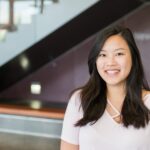
 April Householder, 2018. Photo by Michael Mower.
Having a full week to explore URCAD this year also means viewers will have ample time to browse the available sessions, rather than “rushing from one thing to another,” says Householder, as they used to do at the in-person event. They’ll be able to explore, at their own pace, research on a vast array of topics, from the effects of anti-Asian discrimination during the COVID-19 pandemic to the Black Lives Matter movement, to cancer treatment, skateboarding culture, and online sneaker sales.
Connecting beyond boundaries
In lieu of face-to-face chats, visitors will be able to participate in online discussions with student presenters. Last year a research group in UMBC’s Asian studies department received feedback from researchers in Korea, says Householder. She hopes that this year, opportunities for these kinds of connections will increase with a new feature that enables users who aren’t from UMBC to comment through URCAD’s VoiceThread interface.
Within the UMBC community itself, Householder hopes students, faculty, and staff will take advantage of the opportunity to explore “things outside their disciplinary box.” Artists, scientists, humanists, social scientists, and engineers can all benefit from each others’ feedback, she explains.
Constraints generate creativity
Last year, when students had to quickly pivot from in-person presentations to using VoiceThread, “they had to learn an additional skill on the fly,” says Householder. This year, students are more prepared to take full advantage of all that the online format offers.
Further, due to the constraints of COVID, student researchers have become even more creative in using technology not just to display their research, but to pursue their research at a time when in-person interviews, fieldwork, and traditional performances aren’t possible. Students learned to do interviews online, adjusted their sample sizes, and navigated lab research within physical distancing guidelines. They also responded to the pandemic by examining the changes in society and in themselves.
One advantage of the online format is that the presentations are available to view in perpetuity. “We now have an archive of the event so we can use it as a teaching tool for future generations of URCAD presenters and mentors,” Householder says.
She finds this addition of an expanded archive and URCAD’s global reach to be fitting developments as the event marks its 25th anniversary. To celebrate the milestone, URCAD will feature a special video “fireside chat” with founders Diane Lee, Kathy Sutphin, Elizabeth Pennington, and Janet McGlynn.

Klaudine Wakasa. Image courtesy of Wakasa.
Viewers will also hear a keynote by Klaudine Wakasa ‘08, financial economics, who serves as a strategy advisor for clean technology ecosystems, consulting with international governments.
UMBC students, faculty, staff, and alumni, and the general public, are invited to view these special sessions, and hundreds of available students presentations at urcad.umbc.edu, April 19-25, 2021. Featured below are a few student presentations that give a glimpse into the range of what will be available. Each has been shaped in some way by the COVID-19 pandemic—in topic, approach, or format.
“COVID-19 telehealth and telerehabilation reflections: Understanding the stroke survivor and caregiver perspectives”
Frances Watson ‘21, computer science, conducted research on telehealth and telerehabilitation services during COVID-19 through UMBC’s Bodies in Motion Lab. “I am investigating the stroke survivor and caregiver perspectives to understand how socioeconomic disparities affect this population,” Watson explains.

Frances Watson. Photo courtesy of Watson.
Watson has so far conducted 20 interviews with rehabilitation specialists about their experience with telehealth appointments, alongside her graduate mentor, human-centered computing Ph.D. student Adegboyega Akinsiku. She is also currently interviewing stroke survivors and caregivers.
“The COVID-19 pandemic not only changed how we conduct these interviews, but also the analysis of them,” says Watson. “We conducted and continue to conduct these interviews on teleconferencing platforms such as Cisco Webex and Zoom, allowing us to video-record them. In comparison, when we were in person we would have an audio recording device present. Now we can rewatch the video recordings for our data analysis.”
The fact that her research technique adjusted to match the format of the telehealth appointments themselves “has proven very useful” in surfacing insights, she says.
Watson was previously able to gain research experience through the Stanford SURF program. As a Center for Women in Technology Scholar and Undergraduate Research Award (URA) Scholar, she also knows the power of research opportunities in developing an identity and career pathway as a STEM researcher, as well as the value of peer support. This has motivated her leadership on campus, including as Student Government Association president in spring 2020.
“this is it: A poetic response to the anti-Asian racism during the COVID-19 pandemic”
Just after the pandemic started last March, Calista Ogburn ’21, health administration and policy, felt hurt and angry as she heard about rising anti-Asian hate crimes and racism. Then she herself had an upsetting encounter at a Home Depot. “In that moment, standing in the Home Depot aisle next to the grills, I knew I had to write a poetry collection,” she says.
It was a process that involved many nights of tears, processing heavy emotions. “Reliving past experiences of racism and microaggressions in addition to writing responses to news headlines of anti-Asian racism was utterly exhausting,” she says. She wrote around the clock, and after publication she was gratified to learn “how my poetry has supported others during this turbulent time.”
 Poetry collection “this is it.” Image courtesy of Ogburn.
Ogburn does not intend to pursue a career in poetry, but she says, “I hope it remains my best friend.” Ogburn will present poetry from her collection “this is it” at URCAD. “My hope,” she previously shared with UMBC Magazine, “is that these poems can touch those who are feeling loss, loneliness, or the combined grief and rage of experiencing racism.”
 Calista Ogburn poses with her books of poetry. Photo from calista-ogburn.com.
“Modeling radio emission from tidal disruption events”
Omar French ’21, physics and mathematics, came to UMBC to become a theoretical physicist and he will be leaving soon to do just that. He found COVID-19 increased demands on his faculty mentors’ time, requiring him to move forward with his work more independently than before.
“I’m sure most people can agree that controlling one’s work is much more gratifying than the contrary, but of course, it’s a bit like being in the wilderness,” says French. “It forces you to think for yourself and to be confident in what you’re doing.”
 Omar French. Photo courtesy of French
French’s research on supermassive black holes has yielded insights. “Perhaps the most remarkable technical thing I’ve learned is that the mass of supermassive black holes central to inactive galaxies can be estimated reasonably from measuring only a few factors,” he explains.
After graduating, French will begin a physics Ph.D. program at University of Colorado Boulder. He describes the past year challenging, but also as a period that helped him grow as a scientist more than any other time of his life. As a result, he is heading off to graduate skill with new skills and a critical eye.
“The obedient body: Researching trained and culturally informed movement biases”
It was during a gender and women’s studies course that URA Scholar Gretta Zinski ’22, dance, read something that rocked her world. She says it was fascinating to learn about how the different social conditioning that men and women experience is reflected in how each gender moves. “The excerpt inspired me to assess my own habits, interests, and biases in an attempt to figure out what were my own thoughts and what I had been taught about my own femininity and beliefs,” she says.
Unfortunately, COVID kept the scope of Zinski’s project smaller than she would have liked, but she was still able to access fascinating findings. “Biases do affect our behavior, which translates into movement,” she says. “The physiological connections between the body and the mind were so interesting to me.”
 Still image from Zinski’s dance film project, courtesy of Zinski.
Zinski plans to continue her research and use it to plan bias deconstruction workshops. Of her pandemic research experience, she says, “I learned so much about myself and how to work on my own. This is going to be a very important skill for me and my future career as a self-employed artist.”
“Performing traditional Chinese folk songs”
International travel may have been largely shut down this year, but that didn’t stop URA Scholar Mark Beachy ’21, Asian studies, from exploring China. “When I sing traditional Chinese folk songs I am transported to China and I am experiencing the stories from long ago that are told through the lyrics and music. And it brings me great joy to do that and to share it with others,” he says.
 Mark Beachy. Photo courtesy of Beachy.
Beachy’s URCAD presentation features a video performance of the folk song “Jasmine.” He painstakingly edited together his vocal performance with accompaniment from a pianist in Illinois and a guzheng player in China. Beachy found both musicians online. “When singing traditional Chinese folk songs or any song it is important to connect with the other musicians in order to give the audiences an authentic performance of music that deserves respect,” he says.
Beachy returned to college in his 40s after a career as a professional actor and a writer of musicals, wanting to learn something new. Though not of Chinese descent, he has a passion for Chinese culture, language, and history.
His eventual goal is to teach English to Chinese speakers, and he hopes music can be a helpful teaching tool. “Music is a great way to learn a language,” he says. After graduating, he plans to earn a master’s degree at UMBC in Teaching English as a Second Language.
“Interpretation of models of care in residential communities for older adults”
“I am passionate about working with an underserved population and providing elders with quality care,” says Sydney Siegel ‘20, management of aging services. Siegel graduated in Fall 2020 from UMBC’s Erickson School and now works in an assisted living community. Her URCAD project is an analysis of models of care that older adults can experience. “The models of care I studied are about enhancing quality of life and quality of care, something I hope all aging services strive for,” she says.
Interviewing older people proved to be a challenge during the COVID-19 pandemic. In addition to many care facilities being inaccessible, staff members caring for older adults were incredibly busy. However, Siegel found ways to complete interviews online. “I made great connections and heard wonderful stories from participants,” she shares.
Siegel, a URA scholar, credits Erickson School faculty mentor Louise M. Murray with helping her grow in the field. “I definitely felt imposter syndrome when I started the research, but I learned to see my inexperience as a good thing, Siegel says. “Learning is so powerful and I feel grateful to have learned so much.” She looks forward to continuing to use research to inform care she provides for older adults.
“Optimizing in-situ longevity of silver nanoplates”
As a first-year student who started college in the midst of a pandemic, Dariush Aligholizadeh ‘24, biochemistry and computer science, did not have a typical introduction to UMBC. He didn’t want that to affect his ability to get started with research right away, but it was a lot to manage. “I was trying to adjust to college life while also trying to conduct research safely and securely within COVID-19 restrictions,” he says.

Dariush Aligholizadeh. Image courtesy of Aligholizadeh.
Aligholizadeh was able to find a compelling in-person research opportunity in a lab that employed strict physical distancing. His project involved synthesizing silver nanoplates “for their ability to reflect radiation and light to very high degrees.” He explains, “Basically, I make tiny triangles that kill cancer.” And his research experience proved highly gratifying.
“Every aspect of chemistry is in its own way beautiful, and watching these textbook principles come to life in my project is like watching magic happen. I take simple grains of silver salts and they come together in these beautiful sharp triangular structures, almost as if they were put together by hand,” he explains.
 Electron microscope image of nanoplates. Courtesy of the Devadas Lab.
Aligholizadeh believes his research experience has already improved his skills in calculus, biology, and organic chemistry, and helped solidify his plans to eventually become a medical doctor. He has also found that the challenges of COVID have required him to improve his time-management and online communication skills. Still, he looks forward to learning in-person again when it’s safe to do so.
The UMBC community and general public can see these presentations and many more at urcad.umbc.edu, April 19-25, 2021.
Featured image: Calista Ogburn, 2018. Photo by Marlayna Demond ’11 for UMBC.
Article written by Karen Stysley for UMBC News.
]]>
UMBC’s Undergraduate Research and Creative Achievement Day (URCAD) has burst out of the ballroom and onto computer screens around the world. For the second year in a row, the popular undergraduate...
https://umbc.edu/stories/urcad-2021-showcases-creativity-resilience-of-umbc-student-researchers/
https://my3.my.umbc.edu/api/v0/pixel/news/119658/guest@my.umbc.edu/b0fdbef5295bf80807456fdcff41891f/api/pixel
arts-and-culture
asianstudies
cahss
chembiochem
cnms
coeit
community
csee
dance
ericksonschool
mathstat
page1
physics
policy-and-society
saph
science-and-technology
undergradresearch
UMBC News & Magazine
https://my3.my.umbc.edu/groups/umbc-news-magazine
https://assets1-my.umbc.edu/system/shared/avatars/groups/000/001/943/24435aa6207c452e7bc15cc74b42c7bb/xsmall.png?1748556657
https://assets1-my.umbc.edu/system/shared/avatars/groups/000/001/943/24435aa6207c452e7bc15cc74b42c7bb/original.png?1748556657
https://assets2-my.umbc.edu/system/shared/avatars/groups/000/001/943/24435aa6207c452e7bc15cc74b42c7bb/xxlarge.png?1748556657
https://assets2-my.umbc.edu/system/shared/avatars/groups/000/001/943/24435aa6207c452e7bc15cc74b42c7bb/xlarge.png?1748556657
https://assets3-my.umbc.edu/system/shared/avatars/groups/000/001/943/24435aa6207c452e7bc15cc74b42c7bb/large.png?1748556657
https://assets1-my.umbc.edu/system/shared/avatars/groups/000/001/943/24435aa6207c452e7bc15cc74b42c7bb/medium.png?1748556657
https://assets2-my.umbc.edu/system/shared/avatars/groups/000/001/943/24435aa6207c452e7bc15cc74b42c7bb/small.png?1748556657
https://assets1-my.umbc.edu/system/shared/avatars/groups/000/001/943/24435aa6207c452e7bc15cc74b42c7bb/xsmall.png?1748556657
https://assets2-my.umbc.edu/system/shared/avatars/groups/000/001/943/24435aa6207c452e7bc15cc74b42c7bb/xxsmall.png?1748556657
UMBC News & Magazine
0
0
false
Mon, 12 Apr 2021 03:46:42 -0400
UMBC ranks in the top 100 public universities to receive federal research funding
In the latest Higher Education Research and Development (HERD) survey, UMBC has ranked among the United States’ top 100 public institutions in federal research support.
The annual survey aggregated federal research and development expenditures for fiscal year 2019. UMBC reported more than $80 million in research and development expenditures in 2019, the highest reported amount since 2012.
“It is an area of pride for us to make it into the top 100,” says Karl V. Steiner, vice president for research at UMBC. “We’ve now had year-over-year growth in the last six years. We grew our expenditures by 24 percent during that time—a very significant increase.”
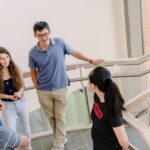
 Karl Steiner (left) and Aryya Gangopadhyay at the Pi Squared opening in 2018.
Within the HERD rankings, UMBC is now #122 in overall research and development expenditures among public institutions, #145 in federal research and development expenditures among all institutions, and #169 overall in expenditures among all institutions. UMBC’s funding sources include NASA, the National Science Foundation (NSF), the Department of Health and Human Services, and many others.
“The expenditures are one key method to get a sense of our faculty and students’ research productivity,” Steiner notes. “These rankings also help us see how UMBC is progressing in meeting our public impact research goals.”
NASA-UMBC connection
UMBC continues to fortify its relationship with NASA, ranking #15 overall in NASA funding (#11 amongst public universities). Currently, more than 170 researchers who are UMBC faculty members and research scientists collaborate with NASA Goddard.

Zhibo Zhang discusses an image collected via satellite with his lab group.
Funding from NASA has contributed to many UMBC-led scientific ventures, including the work of Zhibo Zhang, associate professor of physics.His Aerosol, Cloud, Radiation, Observation, and Simulation (ACROS) research group analyzed data collected from instruments on aircrafts and NASA’s orbiting satellites such as CALIPSO, CloudSat, and MODIS.
They sought to better understand how tiny particles in the atmosphere, such as aerosols and cloud droplets, interact with each other and the radiations from the Sun and Earth, and how these interactions influence our weather and climate systems.
 Zhibo Zhang (at right) with students (clockwise from lower left) Qianqian Song, Chamara Raja, Kevin Zheng, and Olivia Norman in 2019.
Explorations in the urban environment
In geosciences, atmospheric, and ocean sciences, UMBC ranked #39 in federal funding. Amongst UMBC’s federally-funded projects is Claire Welty’s study exploring Earth’s “critical zone”—from treetops to weathered bedrock—in urban centers along the Eastern Seaboard. NSF awarded Welty and her team a $4.8 million Critical Zone Collaborative Network grant to execute this project over five years.
Welty is director of UMBC’s Center for Urban Environment Research and Education (CUERE) and a professor of chemical, biochemical, and environmental engineering (CBEE). She is collaborating with Andrew Miller, professor of geography and environmental systems, and researchers in four other East Coast cities.
 Claire Welty (left) and Andy Miller (right) at a field site in Catonsville. Photo by Victor Fulda.
Human influence on groundwater is one of the many issues they are exploring. “Groundwater is a hidden resource that feeds streams and rivers. In cities, people are typically not using wells for water consumption but groundwater is part of the hydrologic cycle that affects ecosystems,” Welty explains. “Streams lead to rivers and rivers go to potable water intakes for cities, so it’s all connected.”
Despite the COVID-19 pandemic slowing down many research initiatives, Welty and Miller have continued to move their work forward. The team has begun conducting field research that has included subsurface imaging of project field sites, collecting water samples from each of the targeted sites, and deploying water quality sensors. Welty is expecting to bring her first Ph.D. student onto the research team by this fall.
Interdisciplinary approach to environmental problem-solving
Tamra Mendelson, professor of biological sciences, received a $2.8 million NSF Research Traineeship (NRT) grant in 2019 as principal investigator for the Interdisciplinary Consortium for Applied Research in the Environment (ICARE). The training program is designed to broaden participation in the environmental workforce and empower the next generation of scientists to apply research to environmental problem-solving.
 Tamra Mendelson at a research field site. Photo courtesy Mendelson.
ICARE will focus on the socio-ecological challenges facing the Baltimore Harbor. “The health of the Baltimore Harbor is improving, and I am hopeful that the work of ICARE will bolster ongoing efforts to make the Baltimore Harbor a model for the whole country,” says project partner Lee Blaney, associate professor of CBEE.
“It is my hope that the research focus on the Baltimore Harbor will set up ICARE and UMBC to make lasting, sustainable, and positive impacts in our city,” he notes.
 Lee Blaney (left) with two students in his lab, 2019.
“ICARE was originally conceived as a way for ecologists and evolutionary biologists on campus to get together. The NRT added this component of engaging the community in our research,” Mendelson explains.
“At UMBC we are all so invested in this mission of inclusive excellence,” she says. “The racial and ethnic diversity is really low in the environmental sciences, so we wanted to make a difference there as well.”
UMBC partners across five disciplines and three colleges used the time amid the pandemic to organize the program, which will be funded until 2024. Over the next few years, they expect that 30 students will participate. Each student will receive full funding toward a master’s degree. They will also have a chance to collaborate with UMBC faculty, community stakeholders, and scientists and engineers in government, non-profit organizations, and industry careers.
Social science research in action
In the social sciences, UMBC ranks #60 in overall funding sources and #30 in federal funding. Among public universities specifically, UMBC is #37 in overall funding and #20 in federal funding for the social sciences.
Since 2019, the NIH’s National Institute of Aging (NIA) has awarded Laura Girling, director of UMBC’s Center for Aging Studies, more than $750,000 to examine the experiences of people with dementia who live alone in community settings. Recently, Girling has used this funding to research how COVID-19 social distancing guidelines impact people with dementia. She also examines the ethics of including people living with dementia as research participants.
 Laura Girling, director of UMBCs Center for Aging Studies. Photo courtesy of Girling.
“The social sciences are a hallmark of the UMBC experience, and this is reflected in the funding,” says Steiner. “The excellence and national competitiveness of all of our research programs allows us to grow our research portfolio and pursue more funding for it.”
Photos by Marlayna Demond ’11 for UMBC, unless otherwise noted.
Article written by Adriana Fraser for UMBC.
]]>
In the latest Higher Education Research and Development (HERD) survey, UMBC has ranked among the United States’ top 100 public institutions in federal research support. The annual survey...
https://umbc.edu/stories/umbc-ranks-in-the-top-100-public-universities-to-receive-federal-research-funding/
https://my3.my.umbc.edu/api/v0/pixel/news/119665/guest@my.umbc.edu/233707aa30a28f694e706b7770facb97/api/pixel
biology
cahss
cbee
cnms
coeit
ges
physics
policy-and-society
research
saph
science-and-technology
UMBC News & Magazine
https://my3.my.umbc.edu/groups/umbc-news-magazine
https://assets1-my.umbc.edu/system/shared/avatars/groups/000/001/943/24435aa6207c452e7bc15cc74b42c7bb/xsmall.png?1748556657
https://assets1-my.umbc.edu/system/shared/avatars/groups/000/001/943/24435aa6207c452e7bc15cc74b42c7bb/original.png?1748556657
https://assets2-my.umbc.edu/system/shared/avatars/groups/000/001/943/24435aa6207c452e7bc15cc74b42c7bb/xxlarge.png?1748556657
https://assets2-my.umbc.edu/system/shared/avatars/groups/000/001/943/24435aa6207c452e7bc15cc74b42c7bb/xlarge.png?1748556657
https://assets3-my.umbc.edu/system/shared/avatars/groups/000/001/943/24435aa6207c452e7bc15cc74b42c7bb/large.png?1748556657
https://assets1-my.umbc.edu/system/shared/avatars/groups/000/001/943/24435aa6207c452e7bc15cc74b42c7bb/medium.png?1748556657
https://assets2-my.umbc.edu/system/shared/avatars/groups/000/001/943/24435aa6207c452e7bc15cc74b42c7bb/small.png?1748556657
https://assets1-my.umbc.edu/system/shared/avatars/groups/000/001/943/24435aa6207c452e7bc15cc74b42c7bb/xsmall.png?1748556657
https://assets2-my.umbc.edu/system/shared/avatars/groups/000/001/943/24435aa6207c452e7bc15cc74b42c7bb/xxsmall.png?1748556657
UMBC News & Magazine
0
0
false
Mon, 29 Mar 2021 21:40:05 -0400
UMBC’s Anthony Johnson honored for decades of research, mentorship, service
Anthony Johnson, a professor of both physics and computer science and electrical engineering (CSEE) at UMBC, has spent forty years investigating uses for ultrashort pulse lasers. Shrinking cancerous tumors, optimizing long-distance communications, inactivating viruses that commonly infect seafood species, developing new nanoscale materials—he seems to have done it all.
In addition to being an accomplished researcher, Johnson has successfully mentored dozens of students from all backgrounds as they pursued advanced degrees, maintaining contact and continuing to offer support long after graduation. And he’s held key leadership roles in his field, from co-chairing the annual Conference on Lasers and Electro-Optics (CLEO) in 1992, to serving as president of the Optical Society in 2002 and as the editor-in-chief of Optics Letters, the premier peer-reviewed optics journal, from 1995 – 2001.
This year, Johnson’s long-term commitment has resulted in a new accolade: the Stephen D. Fantone Distinguished Service Award from the Optical Society. The award is presented each year to someone who has served the Optical Society in an “outstanding way” over an extended period.

Anthony Johnson. Photo courtesy Anthony Johnson.
Ever humble, “Being a past president [of the Optical Society], being on the board, and so forth, when I saw this email about this award, my initial thought was, ‘Ok, they want me to be on the committee to select the awardee,’” Johnson recalls. “It never occurred to me that it was for me. It was quite surprising, and it’s quite an honor.”
Inclusion imperative
Beyond his work within the Optical Society, Johnson was also recently named to the Committee on Diversity and Inclusion on the Technical Advisory Board of the Institute for Electrical and Electronics Engineers (IEEE). Johnson says there hasn’t been nearly enough change in the number of non-white and women physicists and engineers since he started in the 1970s, and he has made supporting inclusion in physics and engineering a cornerstone of his career.
“There’s still a lot to be done in our professional societies to build up and attract both women and minorities,” Johnson says. “We still have work to do to expand the opportunities to a broader set of people and bring in new ideas. So being on some of these committees is important.”
Closer to home, Johnson works hard to create an inclusive environment in his own research group. “I like to think of us as a family,” he says.
 Anthony Johnson (center front) with his research group in 2011. Photo courtesy Anthony Johnson.
Johnson knows how powerful it can be for young scientists to meet researchers with more experience and have opportunities to forge connections. With this in mind, he says, “I try to give my students as many opportunities as possible to go out and give presentations and be involved in the field of science.”
When working with students of all backgrounds, Johnson’s “kindness comes through,” says Stephen Fantone, after whom the award is named. Fantone has known Johnson for many years through the Optical Society, but has no role in the awardee selection process. He shares, “Anthony understands the role of nurturing students, helping them to find their inner spring and to fulfill their potential and their own personal dreams.”
Expert, colleague, friend
Students are not the only beneficiaries of Johnson’s support. “I gained many nuggets from his advice and leadership to the American Physical Society on graduate education and diversity, long before I made it to UMBC,” shares Belay Demoz, professor of physics and director of the Joint Center for Earth Systems Technology (JCET). “As another Black physicist at UMBC, he is my go-to guy for advice on how to handle delicate things; he is generous with his time and has a calming effect on me.”
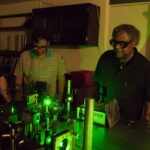
 Anthony Johnson (right) works with students in his lab on a laser setup at CASPR in 2017. Photo by Marlayna Demond ’11 for UMBC.
Johnson’s colleagues recognize the range of important contributions he has made over the years. “The CSEE department is delighted to hear of these richly deserved honors for Dr. Johnson. He is a valued colleague in the department, and a world-renowned authority in the area of optics and photonics,” shares Anupam Joshi, professor and chair of CSEE.
Joshi notes, “These awards recognize that in addition to being a great researcher, he embodies the service mission of a public university, addressing important societal challenges like diversity and inclusion through his service to the major professional organizations.”
An exhilarating beginning
Johnson got his start in optics as an undergraduate at Brooklyn Polytechnic Institute (now the NYU Tandon School of Engineering) in the 1970s. A physics instructor encouraged him to pursue an internship at Bell Labs through the company’s Summer Research Program for Women and Minorities. The experience set Johnson’s entire career in motion.
“That’s where I really got my love of science and optics,” Johnson says.
 Anthony Johnson interning at Bell Labs in 1974. At left, he is with mentor David Auston. Photos courtesy Anthony Johnson.
He earned his Ph.D. in physics from City College of New York, completing his doctoral research at Bell Labs. After his Ph.D., Johnson continued to work at Bell Labs for nearly 15 years, when the lab was in its heyday. “During my doctoral research at Bell Labs, I learned just how many celebrities in physics were there. I could walk down the hall and talk to people we put on pedestals,” Johnson remembers. “It was quite an experience.”
At Bell Labs, Johnson also had the opportunity to mentor interns coming through the same program that had gotten him started. His physics instructor’s impact on his trajectory was not lost on Johnson, and he made a concerted effort to pay it forward with his interns. Eventually, Johnson remembers, “I said, ‘You know, I could enjoy doing this at a university.’”
New home, same mission
So, Johnson made the move to academia. After eight years as a department chair at the New Jersey Institute of Technology, he joined UMBC in 2003. In 2006, he became the UMBC lead on the university’s very first inter-institutional research center when one of his former Bell Labs colleagues, now at Princeton University, suggested the idea.
 Members of Johnson’s lab group manipulate a complicated laser setup in the lab. Photo by Mralayna Demond ’11 for UMBC, taken 2017.
NSF funded the Engineering Research Center (ERC), named Mid-Infrared Technologies for Health and the Environment (MIRTHE), for 10 years. The center supported research, graduate students, and an annual weeklong meeting where the students from the participating universities shared their progress and forged lasting connections. The six-institution collaboration was headquartered at Princeton, and Johnson served as one of two deputy directors.
The center’s work largely focused on medical applications of infrared technologies. For example, one of the group’s inventions included a breathalyzer-style device to detect ammonia, which can indicate liver and kidney problems.
Today, Johnson serves as the director of UMBC’s Center for Advanced Studies in Photonics Research (CASPR). “I’m cherishing being in academia and working with faculty and students, and, in particular, having students and graduating students pursuing advanced degrees,” Johnson says. “It’s really a satisfying process and enterprise, so that has been quite enjoyable.”
Distinctive approach to leadership
Colleagues also cherish their time with Johnson. In particular, Fantone says, Johnson is well-suited to handle challenging conversations. “In conversation, you can be on opposite sides of an issue, but he doesn’t adopt polarizing tactics,” Fantone says. “He wants to have civil discourse, which leads both parties in the discussion to a better place.” Fantone has seen this play out time and again in conversations with students and colleagues.
 Another perspective on one of the laser setups in Johnson’s research laboratory. Photo by Marlayna Demond ’11 for UMBC, taken 2017.
David Auston, one of Johnson’s first mentors at Bell Labs with a lengthy career in research and academic administration, is “thrilled” that Johnson is the 2021 award recipient. “Anthony is an outstanding scientist who has fulfilled many key leadership roles with distinction both in the Optical Society and in the scientific community at large,” Auston says. “This is a most deserving recognition of his numerous important contributions.”
As he enters his fifth decade of professional life, it seems certain Johnson will keep on giving to his community by generating scientific advances, creating meaningful relationships, and inspiring others. As Fantone puts it, “Working with Anthony puts a smile on your face, even when you are working on serious problems. And when you work with Anthony, you have high confidence that the effort is going to be successful.”
“He’s just a person you want in the trenches with you,” Fantone says. “Anthony is an exemplar of a complete human being.”
Banner image: Johnson, right, examines a laser setup in his laboratory. Photo by Marlayna Demond ’11 for UMBC, taken 2017.
]]>
Anthony Johnson, a professor of both physics and computer science and electrical engineering (CSEE) at UMBC, has spent forty years investigating uses for ultrashort pulse lasers. Shrinking...
https://umbc.edu/stories/umbcs-anthony-johnson-honored-for-decades-of-research-mentorship-service/
https://my3.my.umbc.edu/api/v0/pixel/news/119668/guest@my.umbc.edu/3dbd04af6396fcb9872e9766e46b9543/api/pixel
cnms
coeit
csee
diversityandinclusion
page1
physics
science-and-technology
UMBC News & Magazine
https://my3.my.umbc.edu/groups/umbc-news-magazine
https://assets1-my.umbc.edu/system/shared/avatars/groups/000/001/943/24435aa6207c452e7bc15cc74b42c7bb/xsmall.png?1748556657
https://assets1-my.umbc.edu/system/shared/avatars/groups/000/001/943/24435aa6207c452e7bc15cc74b42c7bb/original.png?1748556657
https://assets2-my.umbc.edu/system/shared/avatars/groups/000/001/943/24435aa6207c452e7bc15cc74b42c7bb/xxlarge.png?1748556657
https://assets2-my.umbc.edu/system/shared/avatars/groups/000/001/943/24435aa6207c452e7bc15cc74b42c7bb/xlarge.png?1748556657
https://assets3-my.umbc.edu/system/shared/avatars/groups/000/001/943/24435aa6207c452e7bc15cc74b42c7bb/large.png?1748556657
https://assets1-my.umbc.edu/system/shared/avatars/groups/000/001/943/24435aa6207c452e7bc15cc74b42c7bb/medium.png?1748556657
https://assets2-my.umbc.edu/system/shared/avatars/groups/000/001/943/24435aa6207c452e7bc15cc74b42c7bb/small.png?1748556657
https://assets1-my.umbc.edu/system/shared/avatars/groups/000/001/943/24435aa6207c452e7bc15cc74b42c7bb/xsmall.png?1748556657
https://assets2-my.umbc.edu/system/shared/avatars/groups/000/001/943/24435aa6207c452e7bc15cc74b42c7bb/xxsmall.png?1748556657
UMBC News & Magazine
0
0
false
Thu, 25 Mar 2021 16:37:21 -0400
UMBC receives 2020 Engaged Campus Award

Campus Compact Mid-Atlantic (CCMA) has recognized UMBC with its 2020 Engaged Campus Award. This award acknowledges UMBC faculty, staff, students, and community partners’ commitment to service-learning and community engagement within the greater Mid-Atlantic region.
UMBC has been selected out of 38 CCMA institutions across the Mid-Atlantic. This includes other institutions that, like UMBC, have been recognized with the Carnegie Community Engagement Classification.
 Students fill packages of healthy foods and other essential supplies for
UMBC’s Retriever Essentials program. Photo courtesy of Retriever Essentials.
CCMA honors UMBC’s deep dedication in five categories:
- Philosophy and mission of community engagement
- Student support for and involvement in community engagement
- Faculty support for involvement in community engagement
- Community participation and partnerships
- Institutional support for community engagement
The Engaged Campus Award reflects the UMBC community’s dedication to working in partnership with others to increase racial equity, inclusion, and social justice.
Supporting tomorrow’s college students
Kaitlynn Lilly ‘22, physics and mathematics, exemplifies this dedication to community. Lilly shares that until she came to UMBC, she did not have the mentorship and guidance to fully understand or access all the resources college could offer. At UMBC, she found support for her academic and professional goals and numerous opportunities for community engagement. This experience instilled in her a passion for working with students of all backgrounds to achieve their highest goals.

Kaitlynn Lilly.
Photo courtesy of Lilly.
Lilly has served as a tutor at UMBC’s Physics Tutorial Center and a technical aide at the Johns Hopkins University Applied Physics Laboratory. She has carried what she’s learned through those roles to her work as an advisor to two teams of high school girls participating in the Society of Women Engineers Next Design Challenge.
“I want to give that mentorship and academic assistance I didn’t have growing up to those that are coming after me,” shares Lilly. “My goal is to show every student that their dreams of higher education and careers are possible.”
Community engagement hub
The Shriver Center has led UMBC’s community-engaged work for over 30 years. It has prepared and connected faculty, staff, and students from all academic programs with community partners. Its applied learning experiences have helped thousands of students to develop as community-minded agents of change. At the same time, the center has helped hundreds of partner organizations to meet their goals.
 Maggie Holland (left), geography and environmental systems, and Lee Blaney (second from right), chemical, biochemical, and environmental engineering, prepare to plant trees in Costa Rica with a group of UMBC students. Photo courtesy Holland.
“UMBC’s community-engaged activity and the people who make this activity possible give me great hope,” shares Michele Wolff, director of the Shriver Center. “Now more than ever, our community and civic engagement can help change the current narrative and move us towards a more inclusive, equitable, and just society.”
Banner image: Mavis Sanders (center), professor of education, is director of the Sherman Center for Early Learning in Urban Communities. She talks with a parent participating in the Families, Libraries, and Early Literacy Project. A center staff member (right) shows a book to a child participating in the project. Image by Marlayna Demond ’11 for UMBC.
]]>
Campus Compact Mid-Atlantic (CCMA) has recognized UMBC with its 2020 Engaged Campus Award. This award acknowledges UMBC faculty, staff, students, and community partners’ commitment to...
https://umbc.edu/stories/umbc-receives-2020-engaged-campus-award/
https://my3.my.umbc.edu/api/v0/pixel/news/119687/guest@my.umbc.edu/88db7ce179e26deefbd4fa7aa66b3fb8/api/pixel
cnms
community
majoraward
mathstat
physics
shrivercenter
UMBC News & Magazine
https://my3.my.umbc.edu/groups/umbc-news-magazine
https://assets1-my.umbc.edu/system/shared/avatars/groups/000/001/943/24435aa6207c452e7bc15cc74b42c7bb/xsmall.png?1748556657
https://assets1-my.umbc.edu/system/shared/avatars/groups/000/001/943/24435aa6207c452e7bc15cc74b42c7bb/original.png?1748556657
https://assets2-my.umbc.edu/system/shared/avatars/groups/000/001/943/24435aa6207c452e7bc15cc74b42c7bb/xxlarge.png?1748556657
https://assets2-my.umbc.edu/system/shared/avatars/groups/000/001/943/24435aa6207c452e7bc15cc74b42c7bb/xlarge.png?1748556657
https://assets3-my.umbc.edu/system/shared/avatars/groups/000/001/943/24435aa6207c452e7bc15cc74b42c7bb/large.png?1748556657
https://assets1-my.umbc.edu/system/shared/avatars/groups/000/001/943/24435aa6207c452e7bc15cc74b42c7bb/medium.png?1748556657
https://assets2-my.umbc.edu/system/shared/avatars/groups/000/001/943/24435aa6207c452e7bc15cc74b42c7bb/small.png?1748556657
https://assets1-my.umbc.edu/system/shared/avatars/groups/000/001/943/24435aa6207c452e7bc15cc74b42c7bb/xsmall.png?1748556657
https://assets2-my.umbc.edu/system/shared/avatars/groups/000/001/943/24435aa6207c452e7bc15cc74b42c7bb/xxsmall.png?1748556657
UMBC News & Magazine
0
0
false
Tue, 09 Feb 2021 20:58:16 -0500
Quantum computing, but even faster? UMBC researchers explore the possibilities with new NSF grant
Quantum computers have the potential to revolutionize communications, cybersecurity, and more, by dramatically speeding computation, researchers say. But as Sebastian Deffner notes, “Even quantum computing has shortcomings.”
There may be ways to work around some of quantum computing’s limits, however, further enhancing its speed and other aspects of performance. Deffner, assistant professor of physics at UMBC, and Nathan Myers, a Ph.D. student in Deffner’s research group,will explore techniques to do that with a new three-year, $300,000 grant from the National Science Foundation. And in the process, they just might redefine the fundamental laws of physics.
From paper to the real world
Typically, the quantum systems Deffner’s group (and anyone else) have studied are linear, meaning they are defined by mathematical equations that appear as a line when graphed. However, Deffner says, based on the math, “non-linear systems have very unique capabilities that allow you to circumvent many of the standard problems of linear quantum computing.”
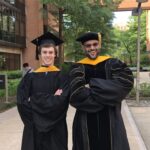
 Nathan Myers (left) and Sebastian Deffner at Myers’s master’s graduation in 2019. Photo courtesy Nathan Myers.
A two-line proof in the grant proposal shows that in theory, non-linear systems can operate much faster than linear quantum systems, and possibly perform better in other ways, too. “Now the question is,” Deffner says, “is that just something you can write on paper, or does it actually play a role in applications?”
Because it doesn’t matter how fast a system could be in theory, if, to go that fast, most of the energy input is released as heat instead of being used for computations. In that case, the total energy required to get anything useful accomplished makes operating such a device impractical in the real world.
That’s why Deffner’s research group focuses on a burgeoning new field known as quantum thermodynamics—the study of the relationships between heat and other forms of energy in quantum systems. Previously, they developed and refined the idea of the “quantum speed limit,” which quantifies the limits of linear quantum systems. Now they’ll expand that work to non-linear systems.
The beauty of math
So, why is it that most of the quantum systems researchers have studied are linear? And where do non-linear systems come in?
Well, quantum systems are composed of many particles that are constantly interacting with each other in a linear fashion. Unfortunately, it’s impossible to precisely define and measure all of those interactions using today’s technology. It is possible, however, to approximate the sum of all of those linear interactions. That approximation can be added to the linear equation describing the overall system as a single term. And here’s the catch: That term is non-linear.
 UMBC’s Physics Building stands on the left, fronted by a quad dusted with snow. Photo by Marlayna Demond ’11 for UMBC.
By accounting for these particle interactions, “we can potentially get a non-linear speed-up from an underlying linear system. That’s the goal,” Myers says. But—and here’s where the thermodynamics comes in—“Say we get this non-linear system,” Myers says. “What energy cost are we paying for it? Is it worth it?”
So a goal of the new project is to better understand the thermodynamics of these non-linear systems. The findings would help quantify how much faster they might be than linear quantum systems, and if it would be feasible to create and run them in the real world.
A monumental leap
The shift from linear to non-linear systems might seem incremental, but it’s actually monumental. Sadi Carnot, a French engineer, developed the field of thermodynamics in the early 19th century to describe steam engines. Then, in the late 20th century, researchers overhauled his foundational principles to apply them to linear quantum systems.
“We have all these statements of thermodynamics that we just recently formulated for quantum systems,” Deffner says. But non-linear systems are so different that another retrofit won’t be sufficient. “What we need to do is go back to the beginnings of quantum thermodynamics and just redo everything.”
They’ll start by developing three foundational mathematical statements describing the non-linear systems. “Those statements will build the foundation upon which we then can build the whole theory,” Deffner says. They’ll test their work on two major algorithms used in database searches and encryption technology.
“Hopefully our work will lead to a broader exploration of how non-linear systems in general can be used to speed up a whole range of quantum devices, or enhance their performance in other ways,” Myers says.
A global UMBC team
During the pandemic, the research group is on four continents and in “I don’t know how many time zones,” according to Deffner. “I told my students from the beginning that we would have to adapt,” he adds. The lab group stays in touch via Slack, WhatsApp, and weekly group meetings. But the work itself is surprisingly low-tech.
 Nathan Myers’s at-home work station. Photo by Nathan Myers.
“The majority of it is pen and paper,” Myers says, plus a lot of reading. “Doing good theory work requires having a really broad knowledge base of what’s being done in different disciplines of physics. Real progress happens when someone realizes that a technique or tool from another area is also applicable to their own problem.”
Myers loves the work, and says his entire thesis grew out of a single question he asked Deffner after class one day. Deffner’s response? “That’s a great question. Want to do a project?”
“It all started with one root question that’s then grown a lot of different branches,” he says. “That’s one of the things that makes it so exciting—you’re following this train of thoughts. You’re pulling at the thread in the sweater, it’s unraveling more and more, and you’re seeing how many different things can grow out of this single question. It’s exciting and it’s fun.”
Disruptive discoveries
In the process of having fun, Myers and Deffner will reformulate thermodynamics for non-linear quantum systems, figure out whether building them is feasible, and get an idea of what their perks might be. Deffner’s team just might also come up with something revolutionary.
Myers tells the story of Carnot, who, in an attempt to optimize the disruptive technology of his day, ended up conceiving the laws of thermodynamics. “By trying to determine the most efficient steam engine possible, he ended up deriving perhaps the most fundamental law in all of physics,” Myers says.
“Now we’re in a similar position to Carnot,” he suggests. “We have this new disruptive technology that’s emerging—it was steam engines for him, quantum devices for us—so let’s do the same thing, and hope something really incredible falls out of it.”
Banner image: Sebastian Deffner. Photo by Marlayna Demond ’11 for UMBC.
]]>
Quantum computers have the potential to revolutionize communications, cybersecurity, and more, by dramatically speeding computation, researchers say. But as Sebastian Deffner notes, “Even quantum...
https://umbc.edu/stories/quantum-computing-but-even-faster-umbc-researchers-explore-the-possibilities-with-new-nsf-grant/
https://my3.my.umbc.edu/api/v0/pixel/news/119697/guest@my.umbc.edu/8c4fc7c1ff19757ea60a931799d9fdac/api/pixel
cnms
gradresearch
physics
research
science-and-technology
UMBC News & Magazine
https://my3.my.umbc.edu/groups/umbc-news-magazine
https://assets1-my.umbc.edu/system/shared/avatars/groups/000/001/943/24435aa6207c452e7bc15cc74b42c7bb/xsmall.png?1748556657
https://assets1-my.umbc.edu/system/shared/avatars/groups/000/001/943/24435aa6207c452e7bc15cc74b42c7bb/original.png?1748556657
https://assets2-my.umbc.edu/system/shared/avatars/groups/000/001/943/24435aa6207c452e7bc15cc74b42c7bb/xxlarge.png?1748556657
https://assets2-my.umbc.edu/system/shared/avatars/groups/000/001/943/24435aa6207c452e7bc15cc74b42c7bb/xlarge.png?1748556657
https://assets3-my.umbc.edu/system/shared/avatars/groups/000/001/943/24435aa6207c452e7bc15cc74b42c7bb/large.png?1748556657
https://assets1-my.umbc.edu/system/shared/avatars/groups/000/001/943/24435aa6207c452e7bc15cc74b42c7bb/medium.png?1748556657
https://assets2-my.umbc.edu/system/shared/avatars/groups/000/001/943/24435aa6207c452e7bc15cc74b42c7bb/small.png?1748556657
https://assets1-my.umbc.edu/system/shared/avatars/groups/000/001/943/24435aa6207c452e7bc15cc74b42c7bb/xsmall.png?1748556657
https://assets2-my.umbc.edu/system/shared/avatars/groups/000/001/943/24435aa6207c452e7bc15cc74b42c7bb/xxsmall.png?1748556657
UMBC News & Magazine
0
0
false
Thu, 21 Jan 2021 23:05:09 -0500
UMBC team reveals possibilities of new one-atom-thick materials

New 2D materials have the potential to transform technologies, with applications from solar cells to smartphones and wearable electronics, explains UMBC’s Can Ataca, assistant professor of physics. These materials consist of a single layer of atoms bound together in a crystal structure. In fact, they’re so thin that a stack of 10 million of them would only be 1 millimeter thick. And sometimes, Ataca says, less is more. Some 2D materials are more effective and efficient than similar materials that are much thicker.
Despite their advantages, however, 2D materials are currently difficult and expensive to make. That means the scientists trying to create them need to make careful choices about how they invest their time, energy, and funds in development.
New research by Daniel Wines, Ph.D. candidate in physics, and Ataca gives those scientists the information they need to pursue high-impact research in this field. Their theoretical work provides reliable information about which new materials might have desirable properties for a range of applications and could exist in a stable form in nature. In a recent paper published in ACS Applied Materials and Interfaces, they used cutting-edge computer modeling techniques to predict the properties of 2D materials that haven’t yet been made in real life.
“We usually are trying to stay five or so years ahead of experimentalists,” says Wines. That way, they can avoid going down expensive dead ends. “That’s time, effort, and money that they can focus on other things.”

Daniel Wines presents his research at the 2019 American Physical Society meeting in Boston. Photo courtesy Daniel Wines.
The perfect mix
The new paper focuses on the stability and properties of 2D materials called group III nitrides. These are mixtures of nitrogen and an element from group III on the periodic table, which includes aluminum, gallium, indium, and boron.
Scientists have already made some of these 2D materials in small quantities. Instead of looking at mixtures of one of the group III elements with nitrogen, however, Wines and Ataca modeled alloys—mixtures including nitrogen and two different group III elements. For example, they predicted the properties of materials made of mostly aluminum, but with some gallium added, or mostly gallium, but with some indium added.
These “in-between” materials might have intermediate properties that could be useful in certain applications. “By doing this alloying, we can say, I have orange light, but I have materials that can absorb red light and yellow light,” Ataca says. “So how can I mix that so that it can absorb the orange light?” Tuning the light absorption capabilities of these materials could improve the efficiency of solar energy systems, for example.
 This figure from Wines’s and Ataca’s paper shows some of the possible alloys made from nitrogen and the group III elements, with the different elements indicated by different colors.
Alloys of the future
Ataca and Wines also looked at the electric and thermoelectric properties of materials. A material has thermoelectric capability if it can generate electricity when one side is cold and the other is hot. The basic group III nitrides have thermoelectric properties, “but at certain concentrations, the thermoelectric properties of alloys are better than the basic group III nitrides,” Ataca says.
Wines adds, “That’s the main motivation of doing the alloying—the tunability of the properties.”
They also showed that not all of the alloys would be stable in real life. For example, mixtures of aluminum and boron at any concentrations were not stable. However, five different ratios of gallium-aluminum mixtures were stable.
Once production of the basic group III nitrides becomes more reliable and is scaled up, Wines and Ataca expect scientists to work on engineering the materials for specific applications using their results as a guide.
Back to basics…with supercomputers
Wines and Ataca modeled the materials’ properties using supercomputers. Rather than using experimental data as input for their models, “We are using the basics of quantum mechanics to create these properties. So the good part is we don’t have any experimental biases,” Ataca says. “We’re working on stuff that doesn’t have any experimental evidence before. So this is a trustable approach.”
To get the most accurate results requires huge amounts of computing power and takes a long time. Running their models at the highest accuracy level can take several days.
“It’s kind of like telling a story,” Wines says. “We go through the most basic level to screen the materials,” which only takes about an hour. “And then we go to the highest levels of accuracy, using the most powerful computers, to find the most accurate parameters possible.”
“I think the beautiful part of these studies is that we started at the basics and we literally went up to the most accurate level in our field,” Ataca adds. “But we can always ask for more.”
 Can Ataca in the UMBC Physics Building. Photo by Marlayna Demond ’11 for UMBC.
A new frontier
They have continued to move forward into uncharted scientific territory. In a different paper, published within a week of the first in ACS Applied Materials and Interfaces, Theodosia Gougousi, professor of physics; Jaron Kropp, Ph.D. ’20, physics; and Ataca demonstrated a way to integrate 2D materials into real devices.
2D materials often need to attach to an electronic circuit within a device. An in-between layer is required to make that connection—and the team found one that works. “We have a molecule that can do this, that can make a connection to the material, in order to use it for external circuit applications,” Ataca says.
This result is a big deal for the implementation of 2D materials. “This work combines fundamental experimental research on the processes that occur on the surface of 2D atomic crystals with detailed computational evaluation of the system,” Gougousi says. “It provides guidance to the device community so they can successfully integrate novel materials into traditional device architectures.”

Theodosia Gougousi. Photo courtesy Gougousi.
Collaboration across disciplines
The theoretical analyses for this work happened in Ataca’s lab, and the experiments happened in Gougousi’s lab. Kropp worked in both groups.
“The project exemplifies the synergy that is required for science and technology development and advancement,” Gougousi says. “It is also a great example of the opportunities that our graduate students have to work on problems of great technological interest, and to develop a broad knowledge basis and a unique set of technical skills.”
Kropp, who is first author on the second paper, is thrilled to have had this research experience.
“2D semiconductors are exciting because they have the potential for applications in non-traditional electronic devices, like wearable or flexible electronics, since they are so thin,” he says. “I was fortunate to have two excellent advisors, because this allowed me to combine the experimental and theoretical work seamlessly. I hope that the results of this work can help other researchers to develop new devices based on 2D materials.”
Header image: Daniel Wines (far right), Jaron Kropp (second from right), Can Ataca (second from left) and other lab members meet. Photo by Marlayna Demond ’11 for UMBC.
]]>
New 2D materials have the potential to transform technologies, with applications from solar cells to smartphones and wearable electronics, explains UMBC’s Can Ataca, assistant professor of...
https://umbc.edu/stories/umbc-team-reveals-possibilities-of-new-one-atom-thick-materials/
https://my3.my.umbc.edu/api/v0/pixel/news/119726/guest@my.umbc.edu/d6c8be75f66c50e22bd3e0084abea2d7/api/pixel
cnms
gradresearch
physics
research
science-and-technology
UMBC News & Magazine
https://my3.my.umbc.edu/groups/umbc-news-magazine
https://assets1-my.umbc.edu/system/shared/avatars/groups/000/001/943/24435aa6207c452e7bc15cc74b42c7bb/xsmall.png?1748556657
https://assets1-my.umbc.edu/system/shared/avatars/groups/000/001/943/24435aa6207c452e7bc15cc74b42c7bb/original.png?1748556657
https://assets2-my.umbc.edu/system/shared/avatars/groups/000/001/943/24435aa6207c452e7bc15cc74b42c7bb/xxlarge.png?1748556657
https://assets2-my.umbc.edu/system/shared/avatars/groups/000/001/943/24435aa6207c452e7bc15cc74b42c7bb/xlarge.png?1748556657
https://assets3-my.umbc.edu/system/shared/avatars/groups/000/001/943/24435aa6207c452e7bc15cc74b42c7bb/large.png?1748556657
https://assets1-my.umbc.edu/system/shared/avatars/groups/000/001/943/24435aa6207c452e7bc15cc74b42c7bb/medium.png?1748556657
https://assets2-my.umbc.edu/system/shared/avatars/groups/000/001/943/24435aa6207c452e7bc15cc74b42c7bb/small.png?1748556657
https://assets1-my.umbc.edu/system/shared/avatars/groups/000/001/943/24435aa6207c452e7bc15cc74b42c7bb/xsmall.png?1748556657
https://assets2-my.umbc.edu/system/shared/avatars/groups/000/001/943/24435aa6207c452e7bc15cc74b42c7bb/xxsmall.png?1748556657
UMBC News & Magazine
0
0
false
Fri, 11 Dec 2020 17:30:19 -0500
UMBC researchers identify where giant jets from black holes discharge their energy

The supermassive black holes at the centers of galaxies are the most massive objects in the universe. They range from about 1 million to upwards of 10 billion times the mass of the Sun. Some of these black holes also blast out gigantic, super-heated jets of plasma at nearly the speed of light. The primary way that the jets discharge this powerful motion energy is by converting it into extremely high-energy gamma rays. However, UMBC physics Ph.D. candidate Adam Leah Harvey says,“How exactly this radiation is created is an open question.”
The jet has to discharge its energy somewhere, and previous work doesn’t agree where. The prime candidates are two regions made of gas and light that encircle black holes, called the broad-line region and the molecular torus.
A black hole’s jet has the potential to convert visible and infrared light in either region to high-energy gamma rays by giving away some of its energy. Harvey’s new NASA-funded research sheds light on this controversy by offering strong evidence that the jets mostly release energy in the molecular torus, and not in the broad-line region. The study was published in October in Nature Communications and co-authored by UMBC physicists Markos Georganopoulos and Eileen Meyer.

Adam Leah Harvey, photo courtesy A.L. Harvey.
Far out
The broad-line region is closer to the center of a black hole, at a distance of about 0.3 light-years. The molecular torus is much farther out—more than 3 light-years. While all of these distances seem huge to a non-astronomer, the new work “tells us that we’re getting energy dissipation far away from the black hole at the relevant scales,” Harvey explains.
“The implications are extremely important for our understanding of jets launched by black holes,” Harvey says. Which region primarily absorbs the jet’s energy offers clues to how the jets initially form, pick up speed, and become column-shaped. For example, “It indicates that the jet is not accelerated enough at smaller scales to start to dissipate energy,” Harvey says.
Other researchers have proposed contradictory ideas about the jets’ structure and behavior. Because of the trusted methods Harvey used in their new work, however, they expect the results to be broadly accepted in the scientific community. “The results basically help to constrain those possibilities—those different models—of jet formation.”
 Eileen Meyer. Photo by Marlayna Demond ’11 for UMBC.
On solid footing
To come to their conclusions, Harvey applied a standard statistical technique called “bootstrapping” to data from 62 observations of black hole jets. “A lot of what came before this paper has been very model-dependent. Other papers have made a lot of very specific assumptions, whereas our method is extremely general,” Harvey explains. “There isn’t much to undermine the analysis. It’s well-understood methods, and just using observational data. So the result should be correct.”
A quantity called the seed factor was central to the analysis. The seed factor indicates where the light waves that the jet converts to gamma rays come from. If the conversion happens at the molecular torus, one seed factor is expected. If it happens at the broad-line region, the seed factor will be different.

Markos Georganopoulos. Photo by Tim Ford.
Georganopolous, associate professor of physics and one of Harvey’s advisors, originally developed the seed factor concept, but “applying the idea of the seed factor had to wait for someone with a lot of perseverance, and this someone was Adam Leah,” Georganopoulos says.
Harvey calculated the seed factors for all 62 observations. They found that the seed factors fell in a normal distribution aligned almost perfectly around the expected value for the molecular torus. That result strongly suggests that the energy from the jet is discharging into light waves in the molecular torus, and not in the broad-line region.
Tangents and searches
Harvey shares that the support of their mentors, Georganopoulos and Meyer, assistant professor of physics, was instrumental to the project’s success. “I think that without them letting me go off on a lot of tangents and searches of how to do things, this would have never gotten to the level that it’s at,” Harvey says. “Because they allowed me to really dig into it, I was able to pull out a lot more from this project.”
Harvey identifies as an “observational astronomer,” but adds, “I’m really more of a data scientist and a statistician than I am a physicist.” And the statistics has been the most exciting part of this work, they say.
“I just think it’s really cool that I was able to figure out methods to create such a strong study of such a weird system that is so removed from my own personal reality.” Harvey says. “It’s going to be fun to see what people do with it.”
Header image: The remnants of a star torn apart by a black hole form a disk around the black hole’s center, while jets eject from either side. Artist’s rendering courtesy of NASA.
]]>
The supermassive black holes at the centers of galaxies are the most massive objects in the universe. They range from about 1 million to upwards of 10 billion times the mass of the Sun. Some of...
https://umbc.edu/stories/umbc-researchers-identify-where-giant-jets-from-black-holes-discharge-their-energy/
https://my3.my.umbc.edu/api/v0/pixel/news/119728/guest@my.umbc.edu/3a550f92a59c537ca467a64bc30da8c9/api/pixel
cnms
gradresearch
physics
research
science-and-technology
UMBC News & Magazine
https://my3.my.umbc.edu/groups/umbc-news-magazine
https://assets1-my.umbc.edu/system/shared/avatars/groups/000/001/943/24435aa6207c452e7bc15cc74b42c7bb/xsmall.png?1748556657
https://assets1-my.umbc.edu/system/shared/avatars/groups/000/001/943/24435aa6207c452e7bc15cc74b42c7bb/original.png?1748556657
https://assets2-my.umbc.edu/system/shared/avatars/groups/000/001/943/24435aa6207c452e7bc15cc74b42c7bb/xxlarge.png?1748556657
https://assets2-my.umbc.edu/system/shared/avatars/groups/000/001/943/24435aa6207c452e7bc15cc74b42c7bb/xlarge.png?1748556657
https://assets3-my.umbc.edu/system/shared/avatars/groups/000/001/943/24435aa6207c452e7bc15cc74b42c7bb/large.png?1748556657
https://assets1-my.umbc.edu/system/shared/avatars/groups/000/001/943/24435aa6207c452e7bc15cc74b42c7bb/medium.png?1748556657
https://assets2-my.umbc.edu/system/shared/avatars/groups/000/001/943/24435aa6207c452e7bc15cc74b42c7bb/small.png?1748556657
https://assets1-my.umbc.edu/system/shared/avatars/groups/000/001/943/24435aa6207c452e7bc15cc74b42c7bb/xsmall.png?1748556657
https://assets2-my.umbc.edu/system/shared/avatars/groups/000/001/943/24435aa6207c452e7bc15cc74b42c7bb/xxsmall.png?1748556657
UMBC News & Magazine
0
0
false
Wed, 09 Dec 2020 16:39:17 -0500
Exploring Every Angle: Climate Research at UMBC
Researchers across UMBC are using unique, interdisciplinary approaches to explore global environmental challenges. Here are just three examples.
Lipi Mukherjee, Ph.D. ’20, atmospheric physics, developed an algorithm to identify the abundance and type of particles present just under the surface of the ocean. Her algorithm is 6,000 times faster than previous methods.
 (left to right:) Anthony Bratt, Lipi Mukherjee, Dr. Pengwang Zhai, and Dr. Meng Gao, courtesy of the UMBC Atmospheric and Oceanic Optics Group.
“That’s the difference between impossible and doable,” says Mukherjee’s advisor, Pengwang Zhai, assistant professor of physics. Mukherjee trained her model to identify different particle types using neural network technology, rather than relying on existing observational data. This method “has the reliability as well as the speed” today’s scientists need, Mukherjee explains.
The model, which analyzes data collected by orbiting satellites, mostly detects colored dissolved organic matter (CDOMs). Some of these particles can be poisonous to sea life. They can also serve as a proxy for carbon stored in the ocean, which is important to understand in the context of climate change.
Zhai is excited to continue to validate Mukherjee’s model. He’ll also use her model to analyze data coming from three instruments that will launch with NASA’s PACE mission in 2024, including UMBC’s own HARP2.
Mukherjee has moved on to a position at the National Center for Atmospheric Research. She’s applying her knowledge of neural networks to interpret magnetic and thermodynamic properties of the sun’s atmosphere, which can lead to solar flares that interrupt GPS tracking and telecommunication systems. “That’s the beauty of the physics Ph.D.,” Zhai says. “You may not work on the exact same topic after you graduate, but your skill set is highly relevant.”
Answers in the air
Ruben Delgado, assistant research professor at the Joint Center for Earth Systems Technology (JCET), a UMBC partnership with NASA, studies a different resource: our air. Since a major air quality study over Chesapeake Bay in 2011, UMBC has gained national prominence for air quality research. Delgado’s group uses data collected by aircraft, satellites, and ground-based systems to understand where, when, and how much of certain pollutants appear near ground level.
The research led to new regulation that has decreased air pollution in the region. Impressed, the federal Environmental Protection Agency asked UMBC in 2016 to serve as the central hub for a fast-growing network of instruments. Delgado and his students analyze air quality data coming in from sites across the U.S. and Canada.
 Delgado, third from left, with a group of physics students in 2019 next to the observatory on the roof of the physics building. Photo by Marlayna Demond ’11.
The instruments at different sites produce raw data that look slightly different. It’s up to the computer science majors on the team to find ways to analyze it all efficiently and then visualize the results in a way that makes sense to the end user.
Some of the students regularly post their findings on a website affectionately known as the “Smog Blog.” During the worst of this fall’s fires in the West, officials from Pennsylvania called to check on the status of blog posts. The governor expected daily updates on how the smoke was affecting local air quality—and their team was relying on the Smog Blog.
“That’s when we give the wake up call to the students: ‘By the way, your work is being used by government officials,’” Delgado says. “Some of them might not have previously thought at all that their coding skills would be useful for environmental research. It’s a point of pride for the students that their work is being used and highlighted.”
Phytoplankton to polar bears
Rather than collecting data at a distance via satellites, Nicole Trenholm spends much of her time on small boats in the Arctic Ocean, exploring everything from ocean currents to algal blooms to microplastics in ice cores. After earning a bachelor’s in geology, research missions to the Arctic with NASA made her want to pursue an advanced degree.
“I was seeing things and making connections, but I was just a data delivery girl at the time,” Trenholm says. “I wanted to go back to school and learn how to lead the science myself.”
 Trenholm on a research site. Photo courtesy of the Department of Geography and Environmental Systems.
Trenholm has a passion for messy questions about the relationships between melting Arctic glaciers and changes in the surrounding biological communities, from phytoplankton to polar bears. Those interests brought her to UMBC, where she is a Ph.D. student co-advised by geography and environmental systems professor Jeff Halverson and JCET scientist Kevin Turpie.
Trenholm is taking advantage of her fieldwork experience to bridge the gap between climate data collected from afar and ecological data collected on the ground. “I’m doing my best to not go one direction or the other, but really try to stay in between and help solve these crossover questions,” she says.
“Glacier melt isn’t just influencing sea level rise—it’s also influencing the future health of marine ecosystems, fisheries, water quality—all this kind of stuff,” Trenholm adds. “And that’s a story that hasn’t been fully investigated at this point.”
On her next research cruise, she’ll be the only graduate student aboard with a group of senior researchers exploring currents in the Beaufort Sea north of Alaska. The trip will be exciting and educational, but it doesn’t come without risk.
“This is going to be one of the nastier times of year to be up in the oceans,” Trenholm says. “We’ll be out there fighting the seas, collecting data. I’ll be wearing a hard hat and be soaking wet most of the time.”
But she’ll be doing important work, gathering information to help scientists better understand our changing world. And, in the true spirit of a committed scientist, she continues, “It’ll be fun. I brought some audio books and my ukulele.”
*****
Learn more about Retrievers’ roles in researching climate change in the Arctic in this fall 2020 feature On Thin Ice.
Header imager: Delgado, standing, works with students in his lab in 2019. Photo by Marlayna Demond ’11.
]]>
Researchers across UMBC are using unique, interdisciplinary approaches to explore global environmental challenges. Here are just three examples. Lipi Mukherjee, Ph.D. ’20, atmospheric...
https://umbc.edu/stories/exploring-every-angle-climate-research-at-umbc/
https://my3.my.umbc.edu/api/v0/pixel/news/119734/guest@my.umbc.edu/b53a6dade15361cf3a2dbcbf23d29187/api/pixel
cnms
discovery
fall-2020
ges
physics
professorsnottomiss
sidebar
UMBC News & Magazine
https://my3.my.umbc.edu/groups/umbc-news-magazine
https://assets1-my.umbc.edu/system/shared/avatars/groups/000/001/943/24435aa6207c452e7bc15cc74b42c7bb/xsmall.png?1748556657
https://assets1-my.umbc.edu/system/shared/avatars/groups/000/001/943/24435aa6207c452e7bc15cc74b42c7bb/original.png?1748556657
https://assets2-my.umbc.edu/system/shared/avatars/groups/000/001/943/24435aa6207c452e7bc15cc74b42c7bb/xxlarge.png?1748556657
https://assets2-my.umbc.edu/system/shared/avatars/groups/000/001/943/24435aa6207c452e7bc15cc74b42c7bb/xlarge.png?1748556657
https://assets3-my.umbc.edu/system/shared/avatars/groups/000/001/943/24435aa6207c452e7bc15cc74b42c7bb/large.png?1748556657
https://assets1-my.umbc.edu/system/shared/avatars/groups/000/001/943/24435aa6207c452e7bc15cc74b42c7bb/medium.png?1748556657
https://assets2-my.umbc.edu/system/shared/avatars/groups/000/001/943/24435aa6207c452e7bc15cc74b42c7bb/small.png?1748556657
https://assets1-my.umbc.edu/system/shared/avatars/groups/000/001/943/24435aa6207c452e7bc15cc74b42c7bb/xsmall.png?1748556657
https://assets2-my.umbc.edu/system/shared/avatars/groups/000/001/943/24435aa6207c452e7bc15cc74b42c7bb/xxsmall.png?1748556657
UMBC News & Magazine
0
0
false
Wed, 02 Dec 2020 19:31:34 -0500
On Thin Ice
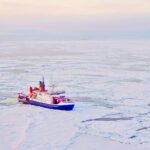
For UMBC alum Nathan Kurtz, the only thing scarier than a surprise visit from a polar bear is a melting ice cap.
When the Polarstern set sail from northern Norway in September 2019, it was looking to get stuck in the ice. But this goal—a death knell for so many historic exploration ships—would be much harder for this modern research vessel to accomplish due to a shrinking ice pack.
The Polarstern was embarking on history’s largest scientific expedition to the Arctic to date. But before the first wave of scientists could start their research, they had to find a suitably robust ice pack, known as a floe, to make their home. This is harder than it sounds in the rapidly warming Arctic. An increasing amount of ice doesn’t survive the summer, which means boats have to travel further north in search of suitably thick ice. But after a nearly two-week journey from Norway, the Polarstern had found its mark.
And this is how Nathan Kurtz, M.S. ’07, Ph.D. ’09, atmospheric physics, ended up standing guard on some floating ice 300 miles from the North Pole armed with a rifle and a mandate to keep an eye out for polar bears.
 Kurtz, pictured on the ice next to research apparatus, courtesy of Kurtz.
Kurtz was part of the first wave of more than 600 scientists from 20 different countries who over the course of the year cycled through the ship as it drifted more than 1500 miles locked in a massive sheet of ice. The goal of the Multidisciplinary drifting Observatory for the Study of Arctic Climate (MOSAiC) expedition was to better understand the link between the Arctic environment and climate change.
Polar bear lookout was “not something I saw myself doing when I was in grad school,” says Kurtz, who didn’t see any bears that day, but by the time he returned to civilization a month later he’d had his fill. “However, UMBC really did prepare me to face challenges,” says Kurtz. “For me, grad school was hard, but it helped me with self-confidence—that this can be done and I can do this.”
Neither Kurtz nor his shipmates had traveled all the way to the Arctic to be polar bear sentinels. It was just a necessary part of the journey that allowed them to do their real job: collecting massive amounts of data on the woefully understudied polar environment. Over the course of its Arctic sojourn, the Polarstern hosted scientists studying everything from zooplankton beneath the ice to the clouds floating above it.
But for Kurtz, the ice itself was the main attraction.
From Icy Moons to Polar Ice Caps
Kurtz’s arrival in the Arctic was the culmination of over a decade of research studying Arctic floes from afar. But his original focus was ice even farther away—the icy moons of Jupiter. A shift in funding from NASA had Kurtz pivot his focus from astrophysics to earth sciences. “But physics applies to the moons of Jupiter and to the Earth,” Kurtz puts it dryly, “so it wasn’t so difficult to switch my focus.”
One of Kurtz’s advisors at UMBC, Raymond Hoff, professor emeritus, says UMBC students are uniquely positioned to lead in atmospheric physics, considered a unique subset in a field that often prioritizes astronomy or astrophysics. UMBC’s relationship with the Earth Science Division of NASA Goddard Space Flight Center to form the Joint Center for Earth Systems Technology allows students to play an active role in ongoing research.
 Scientific teams conduct research at a coring site on MOSAiC ice floe. Alfred-Wegener-Institute / Esther Horvath (CC-BY 4.0)
Hoff himself brought valuable Arctic experience to his classroom, and Kurtz remembers being struck by his advisor’s journeys to the Arctic in the early 1980s. “What amazed me about the Arctic was the stark and pristine beauty of the landscape,” says Hoff. “Even at -45ºF, you would find yourself outside marvelling at the ice crystals which fell out of clear blue skies as any water vapor there would freeze and fall out on your parka.” For about 20 years, Hoff measured pollution at Alert, Northwest Territories, Canada, about as far north as he could get on land. There, researchers discovered that sulfur pollution from Europe and Russia was getting into the high Arctic.
“As a result of our work,” shares Hoff, “the Arctic nations brought in scientific agreements to reduce the inputs of mid-latitudinal pollution going to the Arctic. Some of those pollutants were really surprising since they were pesticides which were used in the tropics. It brought home how small our planet is.”
Kurtz’s work four decades later would continue to rely on the cooperation of numerous stakeholders, as scientists collaborated to study—and perhaps stymie—global warming.
Bridging the Ice Knowledge Gap
As a graduate student, Kurtz worked on methods for determining sea ice thickness based on data from NASA’s ICESat, a polar observation satellite launched in 2003. After earning his Ph.D., Kurtz has continued his work on the properties of polar ice as a scientist at NASA Goddard’s Cryospheric Sciences Branch.
To understand how ice around the poles is changing and what this can tell us about the climate, Kurtz and his colleagues relied heavily on laser data from ICESat, a satellite that passed over the poles bouncing laser light off the ice 40 times per second to get a high resolution map of the sea ice thickness. But when ICESat’s last laser failed in 2009, NASA was left without a dedicated satellite to study the ice caps.
 Three scientists and a bear guard land on a new floe in a transportation device called a “mummy chair” to scout its potential for setting up research stations. Alfred-Wegener Institute / Lianna Nixon (CC-BY 4.0)
NASA’s solution was slightly more hands-on than a satellite—following the laser failure, NASA launched Operation IceBridge. Like ICESat, IceBridge used laser altimeters and radar to observe the Arctic ice sheet, except now they’d use a manned turboprop plane to accomplish the same thing.
Kurtz took over Operation IceBridge in 2015 and helmed the mission until 2018. Hoff shares a story of tuning in to NASA TV to see a story labeled incorrectly on the TV Guide channel as “Ice Bride.” It was really about IceBridge. “You have to laugh,” says Hoff. “I was happy to watch that story and see Nate standing on the ice in the Arctic talking about how important ice thickness is to our understanding of the progression of global warming.”
Each season, Kurtz would travel to the poles for weeks at a time to survey the ice from the air. In the Arctic, Kurtz and his team would depart from an airbase in Greenland and spend upward of eight hours per day in the fuselage of a plane as it zig-zagged back and forth across the Arctic Circle. They would pass the time monitoring the instruments, watching movies, or simply taking in the alien landscape below.
“The scenery outside was really amazing,” Kurtz says. “I never got tired of looking out the window.”
Even if Kurtz wanted to spend more time in the IceBridge plane, the extreme polar weather limited operations to about three months out of the year, which made it difficult to comprehensively survey the polar regions. The upshot was the plane could carry far more instruments than ICESat, including ice penetrating radars that could only work at low altitudes. In this sense IceBridge drastically improved NASA’s understanding of the dynamics of polar ice—but Kurtz wanted to get closer still.
Since 2018, Kurtz has been studying polar ice data sent back by NASA’s shiny new orbiter, ICESat-2, at Goddard Space Flight Center in Maryland. But when he heard about the MOSAiC mission, Kurtz saw a once-in-a-lifetime opportunity. “I had done the airborne work, but on the ground field work is so different,” he says. “Being there would give me a totally different view of how the ice forms and help inspire me to use airborne and satellite data in a different way.”
A New Era of Polar Exploration
One does not simply book a ticket on a month-long trip to the Arctic, of course. After securing the funding to participate in MOSAiC’s research program, Kurtz was required to participate in extensive training in New Hampshire and northern Alaska before departure. Over the course of several weeks in summer 2019, Kurtz along with fellow scientists learned how to shoot a rifle and a flare gun, escape from a sinking helicopter, orchestrate a sea rescue, and protect themselves from polar bears. They were also trained in the art of doing science in the Arctic, learning how to use a giant drill to extract an ice core and drive a snowmobile.
The extensive training was necessary to prepare the scientists for the brutal environment. During the Arctic winter, temperatures can dip dozens of degrees below zero and starting in mid-October the Polarstern would witness five months of total darkness.
 Arctic sea ice in September 2019. Alfred-Wegener-Institute / Sebastian Grote (CC-BY 4.0)
Kurtz recalls reading novels like Endurance, which chronicles explorer Ernest Shackleton’s harrowing efforts to reach the South Pole in 1914. “This book kept sticking in my head even though I felt safe on the ship. There were all kinds of modern communication in case we needed help or ran out of something or if there was some kind of emergency—we could at least talk to someone,” says Kurtz. “Shackleton and his group had none of that. I can’t even imagine.”
In this modern journey, participants would face some of the same challenges as past expeditions—unstable ice sheets, the threat of frostbite, the prospect of hungry bears, diminishing stores of fresh produce—along with new ones: they were limited to just 50 kilobytes of email data per day—barely enough to send a photo. But aside from a brief bout of seasickness during the passage from Norway, Kurtz quickly adapted to the life of a polar seafarer.
A Fresh Perspective on the Ice
To be sure, the days were both literally and figuratively long. When Kurtz and his crewmates arrived in the Arctic at the tail end of summer, the sun was hanging just below the horizon, casting the already alien landscape in a perpetual twilight glow. But given how much work there was to do, the extended daylight was a blessing. As the first of six expedition teams that cycled through the Polarstern that year, Kurtz and his colleagues were responsible for setting up dozens of experiments and research infrastructure that would be used by other scientists over the course of the year.
The nature of the field experiments that surrounded the ship speaks to the diverse expertise of the crew. Some of MOSAiC’s more far flung field sites were up to 30 miles away, accessible only by helicopter. Others took place thousands of feet above and below the ship, where dirigibles or underwater robots collected data and relayed it back to the surface.
 Polar bear mother and cub on starboard side of
 Polarstern
curiously looks at the ship. Alfred-Wegener-Institute / Lianna Nixon (CC-BY 4.0)
Kurtz’s experiments were just a few minutes’ walk from the Polarstern. They were designed to measure changes in the ice’s thickness, density, thermal conductivity, and other properties, which will serve as a ground truth for polar measurements taken from space. The dynamics of the Arctic floe have a lot to tell us about our planet; Kurtz’s experiments are helping us decipher its language.
Being on the ice gave Kurtz a refreshed perspective of an area he could previously only appreciate from satellite data or the window of a plane, both in terms of the immense scale and barren beauty of the Arctic landscape, and what it means to study the ice.
“Science by its nature is very dry and technical, so you’re not necessarily thinking about why something is important when you’re solving an equation, you just do it,” Kurtz says. “But going to take these measurements to make sure we understand what’s happening and what it means for the future put a very different context on the work I do.”
Kurtz says he was struck by the realization that his two elementary school-aged children—who loved to hear stories about his polar bear interactions again and again—will likely never see what he saw during his trip. The Arctic is warming much faster than the rest of the world and its ice sheet is receding at an alarming rate. Over the past few decades it has lost enough winter ice to cover Alaska, Texas, and Montana combined, and many of the regions that used to stay frozen during the summer are now ice-free. Scientists are only just beginning to understand how the Arctic affects and is affected by climate change, but the work of Kurtz and other MOSAiC scientists will fill in a crucial gap in that knowledge.
Kurtz’s retired advisor Hoff adds, “One thing UMBC can be very proud of is the number of its graduates and alumni who are contributing to decision making and making important decisions about the most critical issues which will affect the planet.”
—By Daniel Oberhaus
*****
Learn more about other ways UMBC staff and students are using their research to study and combat the effects of climate change.
Header Image: RV Polarstern in the Arctic. During the MOSAiC expedition the German research icebreaker Polarstern, which is operated by the Alfred Weggener Institute, drifts with the sea ice for a whole year, experiencing several months of polar night. Alfred-Wegener-Institute / Markus Rex (CC-BY 4.0)
]]>
For UMBC alum Nathan Kurtz, the only thing scarier than a surprise visit from a polar bear is a melting ice cap. When the Polarstern set sail from northern Norway in September 2019, it was...
https://umbc.edu/stories/on-thin-ice/
https://my3.my.umbc.edu/api/v0/pixel/news/119735/guest@my.umbc.edu/eff62b5e41130c5dad3ad08c913d1f0a/api/pixel
alumni
alumni-profile
cnms
fall-2020
feature
jcet
nasa-goddard-space-flight-center
physics
UMBC News & Magazine
https://my3.my.umbc.edu/groups/umbc-news-magazine
https://assets1-my.umbc.edu/system/shared/avatars/groups/000/001/943/24435aa6207c452e7bc15cc74b42c7bb/xsmall.png?1748556657
https://assets1-my.umbc.edu/system/shared/avatars/groups/000/001/943/24435aa6207c452e7bc15cc74b42c7bb/original.png?1748556657
https://assets2-my.umbc.edu/system/shared/avatars/groups/000/001/943/24435aa6207c452e7bc15cc74b42c7bb/xxlarge.png?1748556657
https://assets2-my.umbc.edu/system/shared/avatars/groups/000/001/943/24435aa6207c452e7bc15cc74b42c7bb/xlarge.png?1748556657
https://assets3-my.umbc.edu/system/shared/avatars/groups/000/001/943/24435aa6207c452e7bc15cc74b42c7bb/large.png?1748556657
https://assets1-my.umbc.edu/system/shared/avatars/groups/000/001/943/24435aa6207c452e7bc15cc74b42c7bb/medium.png?1748556657
https://assets2-my.umbc.edu/system/shared/avatars/groups/000/001/943/24435aa6207c452e7bc15cc74b42c7bb/small.png?1748556657
https://assets1-my.umbc.edu/system/shared/avatars/groups/000/001/943/24435aa6207c452e7bc15cc74b42c7bb/xsmall.png?1748556657
https://assets2-my.umbc.edu/system/shared/avatars/groups/000/001/943/24435aa6207c452e7bc15cc74b42c7bb/xxsmall.png?1748556657
UMBC News & Magazine
0
0
false
Wed, 02 Dec 2020 19:30:19 -0500
NASA awards UMBC team $1.4M to develop AI that improves how computers process climate data from satellites
Data archives from NASA’s Earth Observing System Data and Information System (EOSDIS), which collects data from satellites, aircraft, and ground instruments, currently contain about 31 petabytes (PB) of data. That’s 31 followed by 15 zeros, or 31 million billion bytes. Within three years, the archives are expected to hold more than 150 PB, and keep adding nearly 50 PB every year.
“Now we have so much raw data. So how do we analyze it? How do we make it useful for the research community?” asks Jianwu Wang, assistant professor of information systems and affiliated faculty at UMBC’s Joint Center for Earth Systems Technology (JCET), a partnership with NASA.
While Earth scientists are encountering this glut of satellite data, researchers in computing fields are rapidly increasing the capabilities of artificial intelligence and machine learning technologies. At the same time, there is an increasingly urgent need to better understand Earth’s systems as they shift due to climate change.
All of these factors drove Wang and his collaborators to find ways to help researchers access useful information collected by Earth-observing satellites much faster. A new $1.4 million award from NASA’s Advancing Collaborative Connections for Earth System Science (ACCESS) program will make their work possible.
 Jianwu Wang. Photo courtesy Jianwu Wang.
Taking computers to cloud school
The ACCESS project focuses specifically on improving how algorithms process and learn from the data satellites collect about clouds. At any moment, clouds cover about two-thirds of Earth’s surface, and yet understanding of their role in global climate is still lacking. Zhibo Zhang, associate professor of physics and a co-PI on the project, and his research group have been working to enhance knowledge about clouds’ role in regulating the global energy balance and precipitation.
To understand how clouds work in the global system, scientists need the data that instruments orbiting Earth on satellites collect. But the data needs some analysis before it’s useful. For example, when an instrument in a satellite looks at the Earth, it can detect things like brightness and color. But it can’t decide if it’s looking at a cloud or a clear sky. That’s the job of computer algorithms that scientists apply to the data after it’s collected.
Clouds can vary greatly in their appearance, so the computer needs to learn what different kinds of clouds look like. That way it can report “cloud” when its data meet the definition. That process of teaching the computer to learn from examples is called “machine learning.”
Zhibo Zhang and members of his research group. Clockwise from lower left: Atmospheric physics Ph.D. students Qianqian Song, Chamara Raja, and Kevin Zheng; Zhibo Zhang; and Olivia Norman ’21, physics. Photo by Marlayna Demond ’11 for UMBC.
To train the computer algorithm, researchers feed the computer data that’s already labeled as “cloud” or “not-cloud.” Eventually, the computer learns to tell the difference on its own, and can report accurately whether an image it’s never seen before is a cloud or not. A good algorithm can learn to tell the difference between a cloud, smoke, dust, and other kinds of particles found in the atmosphere.
It’s all connected
One goal of the new project is to generate these training data sets. At the most basic level, it is somewhat similar to asking humans to complete captchas asking them to “click the boxes that include clouds,” but millions of times, and with significant added challenges and complexity.
For example, clouds cast shadows on each other and interact in other ways. So when the computer is trying to make a judgment about a given pixel in an image, it actually needs information about the surrounding pixels as well. Those interactions can extend far beyond what’s right next door. When looking at a spot in Maryland, for example, “You don’t only need to know about Maryland, you need to know about New York,” Zhang says.
 An image of clouds above Earth collected by the Visible Infrared Imaging Radiometer Suite (VIIRS) instrument, which sends its data through the Earth Observing System Data and Information System (EOSDIS). Find more images available through EOSDIS. Photo by NASA / VIIRS.
To address this challenge, the team will generate numerical simulations, as opposed to direct observational data collected by the satellite, to help define in computer code the ways clouds and other particles interact with each other in the atmosphere.
Using those complex simulations, “We can know which pixels are affecting their surroundings or being affected by their surroundings. That way, we’ll have a totally connected network that we can use to train the algorithms,” Zhang says. “Even observations cannot tell us which pixel is affecting which pixel. Only numerical simulations can do that.”
Decoding the data
Another important part of their work will make it possible to transfer knowledge between two different categories of instruments. The first type, active sensors, are extremely accurate but only observe a very small portion of the sky: All of them together only watch about 10 percent of Earth’s surface. Passive sensors, on the other hand, are a little less accurate but, combined, look at nearly the whole globe.

Sanjay Purushotham. Photo courtesy Sanjay Purushotham.
“These sensors collect different kinds of data,” and all of it is valuable, says Sanjay Purushotham, assistant professor of information systems and another co-investigator on the project. A major challenge for the team is coming up with algorithms that allow computers to use all of the available data—from both kinds of sensors—to define clouds and their interactions in ways a computer can understand.
“You cannot use any off-the-shelf machine learning or deep learning model to solve this problem,” Purushotham says.
The magic of AI
All of this algorithm development takes a lot of resources and human energy. However, the team is working to automate some parts of the process. Right now, “It’s always difficult to duplicate an algorithm designed for one instrument for other, similar instruments, or even for the same instrument on a different platform,” explains Chenxi Wang, a co-PI on the project and an assistant research scientist with JCET. “Even subtle changes in the instrument or the platform’s orbit can cause the original algorithm to fail.”
“You have to develop almost a brand new algorithm,” C. Wang adds. “You have to adjust parameters, check the stability of the algorithm, and do evaluation… You have to do everything again. And that can take from six months to several years.”
 Chenxi Wang. Photo courtesy Chenxi Wang.
C. Wang hopes to help the computer learn to do the translations itself, based on an understanding of the fundamental physics. All a human would have to do is give the program certain parameters about the instrument and the satellite it’s traveling on.
“I think that’s the magic of machine learning and artificial intelligence,” says C. Wang. “The hope is that instead of years, it will take only a few days or at most a week. It will save a lot of time and resources.”
“We’re developing this process so it can be universal and applied to any instrument,” adds Zhang. “It’ll liberate some scientists from repeating the same things again and again to fine-tune the algorithms.” It will also get data to scientists like him much faster. As he notes, “If you have to wait for many years to get that useful data, it’s harder to make progress.”
The power of partnership
UMBC’s long-term partnership with NASA has helped make this project possible. “The special connection between UMBC and NASA through JCET has definitely prepared us better for this kind of proposal,” Zhang says.
 Belay Demoz, director of JCET and professor of physics at UMBC. UMBC also maintains two other partnerships with NASA, the Geoplanetary Heliophysics Institute (GPHI) and the Center for Space Sciences and Technology (CSST). Photo by Marlayna Demond ’11 for UMBC.
In addition, a confluence of advances has given fresh impetus to this kind of work. For one thing, demand for climate data is on the rise, given the increasing visibility of the climate emergency. “Cloud observation is a high priority for NASA today. No one knows just how much clouds are contributing to climate change and other things,” J. Wang says. “That’s why we chose this topic, because it’s so important to understand Earth.”
Parallel advances in machine learning and data collection further fuel the effort. “Even two or three years ago we couldn’t have done this,” J. Wang reflects.
In the end, though, it comes down to collaboration. Each member of the team of data scientists and atmospheric physicists brings a unique perspective and knowledge base.
“We have good synergy among the team members, so we can speak the same language even though we come from different disciplines,” Purushotham says. “That helps us understand what the real problems in the data are, and what innovations we need to solve them.”
Banner image: The VIIRS instrument captured this image of bands of cirrus clouds off the southwest coast of Australia in 2019, which portend intense weather. Photo: NASA.
]]>
Data archives from NASA’s Earth Observing System Data and Information System (EOSDIS), which collects data from satellites, aircraft, and ground instruments, currently contain about 31 petabytes...
https://umbc.edu/stories/nasa-awards-umbc-team-1-4m-to-develop-ai-that-improves-how-computers-process-climate-data-from-satellites/
https://my3.my.umbc.edu/api/v0/pixel/news/119768/guest@my.umbc.edu/7c5fa40d74f9a5c7b6c2eb004dcafa2c/api/pixel
is
jcet
page1
physics
research
science-and-technology
UMBC News & Magazine
https://my3.my.umbc.edu/groups/umbc-news-magazine
https://assets1-my.umbc.edu/system/shared/avatars/groups/000/001/943/24435aa6207c452e7bc15cc74b42c7bb/xsmall.png?1748556657
https://assets1-my.umbc.edu/system/shared/avatars/groups/000/001/943/24435aa6207c452e7bc15cc74b42c7bb/original.png?1748556657
https://assets2-my.umbc.edu/system/shared/avatars/groups/000/001/943/24435aa6207c452e7bc15cc74b42c7bb/xxlarge.png?1748556657
https://assets2-my.umbc.edu/system/shared/avatars/groups/000/001/943/24435aa6207c452e7bc15cc74b42c7bb/xlarge.png?1748556657
https://assets3-my.umbc.edu/system/shared/avatars/groups/000/001/943/24435aa6207c452e7bc15cc74b42c7bb/large.png?1748556657
https://assets1-my.umbc.edu/system/shared/avatars/groups/000/001/943/24435aa6207c452e7bc15cc74b42c7bb/medium.png?1748556657
https://assets2-my.umbc.edu/system/shared/avatars/groups/000/001/943/24435aa6207c452e7bc15cc74b42c7bb/small.png?1748556657
https://assets1-my.umbc.edu/system/shared/avatars/groups/000/001/943/24435aa6207c452e7bc15cc74b42c7bb/xsmall.png?1748556657
https://assets2-my.umbc.edu/system/shared/avatars/groups/000/001/943/24435aa6207c452e7bc15cc74b42c7bb/xxsmall.png?1748556657
UMBC News & Magazine
0
0
false
Mon, 26 Oct 2020 16:09:11 -0400
 April Householder, 2018. Photo by Michael Mower.
 Frances Watson. Photo courtesy of Watson.
 Poetry collection “this is it.” Image courtesy of Ogburn.
 Calista Ogburn poses with her books of poetry. Photo from calista-ogburn.com.
 Omar French. Photo courtesy of French
 Still image from Zinski’s dance film project, courtesy of Zinski.
 Mark Beachy. Photo courtesy of Beachy.
 Dariush Aligholizadeh. Image courtesy of Aligholizadeh.
 Electron microscope image of nanoplates. Courtesy of the Devadas Lab.


