Why We Love it Here
What gets you up and out the door each morning? And what makes a job more than a job—or even more than a career? For so many who make UMBC their professional home, the value goes way beyond a paycheck.
Case in point: Employees for the 14th consecutive year rated UMBC as one of ModernThink’s Great Colleges to Work For in all 10 categories, including shared governance, mission and pride, job satisfaction and support, and diversity, equity, and inclusion. Additionally, the Baltimore Sun has once again named UMBC a 2023 Top Workplace winner based on a confidential employee survey conducted earlier this year. This is the 9th time UMBC has earned this designation since 2013.
What does this excellence look like in the day-to-day? We talked to some Retrievers about what they love about their work at UMBC.
Want weekly Top Stories sent to your inbox?
Valuing Our Whole Selves
UMBC is a place that considers the whole person, opening up space for both professional growth and work-life balance. From mentoring programs to embracing our individual stories, when we support each other in our work and lives, we all come out stronger.
Sharing Our Time
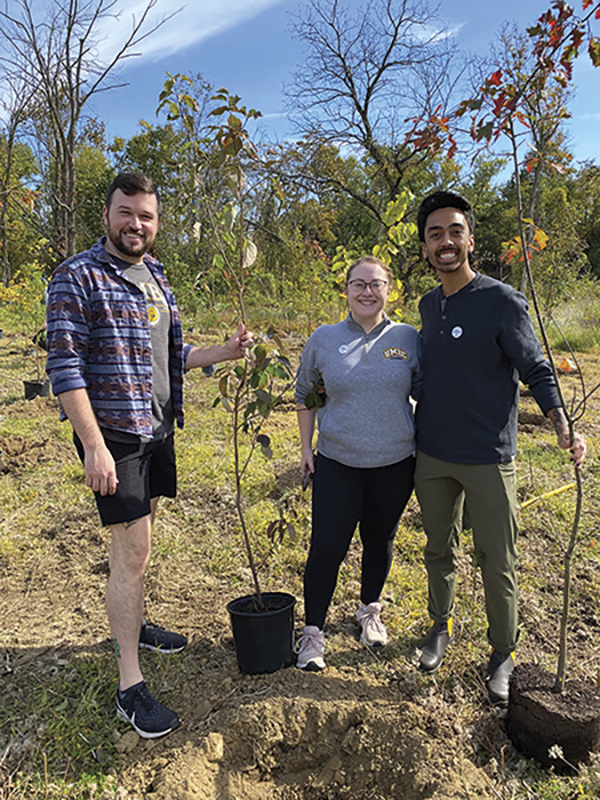
Dozens of Retrievers spent time this fall planting 900 new trees around campus, including those pictured here (L-R): Gavin Gilliland, Abby Hart ’18, and Tim Olivella.
Building bridges across campus
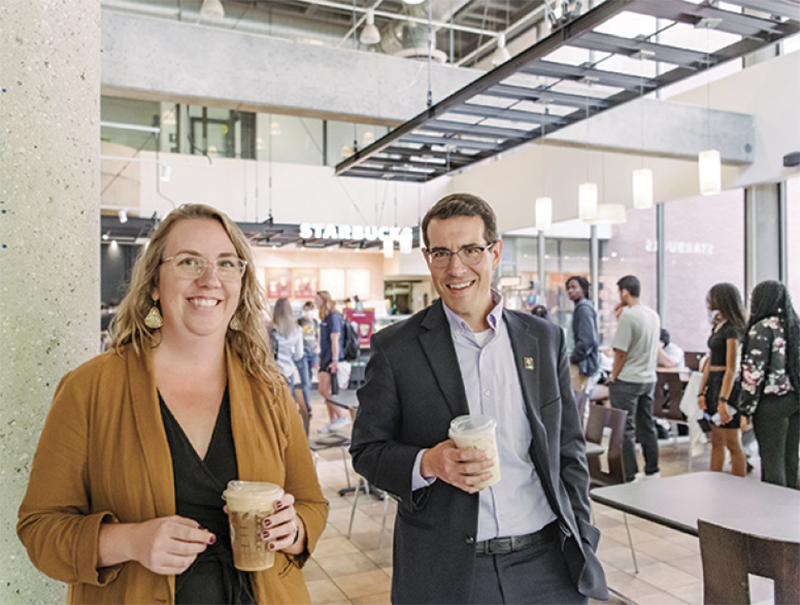
They met so many times at Starbucks, they knew each other’s orders.
Damian Doyle (’99, computer science, M.S. ’16, information systems): tea, Earl Grey, hot. Charlotte Keniston (M.F.A. ’14, intermedia and digital arts): coffee, iced.
Over their caffeine of choice, the two UMBC staff, who work in wildly divergent disciplines, forged connections through the Professional Staff Senate mentorship program—a staple of campus connectedness for the last decade.
Doyle, who works in information technology and has been a staff member at the university for almost 24 years, has served as a mentor for more than five years. Keniston, who started at the Shriver Center five years ago, anticipated a year of opportunity and transition and wanted a mentor to guide her toward balance between a demanding career, family, and finishing her Ph.D. in language, literacy, and culture.
“It was a perfect fit because Damian saw the big picture of the university and explained the campus overarching structures that I had never understood and was really great at advising me on critical points I was at in my career,” Keniston said.
As a mentor to a number of staff over the years, Doyle finds the program rewarding.
“One of the things I loved was getting to know different parts of the university. I get exposed to these different areas of the campus at a deeper level. It confirms for me the kind of driven work that people are doing.”
The mentorship program matches staff through a mentee-first pairing system that includes a speed-dating session and goal analysis for a year-long commitment. Keniston said the mentorship was crucial to her path at UMBC.
“I was at the point where I felt like I couldn’t ask questions, like, ‘Who is this person?’” Keniston said with a laugh. “But being in this mentor/mentee relationship gave me an opportunity to say, ‘Help me understand this.’”
Doyle said that hearing Keniston’s questions and seeing the campus organization through new eyes helped him know what is working and what needs improvement at UMBC. “It’s very educational for me, having to think through what is the right answer, what is the honest answer.”
After a year of meeting about once a month, Doyle has a new mentee, and Keniston has now become a mentor. But they’ll be keeping in touch. Maybe over tea and coffee.
Inner Peace
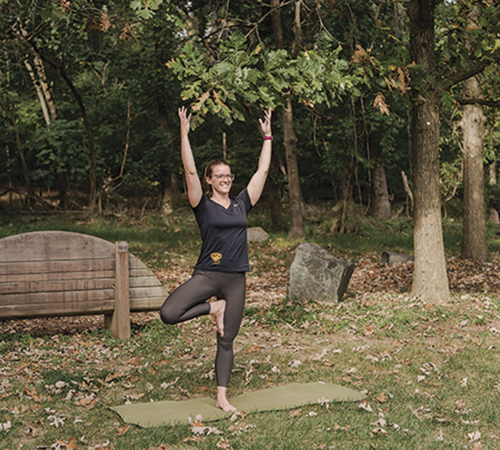
Many of our staff and faculty take advantage of free exercise and wellness classes in the RAC, some of which are taught by Joella Lubaszewski ’10.
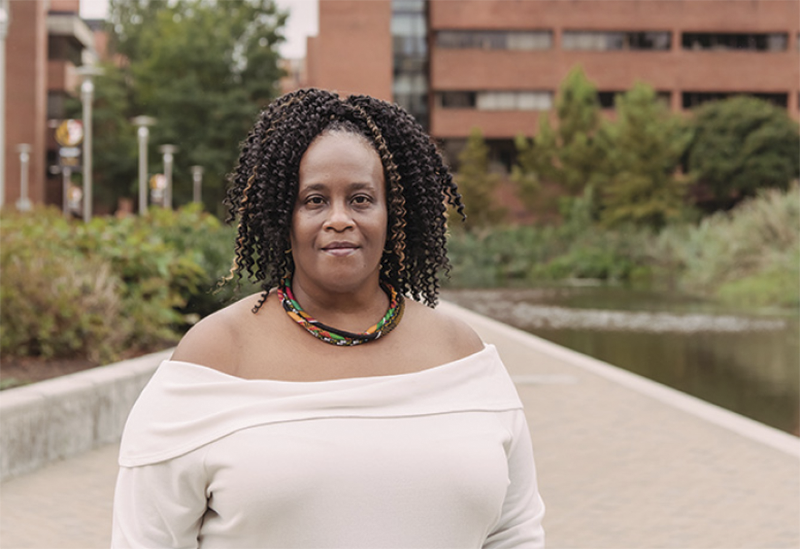
Telling her authentic story
Melessia Jasper’s journey to UMBC was not straight. But something kept pointing her toward UMBC. And toward herself.
“My path to UMBC started before I knew about UMBC,” Jasper said, explaining that after high school in Alabama, she arrived in Maryland only to find that the job she had been promised was locked in a hiring freeze. She started at American University, where she worked with two former UMBC staffers. Then she heard UMBC President Emeritus Freeman Hrabowski at a faculty retreat. “I didn’t realize it at the time, but God was laying the groundwork for where I am today.”
When she moved to Baltimore with her new husband, she applied to UMBC and worked in several different divisions, including Student Affairs and Administration and Finance. In each office, Jasper said, she found acceptance and growth. She now works in the Division of Institutional Equity.
“It was the first university I worked for where you’re applauded for your quirkiness,” Jasper said. “I was so empowered by the resources UMBC offered to me that I then could empower others.”
Last year, she stood on stage to tell her story in a Retriever Talk. For weeks, she and a cohort of other UMBC staff labored with Jill Wardell ’99, interdisciplinary studies, and other strategic talent management and storytelling staff to shape their life tales, a commitment of time and effort on the part of both the storytellers and for UMBC. Jasper said she felt like she was stripping naked. She was reluctant but told herself, “Sometimes, you have to be uncomfortable in order to follow your purpose in life.”
In addition to revealing lifelong intrusive thoughts of inadequacies and imposter syndrome, Jasper also shared—in front of hundreds of people she didn’t know—that in 2000, doctors discovered she had a rare condition called a Chiari malformation, in which part of her brain had grown down into her spine. Her doctor was amazed at what she had achieved, but Jasper knew she was only getting started.
After her Retriever Talk, many students, colleagues, and even strangers have since contacted her to affirm how her story helped them.
“This is something that I have gone through,” Jasper said. “If I can go through it and possibly help you by telling you my story, I want you to have that same freedom…freedom in understanding who I am and accepting who I am.”
A Community That Builds Together
Through our unique commitment to shared governance and a deep appreciation of community, we collectively build UMBC into what we know it should be.
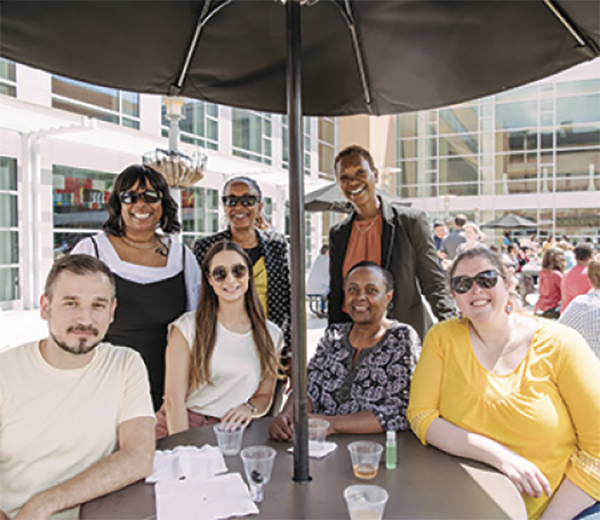
Sharing the Moment
The annual cookout put on by the Professional Staff Senate and Nonexempt Staff Senate brings folks together from all over campus.
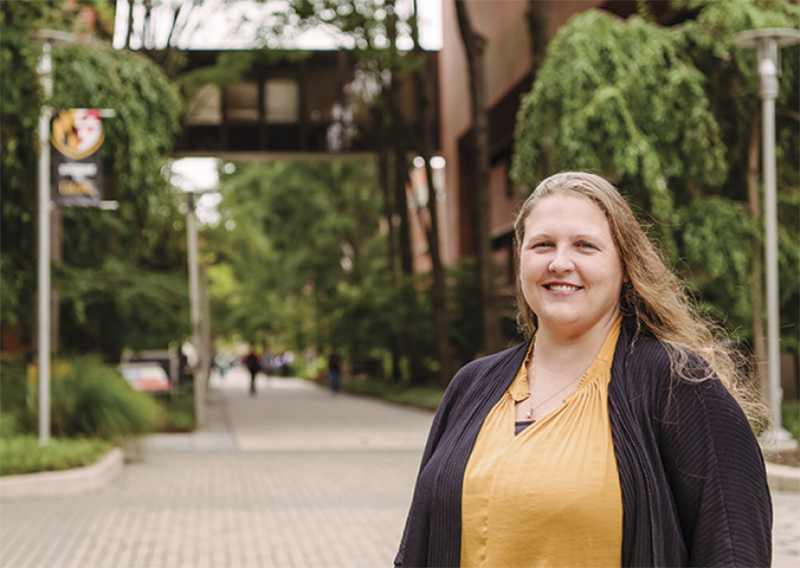
Finding a voice in leadership
There’s a reason the Nonexempt Staff Senate (NESS) carries the name of a democratic body. Alongside other staff and faculty shared governance groups and student government bodies serving their respective constituents, NESS exists to ensure all UMBC nonexempt employees have a voice, the way democracy is supposed to work.
Desiree Stonesifer, serving the second year of her term as president of NESS, and a business services specialist in the financial services department, believes that the shared governance organization builds trust at the university. UMBC offers both staff and faculty shared governance groups, in which all parties work together on the university’s leadership.
“I think it gives people the security of knowing that they’re welcome to speak their mind without it being held against them,” Stonesifer said. “They’re allowed to have thoughts outside the status quo. And a lot of times, those are the kind of thoughts that maybe the administration or other people in the university haven’t thought of. It gives everyone different perspectives and it allows staff the ability to grow more comfortable in their community so that they can be who they are and say what they think.”
NESS helps its members handle issues that are vital to employees: Are job descriptions adequate? Are positions equitably valued? Is professional development available?
Many of the nonexempt senate members aren’t interacting with students as much as other UMBC employees, Stonesifer said, and many of them want to reach out. The NESS, she said, can help members “find ways to get involved in the community.”
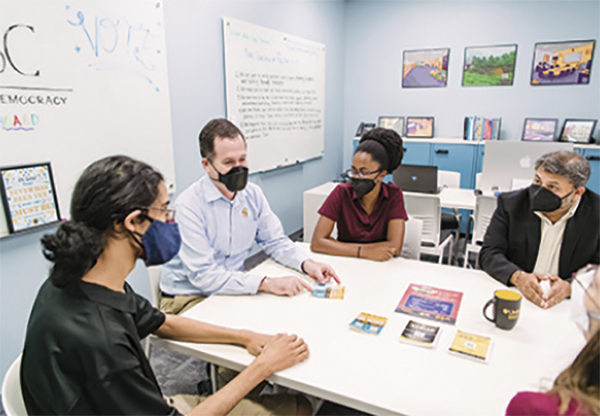
Creating Change
Campus offices like the Center for Democracy and Civic Life work alongside students to engage the community and make a difference.
Creating a green space of solace
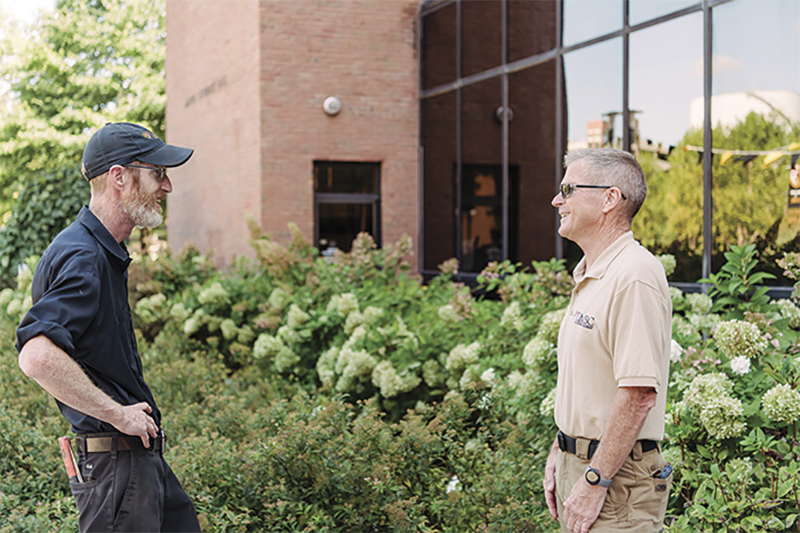
Charles Hogan, UMBC’s landscape and grounds manager, is comfortable with trees. He grew up climbing them, building forts in them, and “falling out of them,” he said, laughing. For decades, he has run and biked through forests for mile upon mile every week.
As he walks UMBC’s Academic Row in his sturdy boots and cargo pants, Hogan (above, right) admires the trees that have survived years of building renovations, root system compromise by tunnels carrying utilities and water underground, and the hundreds of students who tramp over their soil and tie hammocks to their trunks.
Hogan, who has worked on UMBC’s landscaping for 26 years, likes to construct park-like pockets dotted throughout the campus. Each of those miniature parks is based around trees, whether that’s the pair of oaks in front of the Administration Building that tower over the hydrangeas below or the diminutive weeping redbud that Hogan wanted to top with a tiny hat and sunglasses because it looked so much like Cousin Itt from the Addams Family.
“I’m a tree person,” said Hogan, who is a certified arborist. “Trees should be the focal points. We’re creating a lot of little park environments.”
A campus’ green spaces, Hogan said, make a difference when students and their families are trying to decide where to attend as well as provide succor to everyone making their way through a busy semester. That’s why the grounds staff plants 30,000 summer annuals and 10,000 fall pansies every year. Each area on campus is assigned to a particular gardener, Hogan said, who takes pride in the beauty of the plants under their charge.
Those gardens and the shade of the trees surrounding the buildings offer comfort to the staff, faculty, and students who make the campus their living rooms.
“I never went to college, but I know students are under a lot of stress. They should be able to sit outside, read, study, write a paper,” Hogan said. “Any landscape, whether it’s at your house or on campus, should make you feel good, feel relaxed.”
Living the Mission
At the end of the day, UMBC’s values and mission are what bring us all together. When we work in service of our students and our academic mission of inclusive excellence, it’s hard not to feel connected to the work on another level.
A Student-Centered Community
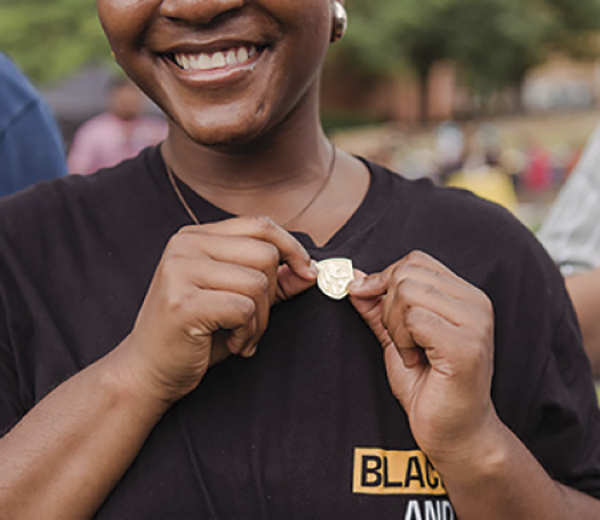
At the beginning of each school year, our new students are officially welcomed with the Convocation ceremony, where they each receive a special UMBC shield pin.
Lifting students to the next level
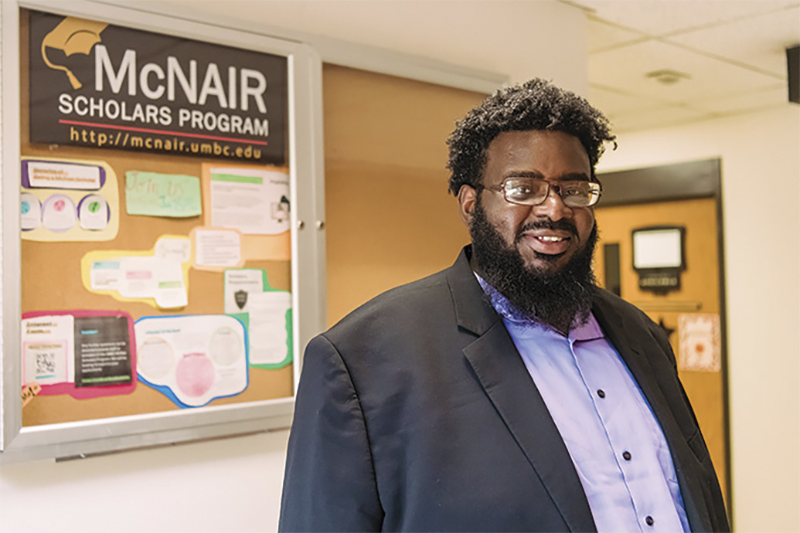
When he’s deep into extolling the mission and benefits of the McNair Scholars Program he directs, Michael Hunt ’06, computer engineering, needs only a pulpit to become the preacher he trained to be.
When Hunt sees a student achieve, he feels “that parent feeling, that joy that comes to you. Sometimes I’m more excited than they are when they’re telling me. Sometimes it’s a sense of awe in knowing their story, in knowing all that had to happen to get to that space,” said Hunt, who has a masters in theology. “I feel like we’re the mama bird, teaching them all they need before they fly away.”
The federally funded McNair program, with a goal of boosting students from underrepresented segments of society into earning research-based doctoral degrees, has expanded over the six years of Hunt’s directorship.
Every year, the McNair Scholars Program funds 30 slots for students, who meet with mentors, fulfill service obligations, attend cross-cultural events, and receive the help they need to prepare for, apply to, and excel in graduate school.
Hunt, who was a Meyerhoff and McNair scholar, is earning his own interdisciplinary Ph.D. from UMBC. After he became director of the McNair program in 2019, he found himself frustrated when he had to shut some students out of opportunities. So he spearheaded, with the backing of the then-current scholars, staff, and McNair Advisory Council, the creation of the Friends of McNair network, a group of students who reap some of the mentoring, community, and support benefits that McNair Scholars enjoy.
Hunt is exploring ways for the university to expand the support it gives to students not in formal scholar programs. He enthusiastically advocates for the need for holistic critical mentoring (HCM), a network of power-dynamic-flipped, student-centered, reciprocal relationships. HCM is the mentoring framework that uplifts both mentor and mentee while dismantling systems of oppression.
“Because of my heart and because of the work that I do, I don’t want to turn anyone away when I know there are resources to support them. The institution has to rise and say, ‘This is a part of the work of inclusive excellence, and we’re going to fund this to make it happen.’ What I love about my institution is that the more I talk and have these conversations, the more I do see people beginning to question and challenge what we are doing. And so I don’t feel quieted. In other spaces, I know that folks would have been quieted.”
Moments of Joy
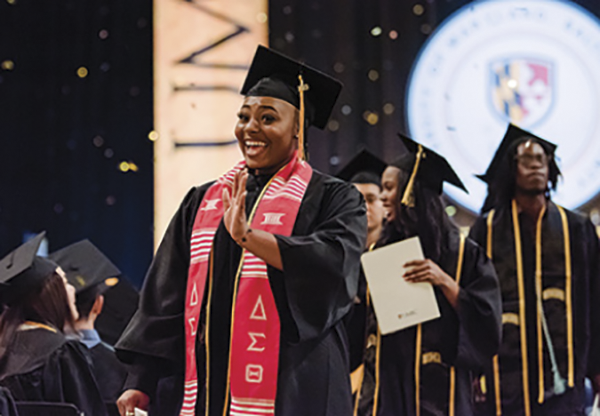
There’s simply nothing like the feeling of watching our students cross the stage to get their diplomas.
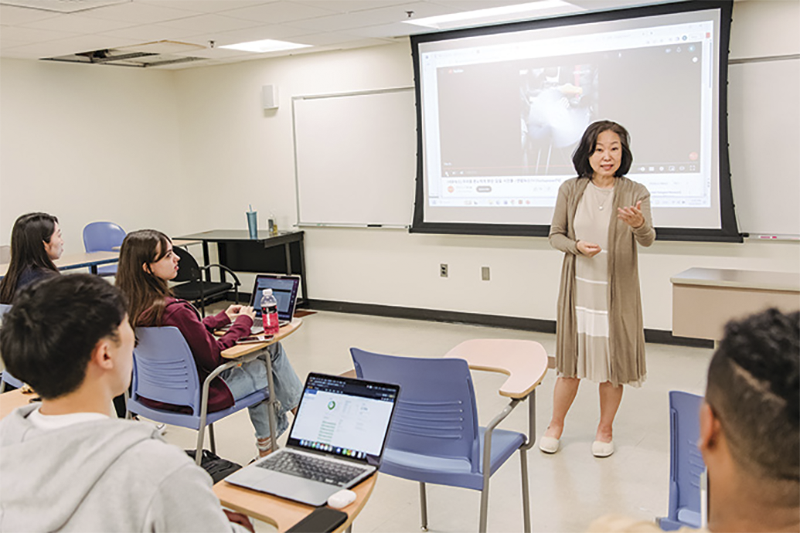
Shaping success in all sizes
At Commencement, Kyung-Eun Yoon likes to sneak out of her academic division’s seating section to hug students in other majors, she confesses. Of course, she gets to hug all the Korean majors when they rise to receive their diplomas, but other students have taken maybe five or six courses or minored in Korean, and she wants to embrace them, too, to recognize that achievement.
Student success, Yoon says, doesn’t come in one shape or size.
“For some students, yes, excelling in every class and getting double degrees and finishing an honors program with a wonderful thesis, going to Korea’s top university as a graduate student, getting a job—that’s a wonderful, wonderful success story,” Yoon said. “But for some students, completing the semester without withdrawing from too many classes, or without failing one or two courses, completing their degree, finally, in five or six years, that’s a wonderful success story for them too.”
Yoon started at UMBC in 2009 as the coordinator of the new Korean program and has grown the program so that students can now major or minor in Korean within the modern languages, linguistics, and intercultural communication department. Over her 14 years, Yoon’s Korean program graduates have gone on to work at the National Security Agency, to pursue graduate schools in various fields including Korean studies and international relations, to teach English in Korea, and more.
But sometimes, she said, success looks like one student whose achievement she particularly treasures. The student had dropped out, withdrawn from many classes, but after six years and many advising sessions with Yoon, last May, she graduated.
“It was not just a mere graduation for her, it was a really, really huge success for her,” Yoon said, and that student’s achievement made Yoon feel proud. “I did this much,” she says, holding up her finger and thumb an inch apart.
Yoon and her colleagues can help students along the path of hard work, but eventually, she says, “you have to have your ownership. We’ll help you, but without your ownership of this time, success cannot be happening.”
And when success happens, Yoon is sure to find that student to give them a hug.
By Susan Thornton Hobby
]]>
What gets you up and out the door each morning? And what makes a job more than a job—or even more than a career? For so many who make UMBC their professional home, the value goes way beyond a...
https://umbc.edu/stories/why-we-love-it-here-at-umbc/
https://my3.my.umbc.edu/api/v0/pixel/news/137627/guest@my.umbc.edu/7e783d773436c1823fe0629cac29e423/api/pixel
campus-life
center-for-democracy-and-civic-life
doit
fall-2023
imda
llc
magazine
mcnairscholars
meyerhoff-scholar
mll
ness
pss
UMBC News & Magazine
https://my3.my.umbc.edu/groups/umbc-news-magazine
https://assets1-my.umbc.edu/system/shared/avatars/groups/000/001/943/24435aa6207c452e7bc15cc74b42c7bb/xsmall.png?1748556657
https://assets1-my.umbc.edu/system/shared/avatars/groups/000/001/943/24435aa6207c452e7bc15cc74b42c7bb/original.png?1748556657
https://assets2-my.umbc.edu/system/shared/avatars/groups/000/001/943/24435aa6207c452e7bc15cc74b42c7bb/xxlarge.png?1748556657
https://assets2-my.umbc.edu/system/shared/avatars/groups/000/001/943/24435aa6207c452e7bc15cc74b42c7bb/xlarge.png?1748556657
https://assets3-my.umbc.edu/system/shared/avatars/groups/000/001/943/24435aa6207c452e7bc15cc74b42c7bb/large.png?1748556657
https://assets1-my.umbc.edu/system/shared/avatars/groups/000/001/943/24435aa6207c452e7bc15cc74b42c7bb/medium.png?1748556657
https://assets2-my.umbc.edu/system/shared/avatars/groups/000/001/943/24435aa6207c452e7bc15cc74b42c7bb/small.png?1748556657
https://assets1-my.umbc.edu/system/shared/avatars/groups/000/001/943/24435aa6207c452e7bc15cc74b42c7bb/xsmall.png?1748556657
https://assets2-my.umbc.edu/system/shared/avatars/groups/000/001/943/24435aa6207c452e7bc15cc74b42c7bb/xxsmall.png?1748556657
UMBC News & Magazine
6
0
false
Fri, 08 Dec 2023 09:06:37 -0500
Fri, 08 Dec 2023 09:06:37 -0500
Three sisters—all alums—share their family’s recipes for food and comfort

Aimee, Jamie, and Gina Joshua have a lot in common. All three went to UMBC as members of the Meyerhoff Scholars Program. And the sisters all have great memories of growing up in a house filled with delicious food and love. So, when their mother’s YouTube channel focusing on Indian cooking techniques started to take off, the trio made it their mission to create a cookbook of family recipes that would honor their beloved parents.
Our parents, Sara and Abraham Joshua, known to us as Mummy and Chacha, immigrated from India in their twenties separately to begin their careers and continued education to help provide for their families back home. Coming to America in the ’70s, they were learning how to navigate a new country and a new culture. After getting married and starting a family, they began raising three daughters in Baltimore, Maryland. The challenge was to figure out how to teach and preserve our Indian culture and traditions when it was over 8,000 miles away.
 The Joshua Sisters: Gina, Jamie, and Aimee.
Growing up as “the Joshua sisters,” we did many things together—singing songs in church at talent shows, Girl Scouts, karate, and even attending UMBC! They wanted the best for us and every day showed us the value and importance of hard work and being and staying humble. Since we were young girls, Mummy and Chacha taught us that everything is possible if you put your mind to it and work hard. Our parents encouraged us to chase our dreams, but as with many parents, they didn’t think about pursuing their own, only providing for their family.
Mummy, affectionately known as “Ammini Aunty,” was a nurse at the University of Maryland Medical System and Chacha, affectionately known as “Bejoy Uncle,” was a realtor. They both kept busy outside of work hours with community and church activities.
If you wanted to find our parents in the house, it was usually in the kitchen—and the garden was a close second. Mummy loved to cook our traditional South Indian dishes and prepare food for others and Chacha enjoyed being her sous chef. Food was their love language and we had so many conversations around the kitchen table.
During our years at UMBC, we often brought Mummy’s home-cooked food when we returned to campus, always willing to share some chicken biriyani or beans mezhukkupuratti with our friends. Mummy didn’t often have time to do more than cooking for her family or special events because of her nursing career and her focus on our education. This meant she didn’t get to cook and experiment as much as she would have liked. It was only once we were in college that we began to understand the joy being in the kitchen would bring her.
Once we were older, some of our favorite memories were when we gathered in the kitchen to catch up on how everyone’s day had been. When we came home with our friends, Mummy would recruit them to help prepare whatever was on the menu, even if they had never cooked before. We did our best and Mummy would walk us through the recipe and cooking techniques with a lot of patience. Mummy always said “If you put your mind to it, you can do it. It’s a passion, and it takes hard work. But at the end of it all, you get something great.”
Food is meant to be shared, and while Mummy was teaching us to cook, she was also teaching us to curate and nurture relationships and be proud of our culture.
The Joshua Sisters
Whether we were peeling ginger, grating coconut, or chopping vegetables, we knew we were not just creating a meal, we were also building and creating something better: loving memories and an appreciation for our Kerala food. Because that’s what it’s about.
Food is meant to be shared, and while Mummy was teaching us to cook, she was also teaching us to curate and nurture relationships and be proud of our culture. Cooking together is creating together, which involves trust and building a connection between each person helping create the meal. In addition, we are Indian American and are so proud of what it means to be both Indian and American.
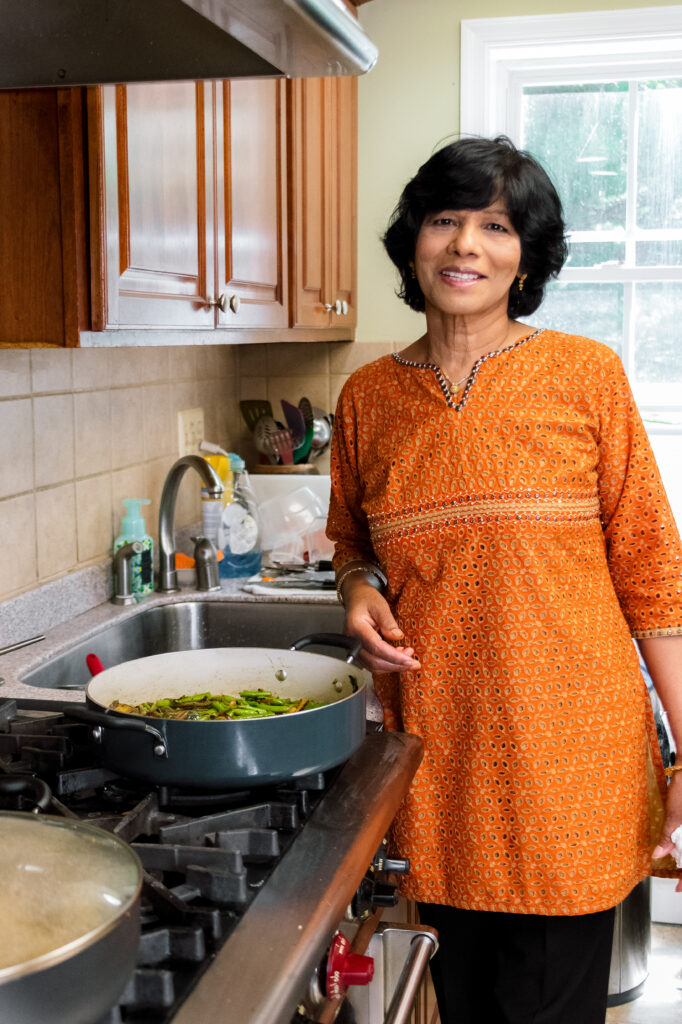 Known as Mummy to her three girls, Sara Joshua poses in her kitchen.
We learned an important lesson during our time at UMBC, taught to us by the late great Lamont Toliver, “Mr. T,” former director of the Meyerhoff Scholarship Program. In a moment of vulnerability, Aimee shared with Mr. T that she had been rejected by all of the Ph.D. programs she had applied to but had gotten into a master’s program.
In all his wisdom, Mr. T comforted Aimee with these wise words: “Not all paths from point A to point B are a straight line. Sometimes you have to take the long way to get where you want to go.” That’s a lesson that has stayed with us for some time and that, we soon realized during the pandemic, applied to Mummy.
By this time, Gina had started a family and we welcomed our next generation of children. The pandemic taught us how precious life is and that making every moment count is important. As sisters, we decided that we would work together to make Mummy’s dream of teaching our generation and future generations how to cook Kerala food come true.
After the pandemic began, Mummy retired from an over 40-year nursing career to help care for Chacha and avoid any risk due to COVID-19. With more time as a retiree, Mummy began experimenting with recipes and sharing them with close by family, who would pick up the care packages she would leave on the porch. They would then text or call her with feedback, helping perfect the recipes.
In April 2020, Mummy came into our room and asked if we wanted to take a picture of what she was cooking in the kitchen. So Jamie and Aimee, armed only with their iPhones and short notice to their friends online, began to livestream Mummy making Mango curry. Then the unexpected happened.
Thousands of people watched it within the first three days, and a flame was lit. Instead of waiting for perfection, we continued to dive into video after video, each an improvement on the one before. What started as a fun project became a thriving YouTube channel, Ammini Aunty’s A Pinch of Kerala, and a full-blown community of “Pinchers.” People were excited to learn from Mummy, and we were all thrilled to share her love for cooking with everyone.
Fast forward to today, our first cookbook, Ammini Aunty’s A Pinch of Kerala: A South Indian Inspired Cookbook, is being published. Thanks to the power of Kickstarter and Pinchers worldwide, what was just once a dream is now becoming a reality. As Mummy reminds her Pinchers, “If you put your mind to it, you can do it.” Don’t let your dreams stay a dream. Work toward making it a reality.
Jamie Joshua ’02, biological sciences, is the diversity, equity, and inclusion manager for Giant Food. Aimee Joshua ’03, M.S. ’05, computer science, is the senior manager, IT contracts, at PBS Distribution. Gina Wright ’05, biological sciences, is a dentist at a Veterans Affairs Medical Center.
]]>
Aimee, Jamie, and Gina Joshua have a lot in common. All three went to UMBC as members of the Meyerhoff Scholars Program. And the sisters all have great memories of growing up in a house filled...
https://umbc.edu/stories/three-sisters-keep-family-recipes-alive-in-book/
https://my3.my.umbc.edu/api/v0/pixel/news/137616/guest@my.umbc.edu/8b9de66ee2fe755d391c1d9411f14bcb/api/pixel
alumni
alumni-essay
biological-sciences
coeit
computer-science
fall-2023
magazine
meyerhoff-scholar
UMBC News & Magazine
https://my3.my.umbc.edu/groups/umbc-news-magazine
https://assets1-my.umbc.edu/system/shared/avatars/groups/000/001/943/24435aa6207c452e7bc15cc74b42c7bb/xsmall.png?1748556657
https://assets1-my.umbc.edu/system/shared/avatars/groups/000/001/943/24435aa6207c452e7bc15cc74b42c7bb/original.png?1748556657
https://assets2-my.umbc.edu/system/shared/avatars/groups/000/001/943/24435aa6207c452e7bc15cc74b42c7bb/xxlarge.png?1748556657
https://assets2-my.umbc.edu/system/shared/avatars/groups/000/001/943/24435aa6207c452e7bc15cc74b42c7bb/xlarge.png?1748556657
https://assets3-my.umbc.edu/system/shared/avatars/groups/000/001/943/24435aa6207c452e7bc15cc74b42c7bb/large.png?1748556657
https://assets1-my.umbc.edu/system/shared/avatars/groups/000/001/943/24435aa6207c452e7bc15cc74b42c7bb/medium.png?1748556657
https://assets2-my.umbc.edu/system/shared/avatars/groups/000/001/943/24435aa6207c452e7bc15cc74b42c7bb/small.png?1748556657
https://assets1-my.umbc.edu/system/shared/avatars/groups/000/001/943/24435aa6207c452e7bc15cc74b42c7bb/xsmall.png?1748556657
https://assets2-my.umbc.edu/system/shared/avatars/groups/000/001/943/24435aa6207c452e7bc15cc74b42c7bb/xxsmall.png?1748556657
UMBC News & Magazine
2
0
false
Thu, 07 Dec 2023 16:32:28 -0500
Thu, 07 Dec 2023 16:32:28 -0500
Historical lens—3 stories that scratch the surface of a 5,400 image archive

One of the most influential sets of historical photos in UMBC’s Special Collections is an archive of more than 5,400 images documenting the harsh conditions of child laborers in early 20th-century America. Recently the team in Special Collections—which celebrates its 50th anniversary this year—undertook a massive project to digitize and rehouse the photos in more protective sheaths to help safeguard the images and the hand-written details on them.
The preservation effort gave UMBC student workers hands-on practice with handling the delicate photographs and allowed staff to dive deep into these historical records in order to comment on timely issues around current child labor conditions in the U.S. Their work will allow future students, faculty, and visiting scholars to access this important material for many years to come.
Preserving the photography of Lewis Hine
In the first article in this three-part feature, Rahne Alexander, M.F.A. ’21, writes about how photographer Lewis Hine secured a place in history as an investigative documentarian by observing and sharing the conditions for child laborers. From 1908 through 1930, Hine worked closely with the National Child Labor Committee (NCLC), an organization devoted to preventing the exploitation of children in the workplace. Hine crisscrossed the U.S. creating portraits of a diverse array of children working in fields and factories.
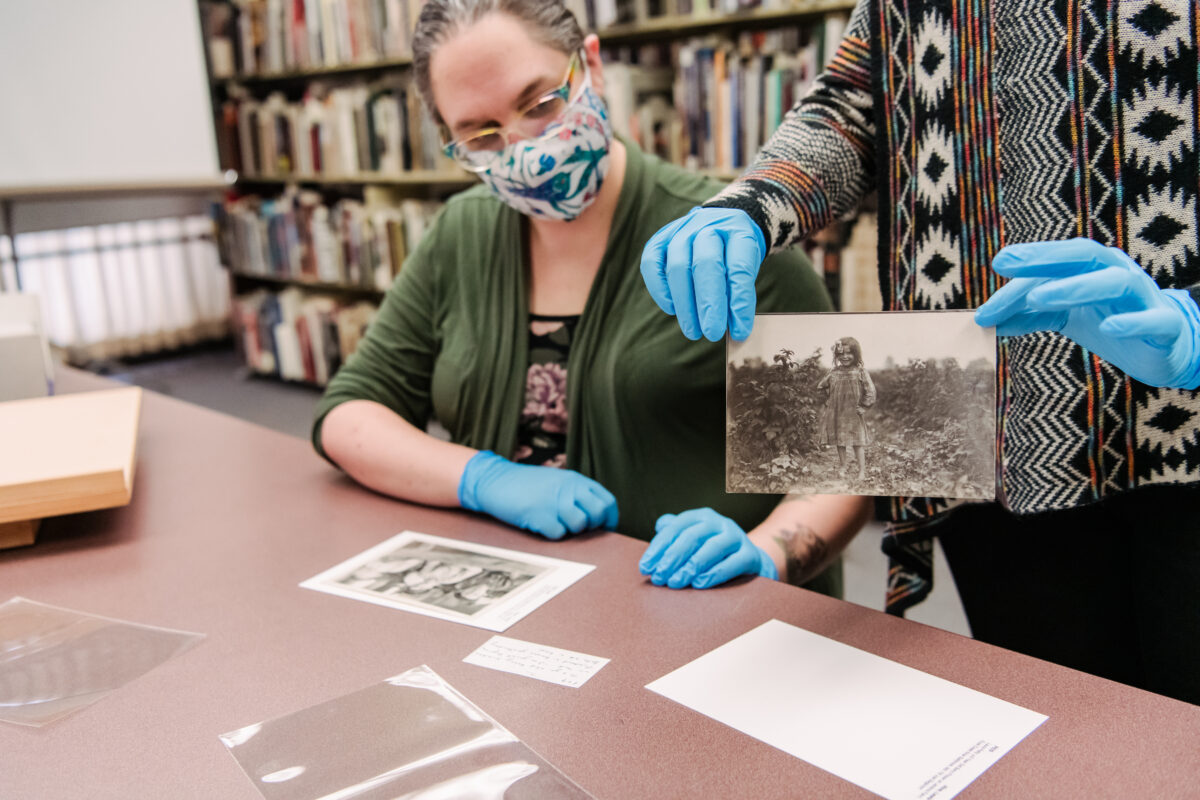 Meredith Power, left, and Susan Graham, right, handle the century-old
photographs. (Marlayna Demond ’11/UMBC)
Meredith Power, left, and Susan Graham, right, handle the century-old
photographs. (Marlayna Demond ’11/UMBC)
Handle with care
Uncovering the work UMBC students put into the project of preserving these historical photos, Catalina Sofia Dansberger Duque interview Special Collections interns Meredith Power ’21, history, a public history graduate student, and Gabe Morrison ’23, anthropology. Along with library staff members, these two worked diligently to ensure that the images of the families and children who lived through these harrowing work conditions are accessible to the public for research and learning.
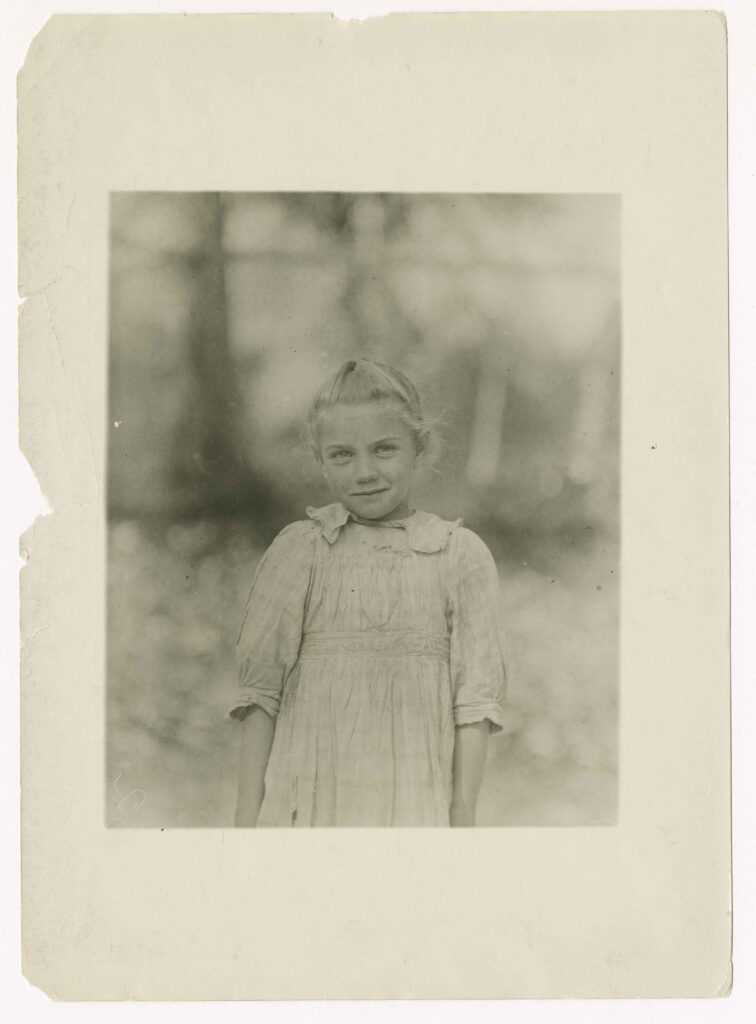
7-year old Rosie. Regular shucker. Her second year at it. Illiterate. Works all day. Shucks only a few pots a day. Varn & Platt Canning Co. in Bluffton, South Carolina, 1911 – 1913.
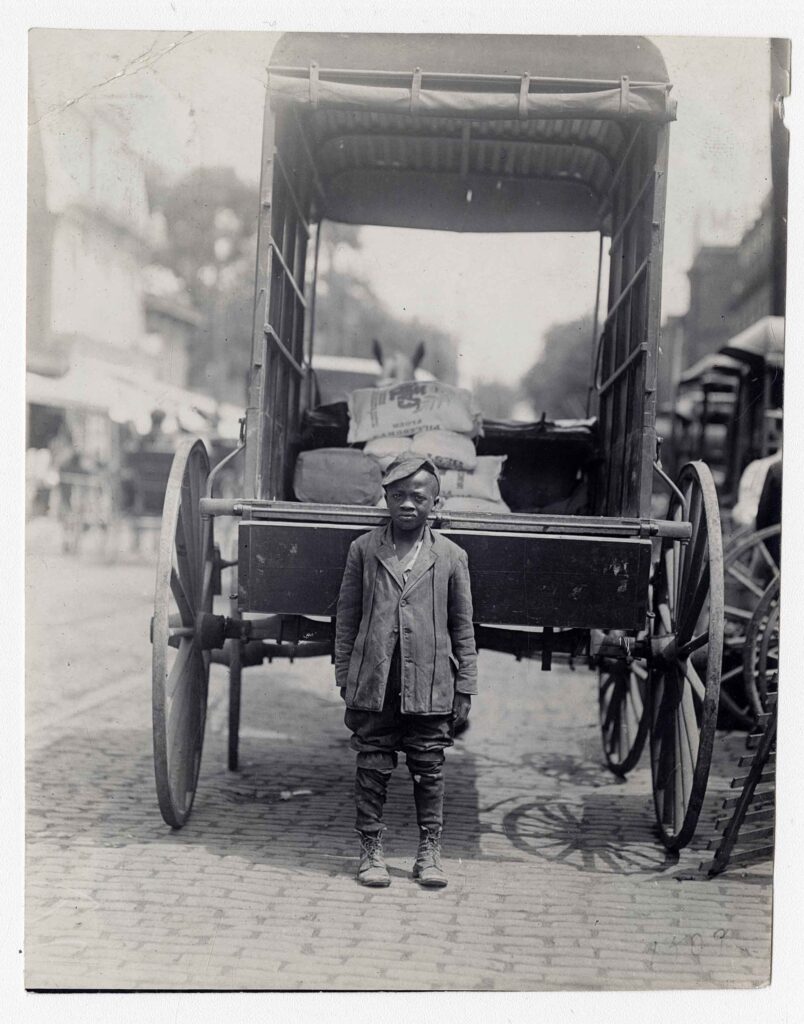
Elwood Palmer Cooper, helper on miller’s wagon, 7 years of age. Carries bags of flour, weighing 25 pounds, from wagon to stores. Receives 25 cents per week. Money not needed at home. Wants money to spend. Wilmington, Delaware, 1910.
The U.S. has a child labor problem
Lastly, in a piece originally published in The Conversation, Curator of Special Collections Beth Saunders, writes, “As I’ve worked with this collection over the last two years, the social and political implications of Hine’s photographs have been very much on my mind. The patina of these black-and-white photographs suggests a bygone era—an embarrassing past that many Americans might imagine they’ve left behind. But with numerous reports of child labor violations, many involving immigrants, occurring in the U.S., along with an uptick in state legislation rolling back the legal working age, it’s clear that Hine’s work is as relevant today as it was a century ago.”
]]>
One of the most influential sets of historical photos in UMBC’s Special Collections is an archive of more than 5,400 images documenting the harsh conditions of child laborers in early 20th-century...
https://umbc.edu/stories/historical-lens-documenting-us-child-labor/
https://my3.my.umbc.edu/api/v0/pixel/news/137603/guest@my.umbc.edu/b7755fbea649a8e09779561afccb2f86/api/pixel
cahss
discovery
fall-2023
feature
history
magazine
special-collections
UMBC News & Magazine
https://my3.my.umbc.edu/groups/umbc-news-magazine
https://assets1-my.umbc.edu/system/shared/avatars/groups/000/001/943/24435aa6207c452e7bc15cc74b42c7bb/xsmall.png?1748556657
https://assets1-my.umbc.edu/system/shared/avatars/groups/000/001/943/24435aa6207c452e7bc15cc74b42c7bb/original.png?1748556657
https://assets2-my.umbc.edu/system/shared/avatars/groups/000/001/943/24435aa6207c452e7bc15cc74b42c7bb/xxlarge.png?1748556657
https://assets2-my.umbc.edu/system/shared/avatars/groups/000/001/943/24435aa6207c452e7bc15cc74b42c7bb/xlarge.png?1748556657
https://assets3-my.umbc.edu/system/shared/avatars/groups/000/001/943/24435aa6207c452e7bc15cc74b42c7bb/large.png?1748556657
https://assets1-my.umbc.edu/system/shared/avatars/groups/000/001/943/24435aa6207c452e7bc15cc74b42c7bb/medium.png?1748556657
https://assets2-my.umbc.edu/system/shared/avatars/groups/000/001/943/24435aa6207c452e7bc15cc74b42c7bb/small.png?1748556657
https://assets1-my.umbc.edu/system/shared/avatars/groups/000/001/943/24435aa6207c452e7bc15cc74b42c7bb/xsmall.png?1748556657
https://assets2-my.umbc.edu/system/shared/avatars/groups/000/001/943/24435aa6207c452e7bc15cc74b42c7bb/xxsmall.png?1748556657
UMBC News & Magazine
3
0
false
Thu, 07 Dec 2023 12:28:52 -0500
Thu, 07 Dec 2023 12:28:52 -0500
Handle with care—students help digitize and rehouse thousands of historical photos
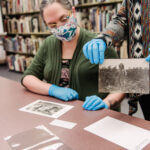
A nine-year-old stands at the mouth of a coal mine covered in coal dust, wearing a small headlamp. A woman holds her baby on her lap as she packs boxes in a warehouse along with her 5-, 8-, and 12-year-olds. These are just two of thousands of evocative black-and white historical photographs handled by Special Collections interns Meredith Power ’21, history, a public history graduate student, and Gabe Morrison ’23, anthropology. Along with library staff members, these two worked diligently to ensure that the images of the families and children who lived through these harrowing work conditions are accessible to the public for research and learning.
Fine motor skills
“Photos from the early 1900s were developed on fine photographic paper that is prone to crinkling around the edges, ripping, and fading,” Power says. Wearing blue nitrile medical gloves, they rehouse photos from their cellophane sleeves to museum-grade mylar sleeves, keeping them from further discoloration, tears, wrinkles, and sticking to the sleeves.
“They’re very delicate,” Power says. “You need good eye-hand coordination to pick up the photos from the corners, remove them from whatever packaging they are in, and slide them into the mylar sleeve.”
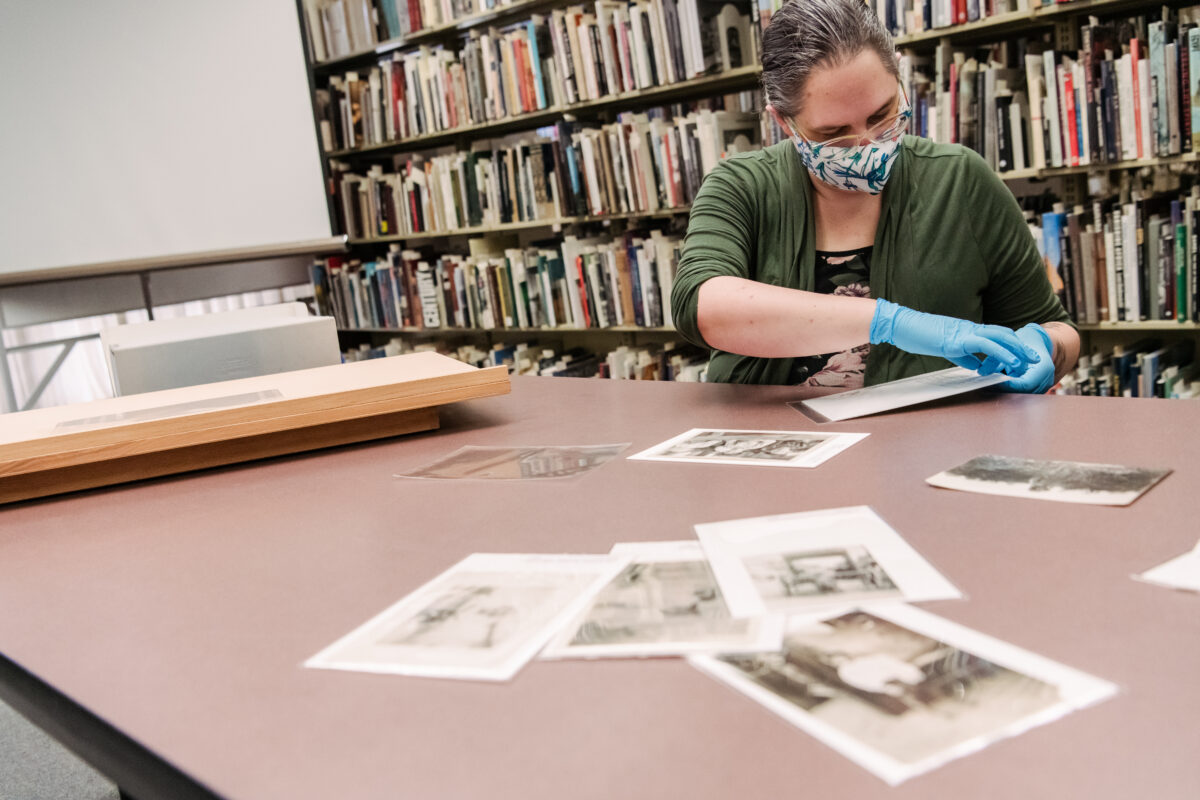 Power puts the historical photos into a mylar sleeve. (Marlayna Demond ’11/UMBC)
This process is second nature for Morrison, who has been working at Special Collections for over a year. He has worked with securing the Lewis Hine photos as part of his public humanities minor, as well as the Maryland Folklife Program Collection, the Coslet-Sapienza Fantasy and Science Fiction Fanzine Collection, and the George Cruikshank illustrations and papers.
“I had to learn how to properly handle photographs and manuscripts and how to catalog them according to the Library of Congress classification system,” Morrison says. For both Power and Morrison, developing greater patience and manual dexterity and embracing working through hundreds of documents alone in a quiet space surrounded by stacks of materials was well worth the effort to broaden access to these historic documents.
“The value of this project is ensuring people understand that this resource exists,” says Power, “to help these photos live beyond a heavily controlled and restricted space on campus into a digital space where more people are able to access the information.”
Digital accessibility
Protecting delicate, historic documents includes digitizing them. The digitizing process is another lesson in precision and patience. Power begins the process by taking a photo out of the mylar sleeve—making sure to only touch the corners—along with a small rectangular white piece of paper describing the photo. They gently place the photo underneath a camera, delicately straightening the image before the camera snaps the picture and sends it to a computer where Power edits it using Adobe Lightroom.
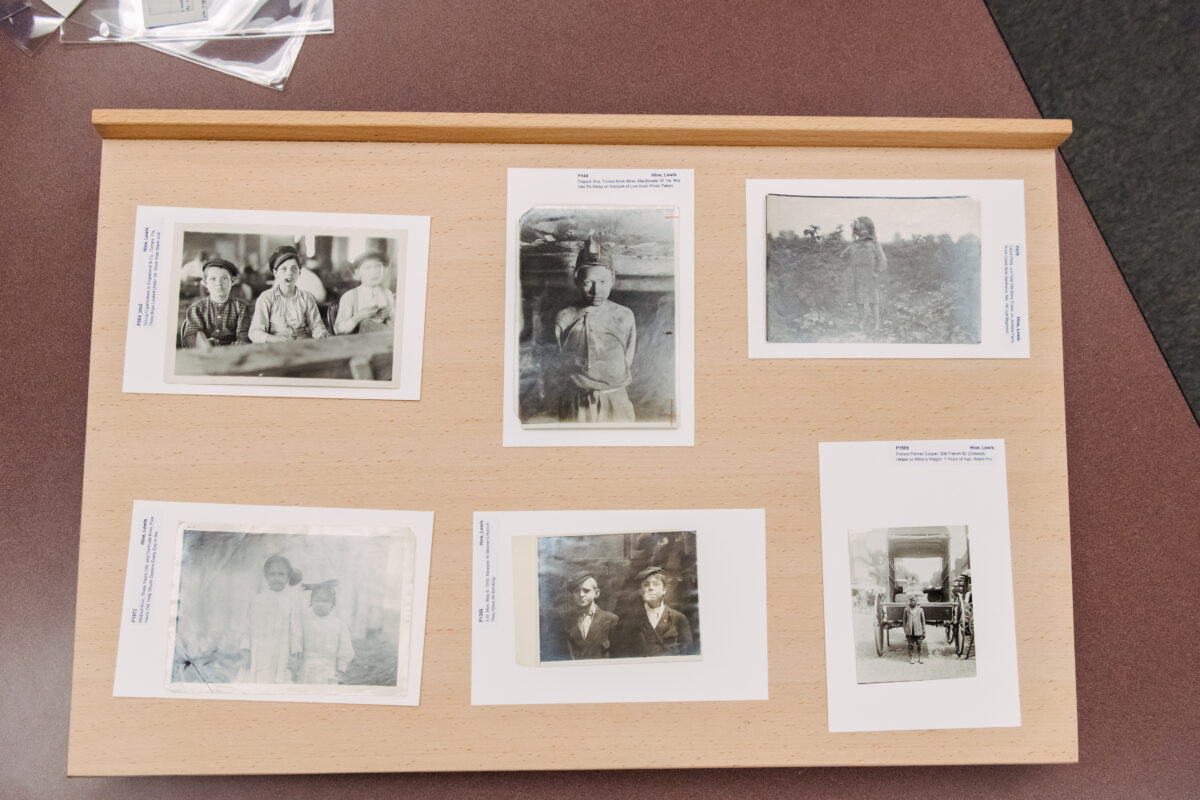 A small collection of the 5,400 photographs that were digitized and rehoused in more protective plastic sleeves. (Marlayna Demond ’11/UMBC)
“It’s an elaborate setup with lights at 45-degree angles, and the camera pointed straight down at a small white stand where I place the image,” explains Power, who would work on digitizing for six to eight hours at a time. “Once I take the image, I edit the size and angle of the photo. The metadata is then added into an Excel spreadsheet, which includes noting if there was a corner missing or if the photo had adhesive stuck to it.”
Digitizing rare books, something Morrison has spent months working on, requires using a special book scanning machine with raised sides, like hands cradling the book open, and small snakelike bean bag weights to keep the pages flat without using his fingers. “I make sure I’m not blocking any text or any important image. And then I press a button, flip a page, press a button, flip a page for hours on end until I finish digitizing that book,” Morrison says, smiling. “So, it’s not the most exciting work, but I find digitization specifically important because it’s a process that helps preserve documents too fragile to be in public circulation. Digitally, you can share it with a broader audience.”
Workforce skills
Both Power and Morrison brought many special collections skills to their public humanities internships. Archaeology camp inspired Morrison to learn about how to study and take care of important and fragile objects. He worked at the Montgomery Parks Archeology Program throughout high school, where he met a friend who introduced him to UMBC’s Special Collections. “I’ve always had an interest in historic things, in the preservation of artifacts,” Morrison says, who plans to apply to a master’s program in library and museum studies after graduation. “I think Special Collections has helped me realize I want to do archival work.”
Power found their footing working full time in the conservation rooms at Baltimore’s Walters Art Museum. “I was the administrative assistant in the Conservation Division and was around a lot of conversations on handling art objects and special collections materials, but I did not work with the materials directly,” says Power. “Working with the Hine Collection was a great opportunity for hands-on experience working with physical items and digitization.” These skills have also come in handy for Power, whose master’s degree focuses on 14th-century religious women hermits in Yorkshire, England. In 2022, Power had the opportunity to visit parish archives in Yorkshire to read through medieval-primary source documents.
For Power, history isn’t just books, dates, and lists of events. They say that there are a lot of living materials out there, whether that’s parish churches or photographs from the early 20th century, like the Hine collection. There is a connection between public history work and the people who lived before us. “It’s important to continue to help students remember that history is not dead and dusty. It’s alive,” says Power. They feel that the connection element is essential, and sometimes it gets lost. “Special Collections prove that these events really happened. They can inspire students to visit those places. To stand in that space where it happened and say, ‘Yeah, I was here too.’ I love that.”
]]>
A nine-year-old stands at the mouth of a coal mine covered in coal dust, wearing a small headlamp. A woman holds her baby on her lap as she packs boxes in a warehouse along with her 5-, 8-, and...
https://umbc.edu/stories/handle-with-care-preserving-historical-photos/
https://my3.my.umbc.edu/api/v0/pixel/news/137604/guest@my.umbc.edu/9c59b0ed09326ab14e553d046e7794b9/api/pixel
anthropology
campus-life
fall-2023
feature
history
magazine
special-collections
UMBC News & Magazine
https://my3.my.umbc.edu/groups/umbc-news-magazine
https://assets1-my.umbc.edu/system/shared/avatars/groups/000/001/943/24435aa6207c452e7bc15cc74b42c7bb/xsmall.png?1748556657
https://assets1-my.umbc.edu/system/shared/avatars/groups/000/001/943/24435aa6207c452e7bc15cc74b42c7bb/original.png?1748556657
https://assets2-my.umbc.edu/system/shared/avatars/groups/000/001/943/24435aa6207c452e7bc15cc74b42c7bb/xxlarge.png?1748556657
https://assets2-my.umbc.edu/system/shared/avatars/groups/000/001/943/24435aa6207c452e7bc15cc74b42c7bb/xlarge.png?1748556657
https://assets3-my.umbc.edu/system/shared/avatars/groups/000/001/943/24435aa6207c452e7bc15cc74b42c7bb/large.png?1748556657
https://assets1-my.umbc.edu/system/shared/avatars/groups/000/001/943/24435aa6207c452e7bc15cc74b42c7bb/medium.png?1748556657
https://assets2-my.umbc.edu/system/shared/avatars/groups/000/001/943/24435aa6207c452e7bc15cc74b42c7bb/small.png?1748556657
https://assets1-my.umbc.edu/system/shared/avatars/groups/000/001/943/24435aa6207c452e7bc15cc74b42c7bb/xsmall.png?1748556657
https://assets2-my.umbc.edu/system/shared/avatars/groups/000/001/943/24435aa6207c452e7bc15cc74b42c7bb/xxsmall.png?1748556657
UMBC News & Magazine
0
0
false
Thu, 07 Dec 2023 12:15:38 -0500
As summer wildfire smoke choked Baltimore, UMBC air pollution researchers leapt into action

Starting this May, a series of wildfires in Eastern Canada sent enormous smoke clouds wafting into the U.S., triggering air quality warnings in cities from the Midwest to the Northeast. For days, orange skies backdropped landscapes clouded by acrid air. People who could hunkered inside with the doors and windows shut. Those who had to go out faced itchy eyes, burning throats, and worse.
As a resident of the Baltimore area—which was blanketed with particularly bad smoke in both early and late June—UMBC Professor Chris Hennigan looked at the haze with dismay. But as an environmental engineer who studies air pollution, he had an additional thought: “We were looking at the air quality forecasts, and we thought ‘We have to gather data,’” he says.
The public found many colorful words to describe the summer’s unwanted smoke: brutal, eerie, dystopian.
Hennigan and his team have been working to put numbers to the adjectives. On the roof of the engineering building, the researchers installed a squat, white sensor that monitors the levels of tiny particles in the air, particularly those measuring 2.5 micrometers in diameter or less—smaller than most bacteria. Called PM2.5, these particles are released in large numbers during fires. They are dangerous to human health because they can work their way into the deepest parts of the lungs and even enter the bloodstream.
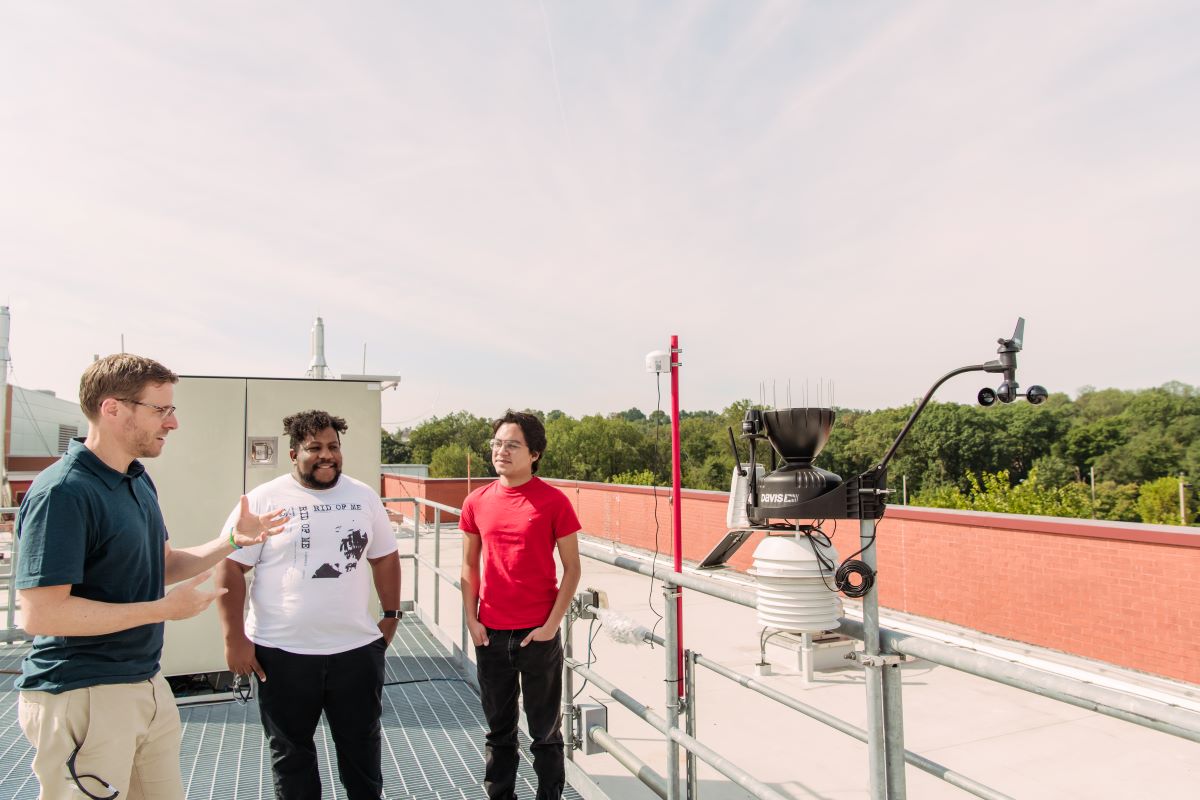 Chris Hennigan, Joel Tyson, Ph.D. ’23, and Luis Rodriguez ’25 (left to right) on the roof of the engineering building next to an air quality sensor. (Marlayna Demond ’11/UMBC)
The sensor showed huge spikes in PM2.5 when the smoke blew through, on some days reaching levels considered unhealthy for anyone to breathe.
The researchers also set up equipment to filter particles out of the air. After 24 hours, they collected the filters, which they are storing, neatly labeled, in a refrigerator in Hennigan’s lab.
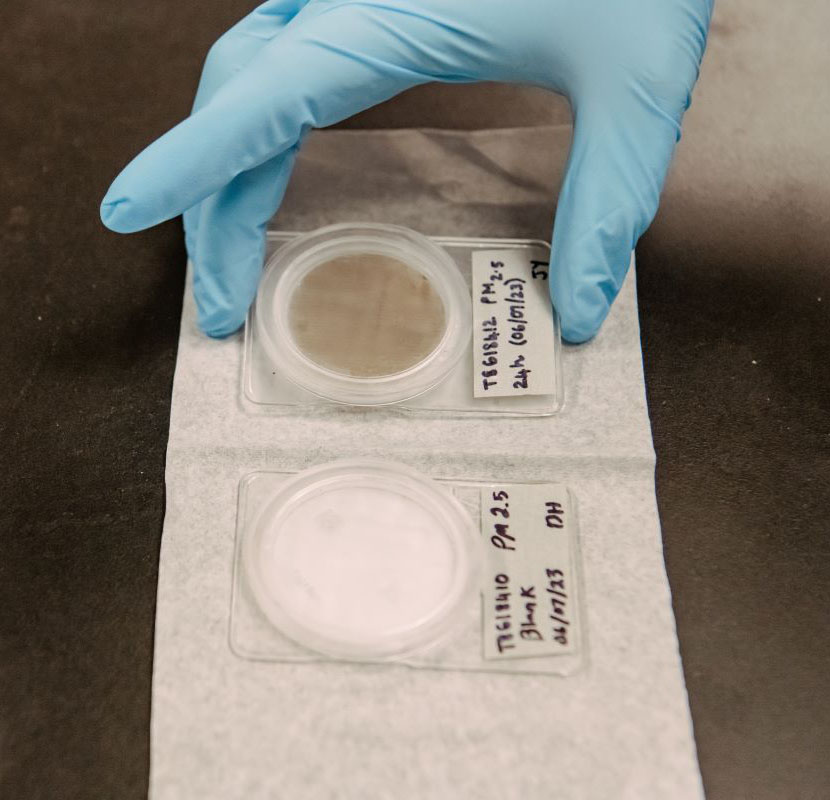 Hennigan shows samples of smoke particles collected this summer. (Marlayna Demond ’11/UMBC)
The filtered samples will advance at least two ongoing investigations, Hennigan says. In one avenue of inquiry, Joel Tyson, Ph.D. ’23, biochemical engineering, is studying how tiny particles can harm human lung cells. Before this year’s smoky summer, Tyson had been studying the toxic effects of particulate matter normally found in the Baltimore air. With the new smoke samples, he will start to investigate whether wildfire smoke particles, per unit, are more toxic than regular urban particulate matter, which comes from sources such as cars and power plants. Some studies have indicated that wildfire particulate matter is indeed more toxic, but more research is needed before any definitive conclusions can be reached.
In another line of research, Hennigan is also studying how particles in the air, including from smoke, may affect the climate. Undergraduate chemical engineering students Danielle Larios ’25 and Luis Rodriguez ’25 are assisting in the investigations.
The researchers study how particles of brown-colored carbon-containing material absorb light. Burning vegetation sends large amounts of this brown carbon into the atmosphere. It’s possible that the particles are trapping significant heat from the sun, accelerating the pace of planetary warming. Such effects are not normally included in global climate models, and better understanding of the process could improve humanity’s ability to predict, and manage, the coming years of climate upheaval.
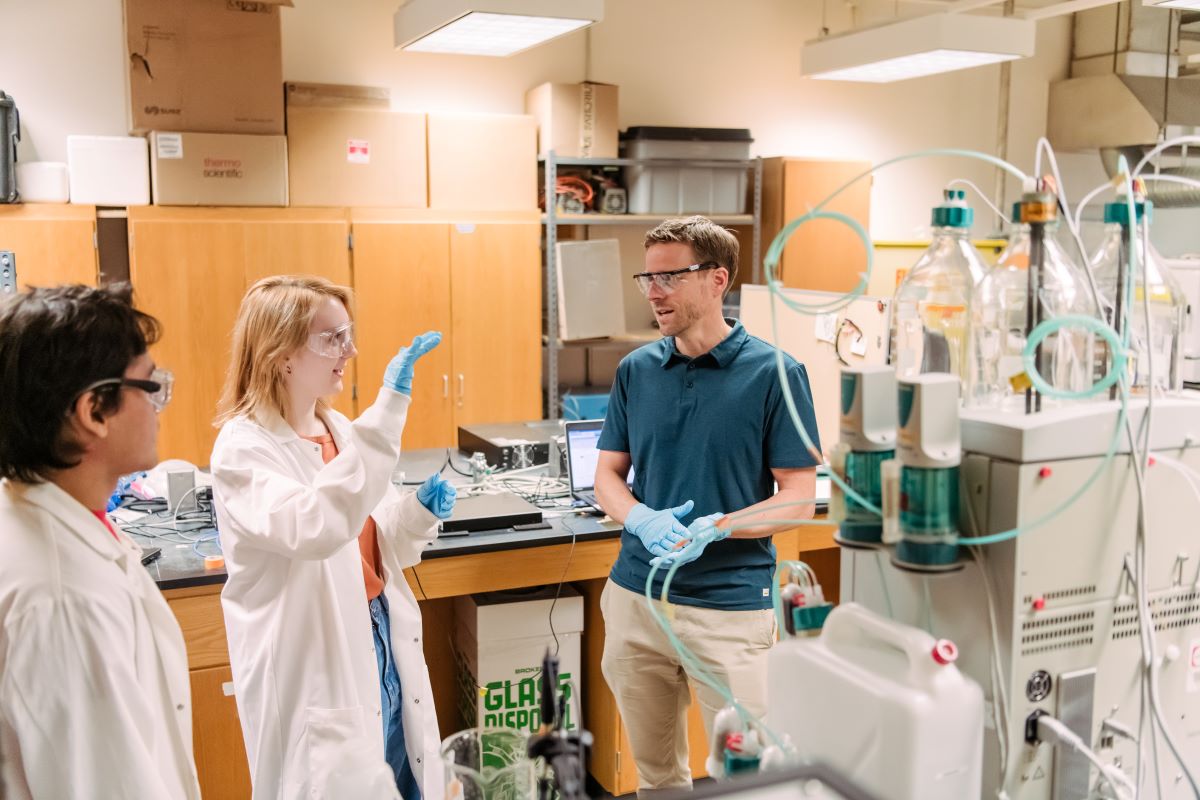 Rodriguez, Danielle Larios ’25 and Hennigan (left to right) discuss research in the lab. (Marlayna Demond ’11/UMBC)
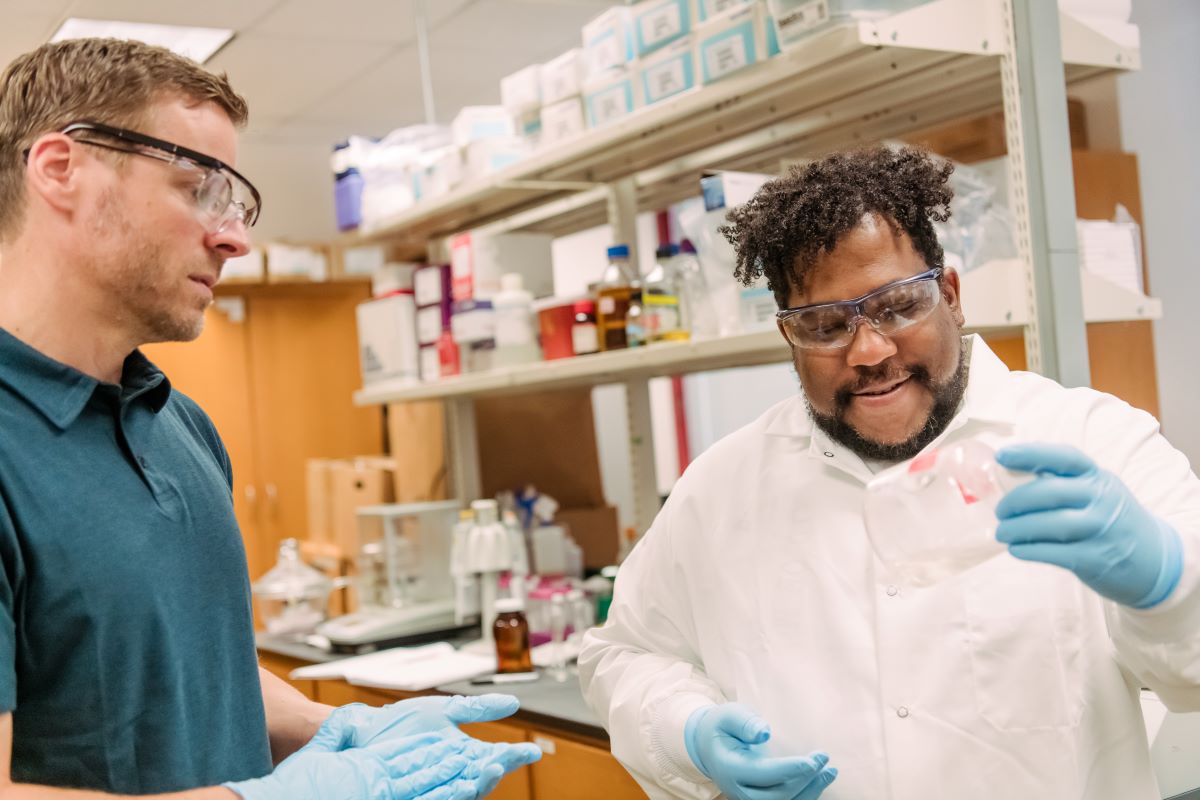 Hennigan and Tyson in the lab. (Marlayna Demond ’11/UMBC)
Climate change and wildfires are intimately linked. This summer was not only smoky, but also scorching. July marked the hottest month ever recorded, and scientists predict that as the world continues to warm, wildfires will continue to increase in quantity and intensity. “Smokeageddon,” as headlines put it, may become the new normal.
Hennigan says recent research illuminates how much wildfire smoke has contributed to air pollution trends. He points to a paper published in September in the scientific journal Nature that estimated that since 2016, wildfire smoke in the contiguous United States has undone around 25% of the progress in air quality made between 2000 and 2016.
For the researchers in Hennigan’s lab, those effects have been felt personally.
Rodriguez recalled how in June he had to go out to buy a fresh pack of N95 masks. “The smoke was just awful,” he says. Larios says she felt a burning at the back of her throat in just 15 minutes walking to her car.
For Tyson, the effects of the smoke were so bad that at one point he struggled to breathe and had to visit the doctor. The episode, he says, drove home the importance of his toxicology research.
All three note both the complexity of the systems they are studying and the importance of discovering new knowledge that might help society handle the environmental challenges it faces.
“Our work can have real-world impact, and that’s exciting,” says Larios.
]]>
Starting this May, a series of wildfires in Eastern Canada sent enormous smoke clouds wafting into the U.S., triggering air quality warnings in cities from the Midwest to the Northeast. For days,...
https://umbc.edu/stories/wildfire-smoke-research/
https://my3.my.umbc.edu/api/v0/pixel/news/137596/guest@my.umbc.edu/c05ae348755b0ec976c77402d2616d21/api/pixel
cbee
coeit
discovery
fall-2023
magazine
research
UMBC News & Magazine
https://my3.my.umbc.edu/groups/umbc-news-magazine
https://assets1-my.umbc.edu/system/shared/avatars/groups/000/001/943/24435aa6207c452e7bc15cc74b42c7bb/xsmall.png?1748556657
https://assets1-my.umbc.edu/system/shared/avatars/groups/000/001/943/24435aa6207c452e7bc15cc74b42c7bb/original.png?1748556657
https://assets2-my.umbc.edu/system/shared/avatars/groups/000/001/943/24435aa6207c452e7bc15cc74b42c7bb/xxlarge.png?1748556657
https://assets2-my.umbc.edu/system/shared/avatars/groups/000/001/943/24435aa6207c452e7bc15cc74b42c7bb/xlarge.png?1748556657
https://assets3-my.umbc.edu/system/shared/avatars/groups/000/001/943/24435aa6207c452e7bc15cc74b42c7bb/large.png?1748556657
https://assets1-my.umbc.edu/system/shared/avatars/groups/000/001/943/24435aa6207c452e7bc15cc74b42c7bb/medium.png?1748556657
https://assets2-my.umbc.edu/system/shared/avatars/groups/000/001/943/24435aa6207c452e7bc15cc74b42c7bb/small.png?1748556657
https://assets1-my.umbc.edu/system/shared/avatars/groups/000/001/943/24435aa6207c452e7bc15cc74b42c7bb/xsmall.png?1748556657
https://assets2-my.umbc.edu/system/shared/avatars/groups/000/001/943/24435aa6207c452e7bc15cc74b42c7bb/xxsmall.png?1748556657
UMBC News & Magazine
2
0
false
Thu, 07 Dec 2023 08:43:35 -0500
Thu, 07 Dec 2023 08:43:35 -0500
Sebastian Deffner attends selective quantum science conference in Vatican City
Sebastian Deffner, associate professor of physics, attended “Quantum Science and Technology: Recent Advances and New Perspectives,” a workshop hosted by the Pontifical Academy of Sciences in Vatican City from November 30 to December 2. Deffner was among only about 70 global experts invited to the workshop, and the guest list included numerous Nobel laureates.
“The leading experts in quantum science met in a unique place for a unique workshop to discuss the past, present, and future of quantum technologies,” Deffner says of the workshop.
For Deffner, it was an exciting and rare opportunity. The invitation recognizes his leadership role in developing the young field of quantum thermodynamics on an international scale. In 2019, he co-authored the first textbook focused on the subject, and his research group consistently contributes to the research literature.
Recordings of talks from the workshop are available here.
]]>
Sebastian Deffner, associate professor of physics, attended “Quantum Science and Technology: Recent Advances and New Perspectives,” a workshop hosted by the Pontifical Academy of Sciences in...
https://umbc.edu/quick-posts/deffner-attends-vatican-quantum-conference/
https://my3.my.umbc.edu/api/v0/pixel/news/139193/guest@my.umbc.edu/153b57933e0b08770e8ad9b24040f6c2/api/pixel
cnms
news
physics
quick-post
research
science-and-tech
UMBC News & Magazine
https://my3.my.umbc.edu/groups/umbc-news-magazine
https://assets1-my.umbc.edu/system/shared/avatars/groups/000/001/943/24435aa6207c452e7bc15cc74b42c7bb/xsmall.png?1748556657
https://assets1-my.umbc.edu/system/shared/avatars/groups/000/001/943/24435aa6207c452e7bc15cc74b42c7bb/original.png?1748556657
https://assets2-my.umbc.edu/system/shared/avatars/groups/000/001/943/24435aa6207c452e7bc15cc74b42c7bb/xxlarge.png?1748556657
https://assets2-my.umbc.edu/system/shared/avatars/groups/000/001/943/24435aa6207c452e7bc15cc74b42c7bb/xlarge.png?1748556657
https://assets3-my.umbc.edu/system/shared/avatars/groups/000/001/943/24435aa6207c452e7bc15cc74b42c7bb/large.png?1748556657
https://assets1-my.umbc.edu/system/shared/avatars/groups/000/001/943/24435aa6207c452e7bc15cc74b42c7bb/medium.png?1748556657
https://assets2-my.umbc.edu/system/shared/avatars/groups/000/001/943/24435aa6207c452e7bc15cc74b42c7bb/small.png?1748556657
https://assets1-my.umbc.edu/system/shared/avatars/groups/000/001/943/24435aa6207c452e7bc15cc74b42c7bb/xsmall.png?1748556657
https://assets2-my.umbc.edu/system/shared/avatars/groups/000/001/943/24435aa6207c452e7bc15cc74b42c7bb/xxsmall.png?1748556657
UMBC News & Magazine
0
0
false
Wed, 06 Dec 2023 09:47:00 -0500
UMBC chapter of National Society of Black Engineers (NSBE) shines at regional conference
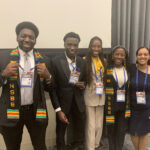
Members of UMBC’s chapter of the National Society of Black Engineers (NSBE) traveled to Norfolk, Virginia for their annual regional conference in November and came home with numerous awards.
The UMBC team defeated Carnegie Mellon University and North Carolina State University to win the Tech Bowl competition, a Jeopardy-style game that tests teams’ knowledge of fundamental engineering principles. UMBC also claimed first through third place in the research poster presentation contest, which involved a 10-minute technical research talk followed by questions from the judges and audience.
The team relied on prior knowledge to excel in the Tech Bowl, only having decided to participate upon arriving at the conference. “It was really exciting getting so many questions right with our only practice being from our coursework,” shares UMBC NSBE chapter president Nelanne Bolima ’24, chemical engineering. “That just goes to show how well UMBC’s College of Engineering and IT prepares students to succeed.”
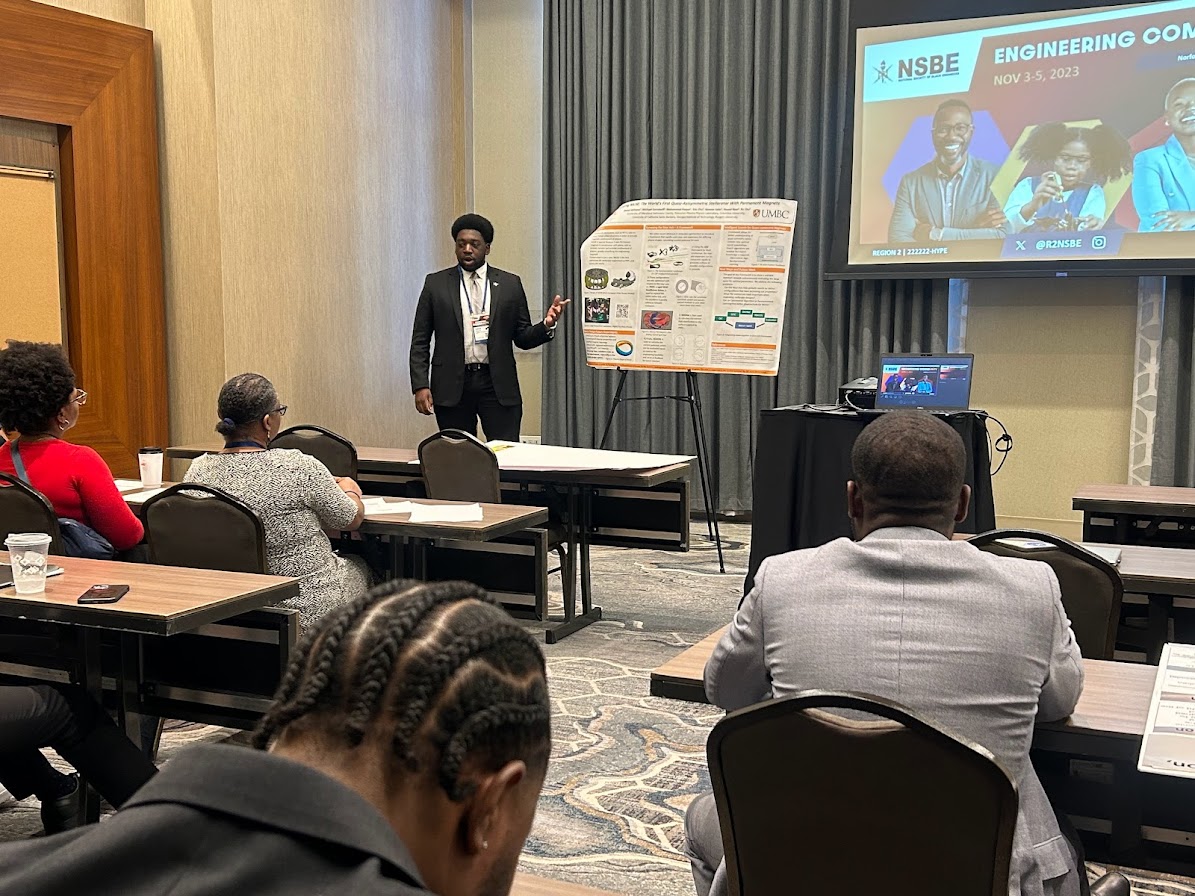 Daniel Williams gives his research presentation at the NSBE conference. (Image by Nelanne Bolima)
In addition to Bolima, the Tech Bowl team members included Kayla Magruder ’26, chemical engineering; Saleem Lawal ’25, computer science; and Daniel Williams ’24, computer science. Presentation winners were Williams (first), Bolima (second), and Christopher Appiah ’24, mechanical engineering (third). Keith Harmon, director of the UMBC Meyerhoff Scholars Program, serves as the chapter advisor.
“We are so proud of the UMBC NSBE Chapter,” Harmon shares. “They do tremendous work supporting UMBC STEM majors and offering service impacting youth in the Baltimore-Washington corridor.”
Students supporting students
NSBE is a completely student-run organization, creating leadership opportunities for hundreds of students across the country. UMBC’s NSBE chapter supports members through activities such as mentoring initiatives, conference preparation, networking opportunities, and leadership development programming. The chapter also focuses on community outreach, such as visiting high schools, collaborating with non-profits, and welcoming younger students to shadow the chapter’s board meetings.
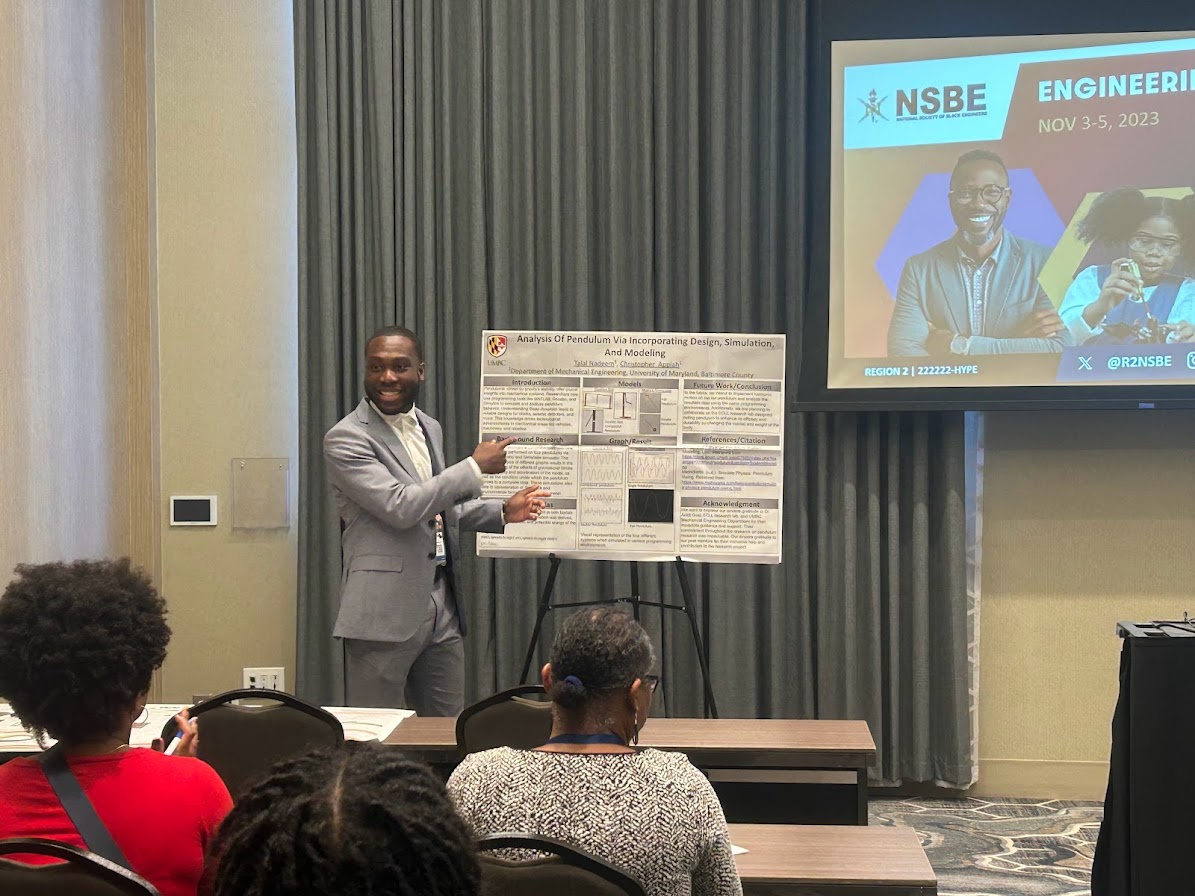 Christopher Appiah gives his research presentation at the NSBE conference. (Image by Nelanne Bolima)
“I have benefitted from being a member of this team by gaining invaluable public speaking and collaboration skills,” Appiah shares. “I learned how to effectively present, detailing the broader impact of research I have done.” Appiah conducts research with Ankit Goel, assistant professor of mechanical engineering. Goel’s group works on complex applications of control theory in robotics and autonomous systems.
For Jaden Somerville ’25, mechanical engineering, “the competition not only improved my technical skills, but also taught me teamwork, problem-solving, and effective time management.”
In March 2024, the chapter will take its talents to the 50th annual NSBE convention in Atlanta, Georgia.
]]>
Members of UMBC’s chapter of the National Society of Black Engineers (NSBE) traveled to Norfolk, Virginia for their annual regional conference in November and came home with numerous awards. ...
https://umbc.edu/stories/nsbe-shines-at-regional-conference/
https://my3.my.umbc.edu/api/v0/pixel/news/137559/guest@my.umbc.edu/101e4ba6879ab3f49b2abd337b9db36c/api/pixel
cbee
coeit
csee
meche
news
rca-2
science-and-tech
UMBC News & Magazine
https://my3.my.umbc.edu/groups/umbc-news-magazine
https://assets1-my.umbc.edu/system/shared/avatars/groups/000/001/943/24435aa6207c452e7bc15cc74b42c7bb/xsmall.png?1748556657
https://assets1-my.umbc.edu/system/shared/avatars/groups/000/001/943/24435aa6207c452e7bc15cc74b42c7bb/original.png?1748556657
https://assets2-my.umbc.edu/system/shared/avatars/groups/000/001/943/24435aa6207c452e7bc15cc74b42c7bb/xxlarge.png?1748556657
https://assets2-my.umbc.edu/system/shared/avatars/groups/000/001/943/24435aa6207c452e7bc15cc74b42c7bb/xlarge.png?1748556657
https://assets3-my.umbc.edu/system/shared/avatars/groups/000/001/943/24435aa6207c452e7bc15cc74b42c7bb/large.png?1748556657
https://assets1-my.umbc.edu/system/shared/avatars/groups/000/001/943/24435aa6207c452e7bc15cc74b42c7bb/medium.png?1748556657
https://assets2-my.umbc.edu/system/shared/avatars/groups/000/001/943/24435aa6207c452e7bc15cc74b42c7bb/small.png?1748556657
https://assets1-my.umbc.edu/system/shared/avatars/groups/000/001/943/24435aa6207c452e7bc15cc74b42c7bb/xsmall.png?1748556657
https://assets2-my.umbc.edu/system/shared/avatars/groups/000/001/943/24435aa6207c452e7bc15cc74b42c7bb/xxsmall.png?1748556657
UMBC News & Magazine
1
0
false
Tue, 05 Dec 2023 17:40:28 -0500
Tue, 05 Dec 2023 17:40:28 -0500
Finding one’s face and building financially resilient spaces through ‘susus’
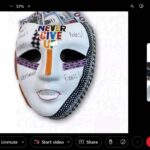
Sonya Squires-Caesar, a doctoral candidate in UMBC’s language, literacy, and culture program, has been interviewing communities who use susus to save money for big-ticket items like homes, farms, or everyday needs like transportation and bills. Susu, a word thought to come linguistically from West African languages, is an informal structure of communal savings where individuals agree to give an equal amount of money to one pool. Members then decide the frequency of when someone receives the entire amount.
 Headshot courtesy of Sonya Squires-Caesar.
“I remember my mother planning her spending around when she would get her payment,” says Squires-Caesar, whose family is from Barbados. Squires-Caesar explains that susus—or rotating savings and credit associations (ROSCAs)—can be a way for people to access larger sums of money without the barriers formal banks and finance systems pose to people without high levels of disposable income.
“While there is a significant body of ROSCA research, it tends to focus on groups living in poverty or with minimal or no access to formal financial instruments,” says Squires-Caesar. “My study differs by focusing on middle-class and upper-middle-class immigrants who opt to use this informal, unregulated financial tool in the U.S. alongside mainstream financial services such as banks, credit cards, investments, etc.”
Squires-Caesar, the Dresher Center for the Humanities’ graduate student research fellow for fall 2023, is interested in studying the evolution of susus from the transatlantic slave trade to today. She explains that for centuries people have pooled their resources for individual and communal needs.
Honoring African indigenous knowledge
Susus are a cultural practice rooted in African indigenous knowledge, a term for how various African cultures orally passed a range of information, customs, and beliefs from generation to generation. “In African indigenous knowledge, the act of learning is thought to be a fully engaged journey to ‘find one’s face,’” says Squires-Caesar, “which is considered the path to discovering your roots, revealing your spirit, and determining the ‘fire in your belly’ or core elements that matter most to you.”
Squires-Caesar “found her face” when she aligned her research path with her authentic identity. “Western research methods couldn’t guide mine. I felt I was trying to fit a square peg into a circle,” explains Squires-Caesar. “I found my face when I realized the methodology that my project needed had to model the community I was looking to understand.”
Researching what’s below the surface
Squires-Caesar’s approach to understanding financial literacy is less about the stock market and credit and more about what is intangible. She calls it the iceberg effect.
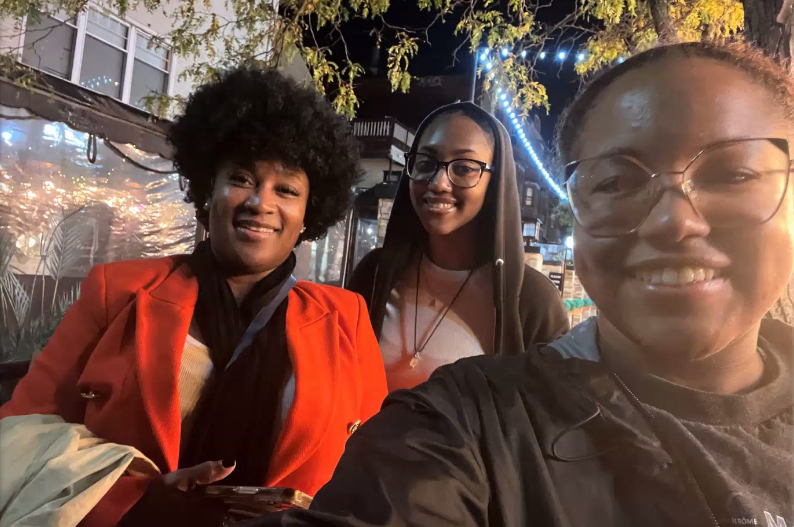 Squires-Caesar, in orange, with students. Some students she interviewed for her dissertation have formed a new intergenerational ROSCA savings club.
“On top of the iceberg are tangible things like bank accounts and credit cards,” explains Squires-Caesar. “You can see, touch, feel, and measure them, but beneath the iceberg are the processes that may not have official rules and regulations and where the general public may not know they are happening, like susus.”
During the four years she managed a community college financial literacy program, Squires-Caesar met many students surviving from month to month. Through ethnographic research, she found students were using non-traditional ways to make ends meet, like getting cash advances from bingo halls to pay for bills and groceries. The data also showed that some students were overwhelmed by the idea of saving.
To shift that thinking, she created a microsavings project for her students to take them through the process of saving—a few cents here, a few dollars there, which grows over time.
These stories about the complexities of susu communities have inspired Squires- Caesar, as part of her Dresher Fellowship, to decorate physical masks as three-dimensional representations of financial identity, of “finding face.”
]]>
Sonya Squires-Caesar, a doctoral candidate in UMBC’s language, literacy, and culture program, has been interviewing communities who use susus to save money for big-ticket items like homes, farms,...
https://umbc.edu/stories/finding-face-financially-resilient-spaces-susus/
https://my3.my.umbc.edu/api/v0/pixel/news/137600/guest@my.umbc.edu/5c3189eb3fce04d4a6418837335acd71/api/pixel
cahss
campus-life
discovery
dresher-center
fall-2023
llc
magazine
UMBC News & Magazine
https://my3.my.umbc.edu/groups/umbc-news-magazine
https://assets1-my.umbc.edu/system/shared/avatars/groups/000/001/943/24435aa6207c452e7bc15cc74b42c7bb/xsmall.png?1748556657
https://assets1-my.umbc.edu/system/shared/avatars/groups/000/001/943/24435aa6207c452e7bc15cc74b42c7bb/original.png?1748556657
https://assets2-my.umbc.edu/system/shared/avatars/groups/000/001/943/24435aa6207c452e7bc15cc74b42c7bb/xxlarge.png?1748556657
https://assets2-my.umbc.edu/system/shared/avatars/groups/000/001/943/24435aa6207c452e7bc15cc74b42c7bb/xlarge.png?1748556657
https://assets3-my.umbc.edu/system/shared/avatars/groups/000/001/943/24435aa6207c452e7bc15cc74b42c7bb/large.png?1748556657
https://assets1-my.umbc.edu/system/shared/avatars/groups/000/001/943/24435aa6207c452e7bc15cc74b42c7bb/medium.png?1748556657
https://assets2-my.umbc.edu/system/shared/avatars/groups/000/001/943/24435aa6207c452e7bc15cc74b42c7bb/small.png?1748556657
https://assets1-my.umbc.edu/system/shared/avatars/groups/000/001/943/24435aa6207c452e7bc15cc74b42c7bb/xsmall.png?1748556657
https://assets2-my.umbc.edu/system/shared/avatars/groups/000/001/943/24435aa6207c452e7bc15cc74b42c7bb/xxsmall.png?1748556657
UMBC News & Magazine
0
0
false
Tue, 05 Dec 2023 16:37:15 -0500
Renique Kersh, VP for student affairs, values listening as the first step of leadership

Renique Kersh became UMBC’s vice president for student affairs in August 2023, and her first days were a whirlwind that included dropping her sons at school, moving from Boston to Maryland, and attending a number of UMBC welcome events for students and the community.
Now that she’s had the chance to replant her roots at UMBC (her first job out of graduate school was as a community director for Residential Life from 2001 – 2003), Kersh is using her time to listen to the community and bring her expertise to the table as she works with campus leadership and partners to support student success and well-being.
Her excitement and eagerness to be here is evident in the way she enthusiastically talks about UMBC students, staff, faculty, alumni, and families—and the work ahead.
UMBC Magazine: What has excited you the most about being at UMBC so far?
The students! One of the most exciting parts of my interview process was meeting students in person. I appreciate how humble they are and how seriously they take the privilege of being here and caring for our community.
I’ve also loved meeting and hearing from staff and faculty across campus. It’s a phenomenal group with a lot of spirit, energy, and commitment to the university and creating opportunities for students.
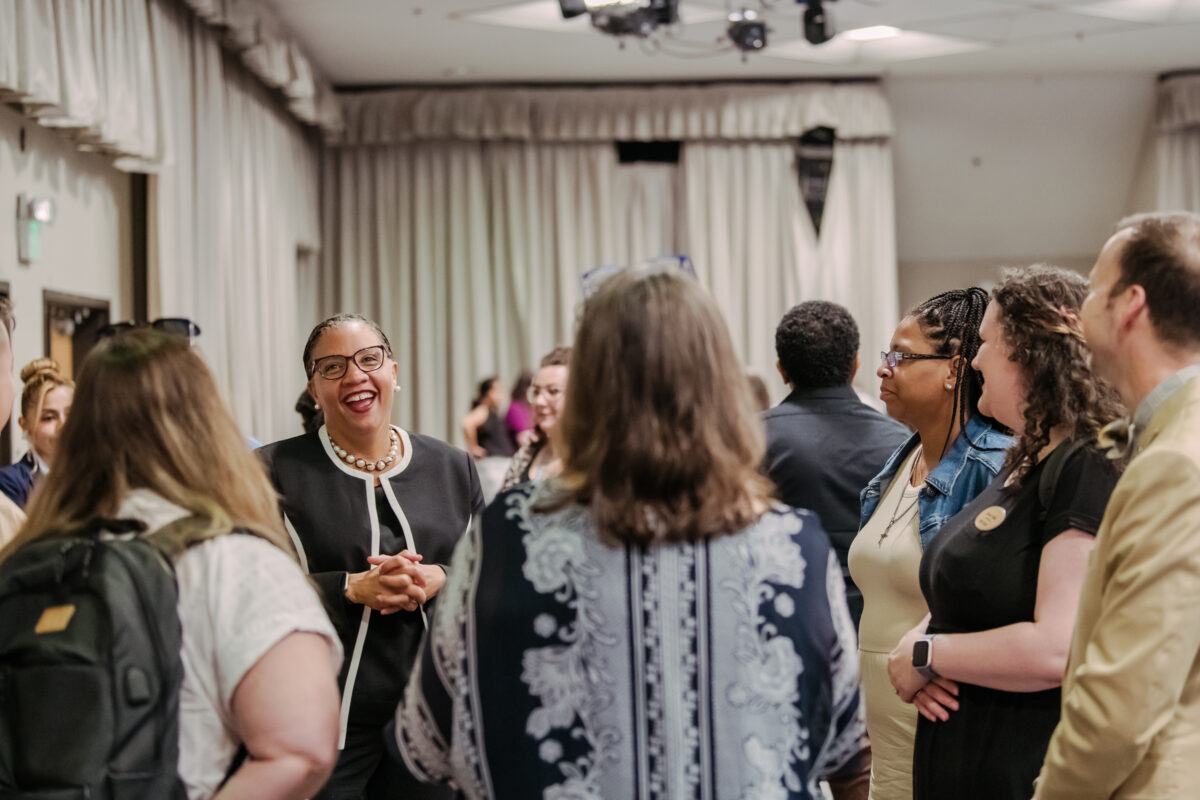 Kersh meets with staff and students at a Division of Student Affairs welcome event. (Marlayna Demond ’11/UMBC)
Some people have heard me say this already, but it’s true: When we moved from Boston and crossed the border into Maryland, I immediately felt a sense of home. I do believe that this is my home, and it’s where my heart has been for many years. I wake up every morning thankful to be part of such a supportive campus environment.
I’m also honored and humbled to work for a president who is a dynamic leader who deeply appreciates UMBC’s history and is committed to taking the university to the next level. I’m excited to be part of that work too.
I’m grateful for the alumni who have welcomed me, and I look forward to additional opportunities to engage with them and hear about their experiences as students here. I would love to bring alumni who were student leaders during their time here to meet with our current student leaders.
UMBC Magazine: What are your initial goals to connect and support students and the campus—now and future? What is the importance of campus partnerships in student affairs?
I’ve been doing a lot of listening, and I hear five areas where we need to grow: belonging; staff well-being and capacity; space; structure; and synergy. I want to build priorities around what I am hearing.
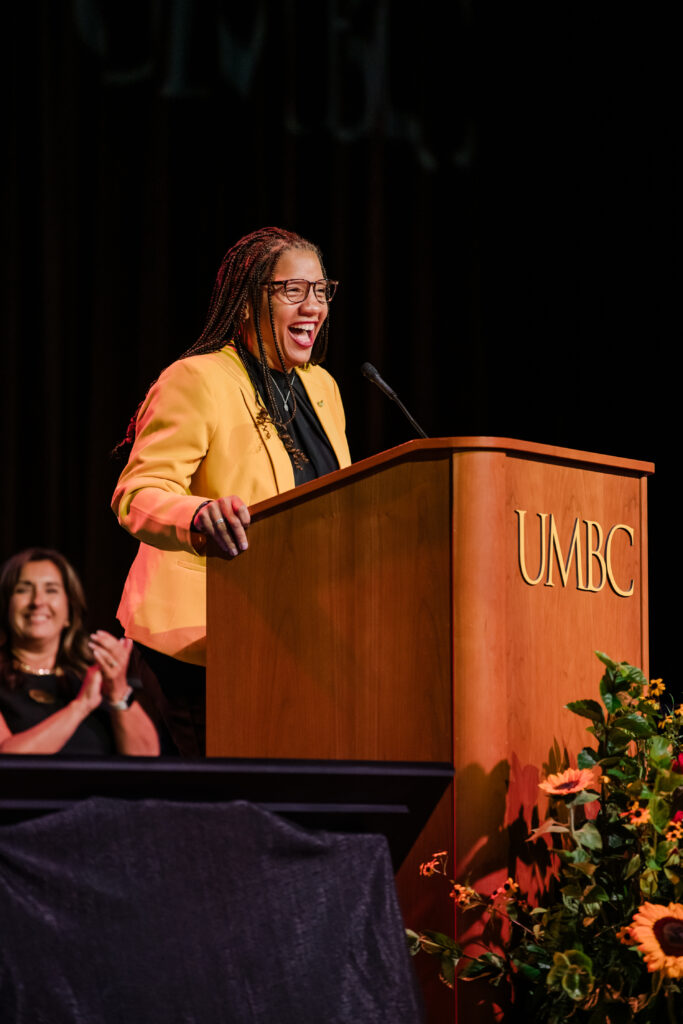 Kersh spoke at the 2023 Fall Opening Meeting. (Marlayna Demond ’11/UMBC)
We are a diverse community but we still need to pay attention to how students feel welcome. Our demographics are changing quickly and as part of our commitment to inclusive excellence we need to have the infrastructure to support the diverse student body. The goal of the Division of Student Affairs is to support and engage both undergraduate and graduate students. To do that fully we need to engage in some difficult conversations in order to build community, while honoring differences and similarities between the two.
We are in need of additional space to support students, staff, and faculty. The pandemic has changed how we use space, and we need to consider these changes and look at how we can use space. We need to find more spaces where students can gather together in the ways we hope for them.
Partnerships across our division and campus are key. We do work better together. Together we can address capacity and efficiency so that students are successful. This includes technology to evaluate success, communication structures, and bringing academics together with co-curricular engagement experiences.
Over the course of my career, I’ve spent a great deal of time in student affairs, and a long time on the academic side of universities as well. Both areas show a care and concern for student success, but sometimes barriers build up between the two. This work cannot be done in silos, and I’m committed to finding the connection points and focusing on ways we can work together.
UMBC Magazine: How do we support students in challenging times?
It’s really important to listen to students and not impose our way of being on them. What do they need? Often, the first things they begin to share with us don’t give us an immediate sense of what they are feeling or need; we have to keep listening and encourage them to tell their story before we respond. What is their concern a symptom of, and how do we diagnose it?
Being present with students also calls for humility and understanding our limitations. Answers aren’t always simple. We have to look at the support systems we offer, and if they don’t have the impact we are hoping for, we may need to change how we do things or consider new ways of doing them.
The mental health crisis is ongoing, so we need to think creatively about what we offer students. That may mean going beyond care appointments to, for example, pop-up spaces with resources and trained facilitators. We know this crisis calls for a major shift in how universities approach this work and that there’s also an impact on faculty and staff, who may struggle to know how to help students while dealing with their own challenges. Sometimes it calls for difficult discussions about students and their responsibility as a member of this community and how they can support themselves and others.
UMBC Magazine: As you began your vice president’s role, you also traveled to Germany in October as part of your Fulbright Administrators Award. What did you learn from the experience?
The experience was transformative both personally and professionally, and I was honored to be one of the 15 leaders chosen from across the country.
First of all, everyone in my group shared their schools’ challenges with equity issues. While our educational systems and our assessment methods are different, we had important conversations and struggled with the idea of trying to change a system that has been in place for quite some time.
I learned that administrators from Germany traveled to Kentucky as part of their Fulbright, and they were shocked by our standard of care. They shared that the level of support and guidance we provide seems excessive and indicated that in Germany the philosophy is that when students turn 18 they are adults who can navigate institutions on their own.
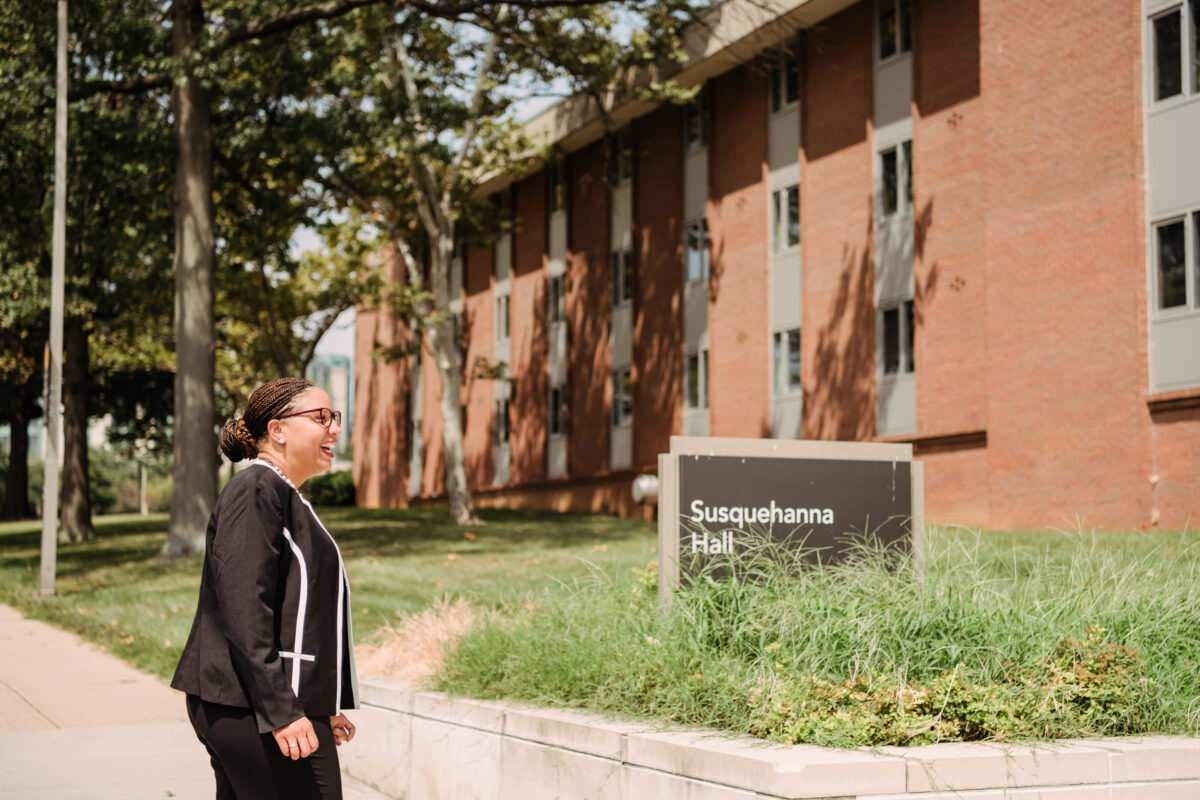 Kersh’s first job out of graduate school was as a community director in UMBC’s Residential Life. (Marlayna Demond ’11/UMBC)
Our conversations led us to discussions about what we can learn from Germans about giving students more space to figure things out and what they can learn from us about meeting students where they are and considering the standard of care that may be needed at each stage of development. In the future, I would love to teach a comparative analysis class and take students to Germany to learn more about their approach to education and care.
In reflecting back, I see the Fulbright as a seed for me and my work, but also an opportunity for my sons to see what is possible for them, too.
UMBC Magazine: In 2022 you were also selected to be an Aspen Institute Senior Impact Fellow. What were the outcomes of this program?
What I loved about this fellowship is that it’s an intergenerational program, so there were leaders in high school and college up to university presidents. We discussed our perspectives on what leadership means and how to create opportunities for experiential equity for students. Some of the things children engage in or are responsible for can be examples of leadership, but are not traditionally acknowledged as such. How do we capture that and provide more resources and support for them?
Being present with students also calls for humility and understanding our limitations. Answers aren’t always simple.
Renique Kersh
As part of my fellowship, I co-authored a report focused on the advancement of youth leadership development opportunities. “Advancing Youth Development Leadership Research,” was published in October 2023 under the new name of the organization that spun off of Aspen, The Center for Expanding Leadership and Opportunity, along with an additional report on “The Future of Youth Leadership Development Practice.”
UMBC Magazine: As a leader, how important is self care to you and how do you practice it?
My doctoral research focused on the relationship between stress and the health risks for women leaders in higher education. It’s real, and the more responsibility women have as leaders the more unhealthy they become. This really spoke to me, and as I grow as a leader I’ve never forgotten it. I have to remind myself to take time for me, that no one else will do that for me. For me, this means personal retreats focused on what I need at the time, whether it’s space to think and write or just a relaxing getaway.
In the day-to-day, I love Peloton, and I just started shadowboxing! I also love spending time in community with family and friends.
Interview by Eleanor Lewis
]]>
Renique Kersh became UMBC’s vice president for student affairs in August 2023, and her first days were a whirlwind that included dropping her sons at school, moving from Boston to Maryland, and...
https://umbc.edu/stories/renique-kersh-student-affairs-values-listening/
https://my3.my.umbc.edu/api/v0/pixel/news/137545/guest@my.umbc.edu/efce14aea75f4eafca8979e4881c69b2/api/pixel
campus-life
magazine
residential-life
student-affairs
UMBC News & Magazine
https://my3.my.umbc.edu/groups/umbc-news-magazine
https://assets1-my.umbc.edu/system/shared/avatars/groups/000/001/943/24435aa6207c452e7bc15cc74b42c7bb/xsmall.png?1748556657
https://assets1-my.umbc.edu/system/shared/avatars/groups/000/001/943/24435aa6207c452e7bc15cc74b42c7bb/original.png?1748556657
https://assets2-my.umbc.edu/system/shared/avatars/groups/000/001/943/24435aa6207c452e7bc15cc74b42c7bb/xxlarge.png?1748556657
https://assets2-my.umbc.edu/system/shared/avatars/groups/000/001/943/24435aa6207c452e7bc15cc74b42c7bb/xlarge.png?1748556657
https://assets3-my.umbc.edu/system/shared/avatars/groups/000/001/943/24435aa6207c452e7bc15cc74b42c7bb/large.png?1748556657
https://assets1-my.umbc.edu/system/shared/avatars/groups/000/001/943/24435aa6207c452e7bc15cc74b42c7bb/medium.png?1748556657
https://assets2-my.umbc.edu/system/shared/avatars/groups/000/001/943/24435aa6207c452e7bc15cc74b42c7bb/small.png?1748556657
https://assets1-my.umbc.edu/system/shared/avatars/groups/000/001/943/24435aa6207c452e7bc15cc74b42c7bb/xsmall.png?1748556657
https://assets2-my.umbc.edu/system/shared/avatars/groups/000/001/943/24435aa6207c452e7bc15cc74b42c7bb/xxsmall.png?1748556657
UMBC News & Magazine
2
0
false
Tue, 05 Dec 2023 11:43:34 -0500
Tue, 05 Dec 2023 11:43:34 -0500
Advanced X-ray Imaging Satellite science team hits major milestone
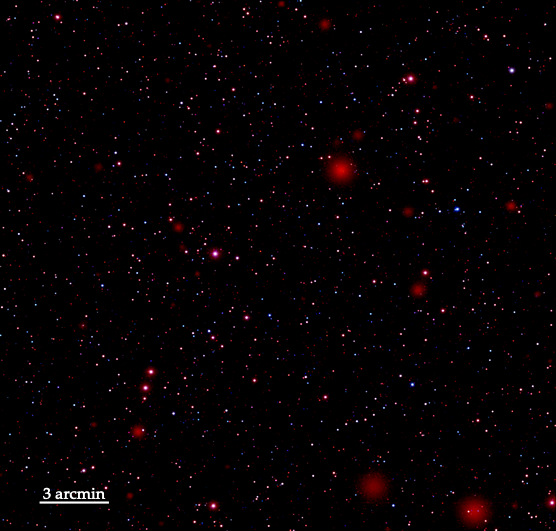 A simulation of the sky as viewed by AXIS in one 5 million-second exposure to deep space. This simulated image shows some of the earliest detected supermassive black holes. (Simulation by Stefano Marchesi)
After 18 months of intensive design work by a team of more than 100 scientists, which followed years of preliminary work and investment, in November the scientists and engineers on the Advanced X-ray Imaging Satellite (AXIS) science team took an important step toward delivering this next-generation space telescope. They became one of 10 teams to submit their formal project proposal to NASA, requesting nearly $1 billion in funding to further develop the design and build the telescope.
Adi Foord, assistant professor of physics, and Eileen Meyer, associate professor of physics, serve on the central AXIS leadership team, and Foord co-leads the sub-team focused on supermassive black hole evolution. If selected for production, AXIS will improve upon the highly successful, but aging, Chandra X-ray Observatory launched in 1999.
As an X-ray telescope, AXIS aligns with one of the established priorities laid out in NASA’s 2020 decadal survey. These surveys initiate a years-long competition to be the one major instrument eventually selected for launch to address one of the priorities.
A revolutionary x-ray telescope
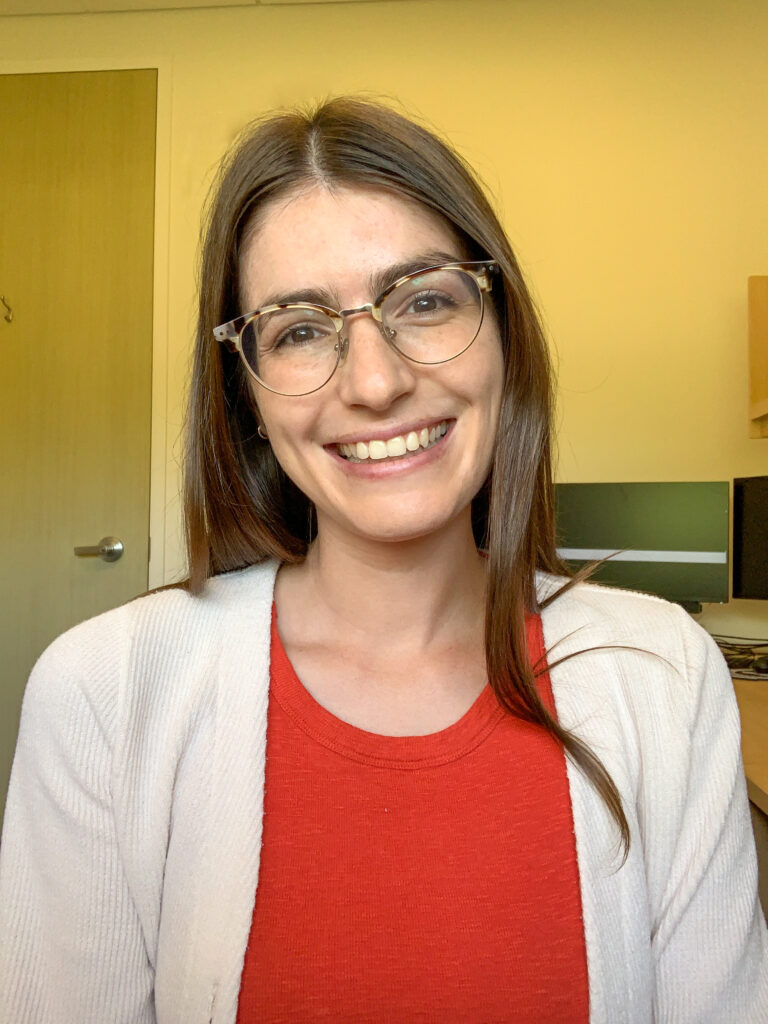 Adi Foord co-leads the AXIS Supermassive Black Hole science working group. She is also the project’s communications and outreach lead. (Image courtesy of Foord)
“AXIS is going to revolutionize our understanding of supermassive black hole growth and evolution by detecting some of the earliest known supermassive black holes to date and tracking them across cosmic time,” Foord says. “AXIS will be the premiere high-angular-resolution X-ray mission of the 2030s, observing deeper into our universe than currently possible with existing X-ray telescopes.”
The lead investigator on the AXIS team is Chris Reynolds at University of Maryland, College Park, and the co-lead is Erin Kara at MIT. The team will know by fall 2024 if its proposal is one of two or three selected to move on to the next phase. After that, one proposal will eventually emerge the winner, and the selected team will build their satellite for launch in the early 2030s.
The team is optimistic about their prospects, given the strength of the proposal and the potential impact of the new satellite’s capabilities. AXIS’ “superb resolution means that it will be able to detect many new systems of interacting supermassive black holes,” Foord explains, such as pairs orbiting each other very closely and expected to merge. “We currently don’t know of too many of these systems, and AXIS is predicted to find hundreds to thousands of them.”
]]>
A simulation of the sky as viewed by AXIS in one 5 million-second exposure to deep space. This simulated image shows some of the earliest detected supermassive black holes. (Simulation by Stefano...
https://umbc.edu/stories/x-ray-satellite-milestone/
https://my3.my.umbc.edu/api/v0/pixel/news/137543/guest@my.umbc.edu/2cad22ac9cc91f4d3c302358a092f294/api/pixel
cnms
news
physics
research
science-and-tech
UMBC News & Magazine
https://my3.my.umbc.edu/groups/umbc-news-magazine
https://assets1-my.umbc.edu/system/shared/avatars/groups/000/001/943/24435aa6207c452e7bc15cc74b42c7bb/xsmall.png?1748556657
https://assets1-my.umbc.edu/system/shared/avatars/groups/000/001/943/24435aa6207c452e7bc15cc74b42c7bb/original.png?1748556657
https://assets2-my.umbc.edu/system/shared/avatars/groups/000/001/943/24435aa6207c452e7bc15cc74b42c7bb/xxlarge.png?1748556657
https://assets2-my.umbc.edu/system/shared/avatars/groups/000/001/943/24435aa6207c452e7bc15cc74b42c7bb/xlarge.png?1748556657
https://assets3-my.umbc.edu/system/shared/avatars/groups/000/001/943/24435aa6207c452e7bc15cc74b42c7bb/large.png?1748556657
https://assets1-my.umbc.edu/system/shared/avatars/groups/000/001/943/24435aa6207c452e7bc15cc74b42c7bb/medium.png?1748556657
https://assets2-my.umbc.edu/system/shared/avatars/groups/000/001/943/24435aa6207c452e7bc15cc74b42c7bb/small.png?1748556657
https://assets1-my.umbc.edu/system/shared/avatars/groups/000/001/943/24435aa6207c452e7bc15cc74b42c7bb/xsmall.png?1748556657
https://assets2-my.umbc.edu/system/shared/avatars/groups/000/001/943/24435aa6207c452e7bc15cc74b42c7bb/xxsmall.png?1748556657
UMBC News & Magazine
0
0
false
Tue, 05 Dec 2023 11:28:07 -0500
Tue, 05 Dec 2023 11:28:07 -0500