The man behind the camera

When LeBron James comes calling, you answer the phone. Philip Knowlton ’03, visual arts, knows this better than most.
The NBA legend doesn’t have the UMBC alum in his contacts because Knowlton is great at one-on-one (probably). Instead, Knowlton has collaborated with James’ media company Uninterrupted on several documentaries as a director, editor, producer, and director of photography. Uninterrupted was founded to empower athletes to tell their stories in their own words. This time, Knowlton was called upon to direct and co-executive produce Redefined: J.R. Smith, a four-part Prime Video documentary series released in April 2023 that follows J.R. Smith, a retired two-time NBA champion, as he navigates a new challenge—college.
“This is the story of him post-NBA as he decides to go to college at North Carolina A&T [State University] to pursue a degree but also to try out for the Aggies golf team,” explains Knowlton.
Student-athlete turned filmmaker
“It was just a really inspiring project to be a part of,” says Knowlton, who made his first sports documentary about UMBC track and field when he was a student-athlete on the team. Having played (and won championships) with James on both the Cleveland Cavaliers and Los Angeles Lakers, Smith became good friends with James. So, when Smith made the decision to pack his book bag, head to college, and try out for the golf team, his team connected with Uninterrupted to see about interest in a possible film project.
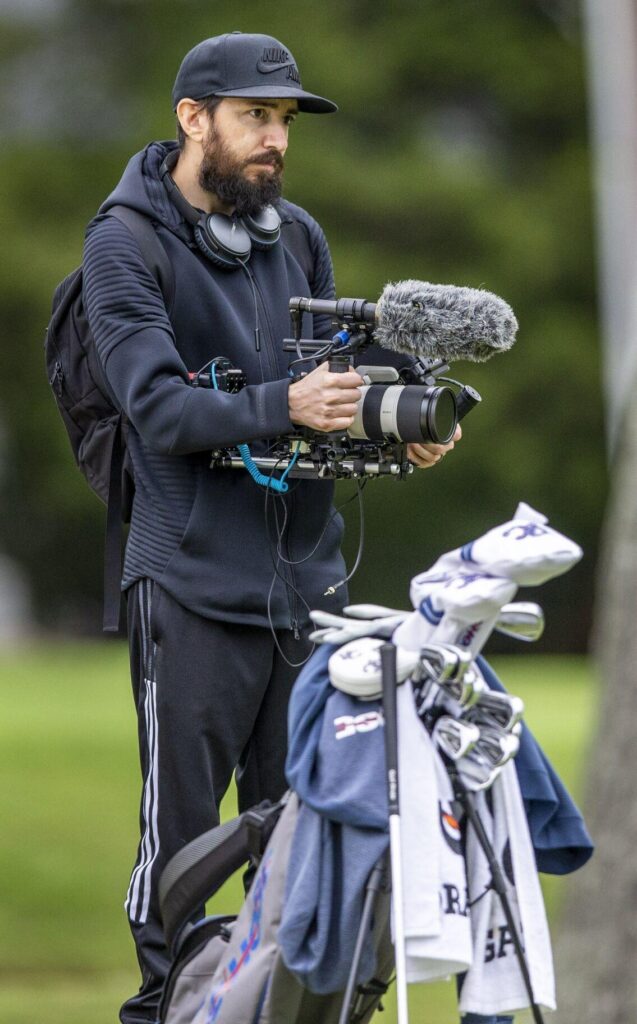 Knowlton filming J.R. playing golf.
“Of course they were on board,” says Knowlton, who received the call from Uninterrupted soon after. “They asked me if I’d be interested in flying to Greensboro to film a sizzle.” In the film world, a sizzle is like a demo—a short trailer used to pitch the story to networks.
Knowlton jumped at the opportunity to once again work with Uninterrupted.
“I think what they really like about me is that I’m able to direct and shoot,” says Knowlton. “It keeps the team smaller and more intimate. So, you’re able to be in places that a big crew may not be able to get into. Or athletes may not want a whole big team following them around.”
Knowlton worked with the team at Uninterrupted to put together a treatment and map out the story they wanted to tell. Then, he hopped on a plane to Greensboro and filmed the sizzle.
“Next, we took meetings with everyone like HBO Max, ESPN+, Amazon—all of them,” explains Knowlton. “There was interest from quite a few networks, but it ultimately landed on Prime Video.”
By this point, Smith was just about two or three weeks out from starting school. So, Knowlton had to move quickly. “This production, specifically, was really dictated by Smith’s golf season and his school year,” says Knowlton. The team made it in time to film the first couple days of school and practice. Then, they returned every month or two for different milestones throughout Smith’s first year, like his first tournament and A&T’s homecoming celebration.
“It was amazing to see J.R., who could have retired and moved to Miami to hang out by the pool, want to go to college for the first time and push himself,” says Knowlton.
Find a place that let’s you do both
Of course, this story starts way before Smith decided to trade basketballs for golf balls. This story starts at a still-burgeoning university in Baltimore County, Maryland.
“I was looking for a school where I could run cross country that also had a good video or digital art program,” explains Knowlton, who now owns and operates Opposit, a creative studio he founded in 2018 specializing in original documentary film content. “A lot of schools have one or the other but not both.” UMBC gave Knowlton the opportunity to explore both.
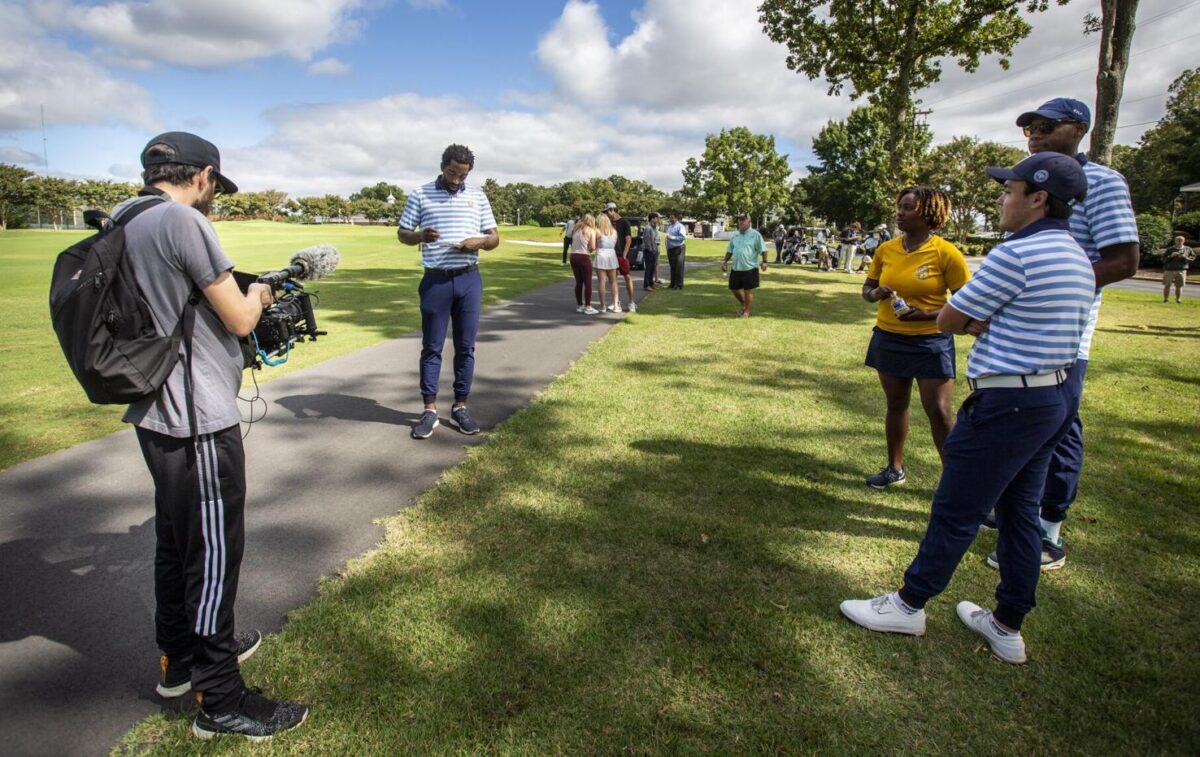 Knowlton filming in North Carolina.
“It was kind of a no-brainer,” admits Knowlton, who received an athletic scholarship to run on the cross country and track and field teams while pursuing his B.A. in imaging and digital arts. “That program was perfect in that it let me experiment in a lot of different art forms.”
Throughout college, Knowlton was still trying to find his passion. He knew he loved visual arts but was unsure where to focus his energy. He enjoyed photography, graphic design, and film. It wasn’t until Vin Grabill’s video art class that it all started to click.
“I taught students that video could be seen as a kind of ‘painting in time.’ Utilizing video edits as brushstrokes, students created short rhythmic works that brought impact to their source material,” explains Grabill, associate professor emeritus in UMBC’s Department of Visual Arts. “Phil’s exercises exemplified these goals, eventually leading to final projects where narrative content was successfully built around a solid rhythmic structure. I’m very happy to see Phil pushing his work forward 20 years later!”
“Today, when I do Q&As about my films, I like to quote [basketball coach] Jim Valvano, who said, ‘Every single day, in every walk of life, ordinary people do extraordinary things,’” says Knowlton. “When I work on documentaries, a lot of the time I am filming everyday people doing amazing things. But J.R.’s story almost feels like the reverse. He’s this extraordinary person doing something more ordinary—going to college. To have been a part of J.R.’s journey and help share with the world has been a great experience.”
]]>
When LeBron James comes calling, you answer the phone. Philip Knowlton ’03, visual arts, knows this better than most. The NBA legend doesn’t have the UMBC alum in his contacts because...
https://umbc.edu/stories/the-man-behind-the-camera-golf-documentary/
https://my3.my.umbc.edu/api/v0/pixel/news/137488/guest@my.umbc.edu/39dc8d9c0c74dab9e1386e560f3fd134/api/pixel
alumni
at-play
fall-2023
impact
magazine
UMBC News & Magazine
https://my3.my.umbc.edu/groups/umbc-news-magazine
https://assets1-my.umbc.edu/system/shared/avatars/groups/000/001/943/24435aa6207c452e7bc15cc74b42c7bb/xsmall.png?1748556657
https://assets1-my.umbc.edu/system/shared/avatars/groups/000/001/943/24435aa6207c452e7bc15cc74b42c7bb/original.png?1748556657
https://assets2-my.umbc.edu/system/shared/avatars/groups/000/001/943/24435aa6207c452e7bc15cc74b42c7bb/xxlarge.png?1748556657
https://assets2-my.umbc.edu/system/shared/avatars/groups/000/001/943/24435aa6207c452e7bc15cc74b42c7bb/xlarge.png?1748556657
https://assets3-my.umbc.edu/system/shared/avatars/groups/000/001/943/24435aa6207c452e7bc15cc74b42c7bb/large.png?1748556657
https://assets1-my.umbc.edu/system/shared/avatars/groups/000/001/943/24435aa6207c452e7bc15cc74b42c7bb/medium.png?1748556657
https://assets2-my.umbc.edu/system/shared/avatars/groups/000/001/943/24435aa6207c452e7bc15cc74b42c7bb/small.png?1748556657
https://assets1-my.umbc.edu/system/shared/avatars/groups/000/001/943/24435aa6207c452e7bc15cc74b42c7bb/xsmall.png?1748556657
https://assets2-my.umbc.edu/system/shared/avatars/groups/000/001/943/24435aa6207c452e7bc15cc74b42c7bb/xxsmall.png?1748556657
UMBC News & Magazine
0
0
false
Mon, 04 Dec 2023 10:03:04 -0500
Mon, 04 Dec 2023 10:03:04 -0500
UMBC, UMB receive $4 million NIH REACH grant to create new biomedical and life sciences accelerator program
UMBC is continuing its commitment to diversifying Maryland’s biomedical and life sciences ecosystem through its latest collaborative effort with the University of Maryland, Baltimore (UMB) to develop a new life sciences accelerator program focused on faculty development and research commercialization efforts.
UMBC and UMB were jointly awarded a four-year, $4 million Research Evaluation and Commercialization Hubs (REACH) grant from the National Institutes of Health (NIH) to advance the biomedical entrepreneurship and innovation economy in the Baltimore region. This grant will be used to build on the work that began when UMBC and the University of Maryland School of Medicine (UMSOM) received a $13 million NIH Common Fund Faculty Institutional Recruitment for Sustainable Transformation (FIRST) grant in 2022 to enhance recruitment and training of junior faculty from groups underrepresented in biomedical science.
“We have a long-term commitment to enhance the diversity of the faculty on our two campuses in the biomedical and life sciences,” says Karl V. Steiner, UMBC’s vice president of research and creative achievement and co-principal investigator of the new REACH grant. “We are pleased to further strengthen the close partnership with our colleagues at UMB and beyond with this next initiative.”
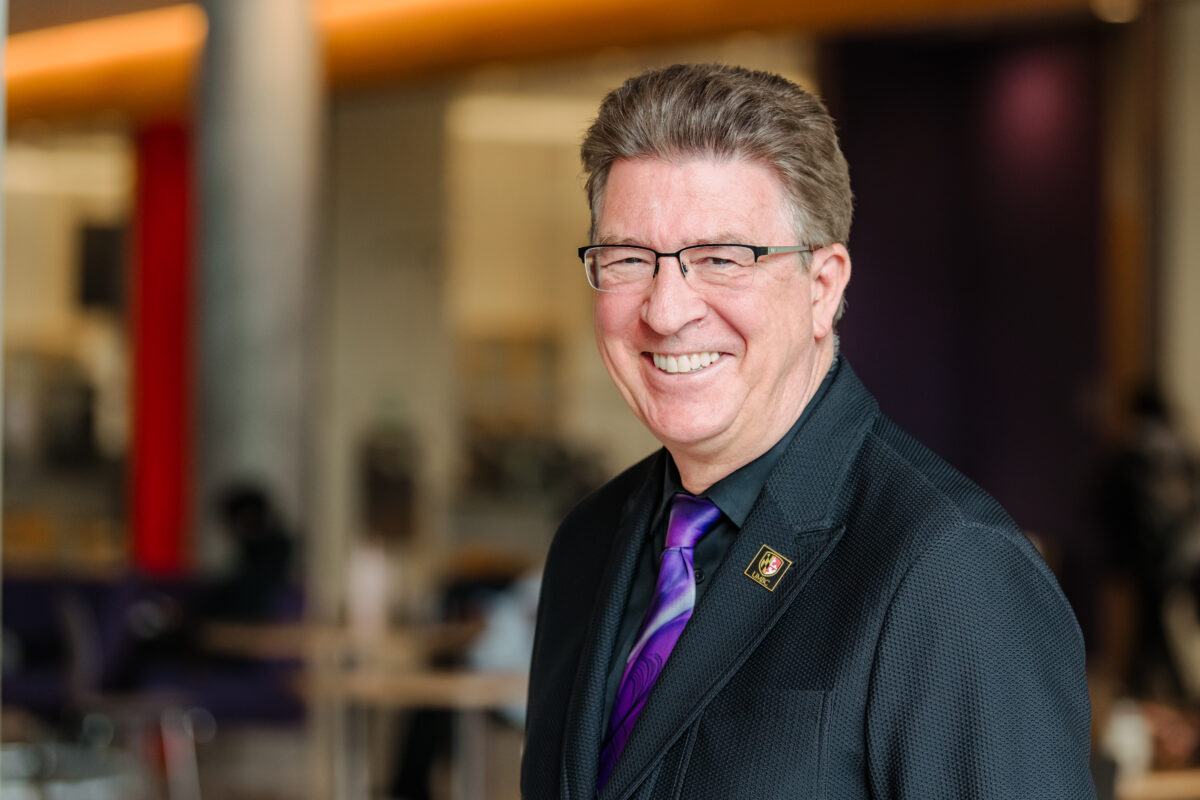 Karl V. Steiner.
Building a life sciences accelerator program
The REACH grant will fund up to 44 early-career faculty and students from UMBC and UMB (11 each year) with up to $100,000 each to develop and test commercially-promising biomedical and life science technologies. Additionally, UMB will use a portion of the grant funding to create the University of Maryland, Baltimore Life Science Discovery (UM-BILD) Accelerator Program’s “proof-of-concept” hub that will be housed at the University of Maryland BioPark and at the bwtech@UMBC Research and Technology Park. The UM-BILD hub, set to launch next year, is one of only five REACH hubs awarded funding across the nation.
Aaron Miscenich, executive director of bwtech@UMBC, explains that bwtech@UMBC has done extensive work in developing a strong community centered around entrepreneurship and technology commercialization.
“UMBC’s partnership with UMB to create this technology commercialization hub will [further] enhance our work and bring additional support to UMBC’s research community,” Miscenich says. “It’s a great opportunity to bring together UMBC faculty and students with resources that can help further develop promising technologies and help them to grow into thriving businesses.”
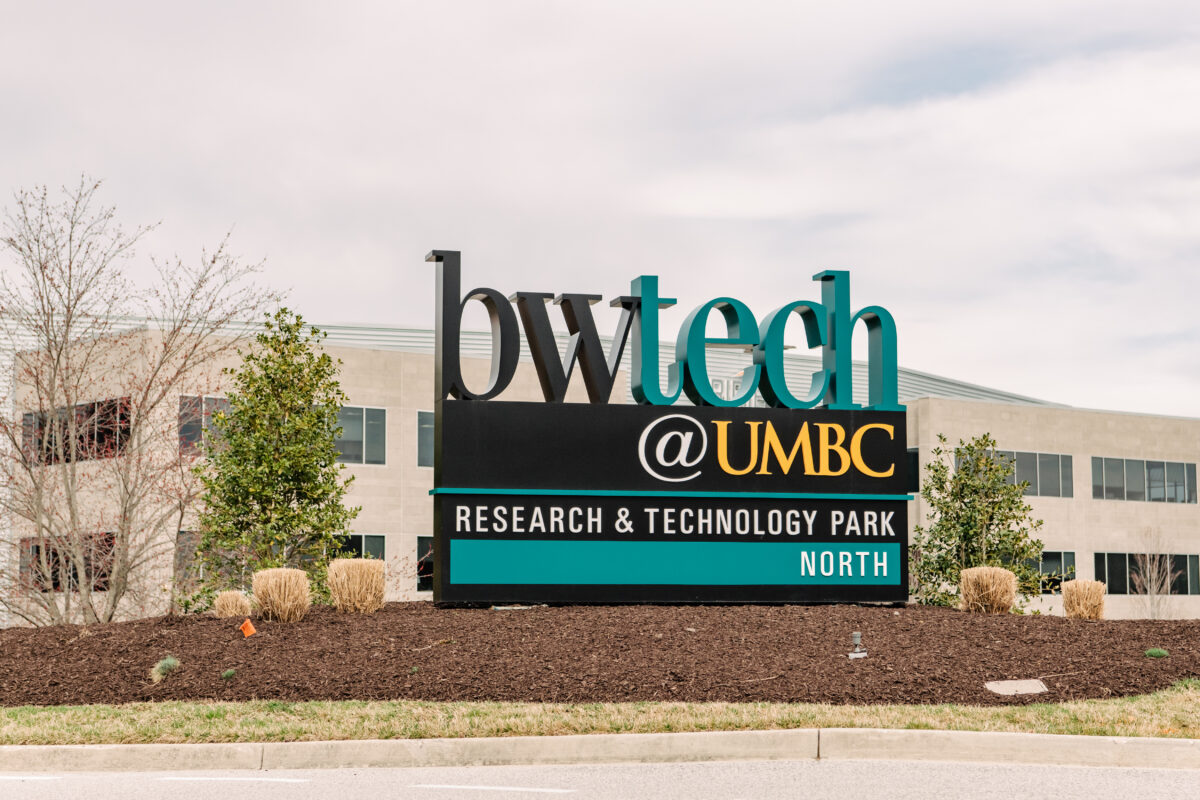 bwtech@UMBC Research and Technology Park, north campus.
UMSOM’s Jason Rose, principal investigator of the REACH grant, shared how both institutions plan to support the biotech entrepreneurs who take part in the accelerator program.
“We recognize that to create our own unique cohort of newly trained biotech entrepreneurs here in Baltimore, our accelerator will need to provide them with both research support and funding, as well as guidance through the process of commercialization and technology development,” Rose said in a UMSOM press release. “We will be providing mentoring and educational programs from a diverse set of successful life science innovators and leaders to help distill their broad experiences—from navigating FDA regulatory pathways to financing new companies—to all of those who interact with the hub.”
This initiative, Steiner adds, aims to increase the number of Black and Latinx entrepreneurs in the biomedical and life sciences.
“As we look at the makeup of entrepreneurs across our communities, it’s obvious that we are under-serving those underserved communities. This will be yet another building block in our joint commitment to ensure that we focus on and benefit from the breadth of entrepreneurial talent in Maryland,” says Steiner. “We’re looking to bring in more individuals from underrepresented communities into the faculty ranks and actively help them develop a strong network of peers and mentors to allow them to successfully build their careers and their businesses in Maryland, with support from UMBC with bwtech and support from UMB.”
UMBC President Valerie Sheares Ashby shares that “we are excited to work together to create opportunities for everyone to benefit from and contribute to this innovation ecosystem, staying true to our long-held commitment to inclusive excellence.”
Commercialization efforts at UMBC
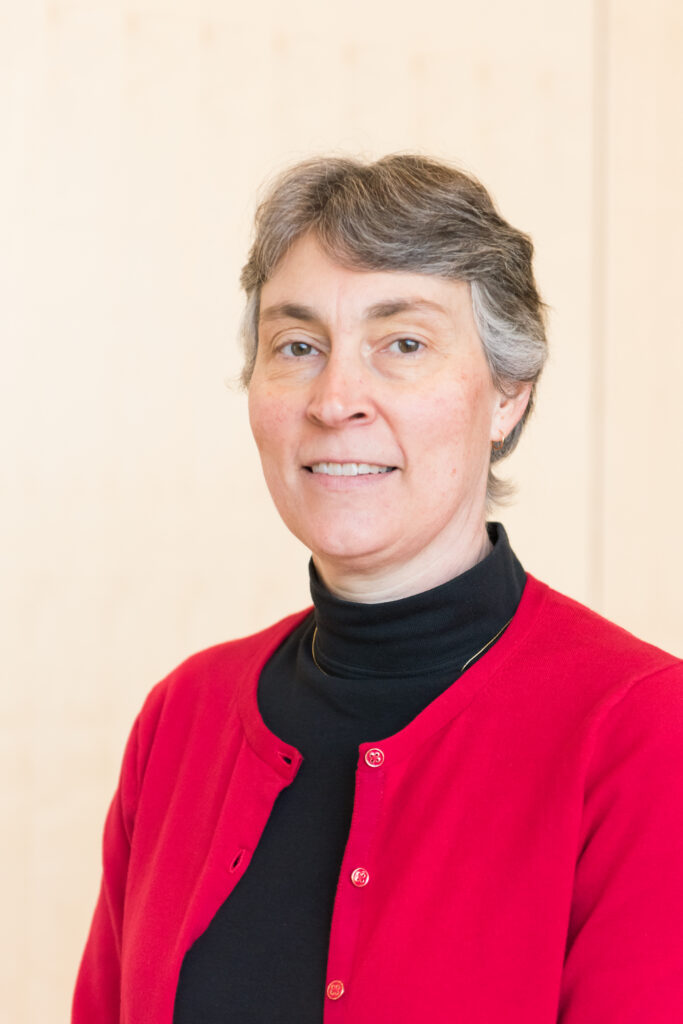 Wendy Martin.
Wendy Martin, director of UMBC’s Office of Technology Development, will assist in selecting and managing the projects that will be funded through the REACH grant. Martin has worked closely with faculty in all aspects of intellectual property protection and commercialization, including helping faculty to receive internal and external funding to develop new products. Those funding opportunities have included UMBC’s long-standing partnership with TEDCO’s Maryland Innovation Initiative (MII), which will also be a collaborator of the UM-BILD accelerator along with the University of Maryland, College Park, Morgan State University, and Blackbird Laboratories.
Since launching in 2012, MII has supported 39 UMBC faculty in their commercialization pursuits, including the development of bendable zinc-based batteries and vibration-powered sensor technology for wind turbines.
“I’m excited that we can bring everyone to the table. UMBC provides a continuum of support for these commercialization projects,” says Martin. “We’re building on enhancing things that we’re already doing. It’s great that we will have these additional resources to keep it going and to do it better.”
]]>
UMBC is continuing its commitment to diversifying Maryland’s biomedical and life sciences ecosystem through its latest collaborative effort with the University of Maryland, Baltimore (UMB) to...
https://umbc.edu/stories/umbc-umb-reach-grant-life-sciences-accelerator-program/
https://my3.my.umbc.edu/api/v0/pixel/news/137448/guest@my.umbc.edu/9e76698ced1b0d55ff2955a521c2d113/api/pixel
bwtech
bwtech-at-umbc
cnms
news
rca-1
research
science-and-tech
UMBC News & Magazine
https://my3.my.umbc.edu/groups/umbc-news-magazine
https://assets1-my.umbc.edu/system/shared/avatars/groups/000/001/943/24435aa6207c452e7bc15cc74b42c7bb/xsmall.png?1748556657
https://assets1-my.umbc.edu/system/shared/avatars/groups/000/001/943/24435aa6207c452e7bc15cc74b42c7bb/original.png?1748556657
https://assets2-my.umbc.edu/system/shared/avatars/groups/000/001/943/24435aa6207c452e7bc15cc74b42c7bb/xxlarge.png?1748556657
https://assets2-my.umbc.edu/system/shared/avatars/groups/000/001/943/24435aa6207c452e7bc15cc74b42c7bb/xlarge.png?1748556657
https://assets3-my.umbc.edu/system/shared/avatars/groups/000/001/943/24435aa6207c452e7bc15cc74b42c7bb/large.png?1748556657
https://assets1-my.umbc.edu/system/shared/avatars/groups/000/001/943/24435aa6207c452e7bc15cc74b42c7bb/medium.png?1748556657
https://assets2-my.umbc.edu/system/shared/avatars/groups/000/001/943/24435aa6207c452e7bc15cc74b42c7bb/small.png?1748556657
https://assets1-my.umbc.edu/system/shared/avatars/groups/000/001/943/24435aa6207c452e7bc15cc74b42c7bb/xsmall.png?1748556657
https://assets2-my.umbc.edu/system/shared/avatars/groups/000/001/943/24435aa6207c452e7bc15cc74b42c7bb/xxsmall.png?1748556657
UMBC News & Magazine
0
0
false
Fri, 01 Dec 2023 16:08:38 -0500
Fri, 01 Dec 2023 16:08:38 -0500
BGE Installation of Electrical Feeder Complete
Dear UMBC Community,
We are delighted to share with you the news that Baltimore Gas & Electric (BGE) has completed installation of a new electrical feeder to our campus. This third feeder comes from a different substation than the campus’s other feeders, providing much-needed redundancy for our power supply, greatly improving reliability and reducing the likelihood of campus power outages.
This milestone concludes a years-long effort to improve the reliability of our electrical system. Going back at least to 2019, the university has engaged BGE leadership in this effort, as our community endured numerous power outages and waited for relief. Each power outage we experienced disrupted research, teaching, administrative work, and student life. Earlier this year, after more outages to our campus, we met with BGE leadership again. We appreciated their
prompt response–which included a meeting on campus for numerous members of their team to hear from our community about the negative impacts of the outages–as well as BGE’s continued work to address short-term fixes while advancing steadily on this long-term upgrade.
While it is impossible to prevent every outage, this system redundancy will go a long way toward improving reliability. Over the past year, UMBC has also made numerous improvements to our campus utility infrastructure, enhancing the system’s overall resiliency. We commend BGE and our own Facilities Management team for their collaborative efforts to complete this project and to have done so with minimal disruption and a month ahead of schedule. Well done!
Sincerely,
President Valerie Sheares Ashby
Vice President for Administration and Finance Kathy L. Dettloff
]]>
Dear UMBC Community, We are delighted to share with you the news that Baltimore Gas & Electric (BGE) has completed installation of a new electrical feeder to our campus. This third feeder...
https://my3.my.umbc.edu/groups/announcements/posts/137361
https://my3.my.umbc.edu/api/v0/pixel/news/137377/guest@my.umbc.edu/92f6bca60b421adc407e75159ae6d94e/api/pixel
president
UMBC News & Magazine
https://my3.my.umbc.edu/groups/umbc-news-magazine
https://assets1-my.umbc.edu/system/shared/avatars/groups/000/001/943/24435aa6207c452e7bc15cc74b42c7bb/xsmall.png?1748556657
https://assets1-my.umbc.edu/system/shared/avatars/groups/000/001/943/24435aa6207c452e7bc15cc74b42c7bb/original.png?1748556657
https://assets2-my.umbc.edu/system/shared/avatars/groups/000/001/943/24435aa6207c452e7bc15cc74b42c7bb/xxlarge.png?1748556657
https://assets2-my.umbc.edu/system/shared/avatars/groups/000/001/943/24435aa6207c452e7bc15cc74b42c7bb/xlarge.png?1748556657
https://assets3-my.umbc.edu/system/shared/avatars/groups/000/001/943/24435aa6207c452e7bc15cc74b42c7bb/large.png?1748556657
https://assets1-my.umbc.edu/system/shared/avatars/groups/000/001/943/24435aa6207c452e7bc15cc74b42c7bb/medium.png?1748556657
https://assets2-my.umbc.edu/system/shared/avatars/groups/000/001/943/24435aa6207c452e7bc15cc74b42c7bb/small.png?1748556657
https://assets1-my.umbc.edu/system/shared/avatars/groups/000/001/943/24435aa6207c452e7bc15cc74b42c7bb/xsmall.png?1748556657
https://assets2-my.umbc.edu/system/shared/avatars/groups/000/001/943/24435aa6207c452e7bc15cc74b42c7bb/xxsmall.png?1748556657
UMBC News & Magazine
0
0
false
Wed, 29 Nov 2023 15:30:25 -0500
A Continued Focus on Safety, Care, and Support
Dear UMBC Community,
As we look ahead to the remainder of the semester, we know that the usual busyness of this season and the last few weeks of classes and final exams may feel especially challenging in the context of world events, most especially the ongoing war between Israel and Hamas. Many among our UMBC community continue to feel direct and indirect impacts of the conflict, as well as of the resulting rise in antisemitism, Islamophobia, and xenophobia toward Israelis and Palestinians that we are seeing throughout society.
Here on our campus, the month of December brings not only end-of-semester deadlines and exams, but also celebrations and special occasions, including many student-organized religious observations.
All of this is on our minds. We are thinking carefully about how to continue to best support and attend to the well-being of all members of our community–students, faculty, and staff–and foster a healthy campus climate that is safe, welcoming, and inclusive. We have reached out with support and care for individuals who are being directly affected by events abroad and here at home. We are attending to safety and security needs and responding to any reports of harassment, discrimination, or threats. We also have met and are continuing to meet with relevant student organizations, as well as with members of UMBC’s Religious Council, to hear and understand their perspectives and work toward the ongoing co-creation of the inclusive community we strive to be.
Some additional updates:
As we continue to work closely with student organizations to ensure the safety of their events and activities, we have increased the level of security in the Commons broadly. If you have an immediate concern about safety on campus, please contact the UMBC Police Department at 410-455-5555.For students in particular, we will offer resources and events to help you manage stress through the end of the semester. Please watch for details in the coming days. Faculty and staff can continue to access such support through our
Employee Assistance Program.We know that UMBC’s academic calendar is especially demanding in the fall semester. We are undertaking a review of the calendar for potential adjustments in future years.
Heading into the final weeks of the semester, remember that it is our collective responsibility to help ensure that every member of our community feels safe, welcomed, and valued. Please continue to report any incidents of harassment or bias through the Office of Equity and Civil Rights’
online reporting form, or by emailing
ecr@umbc.edu or calling 410-455-1717. We must show respect for differing viewpoints, beliefs, practices, and needs, and we ask you to continue to extend kindness, compassion, and flexibility to one another, knowing that individuals may be struggling. Grant yourself some grace, as well. These are challenging days.
Finally, we share with you the attached message from University System of Maryland Chancellor Jay A. Perman, which he sent to system colleagues just before Thanksgiving. In it, he reminds us of the promise of higher education to help us bridge what divides us, and he expresses his hope that in time we will go beyond words denouncing hate to achieve “a shared commitment to using our work for light and peace.” We join Chancellor Perman in this hope, and we believe in the power of this extraordinary community to realize it.
Sincerely,
President Valerie Sheares Ashby
Interim Provost and Senior Vice President for Academic Affairs David P. Dauwalder
Vice President for Institutional Equity and Chief Diversity Officer Tanyka M. Barber
Vice President for Student Affairs Renique T. Kersh
]]>
Dear UMBC Community, As we look ahead to the remainder of the semester, we know that the usual busyness of this season and the last few weeks of classes and final exams may feel especially...
https://my3.my.umbc.edu/groups/announcements/posts/137341
https://my3.my.umbc.edu/api/v0/pixel/news/137352/guest@my.umbc.edu/71e4df29a06930bb9a38ac687ab20973/api/pixel
president
UMBC News & Magazine
https://my3.my.umbc.edu/groups/umbc-news-magazine
https://assets1-my.umbc.edu/system/shared/avatars/groups/000/001/943/24435aa6207c452e7bc15cc74b42c7bb/xsmall.png?1748556657
https://assets1-my.umbc.edu/system/shared/avatars/groups/000/001/943/24435aa6207c452e7bc15cc74b42c7bb/original.png?1748556657
https://assets2-my.umbc.edu/system/shared/avatars/groups/000/001/943/24435aa6207c452e7bc15cc74b42c7bb/xxlarge.png?1748556657
https://assets2-my.umbc.edu/system/shared/avatars/groups/000/001/943/24435aa6207c452e7bc15cc74b42c7bb/xlarge.png?1748556657
https://assets3-my.umbc.edu/system/shared/avatars/groups/000/001/943/24435aa6207c452e7bc15cc74b42c7bb/large.png?1748556657
https://assets1-my.umbc.edu/system/shared/avatars/groups/000/001/943/24435aa6207c452e7bc15cc74b42c7bb/medium.png?1748556657
https://assets2-my.umbc.edu/system/shared/avatars/groups/000/001/943/24435aa6207c452e7bc15cc74b42c7bb/small.png?1748556657
https://assets1-my.umbc.edu/system/shared/avatars/groups/000/001/943/24435aa6207c452e7bc15cc74b42c7bb/xsmall.png?1748556657
https://assets2-my.umbc.edu/system/shared/avatars/groups/000/001/943/24435aa6207c452e7bc15cc74b42c7bb/xxsmall.png?1748556657
UMBC News & Magazine
0
0
false
Tue, 28 Nov 2023 19:44:28 -0500
UMBC volleyball wins fourth-consecutive America East championship
They may say the best things come in threes, but that’s not good enough for UMBC volleyball. Over the weekend, the number one-seeded Retrievers captured their fourth-straight America East championship. After outright winning the season title, they went on to topple Bryant University in the America East semifinals, and they sealed their victory with a sweep of third-seeded Binghamton University on Saturday.
“Winning four straight championships in college sports is really tough, regardless of sport or league,” said head coach Kasey Crider. “More than anything, this past weekend was the standard for what America East volleyball can and should be, in performance and environment.”
]]>
They may say the best things come in threes, but that’s not good enough for UMBC volleyball. Over the weekend, the number one-seeded Retrievers captured their fourth-straight America East...
https://umbc.edu/stories/umbc-volleyball-wins-another-america-east-championship/
https://my3.my.umbc.edu/api/v0/pixel/news/137254/guest@my.umbc.edu/b952d5cb029ee50dd78fd544c203ac49/api/pixel
athletics
community
news
UMBC News & Magazine
https://my3.my.umbc.edu/groups/umbc-news-magazine
https://assets1-my.umbc.edu/system/shared/avatars/groups/000/001/943/24435aa6207c452e7bc15cc74b42c7bb/xsmall.png?1748556657
https://assets1-my.umbc.edu/system/shared/avatars/groups/000/001/943/24435aa6207c452e7bc15cc74b42c7bb/original.png?1748556657
https://assets2-my.umbc.edu/system/shared/avatars/groups/000/001/943/24435aa6207c452e7bc15cc74b42c7bb/xxlarge.png?1748556657
https://assets2-my.umbc.edu/system/shared/avatars/groups/000/001/943/24435aa6207c452e7bc15cc74b42c7bb/xlarge.png?1748556657
https://assets3-my.umbc.edu/system/shared/avatars/groups/000/001/943/24435aa6207c452e7bc15cc74b42c7bb/large.png?1748556657
https://assets1-my.umbc.edu/system/shared/avatars/groups/000/001/943/24435aa6207c452e7bc15cc74b42c7bb/medium.png?1748556657
https://assets2-my.umbc.edu/system/shared/avatars/groups/000/001/943/24435aa6207c452e7bc15cc74b42c7bb/small.png?1748556657
https://assets1-my.umbc.edu/system/shared/avatars/groups/000/001/943/24435aa6207c452e7bc15cc74b42c7bb/xsmall.png?1748556657
https://assets2-my.umbc.edu/system/shared/avatars/groups/000/001/943/24435aa6207c452e7bc15cc74b42c7bb/xxsmall.png?1748556657
UMBC News & Magazine
3
0
false
Tue, 21 Nov 2023 13:48:42 -0500
Tue, 21 Nov 2023 13:48:42 -0500
UMBC-led aquaculture conference brings together academics, business and government leaders, educators to move the industry forward

More than 110 academic researchers, industry pros, government officials and educators met at the Institute of Marine and Environmental Technology (IMET) for the second annual Sustainable Aquaculture Systems Supporting Atlantic Salmon (SAS2) conference in October. The conference’s nine panel discussions (with more than 50 panelists), local field trips and tours, and social events gave stakeholders the opportunity to share progress and address remaining challenges to move the aquaculture industry forward.
Yonathan Zohar, professor of marine biotechnology at UMBC and IMET, leads the SAS2 consortium, which includes 32 co-investigators, 12 research institutions, and 11 industry partners, from around the U.S. and internationally.
Salmon is consumed more than any other fish in the U.S., but over 90 percent of it is imported at a value of $3.8 billion annually, Zohar shared in introductory remarks. People across sectors are interested in reducing this trade deficit and improving environmental sustainability of salmon aquaculture by eliminating the carbon footprint associated with transporting salmon from overseas. As a result, domestic salmon aquaculture is experiencing an investment boom, Zohar says. The investment is particularly strong for land-based aquaculture, which Zohar and colleagues are advancing at IMET’s Aquaculture Research Center (ARC).
“This is a stakeholder-driven program,” Zohar says. “Industry and academia are engaged in genuine brainstorming towards enabling salmon aquaculture in the U.S. to be a success story.”
University System of Maryland Chancellor Jay Perman shared that the SAS2 team’s efforts, from biotechnology to market strategies to workforce development and education, “are poised to change the face of food scarcity and food production the world over.”
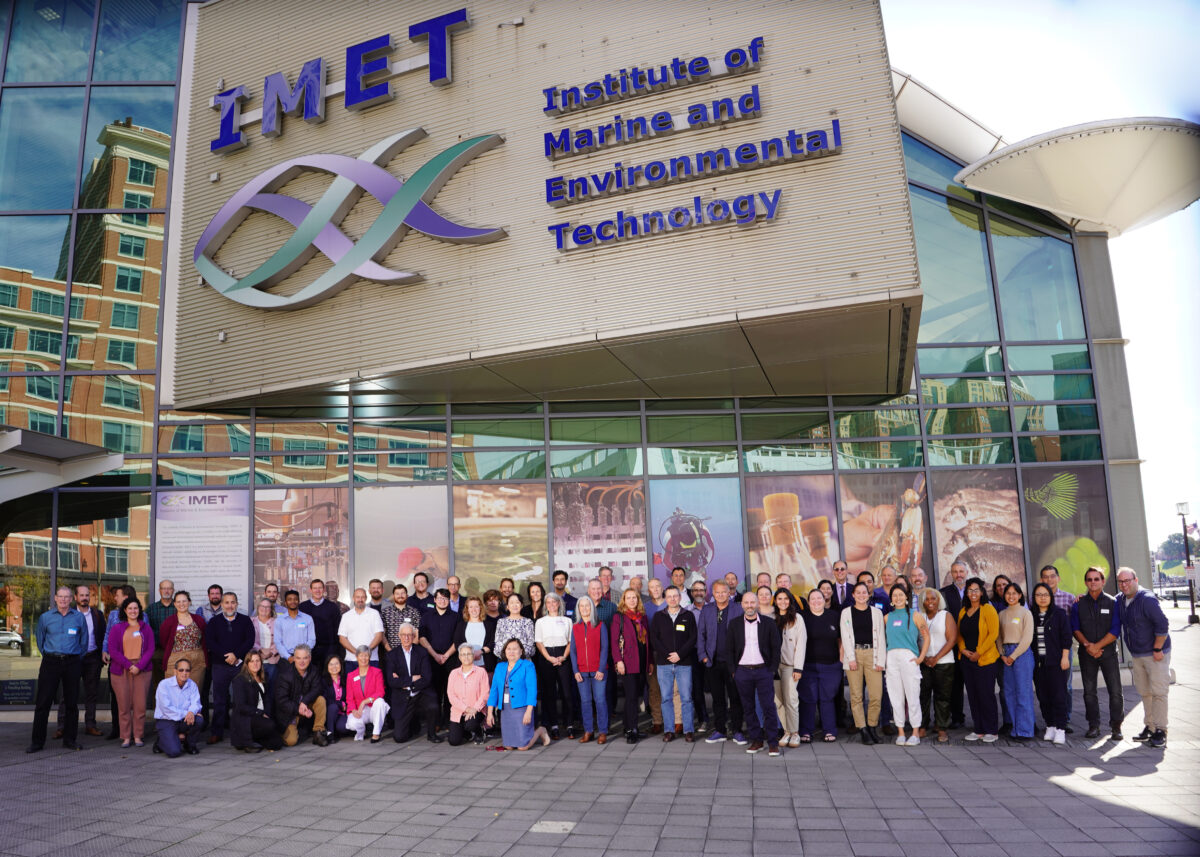 Conference attendees gather in front of the Institute for Marine and Environmental Technology. (Image by Barry Freeman)
Research for the public good
The work at IMET has been critical to move the industry forward worldwide. The SAS2 initiative, awarded $10 million by the U.S. Department of Agriculture in 2021, builds on the Recirculating Aquaculture Salmon Network, also led by Zohar and funded by the National Oceanic and Atmospheric Administration’s National Sea Grant Office.
IMET, and the ARC in particular, are “a showcase of our best ideas, ideas that promise solutions to so many essential challenges—food security, environmental sustainability, economic resilience,” Perman shared. The SAS2 consortium is “research for the public good,” Perman added. “That’s our mission and this project is emblematic of that.”
Session topics at the conference included scientific and engineering challenges like waste remediation, water reuse, and managing the salmon life cycle in captivity. Other sessions discussed market research for salmon produced on land and examples of education programs that increase awareness of aquaculture careers.
Attendees also traveled to The Conservation Fund Freshwater Institute in West Virginia to see collaborative SAS2 research, visited Baltimore City Schools that incorporate aquaculture into the curriculum, toured the ARC, and heard from graduate students contributing to the research arm of SAS2.
“SAS2 is an amazing accomplishment—the best example of public-private partnership to solve problems for industry,” shares Steve Summerfelt, a conference panelist and the chief science officer at Superior Fresh, which raises land-based salmon and recycles the nutrient-rich wastewater to grow greens. “SAS2 is providing relevant and groundbreaking research with strong tech transfer to help land-based salmon farmers.”
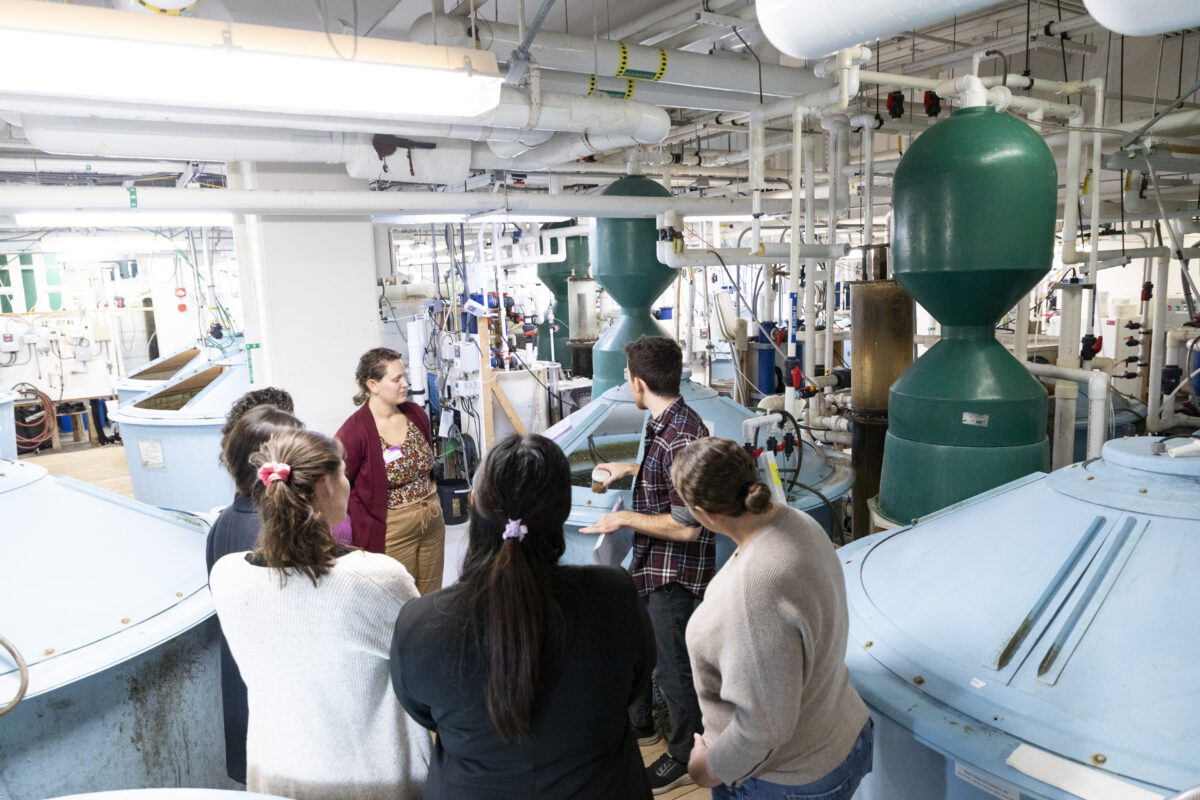 Conference attendees took tours of the Aquaculture Research Center, the land-based salmon production facility at IMET led by Yonathan Zohar. (Image by Melissa Penley Cormier, M.F.A. ’17)
Enabling aquaculture innovation
Overall, the conference emphasized aquaculture’s important and growing role in worldwide food production.
“Land-based, sustainable production of seafood is critically important technology to meet the rapidly growing need for healthy seafood as a source of protein in diets worldwide,” Russell Hill, director of IMET, said. “A land-based approach has huge advantages for minimizing pollution in the coastal environment and taking pressure off wild fish populations—and all of this can be done through this resilient technology that’s also adaptable in the face of a changing planet.”
By bringing together people from across industries, the event created opportunities that will enable more breakthroughs.
“The lively engagement and productive brainstorming of all relevant sectors led to several innovative ideas and collaborations which will contribute in the short term to making Atlantic salmon farming in the U.S. and globally more environmentally responsible and economically feasible” concluded Zohar. “Everyone left inspired and excited about the opportunities being created by the SAS2 program for innovative and sustainable aquaculture.”
]]>
More than 110 academic researchers, industry pros, government officials and educators met at the Institute of Marine and Environmental Technology (IMET) for the second annual Sustainable...
https://umbc.edu/stories/aquaculture-conference/
https://my3.my.umbc.edu/api/v0/pixel/news/137224/guest@my.umbc.edu/b9771cef91d515cec5e21ddb5aff8b2c/api/pixel
cnms
marinebiotech
news
research
science-and-tech
UMBC News & Magazine
https://my3.my.umbc.edu/groups/umbc-news-magazine
https://assets1-my.umbc.edu/system/shared/avatars/groups/000/001/943/24435aa6207c452e7bc15cc74b42c7bb/xsmall.png?1748556657
https://assets1-my.umbc.edu/system/shared/avatars/groups/000/001/943/24435aa6207c452e7bc15cc74b42c7bb/original.png?1748556657
https://assets2-my.umbc.edu/system/shared/avatars/groups/000/001/943/24435aa6207c452e7bc15cc74b42c7bb/xxlarge.png?1748556657
https://assets2-my.umbc.edu/system/shared/avatars/groups/000/001/943/24435aa6207c452e7bc15cc74b42c7bb/xlarge.png?1748556657
https://assets3-my.umbc.edu/system/shared/avatars/groups/000/001/943/24435aa6207c452e7bc15cc74b42c7bb/large.png?1748556657
https://assets1-my.umbc.edu/system/shared/avatars/groups/000/001/943/24435aa6207c452e7bc15cc74b42c7bb/medium.png?1748556657
https://assets2-my.umbc.edu/system/shared/avatars/groups/000/001/943/24435aa6207c452e7bc15cc74b42c7bb/small.png?1748556657
https://assets1-my.umbc.edu/system/shared/avatars/groups/000/001/943/24435aa6207c452e7bc15cc74b42c7bb/xsmall.png?1748556657
https://assets2-my.umbc.edu/system/shared/avatars/groups/000/001/943/24435aa6207c452e7bc15cc74b42c7bb/xxsmall.png?1748556657
UMBC News & Magazine
0
0
false
Mon, 20 Nov 2023 16:11:08 -0500
Mon, 20 Nov 2023 16:11:08 -0500
Your story belongs here
Joining a new community can be tough sometimes, especially post-pandemic. And with new Retrievers coming from every background imaginable, it’s important to make sure everyone feels welcome when they get here.
That’s where “Your Story Belongs Here” comes in. Now in its second year, this video storytelling collaboration between Initiatives for Identity, Inclusion, and Belonging (i3b) and the Department of Theatre brings students together to learn how to share—and celebrate—their own stories of belonging.
“I think it’s pretty common to enter college and be worried that you’re not going to find your people. It’s very different from high school,” said Adam Bayoumi, a public health major, who spoke about the worries he faced about keeping up with school after his father passed away. “I personally thought the transition would kind of knock me out…and it wasn’t easy, and it wasn’t quick, but I did find my people eventually.”
Guiding students’ steps
The resulting film, which was shown at Welcome Week to incoming students, showcases the experiences of 10 students from a variety of backgrounds. Some explore identity or overcoming imposter syndrome. Others speak from the perspectives of adult learners reentering college or international students settling into a new culture. Some felt comfortable in front of a camera while others had to overcome that fear over time. Thankfully, in this second iteration of the project, students took advantage of a four-week workshop-style internship to perfect their performances with help from their cohort and guidance from faculty and staff co-creators.
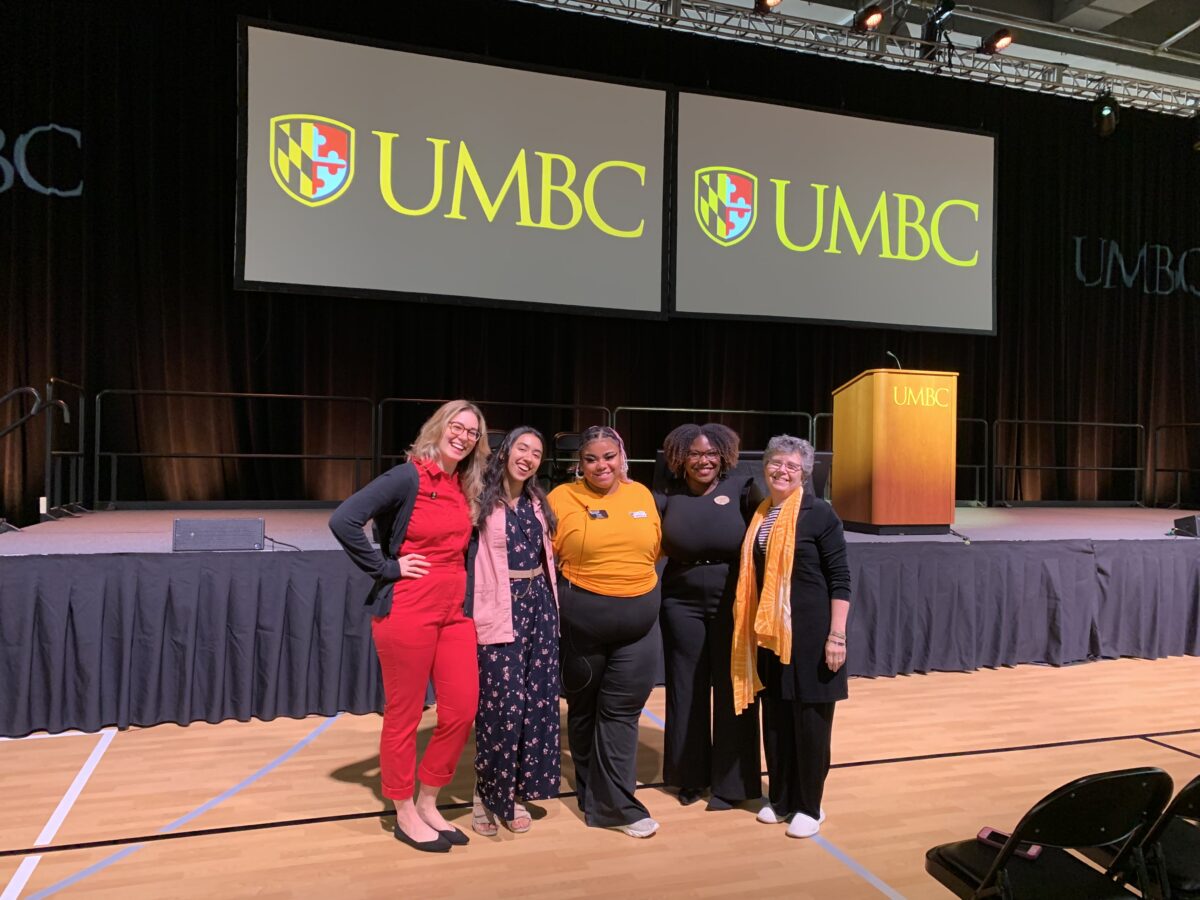 Members of the Your Story Belongs Here group gather before the Welcome Week event. Photo courtesy of Eve Muson.
“We got to have much, much more time with students this year to develop their storylines and infuse some social justice education around identity…storytelling and monologuing, all that good stuff,” said Ciara Christian, acting director of i3b, and a co-founder of the project. “We also had a really cool opportunity to take students to see some live theatre performances…there was a storytelling event in Washington, D.C., that we took the students to, to help inspire them, and it was a beautiful process.”
Project co-founder Eve Muson, associate professor of theatre, called the workshop experiences “magical.” She also brought in alumna Kiirstn Pagan ’11 to film and edit the work. “Because we had more time, the stories were more complex and students were really talking honestly about the identity that they bring with them when they come to UMBC—their doubts, their fears, their trepidations, all of that,” said Muson. “And then there’s the moment when they discover themselves at UMBC. So, that’s the shape of every story.”
Finding your “second family”
When Jaya Marshall, a transfer student focusing on cinematic arts, first arrived at UMBC, she, too, worried she wouldn’t fit in, that she might be the lone theatre person in a sea of STEM students—something she realizes now was a misperception. But seeing the inaugural “Your Story Belongs Here” video at her own Welcome Week in 2022 helped change her mind—and also inspired her to take part in the project the following summer.
“When I saw that video I was like, oh, thank you,” said Marshall, who quickly found several clubs to join after arriving at UMBC. “Thank God, I am not the only one. I hope people who are arts and humanities will see that and be like, okay, I’m not alone.”
Public health major Mashaal Awan chose to share her story of going to UMBC’s STRiVE leadership retreat, which she says had “a huge impact on me in terms of realizing my values” and also helped her make friends she now considers her “second family.” In her video, Awan recalled the first evening of STRiVE, walking outside with friends beneath a beautiful night sky.
“I remember feeling a sense of freedom I had been craving my whole life with these people I instantly felt such a strong connection with,” she recalled in the video.
Bayoumi hopes that the vulnerability students show through their storytelling helps incoming students feel more comfortable and welcome at UMBC.
“Fast forward to the end of the school year, and I had done stuff that I never thought I would have achieved in college,” he said. “So to me at 17 years old, I would just like to say, ‘Hang in there. Life dealt you some hard cards, and it’s going to be okay.’”
]]>
Joining a new community can be tough sometimes, especially post-pandemic. And with new Retrievers coming from every background imaginable, it’s important to make sure everyone feels welcome when...
https://umbc.edu/stories/your-story-belongs-here/
https://my3.my.umbc.edu/api/v0/pixel/news/137171/guest@my.umbc.edu/5fe0a3db7ab4b51af0a159cb162ca9f9/api/pixel
campus-life
magazine
UMBC News & Magazine
https://my3.my.umbc.edu/groups/umbc-news-magazine
https://assets1-my.umbc.edu/system/shared/avatars/groups/000/001/943/24435aa6207c452e7bc15cc74b42c7bb/xsmall.png?1748556657
https://assets1-my.umbc.edu/system/shared/avatars/groups/000/001/943/24435aa6207c452e7bc15cc74b42c7bb/original.png?1748556657
https://assets2-my.umbc.edu/system/shared/avatars/groups/000/001/943/24435aa6207c452e7bc15cc74b42c7bb/xxlarge.png?1748556657
https://assets2-my.umbc.edu/system/shared/avatars/groups/000/001/943/24435aa6207c452e7bc15cc74b42c7bb/xlarge.png?1748556657
https://assets3-my.umbc.edu/system/shared/avatars/groups/000/001/943/24435aa6207c452e7bc15cc74b42c7bb/large.png?1748556657
https://assets1-my.umbc.edu/system/shared/avatars/groups/000/001/943/24435aa6207c452e7bc15cc74b42c7bb/medium.png?1748556657
https://assets2-my.umbc.edu/system/shared/avatars/groups/000/001/943/24435aa6207c452e7bc15cc74b42c7bb/small.png?1748556657
https://assets1-my.umbc.edu/system/shared/avatars/groups/000/001/943/24435aa6207c452e7bc15cc74b42c7bb/xsmall.png?1748556657
https://assets2-my.umbc.edu/system/shared/avatars/groups/000/001/943/24435aa6207c452e7bc15cc74b42c7bb/xxsmall.png?1748556657
UMBC News & Magazine
4
0
false
Fri, 17 Nov 2023 12:43:48 -0500
Fri, 17 Nov 2023 12:43:48 -0500
Office Hours

Each week during her student-facing office hours, UMBC President Valerie Sheares Ashby meets with students to chat about their lives and experiences at UMBC. Today, she’s speaking with Okechukwu Tabugbo ’25, computer engineering, president of UMBC’s Black Men’s Society, a group that provides mentorship, skills training, and community to students while trying to eliminate negative narratives and stigma around what it means to be a Black man in America.
Okechukwu Tabugbo: I found out about UMBC’s Black Men’s Society when I was in my first year. I knew Marvin Onwukwe, the club secretary at the time. He was always walking around campus smiling, and I would ask him, “Why are you smiling so much, Marvin?” He would say, “It’s because I have my life together. I have everything going for me. So what reason do I have to frown?” I would say, “Why do you have everything going for you?” He said, “Because I’m on top of my work. I can help you out, too. You should come to Black Men’s Society so that we can all be on top of our work.”
President Sheares Ashby: Oh, that is so good.
Tabugbo: But, in all honesty, I did not go to the first one. Then Amery Thompson…the current advisor, told me that I should come out, and I have to be honest, I did not go at that time either. [Laughs.] Then, finally, our current vice president, Israel Funmilayo…invited me, and he said, “It’s about financial literacy…I just need you to come out.” I looked at my bank account, and I said, “Okay.”
After getting there, I sat down. Amery was giving the introduction on financial literacy and telling us everything that we need to know. It honestly just made me feel at home and appreciated, the fact that someone took the time out of their day to teach me something that I constantly left on the back burner. I took that for what the club is.
I take it especially as a safe space for Black men on campus—to make them feel appreciated, to give them the time they need to grow in a world that rushes them so often. I appreciate the overall aspect of giving Black people on campus a space for professional development that they may not have had before and giving us a space to talk about issues surrounding the community. The Society allows everyone, despite their views, to be understood and to have time to understand others.
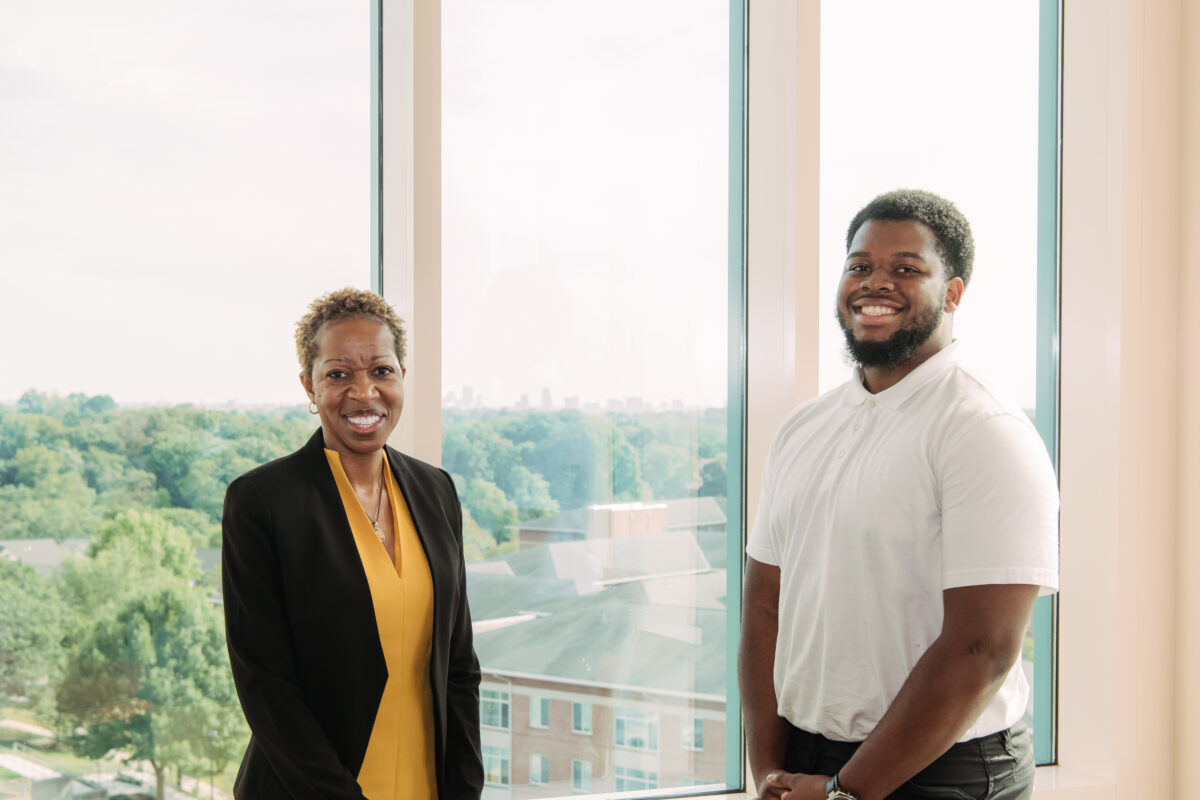 Sheares Ashby and Tabugbo pose on the 7th floor of the library. (Marlayna Demond ’11/UMBC)
Sheares Ashby: That is amazing. And what is so interesting to me is the mentorship of the more senior students to the younger students because I see it all the time. I see the senior students saying, “Hey, come on over here. This is where we are. This is what we’re doing. This is how we can support you.” They’re really living out the mentorship in ways that are so important. And it is so wonderful to see the younger students come in and then become those mentors to other people. I can see that growth even in a year.
Tabugbo: Exactly. And on that note of mentorship, that’s why we wanted to start moving toward outreach programs, especially to local high schools and middle schools. This effort is spearheaded by our secretary, Daniel Bajulaiye. If we can get to these students early and make them know that they’re appreciated, make them know that they can be heard, that will be important in fostering a good relationship, especially as they come into UMBC. Just letting people know that you’re there for them is so important because a lot of people, especially on this campus, don’t know their potential.
Sheares Ashby: I one hundred percent agree. One of the things I’m really excited about for UMBC is the work that we continue to do in Baltimore. We’re right here, and we know that there are a lot of Black men, young men, in Baltimore who would benefit. I don’t think too many Black men in Baltimore walk around feeling appreciated.
If we can get to these students early and make them know that they’re appreciated, make them know that they can be heard, that will be important in fostering a good relationship, especially as they come into UMBC.
Okechukwu Tabugbo ’25
Tabugbo: Even when I did get the role [as president of Black Men’s Society], I still had imposter syndrome. I didn’t truly feel I belonged until actually stepping into the shoes and having to take over. Talking to my brother all summer, the amount of encouragement he had to give me to say just, “You can do this. You are here for a reason.” Hearing it from Amery, hearing it from Israel, it took a lot to be able to have the confidence to come and do this again and again every day.
Sheares Ashby: Mentorship has always been important. Sometimes it just takes somebody to look at you and tell you, “I see you, and I think you’re pretty special,” or, “I see this gift or talent that you have,” and it can change somebody’s life just like that. I don’t know anybody who doesn’t need encouragement.
]]>
Each week during her student-facing office hours, UMBC President Valerie Sheares Ashby meets with students to chat about their lives and experiences at UMBC. Today, she’s speaking with Okechukwu...
https://umbc.edu/stories/office-hours-with-president-shears-ashby/
https://my3.my.umbc.edu/api/v0/pixel/news/137162/guest@my.umbc.edu/fb1a98339cc8ace85e30431255ecdccc/api/pixel
campus-life
coeit
computer-engineering
fall-2023
magazine
office-hours
perspectives
UMBC News & Magazine
https://my3.my.umbc.edu/groups/umbc-news-magazine
https://assets1-my.umbc.edu/system/shared/avatars/groups/000/001/943/24435aa6207c452e7bc15cc74b42c7bb/xsmall.png?1748556657
https://assets1-my.umbc.edu/system/shared/avatars/groups/000/001/943/24435aa6207c452e7bc15cc74b42c7bb/original.png?1748556657
https://assets2-my.umbc.edu/system/shared/avatars/groups/000/001/943/24435aa6207c452e7bc15cc74b42c7bb/xxlarge.png?1748556657
https://assets2-my.umbc.edu/system/shared/avatars/groups/000/001/943/24435aa6207c452e7bc15cc74b42c7bb/xlarge.png?1748556657
https://assets3-my.umbc.edu/system/shared/avatars/groups/000/001/943/24435aa6207c452e7bc15cc74b42c7bb/large.png?1748556657
https://assets1-my.umbc.edu/system/shared/avatars/groups/000/001/943/24435aa6207c452e7bc15cc74b42c7bb/medium.png?1748556657
https://assets2-my.umbc.edu/system/shared/avatars/groups/000/001/943/24435aa6207c452e7bc15cc74b42c7bb/small.png?1748556657
https://assets1-my.umbc.edu/system/shared/avatars/groups/000/001/943/24435aa6207c452e7bc15cc74b42c7bb/xsmall.png?1748556657
https://assets2-my.umbc.edu/system/shared/avatars/groups/000/001/943/24435aa6207c452e7bc15cc74b42c7bb/xxsmall.png?1748556657
UMBC News & Magazine
0
0
false
Fri, 17 Nov 2023 11:24:07 -0500
Fri, 17 Nov 2023 11:24:07 -0500
The Academic Minute: Caring for kinless older adults
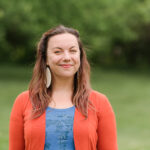
Social, cultural, and scientific advancements have helped people live longer. Not only are people living longer, but they also have fewer children than at any previous time in human history. This shift will present a unique situation where there will be more older adults outnumbering infants and teenagers in about four decades. How will the world take care of this burgeoning population?
Christine A. Mair, associate professor of sociology and gerontology and director of UMBC’s Center for Health, Equity, and Agingin the department of sociology, anthropology, and public health, examines the presence or absence of family and non-family ties. Mair seeks to document how social integration and support (or lack thereof; e.g., “kinlessness”) shape mental health, physical health, end-of-life experiences, and other aspects of well-being especially cross-nationally.
“Many of these older adults will also be unpartnered due to never marrying, divorce, or their eventual widowhood. These three intersecting trends of high longevity, low fertility, and low partnership will culminate to produce a growing population of people who are both unpartnered and childless. This group is sometimes referred to as ‘kinless,’” Mair explains to Lynn Pasquerella, president of the American Association of Colleges and Universities and host of The Academic Minute, a daily show featuring faculty from colleges and universities worldwide speaking about their cutting-edge research.
UMBC’s Academic Minute series
Mair joined six other UMBC scholars this fall in UMBC’s first Academic Minute series, featuring the latest research in media and communication studies; modern languages, linguistics, and intercultural communication; language, literacy, and culture; philosophy; gender, women’s, and sexuality studies; and history. This series is republished on NPR podcasts and Inside Higher Ed.
Learn more about Christine Mair’s research:
Learn more about UMBC’s program in sociology, anthropology, and public health.
]]>
Social, cultural, and scientific advancements have helped people live longer. Not only are people living longer, but they also have fewer children than at any previous time in human history. This...
https://umbc.edu/stories/academic-minute-caring-for-kinless-adults/
https://my3.my.umbc.edu/api/v0/pixel/news/137158/guest@my.umbc.edu/1c499ca8c67b564e85980ab3ede5bbb0/api/pixel
cahss
cahssresearch
news
policy-and-society
research
saph
UMBC News & Magazine
https://my3.my.umbc.edu/groups/umbc-news-magazine
https://assets1-my.umbc.edu/system/shared/avatars/groups/000/001/943/24435aa6207c452e7bc15cc74b42c7bb/xsmall.png?1748556657
https://assets1-my.umbc.edu/system/shared/avatars/groups/000/001/943/24435aa6207c452e7bc15cc74b42c7bb/original.png?1748556657
https://assets2-my.umbc.edu/system/shared/avatars/groups/000/001/943/24435aa6207c452e7bc15cc74b42c7bb/xxlarge.png?1748556657
https://assets2-my.umbc.edu/system/shared/avatars/groups/000/001/943/24435aa6207c452e7bc15cc74b42c7bb/xlarge.png?1748556657
https://assets3-my.umbc.edu/system/shared/avatars/groups/000/001/943/24435aa6207c452e7bc15cc74b42c7bb/large.png?1748556657
https://assets1-my.umbc.edu/system/shared/avatars/groups/000/001/943/24435aa6207c452e7bc15cc74b42c7bb/medium.png?1748556657
https://assets2-my.umbc.edu/system/shared/avatars/groups/000/001/943/24435aa6207c452e7bc15cc74b42c7bb/small.png?1748556657
https://assets1-my.umbc.edu/system/shared/avatars/groups/000/001/943/24435aa6207c452e7bc15cc74b42c7bb/xsmall.png?1748556657
https://assets2-my.umbc.edu/system/shared/avatars/groups/000/001/943/24435aa6207c452e7bc15cc74b42c7bb/xxsmall.png?1748556657
UMBC News & Magazine
0
0
false
Fri, 17 Nov 2023 09:07:11 -0500
Living in vivid color—Kate Feller, Ph.D., is pushing boundaries in biology research and teaching
The shower was full of mantis shrimp. Bubblers burbled and the cranky crustaceans skulked in their tanks, looking for things to punch with their famously fast strikes. Complicated electronics for measuring brain activity stood sentinel beside the bed in the next room. And out on the balcony, Kathryn Feller, Ph.D. ’14, biological sciences, was wearing a respirator and gloves, working with nasty chemicals.
In other words, it was another day of fieldwork as a behavioral neuroscientist—a career Feller has embraced after a journey of self-exploration that took her to surgical operating theaters, drama summer camps, and a range of research institutions around the world. At UMBC, Feller found a robust research atmosphere, supportive lab mates, and a lifelong mentor. Now, as a professor and mentor herself, she’s able to exercise her natural creativity in a way she might never have predicted and play off her strengths from visual arts to handling sensitive scientific instruments.
Feller was in Malaga, Spain, living and working out of an attic apartment in her collaborator’s mother’s home. She was collecting data for her work at the University of Cambridge, where she was fulfilling a two-year Marie Skłodowska-Curie Actions Postdoctoral Fellowship focused on a new line of research into mantis shrimp vision.
Mantis shrimp are famous for two things: their powerful punches and their vision. Humans have three types of cones in our eyes for seeing color. Mantis shrimp have 16. They can see UV light and polarized light, and there is still more to learn. Feller’s Ph.D. at UMBC in Thomas Cronin’s lab focused on vision in mantis shrimp larvae. At the time there was almost no work in that area.
“While studying the visual system, a lot of times I kept wondering: ‘There’s all these cool things that mantis shrimp eyes can do, but what are they actually using this for?’” Feller says. “What are the consequences of this in a behavioral context?”
Her Ph.D. opened up the field of larval mantis shrimp vision and took her down rabbit hole after rabbit hole. “If something interests me, I follow it, and—uh-oh—here’s something else I’m interested in,” Feller jokes. In the end, her thesis explored the visual system using umpteen different scientific techniques, each providing its own insights, she says. “It was like the whole package of describing mantis shrimp
visual systems.”
Want weekly Top Stories sent to your inbox?
The broad scientific foundation Feller obtained at UMBC set her up well for postdoctoral experiences that have taken her around the world, including stints studying butterflies in Japan, mouse brains in Minnesota, and insects in England. In fall 2020, she launched her own laboratory as an assistant professor of biology at Union College in Schenectady, New York.
Feller’s research interests now include new projects on the connections between vision and behavior and work on brain-machine interfaces, initially inspired by a student in one of her classes. That work helped spawn a brand-new course on cyborgs that she’s teaching with Union colleagues in English and computer science.
Things are going well.
“Life is awesome. It really is. You know, it has its ups and downs; it’s not like every day is a dreamboat—I live with a two-year-old,” Feller laughs. But “at this point, I’m just really jazzed about the research I’m doing.”
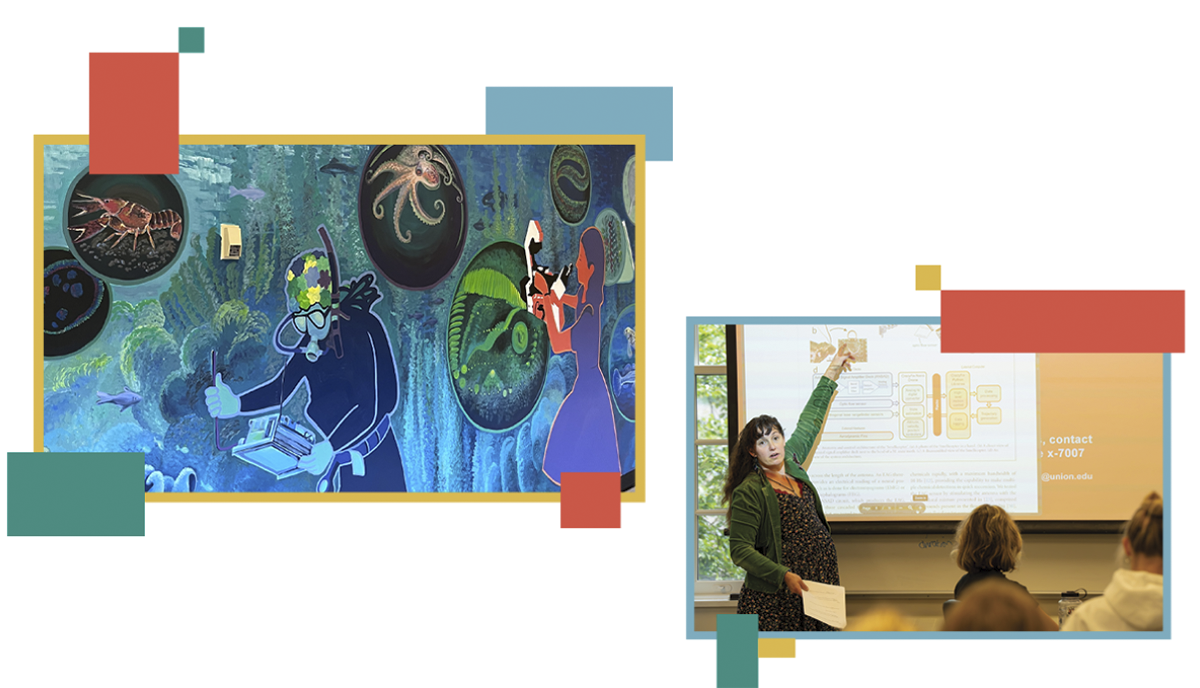 (Left) Feller is the only identifiable person in the mural on the first floor of the Biological Sciences Building at UMBC. Her swim cap covered in bright plastic flowers is unmistakable. (Image; Randianne Leyshon ’09/UMBC) (Right) Kate Feller, left, teaching a new course she co-developed with English and computer science colleagues at Union College on cyborgs. (Image by Paul Buckowski/Union College)
Back in Malaga, Feller was getting lots of great data, “but also psychologically it was a bit difficult,” she says. She didn’t speak Spanish, and her hosts barely spoke English. “For six weeks, I was just alone in someone’s house, doing science.” And then came the email: an invitation to participate in FameLab, an international competition for scientists based out of the United Kingdom. Each participant had three minutes to explain a scientific concept using only their body and any props they could carry on the stage—no slides. Entries were judged on content, clarity, and charisma.
“I got this email, and I wrote my script in one night,” Feller says. The topic? Glittery camouflage structures in the eyes of mantis shrimp larvae. “When you’re in the field, you have a finite number of hours to do what you need to do, so you need to push yourself to the extreme—but you also need to take a break. And that was my break—just to sit down and poke fun at the ridiculousness of my life.”
She won her region in the U.K. and got to spend a weekend in Devonshire, England, with the other county winners, learning about science communication and refining her talk. The final performance was at the London Museum of Science.
“I didn’t win, but it was awesome,” Feller says. After that, she was hooked on science performance. Back in Cambridge, she pursued science stand-up comedy with a group called “The Variables.”
Research requires creativity
Feller’s affinity for performance didn’t come out of nowhere. As a teenager, she attended Camp Quin, a summer arts camp in the Finger Lakes region of New York. And despite a natural affinity for visual arts, she ended up focusing on drama at the camp. A skit she developed with other campers “was hilarious, and it was a hit, and from that I was like, ‘I really like this,’” Feller remembers.
As an undergraduate at Hobart and William Smith Colleges (HWS), she participated in an improv comedy troupe and in her senior year, the Shakespeare club. In the summers, she served as a counselor at Camp Quin. Performance may have taken a backseat in her life for now, but Feller still finds that her communication skills and natural creative energy are huge benefits in her current role.
“As I’ve progressed as a scientist, I’ve learned how much imagination it takes to be a researcher,” Feller says. “And now that I’m a faculty member, I understand how much creativity you need to run an interesting class. I love that aspect—designing a new course is a super fun and creative process, and I find that my students respond quite well to the different ways of communicating I throw at them.”
Feller also applies her visual arts skills to creating research talks and class lectures. “The art of slide design is underrated,” she says. “I think that’s why I’ve been invited to give so many talks—not only do I have that performance element, but I understand the connection between hearing and seeing and information transfer.”
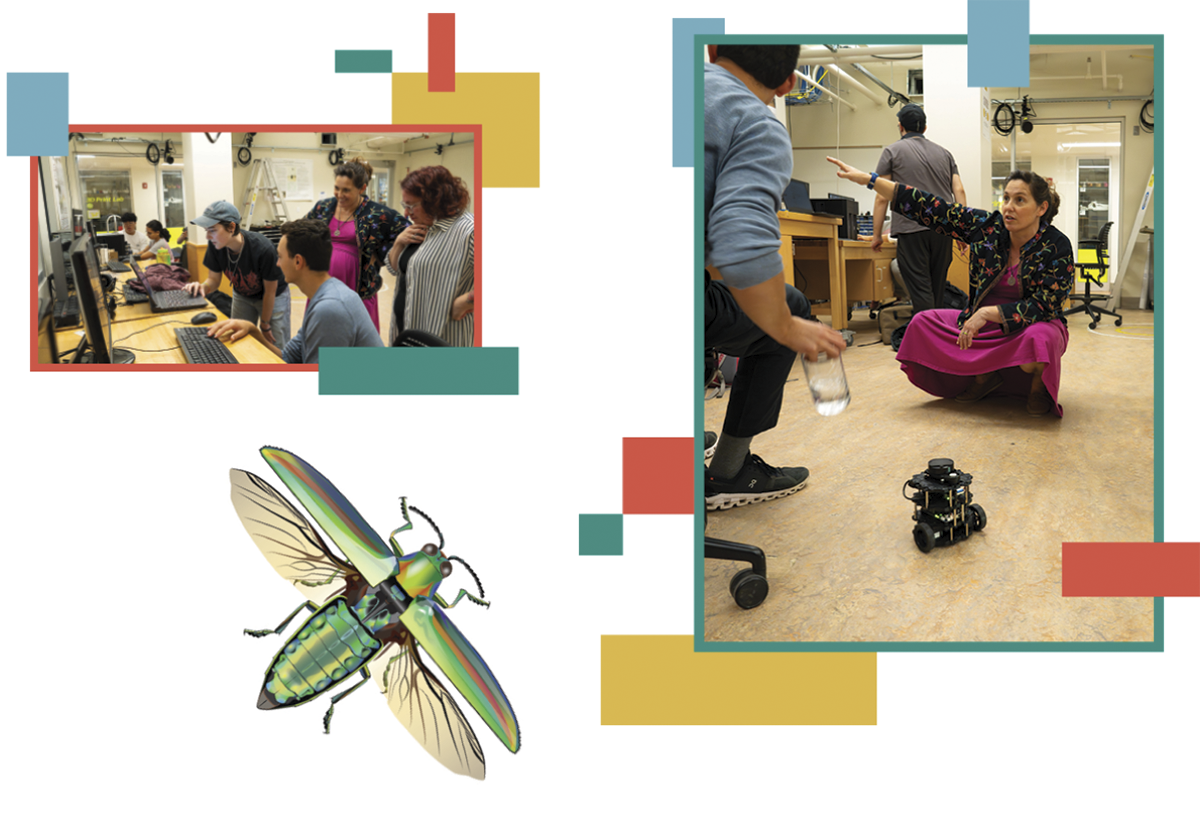 Feller (pink dress) is involved with a robotics laboratory at Union College. Her work has recently expanded into brain-machine interfaces after a student in one of her classes expressed enthusiasm for the topic—just one example of how her teaching continues to inform her research. (Image by Paul Buckowski/Union College) (Lower left) One of Feller’s digital designs. She has been hired to create logos for other labs and continues to make art as a hobby—ranging from using iridescent eye shadow to recreate beetle carapaces to shaping clay sculptures.
An “all-in” personality
Feller has always recognized her artistic side, but she wasn’t always encouraged to integrate it into her career plans. She was a good student, and her kindergarten teacher told her parents she would probably become a doctor. “I got that message my whole life,” Feller says.
It sunk in, and she started at HWS on the pre-med track. As an undergrad, she took an internship as a surgical assistant in a hospital. “There was a major clash with who I was as a person,” Feller says. “Literally, you are in a sterile environment. So while I was good at that job, it crushed me.”
But expectations die hard, and in her junior year, she was still looking at medical school. She decided she should do research to boost her chances. “Literally, it was just for my CV,” she says. Little did she know the experience would permanently shift her trajectory.
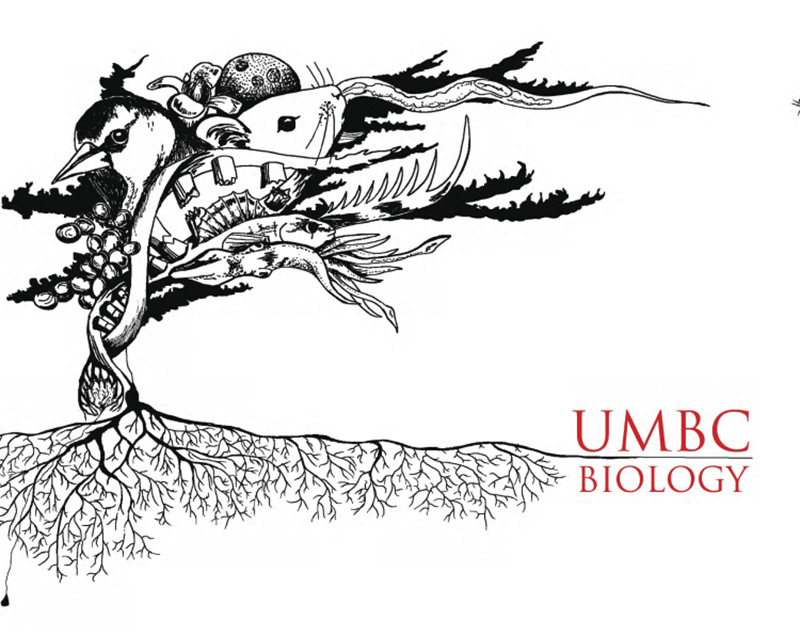
For this design, Feller incorporated the organisms studied in the UMBC biological sciences department for its annual, informal graduate student t-shirt.
Feller did some background research and requested a meeting with HWS biology assistant professor Kristy Kenyon, who studies development of the visual system in frogs and fruit flies, to pitch an honors project. As it turned out, her pitch was a little off the mark. “It was at least within the organ system that I worked,” Kenyon says. Yet, Kenyon decided to give her a chance.
Why? “Kate Feller is such a dynamic person,” Kenyon says. “She was such an all-in, live-life-to-the-fullest kind of person, that it was very easy for me to get excited about working on a project with her despite having never had her in a class. The energy, the creativity, the curiosity—those are three words I would use to describe that initial impression of Kate.”
Feller and Kenyon settled on a bat vision project, and it transformed Feller’s future. Kenyon gave her a crash course in what she needed to know, and Feller thrived. The project led to Feller’s first scientific publication, reporting the discovery of a type of UV-sensitive cell in bat eyes that is evolutionarily related to the same cells in mice.
“I loved it,” Feller says. “Just the idea of thinking about how a different creature sees, because I’m so visual—it just fit so well. It took me a while to realize why I found it so exciting, but then I was like, ‘Oh, that makes sense.’”
And yet. After graduating with a double major in biology and environmental science, Feller took a position as an ophthalmology surgical assistant. She quickly soured on that, though, for the same reasons she had struggled with roles in sterile environments before. Her personal life brought her to Baltimore, and looking for new opportunities, she found Tom Cronin on a Google search.
She applied to other Ph.D. programs, but when she visited UMBC, “there was the pond, and all the grass, and meeting Tom, and I was like, ‘Oh, this is where I need to be.’”
Feller’s Ph.D. years spanned a special time in the Cronin lab. “It was an incredible group of people who formed a tight-knit community and helped each other grow into outstanding scientists,” says Megan Porter, a postdoctoral fellow in the lab during that time. Sometimes, that support involved tough love. An intervention conversation Porter had with Feller when she was experiencing a third-year slump helped get Feller’s Ph.D. back on track. The exchange helped Porter as well.
“It has helped me to be a better mentor to my students now, to have had that conversation first with a friend,” says Porter, who now is a professor at the University of Hawai‘i at Mānoa. “It’s an important conversation to have with any graduate student, as it isn’t the right path for everyone. There are many other careers out there for anyone who loves science.”
If Porter was the nurturing mother figure in the lab, Michael Bok, Ph.D. ’14, biological sciences, was the goofy uncle. Feller and Bok started the same year, and both needed to earn an advanced level of scuba certification to conduct fieldwork in Australia. Given the limited diving options in the mid-Atlantic, “we spent a total of 15 hours goofing around in a pretty uninspiring quarry, but it was worth it for the diving we got to do in Australia,” says Bok, who is now a researcher at Lund University in Sweden.
Feller and Bok conducted fieldwork at Lizard Island Research Station off the northeast coast of Australia for many months across five years. “Some of these stressful and intensive work experiences would probably strain some people’s friendship, but Kate and I seemed to always be quite happy with each other despite having pretty different personalities,” Bok says. “We were definitely kindred in our love for science, appreciation for being out in nature, and senses of humor.”
Feller came to love diving and did so with typical flair. “You could always tell where Kate was in the water,” Cronin says, because she always wore a brightly colored swim cap with plastic flowers stuck all over it. “It was very Kate because it made her look kind of silly but also very distinctive, because even underwater far away you could identify her.”
Dance parties and lost turtles
Alex Kingston, Ph.D. ’15, biological sciences, arrived in the lab after Porter, Bok, and Feller. “I really wouldn’t be where I am today without each of them,” she says.
Kingston, who today is an assistant professor at The University of Tulsa, was always very organized and on top of things, Cronin recalls—“very type A.” She kept the lab running smoothly as lab manager but wasn’t afraid to have fun. Feller and Kingston would have dance parties as a break from drafting scientific manuscripts. “It was hilarious when other people would come into the lab, not expecting us in the middle of the lab blaring music and dancing around,” Kingston remembers.
The group had other shared adventures, like caring for Scott, a box turtle who frequently escaped, necessitating a lab-wide search. And Feller took it as her role to decorate the lab. “In my lab today you can still see Kate stuff,” Cronin says. “She had a tendency of sticking stuff up there that didn’t want to come down again.”
Cronin’s approach to mentorship allowed each of his students to find their own way, with the level of support or independence that worked best for each of them. That means Cronin’s students have complete ownership of both their successes and their struggles and grow the confidence to face both once they leave UMBC.
“Tom was really hands off. However, he was so supportive,” Feller says. “Pretty much any time I came to him with an idea, he was like, ‘Cool, let’s do it.’ So it was that mix of, you’re steering the ship, but you don’t have to worry about resources.”
“Kate was not afraid to try anything— she was particularly inclined to do things her own way,” Cronin recalls. While she may have taken some time to find her footing, in the end, “she did really great work—really original and creative work.”
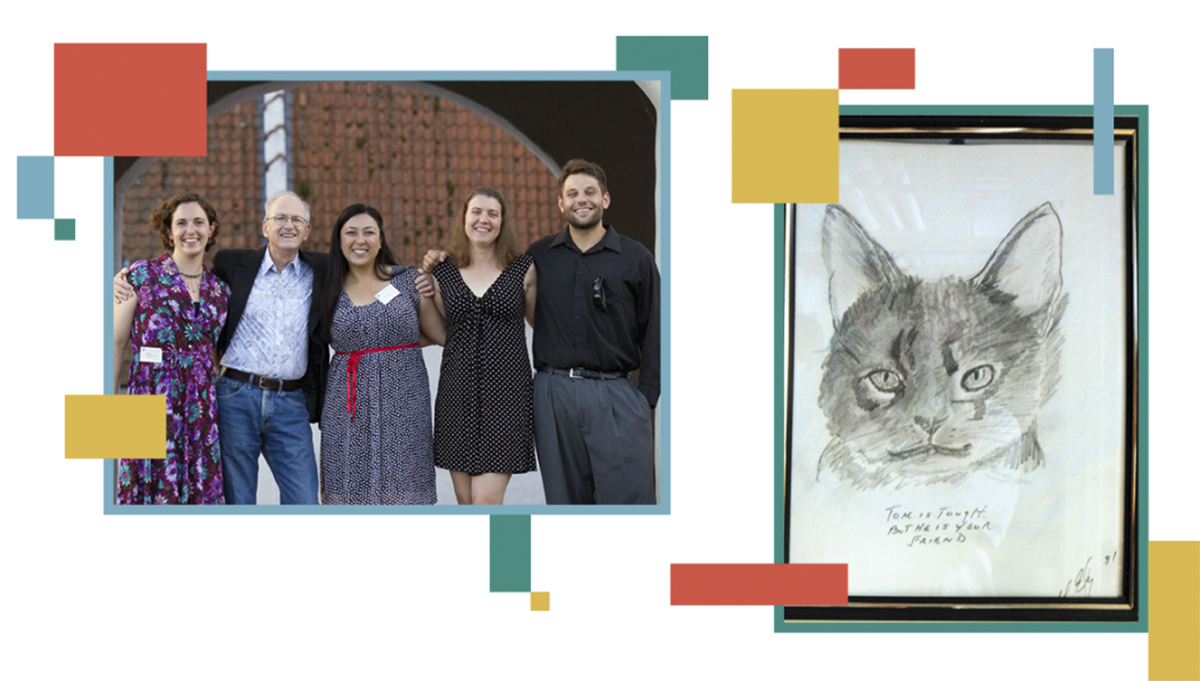 (Left) Current and former members of Tom Cronin’s research group have made it a tradition to reunite at professional conferences and take a “family photo.” From left to right: Kate Feller, Tom Cronin, Alex Kingston, Megan Porter, and Michael Bok in 2013. (Image courtesy of Tom Cronin) (Right) Feller contributed substantially to decorating Tom Cronin’s lab. One day she came home from a thrift shop with a gift for Cronin: this sketch of a cat, with the inscription, “Tom is tough. But he is your friend.” It was a perfect fit for an advisor who held high expectations along with offering generous support. It still hangs in the Cronin lab today.
Rigor, excitement, and resilience
Today, Feller is focused on furthering her research, engaging her students, and raising her family—her second child arrived this October. As a faculty member, Feller is maintaining old connections and forging new ones.
“Kate is really doing a fantastic job of creating and maintaining a network across different areas of science and education, in the research that she does but also in the way that she teaches and the way she facilitates those connections across institutions,” Kenyon, her mentor from HWS, says. For example, Kenyon is now collaborating with a colleague at Union because Feller connected them. And Kenyon is using a book in her courses that features the Cronin lab’s research— including some carried out by Feller.
“What I have thoroughly enjoyed is watching Kate progress at each step along the way, and find her passion, and be able to pursue something with such rigor, and excitement and resilience,” says Kenyon.
Whether creating art, performing on stage or in the classroom, working hard in the lab, or collecting specimens underwater, Feller is embracing each stage of her life and career with a zest that is uniquely hers. As Cronin puts it, “She was always Kate. She never started or stopped being Kate.”
“The thing that I love most is just trying to figure out how the world works,” Feller says. “I like to describe myself as an explorer. I am not a Magellan or a person on a ship looking to explore new places—I’m pushing the boundaries of knowledge. Where is the edge, and how can I shed light on the unknown?”
Feller is on the exploration of a lifetime, discovering new things about how brains work, transforming the lives of students, and doing it all in full color. As her research program takes off, her family grows, and her network broadens, her greatest adventures may be ahead of her.
]]>
The shower was full of mantis shrimp. Bubblers burbled and the cranky crustaceans skulked in their tanks, looking for things to punch with their famously fast strikes. Complicated electronics for...
https://umbc.edu/stories/living-in-vivid-color-biology-research/
https://my3.my.umbc.edu/api/v0/pixel/news/137495/guest@my.umbc.edu/14652561244235525f10f70bae9ccc98/api/pixel
uncategorized
UMBC News & Magazine
https://my3.my.umbc.edu/groups/umbc-news-magazine
https://assets1-my.umbc.edu/system/shared/avatars/groups/000/001/943/24435aa6207c452e7bc15cc74b42c7bb/xsmall.png?1748556657
https://assets1-my.umbc.edu/system/shared/avatars/groups/000/001/943/24435aa6207c452e7bc15cc74b42c7bb/original.png?1748556657
https://assets2-my.umbc.edu/system/shared/avatars/groups/000/001/943/24435aa6207c452e7bc15cc74b42c7bb/xxlarge.png?1748556657
https://assets2-my.umbc.edu/system/shared/avatars/groups/000/001/943/24435aa6207c452e7bc15cc74b42c7bb/xlarge.png?1748556657
https://assets3-my.umbc.edu/system/shared/avatars/groups/000/001/943/24435aa6207c452e7bc15cc74b42c7bb/large.png?1748556657
https://assets1-my.umbc.edu/system/shared/avatars/groups/000/001/943/24435aa6207c452e7bc15cc74b42c7bb/medium.png?1748556657
https://assets2-my.umbc.edu/system/shared/avatars/groups/000/001/943/24435aa6207c452e7bc15cc74b42c7bb/small.png?1748556657
https://assets1-my.umbc.edu/system/shared/avatars/groups/000/001/943/24435aa6207c452e7bc15cc74b42c7bb/xsmall.png?1748556657
https://assets2-my.umbc.edu/system/shared/avatars/groups/000/001/943/24435aa6207c452e7bc15cc74b42c7bb/xxsmall.png?1748556657
UMBC News & Magazine
0
0
false
Wed, 15 Nov 2023 15:22:11 -0500
Wed, 15 Nov 2023 15:22:11 -0500