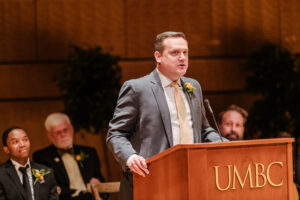
Meet a Retriever—Aysia Miller ’24, volleyball player and biology major
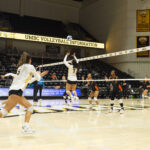
Meet Aysia Miller, a senior on the America East championship women’s volleyball team at UMBC. Originally from Mililani, Hawaii, Aysia is majoring in biology and minoring in bioinformatics. As a student-athlete and scholarship recipient, Aysia says she’s found a community at UMBC that lets her dive deep into the STEM fields that interest her while supporting her on and off the volleyball court.
Q: What’s the one thing you’d want someone who hasn’t joined the UMBC community to know about the support you find here?
A: UMBC has people that can fit you perfectly. There will always be someone that you can relate to and build bonds with. I love that I have people around me who support me and are willing to help me no matter how small or big the task.
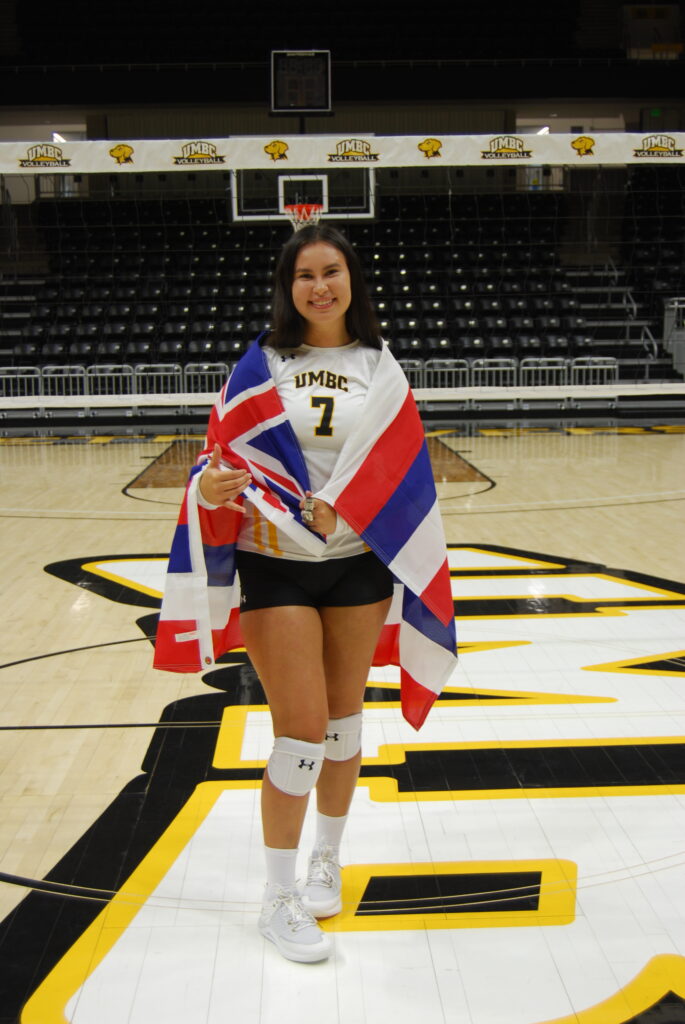 Miller stands wrapped in the Hawaiian flag. “I want to represent the islands to the best of my ability.”
Q: Tell us about what you love about the volleyball program at UMBC.
A: UMBC volleyball is such a special program to be a part of. I love that we all come from different cultures and backgrounds but we are able to be a collective unit. We accept challenges together and strive to become better.
A: As many people may know, deadly wildfires greatly impacted the community of Lahaina, Maui leading to one of the greatest natural disasters in modern U.S. history. Although I wasn’t directly affected, I mourn and ache for my home. Hawaii is more than beautiful beaches and palm trees. The people are what make the culture so rich. Being able to bring a part of my home to UMBC is so important to me. This has been my new home for the past four years and I want to be able to inform people of everything that is going on in the islands. With our match on November 11th, we are hosting a Maui Wildfire Awareness Night. This disaster is affecting thousands of people and doing a small thing like raising awareness allows me to feel like I’m making an impact. I have to thank the people at UMBC for making this night possible. Having people that care about where I come from is amazing. I wouldn’t be able to do something like this anywhere else. I’m eternally grateful for this opportunity and I hope I am able to help those in need.
I love that I have people around me that support me and are willing to help me no matter how small or big the task.
Aysia Miller ’24, biology
Q: What brought you to UMBC in the first place? Tell us about your primary WHY, and how it led you to UMBC.
A: Being from Hawaii, I would have never expected to end up on the East Coast, let alone Maryland. But I chose UMBC because of three things. One of the major factors of my choice was the volleyball program. I found that every aspect about the athletics program was what I was looking for. All of the people involved with athletics were so friendly and helpful.
As I was introduced to the school, I loved that it is a medium sized school close to Baltimore and Washington, D.C. It would allow for great opportunities to make connections. I also really valued the elite STEM programs. I prided myself in finding a school where I could get a good education and play volleyball at the same time. With this in mind, I came on a visit to see UMBC, and I knew it was home.
Q: You’re a scholarship recipient. How has that changed things for you at UMBC?
A: I have two scholarships, academic (Dean’s Fellow) and athletic aid. Obviously, I am eternally grateful to have the opportunity to pursue higher eduction at a fraction of the cost. I honestly don’t think I would have ended up at UMBC if it wasn’t for the aid I am receiving. This place has become a second home and it will always leave an impact on me. When I was younger, I always knew I didn’t want to attend school at home, but finding UMBC was something I never expected. However, this small decision led to even greater impacts. I’ve been able to shape myself into the person I am today because of my experiences at UMBC. I pride myself on my academics, as well, and to have that pay off from high school truly made all my hard work worth it. Being from out of state, it is even more difficult to find an affordable eduction, but my journey has all been worth it. I am getting an amazing education and playing volleyball at a high level like I’ve always dreamed.
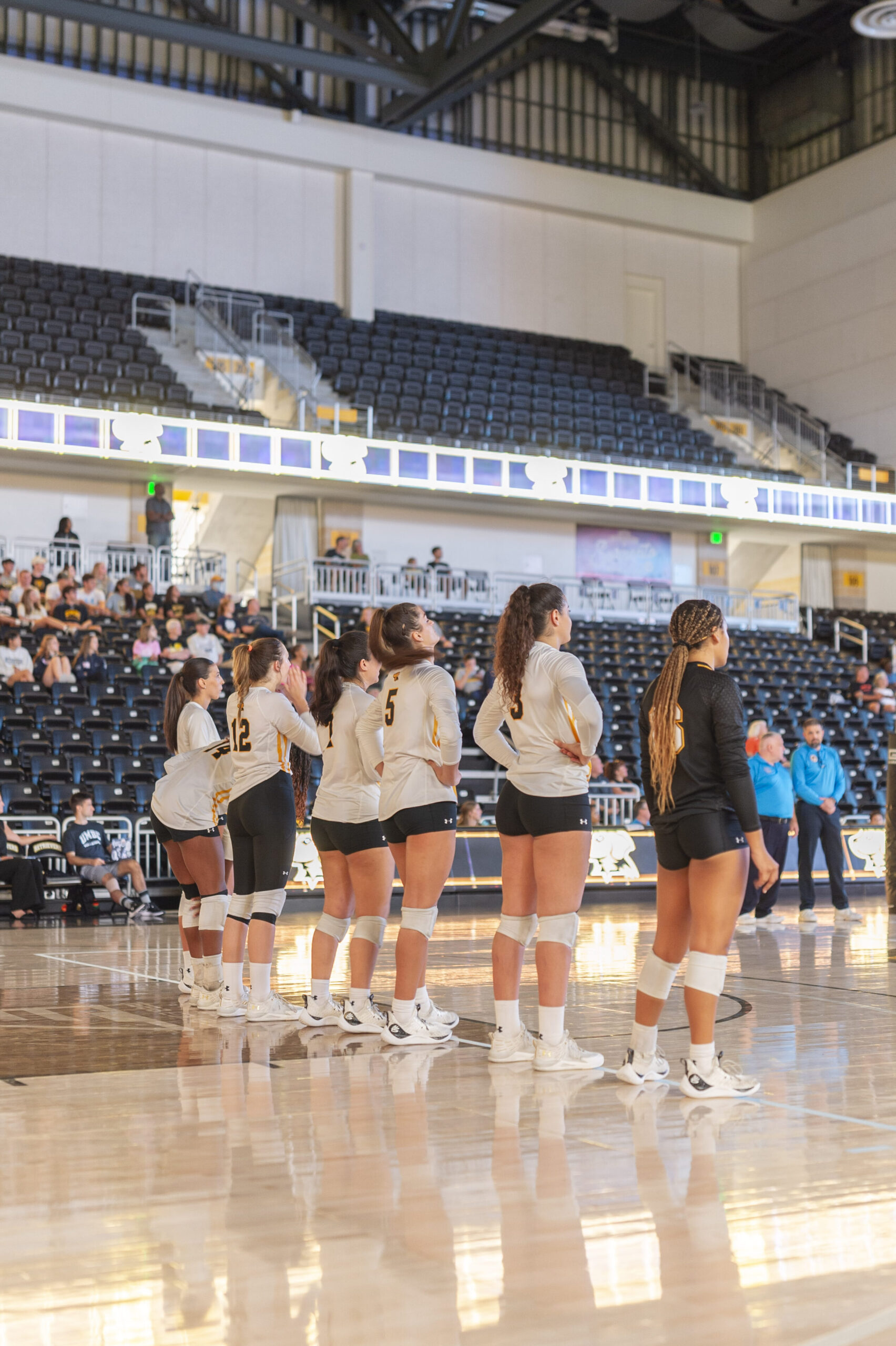
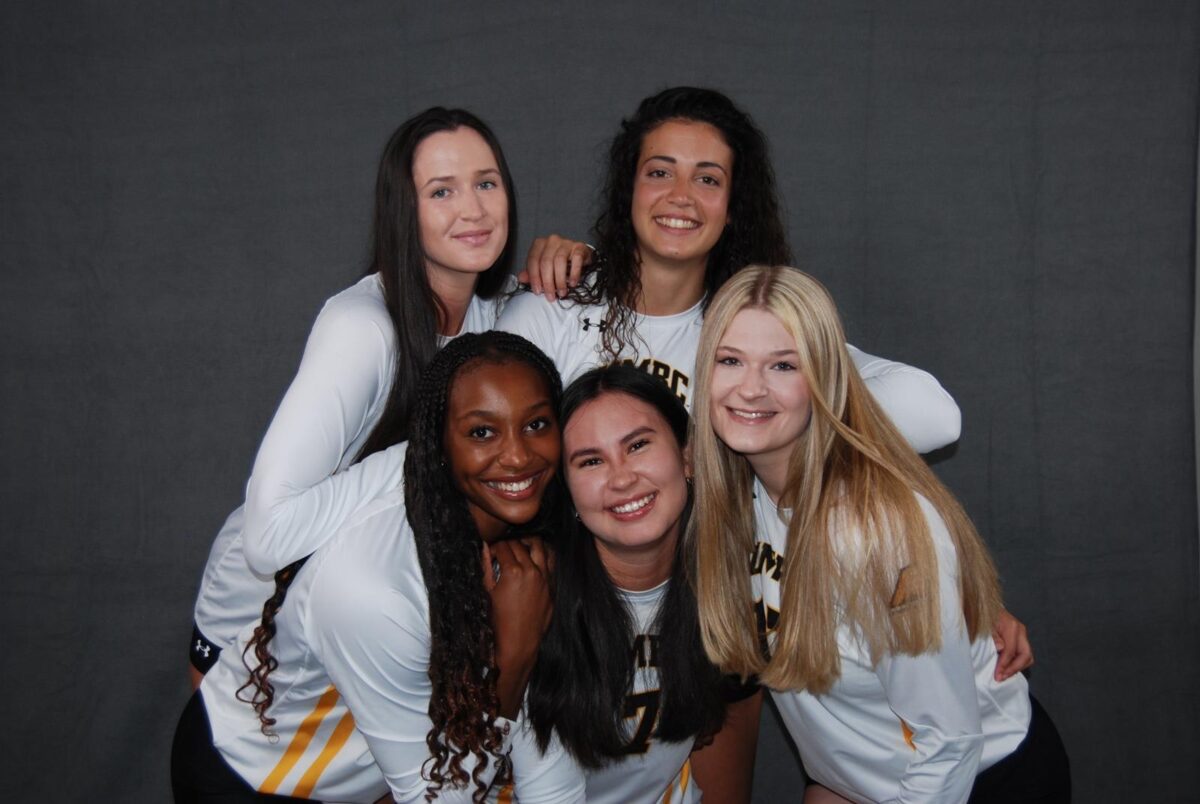 A shared moment with teammates Weronika Wrzesinska (top left), Michela De Marzi (top right), Kamani Conteh (bottom left), Miller, and Emily Ferketic (bottom right). Photos courtesy of Miller.
Q: What advice would you give to a student athlete considering coming to UMBC, and why?
A: To those considering UMBC, this place not only excels in education, the people are what make this place great. It’s easy to feel overwhelmed as a student athlete and finding people that support you is important. Every single person in the athletic department is dedicated to making our student athlete experience amazing. I can go down the list and about everyone in the department has shown that they not only care about my team but me as an individual as well. Over time, building these relationships with people have made my experience at UMBC incredible. I am so fortunate to play the sport I love with people that have my back.
* * * * *
UMBC’s greatest strength is its people. When people meet Retrievers and hear about the passion they bring, the relationships they create, the ways they support each other, and the commitment they have to inclusive excellence, they truly get a sense of our community. That’s what “Meet a Retriever” is all about.
Learn more about how UMBC can help you achieve your goals.
]]>
Meet Aysia Miller, a senior on the America East championship women’s volleyball team at UMBC. Originally from Mililani, Hawaii, Aysia is majoring in biology and minoring in bioinformatics. As a...
https://umbc.edu/stories/meet-a-retriever-aysia-miller-volleyball-player/
https://my3.my.umbc.edu/api/v0/pixel/news/136923/guest@my.umbc.edu/12544b346d9133fa349414482c8f534b/api/pixel
athletics
bioinformatics
biology
campus-life
cnms
magazine
meet-a-retriever
UMBC News & Magazine
https://my3.my.umbc.edu/groups/umbc-news-magazine
https://assets1-my.umbc.edu/system/shared/avatars/groups/000/001/943/24435aa6207c452e7bc15cc74b42c7bb/xsmall.png?1748556657
https://assets1-my.umbc.edu/system/shared/avatars/groups/000/001/943/24435aa6207c452e7bc15cc74b42c7bb/original.png?1748556657
https://assets2-my.umbc.edu/system/shared/avatars/groups/000/001/943/24435aa6207c452e7bc15cc74b42c7bb/xxlarge.png?1748556657
https://assets2-my.umbc.edu/system/shared/avatars/groups/000/001/943/24435aa6207c452e7bc15cc74b42c7bb/xlarge.png?1748556657
https://assets3-my.umbc.edu/system/shared/avatars/groups/000/001/943/24435aa6207c452e7bc15cc74b42c7bb/large.png?1748556657
https://assets1-my.umbc.edu/system/shared/avatars/groups/000/001/943/24435aa6207c452e7bc15cc74b42c7bb/medium.png?1748556657
https://assets2-my.umbc.edu/system/shared/avatars/groups/000/001/943/24435aa6207c452e7bc15cc74b42c7bb/small.png?1748556657
https://assets1-my.umbc.edu/system/shared/avatars/groups/000/001/943/24435aa6207c452e7bc15cc74b42c7bb/xsmall.png?1748556657
https://assets2-my.umbc.edu/system/shared/avatars/groups/000/001/943/24435aa6207c452e7bc15cc74b42c7bb/xxsmall.png?1748556657
UMBC News & Magazine
0
0
false
Tue, 07 Nov 2023 16:37:49 -0500
Tue, 07 Nov 2023 16:37:49 -0500
Meet a Retriever —Diane Tichnell ’70, political science, Founding Four alum

Meet Diane Tichnell ’70, a political science graduate of UMBC’s very first class of Retrievers! As a member of UMBC’s “Founding Four” group of alums from the university’s first four graduating years, Diane has stayed involved with her alma mater, participating as an editor of This Belongs To Us, a collection of Founding Four stories, and establishing the Tichnell Aging Gracefully Graduate Scholarship to support students in the Erickson School of Aging Studies. Take it away, Diane!
Q: What’s one essential thing you’d want another Retriever to know about you?
A: I have been a loyal Retriever since that first day on campus, September 19, 1966, and have tried my best throughout the development of my family life, career, and alumni activities to maintain that Retriever spirit!
Q: What would you want someone who hasn’t joined the UMBC community to know about the support you found here?
A: Frankly, once you are a member of the UMBC community, you are a member of a solid family! You are always welcome on campus. Faculty, staff, and even the students take time to chat with an alum!
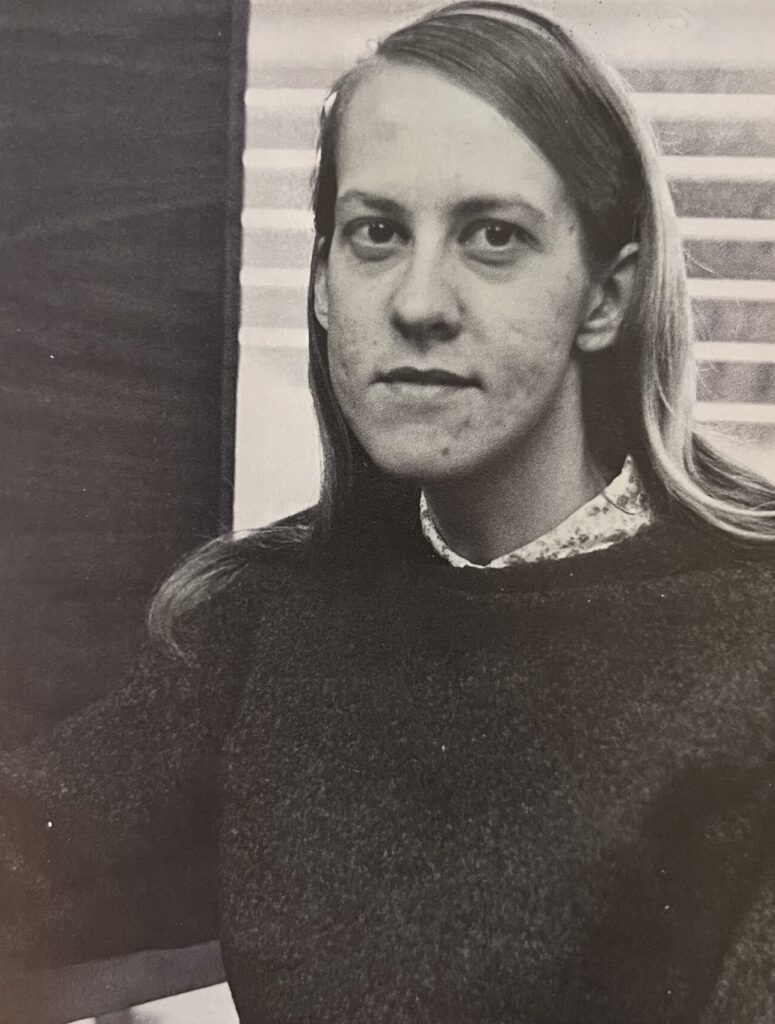 Diane Tichnell from the 1970 Skipjack, UMBC’s yearbook.
Q: Tell us about someone in the community who has inspired you or supported you, and how they did it.
A: Mimi Haw Dietrich ’70 has encouraged me through her continuous involvement and support of UMBC to maintain contact with our Retriever roots consistently. Together with two other alums we feel we have helped to preserve some of our Founding Four history by editing a collection of stories by Retrievers on campus those first four years and publishing the collection this year.
UMBC was just what I needed to equip me for my life and its effects are with me even today.
Diane Tichnell ’70, political science
Q: Tell us what you love about being involved as an alum.
A: The UMBC Alumni Association reaches out frequently to keep alumni engaged in and aware of all the great things happening within the thriving, growing UMBC community. We stay connected no matter where we are in the world. The connection is lifelong and beyond! The association can help an individual stay engaged through a number of legacy giving opportunities which can actually extend long after life ends!
Q: What brought you to UMBC in the first place? Tell us about your primary WHY, and how it led you to UMBC.
A: My “why” in 1966 was a desire to receive a solid education for my future in a way that was affordable to me. My parents had many compelling financial obligations then and could only provide me with a limited amount of financial support for higher education. UMBC was in close proximity to my home, was a choice of many of my friends, and offered an exciting opportunity to be a kind of pioneer at a brand new university in Maryland.
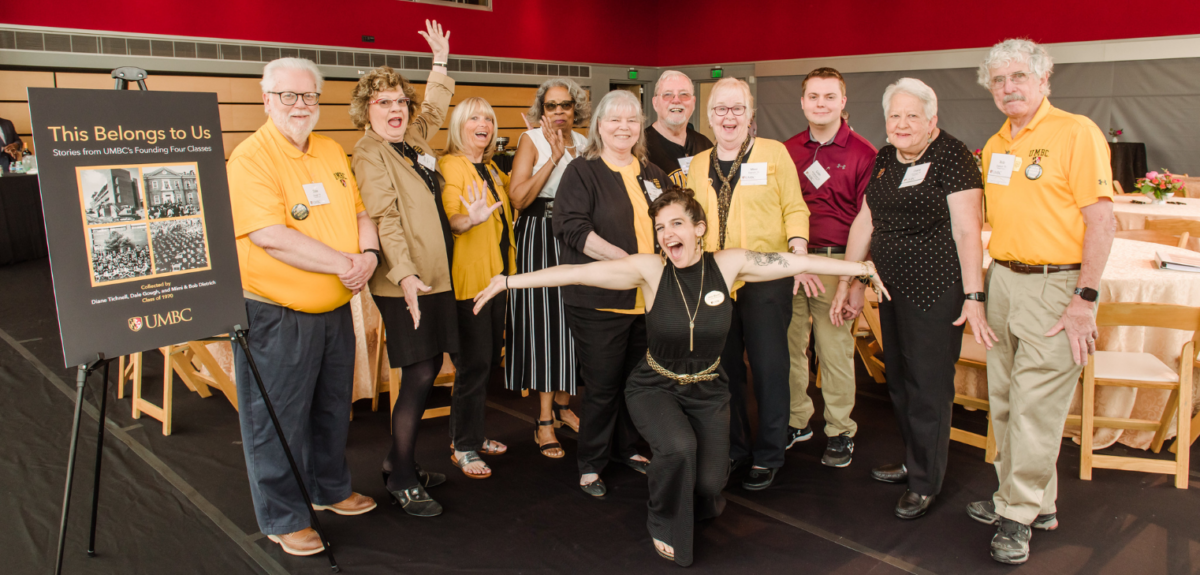 Members of UMBC’s founding classes celebrate the launch of This Belongs to Us. Pictured to the right of Tichnell, in red, is her grandson Colin McFarland ’22, who helped out with book design. From left to right: Dale Gough ‘70, Donna Heckler ‘70, Louie Lyall ‘70, Gail Williams Rouse ’70, Louise Izat ‘70, Royce Bradshaw ‘70, Mimi Dietrich ‘70, McFarland, Tichnell, Bob Dietrich ‘70, and staff member Jess Wyatt in foreground.
Q: Since you’ve been a part of the UMBC community, how have you found support of your WHY?
A: The creative and competent faculty and staff at UMBC in 1966 made me totally comfortable with my decision and made me excited about the career in journalism which I had dreamed of. I had planned to possibly transfer to College Park to complete the journalism major, but I totally fell in love with the unique UMBC environment and changed my major to political science, which was still an awesome preparation for a journalism career. My political science professors as well as the incredible visiting personalities of those first four years prepared me with an open mind and solid principles on which to base my future. Professors in every area of my studies played an integral part in shaping my ability to think, plan, envision, and experience what I needed to do to follow my dreams. UMBC was just what I needed to equip me for my life and its effects are with me even today.
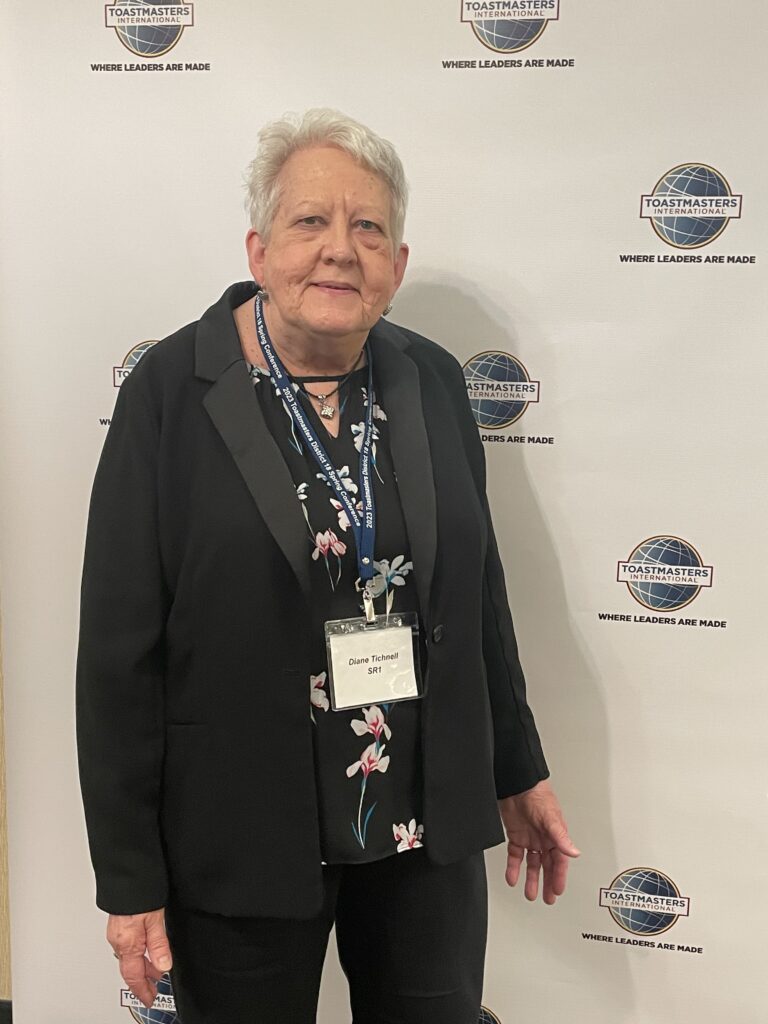 One of Tichnell’s passions since 1988 has been participating in Toastmasters International speaking group. Here she is at a recent District 18 conference. Photo courtesy of Tichnell.
Q: As an alum, what’s your favorite part of Retriever Nation?
A: Seeing the great growth and the direction that UMBC is heading make me so happy to be a part of Retriever Nation! We had no idea in 1966 that this campus would become the amazing, accomplished place it is! What a thrill it is to experience it as it continues to thrive and become much more than just a college campus! It is having a significant impact on the entire area surrounding it and beyond!
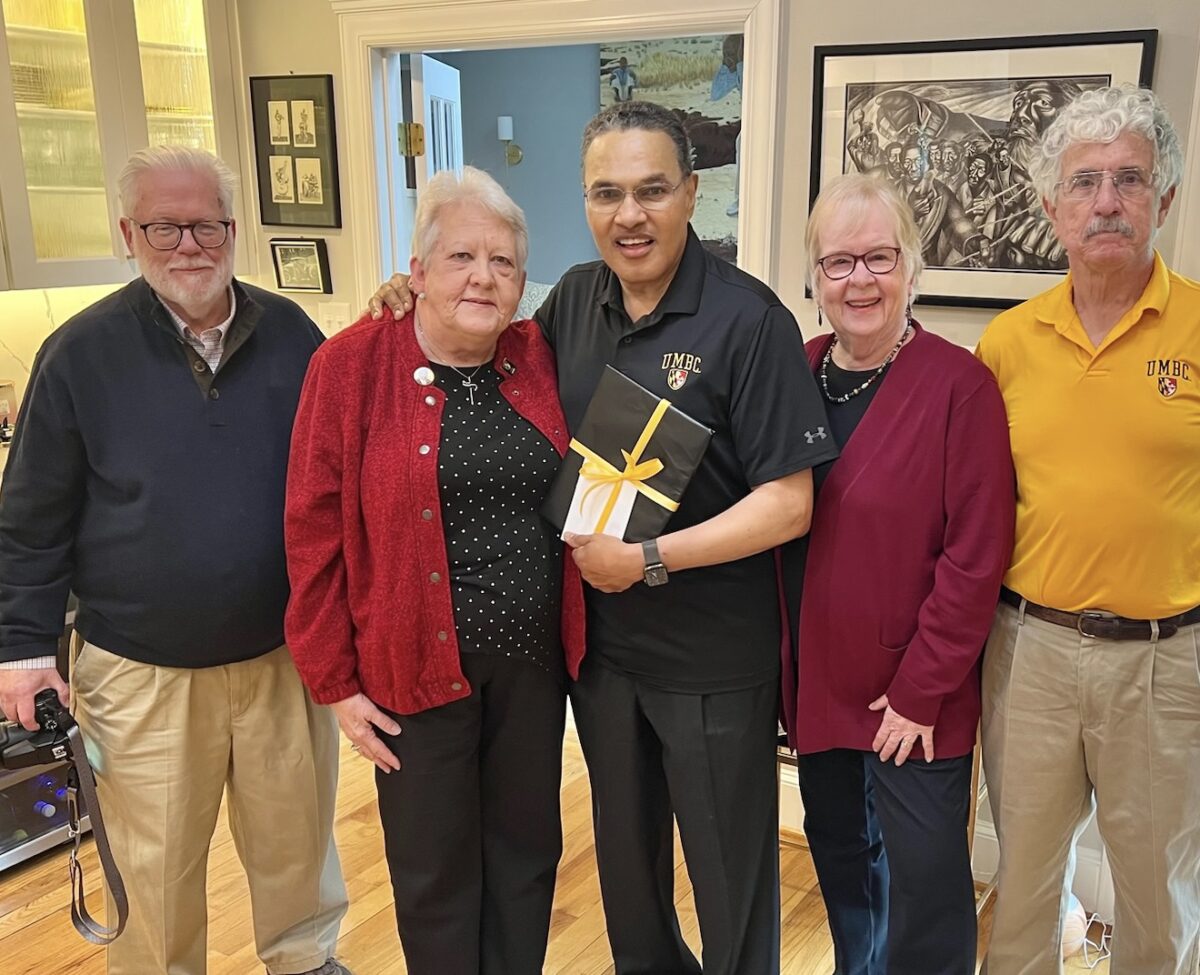 Presenting former UMBC president Freeman Hrabowski with his copy of This Belongs to Us in May 2023. From left, Dale Gough ’70, Tichnell, Hrabowski, Mimi Dietrich, and Bob Dietrich ’70.
Q: You recently established the Tichnell Aging Gracefully Graduate Scholarship to help students in the Erickson School of Aging. Tell us about what that means to you.
A: The Erickson School of Aging Studies intrigued me from the moment of its conception! It is not just a program designed to teach students how to administer senior communities! It goes way beyond that by insisting that students examine every facet of the aging process! Looking at the psychology of aging, as well as the physical, social, and economic realities of that time of life equips the students with a total understanding and appreciation of the process. I recently began the process of endowing a scholarship for graduate students in the Erickson School of Aging Studies. It was easy to do and I am so excited to participate in it!
Partnering with UMBC is really just an extension of being here all those years ago. It makes me feel that I have never left the campus I walked onto that first day. Its growth and current compelling state have never left me behind! I love being a part of it still!
* * * * *
UMBC’s greatest strength is its people. When people meet Retrievers and hear about the passion they bring, the relationships they create, the ways they support each other, and the commitment they have to inclusive excellence, they truly get a sense of our community. That’s what “Meet a Retriever” is all about.
Learn more about how UMBC can help you achieve your goals.
]]>
Meet Diane Tichnell ’70, a political science graduate of UMBC’s very first class of Retrievers! As a member of UMBC’s “Founding Four” group of alums from the university’s first four graduating...
https://umbc.edu/stories/meet-a-retriever-diane-tichnell-70-founding-four/
https://my3.my.umbc.edu/api/v0/pixel/news/136901/guest@my.umbc.edu/9f28fd62397d511a1fbee36732257313/api/pixel
alumni
erickson-school
impact
magazine
meet-a-retriever
political-science
UMBC News & Magazine
https://my3.my.umbc.edu/groups/umbc-news-magazine
https://assets1-my.umbc.edu/system/shared/avatars/groups/000/001/943/24435aa6207c452e7bc15cc74b42c7bb/xsmall.png?1748556657
https://assets1-my.umbc.edu/system/shared/avatars/groups/000/001/943/24435aa6207c452e7bc15cc74b42c7bb/original.png?1748556657
https://assets2-my.umbc.edu/system/shared/avatars/groups/000/001/943/24435aa6207c452e7bc15cc74b42c7bb/xxlarge.png?1748556657
https://assets2-my.umbc.edu/system/shared/avatars/groups/000/001/943/24435aa6207c452e7bc15cc74b42c7bb/xlarge.png?1748556657
https://assets3-my.umbc.edu/system/shared/avatars/groups/000/001/943/24435aa6207c452e7bc15cc74b42c7bb/large.png?1748556657
https://assets1-my.umbc.edu/system/shared/avatars/groups/000/001/943/24435aa6207c452e7bc15cc74b42c7bb/medium.png?1748556657
https://assets2-my.umbc.edu/system/shared/avatars/groups/000/001/943/24435aa6207c452e7bc15cc74b42c7bb/small.png?1748556657
https://assets1-my.umbc.edu/system/shared/avatars/groups/000/001/943/24435aa6207c452e7bc15cc74b42c7bb/xsmall.png?1748556657
https://assets2-my.umbc.edu/system/shared/avatars/groups/000/001/943/24435aa6207c452e7bc15cc74b42c7bb/xxsmall.png?1748556657
UMBC News & Magazine
2
0
false
Tue, 07 Nov 2023 08:48:01 -0500
Tue, 07 Nov 2023 08:48:01 -0500
Vampire viruses prey on other viruses to replicate themselves − and may hold the key to new antiviral therapies
Written by Ivan Erill, professor of biological sciences, UMBC
Have you ever wondered whether the virus that gave you a nasty cold can catch one itself? It may comfort you to know that, yes, viruses can actually get sick. Even better, as karmic justice would have it, the culprits turn out to be other viruses.
Viruses can get sick in the sense that their normal function is impaired. When a virus enters a cell, it can either go dormant or start replicating right away. When replicating, the virus essentially commandeers the molecular factory of the cell to make lots of copies of itself, then breaks out of the cell to set the new copies free.
Sometimes a virus enters a cell only to find that its new temporary dwelling is already home to another dormant virus. Surprise, surprise. What follows is a battle for control of the cell that can be won by either party.
But sometimes a virus will enter a cell to find a particularly nasty shock: a viral tenant waiting specifically to prey on the incoming virus.
I am a bioinformatician, and my laboratory studies the evolution of viruses. We frequently run into “viruses of viruses,” but we recently discovered something new: a virus that latches onto the neck of another virus.
A world of satellites
Biologists have known of the existence of viruses that prey on other viruses – referred to as viral “satellites” – for decades. In 1973, researchers studying bacteriophage P2, a virus that infects the gut bacterium Escherichia coli, found that this infection sometimes led to two different types of viruses emerging from the cell: phage P2 and phage P4.
Bacteriophage P4 is a temperate virus, meaning it can integrate into the chromosome of its host cell and lie dormant. When P2 infects a cell already harboring P4, the latent P4 quickly wakes up and uses the genetic instructions of P2 to make hundreds of its own small viral particles. The unsuspecting P2 is lucky to replicate a few times, if at all. In this case, biologists refer to P2 as a “helper” virus, because the satellite P4 needs P2’s genetic material to replicate and spread.
Bacteriophages are viruses that infect bacteria.
Subsequent research has shown that most bacterial species have a diverse set of satellite-helper systems, like that of P4-P2. But viral satellites are not limited to bacteria. Shortly after the largest known virus, mimivirus, was discovered in 2003, scientists also found its satellite, which they named Sputnik. Plant viral satellites that lurk in plant cells waiting for other viruses are also widespread and can have important effects on crops.
Viral arms race
Although researchers have found satellite-helper viral systems in pretty much every domain of life, their importance to biology remains underappreciated. Most obviously, viral satellites have a direct impact on their “helper” viruses, typically maiming them but sometimes making them more efficient killers. Yet that is probably the least of their contributions to biology.
Satellites and their helpers are also engaged in an endless evolutionary arms race. Satellites evolve new ways to exploit helpers and helpers evolve countermeasures to block them. Because both sides are viruses, the results of this internecine war necessarily include something of interest to people: antivirals.
Recent work indicates that many antiviral systems thought to have evolved in bacteria, like the CRISPR-Cas9 molecular scissors used in gene editing, may have originated in phages and their satellites. Somewhat ironically, with their high turnover and mutation rates, helper viruses and their satellites turn out to be evolutionary hot spots for antiviral weaponry. Trying to outsmart each other, satellite and helper viruses have come up with an unparalleled array of antiviral systems for researchers to exploit.
MindFlayer and MiniFlayer
Viral satellites have the potential to transform how researchers understand antiviral strategies, but there is still a lot to learn about them. In our recent work, my collaborators and I describe a satellite bacteriophage completely unlike previously known satellites, one that has evolved a unique, spooky lifestyle.
Undergraduate phage hunters at the University of Maryland, Baltimore County isolated a satellite phage called MiniFlayer from the soil bacterium Streptomyces scabiei. MiniFlayer was found in close association with a helper virus called bacteriophage MindFlayer that infects the Streptomyces bacterium. But further research revealed that MiniFlayer was no ordinary satellite.
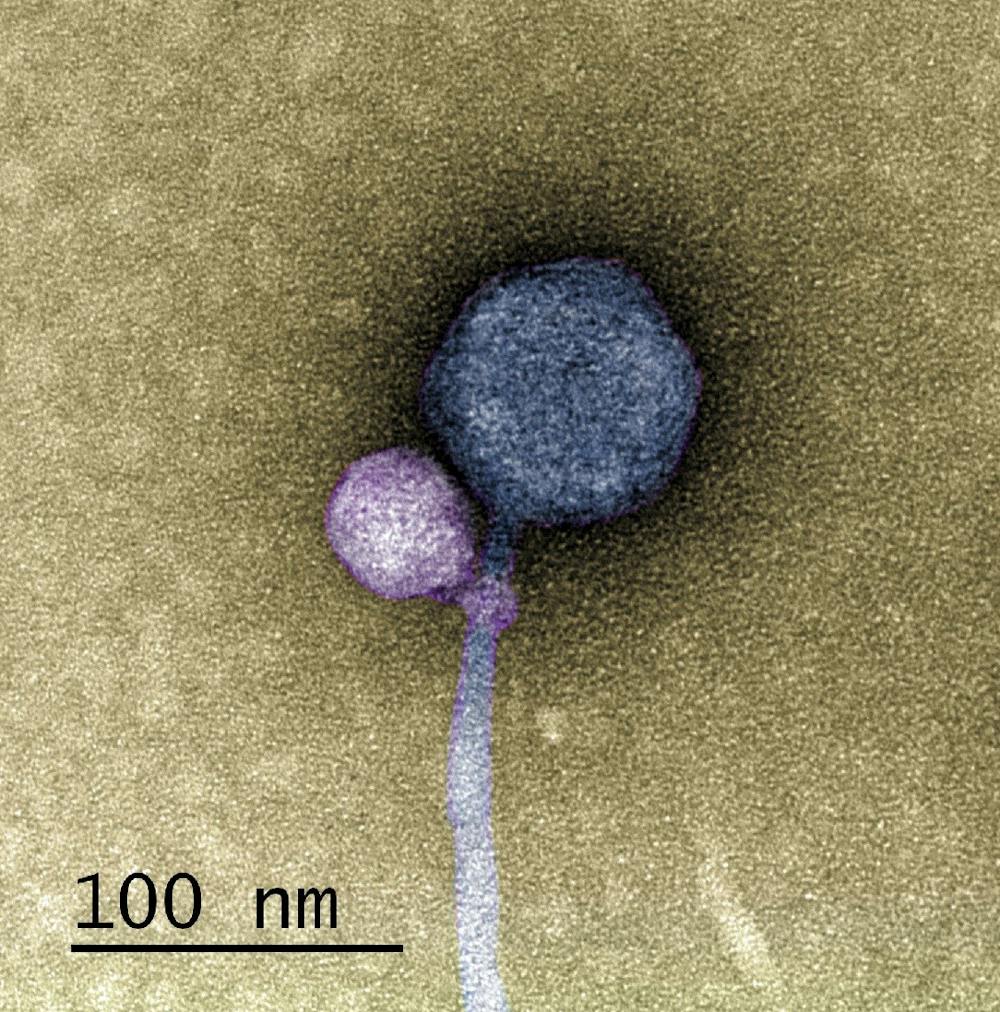
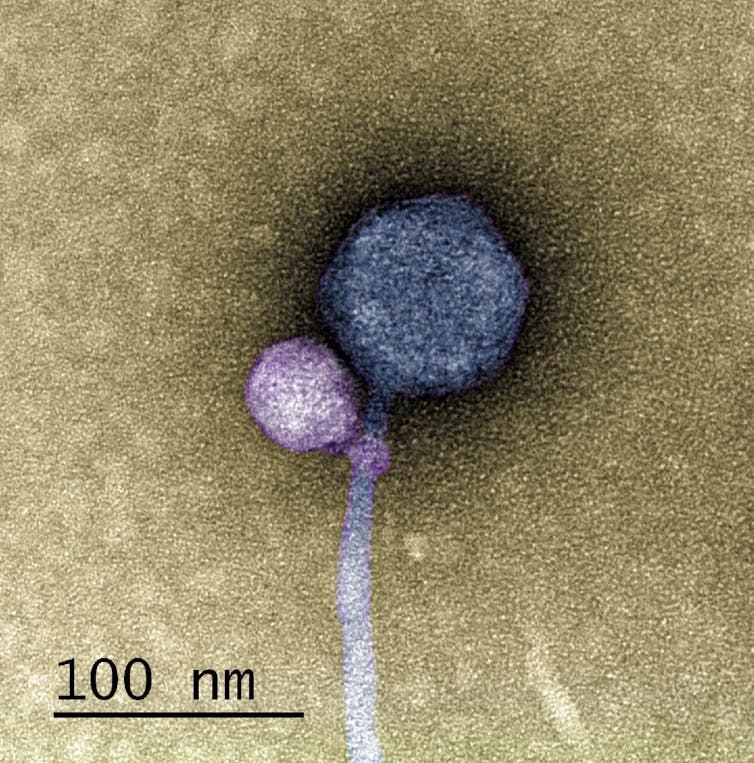 This image shows Streptomyces satellite phage MiniFlayer (purple) attached to the neck of its helper virus, Streptomyces phage MindFlayer (gray). Tagide deCarvalho, CC BY-SA
MiniFlayer is the first satellite phage known to have lost its ability to lie dormant. Not being able to lie in wait for your helper to enter the cell poses an important challenge to a satellite phage. If you need another virus to replicate, how do you guarantee that it makes it into the cell around the same time you do?
MiniFlayer addressed this challenge with evolutionary aplomb and horror-movie creativity. Instead of lying in wait, MiniFlayer has gone on the offensive. Borrowing from both “Dracula” and “Alien,” this satellite phage evolved a short appendage that allows it to latch onto its helper’s neck like a vampire. Together, the unwary helper and its passenger travel in search of a new host, where the viral drama will unfold again. We don’t yet know how MiniFlayer subdues its helper, or whether MindFlayer has evolved countermeasures.
If the recent pandemic has taught us anything, it is that our supply of antivirals is rather limited. Research on the complex, intertwined and at times predatory nature of viruses and their satellites, like the ability of MiniFlayer to attach to its helper’s neck, has the potential to open new avenues for antiviral therapy.
This article is republished from The Conversation under a Creative Commons license. Read the original article and see more than 250 UMBC articles available in The Conversation.
]]>
Written by Ivan Erill, professor of biological sciences, UMBC Have you ever wondered whether the virus that gave you a nasty cold can catch one itself? It may comfort you to know that, yes,...
https://umbc.edu/stories/vampire-viruses-may-hold-key-to-antivirals/
https://my3.my.umbc.edu/api/v0/pixel/news/136870/guest@my.umbc.edu/3cf070771f39e5450041c85363f04174/api/pixel
biology
cnms
discovery
magazine
research
the-conversation
UMBC News & Magazine
https://my3.my.umbc.edu/groups/umbc-news-magazine
https://assets1-my.umbc.edu/system/shared/avatars/groups/000/001/943/24435aa6207c452e7bc15cc74b42c7bb/xsmall.png?1748556657
https://assets1-my.umbc.edu/system/shared/avatars/groups/000/001/943/24435aa6207c452e7bc15cc74b42c7bb/original.png?1748556657
https://assets2-my.umbc.edu/system/shared/avatars/groups/000/001/943/24435aa6207c452e7bc15cc74b42c7bb/xxlarge.png?1748556657
https://assets2-my.umbc.edu/system/shared/avatars/groups/000/001/943/24435aa6207c452e7bc15cc74b42c7bb/xlarge.png?1748556657
https://assets3-my.umbc.edu/system/shared/avatars/groups/000/001/943/24435aa6207c452e7bc15cc74b42c7bb/large.png?1748556657
https://assets1-my.umbc.edu/system/shared/avatars/groups/000/001/943/24435aa6207c452e7bc15cc74b42c7bb/medium.png?1748556657
https://assets2-my.umbc.edu/system/shared/avatars/groups/000/001/943/24435aa6207c452e7bc15cc74b42c7bb/small.png?1748556657
https://assets1-my.umbc.edu/system/shared/avatars/groups/000/001/943/24435aa6207c452e7bc15cc74b42c7bb/xsmall.png?1748556657
https://assets2-my.umbc.edu/system/shared/avatars/groups/000/001/943/24435aa6207c452e7bc15cc74b42c7bb/xxsmall.png?1748556657
UMBC News & Magazine
0
0
false
Mon, 06 Nov 2023 16:05:11 -0500
Mon, 06 Nov 2023 16:05:11 -0500
Higher education can be elusive for asylum-seekers and immigrants

Written by Kerri Evans, assistant professor of social work, UMBC; Ishara Casellas Connors, Texas A&M University, and Lisa Unangst, SUNY Empire State College
Pursuing higher education is often a pathway to higher income and overall better well-being. College graduates are less likely to rely on public benefits. Therefore, it’s beneficial for education leaders and policymakers to help newcomers – including asylum-seekers and refugees – to access higher education in the U.S., whether it be community college, taking advanced English courses, obtaining a certificate through training programs or going to a four-year university.
Despite these clear benefits, we have found that higher education can often be an elusive goal for people who’ve fled their homeland in search of a better life in the U.S.
We all study policy and education issues that affect refugees. Over the past year and a half, the three of us – Kerri Evans, Ishara Casellas Connors and Lisa Unangst – teamed up to learn more about higher education pathways for refugees, asylum-seekers, recent Afghan parolees and people with temporary protected status, in the Maryland, Virginia and Washington, D.C. area.
We partnered with Lutheran Social Services of the National Capital Area, one of the largest refugee resettlement agencies on the East Coast. We as researchers established a community advisory board of local refugees and other immigrants to guide the research process.
While our findings have implications for all refugees and asylum-seekers, we see our findings as particularly relevant for the nearly 77,000 Afghans who entered the U.S. with temporary immigration statuses from 2021 to 2023. Most arrived with parole status, which allows temporary stay and work in the U.S. for only two years. After that, renewals are needed. Parole status confers no option for lawful permanent resident status, unlike what happens when people fleeing their homeland arrive with official refugee status.
Enrolling in college can be difficult for this population because of the uncertainty of their immigrant status and future in the U.S.
Obstacles to higher learning
To identify the barriers to higher education for refugees in the Maryland, Virginia and Washington, D.C., area, our research team interviewed 82 immigrants, all of whom were over 18 at time of arrival in the U.S., and two-thirds of whom were from Afghanistan and arrived since 2021.
We also interviewed 22 people who work for the Lutheran resettlement agency, the majority of whom were refugees or other immigrants who were resettled through the program in prior years. In reviewing the findings with the research team, the community advisory board implemented an additional survey to enhance our research by using both qualitative and quantitative data. Forty-three people – ages 22-55 – who would like to attend college in the U.S. chose to answer the survey, and 37 of them were from Afghanistan.
Through our research, we identified three main barriers for adult asylum-seekers and other immigrants who wanted to go to college or get advanced degrees.
1. Getting their degrees recognized
The process of getting degrees recognized is lengthy, difficult and involves a fee for immigrants.
More than half of participants experienced a barrier with either certifying the degrees they already earned back home or with curriculum requirements that differed from those of their home country. For instance, U.S. colleges may not accept high school and college degrees from other countries. Or participants may not meet all of the requirements for internships or to take specific courses in the U.S.
A female resettlement staff member who is from Afghanistan explained that the problem is having documents from their home country, such as diplomas and work credentials, evaluated here in the U.S.
“For example … let’s say, they have their bachelor’s degree or master’s degree in Afghanistan,” the resettlement staff member said. “But when they arrive in here, somehow, (the degrees are) lost,” she continued, explaining that immigrants often choose to attend college all over again and get the degree in the U.S.
2. Insufficient guidance
Half of the Afghan migrants we interviewed indicated they would like more help applying to college and graduate school programs than they’re getting.
Without guidance, many said they had lost precious time trying to navigate the higher education system. Some said they wanted more help with writing college application essays. Two-thirds of the Afghans wanted a personal connection with university alums or professors who could guide them through the college application process and be a mentor during their time in college.
3. Financial
 Guidance helps migrants find educational opportunities.
silverkblack/iStock via Getty Images
Newly resettled refugees and others who were forced to flee their country struggle to pay their bills as they restart their lives in the U.S. Often they are relegated to low-wage jobs.
Nearly three-quarters of the 43 migrants said they couldn’t afford college tuition for themselves. About two-thirds indicated they would need information about scholarships and other financial resources in order to reconsider applying for college – information that is not always easily available for those who aren’t graduating from high schools in the U.S.
“I have to pay for rent. I have to pay for a car. I have to pay for oil. I have to pay for everything,” said one male from Afghanistan, reflecting on the fact that there is no money left for tuition payments. “Whatever I’m earning is a zero.”
Another male from Afghanistan observed: “We do have families. We have to support them, and at the same time, education fees are so high here.”
 Refugees often have trouble affording tuition at U.S. colleges and universities. AnnaStills/iStock via Getty Images
To overcome these barriers, our research team and community advisory board members recommend the following strategies:
• Identify scholarships for which immigrants and refugees would be eligible and share them with those who are interested.
• Educate resettlement staff on the nuances of legal status for in-state tuition so they can help asylum-seekers and refugees to determine if they are eligible.
• Create webinars and videos that include an overview of U.S. higher education and the financial aid rules for immigrants and refugees.
• Recruit mentors to help asylum-seekers and refugees apply to college.
This article is republished from The Conversation under a Creative Commons license. Read the original article and see more than 250 UMBC articles available in The Conversation.
]]>
Written by Kerri Evans, assistant professor of social work, UMBC; Ishara Casellas Connors, Texas A&M University, and Lisa Unangst, SUNY Empire State College Pursuing higher education is...
https://umbc.edu/stories/higher-education-asylum-seekers-immigrants/
https://my3.my.umbc.edu/api/v0/pixel/news/136863/guest@my.umbc.edu/2d366e8e972d6605e346c157aa1d170b/api/pixel
discovery
magazine
research
social-work
UMBC News & Magazine
https://my3.my.umbc.edu/groups/umbc-news-magazine
https://assets1-my.umbc.edu/system/shared/avatars/groups/000/001/943/24435aa6207c452e7bc15cc74b42c7bb/xsmall.png?1748556657
https://assets1-my.umbc.edu/system/shared/avatars/groups/000/001/943/24435aa6207c452e7bc15cc74b42c7bb/original.png?1748556657
https://assets2-my.umbc.edu/system/shared/avatars/groups/000/001/943/24435aa6207c452e7bc15cc74b42c7bb/xxlarge.png?1748556657
https://assets2-my.umbc.edu/system/shared/avatars/groups/000/001/943/24435aa6207c452e7bc15cc74b42c7bb/xlarge.png?1748556657
https://assets3-my.umbc.edu/system/shared/avatars/groups/000/001/943/24435aa6207c452e7bc15cc74b42c7bb/large.png?1748556657
https://assets1-my.umbc.edu/system/shared/avatars/groups/000/001/943/24435aa6207c452e7bc15cc74b42c7bb/medium.png?1748556657
https://assets2-my.umbc.edu/system/shared/avatars/groups/000/001/943/24435aa6207c452e7bc15cc74b42c7bb/small.png?1748556657
https://assets1-my.umbc.edu/system/shared/avatars/groups/000/001/943/24435aa6207c452e7bc15cc74b42c7bb/xsmall.png?1748556657
https://assets2-my.umbc.edu/system/shared/avatars/groups/000/001/943/24435aa6207c452e7bc15cc74b42c7bb/xxsmall.png?1748556657
UMBC News & Magazine
0
0
false
Mon, 06 Nov 2023 15:23:33 -0500
Mon, 06 Nov 2023 15:23:33 -0500
How to plan a successful stage battle
Van Helsing straddles the vampire, brandishing her cross and wooden stake. The undead—mouth and shirt stained with blood—had just confessed to a brutal kill when the vampire slayer brings down her stake. A half second delayed, a comically small amount of blood spurts from the wooden prop. Van Helsing, played by Franchesca Parker ’25, acting, and the rest of the group in the theatre rehearsal space titter at the anticlimactic moment. Tessara Morgan Farley, production stage manager, and Sierra Young ’23, the fighting and intimacy director, immediately jump in to triage a better death for the vampire, Lucy (played by Liza Mupende ’25, action and information systems technology).
It’s stage blood rehearsal day for UMBC’s fall production of Dracula: a Feminist Revenge Fantasy, Really by Kate Hamill, directed by Kathryn Chase Bryer (running November 2 – 12). Snags like this are the reason the crew is spending four hours on a Monday evening trying out blood capsules, strawberries (aka, mini bags of stage blood), sponges loaded with blood dye, and grits mixed with edible stage blood for various effects on stage.
What does it take to pull off a veritable bloodbath on stage for six performances? That’s what this crew of staff and students aim to find out.
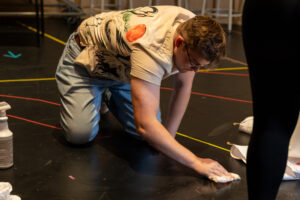
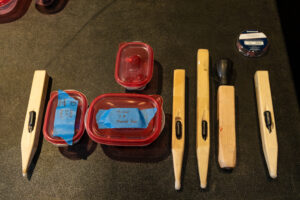
Left to right: Baggies of edible stage blood called strawberries; a crew member cleans the rehearsal floor during practice; various types of blood and props waiting for trial and error. (Kiirstn Pagan ’11/UMBC)
Tools of the Trade
1. 2,000 ounces of stage blood, some homemade, some bought
2. LOTS of baby wipes
3. Several mops and buckets
4. A taste for corn syrup
Step 1—Finding the right vein
For Morgan Farley and Emerson Balthis ’24, theatre design and production, assistant scenic designer and newly-christened stage blood mixologist, finding the perfect combination of purchased and homemade stage blood was a multi-month project. Several of the pressing questions at hand: Some of the blood needed to be edible—could they make it taste at least OK? Was anyone allergic to the substance? Most importantly, could it be washed out of the costumes every night? Oh yeah, and how to stay on budget?
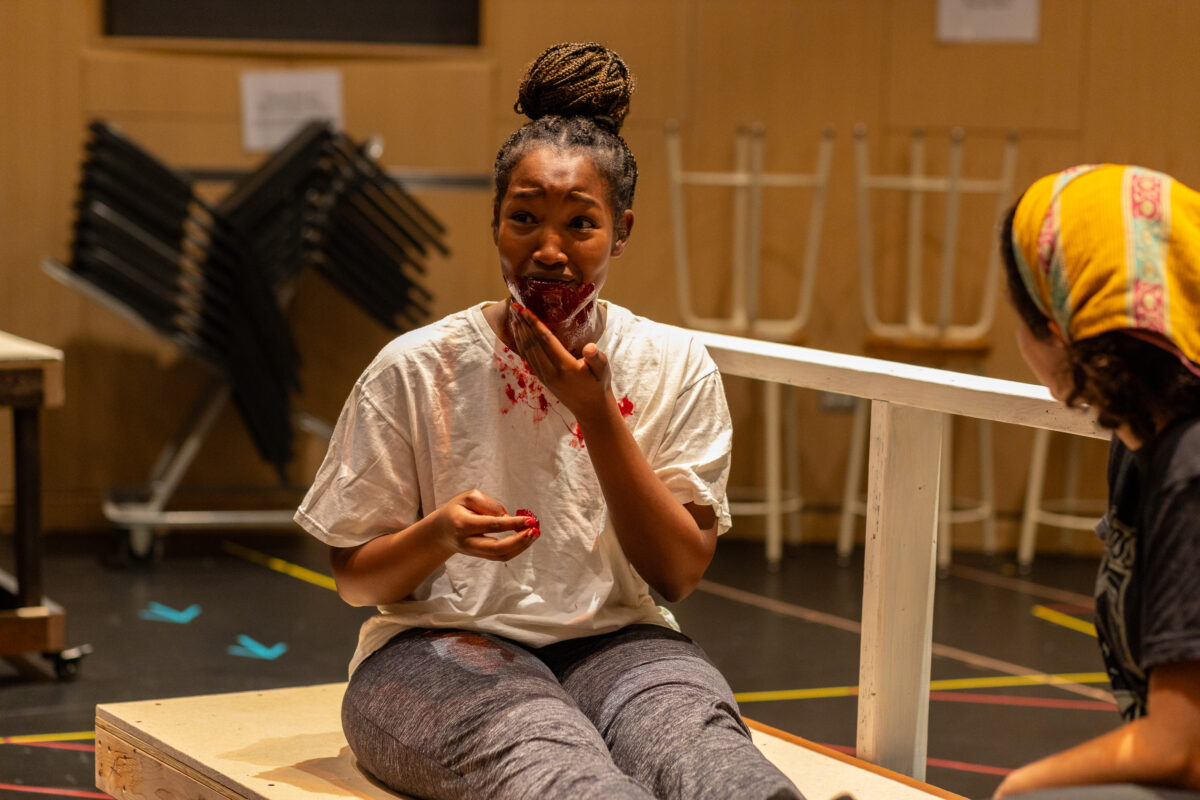 Liza Mupende as the vampire Lucy smears stage blood on her face and neck to get used to the texture in rehearsal. (Kiirstn Pagan ’11/UMBC)
“It’s going to be a bloodbath on stage,” says Morgan Farley, “but also not being too excessive to the point where it becomes funny. We’re trying to go more in the vein of reality versus comical, which also influenced our choice of color for blood. Of course, we were looking for washability, but we were also looking at the color and the viscosity.”
In order to stretch the budget, Morgan Farley and Balthis found ways to water down what they bought and manufacture the rest— simmering vats of chocolate syrup, corn syrup, food coloring, and various thickening agents dissolving into a viscous, sugary brew.
Step 2—Out damned spot
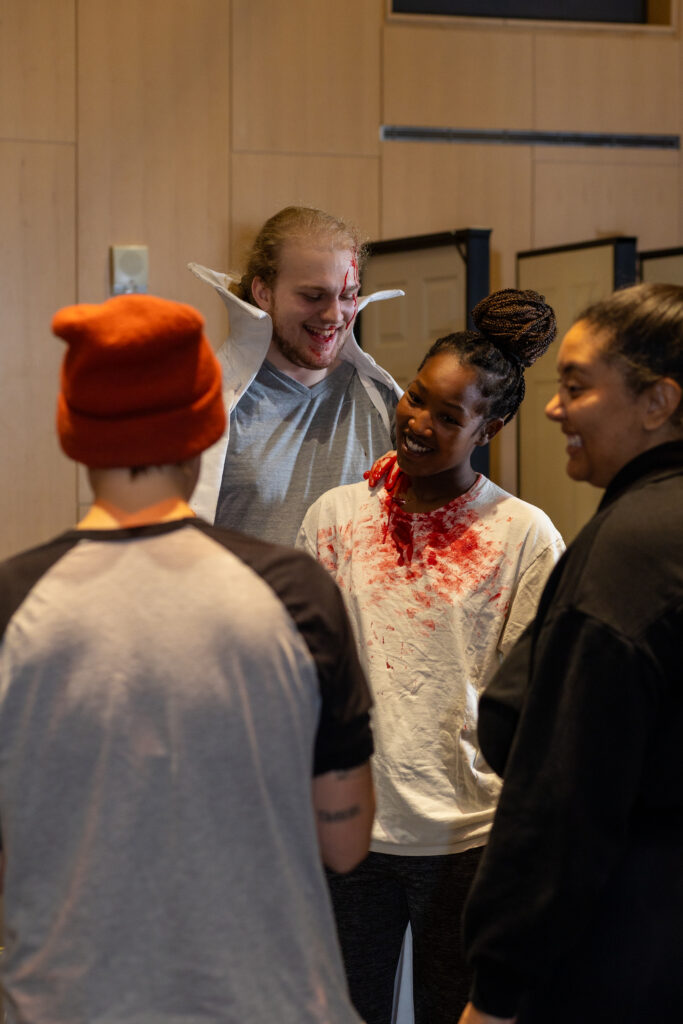 Dracula and Lucy are coached through a violent moment by Sierra Young, right, and Tessara Morgan Farley, left. (Kiirstn Pagan ’11/UMBC)
Moods are high, hands are stained red, and it’s obvious the student actors are having a blast (and most likely, a sugar high, based on the recipe). Standing in a six-foot-long pristine white cape—except for a few new blood smears—with a curved collar another foot high, Cece Smith ’24, acting, who plays Dracula, is nearly giggling with glee.
“I’m having so much fun,” says Smith. “I honestly don’t see a downside to the blood, even when it gets all sticky and nasty—it makes me feel pretty badass.”
Enter the people responsible for wardrobe and laundry: Margaret Caster, assistant costume shop manager and wardrobe supervisor, and Jennie Hardman ’23, theatre studies and environmental studies, wardrobe head for the show. While they could potentially see downsides galore, the duo is taking their tasks in stride.
“It was a little bit of ‘oh no,’ if I’m going to be honest,” says Hardman, who has worked on many UMBC shows in her time as a student, but this is her first as wardrobe head. “When you read the script, there is so much blood. So you think, ‘We’re going to do this with real red liquid. On white colored clothing. Oh boy, that’s going to be my problem, isn’t it!’”
“I’ve done blood shows before, so it’s not my first blood rodeo,” says Caster, “but I like to think of it like ‘How do you wrangle the blood?’ Because as you can see, it spreads everywhere. So my side is to think, ‘How can we contain it?’”
Their answer? Overnight soaks in Oxiclean and Shout spritzes for the tougher stains.
Step 3—Making the magic happen
In her role as an intimacy and fight director, Sierra Young has done vomit, has done other bodily fluids, has done blood—but never this much blood. Her job, as she puts it, “is to choreograph all of those big heightened moments so that they’re specific, repeatable, and narratively dynamic. And then give the actors tools to create a culture that is consent forward and trauma informed so they can feel secure in that space to create.”
In a feminist revenge fantasy based on Bram Stoker’s Dracula, unsurprisingly, there are a lot of opportunities for staging violence and intimacy, often at the same time. The added layer of Young’s already substantial task is designing the choreography so that the blood effects can be effectively masked.
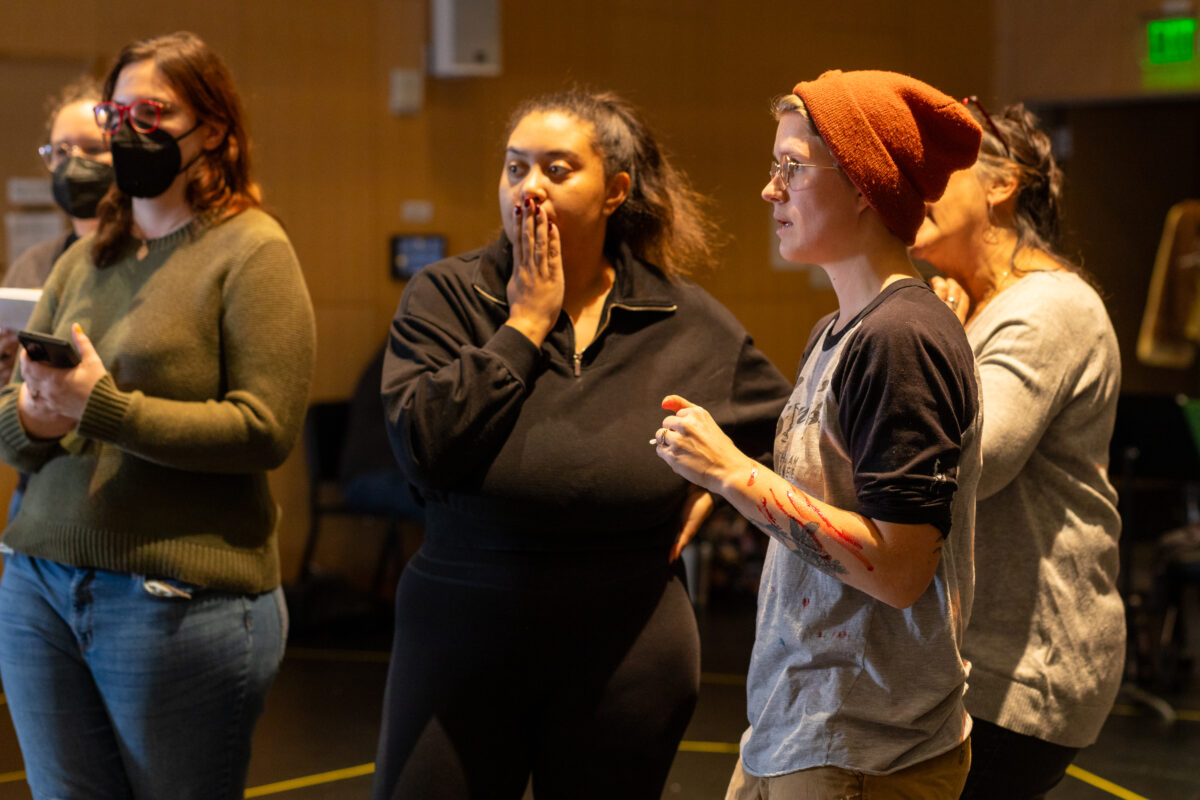 Sierra Young, center, and Tessara Morgan Farley, right, at rehearsal. (Kiirstn Pagan ’11/UMBC)
This means actors are subtly handing off blood capsules to each other, picking them up from behind stage props, or accessing them from hidden pockets. “In terms of choreography, how do I hide these things, because stage combat is the illusion of danger. It’s a lot of magic tricks and misdirection.”
“We’re doing this show on purpose,” adds Eve Muson, associate professor of theatre and chair of the Theatre Department at UMBC. “These extravagant elements are for teaching purposes.”
Step 4—In pursuit of a good death
Back to rehearsal and the problem of Van Helsing’s stake and the paltry amount of blood it produced. The actors, Parker and Mupende, are game to try any workarounds suggested by Morgan Farley and Young. They finally land on a blood strawberry that Parker-as-Van Helsing will place upstage of Mupende-as-the-vampire-Lucy.
While writhing after Van Helsing’s stab, Lucy puts the baggy of blood in her mouth and chomps down. She bends over to gasp her last undead breath, spewing the leftover plastic at the same time, looking as much like viscera as imaginable. The entire rehearsal space erupts in applause at the successful, bloody death.
]]>
Van Helsing straddles the vampire, brandishing her cross and wooden stake. The undead—mouth and shirt stained with blood—had just confessed to a brutal kill when the vampire slayer brings down her...
https://umbc.edu/stories/how-to-plan-a-successful-stage-battle/
https://my3.my.umbc.edu/api/v0/pixel/news/136787/guest@my.umbc.edu/3caf0334b520367b2d42ba587b782748/api/pixel
acting
cahss
campus-life
fall-2023
how-to
magazine
theatre
UMBC News & Magazine
https://my3.my.umbc.edu/groups/umbc-news-magazine
https://assets1-my.umbc.edu/system/shared/avatars/groups/000/001/943/24435aa6207c452e7bc15cc74b42c7bb/xsmall.png?1748556657
https://assets1-my.umbc.edu/system/shared/avatars/groups/000/001/943/24435aa6207c452e7bc15cc74b42c7bb/original.png?1748556657
https://assets2-my.umbc.edu/system/shared/avatars/groups/000/001/943/24435aa6207c452e7bc15cc74b42c7bb/xxlarge.png?1748556657
https://assets2-my.umbc.edu/system/shared/avatars/groups/000/001/943/24435aa6207c452e7bc15cc74b42c7bb/xlarge.png?1748556657
https://assets3-my.umbc.edu/system/shared/avatars/groups/000/001/943/24435aa6207c452e7bc15cc74b42c7bb/large.png?1748556657
https://assets1-my.umbc.edu/system/shared/avatars/groups/000/001/943/24435aa6207c452e7bc15cc74b42c7bb/medium.png?1748556657
https://assets2-my.umbc.edu/system/shared/avatars/groups/000/001/943/24435aa6207c452e7bc15cc74b42c7bb/small.png?1748556657
https://assets1-my.umbc.edu/system/shared/avatars/groups/000/001/943/24435aa6207c452e7bc15cc74b42c7bb/xsmall.png?1748556657
https://assets2-my.umbc.edu/system/shared/avatars/groups/000/001/943/24435aa6207c452e7bc15cc74b42c7bb/xxsmall.png?1748556657
UMBC News & Magazine
0
0
false
Fri, 03 Nov 2023 11:00:53 -0400
Fri, 03 Nov 2023 11:00:53 -0400
Alumni Awards 2023—Making impact through relationships

On the stage of the 35th annual Alumni Awards, awardees and their nominators repeated a shared theme: the freedom and flexibility to grow at UMBC—not alone—but in community.
Presented by the Alumni Association Board of Directors, the event recognizes inspiring alumni in a range of fields, as well as a rising star and an outstanding faculty and staff member. Rehana Shafi, recipient of the inaugural staff award, emphasized that she was only able to do so much “with so many.” Shafi, director emerita of the Sherman Teacher Scholars Program, said: “This work, this way, isn’t an individual endeavor….Impact happens inside of relationships.”
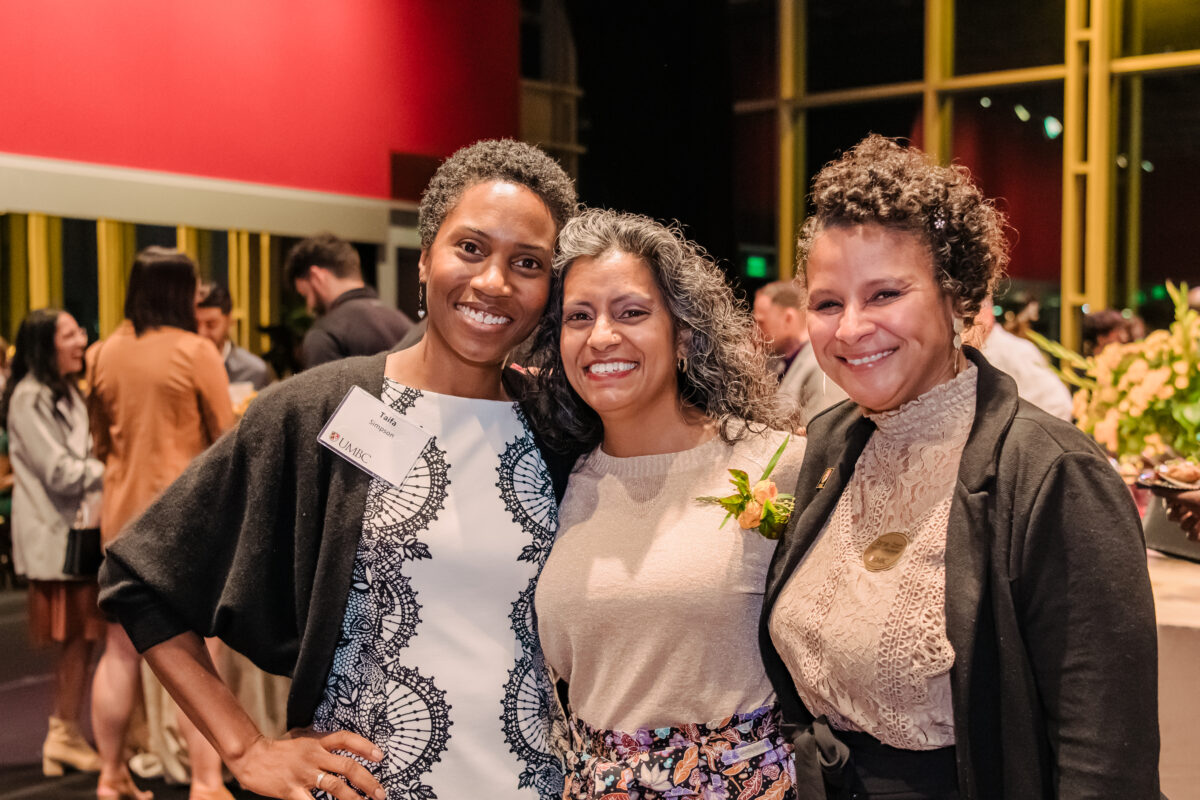 Taifa Simpson, former assistant director of MARC U*STAR, Rehana Shafi, and Stanyell Odom, director of Alumni Engagement at the 2023 Alumni Award reception. (Marlayna Demond ’11/UMBC)
The full circle moment
Several of the alumni recipients have come back to work at UMBC. Recipient of the Outstanding Engineering and Information Technology alumna award, Annica Wayman ’99, mechanical engineering, called it her “full circle” moment. Wayman, now associate dean for Shady Grove Affairs in the College of Natural and Mathematical Sciences, said, “Now that I’m on the ‘inside’ as a faculty member, it’s the same as I observed as a student and alumna—UMBC’s commitment to inclusive excellence, innovative teaching, and supportive community is authentic and I have the chance to see it every day working with UMBC faculty and staff.”
Annica Wayman ’99, left, and Josh Michael, right, speak at the 2023 Alumni Awards.
Josh Michael ’10, political science, Ph.D. ’22, public policy, found his why at UMBC. “I knew I was planted in the right place,” he said, “a place where I would evolve and grow…. It is here at UMBC where I developed a voice and confidence to lead in public education.” Michael, the awardee for Outstanding Alumnus in Social and Behavioral Sciences, is dedicated to public service and community engagement.
A former Baltimore City math teacher and now executive director of the Sherman Family Foundation, Michael took the opportunity on the stage to remind the audience, “For as a community, it is how we treat other people’s children that demonstrates our collective belief in our future.”
Creativity rooted in big ideas
Another teacher was honored for his long commitment to Maryland’s children. James Dorsey ’05, music technology and vocal performance, is in his 19th year as an elementary music teacher. He shared that, “All of our creativity is rooted in big ideas. Ideas that relate to our shared human experience and how we interact in our world.”
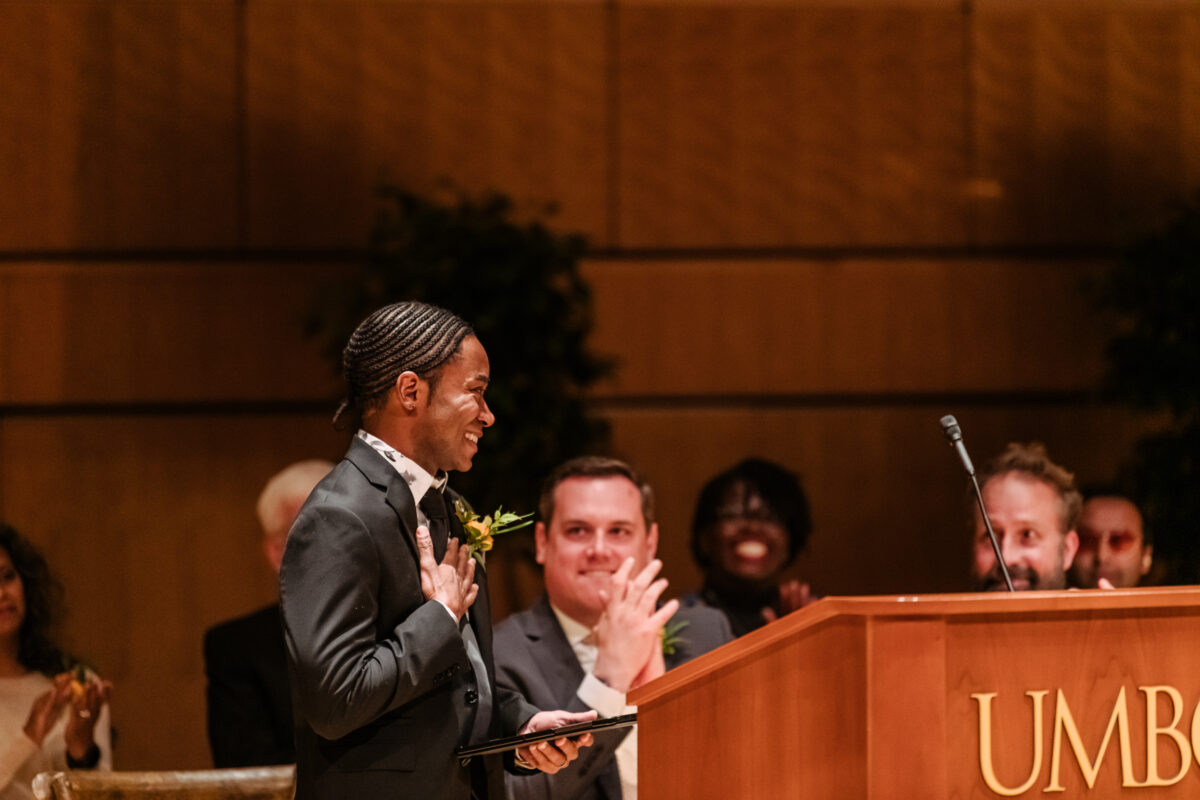 James Dorsey after giving his remarks at the 2023 Alumni Awards. (Marlayna Demond ’11/UMBC)
Dorsey, who received the award for Outstanding Alumnus in the Visual and Performing Arts, said, “I’m blessed to get to help students express their messages and respond to their cultures through creating. It sets a precedent that the arts are a natural way to respond to the issues of our community, self-expression, coping with change, and social justice.”
Other 2023 Outstanding Alumni awardees include: Humanities—Aaron Ralby ’05, English and modern languages and linguistics; and, Natural and Mathematical Sciences—Kay Bidle ’91, biological sciences. The Rising Star award was given to Asif Majid ’13, interdisciplinary studies, and the Outstanding Faculty award was presented to E.F. Charles LaBerge, Ph.D. ’03, professor of the practice in computer science and electrical engineering at UMBC.
]]>
On the stage of the 35th annual Alumni Awards, awardees and their nominators repeated a shared theme: the freedom and flexibility to grow at UMBC—not alone—but in community. Presented by the...
https://umbc.edu/stories/alumni-awards-making-impact-through-relationships/
https://my3.my.umbc.edu/api/v0/pixel/news/136729/guest@my.umbc.edu/e5045b2d07c000dd5467d178c9b199c2/api/pixel
alumni
alumni-awards
cahss
cnms
coeit
fall-2023
magazine
sherman-stem-teacher-scholars-program
UMBC News & Magazine
https://my3.my.umbc.edu/groups/umbc-news-magazine
https://assets1-my.umbc.edu/system/shared/avatars/groups/000/001/943/24435aa6207c452e7bc15cc74b42c7bb/xsmall.png?1748556657
https://assets1-my.umbc.edu/system/shared/avatars/groups/000/001/943/24435aa6207c452e7bc15cc74b42c7bb/original.png?1748556657
https://assets2-my.umbc.edu/system/shared/avatars/groups/000/001/943/24435aa6207c452e7bc15cc74b42c7bb/xxlarge.png?1748556657
https://assets2-my.umbc.edu/system/shared/avatars/groups/000/001/943/24435aa6207c452e7bc15cc74b42c7bb/xlarge.png?1748556657
https://assets3-my.umbc.edu/system/shared/avatars/groups/000/001/943/24435aa6207c452e7bc15cc74b42c7bb/large.png?1748556657
https://assets1-my.umbc.edu/system/shared/avatars/groups/000/001/943/24435aa6207c452e7bc15cc74b42c7bb/medium.png?1748556657
https://assets2-my.umbc.edu/system/shared/avatars/groups/000/001/943/24435aa6207c452e7bc15cc74b42c7bb/small.png?1748556657
https://assets1-my.umbc.edu/system/shared/avatars/groups/000/001/943/24435aa6207c452e7bc15cc74b42c7bb/xsmall.png?1748556657
https://assets2-my.umbc.edu/system/shared/avatars/groups/000/001/943/24435aa6207c452e7bc15cc74b42c7bb/xxsmall.png?1748556657
UMBC News & Magazine
0
0
false
Wed, 01 Nov 2023 12:56:42 -0400
Wed, 01 Nov 2023 12:56:42 -0400
Free Speech, Respect, and Civil Discourse
Dear UMBC Community,
As the crisis in Israel and Gaza deepens, reports of antisemitism and Islamophobia are on the rise, including on college campuses in the U.S. These incidents are deeply troubling, and we know that they add to the anxiety and concern that our own community members are feeling.
College campuses have long been epicenters of activism, including protest against military action and government policy here and abroad. In recent years, campuses also have become targets in American culture wars, in part because of the very values we espouse as institutions of higher learning. Among those core values are the free exchange of ideas and information and a respect for diverse perspectives. These, along with
academic freedom, are key to our mission to advance knowledge and understanding.
We write to you today to reaffirm our commitment to these values and to provide practical guidance on what it means to live these values, especially in times of conflict. We know that recent events on campus and posts on social media have raised concerns. Individuals have reported feeling unsafe in response to language they have seen or heard, and some have expressed fear of speaking out for fear of reprisals of various kinds, including doxxing. We want to be clear: We are hearing these concerns from students, faculty, and staff who represent all sides of the issues. We hear calls simultaneously to curtail speech and calls to protect it.
Ensuring freedom of expression, especially at a public institution, means protecting speech with which we may disagree or even find offensive or objectionable. The right to free speech comes with responsibility, as our collective belonging in this extraordinary UMBC community comes with the responsibility to respect and care for one another, even when–perhaps especially when–we disagree. Free speech does not extend to harassment or true threats.
Learn more about speech that is protected under the First Amendment, as well as types of speech that are unprotected.
We urge all recognized campus groups and members of our community to provide constructive outlets for dissenting views when addressing controversial or divisive issues. We encourage you to avail yourselves of information and resources for knowing how to express your voice effectively and in ways that are consistent with legal guidelines, university policies and practices, and our institutional values. Guidance on how to have challenging discourse productively, how to organize peaceful protest, how to distribute information on campus, and more can be found on the
Using Your Voice page provided by the Center for Democracy and Civil Life. More resources are listed below for your reference.
We ask that you continue to show kindness, grace, and flexibility to one another, knowing that students, faculty, and staff may be struggling. Let us work together, every day, to support UMBC as a community that embraces vibrant dialogue and mutual respect.
Sincerely,
President Valerie Sheares Ashby
Interim Provost and Senior Vice President for Academic Affairs David P. Dauwalder
Vice President for Institutional Equity and Chief Diversity Officer Tanyka M. Barber
Vice President for Student Affairs Renique T. Kersh
Resources for Building Support for Social Change and Constructive Dialogue for Dissenting Views
]]>
Dear UMBC Community, As the crisis in Israel and Gaza deepens, reports of antisemitism and Islamophobia are on the rise, including on college campuses in the U.S. These incidents are deeply...
https://my3.my.umbc.edu/groups/announcements/posts/136695
https://my3.my.umbc.edu/api/v0/pixel/news/136711/guest@my.umbc.edu/d624a427d2c740036acb1e959c7c71d6/api/pixel
president
UMBC News & Magazine
https://my3.my.umbc.edu/groups/umbc-news-magazine
https://assets1-my.umbc.edu/system/shared/avatars/groups/000/001/943/24435aa6207c452e7bc15cc74b42c7bb/xsmall.png?1748556657
https://assets1-my.umbc.edu/system/shared/avatars/groups/000/001/943/24435aa6207c452e7bc15cc74b42c7bb/original.png?1748556657
https://assets2-my.umbc.edu/system/shared/avatars/groups/000/001/943/24435aa6207c452e7bc15cc74b42c7bb/xxlarge.png?1748556657
https://assets2-my.umbc.edu/system/shared/avatars/groups/000/001/943/24435aa6207c452e7bc15cc74b42c7bb/xlarge.png?1748556657
https://assets3-my.umbc.edu/system/shared/avatars/groups/000/001/943/24435aa6207c452e7bc15cc74b42c7bb/large.png?1748556657
https://assets1-my.umbc.edu/system/shared/avatars/groups/000/001/943/24435aa6207c452e7bc15cc74b42c7bb/medium.png?1748556657
https://assets2-my.umbc.edu/system/shared/avatars/groups/000/001/943/24435aa6207c452e7bc15cc74b42c7bb/small.png?1748556657
https://assets1-my.umbc.edu/system/shared/avatars/groups/000/001/943/24435aa6207c452e7bc15cc74b42c7bb/xsmall.png?1748556657
https://assets2-my.umbc.edu/system/shared/avatars/groups/000/001/943/24435aa6207c452e7bc15cc74b42c7bb/xxsmall.png?1748556657
UMBC News & Magazine
0
0
false
Tue, 31 Oct 2023 16:10:43 -0400
UMBC team makes first-ever observation of a virus attaching to another virus
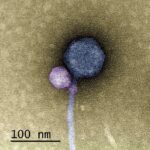
No one had ever seen one virus latching onto another virus, until anomalous sequencing results sent a UMBC team down a rabbit hole leading to a first-of-its-kind discovery.
It’s known that some viruses, called satellites, depend not only on their host organism to complete their life cycle, but also on another virus, known as a “helper,” explains Ivan Erill, professor of biological sciences. The satellite virus needs the helper either to build its capsid, a protective shell that encloses the virus’s genetic material, or to help it replicate its DNA. These viral relationships require the satellite and the helper to be in proximity to each other at least temporarily, but there were no known cases of a satellite actually attaching itself to a helper—until now.
In a paper published in the Journal of the International Society of Microbial Ecology, a UMBC team and colleagues from Washington University in St. Louis (WashU) describe the first observation of a satellite bacteriophage (a virus that infects bacterial cells) consistently attaching to a helper bacteriophage at its “neck”—where the capsid joins the tail of the virus.
In detailed electron microscopy images taken by Tagide deCarvalho, assistant director of the College of Natural and Mathematical Sciences core facilities and first author on the new paper, 80 percent (40 out of 50) helpers had a satellite bound at the neck. Some of those that did not had remnant satellite tendrils present at the neck. Erill, senior author on the paper, describes them as appearing like “bite marks.”
“When I saw it, I was like, ‘I can’t believe this,’” deCarvalho says. “No one has ever seen a bacteriophage—or any other virus—attach to another virus.”
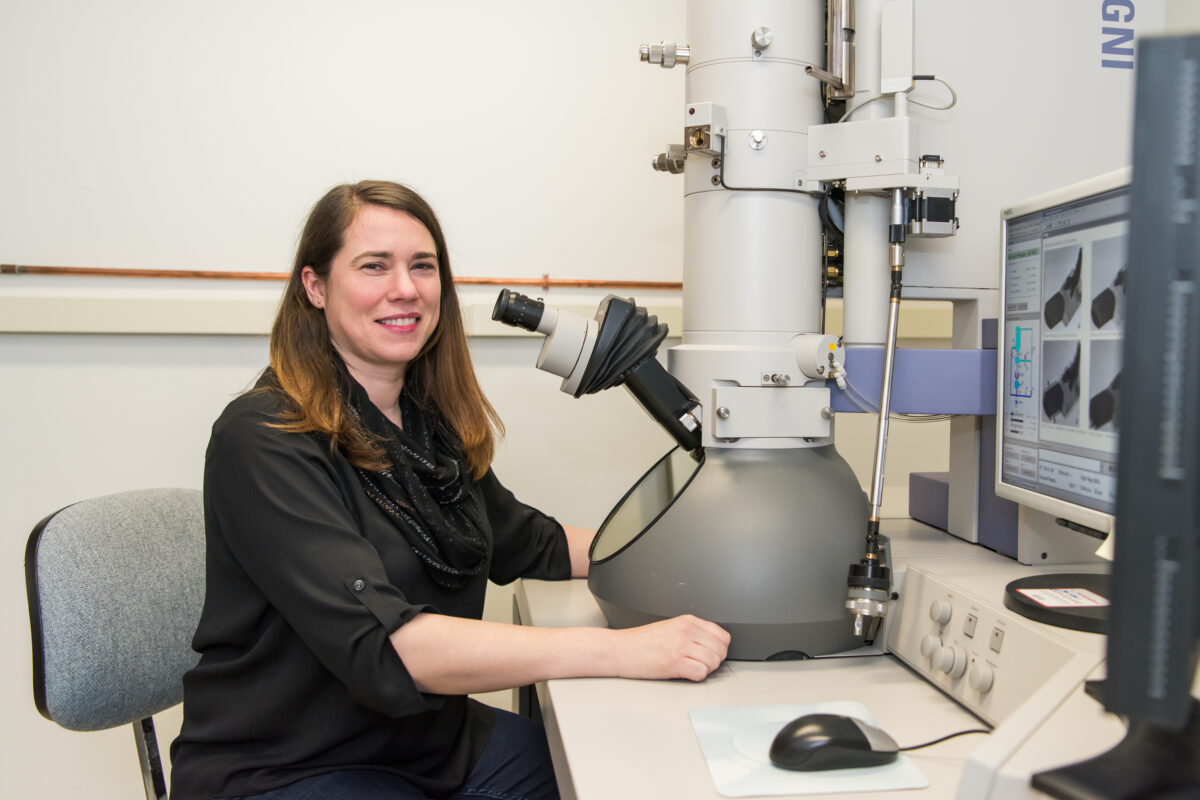 Tagide deCarvalho in the Keith R. Porter Imaging Facility. deCarvalho took advantage of the facility’s transmission electron microscope (TEM) to capture striking images of the satellite-helper virus system discussed in the new paper. (Marlayna Demond ’11/UMBC)
A long-term virus relationship
After the initial observations, Elia Mascolo, a graduate student in Erill‘s research group and co-first author on the paper, analyzed the genomes of the satellite, helper, and host, which revealed further clues about this never-before-seen viral relationship. Most satellite viruses contain a gene that allows them to integrate into the host cell’s genetic material after they enter the cell. This allows the satellite to reproduce whenever a helper happens to enter the cell from then on. The host cell also copies the satellite’s DNA along with its own when it divides.
 Ivan Erill co-leads the SEA-PHAGES program at UMBC. His research group focuses on bioinformatics. (Image by Marlayna Demond ’11/UMBC)
A bacteriophage sample from WashU also contained a helper and a satellite. The WashU satellite has a gene for integration and does not directly attach to its helper, similar to previously observed satellite-helper systems.
However, the satellite in UMBC’s sample, named MiniFlayer by the students who isolated it, is the first known case of a satellite with no gene for integration. Because it can’t integrate into the host cell’s DNA, it must be near its helper—named MindFlayer—every time it enters a host cell if it is going to survive. Given that, although the team did not directly prove this explanation, “Attaching now made total sense,” Erill says, “because otherwise, how are you going to guarantee that you are going to enter into the cell at the same time?”
Additional bioinformatics analysis by Mascolo and Julia López-Pérez, another Ph.D. student working with Erill, revealed that MindFlayer and MiniFlayer have been co-evolving for a long time. “This satellite has been tuning in and optimizing its genome to be associated with the helper for, I would say, at least 100 million years,” Erill says, which suggests there may be many more cases of this kind of relationship waiting to be discovered.
Contamination or discovery?
This groundbreaking discovery could easily have been missed. The project started out as a typical semester in the SEA-PHAGES program—an investigative curriculum where undergraduates isolate bacteriophages from environmental samples, send them out for sequencing, and then use bioinformatics tools to analyze the results. When the sequencing lab at the University of Pittsburgh reported contamination in the sample from UMBC expected to contain the MindFlayer phage, the journey began.
 Steven Caruso co-leads the SEA-PHAGES program at UMBC. He also conducts pedagogy research to improve science education. (Marlayna Demond ’11/UMBC)
The sample included one large sequence: the phage they expected. “But instead of just finding that, we also found a small sequence, which didn’t map to anything we knew,” says Erill, who is also one of the leads for UMBC’s SEA-PHAGES program, called Phage Hunters, along with Steven Caruso, principal lecturer of biological sciences. Caruso ’94, Ph.D. ’02, biological sciences, ran the isolation again, sent it out for sequencing—and got identical results.
That’s when the team pulled in deCarvalho to get a visual of what was going on with the transmission electron microscope (TEM) at UMBC’s Keith R. Porter Imaging Facility (KPIF). Without the images, the discovery would have been impossible.
“Not everyone has a TEM at their disposal,” deCarvalho notes. But with the instruments at the KPIF, deCarvalho says, “I’m able to follow up on some of these observations and validate them with imaging. There’s elements of discovery we can only make using the TEM.”
The team’s discovery sets the stage for future work to figure out how the satellite attaches, how common this phenomenon is, and much more. “It’s possible that a lot of the bacteriophages that people thought were contaminated were actually these satellite-helper systems,” deCarvalho says. “So now, with this paper, people might be able to recognize more of these systems.”
]]>
No one had ever seen one virus latching onto another virus, until anomalous sequencing results sent a UMBC team down a rabbit hole leading to a first-of-its-kind discovery. It’s known that...
https://umbc.edu/stories/first-observed-virus-attaching-to-another/
https://my3.my.umbc.edu/api/v0/pixel/news/136708/guest@my.umbc.edu/c2bf2528852f8aaedcbec04ce669e903/api/pixel
biology
cnms
news
research
science-and-tech
UMBC News & Magazine
https://my3.my.umbc.edu/groups/umbc-news-magazine
https://assets1-my.umbc.edu/system/shared/avatars/groups/000/001/943/24435aa6207c452e7bc15cc74b42c7bb/xsmall.png?1748556657
https://assets1-my.umbc.edu/system/shared/avatars/groups/000/001/943/24435aa6207c452e7bc15cc74b42c7bb/original.png?1748556657
https://assets2-my.umbc.edu/system/shared/avatars/groups/000/001/943/24435aa6207c452e7bc15cc74b42c7bb/xxlarge.png?1748556657
https://assets2-my.umbc.edu/system/shared/avatars/groups/000/001/943/24435aa6207c452e7bc15cc74b42c7bb/xlarge.png?1748556657
https://assets3-my.umbc.edu/system/shared/avatars/groups/000/001/943/24435aa6207c452e7bc15cc74b42c7bb/large.png?1748556657
https://assets1-my.umbc.edu/system/shared/avatars/groups/000/001/943/24435aa6207c452e7bc15cc74b42c7bb/medium.png?1748556657
https://assets2-my.umbc.edu/system/shared/avatars/groups/000/001/943/24435aa6207c452e7bc15cc74b42c7bb/small.png?1748556657
https://assets1-my.umbc.edu/system/shared/avatars/groups/000/001/943/24435aa6207c452e7bc15cc74b42c7bb/xsmall.png?1748556657
https://assets2-my.umbc.edu/system/shared/avatars/groups/000/001/943/24435aa6207c452e7bc15cc74b42c7bb/xxsmall.png?1748556657
UMBC News & Magazine
0
0
false
Tue, 31 Oct 2023 15:34:34 -0400
Tue, 31 Oct 2023 15:34:34 -0400
Academic Success Center earns elite international distinction
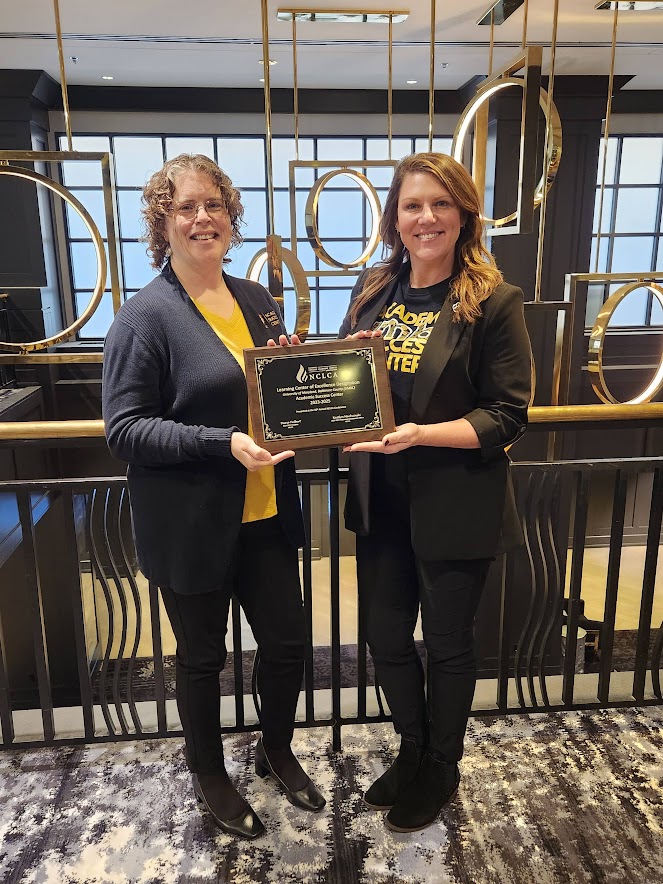 Director of academic learning resources, assessment, and analysis Delana Gregg, M.S. ’04, Ph.D. ’19, and Amanda Knapp pose with the Academic Success Center’s Learning Center of Excellence award. Photo courtesy of Knapp, associate vice provost and assistant dean for undergraduate academic affairs.
In September 2023, the UMBC Academic Success Center (ASC) gained a Learning Center of Excellence designation from the International College Learning Center Association (ICLCA). There are only six other institutions in the world with an active designation of excellence from ICLCA, shares Amanda Knapp, associate vice provost and assistant dean for undergraduate academic affairs.
“It’s remarkable what has been achieved since establishing our one-stop shop learning center model in 2019,” says Knapp. “We can now say with full evidence that our ASC is among the best in the world!”
It was no small feat. ASC staff—in addition to their role providing centralized support services to all undergraduate students at UMBC—completed a rigorous application and peer review process, meeting many standards along the way.
The Learning Center of Excellence designation came at the same time that ASC’s Tutoring Program met the College Reading and Learning Association rigorous standards and successfully completed the International Tutor Training Program Certification peer review process. SI PASS—ASC’s peer-assisted study sessions—gained programmatic accreditation through the International Center for Supplemental Instruction.
In spring 2024, the ASC will have a grand opening of the newly renovated, expanded, and highly visible first floor location in the Albin O. Kuhn Library and Gallery.
]]>
Director of academic learning resources, assessment, and analysis Delana Gregg, M.S. ’04, Ph.D. ’19, and Amanda Knapp pose with the Academic Success Center’s Learning Center of Excellence award....
https://umbc.edu/stories/academic-success-center-earns-elite-distinction/
https://my3.my.umbc.edu/api/v0/pixel/news/136697/guest@my.umbc.edu/f44cac4ffe341e9346dd0acb2918b795/api/pixel
academic-success-center
campus-life
magazine
quick-post
UMBC News & Magazine
https://my3.my.umbc.edu/groups/umbc-news-magazine
https://assets1-my.umbc.edu/system/shared/avatars/groups/000/001/943/24435aa6207c452e7bc15cc74b42c7bb/xsmall.png?1748556657
https://assets1-my.umbc.edu/system/shared/avatars/groups/000/001/943/24435aa6207c452e7bc15cc74b42c7bb/original.png?1748556657
https://assets2-my.umbc.edu/system/shared/avatars/groups/000/001/943/24435aa6207c452e7bc15cc74b42c7bb/xxlarge.png?1748556657
https://assets2-my.umbc.edu/system/shared/avatars/groups/000/001/943/24435aa6207c452e7bc15cc74b42c7bb/xlarge.png?1748556657
https://assets3-my.umbc.edu/system/shared/avatars/groups/000/001/943/24435aa6207c452e7bc15cc74b42c7bb/large.png?1748556657
https://assets1-my.umbc.edu/system/shared/avatars/groups/000/001/943/24435aa6207c452e7bc15cc74b42c7bb/medium.png?1748556657
https://assets2-my.umbc.edu/system/shared/avatars/groups/000/001/943/24435aa6207c452e7bc15cc74b42c7bb/small.png?1748556657
https://assets1-my.umbc.edu/system/shared/avatars/groups/000/001/943/24435aa6207c452e7bc15cc74b42c7bb/xsmall.png?1748556657
https://assets2-my.umbc.edu/system/shared/avatars/groups/000/001/943/24435aa6207c452e7bc15cc74b42c7bb/xxsmall.png?1748556657
UMBC News & Magazine
1
0
false
Tue, 31 Oct 2023 11:37:32 -0400
Tue, 31 Oct 2023 11:37:32 -0400
UMBC’s Vandana Janeja aims to boost high-performance computing know-how to tackle environmental science challenges with a $1 million NSF grant

The discovery of the Higgs boson. The first picture of a black hole. The Covid-19 vaccine. Many recent scientific advances, such as these, owe much to a largely unsung hero: high-performance computing.

Vandana Janeja (Marlayna Demond ’11/UMBC)
Yet the use of high-performance computing is generally limited to a niche group. “Some researchers are very sophisticated in the use of these tools, but many are not,” says Vandana Janeja, a professor of information systems at UMBC.
Janeja is on a mission to spread advanced computing know-how far beyond its current borders. “It’s not just for the elites,” she says.
She was recently awarded a nearly $1 million grant from the National Science Foundation (NSF) that will help further that mission. The grant is part of a larger NSF collaborative award with the University of Maryland Center for Environmental Sciences (UMCES).
Janeja and her UMBC and UMCES colleagues will work to connect a wide range of students and faculty with high-performance computing experts, creating and nurturing what has been called the cyberinfrastructure pipeline. The ultimate goal is to facilitate the flow of knowledge.
“Once one person gains experience, they can turn around and help someone else,” Janeja says. “It’s about supporting and connecting people with resources and not just about setting up the hardware and software.”
Building a high-performance computing workforce
The need for fast computers in research is driven in part by a modern deluge of data. For example, NASA estimates that it will soon have accumulated hundreds of petabytes of Earth science data, from sources such as satellites flying overhead and sensors installed on the ground. Making full use of all that data requires new approaches to computing. While traditional computers generally perform calculations one at a time, high-performance computing facilities break up the work between multiple computing nodes and run processes in parallel.
UMBC has its own high-performance computing facility, which houses computing equipment that can process data significantly faster than a standard laptop. University researchers have employed the fast computers to study topics as diverse as weather modeling, cancer treatment, and flight dynamics.
“Learning how to use high-performance computing is not straight-forward,” says Janeja. Users have to gain a good understanding of the infrastructure of the computers, and also hone their skills in identifying the best techniques to take full advantage of that infrastructure.
People with a good understanding of how these machines and their software work will be in high demand, Janeja adds.
Many modern AI algorithms, which are used by scientific researchers and big tech companies alike, require high-performance computing to operate. “While everyone is running toward the shiny object of AI, many don’t realize that there is a backbone, called cyberinfrastructure, that runs AI,” says Janeja.
Part of Janeja’s goal with the new grant is to educate students who may pursue careers building, maintaining, utilizing, and improving that cyberinfrastructure backbone. She also cares deeply about ensuring diverse groups of people have access to these roles.
“We are trying to democratize the use of cyberinfrastructure and make it accessible to people who have never used it,” Janeja says.
Jack Suess, ‘81, M.S. ‘94, UMBC’s vice president of information technology, says he is excited for his division to play a key role in the award, helping shape best practices and build a national cyberinfrastructure support structure. “I look forward to watching how this work informs not just how we support faculty, but how we train and support advanced undergraduates and graduate students to evolve into these roles,” he says.
Tackling environmental challenges
While there is no shortage of scientific questions that might be tackled with high-performance computing, Janeja and her colleagues on the new grant will test-run their collaborative initiatives with projects in environmental science.

Changes to the ice and snow in Greenland could contribute to sea level rise. (Image credit: NASA)
Janeja is also director of iHARP, an NSF-funded institute that aims to harness big data and advanced computing tools to better model how climate change will affect the polar regions. As part of the new grant, iHARP and UMCES researchers will partner with cyberinfrastructure professionals to explore environmental science questions, such as in iHARP investigating how to predict the rate of snow melting in Greenland.
Scientists increasingly rely on big data and high-performance computing to understand and predict changes in the environment. As human activities continue to put pressure on natural systems, it will be more important than ever to forge collaborations between researchers and computing experts that advance the science.
“I’m excited to leverage high-performance computing to solve real-world problems and make it accessible to students and researchers of all backgrounds,” Janeja says.
]]>
The discovery of the Higgs boson. The first picture of a black hole. The Covid-19 vaccine. Many recent scientific advances, such as these, owe much to a largely unsung hero: high-performance...
https://umbc.edu/stories/vandana-janeja-nsf-grant-computing/
https://my3.my.umbc.edu/api/v0/pixel/news/136681/guest@my.umbc.edu/df7ee24459cf2e6c8d3cbbcb80877422/api/pixel
coeit
doit
is
news
rca-1
research
science-and-tech
UMBC News & Magazine
https://my3.my.umbc.edu/groups/umbc-news-magazine
https://assets1-my.umbc.edu/system/shared/avatars/groups/000/001/943/24435aa6207c452e7bc15cc74b42c7bb/xsmall.png?1748556657
https://assets1-my.umbc.edu/system/shared/avatars/groups/000/001/943/24435aa6207c452e7bc15cc74b42c7bb/original.png?1748556657
https://assets2-my.umbc.edu/system/shared/avatars/groups/000/001/943/24435aa6207c452e7bc15cc74b42c7bb/xxlarge.png?1748556657
https://assets2-my.umbc.edu/system/shared/avatars/groups/000/001/943/24435aa6207c452e7bc15cc74b42c7bb/xlarge.png?1748556657
https://assets3-my.umbc.edu/system/shared/avatars/groups/000/001/943/24435aa6207c452e7bc15cc74b42c7bb/large.png?1748556657
https://assets1-my.umbc.edu/system/shared/avatars/groups/000/001/943/24435aa6207c452e7bc15cc74b42c7bb/medium.png?1748556657
https://assets2-my.umbc.edu/system/shared/avatars/groups/000/001/943/24435aa6207c452e7bc15cc74b42c7bb/small.png?1748556657
https://assets1-my.umbc.edu/system/shared/avatars/groups/000/001/943/24435aa6207c452e7bc15cc74b42c7bb/xsmall.png?1748556657
https://assets2-my.umbc.edu/system/shared/avatars/groups/000/001/943/24435aa6207c452e7bc15cc74b42c7bb/xxsmall.png?1748556657
UMBC News & Magazine
0
0
false
Mon, 30 Oct 2023 15:12:27 -0400
Mon, 30 Oct 2023 15:12:27 -0400