UMBC to receive $7.7 M for U-RISE, a research training program focused on STEM leadership
Since it launched at UMBC in 1997, the MARC U*STAR Program has connected nearly 500 hundred UMBC students with research opportunities and invaluable support. After years of remarkable results, the program is now at an important moment of transition.
MARC U*STAR stands for Maximizing Access to Research Careers Undergraduate Student Training in Academic Research. The NIH program was founded on three key elements that are proven to increase students’ persistence and success in research careers, especially for students from underrepresented groups in biomedical sciences. These elements include recognizing and recruiting outstanding, passionate students; offering excellent research mentorship; and providing strong administrative support and advising.
A striking 95 percent of UMBC’s MARC U*STAR Scholars have graduated with STEM degrees, around double the national rate for students who begin STEM programs. And 87 percent have continued their education in graduate programs, with 79 percent pursuing Ph.D., M.D./Ph.D., or M.D. degrees. UMBC’s MARC U*STAR graduates have been almost five times more likely to attend graduate school than their academically comparable peers.
 MARC U*STAR Scholar Robin Bailey ’20, biological sciences, with her research poster at UMBC’s Undergraduate Research and Creative Achievement Day (URCAD) in 2018. Photo by Phyllis Robinson.
“If I was not a part of the MARC program, I would not be where I am today,” says Robin Bailey ’20, biological sciences. Today, she is about to graduate from UMBC having presented her research at national conferences and written two academic papers. She spent a summer researching at Harvard, and now has committed to pursuing her Ph.D. in cellular and molecular biology at the University of Pennsylvania’s Perelman School of Medicine.
Bailey’s experience is a familiar one in UMBC’s MARC U*STAR program. This unequivocal, long-term success is not an accident.
Growth mindset
As the final year of the current MARC U*STAR grant comes to a close this May, UMBC has received a new five-year grant from the NIH. This new grant is part of the Undergraduate Research Training Initiative for Student Enhancement (U-RISE). It will build on the strong legacy of MARC U*STAR at UMBC, providing $7.7 million over five years to support the same activities offered by MARC U*STAR, plus a few more.
“The MARC grant is 23 years old, and it’s had great success,” says Phyllis Robinson, program director for MARC U*STAR at UMBC and lead on the new U-RISE grant. “So we’re going to take all the good things, and then add a few new things.”
MARC U*STAR provides students intensive academic advising and funding for conference travel and toward tuition. Advising includes traditional guidance on course selection, as well as support in preparing for and obtaining research positions and help with the graduate school application process. Monthly lectures from external STEM professionals connect the scholars with experts in various fields and give them opportunities to network.
 MARC U*STAR Scholar Andreas Seas ’17, biochemical engineering, gives a presentation at URCAD 2016.
Nurturing student passion
Perhaps most importantly, the MARC program helps create a sense of community among the scholars. “Being a part of the MARC family is advantageous not only because you’re getting extra support to go to conferences, but you’re surrounded by all these people that are interested in science and want to improve people’s lives with science,” reflects Andreas Seas ’17, biochemical engineering.
Seas particularly notes the support of Lasse Lindahl, Robinson’s predecessor; Jackie King, associate director of the MARC U*STAR program at UMBC; and his peers and research mentors. Today, Seas is pursuing an M.D./Ph.D. degree at Duke University.
“The MARC program solidified my love for research and science,” adds Erwin Cabrera ’10, biological sciences. “It provided me with the mentoring and one-on-one advising that was pivotal in my success at UMBC.” Cabrera is paying that mentorship forward in his current role as director of the Research Aligned Mentorship Program at Farmingdale State College in New York.

MARC U*STAR Scholar Erwin Cabrera ’10, biological sciences. Photo courtesy Erwin Cabrera.
Resilience on the rise
The new U-RISE funding will offer all of the same programming as MARC for up to 35 students per year. On top of that, U-RISE Scholars will participate in two training workshops. One will examine rigor and reproducibility in research. The other will focus on how to work with big data, which has become ubiquitous in so many research fields. U-RISE will also fund training for faculty mentors in how to best support their diverse mentees.
Current MARC Scholars will be able to continue with the program through graduation.
 Phyllis Robinson (center) with Paula Johnson, president of Wellesley College (left), and UMBC valedictorian and MARC U*STAR Scholar Eudorah Vital ’18, biochemistry and molecular biology, at Commencement.
This is all heartening news for Bailey. “The MARC program has provided me with countless opportunities to improve my skills in the laboratory and develop a scientific mind. The program also pushes MARC Scholars to show proof of these skills at scientific conferences,” she says. “Where I once lacked confidence in my ability to think critically and present publicly, I now have a resilient drive to overcome obstacles.”
Until now, “for students who want to pursue a research career in biomedical sciences, the MARC program has been the place to be,” Bailey says. Now, that place will be U-RISE.
While the name will be new after 2020, the work and commitment of faculty mentors and advising staff will hold steady. Under Robinson’s leadership, they’ll continue to help UMBC students see themselves as future leading scientists and find their paths to research careers.
Banner image: Academic Row at UMBC in springtime. All photos by Marlayna Demond ’11 for UMBC unless otherwise noted.
]]>
Since it launched at UMBC in 1997, the MARC U*STAR Program has connected nearly 500 hundred UMBC students with research opportunities and invaluable support. After years of remarkable results, the...
https://umbc.edu/stories/umbc-to-receive-7-7-m-for-u-rise-a-research-training-program-focused-on-stem-leadership/
https://my3.my.umbc.edu/api/v0/pixel/news/119905/guest@my.umbc.edu/452556dc367ccd402ef5e1557f9b0797/api/pixel
biology
cbee
cnms
coeit
community
marcustar
science-and-technology
undergradresearch
UMBC News & Magazine
https://my3.my.umbc.edu/groups/umbc-news-magazine
https://assets1-my.umbc.edu/system/shared/avatars/groups/000/001/943/24435aa6207c452e7bc15cc74b42c7bb/xsmall.png?1748556657
https://assets1-my.umbc.edu/system/shared/avatars/groups/000/001/943/24435aa6207c452e7bc15cc74b42c7bb/original.png?1748556657
https://assets2-my.umbc.edu/system/shared/avatars/groups/000/001/943/24435aa6207c452e7bc15cc74b42c7bb/xxlarge.png?1748556657
https://assets2-my.umbc.edu/system/shared/avatars/groups/000/001/943/24435aa6207c452e7bc15cc74b42c7bb/xlarge.png?1748556657
https://assets3-my.umbc.edu/system/shared/avatars/groups/000/001/943/24435aa6207c452e7bc15cc74b42c7bb/large.png?1748556657
https://assets1-my.umbc.edu/system/shared/avatars/groups/000/001/943/24435aa6207c452e7bc15cc74b42c7bb/medium.png?1748556657
https://assets2-my.umbc.edu/system/shared/avatars/groups/000/001/943/24435aa6207c452e7bc15cc74b42c7bb/small.png?1748556657
https://assets1-my.umbc.edu/system/shared/avatars/groups/000/001/943/24435aa6207c452e7bc15cc74b42c7bb/xsmall.png?1748556657
https://assets2-my.umbc.edu/system/shared/avatars/groups/000/001/943/24435aa6207c452e7bc15cc74b42c7bb/xxsmall.png?1748556657
UMBC News & Magazine
0
0
false
Wed, 29 Apr 2020 16:17:33 -0400
CWIT Scholar Sammie Maygers ’20 finds, and builds, a community of support at UMBC

When her courses moved online in mid-March due to the coronavirus pandemic, Sammie Maygers ‘20, chemical engineering, knew staying connected with her UMBC community would need to be a top priority. In some ways, her experience changed substantially. But it was also a continuation of the same UMBC journey, powered by community support.
When Maygers was looking at colleges, she knew that UMBC was the place for her as soon as she heard about the Center for Women in Technology (CWIT) from a high school classmate. When she visited campus, she says that it instantly felt like a family. “UMBC feels like home,” she says. “It’s inclusive.”
 Sammie Maygers, fourth from left in front row, with her fellow CWIT scholars. Photo courtesy of CWIT.
CWIT appealed to Maygers because it meant having a network of peers to work with and rely on. Her connections with new friends and mentors started the summer before her freshman year and continue as she heads toward graduation.
“One thing that CWIT does that is really fantastic is they send you on a retreat before the school year starts, with all of the new scholars,” she explains. “So when you move in, you’ve pretty much met all of the people who live on your floor. Even once people got busy, we were always doing work together and I had people who I could really trust.”
Growing as a leader
Working to build and strengthen this community are dedicated CWIT staff. Maygers shares that Erica D’Eramo, assistant director for the CWIT Scholars Program, has been especially impactful on her UMBC experience, including helping her grow and develop as a leader.
“Sammie has an enthusiasm and passion that is contagious,” says D’Eramo. “She has been a mentor to many students—as a ‘Big Wit’ peer mentor in CWIT, and in her Frisbee family, too. So many times I have heard students tell me how amazing it has been to have Sammie as a guide and, more importantly, as a close friend they can rely on.”
 Sammie Maygers, fifth from right, with fellow CWIT Scholars, and Erica D’Eramo, left, at the Society of Women Engineers Conference in 2019. Photo courtesy of CWIT.
Each incoming CWIT scholar is paired with an older student who is also a part of the program. As students move through the program, they become mentors to incoming scholars. Now a graduating senior, Maygers now has a “family” of younger scholars as well as alumni, and they connect regularly.
To sustain and grow these relationships during the pandemic, Maygers says that it is more important than ever to connect with her CWIT community outside of online classes. She intentionally sets aside time to virtually hang out with her mentees, friends, Chem-E-Car teammates, and classmates, including game nights.
Community through student orgs
The format of her classes this semester is helping Maygers stay connected during this difficult time. Most of her current courses are presentation-based. She and her classmates had previously been meeting virtually to develop their presentations, so that work has held steady.
Other changes have been harder to adjust to. Maygers is a member of UMBC’s Chem-E-Car team, which builds and races vehicles powered by precise chemical reactions. The team was heading to a regional competition at Virginia Tech this month, but that’s no longer happening.
“I’ve put a year and a half of work into the Chem-E-Car team, and I’ll never see it through,” Maygers says. She finds herself “mourning the things I was expecting to come.”
 Sammie Maygers, left, playing ultimate frisbee. Photo courtesy of Maygers.
Another activity that has proven challenging for Maygers to carry on with is ultimate frisbee, but her close connections to teammates remain strong. In high school, she was a three-sport athlete, and it was important to her to find a way to stay active in college. Soon after arriving at UMBC, she learned about the ultimate frisbee club team from an older student in CWIT. Although practices are cancelled, UMBC’s ultimate frisbee team has held informal virtual meetups every week.
Virtual connections
Intentionally maintaining all these connections has helped Maygers stay centered and motivated. One day that could be an online coffee with a friend. Another day it could be an online board meeting of the American Institute of Chemical Engineers, UMBC chapter.
 Sammie Maygers, center, with members of the Chem-E-Car team. Maygers holds the team’s first prototype at the 2019 COEIT Celebration. Photo courtesy of Maygers.
Maygers is also continuing her work as a teaching fellow in Mark Marten’s chemical engineering kinetics course. “Being a teaching fellow has given me the opportunity to support students academically and personally. The course load of a student taking this level of chemical engineering courses can really be overwhelming, and I love helping students realize that making mistakes and failing helps them grow as an engineer.”
Maygers has conducted research alongside Marten, professor and chair of chemical, biochemical, and environmental engineering, since fall 2016. One of the most powerful lessons she’s learned from working with him is to be unafraid of learning new skills and making mistakes. This is one of the core messages she works to pass along to both students in the course and younger CWIT scholars.
Thoughtful engineering solutions
Maygers now has her eye on her steps after graduation, and who will be walking those steps with her. She will have a unique opportunity to continue working closely with friends from UMBC after she graduates this spring.
As she has moved through the chemical engineering program, Maygers has become passionate about developing thoughtful engineering solutions. For her, this means solutions that are environmentally conscious and energy efficient. She looks forward to pursuing this passion as an engineer at the Naval Surface Warfare Center (NSWC) near Bethesda, Maryland.
 Sammie Maygers, center, after a networking evening with her CWIT LittleWit Courtney Cavin ’21, chemical engineering, and Cavin’s LittleWit Catherine Wraback ’23, chemical engineering. Photo courtesy of Maygers.
She and classmates Laina Colony ‘20, chemical engineering, and Zach Voelkel ‘20, mechanical engineering, learned about opportunities at the NSWC through a trip organized by UMBC’s Career Center. Not only were they all offered positions at the NSWC, but Colony and Maygers will have a chance to work together on the same team and be roommates, along with Voelkel.
A community of support welcomed Maygers to UMBC before she started classes freshman year. She thoughtfully grew that community during her time as a Retriever. Now, she’ll carry it with her to the next stage of her life and career.
Banner image: Sammie Maygers, right, with her roommates on campus. Photo courtesy of Maygers.
]]>
When her courses moved online in mid-March due to the coronavirus pandemic, Sammie Maygers ‘20, chemical engineering, knew staying connected with her UMBC community would need to be a top...
https://umbc.edu/stories/cwit-scholar-sammie-maygers-20-finds-and-builds-a-community-of-support-at-umbc/
https://my3.my.umbc.edu/api/v0/pixel/news/119918/guest@my.umbc.edu/e18b3b84244822a02c525caa2a28b954/api/pixel
cbee
classof2020
coeit
community
cwit
science-and-technology
UMBC News & Magazine
https://my3.my.umbc.edu/groups/umbc-news-magazine
https://assets1-my.umbc.edu/system/shared/avatars/groups/000/001/943/24435aa6207c452e7bc15cc74b42c7bb/xsmall.png?1748556657
https://assets1-my.umbc.edu/system/shared/avatars/groups/000/001/943/24435aa6207c452e7bc15cc74b42c7bb/original.png?1748556657
https://assets2-my.umbc.edu/system/shared/avatars/groups/000/001/943/24435aa6207c452e7bc15cc74b42c7bb/xxlarge.png?1748556657
https://assets2-my.umbc.edu/system/shared/avatars/groups/000/001/943/24435aa6207c452e7bc15cc74b42c7bb/xlarge.png?1748556657
https://assets3-my.umbc.edu/system/shared/avatars/groups/000/001/943/24435aa6207c452e7bc15cc74b42c7bb/large.png?1748556657
https://assets1-my.umbc.edu/system/shared/avatars/groups/000/001/943/24435aa6207c452e7bc15cc74b42c7bb/medium.png?1748556657
https://assets2-my.umbc.edu/system/shared/avatars/groups/000/001/943/24435aa6207c452e7bc15cc74b42c7bb/small.png?1748556657
https://assets1-my.umbc.edu/system/shared/avatars/groups/000/001/943/24435aa6207c452e7bc15cc74b42c7bb/xsmall.png?1748556657
https://assets2-my.umbc.edu/system/shared/avatars/groups/000/001/943/24435aa6207c452e7bc15cc74b42c7bb/xxsmall.png?1748556657
UMBC News & Magazine
0
0
false
Wed, 15 Apr 2020 12:08:17 -0400
Preparing for impact: Four new UMBC grads share what drives their research

It’s 3 a.m., and Cindy Chelius rolls out of the pull-out couch in the grad student lounge. Time to check on her fungi. For this experiment, measurements must be taken every four hours for forty hours. Thankfully, the undergraduates she mentors took the day shift. Tonight, as the lead on the project, it’s her turn.
“I think it just makes you feel like you really earned it when those results come back,” Chelius says. She has earned it—on December 18, she’ll walk across the stage to receive her Ph.D. in chemical and biochemical engineering from UMBC. The signaling pathways of fungi might seem like niche research, but fungal species are commonly used in industry as tiny, living factories. They can produce substances found in an array of products, including medications.
 Cindy Chelius, Ph.D. ’19 (third from left) with her advisor Mark Marten (far left) and the rest of their lab group. Photo courtesy Cindy Chelius.
After graduation, Chelius will take her skills to Bristol-Myers Squibb’s upstream processing development team in Devens, Massachusetts. She’ll help the company improve the ways they use organisms to produce therapeutic compounds.
Chelius’s UMBC experience has prepared her well for a research career in ways that go beyond a successful dissertation. Encouraged by her Ph.D. advisor, Mark Marten, professor and chair of chemical, biochemical, and environmental engineering, Chelius learned how to use bioreactors. “These industry positions really like someone coming in with that working knowledge,” she explains.
Chelius also took advantage of the Biochemical Regulatory Certification program at UMBC, organized by Tony Moreira, vice provost for academic affairs. It’s a four-course series including training in FDA regulations and good manufacturing practices, local lab tours, and more. “I think it really helped with my job interviews, because I was able to understand the acronyms they were talking about and reference the literature on these topics,” Chelius says.
She’s also expanded her cultural awareness by being active in a dynamic, diverse department with students and faculty from across the U.S. and the world. By participating in department intramural basketball and soccer teams and other departmental social events, “I definitely learned a lot more about different cultures and opinions,” Chelius shares. “Everyone comes from different places here, and it’s been awesome.”
 Cindy Chelius, Ph.D. ’19, fourth from left, with her intramural soccer team. The team includes members of the labs of Mark Marten and Lee Blaney (third from right). Photo courtesy Cindy Chelius.
Freedom to explore
Miranda Marvel, who is graduating with her Ph.D. in marine and estuarine environmental sciences, studied zebrafish development at the Institute of Marine and Environmental Technology with Yonathan Zohar, professor and chair of marine biotechnology. Her research focused on the role of a fish hormone, revealing that it plays important roles in feeding and reproduction. Understanding both processes is critical to optimize the aquaculture industry. After she defended her thesis in August, Marvel assumed a new post as a postdoctoral fellow at the National Institutes of Health, where she continues to study zebrafish development.
“Yoni encourages independent thinking and gave me the freedom to come up with my own experiments and be the leader on their execution,” Marvel says. “Ten-Tsao Wong was also always willing to drop whatever he was doing to help me.” Wong was a postdoctoral fellow when Marvel joined the lab, but later transitioned to assistant professor of marine biotechnology at UMBC.
 Miranda Marvel, Ph.D. ’19, center in front row, with the IMET REEF program participants. Photo courtesy Miranda Marvel.
Like Chelius, Marvel also took advantage of opportunities to receive training beyond her research. She participated in the Ratcliffe Environmental Entrepreneurship Fellowship (REEF), which offers training in business skills. “The skills you learn—like networking, public speaking, and making an elevator pitch—can be applied anywhere,” Marvel says.
As a result of the program, Marvel developed SensorFish, a line of fish bred to change color when they first experience common stressors, and took third place in UMBC’s 2018 Cangialosi Business Innovation Competition. The color change allows people to take action quickly to keep their fish healthy, even before symptoms may be apparent.
 Miranda Marvel, Ph.D. ’19, gives her pitch at the 2018 Cangialosi Business Innovation Competition. Photo courtesy Miranda Marvel.
When she arrived at UMBC, Marvel says she was quiet and shy. But the REEF training and supportive university environment changed that. “Seeing how helpful and friendly everyone was during my time here really helped me come out of my shell,” she says. “I attribute that to the collaborative nature of UMBC and IMET, and especially the researchers’ willingness to support young scientists.”
Creating positive change
Naqiya Ghulamali ‘19, psychology, has also been transformed by her research and service-learning experiences, which she sees as going hand in hand. Her research with Bronwyn Hunter, assistant professor of psychology at UMBC, focused on factors that influence the experience of re-entering society after incarceration. In an internship at the International Rescue Committee, Ghulamali says, “I got to work directly with clients on their paths to self-sufficiency during resettlement.”
As a result of these experiences, Ghulamali shares, “I am pursuing careers where I can apply my skills and knowledge to create positive social change.”
 Naqiya Ghulamali ’19, psychology, during her internship at the International Rescue Committee. Photo courtesy Naqiya Ghulamali.
UMBC mentors like Hunter and Ghulamali’s academic advisor Nkiru Nnawulezi, assistant professor of psychology, have influenced her future path. “They supported me and encouraged me to pursue my goals,” Ghulamali says. “Dr. Hunter and the graduate students in the lab helped me with projects and conference presentations, and generally created an environment conducive to critical thinking.”
Leaders of UMBC’s Alternative Spring Break and the STRiVE program, a five-day leadership retreat organized by the UMBC Center for Democracy and Civic Life, also shaped Ghulamali’s UMBC experience, and her future. “I’m grateful for how they’ve contributed to my sense of my own civic agency,” she shares.
As a member of the Honors College and a Sondheim Public Affairs Scholar, Ghulamali not only met mentors and established her career path, but also forged friendships “with others deeply invested in public service,” she says.
The power of an open door
Ryan Oliver ’19, biological sciences, also met life-changing mentors at UMBC. After struggling with addiction for almost four years at a college in another state, he took a year off to begin recovery with family in Maryland. When he was ready to return to college, Oliver chose UMBC because of what he had heard about the rigorous academics and supportive atmosphere.
It was a good choice for Oliver. This December, he will graduate with a 4.0 GPA. Next fall, he’s headed to his first-choice graduate school, Hebrew University in Israel.
Oliver’s master’s degree will focus on neuroscience using bees as a model organism. This builds on research he completed with UMBC’s Fernando Vonhoff, assistant professor of biological sciences, for which he received an Undergraduate Research Award. That project explored environmental factors that affect how fruit flies respond to alcohol exposure, and whether or not they become addicted.
 Ryan Oliver ’19, rear, green shirt, with members of Fernando Vonhoff’s lab. The lab members include undergraduates, graduate students, and a high school student. The UMBC students affiliate with programs such as STEM BUILD, LSAMP, MARC U*STAR, and the Meyerhoff Scholars. Photo courtesy Fernando Vonhoff.
The connection between his personal experience and academic research is no accident. “I would say my history has opened the door into neuroscience for me,” Oliver shares.
When he came to UMBC, Oliver knew he wanted to pursue undergraduate research, so he started knocking on doors. The first open office door he came to belonged to Vonhoff, who welcomed him in for an impromptu meeting. “By the end of that first conversation, he told me I could develop any project I wanted, and he would support me,” Oliver recalls. “I think him letting me do that is what really sparked so much enthusiasm and dedication on my part.”
During his time at UMBC, Oliver traveled to University of Chicago to present his research at the Society for Neuroscience Annual Meeting. Oliver is drafting the manuscript for a scientific paper on which he will be the first author.
 Ryan Oliver presents his research at UMBC’s Undergraduate Research and Creative Achievement Day 2019. Photo courtesy of Fernando Vonhoff.
Regarding his identity as a person in recovery, “I’ve been able to create more opportunities by being open about it than if I had hidden it. And I don’t think most people realize that,” Oliver says. “I think it needs to be destigmatized, and hopefully I’m doing my part in that by being as open as I can so that other people can get help, be embraced, and be given a chance in the real world.”
“My message would be that UMBC is a place that encourages and enables success through connection with and discovery of a real, personal identity,” he shares.
As they move beyond UMBC, Chelius, Marvel, Ghulamali, and Oliver all remain driven to contribute to positive change in their communities through their research. They also hope to carry forward the support they found at UMBC as mentors to a future generation of researchers.
Banner image: Ryan Oliver, second from left in back, with Fernando Vonhoff, third from right in back, and members of the lab in summer 2019. Oliver served as a mentor to members of the UMBC STEM BUILD program. Photo courtesy Fernando Vonhoff.
]]>
It’s 3 a.m., and Cindy Chelius rolls out of the pull-out couch in the grad student lounge. Time to check on her fungi. For this experiment, measurements must be taken every four hours for forty...
https://umbc.edu/stories/preparing-for-impact-four-new-umbc-grads-share-what-drives-their-research/
https://my3.my.umbc.edu/api/v0/pixel/news/119983/guest@my.umbc.edu/35253f256cb60233b69a38d36ada912b/api/pixel
biology
campus
cbee
class-of-2019
community
gradresearch
marinebiotech
psychology
research
UMBC News & Magazine
https://my3.my.umbc.edu/groups/umbc-news-magazine
https://assets1-my.umbc.edu/system/shared/avatars/groups/000/001/943/24435aa6207c452e7bc15cc74b42c7bb/xsmall.png?1748556657
https://assets1-my.umbc.edu/system/shared/avatars/groups/000/001/943/24435aa6207c452e7bc15cc74b42c7bb/original.png?1748556657
https://assets2-my.umbc.edu/system/shared/avatars/groups/000/001/943/24435aa6207c452e7bc15cc74b42c7bb/xxlarge.png?1748556657
https://assets2-my.umbc.edu/system/shared/avatars/groups/000/001/943/24435aa6207c452e7bc15cc74b42c7bb/xlarge.png?1748556657
https://assets3-my.umbc.edu/system/shared/avatars/groups/000/001/943/24435aa6207c452e7bc15cc74b42c7bb/large.png?1748556657
https://assets1-my.umbc.edu/system/shared/avatars/groups/000/001/943/24435aa6207c452e7bc15cc74b42c7bb/medium.png?1748556657
https://assets2-my.umbc.edu/system/shared/avatars/groups/000/001/943/24435aa6207c452e7bc15cc74b42c7bb/small.png?1748556657
https://assets1-my.umbc.edu/system/shared/avatars/groups/000/001/943/24435aa6207c452e7bc15cc74b42c7bb/xsmall.png?1748556657
https://assets2-my.umbc.edu/system/shared/avatars/groups/000/001/943/24435aa6207c452e7bc15cc74b42c7bb/xxsmall.png?1748556657
UMBC News & Magazine
0
0
false
Tue, 17 Dec 2019 22:49:37 -0500
UMBC spotlights the power of collaboration and community in opening of new science building, GRIT-X talks
During the height of UMBC Homecoming festivities on October 12, the university community and supporters from across Maryland gathered to celebrate the opening of UMBC’s Interdisciplinary Life Sciences Building (ILSB). “With the addition of this incredible, world-class facility, the state of Maryland will continue to lead the way,” Governor Larry Hogan told the crowd, speaking from behind a festive ribbon twisted in the form of a double helix . “And UMBC will continue to push the boundaries, achieve significant breakthroughs, and shine as a national and global leader in innovation.”
 Dean Bill LaCourse cuts the ribbon, surrounded by distinguished guests, at the ILSB opening celebration on the building’s terrace.
Vision for the future
When thinking about how this building came to be, Bill LaCourse, dean of the College of Natural and Mathematical Sciences, sees convergence—people and ideas coming together from different directions to create something new and meaningful—as the central concept.
“Already there are research teams working in this building on such complex issues as age-related disease, environmental degradation, and health disparities,” he notes. Why these topics? Solutions to our most complex challenges “are found through a convergence of talent and effort,” bringing together the perspectives of people from different fields and backgrounds, he shared at the opening event. This is what the new building is designed to achieve.
 Visitors explore the ILSB after the ribbon-cutting ceremony.
The ILSB is a physical space where people from all over UMBC converge to learn and discover, and it was developed with that goal in mind. “This was a shared effort,” LaCourse said. “This building belongs to everybody on this campus.”
But the benefits of the building will extend far beyond those who study, experiment, and collaborate inside it. “The vision is that we prepare the citizens of this state for the workforce, so everybody has a better life,” shared UMBC President Freeman Hrabowski. “This building will lead to so many people in science, in engineering, and in medicine, saving lives. And it’s that vision I want everyone to think about.”
Alumni leaders reflect
In addition to Governor Hogan, several local and state leaders, who are also UMBC alumni, joined in to celebrate what the new building represents: UMBC’s investment in inclusive, problem-oriented, team-based approaches to teaching and research that will also support economic and workforce development in the state.
Baltimore County Executive John “Johnny O.” Olszewski, Ph.D. ’17, public policy, lauded the numerous and diverse UMBC graduates who go on to own local STEM-oriented businesses and employ other Marylanders. “UMBC is a special place, and I couldn’t be prouder to have a degree from this incredible institution,” he added.
 John Olszewski, Ph.D. ’17, (right) chats with Dean Bill LaCourse (left) and other attendees outside the ILSB before the ribbon-cutting ceremony.
Maryland Speaker of the House Adrienne Jones ’76, psychology, also expressed her appreciation for UMBC. “UMBC is really setting the bar high in terms of science, and I commend you for what you continue to do,” she shared. “I’m proud to be an alumna.”
Alumni delegates Mark Chang ’99, psychology, and Charles Sydnor III ’00, policy sciences, also attended. Senate President Mike Miller gave remarks, as did Ken Skrzesz, executive director of the Maryland Arts Council, which supported the construction of the ILSB’s public art installation.
 Maryland Speaker of the House Adrienne Jones ’76 speaks at the ILSB opening celebration.
Environment for growth
Following the ribbon-cutting ceremony, the ILSB opened for building tours and hands-on, family-friendly science activities in the teaching labs, including making slime and using microscopes. The building also hosted an active learning demonstration in a tech-enabled classroom and UMBC’s fourth annual GRIT-X talks.
 A family enjoys making black and gold slime in one of the ILSB’s teaching labs at the building’s opening celebration.
Nine GRIT-X speakers shared their stories of discovery, creativity, collaboration, and perseverance with a standing-room-only crowd in the ILSB. They included two alumni, six faculty members, and one graduate student, representing all three UMBC colleges.
Crystal Watkins-Johannson ’95, M3, biological sciences, reflected on how her experience at UMBC shaped her future. Today, she combines her expertise in neuroscience with her passion for education and patient care as director of the memory clinic in the Sheppard Pratt Health System and assistant professor of psychiatry and behavioral sciences at Johns Hopkins University.
 Crystal Watkins-Johannson ’95 speaks at GRIT-X 2019. Photo by Arionna Gonsalves.
“I’d always felt like I was different, but when I came to UMBC for the accepted Meyerhoff Scholars weekend, everyone around me had accomplished just as much as I had,” Watkins-Johannson shared. “It really inspired me that I was going to have an environment that would allow me to grow, think about new ideas, and propel me to the next step.”
Today, she uses the grit she internalized at UMBC to help her patients with memory loss. “I’m able to help other people look at memory loss and persevere through it,” she says.
Empowering experiences
Fellow alumnus Premal Shah ’98, biochemistry and molecular biology, earned his Ph.D. in biochemistry and molecular biophysics at Caltech, and then launched a career as a socially-conscious entrepreneur. In 2018, he co-founded Citizen, a company that helps people access their healthcare data for free. The goal is to improve health outcomes by empowering people to take a more active role in their healthcare.
 Premal Shah ’98 speaks at GRIT-X 2019. Photo by Arionna Gonsalves.
Like Watkins-Johannson, Shah’s UMBC experience was pivotal in his development. “I want to emphasize that I’ve been fortunate enough to have very good people in my life,” he shared at GRIT-X. “People who have taken an interest in me, people who have cared about me, people who’ve shown me the difference between right and wrong—and therefore I’ve been able to achieve what I have in my career.”
Other speakers included Kevin Omland, professor of biological sciences; Tinoosh Mohsenin, associate professor of computer science and electrical engineering; Lisa Moren, professor of visual arts; Mustafa Al-Adhami, Ph.D. ’20, mechanical engineering; Greg Szeto, assistant professor of chemical, biochemical, and environmental engineering; Carolyn Forestiere, associate professor of political science; and Yonathan Zohar, professor of marine biotechnology. Their talks covered a range of topics including the value of study abroad experiences, sustainable aquaculture, artificial intelligence, and the need for diversity among scientists.
 Mustafa Al-Adhami, Ph.D. ’20, mechanical engineering, speaks at GRIT-X 2019. Photo by Arionna Gonsalves.
At the ribbon-cutting, President Hrabowski reflected on the broad and impactful work members of the UMBC community have already accomplished, and which the ILSB will continue to support for current and future Retrievers.
Whether it’s changing the world through research or training the next generation, “When you have a great goal, it’s important to build a large and diverse community,” to work toward that goal, Hrabowski said. “This building is really teaching us the power of convergence.”
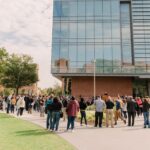
Banner image: Supporters gather outside the ILSB in advance of the ribbon-cutting ceremony. All photos by Marlayna Demond ’11 for UMBC unless otherwise noted.
]]>
During the height of UMBC Homecoming festivities on October 12, the university community and supporters from across Maryland gathered to celebrate the opening of UMBC’s Interdisciplinary Life...
https://umbc.edu/stories/umbc-spotlights-the-power-of-collaboration-and-community-in-opening-of-new-science-building-grit-x-talks/
https://my3.my.umbc.edu/api/v0/pixel/news/120029/guest@my.umbc.edu/2eac17fa01ba25408debbc6c18ac7105/api/pixel
biology
cahss
cbee
chembiochem
cnms
coeit
community
hrabowski
marinebiotech
meche
page1
politicalscience
psychology
publicpolicy
science-and-technology
visual-arts
UMBC News & Magazine
https://my3.my.umbc.edu/groups/umbc-news-magazine
https://assets1-my.umbc.edu/system/shared/avatars/groups/000/001/943/24435aa6207c452e7bc15cc74b42c7bb/xsmall.png?1748556657
https://assets1-my.umbc.edu/system/shared/avatars/groups/000/001/943/24435aa6207c452e7bc15cc74b42c7bb/original.png?1748556657
https://assets2-my.umbc.edu/system/shared/avatars/groups/000/001/943/24435aa6207c452e7bc15cc74b42c7bb/xxlarge.png?1748556657
https://assets2-my.umbc.edu/system/shared/avatars/groups/000/001/943/24435aa6207c452e7bc15cc74b42c7bb/xlarge.png?1748556657
https://assets3-my.umbc.edu/system/shared/avatars/groups/000/001/943/24435aa6207c452e7bc15cc74b42c7bb/large.png?1748556657
https://assets1-my.umbc.edu/system/shared/avatars/groups/000/001/943/24435aa6207c452e7bc15cc74b42c7bb/medium.png?1748556657
https://assets2-my.umbc.edu/system/shared/avatars/groups/000/001/943/24435aa6207c452e7bc15cc74b42c7bb/small.png?1748556657
https://assets1-my.umbc.edu/system/shared/avatars/groups/000/001/943/24435aa6207c452e7bc15cc74b42c7bb/xsmall.png?1748556657
https://assets2-my.umbc.edu/system/shared/avatars/groups/000/001/943/24435aa6207c452e7bc15cc74b42c7bb/xxsmall.png?1748556657
UMBC News & Magazine
0
0
false
Mon, 21 Oct 2019 14:09:20 -0400
UMBC receives $2.8M from NSF for master’s program to prepare a diverse environmental science workforce
An interdisciplinary team of UMBC professors has received $2.8 million from the National Science Foundation to create a new master’s program focused on developing a more diverse environmental science workforce. The program, called the Interdisciplinary Consortium for Applied Research in Ecology and Evolution (ICARE), is funded by a highly competitive NSF Research Traineeship (NRT) grant.
Student projects through the program will focus on environmental issues faced by the Baltimore Harbor and the surrounding region. To ensure students are developing research projects with tangible impacts, they will collaborate with partners in all levels of government as well as non-profit and community organizations focused on the environment.
 Tamra Mendelson at a research field site. Photo courtesy Tamra Mendelson.
The ICARE NRT also creates new opportunities to build a more diverse environmental workforce. “The primary mission of UMBC is inclusive excellence, and our NRT applies that mission to the environmental sciences,” says Tamra Mendelson, professor of biological sciences and the lead on the project. “Our main objectives are to bring a diversity of backgrounds to the environmental workforce and to improve the way that scientific research is applied to environmental problems.”
Baltimore in focus
UMBC is known for its links to Baltimore City, and ICARE’s deliberate focus on the Baltimore Harbor and its surroundings builds on that connection. “The students’ thesis projects need to be tied directly to solving problems in the Baltimore Harbor, which is in the spirit of what UMBC does,” says Chris Swan, professor of geography and environmental systems.
 Lee Blaney and Daniel Ocasio ’17, chemical engineering, working in UMBC’s Engineering Building.
The challenges the region is facing reflect environmental challenges the country and planet are facing on a larger scale, from shifting weather patterns, to air pollution and heat island effects, to water quality concerns.
“The health of the Baltimore Harbor is improving, and I am hopeful that the work of ICARE will bolster ongoing efforts to make the Baltimore Harbor a model for the whole country,” says Lee Blaney, associate professor of chemical, biochemical, and environmental engineering. “It is my hope that the research focus on the Baltimore Harbor will set up ICARE and UMBC to make lasting, sustainable, and positive impacts in our city.”
 Colleen Burge in her lab at the Institute of Marine and Environmental Technology.
For faculty who live in the city, the new program is personal. “As a UMBC employee who lives in Baltimore and works at the Institute of Marine and Environmental Technology in Baltimore’s Inner Harbor, I am especially looking forward to the opportunity to train students who can impact the quality of the environment in Baltimore,” shares Colleen Burge, assistant professor of marine biotechnology. “I’m extremely hopeful that this program will attract local students who will be trained to be the next generation of scientists in their communities.”
 From left to right: Postdoc Sarah Stellwagen, Ph.D. student Tyler Brown, assistant professor Mercedes Burns, and two undergraduate students check out a harvestman, a type of arachnid related to spiders, in a research lab in the Interdisciplinary Life Sciences Building (ILSB).
“As part of developing the ICARE NRT proposal, we identified a number of stakeholders in and around Baltimore City that have a strong interest in better understanding and improving the community,” adds Mercedes Burns, assistant professor of biological sciences, “and since I live in the city, I consider myself a beneficiary, too.”
Many of UMBC’s students come from the region, so this program is also an opportunity for them to make a difference to a resource that is at the center of city life, both literally and figuratively. “Baltimore’s harbor is really integral to the fabric of the city,” says Kevin Omland, professor of biological sciences, “the same way that the Chesapeake Bay is embedded in the culture of the state of Maryland.”
 Kevin Omland, rear, goes birdwatching near UMBC’s Library Pond with some of his students. Left to right: Jon Sikora ’20, Ph.D. student Janine Antalffy, Ph.D. student Evangeline Rose, and Aiman Raza ’22.
Direct career development
The unique structure of the program will create opportunities that students might not find in a more traditional master’s program. “We provide a degree program that allows students to get real-world experience in environmental problems, by partnering with government agencies, nonprofits, industry, and community stakeholders,” shares Mendelson.
Students are required to have someone from outside UMBC—in fact, outside any academic institution—on their master’s thesis committee. In that way, “The program is a catalyst for partnerships,” Swan says.
Maggie Holland, associate professor of geography and environmental systems, agrees. “We have been able to involve partner organizations working actively in the city from the very beginning of our planning for this program,” she says. “It’s thrilling to think that we can continue to deepen those collaborations and extend the network over the next several years. Their involvement is part of what will help us to innovate and adapt graduate student training as we move forward.”
 Maggie Holland (right) and Chris Swan in an ILSB lab.
The environment needs everyone
Creating a master’s program that serves as a direct pathway to environmental careers, and funding students to participate (which is rare in master’s programs), opens the door to a wider range of people who want to pursue this line of work, but who may not be in a position to commit to a five-plus year Ph.D. program or an unfunded master’s degree.
“I’m excited to help diversify environmental science through this program,” shares Burns, “as I think the perspectives of people of color are desperately needed in this field.”
“Big picture, the planet is being challenged in huge ways. So it’s totally a situation of needing all hands on deck,” Omland says. “We think this is a really good way to help broaden the kinds of people who are able to make contributions to basic research and applied action. Ultimately, some of these people might end up working for environmental non-profits, on the policy end, or in other capacities.”
 Kevin Omland and Sheridan Danquah ’20, biological sciences.
This program builds on successes UMBC has had in diversifying other fields. “UMBC has done a singularly outstanding job preparing underrepresented students for careers in the biomedical sciences,” Mendelson says. “We’re thrilled to apply these best practices to the environmental sciences and tackle some of the biggest problems facing our city, nation, and planet.”
Now, everyone involved is excited to get to work designing new courses, cultivating partnerships, and, overall, making a difference in Baltimore and beyond. In short, “We’re super jazzed about this,” says Swan. “It’s something we can be really proud of.”
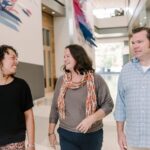
Banner image: Mercedes Burns (left), Maggie Holland (center), and Chris Swan are all part of the ICARE NRT project. All photos by Marlayna Demond ’11 for UMBC unless otherwise noted.
]]>
An interdisciplinary team of UMBC professors has received $2.8 million from the National Science Foundation to create a new master’s program focused on developing a more diverse environmental...
https://umbc.edu/stories/umbc-receives-2-8m-from-nsf-for-masters-program-to-prepare-a-diverse-environmental-science-workforce/
https://my3.my.umbc.edu/api/v0/pixel/news/120042/guest@my.umbc.edu/478c50d75222bb5c7fe1a006a1aa11a0/api/pixel
biology
cahss
cbee
cnms
coeit
ges
graduateschool
marinebiotech
page1
policy-and-society
science-and-technology
UMBC News & Magazine
https://my3.my.umbc.edu/groups/umbc-news-magazine
https://assets1-my.umbc.edu/system/shared/avatars/groups/000/001/943/24435aa6207c452e7bc15cc74b42c7bb/xsmall.png?1748556657
https://assets1-my.umbc.edu/system/shared/avatars/groups/000/001/943/24435aa6207c452e7bc15cc74b42c7bb/original.png?1748556657
https://assets2-my.umbc.edu/system/shared/avatars/groups/000/001/943/24435aa6207c452e7bc15cc74b42c7bb/xxlarge.png?1748556657
https://assets2-my.umbc.edu/system/shared/avatars/groups/000/001/943/24435aa6207c452e7bc15cc74b42c7bb/xlarge.png?1748556657
https://assets3-my.umbc.edu/system/shared/avatars/groups/000/001/943/24435aa6207c452e7bc15cc74b42c7bb/large.png?1748556657
https://assets1-my.umbc.edu/system/shared/avatars/groups/000/001/943/24435aa6207c452e7bc15cc74b42c7bb/medium.png?1748556657
https://assets2-my.umbc.edu/system/shared/avatars/groups/000/001/943/24435aa6207c452e7bc15cc74b42c7bb/small.png?1748556657
https://assets1-my.umbc.edu/system/shared/avatars/groups/000/001/943/24435aa6207c452e7bc15cc74b42c7bb/xsmall.png?1748556657
https://assets2-my.umbc.edu/system/shared/avatars/groups/000/001/943/24435aa6207c452e7bc15cc74b42c7bb/xxsmall.png?1748556657
UMBC News & Magazine
0
0
false
Wed, 18 Sep 2019 20:44:36 -0400
UMBC’s Lee Blaney and federal, state partners publish landmark study on contaminants in the Chesapeake Bay
UMBC’s Lee Blaney and research partners have published a landmark study on contaminants of emerging concern in the Chesapeake Bay. Their article in Science of the Total Environment is the first research study that quantifies concentrations of antibiotics, estrogenic hormones, and UV-filters in multiple locations of the Bay.
Blaney, an associate professor of chemical, biochemical, and environmental engineering, conducted the research with Ke He, Ph.D ‘17, chemical engineering, and Ethan Hain ‘21, chemical engineering. They also partnered with collaborators at the U.S. Forest Service and the Maryland Department of Natural Resources.
Underway since 2016, their work highlights the importance of understanding how previously unexamined chemicals impact the environment. The project has been primarily funded by Maryland Sea Grant through a Program Development Fund to Blaney, and a Graduate Research Fellowship to Hain.
The researchers studied the prevalence of contaminants of emerging concern in water, sediment, and oyster tissue collected from the Eastern Shore of the Chesapeake Bay. Their study of how accumulated UV-filters negatively impact the environment is the first of its kind. UV-filters are one of the primary ingredients in personal care products, such as sunscreen and cosmetics. The accumulation of these UV-filters can impact organisms and animals.
Maintaining a healthy Chesapeake Bay
While the Chesapeake Bay is one of the most well-studied ecosystems in the United States, Blaney says that little is known about the sources, occurrence, and impacts of contaminants of emerging concern in this important estuary.
“As the health of the Chesapeake Bay continues to improve due to recent nutrient and sediment regulations, it is important to consider new threats from specialty chemicals like antibiotics, hormones, and UV-filters,” he explains. “The first step to ensuring the safety of the Chesapeake Bay is to measure the concentrations of these contaminants in water, sediment, and tissue.”
 Lee Blaney. Photo by Marlayna Demond ’11 for UMBC.
The discharge of antibiotics into the Chesapeake Bay may speed up the spread and development of antibiotic resistance, a global public health challenge, explains Blaney. He adds that estrogenic hormones and UV-filters are considered priority chemicals of concern due to reported toxicity and other effects on reproductive systems in aquatic and marine organisms.
Over the past two years, Blaney and his team have continued to collect data throughout the Chesapeake Bay to better understand differences in contaminant levels. They have found relatively high levels of antibiotics in the Chesapeake Bay, and the reported concentrations are in the range that can select for antibiotic resistant bacteria. In addition, most samples have contained UV-filters, including two common in sunscreens that were recently banned from being sold in Hawaii due to concerns that they are toxic to corals.
The researchers argue that their findings suggest a need to improve municipal wastewater treatment and agricultural waste management to remove contaminants of emerging concern and prevent their introduction to the environment. In this regard, Blaney and his collaborators are actively working on a number of technologies to improve the transformation of contaminants into benign molecules that do not have antibiotic or estrogenic properties or other toxicity concerns.
Continuing to expand the research
In 2017, Blaney received a CAREER Award from the National Science Foundation to study contaminants of emerging concern and their effects on the urban environment. That research focused on the Gwynns Falls watershed in Baltimore, and the Chesapeake Bay research is an extension of that work. In addition to the public and ecological health concerns highlighted in the current article, Blaney also continues to examine issues like antimicrobial resistance and the impact of agricultural runoff.
Blaney was recently named associate director for sustainability engineering and liaison to the University System of Maryland (USM) vice chancellor for environmental sustainability. In this capacity, he will work closely with collaborators at the University of Maryland Center for Environmental Science and will lead additional sustainability-focused research projects within the USM.
Banner image: Lee Blaney, left, working with a student in the lab. Photo by Marlayna Demond ’11 for UMBC.
]]>
UMBC’s Lee Blaney and research partners have published a landmark study on contaminants of emerging concern in the Chesapeake Bay. Their article in Science of the Total Environment is the first...
https://umbc.edu/stories/umbcs-lee-blaney-and-federal-state-partners-publish-landmark-study-on-contaminants-in-the-chesapeake-bay/
https://my3.my.umbc.edu/api/v0/pixel/news/120063/guest@my.umbc.edu/ec334ea98166276b05e3fb784a8fce1e/api/pixel
cbee
coeit
science-and-technology
UMBC News & Magazine
https://my3.my.umbc.edu/groups/umbc-news-magazine
https://assets1-my.umbc.edu/system/shared/avatars/groups/000/001/943/24435aa6207c452e7bc15cc74b42c7bb/xsmall.png?1748556657
https://assets1-my.umbc.edu/system/shared/avatars/groups/000/001/943/24435aa6207c452e7bc15cc74b42c7bb/original.png?1748556657
https://assets2-my.umbc.edu/system/shared/avatars/groups/000/001/943/24435aa6207c452e7bc15cc74b42c7bb/xxlarge.png?1748556657
https://assets2-my.umbc.edu/system/shared/avatars/groups/000/001/943/24435aa6207c452e7bc15cc74b42c7bb/xlarge.png?1748556657
https://assets3-my.umbc.edu/system/shared/avatars/groups/000/001/943/24435aa6207c452e7bc15cc74b42c7bb/large.png?1748556657
https://assets1-my.umbc.edu/system/shared/avatars/groups/000/001/943/24435aa6207c452e7bc15cc74b42c7bb/medium.png?1748556657
https://assets2-my.umbc.edu/system/shared/avatars/groups/000/001/943/24435aa6207c452e7bc15cc74b42c7bb/small.png?1748556657
https://assets1-my.umbc.edu/system/shared/avatars/groups/000/001/943/24435aa6207c452e7bc15cc74b42c7bb/xsmall.png?1748556657
https://assets2-my.umbc.edu/system/shared/avatars/groups/000/001/943/24435aa6207c452e7bc15cc74b42c7bb/xxsmall.png?1748556657
UMBC News & Magazine
0
0
false
Mon, 26 Aug 2019 20:21:25 -0400
Open spaces nurture open minds in UMBC’s new Interdisciplinary Life Sciences Building
This fall, hundreds of Retrievers will set foot in UMBC’s new Interdisciplinary Life Sciences Building for the first time. They may be inspired by the vibrant art installation, find a quiet nook to study, or work together in research labs with floor-to-ceiling windows overlooking pocket gardens and curving pathways. The new facility offers features that set it apart as a space for learning, and set up students and faculty for transformative moments of discovery.
“New things will brew”
Each research floor in the ILSB is connected along its entire length and bounded by glass on all sides. Inside the labs, benches are configurable so that instrumentation can go in and out as needed. Neon-colored glass surfaces double as marker boards for quick sketches of lab protocols, equations, or encouraging doodles. Just outside the lab are spaces, overlooking an airy atrium, where graduate students can write and undergraduates can meet with mentors.
It’s a research environment that looks toward the future. These shared, open spaces are designed to help anyone who enters sense that they have a role to play in addressing big challenges, discovering more about the world, and developing the next generation of scientists.
 Greg Szeto, right, and Shirin Parsa ’20, biological sciences, conduct research in one of the ILSB’s open-concept labs.
“The ILSB provides an unprecedented opportunity to have researchers who are intellectually next to each other also be physically next to each other,” shares Greg Szeto, assistant professor of chemical, biochemical, and environmental engineering (CBEE). “When you share a kitchenette with a biologist, a chemist, an engineer and somebody from public policy, it’s inevitable that new things will brew.”
Szeto is part of the new Translational Center for Age-Related Disease and Disparities (TCARD2), an initiative made possible by the ILSB. The initiative is led by Chuck Bieberich, professor of biological sciences, and also includes faculty from CBEE and psychology. Bieberich’s lab focuses on cancer biology, especially prostate cancer, while Szeto works on cancer therapies that leverage the immune system. “When we bring our two approaches together, hopefully it will lead to new research, new papers, new grants,” and new cancer treatments, Szeto says.
 Faculty and students relax in one of the ILSB’s break areas. A spiral staircase reminiscent of DNA swirls up to the next floor in the background.
On top of the collaborative advantage, the ILSB offers all the equipment labs need in one place. Szeto’s students were already collaborating with biologists, but that used to mean carrying samples to instruments in other buildings. Not anymore. “Now everything is going to be in the ILSB,” Szeto says. “Being able to centralize the operation both intellectually and logistically is so critical.”
Bringing the outside in
Faculty in the new Interdisciplinary Consortium for Applied Research in Ecology and Evolution (ICARE2) are also taking up residence in the ILSB. Tamra Mendelson, professor of biological sciences, and Chris Swan, professor of geography and environmental systems (GES) co-lead the initiative. It also includes faculty in CBEE and marine biotechnology.
“The collaboration is designed to bring together evolutionary biologists, ecologists, conservationists, social scientists, and engineers,” says Swan. “We want to build a powerful network of people to collaborate on training graduate students, solving environmental problems relevant to Baltimore, and building out UMBC’s focus on ecology.” The ILSB will offer ICARE2 researchers the opportunity to work in a shared space for the first time.
 The ISLB atrium offers spaces to study or just relax. The art installation and a floating staircase add a whimsical, creative feel.
A new, state-of-the-art environmental science lab in the ILSB will also open up the possibilities for these researchers. It’s a space “devoted to environmental work,” which often means, “It’s dirty!” Swan says. The lab will enable larger-scale controlled experiments that can be hard to manage in the field and that would be incompatible with a lab focused on molecular work, where the slightest bit of stray DNA could ruin an experiment.
“A total game-changer”
Chris Hawn, assistant professor of GES, is excited to move to the ILSB because of the doors it will open for their environmental research. Hawn runs chemical analyses on spiderwebs to measure local air quality. They are collaborating with an advocacy group for houseless people that will train them to collect webs in spaces where they are living to send to Hawn for analysis. The goal is that they can use the findings to advocate locally for their health and make the best possible choices about where to stay.
Hawn also studies how pollutants in waterways are passed through the food chain from small aquatic insects, to spiders, to birds.
The ILSB “is a total game-changer for me,” Hawn says. With the instrumentation available at the ILSB, “There are protocols where I can get ‘level unlocked.’ It just opens things up for me and my students.”
 Chris Hawn (center) and their students in the ILSB, backed by the INFLIGHT art installation.
Hawn is the first researcher assigned to their floor of the new building. They note, “I’m excited to make the space my own, but also excited that it will be a shared space very soon. It will be interesting to see how we can work together.”
Even if they aren’t working together directly, having other researchers nearby is a good thing, Hawn adds. “Working simultaneously and having people around you is important, especially for graduate students who are spending a lot of their time in the lab.”
Coming to life
Sarah Leupen, senior lecturer in biological sciences, has been looking forward to teaching in the ILSB—and not just because it’s a new space, but because it’s a new kind of space. Even the building’s largest learning spaces are designed to help students connect with each other and the material in an engaged, intimate, collaborative way.
 Undergraduate researchers gather outside one of the labs in the ILSB. These spaces are designated as writing and meeting space for student researchers.
One of Leupen’s favorite rooms is filled with small round tables that seat six students. Screens and whiteboards appear all around the room and there is plenty of open space. “It’s this kind of flipped classroom that makes possible truly active learning, the kind of teaching that is most well-supported by research.”
Bill LaCourse, dean of the College of Natural and Mathematical Sciences, which administers the building, is thrilled to see it come to life. “For me, it’s been a decade of planning, design and construction to create this building that can serve the needs of our community in essential ways.”
“The process really epitomized the ethos of UMBC, involving the input and collaboration of so many people across the university,” he shares. “To see it evolve from a germ of an idea to the magnificent building we see today is a tribute to UMBC’s strength in the life sciences and commitment to student and faculty success.”
Banner image: Undergraduate researchers outside the TCARD2 lab. All photos by Marlayna Demond ’11 for UMBC.
]]>
This fall, hundreds of Retrievers will set foot in UMBC’s new Interdisciplinary Life Sciences Building for the first time. They may be inspired by the vibrant art installation, find a quiet nook...
https://umbc.edu/stories/open-spaces-nurture-open-minds-in-umbcs-new-interdisciplinary-life-sciences-building/
https://my3.my.umbc.edu/api/v0/pixel/news/120064/guest@my.umbc.edu/25ade5f53340901a658cd6a78e1112ce/api/pixel
biology
cahss
cbee
cnms
coeit
community
ges
interdisciplinary
page1
psychology
publicpolicy
research
science-and-technology
UMBC News & Magazine
https://my3.my.umbc.edu/groups/umbc-news-magazine
https://assets1-my.umbc.edu/system/shared/avatars/groups/000/001/943/24435aa6207c452e7bc15cc74b42c7bb/xsmall.png?1748556657
https://assets1-my.umbc.edu/system/shared/avatars/groups/000/001/943/24435aa6207c452e7bc15cc74b42c7bb/original.png?1748556657
https://assets2-my.umbc.edu/system/shared/avatars/groups/000/001/943/24435aa6207c452e7bc15cc74b42c7bb/xxlarge.png?1748556657
https://assets2-my.umbc.edu/system/shared/avatars/groups/000/001/943/24435aa6207c452e7bc15cc74b42c7bb/xlarge.png?1748556657
https://assets3-my.umbc.edu/system/shared/avatars/groups/000/001/943/24435aa6207c452e7bc15cc74b42c7bb/large.png?1748556657
https://assets1-my.umbc.edu/system/shared/avatars/groups/000/001/943/24435aa6207c452e7bc15cc74b42c7bb/medium.png?1748556657
https://assets2-my.umbc.edu/system/shared/avatars/groups/000/001/943/24435aa6207c452e7bc15cc74b42c7bb/small.png?1748556657
https://assets1-my.umbc.edu/system/shared/avatars/groups/000/001/943/24435aa6207c452e7bc15cc74b42c7bb/xsmall.png?1748556657
https://assets2-my.umbc.edu/system/shared/avatars/groups/000/001/943/24435aa6207c452e7bc15cc74b42c7bb/xxsmall.png?1748556657
UMBC News & Magazine
0
0
false
Mon, 26 Aug 2019 18:49:05 -0400
Team of UMBC grad students takes first place at 2019 BMEidea competition

A team of three UMBC graduate students earned first place in an innovation competition for their pioneering work in the rapid detection of bacteria in blood. The students joined teams from the University of Pennsylvania and the University of Michigan, which earned second and third place, respectively, at the BMEidea competition hosted by VentureWell, a national alliance of collegiate inventors and innovators.
UMBC’s team competed in the biomedical and bioengineering innovation student category of the competition, and presented a device called ASTEK, which allows physicians to more effectively treat bacterial infections. The interdisciplinary team included Mustafa Al-Adhami M.S. ‘15, mechanical engineering, Ph.D. ‘19, mechanical engineering; David Burgenson ‘17, chemical engineering, PhD ‘21, chemical engineering, and Benjamin Punshon-Smith M.S. ‘17, electrical engineering, and Ph.D. ‘22, electrical engineering.
 Benjamin Punshon-Smith (left), Mustafa Al-Adhami, and David Burgenson with their award at the BMEidea competition. Photo courtesy of Mustafa Al-Adhami.
“It can be difficult to translate science into relatable terms and a feasible business plan,” says Al-Adhami. “Participating in the BMEidea competition proved not only that they are interested in our research, but there is the potential to create a business around it. The BMEidea competition gave us the opportunity to get validation that we are onto something.”
Al-Adhami, Burgenson, and Punshon-Smith share office and lab space in UMBC’s Center for Advanced Sensor Technology, which is directed by Govind Rao, professor of chemical, biochemical, and environmental engineering. The group is also advised by Yordan Kostov, research professor in chemical, biochemical, and environmental engineering at UMBC, and Alan Cross, professor of medicine at the University of Maryland School of Medicine.
The team will use their $10,000 prize from VentureWell to continue to develop the technology and advance the ASTEK.
In 2016, Al-Adhami earned third place in UMBC’s Cangialosi Business Innovation Competition, and he explains that the feedback from the judges was valuable and helped him refine the design of the device. “I have used feedback and networking connections gained from these competitions to develop my business plan and expand my outreach on a national scale,” he says.
The technology was initially developed to detect bacteria in water, but after Al-Adhami learned about sepsis and the serious complications that it can cause, he changed focus to meet a known need in healthcare. The ASTEK displays results of the blood test in a user-friendly interface, he says.
“The project is at the intersection of mechanical engineering, electrical engineering, chemical engineering, and biology,” Al-Adhami explains. “The best thing about working on a multidisciplinary team is there are always four solutions to every problem we face.”
Banner image: Mustafa Al-Adhami gives his three-minute thesis talk at the 2018 Graduate Research Conference. Photo by Marlayna Demond ’11 for UMBC.
]]>
A team of three UMBC graduate students earned first place in an innovation competition for their pioneering work in the rapid detection of bacteria in blood. The students joined teams from the...
https://umbc.edu/stories/team-of-umbc-grad-students-takes-first-place-at-2019-bmeidea-competition/
https://my3.my.umbc.edu/api/v0/pixel/news/120067/guest@my.umbc.edu/6882de03fdcda614ecaae47e6d9f271d/api/pixel
cbee
coeit
csee
gradresearch
interdisciplinary
meche
science-and-technology
UMBC News & Magazine
https://my3.my.umbc.edu/groups/umbc-news-magazine
https://assets1-my.umbc.edu/system/shared/avatars/groups/000/001/943/24435aa6207c452e7bc15cc74b42c7bb/xsmall.png?1748556657
https://assets1-my.umbc.edu/system/shared/avatars/groups/000/001/943/24435aa6207c452e7bc15cc74b42c7bb/original.png?1748556657
https://assets2-my.umbc.edu/system/shared/avatars/groups/000/001/943/24435aa6207c452e7bc15cc74b42c7bb/xxlarge.png?1748556657
https://assets2-my.umbc.edu/system/shared/avatars/groups/000/001/943/24435aa6207c452e7bc15cc74b42c7bb/xlarge.png?1748556657
https://assets3-my.umbc.edu/system/shared/avatars/groups/000/001/943/24435aa6207c452e7bc15cc74b42c7bb/large.png?1748556657
https://assets1-my.umbc.edu/system/shared/avatars/groups/000/001/943/24435aa6207c452e7bc15cc74b42c7bb/medium.png?1748556657
https://assets2-my.umbc.edu/system/shared/avatars/groups/000/001/943/24435aa6207c452e7bc15cc74b42c7bb/small.png?1748556657
https://assets1-my.umbc.edu/system/shared/avatars/groups/000/001/943/24435aa6207c452e7bc15cc74b42c7bb/xsmall.png?1748556657
https://assets2-my.umbc.edu/system/shared/avatars/groups/000/001/943/24435aa6207c452e7bc15cc74b42c7bb/xxsmall.png?1748556657
UMBC News & Magazine
0
0
false
Mon, 12 Aug 2019 16:09:38 -0400
Festive COEIT Celebration honors achievement, service, and community
The COEIT Celebration has quickly become a defining annual event for the community of faculty, staff, and students in UMBC’s College of Engineering and Information Technology (COEIT). The celebration showcases the achievements of COEIT’s numerous highly active student organizations and senior capstone projects. It’s also an opportunity for COEIT Dean Keith J Bowman to reflect on the year and to honor those whose work has been essential to the College’s impact and growth.
 Julianna Posey ’19, mechanical engineering, a Center for Women in Technology Scholar.
Throughout the year, innovative research and strong teaching have contributed to student success, and have also helped faculty establish new connections and opportunities. “The COEIT Celebration allows our community to acknowledge the tremendous accomplishments of our faculty, students, and staff at all levels,” Bowman says.
 Dean Keith Bowman delivering remarks at the COEIT Celebration.
Student achievements
Each academic program recognized students who have demonstrated strong leadership during their time at UMBC.
 Noah Owens ’19, information systems, and Michael Piccinini ’19, information systems, with faculty from the department.
Information systems recognized Victor Cho and Musarrat Khan as Superior Students. Noah Owens and Michael Piccinini, both in business technology administration; computer science’s Aditya Kaliappan; and Edward Hanson, computer engineering, received Student Leadership Awards. Chemical, biochemical and environmental engineering (CBEE) recognized Elizabeth Tan and mechanical engineering honored Shannon Clancy with Student Leadership Awards as well.
 Edward Hanson at the COEIT Celebration.
Two departments also presented special named awards. Information systems honored Jana Burns with the Vijay Jose Award for exceptional involvement in student life. CSEE presented Emily C. McGovern with the Manoharshyam Joshi Award for a computer science student who has demonstrated exemplary achievement in a multitude of areas across academics, service, and leadership.
 Christina Achu ’19, mechanical engineering.
Beyond these specific awards, the College and Provost’s Office recognized nearly a hundred graduating seniors for their outstanding achievements in academics and research.
 Maryam AlAli sharing her work at the COEIT Celebration.
Faculty and staff honors
During the COEIT Celebration, the Provost’s Office presented five COEIT faculty members with awards for their commitment to excellence. Jeffrey Ray, a graduate faculty member in the systems engineering program through the Division of Professional Studies, and William Ryan, an adjunct faculty member in information systems, received Adjunct Faculty Excellence Awards.
Jianwu Wang, assistant professor of information systems, received the Early Career Faculty Excellence Award, and Carolyn Seaman, associate professor of information systems and interim director of UMBC’s Center for Women in Technology, was presented with the Mid-Career Faculty Excellence Award. During the Celebration, Mariajosé Castellanos, senior lecturer in CBEE, was recognized for her innovative pedagogical approach with the Excellence in Teaching Award.
 Mariajosé Castellanos, CBEE senior lecturer and undergraduate program director
The COEIT Dean’s Office also honored staff members for their dedication and service. Joshua Abrams, assistant director and advisor of COEIT’s Undergraduate Student Services; Lina Chung, program management specialist in information systems; and Michael Frizzell, engineering technician in CBEE, were recognized with 2019 Staff Awards for Superior Service.
“The COEIT Celebration is a day of fun for students, faculty, and staff. It is truly a celebration, and a chance for graduating students to share the festivities with family, friends, and mentors,” says Catherine Bielawski, assistant dean for undergraduate student services in the College. “This annual spring event exposes underclassmen to the breadth of opportunities offered at UMBC.”
 Professor Carolyn Seaman cheers on award recipients at the COEIT Celebration.
Read more stories of COEIT student achievement on UMBC News, on students who have had transformative study abroad experiences; who have created their own highly unique UMBC paths; who have found inspiration in their life experiences; and who have come to UMBC from abroad and found meaningful personal connections on campus.
All photos by Chris Ferenzi Photography.
]]>
The COEIT Celebration has quickly become a defining annual event for the community of faculty, staff, and students in UMBC’s College of Engineering and Information Technology (COEIT). The...
https://umbc.edu/stories/festive-coeit-celebration-honors-achievement-service-and-community/
https://my3.my.umbc.edu/api/v0/pixel/news/120127/guest@my.umbc.edu/2fa269a655bd2f021c59f86320fddb5b/api/pixel
cbee
coeit
community
csee
is
meche
page1
science-and-technology
UMBC News & Magazine
https://my3.my.umbc.edu/groups/umbc-news-magazine
https://assets1-my.umbc.edu/system/shared/avatars/groups/000/001/943/24435aa6207c452e7bc15cc74b42c7bb/xsmall.png?1748556657
https://assets1-my.umbc.edu/system/shared/avatars/groups/000/001/943/24435aa6207c452e7bc15cc74b42c7bb/original.png?1748556657
https://assets2-my.umbc.edu/system/shared/avatars/groups/000/001/943/24435aa6207c452e7bc15cc74b42c7bb/xxlarge.png?1748556657
https://assets2-my.umbc.edu/system/shared/avatars/groups/000/001/943/24435aa6207c452e7bc15cc74b42c7bb/xlarge.png?1748556657
https://assets3-my.umbc.edu/system/shared/avatars/groups/000/001/943/24435aa6207c452e7bc15cc74b42c7bb/large.png?1748556657
https://assets1-my.umbc.edu/system/shared/avatars/groups/000/001/943/24435aa6207c452e7bc15cc74b42c7bb/medium.png?1748556657
https://assets2-my.umbc.edu/system/shared/avatars/groups/000/001/943/24435aa6207c452e7bc15cc74b42c7bb/small.png?1748556657
https://assets1-my.umbc.edu/system/shared/avatars/groups/000/001/943/24435aa6207c452e7bc15cc74b42c7bb/xsmall.png?1748556657
https://assets2-my.umbc.edu/system/shared/avatars/groups/000/001/943/24435aa6207c452e7bc15cc74b42c7bb/xxsmall.png?1748556657
UMBC News & Magazine
0
0
false
Fri, 31 May 2019 13:22:45 -0400
Laser focus without limits: UMBC’s newest grads choose their own adventures

He’s a bassoonist and chemical engineer. She’s a dancer and social justice advocate. UMBC students have a lot of focus, but that doesn’t mean they have to focus on one thing. For many, the UMBC experience is about figuring out how to combine their passions, not chose one or the other. Here, four UMBC students graduating this spring share how they have found their own unique balance.
Pitching an idea
Senior Jeff Carr can easily recall one of the most pivotal moments of his first year at UMBC. Jason Schiffman, psychology, was speaking to the new cohort of Retrievers and simply told them “this place will be what you make it.”
“It really resonated with me. This was a place where I could restart and find myself,” remembers Carr. “I get kind of emotional looking back over my four years…I’ve done a lot here and I think part of that is the faculty and the community just motivated me to want to do so.”
For Carr, financial economics, sports were part of life. Growing up in nearby Linthicum, he spent much of his time crouched on a baseball diamond as his high school’s catcher. A shoulder injury ultimately derailed his athletic career, but coming to UMBC allowed him to turn that passion into a future profession.
A chance meeting with a member of the athletics department led to an introduction with Liam Bowen, associate head baseball coach. Carr joined the team as baseball manager, filling in wherever he was most needed, from booking catering to helping with scouting reports.
 Carr (l) with UMBC’s men’s basketball announcers, Gary Stein (c) and John Feinstein (r). Photo courtesy of Carr.
Carr’s biggest contribution came in his sophomore year. “Players would chart pitches during the game using pencil and paper and then I would have to total everything up by hand. One day, I had the realization that the strike zone is basically a graph with X-Y coordinates, so we could just chart pitches using some type of phone app,” explains Carr.
As a result of this epiphany, Carr set out to develop pitchTrax, an app that would track pitches and log the results in a spreadsheet, eliminating the need for hand tabulation.
“Three years ago, I told him that I was interested in tracking our pitchers’ statistics at a granular level and getting the information organized in a way that they could use,” says Bowen. “Jeff took off with the idea and created a system where we could see virtually every aspect of our pitchers’ performance. I have used the information that he has gathered countless times with our players and our program is very much in his debt.”
Carr enlisted the help of economics professor Scott Farrow to turn his ideas into reality. Farrow suggested Carr use heatmap quadrants and helped him refine the visual representation of the pitching data. “Jeff is a great example of becoming outstanding by following a particular interest and then having new opportunities grow from that success,” says Farrow.
 Example of the heatmap developed by Carr and Farrow.
Carr has continued to develop his expertise in sports analytics and will soon begin his master’s degree in sports management at the University of Michigan. But he won’t forget his roots anytime soon.
“I feel like my experience here…I’ve been very lucky, but I’ve also been around the right people,” says Carr. “The community here is so welcoming and that’s the most important part, for me. Everyone has a story like mine and we didn’t do it on our own—it’s all thanks to the people [at UMBC] supporting us.”
 Carr traveled to Charlotte, N.C. to cheer on UMBC men’s basketball during March Madness 2018. Photo by Kait McCaffrey for UMBC.
Justice through performance
The individualized study program at UMBC encourages students to take the road less traveled, or never before traveled, and create their own major. Alexia Petasis jumped at the chance to combine her passion for choreography with her commitment to social justice, a pairing that would define her time at UMBC.
“Dance has always been a big part of my life, but throughout college I became equally interested in social justice activism. When I came to UMBC, I was able to explore the intersections between them,” says Petasis. “I started learning how they could work together to create and inform empathetic dances that grow an individual’s understanding of an issue.”
 Petasis ‘19 at UMBC’s fall Senior Dance Concert. Photo by Marlayna Demond ‘11.
Taking courses in psychology, sociology, dance, and gender and women’s studies helped Petasis to envision how she could use elements from each in developing a cohesive piece.
“She is consistently looking for new ideas and ways to communicate through the body,” says Doug Hamby, associate professor of dance, of Petasis’s work. “Once she sets out on an creative journey she expands and deepens her exploration until the dancers embody every nuance Alexia intends to communicate to her audience.”
 Petasis performing at UMBC’s fall Senior Dance Concert. Photo by Marlayna Demond ‘11.
Petasis’s most ambitious work eventually became her capstone project, an evocative dance piece that “brings to light the experiences of survivors of domestic sex trafficking from the point of view of the victim.”
Petasis explains, “This dance, titled ‘Becoming Survivor,’ calls attention to the various ways a victim can become trapped in the life of human trafficking and offers a deeper understanding of the manipulation into exploitation that occurs.”
“In addition to showing her dance, Alexia saw the importance of using this opportunity to share community resources and have a dialogue about sexual violence in our communities,” says Jess Myers, director of UMBC’s Women’s Center. “Alexia’s dance has brought communities together—We Believe You, the Women’s Center, other on-campus and off-campus partners—to help create space for our UMBC community to have complex conversation about consent and sexual violence.”
Myers lauds Petasis’s keen ability to encourage others to see themselves as people who can have a social impact. She notes, “Alexia uses dance to tell stories that often go unheard. Her interdisciplinary work is grounded in inclusion and inviting others to care about issues they may not have otherwise known mattered to them.”
Taking the skills the she’s learned and the advice from the mentors she’s met along the way, Petasis is pursuing a teacher’s assistant program in France. “My time at UMBC has allowed me to pursue my passion and research interests with guidance, mentorship, and an overwhelmingly supportive network.”
At home in the lab…and on stage
“The world needs more Justins!” exclaims Kim Leisey, associate vice president of Student Affairs, when you ask about senior Justin Hosten. Leisey met Hosten when she taught a class for new Residential Life student staff. “If you want to know him, listen to him play the bassoon—it’s soulful and expressive,” she says. “Justin travels UMBC with gentle humility and care for others” in all that he does.
Hosten has a rare skill set—pursuing majors in both chemical engineering and music performance—and he firmly believes that this combination has improved his problem-solving skills.
“In music, we’re taught to look for patterns and I use this thought process in solving engineering problems. Looking for patterns helps determine what steps need to be taken to reach a solution and that’s integral in the engineering curriculum,” explains Hosten.
At the same time, Hosten notes, “In engineering, we’re taught to use all the tools we have to solve the problem fully. I take this into account when I look at all the ways I can create beautiful sounds.”
 Justin Hosten ‘19 poses with classmate Christina Cruz ‘19, music performance, following a campus studio session. Photo courtesy of Hosten.
After graduating from Bowie High School in Maryland, Hosten hit the ground running at UMBC, with both his music and his passion for engineering, in equal measure. He joined the university orchestra and wind ensemble and is both a Meyerhoff Scholar and a MARC U*STAR Scholar.
Hosten cites his Meyerhoff acceptance as something that makes him particularly proud, and that has had a major impact on his experience. “It’s been a huge part in making sure that I have been successful and helping me to be where I am today,” he shares.
Hosten’s current research explores how nanocapsules could be added to dental resin to revolutionize fillings. Should a person’s filling crack, the nanocapsules would break and the void in the tooth would be filled without a trip back to the dentist. Presently, Hosten is working to coat the particles with a silica shell to keep them uniform and prevent bursting.
 Hosten takes a break from performing to pose with fellow musicians (l to r) Anne Saba ‘19, mathematics, and Shabnam Parsa ‘19, biological sciences. Photo courtesy of Hosten.
One of Hosten’s mentors, Erin Lavik, professor of chemical, biochemical and environmental engineering, appreciates how his lab work is positively influenced by his stage work.
“It is challenging to be a chemical engineer, but to do that while also being a tremendous musician is humbling,” says Lavik, who herself has experience with theatre. “There’s also a critical interplay between the two,” she explains. “It isn’t surprising to me that Justin can approach a challenge from multiple perspectives and come up with elegant, creative solutions.”
This fall, Hosten will pursue his Ph.D. in biomedical engineering as part of a joint program between the Georgia Institute of Technology and Emory University.
Making waves
“I started swimming because my mom told me that my local summer team needed more kids my age…which was a complete lie. The reason she wanted me to swim was so that I wouldn’t drown when I went to the pool.”
It’s not exactly the auspicious beginning you would expect from a Danish national swimming champion, but that’s exactly how Alexander Gliese’s story begins.
 Alexander Gliese ‘19 competing at the 2018-2019 America East championships. Photo courtesy of Colleen Humel.
The Danish-born competitor has a score of swimming accolades attached to his name, but he didn’t develop a true love for the sport until he was a teenager. “I was swimming competitively on a year-round team and it wasn’t until I was about 14 that I began to really like the sport,” says Gliese. “At this point, I started to win events at the Maryland state championships.”
When the time came to look at colleges, UMBC immediately stood out to the young swimmer. And once he committed, he never looked back. “I’m happy that I chose UMBC as the coaching staff and my teammates have helped me grow into the person that I am today,” he reflects.
While his numerous athletic achievements would be impressive alone, Gliese managed to perform just as well in the classroom as he did in the pool. The Meyerhoff Scholar is graduating with a mechanical engineering degree this May and dedicated his time to researching energy harvesting and design optimization. He also credits his academic work for helping him improve his athletic performance.
 Gliese accepting his award for “Best Performance” at the Danish Open. Photo courtesy of Chad Cradock.
Soobum Lee, UMBC assistant professor of mechanical engineering, has served as mentor for Gliese and has been impressed by his research contributions. “Alex has consistently shown promise and commitment” as a researcher, offering “a unique perspective” while applying the research experience to his own learning, says Lee.
“During his involvement of my energy harvesting research for wind turbine monitoring, Alex proactively and voluntarily worked on brainstorming, CAD modeling, and testing,” Lee explains. “His diligence seriously accelerated the project, and his sincerity positively affected my graduate students.”
“I think that my swimming and my academics intersect very well since I have always been interested in how I can maximize my efficiency in the pool,” Gliese says. “I feel that my knowledge from mechanical engineering has helped me to understand what positions and movements in the water will help me to swim faster in the pool.”
 Gliese celebrates his medals during day two of America East competition with coach Chad Cradock. Photo courtesy of Colleen Humel.
His success in research and swimming are also connected by the same underlying work ethic and tenacity. Neil Rothman, professor of practice in mechanical engineering, shares that as busy as Gliese was with U.S. and international swimming competitions, “he would show up to class with a smile on his face. I had him in four different courses over a period of three years and he was consistently an excellent and dedicated student. The busier he got and the harder work became, he seemed to enjoy it even more.”
Gliese’s approach of applying his classroom knowledge to the pool can certainly be deemed a success. He’s a two-time CCSA Champion, two-time America East champion, 2019 America East Most Outstanding Male Swimmer, two-time America East All-Academic Team member, two-time CSCAA Scholar All-American, UMBC record holder in 100 backstroke and 200 medley relay, and the Danish national record holder in 200 backstroke. He even broke Michael Phelps’ 16-year-old NBAC record during the back split of the 400 medley relay in January 2019.
Head swimming and diving coach Chad Cradock ’97, psychology, says Gliese “has always been well-balanced in the classroom and in the pool. They say the price of excellence is discipline. Alex is one of the most disciplined, focused, and hardworking swimmers I have ever worked with and has earned his way to the world stage each and every day.”
After commencement, Gliese will compete in the World University Games. He will then take time to train for the Danish Olympic swimming qualifiers before pursuing a Ph.D. in mechanical engineering.
As much as he’s made a mark on UMBC, Gliese thinks about the mark UMBC has made on him. “UMBC has helped me to not only grow as a student and a swimmer, but as a person.” Sharing that the UMBC community is like family, he says, “it’s allowed me to thrive and create bonds that will last a lifetime.”
Banner image: Alexia Petasis ‘19, left, at UMBC’s fall Senior Dance Concert. Photo by Marlayna Demond ‘11.
]]>
He’s a bassoonist and chemical engineer. She’s a dancer and social justice advocate. UMBC students have a lot of focus, but that doesn’t mean they have to focus on one thing. For many, the UMBC...
https://umbc.edu/stories/laser-focus-without-limits-umbcs-newest-grads-choose-their-own-adventures/
https://my3.my.umbc.edu/api/v0/pixel/news/120133/guest@my.umbc.edu/3114d2e5eba762b448b9bdbc6a88cbaf/api/pixel
athletics
cahss
cbee
class-of-2019
coeit
dance
economics
inds
meche
meyerhoffscholars
page1
womenscenter
UMBC News & Magazine
https://my3.my.umbc.edu/groups/umbc-news-magazine
https://assets1-my.umbc.edu/system/shared/avatars/groups/000/001/943/24435aa6207c452e7bc15cc74b42c7bb/xsmall.png?1748556657
https://assets1-my.umbc.edu/system/shared/avatars/groups/000/001/943/24435aa6207c452e7bc15cc74b42c7bb/original.png?1748556657
https://assets2-my.umbc.edu/system/shared/avatars/groups/000/001/943/24435aa6207c452e7bc15cc74b42c7bb/xxlarge.png?1748556657
https://assets2-my.umbc.edu/system/shared/avatars/groups/000/001/943/24435aa6207c452e7bc15cc74b42c7bb/xlarge.png?1748556657
https://assets3-my.umbc.edu/system/shared/avatars/groups/000/001/943/24435aa6207c452e7bc15cc74b42c7bb/large.png?1748556657
https://assets1-my.umbc.edu/system/shared/avatars/groups/000/001/943/24435aa6207c452e7bc15cc74b42c7bb/medium.png?1748556657
https://assets2-my.umbc.edu/system/shared/avatars/groups/000/001/943/24435aa6207c452e7bc15cc74b42c7bb/small.png?1748556657
https://assets1-my.umbc.edu/system/shared/avatars/groups/000/001/943/24435aa6207c452e7bc15cc74b42c7bb/xsmall.png?1748556657
https://assets2-my.umbc.edu/system/shared/avatars/groups/000/001/943/24435aa6207c452e7bc15cc74b42c7bb/xxsmall.png?1748556657
UMBC News & Magazine
0
0
false
Thu, 16 May 2019 18:14:43 -0400


