Hrabowski Fund for Innovation awardees continue to drive new approaches to teaching and learning
A cross-disciplinary incubator rooted in theatrical storytelling. Artificial intelligence and machine learning ethics education that blends ethical inquiry with hands-on technical exploration. Letterpress printing and bookmaking while students uncover “The Secret Lives of Books.” These are several of the 2024 – 2025 projects selected to receive grants in the Hrabowski Fund for Innovation competition. The fund supports initiatives to enhance teaching and learning at UMBC, with specific emphasis on innovative approaches to increase student success.
“The Hrabowski Innovation Fund has helped to drive innovation in pedagogy and student success at UMBC for the past 13 years. Recent projects have enhanced course and curriculum development, built generative AI literacy and introduced AI-powered tools, and engaged students in cross-disciplinary, international, and community-based projects that prepare them for their majors and careers.” says Kerrie Kephart, interim director of the Faculty Development Center.
Implementation and Research Awards
- IMPACT Lab: Interdisciplinary Music, Performance, Art, Collaboration, and Theatre Lab – Nigel Semaj (THTR) and Colleagues
- Developing Ethical Inquiry: A Participatory and Exploratory Lab Model for AI/ML Ethics Education – Rebecca Williams (CSEE)
- Computing for All: Cultivating a Culturally Responsive and Inclusive Computing Ecosystem – Patricia Ordóñez (IS) and colleague
Adaptation Award
- Hilltop Print Shop: Supporting Applied Learning in a Humanities Makerspace – Lindsay DiCuirci (ENGL) and colleague
Scholarship of Teaching and Learning Award
- Developing an Approach to Creating and Refining Innovative Learning Outcomes in a University Music Education Program – Brian Kaufman (MUSC) and colleague
SEED Awards
- Transforming Graduate Writing Support – Nicole Morse (LLC) and colleagues
- Centering Student Perspectives on Generative AI Integration in a Design Classroom – Yasmine Kotturi (IS)
The Hrabowski Fund for Innovation exemplifies UMBC’s commitment to investing in faculty initiatives that fuel creativity and enterprise and also create opportunities for student engagement. Proposals for the next round are due by October 31, 2025. For more information and to apply, visit UMBC’s Faculty Development Center website.
]]>
A cross-disciplinary incubator rooted in theatrical storytelling. Artificial intelligence and machine learning ethics education that blends ethical inquiry with hands-on technical exploration....
https://umbc.edu/quick-posts/hrabowski-fund-for-innovation-awardees-continue-to-drive-new-approaches-to-teaching-and-learning/
https://my3.my.umbc.edu/api/v0/pixel/news/153359/guest@my.umbc.edu/03473bb2ab97b0c705cfc6bf57f6f836/api/pixel
cahss
cnms
coeit
community
csee
english
is
language-literacy-and-culture
quick-post
theatre
UMBC News & Magazine
https://my3.my.umbc.edu/groups/umbc-news-magazine
https://assets1-my.umbc.edu/system/shared/avatars/groups/000/001/943/24435aa6207c452e7bc15cc74b42c7bb/xsmall.png?1748556657
https://assets1-my.umbc.edu/system/shared/avatars/groups/000/001/943/24435aa6207c452e7bc15cc74b42c7bb/original.png?1748556657
https://assets2-my.umbc.edu/system/shared/avatars/groups/000/001/943/24435aa6207c452e7bc15cc74b42c7bb/xxlarge.png?1748556657
https://assets2-my.umbc.edu/system/shared/avatars/groups/000/001/943/24435aa6207c452e7bc15cc74b42c7bb/xlarge.png?1748556657
https://assets3-my.umbc.edu/system/shared/avatars/groups/000/001/943/24435aa6207c452e7bc15cc74b42c7bb/large.png?1748556657
https://assets1-my.umbc.edu/system/shared/avatars/groups/000/001/943/24435aa6207c452e7bc15cc74b42c7bb/medium.png?1748556657
https://assets2-my.umbc.edu/system/shared/avatars/groups/000/001/943/24435aa6207c452e7bc15cc74b42c7bb/small.png?1748556657
https://assets1-my.umbc.edu/system/shared/avatars/groups/000/001/943/24435aa6207c452e7bc15cc74b42c7bb/xsmall.png?1748556657
https://assets2-my.umbc.edu/system/shared/avatars/groups/000/001/943/24435aa6207c452e7bc15cc74b42c7bb/xxsmall.png?1748556657
UMBC News & Magazine
0
0
false
Tue, 07 Oct 2025 15:51:37 -0400
Tue, 07 Oct 2025 15:51:37 -0400
Meet a Retriever—Meagan Wade ’13, goes above and beyond to make students feel welcome and engaged
Meet Meagan Wade ’13, psychology, the program coordinator for the Department of Information Systems. Part of Meagan’s job is planning professional development and social events for IS students. She’s organized standing-room-only talks with tech leaders, game nights with pizzas and snacks, resume workshops and job search training, and more. She’s loving it all—and shares why she’s so happy she returned to her alma mater as a staff member.
Q: How did you start working in higher ed?
A: I graduated from UMBC in 2013 with a B.A. in psychology and a minor in social welfare. I then graduated from Towson University with a M.A. in teaching for elementary education in 2016. I worked as an elementary teacher for four years before switching gears and finding a job in higher education.
Q: Tell us about someone in the community who has supported you, and how they did it.
A: Dwayne Butcher, assistant director of marketing for the IS department, has been an awesome supporter of me since I started back in October 2024. He has been a great mentor for the marketing aspects of my job, and an amazing supporter of my career growth, for example, by encouraging me to attend conferences.
I love that the department has essentially given me free reign to plan whatever events for IS students that I think will get them engaged in the community and help to prepare them for their careers post-graduation from UMBC.
Q: What part of your job do you enjoy the most and why?
A: My favorite part of my job has been planning events that students enjoy attending—such as our game night events; and planning events that will help students in their career journeys—such as the Career Talk series I planned this fall. Each week we host a different panel of tech industry professionals, with themes such as women in tech and the gaming industry, and company-specific events with Oracle, The Trevor Project, and more.


Wade organizes student events for the IS department throughout the year, including a Women in Tech Career Talk (left) and the IS department’s Welcome Week (right), complete with a visit from Spot, a robotic dog. (Images courtesy of Wade)
Q: What brought you to UMBC in the first place?
 Wade and her dog Baxter at the Homecoming Puppy Parade in 2024. (Image courtesy of Wade)
A: I originally came to UMBC as a starry-eyed 18-year-old, hoping to figure out what I wanted to do with my life and to make great friends along the way. I chose UMBC for a few different reasons: I’m originally from Towson, so UMBC was just the right distance away from home so that I could still easily visit. Also, my dad is a UMBC alum, and my best friend also ended up going to UMBC, so it felt like a “home away from home” for me, which my anxious freshman self needed at the time.
I’m happy to say that UMBC brought so many amazing people into my life, many of whom I am still friends with to this day. I wouldn’t have wanted to be anywhere other than UMBC because of all the happy memories I made here.
Years later, when I ended up working in higher education, I remembered the awesome culture of UMBC that I experienced as a student, and hoped to “come back home” as a staff member. I applied for a number of jobs at UMBC and am so grateful that the information systems department was willing to give me the opportunity to return to UMBC. Now that I am back, I’m so glad that the welcoming culture I experienced as a student is still here, and I hope to now give current students the opportunity to find their way in the world, just like I did years ago.
Q: Are you involved in any campus organizations?
A: Back when I was a student, I was involved with WMBC, UMBC’s radio station. My friend and I had a radio show called “Cuddlecore,” where we would chat and play our favorite music. I remember loving the seemingly infinite amount of CDs back in the WMBC studio that we were encouraged to listen to and write reviews for.
I was also a Resident Assistant, so I was pretty involved with ResLife. I loved the apartment RA family that we created after spending so many hours together, and all the events that we would do together as RAs, including bowling, dinner parties, and late night trips to Double T Diner.
Since returning as a staff member, I’ve resurrected Cuddlecore. It’s on Wednesdays at 5pm! I’ve also attended UMBC Homecoming and participated in the Puppy Parade with my dog Baxter, which was very fun!
Q: How have you found support and community here?
A: As a UMBC student, the main way that I met amazing people was making connections with classmates in my courses, becoming close with roommates and suitemates in the dorms/apartments, and bonding with my fellow Resident Assistants and other ResLife staff when I worked as an RA.
As a UMBC staff member, I’ve been able to help students find their way in the world by planning awesome events for them to meet other people with similar interests. (I had no idea there’d be so many people interested in Super Smash Brothers, specifically!) I’ve also been able to collaborate with other organizations on campus, such as the Information Systems Security Association (ISSA) student chapter and the Career Center, to plan even more meaningful events for IS students. Because UMBC’s culture is so welcoming, it has been surprisingly easy to reach out to other organizations on campus and plan things together to help UMBC students as a whole.


Wade and fellow apartment RAs bowling (left) and at the end-of-year ResLife banquet (right). (Images courtesy of Wade)
Q: What would you tell someone who is considering a career at UMBC?
A: DO IT! I am so happy that I made the switch to UMBC from my prior higher education institution (although I might be a little biased as a UMBC alum).
* * * * *
UMBC’s greatest strength is its people. When people meet Retrievers and hear about the passion they bring, the relationships they create, the ways they support each other, and the commitment they have to inclusive excellence, they truly get a sense of our community. That’s what “Meet a Retriever” is all about.
Learn more about how UMBC can help you achieve your goals.
]]>
Meet Meagan Wade ’13, psychology, the program coordinator for the Department of Information Systems. Part of Meagan’s job is planning professional development and social events for IS students....
https://umbc.edu/stories/meet-a-retriever-meagan-wade/
https://my3.my.umbc.edu/api/v0/pixel/news/153333/guest@my.umbc.edu/40d209e5cfc5de16fdb17400931cf00e/api/pixel
alumni
cahss
coeit
impact
is
magazine
meetaretriever
perspectives
story
UMBC News & Magazine
https://my3.my.umbc.edu/groups/umbc-news-magazine
https://assets1-my.umbc.edu/system/shared/avatars/groups/000/001/943/24435aa6207c452e7bc15cc74b42c7bb/xsmall.png?1748556657
https://assets1-my.umbc.edu/system/shared/avatars/groups/000/001/943/24435aa6207c452e7bc15cc74b42c7bb/original.png?1748556657
https://assets2-my.umbc.edu/system/shared/avatars/groups/000/001/943/24435aa6207c452e7bc15cc74b42c7bb/xxlarge.png?1748556657
https://assets2-my.umbc.edu/system/shared/avatars/groups/000/001/943/24435aa6207c452e7bc15cc74b42c7bb/xlarge.png?1748556657
https://assets3-my.umbc.edu/system/shared/avatars/groups/000/001/943/24435aa6207c452e7bc15cc74b42c7bb/large.png?1748556657
https://assets1-my.umbc.edu/system/shared/avatars/groups/000/001/943/24435aa6207c452e7bc15cc74b42c7bb/medium.png?1748556657
https://assets2-my.umbc.edu/system/shared/avatars/groups/000/001/943/24435aa6207c452e7bc15cc74b42c7bb/small.png?1748556657
https://assets1-my.umbc.edu/system/shared/avatars/groups/000/001/943/24435aa6207c452e7bc15cc74b42c7bb/xsmall.png?1748556657
https://assets2-my.umbc.edu/system/shared/avatars/groups/000/001/943/24435aa6207c452e7bc15cc74b42c7bb/xxsmall.png?1748556657
UMBC News & Magazine
1
0
false
Tue, 07 Oct 2025 10:39:02 -0400
Tue, 07 Oct 2025 10:39:02 -0400
Who is “Fulbright material”? UMBC’s six 2025 – 2026 Fulbright U.S. Student Program recipients share their not-so-secret recipe for success
Alyssa Thomas is more of an “and” person than an “or” person. Growing up in a military family stationed in Florida, Thomas learned flexibility, a sense of curiosity, and a “Why not?” approach to life. So when Shin Yon Kim, assistant teaching professor of Asian studies, encouraged her to apply to the U.S. Fulbright Student Program during her junior year, Thomas was skeptical. “I decided to give it a try, but I didn’t think I’d get very far because I had never studied abroad,” said Thomas. “And then Dr. Kim said, ‘I need you to start believing in yourself and actually push yourself to apply for it.'” Those words of encouragement stuck with her. Thomas took her own advice and said, “Why not?”
Thomas ’25, Asian studies, ended her summer by moving to Taipei, Taiwan, where she is already working as a Fulbright English Teaching Assistant. She hopes her rudimentary Mandarin will help her learn Taiwanese Mandarin and the various dialects while she’s there. “There’s a big difference between learning in the classroom and in person. Accents, tempo, and slang are elements of Mandarin I’ve yet to adjust to,” says Thomas.

Retriever advice from Alyssa Thomas ’25
U.S. Fulbright Student Program
English Teaching Assistant, Taipei, Taiwan
“It’s important to learn how to manage your stress, especially if you have never traveled abroad or applied for a Fulbright. For me, it’s morning walks. Find what works for you—whether it’s journaling or therapy—to help manage the unexpected.”
Deciding to apply for a Fulbright is only the beginning. The process usually starts with a mentor pointing the way toward Brian Souders, M.A. ’19, TESOL, and Ph.D. ’09, language, literacy, and culture, the associate director for global learning at UMBC’s Center for Global Engagement. CGE hosts Fulbright information sessions in the spring for undergraduate, graduate, and recent alumni. Retrievers can apply to earn a master’s, conduct research, or be an English Teaching Assistant in East Asia-Pacific, Europe and Eurasia, Middle East and North Africa, South and Central Asia, Sub-Saharan Africa, and the Western Hemisphere.
With three UMBC 2025 – 2026 Fulbrights already settled in Taiwan, Norway, and Indonesia, and three preparing to cross the Atlantic Ocean to Belgium, Israel, and Germany, these alumni are eager to share tips to inspire and prepare the next generations of Fulbright Retrievers.
Transforming the lives of incarcerated women
Right now, it is the beginning of fall in Bergen, Norway, where Shanika Freeman ’24 is settling in at the University of Bergen, working with faculty studying the reentry experiences of native Norwegian and non-native Norwegian women into the community after incarceration. Freeman’s individualized studies major at UMBC focused on recidivism and policy in urban communities, making Norway a perfect research location. The country’s progressive and humane approach to rehabilitation, from the point of entry into the carceral system to successful reentry, has made Norway have the world’s lowest recidivism rates. Though Baltimore and Norway are worlds apart geographically and culturally, Freeman hopes to use what she learns abroad to help transform the lives of incarcerated women in the U.S. by exploring practices that shift the focus from punishment to rehabilitation and community building.

Retriever advice from Shanika Freeman ’24
U.S. Fulbright Student Program
Research in Bergen, Norway
“Build a team. I found out about Fulbright through Dr. Brian Souders. I didn’t know anything about it before and felt like Fulbright was out of reach for me. The furthest I had traveled was to California, and that was only for a weekend. I never thought a person like me—low-income, two-time college dropout from Baltimore City—would get the opportunity to go abroad.”
Her team included the INDS faculty and her academic mentors: Tammy Henderson, associate teaching professor of Africana studies; Loren Henderson, director of the school of public policy; László Kőrössy, assistant director for academic advising, outreach, and assessment; and Eric Stokan, director of the Center for Social Science Scholarship. “I applied because the faculty encouraged me and supported my research. I knew that my research was important, and Fulbright allowed me to take it further. Applying was a bit overwhelming at times, but Dr. Souders was extremely thorough, patient, kind, and knowledgeable. My team of faculty and staff was instrumental in my development as a scholar and fostered my academic goals.”
Researching your roots
Since Eilah Goldberg ’25, history, with a Judaic studies minor, first learned about the Fulbright Program during her sophomore year, her academic goals became very clear—build a strong academic and social foundation to earn this prestigious award. Goldberg knew she wanted to study Jewish history, religion, and culture abroad. The first step was studying abroad in England at the University College London (UCL) Hebrew and Jewish studies department, with the intent of returning to earn a master’s. “When I told Dr. Souders my plan to return to London after graduation, he asked me what I really wanted to do,” says Goldberg. “I shared my deep interest in Jewish studies, and he helped me realize that I could go directly to Israel to study—that it was a real option.”

Retriever advice from Eilah Goldberg ’25
U.S. Fulbright Student Program
Master’s at Hebrew University of Jerusalem
“Stay true to yourself, your interests, passions, and intellectual curiosities. Don’t let fear stop you from traveling to places or studying topics that are personally and culturally meaningful to you. Take the opportunity to conduct firsthand research into your roots, identity, and beliefs. Lean on the support of student clubs and cultural communities, just as I did with UMBC’s Chabad and Hillel Jewish student organizations and UCL’s Jewish Student Union. It’s important to have people to encourage you and believe in you.”
Goldberg will earn a master’s in Israel Studies at the Hebrew University of Jerusalem, surrounded by her extended family in Israel, an hour away from Jerusalem. She will study the impact of American Aliyah—ascent in Hebrew—the immigration of American Jews to Israel, and how it shaped Israeli society historically, culturally, and politically.
Pre-med neurologocial research abroad
The summer before his first year at UMBC, Andrew Opincar ’25, biological sciences, mapped out a four-year plan to ensure he would complete his major requirements, gain clinical experience, and take the MCAT all before graduating. As a participant in STEM Build—a National Institutes of Health initiative focused on enhancing diversity in the biomedical and behavioral sciences workforce, Opincar was excited to explore diverse perspectives in healthcare and research. While planning for his final two years at UMBC, he took the opportunity to study abroad in Amsterdam, Netherlands, to learn about the Dutch public universal health system.

Retriever advice from Andrew Opincar ’25
U.S. Fulbright Student Program
Research at the University of Heidelberg, Germany
“For pre-med students to critically analyze the health systems around us, we need to understand systems and people different from ourselves. It’s difficult to be well-rounded physicians, scientists, or researchers when you’ve only lived in one place and had one kind of experience,” says Opincar, who, even though his mentors encouraged him to apply, was unsure if he was “Fulbright material.” “I like the sports quote, ‘You lose 100 percent of the shots you don’t take,’ so you really must take a chance on what you care about and put yourself out there.”
Now, Opincar has mapped the time between graduation and medical school to learn a new healthcare system and expand his research experience from cell migration in fruit flies to spinal cord regeneration in mouse models at Heidelberg University, Germany, a global center for molecular biology and neuroscience. He’s excited to plan for many unknowns, like exploring a new research field, becoming bilingual, and stepping outside of his comfort zone to gain more confidence personally and professionally.
Connecting with your community across borders
Law and politics have been on Navara Syed‘s mind as long as she can remember. Her political science professors, Carolyn Forestiere, Brian Grodsky, and Jeffrey Davis, fueled her passion for comparative politics, civil and human rights, and community advocacy, leading her to choose a major in political science. During her visits to Pakistan to visit family and to Thailand to study abroad, Syed began to understand the complexity and broadness of what community can mean, and is ready to embrace the community she will be part of during her Fulbright in Indonesia as an English Teaching Assistant.

Retriever advice from Navara Syed ’25
U.S. Fulbright Student Program
English Teaching Assistant
Padang, West Sumatra, Indonesia
“Dip your toes into different ponds. You never know what you will find. I’m Muslim and have never lived in a Muslim country. In the U.S., I always have to think about where to get Halal food. In Thailand, a kind person approached me and offered to show me where I could find Halal food. Our tour guide even made sure to include Halal restaurant options.
Indonesia is a Muslim country, so spending Ramadan and other major Muslim holidays without needing to explain them or figure out how to participate in them is a dream come true. No experience is a waste—it’s just as important to realize what you don’t like as it is to discover what you do.”
Since graduating in May, these connections, along with her time in Mock Trial, the Muslim Student Association, and the student events board, continue to plant seeds of possibilities for her future in the field of law, whether as a judge, legislator, professor, or advocate.
Intersectional approach to flood mitigation
Daniel Douglas ’21, global studies, M.P.P. ’24, public policy, a current Ph.D. student, has been clear about his career path since his undergraduate years, when he began researching environmental policy focused on disaster mitigation and natural hazards. As a Fulbright recipient, he is now taking his expertise to the international level in Antwerp, Belgium.

Retriever advice from Daniel Douglas, Ph.D. student
U.S. Fulbright Student Program
Research at University of Antwerp, Belgium
“In every single field of study at UMBC, you can identify a way to apply your work for the common good. Find and seek your purpose above all else. This is especially important today when research and academia are being challenged. Now, we all have to uplift goodness, justice, and each other. And most of all, we can’t give up hope. I try my best to uplift those around me, knowing and trusting that they are pushing me forward to new heights.”
At the University of Antwerp, Douglas will conduct research on Belgium’s Sigma Plan—the primary flood mitigation plan along the Scheldt River Valley in Flanders, Belgium. Originally launched in 1977 as a single-purpose safety plan, it has since evolved to manage flood protection with nature conservation, recreation, and the needs of shipping and agriculture. This intersectional approach to flood mitigation is Douglas’s passion. He plans to build on his skill set in Belgium, then bring this newfound knowledge back to UMBC to complete his doctorate, and help communities worldwide—including Ellicott City—reduce the disastrous impacts of environmental hazards through disaster prevention, mitigation, and governance.
Learn more about UMBC’s Center for Global Education.
All photos by Brad Ziegler/UMBC, with the exception of Shanika Friedman’s, courtesy of INDS, and Daniel Douglas, courtesy of Douglas.
]]>
Alyssa Thomas is more of an “and” person than an “or” person. Growing up in a military family stationed in Florida, Thomas learned flexibility, a sense of curiosity, and a “Why not?” approach to...
https://umbc.edu/stories/2025-2026-fulbright-u-s-student-program-recipients-share-advice/
https://my3.my.umbc.edu/api/v0/pixel/news/153327/guest@my.umbc.edu/41b99848b6530be49b6743052c7a2469/api/pixel
africanastudies
asianstudies
baltimorecity
biologicalsciences
cahss
cnms
coeit
community
cs3
globalstudies
graduateschool
inds
international
judaicstudies
news
publicpolicy
story
UMBC News & Magazine
https://my3.my.umbc.edu/groups/umbc-news-magazine
https://assets1-my.umbc.edu/system/shared/avatars/groups/000/001/943/24435aa6207c452e7bc15cc74b42c7bb/xsmall.png?1748556657
https://assets1-my.umbc.edu/system/shared/avatars/groups/000/001/943/24435aa6207c452e7bc15cc74b42c7bb/original.png?1748556657
https://assets2-my.umbc.edu/system/shared/avatars/groups/000/001/943/24435aa6207c452e7bc15cc74b42c7bb/xxlarge.png?1748556657
https://assets2-my.umbc.edu/system/shared/avatars/groups/000/001/943/24435aa6207c452e7bc15cc74b42c7bb/xlarge.png?1748556657
https://assets3-my.umbc.edu/system/shared/avatars/groups/000/001/943/24435aa6207c452e7bc15cc74b42c7bb/large.png?1748556657
https://assets1-my.umbc.edu/system/shared/avatars/groups/000/001/943/24435aa6207c452e7bc15cc74b42c7bb/medium.png?1748556657
https://assets2-my.umbc.edu/system/shared/avatars/groups/000/001/943/24435aa6207c452e7bc15cc74b42c7bb/small.png?1748556657
https://assets1-my.umbc.edu/system/shared/avatars/groups/000/001/943/24435aa6207c452e7bc15cc74b42c7bb/xsmall.png?1748556657
https://assets2-my.umbc.edu/system/shared/avatars/groups/000/001/943/24435aa6207c452e7bc15cc74b42c7bb/xxsmall.png?1748556657
UMBC News & Magazine
0
0
false
Tue, 07 Oct 2025 09:08:23 -0400
Tue, 07 Oct 2025 09:08:23 -0400
Retrievers going green: 7 ways UMBC has contributed to sustainability efforts
Climate change is an ever growing concern, and at times it can be confusing to know how we can help make a difference. Sustainability practices are the key to accessible and effective progress in our planet’s health, and UMBC is dedicated to this effort by enhancing campus’s culture of sustainability, engaging and empowering UMBC’s community to get involved, and serving as a sustainability leader within the University System of Maryland and nationwide.
Check out how faculty, staff, and students—often under the leadership of the Office of Sustainability—are going green through grants, campus installations, research, and community service projects:
Powered by the sun
UMBC received a $1.2 million solar energy grant from the Maryland Energy Administration to support solar power installations and additional sustainability initiatives on campus. The clean, carbon-free energy generated by the solar installations will meet roughly 2.5 percent of the campus’s current annual electricity demand, reducing UMBC’s carbon footprint by roughly 500 tons per year in support of the university’s Campus Clean Energy Master Plan.
Butterflies welcomed
Recently, UMBC revealed a new pollinator garden at the Center for Well-Being. Planted in June 2025, the garden qualifies as a National Wildlife Federation Certified Wildlife Habitat and a Monarch Watch Waystation. In fact, monarch butterflies have already moved in. The pollinator garden will further promote ecosystem health on campus and bring UMBC closer to achieving the next level in the Green Grounds certification program.
Benefitting the community
PFAS, also called “forever chemicals,” are found throughout the country in water, soil, air, food, cleaning products, clothing, and even our bloodstreams. They are linked to a range of health problems, including decreased fertility, developmental effects in children, reduced immune function, and increased risk of cancer and obesity.
 UMBC Library Pond. (Marlayna Demond ’11/UMBC)
Like in most bodies of water now, PFAS were found close to home in the Baltimore Harbor. Under the leadership of Margaret Siao, M.S. ’25, chemical engineering, UMBC students used PFAS samplers installed around the harbor to measure how much of the chemicals were present and identify possible sources.
Fruitful campus connections
As an initiative of Retriever Essentials, a faculty, staff, and student partnership to tackle food insecurity within the UMBC community has been planted. Ariel Barbosa, program coordinator for Retriever Essentials at UMBC and a master’s student in community leadership, worked hard to ready seven garden plots for crop production in an effort to provide the UMBC community essential nutrition they are not receiving from canned food alone. Namely, The Garden remains a student organization that maintains the beds near the UMBC Police Station and works to address problems such as food waste and food insecurity through service opportunities.
 Ariel Barbosa, left, helps get a garden plot cleared for the growing season. (Marlayna Demond ’11/UMBC)
The slow, steady work of removing invasive species
Over several weeks in fall 2022 and again in spring 2023, Isabel Dastvan ’22, geography and environmental systems, in collaboration with Facilities Management staff, completed on-the-ground surveys, created maps of invasive species, identified the most urgent invasive threats, and determined the best ways to combat their spread. Dastvan’s work revealed that there are at least 100 invasive plant species present in natural and managed spaces on campus, which can threaten native species, reduce ecosystem functions like pollination and water filtration, and increase the chance of fires by thickening vegetation. The end result of her work, completed as a Sustainability Fellow with Climate Corps, is a 187-page, comprehensive Invasive Species Management Plan for UMBC, which continues the school’s legacy of prioritizing sustainability and stewardship of the land the university occupies.
Let’s take a walk
In 2021, a $1 million grant from the Chesapeake and Atlantic Coastal Bays Trust Fund, combined with about $1.4 million of university investment, funded a major stream restoration on campus to address deterioration caused by decades of growth at UMBC and in the surrounding community. The restoration project raised the streambed and added natural features, slowing the stream’s flow and reconnecting it with the floodplain. The project not only created and enhanced wetland and stream habitats and functions, it also provides recreational enhancements such as walking trails with stream access and connection to other existing trails.
 Retrievers can access the Herbert Run Greenway by a walkway that skirts the CEI Arena. (Marlayna Demond ’11/UMBC)
UMBC’s commitment to earth-friendly research
Across the world, energy consumption is associated with an increased standard of living—but burning fossil fuels to produce much of that energy increases the concentration of heat-trapping gases in the atmosphere.
Getting more energy from the sun could help reduce greenhouse gas emissions, but since the sun doesn’t always shine, we also need ways to store that energy and share it on the power grid. Three recently-hired researchers in the College of Engineering and Information Technology will build on the college’s strength in environmental research and expand faculty expertise in important areas such as energy storage.
Learn more about UMBC’s commitment to sustainability and how you can be involved.
]]>
Climate change is an ever growing concern, and at times it can be confusing to know how we can help make a difference. Sustainability practices are the key to accessible and effective progress in...
https://umbc.edu/stories/6-ways-retrievers-are-going-green/
https://my3.my.umbc.edu/api/v0/pixel/news/152949/guest@my.umbc.edu/b1c1a516430e0e5fdcd08d7c7b6d94b4/api/pixel
cahss
campus-life
cnms
coeit
magazine
story
sustainability
UMBC News & Magazine
https://my3.my.umbc.edu/groups/umbc-news-magazine
https://assets1-my.umbc.edu/system/shared/avatars/groups/000/001/943/24435aa6207c452e7bc15cc74b42c7bb/xsmall.png?1748556657
https://assets1-my.umbc.edu/system/shared/avatars/groups/000/001/943/24435aa6207c452e7bc15cc74b42c7bb/original.png?1748556657
https://assets2-my.umbc.edu/system/shared/avatars/groups/000/001/943/24435aa6207c452e7bc15cc74b42c7bb/xxlarge.png?1748556657
https://assets2-my.umbc.edu/system/shared/avatars/groups/000/001/943/24435aa6207c452e7bc15cc74b42c7bb/xlarge.png?1748556657
https://assets3-my.umbc.edu/system/shared/avatars/groups/000/001/943/24435aa6207c452e7bc15cc74b42c7bb/large.png?1748556657
https://assets1-my.umbc.edu/system/shared/avatars/groups/000/001/943/24435aa6207c452e7bc15cc74b42c7bb/medium.png?1748556657
https://assets2-my.umbc.edu/system/shared/avatars/groups/000/001/943/24435aa6207c452e7bc15cc74b42c7bb/small.png?1748556657
https://assets1-my.umbc.edu/system/shared/avatars/groups/000/001/943/24435aa6207c452e7bc15cc74b42c7bb/xsmall.png?1748556657
https://assets2-my.umbc.edu/system/shared/avatars/groups/000/001/943/24435aa6207c452e7bc15cc74b42c7bb/xxsmall.png?1748556657
UMBC News & Magazine
2
0
false
Fri, 26 Sep 2025 13:12:17 -0400
Fri, 26 Sep 2025 13:12:17 -0400
Retrievers going green: 7 ways UMBC has contributed to sustainability efforts
Climate change is an ever growing concern, and at times it can be confusing to know how we can help make a difference. Sustainability practices are the key to accessible and effective progress in our planet’s health, and UMBC is dedicated to this effort by enhancing campus’s culture of sustainability, engaging and empowering UMBC’s community to get involved, and serving as a sustainability leader within the University System of Maryland and nationwide.
Check out how faculty, staff, and students—often under the leadership of the Office of Sustainability—are going green through grants, campus installations, research, and community service projects:
Powered by the sun
UMBC received a $1.2 million solar energy grant from the Maryland Energy Administration to support solar power installations and additional sustainability initiatives on campus. The clean, carbon-free energy generated by the solar installations will meet roughly 2.5 percent of the campus’s current annual electricity demand, reducing UMBC’s carbon footprint by roughly 500 tons per year in support of the university’s Campus Clean Energy Master Plan.
Butterflies welcomed
Recently, UMBC revealed a new pollinator garden at the Center for Well-Being. Planted in June 2025, the garden qualifies as a National Wildlife Federation Certified Wildlife Habitat and a Monarch Watch Waystation. In fact, monarch butterflies have already moved in. The pollinator garden will further promote ecosystem health on campus and bring UMBC closer to achieving the next level in the Green Grounds certification program.
Benefiting the community
PFAS, also called “forever chemicals,” are found throughout the country in water, soil, air, food, cleaning products, clothing, and even our bloodstreams. They are linked to a range of health problems, including decreased fertility, developmental effects in children, reduced immune function, and increased risk of cancer and obesity.
UMBC Library Pond. (Marlayna Demond ’11/UMBC)
Like in most bodies of water now, PFAS were found close to home in the Baltimore Harbor. Under the leadership of Margaret Siao, M.S. ’25, chemical engineering, UMBC students used PFAS samplers installed around the harbor to measure how much of the chemicals were present and identify possible sources.
Fruitful campus connections
As an initiative of Retriever Essentials, a faculty, staff, and student partnership to tackle food insecurity within the UMBC community has been planted. Ariel Barbosa, program coordinator for Retriever Essentials at UMBC and a master’s student in community leadership, worked hard to ready seven garden plots for crop production in an effort to provide the UMBC community essential nutrition they are not receiving from canned food alone. Namely, The Garden remains a student organization that maintains the beds near the UMBC Police Station and works to address problems such as food waste and food insecurity through service opportunities.
Ariel Barbosa, left, helps get a garden plot cleared for the growing season. (Marlayna Demond ’11/UMBC)
The slow, steady work of removing invasive species
Over several weeks in fall 2022 and again in spring 2023, Isabel Dastvan ’22, geography and environmental systems, in collaboration with Facilities Management staff, completed on-the-ground surveys, created maps of invasive species, identified the most urgent invasive threats, and determined the best ways to combat their spread. Dastvan’s work revealed that there are at least 100 invasive plant species present in natural and managed spaces on campus, which can threaten native species, reduce ecosystem functions like pollination and water filtration, and increase the chance of fires by thickening vegetation. The end result of her work, completed as a Sustainability Fellow with Climate Corps, is a 187-page, comprehensive Invasive Species Management Plan for UMBC, which continues the school’s legacy of prioritizing sustainability and stewardship of the land the university occupies.
Let’s take a walk
In 2021, a $1 million grant from the Chesapeake and Atlantic Coastal Bays Trust Fund, combined with about $1.4 million of university investment, funded a major stream restoration on campus to address deterioration caused by decades of growth at UMBC and in the surrounding community. The restoration project raised the streambed and added natural features, slowing the stream’s flow and reconnecting it with the floodplain. The project not only created and enhanced wetland and stream habitats and functions, it also provides recreational enhancements such as walking trails with stream access and connection to other existing trails.
Retrievers can access the Herbert Run Greenway by a walkway that skirts the CEI Arena. (Marlayna Demond ’11/UMBC)
UMBC’s commitment to earth-friendly research
Across the world, energy consumption is associated with an increased standard of living—but burning fossil fuels to produce much of that energy increases the concentration of heat-trapping gases in the atmosphere.
Getting more energy from the sun could help reduce greenhouse gas emissions, but since the sun doesn’t always shine, we also need ways to store that energy and share it on the power grid. Three recently-hired researchers in the College of Engineering and Information Technology will build on the college’s strength in environmental research and expand faculty expertise in important areas such as energy storage.
Learn more about UMBC’s commitment to sustainability and how you can be involved.
]]>
Climate change is an ever growing concern, and at times it can be confusing to know how we can help make a difference. Sustainability practices are the key to accessible and effective progress in...
https://umbc.edu/stories/7-ways-retrievers-are-going-green/
https://my3.my.umbc.edu/api/v0/pixel/news/153000/guest@my.umbc.edu/88b1af659752e08caf5b4d88fec8606f/api/pixel
cahss
campus-life
cnms
coeit
magazine
story
sustainability
UMBC News & Magazine
https://my3.my.umbc.edu/groups/umbc-news-magazine
https://assets1-my.umbc.edu/system/shared/avatars/groups/000/001/943/24435aa6207c452e7bc15cc74b42c7bb/xsmall.png?1748556657
https://assets1-my.umbc.edu/system/shared/avatars/groups/000/001/943/24435aa6207c452e7bc15cc74b42c7bb/original.png?1748556657
https://assets2-my.umbc.edu/system/shared/avatars/groups/000/001/943/24435aa6207c452e7bc15cc74b42c7bb/xxlarge.png?1748556657
https://assets2-my.umbc.edu/system/shared/avatars/groups/000/001/943/24435aa6207c452e7bc15cc74b42c7bb/xlarge.png?1748556657
https://assets3-my.umbc.edu/system/shared/avatars/groups/000/001/943/24435aa6207c452e7bc15cc74b42c7bb/large.png?1748556657
https://assets1-my.umbc.edu/system/shared/avatars/groups/000/001/943/24435aa6207c452e7bc15cc74b42c7bb/medium.png?1748556657
https://assets2-my.umbc.edu/system/shared/avatars/groups/000/001/943/24435aa6207c452e7bc15cc74b42c7bb/small.png?1748556657
https://assets1-my.umbc.edu/system/shared/avatars/groups/000/001/943/24435aa6207c452e7bc15cc74b42c7bb/xsmall.png?1748556657
https://assets2-my.umbc.edu/system/shared/avatars/groups/000/001/943/24435aa6207c452e7bc15cc74b42c7bb/xxsmall.png?1748556657
UMBC News & Magazine
0
0
false
Fri, 26 Sep 2025 13:12:17 -0400
Fri, 26 Sep 2025 13:12:17 -0400
U.S. News affirms UMBC’s status as a leading public university with strong student support, especially for veterans
U.S. News & World Report Best Colleges rankings mark UMBC as tied for #127 among national universities, up 17 places from 2025, and tied for #63 on the list of top public schools, up 11 places. The rankings are based on a large variety of factors such as graduation rates, faculty resources, and academic reputation.
UMBC was also tied for #86 in top colleges for veterans, evidence that the university’s initiatives to support veteran students’ success are paying off.
“We are excited to see UMBC’s upward trajectory recognized in these rankings,” says Yvette Mozie-Ross ’88, vice provost for enrollment management and planning. “These gains reflect our strong commitment to student success, access, and innovation—hallmarks of a UMBC education that continue to set us apart nationally.”
Veteran services an example of strong student support
Two years ago, Dennis Walker, Jr., was hired as the assistant director for adult learners and veteran student success.
UMBC being recognized by U.S. News for its efforts in serving veteran and military-affiliated students is more than just an institutional achievement, he says, but a celebration of the positive impact that new veteran-focused initiatives are having on campus.
“With the support of UMBC leadership, I take great pride in knowing that our collective commitment is helping to ensure that these students feel supported, valued, and equipped to succeed during such a pivotal stage of their personal, academic, and professional journeys,” says Walker.
 Students and staff gather for the UMBC Veterans Day Out event, featuring a trip to a Baltimore Raven’s football game. (Photo courtesy of Dennis Walker, Jr.)
UMBC strives to provide holistic support to veteran and military-affiliated students, Walker says. This includes help navigating their educational benefits, access to mental health resources, professional development such as resume workshops and connections to on-campus job opportunities, and dedicated events, spaces, and student organizations that offer a sense of community.
As part of these efforts, UMBC opened a Veterans Lounge in fall 2024, where veteran students can relax and connect with each other. Each year, UMBC also hosts Veterans Week, a tradition that honors the service and contributions of veteran students and staff with a variety of fun and educational events.
“Supporting our veteran population is not only a responsibility, but also a privilege,” Walker says. “Our veteran and military-affiliated student population bring unique perspectives, experiences, and strengths to our campus community. Their dedication, resilience, and leadership not only enrich the university as a whole, but also inspire us to continually enhance the ways in which we support them.”
Read more about UMBC’s national rankings recognition.
]]>
U.S. News & World Report Best Colleges rankings mark UMBC as tied for #127 among national universities, up 17 places from 2025, and tied for #63 on the list of top public schools, up 11...
https://umbc.edu/stories/us-news-rankings-2026/
https://my3.my.umbc.edu/api/v0/pixel/news/152813/guest@my.umbc.edu/6824cbf99368263ab8032431c026e050/api/pixel
cahss
cnms
coeit
community
news
rankings
story
UMBC News & Magazine
https://my3.my.umbc.edu/groups/umbc-news-magazine
https://assets1-my.umbc.edu/system/shared/avatars/groups/000/001/943/24435aa6207c452e7bc15cc74b42c7bb/xsmall.png?1748556657
https://assets1-my.umbc.edu/system/shared/avatars/groups/000/001/943/24435aa6207c452e7bc15cc74b42c7bb/original.png?1748556657
https://assets2-my.umbc.edu/system/shared/avatars/groups/000/001/943/24435aa6207c452e7bc15cc74b42c7bb/xxlarge.png?1748556657
https://assets2-my.umbc.edu/system/shared/avatars/groups/000/001/943/24435aa6207c452e7bc15cc74b42c7bb/xlarge.png?1748556657
https://assets3-my.umbc.edu/system/shared/avatars/groups/000/001/943/24435aa6207c452e7bc15cc74b42c7bb/large.png?1748556657
https://assets1-my.umbc.edu/system/shared/avatars/groups/000/001/943/24435aa6207c452e7bc15cc74b42c7bb/medium.png?1748556657
https://assets2-my.umbc.edu/system/shared/avatars/groups/000/001/943/24435aa6207c452e7bc15cc74b42c7bb/small.png?1748556657
https://assets1-my.umbc.edu/system/shared/avatars/groups/000/001/943/24435aa6207c452e7bc15cc74b42c7bb/xsmall.png?1748556657
https://assets2-my.umbc.edu/system/shared/avatars/groups/000/001/943/24435aa6207c452e7bc15cc74b42c7bb/xxsmall.png?1748556657
UMBC News & Magazine
2
0
false
Tue, 23 Sep 2025 12:54:35 -0400
Tue, 23 Sep 2025 12:54:35 -0400
Quantum on track: UMBC researchers demonstrate feasibility of using quantum devices to manage urban train scheduling, using a Baltimore transit line as a model
Train delays can cascade into stalled commutes, economic losses, and vacation snags. Scheduling trains is computationally complex, though: It can take hours or days to solve large transportation networks on traditional computers, when disruptions like train breakdowns or traffic accidents demand much quicker solutions. A new study led by UMBC researchers—and focused on Baltimore’s Light RailLink, a hybrid tram-rail network sharing roads with cars inside Baltimore City—harnesses quantum computing to address this challenge, using an approach that blends physics, computer science, and mathematics.
In their new paper, Sebastian Deffner, associate professor of physics; postdoctoral fellow Emery Doucet; doctoral candidate Reece Robertson; and collaborators Krzysztof Domino and Bartłomiej Gardas at the Institute of Theoretical and Applied Informatics in the Polish Academy of Sciences tested whether quantum devices could manage train schedules under real-world conditions. The team leveraged the “noise” inherent in quantum computers—random, unwanted disturbances that cause an effect similar to radio static—to model unpredictable train travel times.
Their results suggest that quantum computers can solve transportation scheduling problems, but more advanced hardware is needed to make using quantum devices practical, especially for larger networks.
Randomness on the rails
Doucet and Robertson discussed the work at Baltimore’s Camden Yards LightRail Link Station, while Orioles baseball fans unloaded from trains at regular intervals and delivery trucks rumbled by. Their enthusiasm cut through the urban din, their voices rising over the clatter and clank of passing Baltimore Light RailLink cars.
 Baltimore’s LightRail Link is a good example of a complex system that would benefit from a way to address disruptions quickly and efficiently. As hardware improves, new research suggests quantum computers could help. (Elijah Davis, M.F.A. ’21/UMBC)
“How long it takes you to get between two stations where you have a lot of shared infrastructure in between—you can’t really predict that precisely,” Doucet says, gesturing toward the tracks and their intersection with a nearby stoplight. This randomness complicates scheduling, but the team’s diverse expertise—spanning theoretical physics, algorithm design, and quantum hardware—facilitated creative solutions.
Noisy doesn’t have to be bad
Current quantum computers are classified as “NISQ,” or “noisy intermediate-scale quantum,” pronounced “nisk.” That means they’re error-prone with only moderate power. Rather than fighting the noise, though, the researchers used it to mimic everyday randomness, like traffic delays.
“The ‘N’ in NISQ stands for ‘noisy,’ but that doesn’t mean that the noise has to always be deleterious,” Doucet explains. “We wondered if maybe we could use the noise that the device is subject to as a tool to model the chaos and randomness.”
 Sebastian Deffner leads the research group that published the new paper. (Marlayna Demond ’11/UMBC)
The team tested their approach on two different quantum computers, one made by IonQ, which is headquartered in Maryland, and the other by D-Wave. Each company’s quantum devices use quantum bits, or qubits, slightly differently to process information. The research team was able to solve scheduling problems with up to 12 trains on D-Wave’s system, which contains thousands of qubits, and only two trains on IonQ’s 25-qubit system.
This proof-of-principle work demonstrates that quantum computers can tackle concrete problems, though they’re not yet faster or cheaper than classical supercomputers for large networks—the experiments cost about $65,000.
“What we’ve shown is that with the currently available hardware, you can already solve practical problems,” Deffner, senior author on the new paper, says. The study highlights the need for larger, less noisy quantum systems to handle bigger networks.
Merging expertise, expanding possibilities
The potential impact is significant; rapid rescheduling could prevent network-wide disruptions.
“If you have an issue on a train network, everything has to stop until you reschedule, at least in that region—and the longer it takes you to come up with a new schedule, the more disruptive the original problem becomes,” Doucet noted, as a train coasted noisily into the platform.
 The bustling Baltimore LightRail Link operates as a train outside Baltimore City, and as a tram subject to traffic within the city limits, making it an interesting challenge for scheduling. (Elijah Davis, M.F.A. ’21/UMBC)
Robertson, a Ph.D. candidate in computer science, added, “Within the next few generations of quantum technology, the problems we could address will get larger, approaching problems that are intractable on current hardware.”
Robertson’s computer science background complements the team’s physics expertise.
“Someone else might be able to help me with physics intuition, and then I can help them by suggesting an algorithm we could use to test their idea, or by applying some computational intuition that we could use in designing our quantum solution.”
“Quantum information science is truly interdisciplinary,” adds Deffner, who is also affiliated with the UMBC computer science and electrical engineering department and has master’s level math training.
Beyond trains
This interdisciplinary, quantum-based approach could eventually optimize logistics, financial portfolios, or drug discovery—fields with complex, random variables. The study, funded through Deffner’s fellowship at the National Quantum Laboratory, involved coding, theoretical modeling, and experiments on real quantum devices—a departure for Deffner’s typically theory-focused research group.
Working on the Baltimore system was a fun challenge, Deffner says, because the LightRail Link transitions from operating as a train unaffected by traffic outside the city to a tram navigating city streets and stopping at traffic lights inside Baltimore. “Because of its unusual characteristics, it was just a unique problem. And of course, it’s cool to work on a local system,” Deffner says.
By uniting diverse expertise, UMBC’s team is turning quantum noise into a strength, paving the way for efficient solutions to real-world problems.
]]>
Train delays can cascade into stalled commutes, economic losses, and vacation snags. Scheduling trains is computationally complex, though: It can take hours or days to solve large transportation...
https://umbc.edu/stories/quantum-on-track-for-train-scheduling/
https://my3.my.umbc.edu/api/v0/pixel/news/152581/guest@my.umbc.edu/3eefabfe8602b421ddbf76c093c02380/api/pixel
cnms
coeit
csee
gradresearch
news
physics
qsi
research
science-and-tech
story
UMBC News & Magazine
https://my3.my.umbc.edu/groups/umbc-news-magazine
https://assets1-my.umbc.edu/system/shared/avatars/groups/000/001/943/24435aa6207c452e7bc15cc74b42c7bb/xsmall.png?1748556657
https://assets1-my.umbc.edu/system/shared/avatars/groups/000/001/943/24435aa6207c452e7bc15cc74b42c7bb/original.png?1748556657
https://assets2-my.umbc.edu/system/shared/avatars/groups/000/001/943/24435aa6207c452e7bc15cc74b42c7bb/xxlarge.png?1748556657
https://assets2-my.umbc.edu/system/shared/avatars/groups/000/001/943/24435aa6207c452e7bc15cc74b42c7bb/xlarge.png?1748556657
https://assets3-my.umbc.edu/system/shared/avatars/groups/000/001/943/24435aa6207c452e7bc15cc74b42c7bb/large.png?1748556657
https://assets1-my.umbc.edu/system/shared/avatars/groups/000/001/943/24435aa6207c452e7bc15cc74b42c7bb/medium.png?1748556657
https://assets2-my.umbc.edu/system/shared/avatars/groups/000/001/943/24435aa6207c452e7bc15cc74b42c7bb/small.png?1748556657
https://assets1-my.umbc.edu/system/shared/avatars/groups/000/001/943/24435aa6207c452e7bc15cc74b42c7bb/xsmall.png?1748556657
https://assets2-my.umbc.edu/system/shared/avatars/groups/000/001/943/24435aa6207c452e7bc15cc74b42c7bb/xxsmall.png?1748556657
UMBC News & Magazine
0
0
false
Wed, 17 Sep 2025 10:41:36 -0400
Wed, 17 Sep 2025 10:41:36 -0400
Following where curiosity leads them—COEIT celebrates student summer research
Students from across the College of Engineering and Information Technology (COEIT) spent the summer diving into research—embarking on new projects or deepening their focus. The college celebrated their work in August with a poster session and networking lunch. Students showcased their research on diverse topics including how artificial intelligence can help K-12 teachers monitor student engagement; how best to model environmental phenomena like wildfires and cloud patterns; and how the sex hormone estradiol affects the behavior of blood platelets, which play an essential role in healthy blood clotting.
Julia Chapman, a rising senior in mechanical engineering who conducted research on a mathematical model that replicates aircraft wing flutter, says she was inspired by the curiosity on display at the poster session. “I’m so thankful for the opportunity to share my summer research and engage in thoughtful conversations,” she says.
“I really enjoyed sharing my work with faculty and fellow students. Since everyone comes from different backgrounds, the variety of questions helped me see my research from multiple perspectives,” says Zahid Hassan Tushar, a Ph.D. candidate in information systems who presented his research studying how machine learning techniques can help predict properties of clouds and aerosols from data gathered by one of NASA’s recently launched Earth-observing satellites.
Many of the participating students were supported through the inaugural COEIT Student Summer Projects (CSSP) awards, which provided stipends to 10 students—both graduate and undergraduate—across all academic departments of the college.
The CSSP-funded students were joined by faculty-nominated members of various labs across COEIT and students from REU (Research Experiences for Undergraduates) programs—National Science Foundation-funded opportunities that bring undergraduates from around the country to UMBC for summer research. The students’ summer research experience also included attending professional development seminars, in which campus leaders shared their own research journeys and COEIT faculty ran skill-development workshops on topics such as making effective presentations, writing papers, and more.
 COEIT student summer researchers pose with UMBC President Valerie Sheares Ashby (center in yellow dress). Sheares Ashby spoke with the students as part of a professional development program. (Photo courtesy of Vandana Janeja)
“The poster session was the culmination of a summer of research exploration for our students, and it was an honor to meet them and learn about their work,” says COEIT Dean Jeanne van Briesen. “Their excitement at the challenges they’d faced and the new ideas they’d generated reminded me of why I love research!”
“It was an honor to celebrate the hard work of these students,” says Vandana Janeja, associate dean for research and faculty development in COEIT. “We look forward to seeing where our students’ curiosity leads us next.”
]]>
Students from across the College of Engineering and Information Technology (COEIT) spent the summer diving into research—embarking on new projects or deepening their focus. The college celebrated...
https://umbc.edu/quick-posts/coeit-student-summer-research/
https://my3.my.umbc.edu/api/v0/pixel/news/152544/guest@my.umbc.edu/5dca7d6183be390862d1ba18a8ff6037/api/pixel
coeit
graduateschool
quick-post
research
science-and-tech
UMBC News & Magazine
https://my3.my.umbc.edu/groups/umbc-news-magazine
https://assets1-my.umbc.edu/system/shared/avatars/groups/000/001/943/24435aa6207c452e7bc15cc74b42c7bb/xsmall.png?1748556657
https://assets1-my.umbc.edu/system/shared/avatars/groups/000/001/943/24435aa6207c452e7bc15cc74b42c7bb/original.png?1748556657
https://assets2-my.umbc.edu/system/shared/avatars/groups/000/001/943/24435aa6207c452e7bc15cc74b42c7bb/xxlarge.png?1748556657
https://assets2-my.umbc.edu/system/shared/avatars/groups/000/001/943/24435aa6207c452e7bc15cc74b42c7bb/xlarge.png?1748556657
https://assets3-my.umbc.edu/system/shared/avatars/groups/000/001/943/24435aa6207c452e7bc15cc74b42c7bb/large.png?1748556657
https://assets1-my.umbc.edu/system/shared/avatars/groups/000/001/943/24435aa6207c452e7bc15cc74b42c7bb/medium.png?1748556657
https://assets2-my.umbc.edu/system/shared/avatars/groups/000/001/943/24435aa6207c452e7bc15cc74b42c7bb/small.png?1748556657
https://assets1-my.umbc.edu/system/shared/avatars/groups/000/001/943/24435aa6207c452e7bc15cc74b42c7bb/xsmall.png?1748556657
https://assets2-my.umbc.edu/system/shared/avatars/groups/000/001/943/24435aa6207c452e7bc15cc74b42c7bb/xxsmall.png?1748556657
UMBC News & Magazine
1
0
false
Tue, 16 Sep 2025 14:42:41 -0400
Tue, 16 Sep 2025 14:42:41 -0400
Feeling supported at summer internships gives Retrievers a leg up in applied learning
“Support” is one of the most frequently used words when UMBC students reflect on their internship experiences on and off campus. From resources offered by the Career Center, to guidance from professors, and even sometimes from peers who wind up working side-by-side, UMBC students depend on university support and the many shapes it takes.
This summer, hundreds of Retrievers built upon the foundational knowledge they learned in the classroom and applied it to hands-on, real-world learning through internships. From getting front seat roles in bridge engineering and analyzing cyber threats to using inspiration drawn from campus, these UMBC students had plenty to write about for their “What I Did with My Summer Vacation” essays.
The science of sticking together
Mustafa Akpinar, a senior information systems major; Alek Read, a senior environmental science major; and Ty Allen, a junior mechanical engineering major, honed technical expertise, built teamwork and communication skills, and forged connections with peers and professionals on the Baltimore/D.C. biotech scene working at AstraZeneca.
Akpinar worked as a cyber threat intelligence and threat detection intern, a position that closely aligned with his career trajectory. “This internship is a perfect fit for both my academic path and long-term career goals,” Akpinar says, noting how the role builds on his data communications and networks and database design courses.
 A mixer for UMBC alumni employees and interns at AstraZeneca was a meaningful way for the students to network with potential mentors. (Courtesy of Miriam Friedman)
Read and Allen also used the summer to further their professional goals. Read contributed to sustainability efforts at AstraZeneca’s Frederick Manufacturing Center as an environmental health safety intern and Allen served as a site operations intern, applying his engineering skills to edit technical drawings in AutoCAD.
Building bridges
As all of Baltimore and most of the country recalls, Maryland’s Francis Scott Key Bridge was struck by a cargo ship and collapsed in March of 2024. The impacts of this catastrophe are still felt throughout the region with travel complications, economic hardships, and more. Through a partnership between the Maryland Transportation Authority and the Maryland Higher Education Commission, three Retrievers and six other Maryland-based students had the chance to join the Key Bridge Rebuild Internship Program.
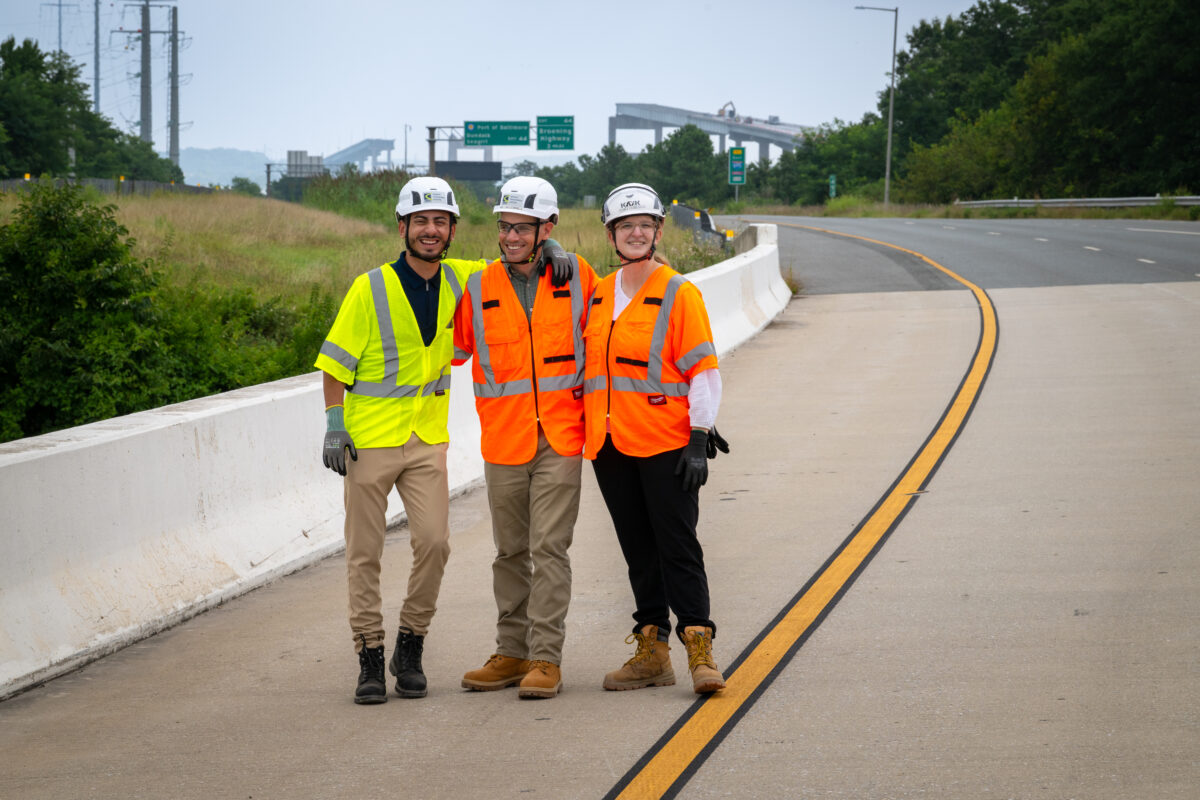 From left to right, Cristian Mena, William McConnell, and Emily DiMarzio pose for a photo near the site of the collapsed Key Bridge. The three worked on the bridge rebuilding project as interns with the Maryland Transportation Authority. (Brad Ziegler/UMBC)
Emily DiMarzio, a junior studying environmental science and geography, and Cristian Mena and William McConnell, both seniors studying mechanical engineering, all explored their individual areas of interest while actively helping to rebuild in their own community.
“It hurt when the bridge went down,” says McConnell, who grew up in Baltimore and now lives with his wife and three kids in Catonsville. “You could practically see it from our neighborhood, and now see that it is missing. So when the opportunity came along to apply for this internship, I jumped on it.”
Bustling Baltimore
The UMBC Career and Internship Fair is a first foot in the door for many UMBC students seeking to make networking connections. This was precisely the case for Wonder Akpabio, a junior computer science major, who connected with a recruiter from T. Rowe Price who helped guide her through the interview process.
With a massive network of UMBC alumni, T. Rowe Price is already a well-known investment management firm with Retrievers, with the added bonus of being headquartered in Baltimore. Gabriel Farmer, another junior computer science major, was impressed with the outreach efforts the company did with UMBC, like sending recruiters to events and hosting online programming.
 Gabriel Farmer in Baltimore’s Inner Harbor, near the headquarters of T. Rowe Price, where he interned in summer 2025. (Brad Ziegler/UMBC)
“Anytime you ask a question, people are ready to help,” Farmer says. “It’s been a very good experience, and T. Rowe Price is definitely a place I could see myself continuing to work at.”
Connections across campus
UMBC is far from a sleepy campus in the summer, with hundreds of research, internship, and student-employment opportunities available. So, while others traveled far and wide to secure an internship in their area of interest, some Retrievers saw the home-field advantage right in front of them.
Giovanna Orfali, a visual arts senior from São Paulo, Brazil, spent this summer behind the camera as a digital content intern at both the Maryland Center for History and Culture and UMBC’s event and conference services. Humanities Scholar Kendal Howell stepped off the plane after studying business management abroad in France this past spring and into the office as an intern at UMBC’s Division of Student Affairs for their new academic partnerships and high-impact experiences unit.
 Kendal Howell updates internship supervisor, James DeVita, on her latest project. (Brad Ziegler/UMBC)
Second-year gerontology doctoral student Claire McDonald also had the opportunity to conduct new research, working with Rowena Winkler, the new assistant director for graduate student career development at the UMBC Career Center, who was seeking graduate students to conduct a 10-week qualitative research project. Caleb Ruck ’22, modern languages, linguistics, and intercultural communication, and M.A. ’24, intercultural communication, continued his work becoming the first year-long graduate assistant for the Center for Social Justice Dialogue.
A numbers game
With so many resources available to help students land their dream internship, it’s not surprising to see the statistics of success—85 percent of recent alumni engaged in applied learning like internships, research, service-learning, or leadership during their time at UMBC. Thanks to the work they’re putting into their futures as a student, 93 percent graduate with firm plans for employment or graduate school within six months of graduation.
“I’m continually inspired by the way our students engage in applied learning to launch their careers,” says Marykate Conroy, associate director of internships and employment. “UMBC students are entering the workforce prepared and in demand.”
 Tanzila Malik speaking at the Women’s History Month panel, hosted by the Women’s, Gender, and Equity Center.
UMBC’s Career Center offers a comprehensive suite of resources including SteppingBlocks to explore alumni career paths and outcomes, UMBC Careers Unleashed Podcast for stories and insights, the Internship and Research Success Practicum course to complement student work experiences, Handshake for employer connections, and the UMBC Career Connectors network of faculty and staff linking the classroom to careers.
The annual Career and Internship Fair will be held on Wednesday, September 17, from 11:30 a.m. – 3:30 p.m. in the Retriever Activity Center. “Get engaged, ask the big questions, push yourself to achieve your goals, and influence the world. The UMBC community will be right there with you along your journey,” recommends Tanzila Malik ’26, women’s studies, who spent two years interning with the Women’s, Gender, and Equity Center.
Read more about where internships took Retrievers this summer.
]]>
“Support” is one of the most frequently used words when UMBC students reflect on their internship experiences on and off campus. From resources offered by the Career Center, to guidance from...
https://umbc.edu/stories/campus-support-umbc-summer-internships-2025/
https://my3.my.umbc.edu/api/v0/pixel/news/152407/guest@my.umbc.edu/bdde959821900d8673fa552b719cbdd0/api/pixel
cahss
careercenter
cnms
coeit
community
computer-science
ges
gwsst
humanities-scholar
internships
is
meche
mlli
news
story
visual-arts
UMBC News & Magazine
https://my3.my.umbc.edu/groups/umbc-news-magazine
https://assets1-my.umbc.edu/system/shared/avatars/groups/000/001/943/24435aa6207c452e7bc15cc74b42c7bb/xsmall.png?1748556657
https://assets1-my.umbc.edu/system/shared/avatars/groups/000/001/943/24435aa6207c452e7bc15cc74b42c7bb/original.png?1748556657
https://assets2-my.umbc.edu/system/shared/avatars/groups/000/001/943/24435aa6207c452e7bc15cc74b42c7bb/xxlarge.png?1748556657
https://assets2-my.umbc.edu/system/shared/avatars/groups/000/001/943/24435aa6207c452e7bc15cc74b42c7bb/xlarge.png?1748556657
https://assets3-my.umbc.edu/system/shared/avatars/groups/000/001/943/24435aa6207c452e7bc15cc74b42c7bb/large.png?1748556657
https://assets1-my.umbc.edu/system/shared/avatars/groups/000/001/943/24435aa6207c452e7bc15cc74b42c7bb/medium.png?1748556657
https://assets2-my.umbc.edu/system/shared/avatars/groups/000/001/943/24435aa6207c452e7bc15cc74b42c7bb/small.png?1748556657
https://assets1-my.umbc.edu/system/shared/avatars/groups/000/001/943/24435aa6207c452e7bc15cc74b42c7bb/xsmall.png?1748556657
https://assets2-my.umbc.edu/system/shared/avatars/groups/000/001/943/24435aa6207c452e7bc15cc74b42c7bb/xxsmall.png?1748556657
UMBC News & Magazine
0
0
false
Fri, 12 Sep 2025 16:12:34 -0400
Fri, 12 Sep 2025 16:12:34 -0400
Meet Dean van Briesen: COEIT’s new leader shares her love of teaching and discovery
Chance and faith: These two forces have shaped the trajectory of Jeanne van Briesen’s life (while also inspiring the names for her two Russian Blue cats). It was by chance that she went down the research path after unexpectedly losing her first job—teaching high school science. Faith later gave her the courage to begin an academic career at an institution (Carnegie Mellon University) that felt like the right fit, even when her Ph.D. in civil engineering could have led to the industrial job she originally planned to take. And chance and faith worked together to bring van Briesen to UMBC, where she took the position of Dean of the College of Engineering and Information Technology (COEIT) this summer.
“I first visited UMBC about 15 years ago to give an invited talk, and I really enjoyed the visit,” she says. “The energy on campus, from the students to the faculty and staff, was exciting. I felt like, ‘I should be watching this place.’”
So when the COEIT deanship opened at a time when van Briesen was ready to make her next career move, she once again felt two familiar forces guiding her. “I do feel like there was a little bit of chance involved in this move—the position opening up just as I was leaving the National Science Foundation and my youngest child was finishing his college journey. A little bit of chance and a little bit of faith brought me here. And, I’m loving it. It feels like home.”
As the campus welcomes new and returning students and faculty for the fall semester, van Briesen shares what she loves about higher ed and how excited she is to start the new school year.
Q: How did you decide on a career in academia?
A: I started my career as a high school chemistry and physics teacher. I thought that was the most fun anybody could have. But after a year, I was laid off because the teacher I had been hired to replace decided unexpectedly to return. So I went to graduate school to get my master’s degree, and I fell in love with research. I loved doing research so much that I stayed to do my Ph.D. When I finished that, I was like, ‘Well, what job can I do where I can do both research and teaching?’ And that’s why I became a professor—because I could do both of the things I loved. And every day I get to engage with students and faculty about teaching and research, I know I made the right choice.
Q: Could you tell us more about your research?
A: My research focuses on water systems, both natural systems, like rivers and lakes and streams, and engineered systems, like drinking water and wastewater systems. I look at how reactions—whether biological, chemical, or geological—affect the transport and transformation of synthetic chemicals in these systems.
I also did a fair amount of work looking at microbial species: bacteria that we either don’t like because they make us sick, or bacteria that we do like because they can transform synthetic chemicals and clean up our environment. Over time, the work in my group changed the way we understand how interactions in natural systems affect interactions in engineered systems. For example, we would look at what’s changing in the river and then how those changes make it more difficult to treat the drinking water for people.
Q: Which of your research findings do you feel has had the most impact so far?
 The Monongahela River, photographed as it runs through Pittsburgh. Van Briesen and her colleagues have studied the river to assess the risks associated with bromide in the water. (Ronjamin; CC BY-SA 2.5)
A: Some research I was doing in southwestern Pennsylvania was related to the development of hydraulic fracturing for shale gas development in the region. There was a lot of discussion about whether shale gas development was using too much water or whether it was producing too much wastewater. And in a lot of ways, the answer was no, it wasn’t that different from other industries that used water and produced wastewater. Engineers have been managing those things for a long time to protect the environment while enabling energy production for people.
But one thing that was different was that wastewater from gas development was being discharged into the environment with minimal treatment. The wastewater didn’t have many negative effects on the river. But in the drinking water plant, bromide from the wastewater interacted with naturally-occurring organic matter and the chlorine used to disinfect the water to produce brominated disinfection by-products. These chemicals are carcinogenic and teratogenic, and this can lead to negative health impacts when people use the treated water for drinking and bathing.
The shale gas industry didn’t know that was going to happen, and the drinking water industry wasn’t expecting that outcome either. My research team’s systems-level work—looking at the whole river, including wastewater discharges and drinking water withdrawals—really changed the understanding that the region had about those impacts. It led to the Pennsylvania Department of Environmental Protection working with the industry to stop those discharges.
So that was the work I did where I could look back and say, ‘I had an impact in my own community, for people in my hometown. My work saved lives.’
Q: What attracted you most to the COEIT deanship?
A: When I first visited UMBC, I was so impressed. The students were clearly engaged in their learning. The faculty were really committed to teaching and research, and that combination of research and teaching in higher ed is so important to me. And, the vision—to redefine excellence through an inclusive culture—that really resonated with me.
The deanship was particularly attractive because of the opportunity to expand my impact. A lot of what faculty do is enable the success of students, and I love that role. And as a dean, you enable the success of everyone in the college—faculty, staff, students, and alumni. And so a dean role really takes that faculty role of enabling the success of others to the next level.
Taking on any new role is a leap of faith. And, the chance to lead at UMBC felt worth it.
Q: What have been your strongest impressions since arriving as dean?
A: The thing that’s struck me the most is that everyone’s really committed to the mission of UMBC. When people here talk about inclusive excellence, it’s not a catch phrase, it’s who we are fundamentally at the core of the institution.
And the other thing is that everyone works really hard. Everyone’s invested in student success, and they’re always generating new ideas for how we can help students be successful. That’s very exciting.
Q: What do you love most about being an engineer?
A: I like solving real problems for real people. I mean, I can get lost in the theoretical world, and I love deepening our fundamental understanding, but I always want to tie my research to some real problem, because that’s what engineering is. You don’t hear this often, but engineering and information technology are helping professions.
The other thing I like about being an engineer is that I always feel like we’re needed. The world will always have increasingly complex and interconnected technical problems that have to be solved if we want people to flourish on the planet. The roles for engineers, computer scientists, and information technologists in different industries are always changing, and there are always more problems to solve.
Q: And what do you love most about working in higher ed?
A: Oh, the students, for sure. Every fall, you return to campus, and you get to meet new students. They’re excited to be here, and they bring energy and new ideas every year. They remind me how much I love learning because they love learning. They remind me why I became a teacher. Students arrive with wonderful potential, they grow while they’re here, and they go out into the world and do amazing things. UMBC exists to nurture that potential, help our students grow and learn, and to proudly look on as they change the world.
 Dean van Briesen talks with computer engineering student Jake Whitt at a COEIT summer research poster session in August. (Brad Ziegler/UMBC)
Q: What are you most looking forward to in the coming year?
A: Learning! I would probably give that answer every year because I am happiest when I’m learning. In this particular year, I’ve come to a new place and have a new job, so there will be even more learning fun. I’m going to be meeting students, staff, faculty, and alumni, not just from COEIT, but from everywhere at UMBC, and throughout Maryland and beyond. All of these meetings will help me understand who we are and what we aspire to be. That will help me fulfill my goal to enable success in my college, the university, and our communities.
I am really excited to be here. Since arriving, I’ve learned so much from everyone I’ve met, and I’m looking forward to much more of that during this year.
Learn more about the College of Engineering and Information Technology.
]]>
Chance and faith: These two forces have shaped the trajectory of Jeanne van Briesen’s life (while also inspiring the names for her two Russian Blue cats). It was by chance that she went down the...
https://umbc.edu/stories/meet-dean-van-briesen/
https://my3.my.umbc.edu/api/v0/pixel/news/152259/guest@my.umbc.edu/b8845dd871dc433b6e4837692b9137ea/api/pixel
coeit
community
news
research
science-and-tech
story
UMBC News & Magazine
https://my3.my.umbc.edu/groups/umbc-news-magazine
https://assets1-my.umbc.edu/system/shared/avatars/groups/000/001/943/24435aa6207c452e7bc15cc74b42c7bb/xsmall.png?1748556657
https://assets1-my.umbc.edu/system/shared/avatars/groups/000/001/943/24435aa6207c452e7bc15cc74b42c7bb/original.png?1748556657
https://assets2-my.umbc.edu/system/shared/avatars/groups/000/001/943/24435aa6207c452e7bc15cc74b42c7bb/xxlarge.png?1748556657
https://assets2-my.umbc.edu/system/shared/avatars/groups/000/001/943/24435aa6207c452e7bc15cc74b42c7bb/xlarge.png?1748556657
https://assets3-my.umbc.edu/system/shared/avatars/groups/000/001/943/24435aa6207c452e7bc15cc74b42c7bb/large.png?1748556657
https://assets1-my.umbc.edu/system/shared/avatars/groups/000/001/943/24435aa6207c452e7bc15cc74b42c7bb/medium.png?1748556657
https://assets2-my.umbc.edu/system/shared/avatars/groups/000/001/943/24435aa6207c452e7bc15cc74b42c7bb/small.png?1748556657
https://assets1-my.umbc.edu/system/shared/avatars/groups/000/001/943/24435aa6207c452e7bc15cc74b42c7bb/xsmall.png?1748556657
https://assets2-my.umbc.edu/system/shared/avatars/groups/000/001/943/24435aa6207c452e7bc15cc74b42c7bb/xxsmall.png?1748556657
UMBC News & Magazine
2
0
false
Tue, 09 Sep 2025 15:33:11 -0400
Tue, 09 Sep 2025 15:33:11 -0400