UMBC rapidly expands live online peer tutoring to include computing fields

When Amanda Knapp heard last fall from Anupam Joshi, professor and chair of computer science and electrical engineering (CSEE), that his department wanted to offer online tutoring to students in their courses, she was ready to help make it happen. COVID or no COVID, she says, “It just made sense.”
Knapp is associate vice provost and assistant dean of Undergraduate Academic Affairs, and she manages UMBC’s Academic Success Center (ASC). “We already had an established system in place and could provide the administration, training, staffing, and assessment,” she explains. “CSEE provided the funding and identified potential tutors for a variety of computer science courses, and we did the rest.”
Just a few months after the partnership began, it expanded to include courses in the information systems (IS) department. And this semester, tutors are supporting ten IS computing courses.
 Amanda Knapp, Katharine Cole, and Delana Gregg in the Academic Success Center, 2019
In total, the ASC’s new Computing Success Center now offers tutoring for 21 courses from across the College of Engineering and Information Technology (COEIT). And the center continues to grow, supported by COEIT Dean Keith J Bowman and Dean Katharine Cole, Undergraduate Academic Affairs.
Peer tutors help students of any major, from computing fields to the arts and life sciences, learn coding and other computing skills.
“The ethos of UMBC is to share knowledge and collaborate with others instead of being proprietary,” says Helena Mentis, associate professor of information systems. Mentis is COEIT’s associate dean of academic programs and learning, and one of the College leads on the partnership.
“At the end of the day,” she says, “our goal at UMBC is to ensure that there are multiple pathways for students to get the assistance they need to succeed and remove any barriers for access to help.”
 Helena Mentis
How it works
Students can now visit the website for the new Computing Success Center to access trained and faculty-recommended peer tutors at their convenience. And the tutoring isn’t just a series of online videos—it’s live and interactive.
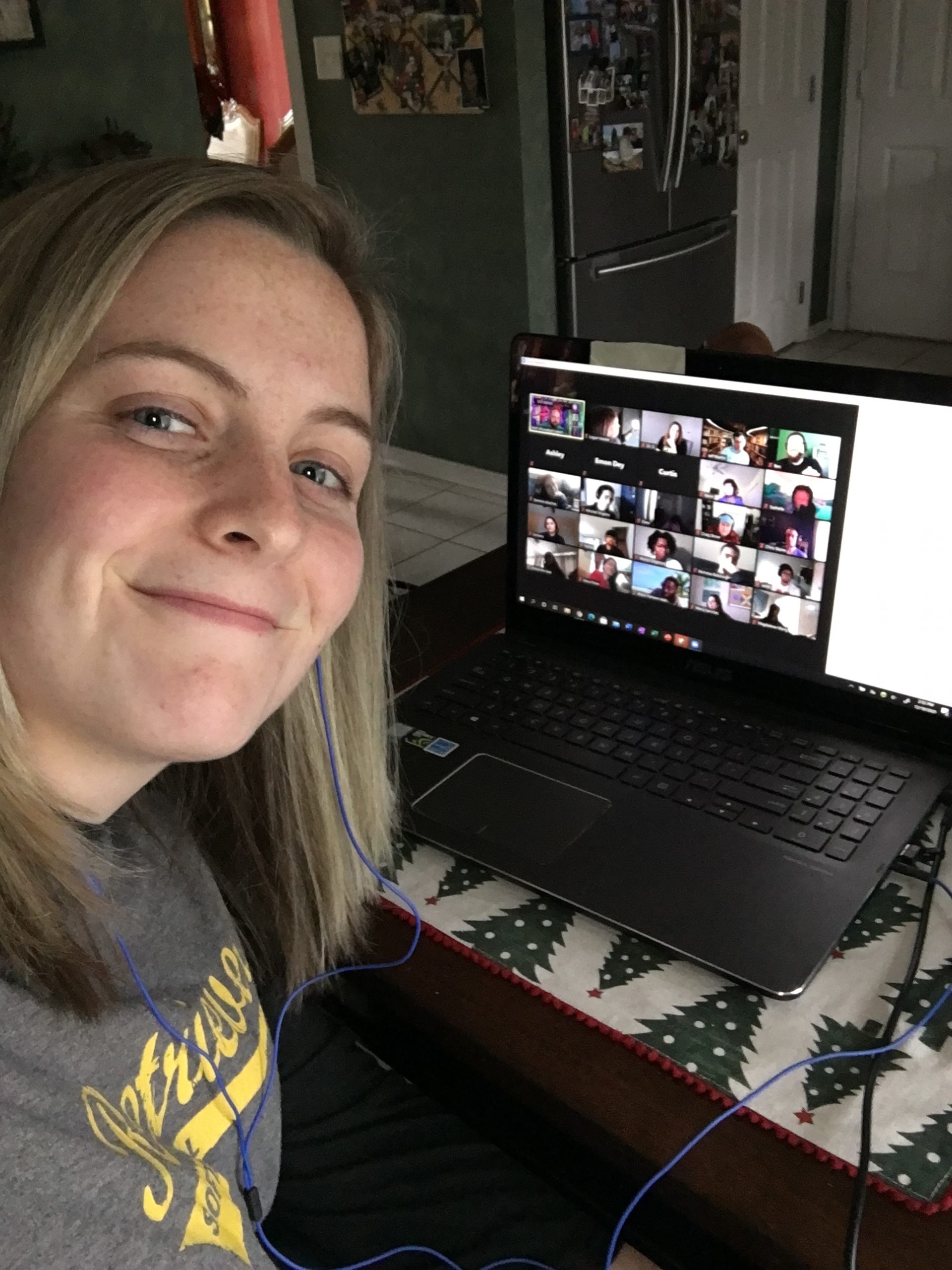
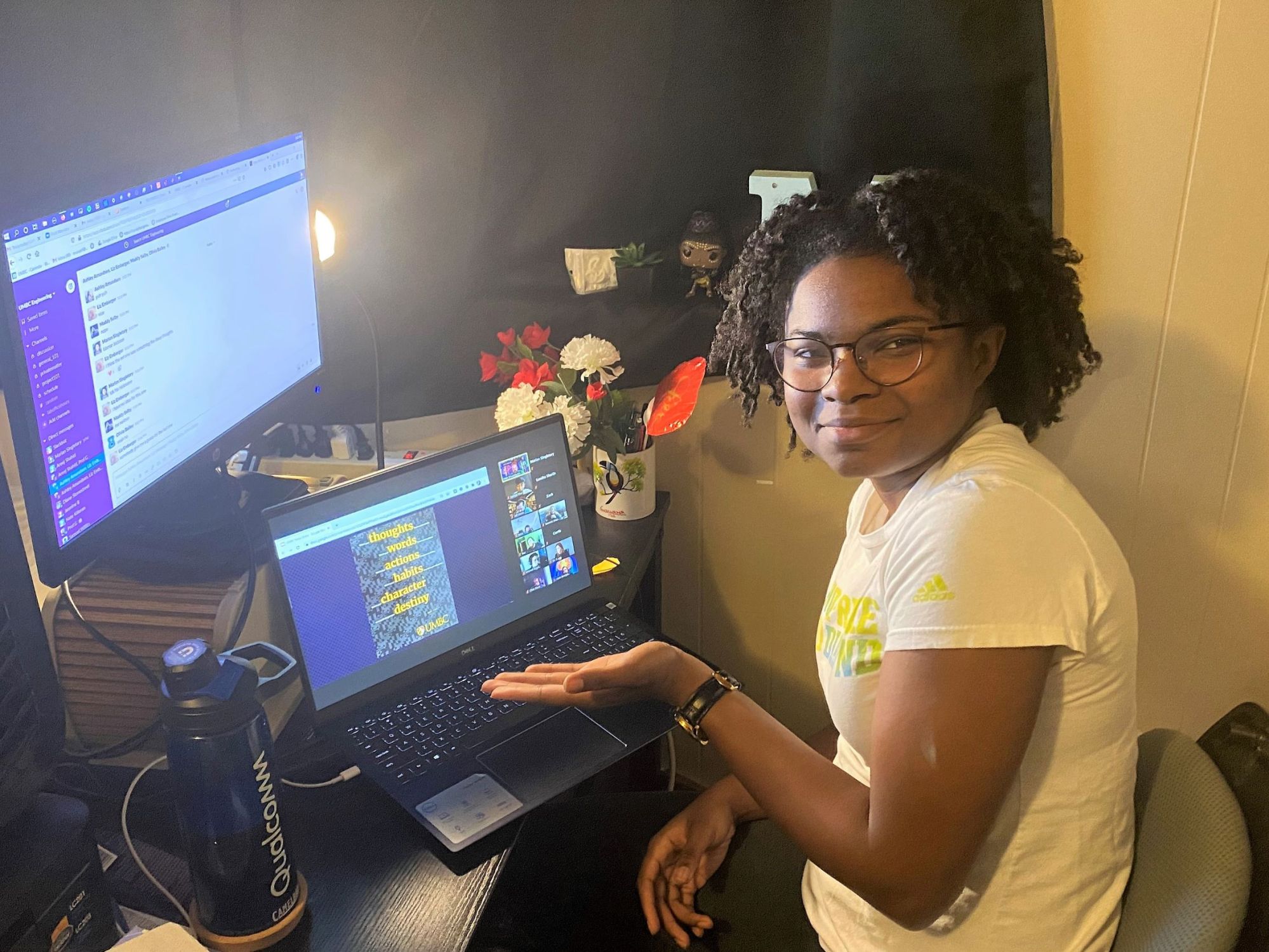
 Peer tutor Sumaiyah Mahmoodi ’21, health administration and policy, answers a student question online in front of a virtual background of the Academic Success Center. Photo courtesy of the ASC.
Britney Sarpong ‘21, computer science, taps into tutoring services twice a week for the CMSC 421: Operating Systems course she is taking. “I can easily log in and get help, and it’s usually the same tutor, so she and I have gotten to know each other really well,” she says.
For the operating systems course, Sarpong is learning C programming, which she likens to learning a foreign language. “I am not familiar at all with the language and terms with C programming,” says Sarpong, “so my tutor explains it in a way that I can understand while I’m working on projects.”
Moving services online
The tutoring offered by the Computing Success Center is just one of the many student support services offered by the ASC that has transitioned online during the COVID-19 pandemic. “This has been essential to enable us to continue serving UMBC students,” says Knapp.
 Amanda Knapp (standing) and Katharine Cole (second from right) speak with students in the Academic Success Center in 2019.
The Academic Success Center hires around 200 students to provide peer support each year. In addition to being paid and getting teaching experience, these student tutors also access professional development training.
Delana Gregg, director of academic learning resources, assessment, and analysis, says that the student tutors are integral to many of the services offered by the ASC.
“Faculty members recommend a student who excelled in a particular course. Then we train them on the technology and identifying strategies to help fellow students better understand the course content,” says Gregg.
The ASC provides tutoring in a range of formats, from appointment tutoring to drop-in tutoring, in the Computing Success Center, Writing Center, and the Math and Science Tutoring Center. In Fall 2020 alone, students attended over 3,000 tutoring appointments across all formats.
 Math and Science Tutoring Center session through UMBC’s Academic Success Center, 2019.
Gregg adds that peer-assisted study sessions (SI PASS) remain the most popular service utilized. “These are for courses that are historically difficult for students, often in the STEM areas,” she says. “SI Pass Leaders are students who have taken a particular course before. They attend the course again, take notes, and then hold weekly study sessions for current students.”
Emphasizing student success
The ASC also offers online learning resources for time management and study skills and academic alerts from faculty to students who are struggling in a course, to connect them with support. And the center is known for its academic advocates. They provide holistic support for students facing barriers to their academic success. These may include personal, academic, or financial issues.
“Sometimes students are unable to ask for help, are unaware that they are struggling academically, or are dealing with stress. Their stress may involve really complicated and challenging issues like the pandemic or racial inequality,” says Knapp. “We make sure they are cared for and heard.”
 Academic Advocates (l-r) Amanda Sharp, Cliff Saul, and Carlos Williams in 2019.
“UMBC students are very special, and here it’s cool to be smart,” says Gregg. “We have a large percentage of first-generation students who are very motivated to succeed, and the culture on campus emphasizes student success.”
Work like the partnership between COEIT and the Academic Success Center—where faculty and staff identify a problem and quickly partner with students to find a solution—is key to supporting student success.
Mentis shares, “The collaboration was so welcomed by faculty, department chairs of CSEE and IS, and Dean Bowman. In my time here, I believe it was the fastest initiative ever completed. Everyone said, ‘yes.’”
Banner image: Amanda Knapp speaks with a student in the ASC in 2019. Photos by Marlayna Demond ’11 for UMBC unless otherwise noted.
Article by Gregory J. Alexander for UMBC.
]]>
When Amanda Knapp heard last fall from Anupam Joshi, professor and chair of computer science and electrical engineering (CSEE), that his department wanted to offer online tutoring to students in...
https://umbc.edu/stories/umbc-rapidly-expands-live-online-peer-tutoring-to-include-computing-fields/
https://my3.my.umbc.edu/api/v0/pixel/news/119673/guest@my.umbc.edu/2e3375f69cd5913e61cbfd730159e442/api/pixel
coeit
csee
is
page1
science-and-technology
UMBC News & Magazine
https://my3.my.umbc.edu/groups/umbc-news-magazine
https://assets1-my.umbc.edu/system/shared/avatars/groups/000/001/943/24435aa6207c452e7bc15cc74b42c7bb/xsmall.png?1748556657
https://assets1-my.umbc.edu/system/shared/avatars/groups/000/001/943/24435aa6207c452e7bc15cc74b42c7bb/original.png?1748556657
https://assets2-my.umbc.edu/system/shared/avatars/groups/000/001/943/24435aa6207c452e7bc15cc74b42c7bb/xxlarge.png?1748556657
https://assets2-my.umbc.edu/system/shared/avatars/groups/000/001/943/24435aa6207c452e7bc15cc74b42c7bb/xlarge.png?1748556657
https://assets3-my.umbc.edu/system/shared/avatars/groups/000/001/943/24435aa6207c452e7bc15cc74b42c7bb/large.png?1748556657
https://assets1-my.umbc.edu/system/shared/avatars/groups/000/001/943/24435aa6207c452e7bc15cc74b42c7bb/medium.png?1748556657
https://assets2-my.umbc.edu/system/shared/avatars/groups/000/001/943/24435aa6207c452e7bc15cc74b42c7bb/small.png?1748556657
https://assets1-my.umbc.edu/system/shared/avatars/groups/000/001/943/24435aa6207c452e7bc15cc74b42c7bb/xsmall.png?1748556657
https://assets2-my.umbc.edu/system/shared/avatars/groups/000/001/943/24435aa6207c452e7bc15cc74b42c7bb/xxsmall.png?1748556657
UMBC News & Magazine
0
0
false
Fri, 12 Mar 2021 23:28:02 -0500
New UMBC-UMB collaborations include research to reduce stress among long-term care workers
A strategic research alliance between UMBC and the University of Maryland, Baltimore (UMB) has selected four new interdisciplinary projects, each a fresh take on a complex challenge.
The Accelerated Translational Incubator Pilot (ATIP) Program funding this work brings together UMBC’s strengths in areas like cybersecurity, data science, artificial intelligence, statistics, and the social sciences with UMB expertise in medicine, pharmacy, nursing, and dentistry. The two universities have worked together on various shared graduate and research programs over the last decade. This partnership with UMB’s Institute for Clinical and Translational Research (ICTR) was launched in August 2019, and faculty have been quick to jump on the opportunity to pursue novel collaborative research.
“The UMB-ICTR is thrilled to partner with UMBC,” says ICTR Director Stephen N. Davis, chair of medicine at UMB and physician-in-chief at the University of Maryland Medical Center. “The ATIP grant program supports top quality clinical and community-based collaborative projects. The grant applications from UMBC are particularly innovative and exciting, scoring very highly in the review process.”
“All of the ATIP proposals are subject to a very rigorous internal peer review process,” says Karl V. Steiner, vice president for research at UMBC. “Their success is a strong indicator of the quality of the intellectual contributions of our faculty at UMBC.”
Meaningful research relationships
“A key goal for this strategic alliance is to develop meaningful partnerships among researchers at both institutions and to establish teams with complementary expertise,” Steiner explains.
Since early 2020, UMBC faculty have secured a total of 12 ATIP awards. This most recent round of UMBC grant recipients includes Lujie Karen Chen, information systems; Lira Yoon, psychology; Chein-I Chang, computer science and electrical engineering (CSEE); Yi Huang, mathematics and statistics; and Tinoosh Mohsenin, CSEE. UMB collaborators include Kelly Doran, School of Nursing; Mathangi Gopalakrishnan, School of Pharmacy; and Michael Domanski and Mohammad Sajadi, both of the School of Medicine.
The four new awards granted in this round focus on a broad range of topics: using machine learning algorithms for transfusion risk assessment, evaluating the effects of serum lipid levels on the progression of renal dysfunction, using a multimodal sensory machine learning framework to diagnose COVID-19, and examining how to predict and manage stress in healthcare workers who work in long-term care facilities.
These types of sustained partnerships help researchers gain insight into new fields and work with experts with whom they might not have otherwise collaborated, to generate novel findings.
Measuring stress to manage stress

UMBC’s Lujie Karen Chen
So, what does interdisciplinary research actually look like?
For the long-term care workers pilot project, Chen, Yoon, and Doran combine data science, clinical psychology, and nursing. From May 2021 through April 2022, they will examine workers’ experiences of job stress in long-term care facilities using both physiological and qualitative measures.
The challenges posed by COVID-19 have sharpened the team’s interest in supporting longer-term care workers through research.

UMBC’s Lira Yoon
“Their work has always been important, but especially given the pandemic, the importance of their work has really been highlighted,” says Yoon. “It’s a demanding job with high stress, and that’s reflected by high job turnover, which is not good for the clients at long-term care facilities.”
The goal of the project is to better identify stress triggers within moments of them happening. This could enable workers to address their stress before it gets to a higher level where it can negatively impact their health and work.
Stress monitoring in action
To identify stress on a more moment-to-moment basis, the team plans to use a combination of surveys and sensors to track exact times when workers become stressed in their workday.
Workers will wear the sensors throughout their shifts to measure heart rate and electrodermal activity, and will fill out surveys five to seven times per day. They will also complete end-of-day interviews to identify additional stressors and other critical information not captured by the surveys.
Information from the surveys and interviews will help the researchers to decipher data obtained from the sensors to understand stress triggers.
“Eventually, we want to be able to just use sensor data to be able to tell whether long-term care workers are about to experience stress or not,” Yoon says. With this knowledge, researchers can then design interventions to improve the work environment, Chen explains, to reduce stress triggers and stress experiences.
Once the pilot project is complete, the team hopes to undertake a larger scale study to collect data from multiple long-term healthcare sites.

UMB’s Kelly Doran
This work wouldn’t be possible without all three researchers bringing together their diverse expertise and perspectives. As Doran says, “The collaboration provides a support system for us to build relationships and kind of cross-train each other and build off each other’s ideas.”
“One of the reasons I love doing collaborative research,” she shares, “is because you’re expanding your networks and research to make meaningful differences.”
Article written by Allison Matyus for UMBC News.
]]>
A strategic research alliance between UMBC and the University of Maryland, Baltimore (UMB) has selected four new interdisciplinary projects, each a fresh take on a complex challenge. The...
https://umbc.edu/stories/new-umbc-umb-collaborations-include-research-to-reduce-stress-among-long-term-care-workers/
https://my3.my.umbc.edu/api/v0/pixel/news/119676/guest@my.umbc.edu/2fae8a3664a6e4bc1fe0fe72d19bb147/api/pixel
cahss
cnms
coeit
csee
is
mathstat
psychology
research
science-and-technology
UMBC News & Magazine
https://my3.my.umbc.edu/groups/umbc-news-magazine
https://assets1-my.umbc.edu/system/shared/avatars/groups/000/001/943/24435aa6207c452e7bc15cc74b42c7bb/xsmall.png?1748556657
https://assets1-my.umbc.edu/system/shared/avatars/groups/000/001/943/24435aa6207c452e7bc15cc74b42c7bb/original.png?1748556657
https://assets2-my.umbc.edu/system/shared/avatars/groups/000/001/943/24435aa6207c452e7bc15cc74b42c7bb/xxlarge.png?1748556657
https://assets2-my.umbc.edu/system/shared/avatars/groups/000/001/943/24435aa6207c452e7bc15cc74b42c7bb/xlarge.png?1748556657
https://assets3-my.umbc.edu/system/shared/avatars/groups/000/001/943/24435aa6207c452e7bc15cc74b42c7bb/large.png?1748556657
https://assets1-my.umbc.edu/system/shared/avatars/groups/000/001/943/24435aa6207c452e7bc15cc74b42c7bb/medium.png?1748556657
https://assets2-my.umbc.edu/system/shared/avatars/groups/000/001/943/24435aa6207c452e7bc15cc74b42c7bb/small.png?1748556657
https://assets1-my.umbc.edu/system/shared/avatars/groups/000/001/943/24435aa6207c452e7bc15cc74b42c7bb/xsmall.png?1748556657
https://assets2-my.umbc.edu/system/shared/avatars/groups/000/001/943/24435aa6207c452e7bc15cc74b42c7bb/xxsmall.png?1748556657
UMBC News & Magazine
0
0
false
Tue, 09 Mar 2021 22:15:02 -0500
UMBC international students build community online during COVID-19


Kirthana Kolekar.
Photo courtesy of Kolekar.
Graduate student Kirthana Kolekar began volunteering as one of UMBC’s first Global Ambassadors in summer 2020. It was a time of incredible stress. COVID-19 made personal connections challenging, federal policies for international students were in limbo, and her family was thousands of miles away in India. But serving as a resource for UMBC international students living abroad helped her feel a strong sense of purpose.
Then, in the fall, everything changed. Kolekar’s mother suddenly passed away from COVID-19 and she flew from Baltimore to Bidar, India, to be with her family. Through it all, she says, she felt supported by her UMBC community. Faculty, classmates, and fellow ambassadors reached out to offer support, as she had reached out to others before.
Kolekar ‘21, information systems, says, “They kept asking: ‘How are you doing? Do you need any help?’” And that mentality—proactively being present for a person half-way around the world—is what the Global Ambassador Peer Mentor Program is all about.
Year of rapid growth
UMBC’s Global Ambassador Program began with a few volunteers connecting with fellow students online. In less than a year, it has quickly grown into a fully-fledged, paid leadership opportunity for UMBC international students living in Baltimore to connect with peers around the globe.
Ambassadors provide peer support that transcends borders. They host panels, facilitate webchats, lead presentations, conduct workshops, and guide newly enrolled students, all online. And when, as COVID-19 recedes, more new international students can physically come to campus, they look forward to welcoming them in person.
“The mission of the Ambassador Program is to ensure you feel connected with your peers as soon as you become a part of the UMBC community,” says Natalie Lobb, a UMBC international student support specialist who oversees the program’s day-to-day operations. “It’s important to know that you are never alone, that you always have someone you can lean on.”
‘They are new, just like I was’

Nastaran Azar.
Photo courtesy of Azar.
Even in a typical year, international students face distinct challenges adjusting to campus life. “Everything was completely different,” says Nastaran Azar, a junior biology major and Global Ambassador, recalling her first semester.
Daily assignments and regular tests at UMBC were a shift from the semesterly exams in Azar’s native Iran. Outside the classroom, she had to navigate getting an apartment, a job, and a driver’s license.
Azar had two older brothers already living in Baltimore, but she realizes other students often don’t have such connections. “They are new, just like I was—uncomfortable and feeling like they don’t know how to do anything. I hope I can help them all to be comfortable and find friends,” she says.

Dmitry Pankratov. Photo courtesy of Pankratov.
Ambassador Dmitry Pankratov recalls how jarring it felt to move from Moscow to Maryland five years ago—and that was without COVID-19 closures. “I understand how awful it can be when you have just come to a new place, and you don’t have anyone around,” the data science master’s student says.
Incoming international students have a litany of questions for ambassadors—everything from how to file taxes to where to buy their favorite foods. “What kind of masalas, what are the ranges in prices, what spices do you need to bring from your home country,” Kolekar lists off, before the self-described foodie adds: “The taste slightly differs!”
Given the global pandemic, ordinary challenges quickly become complex. With that reality, receiving outreach has proven instrumental in connecting international students with university life.
Building relationships
The Global Ambassador Program has found ways to foster community as students study remotely. Many of the ambassadors lead webinars teaching students how to continue engaging in university life. One will focus on the university’s award-winning Bollywood fusion dance team, Adaa. Others spotlight UMBC resources, such as virtual gaming options accessible now and the Gameroom available for students when they eventually come to campus.
Pankratov has spoken about UMBC’s chess club at past events. He plans to deliver a session about the running club next. He’ll focus on the best trails in Maryland and how UMBC students can keep each other motivated while exercising safely outdoors.
“We have special training and people who can guide you, because when you’re just starting, it’s very hard to understand your own physical limitations,” Pankratov says. “It’s team building. You talk with people, get acquainted. Even with COVID-19, you can share your pace and time with others.”
Expanding horizons
UMBC already has a global feel, with international students making up nearly eight percent of the overall student body and a quarter of graduate students. The Global Ambassadors Program enables international students to benefit from connecting with fellow UMBC students from around the globe even if they can’t say hello to each other on Academic Row.
 Students at the Center for Global Engagement 2019 international student orientation. Photo by Marlayna Demond.
Students build trust with one other in the program, Azar says, helping them form homes away from home. They also come to understand themselves and the world in new ways. Kolekar, an aspiring business analyst, says making friends with a diverse set of viewpoints is reframing how she’ll approach her career.
Pankratov marvels at how he has met students from all across the globe, from India and China to Ecuador. “We all have different schools of thought, of literature, and so it just enlightens,” he says. “With this program, I can make friends with people who I never knew existed before.”
Banner image: Flags of the world in the UMBC Commons. Photo by Marlaynd Demond ’11 for UMBC.
Article written by Nick Ford for UMBC News.
]]>
Kirthana Kolekar. Photo courtesy of Kolekar. Graduate student Kirthana Kolekar began volunteering as one of UMBC’s first Global Ambassadors in summer 2020. It was a time of incredible...
https://umbc.edu/stories/umbc-international-students-build-community-online-during-covid-19/
https://my3.my.umbc.edu/api/v0/pixel/news/119683/guest@my.umbc.edu/320954fe3c413b58727fa65c04ef7c10/api/pixel
biology
classof2021
cnms
coeit
community
international
is
page1
UMBC News & Magazine
https://my3.my.umbc.edu/groups/umbc-news-magazine
https://assets1-my.umbc.edu/system/shared/avatars/groups/000/001/943/24435aa6207c452e7bc15cc74b42c7bb/xsmall.png?1748556657
https://assets1-my.umbc.edu/system/shared/avatars/groups/000/001/943/24435aa6207c452e7bc15cc74b42c7bb/original.png?1748556657
https://assets2-my.umbc.edu/system/shared/avatars/groups/000/001/943/24435aa6207c452e7bc15cc74b42c7bb/xxlarge.png?1748556657
https://assets2-my.umbc.edu/system/shared/avatars/groups/000/001/943/24435aa6207c452e7bc15cc74b42c7bb/xlarge.png?1748556657
https://assets3-my.umbc.edu/system/shared/avatars/groups/000/001/943/24435aa6207c452e7bc15cc74b42c7bb/large.png?1748556657
https://assets1-my.umbc.edu/system/shared/avatars/groups/000/001/943/24435aa6207c452e7bc15cc74b42c7bb/medium.png?1748556657
https://assets2-my.umbc.edu/system/shared/avatars/groups/000/001/943/24435aa6207c452e7bc15cc74b42c7bb/small.png?1748556657
https://assets1-my.umbc.edu/system/shared/avatars/groups/000/001/943/24435aa6207c452e7bc15cc74b42c7bb/xsmall.png?1748556657
https://assets2-my.umbc.edu/system/shared/avatars/groups/000/001/943/24435aa6207c452e7bc15cc74b42c7bb/xxsmall.png?1748556657
UMBC News & Magazine
0
0
false
Wed, 17 Feb 2021 18:20:00 -0500
UMBC researchers use AI to help businesses understand complex legal docs, like the Code of Federal Regulations
UMBC researchers have made strides in automated legal document analytics by creating a way to machine-process the Code of Federal Regulations (CFR). The CFR is a complex document containing policies related to doing business with the federal government. All business affiliates of the federal government must comply with it. For government contracts to be equitably open to a broad range of businesses, policies within the CFR must be accessible.
This document automation is just one part of a broader project to help contractors and other entities manage and monitor their legal documents. Directed by Karuna Joshi, associate professor of information systems, the team has successfully managed to do a complete analysis of the CFR. Digital Government: Research and Practice recently published their methodology.
 Karuna Joshi (left) with Yelena Yesha, 2018.
Automating document review through AI
The team’s method for analyzing the CFR involves artificial intelligence (AI), which learns how to categorize information within the document, store it, and extract it when it is requested. Joshi and her team achieved this by creating a knowledge graph using Semantic Web technologies to illustrate all the key terms, rules, and regulations in the document. This basic framework enables users to ask an automated tool about a specific rule and be provided with the answer.
The semantic web language OWL, or Web Ontology Language, is used to represent concepts and to contextualize relationships. According to Joshi, the framework of the knowledge graph can be “adopted by federal agencies and businesses to automate their internal processes that reference the CFR rules and policies.” To facilitate this, they will make it available in the public domain.
Question and answer
General users can interact with the knowledge graph through a question-and-answer process, similar to how many people use Amazon’s Alexa or Apple’s Siri. For example, Joshi says, someone could ask a policy-related question like, “How many days at a minimum must a Request for Proposal (RFP) be posted open/available?” The system would query the CFR knowledge graph to find sections in the document that answer this question.
 Karuna Joshi presents at the USNA-UMBC research symposium, 2016.
The researchers anticipate this will be a highly useful system for any business held to the CFR thanks to how it breaks down CFR’s legal complexity through the automated process with ease.
Access and accountability
This project to automate and support users’ understanding of legal documents has been an ongoing effort by the UMBC team. Beyond the CFR, they seek to assist people with understanding legally binding contracts that they encounter every day, such as terms of service for major companies.

Lavanya Elluri. Image courtesy of Elluri.
Lavanya Elluri, graduate student of information systems, adds, “Our research helps the organizations that use cloud services to understand the context from these textual documents quickly.”
Many users have found that companies are using their data without their knowledge. Often, this is due to the information buried within terms of service and privacy policies. Joshi predicts that the tools her team is developing to help users better understand these documents will be essential to hold companies accountable for their data use.
Featured image: UMBC’s Information Technology and Engineering Building. All photos by Marlayna Demond ’11 for UMBC unless otherwise noted.
Story by Morgan Zepp for UMBC.
]]>
UMBC researchers have made strides in automated legal document analytics by creating a way to machine-process the Code of Federal Regulations (CFR). The CFR is a complex document containing...
https://umbc.edu/stories/umbc-researchers-use-ai-to-help-businesses-understand-complex-legal-docs-like-the-code-of-federal-regulations/
https://my3.my.umbc.edu/api/v0/pixel/news/119691/guest@my.umbc.edu/926a3718aaab2c7cf11bf5049e9c9917/api/pixel
coeit
is
research
science-and-technology
UMBC News & Magazine
https://my3.my.umbc.edu/groups/umbc-news-magazine
https://assets1-my.umbc.edu/system/shared/avatars/groups/000/001/943/24435aa6207c452e7bc15cc74b42c7bb/xsmall.png?1748556657
https://assets1-my.umbc.edu/system/shared/avatars/groups/000/001/943/24435aa6207c452e7bc15cc74b42c7bb/original.png?1748556657
https://assets2-my.umbc.edu/system/shared/avatars/groups/000/001/943/24435aa6207c452e7bc15cc74b42c7bb/xxlarge.png?1748556657
https://assets2-my.umbc.edu/system/shared/avatars/groups/000/001/943/24435aa6207c452e7bc15cc74b42c7bb/xlarge.png?1748556657
https://assets3-my.umbc.edu/system/shared/avatars/groups/000/001/943/24435aa6207c452e7bc15cc74b42c7bb/large.png?1748556657
https://assets1-my.umbc.edu/system/shared/avatars/groups/000/001/943/24435aa6207c452e7bc15cc74b42c7bb/medium.png?1748556657
https://assets2-my.umbc.edu/system/shared/avatars/groups/000/001/943/24435aa6207c452e7bc15cc74b42c7bb/small.png?1748556657
https://assets1-my.umbc.edu/system/shared/avatars/groups/000/001/943/24435aa6207c452e7bc15cc74b42c7bb/xsmall.png?1748556657
https://assets2-my.umbc.edu/system/shared/avatars/groups/000/001/943/24435aa6207c452e7bc15cc74b42c7bb/xxsmall.png?1748556657
UMBC News & Magazine
0
0
false
Fri, 29 Jan 2021 20:37:15 -0500
U.S. News names UMBC’s online master’s in information systems one of the nation’s best

UMBC’s online master’s degree in information systems has once again been ranked one of the best programs in the nation by U.S. News. The rankings, announced this week, also highlight UMBC as offering one of the top 20 such degrees in this field for veterans.
U.S. News has now recognized this UMBC program for several years, making it a longtime leader. Joining UMBC on the list in 2021 are universities like Virginia Tech and Drexel.
Faculty committed to student success
Graduate program director Anita Komlodi, associate professor of information systems, shares, “We are very excited to again be ranked among the best. Our program is well established, with about twenty years of experience educating online technology students.”
 Anita Komlodi. Photo by Marlayna Demond ’11 for UMBC.
Keith J Bowman, dean of the College of Engineering and Information Technology, has described the program’s faculty as deeply committed to their mission of “enabling our online master’s students to gain the skills required to succeed with our extensive range of industry and government partners.”
“We put our students first. We designed our program both for working IT professionals and career changers wishing to transition into IT careers,” Komlodi says. “Most of our students work full-time. The flexibility and asynchronous nature of the program helps them progress in their careers while balancing other responsibilities.”
Flexibility and rigor
UMBC built the online master’s degree in information systems for students balancing many responsibilities. Many are managing work, family, military service, and other commitments, while still seeking to advance their education and careers. And students are able to pursue interests in an extremely broad array of focus area, from health information technology to human-centered computing.
Komlodi notes, “We have recently introduced tracks for in-demand industry areas in artificial intelligence, cybersecurity, data science, and user experience design.”
 Vandana Janeja. Photo by Marlayna Demond ’11 for UMBC.
Vandana Janeja, chair of information systems, knows the value that a rigorous, flexible online graduate program can bring to students. Upon UMBC earning U.S. News recognition last year, she commented that for the online program, “We are committed to a high level of excellence and engagement akin to our on-campus program.”
It’s all about pairing high expectations with strong support for students, she says—the trademark UMBC experience.
Banner image: Mobile technology. Photo by WOCinTechChat, CC BY 2.0.
]]>
UMBC’s online master’s degree in information systems has once again been ranked one of the best programs in the nation by U.S. News. The rankings, announced this week, also highlight UMBC as...
https://umbc.edu/stories/u-s-news-names-umbcs-online-masters-in-information-systems-one-of-the-nations-best/
https://my3.my.umbc.edu/api/v0/pixel/news/119694/guest@my.umbc.edu/0c722c959280f78083adb47426bf369e/api/pixel
coeit
graduateschool
is
rankings
science-and-technology
UMBC News & Magazine
https://my3.my.umbc.edu/groups/umbc-news-magazine
https://assets1-my.umbc.edu/system/shared/avatars/groups/000/001/943/24435aa6207c452e7bc15cc74b42c7bb/xsmall.png?1748556657
https://assets1-my.umbc.edu/system/shared/avatars/groups/000/001/943/24435aa6207c452e7bc15cc74b42c7bb/original.png?1748556657
https://assets2-my.umbc.edu/system/shared/avatars/groups/000/001/943/24435aa6207c452e7bc15cc74b42c7bb/xxlarge.png?1748556657
https://assets2-my.umbc.edu/system/shared/avatars/groups/000/001/943/24435aa6207c452e7bc15cc74b42c7bb/xlarge.png?1748556657
https://assets3-my.umbc.edu/system/shared/avatars/groups/000/001/943/24435aa6207c452e7bc15cc74b42c7bb/large.png?1748556657
https://assets1-my.umbc.edu/system/shared/avatars/groups/000/001/943/24435aa6207c452e7bc15cc74b42c7bb/medium.png?1748556657
https://assets2-my.umbc.edu/system/shared/avatars/groups/000/001/943/24435aa6207c452e7bc15cc74b42c7bb/small.png?1748556657
https://assets1-my.umbc.edu/system/shared/avatars/groups/000/001/943/24435aa6207c452e7bc15cc74b42c7bb/xsmall.png?1748556657
https://assets2-my.umbc.edu/system/shared/avatars/groups/000/001/943/24435aa6207c452e7bc15cc74b42c7bb/xxsmall.png?1748556657
UMBC News & Magazine
0
0
false
Thu, 28 Jan 2021 18:32:12 -0500
UMBC students help create richer online courses for peers in engineering and computing fields
As UMBC faculty prepare for spring, they are reflecting on lessons learned from a primarily online fall 2020 semester. In UMBC’s College of Engineering and Information Technology (COEIT), this means honoring teaching fellows and teaching assistants for their role in making sure courses met student needs.
Essential perspective
“I think anybody’s goal, in any sort of class, is to provide the highest quality, most optimal experience to our students,” said Jamie Gurganus, COEIT’s associate director of engineering education initiatives, in an interview last summer. Along with colleagues across the university, she worked through the summer and fall to help faculty provide students with “safe, thriving online environments” to learn.
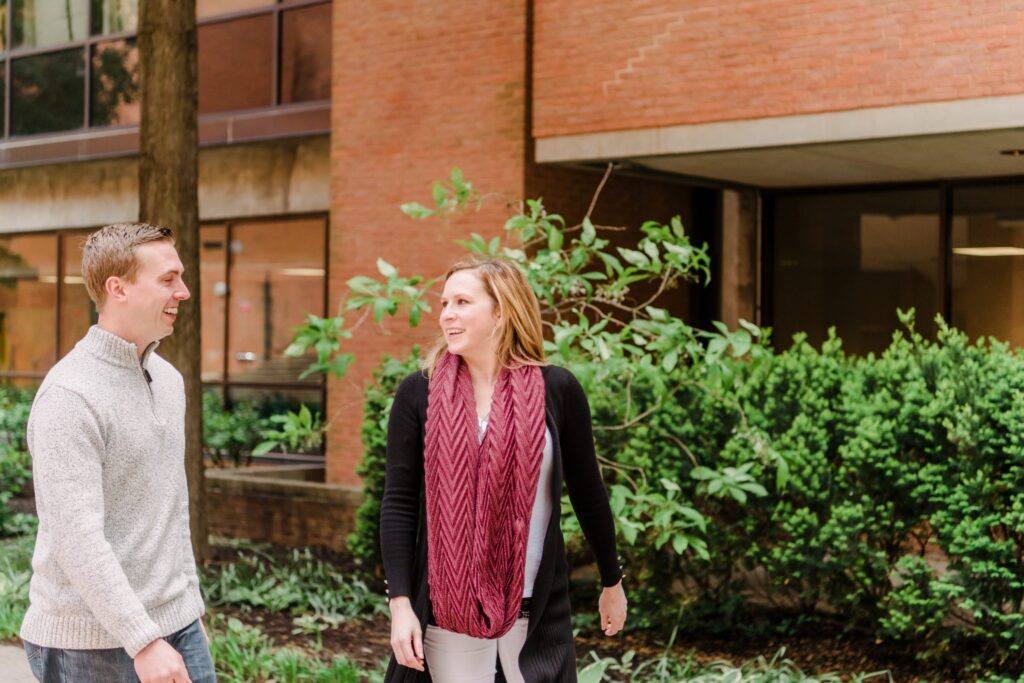 Jamie Gurganus (right) walks with Randy Deinlein ’19, mechanical engineering, on campus, May 2019. Photo by Marlayna Demond ’11 for UMBC.
The centerpiece of this work was the Planning Instructional Variety for Online Teaching (PIVOT) program. PIVOT, PIVOT+, and more specialized webinars helped faculty design truly engaging online courses. COEIT hired several rising UMBC juniors and seniors to participate in the workshops and offer feedback to faculty.
These undergraduate teaching fellows “brought an essential perspective,” Gurganus shares. They continued to provide feedback throughout the fall, and many are continuing the work in spring 2021.
Creativity and community
Hana Flores ’21, chemical engineering, served as a teaching fellow. She shares, “It was unlike anything we have done before, but it was special due to the creativity and strong community of COEIT.”
Flores sees her experience as emblematic of a culture of community support. “I’m grateful for continuing the legacy of support from upperclassmen to underclassmen as a teaching fellow,” she says. “It is what makes engineering classes exceptional.”
Celebrating together
COEIT invited Flores and dozens of other teaching fellows and teaching assistants to a celebration to honor their work in late December. After a busy and intense semester, they took time to enjoy each others’ company, with Flores’s team, the ChemiE Cuties, winning the celebration’s trivia contest.
 Hana Flores (center row, left, in red shirt) with her winning team, the ChemiE Cuties. Image courtesy of COEIT.
“Watching our students celebrate allowed my mind to forget for a moment the challenges that we face,” says Mariajose Castellanos, senior lecturer and undergraduate program director of chemical engineering. “It was important to me that we could come together and remind them of how much we appreciate them. They make our classes better and provide invaluable help.”
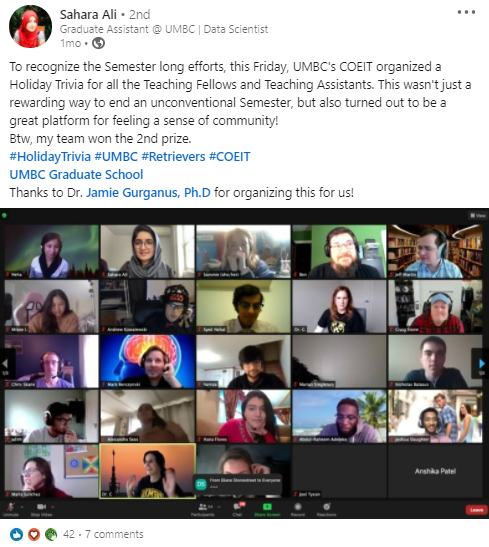
LinkedIn post by
Sahara Ali, PhD student in information systems.
A more meaningful experience
“When it comes to delivering a class, it’s a collaboration effort between the instructors, teaching fellows, and teaching assistants,” says Gurganus. “They go beyond the scope of grading papers and holding office hours. These students provide a unique perspective that gives our classes a richer and more meaningful experience.”
Often, these students have recently completed the class they are now supporting, so they are able to identify and relate to its challenges in a unique way.
“These students’ insights enhance our courses in so many ways,” Gurganus shares, “and they have such a positive impact on the learning experience we can provide.”
Although some COEIT teaching fellows and teaching assistants graduated in fall 2020, Gurganus says a majority will continue their work in spring 2021, as UMBC courses remain largely online.
Tiled gallery images above: Logan Hawker ’22, mechanical engineering, at left, and CWIT CyberScholar Marian Singletary ’21, computer engineering, at right, compete in the trivia game. Images courtesy of Hawker and Singletary.
Featured image: Hand clicking laptop mouse. Photo by Flickr user Marco Verch, CC BY 2.0.
]]>
As UMBC faculty prepare for spring, they are reflecting on lessons learned from a primarily online fall 2020 semester. In UMBC’s College of Engineering and Information Technology (COEIT), this...
https://umbc.edu/stories/umbc-students-help-create-richer-online-courses-for-peers-in-engineering-and-computing-fields/
https://my3.my.umbc.edu/api/v0/pixel/news/119700/guest@my.umbc.edu/94411753e91458ec08f7d6f6fbc4938f/api/pixel
cbee
coeit
community
csee
is
meche
page1
science-and-technology
UMBC News & Magazine
https://my3.my.umbc.edu/groups/umbc-news-magazine
https://assets1-my.umbc.edu/system/shared/avatars/groups/000/001/943/24435aa6207c452e7bc15cc74b42c7bb/xsmall.png?1748556657
https://assets1-my.umbc.edu/system/shared/avatars/groups/000/001/943/24435aa6207c452e7bc15cc74b42c7bb/original.png?1748556657
https://assets2-my.umbc.edu/system/shared/avatars/groups/000/001/943/24435aa6207c452e7bc15cc74b42c7bb/xxlarge.png?1748556657
https://assets2-my.umbc.edu/system/shared/avatars/groups/000/001/943/24435aa6207c452e7bc15cc74b42c7bb/xlarge.png?1748556657
https://assets3-my.umbc.edu/system/shared/avatars/groups/000/001/943/24435aa6207c452e7bc15cc74b42c7bb/large.png?1748556657
https://assets1-my.umbc.edu/system/shared/avatars/groups/000/001/943/24435aa6207c452e7bc15cc74b42c7bb/medium.png?1748556657
https://assets2-my.umbc.edu/system/shared/avatars/groups/000/001/943/24435aa6207c452e7bc15cc74b42c7bb/small.png?1748556657
https://assets1-my.umbc.edu/system/shared/avatars/groups/000/001/943/24435aa6207c452e7bc15cc74b42c7bb/xsmall.png?1748556657
https://assets2-my.umbc.edu/system/shared/avatars/groups/000/001/943/24435aa6207c452e7bc15cc74b42c7bb/xxsmall.png?1748556657
UMBC News & Magazine
0
0
false
Tue, 19 Jan 2021 15:56:33 -0500
UMBC researchers speed up analysis of Arctic ice and snow data through AI

UMBC researchers have developed a technique to more quickly analyze extensive data from Arctic ice sheets to gain insight and useful knowledge on patterns and trends.
Over the years, vast amounts of data have been collected about the Arctic and Antarctic ice. These data are essential for scientists and policymakers seeking to understand climate change and the current trend of melting. Masoud Yari, research assistant professor, and Maryam Rahnemoonfar, associate professor of information systems, have utilized new AI technology to develop a fully automatic technique to analyze ice data.
This public impact research is part of the National Science Foundation’s ongoing BigData project. Rahnemoonfar, Yari, and colleagues have published their findings in the Journal of Glaciology.
Rethinking manual techniques
For decades, researchers have kept close track of polar ice, snow, and soil measurements, but processing the large volume of available data has proven challenging. NASA’s processes for collecting, tracking, and labeling polar data involve significant manual work, and changes detected in the data can take months or even years to see. Even Arctic data collected via remote sensing technologies require manual processing.

Maryam Rahnemoonfar
According to Rahnemoonfar, “Radar big data is very difficult to mine and understand just by using manual techniques.”
The AI techniques the researchers are developing can be used to mine the data more quickly. They help scientists get useful information on trends related to the thickness of the ice sheets and the level of snow accumulation in a certain location.
Spotting patterns
The researchers developed an algorithm that learns how to identify objects and patterns within the Arctic and Antarctic data. An AI algorithm must be exposed to hundreds of thousands of examples to learn how to identify important elements and patterns. Rahnemoonfar and her team used existing incomplete and noisy labeled data from the Arctic to train the AI algorithm on how to categorize and understand new data.
The algorithm’s training is not yet complete. Researchers will need to scale it up over multiple sensors and locations to create a more accurate tool. However, it has already successfully begun to automate a process that was previously inefficient and labor-intensive.
The rapid expansion of using AI to understand ice and snow thickness in the Arctic will allow scientists and researchers to make faster and more accurate predictions to inform dialogue about climate change. The rate at which Arctic ice is melting impacts sea levels. If scientists are better able to predict the severity of the melting, society can better mitigate the harm caused by sea level rise.
Featured image: Team members from U.S. Coast Guard Cutter Healy on the NASA ICESCAPE mission, July 2011. Photo by NASA/Kathryn Hansen.
Story by Morgan Zepp for UMBC.
]]>
UMBC researchers have developed a technique to more quickly analyze extensive data from Arctic ice sheets to gain insight and useful knowledge on patterns and trends. Over the years, vast...
https://umbc.edu/stories/umbc-researchers-speed-up-analysis-of-arctic-ice-and-snow-data-through-ai/
https://my3.my.umbc.edu/api/v0/pixel/news/119703/guest@my.umbc.edu/17985593677c0e630b02d22d8ca6fe0e/api/pixel
coeit
is
science-and-technology
UMBC News & Magazine
https://my3.my.umbc.edu/groups/umbc-news-magazine
https://assets1-my.umbc.edu/system/shared/avatars/groups/000/001/943/24435aa6207c452e7bc15cc74b42c7bb/xsmall.png?1748556657
https://assets1-my.umbc.edu/system/shared/avatars/groups/000/001/943/24435aa6207c452e7bc15cc74b42c7bb/original.png?1748556657
https://assets2-my.umbc.edu/system/shared/avatars/groups/000/001/943/24435aa6207c452e7bc15cc74b42c7bb/xxlarge.png?1748556657
https://assets2-my.umbc.edu/system/shared/avatars/groups/000/001/943/24435aa6207c452e7bc15cc74b42c7bb/xlarge.png?1748556657
https://assets3-my.umbc.edu/system/shared/avatars/groups/000/001/943/24435aa6207c452e7bc15cc74b42c7bb/large.png?1748556657
https://assets1-my.umbc.edu/system/shared/avatars/groups/000/001/943/24435aa6207c452e7bc15cc74b42c7bb/medium.png?1748556657
https://assets2-my.umbc.edu/system/shared/avatars/groups/000/001/943/24435aa6207c452e7bc15cc74b42c7bb/small.png?1748556657
https://assets1-my.umbc.edu/system/shared/avatars/groups/000/001/943/24435aa6207c452e7bc15cc74b42c7bb/xsmall.png?1748556657
https://assets2-my.umbc.edu/system/shared/avatars/groups/000/001/943/24435aa6207c452e7bc15cc74b42c7bb/xxsmall.png?1748556657
UMBC News & Magazine
0
0
false
Wed, 13 Jan 2021 15:51:08 -0500
UMBC’s newest computing grads, from bachelor’s to Ph.D., share stories of connection, support, opportunity
UMBC’s newest graduates in computing and data science fields include students at all stages in their education and careers. Undergraduates, master’s students seeking to access new career opportunities, and Ph.D. students completing high-impact research have thrived at UMBC. Many cite the university’s strong academics, accessible faculty, research opportunities, and connections across disciplines as drawing them to UMBC. Connections with mentors and communities of support have helped carry them over the finish line to earn their degrees.
Impacting communities through service-learning
Fikir Ejigineh ‘20, information systems, remembers feeling intrigued by UMBC in high school, when she first heard about the university’s living learning communities (LLCs). Before long, she moved into UMBC’s Shriver Center LLC, a residential floor for students committed to civic engagement, service, and community-building.

Fikir Ejigineh. Photo courtesy of The Shriver Center.
As an information systems student focused on community-based problem-solving, she was selected for UMBC’s CoLab program in 2018. Ejigineh formed the Race and Social Justice CoLab with two other students. Together, they worked with new mapping software from UMBC’s Imaging Research Center, creating a 3D space to collect and share the multimedia stories of people living in Baltimore. The purpose of the project was to highlight voices that are oftentimes suppressed by the media’s representation of Baltimore City, Ejigineh explains.
As a France-Merrick Scholar through the Shriver Center, Ejigineh helped develop a creative art contest and leadership day for Baltimore youth that posed the question, ‘How do you envision your community?’. The project was another chance for her to work on a team with students from a broad range of majors. Together, they helped launch a display of youth artwork for the grand opening of OCA Mocha, a coffee shop and community gathering space in downtown Arbutus, founded by UMBC alumni.
Ejigineh has also served as vice-president of UMBC’s Ethiopian-Eritrean Student Association. A cultural organization that aims to support philanthropic causes by hosting annual events like the Awareness Banquet.
After graduation, Ejigineh will work as a business administrator at Alakrity, an IT startup company. In the future, she looks forward to combining her technical skills and creativity by furthering her education in user experience design.
 Fikir Ejigineh, third from right, meeting with her CoLabs group and mentors in 2018. Photo by Marlayna Demond ’11 for UMBC.
Her advice to incoming students is to focus not just on excelling in the classroom, but also finding opportunities to connect with students in other fields, and with communities on and off campus. “I’ve had a great UMBC experience because of what I’ve made out of it,” she says. “I would never be where I am now if I hadn’t gotten involved.”
Building connections
As an undergraduate at UMBC, Fabiha Mahmood ‘18, political science, M.P.S. ‘20, cybersecurity, knew that it was important to establish networks right away. “When I was visiting colleges, the one thing that really struck me about UMBC was how close-knit and diverse the community is,” she says. “For me, it’s really important to have interpersonal relationships with my professors.”

Mahmood at the 16 over 1 UMBC Basketball Celebration in the UMBC Event Center in 2018. Photo courtesy of Mahmood.
Mahmood was undecided about what major to pursue, but after meeting with Eric Brown, a lecturer in the individualized studies program, she was eager to begin a first-year seminar in security studies. “He was so invested in my journey here, and from that first interaction, I knew that UMBC was different,” she shares.
That trend of building close connections in the classroom and across campus continued. Mahmood went on to support UMBC students as a resident assistant and president of UMBC’s Panhellenic Association.
After completing her bachelor’s degree, Mahmood found that she was interested in careers that required technical skills that she didn’t yet have. She identified UMBC’s cybersecurity M.P.S. program as a strong complement to her political science degree.
In January 2020, Mahmood joined Residential Life again, this time as a graduate assistant, where she supervised resident assistants, and began a “whirlwind of a semester” in her new program. While she had no idea that the experience would involve a pandemic, she says that her mentors in Residential Life helped her stay motivated and feel connected when many things moved online. “I could tell that they genuinely cared about me, and can confidently say that I wouldn’t have gotten that anywhere else,” she says.
 Fabiha Mahmood, second from right in front row, at the Division of Student Affairs Holiday Party in 2019. Photo courtesy of Mahmood.
Mahmood plans to pursue a career as an intelligence analyst, combining her knowledge of political science and cybersecurity.
Opening doors in a high-demand field
Like Mahmood, Matthew Griff ‘17, mathematics, M.P.S. ‘20, data science, also found a UMBC master’s program to complement his undergraduate degree and open up doors in a high-demand field. After earning his bachelor’s degree, Griff completed a finance internship at the American Psychological Association. A master’s in data science was his “logical next step”—helping him explore impactful ways to apply knowledge from his mathematics courses.
Griff has enjoyed connecting with the data science program’s accessible faculty. He shares that Ergun Simsek, professor of practice and graduate program director for data science, was easy to approach and has served as a mentor for him. Building this one-on-one connection has helped him feel prepared for his next steps.
How tech impacts lives
William Easley took his first course on human-computer interaction as a curious undergraduate at UMBC. Ravi Kuber, associate professor of information systems, piqued his interest in how technology impacts peoples lives, particularly for people with disabilities. Easley, who has a visual impairment, went on to complete an M.S. in human-centered computing in 2015, and is now earning his Ph.D. in the field.
 William Easley talking about his work at event introducing UMBC’s User Studies Lab in January 2020. Photo by Britney Clause ’11.
Easley loves that as a researcher he is now on the cutting edge of “creating knowledge.” “The idea of designing and building technologies to help people with disabilities is super exciting to me. It’s something that’s worthwhile and meaningful,” he explains.
But Easley wasn’t always aware of the opportunities available to him through research. He recalls how much it meant to him as an undergraduate when mentors encouraged him to get involved with research and pursue his master’s degree. They included leaders like UMBC President Freeman Hrabowski and Renetta Tull, former associate vice provost for strategic initiatives at UMBC.
3D print shop creates opportunity
As a master’s student, Easley connected with Amy Hurst, former associate professor of information systems at UMBC, known for her high-impact community-engaged research. Hurst worked with the Digital Harbor Foundation’s 3D print shop in Baltimore City, helping youth develop technical skills that would serve them in future careers.
That experience and the connections he built over the years encouraged Easley to stay at UMBC to pursue his Ph.D. His work with youth at Digital Harbor became three years of dissertation research. Two youth from the first group continued to work in the print shop for all three years and took on more senior roles. Eventually, one of the youth became the shop manager, which Easley was excited about.
 William Easley, bottom center square, with his dissertation committee after he defended his dissertation in September 2020. Photo courtesy of Easley.
Throughout his time at UMBC, Easley says that support from faculty was important to his development as a researcher. Hurst helped him find opportunities to travel to present his research and connected him with fellow researchers in human-centered computing. Easley also worked closely with Helena Mentis, associate professor of information systems, and associate dean in the College of Engineering and Information Technology. Mentis and Foad Hamidi, assistant professor of information systems, were Easley’s co-advisors for his dissertation.
“Everyone that I worked with played a big role in helping me get to the finish line,” he says.
The COVID-19 pandemic shifted Easley’s final months at UMBC. He successfully defended his dissertation virtually in September, and interviewed and accepted a job as a human factors design engineer at Apple, and is currently working remotely.
Banner image: William Easley works with youth in the makerspace at the Digital Harbor Foundation in 2017. Photo by Marlayna Demond ’11 for UMBC.
]]>
UMBC’s newest graduates in computing and data science fields include students at all stages in their education and careers. Undergraduates, master’s students seeking to access new career...
https://umbc.edu/stories/umbcs-newest-computing-grads-from-bachelors-to-ph-d-share-stories-of-connection-support-opportunity/
https://my3.my.umbc.edu/api/v0/pixel/news/119724/guest@my.umbc.edu/c4a03d79eccd747a2b0e2bb8ca24e4cd/api/pixel
classof2020
coeit
community
cybersecurity
gradresearch
inds
is
mathstat
politicalscience
shrivercenter
UMBC News & Magazine
https://my3.my.umbc.edu/groups/umbc-news-magazine
https://assets1-my.umbc.edu/system/shared/avatars/groups/000/001/943/24435aa6207c452e7bc15cc74b42c7bb/xsmall.png?1748556657
https://assets1-my.umbc.edu/system/shared/avatars/groups/000/001/943/24435aa6207c452e7bc15cc74b42c7bb/original.png?1748556657
https://assets2-my.umbc.edu/system/shared/avatars/groups/000/001/943/24435aa6207c452e7bc15cc74b42c7bb/xxlarge.png?1748556657
https://assets2-my.umbc.edu/system/shared/avatars/groups/000/001/943/24435aa6207c452e7bc15cc74b42c7bb/xlarge.png?1748556657
https://assets3-my.umbc.edu/system/shared/avatars/groups/000/001/943/24435aa6207c452e7bc15cc74b42c7bb/large.png?1748556657
https://assets1-my.umbc.edu/system/shared/avatars/groups/000/001/943/24435aa6207c452e7bc15cc74b42c7bb/medium.png?1748556657
https://assets2-my.umbc.edu/system/shared/avatars/groups/000/001/943/24435aa6207c452e7bc15cc74b42c7bb/small.png?1748556657
https://assets1-my.umbc.edu/system/shared/avatars/groups/000/001/943/24435aa6207c452e7bc15cc74b42c7bb/xsmall.png?1748556657
https://assets2-my.umbc.edu/system/shared/avatars/groups/000/001/943/24435aa6207c452e7bc15cc74b42c7bb/xxsmall.png?1748556657
UMBC News & Magazine
0
0
false
Mon, 14 Dec 2020 20:40:43 -0500
TEDxUMBC brings community together through “Unmasking Uncertainty”
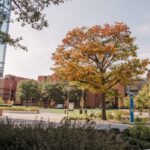
This fall, the student-organized TEDxUMBC gave ten speakers the opportunity to share their stories, experiences, and expertise with the world. Surprisingly, the theme, “Unmasking Uncertainty,” was actually conceived far before COVID-19 surged globally.
Tirzah Khan ‘20, information systems, led the TEDxUMBC team in organizing the event. When the planning committee chose their theme, she says, they did not anticipate the global pandemic, the resurgence in demands for racial justice, and a divisive election. “In these unprecedented circumstances, TEDxUMBC seeks to provide answers and build community,” Khan reflects.
A bumpy road to study in the U.S.
One of the speakers was Sahara Ali, Ph.D.‘26, information systems. She shared her path from Pakistan to the United States for graduate study and explained how it changed the way she approaches challenges.

Sahara Ali. Photo courtesy of Ali.
At age 21, Ali had graduated with her bachelor’s degree in computer science in Pakistan. She was eager to begin pursuing her Ph.D. at UMBC and to marry her U.S.-based fiancé. But it took over a year for Ali to obtain her visa from the U.S. Embassy. The delay changed her marriage plans and she feared it would make international graduate study impossible as well.
Facing a long and uncertain wait, Ali dedicated herself to her work in Pakistan. But just days after deciding to move on, she received her visa. She had to start over with her U.S. plans, rethinking how she would get to Maryland, where she would live, and what the experience would be like.
Ali says this situation taught her about her resilience and using creativity to work through unexpected obstacles. “Uncertainty can lead to something exciting, something innovative,” she shared, even if it means learning something “in an unconventional way.”
Today, Ali is pursuing her Ph.D. in information systems full-time at UMBC. She is working alongside Jianwu Wang, assistant professor of information systems, and collaborating with NASA scientists to study the causal effects of climate change.
Moving theater to a virtual space
Asif Majid ‘13, interdisciplinary studies, shared his passion for community theater and how he has adjusted his work (which previously depended on live, in-person audiences) to fit online formats.

Asif Majid. Photo courtesy of Majid.
Majid works at the intersection of Islam, media, marginality, and politics, and develops plays that focus on stories of racially and religiously marginalized communities. His TEDxUMBC talk took the audience back to the second week of March, when the COVID-19 pandemic first began impacting nearly every aspect of life.
At the time, Majid was in the final stages of producing a new play with a theater in Washington, D.C. Work had been underway since July 2019, and the show was scheduled to debut in front of an audience for the first time at the end of March 2020.
Majid was living with his older family members and became quite concerned that continuing to work in face-to-face settings could put his family members at risk. He decided that while the show needed to go on, it had to move to an online space.
In collaboration with the creative team, Majid figured out how the actors could perform from their own homes, and how attendees could watch the play remotely from around the world. “Over the course of two weeks, we learned about new technologies, rehearsed the tech to performance, and developed a new approach to making theater,” he said.
Ultimately, the performance attracted nearly eight times the number of people who would typically see a show in one night, and people tuned in from 18 countries.
Moving forward in uncertain times
Also featured in the event was Evangeline Kirigua ‘21, political science, who discussed the importance of empowering foreign-born nationals to engage in their communities without being able to vote. Haleemat Adekoya ‘23, political science, talked about being present in the moment, and how to face “what ifs” that can cause fear and uncertainty. Karis Barnett ‘21, chemistry, shared how to identify and address your internal critic to discover self-worth.
Other speakers gave a window into different fields. John Hebeler, a part-time lecturer in information systems, spoke about machine learning, including the impact that it is having on people now and will continue to have in the future. Maryam Elhabashy ‘21, anthropology, discussed the challenges around integrating ethnic studies into school curricula, and how attempts to celebrate diversity may inadvertently lead to otherization. Mike Spano ‘21, psychology, talked about theories related to sleep and dreams, and how to mold your dreams into reality.
Like Ali and Majid, speakers reflected on personal experiences. Rojin Najmabadi ‘21, biological sciences, discussed the decision to invest in herself on her path to success, even when that decision went against how she was raised by her family. Zareen Taj, Ph.D. ‘26, language, literacy, and culture, shared her personal story of empowerment and achievement as an Afghani woman who grew up in refugee camps.
Tess McRae ‘21, individualized studies, concluded the event by encouraging attendees to use the lessons and insights shared by the presenters in their own lives. The event coordinators plan to share the event recording on the TEDx YouTube channel so that the presenters’ messages can continue to be shared.
Banner image: UMBC’s campus in the fall. Photo by Marlayna Demond ’11 for UMBC.
]]>
This fall, the student-organized TEDxUMBC gave ten speakers the opportunity to share their stories, experiences, and expertise with the world. Surprisingly, the theme, “Unmasking Uncertainty,” was...
https://umbc.edu/stories/tedxumbc-brings-community-together-through-unmasking-uncertainty/
https://my3.my.umbc.edu/api/v0/pixel/news/119727/guest@my.umbc.edu/e96771e621322c78b83bb6b40076ca20/api/pixel
cahss
chemistry
coeit
community
inds
is
llc
politicalscience
psychology
saph
UMBC News & Magazine
https://my3.my.umbc.edu/groups/umbc-news-magazine
https://assets1-my.umbc.edu/system/shared/avatars/groups/000/001/943/24435aa6207c452e7bc15cc74b42c7bb/xsmall.png?1748556657
https://assets1-my.umbc.edu/system/shared/avatars/groups/000/001/943/24435aa6207c452e7bc15cc74b42c7bb/original.png?1748556657
https://assets2-my.umbc.edu/system/shared/avatars/groups/000/001/943/24435aa6207c452e7bc15cc74b42c7bb/xxlarge.png?1748556657
https://assets2-my.umbc.edu/system/shared/avatars/groups/000/001/943/24435aa6207c452e7bc15cc74b42c7bb/xlarge.png?1748556657
https://assets3-my.umbc.edu/system/shared/avatars/groups/000/001/943/24435aa6207c452e7bc15cc74b42c7bb/large.png?1748556657
https://assets1-my.umbc.edu/system/shared/avatars/groups/000/001/943/24435aa6207c452e7bc15cc74b42c7bb/medium.png?1748556657
https://assets2-my.umbc.edu/system/shared/avatars/groups/000/001/943/24435aa6207c452e7bc15cc74b42c7bb/small.png?1748556657
https://assets1-my.umbc.edu/system/shared/avatars/groups/000/001/943/24435aa6207c452e7bc15cc74b42c7bb/xsmall.png?1748556657
https://assets2-my.umbc.edu/system/shared/avatars/groups/000/001/943/24435aa6207c452e7bc15cc74b42c7bb/xxsmall.png?1748556657
UMBC News & Magazine
0
0
false
Wed, 09 Dec 2020 16:47:26 -0500
Students focus on mental health and the environment in 2020 UMBC Idea Competition
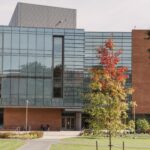
Six student groups recently vied for the top prize in UMBC’s annual Idea Competition, presenting to a panel of alumni judges their innovative solutions to everyday challenges. The competition, hosted by UMBC’s Alex. Brown Center for Entrepreneurship, was held virtually for the first time due to the COVID-19 pandemic. This year’s winning ideas focused on physical and mental health and the environment.
“Even though we had to miss the excitement of an in-person competition this year, it was very important to hold the event to give our students the opportunity to showcase their creative ideas and get feedback from experienced entrepreneurs,” said Vivian Armor ‘73, American studies, director of the Alex. Brown Center for Entrepreneurship.
 Vivian Armor. Photo by Marlayna Demond ’11 for UMBC.
Connection between physical and mental health
Yvann Tientcheu ‘21, information systems, and his collaborators earned first place in the competition for Strive, an app designed to support physical and mental health and wellbeing. The concept for Strive (currently a web-based demo) is that users can enter a simple sentence about their mood. The sentence is run through IBM Watson, a highly robust artificial intelligence system, to assess the person’s current mood. The app then provides the person with a specific workout that aligns with their mood.
Tientcheu explains that the app seeks to move past one-size-fits-all solutions by flexibly responding to how a user feels at a given moment. It will also allow users to connect with each other and build community, he notes, which can be important for sustaining health practices.
Beyond individual users, “Our target market is the medical community,” Tientcheu said in his presentation. “We’re hoping to provide [healthcare providers] with a constant, continuously updated steam of data that shows the connection between [patients’] mental and physical health.”
“Strive was initially planned as a tool to share mental health resources to deal with the mental exhaustion caused by COVID-19,” explains Tientcheu. “As the idea evolved, we realized that there would come a time where the pandemic would be over, that most adults don’t get the recommended amount of exercise, and that physical fitness seems to be linked to mental health. We decided to refocus on offering a brand new service that catered to both physical and mental health.”
Tientcheu describes the project as “something we felt had more long-term viability, and a usefulness that would never be outlived if the idea were properly executed.”
Growth companion
The second place winners, and recipients of the Best Presentation award, were Andrew Park ‘21, interdisciplinary studies, and Tristan King ‘21, interdisciplinary studies, for their idea Sproutful. Park and King are passionate about digital technology, and were inspired to create a unique and whimsical way for people to find healthy coping mechanisms and to prioritize mental health during the COVID-19 pandemic.
The Sproutful System includes a plant container outfitted with sensors that transmit to a phone app, which also features daily guided meditations. The idea is that a person will care for themselves and their plant in a daily meditative practice that is both relaxing and rewarding.
The app guides a user through a meditation and, at the conclusion of the meditation, the app prompts the user to water their plant with the push of a button. Sensors on the plant container monitor water levels in the soil and a water reservoir, and prevent the plant from being overwatered.
“Sproutful is your very own personal meditation and growth companion,” Park explained to the judges. The app “creates a powerful connection between nature and your living space,” said King. “As you grow in your meditation habits, your new plant grows alongside you.”
Looking out for the planet
Robin Paranilam ‘22, computer engineering, presented Terra, which earned third place in the competition. Many people want to protect the environment but don’t know the positive steps they can take, he said. “Terra is an app that acts as a one-stop-shop for eco-friendly living,” he explained. It offers personalized actions that each user can take to protect the world around them.
The Terra app focuses on four aspects of protecting the environment: alternative energy, sustainable living, reducing carbon footprints, and eco-friendly eating. Each category provides tips and resources that people can use to be mindful of how their actions impact the planet. The Terra app will not only tailor resources for individual users, but also will encourage them to connect with other nearby users to make a collective impact.
“The fact that the winning ideas focused on well-being, community, relationships, and the environment shows how much our students care about others and the world around them,” says Armor, “and how much they want to make a difference.”
The winning group received $750 to continue to develop their idea, and the second and third place groups received $500 and $250, respectively. The team that received the Best Presentation award received $250. Each spring, the Alex. Brown Center for Entrepreneurship hosts the Cangialosi Business Innovation Competition.
Banner image: UMBC’s campus in the fall. Photo by Marlayna Demond ‘11 for UMBC.
]]>
Six student groups recently vied for the top prize in UMBC’s annual Idea Competition, presenting to a panel of alumni judges their innovative solutions to everyday challenges. The competition,...
https://umbc.edu/stories/students-focus-on-mental-health-and-the-environment-in-2020-umbc-idea-competition/
https://my3.my.umbc.edu/api/v0/pixel/news/119736/guest@my.umbc.edu/8adfa250c885bcec3706d5a28ab7b83a/api/pixel
alexbrowncenter
coeit
community
csee
inds
is
UMBC News & Magazine
https://my3.my.umbc.edu/groups/umbc-news-magazine
https://assets1-my.umbc.edu/system/shared/avatars/groups/000/001/943/24435aa6207c452e7bc15cc74b42c7bb/xsmall.png?1748556657
https://assets1-my.umbc.edu/system/shared/avatars/groups/000/001/943/24435aa6207c452e7bc15cc74b42c7bb/original.png?1748556657
https://assets2-my.umbc.edu/system/shared/avatars/groups/000/001/943/24435aa6207c452e7bc15cc74b42c7bb/xxlarge.png?1748556657
https://assets2-my.umbc.edu/system/shared/avatars/groups/000/001/943/24435aa6207c452e7bc15cc74b42c7bb/xlarge.png?1748556657
https://assets3-my.umbc.edu/system/shared/avatars/groups/000/001/943/24435aa6207c452e7bc15cc74b42c7bb/large.png?1748556657
https://assets1-my.umbc.edu/system/shared/avatars/groups/000/001/943/24435aa6207c452e7bc15cc74b42c7bb/medium.png?1748556657
https://assets2-my.umbc.edu/system/shared/avatars/groups/000/001/943/24435aa6207c452e7bc15cc74b42c7bb/small.png?1748556657
https://assets1-my.umbc.edu/system/shared/avatars/groups/000/001/943/24435aa6207c452e7bc15cc74b42c7bb/xsmall.png?1748556657
https://assets2-my.umbc.edu/system/shared/avatars/groups/000/001/943/24435aa6207c452e7bc15cc74b42c7bb/xxsmall.png?1748556657
UMBC News & Magazine
0
0
false
Tue, 01 Dec 2020 18:26:22 -0500
 Amanda Knapp, Katharine Cole, and Delana Gregg in the Academic Success Center, 2019
 Helena Mentis
 Peer tutor Sumaiyah Mahmoodi ’21, health administration and policy, answers a student question online in front of a virtual background of the Academic Success Center. Photo courtesy of the ASC.
 Amanda Knapp (standing) and Katharine Cole (second from right) speak with students in the Academic Success Center in 2019.
 Math and Science Tutoring Center session through UMBC’s Academic Success Center, 2019.
 Academic Advocates (l-r) Amanda Sharp, Cliff Saul, and Carlos Williams in 2019.