Small satellite, big ambitions: UMBC’s HARP named SmallSat Mission of the Year
UMBC’s Hyper-Angular Rainbow Polarimeter (HARP) Satellite, which began in Vanderlei Martins’s imagination more than a decade ago, has been flying in low-Earth orbit since February 19. It contains new technology that can collect detailed information about tiny particles in the atmosphere—previously unmeasurable data that will inform climate studies for years to come. The HARP team, including a large number of students, overcame obstacles at every step of the satellite’s journey to space, and its success is already being recognized.
On August 6, the American Institute of Aeronautics and Astronautics (AIAA) named HARP the Small Satellite Mission of the Year. To qualify as a “smallsat,” satellites must weigh less than 150 kg (330 lbs.). To win, a smallsat must demonstrate significant improvement in the capability of small satellites. That could mean advances in their structural design, scientific instrumentation, communications ability, or other factors.
A popular vote informed the AAIA SmallSat Technical Committee’s final decision. After voters selected HARP as a finalist, the smallsat went up against nine other finalists, including teams from the U.S., Guatemala, Singapore, and France. Votes for HARP poured in from all over the world, including ballots from 40 states and countries on six continents. In the end, HARP emerged as the winner.
 The UMBC HARP satellite team with their families and colleagues from Space Dynamics Lab on the morning of the rocket launch (November 2, 2019). Photo by Sarah Hansen, M.S. ’15.
A moment of joy
“I would like to thank the HARP team as a whole, because HARP is really the result of the perseverance of the team over many years,” said Martins, director of UMBC’s Earth and Space Institute, as he accepted the award. “There has been no shortage of problems, but we have always worked together to overcome them.”
HARP’s innovative design and ability to collect new kinds of data that will be crucial for future research sealed the win. The HARP instrument, designed and built by a UMBC team and funded by the NASA Earth Science Technology Office, is smaller than a loaf of bread. Yet, its pioneering polarimeter (the first ever in orbit) can measure certain properties of particles in the atmosphere for the first time, offering a new look at the properties of clouds and tiny particles in the atmosphere called aerosols. The first observation from HARP arrived back on Earth on April 16, and it’s been collecting data continuously since.
The small spacecraft developed by UMBC’s partners at Space Dynamics Lab (SDL) carried HARP to space, and the SDL team manages the satellite while it is in orbit. The whole satellite (instrument plus spacecraft) is the size of a large loaf of bread and only weighs about 6 kg (13 lbs.). UMBC shares the award with Space Dynamics Lab, which is affiliated with Utah State University.
“All of us at UMBC are so very proud of the efforts and the impact of Vanderlei Martins and the Earth & Space Institute,” says Karl Steiner, UMBC’s vice president for research. “Looking back at the launch of the HARP satellite at Wallops Island this past November, I know that today’s recognition as SmallSat Mission of the Year brings a much-needed moment of joy and encouragement to our campus community during a very different time.”
 The HARP instrument (center) at the UMBC Earth and Space Institute. Photo by Marlayna Demond ’11 for UMBC.
Student-driven success
The AIAA also gave out a People’s Choice Award (PCA) at the ceremony. The awards committee selects a PCA when a project has made substantial, unique contributions, but doesn’t necessarily meet the requirements for Mission of the Year. This year, Quetzal 1, Guatemala’s first-ever satellite, received the People’s Choice Award. Quetzal 1 has “opened the whole field of space science and technology in Guatemala,” shared Emily Clemens, awards committee chair.
Guatemala currently has no engineering graduate school programs and no space agency, noted Luis Zea, one of Quetzal 1’s co-directors, “but the students here accomplished something that I think is a good example of what young people can do when they set their minds to solving problems.”
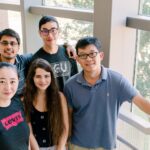
Students are at the root of HARP, as well. The team has included scientists and engineers at every level. High school students, undergraduates, and graduate students all made important contributions in collaboration with faculty researchers.
“HARP is a small satellite, but we always had very big ambitions,” Martins says. At long last, those ambitions are bearing fruit. Some of the students who worked on HARP, and some new ones, are now at work on HARP2, which will build on technology developed for HARP. HARP2 will travel on the major NASA PACE mission, scheduled to launch in 2023. HARP2 will collect data that will inform studies of air quality, clouds, precipitation, and climate.
With only a tinge of disbelief, and a big smile, Martins says, “And that’s all due to this small satellite.”
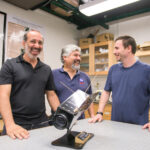
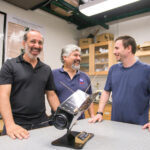
Banner image: Core HARP team members Vanderlei Martins (left); Roberto Borda, assistant research scientist with UMBC’s Joint Center for Earth Systems Technology (JCET); and Dominik Cieslak, assistant research scientist with JCET. Photo by Marlaynd Demond ’11 for UMBC.
]]>
UMBC’s Hyper-Angular Rainbow Polarimeter (HARP) Satellite, which began in Vanderlei Martins’s imagination more than a decade ago, has been flying in low-Earth orbit since February 19. It contains...
https://umbc.edu/stories/small-satellite-big-ambitions-umbcs-harp-named-smallsat-mission-of-the-year/
https://my3.my.umbc.edu/api/v0/pixel/news/119818/guest@my.umbc.edu/59f156d46874d013d1c0420b11f5bca3/api/pixel
cnms
esi
physics
research
science-and-technology
UMBC News & Magazine
https://my3.my.umbc.edu/groups/umbc-news-magazine
https://assets1-my.umbc.edu/system/shared/avatars/groups/000/001/943/24435aa6207c452e7bc15cc74b42c7bb/xsmall.png?1748556657
https://assets1-my.umbc.edu/system/shared/avatars/groups/000/001/943/24435aa6207c452e7bc15cc74b42c7bb/original.png?1748556657
https://assets2-my.umbc.edu/system/shared/avatars/groups/000/001/943/24435aa6207c452e7bc15cc74b42c7bb/xxlarge.png?1748556657
https://assets2-my.umbc.edu/system/shared/avatars/groups/000/001/943/24435aa6207c452e7bc15cc74b42c7bb/xlarge.png?1748556657
https://assets3-my.umbc.edu/system/shared/avatars/groups/000/001/943/24435aa6207c452e7bc15cc74b42c7bb/large.png?1748556657
https://assets1-my.umbc.edu/system/shared/avatars/groups/000/001/943/24435aa6207c452e7bc15cc74b42c7bb/medium.png?1748556657
https://assets2-my.umbc.edu/system/shared/avatars/groups/000/001/943/24435aa6207c452e7bc15cc74b42c7bb/small.png?1748556657
https://assets1-my.umbc.edu/system/shared/avatars/groups/000/001/943/24435aa6207c452e7bc15cc74b42c7bb/xsmall.png?1748556657
https://assets2-my.umbc.edu/system/shared/avatars/groups/000/001/943/24435aa6207c452e7bc15cc74b42c7bb/xxsmall.png?1748556657
UMBC News & Magazine
0
0
false
Fri, 07 Aug 2020 22:41:52 -0400
Support comes full circle: When students become mentors
In 2015, Cherie Tebah’s dream of providing dental care in marginalized communities was shattered when she sustained injuries while in the U.S. military. Tebah, who is originally from Ghana, had nurtured her dream for years as a dental assistant stationed in Japan. But with the guidance of her medical team, she had to accept that her disability would make achieving that dream impossible.
Tebah had just completed an associates degree at Montgomery College, and at first, she struggled to move on. But after three years of deep reflection, working with a psychologist and social worker, and starting her own business, Tebah found a new path.
The support she received from her own social worker, and shadowing a social worker who had graduated from UMBC, helped her decide to apply to UMBC’s social work program at The Universities at Shady Grove (USG). Visiting campus and finding a tight-knit, diverse community so close to home sealed the deal.
This spring, Tebah will graduate from UMBC with a double major in social work and psychology. Now, she has big plans to channel her passion for serving others into a social work career.
Cherie Tebah was featured in a video about the UMBC social work program at the Universities at Shady Grove.
Resources for success
Going back to school wasn’t easy. “As a student with a disability, I had trouble getting my tasks done on time. There were days when it was really hard for me to even walk,” Tebah says. “But my professors worked with me, empowered me, and supported me through everything.” Even when she struggled, “they were there to encourage me to carry on.”
The support Tebah received from her faculty mentors and other resources on campus helped her persist through challenges. The Macklin Center for Academic Success helped her improve her writing. Librarians helped her find sources for assignments. Retriever Essentials provided food when times were especially tough. Counseling services supported her mental health. Zumba classes helped her blow off steam.
The Veteran’s Lounge was most important. “When it was too much for me to handle, I would go to the Veteran’s Lounge,” she says. “There I would connect with other veterans and learn about other resources they had used.”
“At UMBC,” Tebah says, “I’ve gained confidence and learned appropriate ways to advocate for myself.”
Spreading the love
Once she became familiar with campus resources and realized how much they had helped her, Tebah decided to pay it forward. “I love to help people succeed, so for me, if others have put time into my career and my future, I feel that it’s only right to reciprocate that love to other students,” she says.
Tebah joined the Peer Advisory Team, which staffs orientation and conducts monthly check-ins with students. She also became a leader in the Social Work Student Association. “Connecting students with resources that can help them has been very fulfilling for me,” she says.
 Nicole Belfiore, clinical isntructor of social work at USG, is one of Cherie Tebah’s mentors.
In August, Tebah will begin her master’s degree in social work at University of Maryland, Baltimore. She’s asked Nicole Belfiore, a clinical instructor in social work at USG, to continue serving as her mentor. “At USG we’re like a family,” Tebah says. And family members stick with each other.
Chasing his potential
Brian Carroll ‘14, physics, Ph.D. ’20, atmospheric physics, has also already begun to pay forward the mentorship he received while pursuing both of his UMBC degrees.
As an undergrad, he joined the Atmospheric Lidar Group, led by Ruben Delgado and Belay Demoz. He then chose to continue in the group for his Ph.D. Both Delgado, assistant research scientist in the Joint Center for Earth Systems Technology (JCET), and Demoz, JCET director, have been key mentors and role models for Carroll.
“Ruben does a great job of pushing you to chase your own potential and offering you opportunities to excel,” Carroll says. “And Belay is especially good at giving professional advice…he offers a lot of what you can’t get in a classroom.”
From them, and others, he’s learned how to support younger students in his field.
Finding the edge
Throughout Carroll’s Ph.D., he’s had many opportunities to mentor undergraduates, and his approach has shifted over the years. He’s learned that rather than explaining everything in detail up front, the best mentors “get someone to the edge of their understanding, and then let them wander for a bit,” he says.
 Brian Carroll (center, blue shirt), Ruben Delgado (third from left), Belay Demoz (third from right in front row) and other members of the Atmospheric Lidar Group gather in front of the rooftop telescope at UMBC.
If they get stuck in the dark, “then you kind of light up the area around them. They keep wandering until they get to the edge of the light again, and then push beyond it until they need some more help.”
This summer Carroll will begin a postdoctoral fellowship at NASA Langley in Hampton, Virginia. As he continues his career, “I want to carry on a lot of what Ruben and Belay have taught me and to try to provide that push and help people realize their potential,” Carroll says.
It’s especially important to him to support students from underrepresented backgrounds in atmospheric science, as Delgado and Demoz have modeled so well. “I really want to reach out to as many students as possible,” Carroll says, “especially…from populations that may not have as many opportunities, and help make their success a reality.”
New beginnings
STEM BUILD at UMBC is a program designed to do just that.The College of Natural and Mathematical Sciences (CNMS) runs the multi-pronged, NIH-funded program, which is designed to enhance diversity in the biomedical workforce. In 2018, as a non-traditional student at Montgomery College, Shehar Yar Awan ’20, biological sciences, became a BUILD a Bridge to STEM intern. Little did he know how much the experience would affect his future.
 Shehar Yar Awan ’20 gives a presentation on the research he did during the 2018 BUILD a Bridge to STEM internship.
As an intern, Awan conducted research with Erin Green, assistant professor of biological sciences, and presented his work at UMBC’s Summer Undergraduate Research Fest. Because he had such a positive summer experience, Awan decided to transfer to UMBC and apply to be a STEM BUILD Trainee, another arm of the BUILD program. He was accepted.
Spot-on advice
Awan started his STEM BUILD experience as a Retriever with a summer bridge program designed to kick-start his time at UMBC. He shares that program leaders like Lucie Blauvelt, assistant director of student engagement initiatives in CNMS, and Laura Ott, director of the CNMS Science Education Research Unit, made an impact right away.
“It was really great to have someone showing you around campus, introducing you to people, and giving you insight on what it was going to be like and what you needed to do to be successful—and their advice was spot on,” Awan says.
 STEM BUILD Trainees, including Shehar Yar Awan (back row, second from left) with advisors Lucie Blauvelt (far right, front) and Laura Ott (far left, front). Photo courtesy Shehar Yar Awan.
“Lucie always gave us the confidence to succeed. She always said if we were ever in trouble, we could reach out to her for help.”
In his first semester at UMBC, Awan was taking a challenging course load and started to flounder. Blauvelt kept her promise and helped him connect with a physics tutor, while also offering emotional support. By the end of the semester, Awan “blew physics out of the water.”
Caitlin Kowalewski, assistant director for undergraduate initiatives, also influenced Awan’s experience. In his first full semester at UMBC, he participated in the Undergraduate Research Symposium in Chemical and Biological Sciences. “I won first place because of the way that Ms. K. mentored us on our presentations and our posters,” Awan says.
Honored to give back
In his second semester at UMBC, Awan resumed research with Green. The following summer, he served as a mentor to three new BUILD a Bridge to STEM interns in Green’s lab. The trio of interns he supported worked on some of the same techniques he initially struggled with, such as molecular cloning.
“It feels great to be able to give back. Research was something I was completely new to, and it really gave me an appreciation for science that I never had before,” he says. “And now, being able to give that back to other people and show them what it’s all about… It’s amazing and it’s an honor.”
 Shehar Yar Awan (far right, back row) with Erin Green (third from right, back row) and the rest of the lab group at a summer’s end party in 2019 to celebrate the team’s accomplishments. Photo courtesy Shehar Yar Awan.
In addition to supporting the interns, as an older student, many of Awan’s fellow BUILD trainees look to him for guidance. “I try to help everyone as much as I can,” he says.
Awan credits STEM BUILD with reshaping his path forward, a sentiment he also shared with the news outlet Open Campus. He now plans to pursue dental school. He also hopes to continue doing research.
“I never knew that I wanted to do research. It’s something that developed in me over my entire undergraduate career at UMBC,” he says. “STEM BUILD helped me discover this part of myself that I never knew about. I’ll never forget the gratitude I have for people in the program that have opened my eyes along the way. It’s been wonderful.”
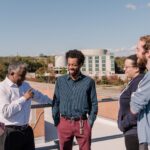
Banner image: Brian Carroll (far right) with Belay Demoz (second from left) and other members of the Atmospheric Lidar Group on the rooftop of the UMBC Physics Building.
All photos by Marlayna Demond ’11 for UMBC unless otherwise noted.
]]>
In 2015, Cherie Tebah’s dream of providing dental care in marginalized communities was shattered when she sustained injuries while in the U.S. military. Tebah, who is originally from Ghana, had...
https://umbc.edu/stories/support-comes-full-circle-when-students-become-mentors/
https://my3.my.umbc.edu/api/v0/pixel/news/119883/guest@my.umbc.edu/9bebbdfd5c4203c40cf215e7ae211e93/api/pixel
biology
cahss
cnms
page1
physics
policy-and-society
psychology
science-and-technology
socialwork
UMBC News & Magazine
https://my3.my.umbc.edu/groups/umbc-news-magazine
https://assets1-my.umbc.edu/system/shared/avatars/groups/000/001/943/24435aa6207c452e7bc15cc74b42c7bb/xsmall.png?1748556657
https://assets1-my.umbc.edu/system/shared/avatars/groups/000/001/943/24435aa6207c452e7bc15cc74b42c7bb/original.png?1748556657
https://assets2-my.umbc.edu/system/shared/avatars/groups/000/001/943/24435aa6207c452e7bc15cc74b42c7bb/xxlarge.png?1748556657
https://assets2-my.umbc.edu/system/shared/avatars/groups/000/001/943/24435aa6207c452e7bc15cc74b42c7bb/xlarge.png?1748556657
https://assets3-my.umbc.edu/system/shared/avatars/groups/000/001/943/24435aa6207c452e7bc15cc74b42c7bb/large.png?1748556657
https://assets1-my.umbc.edu/system/shared/avatars/groups/000/001/943/24435aa6207c452e7bc15cc74b42c7bb/medium.png?1748556657
https://assets2-my.umbc.edu/system/shared/avatars/groups/000/001/943/24435aa6207c452e7bc15cc74b42c7bb/small.png?1748556657
https://assets1-my.umbc.edu/system/shared/avatars/groups/000/001/943/24435aa6207c452e7bc15cc74b42c7bb/xsmall.png?1748556657
https://assets2-my.umbc.edu/system/shared/avatars/groups/000/001/943/24435aa6207c452e7bc15cc74b42c7bb/xxsmall.png?1748556657
UMBC News & Magazine
0
0
false
Tue, 19 May 2020 14:55:38 -0400
Graduating CNMS Scholars carry on a commitment to support women in STEM
UMBC has made great strides in increasing its number of women faculty members in STEM through the ADVANCE program. Now, through the CNMS Scholars Program, these women are serving as mentors to the next generation of scientists and engineers committed to the advancement of women in STEM. The CNMS Scholars program is specifically designed to boost the representation of women in STEM fields that haven’t reached gender parity, from physics and bioinformatics to chemical engineering.
This spring, five women will graduate from UMBC as CNMS Scholars, including Olivia Norman ’20, physics, and Jada Damond ’20, chemical engineering. The financial support, mentorship, and sense of community the program offered created an environment that helped them thrive. Importantly, “CNMS Scholars are paired with our most experienced faculty, who go beyond mentoring to act as champions of these promising future leaders,” says Bill LaCourse, dean of the College of Natural and Mathematical Sciences (CNMS).
Norman’s CNMS Scholars mentor was Theodosia Gougousi, professor of physics and a member of UMBC’s Women in Science and Engineering (WISE) group, affiliated with the ADVANCE program. Damond worked with Jennie Leach, an associate professor of chemical, biochemical, and environmental engineering (CBEE), and a member of UMBC’s 4th ADVANCE cohort.
A nudge in the right direction
The coming weeks will hold excitement for new beginnings and also poignant goodbyes for Olivia Norman, as she prepares to leave UMBC and Maryland. After graduation, she will head to a Ph.D. program in atmospheric science at MIT—a goal realized through research opportunities during her time as a Retriever.
Norman chose to transfer to UMBC as a sophomore specifically to access UMBC’s unique research opportunities. She has been working with Zhibo Zhang, associate professor of physics, on a project involving “polluted dust”—dust particles mixed with pollutants in the atmosphere. They are working to understand how this dust affects cloud formation and climate.
 Olivia Norman ’20 (center, rear) participates in a lab group meeting with Zhibo Zhang (far right) and other lab members.
Zhang and Norman have found their work together rewarding. “He always pushes you to ask questions and seek out things that you’re interested in to inform your research, while also helping nudge you in the right direction if you are feeling a little lost,” Norman shares.
Zhang suggested that Norman join the lab when he noticed her performing exceptionally well in one of his courses. Since then she has made significant contributions to the group’s progress. Now she is participating in the NSF-funded Cyber Training program, which brings together researchers from data science, atmospheric physics, and high-performance computing—a program initially designed for graduate students and early-career faculty.
While it is bittersweet for Zhang to see Norman leave UMBC for her graduate studies, “I have no doubt that Olivia will soon rise as a young star in my field who will lead us to new and exciting scientific discoveries,” he says.
Growth and discovery
CNMS Scholar Jada Damond is also heading to an exceptional Ph.D. program—UMBC’s program in environmental engineering. This offers her a chance to continue research she is committed to moving forward.
Through the CNMS Scholars program, Damond realized the value of mentorship and a community of support. “I gained a really powerful network, and I learned a lot more about the opportunities the campus has to offer,” she shares. In particular, she’s grateful to her program mentor, Jennie Leach, who has offered her both professional and personal support.
“Dr. Leach facilitated my transition to UMBC’s Ph.D. program by offering advice about the program and sharing her own experiences with getting a Ph.D.,” Damond says.
 Jennie Leach works with a student in her lab.
“It’s been really fun to know Jada first as a sophomore, new to engineering, and now, as a senior entering graduate school,” Leach says. “I am so excited to witness all the great things she will accomplish in her career ahead.”
Damond looks forward to continuing research with Upal Ghosh, professor of CBEE, and collaborators at the Smithsonian Environmental Research Center on methods for better measuring mercury levels in water. She’s passionate about the work, she explains, because measuring mercury is a difficult problem and also an important one to solve to protect human health.
She’s also grateful for Ghosh’s ongoing support. At the numerous national and regional conferences Damond has attended with the lab, “Dr. Ghosh always makes sure to introduce his students to other professionals in the field relevant to the specific work that they do, so I have been able to broaden my network,” she says.
 Jada Damond ’20, chemical engineering, introduces herself at the CNMS Scholars opening reception in 2017.
On the academic side, Ghosh “is always making sure his students are on track in their studies,” she says. “He was eager to spend time reviewing concepts that were new to me, and would give me resources to point me in the right direction.”
Damond’s goal is to pursue environmental consulting work. She enjoyed tutoring chemical engineering courses and mentoring younger CNMS Scholars so much that she also hopes to find a way to teach throughout her career.
“Tutoring helped to improve my communication skills, as I had to explain concepts in a way that the students would understand, while making sure that they could replicate those explanations,” she says. “It was very rewarding when they left a tutoring session feeling more confident about the subject than they did going in.”
 Upal Ghosh (right) and Kevin Sowers, professor of marine biotechnology, at the Institute of Marine and Environmental Technology.
Building a network
In addition to supporting young women on their way toward success in STEM fields, the CNMS Scholars program is also all about building a community among the scholars. Caitlin Kowalewski, assistant director of undergraduate initiatives in CNMS, coordinates regular activities for the group. This helps the scholars build relationships with each other and with others members of the UMBC community, such as potential research mentors, leading administrators, and alumni in STEM careers.
“I think the main thing I’ve gained from being a CNMS Scholar was this ability to build a network with people in different levels of their education and professional careers, both in and outside of my department,” Norman shares. “That has been a major plus of being in the program.”
Regular lunches and informal activities like craft projects with just the scholars “allowed us to connect with each other over shared experiences,” Damond says. “Caitlin was really good about getting us together,” adds Norman. “It gave us that opportunity to reach out to other people in a low-key setting.”
Representation in STEM
Both Norman and Damond feel strongly that the program has shaped their futures. Damond wasn’t sure about pursuing a Ph.D. until Leach helped her see the career options the degree could offer her, even if academia is not her goal. For Norman, the program has made her want to do more than make advances in atmospheric science.
 Caitlin Kowalewski, center, at the launch event for the CNMS Scholars program in 2017.
“Being a CNMS Scholar has made me interested in not just doing research, but making sure that where I do research and how I do research is reflective of the scholars program itself,” Norman shares. “I want where I am to have an ongoing conversation about progress being made toward fair representation in STEM.”
Kowalewski is confident Norman and the other scholars will make a difference wherever they go. “I could not be more proud of all that these bright, engaging young women have accomplished during their time at UMBC,” she says. “I have no doubt they will help to pave a stronger path for the advancement of women in STEM in their future careers.”
Additional graduating CNMS Scholars include Ashley Mitchell ’20, biochemistry and molecular biology; Alida Hartwell ’20, bioinformatics and computational biology; and Laina Colony ’20, chemical engineering. To support UMBC’s CNMS Scholars program visit giving.umbc.edu.
Banner image: Olivia Norman ’20 (left of center) relaxes with Zhibo Zhang (center) and other members of the lab group. All photos by Marlayna Demond ’11 for UMBC.
]]>
UMBC has made great strides in increasing its number of women faculty members in STEM through the ADVANCE program. Now, through the CNMS Scholars Program, these women are serving as mentors to the...
https://umbc.edu/stories/graduating-cnms-scholars-carry-on-a-commitment-to-support-women-in-stem/
https://my3.my.umbc.edu/api/v0/pixel/news/119888/guest@my.umbc.edu/7dc89c471b2b6a1d2526a8119bff3e8a/api/pixel
cbee
classof2020
cnms
coeit
physics
science-and-technology
undergradresearch
UMBC News & Magazine
https://my3.my.umbc.edu/groups/umbc-news-magazine
https://assets1-my.umbc.edu/system/shared/avatars/groups/000/001/943/24435aa6207c452e7bc15cc74b42c7bb/xsmall.png?1748556657
https://assets1-my.umbc.edu/system/shared/avatars/groups/000/001/943/24435aa6207c452e7bc15cc74b42c7bb/original.png?1748556657
https://assets2-my.umbc.edu/system/shared/avatars/groups/000/001/943/24435aa6207c452e7bc15cc74b42c7bb/xxlarge.png?1748556657
https://assets2-my.umbc.edu/system/shared/avatars/groups/000/001/943/24435aa6207c452e7bc15cc74b42c7bb/xlarge.png?1748556657
https://assets3-my.umbc.edu/system/shared/avatars/groups/000/001/943/24435aa6207c452e7bc15cc74b42c7bb/large.png?1748556657
https://assets1-my.umbc.edu/system/shared/avatars/groups/000/001/943/24435aa6207c452e7bc15cc74b42c7bb/medium.png?1748556657
https://assets2-my.umbc.edu/system/shared/avatars/groups/000/001/943/24435aa6207c452e7bc15cc74b42c7bb/small.png?1748556657
https://assets1-my.umbc.edu/system/shared/avatars/groups/000/001/943/24435aa6207c452e7bc15cc74b42c7bb/xsmall.png?1748556657
https://assets2-my.umbc.edu/system/shared/avatars/groups/000/001/943/24435aa6207c452e7bc15cc74b42c7bb/xxsmall.png?1748556657
UMBC News & Magazine
0
0
false
Mon, 18 May 2020 15:30:23 -0400
UMBC once again ranks among the top 150 universities in federal research funding
The annual Higher Education Research and Development (HERD) survey from the National Science Foundation again includes UMBC as a top recipient of federal research support.
The most recent survey aggregates federal research and development expenditures for fiscal year 2018. The survey data combines total funding from all federal agencies and also provides information on research funding from non-federal and non-governmental sources.
Overall, UMBC is ranked #148 in federal research funding for the 2018 fiscal year, and #173 in total research funding from all sources. The federal investment figures include funding from sources such as the Department of Defense, Department of Health and Human Services, and NASA, among others.
“The annual HERD Rankings represent a widely reviewed national comparison of institutional scholarly and research activities,” says Karl V. Steiner, vice president for research at UMBC. “The most recently released 2018 data represents the fourth consecutive year of growth in research expenditures for UMBC.”
A leader in studying Earth’s atmosphere
UMBC is now ranked #13 nationally in NASA funding and #27 in federal funding for geosciences, atmospheric sciences, and ocean research more broadly. Among the projects included in that funding was UMBC’s Hyper-Angular Rainbow Polarimeter (HARP) cubesat.
 Vanderlei Martins, Roberto Borda, and Dominik Cieslak with HARP at UMBC. Photo by Marlayna Demond ’11 for UMBC.
This small satellite, the size of a loaf of bread, was developed by a team of UMBC scientists, led by Vanderlei Martins, director of UMBC’s Earth and Space Institute. It was recently launched into space aboard a NASA rocket heading for the International Space Station. The satellite contains sensors that will collect information about Earth’s atmosphere, informing our understanding of pollution and climate.
Computing hardware to address infrastructure challenges
In computer and information sciences, UMBC ranked #69 in federal research support. Among awards in this area was NSF support for UMBC to lead a new $3 million research partnership to solve major infrastructure challenges with next-generation computing hardware.
 Yelena Yesha, right, alongside faculty and students who conduct research through CARTA. Photo by Marlayna Demond ’11 for UMBC.
Yelena Yesha, computer science and electrical engineering, serves as principal investigator for the five-year grant from the NSF Industry-University Cooperative Research Centers. UMBC launched the Center for Accelerated Real Time Analytics (CARTA) to complete computing hardware research supported by this grant. A portion of the NSF funds are also furthering collaborative research with partner institutions North Carolina State University; Rutgers University, Newark; Rutgers University, New Brunswick; and Tel Aviv University. UC San Diego and the University of Utah are also collaborating, and industry partners like Seagate and Morgan Stanley are engaged in this work as well.
Yesha explains, “CARTA will usher in the era of accelerated real-time analytics by effectively utilizing innovative technologies such as cognitive computing, machine learning, and quantum computing to address our nation’s global competitive challenges in health security, disaster mitigation, and the emerging artificial intelligence revolution.”
Social science research to address health disparities
In the social sciences, UMBC ranks #27 in federal research dollars among universities nationwide. UMBC psychology faculty received a particularly high number of federal grants in 2018, including Danielle Beatty Moody (NIH funding), Shawn Bediako (NSF funding), Chris Murphy (DHHS-NIH funding), and Shari Waldenstein ( DHHS-NIH funding, as well as support from the VA Medical Center in Baltimore). Additionally, Christine Yee, economics, received a research grant from the U.S. Department of Veterans Affairs.
 Danielle Beatty Moody. Photo by Marlayna Demond ’11 for UMBC.
Beatty Moody is director of UMBC’s Social Determinants of Health Lab. In 2018 she was the PI on three NIH grants, funded through the National Institute of Aging. They all focused on the HANDLES study, which stands for Health Aging in Neighborhoods of Diversity across the Life Span. Beatty Moody’s team examined health disparities among middle-aged and older residents of Baltimore. This includes the relationship between factors like structural discrimination and early life experiences with cognitive decline and cardiometabolic measures.
“We are proud of the broad impact of our work, from the social sciences, to computing, to our close relationship with NASA Goddard,” says Steiner. “I am pleased with the continued efforts and growing success of our entire research community.”
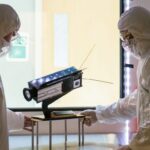
Banner image: Research team of Vanderlei Martins, professor of physics, with a model of the HARP satellite. Photo by Marlayna Demond ’11 for UMBC
]]>
The annual Higher Education Research and Development (HERD) survey from the National Science Foundation again includes UMBC as a top recipient of federal research support. The most recent...
https://umbc.edu/stories/umbc-once-again-ranks-among-the-top-150-universities-in-federal-research-funding/
https://my3.my.umbc.edu/api/v0/pixel/news/119945/guest@my.umbc.edu/6836f3b7f8c57244a547fc39547c3346/api/pixel
cahss
cnms
coeit
csee
economics
jcet
page1
physics
psychology
rankings
research
science-and-technology
UMBC News & Magazine
https://my3.my.umbc.edu/groups/umbc-news-magazine
https://assets1-my.umbc.edu/system/shared/avatars/groups/000/001/943/24435aa6207c452e7bc15cc74b42c7bb/xsmall.png?1748556657
https://assets1-my.umbc.edu/system/shared/avatars/groups/000/001/943/24435aa6207c452e7bc15cc74b42c7bb/original.png?1748556657
https://assets2-my.umbc.edu/system/shared/avatars/groups/000/001/943/24435aa6207c452e7bc15cc74b42c7bb/xxlarge.png?1748556657
https://assets2-my.umbc.edu/system/shared/avatars/groups/000/001/943/24435aa6207c452e7bc15cc74b42c7bb/xlarge.png?1748556657
https://assets3-my.umbc.edu/system/shared/avatars/groups/000/001/943/24435aa6207c452e7bc15cc74b42c7bb/large.png?1748556657
https://assets1-my.umbc.edu/system/shared/avatars/groups/000/001/943/24435aa6207c452e7bc15cc74b42c7bb/medium.png?1748556657
https://assets2-my.umbc.edu/system/shared/avatars/groups/000/001/943/24435aa6207c452e7bc15cc74b42c7bb/small.png?1748556657
https://assets1-my.umbc.edu/system/shared/avatars/groups/000/001/943/24435aa6207c452e7bc15cc74b42c7bb/xsmall.png?1748556657
https://assets2-my.umbc.edu/system/shared/avatars/groups/000/001/943/24435aa6207c452e7bc15cc74b42c7bb/xxsmall.png?1748556657
UMBC News & Magazine
0
0
false
Fri, 28 Feb 2020 20:23:06 -0500
UMBC’s Pelton and Daniel are developing light-driven chips to enable super-fast computing
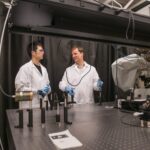
By combining their expertise in physics and chemistry, Matt Pelton and Marie-Christine Daniel are working toward the next big leap in computing. Both are engaged in photonics research, which is “the idea of using light—photons—to do information processing instead of using electrons like you do in electronics,” explains Pelton, associate professor of physics at UMBC.
Using light rather than electrons, as in fiber-optic telecommunication cables, is “faster, and you can send a lot more information,” Pelton says. However, no computer today runs exclusively on photons. “The huge pipeline of data coming down optical fibers all has to be converted to an electrical signal and then distributed to all the different processors in the computer. That’s the big power and time bottleneck,” Pelton says.
“If you could do as much of the function of the computer chip as possible using photons instead of electrons, then you would be able to use less power and do things more efficiently,” he says. “So there’s a big push to try to bring photonics down to the single chip scale.”
That’s where this interdisciplinary duo comes in. They’re working to develop a unique combination of existing chemical structures to enable photon-driven computer functionality even in the computer’s most fundamental building blocks. A new three-year grant from the National Science Foundation will enable Pelton and Daniel to make faster progress on their project and involve more students.
 Marie-Christine Daniel (right) and UMBC chemistry Ph.D. student Chanda Lowrance in Daniel’s lab. Photo by Diane Zeenny.
A new kind of switch
Daniel and Pelton’s novel technique depends on being able to reliably create very specific chemical structures. By binding two types of known structures in a particular arrangement, they can create a kind of on-off switch.
At its most basic level, a computer is just a lot of these switches. Whether they use ones and zeros, light and dark, or something else, the pattern of the switches encodes information. The new kind of switch that Daniel and Pelton are devising is different from what computers use now, because it relies on photons rather than electrons.
The light-driven structures Daniel and Pelton are working to build are made of quantum dots and metal nanoparticles. Quantum dots are tiny crystals only about 20 atoms in diameter. They’re made of semiconductor elements, similar to the silicon that powers electronics, and they can be designed to emit certain wavelengths (colors) of light. They’re even used in some televisions. The metal nanoparticles are larger, usually a few thousand atoms in diameter. They also appear as different colors based on the light they reflect and absorb, but they don’t emit their own light.
Through computer simulations, Pelton and Ph.D. student Vijin Veetil have demonstrated that by binding two rod-shaped nanoparticles (“nanorods”) and a quantum dot together in a specific way, their interaction can produce a structure that allows light to pass straight through both the dot and particle, when it would normally be scattered. Transmitting the light creates a transparent state rather than an opaque one. That switch from transparent to opaque, which can be controlled by an external beam of light, is exactly the kind of switch that could encode information in a computer.
 Matt Pelton in the lab. Photo by Marlayna Demond ’11 for UMBC.
Getting it just right
For this to work, Pelton and Daniel need to successfully construct molecular structures consisting of a single quantum dot stuck between two nanorods.
“It needs to be that configuration,” says Daniel, associate professor of chemistry and biochemistry, who is bringing on chemistry Ph.D. student Chanda Lowrance to help her tackle this project. “The quantum dot alone, or the nanoparticles alone, will not induce the transparency effect.”
And just any quantum dot bound to any nanoparticle is not sufficient. They need to have specific sizes and shapes, so that the wavelength of light that the quantum dot absorbs, and the wavelength that the nanoparticle scatters, are very similar, Daniel explains. Then, “they can interact very efficiently and create that transparency.”
“That’s essentially the goal of this project—to take these structures from a cartoon to something we can actually make,” Daniel says. “And making this is not easy.” If Daniel, Pelton, and their students can do it, though, they’ll be setting the stage for a revolution in computing.
From random to reliable
Previous research has shown that it’s fairly straightforward to get the nanoparticles and dots to clump together in groups. “But we need to get just one of them. And we don’t want it to bind just anywhere. It has to be right there,” Pelton says. “That’s the big challenge.”
A procedure that allows metal particles and dots to bind together randomly does result in a very small number of structures in the desired configuration. When scientists tested those lucky few for the transparency effect, they matched results predicted by Pelton’s simulations, proving this technique can work.
Now, the challenge is producing a larger number of these structures. “When we’re synthesizing these things, we don’t want just a few of them to be the right structure; we want the majority of them to be the right structure,” Pelton says. “We need the ability to make them in much larger numbers, in order to be able to optimize them.”
This is what the team is working on now. Their goal is that “by the end of the project we’ll have shown that we can make these things reliably, in larger numbers, and that we can use them as an on-off switch,” Pelton says.
 Marie-Christine Daniel (left) and Renee Suzich, an undergraduate from St. Mary’s College of Maryland at UMBC for a summer research experience, at work in Daniel’s lab. Photo by Diane Zeenny.
The power of teamwork
“I didn’t know if this was going to work when we started,” Pelton says. But considering their progress so far, and the impact this new funding will have on accelerating their work, today Daniel and Pelton are optimistic about the future of light-based computing and other applications for their joint research.
While the work poses significant challenges, “of course it’s a big opportunity, too,” Pelton says. In addition to the duo’s goal to create light-driven computer chips, there could be other scenarios where it would be beneficial to combine nanoparticles. Different configurations could generate new and useful physical and chemical properties for all kinds of applications.
Daniel and Pelton recognize the importance of their collaboration for the success of this work. Pelton’s theoretical and simulation expertise as well as his ability to do single-particle measurements, and Daniel’s in-depth knowledge of the chemistry and ability to find a way to make specific structures, have all been critical.
“This is not something that any physicist or chemist could do alone,” Daniel reflects. “It takes both.”
Banner image: Matt Pelton (right) and Haixu Leng, Ph.D. ’19, physics. Photo by Marlayna Demond ’11 for UMBC.
]]>
By combining their expertise in physics and chemistry, Matt Pelton and Marie-Christine Daniel are working toward the next big leap in computing. Both are engaged in photonics research, which is...
https://umbc.edu/stories/umbcs-pelton-and-daniel-are-developing-light-driven-chips-to-enable-super-fast-computing/
https://my3.my.umbc.edu/api/v0/pixel/news/119970/guest@my.umbc.edu/817f335d9b6241eacaf06cb6e39720d0/api/pixel
chembiochem
cnms
interdisciplinary
physics
research
science-and-technology
UMBC News & Magazine
https://my3.my.umbc.edu/groups/umbc-news-magazine
https://assets1-my.umbc.edu/system/shared/avatars/groups/000/001/943/24435aa6207c452e7bc15cc74b42c7bb/xsmall.png?1748556657
https://assets1-my.umbc.edu/system/shared/avatars/groups/000/001/943/24435aa6207c452e7bc15cc74b42c7bb/original.png?1748556657
https://assets2-my.umbc.edu/system/shared/avatars/groups/000/001/943/24435aa6207c452e7bc15cc74b42c7bb/xxlarge.png?1748556657
https://assets2-my.umbc.edu/system/shared/avatars/groups/000/001/943/24435aa6207c452e7bc15cc74b42c7bb/xlarge.png?1748556657
https://assets3-my.umbc.edu/system/shared/avatars/groups/000/001/943/24435aa6207c452e7bc15cc74b42c7bb/large.png?1748556657
https://assets1-my.umbc.edu/system/shared/avatars/groups/000/001/943/24435aa6207c452e7bc15cc74b42c7bb/medium.png?1748556657
https://assets2-my.umbc.edu/system/shared/avatars/groups/000/001/943/24435aa6207c452e7bc15cc74b42c7bb/small.png?1748556657
https://assets1-my.umbc.edu/system/shared/avatars/groups/000/001/943/24435aa6207c452e7bc15cc74b42c7bb/xsmall.png?1748556657
https://assets2-my.umbc.edu/system/shared/avatars/groups/000/001/943/24435aa6207c452e7bc15cc74b42c7bb/xxsmall.png?1748556657
UMBC News & Magazine
0
0
false
Thu, 16 Jan 2020 21:17:11 -0500
Climate Shift
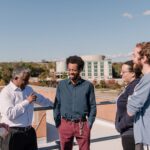
From Eritrea to UMBC, this physicist is cultivating a diverse generation of climate scientists.
It’s a nearly cloudless afternoon at UMBC in early October. A group of physics students and their two faculty advisors, Belay Demoz and Ruben Delgado, make their way to the roof of the physics building to continue their conversation about atmospheric research. Earlier, gathered in a small, dimmed lecture hall, the students engaged their advisors and each other in robust discussions about their research while practicing their presentation skills.
In that session, Amanze Ejiogu ’22, physics, had the chance to explain his findings on the Bay Breeze. Rather than an adult beverage, it refers to breezes coming in off the Chesapeake Bay that redirect back to land air masses (and the pollutants they contain) that would otherwise blow offshore.
The Bay Breeze effect is a complicated phenomenon. Many factors contribute to it, from precipitation to wind speed to the overall quality of the air. Understanding it is a multidisciplinary effort, requiring chemistry, fluid dynamics, statistics, and meteorology skills. That’s exactly the kind of challenge that Demoz, physics professor and director of UMBC’s Joint Center for Earth Systems Technology (JCET), likes to help his students tackle.
After Ejiogu’s presentation, Demoz asks questions. His elbow leaning casually against a railing, he breaks into a grin—he is in his element. Of a certain result, he asks, “Is that expected?” And a minute later, “That’s for you to figure out,” his Eritrean accent inflecting his speech.
 Demoz regularly engages his students in robust discussions about their research. Photo by Marlayna Demond ’11.
Climate change and other environmental issues like air and water quality disproportionately affect people of color. Today, Demoz sees his role at UMBC as empowering students, especially students from underrepresented backgrounds, to take ownership of their research and contribute to their communities. Eventually, he hopes his graduates will also become mentors and advocates for their own students and colleagues—behaviors he models for them every day.
This wasn’t always Demoz’s idea of what his life’s work would be. After a challenging childhood in what is now the East African country of Eritrea, Demoz came to the United States for graduate school in the 1980s. His original goal was to learn how to seed clouds—to bring rain to his drought-stricken homeland. He’s still doing climate research, but his focus has shifted. His experiences as a youth in Eritrea and his years as an African in the United States have shaped who he has become and what he seeks to achieve.
Graduates from all backgrounds have left Demoz’s lab and taken roles at places like NASA, the National Oceanic and Atmospheric Administration (NOAA), the Environmental Protection Agency (EPA), and other research institutions. These alumni create a ripple effect that will continue to enhance diversity in atmospheric research and answer questions that have the potential to change the lives of people around the globe, in part because of Belay Demoz.
Maurice Roots, a graduate student in atmospheric physics, has already felt the effects of Demoz’s efforts. Roots, who graduated from Hampton University, only applied to UMBC for graduate school because Demoz approached him at a conference. “Belay has a great set of stories to tell,” Roots says. “His journey shows that perseverance is possible.”
A changing homeland
“It’s where the desert and the green are always fighting.”
That’s how Demoz describes the location of Eritrea. It’s a small African country on the Red Sea, sandwiched between Sudan and Ethiopia, right where the Sahara Desert and the jungles of central Africa meet. Many people there are subsistence farmers, including generations of the physicist’s family.
It used to be that when drought or floods hit, Eritrean farmers moved to where the grass was literally greener. But that changed after their land was colonized by the Italians and later the British. Strict political borders limited movement. “Once you put a wall, that valve of mitigating drought disappears,” Demoz says.
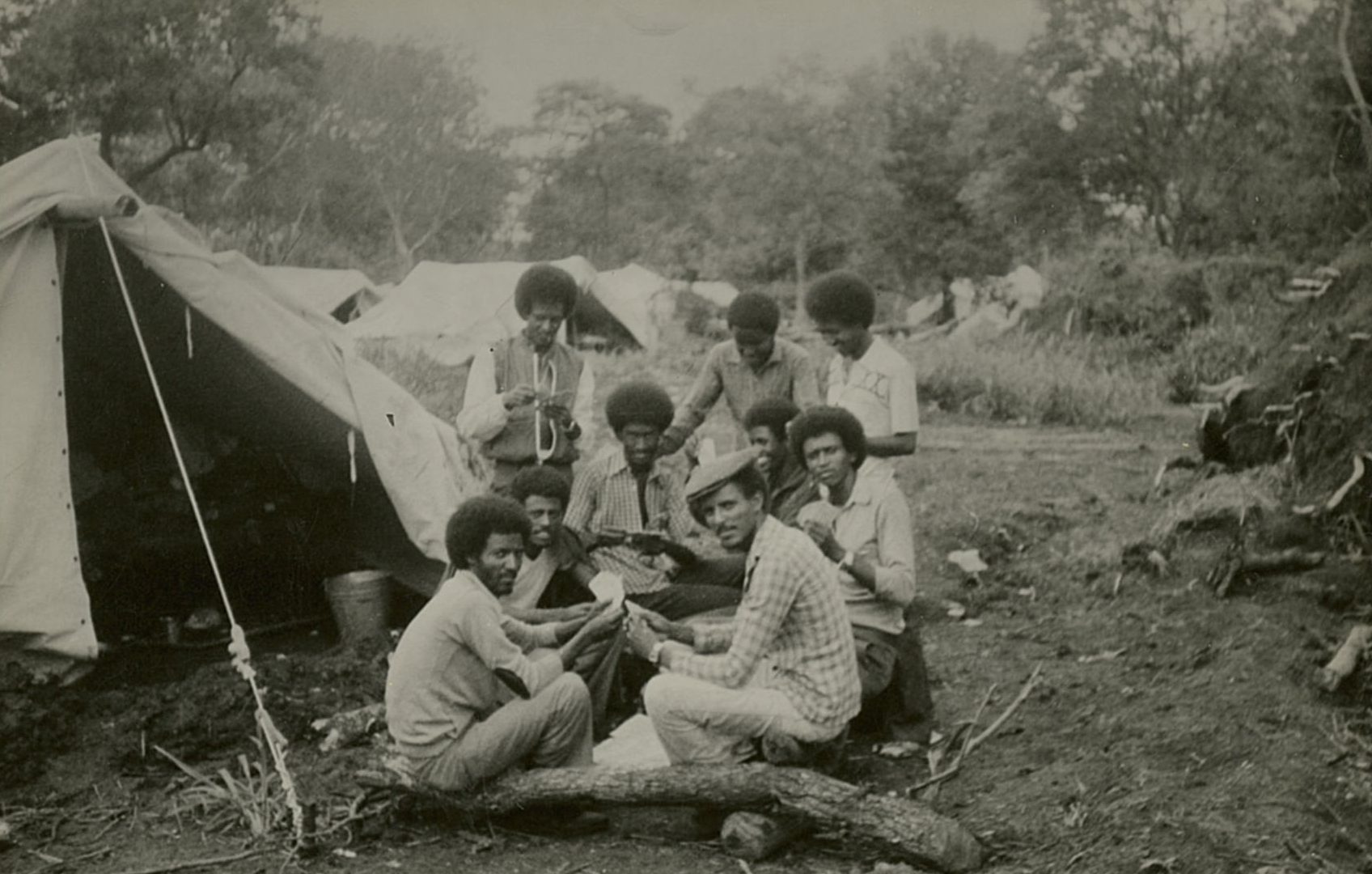
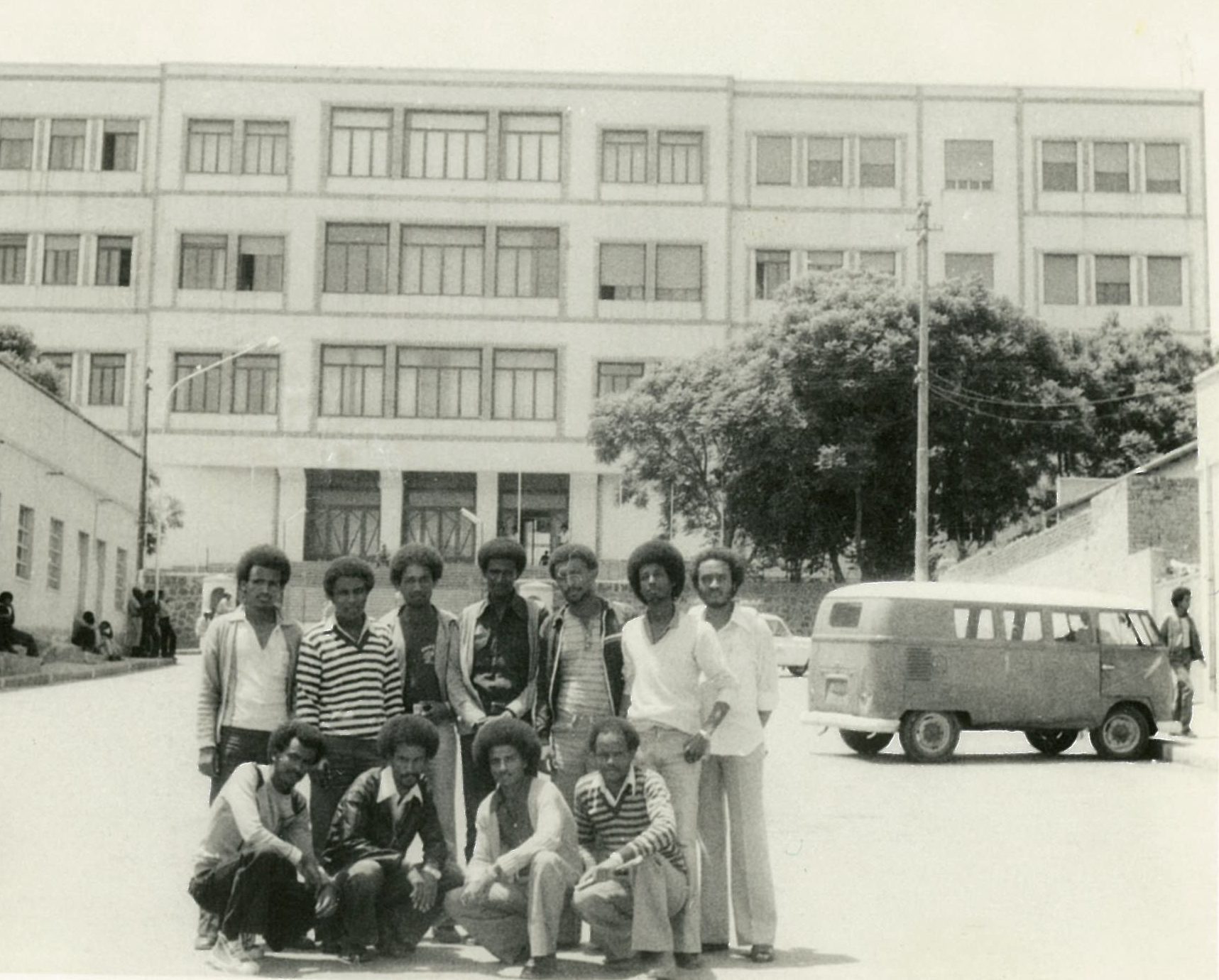
His childhood and youth in Eritrea, in the 1960s and ’70s, was one of the most volatile times for the region, when an internal resistance movement was fighting Ethiopia to gain independence. “My time was a time of coups, a time of drought, a time of war,” Demoz says. “Those are the times when a lot of heartache happened.”
Many people died because they weren’t allowed to migrate. Their crops failed in the drought, and some starved. Some died when they attempted to migrate and met violence along the way. Demoz’s older brother and many of his friends perished fighting in the resistance.
An unlikely advocate
Belay Demoz knew the challenges his people were facing. So in 1980, when he finished high school and was assigned to study physics as an undergraduate at the University of Asmara in what was to become Eritrea, he knew he wanted to find a way to use his education to make things better for his family.
At first, he struggled. He failed his first three exams. And then the first of several major turning points in his life happened, the first time help came from where he least expected it.
Demoz and his roommate frequently played soccer together. Both were highly talented but knew there was no career for them in the sport. So, after Demoz failed his third physics exam, his roommate decided it was time for an intervention.
“You can play soccer so well, but you’re going to let physics twist you?” he asked Demoz. “No, you study with me.” So he did. And by the next semester, Demoz was at the top of his class. “Part of me was afraid,” Demoz admits. Why? His roommate had recently been released from prison on a murder conviction. But “if I didn’t find him, I don’t think I would have made it.”
As his undergraduate career was coming to a close in 1984, another severe drought hit Eritrea. Demoz wanted to do something, but he didn’t know how his nuclear physics degree could help the situation. Then, he learned about cloud seeding in a Physics Today article.
In the 1980s, cloud seeding seemed like the next big revolution in weather modification. In order for clouds to produce rain, the water molecules they contain need to condense into liquid form. That happens around tiny solid particles inside the cloud. Cloud seeding adds these particles, creating more opportunities for raindrops to form.
“That’s when I switched from nuclear to atmospheric physics,” Demoz says. “I wanted to help make it rain.”
He applied and was accepted to the atmospheric physics program at the University of Nevada, Reno, but to leave Eritrea, he had to promise that he would come back. Without the required funds to guarantee that promise, his parents had to put their family home on the line so that he could study in the U.S.
“I was given $50 and a plane ticket,” Demoz remembers. “My dad didn’t blink. He just said, ‘Go. We will find a way.’”
Peaks and valleys
In Nevada, everything was new and different. “At 22, it was my first time to see snow,” Demoz says. And not just through his dorm room window—his courses and research involved spending ample time in the Sierra Nevada Mountains. After replacing his dress shoes with snow boots and skis, Demoz began to learn his way around the mountains.
In addition to the new climate, there were other steep learning curves for Demoz in graduate school. One of the core courses required computer programming skills. One day, Professor Jim Telford—Demoz refers to him as a “cloud giant”—called Demoz into his office.
Telford devised the stochastic rain theory when he was a master’s student in the 1960s, which describes why and predicts when clouds will produce rain. Today there is still no better theory. Demoz describes him as an arrogant, brilliant Australian scientist, who also went to great lengths to ensure his students’ success. Demoz remembers their first conversation going something like this:
“You must be pretty good in programming,” Telford says.
“No, I’m not.” Demoz replies.
“Well, have you used a computer?” Telford asks.
“No.”
“Have you touched a computer?”
“No.”
As Demoz recalls, Telford roared with laughter and rushed to another room to share with a colleague the ridiculousness of a Ph.D. student in physics who had never touched a computer.
“At this point, I’m thinking, I’m doomed!” Demoz remembers. “But there’s something inside me saying, I am an Eritrean, and others are fighting for independence. There’s something instilled in me. And so I stood there.” And instead of throwing him out, Telford agreed to give Demoz a crash course in computing.
 Demoz in grad school, after mastering the necessary computing skills. Photo courtesy of Demoz.
For two weeks, Demoz sat with a clunky 1985 desktop and a pile of Fortran books in Telford’s office, learning how to program. Today, Demoz tells his students, “If you cannot compute, you cannot compete. Everyone who has achieved something in our field is good in programming.” But his experience with Telford was about more than programming. It was about a mentor making a special effort to help a student succeed. Belay carries that memory with him today and strives to pay it forward to his own students.
In addition to learning all about clouds and weather modification, and completing a dissertation titled, “Sierra Nevada Winter Storms Using Microwave Radiometry, Ice Crystal, and Isotopic Techniques,” Demoz learned something else important in Reno—what it felt like to be black in the United States, especially in higher education and especially in physics.
 In front of the Desert Research Institute circa 1991 with a fellow graduate student. Photo courtesy of Demoz.
He noticed it right away in his courses (he was the only black person) and in the city. “It takes a toll,” he says. “Reno had a very tough police force.” He was stopped on many occasions as he drove home late from doing research in the mountains, seemingly for nothing. “I tend to be an outlier,” he reflects. “You don’t see a lot of black people doing cloud seeding and working with snow.”
Only later would he find out that the graduate program had accepted him as a “test case”—he was the first African accepted to the program and the first to graduate with a Ph.D. He remembers John Hallett (another “cloud giant” and another of Demoz’s important mentors) telling him, years later, “We wanted to see if those schools [in East Africa] were any good. That’s why we admitted you.” That, of course, didn’t sit well with Demoz and stayed with him as his future in physics unfolded.
Shifting the landscape
Once he finished his Ph.D., Demoz pursued postdoctoral studies at the University of Illinois in cloud chemistry. In 1997, UMBC finally entered his experience. He completed a second postdoc with UMBC at the NASA Goddard Space Flight Center in Greenbelt, Maryland.
Demoz continued his work at NASA after his postdoc ended. Then, another life-changing moment: He got a call from Howard University to help create a new atmospheric research center there in 2006. “The whole reason I studied this field was to go back and seed clouds,” Demoz reflects. “That wasn’t happening, but I realized, there is plenty to be done here.” So Demoz jumped at the chance to contribute to the historically black university while continuing his research program at NASA.
“It was around that time that I started to be conscious of my status as a minority in the field,” Demoz remembers. “It bothered me, being one of the only ones.”
At a conference around then, Demoz and a handful of other atmospheric researchers of color met in the lobby. “And we asked, OK, what is our part?” Their first step was to join efforts in developing the Howard research center together.
In 2005, Demoz was awarded a NASA Administrators Fellowship—a two-year sabbatical during which recipients are expected to build up a program at a minority-serving institution. The fellowship allowed Demoz to focus full time on building up the research center in Beltsville, which is administered by NOAA. When the two years were up, Demoz didn’t go back to his research program at NASA, choosing instead to commit himself permanently to the work of increasing the success of minorities in atmospheric science.
“Most people thought I was crazy because NASA is a stable job for life,” Demoz says. “But thinking about all the support that I had growing up, I decided my place was there.”
Building the pipeline
Over the next several years, Demoz and colleagues built up the NOAA Center for Atmospheric Science (NCAS) at Howard University’s campus in Beltsville, Maryland. The NCAS is a “super-site” among the Global Climate Observing System (GCOS) Reference Upper Air Network (GRUAN), a set of sites worldwide that looks at air and cloud chemistry. People around the world rely on the data it collects and the analyses the Beltsville researchers (including many students) conduct for their own work. The Beltsville GRUAN site contributes powerfully to science and also to increasing the diversity of scientists. It is the only GRUAN site in the world operated by a university, which is a source of pride for Demoz.
Students who’ve studied at the GRUAN site from Howard, UMBC, and elsewhere—many of them from underrepresented backgrounds—have gone on to careers at preeminent government and private research organizations. “You can involve students no matter how specialized and difficult your science is,” Demoz says. “The Beltsville site has made quite a number of important scientific advances and also brought diversity to the federal agencies.”
At the same time, the small group of African and African-American climate researchers who had met at the conference in the early 1990s started to formalize their lobby conversations into an official event at other meetings. “It paid off. We used to meet in a bar in the hotel lobby at the American Meteorological Society conferences. Right now, Colour of Weather is perhaps the biggest minority-focused group in atmospheric sciences, and it is what we started,” Demoz says with pride. “It’s held in a ballroom. I look at that and I think, I didn’t go back to Eritrea and seed clouds, but I’m making a difference here.”
Bringing a meaningful vision to life
With his experience at NASA and as a professor of physics at Howard, and his commitment to mentoring students from all backgrounds, Demoz was a perfect fit to serve as the next director of UMBC’s JCET, a partnership with NASA formed in 1995, when the position opened up in 2014.
As JCET director, Demoz has clear ideas about what he wants to accomplish. “If I can get a really strong, diverse graduate program here, that would be great. And I think that’s possible here.” In addition to recruiting and mentoring students from diverse backgrounds, Demoz says continuing to diversify the faculty is also a worthy goal. The UMBC physics department is already off to a strong start, with faculty members from Brazil, Eritrea, China, Hungary, Greece, and Puerto Rico.
Students are noticing the changes Demoz has modeled. “He really cares about his students and wants them to succeed,” adds Kylie Hoffman, a third-year graduate student. “He wants to help you do what you want to do.”
 Demoz and Ruben Delgado with a group of their students on top of the physics building. Photo by Marlayna Demond ’11.
He supports graduate and undergraduate students alike. After giving his presentation at the lab meeting, sophomore Amanze Ejiogu expected that “a seasoned atmospheric science veteran would pull it apart like cotton candy,” he says. But Demoz didn’t. “He was very respectful and asked genuine, thoughtful questions that will help me take my research forward.”
“Belay has been a great mentor for teaching lessons that are never covered in a classroom,” says Brian Carroll, a fifth-year Ph.D. candidate. “I’m proud to be part of such a diverse research group,” Carroll adds. “Thanks to my experiences with the group, I will pursue and highlight diversity in my own workplaces and the community at large as I progress in my own career.”
When asked about Demoz’s mentoring, Maurice Roots is more straightforward: “He’s good at it,” Roots replied. “So I’m taking notes.”
Demoz himself benefited from support and mentoring—sometimes from unlikely places. “Help will come from the place you least expect it, so be open,” Demoz says, maybe remembering the time a convicted murderer got him through his nuclear physics degree or an arrogant scientist made sure he was ready for programming class. Or maybe even the time he got the green light from Howard University to start the Beltsville Climate program or the call from UMBC to apply for the JCET directorship.
It’s all part of Demoz’s story. Now he’s taken it as his mission to help students create their own stories, with a strong start at UMBC.
“By seeing us,” he says, “I hope that students say, ‘I belong here.’”
*****
Header image: Demoz meets with students on top of the physics building. Photo by Marlayna Demond ’11.
]]>
From Eritrea to UMBC, this physicist is cultivating a diverse generation of climate scientists. It’s a nearly cloudless afternoon at UMBC in early October. A group of physics students and their...
https://umbc.edu/stories/climate-shift/
https://my3.my.umbc.edu/api/v0/pixel/news/119996/guest@my.umbc.edu/82f73445ca4996ccbf0f34cd279495b8/api/pixel
climate-change
cnms
discovery
fall-2019
feature
graduateschool
jcet
nasa
physics
UMBC News & Magazine
https://my3.my.umbc.edu/groups/umbc-news-magazine
https://assets1-my.umbc.edu/system/shared/avatars/groups/000/001/943/24435aa6207c452e7bc15cc74b42c7bb/xsmall.png?1748556657
https://assets1-my.umbc.edu/system/shared/avatars/groups/000/001/943/24435aa6207c452e7bc15cc74b42c7bb/original.png?1748556657
https://assets2-my.umbc.edu/system/shared/avatars/groups/000/001/943/24435aa6207c452e7bc15cc74b42c7bb/xxlarge.png?1748556657
https://assets2-my.umbc.edu/system/shared/avatars/groups/000/001/943/24435aa6207c452e7bc15cc74b42c7bb/xlarge.png?1748556657
https://assets3-my.umbc.edu/system/shared/avatars/groups/000/001/943/24435aa6207c452e7bc15cc74b42c7bb/large.png?1748556657
https://assets1-my.umbc.edu/system/shared/avatars/groups/000/001/943/24435aa6207c452e7bc15cc74b42c7bb/medium.png?1748556657
https://assets2-my.umbc.edu/system/shared/avatars/groups/000/001/943/24435aa6207c452e7bc15cc74b42c7bb/small.png?1748556657
https://assets1-my.umbc.edu/system/shared/avatars/groups/000/001/943/24435aa6207c452e7bc15cc74b42c7bb/xsmall.png?1748556657
https://assets2-my.umbc.edu/system/shared/avatars/groups/000/001/943/24435aa6207c452e7bc15cc74b42c7bb/xxsmall.png?1748556657
UMBC News & Magazine
0
0
false
Tue, 10 Dec 2019 16:47:44 -0500
We have liftoff! UMBC-developed mini satellite launched into space to study climate, air quality
In the early morning hours of Saturday, November 2, a few hundred guests at the NASA Wallops Flight Facility gathered at the VIP launch viewing site—a grassy pad near a large tent. Sitting on metal bleachers and in camping chairs, they gazed upward. The NASA Antares rocket and Northrop Grumman’s Cygnus capsule stared back at them from two miles away, more than 14 stories high and loaded with supplies for the International Space Station (ISS). Also on board were more than 30 “cubesats”—small satellites no bigger than large loaves of bread—all of them containing scientific instruments their makers hoped would contribute to a better understanding of our world.
 The Cygnus capsule containing UMBC’s HARP cubesat sits atop the Antares rocket on the launchpad. Photo by Bill Ingalls/NASA.
One cubesat, the Hyper-Angular Rainbow Polarimeter (HARP), has been a labor of love for a small group of dedicated UMBC scientists and engineers for the last five years. There were times when they weren’t sure if HARP would ever get to space, but the big moment had finally arrived. Today, HARP was headed up. Way up.
Around 9:55 a.m., the crowd quieted. Their thoughtful silence spoke to years of late nights, early mornings, sighs and tears, hugs and high-fives. They thought back to team meetings with frantic napkin scribbling, spacecraft models made of children’s toys when an idea struck at home, and big dreams.
 Roberto Borda, one of the core engineers on the HARP project, anticipates the launch with his wife, Carolina Napp Avelli. Photo by Sarah Hansen, M.S. ’15.
UMBC’s Roberto Borda, one of the core engineers for HARP, stood at the front of the viewing area, his arms around his wife. “It’s happening, it’s happening!” he whispered excitedly in her ear. Other team members stood nearby with their spouses, children, and friends.
The crowd collectively held its breath and squinted across open fields at the rocket, which was backed almost directly by the low morning sun. And then, finally, it got loud. Really loud. The silent guests watched as Antares and Cygnus roared to life, 440,000 pounds of oxygen fueling eight massive explosions generating upwards of a million pounds of thrust.
 LIFTOFF! Photo by Bill Ingalls/NASA.
At exactly 9:59:37, right on schedule, the rocket burst from its restraints and bolted upward into the sky. Cheers erupted, and the nervous tension dissipated as the rocket rose ever higher. Within four minutes, it was 100 miles above the Earth, headed to the space station at 17,000 miles per hour.
A few minutes later, champagne bottles popped and the celebration began.
 From left to right: Roberto Borda, Dominik Cieslak, Carolina Napp Avelli, Vanderlei Martins, and Pam Millar, director of the NASA Earth Science Technology Office, react just after the rocket launch. Photo by Sarah Hansen, M.S. ’15.
Observing particles in Earth’s atmosphere
The HARP satellite’s unique sensors will collect new kinds of information about clouds and tiny particles in Earth’s atmosphere, such as wildfire smoke, desert dust, and human-generated pollutants. These particles, collectively known as aerosols, have a multitude of effects on the global climate and the health of organisms. For example, rain droplets condense around the particles, so they play a role in global precipitation. The particles can also reflect light away from Earth as well as trap energy inside Earth’s atmosphere, which both affect climate. And pollutants can lead to various respiratory ailments in humans and other animals.
With its innovative design, HARP is able to observe the particles from many angles at once to give scientists a more comprehensive view of what’s going on in the atmosphere. The new data will equip scientists with information they need to better understand climate and air quality concerns.
 Vanderlei Martins with the HARP satellite. Photo by Marlayna Demond ’11 for UMBC.
“HARP is really a technology demonstration mission,” explains Vanderlei Martins, the lead researcher on HARP and director of UMBC’s Earth and Space Institute, “but our goal is to also do some science with the data.”
The team is comprised of engineers, physicists, and mathematicians. “As an engineer, I’m looking to develop technology that can make the science happen,” says Dominik Cieslak, an assistant research scientist with the Joint Center for Earth Systems Technology (JCET), a UMBC partnership with NASA. Other team members are developing algorithms to effectively analyze the data that will eventually be arriving in huge quantities. Cieslak notes that the data could be used in new ways for years to come as researchers develop new algorithms and computing power continues to grow.
 The launch guests mingled in this huge NASA hangar from about 6 to 8 a.m. before boarding buses for the viewing area. Photo by Sarah Hansen, M.S. ’15.
Awaiting “first light”
“We’re going to celebrate every step,” Martins said on the morning of the rocket launch. He is careful to note that the launch is just one step—a particularly exciting one—in a still-lengthy sequence. Only when the satellite is orbiting Earth and sending back data will he and his team know if HARP is working the way they intended.
Cieslak shared Martins’ cautious optimism. “There are many ways for things to go wrong,” he said, “but there is only one way for everything to go right.”
To increase the likelihood of things going right, the team tested HARP many times on two different kinds of aircraft that fly at high and low altitudes, to ensure the instrument is working properly. But still, says Borda, “It’s a different beast going in a plane versus going to space.”
The HARP cubesat team and their colleagues from Space Dynamics Laboratory wait in the NASA hangar with their families on the morning of the rocket launch. Photo by Sarah Hansen, M.S. ’15.
On Monday, November 4, the Cygnus capsule made it safely to the ISS. Another step completed. In about a month, astronauts will launch it and its cubesat companions into space. If that goes smoothly, the satellite will stabilize and enter low-Earth orbit. Then, Earth-bound instrumentation will need to successfully establish a connection with the satellite for transferring data.
If that succeeds, the team will anxiously await the first images from the satellite, which Martins refers to as “first light.” “I’ll really really celebrate when we get the first light,” Martins says.
 Vanderlei Martins is an educator as much as a scientist. After the launch, he pulled out his laptop to teach a group of his undergraduate students, who made the trip to Virginia, what HARP will do once it enters orbit. Photo by Sarah Hansen, M.S. ’15.
An important day
Despite the additional steps to come, the launch “is a big milestone,” says Brent McBride ’14, physics, a current Ph.D. student in atmospheric physics. With the setbacks the project has experienced over five years, to arrive at launch day “is a wonderful thing.”
“We’re all really invested in the spacecraft and the work that will come out of it,” says Ryan Martineau, from the Utah State University Space Dynamics Laboratory, which partnered with UMBC on HARP, and “there’s still more to do.”
 Dawn gradually breaks behind the Antares rocket on launch morning. Photo by Bill Ingalls/NASA.
Karl Steiner, UMBC’s vice president for research, was thrilled to witness his first NASA rocket launch, especially after being inspired by the moon landing and Apollo missions as a child. “To have seen Vanderlei and his team work on this as long as I’ve known them, and know the amount of work and sacrifice they’ve put in, the chance to be with them on this important day…” He trailed off, brimming with emotion. “It’s a very special day for the team and for UMBC.”
At a pizza party after the launch, the team members reminisced about the time they’ve spent together—some as many as 15 years on other projects and five years on HARP—as the excitement of making it to this next big step began to sink in.
“Life can surprise you. Even five years ago I couldn’t have imagined I’d be here today. So keep dreaming,” said Cieslak. “Keep dreaming.”
Banner image: Vanderlei Martins, Roberto Borda, and Dominik Cieslak with HARP at UMBC. Photo by Marlayna Demond ’11 for UMBC.
]]>
In the early morning hours of Saturday, November 2, a few hundred guests at the NASA Wallops Flight Facility gathered at the VIP launch viewing site—a grassy pad near a large tent. Sitting on...
https://umbc.edu/stories/we-have-liftoff-umbc-developed-mini-satellite-launched-into-space-to-study-climate-air-quality/
https://my3.my.umbc.edu/api/v0/pixel/news/120017/guest@my.umbc.edu/b213abdd07ebf35bc50c36a96948706d/api/pixel
cnms
gradresearch
jcet
page1
physics
research
science-and-technology
UMBC News & Magazine
https://my3.my.umbc.edu/groups/umbc-news-magazine
https://assets1-my.umbc.edu/system/shared/avatars/groups/000/001/943/24435aa6207c452e7bc15cc74b42c7bb/xsmall.png?1748556657
https://assets1-my.umbc.edu/system/shared/avatars/groups/000/001/943/24435aa6207c452e7bc15cc74b42c7bb/original.png?1748556657
https://assets2-my.umbc.edu/system/shared/avatars/groups/000/001/943/24435aa6207c452e7bc15cc74b42c7bb/xxlarge.png?1748556657
https://assets2-my.umbc.edu/system/shared/avatars/groups/000/001/943/24435aa6207c452e7bc15cc74b42c7bb/xlarge.png?1748556657
https://assets3-my.umbc.edu/system/shared/avatars/groups/000/001/943/24435aa6207c452e7bc15cc74b42c7bb/large.png?1748556657
https://assets1-my.umbc.edu/system/shared/avatars/groups/000/001/943/24435aa6207c452e7bc15cc74b42c7bb/medium.png?1748556657
https://assets2-my.umbc.edu/system/shared/avatars/groups/000/001/943/24435aa6207c452e7bc15cc74b42c7bb/small.png?1748556657
https://assets1-my.umbc.edu/system/shared/avatars/groups/000/001/943/24435aa6207c452e7bc15cc74b42c7bb/xsmall.png?1748556657
https://assets2-my.umbc.edu/system/shared/avatars/groups/000/001/943/24435aa6207c452e7bc15cc74b42c7bb/xxsmall.png?1748556657
UMBC News & Magazine
0
0
false
Fri, 08 Nov 2019 04:52:35 -0500
NASA and DoE fund UMBC’s Zhibo Zhang to pursue ambitious atmospheric research
Recently, both the Department of Energy (DoE) and NASA awarded Zhibo Zhang, associate professor of physics, significant grants to pursue projects in atmospheric science.
Zhang’s lab has established itself as a powerhouse at UMBC since his arrival in 2011. The lab published groundbreaking findings such as the discovery that dust from the Sahara Desert provides critical nutrients to the Amazon Rainforest in Geophysical Research Letters, and the surprising result that smoke from African wildfires may have a cooling effect on climate by reflecting sunlight back into space in Proceedings of the National Academy of Sciences.
Zhang’s Aerosol, Cloud, Radiation, Observation, and Simulation (ACROS) research group focuses on how small particles in the atmosphere—such as dust, smoke, and other pollutants—interact with clouds and sunlight. His team’s end goal is to better understand how the particles affect global climate and use that information to improve climate models, so we have the best information possible to plan ahead for climate resilience.
 Zhibo Zhang discusses an image collected via satellite with his lab group. Photo by Marlayna Demond ’11 for UMBC.
Clouds up close
The DoE has awarded Zhang’s group $600,000 over three years to improve how climate models incorporate the effect of clouds. “DoE is very interested in how climate change will influence U.S. and global energy consumption,” Zhang says, and having accurate climate models is critical to that effort. The UMBC project is one of 27 atmospheric research projects the DoE funded with a total of $13 million.
Scientists model the global climate as a grid, with each grid square being 100 to 200 kilometers on a side. “We have all the equations to model the whole system based on these discrete grid boxes and how they interact with each other, but what happens on a more granular level, below that grid size, our models can’t say,” Zhang explains. “That’s 200 km—from here almost to New York—and what happens inside this grid box can be very important.”
“Our whole study is to investigate the sub-grid scale—how clouds change from about 5 to 100 kilometers,” Zhang says. The team plans to analyze data collected by ground-based instruments and research aircraft at the DoE’s site on the Azores islands, about 1500 km west of Portugal, to help “check the model’s assumptions and improve them using observational data.”
The team will investigate, for the first time at high resolution, how the total water content of clouds varies. They’ll also look at the number of individual droplets within grid squares that are measurable from airborne sensors flying near the ground-based instruments. The researchers will also track environmental factors within the grid squares, such as wind, humidity, and the overall density of airborne particles.
 Qianqian Song leads a lab group discussion. Photo by Marlayna Demond ’11 for UMBC.
Several members of Zhang’s team are involved in the project, including Olivia Norman ‘21, physics. “We’re depending on her to solve some really tough equations,” Zhang says, “and she’s doing very well.”
Externally, Zhang is collaborating with David Mechem, professor of geography and atmospheric science at the University of Kansas, for this project. “We have a very strong team. We complement each other,” Zhang says. “Also, we’ve been thinking about this problem independently—they from the modeling side and us from the observation side—for a long time.”
Dusting off climate models
The NASA-funded project will analyze data collected from instruments on aircraft and NASA’s orbiting CALIPSO and MODIS satellites to better understand whether dust in the atmosphere warms or cools the planet overall. Combining information from the different data sources “is like putting a puzzle together,” Zhang says. “Each one provides one piece of the puzzle, so when you put them together you get the larger picture.”
Considerable research has looked at how dust interacts with light in the visible spectrum—light waves that humans can see. Those findings suggest that dust has a slight cooling effect. “What hasn’t been studied in detail is the warming effect of the dust,” Zhang says. It can absorb some of the radiation reflecting off the Earth’s surface—specifically, the infrared radiation with longer wavelengths. “It’s basically a greenhouse effect of the dust.”
Qianqian Song, a Ph.D. student in Zhang’s research group, has led some of the first work looking at the warming effect of dust when it interacts with long-wave infrared radiation. “In our study we found the long-wave warming effect could cancel 30 percent of the cooling effect in the Atlantic region during summer,” she says.
 An artist’s rendering of NASA’s CALIPSO satellite. Credit: NASA
Climate models are valuable, but only as good as the assumptions they make. “You can look at the data and you see discrepancies between the climate models and the observations,” says graduate student Kylie Hoffman. “Some of it we can explain, and some of it we can’t. Identifying the discrepancies and being able to modify the climate models to be more accurate down the road is very important.”
Currently, the effect of infrared radiation is completely absent from models, because so little is known. But, “If our research shows the infrared radiation effects of dust are important, then we can add this effect into climate models,” Zhang says. “Actually, dust is going to change a lot in the future as the climate changes, so it’s important to consider the more comprehensive effects of dust in climate models.”
Moving forward, graduate student Kevin Zheng will take the lead on this work. He’ll develop computer code that can process the years and years of data collected by CALIPSO and MODIS and determine the altitude, thickness, and other properties of dust in the atmosphere, which can be used to determine how much radiation it blocks or lets pass through. In the end, he says, “We’ll have a global map of the dust’s infrared radiation properties in different locations at different times.”
Chamara Rajapakshe, another Ph.D. student in the lab, emphasizes that the team plans to share its data to support work in other labs around the world. “Everything is archived and available to any scientist,” Rajapakshe says—including not only the raw data, but also the tools for processing it. “That will benefit a lot of other research groups.” The Zhang lab is making it possible for researchers everywhere to help communities tackle the uncertainties of climate change—starting with better climate models.
Banner image: Clockwise from lower left: Qianqian Song, Chamara Rajapakshe, Kevin Zheng, Zhibo Zhang, Olivia Norman. Photo by Marlayna Demond ’11 for UMBC.
]]>
Recently, both the Department of Energy (DoE) and NASA awarded Zhibo Zhang, associate professor of physics, significant grants to pursue projects in atmospheric science. Zhang’s lab has...
https://umbc.edu/stories/nasa-and-doe-fund-umbcs-zhibo-zhang-to-pursue-ambitious-atmospheric-research/
https://my3.my.umbc.edu/api/v0/pixel/news/120070/guest@my.umbc.edu/adb540fa598616da6f9e0da1ef1fe5fd/api/pixel
cnms
gradresearch
physics
research
science-and-technology
UMBC News & Magazine
https://my3.my.umbc.edu/groups/umbc-news-magazine
https://assets1-my.umbc.edu/system/shared/avatars/groups/000/001/943/24435aa6207c452e7bc15cc74b42c7bb/xsmall.png?1748556657
https://assets1-my.umbc.edu/system/shared/avatars/groups/000/001/943/24435aa6207c452e7bc15cc74b42c7bb/original.png?1748556657
https://assets2-my.umbc.edu/system/shared/avatars/groups/000/001/943/24435aa6207c452e7bc15cc74b42c7bb/xxlarge.png?1748556657
https://assets2-my.umbc.edu/system/shared/avatars/groups/000/001/943/24435aa6207c452e7bc15cc74b42c7bb/xlarge.png?1748556657
https://assets3-my.umbc.edu/system/shared/avatars/groups/000/001/943/24435aa6207c452e7bc15cc74b42c7bb/large.png?1748556657
https://assets1-my.umbc.edu/system/shared/avatars/groups/000/001/943/24435aa6207c452e7bc15cc74b42c7bb/medium.png?1748556657
https://assets2-my.umbc.edu/system/shared/avatars/groups/000/001/943/24435aa6207c452e7bc15cc74b42c7bb/small.png?1748556657
https://assets1-my.umbc.edu/system/shared/avatars/groups/000/001/943/24435aa6207c452e7bc15cc74b42c7bb/xsmall.png?1748556657
https://assets2-my.umbc.edu/system/shared/avatars/groups/000/001/943/24435aa6207c452e7bc15cc74b42c7bb/xxsmall.png?1748556657
UMBC News & Magazine
0
0
false
Tue, 06 Aug 2019 21:32:16 -0400
UMBC’s Qianqian Song receives FINESST Fellowship from NASA for research on dust clouds and climate
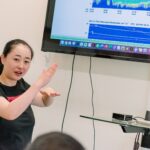
UMBC’s Qianqian Song has just received the Future Investigators in NASA Earth and Space Science and Technology (FINESST) Fellowship—one of just 59 such fellowships granted nationwide this year. The award provides $45,000 per year for three years for her to continue her studies at UMBC with Zhibo Zhang, associate professor of physics.
Song, a fourth-year Ph.D. candidate in atmospheric physics, is studying how dust above clouds affects the global climate. Large amounts of dust enter the atmosphere when strong winds blow across dry areas, such as the Sahara Desert. Previous research from the Zhang lab showed that this dust travels thousands of miles and provides critical nutrients to the Amazon rainforest. Other studies have suggested that the dust has an overall cooling effect on climate, by blocking short-wave radiation coming from the sun. “But they were neglecting the long-wave effect,” says Song. This is where her innovative work comes in.
As long-wave radiation rises into the atmosphere from Earth’s surface, dust can block it from exiting the atmosphere, producing a warming effect. “In our research we found that the dust’s long-wave warming effect cancels about 30 percent of the short-wave cooling effect,” Song explains. Incorporating this new understanding into climate models could have a significant impact on the models’ predictions.
Now Song wants to learn more about how the dust interacts with nearby clouds: How does it affect the size of water droplets in the clouds, or how densely the droplets are packed together? Massive amounts of data obtained by NASA satellites and aircraft and powerful computational tools will assist Song as she works on answering these challenging questions.
Embracing change at UMBC
Qianqian has come a long way since her 2014 arrival in the U.S. from China with her husband, who had obtained a student visa to pursue a Ph.D. in electrical engineering at Johns Hopkins University. Coming to the U.S. “was a big change,” she says. For one, “When we came, our English wasn’t good. It was hard. But now it’s much better.”
After a year, Song decided to pursue her own Ph.D. “When I visited UMBC, I felt like everyone knows each other and supports each other in the physics department,” she remembers. “That’s why I chose here.”
 Some of Zhibo Zhang’s lab members, clockwise from lower left: Qianqian Song, Chamara Raja, Kevin Zheng, Zhibo Zhang, and Olivia Norman. Photo by Marlayna Demond ’11 for UMBC.
However, the visa process proved challenging, and she thought she would have to postpone her enrollment another year. But physics graduate program director Todd Pittman stepped in. “He talked to the whole department,” Song says, and got department chair Michael Hayden’s support for a special, temporary scholarship for Song to initially join the UMBC community as a part-time student. She dived into her courses and research rotations, and the next semester Song was able to finalize her visa and begin her full-time studies.
A rotation in Zhang’s lab sparked Song’s interest in atmospheric research. “Before I came here, I did my master’s degree in Beijing. The pollution there is very severe,” Song shares. “So since living there, I am interested in atmospheric science. When I did a rotation with Dr. Zhang, I did research on dust aerosols, and I got very interested in learning about their role in climate change.”
Pursuing her dream
Now, Song is excelling. “I think she is rising to become a future leader in our field,” says Zhang.
Song shares that UMBC’s supportive network has had a major impact on her experience. “Dr. Zhang is an excellent adviser. He teaches us communication skills and helps us a lot in our research,” she says. “In this research group everyone helps each other, not only on our research but also in our personal life.”
That’s been important for Song, who recently welcomed her first child. The flexibility to work and participate in meetings from home, when needed, allowed her to continue her research at full speed while she was pregnant and now, as she raises her baby with her husband. “I was in my third trimester when I was writing the fellowship proposal,” she shares.
Song plans to pursue a career in academia after her Ph.D. “That’s my dream,” she says. With the support of the fellowship, her lab group, and her family, Song will pursue it with confidence.
Banner image: Qianqian Song discusses her research findings with her lab team. Photo by Marlayna Demond ’11 for UMBC.
]]>
UMBC’s Qianqian Song has just received the Future Investigators in NASA Earth and Space Science and Technology (FINESST) Fellowship—one of just 59 such fellowships granted nationwide this year....
https://umbc.edu/stories/umbcs-qianqian-song-receives-finesst-fellowship-from-nasa-for-research-on-dust-clouds-and-climate/
https://my3.my.umbc.edu/api/v0/pixel/news/120073/guest@my.umbc.edu/abfbbf3d0ab83ece7f426d812eb7c004/api/pixel
cnms
community
gradresearch
graduateschool
page1
physics
research
science-and-technology
UMBC News & Magazine
https://my3.my.umbc.edu/groups/umbc-news-magazine
https://assets1-my.umbc.edu/system/shared/avatars/groups/000/001/943/24435aa6207c452e7bc15cc74b42c7bb/xsmall.png?1748556657
https://assets1-my.umbc.edu/system/shared/avatars/groups/000/001/943/24435aa6207c452e7bc15cc74b42c7bb/original.png?1748556657
https://assets2-my.umbc.edu/system/shared/avatars/groups/000/001/943/24435aa6207c452e7bc15cc74b42c7bb/xxlarge.png?1748556657
https://assets2-my.umbc.edu/system/shared/avatars/groups/000/001/943/24435aa6207c452e7bc15cc74b42c7bb/xlarge.png?1748556657
https://assets3-my.umbc.edu/system/shared/avatars/groups/000/001/943/24435aa6207c452e7bc15cc74b42c7bb/large.png?1748556657
https://assets1-my.umbc.edu/system/shared/avatars/groups/000/001/943/24435aa6207c452e7bc15cc74b42c7bb/medium.png?1748556657
https://assets2-my.umbc.edu/system/shared/avatars/groups/000/001/943/24435aa6207c452e7bc15cc74b42c7bb/small.png?1748556657
https://assets1-my.umbc.edu/system/shared/avatars/groups/000/001/943/24435aa6207c452e7bc15cc74b42c7bb/xsmall.png?1748556657
https://assets2-my.umbc.edu/system/shared/avatars/groups/000/001/943/24435aa6207c452e7bc15cc74b42c7bb/xxsmall.png?1748556657
UMBC News & Magazine
0
0
false
Fri, 02 Aug 2019 20:47:09 -0400
UMBC’s Glenn Wolfe develops new method to gauge atmosphere’s ability to clear methane, a potent greenhouse gas
New research by UMBC’s Glenn Wolfe and collaborators is shaping how scientists understand the fate of methane, a potent greenhouse gas, in Earth’s atmosphere.
Of the greenhouse gases, methane has the second greatest overall effect on climate after carbon dioxide. And the longer it stays in the atmosphere, the more heat it traps. That’s why it’s essential for climate models to properly represent how long methane lasts before it’s broken down. That happens when a methane molecule reacts with a hydroxyl radical—an oxygen atom bound to a hydrogen atom, represented as OH—in a process called oxidation. Hydroxyl radicals also destroy other hazardous air pollutants.
“OH is really the most central oxidizing agent in the lower atmosphere. It controls the lifetime of nearly every reactive gas,” explains Wolfe, an assistant research professor at UMBC’s Joint Center for Earth Systems Technology. However, “globally, we don’t have a way to directly measure OH.” More than that, it’s well understood that current climate models struggle to accurately simulate OH. With existing methods, scientists can infer OH at a coarse scale, but there is scant information on the where, when, and why of variations in OH.
New research published in Proceedings of the National Academy of Sciences and led by Wolfe puts scientists on the path to changing that. Wolfe and colleagues have developed a unique way to infer how global OH concentrations vary over time and in different regions. Better understanding of OH levels can help scientists understand how much of the ups and downs in global methane levels are due to changing emissions, such as from oil and natural gas production or wetlands, versus being caused by changing levels of OH.
A flying laboratory
NASA satellites have been measuring atmospheric formaldehyde concentrations for over 15 years. Wolfe’s new research relies on that data, plus new observations collected during NASA’s recent Atmospheric Tomography (ATom) mission. ATom has flown four around-the-world circuits, sampling air with the aid of a NASA research aircraft.
This “flying laboratory,” as Wolfe describes it, collected data on atmospheric formaldehyde and OH levels that illustrates a remarkably simple relationship between the two gases. This did not surprise the scientists, because formaldehyde is a major byproduct of methane oxidation, but this study provides the first concrete observation of the correlation between formaldehyde and OH. The findings also showed that the formaldehyde concentrations the plane measured are consistent with those measured by the satellites. That will allow Wolfe’s team and others to use existing satellite data to infer OH levels throughout most of the atmosphere.
 The “flying laboratory”: Instruments inside the NASA research aircraft used for Glenn Wolfe’s research. Photo courtesy NASA.
“So the airborne measurements give you a ground truth that that relationship exists,” Wolfe says, “and the satellite measurements let you extend that relationship around the whole globe.”
Wolfe, however, is the first to acknowledge that the work to improve global models is far from done. The airplane measured OH and formaldehyde levels over the open ocean, where the air chemistry is relatively simple. It would be more complicated over a forest, and even more so over a city.
While the relationship the researchers determined provides a solid baseline, as most of Earth’s air does, indeed, float above oceans, more work is needed to see how OH levels differ in more complex environments. Potentially, different data from existing NASA satellites, such as those tracking emissions from urban areas or wildfires, could help.
Wolfe hopes to keep refining this work, which he says is at “the nexus of the chemistry and climate research communities. And they’re very interested in getting OH right.”
Getting it right
The current study did consider seasonal variations in OH, by analyzing measurements taken in February and August. “The seasonality is one aspect of this study that’s important,” Wolfe says, “because the latitude where OH is at its maximum moves around.” Considering seasonal shifts in OH concentrations, or even multi-year shifts caused by phenomena like El Niño and La Niña, could be one angle to explore when trying to improve global climate models.
Looking further at OH levels on a global scale using satellite data validated by airplane data could also help scientists refine their models. “You can use the spatial variability and the seasonality to understand at the process level what’s driving OH, and then ask if the model gets that right or not,” Wolfe says. “The idea is to be able to poke at all these features, where we haven’t really had any data to do that with before.”
This new research is one step in the journey to enhancing our understanding of the global climate, even as it is rapidly changing. More accurately understanding how, for example, cutting methane emissions would affect the climate, and how quickly, could even influence policy decisions.
“It’s not perfect. It needs work,” Wolfe says. “But the potential is there.”
Image: The NASA research aircraft used for the ATom mission. Photo by Susan McFadden for NASA.
]]>
New research by UMBC’s Glenn Wolfe and collaborators is shaping how scientists understand the fate of methane, a potent greenhouse gas, in Earth’s atmosphere. Of the greenhouse gases, methane...
https://umbc.edu/stories/umbcs-glenn-wolfe-develops-new-method-to-gauge-atmospheres-ability-to-clear-methane-a-potent-greenhouse-gas/
https://my3.my.umbc.edu/api/v0/pixel/news/120125/guest@my.umbc.edu/67b9b952b762bc4669dd07424b73421d/api/pixel
jcet
physics
research
science-and-technology
UMBC News & Magazine
https://my3.my.umbc.edu/groups/umbc-news-magazine
https://assets1-my.umbc.edu/system/shared/avatars/groups/000/001/943/24435aa6207c452e7bc15cc74b42c7bb/xsmall.png?1748556657
https://assets1-my.umbc.edu/system/shared/avatars/groups/000/001/943/24435aa6207c452e7bc15cc74b42c7bb/original.png?1748556657
https://assets2-my.umbc.edu/system/shared/avatars/groups/000/001/943/24435aa6207c452e7bc15cc74b42c7bb/xxlarge.png?1748556657
https://assets2-my.umbc.edu/system/shared/avatars/groups/000/001/943/24435aa6207c452e7bc15cc74b42c7bb/xlarge.png?1748556657
https://assets3-my.umbc.edu/system/shared/avatars/groups/000/001/943/24435aa6207c452e7bc15cc74b42c7bb/large.png?1748556657
https://assets1-my.umbc.edu/system/shared/avatars/groups/000/001/943/24435aa6207c452e7bc15cc74b42c7bb/medium.png?1748556657
https://assets2-my.umbc.edu/system/shared/avatars/groups/000/001/943/24435aa6207c452e7bc15cc74b42c7bb/small.png?1748556657
https://assets1-my.umbc.edu/system/shared/avatars/groups/000/001/943/24435aa6207c452e7bc15cc74b42c7bb/xsmall.png?1748556657
https://assets2-my.umbc.edu/system/shared/avatars/groups/000/001/943/24435aa6207c452e7bc15cc74b42c7bb/xxsmall.png?1748556657
UMBC News & Magazine
0
0
false
Fri, 31 May 2019 18:02:57 -0400


