Open to Interpretation
What if you could ask yourself a big question and then use your intuition to follow it wherever it led for as long as it took? It would take a certain kind of guts, right? But, with a willingness to get lost on a tangent, to joyfully put themselves in positions of not knowing, truly creative thinkers can find new ways of translating the world around them.
Enter the following: A dancer who makes beautiful movement from fish research. An information systems professor who turns poetry into wine. A data visualizer who draws connections while splattering paint. A mapper and sculptor of hip hop facts. A harnesser of color and language and culture.
This is the sort of magic that can happen when you’re open to interpretation.

On a molecular level, the push and pull of an ecosystem may feel too infinitesimal for humans to experience visually. A researcher can track the data in a spreadsheet as a series of characters and marks or explain it with the structure of a scientific article. Microscopes may capture stills or video of tiny worlds, but what about the emotional landscape of life in motion?
“I really am fascinated with the small things we cannot see that are so important,” says Ann Sofie Clemmensen, assistant professor of dance, who spent a year in residence at the Institute of Marine & Environmental Technology (IMET) next to Baltimore’s Inner Harbor working with scientists who study a variety of topics adjacent to aquaculture, environment, and sustainability.
Clemmensen began her residency by diving deeply into the research of the IMET scientists around her—learning about everything from rainbow trout viruses to the ecological wear and tear of red tides. As she built relationships with researchers, she found herself drawn into the details of their studies—and wondering how she might translate what she learned into something that might encourage viewers to learn more about their world.
“There’s a sort of unpacking of the language of that field. Because movement, while it’s not a spoken language, it is language,” she explains, ever the eager translator. “We have to understand the concept we are trying to embody in order for the physical embodiment to carry the meaning.”
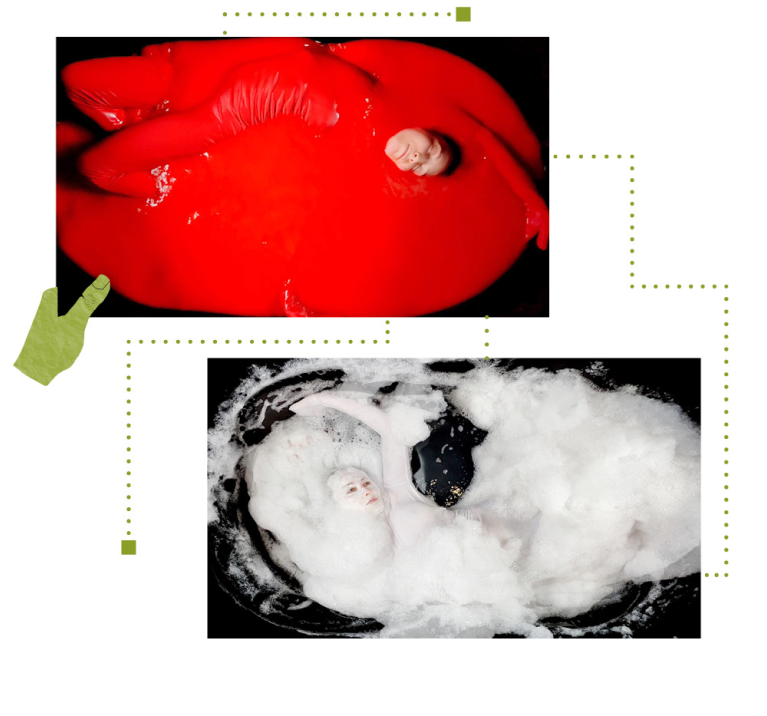
Working with student dancers, Clemmensen choreographed and filmed a series of movements and scenes meant to depict biological processes she learned about from her IMET counterparts. In one, students in masks represent the generic differences of virulent and avirulent strains of the VHSV rainbow trout virus. In another, dancer Michaela Emmerich ’24 (covered in clay powder) rolls in the dirt to show the effect of argonite in reducing levels of phosphorus in farming run-off.
While Clemmensen’s scenes of red tides, green biomass, and white, milky foams are objectively beautiful, don’t be fooled. Nature isn’t pretty, Clemmensen says. But taking a good close look can help us all understand our environment a bit better.
“For many doing art, dance, and data-driven research, it’s like looking at an abstract painting. If you don’t have a little key that can unveil or reveal some of those secrets, then it’s just chaos.”
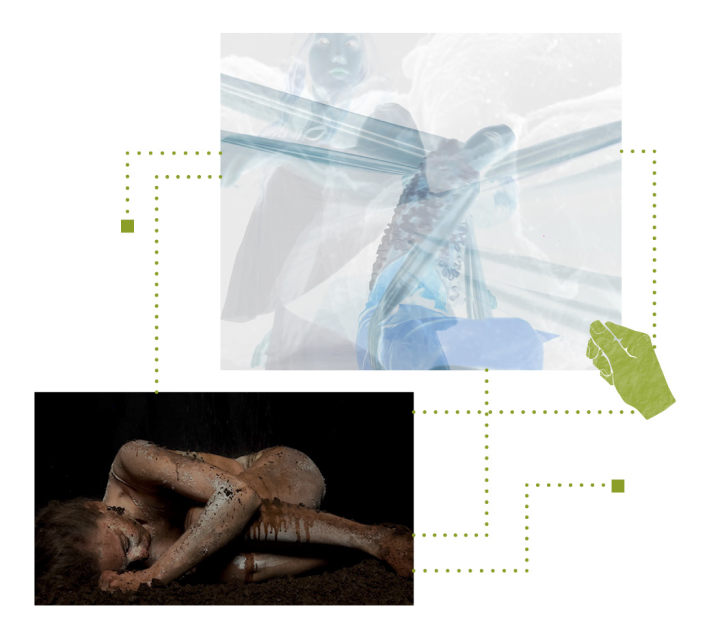
Assistant professor Ann Sofie Clemmensen worked with
researchers at IMET to create a series of videos depicting
microscopic processes like red tides and battling
dinoflaggelates. Photos courtesy of Clemmensen.

A poem crosses time and space, building in meaning as it travels from person to person, from generation to generation. With each new reader, it becomes something new and specific—but also potentially loses something of itself along the way.
As a trained computer scientist, Foad Hamidi, assistant professor of information systems, is fascinated by the practical challenge of being able to retrieve information lost when data is duplicated—an inevitable fact of digital life. As a lifelong lover of Sufi poetry from his home country of Iran, he also can’t help but wonder how to preserve the heart of these precious words, even as circumstances—generations, distance, cultural leanings—might dilute or change them.
“There’s always some information loss” in data duplication, he explains. “However, a very interesting theorem in information theory also says that if you have a lot of replicas of the same code…you can recover the original message in the presence of errors that was in all these codes.”
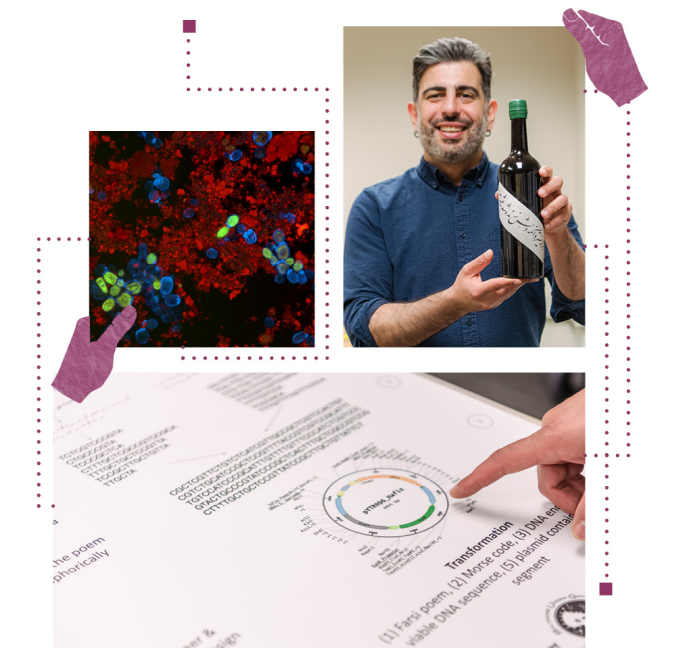
Information systems Professor Foad Hamidi has
translated a favorite childhood poem into DNA code,
wine, and more. Top image (magnified photo of yeast
cells with the modified DNA Hamidi made)
courtesy of Tagide deCarvalho.
Years ago, Hamidi learned about a song that was encoded by Japanese musician Etsuko Yakushimaru using living bacteria as a sort of language, “and it really made me think of the possibilities of information and culture and data and encoding.” And so, at the start of the pandemic, he began exploring ways of translating the poetry of Hafiz, a 14th-century Persian poet, into new, living forms and of sharing the experience with others.
Hamidi’s bio-art-inspired creative inquiry led him first to interpret the poetry as code—DNA, to be precise—culled from the words themselves. He then created a “poetry-infused transgenic wine” using yeast modified with the DNA encoding of the poem. Craving community, he took the idea to other researchers in music, biology, imaging, and beyond to joyfully build further iterations of the chain. These efforts led to an Imaging Research Center (IRC) Faculty Research Fellowship (with Linda Dusman, professor of music), and today, he continues to explore new translations of the coded poem through music, cellular imagery, and even a cluster of mushrooms growing in Hamidi’s office.
With each new link in Hamidi’s poetic chain, the information is replicated and the “data” is one step closer to being saved through this fascinating theorem. In doing so, Hamidi also is able to bring together curious new friends who might not have had reason to collaborate otherwise.
Although Hamidi’s “translations” may seem outside the box, the practice of making a poem one’s own “has a long history,” he explains. “These poems are the DNA of my culture…so our architecture, our music, our visual arts, our cultural traditions, are very much impacted by poetry.”

In a far corner hangs an enormous painting of a brain, with bright blue lines, red arrows, and clips of phrases suggesting ideas in motion. In every direction above it, threads of red and blue crisscross the room anchoring one artwork to the next—a system of knit synapses representing not only 25 years of research but the artistic process that fuels it.
“What I try to do, above and beyond anything else, is show as transparently as possible what that process looks like,” says Lee Boot, director of UMBC’s Imaging Research Center (IRC), whose retrospective exhibit “Abstracts & Artifacts” showed at Baltimore’s Peale Museum earlier this spring.
For Boot, that means a room filled with numbers, images—some animated, many bursting with color—and the connective tissue of the personal paintings he created to process information and experiences related to the various subjects of his research.
“The work is immersive. I paint my brain out as a meditative, reflective process. And then that gets honed, and reshaped, and…out of that automatically comes new perspectives and new ways of framing problems.”
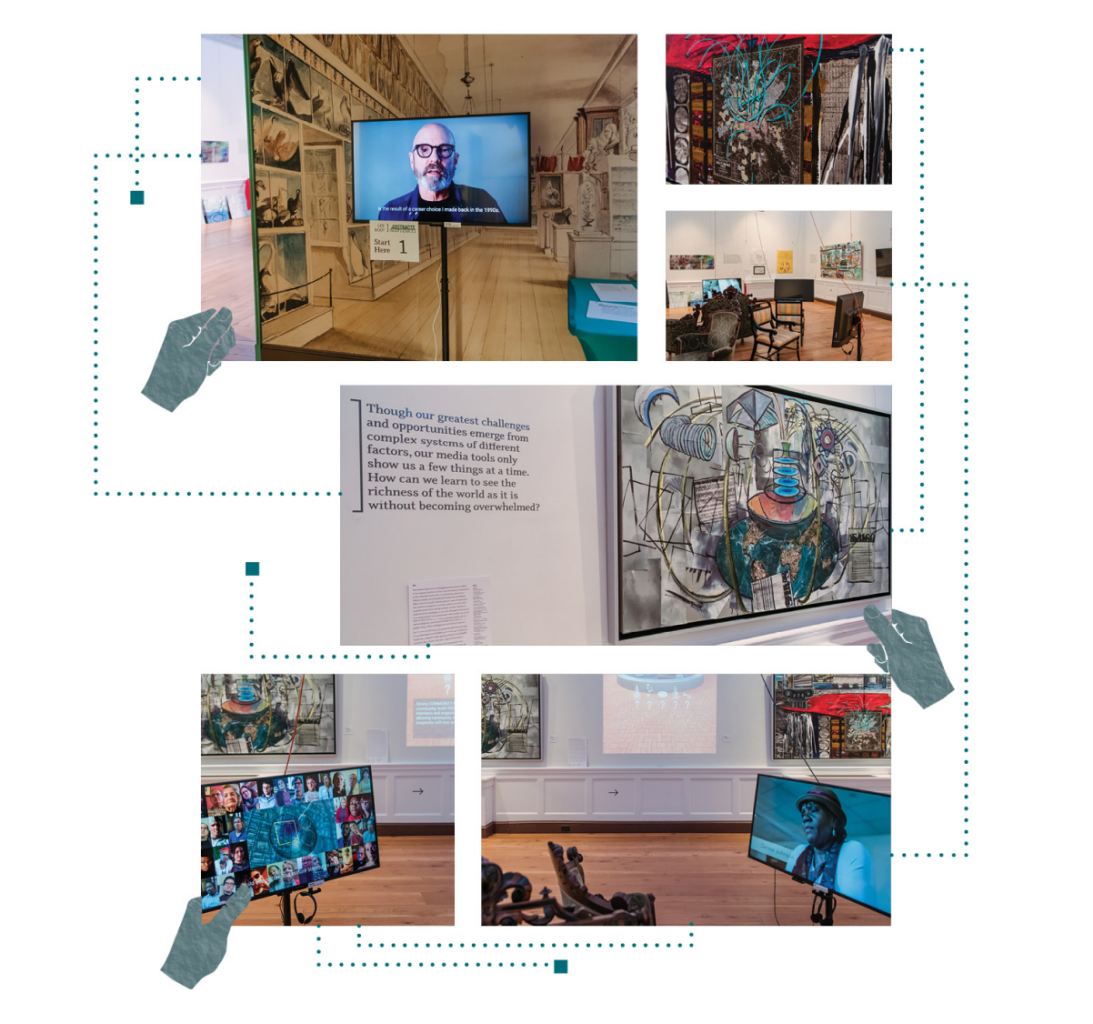 In his exhibit “Abstracts & Artifacts,” Lee Boot asks
viewers to consider new ways of solving problems.
“Almost like dreaming, making art with a question
in mind reveals meaning through metaphor. How
is it that metaphors seem to be both specific and
ambiguous—both personal and universal—at once?”
In his exhibit “Abstracts & Artifacts,” Lee Boot asks
viewers to consider new ways of solving problems.
“Almost like dreaming, making art with a question
in mind reveals meaning through metaphor. How
is it that metaphors seem to be both specific and
ambiguous—both personal and universal—at once?”
Boot lives to solve problems, and believes deeply in the power of combining artists’ ways of thinking with other disciplines to ask questions and find solutions in new ways. Over the years, the IRC has brought together multidisciplinary teams of artists, scientists, and social scientists from state and local agencies, foundations, and other organizations who are open to tackling everything from substance misuse to educational achievement gaps to the epidemiology of pandemics.
And while technology runs much of what the IRC builds, nothing is quite so essential to the heart of the work as one’s own intuition, says Boot. As a classically-trained painter, that means returning to the canvas and allowing his brush to take him in new directions—not to create something beautiful, per se, but to open himself to ideas accessible only through such a personal process.
With each stroke of the brush, and each new color, he pulls from the deepest reaches of experience, community, and understanding, creating a road map for what’s next.
“I’m not trying to make something pretty,” he says. “I am trying to understand how a set of issues sits in being, in my psyche, on the landscape of the world as I understand it. I’m trying to see what I cannot see.”

On the table sit three football-sized forms of light plastic. Each has been sculpted in a 3D printer using zigzag motions specifically programmed to mimic the map lit up behind them showing an orange globe splashed with green arcs. Dots on the screen represent locations mentioned in thousands of hip-hop and rap lyrics, as big as the oft-mentioned city of Atlanta and as hyperlocal as the intersection in front of a neighborhood convenience store.
A student gingerly picks up a gold-colored sculpture, and asks, “Is this Kendrick Lamar?” Tahir Hemphill, a faculty fellow, music aficionado, and self-described “creative technologist who works with art,” nods as a collective “oooh” makes its way around the room.
“It’s data sculpture, literally. It’s making things as real as possible,” says Hemphill, whose ever-evolving body of work, The Rap Research Lab, made its home at UMBC’s Center for Art, Design, and Visual Culture this spring. “This is what it feels like to touch a rapper’s rhymes.”
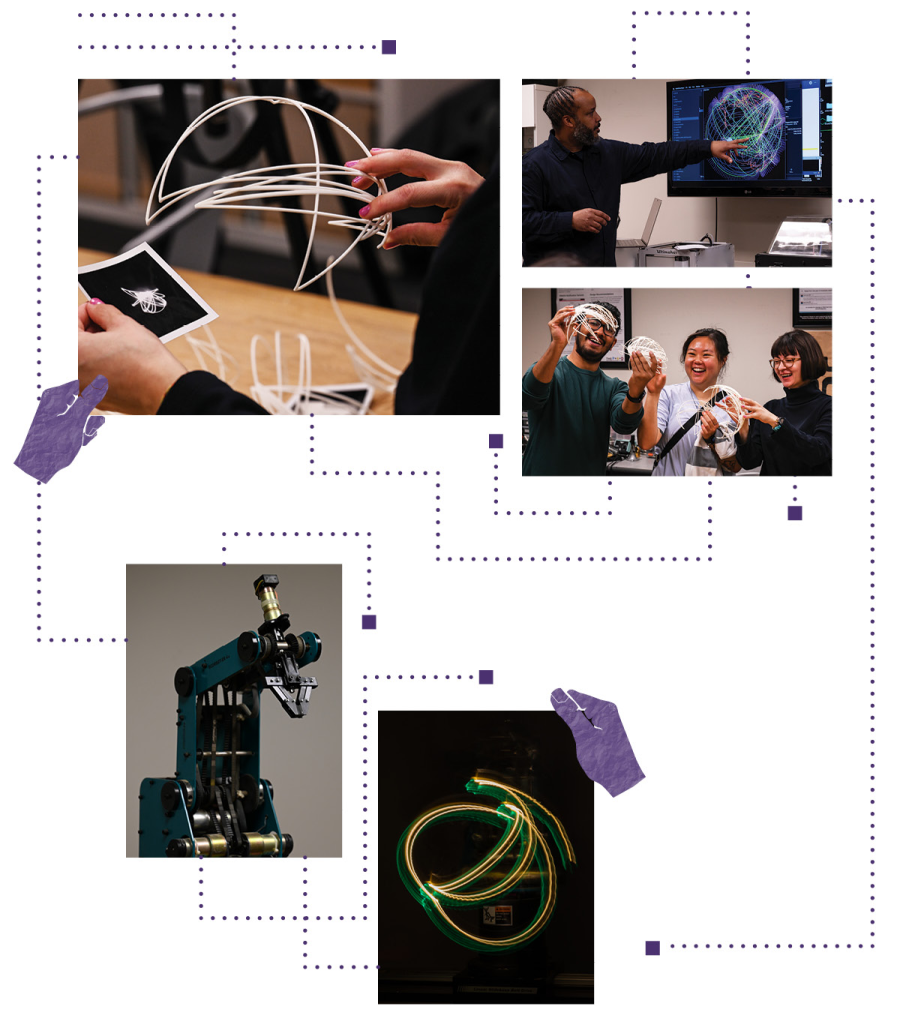
Located at the intersection of hip-hop and data visualization, and built as an interactive teaching space, the lab features the “Mapper’s Delight” tool that, using augmented and virtual reality, cross-references locations from thousands of rap song lyrics along with a variety of other art pieces that speak to Hemphill’s goal of finding “relationships and shapes in the data.”
Over the course of the semester, UMBC students helped Hemphill delve further into the data while middle schoolers from around the state visited the teaching lab with their classes to try their own hands at research using Hemphill’s lyrics database.
On this particular day, Hemphill demonstrates yet another incorporation of the geographic lyric data. In collaboration, Foad Hamidi helped Hemphill program a robotic arm, and by inserting a LED pen into the robot hand and filming movements at a long exposure, he’s able to make “light pen drawings” of the data, à la Pablo Picasso.
With the lights dimmed and the robot arm making ethereal data shapes before their eyes, Hemphill tinkers with his projected spreadsheet in real time. There are just so many threads to follow and infinite stories hidden within.
“My job is to draw them out—pun intended,” he laughs.
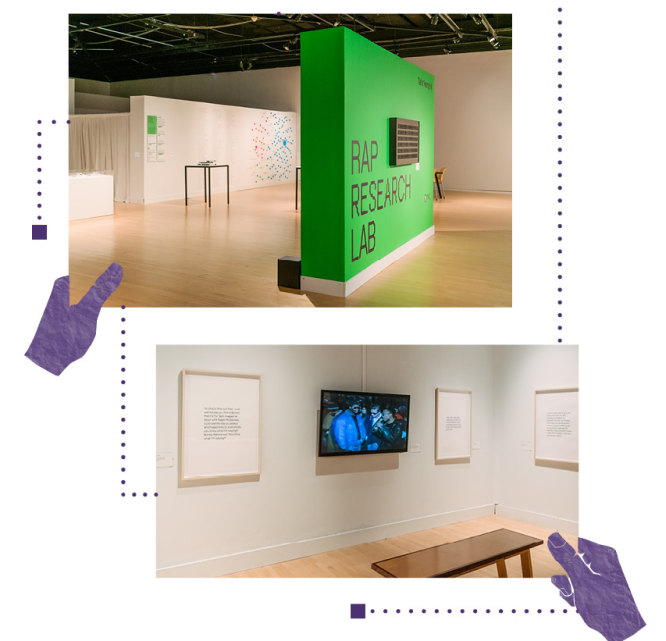
Tahir Hemphill, a faculty fellow, music aficionado, and
self-described “creative technologist who works with
art,” uses data visualization tools to reveal new levels
within hip-hop.
Read how artist Hadieh Shafie, M.F.A. ’04, channels the power of language and her childhood experiences in Iran into intricate and colorful pieces of art.
]]>
What if you could ask yourself a big question and then use your intuition to follow it wherever it led for as long as it took? It would take a certain kind of guts, right? But, with a willingness...
https://umbc.edu/stories/researchers-artists-open-to-interpretation/
https://my3.my.umbc.edu/api/v0/pixel/news/133965/guest@my.umbc.edu/7d78d7c39a954622fea6ad99411873aa/api/pixel
cadvc
dance
discovery
information-systems
irc
magazine
research
spring-2023
UMBC News & Magazine
https://my3.my.umbc.edu/groups/umbc-news-magazine
https://assets1-my.umbc.edu/system/shared/avatars/groups/000/001/943/24435aa6207c452e7bc15cc74b42c7bb/xsmall.png?1748556657
https://assets1-my.umbc.edu/system/shared/avatars/groups/000/001/943/24435aa6207c452e7bc15cc74b42c7bb/original.png?1748556657
https://assets2-my.umbc.edu/system/shared/avatars/groups/000/001/943/24435aa6207c452e7bc15cc74b42c7bb/xxlarge.png?1748556657
https://assets2-my.umbc.edu/system/shared/avatars/groups/000/001/943/24435aa6207c452e7bc15cc74b42c7bb/xlarge.png?1748556657
https://assets3-my.umbc.edu/system/shared/avatars/groups/000/001/943/24435aa6207c452e7bc15cc74b42c7bb/large.png?1748556657
https://assets1-my.umbc.edu/system/shared/avatars/groups/000/001/943/24435aa6207c452e7bc15cc74b42c7bb/medium.png?1748556657
https://assets2-my.umbc.edu/system/shared/avatars/groups/000/001/943/24435aa6207c452e7bc15cc74b42c7bb/small.png?1748556657
https://assets1-my.umbc.edu/system/shared/avatars/groups/000/001/943/24435aa6207c452e7bc15cc74b42c7bb/xsmall.png?1748556657
https://assets2-my.umbc.edu/system/shared/avatars/groups/000/001/943/24435aa6207c452e7bc15cc74b42c7bb/xxsmall.png?1748556657
UMBC News & Magazine
1
0
false
Thu, 08 Jun 2023 19:21:59 -0400
Thu, 08 Jun 2023 19:21:59 -0400
Building AI We Can Trust

The AI apocalypse is coming. Or it isn’t. Depending on what you read, you might get confused.
One thing is certain: Humans are fired up about smart machines. Much of the attention has focused on ChatGPT, an “artificial intelligence language model designed to generate human-like responses to natural language prompts” (in its own words).
ChatGPT gets coy if you ask whether its existence should be cause for human concern. “It’s important to recognize that I am a tool and not inherently good or bad. It’s how people choose to use me that can have positive or negative consequences,” it says.
Many researchers, however, are not so noncommittal. They see inherent flaws in the machine learning technology that forms the foundation of tools such as ChatGPT, and they would like to make it better.
While ChatGPT advises that “it’s always a good idea to double-check any important information I provide,” some UMBC researchers are working to build better safeguards into the AI systems themselves—AI the public can trust.

On March 22 of this year, a group including prominent artificial intelligence researchers and tech entrepreneurs released an open letter calling for a six-month pause on the training of powerful AI systems.
“AI systems with human-competitive intelligence can pose profound risks to society and humanity,” the letter argued. “Powerful AI systems should be developed only once we are confident that their effects will be positive and their risks will be manageable.”
The letter signers, including two UMBC faculty, expressed alarm at an AI arms race unleashed with the November 2022 public debut of ChatGPT, a celebrity chatbot that answers almost any question or prompt with humanlike ease. In a mere two months, the bot attracted 100 million users, and big tech companies began sprinting to deploy similar technology in their products.
Yet a general unease is accompanying this latest rush for AI gold.
ChatGPT can dazzle users with its eloquent prose (and poetry!), but it sometimes delivers complete falsehoods. People fret that such technology will eliminate jobs and empower scammers and dictators. And beneath it all, many researchers worry that we do not fully understand—nor can we reliably control—how creations such as ChatGPT work.
“At the core of many powerful AI systems today are what are called ‘blackbox’ models,” says Manas Gaur, an assistant professor in the Department of Computer Science and Electrical Engineering (CSEE) at UMBC. The models percolate data through layers of calculations so dense and complex that researchers struggle to track what’s happening inside. The models may excel at certain tasks—like writing sentences in ChatGPT’s case—but they cannot explain why they make the decisions they do. Sometimes they do perplexing, and erratic, things.
“Some people see ChatGPT and similar technology as a progressive tool while others fear it is dangerous,” says Nancy Tyagi, a master’s student in computer science at UMBC who is also working as a researcher in Gaur’s lab. “In my opinion, such tools are inherently risky and need further analysis. If these models are to be used in sensitive areas such as mental health or defense systems, then more work is required to make them safe, controllable, and trustworthy.”
Tyagi is working on a project to build an AI mental health assistant capable of initiating safe and appropriate conversations based on clinical guidelines in mental health. Her project is one of many that Gaur and other AI researchers at UMBC are launching with the aim of ensuring AI tools are accurate, transparent, and safe.
To better understand these researchers’ quest for trustworthy AI, it helps to take a step back and consider how the latest AI trend fits into the big picture.

A Brief History of
Thinking Machines
When the field of artificial intelligence launched in the 1950s, computers were feeble compared to the muscular monsters that power systems such as ChatGPT today. Yet researchers were intrigued by the possibility of teaching them to think like humans. What followed was a roller coaster of booms and busts.
“The history of AI has been marked by periods of hype, followed by some level of disillusionment,” says Tim Finin, CSEE professor and a researcher at UMBC who has been studying AI problems for more than 50 years.
Driving the ups and downs were three interrelated factors: the power (and limits) of the hardware that formed computers’ brains, the data available to train those brains, and the “thinking strategies” AI researchers devised.
In the beginning, researchers taught machines to play games, learn language, and solve mathematical puzzles using a variety of “thinking” approaches. Yet the field hit a wall in the 1970s: Computers couldn’t store enough information or process it fast enough to tackle real-world problems. This was the first “AI winter,” when funding dried up and the topic faded from public view.
The birth of the microprocessor at the end of the decade revitalized AI research. Riding the shoots of this new life, a certain approach to machine thinking rose to prominence—that of the expert system. These AI programs were based on pre-programmed knowledge and logic meant to mirror the reasoning of human experts. Perhaps the most famous expert system was IBM’s Deep Blue, which beat the Russian chess champion Garry Kasparov in a chess match in 1997.
Expert systems could shine when solving narrowly defined problems (such as winning a game of chess), but they were brittle, says Finin. The systems struggled to adapt to fuzzy and fluid real-world situations, and it was cumbersome to program all the rules that an expert might use to evaluate a problem.
As the limits of expert systems became clear in the 1990s, AI felt the chill of a second winter.
It was another advance in computing hardware that thawed the field again after the turn of the 21st century. The graphic processing units developed to enhance video games supercharged computers’ speed and power at low cost. This, coupled with a flood of free data from the internet, propelled a new type of AI to the forefront: machine learning.
With loads of computing power and heaps of examples to learn from, researchers found surprising success getting computers to teach themselves how to think. The computers start with a question, perform some calculations, and guess the answer. They then compare it to the actual answer. If they are wrong, (which they usually are at first), they fiddle with the calculations and try again. After running billions of calculations, such systems can become quite proficient at tasks such as identifying images of cats and predicting the next word in a sentence.
THE SEASONS OF AI
The growth of the modern field of AI has been marked by a series of rapid spurts, followed by more dormant periods. People often liken these ups and downs to the seasons. During AI summers, public attention shines hot on the field. Yet the bountiful fruit of the season has often grown from seeds of ideas planted during quiet AI winters.
Summer 1: Expert systems
AI programs based on knowledge and logic flourished in the 1980s. Examples include systems that can identify unknown chemicals, diagnose diseases, and play chess. The systems are safe and explainable, but fail to adapt to fluid and complex situations.
Summer 2: Machine learning
Starting in the early 2010s, the potent combination of supercharged computing and heaps of free internet data powered AI’s second summer: the golden era of machine learning—an era that we are arguably still in.
AI systems started to recognize images, transcribe and translate language, and create text and art almost like humans do. These systems have surprised even their own creators with their range of abilities, but they are hard to understand, reason with, and control.
Into the future: Hybrid AI
It’s not yet clear when or if the second AI summer will turn to fall. But researchers are already planting the seeds for future advances. Combining the fruits of past summers, researchers hope to make future AI systems that are adaptable and safe, self-taught and able to explain their decisions.

FUN FACT:
UMBC’s first Ph.D. graduate in computer science, Sanjeev Bhushan Ahuja, earned his degree when expert systems dominated AI. His dissertation, published in 1985 and titled “An Artificial Intelligence Environment for the Analysis and Classification of Errors in Discrete Sequential Processes,” advances techniques popular during this time.
This approach to machine learning is called a neural network, so named because it was originally inspired by the way neurons in the brain work. Neural networks lie at the heart of most famous AI applications today, including image classification tools, voice recognition, and text and image generators.

The power (and limits) of
machine learning
When many of the new machine learning systems debuted, their powers seemed almost miraculous. But soon enough, drawbacks emerged. The machines require enormous data sets (and enormous amounts of energy) to learn. They will adopt biases from their training data and sometimes from their interactions with humans. A chatbot named Tay was quickly scuppered after its 2016 release, when users pushed it into spewing racist and sexist ideas.
Machine learning systems can also fail spectacularly in individual instances (even if they get answers correct most of the time). For example, a driver was killed in 2016 when the autopilot in a Tesla car failed to recognize the side of a white trailer truck against a bright sky.
The blackbox nature of state-of-the-art machine learning means the systems are unable to explain or justify their conclusions, giving users—and even their own creators—little insight into their thinking. For the most part, the systems struggle to build consistent worldviews or reason logically.
The weaknesses of learning models also leave them susceptible to malicious manipulation. Adversaries might “poison” the data used to train the models or exploit the model’s opaqueness to hide an attack.
“It is time we fall back from trusting these models,” says Gaur, whose personal push to make AI systems more explainable, robust, and safe is part of a growing international movement.
Another UMBC researcher joining the push is Houbing Song, a professor in the Department of Information Systems at UMBC. Song says that transportation, defense, medicine, and the law are some areas where explainable and safe AI systems are needed the most.
As researchers tackle the challenge of making current AI systems better, they are often returning to ideas from an earlier era of AI.

Hybrid systems to merge logic and learning
If the AI systems of the 1980s married the AI systems of the 2010s, their baby might be the type of system Gaur, Song, and others are working to develop.
These systems look to deliver the learning capabilities of neural networks alongside the safeguards of knowledge and rule-based systems.
In the field of mental health, Gaur points out that current chatbot systems are not well suited to answering patients’ questions since they can give unsafe or off-the-wall responses.
“Guaranteeing these systems’ safety calls for more than just improving their overall performance” he says. “We must also make sure the systems are prevented from giving risky answers.”
Working with Karen Chen, an assistant professor from the Department of Information Systems, Gaur has written a paper highlighting the properties that AI-powered virtual mental health assistants should exhibit to be considered safe and effective.
Creating “AI Scientists” at UMBC
New scientific discoveries often lay the groundwork for significant advances in human well being. Think of medical treatments that spring from a better understanding of the human body or labor-saving devices we fashion using our knowledge of material properties.
Tyler Josephson, an assistant professor in the Department of Chemical, Biochemical, and Environmental Engineering, hopes to turbocharge science’s discovery engine, with a little help from AI.
Josephson has started a new project to translate chemical theories into a machine-readable mathematical language. Once the computers have access to the foundations of science, Josephson believes they could be tasked with logically manipulating that information to reveal new discoveries.
You might wonder if Josephson has any worries about creating his own AI-powered replacement. But he doesn’t think AI scientists will displace the human kind.
“I think scientists have so many different problems to solve. And if we solve them faster with AI, they just open up brand new questions for us to go after next,” Josephson said in an interview about his work with the Canadian radio program Quirks & Quarks.

Together with his students, he is also working to create such systems. Using an approach called knowledge-infused learning, the researchers are looking to anchor their AI systems in clinically approved guidelines. They are also pushing their systems to reveal their thinking so that the approaches can be checked by mental health experts. Sometimes the results reveal that even when a system arrives at a correct conclusion, the information it used to reach that conclusion may be irrelevant to a human doctor’s thinking.
Song has also been coaxing AI learning models to open up. In a recent paper, he and his co-authors developed a tool to identify attacks on an image-recognition program by figuring out which parts of its neural network are most susceptible to manipulation.
In the fall of 2023, he will be teaching a new graduate-level course on a broad category of hybrid AI called neurosymbolic AI. UMBC will be only the second university in the world to offer such a course, he says.
Song arrived at UMBC in January on the heels of winning major honors for his research in computing and engineering and is looking forward to turning more of his attention to this emerging frontier in AI research. He says he eventually hopes to build a world-class AI research institute at his new academic home, focused on delivering learning machines that can be confidently used when safety is a top priority.
“I recognize the need for trustworthy AI,” Song says. “I believe that this field of research is where I can make unique contributions and take on responsibilities for my professional communities and my home institution.”


Technology to benefit society
The initial goal of AI, as defined by a group of researchers credited with launching the field at a 1956 workshop, was to “make machines use language, form abstractions and concepts, solve [the] kinds of problems now reserved for humans, and improve themselves.” But if the aim is human-like thinking, it naturally raises the question: How do humans think?
In a bestselling book titled “Thinking, Fast and Slow,” world-renowned psychologist Daniel Kahneman posits that humans have two thinking systems: a fast one and a slow one. The fast one is the thinking that comes to mind almost without effort, and we use this thinking most of the time. Yet it is prone to errors. The deliberative slow thinking system catches mistakes and enables breakthroughs in understanding.
Finin compares machine learning models to the fast-thinking system while knowledge and logic-based systems are more like the slow-thinking system. To make today’s faddish, fast-thinking models more competent, researchers such as Gaur, Song, and their students are extending them with slow-thinking capabilities.
We may still be decades away from AI systems approaching the full range of human intelligence. There are many ethical questions to grapple with before we reach a Hollywood-esque future of self-flying cars and android coworkers. Yet the decades of AI research up to this point have already transformed the world. AI concepts underpin the ways we search the web, shop online, and otherwise interact with the digital world.
AI has enormous potential to improve human lives, but we must proceed wisely. UMBC researchers are at the frontiers of AI research, pushing the limits of knowledge and theory, and striving to make the technology better for the benefit of society.

Training Your Robot Assistants
If you hope the AI revolution will bestow humanity with machine “Jeeves” capable of meeting your every need, Cynthia Matuszek has some bad news. “I’m always being asked: ‘When will we have robot butlers?’ I have to say—not any time soon,” says Matuszek, an associate professor in the Department of Computer Science and Electrical Engineering.
Matuszek researches how to build robots that understand human commands in complex and chaotic natural environments. She has successfully trained a robot hand that can respond to written prompts such as “Grab the apple.” She is also exploring how to teach robots to understand spoken language and to learn new concepts, such as how to dice a vegetable, if a human shows them how.
Part of what motivates Matuszek’s work is the huge unmet demand for caregivers to assist people as they age. Robots might fill the gap. Matuszek says we likely won’t have “Jack of all trades” helpers, but robots could specialize in certain tasks, such as preparing food or folding laundry.
Another part of what motivates Matuszek is the thrill of being the first person to discover how to do something new. “It’s really just so much fun,” she says.
When Natalie Murray ’22, biological sciences, Thomas Azari ’22, political science, and Lauren Wotring ’22, political science, graduated last spring, they didn’t expect to be returning to UMBC so soon. These recent alums—all members of the 2021 National Mock Trial Championship team—were making inroads in the next stages of their careers, but didn’t hesitate to pick up the phone when the UMBC Mock Trial team called.
Together they took on the leadership of UMBC’s B team, guiding the group—composed mostly of first-year students—to the Opening Round Championship Series (ORCS) in March 2023 and saw B team co-captain Fadil Adeite ’26, media and communication studies, and Anna Kim ’26, biochemistry and psychology, win all-National attorney awards.
Coming back to pay it forward
Natalie Murray was the first to rejoin the UMBC Mock Trial team as a coach. She was hesitant initially. A full-time veterinary assistant position at the Elkridge Animal Hospital meant long days, so long she sometimes showed up to practice in her scrubs after a 12-hour shift.
When Murray agreed to coach, she envisioned having a minor position, yet she ended the season as the B team’s head coach. “Once I started working with them, and I saw how driven and incredible they were, I could not help but throw myself way more into it than I had planned,” said Murray.
The students were aware of the coaches’ investment. “To see the three coaches come back after leaving and dedicate so much time and effort—and gas money—to the team was inspiring, and it really motivated us as competitors to give even more,” said co-captain Adeite.
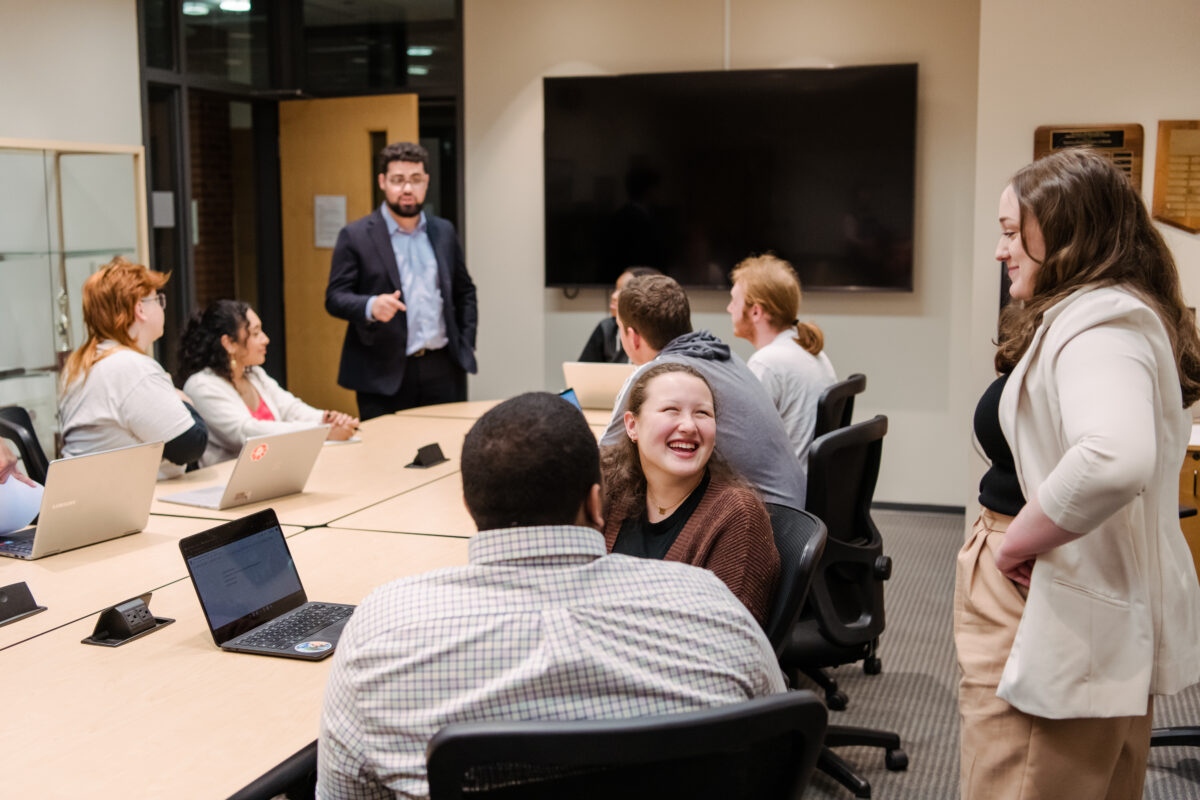 Standing, Azari, left, and Wotring, right, speak with members of the UMBC Mock Trial team. (Marlayna Demond ’11/UMBC)
The team became a source of joy for Murray, brightening her stressful days and making the logistics of coordinating coaching worth it. It helped that she could rely on former teammates to share the load.
Thomas Azari navigated his job in the U.S. Department of State’s Department of Human Rights and Labor, studying for the LSAT, and applying to law school while coaching. Lauren Wotring also made time to coach the B team while working at a D.C. law firm as an intellectual property legal assistant and prepping for law school.
Wotring said the students made the whole experience so special. “I realized how much the students meant to me and how amazing they are and how willing they were to learn,” said Wotring, who realized she wants to keep coaching next year.
Alumni coaching legacy
The Mock Trial team has always had dedicated coaches. The B team trio cites current head coach Ben Garmoe ’13, political science,and assistant coach Whitney Wilder as some coaches who made their mock trial experience.
Azari knew he had to return as a coach after the impact his coaches had on him and his Nationals-winning team.“If not for Ben, we wouldn’t have had any of the success we have now,” he said. “I kind of learned from that and was like, ‘Ben is doing all this work. I have to too.’”
 Garmoe, right, and then-President Freeman Hrabowski show each other their 2021 National Mock Trial Championship rings with members of the UMBC Mock Trial team. (Marlayna Demond ’11/UMBC)
Murray, Azari, and Wotring’s investment in the students took many forms. Wotring spoke to many about the dangers of perfectionism. Murray ensured they were having fun while being competitive. Azari lent out ties and showed them how to stay positive even after a loss. All three drove students to competitions, helped pay for food, and were always a text away.
The students couldn’t have been more thankful. At the end of the season, the alumni coaches received cards from the team with notes from each student. Kim emailed each of them, telling them how they impacted her.
“They taught us how to be better competitors, how to work better as a team, how to get places on time, but mostly how to be confident and proud of ourselves,” said Kim.
“Whenever anyone felt down about themselves, their performance, or not understanding, they were right there to lift us up, guide us, and make us all feel heard,” said B team co-captain Alysha Carter ’26, political science.
Champion volunteers
The trio’s willingness to turn around so quickly after graduation and invest their time in the next generation of UMBC Mock Trial competitors means a lot to Garmoe. “Thomas, Natalie, and Lauren are all national champions and highly decorated competitors,” said Garmoe. “But even more importantly, they are wonderful people and stellar role models for our young students.”
Murray sees a direct correlation between her coaching experience now and the support she received as a Mock Trial participant. Her fond memories of the organization, said Murray, are rooted in the genuine care she felt from her coaches and teammates. “To be part of that equation, and thinking that maybe one day down the line some of these students will do the same thing, they’ll graduate and they’ll want to coach, has been a really fun thought to have.”
By Morgan Casey ’22
]]>
When Natalie Murray ’22, biological sciences, Thomas Azari ’22, political science, and Lauren Wotring ’22, political science, graduated last spring, they didn’t expect to be returning to UMBC so...
https://umbc.edu/stories/all-rise-for-alumni-mock-trial-coaches/
https://my3.my.umbc.edu/api/v0/pixel/news/133925/guest@my.umbc.edu/fc680eab97419f9be2ec22e8a0109bcd/api/pixel
alumni
biological-sciences
impact
magazine
mcs
mock-trial
political-science
spring-2023
UMBC News & Magazine
https://my3.my.umbc.edu/groups/umbc-news-magazine
https://assets1-my.umbc.edu/system/shared/avatars/groups/000/001/943/24435aa6207c452e7bc15cc74b42c7bb/xsmall.png?1748556657
https://assets1-my.umbc.edu/system/shared/avatars/groups/000/001/943/24435aa6207c452e7bc15cc74b42c7bb/original.png?1748556657
https://assets2-my.umbc.edu/system/shared/avatars/groups/000/001/943/24435aa6207c452e7bc15cc74b42c7bb/xxlarge.png?1748556657
https://assets2-my.umbc.edu/system/shared/avatars/groups/000/001/943/24435aa6207c452e7bc15cc74b42c7bb/xlarge.png?1748556657
https://assets3-my.umbc.edu/system/shared/avatars/groups/000/001/943/24435aa6207c452e7bc15cc74b42c7bb/large.png?1748556657
https://assets1-my.umbc.edu/system/shared/avatars/groups/000/001/943/24435aa6207c452e7bc15cc74b42c7bb/medium.png?1748556657
https://assets2-my.umbc.edu/system/shared/avatars/groups/000/001/943/24435aa6207c452e7bc15cc74b42c7bb/small.png?1748556657
https://assets1-my.umbc.edu/system/shared/avatars/groups/000/001/943/24435aa6207c452e7bc15cc74b42c7bb/xsmall.png?1748556657
https://assets2-my.umbc.edu/system/shared/avatars/groups/000/001/943/24435aa6207c452e7bc15cc74b42c7bb/xxsmall.png?1748556657
UMBC News & Magazine
0
0
false
Thu, 08 Jun 2023 11:28:04 -0400
Thu, 08 Jun 2023 11:28:04 -0400
Ministering to the Most Vulnerable

Having the sally port gates slam behind her after walking into the prison for the first time was a bit of a shock to Susan Beck ’74, French. Luckily, a friend was there to hold her hand as they adjusted to the tight space and waited for the next door to open. As Beck got her breathing under control, she joined her classmates in a clinical pastoral education class on the rest of the tour of the facility.
Beck, a former French teacher and a childbirth instructor, never envisioned her retirement as a career rebirth, but as she contemplated how she wanted to spend her time, she kept returning to her love of the church and wondered how she might serve. Prison ministry was the farthest idea from her mind, says Beck now. She imagined shepherding a congregation and ministering to families, but what that evolved into was a role as a community pastor, hosting weekly pub theology sessions and also stepping in as an interim pastor at different churches.
When her predecessor tapped her to think about taking over the spiritual leadership of The Community of St. Dysmas—a Lutheran ministry within the Maryland State Correctional System—Beck thought “no way” at first. But after Beck started volunteering with St. Dysmas, “It was pure gospel,” she says.
Serving an incarcerated congregation
These days Beck works out of a donated office space down the street from UMBC at the Salem Lutheran Church in Catonsville. Before heading to the correctional facilities in the evenings, Salem has set aside space for Beck to make copies, write her newsletter, and put up notes and cards from her congregants behind bars.
 Beck at her formal installation ceremony, which took place at Salem Lutheran Church in Catonsville. Photo by William Beck.
“Christianity is so focused on forgiveness of sins and God’s grace and God’s unconditional love, and that transforms people,” says Beck, who received her masters of divinity from Lutheran Theological Seminary at Gettysburg in 2010. “I do not seek to ever find out what their offenses are. That’s not important to me as their pastor, but sometimes they tell me. And as a mother and a grandmother, it’s really hard to hear—but when someone seeks God’s forgiveness and they get it, it changes their lives. It doesn’t change their circumstances. They’re still going to live out their sentence. They may never get out of prison, but everything’s different. That’s Jesus’ message and it was right there in the prison, and I absolutely loved it.”
Beck explains that while there are many larger prison ministries, St. Dysmas is one of the only places that provides a welcoming and affirming service for the LGBTQAI+ community within the Maryland prison system. “We very much welcome the questioners and the people who aren’t quite sure where they belong…. We welcome first and walk with people along their way, which is a very Lutheran thing to do.”
In post-canonical biblical literature, St. Dysmas is named as the criminal who dies next to a crucified Christ, asking to be remembered in the afterlife. “So our saint is a convicted criminal,” says Beck, “as was our Lord and Savior. Jesus died with a criminal record. How about that?”
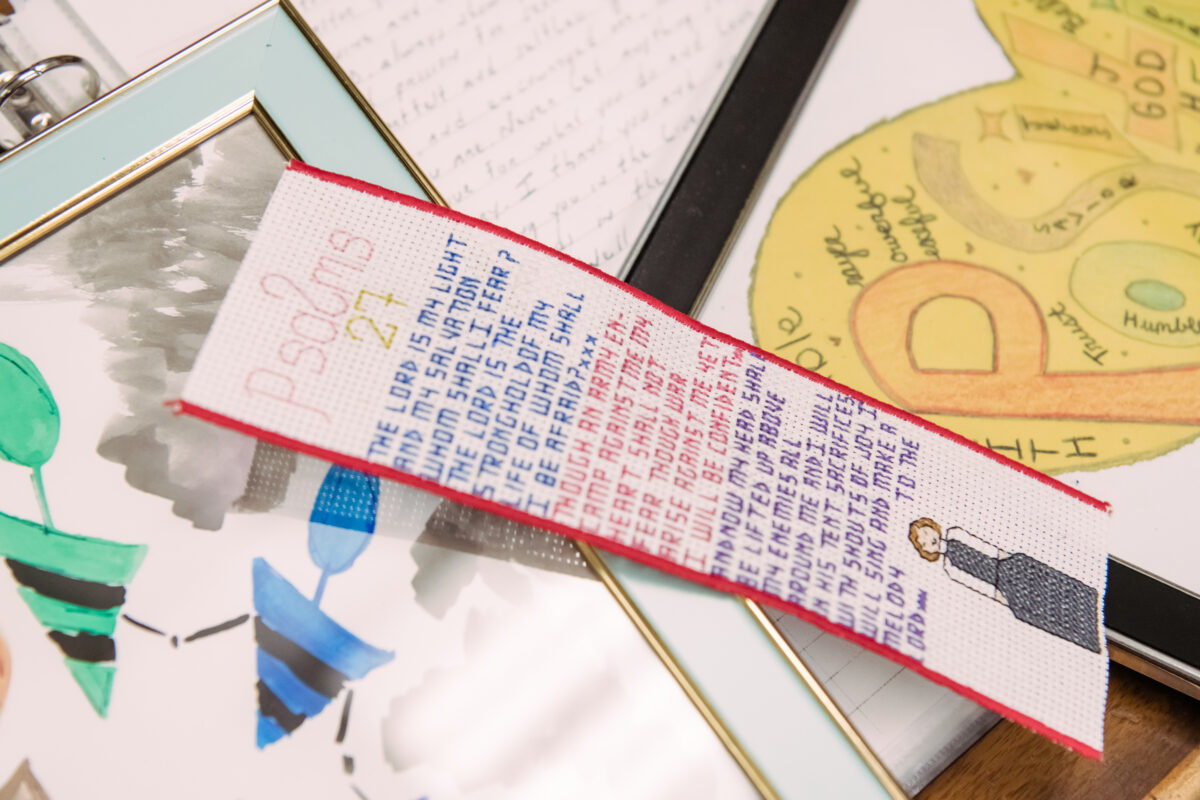 A collection of items made for Beck as gifts by her congregants.
In January 2023, after nearly five years of doing this work, Beck was formally installed as the pastor to a congregation entirely behind bars but spread out over the Maryland state prison system. On Monday nights she’s in Hagerstown; on Wednesdays, Sykesville; and Saturdays in Jessup. Beck is accompanied by a rotating cadre of volunteers, who step up to make sure each facility has coverage for worship services and Bible studies.
Creating a sanctuary behind bars
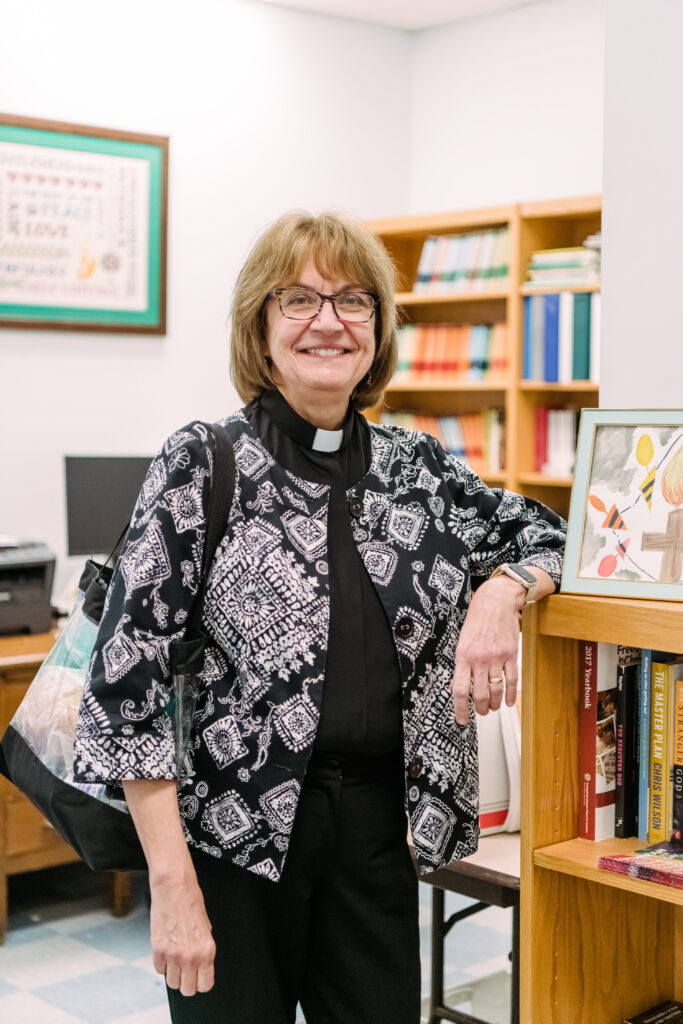
What an average service looks like for Beck is after the sally port gates shut behind her and the next set of doors opens, she needs to successfully go through a metal detector in fewer than three tries. (“Don’t wear bras with underwires.”)
In a clear, plastic purse, she only brings with her items on an approved list from the Maryland Correctional Facilities: bread and a sealed container of grape juice for communion, devotional materials, different colored cloths for different liturgical seasons. Sometimes she needs other materials. “I did a baptism a couple of weeks ago, and I had to send many reminders to the administration that, ‘I need to bring in a plastic bowl. It’s just a plastic bowl.’”
If she successfully makes it through the metal detector, she is patted down by a female guard, and then escorted to the space her congregation will use to worship. Sometimes it is a room and sometimes it is a hallway. Usually members of the congregation will set up chairs and arrange the area for worship. Beck or another volunteer will play music (she has the paperwork cleared to bring her violin in), and they will create a sacred space within the prison walls.
Beck serves communion, offers a time for reflection, and shares a short sermon. “Over time, as they hear us preach and teach and talk—and the services are very interactive—those relationships build. And even though we’re informal and it’s not a cathedral, it’s not a sanctuary like you would imagine, I want to create a sanctuary for them.”
Shared humanity
Beck, who is 70 years old, says that this work she previously couldn’t have imagined for herself continues to energize her. “UMBC offered me an accessible path to education,” reflects Beck. “But you don’t ever stay on one path—you go off and expand it.”
When she goes to leave the prisons at night, her parishioners will tell her, “Watch out for the deer. They’re crazy this time. You’ll watch out for the deer?” And as the sally port gates shut behind Beck, with her now on the outside, she says, “I know on the other side of that door, there are gangs and there’s danger and there’s people yelling at them. But they said, ‘Watch out for the deer.’ That’s just so human.”
]]>
Having the sally port gates slam behind her after walking into the prison for the first time was a bit of a shock to Susan Beck ’74, French. Luckily, a friend was there to hold her hand as they...
https://umbc.edu/stories/ministering-to-the-most-vulnerable-in-prison/
https://my3.my.umbc.edu/api/v0/pixel/news/133916/guest@my.umbc.edu/bca901ea5521a5335bc26dea741ffc03/api/pixel
alumni
cahss
french
impact
magazine
spring-2023
UMBC News & Magazine
https://my3.my.umbc.edu/groups/umbc-news-magazine
https://assets1-my.umbc.edu/system/shared/avatars/groups/000/001/943/24435aa6207c452e7bc15cc74b42c7bb/xsmall.png?1748556657
https://assets1-my.umbc.edu/system/shared/avatars/groups/000/001/943/24435aa6207c452e7bc15cc74b42c7bb/original.png?1748556657
https://assets2-my.umbc.edu/system/shared/avatars/groups/000/001/943/24435aa6207c452e7bc15cc74b42c7bb/xxlarge.png?1748556657
https://assets2-my.umbc.edu/system/shared/avatars/groups/000/001/943/24435aa6207c452e7bc15cc74b42c7bb/xlarge.png?1748556657
https://assets3-my.umbc.edu/system/shared/avatars/groups/000/001/943/24435aa6207c452e7bc15cc74b42c7bb/large.png?1748556657
https://assets1-my.umbc.edu/system/shared/avatars/groups/000/001/943/24435aa6207c452e7bc15cc74b42c7bb/medium.png?1748556657
https://assets2-my.umbc.edu/system/shared/avatars/groups/000/001/943/24435aa6207c452e7bc15cc74b42c7bb/small.png?1748556657
https://assets1-my.umbc.edu/system/shared/avatars/groups/000/001/943/24435aa6207c452e7bc15cc74b42c7bb/xsmall.png?1748556657
https://assets2-my.umbc.edu/system/shared/avatars/groups/000/001/943/24435aa6207c452e7bc15cc74b42c7bb/xxsmall.png?1748556657
UMBC News & Magazine
0
0
false
Thu, 08 Jun 2023 09:14:12 -0400
Thu, 08 Jun 2023 09:14:12 -0400
X-ray emissions from black hole jets vary unexpectedly, challenging leading model of particle acceleration

Researchers discovered only relatively recently that black hole jets emit x-rays, and how the jets accelerate particles to this high-energy state is still a mystery. Surprising new findings in Nature Astronomyappear to rule out one leading theory, opening the door to reimagining how particle acceleration works in the jets—and possibly also elsewhere in the universe.
One leading model of how jets generate x-rays expects the jets’ x-ray emissions to remain stable over long time scales (millions of years). However, the new paperfound that the x-ray emissions of a statistically significant number of jets varied over just a few years.
“One of the reasons we’re excited about the variability is that there are two main models for how x-rays are produced in these jets, and they’re completely different,” explains lead author Eileen Meyer, associate professor of physics. “One model invokes very low-energy electrons and one has very high-energy electrons. And one of those models is completely incompatible with any kind of variability.”
For the study, the authors analyzed archival data from the Chandra X-ray Observatory, the highest-resolution x-ray observatory available. The research team looked at nearly all of the black hole jets for which Chandra had multiple observations, which amounted to 155 unique regions within 53 jets.
Discovering relatively frequent variability on such short time scales “is revolutionary in the context of these jets, because that was not expected at all,” Meyer says.
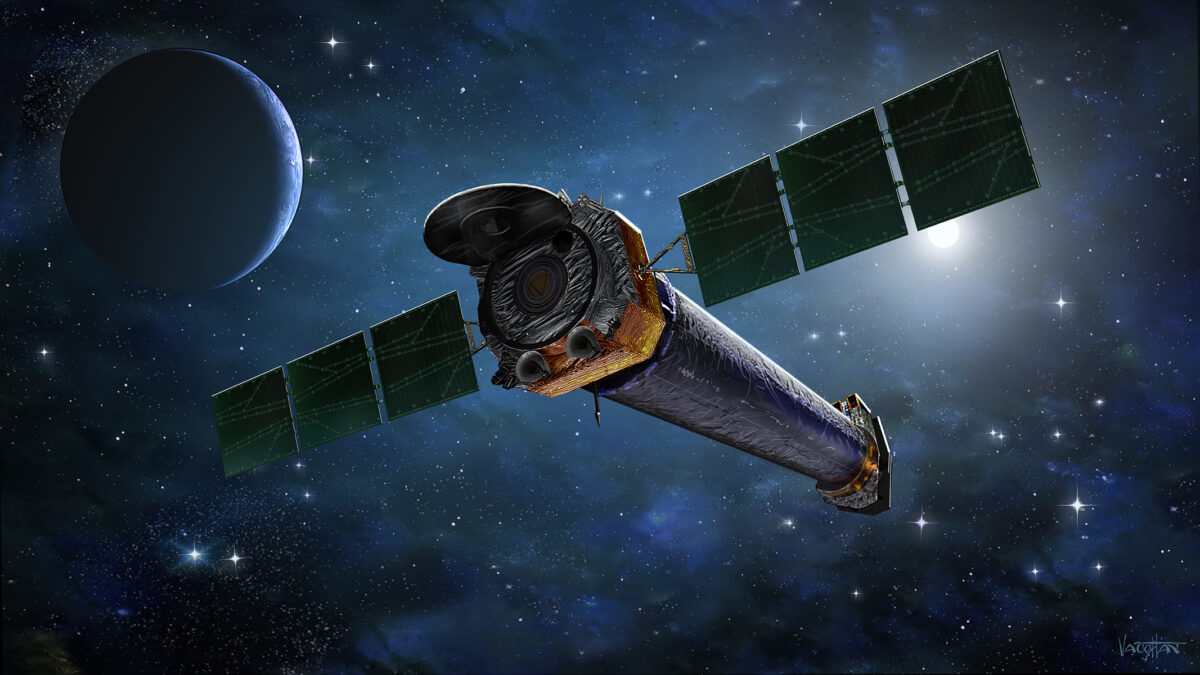 A rendering of the Chandra X-ray Observatory, which is the world’s highest-resolution X-ray telescope. (NASA/CXC and J. Vaughan)
Rethinking particle acceleration
In addition to assuming stability in x-ray emissions over time, the simplest theory for how jets generate x-rays assumes particle acceleration occurs at the center of the galaxy in the black hole “engine” that drives the jet, Meyer explains. However, the new study found rapid changes in x-ray emissions all along the length of the jets. That suggests particle acceleration is occurring all along the jet, at vast distances from the jet’s origin at the black hole.
“There are theories out there for how this could work, but a lot of what we’ve been working with is now clearly incompatible with our observations,” Meyer says.
Interestingly, the results also hinted that jets closer to Earth had more variability than those much farther away. The latter are so far away, that by the time the light coming from them reaches the telescope, it is like looking back in time. It makes sense to Meyer that older jets would have less variability. Earlier in the universe’s history, the universe was smaller and ambient radiation was greater, which researchers believe could lead to greater stability of x-rays in the jets, Meyer says.
 Two jets spreading from the central black hole in the Hercules A galaxy. These jets are about 1.5 million light years long, requiring massive particle acceleration forces and dwarfing the galaxy from which they emanate. (NASA, ESA, S. Baum and C. O’Dea (RIT), R. Perley and W. Cotton (NRAO/AUI/NSF), and the Hubble Heritage Team (STScI/AURA))
Critical collaboration
Despite Chandra’s outstanding imaging resolution, the data set posed significant challenges. Chandra observed some of the pockets of variability with only a handful of x-ray photons. And the variability in x-ray production in a given jet was typically tens of percent or so. To avoid unintentionally counting randomness as real variability, Meyer collaborated with statisticians at the University of Toronto and the Imperial College of London.
“Pulling this result out of the data was almost like a miracle, because the observations were not designed to detect it,” Meyer says. The team’s analysis suggests that between 30 and 100 percent of the jets in the study showed variability over short time scales. “While we would like better constraints,” she says, “the variability is notably not zero.”
A call to action
The research unfolded over nearly a decade. Meyer first submitted a proposal to do the archival study with the Chandra X-ray Observatory in 2014, when she was still a postdoc, and it became one of her first funded projects at UMBC. Several undergraduate and graduate UMBC students, including four who are authors on the new paper, contributed to the work. Plus, Meyer’s group applied several different statistical methods before calling in external colleagues for support.
“We had to start over about three different times,” Meyer says. “But I stuck with it, because I really felt that there was something important here.”
Given the import of the findings, clearly Meyer’s intuition served her well. The new paper pokes significant holes in one of the major theories for x-ray production in black hole jets, and Meyer hopes the paper spurs future work. “Hopefully this will be a real call to the theorists,” she says, “to basically take a look at this result and come up with jet models that are consistent with what we’re finding.”
]]>
Researchers discovered only relatively recently that black hole jets emit x-rays, and how the jets accelerate particles to this high-energy state is still a mystery. Surprising new findings in...
https://umbc.edu/stories/particle-acceleration-in-black-hole-jets/
https://my3.my.umbc.edu/api/v0/pixel/news/133872/guest@my.umbc.edu/8ac013bf1fee92ae5788b9eaf95b4c64/api/pixel
cnms
news
physics
research
science-and-tech
UMBC News & Magazine
https://my3.my.umbc.edu/groups/umbc-news-magazine
https://assets1-my.umbc.edu/system/shared/avatars/groups/000/001/943/24435aa6207c452e7bc15cc74b42c7bb/xsmall.png?1748556657
https://assets1-my.umbc.edu/system/shared/avatars/groups/000/001/943/24435aa6207c452e7bc15cc74b42c7bb/original.png?1748556657
https://assets2-my.umbc.edu/system/shared/avatars/groups/000/001/943/24435aa6207c452e7bc15cc74b42c7bb/xxlarge.png?1748556657
https://assets2-my.umbc.edu/system/shared/avatars/groups/000/001/943/24435aa6207c452e7bc15cc74b42c7bb/xlarge.png?1748556657
https://assets3-my.umbc.edu/system/shared/avatars/groups/000/001/943/24435aa6207c452e7bc15cc74b42c7bb/large.png?1748556657
https://assets1-my.umbc.edu/system/shared/avatars/groups/000/001/943/24435aa6207c452e7bc15cc74b42c7bb/medium.png?1748556657
https://assets2-my.umbc.edu/system/shared/avatars/groups/000/001/943/24435aa6207c452e7bc15cc74b42c7bb/small.png?1748556657
https://assets1-my.umbc.edu/system/shared/avatars/groups/000/001/943/24435aa6207c452e7bc15cc74b42c7bb/xsmall.png?1748556657
https://assets2-my.umbc.edu/system/shared/avatars/groups/000/001/943/24435aa6207c452e7bc15cc74b42c7bb/xxsmall.png?1748556657
UMBC News & Magazine
0
0
false
Mon, 05 Jun 2023 15:52:15 -0400
Mon, 05 Jun 2023 15:52:15 -0400
UMBC leads research into light-based timing and navigation technologies for DOD-funded consortium
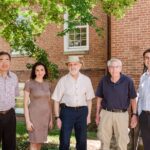
Every day, radio signals from GPS satellites help millions of people figure out what time it is and where they are. Yet the system is vulnerable to disruptions and attacks. Sometimes users are unable to access critical information. Other times, adversaries may try to fool users into thinking they are somewhere they aren’t.
For this reason, researchers at UMBC are working to develop alternative timing and navigation technologies. The university recently received almost $2 million in initial funding from the Department of Defense (DOD) to further this important research. UMBC will collaborate with the Army Research Laboratory (ARL) in Adelphi, Maryland, and other members of a national consortium, managed by the National Center for Manufacturing Sciences (NCMS). UMBC will conduct fundamental research to develop the knowledge base that is needed to design, test, and build clocks and communication protocols that could deliver critical information in the event of a disruption to GPS service.
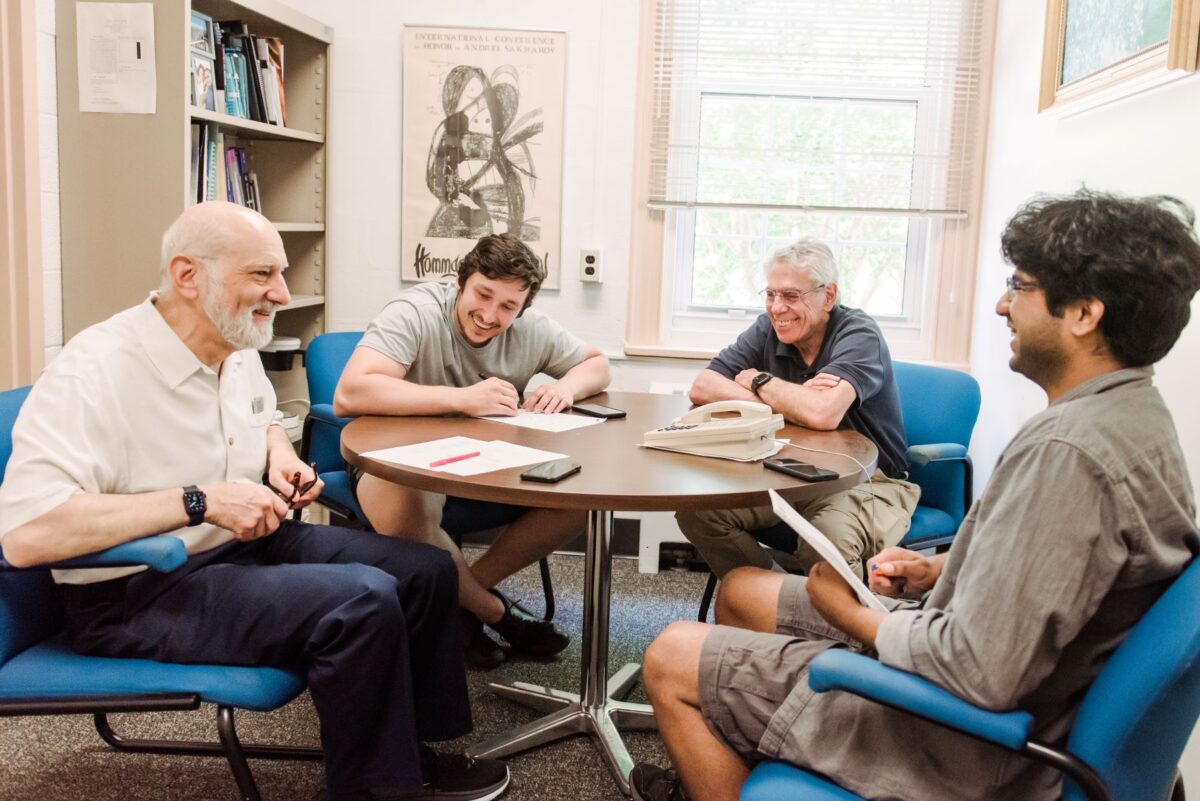 From left to right, Professor Curtis Menyuk, graduate student Logan Courtright, Professor Gary Carter and graduate student Pradyoth Shandilya discuss research plans. (Marlayna Demond ’11/UMBC)
The work will be carried out within the newly launched Center for Navigation, Timing and Frequency Research (Centaνr) at UMBC, led by Curtis Menyuk, professor of computer science and electrical engineering. Centaνr is the second significant research partnership with the ARL that UMBC has launched in recent years. It joins the Center for Real-time Distributed Sensing and Autonomy (CARDS), which opened in 2021 and aims to develop smart robots that can better navigate difficult terrain and coordinate their actions with other robots and humans.
Harnessing the power of light
Centaνr is part of a wider, 10-member consortium that brings together partners from the government, academia, and industry to advance photonic technologies that harness light to process and send information. The partners seek to develop solutions that utilize light in environments where radio frequency solutions do not work. These solutions will be chip-based—taking advantage of modern advances in integrating optical and electronic technology on a single semiconductor chip—in order to achieve low size, weight, power and cost.
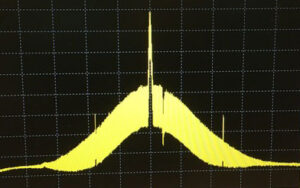 To analyze photonic systems, the team will gather and study data such as this optical spectrum of an optical pulse called a soliton. (Image courtesy of Alioune Niang.)
The UMBC team will lead research on the design and manufacture of photonic technology for positioning, navigation, and timing, which is one of the three main research thrusts for the consortium.
To meet high performance requirements, the photonic elements must be manufactured with extreme precision. UMBC will partner with Worcester Polytechnic Institute and AIM Photonics, one of the U.S. Department of Defense Manufacturing Innovation Institutes, as well as the Army Research Laboratory to design these devices.
Researchers at UMBC will also work to help develop a system that uses light waves to transfer a time signal between two devices, through the open air.
The UMBC team includes several computer science and electrical engineering faculty: Professor Gary Carter, Professor Fow-Sen Choa, Associate Professor Tinoosh Mohsenin and Assistant Professor Ergun Simsek.
High-tech equipment meets motivated students
To further Centaνr’s research aims, UMBC will build a new, high-tech laboratory where photonic components can be tested and characterized. The university will also serve its educational mission by recruiting and training diverse students in the concepts of timing and navigation technology and photonics.
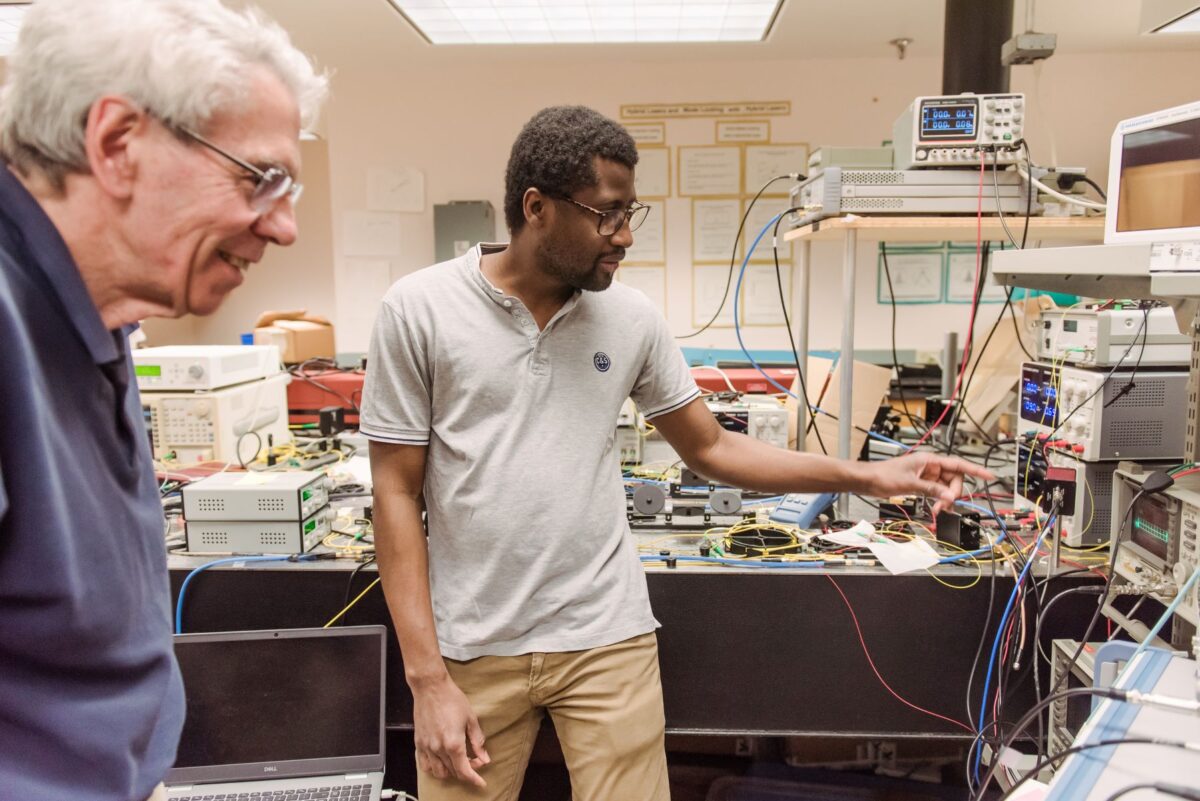 Gary Carter and Research Associate Alioune Niang look at equipment used to study photonic components. The equipment will move to a new lab space soon. (Marlayna Demond ’11/UMBC)
In collaboration with consortium partners, UMBC will develop new course materials and internship programs, and will recruit students from groups underrepresented in this field to participate in these research and learning opportunities.
“There is a real need for good educational material in these areas and I’m excited by the opportunity to build and distribute it,” says Menyuk. He is also excited to build a new experimental facility and partner with other institutions to make U.S.-manufactured high-end photonic components more widely available.
Menyuk says the consortium partners are already discussing additional years of funding. He is also thinking long-term and planning ways that Centaνr can continue to be a source of frontier photonics research for years to come.
]]>
Every day, radio signals from GPS satellites help millions of people figure out what time it is and where they are. Yet the system is vulnerable to disruptions and attacks. Sometimes users are...
https://umbc.edu/stories/light-based-timing-and-navigation-research/
https://my3.my.umbc.edu/api/v0/pixel/news/133847/guest@my.umbc.edu/5ec16ee972cc24ab61fb2f24427b4fe4/api/pixel
coeit
csee
news
research
science-and-tech
UMBC News & Magazine
https://my3.my.umbc.edu/groups/umbc-news-magazine
https://assets1-my.umbc.edu/system/shared/avatars/groups/000/001/943/24435aa6207c452e7bc15cc74b42c7bb/xsmall.png?1748556657
https://assets1-my.umbc.edu/system/shared/avatars/groups/000/001/943/24435aa6207c452e7bc15cc74b42c7bb/original.png?1748556657
https://assets2-my.umbc.edu/system/shared/avatars/groups/000/001/943/24435aa6207c452e7bc15cc74b42c7bb/xxlarge.png?1748556657
https://assets2-my.umbc.edu/system/shared/avatars/groups/000/001/943/24435aa6207c452e7bc15cc74b42c7bb/xlarge.png?1748556657
https://assets3-my.umbc.edu/system/shared/avatars/groups/000/001/943/24435aa6207c452e7bc15cc74b42c7bb/large.png?1748556657
https://assets1-my.umbc.edu/system/shared/avatars/groups/000/001/943/24435aa6207c452e7bc15cc74b42c7bb/medium.png?1748556657
https://assets2-my.umbc.edu/system/shared/avatars/groups/000/001/943/24435aa6207c452e7bc15cc74b42c7bb/small.png?1748556657
https://assets1-my.umbc.edu/system/shared/avatars/groups/000/001/943/24435aa6207c452e7bc15cc74b42c7bb/xsmall.png?1748556657
https://assets2-my.umbc.edu/system/shared/avatars/groups/000/001/943/24435aa6207c452e7bc15cc74b42c7bb/xxsmall.png?1748556657
UMBC News & Magazine
1
0
false
Fri, 02 Jun 2023 12:32:17 -0400
Fri, 02 Jun 2023 12:32:17 -0400
Writing your way through your own history—and sharing the narrative

Family stories, told honestly, reach people in ways that reams of advice and pages in history books cannot. When personal narratives reach the classroom, students respond by opening up, say two professors who have published memoirs of their family tragedies as a way to process their grief and share their stories.
“I believe that writing personal narratives and sharing my own family’s stories helps build trust and rapport in the classroom,” said Aharona (Roni) Rosenthal, director of Judaic Studies at UMBC. “Writing personal narratives can serve as a model for students and encourage them to listen to their grandparents’ stories, embrace their own family’s traditions, and find their own voice in writing.”
Write about the darkness and the light
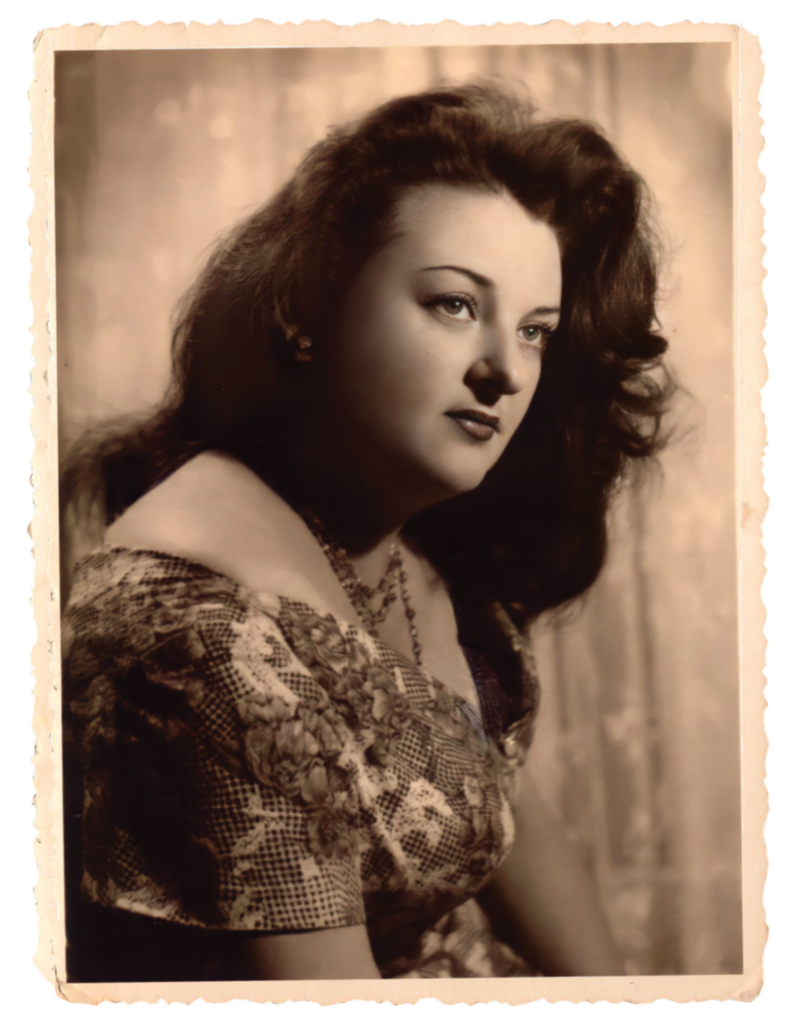 Rosenthal’s Great-Aunt Friddie Stoleru in 1954 and the subject of her family memoir.
Rosenthal, who self-published her family’s history last spring as Where the Lilacs Bloom Once Again,remembers her great-aunt Friddie arriving for a visit to the family in Israel. With her huge laugh, her bright red nail polish, and her scarred hands and face, Friddie would wear thick makeup, pull white gloves over her hands, and paint the undersides of her nails to hide the permanently blackened nails.
Rosenthal recorded her father telling family stories about Friddie, kept for 13 years in secret prisons and labor camps in Romania during World War II and then under the Communist rule, where she was tortured and forced to dig the canal from the Danube River to the Black Sea. When her father, Yossi Rosenthal, died a few months after telling her that history, Rosenthal returned to Israel and found on her father’s desk a photo album, a partially finished family tree, and a note from her father, asking her to tell more widely the story of their family.
Rosenthal spent 12 years researching and writing her family memoir. Along the way, Rosenthal found long-lost family members, learned the fate of others, and gathered material that she now shares in her classes at UMBC, especially in her unit on the Holocaust in her Hebrew literature class.
One of the Rosenthal family stories tells of Friddie’s detainment in the labor camp, where she met a man through a chink in the stone wall dividing the men’s side from the women’s side of the camp. Friddie was looking for a cat who was slinking around the wall, and so was Mircea, the man she fell in love with, sight unseen.
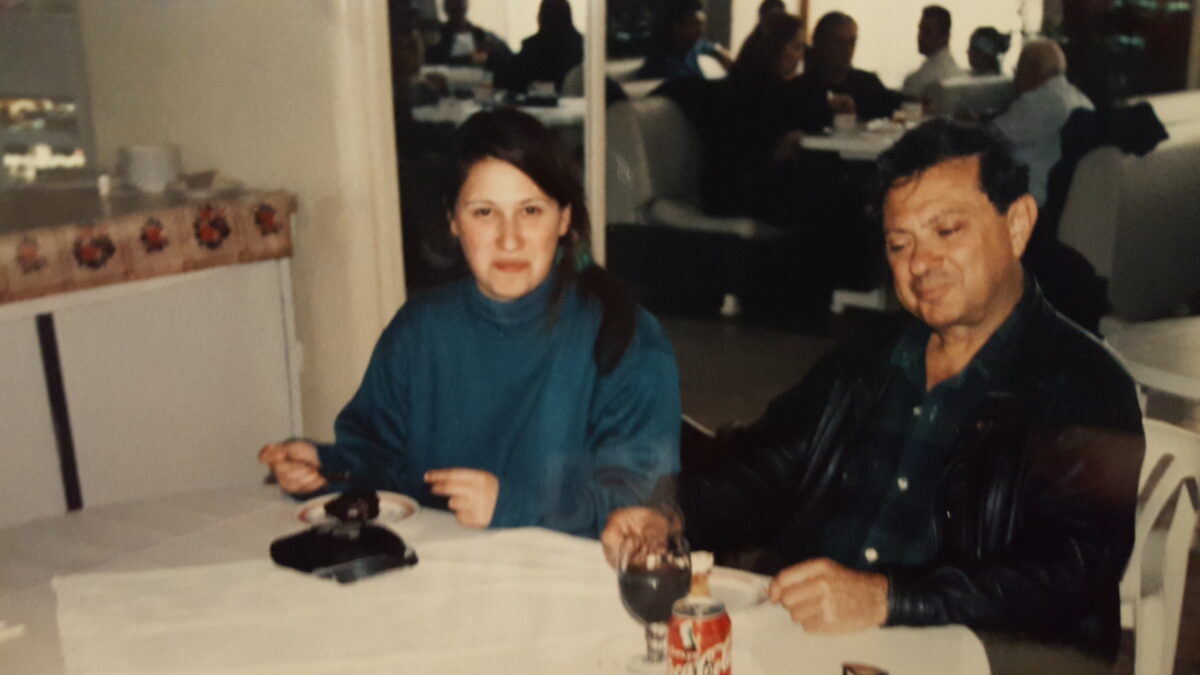 Rosenthal with her father in Romania in July 1998.
“It was a miracle in the darkest place in the world, the scariest place in the world,” Rosenthal said, and after Mircea was released, he helped free Friddie and the couple married.
Narratives that stick with you
Rosenthal’s family tales are intertwined with atrocities in World War II, when Romania allied with the Nazis. Thousands of Romania’s Jews were slaughtered and sent to concentration camps. Rosenthal remembers her grandparents who, on every anniversary of a 1941 pogrom in Iași, would light candles under pictures of lost loved ones, but never speak about the massacre.
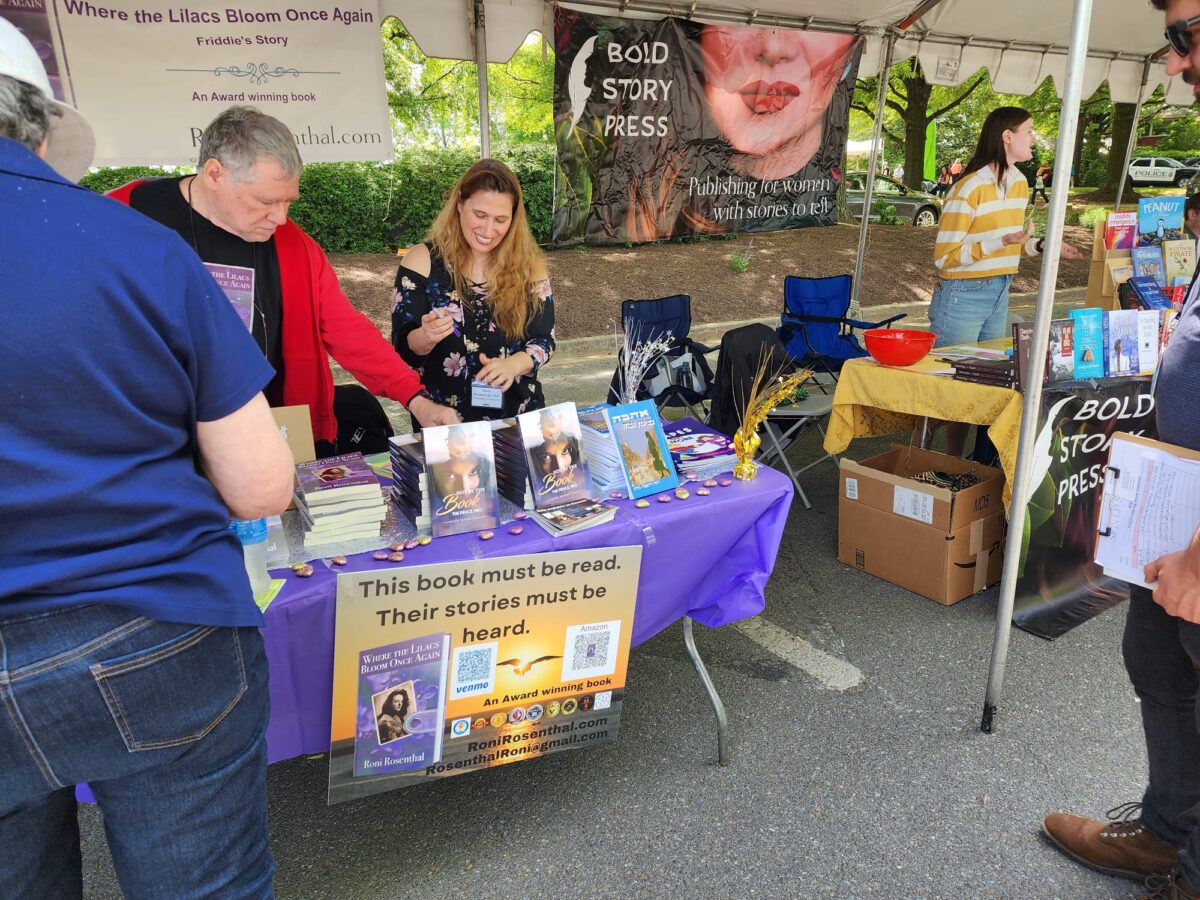 Rosenthal, center, presented a seminar at a 2023 Gaithersburg, Maryland, book festival titled, “Conduct your family research and write your memoir.”
One of Rosenthal’s students, Moriah Thompson ’24, biological sciences, said she had known the history of atrocities in World War II, but that Rosenthal’s stories and primary sources brought that history to life.
“Seeing her pictures and listening to the letter her ancestors wrote, it was actually so absolutely incredible to see the history as it related to her family,” Thompson said. “The narrative that stuck with me the most was the letter her great-grandfather wrote about the pogrom he and his family endured. Being Jewish, we know the history and we’ve heard the stories. But hearing from a man who experienced it was so much different. I can’t imagine the fear he felt trying to keep his family safe, or his wife worrying about the children.”
Writing your story so others can find it
Nancy Shelton,a recently retired education professor at UMBC, knows the power of writing a personal story.
“I don’t believe you can teach kids to write without writing with them,” said Shelton, who researched literacy and taught potential teachers how to teach writing. So as a classroom teacher, then as a professor in the education department, she always wrote with her students during classroom writing sessions.
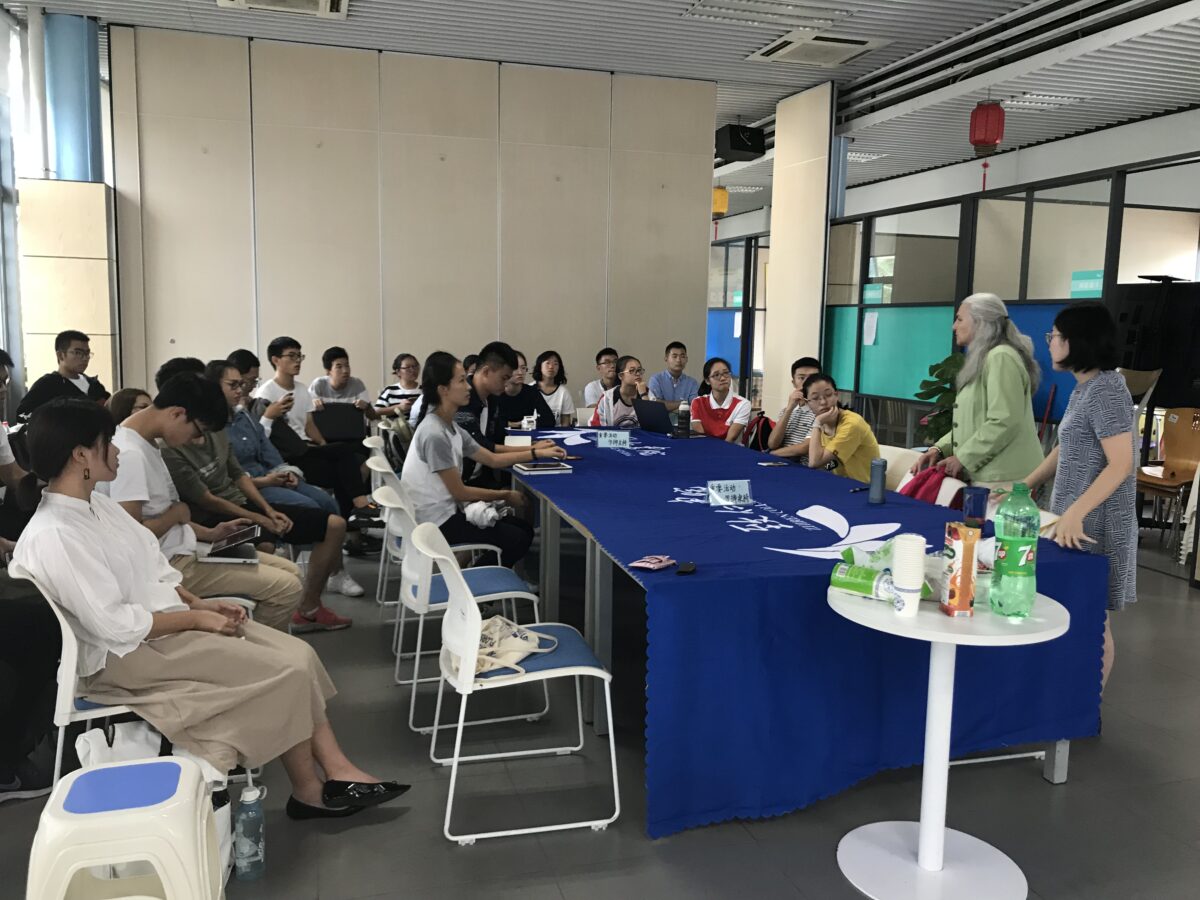 Jiyoon Lee, associate professor of education, and Nancy Shelton speak at the Southern University of Science and Technology in Shenzhen, China, on English Learning.
One winter day at their Florida vacation home, when she and her husband were both a few years from retirement, he was joking with her as he headed out to wash their new car. A while later, Shelton, who has hearing loss, heard her dogs barking frantically and found her husband prone on the kitchen floor, having a seizure.
“It literally came out of the blue,” Shelton remembered. At the hospital soon after his seizure, John was diagnosed with stage four cancer.
“A death sentence,” Shelton said. She called her sister who advised her to take notes during the medical consultations. As John slept in the evenings, Nancy sat by his hospital bedside and filled in her notes “as if they were data,” the kind she had collected for years researching schoolchildren’s literacy. Her notes, she said, were a way of handling her husband’s swift slide into illness, and finally death.
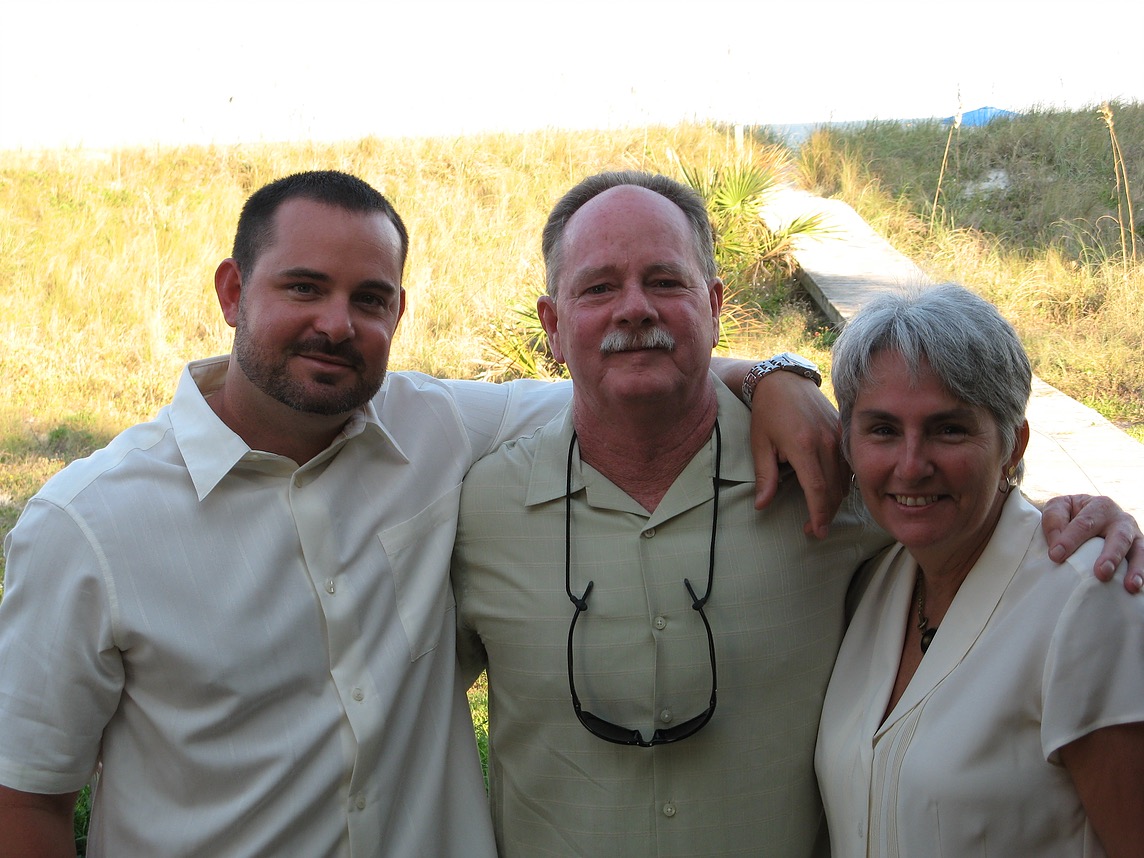 Nancy poses with her son, Conrad and her husband, Jack, circa 2006.
“I am a writer,” Shelton said. “I thought, well, I will write my way through this.”
As a reader, she looked for books with characters whose family members were dying of cancer, but she couldn’t find any she identified with. So she wrote one, 5-13: A Memoir of Love, Loss and Survival, published in 2016.
Writing can make you strong
“Being able to be a published author as a teacher of writing gives you credibility,” Shelton said.
In her education classes, Shelton read literature to her students, such as the first kiss scene from Rita Mae Brown’s autobiographical novel, Rubyfruit Jungle, or the definition of heaven by the narrator of Lovely Bones. Then she would ask the students to write in response. Often, the students’ writing was quite personal, exploring identity, family and memory.
The classroom, she said, turned into a safe space for writing, and for sharing. “I believe writing is something that exposes a part of us that would otherwise be hidden, and that exposing makes you very vulnerable, but also makes you very strong,” she said.
By Susan Thornton Hobby
]]>
Family stories, told honestly, reach people in ways that reams of advice and pages in history books cannot. When personal narratives reach the classroom, students respond by opening up, say two...
https://umbc.edu/stories/writing-your-way-through-your-narrative-history/
https://my3.my.umbc.edu/api/v0/pixel/news/133843/guest@my.umbc.edu/14d6d3be4f624db1fb06ffc7030eced5/api/pixel
cahss
cahssresearch
discovery
education
judaic-studies
magazine
research
UMBC News & Magazine
https://my3.my.umbc.edu/groups/umbc-news-magazine
https://assets1-my.umbc.edu/system/shared/avatars/groups/000/001/943/24435aa6207c452e7bc15cc74b42c7bb/xsmall.png?1748556657
https://assets1-my.umbc.edu/system/shared/avatars/groups/000/001/943/24435aa6207c452e7bc15cc74b42c7bb/original.png?1748556657
https://assets2-my.umbc.edu/system/shared/avatars/groups/000/001/943/24435aa6207c452e7bc15cc74b42c7bb/xxlarge.png?1748556657
https://assets2-my.umbc.edu/system/shared/avatars/groups/000/001/943/24435aa6207c452e7bc15cc74b42c7bb/xlarge.png?1748556657
https://assets3-my.umbc.edu/system/shared/avatars/groups/000/001/943/24435aa6207c452e7bc15cc74b42c7bb/large.png?1748556657
https://assets1-my.umbc.edu/system/shared/avatars/groups/000/001/943/24435aa6207c452e7bc15cc74b42c7bb/medium.png?1748556657
https://assets2-my.umbc.edu/system/shared/avatars/groups/000/001/943/24435aa6207c452e7bc15cc74b42c7bb/small.png?1748556657
https://assets1-my.umbc.edu/system/shared/avatars/groups/000/001/943/24435aa6207c452e7bc15cc74b42c7bb/xsmall.png?1748556657
https://assets2-my.umbc.edu/system/shared/avatars/groups/000/001/943/24435aa6207c452e7bc15cc74b42c7bb/xxsmall.png?1748556657
UMBC News & Magazine
0
0
false
Thu, 01 Jun 2023 13:07:34 -0400
Thu, 15 Jun 2023 13:07:34 -0400
Broadcasting Retriever Success

Eli Eisenberg came into the world of Retriever sports not as a recruited athlete or a walk-on but from a completely different angle—broadcasting. Capturing the energy of the fans, the maneuvers on the court or field, and the cheers and camaraderie of UMBC Athletics hooked Eisenberg early on.
 Headshot of Eli Eisenberg by Marlayna Demond ’11/UMBC.
When Eisenberg enrolled at UMBC in the 1980s, he used his interdisciplinary studies (INDS) major to develop a curriculum that primarily focused on broadcasting, American culture, and business and economics. To this day, he credits UMBC for his success and it’s something he’s been adamant about returning tenfold to the Retriever community.
“I knew at a young age that I wanted to be a television producer and director,” says Eisenberg ’86, INDS, who is now the CEO of VPC, an award-winning, full-service boutique production and broadcasting agency. VPC provided production services for UMBC Commencements as early as 1996 and was instrumental in the university’s momentous 50th anniversary celebration in 2016.
Through VPC, Eisenberg has created a successful working model where real-world training and education intersect. In 2016, America East signed a deal with ESPN to have conference basketball games on ESPN+.
And in the past seven broadcast seasons, VPC has partnered with UMBC—training more than 100 Retriever interns along the way—to put UMBC Athletics on television. Alumni from the program have gone on to work for the Baltimore Ravens, Baltimore Orioles, Philadelphia Eagles, CBS Sports, and many other freelance video and sports productions.
“Although the university doesn’t have a broadcasting major,” says Eisenberg, “through our ESPN initiative, students are trained to televise sporting events and are placed on the path to broadcasting careers.”
In 2022 Eisenberg sought to address another perennial need among student-athletes—he and his wife Patricia M. Vitale made a gift to support students’ mental health amid the pressures of navigating academic and athletic performances.
“We want to ensure that we always have a safety net and strong system in place for our athletes,” says Brian Barrio, UMBC’s director of Athletics. “Which is why Eli’s endowment is so generous and so important.”
The intersection of sports and mental health
While sports and journalism are at the heart of Eisenberg’s endowment, the real root of his generosity is his desire to see mental health be nurtured and prioritized for students, particularly athletes.
When the pandemic hit, the sports world experienced a great shift in how games were played and consumed by the audience (or lack thereof), and that extended to college sports. VPC began to experience firsthand the challenges of athletes playing in front of empty seats; it not only changed the dynamic of how athletes performed, but it also affected physical—and mental—endurance.
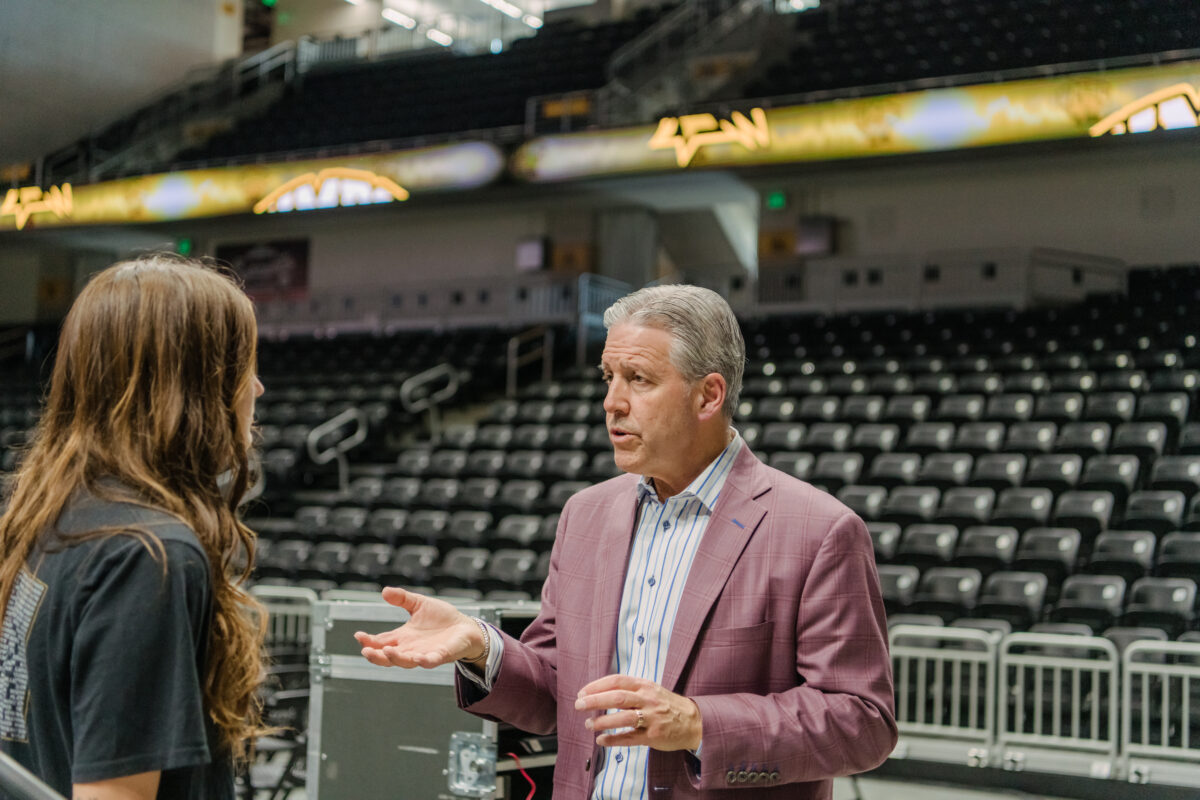 Top: Eisenberg chats with volleyball player Emily Genau ’26
in the CEI Arena about her entrepreneurial goals. (Marlayna
Demond ’11/UMBC)
Top: Eisenberg chats with volleyball player Emily Genau ’26
in the CEI Arena about her entrepreneurial goals. (Marlayna
Demond ’11/UMBC)
“It’s difficult enough for students to balance their athletic career with their academic one both pre- and post-pandemic. It’s very rigorous,” says Eisenberg. “It’s that much easier to become unmotivated when adding the challenge of playing in an empty arena or stadium after long bus trips.”
To expand on the other ways he supports UMBC students, Eisenberg established the Retriever Athletic Wellness Endowment, dedicated to supporting UMBC’s Division I athletes. The anticipated initiatives include nutrition, mental health programming, and sports medicine, among others.
Students reap the benefits
Austin Hood, a media and communication studies senior, who has interned with VPC since last semester, says the experience has provided him with mentors “who want to see me learn and step into different roles like hand-on camera work, replay, audio, director, technical director, utility, and much more.”
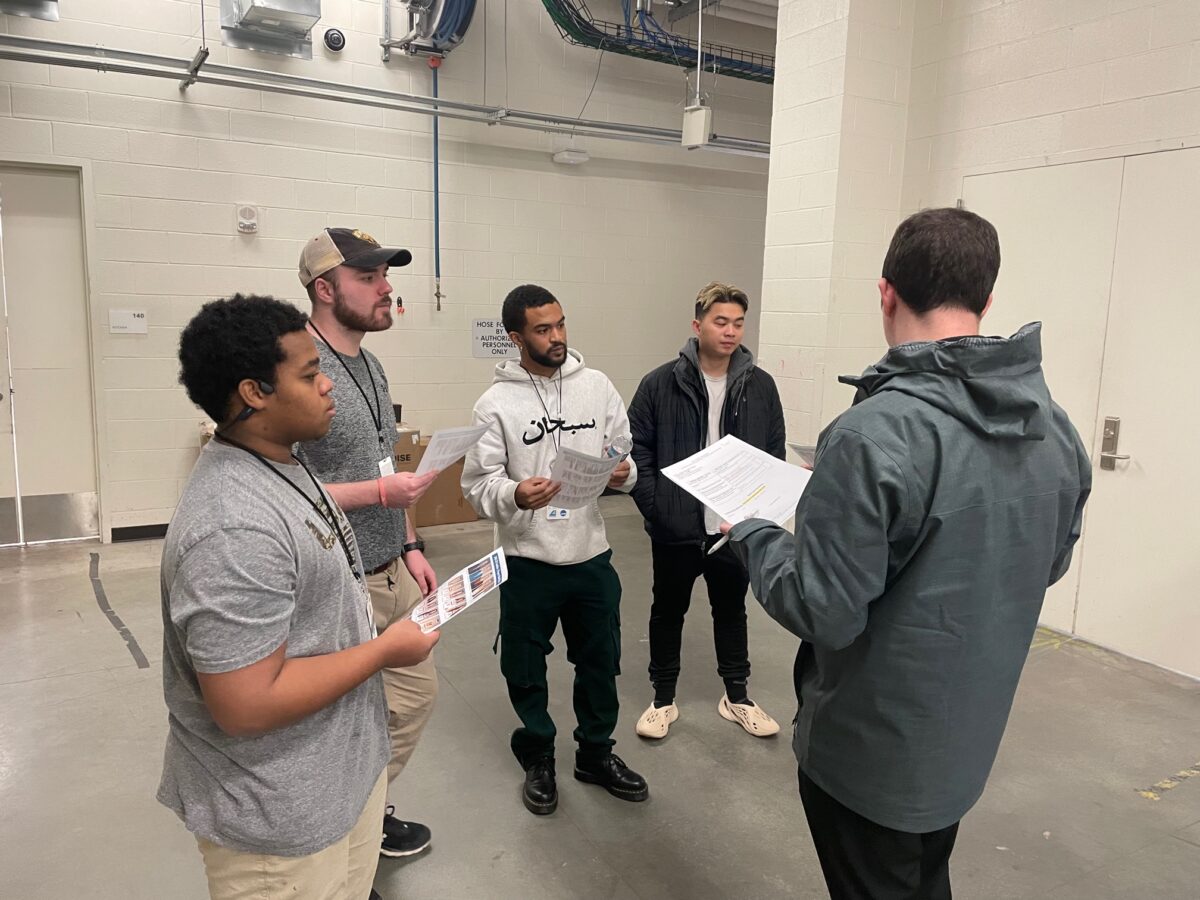 VPC interns, including Austin Hood, center in the white sweatshirt, gather in the production corridor to go over their tasks. Photo courtesy of Eisenberg.
The internship has been invaluable, says Hood. “Eli has been transparent about what it took for him to get where he is. Working alongside him and others has shown me just how much work goes into what you see when you turn on a live sporting event. These experiences, to say the least, have me feeling eager and confident to take on a position anywhere in the production/broadcasting industry.”
The America East Conference, which UMBC is a part of, together with its ESPN partnership, is required to broadcast 300 or more events annually. On average, a conference school broadcasts 30 to 40 games annually and the number is expected to increase to 50—so, having students trained and available to help has been and will continue to be crucial.
“Since the onset of both broadcasting relationships—the conference and UMBC, as well as UMBC with VPC—the Retriever broadcasts have set the bar in production value, execution, and storytelling,” says Eisenberg.
A significant impact
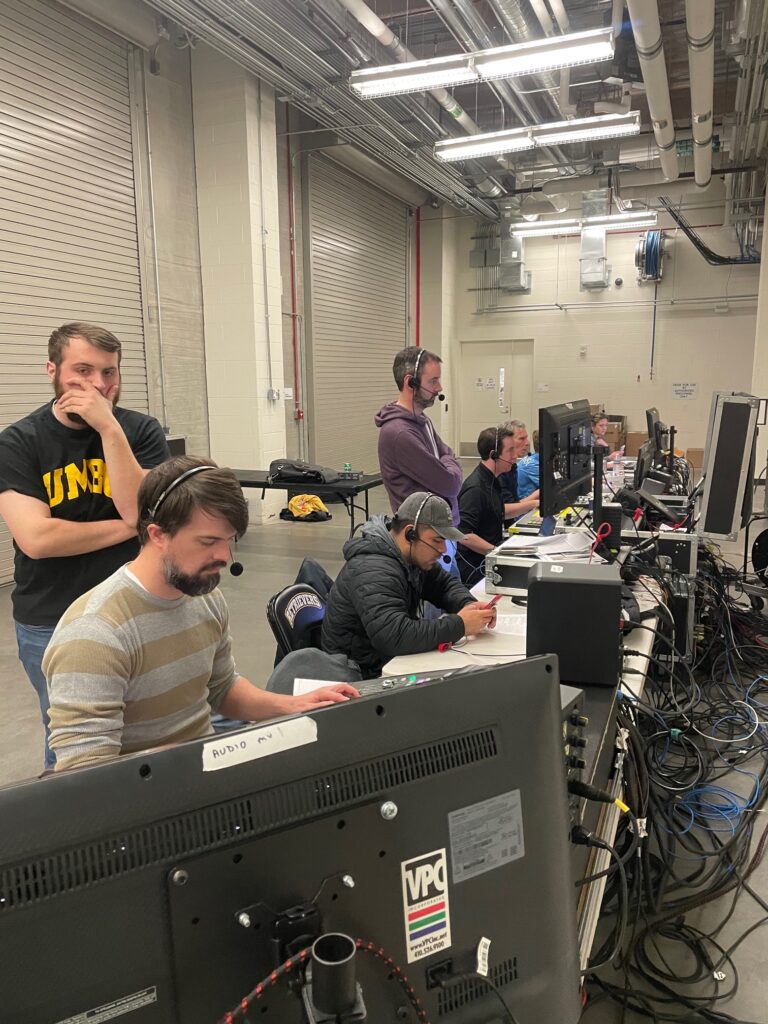 VPC interns work in the production corridor. Photo courtesy of Eisenberg.
Much like how Eisenberg developed his own hybrid curriculum as a UMBC student, he hopes that the school uses the money to establish whatever programs the student-athletes would need, ranging from nutrition to mental health services.
As a result of their gift, the Chesapeake Employers Insurance Arena backstage production corridor and loading dock will be named in recognition and honor of Eisenberg and his wife. The significance of the space is not lost on him.
“It’s where VPC trains students to be in sports broadcast,” he says with a smile.
By Nikoletta Gjoni ’09
]]>
Eli Eisenberg came into the world of Retriever sports not as a recruited athlete or a walk-on but from a completely different angle—broadcasting. Capturing the energy of the fans, the maneuvers on...
https://umbc.edu/stories/broadcasting-retriever-success-healthy-athletes/
https://my3.my.umbc.edu/api/v0/pixel/news/133821/guest@my.umbc.edu/8d723e80237e118c75a95983fe1377b9/api/pixel
alumni
athletics
giving
impact
inds
magazine
spring-2023
UMBC News & Magazine
https://my3.my.umbc.edu/groups/umbc-news-magazine
https://assets1-my.umbc.edu/system/shared/avatars/groups/000/001/943/24435aa6207c452e7bc15cc74b42c7bb/xsmall.png?1748556657
https://assets1-my.umbc.edu/system/shared/avatars/groups/000/001/943/24435aa6207c452e7bc15cc74b42c7bb/original.png?1748556657
https://assets2-my.umbc.edu/system/shared/avatars/groups/000/001/943/24435aa6207c452e7bc15cc74b42c7bb/xxlarge.png?1748556657
https://assets2-my.umbc.edu/system/shared/avatars/groups/000/001/943/24435aa6207c452e7bc15cc74b42c7bb/xlarge.png?1748556657
https://assets3-my.umbc.edu/system/shared/avatars/groups/000/001/943/24435aa6207c452e7bc15cc74b42c7bb/large.png?1748556657
https://assets1-my.umbc.edu/system/shared/avatars/groups/000/001/943/24435aa6207c452e7bc15cc74b42c7bb/medium.png?1748556657
https://assets2-my.umbc.edu/system/shared/avatars/groups/000/001/943/24435aa6207c452e7bc15cc74b42c7bb/small.png?1748556657
https://assets1-my.umbc.edu/system/shared/avatars/groups/000/001/943/24435aa6207c452e7bc15cc74b42c7bb/xsmall.png?1748556657
https://assets2-my.umbc.edu/system/shared/avatars/groups/000/001/943/24435aa6207c452e7bc15cc74b42c7bb/xxsmall.png?1748556657
UMBC News & Magazine
0
0
false
Thu, 01 Jun 2023 12:25:05 -0400
Not goodbye but see you later—Welcoming the Class of 2023 to our alumni community

UMBC’s class of 2023 took the mantra “strength in numbers” to heart as nearly 2,000 graduates crossed the stage during this year’s spring Commencement ceremonies. We can’t confirm it but for those in attendance, it felt like the applause and cheers may have registered on the Richter scale. Each ceremony was unique, just like our graduates, but there were several common themes among the speakers, including the reminder that the journey is just beginning for these Retrievers.
When in doubt, turn to Rocky
Valedictorian for the College of Arts, Humanities, and Social Sciences; School of Social Work; and Erickson School of Aging Studies morning ceremony, Zinedine Partipilo Cornielles ’23, financial economics and mathematics, shared that inspiration can come from the most unlikely sources…including Rocky Balboa, the fictional boxing legend. Cornielles recently rewatched the series with his roommates and reflected on the struggles Rocky faced.
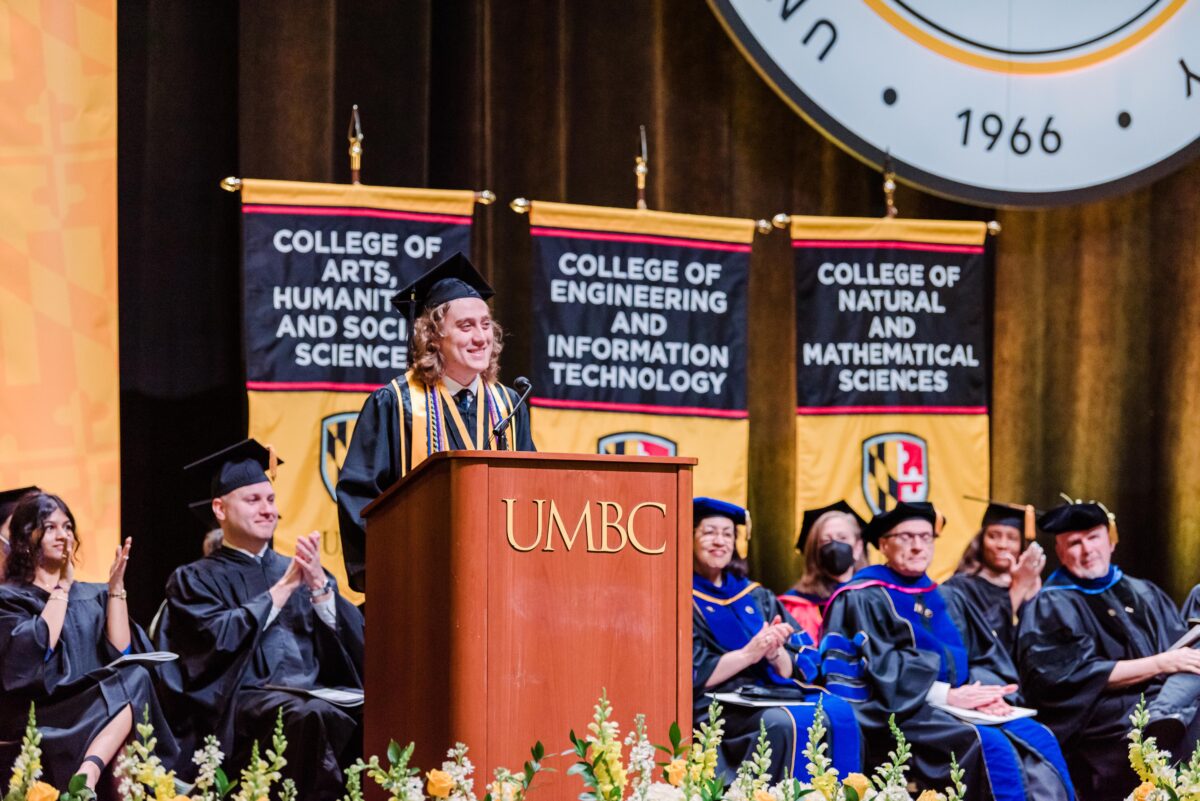 Valedictorian for the College of Arts, Humanities, and Social Sciences; School of Social Work; and Erickson School of Aging Studies morning ceremony, Zinedine Partipilo Cornielles ’23, speaks at Commencement.
“Life is not always about winning. It’s about overcoming adversity and challenges as we all have throughout our lives and throughout this journey,” said Cornielles, addressing his classmates. “It’s about standing up again after falling down, and I know that each and everyone of us has been able to get back on our feet—regardless of the number of times we’ve fallen before—because you are here.”
During the afternoon ceremony for the College of Natural and Mathematical Sciences; College of Engineering and Information Technology; and Division of Undergraduate Academic Affairs, valedictorian Christopher Slaughter ’23, computer engineering, revealed his inspiration comes from UMBC itself.
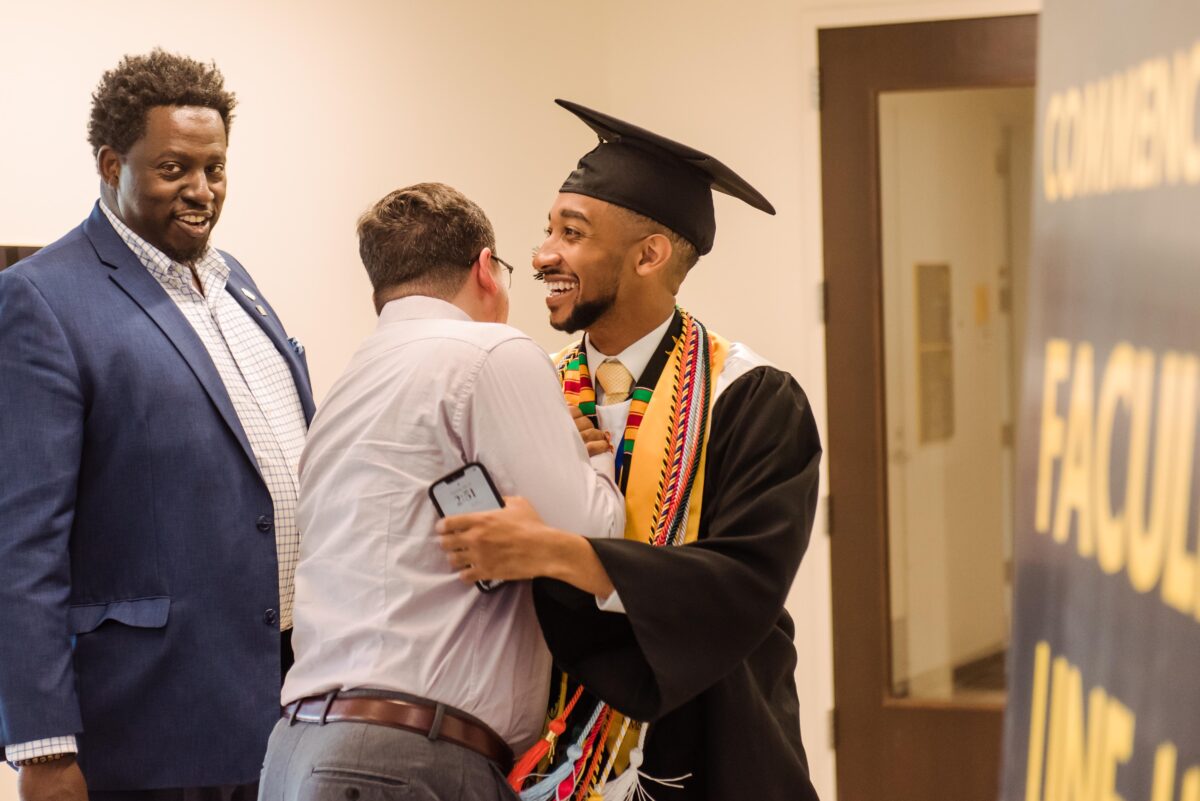 Valedictorian of the College of Natural and Mathematical Sciences; College of Engineering and Information Technology; and Division of Undergraduate Academic Affairs Christopher Slaughter ’23 shares a moment with a mentor.
“Although our journey began here at UMBC where we were unaware of our futures, we quickly learned the magic of this place…a place where we do not defer our dreams, but where we seed them, tend them, and watch them grow,” said the Meyerhoff Scholar.
]]>
UMBC’s class of 2023 took the mantra “strength in numbers” to heart as nearly 2,000 graduates crossed the stage during this year’s spring Commencement ceremonies. We can’t confirm it but for those...
https://umbc.edu/stories/umbc-welcomes-class-of-2023-to-alumni-community/
https://my3.my.umbc.edu/api/v0/pixel/news/133785/guest@my.umbc.edu/570f736f0ef717e5a1c6b18b82b03a87/api/pixel
alumni
campus-life
commencement
magazine
UMBC News & Magazine
https://my3.my.umbc.edu/groups/umbc-news-magazine
https://assets1-my.umbc.edu/system/shared/avatars/groups/000/001/943/24435aa6207c452e7bc15cc74b42c7bb/xsmall.png?1748556657
https://assets1-my.umbc.edu/system/shared/avatars/groups/000/001/943/24435aa6207c452e7bc15cc74b42c7bb/original.png?1748556657
https://assets2-my.umbc.edu/system/shared/avatars/groups/000/001/943/24435aa6207c452e7bc15cc74b42c7bb/xxlarge.png?1748556657
https://assets2-my.umbc.edu/system/shared/avatars/groups/000/001/943/24435aa6207c452e7bc15cc74b42c7bb/xlarge.png?1748556657
https://assets3-my.umbc.edu/system/shared/avatars/groups/000/001/943/24435aa6207c452e7bc15cc74b42c7bb/large.png?1748556657
https://assets1-my.umbc.edu/system/shared/avatars/groups/000/001/943/24435aa6207c452e7bc15cc74b42c7bb/medium.png?1748556657
https://assets2-my.umbc.edu/system/shared/avatars/groups/000/001/943/24435aa6207c452e7bc15cc74b42c7bb/small.png?1748556657
https://assets1-my.umbc.edu/system/shared/avatars/groups/000/001/943/24435aa6207c452e7bc15cc74b42c7bb/xsmall.png?1748556657
https://assets2-my.umbc.edu/system/shared/avatars/groups/000/001/943/24435aa6207c452e7bc15cc74b42c7bb/xxsmall.png?1748556657
UMBC News & Magazine
2
0
false
Tue, 30 May 2023 13:58:42 -0400
Tue, 30 May 2023 13:58:42 -0400
Class of 2023 reflects on UMBC as a community that values and supports the whole person
Kayla Tomas ‘23, information systems, maintained a challenging schedule during her undergraduate years. There were days she rose early, studied, and attended classes in the morning and afternoon, headed to volleyball practice in the late afternoon, paused a half hour for dinner, and then dashed off to lead a dance class in the evening. “It was the support of my friends, my family, and the mentors here at UMBC that made it easier,” she says.
Despite the challenges of a hectic schedule, she wouldn’t have it any other way, given what she gained from each opportunity. As a student athlete, Tomas says that one of her best undergraduate experiences was being on the Division I women’s volleyball team that won the America East Title three years in a row.
“The friendships I made, the breakthroughs I experienced, and the challenges I faced, made me a stronger individual, and this couldn’t have happened without an amazing group of girls I had the privilege in sharing the court with,” Tomas says.
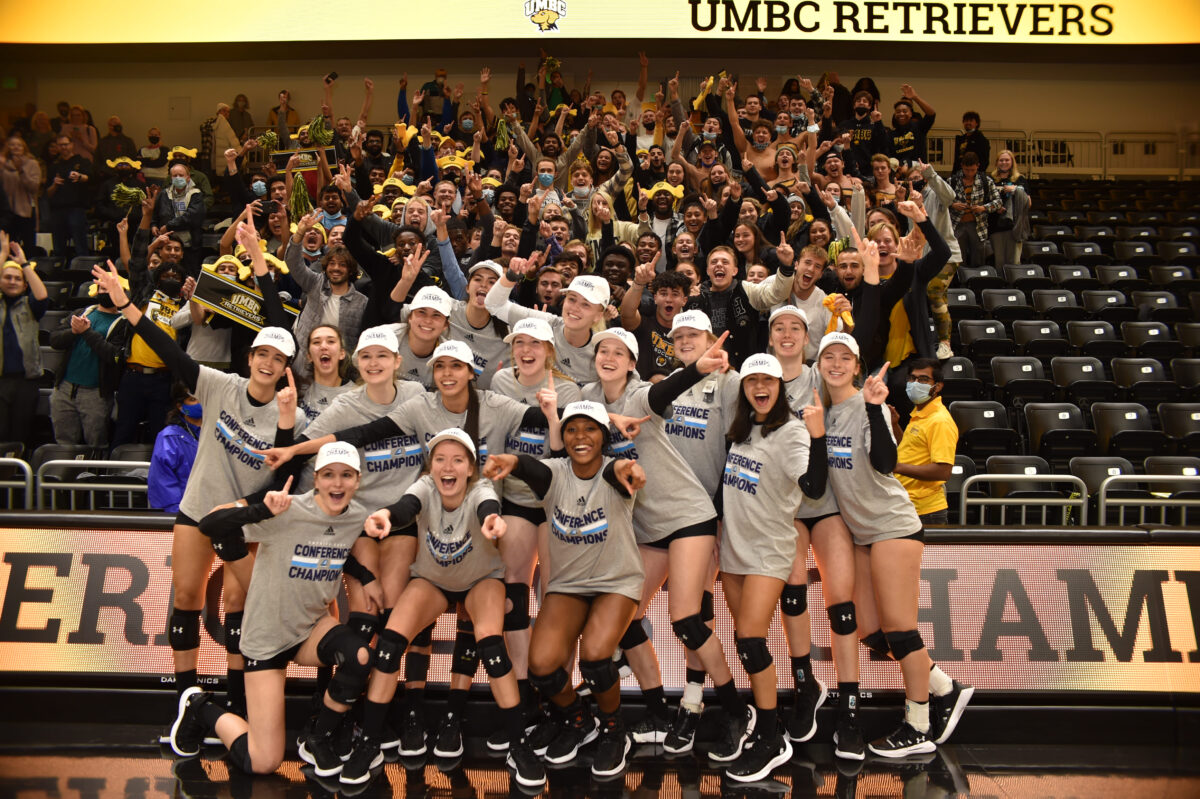 Kayla Tomas and her teammates celebrate a Division I women’s volleyball championship. (Image courtesy of Kayla Tomas)
Valuing the whole person
Tomas was a member of the Center for Women in Information Technology (CWIT) Scholars Program, which anchored her not only financially but also psychologically.
“One person I really have to give credit and thanks to, and someone I will continue to maintain a connection with, is Erica D’Eramo, assistant director at CWIT,” Tomas shares. “She has helped me a lot. We have one-on-one meetings, and if I have a question that I can’t figure out, she always knows who to direct me to. But it doesn’t even have to be about school—it can be about just how I’m doing emotionally, mentally, or physically.”
Tomas has also received support from UMBC alumni through the Alumni Endowed Scholarship. “Receiving that award was such a proud moment, because I knew these scholarships are very competitive.” she shares. “They saw a young woman’s drive to make a difference, to support her community.”
Creating a new student group
Beyond her academic work and competition on the volleyball court, dance has played a major role in Tomas’s UMBC experience. She had enjoyed dancing from a young age, and while at UMBC began to attend dance classes and workshops in the Baltimore-Washington area. She noticed the lack of Latin dancing on campus and she knew of other students who shared the same passion, “and so I did something about it,” she says.
Tomas started to offer evening Latin dance classes in the Public Policy Building. “That was a lot of fun, seeing my friends support me,” she says, “and also support dance genres of different cultures.”
 Kayla Tomas (fourth from right) poses with future colleagues at KPMG, where she will work as a cybersecurity consultant after graduation. (Image courtesy of Kayla Tomas)
“So many students here at UMBC are self-motivated” to try new things, observes Tomas. “They’re go-getters—that’s their mentality. And I love it because it rubs off on me, and I’m sure on other people.”
Emerging as a leader
The experiences of other graduating students mirror those of Tomas. When she began her undergraduate studies at UMBC in 2019, Sianna Serio ’23, computer science, had only one thought in mind: to focus on her academic studies. But within a short period of time, she became involved with the Resident Students Association, began to work for Residential Life, and gave President Valerie Sheares Ashby her first tour of campus.
 Sianna Serio (lower right corner, in black jacket) celebrates with Grit Guides for UMBC’s Just for Juniors event. (Image courtesy of Sianna Serio)
In her four years on campus, Serio participated in the Society of Women Engineers, Sign of Life, First Generation Network and the UMBC Crafters club. She credits faculty, staff and students alike for keeping her going, saying, “When you’re super focused on doing everything at once, sometimes you don’t get a chance to reflect on how that’s impacting you. My mentors did a really great job of providing support and checking in on me.”
Coaches support a student researcher
Emily Ferketic ’23, physics, enjoyed the remarkable distinction of having a paper published in a peer-reviewed journal under the mentorship of Sebastian Deffner, associate professor of physics. “He saw potential in me that I didn’t see in myself,” she shares.
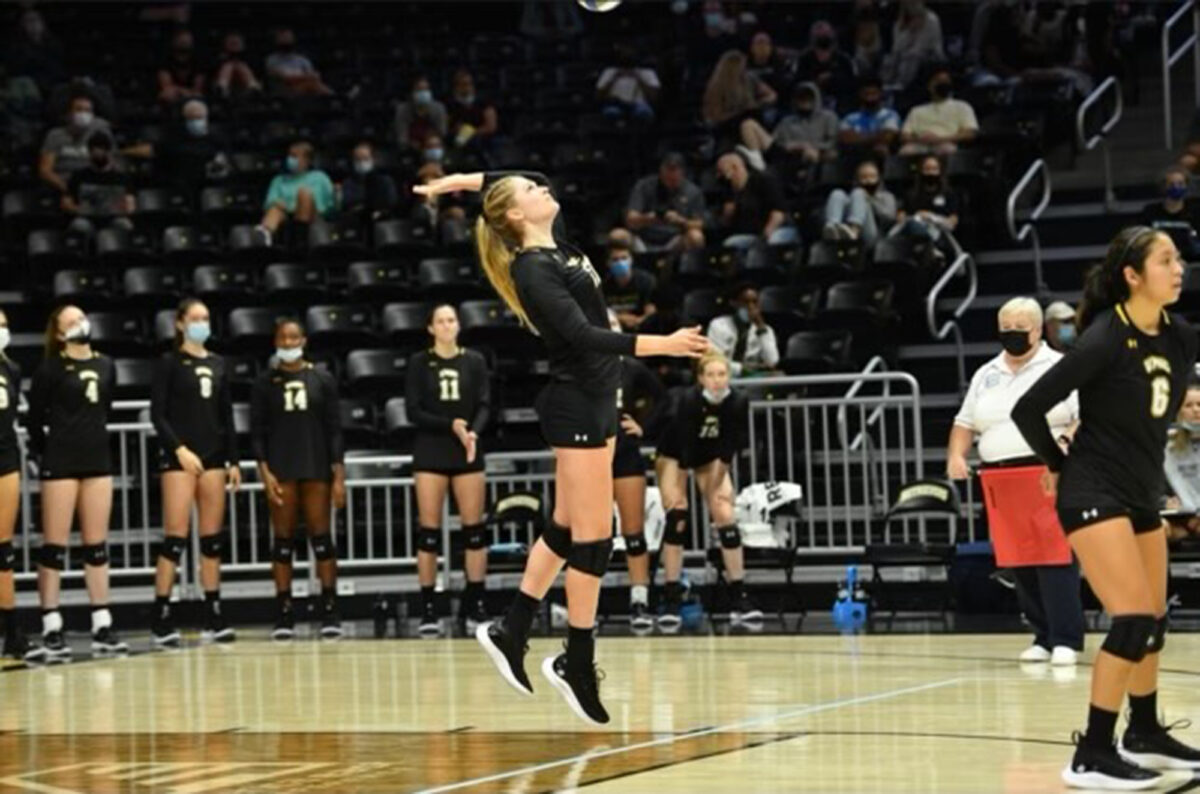 Emily Ferketic on the volleyball court. (Image courtesy of Emily Ferketic)
Despite her rigorous academic schedule, she also excelled on the volleyball court, becoming captain of UMBC’s Division 1 team. In 2021, she won the coveted America East Elite 18 award. Her coaches, too, have been especially engaged. “A few weeks ago, I was presenting my research at Undergraduate Research and Achievement Day. All of my coaches showed up, not only to support me, but also to learn about the work I’ve been doing when I’m not in the gym,” she shares.
A diverse, supportive community
Students who complete double majors face especially challenging demands. Avni Patel ’23, biological sciences and gender, women’s and sexuality studies, achieved academic excellence in both fields of study and also became a community leader at UMBC, revitalizing the Hindu Students Council. “The best part of my UMBC experience was finding a diverse community of peers and mentors where I was appreciated and encouraged to reach my full potential,” she says.
 Avni Patel (fifth from right) with members of the Hindu Student Association at a fundraiser. (Image courtesy of Avni Patel)
One theme strongly resonates through the experiences of all these students: the UMBC community values the whole person. Whether a student is focusing on academic work, participating in student organizations, competing as an athlete, or engaging with any number of other activities, the university’s culture of mentoring and support is there to help them succeed.
]]>
Kayla Tomas ‘23, information systems, maintained a challenging schedule during her undergraduate years. There were days she rose early, studied, and attended classes in the morning and afternoon,...
https://umbc.edu/stories/class-of-2023-on-supporting-the-whole-person/
https://my3.my.umbc.edu/api/v0/pixel/news/133673/guest@my.umbc.edu/492e2b0fa6f4beab6c475683a77b9093/api/pixel
athletics
biology
campus-life
class-of-2023
cnms
coeit
computer-science
cwit
information-systems
news
physics
volleyball
UMBC News & Magazine
https://my3.my.umbc.edu/groups/umbc-news-magazine
https://assets1-my.umbc.edu/system/shared/avatars/groups/000/001/943/24435aa6207c452e7bc15cc74b42c7bb/xsmall.png?1748556657
https://assets1-my.umbc.edu/system/shared/avatars/groups/000/001/943/24435aa6207c452e7bc15cc74b42c7bb/original.png?1748556657
https://assets2-my.umbc.edu/system/shared/avatars/groups/000/001/943/24435aa6207c452e7bc15cc74b42c7bb/xxlarge.png?1748556657
https://assets2-my.umbc.edu/system/shared/avatars/groups/000/001/943/24435aa6207c452e7bc15cc74b42c7bb/xlarge.png?1748556657
https://assets3-my.umbc.edu/system/shared/avatars/groups/000/001/943/24435aa6207c452e7bc15cc74b42c7bb/large.png?1748556657
https://assets1-my.umbc.edu/system/shared/avatars/groups/000/001/943/24435aa6207c452e7bc15cc74b42c7bb/medium.png?1748556657
https://assets2-my.umbc.edu/system/shared/avatars/groups/000/001/943/24435aa6207c452e7bc15cc74b42c7bb/small.png?1748556657
https://assets1-my.umbc.edu/system/shared/avatars/groups/000/001/943/24435aa6207c452e7bc15cc74b42c7bb/xsmall.png?1748556657
https://assets2-my.umbc.edu/system/shared/avatars/groups/000/001/943/24435aa6207c452e7bc15cc74b42c7bb/xxsmall.png?1748556657
UMBC News & Magazine
3
0
false
Mon, 22 May 2023 15:30:19 -0400