Zareen Taj earns her Ph.D., publishing the first autoethnography by a Hazara Afghan woman about the ongoing genocide of Hazara women under Taliban rule
This spring on Thursday evenings, students filled room 424 in the Fine Arts building for their Asian Diaspora in Motion: Media, Culture, Identity, and Activism class. At the head of the classroom was Zareen Taj, who designed the new 300-level class based on her experiences as a documentary filmmaker and activist defending the rights of her community—the Hazara women of Afghanistan, a community that has for over a century experienced extreme ethnic, religious, and gender oppression, including multiple massacres and starvation, under Taliban rule.
It’s a reality Taj grew up with as part of the Hazara people, a religious and ethnic minority. In the 1990s, when the Taliban increased their killings of the Hazara people, Taj and her family fled to a refugee settlement in Pakistan. There, Taj started speaking out against the systemic oppression of Hazara women. Her activism made her a Taliban target. With a scholarship from the Feminist Majority Foundation, Taj fled once more, this time to Towson University, where she earned a bachelor’s in political science and women’s studies and a master’s in women’s studies.
After graduation, Taj worked for Voice of America as an international broadcaster and producer. At UMBC, she worked for Chartwells in the HR department first and then as an accounting associate at The Shriver Center. A year later, Taj was accepted into the language, literacy, and culture (LLC) doctoral program. During her studies, she raised two children and created four short documentaries about Hazara women while teaching in the global studies, Asian studies, and American studies departments.
This semester, Taj successfully defended her dissertation, “Journey of a Scholar-Activist: An Autoethnographic and Multimodal Inquiry,” which includes written narratives and her fourth documentary short film titled “For My People.” The project marks the first time she took the time and space to reflect on her life.
“I learned from this journey that I am different. I look different. I work differently. I see things differently, but my difference is not a problem,” says Taj about her experience at UMBC, where she hopes to become a professor. “My experience is an asset. It’s my wealth. The UMBC community, particularly the LLC and my professors, were very supportive of what I’m doing. So they supported me at each stage of my life.”
Q: What was your journey to UMBC?
A: I studied in a refugee displacement settlement in Pakistan, so it was very hard. But I got the Feminist Majority Scholarship and moved to Maryland in 2000 to attend Towson University. I could not speak English well. I saw a computer for the first time in my life. It was very hard because I came from a very war-torn country. We don’t have that advanced education system, and it’s often interrupted by war. Every minute, I reminded myself about the other Afghan girls who didn’t have this opportunity, so I couldn’t give up.
I always wanted to get a Ph.D. That was my dream. I put all of my experiences into my academic world. In 2018, I applied to the LLC doctoral program. I talked with Carole McCann, professor of gender, sexuality, and women’s studies, about what I wanted to do. She said yes to being my advisor right away. Joby Taylor, Ph.D. ’05, assistant vice provost and co-leader of The Shriver Center for Public Service and Community Engagement, and Tania Lizarazo, associate professor of modern languages, linguistics, and intercultural communication, and global studies, also lent their support as co-chairs.
Q: How did you decide on the topic for your dissertation?
A: My master’s thesis, titled “Dual Identity, Dual Oppression of Hazara Women,” didn’t follow the same research path as a traditional thesis because there were no official documents that I could use for my research. I felt frustrated. My thesis was informed by my firsthand research trips to Afghanistan. This work represents the first contribution of its kind in the academic field. My personal experiences and frustrations motivated me to return to my country, which ultimately shaped and grounded the development of my thesis.
For my dissertation, my committee wanted me to talk about myself, to write a book. I appreciated them encouraging me, but I continued to focus on Hazara women until Dr. Tanya Saunders, associate professor of sociology, pointed out all the different types of ethnography I was doing and encouraged me to focus on myself to do an autoethnography. I was surprised that I could do that, and that’s how I started.
That gave me a kind of confidence in my writing. I’m always reflecting on all of these things I’m doing, but not reflecting on myself. I never had the chance, or I never thought of doing it. I never thought I would be allowed to talk about myself, so I didn’t. I come from a culture where we never talk about ourselves because this is taboo. Women would be told, “Why are you talking about yourself? We have bigger issues, bigger things to talk about.” That’s the culture, especially for Hazara women. We never talk about ourselves, our pain, our joy. Everything is internalized.
I am reaching a stage of very clear realizations about how this academic process is a very healing process for me. I’m making my people visible and bringing awareness to the cause. We’ll get to know people, my people, my ethnicity, their suffering, and also the resilience of these women.
Q: Why was this dissertation process a healing process?
A: My short documentary, “For My People,” which I produced for my dissertation, helped me process the anger and isolation I have carried after years of fighting for survival and against oppression. This process led to exploration and, for the first time, I explored healing and the shift to joy, community, and belonging I have found with the Hazara women who resettled in Washington, D.C., my global network of activists, and my UMBC community.
The more work I’m doing in the form of writing an article, creating films, or public speaking, the more visibility I have to those dimensions, those identities. It’s helping me feel that I do justice for them. That’s the process of healing. The more I work to bring community sustainability and collectiveness, the stronger my sense of belonging, satisfaction, and deep attachment to my community.
Q: What inspired the topics for your other films?
A: I was doing my master’s thesis about Hazara women, but there wasn’t much data. I decided to go back to Afghanistan for the first time since fleeing Pakistan to document the living conditions and experiences of Hazara women living under the fear of genocide. When I returned, I had 40 hours of videotapes, 700 photographs, and 20 hours of cassette recordings that helped me make my first film, “The Oppression of Hazara in Afghanistan.”
But I didn’t just want to show the oppression of Hazara women as victims. I wanted to show the resistance and leadership of Hazara women. After the fall of the last Afghan government in 2021, some Hazara refugees came to the Washington, D.C., Maryland, Virginia area. We have a lot of activists and advocates like Azra Jafari, the first woman in Afghanistan to hold the office of mayor. They were willing to be interviewed for “Our Face Tells: Seeing the Genocide of Hazaras in Afghanistan.”
Last year, I collaborated with several organizations and led efforts to train Hazara women to create and share their own stories. The Hazara Women of Afghanistan Share Digital Stories event trained and supported Hazara women to tell their own stories. That inspired “Voices of Resistance.”
Q: How have you passed on your documentary film skills to your students?
A: UMBC has given me so much and helped me to contribute to it. I taught three years in the global studies program as a visiting lecturer, and I designed, established, and taught Global Studies 409: Documentary Film as Global Activism. Students had to make a documentary about their families from any part of the world. They had to document where their identity and sense of belonging came from. Their films reflected their family backgrounds as well as their personal passions and engagement with social issues.
I still remember a student whose grandparents came from Ethiopia. His film was about them, and afterwards told me that when he was given the assignment, he said to himself, “If this lady, this lady from Afghanistan, can do these films, I can do that too.” It made me smile
Q: Looking back on everything that you have experienced and accomplished, has your purpose changed?
A: In 2021, when the Taliban returned, it was like the loss of a 20-year-old child. It was hard not to despair. But in all the chaos, some Hazara were able to get out and needed help arriving to live in the United States. That service rescued me from that vulnerable situation. Community work changed me again. It lifted me up.
 Zareen Taj (first row, second from the left), at the Hazara Women of Afghanistan Share Digital Stories event. (Image courtesy of Taj.)
After the Hazara Women of Afghanistan Share Digital Stories event, I realized I do not need to feel the responsibility to speak for Hazara women, as they are now able to articulate and share their own stories with the world. This is my message for Hazara around the world, especially Hazara women who feel like their stories do not matter. You need to tell your story because your story is our history. And your story is our future. Sharing our stories will hold us together and make us known to the world.
]]>
This spring on Thursday evenings, students filled room 424 in the Fine Arts building for their Asian Diaspora in Motion: Media, Culture, Identity, and Activism class. At the head of the classroom...
https://umbc.edu/stories/zareen-taj-publishes-first-autoethnography-by-a-hazara-afghan-woman/
Video Preview
https://assets4-my.umbc.edu/system/shared/attachments/e8f854520873b41b0706bf1aa64ec402/6a928245/news/000/159/731/e0c4ba8f6e02c02ed67cc30334e8c183/2498820.jpg?1778009707
https://my3.my.umbc.edu/api/v0/pixel/news/159731/guest@my.umbc.edu/f9e9ea2143bc436276841dd469489856/api/pixel
asianstudies
cahss
class-of-2026
global-studies
gwst
international
language-literacy-and-culture
mlli
news
policy-and-society
saph
shrivercenter
story
UMBC News & Magazine
https://my3.my.umbc.edu/groups/umbc-news-magazine
https://assets1-my.umbc.edu/system/shared/avatars/groups/000/001/943/24435aa6207c452e7bc15cc74b42c7bb/xsmall.png?1748556657
https://assets1-my.umbc.edu/system/shared/avatars/groups/000/001/943/24435aa6207c452e7bc15cc74b42c7bb/original.png?1748556657
https://assets2-my.umbc.edu/system/shared/avatars/groups/000/001/943/24435aa6207c452e7bc15cc74b42c7bb/xxlarge.png?1748556657
https://assets2-my.umbc.edu/system/shared/avatars/groups/000/001/943/24435aa6207c452e7bc15cc74b42c7bb/xlarge.png?1748556657
https://assets3-my.umbc.edu/system/shared/avatars/groups/000/001/943/24435aa6207c452e7bc15cc74b42c7bb/large.png?1748556657
https://assets1-my.umbc.edu/system/shared/avatars/groups/000/001/943/24435aa6207c452e7bc15cc74b42c7bb/medium.png?1748556657
https://assets2-my.umbc.edu/system/shared/avatars/groups/000/001/943/24435aa6207c452e7bc15cc74b42c7bb/small.png?1748556657
https://assets1-my.umbc.edu/system/shared/avatars/groups/000/001/943/24435aa6207c452e7bc15cc74b42c7bb/xsmall.png?1748556657
https://assets2-my.umbc.edu/system/shared/avatars/groups/000/001/943/24435aa6207c452e7bc15cc74b42c7bb/xxsmall.png?1748556657
UMBC News & Magazine
0
0
false
Tue, 05 May 2026 15:29:15 -0400
Tue, 05 May 2026 15:29:15 -0400
Rileigh Mansfield ’26—a mathematician with contagious enthusiasm and a ‘Survivor’ spirit
The UMBC career of Rileigh Mansfield ’26, mathematics, has been a masterclass in combining high-level theory with real-world impact. A Meyerhoff Scholar who began conducting research in her first year, Mansfield has spent the last three years applying complex data assimilation to everything from epidemiology to volcanology. Her academic path has taken her from the Andes of Ecuador to a math camp in Rwanda, and now it will take her to Stanford University to pursue a Ph.D. in geophysics. But Mansfield’s time at UMBC has included much more than academics: It has been defined by resilience and a contagious enthusiasm for building community—whether through tutoring and mentoring fellow students or playing Settlers of Catan with classmates and friends.
Q: What’s next for you after graduation?
A: I’m heading to Stanford University to pursue a Ph.D. in geophysics. Stanford has always been my dream school. I was nervous about applying, because I was switching from math to geophysics and graduating a year early. Plus, I didn’t do as well as I’d hoped on the GRE, and I felt like it was going to be impossible to get in. But I went for it anyway, with encouragement from my best friend—and now I get to go!
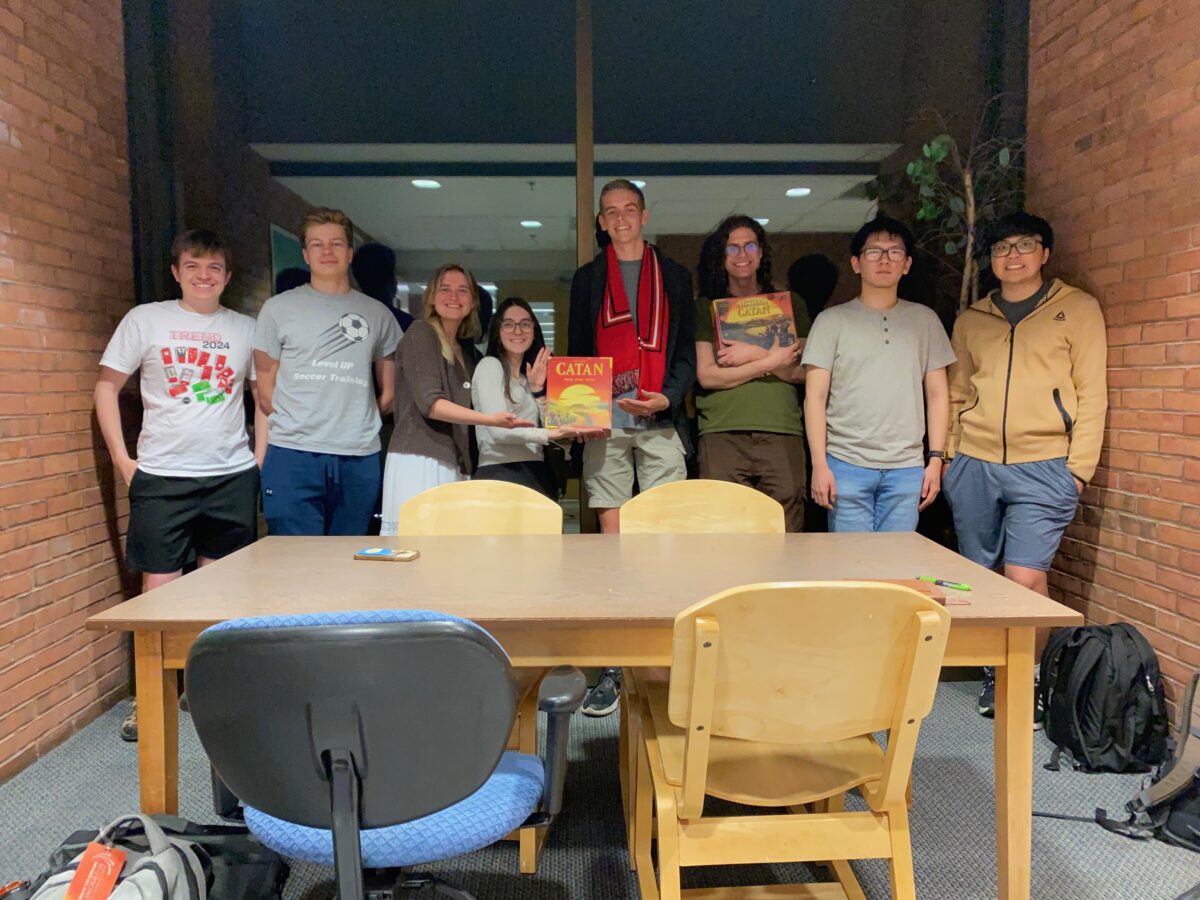 Rileigh Mansfield (third from left) gets together regularly with friends to play the strategic board game Catan. (Courtesy of Mansfield)
Q: How have you gotten involved on campus, and how have those activities supported your growth?
A: I’ve served as the president of Pi Mu Epsilon (the national math honors society), a Meyerhoff Peer Advisor, and a teaching assistant in the math department. I also conducted research with math professors Dr. Animikh Biswas and Dr. Kathleen Hoffman. But honestly, some of my most meaningful involvement has been more informal. Last spring, I was having a tough semester when I got invited to join a group from the math lounge to play the board game Catan on Tuesdays. It became a little community and something to look forward to every week—a much-needed step back from school and work. I actually play in competitive Catan tournaments now, and I’m even hosting an official tournament this spring through the math honors society.
Q: How did you first get involved in research at UMBC, and what did you focus on?
A: I got involved in research through the Meyerhoff Scholars Program. Dr. Biswas taught one of my Summer Bridge classes. I asked a lot of questions, and he said I should apply to be in his lab. In the fall, a notification went out for a research position in the math department, so I filled it out, and it ended up being for his lab combined with Dr. Hoffman’s. I got to start my first year, which was really cool. My research focused on data assimilation—specifically looking at parameter sensitivity and estimation for biological models. I was studying how diseases like cholera and HIV spread. Jumping into that as a freshman was tricky, but I had a lot of support from the seniors in the lab.
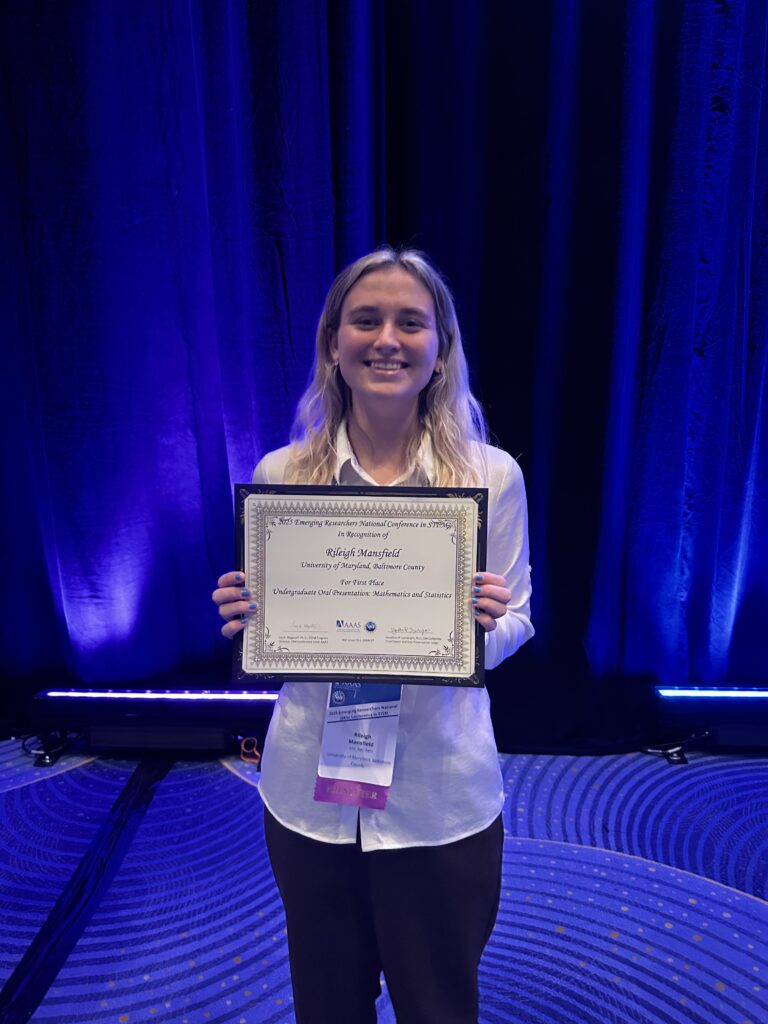 Rileigh Mansfield won first place in the Undergraduate Oral Presentation category at the 2025 Emerging Researchers National Conference in STEM. (Courtesy of Mansfield)
Q: So how did you end up pivoting to geophysics for graduate school?
A: My dad was a budget analyst for NASA, so I grew up around space and earth science. I’ve always been mystified by natural disasters like earthquakes and volcanoes, because we don’t really have them in Maryland. When Dr. Biswas introduced me to data assimilation, he mentioned it’s used for weather forecasting. That was the spark. I liked my research at UMBC, because it’s easy to see how working in biology can help save people’s lives, but honestly biology isn’t my passion. When I looked internally at what I’m excited about that can also help people, natural disasters came to mind. I realized I could use my math background to work on earthquake or volcano early-warning systems.
Q: Who has supported you throughout your UMBC journey?
A: I met my friend Emilia Pelegano-Titmuss at a summer program at Caltech in 2024, and we have supported each other in our pursuit of earth science ever since. Last spring, I had an incredibly challenging semester. My grades dipped, and I lost my self-confidence; I felt like I wasn’t made for research. Emilia talked me through it. She told me, “If you and I aren’t made for the research life, I don’t know who is.” She pushed me to graduate early and apply to grad school with her. Without her courage and motivation, I wouldn’t be in the position I am today.
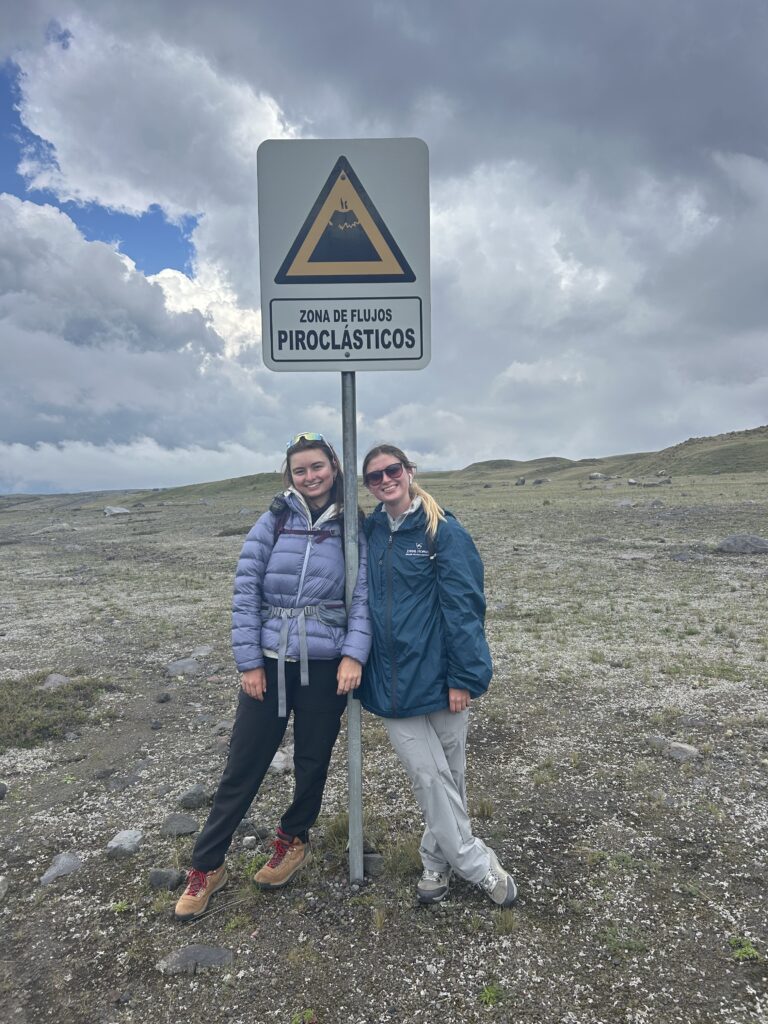 Rileigh Mansfield (right) and her best friend, Emilia Pelegano-Titmuss (left), studied volcanoes in Ecuador among the indigenous people who live there. The sign warns that they are in a volcanic flow zone. (Courtesy of Mansfield)
Q: Can you describe key takeaways from your education abroad experiences?
A: Going to Ecuador was my favorite part of undergrad. In winter 2025, I went into the Andes to do field work in volcanology with Emilia, who goes to Hunter College. We stayed with indigenous communities who lived right on a volcano. It was a huge cultural experience in addition to the science we did. I even got to shear alpacas! Sitting down for dinner with the people I want my work to impact was a huge motivator. I learned about how there was a lot of distrust between their community and scientists, including the ones who order evacuations around disasters. I want to help bridge those divides.
I also went to Rwanda to teach elective math seminars at a Supporting African Maths Initiative (SAMI) camp. I taught game theory and disease modeling, but I also spent a lot of time helping students understand the U.S. college admissions process. Many of those students are so bright, and they really want to come to the U.S. for college, but they don’t have the resources or information to navigate the system. I still talk to some of them today to help them through the Common App.
Q: Why is it important to you to make a positive impact and help others?
A: I don’t like to feel like I’m wasting my time—if I’m going to spend my life doing research, I want to know it’s having a real-world impact. I’m also just genuinely excited about what I do. I really love it, and I want everyone else to love it, too. My favorite type of mentor is someone who loves something so much that even if at first you don’t understand what they’re talking about, you start caring about it just because they do—their enthusiasm is contagious. I try to bring that same energy to my work as a teaching assistant and peer mentor and to sharing math and science with anyone and everyone.
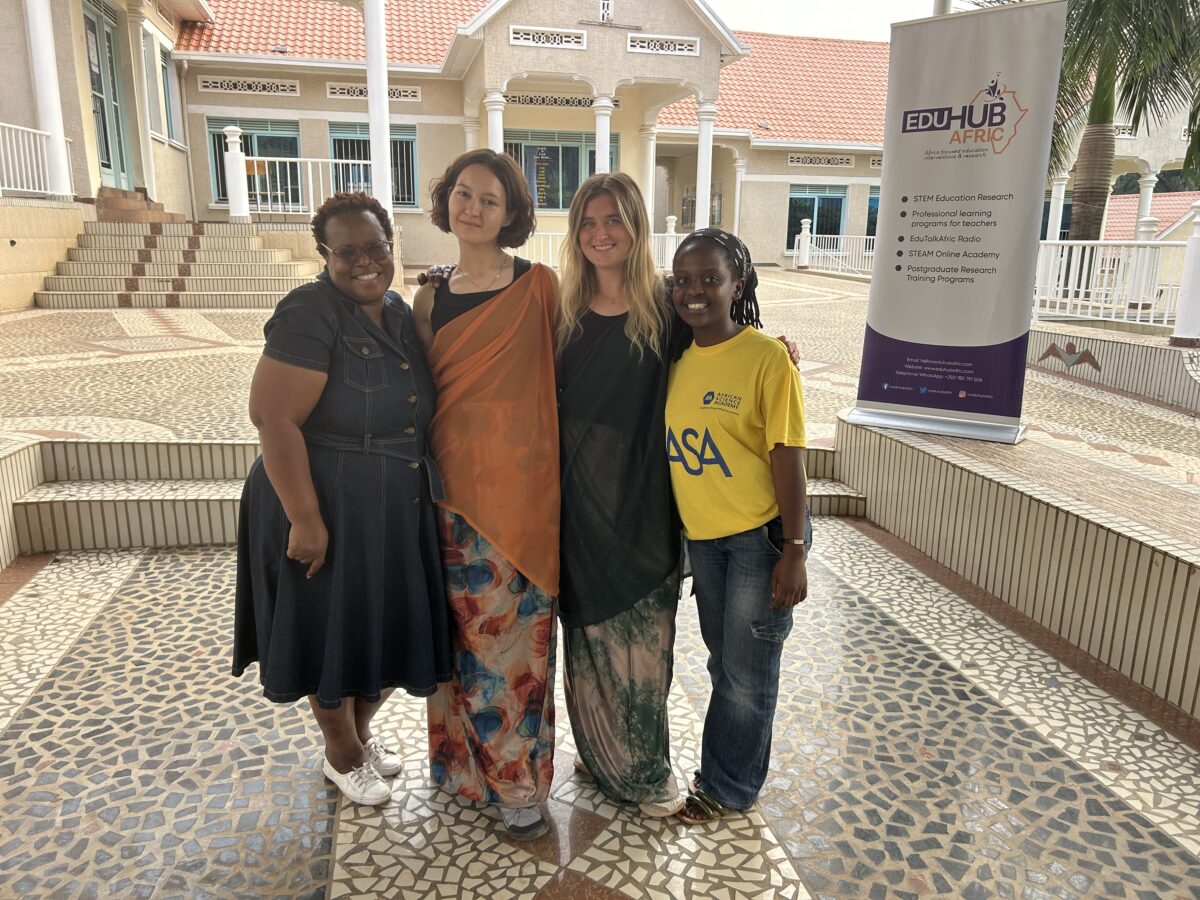 Rileigh Mansfield (second from right) had a transformative experience tutoring math in Rwanda. (Courtesy of Mansfield)
Q: What’s something unique about you that isn’t obvious from your résumé?
A: I am obsessed with the show Survivor. I audition for it every year. I’ve been watching it since third grade, and I’m always training for it. One year during finals, I even practiced eating only small portions of rice and working out on very little sleep just to see if my brain could still function—and it turned out it could. I also practiced starting fires with a flint.
I also did competitive trampolining for years, and I play in competitive Catan tournaments. It’s interesting because, like Survivor, it’s a social game and a strategic game. My strength is always the social game. More recently, I went on The Price is Right with my friend Emilia. If you watch the June 1 episode, you’ll see us screaming and jumping up and down in the audience; she got picked to participate!
Q: What advice do you have for incoming UMBC students or aspiring undergraduate researchers?
A: Go to office hours. Even if you don’t have a specific question, just go and talk to your professors. It helps the professors know who you are, which can have the side benefit of motivating you even more to do well in the class. It can also create opportunities, like how I talked to Dr. Biswas at Summer Bridge, which led to doing research in his lab.
And if you really want something, you can always find a way to get it. Don’t just say, “UMBC doesn’t offer it,” or, “It’s not easy to get.” Many of the things I did weren’t here at UMBC, but UMBC professors sent me applications for workshops and opportunities. Dr. Justin Webster and Dr. Biswas sent me to a workshop in Texas on partial differential equations and to Colorado for a conference on data simulation—both were incredibly valuable. The resources are there to help you get what you want, but you have to go after it.
]]>
The UMBC career of Rileigh Mansfield ’26, mathematics, has been a masterclass in combining high-level theory with real-world impact. A Meyerhoff Scholar who began conducting research in her first...
https://umbc.edu/stories/rileigh-mansfield-survivor-spirit/
https://my3.my.umbc.edu/api/v0/pixel/news/159722/guest@my.umbc.edu/b4633ce5875caa60c53eef598bb38645/api/pixel
class-of-2026
cnms
mathematics
news
science-and-tech
story
undergraduate-research
UMBC News & Magazine
https://my3.my.umbc.edu/groups/umbc-news-magazine
https://assets1-my.umbc.edu/system/shared/avatars/groups/000/001/943/24435aa6207c452e7bc15cc74b42c7bb/xsmall.png?1748556657
https://assets1-my.umbc.edu/system/shared/avatars/groups/000/001/943/24435aa6207c452e7bc15cc74b42c7bb/original.png?1748556657
https://assets2-my.umbc.edu/system/shared/avatars/groups/000/001/943/24435aa6207c452e7bc15cc74b42c7bb/xxlarge.png?1748556657
https://assets2-my.umbc.edu/system/shared/avatars/groups/000/001/943/24435aa6207c452e7bc15cc74b42c7bb/xlarge.png?1748556657
https://assets3-my.umbc.edu/system/shared/avatars/groups/000/001/943/24435aa6207c452e7bc15cc74b42c7bb/large.png?1748556657
https://assets1-my.umbc.edu/system/shared/avatars/groups/000/001/943/24435aa6207c452e7bc15cc74b42c7bb/medium.png?1748556657
https://assets2-my.umbc.edu/system/shared/avatars/groups/000/001/943/24435aa6207c452e7bc15cc74b42c7bb/small.png?1748556657
https://assets1-my.umbc.edu/system/shared/avatars/groups/000/001/943/24435aa6207c452e7bc15cc74b42c7bb/xsmall.png?1748556657
https://assets2-my.umbc.edu/system/shared/avatars/groups/000/001/943/24435aa6207c452e7bc15cc74b42c7bb/xxsmall.png?1748556657
UMBC News & Magazine
0
0
false
Tue, 05 May 2026 13:48:11 -0400
Tue, 05 May 2026 13:48:11 -0400
Meyerhoff Scholars Program celebrates 500th Ph.D.
This spring, the Meyerhoff Scholars Program at UMBC celebrates a landmark achievement: 500 program graduates have earned a Ph.D.
The milestone highlights the program’s success as the nation’s original model for increasing diversity in science, technology, engineering, and mathematics (STEM). Grounded in high expectations and robust support, Meyerhoff Scholars consistently go on to excel in top graduate programs and lead in academia, industry, and government while mentoring the next generation. UMBC has maintained its position as the national leader in producing Black M.D./Ph.D. graduates: Between 2014 and 2024, UMBC alumni accounted for 15 percent of all such dual-degree recipients nationwide, far outpacing any other institution. UMBC is also the leader in graduating Black students who go on to earn Ph.D.s in the life sciences, math and computer sciences, and engineering.
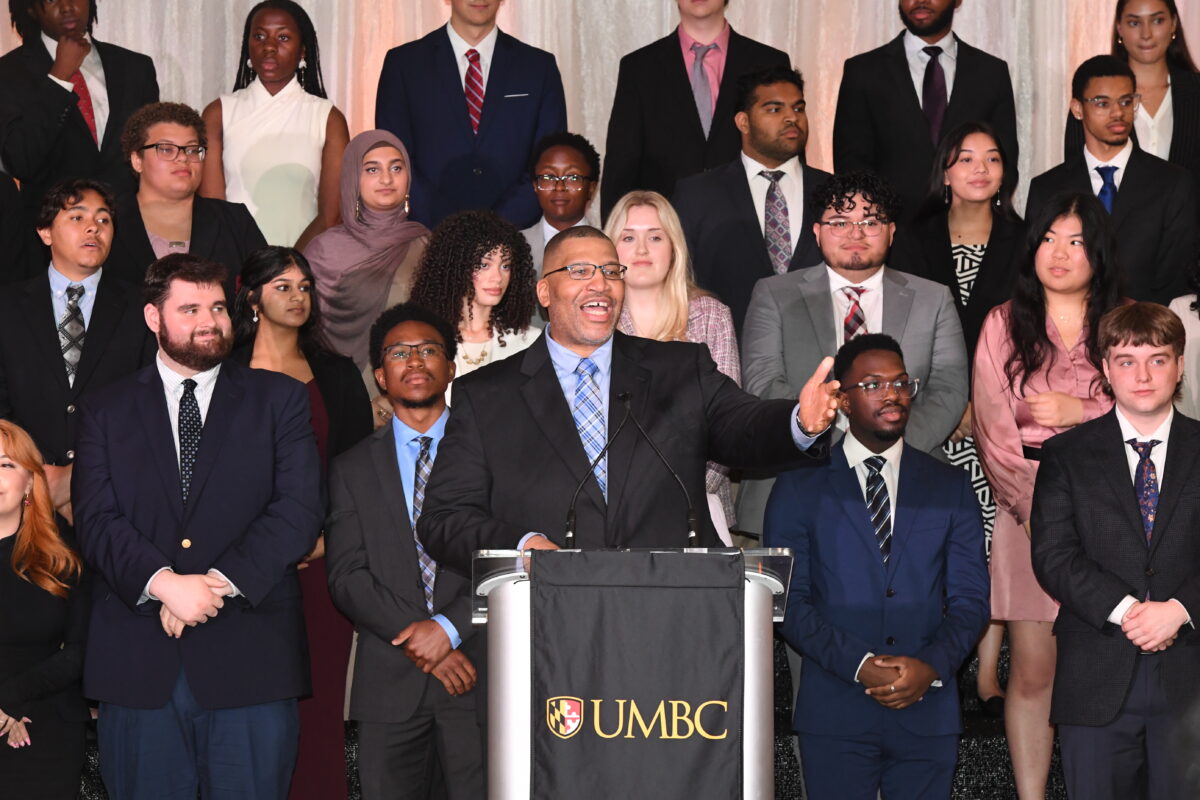 Keith Harmon, director of the Meyerhoff Scholars Program, celebrates graduating scholars at the 2024 Meyerhoff Senior Reception. (Jim Burger for UMBC)
Joseph Washington ’97, mechanical engineering, a member of the fourth Meyerhoff cohort (M4), embodies this trajectory. A first-generation college student, he initially considered trade school after a knee injury derailed his plans to attend the U.S. Naval Academy. The Meyerhoff scholarship changed his path. In particular, Selection Weekend for admitted Meyerhoff Scholars and Summer Bridge, intensive group programming prior to the scholars’ first UMBC semester, affirmed his identity and potential: “The most important message I internalized from the Meyerhoff program was that I can be Black and intelligent,” he recalls.
Washington earned a master’s degree before returning to UMBC for his Ph.D. Today, he serves as an assistant teaching professor at UMBC at the Universities at Shady Grove. He mentors students informally, advises the UMBC chapter of the American Institute of Aeronautics and Astronautics, and creates space for Meyerhoff Scholars to discuss graduate school and careers. “UMBC has always felt like home,” he says. “I would not be here if not for the Meyerhoff Scholars Program.”
A family tradition
Sadella Santos ’12, chemical engineering, M20, and her sister Melissa Santos ’12, chemical engineering, M19, also credit the program with shaping their journeys. Sadella, a senior scientist at Exponent, Inc. with a Ph.D. in chemical engineering, values the emphasis on community. “Academic success is a collective effort, rather than individual competition,” she says. “At work, I champion the message that diverse perspectives are necessary to drive scientific progress.” She pays it forward by reviewing abstracts for the Annual Biomedical Research Conference for Minoritized Scientists (ABRCMS) and hosting lab visits to expose high school students to possible careers.
 Meyerhoff Scholar alumni gathered at the 2022 Meyerhoff Family Meeting. (Marlayna Demond ’11/UMBC)
Melissa, who earned a Ph.D. in chemical engineering followed by a J.D., applies problem-solving and adaptability skills honed through Meyerhoff to her legal career. She recently participated in a panel for McNair Scholars on summer research experiences. “Community and network are important,” she notes. “Surround yourself with people who will support you but also challenge you to grow.”
Meyerhoff scholars often refer to themselves as family—and that’s especially true for the Santoses. Justin Santos ’17, biochemistry and molecular biology, M25, is the third scholar in the family. He is completing his M.D./Ph.D. in neuroscience at Emory University this spring and will begin residency in emergency medicine at Washington University in St. Louis. He mentors students pursuing clinical-scientist careers and assists with ABRCMS abstract reviews. “High-quality, comprehensive mentorship” was invaluable to him, and he works to provide that same guidance to others.
Reaching back to pay it forward
Naomi Mburu ’18, M26, chemical engineering, was UMBC’s first Rhodes Scholar, attending Oxford University on one of the world’s oldest and most prestigious scholarships. She earned a D.Phil. in engineering science from the University of Oxford and today serves as lead analyst at Fusion Advisory Services, providing analysis of the fusion industry to a wide range of stakeholders. Meyerhoff pushed her beyond her comfort zone into leadership roles and strengthened her public speaking and networking skills, she says. She now reviews scholarship essays for UMBC students and organizes summer internships to bring diverse talent into the fusion energy field. “Supporting the next generation is so important,” she says. “I have only come this far myself with the help of my own mentors.”
 From left to right, UMBC sophomore Amir Walton-Irvin, and juniors Jessica Slaughter, Deeya Mistry, and Phoenix Bryant all received a Goldwater Scholarship this year—and all four are Meyerhoff Scholars. (Brad Ziegler/UMBC)
These alumni illustrate the program’s lasting influence. Meyerhoff Scholars do not simply succeed—they reach back, creating opportunities and building communities for current students and early-career researchers. The model’s impact now extends even further: universities including Penn State, UNC-Chapel Hill, UC Berkeley, Stony Brook, and others have adapted key elements of the Meyerhoff approach with support from funders such as the Chan Zuckerberg Initiative and Simons Foundation. The Howard Hughes Medical Institutehas also been a long-term supporter of Meyerhoff and its replications.
With more than 2,200 undergraduates supported to date and a national reputation for producing leaders committed to diversity in STEM, the 500th Ph.D. stands as compelling proof of the Meyerhoff model’s effectiveness. As alumni advance in their fields and invest in those who follow, the Meyerhoff Scholars Program continues to change lives one by one, transforming the face of American science through excellence, community, and a powerful ripple effect that will benefit generations to come.
]]>
This spring, the Meyerhoff Scholars Program at UMBC celebrates a landmark achievement: 500 program graduates have earned a Ph.D. The milestone highlights the program’s success as the nation’s...
https://umbc.edu/stories/meyerhoff-scholars-program-celebrates-500th-ph-d/
https://my3.my.umbc.edu/api/v0/pixel/news/159662/guest@my.umbc.edu/842d203280497d3bf9ff4f93dcf9ec8f/api/pixel
alumni
biochemistry-and-molecular-biology
chemical-biochemical-and-environmental-engineering
chemical-engineering
chemistry-and-biochemistry
class-of-2026
cnms
coeit
community
mechanical-engineering
meche
meyerhoff-scholars
news
science-and-tech
story
UMBC News & Magazine
https://my3.my.umbc.edu/groups/umbc-news-magazine
https://assets1-my.umbc.edu/system/shared/avatars/groups/000/001/943/24435aa6207c452e7bc15cc74b42c7bb/xsmall.png?1748556657
https://assets1-my.umbc.edu/system/shared/avatars/groups/000/001/943/24435aa6207c452e7bc15cc74b42c7bb/original.png?1748556657
https://assets2-my.umbc.edu/system/shared/avatars/groups/000/001/943/24435aa6207c452e7bc15cc74b42c7bb/xxlarge.png?1748556657
https://assets2-my.umbc.edu/system/shared/avatars/groups/000/001/943/24435aa6207c452e7bc15cc74b42c7bb/xlarge.png?1748556657
https://assets3-my.umbc.edu/system/shared/avatars/groups/000/001/943/24435aa6207c452e7bc15cc74b42c7bb/large.png?1748556657
https://assets1-my.umbc.edu/system/shared/avatars/groups/000/001/943/24435aa6207c452e7bc15cc74b42c7bb/medium.png?1748556657
https://assets2-my.umbc.edu/system/shared/avatars/groups/000/001/943/24435aa6207c452e7bc15cc74b42c7bb/small.png?1748556657
https://assets1-my.umbc.edu/system/shared/avatars/groups/000/001/943/24435aa6207c452e7bc15cc74b42c7bb/xsmall.png?1748556657
https://assets2-my.umbc.edu/system/shared/avatars/groups/000/001/943/24435aa6207c452e7bc15cc74b42c7bb/xxsmall.png?1748556657
UMBC News & Magazine
0
0
false
Mon, 04 May 2026 15:15:30 -0400
Mon, 04 May 2026 15:15:30 -0400
One photon, a trillion electrons: UMBC physicist Daniel Suárez-Forero explores the quantum frontier
Imagine a material where trillions of electrons are locked in an intricate, collective dance—so tightly choreographed that the tiniest nudge can send ripples across the entire system, transforming its behavior in dramatic ways. Now picture using light—especially the delicate touch of a single photon—to peek inside that dance, understand its hidden steps, and maybe even change the rhythm.
That’s the frontier Daniel Suárez-Forero is exploring at UMBC. He joined the Department of Physics as an assistant professor in August 2025 and leads the Quantum Optics of Correlated Materials group. His experimental approach sits at the intersection of two powerful fields: quantum optics, which studies how light behaves when quantum effects like entanglement come into play (the 2022 Nobel Prize recognized research in this area), and correlated materials, where electrons interact so intensely that they create physics impossible in ordinary conductors or insulators.
By shining quantum light into these strongly interacting systems, his lab aims to reveal quantum behaviors that existing tools can’t see, probe states that have so far been hidden, and help build the foundation for future technologies. His work, featured in two recent papers published in Science and Nature Materials, blends deep questions with real long-term promise, and he’s excited to build his lab here at UMBC.
Q: What will your research group at UMBC focus on, and how has your background prepared you for it?
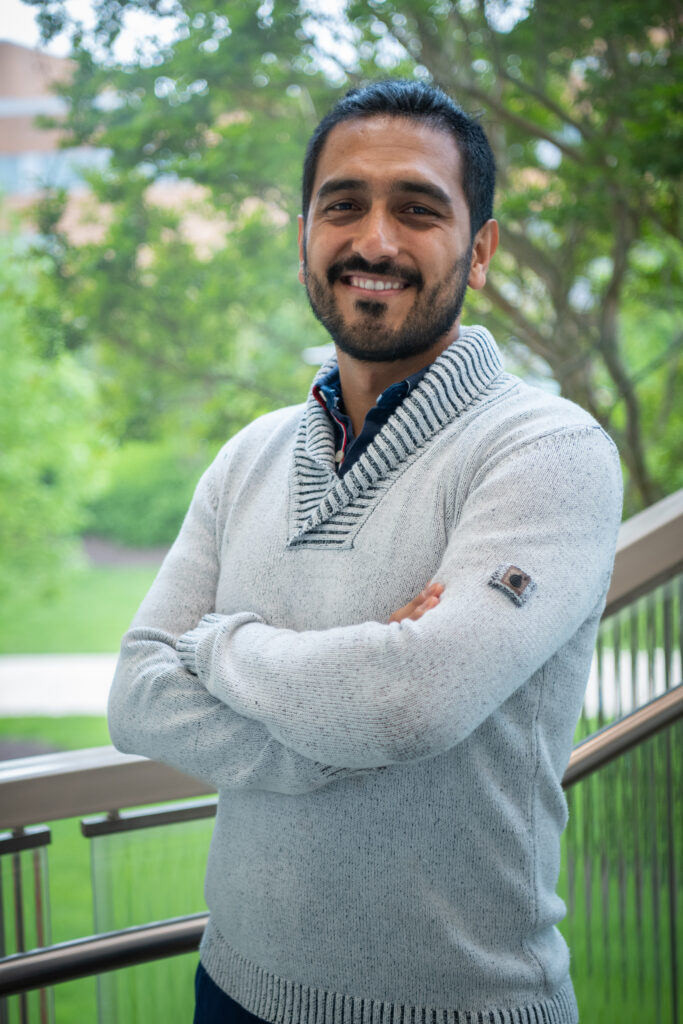 Daniel Suárez-Forero joined the UMBC faculty in 2025 and is already making waves in the physics department. (Brad Ziegler/UMBC)
A: At UMBC, my group will use single photons—the tiniest packets of light—to probe and even gently tweak materials where electrons interact extremely strongly. The exciting goal is to use one photon to affect about a trillion electrons at once: either to reveal hidden quantum details that ordinary tools miss, or to modify the whole material’s behavior with just one particle of light.
My path has been building toward this. In my Ph.D. in Italy, I worked on light-matter hybrids using entangled photons. Then, as a postdoc at the Joint Quantum Institute at the University of Maryland, I dived into these strongly interacting materials. Before joining UMBC, I spent a year in Geneva, Switzerland, learning new experimental techniques that I’m now bringing to campus. The fields of quantum optics and correlated materials had been developing separately, but technology is advancing so that the time is right to bridge them—and that’s what I’ll be doing at UMBC.
What excites me most is the scale: Using one photon to influence a trillion particles could unlock mysteries in these materials and help solve real challenges, like using photons more effectively in quantum computing or creating ultra-sensitive detectors. It’s fundamental science with huge potential for real impact.
Q: How did you choose UMBC and how is your first year going?
A: UMBC made the decision easy. The startup support for my lab’s equipment was strong, and infrastructure from recently retired professors transferred to incoming experimentalists like Geoffrey Diederich, Alex Senichev, and me—creating an excellent setup to build experiments.
Also, the DMV area is a major quantum hub, and Maryland’s initiative to become the “capital of quantum” aligns with UMBC’s Quantum Science Institute, which connects departments across science and engineering to advance quantum from every angle.
 Ph.D. student Nico Rueda-Becerra works with a laser in the Suarez-Forero laboratory. (Courtesy of Daniel Suárez-Forero)
My first year has been wonderful—I’ve gotten tremendous support from the administration, department, and students. I’ve taught graduate quantum mechanics, following the same cohort from their first to second semester. It’s rewarding to watch their understanding and independence grow. I now have one Ph.D. student from Colombia, another starting soon, and two enthusiastic undergrads helping set up the lab. It’s been a positive, exciting start.
Q: What were the key findings from your two recent papers, and how do they relate to your current work?
A: Both papers came from my time as a postdoc and looked at special layered materials where electrons interact very strongly with each other.
In the Science paper, we found something really surprising. Normally, when electrons get “stuck” in place because of their strong interactions (think of them crowding each other so much they can’t move easily), you’d expect other particles in the material to slow down too. But we saw the opposite: Certain particle pairs—made of an excited electron and the empty spot (or “hole”) it left behind—actually moved much faster, about 1,000 times faster than expected! The crowding actually helped these pairs zip around more freely by interfering with their usual tight pairing. It was a “wow” moment that showed how these interactions can lead to unexpected enhanced mobility.
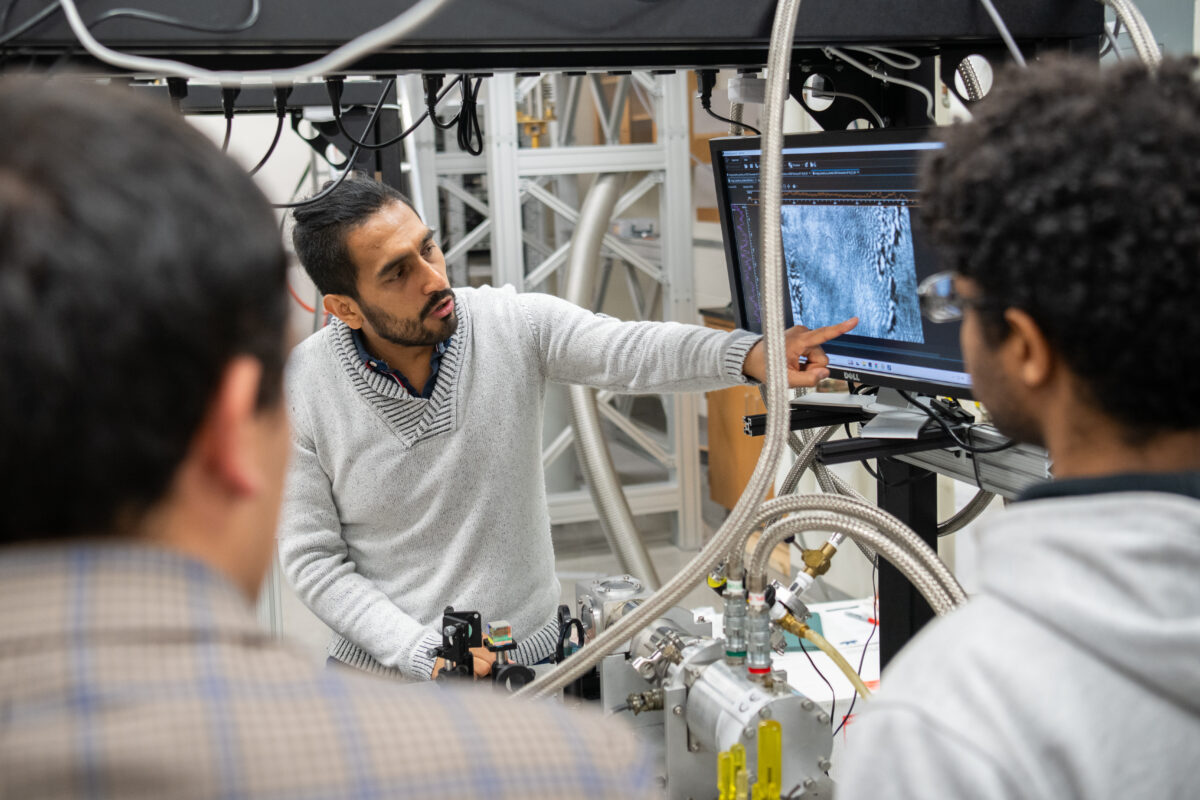 Daniel Suárez-Forero’s group uses complex optics systems to study the properties of correlated materials. Here, he explains the output of one of the research group’s tests. (Brad Ziegler/UMBC)
The Nature Materials paper looked at the flip side: When we shined laser light on the material to create more of those electron-hole pairs, they started lining up neatly all in the same direction—like tiny magnets snapping into alignment. And we could control and reverse this alignment just by turning the light on and off. It’s a way to use light to change how the material behaves, almost like flipping a switch.
These discoveries help us better understand how light and super-strong electron interactions can work together. That’s exactly what sets the stage for my research at UMBC: using single photons to explore or even tweak these materials in new ways—probing hidden details or switching states with just one photon.
Q: What advice do you have for students who are interested in quantum science?
A: If you’re already curious about quantum physics, of course I think that’s a good choice—it’s an exciting field. A Ph.D. can be challenging and involve a lot of failure—like experiments that don’t work—but persistence pays off. Keep digging, stay curious, try different approaches, and don’t get stuck on one path.
If you’re ready to start doing research, choose a group carefully—look at their publications and the tools they use to make sure they match what you’re passionate about. Get hands-on experience early. Quantum is challenging but incredibly rewarding—keep going, and the breakthroughs will eventually come.
 The gold cylinder Suárez-Forero (left) is holding is how samples are loaded into the cryostat instrument for experiments. Suárez-Forero discusses the process with Nico Rueda-Becerra. (Brad Ziegler/UMBC)
]]>
Imagine a material where trillions of electrons are locked in an intricate, collective dance—so tightly choreographed that the tiniest nudge can send ripples across the entire system, transforming...
https://umbc.edu/stories/daniel-suarez-forero-quantum-frontier/
https://my3.my.umbc.edu/api/v0/pixel/news/159598/guest@my.umbc.edu/d9a88a55ac343b89ac739bbddf00a736/api/pixel
cnms
news
physics
research
science-and-tech
story
UMBC News & Magazine
https://my3.my.umbc.edu/groups/umbc-news-magazine
https://assets1-my.umbc.edu/system/shared/avatars/groups/000/001/943/24435aa6207c452e7bc15cc74b42c7bb/xsmall.png?1748556657
https://assets1-my.umbc.edu/system/shared/avatars/groups/000/001/943/24435aa6207c452e7bc15cc74b42c7bb/original.png?1748556657
https://assets2-my.umbc.edu/system/shared/avatars/groups/000/001/943/24435aa6207c452e7bc15cc74b42c7bb/xxlarge.png?1748556657
https://assets2-my.umbc.edu/system/shared/avatars/groups/000/001/943/24435aa6207c452e7bc15cc74b42c7bb/xlarge.png?1748556657
https://assets3-my.umbc.edu/system/shared/avatars/groups/000/001/943/24435aa6207c452e7bc15cc74b42c7bb/large.png?1748556657
https://assets1-my.umbc.edu/system/shared/avatars/groups/000/001/943/24435aa6207c452e7bc15cc74b42c7bb/medium.png?1748556657
https://assets2-my.umbc.edu/system/shared/avatars/groups/000/001/943/24435aa6207c452e7bc15cc74b42c7bb/small.png?1748556657
https://assets1-my.umbc.edu/system/shared/avatars/groups/000/001/943/24435aa6207c452e7bc15cc74b42c7bb/xsmall.png?1748556657
https://assets2-my.umbc.edu/system/shared/avatars/groups/000/001/943/24435aa6207c452e7bc15cc74b42c7bb/xxsmall.png?1748556657
UMBC News & Magazine
2
0
false
Fri, 01 May 2026 16:13:03 -0400
Fri, 01 May 2026 16:13:03 -0400
UMBC Center for Precision Aquaculture launches to boost sustainable U.S. fish farming
The gold cylinder Suárez-Forero (left) is holding is how samples are loaded into the cryostat instrument for experiments. Suárez-Forero discusses the process with Nico Rueda-Becerra. (Brad Ziegler/UMBC)
]]>
Imagine a material where trillions of electrons are locked in an intricate, collective dance—so tightly choreographed that the tiniest nudge can send ripples across the entire system, transforming...
https://umbc.edu/stories/daniel-suarez-forero-quantum-frontier/
https://my3.my.umbc.edu/api/v0/pixel/news/159598/guest@my.umbc.edu/d9a88a55ac343b89ac739bbddf00a736/api/pixel
cnms
news
physics
research
science-and-tech
story
UMBC News & Magazine
https://my3.my.umbc.edu/groups/umbc-news-magazine
https://assets1-my.umbc.edu/system/shared/avatars/groups/000/001/943/24435aa6207c452e7bc15cc74b42c7bb/xsmall.png?1748556657
https://assets1-my.umbc.edu/system/shared/avatars/groups/000/001/943/24435aa6207c452e7bc15cc74b42c7bb/original.png?1748556657
https://assets2-my.umbc.edu/system/shared/avatars/groups/000/001/943/24435aa6207c452e7bc15cc74b42c7bb/xxlarge.png?1748556657
https://assets2-my.umbc.edu/system/shared/avatars/groups/000/001/943/24435aa6207c452e7bc15cc74b42c7bb/xlarge.png?1748556657
https://assets3-my.umbc.edu/system/shared/avatars/groups/000/001/943/24435aa6207c452e7bc15cc74b42c7bb/large.png?1748556657
https://assets1-my.umbc.edu/system/shared/avatars/groups/000/001/943/24435aa6207c452e7bc15cc74b42c7bb/medium.png?1748556657
https://assets2-my.umbc.edu/system/shared/avatars/groups/000/001/943/24435aa6207c452e7bc15cc74b42c7bb/small.png?1748556657
https://assets1-my.umbc.edu/system/shared/avatars/groups/000/001/943/24435aa6207c452e7bc15cc74b42c7bb/xsmall.png?1748556657
https://assets2-my.umbc.edu/system/shared/avatars/groups/000/001/943/24435aa6207c452e7bc15cc74b42c7bb/xxsmall.png?1748556657
UMBC News & Magazine
2
0
false
Fri, 01 May 2026 16:13:03 -0400
Fri, 01 May 2026 16:13:03 -0400
UMBC Center for Precision Aquaculture launches to boost sustainable U.S. fish farming
UMBC has secured $1.5 million in congressional funding to establish the UMBC Center for Precision Aquaculture, an interdisciplinary effort aimed at revolutionizing land-based fish production through real-time monitoring and smart technology.
The new center brings together faculty and students from UMBC’s marine biotechnology, chemistry and biochemistry, and computer science and electrical engineering (CSEE) departments. The interdisciplinary team will strive to make domestic aquaculture more efficient, healthier for fish, and environmentally responsible—while helping reduce America’s massive seafood trade deficit.
“Fish are the last ‘hunt-and-gather’ animal crop,” says Yonathan Zohar, professor and chair of marine biotechnology and the new center’s lead. “To relieve pressure on our oceans, fish—like other animal proteins—must be produced through farming or aquaculture.”
Bringing a “blue revolution”
The U.S. imports over 90 percent of its seafood and nearly all its Atlantic salmon, contributing to American seafood imports exceeding exports by roughly $20 billion, the largest deficit across all agricultural crops. And aquaculture is the fastest-growing sector of global and U.S. agriculture, yet the U.S. ranks only 18th in production.
 Researchers Keiko Saito (left) and Yonathan Zohar (right) discuss the remediation of liquid waste, which is carried out by bacteria in tanks like this one. (Brad Ziegler/UMBC)
To address these challenges, Zohar and his team at the Aquaculture Research Center (ARC) at the Institute of Marine and Environmental Technology in Baltimore’s Inner Harbor have long pioneered recirculating aquaculture systems (RAS)—self-contained, land-based tanks that recycle nearly all their water and discharge nothing into the environment. Compared to the floating, open-ocean pens currently used to farm fish, other perks of land-based operations include preventing commingling of captive fish with wild stocks, limiting disease exposure, the ability to bring fish to market size more quickly and more often throughout the year, and reduced transportation costs and emissions associated with bringing fresh seafood to inland areas. The ARC even converts solid fish waste into biogas that could supply part of the facility’s energy needs.
The new Center for Precision Aquaculture will add a high-tech layer to this work. Advanced underwater imaging, optical sensors, and artificial intelligence will track fish biomass, behavior, body condition, stress signals, and early disease indicators in real time. Producers can then intervene quickly and optimize tank conditions for better growth, health, and welfare.
Zohar, whose decades of work in sustainable aquaculture recently earned him the Distinguished Lifetime Achievement Award from the United States Aquaculture Society, said the project “will contribute to the U.S. and global ‘blue revolution’ by helping develop the next generation of highly efficient and environmentally responsible aquaculture technologies.”
Connecting disciplines, pursuing impact
The center’s strength lies in its cross-department collaboration. Brian Cullum, professor and chair of chemistry and biochemistry and co-investigator on the grant, brings long-standing expertise in multispectral imaging (MSI). His group will use MSI to detect subtle color changes in the visible, infrared, and UV light spectra that are invisible to standard cameras and signal early disease or unwanted sexual maturation, both of which can hurt profitability.

 Emmanuella Duruye, a UMBC chemistry Ph.D. student in Brian Cullum’s lab, is taking the lead on the multispectral imaging aspect of the project. (Brad Ziegler/UMBC)
“In high-density RAS tanks, disease can spread rapidly, so early detection is critical,” Cullum says. “This project combines multispectral imaging with AI to identify stressed or maturing fish early, allowing growers to remove them from the tank.”
“With global demand for protein rising, improving aquaculture systems means contributing to a more stable and responsible food supply,” says Emmanuella Duruye, a Ph.D. candidate in Cullum’s lab. “I am excited about the multidisciplinary aspect, and being part of a team whose goal is to improve systems that make real-world and long-term impacts.” She is focused on improving non-invasive monitoring of hidden stress signals via multispectral imaging.
Rebecca Williams, assistant professor of CSEE, is a co-investigator on the project, as is Don Engel, associate professor of CSEE. Beamlak Bekele, a master’s student in Williams’s group, is developing computer vision tools tailored to underwater environments. “I am excited about this project because it connects computer science with aquaculture, allowing me to apply computer vision to a real-world problem,” Bekele said. “As the project progresses, it can contribute methods that improve the application of underwater vision data to other scenarios as well.”
 Beamlak Bekele (left), Rebecca Williams (center), and Don Engel (right) are developing software to analyze heatmap images of the fish tanks, as pictured on the screen. (Brad Ziegler/UMBC)
Ph.D. students Sean Ravel and Max Prager; postdoctoral fellow Matthew Stromberg, Ph.D. ’26, environmental engineering; and John Stubblefield, ARC laboratory director, are all working with Zohar at IMET. Undergraduates are contributing, too: Krish Bakshi, a junior biochemistry and molecular biology major, and Mason Chialastri, junior biological sciences major, are currently doing research internships with the Zohar lab.
“Early maturation is one of the biggest challenges in salmon aquaculture, and I’m excited to be part of the cutting-edge research to better understand and manage it,” Ravel shares. “We are building tools that let us understand fish in ways that are only possible because we combine biology, engineering, and AI into a single, integrated system.”

 Juniors Krish Bakshi (left) and Mason Chialastri (right) have contributed to the precision aquaculture project as interns in the Zohar lab. (Brad Ziegler/UMBC)
Piloting the future of aquaculture
The new funding will support a pilot RAS system that integrates the new precision technologies. ARC will serve as a demonstration site for industry, hands-on student training, and public outreach. It builds directly on UMBC’s existing strengths, including ongoing USDA- and NOAA-funded salmon research and a popular Sustainable Aquaculture course. The center will also help train the next generation of skilled workers through internships and research opportunities for high school, undergraduate, and graduate students.
By combining UMBC’s deep foundation in RAS technology with state-of-the-art imaging and AI, the Center for Precision Aquaculture positions Maryland as an emerging hub for innovative, sustainable seafood production—reducing reliance on imports, easing pressure on wild fisheries, and delivering healthy food to American tables.
]]>
UMBC has secured $1.5 million in congressional funding to establish the UMBC Center for Precision Aquaculture, an interdisciplinary effort aimed at revolutionizing land-based fish production...
https://umbc.edu/stories/center-for-precision-aquaculture/
https://my3.my.umbc.edu/api/v0/pixel/news/159531/guest@my.umbc.edu/f7ab4a9b5d54e1fee92a2c9f1311367d/api/pixel
chemistry-and-biochemistry
cnms
coeit
csee
graduate-research
marinebiotech
news
research
science-and-tech
story
UMBC News & Magazine
https://my3.my.umbc.edu/groups/umbc-news-magazine
https://assets1-my.umbc.edu/system/shared/avatars/groups/000/001/943/24435aa6207c452e7bc15cc74b42c7bb/xsmall.png?1748556657
https://assets1-my.umbc.edu/system/shared/avatars/groups/000/001/943/24435aa6207c452e7bc15cc74b42c7bb/original.png?1748556657
https://assets2-my.umbc.edu/system/shared/avatars/groups/000/001/943/24435aa6207c452e7bc15cc74b42c7bb/xxlarge.png?1748556657
https://assets2-my.umbc.edu/system/shared/avatars/groups/000/001/943/24435aa6207c452e7bc15cc74b42c7bb/xlarge.png?1748556657
https://assets3-my.umbc.edu/system/shared/avatars/groups/000/001/943/24435aa6207c452e7bc15cc74b42c7bb/large.png?1748556657
https://assets1-my.umbc.edu/system/shared/avatars/groups/000/001/943/24435aa6207c452e7bc15cc74b42c7bb/medium.png?1748556657
https://assets2-my.umbc.edu/system/shared/avatars/groups/000/001/943/24435aa6207c452e7bc15cc74b42c7bb/small.png?1748556657
https://assets1-my.umbc.edu/system/shared/avatars/groups/000/001/943/24435aa6207c452e7bc15cc74b42c7bb/xsmall.png?1748556657
https://assets2-my.umbc.edu/system/shared/avatars/groups/000/001/943/24435aa6207c452e7bc15cc74b42c7bb/xxsmall.png?1748556657
UMBC News & Magazine
0
0
false
Thu, 30 Apr 2026 16:01:14 -0400
Thu, 30 Apr 2026 16:01:14 -0400
Maleeha Ahmed ’26 returned to school with purpose and found her calling in social work
Caring for others has always been central to who Maleeha Ahmed is. As the oldest of five children, she naturally stepped into caregiving roles early in life, supporting both family members and older adults in her community. Over time, she began to recognize that the work she had been doing informally for many years reflected the values and responsibilities of professional social work.
Balancing caregiving responsibilities and helping manage an accounting business with her husband of 26 years made returning to college challenging, and for many years her education was interrupted by family obligations. However, during the COVID-19 pandemic, Ahmed realized how important it was to complete her degree and build long-term stability for herself. With renewed determination, she returned to school at the Community College of Baltimore County (CCBC), where supportive faculty encouraged her to continue her academic journey.
Ahmed was introduced to social work during UMBC orientation by Kenneth Barron, assistant vice provost for academic advising and student success, who helped her see how the profession aligned with both her experience and her career goals. With his guidance, she chose to pursue social work alongside psychology and ultimately completed both majors after transferring to UMBC.
At UMBC, Ahmed found a welcoming community, especially among other adult learners balancing education with family responsibilities, especially within the social work program. Ahmed will continue her education at Salisbury University this fall in the Master of Social Work program, where she plans to focus on work with older adults and end-of-life care and counseling.
Q: How did you come to be at UMBC?
A: UMBC was always my first choice because it is close to home, which was important since I am a caregiver for my mother and needed to be available if she required support. I had started college several times over the years but had to pause because of caregiving responsibilities and family obligations. During the COVID-19 pandemic, I realized how important it was for me to complete my education and build long-term stability for myself. That experience strengthened my motivation, and when I returned to school, I approached my studies with greater focus and determination. I completed my associate degree at CCBC and then transferred to UMBC to pursue a double major in psychology and social work.
Q: What was different this time?
A: This time I returned to school with a clear purpose and stronger self-confidence. Earlier in my life, caregiving responsibilities, especially caring for my father, made it difficult to continue my education. I also faced challenges as an ESL student returning to college after many years away. However, I eventually recognized that I had already developed strong problem-solving and leadership skills through running a business and supporting my family. That realization helped me believe in my academic ability and stay committed to completing my degree.
Q: How did your professors show their support?
A: At CCBC and UMBC, I was very fortunate to have professors who were supportive and encouraging throughout my academic journey. Their guidance helped me build confidence and stay motivated. I actually began by taking just one class at CCBC in 2022, but the encouragement I received from my professors made me feel capable and excited about learning again. That support played an important role in helping me stay committed and continue my education full time.
 Ahmed is presented with the Tina D’Angelo Memorial Scholarship by Nancy Kusmaul, social work. (Photo courtesy of Ahmed)
Q: What has your community been like here at UMBC?
A: I found the campus community to be welcoming and supportive across different age groups and backgrounds. As an adult learner, it was especially meaningful to connect with other returning students who understood the challenges of balancing school with family responsibilities. We encouraged each other and became an important source of support throughout my time at UMBC.
Q: Why did you choose social work?
A: I have always felt drawn to helping others, but earlier in my life I did not realize that social work was a professional field I could pursue. Through my involvement with my mosque, I supported several refugee families and saw firsthand the importance of family support and counseling services. That experience motivated me to return to school and begin working toward a degree in psychology at CCBC because I was interested in becoming a family therapist.
During orientation, I met Dr. Kenneth Barron, who introduced me to social work as a profession and explained that it would allow me to reach my goal of becoming a therapist more quickly. As an adult learner, time was an important consideration, and his guidance helped me see how social work aligned with both my experience and my career goals. With his encouragement, I added social work as a second major. His mentorship played an important role in my academic journey.
Tell me about your social work field work placement.
I am completing my field placement at Vantage Point, a continuing care retirement community in Columbia. It has been a very meaningful experience, and I have been fortunate to work with two supportive supervisors, one in a clinical role and one in a community-based social work role. This has allowed me to gain exposure to different aspects of practice across the continuum of care for older adults. Through this placement, I have been developing skills in assessment, collaboration with interdisciplinary teams, and supporting residents and families during transitions.
Q: What do you see your career being like when you get your MSW?
A: After completing my MSW, I hope to continue working with older adults, particularly in hospice or end-of-life care. My field placement at Vantage Point has strengthened my interest in aging services and has helped me better understand the importance of providing emotional support to residents and families during times of transition and serious illness. Through this experience, I have seen how meaningful it is for individuals to feel supported, respected, and not alone during vulnerable stages of life.
My interest in hospice work is also shaped by personal experience. I once cared for a refugee woman with cancer in my home when her family was unable to provide support, and I stayed with her until she passed away. I have also been present with three people in my life at the time of their death. Those experiences helped me become more comfortable with end-of-life care and showed me how important it is for someone to be present and provide dignity and companionship during that time.
Q: What benefit do you get from the close contact with people you’re caring for?
A: Working closely with people has always felt meaningful to me because I value helping others feel supported, respected, and understood, regardless of their background or life circumstances. Social work feels like a natural fit for who I am because it allows me to combine compassion with practical support and advocacy. It gives me a strong sense of purpose to know that I am contributing in a way that makes a real difference in people’s lives.
Q: How are you preparing yourself to prioritize self-care in order to undertake a career like this?
A: Earlier in my life, I often focused on caring for others without paying enough attention to my own well-being. Over the past two years at UMBC, I have learned how important it is to recognize my limits and take time to recharge so I can remain effective in supporting others. I now make space for activities such as walking, prayer, and quiet reflection, which help me manage stress and prevent burnout.
Q: How do you hope to look back on your working years?
A: I would like to continue working for as long as I am able because helping others gives me a strong sense of purpose. Most importantly, I hope I will have encouraged people to be resilient, believe in themselves, and continue moving forward even during difficult times.
Q: What would you tell people who think it’s too late to go back and finish their education?
A: It is never too late to return to school. During my time at UMBC, I met many adult learners who were balancing family responsibilities and other life commitments while attending school full time, and their dedication was a constant source of encouragement for me. I also experienced how powerful mutual support can be. For example, a close friend and study partner I met at CCBC had been taking classes only occasionally, but seeing my commitment encouraged her to continue her education. She is now preparing to pursue her nursing degree. Experiences like this have shown me that people can inspire each other at any stage of life, and that with determination and support, it is always possible to move forward.
]]>
Caring for others has always been central to who Maleeha Ahmed is. As the oldest of five children, she naturally stepped into caregiving roles early in life, supporting both family members and...
https://umbc.edu/stories/maleeha-ahmed-26-found-her-calling-in-social-work/
https://my3.my.umbc.edu/api/v0/pixel/news/159708/guest@my.umbc.edu/714453e85ea5fea6daf79d27871c72b0/api/pixel
class-of-2026
news
policy-and-society
social-work
story
transfer
UMBC News & Magazine
https://my3.my.umbc.edu/groups/umbc-news-magazine
https://assets1-my.umbc.edu/system/shared/avatars/groups/000/001/943/24435aa6207c452e7bc15cc74b42c7bb/xsmall.png?1748556657
https://assets1-my.umbc.edu/system/shared/avatars/groups/000/001/943/24435aa6207c452e7bc15cc74b42c7bb/original.png?1748556657
https://assets2-my.umbc.edu/system/shared/avatars/groups/000/001/943/24435aa6207c452e7bc15cc74b42c7bb/xxlarge.png?1748556657
https://assets2-my.umbc.edu/system/shared/avatars/groups/000/001/943/24435aa6207c452e7bc15cc74b42c7bb/xlarge.png?1748556657
https://assets3-my.umbc.edu/system/shared/avatars/groups/000/001/943/24435aa6207c452e7bc15cc74b42c7bb/large.png?1748556657
https://assets1-my.umbc.edu/system/shared/avatars/groups/000/001/943/24435aa6207c452e7bc15cc74b42c7bb/medium.png?1748556657
https://assets2-my.umbc.edu/system/shared/avatars/groups/000/001/943/24435aa6207c452e7bc15cc74b42c7bb/small.png?1748556657
https://assets1-my.umbc.edu/system/shared/avatars/groups/000/001/943/24435aa6207c452e7bc15cc74b42c7bb/xsmall.png?1748556657
https://assets2-my.umbc.edu/system/shared/avatars/groups/000/001/943/24435aa6207c452e7bc15cc74b42c7bb/xxsmall.png?1748556657
UMBC News & Magazine
0
0
false
Wed, 29 Apr 2026 13:20:58 -0400
Shawn Bearam, Jr. ’26—Getting involved and finding your place on campus
Just tackling the rigors of a college course load on its own can be daunting for any student. But when you add in the additional responsibilities of working and getting involved with co-curriculars, it can become impossible…unless you’re Shawn Bearam, Jr., computer science. Throughout his time at UMBC, he saw how much value this level of involvement and responsibility added to his college career and saw it as his way of giving back.
Q: What drew you to UMBC?
A: I chose UMBC for a few reasons—first because of the scholarships they provided me, and also because of the diversity here. Other schools didn’t have the same diversity UMBC was able to offer. My last reason was the smaller campus. I felt like a smaller campus would allow me the opportunity to connect with professors and I wouldn’t get lost in a large lecture hall. The professors here actually remember me.
Q: Why did you choose your major?
A: I’m a computer science major. I was always considered the tech kid growing up, and in my early college program, one of the pathways was computer science. I discovered that I liked problem solving, seeing what was going wrong, and it became fun for me.
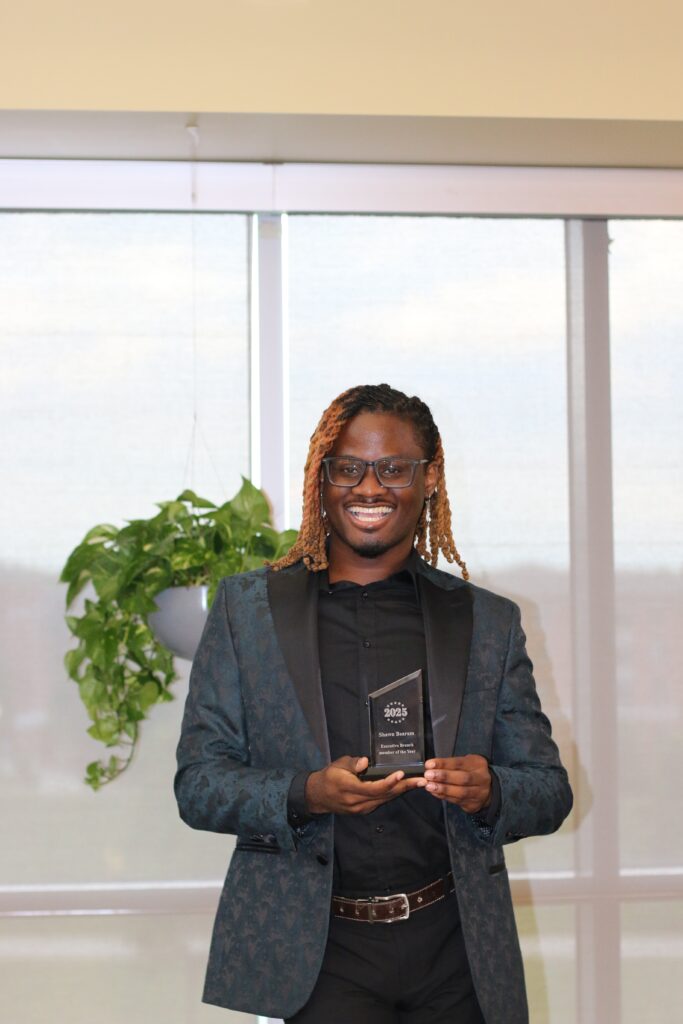
Q: What inspired you to get so involved in different campus departments?
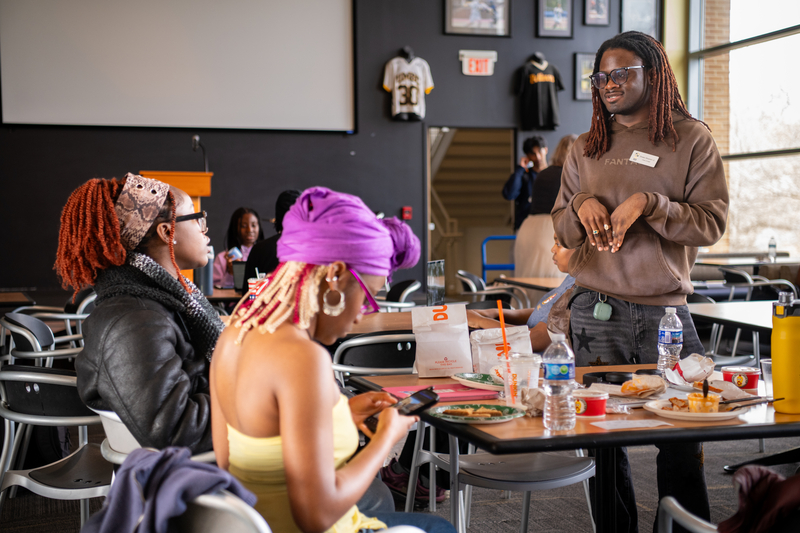
A: I found communities where it seemed that everyone was having fun together, and I wanted to be a part of that. My first role was working with the events staff in Athletics, then I applied to work with bwtech@UMBC. From there, I applied to work in the Vice President of Student Affairs office as an office assistant and I was promoted to lead office assistant. During my first year I was also hired as a resident assistant, and I was later promoted to lead resident assistant. I also served as a first-year ambassador for SGA.
I started to see that I was able to learn so much here. Overall, I saw people who looked like me in different spaces, and I knew they would be able to understand me, so I wanted to get involved.
Q: How have your various roles on campus impacted your time at UMBC?
A: My many roles made me want to stay at UMBC. I had the option to graduate last semester, but I wanted to stay another semester, I didn’t want to leave everyone so soon. I feel safe at UMBC. It also made me want to keep pursuing my education—I knew that being involved in so many different organizations meant I needed to keep my GPA up, so it pushed me to stay focused in my classes so I could keep having fun.

Q: How did you balance your academic work with your on-campus jobs?
A: It was a struggle at first, but using my Google Calendar helped me manage my time. My employers here also made sure to emphasize the importance of me being a student first.
My community director at Walker Avenue Apartments, LaDonna Wyatt, became a mentor to me while I was searching for internships. I was applying to different places, but it became difficult and I wanted to give up. She pushed me to keep applying and was there for me throughout the process which then led me to getting an internship with the Division of Information Technology for the state. The faculty and staff here really care about the students as a whole.
Q: What made you decide to join SGA?
A: I was involved in SGA during my early college program at Montgomery College. I felt like I was really making a change while I was there, and I wanted to do the same at UMBC. I started off as a first-year ambassador in SGA here, then I became the director of communications, and I am currently the chief of staff. I knew after my first year that SGA was something I wanted to continue with and I wanted to keep moving up.
 SGA’s “Prove It!” event gives UMBC students the opportunity to inspire change on campus. (Brad Ziegler/UMBC)
Q: Through all of your roles on campus, what is one moment that had the biggest impact on you?
A: Being an office assistant in the VPSA office. Everyday they drive me forward, and encourage me with their motto: Strive to unlock potential and transform lives. It really feels like a family. They’ve been asking me about how I feel as I’m getting ready to graduate and making sure that I have everything together. At first, it was a shock to me, but they really care about me even though I’m about to leave, and they care about what I’m going to be doing even after I leave. That role has had the biggest impact on me because they are so invested in seeing me grow and succeed.
Q: What’s next for you?
A: I was just offered a role with the State of Maryland with the Division of Information and Technology and I will be starting as a project analyst.
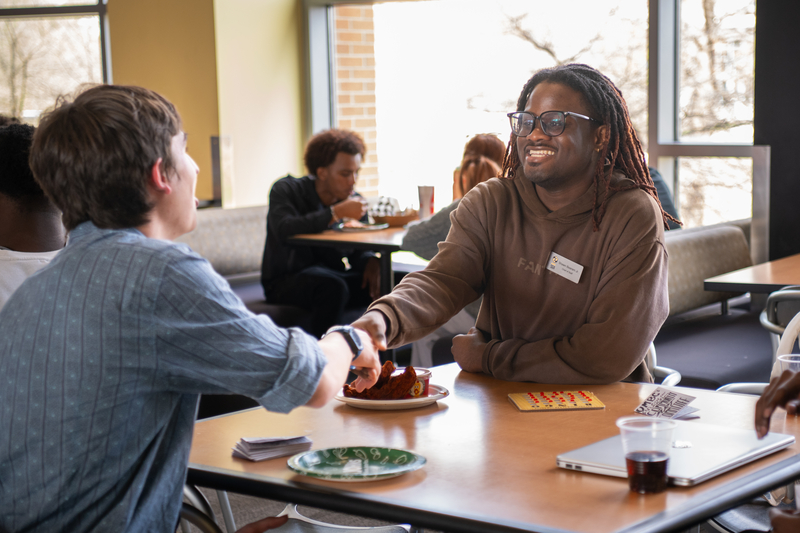 Making connections has been at the forefront of Bearam’s UMBC career. (Brad Ziegler/UMBC)
Q: What advice would you give to new students who are curious about getting involved on campus?
A: You may be scared, but sometimes you have to do things while you’re scared too. It may be scary to go to a big (seb) event because there’s so many people, but that may be the place where you find friends. You can be scared while you do things, but still do it. My personal motto is: The worst thing someone can say is “no.” Take those big steps, join the club, and if the club you’re looking for isn’t there—create it!
My whole experience at UMBC has been amazing—I can be myself here, and I’m not going to be judged. Community is truly the word to describe UMBC.
Story by Allison John ’24, psychology, graduate coordinator for first-year engagement and anchor programs. All photos courtesy of Bearam unless otherwise noted.
]]>
Just tackling the rigors of a college course load on its own can be daunting for any student. But when you add in the additional responsibilities of working and getting involved with...
https://umbc.edu/stories/shawn-bearam-jr-26-getting-involved/
https://my3.my.umbc.edu/api/v0/pixel/news/159406/guest@my.umbc.edu/b61fa0b61a935d6ae3df3e4dcc4e0fa6/api/pixel
bw-tech
class-of-2026
coeit
computer-science
news
science-and-tech
sga
story
UMBC News & Magazine
https://my3.my.umbc.edu/groups/umbc-news-magazine
https://assets1-my.umbc.edu/system/shared/avatars/groups/000/001/943/24435aa6207c452e7bc15cc74b42c7bb/xsmall.png?1748556657
https://assets1-my.umbc.edu/system/shared/avatars/groups/000/001/943/24435aa6207c452e7bc15cc74b42c7bb/original.png?1748556657
https://assets2-my.umbc.edu/system/shared/avatars/groups/000/001/943/24435aa6207c452e7bc15cc74b42c7bb/xxlarge.png?1748556657
https://assets2-my.umbc.edu/system/shared/avatars/groups/000/001/943/24435aa6207c452e7bc15cc74b42c7bb/xlarge.png?1748556657
https://assets3-my.umbc.edu/system/shared/avatars/groups/000/001/943/24435aa6207c452e7bc15cc74b42c7bb/large.png?1748556657
https://assets1-my.umbc.edu/system/shared/avatars/groups/000/001/943/24435aa6207c452e7bc15cc74b42c7bb/medium.png?1748556657
https://assets2-my.umbc.edu/system/shared/avatars/groups/000/001/943/24435aa6207c452e7bc15cc74b42c7bb/small.png?1748556657
https://assets1-my.umbc.edu/system/shared/avatars/groups/000/001/943/24435aa6207c452e7bc15cc74b42c7bb/xsmall.png?1748556657
https://assets2-my.umbc.edu/system/shared/avatars/groups/000/001/943/24435aa6207c452e7bc15cc74b42c7bb/xxsmall.png?1748556657
UMBC News & Magazine
6
0
false
Tue, 28 Apr 2026 12:33:59 -0400
Tue, 28 Apr 2026 12:33:59 -0400
Happy Monday: Honoring the Integral Contributions of Our Support Staff
Dear UMBC Community,
Last week’s Administrative Professionals Day breakfast was a beautiful occasion to honor the integral contributions of UMBC’s administrative support staff. Across campus, their work brings order to complexity and clarity to what needs to happen next. They notice what others might miss, step in where needed, and ensure that the work of the university moves forward with intention and care.
It was a privilege to celebrate our administrative support staff with an inspiring keynote from UMBC’s own Alicia Wilson ’04, vice president for civic engagement and opportunity at Johns Hopkins University. Alicia spoke powerfully to the value of work that gets done, perhaps without ever being noticed—work that supports others, sustains our community, and makes progress possible. She also gave us even more reason to feel proud of UMBC, as she credited this institution and community for so much of her own success.
To our administrative support staff: I hope you felt truly celebrated at the wonderful breakfast co-sponsored by Human Resources and Strategic Talent Management and the Office of Institutional Advancement. I hope you know—every day—that we value you.
Sincerely,
President Valerie Sheares Ashby
]]>
Dear UMBC Community, Last week’s Administrative Professionals Day breakfast was a beautiful occasion to honor the integral contributions of UMBC’s administrative support staff. Across campus,...
https://umbc.edu/stories/happy-monday-honoring-the-integral-contributions-of-our-support-staff/
https://my3.my.umbc.edu/api/v0/pixel/news/159355/guest@my.umbc.edu/b159f47759e596a8c6286b6662134cc5/api/pixel
happy-monday
rss
story
UMBC News & Magazine
https://my3.my.umbc.edu/groups/umbc-news-magazine
https://assets1-my.umbc.edu/system/shared/avatars/groups/000/001/943/24435aa6207c452e7bc15cc74b42c7bb/xsmall.png?1748556657
https://assets1-my.umbc.edu/system/shared/avatars/groups/000/001/943/24435aa6207c452e7bc15cc74b42c7bb/original.png?1748556657
https://assets2-my.umbc.edu/system/shared/avatars/groups/000/001/943/24435aa6207c452e7bc15cc74b42c7bb/xxlarge.png?1748556657
https://assets2-my.umbc.edu/system/shared/avatars/groups/000/001/943/24435aa6207c452e7bc15cc74b42c7bb/xlarge.png?1748556657
https://assets3-my.umbc.edu/system/shared/avatars/groups/000/001/943/24435aa6207c452e7bc15cc74b42c7bb/large.png?1748556657
https://assets1-my.umbc.edu/system/shared/avatars/groups/000/001/943/24435aa6207c452e7bc15cc74b42c7bb/medium.png?1748556657
https://assets2-my.umbc.edu/system/shared/avatars/groups/000/001/943/24435aa6207c452e7bc15cc74b42c7bb/small.png?1748556657
https://assets1-my.umbc.edu/system/shared/avatars/groups/000/001/943/24435aa6207c452e7bc15cc74b42c7bb/xsmall.png?1748556657
https://assets2-my.umbc.edu/system/shared/avatars/groups/000/001/943/24435aa6207c452e7bc15cc74b42c7bb/xxsmall.png?1748556657
UMBC News & Magazine
1
0
false
Mon, 27 Apr 2026 14:14:59 -0400
Kayla Nemirovsky ’26—Math plus financial economics major with equal passion for numbers and travel
If senior Kayla Nemirovsky’s passport could talk, the first thing it would likely say is, “I’m tired.” Despite having local roots, first attending Mount Hebron High School in nearby Ellicott City and then continuing her academic career 10 miles away at UMBC, Nemirovsky has always felt most at home on a plane. She has visited over 30 (!) countries with no signs of stopping her travel now. Thanks to the support and guidance she received from UMBC, she’ll be staying here to pursue a master’s in teaching.
Q: With dual degrees in math and financial economics, it’s a little surprising that one of your greatest passions in life is traveling. How did you catch the travel bug?
A: I was four, if not younger, when I took my first international trip. We traveled a lot as a family and have always had a big love of it. When I was in middle school and early high school, my grandpa took my cousin and me on three trips to Europe, which we’re very grateful for. It was a really great snapshot into a lot of places. Both of my parents are immigrants from the Soviet Union, so growing up, my dad traveled around the Soviet Union a lot with my grandpa. It’s just something that is ingrained in our family. Seeing new places, learning about cultures, trying new food, and learning about the history of places when I’m going to them—that’s what’s fun to me.
Q: With such a pull to travel and see the world, why did you decide to continue your education locally at UMBC?
A: I knew I wanted to stay local-ish and take advantage of in-state tuition. My dad [Sergey Nemirovsky ’03, computer science] went here and I worked at the UMBC summer camp in high school. I met some people who went to UMBC and they showed me around and let me know what it’s really like. But when I was accepted into the Sondheim Scholars Program, that really sealed it for me. My brother [Sam Nemirovsky ’27, mathematics] is a first-year student here, and it’s funny because we’re both math majors but doing it in entirely different ways. He’s working with applied math, and I know that’s just not for me. It was also so important for me to build study abroad into my college experience.
 Nemirovsky and friends traveling in snowy Finland.
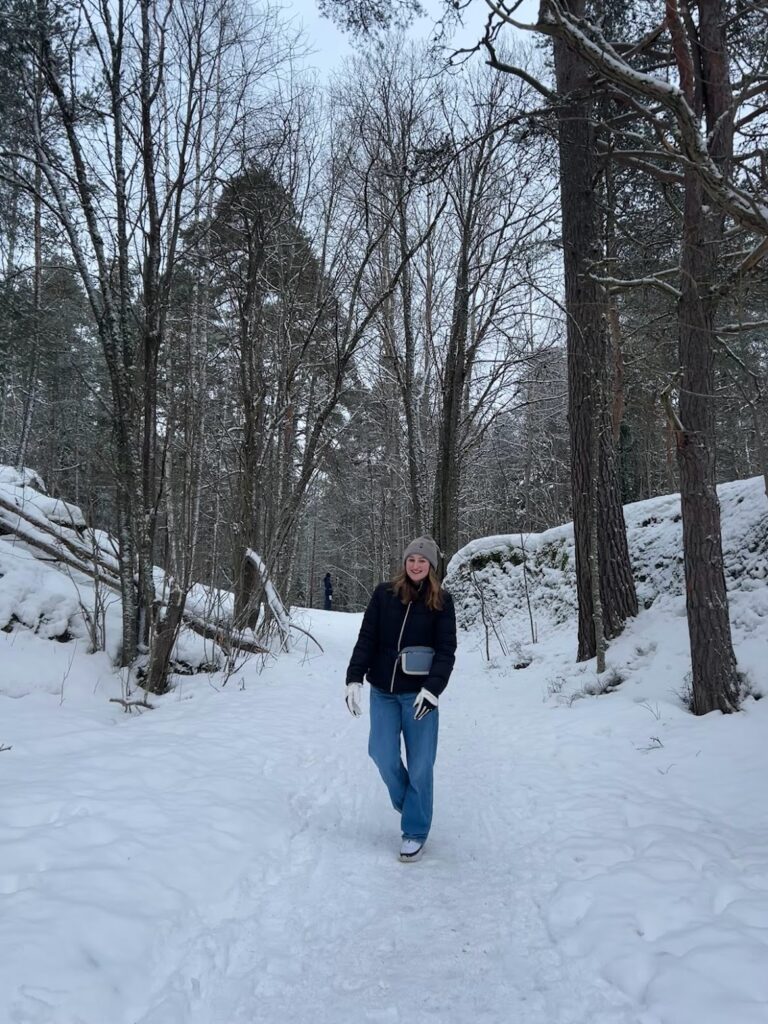 Enjoying a walk through Finland’s winter wonderland.
Q: How would you describe the Sondheim Public Affairs Scholars Program to someone who isn’t familiar with it?
A: We focus on not only policy, but also community engagement and service. Throughout all of freshman year, we’re doing community service, involved mostly in Baltimore and just getting a chance to see local communities. And then we go through our years at UMBC as a cohort. Some people graduate early, but for the most part, for us, it’s been 12 people, together. The other cool thing is it’s a very diverse group of majors so you get a lot of different perspectives and people trying to implement policy in different ways or just seeing how it comes to play, not just in government. It’s been great having that community throughout to push each other. We push each other to really exceed and make the most of our college experiences.
 Nemirovsky, left, with President Valerie Sheares Ashby and members of her Sondheim cohort.
Q: Do you have any advice for students who are unsure what they want to do?
A: Go with what you like and what you enjoy. Obviously having a job is ideal, so be a little more realistic with what you’re studying but think about how you could apply it and investigate that. And be flexible! I texted my mom a couple of times my first year thinking out loud, “What if I add this minor? What if I do this major?” And she said, “If you want to and if it makes sense, do it.”
I knew that I would love to have a job where I have the flexibility to travel but never really as a career. I had no idea what exactly I wanted to do but I always liked math, so figured maybe that route. And then I had a really good high school economics teacher [Vann Prime] who was state recognized, and I decided to go down that path and see where it takes me.
Q: So many students think it’s not possible to study abroad with their academic course load or they can’t fit it into their schedule. What would you say to them?
A: As an Education Abroad Advisor, I talk about this all day, every day. I think everybody should study abroad and there’s so many new ways to do it too, especially with the faculty-led programs that are really growing. Even in these super packed majors where you feel like you have to be here every semester, you can still travel for a short-term winter or summer faculty-led program. They’re really meeting students where they are to give them opportunities.
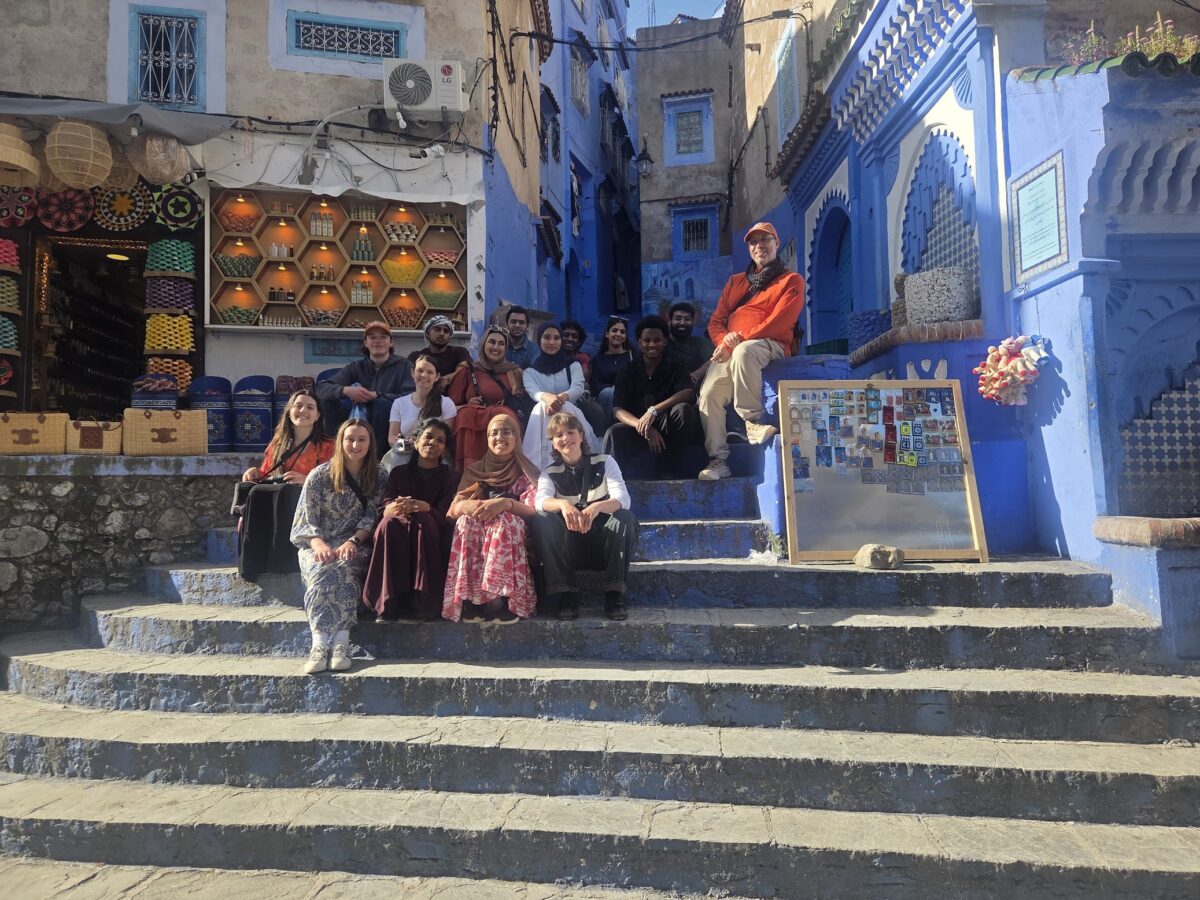 One of Nemirovsky’s many trips abroad with classmates traveling in Morocco.
Q: Have you had mentors who have influenced you throughout your academic career. What does mentorship look like and mean to you?
A: I view mentorship as something that has to be beneficial. Through the Sondheim Program, we were assigned mentors freshman year, and I originally wasn’t sure how to feel about it, and I didn’t know if we would connect in a meaningful way. But it’s been one of the things I’ve enjoyed most. Jess Cook [associate director of Sondheim] connected me to Josh Michael [’10, political science, Ph.D. ’22, public policy], who helped me get my internship at the Maryland State Department of Education and was one of my mentors. From there, this internship helped me solidify the work that I want to do in math education curriculum and policy and helped me figure out what my next steps need to be after college. The internship also helped me to expand my connections in the field and shaped my plans for senior year and beyond.
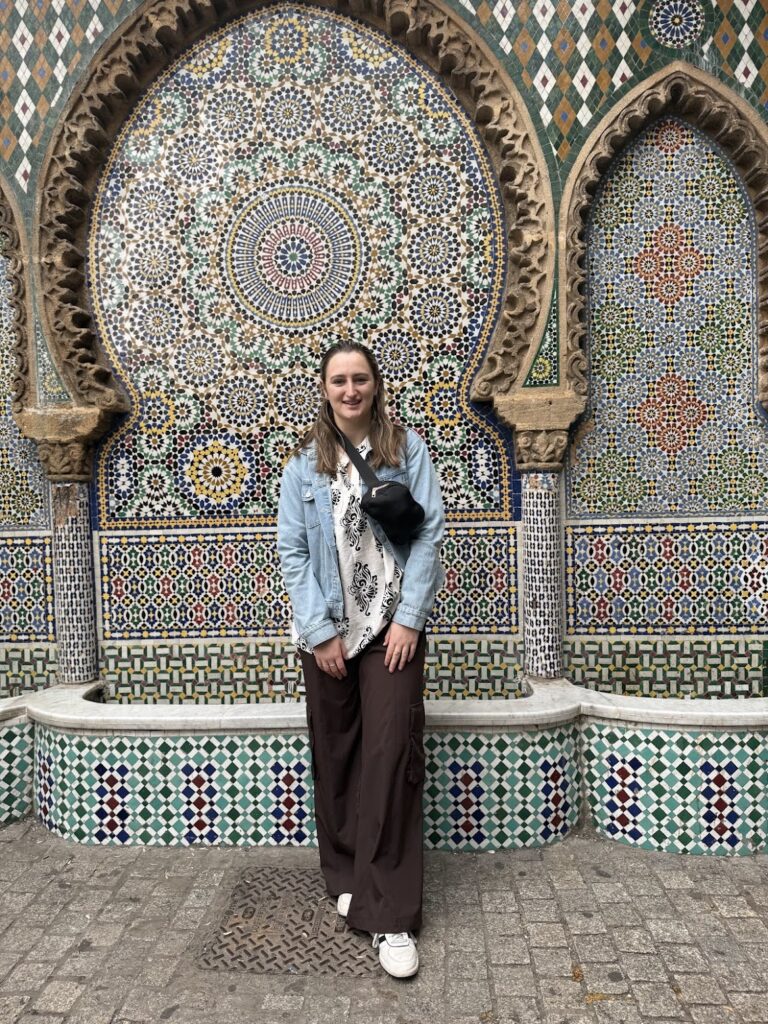
Q: Are there other ways your mentors have helped you?
A: I’m a person who needs a path. And I realized once I got to college that there’s kind of no more path, I have to make my own. That was really scary to me, so having mentors who can help me make this path…give me advice and offer suggestions, that was extremely helpful. I really believe you have to choose the people you look up to and kind of aspire to be them.
]]>
If senior Kayla Nemirovsky’s passport could talk, the first thing it would likely say is, “I’m tired.” Despite having local roots, first attending Mount Hebron High School in nearby Ellicott City...
https://umbc.edu/stories/kayla-nemirovsky-26-passion-for-math-and-travel/
https://my3.my.umbc.edu/api/v0/pixel/news/159259/guest@my.umbc.edu/5764e8df35d0fbde95f78c7d70a8430d/api/pixel
class-of-2026
cnms
education-abroad
financial-economics
mathematics
news
science-and-tech
story
UMBC News & Magazine
https://my3.my.umbc.edu/groups/umbc-news-magazine
https://assets1-my.umbc.edu/system/shared/avatars/groups/000/001/943/24435aa6207c452e7bc15cc74b42c7bb/xsmall.png?1748556657
https://assets1-my.umbc.edu/system/shared/avatars/groups/000/001/943/24435aa6207c452e7bc15cc74b42c7bb/original.png?1748556657
https://assets2-my.umbc.edu/system/shared/avatars/groups/000/001/943/24435aa6207c452e7bc15cc74b42c7bb/xxlarge.png?1748556657
https://assets2-my.umbc.edu/system/shared/avatars/groups/000/001/943/24435aa6207c452e7bc15cc74b42c7bb/xlarge.png?1748556657
https://assets3-my.umbc.edu/system/shared/avatars/groups/000/001/943/24435aa6207c452e7bc15cc74b42c7bb/large.png?1748556657
https://assets1-my.umbc.edu/system/shared/avatars/groups/000/001/943/24435aa6207c452e7bc15cc74b42c7bb/medium.png?1748556657
https://assets2-my.umbc.edu/system/shared/avatars/groups/000/001/943/24435aa6207c452e7bc15cc74b42c7bb/small.png?1748556657
https://assets1-my.umbc.edu/system/shared/avatars/groups/000/001/943/24435aa6207c452e7bc15cc74b42c7bb/xsmall.png?1748556657
https://assets2-my.umbc.edu/system/shared/avatars/groups/000/001/943/24435aa6207c452e7bc15cc74b42c7bb/xxsmall.png?1748556657
UMBC News & Magazine
9
0
false
Fri, 24 Apr 2026 14:24:40 -0400
Fri, 24 Apr 2026 14:24:40 -0400
Eight Retrievers awarded prestigious NSF Graduate Research Fellowships
Eight UMBC students and alumni have been awarded the prestigious 2026 National Science Foundation Graduate Research Fellowship (GRFP), a highly competitive honor that supports outstanding graduate students in STEM disciplines. This year’s large cohort of Retriever recipients demonstrates the university’s commitment to fostering research excellence and preparing students to become leaders in their fields.
The recipients are already making waves with their work. Caly Ferguson ’26, mechanical engineering, was recently named to the National Society of Black Engineers’ “25 Under 25” list and received the Barry Goldwater Scholarship in 2025. He has been working on developing an affordable and dextrous prosthetic forearm and hand with Ramana Vinjamuri, associate professor of computer science and electrical engineering.
 Lesley Hernandez conducted research with Michael Summers at UMBC. Today she is a Ph.D. student at the University of Michigan in biomedical science. (Melissa Penley Cormier, M.F.A. ’17/UMBC)
Lesley Hernandez ’25, biochemistry, will use the GRFP to support her doctoral studies in biomedical science at the University of Michigan. At UMBC, she studied HIV replication with Michael Summers, professor of chemistry and biochemistry. Both Ferguson and Hernandez are Meyerhoff Scholars, and Hernandez also balances her science with a passion for Latin dance.
Peter Allen Wilschke ’24, economics and political science, is heading to graduate school after completing a two-year research assistant position at the Federal Reserve Board of Governors in Washington, DC. His research at UMBC on the complex relationships between political factors and fiscal policy garnered national attention.
 Peter Wilschke (right), presented his research at the 2024 Pi Sigma Alpha National Student Research Conference. Eric Stokan (left), professor of political science and one of Wilschke’s mentors, was there to support him. (Courtesy of Carolyn Forestiere/UMBC)
Sydney Braithwaite, who completed her bachelor’s in forensic chemistry at Towson University, will bring her fellowship to UMBC for graduate study with Lee Blaney, professor of chemical, biochemical, and environmental engineering. Meredith Morse ’25, chemical engineering; Shefra Shah ’24, biochemistry and molecular biology; and Terra Miley ’25, chemical engineering, are all conducting doctoral work at the University of Delaware; Salman Mirza ’25, mechanical engineering, is pursuing a Ph.D. at Johns Hopkins University.
 Caly Ferguson (center) was one of three UMBC recipients of the Barry Goldwater Scholarship for the 2025 – 2026 academic year, along with Lea-Pearl Njei (right) and Jariatu Kargbo (left). (Michael Mower/UMBC)
The substantial fellowship provides three years of financial support, including an annual living stipend and funds for tuition and fees, and the recipients can take their fellowship to any institution in the U.S. That flexibility makes it easier for students to pursue exactly the research they are passionate about with faculty who share their enthusiasm, regardless of the level of resources available at the host institution.
These eight fellowships are a testament to the drive and talent of UMBC’s graduates as they take on new challenges along their research journeys. Each is in a strong position to make their mark on scientific discovery and innovation across the country.
]]>
Eight UMBC students and alumni have been awarded the prestigious 2026 National Science Foundation Graduate Research Fellowship (GRFP), a highly competitive honor that supports outstanding graduate...
https://umbc.edu/stories/nsf-graduate-research-fellowships-2026/
https://my3.my.umbc.edu/api/v0/pixel/news/159250/guest@my.umbc.edu/15fc58fa54a3ac3d7158489f91a1ec70/api/pixel
alumni
biochemistry
biochemistry-and-molecular-biology
cahss
chemical-biochemical-and-environmental-engineering
chemical-engineering
chemistry-and-biochemistry
class-of-2026
cnms
coeit
csee
economics
graduate-research
graduate-school
mechanical-engineering
meche
news
political-science
research
science-and-tech
story
UMBC News & Magazine
https://my3.my.umbc.edu/groups/umbc-news-magazine
https://assets1-my.umbc.edu/system/shared/avatars/groups/000/001/943/24435aa6207c452e7bc15cc74b42c7bb/xsmall.png?1748556657
https://assets1-my.umbc.edu/system/shared/avatars/groups/000/001/943/24435aa6207c452e7bc15cc74b42c7bb/original.png?1748556657
https://assets2-my.umbc.edu/system/shared/avatars/groups/000/001/943/24435aa6207c452e7bc15cc74b42c7bb/xxlarge.png?1748556657
https://assets2-my.umbc.edu/system/shared/avatars/groups/000/001/943/24435aa6207c452e7bc15cc74b42c7bb/xlarge.png?1748556657
https://assets3-my.umbc.edu/system/shared/avatars/groups/000/001/943/24435aa6207c452e7bc15cc74b42c7bb/large.png?1748556657
https://assets1-my.umbc.edu/system/shared/avatars/groups/000/001/943/24435aa6207c452e7bc15cc74b42c7bb/medium.png?1748556657
https://assets2-my.umbc.edu/system/shared/avatars/groups/000/001/943/24435aa6207c452e7bc15cc74b42c7bb/small.png?1748556657
https://assets1-my.umbc.edu/system/shared/avatars/groups/000/001/943/24435aa6207c452e7bc15cc74b42c7bb/xsmall.png?1748556657
https://assets2-my.umbc.edu/system/shared/avatars/groups/000/001/943/24435aa6207c452e7bc15cc74b42c7bb/xxsmall.png?1748556657
UMBC News & Magazine
1
0
false
Fri, 24 Apr 2026 13:34:54 -0400
Fri, 24 Apr 2026 13:34:54 -0400