UMBC’s newest grads share what inspired their unique paths
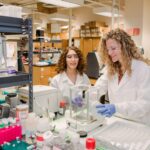
When students come to UMBC, they bring with them life experiences that shape the program they choose, the mentors they find, the research questions they ask, and the communities they build on campus. Here, five UMBC students earning their degrees this month share stories of those connections in their own lives, and how chance encounters and deep moments of inspiration alike opened exciting new paths.
Student-athlete researches Alzheimer’s disease treatment
When Laura Simpson arrived at UMBC as an undergraduate, she knew that she was interested in a broad range of scientific topics, but she didn’t yet have a clear picture of what her career path might look like. An internship at NASA and her own experiences as a student-athlete changed that.
At NASA Simpson became intrigued with how the human body is affected by space. As a record-setting varsity pole vaulter, she experienced joint and ligament injuries that resulted in surgeries with challenging recoveries. Together, these experiences sparked her interest in biomedical engineering, combining her curiosity about how the human body works with, as she describes, “the applicability of the engineering knowledge.”
 Laura Simpson pole vaulting. Photo courtesy of Laura Simpson.
Simpson earned her bachelor’s degree in biological sciences in 2013. Encouraged by her mentor, Jennie Leach, associate professor of chemical, biochemical, and environmental engineering, she applied to UMBC’s chemical engineering Ph.D. program. Now, nearly a decade after stepping onto UMBC’s campus for the first time, Simpson will soon officially earn that Ph.D.
As a graduate student in Leach’s lab, Simpson has researched treatment options for Alzheimer’s disease. “There’s no cure and no preventive treatments for Alzheimer’s disease, and the drugs that are out are just to try to help symptoms, but it doesn’t slow…the progression of the disease,” Simpson explains.
Simpson notes that the most recent unique drug for treating people with Alzheimer’s disease was approved in 2003. The gap in new drugs being released is not due to a lack of drug development, but issues with drug performance and approval by the Food and Drug Administration. She explains that Alzheimer’s drugs are typically studied using mice or cells on a plate, which have limitations.
When her research mentors, Leach and Theresa Good (who is now at NSF), suggested that perhaps the 3D environment was affecting how the beta amyloid protein, which is thought to cause Alzheimer’s disease, was acting, Simpsons dissertation topic was born. She has studied how 3D environments impact the beta amyloid protein associated with neurotoxicity in Alzheimer’s patients, and her work has been groundbreaking. “The 3D has a major affect not only on the protein but on the structure of the cells,” Simpson says.
 Laura Simpson. Photo by Marlayna Demond ’11 for UMBC.
To describe her findings, Simpsons compares the movement of cells and proteins to how people are able to move in space. In wide open spaces, movement is unrestricted, but in a small space, like a closet, people lose their range of motion. Similarly, cells and proteins function differently when they occupy different kinds of 3D spaces.
Simpson’s work has the potential to significantly impact the treatment options available for people with Alzheimer’s. After graduating, she will begin a career in Maryland’s biotech industry.
Returning Women Scholar explores paths, builds confidence
Life as a student who is also a parent can be complicated, and also tremendously rewarding, says Alexis Ashcroft ‘19, psychology. Inspired to finish her degree after her daughter was born, Ashcroft earned her associate’s at Anne Arundel Community College before transferring to UMBC.
Ashcroft has successfully juggled many responsibilities while pursuing her degree, from her class and work schedules, to involvement with student orgs and research opportunities, to her commitments as a parent. Ashcroft found mentorship and a community at UMBC as a Returning Women Scholar and a Newcombe Scholar, through the UMBC Women’s Center.
 Alexis Ashcroft with fellow students and her mentor, Jasmine Abrams.
Returning Women Scholars have the opportunity to attend workshops and programs that focus on academic, personal, and professional aspects of life, in addition to having the support of peers, faculty, and staff. “Being a Returning Women Scholar has been such a great experience for me,” says Ashcroft. “The program and the people in it have helped me so much. From the teaching events they hold, to the one-on-one meetings, and of course the scholarships, the program has taken a lot of burden and stress off of my shoulders.”
When she first arrived at UMBC, Ashcroft was considering a career in law. Her time on campus broadened her sense of the kinds of careers that could fit her interests in the law, health, and social issues. “After taking a psychology of law class, I found myself intrigued by the mental and emotional components of health and wellness,” she recalls. “I realized I could combine my love for the law and social sciences into a career.”
Ashcroft explored the possibilities through every avenue she could find. She served as a student justice on UMBC’s Hearing Board as well as the nontraditional students project manager on UMBC’s Student Government Association executive board, and in roles with other groups. “My involvement with UMBC clubs and organizations forced me to get outside of my comfort zone and open up,” she says. “I became more confident in speaking up, debating, and learned how to communicate better.”
 Alexis Ashcroft, right, with her mentor, Jasmine Abrams.
Ashcroft also conducted research with Jasmine Abrams, assistant professor of psychology, focused on health disparities impacting black women. This year, she has worked on a qualitative study examining the sexual attitudes, practices, and beliefs of young black women. She has also supported Abrams’s highly collaborative research aiming to reduce the stigma surrounding HIV/AIDS in Haiti.
Artist examines the history of a community and herself
Aimi Chinen Bouillon M.F.A.‘19, intermedia and digital arts, spent two months in her hometown of Okinawa, Japan to explore the history and long-standing relationships between Americans and people from Okinawa. That deep study results in her thesis: “The Colonized and the Colonizer Within Me: Finding Ryukyu Language of My Matrilineal Ancestors on a Militarized Island.”
 Aimi Bouillon taking photos during her time in Okinawa. Photo courtesy of Aimi Bouillon.
During World War II, nearly 30 percent of Okinawa’s population was killed in a devastating battle. Today, a large U.S. military base is located on Okinawa. Bouillon’s mother is from Okinawa and her father is a retired U.S. Marine. Bouillon grew up in Okinawa and lived there until she was 16, when she moved with her family to Ohio.
Bouillon was interested in developing a better understanding of Okinawa’s history, and also in examining how that history lives on and is reinterpreted in the present. She aimed to create a visual and textual dialogue around the often polarizing topic of the colonization of Okinawa through her work.
 Aimi Bouillon, left, with her interactive art display in the Center for Art Design, and Visual Culture. Photo courtesy of Aimi Bouillon.
“As I get older, I’m confirmed that I was a born artist. I am interested in many materials and need to make and make and make,” she explains. She reflects that while she’s always had the drive to be an artist, the resources she’s been able to access as an MFA student at UMBC have helped her accomplish so much more.
Bouillon was drawn to pursue her M.F.A. at UMBC after her partner joined the program and she had a chance to meet the faculty a get a sense of the department’s “family feel.” Once enrolled, she quickly connected with mentors Lynn Cazabon, Kathy O’Dell and Chris Peregoy, all of visual arts. She’s enjoyed how they have learned about Okinawa alongside her and have encouraged her to balance learning experiences inside and outside the classroom and studio.
“The classroom is amazing in that it can be a place to share opinions and studies,” Bouillon says. “The outside experiences are where everyday people as a whole live and navigate daily and that is a very important space for inspiration.”
 Aimi Bouillon in Okinawa. Photo courtesy of Aimi Bouillon.
After graduation, Bouillon plans to create an artist residency in Okinawa to “act as a bridge for deeper dialogue and exchange for the Ryukyu culture, language, and history.”
From an Iraqi Internet cafe to Baltimore waterways
Trevor Needham, Ph.D. ‘19, environmental engineering, learned about UMBC at an internet cafe in Iraq during a 15-month deployment. Needham had planned to pursue a Ph.D. for years, but those plans were temporarily put on hold as he fulfilled his ROTC scholarship commitment with the Army.
Needham recalls sitting in front of that computer in Iraq and searching for environmental engineering Ph.D. programs. One of the search results was the lab of UMBC’s Upal Ghosh, professor of chemical, biochemical, and environmental engineering. He reached out to Ghosh to find out more about his work.
 Trevor Needham with his poster at a conference. Photo courtesy of Trevor Needham.
When Needham returned to the U.S. from Iraq, he earned his master’s in environmental engineering from Missouri University of Science and Technology. He was then accepted into UMBC’s environmental engineering Ph.D. program and began working with Ghosh in 2014 to study polychlorinated biphenyl (PCBs), a legacy environmental contaminant.
Needham explains that PCBs were engineered to never break down, and today they are found in fish and in people. The problem of PCB contamination is compounded by the fact that the cost of removing PCBs is very high.
 Trevor Needham with Upal Ghosh, left, and Kevin Sowers. Photo courtesy of Trevor Needham.
During his first year at UMBC, Needham was given the opportunity to explore his interests in a broad range of projects. He was particularly fascinated by his work at a wastewater treatment facility, where he learned how PCBs travel to urban watersheds in the Chesapeake Bay region. “UMBC has been a great place to transition my professional career and pursue cutting edge science to solve real environmental problems that face the Chesapeake Bay.”
Needham is currently working at the U.S. Geological Survey, located at in UMBC’s Research Park. After graduation, he will continue working at USGS as a hydrologist.
Listening to women’s powerful stories
The underrepresentation of women in research on health outcomes after strokes inspired Iona Johnson to pursue her Ph.D. in gerontology. Johnson is a medical speech-language pathologist who currently is a clinical faculty member at Towson University. She finds inspiration for her work in both her personal and professional experiences.
“I have worked with stroke survivors throughout my career as a clinician, and have been running a stroke support group for survivors and caregivers for many years,” says Johnson. She also served as a caretaker for a close family member who experienced a stroke while she was pursuing her Ph.D.
Johnson often finds herself dispelling misconceptions about gerontology. “It is about the aging process, and we are all aging every day,” she says. “People are living longer lives, and the more we know about aging, the more we can help society and help ourselves across the lifespan.”
 Iona Johnson and her son during at her dissertation defense. Photo courtesy of Iona Johnson.
At UMBC, Johnson has worked with Leslie Morgan, professor of sociology and anthropology. “Her guidance, expertise, and patience have been invaluable,” Johnson says.
In addition to valuing the mentorship she’s received, Johnson has been honored for her commitment to mentoring students as a faculty member at Towson. In 2017, she received the University System of Maryland’s Board of Regents Award for Excellence in Mentoring. She describes, “Mentoring is my superpower. I believe that I am a role model for letting students see that they can reach for and accomplish big goals throughout life.”
 Iona Johnson, left, and her mentor Leslie Morgan. Photo courtesy of Iona Johnson.
Looking back on the path to her Ph.D., Johnson says that it was one of the most challenging things she has done, but one of the best decisions she’s ever made. “Doing my research for my dissertation changed me,” she explains. “Listening to the stories of women who were bold and gracious enough to share with me made me reflect on where I am in my life.”
Banner image: Laura Simpson, right, working in the lab. Photo courtesy of Marlayna Demond ’11 for UMBC.
]]>
When students come to UMBC, they bring with them life experiences that shape the program they choose, the mentors they find, the research questions they ask, and the communities they build on...
https://umbc.edu/stories/umbcs-newest-grads-share-what-inspired-their-unique-paths/
https://my3.my.umbc.edu/api/v0/pixel/news/120140/guest@my.umbc.edu/166fbc641d27983a592342acce35c2d6/api/pixel
arts-and-culture
athletics
biology
cahss
cbee
class-of-2019
cnms
coeit
gerontology
gradresearch
graduateschool
newcombescholars
page1
policy-and-society
psychology
research
science-and-technology
undergradresearch
womenscenter
UMBC News & Magazine
https://my3.my.umbc.edu/groups/umbc-news-magazine
https://assets1-my.umbc.edu/system/shared/avatars/groups/000/001/943/24435aa6207c452e7bc15cc74b42c7bb/xsmall.png?1748556657
https://assets1-my.umbc.edu/system/shared/avatars/groups/000/001/943/24435aa6207c452e7bc15cc74b42c7bb/original.png?1748556657
https://assets2-my.umbc.edu/system/shared/avatars/groups/000/001/943/24435aa6207c452e7bc15cc74b42c7bb/xxlarge.png?1748556657
https://assets2-my.umbc.edu/system/shared/avatars/groups/000/001/943/24435aa6207c452e7bc15cc74b42c7bb/xlarge.png?1748556657
https://assets3-my.umbc.edu/system/shared/avatars/groups/000/001/943/24435aa6207c452e7bc15cc74b42c7bb/large.png?1748556657
https://assets1-my.umbc.edu/system/shared/avatars/groups/000/001/943/24435aa6207c452e7bc15cc74b42c7bb/medium.png?1748556657
https://assets2-my.umbc.edu/system/shared/avatars/groups/000/001/943/24435aa6207c452e7bc15cc74b42c7bb/small.png?1748556657
https://assets1-my.umbc.edu/system/shared/avatars/groups/000/001/943/24435aa6207c452e7bc15cc74b42c7bb/xsmall.png?1748556657
https://assets2-my.umbc.edu/system/shared/avatars/groups/000/001/943/24435aa6207c452e7bc15cc74b42c7bb/xxsmall.png?1748556657
UMBC News & Magazine
0
0
false
Fri, 10 May 2019 16:00:19 -0400
“Researching” to “researcher”: UMBC students share why mentoring is the key
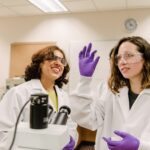
UMBC’s annual Undergraduate Research and Creative Achievement Day allows students to reflect on a year or more of work intensively focused on a project, often with close guidance from a faculty mentor. These mentors have deep and long-lasting impacts on the students who work with them, and the students’ creativity and fresh perspectives inspire their mentors.
Like many faculty across UMBC, Greg Szeto, assistant professor of chemical, biochemical, and environmental engineering, has guided undergraduate and graduate students to achieve a deeper understanding of their discipline. “Being a mentor is the most impactful thing we can do with our time,” he says.
“It’s a mentor’s job to provide comprehensive and diverse experiences that are customized to fit different individuals’ goals and stage of development and to consistently fine-tune those experiences over time,” Szeto explains. “We help provide a safe environment where students can explore their interests in research and determine what the right path is for their future.”
Engineering solutions to health challenges
When Nicole Couturier ‘19, chemical engineering, began exploring options to get involved with research, she wasn’t sure which direction to take. She was intrigued to learn about the interdisciplinary approach to Szeto’s lab, which combines engineering, biology, and human health.
Couturier, a MARC scholar, began working in Szeto’s lab in spring 2017, studying the properties of gold nanoparticles that can potentially be used as immunotherapy agents. She explains that these nanoparticles can “offer an alternative approach to traditional treatment methods by carrying drugs inside their core.” The nanoparticles also have molecules attached to their surfaces that direct them to specific sites within the body, Couturier adds.
Szeto has encouraged Couturier to explore and expand the scope of her work. “Because I have been able to participate in different projects with a range of focuses, I have been able to learn about many different areas of research both inside and outside the field of immunology,” she says. She adds that Szeto had helped her keep her expectations in check, sharing, “One of the most helpful pieces of advice that Dr. Szeto has shared is to remind me that it’s okay at the end of the day if I still don’t know the answer to something.”
For other students seeking research mentors, Szeto suggests, “The fit between a student and a mentor is even more important than finding a perfect intellectual match with research topic at most career stages.”
He notes that strong mentoring relationships benefit everyone, but are particularly important for people early in their careers. “Having supportive mentors and advocates invested in your success as an undergraduate can fundamentally change someone’s perspective on career goals, and their decision to pursue a Ph.D. or career in research,” Szeto says.
From doing research to becoming a researcher
Conducting research in Szeto’s lab has allowed Kojo Bonsu ‘18, chemical engineering, to think about how chemical engineering can address health challenges in new ways.
“I was always interested in applying chemical engineering principles and methodologies to research in biology and medicine, but did not think about doing so by approaching the problems from the immune system,” Bonsu says. “After meeting with Dr. Szeto, I clearly saw how chemical engineering could provide new solutions to long-standing problems in biotechnology and human health.”
Bonsu joined Szeto’s lab in fall 2017. With a strong background in research, he was looking for opportunities to do more independent work. Szeto worked with Bonsu to develop a research experience that included experimental design, data analysis, and project troubleshooting. Bonsu says that this time in Szeto’s lab challenged him to think about possible solutions to obstacles in creative ways.
“This experience truly allowed me to see myself as a researcher and spurred my desires to go to graduate school to further expand upon my knowledge of engineering solutions to a host of problems,” Bonsu says.
Creating a supportive environment for women in STEM
Karla Negrete ‘19, mechanical engineering, a Hill-Lopes Scholar, was drawn to Deepa Madan’s lab after she took a course about the chemical and physical aspects of materials.
Madan has guided Negrete through research on the materials and design of batteries. She focuses on preparing an efficient and safe electrolyte layer for batteries, to avoid the pitfalls of hazardous materials, short lifespan, and susceptibility to damage that are common to conventional designs.
 Karla Negrete, right, working in the lab along her mentors Aswani Poosapati and Deepa Madan.
Negrete is exploring how to replace the liquid in batteries with gel polymer electrolytes while avoiding the challenge of crystallization. “Our research seeks to…introduce the use of novel nanofiber cellulose, which is extracted from wood, as the main constituent in preparing our thin gel electrolytes,” she says.
“Dr. Madan has been a mentor to me in many ways,” Negrete reflects, “but the most important has been her ability to believe in me and stand behind me.”
That active interest, encouragement and confidence-building are central to Madan’s mentoring approach.“I believe the likelihood of students achieving their immediate and possibly long-term career goals can be significantly increased if students believe their mentors are genuinely interested in student success, and students see the activity and engagement as a stepping stone for their successful careers,” Madan says.
Negrete has also been mentored by Aswani Poosapati, Ph.D. ‘23, mechanical engineering, and she says that being a part of a supportive research team has been empowering. “The most rewarding part of working with Dr. Madan has been the welcoming environment that she creates in her lab,” says Negrete. “From the beginning, Dr. Madan and Aswani Poosapati have taught me, challenged me, guided me, and trusted me to be a part of this research.”
Much of Madan’s work with students like Negrete focuses on the nuts and bolts of research: how to conduct a literature review, how to access networking opportunities, and how to use research opportunities as steps toward achieving research goals. At another level, she also sees tremendous value in serving as a resource and sounding board for young women beginning careers in STEM fields.
“I feel my research experiences and story motivate our female students to come and talk to me about their research interests, which I feel some are hesitant to share,” she says. “Many of them are flourishing and are positively surprised by how well their research is progressing in a discipline that once appeared so intimidating.” In a field where women are underrepresented, Madan notes, “It’s not surprising to me that more than half of the students working in my lab are female students.”
Gaining confidence through challenges
Anna Feerick ‘19, chemistry, remembers standing outside the door to Lee Blaney’s lab. Blaney worked in a different department (chemical, biochemical, and environmental engineering), but Feerick was fascinated by how his lab applied chemistry to major environmental challenges.
“While reading the research posters outside of the lab, I could see the passion this lab has toward discovery and innovation,” recalls Feerick. “I wanted to match their enthusiasm with my own and was willing to work as hard as needed to get there.”
 Anna Feerick, working in the lab with Ke He.
The research conducted in Blaney’s lab is interdisciplinary, and involves undergraduate and graduate students. In addition to working with Blaney, Feerick has had an opportunity to work closely with Ke He, Ph.D. ‘17, chemical engineering, and Ethan Hain, Ph.D. ‘23, chemical engineering.
When Feerick first joined the lab, she spent time measuring salts for water samples, freeze-drying and measuring sediment samples, and measuring tissue from oysters from the Chesapeake Bay. These tasks showed her the importance of carefully following lab protocols to ensure that contaminant levels were accurately analyzed.
Over time, Feerick was able to take on increasingly challenging work in the lab, which she found to be highly rewarding. “[Blaney] balances the difficulty of the task with our ability to overcome it,” she says. “His confidence in my ability gives me the determination needed to complete it.”
Supporting this growth over time is the core of how Blaney sees mentoring. “Unlike many undergraduate and graduate courses, research involves open-ended questions without known answers,” he points out. “This scenario can be daunting for many students.”
“I think the real importance of mentors stems from their ability to help students make the transition from homework and exam problems to complex, long-term research projects,” Blaney explains. “Mentors play a critical role in contributing to the personal and professional growth of students at every step of that journey.”
Banner image: Karla Negrete, right, working alongside Deepa Madan in the lab. All photos by Marlayna Demond ’11 for UMBC unless otherwise noted.
]]>
UMBC’s annual Undergraduate Research and Creative Achievement Day allows students to reflect on a year or more of work intensively focused on a project, often with close guidance from a faculty...
https://umbc.edu/stories/researching-to-researcher-umbc-students-share-why-mentoring-is-the-key/
https://my3.my.umbc.edu/api/v0/pixel/news/120157/guest@my.umbc.edu/cd329b99303e56767a86f9adb147d563/api/pixel
biology
cbee
coeit
meche
page1
science-and-technology
se
undergradresearch
UMBC News & Magazine
https://my3.my.umbc.edu/groups/umbc-news-magazine
https://assets1-my.umbc.edu/system/shared/avatars/groups/000/001/943/24435aa6207c452e7bc15cc74b42c7bb/xsmall.png?1748556657
https://assets1-my.umbc.edu/system/shared/avatars/groups/000/001/943/24435aa6207c452e7bc15cc74b42c7bb/original.png?1748556657
https://assets2-my.umbc.edu/system/shared/avatars/groups/000/001/943/24435aa6207c452e7bc15cc74b42c7bb/xxlarge.png?1748556657
https://assets2-my.umbc.edu/system/shared/avatars/groups/000/001/943/24435aa6207c452e7bc15cc74b42c7bb/xlarge.png?1748556657
https://assets3-my.umbc.edu/system/shared/avatars/groups/000/001/943/24435aa6207c452e7bc15cc74b42c7bb/large.png?1748556657
https://assets1-my.umbc.edu/system/shared/avatars/groups/000/001/943/24435aa6207c452e7bc15cc74b42c7bb/medium.png?1748556657
https://assets2-my.umbc.edu/system/shared/avatars/groups/000/001/943/24435aa6207c452e7bc15cc74b42c7bb/small.png?1748556657
https://assets1-my.umbc.edu/system/shared/avatars/groups/000/001/943/24435aa6207c452e7bc15cc74b42c7bb/xsmall.png?1748556657
https://assets2-my.umbc.edu/system/shared/avatars/groups/000/001/943/24435aa6207c452e7bc15cc74b42c7bb/xxsmall.png?1748556657
UMBC News & Magazine
0
0
false
Thu, 18 Apr 2019 19:38:39 -0400
UMBC researchers invent creative approach to remove dangerous pollutant from waterways
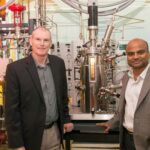
UMBC professors Kevin Sowers and Upal Ghosh have advanced a new technique to eliminate PCBs—one of the most persistent, pervasive, and dangerous chemical pollutants found in waterway sediments. Their innovative, environmentally-friendly approach, published in Environmental Science and Technology, resulted in reducing PCBs by over 50 percent in treated areas.
Sowers, a professor of marine biotechnology, and Ghosh, a professor of chemical, biochemical, and environmental engineering, had been working on PCB removal separately for years. Only recently did they realize their separate efforts could be combined to create a new, more-effective way to get rid of dangerous PCBs, even in ecologically sensitive or hard-to-reach areas, such as around piers and in fragile wetlands. Sowers and Ghosh have now formed a company, Rembac Environmental, to help bring their process to more areas that need PCB remediation.
From required to “remove it!”
PCBs were used extensively as fire retardants—and even required in some products—until they were banned in the U.S. in 1979 because of findings suggesting they might be neurotoxic, disrupt animals’ endocrine systems, and possibly cause cancer. Despite the fact that the ban has been in place for decades, PCBs still persist in sediments around the country, including in Chesapeake Bay. In the Mid-Atlantic, PCBs are the second most common reason for public advisories against consuming fish, just behind mercury.
“If they were to be left alone, PCBs would be in the sediments for decades, and depending on the level it could be a century,” says Sowers. “They’re very stable,” he adds. “That was their selling point.”
The best techniques to deal with PCBs are dredging, which physically removes the PCBs from the area (along with loads of sediment), and capping, which involves piling gravel on top of the sediment to keep the PCBs from interacting with aquatic life above. While each method has its place in the fight against PCB contamination, both are extremely costly, cannot be deployed in ecologically sensitive areas, and are not always effective.
People have tried for decades to develop and sell methods to remove PCBs from sediments biologically. Microorganisms that can break down PCBs occur naturally in sediment, and most efforts have focused on encouraging their populations to grow by adding cocktails of nutrients. None of those prior efforts worked especially well, and Sowers remembers hearing repeatedly that biological removal of PCBs was impossible, but he wasn’t quite ready to give up on the idea.
Never give up
“The technology itself started in the 1980s,” Sowers says, when officials were trying to show that naturally-occurring microbes alone could take care of PCBs in the Hudson River. The effort was not successful, because scientists couldn’t identify the specific microbes doing the work. In the mid-1990s, Sowers and another collaborator, Hal May at the Medical University of South Carolina, identified the species, and soon after that, they developed a method for growing them in the lab without sediment.
“Once we could isolate them, we could study them. We learned enough about them to scale them up and inject them back into sediment,” he says. And finally, about nine years ago, “We found that if we added them in high numbers, we could get rid of the PCBs.” Bingo.
 Upal Ghosh (left) and Kevin Sowers in Sowers’s lab at the Institute of Marine and Environmental Technology. Photo by Marlayna Demond ’11 for UMBC.
Well, almost. Sowers was still delivering the PCB-eating microbes to sediment set up in the lab. How could he inject the microbes over huge bodies of water in the real world?
Sowers’s microbes need to enter the sediment and settle there, not float around in the water. He needed a delivery method that was safe for sensitive areas, relatively quick, and ideally much less expensive than dredging or capping.
Collaboration opens doors
In parallel with Sowers’s work, Ghosh had also been working for years on PCB remediation, but he’d taken a different approach. He had developed pellets made of activated carbon. When the pellets enter the sediment, they bond tightly to PCBs.
“It doesn’t eliminate the PCBs, but it reduces the risk of PCBs getting into the food chain,” he explains. This, in turn, reduces the danger to aquatic life, and the need for fish consumption advisories.
Because carbon is one of the key building blocks of all life, it also wasn’t a significant environmental threat. Ghosh founded a company called Sediment Solutions to produce the pellets, known as SediMite. But it wasn’t until Ghosh and Sowers met that they realized their projects could complement each other.
“Working together allowed us to see the bottlenecks,” Ghosh says.
One breakthrough for the new team was figuring out why the naturally occurring PCB-eaters weren’t enough to have a substantial impact in bodies of water. As an environmental engineer, Ghosh dived into examining the energy balance in the sediment environment, and found it just wouldn’t facilitate growth of those populations in large enough numbers. “You need the microbes in higher levels to see PCB degradation happen in months, and not decades or centuries,” he explains.
With that realization, they began to see the tremendous potential of their partnership. Sowers could produce the microbes that could eliminate PCBs, and Ghosh had pellets that would settle into the sediment—a novel delivery mechanism for the microbes. “When we started working and talking together, we realized, ‘I can solve your problem and you can solve my problem,’” Ghosh says.
Scaling up
Their new publication is the result of the first field trial of the new combined technology. Sowers and Ghosh found a way to bind the microbes to the pellets, and sprayed them into a polluted body of water on the Quantico Marine Corps Base, which drains into the Potomac River. The Department of Defense funded the trial as part of its commitment to clean up PCB contamination at military bases.
The experiment was a success, showing not only that the method is effective at removing PCBs, but also that it didn’t negatively impact the local environment in any detectable way. Ghosh and Sowers also found that the plot treated with the combined microbes and pellets showed a greater reduction in PCBs than a plot treated with the carbon pellets alone. This is the first concrete evidence that a biological approach to removing PCBs can work if delivered in the right way.
Ghosh and Sowers hope the technique will become popular for use in sensitive and hard-to-reach areas. For now, their company is working with another biotech firm to produce the microbes at large scale, but as they take on more remediation projects, they hope to expand their company and start growing the organisms themselves, Sowers says.
It’s taken a long time to get to this point, partly because environmental work of this sort is scrutinized so heavily, “for good reasons,” Ghosh says. But now, Sowers adds, “The most exciting thing is seeing it out there in the field.”
Banner image: Kevin Sowers (left) and Upal Ghosh in Sowers’s lab at the Institute of Marine and Environmental Technology. Photo by Marlayna Demond ’11 for UMBC.
]]>
UMBC professors Kevin Sowers and Upal Ghosh have advanced a new technique to eliminate PCBs—one of the most persistent, pervasive, and dangerous chemical pollutants found in waterway sediments....
https://umbc.edu/stories/umbc-researchers-invent-creative-approach-to-remove-dangerous-pollutant-from-waterways/
https://my3.my.umbc.edu/api/v0/pixel/news/120168/guest@my.umbc.edu/d3c394b3e6772ff71c1366fbdd56b793/api/pixel
cbee
cirsca
cnms
coeit
interdisciplinary
marinebiotech
research
science-and-technology
UMBC News & Magazine
https://my3.my.umbc.edu/groups/umbc-news-magazine
https://assets1-my.umbc.edu/system/shared/avatars/groups/000/001/943/24435aa6207c452e7bc15cc74b42c7bb/xsmall.png?1748556657
https://assets1-my.umbc.edu/system/shared/avatars/groups/000/001/943/24435aa6207c452e7bc15cc74b42c7bb/original.png?1748556657
https://assets2-my.umbc.edu/system/shared/avatars/groups/000/001/943/24435aa6207c452e7bc15cc74b42c7bb/xxlarge.png?1748556657
https://assets2-my.umbc.edu/system/shared/avatars/groups/000/001/943/24435aa6207c452e7bc15cc74b42c7bb/xlarge.png?1748556657
https://assets3-my.umbc.edu/system/shared/avatars/groups/000/001/943/24435aa6207c452e7bc15cc74b42c7bb/large.png?1748556657
https://assets1-my.umbc.edu/system/shared/avatars/groups/000/001/943/24435aa6207c452e7bc15cc74b42c7bb/medium.png?1748556657
https://assets2-my.umbc.edu/system/shared/avatars/groups/000/001/943/24435aa6207c452e7bc15cc74b42c7bb/small.png?1748556657
https://assets1-my.umbc.edu/system/shared/avatars/groups/000/001/943/24435aa6207c452e7bc15cc74b42c7bb/xsmall.png?1748556657
https://assets2-my.umbc.edu/system/shared/avatars/groups/000/001/943/24435aa6207c452e7bc15cc74b42c7bb/xxsmall.png?1748556657
UMBC News & Magazine
0
0
false
Wed, 10 Apr 2019 17:09:34 -0400
Class project to clinical trials: UMBC’s affordable infant incubator wins Global Health Research Award

When Kevin Tran ‘12, chemical engineering, was a student at UMBC, he took a course on sensors that made him realize the best high tech solution is sometimes a low tech solution.
Govind Rao, professor of chemical, biochemical, and environmental engineering, and director of the Center for Advanced Sensor Technology (CAST) asked Tran and his classmates to explore a problem that could be solved by sensors, but to not lose sight of factors beyond the technology. The team began work on a low-cost infant incubator. After years of refinement in the lab, the invention has now earned the 2019 Global Health Research Award from the Academic Pediatric Association. Rao and co-authors will be recognized at the Pediatric Academic Societies Meeting in Baltimore, April 27–30.
Rao and his students sought to develop an incubator to support premature babies in communities with limited resources, and in remote areas that do not have access to medical facilities. The incubators they developed are made from cardboard, and can be easily disposed of after each use. The materials used to construct them are fairly easy to find, making them inexpensive and accessible to people in low- and middle-income countries.
 Govind Rao, center, explaining the cardboard incubator that he and his collaborators have developed to Maryland Secretary of Commerce Mike Gill. Photo by Marlayna Demond ’11 for UMBC.
Seeing the challenge firsthand
Tran recalls that, from the very beginning, the project stretched his mind and allowed him to think of creative solutions to a significant real-world challenge. “The scope of the project was much broader than just the sensor itself,” and Rao emphasized the need to look at social and economic factors, recalls Tran. “Rather than just trying to make an efficient and low-cost sensor, our design would also be heavily influenced by which target population we were trying to reach.”
After completing the course, Tran joined CAST for the summer to continue working on the project alongside the professor. Tran and several other student researchers joined Rao on a trip to India to see, firsthand, how local medical facilities used incubators for premature infants.
 Govind Rao, third from left, with UMBC students and research partners, during a trip to India. Photo courtesy of Kevin Tran.
The facilities they visited had some access to incubators, but the situation was far from ideal. “We learned that incubators that broke were not able to be serviced at hospitals or primary health care facilities,” explains Tran. “Since many [incubators] were donated…no one know how to go about repairing them.”
Eventually, the collaboration included funding from the Food and Drug Administration to support collaborations with the Sri Ramachandra Institute of Higher Education and Research and Phoenix Medical Systems to conduct clinical trials, which resulted in the award winning work.
 Some incubator development team members during a trip to India. Photo courtesy of Kevin Tran.
Thinking outside the box
The research project has evolved over time to better account for the particular needs of communities that would use this incubator technology. Heating systems are common for incubators in air conditioned facilities, and a heating system for the incubator is currently in a clinical trial in India. But what about incubators used in warm environments without air conditioning?
In these contexts, a cooling system can be just as important to help infants maintain a steady body temperature. Plus, both the heating and cooling systems must be highly reliable and cost-effective.
Elizabeth Tan ‘19, chemical engineering, has worked in CAST for about two years, and is conducting research to develop a cooling system. She is collaborating with Deepika Sagar ’18, mechanical engineering, to develop the system, and she says that working a student in another major has allowed her to learn new skills, from computer-aided design to soldering.
“It’s great to put what you learned into play,” Tan says. She adds, “It’s nothing like what I expected.”
Tan has enjoyed learning about the broader process of how a product is designed, tested, and launched, and all of the factors that go into making it successful. It’s also opened her eyes to the opportunities she has to make an impact on how medical care is delivered in communities with limited resources. “You realize the need” for these kinds of solutions, says Tan. That’s affected how she understands the project and how she envisions her career.
In the future, the team envisions the device being modified at a local level to fit the needs of people in different areas. After all, says Tran, providing care for premature babies is a problem faced by all communities, “not just one country or certain population.”
“The dream is to be able to shift paradigms” throughout the world, he explains, so all communities can access this life-saving technology.
Banner image: An infant’s hand. Photo by Limor Zellermayer on Unsplash.com.
]]>
When Kevin Tran ‘12, chemical engineering, was a student at UMBC, he took a course on sensors that made him realize the best high tech solution is sometimes a low tech solution. Govind Rao,...
https://umbc.edu/stories/class-project-to-clinical-trials-umbcs-affordable-infant-incubator-wins-global-health-research-award/
https://my3.my.umbc.edu/api/v0/pixel/news/120195/guest@my.umbc.edu/063b8ef4ce62ccfada517a4ea5303e74/api/pixel
cast
cbee
cirsca
coeit
science-and-technology
strategic-planning
UMBC News & Magazine
https://my3.my.umbc.edu/groups/umbc-news-magazine
https://assets1-my.umbc.edu/system/shared/avatars/groups/000/001/943/24435aa6207c452e7bc15cc74b42c7bb/xsmall.png?1748556657
https://assets1-my.umbc.edu/system/shared/avatars/groups/000/001/943/24435aa6207c452e7bc15cc74b42c7bb/original.png?1748556657
https://assets2-my.umbc.edu/system/shared/avatars/groups/000/001/943/24435aa6207c452e7bc15cc74b42c7bb/xxlarge.png?1748556657
https://assets2-my.umbc.edu/system/shared/avatars/groups/000/001/943/24435aa6207c452e7bc15cc74b42c7bb/xlarge.png?1748556657
https://assets3-my.umbc.edu/system/shared/avatars/groups/000/001/943/24435aa6207c452e7bc15cc74b42c7bb/large.png?1748556657
https://assets1-my.umbc.edu/system/shared/avatars/groups/000/001/943/24435aa6207c452e7bc15cc74b42c7bb/medium.png?1748556657
https://assets2-my.umbc.edu/system/shared/avatars/groups/000/001/943/24435aa6207c452e7bc15cc74b42c7bb/small.png?1748556657
https://assets1-my.umbc.edu/system/shared/avatars/groups/000/001/943/24435aa6207c452e7bc15cc74b42c7bb/xsmall.png?1748556657
https://assets2-my.umbc.edu/system/shared/avatars/groups/000/001/943/24435aa6207c452e7bc15cc74b42c7bb/xxsmall.png?1748556657
UMBC News & Magazine
0
0
false
Fri, 08 Mar 2019 20:37:06 -0500
UMBC ranks among top 150 U.S. universities in federal research funding
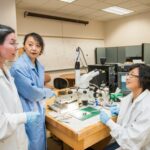
The National Science Foundation (NSF) recently released its latest Higher Education Research and Development (HERD) survey, including UMBC among the top 150 U.S. universities in federal research and development expenditures for fiscal year 2017. The annual HERD survey combines total funding from all federal agencies, including NSF and others, as well as research funding from non-federal and non-governmental sources.
UMBC is ranked #146 in federal funding for the 2017 fiscal year and #169 in total funding from all sources. The federal research investment figure includes funding sources such as the U.S. Department of Agriculture, Department of Defense, and Department of Health and Human Services (DHHS), among many others.
Partnering with NASA
The university is a strong national leader when it comes to NASA funding, where UMBC ranks #12 across all U.S. colleges and universities. This leadership also applies broadly to the overall category of research in the geosciences, atmospheric sciences, and ocean sciences, where UMBC ranks #28 nationwide.
The Center for Research and Exploration in Space Science and Technology (CRESST II) is one core research partnership UMBC maintains with NASA. UMBC and the University of Maryland, College Park, are leading partners in the consortium, which received a commitment of $87.5 million over five years from NASA’s Goddard Space Flight Center beginning in 2017 (following a successful 10-year agreement that launched in 2006).
The partnership supports cutting edge research in high energy astrophysics, gravitational waves, and other areas. Jane Turner, professor of physics, directs the Center for Space Sciences and Technology (CSST), which is the UMBC arm of CRESST. She explains that this research collaboration also creates important teaching and learning opportunities that benefit faculty, graduate, and undergraduate students.
 Jane Turner, director of CSST, at GRIT-X 2017.
The Joint Center for Earth Systems Technology (JCET) is another particularly active and robust UMBC-NASA partnership. NASA renewed JCET in 2015 at a level of $46 million over five years, affirming its commitment to this ongoing, highly productive research collaboration.
“UMBC has a terrific relationship with NASA,” says Susan Hoban, JCET’s associate director. “The UMBC-Goddard JCET is in its third decade, conducting research that advances our understanding of the Earth’s changing climate. NASA scientists, as well as UMBC faculty and students, benefit from this ongoing collaboration.”
Reflecting and informing society
The arts, humanities, and social sciences at UMBC regularly receive funding from a range of federal sources including the DHHS, USDA, National Endowment for the Humanities (NEH), and National Endowment for the Arts (NEA). The latest HERD rankings include projects in a broad range of fields in these areas, such as education, the environment, health disparities, and design. For fiscal year 2017, UMBC ranked #36 in social science research expenditures from federal sources, above institutions such as Princeton University (#48) and Brown University (#52).
Chris Curran, assistant professor of public policy, received a two-year $620,000 National Institute of Justice grant to study the role of law enforcement officers in public schools. Curran, has shared, “Law enforcement have become an increasingly common presence in school settings, particularly after high profile events like the tragedy at Sandy Hook. Our work seeks to understand the role of these officers in promoting safety, managing student behavior, and facilitating relationships with students.”
 F. Chris Curran
Also during the 2017 HERD survey period, Margaret Re, associate professor of visual arts, received a major Art Works grant from the NEA to develop the exhibition and catalog for “A Designed Life.” The project explores how the U.S. government sponsored exhibits of modern American textiles, wallpapers, containers, and packaging in the 1950s to promote American culture abroad. It’s now on display at UMBC’s Center for Art, Design, and Visual Culture.
Computing, information, and engineering
UMBC also has very strong federal support for research in computing, information sciences, and engineering disciplines. In all three areas, UMBC ranked in the top 125 U.S. universities in funding received from federal sources.
In the 2017 HERD period, UMBC received an NSF Major Research Instrumentation award to expand the university’s High Performance Computing Facility. Also in computing, Ting Zhu, assistant professor of computer science and electrical engineering, received a prestigious NSF CAREER Award for his work to develop “Internet of Things” technology.
Faculty also received numerous awards for innovative medical research. Erin Lavik, professor of chemical, biochemical, and environmental engineering, received funding from the National Eye Institute to develop a “living model of the human retina.”
Liang Zhu, professor of mechanical engineering, was PI on an NSF grant to study how applying heat to drug-carrying nanoparticles can cause tumors to shrink. Her research with UMBC colleagues in mechanical engineering, biological science, and chemistry and biochemistry could lead to a more targeted, non-surgical approach to treating tumors in cancer patients. “Not every patient can have surgery,” explained Zhu, “so this is an alternative treatment option.”
Karl V. Steiner, UMBC’s vice president for research, notes that these most recent research funding rankings highlight UMBC’s strength across disciplines. “I could not be more proud of the efforts of our faculty and students as we build our research community together. The HERD Rankings are one measurement of our scholarly impact, and represent a key method of national comparison,” he says.
Steiner continues, “Our top ranking is in NASA support, and the related research highlights areas of remarkable strength built over several decades. We are also thrilled about the strength of our social sciences research community and growing recognition for our important engineering and information sciences programs.”
Banner image: Marie Christine Daniel-Onuta, right, Liang Zhu, and Ronghui Ma working in the lab. All photo by Marlayna Demond ’11 for UMBC.
]]>
The National Science Foundation (NSF) recently released its latest Higher Education Research and Development (HERD) survey, including UMBC among the top 150 U.S. universities in federal research...
https://umbc.edu/stories/umbc-ranks-among-top-150-u-s-universities-in-federal-research-funding/
https://my3.my.umbc.edu/api/v0/pixel/news/120237/guest@my.umbc.edu/4c44aecd364e8e4e93001311bed63c8b/api/pixel
arts-and-culture
cahss
cbee
cnms
coeit
csee
meche
physics
policy-and-society
publicpolicy
research
science-and-technology
visualarts
UMBC News & Magazine
https://my3.my.umbc.edu/groups/umbc-news-magazine
https://assets1-my.umbc.edu/system/shared/avatars/groups/000/001/943/24435aa6207c452e7bc15cc74b42c7bb/xsmall.png?1748556657
https://assets1-my.umbc.edu/system/shared/avatars/groups/000/001/943/24435aa6207c452e7bc15cc74b42c7bb/original.png?1748556657
https://assets2-my.umbc.edu/system/shared/avatars/groups/000/001/943/24435aa6207c452e7bc15cc74b42c7bb/xxlarge.png?1748556657
https://assets2-my.umbc.edu/system/shared/avatars/groups/000/001/943/24435aa6207c452e7bc15cc74b42c7bb/xlarge.png?1748556657
https://assets3-my.umbc.edu/system/shared/avatars/groups/000/001/943/24435aa6207c452e7bc15cc74b42c7bb/large.png?1748556657
https://assets1-my.umbc.edu/system/shared/avatars/groups/000/001/943/24435aa6207c452e7bc15cc74b42c7bb/medium.png?1748556657
https://assets2-my.umbc.edu/system/shared/avatars/groups/000/001/943/24435aa6207c452e7bc15cc74b42c7bb/small.png?1748556657
https://assets1-my.umbc.edu/system/shared/avatars/groups/000/001/943/24435aa6207c452e7bc15cc74b42c7bb/xsmall.png?1748556657
https://assets2-my.umbc.edu/system/shared/avatars/groups/000/001/943/24435aa6207c452e7bc15cc74b42c7bb/xxsmall.png?1748556657
UMBC News & Magazine
0
0
false
Thu, 20 Dec 2018 21:01:09 -0500
30th UMBC Alumni Awards celebrate leadership, service, and community

UMBC community members from the university’s first class to today kicked off Homecoming 2018 on October 4 with a celebration of UMBC Alumni Award winners. Held in the Earl and Danielle Linehan Concert Hall, the moving and memorable ceremony reflected the rich community that is UMBC and honored the tremendous achievements of eight exceptional awardees.
As the evening began, John Becker ’01, information systems, president of the UMBC Alumni Association, remarked, “The alumni and faculty we will recognize tonight truly capture the depth of the UMBC community.” President Freeman Hrabowski encouraged attendees to “listen, learn, and be inspired.”
Kimberly Ellison-Taylor ’93, information systems, received the 2018 Outstanding Alumna in Engineering and Information Technology Award. She bridges her knowledge in technology and finance as a global strategy director at Oracle. She is also the youngest person and first African-American woman to be elected as chair of the American Institute of Certified Public Accountants.
 Awardee Kimberly Ellison-Taylor ’93 (left) with Karen Shaheed ’85.
Greg Simmons, M.P.P. ’04, public policy, and vice president of institutional advancement, described Ellison-Taylor as “a visionary in her field” who can “see the future in the work that she does.” Still, he says, despite her success, “she’s never forgotten where she’s come from, and she’s made sure she’s opened pathways for others to have success that she’s modeled so well.”
Ellison-Taylor grew up in Baltimore’s Sandtown-Winchester neighborhood. “Statistically, I shouldn’t be here,” she shared, but “UMBC provided a foundation of unparalleled opportunity. It empowered, enabled, equipped, and energized me to succeed.”
Through her participation in the Sigma Gamma Rho sorority, Ellison-Taylor began paying it forward, supporting others in finding their paths. “Everyone deserves respect and dignity,” she said, “whether they’re the CEO or the janitor.”
Allan Kittleman ’81, political science, introduced Zainab Alkebsi ’09, political science, this year’s Rising Star Award recipient. Alkebsi serves as policy counsel for the National Association for the Deaf.
As a child, Alkebsi was frustrated by the lack of accessibility for deaf and hard-of-hearing people like herself. She recalled attending a movie and seeing everyone around her laughing while she couldn’t follow the dialogue. So, at 11 years old, “I resolved that I was going to go to law school and advocate for full, equal access,” she told the crowd through an interpreter. “Now, here I am—in the trenches of the battle to break down barriers to accessibility for the Deaf and hard-of-hearing communities.”
 Awardee Zainab Alkebsi ’09 (center) with family members.
Among her many achievements as an advocate, Alkebsi recently negotiated 100 percent captioning for in-flight entertainment on several major airlines. Now a mother, she imagines her daughter “boarding a flight and knowing the role her mother played in ensuring greater accessibility.”
Alkebsi thanked her UMBC professors for encouraging her personal and professional growth. She shared that she continues to give back to UMBC by presenting guest lectures focused on the Deaf community.
Kathleen Hoffman, mathematics, and David Mitch, economics, introduced Mark Doms ’86, mathematics and economics, the 2018 Outstanding Alumnus in Natural and Mathematical Sciences Award recipient. A leading economic policy expert, Doms served on the Board of Governors for the Federal Reserve and as the Under Secretary for Economic Affairs at the Department of Commerce under the Obama administration, and worked at Japan’s largest investment bank.
“I couldn’t have gotten a better education anywhere else,” Doms shared, of his time at UMBC. His math classes taught him to analyze data appropriately, and his economics classes taught him “how to think about the world’s problems in a rigorous manner.”
In addition to a strong academic preparation, “UMBC instilled in me a sense of public service,” Doms said. His career has been primarily in the public sector, and he intends to teach at a public university when he returns to the United States from his current work in Europe.
 Award recipient Saira Khan ’09 addresses the audience.
Saira Khan ’09, English, is UMBC’s 2018 Outstanding Alumna in the Humanities. Chris Corbett, English, noted, “She has achieved more in just a few years than some aspiring journalists achieve in an entire career.”
Khan began her career as a freelancer for Dawn, an English-language publication in her native Pakistan, “moving seamlessly between two very complicated worlds,” Corbett said. Less than a decade later, she is now director of social media for The New Yorker.
Attending UMBC was “one of the best decisions I have made in my life,” Khan shared. “I left this place with relationships that I have carried with me for the last 10 years, and I know I will have them with me for the rest of my life. For that, I will be forever grateful.”
Mina Cheon, M.F.A. ’02, imaging and digital arts, also moves seamless between worlds, from Korea to New York City to UMBC. She says “artists are agents of change,” and they become leaders who “perform art projects in social spaces that matter.”
Her often-controversial art includes a series of political videos framed as art history lessons, which she placed on flash drives inside balloons and launched from South Korea over the border with North Korea. The South Korean president and first lady visited her most recent exhibition.
 Awardee Mina Cheon, M.F.A. ’02, speaks at the Alumni Awards.
Cheon’s connection to the university has been long-lasting. She graduated from UMBC with her infant son in her arms, and now he is studying math at UMBC. “Thank you for being the leading, visionary STEAM research community where I grew abundantly and where my son will be nurtured to flourish in his academic track,” she shared.
Cheon also mentioned her gratitude for UMBC faculty and staff’s dedication to “shaping the future by empowering the artist in society.” Her nominator, Kathy O’Dell, visual arts, said simply, “Dr. Cheon is a treasure.”
Wanda Keyes Heard ’79, political science, the 2018 Outstanding Alumna in Social Sciences Award recipient, is the first female chief judge of the 8th Judicial Circuit. Keyes Heard holds this position following 19 years of service as a circuit court judge in Baltimore City. She has mentored dozens of UMBC students and fellow judges.
 Carolyn Forestiere (left), Wanda Keyes Heard ‘79 (center), and President Freeman Hrabowski.
“UMBC helped prepare me to accomplish my professional goals,” she says, “to break through race and gender bias and barriers, because I was a woman headed into a field where people just didn’t look like me.”
Like other recipients, Keyes Heard also talked about relationships and community. “I embraced this campus, and it embraced me,” she said. She described UMBC as “not only my academic home, but my home away from home.” Many of her former classmates, who remain her close friends, attended the ceremony to cheer her achievement. “They’re here tonight,” Keyes Heard said, “because they are still my family after 40 years.”
Mimi Haw Dietrich ’70, American studies, received the 2018 Outstanding Alumna for Distinguished Service Award. As a founder of the “Fab Four” group (comprised of members of UMBC’s first four graduating classes), Dietrich remembers a time when UMBC included just three buildings.
“We planted the seeds for UMBC’s greatness many years ago just by believing in a new university,” she shared. She chose to attend because Albin O. Kuhn, UMBC’s first president, “promised that we would be pioneers.”
 Mimi Haw Dietrich ’70 hugs her close friend and nominator, Donna Hekler ’70, English, at the Alumni Awards.
For UMBC’s 50th anniversary, Dietrich was one of the first to galvanize alumni to organize and participate in the celebrations. She continues to serve UMBC by organizing Fab Four events. She previously served on the Alumni Association Board of Directors and was named UMBC Volunteer of the Year in 1999 along with her husband, Bob Dietrich ’70, biological sciences.
Professionally, Dietrich has been dedicated to spreading her love of quilting and needlework as an educator for 50 years. She was inducted into the Quilters Hall of Fame in 2015 and named the Professional Quilter of the Year in 2013.
Mariajose Castellanos, chemical, biochemical, and environmental engineering, is the 2018 Outstanding Faculty Award recipient. Castellanos, a teaching faculty member, expressed gratitude that her department supported her when she “chose to pursue teaching and leadership through service,” rather than continue in research.
 Left to right: John Becker ’01, Jeremy Drew ’17, Mariajose Castellanos, and President Hrabowski.
Jeremy Drew ’17, chemical engineering, reflected on the great impact of her work as an educator, for him and so many others. “She showed me the value of trying a problem I wasn’t sure how to solve,” said Drew. He continued,“Dr. C. cares about the well-being of her students, and adapts to each of their individual needs in order to bring them the most comprehensive education possible.”
Throughout the event, speaker after speaker reflected on meaningful friendships and strong bonds with mentors at UMBC—connections that have lasted over decades. President Hrabowski drew on this theme as he offered closing remarks. “The older I get, the more I realize there’s nothing more important than friends and family,” he said. “It is the notion of community through which we are all connected.”
Banner image: Wanda Keyes Heard ’79 speaks to a full Linehan Concert Hall. All images by Marlayna Demond ’11 for UMBC.
]]>
UMBC community members from the university’s first class to today kicked off Homecoming 2018 on October 4 with a celebration of UMBC Alumni Award winners. Held in the Earl and Danielle Linehan...
https://umbc.edu/stories/30th-umbc-alumni-awards-celebrate-leadership-service-and-community/
https://my3.my.umbc.edu/api/v0/pixel/news/120313/guest@my.umbc.edu/b269c3c6f473b3cbaf42d76bf4a30cc3/api/pixel
americanstudies
biology
cahss
cbee
cnms
coeit
community
economics
english
is
mathstat
politicalscience
visualarts
UMBC News & Magazine
https://my3.my.umbc.edu/groups/umbc-news-magazine
https://assets1-my.umbc.edu/system/shared/avatars/groups/000/001/943/24435aa6207c452e7bc15cc74b42c7bb/xsmall.png?1748556657
https://assets1-my.umbc.edu/system/shared/avatars/groups/000/001/943/24435aa6207c452e7bc15cc74b42c7bb/original.png?1748556657
https://assets2-my.umbc.edu/system/shared/avatars/groups/000/001/943/24435aa6207c452e7bc15cc74b42c7bb/xxlarge.png?1748556657
https://assets2-my.umbc.edu/system/shared/avatars/groups/000/001/943/24435aa6207c452e7bc15cc74b42c7bb/xlarge.png?1748556657
https://assets3-my.umbc.edu/system/shared/avatars/groups/000/001/943/24435aa6207c452e7bc15cc74b42c7bb/large.png?1748556657
https://assets1-my.umbc.edu/system/shared/avatars/groups/000/001/943/24435aa6207c452e7bc15cc74b42c7bb/medium.png?1748556657
https://assets2-my.umbc.edu/system/shared/avatars/groups/000/001/943/24435aa6207c452e7bc15cc74b42c7bb/small.png?1748556657
https://assets1-my.umbc.edu/system/shared/avatars/groups/000/001/943/24435aa6207c452e7bc15cc74b42c7bb/xsmall.png?1748556657
https://assets2-my.umbc.edu/system/shared/avatars/groups/000/001/943/24435aa6207c452e7bc15cc74b42c7bb/xxsmall.png?1748556657
UMBC News & Magazine
0
0
false
Mon, 08 Oct 2018 19:40:48 -0400
Porta-NERDs: Meet the team changing how people think about waste through EPA-supported research
UMBC’s Lee Blaney is known for his innovative research on water and soil contamination, working to keep people and the environment healthy. His latest project takes that focus in a new direction by developing an innovative system to recover nutrients from an unexpected source: human urine.
Blaney, associate professor of chemical, biochemical, and environmental engineering, received a phase one grant from the Environmental Protection Agency’s People, Prosperity, and the Planet (P3) program to investigate the ability of his Nutrient Extraction and Recovery Device (NERD) technology to recover nutrients from human urine.
This project will advance knowledge about how sustainable resource recovery technologies can be implemented. “Human urine accounts for the majority of nutrients in municipal wastewater, but only a small fraction of the flow,” explains Blaney. “When urine gets diluted into the wastewater system, it makes it more difficult to treat and recover these nutrients. So, we wanted to go to the source — toilets.”
Blaney worked with co-PI Marc Zupan, associate professor of mechanical engineering, and ten UMBC students to develop a system that can recover around 90% of the phosphorus, an ecologically important nutrient, and some of the nitrogen and potassium from collected urine samples. These nutrients can impair water quality by causing the formation of dead zones in places like the Chesapeake Bay and Gulf of Mexico, so developing a low-cost way of removing them from urine could have a major impact.
Once removed, those nutrients can then be used in ways that are beneficial rather than harmful to human and environmental health. “The recovered nutrients can be used as a fertilizer,” says Blaney. “By ‘recycling’ these nutrients, we also avoid the economical and energy costs associated with traditional fertilizers. It’s a win-win for the environment and our wallets.”
All P3 projects are required to include an educational component, to ensure researchers are sharing knowledge about the environment and sustainability. The student role in this particular project is significant.
Both undergraduate and graduate students have worked to develop and institute the NERD technology, which modified portable toilets to collect and process urine samples. In April, several students presented their work at the USA Science and Engineering Festival in Washington, D.C.
 Students in Lee Blaney’s lab presenting at USA Science and Engineering Festival in Washington, D.C. Photo courtesy of Lee Blaney.
“I would say the biggest impact our work had at the USA Science and Engineering Festival was getting people to think differently about ‘waste’ by raising their awareness of nutrient recovery,” says Josh Benoit ‘18, chemical engineering. “Most people had never heard of the term ‘nutrient recovery’ and once they learned about it were excited about the potential of the Porta-NERDS system.”
Charles Portner ‘18, chemical engineering, who worked with Blaney and Benoit, says that presenting their work in Washington D.C. allowed the group to explain the simplicity of the technology and how it can be implemented easily. “Folks could potentially have fixtures operating on this technology installed in their private homes or schools without having to wait for municipal adoption,” Porter says, explaining that the system could decrease the burden on municipal treatment systems and empower “average folks who wanted to do their part.”
In the future, Utsav Shashvatt Ph.D ‘19, environmental engineering, hopes this work will impact communities globally. “I am excited about the potential of bringing these cost-effective portable nutrient recovery technologies to communities around the world.”
And, as Sophia Lopresti ’18, global studies, states “There are so many ways that human waste disposal affects our environment and our future health, yet urine continues to be a ‘taboo’ topic, but not to those who stopped at our table.”
NSF recently produced a video about research being done in Blaney’s lab. The full video can be viewed on the NSF website.
This @UMBC team is engineering a win-win solution for poultry litter, converting chicken manure into an eco-friendly revenue stream for farmers: https://t.co/UuOVa8fxmH #agriculture #runoff pic.twitter.com/XKa6PsB0ic
— National Science Foundation (@NSF) October 2, 2018
Banner image: Lee Blaney. Photo by Marlayna Demond ’11 for UMBC.
]]>
UMBC’s Lee Blaney is known for his innovative research on water and soil contamination, working to keep people and the environment healthy. His latest project takes that focus in a new direction...
https://umbc.edu/stories/porta-nerds-meet-the-team-changing-how-people-think-about-waste-through-epa-supported-research/
https://my3.my.umbc.edu/api/v0/pixel/news/120318/guest@my.umbc.edu/7c6472f362a1596586de3c0ec00b8e02/api/pixel
cbee
coeit
science-and-technology
UMBC News & Magazine
https://my3.my.umbc.edu/groups/umbc-news-magazine
https://assets1-my.umbc.edu/system/shared/avatars/groups/000/001/943/24435aa6207c452e7bc15cc74b42c7bb/xsmall.png?1748556657
https://assets1-my.umbc.edu/system/shared/avatars/groups/000/001/943/24435aa6207c452e7bc15cc74b42c7bb/original.png?1748556657
https://assets2-my.umbc.edu/system/shared/avatars/groups/000/001/943/24435aa6207c452e7bc15cc74b42c7bb/xxlarge.png?1748556657
https://assets2-my.umbc.edu/system/shared/avatars/groups/000/001/943/24435aa6207c452e7bc15cc74b42c7bb/xlarge.png?1748556657
https://assets3-my.umbc.edu/system/shared/avatars/groups/000/001/943/24435aa6207c452e7bc15cc74b42c7bb/large.png?1748556657
https://assets1-my.umbc.edu/system/shared/avatars/groups/000/001/943/24435aa6207c452e7bc15cc74b42c7bb/medium.png?1748556657
https://assets2-my.umbc.edu/system/shared/avatars/groups/000/001/943/24435aa6207c452e7bc15cc74b42c7bb/small.png?1748556657
https://assets1-my.umbc.edu/system/shared/avatars/groups/000/001/943/24435aa6207c452e7bc15cc74b42c7bb/xsmall.png?1748556657
https://assets2-my.umbc.edu/system/shared/avatars/groups/000/001/943/24435aa6207c452e7bc15cc74b42c7bb/xxsmall.png?1748556657
UMBC News & Magazine
0
0
false
Tue, 02 Oct 2018 18:28:20 -0400
UMBC, NASA, and partners mount intensive Chesapeake Bay air-quality study
This summer, students and faculty from UMBC and three additional universities teamed up with NASA researchers and Maryland’s Department of the Environment to collect huge amounts of data that will provide a snapshot of air quality in the Baltimore-Washington metropolitan area and over the Chesapeake Bay. The study measures factors ranging from wind speed to ozone concentration.
“In trying to understand air quality near the coast, it’s critical to obtain measurements over the water and over the land simultaneously with as wide of a variety of instruments as possible,” says John Sullivan, Ph.D. ’15, atmospheric physics, and the lead NASA researcher on the project.
UMBC serves as the primary land-based site, and equipment placed on remote Hart Miller Island in the Bay collects data over water. “With two sites, you can begin to really answer questions pertaining to differences in air pollution and understand the mechanisms driving these differences,” Sullivan explains.
 The UMBC research trailer on Hart Miller Island in Chesapeake Bay, one of two “super sites” for OWLETS and OWLETS-2 data collection. The other super site is the UMBC campus. Photo: Peninsula Drone Services, LLC
Ozone in the forecast
This summer’s work is an extension of the Ozone Water-Land Environmental Transition Study (OWLETS), dubbed OWLETS-2, and it is particularly focused on tracking the presence of ozone in coastal cities. Ozone in the upper atmosphere helps maintain Earth’s temperature and absorbs harmful UV rays.
However, near ground level, breathing in ozone causes inflammation in the respiratory system, which can be dangerous for young children, the elderly, and those with asthma or other respiratory conditions. Plants also take up ozone, which can reduce crop yields.
Chemical reactions between sunlight and emissions from vehicles and industry generate smog-like ozone episodes, so one would expect the highest concentrations at midday, when the sun is at its brightest. However, wind over the Bay changes that.
“The Bay breeze is like a wall that doesn’t allow normal west to east airflow to happen,” explains Ruben Delgado, assistant professor at the Joint Center for Earth Systems Technology (a UMBC-NASA partnership) and the lead UMBC OWLETS-2 researcher. That means the midday ozone heading out to sea comes back in during the late afternoon, causing a spike just as local residents are heading home from work and school. Other factors, such as smoke blowing over the city from wildfires in the West, can also have a real impact.
Better understanding how these issues influence the presence of ozone in Baltimore can help improve air quality forecasts and protect sensitive populations from ozone’s ill effects. “The National Weather Service is interested in this kind of data, because it allows them to push their models to a new frontier,” Delgado explains.
Students step up
Working with Delgado are students from UMBC, Howard University, City University of New York, and Hampton University. The students and their home-institution faculty mentors are all members of the NOAA-funded Center for Earth System Sciences and Remote Sensing Technologies and Center for Atmospheric Sciences and Meteorology.
Delgado finds mentoring these emerging researchers to be both personally rewarding and essential to the success of the project. “My favorite part of this project is giving the students hands-on experience,” Delgado says. “They get to contribute to the process from start to finish.”
Kat Ball ’21, chemical engineering, is one of those student researchers, and her experience has been transformative. “I feel so fortunate to have had the opportunity to participate in meaningful scientific research so early on in my academic career,” she shares. “I’ve only just completed my freshman year, and will be one of the authors on the publications that result from all the data we received, which is something I thought I would only be dreaming about for quite some time.”
Ball learned that field and lab research differ in important ways. “Not everything is easy to deal with when you’re miles away from an actual lab where you have all of the necessary parts, chemicals, and even just clean water that you need to deal with problems that arise,” she says.
Working with much more experienced team members, Ball was intimidated at first, but soon felt at home on Hart Miller Island. “Hearing from people with such impressive qualifications that your input on the situation truly matters expanded the confidence I had in myself as a researcher,” she shares.
Paying it forward
John Sullivan, the lead NASA researcher, was once in Ball’s shoes, and now he’s paying it forward. “As I moved toward planning larger-scale campaigns, I knew that I wanted to involve UMBC any way I could,” he says. “It wasn’t until I got to NASA that I realized how much of a leg up I had coming from UMBC, as some of my classes were taught by leading researchers in the atmospheric physics community.”
Under Sullivan and Delgado’s leadership, the participating students all took a very active role in the research. “They have been busy taking LiDAR measurements, launching weather balloons, taking mobile samples of pollution, and outfitting research vessels,” Sullivan says. He adds, “There is something very rewarding about bringing together active and engaged researchers to make a difference in public health, and training the next generation of scientists along the way.”
]]>
This summer, students and faculty from UMBC and three additional universities teamed up with NASA researchers and Maryland’s Department of the Environment to collect huge amounts of data that will...
https://umbc.edu/stories/umbc-nasa-and-partners-mount-intensive-chesapeake-bay-air-quality-study/
https://my3.my.umbc.edu/api/v0/pixel/news/120351/guest@my.umbc.edu/70135c77061408fac547466cf218e61e/api/pixel
cbee
cnms
coeit
graduateschool
physics
research
science-and-technology
undergradresearch
UMBC News & Magazine
https://my3.my.umbc.edu/groups/umbc-news-magazine
https://assets1-my.umbc.edu/system/shared/avatars/groups/000/001/943/24435aa6207c452e7bc15cc74b42c7bb/xsmall.png?1748556657
https://assets1-my.umbc.edu/system/shared/avatars/groups/000/001/943/24435aa6207c452e7bc15cc74b42c7bb/original.png?1748556657
https://assets2-my.umbc.edu/system/shared/avatars/groups/000/001/943/24435aa6207c452e7bc15cc74b42c7bb/xxlarge.png?1748556657
https://assets2-my.umbc.edu/system/shared/avatars/groups/000/001/943/24435aa6207c452e7bc15cc74b42c7bb/xlarge.png?1748556657
https://assets3-my.umbc.edu/system/shared/avatars/groups/000/001/943/24435aa6207c452e7bc15cc74b42c7bb/large.png?1748556657
https://assets1-my.umbc.edu/system/shared/avatars/groups/000/001/943/24435aa6207c452e7bc15cc74b42c7bb/medium.png?1748556657
https://assets2-my.umbc.edu/system/shared/avatars/groups/000/001/943/24435aa6207c452e7bc15cc74b42c7bb/small.png?1748556657
https://assets1-my.umbc.edu/system/shared/avatars/groups/000/001/943/24435aa6207c452e7bc15cc74b42c7bb/xsmall.png?1748556657
https://assets2-my.umbc.edu/system/shared/avatars/groups/000/001/943/24435aa6207c452e7bc15cc74b42c7bb/xxsmall.png?1748556657
UMBC News & Magazine
0
0
false
Tue, 21 Aug 2018 14:26:00 -0400
UMBC’s Summer Undergraduate Research Fest 2018 spotlights talents of emerging scientists
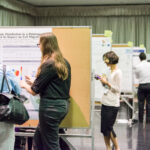
UMBC’s University Center ballroom was standing-room only earlier this week as visitors gathered to learn about new student research on topics from HIV replication to enhancing art conservation through wireless temperature monitoring.
The Summer Undergraduate Research Fest (SURF) presenters were high school students and undergraduates from UMBC and other colleges who chose to spend their summers conducting research at UMBC. In all, 126 students participated in the event, which included two poster sessions and an awards ceremony following the presentations. More than 30 faculty members across five departments and two colleges at UMBC guided the students in their research.
“The experience helped us to think like scientists,” says Olufolake Majekodunmi ’21, biological sciences and psychology. She and her research partner, Avantika Krishna ’21, biochemistry, conducted research for a new project on e-cigarette flavorings with neurobiologist Weihong Lin. As participants in the UMBC STEM BUILD Training Program, they have also received training in writing personal statements, analyzing academic journal articles, constructing their résumés, and more.
“The internship prepared us for giving oral presentations and applying to the workforce or grad school,” says Krishna. Both Krishna and Majekodunmi plan to continue their work with Lin this fall.
For some students, the summer offered a chance to step outside their comfort zones. Sarah Carpe ‘20, environmental science, who transferred to UMBC from Baltimore City Community College, worked with biologist Steve Miller through an NSF Research Experience and Mentoring (REM) award. Her project seeks to enhance algal biofuels by manipulating algae genetics. This stretched her beyond her typical focus areas, but she sees it as very relevant to her passion for the environment because of its potential to help the planet, she says.
Ewnet Sisay ‘20, mechanical engineering, studied zebrafish embryos with developmental biologist Rachel Brewster. “I hope to go for a Ph.D. in biomedical engineering, so I wanted to try biology before committing to a Ph.D,” Sisay says. The result? “I really love it.”
On the other hand, Rakan El-Mayta ‘18, chemical engineering and biological sciences, has been conducting research with biochemical engineer Erin Lavik for two years. This summer, El-Mayta continued work on a project to generate a 3D model of the human colon that will make testing new therapies more efficient. The work has confirmed his enthusiasm for engineering. “Everything is so applicable,” El-Mayta says, “and I get to work with my hands and really think like an engineer.”
Sahle Gebremichael, a student at Baltimore City Community College, spent time in Steve Miller’s lab this summer through the NSF REM program. He intends to transfer to UMBC next year. “I think getting research experience here will help me make the transition to UMBC,” he says.
In addition to sharing the benefits of their experiences, the student also spoke to how research can sometimes be an emotional rollercoaster, peppered with challenges and failures. But by working through those issues, they came to see failures as growth opportunities, rather than setbacks.
“I’ve hit a couple roadblocks along the way,” says Carpe, “which has helped me understand the project better because I have to really think to solve the problem.”
Brett Lucht, a student at Marist College and recipient of an NSF Research Experience for Undergraduates award, also found a way to see the positive in the challenges he faced while working with physical chemist Lisa Kelly. “Failures are a part of research,” he says, “and we’ve learned from them, so they were good failures.”
Bill LaCourse, dean of the College of Natural and Mathematical Sciences, which organized the event, took a moment at the research festival to tell the students that although they are still early in their scientific careers, working to answer questions no one has ever answered before is a noble and exciting challenge. He shared his hope that their time as UMBC researchers “lights a flame of passion that will drive you to greater undertakings…with joy and wonderment.”
“It has been our privilege to host you here at UMBC,” said LaCourse. “Your spirit is an inspiration to us all.”
Image: Students explain their research to attendees at SURF 2017. Photo by Marlayna Demond ’11 for UMBC.
]]>
UMBC’s University Center ballroom was standing-room only earlier this week as visitors gathered to learn about new student research on topics from HIV replication to enhancing art conservation...
https://umbc.edu/stories/umbcs-summer-undergraduate-research-fest-2018-spotlights-talents-of-emerging-scientists/
https://my3.my.umbc.edu/api/v0/pixel/news/120356/guest@my.umbc.edu/a586a1275cff2ea8687ee4bf9e3eb236/api/pixel
biology
cbee
chembiochem
cnms
coeit
meche
science-and-technology
stembuild
undergradresearch
UMBC News & Magazine
https://my3.my.umbc.edu/groups/umbc-news-magazine
https://assets1-my.umbc.edu/system/shared/avatars/groups/000/001/943/24435aa6207c452e7bc15cc74b42c7bb/xsmall.png?1748556657
https://assets1-my.umbc.edu/system/shared/avatars/groups/000/001/943/24435aa6207c452e7bc15cc74b42c7bb/original.png?1748556657
https://assets2-my.umbc.edu/system/shared/avatars/groups/000/001/943/24435aa6207c452e7bc15cc74b42c7bb/xxlarge.png?1748556657
https://assets2-my.umbc.edu/system/shared/avatars/groups/000/001/943/24435aa6207c452e7bc15cc74b42c7bb/xlarge.png?1748556657
https://assets3-my.umbc.edu/system/shared/avatars/groups/000/001/943/24435aa6207c452e7bc15cc74b42c7bb/large.png?1748556657
https://assets1-my.umbc.edu/system/shared/avatars/groups/000/001/943/24435aa6207c452e7bc15cc74b42c7bb/medium.png?1748556657
https://assets2-my.umbc.edu/system/shared/avatars/groups/000/001/943/24435aa6207c452e7bc15cc74b42c7bb/small.png?1748556657
https://assets1-my.umbc.edu/system/shared/avatars/groups/000/001/943/24435aa6207c452e7bc15cc74b42c7bb/xsmall.png?1748556657
https://assets2-my.umbc.edu/system/shared/avatars/groups/000/001/943/24435aa6207c452e7bc15cc74b42c7bb/xxsmall.png?1748556657
UMBC News & Magazine
0
0
false
Tue, 14 Aug 2018 14:55:10 -0400
UMBC research team awarded grant to innovate anti-malarial drug production

A team of researchers from UMBC’s Center for Advanced Sensor Technology (CAST) and department of chemical, biochemical, and environmental engineering is working to develop a new, low-cost anti-malarial drug to help tackle a disease that causes over 200 million infections and 400,000 deaths annually, according to the World Health Organization (WHO).
Peng Xu, assistant professor; Xudong Ge, research associate professor; and Govind Rao, professor, received $422,623 from the Bill & Melinda Gates Foundation to support the research. Xu and Ge are the co-PIs on the grant, and Rao is the project director.
Therapies that contain artemisinin have shown to be an effective first-line treatment for malaria. Artemisinin is derived from extracts of the wormwood plant. This makes it relatively affordable to produce, but also means the medication supply depends on having an abundant and steady source of the plant.
 An image showing how the research will be conducted. Image courtesy of Peng Xu.
With the support of the grant, the UMBC research group will develop a scalable and cost-effective production process. Through genetic and process engineering, they will develop an alternative yeast that can be used to more affordably produce artemisinic acid.
“This work builds on CAST’s unique strength in sensor technology and couples it with innovative yeast metabolic engineering,” Rao says. “We are excited to work with the Bill & Melinda Gates Foundation to develop a cost-efficient manufacturing process, and, ultimately, to help eradicate malaria around the world.”
Banner image: Peng Xu, left, and Xudong Ge, right, work with a student to develop an anti-malarial drug. Photo by Marlayna Demond ’11 for UMBC.
]]>
A team of researchers from UMBC’s Center for Advanced Sensor Technology (CAST) and department of chemical, biochemical, and environmental engineering is working to develop a new, low-cost...
https://umbc.edu/stories/umbc-research-team-awarded-grant-to-innovate-anti-malarial-drug-production/
https://my3.my.umbc.edu/api/v0/pixel/news/120368/guest@my.umbc.edu/a11954d406a3b623fcf33ee7a7af28f9/api/pixel
cbee
cfr
coeit
science-and-technology
UMBC News & Magazine
https://my3.my.umbc.edu/groups/umbc-news-magazine
https://assets1-my.umbc.edu/system/shared/avatars/groups/000/001/943/24435aa6207c452e7bc15cc74b42c7bb/xsmall.png?1748556657
https://assets1-my.umbc.edu/system/shared/avatars/groups/000/001/943/24435aa6207c452e7bc15cc74b42c7bb/original.png?1748556657
https://assets2-my.umbc.edu/system/shared/avatars/groups/000/001/943/24435aa6207c452e7bc15cc74b42c7bb/xxlarge.png?1748556657
https://assets2-my.umbc.edu/system/shared/avatars/groups/000/001/943/24435aa6207c452e7bc15cc74b42c7bb/xlarge.png?1748556657
https://assets3-my.umbc.edu/system/shared/avatars/groups/000/001/943/24435aa6207c452e7bc15cc74b42c7bb/large.png?1748556657
https://assets1-my.umbc.edu/system/shared/avatars/groups/000/001/943/24435aa6207c452e7bc15cc74b42c7bb/medium.png?1748556657
https://assets2-my.umbc.edu/system/shared/avatars/groups/000/001/943/24435aa6207c452e7bc15cc74b42c7bb/small.png?1748556657
https://assets1-my.umbc.edu/system/shared/avatars/groups/000/001/943/24435aa6207c452e7bc15cc74b42c7bb/xsmall.png?1748556657
https://assets2-my.umbc.edu/system/shared/avatars/groups/000/001/943/24435aa6207c452e7bc15cc74b42c7bb/xxsmall.png?1748556657
UMBC News & Magazine
0
0
false
Mon, 23 Jul 2018 16:00:46 -0400


