Bahama Oriole Project team awarded NSF grant to offer more UMBC undergrads international research experiences
UMBC is recognized as a national leader in undergraduate teaching, in part because the university connects so many students with meaningful research opportunities. Now, a new $300,000 NSF International Research Experiences for Students grant will enable one team of UMBC faculty across three departments to offer research and cross-cultural learning experiences to even more students.
Kevin Omland, professor of biological sciences and the lead on the new grant, sees student research as essential to science, and both undergraduate and graduate students have played a major role in his international field research for decades. Many students have gotten involved through the Bahama Oriole Project, a collaborative initiative with Bahamian scientists and conservationists to save the critically endangered Bahama Oriole.
The project began in 2016 and has taken eight students to the Bahamas for research so far. “It’s a great opportunity for students to make a huge impact,” Omland says. “The students have already made many key contributions.”
International advantage
Matthew Kane ’19, biological sciences, has been to the Bahamas twice with Omland. Before his first trip, he’d never been on a plane. “My third flight was a rough charter to Andros Island,” Kane says. On the most recent trip, he collected data to measure rat populations on the island. The rats are known to consume oriole eggs, and Kane wants to figure out how severe a threat they are to oriole populations.
 A Bahama Oriole on a pine branch. UMBC undergrads were the first to discover the species nesting in the pine forest, suggesting they may have more habitat remaining than previously understood. Photo by Matthew Kane ’19.
Kane selected and ordered peanut butter-scented wax baits, worked with other students to set them out in strategic locations, and then regularly checked them for tell-tale bite marks indicating the presence of rats. Being a star on UMBC’s cross country team certainly helped as he traipsed miles through the dry pine forest, day after day.
“Being on the Bahama Oriole Project was my first hands-on glimpse at international research,” Kane says. “It was the first time I had seen scientists from two different countries collaborating on a conservation project on this scale.” The relationships Omland has developed with local scientists and the Bahamas National Trust are huge assets in the work to save the Bahama Oriole, and in creating a memorable student experience.
Traveling to the Bahamas and developing his own relationships with Bahamian scientists “showed me how important it is to have these diverse perspectives in projects like this,” Kane says, “because having the expertise of the Bahamas National Trust as well as this lab is giving the project a much bigger boost than if only one or the other was working on it.”
Creating opportunities
This is exactly the kind of reflection Omland and his UMBC colleagues on the grant—Matthew Fagan, Jane Arnold Lincove, and Colin Studds—hope to hear from students. Through the project, “students can get a sense of endangered species, and climate change, and some of the challenges that are unique to island species, but it’s also an amazing cultural opportunity for them,” Omland says.
“It’s like a combination of being an exchange student and being a researcher,” adds Lincove, associate professor of public policy. Many of the students who participate may have had limited opportunities to travel previously, adding to the experience’s impact.
“UMBC is a younger school with lots of recent immigrants, first-generation college students, and underrepresented minority students who might not have had a chance to go to summer camp in the Rockies or go to France with their parents to see museums,” says Omland. “This project provides an amazing opportunity for these students.”
 Matthew Kane (left) and fellow researcher Briana Yancy ’18 in the Bahamas.
Interdisciplinary efforts
On top of that, “the students from different disciplines are going to have to learn how to communicate with each other,” says Fagan, assistant professor of geography and environmental systems. The project includes students studying biology, geography, and statistics, and Omland is open to recruiting students from other relevant fields. The diversity of expertise will allow the group “to tackle a real diversity of problems,” Fagan adds.
In addition to Kane’s predator work, Fagan will help students make detailed habitat maps of the island. The mapping work will include boots-on-the-ground fieldwork as well as take advantage of “fun 21st century technologies” like remote sensing, Fagan explains. It could help the team investigate how fire affects the island’s ecosystems or predict how sea level rise may change the availability of habitat for the orioles and other species.
Studds, assistant professor of geography and environmental systems, has been working with a student to improve population estimates for the Bahama Oriole using cutting-edge statistical techniques. He’ll also look at predator populations.
 A fledgling Bahama Oriole in a thatch palm tree. Photo by Matthew Kane ’19.
Looking to the future
Lincove has a different role to play. She and her graduate students will evaluate the project, so the researchers “can think about what they want to do in the next year and if it’s meeting their goals for what they want the students to get out of it.”
Lincove’s team will interview the students several times, up until graduation and potentially beyond. They’ll be looking at whether research in the Bahamas influenced the students’ career paths, academic performance at UMBC, and other outcomes. Because of the international factor, her team will also look at whether the experience changes how students think about other cultures.
The results will be helpful for the Bahama Oriole team in planning future student research trips, and the experience will also be valuable for Lincove’s policy students. “I’m trying to give our students hands-on evaluation work to do,” she says. Working directly with UMBC faculty and students rather than being handed a gigantic database by a distant corporation, she explains, “makes it a better learning experience for my students.”
Overall, “a major goal of the grant is to increase the diversity of students and researchers interested in and working on environmental science and ecology conservation projects,” Omland says. This might sound like a lofty goal, but he feels confident that UMBC is well-positioned to make this vision a reality, and to keep producing high-quality, high-impact science along the way.
Banner image: Omland, Michael Rowley ’18, Cierra Mckoy ’20, and Yancy set up a mist net that temporarily captures birds for data collection. Photo by Matthew Kane ’19.
]]>
UMBC is recognized as a national leader in undergraduate teaching, in part because the university connects so many students with meaningful research opportunities. Now, a new $300,000 NSF...
https://umbc.edu/stories/bahama-oriole-project-team-wins-nsf-grant-to-offer-more-umbc-undergrads-international-research-experiences/
https://my3.my.umbc.edu/api/v0/pixel/news/120282/guest@my.umbc.edu/fe911d9c8811fa226cab63101f87e5ea/api/pixel
biology
cahss
cnms
ges
international
publicpolicy
research
science-and-technology
undergradresearch
UMBC News & Magazine
https://my3.my.umbc.edu/groups/umbc-news-magazine
https://assets1-my.umbc.edu/system/shared/avatars/groups/000/001/943/24435aa6207c452e7bc15cc74b42c7bb/xsmall.png?1748556657
https://assets1-my.umbc.edu/system/shared/avatars/groups/000/001/943/24435aa6207c452e7bc15cc74b42c7bb/original.png?1748556657
https://assets2-my.umbc.edu/system/shared/avatars/groups/000/001/943/24435aa6207c452e7bc15cc74b42c7bb/xxlarge.png?1748556657
https://assets2-my.umbc.edu/system/shared/avatars/groups/000/001/943/24435aa6207c452e7bc15cc74b42c7bb/xlarge.png?1748556657
https://assets3-my.umbc.edu/system/shared/avatars/groups/000/001/943/24435aa6207c452e7bc15cc74b42c7bb/large.png?1748556657
https://assets1-my.umbc.edu/system/shared/avatars/groups/000/001/943/24435aa6207c452e7bc15cc74b42c7bb/medium.png?1748556657
https://assets2-my.umbc.edu/system/shared/avatars/groups/000/001/943/24435aa6207c452e7bc15cc74b42c7bb/small.png?1748556657
https://assets1-my.umbc.edu/system/shared/avatars/groups/000/001/943/24435aa6207c452e7bc15cc74b42c7bb/xsmall.png?1748556657
https://assets2-my.umbc.edu/system/shared/avatars/groups/000/001/943/24435aa6207c452e7bc15cc74b42c7bb/xxsmall.png?1748556657
UMBC News & Magazine
0
0
false
Tue, 06 Nov 2018 18:34:26 -0500
New UMBC research suggests need to rethink goals of global reforestation efforts
Many countries have made commitments to restore huge areas of forest as part of the Bonn Challenge, organized by the International Union for Conservation of Nature. For example, Costa Rica has promised to preserve 1 million hectares (3,861 square miles) of forest by 2020—about 20 percent of the nation’s total area. However, a new paper in Conservation Letters suggests that quickly reforesting large areas may not be the best strategy to yield many of the benefits forests can provide.
Forests store carbon, clean water, prevent soil erosion, and provide habitat for a wide range of species, “but all those benefits start kicking in when forests are older,” says Matthew Fagan, assistant professor of geography and environmental systems at UMBC and second author on the paper. That’s why the new paper’s findings were alarming: By analyzing a massive data set spanning 1947 – 2014, the authors found that in Costa Rica, 50 percent of secondary forest patches were re-cleared within 20 years, and 85 percent were re-cleared within 54 years.
A long-term commitment
“Young forests take something like 100 years to get to peak biodiversity, and as many as 80 years to store enough carbon to make a big difference,” Fagan says. “A lot of these benefits accumulate over time, and they don’t accrue linearly,” he adds, so a 100-year-old forest is more than ten times as beneficial as a 10-year-old forest.
Committing to preserve a huge number of hectares of forest by 2020 might be appealing to a government trying to make a statement, but “for every 100 hectares restored in 2020, 20 years later they’re going to have 50, and 50 years later they’re only going to have 15,” Fagan says.
Lead study author Leighton Reid, an assistant scientist at the Missouri Botanical Garden’s Center for Conservation and Sustainable Development, says that he would prefer to see countries “commit to restore an area of 100-year-old forest by 2120.” He added, “What I hope is that this research is going to lead to countries taking a more long-term view of their restoration commitments.”
 Joshua Slaughter (left) and Matthew Fagan discuss a map of forest patches in Costa Rica. Photo by Marlayna Demond ’11 for UMBC.
Green highways
The good news is that the study found certain types of forest patches were less likely to be re-cleared, particularly larger patches and those alongside rivers. That’s critical, because as research partner Joshua Slaughter ’22, computer engineering, explains, previous research has found that “patches just 30 feet across can serve as highways for rare endangered bird species to travel through the landscape.” By teasing apart the relationships between external factors and the likelihood of a patch to persist, Slaughter hopes the team’s work will inform new, targeted restoration policies.
“As long as these forests are being protected, it can help prevent extinction of endangered species,” Slaughter says. “And being directly related to something as big as that has a huge impact on me and why I want to continue pursuing research.”
Slaughter has been working with Fagan since his junior year of high school, and is now a first-year student at UMBC and an author on the new paper. The project brings his interests together seamlessly.
“I want to incorporate my passion for geography with my passion for coding and making devices, so GIS [geographic information systems] is the middle ground where I can reach both fields without dedicating myself to just one,” says Slaughter. He plans to pursue a Ph.D. and then a research career combining computer engineering, environmental systems, and GIS.
Taking a closer look
Overall, “all of our hopes and needs for secondary forests rely on them getting old, and what this study shows is that they aren’t,” Reid says. His main hope for this study is that it will lead to “people, and in particular, national governments, taking more seriously the problems of ensuring that restoration projects persist into the future.”
“We want a world with more forests—where soil isn’t eroding off hillsides, and where trees take carbon dioxide out of the air to help limit climate change. We want to see people drinking clean water and breathing clean air, and secondary forests are seen as a major way to get to that,” Fagan says. “The tropics have been deforested for decades, and now they’re starting to regrow. It’s a really big positive story, but we need to take a closer look.”
Banner image: Matthew Fagan (left) and Joshua Slaughter. Photo by Marlayna Demond ’11 for UMBC.
]]>
Many countries have made commitments to restore huge areas of forest as part of the Bonn Challenge, organized by the International Union for Conservation of Nature. For example, Costa Rica has...
https://umbc.edu/stories/new-umbc-research-suggests-need-to-rethink-goals-of-global-reforestation-efforts/
https://my3.my.umbc.edu/api/v0/pixel/news/120284/guest@my.umbc.edu/8bf23460a5a35c8ce0f8100097862c41/api/pixel
cahss
ges
research
science-and-technology
undergradresearch
UMBC News & Magazine
https://my3.my.umbc.edu/groups/umbc-news-magazine
https://assets1-my.umbc.edu/system/shared/avatars/groups/000/001/943/24435aa6207c452e7bc15cc74b42c7bb/xsmall.png?1748556657
https://assets1-my.umbc.edu/system/shared/avatars/groups/000/001/943/24435aa6207c452e7bc15cc74b42c7bb/original.png?1748556657
https://assets2-my.umbc.edu/system/shared/avatars/groups/000/001/943/24435aa6207c452e7bc15cc74b42c7bb/xxlarge.png?1748556657
https://assets2-my.umbc.edu/system/shared/avatars/groups/000/001/943/24435aa6207c452e7bc15cc74b42c7bb/xlarge.png?1748556657
https://assets3-my.umbc.edu/system/shared/avatars/groups/000/001/943/24435aa6207c452e7bc15cc74b42c7bb/large.png?1748556657
https://assets1-my.umbc.edu/system/shared/avatars/groups/000/001/943/24435aa6207c452e7bc15cc74b42c7bb/medium.png?1748556657
https://assets2-my.umbc.edu/system/shared/avatars/groups/000/001/943/24435aa6207c452e7bc15cc74b42c7bb/small.png?1748556657
https://assets1-my.umbc.edu/system/shared/avatars/groups/000/001/943/24435aa6207c452e7bc15cc74b42c7bb/xsmall.png?1748556657
https://assets2-my.umbc.edu/system/shared/avatars/groups/000/001/943/24435aa6207c452e7bc15cc74b42c7bb/xxsmall.png?1748556657
UMBC News & Magazine
0
0
false
Tue, 06 Nov 2018 18:07:03 -0500
Twenty years of the Baltimore Ecosystem Study: An icon of urban ecology research
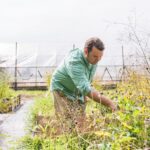
The Baltimore Ecosystem Study (BES) is one of only two urban Long-Term Ecological Research projects initially funded by the National Science Foundation, and this year it turns 20. When the BES was founded in 1998, “The field of urban ecology basically didn’t exist,” says Claire Welty, director of UMBC’s Center for Urban Environmental Research and Education. Since then, the field has flourished, in no small part thanks to dedicated researchers in Baltimore.
The BES has succeeded in compiling massive datasets on the Baltimore region’s watershed, ecology, and sociological issues related to the environment. The extent of these data are unparalleled anywhere else in the world. That makes the study “an international icon,” Welty says, and its wealth of fully public data provides “a rich resource for people to use in their research.”
“We’re living in a rapidly changing environment,” says Andy Miller, professor of geography and environmental systems (GES) and chair of the department when the study was founded. The long-term data the BES collects allows researchers to document “how systems change in response to what we do” on and to the landscape, Miller explains. That includes large-scale development of previously undisturbed ecosystems. If we can learn enough, Miller says, that knowledge may create “opportunities to mitigate the effects of urbanization.”
 Claire Welty, director of UMBC’s Center for Urban Environmental Research and Education.
Moving on those opportunities requires collaboration with policymakers at many levels. Over the course of the BES, its researchers have gained the trust of local and state officials who have found BES data helpful in informing policy discussions, says Miller. Employees from the Maryland Department of the Environment, Department of Natural Resources, and others regularly attend BES quarterly meetings.
At the federal level, scientists and managers from the USDA Forest Service’s Baltimore Field Station and from the US Geological Survey’s MD-DE-DC Water Science Center have been long-term partners, contributing to and benefiting from the BES program. Both are located at the bwtech@UMBC Research & Technology Park.
Beyond the flood of data and influence on policy, “The impact of the BES on research infrastructure and training in Baltimore has been so important,” says Miller. The BES is headquartered on UMBC’s campus, and the presence of the program here has helped faculty successfully apply for funding to support related projects. It even enabled the launch of UMBC’s graduate program in GES by facilitating funding of the program’s first students through the NSF’s Integrative Graduate Education and Research Traineeship program.
The education component of the BES extends far beyond the graduate level. Its education arm works with K-12 students throughout the Baltimore region to teach them about their local ecosystems and the importance of caring for the environment, with the goal of raising a generation of young people committed to environmental stewardship.
 Andy Miller (left) and Matthew Baker, professors of geography and environmental systems at UMBC.
Today, “More than half of the world’s population lives in cities,” says Chris Swan, professor of GES and a BES scientist, “and understanding how these environments function from the natural, physical and social science perspectives has never been more important.”
Plus, the effects of climate change don’t necessarily show up immediately, but can accumulate over time, explains Welty, “so it’s important that the data collection continue,” especially as climate change accelerates.
The BES is unique because it “brings scientists, stakeholders, policy makers, and students to the table on a regular basis to perform research, interpret results and understand outcomes,” says Swan. This level of collaboration on such a large scale enables BES to have a substantial impact, locally and in other urban areas around the world. This impact can be felt in the well-being of urban residents, he adds, “none more so than the people of Baltimore.”
Banner image: Chris Swan tends native plants at a UMBC greenhouse. All photos by Marlayna Demond ’11 for UMBC.
]]>
The Baltimore Ecosystem Study (BES) is one of only two urban Long-Term Ecological Research projects initially funded by the National Science Foundation, and this year it turns 20. When the BES was...
https://umbc.edu/stories/twenty-years-of-the-baltimore-ecosystem-study-an-icon-of-urban-ecology-research/
https://my3.my.umbc.edu/api/v0/pixel/news/120288/guest@my.umbc.edu/7a9e9ef2f7dad128bb9f573ad5905715/api/pixel
cahss
coeit
cuere
ges
research
science-and-technology
UMBC News & Magazine
https://my3.my.umbc.edu/groups/umbc-news-magazine
https://assets1-my.umbc.edu/system/shared/avatars/groups/000/001/943/24435aa6207c452e7bc15cc74b42c7bb/xsmall.png?1748556657
https://assets1-my.umbc.edu/system/shared/avatars/groups/000/001/943/24435aa6207c452e7bc15cc74b42c7bb/original.png?1748556657
https://assets2-my.umbc.edu/system/shared/avatars/groups/000/001/943/24435aa6207c452e7bc15cc74b42c7bb/xxlarge.png?1748556657
https://assets2-my.umbc.edu/system/shared/avatars/groups/000/001/943/24435aa6207c452e7bc15cc74b42c7bb/xlarge.png?1748556657
https://assets3-my.umbc.edu/system/shared/avatars/groups/000/001/943/24435aa6207c452e7bc15cc74b42c7bb/large.png?1748556657
https://assets1-my.umbc.edu/system/shared/avatars/groups/000/001/943/24435aa6207c452e7bc15cc74b42c7bb/medium.png?1748556657
https://assets2-my.umbc.edu/system/shared/avatars/groups/000/001/943/24435aa6207c452e7bc15cc74b42c7bb/small.png?1748556657
https://assets1-my.umbc.edu/system/shared/avatars/groups/000/001/943/24435aa6207c452e7bc15cc74b42c7bb/xsmall.png?1748556657
https://assets2-my.umbc.edu/system/shared/avatars/groups/000/001/943/24435aa6207c452e7bc15cc74b42c7bb/xxsmall.png?1748556657
UMBC News & Magazine
0
0
false
Fri, 02 Nov 2018 20:06:44 -0400
South Africa to Colorado: Summer research helps UMBC STEM BUILD students chart their course
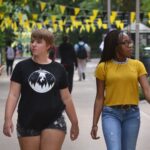
For an undergraduate getting their start in science, traveling far from home for an immersive research experience can be transformational. Living and working in a completely new environment, with new colleagues, can be intimidating, but it also offers powerful opportunities for growth. Five STEM BUILD students from UMBC took that plunge this summer, and all made lasting memories that will inform their paths forward.
Chad Brown ’19, biological sciences, traveled to South Africa with a research team based at the University of Virginia. Before departing, he spent time on UVA’s campus getting to know his team, practicing key lab techniques, and learning about South African culture.
“Not only are you going to be working in a research lab, but you’re doing it in a setting you’ve never experienced before,” Brown said. “You have to be in the mindset for that—and that’s what they were helping us do.”
Once in Thohoyandou, South Africa, Brown measured the concentration of bacteria in water samples from homes in the region. His efforts contributed to a long-term study designed to detect whether water treatment interventions are reducing bacteria in the water and affecting children’s growth.
Brown entered UMBC planning to pursue medical school, “but I think South Africa kind of flipped the script,” he said. Now he’s more seriously considering a research career. Many factors led to the shift, “but South Africa has been the big one that made the difference.”
Victoria Baskerville ’19, biological sciences, and Kendra Kontchou ’19, biological sciences and psychology, both participated in the University of Maryland School of Pharmacy Internship. Kontchou’s project focused on understanding a molecular pathway in pseudomonas bacteria, which is resistant to some antibiotics and commonly found in hospitals. The ultimate goal is to find a way to shut down the pathway and kill the bacteria.
A BUILD summer program at UMBC last summer helped prepare Kontchou by exposing her to techniques like gel electrophoresis, which she carried out many times at UMB. Baskerville felt similarly prepared for her research experience, where she analyzed data from clinical trials comparing a brand name and generic drug for people suffering from anemia.
“I felt comfortable going into it because a lot of the things that I did…I actually was exposed to in the summer BUILD program,” Baskerville said. She loves the scientific process, because “you get to figure out new things all the time.”
Baskerville has been planning to pursue research since her freshman year at UMBC. As she’s gained more lab experience and confidence through the BUILD program, research has become more central to her career plans.
“I feel as if I have a leg-up,” Kontchou said. “BUILD has laid a path for us and guided us. They help us with our academics, and they motivate us to look for research and other opportunities.”
 UMBC STEM BUILD students converse on campus. From left to right: Chad Brown, Kendra Kontchou, Amber Thompson, Gabriel Duran. Photo by Tim Ford.
Amber Thompson ’20, biochemistry and math, spent the summer at Colorado State University. She studied a gene that controls whether yeast cells clump together or not, which has important applications in the biofuels industry.
Her research project ran into roadblocks that required repeating a lengthy set of experiments, but there was a silver lining. “Research is like a big jigsaw puzzle,” Thompson said. “At first, I could only focus on one piece at a time. The second time, I could follow the intricacies and piece it together. Rather than just following a procedure, it was more of an intellectual challenge. You can start to see that trail, that next jigsaw piece that needs to be put together.”
Gabriel Duran ’19, environmental science and biological sciences, knows that he wants to first be a scientist, and then use his political science minor to advocate for environmental policies that benefit indigenous and other marginalized communities.
Duran spent this summer at the Marine Biological Laboratories (MBL) at Woods Hole, MA. There, he analyzed the nitrogen content of water samples from Little Pond, a reservoir in Falmouth, MA. The town is transitioning from septic to sewer systems to help reduce nitrogen pollution in local waterways, which causes harmful algal blooms.
“It gave me a lot of experience with different lab techniques, analyzing data, scientific communication skills, and overall it was just a great experience,” he shared. “I was surrounded by people who are as passionate as I am about environmental science.”
Before this summer, Duran had never before been on a boat, and one of his favorite parts of his time at Woods Hole was embarking on a research vessel to conduct experiments at sea. Away from the light pollution of the cities on land, he saw his first shooting star.
Duran’s summer experience went so well that another researcher at MBL has invited him to spend next summer working on her project—in the Arctic. He was delighted to accept, and he looks forward to another season of scientific discovery.
Image: STEM BUILD students on UMBC’s Academic Row. From left to right: Gabriel Duran, Amber Thompson, Kendra Kontchou, Chad Brown. Photo by Tim Ford.
]]>
For an undergraduate getting their start in science, traveling far from home for an immersive research experience can be transformational. Living and working in a completely new environment, with...
https://umbc.edu/stories/south-africa-to-colorado-umbc-stem-build-students-dive-into-summer-opportunities/
https://my3.my.umbc.edu/api/v0/pixel/news/120337/guest@my.umbc.edu/690bbd8f6a803356f7b34bfe2d1e7a54/api/pixel
biology
chembiochem
class-of-2019
cnms
community
ges
mathstat
psychology
science-and-technology
undergradresearch
UMBC News & Magazine
https://my3.my.umbc.edu/groups/umbc-news-magazine
https://assets1-my.umbc.edu/system/shared/avatars/groups/000/001/943/24435aa6207c452e7bc15cc74b42c7bb/xsmall.png?1748556657
https://assets1-my.umbc.edu/system/shared/avatars/groups/000/001/943/24435aa6207c452e7bc15cc74b42c7bb/original.png?1748556657
https://assets2-my.umbc.edu/system/shared/avatars/groups/000/001/943/24435aa6207c452e7bc15cc74b42c7bb/xxlarge.png?1748556657
https://assets2-my.umbc.edu/system/shared/avatars/groups/000/001/943/24435aa6207c452e7bc15cc74b42c7bb/xlarge.png?1748556657
https://assets3-my.umbc.edu/system/shared/avatars/groups/000/001/943/24435aa6207c452e7bc15cc74b42c7bb/large.png?1748556657
https://assets1-my.umbc.edu/system/shared/avatars/groups/000/001/943/24435aa6207c452e7bc15cc74b42c7bb/medium.png?1748556657
https://assets2-my.umbc.edu/system/shared/avatars/groups/000/001/943/24435aa6207c452e7bc15cc74b42c7bb/small.png?1748556657
https://assets1-my.umbc.edu/system/shared/avatars/groups/000/001/943/24435aa6207c452e7bc15cc74b42c7bb/xsmall.png?1748556657
https://assets2-my.umbc.edu/system/shared/avatars/groups/000/001/943/24435aa6207c452e7bc15cc74b42c7bb/xxsmall.png?1748556657
UMBC News & Magazine
0
0
false
Wed, 12 Sep 2018 14:33:18 -0400
Drones to track one of the largest dam removals on the Eastern Seaboard
Matthew E. Baker
Professor of Geography and Environmental Systems, UMBC
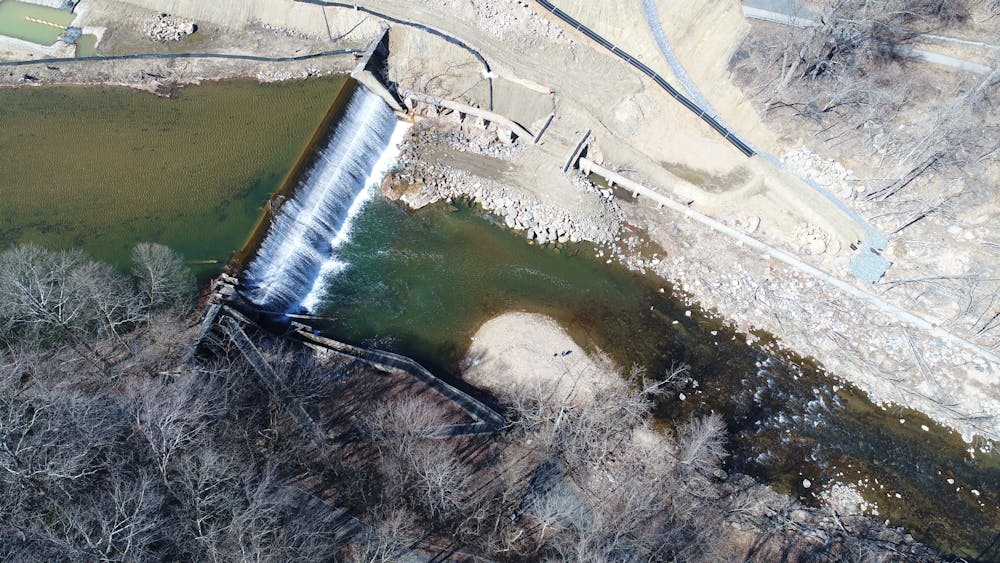
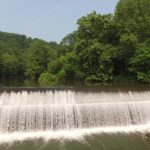
This month, the Bloede Dam will be removed from the Lower Patapsco River near Ilchester, Maryland.
The restoration is a one-of-a-kind natural experiment that will help test how relatively inexpensive drones can help scientists like me understand the integrity of streams and rivers.
My collaborators include students and researchers from the University of Maryland Baltimore County, Maryland Geological Survey, Maryland Department of Natural Resources, National Oceanic and Atmospheric Administration and U.S. Geological Survey.
If our approach works, it will allow us to track sediment movement more completely and accurately than ever before, at a fraction of the expense.
What will change
Completed in 1907 and operational for 30 years, the Bloede Dam contained the first submerged hydroelectric plant in the U.S. At 26.5 feet high, it represents one of the largest dam removals on the Eastern Seaboard.
Why remove the dam? The state, federal agencies and nonprofit American Rivers hope to eliminate a derelict public safety hazard.
Taking out the dam will also complement restoration from previous dam removals upstream and expand connected habitat for fish and other aquatic creatures. The Patapsco once hosted major freshwater runs of shad, alewife and American eel, which were blocked by the dam. A fish ladder has proven ineffective at connecting upstream sections of the river with the downstream estuary and the Chesapeake Bay.
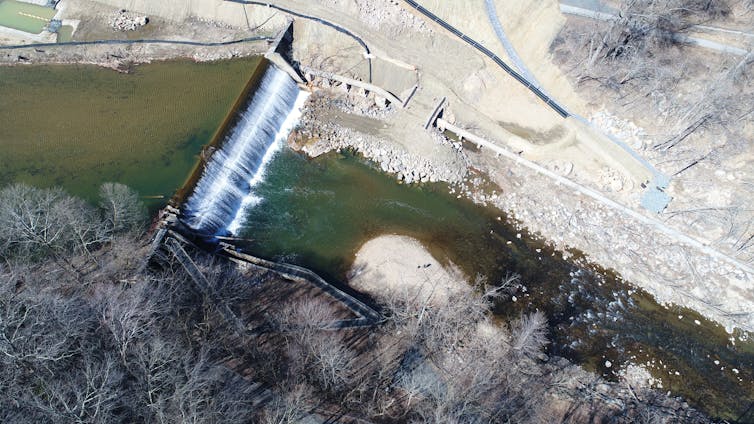 The Bloede Dam in March. The obsolete fish ladder is in the foreground.
Matthew Baker/UMBC
Despite a prominent role in early U.S. manufacturing, the Patapsco Valley has suffered its share of environmental challenges. Colonial shipping was forced to relocate to Baltimore after the original port at Elkridge Landing was choked by sediment from shipping ballast, river bank mining and upstream forest clearing. Once a 10-foot channel surrounded by a saltwater marsh, today the site is fresh and the channel less than two feet deep.
Periodic floods have also wreaked havoc in the narrow gorge, occasionally with catastrophic results. In the past few years, flash floods just upstream in Ellicott City have ruptured the sewer main that runs along the valley bottom and reorganized large quantities of sand, wood and rock in the downstream channel.
Today, the dam stores approximately 2.6 million cubic feet of stratified silt and sand less than eight miles from Chesapeake Bay tidewater. When the dam is removed, we want to know how this much sediment is going to move and how fast.
Why sediment movement?
Understanding sediment movement is critical for river management in every jurisdiction of the Chesapeake Bay watershed.
Sediment helps balance water flow to maintain channel shape and stable habitats for aquatic plants, invertebrates and fish. River sediment is necessary to help estuarine coastlines combat sea level rise. However, fine sediment can also be a pollutant in, or carry nutrients and heavy metals to, downstream estuaries.
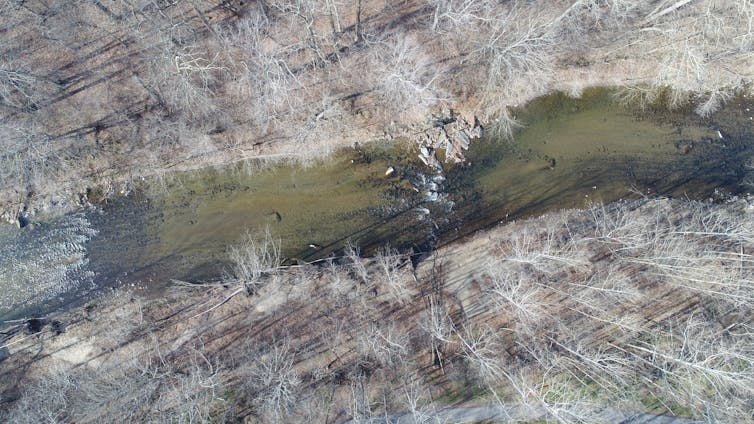 Aerial image of the Patapsco River channel showing gravel, cobble and sand deposits.
Matthew Baker/UMBC
Although it’s easy to observe evidence of sediment erosion from riverbanks or hillsides, it’s often unclear where and how much of that sediment is redeposited and stored. Management of sediment storage, particularly behind dams, can be somewhat controversial.
After studying several other dam removals, we expect sediment trapped behind the dam to rapidly evacuate and redistribute downstream over a period of several years.
However, there’s still much we don’t know. Floods following intense storms can move huge quantities of sediment, altering the valley bottom in just hours. Will such storms redeposit sediment elsewhere in the gorge or the coastal floodplain, or deliver it to the bay?
New ways to track changes
It’s logistically difficult to accurately measure large and potentially rapid channel changes.
In a typical field survey, technicians measure water depth, flow, bottom substrate and other information at specific locations. Though stream channels can vary tremendously over space as well as through time, we scientists are rarely able to represent such variability in our measurements. Instead, we collect isolated snapshots in time. That leaves us with less understanding of dynamic sediment movement, devastation wrought by flood waves or the diversity of conditions necessary to support aquatic life.
Gauging stations located upstream and downstream of the dam measure water flow and estimate suspended material like fine silts and clays, but not coarser sands and gravels moving along the channel bottom. Surveys of 30 cross-sections distributed over eight miles provide information about how channel shape and composition vary as one crosses the channel, but relatively little about the thousands of feet in between each transect.
What’s more, after a major flood, scientists must conduct new cross-sectional surveys, taking up to a month in occasionally in risky conditions.
Our team is attempting to add to our measurements by deploying small, off-the-shelf drones that photograph the entire valley bottom. Repeat photographs before, during and after removal can help us track the location of a sediment plume as it moves downstream. They also allow new perspectives of the river.
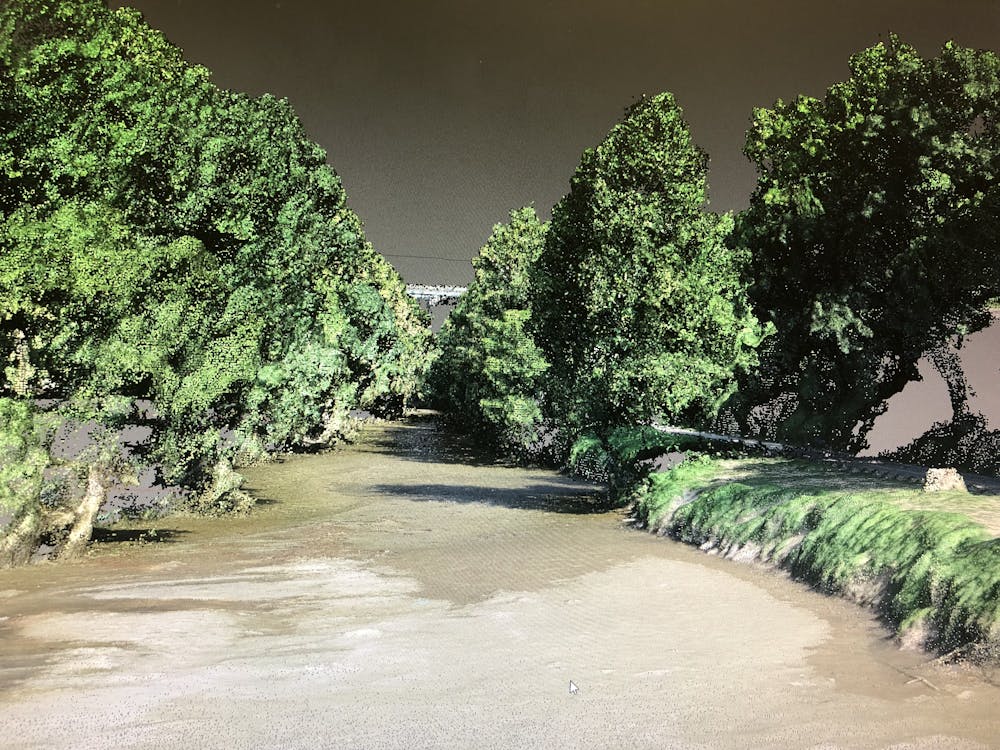
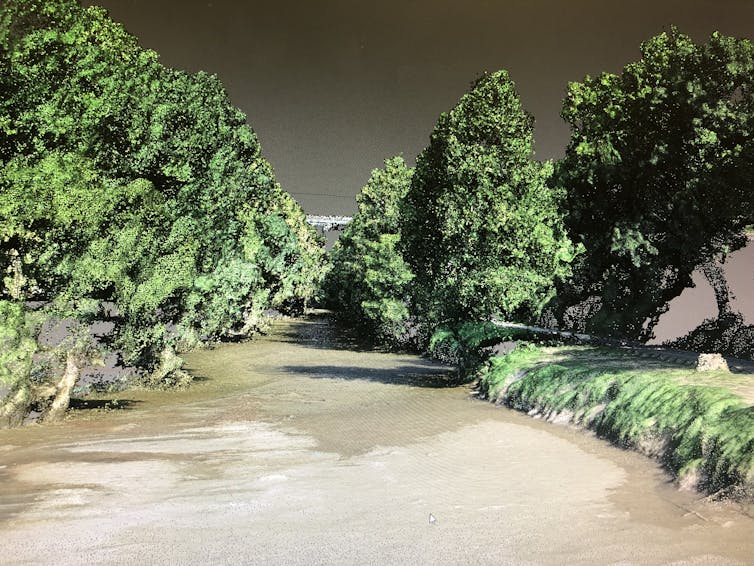 3D view of a Patapsco River channel point cloud.
Matthew Baker/UMBC
Relying solely on overlapping photos collected both before and after dam removal, we will create 3D computer models of the channel bottom and water depth – not just at the surveyed cross-sections, but every few inches along the channel. Although this technology works best in shallow water, our models should allow us to vastly improve estimates of both the amount and location of channel change as sediment moves downstream.
3D view of the Patapsco River point cloud.
With the new approach, our team collects a photo set of all eight miles in just a few days, and further work occurs within a desktop computer. That means measurements can be repeated or made anew at any time using archived images.
Although we are certainly curious to see how this much sediment moves, we are especially interested in how well we can capture it. If it works, this technology will likely change the way scientists collect measurements and monitor rivers.
* * * * *
Matthew E. Baker, Professor of Geography and Environmental Systems, University of Maryland, Baltimore County
Header photo: Bloede Dam (ca. 2016) near Ilchester, Maryland. Matthew Baker/UMBC CC BY-SA
This article was originally published on The Conversation. Read the original article.
]]>
Matthew E. Baker Professor of Geography and Environmental Systems, UMBC This month, the Bloede Dam will be removed from the Lower Patapsco River near Ilchester, Maryland. The restoration is a...
https://umbc.edu/stories/drones-to-track-one-of-the-largest-dam-removals-on-the-eastern-seaboard/
https://my3.my.umbc.edu/api/v0/pixel/news/120343/guest@my.umbc.edu/71759e71b1b22bffecee010fcec0d96e/api/pixel
discovery
ges
matt-baker
the-conversation
UMBC News & Magazine
https://my3.my.umbc.edu/groups/umbc-news-magazine
https://assets1-my.umbc.edu/system/shared/avatars/groups/000/001/943/24435aa6207c452e7bc15cc74b42c7bb/xsmall.png?1748556657
https://assets1-my.umbc.edu/system/shared/avatars/groups/000/001/943/24435aa6207c452e7bc15cc74b42c7bb/original.png?1748556657
https://assets2-my.umbc.edu/system/shared/avatars/groups/000/001/943/24435aa6207c452e7bc15cc74b42c7bb/xxlarge.png?1748556657
https://assets2-my.umbc.edu/system/shared/avatars/groups/000/001/943/24435aa6207c452e7bc15cc74b42c7bb/xlarge.png?1748556657
https://assets3-my.umbc.edu/system/shared/avatars/groups/000/001/943/24435aa6207c452e7bc15cc74b42c7bb/large.png?1748556657
https://assets1-my.umbc.edu/system/shared/avatars/groups/000/001/943/24435aa6207c452e7bc15cc74b42c7bb/medium.png?1748556657
https://assets2-my.umbc.edu/system/shared/avatars/groups/000/001/943/24435aa6207c452e7bc15cc74b42c7bb/small.png?1748556657
https://assets1-my.umbc.edu/system/shared/avatars/groups/000/001/943/24435aa6207c452e7bc15cc74b42c7bb/xsmall.png?1748556657
https://assets2-my.umbc.edu/system/shared/avatars/groups/000/001/943/24435aa6207c452e7bc15cc74b42c7bb/xxsmall.png?1748556657
UMBC News & Magazine
0
0
false
Wed, 05 Sep 2018 21:59:11 -0400
UMBC’s Matthew Baker teams up with Chesapeake Conservancy to create detailed stream maps
Thousands of waterways, from major rivers like the Potomac and Susquehanna to tiny headwaters, flow through the Chesapeake Bay watershed. Many of them appear on official stream maps produced by the U.S. Geological Survey, but many others go unrecorded.
Because the official maps are incomplete, “if you base management and restoration goals on coarse stream maps, you’re going to miss a big part of the picture,” says Matthew Baker, professor of geography and environmental systems at the University of Maryland Baltimore County (UMBC).
Baker’s partnership with the non-profit Chesapeake Conservancy has been awarded $1.2 million from the Chesapeake Bay Program (CBP) to create a more accurate, updated map for the watershed by applying new stream mapping techniques.
The Chesapeake Bay Program is supporting accurate stream mapping to improve management and implementation of the Chesapeake Bay Total Maximum Daily Load—daily Bay pollution limits set by the U.S. EPA in 2010.
Small streams are often overlooked for restoration activities because they do not show up on the official maps, despite delivering large amounts of nutrient and sediment pollution to the Bay. Updated stream maps will help partners throughout the Chesapeake Bay watershed prioritize restoration efforts and better understand how pollution enters the Bay’s tributaries.
Innovative approaches
This project follows a previous Chesapeake Bay Trust (CBT) award to Baker and his Chesapeake Conservancy colleagues to develop the methods necessary to carry out such a daunting task. With traditional methods, “You need skilled personnel doing very tedious, detail-oriented work over a long period of time,” says Baker. “We look forward to continuing to develop more automated, efficient and cost-effective ways.”
Now, Baker and his team get the chance to take on the challenge of using their new techniques to create the most detailed map of the region’s waterways to date, in a fraction of the time required by previous methods.
To identify previously unmapped stream channels, Baker and his team will analyze data from models of the terrain generated by light detection and ranging (LiDAR). This technology uses lasers emitted from aircraft to measure the relative height of Earth’s surface very precisely. But that’s just the beginning.
Baker’s team will remove inconsistencies and errors inherent to the LiDAR data, such as when the laser beam hits tree leaves or water surfaces instead of the ground. Then the team will find stream channels by creatively applying algorithms that interpret the terrain in the context of the surrounding landscape. The new maps may still not capture every single channel, but Baker hopes to get a lot closer while limiting false-positives.
Connecting the dots
“What the CBP was asking for was not just, ‘How do you find the channels?’, but, ‘How do you link them together in a connected network?’ And, ironically, that’s not a simple thing to do with this sort of detailed terrain information,” Baker says.
“For example, if a stream flows under a road, the road is interpreted as a kind of dam by conventional computer algorithms, even though our eyes and brain naturally connect the channel on either side,” Baker explains. Although such features are intuitive for people, computers need to be taught how to fill in those gaps accurately and appropriately.
Once the team develops a more complete map, they will still have one more crucial step to complete. “A big part of the project is to validate and check the map,” Baker says. “If the stream map isn’t reliable and no one believes it, then it’s not very useful. So that’s what we’re going to spend a lot of time doing.”
He estimates that about two-thirds of the time spent on the six-year project will focus on quality control. “With Chesapeake Conservancy’s assistance and expertise, we will compare the results of the new automated techniques with data collected from aerial imagery or on the ground at sites around the watershed.”
“Chesapeake Conservancy is a great partner in this context,” says Baker. “They’ve developed a lot of experience generating geographic datasets for the watershed.”
Conservation outcomes
Having a complete, reliable map is essential for protecting waterways. “If we want to understand how what we do on the landscape influences stream integrity and downstream health in places like the Chesapeake Bay,” Baker says, “then being able to map the connections between human activities on the land and the circulatory water system that delivers their effects to the Bay is paramount.”
Streams not visible on current official maps have already proven extremely important in research. Early evidence that vegetation alongside streams could reduce discharges of harmful pollutants into the Bay came from research on streams that weren’t on the best USGS maps at the time, Baker notes.
For now, the USGS has identified developing high-resolution stream maps as a national goal, and Baker hopes to contribute to that effort. The updated, verified map will enhance management and protection within the Chesapeake Bay watershed, and the methods Baker and the Chesapeake Conservancy have developed have the potential to improve stream mapping—and to better protect waterways—across the nation and the world.
Image: Matthew Baker at UMBC. Photo by Marlayna Demond ’11 for UMBC.
]]>
Thousands of waterways, from major rivers like the Potomac and Susquehanna to tiny headwaters, flow through the Chesapeake Bay watershed. Many of them appear on official stream maps produced by...
https://umbc.edu/stories/umbcs-matthew-baker-teams-up-with-chesapeake-conservancy-to-create-detailed-stream-maps-of-chesapeake-bay-watershed/
https://my3.my.umbc.edu/api/v0/pixel/news/120354/guest@my.umbc.edu/de3af6f82354dcdde8ba61e35aba2a42/api/pixel
cahss
ges
research
science-and-technology
UMBC News & Magazine
https://my3.my.umbc.edu/groups/umbc-news-magazine
https://assets1-my.umbc.edu/system/shared/avatars/groups/000/001/943/24435aa6207c452e7bc15cc74b42c7bb/xsmall.png?1748556657
https://assets1-my.umbc.edu/system/shared/avatars/groups/000/001/943/24435aa6207c452e7bc15cc74b42c7bb/original.png?1748556657
https://assets2-my.umbc.edu/system/shared/avatars/groups/000/001/943/24435aa6207c452e7bc15cc74b42c7bb/xxlarge.png?1748556657
https://assets2-my.umbc.edu/system/shared/avatars/groups/000/001/943/24435aa6207c452e7bc15cc74b42c7bb/xlarge.png?1748556657
https://assets3-my.umbc.edu/system/shared/avatars/groups/000/001/943/24435aa6207c452e7bc15cc74b42c7bb/large.png?1748556657
https://assets1-my.umbc.edu/system/shared/avatars/groups/000/001/943/24435aa6207c452e7bc15cc74b42c7bb/medium.png?1748556657
https://assets2-my.umbc.edu/system/shared/avatars/groups/000/001/943/24435aa6207c452e7bc15cc74b42c7bb/small.png?1748556657
https://assets1-my.umbc.edu/system/shared/avatars/groups/000/001/943/24435aa6207c452e7bc15cc74b42c7bb/xsmall.png?1748556657
https://assets2-my.umbc.edu/system/shared/avatars/groups/000/001/943/24435aa6207c452e7bc15cc74b42c7bb/xxsmall.png?1748556657
UMBC News & Magazine
0
0
false
Wed, 15 Aug 2018 22:49:59 -0400
When did humans start to transform Earth? UMBC’s Erle Ellis introduces the Anthropocene.
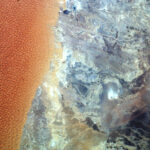
 “Humans have emerged as a force of nature on this planet,” UMBC’s Erle Ellis says, as he begins to explain his work. Ellis, a professor of geography and environmental systems is one of the world’s leading thinkers on the Anthropocene, a new word scientists are using to describe Earth’s current geological epoch, defined by human transformation of the planet.
“We are changing Earth’s climate faster than at any time since the fall of the dinosaurs,” says Ellis. For scientists, he notes, “What’s controversial…is when did this begin? […] When did humans literally become the global shaper of the earth?”
In 2009, the International Commission on Stratigraphy, through its Subcommission of Quaternary Stratigraphy, created the Anthropocene Working Group (AGW) that is officially charged to examine whether the Anthropocene should be added as a formal time interval in the geologic time scale (following the Holocene, the current geological epoch after the last ice age) and, if so, what should mark its beginning. Shortly after its formation, Ellis was asked to join the Anthropocene Working Group as an expert on human transformation of the biosphere.
 AWG workshop in 2015 at the McDonald Institute for Archaeological Research, University of Cambridge, UK. Erle Ellis is on the left side, in the green shirt. Photo courtesy of Erle Ellis.
Scientists today disagree about when human impact on Earth reached levels sufficient to identify the start of the Anthropocene. Did this come with early forest clearing and agricultural production some 5,000 – 8,000 years ago? Or did this begin with European colonization of the Americas? Or very recently, with the Great Acceleration of environmental change that began in the 1950s?
Ellis tackles this question and others in his new book, Anthropocene: A Very Short Introduction. Right now the Great Acceleration of the 1950s is the leading candidate for the Anthropocene’s beginning, but heated discussions are ongoing, and will likely continue even after a formal Anthropocene is defined in the Geologic Time Scale, which could occur as early as 2020, when the International Union of Geological Science next meets.
The book Anthropocene builds on Ellis’s earlier writing about the complexities, evolution, and controversies surrounding the emergence of humans as a force transforming Earth in The New York Times, The Economist, and other media. Ellis offers readers new to this debate varying viewpoints from geologists, geographers, environmental scientists, archaeologists, political scientists, and scholars of the humanities. In exploring how people have impacted air and water quality, plant and animal life, and our own health and wellbeing through practices that have made our immediate lives easier but are also having serious, long-term consequences for the health of the planet.
“The Anthropocene engages us in seeking new narratives about what it means to be human, from humans as environmental destroyers to humans as the salvation of this planet,” explains Erle Ellis.
“One of the biggest questions about the Anthropocene is whether it should be considered to be a bad thing and the reason that it’s such a big question is because so many of the definitions of what humans are doing to this planet are negative things, like changing the climate and causing mass extinction,” says Ellis. “Yet, on the other hand, the Anthropocene is not over, and it really remains to be seen what we’re going to make of this human time period.”
Ultimately, Ellis argues, “We humans are going to shape the future of this planet.” So, he asks, “what kind of planet are we going to shape?”
Banner image: Grand Erg Oriental, Algeria, October 31, 2017. Image provided by the Sally Ride EarthKAM@Space Camp on the International Space Station.
]]>
“Humans have emerged as a force of nature on this planet,” UMBC’s Erle Ellis says, as he begins to explain his work. Ellis, a professor of geography and environmental systems is one of the world’s...
https://umbc.edu/stories/when-did-humans-start-to-transform-earth-umbcs-erle-ellis-introduces-the-anthropocene/
https://my3.my.umbc.edu/api/v0/pixel/news/120390/guest@my.umbc.edu/e0c676d872f9c2d8a9fa72080f6859dc/api/pixel
cahss
ges
policy-and-society
research
science-and-technology
UMBC News & Magazine
https://my3.my.umbc.edu/groups/umbc-news-magazine
https://assets1-my.umbc.edu/system/shared/avatars/groups/000/001/943/24435aa6207c452e7bc15cc74b42c7bb/xsmall.png?1748556657
https://assets1-my.umbc.edu/system/shared/avatars/groups/000/001/943/24435aa6207c452e7bc15cc74b42c7bb/original.png?1748556657
https://assets2-my.umbc.edu/system/shared/avatars/groups/000/001/943/24435aa6207c452e7bc15cc74b42c7bb/xxlarge.png?1748556657
https://assets2-my.umbc.edu/system/shared/avatars/groups/000/001/943/24435aa6207c452e7bc15cc74b42c7bb/xlarge.png?1748556657
https://assets3-my.umbc.edu/system/shared/avatars/groups/000/001/943/24435aa6207c452e7bc15cc74b42c7bb/large.png?1748556657
https://assets1-my.umbc.edu/system/shared/avatars/groups/000/001/943/24435aa6207c452e7bc15cc74b42c7bb/medium.png?1748556657
https://assets2-my.umbc.edu/system/shared/avatars/groups/000/001/943/24435aa6207c452e7bc15cc74b42c7bb/small.png?1748556657
https://assets1-my.umbc.edu/system/shared/avatars/groups/000/001/943/24435aa6207c452e7bc15cc74b42c7bb/xsmall.png?1748556657
https://assets2-my.umbc.edu/system/shared/avatars/groups/000/001/943/24435aa6207c452e7bc15cc74b42c7bb/xxsmall.png?1748556657
UMBC News & Magazine
0
0
false
Thu, 14 Jun 2018 19:10:11 -0400
UMBC health justice research forum focuses on the value of community voices

How does unequal access to health care affect the lives and experiences of people from different communities across Baltimore and the nation? UMBC’s Public Humanities and Health Justice Research Forum addressed this question through remarks and conversations with researchers from UMBC’s College of Arts, Humanities, and Social Sciences (CAHSS), College of Engineering and Information Technology (COEIT), and College of Natural and Mathematical Sciences (CNMS), as well as Johns Hopkins University, Morgan State University, Coppin State University, and Columbia University.
The forum was the fourth in a series organized by UMBC’s Office of the Vice President for Research to bring together faculty tackling shared topics from widely diverse angles. “We established the research forum series in 2014 to provide an opportunity for scientists and scholars to collaboratively explore multiple facets of a topic central to the research and scholarship of UMBC,” says Karl Steiner, vice president for research. Previous forum focus areas include high-performance computing, climate change and the environment, and the visualization of science.
UMBC’s Dresher Center for the Humanities sponsored and helped organize the latest forum, focused on how the humanities can help address challenges related to health care access. Dresher Center Director Jessica Berman shared, “It was exciting to see how much humanistic scholarship is taking place all across campus and the potential partnerships it creates, between UMBC and other universities. This research forum helped to highlight the humanities in their capacity not only to ask good questions but also to help solve important problems such as health justice and access.”
Racism in Health Care Policy
Keynote speaker Graham Mooney, professor in the Institute of the History of Medicine at Johns Hopkins University, presented his research on the Baltimore Medical Care Plan of 1948. “By using the history of medicine and public policy we can better understand how the process of racism and segregation have interacted to prevent black residents’ access to quality medical care in Baltimore,” explained Mooney.
 Graham Mooney, professor in the Institute of the History of Medicine at Johns Hopkins University
The topic led to an interactive conversation about the negative impact the 1948 plan had on the quality of life of Baltimore’s black community and how it served as a model for similar approaches in other states, and later for Medicare and Medicaid. During the discussion, Shawn Bediako, associate professor of psychology, argued that analyses of health care access across U.S. history should also include how black communities have responded to inequities. He mentioned, as examples, the establishment of the National Negro Health Movement and Office of Negro Health Work.
 Shawn Bediako, associate professor of psychology
Listening to Communities
Valuing community voices was a key theme in the two interdisciplinary panel discussions that followed. These discussions revealed how key humanities methods, such as attending to history, paying attention to narrative—including who gets to speak and when—and thinking critically about how we understand and value specific human experiences can be crucial to addressing issues important to contemporary public life.
In the first of those panels, Kristen Slesar, from the Narrative Medicine Program at Columbia University, shared her experience using personal narratives to inform medical research. Slesar is a licensed clinical social worker and psychotherapist who focuses on child trauma. She regularly teaches about health care justice and health care for underserved communities.
Scott Casper, dean of the College of arts, humanities, and social sciences (CAHSS), then moderated a discussion on “Listening as Public Practice: Towards Equity and Justice” that included Bediako as well as colleagues Drew Holladay, assistant professor of English; Amy Hurst, associate professor of information systems; and Denise Meringolo, associate professor of history. The panelists explored how centering the narratives of individuals in their research improves the quality of their findings and the potential impact of their work. “Confronting the barriers to health equity compels us to look across disciplines and toward collaborations among social scientists, scientists and engineers, and humanists and artists,” noted Casper.
 (L to R) Dean Casper, Kristen Slesar, Shawn Bediako, Drew Holladay, Amy Hurst, and Denise Meringolo.
Lawrence Brown, assistant professor of community health and policy at Morgan State University, spoke during the second panel about the impacts of residential displacement and financial disinvestment on community health. In addition to his work on the impact of historical trauma on community health, he also leads the student-driven #BmoreLEADfree project focused on ending lead poisoning in Baltimore.
Berman then led a group discussion on the topic “Communication, the Urban Environment, and Health Justice,” with Dena Aufseeser, assistant professor of geography and environmental systems; Katherine Bankole-Medina, professor of history at Coppin State University; Dawn Biehler, associate professor of geography and environmental systems; and Jennifer Maher, associate professor of English. The discussion showed how paying attention to the ways local communities understand issues of health and the environment can challenge the kinds of changes we propose and the ways we communicate about them.
New Health Equity Collaborative
The forum also introduced UMBC’s new Collaborative for the Interdisciplinary Promotion of Health Equity Research (CIPHER). The collaborative will form working groups bringing together UMBC researchers across different fields to examine current challenges to health care equity, and to inform innovative solutions for the future.
Bediako, whose research focuses on health care inequities experienced by patients with sickle cell disease, will serve as the founding convener of this initiative. He shares, “I am most excited that CIPHER will aim to reach across disciplinary boundaries and use multiple perspectives to address specific challenges to health equity.”
Banner image: (L to R) Courtney C. Hobson M.A.’14, history, coordinator for the Dresher Center; Karl Steiner; Rachel Brubaker M.A. ’00, history, assistant director for grants and program development for the Dresher Center; Don Engel, assistant vice president for research; Scott Casper; and Jessica Berman. All photos by Kait McCaffrey for UMBC.
]]>
How does unequal access to health care affect the lives and experiences of people from different communities across Baltimore and the nation? UMBC’s Public Humanities and Health Justice Research...
https://umbc.edu/stories/umbc-health-justice-research-forum-focuses-on-the-value-of-community-voices/
https://my3.my.umbc.edu/api/v0/pixel/news/120404/guest@my.umbc.edu/37df09496e22a201c580854e4d92402a/api/pixel
cahss
cnms
coeit
diversityandinclusion
dreshercenter
english
ges
history
interdisciplinary
is
policy-and-society
psychology
research
UMBC News & Magazine
https://my3.my.umbc.edu/groups/umbc-news-magazine
https://assets1-my.umbc.edu/system/shared/avatars/groups/000/001/943/24435aa6207c452e7bc15cc74b42c7bb/xsmall.png?1748556657
https://assets1-my.umbc.edu/system/shared/avatars/groups/000/001/943/24435aa6207c452e7bc15cc74b42c7bb/original.png?1748556657
https://assets2-my.umbc.edu/system/shared/avatars/groups/000/001/943/24435aa6207c452e7bc15cc74b42c7bb/xxlarge.png?1748556657
https://assets2-my.umbc.edu/system/shared/avatars/groups/000/001/943/24435aa6207c452e7bc15cc74b42c7bb/xlarge.png?1748556657
https://assets3-my.umbc.edu/system/shared/avatars/groups/000/001/943/24435aa6207c452e7bc15cc74b42c7bb/large.png?1748556657
https://assets1-my.umbc.edu/system/shared/avatars/groups/000/001/943/24435aa6207c452e7bc15cc74b42c7bb/medium.png?1748556657
https://assets2-my.umbc.edu/system/shared/avatars/groups/000/001/943/24435aa6207c452e7bc15cc74b42c7bb/small.png?1748556657
https://assets1-my.umbc.edu/system/shared/avatars/groups/000/001/943/24435aa6207c452e7bc15cc74b42c7bb/xsmall.png?1748556657
https://assets2-my.umbc.edu/system/shared/avatars/groups/000/001/943/24435aa6207c452e7bc15cc74b42c7bb/xxsmall.png?1748556657
UMBC News & Magazine
0
0
false
Wed, 06 Jun 2018 19:11:29 -0400
UMBC ecologist and colleagues expose bias in forest restoration studies

When embarking on a reforestation project, is it better to let an area regenerate on its own, or take active steps like planting trees? Recent high-profile research has suggested that natural regeneration is more effective. However, UMBC’s Matthew Fagan and colleagues have just published their own research in Science Advances suggesting those studies were biased, and advocating for a more nuanced approach to forest restoration.
“This paper takes a more critical look at recent papers that have made a big splash,” says Fagan, assistant professor of geography and environmental systems. “I love this paper because it points out an important flaw in several studies, and also because those studies are really important to understanding how best we should restore the planet’s forests.”
So what was the flaw? Leighton Reid, a Missouri Botanical Garden scientist and first author on the new paper, says the studies were making “an apples to oranges comparison.” All of the sites the studies used to measure the effectiveness of natural regeneration were secondary growth forests, but the sites that used human-aided regeneration ran the gamut from abandoned coal mines to fields compacted by years of cattle-grazing. The natural regeneration sites had a leg up on the sites selected for active regeneration, so it’s no surprise the former came out the winner.
The new paper’s authors are not arguing that tree planting is superior to natural regeneration, however. “We just point out that rather than argue for natural regeneration versus artificial tree planting, it’s often worthwhile to just step back and give natural regeneration a chance for a year or two. It’s free,” Fagan says. “If it fails, then look at your objectives and figure out what sort of interventions you need to do, rather than saying one is better than the other.”
In some cases it makes sense to combine elements from both approaches. For example, planting small clusters of trees, rather than trying to replant an entire site, can sometimes be enough. “Tree planting can be the sparkplug that gets birds coming into a site, that then kickstarts regeneration,” says Fagan.
Around the world right now, countries are committing to restore millions of hectares of forest, explains Fagan, and with limited resources available for such work, it’s important to understand what the most effective techniques will be. There’s no one easy answer, but “if we want to learn more about which of these different types of restoration works better, we need to do more experiments,” says Fagan. To date, there have been very few experiments that actually look at the two methods side by side at the same site, which is what’s needed, he argues.
“The main takeaway from our paper is that natural regeneration isn’t a guaranteed success, even in the tropics. Sites can be so damaged by human management that they take a long time to recover,” says Fagan. “So while natural regeneration can be a useful restoration possibility, we shouldn’t necessarily assume that it’s always better for all objectives.” Those objectives could include pulling carbon out of the atmosphere, preventing erosion, filtering air and water, or building up sustainable agriculture, such as shade-grown coffee. “Contrary to previous scientific arguments, planting trees can be a perfectly viable choice.”
Image: A new artificial reforestation project in Costa Rica. Photo by Matthew Fagan.
]]>
When embarking on a reforestation project, is it better to let an area regenerate on its own, or take active steps like planting trees? Recent high-profile research has suggested that natural...
https://umbc.edu/stories/umbc-ecologist-and-colleagues-expose-bias-in-forest-restoration-studies/
https://my3.my.umbc.edu/api/v0/pixel/news/120432/guest@my.umbc.edu/9fb6300359274a1443e439216412153c/api/pixel
cahss
ges
research
science-and-technology
UMBC News & Magazine
https://my3.my.umbc.edu/groups/umbc-news-magazine
https://assets1-my.umbc.edu/system/shared/avatars/groups/000/001/943/24435aa6207c452e7bc15cc74b42c7bb/xsmall.png?1748556657
https://assets1-my.umbc.edu/system/shared/avatars/groups/000/001/943/24435aa6207c452e7bc15cc74b42c7bb/original.png?1748556657
https://assets2-my.umbc.edu/system/shared/avatars/groups/000/001/943/24435aa6207c452e7bc15cc74b42c7bb/xxlarge.png?1748556657
https://assets2-my.umbc.edu/system/shared/avatars/groups/000/001/943/24435aa6207c452e7bc15cc74b42c7bb/xlarge.png?1748556657
https://assets3-my.umbc.edu/system/shared/avatars/groups/000/001/943/24435aa6207c452e7bc15cc74b42c7bb/large.png?1748556657
https://assets1-my.umbc.edu/system/shared/avatars/groups/000/001/943/24435aa6207c452e7bc15cc74b42c7bb/medium.png?1748556657
https://assets2-my.umbc.edu/system/shared/avatars/groups/000/001/943/24435aa6207c452e7bc15cc74b42c7bb/small.png?1748556657
https://assets1-my.umbc.edu/system/shared/avatars/groups/000/001/943/24435aa6207c452e7bc15cc74b42c7bb/xsmall.png?1748556657
https://assets2-my.umbc.edu/system/shared/avatars/groups/000/001/943/24435aa6207c452e7bc15cc74b42c7bb/xxsmall.png?1748556657
UMBC News & Magazine
0
0
false
Wed, 16 May 2018 19:06:21 -0400
UMBC’s Chris Swan featured in The Atlantic for transforming vacant lots in Baltimore
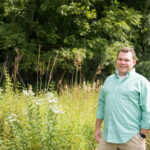
Baltimore, like many large U.S. cities, struggles to manage thousands of vacant lots. Most of these lots consist of a thin layer of nutrient-poor soil over demolition debris, with hardy grasses poking up here and there, but UMBC’s Chris Swan, professor of geography and environmental systems, is working to break this mold.
Swan and his collaborators have planted native wildflower seeds in dozens of vacant Baltimore lots since 2014, and now more than 50 percent of the plants in those plots are native species like black-eyed Susans and purple coneflowers. A new article in The Atlantic discusses the promise and challenges of Swan’s ambitious project.
Swan’s work is part of the Baltimore Ecosystem Study, launched in 1997, and lies at the intersection of the natural and social sciences. He is scientifically investigating which native plants survive best and absorb the most pollutants in abandoned urban lots while simultaneously navigating neighbors’ reactions and city policies. “Science is hard, but this”—managing competing interests and expectations—“is really, really hard,” Swan says.
As The Atlantic describes, there have been setbacks, such as the day some of his plots were unceremoniously mowed in preparation for a neighborhood visit from the mayor. Still, Swan is excited by how much the project has grown over the past few years, and his early findings. Eventually, he hopes to discover a Goldilocks concoction of plants that tolerate the poor soil, attract native pollinators, and reduce runoff of contaminant-laced water into the Chesapeake Bay.
To find the magical combination, twice a year Swan and his team collect tens of thousands of measurements from the plots. “The data collection is enormous,” Swan tells The Atlantic, and it’s only going to increase heading into the summer, as Swan begins using drones to collect even more data about plant growth.
Swan intends to continue the project for five to 10 more years, but recognizes that the ultimate goal is not to turn the city into a wildflower meadow—it’s to reinvigorate neighborhoods that have a high proportion of vacant land. That means that while some plots might thrive with plant life for years, others might be developed, based on local needs and investments.
Even though the challenges are significant and the plots aren’t permanent, Swan is dedicated to helping the city make incremental improvements, and to moving forward the conversation about urban ecology in Baltimore. “The idea is to take a problem that is huge,” he tells The Atlantic, “and try and work toward a way of managing that space that’s better than it is now.” For now, he’s gratified to hear neighbors share their delight at spotting new birds and lightning bugs in the area, attracted by his team’s wildflowers.
Read the entire article in The Atlantic, “The ecologists turning vacant lots into labs.”
Image: Chris Swan. Photo by Marlayna Demond ’11 for UMBC.
]]>
Baltimore, like many large U.S. cities, struggles to manage thousands of vacant lots. Most of these lots consist of a thin layer of nutrient-poor soil over demolition debris, with hardy grasses...
https://umbc.edu/stories/umbcs-chris-swan-featured-in-the-atlantic-for-transforming-vacant-lots-in-baltimore/
https://my3.my.umbc.edu/api/v0/pixel/news/120547/guest@my.umbc.edu/006aa473f8fe20cc1cc41397c63927ff/api/pixel
cahss
ges
policy-and-society
research
science-and-technology
UMBC News & Magazine
https://my3.my.umbc.edu/groups/umbc-news-magazine
https://assets1-my.umbc.edu/system/shared/avatars/groups/000/001/943/24435aa6207c452e7bc15cc74b42c7bb/xsmall.png?1748556657
https://assets1-my.umbc.edu/system/shared/avatars/groups/000/001/943/24435aa6207c452e7bc15cc74b42c7bb/original.png?1748556657
https://assets2-my.umbc.edu/system/shared/avatars/groups/000/001/943/24435aa6207c452e7bc15cc74b42c7bb/xxlarge.png?1748556657
https://assets2-my.umbc.edu/system/shared/avatars/groups/000/001/943/24435aa6207c452e7bc15cc74b42c7bb/xlarge.png?1748556657
https://assets3-my.umbc.edu/system/shared/avatars/groups/000/001/943/24435aa6207c452e7bc15cc74b42c7bb/large.png?1748556657
https://assets1-my.umbc.edu/system/shared/avatars/groups/000/001/943/24435aa6207c452e7bc15cc74b42c7bb/medium.png?1748556657
https://assets2-my.umbc.edu/system/shared/avatars/groups/000/001/943/24435aa6207c452e7bc15cc74b42c7bb/small.png?1748556657
https://assets1-my.umbc.edu/system/shared/avatars/groups/000/001/943/24435aa6207c452e7bc15cc74b42c7bb/xsmall.png?1748556657
https://assets2-my.umbc.edu/system/shared/avatars/groups/000/001/943/24435aa6207c452e7bc15cc74b42c7bb/xxsmall.png?1748556657
UMBC News & Magazine
0
0
false
Fri, 16 Feb 2018 21:39:03 -0500
 A Bahama Oriole on a pine branch. UMBC undergrads were the first to discover the species nesting in the pine forest, suggesting they may have more habitat remaining than previously understood. Photo by Matthew Kane ’19.
 Matthew Kane (left) and fellow researcher Briana Yancy ’18 in the Bahamas.
 A fledgling Bahama Oriole in a thatch palm tree. Photo by Matthew Kane ’19.