UMBC alumni mentors give today’s students a glimpse of possible career paths

During the summer months, hundreds of UMBC students immersed themselves in high-value internships at companies, nonprofits, and government agencies. There, they learned about new fields, developed skills, and expanded their connections, taking advantage of UMBC’s strong network of emerging and established professionals who value both leadership and mentorship.
Over the past 18 years, Wanda Keyes Heard ‘79, political science, an associate judge in the Baltimore City Circuit Court, has mentored 25 UMBC students as interns in her courtroom. Randall Ainsworth ‘20, philosophy, spent this summer working with Heard. Receiving permission to join her on the bench during court proceedings offered him a bird’s-eye view of the round courtroom in the Clarence M. Mitchell, Jr. Courthouse.
 Randall Ainsworth, left, and Hon. Wanda Keyes Heard.
Through her experience supervising interns over the years, Heard says that UMBC students have consistently exceeded her expectations and have delivered high-quality work. “This is real life. I am not giving [interns] busy work, I am giving them meaningful work,” she says. One of Ainsworth’s primary assignments has been to make recommendations for non-hearing motions based on what defendants request, and Heard notes that she has proceeded with many of his suggested actions.
Ainsworth has particularly valued the chance to see the unique way Heard handles monthly “collateral days,” which have changed his perception of how the judicial system operates. Rather than only bringing people on probation into her courtroom after they have violated their probation, Heard began using collateral days to bring probationers in to check on their progress hitting the milestones required by their probation. Heard realized that some of the people who came into her courtroom were unable to read or lacked the education or skills needed to meet the job requirements of their probation. In response, she compiled a list of resources that people on probation can use to find jobs or advance their skills.
“It’s a very satisfying feeling to see someone turn their life around, and contribute to society,” she says. For his part, Ainsworth has tremendously valued the chance to see how such a firm commitment to supporting people’s growth, even in difficult circumstances, plays out in the courtroom.
Justyna Kurbiel ‘18, visual arts, spent the summer interning at Image Factory D.C. (IFDC), a full-service design and production agency in Silver Spring, Maryland. Kurbiel learned of IFDC through her work at UMBC’s Commonvision studio, and then connected with IFDC senior designer and animator Andy Hsu ‘06, visual arts, M.F.A. ‘10, imaging and visual arts, through a UMBC visual arts project class.
 Justyna Kurbiel.
Kurbiel took advantage of the Career Center’s portfolio review services before reaching out to Hsu to submit her application materials. Her initiative and polished portfolio combined helped her land the IFDC’s first-ever student internship. She says that working alongside Hsu and two other UMBC alumni has helped her access valuable critiques of her work and has helped her learn about the design industry, workflow, and how to engage with clients.
“The project I’ve been working on has made an impact, which I think is the most important part of having a paid internship,” Kurbiel reflected. “I do feel like I am working here and that I’m part of the team because my contributions matter.”
For her mentors at IFDC, Kurbiel’s initiative, enthusiasm, and drive has made all the difference. “My advice to students is to try obtaining that internship and not be intimidated,” says Hsu. “You may get a few rejections but if you never try, you’ll never land one.”
At the Centers for Medicare and Medicaid Services (CMS), Norina McAuliffe ‘18, mathematics, worked with Christopher Truffer ‘00, mathematics, a deputy group director on a team that reviewed Medicare and Medicaid spending and budgets from individual states. Truffer works to project Medicaid spending, budget and enrollment, and predicts the impact that proposed legislation could have on the program. He also reviews rates that states and private insurance companies negotiate and establish to ensure that they are actuarially sound, and comply with CMS and federal policies.
 Norina McAuliffe, left, and Christopher Truffer.
McAuliffe was able to contribute substantively to this work thanks to rigorous math coursework at UMBC. It was also math and statistics faculty who connected her with the CMS internship in the first place, identifying it as a valuable opportunity for students interested in actuarial science. At CMS, “everyone wants you to do interesting work…They want you to learn something,” she says. “Everyone is really helpful. They care about your opinion.”
That’s all part of the mindset of CMS, Truffer explains, noting that it’s important to keep learning and remain open to fresh perspectives and approaches. Even in a midst of highly complex, technical project, says Truffer, “Be open to trying something new and different.”
Like McAuliffe, Evan Avila ‘19, economics, also spent the summer interning at a federal agency, supervised by Angela Delano ‘95, mathematics, at the U.S. Census Bureau. He learned of the opportunity through the Hispanic Association of Colleges and Universities (HACU), a nonprofit organization that works with government agencies to increase diversity in the federal workforce, and, after applying, was selected for an internship by the head of the U.S. Census branch.
 Evan Avila, left, and Angela Delano.
Avila worked with the Residential Construction office in the Economics Indicators division of the agency, which handles surveys and monthly reports about permits in cities across the country. Avila’s internship focused on big data—how to collect and process survey responses in the most efficient and precise way possible. Having more automated systems to collect, process, and display the data “would cut out the middleman,” he explains. Delano valued his novel perspective and fresh ideas and reflected, “He has taught me some shortcuts, so the knowledge flows both ways.”
Through HACU, Avila, a Sondheim Scholar, lived in Washington D.C. during his internship. He says that the experience of living in D.C. and working at the bureau—where he’s had the chance to connect with interns from across the country—emphasized for him the quality of his UMBC education. “I’ve met people who go to Ivy League schools, and I can say, unequivocally, that the education I have received at UMBC has been world-class, and been on par with the other people I have worked with at the Census Bureau,” he says.
Cyber Scholar Priyanka Ranade ‘18, information systems, spent the summer at Northrop Grumman as a cyber strategy intern, under the mentorship of Lauren Mazzoli ‘15, computer science, M.S. ‘17, computer science. Mazzoli herself was mentored by Chris Valentino ‘02, information systems management, M.S. ‘06, information systems management, as an intern during her undergraduate days, and is now on his team at Northrop Grumman.
 Lauren Mazzoli, left, and Priyanka Ranade.
Ranade heard about the internship opportunity through a Cyber Practicum course offered at UMBC, and embraced the chance to learn more about the varied facets of the cybersecurity field. “When people think about cybersecurity, they usually think about tools and cyber warfare, but a lot of times people fail to think about the business,” she says. As an intern, Ranade had a chance to build, review, and update business briefings, examine corporate policy and goals, and review white papers.
“[Lauren] always encourages me to connect with different people and take up different opportunities, so I have kind of built my own rotation,” she explains. “I do strategy, but I also get to work in the Cyber Operations Center, and I also get to work on different business projects and engineering-related tasks.”
As her internship supervisor, Mazzoli values Ranade’s drive and curiosity. “Priyanka exemplifies a UMBC student—the fire in the belly, willing to work hard, never taking anything for granted,” says Mazzoli. “When she started on our team, I had no doubt in my mind that she wasn’t going to succeed. She went in there, she worked hard, she proved herself, and kept taking on more and more tasks…[Colleagues] recognized her as a natural leader. That is something that I keep seeing time and time again with UMBC students.”
Zach Dzielinski ‘19, information systems, interned with Dan Hood ‘01, computer science, at ClearEdge IT after learning about the company at a UMBC career fair. He focused on setting up software used by in-house developers to perform various analytical tasks, and he particularly valued the chance to gain experience with industry-specific tools. “The amount of resources available at ClearEdge IT gives me the opportunity to work with a lot of things that I might not be able to [work with] somewhere else,” he said.
 Zach Dzielinski, left, and Dan Hood.
Hood has supervised several interns from UMBC during his time with the company. He focuses on getting a sense of “the particular skills they are coming in with, and where the gaps might be,” to make sure he provides an internship experience that will “leverage the strengths and close the weaknesses as much as possible.” Dzielinski is keen to continue using the new skills he has developed as he grows his expertise.
Geeta Shanbhag ‘18, media and communications, initially connected with the National Family Resiliency Center in Columbia, Maryland, as a volunteer, supporting their mission to provide programs and counseling services to children and adults who are working through divorce and other changes within their families. As an intern, she gained an opportunity to boost the organization’s visibility through marketing, outreach, and social media. “A lot of times people know about NFRC through smaller networks, but those networks don’t quite intersect in a way that would be beneficial to getting the word out about the Center,” Shanbhag explains.
 Geeta Shanbhag, left, and Kathy Helt.
Kathy Helt ‘87, health science and policy, associate director at the NFRC, supervised Shanbhag and says that she aims to give interns comprehensive overview of the Center and have them “experience as much hands-on work as possible.” By getting a broader sense of the supports the NFRC offers, Shanbhag was able create more effective communications to reflect the experiences of families at the Center in a relatable way.
CWIT Scholar Theodora Martin ‘18, chemical engineering, interned in the hydroprocessing unit of the W.R. Grace chemical plant in Baltimore, where she frequently collaborated with processing engineer Mike Dzingeleski ‘91, chemical engineering. The company makes silica gels and catalysts that are incorporated into toothpastes, plastic gallon containers, paints, medicine, and spices. In toothpastes, the silicas are the abrasive agents that clean teeth, and in spices and herbs, silicas prevent caking.
 Theodora Martin, left, and Mike Dzingeleski.
Martin first connect with W.R. Grace through a tour of their Columbia, Maryland, headquarters, coordinated through UMBC’s Career Center. She chose to pursue an internship to gain industry experience that would complement her previous work in the classroom and academic labs, sharing, “I just finished my third year of chemical engineering, and my past experiences were research, research, research. I wanted to see what it would be like to work in an industry.”
One of rewards an internship can offer a student, Dzingeleski reflects, is a chance to get a sense of what type of job is a good match for their interests and strengths. “It’s just as important to find out what’s not a good fit as what is a good fit,” he says. For her part, Martin tremendously enjoyed the chance to see what she learned in class be put into action at the W.R. Grace plant. The experience is helping her reimagine her possible career paths in new ways, and with fresh enthusiasm.
For more information on how to prepare and apply for internships, and to connect with employers, visit the UMBC Career Center. Find photos of more student summer internship experiences—from Apple, Microsoft, and Cisco to law offices, chemistry labs, and construction sites—on Twitter with #UMBCintern.
[nivoslider id=”37523″]
Banner image: Randall Ainsworth, and Hon. Wanda Keyes Heard. All photos by Marlayna Demond ’11 for UMBC.
]]>
During the summer months, hundreds of UMBC students immersed themselves in high-value internships at companies, nonprofits, and government agencies. There, they learned about new fields, developed...
https://umbc.edu/stories/__umbc-alumni-mentors-give-todays-students-a-glimpse-of-possible-career-paths/
https://my3.my.umbc.edu/api/v0/pixel/news/120683/guest@my.umbc.edu/c865e1efbc14e81b411ee60c2e461b2b/api/pixel
alumni
arts-and-culture
cahss
careercenter
cbee
cnms
coeit
csee
economics
is
mathstat
mcs
philosophy
policy-and-society
politicalscience
roi
saph
science-and-technology
visualarts
UMBC News & Magazine
https://my3.my.umbc.edu/groups/umbc-news-magazine
https://assets1-my.umbc.edu/system/shared/avatars/groups/000/001/943/24435aa6207c452e7bc15cc74b42c7bb/xsmall.png?1748556657
https://assets1-my.umbc.edu/system/shared/avatars/groups/000/001/943/24435aa6207c452e7bc15cc74b42c7bb/original.png?1748556657
https://assets2-my.umbc.edu/system/shared/avatars/groups/000/001/943/24435aa6207c452e7bc15cc74b42c7bb/xxlarge.png?1748556657
https://assets2-my.umbc.edu/system/shared/avatars/groups/000/001/943/24435aa6207c452e7bc15cc74b42c7bb/xlarge.png?1748556657
https://assets3-my.umbc.edu/system/shared/avatars/groups/000/001/943/24435aa6207c452e7bc15cc74b42c7bb/large.png?1748556657
https://assets1-my.umbc.edu/system/shared/avatars/groups/000/001/943/24435aa6207c452e7bc15cc74b42c7bb/medium.png?1748556657
https://assets2-my.umbc.edu/system/shared/avatars/groups/000/001/943/24435aa6207c452e7bc15cc74b42c7bb/small.png?1748556657
https://assets1-my.umbc.edu/system/shared/avatars/groups/000/001/943/24435aa6207c452e7bc15cc74b42c7bb/xsmall.png?1748556657
https://assets2-my.umbc.edu/system/shared/avatars/groups/000/001/943/24435aa6207c452e7bc15cc74b42c7bb/xxsmall.png?1748556657
UMBC News & Magazine
0
0
false
Fri, 08 Sep 2017 17:05:53 -0400
UMBC receives NSF grant to launch first-of-its-kind big data and high-performance computing training for researchers across disciplines

Today, data of all kinds is generated at a nearly incomprehensible rate, creating endless opportunities for advances in fields from health care to education. Yet plucking meaningful insights out of an overwhelming amount of information can be challenging, leading many researchers to seek out a firmer understanding of data science.
“On one hand, we have tons and tons of information, and on the other hand, we get lost in this information,” explains Zhibo Zhang, associate professor of physics, “so the question is how we can get something meaningful, something useful, from this ocean of data.”
Zhang and three UMBC colleagues will help researchers address this issue head-on with a unique interdisciplinary course for graduate students, postdocs, and junior faculty that will launch in spring 2018. The project is funded by a three-year National Science Foundation grant, with the expectation that after an initial on-campus test run, the program will be refined and expanded to reach researchers nationwide.
 Zhibo Zhang, courtesy Zhibo Zhang.
The students in the course will spend at least one-third of their time working on interdisciplinary research projects with colleagues from other fields, under the mentorship of one of the faculty. “In this program, we are teaching the latest technology to the students, but also letting them do research together,” explains Jianwu Wang, assistant professor of information systems and the principal investigator on the grant.
“Often we use a siloed approach, where each discipline sticks to itself,” says Aryya Gangopadhyay, professor and chair of information systems. Instead, this team’s approach creates opportunities “to leverage the multidisciplinary nature of problem-solving that is required” to address challenging, complex questions in the real world.
The new course will accept students studying atmospheric physics, information systems, and applied mathematics with a focus on high-performance computing. Moving forward, the team hopes to include a wider variety of researchers, with the goal to complement training in their disciplines with stronger computing and complex data analysis skills.
 Jianwu Wang, courtesy Jianwu Wang.
“Data and computing are becoming two more pillars of science in all fields,” explains Wang, who sees strengthening collaborations across disciplines as beneficial to all. “We need each other,” he says. “For us, in information systems, we can get more concrete challenges to solve, and for scientists in other fields, they can learn from the techniques. Together, we can solve the multi-pronged challenges the world is facing today.”
In atmospheric physics, for example, pulling climate trends out of mountains of data from NASA and other sources is important, but it’s impossible to process vast quantities of complex climate data effectively and efficiently with outdated tools and training. “I used to be able to do everything on my laptop,” remembers Zhang, “but now you can’t put your data on a laptop. You have to put it on a huge data server.”
That’s where collaborations with information systems researchers and high-performance computing experts come in. “In traditional analytics, data is loaded in the memory of a computer, but in big data analytics, the data might be much larger than the machine can handle,” explains Gangopadhyay. “So how do you deal with that? New algorithms must be designed.”
 Matthias Gobbert, courtesy Matthias Gobbert.
The fourth participating faculty member, Matthias Gobbert, professor of mathematics and faculty lead of UMBC’s High-Performance Computing Facility initiative, notes that NSF’s full funding of the grant proposal indicates this area is a priority for the agency, and his collaborators explain why. “There are no such training programs nationwide,” says Wang. As compared to industry, “for scientific research, we have specific challenges.” Gangopadhyay adds, “Big data analytics is arguably one of the most sought-after skill sets in today’s IT world.”
“In a way, we are training a new type of scientist, a new generation of scientists,” Zhang says. These scientists will access and analyze data in new ways, often relying on computing techniques previously unnecessary in their fields. And now that the four colleagues have begun working together, Zhang sees future collaboration opportunities in every new paper he reads. “They’re just popping up everywhere.”
 Aryya Gangopadhyay, courtesy Aryya Gangopadhyay.
The team acknowledges that there will be hurdles along the way to changing how researchers understand and utilize data science, first and foremost teaching a group of students who are already all highly trained, but in vastly different fields. Zhang shares, “I think the challenge will be fitting it all together.”
Still, the team is excited and optimistic. “This type of work is only possible by people who have an adventurous spirit,” says Gangopadhyay. “Sometimes, taking risks is the only way to do something meaningful. And we are ready for the challenge.”
Check cybertraining.umbc.edu for updates on the program.
Image: Data servers at the climate computing facility at Goddard Space Flight Center in Greenbelt, Maryland. Photo by Flickr user ep_jhu, used under license CC BY-NC 2.0.
]]>
Today, data of all kinds is generated at a nearly incomprehensible rate, creating endless opportunities for advances in fields from health care to education. Yet plucking meaningful insights out...
https://umbc.edu/stories/umbc-receives-nsf-grant-to-launch-first-of-its-kind-big-data-and-high-performance-computing-training-for-researchers-across-disciplines/
https://my3.my.umbc.edu/api/v0/pixel/news/120687/guest@my.umbc.edu/6c8f53ec51a54b27d4d03ef3fb947820/api/pixel
cnms
coeit
interdisciplinary
is
mathstat
physics
research
science-and-technology
UMBC News & Magazine
https://my3.my.umbc.edu/groups/umbc-news-magazine
https://assets1-my.umbc.edu/system/shared/avatars/groups/000/001/943/24435aa6207c452e7bc15cc74b42c7bb/xsmall.png?1748556657
https://assets1-my.umbc.edu/system/shared/avatars/groups/000/001/943/24435aa6207c452e7bc15cc74b42c7bb/original.png?1748556657
https://assets2-my.umbc.edu/system/shared/avatars/groups/000/001/943/24435aa6207c452e7bc15cc74b42c7bb/xxlarge.png?1748556657
https://assets2-my.umbc.edu/system/shared/avatars/groups/000/001/943/24435aa6207c452e7bc15cc74b42c7bb/xlarge.png?1748556657
https://assets3-my.umbc.edu/system/shared/avatars/groups/000/001/943/24435aa6207c452e7bc15cc74b42c7bb/large.png?1748556657
https://assets1-my.umbc.edu/system/shared/avatars/groups/000/001/943/24435aa6207c452e7bc15cc74b42c7bb/medium.png?1748556657
https://assets2-my.umbc.edu/system/shared/avatars/groups/000/001/943/24435aa6207c452e7bc15cc74b42c7bb/small.png?1748556657
https://assets1-my.umbc.edu/system/shared/avatars/groups/000/001/943/24435aa6207c452e7bc15cc74b42c7bb/xsmall.png?1748556657
https://assets2-my.umbc.edu/system/shared/avatars/groups/000/001/943/24435aa6207c452e7bc15cc74b42c7bb/xxsmall.png?1748556657
UMBC News & Magazine
0
0
false
Fri, 01 Sep 2017 15:48:16 -0400
UMBC IT leaders honored for supporting student success through innovative data analytics

Three UMBC information technology (IT) leaders have received the Blackboard Catalyst Award for Leading Change in recognition of their work implementing technologies on campus in innovative ways. Vice President of IT Jack Suess ‘81, mathematics, M.S. ‘95, operations analysis; Associate Vice President of IT John Fritz Ph.D.‘16, language, literacy, and culture; and Director of Business Intelligence Kevin Joseph ‘87, computer science and information systems, formally received the award at a special event on July 26, 2017.
Each year, Blackboard, Inc., presents a range of awards to leaders at academic institutions across the country. The Catalyst Award for Leading Change is presented to educational institutions that have implemented educational technology strategies campuswide in novel ways to support the needs of their faculty, students, and staff.
“This award illustrates what can happen when customers and vendors partner on a common goal like student success,” explains Fritz.
Using Blackboard tools and technology, UMBC has created one of the most robust data warehouse in higher education. Joseph led the development of the UMBC data warehouse, called REX, which combines systems from across the university. He explains that REX was built using the Blackboard Analytics platform, noting that it “integrates academic, faculty, and administrative data from systems throughout UMBC and allows authorized faculty, staff, and institutional researchers to report and analyze University data to help turn data into insight.”
“The award shows how the collaborative spirit of UMBC is helping to improve the success of our students,” says Joseph.
Fritz notes that Blackboard also helped the team expand their work in important ways. “We piloted an approach to learning analytics that Blackboard refined and scaled in ways we never could. In turn, this freed us up to dive deeper and share our lessons learned about student engagement, faculty course design and the use of of a learning management system (LMS) as a diagnostic and early warning tool, not just a way to deliver content like the syllabus,” he explains.
In a recent article in EduCause Review, Fritz describes how UMBC analyzed data on an existing learning management system to help the instructor utilize a Blackboard tool more effectively in his course, and then applied their findings in a broader way to help more faculty and students across the university.
Fritz worked with a tool called “adaptive release,” which allows an instructor to set conditions students must meet to access course content” to ensure each student is prepared for increasingly challenging material. He identified which faculty used this particular tool, analyzed quantitative data to determine who was using the tool most effectively, and then examined in greater detail the top cases to determine why adaptive release was particularly effective in certain courses. He explained that UMBC now uses this approach to identify other tools that are particularly effective in supporting student learning.
Read “Moving the Heart and Head: Implications for Learning Analytics Research” in EduCause Review.
Banner image: Jack Suess, John Fritz, and Kevin Joseph. Photo by Marlayna Demond ’11 for UMBC.
]]>
Three UMBC information technology (IT) leaders have received the Blackboard Catalyst Award for Leading Change in recognition of their work implementing technologies on campus in innovative ways....
https://umbc.edu/stories/umbc-information-technology-leaders-honored-for-supporting-student-success-through-innovative-data-analytics/
https://my3.my.umbc.edu/api/v0/pixel/news/120705/guest@my.umbc.edu/42fa0b5bebb48423ddb3adb1f84c29a6/api/pixel
alumni
cahss
cnms
coeit
community
csee
is
llc
mathstat
science-and-technology
staff
UMBC News & Magazine
https://my3.my.umbc.edu/groups/umbc-news-magazine
https://assets1-my.umbc.edu/system/shared/avatars/groups/000/001/943/24435aa6207c452e7bc15cc74b42c7bb/xsmall.png?1748556657
https://assets1-my.umbc.edu/system/shared/avatars/groups/000/001/943/24435aa6207c452e7bc15cc74b42c7bb/original.png?1748556657
https://assets2-my.umbc.edu/system/shared/avatars/groups/000/001/943/24435aa6207c452e7bc15cc74b42c7bb/xxlarge.png?1748556657
https://assets2-my.umbc.edu/system/shared/avatars/groups/000/001/943/24435aa6207c452e7bc15cc74b42c7bb/xlarge.png?1748556657
https://assets3-my.umbc.edu/system/shared/avatars/groups/000/001/943/24435aa6207c452e7bc15cc74b42c7bb/large.png?1748556657
https://assets1-my.umbc.edu/system/shared/avatars/groups/000/001/943/24435aa6207c452e7bc15cc74b42c7bb/medium.png?1748556657
https://assets2-my.umbc.edu/system/shared/avatars/groups/000/001/943/24435aa6207c452e7bc15cc74b42c7bb/small.png?1748556657
https://assets1-my.umbc.edu/system/shared/avatars/groups/000/001/943/24435aa6207c452e7bc15cc74b42c7bb/xsmall.png?1748556657
https://assets2-my.umbc.edu/system/shared/avatars/groups/000/001/943/24435aa6207c452e7bc15cc74b42c7bb/xxsmall.png?1748556657
UMBC News & Magazine
0
0
false
Fri, 28 Jul 2017 18:06:10 -0400
Samantha Furman pursues math solutions to medical problems in unique dual Ph.D. program

Samantha Furman
B.S. Mathematics
Magna Cum Laude
Hometown: Montgomery Village, MD
Plans: Ph.D., Computational Biology, Carnegie Mellon University and University of Pittsburgh
My favorite thing about UMBC is that I believe, ‘It is cool to be smart at UMBC,’ is true… The students here are extremely bright, which pushes me even harder to be the best person and student I can be.
Samantha Furman has embraced the research experience as a UMBC student, pursuing projects at the interface of mathematics and biology with mentors on and off campus. She’s studied mathematical modeling of muscle atrophy with collaborators at UMBC and UMB, and helped develop image analysis techniques to determine if patients are good candidates for immunotherapy through an internship at the acclaimed Sloan Kettering Cancer Center.
 Samantha Furman presents her research at the Memorial Sloan Kettering Center; photo courtesy of Furman.
After graduation, Furman will continue to pursue research along these lines as a Ph.D. student in a special joint computational biology program between Carnegie Mellon University and University of Pittsburgh. “I want to apply my math and stat skills to medical problems,” she shares.
Furman is a Meyerhoff Scholar, MARC U*STAR Scholar, and NSA Scholar. “Without UMBC, I may not have found my passion for research because the Meyerhoff Scholars program introduced me to this beautiful world,” Furman reflects. “This university has given me all of the tools and opportunities to make me feel confident that I will be successful in my Ph.D. program.”
Furman has also served as a leader in student life on campus, including as treasurer of the club volleyball team, vice president of programming for the academic- and service-focused sorority Delta Phi Epsilon, and vice president of the Mathematics Honors Society.
Portrait by Marlayna Demond ’11 for UMBC.
]]>
Samantha Furman B.S. Mathematics Magna Cum Laude Hometown: Montgomery Village, MD Plans: Ph.D., Computational Biology, Carnegie Mellon University and University of Pittsburgh My favorite...
https://umbc.edu/stories/samantha-furman/
https://my3.my.umbc.edu/api/v0/pixel/news/120775/guest@my.umbc.edu/03297c0a5d275e00332d38e095ed7ac8/api/pixel
biology
class-of-2017
cnms
marcustar
mathstat
meyerhoffscholars
science-and-technology
undergradresearch
UMBC News & Magazine
https://my3.my.umbc.edu/groups/umbc-news-magazine
https://assets1-my.umbc.edu/system/shared/avatars/groups/000/001/943/24435aa6207c452e7bc15cc74b42c7bb/xsmall.png?1748556657
https://assets1-my.umbc.edu/system/shared/avatars/groups/000/001/943/24435aa6207c452e7bc15cc74b42c7bb/original.png?1748556657
https://assets2-my.umbc.edu/system/shared/avatars/groups/000/001/943/24435aa6207c452e7bc15cc74b42c7bb/xxlarge.png?1748556657
https://assets2-my.umbc.edu/system/shared/avatars/groups/000/001/943/24435aa6207c452e7bc15cc74b42c7bb/xlarge.png?1748556657
https://assets3-my.umbc.edu/system/shared/avatars/groups/000/001/943/24435aa6207c452e7bc15cc74b42c7bb/large.png?1748556657
https://assets1-my.umbc.edu/system/shared/avatars/groups/000/001/943/24435aa6207c452e7bc15cc74b42c7bb/medium.png?1748556657
https://assets2-my.umbc.edu/system/shared/avatars/groups/000/001/943/24435aa6207c452e7bc15cc74b42c7bb/small.png?1748556657
https://assets1-my.umbc.edu/system/shared/avatars/groups/000/001/943/24435aa6207c452e7bc15cc74b42c7bb/xsmall.png?1748556657
https://assets2-my.umbc.edu/system/shared/avatars/groups/000/001/943/24435aa6207c452e7bc15cc74b42c7bb/xxsmall.png?1748556657
UMBC News & Magazine
0
0
false
Sat, 13 May 2017 20:23:09 -0400
Brandon Enriquez, USM student regent, heads to economics Ph.D. at MIT

Brandon Enriquez
B.A., Economics; B.S., Mathematics
Summa Cum Laude, Certificate: Honors College
Hometown: Ellicott City, Maryland
Plans: Ph.D., Massachusetts Institute of Technology
There are many talented and intelligent college graduates in the world against whom I must compete. My advantage comes through the support I receive from my school, through how I am pushed by mentors to be innovative and creative. UMBC provides that support.
How do financial aid packages affect retention rates for low-income college students? What would happen if remedial courses stopped after the two-year community college level? These are the kinds of challenging, highly complex higher education policy questions that interest Meyerhoff Scholar Brandon Enriquez, which he’s examined through research at Harvard and MIT, and service to the University System of Maryland as student regent for 2016-17.
As student regent, Enriquez is a voice for over 18,000 students systemwide. On campus, he is president of the UMBC College Democrats, co-president and founder of the UMBC TED Club, a member of the Phi Kappa Phi fraternity, and has served as an Alternative Spring Break trip leader.
In recognition of his leadership and exceptional academic and extracurricular accomplishments, Enriquez was named a finalist for the Marshall and Rhodes scholarships this year. After considering opportunities in doctoral programs at Harvard, Yale, Princeton, and the University of Chicago, and he has decided to pursue his Ph.D. in economics with a full fellowship at MIT.
Image: Portrait by Marlayna Demond ’11 for UMBC.
]]>
Brandon Enriquez B.A., Economics; B.S., Mathematics Summa Cum Laude, Certificate: Honors College Hometown: Ellicott City, Maryland Plans: Ph.D., Massachusetts Institute of Technology There...
https://umbc.edu/stories/brandon-enriquez/
https://my3.my.umbc.edu/api/v0/pixel/news/120804/guest@my.umbc.edu/a5f4f5c9a96833c8db18da8dd2910ca9/api/pixel
cahss
class-of-2017
cnms
economics
mathstat
meyerhoffscholars
policy-and-society
science-and-technology
UMBC News & Magazine
https://my3.my.umbc.edu/groups/umbc-news-magazine
https://assets1-my.umbc.edu/system/shared/avatars/groups/000/001/943/24435aa6207c452e7bc15cc74b42c7bb/xsmall.png?1748556657
https://assets1-my.umbc.edu/system/shared/avatars/groups/000/001/943/24435aa6207c452e7bc15cc74b42c7bb/original.png?1748556657
https://assets2-my.umbc.edu/system/shared/avatars/groups/000/001/943/24435aa6207c452e7bc15cc74b42c7bb/xxlarge.png?1748556657
https://assets2-my.umbc.edu/system/shared/avatars/groups/000/001/943/24435aa6207c452e7bc15cc74b42c7bb/xlarge.png?1748556657
https://assets3-my.umbc.edu/system/shared/avatars/groups/000/001/943/24435aa6207c452e7bc15cc74b42c7bb/large.png?1748556657
https://assets1-my.umbc.edu/system/shared/avatars/groups/000/001/943/24435aa6207c452e7bc15cc74b42c7bb/medium.png?1748556657
https://assets2-my.umbc.edu/system/shared/avatars/groups/000/001/943/24435aa6207c452e7bc15cc74b42c7bb/small.png?1748556657
https://assets1-my.umbc.edu/system/shared/avatars/groups/000/001/943/24435aa6207c452e7bc15cc74b42c7bb/xsmall.png?1748556657
https://assets2-my.umbc.edu/system/shared/avatars/groups/000/001/943/24435aa6207c452e7bc15cc74b42c7bb/xxsmall.png?1748556657
UMBC News & Magazine
0
0
false
Fri, 12 May 2017 18:30:41 -0400
START and SFF awards support UMBC faculty pursuing research in new directions

The Office of the Vice President for Research has awarded Strategic Awards for Research Transitions (START) and Summer Faculty Fellowship (SFF) awards to 24 UMBC faculty representing a broad range of departments across all UMBC colleges. START awards offer up to $25,000, beginning in July 2017, to faculty who wish to pursue new areas of research and compete more effectively for external funding and support. SFF awards offer up to $6,000 to non-tenured, tenure-track faculty pursuing research and projects during the summer.
Chris Swan, professor of geography and environmental systems, was awarded START funding to study the role of plant diversity in ecosystem services on urban vacant land. He is interested in understanding which native plants existed in Baltimore before modern seeding practices in the City began, and how plants native to Maryland can thrive in urban settings.
“Resources from the START award will go a long way in supporting our research into answering questions about how best to green vacant land in Baltimore City in order to meet sustainability action goals,” says Swan.
 Michael Lane.
Michael Lane, assistant professor of ancient studies, will use START funding to study Mycenaean Northeast Kopaïs stratigraphy, adding to a body of research on the chronology of mainland Greece, the Greek islands, and the west coast of Turkey during the Late Bronze Age in the Aegean period. Lane will collaborate with the Hellenic Ministry of Culture and Sports in Greece.
Aaron Smith, assistant professor of chemistry and biochemistry, received START and SFF funding to study how infectious bacteria gain iron, which is essential for the organisms to grow in the human body. His research may have impacts for people with gingivitis and cystic fibrosis.
“The UMBC START and SFF awards are invaluable to myself and my laboratory, as it provides us with funding for additional lab equipment necessary to decipher the atomic-level details of iron-transport proteins that are utilized by pathogenic bacteria to establish infection within human hosts,” Smith explains. He adds, “the return on investment to UMBC of this award should ultimately prove high, as the START funding mechanism will allow us to generate a critical mass of results necessary to bring in greater external funding to support our research program for the long term.”
Ed Larkey, professor of modern languages, linguistics and intercultural communication, was awarded START funding to study the transcultural orbit of Israeli television through the adaptation of a comedy series. Larkey will use a combination of quantitative and qualitative data to study that ways heterosexual couples’ private interactions are depicted in modern Israeli society.
Corrie Parks, assistant professor of visual arts, will use START funding to create Black Butterfly, a multi-media work of art that will help viewers visualize the impact violent crime can have on communities. She will use statistics from a Baltimore City homicide map from 2017, and develop an animated portrait of a single grain of sand to represent each point on the map.
 Sarah Shin
Sarah Shin, professor of education and special assistant to the provost for academic initiatives, was awarded START funding to study student and volunteer success through an intergenerational partnership. Volunteers from the Charlestown Retirement Community will tutor students at Lakeland Elementary/Middle School who are struggling with learning English. Shin will assess whether the students show gains in their literacy skills, and will examine what the tutors gain through the partnership.
Deepa Madan, assistant professor of mechanical engineering, will use START and SFF funding to design and produce “a flexible generator that runs on waste heat and generates enough power to replace batteries used in wireless sensor networks.” She explains that the funding will allow her to enhance the properties of the thermoelectric materials.
“An important objective of my current research is to generate necessary data to demonstrate my readiness for undertaking externally funded major projects,” says Madan. “With the support of START and SFF awards, it now appears realistic that I will start writing these grant applications as soon as this summer.”
Brian Kaufman, assistant professor of music, received START funding to conduct research on and release recordings of three pieces composed by newer artists in wind ensemble music. Kaufman will work with each composer, a recording team, and the UMBC Wind Ensemble to complete the project.
Tom Cronin, professor of biological sciences, will study the brains of mantis shrimp, known for their highly complex sense of vision and unique behaviors.
Peggy Re, associate professor of visual arts, will use START funding to support a portion of “A Designed Life,” an exhibition that re-creates and interprets three Cold War-era traveling displays of
contemporary American designed and manufactured goods that were commissioned by the U.S. Department of State in the early 1950s. The displays were presented in West German venues as part of a propaganda campaign to showcase the superior lifestyle choices, built environments and affluence of the United States.
associate professor of visual arts, will use START funding to create “A Designed Life,” an exhibit made out of containers and packaging materials. The exhibit, which will open at UMBC’s Center for Art Design and Visual Culture in October 2018, will show the possible political connections to people and their activities, experiences, needs, desires and attitudes.
Bedrich Sousedik, assistant professor of mathematics and statistics, will use SFF funding to develop algorithms to address problems in physical sciences and engineering that can be modeled by partial differential equations. Sousedik works to develop new methods that use computers to solve the equations using computers.
Christopher Tong, assistant professor of modern languages, linguistics and intercultural communication, received SFF funding for the project “Torrents of Revolution: The Writing of Environmental Disasters in Modern China, 1930-1949.” Tong will study highly complex environmental disasters in early 20th-century China through literature, environmental history, and disaster studies.
 Keisha Allen
Keisha Allen, assistant professor of education, received SFF funding to examine the racial literacy of teacher candidates and high school youth. She will design curricula and study how storytelling can support the racial literacy of teacher candidates.
Daniel Lobo, assistant professor of biological sciences, will use SFF funding to create computational framework to improve the production of biofuels and chemicals. The optimized design will be part of a comprehensive pipeline for biofuel production using bacterial and yeast species.
Greg Szeto, assistant professor of chemical, biochemical and environmental engineering, was awarded SFF funding to develop self-engineering drugs that can quickly break into the outer surface of immune cells to enhance the function of these cells in patients who are using immunotherapy to combat cancer.
Jane Arnold Lincove, associate professor of public policy, will use SFF funding to study how charter schools affect student achievement and teacher retention rates in Maryland. This will be the first study of charter schools in Maryland, where traditional public schools with unionized faculty and charter schools coexist by state law.
Jennifer Callaghan-Koru, assistant professor of health administration and policy, will study the validity of client exit interviews to assess programs. The SFF funding will allow Callaghan-Koru to develop methodologies for monitoring programs.
Jules Rosskam, assistant professor of visual arts, will use SFF funding to create “Paternal Rites,” an essay film that explores the unique challenges facing American families through personal narrative. The film will explore addiction, abuse, and mental illness through some of Rosskam’s historical family narratives and will incorporate the context of the interstate highway system as a factor impacting family and community structure and access to resources.
Maria Bernedo Del Carpio, assistant professor of economics, will use SFF funding to study the long-term effects of water conserving technologies.
 Mejdulene Shomali
Mejdulene Shomali, assistant professor of gender and women’s studies, was awarded SFF funding to study how femininity and sexuality is represented in Arab and Arab American literature and art. She is interested in how Arab and Arab American writers and artists are struggling against racism and Orientalism to represent Arab cultures in their work.
Naghmeh Karimi, assistant professor of computer science and electrical engineering, was awarded SFF funding to study the stability and aging resiliency of physical systems that can be evaluated but are challenging to predict.
Nianshen Song, assistant professor history, will use SFF funding to continue researching the histories of the Sino-Korean boundary and the Korean diaspora community in China for his book project, “Transforming Frontier in East Asia: the Tumen River Demarcation, 1880-1919.”
Nkiru Nnawulezi, assistant professor of psychology, was awarded SFF funding to research the health and resource needs of intimate partner violence survivors whose partners are in abuser intervention programs.
Shimei Pan, assistant professor of information systems, received SFF funding to study self control and impulsiveness of people by using social media analytics to monitor their behavior on social media, such as Facebook posts and likes.
For more information about UMBC’s START and SFF programs, visit the UMBC Research website.
Banner image: Daniel Lobo. All photos by Marlayna Demond ’11 for UMBC.
]]>
The Office of the Vice President for Research has awarded Strategic Awards for Research Transitions (START) and Summer Faculty Fellowship (SFF) awards to 24 UMBC faculty representing a broad range...
https://umbc.edu/stories/start-and-sff-awards-support-umbc-faculty-pursuing-research-in-new-directions/
https://my3.my.umbc.edu/api/v0/pixel/news/120818/guest@my.umbc.edu/121cf56ac98ed03b9ca865a3eff3be82/api/pixel
ancientstudies
arts-and-culture
biology
cahss
cbee
chembiochem
cnms
coeit
csee
economics
education
ges
gwst
is
mathstat
meche
mlli
music
policy-and-society
psychology
publicpolicy
research
saph
science-and-technology
visualarts
UMBC News & Magazine
https://my3.my.umbc.edu/groups/umbc-news-magazine
https://assets1-my.umbc.edu/system/shared/avatars/groups/000/001/943/24435aa6207c452e7bc15cc74b42c7bb/xsmall.png?1748556657
https://assets1-my.umbc.edu/system/shared/avatars/groups/000/001/943/24435aa6207c452e7bc15cc74b42c7bb/original.png?1748556657
https://assets2-my.umbc.edu/system/shared/avatars/groups/000/001/943/24435aa6207c452e7bc15cc74b42c7bb/xxlarge.png?1748556657
https://assets2-my.umbc.edu/system/shared/avatars/groups/000/001/943/24435aa6207c452e7bc15cc74b42c7bb/xlarge.png?1748556657
https://assets3-my.umbc.edu/system/shared/avatars/groups/000/001/943/24435aa6207c452e7bc15cc74b42c7bb/large.png?1748556657
https://assets1-my.umbc.edu/system/shared/avatars/groups/000/001/943/24435aa6207c452e7bc15cc74b42c7bb/medium.png?1748556657
https://assets2-my.umbc.edu/system/shared/avatars/groups/000/001/943/24435aa6207c452e7bc15cc74b42c7bb/small.png?1748556657
https://assets1-my.umbc.edu/system/shared/avatars/groups/000/001/943/24435aa6207c452e7bc15cc74b42c7bb/xsmall.png?1748556657
https://assets2-my.umbc.edu/system/shared/avatars/groups/000/001/943/24435aa6207c452e7bc15cc74b42c7bb/xxsmall.png?1748556657
UMBC News & Magazine
0
0
false
Fri, 28 Apr 2017 15:43:26 -0400
UMBC research team develops statistical analysis to enable targeted cancer drug development
A new study led by Thomas Peterson Ph.D. ’16, biological sciences, reveals thousands of previously ignored, rare mutations that likely contribute to cancer. Peterson conducted the work as a student in the lab of Maricel Kann, associate professor of biological sciences, with additional contributions from Iris Gauran, Ph.D. student; Junyong Park, associate professor; and DoHwan Park, assistant professor, from the UMBC department of mathematics and statistics.
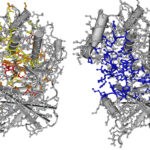
The research applied an innovative statistical analysis to genetic data from cancer patients. It focused on functional regions in proteins (called protein domains) within protein families that include proteins already implicated in cancer. Within this framework, even mutations that only appear in one or two patients could be considered meaningful if the mutations are in the same position in the protein domain as in other proteins in the same family.
The new method is “a really good way to identify important variants that you wouldn’t normally find in traditional methods,” says Peterson, “because we can look across gene families, which is something we normally don’t do.”
By identifying domains that are more likely to contribute to cancer, which the authors dub “oncodomains,” this study could help scientists prioritize particular areas within the very large field of cancer research. Their approach encourages drug development targeting the function of these domains, and because the domains are the same across so many proteins, it is possible that a single treatment could tackle cancers caused by a broad spectrum of mutated proteins.
It may even be possible to use the same statistical methods to help identify mutations that cause rare diseases. Many rare diseases may be caused by mutated proteins in the same families as those that cause more common diseases with more available data. Looking at protein domains across patients with several different diseases could point researchers toward the mutations that are most likely to be involved in causing a rare disease, even if there are only data from very few patients.
“Maybe only two patients have a mutation in a particular protein, but when you realize it is in exactly the same position within the domain as mutations in other proteins in other patients,” says Kann, “you realize it’s important to jointly investigate those different mutations.”
Peterson started in Kann’s lab as an undergraduate as a system administrator for her databases. Eventually, he shifted gears to independent research, and Kann found a project that tapped into his passion and curiosity. After publishing three papers as an undergraduate, Peterson decided to pursue graduate work in Kann’s lab and solidified his career path as a bioinformatician.
Now a postdoctoral fellow at the University of California, San Francisco, Peterson is expanding on the work he completed while at UMBC, and he remains connected to Kann’s lab by helping to train her new students to pick up where he left off.
“Tom made me realize how important it is for a mentor to find the project that best matches the student,” says Kann. “Nothing motivates a student more than working on a project he is passionate about.”
See the original article, Oncodomains: A Protein Domain-Centric Framework for Analyzing Rare Variants in Tumor Samples in PLOS Computational Biology.
Image: Model of the structure of a kinase, a protein and enzyme. Positions that are most often mutated in disease (yellow, orange, and red, left) correspond with positions that are involved in the kinase’s primary function (blue, right). Figure 3 from Peterson et al. (2017).
]]>
A new study led by Thomas Peterson Ph.D. ’16, biological sciences, reveals thousands of previously ignored, rare mutations that likely contribute to cancer. Peterson conducted the work as a...
https://umbc.edu/stories/umbc-research-team-develops-statistical-analysis-to-enable-targeted-cancer-drug-development/
https://my3.my.umbc.edu/api/v0/pixel/news/120827/guest@my.umbc.edu/6ba9b91149240816cda5b684a7ee9ce6/api/pixel
biology
cnms
mathstat
research
science-and-technology
UMBC News & Magazine
https://my3.my.umbc.edu/groups/umbc-news-magazine
https://assets1-my.umbc.edu/system/shared/avatars/groups/000/001/943/24435aa6207c452e7bc15cc74b42c7bb/xsmall.png?1748556657
https://assets1-my.umbc.edu/system/shared/avatars/groups/000/001/943/24435aa6207c452e7bc15cc74b42c7bb/original.png?1748556657
https://assets2-my.umbc.edu/system/shared/avatars/groups/000/001/943/24435aa6207c452e7bc15cc74b42c7bb/xxlarge.png?1748556657
https://assets2-my.umbc.edu/system/shared/avatars/groups/000/001/943/24435aa6207c452e7bc15cc74b42c7bb/xlarge.png?1748556657
https://assets3-my.umbc.edu/system/shared/avatars/groups/000/001/943/24435aa6207c452e7bc15cc74b42c7bb/large.png?1748556657
https://assets1-my.umbc.edu/system/shared/avatars/groups/000/001/943/24435aa6207c452e7bc15cc74b42c7bb/medium.png?1748556657
https://assets2-my.umbc.edu/system/shared/avatars/groups/000/001/943/24435aa6207c452e7bc15cc74b42c7bb/small.png?1748556657
https://assets1-my.umbc.edu/system/shared/avatars/groups/000/001/943/24435aa6207c452e7bc15cc74b42c7bb/xsmall.png?1748556657
https://assets2-my.umbc.edu/system/shared/avatars/groups/000/001/943/24435aa6207c452e7bc15cc74b42c7bb/xxsmall.png?1748556657
UMBC News & Magazine
0
0
false
Thu, 20 Apr 2017 21:06:44 -0400
UMBC mathematician and novelist Manil Suri offers a cure for math anxiety on WYPR

“Yes, there’s no doubt about it,” says Manil Suri: Large numbers of Americans suffer from math anxiety.
Suri, professor of mathematics at UMBC, novelist, and opinion contributor to the New York Times, discussed why math anxiety arises and ways to counter it on WYPR’s On the Record.
The U.S. is ranked well below other developed nations in math proficiency among secondary students, but that doesn’t mean all students are failing, Suri says. “There will always be a cohort of students who are loving math, and there will be a cohort of students who are not that well engaged,” he says. “So let’s see how we can engage people. That’s the main thing.”
As a writer, Suri says his interactions with people in other fields, such as the arts and humanities, have helped him understand some of the problems leading to math anxiety. One of them is that students who don’t pick up math quickly are “told again and again that they are ‘arts people’ and not ‘math people,’ as if you can only do one or the other,” says Suri. “People absorb these stereotypes, and it becomes very hard to get around them.”
The way math is taught to young children, often revolving around tedious activities like times tables, may lead them to lose interest. Instead, he says, bring in fictional elements—weave math into a story. For example, he observed a class learning about infinity from a story about Rapunzel trying to get to an escape door.
It may sound like a leap to teach elementary students an abstract concept like infinity, but, Suri says, “That’s one of the questions that we all as human beings grapple with,” so it’s naturally of interest. In that classroom, Suri says, “These kids were owning the subject—they were given the tools to make math their own.”
Suri also suggests focusing more on process. “What were the steps that got you to that answer?” he asks. “Encourage people to think about different ways to approach a problem, and even if they are incorrect, get in tune with what that thought process is, and where it might fail and where it might succeed.”
Suri says that from what he’s seen, the Common Core education standards take a positive step in that direction.
Rather than constantly subjecting math lessons to the question, “When will I use this?” Suri argues that math should be experienced and enjoyed for its own sake, like the arts. One way he recommends doing that is by “getting rid of the calculations, which scare a lot of people, and really getting to the ideas.”
For example, if you start with a triangle, and sequentially add sides to it (square, pentagon, etc.), you eventually get to an infinitely-sided shape: a circle. That thought experiment has some serious math behind it, but it’s an idea that an elementary school student can visualize.
Technology can be great for visualizing math, but Suri argues that it’s a double-edged sword. “Math needs to have a component that’s reflective,” he says, and gadgets can encourage us to rush. “Where you are interacting with other people and learning from their mistakes, it can really change things,” he shares. One way communities are accomplishing that is by creating “math circles” as after school options for students.
“We need to get over the notion of math only being for nerds,” Suri says, and “make it a day-to-day activity like soccer practice.”
Listen to the entire interview, “How to Love Math” on WYPR.
]]>
“Yes, there’s no doubt about it,” says Manil Suri: Large numbers of Americans suffer from math anxiety. Suri, professor of mathematics at UMBC, novelist, and opinion contributor to the New York...
https://umbc.edu/stories/umbc-mathematician-and-novelist-manil-suri-offers-a-cure-for-math-anxiety-on-wypr/
https://my3.my.umbc.edu/api/v0/pixel/news/120860/guest@my.umbc.edu/1ea4ea5aa961bf2ddb3d271f1174fa05/api/pixel
cnms
mathstat
science-and-technology
UMBC News & Magazine
https://my3.my.umbc.edu/groups/umbc-news-magazine
https://assets1-my.umbc.edu/system/shared/avatars/groups/000/001/943/24435aa6207c452e7bc15cc74b42c7bb/xsmall.png?1748556657
https://assets1-my.umbc.edu/system/shared/avatars/groups/000/001/943/24435aa6207c452e7bc15cc74b42c7bb/original.png?1748556657
https://assets2-my.umbc.edu/system/shared/avatars/groups/000/001/943/24435aa6207c452e7bc15cc74b42c7bb/xxlarge.png?1748556657
https://assets2-my.umbc.edu/system/shared/avatars/groups/000/001/943/24435aa6207c452e7bc15cc74b42c7bb/xlarge.png?1748556657
https://assets3-my.umbc.edu/system/shared/avatars/groups/000/001/943/24435aa6207c452e7bc15cc74b42c7bb/large.png?1748556657
https://assets1-my.umbc.edu/system/shared/avatars/groups/000/001/943/24435aa6207c452e7bc15cc74b42c7bb/medium.png?1748556657
https://assets2-my.umbc.edu/system/shared/avatars/groups/000/001/943/24435aa6207c452e7bc15cc74b42c7bb/small.png?1748556657
https://assets1-my.umbc.edu/system/shared/avatars/groups/000/001/943/24435aa6207c452e7bc15cc74b42c7bb/xsmall.png?1748556657
https://assets2-my.umbc.edu/system/shared/avatars/groups/000/001/943/24435aa6207c452e7bc15cc74b42c7bb/xxsmall.png?1748556657
UMBC News & Magazine
0
0
false
Thu, 23 Mar 2017 16:53:15 -0400
UMBC celebrates launch of Hill-Lopes Scholars Program focused on supporting women in STEM

Barbara Hill and Ancelmo Lopes were drawn to UMBC by the university’s commitment to providing holistic support for students from all backgrounds. On January 13, 2017, UMBC celebrated the launch of the new Hill-Lopes Scholars Program to support high-potential women in specific STEM majors where women remain underrepresented, with a reception for the first cohort of students, their families, and their faculty mentors.
 Karla Negrete ’19 (center) and her family meet Barbara Hill and Ancelmo Lopes (left).
The new scholars program, made possible through a generous gift from Hill and Lopes, draws inspiration from the Meyerhoff Scholars Program, nationally-lauded as the “gold-standard” for supporting underrepresented minority students in STEM. To support students’ persistence and success, the Hill-Lopes Scholars Program provides financial assistance and connects participating scholars with faculty mentors and campus services that can propel them toward their degrees.
 Barbara Hill addresses the new Hill-Lopes Scholars, sharing personal stories to encourage them to persevere in the face of challenges.
The six UMBC students selected as the first class of Hill-Lopes Scholars have a broad range of intellectual interests, but all have their eye on advanced degrees and careers in highly competitive STEM fields.
Heather Frank ’17, biochemistry and molecular biology, conducts research in the lab of University Distinguished Professor Michael Summers and just published a first-author paper in the prestigious journal Proceedings of the National Academy of Sciences.
Karla Negrete ’19, mechanical engineering, began her work in research as a high school student and has focused on finding and creating opportunities to progress toward a career in bioengineering. Her next step will be an internship with BGE this summer.
Jada Damond ’19, environmental engineering, will soon travel to Nicaragua to work on a water quality project. She is also particularly interested in alternative energy sources.
 Jada Damond ’19 introduces herself to her fellow Hill-Lopes Scholars and the other reception attendees.
Johanna Tsang ‘18, mechanical engineering, will intern at Northrop Grumman this summer in the Calibration and Quality Engineering division.
Blair Landon ’19, chemical engineering, plans to pursue graduate school in biochemical or biomedical engineering and, at UMBC, she is already a learning assistant for general chemistry.
 Blair Landon ’19 (left) introduces herself to Ancelmo Lopes.
Stormy Hill ’17, statistics, plans to pursue a career as an actuary with a focus on large-scale risk analysis. “This program is exceptional because it goes above and beyond to help its scholars,” Hill says, “beyond college, into our internships and careers.”
Faculty mentors Jennie Leach, chemical engineering; Anne Spence, mechanical engineering; Elsa Garcin, chemistry and biochemistry; and Anindya Roy, mathematics and statistics, will play a key role in the program.
“Being smart is not enough” to achieve success, UMBC President Freeman Hrabowski reflected. “There needs to be someone to say, ‘Give this person a chance.’” He described how faculty in the program will not only mentor the students, but also advocate for them.
 Stormy Hill ’17 meets Barbara Hill and Ancelmo Lopes. Photo Marlayna Demond ’11.
In describing the power of mentorship, Pres. Hrabowski cited the success of UMBC’s ADVANCE program, which works to increase the number of women faculty at UMBC, particularly in STEM areas. Since that program’s inception in 2003, the number of female tenure-track faculty at UMBC has increased 73.3% – a boost in representation beneficial for UMBC’s new Hill-Lopes Scholars.
Speaking directly to the scholars at the inaugural reception, Pres. Hrabowski encouraged them to learn from their mentors by listening to their personal stories, “and then, imagine how, in time, you can help other people.”
 Ancelmo Lopes, Barbara Hill, and President Freeman Hrabowski converse at the Hill-Lopes Scholars reception.
His focus on support, mentorship, advocacy, and role models echoed how Hill and Lopes described their own sense of the UMBC community. Lopes commented, “This place has a reputation for helping students be the best they can be.”
“We’re very proud to be part of the UMBC community,” shared Hill. “We couldn’t think of a better home for this program.”
Banner image: The inaugural Hill-Lopes Scholars with Barbara Hill (far right) and Ancelmo Lopes (far left). Students from left to right: Stormy Hill ’17, Heather Frank ’17, Karla Negrete ’19, Jada Damond ’19, Blair Landon ’19. All photos by Marlayna Demond ’11 for UMBC.
]]>
Barbara Hill and Ancelmo Lopes were drawn to UMBC by the university’s commitment to providing holistic support for students from all backgrounds. On January 13, 2017, UMBC celebrated the launch of...
https://umbc.edu/stories/umbc-celebrates-launch-of-hill-lopes-scholars-program-focused-on-supporting-women-in-stem-fields/
https://my3.my.umbc.edu/api/v0/pixel/news/120898/guest@my.umbc.edu/93f75573ddabe15aa4f42584b8ebb2be/api/pixel
cbee
chembiochem
cnms
coeit
community
hilllopesscholars
hrabowski
mathstat
meche
science-and-technology
UMBC News & Magazine
https://my3.my.umbc.edu/groups/umbc-news-magazine
https://assets1-my.umbc.edu/system/shared/avatars/groups/000/001/943/24435aa6207c452e7bc15cc74b42c7bb/xsmall.png?1748556657
https://assets1-my.umbc.edu/system/shared/avatars/groups/000/001/943/24435aa6207c452e7bc15cc74b42c7bb/original.png?1748556657
https://assets2-my.umbc.edu/system/shared/avatars/groups/000/001/943/24435aa6207c452e7bc15cc74b42c7bb/xxlarge.png?1748556657
https://assets2-my.umbc.edu/system/shared/avatars/groups/000/001/943/24435aa6207c452e7bc15cc74b42c7bb/xlarge.png?1748556657
https://assets3-my.umbc.edu/system/shared/avatars/groups/000/001/943/24435aa6207c452e7bc15cc74b42c7bb/large.png?1748556657
https://assets1-my.umbc.edu/system/shared/avatars/groups/000/001/943/24435aa6207c452e7bc15cc74b42c7bb/medium.png?1748556657
https://assets2-my.umbc.edu/system/shared/avatars/groups/000/001/943/24435aa6207c452e7bc15cc74b42c7bb/small.png?1748556657
https://assets1-my.umbc.edu/system/shared/avatars/groups/000/001/943/24435aa6207c452e7bc15cc74b42c7bb/xsmall.png?1748556657
https://assets2-my.umbc.edu/system/shared/avatars/groups/000/001/943/24435aa6207c452e7bc15cc74b42c7bb/xxsmall.png?1748556657
UMBC News & Magazine
0
0
false
Thu, 26 Jan 2017 17:09:30 -0500
UMBC cybersecurity instructor selected for prestigious Brookings Legis Congressional Fellows Program

Diana Parr, adjunct instructor for the Cybersecurity Graduate Program, has been selected to participate in the highly competitive Brookings Legis Congressional Fellows Program. The year-long program allows professionals in the public and private sectors to work on Capitol Hill alongside individual members of the U.S. Congress or on a congressional committee to understand the policy-making side of government.
 “I am most excited about the opportunity to work for a member of Congress and to learn how the legislative process flows. It will be a huge time for change on Capitol Hill—a new president and many newly elected officials. I would like to bring my technical knowledge to the Hill as those new officials discuss legislation relating to cybersecurity,” she said.
In addition to her role at UMBC, Parr is a cybersecurity technical leader for the National Security Agency. She anticipates that her work in Congress will focus on cybersecurity education.
“There are many opportunities for new legislation this year to make our nation stronger and safer,” Parr said. “My biggest hope is to build awareness of the need to grow educational opportunities for young people, especially young women, in the growing field of cybersecurity.”
Jeff Hayter ’09, political science and mathematics, has also been selected to participate in the Brookings Legis Congressional Fellows Program. He is currently a program analyst at the Bureau of International Information Programs, where he is a responsible for the strategic planning and resource oversight.

“I recognize this fellowship as a unique opportunity to peer behind the curtain of the legislative process. Very few people are afforded such a great learning opportunity,” Hayter said. “In addition to learning the ins-and-outs of policymaking, I hope to use to the fellowship to grow as a leader and broaden my expertise in foreign policy. To be honest, I’m not sure there has ever been a more interesting time to be on the Hill.”
During his time at UMBC, Hayter interned with the State Department. After graduation, he accepted a full-time position as a Freedom of Information Act Specialist with the State Department, where he worked until he moved to his current role at the Bureau of International Information Programs.
More information about the Brookings Legis Congressional Fellows Program can be found on the Brookings Institution website.
Header image by Robert Lyle Bolton, CC by 2.0. Parr’s headshot by Marlayna Demond ’11 for UMBC. Hayter’s headshot courtesy of Jeff Hayter.
]]>
Diana Parr, adjunct instructor for the Cybersecurity Graduate Program, has been selected to participate in the highly competitive Brookings Legis Congressional Fellows Program. The year-long...
https://umbc.edu/stories/umbc-cybersecurity-instructor-selected-for-prestigious-brookings-legis-congressional-fellows-program/
https://my3.my.umbc.edu/api/v0/pixel/news/120939/guest@my.umbc.edu/7735b1af7540b0f52c2118d76a42ed22/api/pixel
alumni
coeit
cybersecurity
mathstat
politicalscience
science-and-technology
UMBC News & Magazine
https://my3.my.umbc.edu/groups/umbc-news-magazine
https://assets1-my.umbc.edu/system/shared/avatars/groups/000/001/943/24435aa6207c452e7bc15cc74b42c7bb/xsmall.png?1748556657
https://assets1-my.umbc.edu/system/shared/avatars/groups/000/001/943/24435aa6207c452e7bc15cc74b42c7bb/original.png?1748556657
https://assets2-my.umbc.edu/system/shared/avatars/groups/000/001/943/24435aa6207c452e7bc15cc74b42c7bb/xxlarge.png?1748556657
https://assets2-my.umbc.edu/system/shared/avatars/groups/000/001/943/24435aa6207c452e7bc15cc74b42c7bb/xlarge.png?1748556657
https://assets3-my.umbc.edu/system/shared/avatars/groups/000/001/943/24435aa6207c452e7bc15cc74b42c7bb/large.png?1748556657
https://assets1-my.umbc.edu/system/shared/avatars/groups/000/001/943/24435aa6207c452e7bc15cc74b42c7bb/medium.png?1748556657
https://assets2-my.umbc.edu/system/shared/avatars/groups/000/001/943/24435aa6207c452e7bc15cc74b42c7bb/small.png?1748556657
https://assets1-my.umbc.edu/system/shared/avatars/groups/000/001/943/24435aa6207c452e7bc15cc74b42c7bb/xsmall.png?1748556657
https://assets2-my.umbc.edu/system/shared/avatars/groups/000/001/943/24435aa6207c452e7bc15cc74b42c7bb/xxsmall.png?1748556657
UMBC News & Magazine
0
0
false
Tue, 06 Dec 2016 16:31:13 -0500


