Exhibition and lecture explore the artwork and changing society of MyanmarNay Aung Shu, Crowded life, 2013, Acrylic on canvas, 36″ x 48″, courtesy of Thukhuma/Ian Holliday.
Opening on January 30 and continuing until March 26, the Albin O. Kuhn Library Gallery will present Altered State: Painting Myanmar in a Time of Transition, an exhibition of paintings by 36 contemporary artists from Myanmar, the Southeast Asian nation formerly known as Burma.
Created following the transition period of 2011, when a military-backed civilian government replaced oppressive rule by military junta and the country once famous for its seclusion re-entered the world stage, the paintings illustrate current artistic practice in Myanmar and present a series of creative viewpoints on a rapidly changing society. Paintings included in Altered State: Painting Myanmar in a Time of Transition are from the collection of contemporary Myanmar paintings of Ian Holliday, vice president and pro-vice-chancellor (teaching and learning) at the University of Hong Kong.
“The exhibition is important because it highlights the work of a large group of contemporary artists from Myanmar (Burma), many of whom experienced censorship of their work in the past. Myanmar is a country that is gradually transitioning from a long postwar history of military rule to a more democratic form of government,” says Constantine Vaporis, founding director of the Asian Studies Program and professor of history. “Barack Obama was the first U.S. president to visit the country, and his efforts to promote the peaceful democratic transformation of the country were important to the U.S.’s strategic rebalance to Asia.”
On February 1 at 4 p.m., the Humanities Forum and Social Sciences Forum will present a lecture by Christina Fink, professor of the practice in international affairs at The George Washington University, who will speak on “Myanmar: Perspectives on a Society in Transition.”
Professor Fink is a cultural anthropologist who has combined teaching, research, and development work throughout her career. Her areas of expertise are Burma/Myanmar in particular and Southeast Asia more broadly, equitable development, gender and development, civil society in ethnically diverse states. She received her B.A. in international relations from Stanford University and her M.A. and Ph.D. in social/cultural anthropology from the University of California at Berkeley. She has taught at the Elliot School for International Affairs at George Washington University since 2011. She served as a visiting lecturer at the Pacific and Asian studies department at the University of Victoria in 1995, and, from 2001 to 2010, she was a lecturer and program associate at the International Sustainable Development Studies Institute in Thailand.
Aung Khaing, Maung Photu Nat, 2014, Acrylic on canvas, 36″ x 48″, courtesy of Thukhuma/Ian Holliday.
Exhibition hours will be 10 a.m. to 4:30 p.m. Monday through Friday, with extended hours on Thursday until 8 p.m., and on Saturday and Sunday from 12 to 5 p.m. Admission to both the exhibition and lecture is free. Complete information is available on the UMBC Arts & Culture calendar here (exhibition) and here (lecture).
]]>
Nay Aung Shu, Crowded life, 2013, Acrylic on canvas, 36″ x 48″, courtesy of Thukhuma/Ian Holliday. Opening on January 30 and continuing until March 26, the Albin O. Kuhn Library Gallery will...https://umbc.edu/stories/exhibition-and-lecture-explore-the-artwork-and-changing-society-of-myanmar/https://my3.my.umbc.edu/api/v0/pixel/news/120899/guest@my.umbc.edu/1f4909d73500752fde1f12d96e088db0/api/pixelarts-and-cultureasianstudiescahssengageglobalstudieslibraryvisualartsUMBC News & Magazinehttps://my3.my.umbc.edu/groups/umbc-news-magazinehttps://assets1-my.umbc.edu/system/shared/avatars/groups/000/001/943/24435aa6207c452e7bc15cc74b42c7bb/xsmall.png?1748556657https://assets1-my.umbc.edu/system/shared/avatars/groups/000/001/943/24435aa6207c452e7bc15cc74b42c7bb/original.png?1748556657https://assets2-my.umbc.edu/system/shared/avatars/groups/000/001/943/24435aa6207c452e7bc15cc74b42c7bb/xxlarge.png?1748556657https://assets2-my.umbc.edu/system/shared/avatars/groups/000/001/943/24435aa6207c452e7bc15cc74b42c7bb/xlarge.png?1748556657https://assets3-my.umbc.edu/system/shared/avatars/groups/000/001/943/24435aa6207c452e7bc15cc74b42c7bb/large.png?1748556657https://assets1-my.umbc.edu/system/shared/avatars/groups/000/001/943/24435aa6207c452e7bc15cc74b42c7bb/medium.png?1748556657https://assets2-my.umbc.edu/system/shared/avatars/groups/000/001/943/24435aa6207c452e7bc15cc74b42c7bb/small.png?1748556657https://assets1-my.umbc.edu/system/shared/avatars/groups/000/001/943/24435aa6207c452e7bc15cc74b42c7bb/xsmall.png?1748556657https://assets2-my.umbc.edu/system/shared/avatars/groups/000/001/943/24435aa6207c452e7bc15cc74b42c7bb/xxsmall.png?1748556657UMBC News & Magazine00falseTue, 24 Jan 2017 21:50:33 -0500UMBC’s Top 12 Highlights of 2016
UMBC celebrated a banner year in 2016. In thousands of ways, big and small, this golden anniversary has been full of moments to remember for the university community.
Here are twelve top highlights:
Retrievers in Rio — When an ESPN reporter asked Cleopatra Borel ‘02, interdisciplinary studies, what qualifying for the shot put finals at the 2016 Olympic Games meant to her, she responded simply, “Everything.” Borel represented Trinidad and Tobago at her fourth Olympic Games and finished seventh on the global stage. Mohamed Hussein ‘14, mechanical engineering, a current master’s student in engineering management, represented Egypt in the 200 meter individual medley, competing head to head with Ryan Lochte.
Emily Escobedo at 2016 NCAA finals / Tim Binning, The Swim Pictures
Researchers of Distinction — Michael Summers, Robert E. Meyerhoff Chair for Excellence in Research and Mentoring and University Distinguished Professor of chemistry and biochemistry, became the first UMBC faculty member to be inducted into the National Academy of Sciences, one of the highest honors a scientist can receive. Summers was recognized both for his groundbreaking work on the HIV-1 retrovirus and his longstanding commitment to training the next generation of leading scientists, from high school through postdoctoral levels.
Goldwater Scholars — Andreas Seas ‘17, Naomi Mburu ‘18, and Daniel Ocasio ‘17, all chemical engineering majors, received the highly selective and prestigious Barry Goldwater Scholarship. Ocasio shared, “As a first generation college student, I feel extremely fortunate to be pursuing higher education, let alone a career in scientific research. To me, earning the Goldwater Scholarship is recognition of all those who made it possible for me to further my academic development.”
UMBC’s 2016 Goldwater Scholars (l-r): Andreas Seas, Naomi Mburu, and Daniel Ocasio
Leader in Education — UMBC partnered with Baltimore City Public Schools and the Northrop Grumman Foundation on a $1.6 million initiative to support Baltimore students, teachers, and communities. Meanwhile, Shalonda Holt ‘07, biological sciences, was named 2016 Washington Post Teacher of the Year and Howard County Teacher of the Year, and Corey Carter ’08, biological sciences, ’10 M.A.T., was named 2016 Baltimore County Teacher of the Year.
Alumna Shalonda Holt / Nicholas Griner, Howard County Public School System
CAREER Awards — Matt Pelton, assistant professor of physics, and Helena Mentis, assistant professor of information systems, both received the prominent National Science Foundation CAREER Award. Pelton explores how nanoparticles act in liquids to understand how mechanical energy flows at the nanometer scale. Mentis focuses on surgical telemedicine, exploring how surgeons can use gesture-based tools to share expert knowledge in the operating room.
Virtual Reality Lab — UMBC’s PI2 Immersive Hybrid Reality Lab opened, giving students and faculty the ability to interact with data in a more visual way, and reducing the distance between researchers and the information they work with, whether they are studying wind farms or blood flow in the human body.
Guest explores PI2 during ribbon cutting ceremony.
Golden Anniversary — Thousands of Retrievers came together as a community—alumni, faculty, staff, and students from all five decades of UMBC history—to celebrate the remarkable story of UMBC at a 50th anniversary weekend festival.
UMBC’s 50th anniversary fireworks display / Dan Bailey
Arguably the “best public college in Maryland,” UMBC is an “extremely diverse school” that manages to maintain a “small community feel.” And from the moment you set foot on campus it’s evident that the university is focused on “providing exceptional education and research opportunities for students.”
Images: All photos are by Marlayna Demond ’11 for UMBC unless otherwise noted.
]]>
UMBC celebrated a banner year in 2016. In thousands of ways, big and small, this golden anniversary has been full of moments to remember for the university community. Here are twelve top...https://umbc.edu/stories/umbcs-top-12-highlights-of-2016/https://my3.my.umbc.edu/api/v0/pixel/news/120908/guest@my.umbc.edu/d573cb199ff4c906616e728ad833b218/api/pixelalumniathleticscahsscbeechembiochemcnmscoeitcommunityeducationgphihistoryisjcetmajorawardmusicphysicsrankingsresearchumbc50undergradresearchvisualartsUMBC News & Magazinehttps://my3.my.umbc.edu/groups/umbc-news-magazinehttps://assets1-my.umbc.edu/system/shared/avatars/groups/000/001/943/24435aa6207c452e7bc15cc74b42c7bb/xsmall.png?1748556657https://assets1-my.umbc.edu/system/shared/avatars/groups/000/001/943/24435aa6207c452e7bc15cc74b42c7bb/original.png?1748556657https://assets2-my.umbc.edu/system/shared/avatars/groups/000/001/943/24435aa6207c452e7bc15cc74b42c7bb/xxlarge.png?1748556657https://assets2-my.umbc.edu/system/shared/avatars/groups/000/001/943/24435aa6207c452e7bc15cc74b42c7bb/xlarge.png?1748556657https://assets3-my.umbc.edu/system/shared/avatars/groups/000/001/943/24435aa6207c452e7bc15cc74b42c7bb/large.png?1748556657https://assets1-my.umbc.edu/system/shared/avatars/groups/000/001/943/24435aa6207c452e7bc15cc74b42c7bb/medium.png?1748556657https://assets2-my.umbc.edu/system/shared/avatars/groups/000/001/943/24435aa6207c452e7bc15cc74b42c7bb/small.png?1748556657https://assets1-my.umbc.edu/system/shared/avatars/groups/000/001/943/24435aa6207c452e7bc15cc74b42c7bb/xsmall.png?1748556657https://assets2-my.umbc.edu/system/shared/avatars/groups/000/001/943/24435aa6207c452e7bc15cc74b42c7bb/xxsmall.png?1748556657UMBC News & Magazine00falseWed, 04 Jan 2017 18:30:35 -0500Imaging experts from Nat Geo to NPR explore science through photography in UMBC web event
Experts from National Geographic, NPR, and other national leaders in the arts, humanities, and sciences connected by webcam last week to discuss a series of ten powerful images for “How Science is Pictured in the Media and Public Culture.” UMBC and Reading the Pictures jointly produced the panel as part of the year-long Seeing Science project, which explores the role photography plays in shaping, representing, and furthering the sciences.
To prepare, explains Marvin Heiferman, Seeing Science curator at UMBC, “Meg Handler, editor-at-large at Reading the Pictures, and I spent a couple of months looking at the year’s worth of photographs that appeared in magazine articles and online pieces about the sciences to…see the various ways, from stock photography to photojournalism, that the sciences were represented.”
The discussion on December 1 took place on Google HangOut, accommodating live audio and video with viewer participation via live chat. Drawn from the ranks of curators, photo editors, visual scholars, and scientists, the panel included Rebecca Adelman, associate professor of media and communication studies, UMBC; Michael Shaw, publisher, Reading the Pictures; Max Mutchler, manager, Space Telescope Science Institute Hubble Heritage Project; Marvin Heiferman; Kurt Mutchler, senior editor for science photography, National Geographic; Corey Keller, curator, SFMOMA; and Ben de la Cruz, multimedia editor, NPR Science Desk, with moderator Nathan Stormer, professor of rhetoric, University of Maine.
Rebecca Adelman participates in Seeing Science online salon.
The series of ten images they discussed represented a broad range of science disciplines, were visually distinct from one another, and varied in their goals and purposes. Together, Stormer argued, they demonstrated how “science becomes visible to us when science is helping us see things —that is when it becomes apparent to us that we depend on it, live within it as much as we do.”
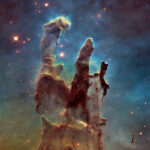
The conversation began with a colorful and formally engaging photograph of a massive general-purpose detector within the Large Hadron Collider at CERN, in Switzerland. Subsequent photographs included a new view of the Pillars of Creation from the Hubble Space Telescope; a human embryo being modified; four women from NASA’s most recent astronaut class; the early 20th century Chart of Physical Traits alongside photographs of faces overlayed with facial recognition software mapping grid points; an overhead view of a toxic algae bloom in Florida; a 4-month-old baby with microcephaly, published during the Zika outbreak; President Obama with a boy and his marshmallow cannon at the White House Science Fair; and two visitors wearing virtual reality gear at The Void in Times Square.
The depth and spectrum of the panelists’ expertise created a fascinating discussion that began with initial emotional and intellectual responses to the images and quickly delved into, as Adelman described, “how the photograph acts as a visual metaphor for how science gets communicated to audiences of non-scientists.”
Marvin Heiferman participates in Seeing Science online salon.
“What was interesting and revealing to me was to listen to the various ways people with different relationships to science and imaging looked at and responded to the images discussed,” says Heiferman. “Since Seeing Science is an interdisciplinary look at how images function, that variety of responses is what gives a discussion like the one we had its depth and richness.”
Melissa Cormier ’17 M.F.A., intermedia and digital arts, tuned in to the event from the on-campus viewing party hosted by UMBC’s Center for Art, Design and Visual Culture (CADVC.) “My current thesis work deals with co-opting traditionally scientific aesthetics and methods of display and observation, so it was an opportunity to witness how those types of images are spoken about and discussed by the various panel members,” says Cormier.
Reflecting on the live chat function of the Google HangOut, Cormier shares, “It was a great experience to be able to interact with such a distinguished panel and feel included in the conversation. It also gave me some new research avenues to pursue in my work, as well as affect the language I will use to discuss my work.”
Reading the Pictures’ salon archive now features in slideshow format the ten photographs that formed that backbone of the event. A video of the discussion is available on YouTube.
Through #SeeingScience, readers can also explore fifty additional media images that Reading the Pictures featured on Twitter and Instagram in the weeks leading up to the event.
Header image: New view of the Pillars of Creation, visible light, detail, 2014; courtesy of NASA/ESA/Hubble and the Hubble Heritage Team (STScI/AURA)/J. Hester, P. Scowen (Arizona State U)
]]>
Experts from National Geographic, NPR, and other national leaders in the arts, humanities, and sciences connected by webcam last week to discuss a series of ten powerful images for “How Science is...https://umbc.edu/stories/imaging-experts-from-nat-geo-to-npr-explore-science-through-photography-in-umbc-web-event/https://my3.my.umbc.edu/api/v0/pixel/news/120948/guest@my.umbc.edu/2d4fd1ff023649ae4bb552f4f123d9d5/api/pixelarts-and-culturecadvccahssmcsscience-and-technologyvisualartsUMBC News & Magazinehttps://my3.my.umbc.edu/groups/umbc-news-magazinehttps://assets1-my.umbc.edu/system/shared/avatars/groups/000/001/943/24435aa6207c452e7bc15cc74b42c7bb/xsmall.png?1748556657https://assets1-my.umbc.edu/system/shared/avatars/groups/000/001/943/24435aa6207c452e7bc15cc74b42c7bb/original.png?1748556657https://assets2-my.umbc.edu/system/shared/avatars/groups/000/001/943/24435aa6207c452e7bc15cc74b42c7bb/xxlarge.png?1748556657https://assets2-my.umbc.edu/system/shared/avatars/groups/000/001/943/24435aa6207c452e7bc15cc74b42c7bb/xlarge.png?1748556657https://assets3-my.umbc.edu/system/shared/avatars/groups/000/001/943/24435aa6207c452e7bc15cc74b42c7bb/large.png?1748556657https://assets1-my.umbc.edu/system/shared/avatars/groups/000/001/943/24435aa6207c452e7bc15cc74b42c7bb/medium.png?1748556657https://assets2-my.umbc.edu/system/shared/avatars/groups/000/001/943/24435aa6207c452e7bc15cc74b42c7bb/small.png?1748556657https://assets1-my.umbc.edu/system/shared/avatars/groups/000/001/943/24435aa6207c452e7bc15cc74b42c7bb/xsmall.png?1748556657https://assets2-my.umbc.edu/system/shared/avatars/groups/000/001/943/24435aa6207c452e7bc15cc74b42c7bb/xxsmall.png?1748556657UMBC News & Magazine00falseMon, 05 Dec 2016 17:40:36 -0500Eric Dyer describes reinventing the zoetrope and other animation innovations at TEDxCharlottesville
Many years ago Eric Dyer, associate professor of visual arts, worked professionally as an animator by day, and at night created his own experimental films. He explained in his recent TEDxCharlottesville talk that spending very long days in front of a screen left him wanting and needing to find a way to limit his screen time and once again use his hands in the creation of his work.
He considered the possibilities of the zoetrope, a device widely popular in the late 19th century for creating the illusion of motion before the arrival of filmed animations. Various configurations of the zoetrope all made static sequences of drawings around a spinning inner cylinder appear to be in motion when viewed through slits. He took this idea with him to Copenhagen, Denmark for a year on a Fulbright Fellowship and upon his return began a course of work that has underpinned his research of the last decade.
Dyer printed sequences of stills from his Copenhagen videos on long strips of inkjet paper and for his own take on the zoetrope he replaced the slits with a video camera. He went on to make cylindrical paper sculptures the size of bicycle wheels from these strips, he estimates 25 in all, recording the animated sequence each created for his 2006 film Copenhagen Cycles. This new approach to animation “helped me get my life back,” Dyer said. “Instead of 12-15 hours a day with my face plastered to a screen I was having little adventures.”
Knippel Louises Bro, from the Copenhagen Cycles project, cut inkjet prints, 2006/2014. An 8′ x 10′ mural of this image will be installed in the new D-E concourse connector at the BWI Airport. Image courtesy of Eric Dyer.
“But video flattens sculpture so I tried to imagine a way that animated sculpture could be experienced as such, and as a completely immersive animated sculpture,” said Dyer.
He came up with the concept of a zoetrope tunnel—the zoetrope turned inside out with the viewer inside the cylinder with a handheld strobe walking through the sculpture. Dyer estimates the full-scale realization of the elaborate structure he envisions creating will take years, but in the meantime he has built a half-scale prototype that he uses for animation tests.
Dyer lies inside the prototype, attaching 3D printed “sequences” with Velcro to the inside of the tunnel. The construction of the device has lead people to comment that it reminds them of an MRI machine. The medical connection spoke to Dyer because “at the age of 14 I was diagnosed with a degenerative retinal condition that is slowly taking my vision away and I’d never responded to that in my work.”
Implant, 2015. Image courtesy of Eric Dyer.
This recognition inspired the creation of his next sculpture, Implant. Dyer describes it as his “science fiction fantasy cure” for his incurable disorder: “a super-magnified medical device that fits around the optic nerve.” With a handheld strobe, viewers explore the animating sculpture and discover thousands of cell-size robots hard at work “weaving in and out of the optic nerve.” Indeed what they are looking at are the tiny static 3D printed and painted elements Dyer has arranged precisely to create the illusion he describes.
Dyer shared that “now vision loss has helped to take me away from things that disconnect me from the world. Instead of being sealed off in an automobile, I ride my bike, take buses and trains, and walk a lot. And instead of visually intensive processes in the studio I am also getting outdoors a lot more and using more of my senses.” At the same time, he has been steadfast in exploring experimental processes to create innovative work and the support necessary to do so, receiving a Creative Capital Grant and Guggenheim Foundation Fellowship along the way.
Two recent examples of his innovative work are Mud Caves and Octopi. Mud Caves is a multi-layered print piece with an animation hidden within the artwork-a zoetrope laid out flat, revealed only by video. Octopi, commissioned by the Aurora Picture Show and recently installed in Houston, is a 17-foot diameter static installation that pops to animated life on the screen when visitors turn a tiny crank. It’s a new kind of zoetrope (dubbed the “real-time zoetrope”) that Dyer developed through work at UMBC’s Imaging Research Center.
A survey of Dyer’s work, ”The Material Instant” is currently exhibited at the Spagnuolo Gallery at Georgetown University and runs through December 11. Included in the exhibition are working zoetropes, maquettes, and videos. An artist talk (5 – 6 p.m.) and reception (6 – 8 p.m.) are scheduled for Thursday, November 17.
Watch Dyer’s TEDxCharlottesville talk below, beginning at 2:48:00.
Header image: Artist and filmmaker Eric Dyer introduces the zoetrope to the TEDxCharlottesville audience. Photo by Edmond Joe, courtesy of TEDx Charlottesville. CC BY-NC-ND 2.0.
]]>
Many years ago Eric Dyer, associate professor of visual arts, worked professionally as an animator by day, and at night created his own experimental films. He explained in his recent...https://umbc.edu/stories/eric-dyer-talks-about-reinventing-the-zoetrope-at-tedxcharlottesville/https://my3.my.umbc.edu/api/v0/pixel/news/120959/guest@my.umbc.edu/fa0afbc9a0fe27ad8f4014acc9cf7a51/api/pixelalumniarts-and-culturecahssircresearchvisualartsUMBC News & Magazinehttps://my3.my.umbc.edu/groups/umbc-news-magazinehttps://assets1-my.umbc.edu/system/shared/avatars/groups/000/001/943/24435aa6207c452e7bc15cc74b42c7bb/xsmall.png?1748556657https://assets1-my.umbc.edu/system/shared/avatars/groups/000/001/943/24435aa6207c452e7bc15cc74b42c7bb/original.png?1748556657https://assets2-my.umbc.edu/system/shared/avatars/groups/000/001/943/24435aa6207c452e7bc15cc74b42c7bb/xxlarge.png?1748556657https://assets2-my.umbc.edu/system/shared/avatars/groups/000/001/943/24435aa6207c452e7bc15cc74b42c7bb/xlarge.png?1748556657https://assets3-my.umbc.edu/system/shared/avatars/groups/000/001/943/24435aa6207c452e7bc15cc74b42c7bb/large.png?1748556657https://assets1-my.umbc.edu/system/shared/avatars/groups/000/001/943/24435aa6207c452e7bc15cc74b42c7bb/medium.png?1748556657https://assets2-my.umbc.edu/system/shared/avatars/groups/000/001/943/24435aa6207c452e7bc15cc74b42c7bb/small.png?1748556657https://assets1-my.umbc.edu/system/shared/avatars/groups/000/001/943/24435aa6207c452e7bc15cc74b42c7bb/xsmall.png?1748556657https://assets2-my.umbc.edu/system/shared/avatars/groups/000/001/943/24435aa6207c452e7bc15cc74b42c7bb/xxsmall.png?1748556657UMBC News & Magazine00falseTue, 15 Nov 2016 18:24:26 -0500UMBC faculty celebrate opportunities to expand collaboration across disciplines
“The complex problems we face do not organize themselves neatly into the categories we’re used to,” says Carole McCann, professor and chair of gender and women’s studies. “We need to think beyond those boundaries.”
McCann leads the new Provost’s Interdisciplinary Activities Advisory Committee, which just hosted UMBC’s first social hour to bring together faculty from different fields, but with overlapping research and creative interests, to plant the seeds for future collaborations.
Provost Philip Rous shares that this event, and the committee behind it, respond to his conversations with faculty who identified “a real need for additional support in the area of interdisciplinary work.” Having opportunities to get away from the “disciplinary lens” and removing barriers to doing interdisciplinary work, he notes, is what will set UMBC apart as a community focused on solving complex, real-world problems.
Four faculty led informal discussions to start the conversation at this week’s event. Nicole King, associate professor and chair of American studies, discussed her work in Baltimore City, including collaborations with colleagues and students in sociology, visual arts, and media and communication studies. One project centers on a community garden in Curtis Bay, in partnership with a local school. Another focuses on interviews with Baltimore residents about their experiences with the city’s deindustrialization—interviews that students have developed into radio segments airing on WEAA.
For King, interdisciplinary research means “asking big questions, solving big problems, with whatever tools you need,” moving beyond artificial limits imposed by academic disciplines.
Nicole King (center), American studies, mingles with colleagues.
Amy Hurst, associate professor of information systems, conducts research in human-centered computing, particularly assistive technologies. She sees her field as an amalgam of design, behavioral science, and technology.
For interdisciplinary projects to be successful, Hurst says, “We need to be fluid in the languages of the different fields.” She, like King, emphasized the need to think beyond a single answer to a narrow question or a single technology to solve a narrow problem. She shares that when working with students, collaborators, or end-users, “Rather than giving them a hammer, I like to give them the toolbox.”
Tulay Adali, University Distinguished Professor of computer science and electrical engineering, says interdisciplinary research increases the impact of her work by applying it in new contexts. Rather than continuing to make small improvements to systems that have been in development for decades, applying her research to brand new fields can lead to positive change in leaps and bounds.
“It enriches what you’re doing,” Adali says. “You have to have patience, to invest your energy, but the rewards are huge.”
Amy Hurst (left), information systems, mingles with colleagues.
Tim Nohe, professor of visual arts, discussed his work at the interface of the arts and ecology. Nohe uses a variety of art forms to explore how different cultures steward the natural environment. A 10-year project of his, based in Australia, recently culminated with the exhibition Sounding Botany Bay at the Albin O. Kuhn Library. He’s also interested in urban landscapes and empowering Baltimore citizens to put pressure on local government to tackle environmental justice issues. That’s made considerably easier by today’s smartphones, because, Nohe says, “You have the tools of agency right in your pocket.”
“In the arts, which have always connected with a public or audience, we are aware of our responsibility to make our work reach people and move them intellectually and emotionally,” Nohe explains. “There’s knowledge to be discovered when disciplines come together, finding new points of entry into a problem or by finding ‘ah-ha’ moments through attentive and respectful dialogue across disciplines.”
McCann and committee member Rachel Carter, Ph.D. candidate in language, literacy, and culture, intend to extend the social hour into a series. Follow the committee’s myUMBC group to learn about upcoming events.
Banner image: Faculty from all three colleges and a variety of disciplines discuss research, plant the seeds for collaborations, and enjoy fellowship at the first interdisciplinary faculty social hour. All photos by Marlayna Demond ’11 for UMBC.
]]>
“The complex problems we face do not organize themselves neatly into the categories we’re used to,” says Carole McCann, professor and chair of gender and women’s studies. “We need to think beyond...https://umbc.edu/stories/umbc-faculty-celebrate-opportunities-to-expand-collaboration-across-disciplines/https://my3.my.umbc.edu/api/v0/pixel/news/120965/guest@my.umbc.edu/de4df5fab267d2b0d74f66cf9748b383/api/pixelamericanstudiescahsscnmscoeitcommunitycseegwstindsinnovationisllcresearchvisualartsUMBC News & Magazinehttps://my3.my.umbc.edu/groups/umbc-news-magazinehttps://assets1-my.umbc.edu/system/shared/avatars/groups/000/001/943/24435aa6207c452e7bc15cc74b42c7bb/xsmall.png?1748556657https://assets1-my.umbc.edu/system/shared/avatars/groups/000/001/943/24435aa6207c452e7bc15cc74b42c7bb/original.png?1748556657https://assets2-my.umbc.edu/system/shared/avatars/groups/000/001/943/24435aa6207c452e7bc15cc74b42c7bb/xxlarge.png?1748556657https://assets2-my.umbc.edu/system/shared/avatars/groups/000/001/943/24435aa6207c452e7bc15cc74b42c7bb/xlarge.png?1748556657https://assets3-my.umbc.edu/system/shared/avatars/groups/000/001/943/24435aa6207c452e7bc15cc74b42c7bb/large.png?1748556657https://assets1-my.umbc.edu/system/shared/avatars/groups/000/001/943/24435aa6207c452e7bc15cc74b42c7bb/medium.png?1748556657https://assets2-my.umbc.edu/system/shared/avatars/groups/000/001/943/24435aa6207c452e7bc15cc74b42c7bb/small.png?1748556657https://assets1-my.umbc.edu/system/shared/avatars/groups/000/001/943/24435aa6207c452e7bc15cc74b42c7bb/xsmall.png?1748556657https://assets2-my.umbc.edu/system/shared/avatars/groups/000/001/943/24435aa6207c452e7bc15cc74b42c7bb/xxsmall.png?1748556657UMBC News & Magazine00falseTue, 08 Nov 2016 22:36:41 -0500Creative minds from UMBC join in White House events, from visual arts to neuroscience
Five Linehan Artist Scholars from UMBC visited the White House last week to participate in a workshop led by William Allman, chief White House curator. Adan Rodriguez ‘17, film; Justyna Kurbiel ‘18, animation; Megan Clelan ‘19, graphic design; Sarah Miller ‘17, photography and interdisciplinary studies; and Emily Eaglin ‘17, video, attended the special event, accompanied by Doug Hamby, associate professor of dance and director of the Linehan Artist Scholars program.
Linehan Artist Scholars , l-r: Justyna Kurbiel, Sarah Miller, Emily Eaglin, Adan Rodriguez, and Megan Clelan.
The workshop was centered around a recently acquired painting by Alma Woodsey Thomas, an African American Expressionist painter and art educator from Washington D.C. (1891-1978). The students learned about Thomas’s painting, now on display in the White House’s Old Family Dining Room, and heard remarks from First Lady Michelle Obama on the significance of Thomas’s work. They also learned from Allman about the broader history of the White House art collection, how the pieces of art were selected and acquired, and how the president and first lady select art to display in the living area of the White House. Following the official remarks, the Linehan Scholars were invited to view and discuss the artwork with art experts on the second floor of the White House.
During another White House event in the same week, Kafui Dzirasa ‘01, chemical engineering, served on a neuroscience panel alongside President Barack Obama. The White House Frontiers Conference was held at Carnegie Mellon University and focused on advances in neuroscience and progress made by the Brain Research through Advancing Innovative Neurotechnologies (BRAIN) and Precision Medicine Initiatives.
The BRAIN Initiative supports research to advance the understanding of the human brain by developing technologies that show how individual cells and intricate circuits interact.
“I think the big opportunity is for us to begin to think of the brain as an engineered system,” said Dzirasa, now a prominent researcher at Duke University, sitting beside President Obama. He went on to describe the incredible number of steps that take place within fractions of a millisecond every time the brain receives, processes, and responds to input, which can easily be interrupted in conditions from Alzheimer’s to autism.
Even when discussing doctors’ and researchers’ “common enemy” of disease, Dzirasa focused on the positive. “The reason I’m optimistic is because I fundamentally believe that there is a seven year old sitting in a classroom somewhere that will take all of the investments and all of the work that we’ve made and will transform things for my family,” he said.
Dzirasa added that he hopes students in classrooms across the country will have “the opportunity for their ideas to bubble up and be nurtured, because at the end of the day, the solution to that common enemy that we all face [disease] might be sitting in that classroom right now.”
Watch the full video of the White House Frontiers Conference panel on the White House website.
Images: (1) A view from the White House, photo by Adan Rodriguez; (2) Linehan Artist Scholars in front of the White House, photo courtesy Doug Hamby.
]]>
Five Linehan Artist Scholars from UMBC visited the White House last week to participate in a workshop led by William Allman, chief White House curator. Adan Rodriguez ‘17, film; Justyna Kurbiel...https://umbc.edu/stories/creative-minds-from-umbc-join-in-white-house-events-from-fine-arts-to-neuroscience/https://my3.my.umbc.edu/api/v0/pixel/news/120980/guest@my.umbc.edu/33355a65ac5ba4e497f3f95e4475bf69/api/pixelalumniarts-and-culturecahsscbeecoeitdanceindslinehanscholarsscience-and-technologyvisualartsUMBC News & Magazinehttps://my3.my.umbc.edu/groups/umbc-news-magazinehttps://assets1-my.umbc.edu/system/shared/avatars/groups/000/001/943/24435aa6207c452e7bc15cc74b42c7bb/xsmall.png?1748556657https://assets1-my.umbc.edu/system/shared/avatars/groups/000/001/943/24435aa6207c452e7bc15cc74b42c7bb/original.png?1748556657https://assets2-my.umbc.edu/system/shared/avatars/groups/000/001/943/24435aa6207c452e7bc15cc74b42c7bb/xxlarge.png?1748556657https://assets2-my.umbc.edu/system/shared/avatars/groups/000/001/943/24435aa6207c452e7bc15cc74b42c7bb/xlarge.png?1748556657https://assets3-my.umbc.edu/system/shared/avatars/groups/000/001/943/24435aa6207c452e7bc15cc74b42c7bb/large.png?1748556657https://assets1-my.umbc.edu/system/shared/avatars/groups/000/001/943/24435aa6207c452e7bc15cc74b42c7bb/medium.png?1748556657https://assets2-my.umbc.edu/system/shared/avatars/groups/000/001/943/24435aa6207c452e7bc15cc74b42c7bb/small.png?1748556657https://assets1-my.umbc.edu/system/shared/avatars/groups/000/001/943/24435aa6207c452e7bc15cc74b42c7bb/xsmall.png?1748556657https://assets2-my.umbc.edu/system/shared/avatars/groups/000/001/943/24435aa6207c452e7bc15cc74b42c7bb/xxsmall.png?1748556657UMBC News & Magazine00falseWed, 19 Oct 2016 16:21:56 -0400Alumni Awards highlight profound impact, drive, and commitment of UMBC alumni and faculty
The UMBC community gathered in the Linehan Concert Hall on October 6 for a moving ceremony to honor the profound impacts and achievements of nine outstanding Retrievers at the 2016 UMBC Alumni Awards.
“This year’s awardees truly capture the depth of our community,” said John Becker ’01, president of the alumni association. Irina Vishnevetsky ’99, chair of the alumni awards committee, shared, “Each year the number of submitted nominations grows, and each year I am amazed by the incredible accomplishments of UMBC alumni.”
Tulay Adlai, electrical engineering, introduced awardee Vincent Calhoun ’02, Ph.D. electrical engineering, as an excellent teacher and mentor, cutting-edge brain researcher, and “a truly genuine human being.”
Vince Calhoun, Ph.D. ’02, accepts the award for Outstanding Alumnus in Engineering and Information Technology.
Today, Calhoun serves as one of the youngest distinguished professors at the University of New Mexico. His primary appointment is in electrical and computer engineering, and, known for his interdisciplinary work, he maintains affiliate appointments with biology, computer science, neuroscience, and psychiatry. In accepting the award, Calhoun emphasized the importance of imagination in scientific research and told the students in the audience, “honesty and integrity in your work will make it endure over the long term.”
Award recipient Ian Ralby ’02, modern languages, linguistics, and intercultural communication (MLLI) and M.A. intercultural communication, was a Humanities Scholar and varsity diver at UMBC, and graduated as valedictorian. He went on to earn a law degree at the College of William and Mary and M.Phil. and Ph.D. degrees at the University of Cambridge, before founding I.R. Consilium, a consultancy that advises governments on international law and policy.
Ralby credits his UMBC humanities education for much of his success in international negotiation, remarking, “I learned to pick up on the subtleties of human interaction, in my own culture and across cultures.” He noted that those skills have “frequently been the deciding factor in whether my work has been merely technically proficient or truly successful.” Thomas Field, MLLI, presented Ralby’s remarks, as he was in Finland at an international maritime security conference and unable to return to the U.S. for the ceremony.
Philip Farabaugh, biological sciences, introduced natural sciences awardee Henry Baker ’78, Ph.D. ’84, biological sciences, who serves as Hazel Kitzman Professor of Genetics, professor of surgery, and chair of molecular genetics and microbiology at the University of Florida College of Medicine, and associate director of the University of Florida Genetics Institute. Farabaugh praised Baker for making the “courageous decision” to change the course of his research when “he recognized the clue to understanding human disease lay in determining how people’s genes change during disease.”
Baker, a Catonsville native, has been proud to watch UMBC grow over the years. “UMBC has truly excelled since its beginning in 1966 up to today, and is headed on to an even higher trajectory,” he shared. “From UMBC, you can get anywhere.”
Left to right: President Hrabowski, Ruby Lu ’94, David Mitch, John Becker ’01.
Social and behavioral sciences awardee Ruby Lu ’94, economics, traveled from Beijing to attend the awards ceremony. After earning a master’s degree in international economics from Johns Hopkins, she co-founded DCM China, a Beijing-based venture capital firm. She has been named one of the top 50 venture capitalists in China by Forbes magazine, 2011–15. Her approach to venture capital is “to invest in companies she thinks will use technology to bring about positive change to society,” shared her nominator, David Mitch, professor and chair of economics. Lu, who came to study at UMBC from China, was a member of the university’s first class of McNair Scholars and reflected on how faculty profoundly impacted her life as teachers, mentors, and friends, at a time when she was far from home and working hard to learn English while preparing for a career.
LaMarDavis, director of The Choice Program at UMBC, referred to this year’s alumni award winner in social work as “a legend.” “If you don’t know who Joe Jones is,” he said, “you’re likely from out of town.”
Joe Jones ’06 (right), recipient of the award for Outstanding Alumnus in Social Work, shakes hands with LaMar Davis.
Joseph Jones, Jr., ’06, social work, founded the Center for Urban Families in Baltimore City in 1999. The organization has served more than 26,000 Baltimore residents through workforce development and other initiatives, and has placed more than 6,400 in full-time jobs. Jones didn’t intend to get a college degree, but that changed when he met President Hrabowski. At UMBC, Jones shared, he developed “the ability to think about how do we create institutions, how do we move systems forward, how do we agitate in a way that creates change?” That reflection has dramatically benefited the people of Baltimore, shard Davis, noting that through his “steadfast belief and unrelenting drive” Jones has “transformed tens of thousands of lives with impacts that will be felt for generations.”
Tiffany Holmes, MFA ’99, this year’s awardee in visual and performing arts, is now the dean of undergraduate studies at the School of the Art Institute of Chicago. Holmes began her career as a middle school art teacher in Baltimore City and brought her students to tour UMBC’s Imaging Research Center. There, she recalled, “I quickly realized that I was interested in using technology to make art.” After over a decade in the field, she has made a “permanent mark on the canon of this once marginalized and little-understood discipline” and she is known for her “commitment to art that poses unique social challenges,” shared her nominator, Lisa Moren, professor of visual arts.
Tiffany Holmes, MFA ’99, receives the award in visual and performing arts.
Ellen Hemmerly, executive director of bwtech@UMBC, was thrilled to introduce Tom Sadowski ’89, political science, as the 2016 Distinguished Service awardee. Sadowski, vice chancellor for economic development for the University System of Maryland, “has always valued relationships and supported partnerships, and has a knack for bringing people together and making things happen,” says Hemmerly. “I believe with Tom at the helm, UMBC and other system campuses will lead the nation in supporting innovation and creating knowledge jobs of the future.”
Accepting his award, Sadowski shared that he’s “just a guy who likes to…help solve problems, help people work as a team and achieve collective goals, or simply help people find that better part of themselves and grow.” Sadowski said that he’s particularly valued his relationship with the university over the past three decades because “UMBC leads its students to believe in themselves, and further, to believe there is nothing they cannot accomplish within themselves and within their communities by working together, with passion, and a deep, heartfelt purpose.”
Galina Madjaroff ’08, M.A. ’11, accepts the Rising Star award from Judah Ronch.
Judah Ronch, dean of the Erickson School, introduced Galina Madjaroff ’08, psychology, M.A. ’11, aging studies, as the Rising Star awardee. Madjaroff serves as undergraduate program director and clinical assistant professor in the Erickson School, whose undergraduate program has grown from almost 400 in 2011 to almost 1,900 today. Ronch noted, “This is really due to the passion, hard work, leadership, and vision that Galina has brought to the program.” In particular, “Her passion is to help society and our students understand the major issues in cybersecurity and tech use for older people,” which has led her to pursue a Ph.D. in human-centered computing at UMBC. Madjaroff says UMBC is special because of the “faculty who are so nurturing, who reach out and take that extra step,” and she is driven to be that supportive mentor to current and future students.
The alumni association honored Kimberly Moffitt, professor of American studies, with the outstanding faculty award for 2016. “Everyone deserves a Dr. Moffitt—someone who shows them the goodness of the world while asking essential follow-up questions to ensure that they never get complacent,” shared her student, Ngeri Nnachi ’11, American studies. “I consider myself blessed to have such a strong, gifted, beautiful woman as my role model.” Accepting her award, Moffit emphasized, “I want to make sure my students know they have voice. And no matter what space they walk into, their voice matters. They matter.”
Kimberly Moffitt, American studies, accepts the Outstanding Faculty Award.
This focus on impact, commitment, and connection emerged again and again throughout the evening, and for good reason, shared President Freeman Hrabowski. “One measures the impact of a university by the research it produces, the questions it asks, the people who are graduates, and what they do,” Hrabowski said. “People you see on this stage are not just amazingly talented, they are good people who have done great work. I can’t think of anything an educator would want more than that: People who care about others, who strive for excellence, and who never, never, never give up.”
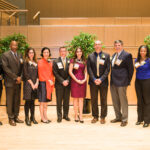
Banner image: From left to right: Freeman Hrabowski, Joseph Jones, Tiffany Holmes, Ruby Lu, Tom Sadowski, Galina Madjaroff, Vince Calhoun, Henry Baker, Kimberly Moffitt, John Becker; all photos by Marlayna Demond ’11 for UMBC.
]]>
The UMBC community gathered in the Linehan Concert Hall on October 6 for a moving ceremony to honor the profound impacts and achievements of nine outstanding Retrievers at the 2016 UMBC Alumni...https://umbc.edu/stories/alumni-awards-highlight-profound-impact-drive-and-commitment-of-umbc-alumni-and-faculty/https://my3.my.umbc.edu/api/v0/pixel/news/120983/guest@my.umbc.edu/4c516aaec7dfa6c6826615366831aef1/api/pixelalumniamericanstudiesarts-and-culturebiologybwtechcahsschoiceprogramcnmscoeitcommunitycseeeconomicsericksonschoolgerontologyhrabowskimllipolicy-and-societypsychologyscience-and-technologyvisualartsUMBC News & Magazinehttps://my3.my.umbc.edu/groups/umbc-news-magazinehttps://assets1-my.umbc.edu/system/shared/avatars/groups/000/001/943/24435aa6207c452e7bc15cc74b42c7bb/xsmall.png?1748556657https://assets1-my.umbc.edu/system/shared/avatars/groups/000/001/943/24435aa6207c452e7bc15cc74b42c7bb/original.png?1748556657https://assets2-my.umbc.edu/system/shared/avatars/groups/000/001/943/24435aa6207c452e7bc15cc74b42c7bb/xxlarge.png?1748556657https://assets2-my.umbc.edu/system/shared/avatars/groups/000/001/943/24435aa6207c452e7bc15cc74b42c7bb/xlarge.png?1748556657https://assets3-my.umbc.edu/system/shared/avatars/groups/000/001/943/24435aa6207c452e7bc15cc74b42c7bb/large.png?1748556657https://assets1-my.umbc.edu/system/shared/avatars/groups/000/001/943/24435aa6207c452e7bc15cc74b42c7bb/medium.png?1748556657https://assets2-my.umbc.edu/system/shared/avatars/groups/000/001/943/24435aa6207c452e7bc15cc74b42c7bb/small.png?1748556657https://assets1-my.umbc.edu/system/shared/avatars/groups/000/001/943/24435aa6207c452e7bc15cc74b42c7bb/xsmall.png?1748556657https://assets2-my.umbc.edu/system/shared/avatars/groups/000/001/943/24435aa6207c452e7bc15cc74b42c7bb/xxsmall.png?1748556657UMBC News & Magazine00falseFri, 14 Oct 2016 20:36:06 -0400UMBC faculty win four new Maryland Innovation Initiative grants, bringing total MII awards to $2.4M
Tech transfer is growing rapidly at UMBC, fueled in part by the university’s notable success in securing Maryland Innovation Initiative (MII) grants designed to promote the commercialization of research.
“UMBC’s success in the MII program has been consistently growing over the course of the 3.5 years since the program started,” says Jennifer Hammaker, MII director at Maryland Technology Development Corporation (TEDCO). In that time, UMBC researchers have received $2.38 million to develop their ideas into commercial applications, with an impressive success rate of 50 percent (50 applications yielding 25 awards).
The MII program is a powerful collaboration between the state of Maryland and five Maryland institutions: Johns Hopkins University; University of Maryland, Baltimore; University of Maryland, College Park; Morgan State University and UMBC. UMBC has one of the highest success rates for MII awards among these institutions. The most recent round of grants for UMBC includes projects in four distinct areas: interactive arts performances, biomedical technology, space weather forecasting, and biofuel production.
The Awards
Linda Dusman, professor of music, and Eric Smallwood, assistant professor of visual arts, will use their phase III award to scale up a prototype of their mobile app, Octava, to make it available to a larger slice of the public. Octava provides real-time program notes during performances such as classical music, dance, and theatre, offering audiences details about the artists and other information that can enrich their experience of the performance and, as Dusman put it, “do real-time education.”
Previous MII grants helped Dusman and Smallwood generate the prototype and conduct a market research study. The phase III grant will enable the team to respond to feedback from phase II, including connecting the app to social media.
Chris Geddes, professor of chemistry and biochemistry and director of the Institute of Fluorescence, won a phase III award in this round for Lyse-it, a company that produces a low-cost portable device that breaks open cells and chops up their DNA to prescribed fragment sizes, a step required in many sample-preparation procedures in the biomedical research and health care industries. The phase III funding will facilitate production of a large inventory of the Lyse-it product and support development of a rapid marketing strategy.
Neel Savani, a researcher at UMBC’s Goddard Planetary Heliophysics Institute (GPHI), is developing a system that can forecast solar storms up to 24 hours in advance, a huge improvement over the current ability to give a one-hour warning. His team’s phase I MII grant will allow them to “get a handle and statistical understanding of how good of an improvement this forecast will be,” Savani explains, “If I can validate how much the improvement will be, then I can convert that into a sales pitch.”
“It’s great to see the state of MD take the lead in supporting space technology,” Savani adds, “I’m seeing venture capitalists looking to invest in the space industry.”
Jeffrey Gardner, assistant professor of biological sciences, received a phase I award for a technology that will support the biofuels industry. His group “will develop a set of small porous filters that enables real-time measurement of microbial growth during biofuel production,” he explains. Bacterial cells used for biofuel production break down large molecules to obtain nutrients, and then use those nutrients to either grow more cells or produce biofuel. By measuring how many cells are growing in real time, researchers can tell if the bacterial cells are “spending more energy than they should making more cells instead of making biofuel.”
Learning Curve
The MII grant process can be a huge learning opportunity for research faculty, many of whom have never tackled a business venture. David Fink, a “site miner” at UMBC, seeks out faculty research that could lead to successful commercial products and supports faculty through the process from start to finish. Don Engel, assistant vice president for research, also encourages faculty to pursue commercialization when he thinks their work is a good fit.
Smallwood shares, “Dave [Fink] has been indispensable, helping us understand the program and shape our ideas.” As UMBC’s first MII team in the arts, and only the second team of artists to receive an MII grant, he says, “We were coming from a different field than most of the applicants, so we had to reorient our brains to how we navigate this new world.”
For Dusman, a business venture “is like an octopus.” She often finds herself asking, “What do you mean there’s one more leg?”
UMBC resources also aided Savani as he grew his business skills. “As somebody who comes from a very research-centric background, I don’t necessarily know the correct lingo for commercialization,” he admits, “That was a tricky component for me to learn, with a steep learning curve.” He thanks Fink and Engel, as well as Paola Buitron and Wendy Martin in UMBC’s Office of Technology Development and Margo Young at GPHI, for his success with the MII program. “They were an absolute tremendous help. They were very patient and supportive.”
“This program is asking questions of faculty that most of them have never been asked,” says Hammaker. “It’s forcing them to think differently.”
She credits UMBC’s success receiving a particularly large number of grants to a combination of support from high-level administrators as well as site miners like Fink. She cites Dusman and Smallwood as an example of what that kind of support makes possible. “They’re closing sales all over the country,” Hammaker says, “That doesn’t happen without a support system.”
Some companies formed by UMBC faculty, as well as alumni and university partners, choose to create a home base at bwtech@UMBC, adjacent to campus. Ellen Hemmerly, executive director of bwtech@UMBC, explains that the research and technology park “provides a range of incubator services to help the companies grow and be successful.”
Geddes, one of the phase III grant recipients, is a veteran entrepreneur attuned to the business landscape. “We are seeing an increased amount of funding available to faculty to explore their ideas and inventions with regard to commercialization,” he says, “With more funding and opportunities materializing, we should expect to see many more companies being spun out from UMBC in the coming years.”
That fits with the culture of UMBC, says Karl V. Steiner, vice president for research. “When we talk about research at UMBC, we frequently use the phrase ‘Innovation that Matters’ to reflect the fact that many of our faculty and students are working on our current, most pressing issues,” he shares. “Our success with the TEDCO MII program is rooted deeply in this research culture of making a difference.”
Hammaker sees UMBC as an exemplar in this regard: “Exactly what’s happening at UMBC is what we’re looking for. UMBC is doing a great job of working with the faculty and getting them prepared to come through the program.” She says, “UMBC has a lot to be excited about.”
Image: Colleagues gather to sign UMBC technology patents into the new Lyse-it company. From left to right: Paola Buitron, Mildred Homa, Wendy Martin, Chris Geddes, Russell Hill, Dean Drake, Rosemary Jagus, David Fink. Photo by Mary Larkin.
]]>
Tech transfer is growing rapidly at UMBC, fueled in part by the university’s notable success in securing Maryland Innovation Initiative (MII) grants designed to promote the commercialization of...https://umbc.edu/stories/umbc-faculty-win-major-new-maryland-innovation-initiative-grants-bringing-total-mii-awards-to-2-4m/https://my3.my.umbc.edu/api/v0/pixel/news/120991/guest@my.umbc.edu/537c2323a6be58e7621cf7064fcf611b/api/pixelarts-and-culturebiologybwtechcahsschembiochemcnmsgphimusicresearchscience-and-technologyvisualartsUMBC News & Magazinehttps://my3.my.umbc.edu/groups/umbc-news-magazinehttps://assets1-my.umbc.edu/system/shared/avatars/groups/000/001/943/24435aa6207c452e7bc15cc74b42c7bb/xsmall.png?1748556657https://assets1-my.umbc.edu/system/shared/avatars/groups/000/001/943/24435aa6207c452e7bc15cc74b42c7bb/original.png?1748556657https://assets2-my.umbc.edu/system/shared/avatars/groups/000/001/943/24435aa6207c452e7bc15cc74b42c7bb/xxlarge.png?1748556657https://assets2-my.umbc.edu/system/shared/avatars/groups/000/001/943/24435aa6207c452e7bc15cc74b42c7bb/xlarge.png?1748556657https://assets3-my.umbc.edu/system/shared/avatars/groups/000/001/943/24435aa6207c452e7bc15cc74b42c7bb/large.png?1748556657https://assets1-my.umbc.edu/system/shared/avatars/groups/000/001/943/24435aa6207c452e7bc15cc74b42c7bb/medium.png?1748556657https://assets2-my.umbc.edu/system/shared/avatars/groups/000/001/943/24435aa6207c452e7bc15cc74b42c7bb/small.png?1748556657https://assets1-my.umbc.edu/system/shared/avatars/groups/000/001/943/24435aa6207c452e7bc15cc74b42c7bb/xsmall.png?1748556657https://assets2-my.umbc.edu/system/shared/avatars/groups/000/001/943/24435aa6207c452e7bc15cc74b42c7bb/xxsmall.png?1748556657UMBC News & Magazine00falseFri, 30 Sep 2016 19:20:25 -0400Seeing Science: UMBC project explores how photographs shape and further science
“I’m fascinated with the ways images and technology are transforming our lives today. And looking back, I realized that photography and the sciences have always worked hand in hand to redefine each other and culture-at-large, too,” says Marvin Heiferman, curator of the new Seeing Science project at UMBC.
“Images are essential in the work scientists do and make their work more accessible to the public,” Heiferman shares. “Seeing Science grew out of my desire to explore that.”
A year-long project, Seeing Science: Photography, Science and Visual Culture, will explore the central role photographic images play in defining, shaping, promoting, and furthering science, and how photographic images made in and about the sciences impact public opinion and health, policy and funding, science education, as well as visual and popular culture.
The project’s diverse components include a website, exhibitions, online salon, film series, publications, and an active social media presence. The Seeing Science website, the cornerstone of the project, will continually expand with weekly mini-exhibitions of historical and contemporary images, thematic looks at science-related images in visual culture, newly commissioned short essays, links to breaking news stories that chart the use and impact of imaging in and on science, a timeline that tracks the historical inter-relationships of science and photographic imaging, an interactive map of science images made and used on UMBC’s campus, and downloadable PDFs of materials generated through the project.
Last spring, UMBC’s Library Gallery hosted an exhibition, The Glass Knife, curated by visual arts faculty Stephen Bradley and Kathy Marmor, that explored the pioneering imaging work of biologist Keith Porter.
This fall, an online salon, co-produced with Reading the Pictures, a visual and media literacy group, will be held on October 20, exploring science images in the media. A Seeing Science Film Festival begins presentations in September featuring films from 1966: “Fantastic Voyage,” “Fahrenheit 451,” and “Daleks–Invasion Earth: 2150 A.D.” A series of public conversations between Heiferman and other scholars will take place at the School of Visual Arts in New York City beginning in October. A book, Seeing Science: Photography, Science and Visual Culture, will be published in 2017 featuring content developed in the course of the project and exploring the evolving relationships of photographic imaging and the sciences, social sciences, and the arts.
“While researching and developing Seeing Science, I realized that most photography and science exhibitions in the past tended to document 19th and 20th century imaging advances and then celebrate how artists respond to them,” adds Heiferman. “I want Seeing Science to do that, and much more. That’s why the project is multi-faceted and primarily web-based. It invites viewers and participants to explore how science images also impact the news, public policy, popular culture and, most importantly, radically change the ways we see, understand, and live in the world.”
Marvin Heiferman, a visiting scholar at UMBC’s Center for Art, Design & Visual Culture (CADVC), has organized projects about photography and visual culture for the Museum of Modern Art, Smithsonian Institution, International Center of Photography, Whitney Museum of American Art, Carnegie Museum of Art, and the New Museum. He has written for The New York Times, Art in America, Gagosian Gallery, CNN, Artforum, Design Observer, Aperture, and BOMB. Heiferman is the author, editor, and packager of more than two dozen books on photography and visual culture, including Photography Changes Everything (Aperture, 2012).
Kelley Bell, associate professor of graphic design at UMBC, is the art director of Seeing Science. Bell has worked with clients including MTV Networks, The Walt Disney Company, and Baltimore-D.C. area non-profits, and her public art works have been featured in numerous events.
Complete information about Seeing Science: Photography, Science and Visual Culture can be found on the UMBC Arts & Culture Calendar.
Seeing Science is produced by the CADVC in collaboration with the Office of the Vice President of Research. A grant from the Alfred P. Sloan Foundation was instrumental in the development of the project’s website.
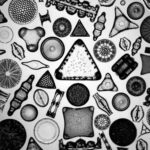
Image: Detail of Carl Strüwe, Archetype of Individuality (1933). Courtesy Steven Kasher Gallery, New York.
]]>
“I’m fascinated with the ways images and technology are transforming our lives today. And looking back, I realized that photography and the sciences have always worked hand in hand to redefine...https://umbc.edu/stories/seeing-science-umbc-project-explores-how-photographs-shape-and-further-science/https://my3.my.umbc.edu/api/v0/pixel/news/121031/guest@my.umbc.edu/525358d97091514007543870f0fe73fb/api/pixelarts-and-culturecadvccfrresearchscience-and-technologyvisualartsUMBC News & Magazinehttps://my3.my.umbc.edu/groups/umbc-news-magazinehttps://assets1-my.umbc.edu/system/shared/avatars/groups/000/001/943/24435aa6207c452e7bc15cc74b42c7bb/xsmall.png?1748556657https://assets1-my.umbc.edu/system/shared/avatars/groups/000/001/943/24435aa6207c452e7bc15cc74b42c7bb/original.png?1748556657https://assets2-my.umbc.edu/system/shared/avatars/groups/000/001/943/24435aa6207c452e7bc15cc74b42c7bb/xxlarge.png?1748556657https://assets2-my.umbc.edu/system/shared/avatars/groups/000/001/943/24435aa6207c452e7bc15cc74b42c7bb/xlarge.png?1748556657https://assets3-my.umbc.edu/system/shared/avatars/groups/000/001/943/24435aa6207c452e7bc15cc74b42c7bb/large.png?1748556657https://assets1-my.umbc.edu/system/shared/avatars/groups/000/001/943/24435aa6207c452e7bc15cc74b42c7bb/medium.png?1748556657https://assets2-my.umbc.edu/system/shared/avatars/groups/000/001/943/24435aa6207c452e7bc15cc74b42c7bb/small.png?1748556657https://assets1-my.umbc.edu/system/shared/avatars/groups/000/001/943/24435aa6207c452e7bc15cc74b42c7bb/xsmall.png?1748556657https://assets2-my.umbc.edu/system/shared/avatars/groups/000/001/943/24435aa6207c452e7bc15cc74b42c7bb/xxsmall.png?1748556657UMBC News & Magazine00falseThu, 01 Sep 2016 13:29:52 -0400Meet SCIART: Groundbreaking fellowship opens students’ eyes to interdisciplinary careers
In early June, eight undergraduates arrived at UMBC for the first edition of SCIART. The unique summer fellowship program funded by the Andrew W. Mellon Foundation seeks to “continue to develop the students’ science expertise while also developing their appreciation for the arts and humanities,” says Zeev Rosenzweig, UMBC chemistry and biochemistry chair, who spearheaded SCIART.
Interdisciplinary programs like SCIART prepare students for a widening range of possible career paths, helping to address the challenges and opportunities presented by an evolving career landscape that emphasizes teamwork and creative problem-solving.
SCIART students work on scientific research projects under the guidance of faculty from UMBC and Johns Hopkins University. Each project has a specific art conservation application at the Walters Art Museum in Baltimore, and museum staff collaborate closely with UMBC to run the program. “I’m so thankful to my colleagues here at UMBC and our partners at Johns Hopkins and the Walters,” Rosenzweig says. “SCIART would not be possible without their commitment to the program, and more importantly, to the students.”
Students make frequent field trips to the Walters. The program also includes visits to the conservation science laboratories of the National Gallery of Art in Washington, DC; New York’s Metropolitan Museum of Art; the Winterthur Museum, Garden, and Library in Delaware; and the Library of Congress. The trips give students the opportunity to interact with conservators, conservation scientists, curators, and other museum professionals whose careers blur the boundaries between art and science.
“One of the best parts has been getting to work with people in the conservation community who have so much experience,” says Marie Desrochers, an art history major with a chemistry minor at the University of Central Arkansas. Before arriving, Desrochers already planned to pursue graduate study in art conservation. “I really love art,” she says, and as a conservator, “You get to be the person that goes behind the scenes and gets the most intimate experience with the objects.”
Janaya Slaughter, a chemistry major at Stevenson University, was planning on pursuing a master’s degree in forensic science. This summer, however, opened her eyes to how much science is involved in art conservation. “Every time we go on a museum trip I get more excited,” she says.
Feddi Roth, a rising sophomore at Stanford University, is still undecided on her major, but she is interested in chemistry and loved her first art history class. She knew SCIART would be the perfect summer opportunity. Now she’s “definitely thinking of art conservation as more of a career option.”
Julie Lauffenburger, director of conservation and technical research at the Walters, discussed with the students how the path to a conservation science career is still not clear-cut. “That’s why this is such an important program,” she explains.
SCIART is also an opportunity to work in a team of peers with varied expertise. Slaughter, Roth, and Khalid Elawad, a materials science major at Johns Hopkins University, are investigating how vibrations from music during events at the museum may affect the structural integrity of art nearby. They needed an abundance of physics knowledge, learned new software programs, and even wrote their own code to analyze data. None of them had any programming experience before SCIART.
“The learning curve was the biggest challenge,” says Elawad, but the team rose to the occasion. In the end, “We all walked away with skills that we never thought we would have,” he adds.
Alex Taylor, a chemistry and archaeology double major at Johns Hopkins, and Sam Maina, who studies biology at UMBC, are working with Desrochers to analyze the effects of different cleaning methods on ancient objects. This team, too, faced its challenges, but the end goal is more than answering a scientific question. “It’s about bringing together people from different disciplines to problem solve,” Desrochers says.
Part of what makes SCIART unique is that the students get to work on real problems. Terry Weisser, Lauffenberger’s predecessor at the Walters, told the students, “What you’re doing here has potential to be really important in the field.” High expectations make the experience that much richer for students. “It’s easy to stay motivated when you know you’re really going to help somebody,” shares Elawad.
A few students may be offered extended fellowships to continue work with the Walters after the summer program concludes. All students, however, will come away with their eyes open to the possibilities for interdisciplinary careers and the team-building and problem-solving experience they need to succeed.
For more information about SCIART and how to apply, click here.
Header: Students tour the conservation labs at the Walters Art Museum; photo Jason Putsché. Top image: Sam Maina (l) and Marie Desrochers (r) work in the lab. Bottom image: Gold-plated “coupons” on which Maina, Desrochers, and Taylor will test cleaning techniques. Photos by Sarah Hansen.
]]>
In early June, eight undergraduates arrived at UMBC for the first edition of SCIART. The unique summer fellowship program funded by the Andrew W. Mellon Foundation seeks to “continue to develop...https://umbc.edu/stories/meet-sciart-groundbreaking-fellowship-opens-students-eyes-to-interdisciplinary-careers/https://my3.my.umbc.edu/api/v0/pixel/news/121075/guest@my.umbc.edu/397e25cbdf3801553f59dd4576ce0b97/api/pixelarts-and-culturecahsschembiochemcnmsresearchscience-and-technologyundergradresearchvisualartsUMBC News & Magazinehttps://my3.my.umbc.edu/groups/umbc-news-magazinehttps://assets1-my.umbc.edu/system/shared/avatars/groups/000/001/943/24435aa6207c452e7bc15cc74b42c7bb/xsmall.png?1748556657https://assets1-my.umbc.edu/system/shared/avatars/groups/000/001/943/24435aa6207c452e7bc15cc74b42c7bb/original.png?1748556657https://assets2-my.umbc.edu/system/shared/avatars/groups/000/001/943/24435aa6207c452e7bc15cc74b42c7bb/xxlarge.png?1748556657https://assets2-my.umbc.edu/system/shared/avatars/groups/000/001/943/24435aa6207c452e7bc15cc74b42c7bb/xlarge.png?1748556657https://assets3-my.umbc.edu/system/shared/avatars/groups/000/001/943/24435aa6207c452e7bc15cc74b42c7bb/large.png?1748556657https://assets1-my.umbc.edu/system/shared/avatars/groups/000/001/943/24435aa6207c452e7bc15cc74b42c7bb/medium.png?1748556657https://assets2-my.umbc.edu/system/shared/avatars/groups/000/001/943/24435aa6207c452e7bc15cc74b42c7bb/small.png?1748556657https://assets1-my.umbc.edu/system/shared/avatars/groups/000/001/943/24435aa6207c452e7bc15cc74b42c7bb/xsmall.png?1748556657https://assets2-my.umbc.edu/system/shared/avatars/groups/000/001/943/24435aa6207c452e7bc15cc74b42c7bb/xxsmall.png?1748556657UMBC News & Magazine00falseTue, 26 Jul 2016 16:52:41 -0400

 Nay Aung Shu, Crowded life, 2013, Acrylic on canvas, 36″ x 48″, courtesy of Thukhuma/Ian Holliday.
 Aung Khaing, Maung Photu Nat, 2014, Acrylic on canvas, 36″ x 48″, courtesy of Thukhuma/Ian Holliday.