Getting Your Research Off the Ground—Balloons Give Students New Perspectives

On a brisk but clear day in early December, half a dozen brightly colored weather balloons barely squeeze through the double doors of Sondheim Hall’s lower level one by one.
A group of four or five students handles each balloon, proceeding to the quad in front of the Interdisciplinary Life Sciences Building in a makeshift parade. A red balloon rises aloft as a demonstration, and then the remaining groups fan out across campus to follow suit. By 9:30 a.m., anyone walking across campus can see colorful dots hundreds of feet high, tethered by ropes that each end at a student on the ground.
This is the peak experience of GES 286, “Exploring the Environment: A Geospatial Perspective.” The course is structured around various data gathering projects, explains Charles Kaylor, the instructor and director of GIS (geographic information systems) and cartography labs in the department of geography and environmental systems (GES). “We use the campus as a laboratory,” he says.
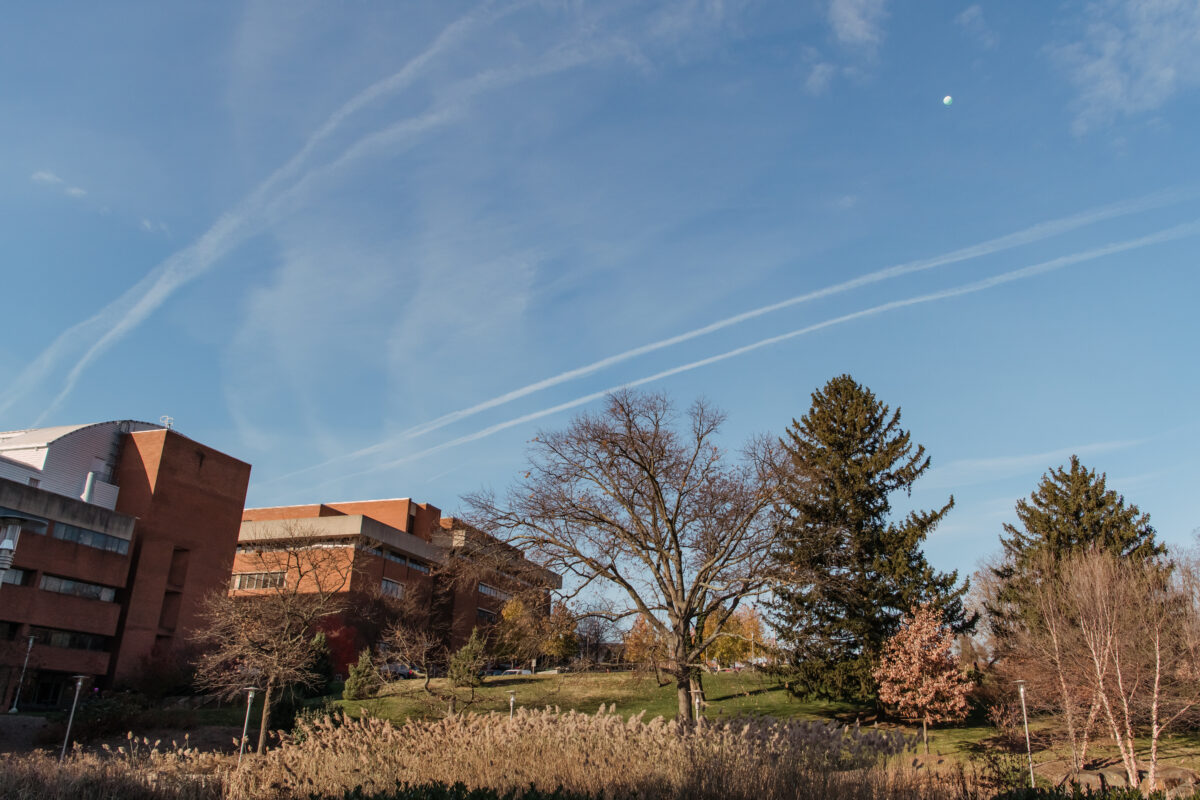
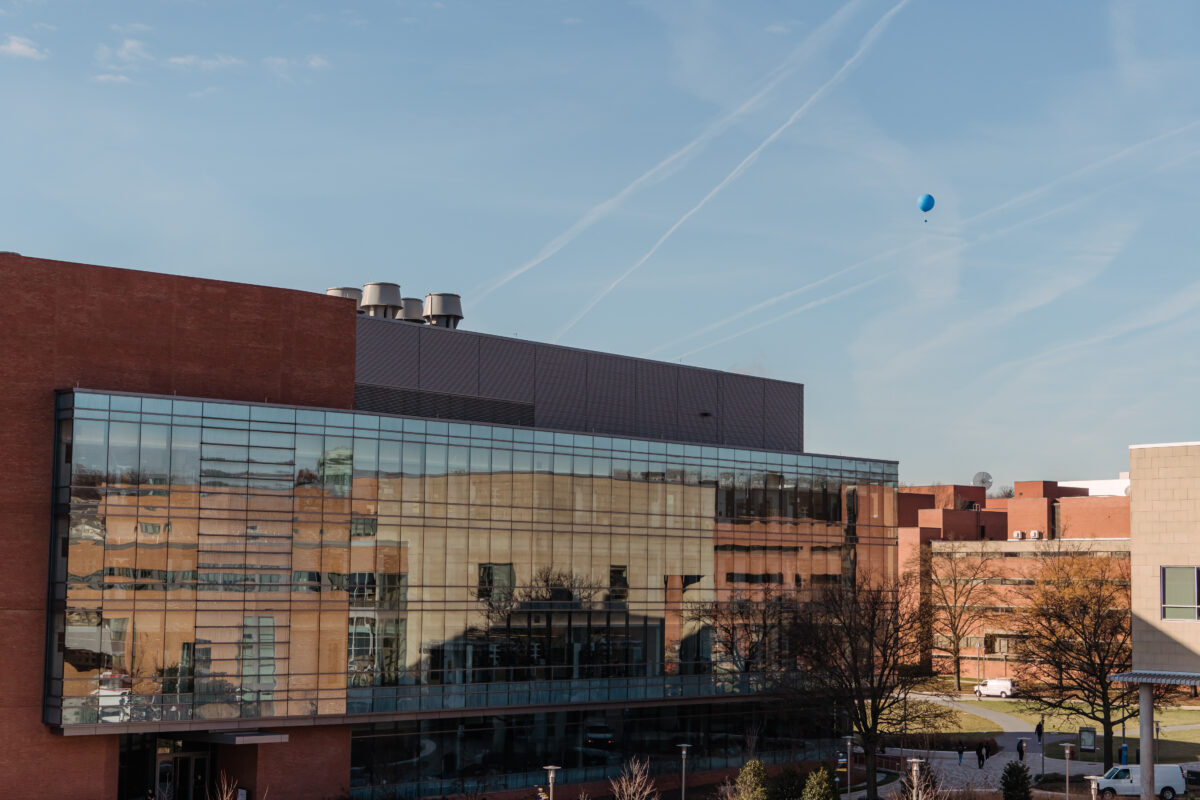
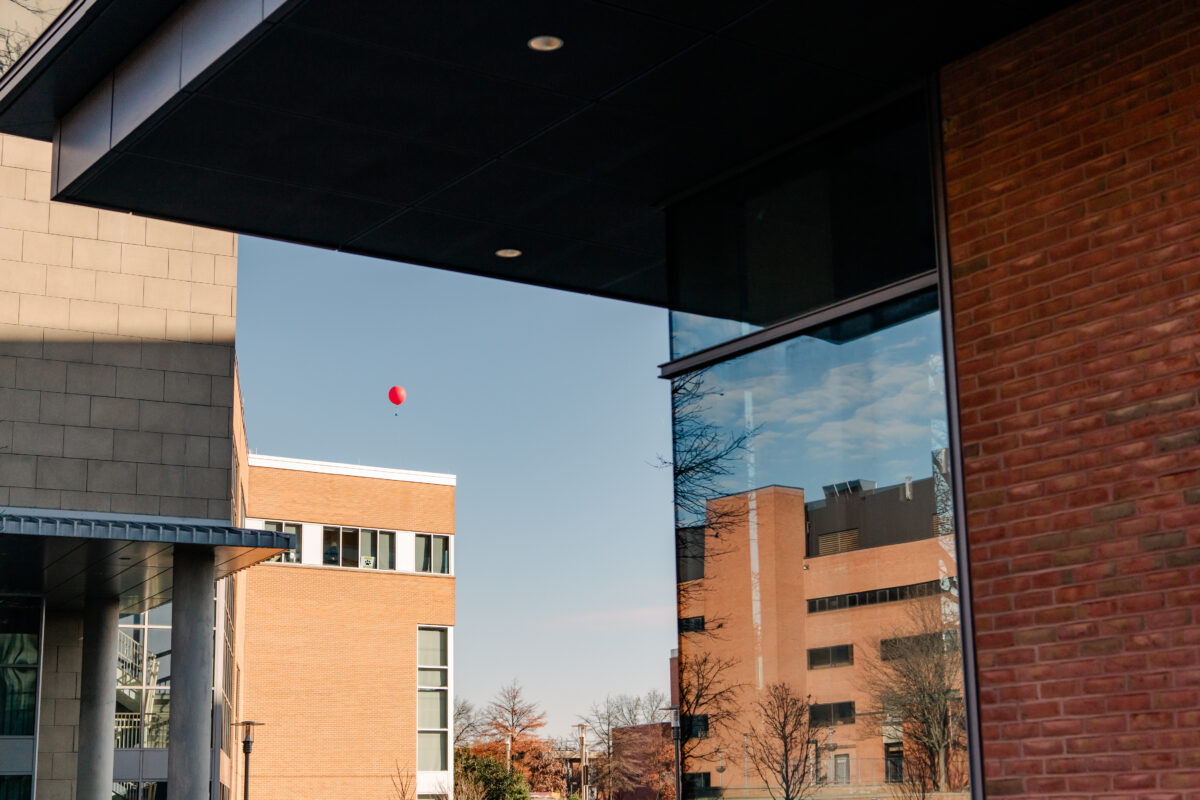
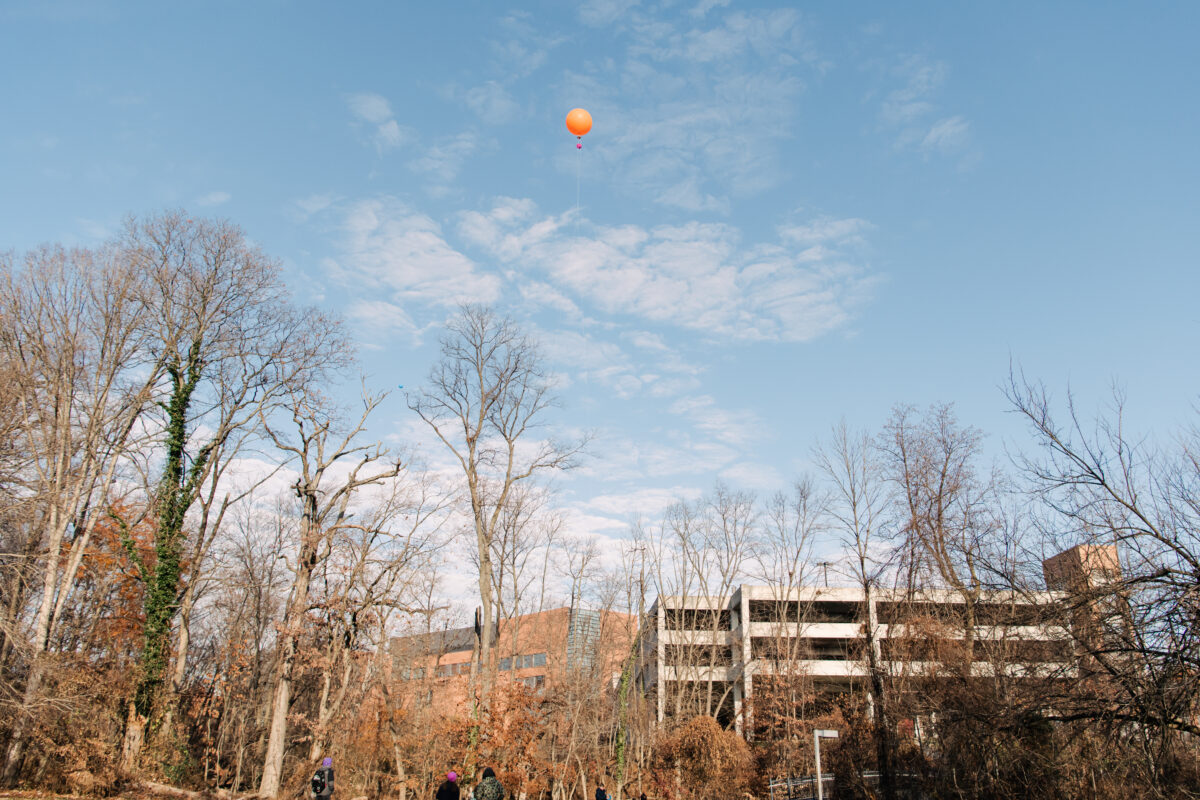
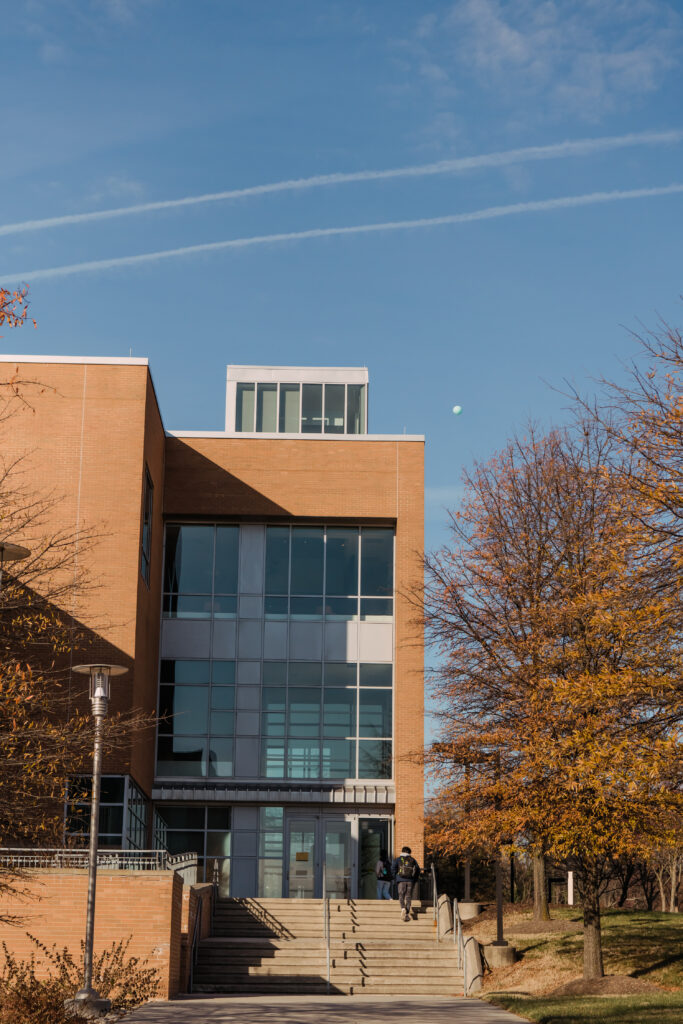
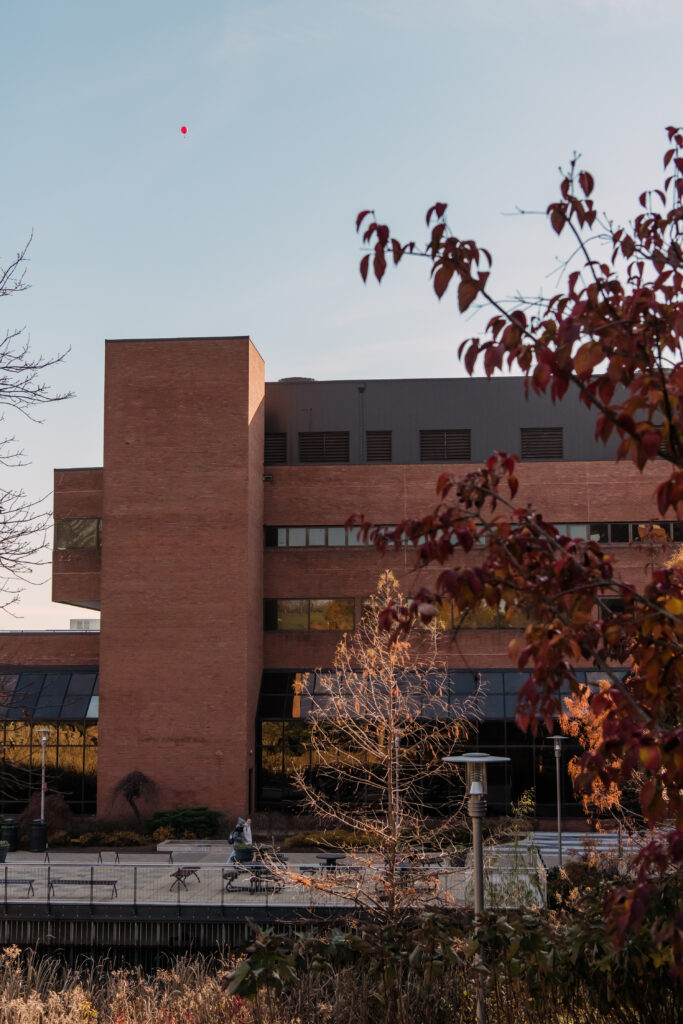 On “balloon day,” the balloons are visible from all over campus. (Marlayna Demond ’11/UMBC)
“Where are we?”
Kaylor opens the first class with a deceptively simple question: “Where are we, and how do we know that?” After beginning with a basic orienteering activity (no smartphones allowed!), the course advances through the surprisingly complex answer to Kaylor’s question, which leads students to develop skills in statistics, data analysis, and various software programs. They also pick up knowledge in disciplines like ecology, sociology, and hydrology.
Given its interdisciplinary bent, the course attracts students from a range of majors, most often those in the GES department (like environmental science) and computer science. With a background in GIS and environmental education, Kaylor is a perfect fit to teach the course to this mixed audience.
At the beginning of the semester, “computer science students will understand that it’s data science-driven. GES students will understand the hands-on sciences,” Kaylor says. By the end, “they’ll meet in the middle. It’s actually a really interesting blend of students to work with, and it’s fun to see how their strengths play off each other.”
Learning in real time
But back to the balloons. Each balloon flies with a digital camera attached, pointed at the ground. Previous students in the course coded a hack into the cameras that commands them to take a picture every 15 seconds as they float above campus.
Far below, students lay what look like paper archery targets flat on the ground and record their precise coordinates using GPS. These targets will show up in the photos taken by the camera on the balloon. Using the targets as reference points, the students will then be able to “geolocate” (tie to a point on the Earth’s surface) other objects—like buildings, trees, even people—in the camera’s photos.
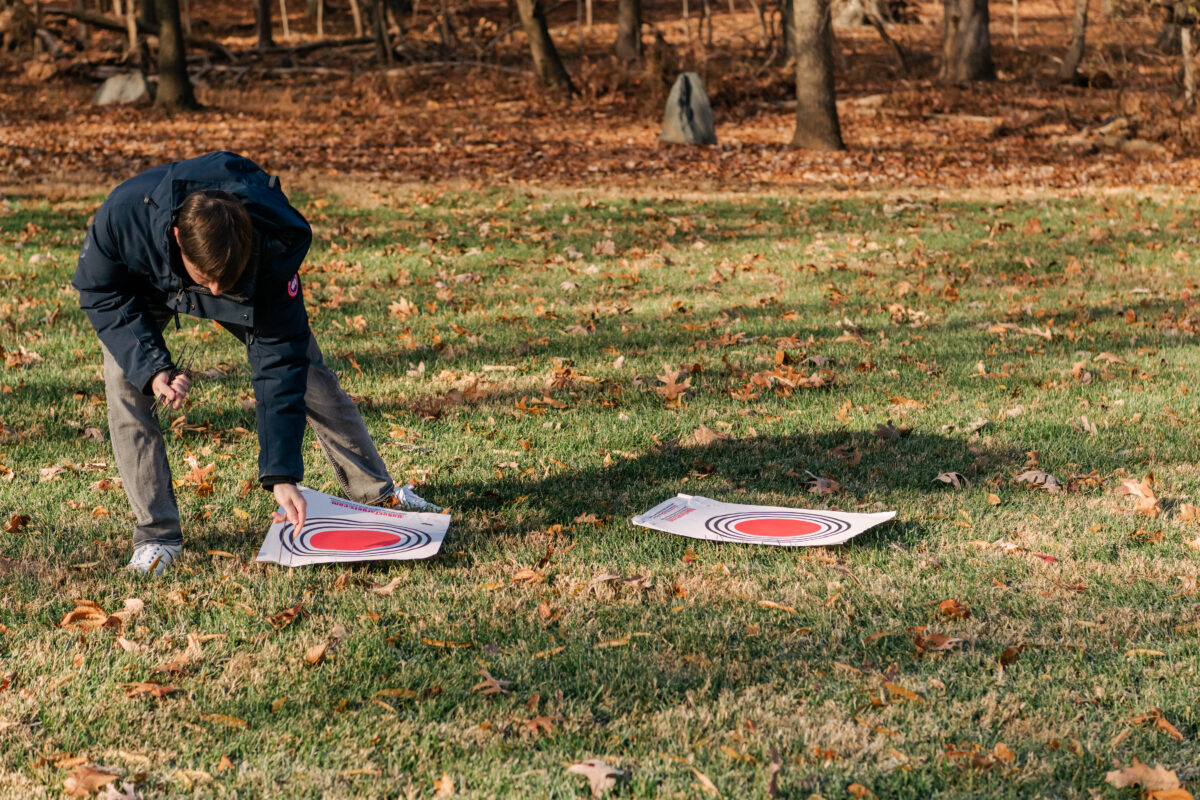 Matthew Parsons, computer science, sets reference targets on the ground. (Marlayna Demond ’11/UMBC)
Kaylor creates a blank digital map at the start of the morning to record the coordinates. “It’s fun to watch in the lab while students are out in the field doing it,” Kaylor says, “because it starts blooming. You see students adding points in real time.”
In what other class…
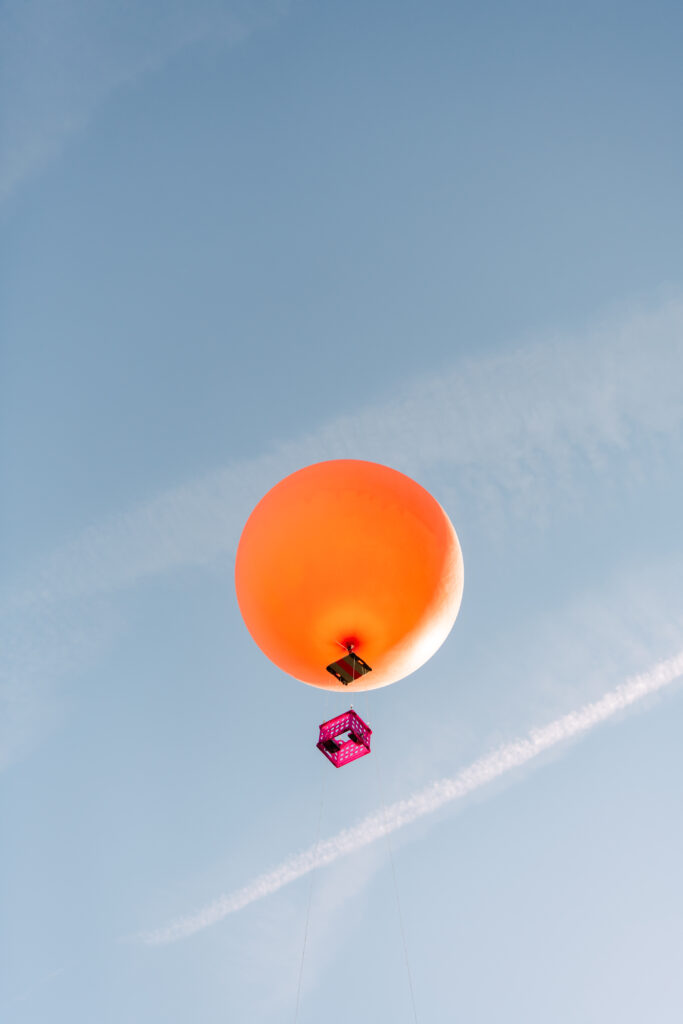 A pink crate dangling from the bottom of a balloon holds a small digital camera horizontal as the balloon flies. (Marlayna Demond ’11/UMBC)
The balloons have been a mystery to much of the campus community for years, with the colorful orbs dotting the campus sky in the tenth week of the semester. But for the students in Kaylor’s class, the balloons represent a culmination of the knowledge and skills they’ve gained.
Each student has their own reasons for taking the course. For some, it’s an opportunity to learn GIS skills—a must in the environmental field today—without spending too much time in front of a computer. As Kamsy Nwaiwau ’23, geography and environmental systems, puts it, “What other class do you get to hold a balloon 450 feet in the air? It’s something different.”
Whereas Alex Flitter ’23, mathematics and computer science, has a different perspective. He’s conducting research with Bedřich Sousedik, associate professor of mathematics, on how to model disease spread using ArcGIS—the same tool the students are using to locate points on the ground. GES 286 is “adding to my ability to visualize my research,” he says.
Learning openness
The course integrates a range of activities to get students thinking about how they could apply GIS to many fields of study. For one assignment, the students explore their own neighborhoods and mark the location of different businesses, like restaurants, pharmacies, and retail shops, and other neighborhood elements, like parks or bus stops. Then they use available data sets to see if they can identify associations with other neighborhood factors, like median income or education level.
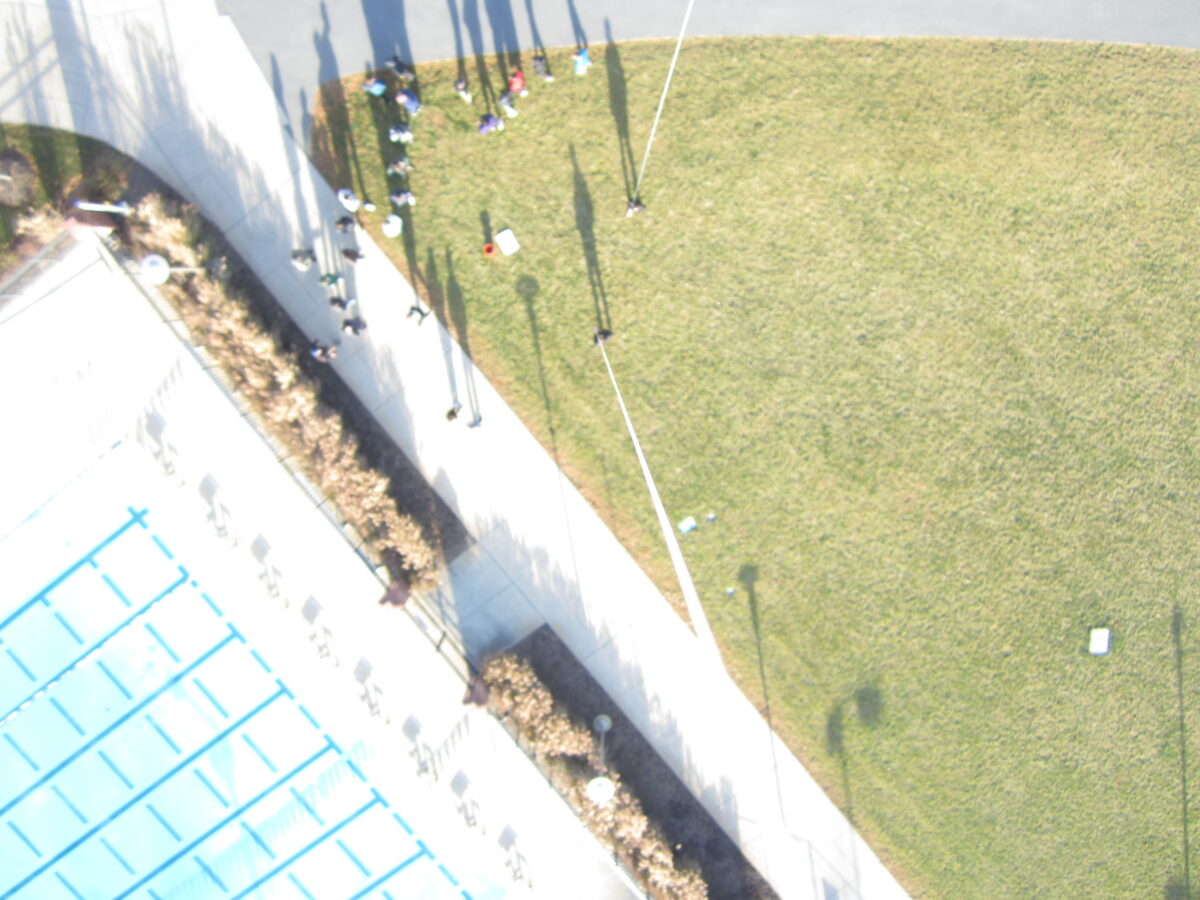

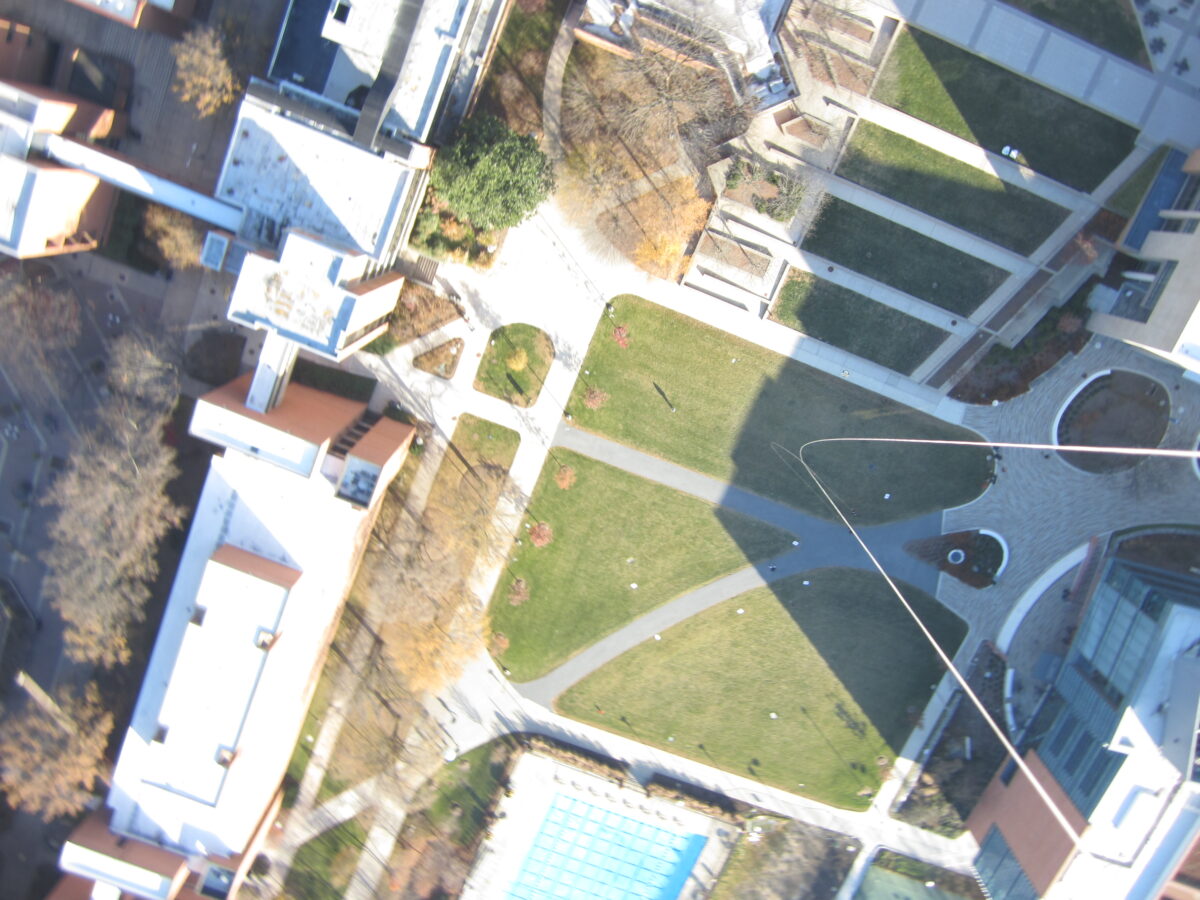 Images captured by one of the balloons. At left, the class gathers to observe the first balloon launch of the morning. (Images courtesy of Charles Kaylor)
This project “gets at the scientific process,” Kaylor says. He tells his students, “Any time a data set floats by, take a look at it and go, ‘What questions could I ask with this data?’ It’s a certain mode of openness.” Each in their own time, students get the idea. “What I love about GIS is—and you can count on it—any student who tries is going to have a GIS epiphany and start figuring things out,” Kaylor says, “and because it’s so applied and so tangible, it’s captivating.”
Making it real
This is Kaylor’s second time teaching the course after coming to UMBC from Temple University. He inherited the course backbone from Joe School, emeritus professor of GES, who still teaches the course in the summer. Kaylor has already made substantial changes, but has more in mind. One major goal is to create more opportunities for the students’ efforts to connect to real research projects.
“What I love about GIS is—and you can count on it—any student who tries is going to have a GIS epiphany and start figuring things out. And because it’s so applied and so tangible, it’s captivating.”
Charles Kaylor
Kaylor has already launched a collaboration with Facilities Management at UMBC to compare the latest data set of campus trees to the reality on the ground. So far, the students have checked about 10 percent of the listed trees, and Kaylor plans to add more each semester.
“I’m hoping to integrate more things like that, that have an obvious practical application or benefit to campus,” Kaylor says. “Since we’re measuring things on campus, we might as well see what we can do with that.” For example, Kaylor has discussed with Matthew Baker, professor of geography and environmental systems, how his students might be able to support Baker’s environmental monitoring work on campus.
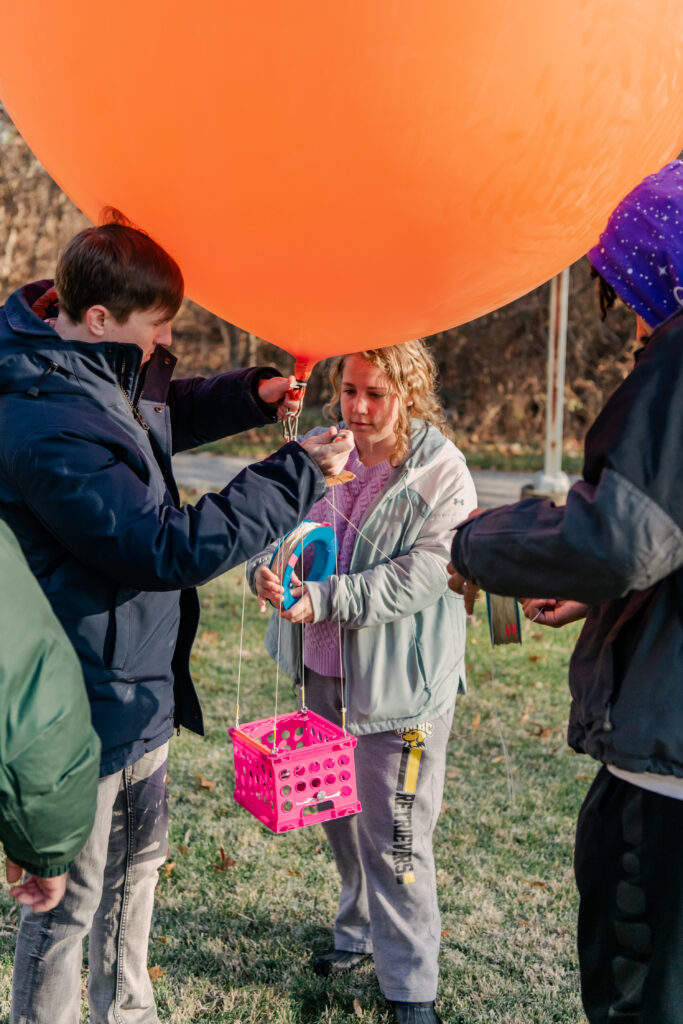 Matthew Parsons, computer science, Olivia Amaral, computer science, and Langston Smith, GES, attach the camera to their balloon and prepare for launch. (Marlayna Demond ’11/UMBC)
No matter what direction they go—whether epidemiology, ecology, or other fields—students who complete GES 286 will be better prepared to ask and answer useful questions about the world around them.
Teaching the class has been a rewarding experience for Kaylor as an instructor, too. The course “reconnected me with something that makes [GIS] live and breathe in a different way—a more exciting way,” he says. “Taking a more applied approach to it is a fun challenge. I’ve been having a great time teaching this class.”
Geography applies to everything
Finally, it’s time for the balloons to come down. As the students are wrangling them down and heading back to Sondheim Hall for a debrief, Joey Laiosa ’23, environmental science, shares that he previously worked in public safety as a dispatcher, then came back to school. He’s interested in conservation ecology, and using remote sensing to measure environmental health has particularly caught his attention.
“GIS is a really sought-after skill to have in a range of industries,” he says. That includes public safety, Laiosa says, where it could involve better pinpointing the location of an emergency in a complex environment like a construction site or an amusement park. “Geography applies to everything.”
Learn more about undergraduate research opportunities at UMBC.
]]>
On a brisk but clear day in early December, half a dozen brightly colored weather balloons barely squeeze through the double doors of Sondheim Hall’s lower level one by one. A group of four...
https://umbc.edu/stories/getting-your-research-off-the-ground-gis-balloons/
https://my3.my.umbc.edu/api/v0/pixel/news/130542/guest@my.umbc.edu/7b6e1b2bd1fb1d7c780b2953ccfd4562/api/pixel
cahss
cnms
coeit
csee
discovery
ges
magazine
mathstat
UMBC News & Magazine
https://my3.my.umbc.edu/groups/umbc-news-magazine
https://assets1-my.umbc.edu/system/shared/avatars/groups/000/001/943/24435aa6207c452e7bc15cc74b42c7bb/xsmall.png?1748556657
https://assets1-my.umbc.edu/system/shared/avatars/groups/000/001/943/24435aa6207c452e7bc15cc74b42c7bb/original.png?1748556657
https://assets2-my.umbc.edu/system/shared/avatars/groups/000/001/943/24435aa6207c452e7bc15cc74b42c7bb/xxlarge.png?1748556657
https://assets2-my.umbc.edu/system/shared/avatars/groups/000/001/943/24435aa6207c452e7bc15cc74b42c7bb/xlarge.png?1748556657
https://assets3-my.umbc.edu/system/shared/avatars/groups/000/001/943/24435aa6207c452e7bc15cc74b42c7bb/large.png?1748556657
https://assets1-my.umbc.edu/system/shared/avatars/groups/000/001/943/24435aa6207c452e7bc15cc74b42c7bb/medium.png?1748556657
https://assets2-my.umbc.edu/system/shared/avatars/groups/000/001/943/24435aa6207c452e7bc15cc74b42c7bb/small.png?1748556657
https://assets1-my.umbc.edu/system/shared/avatars/groups/000/001/943/24435aa6207c452e7bc15cc74b42c7bb/xsmall.png?1748556657
https://assets2-my.umbc.edu/system/shared/avatars/groups/000/001/943/24435aa6207c452e7bc15cc74b42c7bb/xxsmall.png?1748556657
UMBC News & Magazine
2
0
false
Wed, 01 Feb 2023 11:11:15 -0500
Wed, 01 Feb 2023 11:11:15 -0500
Mini creatures with mighty voices know their audience and focus on a single frequency
Written by Bernard Lohr, associate professor of biological sciences, UMBC
In the cloud forests of South America, amid the constant cacophony of bird and insect noise, a deafening blare pierces through the background from time to time. Belonging to the loudest known bird, the white bellbird, Procnias albus, this sound would be painful to humans listening nearby and capable of causing immediate hearing damage from about a yard away.
Listen to the world’s loudest bird call.
Made exclusively by males serenading females, these vocalizations can reach peak levels of more than 120 decibels on the sound pressure level scale (dB SPL), which is equivalent to a jet aircraft taking off from 100 yards away. The female bellbird listens some distance from the male, presumably trading off being close enough to assess his quality as a mate without damaging her ears.
I study the hearing ability of animals and the sounds they make to communicate. A great number of calls exist throughout the animal kingdom – and many are used to attract mates or defend territories. Evolution has favored those able to make sounds efficiently. The louder and more focused the energy in the call and the closer in pitch it is to the intended listener’s optimal hearing range, the farther away a potential mate or rival will hear it.
Many large mammals, such as singing whales, roaring lions and rumbling elephants, produce loud low-pitched sounds that travel especially well through most habitats. Because of their petite physical size, small animals are not capable of making these far-reaching low-frequency sounds.
Ultrasonic calls
Human ears are most sensitive to the highest notes on a piano – about 4 kHz – a unit of measurement that is the physical metric for pitch. Anything above 20 kHz is considered ultrasonic – undetectable to human ears. But such sounds are not undetectable to all ears.
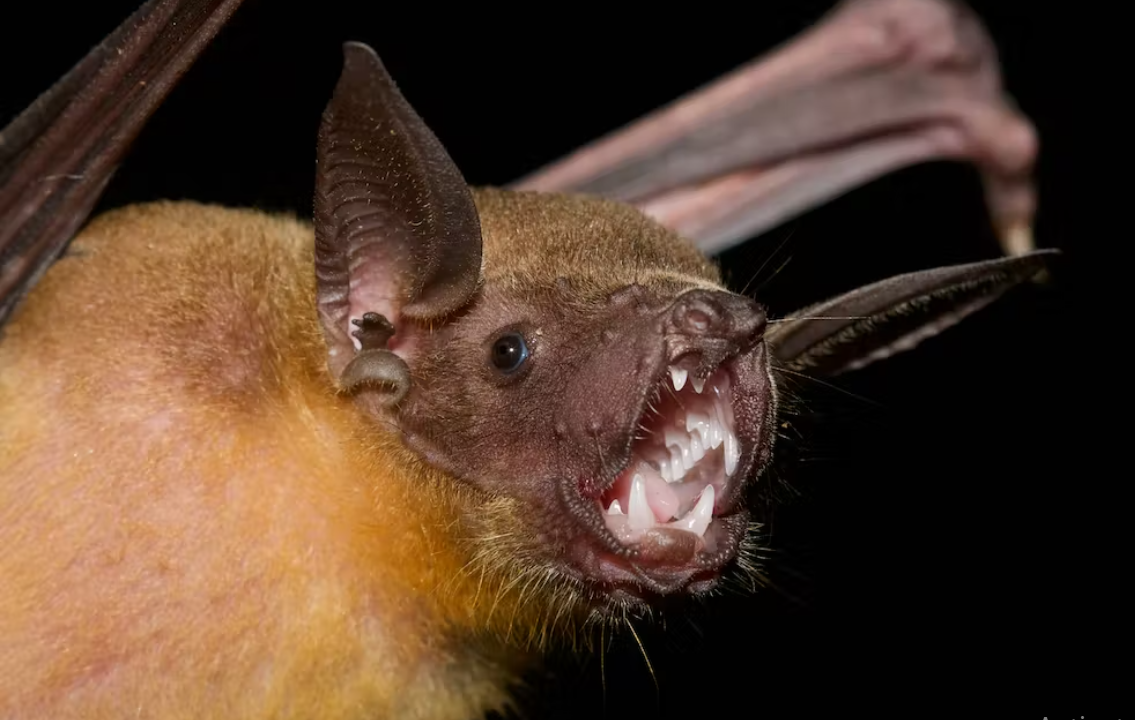 The greater bulldog bat’s ear is engineered for ultrasonic hearing. (Thomas Cuypers/flickr, CC BY-NC-ND)
For example, the greater bulldog bat, Noctilio leporinus, can produce ultrasonic echolocation calls between 30 and 60 kHz when hunting prey and maneuvering during flight. These calls can also get incredibly loud – above 140 dB SPL.
Many other small mammals, including other bats, and even some primates such as tiny tarsiers, produce loud ultrasonic sounds humans can’t perceive. In part, these sounds can reach such volumes because their acoustic power is concentrated in a pure tone or single frequency.
Creating speakers
Insects are some of the smallest animals to produce loud sounds, chief among them the cicadas and the orthopterans, which include katydids, grasshoppers and crickets.
In North America, the robust conehead, Neoconocephalus robustus, a type of katydid, regularly surpasses 105 dB SPL. These calls are produced to attract mates and, like many such calls, are competing against a clamor of comparable sounds from similar species.
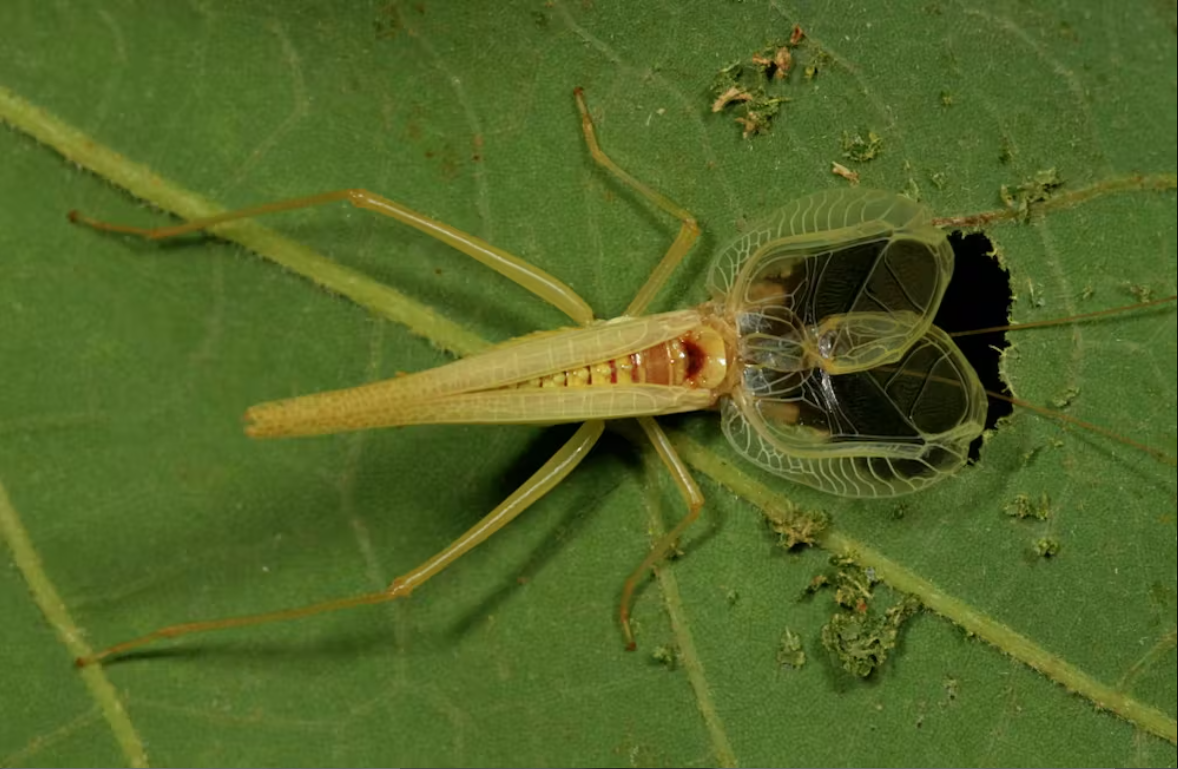 A two-spotted tree cricket, Neoxabea bipunctata, chews a hole just the right size for its fore wings. It then ‘sings’ by poking the wings through the hole and rubbing them together. (Patrick Coin/flickr, CC BY-NC-SA)
Some insects go one step further, amplifying their sounds by building the functional equivalent of audio speakers. Some tree crickets chew holes in leaves, place their vibrating wings in the opening and use the surrounding leaf as a baffle to prevent the loss of sound energy around the edges of their wings.
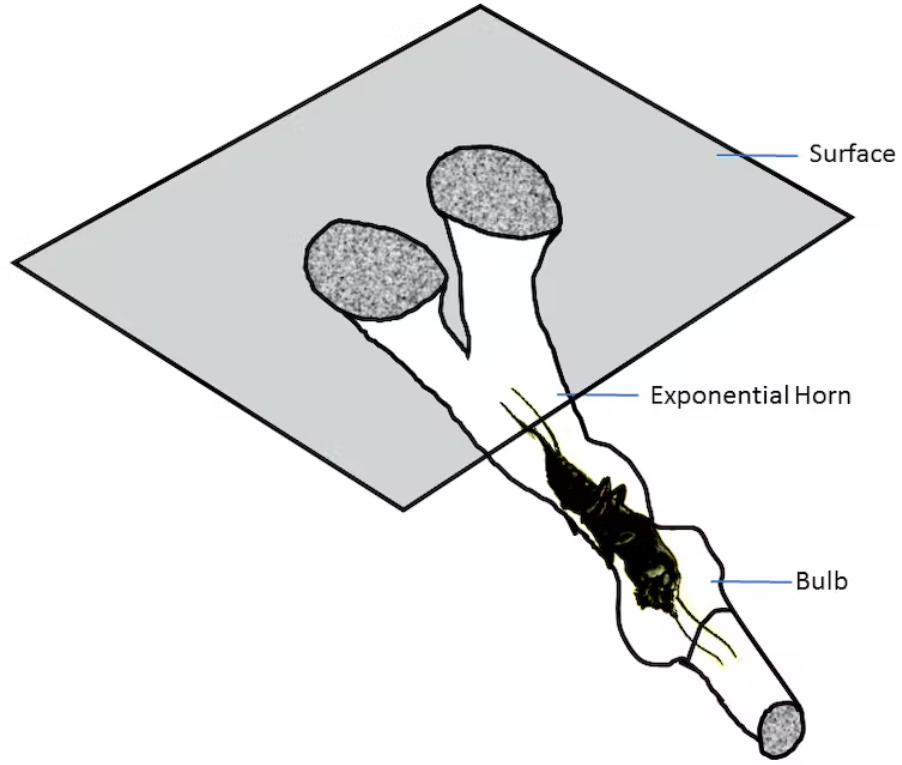 The male mole cricket sings from his specially designed burrow, which amplifies sound like a horn. (Ian Alexander, new drawing based on Bennet-Clark, 1970 with public domain insect from Lydekker 1879, CC BY-SA)
Mole crickets, Gryllotalpa vineae, go even further by constructing a burrow that acts like a wind instrument, creating a cavity of vibrating air that amplifies the sound energy they produce. These crickets’ songs can travel almost half a mile (0.8 kilometer).
Irksome invaders
The official mascot of Puerto Rico is a 1-to-2-inch (2-5-centimeter) frog called the coquí, Eleutherodactylus coqui, whose call is a combination of two pure tones – “ko” and “kee,” from which it gets its name. At 114-120 dB SPL, the frog’s calls are so loud they actually must protect their own hearing when vocalizing, by increasing the air pressure inside their middle ear.
Unfortunately, in the past few decades humans have accidentally introduced the coquí to a number of areas outside their native range, in particular the Hawaiian islands, where they have no natural predators and have become invasive pests. Since coquí calls are within an octave of humans’ best hearing – and they’re nocturnal – many Hawaiians suffer sleep disruptions because of the tiny frogs.
So even if you’re small, it’s not impossible to make yourself heard. You just have to blast all your acoustic energy in a single frequency, and hit the sweet spot of your audience’s hearing.
This article is republished from The Conversation under a Creative Commons license. Read the original article and see more than 250 UMBC articles available in The Conversation.
]]>
Written by Bernard Lohr, associate professor of biological sciences, UMBC In the cloud forests of South America, amid the constant cacophony of bird and insect noise, a deafening blare...
https://umbc.edu/stories/mini-creatures-with-mighty-voices/
https://my3.my.umbc.edu/api/v0/pixel/news/130522/guest@my.umbc.edu/0f7dca78ddc416a99930d7a81b7788b5/api/pixel
biological-sciences
cnms
discovery
magazine
the-conversation
theconversation
UMBC News & Magazine
https://my3.my.umbc.edu/groups/umbc-news-magazine
https://assets1-my.umbc.edu/system/shared/avatars/groups/000/001/943/24435aa6207c452e7bc15cc74b42c7bb/xsmall.png?1748556657
https://assets1-my.umbc.edu/system/shared/avatars/groups/000/001/943/24435aa6207c452e7bc15cc74b42c7bb/original.png?1748556657
https://assets2-my.umbc.edu/system/shared/avatars/groups/000/001/943/24435aa6207c452e7bc15cc74b42c7bb/xxlarge.png?1748556657
https://assets2-my.umbc.edu/system/shared/avatars/groups/000/001/943/24435aa6207c452e7bc15cc74b42c7bb/xlarge.png?1748556657
https://assets3-my.umbc.edu/system/shared/avatars/groups/000/001/943/24435aa6207c452e7bc15cc74b42c7bb/large.png?1748556657
https://assets1-my.umbc.edu/system/shared/avatars/groups/000/001/943/24435aa6207c452e7bc15cc74b42c7bb/medium.png?1748556657
https://assets2-my.umbc.edu/system/shared/avatars/groups/000/001/943/24435aa6207c452e7bc15cc74b42c7bb/small.png?1748556657
https://assets1-my.umbc.edu/system/shared/avatars/groups/000/001/943/24435aa6207c452e7bc15cc74b42c7bb/xsmall.png?1748556657
https://assets2-my.umbc.edu/system/shared/avatars/groups/000/001/943/24435aa6207c452e7bc15cc74b42c7bb/xxsmall.png?1748556657
UMBC News & Magazine
0
0
false
Tue, 31 Jan 2023 17:29:46 -0500
Tue, 31 Jan 2023 17:29:46 -0500
New center director to take NASA-supported Earth science research into next era at UMBC
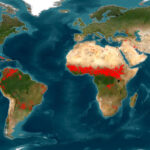
The UMBC-led Goddard Earth Science Technology and Research (GESTAR) Center II includes over 120 researchers advancing Earth and atmospheric sciences and launching the next generation of scientists. GESTAR II scientists and engineers are tracking the effects of shipping regulations on air pollution, predicting fires in India, and much more, often relying on data collected via remote sensing from NASA satellites.
NASA awarded $72 million for UMBC to establish GESTAR II in fall 2021, in collaboration with primary partner Morgan State University and six other institutions. After a national search, a new director is taking the helm of this high-impact collaboration.
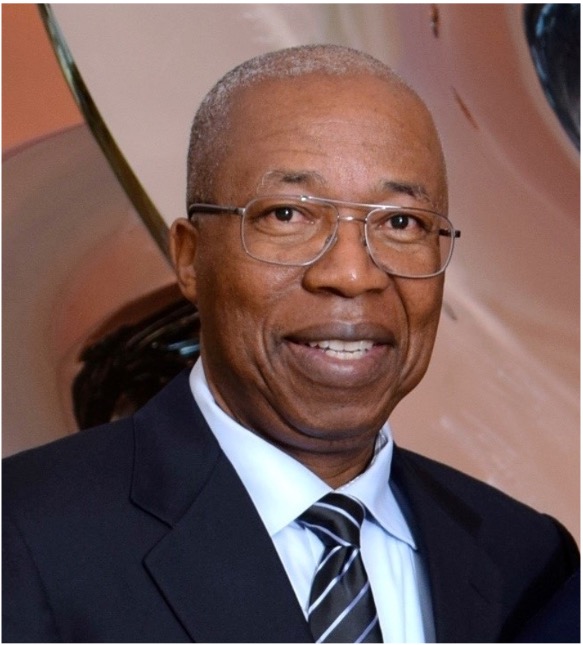 Charles Ichoku (image courtesy of Ichoku)
The new director, Charles Ichoku, brings deep and well-rounded experience in Earth science research, at NASA, and in student development programs—exactly the elements GESTAR II brings together and hopes to expand upon. Ichoku comes to GESTAR II from concurrent roles as professor of Earth and environmental sciences at Howard University and as the Distinguished Scientist of the National Oceanic and Atmospheric Administration (NOAA) Cooperative Science Center in Atmospheric Sciences and Meteorology (NCAS-M). Prior to that, he served at NASA Goddard Space Flight Center in Greenbelt, Maryland for 20 years in various research and management roles.
“Dr. Ichoku brings impressive credentials to this important leadership position at UMBC, not only as a world-class scientist, but also as a long-term NASA-based scientist and program manager,” shares Karl V. Steiner, Vice President for Research and Creative Achievement at UMBC. “He is a perfect fit for both GESTAR II and UMBC.”
Earth science from hundreds of miles up
Ichoku’s research program focuses on applying remote sensing—collecting data from a significant distance, most often from satellites orbiting Earth—and other data to study large-scale processes that affect the environment on land, weather, and air quality. In addition to directing GESTAR II, Ichoku will have an appointment as professor of geography and environmental systems (GES) at UMBC, where he will continue to conduct research, mentor students, and teach courses.
“GES is a good fit,” Ichoku says, “because I’m not just looking at developing the approaches and instrumentation to measure specific parameters, but I’m interested in how you apply the data, knowledge, and science to actually understand phenomena that happen on the ground and in the atmosphere.”
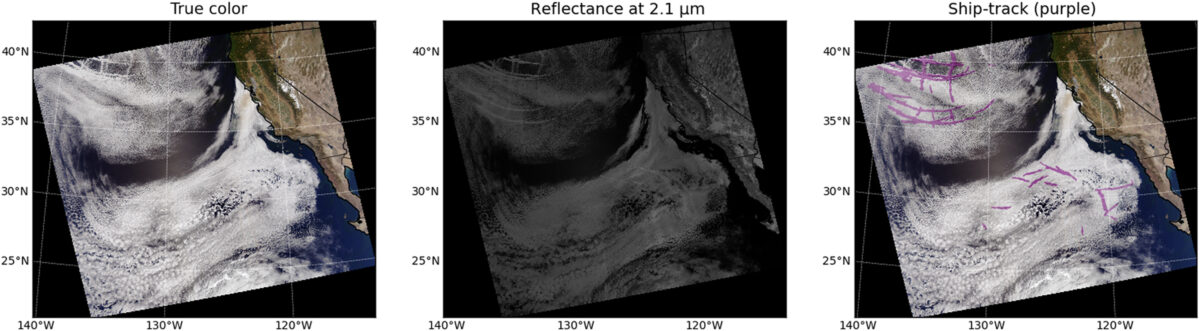 An image collected by NASA’s MODIS satellite of the U.S. West Coast (left) shows tracks of air pollution generated by shipping traffic (purple lines, right), which was detected by a GESTAR II research team’s algorithm.
Elevating African research
Ichoku’s work is influenced by his youth in West Africa, and focuses on phenomena that especially affect that region. For example, frequent agricultural fires send various particles into the atmosphere, which can affect air quality, precipitation, and more. In addition, Lake Chad in Central Africa has nearly dried up over the last few decades in part because of severe drought, resulting in widespread conflict and suffering. Drought also sends dust and other particles into the atmosphere, affecting air quality. These particles and other environmental components (like clouds) interact with radiation from the Sun, driving processes that can adversely impact human life on Earth’s surface, Ichoku explains.
“I’m very interested in seeing research and the application of its results improve in Africa overall, but in particular in Western and Central Africa,” Ichoku says. “So I hope to be able to continue research in that region.”
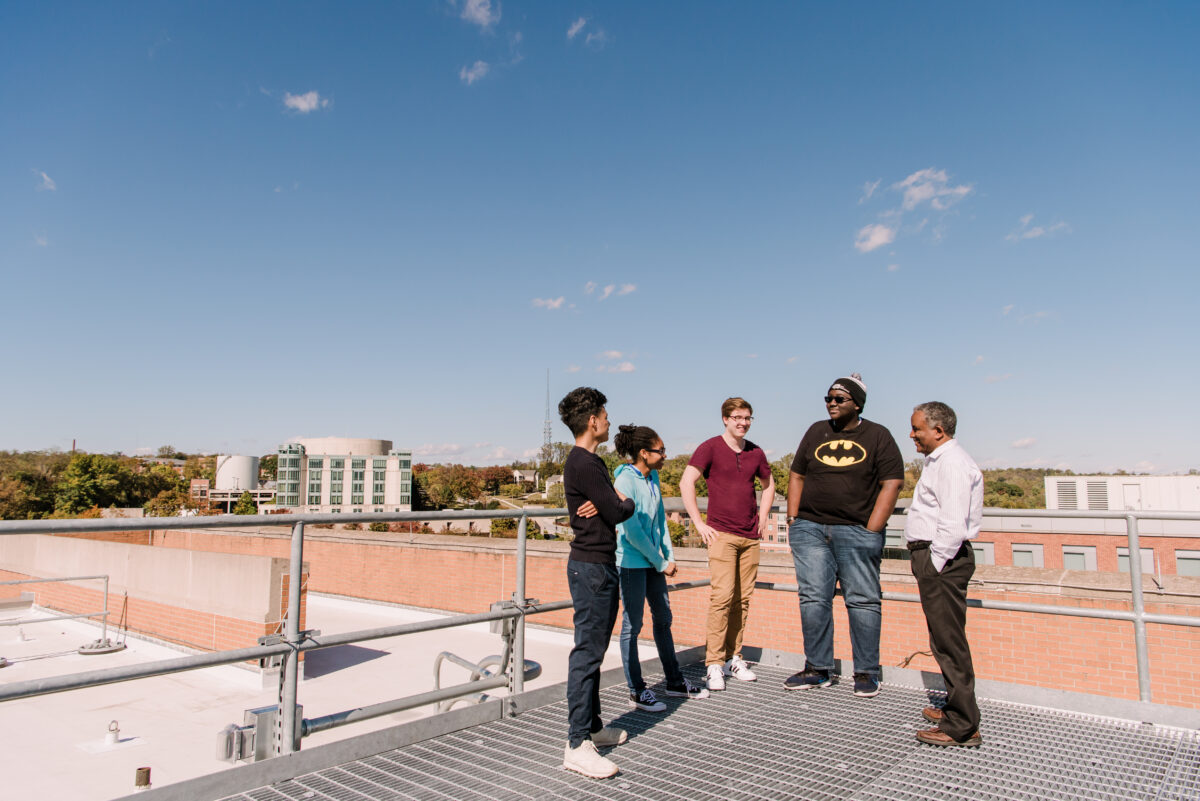 Belay Demoz, right, talks with students on the roof of the UMBC Physics Building. (Marlayna Demond ’11/UMBC)
To that end, a few years ago Ichoku joined with colleagues to initiate the U.S.-West African Coastal Resilience Research Consortium (CRRC). In addition, he recently played an important role in the inauguration of the African Meteorological Society (AfMS), where he serves as chair of the Diaspora and Friends of Africa Committee. The committee involves a significant number of colleagues who are similarly passionate about the advancement of scientific research and applications in Africa.
Those colleagues include GESTAR II’s inaugural director, Belay Demoz, whose research is similarly inspired by experiences with drought, displacement, and resulting conflict during his youth in East Africa—challenges that continue today. Demoz, professor of physics at UMBC, will continue in his departmental role after Ichoku takes up his post.
Demoz notes Ichoku’s extensive experience with Howard University (which is also a partner in UMBC’s Center for Space Sciences Technology) and at NASA as strengths, and shares his interest in expanding UMBC’s research and education efforts in Africa. “I’m looking forward to him leading the next iteration of GESTAR II, and increasing involvement of GES in what we do,” Demoz says.
Clearing the pathway for students
In addition to his own research, Ichoku has demonstrated a deep commitment to student research and success throughout his career. He moved from NASA to Howard and NCAS-M so he could focus more on student training, particularly supporting underrepresented minority students in Earth science.
With NCAS-M, on top of his typical professorial duties, Ichoku was responsible for matching students with appropriate research projects and NOAA mentors across 13 institutions. He also supported students’ success throughout their graduate projects, ensuring they persisted to graduation and were prepared to be competitive for sought-after professional roles, often at NOAA, NASA, or in academia.
With Demoz, Ichoku also served as co-PI for the NASA-funded Student Airborne Science Activation (SaSa) project, involving three NASA centers and six minority-serving Institutions, including UMBC. This past summer, 24 students, including four from UMBC, spent four weeks at UMBC as part of the SaSa program.
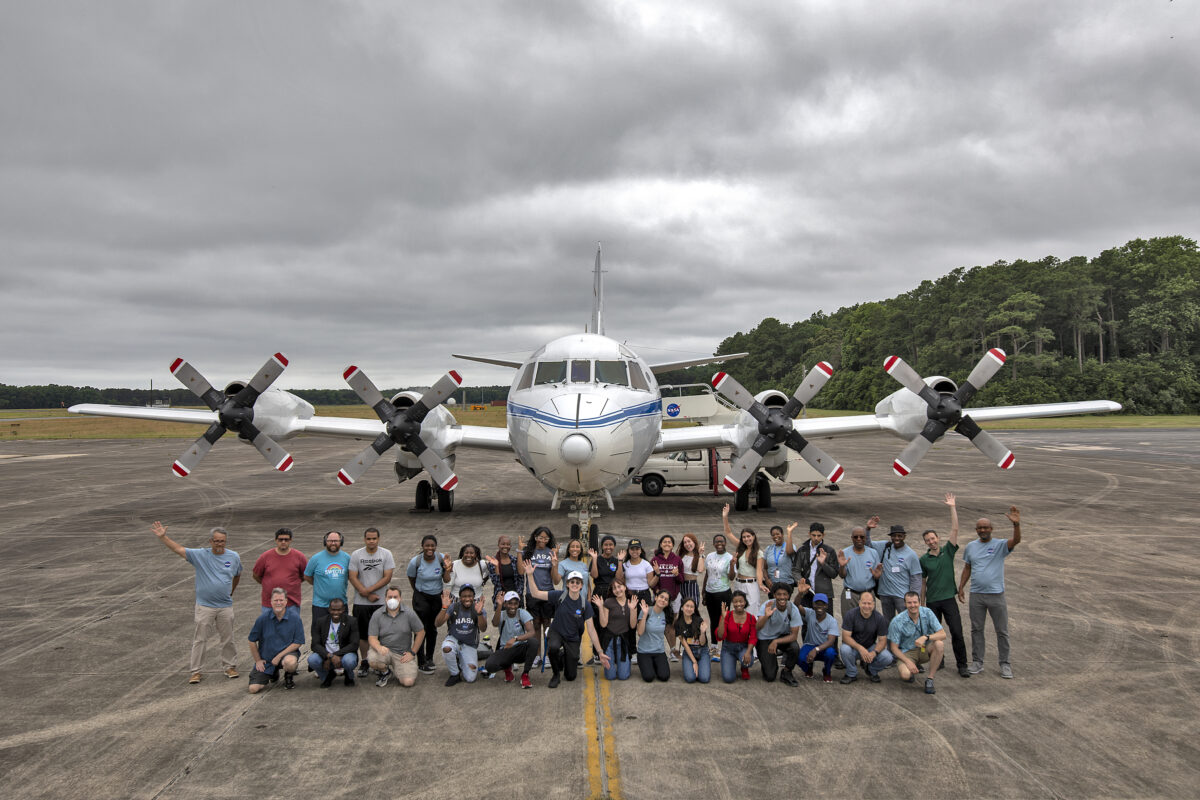 Participants in the 2022 SaSa program at NASA Wallops Flight Facility. (Image courtesy of Belay Demoz)
Now at GESTAR II, Ichoku is interested in continuing to enhance the connection between researchers, who often conduct their work at Goddard Space Flight Center, and members of the larger UMBC community—including students at all levels.
“I think it’s a good thing for a researcher to connect with students. Even if they are not teaching them in a traditional class setting, they can be mentors for interns, which I did myself for many years while I was at NASA as a research scientist,” Ichoku says. “I know that our faculty have a lot to offer to our students, so I will do my best to help facilitate that. My role will be to support the clearing of the pathway and the removal of any obstacles.”
A shining example
Ichoku also brings to GESTAR II and UMBC substantial experience in deepening relationships across institutions. He already has relationships with the scientific leads at other GESTAR II institutions, such as the Pennsylvania State University, Arizona State University, and University of Colorado Boulder, and is excited to continue working with them in a new capacity.
“When we start talking, ideas will flow,” Ichoku says. “We will then synthesize the ideas into strategic initiatives and make them happen.”
Moving forward, Ichoku plans to continue to emphasize top-quality research while enhancing opportunities for students and building bridges between the GESTAR II institutions. And he is especially looking forward to doing all of that at UMBC.
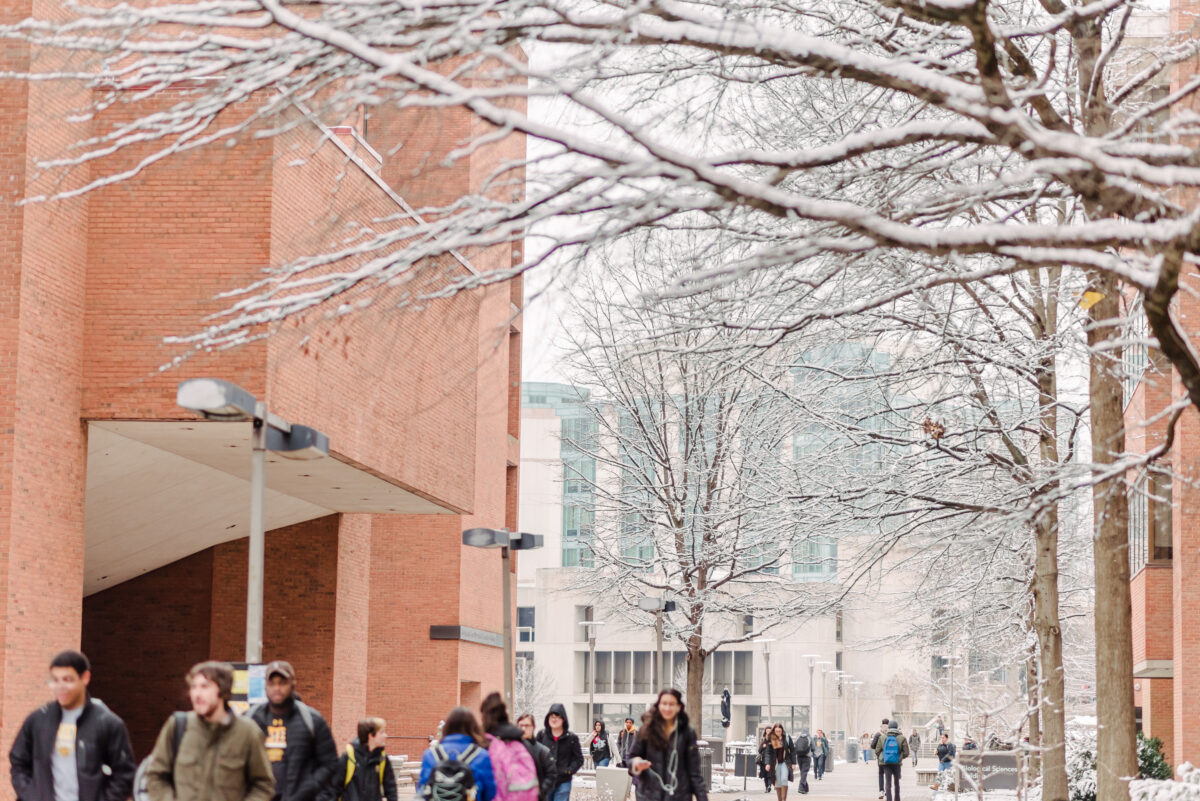 Students bustle through UMBC’s Academic Row on a winter day. (Marlayna Demond ’11/UMBC)
The opportunity to lead GESTAR II “is both a great pleasure and an honor for me, as I have always admired UMBC for being a shining example in all areas of university performance, including education, scholarship, research, innovation, technology, diversity, sports, environmental sustainability, and community outreach,” Ichoku says. “I am proud of UMBC for attaining the status of Carnegie R1 Doctoral Institution.”
“It is also a great blessing to have this wonderful opportunity to contribute to scientific discoveries and knowledge expansion for human advancement through NASA, and, in particular, Goddard Space Flight Center,” he adds. “I feel highly privileged to be involved in a program that connects two of the organizations that perform at the highest levels in their respective domains of activity, namely academia (UMBC) and space (NASA).”
]]>
The UMBC-led Goddard Earth Science Technology and Research (GESTAR) Center II includes over 120 researchers advancing Earth and atmospheric sciences and launching the next generation of...
https://umbc.edu/stories/new-director-to-take-earth-science-research-into-next-era/
https://my3.my.umbc.edu/api/v0/pixel/news/130456/guest@my.umbc.edu/84327406f7fb19fbcc10b317b3683061/api/pixel
cahss
cnms
ges
gestar
news
physics
science-and-tech
UMBC News & Magazine
https://my3.my.umbc.edu/groups/umbc-news-magazine
https://assets1-my.umbc.edu/system/shared/avatars/groups/000/001/943/24435aa6207c452e7bc15cc74b42c7bb/xsmall.png?1748556657
https://assets1-my.umbc.edu/system/shared/avatars/groups/000/001/943/24435aa6207c452e7bc15cc74b42c7bb/original.png?1748556657
https://assets2-my.umbc.edu/system/shared/avatars/groups/000/001/943/24435aa6207c452e7bc15cc74b42c7bb/xxlarge.png?1748556657
https://assets2-my.umbc.edu/system/shared/avatars/groups/000/001/943/24435aa6207c452e7bc15cc74b42c7bb/xlarge.png?1748556657
https://assets3-my.umbc.edu/system/shared/avatars/groups/000/001/943/24435aa6207c452e7bc15cc74b42c7bb/large.png?1748556657
https://assets1-my.umbc.edu/system/shared/avatars/groups/000/001/943/24435aa6207c452e7bc15cc74b42c7bb/medium.png?1748556657
https://assets2-my.umbc.edu/system/shared/avatars/groups/000/001/943/24435aa6207c452e7bc15cc74b42c7bb/small.png?1748556657
https://assets1-my.umbc.edu/system/shared/avatars/groups/000/001/943/24435aa6207c452e7bc15cc74b42c7bb/xsmall.png?1748556657
https://assets2-my.umbc.edu/system/shared/avatars/groups/000/001/943/24435aa6207c452e7bc15cc74b42c7bb/xxsmall.png?1748556657
UMBC News & Magazine
0
0
false
Fri, 27 Jan 2023 19:40:56 -0500
Fri, 27 Jan 2023 19:40:56 -0500
UMBC researchers listed among the world’s top 2% of most-cited scientists and engineers
More than 40 active UMBC researchers are listed among the top 2% of the world’s most-cited scientists and engineers in an analysis recently published by Elsevier.
These researchers include faculty across all three of UMBC’s academic colleges as well as UMBC’s NASA-funded centers, such as the Goddard Earth Sciences Technology and Research (GESTAR II) Center. Their work covers an incredibly diverse array of topics. Represented academic departments include:
- biological sciences
- chemical, biochemical, and environmental engineering
- chemistry and biochemistry
- computer science and electrical engineering
- geography and environmental systems
- information systems
- mathematics and statistics
- mechanical engineering
- physics
- psychology
“We perform research to further our understanding of how the various aspects of our world function,” says Karl V. Steiner, vice president for research and creative achievement. “One of the highest recognitions in the scientific community is when other members of this community cite our work.”
He notes, “The Elsevier analysis shows that our researchers are truly impacting the scientific community in a significant way.”
History of citation honors
The list includes faculty researchers who have also received other “highly cited” researcher accolades. In 2022, Erle Ellis, professor of geography and environmental systems (GES), was featured on Clarivate’s Highly Cited Researchers list, which includes papers ranked in the top 1% of citations within Clarivate’s Web of Science database. About 0.1% of the world’s researchers have received this distinction. Ellis is known for his transformational work on human-managed ecosystems, with his research described as top discovery of 2021 by the Smithsonian National Museum of Natural History.
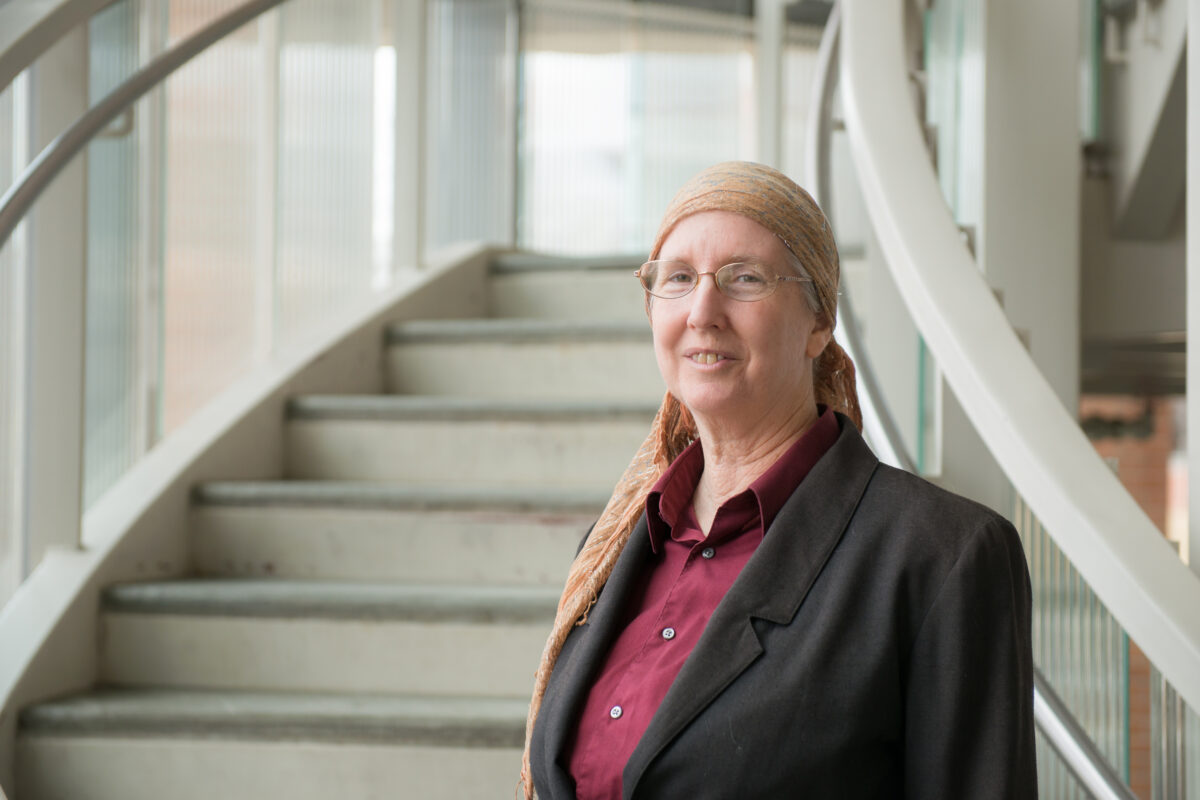 Lorraine Remer (Marlayna Demond ’11/UMBC)
Lorraine Remer, research professor for the Joint Center for Earth Systems Technology, who is affiliated with both GES and physics, is frequently honored for her geophysics publications. She received the 2019 UMBC Research Faculty Excellence Award following her recognition as one of “The Most Influential Scientific Minds” on the Thomson Reuters highly cited researchers list.
Anupam Joshi, director of UMBC’s Center for Cybersecurity and professor and chair of computer science and electrical engineering, was also included on Elsevier’s highly-cited list. His career trajectory demonstrates how UMBC faculty balance high-impact research with other forms of leadership. He has published more than 275 papers, has been granted nine patents, and has obtained research support from a variety of federal and industrial sources. At the same time, he is now serving as a 2022–23 American Council on Education (ACE) Fellow, an intensive program focused on agility and innovative problem solving among higher education leaders.
Measuring impact
This latest most-cited researchers list is based on data annually compiled from author profiles in Elsevier’s abstract and citation database, Scopus.
Elsevier’s 2022 database of standardized citation indicators classifies researchers into 22 fields and 174 subfields. Those with a composite indicator (c-score) within the top 2% of each subfield are included in the most-cited list. The list’s authors indicate that c-score is used because it “focuses on impact (citations) rather than productivity (number of publications)” and because it includes granular information on authorship, including co-authorship and author position (e.g., single, first, or last author).
]]>
More than 40 active UMBC researchers are listed among the top 2% of the world’s most-cited scientists and engineers in an analysis recently published by Elsevier. These researchers include...
https://umbc.edu/stories/most-cited-scientists-2022/
https://my3.my.umbc.edu/api/v0/pixel/news/130830/guest@my.umbc.edu/0a8209cd9947fb4136c6c8893cdbfae1/api/pixel
cahss
cbee
cnms
coeit
csee
cybersecurity
ges
gestar
is
jcet
meche
news
physics
rca-1
research
science-and-tech
UMBC News & Magazine
https://my3.my.umbc.edu/groups/umbc-news-magazine
https://assets1-my.umbc.edu/system/shared/avatars/groups/000/001/943/24435aa6207c452e7bc15cc74b42c7bb/xsmall.png?1748556657
https://assets1-my.umbc.edu/system/shared/avatars/groups/000/001/943/24435aa6207c452e7bc15cc74b42c7bb/original.png?1748556657
https://assets2-my.umbc.edu/system/shared/avatars/groups/000/001/943/24435aa6207c452e7bc15cc74b42c7bb/xxlarge.png?1748556657
https://assets2-my.umbc.edu/system/shared/avatars/groups/000/001/943/24435aa6207c452e7bc15cc74b42c7bb/xlarge.png?1748556657
https://assets3-my.umbc.edu/system/shared/avatars/groups/000/001/943/24435aa6207c452e7bc15cc74b42c7bb/large.png?1748556657
https://assets1-my.umbc.edu/system/shared/avatars/groups/000/001/943/24435aa6207c452e7bc15cc74b42c7bb/medium.png?1748556657
https://assets2-my.umbc.edu/system/shared/avatars/groups/000/001/943/24435aa6207c452e7bc15cc74b42c7bb/small.png?1748556657
https://assets1-my.umbc.edu/system/shared/avatars/groups/000/001/943/24435aa6207c452e7bc15cc74b42c7bb/xsmall.png?1748556657
https://assets2-my.umbc.edu/system/shared/avatars/groups/000/001/943/24435aa6207c452e7bc15cc74b42c7bb/xxsmall.png?1748556657
UMBC News & Magazine
0
0
false
Wed, 25 Jan 2023 11:47:33 -0500
Fri, 10 Feb 2023 17:01:24 -0500
U.S. News ranks UMBC’s online master’s in information systems among best in the nation

U.S. News and World Report has recognized UMBC’s online master’s degree in information systems as #41 on their national list of 2023 Best Online Master’s in Information Technology Programs, as well as #20 for veterans.
The U.S. News rankings, released today, evaluate programs based on qualities such as strong faculty credentials, a good reputation among peer institutions, and the opportunity for students to use diverse online learning tools and engage with their instructors and classmates.
Michael Brown, graduate program director for UMBC’s online information system master’s program, says its wide range of electives, as well as free textbooks and course material, distinguish it from similar programs at other institutions.
The program offers a foundations course for people who do not have degrees or experience in technology fields, as well as four career-specific tracks that allow students to specialize in high-demand areas such as artificial intelligence and cybersecurity. The large number of available electives allows students to further customize their learning, Brown says.
Career opportunities
Graduates of UMBC’s online master’s program in information systems regularly land jobs as cybersecurity specialists, data analysts, systems administrators, and more.
Simbiat Odeshina, a master’s degree student in information systems, is currently enrolled in the program while also working as an associate software tester at Wabtec. “I really enjoy the flexibility with the program. Since I work full-time, I really like being able to attend class after work,” she says. Since beginning the program, she shares, “I am thinking about ways to improve how I approach certain things at my job.”
This ranking follows UMBC’s recognition as #9 in the nation for undergraduate teaching and #10 in the nation for innovation in the 2022–23 U.S. News and World Report Best Colleges undergraduate rankings released last September.
]]>
U.S. News and World Report has recognized UMBC’s online master’s degree in information systems as #41 on their national list of 2023 Best Online Master’s in Information Technology Programs, as...
https://umbc.edu/stories/u-s-news-ranks-umbcs-online-masters-in-information-systems-among-best-in-the-nation/
https://my3.my.umbc.edu/api/v0/pixel/news/130332/guest@my.umbc.edu/e896473b1e940cd4c6f35d138907ac2b/api/pixel
coeit
is
news
rankings
science-and-tech
UMBC News & Magazine
https://my3.my.umbc.edu/groups/umbc-news-magazine
https://assets1-my.umbc.edu/system/shared/avatars/groups/000/001/943/24435aa6207c452e7bc15cc74b42c7bb/xsmall.png?1748556657
https://assets1-my.umbc.edu/system/shared/avatars/groups/000/001/943/24435aa6207c452e7bc15cc74b42c7bb/original.png?1748556657
https://assets2-my.umbc.edu/system/shared/avatars/groups/000/001/943/24435aa6207c452e7bc15cc74b42c7bb/xxlarge.png?1748556657
https://assets2-my.umbc.edu/system/shared/avatars/groups/000/001/943/24435aa6207c452e7bc15cc74b42c7bb/xlarge.png?1748556657
https://assets3-my.umbc.edu/system/shared/avatars/groups/000/001/943/24435aa6207c452e7bc15cc74b42c7bb/large.png?1748556657
https://assets1-my.umbc.edu/system/shared/avatars/groups/000/001/943/24435aa6207c452e7bc15cc74b42c7bb/medium.png?1748556657
https://assets2-my.umbc.edu/system/shared/avatars/groups/000/001/943/24435aa6207c452e7bc15cc74b42c7bb/small.png?1748556657
https://assets1-my.umbc.edu/system/shared/avatars/groups/000/001/943/24435aa6207c452e7bc15cc74b42c7bb/xsmall.png?1748556657
https://assets2-my.umbc.edu/system/shared/avatars/groups/000/001/943/24435aa6207c452e7bc15cc74b42c7bb/xxsmall.png?1748556657
UMBC News & Magazine
0
0
false
Tue, 24 Jan 2023 09:32:27 -0500
Tue, 24 Jan 2023 09:32:27 -0500
New “Life Magnified” USPS stamp series features Tagide deCarvalho’s images of microscopic life
Tagide deCarvalho, director of the Keith R. Porter Imaging Facility in UMBC’s College of Natural and Mathematical Sciences, produces artistic images that reveal microscopic life in vivid, thought-provoking ways. Her work combines her skill at the lab bench and behind the microscope with her artist’s eye, and it continues to earn her accolades worldwide.
deCarvalho has been recognized repeatedly in the Nikon Small World Photomicrography Competition. In 2020, she won the 2019 Olympus Image of the Year Global Life Science Light Microscopy Award for an image of a tardigrade, also known as a “water bear.” This year, she won the 2022 Zeiss Microscopy Image Contest in the Life Sciences category.
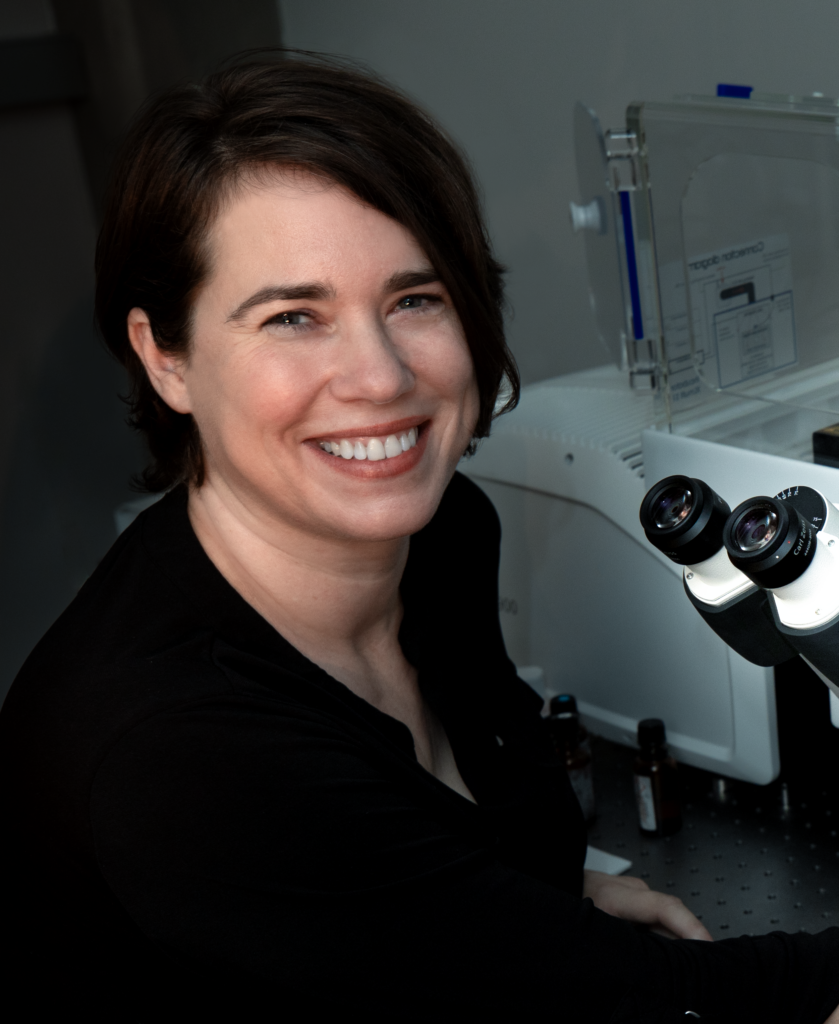 Tagide deCarvalho in front of a confocal microscope in the Keith R. Porter Imaging Facility at UMBC. (Melissa Cormier/UMBC)
“We use their equipment. I’m a big fan of their instruments, so it was nice to be recognized by that company,” deCarvalho says of the Zeiss award. The winning image portrayed bacteria that she scraped from her own tongue. At the time, she simply needed a quick sample to test some new materials for preparing specimens in the lab. Only later did she decide to refine the image into something beautiful.
“My superpower is finding everyday specimens and making them glamorous,” deCarvalho says, a bit tongue in cheek. She recently learned that her images will now reach a larger audience than ever before.
Putting her stamp on the art world
This summer, deCarvalho received an exciting request: An art curator wanted to include two of her images in an upcoming collection—except this was no typical art exhibit. A United States Postal Service (USPS) curator wanted to include deCarvalho’s work in a stamp collection featuring microscope images. USPS officially announced the “Life Magnified” collection in December, and the stamps will become available later in 2023.
The USPS recognition holds special significance for deCarvalho, whose grandfather collected stamps. When he passed away, deCarvalho inherited his collection. Her grandfather was a physician-scientist, and deCarvalho enjoyed looking through his microscopes as a child. He always told his granddaughter she would be a scientist one day.
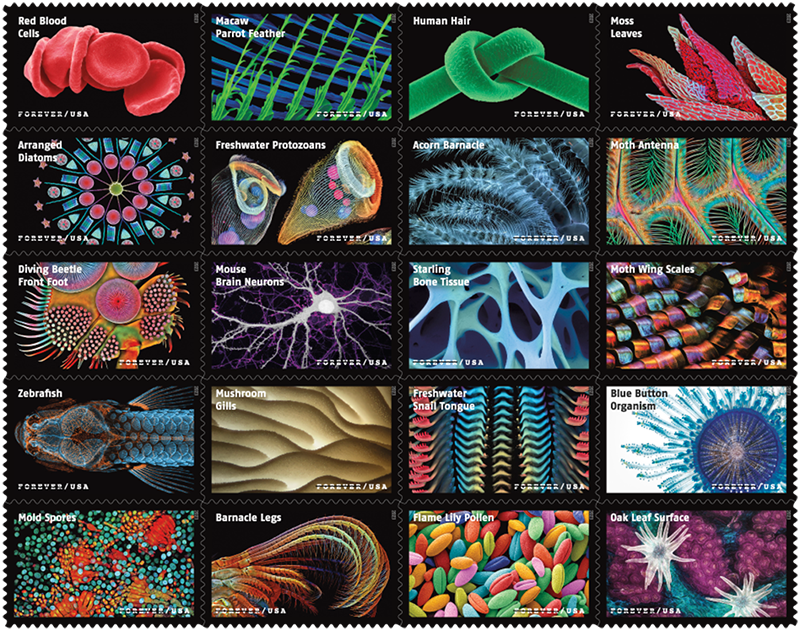 The “Life Magnified” stamp series, set to be released later this year. deCarvalho’s images are the Moss Leaves (upper right) and Mold Spores (lower left). (Image courtesy of U.S. Postal Service)
deCarvalho has had a lifelong interest in art, too, and began her academic career as an art photography major. As an undergraduate, she wanted to learn to use microscopes to create art in a biological context. To that end, she worked for a faculty member at the University of New Mexico School of Medicine creating transmission electron microscope images.
The professor was thrilled to work with a student who already knew how to develop film—the hardest thing to teach, and something deCarvalho had been doing for years in her own darkroom. In the lab, she started to learn techniques essential to her work today, but she never got to put her artistic talents to work. Instead, deCarvalho launched a scientific career, fulfilling her grandfather’s prophecy and eventually landing at UMBC in 2016.
Once she arrived at UMBC, art finally returned to her life. “Suddenly I realized I could do it,” deCarvalho says. “I’d say it was about 20 years later. I came full circle.”
Creating art, informing scientific research
The process of creating an artistic microscope image begins the exact same way as creating a research image. It’s only the post-processing that differs, deCarvalho explains.
“I take things further than what might be considered ethical for a research image, where there are clear guidelines as to what you can do,” she says. In a research image, “You can’t manipulate the image to alter any of the content.” For her art, she removes distracting elements like debris around the main specimen, and emphasizes the specimen’s key elements in a way that makes it more visually engaging.
Her modifications “allow you to focus your attention on [the specimen] more, and to find it more aesthetically pleasing,” explains deCarvalho. She believes this makes viewers “more interested in the content than you would be if I hadn’t slightly altered it,” she says. “I think it makes it more compelling.”
Her artistic work can still inform scientific image production. “I push the limits of my expertise by doing these art images,” deCarvalho says. “I can bring some of the experience and new techniques that I learn in doing that back to the research. It goes both ways.”
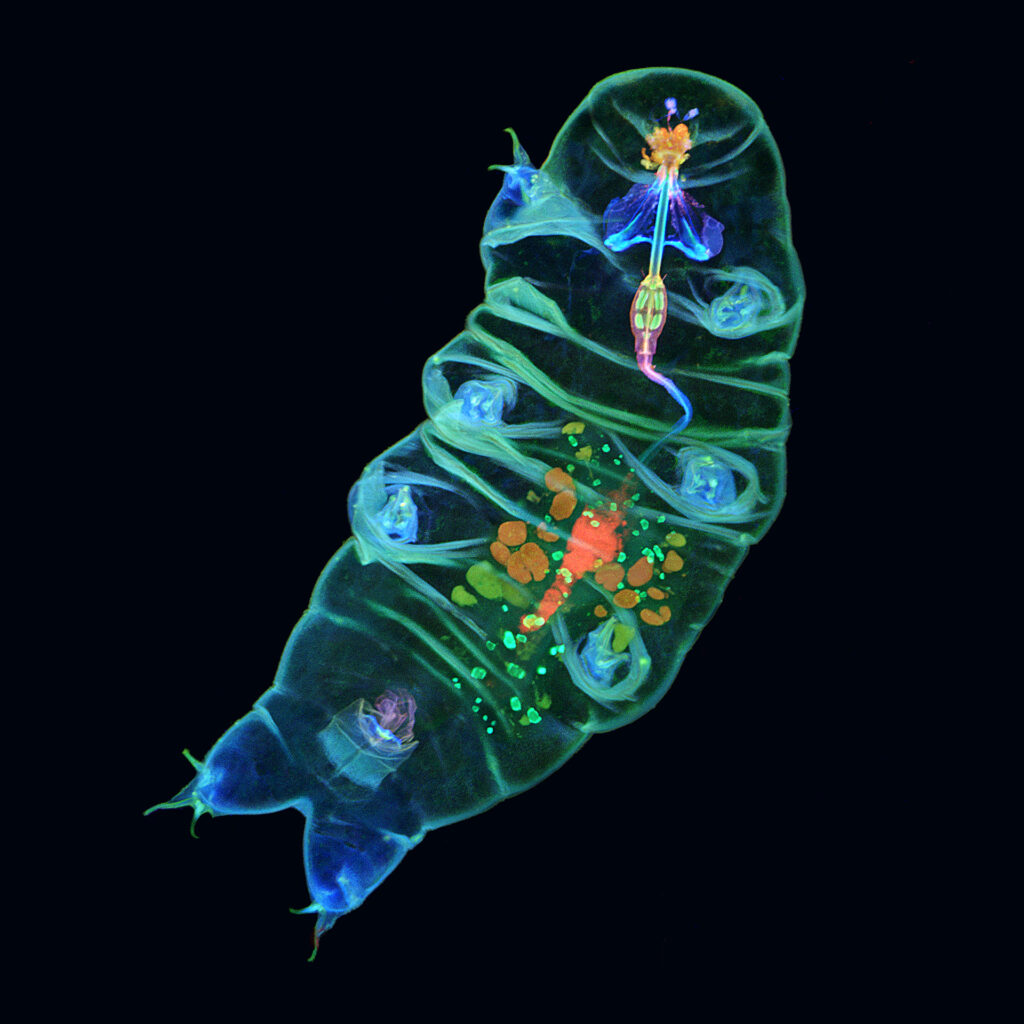 Tagide deCarvalho’s winning image of a tardigrade, or “water bear.” Tardigrades are approximately one millimeter long. (Image courtesy of deCarvalho)
For example, for the winning tardigrade image, “I came up with that staining just to create that pretty picture, and I’ve had tardigrade experts all across the world and people that use tardigrades in classrooms ask me for my technique, because they could see structures stained that they weren’t able to see before with the traditional staining techniques,” deCarvalho says. “So it informed research, just from me trying to make a nice picture.”
Public art, amplified
One of the images selected for “Life Magnified” features moss that deCarvalho scraped off the exterior of the UMBC Biological Sciences Building. “I feel like it’s kind of an homage to UMBC that one of the samples was taken right off the building,” she says.
When asked about her motivations for turning microscope images into beautiful works of art, her answer was simple. “It’s super cheesy, but I just get so excited when I see things under the microscope,” she says. “I look through the microscope, and I just think, ‘Wow, I can’t believe that’s real, and that it just looks so amazing.’” Her art, she says, is “a way to capture the excitement and share it with other people.”
In addition to the connections to UMBC and to her grandfather, having her work on stamps is special because it grants her images the ultimate visibility, she explains. Stamps “are like a public art museum,” deCarvalho says. “Each one is like a little piece of art—it’s the most public art form. So when USPS approached me, I thought, ‘This is the highest honor.’”
]]>
Tagide deCarvalho, director of the Keith R. Porter Imaging Facility in UMBC’s College of Natural and Mathematical Sciences, produces artistic images that reveal microscopic life in vivid,...
https://umbc.edu/stories/microscopic-life-stamps/
https://my3.my.umbc.edu/api/v0/pixel/news/130304/guest@my.umbc.edu/6fe8a84fcc3a5777f2abfd00df1fbb45/api/pixel
biology
cnms
kpif
news
rca-2
science-and-tech
UMBC News & Magazine
https://my3.my.umbc.edu/groups/umbc-news-magazine
https://assets1-my.umbc.edu/system/shared/avatars/groups/000/001/943/24435aa6207c452e7bc15cc74b42c7bb/xsmall.png?1748556657
https://assets1-my.umbc.edu/system/shared/avatars/groups/000/001/943/24435aa6207c452e7bc15cc74b42c7bb/original.png?1748556657
https://assets2-my.umbc.edu/system/shared/avatars/groups/000/001/943/24435aa6207c452e7bc15cc74b42c7bb/xxlarge.png?1748556657
https://assets2-my.umbc.edu/system/shared/avatars/groups/000/001/943/24435aa6207c452e7bc15cc74b42c7bb/xlarge.png?1748556657
https://assets3-my.umbc.edu/system/shared/avatars/groups/000/001/943/24435aa6207c452e7bc15cc74b42c7bb/large.png?1748556657
https://assets1-my.umbc.edu/system/shared/avatars/groups/000/001/943/24435aa6207c452e7bc15cc74b42c7bb/medium.png?1748556657
https://assets2-my.umbc.edu/system/shared/avatars/groups/000/001/943/24435aa6207c452e7bc15cc74b42c7bb/small.png?1748556657
https://assets1-my.umbc.edu/system/shared/avatars/groups/000/001/943/24435aa6207c452e7bc15cc74b42c7bb/xsmall.png?1748556657
https://assets2-my.umbc.edu/system/shared/avatars/groups/000/001/943/24435aa6207c452e7bc15cc74b42c7bb/xxsmall.png?1748556657
UMBC News & Magazine
1
0
false
Thu, 19 Jan 2023 19:03:01 -0500
Thu, 19 Jan 2023 19:03:01 -0500
Organ-on-a-chip models allow researchers to conduct studies closer to real-life conditions – and possibly grease the drug development pipeline
Chengpeng Chen, Assistant Professor of Chemistry and Biochemistry, UMBC
Bringing a new drug to market costs billions of dollars and can take over a decade. These high monetary and time investments are both strong contributors to today’s skyrocketing health care costs and significant obstacles to delivering new therapies to patients. One big reason behind these barriers is the lab models researchers use to develop drugs in the first place.
Preclinical trials, or studies that test a drug’s efficacy and toxicity before it enters clinical trials in people, are mainly conducted on cell cultures and animals. Both are limited by their poor ability to mimic the conditions of the human body. Cell cultures in a petri dish are unable to replicate every aspect of tissue function, such as how cells interact in the body or the dynamics of living organs. And animals are not humans – even small genetic differences between species can be amplified to major physiological differences.
Fewer than 8% of successful animal studies for cancer therapies make it to human clinical trials. Because animal models often fail to predict drug effects in human clinical trials, these late-stage failures can significantly drive up both costs and patient health risks.
To address this translation problem, researchers have been developing a promising model that can more closely mimic the human body – organ-on-a-chip.
As an analytical chemist, I have been working to develop organ and tissue models that avoid the simplicity of common cell cultures and the discrepancies of animal models. I believe that, with further development, organs-on-chips can help researchers study diseases and test drugs in conditions that are closer to real life.
Organs-on-chips offer an alternative model for early-phase biomedical research.
What are organs-on-chips?
In the late 1990s, researchers figured out a way to layer elastic polymers to control and examine fluids at a microscopic level. This launched the field of microfluidics, which for the biomedical sciences involves the use of devices that can mimic the dynamic flow of fluids in the body, such as blood.
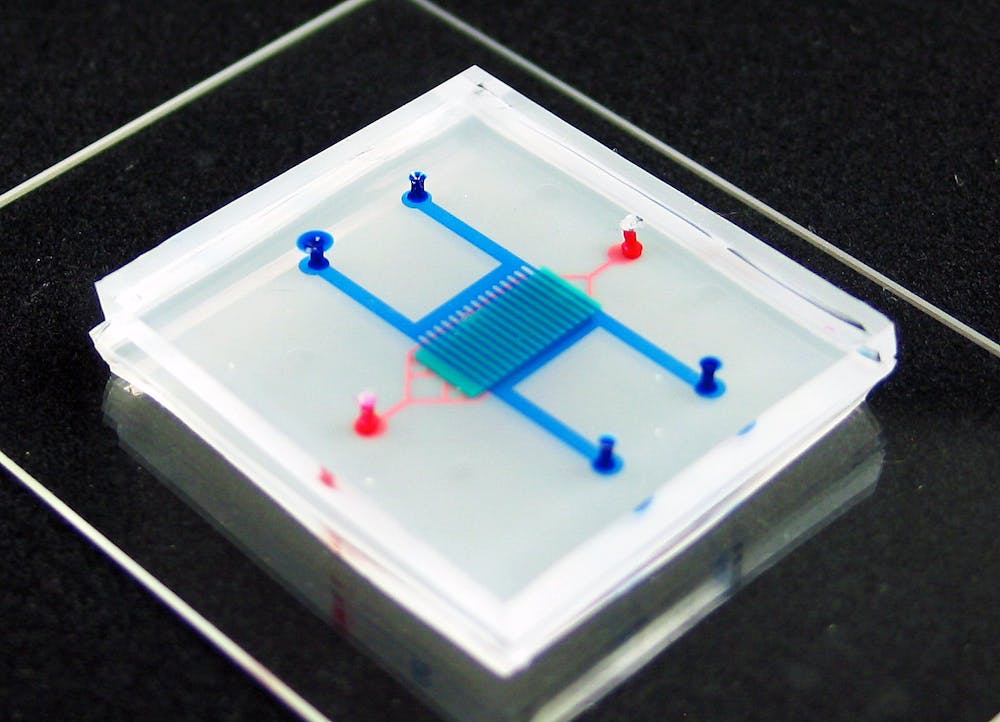
Advances in microfluidics have provided researchers a platform to culture cells that function more closely to how they would in the human body, specifically with organs-on-chips. The “chip” refers to the microfluidic device that encases the cells. They’re commonly made using the same technology as computer chips.
Not only do organs-on-chips mimic blood flow in the body, these platforms have microchambers that allow researchers to integrate multiple types of cells to mimic the diverse range of cell types normally present in an organ. The fluid flow connects these multiple cell types, allowing researchers to study how they interact with each other.
Microfluidics can be used for many applications in biological research.
This technology can overcome the limitations of both static cell cultures and animal studies in several ways. First, the presence of fluid flowing in the model allows it to mimic both what a cell experiences in the body, such as how it receives nutrients and removes wastes, and how a drug will move in the blood and interact with multiple types of cells. The ability to control fluid flow also enables researchers to fine-tune the optimal dosing for a particular drug.
The lung-on-a-chip model, for instance, is able to integrate both the mechanical and physical qualities of a living human lung. It’s able to mimic the dilation and contraction, or inhalation and exhalation, of the lung and simulate the interface between the lung and air. The ability to replicate these qualities allows researchers to better study lung impairment across different factors.
Bringing organs-on-chips to scale
While organ-on-a-chip pushes the boundaries of early-stage pharmaceutical research, the technology has not been widely integrated into drug development pipelines. I believe that a core obstacle for wide adoption of such chips is its high complexity and low practicality.
Current organ-on-a-chip models are difficult for the average scientist to use. Also, because most models are single-use and allow only one input, which limits what researchers can study at a given time, they are both expensive and time- and labor-intensive to implement. The high investments required to use these models might dampen enthusiasm to adopt them. After all, researchers often use the least complex models available for preclinical studies to reduce time and cost.
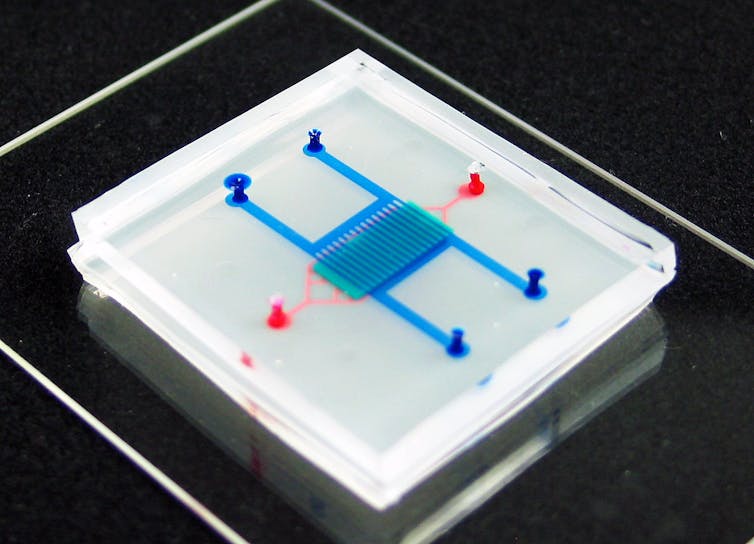 This chip mimics the blood-brain barrier. The blue dye marks where brain cells would go, and the red dye marks the route of blood flow. (Vanderbilt University/Flickr)
Lowering the technical bar to make and use organs-on-chips is critical to allowing the entire research community to take full advantage of their benefits. But this does not necessarily require simplifying the models. My lab, for example, has designed various “plug-and-play” tissue chips that are standardized and modular, allowing researchers to readily assemble premade parts to run their experiments.
The advent of 3D printing has also significantly facilitated the development of organ-on-a-chip, allowing researchers to directly manufacture entire tissue and organ models on chips. 3D printing is ideal for fast prototyping and design-sharing between users and also makes it easy for mass production of standardized materials.
I believe that organs-on-chips hold the potential to enable breakthroughs in drug discovery and allow researchers to better understand how organs function in health and disease. Increasing this technology’s accessibility could help take the model out of development in the lab and let it make its mark on the biomedical industry.
Chengpeng Chen, Assistant Professor of Chemistry and Biochemistry, University of Maryland, Baltimore County
This article is republished from The Conversation under a Creative Commons license. Read the original article.
]]>
Chengpeng Chen, Assistant Professor of Chemistry and Biochemistry, UMBC Bringing a new drug to market costs billions of dollars and can take over a decade. These high monetary and time...
https://umbc.edu/stories/organ-on-a-chip-speeds-drug-development/
https://my3.my.umbc.edu/api/v0/pixel/news/130133/guest@my.umbc.edu/18eb1b7f6349ba863ffc966b1063f288/api/pixel
chembiochem
cnms
discovery
magazine
the-conversation
theconversation
UMBC News & Magazine
https://my3.my.umbc.edu/groups/umbc-news-magazine
https://assets1-my.umbc.edu/system/shared/avatars/groups/000/001/943/24435aa6207c452e7bc15cc74b42c7bb/xsmall.png?1748556657
https://assets1-my.umbc.edu/system/shared/avatars/groups/000/001/943/24435aa6207c452e7bc15cc74b42c7bb/original.png?1748556657
https://assets2-my.umbc.edu/system/shared/avatars/groups/000/001/943/24435aa6207c452e7bc15cc74b42c7bb/xxlarge.png?1748556657
https://assets2-my.umbc.edu/system/shared/avatars/groups/000/001/943/24435aa6207c452e7bc15cc74b42c7bb/xlarge.png?1748556657
https://assets3-my.umbc.edu/system/shared/avatars/groups/000/001/943/24435aa6207c452e7bc15cc74b42c7bb/large.png?1748556657
https://assets1-my.umbc.edu/system/shared/avatars/groups/000/001/943/24435aa6207c452e7bc15cc74b42c7bb/medium.png?1748556657
https://assets2-my.umbc.edu/system/shared/avatars/groups/000/001/943/24435aa6207c452e7bc15cc74b42c7bb/small.png?1748556657
https://assets1-my.umbc.edu/system/shared/avatars/groups/000/001/943/24435aa6207c452e7bc15cc74b42c7bb/xsmall.png?1748556657
https://assets2-my.umbc.edu/system/shared/avatars/groups/000/001/943/24435aa6207c452e7bc15cc74b42c7bb/xxsmall.png?1748556657
UMBC News & Magazine
0
0
false
Tue, 10 Jan 2023 11:35:26 -0500
Tue, 10 Jan 2023 11:35:26 -0500
Manil Suri’s new book, “The Big Bang of Numbers,” introduces readers to the wonder of math

It’s rare to meet a mathematician who is also a bestselling novelist, but UMBC’s Manil Suri, professor of mathematics, is happy to be unique. Suri is the author of a famed trilogy named for Hindu gods, including The Death of Vishnu (2001), which was long-listed for the Booker Prize, The Age of Shiva (2008), and The City of Devi (2013). He recently published his latest book, The Big Bang of Numbers: How to Build the Universe Using Only Math, to global acclaim.
The Big Bang of Numbers is Suri’s first nonfiction book, written to show people who aren’t necessarily fond of math that the discipline is foundational to our world—and can even be fun.
“The concept is intriguing, if hard to get your head around: Can you understand the creation of the universe purely through basic mathematics?” writes The Washingtonian. Suri’s answer with The Big Bang of Numbers is a resounding ‘yes.’ The book “explores many areas of seemingly pure math that explain the natural world, from the shapes of galaxies and living creatures to weather, gravity, beauty, and even art,” Kirkus Reviewswrites.
In his role as math professor, Suri works hard to convince his students that math doesn’t just matter, it is also endlessly interesting—extending his instruction well beyond the basics of calculations and into the field’s fundamental ideas.
“All your life, you keep hearing that maths is all about calculations,” Suri told Telegraph India, “while in essence, maths is all about ideas.” Suri first expounded on this theme in a 2013 New York Times op-ed, “How to Fall in Love with Math.” When the op-ed became shockingly popular, the idea for a book grew from there.
Manil Suri speaks about The Big Bang of Numbers at a special event to mark the book’s publication and success on November 14 at UMBC’s Albin O. Kuhn Library & Gallery.
A new challenge
With The Big Bang of Numbers, which the Wall Street Journal has called “imaginative and organized,” Suri isn’t just seeking to help a wider audience understand or feel comfortable with math, but feel a sense of fascination with it. According to the Mathematical Association of America, Suri’s approach—rich in humor and narrative elements—goes beyond “simply telling the reader about these ideas”; instead, he “allow[s] readers to experience the attitude of curious exploration that attracts mathematicians to the discipline, but is often absent from low-level math classes.”
“With evocative and engaging examples ranging from multidimensional crochet to the Mona Lisa’s asymmetrical smile, as well as ingenious storytelling that helps illuminate complex concepts like infinity and relativity, The Big Bang of Numbers charts a playful, inventive course to existence,” writes the Deccan Herald, which named the book its “read of the week” in mid-October.
For Suri, while the book was very different in some ways from his previous works of fiction, The Big Bang of Numbers hews closely to his style that relies on humor and engaging narrative to draw the reader into unfamiliar topics. His novels all take place in India, a place that feels far away and unknown to many of his readers. “After explaining India in three internationally released books to many readers who didn’t know much about the country, I was ready to take on an even bigger challenge,” he told Frontline, a major English-language magazine in India, “—explaining mathematics to a general audience!”
Manil Suri speaks at GRIT-X, an event during UMBC’s Homecoming festivities, in 2018.
Math as a game
“Usually math is thought of as something that we invent, perhaps, to explain things around us. I’m kind of reversing this perspective and saying that math is the true driver of the universe, and the universe itself is a model of the mathematical principles,” Suri recently told NPR’s Marketplace.
Put another way, the Sunday Times of London explains the central thesis of the book is that “maths, the creative language in which reality is written, is ‘the life force that drives the universe,’ and you could build one—stars, worlds, you and me—from scratch using maths alone.” The review notes, “It sounds intimidating, but Suri has a knack for clarity and a welcome habit of grounding tricky concepts in the tangible.”
In the end, according to Suri’s book, math is a “force that forever enthralls, not just through the answers it gives but also through the new mysteries it poses.” But he hopes his readers will also understand math as a game.
“For mathematicians, I suspect the most appealing characteristic of the subject is its playfulness,” Suri told Frontline. “Maths is a game in which you start with a bunch of rules and then deduce away to see where you can get. You can play it anywhere—in the shower, on the bus, while eating lunch—all you need is your mind.”
]]>
It’s rare to meet a mathematician who is also a bestselling novelist, but UMBC’s Manil Suri, professor of mathematics, is happy to be unique. Suri is the author of a famed trilogy named for Hindu...
https://umbc.edu/stories/the-big-bang-of-numbers/
https://my3.my.umbc.edu/api/v0/pixel/news/130097/guest@my.umbc.edu/16dad0e299dce213100136c2d82a5735/api/pixel
cnms
mathstat
news
science-and-tech
UMBC News & Magazine
https://my3.my.umbc.edu/groups/umbc-news-magazine
https://assets1-my.umbc.edu/system/shared/avatars/groups/000/001/943/24435aa6207c452e7bc15cc74b42c7bb/xsmall.png?1748556657
https://assets1-my.umbc.edu/system/shared/avatars/groups/000/001/943/24435aa6207c452e7bc15cc74b42c7bb/original.png?1748556657
https://assets2-my.umbc.edu/system/shared/avatars/groups/000/001/943/24435aa6207c452e7bc15cc74b42c7bb/xxlarge.png?1748556657
https://assets2-my.umbc.edu/system/shared/avatars/groups/000/001/943/24435aa6207c452e7bc15cc74b42c7bb/xlarge.png?1748556657
https://assets3-my.umbc.edu/system/shared/avatars/groups/000/001/943/24435aa6207c452e7bc15cc74b42c7bb/large.png?1748556657
https://assets1-my.umbc.edu/system/shared/avatars/groups/000/001/943/24435aa6207c452e7bc15cc74b42c7bb/medium.png?1748556657
https://assets2-my.umbc.edu/system/shared/avatars/groups/000/001/943/24435aa6207c452e7bc15cc74b42c7bb/small.png?1748556657
https://assets1-my.umbc.edu/system/shared/avatars/groups/000/001/943/24435aa6207c452e7bc15cc74b42c7bb/xsmall.png?1748556657
https://assets2-my.umbc.edu/system/shared/avatars/groups/000/001/943/24435aa6207c452e7bc15cc74b42c7bb/xxsmall.png?1748556657
UMBC News & Magazine
6
0
false
Fri, 06 Jan 2023 15:52:34 -0500
Fri, 06 Jan 2023 15:52:34 -0500
Star power: UMBC’s Carlos Romero-Talamás explains why fusion is grabbing headlines
On a recent Tuesday in December, UMBC’s Carlos Romero-Talamás escorted a TV crew from Baltimore into one of his labs. The reporters were there to talk about a just announced fusion power milestone achieved at Lawrence Livermore National Laboratory in California, but they quickly became interested in Romero-Talamás’s own experiments too. He is questing after the same fusion milestone using equipment that’s much simpler and cheaper.
Bringing the energy of the stars to Earth
Fusion is the atomic engine that powers stars. Inside the cores of these celestial infernos, fast-moving hydrogen atoms, stripped of their electrons, ricochet around. Occasionally they collide in such ways that they transform into helium atoms. When that happens, a lot of energy is released.
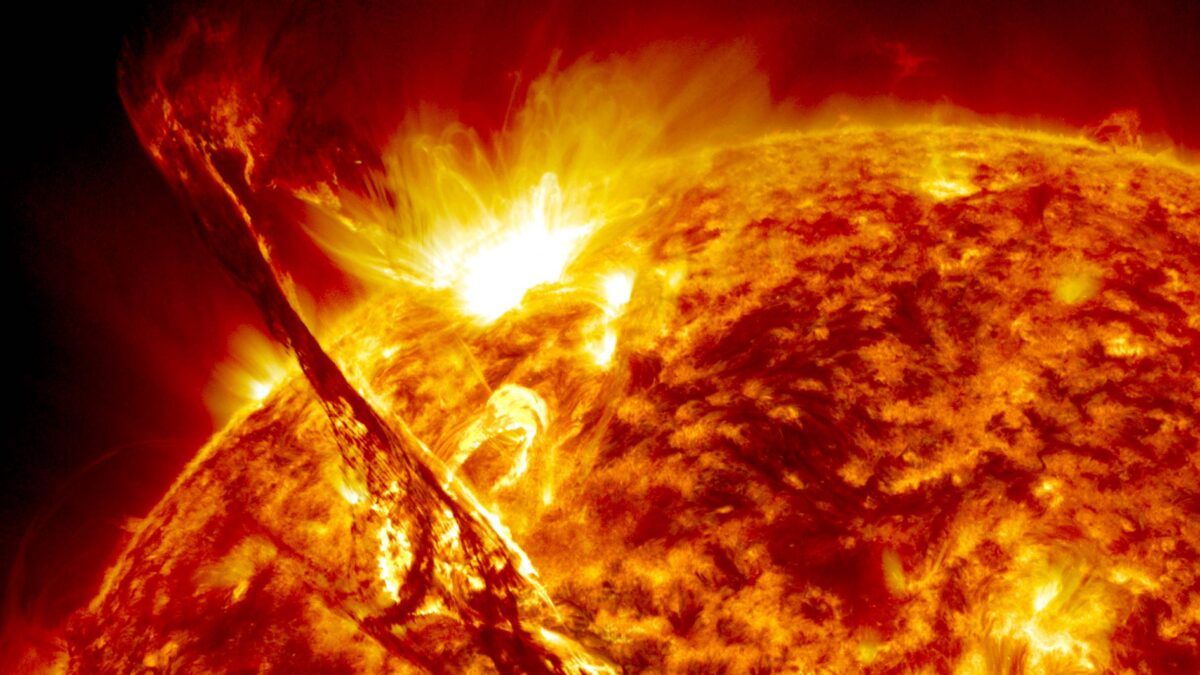 The enormous power of the sun comes from fusion reactions that turn hydrogen into helium. (NASA/SDO)
For decades, humanity has dreamed of harnessing fusion power on Earth to make safe, clean, and near limitless energy. But thorny physics and engineering challenges made the goal elusive, with scientists coming to joke that “fusion power is 30 years away—and always will be.”
Yet now, a growing excitement is displacing some of the skepticism. Governments are directing more money toward fusion research and private investors such as Bill Gates and Jeff Bezos are collectively pitching in billions of dollars. Some companies are promising commercial fusion power in 10 years.
Romero-Talamás’s own work has benefited from the renewed attention. In 2020, he was awarded a $4 million grant from the U.S. Department of Energy to explore a promising alternative to traditional fusion power approaches. Rather than blast hydrogen atoms with lasers (the approach used at Lawrence Livermore) or squeeze them into a donut-shaped ring using enormous magnets (the approach epitomized by the multi-billion-dollar, nearly 100-foot-tall ITER fusion reactor under construction in France), Romero-Talamás and his team plan to confine their hydrogen atoms in a supersonic whirlwind shaped by a novel arrangement of magnets and an electrically conducting central rod.
If the concept works, it could lead to a commercial fusion reactor relatively quickly, Romero-Talamás says, because it uses equipment that is smaller, cheaper, and simpler to operate than the equipment required by other approaches.
A simpler fusion reactor
Romero-Talamás’ team, which includes collaborators from the University of Maryland, College Park, has already built a test machine in a lab on the College Park campus. While the machine does not have the capacity to operate as an energy-generating reactor, initial experiments on it show the hydrogen atoms are being trapped in the whirlwind as hoped. If experiments continue to go well, the team will soon begin work on a bigger, next-generation machine. That machine could be fitted to produce more power than it takes to run, a key milestone on the road to commercial fusion power.
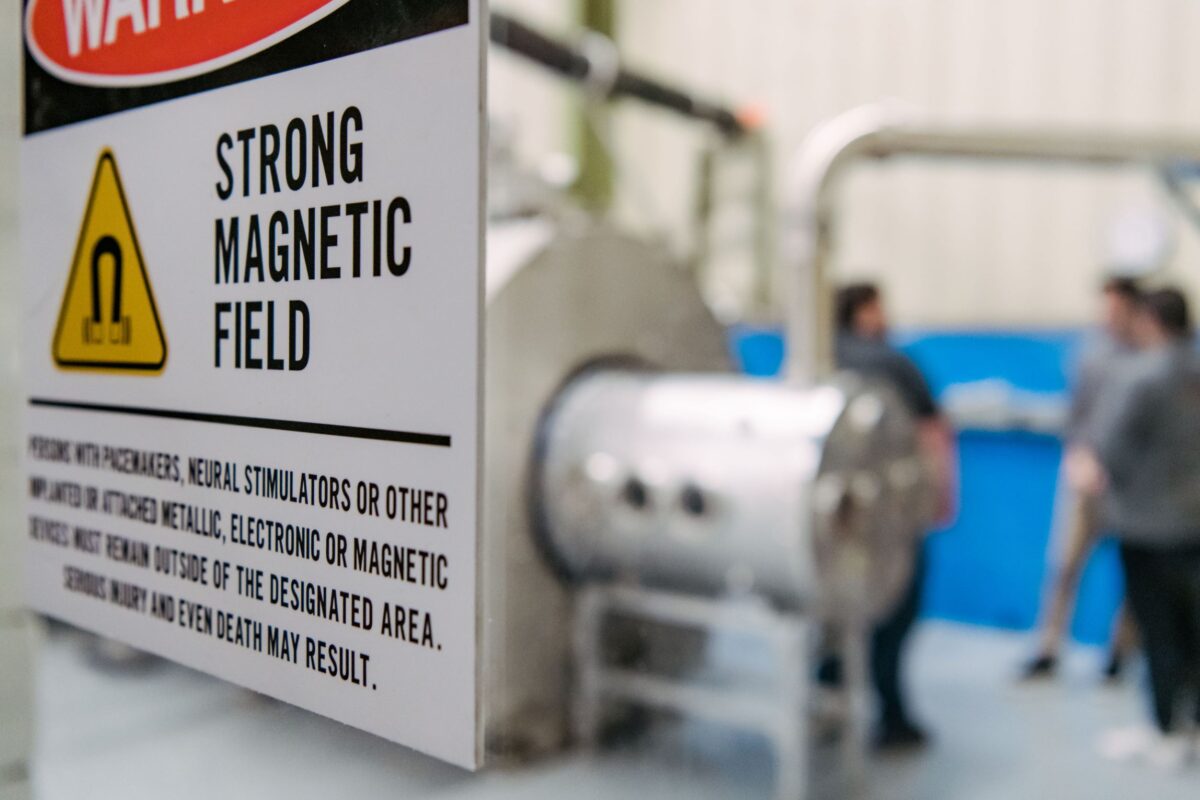 Strong magnets help control the hydrogen atoms inside the test machine. (Marlayna Demond ’11/UMBC)
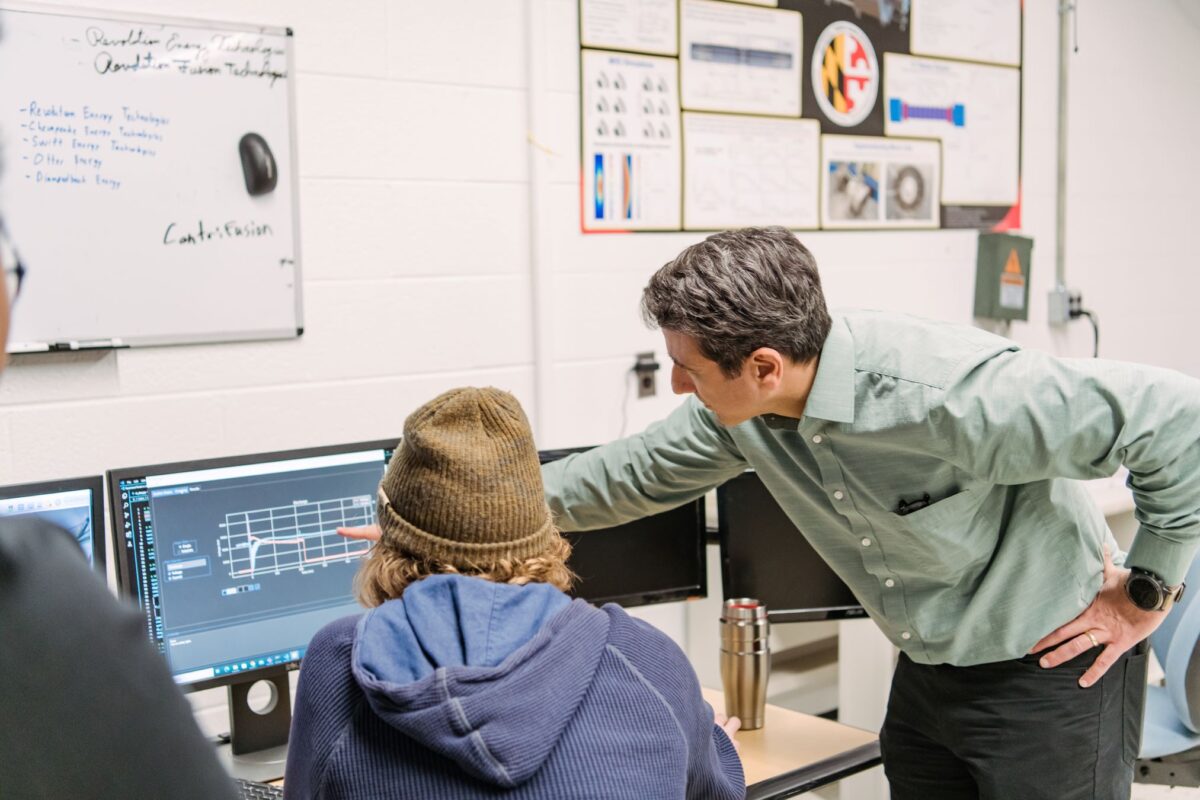 Carlos Romero-Talamás and UMBC graduate student Nathan Eschbach look at diagnostic data. (Marlayna Demond ’11/UMBC)
We sat down to chat with Romero-Talamás about the wonder of fusion and the excitement of scientists who feel they may be on the cusp of world-changing innovations. The following interview has been edited for brevity.
Conversation with Carlos Romero-Talamás
UMBC News: It feels like fusion is having a moment. Do you agree?
Romero-Talamás: The announcement from Lawrence Livermore gained a lot of attention, but fusion has actually been having a moment, so to speak, for the last few years. And the reason these years have been different is because the private sector got interested. The amount of money they bring is changing the equation. I’ve told people our concept will take tens of millions of dollars for the next machine—which is not a reactor, but a reactor-sized experiment—and they don’t even flinch. They are people who are used to handling that kind of money.
UMBC News: What are some of the challenges that remain?
Romero-Talamás: There are still big questions. Some are about the physics—how the particles behave. Some are engineering—how are you actually going to build something that can operate day in and day out. We also need people, not just graduate students, but also technicians who know the technology.
Some of these fusion companies and concepts are probably going to fail. And hopefully, that won’t spook the investors, because the success of one will be beneficial to everyone.
UMBC News: How did you get interested in fusion?
Romero-Talamás: When I was an undergraduate, there was a fusion experiment where for a brief amount of time they produced about 60% of the energy they put in. I had never heard of fusion until then—that’s when I learned about it. I thought, “Okay, by the time I’m a scientist, they are going to have fusion reactors.” Of course, that didn’t happen.
But in graduate school, I learned about fusion energy more from the fundamental physics side, and I thought it was fascinating. I actually got funding as a student to go to Lawrence Livermore, and I did a lot of my research there.
UMBC News: What excites you about this research?
Romero-Talamás: We all need energy, and many metrics even measure a country’s economic strength by the amount of energy it produces and consumes. Fusion is considered the “holy grail” of energy. It could provide virtually unlimited energy for millions of years. It is clean and carbon free. I think finally it is getting the attention it deserves.
And, of course, the students are the heart of the work. They believe they can change the world.
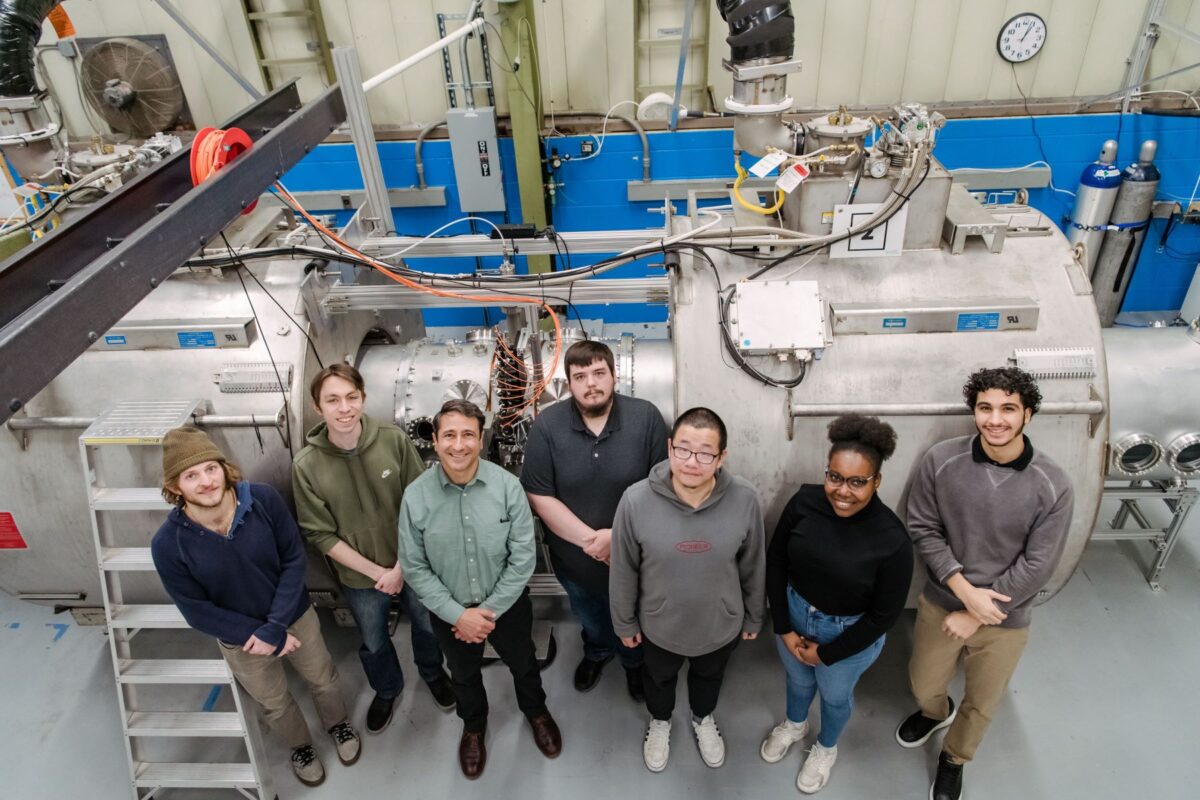 Carlos Romero-Talamás in front of the test machine with students and colleagues from UMBC and UMD who are working on the project. From left to right: Nathan Eschbach, Ryan Schneider, Carlos Romero-Talamás, Zachary Short, Quan Gan, Autumn Bartholomew, and Mohamed Nasser. (Marlayna Demond ’11/UMBC)
]]>
On a recent Tuesday in December, UMBC’s Carlos Romero-Talamás escorted a TV crew from Baltimore into one of his labs. The reporters were there to talk about a just announced fusion power milestone...
https://umbc.edu/stories/star-power-umbcs-carlos-romero-talamas-explains-why-fusion-is-grabbing-headlines/
https://my3.my.umbc.edu/api/v0/pixel/news/130090/guest@my.umbc.edu/6a604f5ea6b2be1376790162b811ac98/api/pixel
coeit
meche
news
research
science-and-tech
UMBC News & Magazine
https://my3.my.umbc.edu/groups/umbc-news-magazine
https://assets1-my.umbc.edu/system/shared/avatars/groups/000/001/943/24435aa6207c452e7bc15cc74b42c7bb/xsmall.png?1748556657
https://assets1-my.umbc.edu/system/shared/avatars/groups/000/001/943/24435aa6207c452e7bc15cc74b42c7bb/original.png?1748556657
https://assets2-my.umbc.edu/system/shared/avatars/groups/000/001/943/24435aa6207c452e7bc15cc74b42c7bb/xxlarge.png?1748556657
https://assets2-my.umbc.edu/system/shared/avatars/groups/000/001/943/24435aa6207c452e7bc15cc74b42c7bb/xlarge.png?1748556657
https://assets3-my.umbc.edu/system/shared/avatars/groups/000/001/943/24435aa6207c452e7bc15cc74b42c7bb/large.png?1748556657
https://assets1-my.umbc.edu/system/shared/avatars/groups/000/001/943/24435aa6207c452e7bc15cc74b42c7bb/medium.png?1748556657
https://assets2-my.umbc.edu/system/shared/avatars/groups/000/001/943/24435aa6207c452e7bc15cc74b42c7bb/small.png?1748556657
https://assets1-my.umbc.edu/system/shared/avatars/groups/000/001/943/24435aa6207c452e7bc15cc74b42c7bb/xsmall.png?1748556657
https://assets2-my.umbc.edu/system/shared/avatars/groups/000/001/943/24435aa6207c452e7bc15cc74b42c7bb/xxsmall.png?1748556657
UMBC News & Magazine
0
0
false
Fri, 06 Jan 2023 14:08:54 -0500
Fri, 06 Jan 2023 14:08:54 -0500
NSF awards UMBC’s Lauren Clay $624K Convergence Accelerator grant to address food insecurity in disasters
Carlos Romero-Talamás in front of the test machine with students and colleagues from UMBC and UMD who are working on the project. From left to right: Nathan Eschbach, Ryan Schneider, Carlos Romero-Talamás, Zachary Short, Quan Gan, Autumn Bartholomew, and Mohamed Nasser. (Marlayna Demond ’11/UMBC)
]]>
On a recent Tuesday in December, UMBC’s Carlos Romero-Talamás escorted a TV crew from Baltimore into one of his labs. The reporters were there to talk about a just announced fusion power milestone...
https://umbc.edu/stories/star-power-umbcs-carlos-romero-talamas-explains-why-fusion-is-grabbing-headlines/
https://my3.my.umbc.edu/api/v0/pixel/news/130090/guest@my.umbc.edu/6a604f5ea6b2be1376790162b811ac98/api/pixel
coeit
meche
news
research
science-and-tech
UMBC News & Magazine
https://my3.my.umbc.edu/groups/umbc-news-magazine
https://assets1-my.umbc.edu/system/shared/avatars/groups/000/001/943/24435aa6207c452e7bc15cc74b42c7bb/xsmall.png?1748556657
https://assets1-my.umbc.edu/system/shared/avatars/groups/000/001/943/24435aa6207c452e7bc15cc74b42c7bb/original.png?1748556657
https://assets2-my.umbc.edu/system/shared/avatars/groups/000/001/943/24435aa6207c452e7bc15cc74b42c7bb/xxlarge.png?1748556657
https://assets2-my.umbc.edu/system/shared/avatars/groups/000/001/943/24435aa6207c452e7bc15cc74b42c7bb/xlarge.png?1748556657
https://assets3-my.umbc.edu/system/shared/avatars/groups/000/001/943/24435aa6207c452e7bc15cc74b42c7bb/large.png?1748556657
https://assets1-my.umbc.edu/system/shared/avatars/groups/000/001/943/24435aa6207c452e7bc15cc74b42c7bb/medium.png?1748556657
https://assets2-my.umbc.edu/system/shared/avatars/groups/000/001/943/24435aa6207c452e7bc15cc74b42c7bb/small.png?1748556657
https://assets1-my.umbc.edu/system/shared/avatars/groups/000/001/943/24435aa6207c452e7bc15cc74b42c7bb/xsmall.png?1748556657
https://assets2-my.umbc.edu/system/shared/avatars/groups/000/001/943/24435aa6207c452e7bc15cc74b42c7bb/xxsmall.png?1748556657
UMBC News & Magazine
0
0
false
Fri, 06 Jan 2023 14:08:54 -0500
Fri, 06 Jan 2023 14:08:54 -0500
NSF awards UMBC’s Lauren Clay $624K Convergence Accelerator grant to address food insecurity in disasters

Longstanding food insecurity problems in the U.S. and around the world, exacerbated by the pandemic, are projected to increase over the coming decades, as food, water, and energy demands increase and environmental crises worsen. With this in mind, the National Science Foundation (NSF) is investing $11 million toward solutions to address the nutritional needs of vulnerable and under-resourced communities through its Convergence Accelerator Program.
UMBC’s Lauren Clay, associate professor and chair of emergency health services, is one 16 Convergence Accelerator awardees selected for Phase I of the program. Clay was awarded $624,000 for her project to improve food system resilience and decrease disaster-induced food insecurity in communities impacted by hurricanes.
Supporting food system resilience
Clay’s proposal explains that 11-15 percent of the U.S. population experienced food insecurity annually between 2008 and 2018, and households that are struggling with food insecurity before a disaster are at greatest risk for serious food access issues when a disaster strikes, and long after.
“Food and nutrition insecurity rates can increase threefold following disasters,” Clay notes. “Increased food and nutrition insecurity rates persist for years while households and communities recover.”
 Food and clothing relief center for Hurricane Sandy survivors in New York City in 2012. (“Walter Jennings”/Wikimedia Commons)
“Communities across the U.S. are planning for growing threats related to climate disasters. Food security is a basic human need and is highly susceptible to disruption when families and communities experience disasters,” says Clay. “I’m excited to work with a multi-disciplinary and multi-sector team to develop a new tool for measuring community food security to support communities planning for, responding to, and recovering from hurricanes.”
Converging on solutions
The NSF Convergence Accelerator Program seeks to address national-scale challenges in science, engineering, and society through a collaborative research process that brings together expertise from multiple scientific disciplines, known as convergence research. The food and nutrition focus was recently added to the Convergence Accelerator, which also includes approaches towards combating challenges related to population health and climate change.
“We hope to create a group of synergistic efforts that advance regenerative agriculture practices, reduce water usage, provide equitable access to nutritious and affordable food for disadvantaged communities, and spur technology and job creation,” says Douglas Maughan, head of the Convergence Accelerator, in NSF’s announcement of award recipients.
Over the course of nine months, Clay and her team will work to develop the Food Index for Resilience, Security, & Tangible Solutions, called FIRST. This index will measure food system functioning in communities and is intended to be a resource that can be used to respond to and recover from disasters and environmental changes.
This effort builds on Clay’s prior and ongoing research to address disaster-specific food insecurity issues. She was also recently awarded an NSF Faculty Early Career Development (CAREER) award to develop a sociocultural model called Food Environment in Disasters (FED) and other tools to improve the understanding and monitoring of food availability, acceptability, and accessibility during disasters.
Following Phase I of this project, participating teams will take part in a formal pitch and Phase II proposal and could receive up to $5 million of additional support. Selected Phase II teams will further develop their solutions and sustainability development plans over the course of 24 months, to rapidly meet the needs of global communities.
]]>
Longstanding food insecurity problems in the U.S. and around the world, exacerbated by the pandemic, are projected to increase over the coming decades, as food, water, and energy demands increase...
https://umbc.edu/stories/convergence-accelerator-grant-food-insecurity-in-disasters/
https://my3.my.umbc.edu/api/v0/pixel/news/130098/guest@my.umbc.edu/3b254c269b2dc52563c49eefac025498/api/pixel
cahss
ehs
news
policy-and-society
rca-1
research
UMBC News & Magazine
https://my3.my.umbc.edu/groups/umbc-news-magazine
https://assets1-my.umbc.edu/system/shared/avatars/groups/000/001/943/24435aa6207c452e7bc15cc74b42c7bb/xsmall.png?1748556657
https://assets1-my.umbc.edu/system/shared/avatars/groups/000/001/943/24435aa6207c452e7bc15cc74b42c7bb/original.png?1748556657
https://assets2-my.umbc.edu/system/shared/avatars/groups/000/001/943/24435aa6207c452e7bc15cc74b42c7bb/xxlarge.png?1748556657
https://assets2-my.umbc.edu/system/shared/avatars/groups/000/001/943/24435aa6207c452e7bc15cc74b42c7bb/xlarge.png?1748556657
https://assets3-my.umbc.edu/system/shared/avatars/groups/000/001/943/24435aa6207c452e7bc15cc74b42c7bb/large.png?1748556657
https://assets1-my.umbc.edu/system/shared/avatars/groups/000/001/943/24435aa6207c452e7bc15cc74b42c7bb/medium.png?1748556657
https://assets2-my.umbc.edu/system/shared/avatars/groups/000/001/943/24435aa6207c452e7bc15cc74b42c7bb/small.png?1748556657
https://assets1-my.umbc.edu/system/shared/avatars/groups/000/001/943/24435aa6207c452e7bc15cc74b42c7bb/xsmall.png?1748556657
https://assets2-my.umbc.edu/system/shared/avatars/groups/000/001/943/24435aa6207c452e7bc15cc74b42c7bb/xxsmall.png?1748556657
UMBC News & Magazine
0
0
false
Fri, 06 Jan 2023 14:04:22 -0500
Fri, 06 Jan 2023 14:04:22 -0500