UMBC and UMSOM work to more effectively reverse opioid overdose in real time through $500,000+ NIH award

Opioid-related deaths have risen sharply in the U.S. in recent years. In 2017, the Department of Health and Human Services declared the opioid crisis to be a public health emergency—one disproportionately affecting historically marginalized communities—and the crisis has worsened since then.
In response to the rising epidemic, UMBC researchers have partnered with the University of Maryland School of Medicine (UMSOM) to develop a device that could help prevent opioid overdose deaths. The device is a non-invasive CO2 monitor designed to more effectively detect and reverse an opioid overdose in real time. It was recently awarded a one-year grant of more than $500,000 from the National Institutes of Health (NIH).
“Opioid-related death is a serious problem for the country. We hope this new device will help to directly address this issue,” said the study’s co-PI Xudong Ge, research professor of chemical, biochemical, and environmental engineering (CBEE).
Meeting an urgent need
The Centers for Disease Control and Prevention’s (CDC) National Center for Health Statistics reported that during a 12-month period ending in April 2021, more than 100,000 drug overdoses were recorded in the U.S., with nearly 76,000 deaths attributed to opioid usage. In a separate 2022 report, the CDC noted the severity of this impact among underserved communities of color. Between 2019 and 2020 alone, overdose death rates increased 44 percent amongst Black populations and 39 percent in American Indian and Alaska Native populations.
“If you look at the statistics, the people who are dying from opioid overdoses largely come from underserved minority communities. They are the ones that need the most help,” said Thelma Wright, associate professor of pain medicine at UMSOM, who developed the idea for the study.
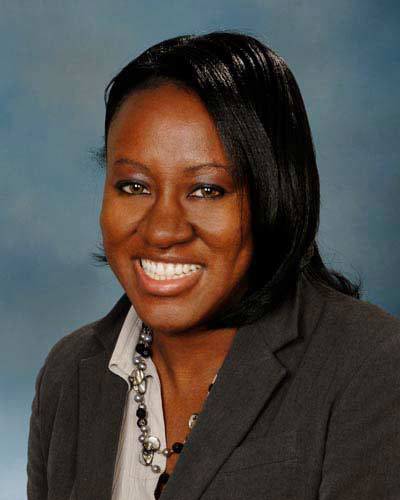 Thelma Wright (Image courtesy of UMSOM)
As a pain medicine physician, she said she was aware of how medically-prescribed opioids have contributed to the rise in overdose death rates. In 2016, Wright began to conceptualize a way to non-invasively monitor if a patient is about to die from an opioid overdose and ways to immediately administer naloxone, an opioid antagonist that can quickly reverse an overdose.
Despite administering naloxone to people experiencing opioid overdose, to reverse their respiratory depression, many overdose cases are fatal because the naloxone was not administered in time, Wright shared.
“When someone is dying from an overdose, they cannot get the antidote from their medicine cabinet to administer it to themselves. I asked around if there was a sensitive monitor that could immediately detect an opioid overdose, and there was nothing,” said Wright. “I needed to find some sort of parameter that would signal respiratory depression due to an overdose, and the most accurate parameter happened to be a carbon dioxide (CO2) monitor.”
Evolving CO2 monitoring research
Opioids stimulate receptors in the brain and can cause a decrease in pain perception. When brain receptors are overstimulated, the brainstem can then become desensitized to rises in CO2 levels. As a result, the opioid user could experience respiratory depression, loss of protective airway reflexes, and respiratory arrest.
Ge, who serves as the assistant director of UMBC’s Center for Advanced Sensor Technology (CAST), has spent more than a decade researching and developing non-invasive CO2 sensor systems. During the pandemic, Ge, along with Govind Rao, a professor of CBEE and the director of CAST, co-authored a study published in Medical Engineering & Physics analyzing the effects of face coverings on transdermal CO2 levels. The study demonstrated the potential effectiveness of monitoring CO2 levels through the use of wearable transdermal CO2 sensors.
“The original CO2 monitoring device is large, about the size of a suitcase,” said Ge. Wright approached Ge and Rao to develop a miniaturized, wearable version that could address some of the shortcomings of other devices available today.
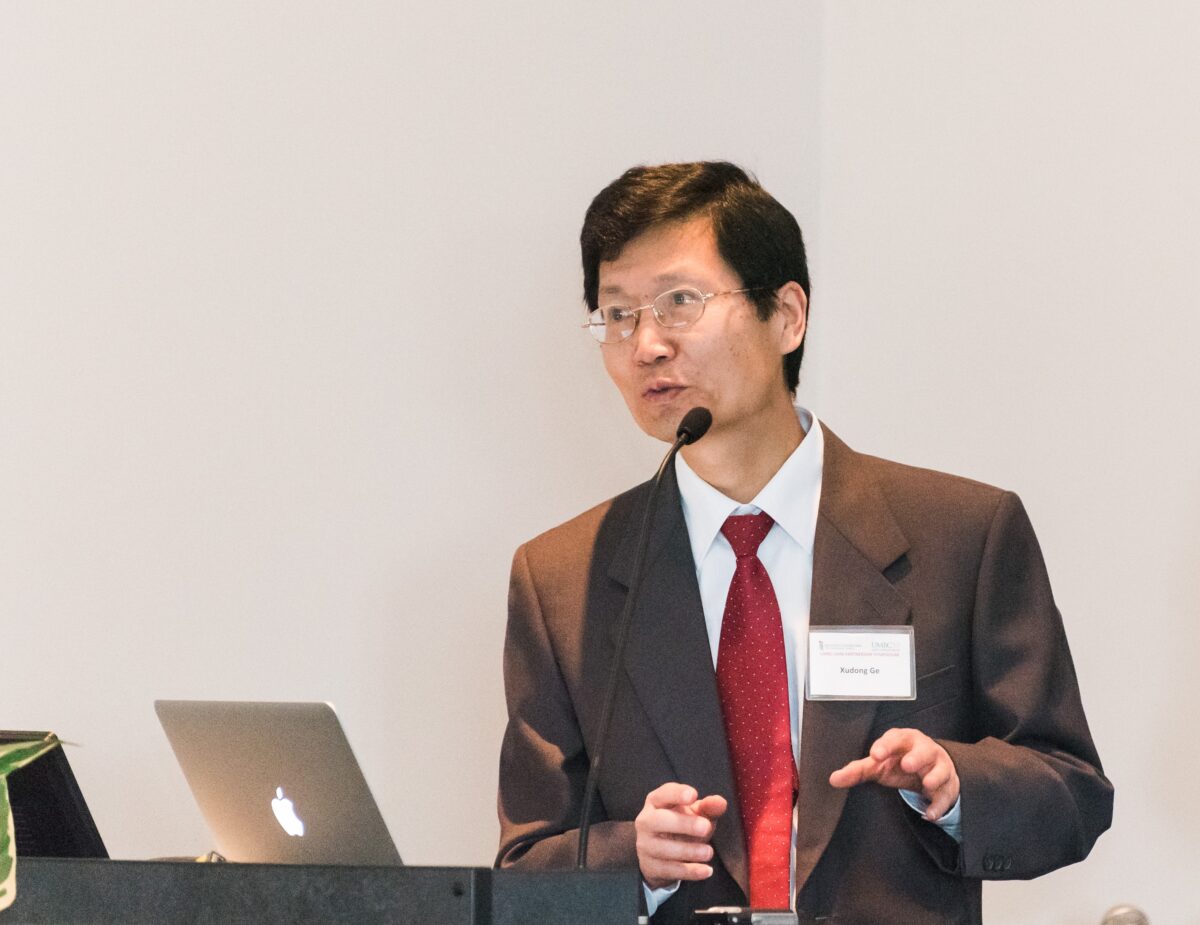 Xudong Ge (Marlayna Demond ’11/UMBC)
Ge explains that traditional non-invasive CO2 monitors that are used on the skin heat up to about 42 degrees Celsius, or more than 107 degrees Fahrenheit. Because of the high heat, they can leave burns on skin and cannot be worn for an extended amount of time. The monitors tend to work at a slower speed and can come with a price tag averaging about $25,000.
Along with miniaturizing the device, Ge aims to create a monitor that is safer and more comfortable, delivers data more efficiently, and is more affordable for the average consumer.
Developing the device
When a patient wears the CO2 device and experiences respiratory depression due to an overdose, the device will trigger an alarm that will automatically inject naloxone. In order to validate the study’s proof of principle, the initial phases of the study will start with developing and testing CO2 sensor prototypes. The test results will then be compared to data from a similar FDA-approved device that they are hoping to improve on.
“We will run side by side tests to see how accurate our device is and then do challenge studies, like holding your breath, breathing into a bag, or exercising to get the subjects’ CO2 levels up in the body to see if we are able to detect it,” says Rao. “We will incorporate some elements of machine learning to detect the signal accurately, to make sure that there are no false positives or false negatives.”
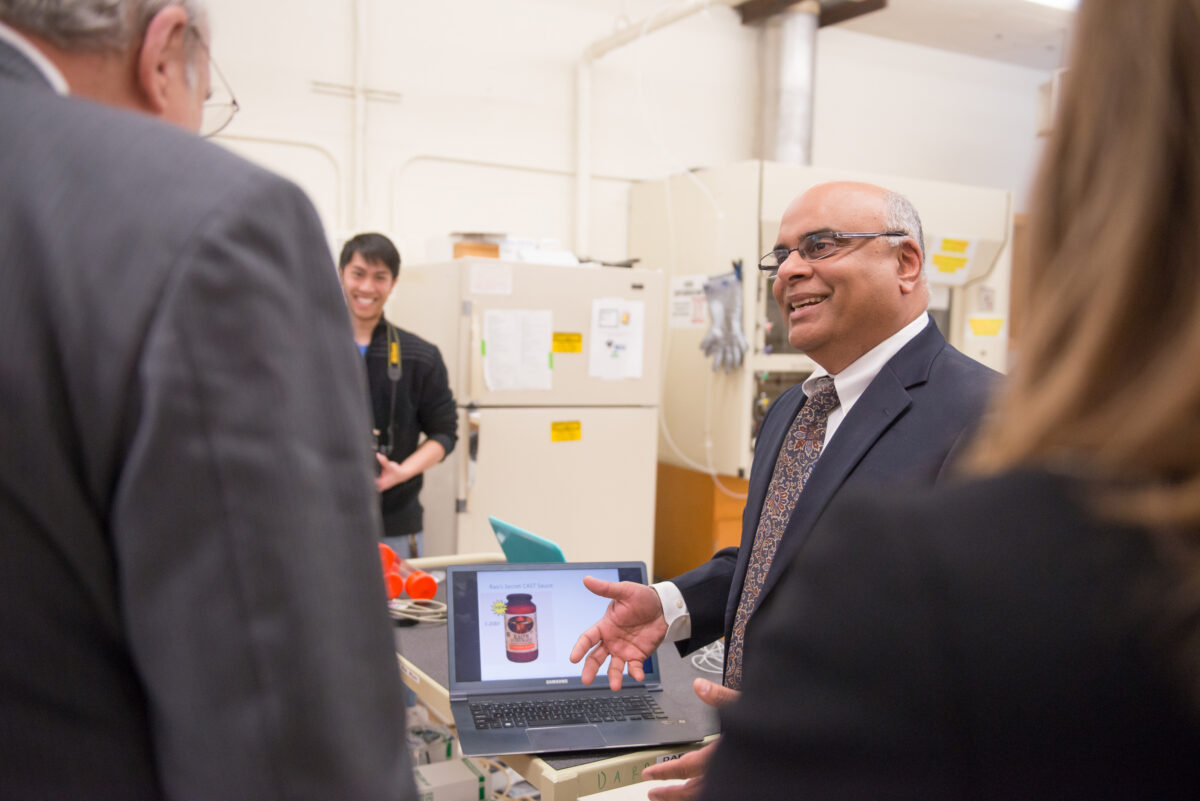 Govind Rao (Marlayna Demond ’11/UMBC)
The investigators have hired UMBC postdoctoral researcher Preety Ahuja to work on the prototyping. If the study is granted additional funding, Wright and her team of researchers will test the sensor on animal subjects to validate whether the wearable transdermal CO2 alarm will be effective. The researchers also intend to develop a mobile app to gather and share the data provided by the monitor.
Rao looks forward to collaborating closely with Wright through this UMBC-UMSOM partnership, noting the significance of her work with underserved populations in Baltimore. He shares, “Dr. Wright is very keen and passionate about finding solutions and our UMBC team is very excited to be working with her.”
]]>
Opioid-related deaths have risen sharply in the U.S. in recent years. In 2017, the Department of Health and Human Services declared the opioid crisis to be a public health emergency—one...
https://umbc.edu/stories/reverse-opioid-overdoses-in-real-time/
https://my3.my.umbc.edu/api/v0/pixel/news/129710/guest@my.umbc.edu/b903201bcdb55aa185c720f758b62002/api/pixel
cast
cbee
coeit
news
rca-2
research
science-and-tech
UMBC News & Magazine
https://my3.my.umbc.edu/groups/umbc-news-magazine
https://assets1-my.umbc.edu/system/shared/avatars/groups/000/001/943/24435aa6207c452e7bc15cc74b42c7bb/xsmall.png?1748556657
https://assets1-my.umbc.edu/system/shared/avatars/groups/000/001/943/24435aa6207c452e7bc15cc74b42c7bb/original.png?1748556657
https://assets2-my.umbc.edu/system/shared/avatars/groups/000/001/943/24435aa6207c452e7bc15cc74b42c7bb/xxlarge.png?1748556657
https://assets2-my.umbc.edu/system/shared/avatars/groups/000/001/943/24435aa6207c452e7bc15cc74b42c7bb/xlarge.png?1748556657
https://assets3-my.umbc.edu/system/shared/avatars/groups/000/001/943/24435aa6207c452e7bc15cc74b42c7bb/large.png?1748556657
https://assets1-my.umbc.edu/system/shared/avatars/groups/000/001/943/24435aa6207c452e7bc15cc74b42c7bb/medium.png?1748556657
https://assets2-my.umbc.edu/system/shared/avatars/groups/000/001/943/24435aa6207c452e7bc15cc74b42c7bb/small.png?1748556657
https://assets1-my.umbc.edu/system/shared/avatars/groups/000/001/943/24435aa6207c452e7bc15cc74b42c7bb/xsmall.png?1748556657
https://assets2-my.umbc.edu/system/shared/avatars/groups/000/001/943/24435aa6207c452e7bc15cc74b42c7bb/xxsmall.png?1748556657
UMBC News & Magazine
3
0
false
Fri, 09 Dec 2022 13:43:21 -0500
Fri, 09 Dec 2022 13:43:21 -0500
Bird Brainiac
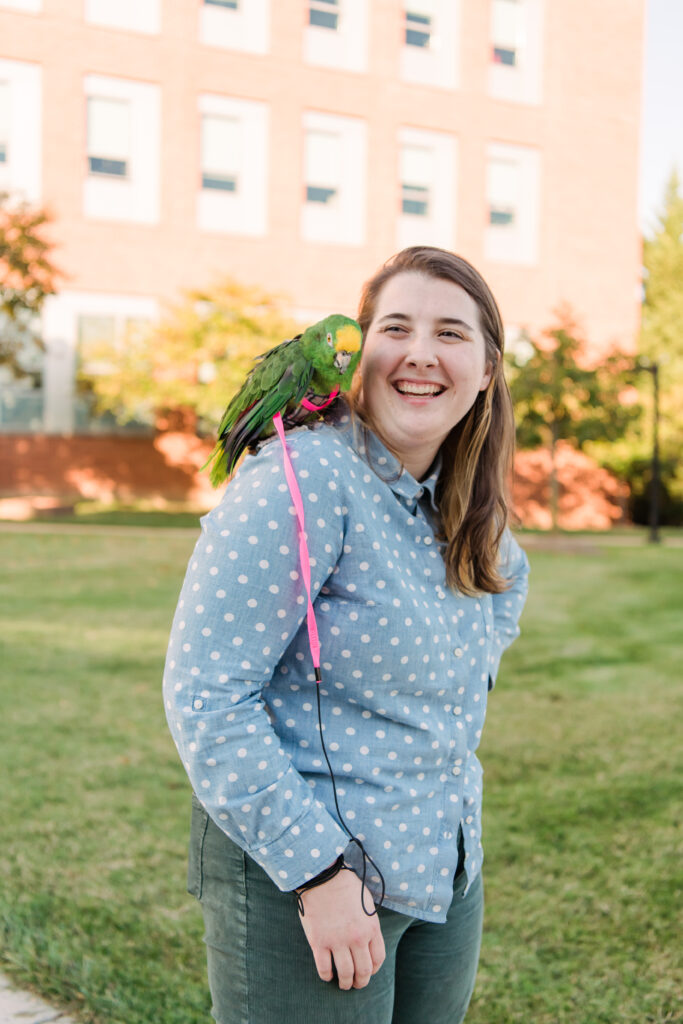 Elle Kreiner and Chicken. (Marlayna Demond ’11/UMBC)
At UMBC, we welcome Retrievers of all stripes… and feathers. Spotted on campus recently enjoying student life is an 87-year-old yellow crowned amazon parrot named Chicken. Yes, you read that right, Chicken.
Elle Kreiner ’20, anthropology, a current master’s student in applied sociology, rescued the bird in 2017 after his long-term caretaker passed away and the family wasn’t able to keep him. Despite coming to campus to spread his wings (metaphorically—Chicken doesn’t enjoy flying), Kreiner doesn’t believe their parrot would make a great student, although he does speak three languages.
Prior to his time with Kreiner, Chicken lived in pre–World War II Germany and then spent most of his years in Florida. As a result, he is prone to colorful language in German, Spanish, and English, says Kreiner, but his favorite word? “Definitely ‘cracker.’”
“If I had to personify him, he’d be a really old crotchety professor, who should have retired 20 years ago but is still here because everyone likes him,” says Kreiner. Like many octogenarians, Chicken doesn’t enjoy the cold, so if you see him on campus on a sunny day, be sure to say Guten Tag!
]]>
Elle Kreiner and Chicken. (Marlayna Demond ’11/UMBC) At UMBC, we welcome Retrievers of all stripes… and feathers. Spotted on campus recently enjoying student life is an 87-year-old yellow...
https://umbc.edu/stories/bird-brainiac/
https://my3.my.umbc.edu/api/v0/pixel/news/129685/guest@my.umbc.edu/bd49c91e9528ee4154b73823e246a196/api/pixel
anthropology
campus-life
fall-2022
magazine
uncategorized
wild-card
UMBC News & Magazine
https://my3.my.umbc.edu/groups/umbc-news-magazine
https://assets1-my.umbc.edu/system/shared/avatars/groups/000/001/943/24435aa6207c452e7bc15cc74b42c7bb/xsmall.png?1748556657
https://assets1-my.umbc.edu/system/shared/avatars/groups/000/001/943/24435aa6207c452e7bc15cc74b42c7bb/original.png?1748556657
https://assets2-my.umbc.edu/system/shared/avatars/groups/000/001/943/24435aa6207c452e7bc15cc74b42c7bb/xxlarge.png?1748556657
https://assets2-my.umbc.edu/system/shared/avatars/groups/000/001/943/24435aa6207c452e7bc15cc74b42c7bb/xlarge.png?1748556657
https://assets3-my.umbc.edu/system/shared/avatars/groups/000/001/943/24435aa6207c452e7bc15cc74b42c7bb/large.png?1748556657
https://assets1-my.umbc.edu/system/shared/avatars/groups/000/001/943/24435aa6207c452e7bc15cc74b42c7bb/medium.png?1748556657
https://assets2-my.umbc.edu/system/shared/avatars/groups/000/001/943/24435aa6207c452e7bc15cc74b42c7bb/small.png?1748556657
https://assets1-my.umbc.edu/system/shared/avatars/groups/000/001/943/24435aa6207c452e7bc15cc74b42c7bb/xsmall.png?1748556657
https://assets2-my.umbc.edu/system/shared/avatars/groups/000/001/943/24435aa6207c452e7bc15cc74b42c7bb/xxsmall.png?1748556657
UMBC News & Magazine
1
0
false
Thu, 08 Dec 2022 15:19:09 -0500
Thu, 08 Dec 2022 15:19:09 -0500
Then & Now—Band of Sisters
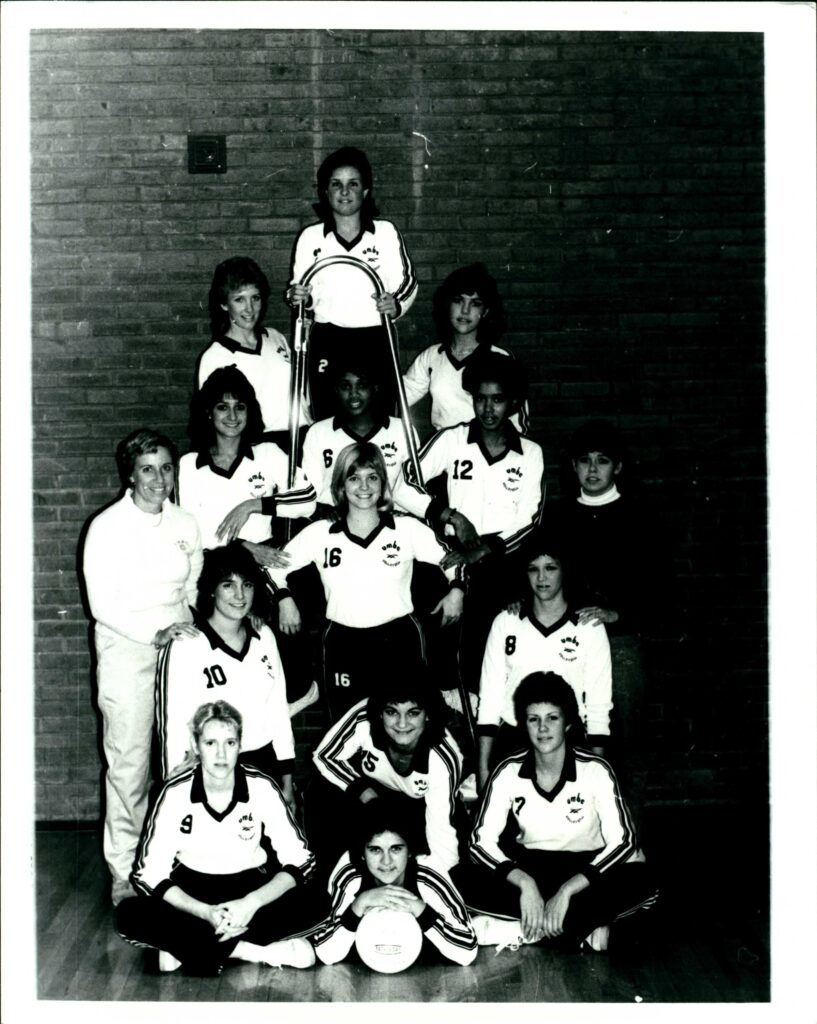 Team photo from 1983.
At the 2022 Homecoming alumnae volleyball scrimmage, Kasey Crider, who joined UMBC as head volleyball coach earlier this year, got a firsthand view of the connections the program has forged over the last 50 years—connections that he considers the foundation of the team’s success. “I exist in that ecosystem of this legacy, which hit me like a ton of bricks. I’m walking out of there going, ‘Man, this is why you do it. You have these incredible people.’”
The volleyball players over the years would tell you that common values and hard work unite a team that comes from all over the world. Robbin Lee ’13, visual arts, remembers the process of bonding with her teammates, even in some unexpected ways: “We spent the preseason meshing and melding our languages—like the way we talk and the slang we use,” she says.
“By the end of the season we all sounded like each other.” This only reflected the close bonds they’d forged. To hear Lee tell it, “our team was a group of sisters. We loved and annoyed each other a lot. But, at the end of the day, we held each other accountable and we pushed each other to be better off and on the court.”
Earlier alumnae recount a similar sisterhood. Elizabeth (Straley) Beckelman, ’90, psychology, played in the ’80s under the nickname “Biff” and met her lifelong best friend Melissa (Diehlmann) Little ’90, psychology, on the first day of tryouts.
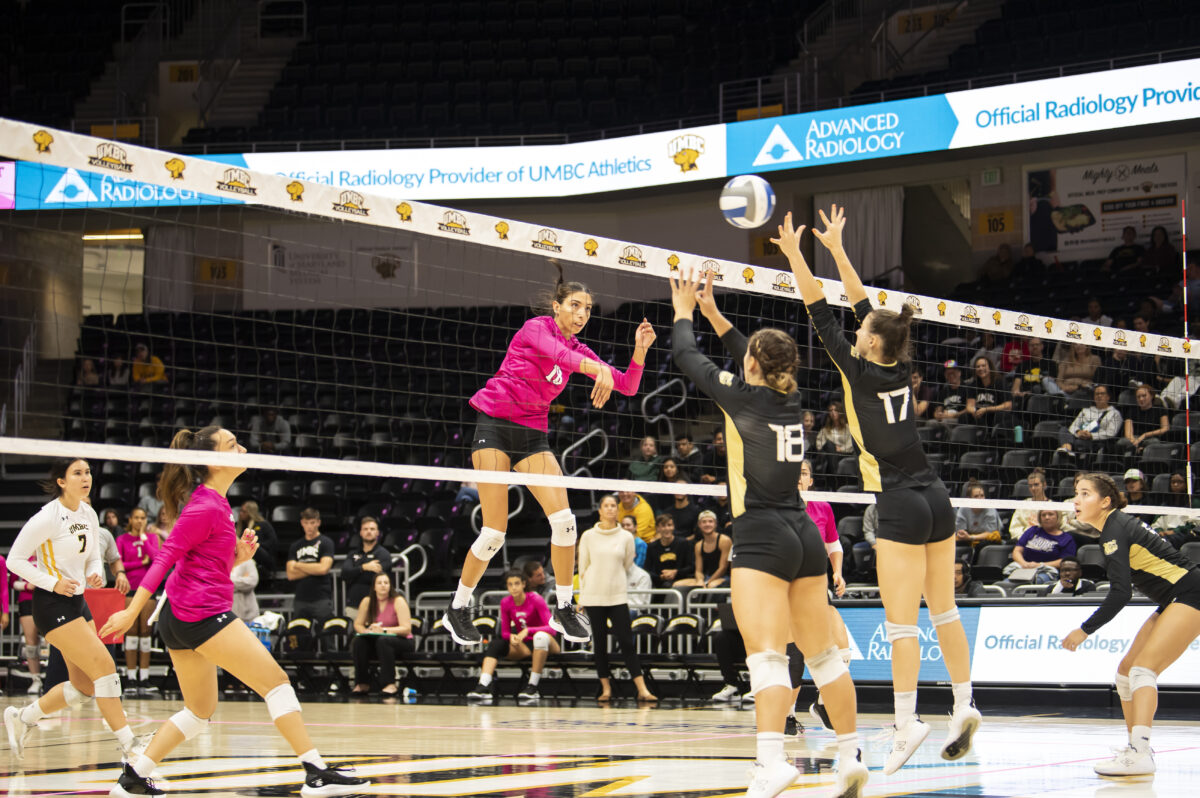 UMBC Volleyball, in pink, on their way to defeat Bryant University 3-0 at an October 2022 match.
“I was a walk-on,” Beckelman remembers. “I didn’t even know if I would make the team.” And yet she did, and now fondly remembers her coaches keeping her grades on track, getting “more competitive” as the program grew, and strenuous running drills. “It really grounded me and kept me focused and kept me on a track and on a path,” Beckelman says.
As the newest member of the team celebrating their 50th anniversary this year, Crider came in as coach with one question on his mind: “What’s best for the players?” It sounds like the program is well-equipped to answer him.
]]>
Team photo from 1983. At the 2022 Homecoming alumnae volleyball scrimmage, Kasey Crider, who joined UMBC as head volleyball coach earlier this year, got a firsthand view of the connections the...
https://umbc.edu/stories/then-now-volleyball-creates-band-of-sisters/
https://my3.my.umbc.edu/api/v0/pixel/news/129670/guest@my.umbc.edu/036a5c808e56ff2279cc4920bba77f46/api/pixel
alumni
athletics
fall-2022
magazine
then-and-now
volleyball
UMBC News & Magazine
https://my3.my.umbc.edu/groups/umbc-news-magazine
https://assets1-my.umbc.edu/system/shared/avatars/groups/000/001/943/24435aa6207c452e7bc15cc74b42c7bb/xsmall.png?1748556657
https://assets1-my.umbc.edu/system/shared/avatars/groups/000/001/943/24435aa6207c452e7bc15cc74b42c7bb/original.png?1748556657
https://assets2-my.umbc.edu/system/shared/avatars/groups/000/001/943/24435aa6207c452e7bc15cc74b42c7bb/xxlarge.png?1748556657
https://assets2-my.umbc.edu/system/shared/avatars/groups/000/001/943/24435aa6207c452e7bc15cc74b42c7bb/xlarge.png?1748556657
https://assets3-my.umbc.edu/system/shared/avatars/groups/000/001/943/24435aa6207c452e7bc15cc74b42c7bb/large.png?1748556657
https://assets1-my.umbc.edu/system/shared/avatars/groups/000/001/943/24435aa6207c452e7bc15cc74b42c7bb/medium.png?1748556657
https://assets2-my.umbc.edu/system/shared/avatars/groups/000/001/943/24435aa6207c452e7bc15cc74b42c7bb/small.png?1748556657
https://assets1-my.umbc.edu/system/shared/avatars/groups/000/001/943/24435aa6207c452e7bc15cc74b42c7bb/xsmall.png?1748556657
https://assets2-my.umbc.edu/system/shared/avatars/groups/000/001/943/24435aa6207c452e7bc15cc74b42c7bb/xxsmall.png?1748556657
UMBC News & Magazine
0
0
false
Thu, 08 Dec 2022 10:14:53 -0500
Thu, 08 Dec 2022 10:14:53 -0500
A Space of One’s Own

On a chilly morning in early spring 2022, Eileen Meyer, Roy Prouty, and Erik Crowe were on the roof of the UMBC Physics Building. They were inside the observatory dome, trying to figure out what had gone wrong with the 32-inch telescope installed when the building was constructed in 1999. They had already determined that the shutters designed to keep dust off the mirrors were jammed, rendering the telescope temporarily unusable.
“So we’re up there with flashlights and ladders that are not quite tall enough,” Meyer recalls, “trying to figure out what is happening and realizing that some of the motors have died.” They weren’t terribly surprised, given the age of the instrument and the harsh conditions on the roof of a building: extreme heat in summer and cold in winter as well as high humidity. At one point, Meyer says, birds unfortunately had to be evicted from one of the ventilation grates, but not before they had spread debris around the dome.
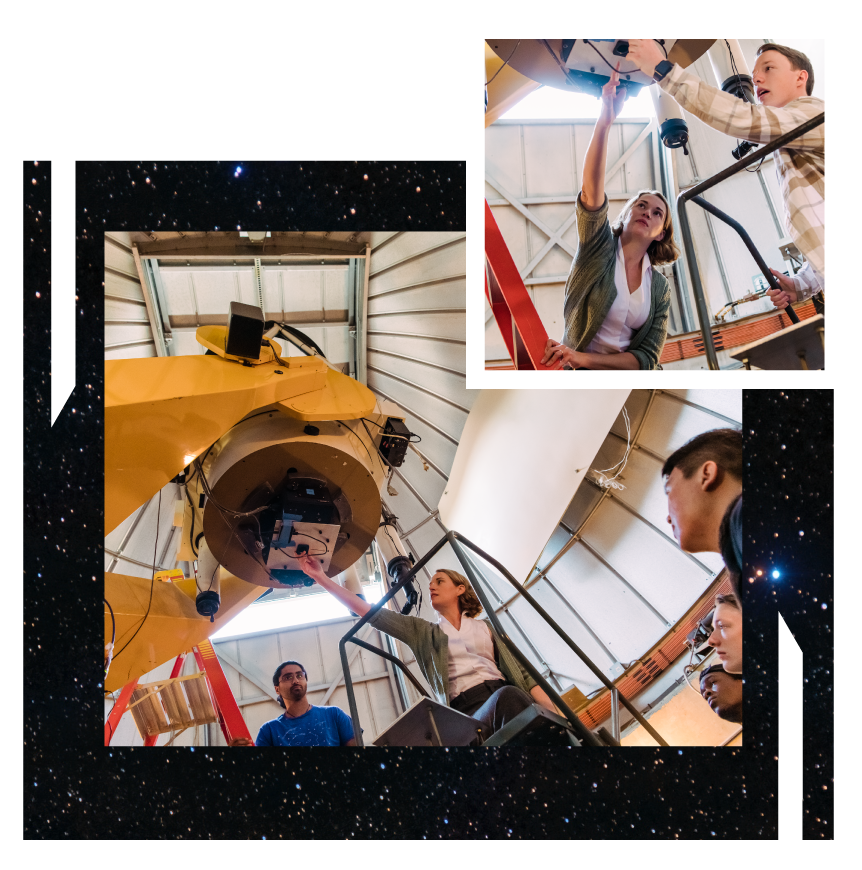 Eileen Meyer works on the observatory telescope with some of her students. (Marlayna Demond ’11/UMBC)
As someone who decided as a first-year graduate student that hands-on lab work wasn’t really her thing, Meyer may seem an unlikely candidate for climbing ladders, ordering parts, and figuring out wiring as the observatory refurbishment lead. In fact, Meyer, associate professor of physics, has spent the better part of the last decade using computers (often the “super” variety) to conduct astrophysics research, mostly on black holes (the supermassive variety)—but she is finding fulfillment in expanding her work.
“That’s the beauty of having a career that is hitting its mid-stage,” Meyer says. “You can start trying different things.”
Leaning into the turning points

The telescope renovation project is a symbol of Meyer’s evolution as a scientist. Because it requires expertise outside her wheelhouse, it’s enhancing her management and delegation skills, she says, and allowing her to collaborate with a wider range of students and colleagues, including engineers. Plus, the upgraded telescope will enable other projects she’s diving into now, creating new opportunities at a turning point in her career, she says.
When it was built, the observatory was a state-of-the-art facility, designed to conduct observations of the near-Earth atmosphere and to serve as a public-outreach tool. The latter function is still underway today, with programming offered by observatory director and current Ph.D. student Roy Prouty, M.S. ’16, atmospheric physics, but the aging of the telescope and its original cameras means it is no longer up to the task of cutting-edge research.
With generous financial support from the College of Natural and Mathematical Sciences and hands-on help from people like Prouty and Crowe, the Physics Building manager, Meyer says, “The goal is to modernize the observatory and bring it up to the level of something that we can actually put research-grade equipment on and do observations.”
The beauty of physics

While the details of Meyer’s research might be shifting, her overall drive to conduct research and create knowledge are longstanding and unchanged. “I always wanted to be a scientist from as soon as I knew what that was,” Meyer reflects—although astronomy was something “I fell into by degrees,” she says.
As an undergraduate at Rice University in Houston, physics won her over because “it’s so beautiful,” she says. “It’s this interplay of the natural world and the mathematical descriptions you can make of it. It can be deceptively simple.”
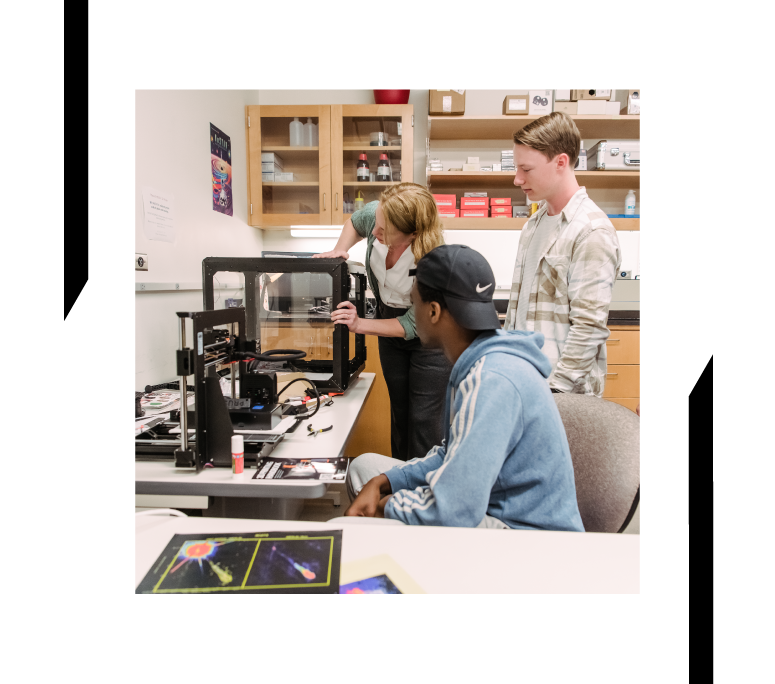 Meyer works with two students in her lab. (Marlayna Demond ’11/UMBC)
“And once you’ve been trained as a physicist, it’s something you can’t turn off,” she adds. “You’re driving down the highway, and you see something oscillating on a truck, and you start to think how you could model this with equations …You start seeing these things everywhere, and it explains to you why the world works the way it does. It takes away a lot of the mystery, but it does it in a beautiful way.”
Meyer initially pursued particle physics, thinking that was the frontier—the field where she could ask fundamental questions about the rules by which the universe operates. But after changing advisors early in her graduate career for a better personality match, she found herself in an astronomy research group, and has stuck with it since. “It turns out that astronomical observations allow us to constrain fundamental physics,” she says, “so it’s not like I went away from that after all.”
Plasma jets and giant mergers

To date, her work has largely focused on “understanding why black holes do what they do,” Meyer says, with a good deal of it focused on the giant jets of extremely high-energy plasma that often stream from them in opposite directions. The jets can be bigger than entire galaxies, carrying tremendous amounts of energy and material, Meyer explains. “And galaxies are enormous,” she adds. “Those themselves are already hard to imagine, they’re so big.”
Supermassive black holes, while denser than anything known in the universe, can have a volume about the size of our solar system. “It’s unbelievably tiny compared to the scale of the chaos that they’re unleashing” with their jets, Meyer says. The existence of the jets “was something that nobody predicted,” she adds. Even in the 1960s, some scientists were still arguing that black holes themselves (forget about their jets!) did not exist. Today, black holes are well established, but, Meyer says, “it’s still a major open question—how do they produce these jets?”
Black holes and their jets “are basically super extreme environments, so they’re interesting to study and to try to understand,” Meyer says. “There’s just major things that we don’t know about them. We’re hopeful we can understand them eventually, through observations and heavy-duty computational modeling—because that’s what they didn’t have in the ’60s. And even today, we regularly run up against the capabilities of what the computer can do.”
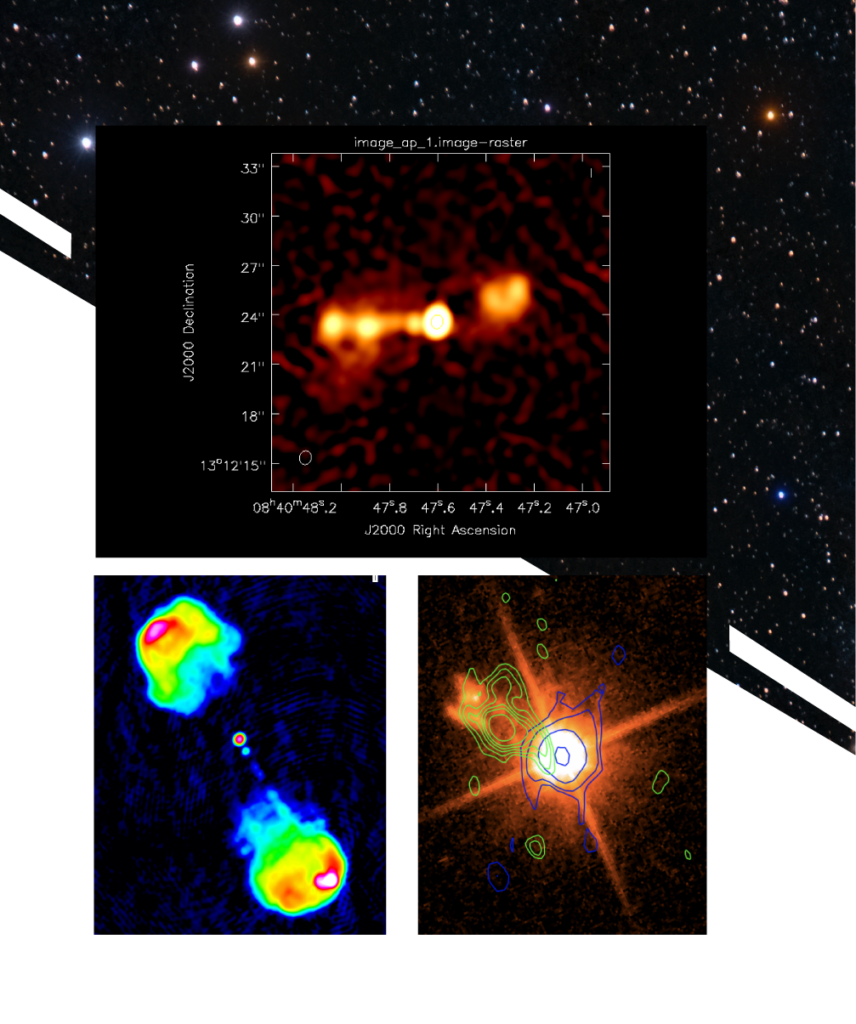 Top: Image using radio waves to visualize a faint jet of plasma (extending to the upper right), powered by a super-massive black hole (the bright white circle). Bottom right: Galaxy 3C 186, where Meyer and colleagues found a black hole that had been “kicked” out of the center of the galaxy. The black hole (blue lines/bright white area) is offset from its galaxy’s center (green lines). Bottom left: The red dot at the center represents a black hole. The rainbow blobs in either corner represent regions where intense radiation is being emitted. The entire image is about 1 million light-years across, and the galaxy is about 6 billion light-years from Earth. Images courtesy of Meyer.
Meyer also studies black hole mergers—the combining of two black holes into one. It’s another research area fraught with uncertainty and with much left to discover. Recently, she co-led a project that found the most convincing evidence yet of a merged black hole that has been “kicked” out of the center of its galaxy, in this case, at 4.5 million miles per hour.
“The history of studying black holes,” Meyer says, “is just one surprise or ‘what the heck’ after another.”
Striking out on her own
As exciting and rewarding as studying black holes is, when asked about major milestones in her career trajectory, rather than naming the funding of a huge proposal or a publication that moved the needle in her field, Meyer turns to more intangible matters. After completing a Ph.D., which Meyer did at Rice in 2012, a researcher should transition to becoming truly independent in setting goals and priorities, bringing in funding, managing a research group, and going beyond “the projects your advisor wanted to do,” she says.
After a postdoctoral fellowship at the Space Telescope Science Institute (STCsI) at Johns Hopkins University under an inspiring mentor, Bill Sparks, Meyer joined the UMBC faculty in 2015. It would be the first time she had a “lab of her own.” Sparks was confident she was on a path to great things at the time. “It was a real pleasure to work with Eileen at STScI; we considered ourselves very fortunate to bring her there,” he says, adding that her work there “was extremely favorably received. An eminent astronomer described it as ‘truly beautiful work.’”
Yet, like new faculty members everywhere, at UMBC Meyer says she went through a period of proving herself— working hard to bring in major grants, come up with fresh research ideas, and publishing high-impact papers as a lead investigator. The first major milestone “felt like it happened eventually after I’d been here a couple years,” she says. “I felt like I could call myself an independent researcher.”
Independent, but not alone
Even as she worked toward independence as a researcher, Meyer certainly wasn’t alone. Mentors like Sparks and Meyer’s husband, Markos Georganopoulos, professor of physics at UMBC, and others in the department and at the university have provided support along the way.
“He was a little bit ahead of me in the career stage,” Meyer says of Georganopoulos, “so everything I would go through he had gone through a few years before. You can kind of mentor each other because you have a sounding board.” Their research is similar enough that Georganopoulos is a co-author on some of Meyer’s publications.
Jane Turner, former director of the Center for Space Sciences and Technology, a UMBC partnership with NASA, also mentored Meyer in her early days at UMBC. “I’ve come to appreciate that UMBC is a very supportive place—the department, the college, and the school in general,” Meyer says. “It’s absolutely true that people want you to succeed here. I’ve always felt that.”
Meyer understands the importance of mentorship, as the first person in her family to earn a Ph.D. She enjoys paying that support forward to UMBC students. “I really love our student population. They’re just fantastic,” she says. “There’s a certain seriousness and maturity that they have that I really appreciate.”
Some of her students are the first person in their family to earn a college degree, and many more, like Meyer, are the first in their family to be considering graduate school. “I feel like I identify with our student population, which makes working with them really a joy.”
Life as a parent-researcher
In 2019, Meyer and Georganopoulos welcomed their son into the world, and she felt the strength of the UMBC community even more. “Parenting and being a highly active researcher is a real challenge,” Meyer says, especially when you’ve moved far from family in order to pursue your dream of being on the faculty at a research university. While “the department and UMBC in general has been very helpful,” parenting still hasn’t been easy given “systemic bigger issues that we have with supporting parents,” she says.
Always a determined problem solver, however, Meyer has found ways to succeed both as a parent and as a scientist. Mentors advised her to consider all of her unfinished projects (of which any researcher usually has many), and instead of trying in vain to complete them all, “focus on where you can make major progress in the field. Focus on impact, and let the others go,” she says. She has taken that advice to heart—especially through the pandemic.
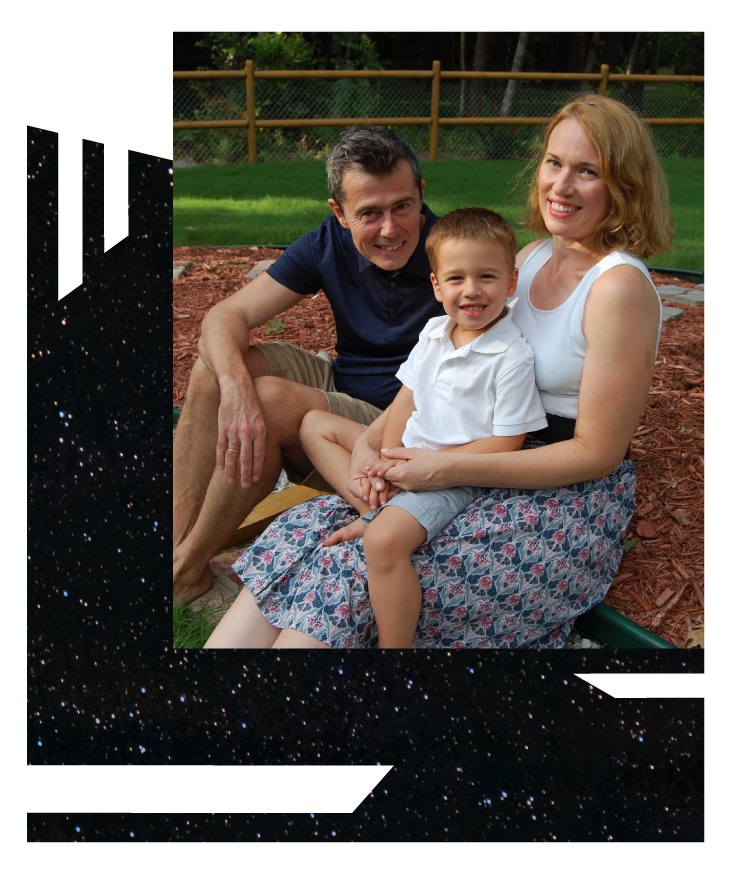 Meyer with husband, Markos Georganopoulos, and their son, Stefanos. (Photo courtesy of Meyer)
And now that she’s more established in her field and as a researcher, it’s time to step back from the “take every opportunity” mentality and learn to say no, which can be a special challenge for women and young scientists, Meyer says. “Bill [Sparks] was always very good at that,” though, she adds—and that’s not the only thing she’s taken from his mentorship.
“He is my model for what a scientist should be,” Meyer says. Especially with current pressures to publish and win grants at a rapid clip, Sparks “always did only what he was interested in,” even shifting focus from astrophysics to astrobiology later in his career. “I want to be as free as he is with how he does his work,” Meyer says.
Living the freedom
Today, Meyer is living that freedom by exploring new kinds of research using the UMBC observatory, and Sparks has joined UMBC as an adjunct faculty member to support the effort. In addition to fixing up broken motors and buying a much larger ladder, Meyer plans to build a new instrument called a polarimeter, which will make observations of objects in our solar system, phenomena farther away such as flare stars, and other targets possible with the UMBC telescope.
“It’s great to be working with Eileen again—she’s so darn good at everything and always open to taking on something new and unfamiliar, whether it’s building polarimeters, climbing wobbly ladders, or thinking about black holes and the origin of the universe,” Sparks says. “Eileen is one of the most capable and versatile researchers in astronomy—and our project should keep UMBC at the forefront of a unique, innovative scientific niche.”
Making new missions happen
She is also on the leadership team of a University of Maryland-led consortium competing for NASA funding for a new space-based satellite mission. NASA put out a call for proposals for high–energy astrophysics missions, and her team’s entry, the Advanced X-ray Imaging Satellite (AXIS), would capture extremely high resolution X-ray images to study galaxy formation, black holes, and much more.
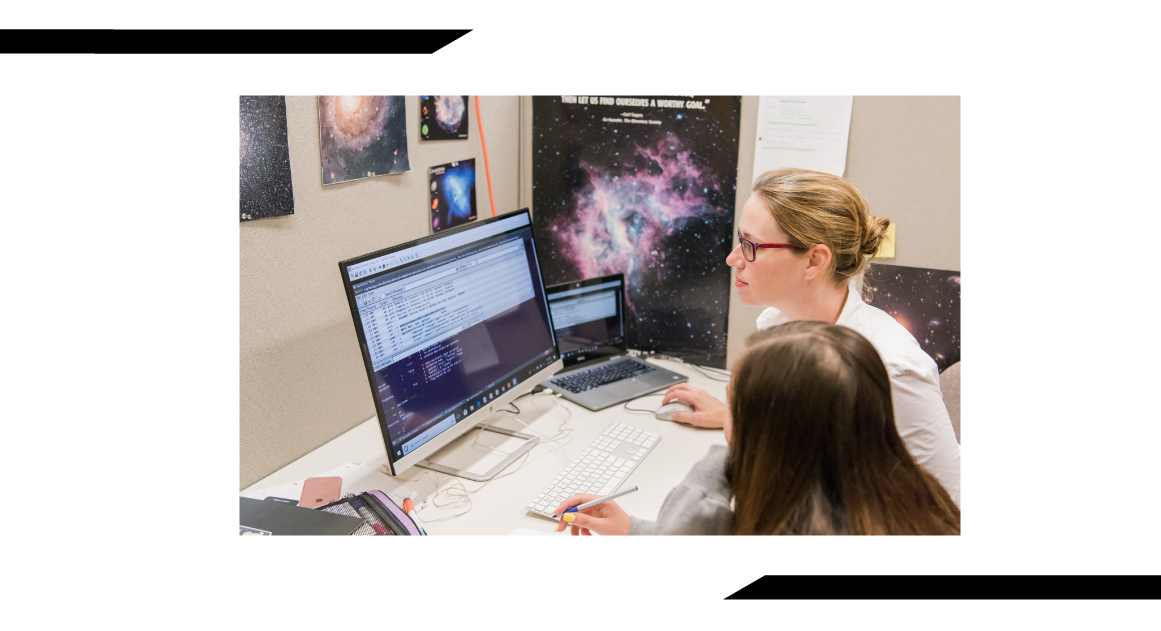 Meyer working with a student. (Marlayna Demond ’11/UMBC)
This role is an exciting change for Meyer. She describes herself as coming from “a classical academic path,” where she relied on data from both land- and space-based instruments but was never involved in their design, construction, or the bureaucracy often involved in actually putting a satellite in the sky. After attending a summer workshop at Harvard, however, her perspective shifted. A scientist on the original Chandra X-ray Observatory mission team gave a talk describing the iconic mission’s 30-year journey from concept to launch, which finally happened in 1999.
“I was astounded by how difficult it was—the immense challenge—but then also how amazing it is that eventually this thing flew, and it’s still working—it’s still taking amazing images all the time,” Meyer says. “Ever since then, I always thought I would love to get involved in that process, to help be an advocate for new observatories, new technologies. So when I was asked to join AXIS I was very happy, because it’s been a long-term side dream of mine to be involved in making new missions happen.”
The things that are mine
As her career—and her family—moves forward, Meyer is hitting her stride. “I love studying black holes and jets, but it’s still true that that was my advisor’s topic,” she says. But with AXIS, the observatory work, and other new collaborations, “I feel like I’m getting into the things that were really mine—the things that were interesting to me all along,” she says.
The UMBC physics department plans to hire at least one more faculty member in high-energy physics soon. That could also shape Meyer’s work, depending on her new colleague’s areas of interest. She’s also been approached by researchers in the Center for Space Sciences and Technology for collaboration. Put simply, the future is bright for Eileen Meyer, and she’s savoring it all.
“I think of myself as an open person; I could see myself doing work that I haven’t imagined yet,” she says. “I like it when people bring me problems to think about. We’ll see where we go next.”
]]>
On a chilly morning in early spring 2022, Eileen Meyer, Roy Prouty, and Erik Crowe were on the roof of the UMBC Physics Building. They were inside the observatory dome, trying to figure out what...
https://umbc.edu/stories/a-space-of-ones-own-black-hole-research/
https://my3.my.umbc.edu/api/v0/pixel/news/129656/guest@my.umbc.edu/dd748553777dae8acd9e475258d69b88/api/pixel
cnms
discovery
fall-2022
magazine
physics
UMBC News & Magazine
https://my3.my.umbc.edu/groups/umbc-news-magazine
https://assets1-my.umbc.edu/system/shared/avatars/groups/000/001/943/24435aa6207c452e7bc15cc74b42c7bb/xsmall.png?1748556657
https://assets1-my.umbc.edu/system/shared/avatars/groups/000/001/943/24435aa6207c452e7bc15cc74b42c7bb/original.png?1748556657
https://assets2-my.umbc.edu/system/shared/avatars/groups/000/001/943/24435aa6207c452e7bc15cc74b42c7bb/xxlarge.png?1748556657
https://assets2-my.umbc.edu/system/shared/avatars/groups/000/001/943/24435aa6207c452e7bc15cc74b42c7bb/xlarge.png?1748556657
https://assets3-my.umbc.edu/system/shared/avatars/groups/000/001/943/24435aa6207c452e7bc15cc74b42c7bb/large.png?1748556657
https://assets1-my.umbc.edu/system/shared/avatars/groups/000/001/943/24435aa6207c452e7bc15cc74b42c7bb/medium.png?1748556657
https://assets2-my.umbc.edu/system/shared/avatars/groups/000/001/943/24435aa6207c452e7bc15cc74b42c7bb/small.png?1748556657
https://assets1-my.umbc.edu/system/shared/avatars/groups/000/001/943/24435aa6207c452e7bc15cc74b42c7bb/xsmall.png?1748556657
https://assets2-my.umbc.edu/system/shared/avatars/groups/000/001/943/24435aa6207c452e7bc15cc74b42c7bb/xxsmall.png?1748556657
UMBC News & Magazine
2
0
false
Wed, 07 Dec 2022 12:59:50 -0500
Wed, 07 Dec 2022 12:59:50 -0500
Unstuck in Time—Peeling Back Layers Through Art

As a visual artist, Monique Crabb, M.F.A. ’22, intermedia and digital arts, draws from her environment quite literally—producing textile-based artworks colored with the rich hues of plants and objects around her. This fall, she spent a month in residency at the Baltimore County Public Library, teaching workshops and engaging with library users as she created new work inspired by her surroundings. These are her reflections from that experience.
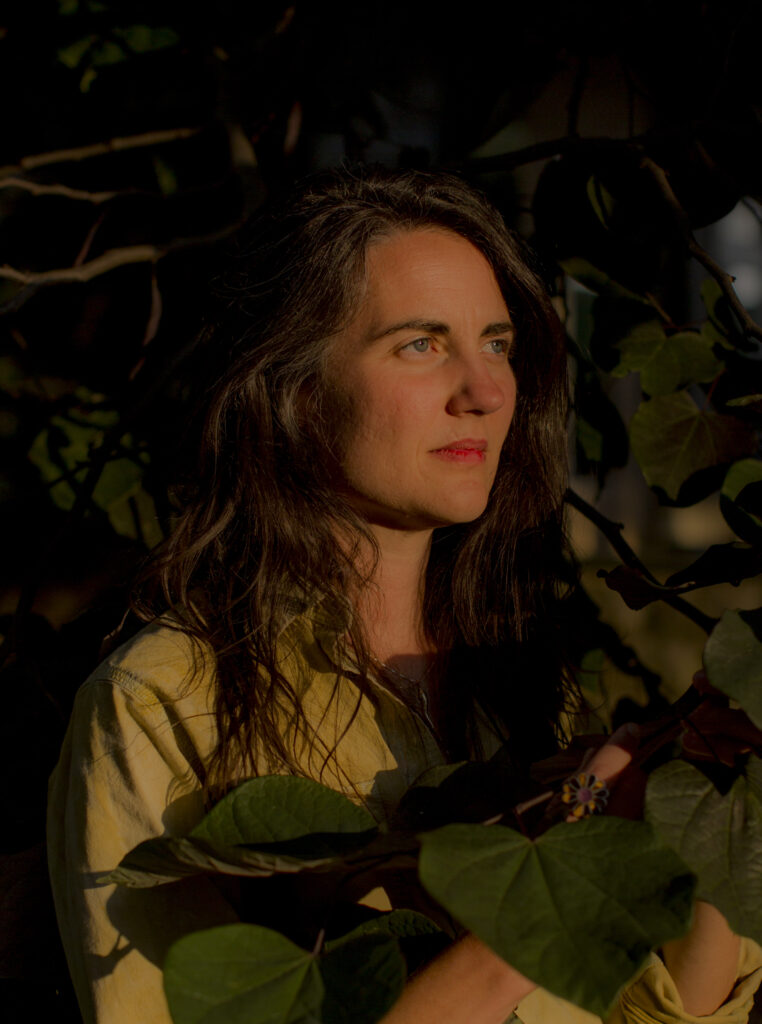 Headshot of Monique Crabb.
One of the most calming places to be in is a public library surrounded by people’s research, stories, and history of every place and culture from almost every perspective imaginable. At times, the amount of knowledge at my fingertips can feel daunting knowing I’ll never be able to take it all in. I’m reminded of a scene in the ’80s movie My Stepmother Is an Alien, when the main character Celeste, played by Kim Basinger, travels to earth in a model’s body to conduct research on human life and discovers books. She’s able to retain the books’ information instantly through osmosis, spanning the gamut of human emotions, and is starved for more. This scene has imprinted itself in my mind as a superpower I wish I had.
Growing up in a working class neighborhood to a mom who would every weekend pull open the large rolling door to our garage for the permanently set-up sale of our used things, and a father who worked various jobs and seemingly was never around, I spent most of my time outside of school on the streets, at friends’ homes, or playing in the woods. My parents did not engage much with books, the arts, or academia; I was mostly influenced by pop culture.
As I got older, books came to me at very specific times in my life to change my perspective and help me find my place in the world of things. One of those times was my junior year in high school when my English teacher gave the class a list of authors to pick from for a book report and I selected Kurt Vonnegut, solely on the fact that his name sounded cool and he shared a first name with Kurt Cobain. I then found myself sitting on the floor of my school’s library absorbed by the opening line of Slaughterhouse-Five: “All this happened, more or less.”
The rest of the book was an eye-opening view of one person’s experience in the world during a time so far removed from my own, yet with relatable philosophical ideas with quotes like, “All time is all time. It does not change. It does not lend itself to warnings or explanations. It simply is. Take it moment by moment, and you will find that we are all, as I’ve said before, bugs in amber.” Books allow us to travel through time and place to help us find meaning in our lives, which is a magical experience that visual arts achieves just as profoundly.
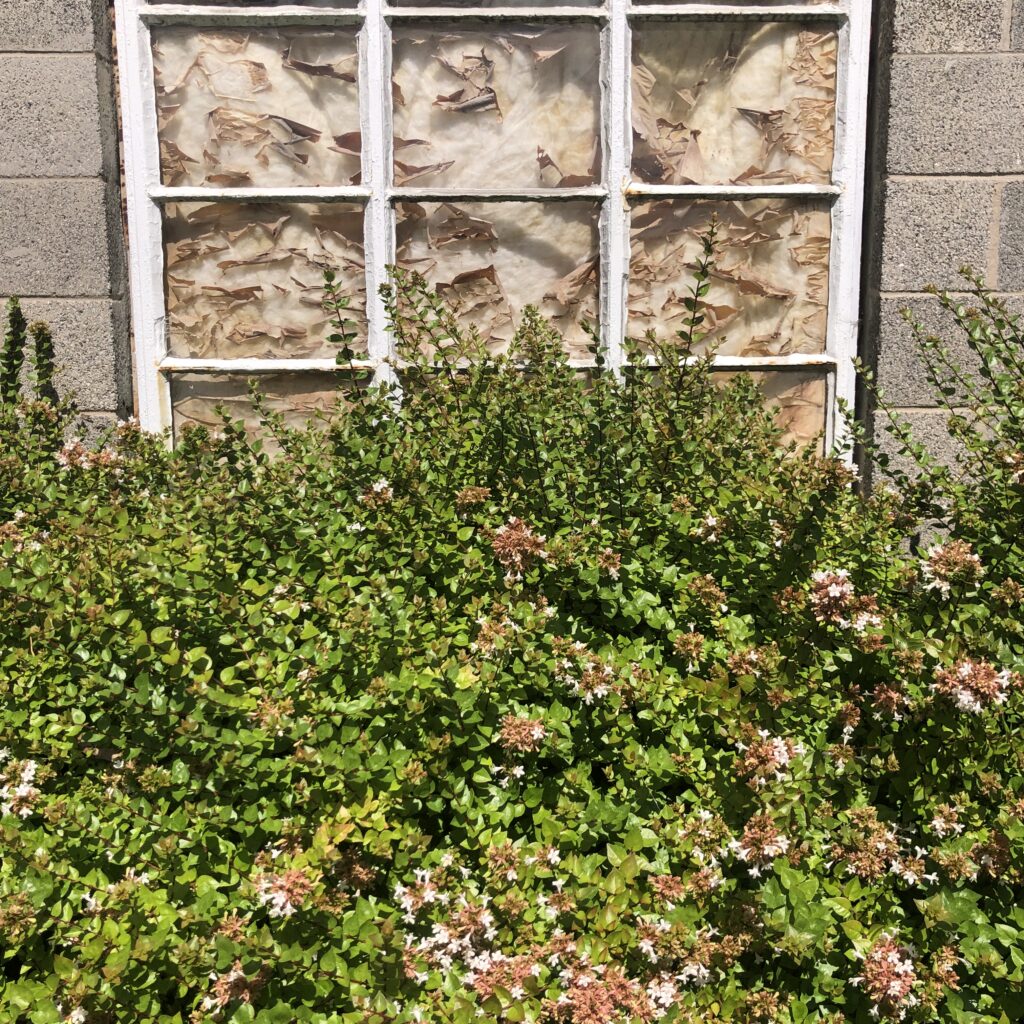 Window of a vacant building interacting with a bush near the Hereford Branch of the Baltimore County Public Library.
The Baltimore County Public Library month-long Artist in Residence program was a gift to take part in. Each week I walked through a sea of books and would greet the librarians on my way to their maker space, The Hive. Being there allowed me the time and space to focus on one project.
I also had the opportunity to engage with a community outside of my own through two workshops I gave on eco-printing and dyeing with food waste as well as having the studio space open to visitors while I was working. On my lunch breaks I would browse books and take walks, once visiting the nearest cemetery and other times just taking in the colors and patterns from the intersecting relationship of plants and human-made constructions in the area.
During my time in residency, I started a project using secondhand vintage linens made with open cut and intricately detailed hand and machine embroidery. I either cut up or used the entire napkin, handkerchief, or tablecloth and machine-pieced them together using pojagi, a Korean form of quilting that creates a seam on both sides of the pliable plane. These textile objects, often made by women, were and continue to be so precious that the folds and creases in them become deep from decades of being stored away unused.
I was drawn to bringing these objects out of storage, unfolding, and piecing one to the other to create a frankensteinian curtain that was large and would present as a confrontation in the middle of a room. I hadn’t fully unraveled the idea, but I knew if I put in the work that richer layers of context would reveal themselves.
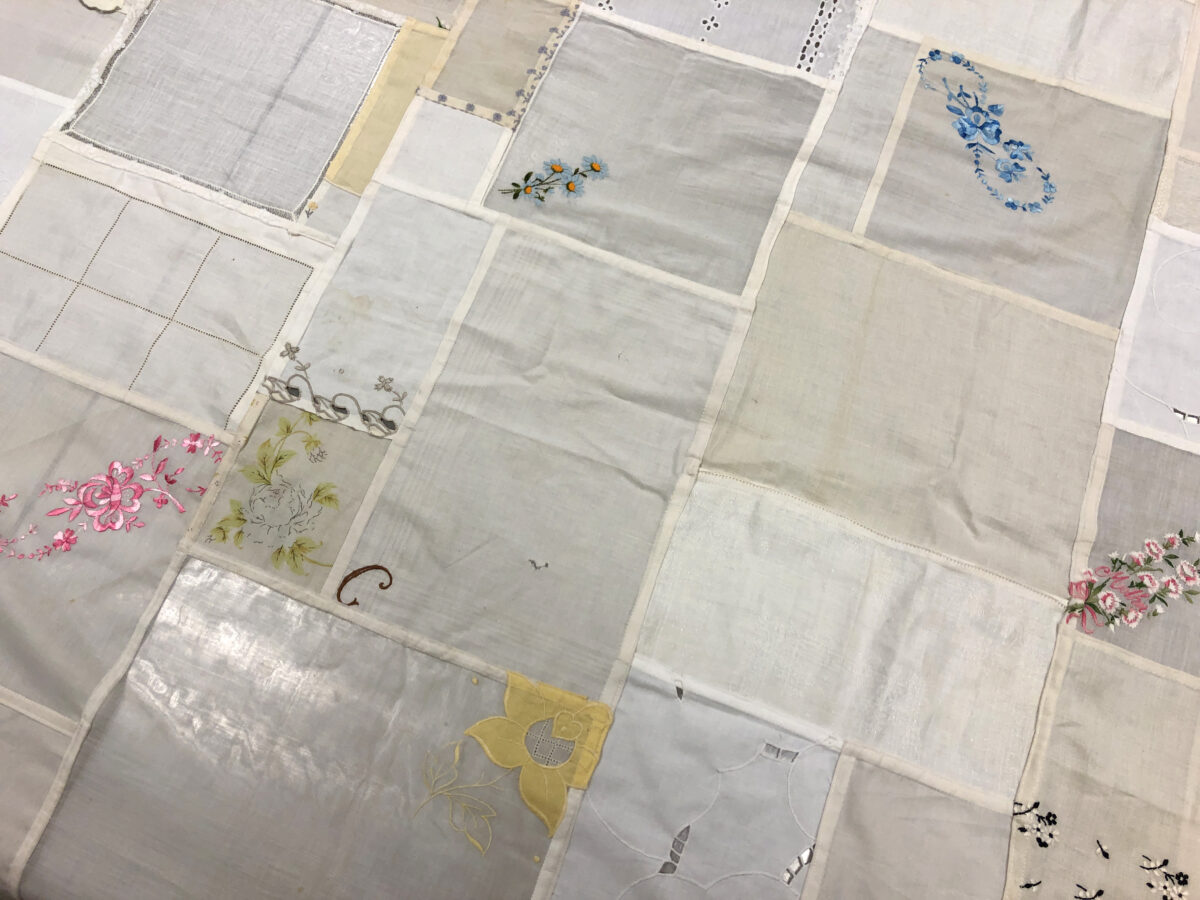 Pojagi-style piecing of secondhand vintage embroidered napkins.
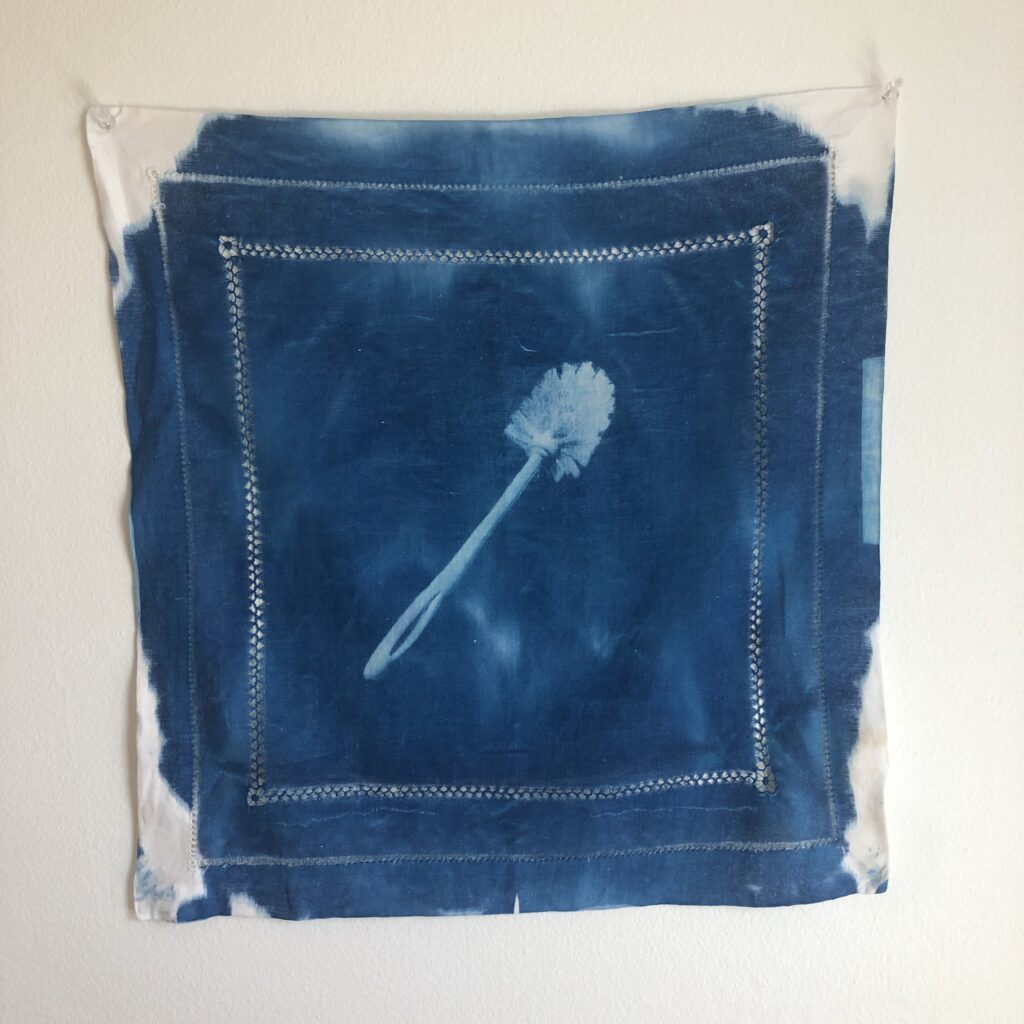 Cyanotype-coated vintage cotton napkin with an image of a toilet brush exposed using the light of the sun.
Toward the end of my residency I had a library visitor come through and we chatted for a while about art, the artist’s process, and the meaning behind what is made. It was during this exchange that I had a lightbulb moment for my project of painting cyanotype directly onto the napkins and exposing stark images of tools used in the domestic world like a toilet brush. Adding this layer of context expanded my exploration of materials from domestic life by bringing attention and exposing the hidden labor behind the undervalued role of homemaker, woman, and caregiver.
It’s essential to my growth as an artist to be in new environments and around new people as well as the opportunity to step back from being so deeply inside of my artwork by engaging with communities outside of my own. Meeting the folks who took my workshops and the ones who came through the studio to ask questions about what I was working on reminded me of the importance of my role as an artist. I believe our stories connect us and often find that the narratives I encounter, whether in person or from books, inform and enrich my practice in ways I could never do alone.
]]>
As a visual artist, Monique Crabb, M.F.A. ’22, intermedia and digital arts, draws from her environment quite literally—producing textile-based artworks colored with the rich hues of plants and...
https://umbc.edu/stories/unstuck-in-time-peeling-back-layers-through-art/
https://my3.my.umbc.edu/api/v0/pixel/news/129651/guest@my.umbc.edu/386371691536ef455083206234f9c043/api/pixel
alumni
cahss
fall-2022
magazine
mfa
visualarts
UMBC News & Magazine
https://my3.my.umbc.edu/groups/umbc-news-magazine
https://assets1-my.umbc.edu/system/shared/avatars/groups/000/001/943/24435aa6207c452e7bc15cc74b42c7bb/xsmall.png?1748556657
https://assets1-my.umbc.edu/system/shared/avatars/groups/000/001/943/24435aa6207c452e7bc15cc74b42c7bb/original.png?1748556657
https://assets2-my.umbc.edu/system/shared/avatars/groups/000/001/943/24435aa6207c452e7bc15cc74b42c7bb/xxlarge.png?1748556657
https://assets2-my.umbc.edu/system/shared/avatars/groups/000/001/943/24435aa6207c452e7bc15cc74b42c7bb/xlarge.png?1748556657
https://assets3-my.umbc.edu/system/shared/avatars/groups/000/001/943/24435aa6207c452e7bc15cc74b42c7bb/large.png?1748556657
https://assets1-my.umbc.edu/system/shared/avatars/groups/000/001/943/24435aa6207c452e7bc15cc74b42c7bb/medium.png?1748556657
https://assets2-my.umbc.edu/system/shared/avatars/groups/000/001/943/24435aa6207c452e7bc15cc74b42c7bb/small.png?1748556657
https://assets1-my.umbc.edu/system/shared/avatars/groups/000/001/943/24435aa6207c452e7bc15cc74b42c7bb/xsmall.png?1748556657
https://assets2-my.umbc.edu/system/shared/avatars/groups/000/001/943/24435aa6207c452e7bc15cc74b42c7bb/xxsmall.png?1748556657
UMBC News & Magazine
0
0
false
Wed, 07 Dec 2022 12:22:02 -0500
Wed, 07 Dec 2022 12:22:02 -0500
Think Fast

The only things faster than David and Caitlyn Bobb themselves, perhaps, are the zingers they toss at one another.
As Caitlyn, a rookie running star now in her sophomore year, describes what it’s like to have a father as head coach of track and field at UMBC, her dad dryly turns it into a bit.
“My dad has many sides to him, okay?” Caitlyn laughs as Coach Bobb literally acts out everything she’s saying while seated beside her.
“There’s the coach side, where he’s stern, and he’s got the stopwatch in his hand, arms crossed, hat on, and ‘GO!’…And then there’s the dad side, who comes to practice all excited, and says ‘Woo, I’m hyped, let’s go!’”
It’s not surprising that Caitlyn is poised for another amazing season. She’s a very hard worker, of course, and also the product of phenomenal athlete parents. Her mom, Dawnnette, represented Bermuda in the 1992 Olympics in the 100-meter dash, and Coach Bobb ’97, information systems, still holds six separate records for indoor and outdoor events at UMBC.
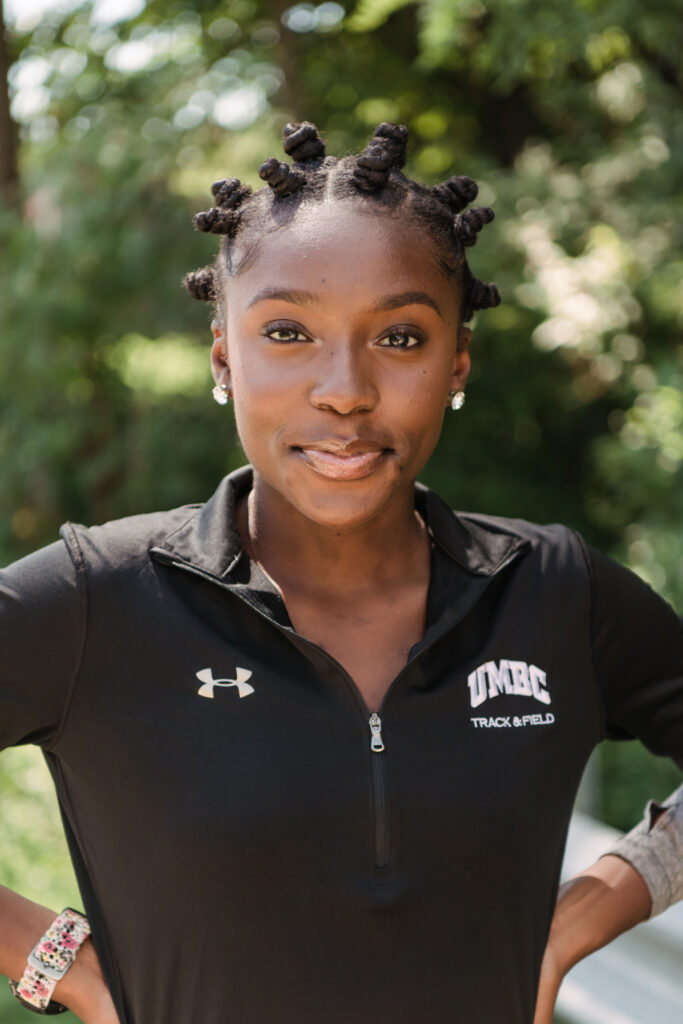
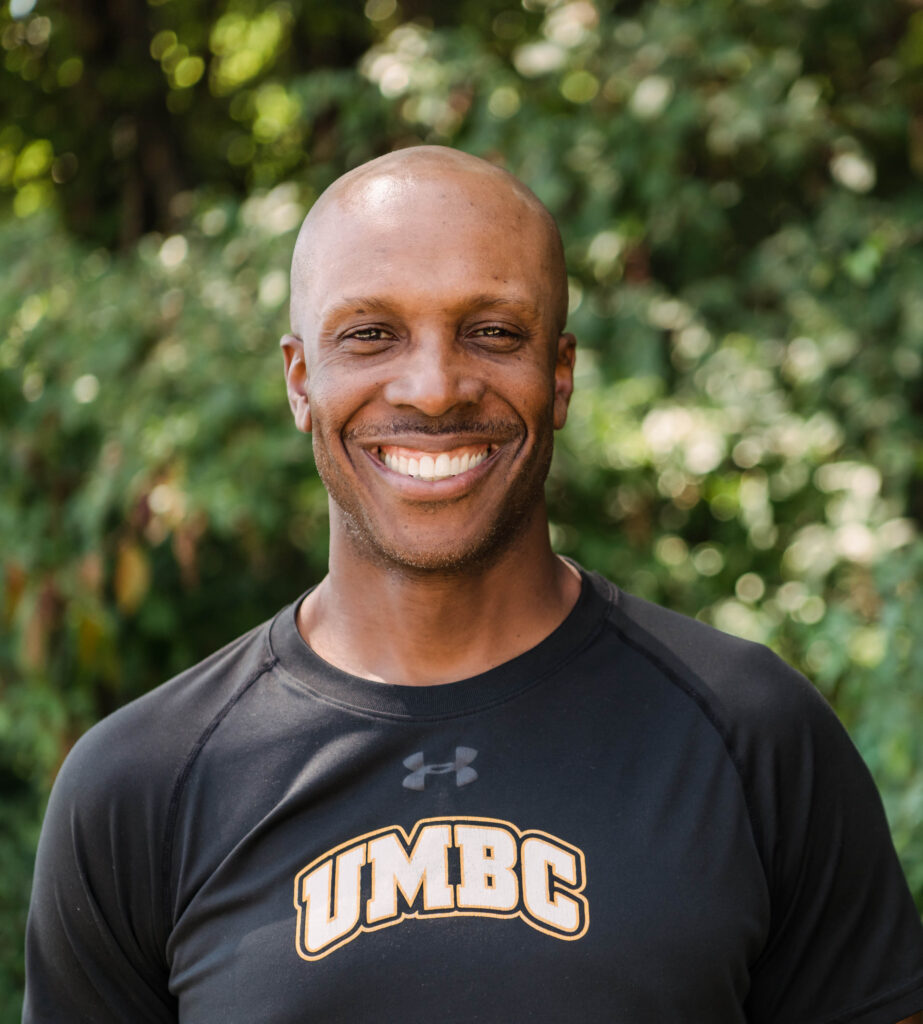
“My mom, she was like, ‘Okay, I saw that coming.’ I’m pretty sure my dad did, too. It’s in my genes. I didn’t have a choice,” Caitlyn says.
Caitlyn wowed the competition in her rookie season, earning several “most outstanding” titles at the America East Championships and placing 17th in the 400-meter dash at the NCAA Championships with a school record-breaking time of 51.84 seconds. And as she continues to learn from her dad and other coaches—like paying attention to the way she pumps her arms, for instance—she’s on course to make improvements each season.
“We’re doing what we’ve been doing for years—the only difference is we’re now doing it at UMBC,” says Coach Bobb. “Hearing my experiences and her mom’s experiences helps her prepare for situations she’s going to encounter herself.”
Although bubbly off the track, Caitlyn is extremely serious in her training—pushing thoughts out of her head in order to focus on breathing above all else. She often runs and studies with her friend Ibra Khairat, a sophomore biological sciences major.
“I would describe Caitlyn and Coach’s relationship as one that’s balanced just right,” he says. “Although she is the coach’s daughter, Coach Bobb gives her room to grow as an athlete and doesn’t give any type of special treatment, which is why it works so well. They are both able to balance that father/daughter and coach/athlete dynamic.”
Coach Bobb is big on building relationships and trust and making sure his runners feel supported, both as athletes and students, he says. As father and daughter gently rib each other, it’s clear the one-upping is grounded in love.
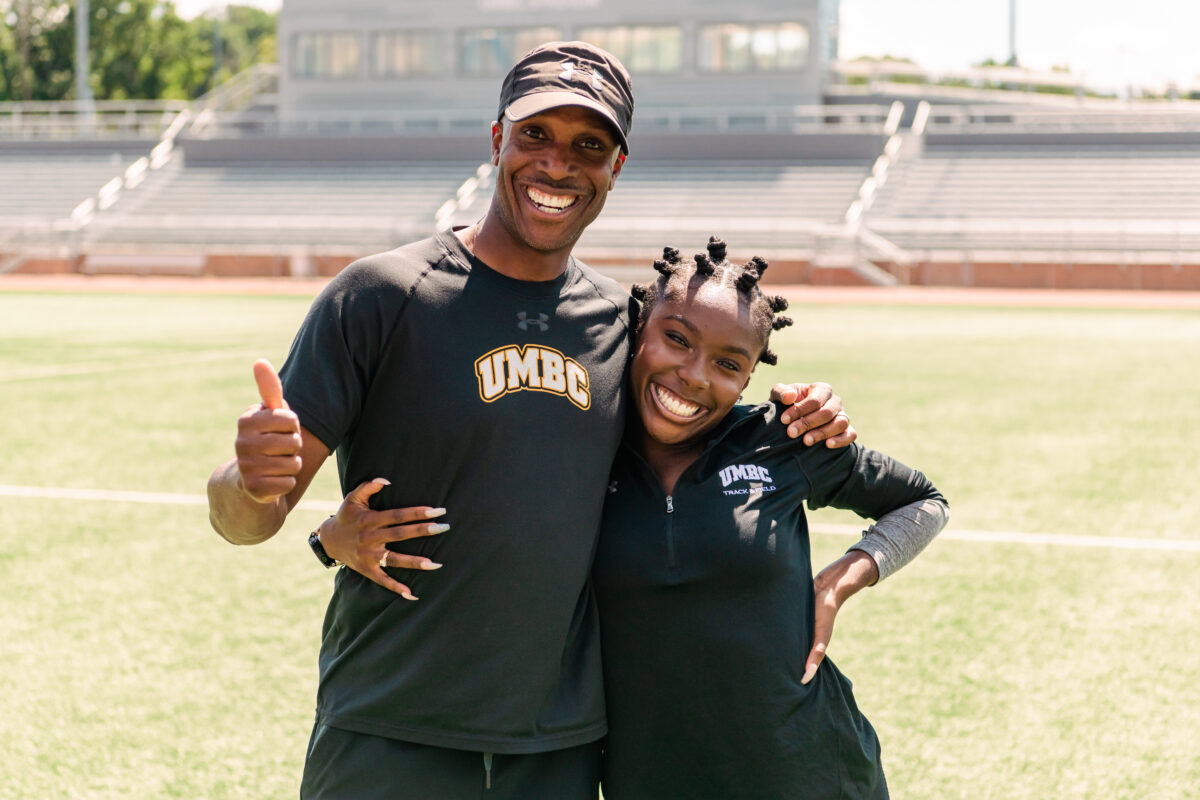 Coach Bobb and his daughter Caitlyn on the track. (Marlayna Demond ’11/UMBC)
“I know what it takes to be successful in this sport, so I just sit back and look at the execution of her race. Is she doing what she’s been trained to do?” Beyond that, he says, it’s about seizing the moment and improving wherever you can. “As a parent, I’m just making sure that I’m supportive. Track and field is only going to be X years of her life. I’m always going to be her dad.”
It’s true: Nobody runs track forever. Caitlyn is studying biological sciences with a minor in entrepreneurship and innovation with hopes of someday being a biology teacher—and possibly a coach herself.
She has a great model right next to her, even if she doesn’t always get his Karate Kid training jokes. (Don’t worry, they can watch it together later.)
“He cares about his students’ well-being, and he makes it a warm, welcoming environment. He cares a lot,” she says, getting serious for a moment. “Good job, Dad.”
]]>
The only things faster than David and Caitlyn Bobb themselves, perhaps, are the zingers they toss at one another. As Caitlyn, a rookie running star now in her sophomore year, describes what...
https://umbc.edu/stories/think-fast-father-daughter-track-duo/
https://my3.my.umbc.edu/api/v0/pixel/news/129600/guest@my.umbc.edu/74a25f9adf6b4ce247cf77b4edef8e90/api/pixel
athletics
biologicalsciences
campus-life
fall-2022
magazine
track-and-field
UMBC News & Magazine
https://my3.my.umbc.edu/groups/umbc-news-magazine
https://assets1-my.umbc.edu/system/shared/avatars/groups/000/001/943/24435aa6207c452e7bc15cc74b42c7bb/xsmall.png?1748556657
https://assets1-my.umbc.edu/system/shared/avatars/groups/000/001/943/24435aa6207c452e7bc15cc74b42c7bb/original.png?1748556657
https://assets2-my.umbc.edu/system/shared/avatars/groups/000/001/943/24435aa6207c452e7bc15cc74b42c7bb/xxlarge.png?1748556657
https://assets2-my.umbc.edu/system/shared/avatars/groups/000/001/943/24435aa6207c452e7bc15cc74b42c7bb/xlarge.png?1748556657
https://assets3-my.umbc.edu/system/shared/avatars/groups/000/001/943/24435aa6207c452e7bc15cc74b42c7bb/large.png?1748556657
https://assets1-my.umbc.edu/system/shared/avatars/groups/000/001/943/24435aa6207c452e7bc15cc74b42c7bb/medium.png?1748556657
https://assets2-my.umbc.edu/system/shared/avatars/groups/000/001/943/24435aa6207c452e7bc15cc74b42c7bb/small.png?1748556657
https://assets1-my.umbc.edu/system/shared/avatars/groups/000/001/943/24435aa6207c452e7bc15cc74b42c7bb/xsmall.png?1748556657
https://assets2-my.umbc.edu/system/shared/avatars/groups/000/001/943/24435aa6207c452e7bc15cc74b42c7bb/xxsmall.png?1748556657
UMBC News & Magazine
1
0
false
Mon, 05 Dec 2022 16:30:20 -0500
Mon, 05 Dec 2022 16:30:20 -0500
Centering Thriving Immigrant Voices in Immigration Research
UMBC faculty are leading interdisciplinary, community-engaged immigration research that is shifting the relationship between higher education institutions and immigrant communities. Their approaches include centering the economic, academic, social, and cultural contributions of immigrants to the well-being of U.S. cities. This scholarship challenges stereotypes and also works to dismantle systemic racism in higher education.
In 2020, New York Times reported that U.S.-born children of immigrants or immigrant students raised in the U.S. accounted for nearly 60 percent of the growth in U.S. university enrollment since 2000. The majority of these students are the children of international students from India who stayed in the U.S. to work, and the children of Latin Americans, and refugees who came to the U.S. in search of better living conditions.
Felipe Filomeno, associate professor of political science and global studies, and associate director of the Center for Social Science Scholarship, and Christopher Brown, a global studies lecturer, explore how immigrant students can be an asset to higher education with their study “Immigrant Students and Global Education.”
Filomeno and Brown designed a collaborative, project-based undergraduate course to study the intercultural experiences of immigrant students at UMBC. Students developed the ability to collect and analyze qualitative data and empathy for immigrants as they learned about diverse peer experiences. The study determined that project-based assignments designed to take advantage of immigrant students’ intercultural experiences could yield significant contributions to the global education of immigrant and non-immigrant students alike.
“It is important that there are such stellar colleagues committed to the vital work of exploring the realities, lived experiences, and challenges of our immigrant communities,” says Kimberly R. Moffitt, dean of the College of Arts, Humanities, and Social Sciences. “We can only thrive as a society by supporting and working together with all members of our community and recognizing their contributions to a global society.”
Digital storytelling for education and advocacy
Several of UMBC’s community-engaged researchers use digital storytelling to shift the focus away from the researcher creating information toward information being created by the community. One such project is “Intercultural Tales: Learning with Maryland’s Immigrant Communities,” developed by Thania Muñoz Davaslıoğlu, assistant professor of modern languages, linguistics, and intercultural communication (MLLI), and Tania Lizarazo, associate professor of MLLI and global studies.
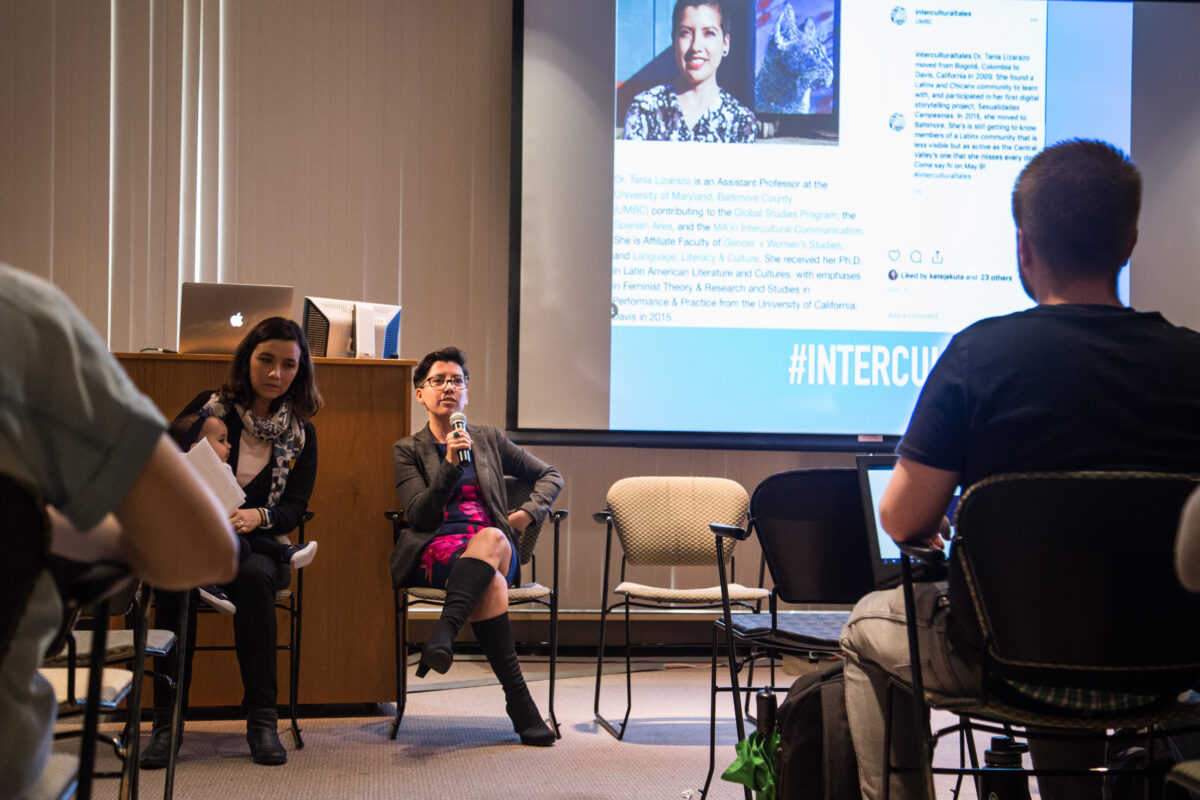 Tania Lizarazo speaking at Intercultural Tales with Thania Muñoz. Photo by Rachel Wallace
This project approaches digital storytelling from a feminist lens where non-academic knowledge such as lived experience is considered equally valuable in teaching and research. “Our project is informed by feminist theory and the field of critical intercultural communication in which power structures and hierarchies are emphasized when thinking about communication,” says Lizarazo, “Intercultural Tales is shaped by all of these fields/practices to facilitate (not guarantee) a more nuanced understanding of immigration as part of UMBC (instead of outside of it).”
This project, now in its third year, brings together students studying Spanish or global studies to produce digital stories of immigrant experiences with the goal of countering stereotypes. In one of the digital stories, “Pack Your Bag,” Heejin Hong ’18, MLLI, speaks of her parents’ transition from Korea to Paraguay, her time living in Brazil, moving to Mexico, and eventually settling in the U.S.
“My parents were first-generation immigrants from South Korea to Paraguay, where I was born. Their life as immigrants was not easy. They worked day and night to support our family,” Hong shared. “They constantly moved to other cities and countries looking for work. When I was little, I moved to Brazil to be with my grandparents because my parents had to work. Brazil was my first experience with immigration and learning a new language, new places, new food, and new cultures.”
She continued, “I have now been living in the U.S. for more than ten years. I used to see all of the changes that made me grow up quickly and think of what I didn’t have. Now, I realize that I gained something greater: courage, independence, patience, a positive outlook, not to lament, and to keep moving forward.”
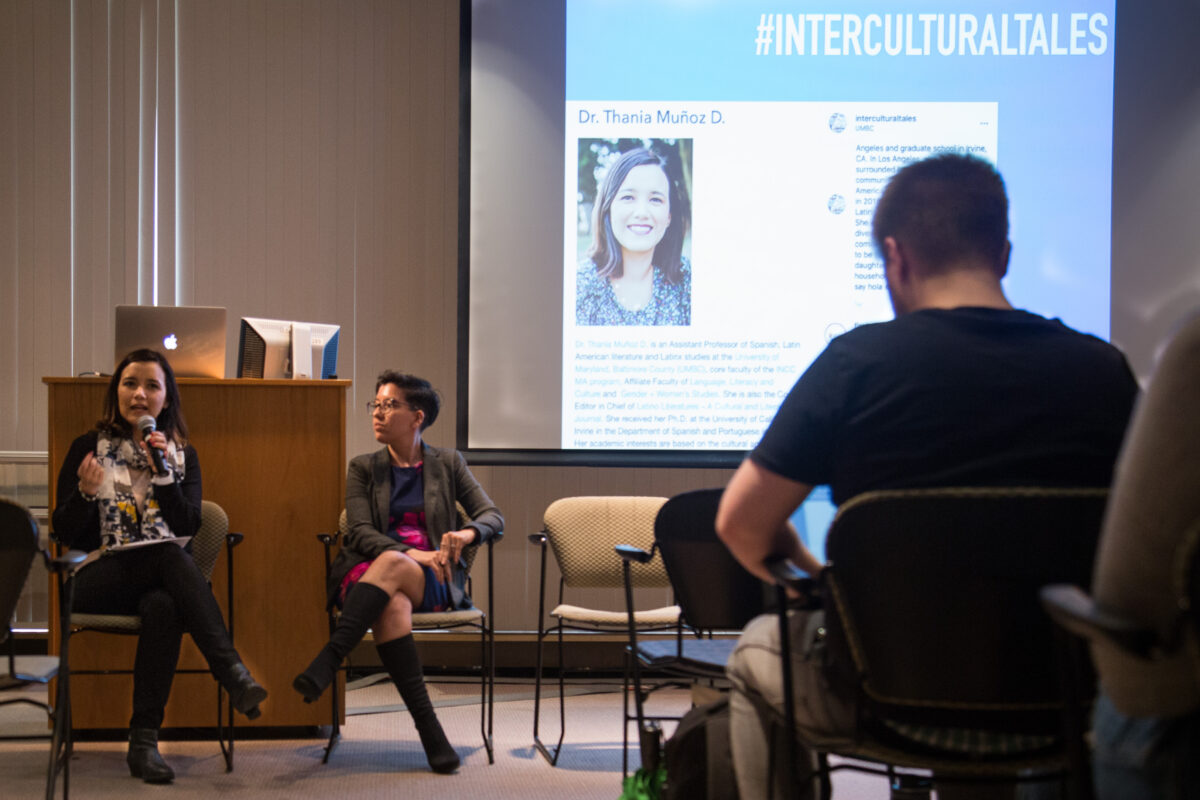 Thania Muñoz speaking about Intercultural Tales with Tania Lizarazo. Photo by Rachel Wallace.
Muñoz notes the findings, which were published in the Journal of Community Engagement and Higher Education, show the process of sharing and valuing knowledge through the project in some cases enabled the students to reframe fear, confusion, and shame through a new lens that revealed feelings of pride, solidarity, and insight.
“Most students had a more nuanced understanding of immigration,” says Lizarazo, “and a renewed appreciation for their classmate’s knowledge, which, in turn, shaped a less hierarchical learning space.”
Community-building through digital storytelling
Lizarazo also collaborated with local immigrant women to create “Moving Stories: Latinas en Baltimore.” The digital storytelling archive visualizes the immigrant experience from the perspective of Latinas in Baltimore. It aims to dispel stereotypes and share the diversity of their experiences.
Camila Daniel shared her experience of being a Black-Brazilian Latina living in Baltimore in her digital story “When Baltimore Became My Home.”
“In 2006 when I came to Baltimore, I lived the experience of what it means to be Black and Latina at the same time in a country that expects people to be only of one race. When people saw me with my accent, my hair, and my Black skin, they assumed I was African American. Many of the Brazilians were white. I didn’t feel I fit in anywhere. I suffered a lot,” says Daniel.
She continues, “Now, I feel it was good for me to come to Baltimore, live in a predominantly Black city, and learn from Black people what it is to have pride in how you look and your history. At the same time, with Spanish and Baltimore, I have created a family that does not have my blood or nationality but one heart.”
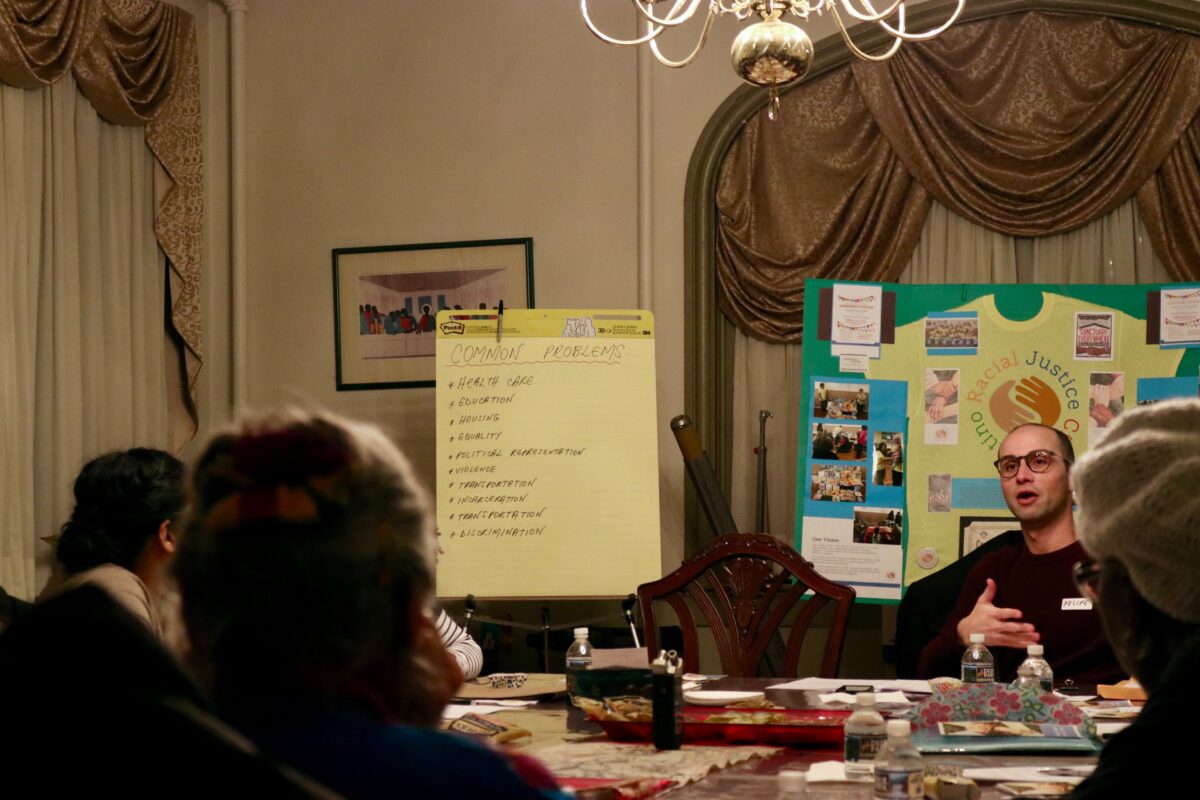 Filomeno leads a discussion with Baltimore’s Latino Racial Justice Circle. Photo courtesy of Filomeno.
Since 2017, Lizarazo and Filomeno have also worked in partnership with Baltimore’s Latino Racial Justice Circle to develop, design, execute, evaluate, and share the “Honest Conversations on Immigration” project. Through dialogue, and digital storytelling, the program fosters conversations between U.S.-born citizens and immigrants that share faith-based spaces but rarely engage in dialogue. Since 2019, about 85 members of 15 congregations have participated.
“Our goal as researchers is to use dialogue and digital stories as ways to bring different communities together around religion, race, and immigration,” explains Filomeno. “Through that process, we hope to create the potential to change the relationships among individuals, and between communities and society for the better.”
Baltimore’s immigration policies
Filomeno last year received the Hispanic Heritage Award from Baltimore Mayor Brandon Scott in recognition of his work facilitating dialogue as well as an earlier comprehensive assessment of Baltimore’s immigration policies. The study “Baltimore’s Policies to Attract and Retain Immigrants: A Community-Engaged Evaluation” was critical in shaping the strategic vision of the Mayor’s Office of Immigrant Affairs. It built on a prior study in which Filomeno reviewed Baltimore’s economic development, multicultural, and law enforcement policies, collaboration with civil society, and policy advocacy.
“In all these studies, I have engaged local groups and organizations in the creation of knowledge about immigration and the application of this knowledge to help solve real-world problems,” says Filomeno. “This research has helped a local government trying to encourage the city’s growth through immigration, a faith community trying to build connections between congregants of different nationalities, and a university trying to leverage student diversity of national origin to promote global learning. As we say at UMBC, it is public research for public good.”
Documenting places of belonging and meaning
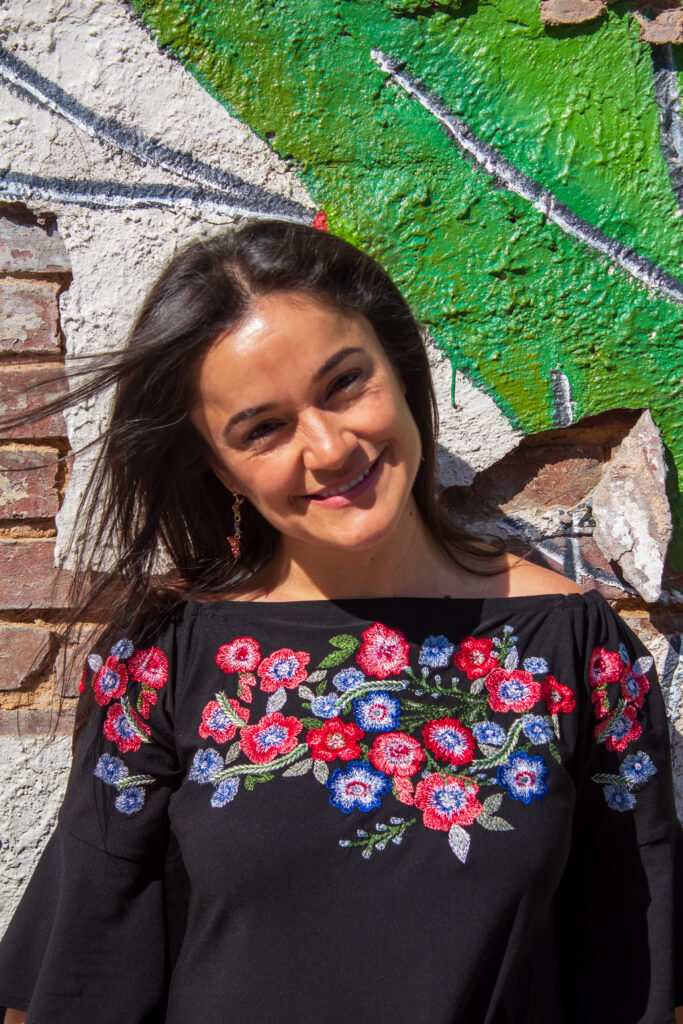 Headshot courtesy of Yolanda Valencia.
Beyond Maryland, Yolanda Valencia, assistant professor of geography and environmental systems, explores the Mexican immigrant community of Pasco, Washington, and how this community creates places of peace, tranquility, and family—places of belonging and meaning—under disadvantaged conditions. In the forthcoming book Relational Life: Legal Death, Valencia draws on years of fieldwork in Pasco, transnational ethnography, archival research, interviews with city leaders, and testimonies from undocumented Mexican immigrants.
“I aim to provide a historical political economy analysis of geographies of oppression overlaid with an analysis of spaces where this community thrives, as they both happen simultaneously across scale, time, and border,” says Valencia.
This year, Valencia received a 12-month Career Enhancement Fellowship, funded by the Mellon Foundation and administered by the Institute for Citizens and Scholars. She was also selected as a 2020 – 2022 Summer Institute on Tenure and Professional Advancement (SITPA) scholar. The mentoring and professional initiative is designed to facilitate junior faculty members’ successful transition to tenured associate professor status.
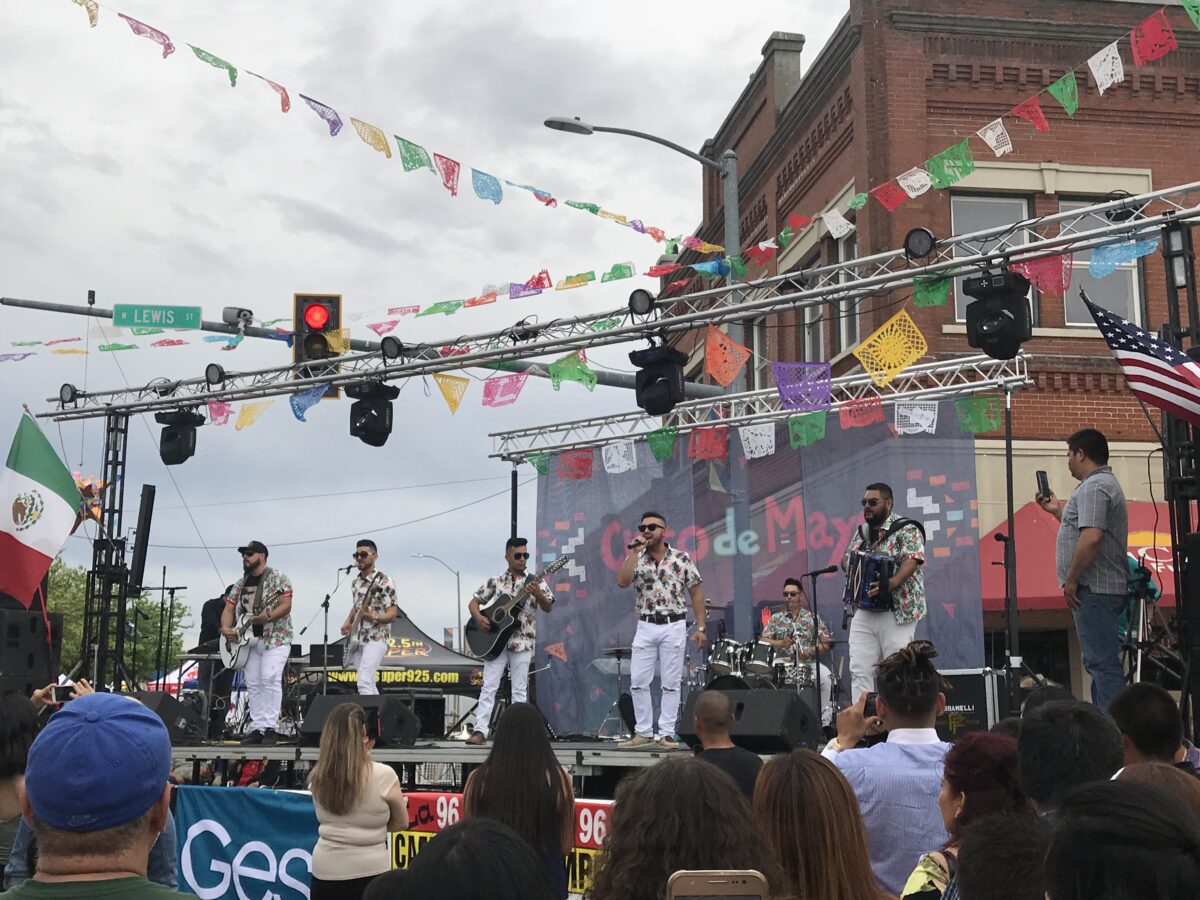 This Cinco de Mayo event in Pasco features second-generation Mexican immigrant musicians who have learned how to play, sing, and love traditional Mexican (and Latinx) music. Photo courtesy of Valencia.
Another faculty member has been highly engaged with immigrant communities in New Orleans. The success of taco trucks and Soul Food pop-ups there have raised complex questions about food truck regulation, worker rights, and immigration. The Whiting Foundation awarded a $50,000 Public Engagement Fellowship to Sarah Fouts, assistant professor of American studies, along with local New Orleans organizers Toya Ex Lewis and Fernando López, to implement “Project Neutral Grounds: At the Intersection of People, Street Food, and the Hustle.”
Lewis is the organizer of Project Hustle, born in New Orleans, and López is a Mexican-born documentarian. The three partners have worked together since 2013. Their latest collaboration will bring together Black, Brown, LGBTQ+, and immigrant food vendors in New Orleans to celebrate, share, and document their experiences and histories.
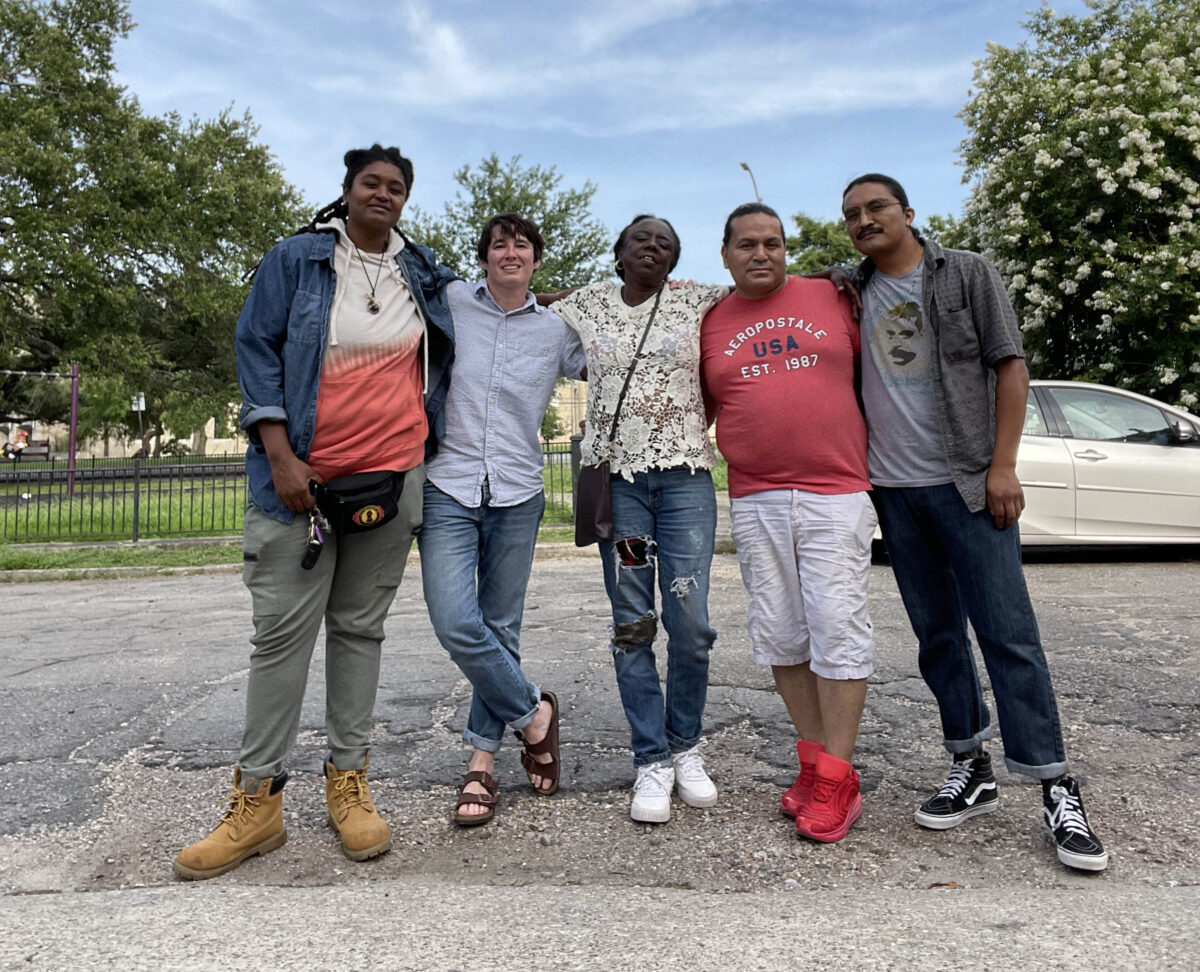 Left to right: Toya Ex Lewis, Sarah Fouts, community members, and Fernando Lopez. Photo courtesy of Fouts.
Challenging extractive research
This innovative research intentionally values the knowledge of immigrants and creates new ways for academics to think about primary sources. It highlights thriving communities and enables communication, personal reflection, and empathy while challenging systemic racism and the role of education and institutions in perpetuating inequalities.
“Recognizing each other’s humanity is not an abstract process. It requires a commitment to questioning pedagogies that reproduce the hierarchies we critique,” Muñoz Davaslıoğlu and Lizarazo explain. “Teaching and learning are inextricable from struggles against the dehumanization of immigrants and minorities.”
]]>
UMBC faculty are leading interdisciplinary, community-engaged immigration research that is shifting the relationship between higher education institutions and immigrant communities. Their...
https://umbc.edu/stories/immigrant-voices-in-immigration-research/
https://my3.my.umbc.edu/api/v0/pixel/news/129593/guest@my.umbc.edu/b0f32c6867d89407d88e1ee16c263f2e/api/pixel
americanstudies
arts-and-culture
cahss
csss
discovery
ges
globalstudies
magazine
mlli
news
politicalscience
rca-2
UMBC News & Magazine
https://my3.my.umbc.edu/groups/umbc-news-magazine
https://assets1-my.umbc.edu/system/shared/avatars/groups/000/001/943/24435aa6207c452e7bc15cc74b42c7bb/xsmall.png?1748556657
https://assets1-my.umbc.edu/system/shared/avatars/groups/000/001/943/24435aa6207c452e7bc15cc74b42c7bb/original.png?1748556657
https://assets2-my.umbc.edu/system/shared/avatars/groups/000/001/943/24435aa6207c452e7bc15cc74b42c7bb/xxlarge.png?1748556657
https://assets2-my.umbc.edu/system/shared/avatars/groups/000/001/943/24435aa6207c452e7bc15cc74b42c7bb/xlarge.png?1748556657
https://assets3-my.umbc.edu/system/shared/avatars/groups/000/001/943/24435aa6207c452e7bc15cc74b42c7bb/large.png?1748556657
https://assets1-my.umbc.edu/system/shared/avatars/groups/000/001/943/24435aa6207c452e7bc15cc74b42c7bb/medium.png?1748556657
https://assets2-my.umbc.edu/system/shared/avatars/groups/000/001/943/24435aa6207c452e7bc15cc74b42c7bb/small.png?1748556657
https://assets1-my.umbc.edu/system/shared/avatars/groups/000/001/943/24435aa6207c452e7bc15cc74b42c7bb/xsmall.png?1748556657
https://assets2-my.umbc.edu/system/shared/avatars/groups/000/001/943/24435aa6207c452e7bc15cc74b42c7bb/xxsmall.png?1748556657
UMBC News & Magazine
0
0
false
Mon, 05 Dec 2022 15:44:58 -0500
Mon, 05 Dec 2022 15:44:58 -0500
UMBC’s Zhibo Zhang to clarify atmospheric dust’s role in climate with NSF grant
Natural dust particles and human-produced pollutants in the atmosphere affect Earth’s overall energy budget in different and nuanced ways. A new three-year, $620,000 NSF grant led by Zhibo Zhang, professor of physics, will study how dust, pollutants, and water vapor in the atmosphere interact, to increase understanding of their overall effects on the global climate.
Atmospheric dust particles are large enough that they can reflect the Sun’s energy back to space, producing a cooling effect—but they can also trap energy from the earth trying to escape, contributing to warming. Most pollutants are too small to contribute to cooling, and tend to warm the planet instead, Zhang explains. But when the two mix in the atmosphere, which is commonplace, things get complicated. The new project will work to disentangle the effects of different kinds of particles through a combination of techniques.
Zhang is particularly excited about the upcoming work, because research led by his former students made it possible. Qianqian Song, Ph.D. ’21, atmospheric physics, “wrote three papers over the last three years that gave us the credentials to apply for this program,” Zhang says. Olivia Norman’20, physics, also contributed substantially. Song is currently pursuing a postdoc at Princeton, and Norman is in graduate school at M.I.T.
Moving forward, Tony La Luna, a new Ph.D. student in Zhang’s lab, will focus on the project, and Zhang is looking forward to adding more students to his team.
Domino effect in the atmosphere
Wind is always lifting dust from Earth’s surface, especially in arid areas such as the Sahara and Gobi Deserts. Once airborne, the dust can travel long distances and interact with other particles in the atmosphere.
“When dust moves from its source region to a polluted area, it gets mixed with the pollution there. And we are interested in these interactions,” Zhang says. His team’s research has shown these interactions are most common in eastern China, India, and central Africa.
 A satellite image centered on the Korean peninsula shows dust and clouds in the atmosphere. (Jacques Descloitres/NASA GSFC)
Until very recently, researchers typically modeled dust and pollutants separately, assuming they did not interact. But based on Zhang’s group’s research, that approach doesn’t produce a good approximation of what’s actually happening, he says.
Where dust and pollutants mix, tiny pollutant particles can condense onto larger dust particles. “The pollution particles can bump into the dust and stick together,” Zhang says. Then a domino effect ensues: “Once the pollution is coated on the dust,” he says, “it changes the way the dust interacts with water.”
Dust generally repels water, but pollutants are often attracted to water molecules. So dust coated with pollutants, called “coated dust,” can start to collect water. By changing how the dust reflects light, “This coating can change the net effect from cooling to warming,” Zhang says. By providing a surface to which water molecules can attach, the coated dust can also contribute to cloud formation, which affects precipitation.
Beyond satellite images
It can actually be difficult to tell whether a satellite image shows dust, pollution, or coated dust—so developing techniques to distinguish between different kinds of atmospheric particles is another one of the team’s goals.
“First, we need a good dust model,” Zhang says. His collaborator Dr. Diana Ortiz-Montalvo at the National Institute of Standards and Technology (NIST) uses a special imaging technique to precisely measure the shape of dust particles in the lab. Those measurements will help create models of different kinds of dust.
In general, pure dust has jagged edges. However, if the dust is thickly coated, it appears spherical again; this is called “smoothed dust.” A smoothing effect can also happen if water binds to dust and then evaporates.
Knowing exactly what each type of dust looks like will support efforts to more accurately identify them in satellite images, and understand how each type will behave in the sky.
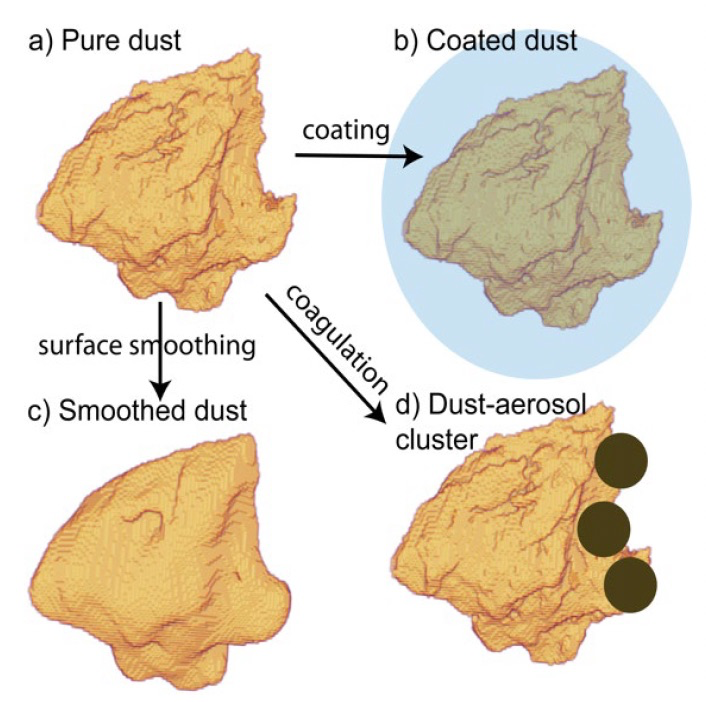 Different combinations of dust and pollutants take different shapes, which can be identified in the atmosphere through a combination of satellite data. (Image courtesy Zhibo Zhang)
Scattering light—and focusing on results
With the dust models in hand, Zhang’s team will calculate how the dust would interact with different particles it might encounter in the sky, like water, smoke, or industrial pollutants. Specifically, they will estimate how the dust would reflect—or “scatter”—light that strikes it. The scattering pattern depends on how rough or smooth the dust is.
The researchers will also analyze observational data that measure how dust all over the globe is scattering light. “Then we’ll combine lab measurements, the scattering calculations, and these satellite observations all together,” Zhang says, to answer the project’s ultimate question: Is dust and its interactions with other particles warming or cooling the planet, and how much?
Zhang’s research group melds computer science, physics, and climate science to address some of the least understood factors contributing to global climate. The new project will further those efforts, with the potential to clarify what roles dust and other atmospheric particles play. Along the way, it will also prepare students for successful careers in science.
“The new grant is indeed based on the success of the students. They laid the foundation for this project,” Zhang says. Much like his students, he adds, “I’m excited to take this essential next step in addressing an issue that affects our planet so profoundly.”
]]>
Natural dust particles and human-produced pollutants in the atmosphere affect Earth’s overall energy budget in different and nuanced ways. A new three-year, $620,000 NSF grant led by Zhibo Zhang,...
https://umbc.edu/stories/atmospheric-dusts-role-in-climate/
https://my3.my.umbc.edu/api/v0/pixel/news/129515/guest@my.umbc.edu/025047a936fc75ca4ae64cc21e4dfcd5/api/pixel
cnms
gradresearch
news
physics
rca-2
research
science-and-tech
undergraduate-research
UMBC News & Magazine
https://my3.my.umbc.edu/groups/umbc-news-magazine
https://assets1-my.umbc.edu/system/shared/avatars/groups/000/001/943/24435aa6207c452e7bc15cc74b42c7bb/xsmall.png?1748556657
https://assets1-my.umbc.edu/system/shared/avatars/groups/000/001/943/24435aa6207c452e7bc15cc74b42c7bb/original.png?1748556657
https://assets2-my.umbc.edu/system/shared/avatars/groups/000/001/943/24435aa6207c452e7bc15cc74b42c7bb/xxlarge.png?1748556657
https://assets2-my.umbc.edu/system/shared/avatars/groups/000/001/943/24435aa6207c452e7bc15cc74b42c7bb/xlarge.png?1748556657
https://assets3-my.umbc.edu/system/shared/avatars/groups/000/001/943/24435aa6207c452e7bc15cc74b42c7bb/large.png?1748556657
https://assets1-my.umbc.edu/system/shared/avatars/groups/000/001/943/24435aa6207c452e7bc15cc74b42c7bb/medium.png?1748556657
https://assets2-my.umbc.edu/system/shared/avatars/groups/000/001/943/24435aa6207c452e7bc15cc74b42c7bb/small.png?1748556657
https://assets1-my.umbc.edu/system/shared/avatars/groups/000/001/943/24435aa6207c452e7bc15cc74b42c7bb/xsmall.png?1748556657
https://assets2-my.umbc.edu/system/shared/avatars/groups/000/001/943/24435aa6207c452e7bc15cc74b42c7bb/xxsmall.png?1748556657
UMBC News & Magazine
0
0
false
Thu, 01 Dec 2022 16:46:00 -0500
Thu, 01 Dec 2022 16:46:00 -0500
When We Work Together

It’s no secret that at UMBC we do things a little differently. As a university, we’re young, agile, and (buzzword that it may be) truly innovative. We can see the success of these traits in our rankings or research-lab results or employee-satisfaction surveys, but those numbers don’t tell the full story of how, when the Retriever community joins efforts to achieve greatness, we arrive there together.
So on the eve of UMBC’s 50th anniversary in 2016, when the institution put forth a goal to raise $150 million— money that goes directly to student scholarships, graduate fellowships, professorial awards, and so much more— we didn’t question if we would succeed, we just wondered how we’d be able to capture the magnitude of the collective campaign when it came to a close.
Now, wrapping up the endeavor with over $189 million, we get to celebrate the stories that made this all possible. This campaign called upon our community’s Grit & Greatness, and Retrievers responded in kind by making big breakthroughs, forging true partnerships, and transforming lives.
Making Big Breakthroughs

The Talent Goes Both Ways
“One of my top priorities is recruiting the best talent who aspire to be great leaders for our company and the nation,” says Jennifer Walsmith, vice president of the Cyber and Information Solutions business unit at Northrop Grumman and executive lead for university relations with UMBC. “Our deep connection with UMBC enables us to recruit and hire the very best. Many of our UMBC graduates have remained at Northrop for decades and play an invaluable leadership role in cybersecurity.”
Walsmith knows something about connection as a Retriever herself, graduating in 1990 with a degree in computer science—something she said was only possible due to 2 a.m. study sessions with classmates and encouraging lunch meet-ups with friends on campus. In her current role, she oversees 2,000 plus employees and is often seen on campus speaking to alumni, faculty, and board members.
“As a nation, we have been enabled by enjoying a technically superior way of life. However, the number of students in the technical fields is getting smaller, especially among women in these majors.” So how do Northrop Grumman and UMBC plan on breaking through that limitation? “I believe it’s vitally important that we all give back,” says Walsmith.
That looks like dozens of UMBC interns each semester who get the chance to work on the toughest problems in space, aeronautics, defense, and cyberspace; an alumni chapter at Northrop Grumman over 600 employees strong who volunteer considerable time at local schools; and millions of dollars spent to benefit students, programs, and research over the last campaign.
Northrop Grumman has a unique relationship with UMBC, but they are not alone in their support of UMBC students and faculty and graduate research. Throughout the Grit & Greatness campaign, 69 percent of commitments came from foundations and companies like T. Rowe Price, Morgan Stanley, Lockheed Martin, and Baltimore Gas and Electric Company.
“We are technical leaders, and I love to see our UMBC students thrive to become future leaders of our company and give back to other students,” says Walsmith. “So when you create the engine where people on each side fuel this relationship, it strengthens everyone.”
— Randianne Leyshon ’09
Breaking Through Education Barriers
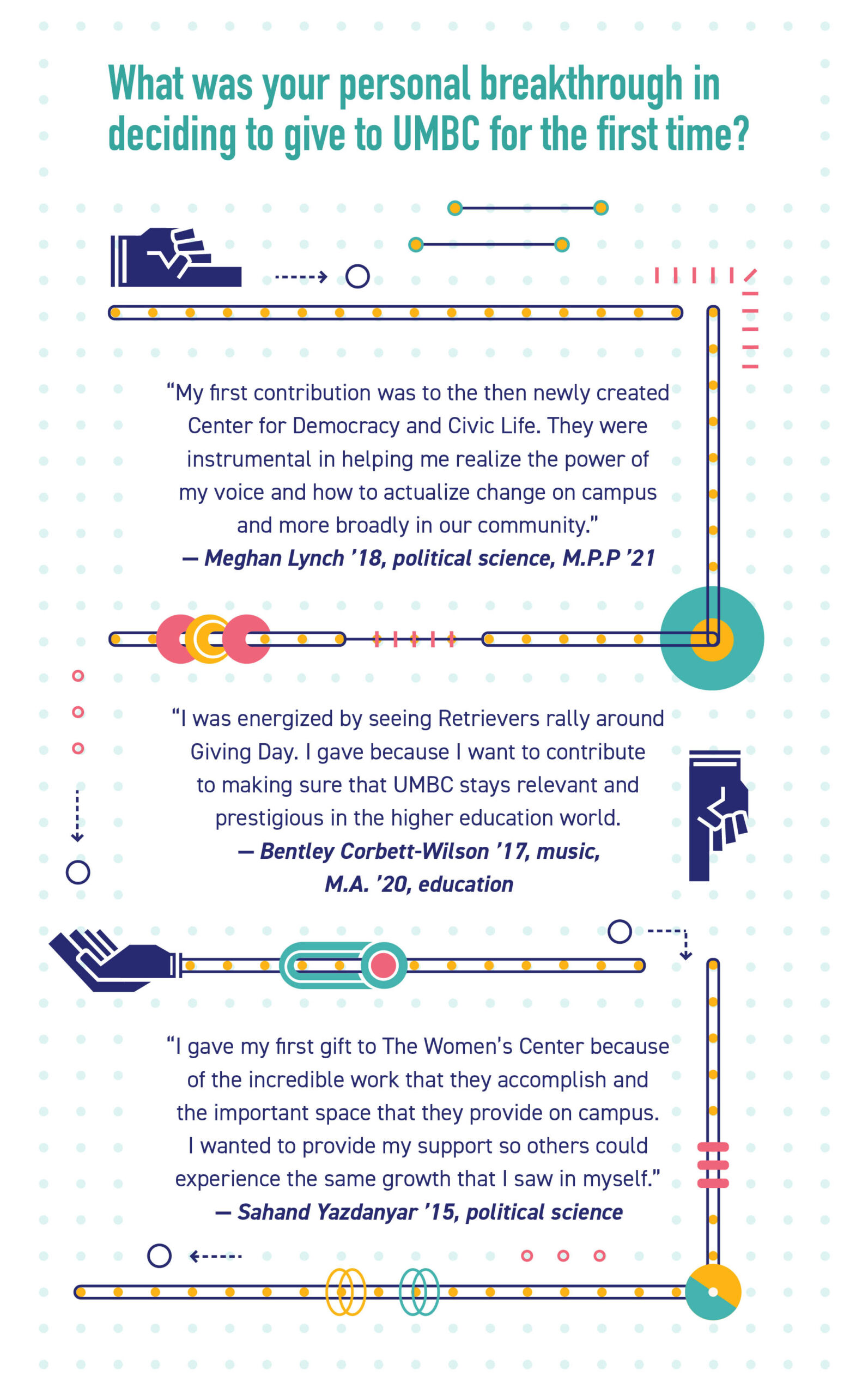
In Baltimore City, middle schoolers are making roller coasters out of insulation tubing and tape. High schoolers are dunking basketballs to learn math equations. And not too far away at UMBC, the Sherman STEM Teacher Scholars are prepping to spread even more innovative, inclusive lessons throughout city schools.
The Sherman STEM Teacher Scholars Program, founded in 2006, and other initiatives supporting Retrievers to become culturally responsive and compassionate educators in historically underserved, urban schools, are thanks to the vision of philanthropists Betsy Sherman and her late husband George.
In early 2022, the Sherman Family Foundation donated $21 million to create the Betsy & George Sherman Center, which expands and integrates UMBC’s work in teacher preparation, school partnerships, and applied research focused on early childhood education and improving learning outcomes for Baltimore students. This gift allows educators to implement new teaching methods and find ways to break through learning barriers for their students.
The gift—the largest in UMBC’s history—will transform both UMBC and generations of local students. It also serves as a rallying point for others to join in giving and volunteering at participating schools. To date, says Greg Simmons, M.P.P. ’04, and vice president of Institutional Advancement, “our school partnership work is our most robust community-based philanthropic effort given the scope and range of donors involved.” In addition to the Shermans’ foundational gift, other organizations—like the Richmond Family Foundation and Northop Grumman, just to name two—and many individual donors have supported this endeavor with their own time and resources.
“I see the legacy of the Sherman program as a seed,” says Haleemat Adekoya ’22, political science, a Sherman STEM Teacher Scholar. “It’s been planted and people will continue to water that seed…it will be one of those trees in a folk tale that does not die out because the community and the people who have benefited from its impact see the importance of that tree living beyond generations.”
— Randianne Leyshon ’09
Forging True Partnerships
The Snowball Effect
Sandy Geest ’72, English, knows the power of how a little can go a long way. When she graduated, she immediately started giving to the department that shaped her UMBC experience, “even if it was just 10 or 15 dollars a year,” she says.
Now, 50 years later, Geest and her husband Jay have an endowed scholarship for English majors that has supported 10 students since 2017.
Geest spent most of her career as conference and event planner for James Rouse’s Enterprise Foundation, using her organizational skills to plan ribbon cuttings at the White House and pull together the 1992 U.S. Olympic Gymnastics Trials held in Baltimore. She says it was through the company’s matching shares program that she began to realize the power investments could have—if they could help her savings accrue over time, she wondered how her donations might increase as well.

Geest recounts how her office was located across from the then new Columbia Mall. On lunch breaks, her other coworkers would frequently go shopping. “And I told them, ‘No, you need to be putting your money into this fund because it will grow. When you’re old and gray, you’ll be glad you did that. These shoes will be all worn out by then.’”
Over time, Geest realized the same logic applied to her giving to UMBC. As she got raises and advanced through her career, she upped her giving. “I didn’t do it all at one time, [but] as it grew over the years I gave more and more,” she says, knowing the power for sizable change hinged on an endowment that would be invested by the university and able to sustain its monetary output.
Her scholarship eventually snowballed to support up to four Retrievers a year. Her scholars’ success is the biggest reward, says Geest. At on-campus events, they tell her what a difference her giving made to their UMBC experience—it allowed them to explore career options through internships or it provided a lifeline when they thought they might have to drop out.
“It’s a very good feeling,” says Geest, “to know that you have put a hand back to help somebody behind you.”
— Randianne Leyshon ’09
The Competition Is Strong
Vanessa Mann, head coach for women’s soccer in her fifth season, has the mindset of leaving things better than you found them and uses the competitive spirit inherent in athletics to teach the power of giving back. This philosophy has led to 100 percent participation in UMBC’s annual Black & Gold Rush Giving Day among her student-athletes.
The itch to compete motivates the other teams as well. Women’s lacrosse goalkeeper Isabella Fontana ’24, economics, sees it as the perfect way to get student-athletes engaged. “Not only do I want to support the women’s lacrosse team because everyone loves to support our team,” she says, “but as athletes, we always want to win. So if there’s something on the line, we’re like, ‘Oh, let’s do it.’”
Fontana’s competitive spirit earned her a year-long prime parking spot in front of the Chesapeake Employers Insurance Arena after she won UMBC’s 2022 Giving Day student ambassador challenge. By calling on her enthusiastic network of friends and family, Fontana generated the most donors (104) out of all the ambassadors and brought the lacrosse team’s total to 335, almost double the amount from the previous year. Curious what that looks like by the numbers? It’s the difference between $5,045 in 2020 and a whopping $40,040 in 2022.
The lacrosse team isn’t alone in getting people hyped for giving—in fact, Athletics is responsible for bringing in the most donors and dollars for UMBC’s annual Black & Gold Rush. Even so, they’re always striving to top themselves: in 2020, women’s soccer more than tripled their goal for donors.
Both Fontana and Mann would be the first to remind you that good competition is nothing without cooperation. “So it wasn’t that we were really competing with anyone, like any outside entity,” Mann sums up. “We define competition as competere, which means to strive together. That’s actually the Latin translation. So it’s not me versus you, it’s actually me with you.”
— Levi Lewis ’23
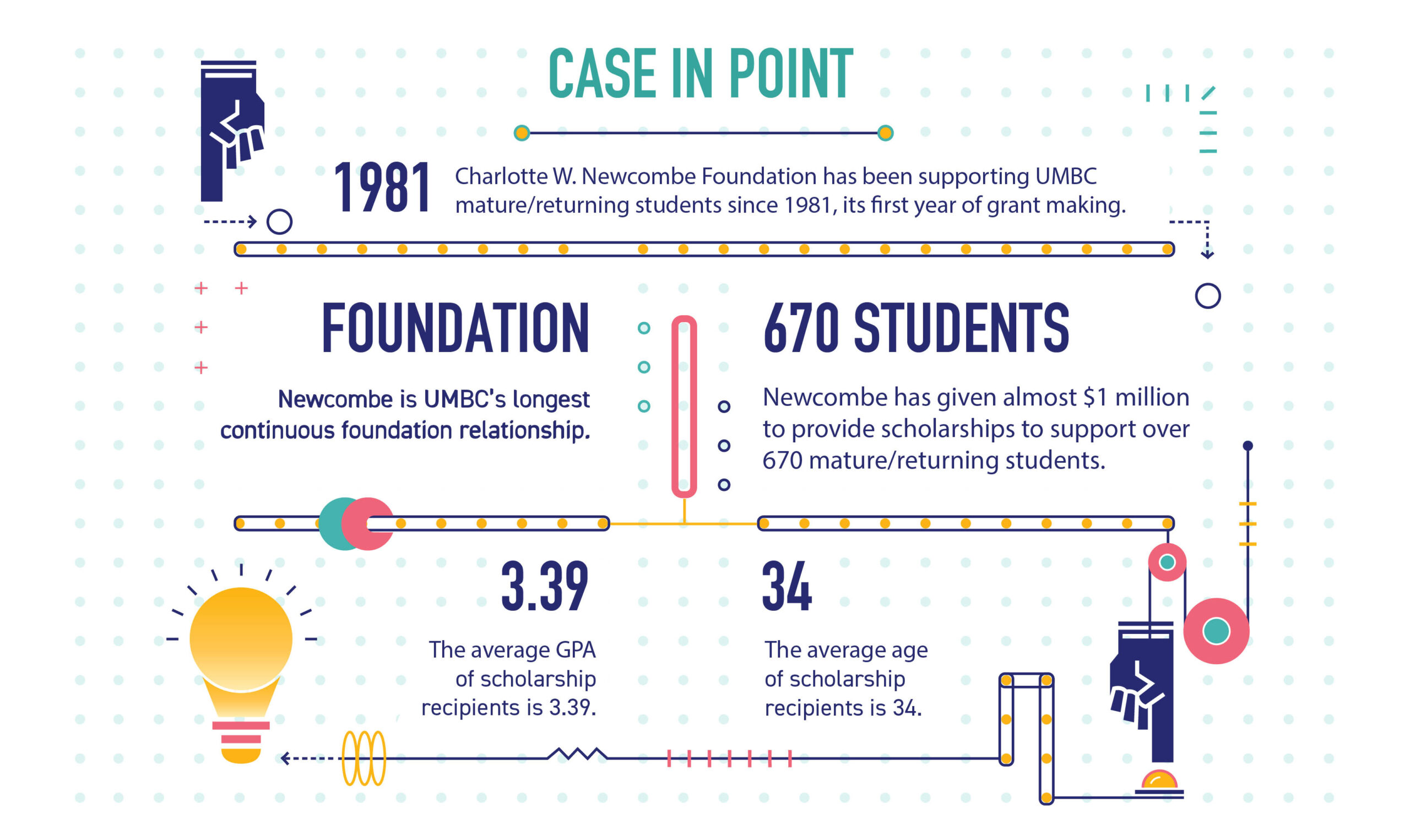
Bridge-Building Alumni
Anwesha Dey came to UMBC from Singapore for a summer research internship. She ended up staying much longer, completing her Ph.D. in biochemistry in 2004. “In many ways, I think of the entire experience being one of the turning points in my life,” says Dey. “The sense of community and belonging and the focus on excellence at UMBC would go on to define my career.”
Now, as director and senior principal scientist of Discovery Oncology at Genentech, a groundbreaking biotechnology company, Dey is dedicated to bringing in UMBC students to her own lab and research community. Early in 2022, that meant inviting her former mentor, Mike Summers, professor of chemistry and biochemistry and the Robert E. Meyerhoff Chair for Excellence in Research and Mentoring, along with then president Freeman Hrabowski to Genentech to discuss the company’s ongoing support of UMBC. “We’re all mutually invested in the same thing,” says Dey. “When we first started this fellowship about five years ago, it was really one step at a time. And so it’s great to see where it is now. The trajectory is really strong.”
Dey is far from alone in bringing her enthusiasm for her alma mater to the workplace, and as more Retrievers go on to work in the upper echelons of the scientific community, they are finding ways to connect their industries to the campus that shaped them.
Bobby Allen ’99, M7, computer science is clear that he has a lot to be thankful for because of UMBC. He met his future wife Frances Allen ’99, M7, computer science, and many of his closest friends as teenagers in the Meyerhoff Program’s Summer Bridge. But aside from his personal connections, as a product manager at Google, it’s Allen’s personal mission to connect UMBC’s proven pipeline of talented Retrievers to his workplace. “At Google, we know we need to have underrepresented populations as managers, champions, executive support, and mentors so that as we hire graduates and interns, they see people who look like them and know what is possible.”
— Randianne Leyshon ’09
Transforming Lives
Rising to the Top
It’s no accident that when visitors arrive on campus from the west entrance, they’re greeted by the radiant reflection on the silver slope of the Performing Arts and Humanities Building (PAHB). This LEED Gold-certified building, which opened in 2014, is a symbol of UMBC’s investment in the performing arts and humanities. But, it’s the students and activities inside the facility that really shine.
Deven Fuller ’23 is a case in point. Double-majoring in dance and math, Fuller is a Linehan Artist Scholar—part of a selective program endowed by Earl and Darielle Linehan that has launched the careers of more than 300 Linehan Artist Scholar alumni in dance, music, theatre, and other creative disciplines.
Fuller is focused on commercial dance—a highly competitive field that’s principally centered in New York and Los Angeles— which would put a career in his chosen field effectively out of reach were it not for the Linehans.
Thanks to the scholarship, Fuller said, he was able to join a New York–based dance training company in his sophomore year, take classes at local studios with accomplished touring commercial dancers, and enjoy other unique opportunities. The fact that the Linehans are “recognizing dance as a serious career…is just such an amazing thing,” Fuller said.

Most recently, with a Linehan Summer Research Award, “I was able to travel and do a certificate program at one of the most prestigious studios in the world for commercial dance. … I was very lucky to have the grant to be able to branch out in that direction.”
Fuller is far from the only student to benefit from philanthropists’ investment in UMBC’s arts-focused students. Todd Carton ’77, interdisciplinary studies, has created the Carton Family Endowed Scholarship to support talented students in the performing arts who come from disadvantaged backgrounds. Along with a gift that helped to fund the PAHB, Carton has included UMBC in his estate plan so that the endowed scholarship can grow and benefit even more arts students far into UMBC’s future.
Fuller hasn’t had the opportunity to meet the Linehans, but if he could, he said, “I would thank them for the opportunities that I’ve been able to have because of them …and let them know how much they are positively affecting the community of artists.”
— Scott Cech
A Family That Gives Together
Professor Bimal Sinha and his family weren’t content to let his 30-plus years of pioneering academic contributions to UMBC be his only professional legacy. Even though neither he nor his sons Jit and Shomo Sinha attended the university, they decided to collectively donate $750,000 to create the Dr. Bimal Sinha Professorship in Statistics at UMBC.
The professorship permanently funds a new statistics faculty position at the university, which seems especially fitting, considering that Sinha founded the statistics department in 1985 and helped transform UMBC into a national leader in statistics education.
But Sinha’s sons remember that beyond his academic accolades, the way their father has always interacted with his mentees is what made the deepest impression— whether meeting international students at the airport or inviting groups of students to their family home for dinner.

Creating community has been a hallmark of Sinha’s career: The professor successfully spearheaded the African International Conference on Statistics, held in a different African country each year since 2014. In 2018, UMBC signed a memorandum of understanding with the University of Limpopo in South Africa to foster collaboration and exchange. A number of graduate students from African countries have also flourished with Sinha’s mentorship.
“Bimal has not only engaged in groundbreaking research for decades but has also produced and championed an impressive number of influential Black statisticians throughout Africa,” noted Freeman Hrabowski, UMBC president emeritus.
In fact, the family’s dedication to continuing Sinha’s legacy has already inspired others: Forty alumni and friends of the university pitched in a combined $150,000, and the Maryland E-Nnovation Initiative Fund committed to a matching grant, bringing the professorship’s total endowment to $1.8 million.
“I feel honored and fortunate to have played a small role in the evolution of this beloved institution,” Sinha said. “Through this gift, I want to ensure that future generations of leading scholars will view UMBC as an attractive home to advance their contributions to the field of statistics.”
— Sarah Hansen, M.S. ’15
Gesture of Gratitude
When Felicia Sanders moved into Susquehanna Hall in the early ’90s as part of the fourth cohort of Meyerhoff Program Scholars, she found herself experiencing a series of firsts. It was her first time living in a mixed-gender dorm; the first time she understood the power of study groups; and she was a member of a scholarship program so new it hadn’t yet graduated its first class of scholars. “I thought I was just making friends, but this setup was really part of an ecosystem, a very effective one that set us up for success.”
The Meyerhoff Scholars Program fosters a collective spirit from day one—when students tackle Summer Bridge together. So when it came time to celebrate the program’s 30th anniversary and thank Robert Meyerhoff, the philanthropist who founded the program with President Emeritus Freeman Hrabowski, the graduates decided to give together, with an initial half-a-million dollar gift.

“When we give collectively, we keep the continuity of the culture that was built by the program,” says Sanders ’96, M4, chemical engineering, and a leadership level giver. “We keep the family bond that was built by the program. It doesn’t become something that is piecemeal or start-stop or becomes intermittent because it is something that was fun for someone one year and then wasn’t supported the following year.”
The word Meyerhoff Scholars most often use to describe themselves is family. Not just a family of 1,300+ alumni who have gone on to use their gifts as industry leaders and academic powerhouses, but including the students who have yet to join their ranks as scholars, the future generation of Meyerhoffs.
Jason Dixon ’02, M10, computer science, and Rhea Brooking-Dixon ’02, M10, biological sciences, whose origin story began in Summer Bridge, give together because “we know that our successes are never truly our own,” they share. “We are confident that our gifts to UMBC and the Meyerhoff Scholars Program will help other young scholars the same way the program has helped us and more.”
“It’s important for the family to be engaged in the program’s continuity,” says Sanders. “Now that Doc [Hrabowski] has moved on to the next chapter of his life, it’s important that the Meyerhoff Program is something we’re still talking about in another 30 years. And that can’t happen if the family doesn’t continue to reinvest.”
— Randianne Leyshon ’09
]]>
It’s no secret that at UMBC we do things a little differently. As a university, we’re young, agile, and (buzzword that it may be) truly innovative. We can see the success of these traits in our...
https://umbc.edu/stories/when-we-work-together/
https://my3.my.umbc.edu/api/v0/pixel/news/129507/guest@my.umbc.edu/c083b670e4d7274bdd2cab45bce969e3/api/pixel
athletics
biochemistry
chemical-engineering
computer-science
dance
english
fall-2022
impact
inds
magazine
meyerhoffscholars
pahb
sherman-stem-teacher-scholars-program
statistics
UMBC News & Magazine
https://my3.my.umbc.edu/groups/umbc-news-magazine
https://assets1-my.umbc.edu/system/shared/avatars/groups/000/001/943/24435aa6207c452e7bc15cc74b42c7bb/xsmall.png?1748556657
https://assets1-my.umbc.edu/system/shared/avatars/groups/000/001/943/24435aa6207c452e7bc15cc74b42c7bb/original.png?1748556657
https://assets2-my.umbc.edu/system/shared/avatars/groups/000/001/943/24435aa6207c452e7bc15cc74b42c7bb/xxlarge.png?1748556657
https://assets2-my.umbc.edu/system/shared/avatars/groups/000/001/943/24435aa6207c452e7bc15cc74b42c7bb/xlarge.png?1748556657
https://assets3-my.umbc.edu/system/shared/avatars/groups/000/001/943/24435aa6207c452e7bc15cc74b42c7bb/large.png?1748556657
https://assets1-my.umbc.edu/system/shared/avatars/groups/000/001/943/24435aa6207c452e7bc15cc74b42c7bb/medium.png?1748556657
https://assets2-my.umbc.edu/system/shared/avatars/groups/000/001/943/24435aa6207c452e7bc15cc74b42c7bb/small.png?1748556657
https://assets1-my.umbc.edu/system/shared/avatars/groups/000/001/943/24435aa6207c452e7bc15cc74b42c7bb/xsmall.png?1748556657
https://assets2-my.umbc.edu/system/shared/avatars/groups/000/001/943/24435aa6207c452e7bc15cc74b42c7bb/xxsmall.png?1748556657
UMBC News & Magazine
2
0
false
Thu, 01 Dec 2022 13:24:48 -0500
Thu, 01 Dec 2022 13:24:48 -0500
Getting to Know U
It’s only been a few months since she took the helm, but it feels like President Valerie Sheares Ashby has been at UMBC for years. She can often be seen engaged in lively conversation as she makes her way across campus, treating each new face not as a stranger, but simply as a friend she hasn’t met yet. She’s already a familiar face at sporting events, cheering on #RetrieverNation as a fan in the stands. And her first Homecoming felt just like that–coming home. You already know she’s a chemist, a former dean, and now a president, but we’re going to tell you how she’s so much more.

Finding a New Home
From the moment Valerie Sheares Ashby started her tenure as the new president of UMBC, we wanted to make sure she knew what a special community she was joining. At the opening of the semester, we asked community members to share some advice for our new president, and the answers didn’t disappoint.
These words of wisdom from Constance A. Pierson ’90, M.A . ’92, associate vice provost for institutional research, analysis, and decision support, sum up who we are as a campus best: “Take the time to get to know the people. You will likely meet some of the most extraordinary individuals who will change your world. And be sure to find the joy in every moment that you can. Laugh a lot—it’s contagious.” It looks like President Sheares Ashby has that one down already.
Ear to Ear
Flipping through photos of Sheares Ashby’s first Homecoming, it’s almost impossible to find a photo of her without a grin on her face. Though she met numerous members of #RetrieverNation during the festivities, each interaction held something special.
Dancing in the Streets
On one of her first days in the office, President Sheares Ashby found this group of students dancing together in the walkway outside of the Admin building. They couldn’t resist snapping a pic!
Fast Friends
The real GOAT of UMBC gave Sheares Ashby his paw of approval as soon as he met her. As any Retriever knows, True Grit is the real one you have to win over around here.
Photo courtesy of President Sheares Ashby.
Photo Op
Talk about a family affair! Sheares Ashby’s whole family decked themselves out in black and gold to celebrate her appointment as UMBC president.
 Photo courtesy of President Sheares Ashby.

Learning from the Community
For Sheares Ashby, the best way to learn about our community is to immerse herself in it. In her first few weeks and months, she’s made it a point to attend meetings, get to know constituents, and turn a simple walk down Academic Row into an informal meet and greet. Each of these interactions serves as another piece of the puzzle that makes up UMBC . At a welcome reception with University System of Maryland (USM) Chancellor Perman, Sheares Ashby addressed the audience and said, “People keep thanking me for coming to UMBC, and I don’t understand that because the gift is all mine.”
Joining the USM
“It has been a pleasure getting to know President Sheares Ashby. She fits right into the UMBC community and readily meets with students, faculty, and staff. Her commitment to developing UMBC’s culture of inclusive and academic excellence is evident in her priorities and appreciated by everyone,” says Farah Helal ’24, global studies and political science, USM student regent. She joined Chancellor Perman in welcoming Sheares Ashby.
Addressing the Crowd
One of the hallmarks of Sheares Ashby’s conversations is the reminder to “take care of yourself.” At this year’s new-faculty meeting, she assured the audience, “You are a human being and what you bring to us is more than enough.”
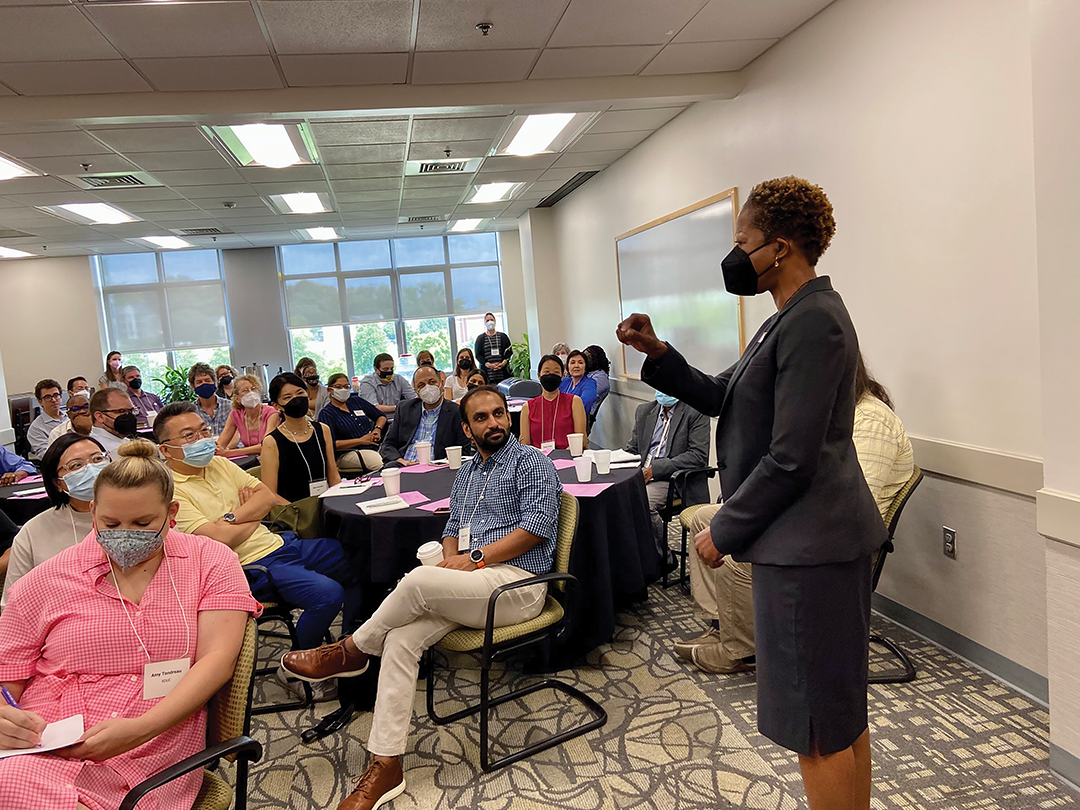
Golden Girls
Making her rounds on the first day of classes, Sheares Ashby encountered the UMBC inevitable—unintentional matching outfits. Jasmine Lee (center), director of inclusive excellence, and Samantha Smith (right), director of health promotion, joined Sheares Ashby for a photo op we couldn’t have planned better!
Family Ties
When you think about a university, you think about students, faculty, staff, and alumni. But families are the support system that keep UMBC going. Sheares Ashby stopped by the Family Breakfast during this year’s Homecoming to meet some of these integral members of our community.
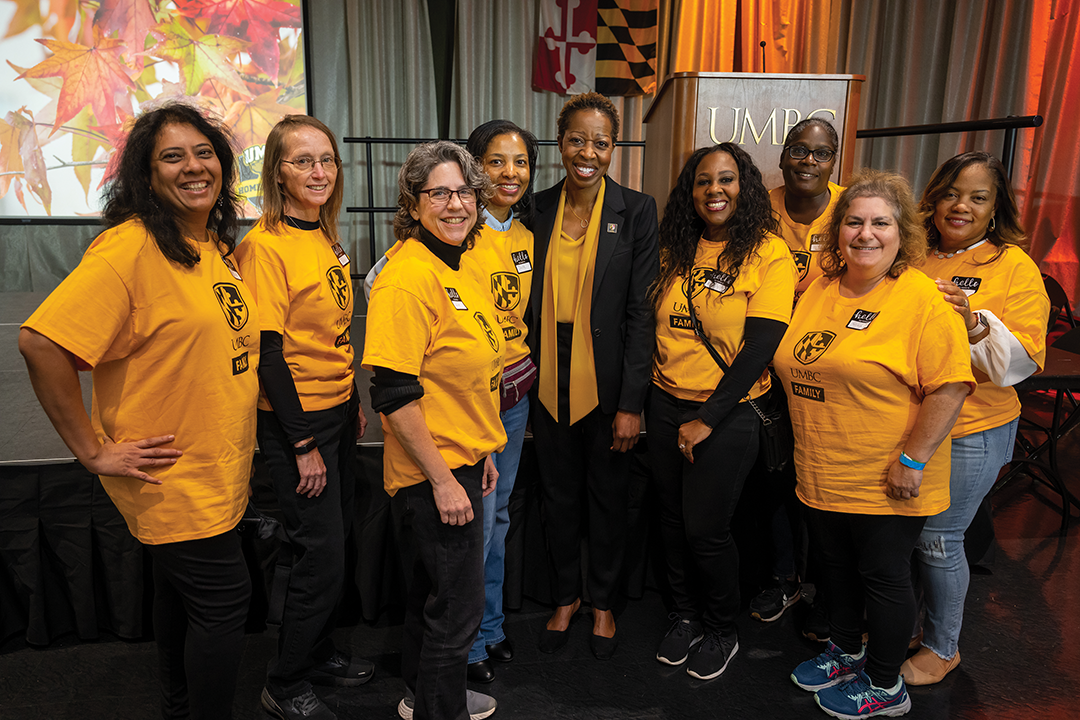
Getting to Know You, Getting to Know All About You
We know that Sheares Ashby loves getting to know our community, but if possible, we love getting to know her even more—as evidenced by the fact she is the most flagged-down person on campus for a selfie (we have to accept campus comfort dog Chip is still #1 overall). To further your presidential education, here are five fast facts straight from the source.
What has been your favorite spot to do work on campus?
I’ve really only had the chance to work in the Administration Building, but what I consider my job and what people call work are interesting. Sitting in my office and having meetings, that’s work. But it’s also my job and my joy to be out amongst people.
Do you have a favorite theatre production?
My mother instilled in me The Sound of Music. My whole family can sing and quote almost every word.
What’s your go-to coffee order?
I haven’t had coffee in years because, I don’t know if you could tell, I have a little energy so I don’t need caffeine. Occasionally I’ll drink tea, chamomile or Earl Grey. I love a good Earl Grey.
When given 15 minutes for self-care, what do you reach for?
If you gave me three hours, I would take a nap. But for 15 minutes, I’m probably going to call my friends and just laugh. I love talking to my friends. They keep me grounded.
What advice would you give someone getting ready to start their first year of college?
It doesn’t matter if you don’t know the whole plan. Don’t worry about it. You’re going to be fine.
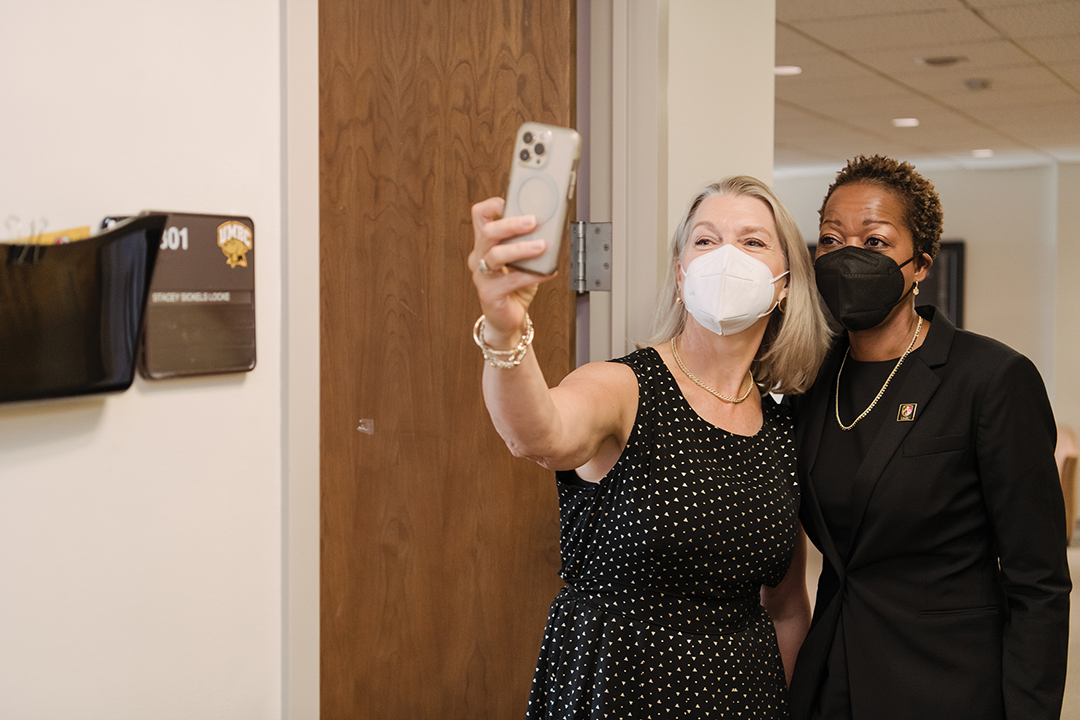
]]>
It’s only been a few months since she took the helm, but it feels like President Valerie Sheares Ashby has been at UMBC for years. She can often be seen engaged in lively conversation as she makes...
https://umbc.edu/stories/getting-to-know-u-welcome-president-sheares-ashby/
https://my3.my.umbc.edu/api/v0/pixel/news/129734/guest@my.umbc.edu/84cef6ef92e9c1d61543ce846d987acd/api/pixel
campus-life
fall-2022
magazine
UMBC News & Magazine
https://my3.my.umbc.edu/groups/umbc-news-magazine
https://assets1-my.umbc.edu/system/shared/avatars/groups/000/001/943/24435aa6207c452e7bc15cc74b42c7bb/xsmall.png?1748556657
https://assets1-my.umbc.edu/system/shared/avatars/groups/000/001/943/24435aa6207c452e7bc15cc74b42c7bb/original.png?1748556657
https://assets2-my.umbc.edu/system/shared/avatars/groups/000/001/943/24435aa6207c452e7bc15cc74b42c7bb/xxlarge.png?1748556657
https://assets2-my.umbc.edu/system/shared/avatars/groups/000/001/943/24435aa6207c452e7bc15cc74b42c7bb/xlarge.png?1748556657
https://assets3-my.umbc.edu/system/shared/avatars/groups/000/001/943/24435aa6207c452e7bc15cc74b42c7bb/large.png?1748556657
https://assets1-my.umbc.edu/system/shared/avatars/groups/000/001/943/24435aa6207c452e7bc15cc74b42c7bb/medium.png?1748556657
https://assets2-my.umbc.edu/system/shared/avatars/groups/000/001/943/24435aa6207c452e7bc15cc74b42c7bb/small.png?1748556657
https://assets1-my.umbc.edu/system/shared/avatars/groups/000/001/943/24435aa6207c452e7bc15cc74b42c7bb/xsmall.png?1748556657
https://assets2-my.umbc.edu/system/shared/avatars/groups/000/001/943/24435aa6207c452e7bc15cc74b42c7bb/xxsmall.png?1748556657
UMBC News & Magazine
0
0
false
Wed, 30 Nov 2022 16:27:58 -0500
Wed, 30 Nov 2022 16:27:58 -0500