Résumés in hand, 2,000+ hopeful and prepared Retrievers attend the 2024 Career Fair
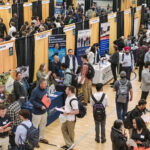
On a perfect 55-degree sunny February day, hundreds of undergraduate and graduate students across all colleges stood in a line that began at the RAC and wrapped its way to Sherman Hall. Instead of exercise gear, Retrievers were dressed to impress with résumés in hand, ready to land a summer internship or a job with one of the 180-plus employers across multiple industry sectors at UMBC’s Spring 2024 Career and Internship Fair.
“We are excited to help employers develop a strong talent pipeline and diverse future workforce, shaping the leaders and innovators of tomorrow,” said Paige Bauder, associate director of employer relations and recruitment programs at UMBC.
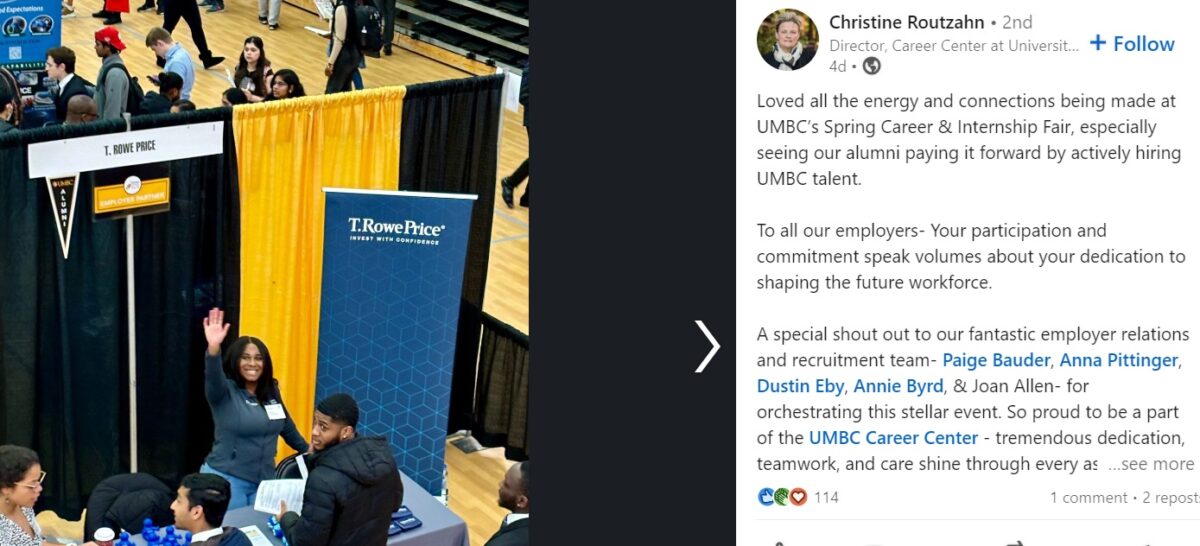 Image courtesy of Christine Routzahn, director of UMBC’s Career Center.
The leading edge
“Give strong handshakes. Maintain eye contact,” said Leon Tang ’26, information systems, in a booming voice, as he scanned IDs as a volunteer at the event.
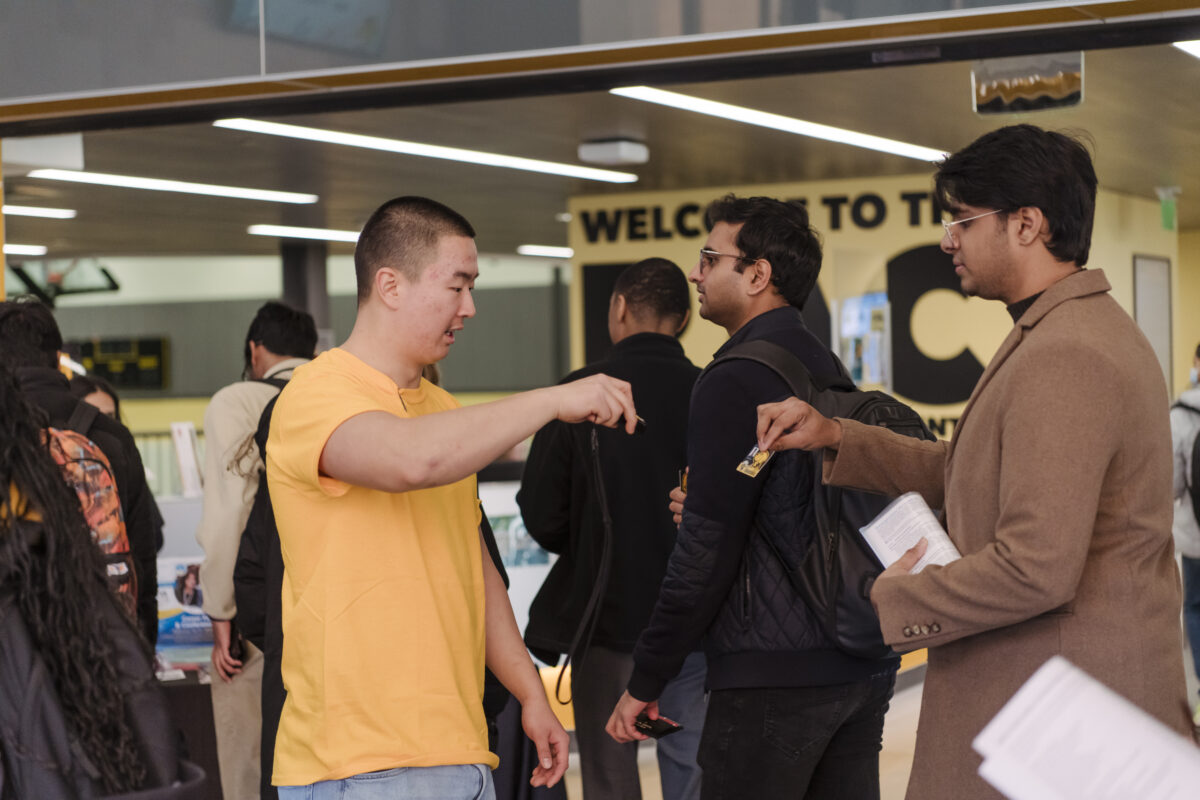 Leon Tang welcoming Career Fair attendees. (Marlayna Demond ’11/UMBC)
“Some people might come in nervous. It’s over 180 companies, so it can be pretty hard,” said Tang. He currently has two internships, one as a business technology intern at Agile Care Enterprises, based at bwtech@UMBC, and another as a research assistant in the information systems department. “It’s a good way to tell everyone to be calm and be confident. It’s the little things that can go pretty far in obtaining something.” For the nearly 2,200 Retrievers that made it through the door that day, this was sage advice.
A professional headshot is one of those little things. After making it past Tang, Bhargavi Gudapati, a current master’s student in information systems, headed straight back to grab the 10th spot in a line that, over the next four hours, would consistently have dozens of excited and grateful students waiting for their free headshot. Gudapati, an international student from India, has attended every career fair since she arrived in 2022. She wants to get ahead of the steep competition of international students looking to launch the next phase of their career in the U.S.
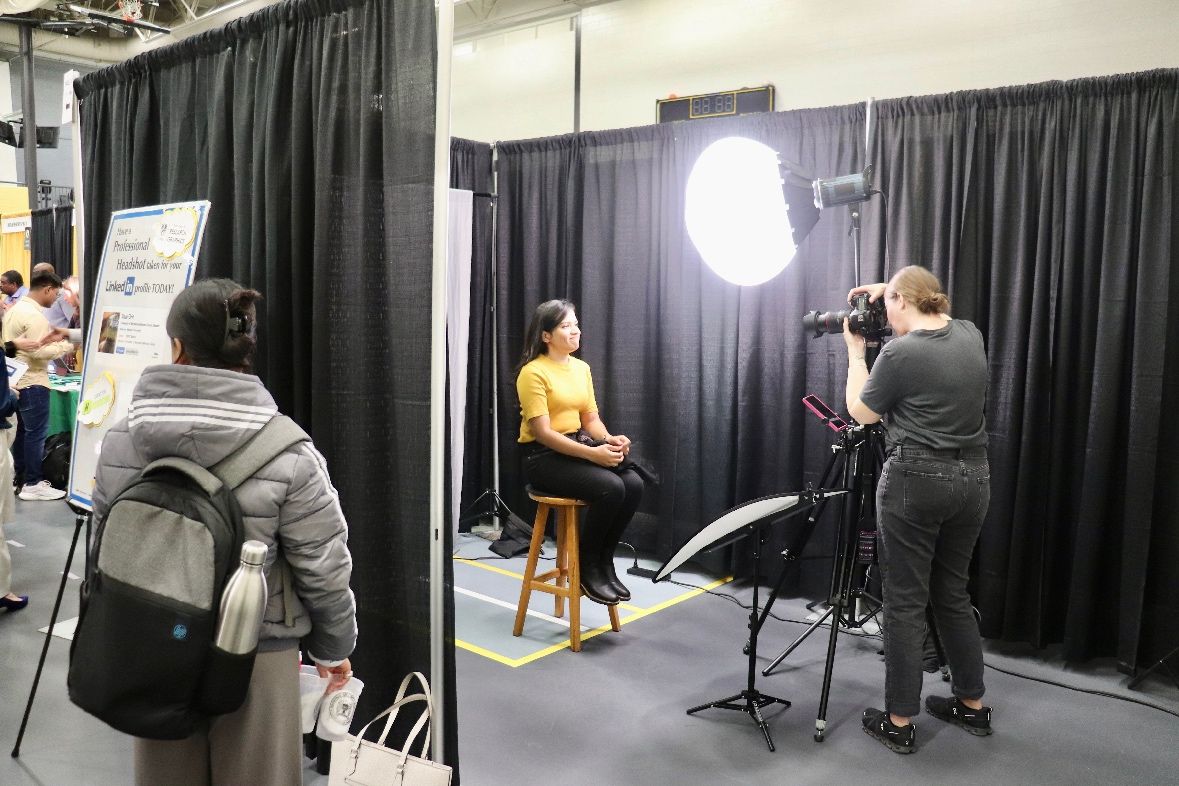 Spring 2024 Career and Internship Fair headshot station. (Image courtesy of Christine Routzahn)
“It’s incredibly important to get to know employers in person instead of only on their online portal,” says Gudapati.“You want to know what they require and the current technology they are using.”
One of those employers, Ed Belsinger ’90, M.S. ’93, mechanical engineering, is a newbie to UMBC’s career fairs. He proudly wore his UMBC sweatshirt and a smile that became a beacon of friendliness in a sea of students seeking opportunities. Belsinger is the director of product development at RPM Tech, a company that turns an idea into a prototype and a prototype into a fully manufacturable product. Because RPM does all the engineering and design in-house with a full shop and lab, it can offer students a wide range of expertise.
Belsinger notes that RPM is currently in a growth mode and has three internships available as well as full-time positions. “As an alum, I said, ‘This is a great school—we have to go there.’ Whether it’s an internship or someone right out of college, we’re looking for students with curiosity, who want to learn, are willing to do new things, to be challenged, and be part of a team.”
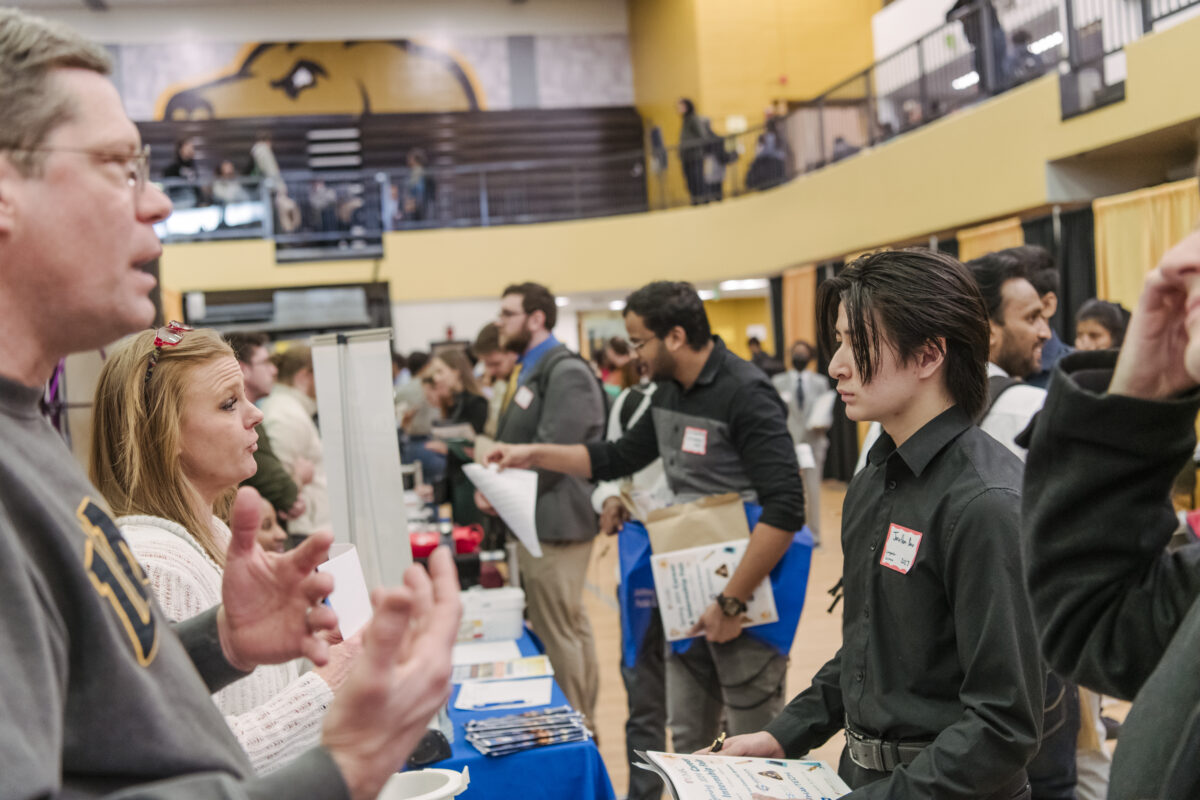 (l – r): Ed Belsinger (in grey) and Jonathan Dao (in black). (Marlayna Demond ’11/UMBC)
Hoping to grab one of the RPM internships is Jonathan Dao, computer science, a first-year student waiting in line to speak with Belsinger. “I saw tech in the name and wanted to learn more. I want to see if I can start early to have a competitive advantage,” said Dao. “I think first-year students should definitely give the career fair a shot. Come in with confidence, try rehearsing how to present yourself, and dress well.”
Part of the team
Sekinat Dosunmu ’24 agrees with Dao’s approach. After spending her first year of college remote, she has made it a point to attend every career fair in person. Toward the end of the day, she lined up at the FBI table, ready to discuss what the FBI had to offer someone like her with a global studies major, an Africana studies minor, and certificates in tech and intercultural communication. As she stepped forward, a recruiter immediately welcomed her.
While waiting to continue talking with Dosunmu, other recruiters shared that the FBI welcomes all majors, including the arts and humanities. They noted that the most important skill the FBI is looking for is how someone approaches and solves a problem in a team environment.
The artists approach
Solving problems creatively is the bread (or blood) and butter of C.C. Smith ’24, theatre, formerly known as Dracula in UMBC’s fall 2023 production of Dracula: a Feminist Revenge Fantasy, Really. That role earned him an audition for a film later on in the day, so Smith is hurrying through the fair.
Later in the spring, UMBC’s Career Center hosts boutique career fairs, one of which is focused on creative careers, and on March 7, it will host the CAHSS Career Connection Social for arts, humanities, and social science majors, but that doesn’t stop Smith from checking things out. As an actor, Smith explains, you never know when someone is looking to do a commercial. “This is my first time here. I would like to see more performing arts employers in this larger career fair, especially with how good the arts programs are here,” says Smith. “As a senior, it’s still important to be poking around this fair.”
Luna Siesko ’25, visual arts, and Alexander Schobitz ’22, visual arts, agree with Smith that UMBC students excel in the arts, and would like local employers to know about that. Siesko, a photographer and videographer at commonvision, UMBC’s design shop, used her skillset to bring personally designed business cards and résumés to the fair. Siesko is unsure what she is looking for but hopes that by speaking with some of the employers, like the folks at the Baltimore County Arts Guild, she can get a sense of how to best move forward.
 Luna Siesko at the Baltimore County Arts Guild table. (Marlayna Demond ’11/UMBC)
“We’re a small non-profit five minutes from UMBC. We want to make sure that artists feel seen and heard and know there is a place for them to work,” said Gloria Fajimolu, program and events manager at the Baltimore County Arts Guild, a new employer at the Career Fair. “We’re very welcoming. If a student doesn’t get the internship or the job, they can still be a paid instructor. If they are in animation, we will pay them to teach animation classes to the community.”
 Gloria Fajimolu, program and events manager at the Baltimore County Arts Guild. (Marlayna Demond ’11/UMBC)
As a recent alum, Schobitz has one goal—to get a job in animation. He is grateful UMBC gives alumni access to the career fairs and Handshake, a job listing app. “I apply to about 10 jobs per day. I use sites like Indeed and Handshake to find jobs and apply,” says Schobitz. “While I was a student, I used UMBC’s résumé services and made a lot of appointments. I’m still trying. I won’t give up.”
The end and beginning
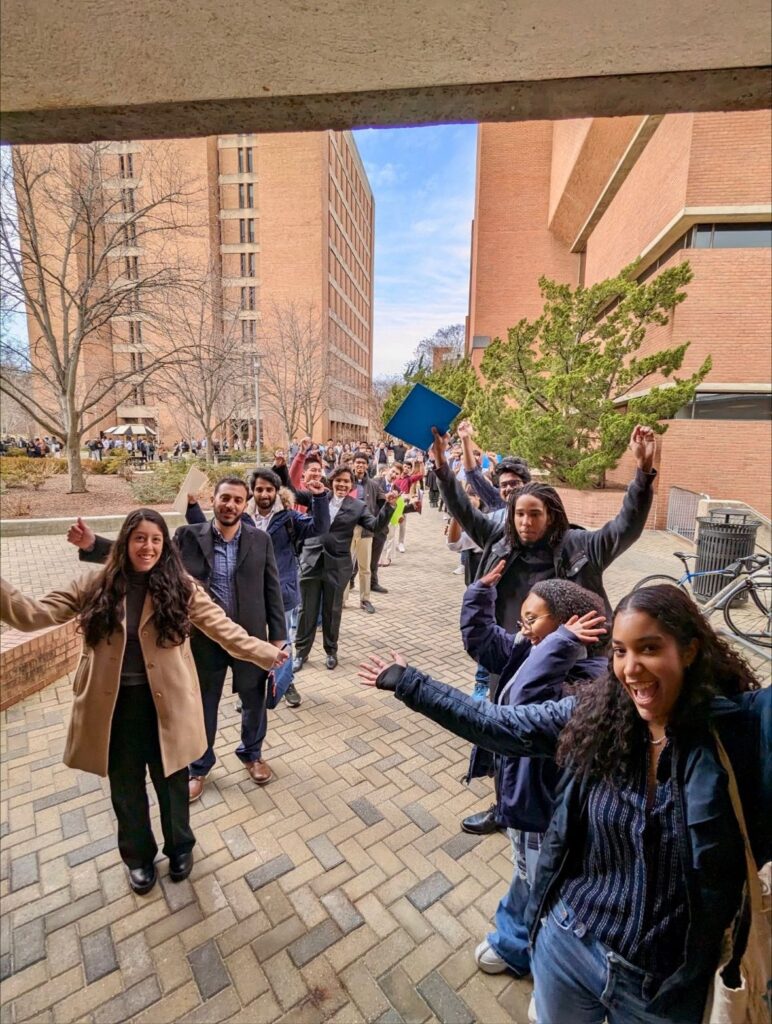 UMBC students lineup for the Spring 2024 Career and Internship Fair.
(Image courtesy of Routzhan)
Back at the headshot line, Cristian Castro, M.S. ’24, cybersecurity, joined the still-growing line as the last wave of students filed in. Castro is from Colombia and is looking to find a company to sponsor him to work in the U.S. “The Career Fair is a very good opportunity to see what’s out there. A professional photo is important in a LinkedIn profile,” says Castro. He also found some job leads earlier this year while representing UMBC as part of the Society of Advancing Chicanos/Hispanics and Native Americans in Science. “When it comes to what happens after graduation, every detail helps.”
Follow the Career Center on myUMBC and RSVP to the CAHSS Career Connection Social on Thursday, March 7, to network with alumni and employers in the arts, humanities, and social sciences.
]]>
On a perfect 55-degree sunny February day, hundreds of undergraduate and graduate students across all colleges stood in a line that began at the RAC and wrapped its way to Sherman Hall. Instead of...
https://umbc.edu/stories/the-2024-career-fair/
https://my3.my.umbc.edu/api/v0/pixel/news/139041/guest@my.umbc.edu/21c9b154d9df23acc2fa66d5d7b9f73e/api/pixel
africana-studies
cahss
career-center
coeit
community
computer-science
cybersecurity
global-studies
is
meche
news
story
theatre
visual-arts
UMBC News & Magazine
https://my3.my.umbc.edu/groups/umbc-news-magazine
https://assets1-my.umbc.edu/system/shared/avatars/groups/000/001/943/24435aa6207c452e7bc15cc74b42c7bb/xsmall.png?1748556657
https://assets1-my.umbc.edu/system/shared/avatars/groups/000/001/943/24435aa6207c452e7bc15cc74b42c7bb/original.png?1748556657
https://assets2-my.umbc.edu/system/shared/avatars/groups/000/001/943/24435aa6207c452e7bc15cc74b42c7bb/xxlarge.png?1748556657
https://assets2-my.umbc.edu/system/shared/avatars/groups/000/001/943/24435aa6207c452e7bc15cc74b42c7bb/xlarge.png?1748556657
https://assets3-my.umbc.edu/system/shared/avatars/groups/000/001/943/24435aa6207c452e7bc15cc74b42c7bb/large.png?1748556657
https://assets1-my.umbc.edu/system/shared/avatars/groups/000/001/943/24435aa6207c452e7bc15cc74b42c7bb/medium.png?1748556657
https://assets2-my.umbc.edu/system/shared/avatars/groups/000/001/943/24435aa6207c452e7bc15cc74b42c7bb/small.png?1748556657
https://assets1-my.umbc.edu/system/shared/avatars/groups/000/001/943/24435aa6207c452e7bc15cc74b42c7bb/xsmall.png?1748556657
https://assets2-my.umbc.edu/system/shared/avatars/groups/000/001/943/24435aa6207c452e7bc15cc74b42c7bb/xxsmall.png?1748556657
UMBC News & Magazine
1
0
false
Thu, 15 Feb 2024 16:23:39 -0500
Thu, 15 Feb 2024 16:23:39 -0500
Putting the principles of education to work

There are some people who you meet, and it’s obvious: They’re natural leaders—seemingly born to the role. Derek Anderson ’03, interdisciplinary studies, is one of those people.
He went right from UMBC to the front of the classroom as a teacher in the highly regarded Howard County Public School System, earning a master’s degree in school administration and supervision from Johns Hopkins University at the same time.
But in talking with Anderson, it becomes apparent that he wasn’t born a leader—he became one. And he says UMBC was a big reason why he did.
After nearly a decade of classroom leadership, Anderson became an assistant principal, then principal at Longfellow Elementary School in Columbia, Maryland, winning recognition as Howard County’s 2023 Principal of the Year.
And now he’s been tapped by Maryland’s state superintendent of schools to be the state’s new executive director of community schools, overseeing more than 450 schools with the goal of better connecting schools with the families they serve.
From imposter syndrome to educator
As improbable as it sounds, this rising star in education leadership remembers that as a first-year student, he wasn’t sure at first that he even belonged in college.
“I struggled mightily in my first semester,” he remembers—in large part because his secondary school hadn’t fully prepared him for college-level academics. “There was a point where I said to myself, ‘Am I cut out for this? This is a lot.’”
Anderson says UMBC’s academic advising and his own inner determination to persevere helped, but what set him firmly on the path to his future was The Shriver Center, an organization at UMBC that connects students with applied learning, civic engagement, and community-based service opportunities. He began volunteering weekly at a local elementary school not too far from campus.
“I really realized how excited the kids were when we came to visit,” Anderson says. “And it was mutual—I would start looking forward to that particular day of the week. That was the first time I really started to consider a career in education.”
Building a major to match his passion
That realization, he says, galvanized him: It not only gave him a career goal to help shape his studies, it motivated him to work toward the day when he could help students prepare better than he had been for postsecondary academics.
“I thought about my own experience, and I questioned: Could I have been better prepared?” Anderson says. “What would have better prepared me so that I did not struggle the way I did in college? So that really reinforced the idea of, ‘I want to go into education so that I can help and support [students] so that they don’t have some of those experiences.’”
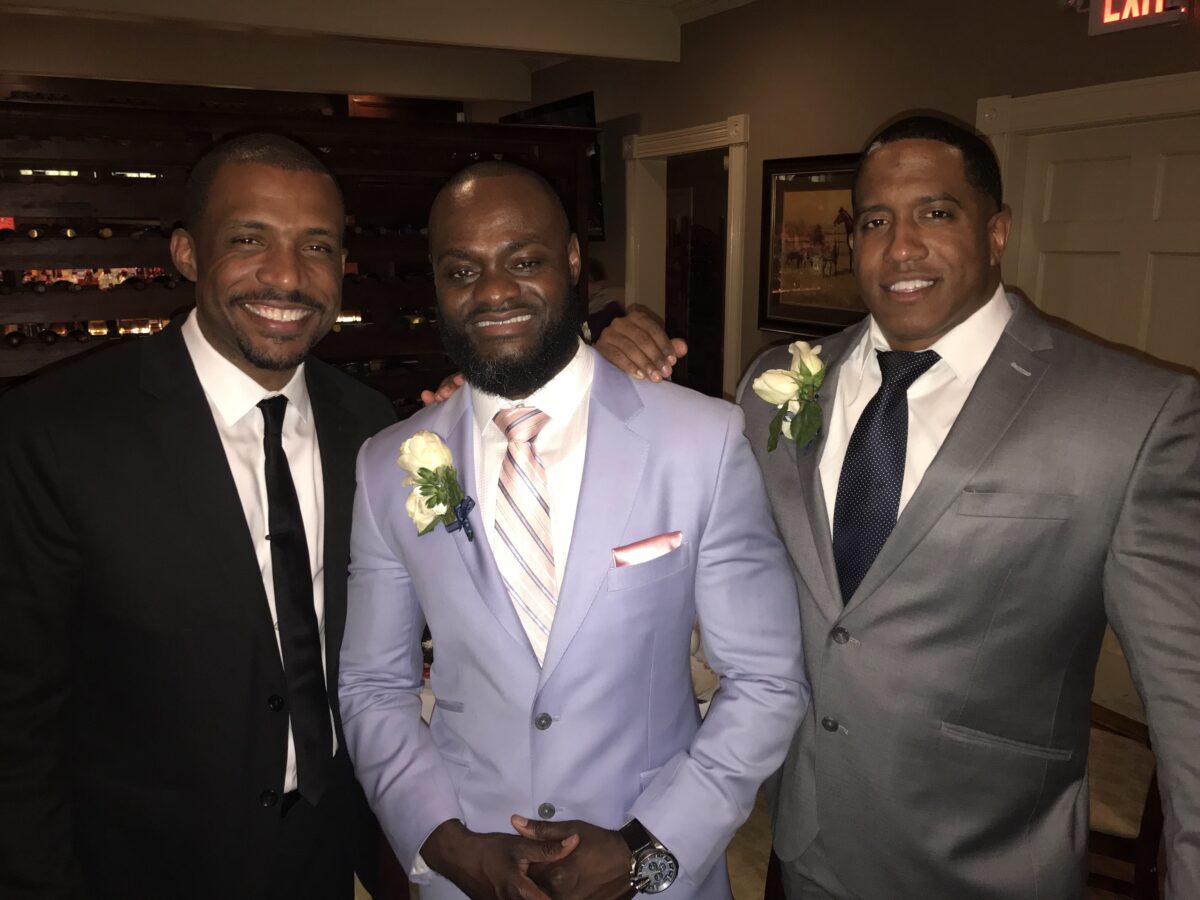
Anderson, on the left, with two of his closest UMBC friends, Eddie Freeman ’03, M.S. ’06, and Marc Haskins ’01 at Freeman’s wedding.
UMBC didn’t offer an education major at the time, but Anderson followed his inspiration, juggling a steady load of challenging coursework with his athletic obligations as captain of the track and field team, responsibilities as a dorm resident advisor, and eventually student teaching in Baltimore City schools as he pursued his teaching certificate.
Along with his teacher-certification track, Anderson’s interdisciplinary studies focused on psychology and Africana studies, and one of his professors in the latter field gave him first-hand insight into the power of effective teaching.
He remembers vividly the classes he took with Christel N. Temple, then an assistant professor of Africana studies at UMBC.
“She’s an African American woman, and I believe at the time she was relatively new to the position, but she was very good—not just in disseminating the content, but in the passion she showed for it. That was a big motivator for me,” Anderson says.
Because of that passion for teaching, he remembers: “I really enjoyed her class. I wanted to learn. I wanted to grow. I wanted to enhance my knowledge for no other reason than to become brighter and better.”
Temple, now a full professor of Africana studies at the University of Pittsburgh, isn’t surprised that her former student’s leadership qualities have attracted attention.
“I am so proud of his career,” she says. “His success is a reminder of the contribution that Africana studies makes—not just our field’s orientation to subjects such as culture, communication and sociology, but also to education studies.”
Understanding the personal dimensions of education
Anderson landed a job in Howard County Public Schools soon after graduation by way of his teaching certification and graduation from UMBC. He taught at an elementary school for seven years, then served as an elementary school instructional team leader before becoming an assistant principal. He served in that role for four years before becoming principal at Longfellow Elementary School in 2017.
Kathy Nuemann ’06, American studies, remembers meeting Anderson the year before he became principal. Neumann, a math specialist at Longfellow, was excited to meet another Retriever at her school and struck by his genuine personality. For the next six years, as they worked together, she says, “Derek was always available. Whether I was seeking advice, sharing an idea, or just needed someone to lend an ear. His sincerity extended to students as well.”
She recounts a recent story where her students wrote a proposal to Anderson as part of a social studies project. After identifying a problem (trash on the recess field), the students brainstormed a solution by requesting a recycling bin out on the playground. Neumann invited Anderson to visit her class and the students read the proposal to him. “Not only did Derek listen to the proposal, but he fulfilled the request within a week. My students were thrilled!”
All told, Anderson served nearly 20 years in Howard County’s elementary schools—long enough to see two of his three his own children pass through Longfellow Elementary while he was principal there. (He met his wife of 16 years, Jonae Anderson ’02, psychology, M.P.P. ’05, at UMBC.)

Anderson was named 2023 Principal of the Year for Howard County Public Schools. He’s pictured here with his wife and children, and mother and brother.
Indeed, Anderson says, parenthood helped underline the personal dimension of education, and not just for the obvious reasons.
“It makes me that much more passionate about the work” of education, he says. “Parents send us their kids—they send us the best they have, Monday through Friday, with the expectation that they’re going to come back safely, happy and enjoying that [school] experience. That is a responsibility I carry with me every day.”
Bringing energy to the executive position
In fact, it turned out that that sense of greater responsibility made him the perfect candidate for his new role as executive director of Maryland’s growing portfolio of community schools.
The expansion is part of the state’s 2019 Blueprint for Maryland’s Future legislation, which dedicates almost $4 billion per year in state and local funding over the next decade to a set of reforms aimed at improving public schools in the state.
The intent of community schools is to better connect schools with the families they serve. Particulars of that connection can include addressing daycare deficiencies in schools that educate a disproportionate proportion of teenage mothers, or creating a weekend food pantry with fresh groceries at a school situated in a food desert.
“Leadership has always been something that I’ve aspired to,” Anderson says. “For a long time, I never thought past the principalship,” and he admits that there’s a special energy to being in a school building that he may well miss in his new job as executive director.
But when he weighed the one school he was leaving against the difference he could make in overseeing more than 450 schools, he says he found himself thinking about his own educational journey.
“I went from, ‘I’m not confident about being a student in college’ to ‘This is something I want to pursue,’ because along the way people were providing opportunities, providing guidance, providing insight, and it’s led to a very fulfilling career for me,” Anderson says.
And with his new role’s wider scope, he has the opportunity to be just such a helping hand in the lives and education of many more students.
“I still get up excited about coming to work [in education] because I know it’s meaningful work,” Anderson says. “What better way to serve kids?”
]]>
There are some people who you meet, and it’s obvious: They’re natural leaders—seemingly born to the role. Derek Anderson ’03, interdisciplinary studies, is one of those people. He went right...
https://umbc.edu/stories/putting-the-principles-of-education-to-work/
https://my3.my.umbc.edu/api/v0/pixel/news/134703/guest@my.umbc.edu/14bdc2b3afd109b607e9e561d1091dc2/api/pixel
africana-studies
alumni
american-studies
cahss
feature
inds
magazine
the-shriver-center
UMBC News & Magazine
https://my3.my.umbc.edu/groups/umbc-news-magazine
https://assets1-my.umbc.edu/system/shared/avatars/groups/000/001/943/24435aa6207c452e7bc15cc74b42c7bb/xsmall.png?1748556657
https://assets1-my.umbc.edu/system/shared/avatars/groups/000/001/943/24435aa6207c452e7bc15cc74b42c7bb/original.png?1748556657
https://assets2-my.umbc.edu/system/shared/avatars/groups/000/001/943/24435aa6207c452e7bc15cc74b42c7bb/xxlarge.png?1748556657
https://assets2-my.umbc.edu/system/shared/avatars/groups/000/001/943/24435aa6207c452e7bc15cc74b42c7bb/xlarge.png?1748556657
https://assets3-my.umbc.edu/system/shared/avatars/groups/000/001/943/24435aa6207c452e7bc15cc74b42c7bb/large.png?1748556657
https://assets1-my.umbc.edu/system/shared/avatars/groups/000/001/943/24435aa6207c452e7bc15cc74b42c7bb/medium.png?1748556657
https://assets2-my.umbc.edu/system/shared/avatars/groups/000/001/943/24435aa6207c452e7bc15cc74b42c7bb/small.png?1748556657
https://assets1-my.umbc.edu/system/shared/avatars/groups/000/001/943/24435aa6207c452e7bc15cc74b42c7bb/xsmall.png?1748556657
https://assets2-my.umbc.edu/system/shared/avatars/groups/000/001/943/24435aa6207c452e7bc15cc74b42c7bb/xxsmall.png?1748556657
UMBC News & Magazine
2
0
false
Tue, 15 Aug 2023 13:19:02 -0400
Tue, 15 Aug 2023 13:19:02 -0400
Rooted in Advocacy—Giese ’99 ensures federal programs meet community needs

Danielle Giese ’99, political science and Africana studies, remembers her first paychecks were hot and cheesy pizza lunches. They were the reward for volunteering at the Southern Maryland Tri-County Community Action Committee where her father, Dana M. Jones, served as chief executive officer for 30 years. At 12 years old, Giese and her two brothers, Rondell and Gregory, were tasked with answering phones, doing data entry, and directing people to the corresponding service.
Giese watched as her father advocated for and administered federal and state-funded local programs for vulnerable communities for decades. Giese quickly learned that her participation was vital to helping connect people to necessary resources, and Jones had no qualms about his children’s ability to do their job well. Slacking off was not an option, Giese reminisces with a smile.
“I began working on my political science and Africana studies degrees years before coming to UMBC,” says Giese who is the assistant director at the U.S. Government Accountability Office where she has dedicated over two decades. She leads performance audits of government programs at the request of congressional committees, a policy-making process to help ensure federal programs are meeting community needs.
Day-to-day work of social change
 Danielle and Michael Giese early in their relationship. Photo courtesy of Giese.
What she remembers most about volunteering for her father is getting a glimpse into the myriad needs of her community. Doing data entry for the food bank increased her awareness of the number of families whose paychecks were not enough to feed their families. “I saw people who had jobs and sometimes were also receiving other types of support,” says Giese, “show up month after month after month. I learned just how difficult it was for people to make ends meet and put food on the table.”
As the hub of entry for new and existing clients, Giese quickly learned community members’ needs went beyond being connected with other agencies and resources. Direct services like a Head Start program and an elder care program provided the spectrum of direct support caretakers needed to seek and maintain employment. And for those who needed housing, the organization also raised funds to supplement federal and state allocations to build affordable housing. Her father would even do home visits to inform families on energy efficiency.
 Giese, center, while as a student at UMBC. Photo courtesy of Giese.
What Giese didn’t know at the time was that she was an active participant in the War on Poverty, a social welfare legislation introduced in the 1960s by President Lyndon Bates Johnson intended to help end poverty in the United States. The people she welcomed were part of the about 13 percent of Americans who were living in poverty at the time. When she volunteered, it freed more employees to serve more families. In those informative years, Giese watched her father be a liaison between the federal and state government and local communities carrying out the day-to-day work of social change, and she saw a place for herself in that world.
From local to federal change
Once at UMBC, Giese, a Humanities Scholar and a McNair Scholar, chose a path that broadened the foundation her father had given her. Giese passionately describes the long-term impact her gender and women’s studies courses—taught by Patrice McDermott, now vice provost for faculty affairs—have had on her work with childcare policies at the federal level.
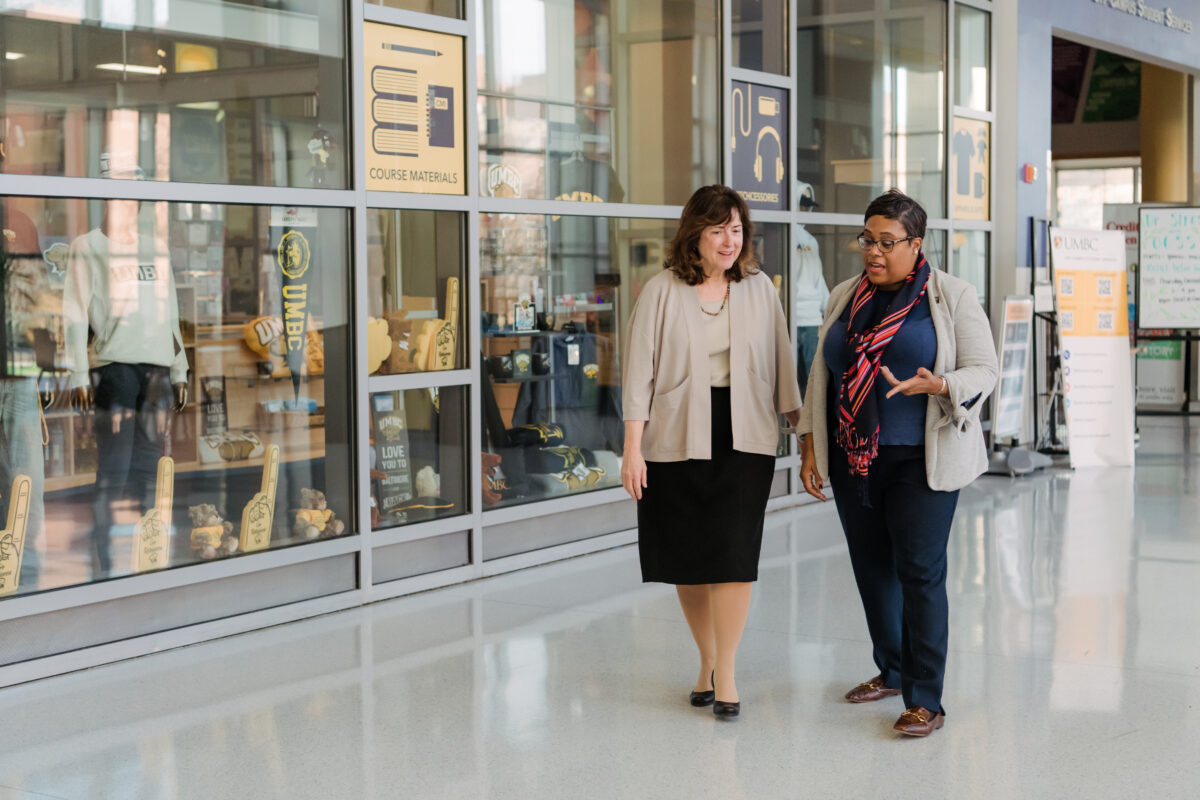 Patrice McDermott and Danielle Giese. (Marlayna Demond ’11/UMBC)
“Learning about how the social construct of gender controls access to work and its distribution, income, and wealth inspired me to engage in conversations about how we define and value ‘male’ work versus ‘female’ work, especially in the childcare industry,” says Giese. “Finally, after 20 years, policymakers are willing to discuss viable wages for childcare workers that will allow them to sustain a family.”
UMBC laid the foundation for so many aspects of Giese’s professional career, but also would determine the personal side of her life too. Danielle Jones met Michael Giese ’97, history, at Humanities Scholars gatherings where they found they shared an agricultural background dating back to the 1860s—with her family’s liberation and landownership and his family’s immigration from a farm in Germany to one in Maryland. He also took McDermott’s gender and women’s studies class. These shared bonds deepened their understanding of the world and each other leading to their marriage and their two children: Kent, 12, and Luke, 10.
 The Giese family. Photo courtesy of Giese.
“Danielle’s courses in gender, women’s, and sexuality studies shaped not only her understanding of herself but also the ways she pursues her work in the world,” shares McDermott. “Her story is a testament to the powerful ways our graduates draw on these lessons within their workplaces and society at large.”
From theory to action
Giese recently spoke about the joy she experienced as an Africana studies major in a video celebrating the department’s 50th anniversary. She shared the pivotal role Willie Lamousé-Smith, professor emeritus and former chair, had in her understanding of race and power in society and the global systems that have supported and perpetuated racism. Giese also shared about the transformative power of her class with Thomas Robinson, professor of Africana studies, on the psychology of racism and how it affects home, work, and personal relationships.
Reflecting on the on-going legacy of the department, Gloria Chuku, current chair and professor of Africana studies said, “The goal of the Africana studies department is to educate about the Africana heritage which includes the experiences, successes, challenges, and progress of people of African descent in the U.S. and across the globe.”
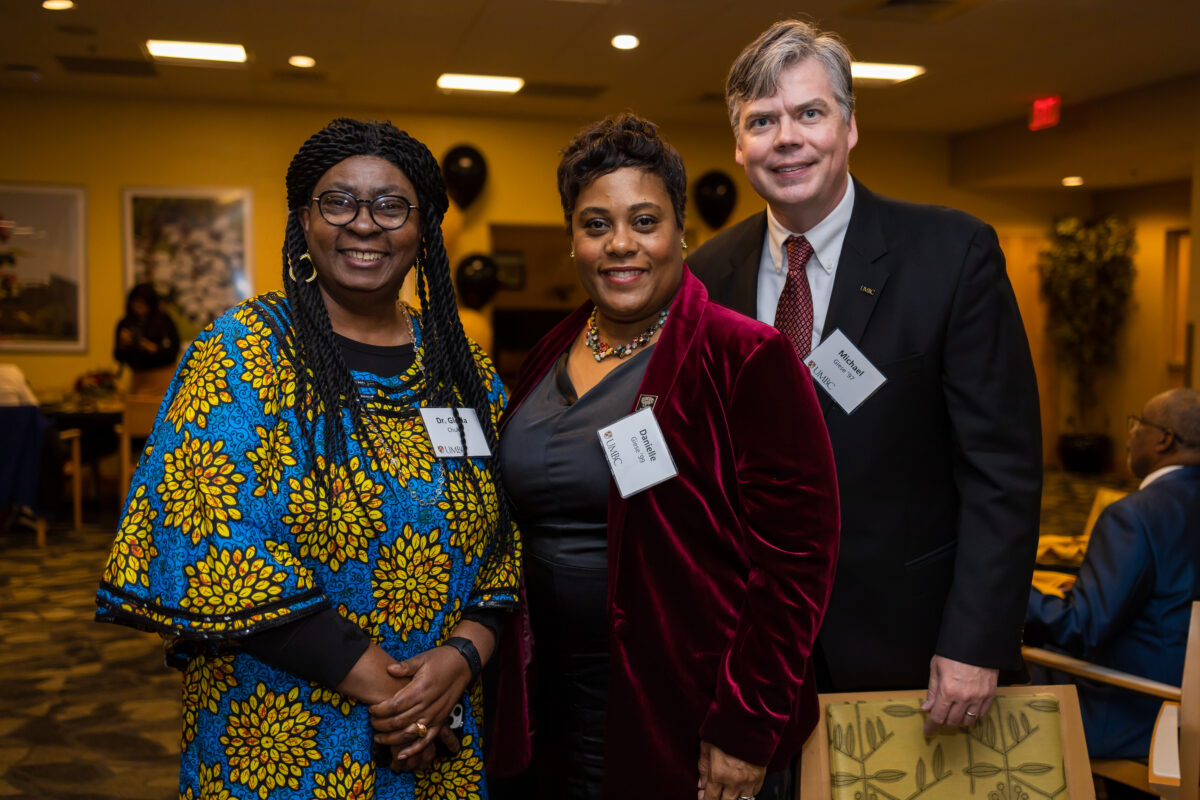 (l-r): Gloria Chuku, Danielle and Michael Giese. (Marlayna Demond ’11/UMBC)
Before graduating, Giese applied her experience from volunteering with her father that she continued to build on at UMBC to serve as an intern within an organization tackling housing issues in the Maryland Housing and Community Development Agency. Once again, she experienced the intricacies of collaborative work between state and local and state and federal programs. Even as a student, Giese could envision the impact she could have if she continued down this path at a federal level.
“The humanities, the cultural studies, provide important insights that we all need to basically influence the nation that we live in. It makes you think creatively about how you want to live your life,” says Giese. “Combining Africana studies with political science has given me incredible insights into how our government systems affect people of color. Change requires daily committed engagement through tough conversations that push the dialogue incrementally. Both majors have given me a leg up in a lot of ways.”
 (l-r): McDermott, Giese, and Chuku. (Marlayna Demond ’11/UMBC)
Improving the country
“My work, like my dad’s, is ever-changing because it is always about improving the lives of communities across the country,” says Giese. She specializes in issues related to education, income and workforce security, equitable wages, worker protections, and subsidized childcare programs.
“It’s about engaging in dialogue on whether the federal programs meet the goal, the vision we have for serving people and for improving their lives.” She has no qualms about her ability to do the job well. Slacking off is not an option.
]]>
Danielle Giese ’99, political science and Africana studies, remembers her first paychecks were hot and cheesy pizza lunches. They were the reward for volunteering at the Southern Maryland...
https://umbc.edu/stories/rooted-in-advocacy-federal-programs-meet-needs/
https://my3.my.umbc.edu/api/v0/pixel/news/131287/guest@my.umbc.edu/554028ddcd3fb1887b5cf4f404092bdf/api/pixel
africana-studies
alumni
cahss
gwst
history
impact
magazine
politicalscience
UMBC News & Magazine
https://my3.my.umbc.edu/groups/umbc-news-magazine
https://assets1-my.umbc.edu/system/shared/avatars/groups/000/001/943/24435aa6207c452e7bc15cc74b42c7bb/xsmall.png?1748556657
https://assets1-my.umbc.edu/system/shared/avatars/groups/000/001/943/24435aa6207c452e7bc15cc74b42c7bb/original.png?1748556657
https://assets2-my.umbc.edu/system/shared/avatars/groups/000/001/943/24435aa6207c452e7bc15cc74b42c7bb/xxlarge.png?1748556657
https://assets2-my.umbc.edu/system/shared/avatars/groups/000/001/943/24435aa6207c452e7bc15cc74b42c7bb/xlarge.png?1748556657
https://assets3-my.umbc.edu/system/shared/avatars/groups/000/001/943/24435aa6207c452e7bc15cc74b42c7bb/large.png?1748556657
https://assets1-my.umbc.edu/system/shared/avatars/groups/000/001/943/24435aa6207c452e7bc15cc74b42c7bb/medium.png?1748556657
https://assets2-my.umbc.edu/system/shared/avatars/groups/000/001/943/24435aa6207c452e7bc15cc74b42c7bb/small.png?1748556657
https://assets1-my.umbc.edu/system/shared/avatars/groups/000/001/943/24435aa6207c452e7bc15cc74b42c7bb/xsmall.png?1748556657
https://assets2-my.umbc.edu/system/shared/avatars/groups/000/001/943/24435aa6207c452e7bc15cc74b42c7bb/xxsmall.png?1748556657
UMBC News & Magazine
0
0
false
Mon, 27 Feb 2023 15:52:33 -0500
Mon, 27 Feb 2023 15:52:33 -0500
Legends of Excellence 2017: Dr. Willie Lamousé-Smith, Professor Emeritus and Former Chair of Africana Studies
Hosted every five years by the UMBC Chapter of Black and Latino Alumni (CBLA), the Legends of Excellence Awards Brunch honors the achievements and contributions of faculty and staff who have made a significant impact on the lives of UMBC’s black and Latino students. In the weeks leading up to this year’s event, we’ll be profiling each of this year’s honorees here on our blog. Read on for today’s bio…
 Dr. Willie Bediako Lamousé-Smith first arrived at UMBC in 1975 to direct what was then known as the Division of Afro-American Studies. As the university re-organized its academic structure, his role evolved along with it, as he became the department’s first Chair. In his 33 years at UMBC, he established himself as both a key architect of what would eventually become the Africana Studies department, and a steadfast advocate for the students he taught.
Before coming to UMBC, Dr. Lamousé-Smith was the Associate Director of the Program of Eastern African Studies at Syracuse University’s Maxwell Graduate School of Citizenship and Public Affairs, and had taught sociology at Makerere University in Uganda and the Free University of Berlin after finishing his Ph.D at Germany’s University of Muenster. Throughout his academic career, his research focused primarily on the politics, demography, and economics of Africa and its diaspora, and he is the author of several influential papers on these subjects.
Given his expertise, he was instrumental in adding courses on the African diaspora to the program’s curriculum, and also established the W.E.B. DuBois Lecture Series, which continues to bring distinguished scholars and activists to campus each year. In 1997, the department changed its name to Africana Studies to reflect its new focus, thanks in large part to his scholarship. He has also provided expert testimony on African affairs to the U.S. House of Representatives, the United Nations, and the Organization of African Unity, and co-authored the Africa Interactive Maps CD-ROM series. He authored the initial 200-page proposal for a master’s degree in African-American Studies at UMBC, and served as the now-defunct program’s chair from 1988 to 1991.
In addition to his stature as a researcher, Dr. Lamousé-Smith is also remembered by his former students as a dedicated teacher and mentor. “As a parent who did not spare energy or resources on the education of our children,” he says, “I regarded all students in the frame of striving for quality education.” Particularly in his first two decades at UMBC, he says, many of his students were the first in their families to go to college, and he saw it as a moral duty to guide them to their full academic potential. No matter what role he held in his department’s administration, he remained a full teaching faculty member until his retirement in 2008.
He also says that one of his proudest moments, as an educator, was “standing by [minority] students, and standing up with them” in their fight for racial equality on campus. “While they could not have foreseen the consequential impact of their demonstrations on the campus for racial justice and equality,” he says, “UMBC would not be what it is today but for them.”
Register NOW for the Legends of Excellence Awards Brunch on Saturday, May 6!
]]>
Hosted every five years by the UMBC Chapter of Black and Latino Alumni (CBLA), the Legends of Excellence Awards Brunch honors the achievements and contributions of faculty and staff who have made...
https://umbc.edu/stories/legends-of-excellence-2017-dr-willie-lamouse-smith-professor-emeritus-and-former-chair-of-africana-studies/
https://my3.my.umbc.edu/api/v0/pixel/news/120821/guest@my.umbc.edu/0a1a823668f1f621bc57b56c7cbca637/api/pixel
africana-studies
alumni
willie-lamous-smith
UMBC News & Magazine
https://my3.my.umbc.edu/groups/umbc-news-magazine
https://assets1-my.umbc.edu/system/shared/avatars/groups/000/001/943/24435aa6207c452e7bc15cc74b42c7bb/xsmall.png?1748556657
https://assets1-my.umbc.edu/system/shared/avatars/groups/000/001/943/24435aa6207c452e7bc15cc74b42c7bb/original.png?1748556657
https://assets2-my.umbc.edu/system/shared/avatars/groups/000/001/943/24435aa6207c452e7bc15cc74b42c7bb/xxlarge.png?1748556657
https://assets2-my.umbc.edu/system/shared/avatars/groups/000/001/943/24435aa6207c452e7bc15cc74b42c7bb/xlarge.png?1748556657
https://assets3-my.umbc.edu/system/shared/avatars/groups/000/001/943/24435aa6207c452e7bc15cc74b42c7bb/large.png?1748556657
https://assets1-my.umbc.edu/system/shared/avatars/groups/000/001/943/24435aa6207c452e7bc15cc74b42c7bb/medium.png?1748556657
https://assets2-my.umbc.edu/system/shared/avatars/groups/000/001/943/24435aa6207c452e7bc15cc74b42c7bb/small.png?1748556657
https://assets1-my.umbc.edu/system/shared/avatars/groups/000/001/943/24435aa6207c452e7bc15cc74b42c7bb/xsmall.png?1748556657
https://assets2-my.umbc.edu/system/shared/avatars/groups/000/001/943/24435aa6207c452e7bc15cc74b42c7bb/xxsmall.png?1748556657
UMBC News & Magazine
0
0
false
Thu, 27 Apr 2017 13:00:18 -0400