Meet a Retriever—Beryl Fuamazeh ’26 is on her way to medical school with an eye on aging care
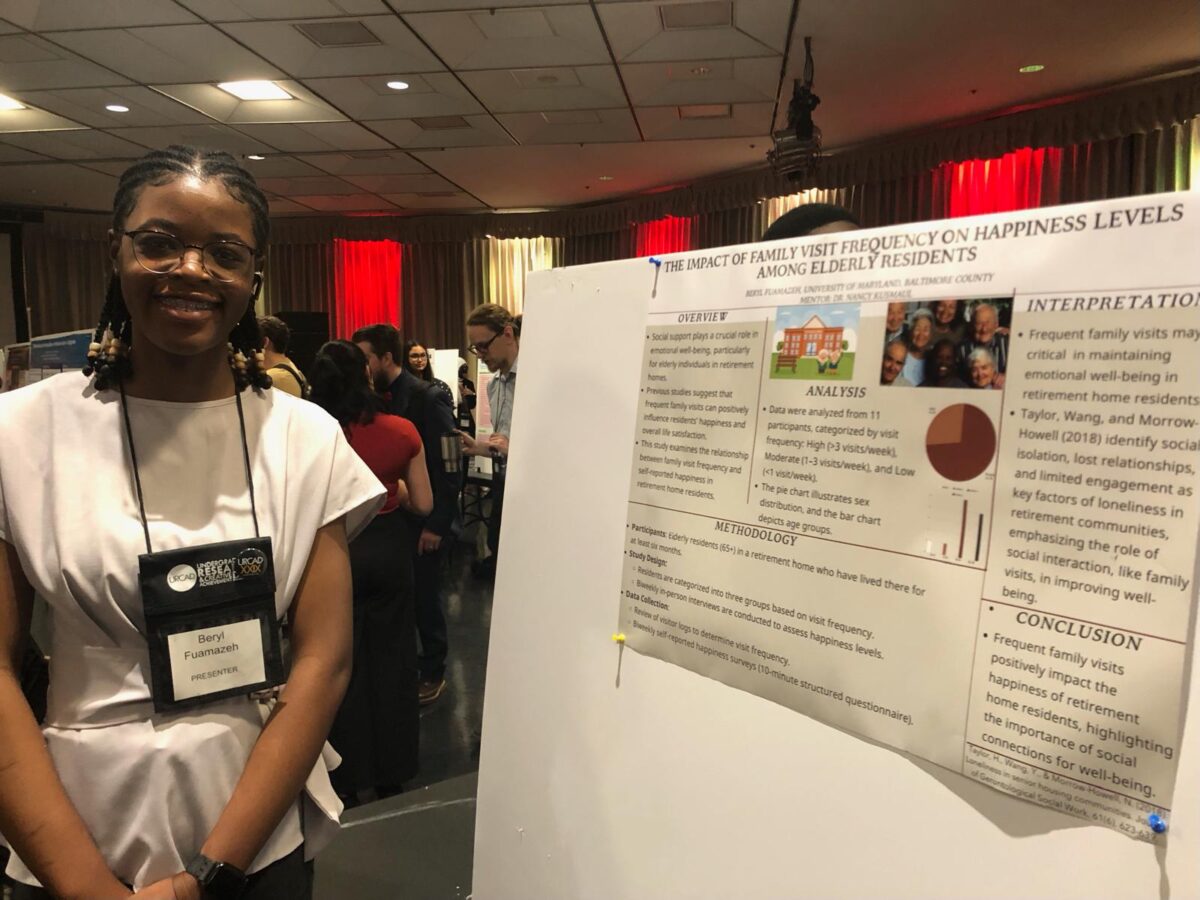
Beryl Fuamazeh ’26, biology, and a minor in health, wellness, and aging, is on her way to Howard University College of Medicine. After connecting with Nancy Kusmaul, professor of social work, Beryl found her research interests piqued by learning more about healthcare and aging care. While at UMBC, Beryl worked as a nursing assistant at a retirement community and volunteered for an organization that supports people with disabilities and older adults. After presenting her research at UMBC’s Undergraduate Research and Creative Achievement Day, she received the Erickson School of Aging Studies Award for Excellence in Undergraduate Research.
Beryl transferred to UMBC from the Community College of Baltimore County through the Degrees to Succeed program, and says that the support and funding she’s received from UMBC has made her education affordable and given her time to focus on her passion: healthcare and aging. Outside of school and work, she loves watching Korean dramas.
Q: Tell us about someone in the UMBC community who has inspired you.
A: Dr. Nancy Kusmaul is my research mentor, and she has been instrumental in my undergraduate research journey. The work she does to support the aging community has deeply inspired me. I have also been greatly influenced by Professor Mary Carter, an English professor here, who taught me how to better express myself through writing—a skill that was invaluable during my medical school application process. The support and guidance both faculty members have given me have truly shaped my experience at UMBC.
Q: Tell us about what you love about your academic program.
A: I’ve really enjoyed being part of the Erickson School of Aging Studies through my minor in health, wellness, and aging. Many of the classes I’ve taken have been meaningful because I can directly apply what I learn to my work as a nursing assistant in a retirement community. My biology major has also given me a strong foundation as I prepare to matriculate into medical school.
Q: What’s one thing you’d want someone to know about the support you find here?
A: Because it’s a smaller university, I’ve been able to build meaningful one-on-one relationships with professors, which has been incredibly valuable. I’ve also loved being surrounded by students who are passionate, driven, and genuinely supportive of one another, especially within the sciences. UMBC is a very supportive community.
Q: What brought you to UMBC in the first place?
A: I wanted to further my education while building meaningful relationships along the way. As someone pursuing the pre-med path, I knew it was important to be surrounded by supportive, like-minded people, and UMBC provided that for me, especially as a transfer student from the Community College of Baltimore County.
I was also drawn to the smaller campus environment, which made it easier to adapt and connect with professors and peers. Through my community college’s Degrees to Succeed partnership program, I was introduced to UMBC and the opportunities it offered, including research experiences, mentorship, and a strong academic community.
Right: Fuamazeh next to her poster at URCAD 2025.
Q: Tell us about the people who are helping you grow at UMBC.
A: Dr. Nancy Kusmaul has been incredibly instrumental in helping me grow at UMBC. She helped me kickstart my undergraduate research journey, which initially felt very daunting. All it took was reaching out to her by email, and she was immediately supportive and responsive. She took time out of her busy schedule to help me develop an individualized research study focused on aging, a topic that has become deeply meaningful to me and the communities it impacts.
Q: How have you connected with the community?
A: I have been involved in community programs, like volunteering with the Trusted Ride Program at Ascension Saint Agnes Hospital, which supports older adults and individuals with disabilities by helping them get to medical appointments safely. Experiences like this have allowed me to stay connected to the community while pursuing my interests in healthcare and aging.
Q: What would you tell others who are in your shoes about UMBC?
A: I transferred to UMBC from the Community College of Baltimore County, and through scholarships and financial support, including merit-based awards, UMBC helped ease the financial burden of pursuing higher education, which allowed me to focus more on my academics and future goals. I also felt well supported as a transfer student through the Degrees to Succeed program, even before officially transferring to UMBC. The transition felt smooth, and I always felt like there were people willing to help guide me along the way.
UMBC’s greatest strength is its people. When people meet Retrievers and hear about the passion they bring, the relationships they create, the ways they support each other, and the commitment they have to inclusive excellence, they truly get a sense of our community. That’s what “Meet a Retriever” is all about.
Learn more about how UMBC can help you achieve your goals.
]]>
Beryl Fuamazeh ’26, biology, and a minor in health, wellness, and aging, is on her way to Howard University College of Medicine. After connecting with Nancy Kusmaul, professor of social work,...
https://umbc.edu/stories/meet-a-retriever-beryl-fuamazeh-aging-care/
https://my3.my.umbc.edu/api/v0/pixel/news/160752/guest@my.umbc.edu/8b4bf215522e0179499e5c60c5bc173d/api/pixel
aging-studies
alumni
cnms
erickson-school
meet-a-retriever
perspectives
social-work
story
urcad
UMBC News & Magazine
https://my3.my.umbc.edu/groups/umbc-news-magazine
https://assets1-my.umbc.edu/system/shared/avatars/groups/000/001/943/24435aa6207c452e7bc15cc74b42c7bb/xsmall.png?1748556657
https://assets1-my.umbc.edu/system/shared/avatars/groups/000/001/943/24435aa6207c452e7bc15cc74b42c7bb/original.png?1748556657
https://assets2-my.umbc.edu/system/shared/avatars/groups/000/001/943/24435aa6207c452e7bc15cc74b42c7bb/xxlarge.png?1748556657
https://assets2-my.umbc.edu/system/shared/avatars/groups/000/001/943/24435aa6207c452e7bc15cc74b42c7bb/xlarge.png?1748556657
https://assets3-my.umbc.edu/system/shared/avatars/groups/000/001/943/24435aa6207c452e7bc15cc74b42c7bb/large.png?1748556657
https://assets1-my.umbc.edu/system/shared/avatars/groups/000/001/943/24435aa6207c452e7bc15cc74b42c7bb/medium.png?1748556657
https://assets2-my.umbc.edu/system/shared/avatars/groups/000/001/943/24435aa6207c452e7bc15cc74b42c7bb/small.png?1748556657
https://assets1-my.umbc.edu/system/shared/avatars/groups/000/001/943/24435aa6207c452e7bc15cc74b42c7bb/xsmall.png?1748556657
https://assets2-my.umbc.edu/system/shared/avatars/groups/000/001/943/24435aa6207c452e7bc15cc74b42c7bb/xxsmall.png?1748556657
UMBC News & Magazine
1
0
false
Wed, 17 Jun 2026 15:25:50 -0400
Wed, 17 Jun 2026 15:25:50 -0400
The Senior Class
Retrievers for life, that’s UMBC’s promise, and a group of residents at Charlestown’s senior living community are keeping their end of the bargain. Located two miles away from UMBC’s Catonsville campus, 60 or so retired and current faculty, staff, alumni, and friends at Charlestown are enjoying the ongoing cultural and educational perks of the two institutions. Several of these “Friends of UMBC” are laying the groundwork for continued exchange and connection—jazz concerts, classes about gender and sexuality, high-profile speakers—leaving a legacy for future generations to follow.
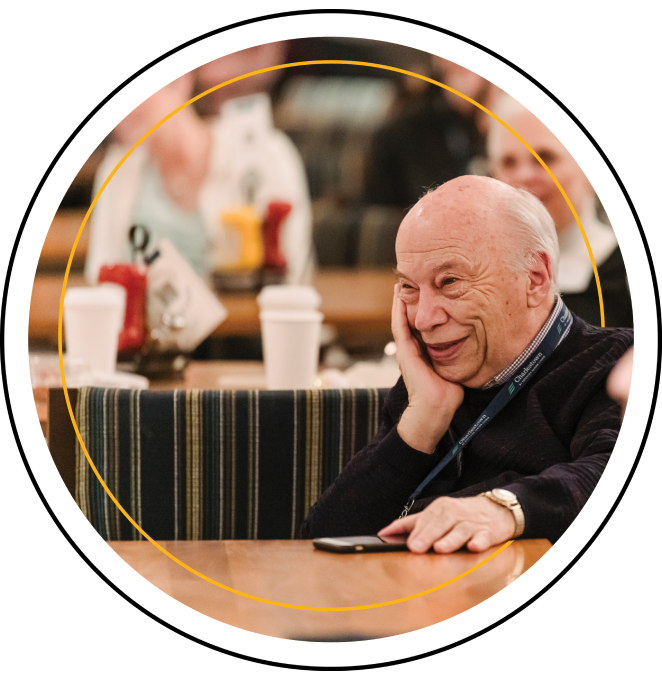 Art Johnson, professor emeritus, enjoys a jazz concert at Charlestown.
Around the café tables, heads are bobbing in rhythm tonight.
A duo of UMBC jazz students—Henry Smith ’24, on alto saxophone, and Leo Hickman ’27, on electric mandolin—are deep into their own takes on jazz standards. “Caravan,” “Misty,” and “There is No Greater Love” pour jauntily from their instruments.
The seniors here at Charlestown Senior Living know those tunes. Every song the UMBC jazz duo played was composed long before the student musicians were born, but just in the sweet spot for the audience. In the café where many have just eaten their crab soup and burgers for dinner, more than 100 Charlestown residents, including at least six who have tight connections to UMBC, clapped for the efforts of the young jazz players.
After the two finished playing “All of Me,” the crowd erupted in applause.
“That was ‘All of Me,’” Smith said into the microphone. “I feel like lots of you know that one. We’re having a great time playing for you. This is super fun!”
By 8 p.m. the crowd was stuffing dollar bills and fivers into the musicians’ tip jar by the mic and in paper bags held by volunteers at each exit. Then the seniors headed back to their apartments at the end of long corridors and in different buildings, very much like college dorms for older folks.
Strengthening Connections
A dedicated group of nearly 60 retired and current faculty and staff, alumni, or relatives have formed to promote connections between UMBC and Charlestown, a sprawling senior community with 2,000 residents. Thanks to their efforts, UMBC professors are teaching classes at the senior living community, Charlestown residents are traveling to UMBC for events, and helping the senior community’s restaurant staff with scholarship applications, funded by Charlestown residents, to UMBC and other Maryland colleges.
“That’s what I’m trying to do here, make connections,” said Art Johnson, provost emeritus who retired in 2019 from his position as political science professor and director of the Sondheim Scholars program. He moved to Charlestown in 2022 and since then, like a first-year student in search of college social groups, he has been indefatigably recruiting residents to join the Friends of UMBC at Charlestown.
“It helps maintain my connection to UMBC and lets me brag a little bit about UMBC,” Johnson said, laughing. “I meet people I wouldn’t have met otherwise. As provost, I used to promote UMBC all over. This is just an extension of that.”
Johnson met Lucy McKean on the bocce court, learned one of her kids went to UMBC, and reeled her into the group.
“Any connection will do,” Johnson said. “That’s how you build a long mailing list.”
Sitting at a dinner table on the Charlestown campus, McKean and Johnson laughed together. Thanks to the Friends of UMBC group, she’s now attending jazz concerts, which she never thought she would do.
The idea for a formal-ish group sprang from a walk that Johnson and Sam Lomonaco, computer science and electrical engineering professor, took around Charlestown in the fall of 2022. They wanted to create a web of connections between UMBC and Charlestown.
Lomonaco, who has lived at Charlestown for three years, still teaches at UMBC. His commute is nicely short, he said, and having a partnership between UMBC and Charlestown offers “a good chance to do things together. I meet a lot of interesting people I would not have met otherwise. And,” he said with a grin, “I’ve gotten interested in jazz.”
Johnson and Lomonaco started small, with a social for UMBC-connected folks at Charlestown. They’ve grown to arrange trips to programs by UMBC’s arts and culture departments, as well as the Wisdom Institute (the association for retired UMBC faculty and staff), and those monthly jazz concerts. As well, Johnson and others publish a newsletter and are recruiting UMBC faculty to teach courses at Charlestown through ELLIC (Elderhostel’s Lifelong Learning Institute at Charlestown), including classes on galaxies, genes, and gender.
“Art has been a binder, keeping us together,” said Bernice De Bels ’76, English, the first Black honors graduate at UMBC, who later worked in the foreign language department and now lives at Charlestown. “With UMBC we should explore what we have to offer them and what they have to offer us.”
Keeping Memory Alive
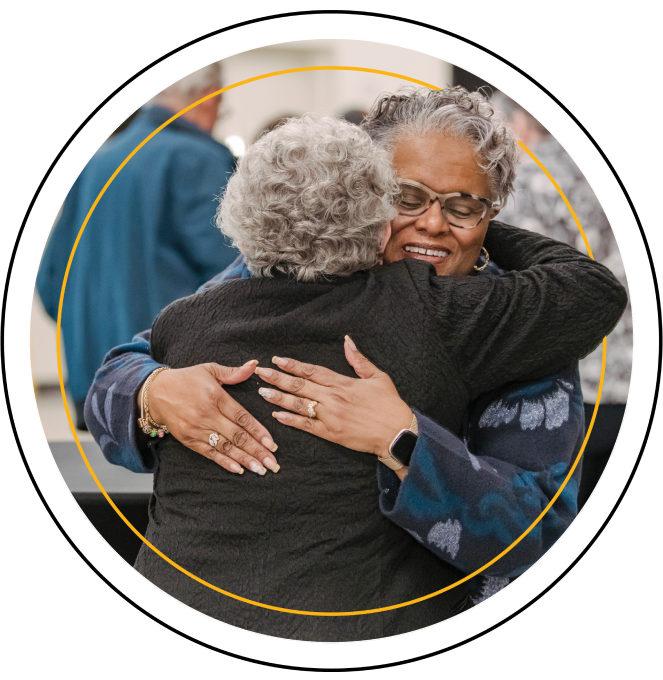 Diane Lee hugs Pamela Morgan, the former director of the Office of Field Experiences and Clinical Practice in UMBC’s education department and a Wisdom Institute Board Member.
Of the many courses offered at Charlestown’s ELLIC program, nine are taught by UMBC faculty. That’s not a coincidence. Though the connections between Charlestown and UMBC have been sporadic, the institutions do have history.
John Erickson, who founded Erickson Living, which owns Charlestown, has long worked with UMBC to promote the study of getting older. Through joint efforts of Erickson and then-president Freeman Hrabowski, in 2004 the state funded the Erickson School of Aging Studies at UMBC, and Erickson Living donated $5 million for the school’s development.
Jeff Watson, who is on the faculty for the Erickson School of Aging Studies and serves as Erickson’s director of operations, also researches geriatric cognition.
“The literature and growing academic consensus is that whatever is good for the heart is good for the lungs is good for the brain,” Watson said. “Thus a healthy lifestyle, reducing inflammation and injury, while increasing physical and cognitive strength, and engaging in life, builds better brain health.”
Erickson researchers have published a study in the American Journal of Geriatric Psychiatry testing UCLA Longevity Center researchers’ findings about memory fitness on two of Erickson’s campuses, Riderwood and Oak Crest. Watson said they found that “eating wisely, exercising daily, learning consistently, relaxing meaningfully, and connecting socially” is optimal for a healthy lifestyle for seniors.
The Friends of UMBC are all about learning and socializing while they’re matchmaking between UMBC and Charlestown. For years, Johnson said, UMBC talked about collaborating with Charlestown, but it never really manifested to the extent they envisioned.
“One of our long-term goals is to try to bring the two institutions closer together,” Johnson said. “We could cooperate on issues: sustainability, local transportation, good health care…. We talked about it years ago when I was at UMBC, but it never happened.”
Same Goals, From Different Directions
UMBC’s Wisdom Institute is trying to accomplish the same community-building as the UMBC group at the senior village. But now, they’re working together.
Johnson, who serves on the Wisdom Institute’s board, is the hub, said Diane Lee, director of the UMBC organization for retirees.
“He brilliantly brought people together,” Lee said. “What a wonderful way to reconnect with these folks.”
The Wisdom Institute is printing extra copies of its newsletters for distribution at Charlestown, and for a recent event, the institute rented out the Charlestown bus to bring UMBC-curious residents to a lunch and keynote by WJZ-TV anchor Denise Koch. The institute plans to invite Charlestown residents to other events, including observatory tours in UMBC’s Physics Building, monthly lunches, discussions, and concerts.
“We really want to forge this tie,” Lee said. “We like the idea of reciprocity.”
For 30 years, Lee taught at UMBC in the education department and worked in the administration. “I came as a visiting assistant professor with no intention of staying. But it was an exciting place and an exciting time to be there.”
She, like many of the longtime UMBC staff and faculty who now live at Charlestown, helped build UMBC from the ground up into the institution it is today.
“It’s a wonderful place to be,” Lee said. The work was demanding but energizing, she said. “And people cared. We’re trying to capture the spirit, to continue that sense of self and community and the kind of work we did together. UMBC was not just a campus. We talked about one another as family.”
Dream Students
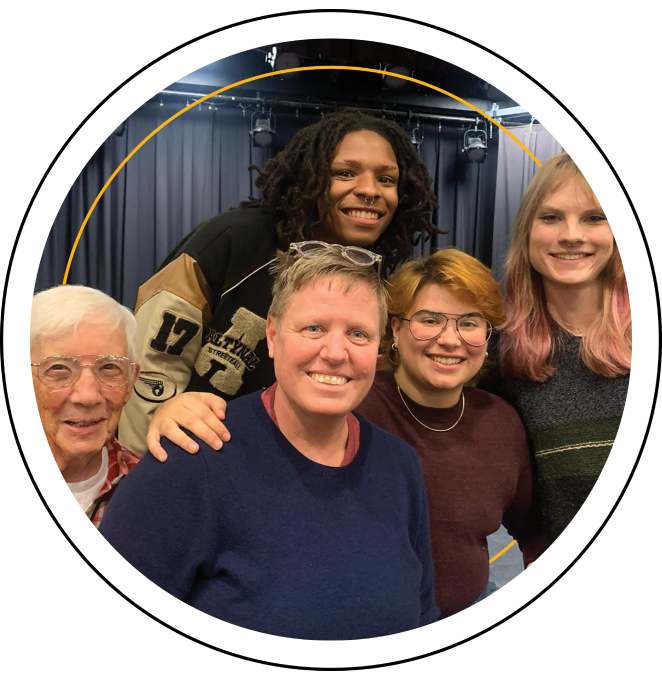 Donna Martin, Kate Drabinski, and students Marcus Ross, Sage Zoz, and August Wichman pose together after a class about gender and sexuality through the Enjoy Lifelong Learning in Charlestown program. Photo courtesy of Drabinski.
Kate Drabinski, principal lecturer in gender and women’s and sexuality studies, has visited Charlestown eight times to teach over three years. She jokes that if she teaches two more classes, she’ll earn a punch card for a free meal at Charlestown’s restaurant.
“It’s been some of the most valuable teaching I’ve done,” Drabinski said of the senior students learning through the ELLIC program, Enjoy Lifelong Learning in Charlestown. “They are rapt, they take notes, they ask questions. It’s a dream setup.”
On a spring Tuesday, Drabinski brought UMBC students who identify as gay, transgender, and nonbinary to the senior living community to tell their coming out stories, along with their struggles and joys around gender and sexuality.
“It’s been really moving for us, and also for the residents, to make these connections,” Drabinski said.
One student, who performs in drag shows, grew up on the same block as one of the residents, Drabinski said. The resident stood up and said she was proud of the student, Drabinski said, “for being brave and sharing her story.”
At least one of the Charlestown residents has a nonbinary grandchild, Drabinski said. “They probably feel uncomfortable asking their grandchild these questions,” she continued, but were curious and asked many questions of the students without the fear of rejection from a family member.
And she asked the students a question in front of the residents: “What do you wish your grandparents had said to you when you told them your coming out story? They said, ‘I want you to be part of my life—I trust you and this is a gift I’m giving.’”
They also discussed the generational misunderstandings, Drabinski said, “hot-button issues.” One resident asked why drag queens were reading stories at libraries. Students were worried about the question, but Drabinski said she maneuvered the fear in the room and, ultimately, they had a “fantastic discussion, the kind of discussion you only have when you have dedicated intergenerational space.”
Drabinski said her students came away from the interaction enriched. “Just because people are old doesn’t mean they are hostile. It was a huge benefit to students to get to practice telling their stories, to build confidence, and to learn from the questions the seniors are asking. It was a really positive experience.”
Familiar Tunes in a New Way
Now that he’s retired, Johnson has time to fulfill the goal of bringing UMBC and Charlestown closer.
One evening before the jazz concert, Johnson pulled together members of his group of UMBC folks to chat in the atrium of one of Charlestown’s buildings.
Pat Bettridge, who came to UMBC in 1966 and did graduate work in English, was married to English professor William Bettridge, and remembers UMBC in the 1960s as “a hole in the ground.” Bettridge, who has lived at Charlestown for 11 years, helped bring UMBC artists, dancers and theater productions to the senior living community over the years.
“It’s a good idea to get us together, to continue what we started 10 years ago,” Bettridge said.
Sebastian Petix, organizer of Charlestown’s jazz club and a friend of the Friends of UMBC, has worked with Matt Belzer, senior lecturer in jazz studies at UMBC, to bring the jazz groups to Charlestown. Petix, who played piano and trumpet and organized concert series before retirement, formed the Charlestown Jazz Club, and quickly signed onto the idea of bringing Retriever musicians onto Charlestown’s campus.
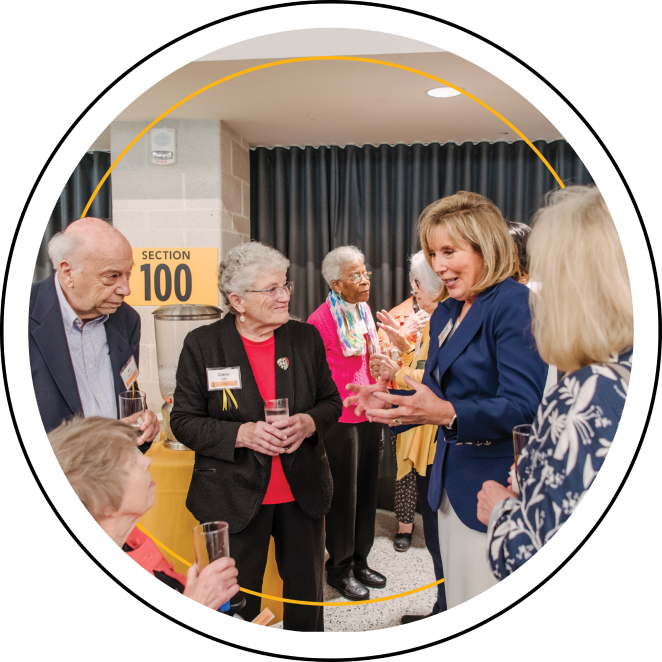 Art Johnson, Diane Lee, and Denise Koch chat with community members at the Wisdom Institute’s Signature Event in April 2024
“The audiences have really loved them,” Petix said. His jazz club, including some UMBC members, are planning a trip to see the UMBC semester’s final jazz recitals.
Valerie Woolston, whose husband Charles started as UMBC’s admissions director in 1968, helps edit the Friends of UMBC newsletter. She’s attended every jazz concert.
“They’re terrific,” Woolston said, nodding at the duo warming up in front of the crowd. “It’s really great to see how young people develop. They write their own music,” she said, almost as proud as a grandparent.
“I’m really pulled to UMBC,” said Woolston. “I’m really proud of it.”
Then she settled down with friends to watch the students play old, familiar tunes in a new way.
“I’m really pulled to UMBC,” said Woolston. “I’m really proud of it.”
Then she settled down with friends to watch the students play old, familiar tunes in a new way.
]]>
Retrievers for life, that’s UMBC’s promise, and a group of residents at Charlestown’s senior living community are keeping their end of the bargain. Located two miles away from UMBC’s Catonsville...
https://umbc.edu/stories/the-senior-class-charlestown-cultural-exchange/
https://my3.my.umbc.edu/api/v0/pixel/news/142344/guest@my.umbc.edu/355422fcb02e43ca3b6d40c2be3c039e/api/pixel
aging-studies
campus-life
erickson
feature
gwss
magazine
music
spring-2024
story
wisdom-institute
UMBC News & Magazine
https://my3.my.umbc.edu/groups/umbc-news-magazine
https://assets1-my.umbc.edu/system/shared/avatars/groups/000/001/943/24435aa6207c452e7bc15cc74b42c7bb/xsmall.png?1748556657
https://assets1-my.umbc.edu/system/shared/avatars/groups/000/001/943/24435aa6207c452e7bc15cc74b42c7bb/original.png?1748556657
https://assets2-my.umbc.edu/system/shared/avatars/groups/000/001/943/24435aa6207c452e7bc15cc74b42c7bb/xxlarge.png?1748556657
https://assets2-my.umbc.edu/system/shared/avatars/groups/000/001/943/24435aa6207c452e7bc15cc74b42c7bb/xlarge.png?1748556657
https://assets3-my.umbc.edu/system/shared/avatars/groups/000/001/943/24435aa6207c452e7bc15cc74b42c7bb/large.png?1748556657
https://assets1-my.umbc.edu/system/shared/avatars/groups/000/001/943/24435aa6207c452e7bc15cc74b42c7bb/medium.png?1748556657
https://assets2-my.umbc.edu/system/shared/avatars/groups/000/001/943/24435aa6207c452e7bc15cc74b42c7bb/small.png?1748556657
https://assets1-my.umbc.edu/system/shared/avatars/groups/000/001/943/24435aa6207c452e7bc15cc74b42c7bb/xsmall.png?1748556657
https://assets2-my.umbc.edu/system/shared/avatars/groups/000/001/943/24435aa6207c452e7bc15cc74b42c7bb/xxsmall.png?1748556657
UMBC News & Magazine
0
0
false
Wed, 29 May 2024 16:34:41 -0400
Wed, 29 May 2024 16:34:41 -0400
Access for All—Rising Together

Since 2009, as part of its Alumni Awards celebration, the UMBC Alumni Association has named one “Rising Star” recipient each year who exemplifies early career and professional achievement. In the coming weeks, we will spend some time with awardees from the past decade to see where they are now—and how they’ve grown in their fields while maintaining ties to UMBC. In this installment, UMBC Rising Stars Galina Madjaroff Reitz ’08, psychology, M.A. ’11, aging studies, Ph.D. ’18, human centered computing, and Sondheim Scholar Aaron Merki ’05, political science, discuss their mutual goal to uplift the dignity of elderly, cognitively impaired, and low-income individuals. Reitz is using tech to assist older folks and Merki is creating accessible communities through a different path—law and philanthropy.
Using tech the ‘right way’
Growing up in an intergenerational household helped focus her research with assistive devices, says Reitz, who received UMBC’s Rising Star award in 2016. Although during her childhood, she says, her family functioned without a lot of technology. “It was just stories,” Reitz clarifies. “It was a lot of talking to my grandparents, hearing their perspective on life, and getting a lot of advice, solicited or unsolicited,” she laughs, “but in retrospect, I’m actually kind of glad that we didn’t have so much tech around us. I think that really gave space for reflection and to kind of connect on a different level. But now that we are so consumed by it and it’s all around us, I think it has to be incorporated into our lives the right way.”
 Reitz confers with participants of her research into assistive technologies. Photo courtesy of Reitz.
Now, after teaching at UMBC for 12 years, Reitz is now the faculty program director of the University of Maryland’s College of Information Studies and also an affiliate faculty at the Trace Center, which develops technology with the end goal of increasing the accessibility of information and communication technologies for people with disabilities.
Finding intuitive tools
Reitz also consults for Google and Amazon on their Echo and Alexa products to make the tech more helpful for older, cognitively impaired adults. But she didn’t come up with this idea on her own. About six years ago, in a conversation with a research participant whose wife had dementia, Reitz asked him about what technologies he already used. When he mentioned Amazon Alexa, Reitz was immediately interested. It had so much potential—it was an intuitive tool already built for consumers and at a moderately affordable price point, two things that often inhibit the accessibility of assistive technology.
 Reitz with (from left) Dr. Judah Ronch, her mentor, President Freeman Hrabowski, and then-President of the UMBC Alumni Association John Becker ’01. Photo by Marlayna Demond ’11.
“For a long time we were developing tech that was, I think, infantilizing, and we didn’t understand the needs of older adults,” says Reitz, who explains that what older adults wanted was the devices they already used to better assist them. “So we’ve been really focused on building this ecosystem of tech that can support somebody—so they can stay in their home as long as possible, feel like themselves and continue to focus on their personhood versus just disease management.”
Long-lasting mentorship
 Headshot courtesy of Merki.
Merki, who was a Sondheim Public Affairs Scholar at UMBC, tries to carry the values of the program’s namesake and his mentor—the late Walter Sondheim—into his own work in creating accessible communities. Merki was just 17 when he first met Sondheim, but the 93-year-old civic leader made a lifelong impact on him. “Everything about him as a leader went contrary to what you might envision,” says Merki. “He was such a humble, gentle man, and everybody trusted him, which enabled him to get so much done.”
“We only provide grants to direct service providers—no policy, no research, no higher education, just direct services in the field of combating poverty,” says Merki.
Now, as managing director of programs and grants at The Weinberg Foundation—one of the largest grant makers in the older adults and aging space in the United States—Merki oversees approximately $130 million a year in grant distributions from the foundation, all focused on meeting the basic human needs of people experiencing poverty.
Staying connected
Like Reitz, Merki sees the need to ground himself in the experiences of the populations he’s working with. “It’s easy to become disconnected when you work in philanthropy,” says Merki, who was a Rising Star recipient in 2010. “It’s easy to get an inflated sense of your own importance and capacity for impact. And it’s important to remember that it’s not you who’s doing the real work on the ground, that you are simply a partner and a supporter for those nonprofit leaders, for those people who are out there meeting the needs of older adults and children and families every day.”
 Merki with Alicia Wilson ’04, right, and Paul Pineau and Susan Leviton, at the Alumni Award ceremony in 2010.
To combat distancing himself, Merki says he and his team go out in the field a lot. “We are traveling to the communities that we work in. We are meeting people and making sure that the projects that we’re funding are top notch. You really have to make it a priority to be with the people who your grants serve.”
Twenty years after meeting Sondheim, Merki says, “He is still a guiding force in my life, and I try to live up to his example. Walter’s life of service was focused on bettering the lives of other people, largely disadvantaged and vulnerable populations throughout Baltimore—he was just so fundamentally concerned with everyone else and the community at large, more than himself.”
Read more about other Retrievers rising together and stay tuned for more information about UMBC’s 32nd annual Alumni Awards in October.
]]>
Since 2009, as part of its Alumni Awards celebration, the UMBC Alumni Association has named one “Rising Star” recipient each year who exemplifies early career and professional achievement. In the...
https://umbc.edu/stories/access-for-all/
https://my3.my.umbc.edu/api/v0/pixel/news/119639/guest@my.umbc.edu/87763bc9a14aa032287560f9e66e7d0a/api/pixel
aging-studies
alumni
alumni-awards
erickson-school
human-centered-computer
political-science
psychology
rising-star
sondheim
spring-2021
UMBC News & Magazine
https://my3.my.umbc.edu/groups/umbc-news-magazine
https://assets1-my.umbc.edu/system/shared/avatars/groups/000/001/943/24435aa6207c452e7bc15cc74b42c7bb/xsmall.png?1748556657
https://assets1-my.umbc.edu/system/shared/avatars/groups/000/001/943/24435aa6207c452e7bc15cc74b42c7bb/original.png?1748556657
https://assets2-my.umbc.edu/system/shared/avatars/groups/000/001/943/24435aa6207c452e7bc15cc74b42c7bb/xxlarge.png?1748556657
https://assets2-my.umbc.edu/system/shared/avatars/groups/000/001/943/24435aa6207c452e7bc15cc74b42c7bb/xlarge.png?1748556657
https://assets3-my.umbc.edu/system/shared/avatars/groups/000/001/943/24435aa6207c452e7bc15cc74b42c7bb/large.png?1748556657
https://assets1-my.umbc.edu/system/shared/avatars/groups/000/001/943/24435aa6207c452e7bc15cc74b42c7bb/medium.png?1748556657
https://assets2-my.umbc.edu/system/shared/avatars/groups/000/001/943/24435aa6207c452e7bc15cc74b42c7bb/small.png?1748556657
https://assets1-my.umbc.edu/system/shared/avatars/groups/000/001/943/24435aa6207c452e7bc15cc74b42c7bb/xsmall.png?1748556657
https://assets2-my.umbc.edu/system/shared/avatars/groups/000/001/943/24435aa6207c452e7bc15cc74b42c7bb/xxsmall.png?1748556657
UMBC News & Magazine
0
0
false
Tue, 11 May 2021 21:05:04 -0400