Calling our better angels: Computing for Social Good Award launched by alumnus Akshay Java at Google honors work prioritizing people’s well-being
 Akshay Java (Photo courtesy of Java)
Akshay Java, M.S. ’03, Ph.D. ’08, computer science, is a seasoned technology leader whose career spans key roles across the tech industry, including research at Microsoft, co-founding a successful start-up, and leading critical user protection efforts at Google. In his roles at Google across Egregious Harms Protections and Responsibility AI Engineering, he works daily on the front lines of digital safety, addressing both the serious risks and the transformative potential of modern computing technology.
“Technology by itself is not necessarily good or bad, what matters is how we choose to use it,” Java says. “But AI is moving so quickly now—community and technical leaders need to be engaged, making sure the good use cases can be advanced rapidly while preventing the bad from happening.”
It was in this spirit that Java made a generous donation to UMBC to launch the Computing for Social Good Award, to be given annually to one or more students in the College of Engineering and Information Technology (COEIT) who have conducted substantial research with the goal of harnessing technology to make positive social change. The awards are funded by an endowment, which is open to contributions from the community. In May of this year, two students—Rishav Gupta, a Ph.D. student in computer science, and ASM Mobarak Hossain, M.S. ’26, information systems—received the inaugural awards for their work in affordable health monitoring and wheelchair accessibility, respectively.
“We are tremendously grateful to Akshay Java for establishing the Computing for Social Good Award in COEIT,” says Dean Jeanne van Briesen. “His commitment to supporting research that combines technical excellence with meaningful societal impact reflects values that are central to our college. This award celebrates the creativity and dedication of our student researchers and reinforces our belief that engineering and computing can be powerful forces for positive change.”
Monitoring cardiovascular health and improving wheelchair accessibility
Both recipients of the 2026 awards talked about how meaningful it was to them to apply their technical expertise to work that aims to improve people’s lives.
Gupta is working in the lab of his advisor Dong Li on tools to make blood pressure monitoring affordable and accessible using only a commodity smartphone. Hossain worked on a project with advisor Md Osman Gani to develop MyPath, a Google Maps–style app that uses AI, remote sensing measurements, and crowd-sourced data to guide wheelchair users to accessible routes.
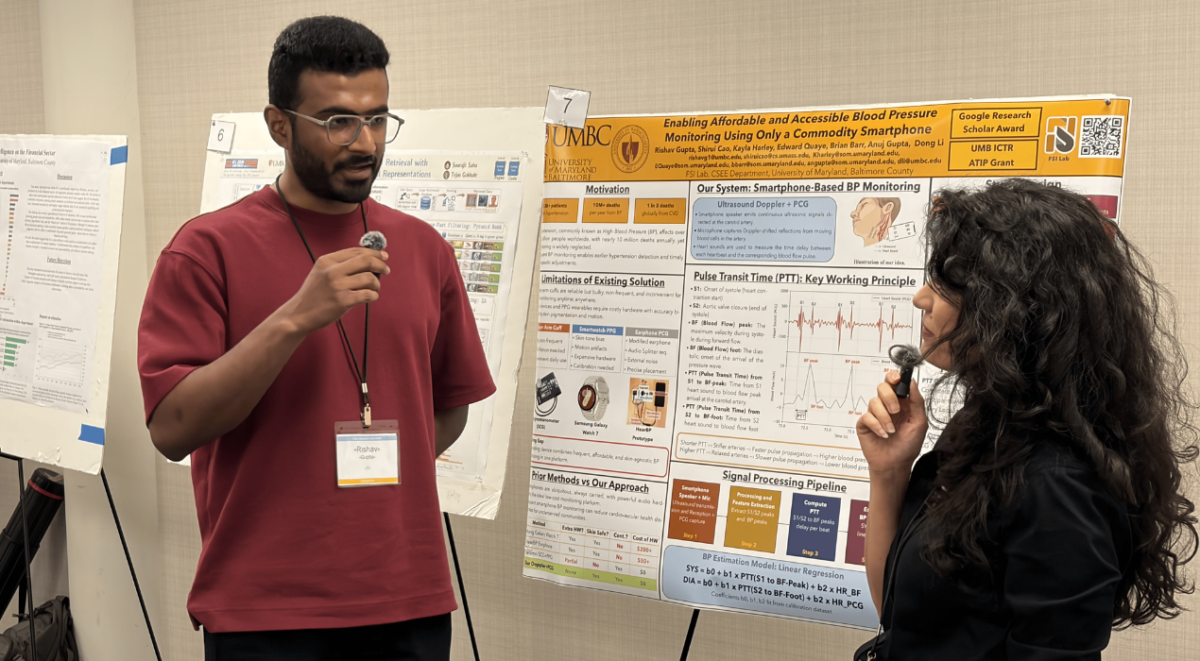 Ph.D. student Rishav Gupta presents at UMBC COEIT Research Day 2026 in front of his poster, “Enabling Affordable and Accessible Blood Pressure Monitoring Using Only a Commodity Smartphone.” (Photo courtesy of Gupta)
“Receiving the COEIT Computing for Social Good Award felt meaningful in a way I didn’t expect,” Gupta says. “I came to UMBC from a career in industry because I wanted my work to matter beyond a product. Being recognized for the research’s social impact felt like confirmation that I’d chosen the right path.”
“Developing MyPath required countless hours of hard work, continuous refinement, and a deep commitment to addressing a meaningful community need,” Hossain says. “Seeing that work recognized by COEIT was incredibly exciting and humbling—it gave me a strong sense of pride in what we’ve built and renewed enthusiasm for creating tools that deliver genuine social value.”
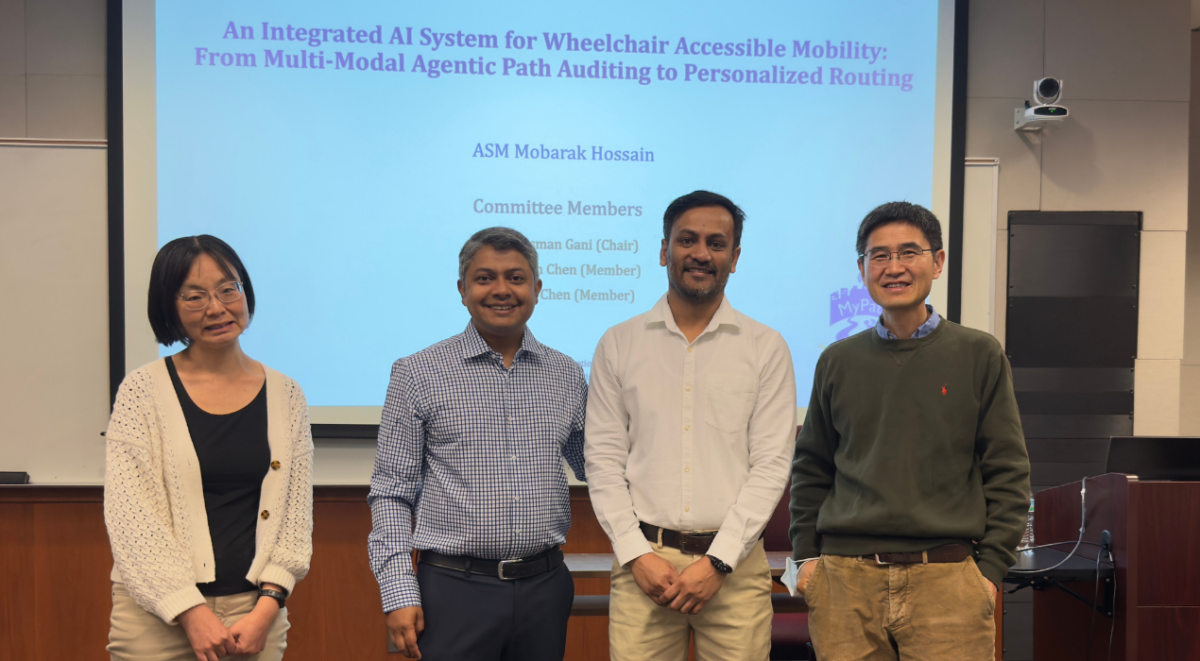 Hossain after his master’s thesis defense at UMBC. From left to right: Karen Chen, Md Osman Gani, Hossain, and Zhiuyan Chen. (Photo courtesy of Hossain)
Seeing the students and the work they are doing has been the most meaningful part of the award process, Java says. “I’m so proud of the students for what they’ve achieved. And I hope this award inspires more students to apply their skills in this space of social good.”
]]>
Akshay Java (Photo courtesy of Java) Akshay Java, M.S. ’03, Ph.D. ’08, computer science, is a seasoned technology leader whose career spans key roles across the tech industry, including...
https://umbc.edu/stories/computing-for-social-good-award/
https://my3.my.umbc.edu/api/v0/pixel/news/162247/guest@my.umbc.edu/b8c62600208724700159c05fd6f43321/api/pixel
alumni
coeit
csee
graduate-research
impact
is
research
science-and-tech
stories
story
UMBC News & Magazine
https://my3.my.umbc.edu/groups/umbc-news-magazine
https://assets1-my.umbc.edu/system/shared/avatars/groups/000/001/943/24435aa6207c452e7bc15cc74b42c7bb/xsmall.png?1748556657
https://assets1-my.umbc.edu/system/shared/avatars/groups/000/001/943/24435aa6207c452e7bc15cc74b42c7bb/original.png?1748556657
https://assets2-my.umbc.edu/system/shared/avatars/groups/000/001/943/24435aa6207c452e7bc15cc74b42c7bb/xxlarge.png?1748556657
https://assets2-my.umbc.edu/system/shared/avatars/groups/000/001/943/24435aa6207c452e7bc15cc74b42c7bb/xlarge.png?1748556657
https://assets3-my.umbc.edu/system/shared/avatars/groups/000/001/943/24435aa6207c452e7bc15cc74b42c7bb/large.png?1748556657
https://assets1-my.umbc.edu/system/shared/avatars/groups/000/001/943/24435aa6207c452e7bc15cc74b42c7bb/medium.png?1748556657
https://assets2-my.umbc.edu/system/shared/avatars/groups/000/001/943/24435aa6207c452e7bc15cc74b42c7bb/small.png?1748556657
https://assets1-my.umbc.edu/system/shared/avatars/groups/000/001/943/24435aa6207c452e7bc15cc74b42c7bb/xsmall.png?1748556657
https://assets2-my.umbc.edu/system/shared/avatars/groups/000/001/943/24435aa6207c452e7bc15cc74b42c7bb/xxsmall.png?1748556657
UMBC News & Magazine
0
0
false
Tue, 01 Sep 2026 11:32:45 -0400
Tue, 01 Sep 2026 11:32:45 -0400
More than skills: Four CNMS interns on mentorship, belonging, and the gift of opportunity
Every morning this summer, junior biological sciences major Magdalen Ruth made her way to the National Institutes of Health in Bethesda—a dense hub of biomedical research. There, at the National Institute of Arthritis and Musculoskeletal and Skin Diseases, she helped investigate a genetic mutation in a patient with a rare form of juvenile arthritis known as Still’s disease, connecting her UMBC training to work that could improve patients’ lives. She is one of four CNMS students whose recent internships at Maryland-based companies and agencies show how local opportunities are helping Retrievers build skills, find mentors, and advance discoveries that matter here and beyond.
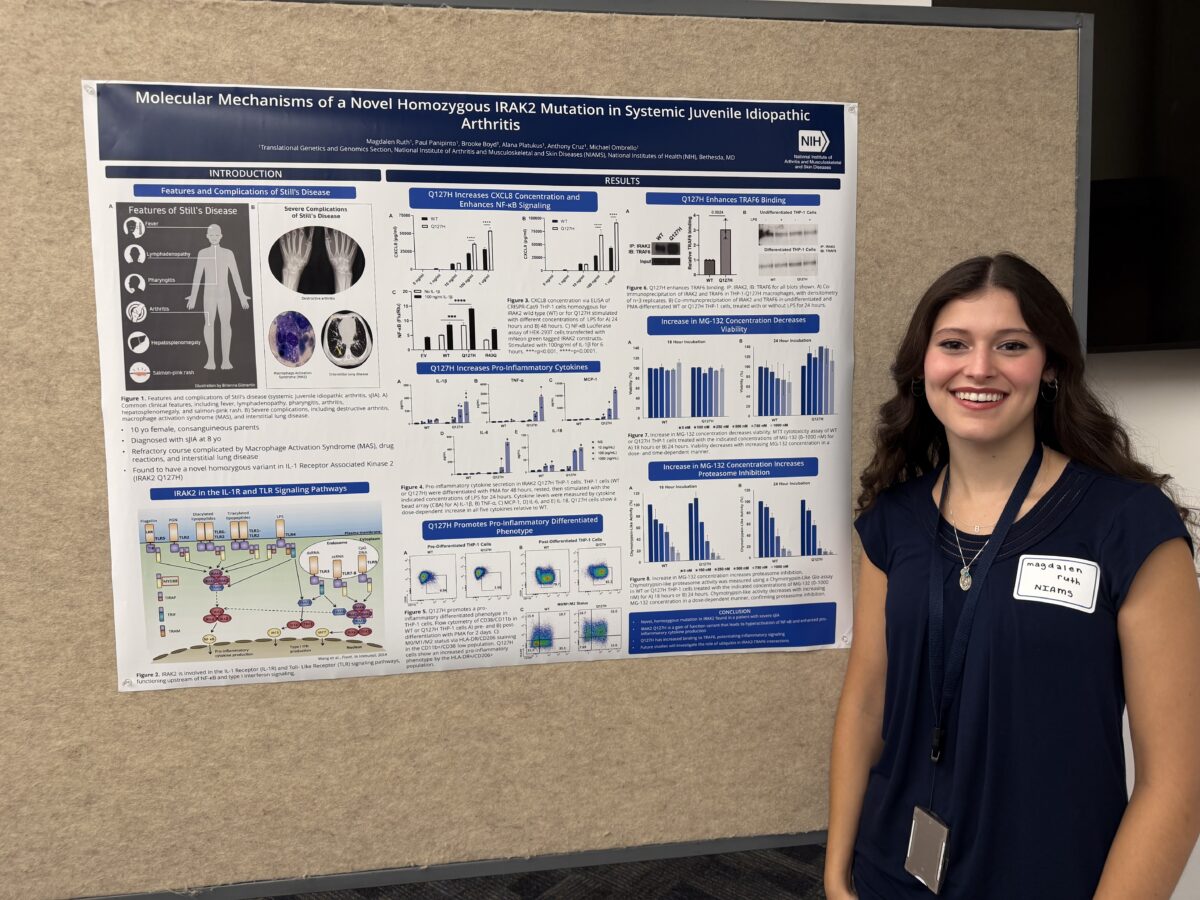 At the conclusion of her NIH internship, Magdalen Ruth presented her summer research on the role of a particular genetic mutation in a rare form of juvenile arthritis. (Courtesy of Ruth)
“I feel like I’m doing really important work,” Ruth, a Meyerhoff and U-RISE scholar, says. “Getting to know the patient’s diagnosis and being able to see that what I’m working on is affecting an actual person in real time has been awesome.” The internship has confirmed her interest in pursuing a career in pharmacology. It’s also stretched her communication skills. While familiar with presenting her work to colleagues in Deepak Koirala’s lab group at UMBC, communicating her research to a mix of researchers and clinicians—who don’t all share the same jargon and expertise—taught her the nuance of communicating with technical and non-technical audiences.
The Meyerhoff community helped make the opportunity possible. “I would not be in the place I am without Meyerhoff,” she notes. On campus, Ruth balances research and leadership as vice president of the STEM Ph.D. Society, a student-run organization designed to help students connect with scholarships, internships, graduate schools, and more. She also takes dance classes, is pursuing a music minor, and volunteers at her family’s Catholic parish—nurturing connections that ground her amid rigorous academic work.
Protecting lives, growing a career
Mark Harrison, a senior biological sciences major who started in chemical engineering, is in his third summer at Aberdeen Proving Ground (APG), a U.S. Army installation in Aberdeen, Maryland. His work involves designing and testing gas masks, bridging his early engineering training and his understanding of physiology. “I’m able to bring an understanding of what a warfighter may be experiencing in their body while wearing a gas mask in a way that others at APG may not,” Harrison says.
His mentors at APG, Jon Sampson ’03, mechanical engineering, and Edward Parshley ’06, chemical engineering, value the perspective Harrison brings and have supported his growth. “They made it clear that they want to reach back and offer opportunities to those coming behind them,” he says. They are making good on that commitment: Harrison will stay on board at APG this fall, and the plan is to transition him into a full-time position after he graduates in December. “They were always asking me what I wanted to learn and then giving me related opportunities,” Harrison says. “I could ask anyone how something worked, and they’d take the time to explain it to me. I’m so grateful for the way they’ve invested in me.”
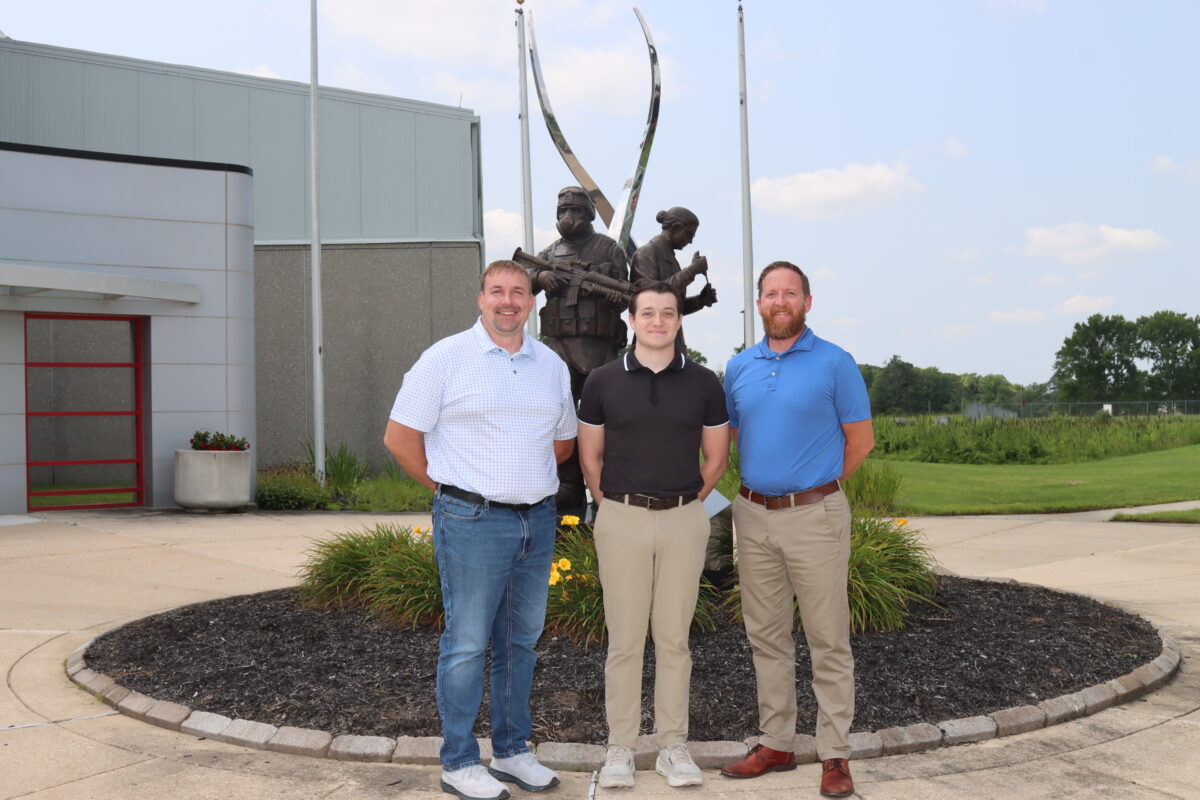 UMBC alumni Jonathan Sampson (right) and Ed Parshley (left) have mentored Mark Harrison (center) over the last two-plus years as he completed three internships at Aberdeen Proving Ground. (Courtesy of Harrison)
Interning in a fast-paced, interdisciplinary environment has also changed how Harrison operates in the classroom. “I learned how to learn at APG,” he says. “Now I don’t have to spend as much time studying, because when I leave class I already have a good understanding of the material. I’m connecting the dots so much better than before.” For Harrison, the work has taken on personal meaning, as well. “I’m fighting right now to try to protect American lives—that’s why I’m here.”
Translating discovery into treatment
Zainab Idowu, a senior biochemistry and molecular biology major and a Meyerhoff Scholar, interned at pharmaceutical giant AstraZeneca in Gaithersburg, Maryland, joining a robust group of Retrievers who’ve grown their skills there. Her project involved testing flow cytometers, which count and characterize individual cells and are used in manufacturing cell therapy treatments. Her goal was to determine the instrument and protocols that would be simplest and most effective for manufacturing teams to implement. The experience shifted Idowu’s focus toward translational medicine and reinforced her plans for an M.D./Ph.D. after UMBC. But the people around her made the biggest impression.
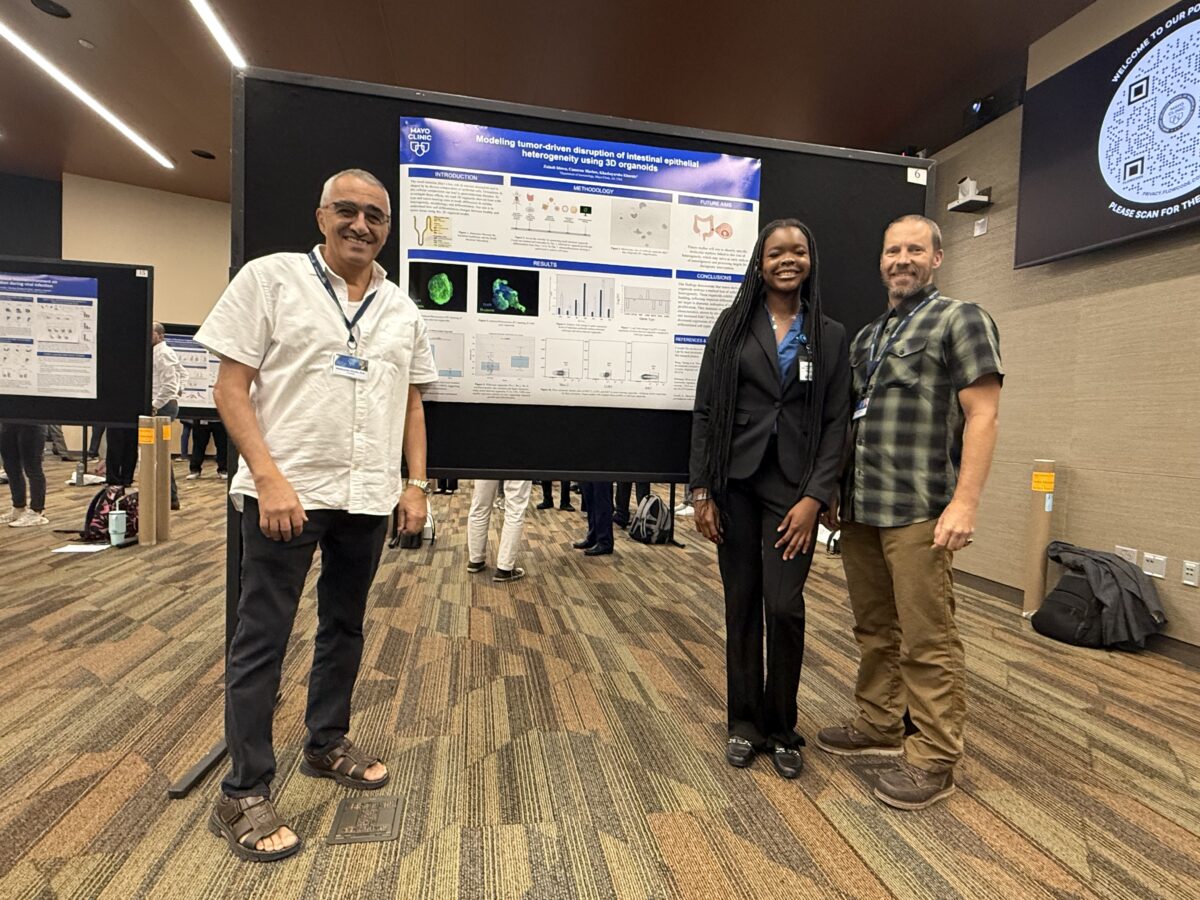
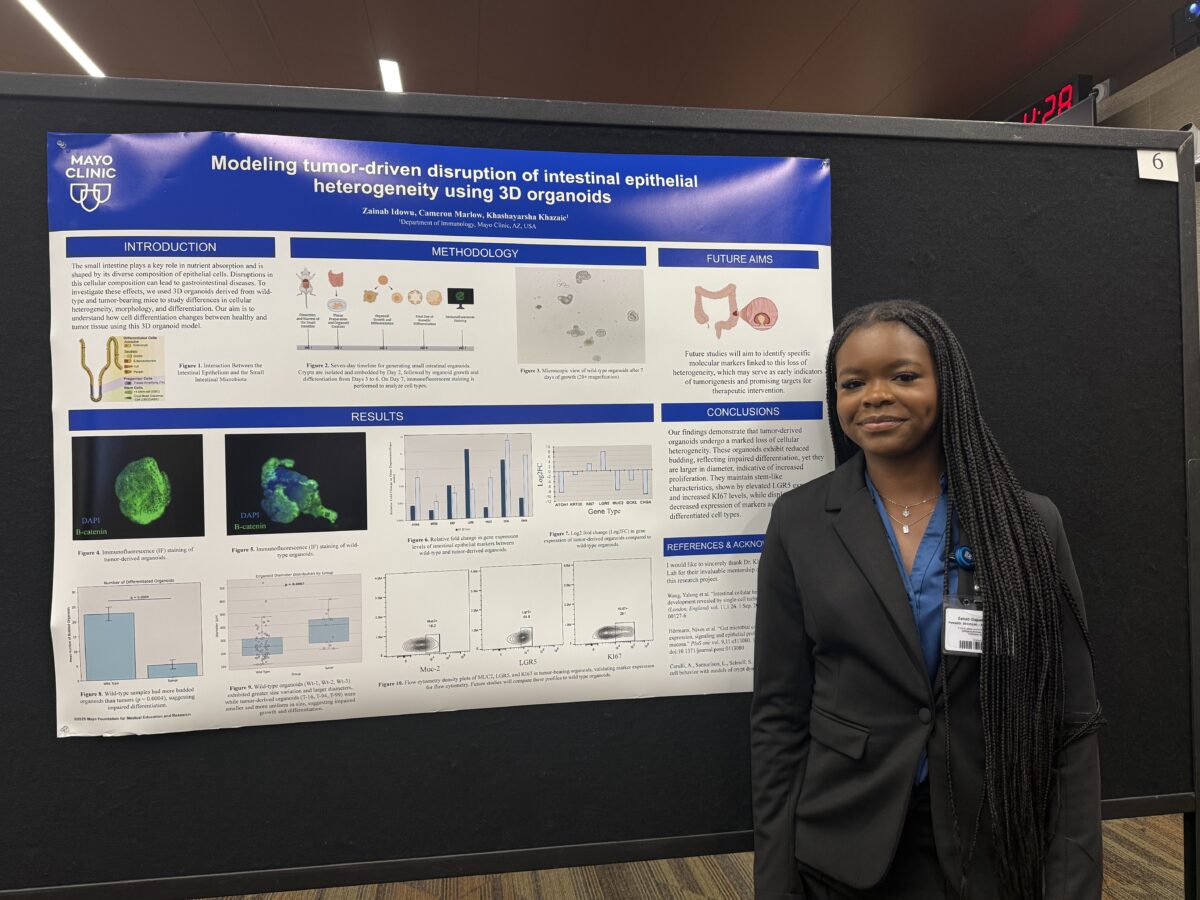 Zainab Idowu presented a research poster at the conclusion of a previous internship at the Mayo Clinic. She was supported by two mentors at the Mayo Clinic, Khashayarsha Khazaie (far left) and Cameron Marlow. (Courtesy of Idowu)
“I love everyone on my team,” Idowu says. “My managers, Ashley Ruddy and Jen Fox, were really insightful—giving me advice on what I want to do post-grad and what I should do my senior year to make sure I’m well-positioned for after graduation.” And when she had questions, the collaborative atmosphere showed her how scientists work together. “They were able to give recommendations and point me to scientific literature to help me along,” she says.
Opportunities through Meyerhoff gave her the chance to connect with AstraZeneca staff, which helped her secure the internship. “I was able to talk to them about my passions for research,” she says. Roles with UMBC’s chapters of the Society of Women Engineers, the international professional medical fraternity Phi Delta Epsilon, the National Society of Black Engineers, and the African Students Association have also enriched her UMBC experience. These organizations, she says, offered “a place to be ourselves, find new friends, and really build a home here at UMBC.”
The benefit of seeing both sides
 Saeed Damadi (left) and his wife Sepideh Hematian at her graduation from UMBC’s master’s program in data science.
Saeed Damadi recently defended his Ph.D. thesis in applied mathematics after beginning in electrical engineering. This summer at the FDA, he developed a mathematical model for how illicit drugs taken during pregnancy transfer to the developing baby through the placenta—increasing important understanding in a situation where human testing would be profoundly unethical.
While the math was familiar, Damadi welcomed the new challenge of jumping into biology. “I learned so many things, and I am still learning,” he says. Yet he found that his interest in how to describe randomness mathematically, which led him to complete a master’s in statistics on the way to his Ph.D., was highly relevant to studying the quirks of the human body. Looking ahead, he wants to continue work at the interface of biology and mathematics.
“Hopefully in the future I can make a contribution by bridging fields,” Damadi says, “because you can computationally simulate millions of parameters and patients at once, which makes the rate of iteration and discovery much faster.” The work Damadi and colleagues do with simulations can help effectively target limited resources for expensive and lengthy clinical studies, he explains.
Damadi and his wife, Sepideh Hematian, M.S. ’23, data science, and a former data scientist at the Maryland Department of Human Services, are planning to build their lives in California. They are both thriving, but “sometimes I get emotional thinking about UMBC,” Damadi says, “because after I arrived nine years ago from Iran, it became like a home to me and my wife.”
 Saeed Damadi (center) with his wife Sepideh Hematian (third from right), Ph.D. advisor Jinglai Shen (third from left), and the rest of his thesis committee and other members of the UMBC math faculty at his Ph.D. defense. (Courtesy of Damadi)
Damadi has given back through his teaching. As an engineer, “I just learned how to use the mathematical tools without understanding what was going on behind the scenes,” he says. Whereas, in math, “you learn the origins of all the theorems and how they work, but not necessarily how to apply them. I feel super lucky to get to see both sides.” So, in undergraduate calculus and linear algebra courses, “I just wanted to explain to my students, ‘Why do you need these equations? Why are they important?’ and give them a feeling of gratitude.”
Gratitude threads through all four of these journeys—for mentors who reach back, for teams that invest in their members, for communities that feel like home, and for the chance to do work that matters. As Magdalen Ruth at NIH puts it, “I’ve just found myself in a great spot with UMBC. I feel really blessed to have had all the opportunities I’ve had. Being able to do these internships has seriously been great.”
]]>
Every morning this summer, junior biological sciences major Magdalen Ruth made her way to the National Institutes of Health in Bethesda—a dense hub of biomedical research. There, at the National...
https://umbc.edu/stories/cnms-interns-mentorship-belonging-opportunity/
https://my3.my.umbc.edu/api/v0/pixel/news/161797/guest@my.umbc.edu/dacd98bb3662b16e6b4733ee94746d77/api/pixel
alumni
biology
career-center
chemical-biochemical-and-environmental-engineering
chemistry-and-biochemistry
cnms
coeit
community
data-science
internships
mathstat
meche
meyerhoff-scholars
science-and-tech
stories
story
undergraduate-research
urise
UMBC News & Magazine
https://my3.my.umbc.edu/groups/umbc-news-magazine
https://assets1-my.umbc.edu/system/shared/avatars/groups/000/001/943/24435aa6207c452e7bc15cc74b42c7bb/xsmall.png?1748556657
https://assets1-my.umbc.edu/system/shared/avatars/groups/000/001/943/24435aa6207c452e7bc15cc74b42c7bb/original.png?1748556657
https://assets2-my.umbc.edu/system/shared/avatars/groups/000/001/943/24435aa6207c452e7bc15cc74b42c7bb/xxlarge.png?1748556657
https://assets2-my.umbc.edu/system/shared/avatars/groups/000/001/943/24435aa6207c452e7bc15cc74b42c7bb/xlarge.png?1748556657
https://assets3-my.umbc.edu/system/shared/avatars/groups/000/001/943/24435aa6207c452e7bc15cc74b42c7bb/large.png?1748556657
https://assets1-my.umbc.edu/system/shared/avatars/groups/000/001/943/24435aa6207c452e7bc15cc74b42c7bb/medium.png?1748556657
https://assets2-my.umbc.edu/system/shared/avatars/groups/000/001/943/24435aa6207c452e7bc15cc74b42c7bb/small.png?1748556657
https://assets1-my.umbc.edu/system/shared/avatars/groups/000/001/943/24435aa6207c452e7bc15cc74b42c7bb/xsmall.png?1748556657
https://assets2-my.umbc.edu/system/shared/avatars/groups/000/001/943/24435aa6207c452e7bc15cc74b42c7bb/xxsmall.png?1748556657
UMBC News & Magazine
1
0
false
Thu, 20 Aug 2026 12:10:24 -0400
Thu, 20 Aug 2026 12:10:24 -0400
There’s nothing secret about David Mountain’s love of learning
David Mountain, Ph.D. ’17, computer engineering, can’t tell you much about his job. It still sounds exciting. As a researcher at the National Security Agency (NSA)—sometimes jokingly called the “No Such Agency” because of its top secret signal intelligence and cybersecurity work—Mountain worked to develop groundbreaking computing technology over a career spanning more than four decades.
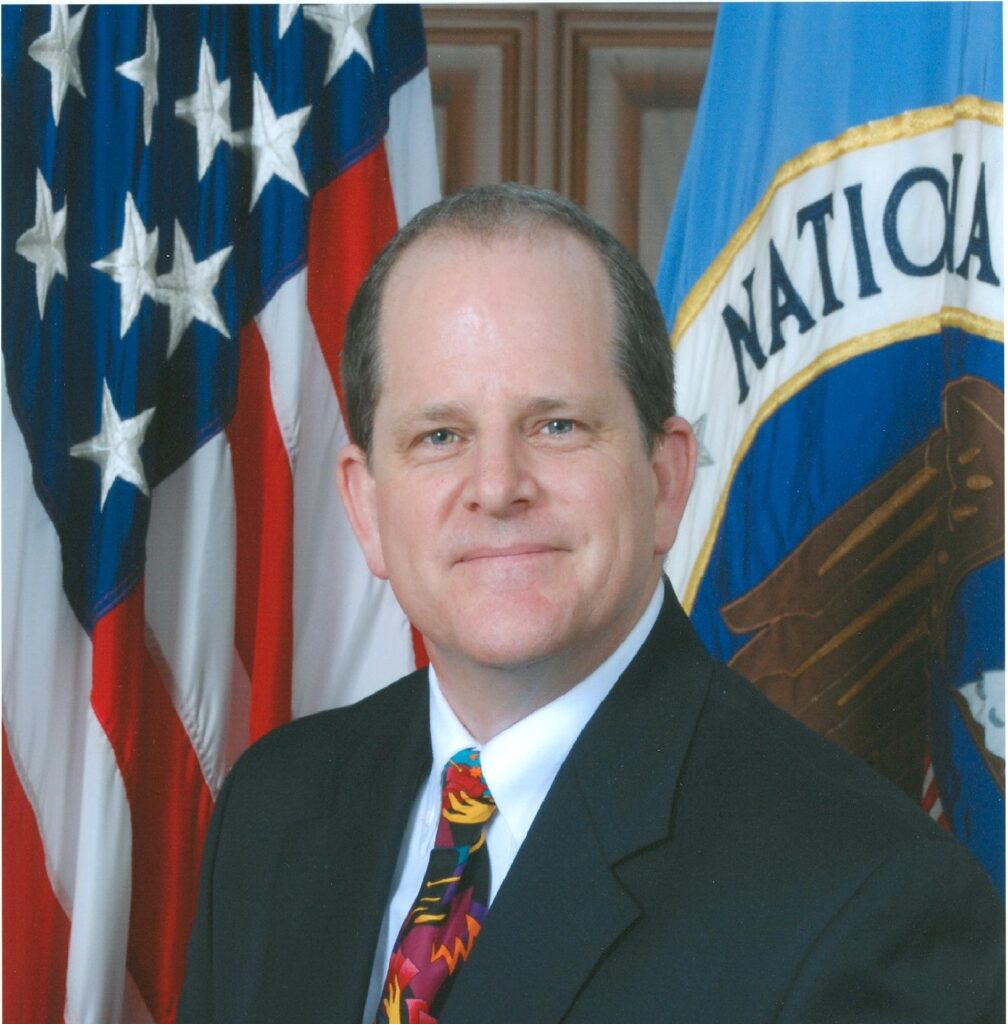 David Mountain worked his entire career for the U.S. National Security Agency. (Photo courtesy of Mountain)
“The most fun projects started with an operational organization [within NSA] asking us, ‘Can you do this [perhaps wild-sounding] thing?’ and ended with them telling us they fielded the devices we built and they are working great,” he says.
Pop culture often portrays the NSA as a shadowy spy agency. From Mountain’s perspective, his job was not the thrilling escapades of James Bond, but had a certain resemblance to the high-tech wizardry of Q, who supplies Bond with his cool gadgets. Mountain’s colleagues were curious people who loved tackling hard science, math, and engineering problems. Add to that the mission of protecting U.S. national security and it equaled a fulfilling work environment.
Looking back, Mountain splits his career into two approximately 15-year blocks, the first spent “doing really hardcore technical stuff,” from which he earned numerous patents, and the second half coordinating the work of technical teams and mentoring the next generation of researchers. Along the way, he also spent multiple years taking advantage of NSA internship and development programs.
Sometimes Mountain’s work did see public light, such as his research into building flexible electronics, with applications in “smart” clothing, autonomous vehicles, solar panels, and more. The research was shared with industry through the NSA’s Technology Transfer Program.
Now (mostly) retired, Mountain says the best part of his job was the opportunity to constantly explore new topics and take on new challenges.
“The government was really good about education and developing people, and I took full advantage of that,” Mountain says. “I got paid to learn new things, and that was great.”
Imagining a new type of computer hardware
It was the love of learning that brought Mountain late in his career to UMBC as a Ph.D. student. He had already made use of NSA programs to earn his master’s degree in electrical engineering from the University of Maryland, College Park, and to take research sabbaticals. After enrolling as a UMBC student in 2014, Mountain worked with his advisor Anupam Joshi, a computer science and electrical engineering professor and now the university’s chief A.I. officer, on a Ph.D. dissertation exploring a concept called neuromorphic computing.
In neuromorphic computing, researchers take inspiration from the human brain to reimagine traditional computing hardware. While traditional computers perform data processing and memory operations in physically separate units, neuromorphic systems merge the functions at artificial “synapses.” Neuromorphic systems also generally trigger calculations when they receive an input signal, rather than performing operations at regular, clock-based intervals. These changes improve computers’ energy efficiency and adaptability when applied to most AI tasks today, such as image and speech recognition.
For his Ph.D., Mountain analyzed a new type of electrical circuit building block, called a memristor, that shows promise in neuromorphic computing. Mountain explored how arrays of memristors divided into small chunks, or “tiles,” could be flexibly combined to handle a variety of tasks, including recognizing hand-written digits and detecting malware. The conclusion, Mountain says, was that with additional hardware improvements it should be possible to build a general purpose neuromorphic computer—similar to our general purpose personal computers of today—that could handle a wide variety of tasks with both high performance and energy efficiency.
Mountain was drawn to UMBC for his Ph.D. in part because of its close proximity to where he worked in the Advanced Computing Systems group of the NSA’s Laboratory for Physical Sciences, located at the bwtech@UMBC Research and Technology Park. The Laboratory for Physical Sciences is a partnership that the government runs with industry and university partners to advance research in communication, sensing, and computer technologies. Prior to beginning his Ph.D. work, Mountain had developed many positive relationships with UMBC faculty and students, including collaborating with Matthias Gobbert, a professor of mathematics and statistics at UMBC, on several high-performance computing research projects for undergraduate students, funded by the National Science Foundation.
During his Ph.D. research, Mountain took numerous UMBC graduate courses, and credits computer science and electrical engineering professor Fow-Sen Choa and associate professor Ryan Robucci with providing valuable guidance and support that shaped his research.
“I was a non-traditional student and everyone supported me in that,” Mountain says.
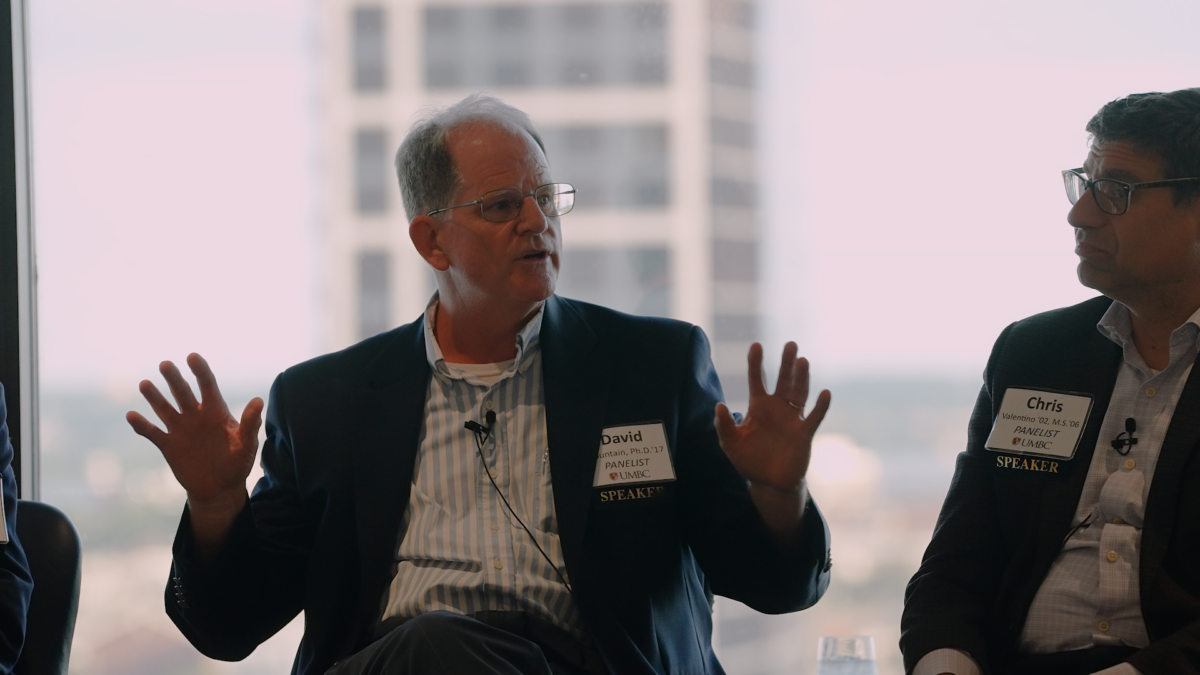 David Mountain (left) speaks at the Hilltop Society’s event “Artificial Intelligence: Making Our Lives Healthier, Safer, and More Efficient,” held at the The Center Club in Baltimore. (Elijah Davis, M.F.A. ’21/UMBC)
“David is super smart and well respected,” Joshi says. Joshi’s own Ph.D. thesis explored how computers might learn like biological brains, specifically examining how a type of machine learning approach called neural networks could be organized in a similar way to the early stages of human’s visual processing system. “With David, the research came full circle,” Joshi says. “I looked at how biology could be emulated in software. David was looking at how to create the hardware.”
Staying connected and giving back
Mountain lives in the southwest Baltimore neighborhood of Ten Hills, a 10-minute drive from the UMBC campus. Since graduating with his Ph.D., he has served on the advisory board for the Department of Computer Science and Electrical Engineering, networked with students at various career-focused events, and developed and taught a graduate level quantum computing course, designed to help build the quantum workforce by providing computer scientists and engineers with an accessible introduction to core quantum computing concepts.
On May 28, Mountain served as an expert panelist at an event organized by the Hilltop Society exploring how AI can create a healthier, safer, and more efficient future. He was joined by Jennifer Sleeman, Ph.D. ’17, computer science, a senior AI research scientist at The Johns Hopkins Applied Physics Laboratory, and Chris Valentino ’02, M.S. ’06, information systems, the vice president of cyber and information solutions at Northrop Grumman.
Enjoying semi-retirement with his wife, Diane, with whom he raised four children, Mountain now regularly travels, visits the theatre and museums, and takes the occasional consulting gig. “My wife and I joke that we have become wise asses on the hill,” he says. He’s happy to dispense opinions on the future of computing and AI, the prospects of data centers in space, and more. Just don’t ask him too much about what he did for a living.
]]>
David Mountain, Ph.D. ’17, computer engineering, can’t tell you much about his job. It still sounds exciting. As a researcher at the National Security Agency (NSA)—sometimes jokingly called the...
https://umbc.edu/stories/david-mountain-csee-alumnus/
https://my3.my.umbc.edu/api/v0/pixel/news/161588/guest@my.umbc.edu/46242d59b32067999c02c4b82aa7b423/api/pixel
alumni
bwtech
coeit
csee
graduate-research
research
science-and-tech
stories
story
UMBC News & Magazine
https://my3.my.umbc.edu/groups/umbc-news-magazine
https://assets1-my.umbc.edu/system/shared/avatars/groups/000/001/943/24435aa6207c452e7bc15cc74b42c7bb/xsmall.png?1748556657
https://assets1-my.umbc.edu/system/shared/avatars/groups/000/001/943/24435aa6207c452e7bc15cc74b42c7bb/original.png?1748556657
https://assets2-my.umbc.edu/system/shared/avatars/groups/000/001/943/24435aa6207c452e7bc15cc74b42c7bb/xxlarge.png?1748556657
https://assets2-my.umbc.edu/system/shared/avatars/groups/000/001/943/24435aa6207c452e7bc15cc74b42c7bb/xlarge.png?1748556657
https://assets3-my.umbc.edu/system/shared/avatars/groups/000/001/943/24435aa6207c452e7bc15cc74b42c7bb/large.png?1748556657
https://assets1-my.umbc.edu/system/shared/avatars/groups/000/001/943/24435aa6207c452e7bc15cc74b42c7bb/medium.png?1748556657
https://assets2-my.umbc.edu/system/shared/avatars/groups/000/001/943/24435aa6207c452e7bc15cc74b42c7bb/small.png?1748556657
https://assets1-my.umbc.edu/system/shared/avatars/groups/000/001/943/24435aa6207c452e7bc15cc74b42c7bb/xsmall.png?1748556657
https://assets2-my.umbc.edu/system/shared/avatars/groups/000/001/943/24435aa6207c452e7bc15cc74b42c7bb/xxsmall.png?1748556657
UMBC News & Magazine
0
0
false
Thu, 13 Aug 2026 09:30:44 -0400
Thu, 13 Aug 2026 09:30:44 -0400
Meet a Retriever—Kyle Clelan ’08, M.A. ’09, private investments manager and Retriever Loyal donor
Meet Kyle Clelan, a double alumnus who earned his B.S. in financial economics in 2008 and his M.A. in economic policy analysis in 2009. Today, he serves as a private investments manager with The Johnson Group, building on a successful career with stints at the U.S. Commodity Futures Trading Commission and T. Rowe Price. Kyle is also a Retriever Loyal donor, having given back to UMBC for the past eight years. Take it away, Kyle!
Q: What brought you to UMBC?
A: I was primarily drawn to UMBC because of its academically-centered reputation coming out of high school. I wanted to go to school, study, and work hard so that I could get to my career as soon as possible. Then I found myself surrounded by similarly-minded people and started making some lifelong friendships—many of whom were in my wedding. Meeting so many great people with a vast array of life experiences and backgrounds enhanced my time at UMBC immensely and helped me to slow down and enjoy the journey.

 Left: Clelan when he first started at UMBC and lived in Chesapeake Hall. Right: Clelan and his first-year roommate, Matt Basch ’08, M.S. ’09, who became a lifelong friend.
Q: What did you love about the economics programs at UMBC?
A: The economic policy analysis program in particular introduced me to econometric and data science concepts and how they can apply to investment management and policy decision-making. I have used foundational knowledge I learned in that coursework over and over throughout my career. From how to build a model using Stata or SAS, for example, to learning how to organize data and look for anomalies that can help inform better risk management, the courses taught me how to think better analytically and holistically.
Q: Who in the community inspired you or supported you?
A: Doug Lamdin in the Department of Economics was my M.A. advisor, and I also did work with him during my time as an undergraduate. He helped me connect the dots between academia and practice by pushing me to do research with real-world market data. He also introduced me to several professional mentors and helped me find my initial internship at T. Rowe Price, where I spent the first 12 years of my professional career. That experience has been instrumental to where I am today.
Without Dr. Lamdin’s guidance and support, I likely would have never found that pivotal opportunity. And the knowledge I acquired and various investment and technical courses continue to come in handy in roles I have had and have now.
Q: What’s one thing you’d want someone to know about the support you find at UMBC?
A: I came to UMBC expecting a healthy balance of academic rigor and the opportunity to develop lasting relationships and connections. I was not disappointed. UMBC offers a myriad of opportunities to perform meaningful research. Undergraduate Research and Creative Achievement Day, also known as URCAD, is one example that was very rewarding for me to publish my first paper. There are real pipelines that I personally benefitted from to get my career going, which showed me opportunities that wouldn’t have been possible without UMBC. It’s all about being proactive and seeking them out because the resources are there.
The UMBC community really engages with alumni and cares how they are doing after graduation.
Kyle Clelan ’08, M.A. ’09
financial economics
Q: Tell us about your current job. What do you like most about it?
A: For the past five years, I was a risk analyst within the Risk Surveillance Branch at the U.S. Commodity Futures Trading Commission (CFTC). I enjoyed performing broad derivatives market oversight work where we published reports on a regular basis to help better inform the public and help markets better manage systemic risks.
For the last year, I have relocated to being nearer to family in South Carolina and am working as a private investments manager for a family office and set of operating companies. In this role, I am applying the investment and risk management knowledge acquired from UMBC and my career, and I am enjoying being part of investment and capital allocation decisions that directly affect investment outcomes that benefit the company and also the local community.
Q: What drives you to support UMBC?
A: Without financial support from aid and scholarships, I likely would not have been able to attend college at all. So, giving back in whatever way I can now is important to me and my family because it could be just the little bit extra that makes all of the difference for someone to make something really special happen.
* * * * *
UMBC’s greatest strength is its people. When people meet Retrievers and hear about the passion they bring, the relationships they create, the ways they support each other, and the commitment they have to inclusive excellence, they truly get a sense of our community. That’s what “Meet a Retriever” is all about.
Learn more about how UMBC can help you achieve your goals.
]]>
Meet Kyle Clelan, a double alumnus who earned his B.S. in financial economics in 2008 and his M.A. in economic policy analysis in 2009. Today, he serves as a private investments manager with The...
https://umbc.edu/stories/meet-kyle-clelan-financial-economics/
https://my3.my.umbc.edu/api/v0/pixel/news/161541/guest@my.umbc.edu/f3bf184af8cd0e930c021c9d0b7bff32/api/pixel
alumni
cahss
financial-economics
impact
stories
story
UMBC News & Magazine
https://my3.my.umbc.edu/groups/umbc-news-magazine
https://assets1-my.umbc.edu/system/shared/avatars/groups/000/001/943/24435aa6207c452e7bc15cc74b42c7bb/xsmall.png?1748556657
https://assets1-my.umbc.edu/system/shared/avatars/groups/000/001/943/24435aa6207c452e7bc15cc74b42c7bb/original.png?1748556657
https://assets2-my.umbc.edu/system/shared/avatars/groups/000/001/943/24435aa6207c452e7bc15cc74b42c7bb/xxlarge.png?1748556657
https://assets2-my.umbc.edu/system/shared/avatars/groups/000/001/943/24435aa6207c452e7bc15cc74b42c7bb/xlarge.png?1748556657
https://assets3-my.umbc.edu/system/shared/avatars/groups/000/001/943/24435aa6207c452e7bc15cc74b42c7bb/large.png?1748556657
https://assets1-my.umbc.edu/system/shared/avatars/groups/000/001/943/24435aa6207c452e7bc15cc74b42c7bb/medium.png?1748556657
https://assets2-my.umbc.edu/system/shared/avatars/groups/000/001/943/24435aa6207c452e7bc15cc74b42c7bb/small.png?1748556657
https://assets1-my.umbc.edu/system/shared/avatars/groups/000/001/943/24435aa6207c452e7bc15cc74b42c7bb/xsmall.png?1748556657
https://assets2-my.umbc.edu/system/shared/avatars/groups/000/001/943/24435aa6207c452e7bc15cc74b42c7bb/xxsmall.png?1748556657
UMBC News & Magazine
0
0
false
Tue, 11 Aug 2026 08:44:06 -0400
Tue, 11 Aug 2026 08:44:06 -0400
Meet a Retriever—Annie Byrd ’04, M.P.S. ’23, birth worker advocate who creates employment connections for UMBC students
Annie Byrd ’04, emergency health services, M.P.S. ’23, community leadership, began her staff career at UMBC as an executive administrative assistant and she is now the Career Center’s assistant director for employer relations. She attributes her growth as a leader to UMBC’s supportive environment that encouraged members to make an impact in their communities. Annie says that the community leadership program helped her connect the dots between her undergraduate degree in emergency health services, her experience as a doula—a trained professional who provides emotional, physical, and informational support during pregnancy, birth, and the postpartum period—and her passion for maternal health equity and social justice. She then integrated these values into systems-level change, co-founding the Doula Alliance of Maryland.
Q: What’s one essential thing you’d want another Retriever to know about you?
A: I’ve been part of the UMBC community for over 20 years—as an undergraduate, graduate student, and a staff member. I love building connections, supporting students, and finding creative solutions that help people succeed.
Q: Tell us about someone in the UMBC community who has inspired you.
 Byrd, second from left, in May 2026 with the student staff she supervises. “This is why I do what I do—students!”
A: Yvette Mozie-Ross [’88, currently vice provost for enrollment management and planning] saw potential in me before I saw it in myself. As my first supervisor at UMBC, she encouraged me to continue my education and pursue new opportunities. Her mentorship helped shape my journey from executive administrative assistant to assistant director.
Q: Tell us about what you love about your academic program or an organization you’re involved in at UMBC.
A: What I loved most about the M.P.S. in Community Leadership was learning alongside people committed to creating change. The program challenged me to think strategically, and it directly inspired my work co-founding the Doula Alliance of Maryland to advance equitable maternal health.
Q: What’s the one thing you’d want someone who hasn’t joined the UMBC community to know about the support you find here?
A: What makes UMBC special is that everyone belongs here. It’s an inclusive community that values curiosity, encourages ambitious ideas, and provides the support to help you grow personally, academically, and professionally.
Q: What part of your job do you enjoy the most and why?
A: Student interactions are what I enjoy most. I love helping students discover opportunities, build confidence, and recognize the skills they already have. It’s rewarding to know that even one conversation can have a lasting impact on their career journey.
Q: What brought you to UMBC?
 Byrd at the May 2023 graduation ceremony for her M.P.S. in Community Leadership.
A: I came to UMBC as an undergraduate and a student-athlete, and I’ve come back as a staff member because I experienced firsthand how transformative this community can be. UMBC has shaped my life. I met my husband, built lifelong friendships, and found a career where I can help students create their own UMBC stories.
Q: At UMBC, how have you found support for birth work advocacy?
A: The community leadership program faculty and staff helped me turn my passion for birth work into systems-level change. Research shows that doula support is associated with better maternal health outcomes, yet many families—particularly those who have been historically marginalized—face significant barriers to accessing this care. Seeing both the impact of doulas and the inequities in access inspired me to co-found the Doula Alliance of Maryland to expand access and advance maternal health equity. Also, my Career Center colleagues have continued to support that mission, reminding me that UMBC values both professional growth and community impact.
Q: What would you tell someone who is considering a career at UMBC?
A: UMBC is a place where your ideas and potential are valued. It provides opportunities to grow your career while connecting your work to a larger purpose. My own journey from student to staff member shows how UMBC supports people who want to make a difference.
]]>
Annie Byrd ’04, emergency health services, M.P.S. ’23, community leadership, began her staff career at UMBC as an executive administrative assistant and she is now the Career Center’s assistant...
https://umbc.edu/stories/meet-a-retriever-annie-byrd-birth-worker-advocate/
https://my3.my.umbc.edu/api/v0/pixel/news/161335/guest@my.umbc.edu/411920c2945bc1cc733100111b1660e1/api/pixel
alumni
cahss
campus-life
career-center
community-leadership
dps
ehs
mps
stories
story
UMBC News & Magazine
https://my3.my.umbc.edu/groups/umbc-news-magazine
https://assets1-my.umbc.edu/system/shared/avatars/groups/000/001/943/24435aa6207c452e7bc15cc74b42c7bb/xsmall.png?1748556657
https://assets1-my.umbc.edu/system/shared/avatars/groups/000/001/943/24435aa6207c452e7bc15cc74b42c7bb/original.png?1748556657
https://assets2-my.umbc.edu/system/shared/avatars/groups/000/001/943/24435aa6207c452e7bc15cc74b42c7bb/xxlarge.png?1748556657
https://assets2-my.umbc.edu/system/shared/avatars/groups/000/001/943/24435aa6207c452e7bc15cc74b42c7bb/xlarge.png?1748556657
https://assets3-my.umbc.edu/system/shared/avatars/groups/000/001/943/24435aa6207c452e7bc15cc74b42c7bb/large.png?1748556657
https://assets1-my.umbc.edu/system/shared/avatars/groups/000/001/943/24435aa6207c452e7bc15cc74b42c7bb/medium.png?1748556657
https://assets2-my.umbc.edu/system/shared/avatars/groups/000/001/943/24435aa6207c452e7bc15cc74b42c7bb/small.png?1748556657
https://assets1-my.umbc.edu/system/shared/avatars/groups/000/001/943/24435aa6207c452e7bc15cc74b42c7bb/xsmall.png?1748556657
https://assets2-my.umbc.edu/system/shared/avatars/groups/000/001/943/24435aa6207c452e7bc15cc74b42c7bb/xxsmall.png?1748556657
UMBC News & Magazine
7
0
false
Tue, 28 Jul 2026 14:53:00 -0400
Tue, 28 Jul 2026 14:53:00 -0400
UMBC’s student Fulbright recipients pursue community-driven research on a global stage
UMBC’s 2026 – 2027 recipients of the prestigious Fulbright U.S. Student Program are joining the ranks of UMBC’s distinguished Fulbright alumni, who have made UMBC a three-time Fulbright Top Producing Institution, a recognition from the U.S. Department of State’s Bureau of Educational and Cultural Affairs.
More than 2,000 Fulbright U.S. Students—recent college graduates, graduate students, and early career professionals—pursue graduate study, conduct research, or teach English in schools abroad each year, earning placements in Africa, Asia and the Pacific, the Middle East, Latin America, and Europe. This year’s Fulbright Retrievers are launching the international phase of their research. From Baltimore to the Dominican Republic, India, and Mexico, these students are working with and for local communities to support local approaches to ongoing challenges.
The art of collaboration
During her senior year, Marelen Acevedo Soto ’26, visual arts, wowed Retrievers at UMBC’s 2025 Undergraduate Research and Creative Achievement Day with an experiential painting that combined projection, animation, and live performance. Now, she is packing up these skills and taking them to Santo Domingo, Dominican Republic, where she was born. Acevedo Soto earned her associate’s degree from Chavón School of Design. She is returning to work with the students to create a large-scale mural titled “Multidimensional Mural: Augmented Reality for Environmental Change” in Santo Domingo’s Zona Colonial (Colonial Zone), a UNESCO World Heritage site. Using QR codes, passersby will access animations and hear community voices describing how pollution affects daily life. The project will close with a Spanish and English multimedia performance combining projected animations, environmental data, and Dominican music.


Acevedo Soto (on the right) with artists from The Music and Me Foundation and at URCAD 2025. (Images courtesy of Acevedo)
“Many of my strongest ideas came from learning across different fields at UMBC,” says Acevedo Soto. “Music theory helped me think about rhythm and emotion. Storytelling taught me how to create meaningful experiences. Psychology helped me better understand how people think and engage with art. Environmental science deepened my understanding of water and the importance of its conservation, and data analysis gave me the tools to measure the impact of my project.”
Researchers’ responsibility
Vunnathi Ankem ’26, psychology, has had a passion for India for years, specifically how cultural exchange in India was shaped by hundreds of years of discourse, colonization, and history. While researching intimate partner violence (IPV) for her honors thesis, Vunnathi Ankem ’26, psychology, became interested in how South Asian students developed their understandings of IPV. Unexpectedly, most of the students she interviewed were from Telugu-speaking regions, such as Hyderabad in southern India. Intrigued, Ankem is now headed to the Psychology Center at the University of Hyderabad to continue her research. “Psychology, as we know it in the Western world, is only one approach to understanding the mind and the body,” says Ankem. “As psychology students, it is our responsibility to explore worlds and lenses beyond the Eurocentric ones.”
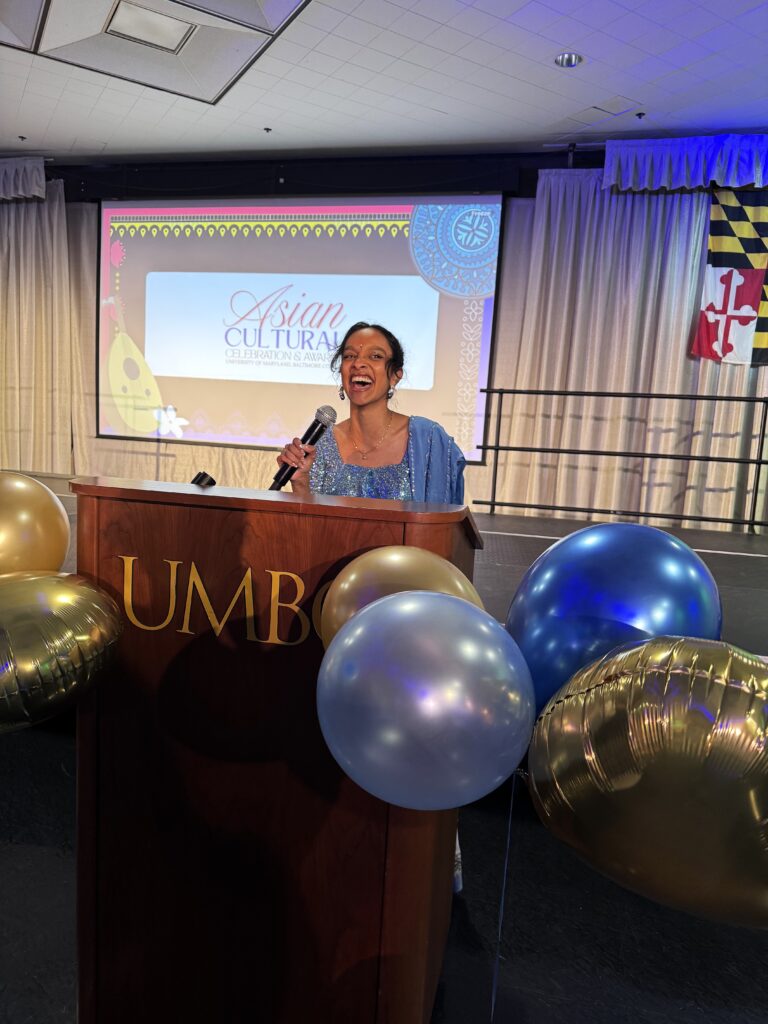
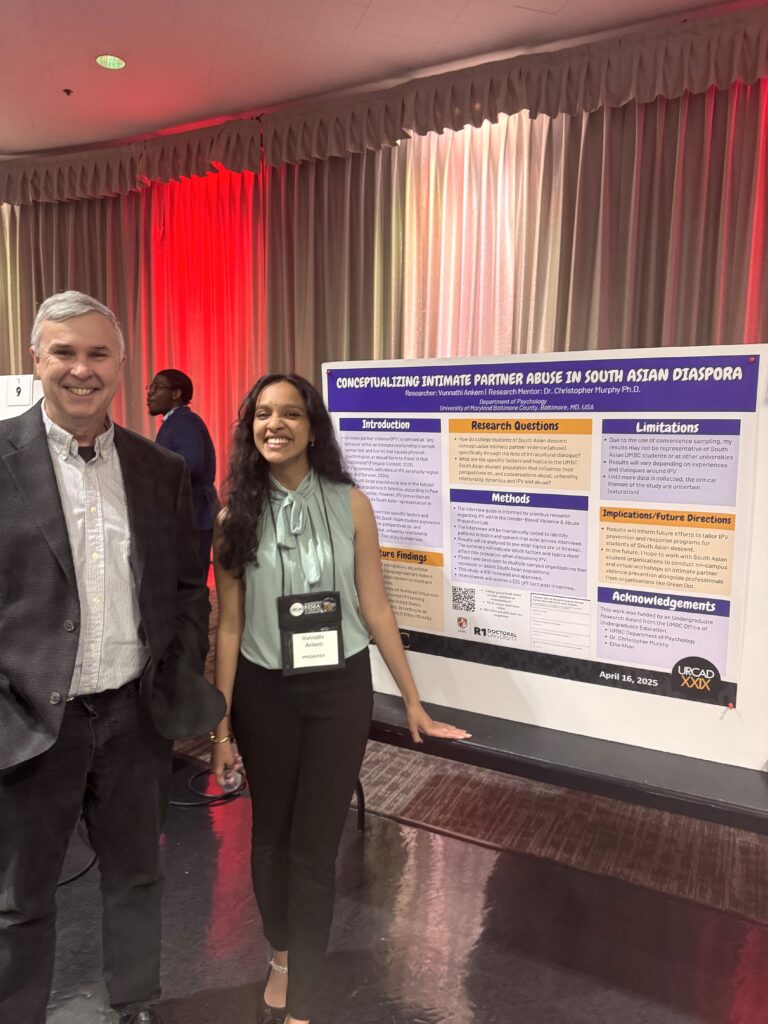
(l-r) Ankem at the 2026 Asian Cultural Celebration and Awards ceremony. Ankem with mentor Christopher Murphy, professor of psychology. (Images courtesy of Ankem)
She will study how systems, class, community, and culture shape experiences of IPV in India and inform more culturally responsive prevention strategies. Ankem will then develop community-based and community-led IPV prevention workshops. “The Fulbright program is giving me the opportunity I have always dreamed about,” says Ankem. “I can’t wait to learn from professionals and clinicians, alongside ancient culture practitioners and experts in India. It will be the experience of a lifetime!”
Humanistic climate futures
After studying climate change and migration on a study abroad trip to Oaxaca, Mexico, Bryan Castro-Velez ’26, geography and environmental studies, knew he was on the right research path—studying humanistic approaches to equitable agroecological systems and land in Indigenous Latin American communities. He says learning directly from indigenous leaders about their farming practices and response to climate change inspired him to apply for the Fulbright García-Robles award for graduate and doctoral research in Mexico. Castro-Velez’s graduate work will focus on agroecology, natural resource management, and rural development in Chiapas, Mexico.
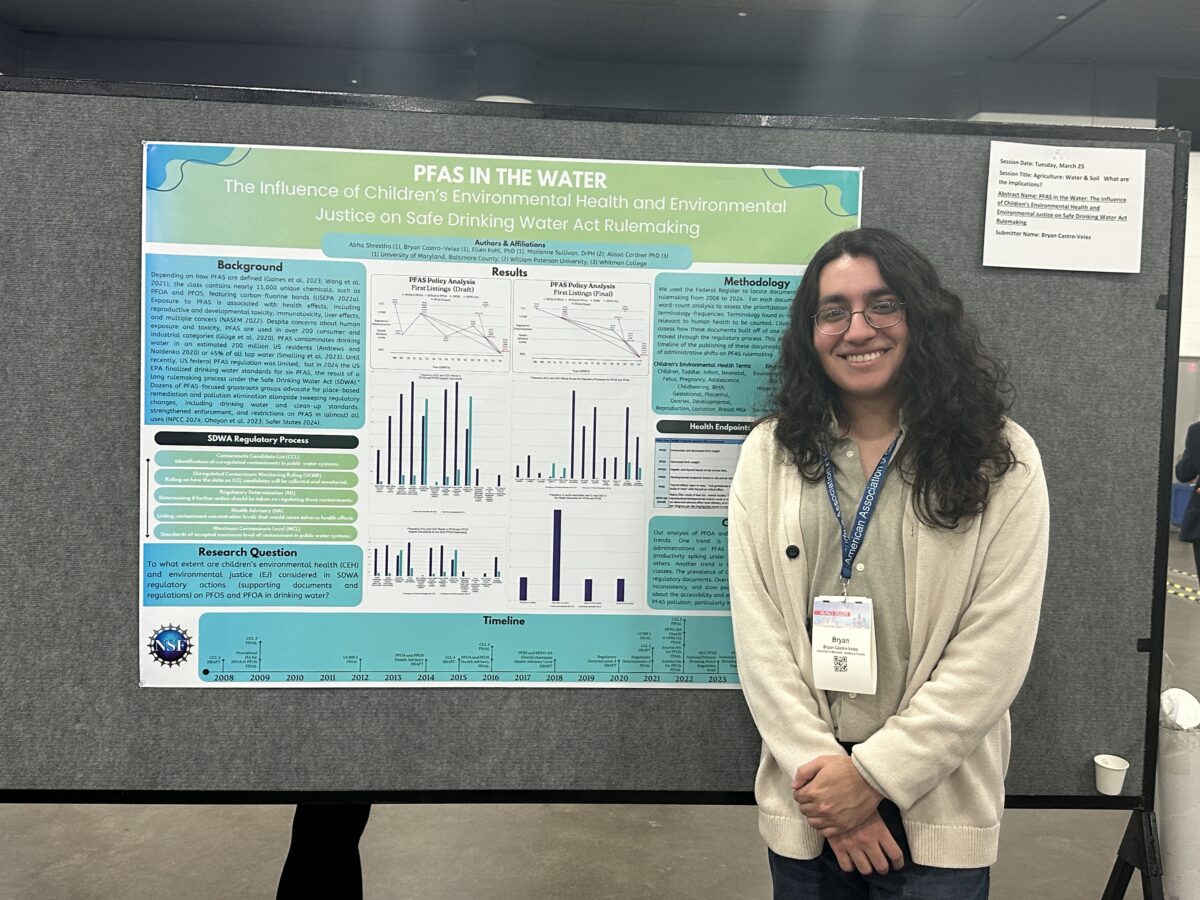 Bryan Castro-Velez at the 2025 Association of American Geographers annual conference in Detroit. (Image courtesy of Castro-Velez)
“I look forward to continuing down this path, encouraging others to do the same, and furthering my education outside the walls of academia,” says Castro-Velez. “My experiences during and outside of UMBC have proven to me that community-based learning systems are fundamental to just climate solutions and humanistic futures.”
As the U.S. Fulbright Program celebrates its 80th anniversary this year, UMBC’s Fulbright program is celebrating by expanding support through the Office of Prestigious Scholarships (OPS) under the leadership of April Householder ’95, director of OPS: “I am looking forward to building on UMBC’s strong legacy as a top producer of Fulbright students,” says Householder, “and expanding student support throughout the processes of exploring, applying, and transitioning abroad.”
Learn more about UMBC’s international opportunities.
]]>
UMBC’s 2026 – 2027 recipients of the prestigious Fulbright U.S. Student Program are joining the ranks of UMBC’s distinguished Fulbright alumni, who have made UMBC a three-time Fulbright Top...
https://umbc.edu/stories/umbcs-2026-student-fulbright-recipients/
https://my3.my.umbc.edu/api/v0/pixel/news/161318/guest@my.umbc.edu/3c2bd6a8225156f81db68222ed9fdd71/api/pixel
alumni
cahss
class-of-2026
community
fulbright
geographic-information-systems
international
policy-and-society
psychology
stories
story
urcad
visual-arts
UMBC News & Magazine
https://my3.my.umbc.edu/groups/umbc-news-magazine
https://assets1-my.umbc.edu/system/shared/avatars/groups/000/001/943/24435aa6207c452e7bc15cc74b42c7bb/xsmall.png?1748556657
https://assets1-my.umbc.edu/system/shared/avatars/groups/000/001/943/24435aa6207c452e7bc15cc74b42c7bb/original.png?1748556657
https://assets2-my.umbc.edu/system/shared/avatars/groups/000/001/943/24435aa6207c452e7bc15cc74b42c7bb/xxlarge.png?1748556657
https://assets2-my.umbc.edu/system/shared/avatars/groups/000/001/943/24435aa6207c452e7bc15cc74b42c7bb/xlarge.png?1748556657
https://assets3-my.umbc.edu/system/shared/avatars/groups/000/001/943/24435aa6207c452e7bc15cc74b42c7bb/large.png?1748556657
https://assets1-my.umbc.edu/system/shared/avatars/groups/000/001/943/24435aa6207c452e7bc15cc74b42c7bb/medium.png?1748556657
https://assets2-my.umbc.edu/system/shared/avatars/groups/000/001/943/24435aa6207c452e7bc15cc74b42c7bb/small.png?1748556657
https://assets1-my.umbc.edu/system/shared/avatars/groups/000/001/943/24435aa6207c452e7bc15cc74b42c7bb/xsmall.png?1748556657
https://assets2-my.umbc.edu/system/shared/avatars/groups/000/001/943/24435aa6207c452e7bc15cc74b42c7bb/xxsmall.png?1748556657
UMBC News & Magazine
0
0
false
Mon, 27 Jul 2026 17:10:21 -0400
Mon, 27 Jul 2026 17:10:21 -0400
A $1M alumni gift expands graduate student success and inclusive excellence in tech
In 2022, when Pam Offutt ’82, computer science, visited campus 40 years after graduating, she was taken aback by two things: how much the university had changed and how much it had stayed the same.
“While I can still see the bones of what we knew, it is almost unrecognizable,” says Pam, who loved seeing the new buildings and how much the campus had physically grown since she and her husband, Jay Offutt ’82, computer science, graduated. However, Pam was shocked to see that the percentage of women majoring in computer science had not changed much since 1982.
“We were part of the first graduating class in computer science at UMBC. It was brand new,” says Pam. “Back then, 18 percent of the computer science population was women. When I came back to campus and looked it up, the percentage was around 20 percent. And that just doesn’t sit right after 40 years.”
Determined to be part of the solution, Pam and Jay established the Pam and Jay Offutt Graduate Student Endowment in May 2026 with a transformational $1,040,000 gift. This significant investment will expand the Center for Women in Technology (CWIT) model at the graduate level, helping CWIT Scholars pursue advanced degrees at UMBC—a primary driver for moving into senior management and executive leadership roles after graduation.
While Pam’s personal experience has centered on gender equity, the Offutt endowment is designed to support any CWIT Scholar as they pursue graduate education in computing or technology, reflecting CWIT’s broader mission of inclusive excellence.
“We are tremendously grateful for Pam and Jay’s vision, which supports our commitment to inclusive excellence,” says Jeanne van Briesen, dean of the College of Engineering and Information Technology. “The endowment will help strengthen the pipeline of talent prepared for leadership in computing and technology careers.”
UMBC’s CWIT program is committed to developing community members who are prepared and empowered to be change agents in creating technology workplaces that are diverse, equitable, and inclusive. The program encourages the participation and success of all students, especially those from underrepresented groups, with a nurturing and challenging community, transformative leadership experiences, and professional development opportunities.
 CWIT Scholars, Cyber Scholars, and affiliates before UMBC’s spring 2026 Commencement ceremony. (Cindy Greenwood, M.P.S. ’21/UMBC)
“The CWIT office is buzzing with happy plans for recruiting and supporting the first cohort of Offutt Scholars this fall,” says Carolyn Seaman, director of CWIT. “We are grateful for this opportunity to support so many more of our students in taking the next step toward being the tech leaders we know they can be.”
Going beyond the gift
Pam and Jay knew the problem they wanted to solve, but they took time to discuss the issue with Seaman, van Briesen, and Kim Robinson, director of major gifts in the Office of Institutional Advancement, to come up with a plan that felt like it could make a difference.
“Maybe some people find value in giving money for the sake of giving money, but if it’s not going to solve a problem, what’s the point?”
Pam Offutt ’82
computer science
Simply funding scholarships wasn’t enough. Pam and Jay realized that in order to truly make a difference, they needed to find a way to support students throughout their academic journey. To the Offutts, the solution was simple—mentoring and leadership development.
Offutt Scholars will receive a financial award for two years to defray school expenses, participate in leadership development, mentor undergraduate CWIT Scholars, and be mentored by more senior alumni with similar professional interests. The endowment will also support staff and programming for Offutt Scholars through the CWIT Program. This investment extends beyond financial support to build a connected community across undergraduate students, graduate students, and professional mentors.
“What stands out to me about Pam and Jay’s vision is that they are not just investing in financial support for students—they are investing in a model that builds community, mentorship, and leadership that will shape how our students persist, succeed, and lead,” says van Briesen. “They asked us to think beyond access and to focus on what it takes for students to grow into leaders in the computing field.”
 CWIT Scholars alumni, UMBC alumni, and industry partners come together for Fall Career Networking, a signature CWIT event. Many featured alumni also mentor in CWIT’s industry mentor program. (Jess Myers/UMBC)
Pam believes deeply in mentorship. She served on the UMBC Alumni Association Board of Directors from 1998 to 2004, and, most recently, served as a CWIT industry mentor.
“What makes this gift so meaningful is the journey behind it,” says Robinson, who assisted in cultivating the relationship with the Offutts throughout their engagement with UMBC. “Pam has been engaged with UMBC in so many ways—through the Alumni Association Board, as a CWIT industry mentor, at career fairs—and that connection is exactly what led her and Jay to see this gap and want to help close it.”
For Pam and Jay, it comes back to the experiences they had as undergraduate students at UMBC and how their careers unfolded after graduation.
Computer science pioneers
Pam and Jay both started UMBC as math majors—computer science was not yet an option—and met in Calculus 101. Boy meets girl. Boy and girl both become teaching assistants. Boy and girl form a close bond by terrorizing professors.
“As TAs, Jay and I both had keys to the same office and we used to torture the same professors that were right across the hall from us, flipping bottle caps and stuff into their room while they were teaching,” says Pam. “So, that got the door slammed on us at least a couple of times.”
It’s the classic UMBC love story.
One semester before Pam and Jay were set to graduate, UMBC launched the B.S. in computer science. Knowing what it could mean for their job prospects and earning potential, both switched majors.
“I took a couple of extra classes and finished the B.S.,” says Pam.
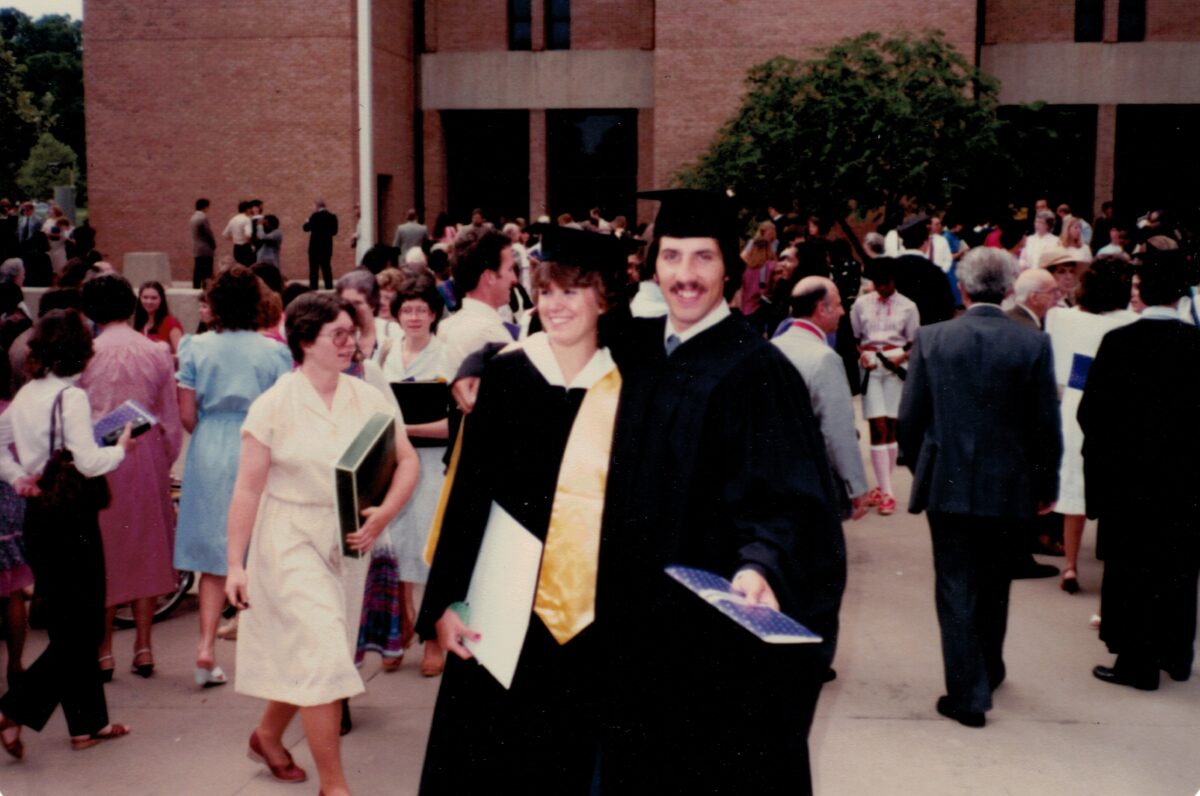
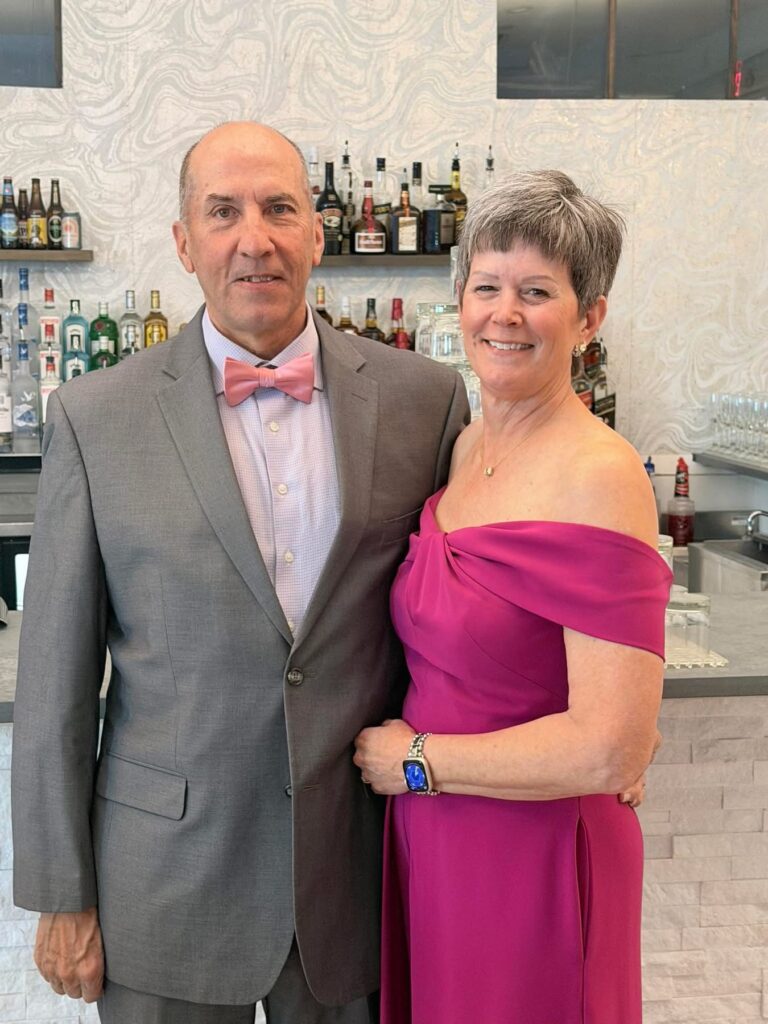 Left: Pam and Jay after their 1982 UMBC graduation. Right: The Offutts today. (Photos courtesy Pam and Jay Offutt)
After UMBC, Pam and Jay went on to Loyola University and earned master’s degrees.
In 1988, Jay founded Offutt Associates, which later folded into Interface and Control Systems, Inc. (ICS). Serving public and private sectors, ICS provided end-to-end autonomous command and control software for satellites, operational centers, testing setups, and digital business systems. Notably, ICS technology was integrated into major aerospace and defense initiatives, including NASA’s Constellation project and the Department of Defense’s TAC-SAT tactical satellite program. Jay and his partners sold ICS to SRA International in 2008, and Jay retired a few years later.
Meanwhile, Pam took on management and leadership roles in various companies, including COO at Edaptive Systems, LLC (acquired by ManTech) and CEO at MDMeta. In 2009, Pam and fellow UMBC alumnus John duClos ’90, information systems, founded Bellese Technologies, which engineers large-scale, human-centered digital products and data solutions that improve the quality, equity, and efficiency of public health systems. As CEO, Pam made a concerted effort to hire and promote women—successfully building a workforce that was 25 to 30 percent female. It was a stark contrast to the male-dominated workspaces she had experienced throughout her career, though still not the parity she envisioned. The problem, however, was not in the motivation, but in the small pool of potential female hires.
“You can’t find women to hire because women aren’t going into tech,” says Pam. “So it’s a difficult thing.”
Pam sold the company in 2022, and now serves on its Board of Directors. Around the same time, she had that inspirational visit to UMBC where she realized that she and Jay could be part of the solution, leading to the establishment of the Pam and Jay Offutt Graduate Student Endowment.
“I want to see that needle move,” says Pam.
]]>
In 2022, when Pam Offutt ’82, computer science, visited campus 40 years after graduating, she was taken aback by two things: how much the university had changed and how much it had stayed the...
https://umbc.edu/stories/inclusive-excellence-in-tech/
https://my3.my.umbc.edu/api/v0/pixel/news/161186/guest@my.umbc.edu/df6e441b7cb09e030249aa065efa7ab6/api/pixel
alumni
coeit
cwit
impact
stories
story
UMBC News & Magazine
https://my3.my.umbc.edu/groups/umbc-news-magazine
https://assets1-my.umbc.edu/system/shared/avatars/groups/000/001/943/24435aa6207c452e7bc15cc74b42c7bb/xsmall.png?1748556657
https://assets1-my.umbc.edu/system/shared/avatars/groups/000/001/943/24435aa6207c452e7bc15cc74b42c7bb/original.png?1748556657
https://assets2-my.umbc.edu/system/shared/avatars/groups/000/001/943/24435aa6207c452e7bc15cc74b42c7bb/xxlarge.png?1748556657
https://assets2-my.umbc.edu/system/shared/avatars/groups/000/001/943/24435aa6207c452e7bc15cc74b42c7bb/xlarge.png?1748556657
https://assets3-my.umbc.edu/system/shared/avatars/groups/000/001/943/24435aa6207c452e7bc15cc74b42c7bb/large.png?1748556657
https://assets1-my.umbc.edu/system/shared/avatars/groups/000/001/943/24435aa6207c452e7bc15cc74b42c7bb/medium.png?1748556657
https://assets2-my.umbc.edu/system/shared/avatars/groups/000/001/943/24435aa6207c452e7bc15cc74b42c7bb/small.png?1748556657
https://assets1-my.umbc.edu/system/shared/avatars/groups/000/001/943/24435aa6207c452e7bc15cc74b42c7bb/xsmall.png?1748556657
https://assets2-my.umbc.edu/system/shared/avatars/groups/000/001/943/24435aa6207c452e7bc15cc74b42c7bb/xxsmall.png?1748556657
UMBC News & Magazine
18
0
false
Mon, 20 Jul 2026 08:09:08 -0400
Mon, 20 Jul 2026 08:09:08 -0400
Meet a Retriever–Keisha Hale, M.A. ’20, Hurricane Katrina survivor, educator, researcher, and author
Meet Keisha Hale, M.A.’20, applied sociology. Keisha is an educator, researcher, and author. In 2025, she published We Weather the Storm: A Poetry Memoir of Survival and Healing, inspired by her experiences surviving Hurricane Katrina and navigating foster care. Her work centers on resilience, education, and giving voice to stories that are often overlooked. Whether she’s teaching fourth grade math, analyzing data, or writing poetry, Keisha is passionate about using storytelling and research to create understanding, inspire change, and help others feel seen. Take it away, Keisha!
Q: What initially brought you to UMBC?
A: I came to UMBC because I wanted to better understand the social systems that shape people’s lives and to gain the skills to create meaningful change. After experiencing Hurricane Katrina, navigating foster care, and witnessing firsthand how policies and institutions can impact individuals and families, I knew I wanted to study society in a way that combined research with real world application. UMBC’s applied sociology program stood out because it emphasized using data, research, and critical thinking to address complex social issues.
I wanted more than a degree. I wanted an education that would prepare me to serve my community, inform policy, and make a lasting impact.
Keisha Hale, M.A. ’20
Q: Can you tell us what you loved most about the applied sociology program?
A: What I loved most about UMBC’s applied sociology program was its emphasis on using research to solve real world problems. The program challenged me to think critically, analyze data, and understand the social systems that shape people’s lives. It encouraged me to move beyond theory and consider how research can inform policy, improve communities, and create meaningful change.
Q: Can you talk about your experience as a first generation student?
A: As a first generation graduate student, there were moments when I questioned whether I truly belonged. Like many students, I experienced imposter syndrome and wondered if I was capable enough to succeed. What I learned at UMBC is that belonging is not determined by where you come from, but by your willingness to learn, grow, and persevere.
I would encourage other first generation students to not let self doubt convince them they are less deserving of the opportunities they’ve earned. Ask questions, seek out mentors, build relationships, and take advantage of the support systems UMBC has to offer. There are people here who genuinely want to see you succeed.
Looking back, I realize that believing in myself was just as important as earning good grades. UMBC gave me the confidence to trust my abilities, find my voice, and pursue opportunities that have shaped my career as a researcher, educator, and author. I hope other students give themselves permission to do the same.
Q: Were you a part of any clubs or organizations at UMBC?
A: During my time at UMBC, I was an active member of Alpha Kappa Delta, the International Sociology Honor Society, and the Sociology Graduate Student Association. Both organizations gave me opportunities to connect with classmates who shared my passion for research, social justice, and community engagement.
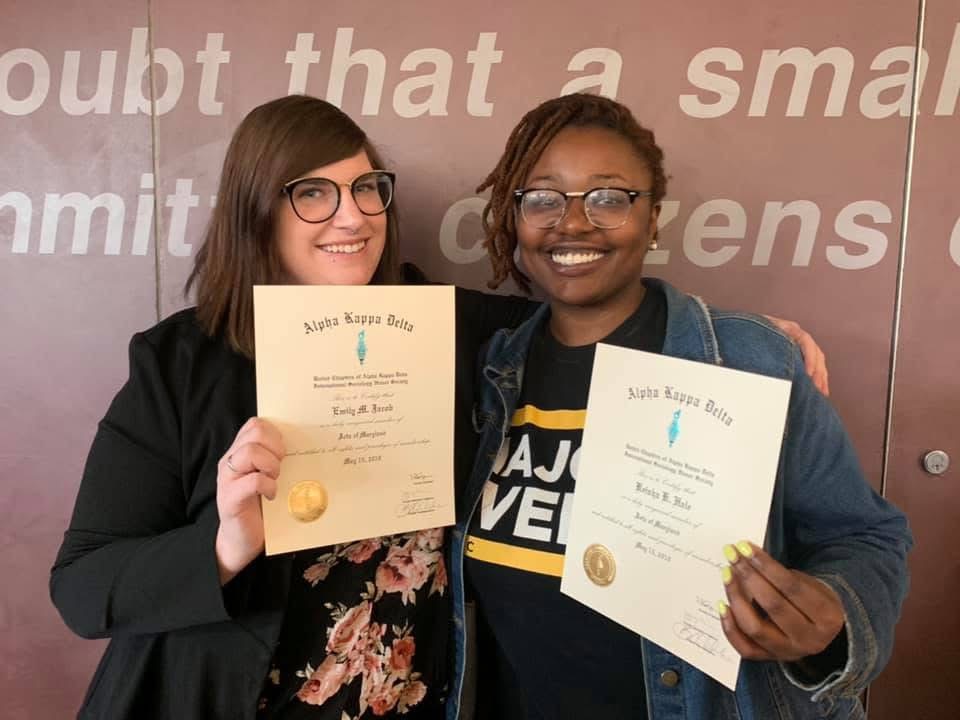 Hale (right) during Alpha Kappa Delta induction. (Photo courtesy Hale)
 Hale (left) at the Sociology Graduate Student Organization table during UMBC Career Month. (Photo courtesy Hale)
What I appreciated most was the opportunity to learn from one another beyond the classroom. Through these organizations, I built friendships, expanded my professional network, and engaged in meaningful conversations about research, policy, and the role sociology plays in addressing real world challenges. Those experiences strengthened my sense of belonging at UMBC and reinforced my commitment to using research and education to make a positive impact in my community.
Q: Where did you find support while at UMBC?
A: One of the things I valued most about my time at UMBC was the sense of community I found there. While there was not just one person who inspired me, the relationships I built as a graduate assistant had a lasting impact. Working alongside fellow graduate students, faculty, and staff allowed me to develop meaningful connections with people who became mentors, collaborators, and an important part of my support system.
One of those relationships was with my fellow graduate student, Samantha Fries ’18, M.A. ’25. We supported one another throughout our time at UMBC, encouraging each other academically and personally. That friendship has continued long after graduation, and I was honored to stand beside her as a member of her wedding party.
Some of the most meaningful parts of the UMBC experience are the lifelong relationships you build along the way.
Keisha Hale, M.A. ’20
Building a trusted, supportive community, whether through biological family or the family we create through friends, mentors, and colleagues, has always been essential to my success. UMBC reinforced that belief by surrounding me with people who invested in my growth both personally and professionally. Their encouragement gave me the confidence to pursue my goals, and those relationships continue to influence the way I approach my work as an educator, researcher, and author.
Q: Since you’ve been a part of the UMBC community, how have you found support for your dreams?
A: UMBC helped turn my aspirations into opportunities by surrounding me with people who believed in my potential and invested in my growth. As a graduate assistant, I gained hands-on experience while building meaningful relationships with faculty, staff, and fellow graduate students who encouraged me to challenge myself and pursue new opportunities.
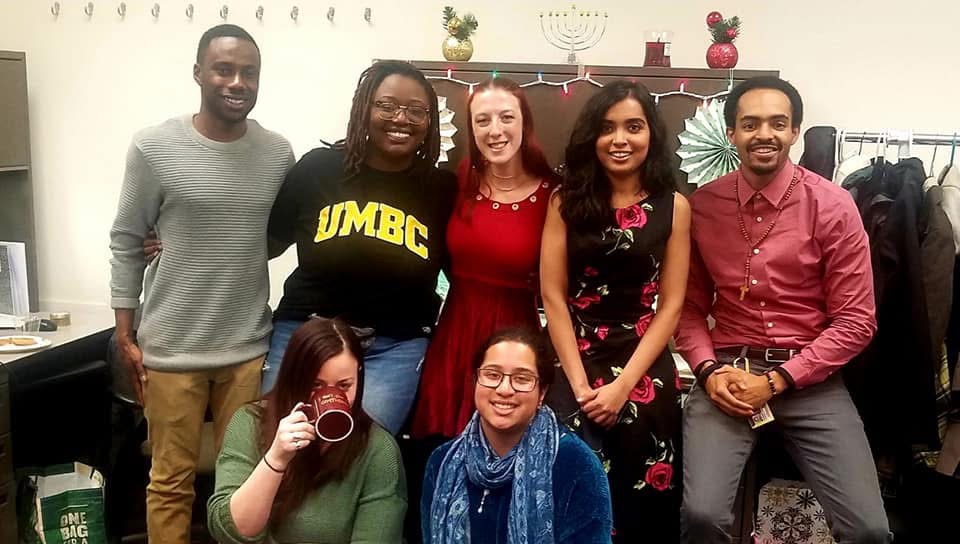 Hale (back row, second from left) and other applied sociology graduate students at a holiday party. (Photo courtesy Hale)
The knowledge and practical experience I gained through the applied sociology program prepared me for a career in research, beginning with my role at Westat, where I supported large scale federally funded studies. Just as importantly, the confidence and encouragement I received at UMBC inspired me to continue growing beyond research. Today, I am an educator, researcher, and author, and I carry the lessons, mentorship, and sense of community I found at UMBC into everything I do.
What has made the biggest difference is knowing that UMBC did not just prepare me academically. It gave me a network of people who continue to encourage, support, and celebrate one another long after graduation. That lasting community is one of the greatest gifts UMBC has given me.
Q: What is a piece of advice you would give a current UMBC student?
A: You never have to navigate your journey alone. UMBC is a place where people genuinely invest in one another’s success. Whether it is faculty who challenge and encourage you, classmates who become lifelong friends, or mentors who help you see your potential, there is a strong sense that everyone wants to see you succeed.
* * * * *
UMBC’s greatest strength is its people. When people meet Retrievers and hear about the passion they bring, the relationships they create, the ways they support each other, and the commitment they have to inclusive excellence, they truly get a sense of our community. That’s what “Meet a Retriever” is all about.
Learn more about how UMBC can help you achieve your goals.
]]>
Meet Keisha Hale, M.A.’20, applied sociology. Keisha is an educator, researcher, and author. In 2025, she published We Weather the Storm: A Poetry Memoir of Survival and Healing, inspired by her...
https://umbc.edu/stories/keisha-hale-author/
https://my3.my.umbc.edu/api/v0/pixel/news/161111/guest@my.umbc.edu/4edb0efc96ff6bca5429c2eba205c3f1/api/pixel
alumni
applied-sociology
arts-and-culture
cahss
graduate-school
retriever-authors
social-work
stories
story
UMBC News & Magazine
https://my3.my.umbc.edu/groups/umbc-news-magazine
https://assets1-my.umbc.edu/system/shared/avatars/groups/000/001/943/24435aa6207c452e7bc15cc74b42c7bb/xsmall.png?1748556657
https://assets1-my.umbc.edu/system/shared/avatars/groups/000/001/943/24435aa6207c452e7bc15cc74b42c7bb/original.png?1748556657
https://assets2-my.umbc.edu/system/shared/avatars/groups/000/001/943/24435aa6207c452e7bc15cc74b42c7bb/xxlarge.png?1748556657
https://assets2-my.umbc.edu/system/shared/avatars/groups/000/001/943/24435aa6207c452e7bc15cc74b42c7bb/xlarge.png?1748556657
https://assets3-my.umbc.edu/system/shared/avatars/groups/000/001/943/24435aa6207c452e7bc15cc74b42c7bb/large.png?1748556657
https://assets1-my.umbc.edu/system/shared/avatars/groups/000/001/943/24435aa6207c452e7bc15cc74b42c7bb/medium.png?1748556657
https://assets2-my.umbc.edu/system/shared/avatars/groups/000/001/943/24435aa6207c452e7bc15cc74b42c7bb/small.png?1748556657
https://assets1-my.umbc.edu/system/shared/avatars/groups/000/001/943/24435aa6207c452e7bc15cc74b42c7bb/xsmall.png?1748556657
https://assets2-my.umbc.edu/system/shared/avatars/groups/000/001/943/24435aa6207c452e7bc15cc74b42c7bb/xxsmall.png?1748556657
UMBC News & Magazine
0
0
false
Wed, 15 Jul 2026 09:27:49 -0400
Wed, 15 Jul 2026 09:27:49 -0400
“Don’t be afraid”—Doctoral student Demetrie Garner ’23, public health, and M.P.P ’25, overcame decades of opioid abuse disorder to serve as an overdose response expert
When Demetrie Garner moved from Maryland’s Eastern Shore to Baltimore, he found a wealth of opportunities in Baltimore, a strong spiritual practice, and a supportive network of friends and family. They became necessary anchors for recovering from opioid dependency and managing the workload of a full-time job while earning a bachelor’s, a master’s, and now a doctorate in public health from UMBC.
“My story has a lot of twists and turns. I came to Baltimore in 2018 for treatment for opioid use disorder after experiencing homelessness, incarceration, hospitalizations, and treatment programs. Recovery was a process of 26 years,” says Garner, who now works in the Baltimore City Mayor’s Office of Overdose Response. “When I came to Baltimore, I had a clean slate. I was able to go through an expungement process of criminal records, which was a list of misdemeanors that happened during my drug and alcohol addiction. My journey to UMBC began as an adult learner, at 40 years old, after a year in recovery.”
Understanding the bigger picture
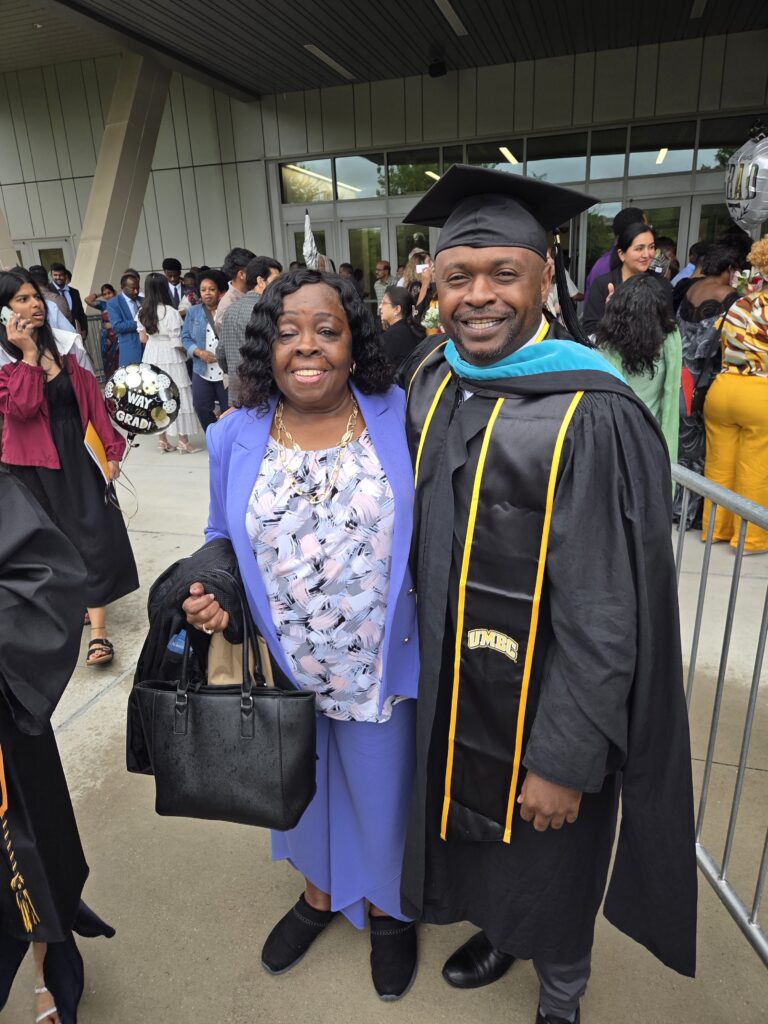 Garner with his mom, Clara Turner.
The inspiration to pursue a bachelor’s degree came from working as a recovery specialist at Franklin Square Hospital in Baltimore County, where he supported patients who had overdosed or were experiencing substance use disorders, many of whom faced significant social and economic conditions that negatively affected their health. Although he connected patients to treatment and recovery resources, he questioned why so many returned to the emergency department with the same challenges. That curiosity sparked a desire to better understand the systems, policies, and social factors driving addiction and recovery.
“I wanted to understand how healthcare is failing people in recovery,” says Garner. “I decided to go back to school. The logical step was to study public health.” Making the leap from working full-time and being a full-time student without a driver’s license posed many challenges. Thankfully, in addition to his faith, friends, and family, Garner also had a team of mentors at UMBC’s School of Public Policy that continue to support him to make his vision possible.
Garner immersed himself in public health research and learned about comorbidities, where patients are managing multiple health needs like substance dependency and mental health. He found that having multiple health needs with little to no healthcare is also exacerbated by homelessness, lack of transportation, inconsistent healthcare, or an environment not conducive to recovery. The emergency room could treat the symptoms but not the root causes.
“My undergrad journey into public health was transformative because the curriculum I was learning for the core courses in public health also exposed me to psychology and epidemiology,” says Garner. “UMBC helped me understand what was needed for me to actually serve. If I wanted to be of service, then I needed to understand not just what leads people into substance use disorder but also what drives the research.”
No limits in sight
Each learning moment inspired great curiosity. Garner sought faculty for advice and opportunities. A game-changing moment came in a research methods course with Pamela R. Bennett, professor of public policy. Bennett encouraged Garner to think beyond what was stated in the research and analyze what was in between the lines.
“I got a D in one discussion post, so I went to Dr. Bennett’s office hours. She told me to stop synthesizing information and to start thinking critically,” says Garner. “That was a game changer because I translated what she said to me into my work.”
UMBC offered me, someone with a lived experience of homelessness and substance use disorder, a door that I would normally not have access to. College is an opportunity to discover who you are and what matters to you. Don’t be afraid to engage with professors, challenge ideas, and use your voice.
Demetrie Garner ’23, public health, and M.P.P ’25
Another game-changing moment came in Lauren Hamilton Edwards‘ class. Hamilton Edwards, associate professor of public policy, told the class at the beginning of the semester that everyone had an A until they didn’t. Garner interpreted that as an incentive to do his best every day. “From the beginning, she gave me the kind of nurturing I needed,” says Garner. “Now, when I have an intern, I make sure that I’m the “Dr. Lauren Hamilton Edwards” to that intern, as she was with me.”
Additional supports like the McNair Scholars Program gave him the foundation and confidence to pursue graduate school, and his first experience presenting his research at UMBC’s Undergraduate Research and Creative Achievement Day was a humbling experience, he says.
 Garner with Baltimore City Mayor
Brandon Scott.
Garner is thriving thanks to the support of the faculty and staff in the public policy and sociology, anthropology, and public health departments, who recognized his potential.
“Associate Professor Andrea Kalfoglou called me Dr. Garner long before I believed it myself. My faculty advisor, Katie Birger, associate teaching professor, recognized my potential early on and encouraged me to pursue the B.A./M.A. pathway,” says Garner. “Now, with Professor Nancy Miller‘s mentorship, I am on track to finish my coursework by the end of the fall semester and begin my dissertation proposal in the spring of 2027.”
“Don’t be afraid”
As Garner’s expertise in public health and policy grew, so did his career opportunities. Today, he serves as the quality assurance manager for Baltimore City’s Behavioral Health Consent Decree. His work focuses on improving outcomes for people experiencing homelessness, substance use disorders, and behavioral health crises, giving him a unique perspective on how public safety and public health intersect to advance overdose prevention and crisis response.
“I no longer see those 26 years to recovery as a period of failure. They gave me lived experience that I now use to help others entering recovery,” says Garner, who, throughout that time, drew strength from the unwavering faith of his grandmother, Hazel Parker; his sister, Shontell Cooper, and his mother, Clara Turner, who never stopped believing change was possible. He hopes his story inspires others to begin their own path to healing.
“UMBC offered me, someone with a lived experience of homelessness and substance use disorder, a door that I would normally not have access to,” says Garner. “College is an opportunity to discover who you are and what matters to you. Don’t be afraid to engage with professors, challenge ideas, and use your voice.”
Learn more about UMBC’s public health programs.
]]>
When Demetrie Garner moved from Maryland’s Eastern Shore to Baltimore, he found a wealth of opportunities in Baltimore, a strong spiritual practice, and a supportive network of friends and family....
https://umbc.edu/stories/demetrie-garner-overcame-decades-of-opioid-abuse-disorder-to-serve-as-an-overdose-response-expert/
https://my3.my.umbc.edu/api/v0/pixel/news/160920/guest@my.umbc.edu/82de84a000ca166fe752f0323fb5678e/api/pixel
alumni
baltimore-city
cahss
mcnair-scholars
policy-and-society
public-policy
saph
stories
story
UMBC News & Magazine
https://my3.my.umbc.edu/groups/umbc-news-magazine
https://assets1-my.umbc.edu/system/shared/avatars/groups/000/001/943/24435aa6207c452e7bc15cc74b42c7bb/xsmall.png?1748556657
https://assets1-my.umbc.edu/system/shared/avatars/groups/000/001/943/24435aa6207c452e7bc15cc74b42c7bb/original.png?1748556657
https://assets2-my.umbc.edu/system/shared/avatars/groups/000/001/943/24435aa6207c452e7bc15cc74b42c7bb/xxlarge.png?1748556657
https://assets2-my.umbc.edu/system/shared/avatars/groups/000/001/943/24435aa6207c452e7bc15cc74b42c7bb/xlarge.png?1748556657
https://assets3-my.umbc.edu/system/shared/avatars/groups/000/001/943/24435aa6207c452e7bc15cc74b42c7bb/large.png?1748556657
https://assets1-my.umbc.edu/system/shared/avatars/groups/000/001/943/24435aa6207c452e7bc15cc74b42c7bb/medium.png?1748556657
https://assets2-my.umbc.edu/system/shared/avatars/groups/000/001/943/24435aa6207c452e7bc15cc74b42c7bb/small.png?1748556657
https://assets1-my.umbc.edu/system/shared/avatars/groups/000/001/943/24435aa6207c452e7bc15cc74b42c7bb/xsmall.png?1748556657
https://assets2-my.umbc.edu/system/shared/avatars/groups/000/001/943/24435aa6207c452e7bc15cc74b42c7bb/xxsmall.png?1748556657
UMBC News & Magazine
7
0
false
Thu, 02 Jul 2026 08:45:04 -0400
Thu, 02 Jul 2026 08:45:04 -0400
Meet a Retriever—Lynn Dutrow ’89, counselor, coach, speaker, and author
Meet Lynn Dutrow. Lynn graduated from UMBC in 1989 with a B.A. in psychology and a certificate in early childhood education. Since then, she has worn many hats, including counselor, coach, and speaker. In 2022, she added another hat—author—when she published her first book, Aligned As F*ck: Transforming Your Inner Assholes (Like Anxiety) into Allies. Much of her work focuses on anxiety, overwhelm, and creating lives that feel more aligned and less exhausting. Lynn is deeply curious about humans and firmly believes humor belongs in serious conversations. Take it away, Lynn!
Q: What brought you to UMBC?
A: I chose UMBC because it felt like the best of both worlds—it was close enough to home that I could get back when I wanted to, but far enough away that I could have the full experience of living on campus and becoming independent.
I actually didn’t know what I wanted to study. My parents wanted me to study business, but after my first psychology class, I was hooked!
Back then there were three dorms and two sets of apartments, only one of which even had kitchens! Living on campus was an education in itself. Some of my most memorable lessons about human behavior came not from textbooks, but from sharing living space with a variety of colorful personalities. In hindsight, my roommates may have unknowingly contributed to my professional training.
Pictured right: Dutrow on stage at her UMBC graduation.

What I remember most and appreciate, even 40 years later, are the approachable and supportive professors and the opportunities to gain hands-on experience through practicums and internships. Those experiences helped me connect what I was learning in the classroom to real people and real situations, something that has remained important throughout my career.
Looking back, I can see how those experiences laid the foundation for work that has taken many forms over the years: from education and school psychology to counseling, coaching, speaking, and writing. While the specific roles have changed, the common thread has always been a fascination with people and a desire to help them better understand themselves and navigate life’s challenges.
If you had told me in 1989 that my psychology degree would eventually lead me to become a counselor, coach, speaker, and author, I probably wouldn’t have believed you. But the curiosity about people that drew me to psychology in the first place has been the common thread through every chapter of my career.
Q: What do you enjoy most about your current work?
A: Much of my work focuses on helping people navigate anxiety, overwhelm, and the exhausting experience of feeling like they’re constantly fighting with themselves. What I love most is helping people realize they aren’t broken. Watching someone shift from “Why am I like this?” to “Ohhh…this part was trying to help” never gets old.
Q: Can you tell us more about your work as an author?
A: People often ask what motivated me to write my book, Aligned As F*ck: Transforming Your Inner Assholes (Like Anxiety) into Allies, and the honest answer is that I realized I was repeating the same conversations over and over again…with clients, friends, family members, and occasionally random strangers. I wanted to put the information I found myself sharing most often into one place where people could return to it when they needed it.
I also hoped, somewhat naively, that writing the book would mean I could stop repeating myself. It turns out that’s not how humans work. What I discovered instead is that people often need to hear the same ideas many times and in many different ways, and I’m grateful to keep being part of those conversations.
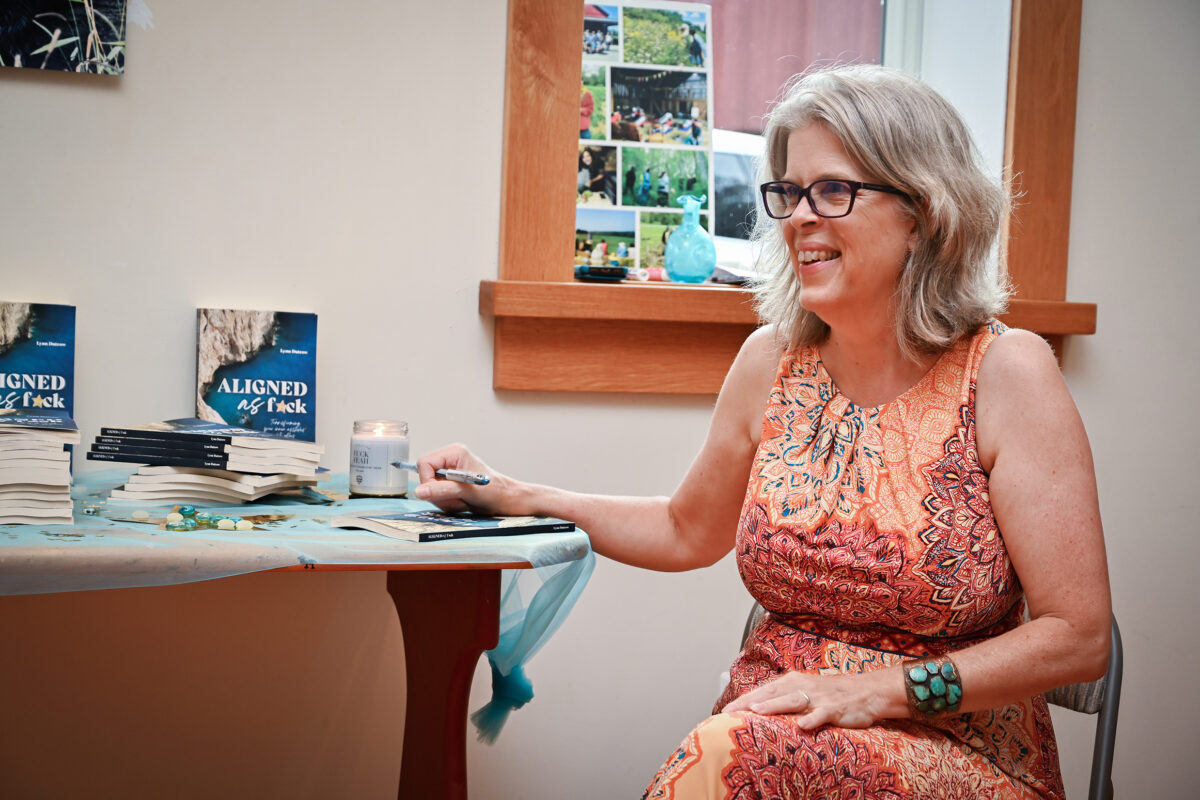 Dutrow at the release party for the author’s first book.
* * * * *
UMBC’s greatest strength is its people. When people meet Retrievers and hear about the passion they bring, the relationships they create, the ways they support each other, and the commitment they have to inclusive excellence, they truly get a sense of our community. That’s what “Meet a Retriever” is all about.
Learn more about how UMBC can help you achieve your goals.
]]>
Meet Lynn Dutrow. Lynn graduated from UMBC in 1989 with a B.A. in psychology and a certificate in early childhood education. Since then, she has worn many hats, including counselor, coach, and...
https://umbc.edu/stories/author-lynn-dutrow/
https://my3.my.umbc.edu/api/v0/pixel/news/160903/guest@my.umbc.edu/4b4ccad25ddfdc8dc623a18d855992bb/api/pixel
alumni
retriever-authors
story
UMBC News & Magazine
https://my3.my.umbc.edu/groups/umbc-news-magazine
https://assets1-my.umbc.edu/system/shared/avatars/groups/000/001/943/24435aa6207c452e7bc15cc74b42c7bb/xsmall.png?1748556657
https://assets1-my.umbc.edu/system/shared/avatars/groups/000/001/943/24435aa6207c452e7bc15cc74b42c7bb/original.png?1748556657
https://assets2-my.umbc.edu/system/shared/avatars/groups/000/001/943/24435aa6207c452e7bc15cc74b42c7bb/xxlarge.png?1748556657
https://assets2-my.umbc.edu/system/shared/avatars/groups/000/001/943/24435aa6207c452e7bc15cc74b42c7bb/xlarge.png?1748556657
https://assets3-my.umbc.edu/system/shared/avatars/groups/000/001/943/24435aa6207c452e7bc15cc74b42c7bb/large.png?1748556657
https://assets1-my.umbc.edu/system/shared/avatars/groups/000/001/943/24435aa6207c452e7bc15cc74b42c7bb/medium.png?1748556657
https://assets2-my.umbc.edu/system/shared/avatars/groups/000/001/943/24435aa6207c452e7bc15cc74b42c7bb/small.png?1748556657
https://assets1-my.umbc.edu/system/shared/avatars/groups/000/001/943/24435aa6207c452e7bc15cc74b42c7bb/xsmall.png?1748556657
https://assets2-my.umbc.edu/system/shared/avatars/groups/000/001/943/24435aa6207c452e7bc15cc74b42c7bb/xxsmall.png?1748556657
UMBC News & Magazine
0
0
false
Wed, 01 Jul 2026 09:50:56 -0400
Wed, 01 Jul 2026 09:50:56 -0400