One brick at a time
Brick making is an inherently pay-it-forward process, says Marian April Glebes, M.F.A. ’09, a conceptual and mixed-media artist. In the past 10 years of her Mobile Community Brick Factory & Monument project, Glebes has made thousands of bricks and then invited community members to imprint their stories into the clay. Later, the bricks are used in mobile monuments around Baltimore City and beyond. Glebes, who won the 2025 Rubys Alumni Award through the Robert W. Deutsch Foundation for this work, asks: How can we support social and spatial change in order to build a new kind of community-driven monumental public space?
I come to historic preservation by way of my M.F.A. in imaging media and digital arts (IMDA) from UMBC—with an additional masters degree in city and regional planning and historic preservation from the University of Pennsylvania—my home in Baltimore City, and by making bricks as public art. As an artist, a preservation planner, a homeowner, an educator, a gardener, and a community and economic development practitioner, all of my research and methods investigate how we make a place and how a place makes us.
In 2015, I was the inaugural artist-in-residence at the Baltimore Museum of Art’s Patricia and Mark Joseph Education Center. The Robert E. Lee and Stonewall Jackson Confederate monument still stood across from the BMA’s Spring House in Wyman Park Dell in the Charles Village neighborhood of Baltimore. Aligning with and inspired by protest in support of social and civic justice movements, The Mobile Community Brick Factory & Monument operated within these complex intersections.
 Glebes’ brick factory set up outside of the Spring House at the Baltimore Museum of Art. (Photo by Marian April Glebes, M.F.A. ’09)
Almost a decade later, my camera was the only familiar thing at Baltimore City’s Department of Transportation facility on a frigid dawn in November 2023. I held it tightly as if it would prove to signify my role in providing archival documentation of a monumental move. The temperature had dropped to a mere 22 degrees, but the top-secret site was teeming with activity while the project was just beginning.
“I like to do an easy one first,” the director of field operations says. But with the removal of any Confederate monuments, these or other “monuments to hate,” there is no easy one.
In the back corner of a DOT storage yard, I watched as the historical record was made and unmade, as preservation theory and practice was suspended and turned on their side, as conservation techniques and concepts were followed to the letter and simultaneously reinvented, starting with the Roger B. Taney statue.
 Baltimore’s Confederate monuments in a Department of Transportation storage lot. (Photo by Marian April Glebes, M.F.A. ’09)
Baltimore’s contentious monuments shipped out to a storage facility near St. Louis on their way to Los Angeles for an exhibition at The Brick (formerly LAXart). In Baltimore, I stayed with the problem through a project I started a decade ago—creating a countermonument out of personalized, handmade bricks.
Memory is mutable. Social contexts shift. This is the wicked problem in living heritage and what to do when it dies. I’ve had a unique position with singular access to process and understand this ongoing debate in Baltimore City while unofficial researcher-in-residence at the Commission for Historic and Architectural Preservation (CHAP). Each community is unique in its response on what to do with their Confederate monuments, and Baltimore’s perspective is vital to the discourse. Eric Holcomb, the former director of CHAP, invited me to the conversation, positing that perhaps it could or should be for the arts and artists to influence this unfolding preservation conundrum.

 Left: A stack of imprinted bricks waits to be transformed. Right: Glebes holds a brick imprinted with: “I am a monument.”
At UMBC, as M.F.A. candidates, our artwork was considered research—and therefore had to be contextualized and placed within the canon. To work responsibly, we were encouraged to know our audiences and our references and understand our place in time. Inspired by the people and places of Baltimore and by conceptual art’s blurring-of-art-andlife thinking of the 1960s, The Mobile Community Brick Factory & Monument maintains the ethos of rigorous research, material gravitas, and community connection engendered by my IMDA studies. Existing in the contexts of the Baltimore Uprising, the 2017 monument removals, social practice art, and civic engagement, I interrogate our circumscribed understandings of monumentality.
Monuments exist in social contexts that have often changed dramatically since the time they were created. Because of this, their meaning does not come only from the objects themselves—or only from how people view them—but from the shifting relationship between the two. The counter-monument was birthed by artists in Germany after the fall of the Berlin Wall and has not been widely accepted or brought into practice. In 2017, as monuments were being removed from our public spaces, artists again began erecting counter-monuments in protest of white supremacy.
The Mobile Community Brick Factory & Monument is centered in process, people, and making. To date, we have engaged over 15,000 people in Baltimore, made over 2,500 unique bricks, and collected over 1,000 personal stories from Baltimore residents. The Mobile Community Brick Factory & Monument is a new kind of monument, a monument not to the past, but a monument as an act of collective power that anticipates what will come to be.
 To date, the project has engaged over 15,000 people in Baltimore, made over 2,500 unique bricks, and collected over 1,000 personal stories from Baltimore residents.
The Mobile Community Brick Factory produces handmade bricks using local hand-processed clay and historic water-struck methods. This means of brickmaking is an inherently pay-it-forward endeavor—the bricks made one day are destined for someone else’s future hands. Participants personalize and inscribe their stories onto these bricks—words and messages about place, power, home, and experience. These story bricks are woodfired and become The Mobile Community Brick Monument, an ongoing series of exhibitions that create shared spaces.
While the bricks become pathways, garden beds, benches—some are embedded in sidewalks in Baltimore—I collect oral histories from brick constituents through ethnographic methods. In Baltimore, over 150,000 people have visited The Mobile Community Brick Monuments, finding connections to stories that are like their own.
At The Mobile Community Brick Factory & Monument, we believe ordinary voices matter, especially those that aren’t usually heard, that public space should be built by the people who use it, that heritage is alive, memory is mutable, and history is ongoing—made by daily lives. Our bricks represent pasts, presents, and futures that would otherwise remain untold and unwitnessed, built, shared, and spoken by urban residents. All are welcome and included in the process—a different kind of monument—a living space that honors the past and is built collectively by the people who live in and use our cities.
—Marian April Glebes, M.F.A ’09
]]>
Brick making is an inherently pay-it-forward process, says Marian April Glebes, M.F.A. ’09, a conceptual and mixed-media artist. In the past 10 years of her Mobile Community Brick Factory &...
https://umbc.edu/stories/one-brick-at-a-time-marian-april-glebes/
https://my3.my.umbc.edu/api/v0/pixel/news/154790/guest@my.umbc.edu/a5b5b57409fdd065cdb303c4d962d827/api/pixel
alumni
alumni-essay
cahss
fall-2025
imda
magazine
mfa
story
UMBC News & Magazine
https://my3.my.umbc.edu/groups/umbc-news-magazine
https://assets1-my.umbc.edu/system/shared/avatars/groups/000/001/943/24435aa6207c452e7bc15cc74b42c7bb/xsmall.png?1748556657
https://assets1-my.umbc.edu/system/shared/avatars/groups/000/001/943/24435aa6207c452e7bc15cc74b42c7bb/original.png?1748556657
https://assets2-my.umbc.edu/system/shared/avatars/groups/000/001/943/24435aa6207c452e7bc15cc74b42c7bb/xxlarge.png?1748556657
https://assets2-my.umbc.edu/system/shared/avatars/groups/000/001/943/24435aa6207c452e7bc15cc74b42c7bb/xlarge.png?1748556657
https://assets3-my.umbc.edu/system/shared/avatars/groups/000/001/943/24435aa6207c452e7bc15cc74b42c7bb/large.png?1748556657
https://assets1-my.umbc.edu/system/shared/avatars/groups/000/001/943/24435aa6207c452e7bc15cc74b42c7bb/medium.png?1748556657
https://assets2-my.umbc.edu/system/shared/avatars/groups/000/001/943/24435aa6207c452e7bc15cc74b42c7bb/small.png?1748556657
https://assets1-my.umbc.edu/system/shared/avatars/groups/000/001/943/24435aa6207c452e7bc15cc74b42c7bb/xsmall.png?1748556657
https://assets2-my.umbc.edu/system/shared/avatars/groups/000/001/943/24435aa6207c452e7bc15cc74b42c7bb/xxsmall.png?1748556657
UMBC News & Magazine
2
0
false
Fri, 21 Nov 2025 14:32:47 -0500
Fri, 21 Nov 2025 14:32:47 -0500
My life between the yellow borders
At UMBC, students get a versatile education that Retrievers can draw on to succeed no matter where their career lands them. But sometimes, you hit the home run and end up with your dream job. For Kennedy Lamb ’20, English—who also played softball for UMBC—that meant a role in the storied legacy of National Geographic. But dream jobs don’t land because of random luck or chance. Lamb knew early on that she wanted to lean on her love of science in her English degree and topped off her UMBC education with a graduate degree from Johns Hopkins University’s program in science writing. Ultimately, when she applied for the gig at Nat Geo, she’d loaded her bases and was ready to knock it out of the park.
Seven years ago, I sat in my academic advisor’s office in the Performing Art and Humanities Building mulling over which classes to take next semester. The meeting, like all meetings with English professor Christopher Corbett, mostly consisted of discussing select passages from Phillip Lopate’s Art of the Personal Essay, the Baltimore Orioles’ record, and Babe Ruth. I always looked forward to them.
“What do you want to do after college?” he asked, chuckling good-naturedly. I smiled politely and fiddled with my earrings. At 19, the prospect of securing a full-time job was daunting. I knew I loved to write. I knew I loved science. I did not know how to combine the two. “I’m not sure,” I said. “Write, I guess.”
Corbett took a sip out of his coffee mug and sat back in his chair. “Well, I can tell you where others have gone on after college, if that would help.” I nodded. In his Maine drawl, he rattled off a few media outlets, some of which I was familiar with. Nothing piqued my interest.
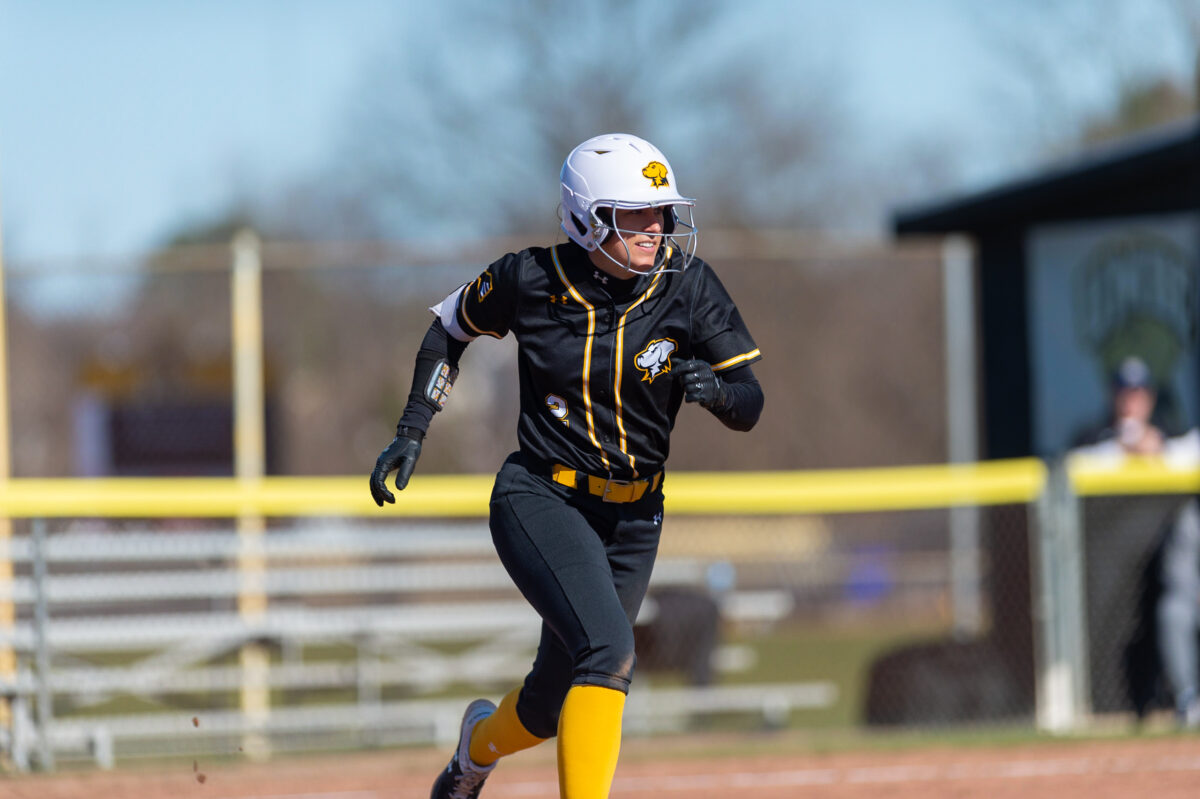 Lamb runs to first base her last collegiate game before the COVID-19 pandemic canceled the 2020 season. Photo by Ian Feldmann ’21.
“And one alumna went to write for National Geographic,” he said, almost as an afterthought. I looked up at him. “Really?” I replied.
Corbett hadn’t heard me and continued recounting the various places alumni from the English Department went on to work. But my mind was stuck: National Geographic. Now that would be something special. I pictured the iconic yellow borders in my head and pondered the pathway from college sophomore to Nat Geo writer.
At the end of the meeting, I had signed up for a handful of writing seminars, an introductory biology class, and Deborah Rudacille’s science writing class. As semesters turned into years and my time at UMBC came to a close in 2020, the dreams of National Geographic lingered in the back of my mind. What if? I would wonder. And how?
Fast forward to 2025, and that dream has become a reality. I am a communications specialist at the National Geographic Society, the centuries-old nonprofit dedicated to illuminating and protecting the wonders of our world. As a public relations professional, I’m tasked with translating stories of scientific discovery into well-packaged pitches to writers around the world.


Left: Lamb poses with a copy of The Wall Street Journal featuring the “mega coral.” Photo courtesy of Lamb. Right: A diver measures the world’s largest coral in the Solomon Islands. October 2024. Photograph by Manu San Félix, National Geographic Pristine Seas.
No two days are alike. Some days are spent decoding technical science papers about extinct human ancestors or writing a press release about cutting-edge conservation tactics that aim to save a slimy snail. Other days are spent digging through National Geographic’s colossal photo archive to find just the right picture for a reporter or presenting to leaders from Pacific Island countries about how to communicate the benefits of marine protected areas.
Perhaps my proudest moment came when a team of scientists and filmmakers from National Geographic Pristine Seas uncovered the world’s largest piece of coral (dubbed the “mega coral”) while on expedition in the Solomon Islands. After being briefed on the discovery by the expedition team and Solomon Islands scientists, our communications crew began a two-week sprint to craft a press release and press kit, organize a press conference, and pitch the story to reporters across the globe.
And that work paid off: The story went viral. In three weeks, the story was picked up by over 3,000 outlets in 50 countries. The mega coral graced the front page of The Wall Street Journal, was featured on Germany’s largest television show Tagesschau and even became the butt of a joke on The Late Show with Stephen Colbert. (All press is good press, right?)
In moments like this, I’m reminded of the privilege of working for such an iconic brand. It’s easy to trudge to the next assignment and never truly celebrate the amount of work that went into making a piece of coral in the Pacific Ocean a viral sensation. But after the story had run its course, I reflected on what got me to this moment.
What I realized is that there is no secret to landing a dream job. It is hard work with a healthy serving of serendipity. I took nearly every internship offered to me (including one at UMBC Magazine!) and tried to view even the most mundane task as a chance to learn something new. When it came time to apply to the National Geographic Society, I trusted my skills.
All writers know there is no such thing as perfection. Instead, I try to strive for the asymptote of perfection. It is demanding and, at times, downright exhausting. But because I know the impact of conservancy in action—from coral reefs to slimy snails—I wouldn’t have it any other way.
— Kennedy Lamb ’20
]]>
At UMBC, students get a versatile education that Retrievers can draw on to succeed no matter where their career lands them. But sometimes, you hit the home run and end up with your dream job. For...
https://umbc.edu/stories/my-life-in-the-yellow-borders-national-geographic/
https://my3.my.umbc.edu/api/v0/pixel/news/150518/guest@my.umbc.edu/03ecfb76eae4b5f3bbaa8df5841ce8be/api/pixel
alumni
alumni-essay
cahss
english
magazine
softball
spring-2025
story
UMBC News & Magazine
https://my3.my.umbc.edu/groups/umbc-news-magazine
https://assets1-my.umbc.edu/system/shared/avatars/groups/000/001/943/24435aa6207c452e7bc15cc74b42c7bb/xsmall.png?1748556657
https://assets1-my.umbc.edu/system/shared/avatars/groups/000/001/943/24435aa6207c452e7bc15cc74b42c7bb/original.png?1748556657
https://assets2-my.umbc.edu/system/shared/avatars/groups/000/001/943/24435aa6207c452e7bc15cc74b42c7bb/xxlarge.png?1748556657
https://assets2-my.umbc.edu/system/shared/avatars/groups/000/001/943/24435aa6207c452e7bc15cc74b42c7bb/xlarge.png?1748556657
https://assets3-my.umbc.edu/system/shared/avatars/groups/000/001/943/24435aa6207c452e7bc15cc74b42c7bb/large.png?1748556657
https://assets1-my.umbc.edu/system/shared/avatars/groups/000/001/943/24435aa6207c452e7bc15cc74b42c7bb/medium.png?1748556657
https://assets2-my.umbc.edu/system/shared/avatars/groups/000/001/943/24435aa6207c452e7bc15cc74b42c7bb/small.png?1748556657
https://assets1-my.umbc.edu/system/shared/avatars/groups/000/001/943/24435aa6207c452e7bc15cc74b42c7bb/xsmall.png?1748556657
https://assets2-my.umbc.edu/system/shared/avatars/groups/000/001/943/24435aa6207c452e7bc15cc74b42c7bb/xxsmall.png?1748556657
UMBC News & Magazine
5
0
false
Mon, 02 Jun 2025 16:22:47 -0400
Mon, 02 Jun 2025 16:22:47 -0400
Creativity in the C-suite
As Kent Malwitz ’92, information systems, moved up through the world of technology leadership, he kept wondering if an MBA was in the cards. But what he found ultimately most useful and fulfilling, as someone already steeped in the CEO-world, was pursuing an M.F.A. in creative writing. Malwitz, who is the director of strategic partnerships at UMBC Training Centers—a nonprofit providing private workforce training in technology, cybersecurity, project management, and leadership development—nurtured this early creative emphasis as an IS student who wanted to explore the empowering and vulnerable world of writing workshops. Now, he corrals his curiosity and storyteller-instincts to become a more empathetic teammate and leader.
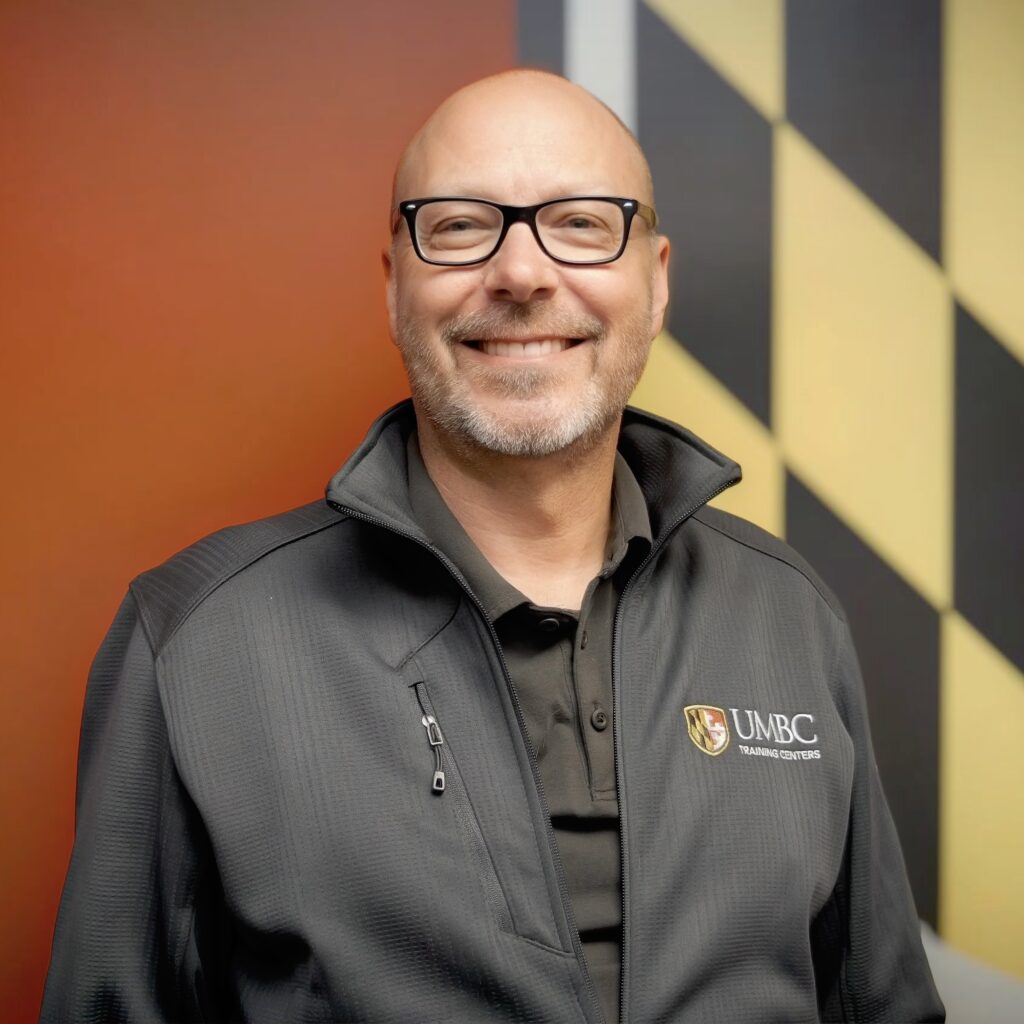 Kent Malwitz at UMBC Training Centers.
While I knew from a very young age that I loved technology, it wasn’t until my junior year at UMBC that I discovered that I also love to write. Working and playing with technology was natural to me as a kid, and since personal computers, modems, and bulletin boards were all fairly new to the public in the late ’80s, I was drawn to technology for exactly that reason—it was new. There was an element of discovery and creativity in trying to figure out how to do certain things with computers, leading me to pursue a degree in information systems at UMBC and a career in technology.
While at UMBC, I worked at a co-op with IBM, which allowed me to gain technical and business experience. I would drive to Gaithersburg daily from UMBC to provide technical support to IBM’s sales teams, and at certain times, I would take night classes alongside my 40-hour-a-week job at IBM, which gave me a heavy dose of the “real world,” as I tried to balance work, school, a social life, and a lengthy commute. The grind did not leave a lot of space for creativity.
After completing the required technical writing courses for my major, I felt a creative pull in me and acknowledged that my best chance of exploring that would be through writing, as I had shown no promise in the visual arts. I took a creative writing class and fell in love. It felt amazing to be doing something creative alongside my very technical work, and what I loved the most was sharing work with my fellow students and seeing and hearing their work—their thoughts and ideas, their fears. It made me feel extremely vulnerable, as well, but hearing my peers’ feedback was empowering, and I felt inspired by their talent.
Working to extend the university’s mission
Back then, IBM was known for having an unofficial dress code—blue suit, white shirt, red tie. I conformed. The people were very nice, and it was a great introduction into the work world, but I knew that I wanted to work in an environment with a different kind of energy.
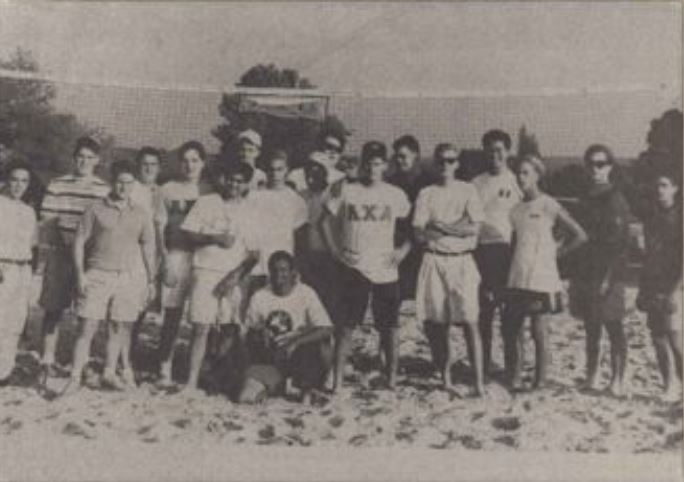 Kent Malwitz with intramural friends at UMBC.
I found myself drawn to smaller, entrepreneurial companies where you got to—and had to—do many things based on the limited resources available. I found these environments to be conducive to learning, problem solving, and creativity. Where there were many challenges, there were equal opportunities to think critically and creatively and to lead through them. I found great joy in creating elegant technical solutions to address our customers’ business needs. I loved trying to figure things out that had not yet been figured out, and as my career grew, I took on bigger and bigger projects and teams.
After 10 years of technology consulting, I learned about a non-profit that UMBC founded focused on the delivery of technical training—the UMBC Computer Certification and Training Center (UMBC CCTC—way too many Cs!). I was recruited by the president of CCTC at the time, Doug Kenzierski, my former instructor who connected me to IBM for my co-op. I got involved in 2003 to help lead business development efforts with organizations and government agencies to train their employees. We renamed UMBC CCTC to UMBC Training Centers and started winning contracts with regional businesses and key agencies in the intelligence community, the military, and civilian government.
In true grit fashion, UMBC was very early to grasp the concept of a research university that provides workforce development programs as well as having a related business entity that extends the mission of the university to new audiences. Today, UMBC Training Centers is a significant provider of workforce training in technology, cybersecurity, project management, and leadership development, serving many individuals and employers in the region through our private training programs and our robust open enrollment schedule that reaches more than 10,000 learners a year.
Nurturing curiosity
Throughout my career, I often thought about pursuing an MBA, and while I know I would have learned a lot, I already had significant hands-on experience from leading business development at UMBC Training Centers and then later becoming the CEO. Instead, I realized what I really needed was to nurture my curiosity and interest in creativity. I thought that tapping into my own personal beliefs and values and becoming a better storyteller would help me become a more empathetic and more effective teammate and leader.
After hearing from other UMBC staff who had gone this route, including Jenny O’Grady, the editor of this magazine, I applied for the Master’s of Fine Arts creative writing program at the University of Baltimore. In many ways, I was a fish out of water in the program, but I loved it. I was much older than most of the students, and I was working full-time as the CEO of UMBC Training Centers. I was the only one who would show up in a suit on many nights, but my classmates welcomed me. I delved into writing workshop after workshop.
I thought that tapping into my own personal beliefs and values and becoming a better storyteller would help me become a more empathetic and more effective teammate and leader.
Kent Malwitz '92
Director of strategic partnerships at UMBC Training Centers
Just like when I was an undergrad, sharing my work with others and having their work shared with me was my favorite part of the program. I loved the feedback and the support—both giving and receiving. While I haven’t completed the M.F.A. program, I intend to and feel that I have already benefited from it greatly as a business person and as a leader. Thinking critically and creatively and being open minded and unafraid of the unknown has been a key factor in the growth of my career.
Full-circle all the way home
After 17 years at UMBC Training Centers, I was recruited to go work again for IBM, despite my concerns from my earlier experience working there as a student. I worried about how I would feel working for such a large, corporate organization after having been in a small, entrepreneurial environment for my entire career. I was there for 4 years and learned a lot—about corporate culture, about scale, and about leadership, and I was reminded about the critical nature of strategic partnerships.
In August of this year I had the opportunity to return to my beloved UMBC and UMBC Training Centers in the capacity of director of strategic partnerships. Here, I intend to work collaboratively—and creatively—with our partners, UMBC being our most strategic partner, to scale up the impact we have on the communities we serve, including finding ways to allow UMBC students to more directly benefit from our offerings, and to make UMBC Training Centers no longer the best kept secret at UMBC.
]]>
As Kent Malwitz ’92, information systems, moved up through the world of technology leadership, he kept wondering if an MBA was in the cards. But what he found ultimately most useful and...
https://umbc.edu/stories/harnessing-creativity-in-technology-leadership/
https://my3.my.umbc.edu/api/v0/pixel/news/146073/guest@my.umbc.edu/49506833e82c0a2f8ccfb403a8f25998/api/pixel
alumni
alumni-essay
coeit
fall-2024
is
magazine
story
UMBC News & Magazine
https://my3.my.umbc.edu/groups/umbc-news-magazine
https://assets1-my.umbc.edu/system/shared/avatars/groups/000/001/943/24435aa6207c452e7bc15cc74b42c7bb/xsmall.png?1748556657
https://assets1-my.umbc.edu/system/shared/avatars/groups/000/001/943/24435aa6207c452e7bc15cc74b42c7bb/original.png?1748556657
https://assets2-my.umbc.edu/system/shared/avatars/groups/000/001/943/24435aa6207c452e7bc15cc74b42c7bb/xxlarge.png?1748556657
https://assets2-my.umbc.edu/system/shared/avatars/groups/000/001/943/24435aa6207c452e7bc15cc74b42c7bb/xlarge.png?1748556657
https://assets3-my.umbc.edu/system/shared/avatars/groups/000/001/943/24435aa6207c452e7bc15cc74b42c7bb/large.png?1748556657
https://assets1-my.umbc.edu/system/shared/avatars/groups/000/001/943/24435aa6207c452e7bc15cc74b42c7bb/medium.png?1748556657
https://assets2-my.umbc.edu/system/shared/avatars/groups/000/001/943/24435aa6207c452e7bc15cc74b42c7bb/small.png?1748556657
https://assets1-my.umbc.edu/system/shared/avatars/groups/000/001/943/24435aa6207c452e7bc15cc74b42c7bb/xsmall.png?1748556657
https://assets2-my.umbc.edu/system/shared/avatars/groups/000/001/943/24435aa6207c452e7bc15cc74b42c7bb/xxsmall.png?1748556657
UMBC News & Magazine
0
0
false
Wed, 04 Dec 2024 16:52:45 -0500
Wed, 04 Dec 2024 16:52:45 -0500
Stepping up to the plate to preserve UMBC history

When the Fort McHenry Tunnel opened, drivers could thank Richard “Rock” Soracoe ’71, economics, for helping them see as they drove under the harbor. Soracoe spent 50-plus years in the lighting industry and helped source the original 8,870 8-ft light fixtures that lined the road. In retirement, he’s helping shed a different type of light. Soracoe and other members of the founding four classes at UMBC are putting their collective memories to work to assist in identifying people and events in UMBC’s archival material to help complete our UMBC history. One event—UMBC’s first intercollegiate athletics win—is a story Soracoe loves to tell.
I have the game ball in my hand. The red stitches feel familiar, and the leather sits in my palm like it was made to fit. I’m not on the mound winding up to pitch, however; I’m standing in the basement of the Albin O. Kuhn Library. It’s been 57 years since I last touched this baseball when UMBC won its first intercollegiate victory.
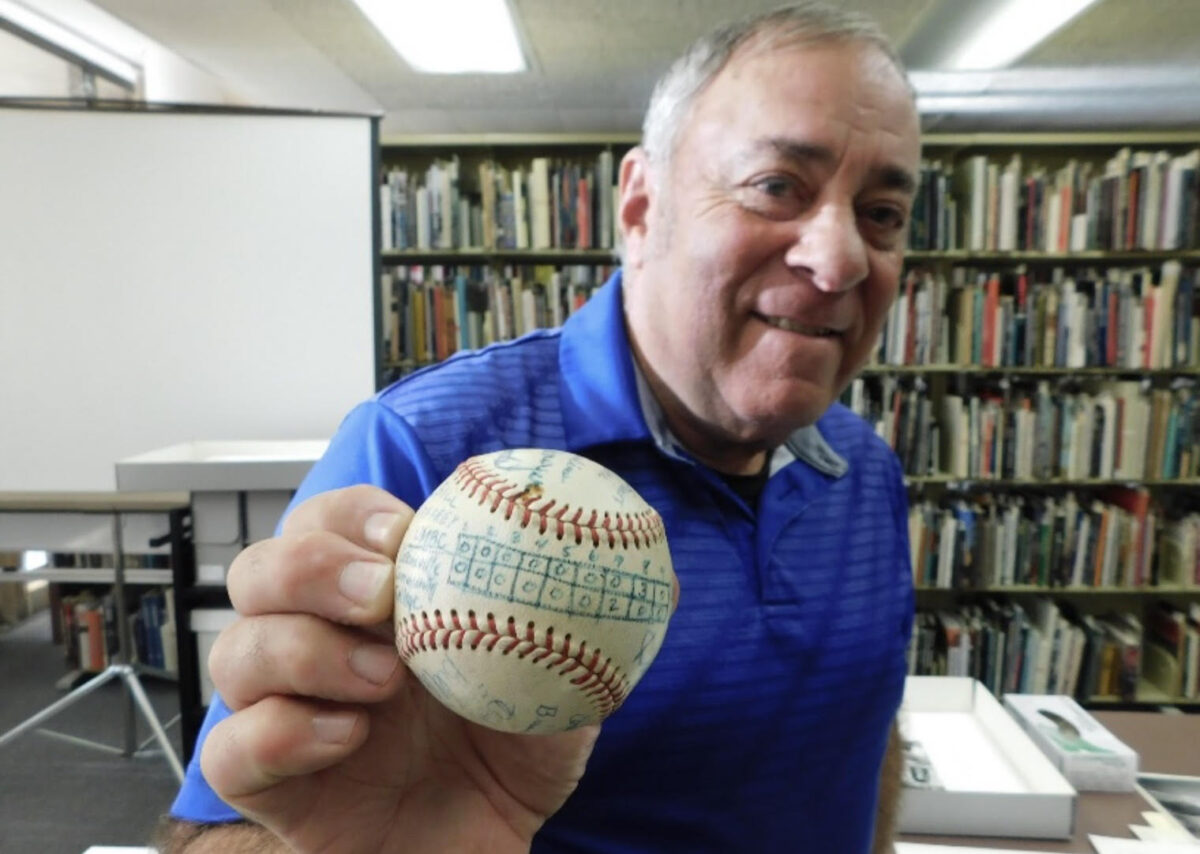 In UMBC’s Special Collections, Soracoe holds up the first game-winning baseball with the box score drawn on.
In 1967, UMBC’s inaugural fall sports season, the teams didn’t win a single game (as a member of the UMBC soccer team at the time, I was well aware of this), so it fell to baseball or lacrosse, the spring sports, to come through with the first win. While the details of that ballgame (a 3-2 win) are fuzzy now—all that remains officially is a 28-word write up in the Baltimore Sun archives—the game deserves its place of honor in the relatively short history of our institution. The budding campus newspaper, The Retriever Weekly, didn’t cover the game (although they did cover our loss to the same team the following week) and the box score is immortalized only as pen scratched onto the game ball’s leather.
Despite the lack of thorough archival material, in its own way, the game has certainly gone on to define aspects of my own life. Ken Diehl—the pitcher of the losing team, Catonsville Community College—would go on to transfer to UMBC the next year. We bonded over our shared Retriever spirit and also from our shared memories as roommates on UMBC’s first mini-mester trip to Europe in 1968. But it’s my Founding Four membership that drives me to keep memories like the first intercollegiate win alive.
As graduates of the first four classes at UMBC, we feel excited but also responsible for helping archive and catalog memories that might be unique to us. It’s one of the reasons we wrote This Belongs to Us, and it’s the reason we meet at the library to help the university archivists put appropriate names and metadata on early university yearbooks called Skipjack and other historical materials.
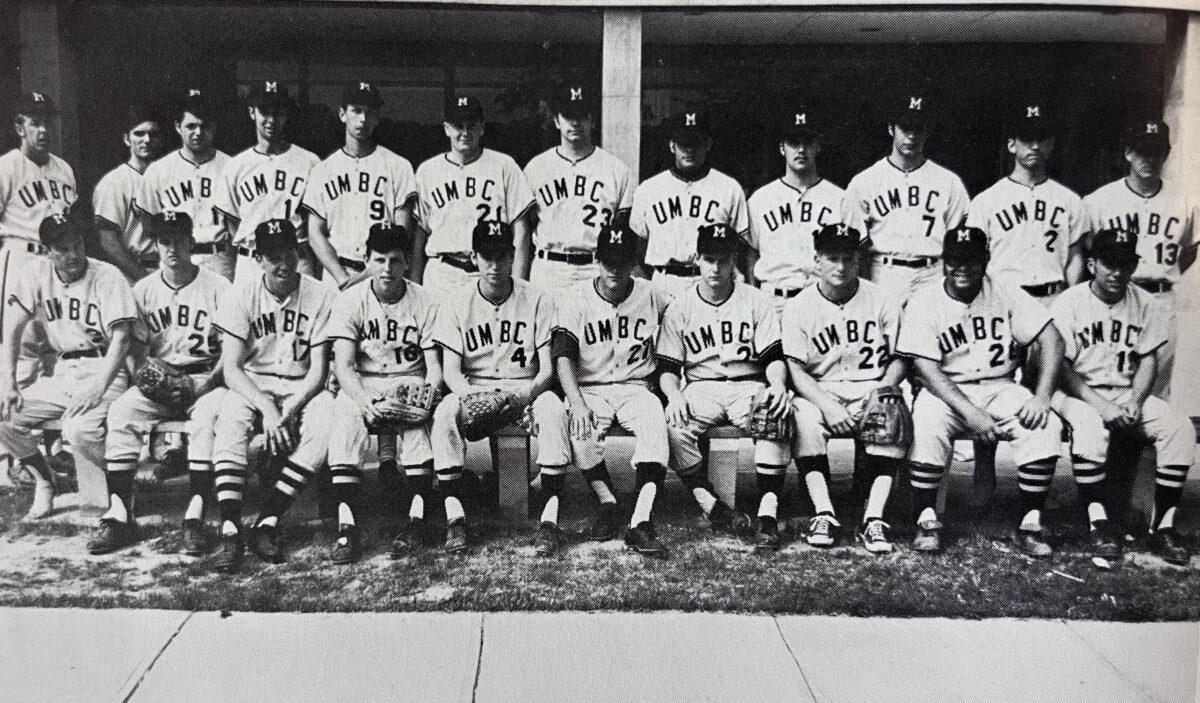
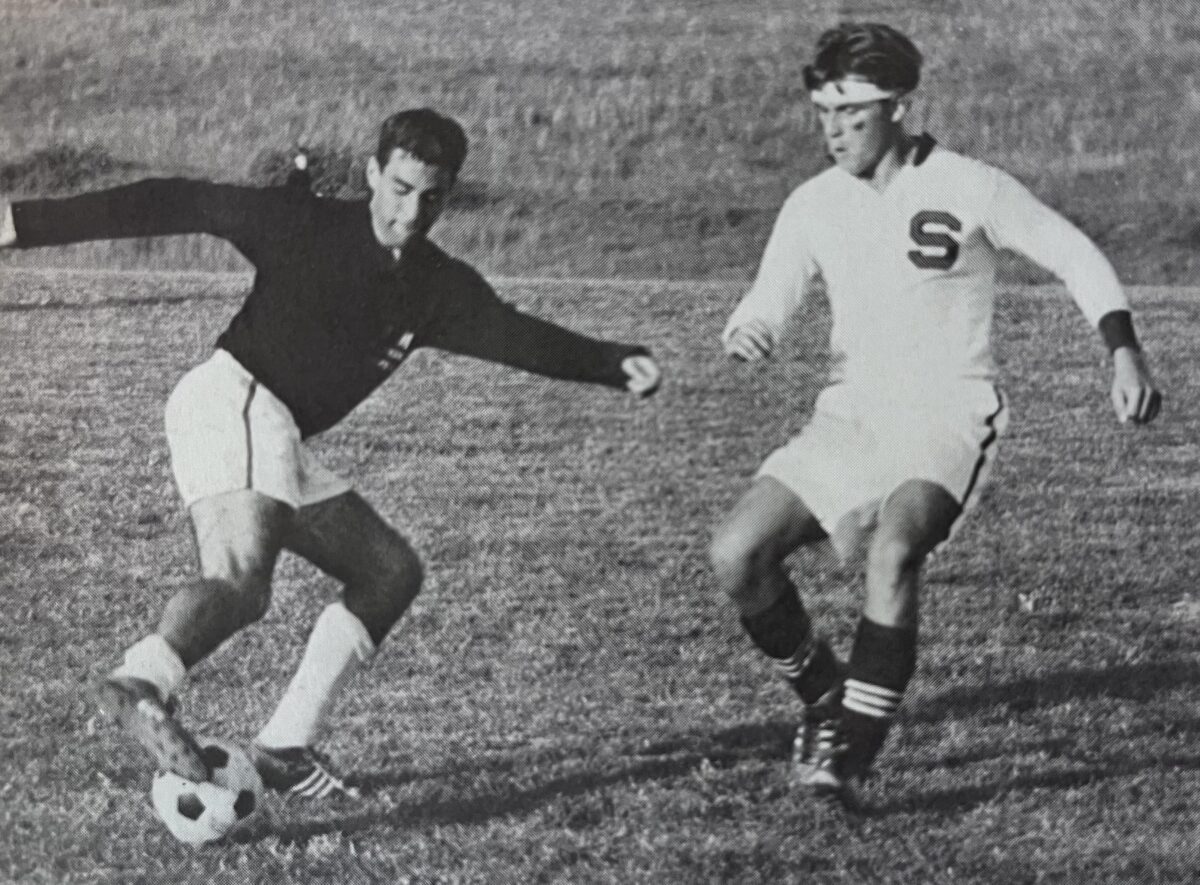
Left, the 1969 baseball team pictured in the 1969 university yearbook, Skipjack. Right, Soracoe in the black jersey also played on UMBC’s men’s soccer team.
When we were students here—walking around on plywood sidewalks on top of muddy construction sites—we weren’t thinking about creating the history of UMBC. We referred to the college as “high school plus one.” So our yearbooks rarely include captions or names and it’s up to us now to identify those people so that they’re not lost to history.
Some things have been lost to history. Louie Sowers [’70, American studies], a fellow classmate and student-athlete, stood up for Retriever women to have equal representation in university sports well before Title IX made it mandatory. She, along with Athletic Director Dick Watts, formed the women’s field hockey, basketball, and volleyball teams for the 1967 – 1968 academic year. Unfortunately, those records have been lost to time, so on paper, officially, women’s varsity sports only started in 1973.
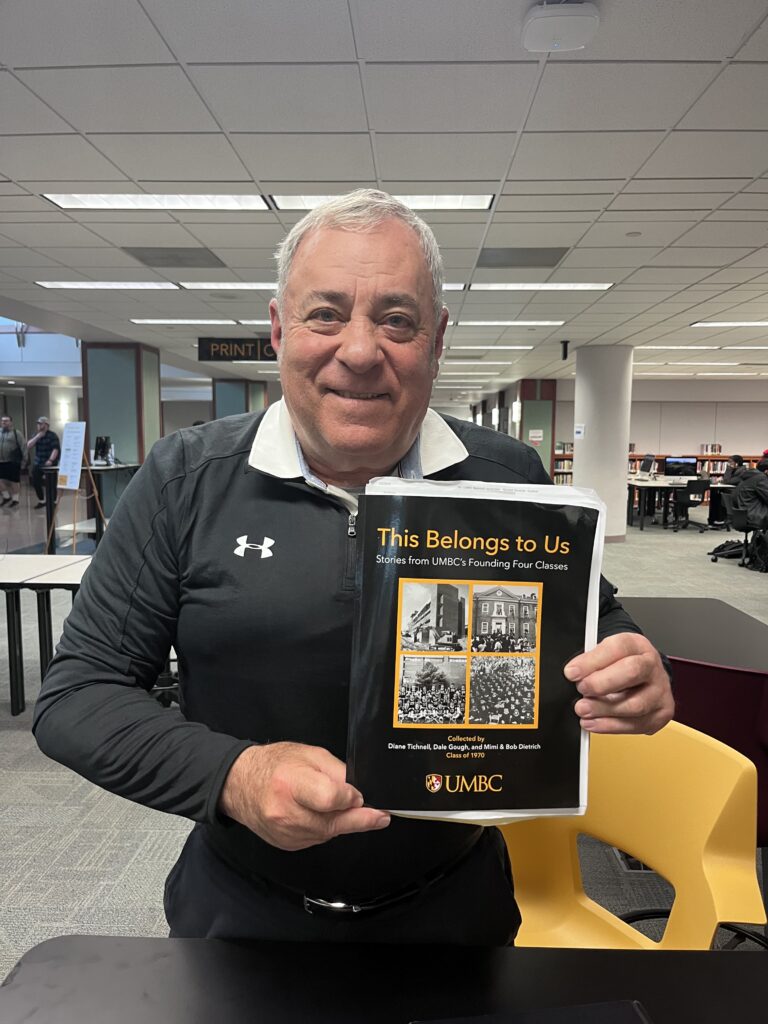 Soracoe holds a copy of This Belongs to Us—the Founding Four’s book about UMBC’s early days.
I reached out to some teammates to see if they could help me fill in the missing blanks of that game in April 1967. We played at Banneker Field in Catonsville (referred to as the “loser’s field” in the Sun write up) because UMBC did not have its own field yet. It was a low-scoring game; CCC got the first two runs in the game in the bottom of the 7th inning. The top of the 8th would be our key to victory. After one runner already came in, my teammate Bill Rust [’71, history] remembers players on second and third. He was at bat, and lined our then-opponent Ken’s pitch into left center field for what would become the game-winning RBIs.
What I remember is pitching the whole game (90 pitches according to Bill’s memory), and being so grateful when Ken [’70, psychology] joined our team the next year as an additional pitcher. And over the years, I’ve grown comfortable with the idea that the individual details don’t matter as much as the whole picture. Stepping back to see the shape of my career, my marriage, and my friends, I can see how they’ve all been defined by my UMBC experience.
UMBC was as welcoming as you wanted it to be, and still is today. My professors taught me the power of critical thinking and my coaches taught me the power of mental and physical discipline—which helped me in my job and my 36-year career as a high school and college soccer referee. I am very proud to say that I am a UMBC graduate and happy to see the tremendous achievement the university has attained from humble beginnings to worldwide status.
— Richard “Rock” Soracoe ’71, economics
]]>
When the Fort McHenry Tunnel opened, drivers could thank Richard “Rock” Soracoe ’71, economics, for helping them see as they drove under the harbor. Soracoe spent 50-plus years in the lighting...
https://umbc.edu/stories/stepping-up-to-the-plate-to-preserve-umbc-history/
https://my3.my.umbc.edu/api/v0/pixel/news/142515/guest@my.umbc.edu/1ba6502c67b2faff3c9f3194cc2c07a1/api/pixel
alumni
alumni-essay
american-studies
athletics
baseball
economics
founding-four
history
magazine
spring-2024
story
umbc-history
UMBC News & Magazine
https://my3.my.umbc.edu/groups/umbc-news-magazine
https://assets1-my.umbc.edu/system/shared/avatars/groups/000/001/943/24435aa6207c452e7bc15cc74b42c7bb/xsmall.png?1748556657
https://assets1-my.umbc.edu/system/shared/avatars/groups/000/001/943/24435aa6207c452e7bc15cc74b42c7bb/original.png?1748556657
https://assets2-my.umbc.edu/system/shared/avatars/groups/000/001/943/24435aa6207c452e7bc15cc74b42c7bb/xxlarge.png?1748556657
https://assets2-my.umbc.edu/system/shared/avatars/groups/000/001/943/24435aa6207c452e7bc15cc74b42c7bb/xlarge.png?1748556657
https://assets3-my.umbc.edu/system/shared/avatars/groups/000/001/943/24435aa6207c452e7bc15cc74b42c7bb/large.png?1748556657
https://assets1-my.umbc.edu/system/shared/avatars/groups/000/001/943/24435aa6207c452e7bc15cc74b42c7bb/medium.png?1748556657
https://assets2-my.umbc.edu/system/shared/avatars/groups/000/001/943/24435aa6207c452e7bc15cc74b42c7bb/small.png?1748556657
https://assets1-my.umbc.edu/system/shared/avatars/groups/000/001/943/24435aa6207c452e7bc15cc74b42c7bb/xsmall.png?1748556657
https://assets2-my.umbc.edu/system/shared/avatars/groups/000/001/943/24435aa6207c452e7bc15cc74b42c7bb/xxsmall.png?1748556657
UMBC News & Magazine
1
0
false
Thu, 20 Jun 2024 13:02:54 -0400
Thu, 20 Jun 2024 13:02:54 -0400
Three sisters—all alums—share their family’s recipes for food and comfort
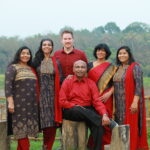
Aimee, Jamie, and Gina Joshua have a lot in common. All three went to UMBC as members of the Meyerhoff Scholars Program. And the sisters all have great memories of growing up in a house filled with delicious food and love. So, when their mother’s YouTube channel focusing on Indian cooking techniques started to take off, the trio made it their mission to create a cookbook of family recipes that would honor their beloved parents.
Our parents, Sara and Abraham Joshua, known to us as Mummy and Chacha, immigrated from India in their twenties separately to begin their careers and continued education to help provide for their families back home. Coming to America in the ’70s, they were learning how to navigate a new country and a new culture. After getting married and starting a family, they began raising three daughters in Baltimore, Maryland. The challenge was to figure out how to teach and preserve our Indian culture and traditions when it was over 8,000 miles away.
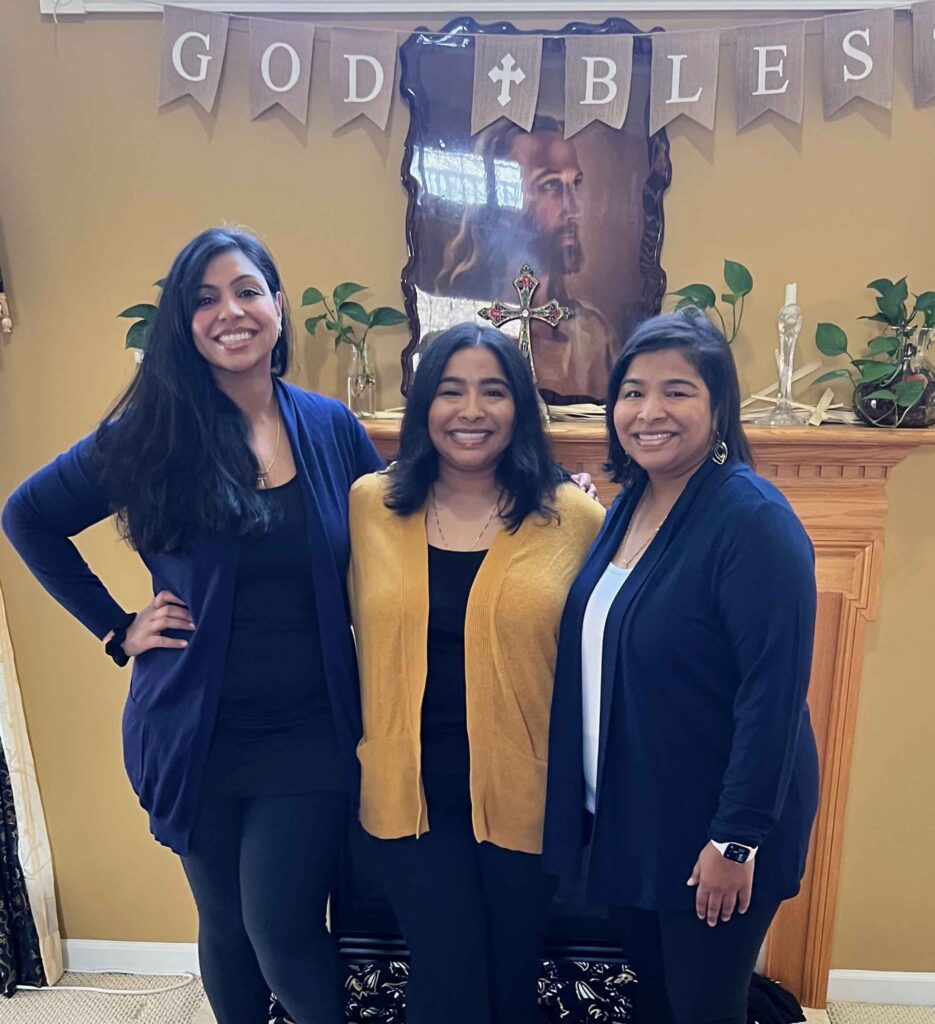 The Joshua Sisters: Gina, Jamie, and Aimee.
Growing up as “the Joshua sisters,” we did many things together—singing songs in church at talent shows, Girl Scouts, karate, and even attending UMBC! They wanted the best for us and every day showed us the value and importance of hard work and being and staying humble. Since we were young girls, Mummy and Chacha taught us that everything is possible if you put your mind to it and work hard. Our parents encouraged us to chase our dreams, but as with many parents, they didn’t think about pursuing their own, only providing for their family.
Mummy, affectionately known as “Ammini Aunty,” was a nurse at the University of Maryland Medical System and Chacha, affectionately known as “Bejoy Uncle,” was a realtor. They both kept busy outside of work hours with community and church activities.
If you wanted to find our parents in the house, it was usually in the kitchen—and the garden was a close second. Mummy loved to cook our traditional South Indian dishes and prepare food for others and Chacha enjoyed being her sous chef. Food was their love language and we had so many conversations around the kitchen table.
During our years at UMBC, we often brought Mummy’s home-cooked food when we returned to campus, always willing to share some chicken biriyani or beans mezhukkupuratti with our friends. Mummy didn’t often have time to do more than cooking for her family or special events because of her nursing career and her focus on our education. This meant she didn’t get to cook and experiment as much as she would have liked. It was only once we were in college that we began to understand the joy being in the kitchen would bring her.
Once we were older, some of our favorite memories were when we gathered in the kitchen to catch up on how everyone’s day had been. When we came home with our friends, Mummy would recruit them to help prepare whatever was on the menu, even if they had never cooked before. We did our best and Mummy would walk us through the recipe and cooking techniques with a lot of patience. Mummy always said “If you put your mind to it, you can do it. It’s a passion, and it takes hard work. But at the end of it all, you get something great.”
Food is meant to be shared, and while Mummy was teaching us to cook, she was also teaching us to curate and nurture relationships and be proud of our culture.
The Joshua Sisters
Whether we were peeling ginger, grating coconut, or chopping vegetables, we knew we were not just creating a meal, we were also building and creating something better: loving memories and an appreciation for our Kerala food. Because that’s what it’s about.
Food is meant to be shared, and while Mummy was teaching us to cook, she was also teaching us to curate and nurture relationships and be proud of our culture. Cooking together is creating together, which involves trust and building a connection between each person helping create the meal. In addition, we are Indian American and are so proud of what it means to be both Indian and American.
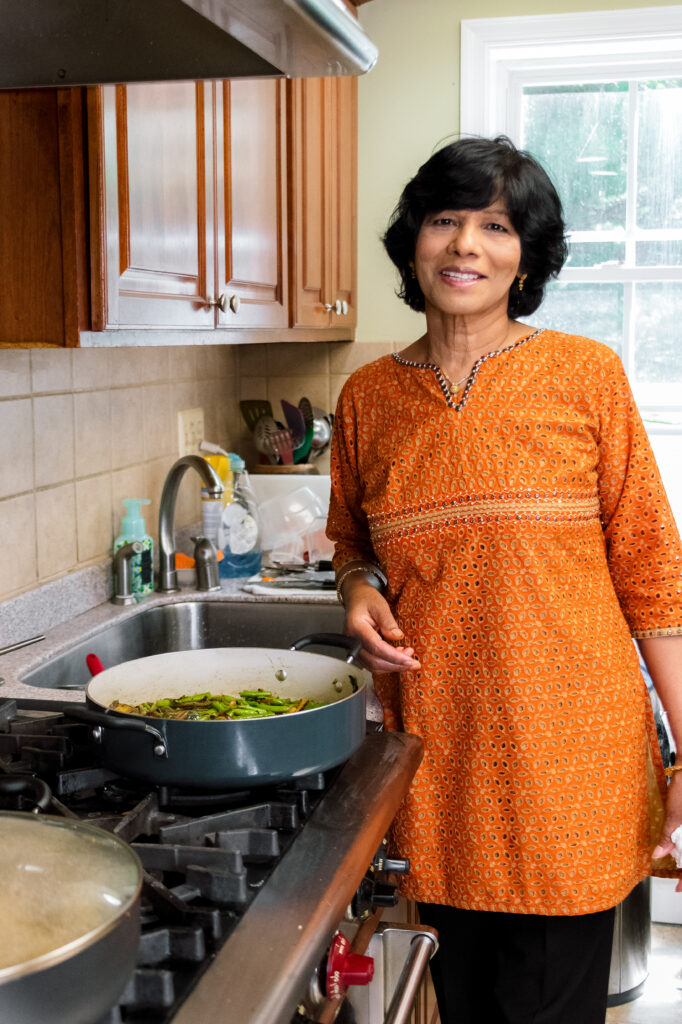 Known as Mummy to her three girls, Sara Joshua poses in her kitchen.
We learned an important lesson during our time at UMBC, taught to us by the late great Lamont Toliver, “Mr. T,” former director of the Meyerhoff Scholarship Program. In a moment of vulnerability, Aimee shared with Mr. T that she had been rejected by all of the Ph.D. programs she had applied to but had gotten into a master’s program.
In all his wisdom, Mr. T comforted Aimee with these wise words: “Not all paths from point A to point B are a straight line. Sometimes you have to take the long way to get where you want to go.” That’s a lesson that has stayed with us for some time and that, we soon realized during the pandemic, applied to Mummy.
By this time, Gina had started a family and we welcomed our next generation of children. The pandemic taught us how precious life is and that making every moment count is important. As sisters, we decided that we would work together to make Mummy’s dream of teaching our generation and future generations how to cook Kerala food come true.
After the pandemic began, Mummy retired from an over 40-year nursing career to help care for Chacha and avoid any risk due to COVID-19. With more time as a retiree, Mummy began experimenting with recipes and sharing them with close by family, who would pick up the care packages she would leave on the porch. They would then text or call her with feedback, helping perfect the recipes.
In April 2020, Mummy came into our room and asked if we wanted to take a picture of what she was cooking in the kitchen. So Jamie and Aimee, armed only with their iPhones and short notice to their friends online, began to livestream Mummy making Mango curry. Then the unexpected happened.
Thousands of people watched it within the first three days, and a flame was lit. Instead of waiting for perfection, we continued to dive into video after video, each an improvement on the one before. What started as a fun project became a thriving YouTube channel, Ammini Aunty’s A Pinch of Kerala, and a full-blown community of “Pinchers.” People were excited to learn from Mummy, and we were all thrilled to share her love for cooking with everyone.
Fast forward to today, our first cookbook, Ammini Aunty’s A Pinch of Kerala: A South Indian Inspired Cookbook, is being published. Thanks to the power of Kickstarter and Pinchers worldwide, what was just once a dream is now becoming a reality. As Mummy reminds her Pinchers, “If you put your mind to it, you can do it.” Don’t let your dreams stay a dream. Work toward making it a reality.
Jamie Joshua ’02, biological sciences, is the diversity, equity, and inclusion manager for Giant Food. Aimee Joshua ’03, M.S. ’05, computer science, is the senior manager, IT contracts, at PBS Distribution. Gina Wright ’05, biological sciences, is a dentist at a Veterans Affairs Medical Center.
]]>
Aimee, Jamie, and Gina Joshua have a lot in common. All three went to UMBC as members of the Meyerhoff Scholars Program. And the sisters all have great memories of growing up in a house filled...
https://umbc.edu/stories/three-sisters-keep-family-recipes-alive-in-book/
https://my3.my.umbc.edu/api/v0/pixel/news/137616/guest@my.umbc.edu/8b9de66ee2fe755d391c1d9411f14bcb/api/pixel
alumni
alumni-essay
biological-sciences
coeit
computer-science
fall-2023
magazine
meyerhoff-scholar
UMBC News & Magazine
https://my3.my.umbc.edu/groups/umbc-news-magazine
https://assets1-my.umbc.edu/system/shared/avatars/groups/000/001/943/24435aa6207c452e7bc15cc74b42c7bb/xsmall.png?1748556657
https://assets1-my.umbc.edu/system/shared/avatars/groups/000/001/943/24435aa6207c452e7bc15cc74b42c7bb/original.png?1748556657
https://assets2-my.umbc.edu/system/shared/avatars/groups/000/001/943/24435aa6207c452e7bc15cc74b42c7bb/xxlarge.png?1748556657
https://assets2-my.umbc.edu/system/shared/avatars/groups/000/001/943/24435aa6207c452e7bc15cc74b42c7bb/xlarge.png?1748556657
https://assets3-my.umbc.edu/system/shared/avatars/groups/000/001/943/24435aa6207c452e7bc15cc74b42c7bb/large.png?1748556657
https://assets1-my.umbc.edu/system/shared/avatars/groups/000/001/943/24435aa6207c452e7bc15cc74b42c7bb/medium.png?1748556657
https://assets2-my.umbc.edu/system/shared/avatars/groups/000/001/943/24435aa6207c452e7bc15cc74b42c7bb/small.png?1748556657
https://assets1-my.umbc.edu/system/shared/avatars/groups/000/001/943/24435aa6207c452e7bc15cc74b42c7bb/xsmall.png?1748556657
https://assets2-my.umbc.edu/system/shared/avatars/groups/000/001/943/24435aa6207c452e7bc15cc74b42c7bb/xxsmall.png?1748556657
UMBC News & Magazine
2
0
false
Thu, 07 Dec 2023 16:32:28 -0500
Thu, 07 Dec 2023 16:32:28 -0500
Building a Better Baltimore—Together
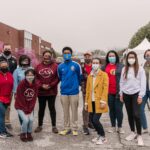
As a first-generation college student from southeast Baltimore, Sondheim Scholar Stefanie Mavronis ’12, political science and media & communication studies, was initially hesitant to talk openly about her past. As she made a home—and a name for herself as an organizer—on campus, Mavronis realized that she could bring her whole self to UMBC. Now deputy director of communication for Baltimore City Mayor Brandon Scott, Mavronis channels her hometown pride and Retriever confidence to tackle connecting with constituents during a pandemic and what feels like an all-time low of public trust in government.
In 2000, all eyes were on the presidential election—mine included—except I was fixated on winning the highest office of fifth grade.
My teacher must have seen something in me, and she encouraged me to run for class president and generally explore things that I didn’t know were possible. It turns out that I naturally gravitate to these opportunities, whenever I’m in a new space or a new school or a new class—I end up organizing the people around me and working to make change.
 All photos courtesy of Stefanie Mavronis. Portrait by Egan Jimenez, Princeton University.
Despite that, it wasn’t until my senior year at UMBC that I would explicitly share with people that I was from Dundalk. When people heard that about me first, there were stereotypes and assumptions about what I was capable of achieving and who I was.
Learning local history through my coursework at UMBC, reading books like Not in My Neighborhood, and having opportunities to explore and embed myself in the Baltimore community, where I was from became something that I wasn’t ashamed of. I wasn’t ashamed to be a first-generation college student—I was proud of it, and I started to see some of the unique leadership skills and insights that I brought as someone who came from that experience in Baltimore. UMBC was a safe and supportive space for my development as a young person and ultimately brought me to the position in the Mayor’s Office I have today.
Actively creating culture
At UMBC, I was always bursting at the seams with ideas and motivated to change the culture on campus. I have gratitude for my professors and mentors, who not only made time for me, but helped point me in new directions. In a big way, they were my support system. Delana Gregg, M.S. ’04, instructional development systems, Ph.D. ’19, language, literacy, and culture, who co-led the Sondheim Scholars program; Jodi Kelber-Kaye and Simon Stacey in the Honors College; Lisa Akchin in Institutional Advancement; Jason Loviglio in media and communication studies—I’m sure in his office alone, I probably spent tens of hours.
-
 Mavronis served as vice president and design and marketing director for the Student Events Board (seb) while a student at UMBC.

When I came to campus at UMBC, I fully intended to be part of the Student Government Association (SGA) but instead got involved with another student leadership organization in my first semester: the students events board (seb). When it came to the people on campus who I saw actively shaping and creating campus culture—taking the reputation that the school had at that time as a “commuter school”—I was really interested in being one of the students making campus culture more inclusive and just, and helping incoming students find their place.
As I got close to graduation, I realized one of the reasons why UMBC people stick together. We are collectively coming out of an institution that has gone to great lengths to not cushion us but help us find our individual paths, forge our unique lanes, and identify our strengths in a way that was very supportive.
 Mavronis in her office at City Hall. Photo by Mark Dennis
.
The shift into the “real world” can be challenging. For me, it felt like I was being asked to fit myself into a box after being embraced for my whole, multifaceted self. I’m so grateful for my mentors and friends who sent me the message that they didn’t want me to change, who supported me in finding ways to communicate my strengths to the outside world.
Supporting a homegrown leader
In my last year of college, I applied for a mayoral fellowship which I ultimately did not get. Brandon Scott, a councilmember at the time, was part of my interview panel. I developed a proposal for how to address Baltimore’s vacant housing crisis over a summer, leveraging public-private partnerships in a different kind of community-based way. It was a wild plan, but Brandon recognized my passion, big ideas, and hometown pride.
 In December 2020, Mavronis accompanies Mayor Brandon Scott to talk to Baltimore residents about the city’s COVID response. Photo by Mark Dennis
.
Brandon was a frequent guest on the Marc Steiner Show on WEAA 88.9-FM, where I worked as a producer for several years. Even back then Brandon often spoke about the need for local control of our police force and holistic strategies to combat gun violence. When I left to attend Princeton for graduate school, one of the ways I stayed connected to Baltimore was working with Brandon on the development of his strategy as the public safety chair of the City Council. After getting my master’s, I returned to Baltimore and landed a job at City Hall in Councilmember Zeke Cohen’s office.
After Brandon won his bid for council president in 2019, I was tapped to serve as his Communication Director. I was energized to work for a homegrown leader, someone who has a keen sense of what Baltimore needs and unconditional love for the people of the city in a way that I have not always seen or felt from leaders in the past.
Calling all visionaries
If you don’t like the way that things are, play an active role in changing them. There’s a lot of people who have made me feel like that’s possible throughout history and in my own life, from my successful bid for fifth grade class president to running a more competitive race in high school to represent southeast Baltimore County at a county-wide level in student government.
 Mavronis working alongside Mayor Scott and Press Secretary Sydney Burns in the Mayor’s Office at City Hall.
I never expected to work in local government, but am so glad I landed here. And now being here, I often wish there were even more people in this space with visionary ideas who aren’t deterred by boundaries, willing to try new things. Confronting the legacy of redlining and inequitable systems is not overnight work—but I now see how it takes people finding new ways to work together inside and outside of government to make transformative change and rebuild the trust that’s eroded over time.
I’m excited to be tasked with the opportunity and responsibility to be part of shaping this administration and bringing more people into this project of building a stronger Baltimore City, one that’s more equitable and accountable and that works better for people.
*****
Header image: Mavronis, in yellow coat, accompanies Mayor Brandon Scott to a UMBC co-sponsored vaccination pop-up event for the Lakeland community in southeast Baltimore. Photo by Marlayna Demond ’11.
]]>
As a first-generation college student from southeast Baltimore, Sondheim Scholar Stefanie Mavronis ’12, political science and media & communication studies, was initially hesitant to talk...
https://umbc.edu/stories/baltimore-together/
https://my3.my.umbc.edu/api/v0/pixel/news/119613/guest@my.umbc.edu/0ac8b9ab14ed4fd69e2522cb0919d211/api/pixel
alumni
alumni-essay
baltimore-city
communityimpact
media-and-communication-studies
political-science
seb
sondheim-scholar
spring-2021
UMBC News & Magazine
https://my3.my.umbc.edu/groups/umbc-news-magazine
https://assets1-my.umbc.edu/system/shared/avatars/groups/000/001/943/24435aa6207c452e7bc15cc74b42c7bb/xsmall.png?1748556657
https://assets1-my.umbc.edu/system/shared/avatars/groups/000/001/943/24435aa6207c452e7bc15cc74b42c7bb/original.png?1748556657
https://assets2-my.umbc.edu/system/shared/avatars/groups/000/001/943/24435aa6207c452e7bc15cc74b42c7bb/xxlarge.png?1748556657
https://assets2-my.umbc.edu/system/shared/avatars/groups/000/001/943/24435aa6207c452e7bc15cc74b42c7bb/xlarge.png?1748556657
https://assets3-my.umbc.edu/system/shared/avatars/groups/000/001/943/24435aa6207c452e7bc15cc74b42c7bb/large.png?1748556657
https://assets1-my.umbc.edu/system/shared/avatars/groups/000/001/943/24435aa6207c452e7bc15cc74b42c7bb/medium.png?1748556657
https://assets2-my.umbc.edu/system/shared/avatars/groups/000/001/943/24435aa6207c452e7bc15cc74b42c7bb/small.png?1748556657
https://assets1-my.umbc.edu/system/shared/avatars/groups/000/001/943/24435aa6207c452e7bc15cc74b42c7bb/xsmall.png?1748556657
https://assets2-my.umbc.edu/system/shared/avatars/groups/000/001/943/24435aa6207c452e7bc15cc74b42c7bb/xxsmall.png?1748556657
UMBC News & Magazine
1
0
false
Wed, 26 May 2021 17:12:15 -0400
Finding Joy in the Classroom

“Why are chemists so great at solving problems?” Theresa Bruce ’09, asks her eighth grade social studies class at KIPP Harmony. Her corny joke elicits no verbal responses but doesn’t go unanswered as students engage with the icebreaker online. “Because they have all the solutions!” Bruce guffaws.
In a year where teaching looks like nothing before, Bruce and other educators are grappling with how to best reach their students, academically and relationally. But the cheesy jokes are nothing new, admits Bruce. “That’s just who I am.” A Sondheim Scholar who majored in political science and social work, Bruce was runner up for the 2020 Baltimore City Teacher of the Year. It’s easy to see why, as her energetic and enthusiastic demeanor comes through clearly, even mediated through the multiple computer windows she uses to instruct her scholars from afar.
But Bruce didn’t set out to be a teacher—she had her sights set on being a hot-shot lawyer. So how to explain her past decade working as a Baltimore City school teacher? She shares this in her own words.
Putting the common good first
When I left high school, I had my mind made up that I was going to be a lawyer. I was going to be the next Johnnie Cochran. Forget if the glove didn’t fit, I was going to have my own catchphrase and it was going to blow up. I was going to be riding in limos with all of the entertainers. Then UMBC got in the way of that fantasy.
Being a part of the Sondheim Public Affairs Scholars program made me realize that I wanted to work toward something greater than myself. My celebrity ideals weren’t putting the common good first—they certainly didn’t push for society in a way that is helpful, meaningful, and beneficial for all. When that switch happened inside me, my mentors at UMBC were instrumental in helping me pursue a new goal, nurturing me, and pushing me along a path that led to public policy.
 Bruce teaching virtually from her empty classroom in October 2020. Photo by Corey Jennings ’10.
So how did I end starting my 10th year teaching as a Baltimore City school teacher? After I got my master’s in public policy at the University of Chicago with a focus in K through 12 urban education reform, I realized that I needed to actually be in a teaching role before I could make policy that affected education. Additionally, I believe that every child deserves the opportunity to make choices in their lives. I feel like I got the best public education possible in Baltimore City, and I got it for free. A motivating factor for me is the belief that every child should get what I got.
Lifting up others’ dreams
I’ve always loved school, so UMBC was the perfect fit for me. It was undeniably cool to be smart. So that’s the atmosphere I try to create in my classroom. We all have favorite subjects, and I understand that for some of my students, social studies may not be their favorite. But I want these young people to find some joy when they come into my room—to feel like they can talk with me and connect. I want them to know that I support them in their goals. UMBC taught me the importance of lifting up other people’s dreams.
 Bruce, right, with Adrienne Hawkins ’09, at a 2008 UMBC basketball game.
Looking back on my time as a student, I have so many people I’m grateful to for putting up with me, quite honestly, because I was a headache. I always had an idea. I always wanted to do something. And I wasn’t always listening. Despite that, Dr. Roy Meyers, professor of political science and affiliate professor of public policy, was my biggest champion. Dr. Cheryl Miller, associate professor emerita, public policy and political science, challenged me to think bigger than myself. Dr. Tyson King Meadows, associate professor of political science, taught my very first poli-sci class and never stopped pushing me forward. Delana Gregg, Ph.D. ’19, language, literacy, and culture, a powerhouse in the Academic Success Center, was a constant force in helping me shape my career path while being a sounding board for all of my ideals.
So now, as an educator myself, I ask how I can best push and champion my students. The biggest step I can take—and this doesn’t matter if you’re in a brick-and-mortar building or if you’re online—is to make a relationship. Yes, they’re harder to build virtually, but when young people can relate to you as a person, they’re more apt to try. When you acknowledge them and their efforts, they’re going to try even harder. There’s an old saying I think about often: People don’t care what you know, until they know you care.
Creating community in a virtual classroom
My biggest reward right now is sparking the minds of the next generation. Our young people come to us with so many gifts. They’re talented in ways that might just take a little nudging for them to realize. But I know how many people took time for me, and I want to make my students feel the same. I want them to know I care about their success, beyond their grades. How can I help them discover who they truly are, pursue what matters to them, and be an agent for change?
 Bruce, working from her home office.
Part of the way I help them along this path is by putting books in front of them—all the time. There are over 700 books in my classroom that I’ve amassed, partly through donations via the Donors Choose platform and partly by spending my own money. Quarterly, I host a Starbooks session for my students within my classroom, usually around a theme, like non-fiction texts or graphic novels. It gives young people a chance to sample books and see what they might enjoy. Slowly but surely, I’ve been seeing an increase in my scholars’ excitement about reading books and checking them out of my classroom.
Now that we’re meeting virtually, it’s been hard to not gather in the classroom I’ve lovingly decorated and filled with books and materials. My scholars and I have created our own community in the classroom, and it’s been interesting in this pandemic to rethink the way community needs to develop. All things considered, I am thankful because even though we’re in the midst of a global virus, I’ve been pushed to rethink the way I engage the students, not only in the work, but how to grow relationships with them as well. So we’re creating a new classroom, a new virtual one. It may not be as big or as colorful, but it’s got great potential.
*****
Header image, by Corey Jennings ’10. All other photos courtesy of Theresa Bruce, unless noted.
]]>
“Why are chemists so great at solving problems?” Theresa Bruce ’09, asks her eighth grade social studies class at KIPP Harmony. Her corny joke elicits no verbal responses but doesn’t go unanswered...
https://umbc.edu/stories/theresa-bruce/
https://my3.my.umbc.edu/api/v0/pixel/news/119732/guest@my.umbc.edu/efad73ff51cf45edaf50ee94a67fa4ae/api/pixel
alumni
alumni-essay
baltimore-city-schools
cahss
fall-2020
political-science
social-work
videos
web-extra
UMBC News & Magazine
https://my3.my.umbc.edu/groups/umbc-news-magazine
https://assets1-my.umbc.edu/system/shared/avatars/groups/000/001/943/24435aa6207c452e7bc15cc74b42c7bb/xsmall.png?1748556657
https://assets1-my.umbc.edu/system/shared/avatars/groups/000/001/943/24435aa6207c452e7bc15cc74b42c7bb/original.png?1748556657
https://assets2-my.umbc.edu/system/shared/avatars/groups/000/001/943/24435aa6207c452e7bc15cc74b42c7bb/xxlarge.png?1748556657
https://assets2-my.umbc.edu/system/shared/avatars/groups/000/001/943/24435aa6207c452e7bc15cc74b42c7bb/xlarge.png?1748556657
https://assets3-my.umbc.edu/system/shared/avatars/groups/000/001/943/24435aa6207c452e7bc15cc74b42c7bb/large.png?1748556657
https://assets1-my.umbc.edu/system/shared/avatars/groups/000/001/943/24435aa6207c452e7bc15cc74b42c7bb/medium.png?1748556657
https://assets2-my.umbc.edu/system/shared/avatars/groups/000/001/943/24435aa6207c452e7bc15cc74b42c7bb/small.png?1748556657
https://assets1-my.umbc.edu/system/shared/avatars/groups/000/001/943/24435aa6207c452e7bc15cc74b42c7bb/xsmall.png?1748556657
https://assets2-my.umbc.edu/system/shared/avatars/groups/000/001/943/24435aa6207c452e7bc15cc74b42c7bb/xxsmall.png?1748556657
UMBC News & Magazine
0
0
false
Mon, 07 Dec 2020 14:14:39 -0500
Treasured Moments

In his more than a decade of service to UMBC through the Alumni Association Board of Directors, outgoing president John Becker ’01, information systems, has seen a little bit of everything. As he passes the torch of leadership, Becker thinks back to some of the moments—and the people of our community—that have meant the most to him.
I’m writing this column from my dining room table, while my wife leads my two children in a home-schooling session on peregrine falcons. There are no pressing activities. There is nowhere to be—in fact, we are not allowed to be anywhere else. (I can’t say “gotta run” at the end of phone calls anymore.) This is strange for us, and I’m sure some of you have also felt a sense of surrealism. We’re sheltered in place, waiting for the seemingly inevitable house call we will be receiving from the novel coronavirus.
While our inability to work during this lock-down is a dark cloud on the horizon, I am finding silver linings. We are spending more time (and more meaningful time) together. We are closer now than ever with our neighbors and we are in touch daily with our out-of-state parents. I have also had time to pause and reflect on the past several years in a way that I rarely can when we are rushing around with daily routines and extra curriculars.
The 10 years that I have served on the UMBC Alumni Association Board of Directors have been among the most rewarding years of my life. Some of that reward comes from a sense of debt repayment—a sense of fulfilling an obligation for the many gifts I was given while I was a student here in the late ’90s. But in thinking about it more deeply, I realize it is something else— Retriever pride—that feeds the beast.
Reaching Together
Our UMBC has been accomplishing great things for decades socially, academically and athletically. There are bread crumbs trailing all the way back to 1966 that a nostalgic alum or prospective Board member could discover or remember that would kindle that fire—that pride—within them. Among my fellow Board members, I found a common interest in recalling formative years, assisting those students we recognize so clearly as a reflection of ourselves, and planning for an enduring legacy.
The highlights of my time on the Board could fill this magazine, but one thread that shines through is that the alumni have become increasingly involved over time. This truth reflects the hard work of our Director of Alumni Engagement, Stanyell Odom, and her team, the acknowledgement of the role we play in the university by Vice President of Institutional Advancement, Greg Simmons, M.P.P. ’04, and of course the curiosity of our great alumni, which often foments into a desire to return and help in a meaningful way.
Exceptional by Example
I vividly recall meeting Naomi Mburu ’18, M26, chemical engineering, UMBC’s first Rhodes Scholar at our Annapolis Alumni Reception, learning her story and being inspired by her determination. This reception, held in winter each year and hosted by the Board of Directors has allowed us to meet our state’s leaders who are UMBC alumni themselves, learn their perspectives, and find common interests through our ties to UMBC.
-
 Naomi Mburu ’18, M26, chemical engineering, UMBC’s first Rhodes Scholar speaks at the 2018 Annapolis Alumni Reception.
-
 Jerome Adams ’97, M4, biochemistry and molecular biology, the Surgeon General of the United States speaks at the 2019 Alumni Awards.
The growth of the annual Alumni Awards gala has been another source of pride for me. What began for me as an intimate affair in our library’s gallery has blossomed into a spectacle with hundreds of guests held in the Linehan Concert Hall in the Performing Arts and Humanities Building. I’m stunned every year by the unique, inspirational alumni I meet across all disciplines and from all walks of life. Last year I had a chance to speak with Jerome Adams ’97, M4, biochemistry and molecular biology, the Surgeon General of the United States, who is now at the tip of the spear in handling the COVID-19 pandemic. What struck me about Dr. Adams was how down to earth and family-oriented he was. He demonstrated a sense of perspective that was refreshing to see in a person in his position of national leadership.
And I am proud of leading the effort to develop and successfully reach an audacious fundraising campaign for the Alumni Endowed Scholarship, doubling our market value in four years and allowing the funds raised by the Board to leave an enduring legacy of scholarship on generations of deserving students.
A Proud Legacy
The thread linking these events and milestones is the people. UMBC is ripe with talented alumni, faculty, staff and, of course, talented students and student-athletes. My engagement with bright, energetic, and driven individuals is what keeps me coming back for more. If you haven’t been back to campus lately, please accept this invitation. I want you to see the intelligence, diversity, passion, grit, and greatness that I have enjoyed, and maybe in the process find something you left behind.
Dr. Hrabowski likes to remind us every year at Commencement that “success is never final.” As we embark on a new fundraising campaign for the Alumni Endowed Scholarship and I pass the torch to Brian Frazee ’11, M.P.P. ’12, I am at ease knowing that our success will continue and our future is bright. Thank you for the opportunity to serve you.
*****
Learn more about ways of engaging with UMBC at alumni.umbc.edu.
Header image: John Becker with President Hrabowski and the U.S. Surgeon General, Jerome Adams. All photos by Marlayna Demond ’11.
]]>
In his more than a decade of service to UMBC through the Alumni Association Board of Directors, outgoing president John Becker ’01, information systems, has seen a little bit of everything. As he...
https://umbc.edu/stories/alumni-association-president-passes-the-retriever-torch/
https://my3.my.umbc.edu/api/v0/pixel/news/119885/guest@my.umbc.edu/a4b7546227914666bcd5100af528dbd7/api/pixel
alumni
alumni-essay
meyerhoff
spring-2020
UMBC News & Magazine
https://my3.my.umbc.edu/groups/umbc-news-magazine
https://assets1-my.umbc.edu/system/shared/avatars/groups/000/001/943/24435aa6207c452e7bc15cc74b42c7bb/xsmall.png?1748556657
https://assets1-my.umbc.edu/system/shared/avatars/groups/000/001/943/24435aa6207c452e7bc15cc74b42c7bb/original.png?1748556657
https://assets2-my.umbc.edu/system/shared/avatars/groups/000/001/943/24435aa6207c452e7bc15cc74b42c7bb/xxlarge.png?1748556657
https://assets2-my.umbc.edu/system/shared/avatars/groups/000/001/943/24435aa6207c452e7bc15cc74b42c7bb/xlarge.png?1748556657
https://assets3-my.umbc.edu/system/shared/avatars/groups/000/001/943/24435aa6207c452e7bc15cc74b42c7bb/large.png?1748556657
https://assets1-my.umbc.edu/system/shared/avatars/groups/000/001/943/24435aa6207c452e7bc15cc74b42c7bb/medium.png?1748556657
https://assets2-my.umbc.edu/system/shared/avatars/groups/000/001/943/24435aa6207c452e7bc15cc74b42c7bb/small.png?1748556657
https://assets1-my.umbc.edu/system/shared/avatars/groups/000/001/943/24435aa6207c452e7bc15cc74b42c7bb/xsmall.png?1748556657
https://assets2-my.umbc.edu/system/shared/avatars/groups/000/001/943/24435aa6207c452e7bc15cc74b42c7bb/xxsmall.png?1748556657
UMBC News & Magazine
0
0
false
Mon, 18 May 2020 23:54:20 -0400
Creating Community Through Food

If you’ve ever searched online for a place to eat in Baltimore, chances are Ekiben has popped up as a top destination again and again. Or, if you followed along with this year’s fried chicken sandwich feud between two fast food joints, you’ll have seen plenty of Baltimoreans resolving the issue by pointing to Ekiben’s classic Neighborhood Bird steamed bun. Yelp, Buzzfeed, and other national outlets reaffirm that this small storefront serving eclectic pan-Asian fare is worth the trip to Fells Point (with a second location in Hampden to open soon). Steve Chu ’12, economics, co-owner of the restaurant along with two other UMBC alumni, writes how the store owes its origins to UMBC and Baltimore City, and why these Retriever chefs care so much about the communities they serve.
Food has always been about community to me. My father worked endless hours running his Chinese restaurant, but on Mondays, he closed the restaurant and the whole family—aunts, uncles, grandparents—would go out to eat dim sum for breakfast. There’s be like 50 plates on the table. My relatives would urge me, eat, eat, try everything.
When Ephrem Abebe ’13, web development and information systems, Nikhil Yesurpriya ’13, M.S., ’16, biological science, and I started Ekiben in 2013 we wanted other people to enjoy food together, specifically this weird combination of Chinese/Taiwanese/Indian/Ethiopian cuisine. It was completely natural to us, coming from the food-focused cultures we came from, that food could unite disparate groups of people. The fact that Ekiben has been such a hit in Baltimore blows our minds, but is exactly what we hoped would happen.
 Abebe chats with a regular customer who brought some out-of-town friends.
When we met at UMBC—Nikhil and I through suitemates and Ephrem and I while volunteering for Habitat for Humanity in Baltimore City—I was studying financial economics, but it was so heavily focused on crunching numbers. I switched to a straight economics major early on after I realized that I wanted to learn more about how people thought and behaved with money. My background from UMBC has helped me tremendously in my career.
Gib Mason ’95, economics, taught a course on entrepreneurship that gave me the confidence that we could take this leap, buy a hot dog cart, and sell meatballs or spicy tofu at farmers markets, which is how we started out. He steered the class away from traditional homework assignments and asked us for our reasoning behind our answers instead. That still resonates with me as a business owner.
 Chu and Abebe in their Fells Point storefront.
Gathering community around us has come as naturally as combining our love of food into affordable and delicious dishes. Fells Point has been like home to us, and Baltimore has supported us every step of the way. Even in unusual ways—getting the original food license for the hot dog cart as a couple of 20-somethings was so much easier than we anticipated. The licensing board was so supportive after we explained our vision, but that came as a complete surprise to us.
What came next could be surprising to some in the restaurant business, but in Baltimore, this seems par for the course. After struggling with our hot dog cart-turned eclectic Asian fare cart for about a year, we got invaluable support from other local chefs. Ekiben wouldn’t exist without the guys behind Black Sauce, Damian Mosley and Michael Singleton, and Ben Lefenfeld from La Cuchara. Our friendships with other local chefs led naturally into collaboration and guest chef takeovers.
The best example of that communal approach to food in the city is the Charm City Night Market—think of an Asian open air market, tons of people and amazing food—organized by Stephanie Hsu and the rest of the local Chinatown Collective. We were really proud to be a part of the inaugural year and subsequent events. It does what we want for the city. It brings people of all demographics together, and it’s always so densely packed, and there’s so much great energy in it.
We’ve partnered with so many excellent chefs from Baltimore and beyond, and this is another way we get to cross-pollinate with talented craftspeople. There’s this push for food to be “traditional” or “authentic” but at it’s best, food is art. And ultimately, we just want to make food that tastes good and build up the community while doing so. We start that goal in the restaurant, investing a lot of energy into developing leaders in the company. We have staff that’s been with us since the beginning. I hope the supportive culture that we built really just kind of oozes out, and it spreads.
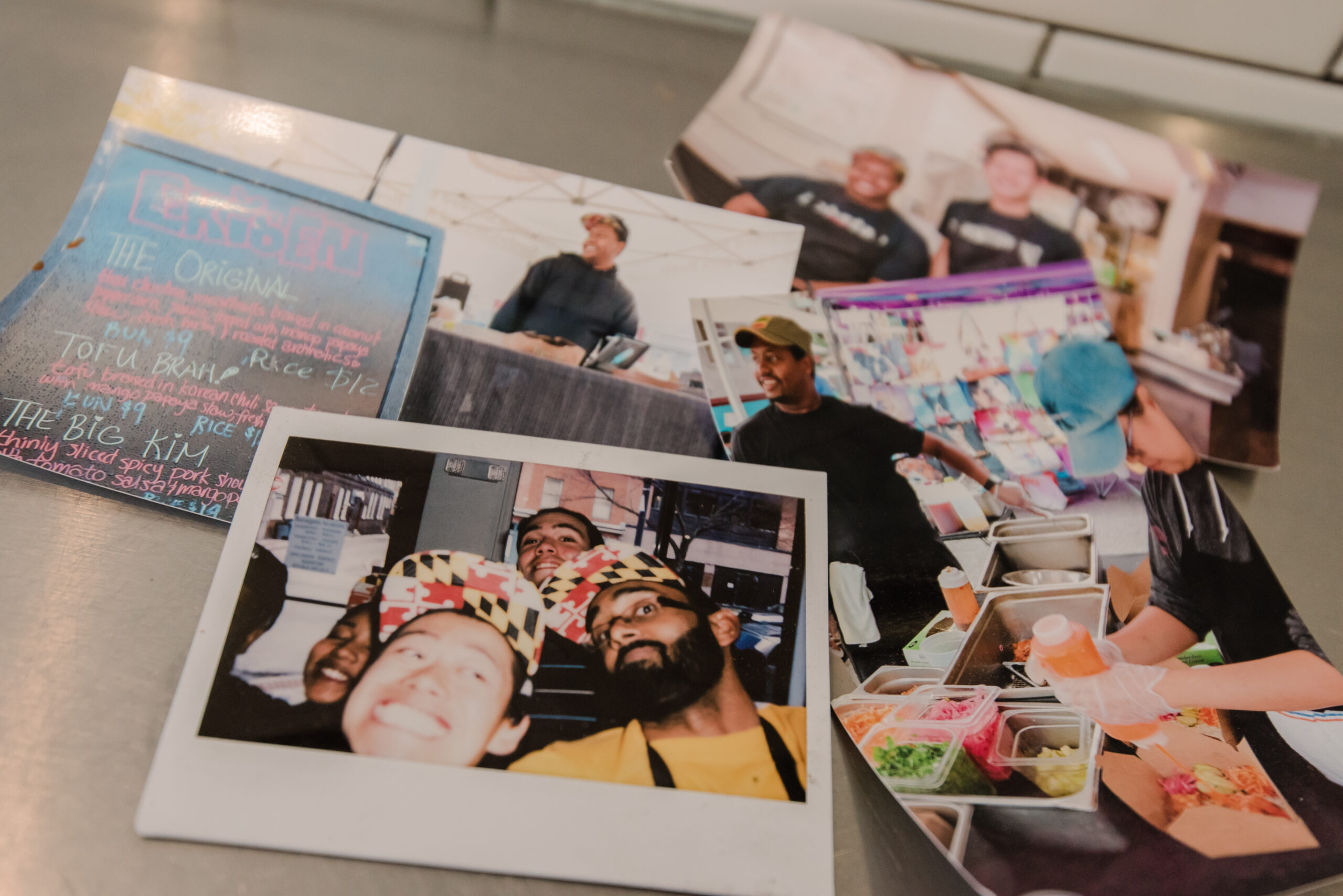

And Baltimore has supported us every step of the way. Baltimore has raised us. Literally, this restaurant was built on every $7 meal we served at any market that would let us sell there. We didn’t have a Kickstarter page, we just had Baltimore showing up to buy our food.
At those family dim sum breakfasts, as communal as they were, my relatives were not encouraging me to start my own restaurant. They actually loudly and emphatically (to put it politely) tried to steer me in the opposite direction. They, like so many other immigrants, had come here with very little and worked so hard to break away from that poverty. They didn’t want to see me take that same road, I guess. But in the end, their harsh words really spurred me to succeed. How could I fail when they had given so much to make a successful life here?
—Steve Chu ’12
*****
Header image: Abebe and Chu work together in the small prep space where customers can watch their orders being created. All photos by Marlayna Demond ’11.
]]>
If you’ve ever searched online for a place to eat in Baltimore, chances are Ekiben has popped up as a top destination again and again. Or, if you followed along with this year’s fried chicken...
https://umbc.edu/stories/creating-community-through-food/
https://my3.my.umbc.edu/api/v0/pixel/news/119980/guest@my.umbc.edu/8f902d5d1939ddc2c6f4e52373bbc4ee/api/pixel
alumni
alumni-essay
baltimore-city
economics
ekiben
fall-2019
UMBC News & Magazine
https://my3.my.umbc.edu/groups/umbc-news-magazine
https://assets1-my.umbc.edu/system/shared/avatars/groups/000/001/943/24435aa6207c452e7bc15cc74b42c7bb/xsmall.png?1748556657
https://assets1-my.umbc.edu/system/shared/avatars/groups/000/001/943/24435aa6207c452e7bc15cc74b42c7bb/original.png?1748556657
https://assets2-my.umbc.edu/system/shared/avatars/groups/000/001/943/24435aa6207c452e7bc15cc74b42c7bb/xxlarge.png?1748556657
https://assets2-my.umbc.edu/system/shared/avatars/groups/000/001/943/24435aa6207c452e7bc15cc74b42c7bb/xlarge.png?1748556657
https://assets3-my.umbc.edu/system/shared/avatars/groups/000/001/943/24435aa6207c452e7bc15cc74b42c7bb/large.png?1748556657
https://assets1-my.umbc.edu/system/shared/avatars/groups/000/001/943/24435aa6207c452e7bc15cc74b42c7bb/medium.png?1748556657
https://assets2-my.umbc.edu/system/shared/avatars/groups/000/001/943/24435aa6207c452e7bc15cc74b42c7bb/small.png?1748556657
https://assets1-my.umbc.edu/system/shared/avatars/groups/000/001/943/24435aa6207c452e7bc15cc74b42c7bb/xsmall.png?1748556657
https://assets2-my.umbc.edu/system/shared/avatars/groups/000/001/943/24435aa6207c452e7bc15cc74b42c7bb/xxsmall.png?1748556657
UMBC News & Magazine
0
0
false
Fri, 20 Dec 2019 20:53:29 -0500
Alumni Essay: Forget The Smoking Gun, by Gus Russo ’72

Catonsville resident Gus Russo ’72, political science, is married to the mob. And to U.S. history. He is a writer and investigative reporter specializing in the shadowy netherworld of American crime and politics. Russo has worked on 15 television documentaries for major networks in the United States and elsewhere, and he is the author of seven books – including “Where Were You? America Remembers the JFK Assassination” (Lyons Press, 2013).
The 1960s and 1970s (when I was a student at UMBC) were not just defined by musical  revolutions, but also by the tumult of politics and conspiracy – and the frantic efforts by public officials to keep secrets: Who killed JFK, MLK and RFK? Why were we in a senseless and seemingly endless war in Vietnam? Who ordered the Watergate break-in and what were the burglars after in the Democratic National Committee headquarters? What were all those silver discs people thought they saw in the sky?
In the 1980s, I gave up work as a musician to embark upon a journey to find answers to those sorts of questions as an investigative journalist. While it’s often portrayed as a glamorous profession, the skills and tools I employ are the same mundane ones that previous generations of gumshoes have relied upon: developing and working sources, skip-tracing (locating subjects), and obtaining documentary records from courts, real estate transactions, federal archives and law enforcement agencies.
Other than giving faster access to a small percentage of available records, the digital revolution hasn’t changed the work much. Investigative reporters rarely find their best stories online. The real truth (or as close as we can get to it) often lies buried in undigitized repositories of primary source documents, or in the closely guarded memories of the first-hand players and witnesses.
It’s often hard to win the trust of those actors and witnesses to history. It requires patience and perseverance, especially in the areas that most interest me: organized crime and intelligence agencies domestic and foreign. Old school wiseguys and retired spies don’t open up their vaults (or memories) just because you sent a nice email or even snail mail. I’ve sent Christmas presents, birthday presents, get-well cards, and funeral floral arrangements. (When I’m in the middle of a project, I have “Edible Arrangements” on speed dial.) I’ve hopped on countless planes, trains and autos to take someone out to dinner and slowly gain their trust. It often takes many months. In some cases, years.
But more often than not, determination pays off. When I flew to Chicago in 2000 to take ten members of former boss Sam Giancana’s family to dinner in a suburban restaurant infamous for its parking lot whackings, I thought I must have lost my mind. But it worked. The clan introduced me to many of Sam’s still-living friends and associates – a treasure trove of information for my then work-in-progress, The Outfit.
Then there is the paper trail – and the elusive “smoking gun” that everybody wants to find. But the truth is that document trolling is painstaking and boring 99 percent of the time. (I should know: Staff members at the National Archives have told me I’ve spent more hours there over the last 20 years than any other researcher.) And for every useful page, I’ve discarded a thousand others.
It’s also difficult to find the best documents. They certainly aren’t all at the National Archives. I’ve pulled FBI files from garages and attics of retired agents. My eyes have gone blurry pouring over faded real estate quitclaim deeds. I’ve begged Congressional committee chairmen to open up investigative files stored in the Library of Congress before the traditional 50-year lockdown date expires, and appealed FBI and CIA denials more times than I can count. When the FBI tried to tell me they only held 275 pages on the mob’s longtime fixer, Sidney Korshak, I hounded them for two years to obtain the rest of what I intuited they must possess. Eventually I was rewarded with 7,500 pages delivered to my doorstep at no charge. Maybe they felt guilty about the two-year runaround.
There was gold in those files, but there were no “smoking guns.” In fact, that concept should be erased from the minds of budding and seasoned journalists alike. The only “smoking gun” proof is the literal kind: a perpetrator caught holding one of them over the body of a victim. Nothing that dispositive can ever be found after the fact. Any document can be forged, any picture Photoshopped, and any witness mistaken or corrupted.
The seasoned investigative reporter knows that the more sensational the information you have, the more corroboration is needed so that one can arrive, at best, at an approximate truth based on a preponderance of evidence. If you require concrete proofs in your life, I suggest majoring in math. Otherwise you’ll be in for one major disappointment after another.
Serious investigative work – pounding the pavement, working the phones, and poring through over documents – can max out your stamina and your credit card. But it’s the only way I have been able to find answers to the questions that dog me about the shadow powers in our country.
Plus, you make some lasting human connections along the way. (What a concept!) In the week that I wrote this piece, I had phone calls from Sam Giancana’s daughter, Carlos Marcello’s son, the man who found Lee Harvey Oswald hiding in a Dallas theater after the Kennedy assassination, and two members of JFK’s Secret Service detail.
Often when these friends call or we visit in person, I feel sad for a generation that has been led to believe that all information, knowledge and wisdom reside inside in an invisible digital server or the “cloud.” It is a failure of my generation, which created and sold the myth, and it certainly doesn’t bode well for the future of my profession.
]]>
Catonsville resident Gus Russo ’72, political science, is married to the mob. And to U.S. history. He is a writer and investigative reporter specializing in the shadowy netherworld of American...
https://umbc.edu/stories/alumni-essay-forget-the-smoking-gun-by-gus-russo-72/
https://my3.my.umbc.edu/api/v0/pixel/news/122746/guest@my.umbc.edu/65b16ebf8e1c717eb400f6818343a35a/api/pixel
alumni
alumni-essay
catonsville
gus-russo
jfk
john-f-kennedy
lyons-press
political-science
umbc-magazine
university-of-maryland-baltimore-county
where-were-you-america-remembers-the-jfk-assassination
UMBC News & Magazine
https://my3.my.umbc.edu/groups/umbc-news-magazine
https://assets1-my.umbc.edu/system/shared/avatars/groups/000/001/943/24435aa6207c452e7bc15cc74b42c7bb/xsmall.png?1748556657
https://assets1-my.umbc.edu/system/shared/avatars/groups/000/001/943/24435aa6207c452e7bc15cc74b42c7bb/original.png?1748556657
https://assets2-my.umbc.edu/system/shared/avatars/groups/000/001/943/24435aa6207c452e7bc15cc74b42c7bb/xxlarge.png?1748556657
https://assets2-my.umbc.edu/system/shared/avatars/groups/000/001/943/24435aa6207c452e7bc15cc74b42c7bb/xlarge.png?1748556657
https://assets3-my.umbc.edu/system/shared/avatars/groups/000/001/943/24435aa6207c452e7bc15cc74b42c7bb/large.png?1748556657
https://assets1-my.umbc.edu/system/shared/avatars/groups/000/001/943/24435aa6207c452e7bc15cc74b42c7bb/medium.png?1748556657
https://assets2-my.umbc.edu/system/shared/avatars/groups/000/001/943/24435aa6207c452e7bc15cc74b42c7bb/small.png?1748556657
https://assets1-my.umbc.edu/system/shared/avatars/groups/000/001/943/24435aa6207c452e7bc15cc74b42c7bb/xsmall.png?1748556657
https://assets2-my.umbc.edu/system/shared/avatars/groups/000/001/943/24435aa6207c452e7bc15cc74b42c7bb/xxsmall.png?1748556657
UMBC News & Magazine
0
0
false
Wed, 19 Mar 2014 19:59:50 -0400


