Plot twist— Michelle Corpora ’03 took a nonlinear path to becoming NYT bestselling author
It was around five o’clock on a Wednesday in May, and Michelle Jabès Corpora ’03, English and theatre, was on her sofa watching her favorite British murder mystery on TV. It had been a long shot to think her newest book, His Face Is the Sun, would hit the New York Times (NYT) bestsellers list, and since she hadn’t heard anything and it was getting late, she figured it wasn’t meant to be.
Buzz! Buzz! Buzz! Suddenly, she looked down at her phone to see a FaceTime call from five different numbers—most of which she didn’t recognize. She quickly answered and saw her agent, editor, assistant editor, and publicists in the group of smiling faces before hearing the four words every author dreams of hearing: “You’re on the list!”
“I just started crying,” recalls Corpora. “I couldn’t believe it.”
His Face Is the Sun stayed on the NYT Bestsellers Young Adult Hardcover list for five weeks, which the author says was “absolutely unbelievable.”
Where it all began
Corpora’s journey to becoming a NYTbestselling author was not a straight line—far from it. Corpora initially came to UMBC as a Linehan Artist Scholar to study theatre. Because she’d always been passionate about writing and literature, however, she added English as a second major to supplement her studies.

“Learning about drama helped significantly with my approach to character, plot, and pacing,” says Corpora. After UMBC, Corpora earned a master’s degree in Children’s Literature from Hollins University. Then, a few more twists and turns. Among other jobs, Corpora worked as a wedding singer, as a technician in a veterinarian’s office, and volunteered at a wildlife rehabilitation center before taking a big career leap and moving to New York City to try and get a job in children’s publishing.
Pictured left: Corpora as ‘Cleo’ AKA Fraulein Kost in a 2001 UMBC Theatre production of Cabaret.
New York state of mind
One catch: Corpora didn’t have a full-time job lined up. All she had were two unpaid summer internships at children’s publishing houses.
“It was a real gamble,” says Corpora, “but I feel like my entire career has been a series of gambles, and they always seem to work out well.”
Corpora landed an editorial assistant position at Greenwillow Books, an imprint of HarperCollins Children’s Books, where she had the opportunity to work on books by legendary authors like Kevin Henkes and Sid Fleischman, among many others. Then came her own children and another career pivot. With the birth of her daughter, Corpora moved into book packaging services.
“Book packaging is an interesting, mostly unknown side of the publishing industry where groups of writers work as a team to create concepts for series fiction,” says Corpora. “The transition was challenging because you really have to let go of ownership over your ideas, and you have to be creative in a collaborative way, which doesn’t come naturally to most people at first.”
Despite the learning curve, Corpora admits that her work as a concept creator really helped her grow as a writer, as she was coming up with ideas, developing them, and also editing manuscripts. “It made me into a jack of all trades,” she says.
From ghostwriting to ghosts
In 2015, Corpora got her first publishing opportunity after winning an audition to be a ghostwriter for a long-running middle-grade mystery series, eventually writing five books in the series. It wasn’t until 2021, however, that Corpora would see her name on one of her creations. Her next four books, all bearing the name Michelle Jabes Corpora on the cover, were what are known as work-for-hire projects.
“These are usually projects that you audition for,” explains Corpora. “It’s not ghostwriting because your name goes on the books, but usually the publisher has a concept for a book or series they want on their list, and they hire a writer to develop and write that project for them.”
This was the process for her two middle-grade historical fiction novels, The Fog of Warand The Dust Bowl, as well as her young adult horror duology, Holly Horror, which was created in partnership with the owners of the classic character, Holly Hobbie.
“Because of my job, I’d become a kind of chameleon,” says Corpora. “I was happy to write whatever book the client wanted. But it also taught me to identify the essence of every story. What makes it good? What makes it human? What’s the heart of this story?”
Michelle Jabès Corpora '03
English
Each step in Corpora’s journey built her foundation as a writer. But at that point, her agent knew she was ready for more.
“She’d seen me grow through all of this, was basically like, ‘It’s time for you to stop auditioning and ghostwriting and start writing your story—something that’s meaningful to you and that’s yours,’” recalls Corpora.
Finding her story
In 2023, Corpora took her next big gamble: creating not only her own original series, but writing something she’d never tried her hand at before. Epic fantasy.
“It felt like a big leap of faith at the time. I still had two young daughters, a part-time job, and a very busy life,” says Corpora, “and I was planning to put a lot of hours into a project that might never sell. But once the idea was born, I knew there was no going back.”
The Throne of Khetara series, born from that fateful conversation with her editor, is an Ancient Egyptian-inspired trilogy about a kingdom in turmoil, a forgotten oracle, and four unlikely heroes: a princess, a priestess, a rebel, and a thief.
“My parents and three of my grandparents were immigrants born in Egypt,” says Corpora. “So I grew up hearing stories about Egypt, and became fascinated by Ancient Egyptian history from a very young age.”
Corpora describes the series as “Ancient Egyptian Game of Thrones for young adults,” and is told from the perspectives of the four main characters.
“That seemed to really resonate strongly with people,” says Corpora, who wanted to showcase the different perspectives in ancient Egypt, including the non-royal population who were most affected by war and conquest.
The trilogy was picked up by Sourcebooks Fire and is currently being published in nine territories so far, including the UK, Italy, France, Germany, Spain, Brazil, Hungary, and Greece. It has also won numerous distinctions, including being on the list of YALSA Top Ten Best Fiction for Young Adults in 2026.
“It’s been a long and winding road to get here,” says Corpora. “But I’ll always remember UMBC as a place that allows people to find their way in the world, even if your journey might take you off the beaten path.”
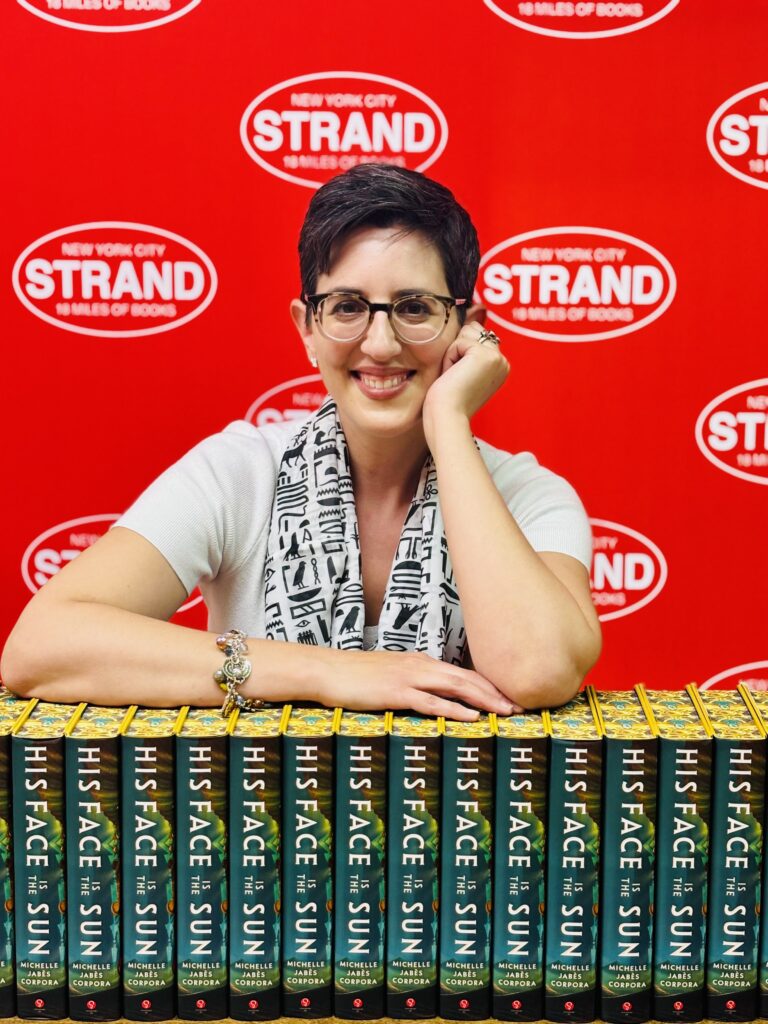
Pictured right: Corpora, a New York Times bestseller, at a book signing event at The Strand Book Store in New York City.
]]>
It was around five o’clock on a Wednesday in May, and Michelle Jabès Corpora ’03, English and theatre, was on her sofa watching her favorite British murder mystery on TV. It had been a long shot...
https://umbc.edu/stories/michelle-corpora-nyt-bestselling-author/
https://my3.my.umbc.edu/api/v0/pixel/news/160456/guest@my.umbc.edu/e88128bedc3f4318bdb5ec9e163215e9/api/pixel
alumni
alumni-profile
cahss
english
magazine
retriever-authors
spring-2026
story
theatre
UMBC News & Magazine
https://my3.my.umbc.edu/groups/umbc-news-magazine
https://assets1-my.umbc.edu/system/shared/avatars/groups/000/001/943/24435aa6207c452e7bc15cc74b42c7bb/xsmall.png?1748556657
https://assets1-my.umbc.edu/system/shared/avatars/groups/000/001/943/24435aa6207c452e7bc15cc74b42c7bb/original.png?1748556657
https://assets2-my.umbc.edu/system/shared/avatars/groups/000/001/943/24435aa6207c452e7bc15cc74b42c7bb/xxlarge.png?1748556657
https://assets2-my.umbc.edu/system/shared/avatars/groups/000/001/943/24435aa6207c452e7bc15cc74b42c7bb/xlarge.png?1748556657
https://assets3-my.umbc.edu/system/shared/avatars/groups/000/001/943/24435aa6207c452e7bc15cc74b42c7bb/large.png?1748556657
https://assets1-my.umbc.edu/system/shared/avatars/groups/000/001/943/24435aa6207c452e7bc15cc74b42c7bb/medium.png?1748556657
https://assets2-my.umbc.edu/system/shared/avatars/groups/000/001/943/24435aa6207c452e7bc15cc74b42c7bb/small.png?1748556657
https://assets1-my.umbc.edu/system/shared/avatars/groups/000/001/943/24435aa6207c452e7bc15cc74b42c7bb/xsmall.png?1748556657
https://assets2-my.umbc.edu/system/shared/avatars/groups/000/001/943/24435aa6207c452e7bc15cc74b42c7bb/xxsmall.png?1748556657
UMBC News & Magazine
1
0
false
Mon, 01 Jun 2026 08:39:25 -0400
Mon, 01 Jun 2026 08:39:25 -0400
Finding a lifetime of purpose in giving back
A bright yellow bead slides over a red pipe cleaner, then a blue bead followed by green. Soon, the rainbow of beads and wire is twisted this way and that until it resembles the Big Dipper. This same activity is happening throughout PHYS 401, a seminar room in the UMBC Physics building, as 20 Baltimore City middle and high school students and their parents recreate the constellations.
These students are part of their local Sigma Beta Club, a youth auxiliary of Phi Beta Sigma Fraternity, Inc., founded nationally in 1950 to help mentor young men and develop their leadership skills. “When we go out to UMBC, it’s always something special,” says Gary Brooks ’79, history, who played a large part in bringing these young people to Hilltop Circle. “UMBC does things second to none.”
The students came to campus in February with members of the Nu Sigma Sigma Alumni Chapter, which includes Phi Beta Sigma alumni—including Brooks—to tour the UMBC Observatory and attend a men’s basketball game.
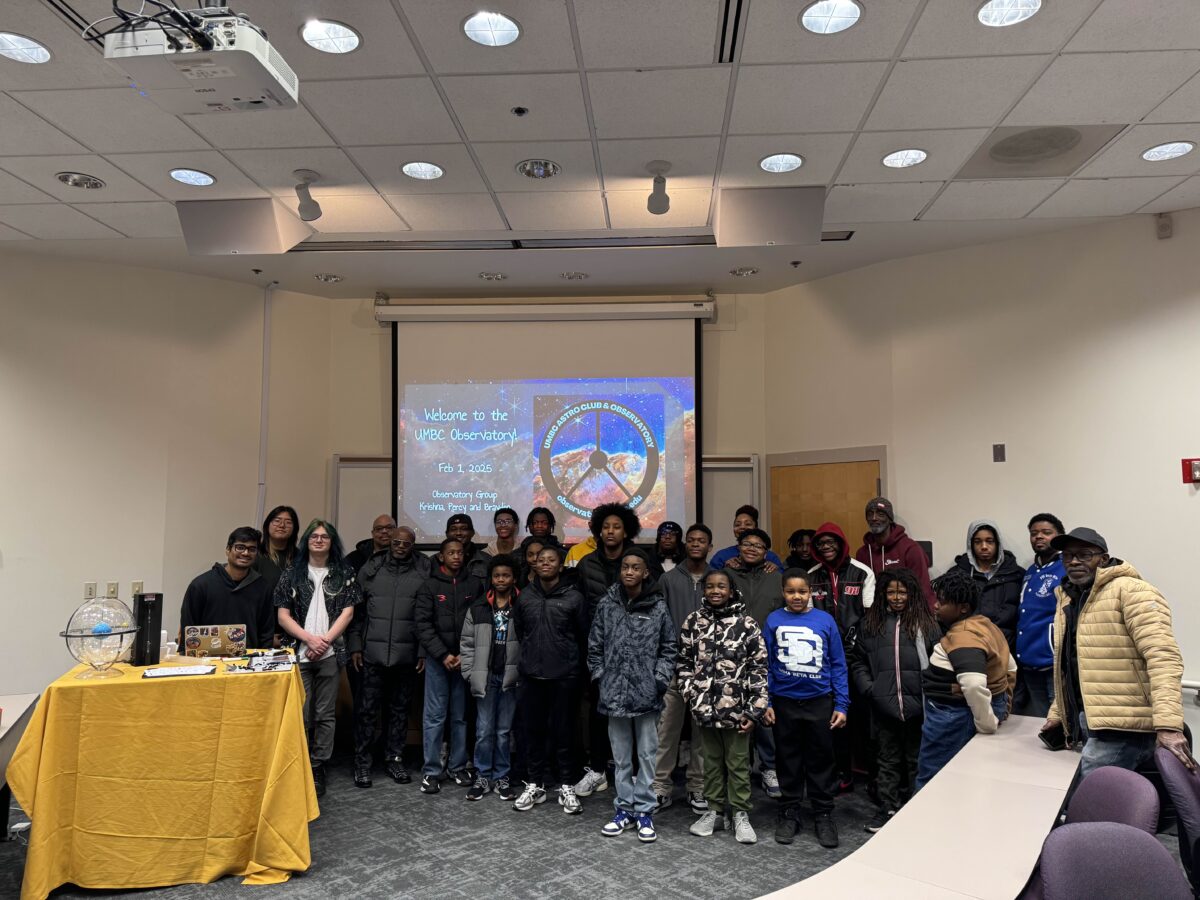 Gary Brooks ’79 and members of the Sigma Beta Club touring the UMBC Observatory with middle and high school students.
Nu Sigma Sigma partners with local universities like UMBC to offer Baltimore City youth interested in STEM the chance to experience college life. Most of these visits involve some sort of athletics event, and that’s about it—but not at UMBC.
Another Sigma Beta Club visit to UMBC involved a FIRST LEGO League competition, and another saw the students observe a robotics event. Brooks also makes sure that each visit includes a member of UMBC senior leadership. Recently, the students had the chance to speak with UMBC President Valerie Sheares Ashby and Athletics Director Tiffany Tucker.
Brooks wants each visit to UMBC to be as meaningful as possible for these young men because he knows how UMBC can change lives.
Staying connected
Even though Brooks graduated 45 years ago, he never really left UMBC. He remains closely involved with Phi Beta Sigma at UMBC, helping mentor students, and he is an active member of Nu Sigma Sigma, working closely with the university to bring Sigma Beta Club members to campus.
“The fraternity got me involved in community service,” says Brooks—a personal mission he carries on to this day.
“Since I met Gary almost 20 years ago, he has been a dedicated champion of UMBC,” says Stanyell Bruce, director of alumni engagement at UMBC.
Brooks also serves on the UMBC Second Generation Scholarship Fund committee. The Second Generation Scholarship is awarded annually to outstanding undergraduate students who intend to pursue study at UMBC, are enrolled in or have completed a course in Africana studies, and demonstrate a commitment to improving the lives of racial/ethnic minorities through community service, extracurricular activities, or other community involvement. Brooks has served on the committee since 1986, when the scholarship was established.
Brooks is also the chairperson for the Historic St. James Episcopal Church Scholarship Fund—a position he has held since 2010—and helped establish the Dr. Lamont Smith, M.D. Scholarship through Sigma R.E.A.C.H., Inc. Brooks has served on that committee since its inception as well.
“Education is dear to my heart,” says Brooks, who went on to earn his M.P.A. from the University of Baltimore and his J.D. from the University of Maryland School of Law—an impressive resume for someone who initially struggled in college.
“My first semester at UMBC wasn’t the best,” admits Brooks. “I didn’t do well at all.”
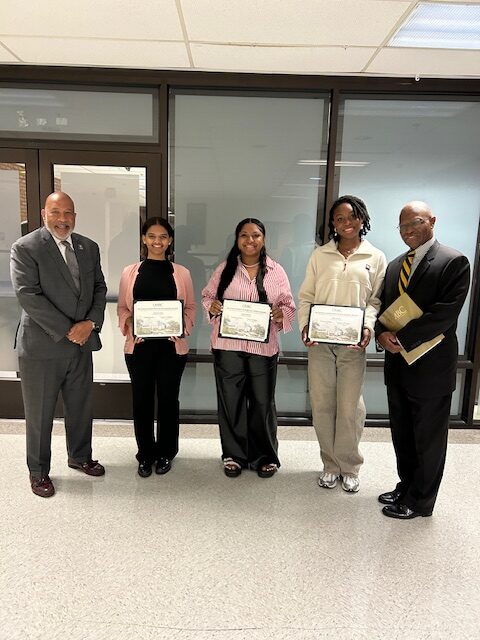
Photo left: Gary Brooks ‘79 and Larry Wiggins ‘75 with the 2024 Second Generation Scholarship recipients.
Finding place and purpose
Instead of giving up, Brooks decided to lean into his weaknesses—reading and writing—by taking courses in Africana studies, a subject that interested him a great deal. These courses involved a lot of reading and writing, but Brooks found himself more immersed in the work. It was still difficult, but he enjoyed the subject matter, and the faculty was incredibly supportive. As a result, his grades began to improve.
“I saw that success, and I got more and more serious about school,” says Brooks.
After graduation, Brooks remained close to the Africana studies department. He spearheaded a committee tasked with hosting the annual “Party with a Purpose,” whose proceeds supported Africana studies and the Second Generation Scholarship. Brooks also continued to correspond with several Africana studies faculty members who mentored Brooks throughout graduate school, law school, and his career.
 Gary Brooks ‘79 and the Party with a Purpose planning committee during UMBC’s 50th anniversary.
After Brooks graduated from law school, one of those professors, Willie Lamousé-Smith, former chair of Africana studies, asked Brooks to step out of his comfort zone and step into the classroom to teach a course on the impact of the criminal justice system on the Black community. Despite some hesitancy—“I do estate planning and bankruptcy,” says Brooks. “I am not a criminal justice attorney.”—the young lawyer decided to take the leap into teaching after more than a little encouragement from Lamousé-Smith.
“Dr. Lamousé-Smith said, ‘Mr. Brooks, you are smart enough,’ and that was enough,” says Brooks. “He believed in me.”
Brooks taught this class for six years, connecting UMBC students with impactful, African American leaders, including the Baltimore City police commissioner and the Baltimore City state’s attorney. Brooks eventually handed the class over to his good friend and former law partner, Larry Wiggins ’75, political science, who played a large role in helping Brooks study for and pass the bar exam.
When the giving goes both ways
Brooks was honored at the 2001 UMBC Alumni Awards with an Alumni Community Leadership Award. He also received a special Visionary Leadership Award in 2006, recognizing members of the Reginald F. Lewis Museum of Maryland African American History and Culture Event Planning Committee for their outstanding contributions to advancing the mission of the UMBC Alumni Association. He’d like to thank his wife, Karen B. Brooks, their four children, Aja, Ashlea, Morgan, and Geron, and their three grandkids, Ryder, Ari, and Amari.
Over the years, Brooks has continued to give back to the UMBC community because of how much the UMBC community has given him.
“Gary’s commitment to UMBC never wavers,” says Bruce. “He’s someone I seek out for advice and guidance, and he embodies what it means to be Retriever Proud.”
]]>
A bright yellow bead slides over a red pipe cleaner, then a blue bead followed by green. Soon, the rainbow of beads and wire is twisted this way and that until it resembles the Big Dipper. This...
https://umbc.edu/stories/finding-a-lifetime-of-purpose-in-giving-back/
https://my3.my.umbc.edu/api/v0/pixel/news/149879/guest@my.umbc.edu/88822ec4ac81192ec039f21af5edb8c6/api/pixel
alumni
alumni-profile
baltimore-city
cahss
gary-brooks
history
impact
magazine
phi-beta-sigma
second-generation-scholarship
sigma-beta-club
spring-2025
story
UMBC News & Magazine
https://my3.my.umbc.edu/groups/umbc-news-magazine
https://assets1-my.umbc.edu/system/shared/avatars/groups/000/001/943/24435aa6207c452e7bc15cc74b42c7bb/xsmall.png?1748556657
https://assets1-my.umbc.edu/system/shared/avatars/groups/000/001/943/24435aa6207c452e7bc15cc74b42c7bb/original.png?1748556657
https://assets2-my.umbc.edu/system/shared/avatars/groups/000/001/943/24435aa6207c452e7bc15cc74b42c7bb/xxlarge.png?1748556657
https://assets2-my.umbc.edu/system/shared/avatars/groups/000/001/943/24435aa6207c452e7bc15cc74b42c7bb/xlarge.png?1748556657
https://assets3-my.umbc.edu/system/shared/avatars/groups/000/001/943/24435aa6207c452e7bc15cc74b42c7bb/large.png?1748556657
https://assets1-my.umbc.edu/system/shared/avatars/groups/000/001/943/24435aa6207c452e7bc15cc74b42c7bb/medium.png?1748556657
https://assets2-my.umbc.edu/system/shared/avatars/groups/000/001/943/24435aa6207c452e7bc15cc74b42c7bb/small.png?1748556657
https://assets1-my.umbc.edu/system/shared/avatars/groups/000/001/943/24435aa6207c452e7bc15cc74b42c7bb/xsmall.png?1748556657
https://assets2-my.umbc.edu/system/shared/avatars/groups/000/001/943/24435aa6207c452e7bc15cc74b42c7bb/xxsmall.png?1748556657
UMBC News & Magazine
1
0
false
Tue, 06 May 2025 17:06:34 -0400
Tue, 06 May 2025 17:06:34 -0400
Meet a Retriever—Collin Sullivan ’19, M.P.P. ’21, digital credential innovator
Collin Sullivan ’19, information systems and economics, M.P.P. ’21, is the program director for digital credential innovation in the Division of Professional Studies. While he started as a student worker in 2015 for the Division of Information Technology (DoIT), working with faculty to leverage the use of clickers in the classroom, he now leads university efforts to offer in-demand microcredentials, such as the Greater Washington Partnership Digital Tech credential. Two things have been constant in Collin’s career: his interest in technology and his love of the UMBC community.
Q: What led you to your current role?
A: In many ways, my professional time at UMBC found me. I began as an undergraduate student worker in Instructional Technology with DoIT. I started by supporting classroom clickers in classes all across campus. I’ve always been interested in educational technology, so I was incredibly fortunate and lucky to have had that opportunity during my undergrad.
When I was about to graduate, like many rising seniors, I was really unsure of where I was going to go. I was feeling uneasy about looking for jobs because I knew the values of UMBC and the community that exists here, and I had a hard time thinking about other places to work that would have the same feeling. My passion for educational technology never waned, and in the end I found an opportunity at UMBC.
Q: How many hats do you wear at UMBC?
A: I have had many roles here at UMBC: undergraduate student, graduate student, alumnus, staff, and adjunct faculty member. I’ve studied information systems, economics, and public policy. I began my career in the Division of Information Technology, and now I am in Extended Studies with the Division of Professional Studies. It is without question that I am who I am, and where I am, because of UMBC.
Q: Tell us about someone in the community who has inspired you.
A: There are way too many people to name! The first person who comes to mind is Craig Berger, my Student Government Association advisor when I was an undergrad. There is no other way to put it other than Craig is the best. During my first few days at UMBC, I made my way to the Campus Life office, and Craig always made me feel welcomed and, later, truly empowered me to feel like I could make a difference on campus and beyond the loop. He taught me that even during times that feel particularly challenging, the world is still malleable. A different perspective and level-headed, strategic approach often is a meaningful path forward.
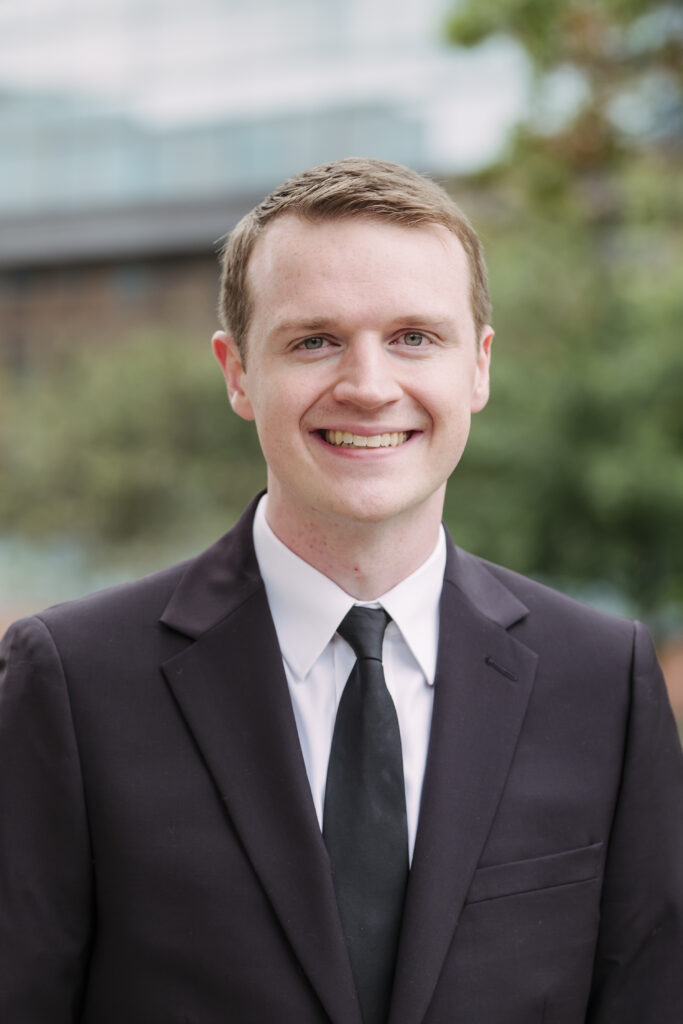
Q: What’s the one thing you’d want someone who hasn’t joined the UMBC community to know about the support you find here?
A: In many ways, UMBC is a small town. It feels like a close-knit community where it’s easy to make meaningful connections with people from diverse backgrounds who genuinely care about each other. While we strive for excellence, there’s no sense of competition—everyone supports one another in achieving personal and collective success, whether in academics, work, or relationships.
Q: Tell us about an organization you’re involved in as part of your work.
A: I’ve had the privilege of being involved with 1EdTech, a national education technology organization, where I serve as co-chair of the Digital Credential Innovation Leadership Network. Our goal is to ensure that everyone who earns digital credentials can confidently showcase their verified competencies and achievements, using them in ways that best support whatever is next in life.
Q: What’s your favorite place on campus to relax or meet friends?
A: My favorite spot has changed over the years—from the tables by the Library pond to the area outside the RAC and the Forum sculpture at the PAHB. But honestly, my go-to answer has to be the coveted comfy chairs at Starbucks! I’ve had so many amazing conversations with friends, mentors, and colleagues there. Plus, you never know who you’ll bump into. There’s just something about the possibilities of chatting over a cup of coffee.
In many ways, UMBC is a small town. It feels like a close-knit community where it's easy to make meaningful connections with people from diverse backgrounds who genuinely care about each other.
Collin Sullivan '19, M.P.P. '21
program director for digital credential innovation
Q: What part of your job do you enjoy the most and why?
A: Working with faculty and staff to create new pathways for learners to reach their goals. It’s easy to get caught up in our own worlds and forget to pause and reflect on the progress we’re all making. I love that I get to collaborate with others to create space for those reflections, where we can really think about what we want learners to achieve. The best part? Seeing the end result—acknowledging all the hard work, both seen and unseen, that helps learners improve their lives and take the next step in their journey.
UMBC’s greatest strength is its people. When people meet Retrievers and hear about the passion they bring, the relationships they create, the ways they support each other, and the commitment they have to inclusive excellence, they truly get a sense of our community. That’s what “Meet a Retriever” is all about.
Learn more about how UMBC can help you achieve your goals.
]]>
Collin Sullivan ’19, information systems and economics, M.P.P. ’21, is the program director for digital credential innovation in the Division of Professional Studies. While he started as a student...
https://umbc.edu/stories/collin-sullivan-digital-credentials-innovation/
https://my3.my.umbc.edu/api/v0/pixel/news/146169/guest@my.umbc.edu/e8cc4a2302334d51835dd340b7a826e9/api/pixel
alumni
alumni-profile
doit
economics
fall-2024
information-systems
magazine
meet-a-retriever
mpp
story
UMBC News & Magazine
https://my3.my.umbc.edu/groups/umbc-news-magazine
https://assets1-my.umbc.edu/system/shared/avatars/groups/000/001/943/24435aa6207c452e7bc15cc74b42c7bb/xsmall.png?1748556657
https://assets1-my.umbc.edu/system/shared/avatars/groups/000/001/943/24435aa6207c452e7bc15cc74b42c7bb/original.png?1748556657
https://assets2-my.umbc.edu/system/shared/avatars/groups/000/001/943/24435aa6207c452e7bc15cc74b42c7bb/xxlarge.png?1748556657
https://assets2-my.umbc.edu/system/shared/avatars/groups/000/001/943/24435aa6207c452e7bc15cc74b42c7bb/xlarge.png?1748556657
https://assets3-my.umbc.edu/system/shared/avatars/groups/000/001/943/24435aa6207c452e7bc15cc74b42c7bb/large.png?1748556657
https://assets1-my.umbc.edu/system/shared/avatars/groups/000/001/943/24435aa6207c452e7bc15cc74b42c7bb/medium.png?1748556657
https://assets2-my.umbc.edu/system/shared/avatars/groups/000/001/943/24435aa6207c452e7bc15cc74b42c7bb/small.png?1748556657
https://assets1-my.umbc.edu/system/shared/avatars/groups/000/001/943/24435aa6207c452e7bc15cc74b42c7bb/xsmall.png?1748556657
https://assets2-my.umbc.edu/system/shared/avatars/groups/000/001/943/24435aa6207c452e7bc15cc74b42c7bb/xxsmall.png?1748556657
UMBC News & Magazine
0
0
false
Mon, 09 Dec 2024 13:15:01 -0500
Mon, 09 Dec 2024 13:15:01 -0500
Renaissance woman: Khadijah Ali-Coleman ’95 lends her varied voice to the Maryland humanities
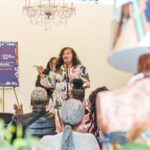
Early mentorship at UMBC, layered with her continued education and formative life experiences, has shaped Ali-Coleman’s voice and purpose. From her transformative years at UMBC—where she wrangled her array of interests into a self-designed major—to her current varied roles, Ali-Coleman’s commitment to the arts, education, and advocacy is clear. Her most recent project was launching the nonprofit Black Writers for Peace and Social Justice, which emerged from her experiences and inspirations gathered from a recent trip to Cuba.
Ali-Coleman’s entrepreneurial spirit is evident in her earlier work as well. In 2008, she founded an arts organization called Liberated Muse, driven by a passion for artistic expression and community engagement rather than immediate financial gain. Her leadership roles in various nonprofits provided her with the skills to formalize her initiatives with integrity and a systems mindset, she says. Collaborations with fellow UMBC alum Maceo Thomas ’93, biochemistry and molecular biology, arose from her desire to create spaces for artistic expression.
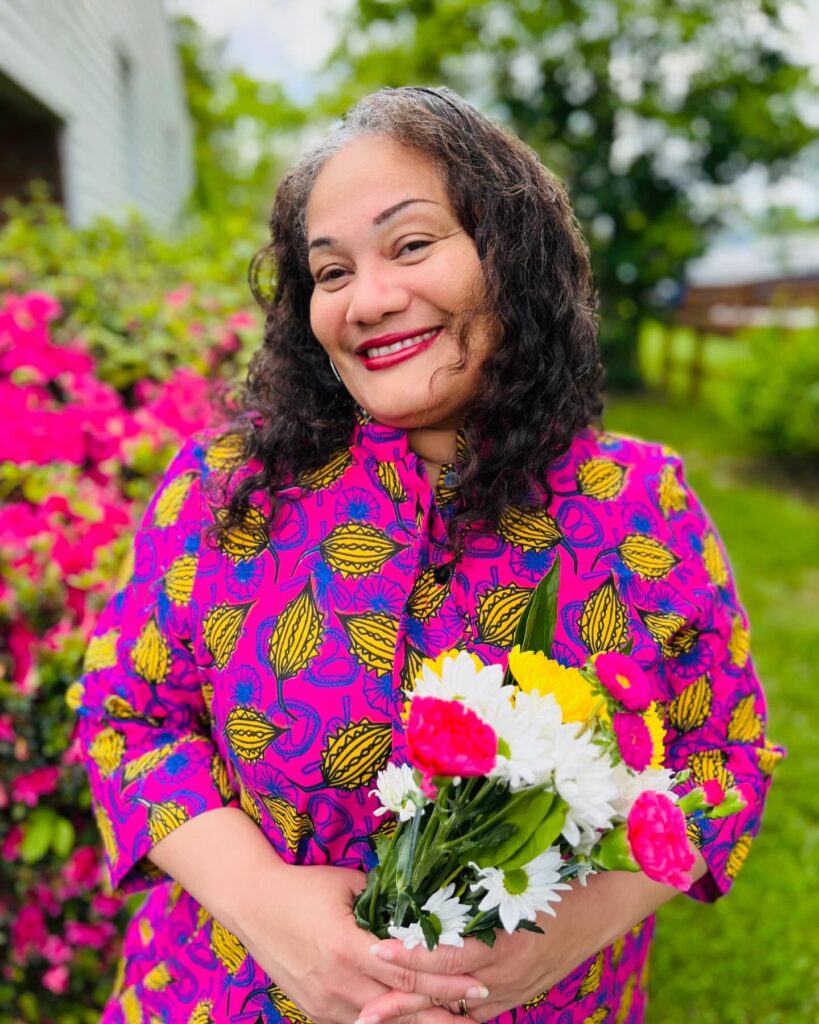 Ali-Coleman stops the smell the roses (and a few other flowers). Photo courtesy of Ali-Coleman.
As the second poet laureate of Prince George’s County, Maryland, Khadijah Z. Ali-Coleman embodies the role’s commitment to both the arts and community. She describes the work as an ambassador for literature and writing, creating courses and spaces for writers to share their voices. “What I’ve found the greatest joy in,” says Ali-Coleman ’95, interdisciplinary studies , “is partnering with local libraries and schools to share the different literary eras that have impacted our world.” Through this position, she has launched a symposium series, focusing on the Black Arts Movement, with plans for an exploration of the Harlem Renaissance in 2025.
Listening to her mother’s voice
Ali-Coleman’s path to UMBC was heavily influenced by her mother, who encouraged her to stay local, despite initially being set on applying to schools across the country. However, during a family tour of UMBC, she felt an unexpected connection. It was, as she describes it, “love at first sight,” enamored by the warmth of the campus community and the support from then admissions counselor Yvette Mozie-Ross ’88.
Now the vice provost for enrollment management and planning, Mozie-Ross was present when Ali-Coleman won the UMBC 2024 Outstanding Alumni Award. “It’s great to see that the same passion and compassion for the genuine well-being of others that ignited and drove Khadijah as a student leader has not waned a bit,” says Mozie-Ross. “Her work in our communities continues to reflect her deep sense of humanity. We (UMBC) couldn’t be more proud of her.”
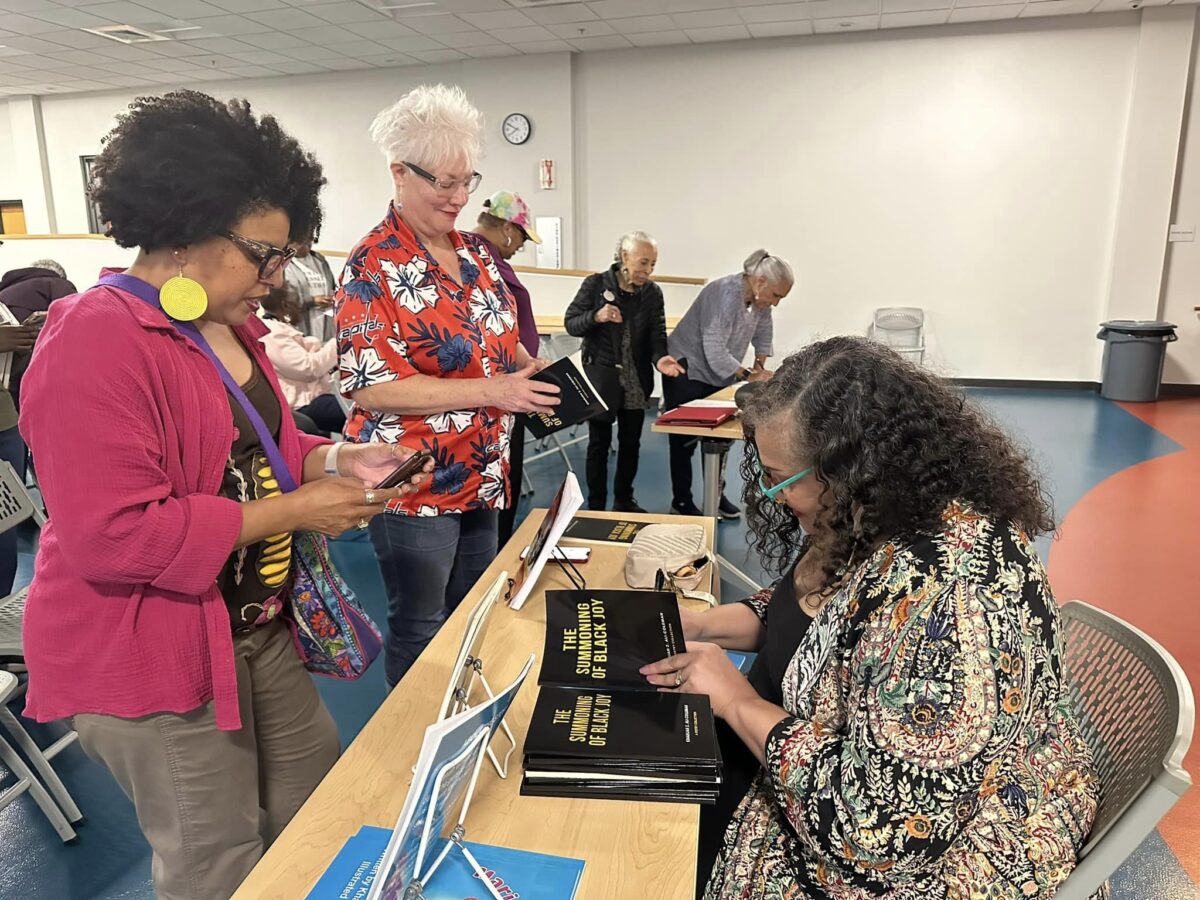 Ali-Coleman signs a copy of her poetry book The Summoning of Black Joy. Photo courtesy of Ali-Coleman.
Once at UMBC, Ali-Coleman faced the challenge of narrowing down her diverse academic interests—ranging from social work and mass media to African American history and English. She quickly realized that a traditional major wouldn’t fit her needs, and after reading the entire course catalog, she discovered the interdisciplinary studies (INDS) program, which allowed her to create a personalized curriculum. This flexibility enabled her to weave courses from African American studies, American studies, and English into a unique educational path that laid the groundwork for her future in communications and education.
Key figures at UMBC also played a significant role in shaping her journey. One of her favorite classes was Acklyn Lynch’s course on the Black Experience, where Ali-Coleman formed a lasting friendship with William Honablew ’95. This course not only stimulated intellectual discussions but also fostered ongoing connections among both students and Lynch long after graduation. Another influential mentor was Jamie Washington, who taught Ali-Coleman during her time as a student peer advisor. Washington’s ability to facilitate difficult conversations around racial tolerance during pivotal moments—such as the Rodney King trial verdict—left a lasting impression on Ali-Coleman. She often finds herself wishing she could emulate his approach as a facilitator and teacher. “Jamie Washington is by far the most impacting role model and person that I think of,” she says.
Making herself at home
Ali-Coleman draws on her inspiring mentors in her own classrooms as an associate professor of English at Coppin State University. “Baltimore is really my second home,” she shares, which started with her time at UMBC, followed by earning her master’s from Towson University, and her doctorate from Morgan State University. As someone familiar with area institutions, Ali-Coleman calls UMBC a “gem.” Aside from having high academic standards, she said it was also ahead of its time.
“Many aspects we now take for granted—like diversity, equity, and inclusion—were already being prioritized at UMBC,” says Ali-Coleman. “The university created a culture around inclusion, which was evident during my time as both an employee and a student.” As a member of the second cohort of UMBC McNair Scholars, Ali-Coleman experienced firsthand UMBC’s commitment to supporting underrepresented students in pursuing doctoral degrees. “I realized how ahead of the curve UMBC was,” said Ali-Coleman. “It didn’t sacrifice academics or cultural experiences. I don’t think people fully appreciate that.”
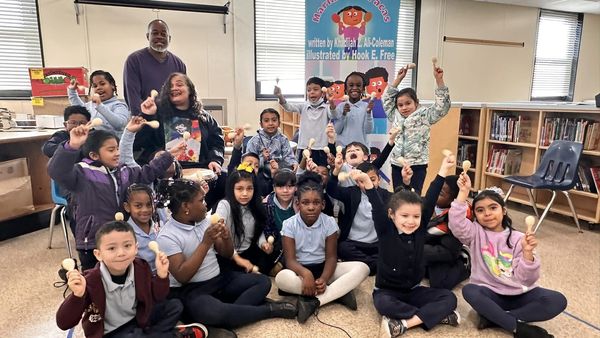 Ali-Coleman gathers with students at Chillum Elementary. Photo courtesy of Ali-Coleman.
Ali-Coleman, who was named an Outstanding Alumni at the 2024 Alumni Awards, says that her career trajectory reflects her experiences at UMBC, where she honed skills that would later serve her in various opportunities. After defending her dissertation on African American homeschool students who were dual enrolled just days before the onset of the COVID-19 pandemic, she recognized an urgent need for support among families navigating homeschooling for the first time. This led her to found Black Family Homeschool Educators and Scholars in 2020, an organization created to assist parents struggling with the transition to remote learning.
As she continues to navigate her role as poet laureate, professor, and nonprofit leader, her story showcases how pivotal moments, resilience, and a little bit of serendipity have shaped her path. “UMBC was one of the best experiences I’ve ever had, and it has been incredibly impactful,” Ali-Coleman reflects. “I’ve drawn from my time there in countless ways in all different areas of my life.”
]]>
Early mentorship at UMBC, layered with her continued education and formative life experiences, has shaped Ali-Coleman’s voice and purpose. From her transformative years at UMBC—where she wrangled...
https://umbc.edu/stories/khadijah-ali-coleman-lends-voice-to-humanities/
https://my3.my.umbc.edu/api/v0/pixel/news/145943/guest@my.umbc.edu/43d3827fa73be53f4ebb9c6f7fc98965/api/pixel
alumni
alumni-awards
alumni-profile
american-studies
english
fall-2024
inds
magazine
story
UMBC News & Magazine
https://my3.my.umbc.edu/groups/umbc-news-magazine
https://assets1-my.umbc.edu/system/shared/avatars/groups/000/001/943/24435aa6207c452e7bc15cc74b42c7bb/xsmall.png?1748556657
https://assets1-my.umbc.edu/system/shared/avatars/groups/000/001/943/24435aa6207c452e7bc15cc74b42c7bb/original.png?1748556657
https://assets2-my.umbc.edu/system/shared/avatars/groups/000/001/943/24435aa6207c452e7bc15cc74b42c7bb/xxlarge.png?1748556657
https://assets2-my.umbc.edu/system/shared/avatars/groups/000/001/943/24435aa6207c452e7bc15cc74b42c7bb/xlarge.png?1748556657
https://assets3-my.umbc.edu/system/shared/avatars/groups/000/001/943/24435aa6207c452e7bc15cc74b42c7bb/large.png?1748556657
https://assets1-my.umbc.edu/system/shared/avatars/groups/000/001/943/24435aa6207c452e7bc15cc74b42c7bb/medium.png?1748556657
https://assets2-my.umbc.edu/system/shared/avatars/groups/000/001/943/24435aa6207c452e7bc15cc74b42c7bb/small.png?1748556657
https://assets1-my.umbc.edu/system/shared/avatars/groups/000/001/943/24435aa6207c452e7bc15cc74b42c7bb/xsmall.png?1748556657
https://assets2-my.umbc.edu/system/shared/avatars/groups/000/001/943/24435aa6207c452e7bc15cc74b42c7bb/xxsmall.png?1748556657
UMBC News & Magazine
1
0
false
Wed, 27 Nov 2024 09:53:23 -0500
Wed, 27 Nov 2024 09:53:23 -0500
Alumna introduces horseshoe crabs to K-12 classrooms to raise these scientifically useful arthropods
Most people wouldn’t guess horseshoe crabs—ancient arthropods with hard, round carapaces and long, spiky tails—when asked what animals you might find in a K-12 classroom. But Jessica Baniak ’23, biological sciences, is collaborating with the Maryland Department of Natural Resources (DNR) to shift kids’ perspectives of the alien-looking critters and create opportunities for inquiry-based learning.
Today, Baniak is a student in the ICARE program, an environmental science master’s program led by UMBC biology professor Tamra Mendelson. ICARE students study local environmental issues and include community partners on their master’s thesis committees.
Horseshoe crabs congregate on Maryland and Delaware beaches to mate each spring, and the last two years Baniak has collected some of their eggs with a research permit from the Maryland DNR. Each female can produce upwards of 20,000 eggs. Baniak takes the eggs back to a lab at the Institute of Marine and Environmental Technology (IMET), a multi-institution research facility on Baltimore’s Inner Harbor, and raises them until they’re about a centimeter across.
Then Baniak delivers the baby crabs to elementary, middle, and high school classrooms in Howard, Carroll, and Baltimore counties. This year, 10 schools received crabs. Some teachers use the crabs in their curriculum, and some crabs are tended by student environmental clubs. Students run basic experiments that develop their science reasoning skills, like comparing growth rates in different hatchery setups.
Finding the sweet spot
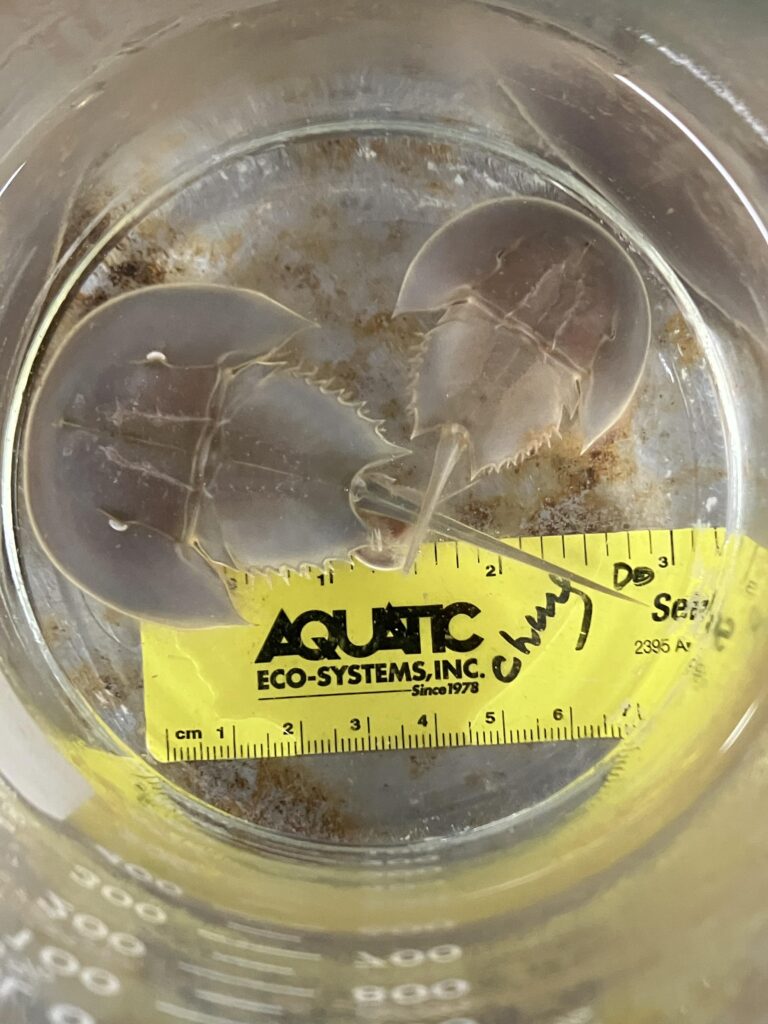 These baby crabs are about six months old, and Baniak grew them at the highest temperature in her study—so they are a little larger than average. (Courtesy of Baniak)
It’s tricky to successfully raise the crabs to adulthood. Baniak visits each classroom a couple of times a year and makes suggestions to improve the crab habitats. Factors like feed, temperature, salinity, and more play a role in their survival. For her master’s research, Baniak is working out the ideal setup for successful crab-rearing with a focus on temperature. Higher temperatures produce faster growth, but some baby crabs perish in the heat. Cooler temps cut the mortality rate, but slow growth.
Baniak’s goal is to find the sweet spot that produces the most healthy crabs in a short amount of time. Why does efficiency matter? Because eager students aren’t the only ones interested in raising crabs.
Companies extract a compound from horseshoe crab blood that is used to detect bacterial contamination in pharmaceuticals. The blood can’t be harvested until the crabs are about 10 years old, Baniak explains, so raising them in captivity isn’t economical (it’s also challenging). Instead, reintroducing young crabs to their natural habitat is “a way that companies can help mitigate how much they’ve taken out of the wild,” Baniak says. Baniak’s work will help optimize these reintroduction programs for the industry—and at the same time, give kids a unique learning opportunity.
‘Everything all at once’
As a child, the National Aquarium in Baltimore—directly across the pier from IMET—inspired Baniak to pursue marine biology. Today her experiences range well beyond horseshoe crabs. As an undergraduate, she had a summer internship at an oyster hatchery. “During the breeding season—that’s when you work really long hours,” she says. “You have to do everything all at once.”
Counting surviving oysters, mating specific oyster pairs, and cleaning tanks—all while squeezing in work on experiments running at the hatchery—filled her days. One project involved developing a protocol to anesthetize oysters, which made it possible to collect tissue samples without killing the oyster. Baniak also assisted with the hatchery’s softshell clam initiative.
For another internship, she worked at the Maryland Pesticide Education Network, which promotes safer alternatives to harmful pesticides. During the academic year, she found time to participate in UMBC’s tae-kwon do club and play club volleyball.
Sharing the joy in science
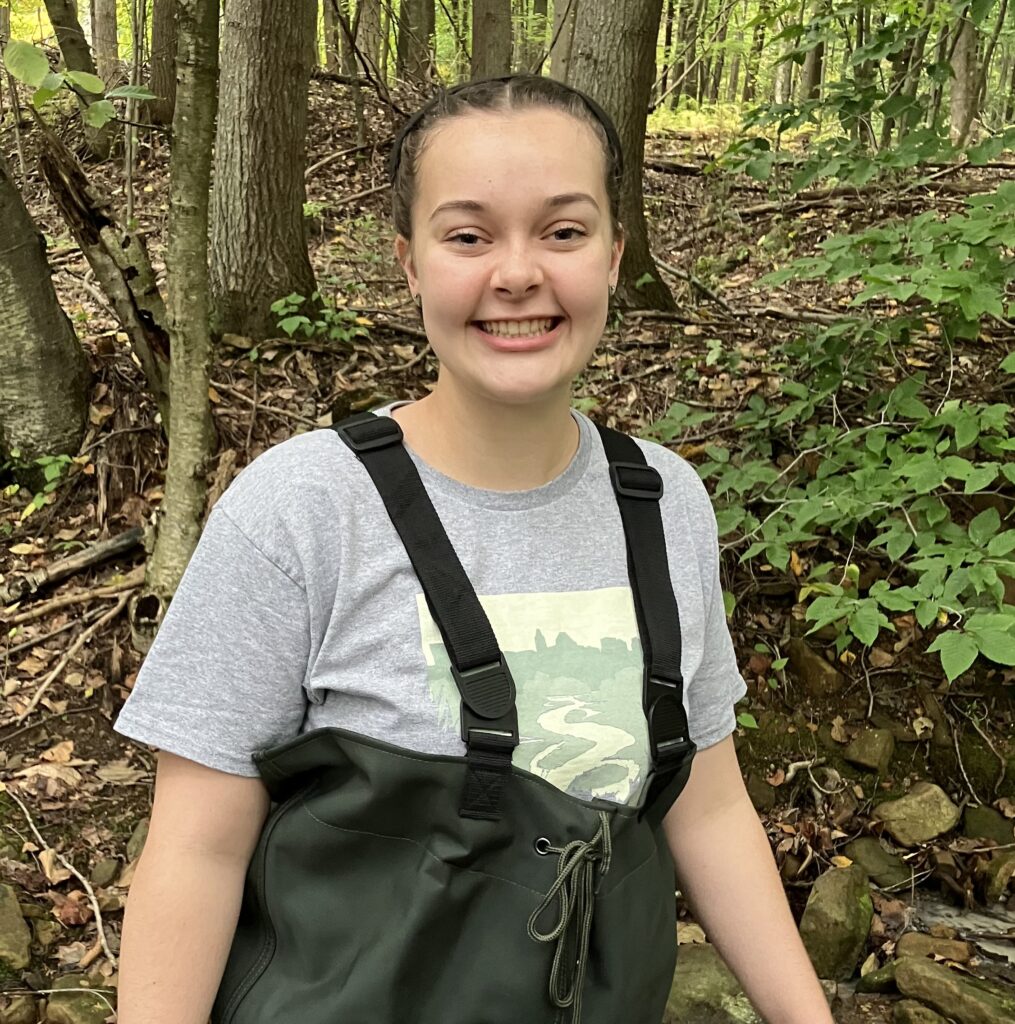 Jessica Baniak ’23 (Courtesy of Baniak)
After she graduates with her master’s next spring, Baniak hopes to move on to a role in a federal agency like the U.S. Fish and Wildlife Service. She wants to continue to contribute to outreach programs like the horseshoe crab project.
“That’s my motivation for continuing in science, because I want to make more programs like that,” Baniak says. “I like ICARE because you’re working with other people in the community and not just researching a really niche subject.”
After she transferred to UMBC during the pandemic to be closer to home, UMBC faculty members helped her stay committed to her biological sciences degree. Maggie Holland, professor of geography and environmental systems, “brought back the joy into science after returning from online learning,” Baniak says. “She seemed to genuinely care about me as a student and about the subject she was teaching.”
Mendelson, too, made an impact. “She’s put a lot of effort into the ICARE program and wants to see all of us succeed,” Baniak says.
At the end of the school year, Baniak will travel with the students to release their horseshoe crabs at Sandy Point State Park and watch them wriggle across the sand and swim into the Chesapeake Bay, heading for life’s next phase.
]]>
Most people wouldn’t guess horseshoe crabs—ancient arthropods with hard, round carapaces and long, spiky tails—when asked what animals you might find in a K-12 classroom. But Jessica Baniak ’23,...
https://umbc.edu/stories/horseshoe-crabs-in-the-classroom/
https://my3.my.umbc.edu/api/v0/pixel/news/145121/guest@my.umbc.edu/bed35689905753f7e8e4a73a2ba71d5f/api/pixel
alumni
alumni-profile
biology
cahss
cnms
fall-2024
ges
icare
imet
magazine
story
UMBC News & Magazine
https://my3.my.umbc.edu/groups/umbc-news-magazine
https://assets1-my.umbc.edu/system/shared/avatars/groups/000/001/943/24435aa6207c452e7bc15cc74b42c7bb/xsmall.png?1748556657
https://assets1-my.umbc.edu/system/shared/avatars/groups/000/001/943/24435aa6207c452e7bc15cc74b42c7bb/original.png?1748556657
https://assets2-my.umbc.edu/system/shared/avatars/groups/000/001/943/24435aa6207c452e7bc15cc74b42c7bb/xxlarge.png?1748556657
https://assets2-my.umbc.edu/system/shared/avatars/groups/000/001/943/24435aa6207c452e7bc15cc74b42c7bb/xlarge.png?1748556657
https://assets3-my.umbc.edu/system/shared/avatars/groups/000/001/943/24435aa6207c452e7bc15cc74b42c7bb/large.png?1748556657
https://assets1-my.umbc.edu/system/shared/avatars/groups/000/001/943/24435aa6207c452e7bc15cc74b42c7bb/medium.png?1748556657
https://assets2-my.umbc.edu/system/shared/avatars/groups/000/001/943/24435aa6207c452e7bc15cc74b42c7bb/small.png?1748556657
https://assets1-my.umbc.edu/system/shared/avatars/groups/000/001/943/24435aa6207c452e7bc15cc74b42c7bb/xsmall.png?1748556657
https://assets2-my.umbc.edu/system/shared/avatars/groups/000/001/943/24435aa6207c452e7bc15cc74b42c7bb/xxsmall.png?1748556657
UMBC News & Magazine
0
0
false
Mon, 28 Oct 2024 10:14:45 -0400
Mon, 28 Oct 2024 10:14:45 -0400
Alumna introduces horseshoe crabs to K-12 classrooms to raise these scientifically useful arthropods
Most people wouldn’t guess horseshoe crabs—ancient arthropods with hard, round carapaces and long, spiky tails—when asked what animals you might find in a K-12 classroom. But Jessica Baniak ’23, biological sciences, is collaborating with the Maryland Department of Natural Resources (DNR) to shift kids’ perspectives of the alien-looking critters and create opportunities for inquiry-based learning.
Today, Baniak is a student in the ICARE program, an environmental science master’s program led by UMBC biology professor Tamra Mendelson. ICARE students study local environmental issues and include community partners on their master’s thesis committees.
Horseshoe crabs congregate on Maryland and Delaware beaches to mate each spring, and the last two years Baniak has collected some of their eggs with a research permit from the Maryland DNR. Each female can produce upwards of 20,000 eggs. Baniak takes the eggs back to a lab at the Institute of Marine and Environmental Technology (IMET), a multi-institution research facility on Baltimore’s Inner Harbor, and raises them until they’re about a centimeter across.
Then Baniak delivers the baby crabs to elementary, middle, and high school classrooms in Howard, Carroll, and Baltimore counties. This year, 10 schools received crabs. Some teachers use the crabs in their curriculum, and some crabs are tended by student environmental clubs. Students run basic experiments that develop their science reasoning skills, like comparing growth rates in different hatchery setups.
Finding the sweet spot
These baby crabs are about six months old, and Baniak grew them at the highest temperature in her study—so they are a little larger than average. (Courtesy of Baniak)
It’s tricky to successfully raise the crabs to adulthood. Baniak visits each classroom a couple of times a year and makes suggestions to improve the crab habitats. Factors like feed, temperature, salinity, and more play a role in their survival. For her master’s research, Baniak is working out the ideal setup for successful crab-rearing with a focus on temperature. Higher temperatures produce faster growth, but some baby crabs perish in the heat. Cooler temps cut the mortality rate, but slow growth.
Baniak’s goal is to find the sweet spot that produces the most healthy crabs in a short amount of time. Why does efficiency matter? Because eager students aren’t the only ones interested in raising crabs.
Companies extract a compound from horseshoe crab blood that is used to detect bacterial contamination in pharmaceuticals. The blood can’t be harvested until the crabs are about 10 years old, Baniak explains, so raising them in captivity isn’t economical (it’s also challenging). Instead, reintroducing young crabs to their natural habitat is “a way that companies can help mitigate how much they’ve taken out of the wild,” Baniak says. Baniak’s work will help optimize these reintroduction programs for the industry—and at the same time, give kids a unique learning opportunity.
‘Everything all at once’
As a child, the National Aquarium in Baltimore—directly across the pier from IMET—inspired Baniak to pursue marine biology. Today her experiences range well beyond horseshoe crabs. As an undergraduate, she had a summer internship at an oyster hatchery. “During the breeding season—that’s when you work really long hours,” she says. “You have to do everything all at once.”
Counting surviving oysters, mating specific oyster pairs, and cleaning tanks—all while squeezing in work on experiments running at the hatchery—filled her days. One project involved developing a protocol to anesthetize oysters, which made it possible to collect tissue samples without killing the oyster. Baniak also assisted with the hatchery’s softshell clam initiative.
For another internship, she worked at the Maryland Pesticide Education Network, which promotes safer alternatives to harmful pesticides. During the academic year, she found time to participate in UMBC’s tae-kwon do club and play club volleyball.
Sharing the joy in science
Jessica Baniak ’23 (Courtesy of Baniak)
After she graduates with her master’s next spring, Baniak hopes to move on to a role in a federal agency like the U.S. Fish and Wildlife Service. She wants to continue to contribute to outreach programs like the horseshoe crab project.
“That’s my motivation for continuing in science, because I want to make more programs like that,” Baniak says. “I like ICARE because you’re working with other people in the community and not just researching a really niche subject.”
After she transferred to UMBC during the pandemic to be closer to home, UMBC faculty members helped her stay committed to her biological sciences degree. Maggie Holland, professor of geography and environmental systems, “brought back the joy into science after returning from online learning,” Baniak says. “She seemed to genuinely care about me as a student and about the subject she was teaching.”
Mendelson, too, made an impact. “She’s put a lot of effort into the ICARE program and wants to see all of us succeed,” Baniak says.
At the end of the school year, Baniak will travel with the students to release their horseshoe crabs at Sandy Point State Park and watch them wriggle across the sand and swim into the Chesapeake Bay, heading for life’s next phase.
]]>
Most people wouldn’t guess horseshoe crabs—ancient arthropods with hard, round carapaces and long, spiky tails—when asked what animals you might find in a K-12 classroom. But Jessica Baniak ’23,...
https://umbc.edu/stories/alumna-introduces-horseshoe-crabs-to-k-12-classrooms-to-raise-these-scientifically-useful-arthropods/
https://my3.my.umbc.edu/api/v0/pixel/news/145114/guest@my.umbc.edu/740ef73058e1b1c2c43f965fda03acb2/api/pixel
alumni
alumni-profile
biology
cahss
cnms
fall-2024
ges
icare
imet
magazine
story
UMBC News & Magazine
https://my3.my.umbc.edu/groups/umbc-news-magazine
https://assets1-my.umbc.edu/system/shared/avatars/groups/000/001/943/24435aa6207c452e7bc15cc74b42c7bb/xsmall.png?1748556657
https://assets1-my.umbc.edu/system/shared/avatars/groups/000/001/943/24435aa6207c452e7bc15cc74b42c7bb/original.png?1748556657
https://assets2-my.umbc.edu/system/shared/avatars/groups/000/001/943/24435aa6207c452e7bc15cc74b42c7bb/xxlarge.png?1748556657
https://assets2-my.umbc.edu/system/shared/avatars/groups/000/001/943/24435aa6207c452e7bc15cc74b42c7bb/xlarge.png?1748556657
https://assets3-my.umbc.edu/system/shared/avatars/groups/000/001/943/24435aa6207c452e7bc15cc74b42c7bb/large.png?1748556657
https://assets1-my.umbc.edu/system/shared/avatars/groups/000/001/943/24435aa6207c452e7bc15cc74b42c7bb/medium.png?1748556657
https://assets2-my.umbc.edu/system/shared/avatars/groups/000/001/943/24435aa6207c452e7bc15cc74b42c7bb/small.png?1748556657
https://assets1-my.umbc.edu/system/shared/avatars/groups/000/001/943/24435aa6207c452e7bc15cc74b42c7bb/xsmall.png?1748556657
https://assets2-my.umbc.edu/system/shared/avatars/groups/000/001/943/24435aa6207c452e7bc15cc74b42c7bb/xxsmall.png?1748556657
UMBC News & Magazine
0
0
false
Mon, 28 Oct 2024 10:14:45 -0400
Embarking on ‘Happily Ever After’

By Roni Rosenthal
For those who grew up—or still are—spellbound by movies like Beauty and the Beast, Toy Story, and The Lion King, you are part of what some historians dub the “Disney Generation.” Your childhood joins forces with a collective nostalgia that weaves Disney’s enchanting tales into our very own identities. In a country with many competing cultural icons, Disney—for better or worse—remains a singular unifying brand for anyone who spent their childhood in the U.S.
Smithsonian museum specialist and curator Bethanee Bemis ’09, history and anthropology, M.A. ’11, history, is an expert in weaving narratives with identity and a storyteller at heart. Her work shines best when married to her earliest passion—Disney.
Where the magic all started
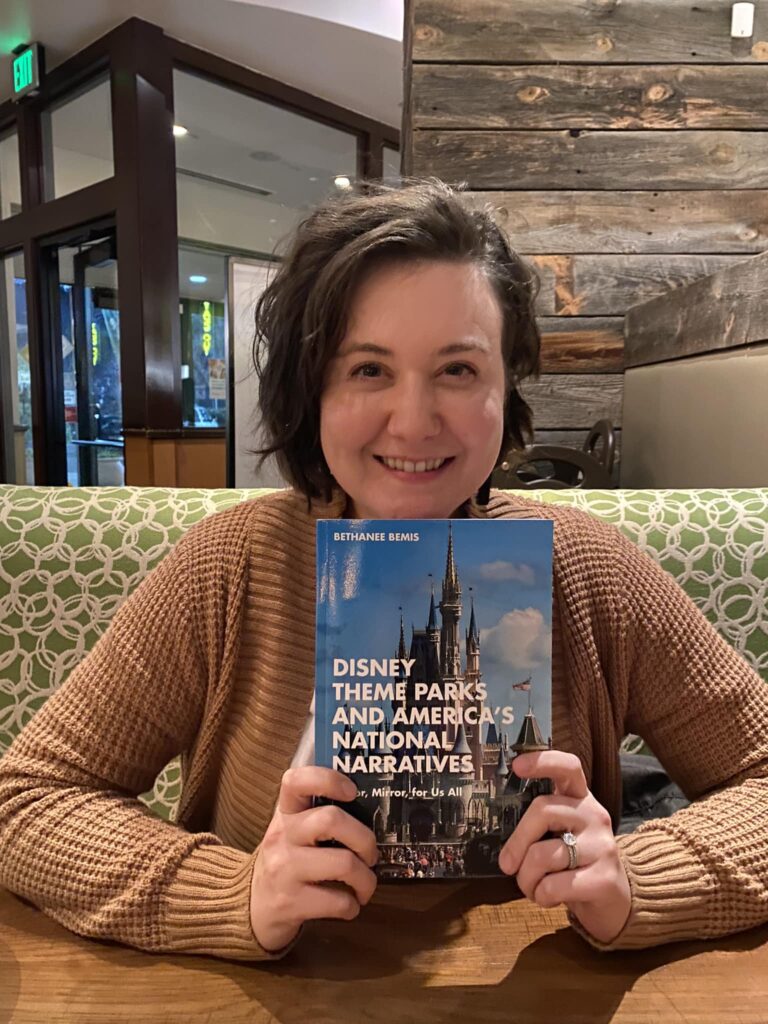 Bethanee Bemis holds up a copy of her book “Disney Theme Parks and America’s National Narratives.”
In her newly published book Disney Theme Parks and America’s National Narratives: Mirror, Mirror for Us All, Bemis shares her journey with Disney. She was brought home from the hospital to a Disney-themed nursery, went to Disney World at age two, and around that age, watched The Little Mermaid for the first time, marking her enchantment. Bemis acknowledges her mother’s infatuation with Disney World in the 1970s as the catalyst for her own passion and appreciation of the imaginary world.
This profound connection with Disney would eventually shape Bemis’ academic and then career path. During a recent installation of a Smithsonian exhibition on American democracy, Bemis recalls, “The central inquiry revolved around who holds the authority to narrate America’s tales. Must our collective narrative be uniform for national unity? Can such unity even exist? That’s when it hit me—Disney! Disney is the narrator of American stories.”
As the curator of the exhibit “Mirror, Mirror: Reflections of America in Disney Parks” at the National Museum of American History, Bemis explores Disney’s impact on American culture and reminds us of the significance of cultural artifacts like movies, dolls, and historical items. These artifacts can inspire conversations, challenge assumptions, and even drive change.
“A great way to launch”
Bemis used her time at UMBC to fuse her early fascination with storytelling and her dedication to exploring the intricate threads of history.
Reflecting on her UMBC days, she remembers the transformative role of Seth Messinger, then an associate professor of sociology and anthropology at UMBC. “Initially, I wasn’t sure what I wanted to do. Dr. Messinger, my undergraduate advisor, believed in me,” says Bemis. “He was convinced that I could achieve success with a little extra effort. He pushed me to go outside my comfort zone and grow, which I appreciated….Well, later on, not in the moment.”
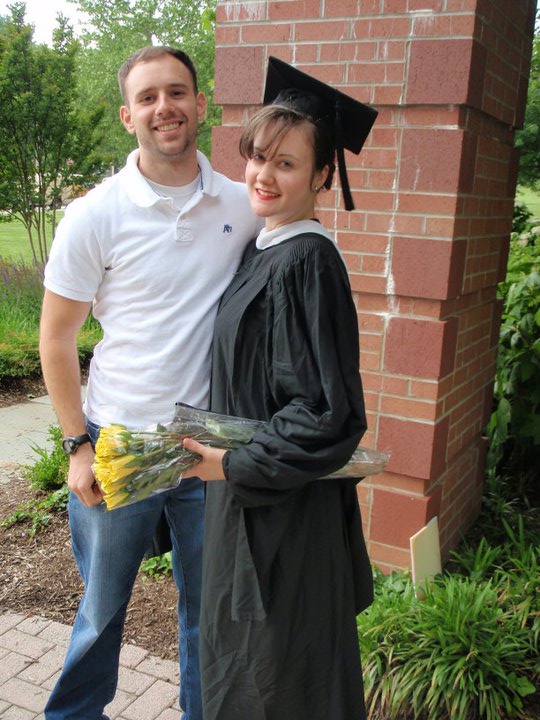 Bemis at graduation with her now husband, Benjamin D’Alessio ’10, M.S. ’11.
On campus, Bemis felt that she could unfold her wings and explore her interests. “I really appreciated how the community at UMBC was a safe space to experiment and think about the person I wanted to be when I finished college,” says Bemis, who met her husband Benjamin D’Alessio ’10, M.S. ’11, chemical engineering, when they were both grad students on campus. “It’s a lifetime community if you want it to be,” she smiles. “It’s not just a school.” Though only seven years old, her daughter already talks about being a Retriever someday.
With mentors like Messinger, Denise Meringolo, associate professor of history, and Amy Froide, professor and chair of history, Bemis found herself propelled beyond her comfort zone, guided to embrace challenges and expand her horizons. The influence of these educators was not confined to her university years; it stretched into the present day, with continued support and advice shaping her path.
Messinger, who has kept in touch with Bemis after they both moved on from UMBC, says Bemis has made him so proud. “In addition to taking my classes, she served as a research assistant for me. She’s very detail oriented and organized, as well as warm and kind as a person. I’ve loved watching her family and career flourish.”
Bemis’s journey through academia led her to a pivotal connection with the Smithsonian’s National Museum of American History. What began as an internship at the Smithsonian’s National Museum of American History grew into a career mission to uncover stories hidden within the museum’s vast collections. Over the years, she moved from intern to curator, specializing in political history and weaving narratives that resonate with the pulse of the nation.
In fact, she says, “I think that the key to finding success in my chosen field was internships and taking advantage of all the opportunities that UMBC provided as a student. Finding a job is often about who you know, and UMBC offers a safe space to grow your network. It is a great way to launch.”
Keep telling stories and making space
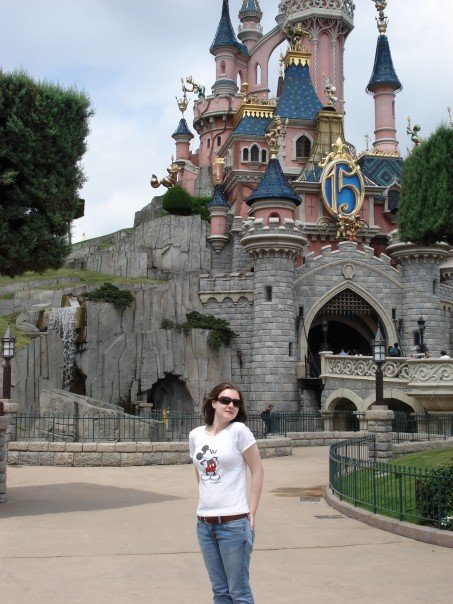 Bemis visited Disneyland, Paris, when she studied abroad.
In an era when entertainment is not just about escapism but also about challenging norms, forming identities, and prompting thought-provoking conversations, the Barbie movie emerges as a recent and unifying testament to the evolving storytelling landscape.
Although Barbie isn’t a Disney creation, Bemis says, “I think that our pop culture has always held the story of us. It isn’t just about entertainment; it’s a reflection of societal values, norms, and aspirations.”
Bemis is proud of her achievements but reminds us that “there’s so much more that needs to be done.” She plans to continue working in the public history field and to tell untold and uninvestigated stories, especially stories that are underrepresented in the public history field.
“We must keep telling the stories and make space in the museum for people to tell their own stories,” says Bemis. “I hope that whatever I do will contribute to that somehow.”
]]>
By Roni Rosenthal For those who grew up—or still are—spellbound by movies like Beauty and the Beast, Toy Story, and The Lion King, you are part of what some historians dub the “Disney...
https://umbc.edu/stories/embarking-on-happily-ever-after-disney-book/
https://my3.my.umbc.edu/api/v0/pixel/news/136487/guest@my.umbc.edu/310f3d20fafb2b6ad410a77a98f45bc9/api/pixel
alumni
alumni-profile
anthropology
cahss
fall-2023
history
magazine
UMBC News & Magazine
https://my3.my.umbc.edu/groups/umbc-news-magazine
https://assets1-my.umbc.edu/system/shared/avatars/groups/000/001/943/24435aa6207c452e7bc15cc74b42c7bb/xsmall.png?1748556657
https://assets1-my.umbc.edu/system/shared/avatars/groups/000/001/943/24435aa6207c452e7bc15cc74b42c7bb/original.png?1748556657
https://assets2-my.umbc.edu/system/shared/avatars/groups/000/001/943/24435aa6207c452e7bc15cc74b42c7bb/xxlarge.png?1748556657
https://assets2-my.umbc.edu/system/shared/avatars/groups/000/001/943/24435aa6207c452e7bc15cc74b42c7bb/xlarge.png?1748556657
https://assets3-my.umbc.edu/system/shared/avatars/groups/000/001/943/24435aa6207c452e7bc15cc74b42c7bb/large.png?1748556657
https://assets1-my.umbc.edu/system/shared/avatars/groups/000/001/943/24435aa6207c452e7bc15cc74b42c7bb/medium.png?1748556657
https://assets2-my.umbc.edu/system/shared/avatars/groups/000/001/943/24435aa6207c452e7bc15cc74b42c7bb/small.png?1748556657
https://assets1-my.umbc.edu/system/shared/avatars/groups/000/001/943/24435aa6207c452e7bc15cc74b42c7bb/xsmall.png?1748556657
https://assets2-my.umbc.edu/system/shared/avatars/groups/000/001/943/24435aa6207c452e7bc15cc74b42c7bb/xxsmall.png?1748556657
UMBC News & Magazine
0
0
false
Mon, 23 Oct 2023 13:09:17 -0400
Mon, 23 Oct 2023 13:09:17 -0400
Carrying on a Philanthropic Legacy
Behind every story of giving lies a story about someone’s generosity. For Hema Gowda ’01, biological sciences, this story was about continuing a generational legacy through philanthropy.
“My mom came to this country in the late ’60s, and education was a huge foundation for her in propelling her forward,” says Gowda, a Prince George’s County native who works in pharmaceutical research.
“When she retired, she set up endowments at [The University of Maryland,] College Park in the name of her parents because they were the ones that pushed her for higher education. She is the person she is today because of them…So I’d always been inspired by that and wanted to give back to UMBC because it was the foundation for my career.”
UMBC’s Alumni Endowment Scholarship Fund presents the perfect opportunity for alumni to give back to the university by directly contributing to the success of students in their undergraduate years. In Gowda’s case, the fund allowed her to follow in her mom’s charitable footsteps by establishing the Gowda Scholarship Endowment for UMBC in 2016 (and a similar scholarship at the University of Maryland School of Pharmacy in 2015) to help students interested in pursuing graduate studies in pharmacy find success at UMBC.
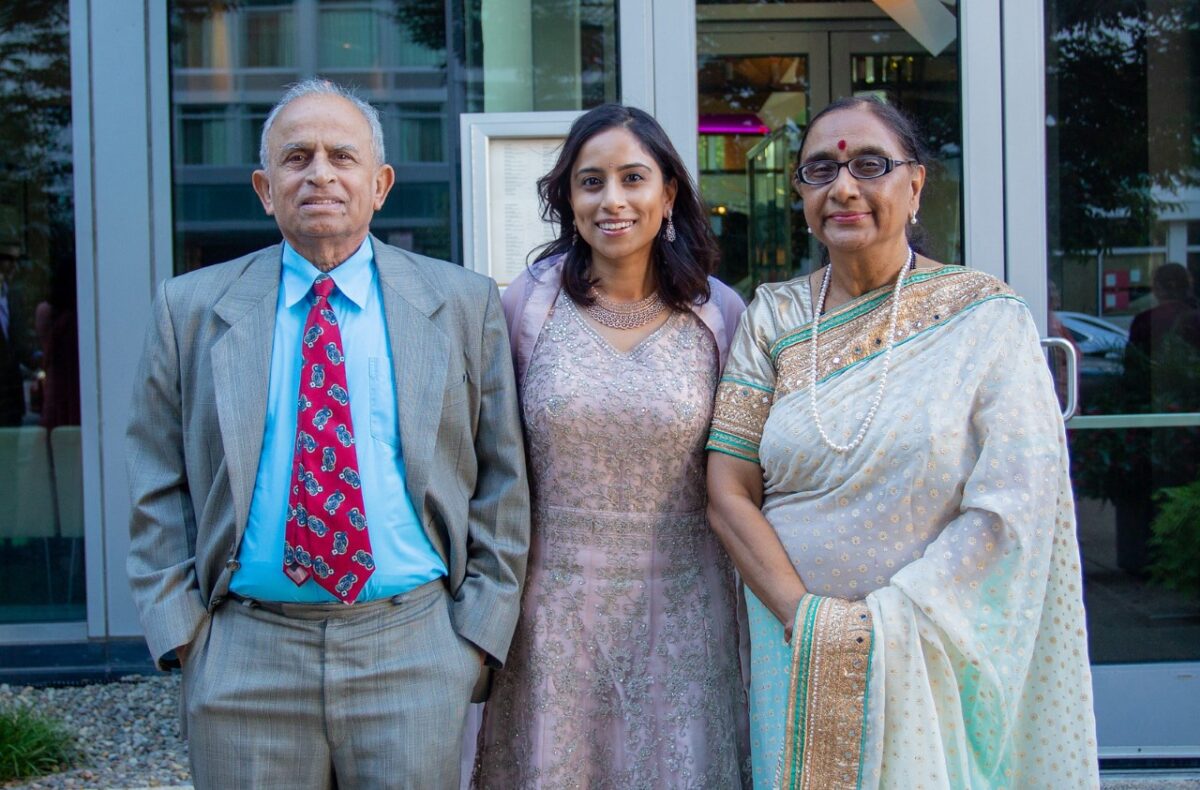 Hema Gowda ’01, center, shares a moment with her parents, Mrs. Vijayalakshmi and Dr. Kusumadhara Gowda. (Image courtesy of Gowda.)
Defining her path
Even as an undergraduate, Gowda knew she wanted to give back to her alma mater, but it took her longer to decide what she really wanted to study at UMBC. When it came to deciding a major, she wanted to pursue the sciences after having been involved in a science and technology program at Eleanor Roosevelt High School. But even after deciding that certain routes like medical school were not for her, it took more steps to narrow down what path called out to her most.
Gowda applied to the University of Maryland School of Pharmacy in her senior year at UMBC and entered the next stage of her academic career. Prior to graduation in 2005, she caught sight of a posting for an editorial internship at the American Society of Health-System Pharmacists —an experience that would eventually lead her to a medical writing position at a medical communications agency in the Philadelphia area the following year. There, Gowda collaborated with pharmaceutical and biotechnology companies to help develop their clinical trial publications and scientific communications for products that were marketed or in development.
After about five years at the agency, Gowda joined the biopharmaceutical company, Incyte, and gained experience in the company’s medical affairs and clinical development groups. This latter opportunity allowed her to take advantage of the communication skills and clinical expertise she had gained through her previous positions and educational experience.
In April 2020, a month into the pandemic, Gowda started her new position as a global development scientist director at AstraZeneca.
“I collaborate with colleagues from many other functions to execute registrational clinical trials in lung cancer. We conduct the trials globally, and gather and submit data for regulatory agencies in hopes of getting new drugs approved for different types of cancers,” explains Gowda.
Gowda’s journey down multiple routes in pharmacy has shown that taking the time to figure out the right path was not at all a setback. Even if it took a bit longer for her to settle on the research route, Gowda did not regret any of the experiences she had gained along the way.
“Each segment of my career helped define my path a little bit better,” Gowda puts it.
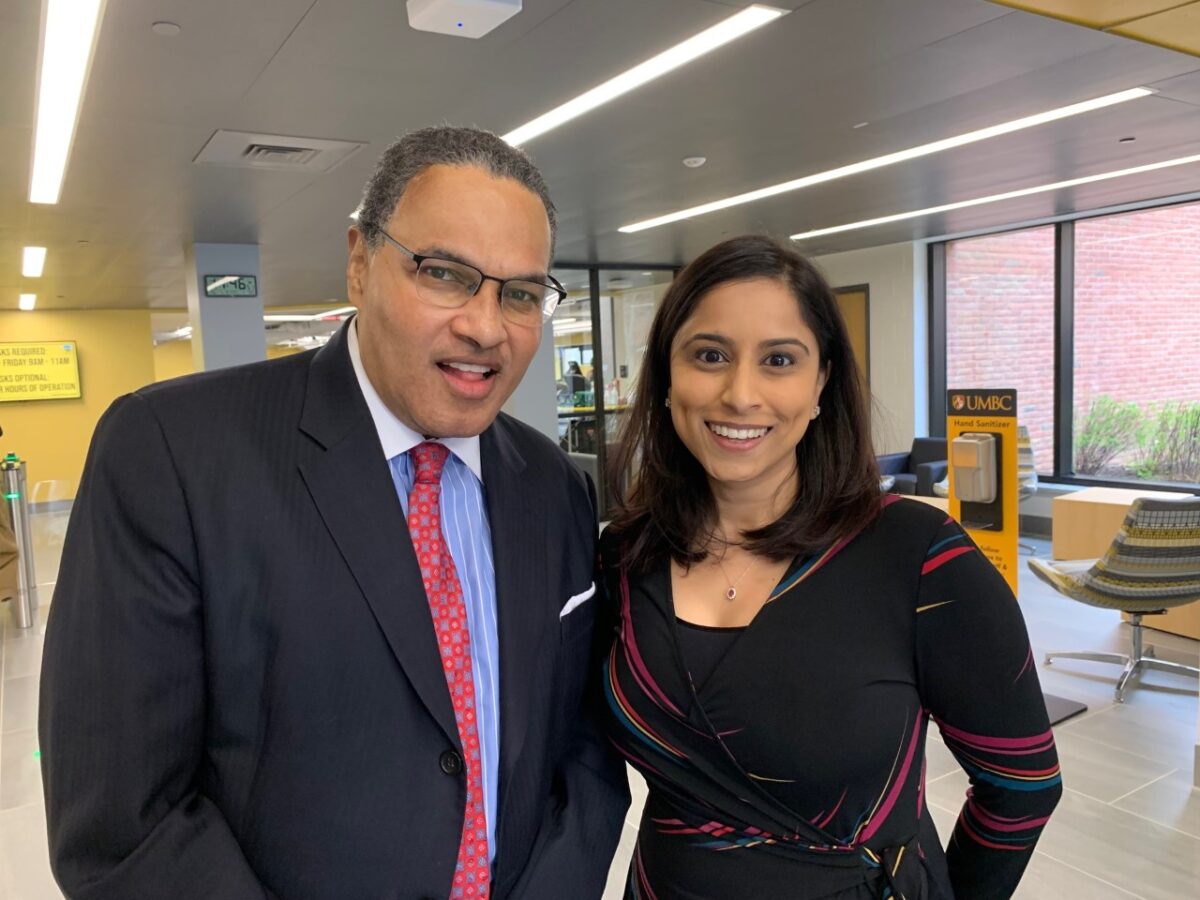 Gowda, right, chats with UMBC president Freeman Hrabowski. (Image courtesy of Gowda.)
Reconnecting to her foundations
The Gowda Scholarship Endowment, open to students interested in pursuing a career in the pharmaceutical sciences, gives preference to students who graduated from a Prince George’s County high school or current residents of the county. On top of wanting to give back to the school system that helped build the foundation for her career, Gowda hopes the scholarship will benefit students who are juggling their responsibilities in the D.C. region.
In describing the time during the pandemic when she met virtually with her first scholar, Adam Kouyate ’22, biological sciences, Gowda says, “[My scholar] was brimming with excitement…and to me, it’s a small amount, but I know it’s a lot for them. And maybe 10 or 20 years from now, that might inspire them to do something similar.”
“Because of this scholarship, I was able to work less hours during the school year and focus more on classes and finding myself.”
– Adam Kouyate ’22
The scholarship lifted a huge burden off Kouyate’s shoulders during a period of burnout. At the time she applied, Kouyate was working at a music store to help pay her tuition. Because she wanted to cover most of the tuition costs on her own, the scholarship allowed her to do so with only $200 coming from her parents. Kouyate was extremely grateful to have been chosen as a scholar, as it also meant she no longer needed to turn to student loans.
“Because of this scholarship, I was able to work less hours during the school year and focus more on classes and finding myself. Though I did end up switching from pharmacy to nursing, this scholarship gave me the peace of mind to focus on what I really wanted to do with my life,” says Kouyate.
Kouyate graduated from UMBC this past spring and will be attending the University of Maryland School of Nursing’s Master’s-Level Entry-Into-Nursing Clinical Nurse Leader program in the fall.
A second recipient of the scholarship, who graduated from Eleanor Roosevelt High School, is also currently studying at UMBC with plans to pursue a graduate degree in pharmacy.
Setting up lifetimes of success
Gowda’s connection to UMBC isn’t just limited to the endowed scholarship, but can be seen through her interactions with friends from her undergraduate days, connections to relatives interested in attending UMBC, and sponsored events such as the Endowed Scholarship Luncheon that is hosted annually at UMBC.
Now and moving forward, Gowda hopes to echo a legacy of giving that has been modeled by her mother as well as inspired by familiar faces at UMBC. Most importantly, she is eager to pass on a future of giving to her scholars—a future that may consist of trial and error, but also with valuable experiences along the way.
“It’s the gift that I want to keep giving, and I can only hope that this small amount for a semester or a year sets them up for a lifetime of success.”
]]>
Behind every story of giving lies a story about someone’s generosity. For Hema Gowda ’01, biological sciences, this story was about continuing a generational legacy through philanthropy. “My...
https://umbc.edu/stories/carrying-on-a-philanthropic-legacy/
https://my3.my.umbc.edu/api/v0/pixel/news/125731/guest@my.umbc.edu/30e5b1d629596f38290c95be093eb18c/api/pixel
alumni-profile
biological-sciences
cnms
impact
magazine
summer-2022
UMBC News & Magazine
https://my3.my.umbc.edu/groups/umbc-news-magazine
https://assets1-my.umbc.edu/system/shared/avatars/groups/000/001/943/24435aa6207c452e7bc15cc74b42c7bb/xsmall.png?1748556657
https://assets1-my.umbc.edu/system/shared/avatars/groups/000/001/943/24435aa6207c452e7bc15cc74b42c7bb/original.png?1748556657
https://assets2-my.umbc.edu/system/shared/avatars/groups/000/001/943/24435aa6207c452e7bc15cc74b42c7bb/xxlarge.png?1748556657
https://assets2-my.umbc.edu/system/shared/avatars/groups/000/001/943/24435aa6207c452e7bc15cc74b42c7bb/xlarge.png?1748556657
https://assets3-my.umbc.edu/system/shared/avatars/groups/000/001/943/24435aa6207c452e7bc15cc74b42c7bb/large.png?1748556657
https://assets1-my.umbc.edu/system/shared/avatars/groups/000/001/943/24435aa6207c452e7bc15cc74b42c7bb/medium.png?1748556657
https://assets2-my.umbc.edu/system/shared/avatars/groups/000/001/943/24435aa6207c452e7bc15cc74b42c7bb/small.png?1748556657
https://assets1-my.umbc.edu/system/shared/avatars/groups/000/001/943/24435aa6207c452e7bc15cc74b42c7bb/xsmall.png?1748556657
https://assets2-my.umbc.edu/system/shared/avatars/groups/000/001/943/24435aa6207c452e7bc15cc74b42c7bb/xxsmall.png?1748556657
UMBC News & Magazine
1
0
false
Fri, 03 Jun 2022 14:42:27 -0400
Fri, 03 Jun 2022 14:42:27 -0400
Body of Work

Artist, educator, community and cultural worker, and curator: Kimberley Acebo Arteche identifies themself with all of these labels. But their path as an artist was a considerable diversion from their original plan to enter the field of medicine.
“I come from a Filipino family and the expectation is always that the children either become nurses, doctors, or pharmacists,” says Arteche ’11, visual arts. Their mother worked at Howard University Hospital, mostly with other Filipino nurses, and Arteche’s high grades in science pushed them in that direction.
 Photo by Jamie Cardenas
, c
ourtesy of Arteche.
It was at UMBC that Arteche, now the co-director of the Berkeley Art Center, decided to delve into other ways of exploring their identity and visibility. Joining the Filipino American Student Association freshman year was one step, another was their role as a founding member of the campus hip-hop dance group Major Definition.“I did struggle a little bit trying to navigate what my identity was as an autonomous person outside of my parents home. I started dancing and that led me into a few years of training with a dance company in DC called Culture Shock,” they say.
This exposure to folks pursuing arts pushed Arteche to switch majors and they began their journey down a new path: photography—finishing a visual arts major in only a year and a half.
Independent study
 Headshot of Gonzalves. Courtesy of Marlayna Demond.
Coincidentally, Arteche’s graduation in 2011 was the same year UMBC established the Asian studies program. It felt like such bad timing, Arteche remembers. “I’ve had been looking for this kind of education in this kind of history for so long!’” they say. Arteche even emailed American Studies Professor Theodore S. Gonzalves to ask if she should try to get a second degree at UMBC, this time in Asian studies. He offered to meet with her regularly instead.
Gonzalves, currently the interim director of the Smithsonian Asian Pacific American Center, introduced Arteche to Filipino American literature and had them read America Is in the Heart, a book by Carlos Bulosan about the struggles of Filipino migrant laborers in the 1930s and 1940s. Gonzalves and Arteche also discussed Carlos Villa, an artist, educator, and community arts organizer and the first person in the United States to teach a Filipino American arts course.
From these conversations, Arteche situated themself in the greater historical and colonialist context of America. “What came out of that was me finally realizing that, although my family had just immigrated to the U.S., my history here in the United States is so much longer,” they say.
Rethinking the gallery
After getting their M.F.A at San Francisco State, Arteche teaches there while also working at the Berkeley Art Center, and pursuing their own art. “For me, all of that informs each other. I’m teaching two classes now [and] one of them is the intermediate darkroom class. My focus is also on decolonizing photography, because our history of photography, in the European American Western canon, is about documenting indigenous peoples and like using that as a tool for colonialism.”
While at the Berkeley Art Center, Arteche aims to break down ideas of art being within the “white cube gallery with crisp white walls.” One of their art exhibitions is Bodyless, which features colorful and bright dusters suspended in spaces as if being worn, but, as expected by the title: without a body inside the dress.
Dusters, Arteche says, are very significant to their community. “They’re the dresses that you wear at home. A lot of times your grandma doesn’t even wear underwear underneath the dresses, because they’re at home, they’re doing physical domestic care work,” Arteche says. As the only one pursuing arts in their family, and a self proclaimed black sheep, Arteche has been digging into family history to understand oral histories and experiences.
They collected dusters from their own family members and created Bodyless, the experience of being seen as a body in space but not being seen as a full human. “You see the outline of a body. That also is very similar for me, as a person of color in art spaces. When I got out of grad school, so much of me being affiliated with white art spaces was so that I could check off these diversity boxes.”
They noted that they value being conscious about equity within art spaces. “[With] my role at Berkeley Art Center, we have been very conscious to not underpay artists. [I try to be] very intentional, like in all of the layers of all the work that I do, to make sure that each decision we make also sets people up to be well and be healthy.”
Reclaiming our bodies
Most recently, the San Francisco Arts Commission awarded Arteche funding for their work, an upcoming project called Kundiman ng Katawan. “It touches on these really tense political histories in the Philippines like the [Ferdinand] Marcos dictatorship, and also just how colonialism has compromised our relationship to our bodies, and how we feel like success and wealth and freedom is tied to how much money we can make and that also kind of puts our bodies at this way where it’s really just a tool for capitalism. I’m unpacking all of those things in this project that’s going to premiere next year,” they say.
As for their future, they hope to move towards taking on larger art commissions, and having their work acquired by museum collections. “Artistically, my goal is to make art that makes folks question their relationship to culture and question their relationship to history, in whatever that means for them,” Arteche says.
— Anjali DasSarma ‘21
*****
Header image: Arteche at a speaking engagement. Photo by Minoosh Zomordinia, courtesy of Arteche.
]]>
Artist, educator, community and cultural worker, and curator: Kimberley Acebo Arteche identifies themself with all of these labels. But their path as an artist was a considerable diversion from...
https://umbc.edu/stories/body-of-work/
https://my3.my.umbc.edu/api/v0/pixel/news/119530/guest@my.umbc.edu/fd82c27c19fa05405da87c08588ef5bc/api/pixel
alumni
alumni-profile
asianstudies
cahss
communityimpact
fall-2021
fasa
filipinoamericanstudentassociation
majordefinition
UMBC News & Magazine
https://my3.my.umbc.edu/groups/umbc-news-magazine
https://assets1-my.umbc.edu/system/shared/avatars/groups/000/001/943/24435aa6207c452e7bc15cc74b42c7bb/xsmall.png?1748556657
https://assets1-my.umbc.edu/system/shared/avatars/groups/000/001/943/24435aa6207c452e7bc15cc74b42c7bb/original.png?1748556657
https://assets2-my.umbc.edu/system/shared/avatars/groups/000/001/943/24435aa6207c452e7bc15cc74b42c7bb/xxlarge.png?1748556657
https://assets2-my.umbc.edu/system/shared/avatars/groups/000/001/943/24435aa6207c452e7bc15cc74b42c7bb/xlarge.png?1748556657
https://assets3-my.umbc.edu/system/shared/avatars/groups/000/001/943/24435aa6207c452e7bc15cc74b42c7bb/large.png?1748556657
https://assets1-my.umbc.edu/system/shared/avatars/groups/000/001/943/24435aa6207c452e7bc15cc74b42c7bb/medium.png?1748556657
https://assets2-my.umbc.edu/system/shared/avatars/groups/000/001/943/24435aa6207c452e7bc15cc74b42c7bb/small.png?1748556657
https://assets1-my.umbc.edu/system/shared/avatars/groups/000/001/943/24435aa6207c452e7bc15cc74b42c7bb/xsmall.png?1748556657
https://assets2-my.umbc.edu/system/shared/avatars/groups/000/001/943/24435aa6207c452e7bc15cc74b42c7bb/xxsmall.png?1748556657
UMBC News & Magazine
0
0
false
Wed, 10 Nov 2021 18:36:10 -0500
Supporting the Whole Student
 Lewis on campus in 1992. Photo courtesy of Lewis.
“To me, UMBC opened up the world,” says Tamara L. Lewis ’92, psychology. As a student, that meant joining Alpha Kappa Alpha Sorority, Inc., for instance, holding multiple jobs all around campus, and ultimately re-envisioning her career path.
Lewis began her studies focusing on industrial and organizational psychology. However, it was her many on-campus jobs—conference assistant, desk staffer, and student worker in the admissions office—that allowed her to realize that she was actually drawn to counseling. Working across campus let Lewis see how a university can support student success, so she began to explore how she could work with students.
Thirty years later, Lewis still feels a sense of real connection to the campus and actively works to help other alumni engage with students and the institution. And her career pathway has allowed her to continue to support students in the manner she first observed at UMBC.
The need to belong
Academic support has defined many aspects of Lewis’s career and philanthropic life. After UMBC, Lewis received her master’s degree in counseling from Hampton University—UMBC President Freeman Hrabowski’s alma mater. She then began her career in the counseling center at Baltimore City Community College.
“Being in the academic realm got me thinking more about college student experiences,” she shares, and she started thinking about what structures exist to help young people succeed. She drew on lessons learned at UMBC that helped her understand the value of community and support in educating the whole student.
 Lewis speaking at a CBLA event. Photo courtesy of the Alumni Association.
Lewis continued exploring the topic of academic success in her dissertation for her doctorate from Morgan University. After earning both her graduate degrees from Historically Black Colleges and Universities, Lewis understood the advantages of students feeling a sense of belonging while at school. Her own experience, along with research and alumni work, has shown her the importance of making students feel important and valuable within their community.
Carving out space
Creating a space for Black and Latinx alumni to come together came organically through events and outreach supported by UMBC’s Office of Alumni Engagement, says Lewis. What started as a UMBC-hosted evening for Black and Latinx alumni at Baltimore’s Reginald F. Lewis Museum of African American History, would result in the creation of the Chapter of Black and Latino Alumni (CBLA) at UMBC in 2006.
“Tamara was instrumental in creating the CBLA and leading events and initiatives that would speak to and acknowledge the unique experiences of our Black and Latine/x graduates,” says Stanyell Odom, director of Alumni Engagement. “Her love for UMBC is evident in the way she gives back her time, talent, and resources through the CBLA, the Alumni Board and her beloved sorority.”
In 1991, Lewis became a member of Alpha Kappa Alpha Sorority (AKA), one of the first historically Black sororities on campus. She remembers how important it felt to build community within the “small community” of Black students on campus. Through her student work in AKA, as well as her residential life involvement, she saw the value of supporting Black students to do their very best at UMBC, a vision that was shared through the administration, she says.
Now, nearly 30 years after joining her sorority, she continues to connect with members to support UMBC. In 2011, Lewis helped plan the first AKA Homecoming reunion. Anita Jackson ’80, health science and policy, then a member of the Alumni Association Board of Directors, and the Office of Alumni Engagement leveraged connections to the alumni community to make the event a success. AKA members have gathered at Homecoming every year since. The event also fundraises for the UMBC Second Generation Scholarship, which is dedicated to students who show a commitment to the advancement of minorities. In 2020, during the COVID-19 pandemic, the sorority sisters came together virtually in honor of the charter anniversary of their chapter.
“It’s important that people give what they can; even if it’s not money but time,” Lewis says, emphasizing the value of expanding the ways alumni can support the UMBC community.
Integral part of the community
Now, as the state test security officer and the National Assessment of Educational Progress state coordinator for the Maryland State Department of Education (MSDE), Lewis continues to ensure students have everything they need to succeed on standardized testing. The Assessment Branch of MSDE works to create uniform and accessible testing standards so students, educators, and community members can best support students and address any gaps in education. Working in Baltimore City, Lewis understands the value of equitable testing practices so students can use every support available. Her continued curiosity about addressing gaps and building community has made her an integral part of the UMBC alumni community.
As a student, Lewis realized that being an active member of the UMBC community was the best way to get the most of her education. Now, she wants to help current students—who she sees as future alumni—realize how important it is to give back to UMBC when they do graduate. “When I tell people I went to UMBC, they’re impressed,” she says, which just inspires her to give back even more.
— Imani Spence ’16
*****
Header image: Lewis, right, at an AKA Homecoming reunion in 2014. Photo by Marlayna Demond ’11.
]]>
Lewis on campus in 1992. Photo courtesy of Lewis. “To me, UMBC opened up the world,” says Tamara L. Lewis ’92, psychology. As a student, that meant joining Alpha Kappa Alpha Sorority, Inc.,...
https://umbc.edu/stories/supporting-the-whole-student/
https://my3.my.umbc.edu/api/v0/pixel/news/119600/guest@my.umbc.edu/2085d6b424400e388285f53706764f4b/api/pixel
alumni-association
alumni-profile
cbla
homecoming
impact
psychology
spring-2021
UMBC News & Magazine
https://my3.my.umbc.edu/groups/umbc-news-magazine
https://assets1-my.umbc.edu/system/shared/avatars/groups/000/001/943/24435aa6207c452e7bc15cc74b42c7bb/xsmall.png?1748556657
https://assets1-my.umbc.edu/system/shared/avatars/groups/000/001/943/24435aa6207c452e7bc15cc74b42c7bb/original.png?1748556657
https://assets2-my.umbc.edu/system/shared/avatars/groups/000/001/943/24435aa6207c452e7bc15cc74b42c7bb/xxlarge.png?1748556657
https://assets2-my.umbc.edu/system/shared/avatars/groups/000/001/943/24435aa6207c452e7bc15cc74b42c7bb/xlarge.png?1748556657
https://assets3-my.umbc.edu/system/shared/avatars/groups/000/001/943/24435aa6207c452e7bc15cc74b42c7bb/large.png?1748556657
https://assets1-my.umbc.edu/system/shared/avatars/groups/000/001/943/24435aa6207c452e7bc15cc74b42c7bb/medium.png?1748556657
https://assets2-my.umbc.edu/system/shared/avatars/groups/000/001/943/24435aa6207c452e7bc15cc74b42c7bb/small.png?1748556657
https://assets1-my.umbc.edu/system/shared/avatars/groups/000/001/943/24435aa6207c452e7bc15cc74b42c7bb/xsmall.png?1748556657
https://assets2-my.umbc.edu/system/shared/avatars/groups/000/001/943/24435aa6207c452e7bc15cc74b42c7bb/xxsmall.png?1748556657
UMBC News & Magazine
0
0
false
Wed, 09 Jun 2021 19:27:00 -0400


