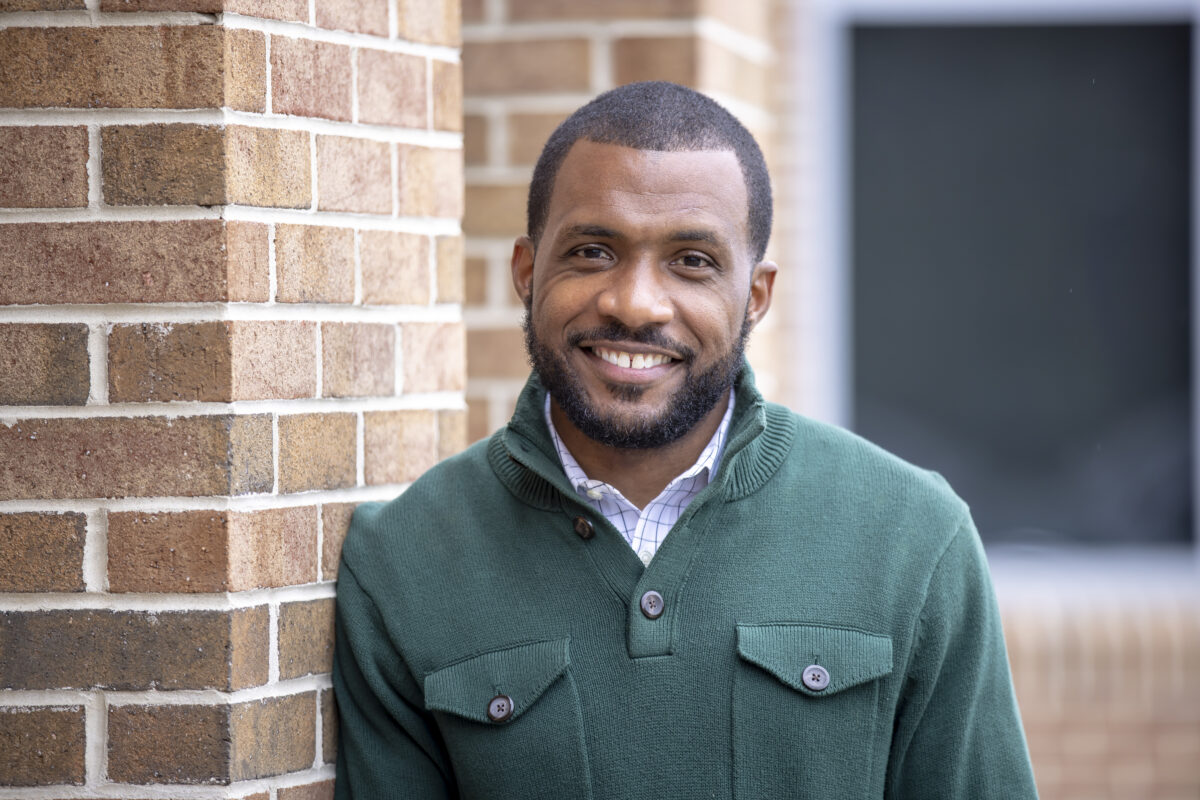
Finley Bandy ’26 finds a future in history
Finley Bandy spent last summer in the cool temperatures and dim light of UMBC’s Albin O. Kuhn Library and Gallery Special Collections—the perfect environment to preserve rare books, photographs, manuscripts, archives, and artifacts. As part of UMBC’s 2025 Co-Lab interdisciplinary undergraduate summer research program, Bandy learned techniques to produce “Special Collections 101”, an informative video about how to use the resources in the collections. Bandy also loves being surrounded by thousands of historical narratives and working with Special Collections staff Beth Saunders, associate director and curator, and Lindsey Loeper, reference and instruction archivist. The infinite possibilities housed in Special Collections and the people who ensure historical narratives aren’t forgotten have inspired Bandy to join the cadre of museum and archive professionals.
“I was accepted into UMBC’s master’s program in historical studies,” says Bandy. “I love the process of using my historical and archival research to write about what I’m finding so that other people are aware that this piece of history exists. That’s why I want my master’s research to be an online exhibit that is accessible to the world.”
Museums and archives are only two of Bandy’s passions. When Bandy transferred to UMBC from Lamar Community College in Colorado, they brought their love of Russian language, history, and culture, and their deep love of Baltimore City.
Q: Did you come to UMBC already knowing what you wanted to study?
A: When I started at UMBC, I was all set to learn Russian and study Soviet history, but then I decided to go broader and major in history. I did finish all the Russian language courses, so I can speak Russian. I’m still interested in Russian history, and I love Russian music. I really love the language and like Eastern European culture.
Q: Where does your passion for Russian language and culture come from?
A: In my community college, I took a 20th-century world history class, and learned about the Cold War, which lasted from 1947 to 1991. A lot of the history really broke my heart. It made me want to learn more about it. I took a lot of Russian history classes and started reading Russian and Soviet literature. I really love how unique it is.
Q: Is there a modern piece of Russian culture that you enjoy, or are you focused on the history?
A: I think it’s really interesting to see how Soviet culture is beginning to meld with Western culture.
Soviet rock bands are really, really cool. There’s this great rock band that has been around since the ’70s called Akvarium or Aquarium. They were underground for a long time due to the war. I listen to them a lot. There’s also a current pop musician named Monetochka. She’s really cool.
I’ve never travelled abroad or have a passport, but one day I would like to visit Moscow and St. Petersburg, and travel all over Eastern Europe and the Balkans.
 UMBC’s proximity to Camden Yards makes for a great trip to cheer on the Orioles! (Image courtesy of Bandy)
Q: Do you have a community to speak Russian with and immerse yourself in Russian culture?
A: Yes! UMBC’s Russian Club is a really tight-knit group. In the past, we hosted many holiday celebrations. In post-Soviet Russia and Eastern Europe, they still celebrate Christmas, but New Year’s is celebrated more because during the Soviet era, atheism was promoted and New Year’s didn’t have religious ties. Towards the end of the fall semester, we organized a giant Novy God [New Year’s] celebration. And then in the spring, we celebrated Maslenitsa. In the Russian Orthodox Church, this is the last week to feast before a period of fasting that ends at Easter. We also hung out a lot and talked about different Eastern European cultures. It’s called the Russian Club, but we have students from all over Eastern Europe—Ukraine, Armenia, and Belarus.
Q: Why do you love Baltimore City?
A:. Even though I was in Colorado for community college, I spent a lot of my childhood in Baltimore City because my grandmother worked in the city and my mom lived there. I have a connection to Baltimore, but I never really knew its history. I took “The History of Baltimore” at the Lion Brothers Building downtown. Every week, we took field trips to historic sites in Baltimore City to connect what we were learning with real-world experiences.
Q: Why did you change your major from Russian to history, and who has inspired you in this path?
A: I decided to switch majors from Russian to history while doing research in Professor Melissa Blair‘s “The History of Baltimore” class. It inspired me to pivot and focus my work on Maryland’s transportation history. The experiential learning and field work inspired me to better understand Baltimore and its history. I think Baltimore is a very unique city with a rich history that is often ignored by the historical record. I enjoyed interacting with other public historians and museum professionals within the city through that class.
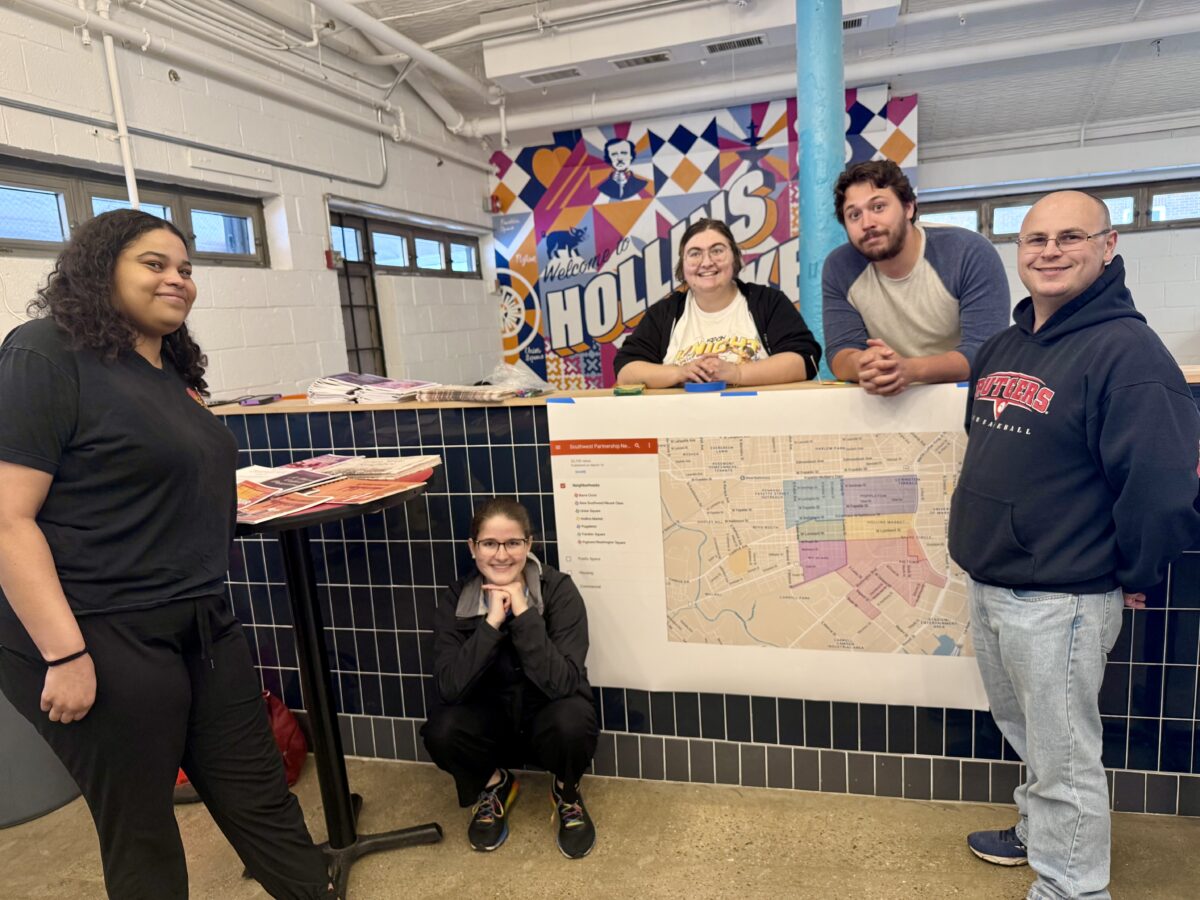 Students from King’s class, “Preserving Spaces, Making Spaces in Baltimore,” participated in a Community Archiving Day event. The class planned this event to engage with residents and community members from neighborhoods in Southwest Baltimore and to gauge interest in developing a Community Archive to preserve their histories. (l-r) Amina Thiam ’24, history, Em Schumacher, a geography and environmental systems senior, Bandy, Tristan Diaz ’25, cultural anthropology and sociology, and Bandy’s fiancé, Max Taylor (who is not a UMBC student). (Image courtesy of King)
I’ve also worked a lot with Professor Nicole King in American studies—I took her “Preserving Places, Making Spaces in Baltimore” class twice. In 2025, we worked with the Poppleton Now Community Association and the Southwest Partnership Historic Preservation Committee on a Public History and Preservation Study. It included my research on the “Highway to Nowhere,” a 1.4-mile stretch of U.S. Route 40 in West Baltimore, built in the 1970s, that ends abruptly. The highway cuts off a section of Poppleton, one of the city’s oldest historically Black neighborhoods. We also created an online story map.
Q: Why are you passionate about transportation equity?
A: I don’t have a car, so I rely on Baltimore’s terrible public transportation. I love public transit, and I need it to be better. In the Baltimore history class, I realized the bus schedules, the bus routes, and the history of highway construction in the city have limited transportation, not expanded it. I conducted research with American studies Professor Michael Cassiano, my public humanities advisor. I presented my research, “Our City Is a City Without an Expressway: A Historical Review of Transportation Injustice in Baltimore City,” at URCAD. I’m interested in exploring these topics in my master’s program.
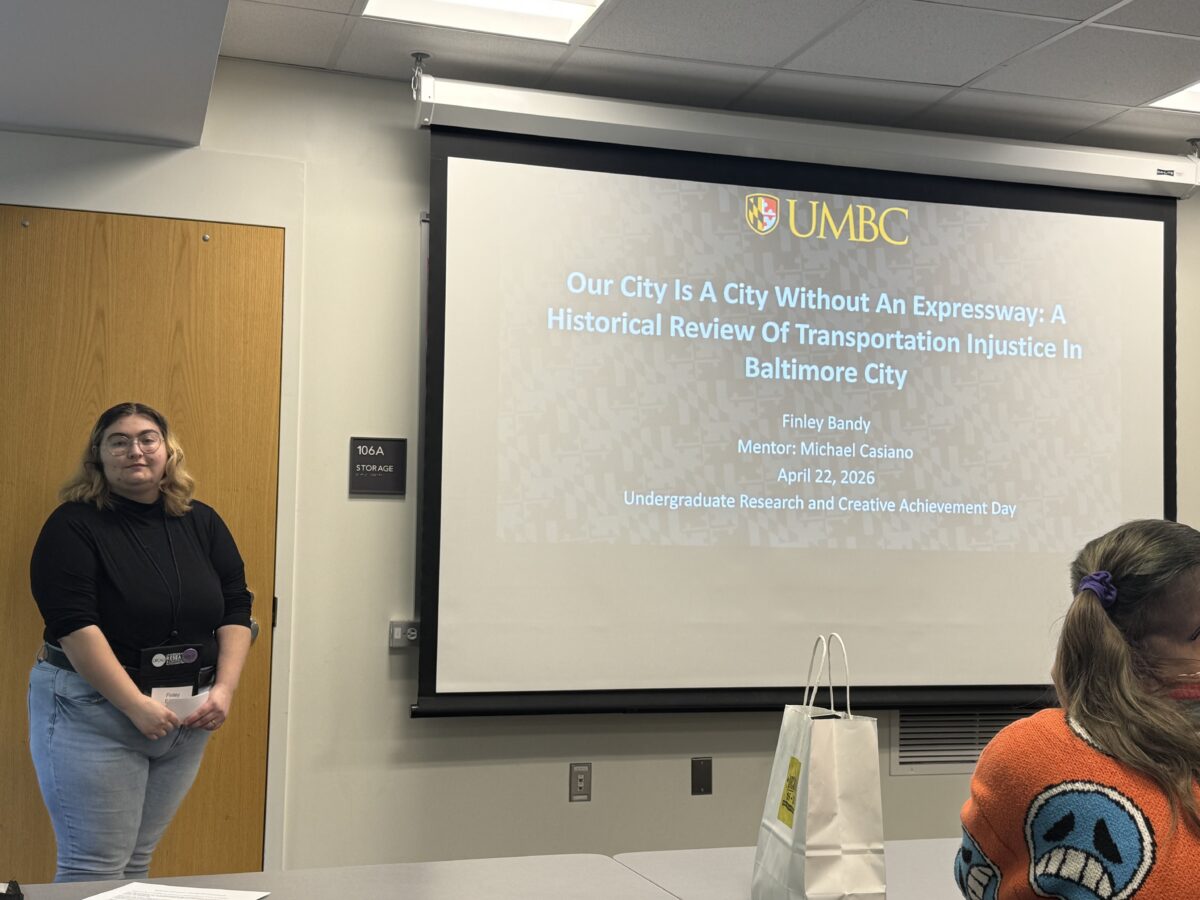 Bandy presents her research at the 2026 Undergraduate Research and Creative Achievement Day. (Image courtesy of King.)
Q: What is a challenge that you love?
A: I love creative writing. I’ve been writing since I was a kid. I think it’s a natural segue into history, because history is narrative-based. It’s very humanistic. I won’t say it comes naturally to me. It takes me probably an hour to write a sentence because I overthink my word choices a lot. But I love using language to evoke certain feelings and really press home on an idea. I try to choose the right word to fit what I’m talking about and its context. I also try to support students in the writing process as the History Student Council president. Last semester, we organized a bi-weekly writing group to encourage community and motivation within the major.
Q: What advice do you have for undergraduate and transfer students?
A: For undergraduate students, I would say to be realistic. Don’t put too much on your plate. That’s been the biggest challenge for me. I’ve been suffering a lot of burnout, because, in addition to my classes, I am a teaching assistant for “Introduction to the University for Transfer Students.” I started getting better at saying no to things. I encourage students to get out there, explore new things, but also recognize their limits. Prioritize making space for something that brings you joy.
For transfer students, I would say time management. Most of us work full-time or part-time, are raising families, and have other commitments. We’re not fresh out of high school and can sometimes internalize a feeling of being behind or not doing college “right.” It’s important to get over that because it doesn’t really matter. When I was 18 years old, my coworker was 40 years old. They had been working for decades. Once you leave high school, age doesn’t matter the same way—people are people, and everyone is busy. I wouldn’t focus on trying to get things done in a way that’s expected of you. Instead, focus on what you need to do to succeed.
Read more Class of 2026 stories.
]]>
Finley Bandy spent last summer in the cool temperatures and dim light of UMBC’s Albin O. Kuhn Library and Gallery Special Collections—the perfect environment to preserve rare books, photographs,...
https://umbc.edu/stories/finley-bandy-finds-a-future-in-history/
Video Preview
https://assets1-my.umbc.edu/system/shared/attachments/a5ce6a13fab1eea8fb9bbf840fef524e/6a9dd6a6/news/000/160/021/753b160cd612d83ee6b7c8c05e556046/2VV5_EeP8xs.jpg?1778616307
https://my3.my.umbc.edu/api/v0/pixel/news/160021/guest@my.umbc.edu/74ebb52b16afdf97b14dc160572a104f/api/pixel
american-studies
aok-library
baltimore-city
cahss
class-of-2026
ges
history
news
policy-and-society
saph
story
UMBC News & Magazine
https://my3.my.umbc.edu/groups/umbc-news-magazine
https://assets1-my.umbc.edu/system/shared/avatars/groups/000/001/943/24435aa6207c452e7bc15cc74b42c7bb/xsmall.png?1748556657
https://assets1-my.umbc.edu/system/shared/avatars/groups/000/001/943/24435aa6207c452e7bc15cc74b42c7bb/original.png?1748556657
https://assets2-my.umbc.edu/system/shared/avatars/groups/000/001/943/24435aa6207c452e7bc15cc74b42c7bb/xxlarge.png?1748556657
https://assets2-my.umbc.edu/system/shared/avatars/groups/000/001/943/24435aa6207c452e7bc15cc74b42c7bb/xlarge.png?1748556657
https://assets3-my.umbc.edu/system/shared/avatars/groups/000/001/943/24435aa6207c452e7bc15cc74b42c7bb/large.png?1748556657
https://assets1-my.umbc.edu/system/shared/avatars/groups/000/001/943/24435aa6207c452e7bc15cc74b42c7bb/medium.png?1748556657
https://assets2-my.umbc.edu/system/shared/avatars/groups/000/001/943/24435aa6207c452e7bc15cc74b42c7bb/small.png?1748556657
https://assets1-my.umbc.edu/system/shared/avatars/groups/000/001/943/24435aa6207c452e7bc15cc74b42c7bb/xsmall.png?1748556657
https://assets2-my.umbc.edu/system/shared/avatars/groups/000/001/943/24435aa6207c452e7bc15cc74b42c7bb/xxsmall.png?1748556657
UMBC News & Magazine
0
0
false
Tue, 12 May 2026 15:44:27 -0400
Tue, 12 May 2026 15:44:27 -0400
Then & Now—Going on Tour
Sarah Darby regularly gets in thousands of steps walking backwards around campus. “I have never felt more burn in my legs. It’s like you’re using muscle groups that you don’t use when you walk forward. I was sore,” says the sophomore political science and psychology major after she got her dream job as a Grit Guide last spring. Generally tours last a little under 90 minutes, and Darby said that her legs adjusted pretty quickly.
Surely in the 1960s, when UMBC only had four academic buildings and no residential life yet, the tours were quicker, or at least shorter, right? Frances Allen Nickolas ’70, American studies, says: “Not really.” According to Nickolas, one of the early tour guides on campus, the tours would usually take over an hour as the interested visitors wanted to see the new school that had sprouted up in Catonsville over the last few years.


 The 1969 copy of Skipjack, the university’s year book, featured photos of Fran Allen giving tours to prospective students.
“We would talk about the majors UMBC offered and share perspectives from our own majors,” says Nickolas. “We would tell them about our experiences with the courses of study and the professors. I truly loved it because I got to meet different people all the time, and I just really enjoyed it. Because UMBC was much smaller in those days, later I’d run into some of those visitors again, but as students this time.”
This is something the modern tours have in common, says Darby, a Sondheim Scholar who enjoys giving her tours an in-depth view of her majors and favorite areas on campus (The Commons and the Library). But the thing she values most is getting to know these potential Retrievers. “I have made so many genuine connections with people when I’m out on tour—I enjoy making jokes and making them laugh,” says Darby. “Some people might think it’s ‘just a campus job,’ but I love seeing the high schoolers’ reactions to campus. It’s rewarding in a way that none of my other jobs have been. I really love it.”
]]>
Sarah Darby regularly gets in thousands of steps walking backwards around campus. “I have never felt more burn in my legs. It’s like you’re using muscle groups that you don’t use when you walk...
https://umbc.edu/stories/then-now-going-on-campus-tour/
https://my3.my.umbc.edu/api/v0/pixel/news/154794/guest@my.umbc.edu/a55a6e4a429da0771fc98db8af4558f4/api/pixel
alumni
american-studies
cahss
campus-life
fall-2025
founding-four
magazine
polisci
psychology
sondheim-scholar
story
then-and-now
UMBC News & Magazine
https://my3.my.umbc.edu/groups/umbc-news-magazine
https://assets1-my.umbc.edu/system/shared/avatars/groups/000/001/943/24435aa6207c452e7bc15cc74b42c7bb/xsmall.png?1748556657
https://assets1-my.umbc.edu/system/shared/avatars/groups/000/001/943/24435aa6207c452e7bc15cc74b42c7bb/original.png?1748556657
https://assets2-my.umbc.edu/system/shared/avatars/groups/000/001/943/24435aa6207c452e7bc15cc74b42c7bb/xxlarge.png?1748556657
https://assets2-my.umbc.edu/system/shared/avatars/groups/000/001/943/24435aa6207c452e7bc15cc74b42c7bb/xlarge.png?1748556657
https://assets3-my.umbc.edu/system/shared/avatars/groups/000/001/943/24435aa6207c452e7bc15cc74b42c7bb/large.png?1748556657
https://assets1-my.umbc.edu/system/shared/avatars/groups/000/001/943/24435aa6207c452e7bc15cc74b42c7bb/medium.png?1748556657
https://assets2-my.umbc.edu/system/shared/avatars/groups/000/001/943/24435aa6207c452e7bc15cc74b42c7bb/small.png?1748556657
https://assets1-my.umbc.edu/system/shared/avatars/groups/000/001/943/24435aa6207c452e7bc15cc74b42c7bb/xsmall.png?1748556657
https://assets2-my.umbc.edu/system/shared/avatars/groups/000/001/943/24435aa6207c452e7bc15cc74b42c7bb/xxsmall.png?1748556657
UMBC News & Magazine
1
0
false
Fri, 21 Nov 2025 15:56:11 -0500
Fri, 21 Nov 2025 15:56:11 -0500
Renaissance woman: Khadijah Ali-Coleman ’95 lends her varied voice to the Maryland humanities
Early mentorship at UMBC, layered with her continued education and formative life experiences, has shaped Ali-Coleman’s voice and purpose. From her transformative years at UMBC—where she wrangled her array of interests into a self-designed major—to her current varied roles, Ali-Coleman’s commitment to the arts, education, and advocacy is clear. Her most recent project was launching the nonprofit Black Writers for Peace and Social Justice, which emerged from her experiences and inspirations gathered from a recent trip to Cuba.
Ali-Coleman’s entrepreneurial spirit is evident in her earlier work as well. In 2008, she founded an arts organization called Liberated Muse, driven by a passion for artistic expression and community engagement rather than immediate financial gain. Her leadership roles in various nonprofits provided her with the skills to formalize her initiatives with integrity and a systems mindset, she says. Collaborations with fellow UMBC alum Maceo Thomas ’93, biochemistry and molecular biology, arose from her desire to create spaces for artistic expression.
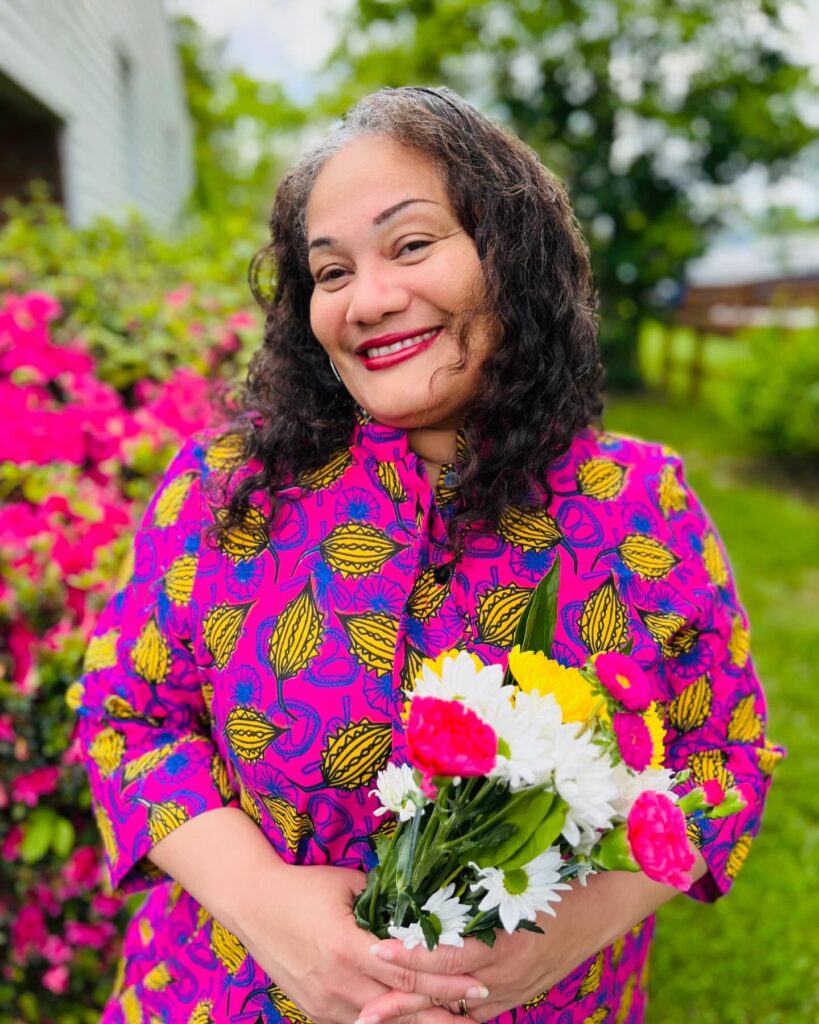 Ali-Coleman stops the smell the roses (and a few other flowers). Photo courtesy of Ali-Coleman.
As the second poet laureate of Prince George’s County, Maryland, Khadijah Z. Ali-Coleman embodies the role’s commitment to both the arts and community. She describes the work as an ambassador for literature and writing, creating courses and spaces for writers to share their voices. “What I’ve found the greatest joy in,” says Ali-Coleman ’95, interdisciplinary studies , “is partnering with local libraries and schools to share the different literary eras that have impacted our world.” Through this position, she has launched a symposium series, focusing on the Black Arts Movement, with plans for an exploration of the Harlem Renaissance in 2025.
Listening to her mother’s voice
Ali-Coleman’s path to UMBC was heavily influenced by her mother, who encouraged her to stay local, despite initially being set on applying to schools across the country. However, during a family tour of UMBC, she felt an unexpected connection. It was, as she describes it, “love at first sight,” enamored by the warmth of the campus community and the support from then admissions counselor Yvette Mozie-Ross ’88.
Now the vice provost for enrollment management and planning, Mozie-Ross was present when Ali-Coleman won the UMBC 2024 Outstanding Alumni Award. “It’s great to see that the same passion and compassion for the genuine well-being of others that ignited and drove Khadijah as a student leader has not waned a bit,” says Mozie-Ross. “Her work in our communities continues to reflect her deep sense of humanity. We (UMBC) couldn’t be more proud of her.”
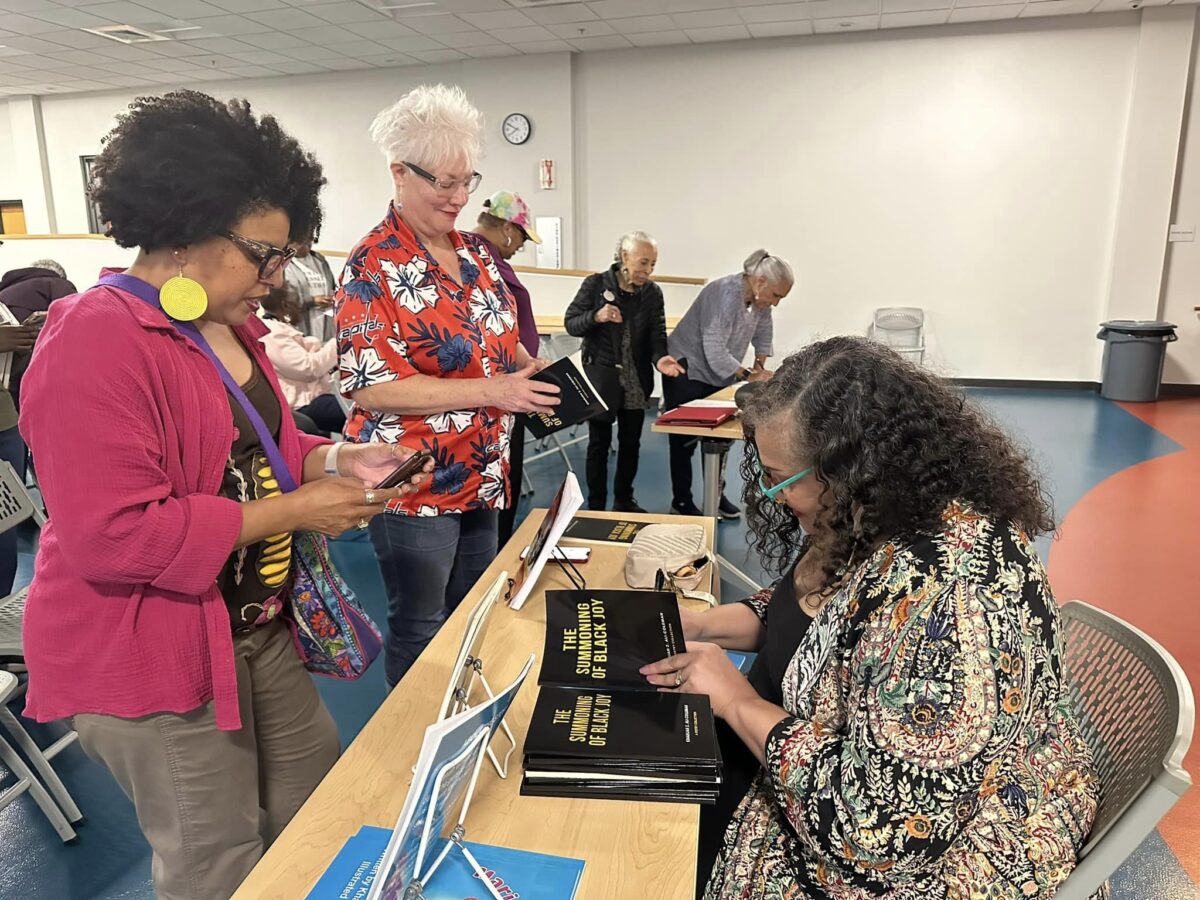 Ali-Coleman signs a copy of her poetry book The Summoning of Black Joy. Photo courtesy of Ali-Coleman.
Once at UMBC, Ali-Coleman faced the challenge of narrowing down her diverse academic interests—ranging from social work and mass media to African American history and English. She quickly realized that a traditional major wouldn’t fit her needs, and after reading the entire course catalog, she discovered the interdisciplinary studies (INDS) program, which allowed her to create a personalized curriculum. This flexibility enabled her to weave courses from African American studies, American studies, and English into a unique educational path that laid the groundwork for her future in communications and education.
Key figures at UMBC also played a significant role in shaping her journey. One of her favorite classes was Acklyn Lynch’s course on the Black Experience, where Ali-Coleman formed a lasting friendship with William Honablew ’95. This course not only stimulated intellectual discussions but also fostered ongoing connections among both students and Lynch long after graduation. Another influential mentor was Jamie Washington, who taught Ali-Coleman during her time as a student peer advisor. Washington’s ability to facilitate difficult conversations around racial tolerance during pivotal moments—such as the Rodney King trial verdict—left a lasting impression on Ali-Coleman. She often finds herself wishing she could emulate his approach as a facilitator and teacher. “Jamie Washington is by far the most impacting role model and person that I think of,” she says.
Making herself at home
Ali-Coleman draws on her inspiring mentors in her own classrooms as an associate professor of English at Coppin State University. “Baltimore is really my second home,” she shares, which started with her time at UMBC, followed by earning her master’s from Towson University, and her doctorate from Morgan State University. As someone familiar with area institutions, Ali-Coleman calls UMBC a “gem.” Aside from having high academic standards, she said it was also ahead of its time.
“Many aspects we now take for granted—like diversity, equity, and inclusion—were already being prioritized at UMBC,” says Ali-Coleman. “The university created a culture around inclusion, which was evident during my time as both an employee and a student.” As a member of the second cohort of UMBC McNair Scholars, Ali-Coleman experienced firsthand UMBC’s commitment to supporting underrepresented students in pursuing doctoral degrees. “I realized how ahead of the curve UMBC was,” said Ali-Coleman. “It didn’t sacrifice academics or cultural experiences. I don’t think people fully appreciate that.”
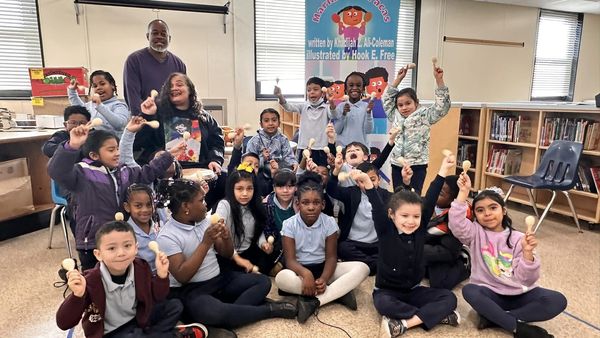 Ali-Coleman gathers with students at Chillum Elementary. Photo courtesy of Ali-Coleman.
Ali-Coleman, who was named an Outstanding Alumni at the 2024 Alumni Awards, says that her career trajectory reflects her experiences at UMBC, where she honed skills that would later serve her in various opportunities. After defending her dissertation on African American homeschool students who were dual enrolled just days before the onset of the COVID-19 pandemic, she recognized an urgent need for support among families navigating homeschooling for the first time. This led her to found Black Family Homeschool Educators and Scholars in 2020, an organization created to assist parents struggling with the transition to remote learning.
As she continues to navigate her role as poet laureate, professor, and nonprofit leader, her story showcases how pivotal moments, resilience, and a little bit of serendipity have shaped her path. “UMBC was one of the best experiences I’ve ever had, and it has been incredibly impactful,” Ali-Coleman reflects. “I’ve drawn from my time there in countless ways in all different areas of my life.”
]]>
Early mentorship at UMBC, layered with her continued education and formative life experiences, has shaped Ali-Coleman’s voice and purpose. From her transformative years at UMBC—where she wrangled...
https://umbc.edu/stories/khadijah-ali-coleman-lends-voice-to-humanities/
https://my3.my.umbc.edu/api/v0/pixel/news/145943/guest@my.umbc.edu/43d3827fa73be53f4ebb9c6f7fc98965/api/pixel
alumni
alumni-awards
alumni-profile
american-studies
english
fall-2024
inds
magazine
story
UMBC News & Magazine
https://my3.my.umbc.edu/groups/umbc-news-magazine
https://assets1-my.umbc.edu/system/shared/avatars/groups/000/001/943/24435aa6207c452e7bc15cc74b42c7bb/xsmall.png?1748556657
https://assets1-my.umbc.edu/system/shared/avatars/groups/000/001/943/24435aa6207c452e7bc15cc74b42c7bb/original.png?1748556657
https://assets2-my.umbc.edu/system/shared/avatars/groups/000/001/943/24435aa6207c452e7bc15cc74b42c7bb/xxlarge.png?1748556657
https://assets2-my.umbc.edu/system/shared/avatars/groups/000/001/943/24435aa6207c452e7bc15cc74b42c7bb/xlarge.png?1748556657
https://assets3-my.umbc.edu/system/shared/avatars/groups/000/001/943/24435aa6207c452e7bc15cc74b42c7bb/large.png?1748556657
https://assets1-my.umbc.edu/system/shared/avatars/groups/000/001/943/24435aa6207c452e7bc15cc74b42c7bb/medium.png?1748556657
https://assets2-my.umbc.edu/system/shared/avatars/groups/000/001/943/24435aa6207c452e7bc15cc74b42c7bb/small.png?1748556657
https://assets1-my.umbc.edu/system/shared/avatars/groups/000/001/943/24435aa6207c452e7bc15cc74b42c7bb/xsmall.png?1748556657
https://assets2-my.umbc.edu/system/shared/avatars/groups/000/001/943/24435aa6207c452e7bc15cc74b42c7bb/xxsmall.png?1748556657
UMBC News & Magazine
1
0
false
Wed, 27 Nov 2024 09:53:23 -0500
Wed, 27 Nov 2024 09:53:23 -0500
UMBC and MSDE launch admissions pathway for high school students aspiring to become teachers

Thanks to award-winning education faculty and UMBC’s research-based teacher preparation programs, hundreds of Retriever alumni lead pre-k through 12-grade classrooms across the state, meeting the need for highly qualified teachers. Maryland’s high school students now have a unique opportunity to join their ranks by beginning their teacher training early in preparation for applying to UMBC’s teaching programs. This fall, UMBC joined an existing network of higher education institutions across Maryland that partner with the Maryland State Department of Education (MSDE) and the Teacher Academy of Maryland (TAM) to offer Maryland-high-school students interested in teaching a direct admissions pathway to UMBC’s undergraduate teacher education programs.
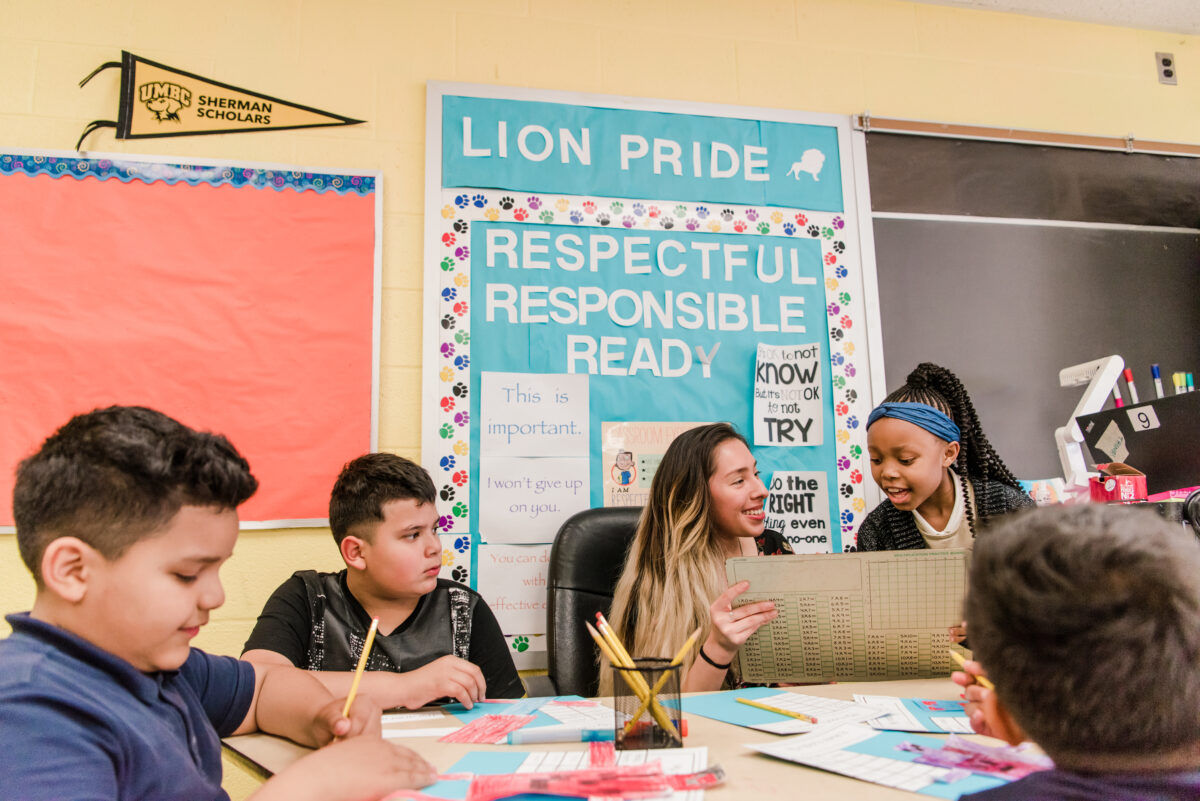 Sherman Teacher Scholars Program alumna, Vanessa Gonzalez ’19, American studies, during her first year teaching at Lakeland Elementary/Middle School in 2019. (Marlayna Demond ’11/UMBC)
UMBC awarded its first TAM scholarship and academic credit this fall to three first-year students, Layla Bugarini, Alna Thekkiniath, and Sofia Driver.“Once the word gets out that UMBC is a TAM-participating institution offering not only great benefits for TAM students but also a high quality and unique teacher education program, we anticipate many more aspiring educators will see UMBC as a destination institution for teacher education,” says Vickie Williams, director of student services and certification officer for UMBC’s Department of Education and a member of the organizing committee
TAM’s mission is to grow and diversify the teaching field by igniting high school students’ passion for teaching. The program provides them with foundational knowledge and skills essential for success as educators, learners, and leaders. Through a partnership with a higher education institution, participants gain valuable experience in a university setting which helps them prepare for their transition to education majors.
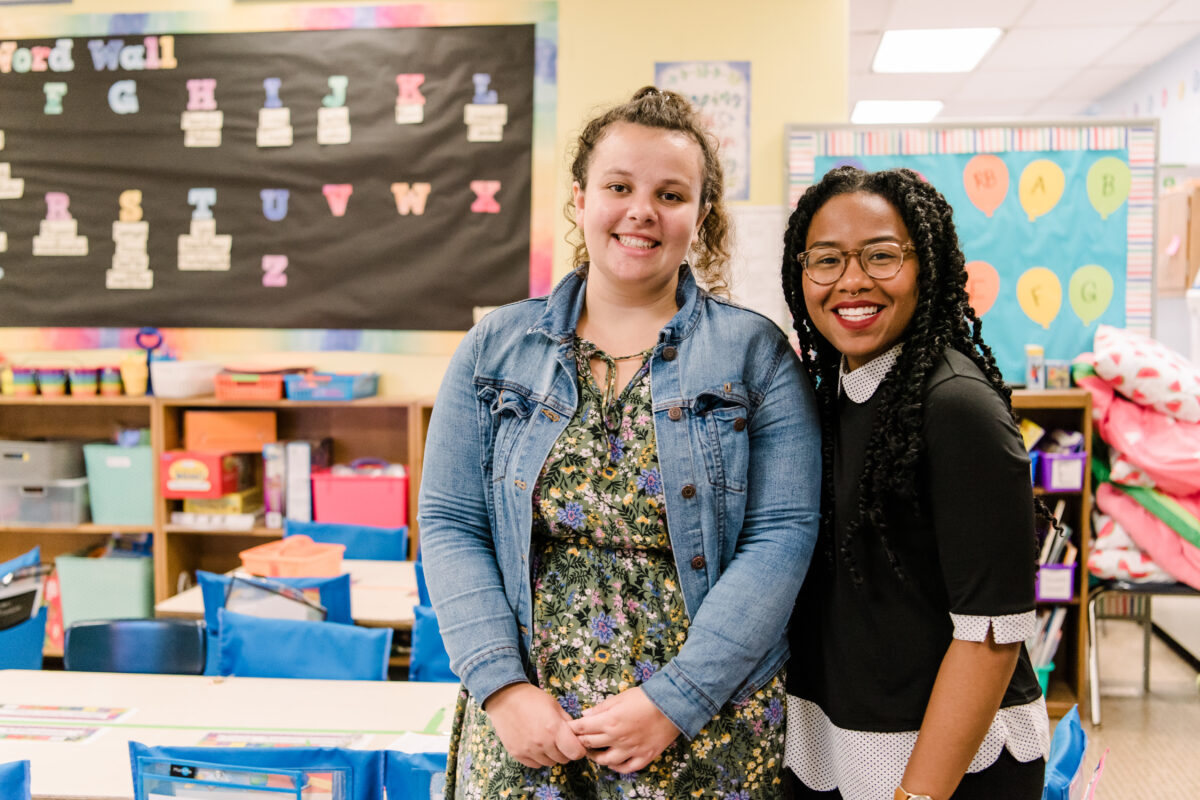 (l-r): Sherman Teacher Scholars Program alumni, Olivia Grimes ’19, individualized study, and Lydia Coley ’20, American studies, in 2020 during Grimes’s first year of teaching and Coley’s first semester as a student-teacher at Maree G. Farring Elementary/Middle School. (Marlayna Demond ’11/UMBC)
Participating high schoolers develop a portfolio that includes three high school courses: Human Growth and Development through Adolescence, Teaching as a Profession, and Foundations of Curriculum and Instruction. Students are also required to complete an internship in a classroom setting under the supervision of a TAM mentor. After fulfilling all the TAM requirements, students submit their portfolio for review and feedback to the university they plan to attend. Each university offers students different benefits.
UMBC is providing students who successfully complete the TAM program, with several incentives:
- a $75 application fee waiver
- three lower-level education elective credits that can be applied towards the 120-minimum credit graduation requirement
- for those who matriculate directly from high school, a $1,000 merit scholarship from the Homer and Martha Gudelsky and the Maggie Geeter Hrabowski Scholarship, to be applied directly to their UMBC account to assist with tuition, fees, and other educational expenses
- an opportunity to interview for UMBC’s Sherman Teacher Scholars Program.
“Our undergraduate students enter classrooms equipped with pedagogical knowledge, field experience, and expertise from their academic major. This prepares them for their teacher certification exams in their chosen grade level and subject area,” says Williams. “Collaborating with TAM provides high school students with exposure to rigorous education research and practice, along with guidance, financial support, and mentorship.”
“My journey with TAM began back in my freshman year at Eastern Technical High School [Baltimore County], where I had the opportunity to intern in a third-grade classroom at Rossville Elementary in Baltimore County Public Schools,” says Bugarini. She notes that the experience led her to enroll in UMBC’s education program and major in psychology. “TAM didn’t just introduce me to teaching in a classroom, it also gave me a glimpse of what education courses at college would be like. This head start has been invaluable as I pursue my education certification and the required classes to complete it.”
To learn more about UMBC’s teacher preparation programs, contact Vickie Williams, director of student services and certification officer.
]]>
Thanks to award-winning education faculty and UMBC’s research-based teacher preparation programs, hundreds of Retriever alumni lead pre-k through 12-grade classrooms across the state, meeting the...
https://umbc.edu/stories/umbc-msde-launched-pathway-for-aspiring-teachers/
https://my3.my.umbc.edu/api/v0/pixel/news/145533/guest@my.umbc.edu/5972d9f2def66dbf0d41a81aabf214bb/api/pixel
american-studies
cahss
community
education
inds
news
sherman-scholars
story
UMBC News & Magazine
https://my3.my.umbc.edu/groups/umbc-news-magazine
https://assets1-my.umbc.edu/system/shared/avatars/groups/000/001/943/24435aa6207c452e7bc15cc74b42c7bb/xsmall.png?1748556657
https://assets1-my.umbc.edu/system/shared/avatars/groups/000/001/943/24435aa6207c452e7bc15cc74b42c7bb/original.png?1748556657
https://assets2-my.umbc.edu/system/shared/avatars/groups/000/001/943/24435aa6207c452e7bc15cc74b42c7bb/xxlarge.png?1748556657
https://assets2-my.umbc.edu/system/shared/avatars/groups/000/001/943/24435aa6207c452e7bc15cc74b42c7bb/xlarge.png?1748556657
https://assets3-my.umbc.edu/system/shared/avatars/groups/000/001/943/24435aa6207c452e7bc15cc74b42c7bb/large.png?1748556657
https://assets1-my.umbc.edu/system/shared/avatars/groups/000/001/943/24435aa6207c452e7bc15cc74b42c7bb/medium.png?1748556657
https://assets2-my.umbc.edu/system/shared/avatars/groups/000/001/943/24435aa6207c452e7bc15cc74b42c7bb/small.png?1748556657
https://assets1-my.umbc.edu/system/shared/avatars/groups/000/001/943/24435aa6207c452e7bc15cc74b42c7bb/xsmall.png?1748556657
https://assets2-my.umbc.edu/system/shared/avatars/groups/000/001/943/24435aa6207c452e7bc15cc74b42c7bb/xxsmall.png?1748556657
UMBC News & Magazine
0
0
false
Mon, 11 Nov 2024 11:50:17 -0500
Mon, 11 Nov 2024 11:50:17 -0500
Stepping up to the plate to preserve UMBC history

When the Fort McHenry Tunnel opened, drivers could thank Richard “Rock” Soracoe ’71, economics, for helping them see as they drove under the harbor. Soracoe spent 50-plus years in the lighting industry and helped source the original 8,870 8-ft light fixtures that lined the road. In retirement, he’s helping shed a different type of light. Soracoe and other members of the founding four classes at UMBC are putting their collective memories to work to assist in identifying people and events in UMBC’s archival material to help complete our UMBC history. One event—UMBC’s first intercollegiate athletics win—is a story Soracoe loves to tell.
I have the game ball in my hand. The red stitches feel familiar, and the leather sits in my palm like it was made to fit. I’m not on the mound winding up to pitch, however; I’m standing in the basement of the Albin O. Kuhn Library. It’s been 57 years since I last touched this baseball when UMBC won its first intercollegiate victory.
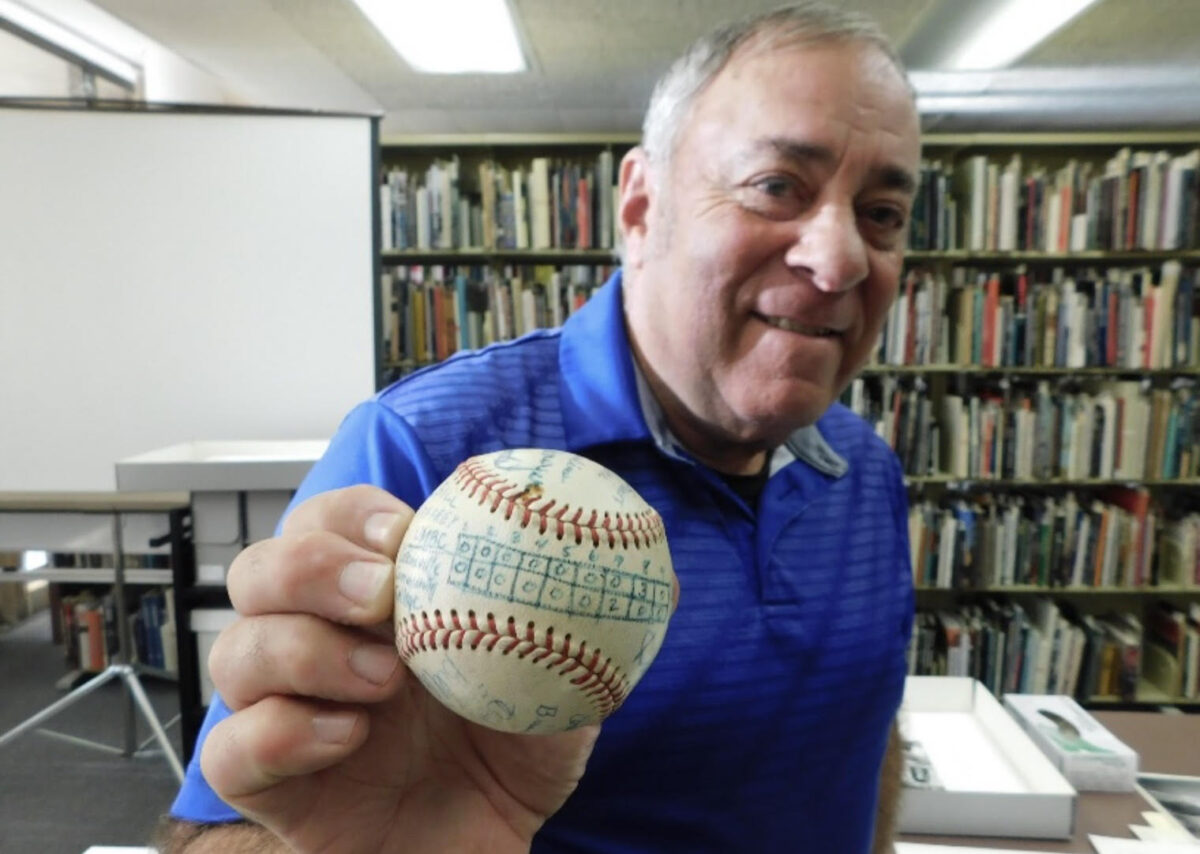 In UMBC’s Special Collections, Soracoe holds up the first game-winning baseball with the box score drawn on.
In 1967, UMBC’s inaugural fall sports season, the teams didn’t win a single game (as a member of the UMBC soccer team at the time, I was well aware of this), so it fell to baseball or lacrosse, the spring sports, to come through with the first win. While the details of that ballgame (a 3-2 win) are fuzzy now—all that remains officially is a 28-word write up in the Baltimore Sun archives—the game deserves its place of honor in the relatively short history of our institution. The budding campus newspaper, The Retriever Weekly, didn’t cover the game (although they did cover our loss to the same team the following week) and the box score is immortalized only as pen scratched onto the game ball’s leather.
Despite the lack of thorough archival material, in its own way, the game has certainly gone on to define aspects of my own life. Ken Diehl—the pitcher of the losing team, Catonsville Community College—would go on to transfer to UMBC the next year. We bonded over our shared Retriever spirit and also from our shared memories as roommates on UMBC’s first mini-mester trip to Europe in 1968. But it’s my Founding Four membership that drives me to keep memories like the first intercollegiate win alive.
As graduates of the first four classes at UMBC, we feel excited but also responsible for helping archive and catalog memories that might be unique to us. It’s one of the reasons we wrote This Belongs to Us, and it’s the reason we meet at the library to help the university archivists put appropriate names and metadata on early university yearbooks called Skipjack and other historical materials.
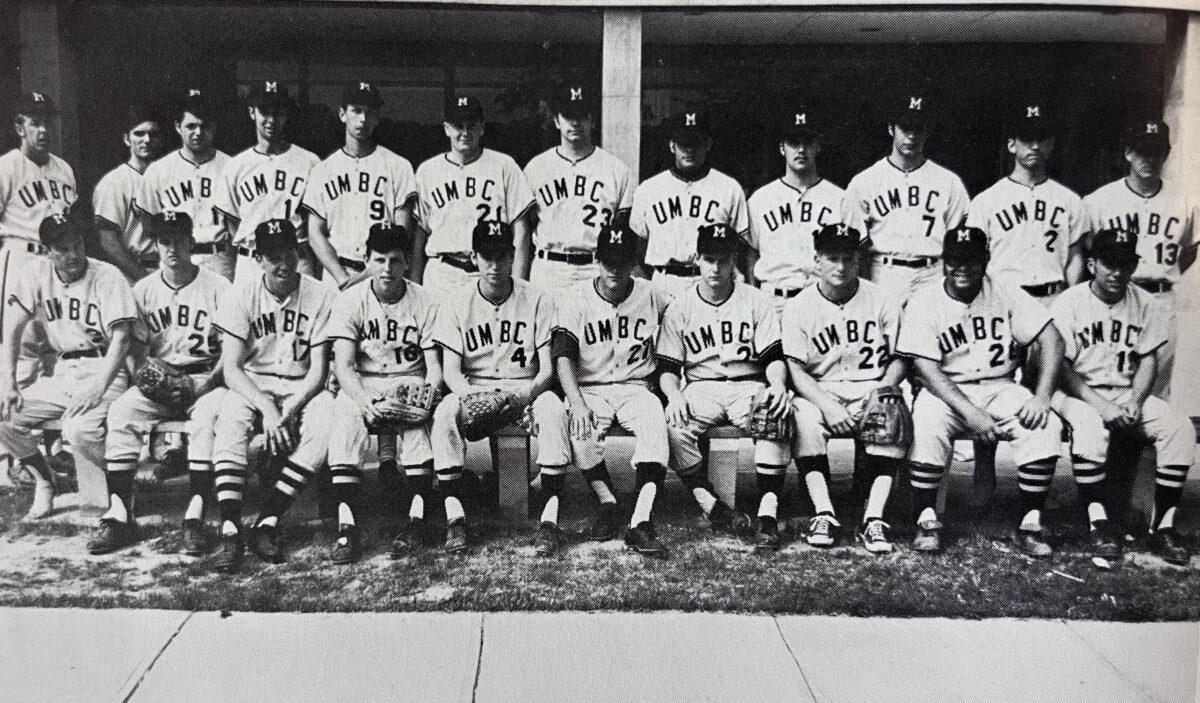
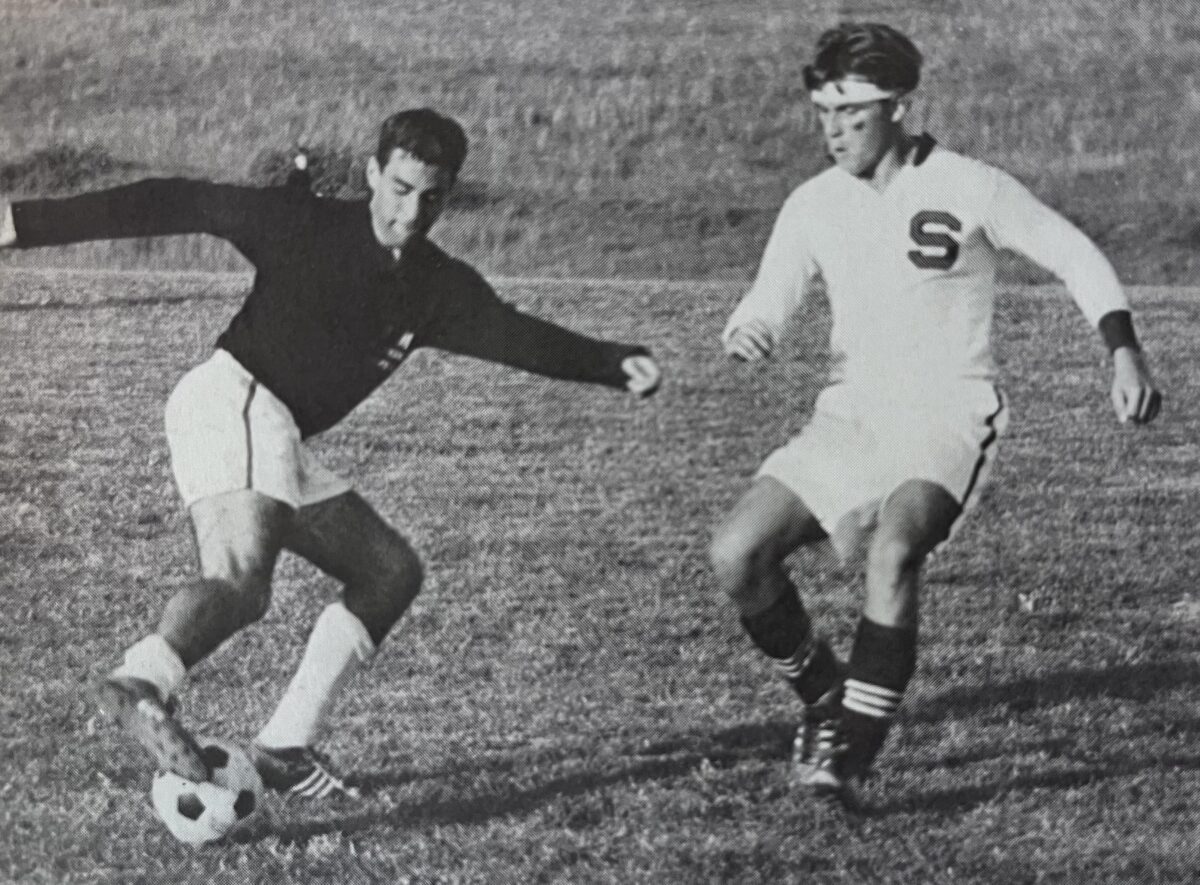
Left, the 1969 baseball team pictured in the 1969 university yearbook, Skipjack. Right, Soracoe in the black jersey also played on UMBC’s men’s soccer team.
When we were students here—walking around on plywood sidewalks on top of muddy construction sites—we weren’t thinking about creating the history of UMBC. We referred to the college as “high school plus one.” So our yearbooks rarely include captions or names and it’s up to us now to identify those people so that they’re not lost to history.
Some things have been lost to history. Louie Sowers [’70, American studies], a fellow classmate and student-athlete, stood up for Retriever women to have equal representation in university sports well before Title IX made it mandatory. She, along with Athletic Director Dick Watts, formed the women’s field hockey, basketball, and volleyball teams for the 1967 – 1968 academic year. Unfortunately, those records have been lost to time, so on paper, officially, women’s varsity sports only started in 1973.
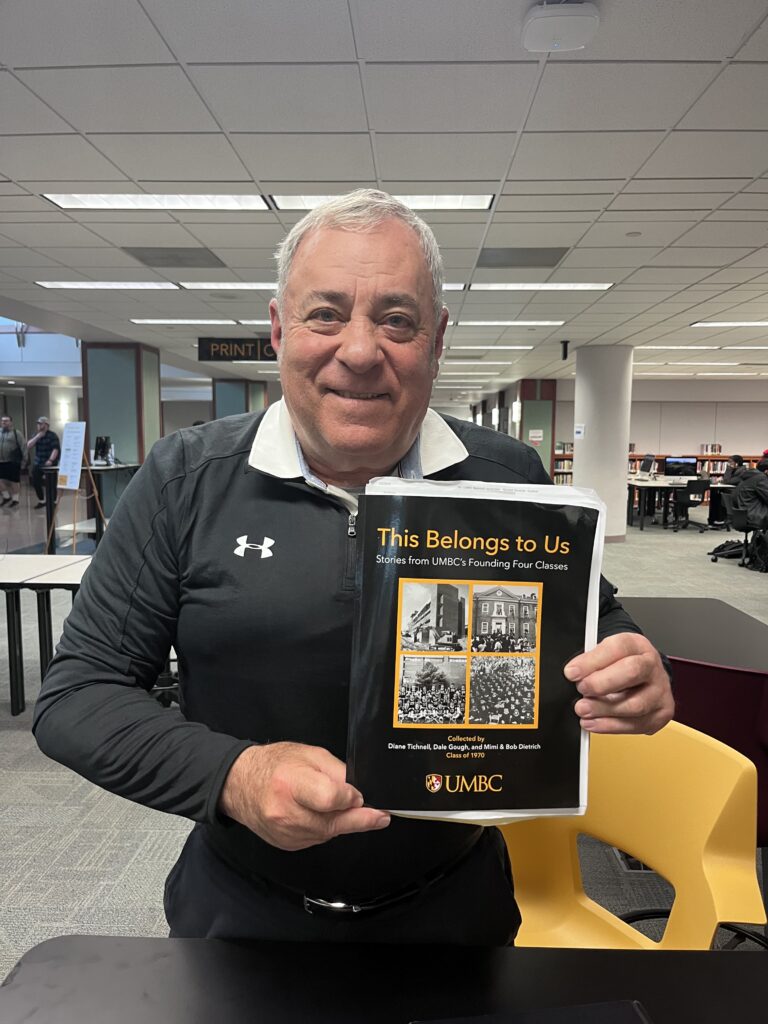 Soracoe holds a copy of This Belongs to Us—the Founding Four’s book about UMBC’s early days.
I reached out to some teammates to see if they could help me fill in the missing blanks of that game in April 1967. We played at Banneker Field in Catonsville (referred to as the “loser’s field” in the Sun write up) because UMBC did not have its own field yet. It was a low-scoring game; CCC got the first two runs in the game in the bottom of the 7th inning. The top of the 8th would be our key to victory. After one runner already came in, my teammate Bill Rust [’71, history] remembers players on second and third. He was at bat, and lined our then-opponent Ken’s pitch into left center field for what would become the game-winning RBIs.
What I remember is pitching the whole game (90 pitches according to Bill’s memory), and being so grateful when Ken [’70, psychology] joined our team the next year as an additional pitcher. And over the years, I’ve grown comfortable with the idea that the individual details don’t matter as much as the whole picture. Stepping back to see the shape of my career, my marriage, and my friends, I can see how they’ve all been defined by my UMBC experience.
UMBC was as welcoming as you wanted it to be, and still is today. My professors taught me the power of critical thinking and my coaches taught me the power of mental and physical discipline—which helped me in my job and my 36-year career as a high school and college soccer referee. I am very proud to say that I am a UMBC graduate and happy to see the tremendous achievement the university has attained from humble beginnings to worldwide status.
— Richard “Rock” Soracoe ’71, economics
]]>
When the Fort McHenry Tunnel opened, drivers could thank Richard “Rock” Soracoe ’71, economics, for helping them see as they drove under the harbor. Soracoe spent 50-plus years in the lighting...
https://umbc.edu/stories/stepping-up-to-the-plate-to-preserve-umbc-history/
https://my3.my.umbc.edu/api/v0/pixel/news/142515/guest@my.umbc.edu/1ba6502c67b2faff3c9f3194cc2c07a1/api/pixel
alumni
alumni-essay
american-studies
athletics
baseball
economics
founding-four
history
magazine
spring-2024
story
umbc-history
UMBC News & Magazine
https://my3.my.umbc.edu/groups/umbc-news-magazine
https://assets1-my.umbc.edu/system/shared/avatars/groups/000/001/943/24435aa6207c452e7bc15cc74b42c7bb/xsmall.png?1748556657
https://assets1-my.umbc.edu/system/shared/avatars/groups/000/001/943/24435aa6207c452e7bc15cc74b42c7bb/original.png?1748556657
https://assets2-my.umbc.edu/system/shared/avatars/groups/000/001/943/24435aa6207c452e7bc15cc74b42c7bb/xxlarge.png?1748556657
https://assets2-my.umbc.edu/system/shared/avatars/groups/000/001/943/24435aa6207c452e7bc15cc74b42c7bb/xlarge.png?1748556657
https://assets3-my.umbc.edu/system/shared/avatars/groups/000/001/943/24435aa6207c452e7bc15cc74b42c7bb/large.png?1748556657
https://assets1-my.umbc.edu/system/shared/avatars/groups/000/001/943/24435aa6207c452e7bc15cc74b42c7bb/medium.png?1748556657
https://assets2-my.umbc.edu/system/shared/avatars/groups/000/001/943/24435aa6207c452e7bc15cc74b42c7bb/small.png?1748556657
https://assets1-my.umbc.edu/system/shared/avatars/groups/000/001/943/24435aa6207c452e7bc15cc74b42c7bb/xsmall.png?1748556657
https://assets2-my.umbc.edu/system/shared/avatars/groups/000/001/943/24435aa6207c452e7bc15cc74b42c7bb/xxsmall.png?1748556657
UMBC News & Magazine
1
0
false
Thu, 20 Jun 2024 13:02:54 -0400
Thu, 20 Jun 2024 13:02:54 -0400
Mellon Foundation grants CAHSS $750K to establish Global Asias Initiative
Kimberly Moffitt, dean of the College of Arts, Humanities, and Socials Sciences, and co-pi Tamara Bhalla, associate professor of American studies and director of the Asian American studies minor, have been awarded a $750,000 grant from the Mellon Foundation to establish the Global Asias Initiative. The initiative will support the rethinking of Asian American issues on campus in a global, diasporic, and collaborative framework through community-engaged, public-facing scholarship and teaching.
“The impact and influence of the Asian diaspora in this region makes it clear that our world has more to offer in providing valuable opportunities for our students, while also creating additional partnerships with the greater Baltimore community,” says Moffitt.
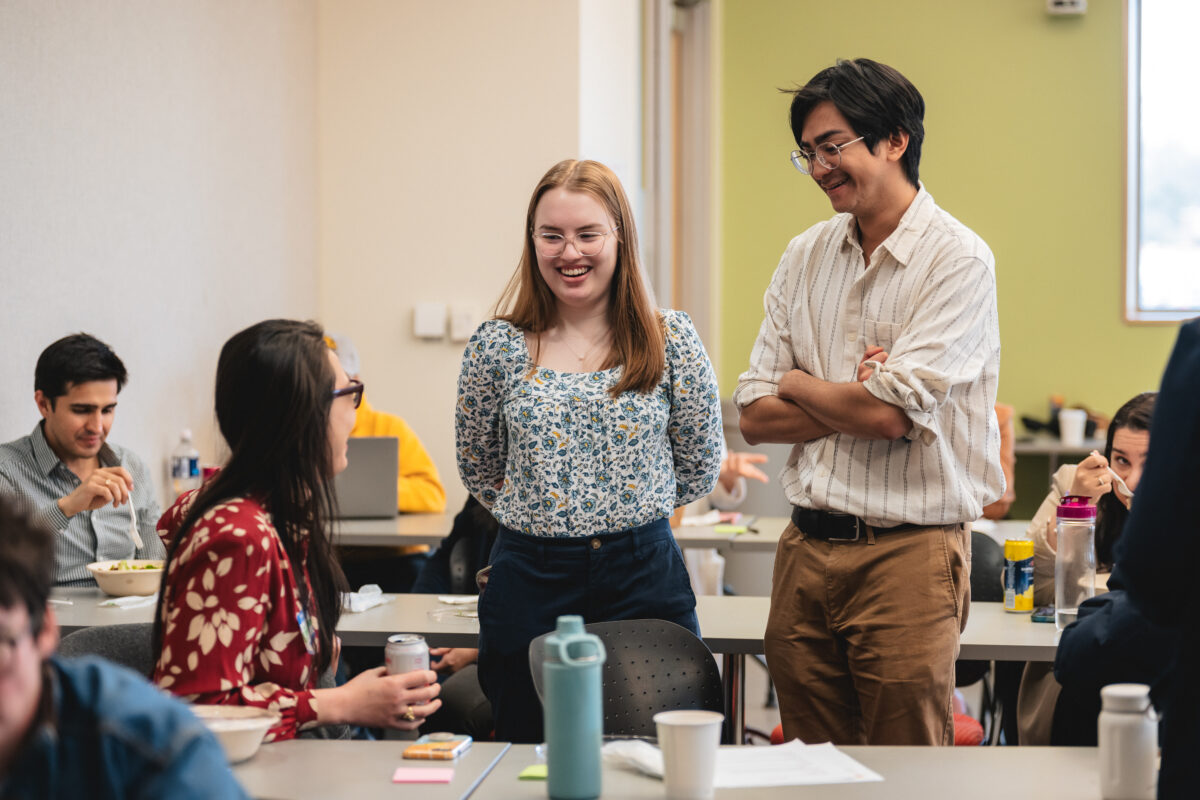 (l-r) Emily Yoon and students at the Global Asias Initiative launch workshop.
(Abnet Shiferaw)
UMBC’s existing Asian studies program and Asian American studies minor will grow into a more expansive Global Asias program that better serves and represents UMBC’s Asian American community, interested students, and beyond. This includes launching an undergraduate community-based research fellowship in Global Asias and the conversation series “Reframing Global Asias,” which invites prominent leaders, scholars, and community members in the field to present and discuss key issues, possibilities, challenges, and new research.
“Together,” says Bhalla, “we will create a forum for engaging in difficult yet productive intellectual conversations in Asian American studies, Asian diaspora studies, and Asian studies.”
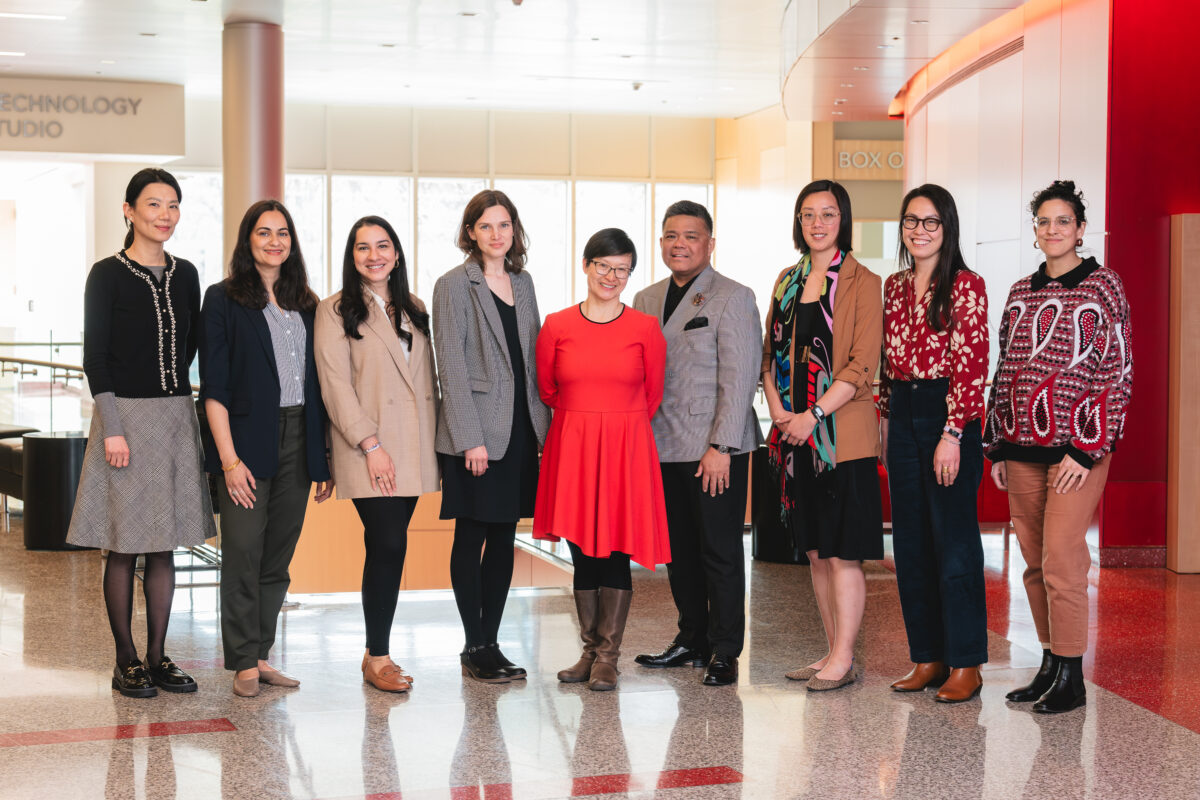 Global Asias Advisory Board, AY2023-2024. (l-r) Tamara Bhalla, Noor Zaidi, Meredith Oyen, Fan Yang, Theo Gonzalvez, Emily Yoon, and Priya Bhayana, project manager for the Global Asias Initiative. (Abnet Shiferaw)
Faculty across UMBC are collaborating to bring the Global Asia Initiative to fruition along with community partners:
-
Meredith Oyen, associate professor of history and director of the Asian studies program
-
Shin Yon Kim, Asian studies lecturer
-
Fan Yang, associate professor of media and communication studies
-
Emily Yoon, assistant professor of English
-
Noor Zaidi, assistant professor of history
-
Christopher Tong, associate professor of modern languages, linguistics, and intercultural communication
-
Theo Gonzalves, former American studies chair and professor, curator of Asian-Pacific American history at the Smithsonian National Museum of American History
-
Robbin Lee ’13, visual arts and media and communications studies, director of partnerships and mobilization at UpSurge Baltimore
Learn more about the Global Asias Iniatiave and Asian studies program.
]]>
Kimberly Moffitt, dean of the College of Arts, Humanities, and Socials Sciences, and co-pi Tamara Bhalla, associate professor of American studies and director of the Asian American studies minor,...
https://umbc.edu/quick-posts/umbc-to-establish-global-asias-initiative/
https://my3.my.umbc.edu/api/v0/pixel/news/140528/guest@my.umbc.edu/32bd2a6ff02002d0cfa31ee10d13251e/api/pixel
american-studies
asian-studies
cahss
english
history
mcs
mlli
news
policy-and-society
quick-post
quick-posts
research
visual-arts
UMBC News & Magazine
https://my3.my.umbc.edu/groups/umbc-news-magazine
https://assets1-my.umbc.edu/system/shared/avatars/groups/000/001/943/24435aa6207c452e7bc15cc74b42c7bb/xsmall.png?1748556657
https://assets1-my.umbc.edu/system/shared/avatars/groups/000/001/943/24435aa6207c452e7bc15cc74b42c7bb/original.png?1748556657
https://assets2-my.umbc.edu/system/shared/avatars/groups/000/001/943/24435aa6207c452e7bc15cc74b42c7bb/xxlarge.png?1748556657
https://assets2-my.umbc.edu/system/shared/avatars/groups/000/001/943/24435aa6207c452e7bc15cc74b42c7bb/xlarge.png?1748556657
https://assets3-my.umbc.edu/system/shared/avatars/groups/000/001/943/24435aa6207c452e7bc15cc74b42c7bb/large.png?1748556657
https://assets1-my.umbc.edu/system/shared/avatars/groups/000/001/943/24435aa6207c452e7bc15cc74b42c7bb/medium.png?1748556657
https://assets2-my.umbc.edu/system/shared/avatars/groups/000/001/943/24435aa6207c452e7bc15cc74b42c7bb/small.png?1748556657
https://assets1-my.umbc.edu/system/shared/avatars/groups/000/001/943/24435aa6207c452e7bc15cc74b42c7bb/xsmall.png?1748556657
https://assets2-my.umbc.edu/system/shared/avatars/groups/000/001/943/24435aa6207c452e7bc15cc74b42c7bb/xxsmall.png?1748556657
UMBC News & Magazine
0
0
false
Wed, 03 Apr 2024 11:06:07 -0400
Wed, 03 Apr 2024 11:06:07 -0400
How to stay in touch—4 steps to being a prolific pen pal

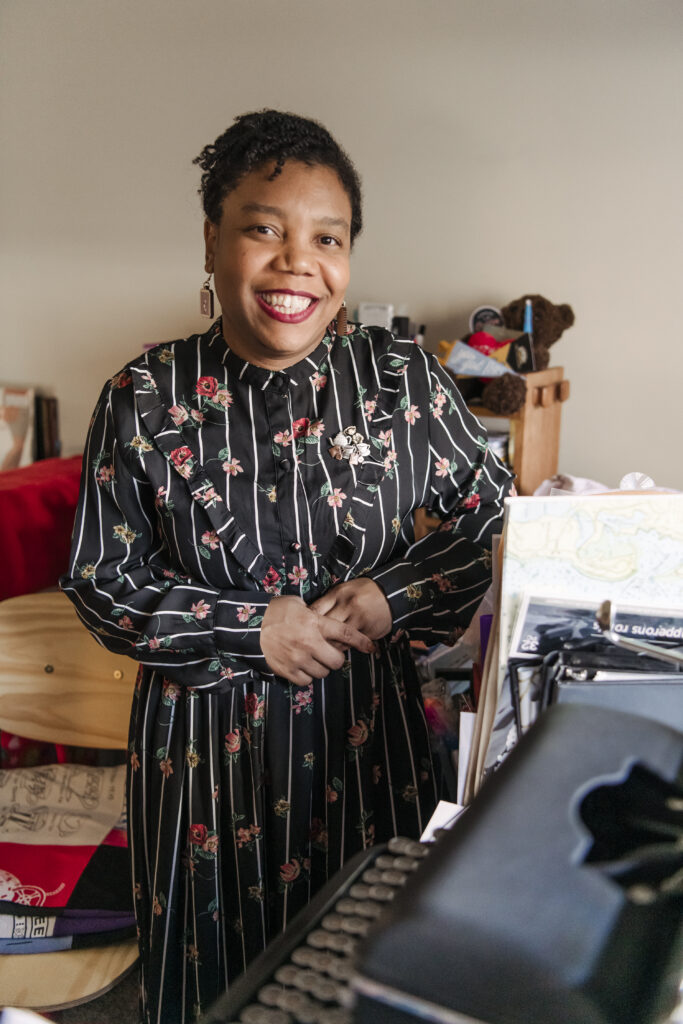 Headshot of Winona Caesar ’09 in her letter writing “command station.” (Marlayna Demond ’11/UMBC)
With Winona Caesar ’09, American studies and history
As a first-year student—before classes had even started—Winona Caesar ’09, American studies and history, took to heart some advice she heard at Welcome Week: Keep in touch with your loved ones. So she started writing to her grandfather who lived a few miles down the road in Baltimore City. And then, two years into their correspondence, he passed away. “His letters were amazing,” says Caesar, “a wealth of knowledge.”
Around that same time—halfway through her time at UMBC—Caesar’s older friends began graduating and moving around the country. She kept in touch with a few of them through letters, occasionally splurging on stickers to be extra thoughtful. Now she spends a good portion of her free time corresponding regularly with 16 established pen pals, although she’s written back and forth with more than 50 interlocutors in the past two decades.
For Caesar, a sergeant in the Baltimore City Police, it’s a creative outlet. Whether hand writing a letter or using one of her seven typewriters, Caesar says the process slows her down and connects her to individuals all over the globe. As the world grows increasingly more digitized, Caesar and her pen pals are saving the lost art of keeping in touch.
Tools of the Trade:
A writing implement
Paper or postcard
Postage stamp
Envelope (handmade, if you’re serious about this)
A collection of stickers or ephemera to share
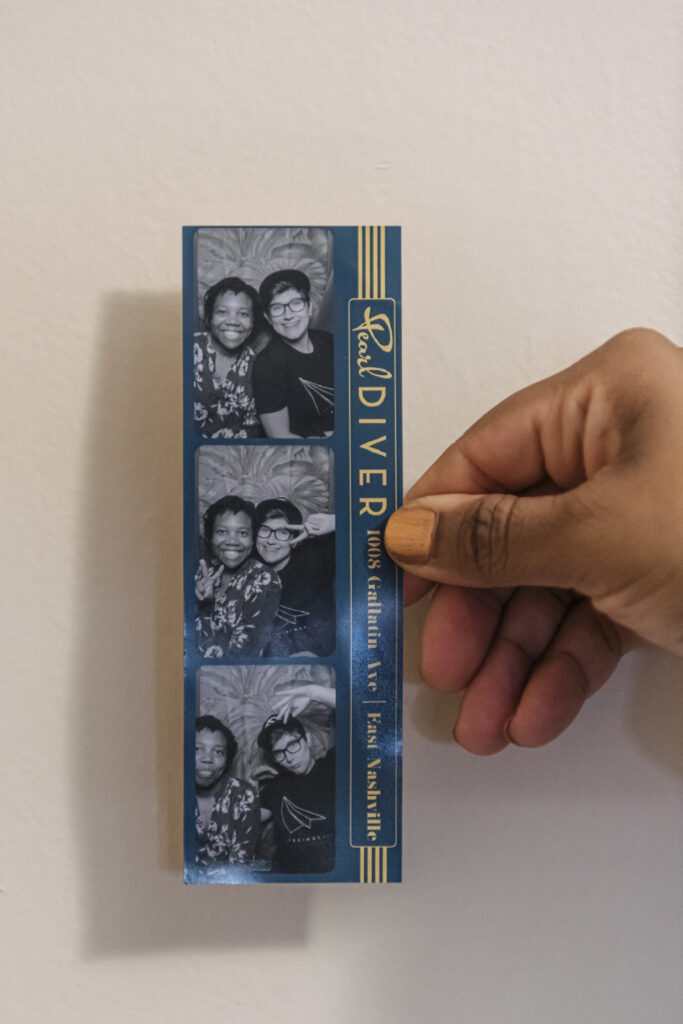
Step 1: Find a willing pen pal (or several)
For Caesar, her letter writing career started as a natural offshoot of keeping in touch with loved ones, but she has since joined two professional letter writing societies that connect new pen pals and charge a very small fee to screen participants.
Caesar says that not all matches work out but letter exchanges that hit a good groove sometimes go on indefinitely. One of her first matches was with Amy in Tennessee [pictured in the photobooth series with Caesar, left]. After seven years of corresponding, while on vacation in Tennessee, Caesar and Amy met up. Caesar says her pen pal was exactly like her letter-writing persona. “Reading her writing and meeting her in person, it was like we were best of friends. It worked,” says Caesar.
Step 2: Tap into your creativity
Caesar has been writing and sending letters long enough that she can hand make an envelope with her eyes closed, she says. In her writing nook in her apartment, Caesar keeps clear boxes stacked on each other—each organized by the correspondent’s name and send date—with thousands of letters filed inside. Nearby are her collection of typewriters, her stash of pens, her paper supplies, her stamp options, colorful washi tape, old magazines and paper samples for envelopes, so many stickers and other fun items to include in her letters.
Seated in a command-center-like swivel chair in the middle of her supplies and the sun streaming past her collection of succulents on the window nearby, Caesar will spend as long as she needs to (and as much energy as her job leaves her) replying to friends and new acquaintances near and far.
 A small section of the many thousands of letters Caesar has filed away from her pen pals. (Marlayna Demond ’11/UMBC)
She says she doesn’t plan out her responses in advance. “I try to react directly to the letter and then add any extra stuff that’s coming up in my life, like, ‘Oh, I got a future trip,’ or ‘This is how I’m feeling.’” With some correspondents, she plays on-going games of hangman, scavenger hunts, mystery games, or Pictionary.
Step 3: Share as much as you want about yourself
 Part of Caesar’s letter writing station. (Marlayna Demond ’11/UMBC)
One of Caesar’s regular pen pals, Sam, is a student from Belgium, who often sends her two letters a week, densely written on graph paper. His tight cursive isn’t easy to skim, but Caesar has grown accustomed to his handwriting over the past four years. “He’s more prolific than most,” says Caesar, and in addition to his own letters, Sam has also connected her to his mom, Christine. “Her letters were much more colorful and had lively stickers and things in them, while his are utilitarian.”
After three or four years of letter writing with Christine, Caesar received a note this past December saying she wanted to end the correspondence. “I was sad,” Caesar said, “so I reached out to my letter writing groups and asked, ‘How do you feel when this happens?’”
Pen pal relationships have many of the same ups and downs as in-person friendships, so Caesar shares certain parts of her life more or less with some writers, but all of them know about her love of tea and the Marvel universe. Oftentimes, she’ll receive gifts of specialty tea flavors or themed-stamps, and she attempts to keep her correspondence and gifts focused on the recipients’ interests.
Step 4: Give it your stamp of approval
Getting your letter (or in Caesar’s case, sometimes dozens of letters at a time) out the door is the final step. When Caesar travels, she makes it a point to ask the local post office to add its own unique cancel stamp to her postcards or letters, so the recipients can see where she’s visited.
Once, a pen pal from New Hampshire sent Caesar a letter stamped from Valentine Station in Loveland, Colorado. Caesar was confused until she learned about a service that will send your mail through interesting named locations for a small fee.
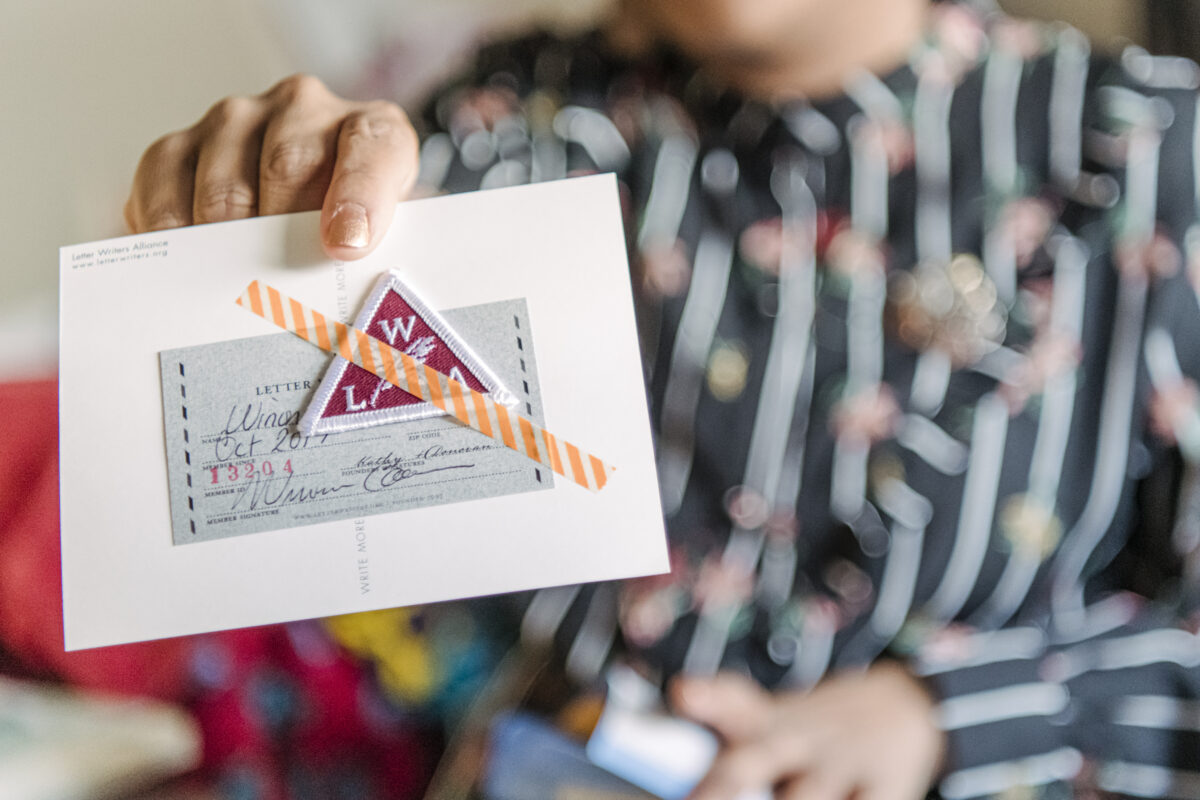 Caesar holds up one of her letter writing membership affiliation cards. (Marlayna Demond ’11/UMBC)
Thoughtful touches like these are part-and-parcel being a good pen pal, but they’re not necessary to get started writing letters. “This really does fulfill my creative spirit,” says Caesar, “especially since I don’t get to do this in my daily life—but actually this is my daily life.”
For aspiring pen pals, Caesar says, start by writing to someone you already know and love. Who knows where your letters will take you after that.
]]>
Headshot of Winona Caesar ’09 in her letter writing “command station.” (Marlayna Demond ’11/UMBC) With Winona Caesar ’09, American studies and history As a first-year student—before...
https://umbc.edu/stories/how-to-stay-in-touch-4-steps-to-being-a-pen-pal/
https://my3.my.umbc.edu/api/v0/pixel/news/140072/guest@my.umbc.edu/1dcf502abf55118fae85f0dfec1c26f0/api/pixel
alumni
american-studies
cahss
history
magazine
spring-2024
story
UMBC News & Magazine
https://my3.my.umbc.edu/groups/umbc-news-magazine
https://assets1-my.umbc.edu/system/shared/avatars/groups/000/001/943/24435aa6207c452e7bc15cc74b42c7bb/xsmall.png?1748556657
https://assets1-my.umbc.edu/system/shared/avatars/groups/000/001/943/24435aa6207c452e7bc15cc74b42c7bb/original.png?1748556657
https://assets2-my.umbc.edu/system/shared/avatars/groups/000/001/943/24435aa6207c452e7bc15cc74b42c7bb/xxlarge.png?1748556657
https://assets2-my.umbc.edu/system/shared/avatars/groups/000/001/943/24435aa6207c452e7bc15cc74b42c7bb/xlarge.png?1748556657
https://assets3-my.umbc.edu/system/shared/avatars/groups/000/001/943/24435aa6207c452e7bc15cc74b42c7bb/large.png?1748556657
https://assets1-my.umbc.edu/system/shared/avatars/groups/000/001/943/24435aa6207c452e7bc15cc74b42c7bb/medium.png?1748556657
https://assets2-my.umbc.edu/system/shared/avatars/groups/000/001/943/24435aa6207c452e7bc15cc74b42c7bb/small.png?1748556657
https://assets1-my.umbc.edu/system/shared/avatars/groups/000/001/943/24435aa6207c452e7bc15cc74b42c7bb/xsmall.png?1748556657
https://assets2-my.umbc.edu/system/shared/avatars/groups/000/001/943/24435aa6207c452e7bc15cc74b42c7bb/xxsmall.png?1748556657
UMBC News & Magazine
0
0
false
Fri, 22 Mar 2024 10:05:18 -0400
Fri, 22 Mar 2024 10:05:18 -0400
Putting the principles of education to work

There are some people who you meet, and it’s obvious: They’re natural leaders—seemingly born to the role. Derek Anderson ’03, interdisciplinary studies, is one of those people.
He went right from UMBC to the front of the classroom as a teacher in the highly regarded Howard County Public School System, earning a master’s degree in school administration and supervision from Johns Hopkins University at the same time.
But in talking with Anderson, it becomes apparent that he wasn’t born a leader—he became one. And he says UMBC was a big reason why he did.
After nearly a decade of classroom leadership, Anderson became an assistant principal, then principal at Longfellow Elementary School in Columbia, Maryland, winning recognition as Howard County’s 2023 Principal of the Year.
And now he’s been tapped by Maryland’s state superintendent of schools to be the state’s new executive director of community schools, overseeing more than 450 schools with the goal of better connecting schools with the families they serve.
From imposter syndrome to educator
As improbable as it sounds, this rising star in education leadership remembers that as a first-year student, he wasn’t sure at first that he even belonged in college.
“I struggled mightily in my first semester,” he remembers—in large part because his secondary school hadn’t fully prepared him for college-level academics. “There was a point where I said to myself, ‘Am I cut out for this? This is a lot.’”
Anderson says UMBC’s academic advising and his own inner determination to persevere helped, but what set him firmly on the path to his future was The Shriver Center, an organization at UMBC that connects students with applied learning, civic engagement, and community-based service opportunities. He began volunteering weekly at a local elementary school not too far from campus.
“I really realized how excited the kids were when we came to visit,” Anderson says. “And it was mutual—I would start looking forward to that particular day of the week. That was the first time I really started to consider a career in education.”
Building a major to match his passion
That realization, he says, galvanized him: It not only gave him a career goal to help shape his studies, it motivated him to work toward the day when he could help students prepare better than he had been for postsecondary academics.
“I thought about my own experience, and I questioned: Could I have been better prepared?” Anderson says. “What would have better prepared me so that I did not struggle the way I did in college? So that really reinforced the idea of, ‘I want to go into education so that I can help and support [students] so that they don’t have some of those experiences.’”
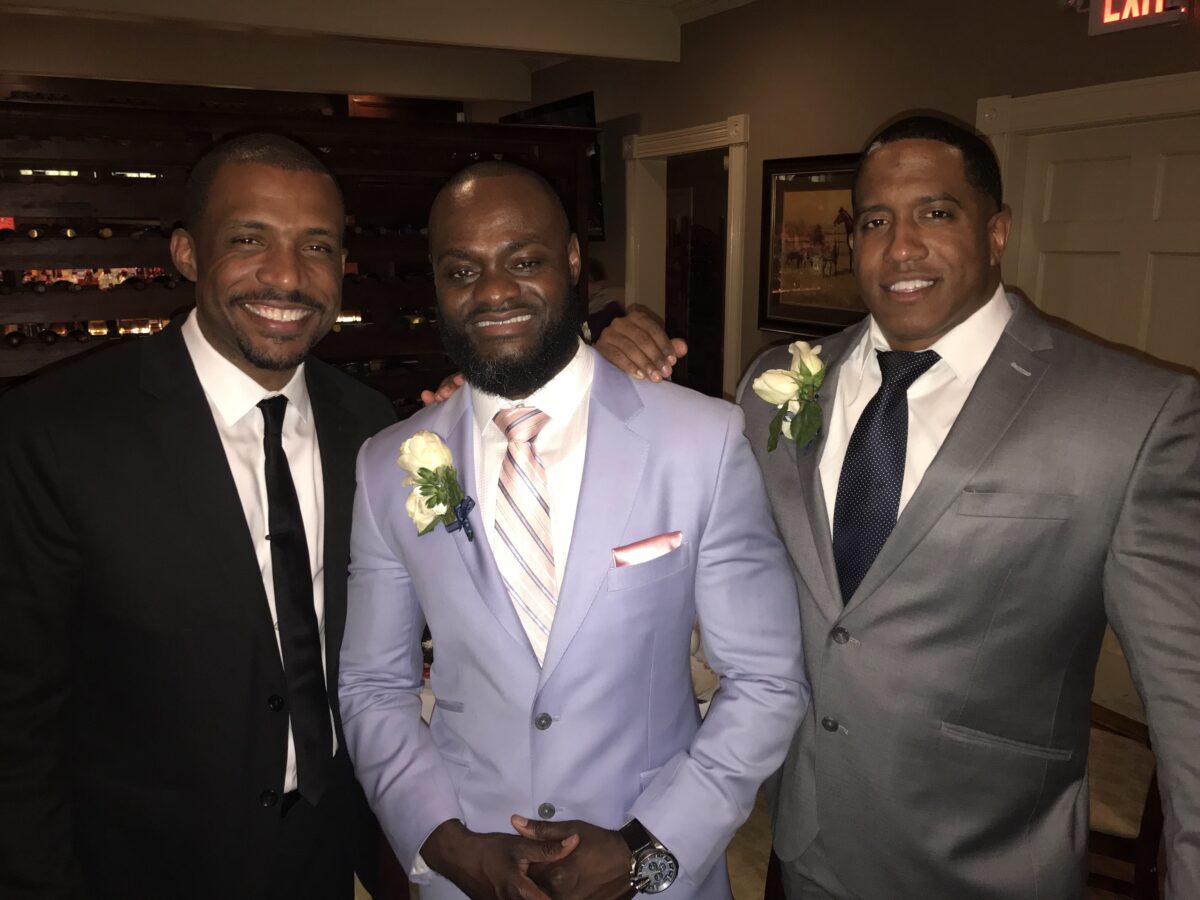
Anderson, on the left, with two of his closest UMBC friends, Eddie Freeman ’03, M.S. ’06, and Marc Haskins ’01 at Freeman’s wedding.
UMBC didn’t offer an education major at the time, but Anderson followed his inspiration, juggling a steady load of challenging coursework with his athletic obligations as captain of the track and field team, responsibilities as a dorm resident advisor, and eventually student teaching in Baltimore City schools as he pursued his teaching certificate.
Along with his teacher-certification track, Anderson’s interdisciplinary studies focused on psychology and Africana studies, and one of his professors in the latter field gave him first-hand insight into the power of effective teaching.
He remembers vividly the classes he took with Christel N. Temple, then an assistant professor of Africana studies at UMBC.
“She’s an African American woman, and I believe at the time she was relatively new to the position, but she was very good—not just in disseminating the content, but in the passion she showed for it. That was a big motivator for me,” Anderson says.
Because of that passion for teaching, he remembers: “I really enjoyed her class. I wanted to learn. I wanted to grow. I wanted to enhance my knowledge for no other reason than to become brighter and better.”
Temple, now a full professor of Africana studies at the University of Pittsburgh, isn’t surprised that her former student’s leadership qualities have attracted attention.
“I am so proud of his career,” she says. “His success is a reminder of the contribution that Africana studies makes—not just our field’s orientation to subjects such as culture, communication and sociology, but also to education studies.”
Understanding the personal dimensions of education
Anderson landed a job in Howard County Public Schools soon after graduation by way of his teaching certification and graduation from UMBC. He taught at an elementary school for seven years, then served as an elementary school instructional team leader before becoming an assistant principal. He served in that role for four years before becoming principal at Longfellow Elementary School in 2017.
Kathy Nuemann ’06, American studies, remembers meeting Anderson the year before he became principal. Neumann, a math specialist at Longfellow, was excited to meet another Retriever at her school and struck by his genuine personality. For the next six years, as they worked together, she says, “Derek was always available. Whether I was seeking advice, sharing an idea, or just needed someone to lend an ear. His sincerity extended to students as well.”
She recounts a recent story where her students wrote a proposal to Anderson as part of a social studies project. After identifying a problem (trash on the recess field), the students brainstormed a solution by requesting a recycling bin out on the playground. Neumann invited Anderson to visit her class and the students read the proposal to him. “Not only did Derek listen to the proposal, but he fulfilled the request within a week. My students were thrilled!”
All told, Anderson served nearly 20 years in Howard County’s elementary schools—long enough to see two of his three his own children pass through Longfellow Elementary while he was principal there. (He met his wife of 16 years, Jonae Anderson ’02, psychology, M.P.P. ’05, at UMBC.)
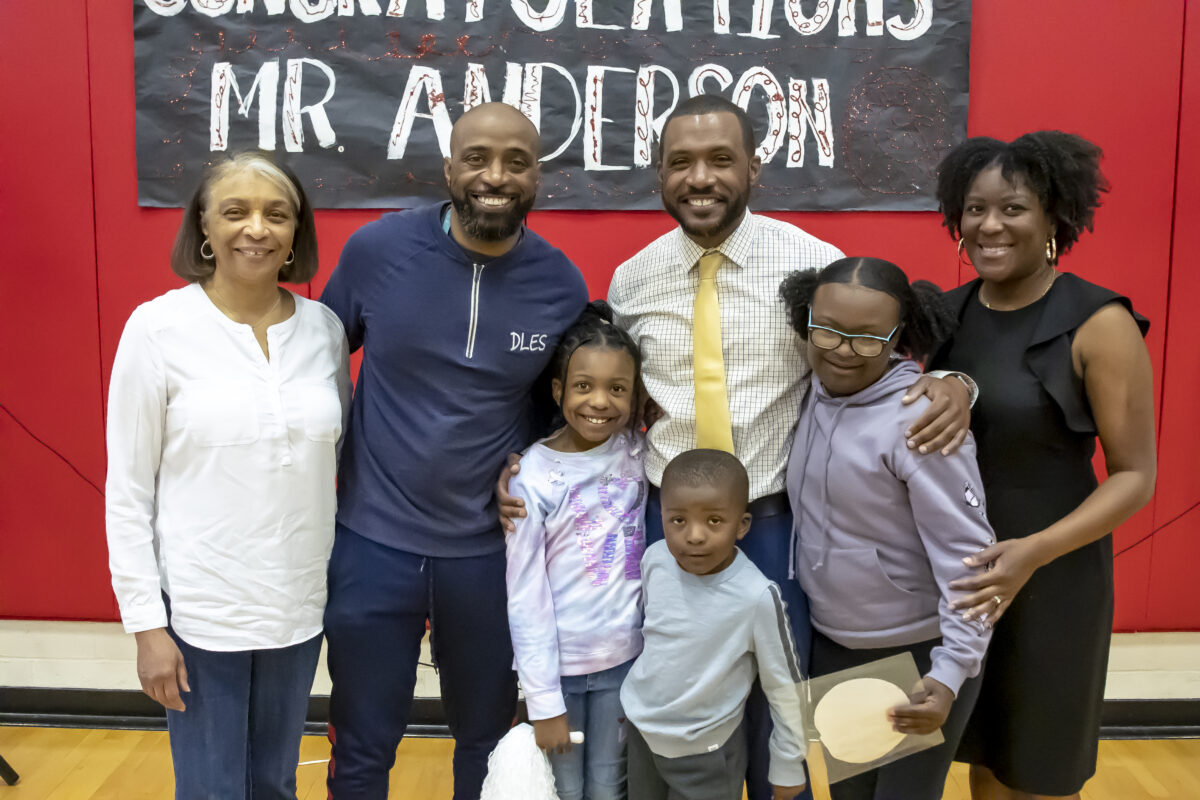
Anderson was named 2023 Principal of the Year for Howard County Public Schools. He’s pictured here with his wife and children, and mother and brother.
Indeed, Anderson says, parenthood helped underline the personal dimension of education, and not just for the obvious reasons.
“It makes me that much more passionate about the work” of education, he says. “Parents send us their kids—they send us the best they have, Monday through Friday, with the expectation that they’re going to come back safely, happy and enjoying that [school] experience. That is a responsibility I carry with me every day.”
Bringing energy to the executive position
In fact, it turned out that that sense of greater responsibility made him the perfect candidate for his new role as executive director of Maryland’s growing portfolio of community schools.
The expansion is part of the state’s 2019 Blueprint for Maryland’s Future legislation, which dedicates almost $4 billion per year in state and local funding over the next decade to a set of reforms aimed at improving public schools in the state.
The intent of community schools is to better connect schools with the families they serve. Particulars of that connection can include addressing daycare deficiencies in schools that educate a disproportionate proportion of teenage mothers, or creating a weekend food pantry with fresh groceries at a school situated in a food desert.
“Leadership has always been something that I’ve aspired to,” Anderson says. “For a long time, I never thought past the principalship,” and he admits that there’s a special energy to being in a school building that he may well miss in his new job as executive director.
But when he weighed the one school he was leaving against the difference he could make in overseeing more than 450 schools, he says he found himself thinking about his own educational journey.
“I went from, ‘I’m not confident about being a student in college’ to ‘This is something I want to pursue,’ because along the way people were providing opportunities, providing guidance, providing insight, and it’s led to a very fulfilling career for me,” Anderson says.
And with his new role’s wider scope, he has the opportunity to be just such a helping hand in the lives and education of many more students.
“I still get up excited about coming to work [in education] because I know it’s meaningful work,” Anderson says. “What better way to serve kids?”
]]>
There are some people who you meet, and it’s obvious: They’re natural leaders—seemingly born to the role. Derek Anderson ’03, interdisciplinary studies, is one of those people. He went right...
https://umbc.edu/stories/putting-the-principles-of-education-to-work/
https://my3.my.umbc.edu/api/v0/pixel/news/134703/guest@my.umbc.edu/14bdc2b3afd109b607e9e561d1091dc2/api/pixel
africana-studies
alumni
american-studies
cahss
feature
inds
magazine
the-shriver-center
UMBC News & Magazine
https://my3.my.umbc.edu/groups/umbc-news-magazine
https://assets1-my.umbc.edu/system/shared/avatars/groups/000/001/943/24435aa6207c452e7bc15cc74b42c7bb/xsmall.png?1748556657
https://assets1-my.umbc.edu/system/shared/avatars/groups/000/001/943/24435aa6207c452e7bc15cc74b42c7bb/original.png?1748556657
https://assets2-my.umbc.edu/system/shared/avatars/groups/000/001/943/24435aa6207c452e7bc15cc74b42c7bb/xxlarge.png?1748556657
https://assets2-my.umbc.edu/system/shared/avatars/groups/000/001/943/24435aa6207c452e7bc15cc74b42c7bb/xlarge.png?1748556657
https://assets3-my.umbc.edu/system/shared/avatars/groups/000/001/943/24435aa6207c452e7bc15cc74b42c7bb/large.png?1748556657
https://assets1-my.umbc.edu/system/shared/avatars/groups/000/001/943/24435aa6207c452e7bc15cc74b42c7bb/medium.png?1748556657
https://assets2-my.umbc.edu/system/shared/avatars/groups/000/001/943/24435aa6207c452e7bc15cc74b42c7bb/small.png?1748556657
https://assets1-my.umbc.edu/system/shared/avatars/groups/000/001/943/24435aa6207c452e7bc15cc74b42c7bb/xsmall.png?1748556657
https://assets2-my.umbc.edu/system/shared/avatars/groups/000/001/943/24435aa6207c452e7bc15cc74b42c7bb/xxsmall.png?1748556657
UMBC News & Magazine
2
0
false
Tue, 15 Aug 2023 13:19:02 -0400
Tue, 15 Aug 2023 13:19:02 -0400
UMBC Belongs to All of Us

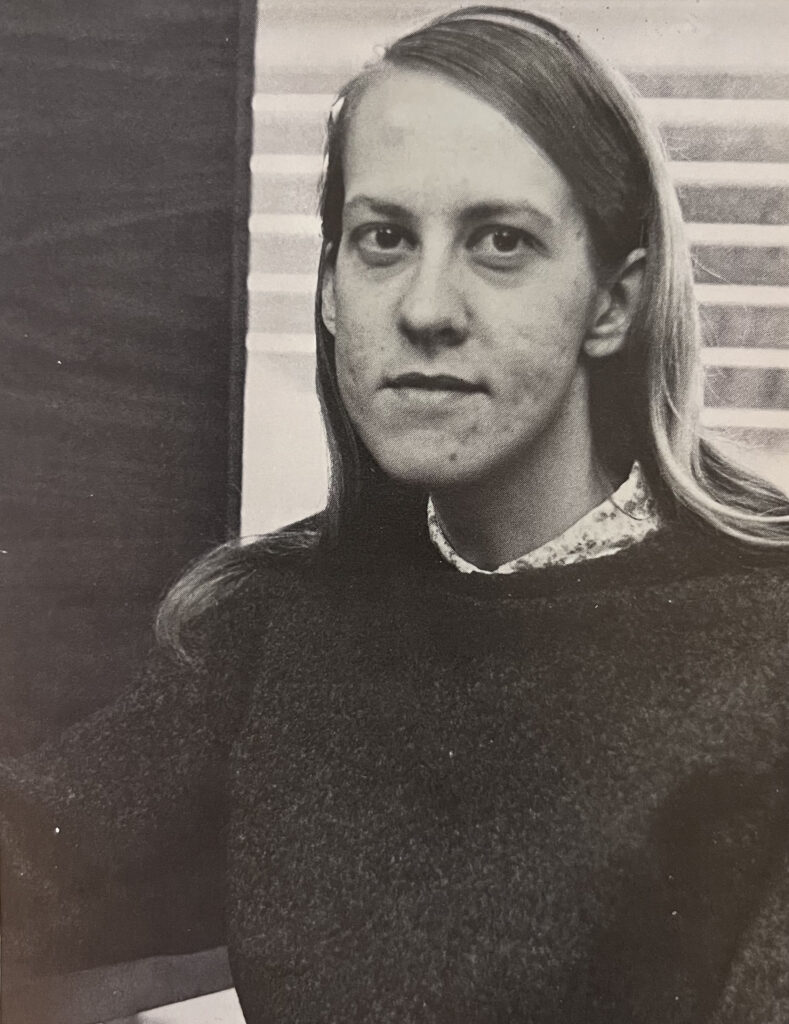 Diane Tichnell from the 1970 Skipjack, UMBC’s yearbook.
UMBC is a young institution—and not only do we have active alumni from the first four graduating classes still working to make an impact on campus and beyond, we are still discovering new stories about the establishment of the university and the ways the campus community was invited to co- create UMBC at its inception.
In fact, Diane Tichnell ’70, political science, describes the impetus for the Founding Four’s book, This Belongs to Us (2023), as its own sort of inception. Several years ago, she had a dream—literal dream while she was asleep. In it, she was attending a lecture given by then-President Freeman Hrabowski. He was talking about the books he had written, and afterward, Tichnell went up to speak to him. In her dream, she said, “We need to get the first four years of UMBC documented because soon we’re all going to be gone. Maybe in a hundred years, somebody will write it down, but why not do it now?” Dream Freeman replied, “Write that book.”
Mimi Dietrich ’70, American studies, remembers an event at the Wisdom Institute—UMBC’s association for retired faculty and staff—where a UMBC professor expressed surprise by Dietrich’s story about the plywood sidewalks that connected campus during the construction in the early years. “What do you mean you’ve never heard that story?” Dietrich responded—she figured everyone remembered what it was like in the beginning. “So Diane and I, and later Dale [Gough ’70, American studies] and Bob [Dietrich ’70, biological sciences, Mimi’s husband] came together on this; and we just started saying, ‘We have to do this. We have to do this right now.’”
Left: Co-authors Mimi and Bob Dietrich in UMBC’s 1970 yearbook Skipjack. Right: Dale Gough (pictured with Betty Huesman ’70) in the 1969 Skipjack.
Those four brainstormed the idea and knew that this labor of love would need to be as inclusive as possible. “We needed to engage the collective memory of everybody that we could possibly ask to write a story from the first four classes who were on campus,” says Tichnell. They sent newsletters, emails, mail, and even knocked on doors to capture the voices of as many graduates as possible.
In the end, 84 authors contributed more than 100 stories to This Belongs to Us, a kaleidoscopic retelling of the colorful and authentic story of UMBC. Proceeds from the book (at the clever price of $19.66) go to several scholarships supported by the founding four classes.
The Founding Four marvel at what their young institution has grown into. “All those flags in The Commons are so incredible to me,” says Joan Costello ’73, social work, a contributing author. “Because they’re from different countries. But when we came here, we were just from different neighborhoods.”
]]>
Diane Tichnell from the 1970 Skipjack, UMBC’s yearbook. UMBC is a young institution—and not only do we have active alumni from the first four graduating classes still working to make an impact...
https://umbc.edu/stories/umbc-belongs-to-all-of-us-founding-four/
https://my3.my.umbc.edu/api/v0/pixel/news/133982/guest@my.umbc.edu/49059143f75149be9cf1041938729431/api/pixel
alumni
american-studies
biological-sciences
erickson-school
founding-four
impact
magazine
spring-2023
UMBC News & Magazine
https://my3.my.umbc.edu/groups/umbc-news-magazine
https://assets1-my.umbc.edu/system/shared/avatars/groups/000/001/943/24435aa6207c452e7bc15cc74b42c7bb/xsmall.png?1748556657
https://assets1-my.umbc.edu/system/shared/avatars/groups/000/001/943/24435aa6207c452e7bc15cc74b42c7bb/original.png?1748556657
https://assets2-my.umbc.edu/system/shared/avatars/groups/000/001/943/24435aa6207c452e7bc15cc74b42c7bb/xxlarge.png?1748556657
https://assets2-my.umbc.edu/system/shared/avatars/groups/000/001/943/24435aa6207c452e7bc15cc74b42c7bb/xlarge.png?1748556657
https://assets3-my.umbc.edu/system/shared/avatars/groups/000/001/943/24435aa6207c452e7bc15cc74b42c7bb/large.png?1748556657
https://assets1-my.umbc.edu/system/shared/avatars/groups/000/001/943/24435aa6207c452e7bc15cc74b42c7bb/medium.png?1748556657
https://assets2-my.umbc.edu/system/shared/avatars/groups/000/001/943/24435aa6207c452e7bc15cc74b42c7bb/small.png?1748556657
https://assets1-my.umbc.edu/system/shared/avatars/groups/000/001/943/24435aa6207c452e7bc15cc74b42c7bb/xsmall.png?1748556657
https://assets2-my.umbc.edu/system/shared/avatars/groups/000/001/943/24435aa6207c452e7bc15cc74b42c7bb/xxsmall.png?1748556657
UMBC News & Magazine
4
0
false
Tue, 13 Jun 2023 13:31:26 -0400
Tue, 13 Jun 2023 13:31:26 -0400
Inclusion Imperative spotlights six years of innovation in community-engaged humanities research and teaching
UMBC’s Dresher Center for the Humanities recently partnered with the National Humanities Alliance to host Inclusion and Public Humanities: A Convening, one of the culminating events in the final year of the Inclusion Imperative.
Over the past six years, the Inclusion Imperative’s work has focused on three core projects: the Visiting Faculty Fellows Program, the Diversity Teaching Network, and the Humanities Teaching Labs (HTLabs).
The Inclusion Imperative is a six-year initiative funded with a $750,000 grant from the Mellon Foundation. Run by the Dresher Center, the Inclusion Imperative promotes diversity and inclusion in the humanities in partnership with Bowie State University, Coppin State University, and Howard University. The initiative has supported cutting-edge humanities-centered inclusive practices and community collaborations in the Mid-Atlantic, with the goal of creating a national ripple effect.
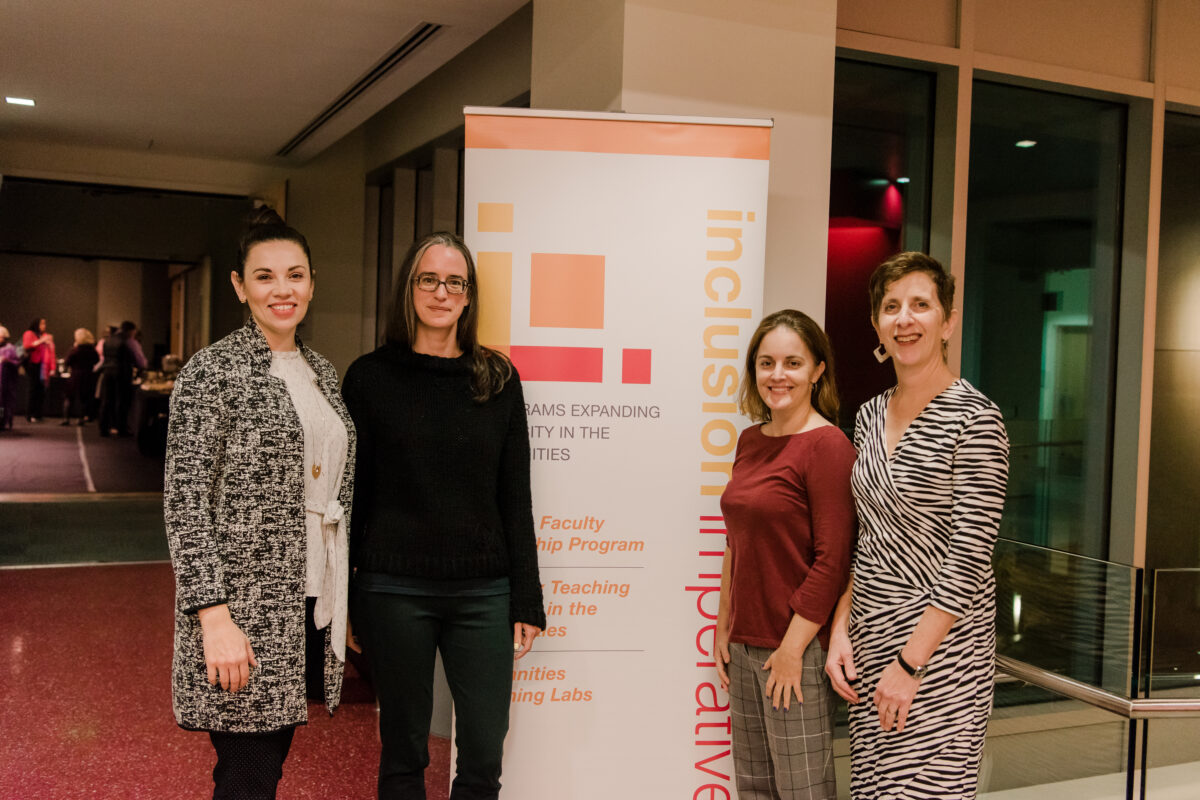 From left to right: Lindsay DiCuirci, associate professor of English, director of the English Honors program at UMBC, and the director of the HT Labs; former Faculty Visiting Fellow Elizabeth Groeneveld, associate professor and chair of women’s and gender studies at Old Dominion University; former Faculty Visiting Fellow Tracy Perkins, assistant professor in the School of Social Transformation at Arizona State University; and Jessica Berman, director of the Dresher Center and professor of English; gender, women’s, and sexuality studies; and language, literacy, and culture. Both Groeneveld and Perkins have since completed and published the projects they worked on during their fellowships.
(Marlayna Demond ’11/UMBC)
The Visiting Faculty Fellows Program has welcomed 14 full-time faculty from area universities to join UMBC for a semester or year as residential research fellows. The Diversity Teaching Network has brought together visiting fellows, UMBC faculty, and other interested scholars to work on curricular and civic-engagement projects. Through HTLabs, faculty, staff, and students have practiced innovative humanities-centered approaches to teaching and learning, from decolonizing assessments to teaching with the Smithsonian Learning Lab.
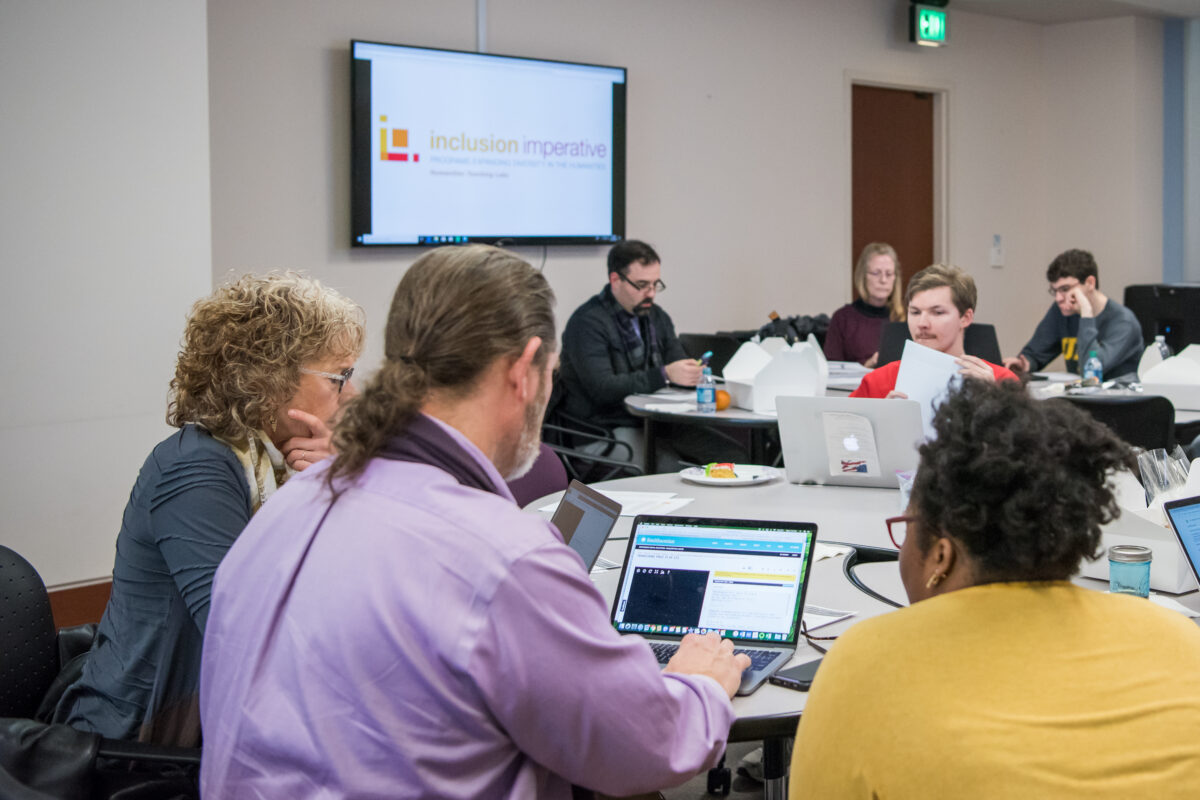 UMBC faculty, staff, and students at the 2018 Frederick Douglass Day Transcribe-a-thon HT Lab. (Marlayna Demond ’11/UMBC)
At the convening this spring, faculty and staff from institutions across the Mid-Atlantic gathered to share their approaches to community-engaged humanities research, teaching, and learning focused on race, equity, inclusion, and social justice issues.
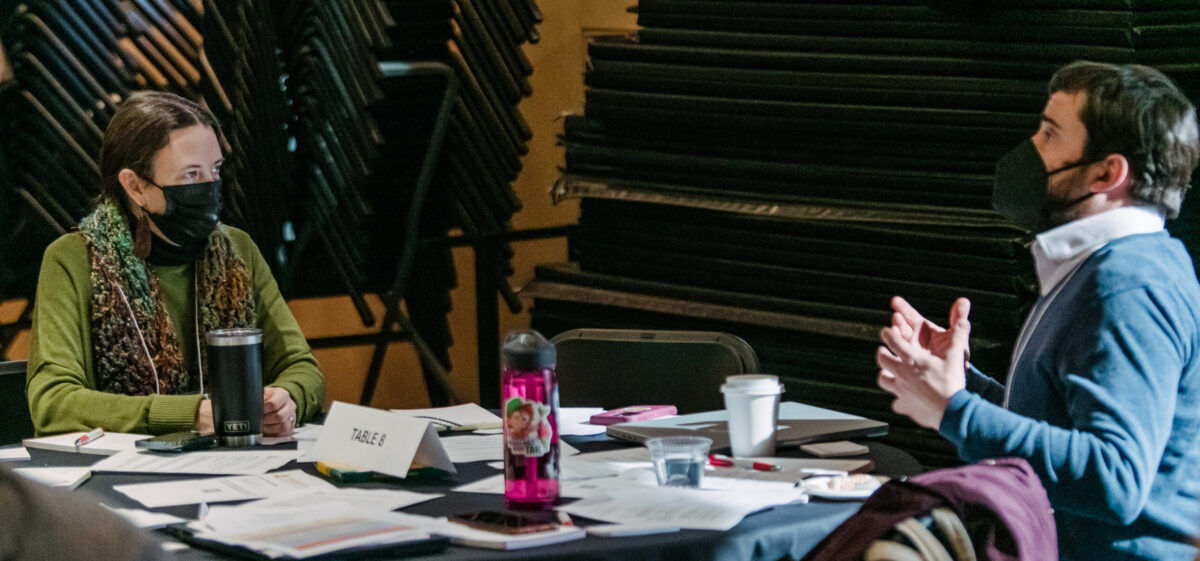 Jill Vasbinder, adjunct instructor of dance at UMBC, at left, discusses humanities music and dance topics with Scott Muir, director of undergraduate initiatives at the National Humanities Alliance.
(Marlayna Demond ’11/UMBC)
Building teaching and learning communities
Colleagues from University of Lynchburg, Community College of Baltimore County, Lehigh University, DewMore Baltimore, and Bard High School Early College-Baltimore presented on topics such as public humanities curriculum development, LGBTQ+ histories and resources, and poetry by local students.
UMBC faculty also shared several high-impact projects. Sarah Fouts, assistant professor of American studies and assistant director of the public humanities minor, spoke about her ongoing work with the Baltimore Field School 2.0. Earl Brooks, assistant professor of English, reported on his course Sounds Like Social Justice, redesigned through support from an Inclusion Imperative/HT Labs Course Transformation Grant.
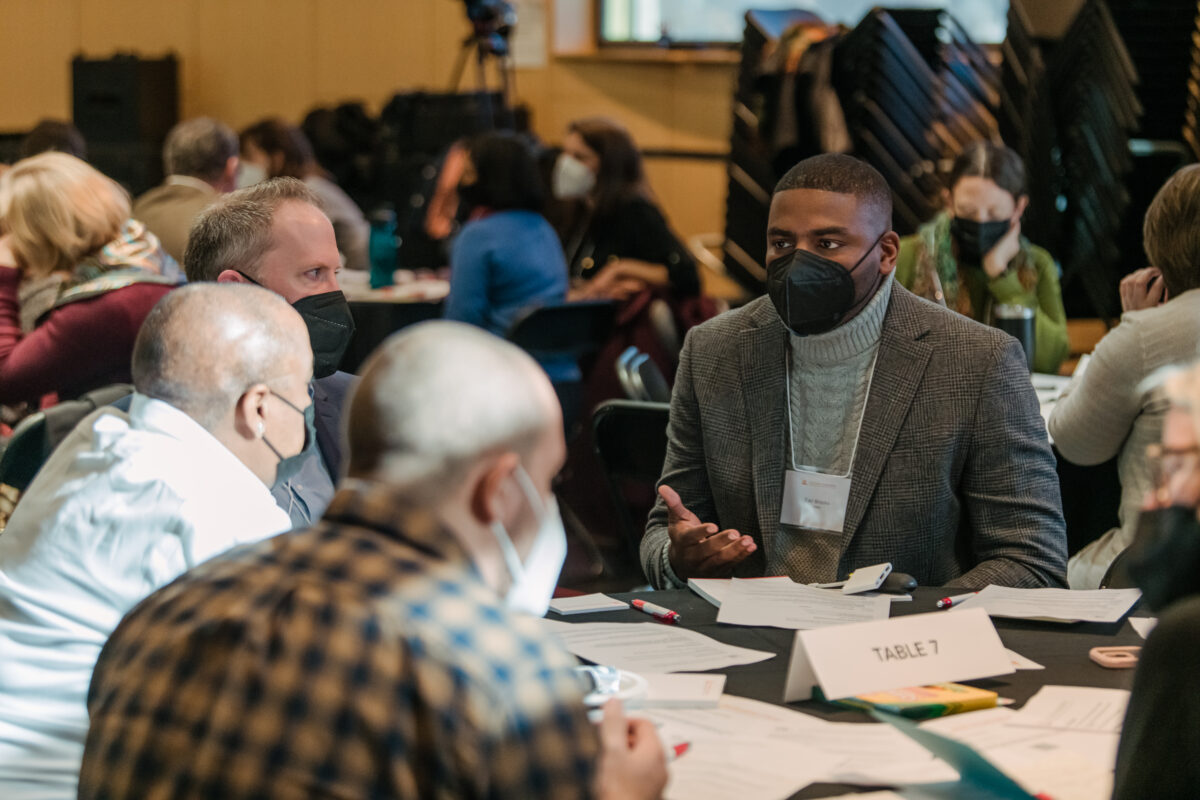 Earl Brooks speaking with Steven Park, faculty director of Community-Engaged Learning and Scholarship and assistant professor of English at Loyola University Maryland (on Brooks’s right); Tanya Saunders, associate professor of language, literacy, and culture at UMBC (middle); and Michael Casiano, assistant professor of American studies at UMBC (directly across from Brooks). (Marlayna Demond ’11/UMBC)
The funds provided recording equipment for students to work in collaboration with the Meadow Community Fellowship Church in Catonsville’s Beechfield and Irvington communities to document their experiences during and after the 2016 and 2018 floods in the “Underwater/Underserved” podcast (as shared in The Baltimore Banner). “What most people don’t know is that all that water flows downhill into the Irvington and Beechfield community, which is a little more than a mile from UMBC,” explains Brooks. The class created “Underwater/Underserved” podcast about flooding in the Irvington and Beechfield neighborhoods in Baltimore, MD.
The grant included funding for students to work on interview skills with Rona Kobell, science editor and writer with Maryland Sea Grant. Brooks explains, “I wanted my students to tell a story about the ways that the church community was underserved as a way of thinking about the role of sound in storytelling.”
Disability justice
Also at the event, faculty from La Salle University, University of Delaware, and Bowie State University shared insights into how diversity, equity, inclusion, and accommodation (DEIA) have become central to their humanities practice. To emphasize the role of accessibility and accommodation, leaders of two UMBC faculty working groups presented their ongoing work related to disability justice.
Dresher Center Disability Studies faculty working group leaders Drew Holladay, assistant professor of English, and Sharon Tran, assistant professor of English, discussed the disability justice movement and the pitfalls of ableist institutional policies that limit student and faculty engagement and success.
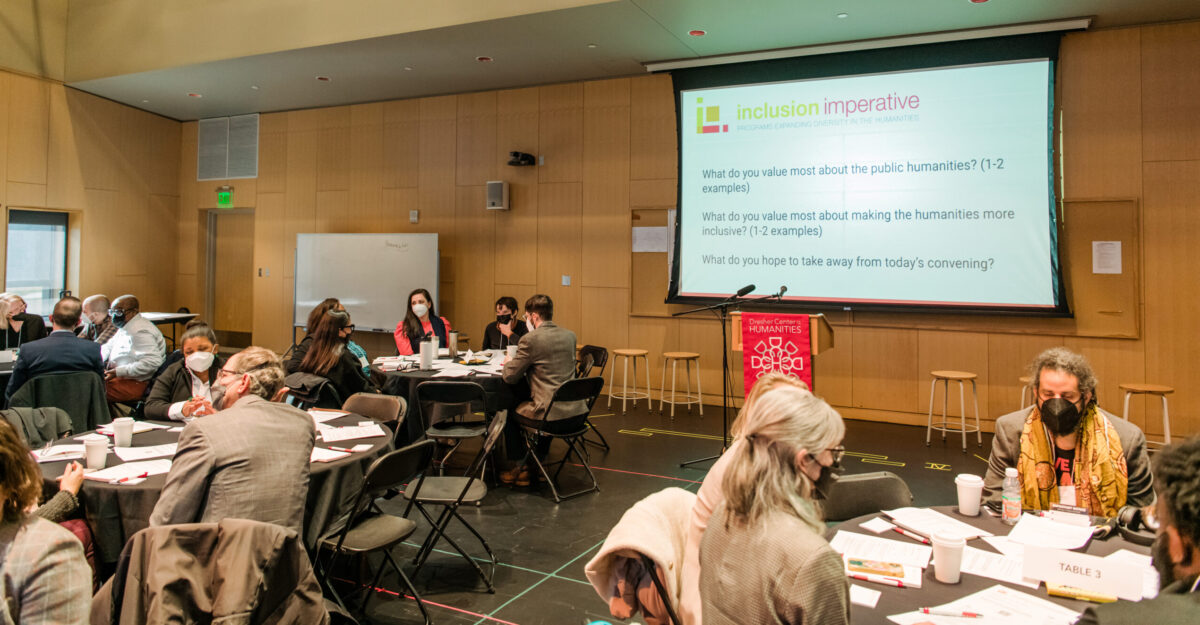 UMBC faculty Sharon Tran, Elizabeth Patton, Lindsay DiCuirci, Sarah Fouts, and Drew Holladay gather at at the Inclusion and Public Humanities convening, at the table closest to the podium.
(Marlayna Demond ’11 /UMBC)
Disability justice does not equal accessibility, especially in the way that it is institutionally defined, and it does not equal DEIA, Holladay suggested. The way he prefers to approach disability justice is to center his research and classroom practice as examples of disability justice, not as a topic that is part of the curriculum.
Tran explained strategies to implement disability justice in the classroom. “We need to think of how we can [adjust] the normative clock in the classroom to better accommodate disabled students rather than forcing those students to meet those temporal pressures,” she said.
Members of the Anti-Racism and Our Actions faculty and staff working group, Michael Hunt, director of UMBC’s McNair Scholars Program, and Amy Tondreau, assistant professor of education, talked about their work to demystify, destigmatize, and magnify anti-racist practices in the academy and in K-12 education.
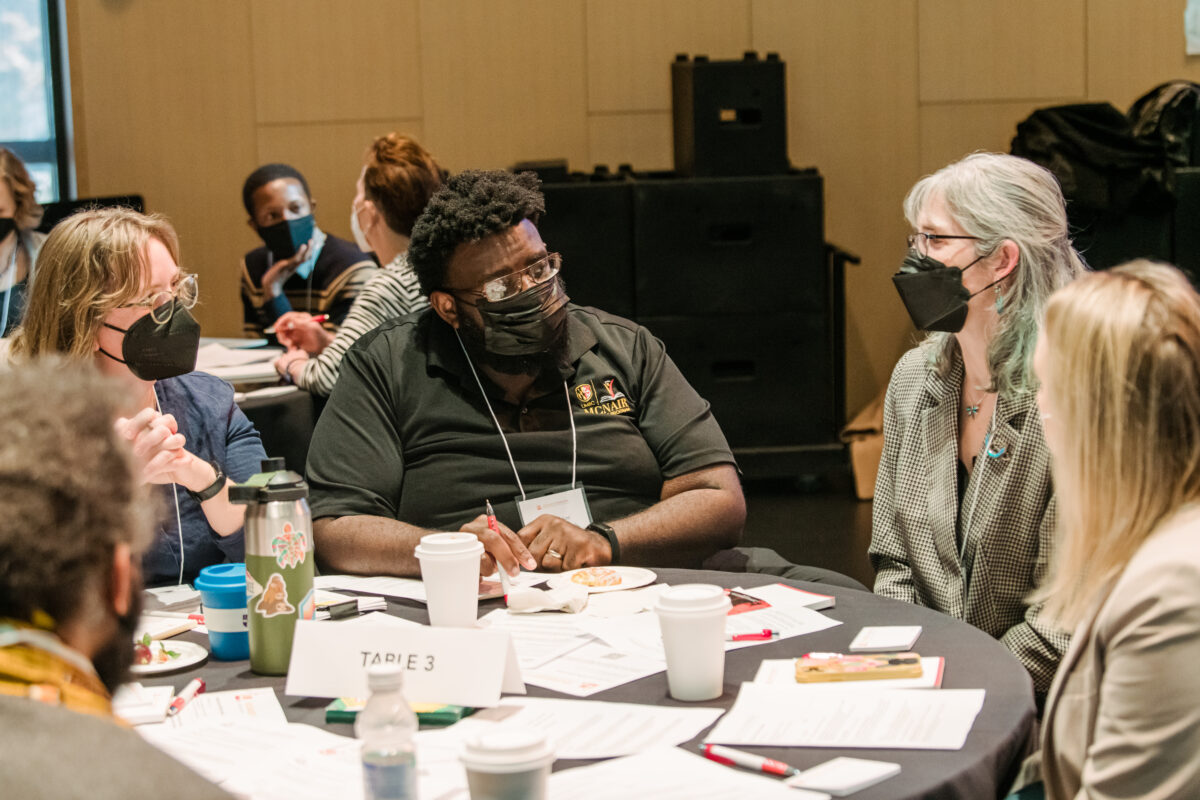 Michael Hunt (center) with colleagues from UMBC and partnering institutions. (Marlayna Demond ’11/UMBC)
Leading a national conversation
Although the Inclusion Imperative’s formal programming will come to a close this summer, the work itself will continue in several ways. Many of the program’s participants will gather again in June for the 11th International Digital Storytelling Conference, hosted by UMBC in partnership with Montgomery College and the Smithsonian Institution.
“I firmly believe that the humanities offer us crucial tools for addressing pressing issues of civic life,” says Berman who presented this work in partnership with the NHA at the 2023 NHA annual meeting. “Now more than ever, we need the tools of the humanities to advance local and national conversations about our history, our identities, and our common future.”
]]>
UMBC’s Dresher Center for the Humanities recently partnered with the National Humanities Alliance to host Inclusion and Public Humanities: A Convening, one of the culminating events in the final...
https://umbc.edu/stories/inclusion-imperative-convening/
https://my3.my.umbc.edu/api/v0/pixel/news/133242/guest@my.umbc.edu/c8d649536cdd080aaebc65b07fc28695/api/pixel
american-studies
arts-and-culture
cahss
cahssresearch
dance
dreshercenter
education
english
llc
mcnairscholars
news
policy-and-society
UMBC News & Magazine
https://my3.my.umbc.edu/groups/umbc-news-magazine
https://assets1-my.umbc.edu/system/shared/avatars/groups/000/001/943/24435aa6207c452e7bc15cc74b42c7bb/xsmall.png?1748556657
https://assets1-my.umbc.edu/system/shared/avatars/groups/000/001/943/24435aa6207c452e7bc15cc74b42c7bb/original.png?1748556657
https://assets2-my.umbc.edu/system/shared/avatars/groups/000/001/943/24435aa6207c452e7bc15cc74b42c7bb/xxlarge.png?1748556657
https://assets2-my.umbc.edu/system/shared/avatars/groups/000/001/943/24435aa6207c452e7bc15cc74b42c7bb/xlarge.png?1748556657
https://assets3-my.umbc.edu/system/shared/avatars/groups/000/001/943/24435aa6207c452e7bc15cc74b42c7bb/large.png?1748556657
https://assets1-my.umbc.edu/system/shared/avatars/groups/000/001/943/24435aa6207c452e7bc15cc74b42c7bb/medium.png?1748556657
https://assets2-my.umbc.edu/system/shared/avatars/groups/000/001/943/24435aa6207c452e7bc15cc74b42c7bb/small.png?1748556657
https://assets1-my.umbc.edu/system/shared/avatars/groups/000/001/943/24435aa6207c452e7bc15cc74b42c7bb/xsmall.png?1748556657
https://assets2-my.umbc.edu/system/shared/avatars/groups/000/001/943/24435aa6207c452e7bc15cc74b42c7bb/xxsmall.png?1748556657
UMBC News & Magazine
0
0
false
Thu, 04 May 2023 14:30:12 -0400
Thu, 04 May 2023 14:30:12 -0400