Centering Thriving Immigrant Voices in Immigration Research
UMBC faculty are leading interdisciplinary, community-engaged immigration research that is shifting the relationship between higher education institutions and immigrant communities. Their approaches include centering the economic, academic, social, and cultural contributions of immigrants to the well-being of U.S. cities. This scholarship challenges stereotypes and also works to dismantle systemic racism in higher education.
In 2020, New York Times reported that U.S.-born children of immigrants or immigrant students raised in the U.S. accounted for nearly 60 percent of the growth in U.S. university enrollment since 2000. The majority of these students are the children of international students from India who stayed in the U.S. to work, and the children of Latin Americans, and refugees who came to the U.S. in search of better living conditions.
Felipe Filomeno, associate professor of political science and global studies, and associate director of the Center for Social Science Scholarship, and Christopher Brown, a global studies lecturer, explore how immigrant students can be an asset to higher education with their study “Immigrant Students and Global Education.”
Filomeno and Brown designed a collaborative, project-based undergraduate course to study the intercultural experiences of immigrant students at UMBC. Students developed the ability to collect and analyze qualitative data and empathy for immigrants as they learned about diverse peer experiences. The study determined that project-based assignments designed to take advantage of immigrant students’ intercultural experiences could yield significant contributions to the global education of immigrant and non-immigrant students alike.
“It is important that there are such stellar colleagues committed to the vital work of exploring the realities, lived experiences, and challenges of our immigrant communities,” says Kimberly R. Moffitt, dean of the College of Arts, Humanities, and Social Sciences. “We can only thrive as a society by supporting and working together with all members of our community and recognizing their contributions to a global society.”
Digital storytelling for education and advocacy
Several of UMBC’s community-engaged researchers use digital storytelling to shift the focus away from the researcher creating information toward information being created by the community. One such project is “Intercultural Tales: Learning with Maryland’s Immigrant Communities,” developed by Thania Muñoz Davaslıoğlu, assistant professor of modern languages, linguistics, and intercultural communication (MLLI), and Tania Lizarazo, associate professor of MLLI and global studies.
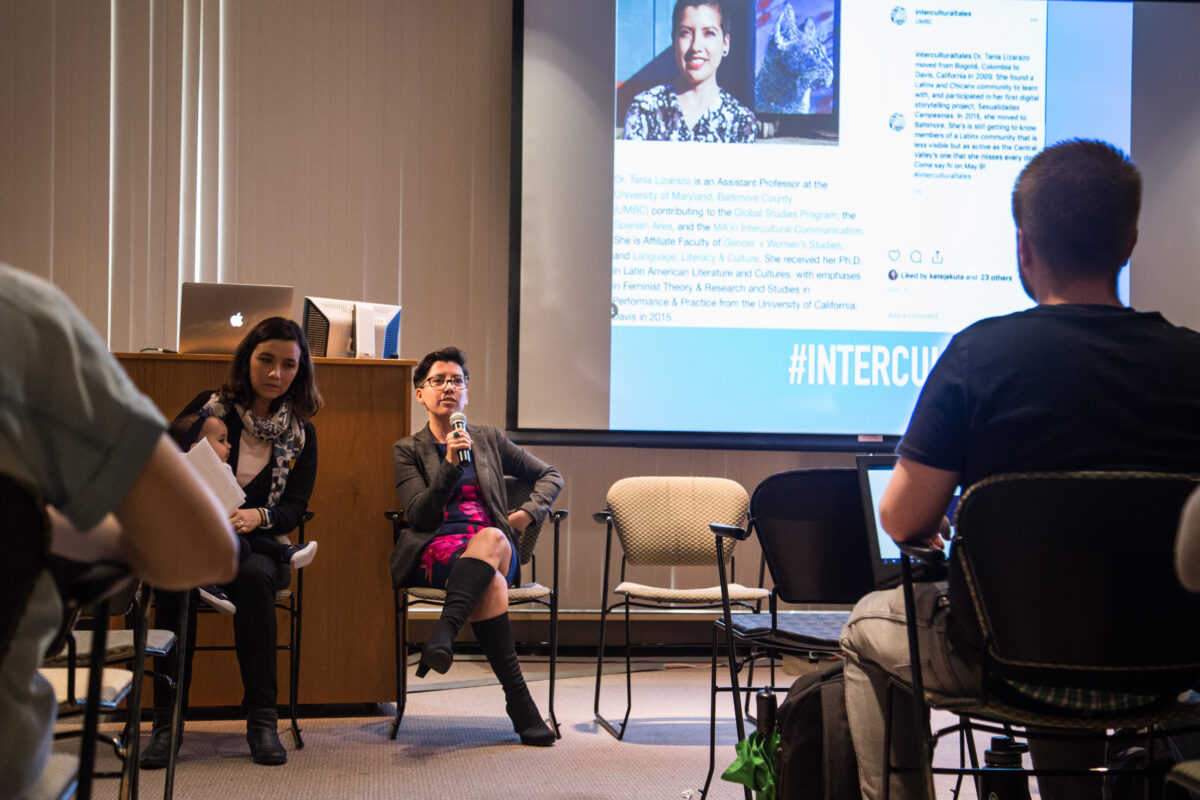 Tania Lizarazo speaking at Intercultural Tales with Thania Muñoz. Photo by Rachel Wallace
This project approaches digital storytelling from a feminist lens where non-academic knowledge such as lived experience is considered equally valuable in teaching and research. “Our project is informed by feminist theory and the field of critical intercultural communication in which power structures and hierarchies are emphasized when thinking about communication,” says Lizarazo, “Intercultural Tales is shaped by all of these fields/practices to facilitate (not guarantee) a more nuanced understanding of immigration as part of UMBC (instead of outside of it).”
This project, now in its third year, brings together students studying Spanish or global studies to produce digital stories of immigrant experiences with the goal of countering stereotypes. In one of the digital stories, “Pack Your Bag,” Heejin Hong ’18, MLLI, speaks of her parents’ transition from Korea to Paraguay, her time living in Brazil, moving to Mexico, and eventually settling in the U.S.
“My parents were first-generation immigrants from South Korea to Paraguay, where I was born. Their life as immigrants was not easy. They worked day and night to support our family,” Hong shared. “They constantly moved to other cities and countries looking for work. When I was little, I moved to Brazil to be with my grandparents because my parents had to work. Brazil was my first experience with immigration and learning a new language, new places, new food, and new cultures.”
She continued, “I have now been living in the U.S. for more than ten years. I used to see all of the changes that made me grow up quickly and think of what I didn’t have. Now, I realize that I gained something greater: courage, independence, patience, a positive outlook, not to lament, and to keep moving forward.”
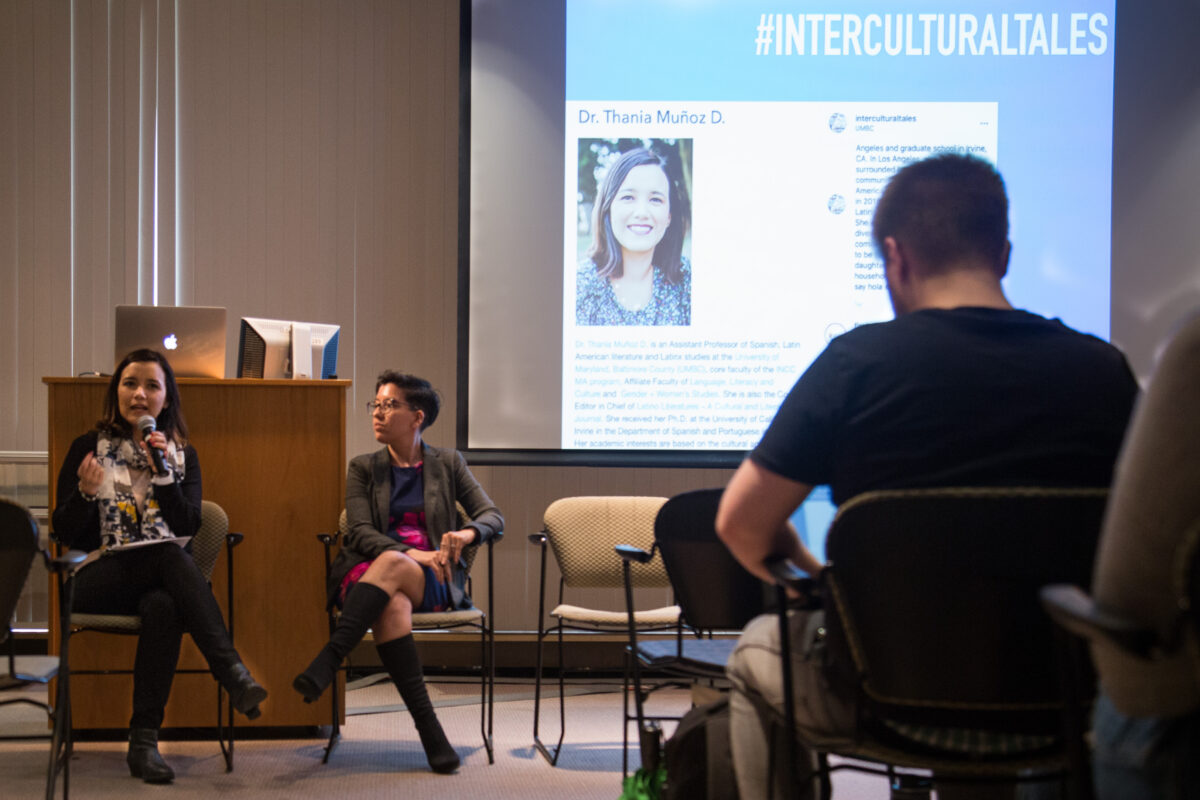 Thania Muñoz speaking about Intercultural Tales with Tania Lizarazo. Photo by Rachel Wallace.
Muñoz notes the findings, which were published in the Journal of Community Engagement and Higher Education, show the process of sharing and valuing knowledge through the project in some cases enabled the students to reframe fear, confusion, and shame through a new lens that revealed feelings of pride, solidarity, and insight.
“Most students had a more nuanced understanding of immigration,” says Lizarazo, “and a renewed appreciation for their classmate’s knowledge, which, in turn, shaped a less hierarchical learning space.”
Community-building through digital storytelling
Lizarazo also collaborated with local immigrant women to create “Moving Stories: Latinas en Baltimore.” The digital storytelling archive visualizes the immigrant experience from the perspective of Latinas in Baltimore. It aims to dispel stereotypes and share the diversity of their experiences.
Camila Daniel shared her experience of being a Black-Brazilian Latina living in Baltimore in her digital story “When Baltimore Became My Home.”
“In 2006 when I came to Baltimore, I lived the experience of what it means to be Black and Latina at the same time in a country that expects people to be only of one race. When people saw me with my accent, my hair, and my Black skin, they assumed I was African American. Many of the Brazilians were white. I didn’t feel I fit in anywhere. I suffered a lot,” says Daniel.
She continues, “Now, I feel it was good for me to come to Baltimore, live in a predominantly Black city, and learn from Black people what it is to have pride in how you look and your history. At the same time, with Spanish and Baltimore, I have created a family that does not have my blood or nationality but one heart.”
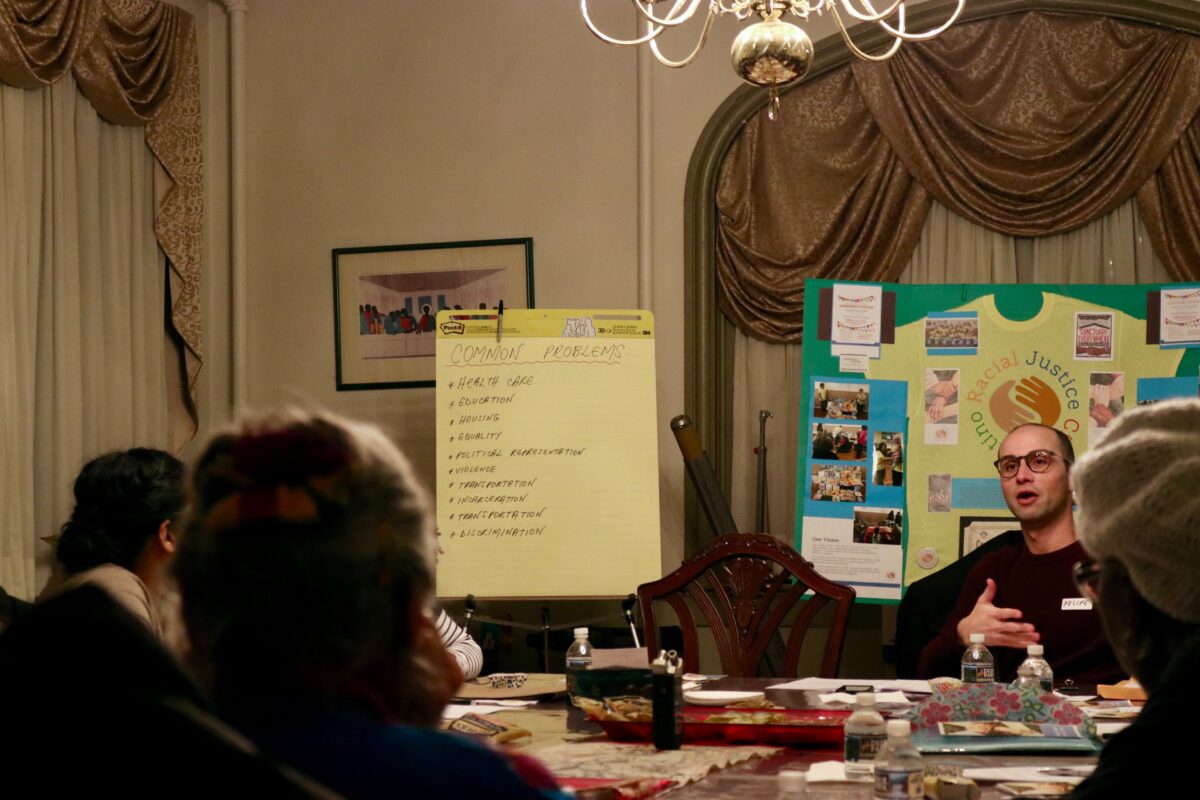 Filomeno leads a discussion with Baltimore’s Latino Racial Justice Circle. Photo courtesy of Filomeno.
Since 2017, Lizarazo and Filomeno have also worked in partnership with Baltimore’s Latino Racial Justice Circle to develop, design, execute, evaluate, and share the “Honest Conversations on Immigration” project. Through dialogue, and digital storytelling, the program fosters conversations between U.S.-born citizens and immigrants that share faith-based spaces but rarely engage in dialogue. Since 2019, about 85 members of 15 congregations have participated.
“Our goal as researchers is to use dialogue and digital stories as ways to bring different communities together around religion, race, and immigration,” explains Filomeno. “Through that process, we hope to create the potential to change the relationships among individuals, and between communities and society for the better.”
Baltimore’s immigration policies
Filomeno last year received the Hispanic Heritage Award from Baltimore Mayor Brandon Scott in recognition of his work facilitating dialogue as well as an earlier comprehensive assessment of Baltimore’s immigration policies. The study “Baltimore’s Policies to Attract and Retain Immigrants: A Community-Engaged Evaluation” was critical in shaping the strategic vision of the Mayor’s Office of Immigrant Affairs. It built on a prior study in which Filomeno reviewed Baltimore’s economic development, multicultural, and law enforcement policies, collaboration with civil society, and policy advocacy.
“In all these studies, I have engaged local groups and organizations in the creation of knowledge about immigration and the application of this knowledge to help solve real-world problems,” says Filomeno. “This research has helped a local government trying to encourage the city’s growth through immigration, a faith community trying to build connections between congregants of different nationalities, and a university trying to leverage student diversity of national origin to promote global learning. As we say at UMBC, it is public research for public good.”
Documenting places of belonging and meaning
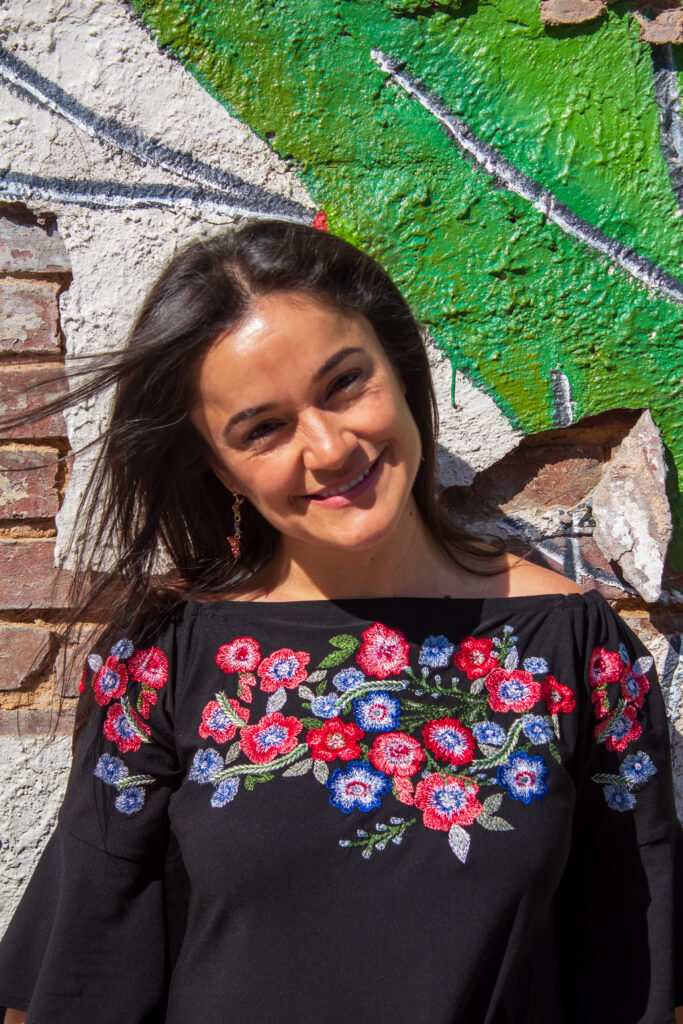 Headshot courtesy of Yolanda Valencia.
Beyond Maryland, Yolanda Valencia, assistant professor of geography and environmental systems, explores the Mexican immigrant community of Pasco, Washington, and how this community creates places of peace, tranquility, and family—places of belonging and meaning—under disadvantaged conditions. In the forthcoming book Relational Life: Legal Death, Valencia draws on years of fieldwork in Pasco, transnational ethnography, archival research, interviews with city leaders, and testimonies from undocumented Mexican immigrants.
“I aim to provide a historical political economy analysis of geographies of oppression overlaid with an analysis of spaces where this community thrives, as they both happen simultaneously across scale, time, and border,” says Valencia.
This year, Valencia received a 12-month Career Enhancement Fellowship, funded by the Mellon Foundation and administered by the Institute for Citizens and Scholars. She was also selected as a 2020 – 2022 Summer Institute on Tenure and Professional Advancement (SITPA) scholar. The mentoring and professional initiative is designed to facilitate junior faculty members’ successful transition to tenured associate professor status.
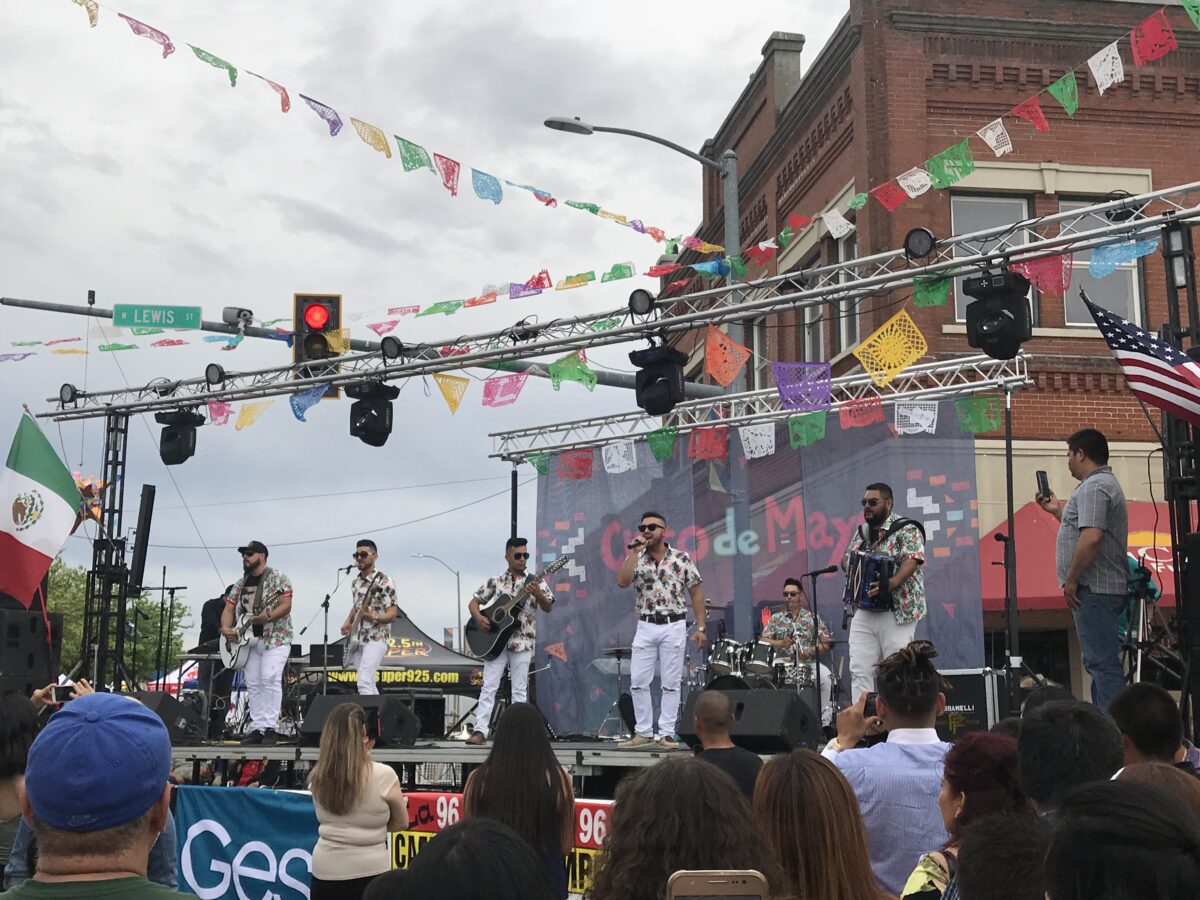 This Cinco de Mayo event in Pasco features second-generation Mexican immigrant musicians who have learned how to play, sing, and love traditional Mexican (and Latinx) music. Photo courtesy of Valencia.
Another faculty member has been highly engaged with immigrant communities in New Orleans. The success of taco trucks and Soul Food pop-ups there have raised complex questions about food truck regulation, worker rights, and immigration. The Whiting Foundation awarded a $50,000 Public Engagement Fellowship to Sarah Fouts, assistant professor of American studies, along with local New Orleans organizers Toya Ex Lewis and Fernando López, to implement “Project Neutral Grounds: At the Intersection of People, Street Food, and the Hustle.”
Lewis is the organizer of Project Hustle, born in New Orleans, and López is a Mexican-born documentarian. The three partners have worked together since 2013. Their latest collaboration will bring together Black, Brown, LGBTQ+, and immigrant food vendors in New Orleans to celebrate, share, and document their experiences and histories.
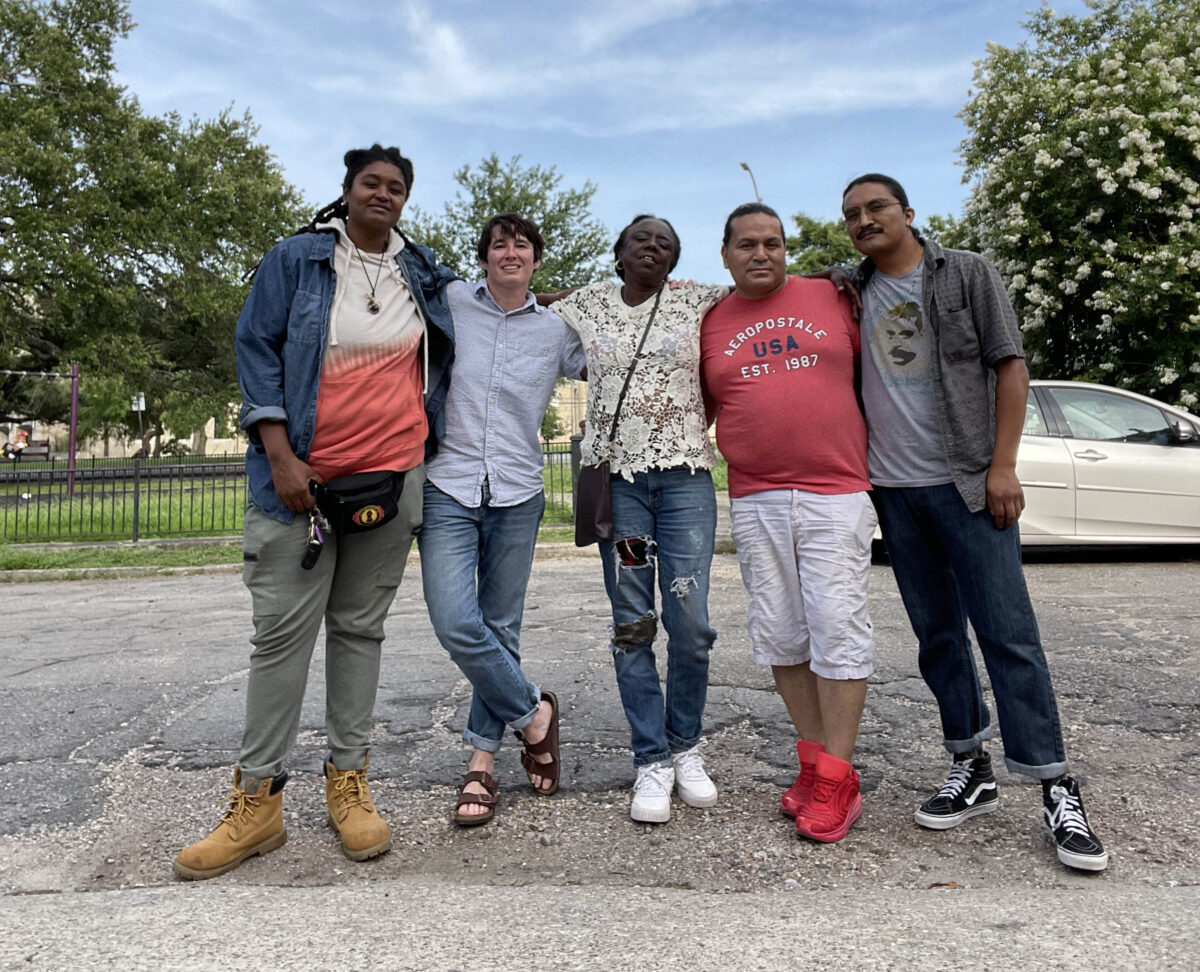 Left to right: Toya Ex Lewis, Sarah Fouts, community members, and Fernando Lopez. Photo courtesy of Fouts.
Challenging extractive research
This innovative research intentionally values the knowledge of immigrants and creates new ways for academics to think about primary sources. It highlights thriving communities and enables communication, personal reflection, and empathy while challenging systemic racism and the role of education and institutions in perpetuating inequalities.
“Recognizing each other’s humanity is not an abstract process. It requires a commitment to questioning pedagogies that reproduce the hierarchies we critique,” Muñoz Davaslıoğlu and Lizarazo explain. “Teaching and learning are inextricable from struggles against the dehumanization of immigrants and minorities.”
]]>
UMBC faculty are leading interdisciplinary, community-engaged immigration research that is shifting the relationship between higher education institutions and immigrant communities. Their...
https://umbc.edu/stories/immigrant-voices-in-immigration-research/
https://my3.my.umbc.edu/api/v0/pixel/news/129593/guest@my.umbc.edu/b0f32c6867d89407d88e1ee16c263f2e/api/pixel
americanstudies
arts-and-culture
cahss
csss
discovery
ges
globalstudies
magazine
mlli
news
politicalscience
rca-2
UMBC News & Magazine
https://my3.my.umbc.edu/groups/umbc-news-magazine
https://assets1-my.umbc.edu/system/shared/avatars/groups/000/001/943/24435aa6207c452e7bc15cc74b42c7bb/xsmall.png?1748556657
https://assets1-my.umbc.edu/system/shared/avatars/groups/000/001/943/24435aa6207c452e7bc15cc74b42c7bb/original.png?1748556657
https://assets2-my.umbc.edu/system/shared/avatars/groups/000/001/943/24435aa6207c452e7bc15cc74b42c7bb/xxlarge.png?1748556657
https://assets2-my.umbc.edu/system/shared/avatars/groups/000/001/943/24435aa6207c452e7bc15cc74b42c7bb/xlarge.png?1748556657
https://assets3-my.umbc.edu/system/shared/avatars/groups/000/001/943/24435aa6207c452e7bc15cc74b42c7bb/large.png?1748556657
https://assets1-my.umbc.edu/system/shared/avatars/groups/000/001/943/24435aa6207c452e7bc15cc74b42c7bb/medium.png?1748556657
https://assets2-my.umbc.edu/system/shared/avatars/groups/000/001/943/24435aa6207c452e7bc15cc74b42c7bb/small.png?1748556657
https://assets1-my.umbc.edu/system/shared/avatars/groups/000/001/943/24435aa6207c452e7bc15cc74b42c7bb/xsmall.png?1748556657
https://assets2-my.umbc.edu/system/shared/avatars/groups/000/001/943/24435aa6207c452e7bc15cc74b42c7bb/xxsmall.png?1748556657
UMBC News & Magazine
0
0
false
Mon, 05 Dec 2022 15:44:58 -0500
Mon, 05 Dec 2022 15:44:58 -0500
Community-building in Baltimore through public humanities
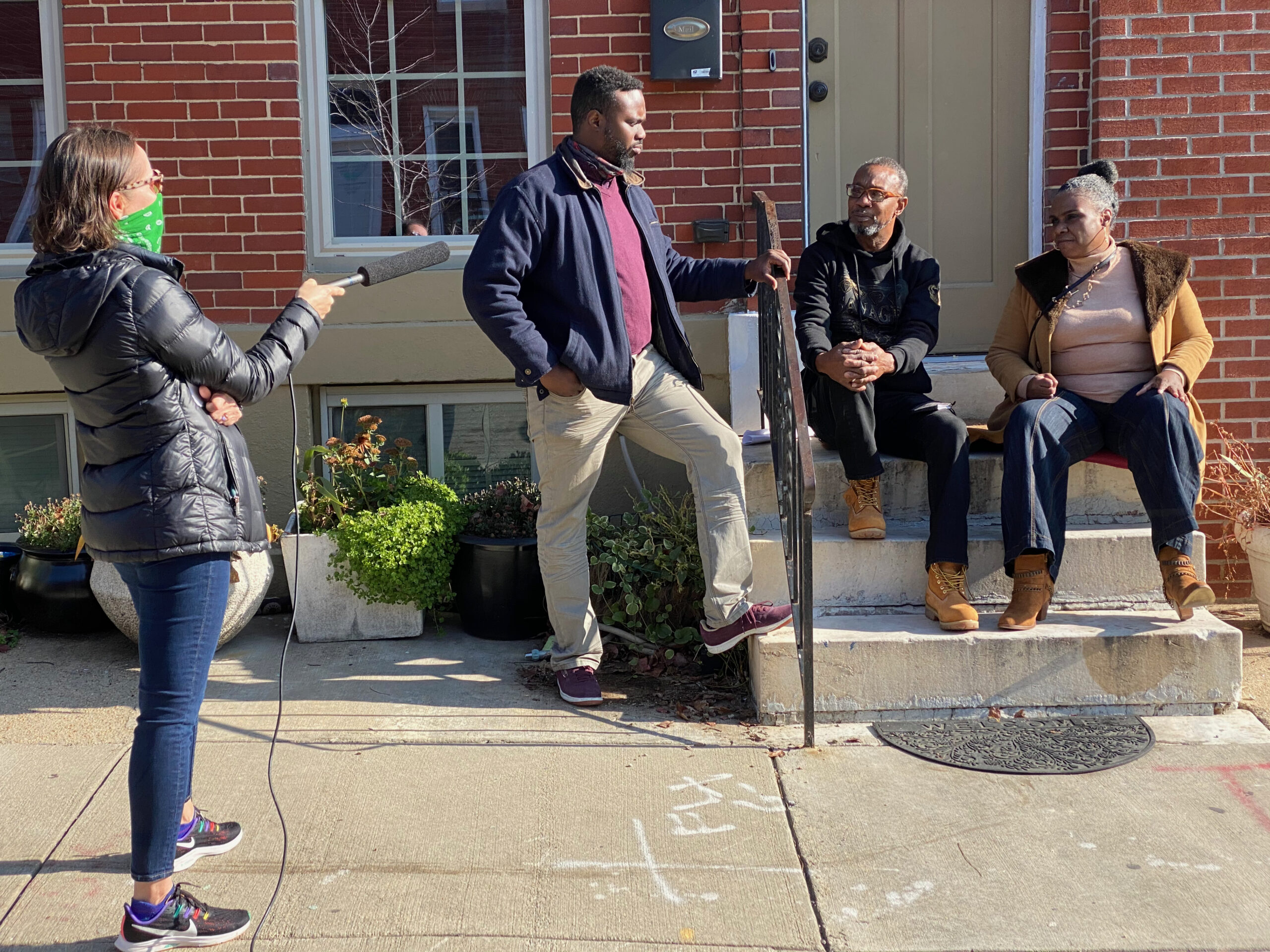
Over the last decade Nicole King, professor of American studies and director of the Orser Center for the Study of Place, Community, and Culture, has worked with colleagues to develop public humanities research methods that address disconnections, misrepresentation, and inequalities in Baltimore City and in the classroom. King helps students actively listen to and partner with Baltimore communities in research to create multimedia narratives as a vehicle of community-building and advocacy.
“Place-based public history projects demonstrate that students and scholars can engage and collaborate with communities to identify, analyze, and respond to pressing social problems,” says King. “Public history methods can create dynamic social spaces in which scholars and residents work together to frame questions, conduct research, and preserve urban places.”
King’s work has reached a broad range of academic and public audiences, from the recent co-authored article “Building Together” in Baltimore? Corporate Megadevelopment and Coalitions for Community Power in Urban Affairs Review to media coverage of A Place Called Poppleton, documenting a fight for community-led development as part of the Baltimore Traces project.
A Place Called Poppleton
In July 2022, Sonia and Curtis Eaddy celebrated as Baltimore’s mayor announced their home in the historic Poppleton neighborhood of West Baltimore, dating back to the late 1800s, would not be demolished for redevelopment as previously planned. Among those whom Sonia thanked for support were King and her students.
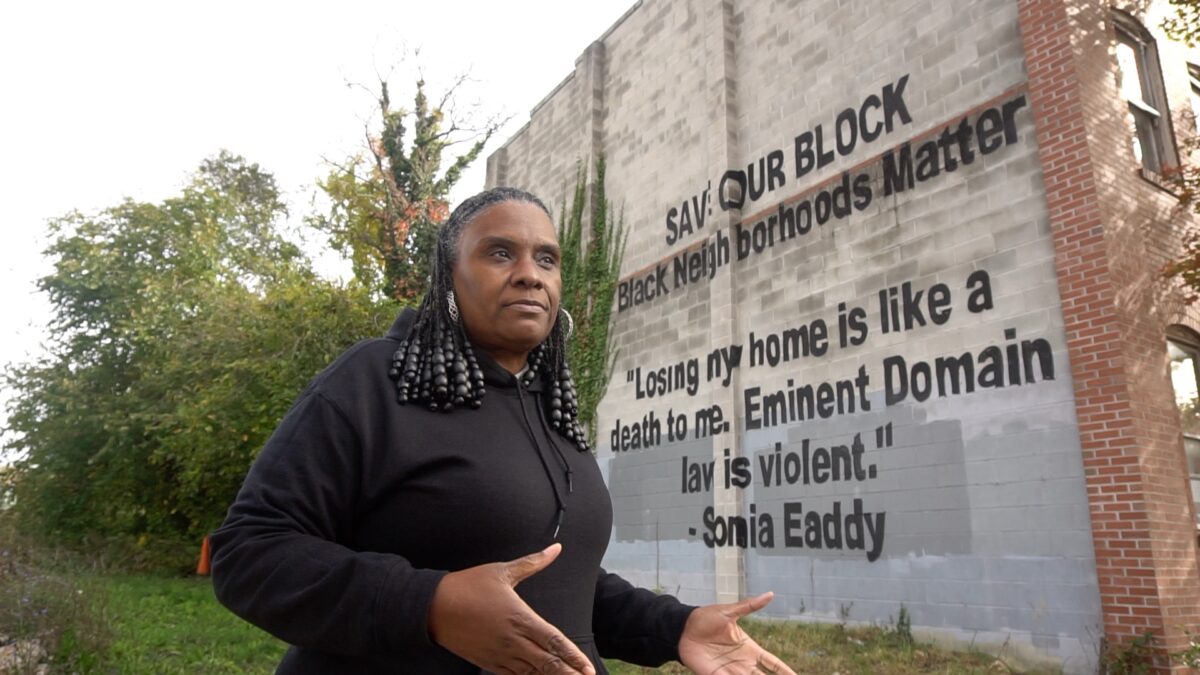 Sonia Eaddy. (Image courtesy of King)
King originally connected with the Eaddy family through their son, Curtis Eaddy II, who shared his story as a third-generation Poppleton resident in 2019 for the storytelling series Baltimore Traces: West Baltimore. He became a strong partner in leading walking tours of West Baltimore through UMBC’s Baltimore Field School before interviewing his parents for A Place Called Poppleton, which King co-created in 2020 with students, residents, and Bill Shewbridge, media and communication studies professor of the practice.
Curtis Eaddy II shares his story for Baltimore Traces: West Baltimore, produced by Shewbridge.
Through A Place Called Poppleton, UMBC students listened to residents who live, work, and are connected to Poppleton. They shared their voices through media like films, a digital walking tour and historical timeline, a zine, and a brochure. These materials have documented, analyzed, and raised awareness about Poppleton’s history and present community advocacy.
We Are You and You Are Us produced by María Morte, M.A. ’23, intercultural communication, Fulbright U.S. Student Scholar from Spain.
The project Baltimore Traces: Communities in Transition, which began in 2015, is a collaborative teaching initiative that brings together students from a variety of disciplines in the arts and humanities to create media focused on Baltimore neighborhoods. The project has produced the Telly Award-winning documentary Mill Stories: Remembering Sparrows Point Steel Mill as well as short films, digital maps, and podcasts such as the Baltimore Green Space and A Walk Down West Baltimore Street. This included the radio series Stories of Deindustrialization, produced in partnership with the Center for Emerging Media—a Baltimore non-profit, and aired on the Marc Steiner Show.
“Getting out, showing up, listening to people, and meeting people where they are is so important to building the Baltimore Traces project,” King explains. “It’s something that organically grows to educate students…to do work that matters on the ground.”
Baltimore Field School
It’s no accident that King first connected with Curtis Eaddy II through Baltimore Traces, and then the Baltimore Field School, a project specifically designed to support innovation in the public humanities through collaboration with Baltimore residents.
The Andrew W. Mellon Foundation awarded King and Dean Kimberly Moffitt $125,000 to establish the Baltimore Field School in 2020, to enhance the understanding and visibility of communities in South and Southwest Baltimore. The project accomplishes these objectives through methods centered in community partnership. In this way, it works to build a national model of effective, ethical humanities research, teaching, and learning about Baltimore and cities like it.
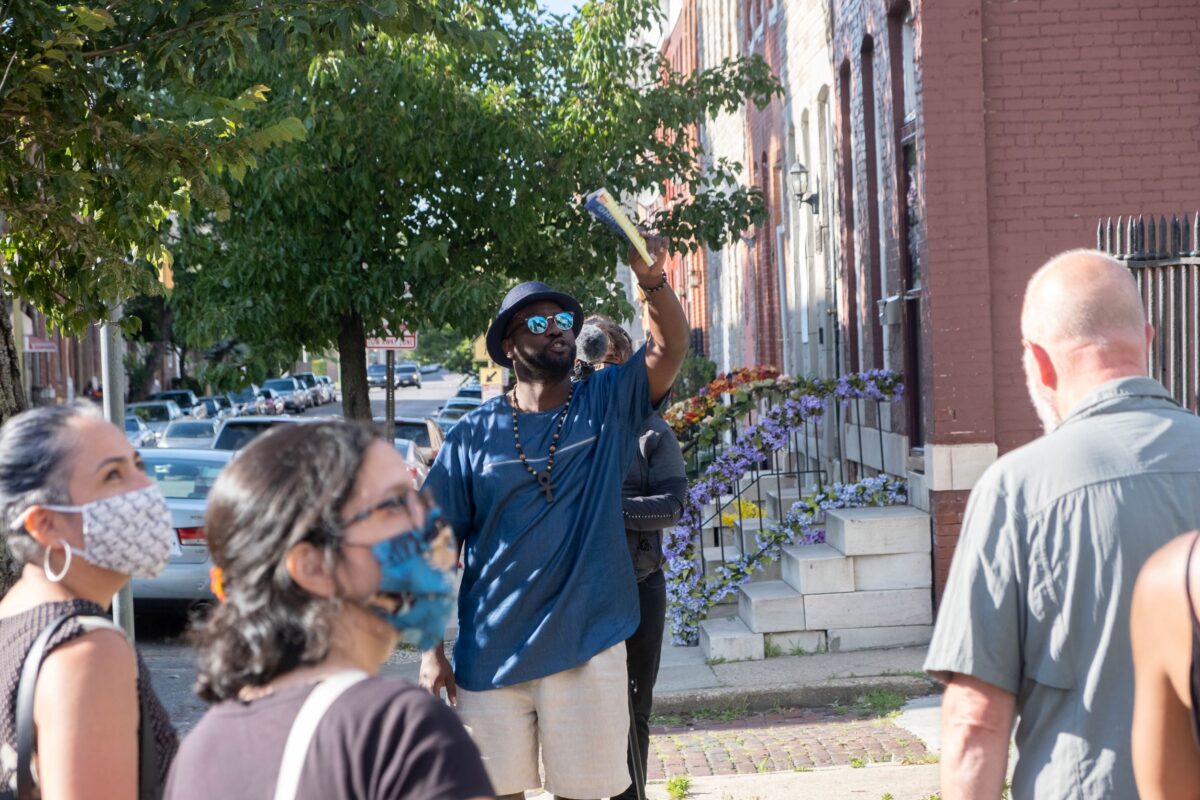 Curtis Eaddy II (center) leading a walking tour of West Baltimore for the Baltimore Field School.
The work continues to evolve. In 2022, the American Council of Learned Societies awarded King; Sarah Fouts, assistant professor of American studies; and Tahira Mahdi, adjunct professor of psychology, an NEH-supported public engagement grant totaling more than $150,000 for “Baltimore Field School 2.0: Undoing & Doing Anew in Public Humanities.”
Fouts, King, and Mahdi will work with community members, UMBC graduate students, and faculty to continue to develop frameworks for ethical and sustainable community-engaged research between local communities and academia, around topics such as public information, racial equity, and food and land justice.
The “public” in public humanities
These are some of the same core themes explored inBaltimore Revisited(Rutgers University Press, 2019), the leading contemporary anthology on the city’s complex history and efforts to address longstanding inequalities, written by experts both within and outside of academia. King co-edited the book with long-time collaborators Kate Drabinski, principal lecturer of gender, women’s, and sexuality studies, and the University of Baltimore’s Joshua Clark Davis.
“We hope the book raises questions about how history can inform the present to understand the roots of the city’s many inequalities,” said Drabinski, when it was published. “We wish readers to imagine new ways of being in and organizing for Baltimore now and in the future.”
Thinking of the anthology and all that has followed it, King reflects, “We can not forget the ‘public’ in public humanities.”
]]>
Over the last decade Nicole King, professor of American studies and director of the Orser Center for the Study of Place, Community, and Culture, has worked with colleagues to develop public...
https://umbc.edu/stories/community-building-in-baltimore-through-public-humanities/
https://my3.my.umbc.edu/api/v0/pixel/news/128592/guest@my.umbc.edu/75d853f2693ffa86fb3610b7278880c5/api/pixel
americanstudies
cahss
cahssresearch
gwst
intercultural-communications
mcs
news
policy-and-society
psychology
UMBC News & Magazine
https://my3.my.umbc.edu/groups/umbc-news-magazine
https://assets1-my.umbc.edu/system/shared/avatars/groups/000/001/943/24435aa6207c452e7bc15cc74b42c7bb/xsmall.png?1748556657
https://assets1-my.umbc.edu/system/shared/avatars/groups/000/001/943/24435aa6207c452e7bc15cc74b42c7bb/original.png?1748556657
https://assets2-my.umbc.edu/system/shared/avatars/groups/000/001/943/24435aa6207c452e7bc15cc74b42c7bb/xxlarge.png?1748556657
https://assets2-my.umbc.edu/system/shared/avatars/groups/000/001/943/24435aa6207c452e7bc15cc74b42c7bb/xlarge.png?1748556657
https://assets3-my.umbc.edu/system/shared/avatars/groups/000/001/943/24435aa6207c452e7bc15cc74b42c7bb/large.png?1748556657
https://assets1-my.umbc.edu/system/shared/avatars/groups/000/001/943/24435aa6207c452e7bc15cc74b42c7bb/medium.png?1748556657
https://assets2-my.umbc.edu/system/shared/avatars/groups/000/001/943/24435aa6207c452e7bc15cc74b42c7bb/small.png?1748556657
https://assets1-my.umbc.edu/system/shared/avatars/groups/000/001/943/24435aa6207c452e7bc15cc74b42c7bb/xsmall.png?1748556657
https://assets2-my.umbc.edu/system/shared/avatars/groups/000/001/943/24435aa6207c452e7bc15cc74b42c7bb/xxsmall.png?1748556657
UMBC News & Magazine
0
0
false
Wed, 19 Oct 2022 10:52:25 -0400
Wed, 19 Oct 2022 10:52:25 -0400
Rethinking collaborative public humanities research in New Orleans and Baltimore

If you were looking for Sarah Fouts in New Orleans, chances are you would find her at one of the many taco trucks or pop-up food vendors across the city, chatting with locals. Relationship-building is at the core of her work, which focuses on the experiences of Black, Central American, and Mexican food industry workers in post-Katrina New Orleans.
Fouts is an assistant professor of American studies at UMBC who earned her Ph.D. in Latin American studies at Tulane University. For more than a decade, she has volunteered for, collaborated with, and supported the work of grassroots organizations in New Orleans. Now, she is working with long-time partners there on an exciting new project.
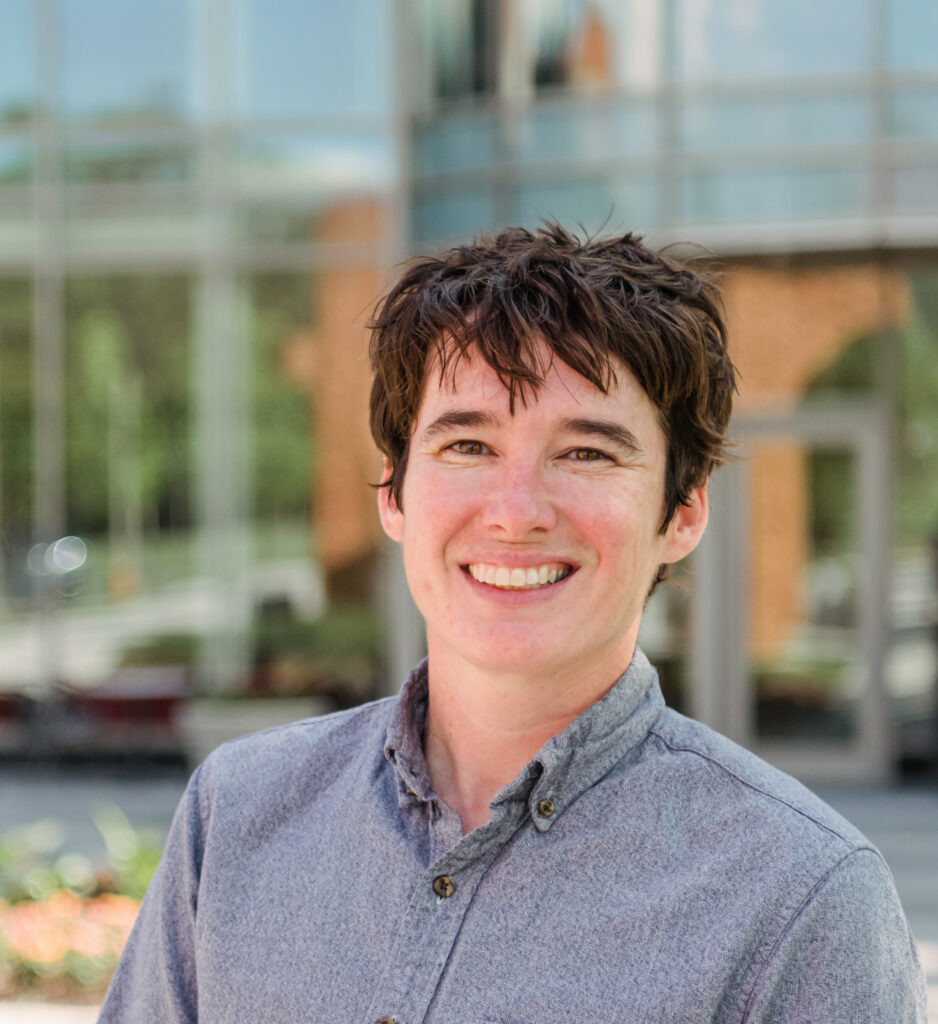 Sarah Fouts. (Marlayna Demond ’11/UMBC)
The Whiting Foundation has awarded a $50,000 Public Engagement Fellowship to Fouts along with local organizers Toya Ex Lewis and Fernando López to implement Project Neutral Grounds: At the Intersection of People, Street Food, and the Hustle. Lewis is the organizer of Project Hustle, born in New Orleans, and López is a Mexican-born documentarian. The three partners have worked together since 2013. Their latest collaboration will bring together Black, Brown, LGBTQ+, and immigrant food vendors in New Orleans to celebrate, share, and document their experiences and histories.
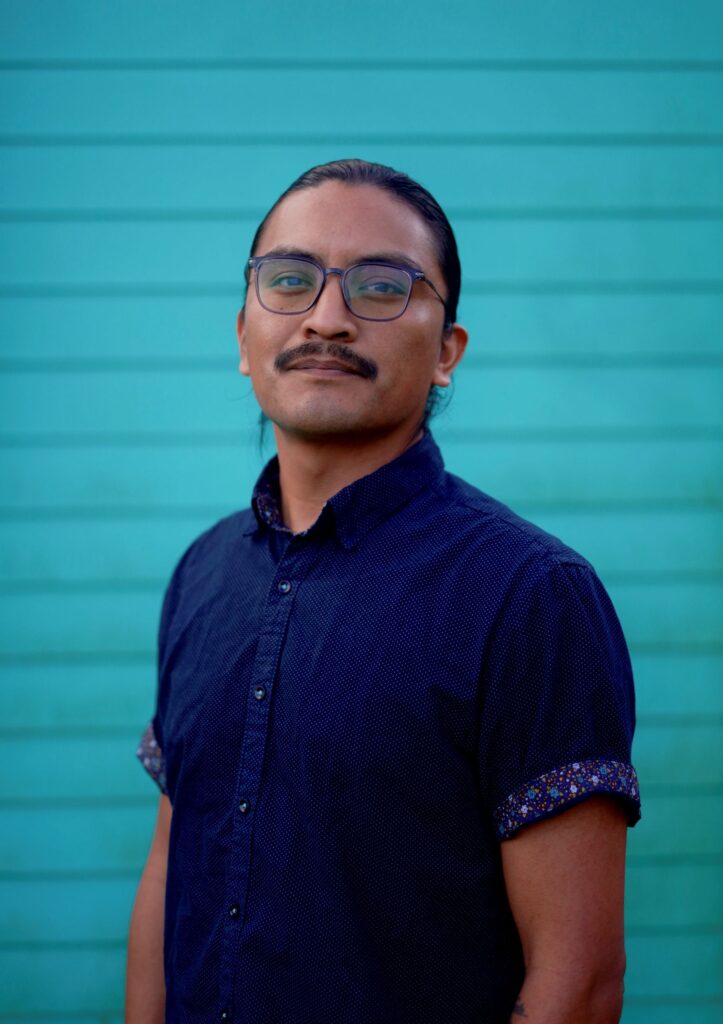 Fernando López. (Photo by López)
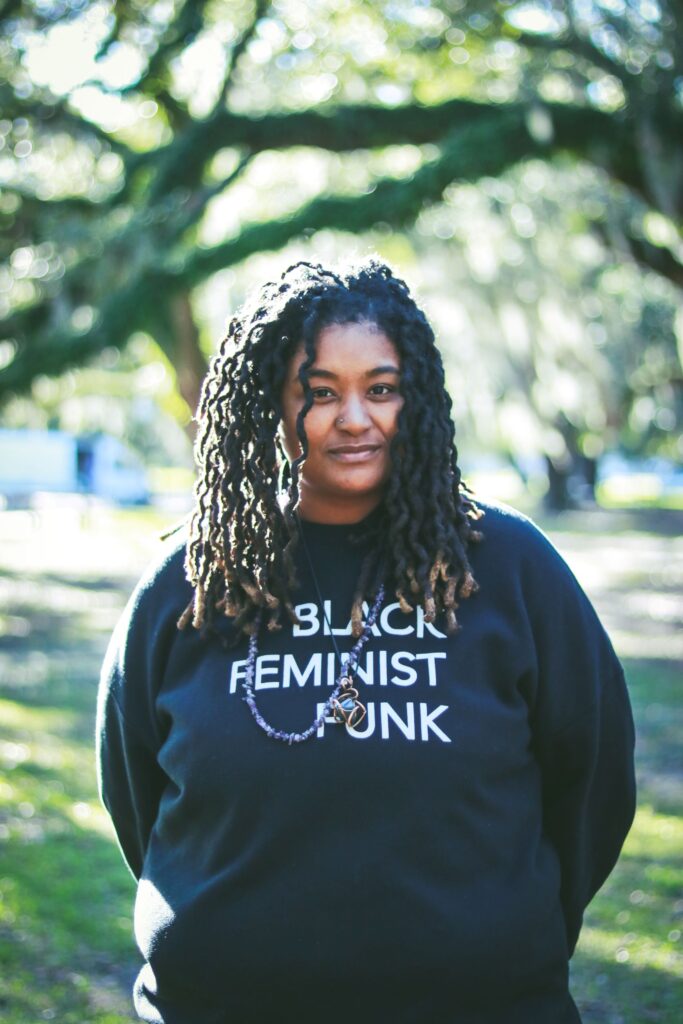 Toya Ex Lewis. (Photo by López)
“In collaboration with Black and Brown food vendors, Project Neutral Ground will showcase the culture, complexities, and potential futures of post-disaster economies,” says Fouts. “We seek to dismantle barriers and foster dialogue to build networks across factors like race, gender, and class in order to foment an understanding of these vendors as they occupy and vie for city spaces.”
Sharing community history
New Orleans has a rich history and culture of street food vendors, particularly led by the city’s Black community. In 2005, Hurricane Katrina devastated New Orleans with wind speeds of over 100 miles per hour and a monumental storm surge that flooded 80% of the city. Many Black and Brown vendors were forced to leave their homes and businesses or find new ways to continue to live and work. Central American food vendors migrated to the city to help fill the void.
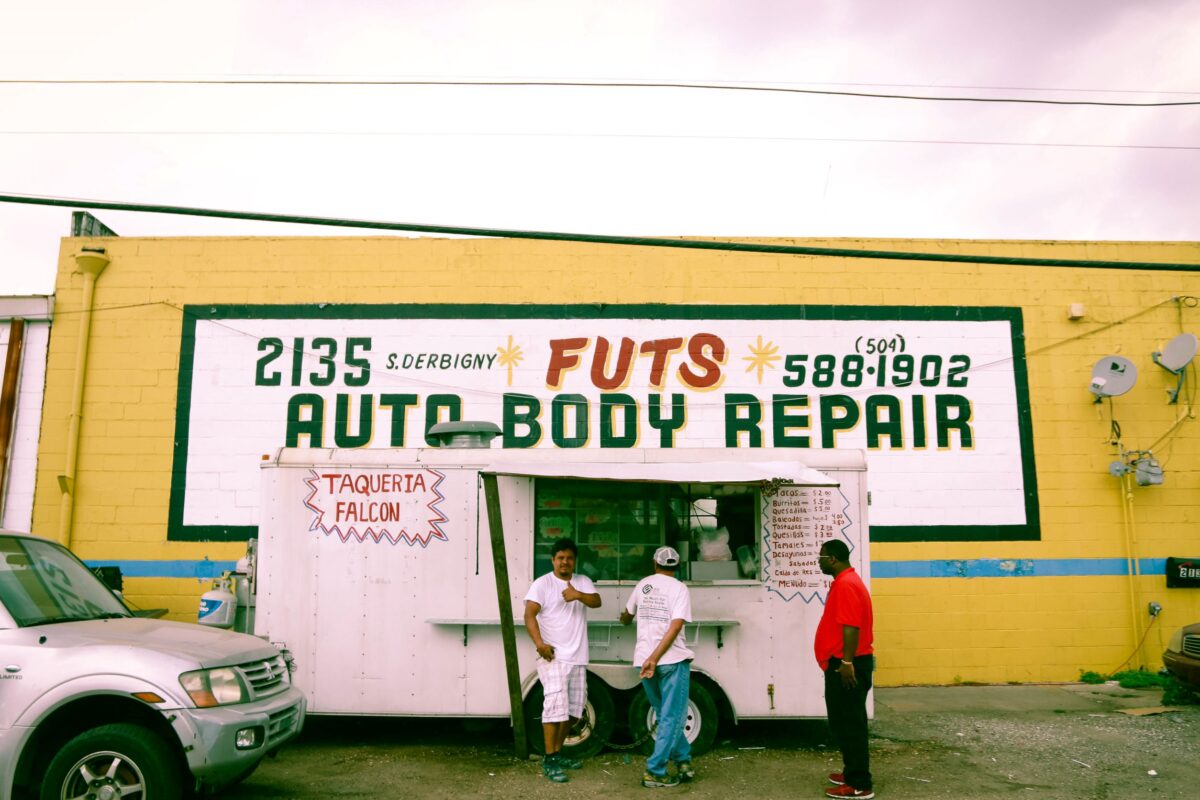 New Orleans taco truck. (Photo by Fernando López)
Now, almost 20 years after Katrina, New Orleans street vendor culture is a mixture of traditional and modern takes on Soul Food and Latin food representative of its burgeoning Black and Brown communities. The success of taco trucks and Soul Food pop-ups has raised complex questions about food truck regulation, worker rights, immigration issues, and local vs. tourist experiences that often pit these communities against each other.
The Whiting Foundation funding will help Fouts, the project director; Lewis, the organizing director; and López, the creative director, work in collaboration with the Southern Food and Beverage Museum to document and share the history, culture, cuisine, and personal journeys of ten food vendors in post-Katrina New Orleans food culture.
Collaborative storytelling
The team will first film and photograph the vendors cooking a dish of their choice at the Southern Food and Beverage Museum. A follow-up filming will document a “day in the life” of each food vendor. Finally, an audio recording will capture personal oral history interviews. Over the course of the year, López and Lewis will use the footage to develop ten mini-documentaries showcasing each vendor’s story.
 (l-r): López with food vendor and Fouts filming at the Southern Food and Beverage Museum. (Photo by Fernando López)
Fouts, Lewis, and local artist SheRa Phillips will work with students in Fouts’s UMBC Public Humanities course in fall 2022 to convert these stories into a zine that highlights historic and contemporary vendor stories, maps of where street food vendors are, a historical timeline of street vending in New Orleans, and recipes. Vendors will also be able to give the zine to their customers, helping to share this important part of New Orleans history with new audiences.
“This is a way for native New Orleanians to have opportunities to tell our own stories,” says Lewis, “instead of the usual extractive way our stories get taken and told for us.”
The Project Neutral Grounds digital and physical collection of stories will be on exhibit and archived at the Southern Food and Beverage Museum to share with future generations of locals, vendors, visitors, and public humanities scholars.
Public humanities in Baltimore
Since joining the faculty of UMBC, Fouts has also connected with Baltimore communities. The American Council of Learned Societies has awarded Fouts; Nicole King, professor and chair of American studies; and Tahira Mahdi, adjunct professor of psychology, a public engagement grant of over $150,000 to support their innovative public humanities work. The award, supported by the National Endowment for the Humanities, will fund the development and implementation of the project Baltimore Field School (BFS) 2.0: Undoing & Doing Anew in Public Humanities at UMBC 2022 – 2023.
Fouts, King, and Mahdi will work with community members, UMBC graduate students, and faculty to continue developing frameworks for community engagement between local communities and academia that have long-term benefits for local communities in particular.
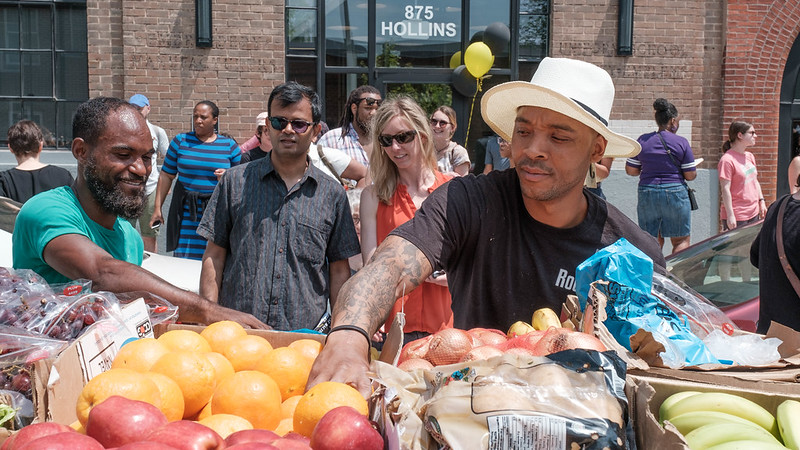 An arabber sells produce form a horse-drawn cart in Baltimore. (Bill Shewbridge/UMBC, Baltimore Traces project)
“This collaborative process takes a great deal of time, listening, and building trust,” King explains. “The people living and working in city neighborhoods and building grassroots organizations should be centered in the process of defining challenges and ways to address them in Baltimore and cities like it.”
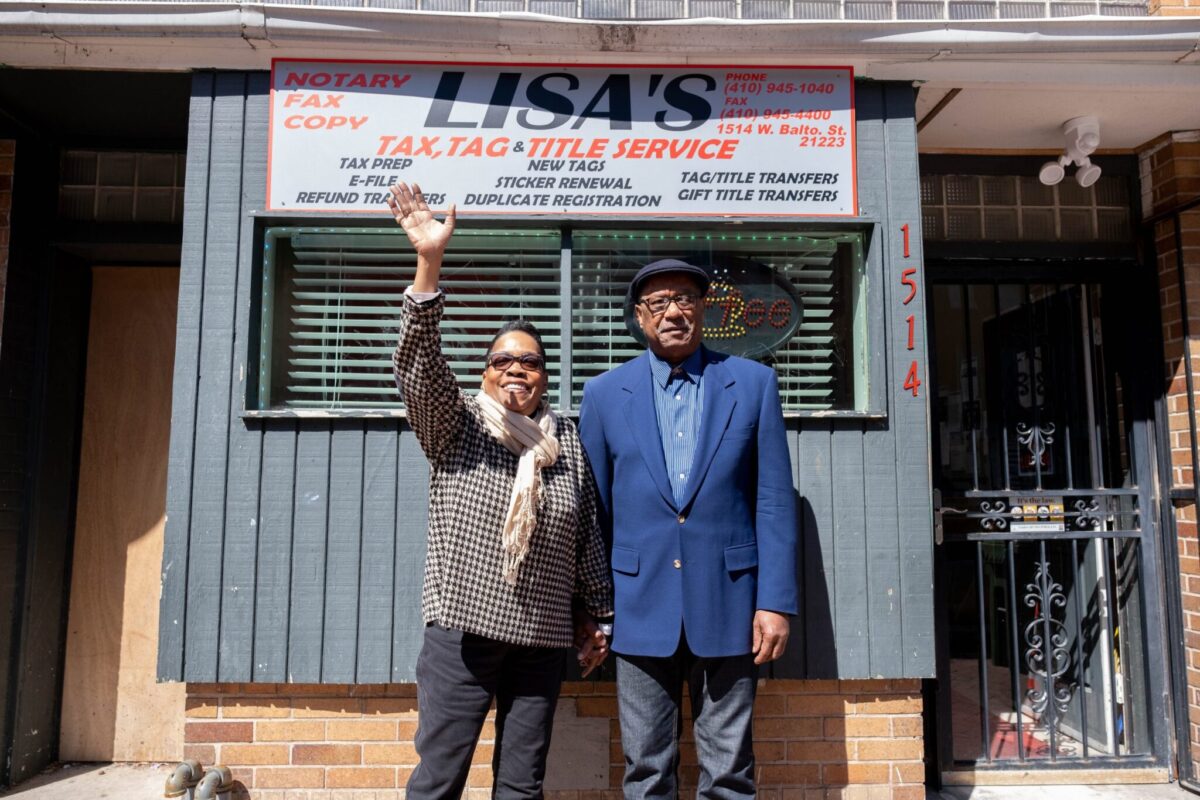 West Baltimore street walking tour with Curtis Eaddy. (Bill Shewbridge/UMBC, Baltimore Traces project)
The award will broaden the reach of the Baltimore Field School (BFS), launched through a $125,000 grant from the Andrew W. Mellon Foundation in 2020. BFS creates a framework for faculty to collaborate with community organizations in building ethical and sustainable research and teaching projects focused on public humanities.
“ACLS is proud to support these outstanding examples of publicly engaged, community-centered scholarship,” says ACLS President Joy Connolly. “Direct engagement with communities beyond the walls of academia is essential to the continued creation of knowledge for the public good. At the same time, these programs will help in expanding our definitions of humanistic scholarship and in contributing to solutions for a brighter future for all.”
]]>
If you were looking for Sarah Fouts in New Orleans, chances are you would find her at one of the many taco trucks or pop-up food vendors across the city, chatting with locals....
https://umbc.edu/stories/strong-public-humanities-in-new-orleans-strong/
https://my3.my.umbc.edu/api/v0/pixel/news/125939/guest@my.umbc.edu/bce533f66624f9128a426aff09b16c6b/api/pixel
americanstudies
baltimore
cahss
cahssresearch
community
news
policy-and-society
psychology
public-humanities
UMBC News & Magazine
https://my3.my.umbc.edu/groups/umbc-news-magazine
https://assets1-my.umbc.edu/system/shared/avatars/groups/000/001/943/24435aa6207c452e7bc15cc74b42c7bb/xsmall.png?1748556657
https://assets1-my.umbc.edu/system/shared/avatars/groups/000/001/943/24435aa6207c452e7bc15cc74b42c7bb/original.png?1748556657
https://assets2-my.umbc.edu/system/shared/avatars/groups/000/001/943/24435aa6207c452e7bc15cc74b42c7bb/xxlarge.png?1748556657
https://assets2-my.umbc.edu/system/shared/avatars/groups/000/001/943/24435aa6207c452e7bc15cc74b42c7bb/xlarge.png?1748556657
https://assets3-my.umbc.edu/system/shared/avatars/groups/000/001/943/24435aa6207c452e7bc15cc74b42c7bb/large.png?1748556657
https://assets1-my.umbc.edu/system/shared/avatars/groups/000/001/943/24435aa6207c452e7bc15cc74b42c7bb/medium.png?1748556657
https://assets2-my.umbc.edu/system/shared/avatars/groups/000/001/943/24435aa6207c452e7bc15cc74b42c7bb/small.png?1748556657
https://assets1-my.umbc.edu/system/shared/avatars/groups/000/001/943/24435aa6207c452e7bc15cc74b42c7bb/xsmall.png?1748556657
https://assets2-my.umbc.edu/system/shared/avatars/groups/000/001/943/24435aa6207c452e7bc15cc74b42c7bb/xxsmall.png?1748556657
UMBC News & Magazine
0
0
false
Fri, 17 Jun 2022 07:52:00 -0400
Fri, 17 Jun 2022 07:52:00 -0400
UMBC faculty and staff award recipients place community at the core of their success
At UMBC’s 2022 Presidential Faculty and Staff Awards (PFASA), Tamra Mendelson, professor of biological sciences and recipient of the 2022 – 2025 Presidential Teaching Professor Award, said she loves “getting to the core of a concept” in her research and teaching. In her large introductory biology courses, which Mendelson has been teaching with humor, creativity, and enthusiasm since her arrival on campus in 2006, the concept might be an idea like natural selection. But as awardee after awardee addressed the audience, both in person and online, it became clear that all shared the same “core concept” of UMBC: community.
“Teaching and research make me want to come to work every day, but it’s the community here, and Dr. Hrabowski in particular, who’ve made me want to come to UMBC every day,” Mendelson said.
Yonathan Zohar, professor and chair of marine biotechnology and the 2022 – 2025 Presidential Research Professor, added, “This recognition is not about me, it’s about us,” adapting the opening quote from President Hrabowski’s book, The Empowered University. Zohar’s work, nurtured diligently over more than three decades, has in the last few years brought in more than $10 million dollars of research funding, earned international awards, and is poised to reimagine the seafood industry as we know it.
And yet, Zohar says, “None of my research accomplishments would have been possible without the ‘about us’ spirit at UMBC—the spirit that together we can make everything and anything happen.”
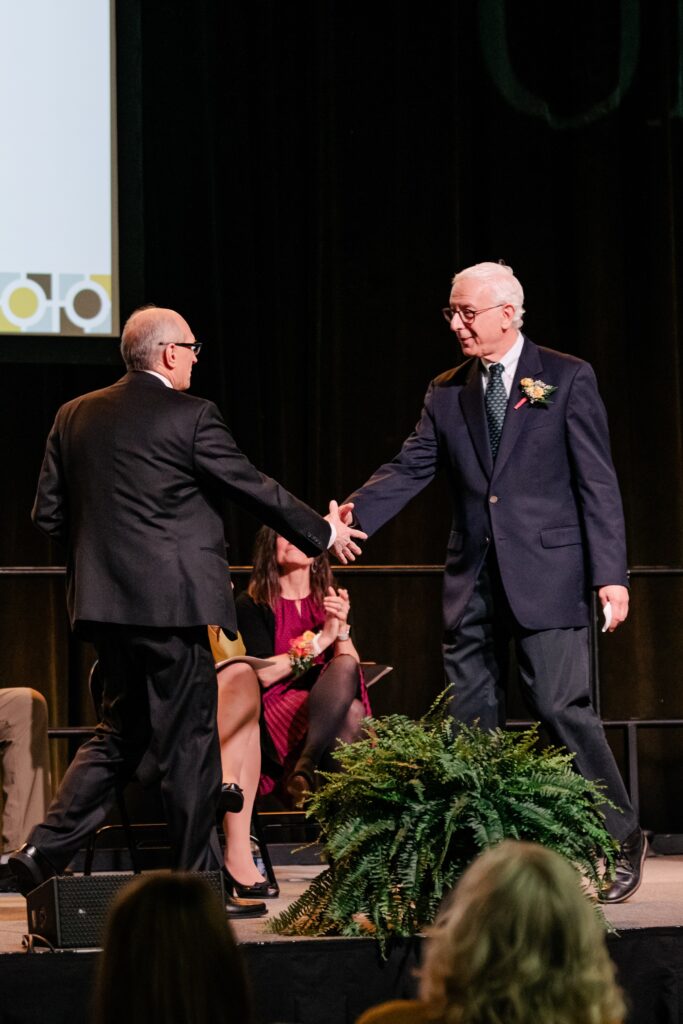 Yonathan Zohar, right, accepts his award from Bill LaCourse, dean of the College of Natural and Mathematical Sciences.
Supporting each other
Helena Dahlen, executive administrative assistant in the Division of Information Technology and the 2022 – 2023 Presidential Distinguished Staff Award for Non-exempt Staff recipient, recalled becoming an active member of the community when she started at UMBC in 2015. She joined book clubs, participated in wellness events, attended lectures, and more.
“It felt like I had moved into a small community,” she says. “Almost like a village, surrounded by brilliant people of all ages.” The supportive environment has allowed Dahlen to do her best work at UMBC and to give back. She generously contributes her energy to programs like Retriever Essentials and the Maryland Charity Campaign, and she serves as president of the Non-exempt Staff Senate.
Finally, Michael Pound, director of environmental safety and health and the 2022 – 2023 Presidential Distinguished Staff Award recipient, got to the heart of the matter. Recalling the challenges of managing the university’s response to the pandemic with a team of dedicated colleagues, he says, “I just couldn’t be prouder to work with these great folks.”
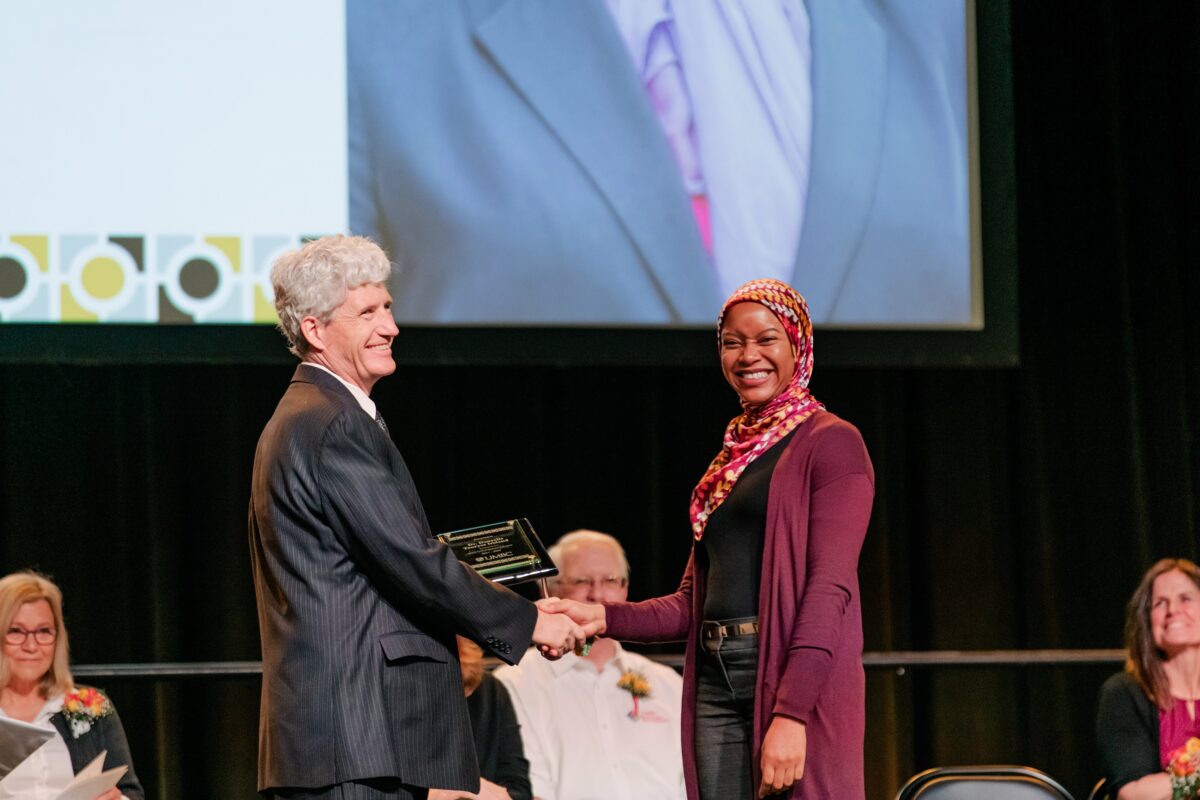 Danyelle Ireland, right, accepts her award from Marc Olano, associate dean of academic programs and learning in the College of Engineering and IT.
Beyond imagination
The UMBC community, all of the awardees emphasized, has grown through years of thoughtful care and collaboration. It’s taken decades to cultivate the UMBC ethos of community support and shared leadership.
“It’s hard to express how far we’ve come,” reflected President Hrabowski, as he offered remarks at his final PFASA as UMBC president. “Growing up, I could never have imagined the concept of UMBC—people from all over the world coming to study, to seek the truth, to get to know people different from themselves.”
UMBC’s newest awardees highlighted how that vision has become a reality, and Pres. Hrabowski honored all that they have contributed. “Leadership isn’t about one person at the top; it’s about what we all do,” Hrabowski said. “When we say we care about UMBC, what we’re saying is we care about each other.”
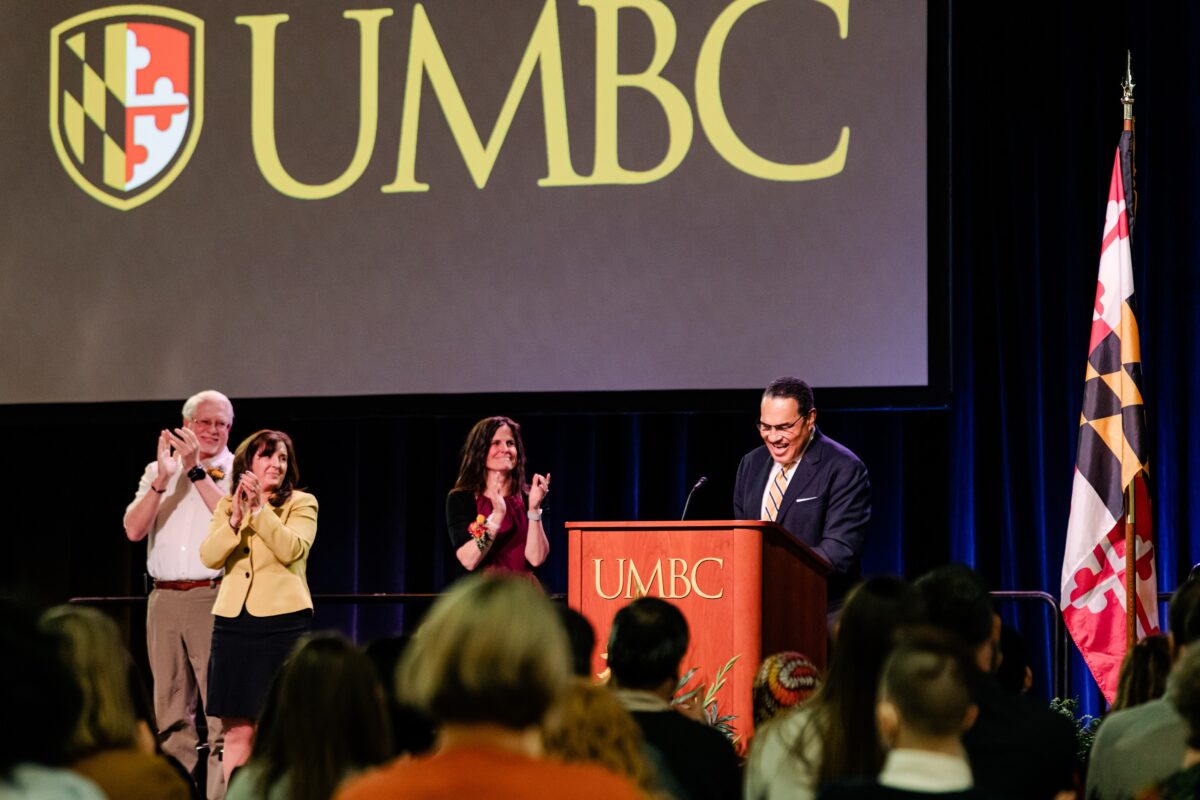 The audience applauds President Hrabowski as he makes remarks at his final Presidential Faculty and Staff Awards.
Honoring excellence
UMBC’s other named awards honor members of the UMBC community who embody the university’s ethos, such as Diane Lee, retired vice provost and dean of undergraduate education; Marilyn E. Demorest, professor emerita of psychology and former vice provost for faculty affairs; and Teresa Lupinek, the late former executive administrative assistant to the president. This year’s recipients include:
Mark Berczynski, M.S. ’17, lecturer, engineering and computing education program
Diane M. Lee Teaching Award
Danyelle Tauryce Ireland, associate director, Center for Women in Technology
Jakubik Family Endowment Staff Award
Nichole Zang Do, M.A. ’15, program management specialist, biological sciences
Karen L. Wensch Endowment Award for Outstanding Non-exempt Staff
C. Jill Randles, assistant vice provost and assistant dean, Academic Engagement and Transition Programs
Teresa Lupinek Endowment Award
Tamara Bhalla, associate professor, American studies
Marilyn E. Demorest Award for Faculty Advancement
Margaret Holland, associate professor, geography and environmental systems
Marilyn E. Demorest Award for Faculty Advancement
Narsingh B. Singh, research professor, chemistry and biochemistry, and affiliate faculty, computer science and electrical engineering
UMBC Research Faculty Excellence Award
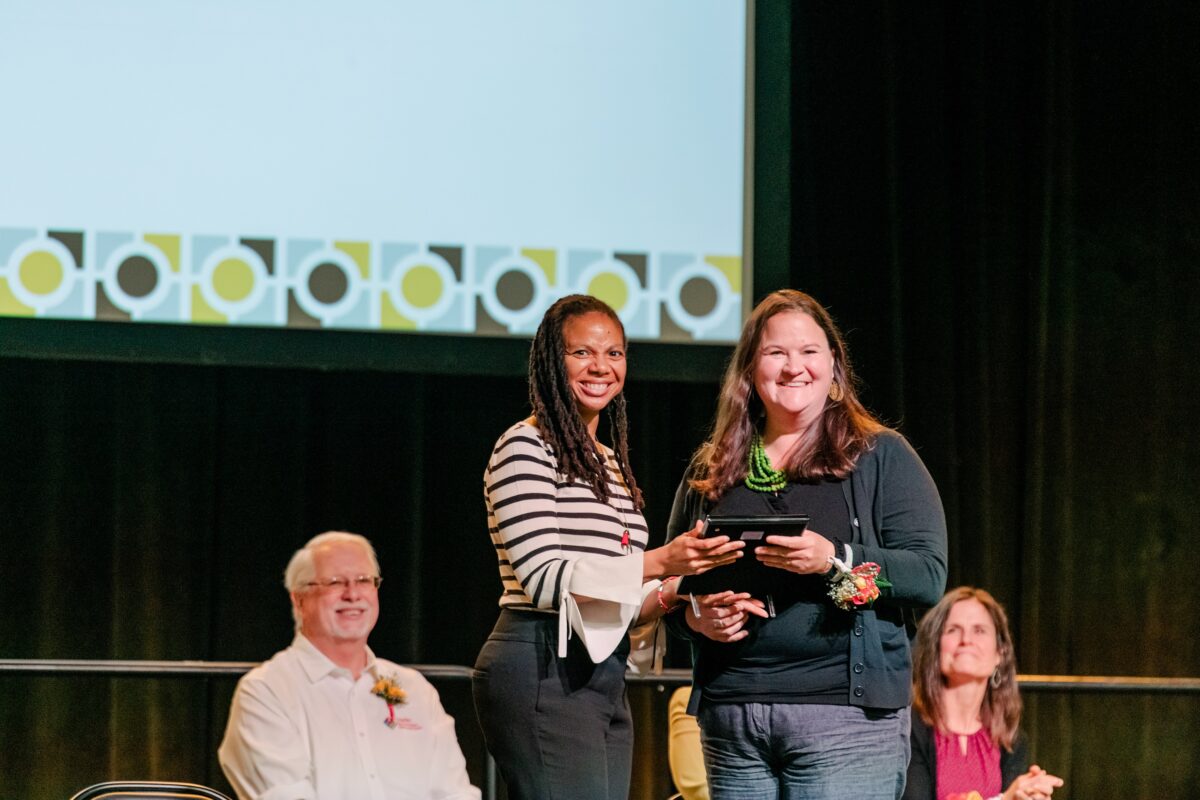 Margaret Holland, right, accepts her award from Kimberly Moffitt, dean of the College of Arts, Humanities, and Social Sciences.
USM Board of Regents awardees
This year, UMBC also had two University System of Maryland (USM) Board of Regents Award recipients. These awards represent the highest honor bestowed on faculty and staff across the USM by the Board of Regents. Awardees are selected by the Council of University System Staff and approved by the Board. The awards recognize faculty and staff for excellence in teaching; research, scholarship, and creative activity; public service; mentoring; or innovation.
UMBC has received an outsize share of these awards over the years, demonstrating the strength of our faculty and staff across all areas of achievement. This year, Marjoleine Kars, professor of history, received the 2022 USM Board of Regents Award for Excellence in Scholarship. Her latest book, Blood on the River: A Chronicle of Mutiny and Freedom on the Wild Coast, has received widespread acclaim for its discussion of a nearly successful rebellion of enslaved African and Indigenous people in the Dutch colony of Berbice in the 1860s.
Lee Blaney, associate professor of chemical, biochemical, and environmental engineering, received the 2022 USM Board of Regents Award for Excellence in Teaching. Blaney has received awards previously for exceptional mentoring and for engaging his students in high-impact research. His laboratory focuses on contaminants of emerging concern, such as compounds found in pharmaceuticals and personal care products, in waterways such as Chesapeake Bay.
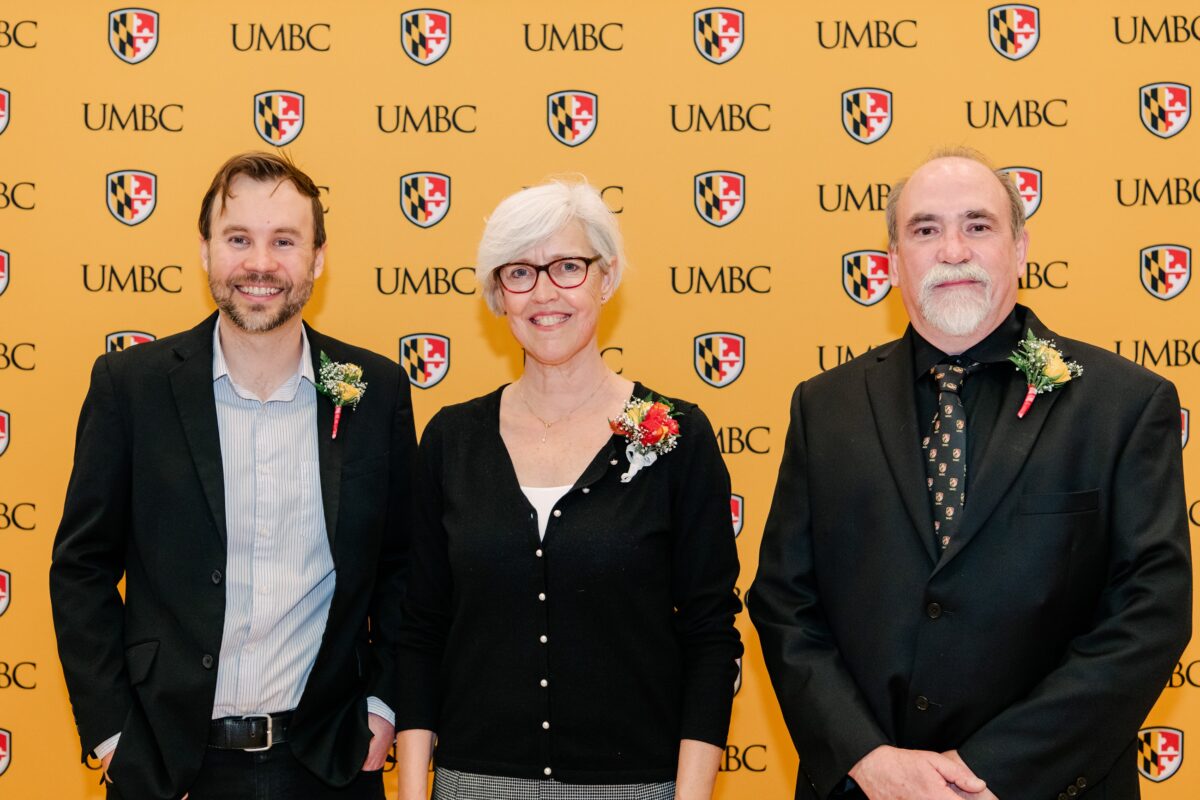 From left to right: Lee Blaney, Marjoleine Kars, and Victor Fulda.
Celebrating together
This year’s ceremony was the first in-person PFASA event since 2019. With that in mind, the ceremony also honored awardees from 2020 and 2021.
Victor Fulda, engineering technician, chemical, biochemical, and environmental engineering
2021 University System of Maryland Board of Regents Award for Exceptional Contribution to the Institution or Unit to which the Person Belongs
Jamie Gurganus ‘04, M.S. ‘11, Ph.D. ‘20; faculty, mechanical engineering; associate director, engineering education initiatives; and director, Center for the Integration of Research, Teaching, and Learning
2020 – 2021 Diane M. Lee Teaching Award
Jonathan Zwi, instructor and affiliate artist, music
2020 – 2021 Diane M. Lee Teaching Award
Header image: Recipients of awards who accepted them in person at this year’s PFASA. From left to right: Marjoleine Kars, Michael Pound, Jamie Gurganus, Maggie Holland, Nichole Zang Do, Jill Randles, Danyelle Ireland, Tamra Mendelson, Yonathan Zohar, Helena Dahlen, Freeman Hrabowski, Tamara Bhalla, Victor Fulda, Jonanthan Zwi, Narsingh Singh, Lee Blaney, Philip Rous.
All photos by Marlayna Demond ’11 for UMBC.
]]>
At UMBC’s 2022 Presidential Faculty and Staff Awards (PFASA), Tamra Mendelson, professor of biological sciences and recipient of the 2022 – 2025 Presidential Teaching Professor Award, said she...
https://umbc.edu/stories/umbc-faculty-and-staff-award-recipients-place-community-at-the-core-of-their-success/
https://my3.my.umbc.edu/api/v0/pixel/news/119452/guest@my.umbc.edu/f95ae1b8548d27f329239aad427f3da5/api/pixel
americanstudies
biology
cahss
cbee
chemistry
cnms
coeit
community
csee
cwit
ges
history
marinebiotech
music
news
UMBC News & Magazine
https://my3.my.umbc.edu/groups/umbc-news-magazine
https://assets1-my.umbc.edu/system/shared/avatars/groups/000/001/943/24435aa6207c452e7bc15cc74b42c7bb/xsmall.png?1748556657
https://assets1-my.umbc.edu/system/shared/avatars/groups/000/001/943/24435aa6207c452e7bc15cc74b42c7bb/original.png?1748556657
https://assets2-my.umbc.edu/system/shared/avatars/groups/000/001/943/24435aa6207c452e7bc15cc74b42c7bb/xxlarge.png?1748556657
https://assets2-my.umbc.edu/system/shared/avatars/groups/000/001/943/24435aa6207c452e7bc15cc74b42c7bb/xlarge.png?1748556657
https://assets3-my.umbc.edu/system/shared/avatars/groups/000/001/943/24435aa6207c452e7bc15cc74b42c7bb/large.png?1748556657
https://assets1-my.umbc.edu/system/shared/avatars/groups/000/001/943/24435aa6207c452e7bc15cc74b42c7bb/medium.png?1748556657
https://assets2-my.umbc.edu/system/shared/avatars/groups/000/001/943/24435aa6207c452e7bc15cc74b42c7bb/small.png?1748556657
https://assets1-my.umbc.edu/system/shared/avatars/groups/000/001/943/24435aa6207c452e7bc15cc74b42c7bb/xsmall.png?1748556657
https://assets2-my.umbc.edu/system/shared/avatars/groups/000/001/943/24435aa6207c452e7bc15cc74b42c7bb/xxsmall.png?1748556657
UMBC News & Magazine
0
0
false
Thu, 07 Apr 2022 22:12:22 -0400
Thu, 07 Apr 2022 22:12:22 -0400
$21M Sherman Family Foundation gift supports UMBC’s bold commitment to PreK-12 research, teaching, and learning

The largest gift in the history of UMBC—a $21 million donation from the Sherman Family Foundation—will dramatically expand the reach and impact of the university’s K-12 and early childhood education work. The transformational gift will provide funding to launch the Betsy & George Sherman Center as a national model to advance excellence in urban schools. This new center will expand and integrate UMBC’s work in teacher preparation, school partnerships, and applied research focused on early childhood education and improving learning outcomes for Baltimore’s students.
“If universities are to be major contributors to the development of society, they have to be involved with the schools and with neighborhoods and with communities,” says UMBC President Freeman Hrabowski. “Betsy and the Sherman Family Foundation have provided us with invaluable resources to make this collaborative work possible.”
“This gift represents a clear and bold commitment to developing teachers that can better support future generations of students in Baltimore City, especially in early learning and STEM,” said Sonja Brookins Santelises, chief executive officer of Baltimore City Public Schools. “It also expands the research partnership between City Schools and the university in ways that will further enhance teaching and learning in our community. We are excited about this next great step.”
Investing in education
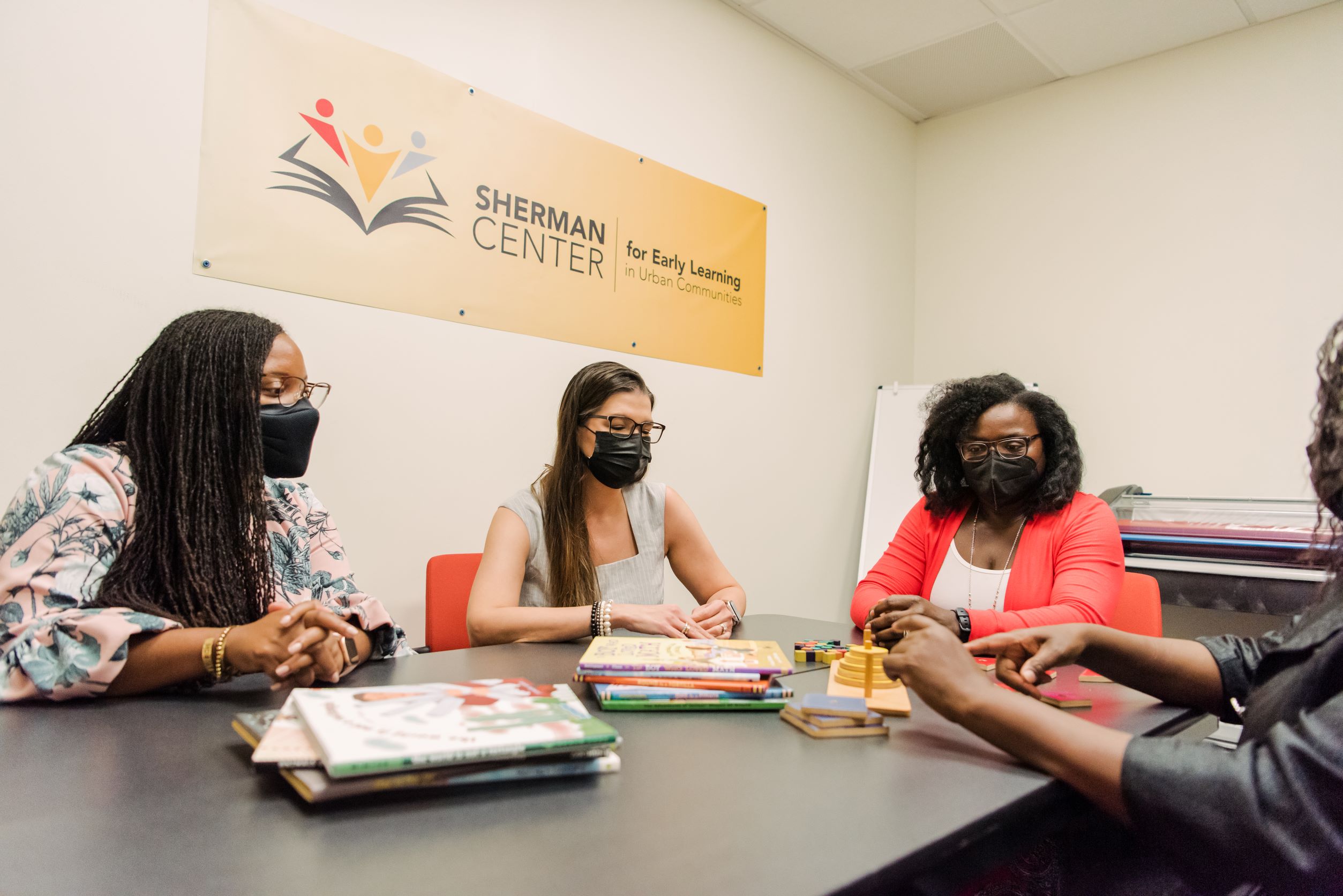
Prior gifts from the Sherman Family Foundation supported the launch of UMBC’s Sherman Center for Early Learning in Urban Communities as well as the Sherman STEM Teacher Scholars program, which prepares UMBC students as culturally responsive and compassionate STEM educators. The Betsy & George Sherman Center will include these programs and more.

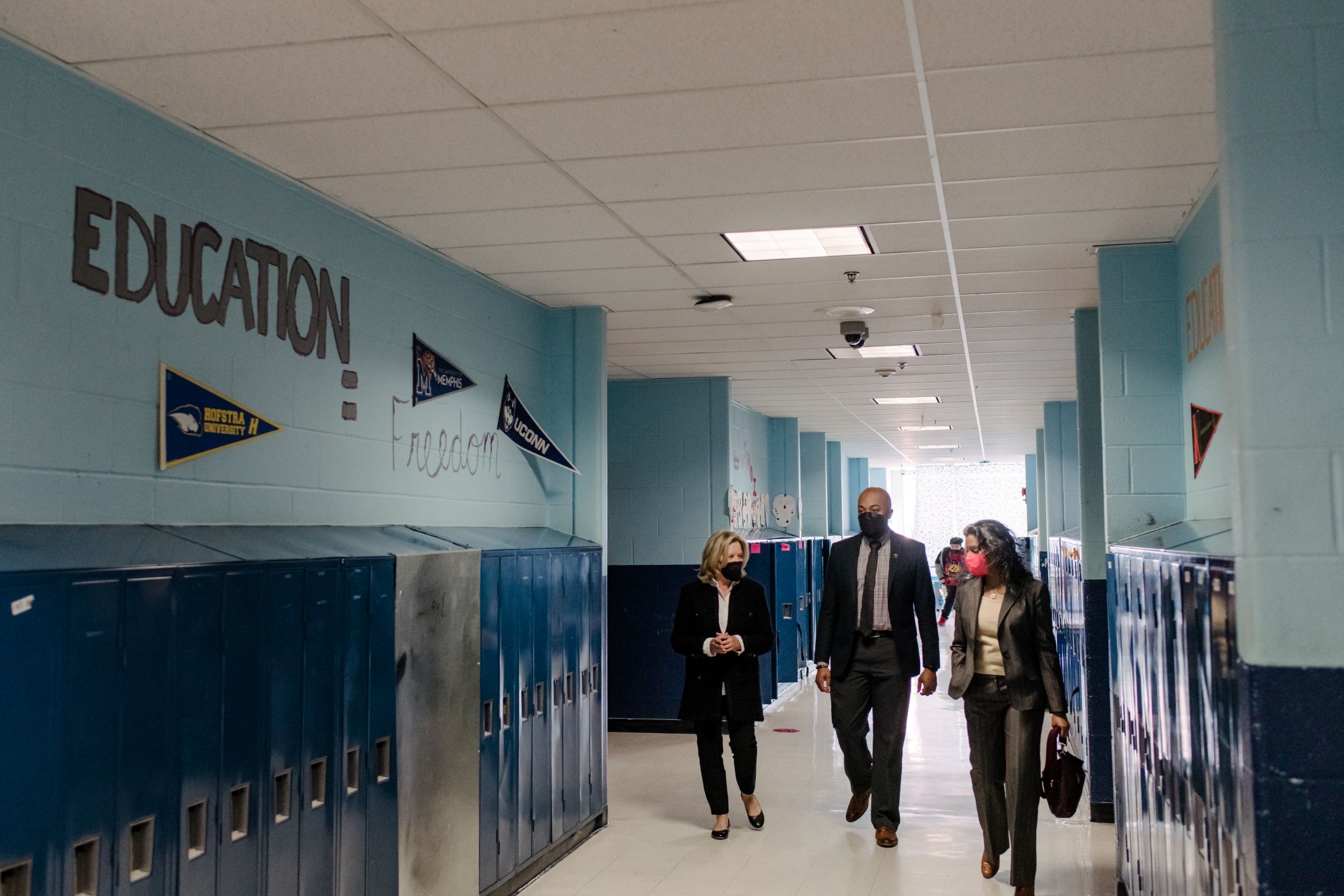
President Freeman Hrabowski and Betsy Sherman with students at Lakeland Elementary/Middle School.
Betsy and George Sherman’s philanthropy in STEM education has been inspired by Mrs. Sherman’s career in early childhood education and the late Mr. Sherman’s experience as an engineer and business leader. Their family foundation has now invested more than $38 million in UMBC’s education initiatives.
The Shermans have shared with UMBC a deep commitment to children’s equal access to high-quality education and a supportive community. “It is our job as the adults in the community to offer them an opportunity to grow in a way that will support them,” says Mrs. Sherman. “When a university is connected to a city, children thrive, families thrive.”

Betsy Sherman joins in a rhyming practice activity with students at Lakeland.
Meeting STEM needs
The Sherman STEM Teacher Scholars program, founded with the support of the Shermans in 2006, prepares UMBC undergraduate and graduate students from all majors to become highly qualified PreK-12 teachers with a focus on STEM education.
Lakeland Elementary/Middle School, in south Baltimore, was the first school to partner with UMBC through this program. Over the past decade, it has become a model of a full-service community school in Baltimore City. Among other exciting results, Lakeland now has a Community and STEAM Center, and the school has seen notable increases in students’ math test scores.
 Gustavo Sanabria
 ’22, American studies, and current Sherman Scholar, is completing a certificate in elementary education while serving as a long-term 4th-grade substitute teacher.
The Sherman Scholars program now partners with ten schools to promote academic achievement through professional development for teachers and intensive tutoring for students. For example, more than 90 UMBC students, including Sherman Scholars and others, provide evidence-based math tutoring for over 350 elementary and middle school students in several schools across Baltimore. Early data show this approach is working.
Moving the needle
Rehana Shafi, director of the Sherman Scholars program, remembers the program’s first steps with fondness. “It started off with an investment that we wanted to use to figure out, with the right sorts of support in place—teacher professional development, after school activities for kids, and community engagement—how could we really move the needle for Lakeland’s students and their families,” explains Shafi.
 (L-R) Betsy Sherman, with Corey Carter, and Rehana Shafi at Lakeland.
In 2021, the program graduated 22 scholars, 19 of whom are teaching in Baltimore City. Over the past 15 years (since 2007), the program has yielded 170 educators who are now teaching across the Baltimore region, the state of Maryland, and beyond, often in the most vulnerable school communities. An additional 20 conditionally certified teachers have been supported since 2020–educators meeting critical classroom needs while working to complete M.A.T. degrees.
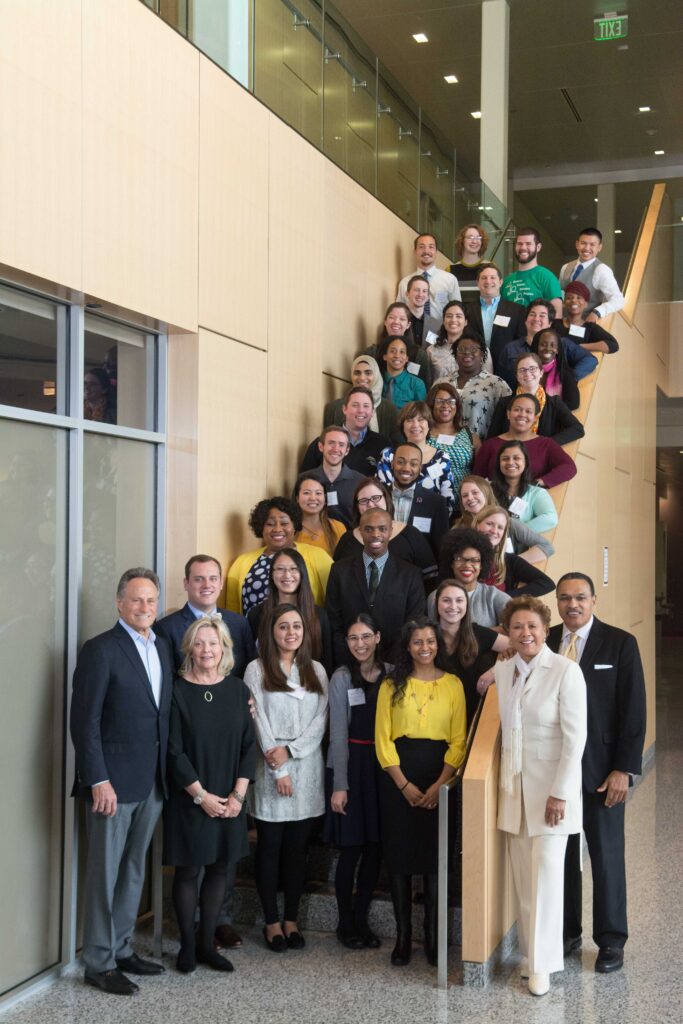
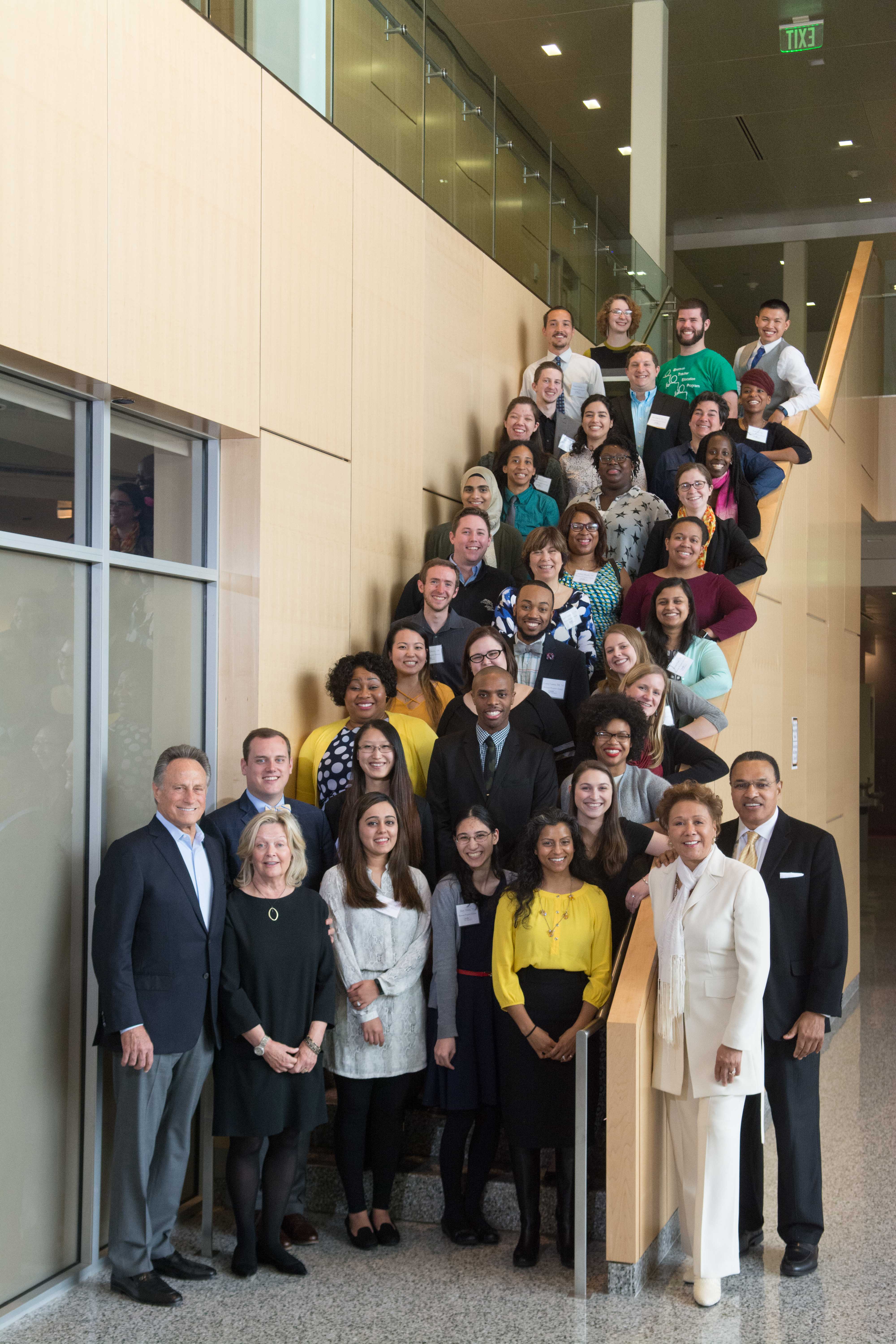
George and Betsy Sherman (front row, left) with President Freeman Hrabowski and Jacqueline Hrabowski (front row, right) next to Rehana Shafi (front row, in yellow) at the Sherman Scholars 10-year anniversary held on April 1, 2017.
More than a decade into the work, Shafi is proud of the strong collaborations that have developed. “Partnering with schools and with communities to walk together through the process of growth and dreaming and achieving…it’s what the work really is about,” she says.
Reflecting on this successful partnership model, she notes, “The work that we’re doing is ready to grow and expand, preparing even more teachers for classrooms across Maryland.”
Focus on early childhood
This new gift will also enable the expansion of UMBC’s early childhood programs. “I am excited to continue to grow our programming and further extend the impact and support for early childhood education,” shares Jennifer Mata-McMahon, director of the Sherman Center for Early Learning in Urban Communities and associate professor of early childhood education.

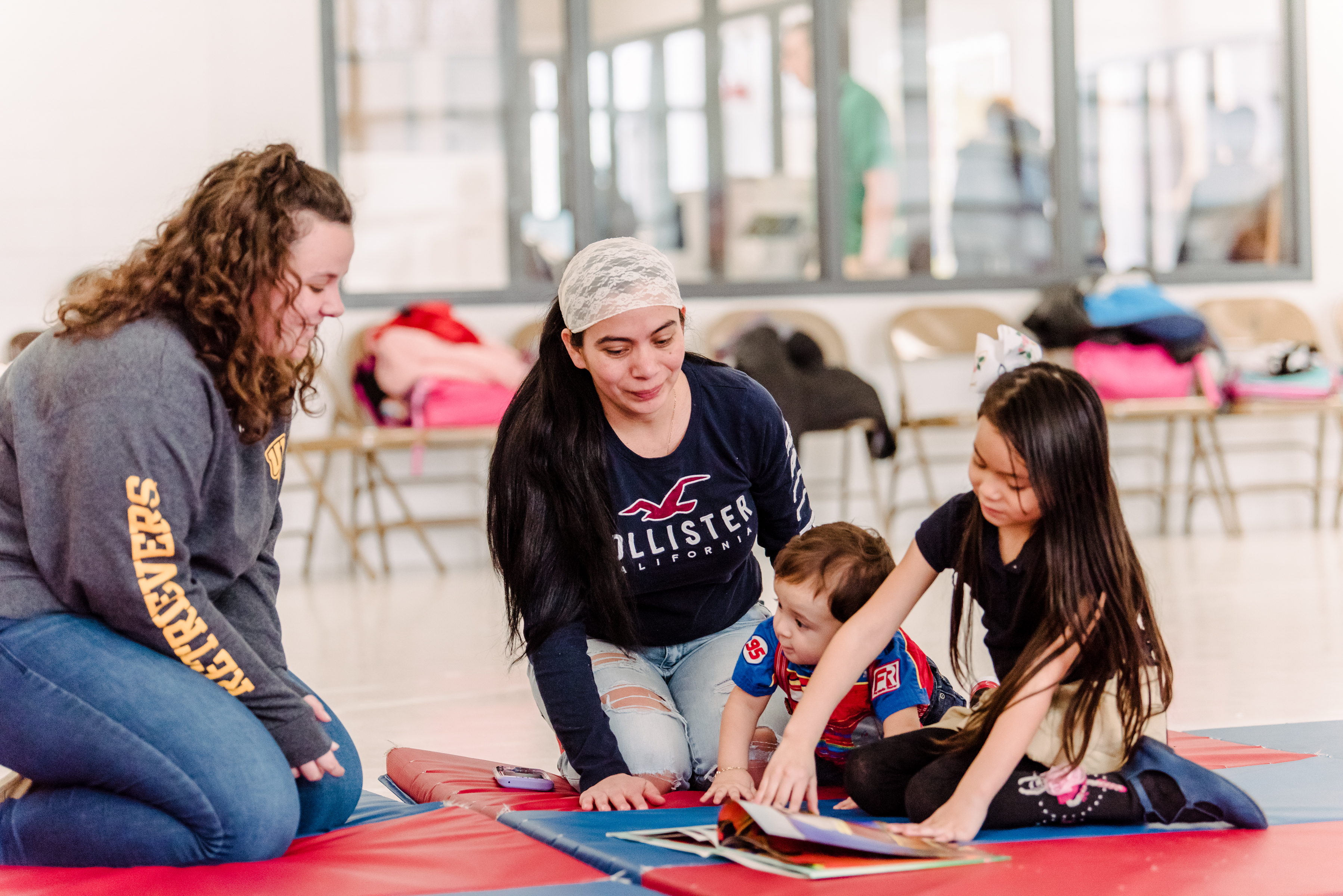
Lakeland community member at a Families, Libraries, and Early Literacy Project event.
In the last four years, the center has implemented four highly successful programs developed with and for teachers and families across five Baltimore City Schools: the Literacy Fellows Program in collaboration with UMBC’s Shriver Center, the Diverse Books Project, the Teacher Summer Institute, and the Families, Libraries, and Early Literacy Project. Hundreds of families have benefited from these programs.
UMBC’s students volunteer over 400 hundred hours a year in partner schools. Participating teachers receive research-based skill development and funding for teaching materials.
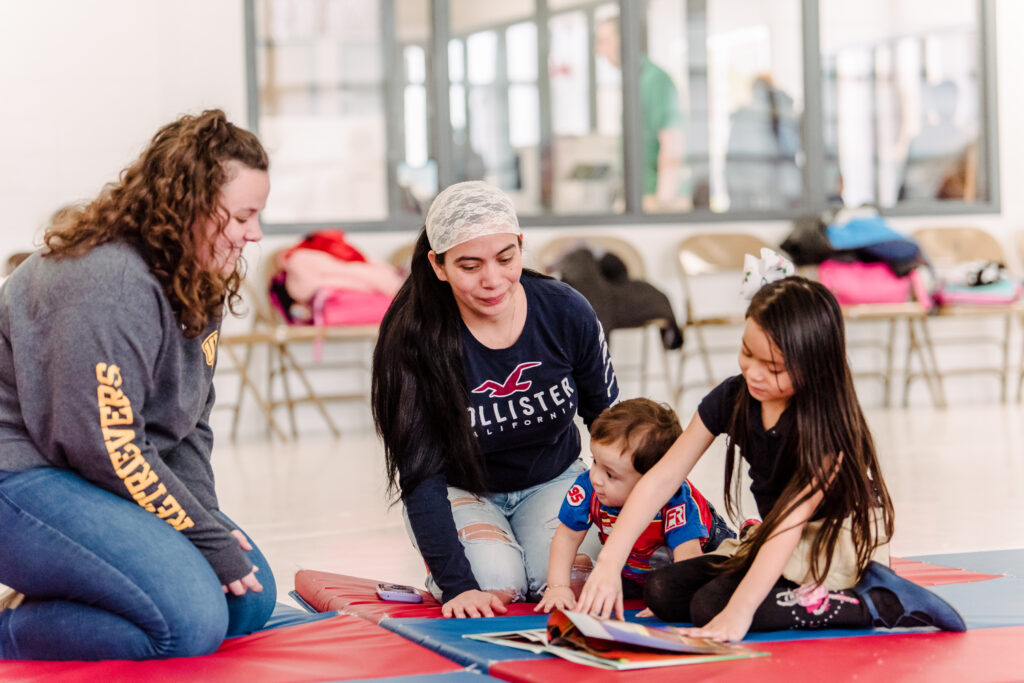 Olivia Grimes
 ’19, individualized study, Sherman Scholar alum and former Sherman Center program assistant, at left, with a Lakeland family in 2020.
The center also invests in community-engaged early childhood research to evaluate learning interventions, academic growth, social-emotional wellbeing, behavioral outcomes, and education policy with faculty across the College of Arts, Humanities, and Social Sciences (CAHSS).
Through its annual Faculty Research Award program, the center provides funding for new research projects. Past recipients have studied topics like Judy Centers in Baltimore, reading interventions, and culture-based computational thinking in urban preschools. Prior awardees have shared with the public their high-impact community-engaged scholarship on different ways to teach kids to read and math skills to prepare children for kindergarten.
“The College remains inspired by the enduring commitment of the Sherman family to urban education. This gift affords CAHSS faculty with the resources needed to further education research and practice,” shares Kimberly Moffitt, interim dean of CAHSS and professor of language, literacy, and culture. She is thrilled that UMBC students will have even more opportunities to work with PreK-12 students throughout Baltimore who are “deserving of dedicated teachers who believe in their abilities and their aspirations for the future.”
“This gift lays out the charge and we stand ready to fulfill it,” says Moffitt.

(L -R)
Shana Rochester, the center’s assistant director and research associate,
with Mata-McMahon, and
Patricia Young, professor of education, and 2020 recipient of the Faculty Research Award.
Scaling and expanding programs
In addition to supporting research and classrooms directly, the center also advances the field by providing leadership development to early childhood educators across the state through the Maryland Early Childhood Leadership Program, which started its third cohort in 2021.
“The new funding will not only ensure the scaling of these programs, but also support new initiatives like Breathe2Think and the Sherman Center Research Conference,” says Mata-McMahon. She is leading the implementation of both programs to further support teachers’ well-being and develop teachers’ skills as action researchers.
“This is about sustainability over time and long-lasting impact in urban communities,” she says.
Full circle
The ripple effect of the Sherman family’s investment is beginning to come full circle. UMBC’s Sherman Scholar alumni are now teaching in Baltimore City classrooms and beyond, preparing the next generation of change-makers. And one scholar has returned to UMBC to share his on-the-ground experience with UMBC students just beginning their journey as future teachers.
Sherman Scholar alum Corey Carter ’08, biological sciences, ’10 M.A.T., taught in both Baltimore City and Baltimore County Public Schools after graduating from UMBC. In 2016, Baltimore County Public Schools honored him as Teacher of the Year. Seeking to expand his impact as an educator in a new way, he returned to UMBC to serve as assistant director of the Sherman Scholars program.

Corey Carter at Lakeland.
“I didn’t see myself in the classroom immediately when I came to UMBC,” says Carter. Without the Sherman STEM Teacher Scholars program, and the opportunities and guidance it provided, he isn’t sure that he would have found his way to the classroom. Now he sees the power of collaboration between universities and schools, fueled by philanthropy, to advance an education system truly centered around students and families.

Corey Carter leads a group activity at UMBC.
As Carter supports the work of the new Betsy & George Sherman Center, he’s excited to see it expand even further. “The impact that we all can bring when we come together to the table—with community, university, and school staff—is a really powerful example,” he says. “I look forward to building our vision together and seeing this energy and momentum spread throughout Baltimore.”
Banner image: Betsy Sherman at Lakeland Elementary/Middle School. All photos by Marlayna Demond ’11 for UMBC.
Video by Corey Jennings ’10 for UMBC.
]]>
The largest gift in the history of UMBC—a $21 million donation from the Sherman Family Foundation—will dramatically expand the reach and impact of the university’s K-12 and early childhood...
https://umbc.edu/stories/21m-sherman-family-foundation-gift-supports-umbcs-bold-commitment-to-prek-12-research-teaching-and-learning/
https://my3.my.umbc.edu/api/v0/pixel/news/119472/guest@my.umbc.edu/1b98fc95d8c7d959b99db46c024c3543/api/pixel
americanstudies
biology
cahss
community
education
inds
news
page1
science-and-tech
shermancenter
shermanscholars
UMBC News & Magazine
https://my3.my.umbc.edu/groups/umbc-news-magazine
https://assets1-my.umbc.edu/system/shared/avatars/groups/000/001/943/24435aa6207c452e7bc15cc74b42c7bb/xsmall.png?1748556657
https://assets1-my.umbc.edu/system/shared/avatars/groups/000/001/943/24435aa6207c452e7bc15cc74b42c7bb/original.png?1748556657
https://assets2-my.umbc.edu/system/shared/avatars/groups/000/001/943/24435aa6207c452e7bc15cc74b42c7bb/xxlarge.png?1748556657
https://assets2-my.umbc.edu/system/shared/avatars/groups/000/001/943/24435aa6207c452e7bc15cc74b42c7bb/xlarge.png?1748556657
https://assets3-my.umbc.edu/system/shared/avatars/groups/000/001/943/24435aa6207c452e7bc15cc74b42c7bb/large.png?1748556657
https://assets1-my.umbc.edu/system/shared/avatars/groups/000/001/943/24435aa6207c452e7bc15cc74b42c7bb/medium.png?1748556657
https://assets2-my.umbc.edu/system/shared/avatars/groups/000/001/943/24435aa6207c452e7bc15cc74b42c7bb/small.png?1748556657
https://assets1-my.umbc.edu/system/shared/avatars/groups/000/001/943/24435aa6207c452e7bc15cc74b42c7bb/xsmall.png?1748556657
https://assets2-my.umbc.edu/system/shared/avatars/groups/000/001/943/24435aa6207c452e7bc15cc74b42c7bb/xxsmall.png?1748556657
UMBC News & Magazine
0
0
false
Thu, 24 Feb 2022 18:00:09 -0500
UMBC’s Cangialosi Business Innovation Competition winners focus on tech innovations, social impact
When Balaji Viswanathan’s grandfather was injured in a fall at a senior care facility a few years ago, he committed to seeing what he could do to prevent it from happening again, to his grandfather or other older adults. Viswanathan, M.S ‘06, Ph.D. ‘21, computer science, developed Invento, a technology that analyzes movement patterns to determine fall risk and notify caregivers if a fall seems likely, helping caretakers prevent injuries from falls.

Balaji Viswanathan. Photo courtesy of Viswanathan.
Invento earned first place in the technology track of UMBC’s eighth annual Cangialosi Business Innovation Competition hosted by the Alex. Brown Center for Entrepreneurship. The event was held virtually on April 29, with one track focused on technology and the other focused on social impact ideas beyond tech.
Vivian Armor ‘73, American studies, director of the Alex. Brown Center for Entrepreneurship, explains that the two tracks offered this year allowed students to propose a broader range of ideas. “Special thanks to entrepreneurial alums Khuram Zaman ‘05, political science, and Asif Khan ‘04, information systems and computer science, co-founders of FifthTribe, for reaching out to support the new social impact track this year. It’s a wonderful addition to the competition originally founded by Greg Cangialosi ‘96, English, in 2014,” says Armor. “It’s very rewarding to see our Retriever alums generously give back to help develop the next wave of entrepreneurs for the future.”
The competition provides opportunities for students interested in entrepreneurship to connect with alumni and advisors. “The CBIC competition is a great platform for startups to get discovered by investors,” Viswanathan says. “We participated in the competition, winning the top prize in our category. And through that we got a key advisor and also connected with investors.”
Affordability and sustainability
Second place in the technology track went to Edullo, led by Esha Vangara ‘23, economics. Vangara explains that Edullo offers affordable and personalized tutoring that is fast for students to access. The system is structured differently than traditional tutoring companies. All of the tutors are also students, tutoring is fully online, and students who access tutoring aren’t required to sign up for subscriptions or to sign longer-term contracts.
Kayleigh Nelson ‘23, global studies, presented Digitize My Closet, which placed third on the technology track. Rather than producing physical clothing, Digitize My Closet produces digital clothing for users to “wear” while on video calls. The clothing moves with the model on screen, providing users with a way to wear clothing that they may only need for a singular event without needing to purchase new pieces. This approach, explains Nelson, is a more environmentally and financially sustainable way for people to expand their wardrobes.
Innovation with social impact
In the social impact category, Mariah Qureshi ‘23, computer science, took first place with a proposal to grow codeHer. Qureshi is an executive board member of codeHer, a nonprofit organization that works to address the gender gap in STEM fields by empowering women and providing them with tools to help them succeed in computing and science.

Mariah Qureshi. Photo courtesy of Qureshi.
CodeHer plans to expand the course offerings in and around Baltimore, explains Qureshi, to support underserved youth who are interested in STEM disciplines. She says that they plan to develop after-school programs for high school and middle school students, as well as provide personalized mentoring to students.
Kelvin Johnson M.P.S. ‘21, entrepreneurship, innovation, and leadership, presented Businessaire and earned second place. Businessaire is a board game that increases financial literacy by teaching business principles and information about the economy.
Sotonye Koko ‘21, information systems, and Yvann Tientcheu ‘21, information systems, earned third prize for EndeaVR. They propose using virtual reality technology to provide online services such as job training, to address high recidivism rates among people in the U.S. prison system.
Through this annual competition, winners receive funding to continue to advance their idea. They also access the opportunity to connect with local entrepreneurs who serve as mentors and help connect them with Baltimore’s entrepreneurship community.
“CBIC was an enriching experience that I’d recommend for every UMBC student who is entrepreneurship-oriented. I’m grateful for the immense help provided by the competition mentors and coordinators, even during COVID-19,” says Qureshi. “I learned of several different ways to further my own social venture, and have had many professional and personal takeaways from this experience.”
Banner image: The UMBC Albin O. Kuhn Library in spring 2017. Photo by Marlayna Demond ’11 for UMBC.
]]>
When Balaji Viswanathan’s grandfather was injured in a fall at a senior care facility a few years ago, he committed to seeing what he could do to prevent it from happening again, to his...
https://umbc.edu/stories/umbcs-cangialosi-business-innovation-competition-winners-focus-on-tech-innovations-social-impact/
https://my3.my.umbc.edu/api/v0/pixel/news/119621/guest@my.umbc.edu/f2b4da03ed0de03033e531913ae3218e/api/pixel
alexbrowncenter
americanstudies
community
csee
economics
english
entrepreneurship
globalstudies
is
politicalscience
UMBC News & Magazine
https://my3.my.umbc.edu/groups/umbc-news-magazine
https://assets1-my.umbc.edu/system/shared/avatars/groups/000/001/943/24435aa6207c452e7bc15cc74b42c7bb/xsmall.png?1748556657
https://assets1-my.umbc.edu/system/shared/avatars/groups/000/001/943/24435aa6207c452e7bc15cc74b42c7bb/original.png?1748556657
https://assets2-my.umbc.edu/system/shared/avatars/groups/000/001/943/24435aa6207c452e7bc15cc74b42c7bb/xxlarge.png?1748556657
https://assets2-my.umbc.edu/system/shared/avatars/groups/000/001/943/24435aa6207c452e7bc15cc74b42c7bb/xlarge.png?1748556657
https://assets3-my.umbc.edu/system/shared/avatars/groups/000/001/943/24435aa6207c452e7bc15cc74b42c7bb/large.png?1748556657
https://assets1-my.umbc.edu/system/shared/avatars/groups/000/001/943/24435aa6207c452e7bc15cc74b42c7bb/medium.png?1748556657
https://assets2-my.umbc.edu/system/shared/avatars/groups/000/001/943/24435aa6207c452e7bc15cc74b42c7bb/small.png?1748556657
https://assets1-my.umbc.edu/system/shared/avatars/groups/000/001/943/24435aa6207c452e7bc15cc74b42c7bb/xsmall.png?1748556657
https://assets2-my.umbc.edu/system/shared/avatars/groups/000/001/943/24435aa6207c452e7bc15cc74b42c7bb/xxsmall.png?1748556657
UMBC News & Magazine
0
0
false
Fri, 21 May 2021 15:41:26 -0400
UMBC and Baltimore’s Lakeland Elementary/Middle School launch innovative online summer math program
UMBC’s Sherman STEM Teacher Scholars Program has launched an intensive virtual math incubator for Lakeland Elementary/Middle School in Baltimore City this summer. The free, voluntary five-week program is a math intervention for 150 Lakeland students in third through eighth grade. The program seeks to prevent summer learning loss, which could increase this year, intensified by COVID-19’s impact on student learning during the school year.
“With the changes this spring to learning, the UMBC/Lakeland Summer Math Program has allowed us to make up ground and get a head start with students in a targeted approach to math instruction,” says Lakeland Principal Najib Jammal. “This partnership lets us plan for students’ needs this fall knowing that 150 of our students had access to high-quality math instruction the summer.”
Jammal recently spoke about the collaboration in an interview for the segment “Staving Off Summer Slide” on WYPR’s On The Record.
The summer program was designed to also have a lasting impact beyond improving specific STEM skills. Lakeland teachers and UMBC partners are helping Lakeland students develop a positive math identity that will carry them forward into higher level math courses.
Moving online
The summer STEM program was originally designed to be held in person. COVID-19 both increased the need for the program and required Lakeland to move instruction online, decreasing student–teacher and peer interactions. To counter this challenge, program organizers knew they’d need more teachers to decrease the student–teacher ratio and reach more students overall.
 A rug in Lydia Coley’s classroom during her student teaching internship.
The Goldseker Foundation and Baltimore Children’s Youth Fund (BCYF) provided the funding needed to implement the program online and to hire more teachers. Their financial support also expanded the program from the initial 60 rising fourth through sixth graders to 150 rising third through eighth-grade students.
This creative intervention has three priorities: whole child development, math identity development, and math growth. The program is implemented under the direction of Josh Michael ‘10, political science and education, assistant director of UMBC’s Sherman STEM Teachers Scholars Program, in collaboration with five Baltimore City school teachers and twelve interns from the Sherman Scholars program.
Whole child development
UMBC has fostered a strong partnership with Lakeland for more than five years. It has supported Lakeland’s wrap-around academic and community services through the Sherman STEM Teachers Scholars Program, the Sherman Center for Early Learning in Urban Communities, and the Shriver Center Literacy Fellows program. Through additional collaboration with area community groups and companies, such as Northrop Grumman, Lakeland has built a safe and supportive community where students can thrive socially and academically.
The summer program also relies on a firm foundation of strong teacher, student, family, and community relationships. The Sherman STEM Teacher Scholars serve as program leaders. In this role, they dedicate the majority of their day to fostering relationships with students and their families through video chats, phone calls, texts, and emails.
 Coley’s classroom during her student teaching internship.
These program leaders coach the three Lakeland teachers who serve as program facilitators, including one UMBC alumna. Former Sherman Scholar Molly Hart, M.A.T. ‘19, elementary education, is now a sixth grade math teacher at Lakeland and serves as a facilitator for the summer STEM program.
“The program’s support system is incredible,” shares Haleemat Adekoya ‘23, political science. She says this experience has made her aware of the importance of consistent communication in the classroom.
If a student is absent one day, her priority is to get in touch with their family as soon as possible. “Every time I let a student and their family know they were missed, as an intricate part of the classroom community, they’ve shown up the next day and actively engaged.”
This structure of robust support is cultivating strong student and family relationships and student participation. Out of 150 enrolled students, an average of 120 consistently engage in math instruction and STEM activities each day. Nearly 100 percent engage each week. Once students feel supported and are engaged, teachers can then move forward to focus on further developing students’ math identity and math skills.
Math identity
Historically many Black, Latinx, and first-generation students, as well as English Language Learners (ELL) and students experiencing economic hardship, have faced obstacles in math achievement. Limited public school resources, insufficient access to quality culturally relevant instruction, and high social/emotional stresses have created learning gaps at lower grades, which often deepen in upper grades.
For many students, negative experiences in trying to build fundamental math skills have impeded their development of a positive math identity. Math identity is a student’s perception of their ability to perform well in math. It has been shown to impact math performance.

Coley’s classroom during her student teaching internship.
These factors have also contributed to a lack of diversity in STEM fields, reinforcing the negative stereotype that underrepresented students can’t do math regardless of the resources available to them. As a result, underrepresented students are less likely to feel confident enough to pursue higher level math courses. This further limits their access to a variety of academic, career, and social opportunities.
“I am terrified of math even though I was given all the support and resources to excel in math,” explains Adekoya. “Josh Michael and Lydia Coley give me the support and confidence to lean into this opportunity and not give in to imposter syndrome. I have to lead by example.”
Lydia Coley ’20, American studies, valedictorian of UMBC’s most recent graduating class, is also a program leader and a Sherman Scholar alumna. She is a first-year, sixth grade math teacher at Maree G. Farring Elementary/Middle School in Baltimore City.
Me, myself, and math
Lakeland serves 1,000 Pre-K to eighth-grade students. The majority come from underrepresented populations in STEM fields. They are less likely to have a positive math identity. Black students make up 32 percent of the school, 62 percent are Latinx, 42 percent are English Language Learners, 11 percent receive special education services, and most students come from low-income families.
The summer program aims to help Lakeland students break the cycle of underrepresentation. Immersing students in a safe and nurturing space encourages them to engage in the math learning process. It also broadens and strengthens their math skills and fosters a positive math identity.
Through daily interactive synchronous video lessons, based on common core standards, program leaders teach, model, and provide individualized instruction. Students develop a toolkit of strategies that build the confidence needed to take risks and see mistakes as learning opportunities.
 Coley’s classroom during her student teaching internship.
Program facilitator Iliana Hernandez, a fifth-year, third grade math and dual-language teacher at Lakeland, provides program leaders with best practices to support ELL learners. She admits her own fears of math in elementary school. “I don’t want my students to fear math like I did,” shares Hernandez. “When students stay connected and feel valued and cared for their confidence grows and they feel ready to learn.”
Math growth
With this foundation in place, rigorous math instruction can move forward. Program Director Carly Harkins leads the team in curriculum development and instruction. Under her guidance, program facilitators coach program leaders in weekly lesson planning, lesson delivery, assessments, and student support. After daily class, students practice independently through proven online learning tools wherever they are on their math journey.
The program also provides hands-on experience to help students apply what they are learning. Josh Massey, the STEM facilitator, works with Michael and Harkins to create hands-on STEM activities for students.
Massey ‘18, computer engineering, and M.A.T. ‘19, technology education, is a first-year computer science teacher at the Baltimore Polytechnic Institute in Baltimore City. He creates 150 STEM kits weekly, and helps deliver them to students’ homes. Each kit includes the materials needed to complete a project. They tie into the week’s topic, like circuits or small machines.

Adekoya showing the circuit flashlight STEM Kit project.
Photo courtesy of Adekoya.
Students first work on the project independently and then share their process in class. Each student is then the proud owner of something they have built themselves. These projects help support both math growth and a positive math identity.
Access to a bright future
When Michael sees students participating in these activities, he sees them as accessing the building blocks they’ll use to excel in the years ahead.
UMBC and Lakeland partners hope this extra support will ensure more Lakeland students will be better prepared for Algebra I when they enter eighth grade. Why? “Algebra I is a key academic gateway,” says Michael. “There is strong evidence that successfully completing Algebra I in eighth grade is related to higher math achievement in high school and attainment in college.”
Michael notes that it’s long been the case that students of color have had less access to Algebra I in eighth grade. He shares, “Our goal is to provide that access by helping students believe success in math is for them.”
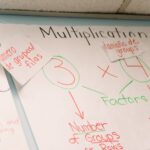
Banner image: A math chart in Coley’s classroom during her student teaching internship. All images by Marlayna Demond ’11 unless otherwise noted.
]]>
UMBC’s Sherman STEM Teacher Scholars Program has launched an intensive virtual math incubator for Lakeland Elementary/Middle School in Baltimore City this summer. The free, voluntary five-week...
https://umbc.edu/stories/umbc-and-baltimores-lakeland-elementary-middle-school-launch-innovative-online-summer-math-program/
https://my3.my.umbc.edu/api/v0/pixel/news/119827/guest@my.umbc.edu/3db479bb9c38fac56547ece54e817530/api/pixel
americanstudies
cahss
coeit
education
history
page1
policy-and-society
politicalscience
resilience
shermanscholars
UMBC News & Magazine
https://my3.my.umbc.edu/groups/umbc-news-magazine
https://assets1-my.umbc.edu/system/shared/avatars/groups/000/001/943/24435aa6207c452e7bc15cc74b42c7bb/xsmall.png?1748556657
https://assets1-my.umbc.edu/system/shared/avatars/groups/000/001/943/24435aa6207c452e7bc15cc74b42c7bb/original.png?1748556657
https://assets2-my.umbc.edu/system/shared/avatars/groups/000/001/943/24435aa6207c452e7bc15cc74b42c7bb/xxlarge.png?1748556657
https://assets2-my.umbc.edu/system/shared/avatars/groups/000/001/943/24435aa6207c452e7bc15cc74b42c7bb/xlarge.png?1748556657
https://assets3-my.umbc.edu/system/shared/avatars/groups/000/001/943/24435aa6207c452e7bc15cc74b42c7bb/large.png?1748556657
https://assets1-my.umbc.edu/system/shared/avatars/groups/000/001/943/24435aa6207c452e7bc15cc74b42c7bb/medium.png?1748556657
https://assets2-my.umbc.edu/system/shared/avatars/groups/000/001/943/24435aa6207c452e7bc15cc74b42c7bb/small.png?1748556657
https://assets1-my.umbc.edu/system/shared/avatars/groups/000/001/943/24435aa6207c452e7bc15cc74b42c7bb/xsmall.png?1748556657
https://assets2-my.umbc.edu/system/shared/avatars/groups/000/001/943/24435aa6207c452e7bc15cc74b42c7bb/xxsmall.png?1748556657
UMBC News & Magazine
0
0
false
Fri, 24 Jul 2020 18:55:04 -0400
Baltimore Field School: The Andrew W. Mellon Foundation supports UMBC’s inclusive approach to community-based research

UMBC’s College of Arts, Humanities, and Social Sciences (CAHSS) is pleased to announce the launch of a fourteen-month initiative to promote diversity, inclusion, and social justice in the public humanities, supported by a $125,000 grant from The Andrew W. Mellon Foundation. The project, Strengthening UMBC’s Public Humanities Infrastructure: The Baltimore Field School, will create a framework for faculty to collaborate with community organizations in building ethical and sustainable research and teaching projects focused on public humanities.
A new view of public humanities
The Baltimore Field School is coordinated by UMBC’s Orser Center for the Study of Place, Community, and Culture and led by Nicole King, associate professor of American Studies and director of the Orser Center, and CAHSS Dean Scott Casper. It aims to advance UMBC’s humanistic scholarship and teaching, rooted in deep and meaningful engagement with communities and neighborhoods.
“We want to think differently about how public humanities work can be done by reflecting on what ethical community-university partnerships look like,” says King.
 King’s 2017 Learning from Lexington students hosted their Zine Launch + Open Mic at Lexington Market. Image by Kimberly Zerfas. Photo by Marlayna Demond ’11 for UMBC.
“This collaborative process takes a great deal of time, listening, and building trust,” King explains. “The people living and working in city neighborhoods and building grassroots organizations should be centered in the process of defining challenges and ways to address them in Baltimore and cities like it.”
 UMBC students interview a local business owner.
The field school’s three pillars
This new initiative is rooted in three pillars. First, it seeks to enhance the understanding and visibility of communities in South and Southwest Baltimore, including their cultures and the challenges they face, from a variety of humanities-centered methods. Second, it will cultivate a national model of effective ethical humanities research, teaching, and learning about Baltimore and cities like it. Finally, it will expand UMBC’s infrastructure of engagement for public humanities research and teaching based in Baltimore.
This project builds on previous innovative humanities work at UMBC, supported by The Mellon Foundation. In 2017, The Mellon Foundation provided a five-year, $750,000 grant for UMBC’s Dresher Center for the Humanities and CAHSS to create the Inclusion Imperative. The project was designed to grow a regional community of scholars committed to diversity in the humanities. It has also sought to expand community-engaged humanities research and teaching around issues of race, equity, inclusion, and justice.
 An arabber sells produce form a horse-drawn cart in Baltimore.
“Faculty, staff, and students in the humanities have for many years been at the forefront of UMBC’s engagement with communities in and around Baltimore,” says Casper. “Thanks to this support from The Mellon Foundation, we look forward to deepening our work and strengthening its foundations across disciplines and beyond individual projects.”
To meet these goals, the Orser Center’s advisory committee and graduate students will convene, listen to, and plan with community organizations on an ongoing basis. They will also work with community partners to develop ethical principles for public humanities research and teaching. This information will be used to develop and execute a planning pilot of the Field School in summer 2020 and a Community Fellows Program in public humanities in fall 2020.
“The Baltimore Field School is a powerful standard for our community-focused work across campus and part of UMBC’s vision to Extend Beyond,” shared President Freeman Hrabowski, in voicing his support for the project. “It is rooted in UMBC’s proud history of diversity, inclusion, and social justice, and it helps us put those commitments into action in our local communities.”
Banner image: Discover Baltimore group tour of historic Lexington Market, UMBC summer session 2017, by Marylana Demond ’11 for UMBC. All other photos are courtesy of Bill Shewbridge, media and communications studies, from the Baltimore Traces project, unless otherwise noted.
]]>
UMBC’s College of Arts, Humanities, and Social Sciences (CAHSS) is pleased to announce the launch of a fourteen-month initiative to promote diversity, inclusion, and social justice in the public...
https://umbc.edu/stories/baltimore-field-school-the-andrew-w-mellon-foundation-supports-umbcs-inclusive-approach-to-community-based-research/
https://my3.my.umbc.edu/api/v0/pixel/news/119965/guest@my.umbc.edu/0a9266acdb7cc0563cb4217401e2ef28/api/pixel
americanstudies
cahss
dreshercenter
majoraward
mcs
page1
policy-and-society
research
UMBC News & Magazine
https://my3.my.umbc.edu/groups/umbc-news-magazine
https://assets1-my.umbc.edu/system/shared/avatars/groups/000/001/943/24435aa6207c452e7bc15cc74b42c7bb/xsmall.png?1748556657
https://assets1-my.umbc.edu/system/shared/avatars/groups/000/001/943/24435aa6207c452e7bc15cc74b42c7bb/original.png?1748556657
https://assets2-my.umbc.edu/system/shared/avatars/groups/000/001/943/24435aa6207c452e7bc15cc74b42c7bb/xxlarge.png?1748556657
https://assets2-my.umbc.edu/system/shared/avatars/groups/000/001/943/24435aa6207c452e7bc15cc74b42c7bb/xlarge.png?1748556657
https://assets3-my.umbc.edu/system/shared/avatars/groups/000/001/943/24435aa6207c452e7bc15cc74b42c7bb/large.png?1748556657
https://assets1-my.umbc.edu/system/shared/avatars/groups/000/001/943/24435aa6207c452e7bc15cc74b42c7bb/medium.png?1748556657
https://assets2-my.umbc.edu/system/shared/avatars/groups/000/001/943/24435aa6207c452e7bc15cc74b42c7bb/small.png?1748556657
https://assets1-my.umbc.edu/system/shared/avatars/groups/000/001/943/24435aa6207c452e7bc15cc74b42c7bb/xsmall.png?1748556657
https://assets2-my.umbc.edu/system/shared/avatars/groups/000/001/943/24435aa6207c452e7bc15cc74b42c7bb/xxsmall.png?1748556657
UMBC News & Magazine
0
0
false
Thu, 23 Jan 2020 19:44:57 -0500
UMBC’s Top Highlights of 2019

As UMBC welcomes 2020, we celebrate the student successes, athletic achievements, research breakthroughs, and community news that made 2019 a year to remember.
Retriever Nation
Whether it was on the field, on the court, or in the pool, UMBC’s Retrievers set out to shatter records in 2019. After being predicted to finish last in the America East, women’s softball stunned by clinching the title for the first time in program history. First-year standout Courtney Coppersmith, biochemistry and molecular biology, was named UMBC softball’s first-ever All-American. She was also the first person in America East history to be named both Pitcher of the Year and Rookie of the Year in the same season.
Men’s and women’s swimming and diving were both crowned America East champions, with the men’s team successfully defending their title. The America East accolades don’t end there, with men’s lacrosse bringing home the title for the first time in a decade. And men’s basketball had another thrilling season thanks to the support of dedicated fans.
 UMBC softball celebrates a landmark victory over Stony Brook to capture the America East title. Photo courtesy of UMBC Athletics.
Global learning experiences
In 2019, Retrievers discovered more ways to explore the world. Faculty-led summer trips gave students the opportunity to earn college credits through immersive experiences in Wales, Spain, France, Italy, and Colombia. Also, as part of a pilot program this year, nearly 30 new Retrievers jump-started their college career through Dawg Days Abroad in England. And 14 UMBC students and recent alumni received Fulbright U.S. Student Program awards — a new university record.
 Brian Souders Ph.D. ’09, language, literacy, and culture, Fulbright coordinator, (left) with recipients.
Student achievements
Students also earned major recognition for their contributions to communities in Baltimore and around the globe, and for their promise as emerging leaders in a range of fields.
Evan Avila ‘20, economics, was awarded a Harry S. Truman Scholarship, the fourth recipient in UMBC history. Avila shared, “I want to pursue a career in economics to inform policy that can dismantle structural barriers to economic equality for immigrant communities.” Maheen Haq ‘20, global studies and economics, was named a Newman Civic Fellow for her work supporting people facing discrimination in Baltimore and abroad. The Cyber Dawgs, UMBC’s Cyber Defense Team, beat out over 100 teams to be named the U.S. Department of Energy’s CyberForce Competition national champion.
 Evan Avila (center) with (l-r) Simon Stacey, director of the Honors College, and UMBC Truman Selection Committee members Lori Hardesty, David Hoffman, April Householder, and Brian Souders.
New faces and spaces
UMBC’s Interdisciplinary Life Sciences Building (ILSB) officially opened in the fall. The new facility offers features that set it apart as a space for learning, and set up students and faculty for transformative moments of discovery.
 The ILSB atrium offers spaces to study or just relax. The art installation and a floating staircase add a whimsical, creative feel.
Off campus, the doors of OCA Mocha—a student-developed coffee shop and community gathering space in downtown Arbutus—opened in November. And we gave a big #RetrieverNation welcome to Brian Barrio, UMBC’s new director of athletics, physical education, and recreation.
Making the grade
UMBC again appeared on numerous distinguished rankings lists in 2019. U.S. News named UMBC a national leader in teaching and innovation and recognized several UMBC graduate programs as among the best in the nation. The Center for World University Rankings declared UMBC one of the top 3.3 percent of universities worldwide, and the Princeton Review’s Best 385 Colleges for 2020 lauded UMBC as one of the best colleges in the nation. The research-focused QS World University Rankings 2020 named UMBC one of the top 500 universities in the world overall and among the best of the best in a key measure of faculty scholarship. And a brand new Times Higher Education ranking recognized UMBC as #3 among U.S. universities in global social and economic impact.
 New members of Retriever Nation gather for an incoming student photo during Welcome Week.
Research with impact, at all scales
From launching a satellite into space to sequencing the genes for spider glue, the UMBC community made exciting breakthroughs in 2019.
Sarah Stellwagen, assistant research scientist in biology, published the first-ever complete sequence of two genes that allow spiders to produce glue—a sticky, modified version of spider silk that keeps a spider’s prey stuck in its web. A NASA-funded satellite that UMBC’s Vanderlei Martins, physics, developed in collaboration with Space Dynamics Laboratory launched from NASA’s Wallops Flight Facility to the International Space Station in November.
Mustafa Al-Adhami M.S. ‘15, Ph.D. ‘20, mechanical engineering, developed a rapid bacterial-detection test that can assess, within an hour, if a patient has an infection. His test can also help physicians determine which antibiotics should be used to help fight the infection at a fraction of the price of the current antibiotic susceptibility test. This impressive breakthrough won Al-Adhami first place at the national Three-Minute Thesis competition.
Erle Ellis, geography and environmental systems, worked with colleagues to survey archaeologists across the globe to better understand human land use over time.
In the arts, UMBC Magazine highlighted the groundbreaking work of Chelsea Pace, assistant professor of theatre, a national expert on best practices for staging intimacy in theatre and film. Shortly afterward, she was featured in a major New York Times Magazine piece on intimacy coordinators.
 Sarah Stellwagen with her pet baby orange-kneed tarantula.
Building on a legacy of excellence
UMBC’s Meyerhoff Scholars Program has long been recognized as a national leader at the forefront of efforts to increase diversity in STEM fields. Last summer, hundreds of Meyerhoff alumni gathered in Baltimore to celebrate the vision of philanthropist Robert E. Meyerhoff. Celebrations continued throughout the weekend as members of the Meyerhoff Scholar community shared how the program helped guide them to where they are today.
The program also reached an exciting new milestone. The Chan Zuckerberg Initiative (CZI) announced that it has awarded $6.9 million to replicate UMBC’s Meyerhoff Scholars Program at UC San Diego and UC Berkeley. This work builds on successful Meyerhoff replications at Penn State and UNC-Chapel Hill, supported by the Howard Hughes Medical Institute. These programs and more are also highlighted in The Empowered University, a new book by President Freeman Hrabowski, Provost Philip J. Rous, and Peter H. Henderson that brings UMBC’s story to readers around the world.
And in an exciting story of local impact, Maryland’s latest PARCC test results revealed that Baltimore City schools partnering with UMBC have seen dramatic growth in student math performance. Joshua Michael ’10, political science, and assistant director of UMBC’s Sherman STEM Teacher Scholars Program, provided insight on this work.
 Naomi Mburu ’18 (left), chemical engineering, stops for a selfie with Talmesha Richards ‘04 (right), chemical engineering and mathematics, during the Meyerhoff celebration.
Alumni leadership and inspiration
What our students accomplish at UMBC is only the beginning. Their lives as alumni continue to inspire after they leave campus. This year, several Retrievers shared their stories of parlaying their college internships into full-time positions, thanks to the support they received from UMBC’s Career Center.
UMBC Magazine profiled alumna Karyn Swann ‘92, sociology, whose daughter is carrying on her basketball and academic legacy. Lyric Swann ‘23, visual arts, is following (and running and dribbling) in her mom’s footsteps and getting noticed during her first year at UMBC. Mimi Dietrich ‘70, American studies, was in UMBC’s first graduating class and hasn’t stopped working since. In March, the Maryland Historical Society launched a year-long retrospective of Dietrich’s national acclaimed quilts at its Baltimore headquarters.
Several alumni also began new, high-profile leadership positions. Adrienne Jones ‘76, psychology, made history when she was sworn in as Maryland Speaker of the House, the first African American and first woman to serve in this role. Letitia Dzirasa ‘03, M11, biological sciences, was appointed Baltimore’s new health commissioner, presiding over the health department’s annual budget of $150 million.
 Adrienne A. Jones ‘76, psychology, celebrates UMBC’s 50th anniversary.
Retriever fever
We love adding new fans to #RetrieverNation and 2019 gave us an impawssibly cute one. UMBC’s police department welcomed Chip, the new campus comfort dog, in September. Along with her handler, Sergeant Jamie Cheatem, Chip helps to provide comfort during midterms, finals, and high-stress situations.
 Comfort dog Chip eagerly greets students on campus.
To hear the latest UMBC news as it happens in 2020, follow UMBC on Facebook, Twitter, Instagram, UMBC News, and UMBC Magazine, and subscribe to UMBC’s “Top Stories of the Week” email.
Banner image: UMBC swim team members underwater. All photos by Marlayna Demond ‘11 unless otherwise noted.
]]>
As UMBC welcomes 2020, we celebrate the student successes, athletic achievements, research breakthroughs, and community news that made 2019 a year to remember. Retriever Nation Whether it was...
https://umbc.edu/stories/umbcs-top-highlights-of-2019/
https://my3.my.umbc.edu/api/v0/pixel/news/119973/guest@my.umbc.edu/6f572754ce580b0fd40e25293690e0e3/api/pixel
alumni
americanstudies
athletics
cahss
campus
cnms
coeit
community
hrabowski
page1
research
undergradresearch
UMBC News & Magazine
https://my3.my.umbc.edu/groups/umbc-news-magazine
https://assets1-my.umbc.edu/system/shared/avatars/groups/000/001/943/24435aa6207c452e7bc15cc74b42c7bb/xsmall.png?1748556657
https://assets1-my.umbc.edu/system/shared/avatars/groups/000/001/943/24435aa6207c452e7bc15cc74b42c7bb/original.png?1748556657
https://assets2-my.umbc.edu/system/shared/avatars/groups/000/001/943/24435aa6207c452e7bc15cc74b42c7bb/xxlarge.png?1748556657
https://assets2-my.umbc.edu/system/shared/avatars/groups/000/001/943/24435aa6207c452e7bc15cc74b42c7bb/xlarge.png?1748556657
https://assets3-my.umbc.edu/system/shared/avatars/groups/000/001/943/24435aa6207c452e7bc15cc74b42c7bb/large.png?1748556657
https://assets1-my.umbc.edu/system/shared/avatars/groups/000/001/943/24435aa6207c452e7bc15cc74b42c7bb/medium.png?1748556657
https://assets2-my.umbc.edu/system/shared/avatars/groups/000/001/943/24435aa6207c452e7bc15cc74b42c7bb/small.png?1748556657
https://assets1-my.umbc.edu/system/shared/avatars/groups/000/001/943/24435aa6207c452e7bc15cc74b42c7bb/xsmall.png?1748556657
https://assets2-my.umbc.edu/system/shared/avatars/groups/000/001/943/24435aa6207c452e7bc15cc74b42c7bb/xxsmall.png?1748556657
UMBC News & Magazine
0
0
false
Thu, 09 Jan 2020 18:06:40 -0500
In Baltimore Revisited, UMBC and community authors reflect on the city’s history of inequality and resistance

UMBC’s Nicole King, American studies, and Kate Drabinski, gender, women’s, and sexuality studies, have published Baltimore Revisited. The anthology, edited with the University of Baltimore’s Joshua Clark Davis, reflects the complex history of Charm City and efforts currently underway to address the city’s pervasive inequalities. These issues continue to resonate with Baltimore residents almost five years after the death of Freddie Gray and the Baltimore Uprising that followed.
 (L to R) King, Davis, and Drabinski at the Baltimore Revisited launch. Photo by Dinah Winnick.
“Many issues in our city are the result of long histories, whether it’s about the history of policing, environmental justice, vacancy, redlining, or gentrification,” shares Davis. “The roots of these issues are much deeper than a lot of us are aware of. History is not about dusty things in the past. It has usefulness today.”
Baltimore Revisited is a compilation of perspectives from activists, artists, community members, and academics, including several from UMBC. It is also accompanied by a website, Baltimorerevisited.org, for the community to access more information about the project and related events.
“We hope the book raises questions about how history can inform the present to understand the roots of the city’s many inequalities,” says Drabinski. “We wish readers to imagine new ways of being in and organizing for Baltimore in the future.”
Community focus
King and Drabinski, trained as interdisciplinary scholars, are long-time collaborators. The inspiration for Baltimore Revisited came a few years ago when they taught a Humanities Scholar seminar at UMBC. During a labor history walking tour with the class, they realized the content of the tour did not sufficiently incorporate gender, sexuality, race, ethnicity, and other points of view to give a holistic picture of Baltimore.
King and Drabinski recognized the need for an updated history of Baltimore, written by and for scholars and community members alike, so they took up the task. “We wanted our work to reach beyond the academy because these histories belong to everyone,” shares Drabinski. “We hope readers can find pieces that speak to them.”
 Nicole King opening the Baltimore Revisited launch.
The book reflects a wide range of methodological approaches to keep up with changes in the fields of history and American studies. The five sections cover a wide range of topics from the Jim Crow era to the present. They include: Place and Power: Roots of (In)Justice in the City; Histories of Contestation and Activism in a Legacy City; Voices from Here: Listening to the Past; Surviving in the Neoliberal City: Redevelopment in Baltimore; and Democratizing the Archives.
The book’s contributors approached these themes through writing in several different formats, such as interviews, analysis of archival research, poetry, and essays. The breadth and diversity of material in the book makes it accessible and useful for a range of audiences. Baltimore Revisited is already being applied at UMBC in media and communication studies and American studies courses.
UMBC perspectives
The authors and supportive community members recently gathered at Red Emma’s restaurant and bookstore in Baltimore City to celebrate the book’s launch. Some read excerpts from the book and others shared reflections. Of the many book contributors, several are from UMBC.
Shawntay Stocks Ph.D. ‘19, language, literacy, and culture, read two poems at the book launch event, including “Placed Love,” which appears at the very start of the book. Ashley Minner, American studies, also spoke at the event, about the chapter she contributed on her Lumbee community in Baltimore’s Fells Point neighborhood.
 Stocks doing a poetry reading at the Baltimore Revisited launch. Photo by Dinah Winnick.
Additional UMBC contributors include Denise Meringolo, history, who shared her public archive project to preserve the Baltimore Uprising. Joe Tropea ’06, history, and M.A. ’08, historical studies, explored censorship by Maryland’s Board of Motion Pictures. April Householder, visual and performing arts, and M.A. ‘00, comparative literature, and Jodi Kelber-Kaye wrote about Baltimore’s socialist feminists, with coauthor Elizabeth Morrow Nix. Householder is director of undergraduate research and prestigious scholarships at UMBC and Kelber-Kaye serves as associate director of the Honors College. And Michael Casiano, American studies, wrote about criminalizing Black neighborhoods in Baltimore during the Jim Crow era.
Public humanities
 While King and Drabinski worked to include a broad range of voices in a way not often seen in academic volumes, they also note that this is just the beginning. “There are many change agents in Baltimore whose voices need to be heard and many histories that have yet to be documented,” says Drabinski, who also co-authored a chapter with Louise Parker Kelley on Baltimore’s LGBTQ community.
Supporting the collection and sharing of research by and for the communities Baltimore represents is an essential aspect of King and Drabinski’s work and the book. “We can not forget the public in public humanities,” shares King, who also wrote a chapter about development in Baltimore.
During the launch event, the editors emphasized the importance of public-serving institutions, particularly public libraries. “Without institutions like the public library, these histories would not have as much of an opportunity to reach the communities they represent,” said King. With this in mind, the editors are donating all proceeds of the book to the Enoch Pratt Free Library, which they note remained open for city residents during the Baltimore Uprising.
Ultimately, says Drabinski, “The book comes from our love of Baltimore, a city both of us now call home.”
Banner image: Stocks doing a poetry reading at the Baltimore Revisited launch. Photo by Dinah Winnick.
]]>
UMBC’s Nicole King, American studies, and Kate Drabinski, gender, women’s, and sexuality studies, have published Baltimore Revisited. The anthology, edited with the University of Baltimore’s...
https://umbc.edu/stories/in-baltimore-revisited-umbc-and-community-authors-reflect-on-the-citys-history-of-inequality-and-resistance/
https://my3.my.umbc.edu/api/v0/pixel/news/120027/guest@my.umbc.edu/10c90913995b01ae1cdba9fdb7166d17/api/pixel
alumni
americanstudies
cahss
gwst
history
honorscollege
policy-and-society
UMBC News & Magazine
https://my3.my.umbc.edu/groups/umbc-news-magazine
https://assets1-my.umbc.edu/system/shared/avatars/groups/000/001/943/24435aa6207c452e7bc15cc74b42c7bb/xsmall.png?1748556657
https://assets1-my.umbc.edu/system/shared/avatars/groups/000/001/943/24435aa6207c452e7bc15cc74b42c7bb/original.png?1748556657
https://assets2-my.umbc.edu/system/shared/avatars/groups/000/001/943/24435aa6207c452e7bc15cc74b42c7bb/xxlarge.png?1748556657
https://assets2-my.umbc.edu/system/shared/avatars/groups/000/001/943/24435aa6207c452e7bc15cc74b42c7bb/xlarge.png?1748556657
https://assets3-my.umbc.edu/system/shared/avatars/groups/000/001/943/24435aa6207c452e7bc15cc74b42c7bb/large.png?1748556657
https://assets1-my.umbc.edu/system/shared/avatars/groups/000/001/943/24435aa6207c452e7bc15cc74b42c7bb/medium.png?1748556657
https://assets2-my.umbc.edu/system/shared/avatars/groups/000/001/943/24435aa6207c452e7bc15cc74b42c7bb/small.png?1748556657
https://assets1-my.umbc.edu/system/shared/avatars/groups/000/001/943/24435aa6207c452e7bc15cc74b42c7bb/xsmall.png?1748556657
https://assets2-my.umbc.edu/system/shared/avatars/groups/000/001/943/24435aa6207c452e7bc15cc74b42c7bb/xxsmall.png?1748556657
UMBC News & Magazine
0
0
false
Tue, 22 Oct 2019 16:31:17 -0400