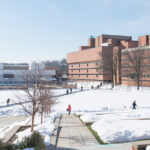
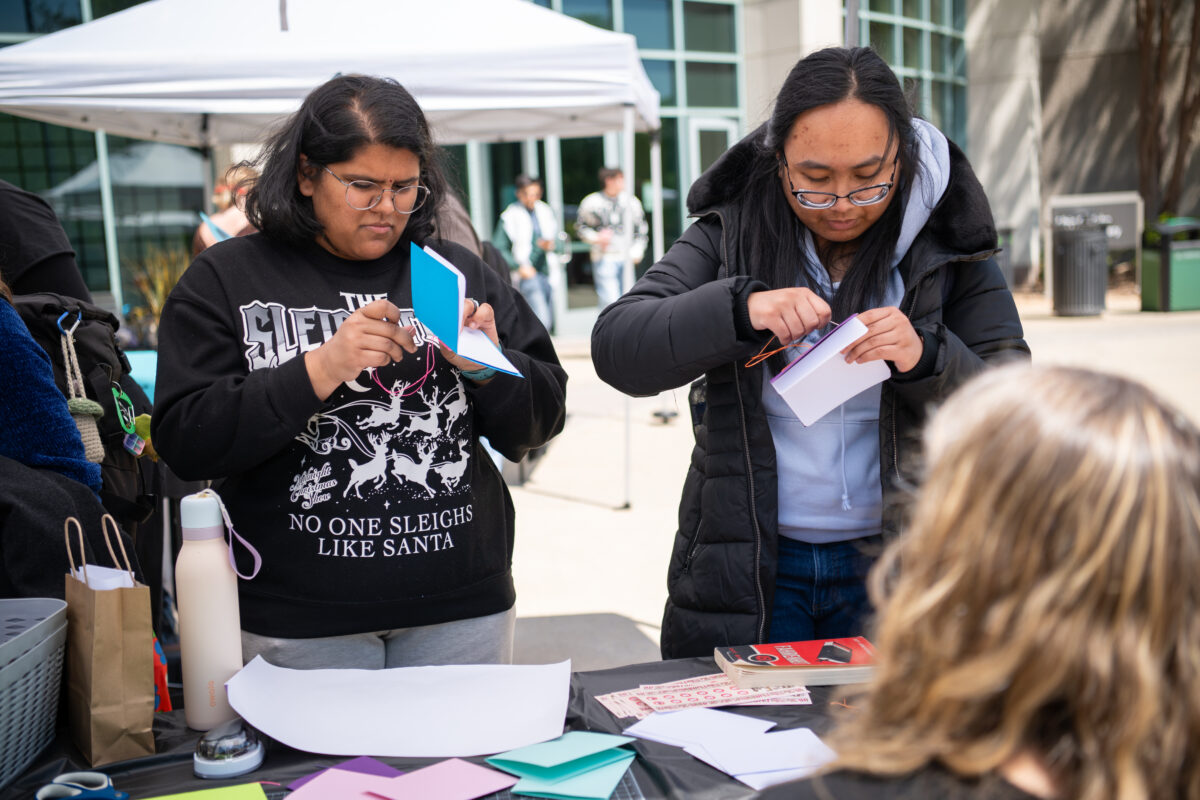
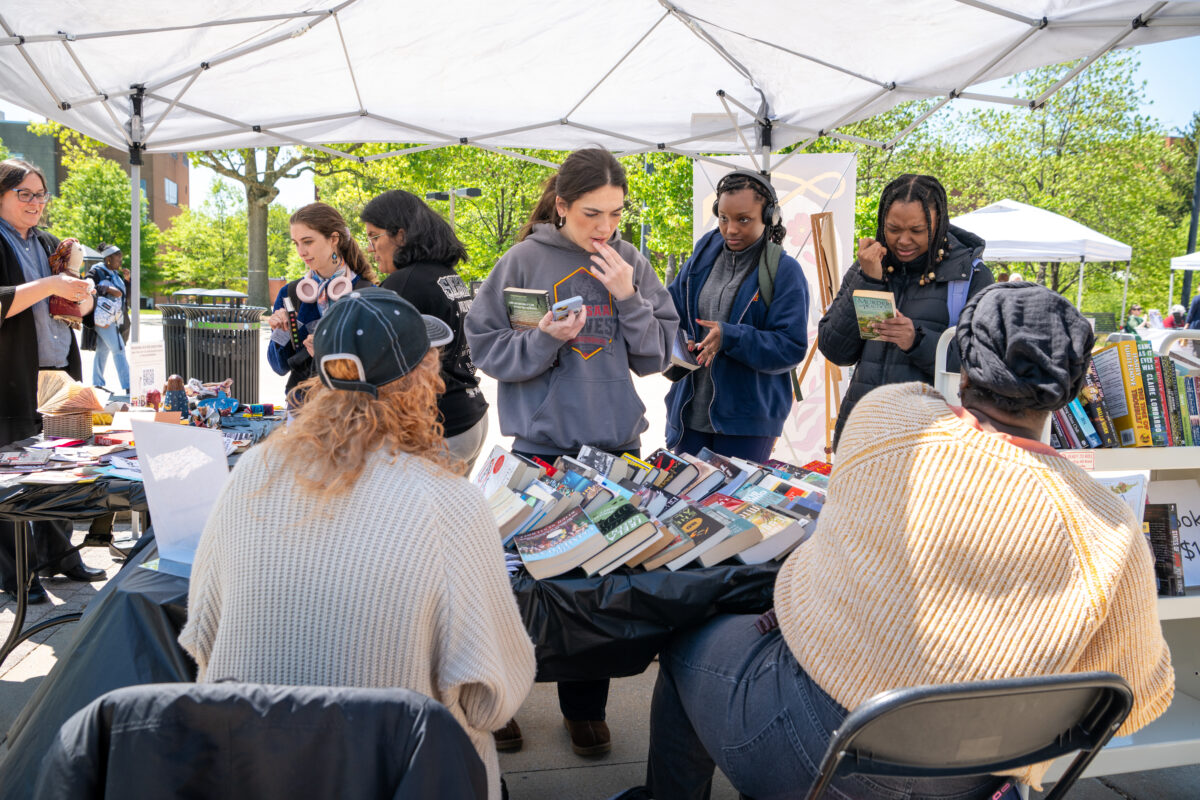
Appropriately, chapter one of UMBC’s inaugural BookFest began at AOK Library Plaza. Hundreds of students gathered at the BookMarkIt to try letterpress printing, stitch pamphlets, create and swap zines, and browse a book arts display and used books.
Lindsay DiCuirci, associate professor of English, envisioned Bookfest ’26 after receiving professional development funds from the Breaking the M.O.L.D. leadership program in the College of Arts, Humanities, and Social Sciences in spring 2025. Her proposal for the funds included hosting a book festival that explored both the creative, maker-based aspects of book history and the importance of advocacy and access. BookFest came to fruition this April when UMBC celebrated writers, readers, makers, and advocates during National Library Week.
A letterpress and zine swap were highlights for BookFest attendees.
“My own research is in early American book history, so I am drawn to all aspects of books across time and place,” DiCuirci says. “Given that we are also facing a major resurgence in book banning and censorship, I wanted to draw particular attention to attacks on libraries and the urgency around protecting our rights to read. Books by and about underrepresented people and experiences are being pulled from shelves across the country at the same time that funding for public schools and libraries is being slashed. I wanted BookFest to amplify this dynamic.”
A communal reading experience
One of the first conversations DiCuirci had about her idea was with Aditya Desai ’09, English, a program officer for Maryland Humanities who runs its Center for the Book and the One Maryland, One Book (OMOB) initiative. The pair decided that BookFest would celebrate OMOB—a communal reading experience for the state—by hosting Lawrence Burney, author of the 2026 OMOB selection, No Sense in Wishing. Burney attended BookFest and discussed his essay collection, growing up in Baltimore, and his deep relationship to music with Chris L. Terry, assistant professor of English.
Burney contended that everyone, no matter their age or life stage, can make valuable contributions to their community. “I think that’s one of the easiest ways any critic can kind of stunt their own growth, so I always make it a point to engage with people younger than me,” he said. As he leaned into writing and sharing his passions, he says he realized, “There is a way to amplify something while also having a challenging conversation about it.”
Desai also introduced DiCuirci to Maryland State Librarian Morgan Miller, who was instrumental in passing Maryland’s Freedom to Read Act. The pair collaborated on a BookFest panel called “Freedom to Read: Libraries and Our Democracy.”
Left: Students got to stitch together their own books at BookFest. Right: So many books, so little time!
Miller then brought John Owen into the mix. Owen is the librarian for the Maryland State Library of the Blind and Print Disabled (LBPD), and throughout BookFest, UMBC raised funds for a nonprofit that supports the LBPD in its mission to make reading and all library services accessible to Marylanders. In partnership with Maryland Humanities, BookFest also served as a collection point for the Maryland Commission on African American History and Culture’s annual book drive.
Stay tuned for the sequel
Craft and care were front and center throughout the festival. Graphic design senior Sonia Pivovarov brought the first iteration of BookFest to life with eye-catching print and digital advertising materials. The BookMarkIt purveyed BookFest-themed original creations and items from the Hilltop Print Shop, an instructional letterpress printing shop and mobile cart. Special Collections librarian Lindsey Loeper and DiCuirci built the shop with support from a Hrabowski Innovation Grant.
Hoping for a sequel to BookFest? The next iteration is already in the works, DiCuirci says, along with ideas for smaller pop-up events throughout the year to amplify the creative work of UMBC students.
By Kayla Logue ’27
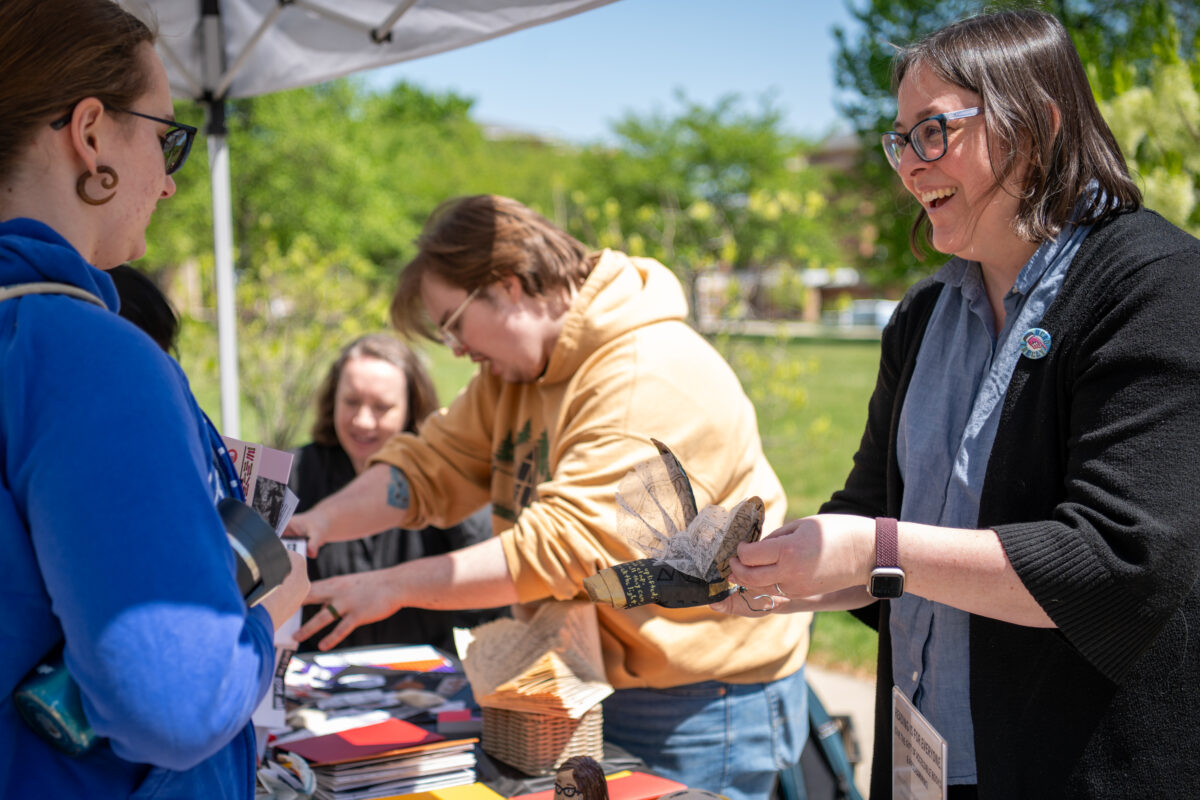
Jenny O’Grady, assistant vice president for communications, (right), shares her love of bookmaking with students at BookFest.
]]>
Appropriately, chapter one of UMBC’s inaugural BookFest began at AOK Library Plaza. Hundreds of students gathered at the BookMarkIt to try letterpress printing, stitch pamphlets, create and swap...https://umbc.edu/stories/umbc-opens-a-new-chapter-with-inaugural-bookfest/https://my3.my.umbc.edu/api/v0/pixel/news/160126/guest@my.umbc.edu/5241e563d54f59f869c22de29ea7284f/api/pixelalumniaok-librarycahsscampus-lifeenglishgraphic-designmagazinestoryUMBC News & Magazinehttps://my3.my.umbc.edu/groups/umbc-news-magazinehttps://assets1-my.umbc.edu/system/shared/avatars/groups/000/001/943/24435aa6207c452e7bc15cc74b42c7bb/xsmall.png?1748556657https://assets1-my.umbc.edu/system/shared/avatars/groups/000/001/943/24435aa6207c452e7bc15cc74b42c7bb/original.png?1748556657https://assets2-my.umbc.edu/system/shared/avatars/groups/000/001/943/24435aa6207c452e7bc15cc74b42c7bb/xxlarge.png?1748556657https://assets2-my.umbc.edu/system/shared/avatars/groups/000/001/943/24435aa6207c452e7bc15cc74b42c7bb/xlarge.png?1748556657https://assets3-my.umbc.edu/system/shared/avatars/groups/000/001/943/24435aa6207c452e7bc15cc74b42c7bb/large.png?1748556657https://assets1-my.umbc.edu/system/shared/avatars/groups/000/001/943/24435aa6207c452e7bc15cc74b42c7bb/medium.png?1748556657https://assets2-my.umbc.edu/system/shared/avatars/groups/000/001/943/24435aa6207c452e7bc15cc74b42c7bb/small.png?1748556657https://assets1-my.umbc.edu/system/shared/avatars/groups/000/001/943/24435aa6207c452e7bc15cc74b42c7bb/xsmall.png?1748556657https://assets2-my.umbc.edu/system/shared/avatars/groups/000/001/943/24435aa6207c452e7bc15cc74b42c7bb/xxsmall.png?1748556657UMBC News & Magazine00falseFri, 15 May 2026 14:10:47 -0400Fri, 15 May 2026 14:10:47 -0400Finley Bandy ’26 finds a future in history
Finley Bandy spent last summer in the cool temperatures and dim light of UMBC’s Albin O. Kuhn Library and Gallery Special Collections—the perfect environment to preserve rare books, photographs, manuscripts, archives, and artifacts. As part of UMBC’s 2025 Co-Lab interdisciplinary undergraduate summer research program, Bandy learned techniques to produce “Special Collections 101”, an informative video about how to use the resources in the collections. Bandy also loves being surrounded by thousands of historical narratives and working with Special Collections staff Beth Saunders, associate director and curator, and Lindsey Loeper, reference and instruction archivist. The infinite possibilities housed in Special Collections and the people who ensure historical narratives aren’t forgotten have inspired Bandy to join the cadre of museum and archive professionals.
“I was accepted into UMBC’s master’s program in historical studies,” says Bandy. “I love the process of using my historical and archival research to write about what I’m finding so that other people are aware that this piece of history exists. That’s why I want my master’s research to be an online exhibit that is accessible to the world.”
Museums and archives are only two of Bandy’s passions. When Bandy transferred to UMBC from Lamar Community College in Colorado, they brought their love of Russian language, history, and culture, and their deep love of Baltimore City.
Q: Did you come to UMBC already knowing what you wanted to study?
A: When I started at UMBC, I was all set to learn Russian and study Soviet history, but then I decided to go broader and major in history. I did finish all the Russian language courses, so I can speak Russian. I’m still interested in Russian history, and I love Russian music. I really love the language and like Eastern European culture.
Q: Where does your passion for Russian language and culture come from?
A: In my community college, I took a 20th-century world history class, and learned about the Cold War, which lasted from 1947 to 1991. A lot of the history really broke my heart. It made me want to learn more about it. I took a lot of Russian history classes and started reading Russian and Soviet literature. I really love how unique it is.
Q: Is there a modern piece of Russian culture that you enjoy, or are you focused on the history?
A: I think it’s really interesting to see how Soviet culture is beginning to meld with Western culture.
Soviet rock bands are really, really cool. There’s this great rock band that has been around since the ’70s called Akvarium or Aquarium. They were underground for a long time due to the war. I listen to them a lot. There’s also a current pop musician named Monetochka. She’s really cool.
I’ve never travelled abroad or have a passport, but one day I would like to visit Moscow and St. Petersburg, and travel all over Eastern Europe and the Balkans.
UMBC’s proximity to Camden Yards makes for a great trip to cheer on the Orioles! (Image courtesy of Bandy)
Q: Do you have a community to speak Russian with and immerse yourself in Russian culture?
A: Yes! UMBC’s Russian Club is a really tight-knit group. In the past, we hosted many holiday celebrations. In post-Soviet Russia and Eastern Europe, they still celebrate Christmas, but New Year’s is celebrated more because during the Soviet era, atheism was promoted and New Year’s didn’t have religious ties. Towards the end of the fall semester, we organized a giant Novy God [New Year’s] celebration. And then in the spring, we celebrated Maslenitsa. In the Russian Orthodox Church, this is the last week to feast before a period of fasting that ends at Easter. We also hung out a lot and talked about different Eastern European cultures. It’s called the Russian Club, but we have students from all over Eastern Europe—Ukraine, Armenia, and Belarus.
Q: Why do you love Baltimore City?
A:. Even though I was in Colorado for community college, I spent a lot of my childhood in Baltimore City because my grandmother worked in the city and my mom lived there. I have a connection to Baltimore, but I never really knew its history. I took “The History of Baltimore” at the Lion Brothers Building downtown. Every week, we took field trips to historic sites in Baltimore City to connect what we were learning with real-world experiences.
Q: Why did you change your major from Russian to history, and who has inspired you in this path?
A: I decided to switch majors from Russian to history while doing research in Professor Melissa Blair‘s “The History of Baltimore” class. It inspired me to pivot and focus my work on Maryland’s transportation history. The experiential learning and field work inspired me to better understand Baltimore and its history. I think Baltimore is a very unique city with a rich history that is often ignored by the historical record. I enjoyed interacting with other public historians and museum professionals within the city through that class.
Students from King’s class, “Preserving Spaces, Making Spaces in Baltimore,” participated in a Community Archiving Day event. The class planned this event to engage with residents and community members from neighborhoods in Southwest Baltimore and to gauge interest in developing a Community Archive to preserve their histories. (l-r) Amina Thiam ’24, history, Em Schumacher, a geography and environmental systems senior, Bandy, Tristan Diaz ’25, cultural anthropology and sociology, and Bandy’s fiancé, Max Taylor (who is not a UMBC student). (Image courtesy of King)
I’ve also worked a lot with Professor Nicole King in American studies—I took her “Preserving Places, Making Spaces in Baltimore” class twice. In 2025, we worked with the Poppleton Now Community Association and the Southwest Partnership Historic Preservation Committee on a Public History and Preservation Study. It included my research on the “Highway to Nowhere,” a 1.4-mile stretch of U.S. Route 40 in West Baltimore, built in the 1970s, that ends abruptly. The highway cuts off a section of Poppleton, one of the city’s oldest historically Black neighborhoods. We also created an online story map.
Q: Why are you passionate about transportation equity?
A: I don’t have a car, so I rely on Baltimore’s terrible public transportation. I love public transit, and I need it to be better. In the Baltimore history class, I realized the bus schedules, the bus routes, and the history of highway construction in the city have limited transportation, not expanded it. I conducted research with American studies Professor Michael Cassiano, my public humanities advisor. I presented my research, “Our City Is a City Without an Expressway: A Historical Review of Transportation Injustice in Baltimore City,” at URCAD. I’m interested in exploring these topics in my master’s program.
Bandy presents her research at the 2026 Undergraduate Research and Creative Achievement Day. (Image courtesy of King.)
Q: What is a challenge that you love?
A: I love creative writing. I’ve been writing since I was a kid. I think it’s a natural segue into history, because history is narrative-based. It’s very humanistic. I won’t say it comes naturally to me. It takes me probably an hour to write a sentence because I overthink my word choices a lot. But I love using language to evoke certain feelings and really press home on an idea. I try to choose the right word to fit what I’m talking about and its context. I also try to support students in the writing process as the History Student Council president. Last semester, we organized a bi-weekly writing group to encourage community and motivation within the major.
Q: What advice do you have for undergraduate and transfer students?
A: For undergraduate students, I would say to be realistic. Don’t put too much on your plate. That’s been the biggest challenge for me. I’ve been suffering a lot of burnout, because, in addition to my classes, I am a teaching assistant for “Introduction to the University for Transfer Students.” I started getting better at saying no to things. I encourage students to get out there, explore new things, but also recognize their limits. Prioritize making space for something that brings you joy.
For transfer students, I would say time management. Most of us work full-time or part-time, are raising families, and have other commitments. We’re not fresh out of high school and can sometimes internalize a feeling of being behind or not doing college “right.” It’s important to get over that because it doesn’t really matter. When I was 18 years old, my coworker was 40 years old. They had been working for decades. Once you leave high school, age doesn’t matter the same way—people are people, and everyone is busy. I wouldn’t focus on trying to get things done in a way that’s expected of you. Instead, focus on what you need to do to succeed.
]]>
Finley Bandy spent last summer in the cool temperatures and dim light of UMBC’s Albin O. Kuhn Library and Gallery Special Collections—the perfect environment to preserve rare books, photographs,...https://umbc.edu/stories/finley-bandy-finds-a-future-in-history/Video Previewhttps://assets1-my.umbc.edu/system/shared/attachments/061df1edbef80bc885b7ac1fa3bb4aca/6a9bf762/news/000/160/021/753b160cd612d83ee6b7c8c05e556046/2VV5_EeP8xs.jpg?1778616307https://my3.my.umbc.edu/api/v0/pixel/news/160021/guest@my.umbc.edu/74ebb52b16afdf97b14dc160572a104f/api/pixelamerican-studiesaok-librarybaltimore-citycahssclass-of-2026geshistorynewspolicy-and-societysaphstoryUMBC News & Magazinehttps://my3.my.umbc.edu/groups/umbc-news-magazinehttps://assets1-my.umbc.edu/system/shared/avatars/groups/000/001/943/24435aa6207c452e7bc15cc74b42c7bb/xsmall.png?1748556657https://assets1-my.umbc.edu/system/shared/avatars/groups/000/001/943/24435aa6207c452e7bc15cc74b42c7bb/original.png?1748556657https://assets2-my.umbc.edu/system/shared/avatars/groups/000/001/943/24435aa6207c452e7bc15cc74b42c7bb/xxlarge.png?1748556657https://assets2-my.umbc.edu/system/shared/avatars/groups/000/001/943/24435aa6207c452e7bc15cc74b42c7bb/xlarge.png?1748556657https://assets3-my.umbc.edu/system/shared/avatars/groups/000/001/943/24435aa6207c452e7bc15cc74b42c7bb/large.png?1748556657https://assets1-my.umbc.edu/system/shared/avatars/groups/000/001/943/24435aa6207c452e7bc15cc74b42c7bb/medium.png?1748556657https://assets2-my.umbc.edu/system/shared/avatars/groups/000/001/943/24435aa6207c452e7bc15cc74b42c7bb/small.png?1748556657https://assets1-my.umbc.edu/system/shared/avatars/groups/000/001/943/24435aa6207c452e7bc15cc74b42c7bb/xsmall.png?1748556657https://assets2-my.umbc.edu/system/shared/avatars/groups/000/001/943/24435aa6207c452e7bc15cc74b42c7bb/xxsmall.png?1748556657UMBC News & Magazine00falseTue, 12 May 2026 15:44:27 -0400Tue, 12 May 2026 15:44:27 -0400Then and Now—Place of Play to Protected Site
The afternoon sun dances on the water of the Library pond while fish swim below the surface. Most days, you see ducks enjoying the water. Unlike many newer places on campus, the pond has been one of UMBC’s iconic spots since the beginning. But the current generation of fish—and today’s Retrievers—don’t have a long enough memory to know that the pond was once a place of recreation for students.
Photos from UMBC’s 1969 yearbook, Skipjack, reveal students playing tug of war over the pond and other water activities such as rowing and ice skating. Splashing around in the pond is unimaginable today—signs tell those who come to the water feature about its importance to the natural wildlife and the delicate nature of the pond’s ecosystem. he terrace and landscaping around the pond has been reshaped over the years to invite students, faculty, staff, and others to sit on nearby benches admiring the site’s natural beauty.
While students no longer play in its water, the pond has never been better monitored. UMBC’s Facilities Management works to keep the pond clean and safe for its many flora and fauna. “A little bit of care goes a long way,” says Ralph Ericksen, grounds manager of maintenance, who explains that Facilities Management is currently focused on controlling vegetation (mainly phragmites—the common reed—which if left unchecked can cause major problems), keeping invasive species out, and managing oxygenation levels in the water. His group works with UMBC’s Office of Sustainability to develop programs to educate students about why it’s important to conserve the pond for many generations of Retrievers to come.
“Ponds create a wonderful atmosphere.” Ericksen commented. The fish and the ducks would agree with him and so would the many visitors over the years.
]]>
The afternoon sun dances on the water of the Library pond while fish swim below the surface. Most days, you see ducks enjoying the water. Unlike many newer places on campus, the pond has been one...https://umbc.edu/stories/place-of-play-to-protected-site-library-pond/https://my3.my.umbc.edu/api/v0/pixel/news/146029/guest@my.umbc.edu/12cda80e9726ca91f19c0e949598e2f4/api/pixelaok-librarycampus-lifefall-2024magazinepondstorysustainabilitythen-and-nowUMBC News & Magazinehttps://my3.my.umbc.edu/groups/umbc-news-magazinehttps://assets1-my.umbc.edu/system/shared/avatars/groups/000/001/943/24435aa6207c452e7bc15cc74b42c7bb/xsmall.png?1748556657https://assets1-my.umbc.edu/system/shared/avatars/groups/000/001/943/24435aa6207c452e7bc15cc74b42c7bb/original.png?1748556657https://assets2-my.umbc.edu/system/shared/avatars/groups/000/001/943/24435aa6207c452e7bc15cc74b42c7bb/xxlarge.png?1748556657https://assets2-my.umbc.edu/system/shared/avatars/groups/000/001/943/24435aa6207c452e7bc15cc74b42c7bb/xlarge.png?1748556657https://assets3-my.umbc.edu/system/shared/avatars/groups/000/001/943/24435aa6207c452e7bc15cc74b42c7bb/large.png?1748556657https://assets1-my.umbc.edu/system/shared/avatars/groups/000/001/943/24435aa6207c452e7bc15cc74b42c7bb/medium.png?1748556657https://assets2-my.umbc.edu/system/shared/avatars/groups/000/001/943/24435aa6207c452e7bc15cc74b42c7bb/small.png?1748556657https://assets1-my.umbc.edu/system/shared/avatars/groups/000/001/943/24435aa6207c452e7bc15cc74b42c7bb/xsmall.png?1748556657https://assets2-my.umbc.edu/system/shared/avatars/groups/000/001/943/24435aa6207c452e7bc15cc74b42c7bb/xxsmall.png?1748556657UMBC News & Magazine10falseTue, 03 Dec 2024 11:48:41 -0500Tue, 03 Dec 2024 11:48:41 -05006 Earth Day events that will ground you to our planet
While Earth Day may be a one-day affair, our everyday actions affect the Earth 365 days of the year. This April, UMBC is celebrating Earth Month, allowing the community to dedicate time to reflect more deeply on the environmental challenges we are facing and also celebrate the many gifts our world has to offer. In partnership with the Environmental Protection Agency (EPA) and the United States Geological Survey (USGS), UMBC is hosting a lineup of free, exciting, Earth Day events happening all month! You don’t even need to leave campus to join in on the fun all while learning about how we can all do our part to take care of our planet.
1. Watch the Solar Eclipse (with proper glasses)
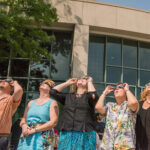
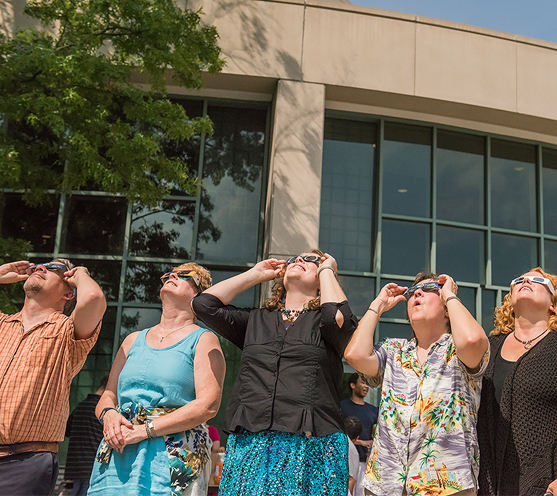
Head over to the Quad, on April 8 from 2 to 4 p.m., and join your fellow earthlings from the Astronomy Club for a watch party of the solar eclipse! The eclipse will trace a narrow path of darkness across North America where the moon will pass between the Sun and the Earth, creating a partial eclipse. Watch as more than 88 percent of the Sun will be obstructed from view at UMBC. (Left, a group watches the 2017 eclipse in front of the AOK Library.)
2. Go see the play “SLIME”
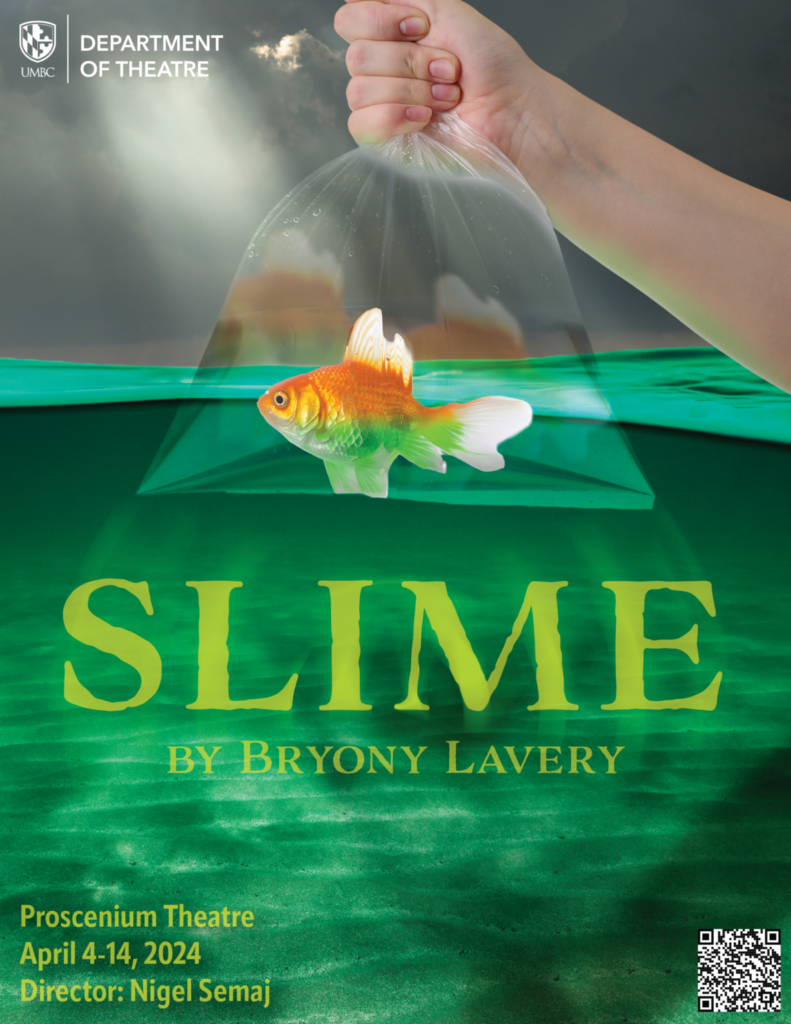
As part of the Plays for Our Planet initiative, the Department of Theatre is producing Byrony Lavery’s “SLIME,” directed by Nigel Semaj. The play is about seven graduate students who appear at the Third Annual Slime Crisis Conference, fighting to save the Earth from a toxic slime that is threatening all animal life.
Performances will take place from April 4 to 14, and on April 14, there will be a free matinee for students, followed by a post-show actor talk-back, featuring, Dawn Biehler of UMBC’s Department of Geography and Environmental Systems. You don’t want to miss this opportunity to educate yourself on climate change in an engaging and entertaining way.
3. Run the Earth Day 3K
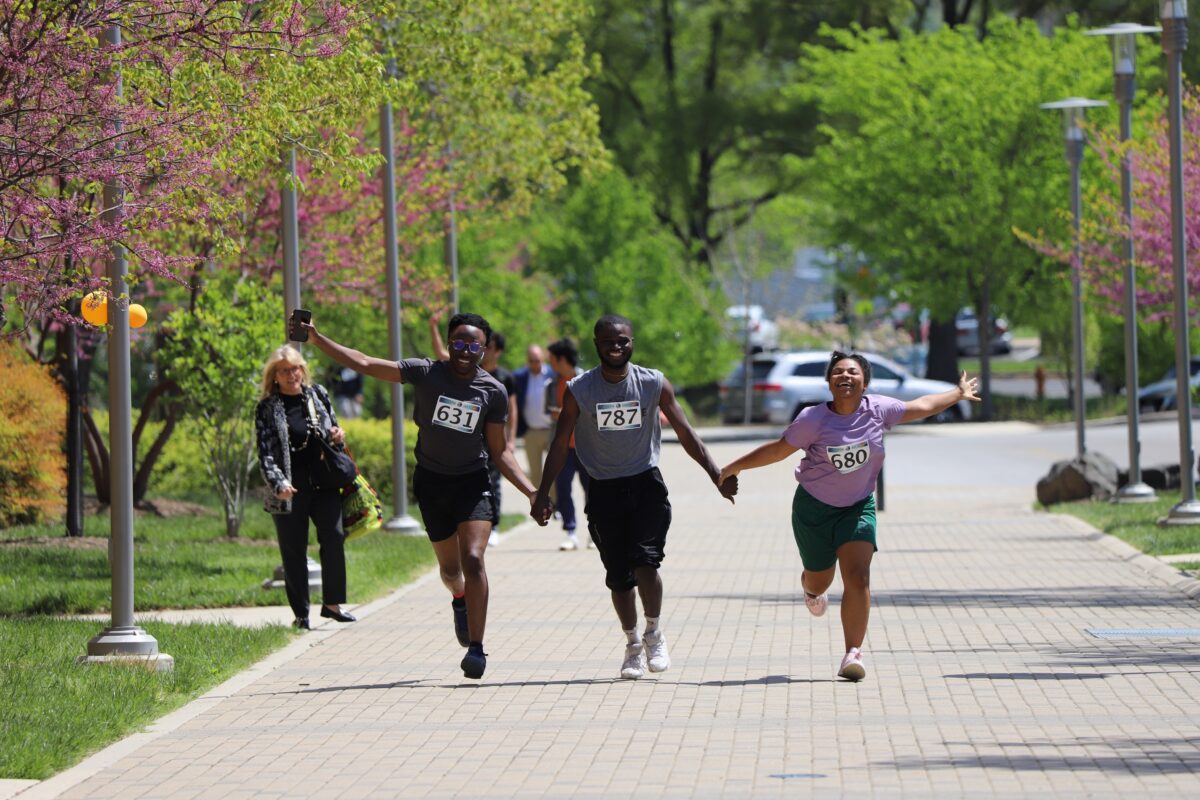
Enjoy the spring weather and head over to RAC for the annual free Earth Day 3K Run on April 17. Don’t worry if you’re not a competitive runner, walking is encouraged as well. If you’re up for the challenge, you can sign up here, or via walk-up registration the day of from 11 a.m.to noon. Prizes will be awarded to the top finishers, and the first 100 completed racers will receive Earth Day T-Shirts.
A group of students running the 2022 Earth Day 3K on campus.
The event begins at 12:15 p.m. and refreshments will be provided post-race. All participants will have a chance to connect with the community and become more aware of earth sciences and the environment. UMBC students, faculty, as well as anyone in the Baltimore community is encouraged to participate!
4. Bring global change down to Earth
For most of us, managing greenhouse gas emissions and watching distant islands flood or glaciers melt are far beyond our reach. However, the pervasive reach of an environmental reckoning means we have local issues, with much for all of us to work on. This panel on April 22 will bring together scholars from public policy, geography and environmental systems, and beyond to discuss multiple ways to understand climate work.
Students gathered in The Commons to make bouquets of flowers in spring 2023. (Marlayna Demond ’11/UMBC)
5. Check out research from the UMBC community
There is so much groundbreaking research happening at UMBC conducted by students, faculty, staff, and community members, and you can learn all about it at Earth Day Community Day on the Quad on April 22. There will be two sessions, one starts at 10 a.m. and another at 1 p.m. Take this time to enrich your understanding of the research being carried out at UMBC and how it has had a significant impact on the Baltimore community and beyond.
6. Attend an Earth Day panel
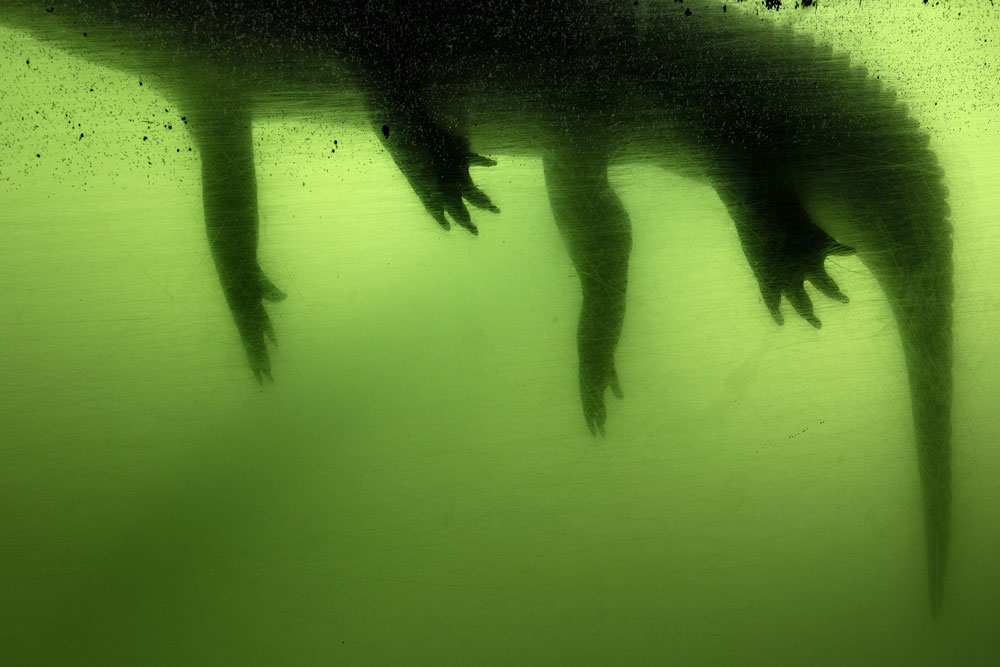
After checking out Community Day on the Quad, be sure to catch the panel, Climate Change, Science Communication, and the Arts. Artist Anastasia Samoylova (Gator, 2017, left) will be joining scientists and media historians for a panel discussion on April 22.
Along with Anastasia Samoylova—the photographer behind the vivid pictures in the exhibit “Floodzone” which takes a look at how climate change has affected the southern U.S.—the panelists will include, Autumn Powell, a UMBC graduate student in geography and environmental systems, Lavar Thomas, a special assistant within the EPA’s administrator’s office, and Tracy Tinga, assistant professor in media and communication studies. This event will be a discussion of how to use of how to use alternate forms of communication, including art, to describe climate change findings to a general audience. The event will take place at the AOK Library Gallery at 5 p.m.
]]>
While Earth Day may be a one-day affair, our everyday actions affect the Earth 365 days of the year. This April, UMBC is celebrating Earth Month, allowing the community to dedicate time to reflect...https://umbc.edu/stories/6-earth-day-events-that-ground-you-to-our-planet/https://my3.my.umbc.edu/api/v0/pixel/news/140608/guest@my.umbc.edu/c1ca080f96cc69268bdf418c5ed3affc/api/pixelaok-librarycahsscampus-lifecnmscoeitgesmagazinemcsstorytheatreUMBC News & Magazinehttps://my3.my.umbc.edu/groups/umbc-news-magazinehttps://assets1-my.umbc.edu/system/shared/avatars/groups/000/001/943/24435aa6207c452e7bc15cc74b42c7bb/xsmall.png?1748556657https://assets1-my.umbc.edu/system/shared/avatars/groups/000/001/943/24435aa6207c452e7bc15cc74b42c7bb/original.png?1748556657https://assets2-my.umbc.edu/system/shared/avatars/groups/000/001/943/24435aa6207c452e7bc15cc74b42c7bb/xxlarge.png?1748556657https://assets2-my.umbc.edu/system/shared/avatars/groups/000/001/943/24435aa6207c452e7bc15cc74b42c7bb/xlarge.png?1748556657https://assets3-my.umbc.edu/system/shared/avatars/groups/000/001/943/24435aa6207c452e7bc15cc74b42c7bb/large.png?1748556657https://assets1-my.umbc.edu/system/shared/avatars/groups/000/001/943/24435aa6207c452e7bc15cc74b42c7bb/medium.png?1748556657https://assets2-my.umbc.edu/system/shared/avatars/groups/000/001/943/24435aa6207c452e7bc15cc74b42c7bb/small.png?1748556657https://assets1-my.umbc.edu/system/shared/avatars/groups/000/001/943/24435aa6207c452e7bc15cc74b42c7bb/xsmall.png?1748556657https://assets2-my.umbc.edu/system/shared/avatars/groups/000/001/943/24435aa6207c452e7bc15cc74b42c7bb/xxsmall.png?1748556657UMBC News & Magazine00falseFri, 05 Apr 2024 12:06:31 -0400Fri, 05 Apr 2024 12:06:31 -0400The US has a child labor problem – recalling an embarrassing past that Americans may think they’ve left behind
At the University of Maryland, Baltimore County’s Special Collections, where I am head curator, we’ve recently completed a major digitization and rehousing project of our collection of over 5,400 photographs made by Lewis Wickes Hine in the early 20th century.
Traveling the country with his camera, Hine captured the often oppressive working conditions of thousands of children – some as young as 3 years old.
As I’ve worked with this collection over the past two years, the social and political implications of Hine’s photographs have been very much on my mind. The patina of these black-and-white photographs suggests a bygone era – an embarrassing past that many Americans might imagine they’ve left behind.
A sociologist by training, Hine began making photographs in 1903 while working as a teacher at the progressive Ethical Culture School in New York City.
Between 1903 and 1908, he and his students photographed migrants at Ellis Island. Hine believed that the future of the U.S. rested in its identity as an immigrant nation – a position that contrasted with escalating xenophobic fears.
Based on this work, the National Child Labor Committee, which advocated for child labor laws, hired Hine to document the living and working conditions of American children.
Lewis Wickes Hine, ‘Trapper Boy, Turkey Knob Mine, MacDonald, West Virginia, 1908.’ Gelatin silver print. 5 x 7 in. The Photography Collections, University of Maryland, Baltimore County (P148), CC BY-SA
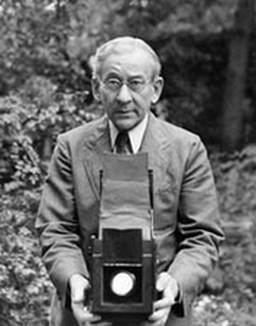
In his work for the National Child Labor Committee, Hine journeyed to farms and mills in the industrializing South and the streets and factories of the Northeast. He used a Graflex camera with 5-by-7-inch glass plate negatives and employed flash powder for nighttime and interior shots, hauling upward of 50 pounds of equipment on his slight frame.
To gain entry into factories and other facilities, Hine sometimes disguised himself as a Bible, postcard or insurance salesman. Other times he’d wait outside to catch workers arriving for or departing from their shifts.
Along with photographic records, Hine collected his subjects’ personal stories, including their ages and ethnicities. He documented their working lives, such as their typical hours and any injuries or ailments they incurred as a result of their labor.
Hine, who considered himself “an investigator with a camera,” used this information to create what he termed “photo stories” – combinations of images and text that could be used on posters, in public lectures and in published reports to help the organization advance its mission.
Hine’s muckraking photographs exemplify the genre of documentary photography, which relies upon the perceived truthfulness of photography to make a case for social change.
The camera serves as an eyewitness to a societal ill, a problem that needs a solution. Hine portrayed his subjects in a direct manner, typically frontally and looking straight into the camera, against the backdrop of the very factories, farmland or cities where they worked.
By capturing details of his sitters’ bare feet, tattered clothes, soiled faces and hands, and diminutive stature against hulking industrial equipment, Hine made a direct statement about the poor conditions and precarity of these children’s lives.
Lewis Wickes Hine, ‘Group of newsies selling on Capitol steps, April 11, 1912.’ The Photography Collections, University of Maryland, Baltimore County (P2904), CC BY-SA
Hine’s photographs made a successful case for child labor reform.
Notably, the National Child Labor Committee’s efforts resulted in Congress establishing the Children’s Bureau in 1912 and passing the Keating-Owen Act in 1916, which limited working hours for children and prohibited the interstate sale of goods produced by child labor.
Although the Supreme Court later ruled it and a subsequent Child Labor Tax Law of 1919 unconstitutional, momentum for enshrining protections for child workers had been created. In 1938, Congress passed the Fair Labor Standards Act, which established restrictions and protections on employing children.
The National Child Labor Committee’s project also included advocacy for the enforcement of existing child labor regulations, a regulatory problem reemerging today as the Department of Labor – the agency tasked with enforcing labor laws – comes under fire for failing to protect child workers.
A recent surge of unaccompanied minors, primarily from Central America, has brought new attention to America’s old problem of child labor and has threatened the very laws Hine and the National Child Labor Committee worked to enact.
Some estimates suggest that one-third of migrants under 18 are working illegally, whether it’s laboring more hours than current laws permit, or working without the proper authorizations. Many of them perform hazardous jobs similar to those of Hine’s subjects: handling dangerous equipment and being exposed to noxious chemicals in factories, slaughterhouses and industrial farms.
While the content of Hine’s photographs remains pertinent to today’s child labor crisis, a key distinction between the subject of Hine’s photographs and working children today is race.
Hine focused his camera almost exclusively on white children who arrived in the country during waves of immigration from Europe during the late-19th and early-20th centuries. As art historian Natalie Zelt argues, Hine’s pictorial treatment of Black children – either ignored or forced to the margins of his images – implied to viewers that the face of childhood in America was, by default, white.
The perceived racial hierarchies of Hine’s era reverberate into the present, where underage migrants of color live and work at the margins of society.
Contemporary reports of child labor violations offer few images to accompany their texts, graphs and statistics. There are legitimate reasons for this. By not including identifying personal information or portraits, news outlets protect a vulnerable population. Ethical guidelines frown upon revealing private details of the lives of children interviewed. And, as Hine’s experience demonstrates, it can be difficult to infiltrate the sites of these labor violations, since they are typically kept secure.
Digital cameras and smartphones offer a workaround. Beginning in 2015, the International Labor Organization urged child laborers in Myanmar to become “young activists” and use their own images and words to create “photo stories” – echoing Hine’s use of the term – that the organization could then disseminate.
Photographs of child labor in foreign countries are far more common than those made in the U.S., which leaves the impression that child labor is someone else’s problem, not ours. Perhaps it’s too hard for Americans to look at this domestic issue square in the eyes.
A similar effect is at work when viewing Hine’s photographs today. While they were originally valued for their immediacy, they can seem to belong to a distant past.
But if Hine’s photographic archive of child laborers is evidence of the power of photography to sway public opinion, does the lack of images in today’s reporting – even if nobly intended – create a disconnect?
Is the public capable of understanding the harmful consequences of lack of labor enforcement when the faces of the people affected are missing from the picture?
]]>
Written by Beth Saunders, Curator and Head of Special Collections and Gallery, UMBC. At the University of Maryland, Baltimore County’s Special Collections, where I am head curator, we’ve...https://umbc.edu/stories/the-conversation-us-child-labor-problem/https://my3.my.umbc.edu/api/v0/pixel/news/134034/guest@my.umbc.edu/900a55b9775015504e5a594fcc4fc295/api/pixelaok-galleryaok-libraryaok-library-gallerydiscoverymagazinespecial-collectionsthe-conversationUMBC News & Magazinehttps://my3.my.umbc.edu/groups/umbc-news-magazinehttps://assets1-my.umbc.edu/system/shared/avatars/groups/000/001/943/24435aa6207c452e7bc15cc74b42c7bb/xsmall.png?1748556657https://assets1-my.umbc.edu/system/shared/avatars/groups/000/001/943/24435aa6207c452e7bc15cc74b42c7bb/original.png?1748556657https://assets2-my.umbc.edu/system/shared/avatars/groups/000/001/943/24435aa6207c452e7bc15cc74b42c7bb/xxlarge.png?1748556657https://assets2-my.umbc.edu/system/shared/avatars/groups/000/001/943/24435aa6207c452e7bc15cc74b42c7bb/xlarge.png?1748556657https://assets3-my.umbc.edu/system/shared/avatars/groups/000/001/943/24435aa6207c452e7bc15cc74b42c7bb/large.png?1748556657https://assets1-my.umbc.edu/system/shared/avatars/groups/000/001/943/24435aa6207c452e7bc15cc74b42c7bb/medium.png?1748556657https://assets2-my.umbc.edu/system/shared/avatars/groups/000/001/943/24435aa6207c452e7bc15cc74b42c7bb/small.png?1748556657https://assets1-my.umbc.edu/system/shared/avatars/groups/000/001/943/24435aa6207c452e7bc15cc74b42c7bb/xsmall.png?1748556657https://assets2-my.umbc.edu/system/shared/avatars/groups/000/001/943/24435aa6207c452e7bc15cc74b42c7bb/xxsmall.png?1748556657UMBC News & Magazine00falseThu, 15 Jun 2023 18:35:31 -0400UMBC’s galleries deliver interactive and thoughtful art
UMBC’s art galleries are already in full bloom for the spring. With exhibits showcasing historic and innovative 20th century photography, interactive hip-hop data visualization, and the legacies of political resistance as seen through Black hair, the university’s exhibition spaces are bountiful with thought-provoking work.
Hip-Hop and Data at CADVC
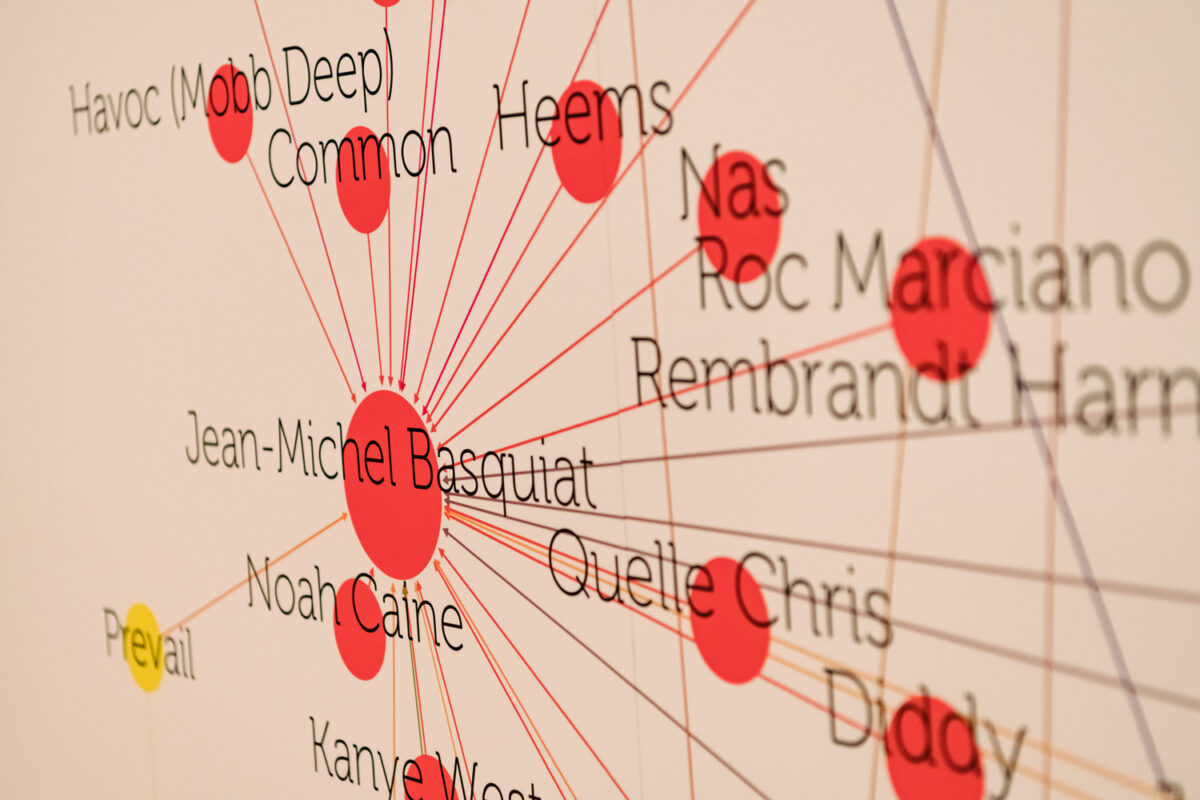
Tahir Hemphill: Rap Research Lab runs at the Center for Art, Design, and Visual Culture (CADVC) through March 18. In this exhibition, Tahir Hemphill, the inaugural Fellow for Faculty Diversity in the Visual Arts at UMBC, presents a collection of interactive works that explore what he calls “the hybrid area between art, technology, social engagement, and interdisciplinary research.”
Visitors are invited to participate in Hemphill’s design and research process through evolving artworks, including “Visualisation of Authority,” a kinetic sculpture drawing on Library of Congress research data, and “Mapper’s Delight,” an interactive augmented reality-based middle-school curriculum Hemphill designed in collaboration with Verizon Innovative Learning.
Data visualization from Hemphill’s Rap Research Lab at the CADVC. (Marlayna Demond ’11/UMBC)
Hemphill is using the exhibition space for teaching as well. In a course offered in collaboration between Visual Arts and the UMBC Image Research Center (IRC) students have the opportunity to mine the “Rap Almanac,” Hemphill’s expansive dataset of rap lyrics, to produce work in an internship-based research practicum.
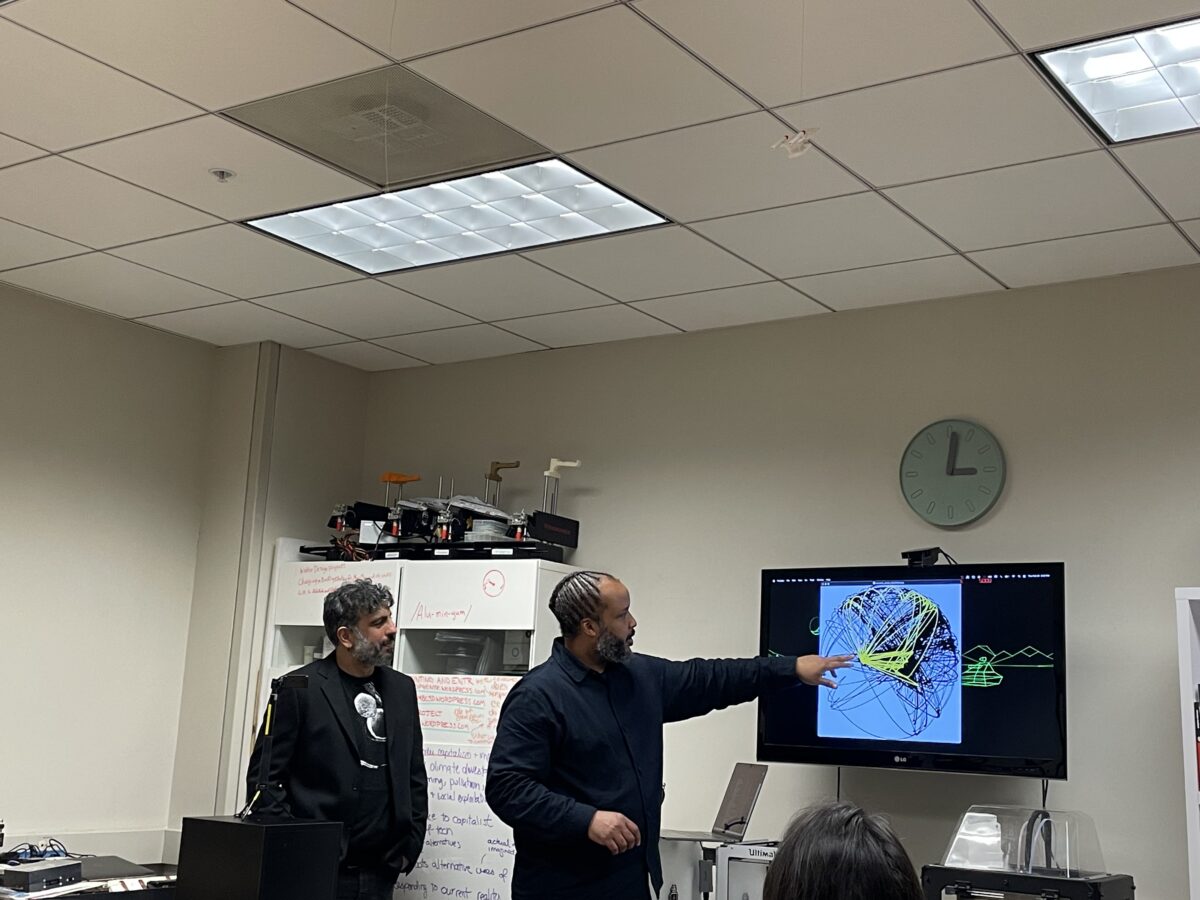
Hamidi, left, and Hemphill, right, talk through data visualization. (Marlayna Demond ’11/UMBC)
“CADVC operates as an art gallery and research center dedicated to scholarship and experimentation in art and culture,” says CADVC Director Rebecca Uchill. “This exhibition demonstrates a terrific range of scholarly inquiries, by Hemphill and his collaborators, into many facets of cultural history and the power of creative data visualization strategies. It is very exciting to watch this research develop in a public-facing presentation!”
Additional programming for the exhibition will include a series of public events such as a choreographed activation of a programmable robot arm, a partnership project with assistant professor Foad Hamidi from the Human-Centered Computing program in Information Systems, and a series of pop-up events.
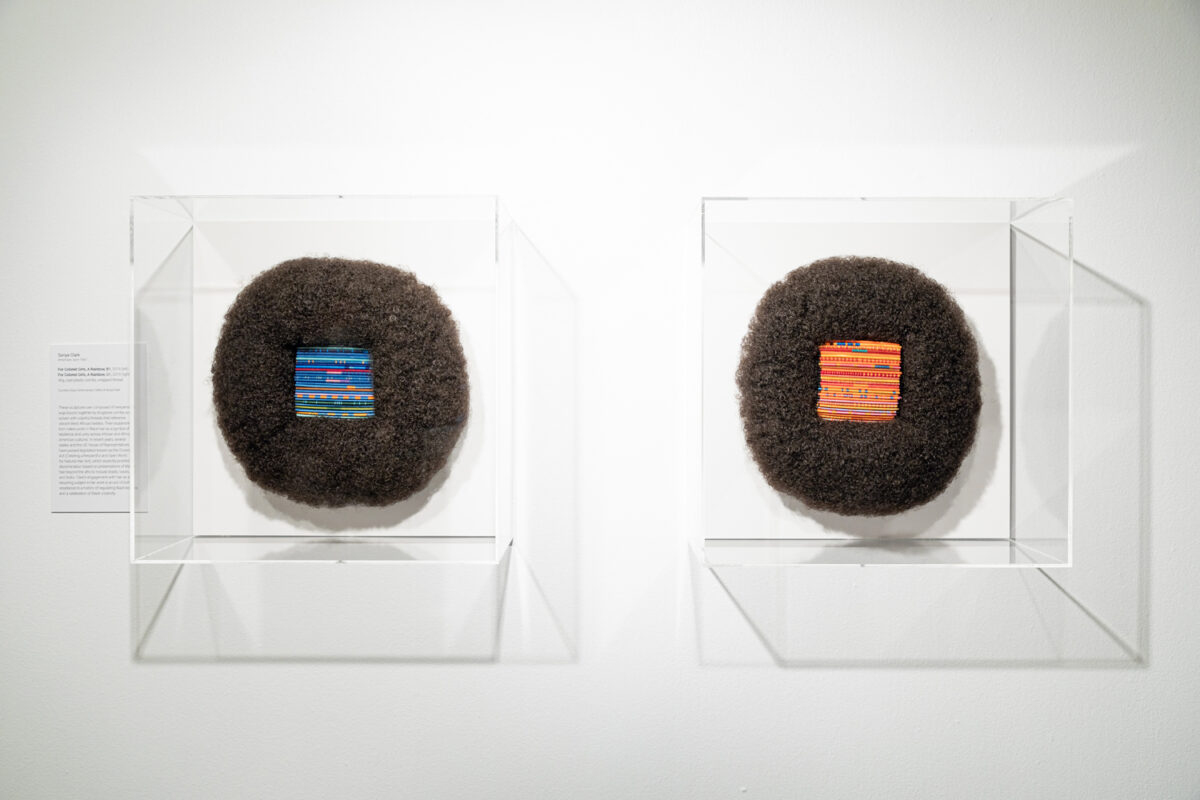
Multidisciplinary artist Sonya Clark presents five works made with human hair and fiber art techniques to explore Black visibility and identity, and to examine the ways Black hair has been employed as an instrument of political resistance across the African diaspora. Clark, whose work explores issues of identity, race, cultural heritage, and collective memory, engages everyday objects and craft traditions to examine narrative threads connecting modern issues with historical origins, including the Black national anthem “Lift Every Voice and Sing” and the biography of Madam C. J. Walker, who became the first female self-made millionaire by selling hair care products to Black women.
Sonya Clark’s Hair/Craft exhibit at the AOK Library Gallery. (Melissa Penley Cormier, M.F.A. ’17, for Research Graphics)
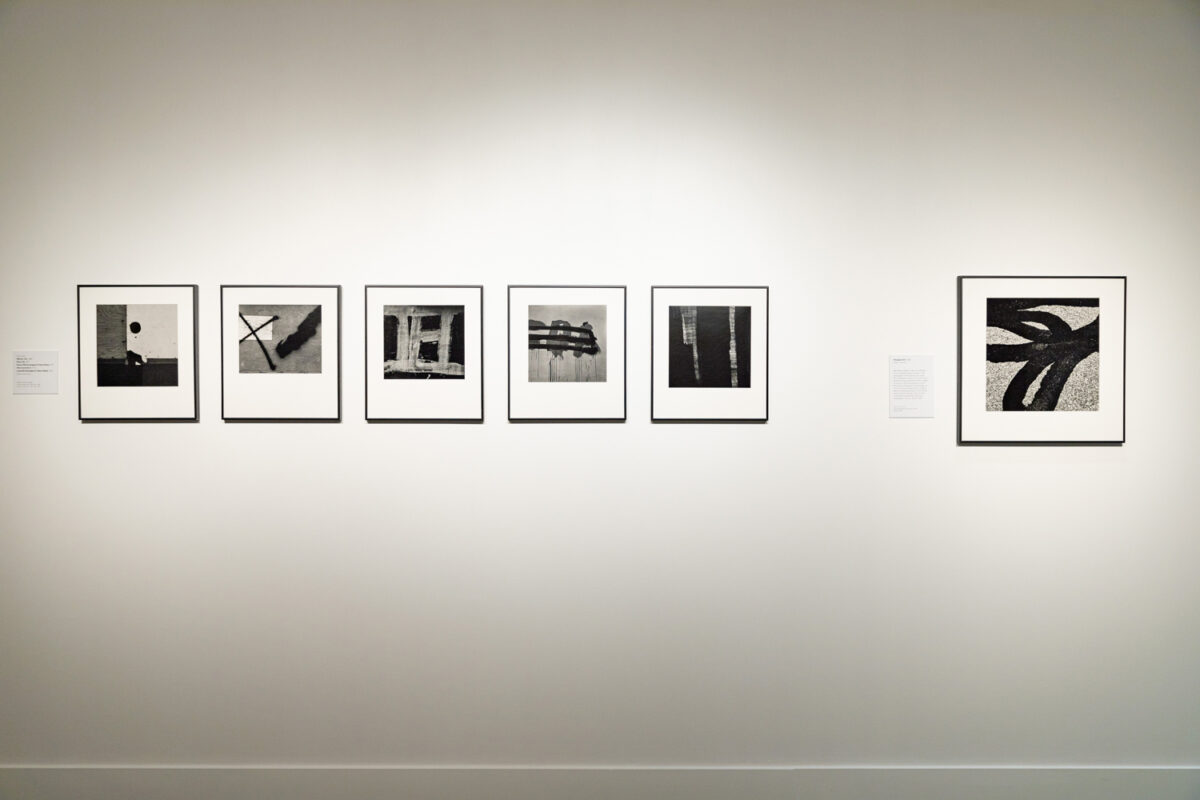
Influential photographer Aaron Siskind is celebrated through 55 works spanning his prolific career, all part of UMBC’s Photography Collections. Beginning with early documentary works Siskind made as part of the New York Film and Photo League in the 1930s and his groundbreaking abstract works of the 1940s and 1950s, the exhibition continues through phases of architectural studies, travel photography, and Siskind’s famous series focused on divers suspended in mid-air, “Terrors and Pleasures of Levitation.”
The Aaron Siskind exhibit in the AOK Library Gallery. (Melissa Penley Cormier, M.F.A. ’17, for Research Graphics)
Mind’s Eye in Toronto
WithMind’s Eye: The Psychic Photographs of Ted Serios, UMBC’s Special Collections has gone international. The Image Centre of Toronto Metropolitan University invited UMBC’s Curator of Exhibitions Emily Cullen to curate a show featuring one of AOK’s more fascinating collections, the Jule Eisenbud Collection on Ted Serios and Thoughtographic Photography.
Serios claimed to have the ability to psychically transfer his thoughts onto Polaroid film, a process called “thoughtography.” Chicago psychiatrist Jule Eisenbud investigated these claims, experimenting with Serios for several years in the mid-1960s, and the archive of those results is now part of UMBC’s permanent collection.
Mind’s Eye: The Psychic Photographs of Ted Serios opens at the IMC tomorrow, on view January 25–April 1!
]]>
UMBC’s art galleries are already in full bloom for the spring. With exhibits showcasing historic and innovative 20th century photography, interactive hip-hop data visualization, and the legacies...https://umbc.edu/stories/umbcs-galleries-deliver-interactive-art/https://my3.my.umbc.edu/api/v0/pixel/news/131356/guest@my.umbc.edu/5fd578a744572090ba95cb818c844cba/api/pixelaok-libraryarts-and-culturecadvccampus-lifeismagazinemedia-and-communication-studiesnewsspecial-collectionsvisual-artsUMBC News & Magazinehttps://my3.my.umbc.edu/groups/umbc-news-magazinehttps://assets1-my.umbc.edu/system/shared/avatars/groups/000/001/943/24435aa6207c452e7bc15cc74b42c7bb/xsmall.png?1748556657https://assets1-my.umbc.edu/system/shared/avatars/groups/000/001/943/24435aa6207c452e7bc15cc74b42c7bb/original.png?1748556657https://assets2-my.umbc.edu/system/shared/avatars/groups/000/001/943/24435aa6207c452e7bc15cc74b42c7bb/xxlarge.png?1748556657https://assets2-my.umbc.edu/system/shared/avatars/groups/000/001/943/24435aa6207c452e7bc15cc74b42c7bb/xlarge.png?1748556657https://assets3-my.umbc.edu/system/shared/avatars/groups/000/001/943/24435aa6207c452e7bc15cc74b42c7bb/large.png?1748556657https://assets1-my.umbc.edu/system/shared/avatars/groups/000/001/943/24435aa6207c452e7bc15cc74b42c7bb/medium.png?1748556657https://assets2-my.umbc.edu/system/shared/avatars/groups/000/001/943/24435aa6207c452e7bc15cc74b42c7bb/small.png?1748556657https://assets1-my.umbc.edu/system/shared/avatars/groups/000/001/943/24435aa6207c452e7bc15cc74b42c7bb/xsmall.png?1748556657https://assets2-my.umbc.edu/system/shared/avatars/groups/000/001/943/24435aa6207c452e7bc15cc74b42c7bb/xxsmall.png?1748556657UMBC News & Magazine10falseWed, 01 Mar 2023 14:37:02 -0500Wed, 01 Mar 2023 14:37:02 -0500The 9 Best Places on Campus to Enjoy Fresh Air
The Norwegians call it “friluftsliv”—the philosophy of spending time outdoors frequently, regardless of the weather. Or, as the Swedes put it, “There is no such thing as bad weather, only bad clothing.” These denizens of harsh northern climes aren’t just making the best of the cold—there’s a host of documented benefits to going outside.
“Research has demonstrated that spending time outdoors can improve physical health and emotional wellbeing, especially the more time you spend outdoors,” says Samantha Smith, associate director of health promotion at UMBC. “Whether taking a walk or just soaking up some natural sunlight, spending time outside can boost your mood, inspire creativity, help to reduce stress and anxiety-related symptoms, and increase your mobility and flexibility.”
In celebration of spending time outdoors in all seasons, here are a few of the best spots on and near campus to enjoy some fresh air in the new year.
1. Library Pond
The Library Pond sits at the north end of Academic Row between the AOK Library and Gallery and the Meyerhoff Chemistry Building. Surrounded by native vegetation, it is also a National Wildlife Federation Certified Wildlife Habitat. Ducks, songbirds, and the occasional heron enjoy the pond year round. The pond also supports a small population of catfish (but no fishing!). As a human, you can enjoy a brisk walk around the pond (approximately 500 steps) to get your blood flowing again after a serious bout of screen time, or enjoy your lunch at tables on the pond’s patio or the library’s terraced hillside nearby.
But wait, there’s more: Underneath the surface of the pond lies a complicated series of tunnels and reservoirs that enhances storm water management by preventing flooding and improving filtration of precipitation. The pond was completely gutted in 2013 and the current version completed in 2015, setting the stage for much better support of plants, animals, and the campus.
Circling the Library Pond is an invigorating stroll in any season.
2. Joseph Beuys Sculpture Park
The Joseph Beuys Sculpture Park is not your typical sculpture garden. In 2001, volunteers planted 30 trees on The Knoll, a wooded area between The Commons Garage and Administration Drive. Each tree has a stone at its base. The trees and stones compose a living artwork that emphasizes constant transformation: As the trees grow, the stones erode, shifting their relationship with each other and the landscape. The sculpture garden is modeled after a similar (but much larger) project in Kassel, Germany, which was installed in the 1980s and includes over 7,000 trees. At UMBC, three wooden benches are situated among the trees and one conceals a journal in a small cubby, where passersby are welcome to contribute their musings. The UMBC library archives store all of the completed journals.
When you visit the sculpture park, make sure to write down your thoughts in The Knoll’s shared journal.
As the campus has grown and expanded, The Knoll has remained intact thanks to the support of UMBC community members advocating for the green space over several decades. Today, the sculpture park is a highly valued and peaceful sanctuary that is expected to welcome many future generations of UMBC students.
3. Forum
Just outside the Performing Arts and Humanities Building, several large stone structures, almost like upside-down bookends, rise from the earth in ancient Greco-Roman style. Stools of various heights below the columns invite community members to have a seat and wax philosophical. Instructors conduct class discussions around the sculpture, named “Forum” by artist Thomas Sayre, and a colorful sky at sunset is often visible just across The Loop. The Ancient Studies department holds regular readings beneath Forum’s stately columns—even in winter.
Forum was the very first public art installation supported by the Maryland State Arts Council’s “Percent-for-Art” program, which requires new state-owned buildings to set aside a portion of their budgets for public art installations.
Forum draped in a dusting of snow.
4. Commons Terrace
The Commons Terrace, just south of The Commons and looking out on the quad and outdoor pool, is another great outdoor spot. With numerous tables, it’s the perfect locale to enjoy your lunch in any weather. (Make sure to properly sort your trash and compost and recycle whatever you can—even plastic bags can now be recycled in designated bins.) You might even get lucky and see an impromptu performance or tabling event. If it’s nice out, take advantage of the oversize Adirondack chairs on the terraced hillside leading down to the quad.
Find a few minutes to lift your face to the sun even on a chilly day on the Commons Terrace.
5. RAC Plaza
At the main entrance to campus, between the RAC and Administration Building, a handful of tables beckons students to study and socialize. The tables are equipped with umbrellas topped by solar panels that support charging ports, so there’s no need to go inside when your laptop runs out of juice. In fact, UMBC gets 40 percent of its energy from solar and other renewable sources. In early spring, as the campus is just shaking off the cold, enjoy the blooms of the star magnolia trees lined up along the RAC. And don’t forget to rub True Grit’s nose while you’re there!
The RAC plaza viewed from above. Solar panels perch on top of the tables’ umbrellas.
6. Admin Café Terrace
Just across Academic Row from the RAC, in front of the Administration Building, another small enclave of tables welcomes those enjoying a meal from the Admin Café or their own lunch bag. The seating area is protected by mint, bluestar, and more in a garden honoring former Vice President for Administration and Finance Mark Behm. Feel the crisp air and sunshine on your face as you dig into the café ‘s blue plate special, and ponder the meaning of the divided obelisk nearby.
The Admin Cafe Terrace in summer.
7. Erickson Field
Nothing like tossing a frisbee or football, playing soccer, or partaking in humans vs. zombies to warm you up on a cold day. Erickson Field, the large grassy area between the Library and new Center for Well-Being, is the place to go for casual outdoor sports. In fall, the UMBC Homecoming bonfire and movie showing also take place here.
Make new friends and hobbies by playing pick up games on Erickson Field.
8. Herbert Run Greenway
The Herbert Run, a tributary of the Patapsco River, meanders along the southeast quadrant of campus. The Herbert Run Greenway trail traces its path from the sculpture park, around the stadium complex, through the Conservation Environmental Research Area (a designated outdoor research space at UMBC), and toward bwtech@UMBC. The entire trail travels about 1.5 miles, but one of the trail’s highlights is accessible just steps from the campus entrance plaza. Visit the CERA Pond (previously known as Pig Pen Pond) just across The Loop from the Administration Drive Garage. Reach it via a footbridge flanked by two pollinator gardens. A duck house and a small viewing platform will greet you, and possibly some ducks and turtles, too. Currently, a portion of the trail near the stadium is undergoing a major stream restoration to improve habitat, stormwater management, and access to the stadium. It should be completed by mid-spring 2022.
The sidewalk (almost) ends at CERA Pond, right outside The Loop.Photo courtesy of Sarah Hansen.
9. Patapsco Valley State Park
For those interested in a bigger adventure, Patapsco Valley State Park’s Hilton, Glen Artney, Orange Grove, and Avalon areas are located just off campus. One of the premier mountain biking destinations in the state, the park is also popular for hiking, swimming, camping, and grilling at the park’s many pavilions. More than 30 miles of trails wind through the park, from the paved Grist Mill Trail along the Patapsco River to rocky, technical routes. Cascade Falls is a particularly popular destination. The park is also a great location for birdwatching and sighting other wildlife.
Cascade Falls at Patapsco State Park. Photo courtesy of Sarah Hansen.
As you can see, there are plenty of places to enjoy a brisk walk, a quiet moment, or a group activity on campus throughout the seasons. Just remember to grab your hat and gloves, and you won’t even notice the chill in the air.
“Just because it’s cold outside, doesn’t mean the outdoors is closed!” Smith reminds us. “Bundle up, grab your sunscreen, and enjoy the wonders and benefits of spending time outside all year long.”
*****
All photos courtesy of Marlayna Demond ’11, unless otherwise noted.
]]>
The Norwegians call it “friluftsliv”—the philosophy of spending time outdoors frequently, regardless of the weather. Or, as the Swedes put it, “There is no such thing as bad weather, only bad...https://umbc.edu/stories/the-9-best-places-on-campus-to-enjoy-fresh-air/https://my3.my.umbc.edu/api/v0/pixel/news/119485/guest@my.umbc.edu/6947127a278c9cfb86db8af6dfc098c8/api/pixelaok-librarycampuscampus-lifecurrentforummagazinepabhracsculpture-parkthe-commonsUMBC News & Magazinehttps://my3.my.umbc.edu/groups/umbc-news-magazinehttps://assets1-my.umbc.edu/system/shared/avatars/groups/000/001/943/24435aa6207c452e7bc15cc74b42c7bb/xsmall.png?1748556657https://assets1-my.umbc.edu/system/shared/avatars/groups/000/001/943/24435aa6207c452e7bc15cc74b42c7bb/original.png?1748556657https://assets2-my.umbc.edu/system/shared/avatars/groups/000/001/943/24435aa6207c452e7bc15cc74b42c7bb/xxlarge.png?1748556657https://assets2-my.umbc.edu/system/shared/avatars/groups/000/001/943/24435aa6207c452e7bc15cc74b42c7bb/xlarge.png?1748556657https://assets3-my.umbc.edu/system/shared/avatars/groups/000/001/943/24435aa6207c452e7bc15cc74b42c7bb/large.png?1748556657https://assets1-my.umbc.edu/system/shared/avatars/groups/000/001/943/24435aa6207c452e7bc15cc74b42c7bb/medium.png?1748556657https://assets2-my.umbc.edu/system/shared/avatars/groups/000/001/943/24435aa6207c452e7bc15cc74b42c7bb/small.png?1748556657https://assets1-my.umbc.edu/system/shared/avatars/groups/000/001/943/24435aa6207c452e7bc15cc74b42c7bb/xsmall.png?1748556657https://assets2-my.umbc.edu/system/shared/avatars/groups/000/001/943/24435aa6207c452e7bc15cc74b42c7bb/xxsmall.png?1748556657UMBC News & Magazine00falseFri, 21 Jan 2022 20:19:18 -0500How To Become a Fanzine Fan
With Susan Graham ’98, VPA & Anthropology, Special Collections Librarian at UMBC
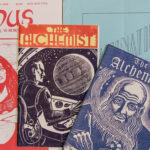
Since the early 1900s, fans of science fiction and fantasy have produced thousands upon thousands of “fanzines” to showcase writing and art, discuss literature and politics of the era, and build community among fellow fans. Often produced by amateur editors, they have titles like Janus and Mirage and If!, and many are stapled together, copied by mimeograph, or even colored by hand. Many are filled with in jokes and turns of phrase meant to delight and engage a very specific — and passionate — readership.
These publications are unique, fun, and meant to be enjoyed. But, if you’ve never tried reading one, much less becoming an honest to goodness fanzine fan, where do you begin? Well, it just so happens that the Special Collections department of the Albin O. Kuhn Library houses the Coslet-Sapienza Fantasy and Science Fiction Fanzine Collection, which contains tens of thousands of amateur press science fiction and fantasy magazines produced from 1937 to 72. Among the collection you can find early works by famous authors like Ray Bradbury and Isaac Asimov, as well as undiscovered talents from across the genres.
Special Collections librarian Susan Graham ’98, is here to walk us through a few easy steps anyone can take to blast warp speed ahead into this exciting new (old, really) universe of literature. The key, of course, is knowing what to ask.
TOOLS OF THE TRADE
A friendly librarian — like Susan!
A section of great zines — like UMBC’s Coslet-Sapienza Fantasy and Science Fiction Collection.
A bookish sense of adventure!
STEP 1: WHAT IS A FANZINE ANYWAY?
Fanzines are amateur publications that are created by fans of a particular genre of work for other fans of that genre. Work of this sort spans not only science fiction and fantasy, but also horror, mystery, crime, and other genres. The first American fanzine was called The Comet and published in May 1930, and the first use of the word “fanzine” was in the October 1940 issue of Detours, a hand-written mimeographed publication on hand in Special Collections.
So, what’s inside?
“They often had letters to the editor with fans discussing the works of other established writers…but they were also a venue for aspiring writers to write their own stories and artists who contributed artwork. There were poems, inside jokes,” as well as plans for get-togethers and conventions, Graham says. “Sometimes authors would even write in and have this sort of relationship with the fans” that kept them reading issue after issue.
STEP 2: HOW CAN I FIND FANZINES TO LOOK AT, AND WHAT KINDS ARE AVAILABLE?
Because their history is so deep and interesting, much is to be found online about fanzines and their background. Many titles from the Coslet-Sapienza collection are digitized and available via the UMBC Library website, where it’s easy to quickly learn about a range of titles and topics — from war to feminism — and even find out how to see them first-hand on campus.
Over the summer, a group of students new to fanzines spent several weeks exploring the collection through the CoLab program, digging deep into titles that interested them, and ultimately creating an online resource for people interested in the literature.
“They produced a great online exhibit that talks all about fanzines and how they were created,” says Graham. “If you’re just starting out, it’s a great place to begin.”
STEP 3: HOW CAN I LEARN MORE ABOUT THE FANZINE COMMUNITY?
Much like immersing oneself in the language of an undiscovered country, learning the ins and outs of fanzines can take some deep study. Much like travel, you can also easily lose yourself in the splendor of fanzine culture.
One great doorway in is through the library’s collections of Fantasy Amateur Press Association (FAPA) materials. A quick flip through some of their newsletters can give you a host of details about what readers enjoyed, and how they communicated with each other, Graham says.
Another is The Fillostrated Fan Dictionary by Elliot Weinstein, also on hand at the library, which offers definitions for hundreds of fandom-specific terms you didn’t even know you didn’t know. (Like “Bolega,” a “mythical fannish liquor,” or “Helicopter Beanie,” the “stereotyped head gear worn by all neo type fans,” to name just a couple.)
But, nothing quite compares to holding a fanzine in your hands and imagining who made it, says Graham.
“One thing that’s really special about fanzines is that some of them can look really homemade,” with original drawings and hand bindings that show the depth of commitment of the publisher, says Graham. “This was somebody’s passion, they loved it, they wanted to get work out there. They wanted to be a part of this community.”
The More You Know
Ready to get started? Here are some resources to get you on your way to fanzine fandom.
Fanzine Lib Guide: Visit this guide online for history of fanzines, links to searches within the Coslet-Sapienza collection, digital copies of fanzines, and information on how to visit the collection in person. lib.guides.umbc.edu/fanzines
Zine Wiki: Use this open-source encyclopedia devoted to zines and independent media to find out about a larger swath of zines, including history, production, distribution, and culture of the small press. Zinewiki.com
]]>
With Susan Graham ’98, VPA & Anthropology, Special Collections Librarian at UMBC Since the early 1900s, fans of science fiction and fantasy have produced thousands upon thousands of...https://umbc.edu/stories/how-to-become-a-fanzine-fan/https://my3.my.umbc.edu/api/v0/pixel/news/120247/guest@my.umbc.edu/bf6b7018b308884b594af6bc37b7e555/api/pixelaok-librarydiscoveryfall-2018how-toUMBC News & Magazinehttps://my3.my.umbc.edu/groups/umbc-news-magazinehttps://assets1-my.umbc.edu/system/shared/avatars/groups/000/001/943/24435aa6207c452e7bc15cc74b42c7bb/xsmall.png?1748556657https://assets1-my.umbc.edu/system/shared/avatars/groups/000/001/943/24435aa6207c452e7bc15cc74b42c7bb/original.png?1748556657https://assets2-my.umbc.edu/system/shared/avatars/groups/000/001/943/24435aa6207c452e7bc15cc74b42c7bb/xxlarge.png?1748556657https://assets2-my.umbc.edu/system/shared/avatars/groups/000/001/943/24435aa6207c452e7bc15cc74b42c7bb/xlarge.png?1748556657https://assets3-my.umbc.edu/system/shared/avatars/groups/000/001/943/24435aa6207c452e7bc15cc74b42c7bb/large.png?1748556657https://assets1-my.umbc.edu/system/shared/avatars/groups/000/001/943/24435aa6207c452e7bc15cc74b42c7bb/medium.png?1748556657https://assets2-my.umbc.edu/system/shared/avatars/groups/000/001/943/24435aa6207c452e7bc15cc74b42c7bb/small.png?1748556657https://assets1-my.umbc.edu/system/shared/avatars/groups/000/001/943/24435aa6207c452e7bc15cc74b42c7bb/xsmall.png?1748556657https://assets2-my.umbc.edu/system/shared/avatars/groups/000/001/943/24435aa6207c452e7bc15cc74b42c7bb/xxsmall.png?1748556657UMBC News & Magazine00falseMon, 17 Dec 2018 18:31:00 -0500Video: Eclipse-Watching, UMBC Style
Along with the rest of the country, members of the UMBC community came together to try to catch a glimpse of August’s total eclipse of the sun. Although Maryland was not in the “path of totality,” the 80% view from Catonsville still elicited the “oohs” and “ahs” of bespectacled Retrievers in front of the Albin O. Kuhn Library – where staff offered demonstrations in pinhole viewer construction – and around campus.
[nivoslider id=”8382″]
Photos by Marlayna Demond ’11
]]>
[Video] Along with the rest of the country, members of the UMBC community came together to try to catch a glimpse of August’s total eclipse of the sun. Although Maryland was not in the “path of...https://umbc.edu/stories/eclipse/https://my3.my.umbc.edu/api/v0/pixel/news/120679/guest@my.umbc.edu/f67129551c00cf5b45dcb5c8a62a3c24/api/pixelaok-librarycampus-lifeeclipsevideoswebweb-extrasUMBC News & Magazinehttps://my3.my.umbc.edu/groups/umbc-news-magazinehttps://assets1-my.umbc.edu/system/shared/avatars/groups/000/001/943/24435aa6207c452e7bc15cc74b42c7bb/xsmall.png?1748556657https://assets1-my.umbc.edu/system/shared/avatars/groups/000/001/943/24435aa6207c452e7bc15cc74b42c7bb/original.png?1748556657https://assets2-my.umbc.edu/system/shared/avatars/groups/000/001/943/24435aa6207c452e7bc15cc74b42c7bb/xxlarge.png?1748556657https://assets2-my.umbc.edu/system/shared/avatars/groups/000/001/943/24435aa6207c452e7bc15cc74b42c7bb/xlarge.png?1748556657https://assets3-my.umbc.edu/system/shared/avatars/groups/000/001/943/24435aa6207c452e7bc15cc74b42c7bb/large.png?1748556657https://assets1-my.umbc.edu/system/shared/avatars/groups/000/001/943/24435aa6207c452e7bc15cc74b42c7bb/medium.png?1748556657https://assets2-my.umbc.edu/system/shared/avatars/groups/000/001/943/24435aa6207c452e7bc15cc74b42c7bb/small.png?1748556657https://assets1-my.umbc.edu/system/shared/avatars/groups/000/001/943/24435aa6207c452e7bc15cc74b42c7bb/xsmall.png?1748556657https://assets2-my.umbc.edu/system/shared/avatars/groups/000/001/943/24435aa6207c452e7bc15cc74b42c7bb/xxsmall.png?1748556657UMBC News & Magazine00falseWed, 13 Sep 2017 18:50:50 -0400Legend of Excellence
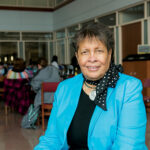
During her years as an undergrad at UMBC, Karen Sutton ’97, history, would constantly see Simmona Simmons ’74, American studies, working quietly in the library. Even today, when she stops in the Albin O. Kuhn Library, she sees Simmons and smiles, for even the sight of the librarian still inspires Sutton to pursue her goals.
“I (wanted to) become a librarian vicariously through her,” says Sutton, a lecturer at UMBC. “I plan to use the skills Simmona taught me to inspire others.”
Despite the major impact she tends to have on the lives of others, Simmons has always kept a low profile. Described as modest, quiet, and unassuming, Simmons maintains that people should be measured by their actions. And after more than fifty years of service at UMBC, she certainly has a lot to be measured by, quietly inspiring others – sometimes without even knowing it.
This year, Simmons, along with three other UMBC faculty members will be honored with the Legends of Excellence Award – a tribute that acknowledges faculty members and staff who have made an impact on UMBC’s African and Latino students. Serving on the library staff since the school opened in 1966, and through her role as library liaison, Simmons has had the opportunity to work with countless staff and students.
“My tenure at the Albin O. Kuhn Library & Gallery has been rewarding because I have had the opportunity to work with students, faculty, and staff, answering interesting queries and assisting with their research needs,” she says. “I have always loved working with the students; as they discover new information and as they mature, it is exciting to contribute a small part to their success.”
Simmons is also one of the founders of the UMBC Women’s Center which first opened in 1991, serving on its advisory board. Along with other founders, she pressed for the Center to be on the “footpath” of campus, ensuring that it be, as it is now, centrally located in The Commons for students to easily access.
“What I have learned from Simmona,” says Jess Myers, Director of the Women’s Center, “is that the work and its impact is most important and getting credit is less important.” Though she keeps out of the spotlight, Simmons is hardly inaccessible.
Through these various roles on campus she has made herself available to the student body, and she thrives on the role of mentorship in bettering one’s career. She often encourages students to seek out community and role models.
“Coming from a background where your parents aren’t educated,” says Simmons, referring to her own childhood, students need to find people who can help them make their way through academia.
“Identify a person that is doing what (you) want to do and hitch (your) wagon to that person,” she says. “Just go for coffee with them and ask them five questions.”
Simmons cites Dr. Gloria Oden, poet and former professor in the English department, as her professional inspiration even across the disciplines, recalling Oden’s constant encouragement to strategize and read better sources, and even to pursue writing for various publications and encyclopedias as a means to continue on in her professional development.
Everyone relies on the same tools to pursue their goals, regardless of family background or academic interests. And anyone can encourage others to use these tools: a poet from the English Department inspires a librarian in the American Studies department who inspires an instructor in the African American studies department.
Simmons has made sure that she can be a resource for students and even for other faculty, learning from those who have helped her in her career how to best help others.
— Kristen Russell
]]>
During her years as an undergrad at UMBC, Karen Sutton ’97, history, would constantly see Simmona Simmons ’74, American studies, working quietly in the library. Even today, when she stops in the...https://umbc.edu/stories/legend-of-excellence/https://my3.my.umbc.edu/api/v0/pixel/news/120751/guest@my.umbc.edu/22bc653be9a3f8c1ea4308de2fcce7c8/api/pixelalumniamerican-studiesaok-librarycahsslegends-of-excellencesimmona-simmonsspring-2017UMBC News & Magazinehttps://my3.my.umbc.edu/groups/umbc-news-magazinehttps://assets1-my.umbc.edu/system/shared/avatars/groups/000/001/943/24435aa6207c452e7bc15cc74b42c7bb/xsmall.png?1748556657https://assets1-my.umbc.edu/system/shared/avatars/groups/000/001/943/24435aa6207c452e7bc15cc74b42c7bb/original.png?1748556657https://assets2-my.umbc.edu/system/shared/avatars/groups/000/001/943/24435aa6207c452e7bc15cc74b42c7bb/xxlarge.png?1748556657https://assets2-my.umbc.edu/system/shared/avatars/groups/000/001/943/24435aa6207c452e7bc15cc74b42c7bb/xlarge.png?1748556657https://assets3-my.umbc.edu/system/shared/avatars/groups/000/001/943/24435aa6207c452e7bc15cc74b42c7bb/large.png?1748556657https://assets1-my.umbc.edu/system/shared/avatars/groups/000/001/943/24435aa6207c452e7bc15cc74b42c7bb/medium.png?1748556657https://assets2-my.umbc.edu/system/shared/avatars/groups/000/001/943/24435aa6207c452e7bc15cc74b42c7bb/small.png?1748556657https://assets1-my.umbc.edu/system/shared/avatars/groups/000/001/943/24435aa6207c452e7bc15cc74b42c7bb/xsmall.png?1748556657https://assets2-my.umbc.edu/system/shared/avatars/groups/000/001/943/24435aa6207c452e7bc15cc74b42c7bb/xxsmall.png?1748556657UMBC News & Magazine00falseFri, 26 May 2017 19:03:55 -0400


 A letterpress and zine swap were highlights for BookFest attendees.
 Left: Students got to stitch together their own books at BookFest. Right: So many books, so little time!
 Jenny O’Grady, assistant vice president for communications, (right), shares her love of bookmaking with students at BookFest.
]]>
Jenny O’Grady, assistant vice president for communications, (right), shares her love of bookmaking with students at BookFest.
]]>
 UMBC’s proximity to Camden Yards makes for a great trip to cheer on the Orioles! (Image courtesy of Bandy)
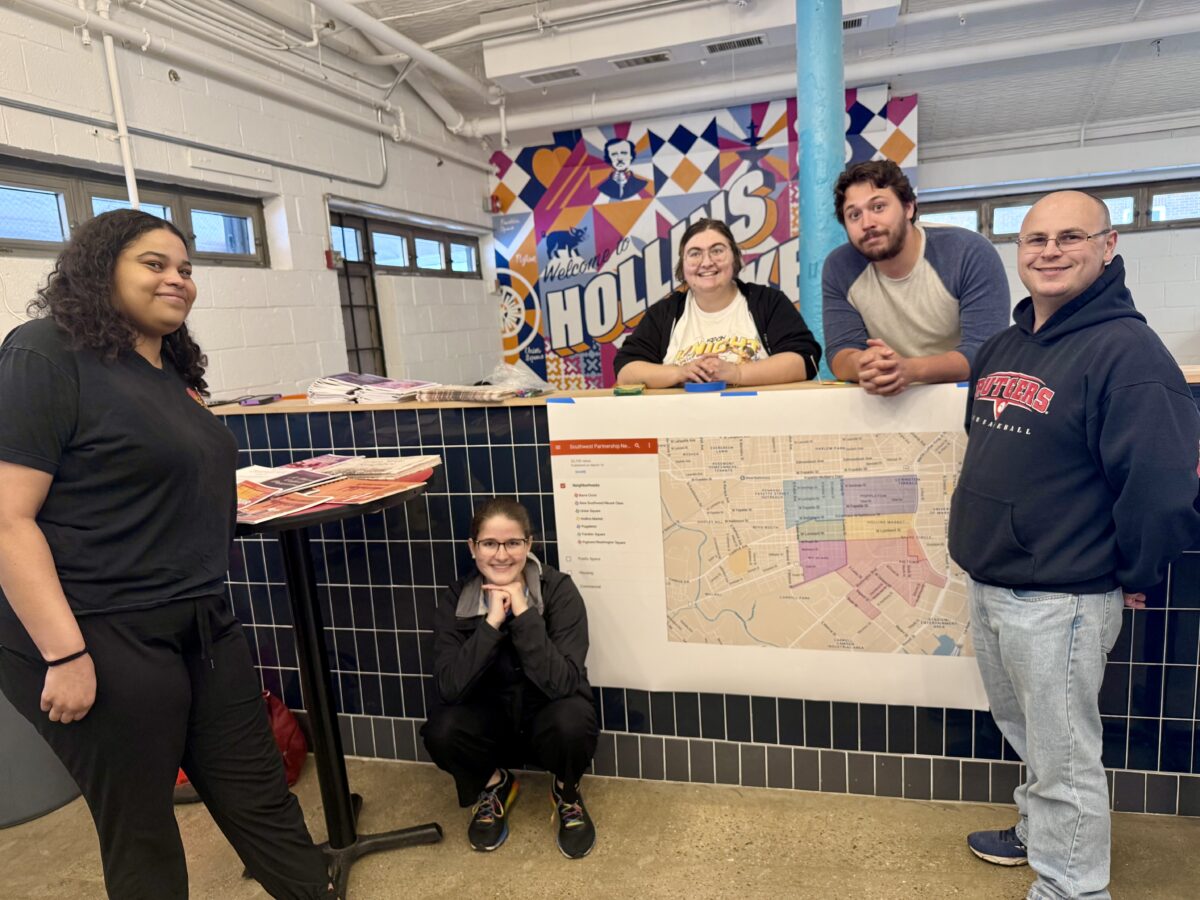 Students from King’s class, “Preserving Spaces, Making Spaces in Baltimore,” participated in a Community Archiving Day event. The class planned this event to engage with residents and community members from neighborhoods in Southwest Baltimore and to gauge interest in developing a Community Archive to preserve their histories. (l-r) Amina Thiam ’24, history, Em Schumacher, a geography and environmental systems senior, Bandy, Tristan Diaz ’25, cultural anthropology and sociology, and Bandy’s fiancé, Max Taylor (who is not a UMBC student). (Image courtesy of King)
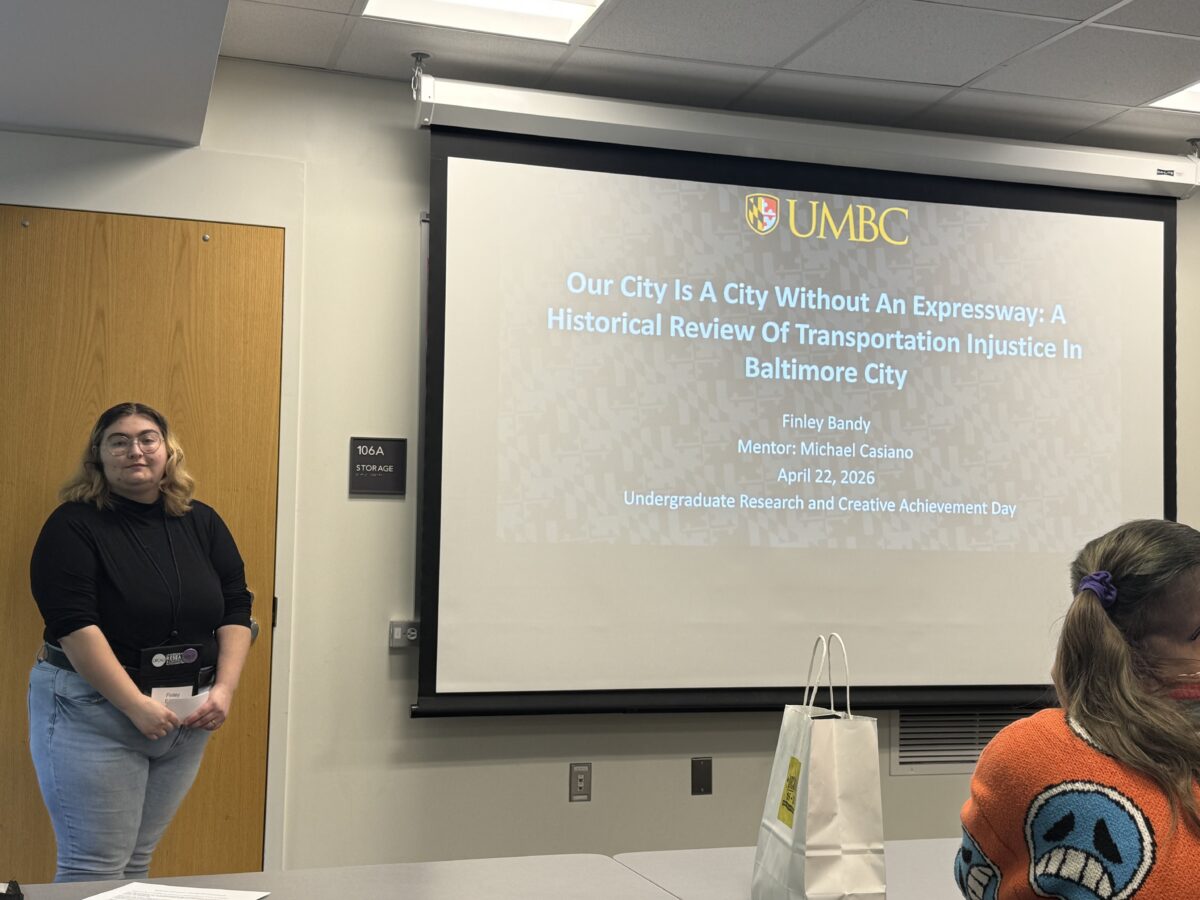 Bandy presents her research at the 2026 Undergraduate Research and Creative Achievement Day. (Image courtesy of King.)

 A group of students running the 2022 Earth Day 3K on campus.
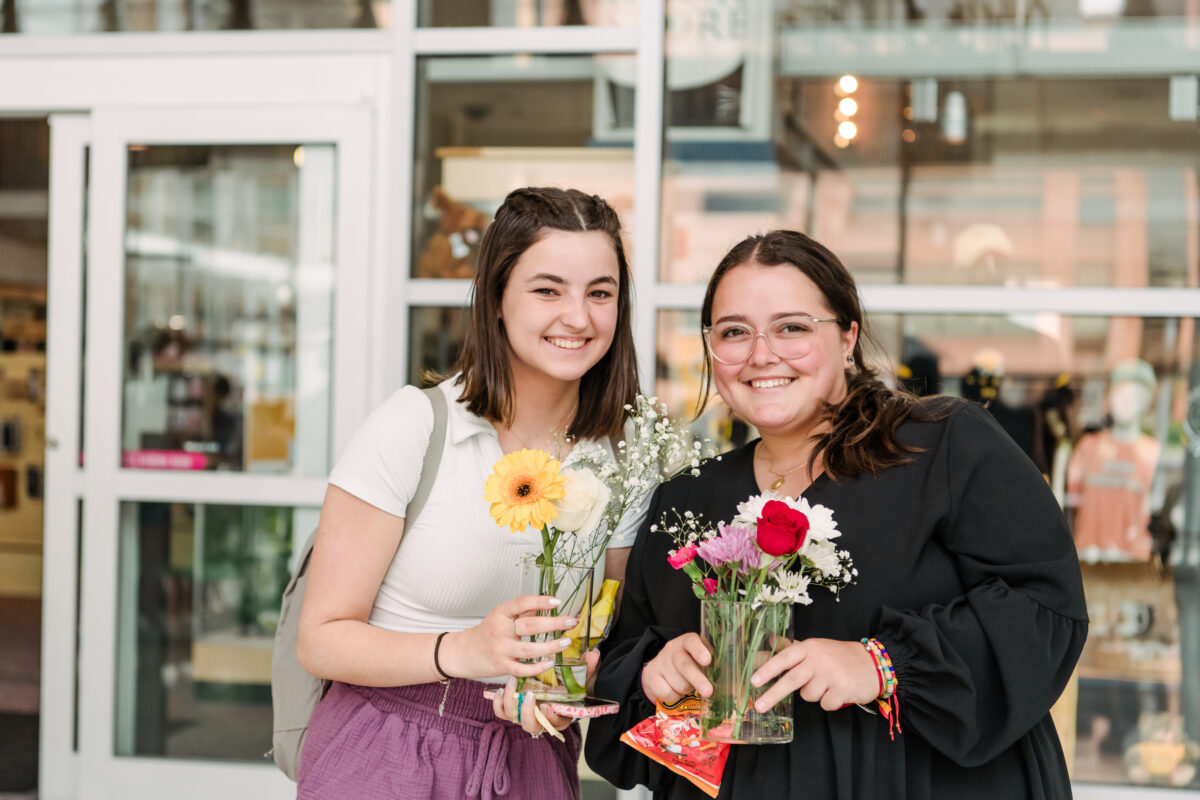 Students gathered in The Commons to make bouquets of flowers in spring 2023. (Marlayna Demond ’11/UMBC)

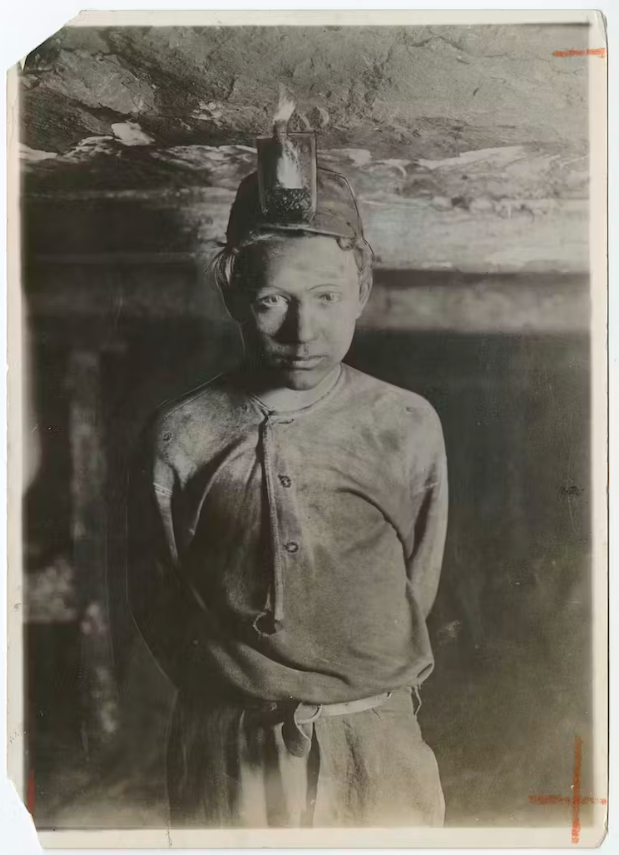 Lewis Wickes Hine, ‘Trapper Boy, Turkey Knob Mine, MacDonald, West Virginia, 1908.’ Gelatin silver print. 5 x 7 in. The Photography Collections, University of Maryland, Baltimore County (P148), CC BY-SA
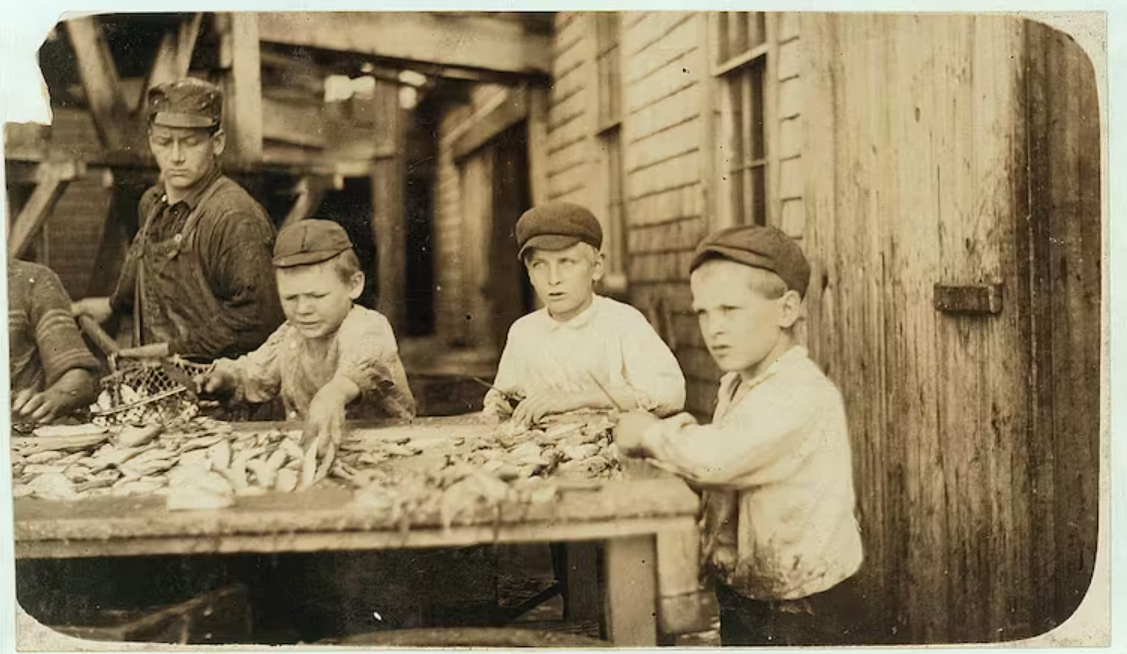 Lewis Wickes Hine’s photograph of three young fish cutters working at the Seacoast Canning Co. in Eastport, Maine. National Child Labor Committee collection, Library of Congress, Prints and Photographs Division
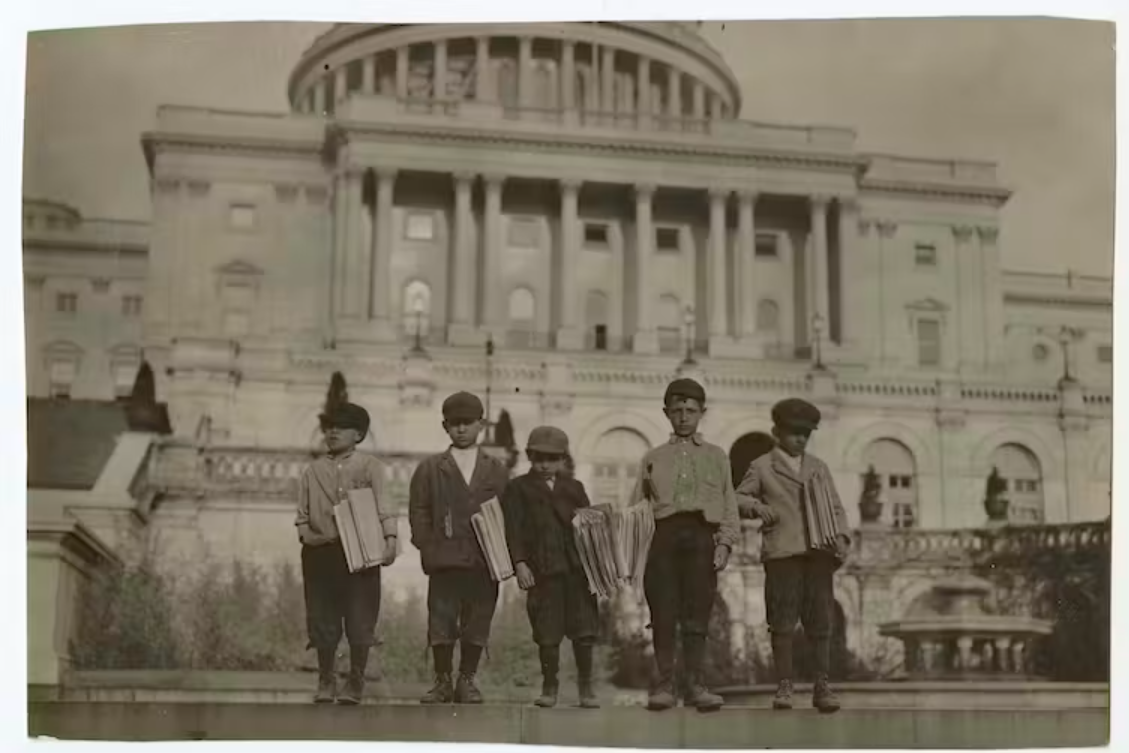 Lewis Wickes Hine, ‘Group of newsies selling on Capitol steps, April 11, 1912.’ The Photography Collections, University of Maryland, Baltimore County (P2904), CC BY-SA
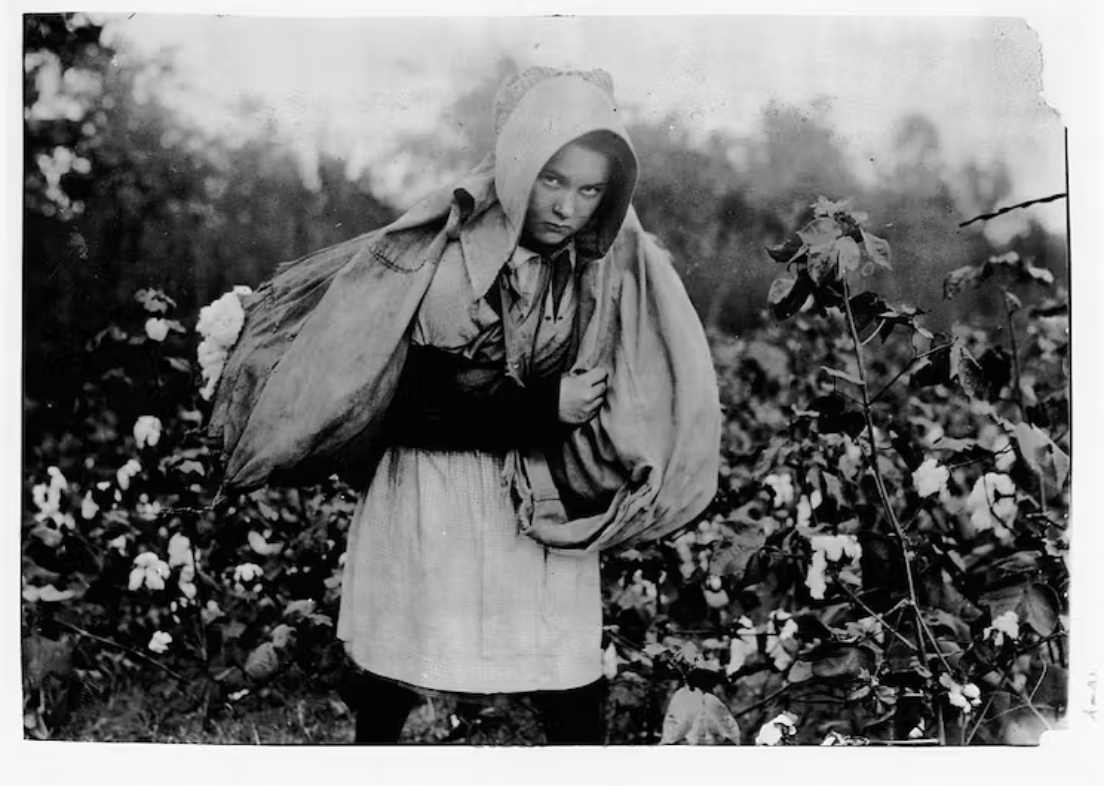 A young picker carries a large sack of cotton on her back. Lewis Wickes Hine/Library of Congress via Getty Images
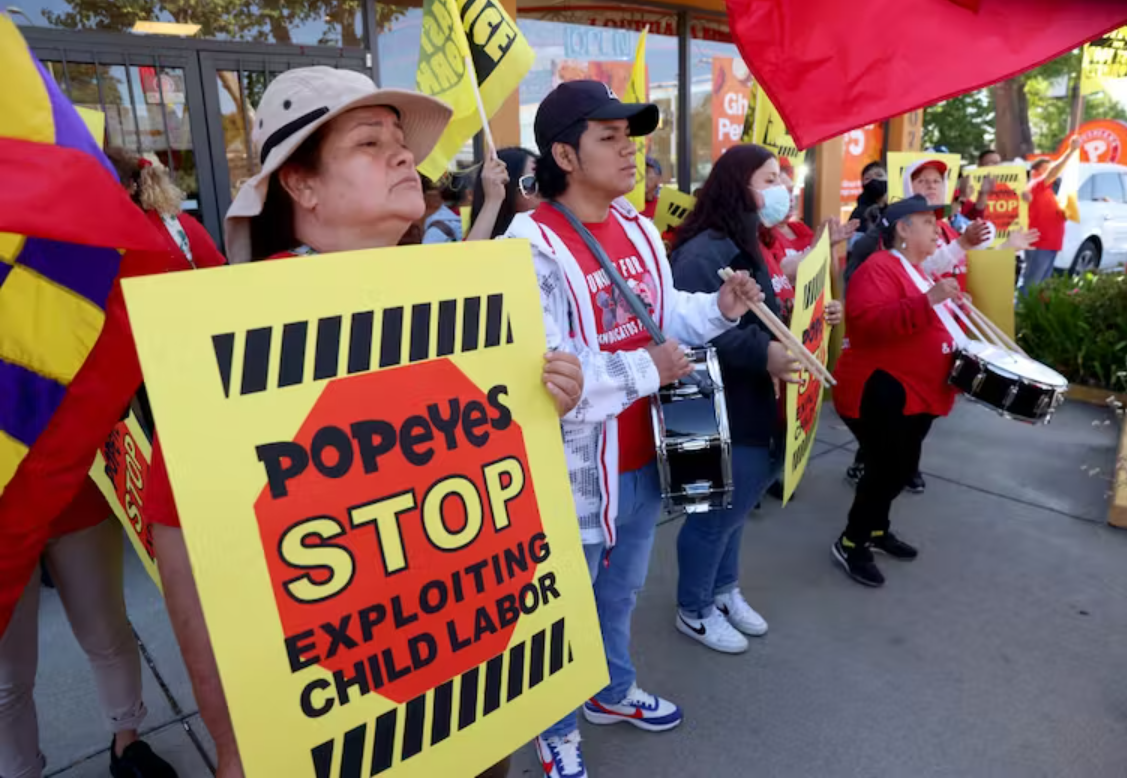 Workers protest outside a Popeye’s restaurant in Oakland, Calif., on May 18, 2023, after reports emerged of the franchise exploiting child labor. Jane Tyska/Digital First Media/East Bay Times via Getty Images
 Data visualization from Hemphill’s Rap Research Lab at the CADVC. (Marlayna Demond ’11/UMBC)
 Hamidi, left, and Hemphill, right, talk through data visualization. (Marlayna Demond ’11/UMBC)
 Sonya Clark’s Hair/Craft exhibit at the AOK Library Gallery. (Melissa Penley Cormier, M.F.A. ’17, for Research Graphics)
 The Aaron Siskind exhibit in the AOK Library Gallery. (Melissa Penley Cormier, M.F.A. ’17, for Research Graphics)