Zareen Taj earns her Ph.D., publishing the first autoethnography by a Hazara Afghan woman about the ongoing genocide of Hazara women under Taliban rule
This spring on Thursday evenings, students filled room 424 in the Fine Arts building for their Asian Diaspora in Motion: Media, Culture, Identity, and Activism class. At the head of the classroom was Zareen Taj, who designed the new 300-level class based on her experiences as a documentary filmmaker and activist defending the rights of her community—the Hazara women of Afghanistan, a community that has for over a century experienced extreme ethnic, religious, and gender oppression, including multiple massacres and starvation, under Taliban rule.
It’s a reality Taj grew up with as part of the Hazara people, a religious and ethnic minority. In the 1990s, when the Taliban increased their killings of the Hazara people, Taj and her family fled to a refugee settlement in Pakistan. There, Taj started speaking out against the systemic oppression of Hazara women. Her activism made her a Taliban target. With a scholarship from the Feminist Majority Foundation, Taj fled once more, this time to Towson University, where she earned a bachelor’s in political science and women’s studies and a master’s in women’s studies.
After graduation, Taj worked for Voice of America as an international broadcaster and producer. At UMBC, she worked for Chartwells in the HR department first and then as an accounting associate at The Shriver Center. A year later, Taj was accepted into the language, literacy, and culture (LLC) doctoral program. During her studies, she raised two children and created four short documentaries about Hazara women while teaching in the global studies, Asian studies, and American studies departments.
This semester, Taj successfully defended her dissertation, “Journey of a Scholar-Activist: An Autoethnographic and Multimodal Inquiry,” which includes written narratives and her fourth documentary short film titled “For My People.” The project marks the first time she took the time and space to reflect on her life.
“I learned from this journey that I am different. I look different. I work differently. I see things differently, but my difference is not a problem,” says Taj about her experience at UMBC, where she hopes to become a professor. “My experience is an asset. It’s my wealth. The UMBC community, particularly the LLC and my professors, were very supportive of what I’m doing. So they supported me at each stage of my life.”
Q: What was your journey to UMBC?
A: I studied in a refugee displacement settlement in Pakistan, so it was very hard. But I got the Feminist Majority Scholarship and moved to Maryland in 2000 to attend Towson University. I could not speak English well. I saw a computer for the first time in my life. It was very hard because I came from a very war-torn country. We don’t have that advanced education system, and it’s often interrupted by war. Every minute, I reminded myself about the other Afghan girls who didn’t have this opportunity, so I couldn’t give up.
I always wanted to get a Ph.D. That was my dream. I put all of my experiences into my academic world. In 2018, I applied to the LLC doctoral program. I talked with Carole McCann, professor of gender, sexuality, and women’s studies, about what I wanted to do. She said yes to being my advisor right away. Joby Taylor, Ph.D. ’05, assistant vice provost and co-leader of The Shriver Center for Public Service and Community Engagement, and Tania Lizarazo, associate professor of modern languages, linguistics, and intercultural communication, and global studies, also lent their support as co-chairs.
Q: How did you decide on the topic for your dissertation?
A: My master’s thesis, titled “Dual Identity, Dual Oppression of Hazara Women,” didn’t follow the same research path as a traditional thesis because there were no official documents that I could use for my research. I felt frustrated. My thesis was informed by my firsthand research trips to Afghanistan. This work represents the first contribution of its kind in the academic field. My personal experiences and frustrations motivated me to return to my country, which ultimately shaped and grounded the development of my thesis.
For my dissertation, my committee wanted me to talk about myself, to write a book. I appreciated them encouraging me, but I continued to focus on Hazara women until Dr. Tanya Saunders, associate professor of sociology, pointed out all the different types of ethnography I was doing and encouraged me to focus on myself to do an autoethnography. I was surprised that I could do that, and that’s how I started.
That gave me a kind of confidence in my writing. I’m always reflecting on all of these things I’m doing, but not reflecting on myself. I never had the chance, or I never thought of doing it. I never thought I would be allowed to talk about myself, so I didn’t. I come from a culture where we never talk about ourselves because this is taboo. Women would be told, “Why are you talking about yourself? We have bigger issues, bigger things to talk about.” That’s the culture, especially for Hazara women. We never talk about ourselves, our pain, our joy. Everything is internalized.
I am reaching a stage of very clear realizations about how this academic process is a very healing process for me. I’m making my people visible and bringing awareness to the cause. We’ll get to know people, my people, my ethnicity, their suffering, and also the resilience of these women.
Q: Why was this dissertation process a healing process?
A: My short documentary, “For My People,” which I produced for my dissertation, helped me process the anger and isolation I have carried after years of fighting for survival and against oppression. This process led to exploration and, for the first time, I explored healing and the shift to joy, community, and belonging I have found with the Hazara women who resettled in Washington, D.C., my global network of activists, and my UMBC community.
The more work I’m doing in the form of writing an article, creating films, or public speaking, the more visibility I have to those dimensions, those identities. It’s helping me feel that I do justice for them. That’s the process of healing. The more I work to bring community sustainability and collectiveness, the stronger my sense of belonging, satisfaction, and deep attachment to my community.
Q: What inspired the topics for your other films?
A: I was doing my master’s thesis about Hazara women, but there wasn’t much data. I decided to go back to Afghanistan for the first time since fleeing Pakistan to document the living conditions and experiences of Hazara women living under the fear of genocide. When I returned, I had 40 hours of videotapes, 700 photographs, and 20 hours of cassette recordings that helped me make my first film, “The Oppression of Hazara in Afghanistan.”
But I didn’t just want to show the oppression of Hazara women as victims. I wanted to show the resistance and leadership of Hazara women. After the fall of the last Afghan government in 2021, some Hazara refugees came to the Washington, D.C., Maryland, Virginia area. We have a lot of activists and advocates like Azra Jafari, the first woman in Afghanistan to hold the office of mayor. They were willing to be interviewed for “Our Face Tells: Seeing the Genocide of Hazaras in Afghanistan.”
Last year, I collaborated with several organizations and led efforts to train Hazara women to create and share their own stories. The Hazara Women of Afghanistan Share Digital Stories event trained and supported Hazara women to tell their own stories. That inspired “Voices of Resistance.”
Q: How have you passed on your documentary film skills to your students?
A: UMBC has given me so much and helped me to contribute to it. I taught three years in the global studies program as a visiting lecturer, and I designed, established, and taught Global Studies 409: Documentary Film as Global Activism. Students had to make a documentary about their families from any part of the world. They had to document where their identity and sense of belonging came from. Their films reflected their family backgrounds as well as their personal passions and engagement with social issues.
I still remember a student whose grandparents came from Ethiopia. His film was about them, and afterwards told me that when he was given the assignment, he said to himself, “If this lady, this lady from Afghanistan, can do these films, I can do that too.” It made me smile
Q: Looking back on everything that you have experienced and accomplished, has your purpose changed?
A: In 2021, when the Taliban returned, it was like the loss of a 20-year-old child. It was hard not to despair. But in all the chaos, some Hazara were able to get out and needed help arriving to live in the United States. That service rescued me from that vulnerable situation. Community work changed me again. It lifted me up.
 Zareen Taj (first row, second from the left), at the Hazara Women of Afghanistan Share Digital Stories event. (Image courtesy of Taj.)
After the Hazara Women of Afghanistan Share Digital Stories event, I realized I do not need to feel the responsibility to speak for Hazara women, as they are now able to articulate and share their own stories with the world. This is my message for Hazara around the world, especially Hazara women who feel like their stories do not matter. You need to tell your story because your story is our history. And your story is our future. Sharing our stories will hold us together and make us known to the world.
]]>
This spring on Thursday evenings, students filled room 424 in the Fine Arts building for their Asian Diaspora in Motion: Media, Culture, Identity, and Activism class. At the head of the classroom...
https://umbc.edu/stories/zareen-taj-publishes-first-autoethnography-by-a-hazara-afghan-woman/
Video Preview
https://assets4-my.umbc.edu/system/shared/attachments/a92d77fcb8fdf3737c0fba90c9c4b0b7/6a9cd7be/news/000/159/731/e0c4ba8f6e02c02ed67cc30334e8c183/2498820.jpg?1778009707
https://my3.my.umbc.edu/api/v0/pixel/news/159731/guest@my.umbc.edu/f9e9ea2143bc436276841dd469489856/api/pixel
asianstudies
cahss
class-of-2026
global-studies
gwst
international
language-literacy-and-culture
mlli
news
policy-and-society
saph
shrivercenter
story
UMBC News & Magazine
https://my3.my.umbc.edu/groups/umbc-news-magazine
https://assets1-my.umbc.edu/system/shared/avatars/groups/000/001/943/24435aa6207c452e7bc15cc74b42c7bb/xsmall.png?1748556657
https://assets1-my.umbc.edu/system/shared/avatars/groups/000/001/943/24435aa6207c452e7bc15cc74b42c7bb/original.png?1748556657
https://assets2-my.umbc.edu/system/shared/avatars/groups/000/001/943/24435aa6207c452e7bc15cc74b42c7bb/xxlarge.png?1748556657
https://assets2-my.umbc.edu/system/shared/avatars/groups/000/001/943/24435aa6207c452e7bc15cc74b42c7bb/xlarge.png?1748556657
https://assets3-my.umbc.edu/system/shared/avatars/groups/000/001/943/24435aa6207c452e7bc15cc74b42c7bb/large.png?1748556657
https://assets1-my.umbc.edu/system/shared/avatars/groups/000/001/943/24435aa6207c452e7bc15cc74b42c7bb/medium.png?1748556657
https://assets2-my.umbc.edu/system/shared/avatars/groups/000/001/943/24435aa6207c452e7bc15cc74b42c7bb/small.png?1748556657
https://assets1-my.umbc.edu/system/shared/avatars/groups/000/001/943/24435aa6207c452e7bc15cc74b42c7bb/xsmall.png?1748556657
https://assets2-my.umbc.edu/system/shared/avatars/groups/000/001/943/24435aa6207c452e7bc15cc74b42c7bb/xxsmall.png?1748556657
UMBC News & Magazine
0
0
false
Tue, 05 May 2026 15:29:15 -0400
Tue, 05 May 2026 15:29:15 -0400
Celebrating the history, evolution, and impact of K-pop culture as represented in ‘KPop Demon Hunters’
Abbie Fakoya is at the front of the room, smiling and encouraging over 40 UMBC faculty, staff, and students to follow her dance steps. Many of the attentive dancers were either new to the intricate K-pop choreography, learning this sequence, or, like millions of fans around the world, ready to show off their synchronized dance moves to “Golden,” the 2026 Grammy-nominated Song of the Year, from Netflix’s KPop Demon Hunters film.
The global success of the film drew fans to the KPop Demon Hunters: A Conversation on Media, Culture, & Globalization event organized by the Asian Studies Program in collaboration with several CAHSS departments at the Skylight Lounge this fall. Fakoya, a biochemistry senior and the event coordinator for UMBC’s K-pop Dance Club, was not surprised to see the long line of people waiting to participate in an evening of Korean culture, dance, and food that celebrated Korea’s vast snack culture thanks to the D.C. Korean Foundation and a delicious Korean-fusion catered dinner by Baltimore’s own Dooby’s restaurant

 Participants line up for a Korean-fusion dinner and Korean snacks and drinks.
“Seeing the movie accurately portray the food and cultural practices I grew up with in a positive way—like the noodles, the Korean spa the characters enjoyed, and Korean shamanistic practices—reminds me of my own childhood experiences, and doing those same things now when visiting family in Korea. It is really inspiring,” said Angelina Jenkins, assistant director of UMBC’s Mosaic Center for Cultural Diversity, a member of the expert panel.
Growing up with K-pop
Fakoya became interested in K-pop in elementary school, at a time when she felt that liking K-pop—especially if you weren’t Korean—was not as well received. Friend and club historian Esha Shah, an information systems junior, agrees. “This year has been very exciting. We’ve had a lot of interest in the club because of the movie,” said Sha. “I remember when I was in elementary and middle school, kids would give me side-eyes for liking K-pop and singing in Korean and ask me why I wanted to be Korean.”
The two met in 2022 at the RAC for a packed K-pop dance workshop, featuring the then-top K-pop song “Dope,” by BTS. It was the first in-person dance workshop after COVID-19 restrictions were lifted. “UMBC’s K-pop dance club moved its dance workshops online during the COVID-19 lockdown because K-pop artists were still posting songs and dance videos,” said Sha. “When students came back in person, there were so many people who wanted to participate that the club had to keep rotating participants in and out of the workshop.”
For Jenkins, a life-long K-pop fan, being among Retrievers who champion, appreciate, and embrace Korean culture was also a welcome change from her experience growing up in Pennsylvania, where she was one of the very few students of color in her high school. “I’m super excited to be here as I am what I consider to be a one-and-a-half first-generation American, Korean American, who not only does their work through the Mosaic Center,” said Jenkins.
“I am also a third-year Ph.D. student at the University of Maryland, College Park, looking at culture studies, Asian American identity development, and how films like KPop Demon Hunters allow young Asian American students to really understand what this means to bridge the gap between American culture, Korean culture, and this idea of globalization.”
 (l-r): Mea Lee and Angelina Jenkins discuss Korean culture as represented in the film KPOP Demon Hunters.
Alongside Angelina Jenkins, Mea Lee, a doctoral student in the Language, Literacy, and Culture Program at UMBC and a librarian at Anne Arundel Community College, highlighted the film’s cultural integrity. Lee emphasized how breaking Asian stereotypes and incorporating authentic cultural references can empower not only Korean communities but all minority groups in America.
She explained how Korean folk narratives and art were skillfully woven into the storyline, enriching the film’s depth and relevance. One example is the blue-striped mystical tiger, Derpy, and the magpie, Sussy, with three eyes on each side of its head, who are paired together to act as messengers and protectors. These elements not only honored tradition but also created a bridge between folklore and modern fantasy, allowing the narrative to resonate with diverse audiences.
 Lee discusses the meaning of a Korean mystical tiger and magpie in Korean folklore.
K-pop’s influence beyond the screen
The panel, moderated by Fan Yang, professor of media and communication studies, director of the Asian Studies Program, and the faculty leader of UMBC’s Global Asias Initiative, discussed the spiritual, gender, linguistic, and artistic Korean cultural references throughout the movie, along with the Westernization of K-pop.
“The experience of being a human and a demon—struggling with duality— is very relatable. I’m an American,” said Lee, “but I also want to live within my Korean culture. It’s a balance between how much I really want to be an outcast in either culture, versus how much I’m going to accept. It’s a constant struggle.” Lee continues, “It’s a similar duality that Rumi, the main character, faces as a half-demon and half-human. Life isn’t always so clear. We spend most of our lives in the grey area. It’s a balance. At least I don’t have to fight four dancing demons.”
Fakoya and Sha have also witnessed the Westernization of K-pop, with a shift from Korean lyrics to mostly English lyrics—like in KPop Demon Hunters. First, they didn’t expect to like the movie because it was marketed for children, and most of it was in English. “I don’t speak Korean, but I like to memorize the Korean lyrics and the dances,” said Sha.
 Abbie Fakoya leads the audience in a K-pop dance sequence at the KPop Demon Hunters: A Conversation on Media, Culture, & Globalization event.
They were won over by the movie’s attention to detail of the K-pop culture they’ve been a part of since childhood. Now, they’ve found themselves as ambassadors encouraging students who “don’t want to like it because everyone likes it now,” to explore the genre beyond what’s popular. “There are different sounds and niche groups just like in any type of music,” said Sha.
In preparation to lead the “Golden” dance workshop, Fakoya memorized the Korean and English lyrics and choreography. “K-pop is so cool. It’s just a habit. I love it,” she said, after masterfully and patiently showing everyone how to be a K-pop demon superstar.
Learn more about UMBC’s K-Pop Dance Club’s next showcase.
]]>
Abbie Fakoya is at the front of the room, smiling and encouraging over 40 UMBC faculty, staff, and students to follow her dance steps. Many of the attentive dancers were either new to the...
https://umbc.edu/stories/celebrating-k-pop-culture-in-kpop-demon-hunters/
https://my3.my.umbc.edu/api/v0/pixel/news/154739/guest@my.umbc.edu/cd7f498a1fbee02793558176307efae5/api/pixel
arts-and-culture
asianstudies
biochemistry
cahss
community
international
is
llc
mcs
mlli
news
story
the-mosaic
UMBC News & Magazine
https://my3.my.umbc.edu/groups/umbc-news-magazine
https://assets1-my.umbc.edu/system/shared/avatars/groups/000/001/943/24435aa6207c452e7bc15cc74b42c7bb/xsmall.png?1748556657
https://assets1-my.umbc.edu/system/shared/avatars/groups/000/001/943/24435aa6207c452e7bc15cc74b42c7bb/original.png?1748556657
https://assets2-my.umbc.edu/system/shared/avatars/groups/000/001/943/24435aa6207c452e7bc15cc74b42c7bb/xxlarge.png?1748556657
https://assets2-my.umbc.edu/system/shared/avatars/groups/000/001/943/24435aa6207c452e7bc15cc74b42c7bb/xlarge.png?1748556657
https://assets3-my.umbc.edu/system/shared/avatars/groups/000/001/943/24435aa6207c452e7bc15cc74b42c7bb/large.png?1748556657
https://assets1-my.umbc.edu/system/shared/avatars/groups/000/001/943/24435aa6207c452e7bc15cc74b42c7bb/medium.png?1748556657
https://assets2-my.umbc.edu/system/shared/avatars/groups/000/001/943/24435aa6207c452e7bc15cc74b42c7bb/small.png?1748556657
https://assets1-my.umbc.edu/system/shared/avatars/groups/000/001/943/24435aa6207c452e7bc15cc74b42c7bb/xsmall.png?1748556657
https://assets2-my.umbc.edu/system/shared/avatars/groups/000/001/943/24435aa6207c452e7bc15cc74b42c7bb/xxsmall.png?1748556657
UMBC News & Magazine
1
0
false
Thu, 20 Nov 2025 09:42:26 -0500
Thu, 20 Nov 2025 09:42:26 -0500
Who is “Fulbright material”? UMBC’s six 2025 – 2026 Fulbright U.S. Student Program recipients share their not-so-secret recipe for success
Alyssa Thomas is more of an “and” person than an “or” person. Growing up in a military family stationed in Florida, Thomas learned flexibility, a sense of curiosity, and a “Why not?” approach to life. So when Shin Yon Kim, assistant teaching professor of Asian studies, encouraged her to apply to the U.S. Fulbright Student Program during her junior year, Thomas was skeptical. “I decided to give it a try, but I didn’t think I’d get very far because I had never studied abroad,” said Thomas. “And then Dr. Kim said, ‘I need you to start believing in yourself and actually push yourself to apply for it.'” Those words of encouragement stuck with her. Thomas took her own advice and said, “Why not?”
Thomas ’25, Asian studies, ended her summer by moving to Taipei, Taiwan, where she is already working as a Fulbright English Teaching Assistant. She hopes her rudimentary Mandarin will help her learn Taiwanese Mandarin and the various dialects while she’s there. “There’s a big difference between learning in the classroom and in person. Accents, tempo, and slang are elements of Mandarin I’ve yet to adjust to,” says Thomas.

Retriever advice from Alyssa Thomas ’25
U.S. Fulbright Student Program
English Teaching Assistant, Taipei, Taiwan
“It’s important to learn how to manage your stress, especially if you have never traveled abroad or applied for a Fulbright. For me, it’s morning walks. Find what works for you—whether it’s journaling or therapy—to help manage the unexpected.”
Deciding to apply for a Fulbright is only the beginning. The process usually starts with a mentor pointing the way toward Brian Souders, M.A. ’19, TESOL, and Ph.D. ’09, language, literacy, and culture, the associate director for global learning at UMBC’s Center for Global Engagement. CGE hosts Fulbright information sessions in the spring for undergraduate, graduate, and recent alumni. Retrievers can apply to earn a master’s, conduct research, or be an English Teaching Assistant in East Asia-Pacific, Europe and Eurasia, Middle East and North Africa, South and Central Asia, Sub-Saharan Africa, and the Western Hemisphere.
With three UMBC 2025 – 2026 Fulbrights already settled in Taiwan, Norway, and Indonesia, and three preparing to cross the Atlantic Ocean to Belgium, Israel, and Germany, these alumni are eager to share tips to inspire and prepare the next generations of Fulbright Retrievers.
Transforming the lives of incarcerated women
Right now, it is the beginning of fall in Bergen, Norway, where Shanika Freeman ’24 is settling in at the University of Bergen, working with faculty studying the reentry experiences of native Norwegian and non-native Norwegian women into the community after incarceration. Freeman’s individualized studies major at UMBC focused on recidivism and policy in urban communities, making Norway a perfect research location. The country’s progressive and humane approach to rehabilitation, from the point of entry into the carceral system to successful reentry, has made Norway have the world’s lowest recidivism rates. Though Baltimore and Norway are worlds apart geographically and culturally, Freeman hopes to use what she learns abroad to help transform the lives of incarcerated women in the U.S. by exploring practices that shift the focus from punishment to rehabilitation and community building.

Retriever advice from Shanika Freeman ’24
U.S. Fulbright Student Program
Research in Bergen, Norway
“Build a team. I found out about Fulbright through Dr. Brian Souders. I didn’t know anything about it before and felt like Fulbright was out of reach for me. The furthest I had traveled was to California, and that was only for a weekend. I never thought a person like me—low-income, two-time college dropout from Baltimore City—would get the opportunity to go abroad.”
Her team included the INDS faculty and her academic mentors: Tammy Henderson, associate teaching professor of Africana studies; Loren Henderson, director of the school of public policy; László Kőrössy, assistant director for academic advising, outreach, and assessment; and Eric Stokan, director of the Center for Social Science Scholarship. “I applied because the faculty encouraged me and supported my research. I knew that my research was important, and Fulbright allowed me to take it further. Applying was a bit overwhelming at times, but Dr. Souders was extremely thorough, patient, kind, and knowledgeable. My team of faculty and staff was instrumental in my development as a scholar and fostered my academic goals.”
Researching your roots
Since Eilah Goldberg ’25, history, with a Judaic studies minor, first learned about the Fulbright Program during her sophomore year, her academic goals became very clear—build a strong academic and social foundation to earn this prestigious award. Goldberg knew she wanted to study Jewish history, religion, and culture abroad. The first step was studying abroad in England at the University College London (UCL) Hebrew and Jewish studies department, with the intent of returning to earn a master’s. “When I told Dr. Souders my plan to return to London after graduation, he asked me what I really wanted to do,” says Goldberg. “I shared my deep interest in Jewish studies, and he helped me realize that I could go directly to Israel to study—that it was a real option.”

Retriever advice from Eilah Goldberg ’25
U.S. Fulbright Student Program
Master’s at Hebrew University of Jerusalem
“Stay true to yourself, your interests, passions, and intellectual curiosities. Don’t let fear stop you from traveling to places or studying topics that are personally and culturally meaningful to you. Take the opportunity to conduct firsthand research into your roots, identity, and beliefs. Lean on the support of student clubs and cultural communities, just as I did with UMBC’s Chabad and Hillel Jewish student organizations and UCL’s Jewish Student Union. It’s important to have people to encourage you and believe in you.”
Goldberg will earn a master’s in Israel Studies at the Hebrew University of Jerusalem, surrounded by her extended family in Israel, an hour away from Jerusalem. She will study the impact of American Aliyah—ascent in Hebrew—the immigration of American Jews to Israel, and how it shaped Israeli society historically, culturally, and politically.
Pre-med neurologocial research abroad
The summer before his first year at UMBC, Andrew Opincar ’25, biological sciences, mapped out a four-year plan to ensure he would complete his major requirements, gain clinical experience, and take the MCAT all before graduating. As a participant in STEM Build—a National Institutes of Health initiative focused on enhancing diversity in the biomedical and behavioral sciences workforce, Opincar was excited to explore diverse perspectives in healthcare and research. While planning for his final two years at UMBC, he took the opportunity to study abroad in Amsterdam, Netherlands, to learn about the Dutch public universal health system.

Retriever advice from Andrew Opincar ’25
U.S. Fulbright Student Program
Research at the University of Heidelberg, Germany
“For pre-med students to critically analyze the health systems around us, we need to understand systems and people different from ourselves. It’s difficult to be well-rounded physicians, scientists, or researchers when you’ve only lived in one place and had one kind of experience,” says Opincar, who, even though his mentors encouraged him to apply, was unsure if he was “Fulbright material.” “I like the sports quote, ‘You lose 100 percent of the shots you don’t take,’ so you really must take a chance on what you care about and put yourself out there.”
Now, Opincar has mapped the time between graduation and medical school to learn a new healthcare system and expand his research experience from cell migration in fruit flies to spinal cord regeneration in mouse models at Heidelberg University, Germany, a global center for molecular biology and neuroscience. He’s excited to plan for many unknowns, like exploring a new research field, becoming bilingual, and stepping outside of his comfort zone to gain more confidence personally and professionally.
Connecting with your community across borders
Law and politics have been on Navara Syed‘s mind as long as she can remember. Her political science professors, Carolyn Forestiere, Brian Grodsky, and Jeffrey Davis, fueled her passion for comparative politics, civil and human rights, and community advocacy, leading her to choose a major in political science. During her visits to Pakistan to visit family and to Thailand to study abroad, Syed began to understand the complexity and broadness of what community can mean, and is ready to embrace the community she will be part of during her Fulbright in Indonesia as an English Teaching Assistant.

Retriever advice from Navara Syed ’25
U.S. Fulbright Student Program
English Teaching Assistant
Padang, West Sumatra, Indonesia
“Dip your toes into different ponds. You never know what you will find. I’m Muslim and have never lived in a Muslim country. In the U.S., I always have to think about where to get Halal food. In Thailand, a kind person approached me and offered to show me where I could find Halal food. Our tour guide even made sure to include Halal restaurant options.
Indonesia is a Muslim country, so spending Ramadan and other major Muslim holidays without needing to explain them or figure out how to participate in them is a dream come true. No experience is a waste—it’s just as important to realize what you don’t like as it is to discover what you do.”
Since graduating in May, these connections, along with her time in Mock Trial, the Muslim Student Association, and the student events board, continue to plant seeds of possibilities for her future in the field of law, whether as a judge, legislator, professor, or advocate.
Intersectional approach to flood mitigation
Daniel Douglas ’21, global studies, M.P.P. ’24, public policy, a current Ph.D. student, has been clear about his career path since his undergraduate years, when he began researching environmental policy focused on disaster mitigation and natural hazards. As a Fulbright recipient, he is now taking his expertise to the international level in Antwerp, Belgium.

Retriever advice from Daniel Douglas, Ph.D. student
U.S. Fulbright Student Program
Research at University of Antwerp, Belgium
“In every single field of study at UMBC, you can identify a way to apply your work for the common good. Find and seek your purpose above all else. This is especially important today when research and academia are being challenged. Now, we all have to uplift goodness, justice, and each other. And most of all, we can’t give up hope. I try my best to uplift those around me, knowing and trusting that they are pushing me forward to new heights.”
At the University of Antwerp, Douglas will conduct research on Belgium’s Sigma Plan—the primary flood mitigation plan along the Scheldt River Valley in Flanders, Belgium. Originally launched in 1977 as a single-purpose safety plan, it has since evolved to manage flood protection with nature conservation, recreation, and the needs of shipping and agriculture. This intersectional approach to flood mitigation is Douglas’s passion. He plans to build on his skill set in Belgium, then bring this newfound knowledge back to UMBC to complete his doctorate, and help communities worldwide—including Ellicott City—reduce the disastrous impacts of environmental hazards through disaster prevention, mitigation, and governance.
Learn more about UMBC’s Center for Global Education.
All photos by Brad Ziegler/UMBC, with the exception of Shanika Friedman’s, courtesy of INDS, and Daniel Douglas, courtesy of Douglas.
]]>
Alyssa Thomas is more of an “and” person than an “or” person. Growing up in a military family stationed in Florida, Thomas learned flexibility, a sense of curiosity, and a “Why not?” approach to...
https://umbc.edu/stories/2025-2026-fulbright-u-s-student-program-recipients-share-advice/
https://my3.my.umbc.edu/api/v0/pixel/news/153327/guest@my.umbc.edu/41b99848b6530be49b6743052c7a2469/api/pixel
africanastudies
asianstudies
baltimorecity
biologicalsciences
cahss
cnms
coeit
community
cs3
globalstudies
graduateschool
inds
international
judaicstudies
news
publicpolicy
story
UMBC News & Magazine
https://my3.my.umbc.edu/groups/umbc-news-magazine
https://assets1-my.umbc.edu/system/shared/avatars/groups/000/001/943/24435aa6207c452e7bc15cc74b42c7bb/xsmall.png?1748556657
https://assets1-my.umbc.edu/system/shared/avatars/groups/000/001/943/24435aa6207c452e7bc15cc74b42c7bb/original.png?1748556657
https://assets2-my.umbc.edu/system/shared/avatars/groups/000/001/943/24435aa6207c452e7bc15cc74b42c7bb/xxlarge.png?1748556657
https://assets2-my.umbc.edu/system/shared/avatars/groups/000/001/943/24435aa6207c452e7bc15cc74b42c7bb/xlarge.png?1748556657
https://assets3-my.umbc.edu/system/shared/avatars/groups/000/001/943/24435aa6207c452e7bc15cc74b42c7bb/large.png?1748556657
https://assets1-my.umbc.edu/system/shared/avatars/groups/000/001/943/24435aa6207c452e7bc15cc74b42c7bb/medium.png?1748556657
https://assets2-my.umbc.edu/system/shared/avatars/groups/000/001/943/24435aa6207c452e7bc15cc74b42c7bb/small.png?1748556657
https://assets1-my.umbc.edu/system/shared/avatars/groups/000/001/943/24435aa6207c452e7bc15cc74b42c7bb/xsmall.png?1748556657
https://assets2-my.umbc.edu/system/shared/avatars/groups/000/001/943/24435aa6207c452e7bc15cc74b42c7bb/xxsmall.png?1748556657
UMBC News & Magazine
0
0
false
Tue, 07 Oct 2025 09:08:23 -0400
Tue, 07 Oct 2025 09:08:23 -0400
How China uses second world war history in its bid to reshape the global order – podcast
The Conversation Weekly Podcast Interview with Meredith Oyen, Associate Professor of History and Asian Studies, UMBC.
With Russia’s Vladimir Putin and North Korea’s Kim Jong-Un among 26 world leaders watching, China’s president Xi Jinping made a muscular address to 50,000 people in Tiananmen Square marking 80 years since the end of the second world war. China is “never intimidated by bullies” and would “stand by the right side of history”, Xi said, adding that “the great rejuvenation of the Chinese nation was unstoppable”.
Absent from the ceremony was Taiwan’s leader, Lai Ching-te, who instead took to Facebook, writing that Taiwan does not “commemorate peace with the barrel of a gun”. Taiwan had barred public officials from attending the event.
China and Taiwan both claim their forces bore the true burden of Chinese resistance against Japan during the second world war, and use this contested history to lay claim to power and territory. Now China is weaponising this history, pushing for a “correct” perspective of the war as it seeks to reshape the world order and assert its ambitions over Taiwan.
In this episode of The Conversation Weekly podcast, Meredith Oyen, a historian and expert in China-Taiwan relations, explains how disagreements between China and Taiwan over who fought the Japanese more than 80 years ago are still raging and why China’s military parade raised tensions with Taiwan up another notch.
“The second world war has this very long shadow in all of east Asia because there’s a lot of unfinished business,” says Oyen, an associate professor of history and Asian studies at the University of Maryland, Baltimore County.
When Japan officially surrendered on September 9 at a ceremony in Nanjing, it was to the Republic of China, then ruled by Chiang Kai-shek. With the war against Japan over, Chiang’s nationalist Kuomintang resumed their civil war against the Chinese Communist Party. In 1949, Chiang and the Kuomintang were pushed to Taiwan as Mao Zedong declared the People’s Republic of China.
As a result, persistent questions about whether China and Taiwan are two separate entities or a divided nation with Taiwan a part of China are a “really significant geopolitical flashpoint” says Oyen, “something that stems directly out of the second world war”.
Listen to the conversation with Meredith Oyen about how disagreements between China and Taiwan over the second world war on The Conversation Weekly podcast. You can also read an text version of this interview.
This episode of The Conversation Weekly was written and produced by Mend Mariwany and Gemma Ware with assistance from Katie Flood. Mixing and sound design by Eloise Stevens and theme music by Neeta Sarl.
Newclips in this episode from Straits Times , BBC News and NBC News and KinoLibrary .
Listen to The Conversation Weekly via any of the apps listed above, download it directly via our RSS feed or find out how else to listen here. A transcript of this episode is available on Apple Podcasts or Spotify.
Gemma Ware, Host, The Conversation Weekly Podcast, The Conversation
This article is republished from The Conversation under a Creative Commons license. Read the original article and see more than 300 UMBC articles available in The Conversation.
]]>
The Conversation Weekly Podcast Interview with Meredith Oyen, Associate Professor of History and Asian Studies, UMBC. With Russia’s Vladimir Putin and North Korea’s Kim Jong-Un among 26 world...
https://umbc.edu/stories/china-uses-history-to-reshape-global-order/
https://my3.my.umbc.edu/api/v0/pixel/news/152245/guest@my.umbc.edu/b7d2feb9e9f5c8b9041a925c9b447542/api/pixel
asianstudies
cahss
conversation
discovery
history
magazine
story
UMBC News & Magazine
https://my3.my.umbc.edu/groups/umbc-news-magazine
https://assets1-my.umbc.edu/system/shared/avatars/groups/000/001/943/24435aa6207c452e7bc15cc74b42c7bb/xsmall.png?1748556657
https://assets1-my.umbc.edu/system/shared/avatars/groups/000/001/943/24435aa6207c452e7bc15cc74b42c7bb/original.png?1748556657
https://assets2-my.umbc.edu/system/shared/avatars/groups/000/001/943/24435aa6207c452e7bc15cc74b42c7bb/xxlarge.png?1748556657
https://assets2-my.umbc.edu/system/shared/avatars/groups/000/001/943/24435aa6207c452e7bc15cc74b42c7bb/xlarge.png?1748556657
https://assets3-my.umbc.edu/system/shared/avatars/groups/000/001/943/24435aa6207c452e7bc15cc74b42c7bb/large.png?1748556657
https://assets1-my.umbc.edu/system/shared/avatars/groups/000/001/943/24435aa6207c452e7bc15cc74b42c7bb/medium.png?1748556657
https://assets2-my.umbc.edu/system/shared/avatars/groups/000/001/943/24435aa6207c452e7bc15cc74b42c7bb/small.png?1748556657
https://assets1-my.umbc.edu/system/shared/avatars/groups/000/001/943/24435aa6207c452e7bc15cc74b42c7bb/xsmall.png?1748556657
https://assets2-my.umbc.edu/system/shared/avatars/groups/000/001/943/24435aa6207c452e7bc15cc74b42c7bb/xxsmall.png?1748556657
UMBC News & Magazine
0
0
false
Tue, 09 Sep 2025 14:08:14 -0400
After a lifetime of adapting her English to fit the occasion, Ivy Nguyen ’23 pursues further language education abroad with critical funding
When Ivy Nguyen moved to the United States from Vietnam in 2014, her high school peers struggled to understand the British English she had grown up speaking. As she found herself “lost in British translation,” Nguyen decided to expand her skills across multiple English accents—Mid-Atlantic English, British English, and the accent with a mix of Vietnamese and English. From high school through college, these linguistic bridges provided Nguyen with opportunities for community building and leadership. Now, equipped with these strengths, she is headed to Taiwan to add Chinese to her language repertoire.
 Nguyen wearing a hanbok, traditional Korean clothing, at Gyeongbokgung Palace in Seoul, Korea. (Image courtesy of Nguyen)
“Being able to listen without judgment is a critical skill,” says Nguyen, who double majored in Asian studies and global studies—adding Chinese, Korean, and a bit of Japanese—as well as some mileage in between with an education abroad experience at the Ewha Womans University in Seoul, Korea, during her junior year.
Since graduating in 2023, Nguyen has worked as a tutor at several public schools in Anne Arundel County, supporting students in first to ninth grade during the academic year, and served as a Generation Teach AmeriCorps Summer Teaching Fellow, a five-week K-8 STEAM academy, during the summer. “Two core values of Generation Teach are to foster belonging and to make sure everyone is included,” said Nguyen of her intensive training in identity, community building, content, and teaching. “We have students and teachers from all kinds of different backgrounds. I learned more about expressing myself without causing misunderstandings and how to convey my message while understanding the role that privilege plays in communication.”
Nguyen’s language chops and ability to teach, lead, and uplift multiple communities earned her two prestigious international opportunities: First, as an alternate for the Fulbright U.S. Student Program award to Taiwan to pursue a master’s in Chinese as a second language; and the second is admission to the National Normal University, a leading institution in education and education research in Taipei, Taiwan, with funding from Taiwan’s Ministry of Education.
After completing over 350 hours of AmeriCorps service, Nguyen decided to forgo the alternate Fulbright spot and apply her hard-earned wisdom to pursue a master’s degree in teaching Chinese as a foreign language in Taiwan.
“When I was a kid coming to the United States, I was excited to get on a plane and move to a different country, but once I got here, I realized how different it was from what I thought it would be or sound like,” said Nguyen, who is already applying for a part-time job in Taiwan’s Ministry of Education English Language Teaching Assistant Program. “You have to know how to be flexible and pick what is right for you. If there is a change in plans, that’s still okay. Everything will be okay in the end.”
Learn more about UMBC’s Asian studies and global studies programs.
]]>
When Ivy Nguyen moved to the United States from Vietnam in 2014, her high school peers struggled to understand the British English she had grown up speaking. As she found herself “lost in British...
https://umbc.edu/stories/ivy-nguyen-pursues-language-ed-abroad/
https://my3.my.umbc.edu/api/v0/pixel/news/152216/guest@my.umbc.edu/e4789333d8030eac82bc05d227b4514b/api/pixel
asianstudies
cahss
community
fulbright
globalstudies
international
news
policy-and-society
story
UMBC News & Magazine
https://my3.my.umbc.edu/groups/umbc-news-magazine
https://assets1-my.umbc.edu/system/shared/avatars/groups/000/001/943/24435aa6207c452e7bc15cc74b42c7bb/xsmall.png?1748556657
https://assets1-my.umbc.edu/system/shared/avatars/groups/000/001/943/24435aa6207c452e7bc15cc74b42c7bb/original.png?1748556657
https://assets2-my.umbc.edu/system/shared/avatars/groups/000/001/943/24435aa6207c452e7bc15cc74b42c7bb/xxlarge.png?1748556657
https://assets2-my.umbc.edu/system/shared/avatars/groups/000/001/943/24435aa6207c452e7bc15cc74b42c7bb/xlarge.png?1748556657
https://assets3-my.umbc.edu/system/shared/avatars/groups/000/001/943/24435aa6207c452e7bc15cc74b42c7bb/large.png?1748556657
https://assets1-my.umbc.edu/system/shared/avatars/groups/000/001/943/24435aa6207c452e7bc15cc74b42c7bb/medium.png?1748556657
https://assets2-my.umbc.edu/system/shared/avatars/groups/000/001/943/24435aa6207c452e7bc15cc74b42c7bb/small.png?1748556657
https://assets1-my.umbc.edu/system/shared/avatars/groups/000/001/943/24435aa6207c452e7bc15cc74b42c7bb/xsmall.png?1748556657
https://assets2-my.umbc.edu/system/shared/avatars/groups/000/001/943/24435aa6207c452e7bc15cc74b42c7bb/xxsmall.png?1748556657
UMBC News & Magazine
0
0
false
Tue, 09 Sep 2025 09:39:46 -0400
Tue, 09 Sep 2025 09:39:46 -0400
Ayra Sangi, current senior, receives prestigious Freeman-ASIA study abroad scholarship
Ayra Sangi, an Asian studies senior, has received the 2025 Freeman-ASIA Award. The semester-long education abroad award funds U.S.-based undergraduates up to $5,000 to study abroad in East or Southeast Asia for one semester. Sangi will spend the fall semester of her senior year at the National Taiwan University in Taipei City in their intensive Mandarin Chinese language program to prepare her for a career in Chinese linguistics.
Sangi’s love of Mandarin began in high school, when she started learning it through English translations of Chinese web novels. This hobby inspired her to explore Asia’s cultures and languages, and it was the deciding factor in choosing UMBC.
“It was important for me to find a university with a strong education abroad program and a comprehensive Asian studies major rather than one centered solely on learning Chinese,” said Sangi, who pursued her degree while working every other semester in the federal civil service. “While I did want to learn the language, I also wanted to learn about the history, culture, and politics. UMBC offered both.”
Sangi is in good company. Despite the unexpected challenges of international travel, UMBC’s 2025 – 2026 academic year marks the largest cohort of Retrievers participating in education abroad programs. “As more and more UMBC undergraduate and graduate students participate in global education opportunities, they are applying for more nationally competitive awards,” says Brian Souders, Ph.D. ’09, language, literacy, and culture, M.A. ’19, TESOL, the associate director of global learning at UMBC’s Center for Global Engagement. “Looking at the past decade, Ms. Sangi is the first Retriever recipient of the Freeman-ASIA scholarship.”
Planning a career in linguistics
Sangi comes from a globetrotting bilingual family that speaks English and Sindhi, a Pakistani language. They have traveled to 14 countries across Europe, Asia, and Africa, which planted the seed for an international career. To go from international vacation mode to international career mode, Sangi intentionally pursued faculty-led education abroad opportunities to develop the professional, social, and cultural skills needed to work and live in Asia. She first explored options within her second major, modern languages, linguistics, and intercultural communication, by enrolling in the Intercultural Communication in Morocco and Spain class in summer 2024.
“I don’t speak any Arabic at all, but having Samir El Omari, a teaching professor of Arabic and French, who is Moroccan, lead the trip made a huge difference,” said Sangi. “He helped me understand how to navigate the culture in a way I couldn’t have on my own,” said Sangi.
The success of that trip led her to enroll in the political science class, Comparative Politics and the Italian Political System in Rome, Italy, during the 2025 winter break, led by Carolyn Forestiere, professor of political science, who has spent several years studying and working in Italy. “I feel more prepared to travel solo now,” said Sangi. “I’ve learned that I first need to acclimate to my surroundings, not get overwhelmed with the new language right away, and give myself grace because the jet lag and managing all the logistics take time.”
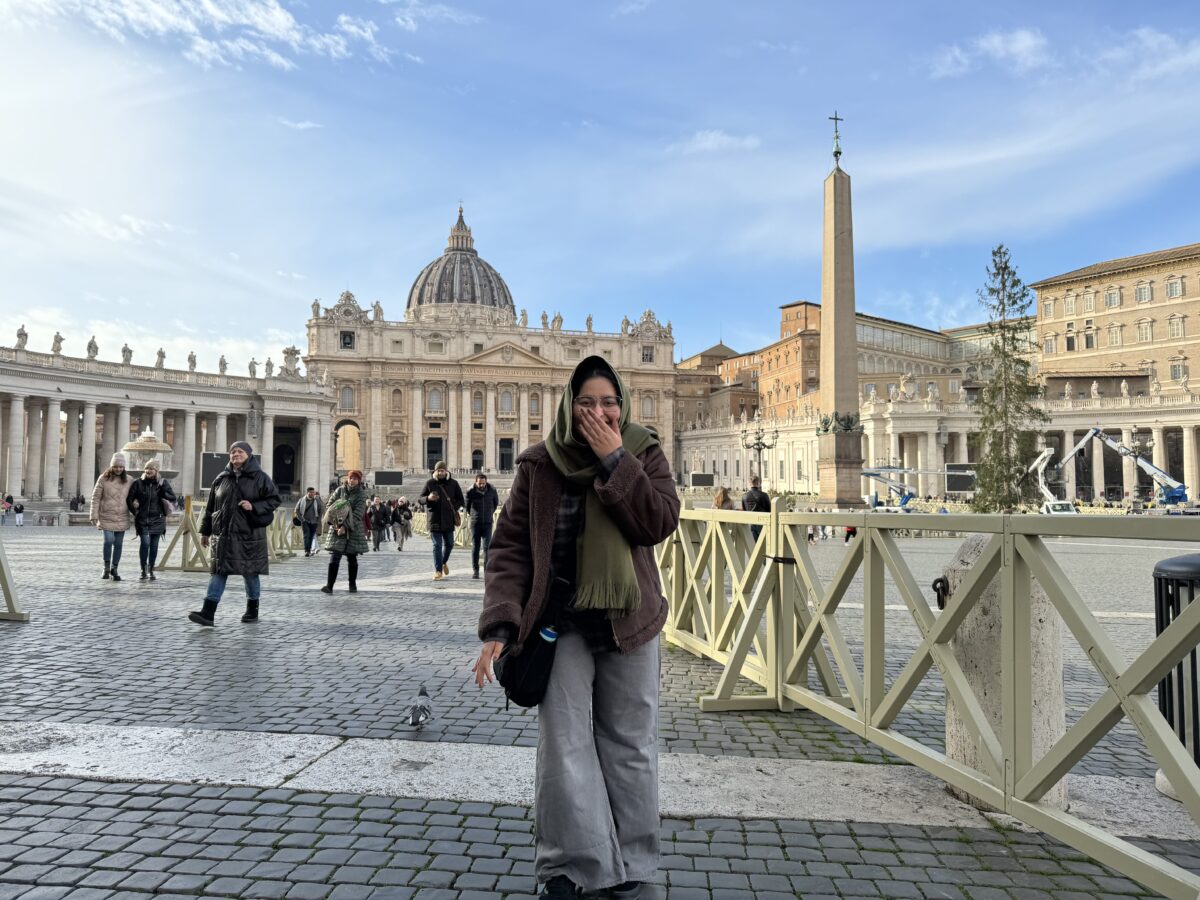 Ayra Sangi at Saint Peter’s Basilica in Rome, Italy. (Image courtesy of Sangi.)
From campus to Taiwan
Throughout her journey, Sangi benefited from the guidance and support of faculty members who brought both global experience and personal insight to the classroom, in particular her academic advisor, Meredith Oyen, associate professor of history, specializing in the history of U.S.-China relations and migration
UMBC’s 2025 – 2026 academic year marks the largest cohort of Retrievers participating in education abroad programs.
Sangi has excelled in her Chinese coursework with Oyen and left a lasting impression. “Ayra is diligent, thoughtful, and creative. In my classes, she was as good at traditional research and analysis as she was at reimagining engaging ways to present information visually,” said Oyen. “Add her outstanding record in Chinese coursework, and you have someone with endless potential to make her mark. I’m excited to see where she goes next.”
“Professor Oyen was a huge help when I started thinking about studying in Taiwan because she lived in Taiwan while conducting research,” said Sangi. “She helped me find education abroad programs and scholarships and encouraged me to apply for the Fulbright Program. Professor Oyen opened the path for me to study in Taiwan.”
Learn more about UMBC’s education abroad opportunities.
]]>
Ayra Sangi, an Asian studies senior, has received the 2025 Freeman-ASIA Award. The semester-long education abroad award funds U.S.-based undergraduates up to $5,000 to study abroad in East or...
https://umbc.edu/stories/ayra-sangi-receives-freeman-asia-scholarship/
https://my3.my.umbc.edu/api/v0/pixel/news/150747/guest@my.umbc.edu/cfd546798ba7ffff3935ebef0945f23a/api/pixel
asianstudies
cahss
international
news
policy-and-society
politicalscience
story
UMBC News & Magazine
https://my3.my.umbc.edu/groups/umbc-news-magazine
https://assets1-my.umbc.edu/system/shared/avatars/groups/000/001/943/24435aa6207c452e7bc15cc74b42c7bb/xsmall.png?1748556657
https://assets1-my.umbc.edu/system/shared/avatars/groups/000/001/943/24435aa6207c452e7bc15cc74b42c7bb/original.png?1748556657
https://assets2-my.umbc.edu/system/shared/avatars/groups/000/001/943/24435aa6207c452e7bc15cc74b42c7bb/xxlarge.png?1748556657
https://assets2-my.umbc.edu/system/shared/avatars/groups/000/001/943/24435aa6207c452e7bc15cc74b42c7bb/xlarge.png?1748556657
https://assets3-my.umbc.edu/system/shared/avatars/groups/000/001/943/24435aa6207c452e7bc15cc74b42c7bb/large.png?1748556657
https://assets1-my.umbc.edu/system/shared/avatars/groups/000/001/943/24435aa6207c452e7bc15cc74b42c7bb/medium.png?1748556657
https://assets2-my.umbc.edu/system/shared/avatars/groups/000/001/943/24435aa6207c452e7bc15cc74b42c7bb/small.png?1748556657
https://assets1-my.umbc.edu/system/shared/avatars/groups/000/001/943/24435aa6207c452e7bc15cc74b42c7bb/xsmall.png?1748556657
https://assets2-my.umbc.edu/system/shared/avatars/groups/000/001/943/24435aa6207c452e7bc15cc74b42c7bb/xxsmall.png?1748556657
UMBC News & Magazine
14
0
false
Fri, 20 Jun 2025 14:01:35 -0400
Fri, 20 Jun 2025 14:01:35 -0400
US, Chinese warships’ near miss in Taiwan Strait hints at ongoing troubled diplomatic waters, despite chatter about talks

Written by Meredith Oyen, associate professor of history and Asian studies, UMBC.
An encounter in which a Chinese naval ship cut across the path of a U.S. destroyer in the Taiwan Strait on June 3, 2023, has both Beijing and Washington pointing fingers at each other.
It was the second near miss in the space of just a few weeks; in late May a Chinese plane crossed in front of an American surveillance aircraft above the South China Sea.
Meredith Oyen, an expert on China-U.S. relations at the University of Maryland, Baltimore County, helps explain the context of the recent encounters and how they fit within growing tensions between the two countries.
What do we know about the Taiwan Strait incident?
It came as the U.S. and Canada were conducting a joint transit of the Taiwan Strait – a body of water that separates the island of Taiwan from mainland China. Washington does these transits fairly regularly, but not usually with another country.
As the American destroyer USS Chung-Hoon and Canadian frigate HMCS Montreal traveled up the channel, a Chinese warship passed and veered across the U.S. vessel’s path at a pretty close range, according to U.S. Indo-Pacific Command. As a result, the USS Chung-Hoon had to reduce its speed to avoid a collision.
The U.S. has characterized the incident as an “unsafe” maneuver on behalf of the Chinese and protested that it took place in international waters.
The perspective from Beijing is that the U.S. and Canada were “deliberately provoking risk” by sailing a warship through Chinese waters.
Who is right? Did it take place in international or Chinese waters?
The United Nations Convention on the Law of the Sea stipulates that a country’s “territorial waters” extend 12 nautical miles off its coast – anything above or on the sea in that zone is considered part of the country’s territory. After that, there is a further 12-mile “contiguous zone,” over which a coastal state has rights to prevent infringement of the country’s “customs, fiscal, immigration or sanitary” laws, according to the UN treaty.
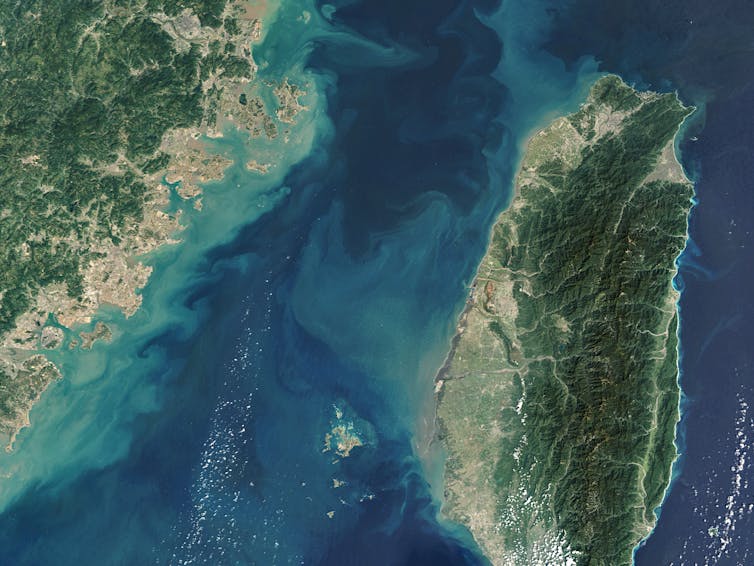 The Taiwan Strait. Gallo Images/Orbital Horizon/Copernicus Sentinel Data
Complicating matters, Beijing – a signatory to the Convention on the Law of the Sea, unlike the U.S. – claims the island of Taiwan as part of China. Under the U.N. convention’s stipulations, this would also mean Beijing can claim the 12 miles of territorial waters off Taiwan’s coast, as well as a 12-mile contiguous zone.
But even at its narrowest point, the Taiwan Strait is around 86 miles wide. So even accepting Beijing’s territorial claim, there would, under U.N. law, be a channel that falls outside its territory.
Nonetheless, Beijing claims sovereignty of the entirety of the waters between Taiwan and China under its exclusive economic zone.
Despite not signing the U.N. Convention on the Law of the Sea, the U.S. abides by the 12-mile standard and views a large chunk of the strait as international waters.
How common are these ‘near misses’?
The United States has regularly sailed vessels through the Taiwan Strait for decades. At times of tension – notably during the Korean War and Taiwan Straits crises of 1954-55, 1958 and 1962 – the U.S. has deployed destroyers in the channel as a deliberate show of military strength and support for Taiwan.
This continued after the U.S. normalized relations with China in 1978 until today, with few incidents that caused the level of tit-for-tat recriminations such as in the latest case. But there have been “near misses” in the sky, noticeably the recent airplane-to-airplane encounter that preceded this incident.
What we have increasingly seen, though, is Chinese officials protest these Taiwan Strait transits by the U.S. And the number of protests by China has increased in recent years, as tension over Taiwan has increased.
How does this incident fit growing maritime tension in the region?
The past few years have seen a deterioration in U.S.-China relations. There have been no direct, high-level military talks between the two countries since 2019. Meanwhile, relations have further soured on other topics, such as the ongoing trade war, the issue of Taiwan and allegations relating to the spread of COVID-19.
At times of better relations between Beijing and Washington, military transits such as the one in the Taiwan Strait might have gone largely unremarked upon. But amid such tensions, any incident is elevated to the level of uniquely bad provocation.
The broader context is that the U.S. regularly holds military drills and “freedom of navigation” operations in the South China Sea. These activities are used by the U.S. Department of Defense to demonstrate that the U.S. has a right to sail in waters it views as international, even if they are claimed by nation states.
The concern is that with tensions as they are – and with no official direct line of dialogue – a near miss during such a drill, or, worse still, an actual collision, could escalate beyond control, leading to military conflict.
Any significance over why this happened now?
The near miss came at a curious time – while top diplomats and defense chiefs from both the U.S. and China were attending the Shangri-La Dialogue in Singapore.
At that security summit, U.S. Defense Secretary Lloyd Austin shook the hand of his Chinese counterpart, Li Shangfu. But they didn’t hold a side meeting – as some observers had hoped.
Austin also underscored the importance of the Taiwan Strait to Washington: “The whole world has a stake in maintaining peace and stability in the Taiwan Strait. The security of commercial shipping lanes and global supply chains depends on it. And so does freedom of navigation worldwide. Make no mistake: conflict in the Taiwan Strait would be devastating.”
Washington has suggested that it wants to resume official talks with Beijing. Incidents such as that in the Taiwan Strait underscore the potential need for such discussions, if only to avoid encounters escalating into something more serious.
This article is republished from The Conversation under a Creative Commons license. Read the original article and see more than 250 UMBC articles available in The Conversation.
]]>
Written by Meredith Oyen, associate professor of history and Asian studies, UMBC. An encounter in which a Chinese naval ship cut across the path of a U.S. destroyer in the Taiwan Strait on...
https://umbc.edu/stories/us-chinese-warships-near-miss-in-taiwan-strait-hints-at-ongoing-troubled-diplomatic-waters-despite-chatter-about-talks/
https://my3.my.umbc.edu/api/v0/pixel/news/133938/guest@my.umbc.edu/a70a732e2515dfb64ecfc4535303c33d/api/pixel
asianstudies
cahss
cahssresearch
discovery
international-stories
magazine
the-conversation
UMBC News & Magazine
https://my3.my.umbc.edu/groups/umbc-news-magazine
https://assets1-my.umbc.edu/system/shared/avatars/groups/000/001/943/24435aa6207c452e7bc15cc74b42c7bb/xsmall.png?1748556657
https://assets1-my.umbc.edu/system/shared/avatars/groups/000/001/943/24435aa6207c452e7bc15cc74b42c7bb/original.png?1748556657
https://assets2-my.umbc.edu/system/shared/avatars/groups/000/001/943/24435aa6207c452e7bc15cc74b42c7bb/xxlarge.png?1748556657
https://assets2-my.umbc.edu/system/shared/avatars/groups/000/001/943/24435aa6207c452e7bc15cc74b42c7bb/xlarge.png?1748556657
https://assets3-my.umbc.edu/system/shared/avatars/groups/000/001/943/24435aa6207c452e7bc15cc74b42c7bb/large.png?1748556657
https://assets1-my.umbc.edu/system/shared/avatars/groups/000/001/943/24435aa6207c452e7bc15cc74b42c7bb/medium.png?1748556657
https://assets2-my.umbc.edu/system/shared/avatars/groups/000/001/943/24435aa6207c452e7bc15cc74b42c7bb/small.png?1748556657
https://assets1-my.umbc.edu/system/shared/avatars/groups/000/001/943/24435aa6207c452e7bc15cc74b42c7bb/xsmall.png?1748556657
https://assets2-my.umbc.edu/system/shared/avatars/groups/000/001/943/24435aa6207c452e7bc15cc74b42c7bb/xxsmall.png?1748556657
UMBC News & Magazine
0
0
false
Fri, 09 Jun 2023 08:01:11 -0400
Biden again indicates that US will defend Taiwan ‘militarily’ – does this constitute a change in policy?
Meredith Oyen, Associate Professor of History and Asian Studies, UMBC.
President Joe Biden has – not for the first time – suggested that the U.S. would intervene “militarily” should China attempt an invasion of Taiwan.
In an interview with CBS’s “60 Minutes” on Sept. 18, 2022, Biden vowed to protect the island in the face of any attack. Pressed if that meant the U.S. getting “involved militarily,” the president replied: “Yes.”
The comments appear to deviate from the official U.S. line on Taiwan, in place for decades. But White House officials said the remarks did not represent any change in Taiwan policy.
Meredith Oyen, an expert on U.S.-China relations at the University of Maryland, Baltimore County, helps explain the background to Biden’s comments and untangles what should be read into his remarks – and what shouldn’t.
What did Biden say and why was it significant?
In an exchange on “60 Minutes,” Biden was asked directly if the U.S. would “come to Taiwan’s defense” if it were attacked by China. He replied: “Yes, we have a commitment to do that.” He also confirmed that U.S. intervention would be military.
By my count, this is the fourth time Biden as president has suggested that the U.S. will come to Taiwan’s aid militarily if the island is attacked. In 2021 he made similar remarks in an interview with ABC News and then again while taking part in a CNN town hall event. And earlier this year he said something similar while in Japan, marking the first time he has made the assertion while in Asia.
On each occasion he has made such a comment, it has been followed quite quickly by the White House’s walking back the remarks, by issuing statements along the lines of “what the president actually means is …” and stressing that this isn’t a shift away from the official U.S. policy on China or Taiwan.
But I think that with each incident it is harder to prevaricate about Biden’s comments being an accident, or suggest that he in some way misspoke. I think it is clear at this point that Biden’s interpretation of the Taiwan Relations Act – which since 1979 has set out the parameters of U.S. policy on the island – is that it allows for a U.S. military response should China invade. And despite White House claims to the contrary, I believe that does represent a departure from the long-standing policy of “strategic ambiguity” on Taiwan.
What does ‘strategic ambiguity’ mean?
Strategic ambiguity has long been the U.S. policy toward Taiwan – really since the 1950s, but certainly from 1979 onward. While it does not explicitly commit the U.S. to defending Taiwan in every circumstance, it does leave open the option of American defensive support to Taiwan in the event of an unprovoked attack by China.
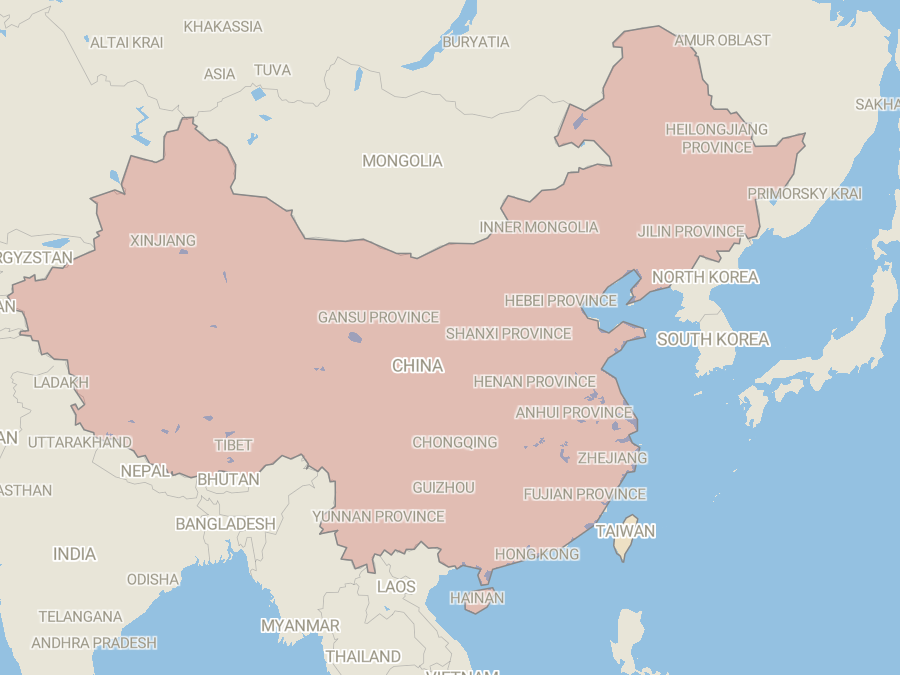 Map: The Conversation, CC-BY-ND @OpenStreetMap contributors.
Crucially, the U.S. hasn’t really said what it will do – so does this support mean economic aid, supply of weapons or U.S. boots on the ground? China and Taiwan are left guessing if – and to what extent – the U.S. will be involved in any China-Taiwan conflict.
By leaving the answer to that question ambiguous, the U.S. holds a threat over China: Invade Taiwan and find out if you face the U.S. as well.
Traditionally, this has been a useful policy for the U.S., but things have changed since it was first rolled out. It was certainly effective when the U.S. was in a much stronger position militarily compared with China. But it might be less effective as a threat now that China’s military is catching up with the U.S.
Leading voices from U.S. allies in Asia, such as Japan, believe that “strategic clarity” might be a better option now – with the U.S. stating outright that it would defend Taiwan if the island were attacked.
What is the history of US relations with Taiwan?
After the victory of the Chinese Communist Party in 1949, the defeated Republic of China government withdrew to the island of Taiwan, located just 100 miles off the shore of Fujian province. And until the 1970s, the U.S. recognized only this exiled Republic of China on Taiwan as the government of China.
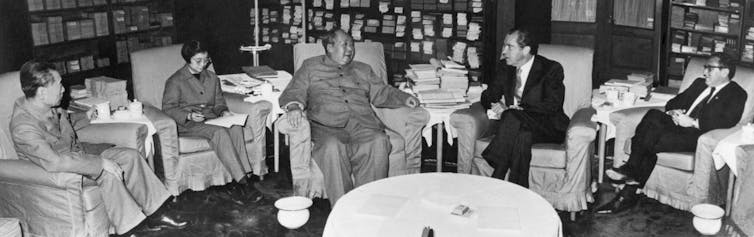 Nixon in China. Bettmann/Getty Images
But in 1971, the United Nations shifted recognition to the People’s Republic of China on the mainland. In 1972, President Richard Nixon made a now-famous trip to China to announce a rapprochement and sign the Shanghai Communique, a joint statement from Communist China and the U.S. signaling a commitment to pursue formal diplomatic relations. A critical section of that document stated: “The United States acknowledges that all Chinese on either side of the Taiwan Strait maintain there is but one China and that Taiwan is a part of China. The United States Government does not challenge that position.”
The wording was crucial: The U.S. was not formally committing to a position on whether Taiwan was part of the China nation. Instead, it was acknowledging what the governments of either territory asserted – that there is “one China.”
Where does US commitment of military support for Taiwan come from?
After establishing formal diplomatic relations with China in 1979, the U.S. built an informal relationship with the ROC on Taiwan. In part to push back against President Jimmy Carter’s decision to recognize Communist China, U.S. lawmakers passed the Taiwan Relations Act in 1979. That act outlined a plan to maintain close ties between the U.S. and Taiwan and included provisions for the U.S. to sell military items to help the island maintain its defense – setting the path for the policy of strategic ambiguity.
What has changed recently?
China has long maintained its desire for an eventual peaceful reunification of its country with the island it considers a rogue province. But the commitment to the principle of “one China” has become increasingly one-sided. It is an absolute for Beijing. In Taiwan, however, resistance to the idea of reunification has grown amid a surge of support for moving the island toward independence.
Beijing has become more aggressive of late in asserting that Taiwan must be “returned to China.” Domestic politics plays a role in this. At times of internal instability in China, Beijing has sounded a more belligerent tone on relations between the two entities separated by the Taiwan Strait. We have seen this over the past year with Beijing sending military aircraft into Taiwan’s Air Defense Zone.
Meanwhile, Chinese assertion of increased authority over Hong Kong has damaged the argument for “one country, two systems” as a means of peaceful reunification with Taiwan.
How has the US position shifted in the face of Beijing’s stance?
Biden has definitely been more openly supportive of Taiwan than previous presidents. He officially invited a representative from Taiwan to his inauguration – a first for an incoming president – and has repeatedly made it clear that he views Taiwan as an ally.
He also didn’t overturn the Taiwan Travel Act passed under the the previous administration of Donald Trump. This legislation allows U.S. officials to visit Taiwan in an official capacity.
In August 2022, U.S. House Speaker Nancy Pelosi visited Taiwan, making her the highest-profile U.S. politician to go to the island in decades.
Meanwhile, for the second time, Biden in his “60 Minutes” interview indicated a belief that it was up to Taiwan to decide its future, departing slightly from the usual line that the U.S. doesn’t support changes to the status quo. However, Biden has also said he does not support a unilateral declaration of independence from Taiwan.
So there has been a shift to a degree. But the White House is keen not to overstate any change. At heart, there is a desire by the U.S. to not stray from the Shanghai Communique.
So is an invasion of Taiwan likely?
The current rhetoric from the U.S. and response from China do raise the risk of conflict, but I don’t think we are at that point yet. Any invasion across the Taiwan Strait would be militarily complex. It also comes with risks of backlash from the international community. Taiwan would receive support from not only the U.S. – in an unclear capacity, given Biden’s remarks – but also Japan and likely other countries in the region.
Meanwhile, China maintains that it wants to see reintegration through peaceful means. As long as Taiwan doesn’t force the issue and declare independence unilaterally, I think there is tolerance in Beijing to wait it out. And despite some commentary to the contrary, I don’t think the invasion of Ukraine has raised the prospects of a similar move on Taiwan. In fact, given that Russia is now bogged down in a monthslong conflict that has hit its military credibility and economy, the Ukraine invasion may actually serve as a warning to Beijing.
This is an update to an article that was originally published on May 24, 2022.
This article is republished from The Conversation under a Creative Commons license. Read the original article.
]]>
Meredith Oyen, Associate Professor of History and Asian Studies, UMBC. President Joe Biden has – not for the first time – suggested that the U.S. would intervene “militarily” should China...
https://umbc.edu/stories/biden-again-indicates-that-us-will-defend-taiwan-militarily/
https://my3.my.umbc.edu/api/v0/pixel/news/127756/guest@my.umbc.edu/2e57e1ff30b15ff9ad42ebb620e16b7e/api/pixel
asianstudies
cahss
cahssresearch
cs3
discovery
history
international
magazine
UMBC News & Magazine
https://my3.my.umbc.edu/groups/umbc-news-magazine
https://assets1-my.umbc.edu/system/shared/avatars/groups/000/001/943/24435aa6207c452e7bc15cc74b42c7bb/xsmall.png?1748556657
https://assets1-my.umbc.edu/system/shared/avatars/groups/000/001/943/24435aa6207c452e7bc15cc74b42c7bb/original.png?1748556657
https://assets2-my.umbc.edu/system/shared/avatars/groups/000/001/943/24435aa6207c452e7bc15cc74b42c7bb/xxlarge.png?1748556657
https://assets2-my.umbc.edu/system/shared/avatars/groups/000/001/943/24435aa6207c452e7bc15cc74b42c7bb/xlarge.png?1748556657
https://assets3-my.umbc.edu/system/shared/avatars/groups/000/001/943/24435aa6207c452e7bc15cc74b42c7bb/large.png?1748556657
https://assets1-my.umbc.edu/system/shared/avatars/groups/000/001/943/24435aa6207c452e7bc15cc74b42c7bb/medium.png?1748556657
https://assets2-my.umbc.edu/system/shared/avatars/groups/000/001/943/24435aa6207c452e7bc15cc74b42c7bb/small.png?1748556657
https://assets1-my.umbc.edu/system/shared/avatars/groups/000/001/943/24435aa6207c452e7bc15cc74b42c7bb/xsmall.png?1748556657
https://assets2-my.umbc.edu/system/shared/avatars/groups/000/001/943/24435aa6207c452e7bc15cc74b42c7bb/xxsmall.png?1748556657
UMBC News & Magazine
0
0
false
Mon, 19 Sep 2022 16:07:15 -0400
Mon, 19 Sep 2022 16:07:15 -0400
Why the big fuss over Nancy Pelosi’s possible visit to Taiwan?
Meredith Oyen, Associate Professor of History and Asian Studies, UMBC
U.S. House Speaker Nancy Pelosi hasn’t confirmed when – or even if – she is to visit Taiwan. Yet such is the sensitivity over the island’s status that reports of her possible trip have resulted in a warning by China of “serious consequences” and a suggestion by President Joe Biden that the visit was “not a good idea.” Amid the rhetoric and heightened tensions, Taiwan is conducting military drills.
The comments follow a report by the Financial Times that Pelosi planned to take a delegation to Taiwan in August. The outlet based its report on six people “familiar with the situation”; Pelosi’s spokesperson has said she could neither confirm not deny the reported trip.
As someone who has long studied the U.S.‘s delicate diplomatic dance over Taiwan, I understand why this reported trip has sparked reaction in both Washington and Beijing, given the current tensions in the region. It also marks the continuation of a process that has seen growing U.S. political engagement with Taiwan – much to China’s annoyance.
Cutting diplomatic ties
The controversy over reports of Pelosi’s potential visit stems from the “one China” policy – the diplomatic stance under which the U.S. recognizes China and acknowledges Beijing’s position that Taiwan is part of China. The policy has governed U.S. relations with Taiwan for the last 40-plus years.
In 1979, the U.S. abandoned its previous policy of recognizing the government of Taiwan as that of all of China, instead shifting recognition to the government on the mainland.
As part of this change, the U.S. cut off formal diplomatic ties with Taiwan, with the U.S. embassy in Taiwan replaced by a nongovernmental entity called the American Institute in Taiwan.
The institute was a de facto embassy – though until 2002, Americans assigned to the institute would have to resign from U.S. State Department to go there, only to be rehired once their term was over. And contact between the two governments was technically unofficial.
As the government in Taiwan pursued democracy – starting from the lifting of martial law in 1987 through the first fully democratic elections in 1996 – it shifted away from the assumption once held by governments in both China and Taiwan of eventual reunification with the mainland. The government in China, however, has never abandoned the idea of “one China” and rejects the legitimacy of Taiwanese self-government. That has made direct contact between Taiwan and U.S. representatives contentious to Chinese officials.
Indeed, in 1995, when Lee Teng-hui, Taiwan’s first democratically elected president, touched down in Hawaii en route to Central America, he didn’t even set foot on the tarmac. The U.S. State Department had already warned that the president would be refused an entry visa to the U.S., but had allowed for a brief, low-level reception in the airport lounge during refueling. Apparently feeling snubbed, Lee refused to leave the airplane.
Previous political visits
Two years after this incident came a visit to Taiwan by then-House Speaker Newt Gingrich.
Similarly to the possible Pelosi visit, the one by Gingrich annoyed Beijing. But it was easier for the White House to distance itself from Gingrich – he was a Republican politician visiting Taiwan in his own capacity, and clearly not on behalf of then-President Bill Clinton.
Pelosi’s possible visit could be different, because she is a member of the same party as President Joe Biden, and China may assume she has Biden’s blessing, despite his comments to the contrary.
Asked on July 20 about his views on the potential Pelosi trip, Biden responded that the “military thinks it’s not a good idea right now.”
The comment echoes the White House’s earlier handling of a comment by Biden in which he suggested in May 2022 that the U.S. would intervene “militarily” should China invade Taiwan. Officials in the Biden administration rolled back the comment, which would have broken a long-standing policy of ambiguity over what the U.S. would do if China tried to take Taiwan by force.
Similarly with Pelosi, the White House is distancing itself from a position that suggests a shift in U.S.-Taiwanese relations following a period in which the U.S. had already been trying to rethink how it interacts with Taiwan.
Shifting policy?
In 2018, Congress passed the bipartisan Taiwan Travel Act. This departed from previous policy in that it allowed bilateral official visits between the U.S. and Taiwan, although they are still considered to be subdiplomatic.
In the wake of that act, Donald Trump’s Health and Human Services secretary, Alex Azar, became the highest-ranking U.S. official to visit Taiwan since 1979. Then in 2020, Keith Krach, undersecretary for economic growth, energy and the environment, visited Taiwan.
And in April 2022, a U.S. congressional delegation visited Taiwan. Pelosi herself was reportedly due to visit the island that same month, but canceled after testing positive for COVID-19.
Each of these visits has provoked angry statements from Beijing.
A high-profile visit – even one without the public backing of the White House – would signal support to the island at a time when the invasion of Ukraine by Russia has raised questions over the international community’s commitment to protect smaller states from more powerful neighbors.
Meanwhile, the erosion of democracy in Hong Kong has undermined China’s commitment to the idea of “one nation, two systems.” The principle, which allowed Hong Kong to maintain its economic, political and social systems while returning to the mainland after the end of British rule, had been cited as a model for reunification with Taiwan. The Chinese Communist Party also plans to hold its 20th congress in the coming months, making the timing sensitive for a Taiwan visit from a high-profile U.S. political figure such as Pelosi.
* * * * * *
Meredith Oyen, Associate Professor of History and Asian Studies, University of Maryland, Baltimore County
This article is republished from The Conversation under a Creative Commons license. Read the original article.
]]>
Meredith Oyen, Associate Professor of History and Asian Studies, UMBC U.S. House Speaker Nancy Pelosi hasn’t confirmed when – or even if – she is to visit Taiwan. Yet such is the sensitivity...
https://umbc.edu/stories/why-the-fuss-over-nancy-pelosis-possible-visit-to-taiwan/
https://my3.my.umbc.edu/api/v0/pixel/news/126430/guest@my.umbc.edu/2ae4ff51ab97b761e47e0fdf78cbc2a4/api/pixel
asianstudies
cahss
discovery
history
magazine
UMBC News & Magazine
https://my3.my.umbc.edu/groups/umbc-news-magazine
https://assets1-my.umbc.edu/system/shared/avatars/groups/000/001/943/24435aa6207c452e7bc15cc74b42c7bb/xsmall.png?1748556657
https://assets1-my.umbc.edu/system/shared/avatars/groups/000/001/943/24435aa6207c452e7bc15cc74b42c7bb/original.png?1748556657
https://assets2-my.umbc.edu/system/shared/avatars/groups/000/001/943/24435aa6207c452e7bc15cc74b42c7bb/xxlarge.png?1748556657
https://assets2-my.umbc.edu/system/shared/avatars/groups/000/001/943/24435aa6207c452e7bc15cc74b42c7bb/xlarge.png?1748556657
https://assets3-my.umbc.edu/system/shared/avatars/groups/000/001/943/24435aa6207c452e7bc15cc74b42c7bb/large.png?1748556657
https://assets1-my.umbc.edu/system/shared/avatars/groups/000/001/943/24435aa6207c452e7bc15cc74b42c7bb/medium.png?1748556657
https://assets2-my.umbc.edu/system/shared/avatars/groups/000/001/943/24435aa6207c452e7bc15cc74b42c7bb/small.png?1748556657
https://assets1-my.umbc.edu/system/shared/avatars/groups/000/001/943/24435aa6207c452e7bc15cc74b42c7bb/xsmall.png?1748556657
https://assets2-my.umbc.edu/system/shared/avatars/groups/000/001/943/24435aa6207c452e7bc15cc74b42c7bb/xxsmall.png?1748556657
UMBC News & Magazine
0
0
false
Tue, 26 Jul 2022 16:35:02 -0400
Tue, 26 Jul 2022 16:35:02 -0400
Biden on Taiwan: Did he really commit US forces to stopping any invasion by China? An expert explains why, on balance, probably not
Meredith Oyen, Associate Professor of History and Asian Studies, UMBC
The White House has been left scrambling a little after President Joe Biden suggested on May 23, 2022, that the U.S. would intervene militarily should China attempt an invasion of Taiwan.
The comment, which Biden made during a trip to Japan, was taken by some observers as a deviation from the official U.S. line on Taiwan, in place for decades. But officials in Washington walked back that interpretation, saying instead that it only referred to military assistance.
Meredith Oyen, an expert on U.S.-China relations at the University of Maryland, Baltimore County, helps explain the background to Biden’s recent comments and untangles what should be read into his remarks – and what shouldn’t.
What did Biden say and why was it significant?
Asked if the U.S. was willing to get involved “militarily” in the event of an invasion of Taiwan, Biden replied, “yes.” A follow-up question saw the U.S. president add: “That’s the commitment we have made.”
By my count, this is the third time Biden has as president suggested that the U.S. will come to Taiwan’s aid militarily if the island is attacked. In 2021 he made similar remarks in an interview with ABC News and then again while taking part in a CNN town hall event.
But it is significant that this is the first time he has made the assertion while in Asia.
An important thing to note is that on each occasion he has made such a comment, it has been followed quite quickly by the White House walking back the remarks, by issuing statements along the lines of “what the president actually means is…” and stressing that this isn’t a shift away from the official U.S. policy on China or Taiwan.
However, the remarks and the clarifications have increased doubt over whether Biden is continuing the policy of “strategic ambiguity” on Taiwan.
What does ‘strategic ambiguity’ mean?
Strategic ambiguity has long been the U.S. policy toward Taiwan – really since the 1950s but certainly from 1979 onward. While it does not explicitly commit the U.S. to defending Taiwan in every circumstance, it does leaves open the option of American defensive support to Taiwan in the event of an unprovoked attack by China.
Crucially, the U.S. hasn’t really said what it will do – so does this support mean economic aid, supply of weapons or U.S. boots on the ground? China and Taiwan are left guessing if – and to what extent – the U.S. will be involved in any China-Taiwan conflict.
By leaving the answer to that question ambiguous, the U.S. holds a threat over China: Invade Taiwan and find out if you face the U.S. as well.
Traditionally, this has been a useful policy for the U.S., but things have changed since it was first rolled out. It was certainly effective when the U.S. was in a much stronger position militarily compared to China. But it might be less effective as a threat now that China’s military is catching up with the U.S.
Leading voices from U.S. allies in Asia, such as Japan, believe that “strategic clarity” might be a better option now – with the U.S. stating outright that it would defend Taiwan if the island is attacked.
So Biden’s comments could hint at this shift?
There does seem to be a pattern: Biden says something seemingly very clear on defending Taiwan, and that then gets walked back. If no one in Washington was walking back the comments then it would seem like an intentional shift in policy by the Biden administration.
But the fact that the White House has always been quick to clarify the comments suggests to me that it isn’t necessarily intentional. It seems like Biden is simply trying to signal more support for Taiwan, and perhaps reassure U.S. allies in Asia.
But I’m a historian, not a strategist. It could be that this is some advanced chess game that I can’t figure out.
What is the history of US relations with Taiwan?
After the victory of the Chinese Communist Party in 1949, the defeated Republic of China government withdrew to the island of Taiwan, located just 100 miles off the shore of Fujian province. And until the 1970s, the U.S. recognized only this exiled Republic of China on Taiwan as the government of China.
Nixon in China. Bettmann/Getty Images
But in 1971, the United Nations shifted recognition to the People’s Republic of China on the mainland. In 1972, President Richard Nixon made a now-famous trip to China to announce a rapprochement and sign the Shanghai Communique, a joint statement from communist China and the U.S. signaling a commitment to pursue formal diplomatic relations. A critical section of that document stated: “The United States acknowledges that all Chinese on either side of the Taiwan Strait maintain there is but one China and that Taiwan is a part of China. The United States Government does not challenge that position.”
The wording was crucial: the U.S. was not formally committing to a position on whether Taiwan was part of the China nation. Instead, it was acknowledging what the governments of either territory asserted – that there is “one China.”
Where does US commitment of military support for Taiwan come from?
After establishing formal diplomatic relations with China in 1979, the U.S. built an informal relationship with the ROC on Taiwan. In part to push back against President Jimmy Carter’s decision to recognize communist China, U.S. lawmakers passed the Taiwan Relations Act in 1979. That act outlined a plan to maintain close ties between the U.S. and Taiwan and included provisions for the U.S. to sell military items to help the island maintain its defense – setting the path for the policy of strategic ambiguity.
What has changed recently?
China has long maintained its desire for an eventual peaceful reunification of its country with the island it considers a rogue province. But the commitment to the principle of “one China” has become increasingly one-sided. It is an absolute for Beijing. But in Taiwan, however, resistance to the idea of reunification has grown amid a surge of support for moving the island toward independence.
Beijing has become more aggressive of late in asserting that Taiwan must be “returned to China.” Domestic politics plays a role in this. At times of internal instability in China, Beijing has sounded a more belligerent tone on relations between the two entities separated by the Taiwan Strait. We have seen this over the last year with Beijing sending military aircraft into Taiwan’s Air Defense Zone.
Meanwhile, Chinese assertion of increased authority over Hong Kong has damaged the argument for “one country, two system” as a means of peaceful reunification with Taiwan.
How has the US position shifted in the face of Beijing’s stance?
Biden has definitely been more openly supportive of Taiwan than previous presidents. He officially invited a representative from Taiwan to his inauguration – a first for an incoming president – and has repeatedly made it clear that he views Taiwan as an ally.
He also didn’t overturn the Taiwan Travel Act passed under the the previous administration of Donald Trump. This legislation allows U.S. officials to visit Taiwan in an official capacity.
So there has been a shift to a degree. But the White House is keen not to overstate any change. At heart, there is a desire by the U.S. to not stray from the Shanghai Communique.
So is an invasion of Taiwan likely?
I don’t think we are anywhere near that yet. Any invasion across the Taiwan Strait would be militarily complex. It also comes with risks of backlash from the international community. Taiwan would receive support from not only the U.S. – in an unclear capacity, given Biden’s remarks – but also Japan and likely other countries in the region.
Meanwhile, China maintains that it wants to see reintegration through peaceful means. As long as Taiwan doesn’t force the issue and declare independence unilaterally, I think there is tolerance in Beijing to wait it out. And despite some commentary to the contrary, I don’t think the invasion of Ukraine has raised the prospects of a similar move on Taiwan. In fact, given that Russia is now bogged down in a months-long conflict that has hit its military credibility and economy, the Ukraine invasion may actually serve as a warning to Beijing.
Meredith Oyen, Associate Professor of History and Asian Studies, University of Maryland, Baltimore County
This article is republished from The Conversation under a Creative Commons license. Read the original article.
]]>
Meredith Oyen, Associate Professor of History and Asian Studies, UMBC The White House has been left scrambling a little after President Joe Biden suggested on May 23, 2022, that the U.S....
https://umbc.edu/stories/biden-on-taiwan-did-he-really-commit-us-forces-to-stopping-any-invasion-by-china-an-expert-explains-why-on-balance-probably-not/
https://my3.my.umbc.edu/api/v0/pixel/news/125567/guest@my.umbc.edu/e14b928b918dbad2cf1b8ad4ac7cdbe3/api/pixel
asianstudies
discovery
history
magazine
the-conversation
UMBC News & Magazine
https://my3.my.umbc.edu/groups/umbc-news-magazine
https://assets1-my.umbc.edu/system/shared/avatars/groups/000/001/943/24435aa6207c452e7bc15cc74b42c7bb/xsmall.png?1748556657
https://assets1-my.umbc.edu/system/shared/avatars/groups/000/001/943/24435aa6207c452e7bc15cc74b42c7bb/original.png?1748556657
https://assets2-my.umbc.edu/system/shared/avatars/groups/000/001/943/24435aa6207c452e7bc15cc74b42c7bb/xxlarge.png?1748556657
https://assets2-my.umbc.edu/system/shared/avatars/groups/000/001/943/24435aa6207c452e7bc15cc74b42c7bb/xlarge.png?1748556657
https://assets3-my.umbc.edu/system/shared/avatars/groups/000/001/943/24435aa6207c452e7bc15cc74b42c7bb/large.png?1748556657
https://assets1-my.umbc.edu/system/shared/avatars/groups/000/001/943/24435aa6207c452e7bc15cc74b42c7bb/medium.png?1748556657
https://assets2-my.umbc.edu/system/shared/avatars/groups/000/001/943/24435aa6207c452e7bc15cc74b42c7bb/small.png?1748556657
https://assets1-my.umbc.edu/system/shared/avatars/groups/000/001/943/24435aa6207c452e7bc15cc74b42c7bb/xsmall.png?1748556657
https://assets2-my.umbc.edu/system/shared/avatars/groups/000/001/943/24435aa6207c452e7bc15cc74b42c7bb/xxsmall.png?1748556657
UMBC News & Magazine
0
0
false
Tue, 24 May 2022 10:53:16 -0400
Tue, 24 May 2022 10:53:16 -0400
