“Don’t be afraid”—Doctoral student Demetrie Garner ’23, public health, and M.P.P ’25, overcame decades of opioid abuse disorder to serve as an overdose response expert
When Demetrie Garner moved from Maryland’s Eastern Shore to Baltimore, he found a wealth of opportunities in Baltimore, a strong spiritual practice, and a supportive network of friends and family. They became necessary anchors for recovering from opioid dependency and managing the workload of a full-time job while earning a bachelor’s, a master’s, and now a doctorate in public health from UMBC.
“My story has a lot of twists and turns. I came to Baltimore in 2018 for treatment for opioid use disorder after experiencing homelessness, incarceration, hospitalizations, and treatment programs. Recovery was a process of 26 years,” says Garner, who now works in the Baltimore City Mayor’s Office of Overdose Response. “When I came to Baltimore, I had a clean slate. I was able to go through an expungement process of criminal records, which was a list of misdemeanors that happened during my drug and alcohol addiction. My journey to UMBC began as an adult learner, at 40 years old, after a year in recovery.”
Understanding the bigger picture
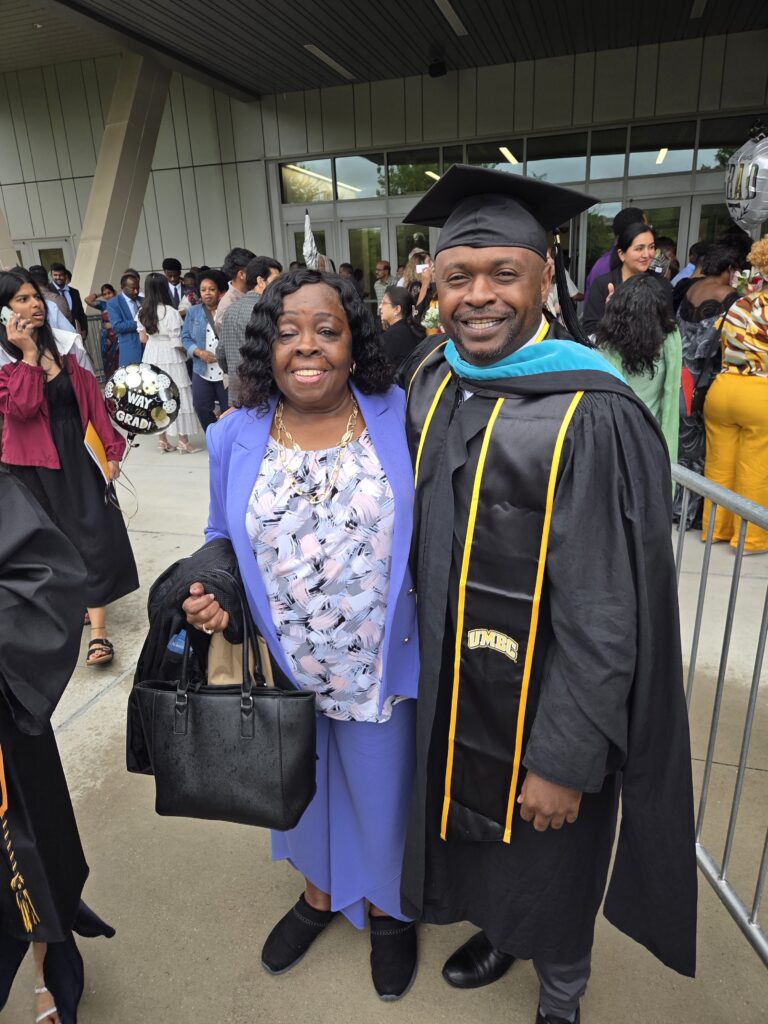 Garner with his mom, Clara Turner.
The inspiration to pursue a bachelor’s degree came from working as a recovery specialist at Franklin Square Hospital in Baltimore County, where he supported patients who had overdosed or were experiencing substance use disorders, many of whom faced significant social and economic conditions that negatively affected their health. Although he connected patients to treatment and recovery resources, he questioned why so many returned to the emergency department with the same challenges. That curiosity sparked a desire to better understand the systems, policies, and social factors driving addiction and recovery.
“I wanted to understand how healthcare is failing people in recovery,” says Garner. “I decided to go back to school. The logical step was to study public health.” Making the leap from working full-time and being a full-time student without a driver’s license posed many challenges. Thankfully, in addition to his faith, friends, and family, Garner also had a team of mentors at UMBC’s School of Public Policy that continue to support him to make his vision possible.
Garner immersed himself in public health research and learned about comorbidities, where patients are managing multiple health needs like substance dependency and mental health. He found that having multiple health needs with little to no healthcare is also exacerbated by homelessness, lack of transportation, inconsistent healthcare, or an environment not conducive to recovery. The emergency room could treat the symptoms but not the root causes.
“My undergrad journey into public health was transformative because the curriculum I was learning for the core courses in public health also exposed me to psychology and epidemiology,” says Garner. “UMBC helped me understand what was needed for me to actually serve. If I wanted to be of service, then I needed to understand not just what leads people into substance use disorder but also what drives the research.”
No limits in sight
Each learning moment inspired great curiosity. Garner sought faculty for advice and opportunities. A game-changing moment came in a research methods course with Pamela R. Bennett, professor of public policy. Bennett encouraged Garner to think beyond what was stated in the research and analyze what was in between the lines.
“I got a D in one discussion post, so I went to Dr. Bennett’s office hours. She told me to stop synthesizing information and to start thinking critically,” says Garner. “That was a game changer because I translated what she said to me into my work.”
UMBC offered me, someone with a lived experience of homelessness and substance use disorder, a door that I would normally not have access to. College is an opportunity to discover who you are and what matters to you. Don’t be afraid to engage with professors, challenge ideas, and use your voice.
Demetrie Garner ’23, public health, and M.P.P ’25
Another game-changing moment came in Lauren Hamilton Edwards‘ class. Hamilton Edwards, associate professor of public policy, told the class at the beginning of the semester that everyone had an A until they didn’t. Garner interpreted that as an incentive to do his best every day. “From the beginning, she gave me the kind of nurturing I needed,” says Garner. “Now, when I have an intern, I make sure that I’m the “Dr. Lauren Hamilton Edwards” to that intern, as she was with me.”
Additional supports like the McNair Scholars Program gave him the foundation and confidence to pursue graduate school, and his first experience presenting his research at UMBC’s Undergraduate Research and Creative Achievement Day was a humbling experience, he says.
 Garner with Baltimore City Mayor
Brandon Scott.
Garner is thriving thanks to the support of the faculty and staff in the public policy and sociology, anthropology, and public health departments, who recognized his potential.
“Associate Professor Andrea Kalfoglou called me Dr. Garner long before I believed it myself. My faculty advisor, Katie Birger, associate teaching professor, recognized my potential early on and encouraged me to pursue the B.A./M.A. pathway,” says Garner. “Now, with Professor Nancy Miller‘s mentorship, I am on track to finish my coursework by the end of the fall semester and begin my dissertation proposal in the spring of 2027.”
“Don’t be afraid”
As Garner’s expertise in public health and policy grew, so did his career opportunities. Today, he serves as the quality assurance manager for Baltimore City’s Behavioral Health Consent Decree. His work focuses on improving outcomes for people experiencing homelessness, substance use disorders, and behavioral health crises, giving him a unique perspective on how public safety and public health intersect to advance overdose prevention and crisis response.
“I no longer see those 26 years to recovery as a period of failure. They gave me lived experience that I now use to help others entering recovery,” says Garner, who, throughout that time, drew strength from the unwavering faith of his grandmother, Hazel Parker; his sister, Shontell Cooper, and his mother, Clara Turner, who never stopped believing change was possible. He hopes his story inspires others to begin their own path to healing.
“UMBC offered me, someone with a lived experience of homelessness and substance use disorder, a door that I would normally not have access to,” says Garner. “College is an opportunity to discover who you are and what matters to you. Don’t be afraid to engage with professors, challenge ideas, and use your voice.”
Learn more about UMBC’s public health programs.
]]>
When Demetrie Garner moved from Maryland’s Eastern Shore to Baltimore, he found a wealth of opportunities in Baltimore, a strong spiritual practice, and a supportive network of friends and family....
https://umbc.edu/stories/demetrie-garner-overcame-decades-of-opioid-abuse-disorder-to-serve-as-an-overdose-response-expert/
https://my3.my.umbc.edu/api/v0/pixel/news/160920/guest@my.umbc.edu/82de84a000ca166fe752f0323fb5678e/api/pixel
alumni
baltimore-city
cahss
mcnair-scholars
policy-and-society
public-policy
saph
stories
story
UMBC News & Magazine
https://my3.my.umbc.edu/groups/umbc-news-magazine
https://assets1-my.umbc.edu/system/shared/avatars/groups/000/001/943/24435aa6207c452e7bc15cc74b42c7bb/xsmall.png?1748556657
https://assets1-my.umbc.edu/system/shared/avatars/groups/000/001/943/24435aa6207c452e7bc15cc74b42c7bb/original.png?1748556657
https://assets2-my.umbc.edu/system/shared/avatars/groups/000/001/943/24435aa6207c452e7bc15cc74b42c7bb/xxlarge.png?1748556657
https://assets2-my.umbc.edu/system/shared/avatars/groups/000/001/943/24435aa6207c452e7bc15cc74b42c7bb/xlarge.png?1748556657
https://assets3-my.umbc.edu/system/shared/avatars/groups/000/001/943/24435aa6207c452e7bc15cc74b42c7bb/large.png?1748556657
https://assets1-my.umbc.edu/system/shared/avatars/groups/000/001/943/24435aa6207c452e7bc15cc74b42c7bb/medium.png?1748556657
https://assets2-my.umbc.edu/system/shared/avatars/groups/000/001/943/24435aa6207c452e7bc15cc74b42c7bb/small.png?1748556657
https://assets1-my.umbc.edu/system/shared/avatars/groups/000/001/943/24435aa6207c452e7bc15cc74b42c7bb/xsmall.png?1748556657
https://assets2-my.umbc.edu/system/shared/avatars/groups/000/001/943/24435aa6207c452e7bc15cc74b42c7bb/xxsmall.png?1748556657
UMBC News & Magazine
7
0
false
Thu, 02 Jul 2026 08:45:04 -0400
Thu, 02 Jul 2026 08:45:04 -0400
Baltimore City hometown recruits shine bright
The Best of Baltimore Grant, a UMBC initiative started in fall 2025, is changing how students from Baltimore City imagine college: not as a distant possibility overshadowed by debt, but as a tangible, financially supported path forward, and right in their backyard.
For first-year student Essence Jones, who went to Baltimore City College, a high school in east Baltimore, “that financial freedom really pushed me towards UMBC,” she says, describing the moment she learned the grant would cover what other aid could not—including room and board. A double major in biological sciences and psychology, Jones is already thinking ahead to a future in forensics, drawn by what she calls “the puzzle problem-solving aspect” of analyzing crime scenes. But her present focus is simpler: adjusting, learning, and finding her place and people.
Embracing the ‘B’ in UMBC
The Best of Baltimore grant grew out of President Valerie Sheares Ashby’s desire to see a greater number of Baltimore City high school students become Retrievers. And the grant is just one part of a bigger initiative, says Yvette Mozie-Ross ’88, vice provost for enrollment management and planning: “This year, we have been more intentional with our outreach efforts—partnering with community based organizations such as CollegeBound and College Track to continue to help us get the word out about the many benefits of a UMBC education and specifically how the Best of Baltimore grant can make a UMBC education attainable for all Baltimore City residents.”
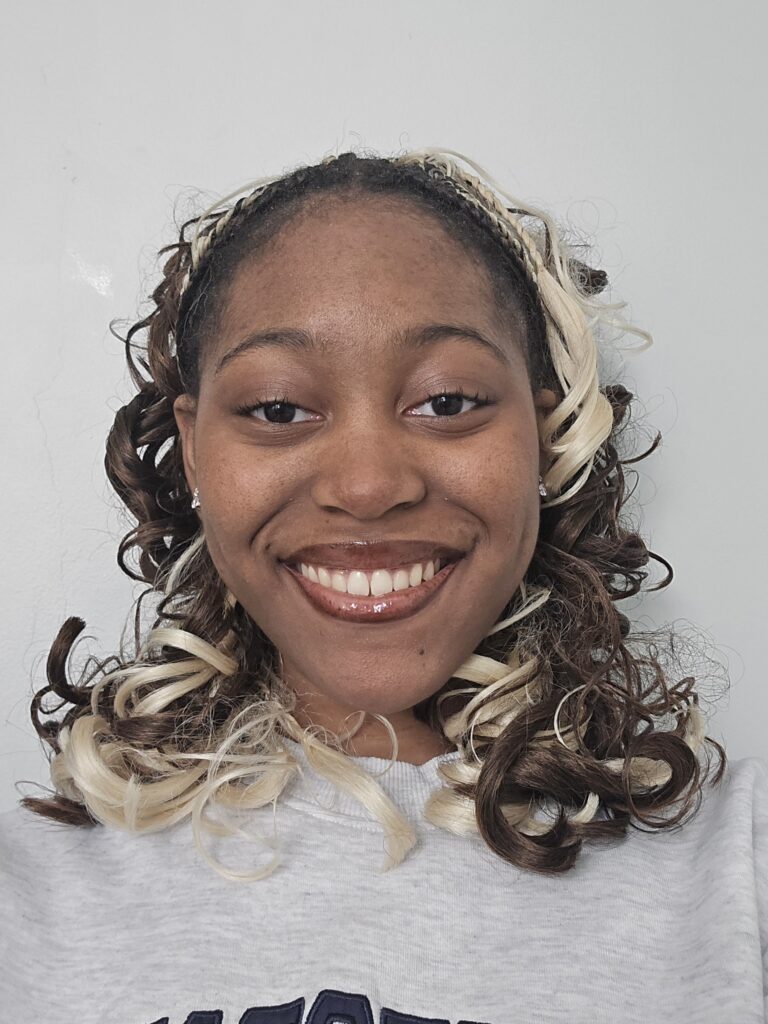 Essence Jones
The grant is designed to cover remaining billed costs after federal grants, subsidized loans, and other scholarships are applied—closing gaps that often prevent students with demonstrated financial need from enrolling.
Early results suggest momentum. In its first year, the program offered awards to nearly 140 students, with dozens ultimately enrolling and receiving grants ranging from $1,100 to $22,000. Just as importantly, Mozie-Ross notes, the early promise of financial support helped families make confident decisions about college. And the increased outreach methods are paying off—applications from city residents grew by 20 percent for fall 2026.
UMBC, Jones says, meets her at her pace and provides lots of student support. She points to spaces like the Learning Collaboratory, where students gather to work through complex chemistry problems together. “You’re both teaching and learning,” she explains. “That helps solidify the information.”
That sense of shared effort—of not struggling alone—has defined her early college experience. Whether studying with friends from her STEM courses or working quietly on the sixth floor of the library, Jones has found community. Her path to science was shaped before UMBC. At Baltimore City College, she was inspired by teachers who looked like her—women of color leading classrooms in biology and chemistry. “Being able to see them in that space… really helped me enjoy science,” she says. Now, she hopes to carry that sense of belonging forward.
Support fosters success
Deylon Moy Joseph, a mechanical engineering first-year student and another Best of Baltimore awardee, echoes Jones’ observations about support and community at UMBC. Originally from Trinidad and Tobago, he arrived in the United States in 2022 and enrolled at Mergenthaler Vocational-Technical High School—a mile north of Jones’ school. From the start, financial reality shaped his college search. “It was necessary for me to get some type of college funding,” he says. “I didn’t want to be stuck with really heavy student loans.”
At UMBC, he found a layered support system: the prestigious Meyerhoff Scholars Program, and unexpectedly, the Best of Baltimore grant. “We didn’t have to apply, but when we were accepted to UMBC, we received letters saying, ‘Congratulations,’” he recalls. “It was amazing.”
For Moy Joseph, that confidence extends into the classroom. He describes his technical coursework as demanding but manageable—especially with the right support. He credits faculty like Joseph Washington ’97, mechanical engineering, an assistant teaching professor whose open-door approach allows students to work through complex problems in real time. “Having the professor right there to give pointers… it really made retention much easier,” he says.
Outside class, in spaces like the Retriever Learning Center, students gather around whiteboards filled with equations, working through concepts together. “It’s so easy to study with someone,” Moy Joseph says. “And it’s satisfying to help people, too.”
That reciprocity—learning, then teaching—is central to many Retrievers’ experiences. It reflects a broader culture at UMBC, one that merges academic rigor with connection, starting in our very own neighborhood.
]]>
The Best of Baltimore Grant, a UMBC initiative started in fall 2025, is changing how students from Baltimore City imagine college: not as a distant possibility overshadowed by debt, but as a...
https://umbc.edu/stories/baltimore-city-recruits-shine-bright/
https://my3.my.umbc.edu/api/v0/pixel/news/160819/guest@my.umbc.edu/f96cc653dbc18a3b7081fca1134b9df1/api/pixel
baltimore-city
cahss
cnms
coeit
impact
spring-2026
stories
story
UMBC News & Magazine
https://my3.my.umbc.edu/groups/umbc-news-magazine
https://assets1-my.umbc.edu/system/shared/avatars/groups/000/001/943/24435aa6207c452e7bc15cc74b42c7bb/xsmall.png?1748556657
https://assets1-my.umbc.edu/system/shared/avatars/groups/000/001/943/24435aa6207c452e7bc15cc74b42c7bb/original.png?1748556657
https://assets2-my.umbc.edu/system/shared/avatars/groups/000/001/943/24435aa6207c452e7bc15cc74b42c7bb/xxlarge.png?1748556657
https://assets2-my.umbc.edu/system/shared/avatars/groups/000/001/943/24435aa6207c452e7bc15cc74b42c7bb/xlarge.png?1748556657
https://assets3-my.umbc.edu/system/shared/avatars/groups/000/001/943/24435aa6207c452e7bc15cc74b42c7bb/large.png?1748556657
https://assets1-my.umbc.edu/system/shared/avatars/groups/000/001/943/24435aa6207c452e7bc15cc74b42c7bb/medium.png?1748556657
https://assets2-my.umbc.edu/system/shared/avatars/groups/000/001/943/24435aa6207c452e7bc15cc74b42c7bb/small.png?1748556657
https://assets1-my.umbc.edu/system/shared/avatars/groups/000/001/943/24435aa6207c452e7bc15cc74b42c7bb/xsmall.png?1748556657
https://assets2-my.umbc.edu/system/shared/avatars/groups/000/001/943/24435aa6207c452e7bc15cc74b42c7bb/xxsmall.png?1748556657
UMBC News & Magazine
0
0
false
Tue, 23 Jun 2026 16:18:32 -0400
Tue, 23 Jun 2026 16:18:32 -0400
Finley Bandy ’26 finds a future in history
Finley Bandy spent last summer in the cool temperatures and dim light of UMBC’s Albin O. Kuhn Library and Gallery Special Collections—the perfect environment to preserve rare books, photographs, manuscripts, archives, and artifacts. As part of UMBC’s 2025 Co-Lab interdisciplinary undergraduate summer research program, Bandy learned techniques to produce “Special Collections 101”, an informative video about how to use the resources in the collections. Bandy also loves being surrounded by thousands of historical narratives and working with Special Collections staff Beth Saunders, associate director and curator, and Lindsey Loeper, reference and instruction archivist. The infinite possibilities housed in Special Collections and the people who ensure historical narratives aren’t forgotten have inspired Bandy to join the cadre of museum and archive professionals.
“I was accepted into UMBC’s master’s program in historical studies,” says Bandy. “I love the process of using my historical and archival research to write about what I’m finding so that other people are aware that this piece of history exists. That’s why I want my master’s research to be an online exhibit that is accessible to the world.”
Museums and archives are only two of Bandy’s passions. When Bandy transferred to UMBC from Lamar Community College in Colorado, they brought their love of Russian language, history, and culture, and their deep love of Baltimore City.
Q: Did you come to UMBC already knowing what you wanted to study?
A: When I started at UMBC, I was all set to learn Russian and study Soviet history, but then I decided to go broader and major in history. I did finish all the Russian language courses, so I can speak Russian. I’m still interested in Russian history, and I love Russian music. I really love the language and like Eastern European culture.
Q: Where does your passion for Russian language and culture come from?
A: In my community college, I took a 20th-century world history class, and learned about the Cold War, which lasted from 1947 to 1991. A lot of the history really broke my heart. It made me want to learn more about it. I took a lot of Russian history classes and started reading Russian and Soviet literature. I really love how unique it is.
Q: Is there a modern piece of Russian culture that you enjoy, or are you focused on the history?
A: I think it’s really interesting to see how Soviet culture is beginning to meld with Western culture.
Soviet rock bands are really, really cool. There’s this great rock band that has been around since the ’70s called Akvarium or Aquarium. They were underground for a long time due to the war. I listen to them a lot. There’s also a current pop musician named Monetochka. She’s really cool.
I’ve never travelled abroad or have a passport, but one day I would like to visit Moscow and St. Petersburg, and travel all over Eastern Europe and the Balkans.
 UMBC’s proximity to Camden Yards makes for a great trip to cheer on the Orioles! (Image courtesy of Bandy)
Q: Do you have a community to speak Russian with and immerse yourself in Russian culture?
A: Yes! UMBC’s Russian Club is a really tight-knit group. In the past, we hosted many holiday celebrations. In post-Soviet Russia and Eastern Europe, they still celebrate Christmas, but New Year’s is celebrated more because during the Soviet era, atheism was promoted and New Year’s didn’t have religious ties. Towards the end of the fall semester, we organized a giant Novy God [New Year’s] celebration. And then in the spring, we celebrated Maslenitsa. In the Russian Orthodox Church, this is the last week to feast before a period of fasting that ends at Easter. We also hung out a lot and talked about different Eastern European cultures. It’s called the Russian Club, but we have students from all over Eastern Europe—Ukraine, Armenia, and Belarus.
Q: Why do you love Baltimore City?
A:. Even though I was in Colorado for community college, I spent a lot of my childhood in Baltimore City because my grandmother worked in the city and my mom lived there. I have a connection to Baltimore, but I never really knew its history. I took “The History of Baltimore” at the Lion Brothers Building downtown. Every week, we took field trips to historic sites in Baltimore City to connect what we were learning with real-world experiences.
Q: Why did you change your major from Russian to history, and who has inspired you in this path?
A: I decided to switch majors from Russian to history while doing research in Professor Melissa Blair‘s “The History of Baltimore” class. It inspired me to pivot and focus my work on Maryland’s transportation history. The experiential learning and field work inspired me to better understand Baltimore and its history. I think Baltimore is a very unique city with a rich history that is often ignored by the historical record. I enjoyed interacting with other public historians and museum professionals within the city through that class.
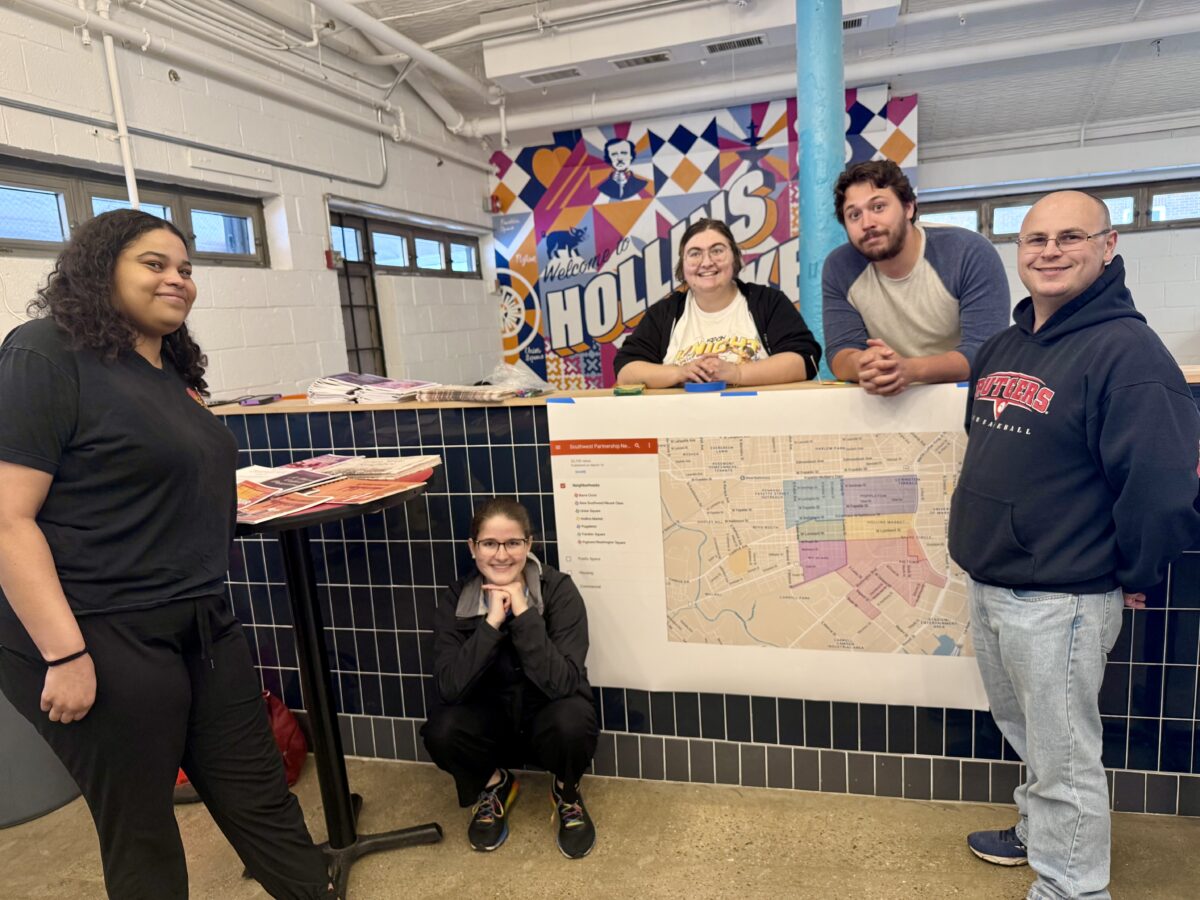 Students from King’s class, “Preserving Spaces, Making Spaces in Baltimore,” participated in a Community Archiving Day event. The class planned this event to engage with residents and community members from neighborhoods in Southwest Baltimore and to gauge interest in developing a Community Archive to preserve their histories. (l-r) Amina Thiam ’24, history, Em Schumacher, a geography and environmental systems senior, Bandy, Tristan Diaz ’25, cultural anthropology and sociology, and Bandy’s fiancé, Max Taylor (who is not a UMBC student). (Image courtesy of King)
I’ve also worked a lot with Professor Nicole King in American studies—I took her “Preserving Places, Making Spaces in Baltimore” class twice. In 2025, we worked with the Poppleton Now Community Association and the Southwest Partnership Historic Preservation Committee on a Public History and Preservation Study. It included my research on the “Highway to Nowhere,” a 1.4-mile stretch of U.S. Route 40 in West Baltimore, built in the 1970s, that ends abruptly. The highway cuts off a section of Poppleton, one of the city’s oldest historically Black neighborhoods. We also created an online story map.
Q: Why are you passionate about transportation equity?
A: I don’t have a car, so I rely on Baltimore’s terrible public transportation. I love public transit, and I need it to be better. In the Baltimore history class, I realized the bus schedules, the bus routes, and the history of highway construction in the city have limited transportation, not expanded it. I conducted research with American studies Professor Michael Cassiano, my public humanities advisor. I presented my research, “Our City Is a City Without an Expressway: A Historical Review of Transportation Injustice in Baltimore City,” at URCAD. I’m interested in exploring these topics in my master’s program.
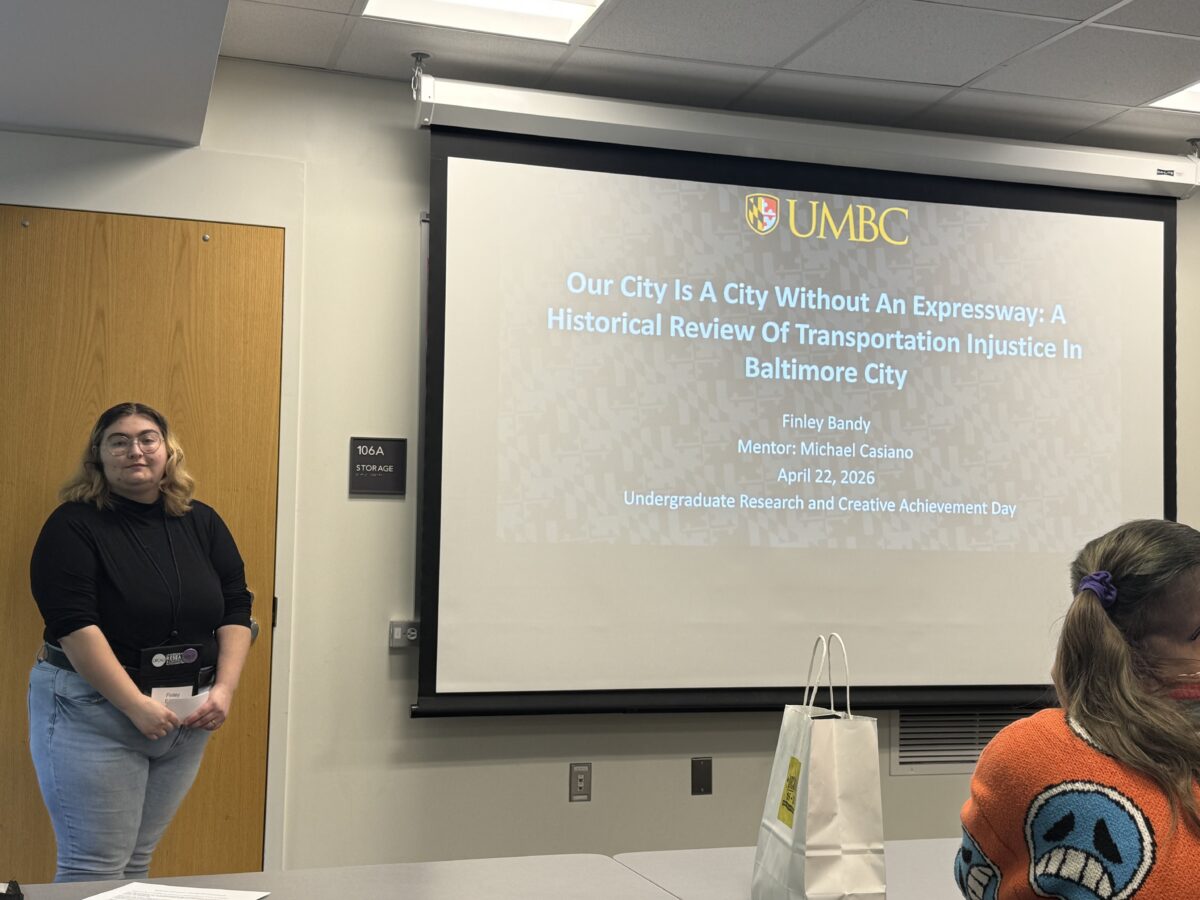 Bandy presents her research at the 2026 Undergraduate Research and Creative Achievement Day. (Image courtesy of King.)
Q: What is a challenge that you love?
A: I love creative writing. I’ve been writing since I was a kid. I think it’s a natural segue into history, because history is narrative-based. It’s very humanistic. I won’t say it comes naturally to me. It takes me probably an hour to write a sentence because I overthink my word choices a lot. But I love using language to evoke certain feelings and really press home on an idea. I try to choose the right word to fit what I’m talking about and its context. I also try to support students in the writing process as the History Student Council president. Last semester, we organized a bi-weekly writing group to encourage community and motivation within the major.
Q: What advice do you have for undergraduate and transfer students?
A: For undergraduate students, I would say to be realistic. Don’t put too much on your plate. That’s been the biggest challenge for me. I’ve been suffering a lot of burnout, because, in addition to my classes, I am a teaching assistant for “Introduction to the University for Transfer Students.” I started getting better at saying no to things. I encourage students to get out there, explore new things, but also recognize their limits. Prioritize making space for something that brings you joy.
For transfer students, I would say time management. Most of us work full-time or part-time, are raising families, and have other commitments. We’re not fresh out of high school and can sometimes internalize a feeling of being behind or not doing college “right.” It’s important to get over that because it doesn’t really matter. When I was 18 years old, my coworker was 40 years old. They had been working for decades. Once you leave high school, age doesn’t matter the same way—people are people, and everyone is busy. I wouldn’t focus on trying to get things done in a way that’s expected of you. Instead, focus on what you need to do to succeed.
Read more Class of 2026 stories.
]]>
Finley Bandy spent last summer in the cool temperatures and dim light of UMBC’s Albin O. Kuhn Library and Gallery Special Collections—the perfect environment to preserve rare books, photographs,...
https://umbc.edu/stories/finley-bandy-finds-a-future-in-history/
Video Preview
https://assets4-my.umbc.edu/system/shared/attachments/d466f8276cc946f059f8628c77954b1c/6aa134f8/news/000/160/021/753b160cd612d83ee6b7c8c05e556046/2VV5_EeP8xs.jpg?1778616307
https://my3.my.umbc.edu/api/v0/pixel/news/160021/guest@my.umbc.edu/74ebb52b16afdf97b14dc160572a104f/api/pixel
american-studies
aok-library
baltimore-city
cahss
class-of-2026
ges
history
news
policy-and-society
saph
story
UMBC News & Magazine
https://my3.my.umbc.edu/groups/umbc-news-magazine
https://assets1-my.umbc.edu/system/shared/avatars/groups/000/001/943/24435aa6207c452e7bc15cc74b42c7bb/xsmall.png?1748556657
https://assets1-my.umbc.edu/system/shared/avatars/groups/000/001/943/24435aa6207c452e7bc15cc74b42c7bb/original.png?1748556657
https://assets2-my.umbc.edu/system/shared/avatars/groups/000/001/943/24435aa6207c452e7bc15cc74b42c7bb/xxlarge.png?1748556657
https://assets2-my.umbc.edu/system/shared/avatars/groups/000/001/943/24435aa6207c452e7bc15cc74b42c7bb/xlarge.png?1748556657
https://assets3-my.umbc.edu/system/shared/avatars/groups/000/001/943/24435aa6207c452e7bc15cc74b42c7bb/large.png?1748556657
https://assets1-my.umbc.edu/system/shared/avatars/groups/000/001/943/24435aa6207c452e7bc15cc74b42c7bb/medium.png?1748556657
https://assets2-my.umbc.edu/system/shared/avatars/groups/000/001/943/24435aa6207c452e7bc15cc74b42c7bb/small.png?1748556657
https://assets1-my.umbc.edu/system/shared/avatars/groups/000/001/943/24435aa6207c452e7bc15cc74b42c7bb/xsmall.png?1748556657
https://assets2-my.umbc.edu/system/shared/avatars/groups/000/001/943/24435aa6207c452e7bc15cc74b42c7bb/xxsmall.png?1748556657
UMBC News & Magazine
0
0
false
Tue, 12 May 2026 15:44:27 -0400
Tue, 12 May 2026 15:44:27 -0400
UMBC student entrepreneurs win funding from the 2026 Pava LePere Innovation Awards
Two student-led UMBC start-ups have been selected to receive 2026 Pava LePere Innovation Awards, granting them $50,000 each from the state of Maryland to support their business, as well as access to mentorship, training, and strategic support from the Maryland Student Venture Core Advisory Board and representatives from a network of entrepreneur support organizations across the local tech ecosystem.
The first start-up, called iBraid, was founded by Velma Funebe, a junior studying public health. She is building an augmented reality braiding app to help users part faster, see more clearly, and confidently braid their own hair.
The second start-up, called Strike Sense, is led by Charles Nerad, a sophomore studying media and communications and financial economics, and Aidan Fleischer,and Abhinav Patel, both sophomores studying mechanical engineering. The team is developing cost-effective attachments to transform any existing martial arts chest protector into an electronic, gamified system with sound effects and a “health bar.”
The teams were recognized at the Maryland Student Venture Showcase, held February 18 in Baltimore.
 Velma Funebe presents her start-up iBraid at the 2026 Maryland Student Venture Showcase on February 18. (Photo courtesy of Kevin Fulmer)
Aspiring entrepreneurs can tap a wealth of resources at UMBC. The Alex. Brown Center for Entrepreneurship and Innovation, led by director Kevin Fulmer, supports the entrepreneurial mindset with courses, speaker series featuring business leaders, start-up accelerator programs, and assistance with business ideas and networking with experts.
Last spring, Strike Sense competed and won second place in the technology and innovation track at the Cangialosi Business Innovation Competition, established by Greg Cangialosi ’96, English, an entrepreneurial leader in Baltimore. The competition provides UMBC student entrepreneurs with real-world experience, pairing them with mentors and connecting them to the local entrepreneurial ecosystem. Winners receive valuable support, including free legal and accounting services, a six-month affiliate membership at the bwtech@UMBC incubator, and guidance for fundraising and pitch development.
This year marks the second in a row that UMBC teams have won Pava LePere Innovation Awards, following the success of Elastic Energy, co-founded by mechanical engineering junior Samuel Bendek, at the inaugural awards in 2025.
“We are excited about the continued exposure and opportunities our student ventures are receiving in the broader Baltimore entrepreneurship community. It is validation that the programs we’ve put in place over the past few years are starting to pay dividends,” says Fulmer. “The ideas students are coming up with continue to be very impactful in creating economic and social impact in addition to being a great learning experience.”
]]>
Two student-led UMBC start-ups have been selected to receive 2026 Pava LePere Innovation Awards, granting them $50,000 each from the state of Maryland to support their business, as well as access...
https://umbc.edu/stories/entrepreneurs-win-2026-pava-lepere-innovation-awards/
https://my3.my.umbc.edu/api/v0/pixel/news/157097/guest@my.umbc.edu/56eefac58594f56a5b2d6e6d9ff20ec1/api/pixel
alexbrowncenter
baltimore-city
bwtech
cahss
coeit
meche
news
policy-and-society
public-policy
science-and-tech
story
UMBC News & Magazine
https://my3.my.umbc.edu/groups/umbc-news-magazine
https://assets1-my.umbc.edu/system/shared/avatars/groups/000/001/943/24435aa6207c452e7bc15cc74b42c7bb/xsmall.png?1748556657
https://assets1-my.umbc.edu/system/shared/avatars/groups/000/001/943/24435aa6207c452e7bc15cc74b42c7bb/original.png?1748556657
https://assets2-my.umbc.edu/system/shared/avatars/groups/000/001/943/24435aa6207c452e7bc15cc74b42c7bb/xxlarge.png?1748556657
https://assets2-my.umbc.edu/system/shared/avatars/groups/000/001/943/24435aa6207c452e7bc15cc74b42c7bb/xlarge.png?1748556657
https://assets3-my.umbc.edu/system/shared/avatars/groups/000/001/943/24435aa6207c452e7bc15cc74b42c7bb/large.png?1748556657
https://assets1-my.umbc.edu/system/shared/avatars/groups/000/001/943/24435aa6207c452e7bc15cc74b42c7bb/medium.png?1748556657
https://assets2-my.umbc.edu/system/shared/avatars/groups/000/001/943/24435aa6207c452e7bc15cc74b42c7bb/small.png?1748556657
https://assets1-my.umbc.edu/system/shared/avatars/groups/000/001/943/24435aa6207c452e7bc15cc74b42c7bb/xsmall.png?1748556657
https://assets2-my.umbc.edu/system/shared/avatars/groups/000/001/943/24435aa6207c452e7bc15cc74b42c7bb/xxsmall.png?1748556657
UMBC News & Magazine
1
0
false
Tue, 03 Mar 2026 13:09:42 -0500
Tue, 03 Mar 2026 13:09:42 -0500
Submersive Subversive Art
While many know that Charm City is home to the wizard of weird himself, John Waters, along with the quirky American Visionary Art Museum, poodle skirts, and flamingos galore, most probably don’t associate UMBC with the same offbeat reputation. But take a splash in the wacky waters and you’ll find Retrievers all the way down.
By Janelle Erlichman Diamond
It’s a few minutes into her Fluid Movement water ballet scene, and while most of the swimmers have dropped the red cloaks that hid their bathing suits—a nod to The Handmaid’s Tale—and slipped into the pool as Madonna’s “Like a Prayer” plays on the speaker, Delana Gregg stands alone. As the song reaches its crescendo—“let the choir sing”—Gregg, still in her red cape, falls dramatically backward into the water as the audience gasps and cheers.
Gregg, M.S. ’04, Ph.D. ’19, has worked at UMBC for more than 20 years and is currently the assistant vice provost for Undergraduate Academic Affairs, working with the Academic Success Center and with data and analytics supporting student success. But her summers are filled with swimsuits, glitter, and choreography sheets.
Fluid Movement is a Baltimore-based nonprofit performance art organization that creates joyful, inclusive, quirky, and accessible performances in public spaces, most notably their annual synchronized swimming shows in city pools. “Our art is a love letter to the city of Baltimore and its residents,” says Ashley Ball, Fluid Movement artistic director. “We focus on inclusivity and the empowerment that comes from movement.”
Baltimore City’s commitment to the quirk is well documented, but you might be more surprised to learn that UMBC may be one of the best breeding grounds for pursuing and creating non-traditional art. (John Waters, the kinky, eccentric, famous Baltimore-based filmmaker, writer, and artist known as the “Pope of Trash,” borrowed UMBC film equipment to make some of his early films.) UMBC, a school with an R1 classification for its high level of research and known by a national audience perhaps for the immensely successful STEM-focused Meyerhoff Scholars Program or the 2018 NCAA men’s basketball upset, has a long history of stirring the artistic pot—and current Retrievers play an active role in the weird and inclusive art world of Charm City.
Water ballet get STEAM-y

Photos by Erik Whipple
Gregg swam in her very first water ballet in 2014—Star Spangled Swimmer—and has starred in, stage managed, or produced almost every ballet since including her role as a fatberg in Sinkholes, Sewers, & Streams: A Water Infrastructure Ballet. This past summer she added directing to her repertoire with The Handmaid’s Tale scene in the Dive Into Banned Books: A Water Ballet of Resistance and Joy performance.
That her love for theatrics and performance might be nurtured at a school that has earned a national reputation for excellence in STEM education is not a surprise to Gregg. “Art and design are in everything, and you can’t have theatre without science and technology,” she says. Anyone who has ever built a set or mixed music can attest to that. “Performance is the ultimate interdisciplinary project, and community performance allows for all the different talents to find expression. You know how to sculpt, sew, run cable, create a program, design a logo, write a script, plan a budget, figure out how to create a waterproof, lightweight, affordable set design that can fit in a storage pod—so much geometry and engineering—we need all of those talents, along with sparkle.”
Ball, the artistic director, comes from a STEM background and has her master’s degree in environmental engineering. “People in STEM need art just as much as anyone else, and a Fluid Movement show is nothing short of an engineering marvel,” she says.
And it’s clear that this is a draw for Retrievers. “I’ve met so many UMBC people via Fluid Movement: former board members like visual arts professor Timothy Nohe and Kelly Quinn—people who are committed to creating art in Baltimore with people in our communities. UMBC alumni who live in the area, like Amelia Meman ’15; Maria Blanca, M.A. ’15; and Charlotte Keniston, M.F.A. ’14, Ph.D. ’24—it was so great to work with them at UMBC and to create art with them in Baltimore City. Other amazing artists, like Ann Tabor ’03 of the Mercury Theater, I met through Fluid Movement and realized the UMBC connection later,” says Gregg.
“People are validated by seeing people of all shapes and sizes and ages and ethnicities performing. My performing at age 60-plus as a full-figured, African American woman is affirming to many people in our audiences.”
— Judith “Judi” Reynolds-Stokes ’87, M.A. ’02
“I think there is something about working at a university committed to excellence that makes space for people to be excellent in many aspects of their lives,” says Quinn, managing director of The Choice Program at UMBC and a longtime Fluid Movement participant. “I’m really grateful that I have a boss who’s challenged me as part of my performance plan for this year to incorporate more of my artistic work with Fluid Movement into my leadership of our organization,” says Quinn. This next year she’s going to add “whimsy and creativity” to her storytelling. “I think that’s a testament both to Fluid Movement and my boss’s understanding of the value of arts in everyday life. People at UMBC—including our leadership—really take seriously our artistic and civic lives beyond our position descriptions.”
There’s a place in the pool for everyone
These artistic endeavors may hit the UMBC sweet spot because of the recognition that STEM and art go hand in hand, but the accessibility and inclusiveness of the programming also aligns with the Retriever spirit. “I first became acquainted with Fluid Movement while lifeguarding for Baltimore City Aquatics,” says Judith “Judi” Reynolds-Stokes ’87, M.A. ’02, who works as an instructor, advisor, and career counselor at the Caroline Center, a workforce development program for adult women. “I guarded many of their water ballet shows and loved their creativity and inclusivity. I decided that I wanted to be a swimmer in one of their shows.” Her Fluid Movement debut was in the 2019 show Fluid Movement: The Water Ballet in honor of the nonprofit’s 20th anniversary.
“I think the pull of Fluid Movement for UMBC folks is that you can be a big kid having fun dancing, swimming, and acting. You get to wear pretty costumes and outrageous makeup, and the best part is you get to bring others joy and laughter,” says Reynolds-Stokes.
Like Gregg, she loves that the quirky—in the best way possible—group brings her so much joy and affirmation. “People are validated by seeing people of all shapes and sizes and ages and ethnicities performing. My performing at age 60-plus as a full-figured, African American woman is affirming to many people in our audiences. It lets others know that they too can be in a Fluid Movement show and will be accepted just as they are,” says Reynolds-Stokes, who swims with Stephanie Johnson ’86, her aunt and a fellow UMBC alum. “I love to swim and dance and put on pretty things, so Fluid Movement is a perfect fit for me.”
Release the Kraken
The American Visionary Art Museum, adjacent to the Inner Harbor, is another incubator of Baltimore quirk. The distinctive landmark and home to Fifi, a 15-foot pink poodle on wheels, is dedicated to the preservation and display of outside art and features the work of self-taught artists. (Retriever Jess Owens-Young ’08, political science, recently showed her sports-inspired work in the museum’s galleries.) That includes the Kinetic Sculpture Race, for which teams build and pedal works of art for eight hours on Baltimore City streets, including a foray into the Baltimore Harbor.
In 2011, Steven McAlpine, assistant teaching professor in the Individualized Study Program (INDS), was at the race, as a casual observer with his son. “Dad, can we build one of these?” he asked in awe. McAlpine had also been blown away by both the artistry of the floats and the physical effort of the 15-mile human-powered, all-terrain race for custom-built amphibious sculptures. McAlpine was trying to figure out how he could construct a 12-foot high and 30-foot-long creature at his house when he had a lightbulb moment—the answer was UMBC.
In 2014, McAlpine started the Kinetic Sculpture Project, an interdisciplinary applied learning experience funded by the Alex. Brown Center for Entrepreneurship and UMBC community engagement organization BreakingGround. Students from INDS, mechanical engineering, computer engineering, visual art, psychology, geography and environmental systems, and mathematics all came together to design, build, and race the Kraken Upcycle in the 2015 race. “You need all those perspectives and disciplines to be that innovative,” says McAlpine.
In the 400-level class, students studied sustainable design methods and use of recycled materials (including plastic bottles and barrels as well as reclaimed metal and wood) that would often involve McAlpine dumpster diving—especially after the theatre department broke down a set.
“I wanted to explore something less traditional, where I could express new, wacky ideas and merge creativity with engineering.”
—Michael Webb, computer engineering student

Top and bottom photos courtesy of Steve McAlpine; Middle photo by Poulomi Banerjee ’16, M.P.P. ’21
That very first year UMBC’s team was awarded the “Grand Mediocre East Coast Champion,” and in the 10 years since, more than 100 students have passed through the class. Last year UMBC teamed up with a disability advocacy organization and took home the “Best Art Award” for IMAGE Man—in which a larger-than-life teal superhero sits in a wheelchair with a football in hand, flying over some of Baltimore’s iconic buildings, such as the Bromo Seltzer Arts Tower and the Baltimore World Trade Center.
Of all the years UMBC has participated, McAlpine was especially proud of this one since it showed “the beauty of an infusion of a new partnership,” that, like the water ballet, also underscored UMBC’s commitment to accessibility for all.
“It’s a lot of work—but unconventional art that leans a little offbeat and weird is never all work because it’s playful too,” says McAlpine. “I think it’s absolutely essential for education to feel thrilling and full of discovery and adventure.”
An Out-of-the-Ordinary Spectacle
Dulcey Comeau, a sophomore computer engineering student, participated in the 2025 race with IMAGE Man. “The race day was super cool; we woke up early to get our capes and our helmets, and we spent some of the morning talking to people who wanted to know more about the float,” says Comeau. “It was a cool experience to have people cheering you along all throughout Baltimore,” she says. The race started a bit rocky—they were having some issues with the brakes—but once they were fixed, it was smooth sailing.
“Part of the race is to ride through the mud and I remember getting stuck, and it was so fun to be pushed up the hill through the rest of it,” she says. “Usually as engineers, we create something for a very specific reason with specific standards for the customer, so it was cool to create something for ourselves and really see the full engineering cycle. The opportunity to have creative freedom with such little specifications made the project that much more enjoyable, and I was able to find the fun in being an engineer again.”
Michael Webb had a similar experience. “As a computer engineering student, I was initially drawn to STEM-related clubs and activities like Baja SAE and UMBC’s chapter of American Institute of Aeronautics and Astronautics. Those organizations are incredible for hands-on experience, but they tend to be more formulaic, focused on refining and improving designs from past generations,” the sophomore says. He wanted something a little more left-field and subversive. “I wanted to explore something less traditional, where I could express new, wacky ideas and merge creativity with engineering.”
The Kinetic Sculpture Race, like Fluid Movement, is a perfect blend of the new iteration of STEM—one that includes art with an emphasis on off-the-wall—and it’s in that combination that UMBC excels. The UMBC team and faculty Webb ended up working alongside helped challenge some of his established systems and beliefs and consider alternative perspectives.
“The Kinetic Sculpture Race is unlike anything I had ever seen before,” says Webb. “It was fun, quirky, and completely different from the structured world of engineering I’m used to. The whole event is just for fun, and the sculptures people bring in are absolutely wild: a giant poodle, giant alligators, even a platypus with a differential axle. The rules are just as wacky—you can even bribe the judges.”
It was the wake-up he needed. “In engineering, the goal is usually performance and efficiency,” he says. But in the Kinetic Sculpture Race, the goal is simply to make something imaginative and have fun trying to race it. “It’s messy, unpredictable, and just laughs; a reminder that engineering and art can come together and be creative, ridiculous, and fun at once.”
]]>
While many know that Charm City is home to the wizard of weird himself, John Waters, along with the quirky American Visionary Art Museum, poodle skirts, and flamingos galore, most probably don’t...
https://umbc.edu/stories/submersive-subversive-art/
https://my3.my.umbc.edu/api/v0/pixel/news/155083/guest@my.umbc.edu/be5fc6058db751a75e902259d83cf09c/api/pixel
baltimore-city
cahss
coeit
computer-engineering
fall-2025
impact
inds
magazine
story
UMBC News & Magazine
https://my3.my.umbc.edu/groups/umbc-news-magazine
https://assets1-my.umbc.edu/system/shared/avatars/groups/000/001/943/24435aa6207c452e7bc15cc74b42c7bb/xsmall.png?1748556657
https://assets1-my.umbc.edu/system/shared/avatars/groups/000/001/943/24435aa6207c452e7bc15cc74b42c7bb/original.png?1748556657
https://assets2-my.umbc.edu/system/shared/avatars/groups/000/001/943/24435aa6207c452e7bc15cc74b42c7bb/xxlarge.png?1748556657
https://assets2-my.umbc.edu/system/shared/avatars/groups/000/001/943/24435aa6207c452e7bc15cc74b42c7bb/xlarge.png?1748556657
https://assets3-my.umbc.edu/system/shared/avatars/groups/000/001/943/24435aa6207c452e7bc15cc74b42c7bb/large.png?1748556657
https://assets1-my.umbc.edu/system/shared/avatars/groups/000/001/943/24435aa6207c452e7bc15cc74b42c7bb/medium.png?1748556657
https://assets2-my.umbc.edu/system/shared/avatars/groups/000/001/943/24435aa6207c452e7bc15cc74b42c7bb/small.png?1748556657
https://assets1-my.umbc.edu/system/shared/avatars/groups/000/001/943/24435aa6207c452e7bc15cc74b42c7bb/xsmall.png?1748556657
https://assets2-my.umbc.edu/system/shared/avatars/groups/000/001/943/24435aa6207c452e7bc15cc74b42c7bb/xxsmall.png?1748556657
UMBC News & Magazine
1
0
false
Thu, 04 Dec 2025 14:42:41 -0500
Thu, 04 Dec 2025 14:42:41 -0500
UMBC and Building STEPs partner to help Baltimore City high school students reach their potential in STEM
Boing! Bouncy balls strike the hallway floor as small groups of students measure bounce heights with a meterstick and record data. They repeat the test in a carpeted classroom, then analyze results in Excel, discussing how surfaces affect energy conversion.
This might sound like a physics laboratory, but it’s actually a math course for high schoolers in Building Science Technology Education Partnerships (STEPs), a college-preparatory program for students from under-resourced high schools in Baltimore City. For two weeks this summer, 21 rising seniors and college-bound students, nine college-student tutors, and instructor Rebecca Kirvan, M.A. ’13, secondary education and teaching, filled the fourth floor of UMBC’s Interdisciplinary Life Sciences Building for intensive, hands-on math instruction each afternoon. In the mornings, the students participated in professional development programming, such as a financial literacy workshop and team-based problem-solving challenges.
This is the fifth year of collaboration between Building STEPS and UMBC, but thanks to a deepening relationship between the organization and the College of Natural and Mathematical Sciences (CNMS), this year the summer program came to UMBC’s campus for the first time. In addition, the math portion shifted from traditional tutoring to an adapted version of MATH 110: Math in Action, a unique laboratory-style math course heading into its third year being taught at UMBC.
 UMBC tutor Xavier Cohen (left), a rising senior majoring in math and computer science, has been tutoring math in various capacities since 2021. He says that he sees firsthand how the activity-based curriculum used by Building STEPs improves student learning. (Brad Ziegler/UMBC)
“UMBC and CNMS have been incredible collaborators, providing Building STEPs students with accessible and effective math enrichment in an immersive college experience,” says Debra Hettleman, CEO of Building STEPs.
William R. LaCourse, CNMS dean, believes strongly in making math education engaging and relevant for all students, in support of developing their critical thinking skills. “Teaching math in an interactive format shows the students how it relates to their everyday lives,” he says. “Creating opportunities for them to make those connections is so important.”
From tutoring to hands-on labs
In 2021, Cindy Greenwood, associate director of UMBC’s Center for Women in Technology, coordinated the original tutoring initiative for her capstone project in UMBC’s certificate program in community leadership, after learning from Building STEPs that that was what they needed most.
Alexis O’Malley ’18, mathematics and psychology, took the lead developing a robust curriculum for the tutors to implement on top of her role as a calculus instructor in CNMS. Until this year, the University of Baltimore hosted the tutoring sessions. For 2025, CNMS hired Kirvan to modify the activities in MATH 110, which O’Malley also originally led with support from math department faculty.
“As a former high school teacher, I’ve enjoyed the opportunity to adapt college labs for a high school audience,” Kirvan says. “It’s great to work with this group of students and help them beef up their math skills and get ready for college.”
 UMBC alumna Rebecca Kirvan, right, taught the lab-based math course this summer. (Brad Ziegler/UMBC)
The students see the benefits.
“It’s been good to review concepts and practice my math skills,” shared Benjamin Kima, a participant from Mergenthaler Vocational-Technical High School. Sam Boad, also at Mergenthaler, said, “I’m glad they’re giving us a chance to see the content ahead of the school year.” Zaiqah Pinkney, from City Neighbors High School, added, “I like hands-on activities. It helps me learn better.”
“Students consistently rate math as their favorite part of the day,” shares Sheyna Mikeal, chief program officer at Building STEPs. “It challenges them, but the small-group structure, guided by dedicated tutors, builds confidence and encourages real growth.”
Campus immersion and career prep
Beyond providing math instruction, CNMS funded lunches at UMBC’s True Grit’s dining hall, freeing up Building STEPs’ budget for student transportation and enabling greater participation.
“I’ve enjoyed the opportunity to be on a college campus,” shared Brandon Thomas, a student at Mergenthaler.
And beyond the summer program, a larger cohort of Building STEPs students visited UMBC during the semester. They heard presentations from CNMS departments and took a tour of campus. “We’ve witnessed the power of learning on a college campus shifting the students’ perspective,” Mikeal says. “It reinforces that college is not just a goal, it’s an environment where they belong.”
Other Building STEPs activities include visits to companies like Northrop Grumman and Beckton-Dickinson, workshops on searching for and applying to colleges, and one-on-one feedback with volunteer writing advisors.
 Benjamin Kima (standing) runs a trial in a lab activity about potential and kinetic energy. (Brad Ziegler/UMBC)
Strength beyond academics
Students in the program, founded in 2000, are recommended by college counselors and teachers, and must maintain a 3.0 GPA. This past academic year, there were 83 juniors and 83 seniors enrolled, and there are 175 Building STEPs alumni. Nearly 80 percent earn a college degree, and nearly two-thirds earn degrees in STEM. Coming from 15 of Baltimore’s most challenged high schools, 87 percent are first-generation college graduates. Alumni return from college to offer programming to current participants, fostering leadership development.
“Together with UMBC, we’re not only strengthening academic skills—we’re also expanding access to opportunity,” Mikeal says.
LaCourse sees providing space, funds, and effective and engaging math activities to benefit local high schoolers as a natural fit for the college.
“Building STEPs participants are bright, motivated students who just need a little support to reach their potential,” LaCourse says. “It’s a privilege to be able to offer the resources the program needs—from classrooms to curriculum—to enable an enriching summer math and professional development experience. We hope to see some of their faces on campus again soon—this time as UMBC students.”
 Building STEPs participant Brandon Thomas relaxes with his group members between experiments. (Brad Ziegler/UMBC)
]]>
Boing! Bouncy balls strike the hallway floor as small groups of students measure bounce heights with a meterstick and record data. They repeat the test in a carpeted classroom, then analyze...
https://umbc.edu/stories/umbc-building-steps-partnership/
https://my3.my.umbc.edu/api/v0/pixel/news/151257/guest@my.umbc.edu/78258b47f3068ff9dd7afde03f0bddb5/api/pixel
alumni
baltimore-city
cahss
cnms
coeit
community
community-leadership
cwit
education
news
science-and-tech
story
UMBC News & Magazine
https://my3.my.umbc.edu/groups/umbc-news-magazine
https://assets1-my.umbc.edu/system/shared/avatars/groups/000/001/943/24435aa6207c452e7bc15cc74b42c7bb/xsmall.png?1748556657
https://assets1-my.umbc.edu/system/shared/avatars/groups/000/001/943/24435aa6207c452e7bc15cc74b42c7bb/original.png?1748556657
https://assets2-my.umbc.edu/system/shared/avatars/groups/000/001/943/24435aa6207c452e7bc15cc74b42c7bb/xxlarge.png?1748556657
https://assets2-my.umbc.edu/system/shared/avatars/groups/000/001/943/24435aa6207c452e7bc15cc74b42c7bb/xlarge.png?1748556657
https://assets3-my.umbc.edu/system/shared/avatars/groups/000/001/943/24435aa6207c452e7bc15cc74b42c7bb/large.png?1748556657
https://assets1-my.umbc.edu/system/shared/avatars/groups/000/001/943/24435aa6207c452e7bc15cc74b42c7bb/medium.png?1748556657
https://assets2-my.umbc.edu/system/shared/avatars/groups/000/001/943/24435aa6207c452e7bc15cc74b42c7bb/small.png?1748556657
https://assets1-my.umbc.edu/system/shared/avatars/groups/000/001/943/24435aa6207c452e7bc15cc74b42c7bb/xsmall.png?1748556657
https://assets2-my.umbc.edu/system/shared/avatars/groups/000/001/943/24435aa6207c452e7bc15cc74b42c7bb/xxsmall.png?1748556657
UMBC News & Magazine
1
0
false
Fri, 01 Aug 2025 12:07:10 -0400
Fri, 01 Aug 2025 12:07:10 -0400
Magaly Lizama Hernandez ’26, a burgeoning public servant, receives the inaugural Bernard L. Berkowitz Memorial Award, honoring service to Baltimore City
Building STEPs participant Brandon Thomas relaxes with his group members between experiments. (Brad Ziegler/UMBC)
]]>
Boing! Bouncy balls strike the hallway floor as small groups of students measure bounce heights with a meterstick and record data. They repeat the test in a carpeted classroom, then analyze...
https://umbc.edu/stories/umbc-building-steps-partnership/
https://my3.my.umbc.edu/api/v0/pixel/news/151257/guest@my.umbc.edu/78258b47f3068ff9dd7afde03f0bddb5/api/pixel
alumni
baltimore-city
cahss
cnms
coeit
community
community-leadership
cwit
education
news
science-and-tech
story
UMBC News & Magazine
https://my3.my.umbc.edu/groups/umbc-news-magazine
https://assets1-my.umbc.edu/system/shared/avatars/groups/000/001/943/24435aa6207c452e7bc15cc74b42c7bb/xsmall.png?1748556657
https://assets1-my.umbc.edu/system/shared/avatars/groups/000/001/943/24435aa6207c452e7bc15cc74b42c7bb/original.png?1748556657
https://assets2-my.umbc.edu/system/shared/avatars/groups/000/001/943/24435aa6207c452e7bc15cc74b42c7bb/xxlarge.png?1748556657
https://assets2-my.umbc.edu/system/shared/avatars/groups/000/001/943/24435aa6207c452e7bc15cc74b42c7bb/xlarge.png?1748556657
https://assets3-my.umbc.edu/system/shared/avatars/groups/000/001/943/24435aa6207c452e7bc15cc74b42c7bb/large.png?1748556657
https://assets1-my.umbc.edu/system/shared/avatars/groups/000/001/943/24435aa6207c452e7bc15cc74b42c7bb/medium.png?1748556657
https://assets2-my.umbc.edu/system/shared/avatars/groups/000/001/943/24435aa6207c452e7bc15cc74b42c7bb/small.png?1748556657
https://assets1-my.umbc.edu/system/shared/avatars/groups/000/001/943/24435aa6207c452e7bc15cc74b42c7bb/xsmall.png?1748556657
https://assets2-my.umbc.edu/system/shared/avatars/groups/000/001/943/24435aa6207c452e7bc15cc74b42c7bb/xxsmall.png?1748556657
UMBC News & Magazine
1
0
false
Fri, 01 Aug 2025 12:07:10 -0400
Fri, 01 Aug 2025 12:07:10 -0400
Magaly Lizama Hernandez ’26, a burgeoning public servant, receives the inaugural Bernard L. Berkowitz Memorial Award, honoring service to Baltimore City
Growing up in Bronx, New York, almost a century ago, Bernard “Bernie” L. Berkowitz, a first-generation son of Hungarian immigrants, may not have realized then that his life would take him beyond the bounds of New York City to Baltimore City and eventually to UMBC. In 1995, Berkowitz completed seven years of service to UMBC as the special assistant to the president for economic development efforts, which included planning for the bwtech@UMBC Research and Technology Park.
Thirty years later, Magaly Lizama Hernandez, a first-generation daughter of Salvadoran immigrants, is the recipient of the inaugural award bearing his name for her vision to develop a higher education pathway for Baltimore City students—a similar program to the one that led her to the psychology program at UMBC at the Universities at Shady Grove.
“Receiving the Bernard L. Berkowitz Memorial Award is not only an incredible and personal honor, but a reflection of a mission I’m deeply passionate about, making higher education more accessible for young people in Baltimore City,” said senior Lizama Hernandez at the awards ceremony this past May. “I’ve seen many talented and hardworking students feel that college was out of reach, not because of ability, but because they lacked access, support, and sometimes simply someone who believed in them. I know, because I was that student.”
As an alumna of the Achieving Collegiate Excellence and Success (ACES) program, a partnership between Montgomery County Public Schools, Montgomery College, and the Universities at Shady Grove, Lizama Hernandez knows firsthand the profound impact of mentorship. Beginning in her sophomore year at Gaithersburg High School in Montgomery County, Lizama Hernandez received one-on-one coaching to develop college-level skills and guidance on college and scholarship applications, which made her transition from high school to Montgomery College—and eventually to UMBC-Shady Grove—a success. Now, she wants to adapt the program for Baltimore City Public Schools.
The next generation of public servants
“The goal of the endowment is to inspire the next generation of committed Baltimore public servants,” said Rachel Edds, former deputy director of Baltimore City’s planning department, principal at Edds Consulting, and one of 10 founding donors. After Berkowitz passed in 2023, the group—composed of family, friends, and colleagues—established the award to commemorate his more than 40-year legacy of planning and economic development in Baltimore City.
Berkowitz began his service to Baltimore City in 1961 at the Baltimore City Department of Planning, becoming the director in 1968. He held various positions across the city, including on Mayor William Donald Schaefer’s economic development team (1974 – 1980), and more recently as the president of the Black/Jewish Forum of Baltimore (1997 – 1999) and as president of the Lexington Market Board (1990s – 2000s).
“We look to provide the recipients of the Bernard Berkowitz Memorial Award with planning, guidance, and leadership, assuring that the Baltimore region of the future remains sound and continues to be on very strong economic footing,” said Edds. She was joined in the audience by three other founding members: David Berkowitz, his son, Chris Ryer, director of planning for Baltimore City Mayor Brandon Scott, and David Hash, senior director of facilities planning at Johns Hopkins Bayview Medical Center, who worked with Berkowitz for over 20 years.
 (l-r): Eli Edds, Dave Hash, Rachel Edds, Lizama Hernandez, Erick Stokan, and Chris Ryer. (Image courtesy of Stokan)
“Bernie was a true professional whose work ethic was exemplary. He cared very much about serving the business community, calling upon companies who he thought might benefit from the numerous economic development programs available for their retention and expansion”, said David Hash, former executive vice president of the Baltimore Economic Development Corporation.
The fund marks the first student-centered endowment award administered by UMBC’s Center for Social Science Scholarship (CS3). Eric Stokan, director of CS3 and associate professor of political science, noted that Lizama Hernandez’s application stood out among the 16 submitted. “Magaly’s efforts to empower low-income students throughout their educational journey, providing them with tools, support, and confidence to thrive professionally and personally, align well with the spirit and purpose of the award,” said Stokan.
Stokan is grateful that the founding funders will ensure that CS3 can offer this award on an annual basis to students who embody the spirit of “Bernie” Berkowitz with a focus on local public service in the Baltimore area.
Investing in Baltimore City Public Schools
Impressed by Lizama Hernandez’s entrepreneurial spirit, the counseling staff at Gaithersburg High School hired her as a student worker to guide students like herself through the college application process. The knowledge she acquired as a student and staff member in the program has prepared her to begin the planning process for establishing the program at Baltimore City Public Schools with the guidance from the Bernard L. Berkowitz Memorial Fund donors.
“Bernie believed in transcending divisions—bringing together people of different social and economic backgrounds,” said Edds. “He is fondly remembered for his clear thinking, always with a sense of humor and kindness.”
His example has motivated Lizama Hernandez to take the next step in her academic and professional journey. “Through my studies in psychology and social work at UMBC and my work supporting students and families, I’ve seen firsthand the transformative power of education,” said Lizama Hernandez, who plans on earning a master’s in social work. “My goal as a future counselor is to help students know why their dreams are valid and achievable. Baltimore’s young people deserve every chance to thrive.”
Learn more about UMBC scholarship opportunities.
]]>
Growing up in Bronx, New York, almost a century ago, Bernard “Bernie” L. Berkowitz, a first-generation son of Hungarian immigrants, may not have realized then that his life would take him beyond...
https://umbc.edu/stories/lizama-hernandez-wins-bernard-l-berkowitz-award/
https://my3.my.umbc.edu/api/v0/pixel/news/150728/guest@my.umbc.edu/44efec996714b9d256f91e11ea2636b4/api/pixel
baltimore-city
cahss
cs3
news
policy-and-society
political-science
psychology
shadygrove
story
UMBC News & Magazine
https://my3.my.umbc.edu/groups/umbc-news-magazine
https://assets1-my.umbc.edu/system/shared/avatars/groups/000/001/943/24435aa6207c452e7bc15cc74b42c7bb/xsmall.png?1748556657
https://assets1-my.umbc.edu/system/shared/avatars/groups/000/001/943/24435aa6207c452e7bc15cc74b42c7bb/original.png?1748556657
https://assets2-my.umbc.edu/system/shared/avatars/groups/000/001/943/24435aa6207c452e7bc15cc74b42c7bb/xxlarge.png?1748556657
https://assets2-my.umbc.edu/system/shared/avatars/groups/000/001/943/24435aa6207c452e7bc15cc74b42c7bb/xlarge.png?1748556657
https://assets3-my.umbc.edu/system/shared/avatars/groups/000/001/943/24435aa6207c452e7bc15cc74b42c7bb/large.png?1748556657
https://assets1-my.umbc.edu/system/shared/avatars/groups/000/001/943/24435aa6207c452e7bc15cc74b42c7bb/medium.png?1748556657
https://assets2-my.umbc.edu/system/shared/avatars/groups/000/001/943/24435aa6207c452e7bc15cc74b42c7bb/small.png?1748556657
https://assets1-my.umbc.edu/system/shared/avatars/groups/000/001/943/24435aa6207c452e7bc15cc74b42c7bb/xsmall.png?1748556657
https://assets2-my.umbc.edu/system/shared/avatars/groups/000/001/943/24435aa6207c452e7bc15cc74b42c7bb/xxsmall.png?1748556657
UMBC News & Magazine
1
0
false
Wed, 18 Jun 2025 15:34:11 -0400
Wed, 18 Jun 2025 15:34:11 -0400
Multiplying community connections: UMBC math and stat and the Ingenuity Project at a Baltimore high school forge thriving STEM partnership
On Wednesday, May 21, more than 300 high school students from the high school Baltimore Polytechnic Institute (Poly), family members, teachers, and faculty and staff from area universities filled a hall at Loyola University Maryland for the Ingenuity Project’s 2025 STEM Student Research Symposium. Poly students presented research they had completed as part of the Ingenuity Project, UMBC mathematics and statistics majors presented educational workshops, and UMBC faculty and staff were on site to discuss their research and opportunities at UMBC.
The Ingenuity Project is a premier STEM program at Poly, a top-tier, STEM-focused high school in Baltimore City. Ingenuity prepares highly motivated students for success in college and beyond with a rigorous STEM curriculum, including independent research. Ingenuity students have earned over $27 million in scholarships since the program’s launch in 1997.

 Ingenuity Project students visited UMBC this spring. They toured campus (right), heard from current math and stat students (left), and sat in on UMBC math courses. (Courtesy of Justin Webster)
Two years ago, UMBC’s Department of Mathematics and Statistics recognized a unique opportunity to engage with these talented students, sparking a partnership that has flourished through shared goals and hands-on collaboration. UMBC’s College of Natural and Mathematical Sciences, Summer Enrichment Academy, College of Engineering and IT, and Meyerhoff Scholars Program also participated in the research symposium, either in person or through financial support.
Ingenuity and commitment to student success
“Our partnership with Ingenuity has allowed us to interact with some truly exceptional students and share the wonder of higher mathematics,” says Justin Webster, associate professor of mathematics and a lead liaison between UMBC and Poly. “The diverse collection of mathematically gifted students at Ingenuity is truly amazing.”
Those interactions go well beyond the research symposium. This semester alone, UMBC faculty visited the Ingenuity program at Poly three times, engaging with students through the Math Modeling Club and offering guidance in Poly’s Research Methods course. The department hosted 21 Ingenuity students at UMBC for the first-ever Math and Stat Visitation Day. They toured the campus, shared lunch with faculty and undergraduates, and sat in on mathematics lectures, gaining a firsthand look at college-level STEM education.

 Left: Ephraim Ruttenberg ’25, mathematics, (who also loves to crochet) speaks to high school students at the 2024 Ingenuity Research Conference at Morgan State University. Right: Justin Webster (left) works with a student at the 2024 conference. (Courtesy of Ingenuity Project)
“Our partnership with UMBC is an invaluable asset to the Ingenuity Project, and we are so grateful for their ongoing collaboration and support,” shared Lisette Morris, executive director for the Ingenuity Project. “Their generous sponsorship and support of both the Leadership Conference and the Research Symposium truly helped make this year’s events a tremendous success, empowering nearly 300 young scholars to explore and showcase their passion for STEM.”
For Webster, who lives less than a mile from Poly, the partnership is also personal.
“As a Baltimore City resident, getting to share the beauty of higher math with these students—both at Poly and on UMBC’s campus—has been a privilege,” he says. “It’s just deeply rewarding to work with such talented young minds.”
This collaboration strengthens ties with the local community, creating a pipeline for future STEM leaders. By fostering these connections, UMBC and Poly are building a future full of opportunity for Baltimore’s brightest.
 Before they left, the Ingenuity Project students who came to UMBC this spring for Math and Stat Visitation Day stopped to say hello to True Grit outside the Retriever Activities Center. (Courtesy of Justin Webster)
]]>
On Wednesday, May 21, more than 300 high school students from the high school Baltimore Polytechnic Institute (Poly), family members, teachers, and faculty and staff from area universities filled...
https://umbc.edu/stories/math-and-stat-ingenuity-partnership/
https://my3.my.umbc.edu/api/v0/pixel/news/150460/guest@my.umbc.edu/75b1fdf52d4ba1b70bc2b106913cbbca/api/pixel
baltimore-city
cnms
coeit
ecep
mathematics-and-statistics
news
science-and-tech
story
UMBC News & Magazine
https://my3.my.umbc.edu/groups/umbc-news-magazine
https://assets1-my.umbc.edu/system/shared/avatars/groups/000/001/943/24435aa6207c452e7bc15cc74b42c7bb/xsmall.png?1748556657
https://assets1-my.umbc.edu/system/shared/avatars/groups/000/001/943/24435aa6207c452e7bc15cc74b42c7bb/original.png?1748556657
https://assets2-my.umbc.edu/system/shared/avatars/groups/000/001/943/24435aa6207c452e7bc15cc74b42c7bb/xxlarge.png?1748556657
https://assets2-my.umbc.edu/system/shared/avatars/groups/000/001/943/24435aa6207c452e7bc15cc74b42c7bb/xlarge.png?1748556657
https://assets3-my.umbc.edu/system/shared/avatars/groups/000/001/943/24435aa6207c452e7bc15cc74b42c7bb/large.png?1748556657
https://assets1-my.umbc.edu/system/shared/avatars/groups/000/001/943/24435aa6207c452e7bc15cc74b42c7bb/medium.png?1748556657
https://assets2-my.umbc.edu/system/shared/avatars/groups/000/001/943/24435aa6207c452e7bc15cc74b42c7bb/small.png?1748556657
https://assets1-my.umbc.edu/system/shared/avatars/groups/000/001/943/24435aa6207c452e7bc15cc74b42c7bb/xsmall.png?1748556657
https://assets2-my.umbc.edu/system/shared/avatars/groups/000/001/943/24435aa6207c452e7bc15cc74b42c7bb/xxsmall.png?1748556657
UMBC News & Magazine
1
0
false
Thu, 29 May 2025 10:25:06 -0400
Thu, 29 May 2025 10:25:06 -0400
ICARE Day celebrates 5 years of environmental research, community partnerships
Before they left, the Ingenuity Project students who came to UMBC this spring for Math and Stat Visitation Day stopped to say hello to True Grit outside the Retriever Activities Center. (Courtesy of Justin Webster)
]]>
On Wednesday, May 21, more than 300 high school students from the high school Baltimore Polytechnic Institute (Poly), family members, teachers, and faculty and staff from area universities filled...
https://umbc.edu/stories/math-and-stat-ingenuity-partnership/
https://my3.my.umbc.edu/api/v0/pixel/news/150460/guest@my.umbc.edu/75b1fdf52d4ba1b70bc2b106913cbbca/api/pixel
baltimore-city
cnms
coeit
ecep
mathematics-and-statistics
news
science-and-tech
story
UMBC News & Magazine
https://my3.my.umbc.edu/groups/umbc-news-magazine
https://assets1-my.umbc.edu/system/shared/avatars/groups/000/001/943/24435aa6207c452e7bc15cc74b42c7bb/xsmall.png?1748556657
https://assets1-my.umbc.edu/system/shared/avatars/groups/000/001/943/24435aa6207c452e7bc15cc74b42c7bb/original.png?1748556657
https://assets2-my.umbc.edu/system/shared/avatars/groups/000/001/943/24435aa6207c452e7bc15cc74b42c7bb/xxlarge.png?1748556657
https://assets2-my.umbc.edu/system/shared/avatars/groups/000/001/943/24435aa6207c452e7bc15cc74b42c7bb/xlarge.png?1748556657
https://assets3-my.umbc.edu/system/shared/avatars/groups/000/001/943/24435aa6207c452e7bc15cc74b42c7bb/large.png?1748556657
https://assets1-my.umbc.edu/system/shared/avatars/groups/000/001/943/24435aa6207c452e7bc15cc74b42c7bb/medium.png?1748556657
https://assets2-my.umbc.edu/system/shared/avatars/groups/000/001/943/24435aa6207c452e7bc15cc74b42c7bb/small.png?1748556657
https://assets1-my.umbc.edu/system/shared/avatars/groups/000/001/943/24435aa6207c452e7bc15cc74b42c7bb/xsmall.png?1748556657
https://assets2-my.umbc.edu/system/shared/avatars/groups/000/001/943/24435aa6207c452e7bc15cc74b42c7bb/xxsmall.png?1748556657
UMBC News & Magazine
1
0
false
Thu, 29 May 2025 10:25:06 -0400
Thu, 29 May 2025 10:25:06 -0400
ICARE Day celebrates 5 years of environmental research, community partnerships
Since fall 2021, UMBC’s Interdisciplinary Consortium for Applied Research in the Environment (ICARE) has supported master’s students pursuing environmental science research related to Baltimore and the surrounding area. Students in the program have studied everything from “forever chemical” contamination in local waterways to educational outreach using horseshoe crabs to stormwater management. Trainees have looked at urban bat populations, community members’ knowledge of zero-waste practices, and oyster aquaculture. Program alumni have accepted roles with the U.S. Forest Service, National Oceanic and Atmospheric Administration, The National Academies of Sciences, Baltimore Tree Trust, and more.
To increase the relevance and benefit of students’ projects, members of community partner organizations co-advise students on their research. Co-advisors have come from organizations like Baltimore Green Space, Maryland’s Department of Natural Resources, and the South Baltimore Community Land Trust. ICARE began with a handful of faculty members from all three colleges at UMBC who wanted to collaborate more closely. Over time, it grew into an NSF-funded training program that today includes more than 100 people and 36 organizations.
Earlier this month, the ICARE program celebrated its impact with “ICARE Day,” including a research poster session and luncheon with keynote address.
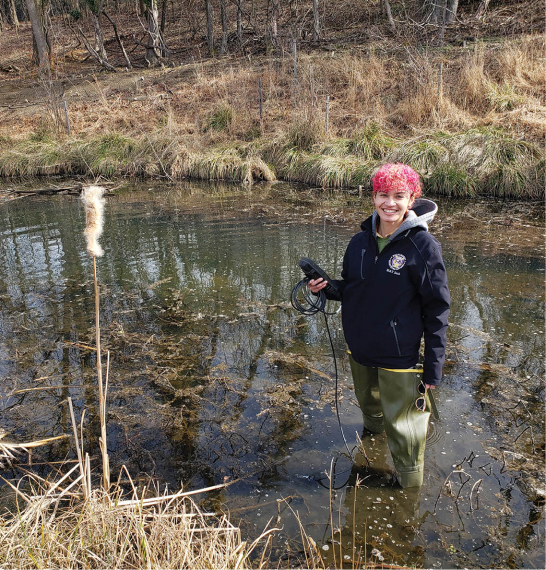

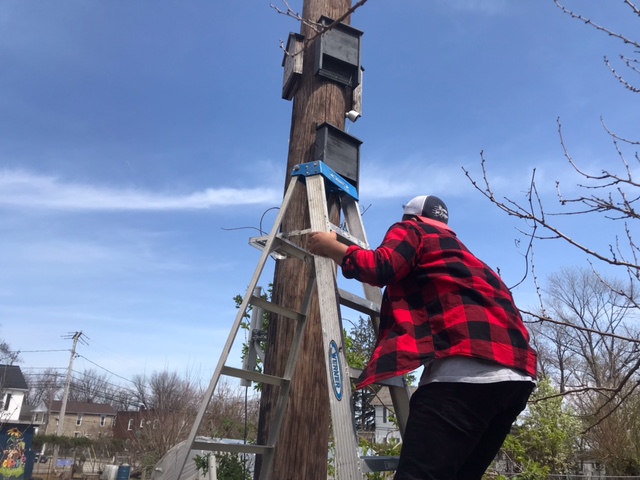 Left: Erin Hamner collected weekly water quality data from this stream for six months, using the battery-powered digital probe she’s holding. (Sarah L. Hansen, M.S. ’15/UMBC) Center: Natalia Figueredo, M.S. ’23, geography and environmental systems (second from left), interviewed local community members about their experiences with zero-waste practices. (Courtesy of Figueredo) Right: Chris Blume, M.S. ’23, geography and environmental systems, studied urban bat populations to investigate heavy metal pollution. (Courtesy of Blume)
“You’re combining the skills, knowledge, and perspectives you gained here in ICARE with your already strong commitment to environmental justice to make the world better for people and the ecosystems we live in,” said Tamra Mendelson, professor of biological sciences and ICARE program director, of program alumni, while members of the current cohort are “flexing those skills, nurturing your passions, and finding your way toward meaningful and consequential work in the environmental sector.”
Those opportunities are plentiful today, according to keynote speaker Fernando Miralles-Wilhelm, president of the University of Maryland Center for Environmental Science.
“What’s happening now is that individuals realize that every single thing we do—every single economic activity we engage in, from the food you eat, to the clothing you wear, to how we power our cities—everything hinges on the environment and natural resources,” he said. “It’s not just about having a nice landscape—the environment impacts economic bottom lines.”
Current trainees, set to graduate in the next few months, are pursuing a diverse set of projects. For example, Isabella Molatore has been studying the presence of invasive fish species in Baltimore Harbor through a combination of angler interviews and DNA testing of harbor water samples. Donovin Smith is exploring novel methods to detect heavy metals in the air and using the data to measure how proximity to railways, incinerators, and other factors affects air pollution. And Will Kaselow has compared the roles and effects of different entities that influence environmental education, such as nonprofits, various levels of government, and local institutions like schools and community centers.
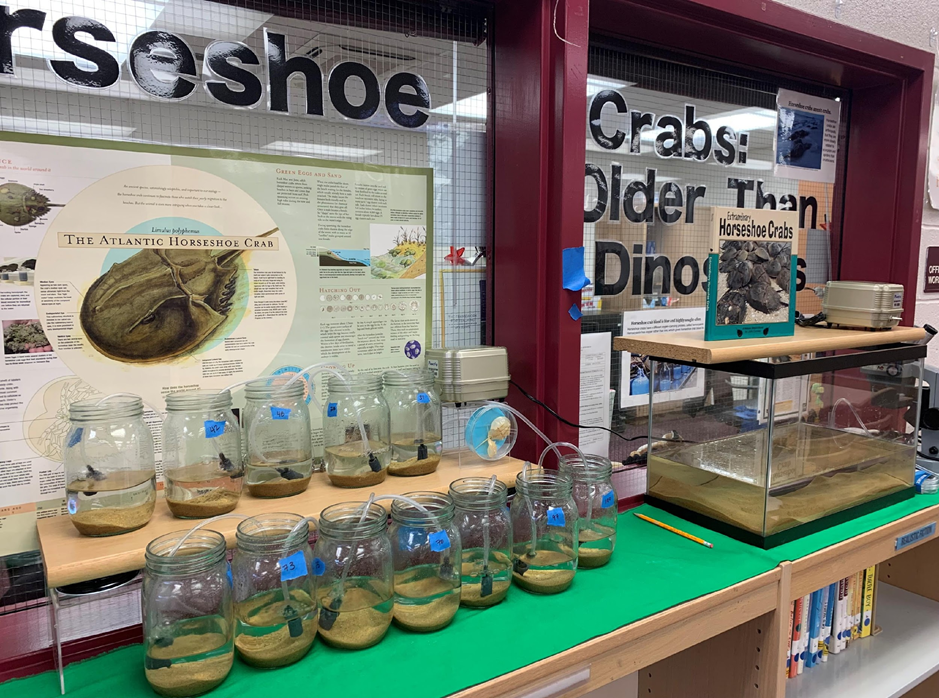
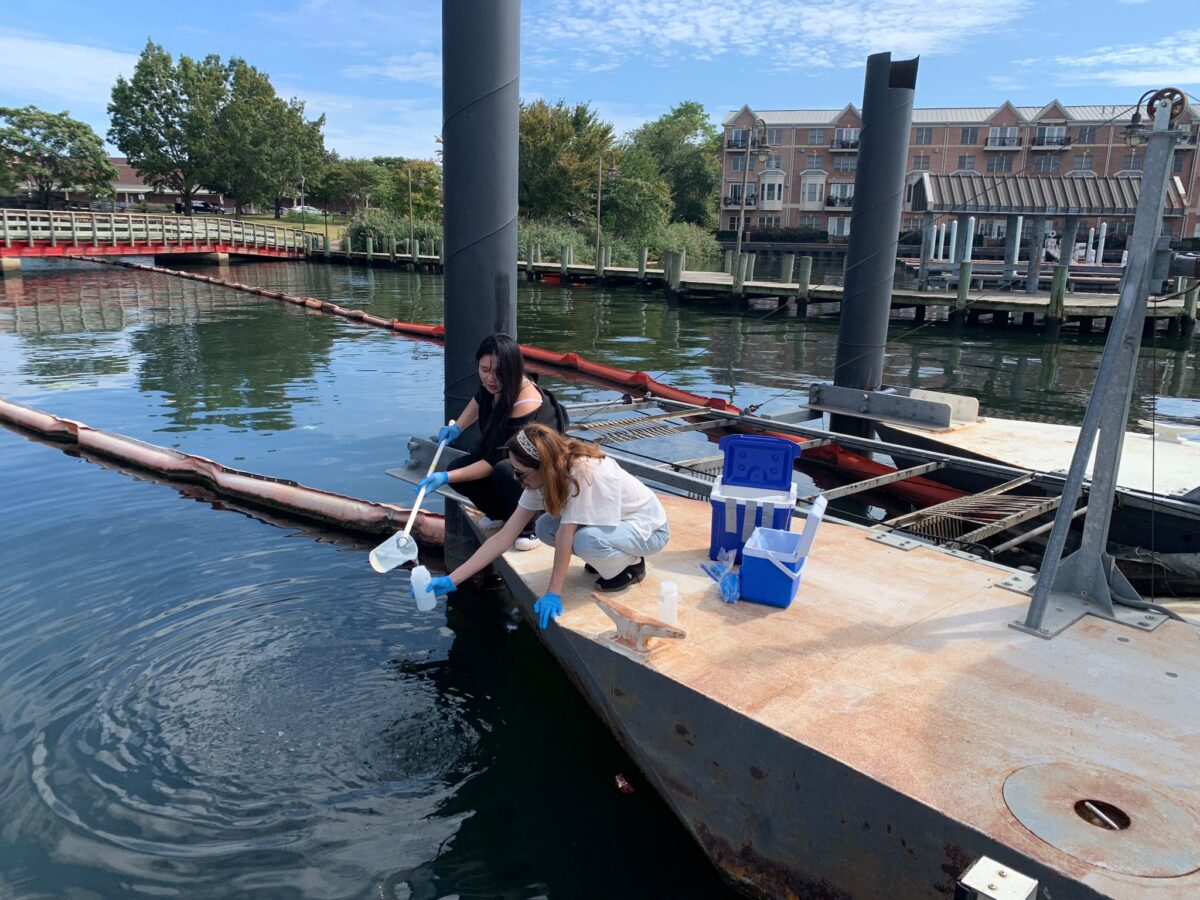 Left: Kids at Glenwood Middle School in Howard County raised horseshoe crabs hand-delivered by Jessica Baniak during the 2023 – 2024 school year. (Courtesy of Baniak) Right: Margaret Siao (left) and Donya Hamidi collect water samples from around Baltimore Harbor, part of the initial stages of a project to measure PFAS in the local waterways. (Image courtesy of Siao)
Despite undeniable environmental challenges, Miralles-Wilhelm ended the event on a hopeful note.
“If you look at the news, you get bombarded by so much negative stuff. You may end up believing that the world is becoming a worse place. However, I counter that by saying that since World War II, every single human development indicator and every single environmental and development indicator around the world has gotten better,” Miralles-Wilhelm said. “We’ve spent quite a bit of effort—scientists, policymakers, and investors—to try to make a better world, and it is working. It may not be working at the pace that you want it to work, it may not be improving everywhere at the same time, but it’s also undeniable that we have gotten better.”
ICARE trainees and alumni, armed with skills from technical laboratory techniques to community organizing, are now poised to contribute to and accelerate that positive trend.
]]>
Since fall 2021, UMBC’s Interdisciplinary Consortium for Applied Research in the Environment (ICARE) has supported master’s students pursuing environmental science research related to Baltimore...
https://umbc.edu/stories/icare-day-2025/
https://my3.my.umbc.edu/api/v0/pixel/news/150278/guest@my.umbc.edu/d6b440564a266f02aee293ec5319d6ce/api/pixel
baltimore-city
biological-sciences
biology
cahss
cnms
ges
icare
marinebiotech
news
policy-and-society
science-and-tech
story
UMBC News & Magazine
https://my3.my.umbc.edu/groups/umbc-news-magazine
https://assets1-my.umbc.edu/system/shared/avatars/groups/000/001/943/24435aa6207c452e7bc15cc74b42c7bb/xsmall.png?1748556657
https://assets1-my.umbc.edu/system/shared/avatars/groups/000/001/943/24435aa6207c452e7bc15cc74b42c7bb/original.png?1748556657
https://assets2-my.umbc.edu/system/shared/avatars/groups/000/001/943/24435aa6207c452e7bc15cc74b42c7bb/xxlarge.png?1748556657
https://assets2-my.umbc.edu/system/shared/avatars/groups/000/001/943/24435aa6207c452e7bc15cc74b42c7bb/xlarge.png?1748556657
https://assets3-my.umbc.edu/system/shared/avatars/groups/000/001/943/24435aa6207c452e7bc15cc74b42c7bb/large.png?1748556657
https://assets1-my.umbc.edu/system/shared/avatars/groups/000/001/943/24435aa6207c452e7bc15cc74b42c7bb/medium.png?1748556657
https://assets2-my.umbc.edu/system/shared/avatars/groups/000/001/943/24435aa6207c452e7bc15cc74b42c7bb/small.png?1748556657
https://assets1-my.umbc.edu/system/shared/avatars/groups/000/001/943/24435aa6207c452e7bc15cc74b42c7bb/xsmall.png?1748556657
https://assets2-my.umbc.edu/system/shared/avatars/groups/000/001/943/24435aa6207c452e7bc15cc74b42c7bb/xxsmall.png?1748556657
UMBC News & Magazine
0
0
false
Mon, 19 May 2025 12:13:28 -0400
Mon, 19 May 2025 12:13:28 -0400
Community starts in the kitchen—Q&A with Ekiben’s Steve Chu ’12 and professor and author Mark Padoongpatt
The tantalizing aroma of food from everyone’s favorite UMBC alumni-founded restaurant, Ekiben, wafts through the air of the Albin O. Kuhn Library and Gallery. People are drawn in by the steamed buns and tofu nuggets and stay for the community, including a Q&A with Ekiben co-owner Steve Chu ’12, economics, and Mark Padoongpatt, associate professor and director of the Asian and Asian American Studies Program at the University of Nevada, Las Vegas. The discussion, part of the Reframing Global Asias Conversation Series and led by UMBC’s Global Asias Initiatives postdoctoral fellow Mika Thornburg, dives into Padoongpatt’s book, Flavors of Empire, with Chu providing support using his own experience creating community through food.
Mika Thornburg: Tell us a little about your personal history and how you came to work with food.
Steve Chu: When my family immigrated from Taiwan to the U.S., most decided to go into the restaurant business. All my aunts and uncles had restaurants at one point in time, so I grew up with it. I understood the work hours behind it, the work ethic. When I was 13, I read Anthony Bourdain’s Kitchen Confidential. I told my mom that this is what I wanted to do, and she was like, “No, you’re going to college.”
So I came to UMBC, studied economics, and every paper I did was about food. I did a paper on Taco Bell, did a paper on Chipotle, and around sophomore year I was like, alright, this is getting kind of silly. So I decided to get my first job in a restaurant and work and go to school full time. That’s when I started diving into this industry and I haven’t really looked back since.
Mark Padoongpatt: Growing up as a Thai American, you get associated with food even if you have no professional relationship to food at all. I didn’t want to perpetuate that stereotype, so I avoided even thinking about food until graduate school. And that’s when I realized Thai people are so visible through food. Thai food comes to stand in for Thai people and there’s really nothing else we know about Thai people.
So instead of talking about the community outside of food, I thought maybe I should just think about that. How did we come to this point where Thai food comes to stand in for Thai people? Since then, I’ve been thinking about food as a very dynamic way to study communities.

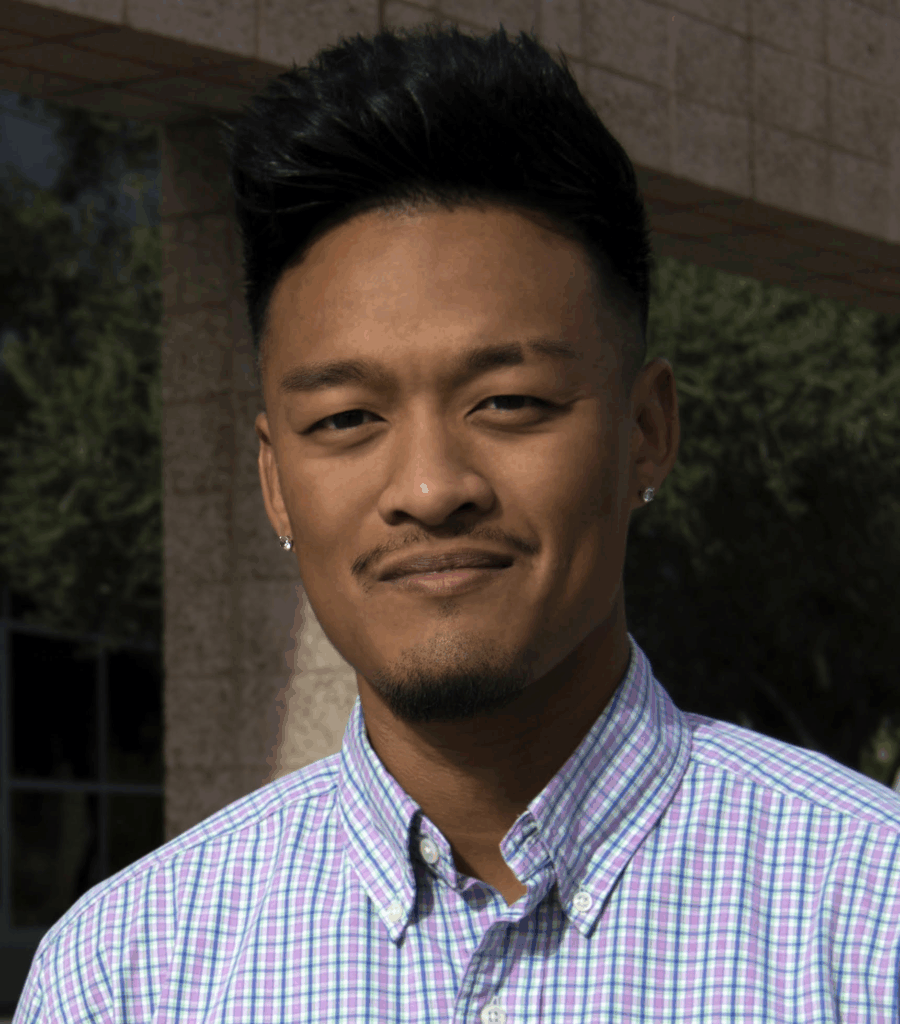
Steve Chu ’12, left, and Mark Padoongpatt, right.
Thornburg: Our event theme is about food and community. Can you speak a little bit about your perspective on the relationship between these two things from your respective position?
Chu: Food brings people together. You see that at this event, you see that at Costco with the free sample line. When we opened Ekiben in Baltimore City, we realized that it was a very polarized city, so we built a space where people from all walks of life could come, afford the food, and sit next to someone that they typically wouldn’t be sitting next to. On any Saturday, you’ll have a squeegee kid sitting next to a Jewish grandmother listening to Cardi B on the speakers, eating some fried chicken. It’s things that you normally wouldn’t put together. Food is a really, really powerful tool to build a community.
 Chu and Ekiben co-owner Ephrem Abebe ’13, information systems, chat with a customer in their original Fells Point location. Photo by Marlayna Demond ’11/UMBC.
Thornburg: What role can food play in changing culture and relationships between different groups of people, whether they be individuals, local communities or entire nations?
Padoongpatt: Food culture is incredibly transformative. Just look at European empires. How did they grow? Through food commodities. They created political and economic systems that were around food and food production. And so in terms of nation building, the evidence is all there in terms of the significance of food and the role that food can play.
The Thai government for the last 15 years has been pouring a lot of effort, time, and energy into this through a kind of gastro diplomacy so that more people will come to Thailand. I think it is a great way to stimulate curiosity and human connection, but just the eating of the food itself is not enough.
Chu: What I find really cool is if you grew up in a very diverse community, chances are you’ve had a very diverse group of friends and you’ve tried a very diverse group of foods. And that helps break down walls and allow for understanding and the building of community. One of the coolest things about coming to UMBC was how diverse a group of friends I was able to meet.
After UMBC, I went to New York and worked as a line cook, and I brought back a lot of creativity with me. I sat down with my two future business partners, [Ephrem Abebe ’13, information systems, and Nikhil Yesurpriya ’13, M.S. ’16, biological sciences]. I said, “Hey, bring me all these random ingredients that your moms aren’t using in the pantry.” And so they bring me all this stuff, and over time we just learned how to incorporate it into our core menu. Honestly, there wasn’t a lot of thought behind it—except, “that tastes good.”
Learn more about the Global Asias Initiative and follow along with their events.
]]>
The tantalizing aroma of food from everyone’s favorite UMBC alumni-founded restaurant, Ekiben, wafts through the air of the Albin O. Kuhn Library and Gallery. People are drawn in by the steamed...
https://umbc.edu/stories/community-starts-in-the-kitchen/
https://my3.my.umbc.edu/api/v0/pixel/news/150232/guest@my.umbc.edu/ffba7d4ce69f531b7e1004153f991fa3/api/pixel
alumni
at-play
baltimore-city
cahss
campus-life
coeit
economics
ekiben
global-asias
information-systems-management
magazine
story
UMBC News & Magazine
https://my3.my.umbc.edu/groups/umbc-news-magazine
https://assets1-my.umbc.edu/system/shared/avatars/groups/000/001/943/24435aa6207c452e7bc15cc74b42c7bb/xsmall.png?1748556657
https://assets1-my.umbc.edu/system/shared/avatars/groups/000/001/943/24435aa6207c452e7bc15cc74b42c7bb/original.png?1748556657
https://assets2-my.umbc.edu/system/shared/avatars/groups/000/001/943/24435aa6207c452e7bc15cc74b42c7bb/xxlarge.png?1748556657
https://assets2-my.umbc.edu/system/shared/avatars/groups/000/001/943/24435aa6207c452e7bc15cc74b42c7bb/xlarge.png?1748556657
https://assets3-my.umbc.edu/system/shared/avatars/groups/000/001/943/24435aa6207c452e7bc15cc74b42c7bb/large.png?1748556657
https://assets1-my.umbc.edu/system/shared/avatars/groups/000/001/943/24435aa6207c452e7bc15cc74b42c7bb/medium.png?1748556657
https://assets2-my.umbc.edu/system/shared/avatars/groups/000/001/943/24435aa6207c452e7bc15cc74b42c7bb/small.png?1748556657
https://assets1-my.umbc.edu/system/shared/avatars/groups/000/001/943/24435aa6207c452e7bc15cc74b42c7bb/xsmall.png?1748556657
https://assets2-my.umbc.edu/system/shared/avatars/groups/000/001/943/24435aa6207c452e7bc15cc74b42c7bb/xxsmall.png?1748556657
UMBC News & Magazine
0
0
false
Fri, 16 May 2025 10:51:47 -0400
Fri, 16 May 2025 10:51:47 -0400