Meet a Retriever—Triple alum Corris Davis is building a stronger network for students
Corris Davis’98, M.P.P. ’19, Ph.D. ’25, didn’t originally envision such a long career at UMBC or the number of students she would directly impact. As a Meyerhoff Program Scholar, Corris experienced how intentional mentoring and support could lift up students on their UMBC journeys. Now the senior director of the Office of Academic Opportunity Programs—which she founded as a home to UMBC’s five TRIO Programs as well as first-generation student programming—Corris has been at the front lines for first-gen and low-income students for 26 years. By forging cross-departmental connections, Corris has built a network of support and encouragement for UMBC’s growing population of first-gen students. Tell us all about it!
Q: What’s one essential thing you’d want another Retriever to know about you?
A: I’m a three time UMBC alum—undergrad in biological sciences in 1998, M.P.P. ’19, and Ph.D. ’25, public policy—who has recently rekindled a love for Galaga and LEGOs (because everything old is new again).

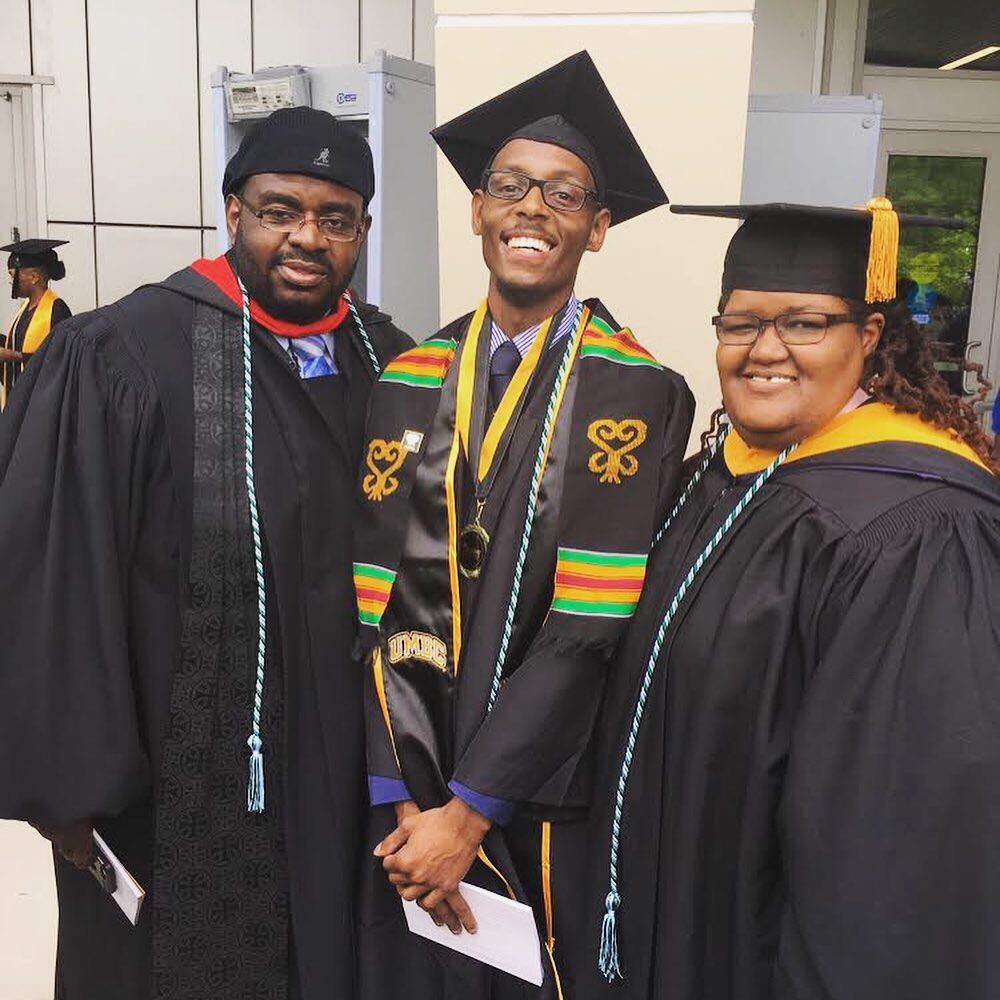 Left: Fellow staff of the Upward Bound Program outside of the Apollo Theatre in New York City during an end of summer field trip. Left to right: Terri Chambers, Christine Harris ’98, Allen Bolden ’99, Karriem Farrakhan ’97, Kerrian McLean ’00, and Corris. Right: At UMBC Commencement 2022, Dr. Michael Hunt, Damarius Johnson ’22 (McNair alum), and Corris.
Q: What’s the one thing you’d want someone to know about the support you find here?
A: “Support” and “community” aren’t just words. People show up for each other because that’s who we are, be it faculty, staff, students, or alumni.
Q: What part of your job do you enjoy the most and why?
A: I support programs that allow students from middle school all the way to undergrad to see what they can be. I have seen students that I met in 8th or 9th grade earn Ph.D.s. I love knowing that while I don’t always work directly with students, the work I do supports them in reaching their goals.
Q: What brought you to UMBC in the first place?
A: I started my professional staff journey as the office coordinator of the TRIO Upward Bound program at UMBC, one of what is now five TRIO programs hosted at UMBC (Upward Bound, Upward Bound Math/Science, Talent Search, McNair Scholars, and now Student Support Services). Since then, I’ve been the assistant director of Upward Bound, and then director. In 2016, I was able to form the Office of Academic Opportunity Programs that houses all of the TRIO Programs as well as first-generation student programming.
After completing my bachelor’s degree, I left UMBC to go to a Ph.D. program in molecular and cellular biology, but about seven months in, I realized that it was not a good fit. I had previously worked with Upward Bound as an undergrad so I essentially came home until I could figure out what my next moves were. I didn’t think that I would still be at UMBC 26 years later.
The reason I stay at UMBC is that I am given the space to help students who are from similar backgrounds to grow and thrive and have great experiences.
Photo: Over the years, many participants have become like family, says Corris. Left side front to back: Prentiss Haney, Gerrod Williamson (Upward Bound alum and current staff member), Corris’s wife, Consuela Lowery; on the right from front to back: Tobias Davis (Upward Bound alum), Dr. Durell Callier ’14, McNair Scholar alum), and Corris.

Q: Tell us about the people who have helped you at UMBC, and why it has made such a difference to you.
A: I must start with the late LaMont Toliver, director of the Meyerhoff Scholars Program. While my initial relationship with him was as a Meyerhoff Scholar, once I became a staff member, he provided even more guidance and support. I use much of what I learned from him in my work in supporting students now, both directly and behind the scenes. I recall him sharing a quote from Harry Truman: “It is amazing what you can accomplish if you do not care who gets the credit.” This has shaped a lot of my work at UMBC. It’s all about advancing our students.
I’ve found support at UMBC in two ways: sometimes by making the ask, and sometimes because people see the vision and step forward on their own. A great example is the creation of the First Generation Network. While it’s not as active as we’d like currently, it’s very existence comes from a group of campus partners, many of whom were first-generation students themselves who understand the importance of the work and volunteering.
The quote… “It is amazing what you can accomplish if you do not care who gets the credit.” This has shaped a lot of my work at UMBC. It’s all about advancing our students.
Corris Davis
Senior director of the Office of Academic Opportunity Programs
We’ve been able to honor first-generation graduates with cords for about six years now. Offices like the Academic Success Center, the Career Center, and several Student Affairs departments have regularly stepped up, not just as cord pick-up sites, but as co-creators of programming that supports UMBC’s first-gen students. Support may be handing out graduation cords, or staffing First Gen Week tables, or even redesigning programming and workshops so they tackle the hidden curriculum and the barriers created by higher-ed jargon.
 Staff of the various TRIO programs in the Office of Academic Opportunity Programs at the annual regional TRIO conference in Hershey, PA, in Feb 2023. Front, left to right: Tanaj Mogase, Talent Search, Corris, Ting Huang (UMBC and McNair alum), Ahdrianna Boyce (UMBC and Upward Bound alum); back left to right: Jennifer Appleby (former TS coordinator), Dr. Michael Hunt, and Dr. Sunji Jangha ’25
Although my office sits in Academic Affairs, this cross-division collaboration is exactly how things get done at UMBC: People come together to support students. It’s impossible to name everyone who has supported me and this work over the years, but I must acknowledge the incredibly talented staff in AOP. Their commitment, partnership, and care make everything we do not only possible, but even more meaningful.
Q: What would you tell someone who is considering a career at UMBC?
A: UMBC is a place where you can take a dream and run with it. We have a culture of supporting students and supporting each other in that work.
UMBC’s greatest strength is its people. When people meet Retrievers and hear about the passion they bring, the relationships they create, the ways they support each other, and the commitment they have to inclusive excellence, they truly get a sense of our community. That’s what “Meet a Retriever” is all about.
Learn more about how UMBC can help you achieve your goals.
]]>
Corris Davis’98, M.P.P. ’19, Ph.D. ’25, didn’t originally envision such a long career at UMBC or the number of students she would directly impact. As a Meyerhoff Program Scholar, Corris...
https://umbc.edu/stories/meet-a-retriever-triple-alum-corris-davis-is-building-a-stronger-network-for-students/
https://my3.my.umbc.edu/api/v0/pixel/news/155467/guest@my.umbc.edu/c1b04b96258202ea2847b3e626f8104b/api/pixel
biological-sciences
cnms
graduateschool
meet-a-retriever
meyerhoff-alumni
story
trio
uncategorized
UMBC News & Magazine
https://my3.my.umbc.edu/groups/umbc-news-magazine
https://assets1-my.umbc.edu/system/shared/avatars/groups/000/001/943/24435aa6207c452e7bc15cc74b42c7bb/xsmall.png?1748556657
https://assets1-my.umbc.edu/system/shared/avatars/groups/000/001/943/24435aa6207c452e7bc15cc74b42c7bb/original.png?1748556657
https://assets2-my.umbc.edu/system/shared/avatars/groups/000/001/943/24435aa6207c452e7bc15cc74b42c7bb/xxlarge.png?1748556657
https://assets2-my.umbc.edu/system/shared/avatars/groups/000/001/943/24435aa6207c452e7bc15cc74b42c7bb/xlarge.png?1748556657
https://assets3-my.umbc.edu/system/shared/avatars/groups/000/001/943/24435aa6207c452e7bc15cc74b42c7bb/large.png?1748556657
https://assets1-my.umbc.edu/system/shared/avatars/groups/000/001/943/24435aa6207c452e7bc15cc74b42c7bb/medium.png?1748556657
https://assets2-my.umbc.edu/system/shared/avatars/groups/000/001/943/24435aa6207c452e7bc15cc74b42c7bb/small.png?1748556657
https://assets1-my.umbc.edu/system/shared/avatars/groups/000/001/943/24435aa6207c452e7bc15cc74b42c7bb/xsmall.png?1748556657
https://assets2-my.umbc.edu/system/shared/avatars/groups/000/001/943/24435aa6207c452e7bc15cc74b42c7bb/xxsmall.png?1748556657
UMBC News & Magazine
0
0
false
Mon, 22 Dec 2025 20:33:40 -0500
Mon, 22 Dec 2025 20:33:40 -0500
Internationally minded excellence: Faculty and staff across all three UMBC colleges receive Fulbright U.S. Scholar awards to teach and research abroad
Four UMBC faculty and staff members have received highly competitive Fulbright U.S. Scholar awards to teach, conduct research, and forge cross-cultural connections around the world in the coming year. The recipients span all three UMBC colleges and comprise three faculty members and one staff member. Augusto Casas, an associate teaching professor in information systems, will travel to Colombia; Cynthia Wagner, a teaching professor in biological sciences, will travel to Kyrgyzstan; Irene Chan, a professor in visual arts, will travel to Romania; and Tom Penniston, M.A. ’09, TESOL, Ph.D. ’14, language, literacy, and culture, the coordinator of learning analytics in the Division of Information Technology (DoIT), will travel to Croatia.
“Fulbright Scholar awards are not just a globally prestigious academic award; they are also a centerpiece of public diplomacy,” says Brian Souders, Ph.D. ’09, language, literacy, and culture, M.A. ’19, TESOL, the associate director for global learning in UMBC’s Center for Global Engagement.
The Fulbright Program was founded in 1946 with the goal of increasing mutual understanding and supporting friendly relations between people in the United States and other countries. It is the flagship international academic exchange program sponsored by the United States government. UMBC has had 18 Fulbright Scholars over the past 10 years, not including the upcoming year’s four recipients. Past awardees have taught or conducted research throughout the world, including in Ethiopia, Kosovo, Colombia, Germany, Australia, the United Kingdom, Denmark, and China.
Sharing a passion with international partners
The new UMBC awardees will connect with international partners in areas of shared interest.
 Augusto Casas (Photo courtesy of Casas)
“My primary responsibility at UMBC is to support data-informed pedagogy, and my Fulbright grant aligns directly with this work,” says Penniston, who will be working with colleagues at the University of Zagreb in Croatia on projects such as AI-assisted course redesigns and mapping how learning analytics tools are adopted within and between universities. “I am most excited to dive headfirst into work and be a data wonk,” he says.
Casas, who is an associate teaching professor in the online M.S. in information systems program at UMBC, will assist the Universidad del Atlántico in Barranquilla, Colombia, in creating an online software engineering degree program to reach beyond the university’s physical campus. He will support creating the curriculum, help select the most appropriate technology, and train their faculty.
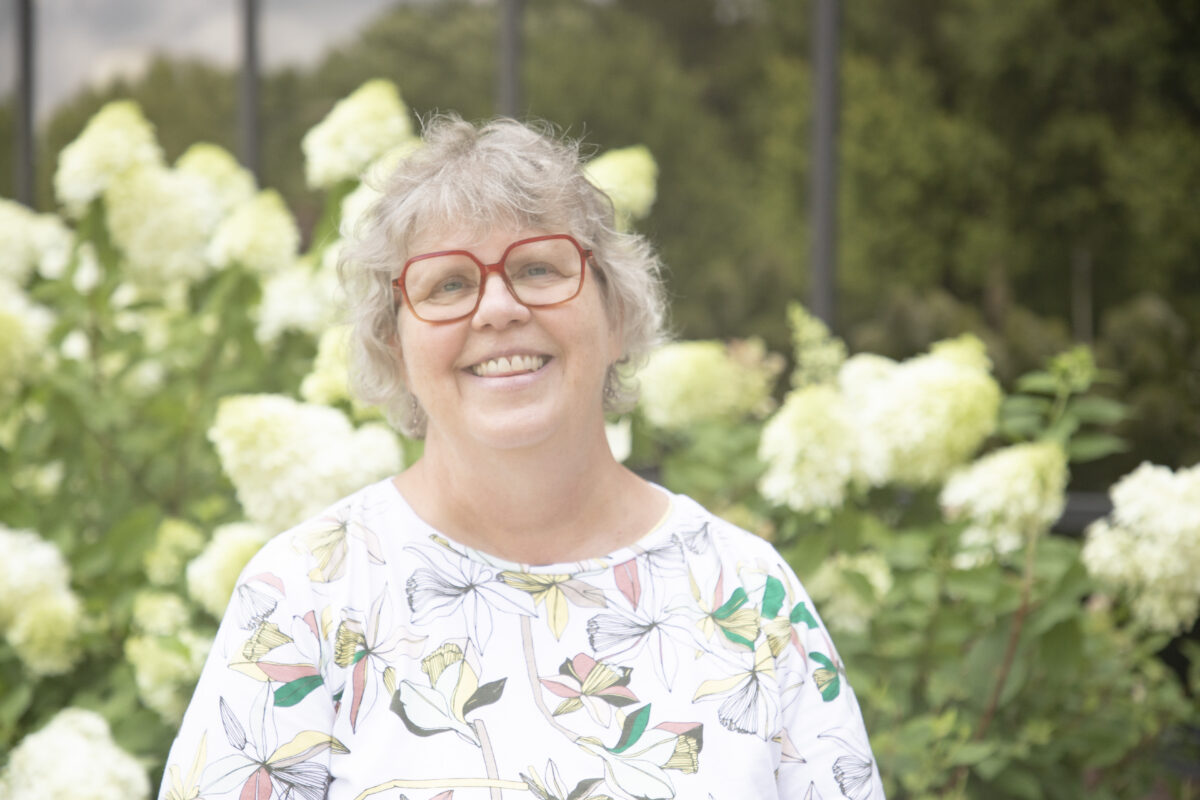 Cynthia Wagner (Photo courtesy of Wagner)
Wagner, who recently retired from UMBC after decades of inspiring students in her popular biology courses, will teach biology classes in English to students at Kyrgyz-Turkish Manas University in Bishkek, Kyrgyzstan. She’ll also conduct research searching for novel antimicrobial agents in the soil of Kyrgyzstan.
Lastly, Chan, a multidisciplinary artist engaged in conceptual work across print media, papermaking, installation art, and storytelling performance, will instruct both undergraduate and graduate students at the University of Art and Design in Cluj Napoca, Romania, utilizing concepts and methodologies she has developed during her tenure at UMBC. Additionally, she will produce a new collection of artist books, focusing on research into fiber art techniques and Romanian folk tales. These books, intended for display in both Romanian and international art collections, will also subtly reference corresponding motifs found within Chan’s own Chinese and American cultural heritage. This recognition of folk art traditions provides a foundation for cultural exchange, Chan says.
 Chan printing in August 2024 at ‘ace Proyecto, Buenos Aires, Argentina. (Photo courtesy of Chan)
Finding support at home and abroad
Souders, who serves as the Fulbright Scholar Liaison, says most UMBC faculty and staff work with him to hone their application. Casas shares that while he had been interested in the Fulbright awards since he started his academic career in the early 2000s, it wasn’t until he attended an informational webinar by Souders that he realized he was ready to apply. He met with Souders for advice, reached out to colleagues at the Universidad del Atlántico to assess where their needs and his interests overlapped, submitted his application, and “Here I am,” he says.
Penniston credits his supervisors and colleagues in DoIT with supporting his application and the opportunity for him to work remotely from Croatia following his six-month residency at the University of Zagreb. He hopes his time abroad will deepen his understanding of European Union education policy and seed partnerships that will ultimately benefit UMBC students and faculty.
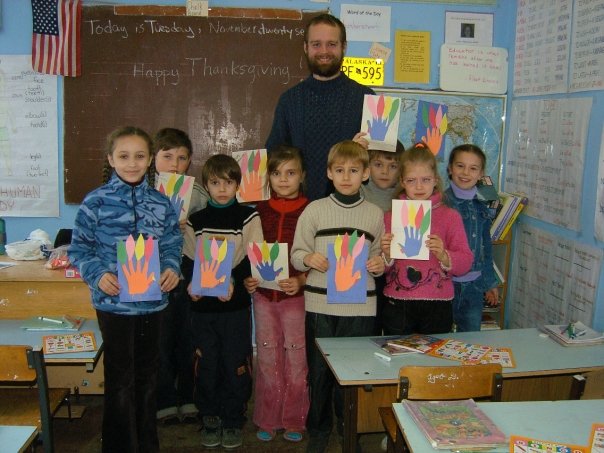 Tom Penniston with students at a school in Moldova, where he served as a U.S. Peace Corps volunteer. (Photo courtesy of Penniston)
Different scholars find different ways to bring bits of the world back with them when they return to the UMBC community, Souders says. For example, the College of Engineering and Information Technology’s award-winning Global Engineering course, co-taught with faculty at the University of Porto in Portugal, originated with the Fulbright project of Marc Zupan, an associate professor in the Department of Mechanical Engineering.
Wagner says it would be amazing to make a discovery that might one day help alleviate the antibiotic resistance crisis in the world. “A good majority of our current antibiotics come from soil microbes,” she says. “Kyrgyzstan has several different ecological niches in which the soil could vary and so could the microbes.”
Across the board, UMBC’s newest crop of Fulbright Scholars is excited to connect internationally and advance projects of shared interest.
“My Croatian hosts have already gone out of their way to make me feel welcome,” says Penniston. “I am thrilled to embark on this immersive intercultural experience, and to share it with my wife and our children.”
Wagner echoes the sense of excitement at a new, horizon-broadening opportunity: “It will be an adventure!” she says.
]]>
Four UMBC faculty and staff members have received highly competitive Fulbright U.S. Scholar awards to teach, conduct research, and forge cross-cultural connections around the world in the coming...
https://umbc.edu/stories/umbc-fulbright-scholar-awards-2025-2026/
https://my3.my.umbc.edu/api/v0/pixel/news/151242/guest@my.umbc.edu/40aedb34ecbc39cdccebef1442f801d5/api/pixel
biological-sciences
cahss
cnms
coeit
doit
fulbright
is
news
policy-and-society
research
story
visualarts
UMBC News & Magazine
https://my3.my.umbc.edu/groups/umbc-news-magazine
https://assets1-my.umbc.edu/system/shared/avatars/groups/000/001/943/24435aa6207c452e7bc15cc74b42c7bb/xsmall.png?1748556657
https://assets1-my.umbc.edu/system/shared/avatars/groups/000/001/943/24435aa6207c452e7bc15cc74b42c7bb/original.png?1748556657
https://assets2-my.umbc.edu/system/shared/avatars/groups/000/001/943/24435aa6207c452e7bc15cc74b42c7bb/xxlarge.png?1748556657
https://assets2-my.umbc.edu/system/shared/avatars/groups/000/001/943/24435aa6207c452e7bc15cc74b42c7bb/xlarge.png?1748556657
https://assets3-my.umbc.edu/system/shared/avatars/groups/000/001/943/24435aa6207c452e7bc15cc74b42c7bb/large.png?1748556657
https://assets1-my.umbc.edu/system/shared/avatars/groups/000/001/943/24435aa6207c452e7bc15cc74b42c7bb/medium.png?1748556657
https://assets2-my.umbc.edu/system/shared/avatars/groups/000/001/943/24435aa6207c452e7bc15cc74b42c7bb/small.png?1748556657
https://assets1-my.umbc.edu/system/shared/avatars/groups/000/001/943/24435aa6207c452e7bc15cc74b42c7bb/xsmall.png?1748556657
https://assets2-my.umbc.edu/system/shared/avatars/groups/000/001/943/24435aa6207c452e7bc15cc74b42c7bb/xxsmall.png?1748556657
UMBC News & Magazine
12
0
false
Thu, 31 Jul 2025 14:51:07 -0400
Thu, 31 Jul 2025 14:51:07 -0400
Awarding 100,000 dreams and counting—UMBC’s Class of 2025
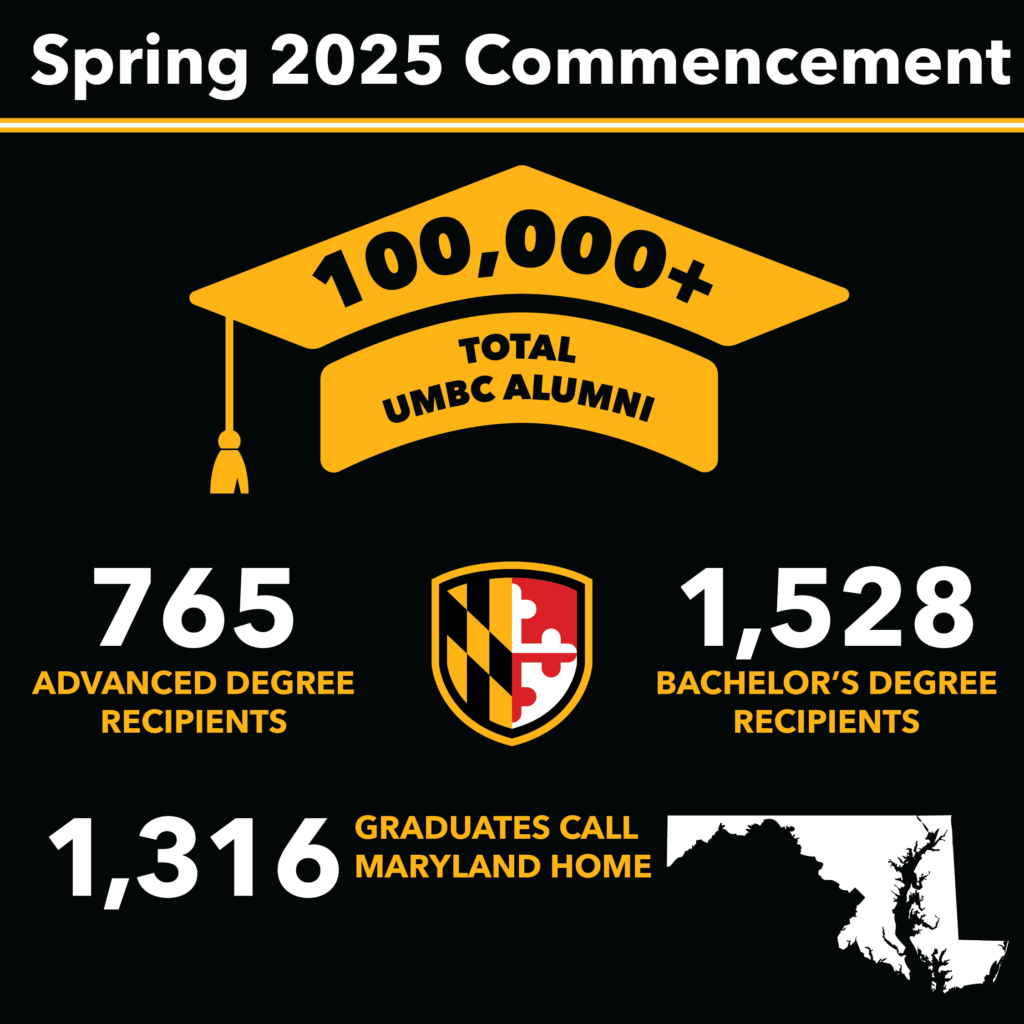
Before Joy Gabrielle Ware walked off the Commencement stage, she stopped mid-stage to face her peers and shouted, “UM!” prompting a booming “BC!” response from the undergraduates and their families who packed the arena last week at UMBC’s 84th Undergraduate Commencement Ceremony. Ware, an individualized study major, was awarded the historic 100,000th degree since UMBC’s first Commencement class in 1970, which had 241 students—a stark contrast to the 1,528 undergraduate and over 700 graduate degrees awarded to the Class of 2025.
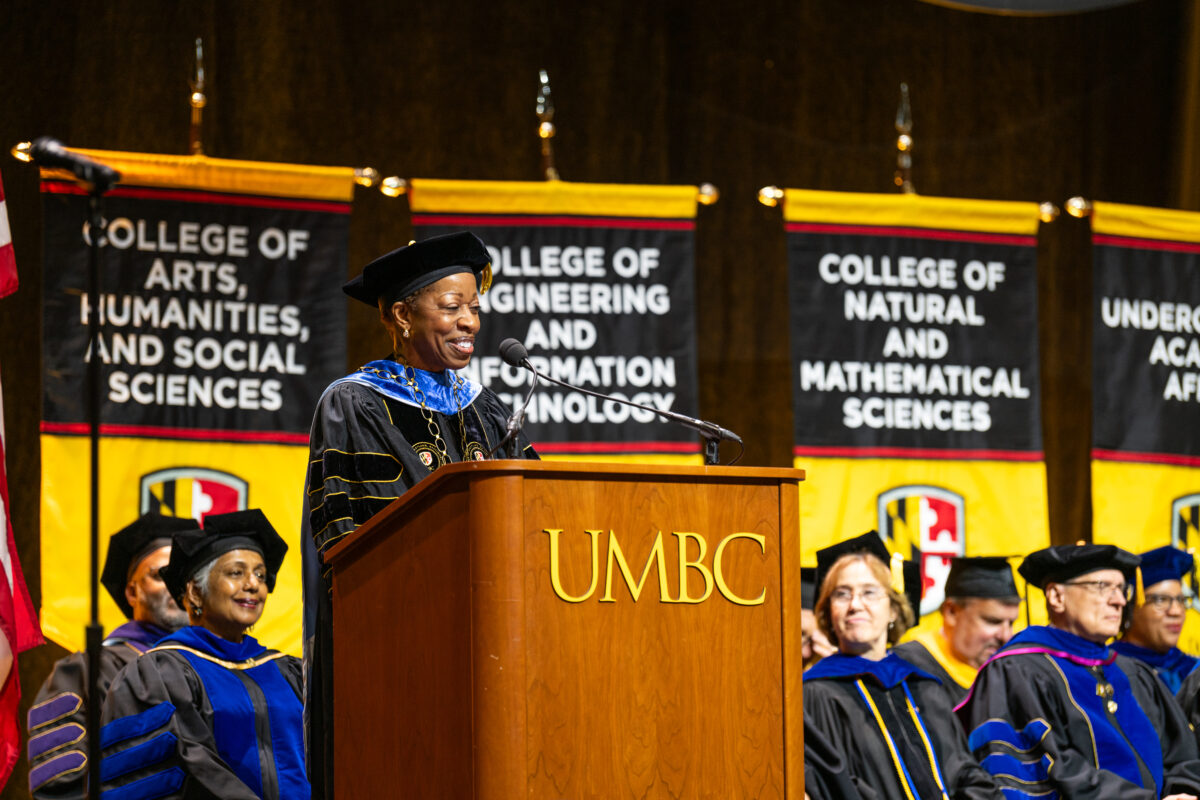
 (l) President Valerie Sheares Ashby addressing UMBC’s Class of 2025. (Brad Ziegler/UMBC) (r) Diane Tichnell ’70 (third from left) celebrates the publication of This Belongs To Us with fellow book editors Mimi Dietrich, Bob Dietrich, and Dale Gough. (Marlayna Demond ’11/UMBC).
To celebrate this historic moment, President Valerie Sheares Ashby paid tribute to the alumni known as the Founding Four, who represented graduates of the first four undergraduate classes from 1970 to 1973.
“What a profound impact UMBC has had on the state of Maryland and the world,” said Sheares Ashby. “Each one of our alumni has made a difference in some way, many of them as leaders and pathbreakers—in the public and private sectors, in the arts, in education, in research, in public service, and in their communities.”
Gratitude
The Class of 2025 celebrated and cheered for each other. However, thunderous applause rippled across UMBC’s Chesapeake Employers Insurance Arena every time a speaker asked the students to thank those who made their dreams come true. The stands were filled with roommates, classmates, mentors, and families who kept pointing the way when graduation seemed out of reach.
“You took risks when you chose to pursue this graduate degree. You stumbled and struggled and faced down your fears and insecurities,” said Graduate Student Association President Jessica Burstrem, Ph.D. ’25, language, literacy, and culture, in her address to her peers at the Graduate School Commencement ceremony.

 (l) Jessica Burstrem addressing the Graduate School Class of 2025. (Brad Ziegler/UMBC)
“That bravery is why you celebrate today. Those are the kinds of people the world always needs—people who do the right thing even if they are afraid. People of integrity and bravery. People who stand together,” said Burstrem.
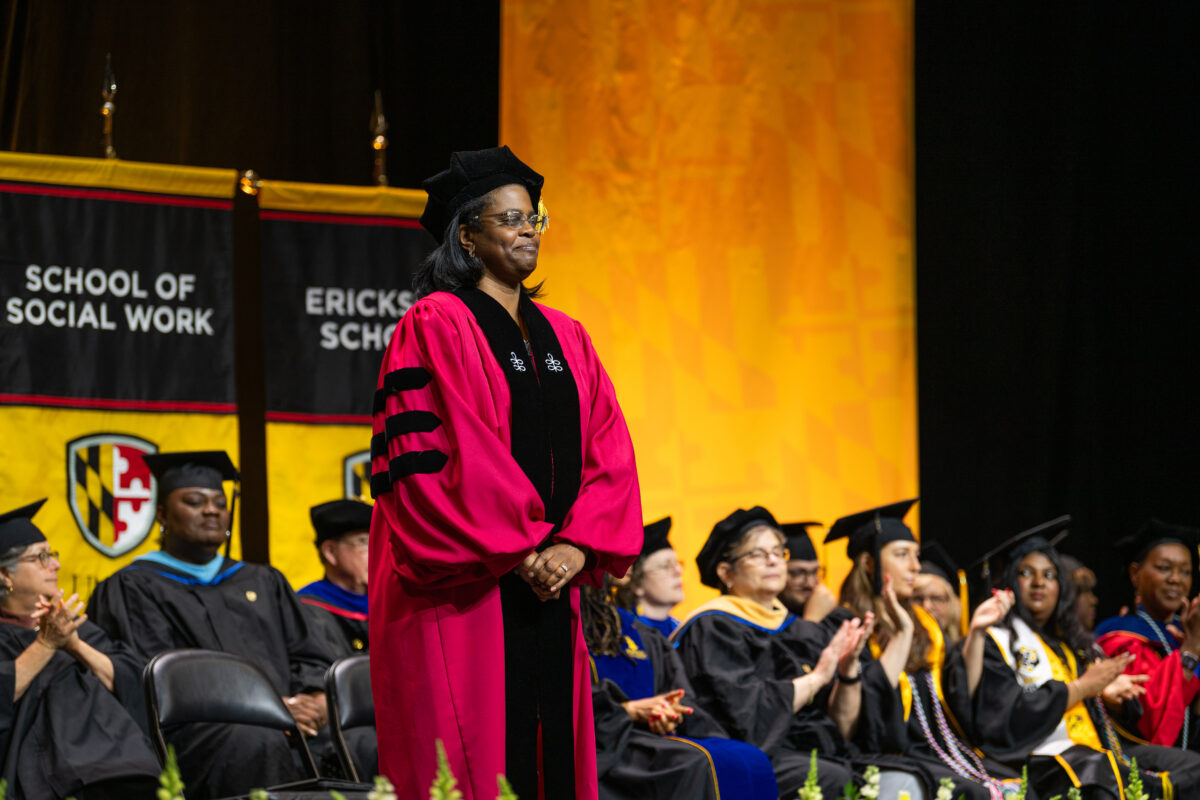
 (l) Sonja Brookins Santelises, chief executive officer of Baltimore City Public Schools, Thursday morning’s undergraduate commencement speaker and honorary degree recipient. (r) Anwesha Day, Ph.D. ’04, biochemistry and molecular biology, executive director in the Discovery Oncology Department of Genentech, spoke to Thursday afternoon’s graduates. (Brad Ziegler/UMBC)
The path of service
College wasn’t Tina Garcia’s first path, even after becoming the first in her family to graduate from high school. She served nearly a decade in the United States Air Force, rising to the rank of staff sergeant, before continuing her service within the government. After serving her country, Garcia chose to honor her family once again—this time by becoming the first to earn a college degree. She drew on her experience as a veteran and her majors in social work and psychology to co-found and serve as vice president of UMBC’s Student Service Members, Veterans, and Families organization.

 (l) Valedictorian Tina Garcia shares her journey to UMBC. (r) UMBC’s Color Guard opening the 2025 commencement ceremonies. (Brad Ziegler/UMBC)
“UMBC is where I found my community, and with it, a renewed sense of purpose to continue serving Veterans. I’m so grateful to everyone who continues this work, who shows up for veterans every day, and who refuses to let that momentum fade,” said Garcia, as one of two undergraduate valedictorians. “When we find belonging, we thrive. When we thrive, we create space for others to do the same. May you always find places where you belong and never let anyone convince you that you don’t.”
UMBC welcomes all
For international students, the meaning of community transcended physical boundaries, cultures, and languages, with graduate students representing 27 nations across five continents and Central America, and undergraduates representing 35 countries across six continents and the Caribbean, including Jamaican native, Akellia Bernard, a music performance major with a concentration in voice. Bernard, a member of UMBC’s Choir and Camerata, performed the national anthem for the three commencement ceremonies. This summer, Bernard plans to join the Choir and Camerata in Paris and Prague, where they have been invited to perform with the Czech National Symphony Orchestra.
 Akellia Bernardsings the Star-Spangled Banner at her undergraduate commencement ceremony. (Brad Ziegler/UMBC)
Praise Lasekan, a biological science major, whose family watched his valedictorian speech virtually back home in Ondo, Nigeria, was adamant about how the Retriever community became the vessel for his growth, acceptance, and joy.
 UMBC faculty and alumni give Praise Lasekan a standing ovation for his inspiring words. (Brad Ziegler/UMBC)
“The person you see standing in front of you today was once called a failure. People made fun of me. There were times I almost quit. But mentors, community, and the grace of God reminded me: Dreams don’t die, they just need to be stirred again,” said Lasekan. This fall, he will begin his Ph.D. at Brown University in the Department of Molecular Biology, Cell Biology, and Biochemistry. “UMBC showed me that community isn’t just who you’re around, it’s who holds you up when life feels heavy.” His journey resonated with the celebratory crowd and earned a standing ovation from the full house.
 And with the turn of the tassel, these students are officially UMBC Alumni. (Brad Ziegler/UMBC)
As Retrievers crossed their tassels from right to left, President Sheares Ashby reminded them that while the pursuit of their dreams might have had similar zig zags, they, “will be the ones who will listen to all the voices, fight for the needs of others, not just yourself, unite, not divide, bring calm to chaos, open doors, and see new ways forward.”
Listen to Akellia Bernard sing the Star-Spangled Banner, Governor Wes Moore’s message to the Class of 2025, and watch all three ceremonies at commencement.umbc.edu.
]]>
Before Joy Gabrielle Ware walked off the Commencement stage, she stopped mid-stage to face her peers and shouted, “UM!” prompting a booming “BC!” response from the undergraduates and their...
https://umbc.edu/stories/umbcs-class-of-2025/
https://my3.my.umbc.edu/api/v0/pixel/news/150428/guest@my.umbc.edu/976827328c289a34967296b2f158b9ce/api/pixel
biological-sciences
cahss
class-of-2025
cnms
coeit
community
feature
inds
music
news
psych
social-work
story
UMBC News & Magazine
https://my3.my.umbc.edu/groups/umbc-news-magazine
https://assets1-my.umbc.edu/system/shared/avatars/groups/000/001/943/24435aa6207c452e7bc15cc74b42c7bb/xsmall.png?1748556657
https://assets1-my.umbc.edu/system/shared/avatars/groups/000/001/943/24435aa6207c452e7bc15cc74b42c7bb/original.png?1748556657
https://assets2-my.umbc.edu/system/shared/avatars/groups/000/001/943/24435aa6207c452e7bc15cc74b42c7bb/xxlarge.png?1748556657
https://assets2-my.umbc.edu/system/shared/avatars/groups/000/001/943/24435aa6207c452e7bc15cc74b42c7bb/xlarge.png?1748556657
https://assets3-my.umbc.edu/system/shared/avatars/groups/000/001/943/24435aa6207c452e7bc15cc74b42c7bb/large.png?1748556657
https://assets1-my.umbc.edu/system/shared/avatars/groups/000/001/943/24435aa6207c452e7bc15cc74b42c7bb/medium.png?1748556657
https://assets2-my.umbc.edu/system/shared/avatars/groups/000/001/943/24435aa6207c452e7bc15cc74b42c7bb/small.png?1748556657
https://assets1-my.umbc.edu/system/shared/avatars/groups/000/001/943/24435aa6207c452e7bc15cc74b42c7bb/xsmall.png?1748556657
https://assets2-my.umbc.edu/system/shared/avatars/groups/000/001/943/24435aa6207c452e7bc15cc74b42c7bb/xxsmall.png?1748556657
UMBC News & Magazine
0
0
false
Tue, 27 May 2025 20:14:29 -0400
Tue, 27 May 2025 20:14:29 -0400
Interdisciplinary UMBC team deepens understanding of cell migration, important for potential medical advances
Imagine cells navigating through a complex maze, guided by chemical signals and the physical landscape of their environment. At UMBC, a team of researchers has contributed an important discovery about how cells move, or migrate, through this maze of bodily tissues. Potential implications include better understanding of diseases like cancer and advancing medical treatments.
Published in iScience, the team’s study combines biological experiments and mathematics to reveal new insights into cell migration. Alex George, Ph.D. ’24, biological sciences, and Naghmeh Akhavan, Ph.D. ’25, mathematics, led the study, which explores how cells in fruit fly egg chambers navigate their environment. Their mentors, Michelle Starz-Gaiano, professor of biological sciences, and Brad Peercy, professor of mathematics, are co-authors.
By integrating mathematical modeling with advanced imaging, the team discovered that the physical shape of the egg chamber, combined with chemical signals called chemoattractants, significantly influences how cells move.
 Alex George (left) and Naghmeh Akhavan present their research at a conference at the University of Maryland, College Park. (Courtesy of Starz-Gaiano)
“This paper takes an interdisciplinary focus with tight collaboration between a mathematical framework and experimental design,” Peercy says. “The results promote the idea that complex distribution of chemical attractants can explain specific variations in migratory movement.” His enthusiasm highlights the study’s innovative approach, which merges precise mathematical models with real-world biological experiments to uncover patterns that were previously invisible.
Following the breadcrumbs
The team’s work focuses on border cells, a type of cell in fruit fly egg chambers, which are a model system for studying cell migration because of their similarities to processes in human development and disease. The team found that the border cells’ movement wasn’t just driven by continuously increasing chemical concentrations from one end of the egg chamber to the other, as earlier models suggested. Instead, the physical structure of the tissue—narrow tubes alternating with wider gaps—played a critical role.
“This was the first time that we characterized that there were these patterns of migration behavior that ended up correlating to aspects of the tissue geometry,” explains George, who specializes in capturing live images of these cells. He likens the process to Hansel and Gretel following breadcrumbs through a forest: On a flat plain, the trail is clear, but in a landscape with ravines and valleys, the breadcrumbs pool in unexpected ways, complicating the path.
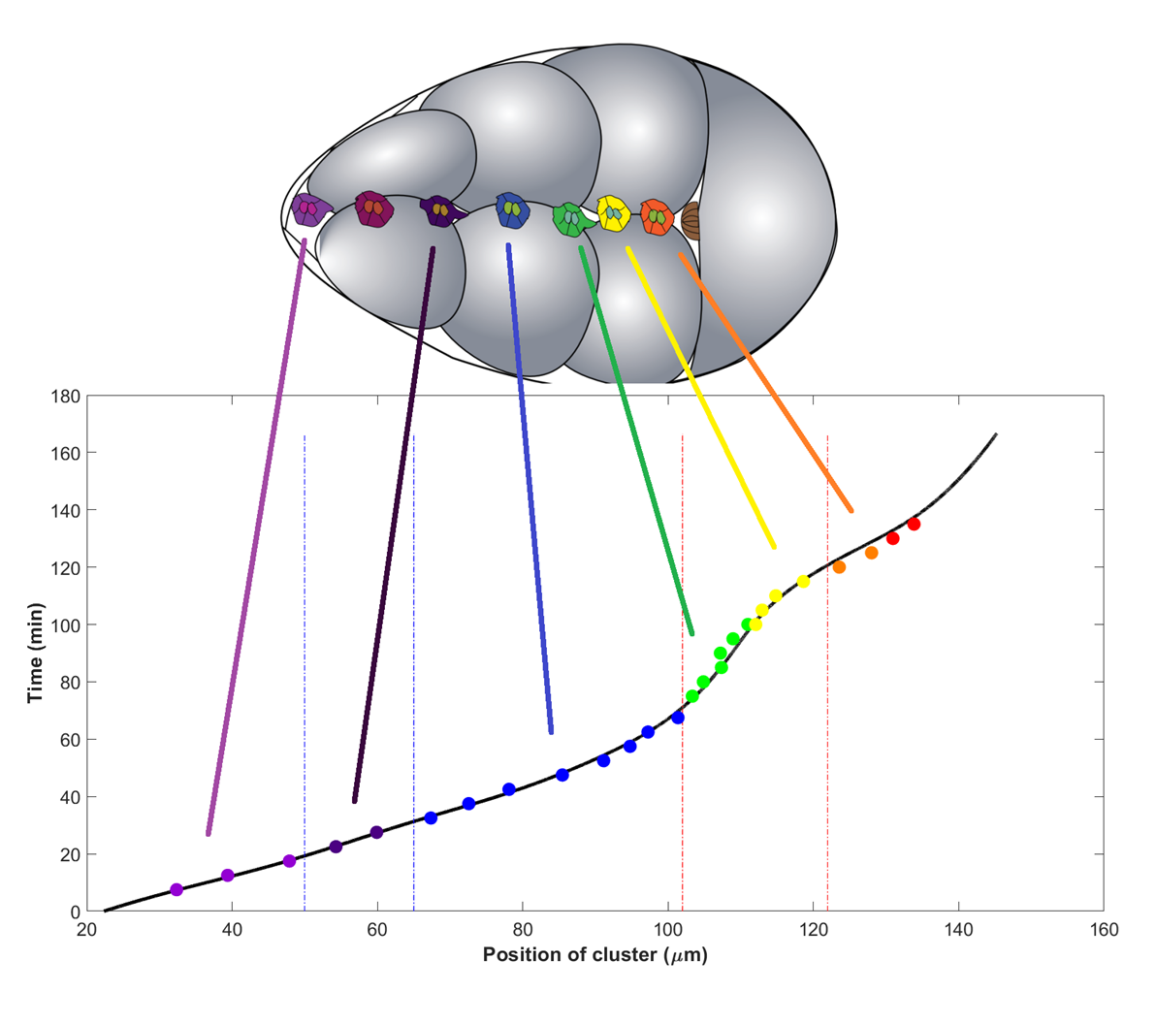 This visualization of Akhavan’s mathematical model shows how migration speed shifts in each zone of the egg chamber, pictured above the graph. A steeper slope indicates a slower speed. (Courtesy of Akhavan)
To understand this, Akhavan developed mathematical models that simulate how cells respond to both chemical signals and tissue geometry together. “Alex’s experiments showed that the speed is not exactly the way previous models showed it,” she says. Her models revealed that cells speed up in narrow tubes and slow down in larger gaps, a pattern confirmed by George’s imaging.
Both approaches—wet-lab experiments and modeling—bring unique strengths to the work. Putting them together “is like unveiling the invisible from two different perspectives,” George says. “My experiments would refine her model, and her model would refine my experiments.”
And then, “When our model shows exactly what Alex found in his experiments, we love that,” Akhavan adds.
Learning new languages
This synergy didn’t always come easily. Working across disciplines meant learning to speak each other’s scientific “languages.” Akhavan, with a background in pure mathematics, recalls that when she joined the project in spring 2022, “Everything was in a different language for me.” Similarly, “A couple of times I opened my MATLAB code and Alex’s eyes got huge,” Akhavan laughs.
Yet, their collaboration flourished, fostering not only scientific breakthroughs but also friendship. “It’s a challenge to communicate across disciplines since it’s almost like speaking in different languages,” Starz-Gaiano says. “Both Alex and Naghmeh got more adept at explaining their work and honing their research questions as a result of working together over a couple of years, which was great to watch.”
Putting together wet lab experiments and mathematical modeling “is like unveiling the invisible from two different perspectives. My experiments would refine her model, and her model would refine my experiments.”
Alex George, Ph.D. ’24, biological sciences
“It is a risky and vulnerable situation to be open with colleagues in areas in which you are not a burgeoning expert,” Peercy adds. “Naghmeh and Alex have grown so much through this project to genuinely rely on each other’s opinion.”
The study’s broader impact lies in its potential to inform fields beyond developmental biology. Cell migration is critical in processes like wound healing, immune responses, and cancer metastasis. “Most research on how cells navigate the world has focused only on chemical signals or only on structural ones, so this is one of the first studies to consider how those two things impact each other, which is likely to be relevant in many cases,” Starz-Gaiano explains. By showing how tissue geometry and chemical signals interact, the research could guide new strategies for controlling cell movement via medical treatments.


 Left: The team traveled to the Janelia Research Campus in Virginia to do advanced imaging for the cell migration project, which will open new avenues for research. (Courtesy of Starz-Gaiano) Center: A moment of levity in the Starz-Gaiano lab. (Courtesy of Akhavan) Right: Brad Peercy and Michelle Starz-Gaiano shared their collaborative work at the “RetriEVER Empowered: Student Success + Research + Community”event in April 2022.
New strategies lead to new discoveries
George refined his expertise in microscopy through working with Tagide deCarvalho in UMBC’s Keith R. Porter Imaging Facility. “It helped me learn a lot, getting my hands on other people’s work and visualizing all the cool things,” he says. “A picture is worth a thousand words, but a movie? Ten thousand words.” Now he’s taking his skills to the Dartmouth Cancer Center’s microscopy core facility at the Geisel School of Medicine, where he’ll start as a research scientist in June.
For Akhavan and George, leading this project has been a defining experience. Akhavan’s models, including a new approach that uses energy calculations to better capture the egg chamber’s complex geometry, have become a cornerstone of her dissertation, and she plans to continue this work post-graduation.
George and Akhavan’s mentors played a pivotal role in their success. “Michelle is a role model for me,” Akhavan says, praising the collaborative spirit of Starz-Gaiano and Peercy. “Dr. Peercy and Dr. Starz-Gaiano make the best combination for doing interdisciplinary research. This collaboration is amazing.”

 Left: Naghmeh Akhavan (center) accepts the Outstanding Graduate Research in Mathematics Award at CNMS Awards and Recognition Day. (Courtesy of Akhavan) Right: Michelle Starz-Gaiano and Alex George take some time for fun while attending the Society for Developmental Biology Annual Meeting in Chicago in 2023. (Courtesy of Starz-Gaiano)
The team’s work continues to evolve, including recent experiments at the Advanced Imaging Center at the Janelia Research Campus in Virginia, where George used advanced microscopes to capture previously unseen dynamics of the relevant chemoattractants. These findings will further refine their models, opening new avenues for research.
“We are developing new experimental strategies both on the biology and the math side of things,” Starz-Gaiano says, “so it will be exciting to see where this will take us next.”
]]>
Imagine cells navigating through a complex maze, guided by chemical signals and the physical landscape of their environment. At UMBC, a team of researchers has contributed an important discovery...
https://umbc.edu/stories/cell-migration-research-medical-advances/
https://my3.my.umbc.edu/api/v0/pixel/news/150422/guest@my.umbc.edu/5bddad5f85a6271f260efba4d150dbfc/api/pixel
biological-sciences
biology
cnms
gradresearch
mathematics-and-statistics
mathstat
news
research
science-and-tech
story
UMBC News & Magazine
https://my3.my.umbc.edu/groups/umbc-news-magazine
https://assets1-my.umbc.edu/system/shared/avatars/groups/000/001/943/24435aa6207c452e7bc15cc74b42c7bb/xsmall.png?1748556657
https://assets1-my.umbc.edu/system/shared/avatars/groups/000/001/943/24435aa6207c452e7bc15cc74b42c7bb/original.png?1748556657
https://assets2-my.umbc.edu/system/shared/avatars/groups/000/001/943/24435aa6207c452e7bc15cc74b42c7bb/xxlarge.png?1748556657
https://assets2-my.umbc.edu/system/shared/avatars/groups/000/001/943/24435aa6207c452e7bc15cc74b42c7bb/xlarge.png?1748556657
https://assets3-my.umbc.edu/system/shared/avatars/groups/000/001/943/24435aa6207c452e7bc15cc74b42c7bb/large.png?1748556657
https://assets1-my.umbc.edu/system/shared/avatars/groups/000/001/943/24435aa6207c452e7bc15cc74b42c7bb/medium.png?1748556657
https://assets2-my.umbc.edu/system/shared/avatars/groups/000/001/943/24435aa6207c452e7bc15cc74b42c7bb/small.png?1748556657
https://assets1-my.umbc.edu/system/shared/avatars/groups/000/001/943/24435aa6207c452e7bc15cc74b42c7bb/xsmall.png?1748556657
https://assets2-my.umbc.edu/system/shared/avatars/groups/000/001/943/24435aa6207c452e7bc15cc74b42c7bb/xxsmall.png?1748556657
UMBC News & Magazine
0
0
false
Tue, 27 May 2025 14:10:11 -0400
Tue, 27 May 2025 14:10:11 -0400
ICARE Day celebrates 5 years of environmental research, community partnerships
Since fall 2021, UMBC’s Interdisciplinary Consortium for Applied Research in the Environment (ICARE) has supported master’s students pursuing environmental science research related to Baltimore and the surrounding area. Students in the program have studied everything from “forever chemical” contamination in local waterways to educational outreach using horseshoe crabs to stormwater management. Trainees have looked at urban bat populations, community members’ knowledge of zero-waste practices, and oyster aquaculture. Program alumni have accepted roles with the U.S. Forest Service, National Oceanic and Atmospheric Administration, The National Academies of Sciences, Baltimore Tree Trust, and more.
To increase the relevance and benefit of students’ projects, members of community partner organizations co-advise students on their research. Co-advisors have come from organizations like Baltimore Green Space, Maryland’s Department of Natural Resources, and the South Baltimore Community Land Trust. ICARE began with a handful of faculty members from all three colleges at UMBC who wanted to collaborate more closely. Over time, it grew into an NSF-funded training program that today includes more than 100 people and 36 organizations.
Earlier this month, the ICARE program celebrated its impact with “ICARE Day,” including a research poster session and luncheon with keynote address.
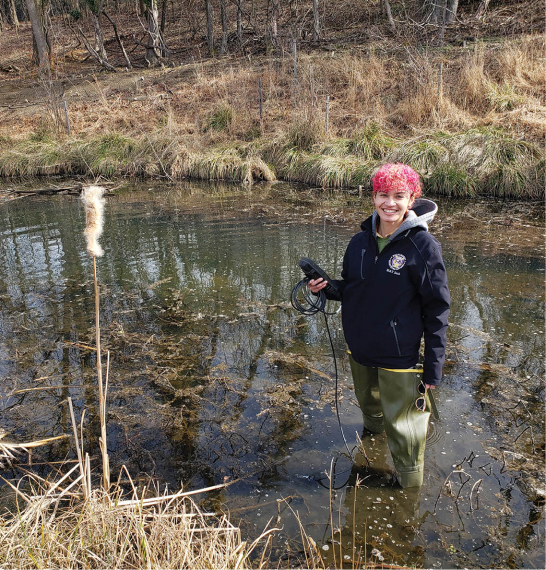

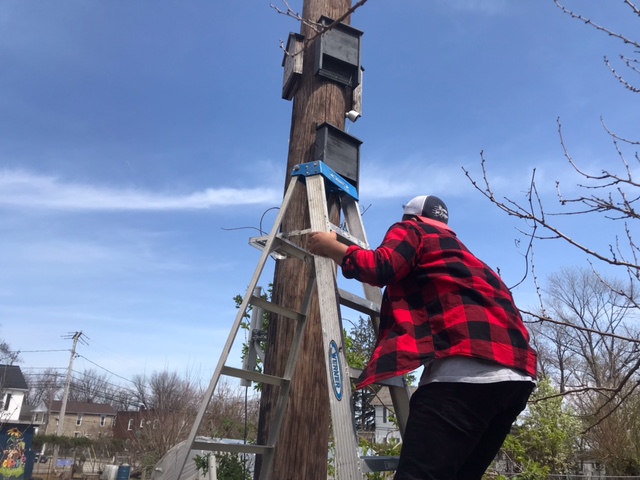 Left: Erin Hamner collected weekly water quality data from this stream for six months, using the battery-powered digital probe she’s holding. (Sarah L. Hansen, M.S. ’15/UMBC) Center: Natalia Figueredo, M.S. ’23, geography and environmental systems (second from left), interviewed local community members about their experiences with zero-waste practices. (Courtesy of Figueredo) Right: Chris Blume, M.S. ’23, geography and environmental systems, studied urban bat populations to investigate heavy metal pollution. (Courtesy of Blume)
“You’re combining the skills, knowledge, and perspectives you gained here in ICARE with your already strong commitment to environmental justice to make the world better for people and the ecosystems we live in,” said Tamra Mendelson, professor of biological sciences and ICARE program director, of program alumni, while members of the current cohort are “flexing those skills, nurturing your passions, and finding your way toward meaningful and consequential work in the environmental sector.”
Those opportunities are plentiful today, according to keynote speaker Fernando Miralles-Wilhelm, president of the University of Maryland Center for Environmental Science.
“What’s happening now is that individuals realize that every single thing we do—every single economic activity we engage in, from the food you eat, to the clothing you wear, to how we power our cities—everything hinges on the environment and natural resources,” he said. “It’s not just about having a nice landscape—the environment impacts economic bottom lines.”
Current trainees, set to graduate in the next few months, are pursuing a diverse set of projects. For example, Isabella Molatore has been studying the presence of invasive fish species in Baltimore Harbor through a combination of angler interviews and DNA testing of harbor water samples. Donovin Smith is exploring novel methods to detect heavy metals in the air and using the data to measure how proximity to railways, incinerators, and other factors affects air pollution. And Will Kaselow has compared the roles and effects of different entities that influence environmental education, such as nonprofits, various levels of government, and local institutions like schools and community centers.
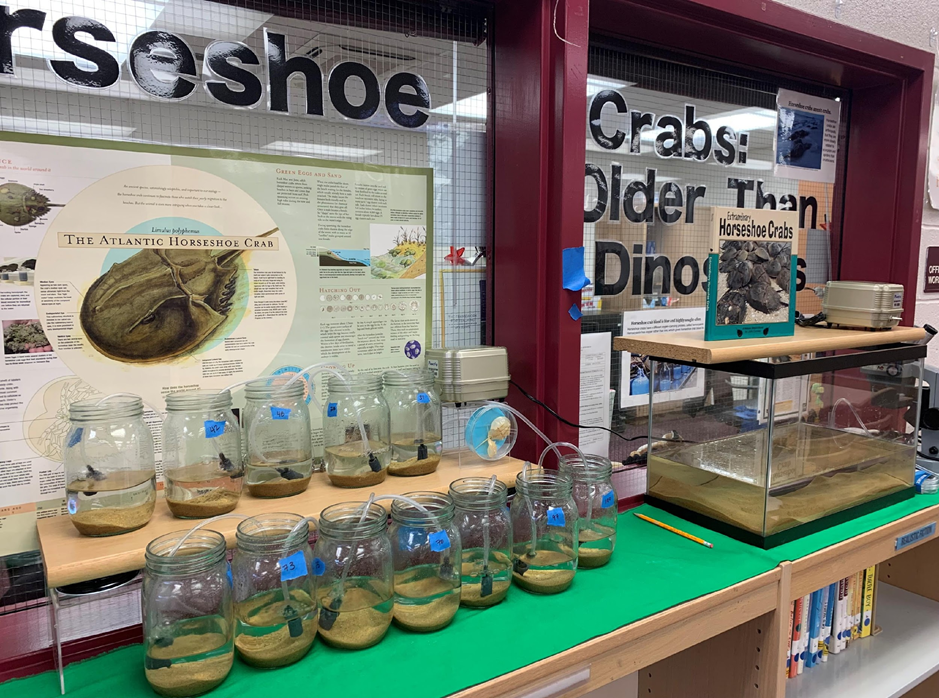
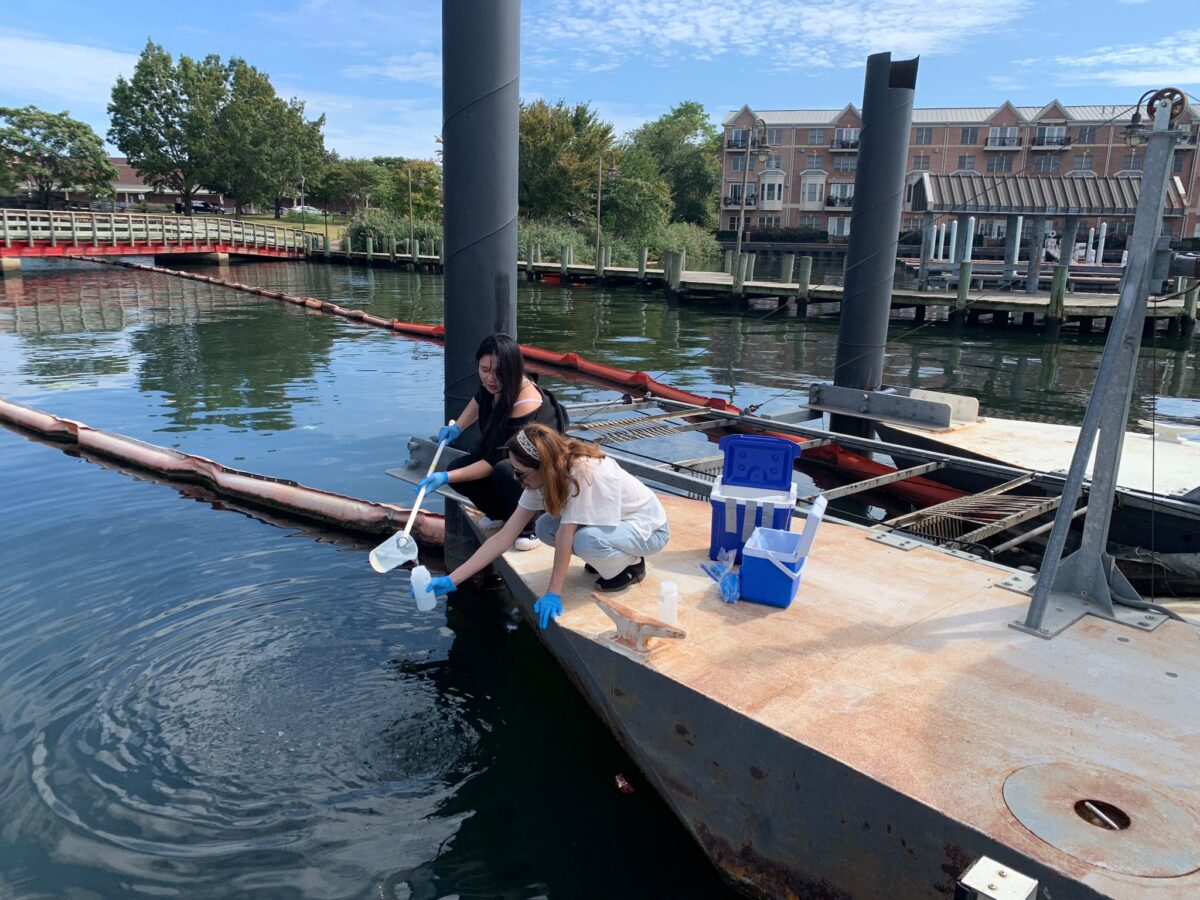 Left: Kids at Glenwood Middle School in Howard County raised horseshoe crabs hand-delivered by Jessica Baniak during the 2023 – 2024 school year. (Courtesy of Baniak) Right: Margaret Siao (left) and Donya Hamidi collect water samples from around Baltimore Harbor, part of the initial stages of a project to measure PFAS in the local waterways. (Image courtesy of Siao)
Despite undeniable environmental challenges, Miralles-Wilhelm ended the event on a hopeful note.
“If you look at the news, you get bombarded by so much negative stuff. You may end up believing that the world is becoming a worse place. However, I counter that by saying that since World War II, every single human development indicator and every single environmental and development indicator around the world has gotten better,” Miralles-Wilhelm said. “We’ve spent quite a bit of effort—scientists, policymakers, and investors—to try to make a better world, and it is working. It may not be working at the pace that you want it to work, it may not be improving everywhere at the same time, but it’s also undeniable that we have gotten better.”
ICARE trainees and alumni, armed with skills from technical laboratory techniques to community organizing, are now poised to contribute to and accelerate that positive trend.
]]>
Since fall 2021, UMBC’s Interdisciplinary Consortium for Applied Research in the Environment (ICARE) has supported master’s students pursuing environmental science research related to Baltimore...
https://umbc.edu/stories/icare-day-2025/
https://my3.my.umbc.edu/api/v0/pixel/news/150278/guest@my.umbc.edu/d6b440564a266f02aee293ec5319d6ce/api/pixel
baltimore-city
biological-sciences
biology
cahss
cnms
ges
icare
marinebiotech
news
policy-and-society
science-and-tech
story
UMBC News & Magazine
https://my3.my.umbc.edu/groups/umbc-news-magazine
https://assets1-my.umbc.edu/system/shared/avatars/groups/000/001/943/24435aa6207c452e7bc15cc74b42c7bb/xsmall.png?1748556657
https://assets1-my.umbc.edu/system/shared/avatars/groups/000/001/943/24435aa6207c452e7bc15cc74b42c7bb/original.png?1748556657
https://assets2-my.umbc.edu/system/shared/avatars/groups/000/001/943/24435aa6207c452e7bc15cc74b42c7bb/xxlarge.png?1748556657
https://assets2-my.umbc.edu/system/shared/avatars/groups/000/001/943/24435aa6207c452e7bc15cc74b42c7bb/xlarge.png?1748556657
https://assets3-my.umbc.edu/system/shared/avatars/groups/000/001/943/24435aa6207c452e7bc15cc74b42c7bb/large.png?1748556657
https://assets1-my.umbc.edu/system/shared/avatars/groups/000/001/943/24435aa6207c452e7bc15cc74b42c7bb/medium.png?1748556657
https://assets2-my.umbc.edu/system/shared/avatars/groups/000/001/943/24435aa6207c452e7bc15cc74b42c7bb/small.png?1748556657
https://assets1-my.umbc.edu/system/shared/avatars/groups/000/001/943/24435aa6207c452e7bc15cc74b42c7bb/xsmall.png?1748556657
https://assets2-my.umbc.edu/system/shared/avatars/groups/000/001/943/24435aa6207c452e7bc15cc74b42c7bb/xxsmall.png?1748556657
UMBC News & Magazine
0
0
false
Mon, 19 May 2025 12:13:28 -0400
Mon, 19 May 2025 12:13:28 -0400
Oyinlola Oluka ’25, political science and philosophy, sees no limits for herself
For Oyinlola Oluka, political science and philosophy, doing the right thing is not just a mantra but a career path. A law school hopeful since middle school, Oluka, a first-generation Nigerian American, has a keen interest in the efforts of African countries to move from political instability toward accountability for human rights violations. She knows that holding governments accountable is a lofty task, but fear is not in her vocabulary—justice is. At UMBC, she found a kindred spirit in Jeffrey Davis, a political science professor whose passion for human rights and politics began at 12 years old after joining Amnesty International. Oluka delved deeply into the complexities of international law in Davis’s classes, inspiring her to shift her ambitions toward becoming an international human rights judge—someone committed to upholding human rights at the highest level.
Q: What motivated you to come to UMBC?
 Oyinlola Oluka carrying her sister Atinuke Oluka at her graduation. (Image courtesy of Oluka)
A: My sister, Atinuke Oluka, is a Retriever. She graduated in 2022 with degrees in psychology and biological sciences. I saw how many opportunities UMBC gave her—how she felt like she belonged and how smoothly she transitioned from high school to college. I don’t see limits for myself either, so I decided to follow in her footsteps. The opportunities I’ve had at UMBC have changed the way I approach life.
Q: In what ways do you live out your ‘no limits’ philosophy?
A: I am a first-generation Nigerian American.My family inspires me. They experienced Nigeria’s instability, but did not let it limit their future. I knew I wanted to be a lawyer in middle school. So, once I came to UMBC, I took advantage of opportunities to help me learn more about being a lawyer and due process, such as civil rights, criminal justice, and international law classes. As part of UMBC’s Legal Internship Program, I worked at the Baltimore City Juvenile Justice Center under the mentorship of the Honorable Judge Nicole K. Barmore, an associate judge in Baltimore City’s Circuit Court.
I chose philosophy as my second major and completed a certificate in philosophy, law, and politics, another in French, a minor in law and justice, and participated in Philosophers Anonymous, which serves as a council of majors. My hard work earned me memberships in Pi Sigma Alpha, the National Political Science Honor Society, and Phi Beta Kappa Society, an academic honor society.
 Oyinlola Oluka assists with a client intake at UMBC’s first Expungement Clinic in partnership with Maryland Legal Aid. (Image courtesy of Molly Timko, UMBC’s pre-law academic advisor)
Giving back to UMBC is also important to me. I am a tutor at UMBC’s Writing Center and a teaching assistant for ENGL 393 Technical Communication. All of this while working as a certified pharmacy technician. UMBC’s Black Student Union, the African Student Association, and Philosophers Anonymous allowed me to help foster a sense of community on campus.
Simply put, I don’t limit myself—not to one field, skill, or experience. I always make sure that what I’m doing now aligns with my long-term goals. If I can see myself succeeding where I am, then I know I can succeed elsewhere, too. I will be the first person in my family to pursue a career in law.
Q: How did you choose to add a philosophy major?
A: When I applied to UMBC while I was at Towson High School, the application asked what other major I might consider, which I interpreted as a backup in case my first choice didn’t work out. I chose philosophy because of my passion for the law. It offered a safe, inquisitive space to explore and understand fundamental questions about the world around us. To my surprise, I was admitted as a dual major. I decided to keep it, and it turned out to be one of the best decisions of my life.
In 2024, the Department of Philosophy nominated and voted to award me the Evelyn Barker Book Prize for superior academic performance by a senior. I am proud to receive this award because it demonstrates that my contributions to the department and the discipline, as a whole, made an impact. Even though picking this major was initially unintentional, it proved to be a discipline that fit perfectly with the person I strive to be. This award shows me that I am taking the necessary steps to actualize my dreams and aspirations. My experience in the department has been phenomenal, and I would absolutely make the same choice again.
Q: Is there someone who has served as a mentor for you?
A: My favorite classes were taught by Jeffrey Davis, professor of political science, because they deepened my interest in criminal justice and international human rights law. His teaching style left a lasting impression on me. He influenced my time at UMBC not only through what he taught, but also how he taught. He was always encouraging, never condescending, precise, yet never rigid.
Jeffrey Davis's classroom was a space where ideas could be explored freely, and where every student’s voice was heard. He helped shape not only my academic path but also my sense of purpose as a future legal scholar and advocate. I will always be grateful for his mentorship.
Oyinlola Oluka ’25
political science and philosophy
A: In the American voting behavior class, led by Ian Anson, the associate director of UMBC’s Institute of Politics, I learned how voting behavior reflects public opinion and policy. We gauged the attitudes of 1,119 Baltimore County voters who cast their ballots in person during early voting and on Election Day. The poll asked voters about their views on the presidential and congressional races, state constitutional amendments like “The Right to Reproductive Freedom,” and broader issues like the economy.
 Oyinlola Oluka at UMBC’s 14th annual Pi Sigma Alpha Research Conference. (Image courtesy of Oluka)
This hands-on project taught me so much about public opinion research, voter behavior, and the challenges of conducting fieldwork in real time. I used the information from this course to create a final paper, which I presented at UMBC’s 14th annual Pi Sigma Alpha Research Conference. I was honored with the award for best presentation and speech, a validating milestone in my academic journey.
Q: Where do you see yourself in a decade?
A: My ultimate goal is to become a judge because it is one of the most direct ways to improve the lives of people charged with a crime. A judge has the responsibility and the power to decide what happens next for that individual. My internship at the Baltimore City Juvenile Justice Center immersed me in the complexities of juvenile justice. I engaged in legal research, drafted memos on post-conviction issues and child welfare cases, and presented my findings directly to Judge Barmore. Through this experience, I developed my research, analytical, and oral communication skills, particularly in breaking down legal arguments clearly and persuasively. It also strengthened my professional network, as I interacted with judges, administrative staff, and law clerks.
By observing Judge Barmore, I also saw how a judge can be nurturing and compassionate toward defendants while also holding them accountable for their actions. She was efficient and effective in addressing the needs of the children in the system, their parents, and their unique family circumstances. These processes helped me understand how crucial it is for a judge to manage their emotions so they can remain clear, consistent, and fair under pressure.
This opportunity was especially valuable because I’m still exploring whether I want to practice law in government, at a firm, or within a nonprofit organization. With the help of UMBC’s Pre-Law Society, I met law school admissions counselors, reviewed mock applications, and connected with lawyers—all of which are helping me prepare for the Law School Admission Test and narrow down the law schools I want to apply to.
Q: Now that you are the second Retriever in your family, how do you reflect on your UMBC journey?
A: The classes at UMBC taught me how to think, how to ask the right questions, and how to engage with the world around me. Whether it was a lively debate in a politics class or a professor’s encouragement after a class, every moment shaped my understanding of what it truly means to learn. I carry that with me, not just the knowledge I’ve gained at UMBC, but also the curiosity and courage to keep learning wherever I go.
Read more Commencement 2025 stories.
]]>
For Oyinlola Oluka, political science and philosophy, doing the right thing is not just a mantra but a career path. A law school hopeful since middle school, Oluka, a first-generation Nigerian...
https://umbc.edu/stories/oyinlola-oluka-polisci-philosophy-has-no-limits/
https://my3.my.umbc.edu/api/v0/pixel/news/150190/guest@my.umbc.edu/e012cca1d042306fcc926eb1b6ab55f7/api/pixel
biological-sciences
cahss
class-of-2025
news
philosophy
policy-and-society
politicalscience
psychology
story
UMBC News & Magazine
https://my3.my.umbc.edu/groups/umbc-news-magazine
https://assets1-my.umbc.edu/system/shared/avatars/groups/000/001/943/24435aa6207c452e7bc15cc74b42c7bb/xsmall.png?1748556657
https://assets1-my.umbc.edu/system/shared/avatars/groups/000/001/943/24435aa6207c452e7bc15cc74b42c7bb/original.png?1748556657
https://assets2-my.umbc.edu/system/shared/avatars/groups/000/001/943/24435aa6207c452e7bc15cc74b42c7bb/xxlarge.png?1748556657
https://assets2-my.umbc.edu/system/shared/avatars/groups/000/001/943/24435aa6207c452e7bc15cc74b42c7bb/xlarge.png?1748556657
https://assets3-my.umbc.edu/system/shared/avatars/groups/000/001/943/24435aa6207c452e7bc15cc74b42c7bb/large.png?1748556657
https://assets1-my.umbc.edu/system/shared/avatars/groups/000/001/943/24435aa6207c452e7bc15cc74b42c7bb/medium.png?1748556657
https://assets2-my.umbc.edu/system/shared/avatars/groups/000/001/943/24435aa6207c452e7bc15cc74b42c7bb/small.png?1748556657
https://assets1-my.umbc.edu/system/shared/avatars/groups/000/001/943/24435aa6207c452e7bc15cc74b42c7bb/xsmall.png?1748556657
https://assets2-my.umbc.edu/system/shared/avatars/groups/000/001/943/24435aa6207c452e7bc15cc74b42c7bb/xxsmall.png?1748556657
UMBC News & Magazine
2
0
false
Thu, 15 May 2025 10:43:15 -0400
Thu, 15 May 2025 10:43:15 -0400
Sam Geleta ’25: A biochemist with dreams of taking his skills back home
When Samuel Geleta ’25, biological sciences, arrived at UMBC from Ethiopia, he was confident he wanted to go to medical school. But that was before he started conducting HIV research with Michael Summers, Distinguished Professor of Chemistry and Biochemistry, and fell in love with the scientific process. This fall, he’s headed to Yale University to pursue a Ph.D. in biomedical and biological sciences. He dreams of conducting research that he can parlay into biotech entrepreneurship in his home country.
Q: How did you choose UMBC?
A: I’m from Ethiopia, and the health sector there needs a lot of work. I wanted to contribute to my community, and at that time I thought getting a medical degree would be the best way to do that. I first started looking at UMBC because I had family living in Maryland. But what really drew me in was UMBC’s reputation as a research powerhouse in the area, with exciting and innovative research that captured my interest. I also appreciated the more affordable price tag at UMBC, and I really liked the communication I had with UMBC staff while I was applying. Especially as an international student, I had a lot to figure out, and they were very quick to respond to all of my requests. I thought, “This is the kind of environment I want to be in.”
Q: How did you get connected with the Summers lab?
A: I was waiting for an Uber at the campus entrance circle, and I saw then President Freeman Hrabowski walking to his car from the Administration Building. I thought, “Let me go talk to him for a second—this is the president, I might never get another chance.” So I talked to him about where I’m from and my strong interest in science. He mentioned the Meyerhoff Scholars Program, and that conversation started a whole chain of communication with him. Eventually he connected me with Keith Harmon, the director of the Meyerhoff Scholars Program. After I met with Mr. Harmon, I became a friend of the program and started receiving advising and other support from Meyerhoff staff. Mr. Harmon was also the one who connected me with Dr. Summers.

 Sam Geleta works hard in Dr. Michael Summers’ lab (left), but also finds time for fun with friends. At right, he celebrates Diwali on campus at an event hosted by the Hindu Student Association. (Courtesy of Geleta)
I was really excited about what Dr. Summers’ lab was doing, and I wanted to be a part of it. We study HIV’s RNAs and proteins, particularly how the virus replicates and packages its genetic material. That was really exciting for me, because Ethiopia is heavily affected by the HIV epidemic. If I could do research that could help us understand how the virus works and ease the epidemic, I wanted to participate in that. Fast forward, and it’s been two-and-a-half years since I joined the lab.
Q: What are you working on in the lab?
A: My first project was on understanding the role of RNA structures in modulating the translation and packaging of the HIV genome. That project was one of the reasons I became strongly interested in doing research, because it showed me the ups and downs of science. A lot of things didn’t work as planned, but eventually they came together, and just that pursuit itself was an incredibly rewarding experience.
We were able to publish results from that project in the Proceedings of the National Academy of Sciences (PNAS) last summer, and now I’m working on a new project where I study how HIV proteins interact with human proteins—how they hijack cellular factors to enhance their own replication. The goal is to find new therapeutic targets for HIV.
Going to conferences taught me that you’re not just limited to your own little bench. Science goes much wider, and you can collaborate with people from across the country or the world, which is amazing.
Samuel Geleta ’25
Q: How did you decide to pursue a research career?
When we published the paper on my first project, I thought, “Wow, by doing research, I can be a part of a story that’s not done yet, but will continue to help other people. That really got me excited about pursuing my Ph.D. Also, for the paper, we collaborated with researchers at the University of Wisconsin and the University of Michigan. That showed me how much collaboration there is in science—that other people are also trying to figure out what’s going on.
Going to multiple conferences also really inspired me to pursue a Ph.D. I was able to meet people from different places and backgrounds, and it was just amazing how much we had in common in terms of what we wanted to pursue. At the same time, there were differences in how we approached our questions. That was really exciting, because I felt like doing my Ph.D. could connect me to a lot more potential collaborators and opportunities. Going to conferences taught me that you’re not just limited to your own little bench. Science goes much wider, and you can collaborate with people from across the country or the world, which is amazing.

 Left: Sam Geleta poses by the ABRCMS sign, a major conference for undergraduate scientists. Right: Samuel Geleta (far left), Dr. Michael Summers (center) and other undergraduate researchers attend UMBC’s Summer Undergraduate Research Fest in 2023. (Courtesy of Geleta)
Q: Who has supported you through your UMBC career?
A: I chose to work with Dr. Saif Yasin, an M.D./Ph.D. candidate in the Summers lab, because of how passionate he was about his science. We clicked immediately. He gave me a lot of freedom to think like a scientist, and come up with solutions to problems in the lab. He’s been an amazing support, and I learned a lot from him.
After he defended his Ph.D and returned to medical school, now I’m working with Dr. Nele Hollman, a postdoc in the lab. She has helped me take ownership of my work and come up with new ideas for the project that I’m doing right now. Even other grad students and postdocs in the Summers lab are always there if I need help. It’s an awesome environment for doing science.
The entire Meyerhoff staff has also been very supportive, and their support didn’t waver as my goals changed. Dr. Tiffany Gierasch, a teaching professor in chemistry and biochemistry, gave me the opportunity to be a learning assistant for organic chemistry classes, which really helped me understand organic chemistry even more and give back to other students. Dr. Deepak Koirala, an assistant professor of chemistry and biochemistry, has also been an awesome mentor. He does RNA research, and I’ve gotten to know him because we’ve gone to a lot of conferences together. I sit in on some of his classes on RNA structures.
The Center for Global Engagement has been very supportive, too. Whenever I have a question, I just go there during their walk-in hours and talk to someone. They are so responsive.
And I can’t leave out my family and friends—some of them are still in Ethiopia. They’ve also been incredibly supportive and encouraging.
It’s perfectly fine if you are not sure about what you want to do. If you’re confused and looking for inspiration for what to do, then you’re doing the right thing. You should let the process play out. Just explore all the paths and everything you’re interested in, and eventually you will find what you really want to do. And once you find that, just keep going.
Samuel Geleta ’25
Q: What’s next for you?
A: I committed to Yale for my Ph.D. in biomedical and biological sciences. I’m really looking forward to starting life in New Haven and being in a new environment to do science. I’m interested in studying RNA therapeutics and how they can be used for viral interventions in different kinds of viruses.
My research got me looking into biotech as well, and after my Ph.D. I would be interested in pursuing that while also potentially working in academia. I would like my research to produce a product or get patented—translational work. That prospect got me more excited to do my Ph.D. I also want to bring some of the business back to Ethiopia and see what I can do. I want to be an entrepreneurial scientist.
Q: What advice do you have for incoming UMBC students or aspiring undergraduate researchers?
A: It’s perfectly fine if you are not sure about what you want to do. If you’re confused and looking for inspiration for what to do, then you’re doing the right thing. You should let the process play out. Just explore all the paths and everything you’re interested in, and eventually you will find what you really want to do. And once you find that, just keep going.
Also, forming connections is really important. Attend events with people from different places, and you’ll gain new insight into what they do. If you decide to start up a conversation with someone who doesn’t know you, you don’t have to go into the conversation with a specific goal. If you’re kind and curious, the other person will take the next step and want to help you out. Even if they can’t help you directly, they may be able to connect you with someone else who can.
I’m still in touch with Dr. Hrabowski. I told him about my post-grad plans and how he’s impacted me, and he was really happy. When I first had that conversation with him, I didn’t think it would lead up to this. I just took a chance, and it worked out. It’s been amazing.

 Left: Sam Geleta (far left) with Dr. Summers and other members of the laboratory, all sporting sweatshirts advertising where they will pursue further study. Right: Geleta visited Yale’s campus before making his graduate school decision.
]]>
When Samuel Geleta ’25, biological sciences, arrived at UMBC from Ethiopia, he was confident he wanted to go to medical school. But that was before he started conducting HIV research with Michael...
https://umbc.edu/stories/sam-geleta-25/
https://my3.my.umbc.edu/api/v0/pixel/news/150090/guest@my.umbc.edu/3fc41b13d20593ba60d1dd159961735b/api/pixel
biological-sciences
biology
class-of-2025
cnms
community
news
science-and-tech
story
undergradresearch
UMBC News & Magazine
https://my3.my.umbc.edu/groups/umbc-news-magazine
https://assets1-my.umbc.edu/system/shared/avatars/groups/000/001/943/24435aa6207c452e7bc15cc74b42c7bb/xsmall.png?1748556657
https://assets1-my.umbc.edu/system/shared/avatars/groups/000/001/943/24435aa6207c452e7bc15cc74b42c7bb/original.png?1748556657
https://assets2-my.umbc.edu/system/shared/avatars/groups/000/001/943/24435aa6207c452e7bc15cc74b42c7bb/xxlarge.png?1748556657
https://assets2-my.umbc.edu/system/shared/avatars/groups/000/001/943/24435aa6207c452e7bc15cc74b42c7bb/xlarge.png?1748556657
https://assets3-my.umbc.edu/system/shared/avatars/groups/000/001/943/24435aa6207c452e7bc15cc74b42c7bb/large.png?1748556657
https://assets1-my.umbc.edu/system/shared/avatars/groups/000/001/943/24435aa6207c452e7bc15cc74b42c7bb/medium.png?1748556657
https://assets2-my.umbc.edu/system/shared/avatars/groups/000/001/943/24435aa6207c452e7bc15cc74b42c7bb/small.png?1748556657
https://assets1-my.umbc.edu/system/shared/avatars/groups/000/001/943/24435aa6207c452e7bc15cc74b42c7bb/xsmall.png?1748556657
https://assets2-my.umbc.edu/system/shared/avatars/groups/000/001/943/24435aa6207c452e7bc15cc74b42c7bb/xxsmall.png?1748556657
UMBC News & Magazine
8
0
false
Tue, 13 May 2025 11:23:46 -0400
Tue, 13 May 2025 11:23:46 -0400
Finding the harmony within art and science
Left: Sam Geleta (far left) with Dr. Summers and other members of the laboratory, all sporting sweatshirts advertising where they will pursue further study. Right: Geleta visited Yale’s campus before making his graduate school decision.
]]>
When Samuel Geleta ’25, biological sciences, arrived at UMBC from Ethiopia, he was confident he wanted to go to medical school. But that was before he started conducting HIV research with Michael...
https://umbc.edu/stories/sam-geleta-25/
https://my3.my.umbc.edu/api/v0/pixel/news/150090/guest@my.umbc.edu/3fc41b13d20593ba60d1dd159961735b/api/pixel
biological-sciences
biology
class-of-2025
cnms
community
news
science-and-tech
story
undergradresearch
UMBC News & Magazine
https://my3.my.umbc.edu/groups/umbc-news-magazine
https://assets1-my.umbc.edu/system/shared/avatars/groups/000/001/943/24435aa6207c452e7bc15cc74b42c7bb/xsmall.png?1748556657
https://assets1-my.umbc.edu/system/shared/avatars/groups/000/001/943/24435aa6207c452e7bc15cc74b42c7bb/original.png?1748556657
https://assets2-my.umbc.edu/system/shared/avatars/groups/000/001/943/24435aa6207c452e7bc15cc74b42c7bb/xxlarge.png?1748556657
https://assets2-my.umbc.edu/system/shared/avatars/groups/000/001/943/24435aa6207c452e7bc15cc74b42c7bb/xlarge.png?1748556657
https://assets3-my.umbc.edu/system/shared/avatars/groups/000/001/943/24435aa6207c452e7bc15cc74b42c7bb/large.png?1748556657
https://assets1-my.umbc.edu/system/shared/avatars/groups/000/001/943/24435aa6207c452e7bc15cc74b42c7bb/medium.png?1748556657
https://assets2-my.umbc.edu/system/shared/avatars/groups/000/001/943/24435aa6207c452e7bc15cc74b42c7bb/small.png?1748556657
https://assets1-my.umbc.edu/system/shared/avatars/groups/000/001/943/24435aa6207c452e7bc15cc74b42c7bb/xsmall.png?1748556657
https://assets2-my.umbc.edu/system/shared/avatars/groups/000/001/943/24435aa6207c452e7bc15cc74b42c7bb/xxsmall.png?1748556657
UMBC News & Magazine
8
0
false
Tue, 13 May 2025 11:23:46 -0400
Tue, 13 May 2025 11:23:46 -0400
Finding the harmony within art and science
At UMBC, undergraduate students are redefining the boundaries of scientific and artistic pursuits. From a chemical engineer who graces the stage with his cello to a bioinformatician who paints and a biochemist who ignites the dance floor with Latin rhythms, these scholars thrive in an environment that celebrates their diverse passions.
This spring, several U-RISE Scholars—the National Institutes of Heath’s Undergraduate Research Training Initiative for Student Enhancement—shared their multidisciplinary interests with Jacqueline King, associate director of the U-RISE program, and Mariano Sto. Domingo, associate director of research and evaluation within the Meyerhoff Scholars Program. As a result, King and Sto. Domingo started researching how the arts and science blend in these students’ lives, and presented their findings at an academic conference this spring. What they learned was that here, rigorous research and creative expression intertwine, fostering a vibrant community where students explore every dimension of their talents.
Ajeetha Aruchandran, a seniorbioinformatics and computational biology major, studies how the neural tube—a precursor to the spinal cord—forms in zebrafish embryos with Rachel Brewster, professor of biological sciences.
The development of the embryos, which are transparent, “is a very visual process,” Aruchandran says. Her artistic skills have allowed her to generate beautiful and accurate diagrams that communicate her research, she says. “When you’re not able to communicate science well, then the meaning is lost. So I think my art has really strengthened that aspect of my science. The connection has surprised and delighted me, because for a long time I thought my science and my art had to be separate.”
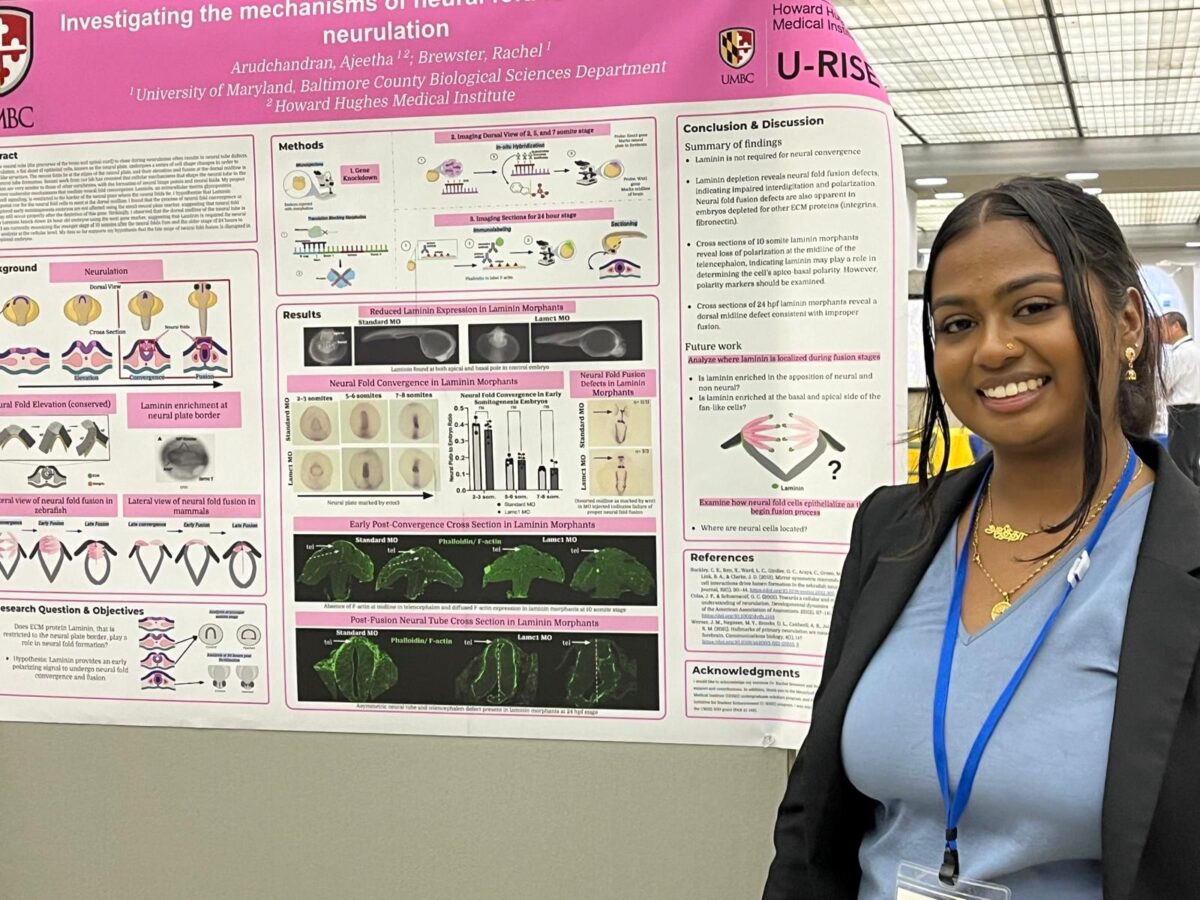
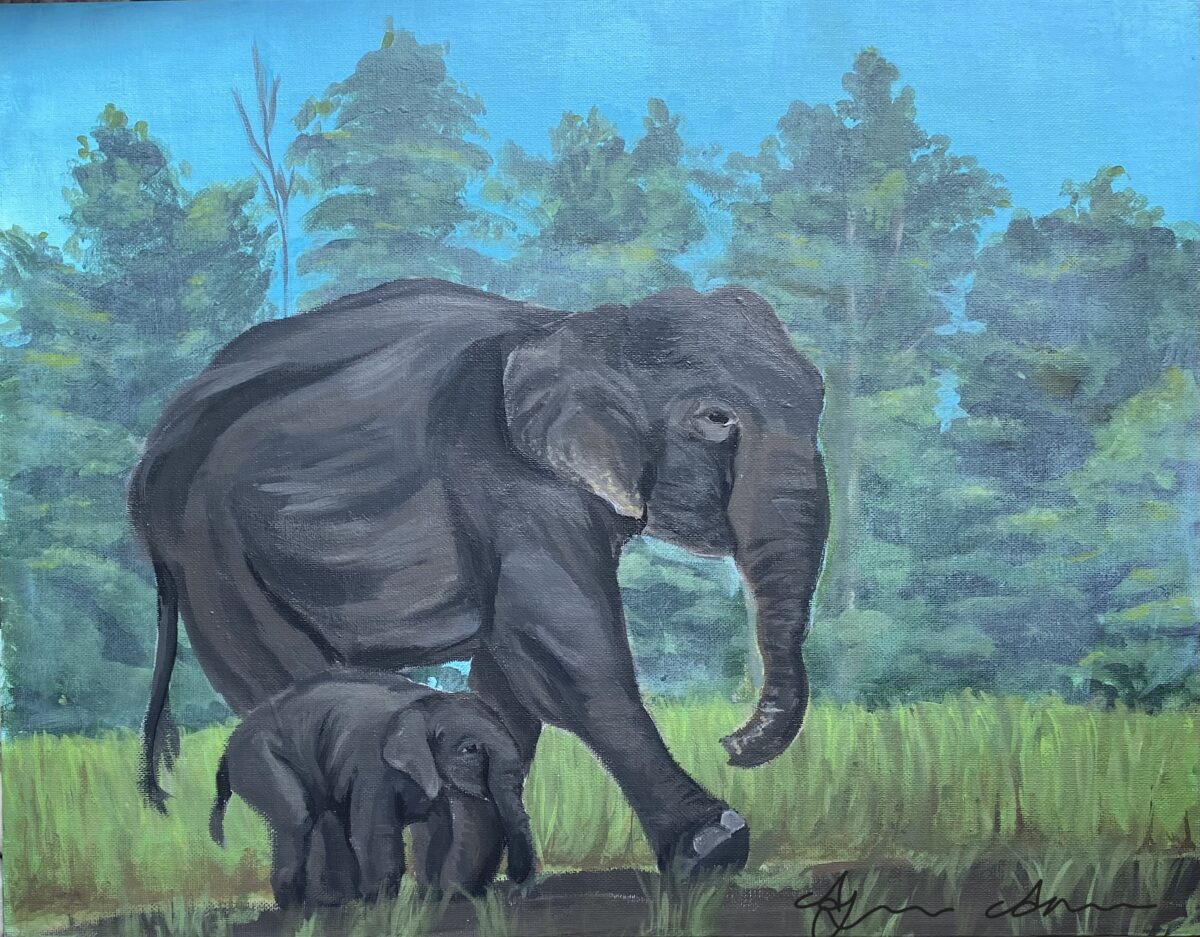 Biologist Ajeetha Aruchandran also loves to paint. (Courtesy of Aruchandran)
Aruchandran began with drawing, but has transitioned to painting. “There’s something so special about the freeness of a brushstroke,” she says. The two pursuits “create balance in my life, because when I need more structure, I have research and the scientific method, but when I need to feel more free, I have my art.”
Rhythm and harmony
Lesley Hernandez, a senior majoring in biochemistry and molecular biology, is hunting for factors that regulate how viruses like HIV multiply in cells with Michael Summers, University Distinguished Professor of Cchemistry and Bbiochemistry. The ultimate goal is to disrupt the viruses’ replication. She also loves to dance.
“My family is from the Dominican Republic, so I grew up surrounded by music and movement. I decided to embrace that part of my culture at UMBC by joining the Latin Dance Club, where I could perform and share my love for dance with others,” Hernandez says. “I love incorporating dance into the workspace by sharing a laugh with my peers and dancing between experiments. It fosters stronger connections and creates an enjoyable work environment.”
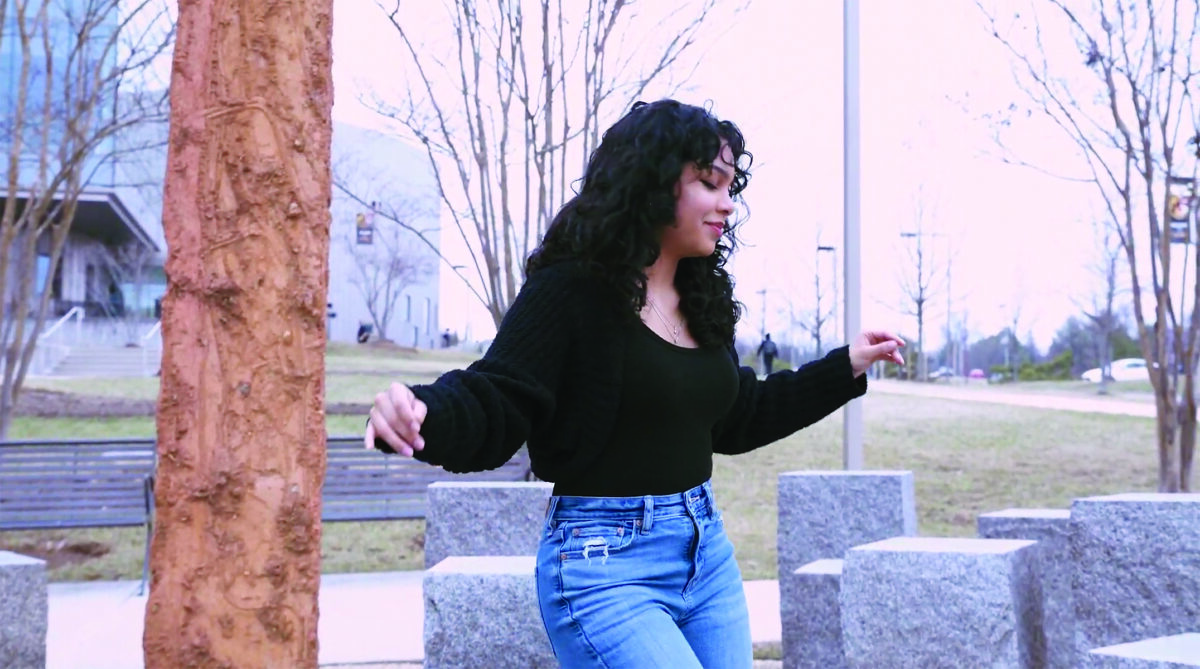
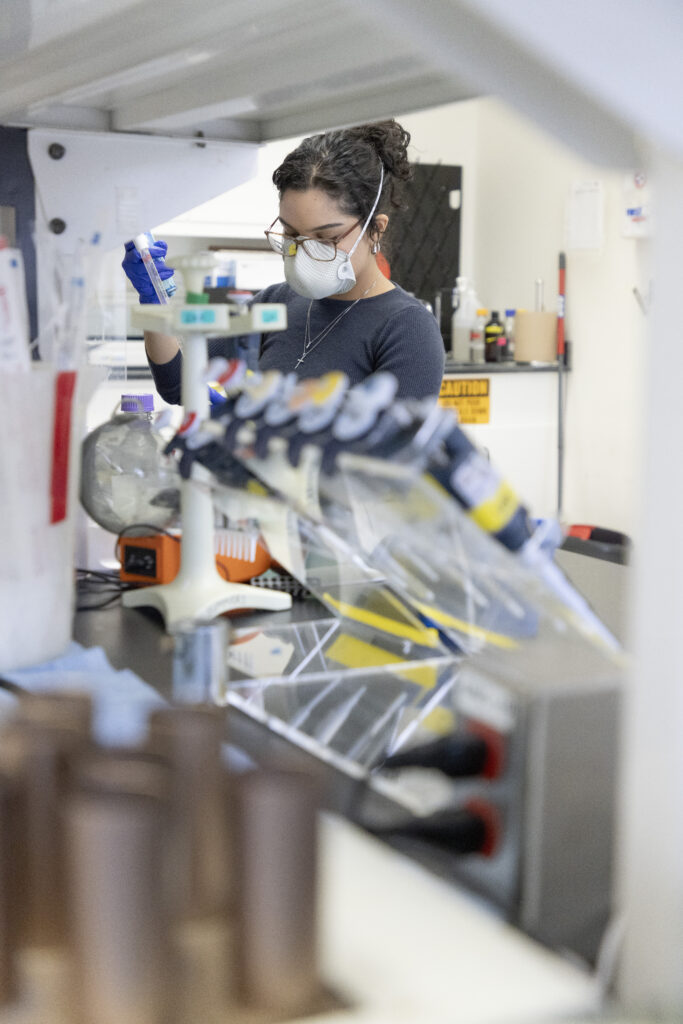 Lesley Hernandez loves being able to “go to my dance class and come back [to the lab] with a refreshed mind.” (Melissa Penley Cormier, M.F.A. ’17/UMBC)
And, when the science gets intense, “I can go to my dance class and come back with a refreshed mind,” Hernandez says. Her attention to detail benefits both her science and her dance. Being “a calculated person” helps her pick up rhythmically complex dance moves more quickly, for example. Both activities also require creativity, whether in trouble-shooting an experiment that’s not working or coming up with new dance routines.
In the Summers lab, “We are all really into science, but what is fun for you outside of that? Everyone in my lab has their own outlet, and that is encouraged,” Hernandez says.
For Daisy Parry, a senior majoring in biological sciences, that outlet is singing. “I’ve had a lot of interests that have come and gone, but singing has been a constant thread throughout my life. It’s very important and very centering to me,” Parry says. Her music minor has created dedicated times that provide a respite from the demands of science, she says.
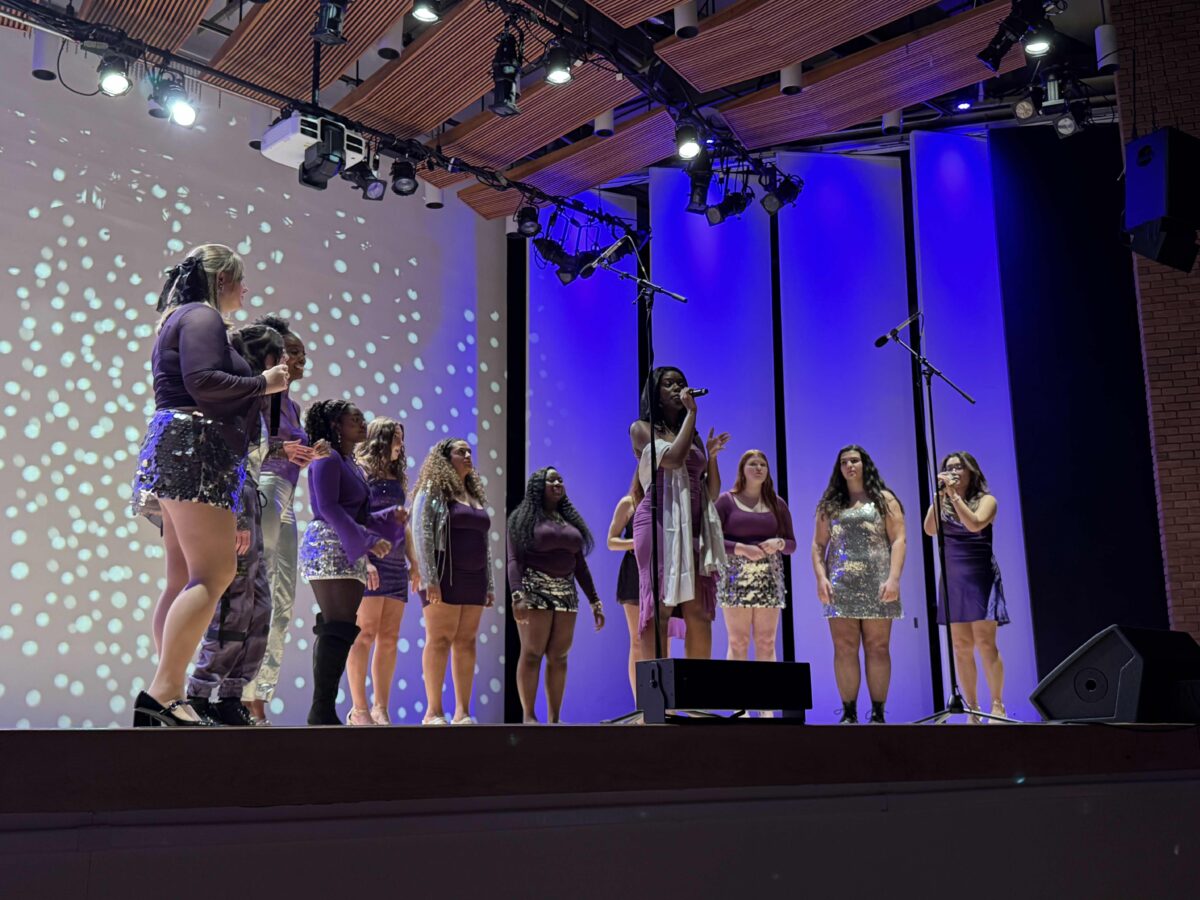 Daisy Parry (in front, with microphone) performs with the UMBC Stilettos, an all-female a cappella group. (Courtesy of Parry)
Parry is a member of The Stilettos, an all-woman a cappella group at UMBC, and her church choir. She arranges songs for The Stilettos to perform, which permits taking some creative license with the original work. “I like changing up the rhythms and dynamics to add depth to the music, and I think’s encouraged me to think a bit outside the box with my science, too, in terms of trying new experimental techniques.”
For now, her work on cell migration in fruit fly embryos with Michelle Starz-Gaiano, professor of biological sciences, her classes, and her music keep her busy, but Parry is looking forward to pursuing a master’s in public health after UMBC. She emphasizes how the concept of harmony—so central to music—carries over to the kind of work she wants to do. Factors such as research, clinical care, public policy, economics, the environment, and how they intersect are all relevant to public health outcomes, she explains.
‘It makes me whole’
Ella Reinders, a junior biological sciences major, also likes to tackle projects—scientific or artistic—from many angles. Watercolor and acrylic paints, sketching and drawing, handicrafts, sewing, and ballet have all captured her interest. “There are all different kinds of random things that I think are fun,” Reinders says.
In the lab, “I am able to come up with different ways of thinking about something because I’ve taken so many different approaches,” she says.
Reinders does behavioral research with Tara LeGates, assistant professor of biological sciences. The lab needed a new piece of equipment, but it was too expensive to buy off the shelf. “So I decided, why not create our own?” Reinders recalls.
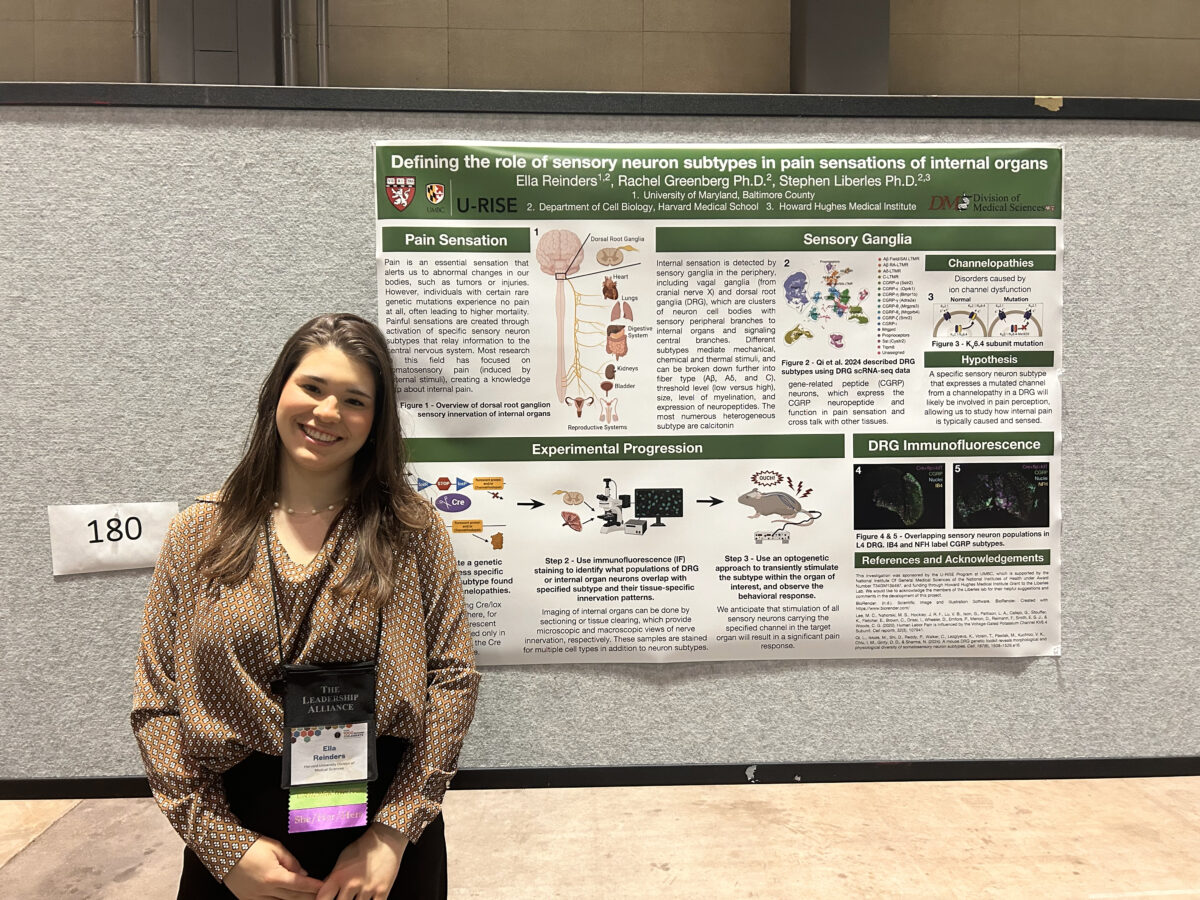
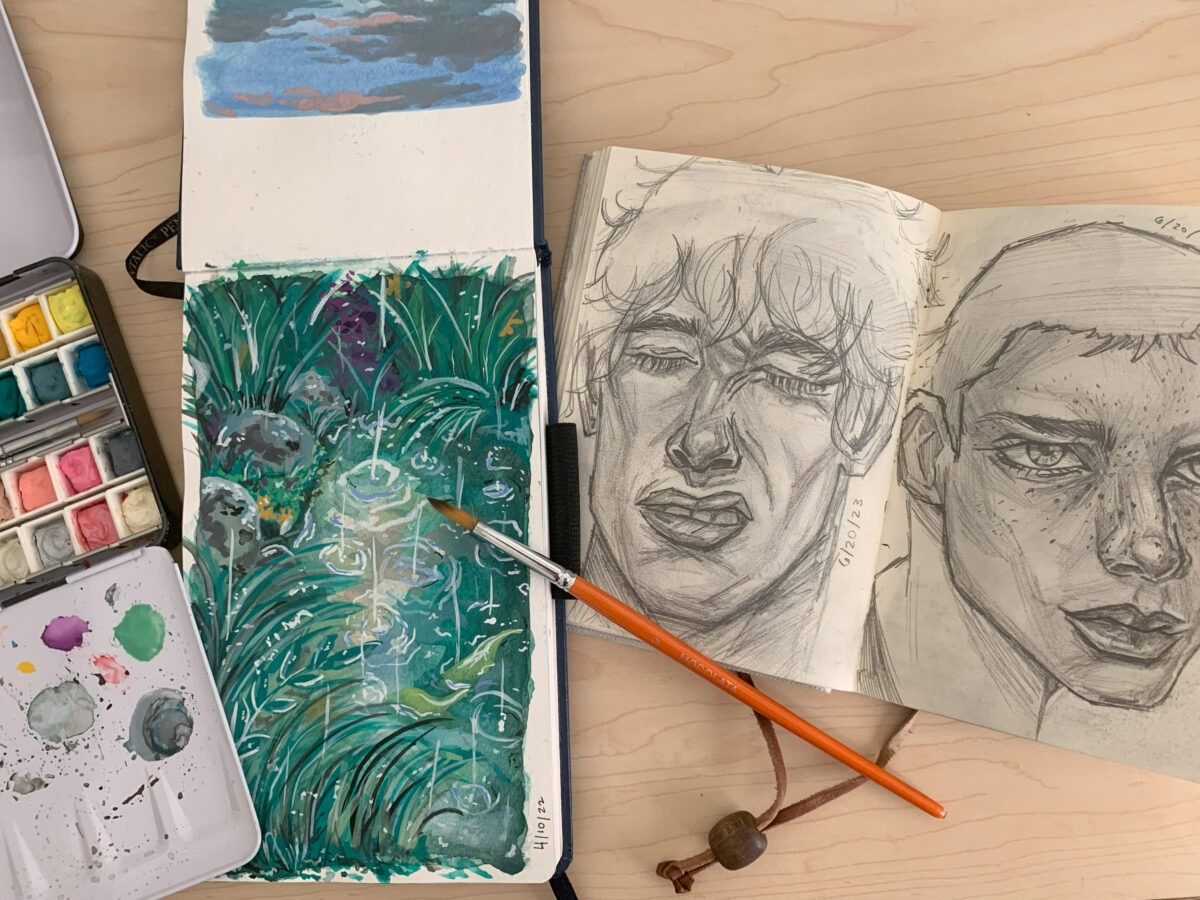 Ella Reinders says that “moving through life with both scientific and artistic interests just makes everything more interesting.” (Courtesy of Reinders)
She sketched it out, learned how to render it on the computer, how to 3D print it at the UMBC library, and then how to wire it. “And now I’ve actually been using it, and it works,” she says. “It was really exciting. I love turning something from my brain into something that I’m actually holding.”
There is also direct overlap between Reinders’ science and her art. “I’ve done imaging of neurons, and being able to turn them into this piece of artwork that you want to hang on your wall is really exciting. Moving through life with both scientific and artistic interests just makes everything more interesting and feels like a way to express all sides of myself.”
For Joshua Dayie, a senior chemical engineering major, both discipline and creativity are required for his research and his art—playing the cello. “You really have to strike a balance between them to make any meaningful progress,” he says. Practicing cello requires hours of repetition, until technical passages flow out of his fingers from muscle memory alone. In the lab, sometimes experiments must be repeated many times before they’re successful—that’s the discipline.
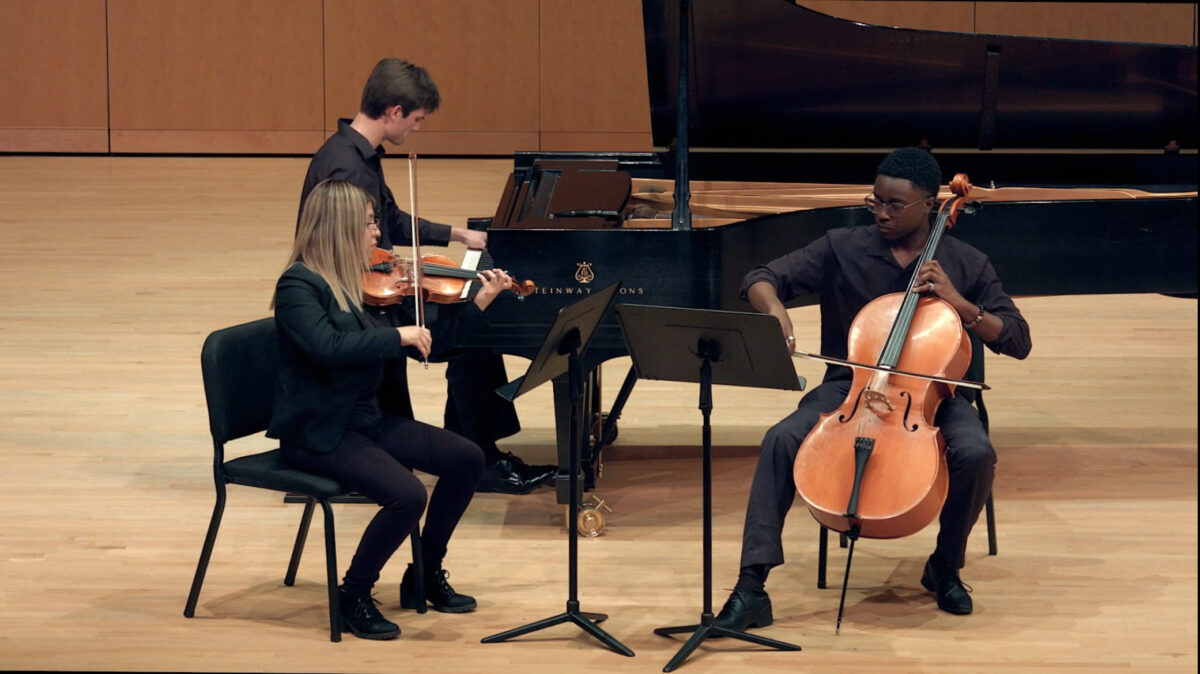
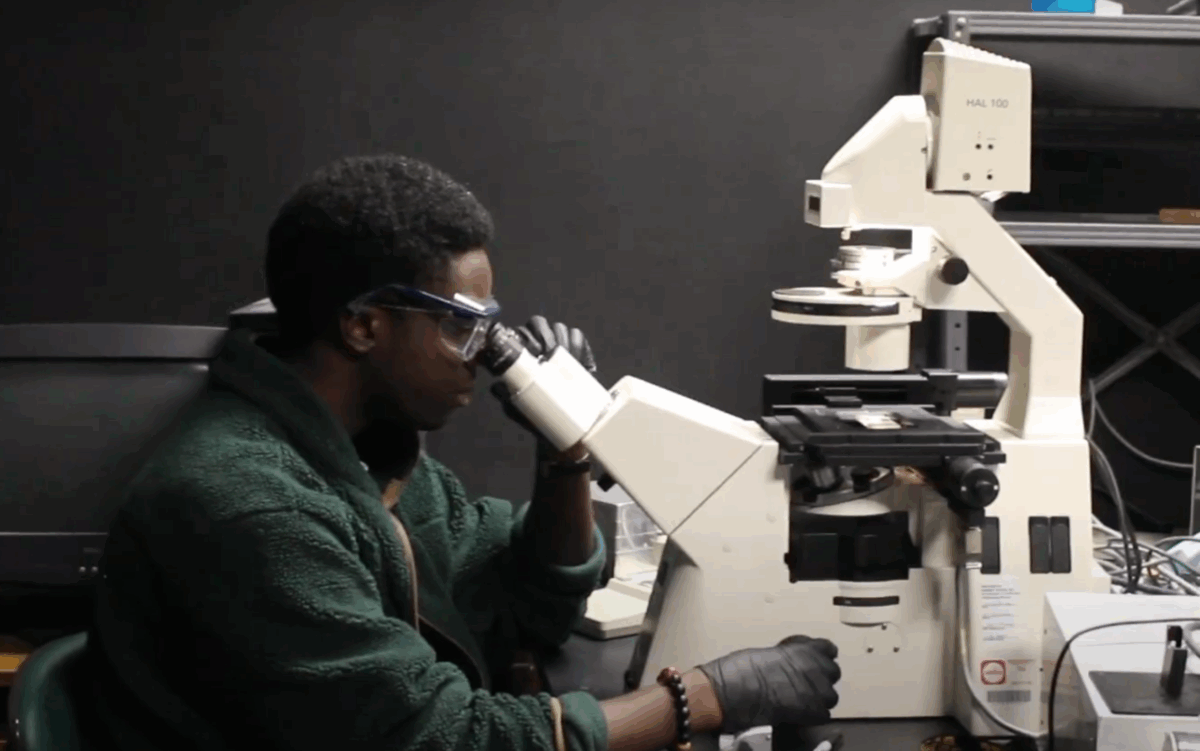 Playing the cello and conducting research makes Joshua Dayie feel “more whole.” (Melissa Penley Cormier, M.F.A. ’17/UMBC)
Dayie applies that discipline to his research with Mark Marten, professor of chemical, biochemical, and environmental engineering, on characterizing signaling pathways in fungi that activate in response to environmental stressors.
Then comes the creativity. Only after someone masters the fundamentals can they explore nuance in the tone or emotion conveyed on the cello, Dayie says. Similarly, in science “a lot of the innovation that you generate is really only meaningful after you’ve spent a lot of time understanding the core scientific concepts behind everything.”
“I think that’s been the most surprising thing: The creativity that comes from a very sound foundation of discipline is something that is translatable pretty much anywhere,” Dayie reflects.
As an added bonus, “Music has been a really nice outlet for me to use a different part of my brain, just to express myself in a different way,” he adds. “I feel like it makes me a little bit more whole.”
]]>
At UMBC, undergraduate students are redefining the boundaries of scientific and artistic pursuits. From a chemical engineer who graces the stage with his cello to a bioinformatician who paints and...
https://umbc.edu/stories/art-of-scientists/
https://my3.my.umbc.edu/api/v0/pixel/news/150074/guest@my.umbc.edu/8497eb97bed55a957858f91cb734d636/api/pixel
biochemistry-and-molecular-biology
bioinformatics
bioinformatics-and-computational-biology
biological-sciences
biology
cbee
chembiochem
cheme
chemeng
chemical-engineering
cnms
coeit
dance
discovery
magazine
music
story
UMBC News & Magazine
https://my3.my.umbc.edu/groups/umbc-news-magazine
https://assets1-my.umbc.edu/system/shared/avatars/groups/000/001/943/24435aa6207c452e7bc15cc74b42c7bb/xsmall.png?1748556657
https://assets1-my.umbc.edu/system/shared/avatars/groups/000/001/943/24435aa6207c452e7bc15cc74b42c7bb/original.png?1748556657
https://assets2-my.umbc.edu/system/shared/avatars/groups/000/001/943/24435aa6207c452e7bc15cc74b42c7bb/xxlarge.png?1748556657
https://assets2-my.umbc.edu/system/shared/avatars/groups/000/001/943/24435aa6207c452e7bc15cc74b42c7bb/xlarge.png?1748556657
https://assets3-my.umbc.edu/system/shared/avatars/groups/000/001/943/24435aa6207c452e7bc15cc74b42c7bb/large.png?1748556657
https://assets1-my.umbc.edu/system/shared/avatars/groups/000/001/943/24435aa6207c452e7bc15cc74b42c7bb/medium.png?1748556657
https://assets2-my.umbc.edu/system/shared/avatars/groups/000/001/943/24435aa6207c452e7bc15cc74b42c7bb/small.png?1748556657
https://assets1-my.umbc.edu/system/shared/avatars/groups/000/001/943/24435aa6207c452e7bc15cc74b42c7bb/xsmall.png?1748556657
https://assets2-my.umbc.edu/system/shared/avatars/groups/000/001/943/24435aa6207c452e7bc15cc74b42c7bb/xxsmall.png?1748556657
UMBC News & Magazine
3
0
false
Tue, 13 May 2025 09:16:55 -0400
Tue, 13 May 2025 09:16:55 -0400
UMBC and the U.S. Department of Health and Human Services partner to create pathways for a more diverse and inclusive workforce
UMBC and the U.S. Department of Health and Human Services (HHS) have signed a memorandum of understanding (MOU) establishing a strategic partnership to increase public service career awareness and diversify workforce opportunities. This collaboration can include internships, mentorships, shadowing experiences for UMBC students, and joint outreach events to boost awareness of HHS as an employer of choice.
“We work very hard to make sure that we do not just have a culture that is great, but we also have representation in places where students can see themselves and imagine who they can be and what they can contribute,” said Cheryl R. Campbell, the assistant secretary for administration for HHS.
HHS’s mission is to enhance the health and well-being of all Americans by providing effective health and human services and fostering sound, sustained advances in the sciences underlying medicine, public health, and social services. This MOU will enhance recruitment efforts, support career development programs, and share resources to broaden federal employment pathways for UMBC students, particularly in public health, research, and engineering.
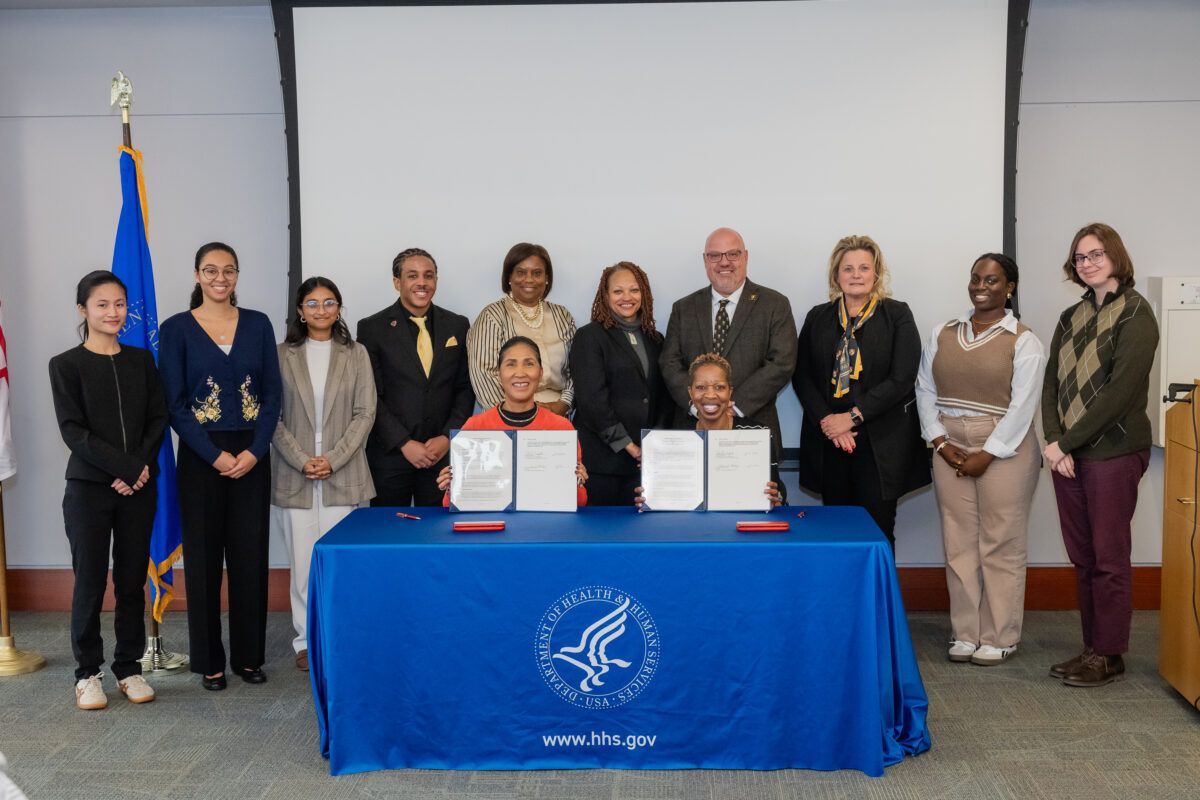 (l-r): Cheryl R. Campbell, the assistant secretary for administration for HHS, and UMBC President Dr. Valerie Sheares Ashby. (Marlayna Demond ’11/UMBC)
“When you talk about how do we change the conversation, how do we change and improve the health disparities? Well, you have to have people at the table that come from those environments,” said Campbell. “That’s why it’s critically important that we sign these memorandums of understanding to bring the next generation of Black and brown professionals into government service. Because if you want to affect change, you have to have a seat at the table to impact policy.”
This news is inspiring for Michael Ack. He joined UMBC as a Meyerhoff Scholar and earned a John H., Sr. and Althea Griner Scholarship for outstanding first-year undergraduate students committed to the advancement of minorities in the sciences and who intend to pursue biological sciences as a major. Ack is now a junior and in his second year at the National Institutes of Health Undergraduate Scholars Program (UGSP), which is part of HHS. Ack notes how these programs provided him access to invaluable financial support, mentorship, and a strong community of peers, faculty, and alumni. Last summer, Ack shadowed researchers working on understanding the development and continued survival of cancer cells. After graduation, Ack will complete his UGSP service obligation by working as a full-time NIH employee in an NIH Intramural Research Laboratory.
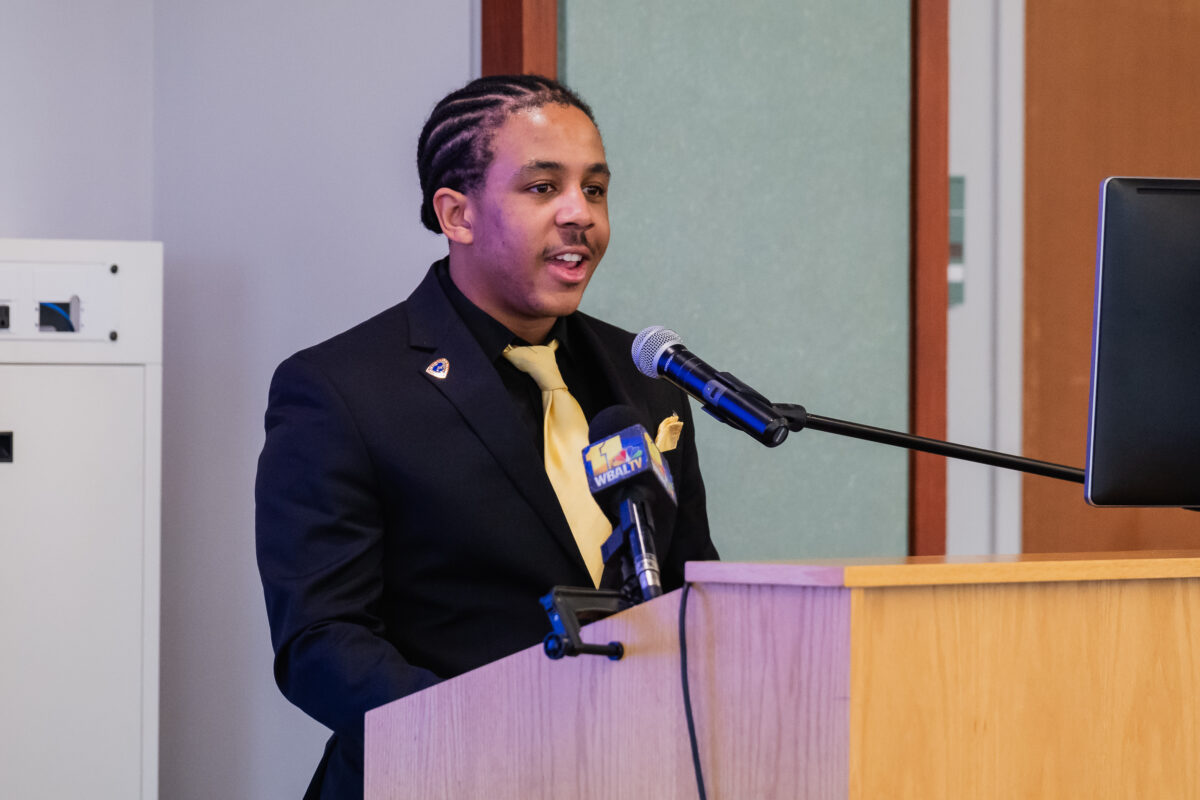 Michael Ack. (Marlayna Demond ’11/UMBC)
“This MOU will serve as a pathway for UMBC students to pursue meaningful careers in public service and make meaningful contributions to our society,” said Ack. “And through the various opportunities that this partnership promises, more UMBC students will be able to see the benefits of working for HHS, such as I have, and will empower more of us to dream big.”
For more internship and career information visit UMBC’s Career Center and listen to their UMBC Careers Unleashed podcast.
]]>
UMBC and the U.S. Department of Health and Human Services (HHS) have signed a memorandum of understanding (MOU) establishing a strategic partnership to increase public service career awareness and...
https://umbc.edu/quick-posts/umbc-and-health-and-human-services-partner-to-create-workforce-pathways/
https://my3.my.umbc.edu/api/v0/pixel/news/146556/guest@my.umbc.edu/7db8a2edf3bad945354b3b8d4241488e/api/pixel
biological-sciences
cahss
career-center
cnms
coeit
meyerhoff-scholar
news
policy-and-society
quick-post
UMBC News & Magazine
https://my3.my.umbc.edu/groups/umbc-news-magazine
https://assets1-my.umbc.edu/system/shared/avatars/groups/000/001/943/24435aa6207c452e7bc15cc74b42c7bb/xsmall.png?1748556657
https://assets1-my.umbc.edu/system/shared/avatars/groups/000/001/943/24435aa6207c452e7bc15cc74b42c7bb/original.png?1748556657
https://assets2-my.umbc.edu/system/shared/avatars/groups/000/001/943/24435aa6207c452e7bc15cc74b42c7bb/xxlarge.png?1748556657
https://assets2-my.umbc.edu/system/shared/avatars/groups/000/001/943/24435aa6207c452e7bc15cc74b42c7bb/xlarge.png?1748556657
https://assets3-my.umbc.edu/system/shared/avatars/groups/000/001/943/24435aa6207c452e7bc15cc74b42c7bb/large.png?1748556657
https://assets1-my.umbc.edu/system/shared/avatars/groups/000/001/943/24435aa6207c452e7bc15cc74b42c7bb/medium.png?1748556657
https://assets2-my.umbc.edu/system/shared/avatars/groups/000/001/943/24435aa6207c452e7bc15cc74b42c7bb/small.png?1748556657
https://assets1-my.umbc.edu/system/shared/avatars/groups/000/001/943/24435aa6207c452e7bc15cc74b42c7bb/xsmall.png?1748556657
https://assets2-my.umbc.edu/system/shared/avatars/groups/000/001/943/24435aa6207c452e7bc15cc74b42c7bb/xxsmall.png?1748556657
UMBC News & Magazine
1
0
false
Tue, 14 Jan 2025 13:39:02 -0500
Tue, 14 Jan 2025 13:39:02 -0500
Kaitlyn Sadtler ’11 named to TIME100 Next list for interdisciplinary biotech research
Kaitlyn Sadtler ’11, biological sciences, has been selected for the TIME100 Next list. In its fifth year, the list aims “to recognize rising leaders in health, climate, business, sports, and more—and by doing so, not just show the stories that are capturing headlines in 2024, but also introduce you to the people who we believe will play an important role in leading the future.”
Since 2019, Sadtler has been a tenure-track researcher and chief of the Section on Immunoengineering at the National Institute of Biomedical Imaging and Bioengineering. Her interdisciplinary research straddles bioengineering and immunology.
“I’m super excited and absolutely surprised to be included on the TIME100 Next list. Working in regenerative medicine, our lab gets to look forward to where we could build therapies to help regrow our damaged tissues after traumatic injuries,” Sadlter shared. “I’m also thrilled that there is excitement for bioengineering at the National Institutes of Health. Biomedical engineering is a field that’s able to connect the basic fundamental biology discoveries with clinical translation and application of those discoveries.”
In 2020, Sadtler led a study published in Science Translational Medicinelooking for undiagnosed COVID-19 cases in more than 9,000 blood samples that never-diagnosed participants mailed in. The study found that during the first several months of the pandemic, for every diagnosed case of COVID-19, an estimated 4.8 cases went undiagnosed. That suggested a total of 16.8 million undiagnosed (and therefore mild or asymptomatic) cases by July 2020.
Undiagnosed cases were more likely in certain demographic groups, including younger people, people in urban areas, and people without risk factors for severe disease. The findings provided important insights for the pandemic response by suggesting that immunity acquired from infection among the young and healthy population and in dense areas was higher than previously understood, meaning herd immunity might be reached faster than first anticipated.
After graduating summa cum laude from UMBC, Sadtler completed her doctorate at the Johns Hopkins School of Medicine and a postdoctoral fellowship at MIT. Sadlter has received numerous awards, and her 2018 TED Talk was one of the 25 most-viewed TED talks that year. Sadtler also presented at UMBC’s GRIT-X speaker series in 2022.
]]>
Kaitlyn Sadtler ’11, biological sciences, has been selected for the TIME100 Next list. In its fifth year, the list aims “to recognize rising leaders in health, climate, business, sports, and...
https://umbc.edu/quick-posts/kaitlyn-sadtler-time100-next/
https://my3.my.umbc.edu/api/v0/pixel/news/144684/guest@my.umbc.edu/c1fdb3ee4619f1d5297c5b8dfda0738d/api/pixel
alumni
biological-sciences
biology
cnms
news
quick-post
science-and-tech
UMBC News & Magazine
https://my3.my.umbc.edu/groups/umbc-news-magazine
https://assets1-my.umbc.edu/system/shared/avatars/groups/000/001/943/24435aa6207c452e7bc15cc74b42c7bb/xsmall.png?1748556657
https://assets1-my.umbc.edu/system/shared/avatars/groups/000/001/943/24435aa6207c452e7bc15cc74b42c7bb/original.png?1748556657
https://assets2-my.umbc.edu/system/shared/avatars/groups/000/001/943/24435aa6207c452e7bc15cc74b42c7bb/xxlarge.png?1748556657
https://assets2-my.umbc.edu/system/shared/avatars/groups/000/001/943/24435aa6207c452e7bc15cc74b42c7bb/xlarge.png?1748556657
https://assets3-my.umbc.edu/system/shared/avatars/groups/000/001/943/24435aa6207c452e7bc15cc74b42c7bb/large.png?1748556657
https://assets1-my.umbc.edu/system/shared/avatars/groups/000/001/943/24435aa6207c452e7bc15cc74b42c7bb/medium.png?1748556657
https://assets2-my.umbc.edu/system/shared/avatars/groups/000/001/943/24435aa6207c452e7bc15cc74b42c7bb/small.png?1748556657
https://assets1-my.umbc.edu/system/shared/avatars/groups/000/001/943/24435aa6207c452e7bc15cc74b42c7bb/xsmall.png?1748556657
https://assets2-my.umbc.edu/system/shared/avatars/groups/000/001/943/24435aa6207c452e7bc15cc74b42c7bb/xxsmall.png?1748556657
UMBC News & Magazine
0
0
false
Thu, 10 Oct 2024 15:34:29 -0400
Thu, 10 Oct 2024 15:34:29 -0400

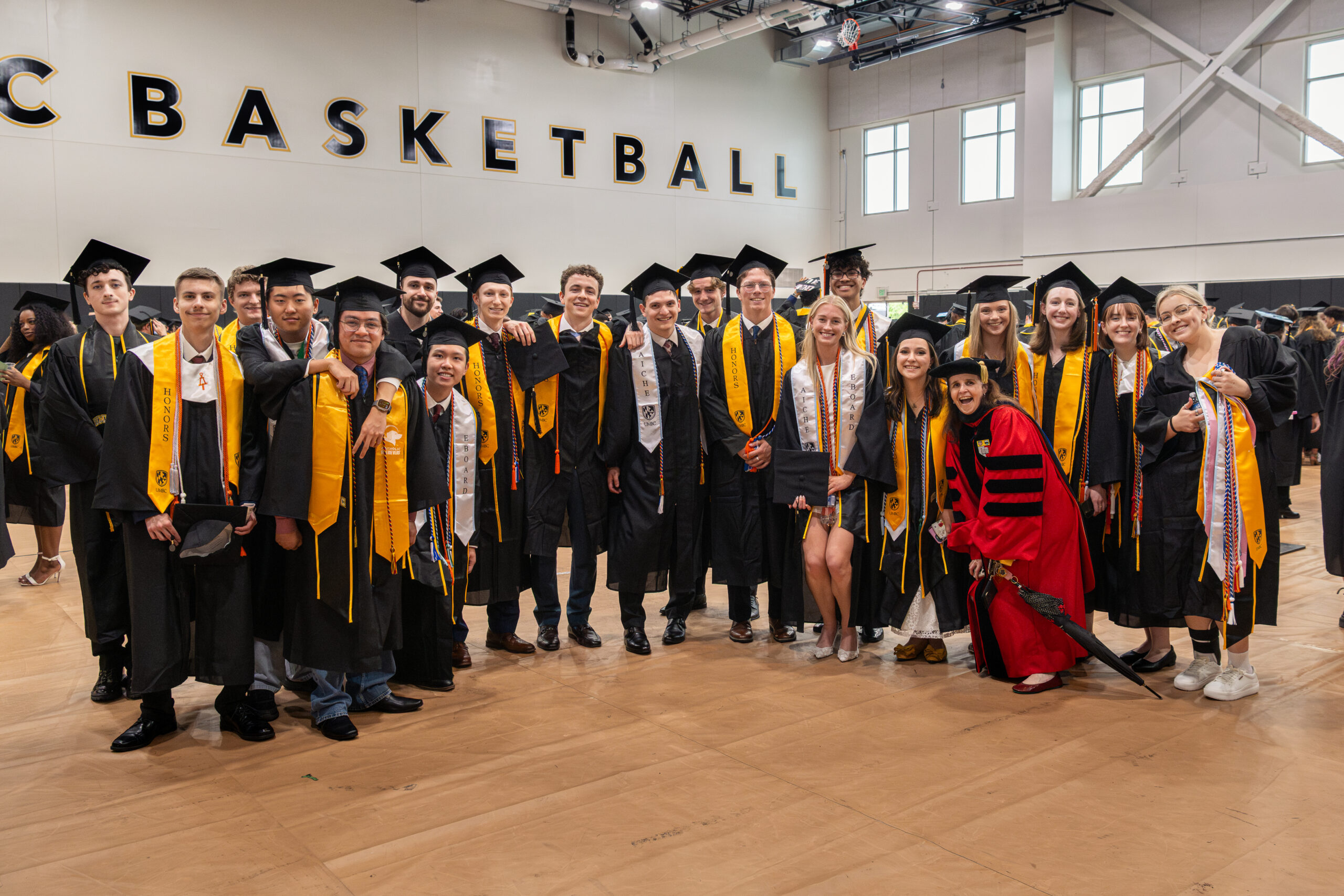


 Celebrating graduation day! (Brad Ziegler/UMBC)