Who is “Fulbright material”? UMBC’s six 2025 – 2026 Fulbright U.S. Student Program recipients share their not-so-secret recipe for success
Alyssa Thomas is more of an “and” person than an “or” person. Growing up in a military family stationed in Florida, Thomas learned flexibility, a sense of curiosity, and a “Why not?” approach to life. So when Shin Yon Kim, assistant teaching professor of Asian studies, encouraged her to apply to the U.S. Fulbright Student Program during her junior year, Thomas was skeptical. “I decided to give it a try, but I didn’t think I’d get very far because I had never studied abroad,” said Thomas. “And then Dr. Kim said, ‘I need you to start believing in yourself and actually push yourself to apply for it.'” Those words of encouragement stuck with her. Thomas took her own advice and said, “Why not?”
Thomas ’25, Asian studies, ended her summer by moving to Taipei, Taiwan, where she is already working as a Fulbright English Teaching Assistant. She hopes her rudimentary Mandarin will help her learn Taiwanese Mandarin and the various dialects while she’s there. “There’s a big difference between learning in the classroom and in person. Accents, tempo, and slang are elements of Mandarin I’ve yet to adjust to,” says Thomas.

Retriever advice from Alyssa Thomas ’25
U.S. Fulbright Student Program
English Teaching Assistant, Taipei, Taiwan
“It’s important to learn how to manage your stress, especially if you have never traveled abroad or applied for a Fulbright. For me, it’s morning walks. Find what works for you—whether it’s journaling or therapy—to help manage the unexpected.”
Deciding to apply for a Fulbright is only the beginning. The process usually starts with a mentor pointing the way toward Brian Souders, M.A. ’19, TESOL, and Ph.D. ’09, language, literacy, and culture, the associate director for global learning at UMBC’s Center for Global Engagement. CGE hosts Fulbright information sessions in the spring for undergraduate, graduate, and recent alumni. Retrievers can apply to earn a master’s, conduct research, or be an English Teaching Assistant in East Asia-Pacific, Europe and Eurasia, Middle East and North Africa, South and Central Asia, Sub-Saharan Africa, and the Western Hemisphere.
With three UMBC 2025 – 2026 Fulbrights already settled in Taiwan, Norway, and Indonesia, and three preparing to cross the Atlantic Ocean to Belgium, Israel, and Germany, these alumni are eager to share tips to inspire and prepare the next generations of Fulbright Retrievers.
Transforming the lives of incarcerated women
Right now, it is the beginning of fall in Bergen, Norway, where Shanika Freeman ’24 is settling in at the University of Bergen, working with faculty studying the reentry experiences of native Norwegian and non-native Norwegian women into the community after incarceration. Freeman’s individualized studies major at UMBC focused on recidivism and policy in urban communities, making Norway a perfect research location. The country’s progressive and humane approach to rehabilitation, from the point of entry into the carceral system to successful reentry, has made Norway have the world’s lowest recidivism rates. Though Baltimore and Norway are worlds apart geographically and culturally, Freeman hopes to use what she learns abroad to help transform the lives of incarcerated women in the U.S. by exploring practices that shift the focus from punishment to rehabilitation and community building.

Retriever advice from Shanika Freeman ’24
U.S. Fulbright Student Program
Research in Bergen, Norway
“Build a team. I found out about Fulbright through Dr. Brian Souders. I didn’t know anything about it before and felt like Fulbright was out of reach for me. The furthest I had traveled was to California, and that was only for a weekend. I never thought a person like me—low-income, two-time college dropout from Baltimore City—would get the opportunity to go abroad.”
Her team included the INDS faculty and her academic mentors: Tammy Henderson, associate teaching professor of Africana studies; Loren Henderson, director of the school of public policy; László Kőrössy, assistant director for academic advising, outreach, and assessment; and Eric Stokan, director of the Center for Social Science Scholarship. “I applied because the faculty encouraged me and supported my research. I knew that my research was important, and Fulbright allowed me to take it further. Applying was a bit overwhelming at times, but Dr. Souders was extremely thorough, patient, kind, and knowledgeable. My team of faculty and staff was instrumental in my development as a scholar and fostered my academic goals.”
Researching your roots
Since Eilah Goldberg ’25, history, with a Judaic studies minor, first learned about the Fulbright Program during her sophomore year, her academic goals became very clear—build a strong academic and social foundation to earn this prestigious award. Goldberg knew she wanted to study Jewish history, religion, and culture abroad. The first step was studying abroad in England at the University College London (UCL) Hebrew and Jewish studies department, with the intent of returning to earn a master’s. “When I told Dr. Souders my plan to return to London after graduation, he asked me what I really wanted to do,” says Goldberg. “I shared my deep interest in Jewish studies, and he helped me realize that I could go directly to Israel to study—that it was a real option.”

Retriever advice from Eilah Goldberg ’25
U.S. Fulbright Student Program
Master’s at Hebrew University of Jerusalem
“Stay true to yourself, your interests, passions, and intellectual curiosities. Don’t let fear stop you from traveling to places or studying topics that are personally and culturally meaningful to you. Take the opportunity to conduct firsthand research into your roots, identity, and beliefs. Lean on the support of student clubs and cultural communities, just as I did with UMBC’s Chabad and Hillel Jewish student organizations and UCL’s Jewish Student Union. It’s important to have people to encourage you and believe in you.”
Goldberg will earn a master’s in Israel Studies at the Hebrew University of Jerusalem, surrounded by her extended family in Israel, an hour away from Jerusalem. She will study the impact of American Aliyah—ascent in Hebrew—the immigration of American Jews to Israel, and how it shaped Israeli society historically, culturally, and politically.
Pre-med neurologocial research abroad
The summer before his first year at UMBC, Andrew Opincar ’25, biological sciences, mapped out a four-year plan to ensure he would complete his major requirements, gain clinical experience, and take the MCAT all before graduating. As a participant in STEM Build—a National Institutes of Health initiative focused on enhancing diversity in the biomedical and behavioral sciences workforce, Opincar was excited to explore diverse perspectives in healthcare and research. While planning for his final two years at UMBC, he took the opportunity to study abroad in Amsterdam, Netherlands, to learn about the Dutch public universal health system.

Retriever advice from Andrew Opincar ’25
U.S. Fulbright Student Program
Research at the University of Heidelberg, Germany
“For pre-med students to critically analyze the health systems around us, we need to understand systems and people different from ourselves. It’s difficult to be well-rounded physicians, scientists, or researchers when you’ve only lived in one place and had one kind of experience,” says Opincar, who, even though his mentors encouraged him to apply, was unsure if he was “Fulbright material.” “I like the sports quote, ‘You lose 100 percent of the shots you don’t take,’ so you really must take a chance on what you care about and put yourself out there.”
Now, Opincar has mapped the time between graduation and medical school to learn a new healthcare system and expand his research experience from cell migration in fruit flies to spinal cord regeneration in mouse models at Heidelberg University, Germany, a global center for molecular biology and neuroscience. He’s excited to plan for many unknowns, like exploring a new research field, becoming bilingual, and stepping outside of his comfort zone to gain more confidence personally and professionally.
Connecting with your community across borders
Law and politics have been on Navara Syed‘s mind as long as she can remember. Her political science professors, Carolyn Forestiere, Brian Grodsky, and Jeffrey Davis, fueled her passion for comparative politics, civil and human rights, and community advocacy, leading her to choose a major in political science. During her visits to Pakistan to visit family and to Thailand to study abroad, Syed began to understand the complexity and broadness of what community can mean, and is ready to embrace the community she will be part of during her Fulbright in Indonesia as an English Teaching Assistant.

Retriever advice from Navara Syed ’25
U.S. Fulbright Student Program
English Teaching Assistant
Padang, West Sumatra, Indonesia
“Dip your toes into different ponds. You never know what you will find. I’m Muslim and have never lived in a Muslim country. In the U.S., I always have to think about where to get Halal food. In Thailand, a kind person approached me and offered to show me where I could find Halal food. Our tour guide even made sure to include Halal restaurant options.
Indonesia is a Muslim country, so spending Ramadan and other major Muslim holidays without needing to explain them or figure out how to participate in them is a dream come true. No experience is a waste—it’s just as important to realize what you don’t like as it is to discover what you do.”
Since graduating in May, these connections, along with her time in Mock Trial, the Muslim Student Association, and the student events board, continue to plant seeds of possibilities for her future in the field of law, whether as a judge, legislator, professor, or advocate.
Intersectional approach to flood mitigation
Daniel Douglas ’21, global studies, M.P.P. ’24, public policy, a current Ph.D. student, has been clear about his career path since his undergraduate years, when he began researching environmental policy focused on disaster mitigation and natural hazards. As a Fulbright recipient, he is now taking his expertise to the international level in Antwerp, Belgium.

Retriever advice from Daniel Douglas, Ph.D. student
U.S. Fulbright Student Program
Research at University of Antwerp, Belgium
“In every single field of study at UMBC, you can identify a way to apply your work for the common good. Find and seek your purpose above all else. This is especially important today when research and academia are being challenged. Now, we all have to uplift goodness, justice, and each other. And most of all, we can’t give up hope. I try my best to uplift those around me, knowing and trusting that they are pushing me forward to new heights.”
At the University of Antwerp, Douglas will conduct research on Belgium’s Sigma Plan—the primary flood mitigation plan along the Scheldt River Valley in Flanders, Belgium. Originally launched in 1977 as a single-purpose safety plan, it has since evolved to manage flood protection with nature conservation, recreation, and the needs of shipping and agriculture. This intersectional approach to flood mitigation is Douglas’s passion. He plans to build on his skill set in Belgium, then bring this newfound knowledge back to UMBC to complete his doctorate, and help communities worldwide—including Ellicott City—reduce the disastrous impacts of environmental hazards through disaster prevention, mitigation, and governance.
Learn more about UMBC’s Center for Global Education.
All photos by Brad Ziegler/UMBC, with the exception of Shanika Friedman’s, courtesy of INDS, and Daniel Douglas, courtesy of Douglas.
]]>
Alyssa Thomas is more of an “and” person than an “or” person. Growing up in a military family stationed in Florida, Thomas learned flexibility, a sense of curiosity, and a “Why not?” approach to...
https://umbc.edu/stories/2025-2026-fulbright-u-s-student-program-recipients-share-advice/
https://my3.my.umbc.edu/api/v0/pixel/news/153327/guest@my.umbc.edu/41b99848b6530be49b6743052c7a2469/api/pixel
africanastudies
asianstudies
baltimorecity
biologicalsciences
cahss
cnms
coeit
community
cs3
globalstudies
graduateschool
inds
international
judaicstudies
news
publicpolicy
story
UMBC News & Magazine
https://my3.my.umbc.edu/groups/umbc-news-magazine
https://assets1-my.umbc.edu/system/shared/avatars/groups/000/001/943/24435aa6207c452e7bc15cc74b42c7bb/xsmall.png?1748556657
https://assets1-my.umbc.edu/system/shared/avatars/groups/000/001/943/24435aa6207c452e7bc15cc74b42c7bb/original.png?1748556657
https://assets2-my.umbc.edu/system/shared/avatars/groups/000/001/943/24435aa6207c452e7bc15cc74b42c7bb/xxlarge.png?1748556657
https://assets2-my.umbc.edu/system/shared/avatars/groups/000/001/943/24435aa6207c452e7bc15cc74b42c7bb/xlarge.png?1748556657
https://assets3-my.umbc.edu/system/shared/avatars/groups/000/001/943/24435aa6207c452e7bc15cc74b42c7bb/large.png?1748556657
https://assets1-my.umbc.edu/system/shared/avatars/groups/000/001/943/24435aa6207c452e7bc15cc74b42c7bb/medium.png?1748556657
https://assets2-my.umbc.edu/system/shared/avatars/groups/000/001/943/24435aa6207c452e7bc15cc74b42c7bb/small.png?1748556657
https://assets1-my.umbc.edu/system/shared/avatars/groups/000/001/943/24435aa6207c452e7bc15cc74b42c7bb/xsmall.png?1748556657
https://assets2-my.umbc.edu/system/shared/avatars/groups/000/001/943/24435aa6207c452e7bc15cc74b42c7bb/xxsmall.png?1748556657
UMBC News & Magazine
0
0
false
Tue, 07 Oct 2025 09:08:23 -0400
Tue, 07 Oct 2025 09:08:23 -0400
Innies, outies and omphalophobia: 7 navel-gazing questions about belly buttons answered

Written by Sarah Leupen, senior lecturer of biological sciences, UMBC
Everyone has one, but you might not know much about it. Here biologist Sarah Leupen, who teaches human and comparative animal physiology, explains the ins and outs of belly buttons.
1. Why do I even have a belly button?
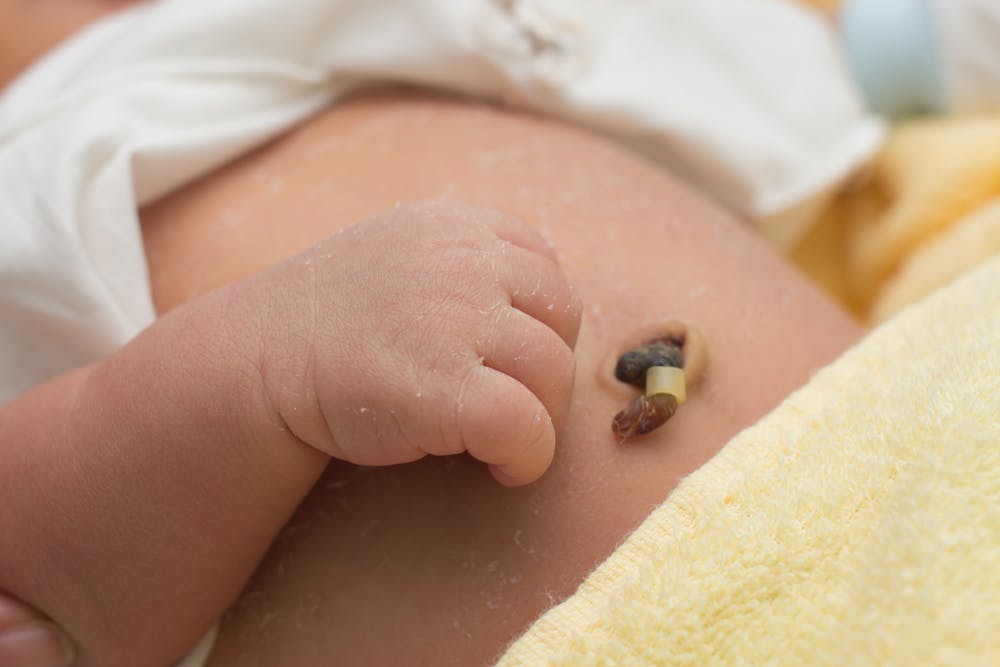
Your belly button, or navel – clinically, your umbilicus – is the permanent scar left from where your umbilical cord connected your circulatory system, when you were a fetus, to the placenta. Fetuses don’t breathe, eat or eliminate waste, so the placenta provides an exchange site for the mother to deliver oxygen and nutrients from her bloodstream to the fetus, as well as collecting its wastes to eliminate from her body.
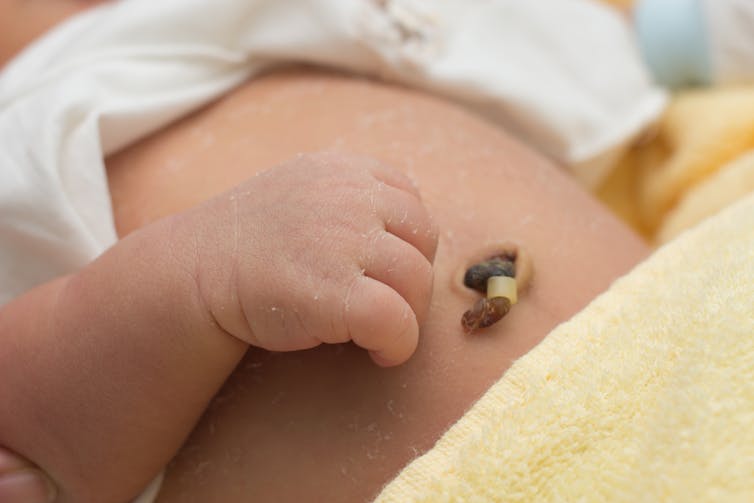 Once the umbilical cord is cut, the stump dries up and falls off, revealing the baby’s navel. Wacharaphong/iStock via Getty Images Plus
After the baby is born, the physician or other attendant cuts the cord and clamps off the stub, which then dries and falls off after about a week, leaving the point of connection – your belly button – remaining.
If the cord is not cut, as has been the practice in some times and places and as is becoming trendy again in others, it will close off after an hour or so, then naturally detach a few days after birth. Some health care practitioners are concerned that this “lotus birth” could be an infection risk, since the umbilical cord remains attached to the placenta, which is dead tissue once out of the mother’s body.
2. If it’s a scar, why doesn’t it disappear over time?
If you injure just the outer layers of your skin, as in a cut or burn, the scar will soon completely disappear, especially in young people. And newborns are very young people. But unlike in those situations, the umbilicus involves more tissue layers — not just the skin but the connective tissue underneath – so it makes sense it doesn’t just blend in with the rest of your abdominal wall once it’s healed.
What about some pretty complicated surgeries that don’t leave scars? Doctors perform many operations in ways that deliberately avoid scarring, which is not nature’s way. In fact, one way to minimize scarring for surgeries uses this existing scar – surgeons can take advantage of the navel as an incision site for removing your appendix or gall bladder or for weight-loss surgery.
But if you don’t like the way your umbilical scar looks, plastic surgery to change its appearance, called umbilicoplasty, is possible. People sometimes take this cosmetic option after pregnancy or the removal of a piercing, or just to make an “outie” into an “innie.”
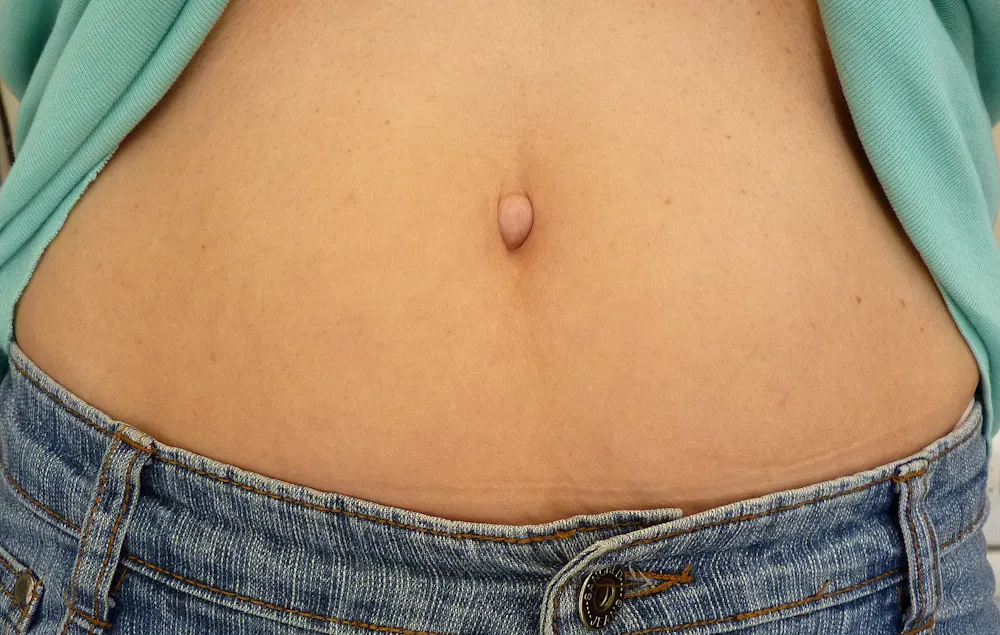
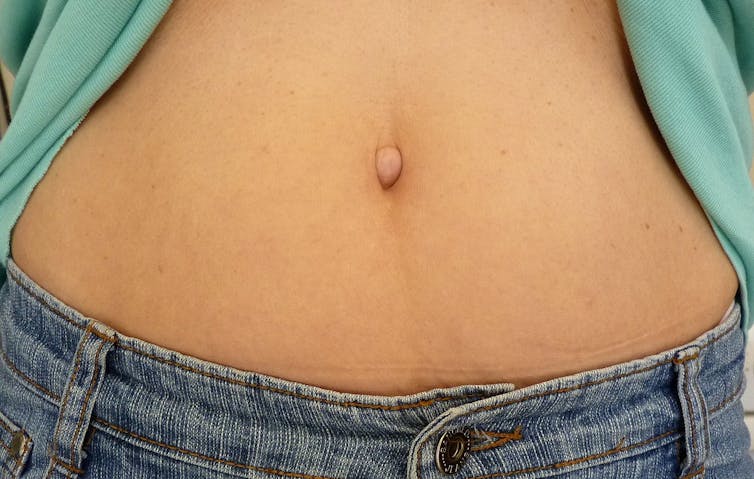 Outies are much less common than innies. Zeev Barkan/Flickr, CC BY
3. But why do some people have outies, anyway?
The look of your belly button is not related to the location of the clamp or where your doctor cut the cord.
Outies are simply an example of normal human variation, like the way some people have curly hair or dimples. When the tip of the umbilical cord’s remnant pokes out past the skin around it, you have an outie; about 10% of people have these. Any concave navel is called an “innie” and a convex one an “outie.”
Sometimes outies can be caused by an umbilical hernia in the baby or another medical problem, but most of it is just due to what your genes encoded. You might also temporarily have an outie during late pregnancy, when the abdominal pressure from the growing fetus stretches your navel and may push it out.
4. How deep does it go?
You can probably easily probe the depth of your own navel – there are no hidden recesses there. What’s under it is the same as what’s under the skin of the rest of your abdomen: your abdominal muscles, to which the navel is attached by a short umbilical stalk, and the peritoneum, the membrane that lines the abdominal cavity. Under that lie your guts – that is, your intestines and other abdominal organs. If you keep following this imaginary journey back, you’ll get to your spine – the belly button is usually lined up between the third and fourth lumbar vertebrae (L3 and L4).
Learn how to find your pet’s belly button.
5. Do other animals have belly buttons?
Because the navel is a scar from where the umbilical cord connected the fetus to the placenta, all placental mammals have them. That includes all mammals except marsupials (like kangaroos and possums) and monotremes (like platypuses and echidnas).
Your cat or dog or guinea pig does have a belly button, but because it’s a flatter scar than a person’s rather than a concave one, and is covered in fur, you might have missed it.
6. Is there anything besides lint in there?
Like any concave surface, if you have an innie, it probably gathers bits of debris occasionally. Your navel also has a microbial community, just like the rest of your skin. Because it’s pretty protected from soap and abrasion, a more stable and diverse bacterial community lives in your navel than elsewhere on your skin’s surface.
The innovative Belly Button Biodiversity project at North Carolina State University has revealed a lot about these little friends. The researchers found over 2,000 species of bacteria in the first 60 belly buttons they investigated.
It looks like most people have a set of eight common belly button bacteria, but the project is discovering new ones all the time.
7. Why do belly buttons gross out some people?
There hasn’t really been much research into why some people find belly buttons to be repulsive.
It may overlap with omphalophobia, the fear of belly buttons and touching them. There’s no specific treatment beyond the therapy or anti-anxiety medications a doctor might prescribe for any other phobia.
Whatever your feelings about belly buttons, they’re harmless. What’s more, they’re part of your evolutionary legacy as a mammal, the group of animals so invested in their offspring that they invented a way to deliver nutrients and oxygen, the mother’s bread and breath, straight into their developing young. Your navel can be a reminder of that first life-sustaining care you received from another person before you were even born.
This article is republished from The Conversation under a Creative Commons license. Read the original article and see more than 250 UMBC articles available in The Conversation.
]]>
Written by Sarah Leupen, senior lecturer of biological sciences, UMBC Everyone has one, but you might not know much about it. Here biologist Sarah Leupen, who teaches human and comparative...
https://umbc.edu/stories/questions-about-belly-buttons-answered/
https://my3.my.umbc.edu/api/v0/pixel/news/132302/guest@my.umbc.edu/4dda39ebf01cbe4ec2a1c677ea958d28/api/pixel
biological-sciences
biologicalsciences
biology
cnms
discovery
magazine
the-conversation
UMBC News & Magazine
https://my3.my.umbc.edu/groups/umbc-news-magazine
https://assets1-my.umbc.edu/system/shared/avatars/groups/000/001/943/24435aa6207c452e7bc15cc74b42c7bb/xsmall.png?1748556657
https://assets1-my.umbc.edu/system/shared/avatars/groups/000/001/943/24435aa6207c452e7bc15cc74b42c7bb/original.png?1748556657
https://assets2-my.umbc.edu/system/shared/avatars/groups/000/001/943/24435aa6207c452e7bc15cc74b42c7bb/xxlarge.png?1748556657
https://assets2-my.umbc.edu/system/shared/avatars/groups/000/001/943/24435aa6207c452e7bc15cc74b42c7bb/xlarge.png?1748556657
https://assets3-my.umbc.edu/system/shared/avatars/groups/000/001/943/24435aa6207c452e7bc15cc74b42c7bb/large.png?1748556657
https://assets1-my.umbc.edu/system/shared/avatars/groups/000/001/943/24435aa6207c452e7bc15cc74b42c7bb/medium.png?1748556657
https://assets2-my.umbc.edu/system/shared/avatars/groups/000/001/943/24435aa6207c452e7bc15cc74b42c7bb/small.png?1748556657
https://assets1-my.umbc.edu/system/shared/avatars/groups/000/001/943/24435aa6207c452e7bc15cc74b42c7bb/xsmall.png?1748556657
https://assets2-my.umbc.edu/system/shared/avatars/groups/000/001/943/24435aa6207c452e7bc15cc74b42c7bb/xxsmall.png?1748556657
UMBC News & Magazine
0
0
false
Wed, 05 Apr 2023 13:34:16 -0400
Wed, 05 Apr 2023 13:34:16 -0400
Think Fast

The only things faster than David and Caitlyn Bobb themselves, perhaps, are the zingers they toss at one another.
As Caitlyn, a rookie running star now in her sophomore year, describes what it’s like to have a father as head coach of track and field at UMBC, her dad dryly turns it into a bit.
“My dad has many sides to him, okay?” Caitlyn laughs as Coach Bobb literally acts out everything she’s saying while seated beside her.
“There’s the coach side, where he’s stern, and he’s got the stopwatch in his hand, arms crossed, hat on, and ‘GO!’…And then there’s the dad side, who comes to practice all excited, and says ‘Woo, I’m hyped, let’s go!’”
It’s not surprising that Caitlyn is poised for another amazing season. She’s a very hard worker, of course, and also the product of phenomenal athlete parents. Her mom, Dawnnette, represented Bermuda in the 1992 Olympics in the 100-meter dash, and Coach Bobb ’97, information systems, still holds six separate records for indoor and outdoor events at UMBC.
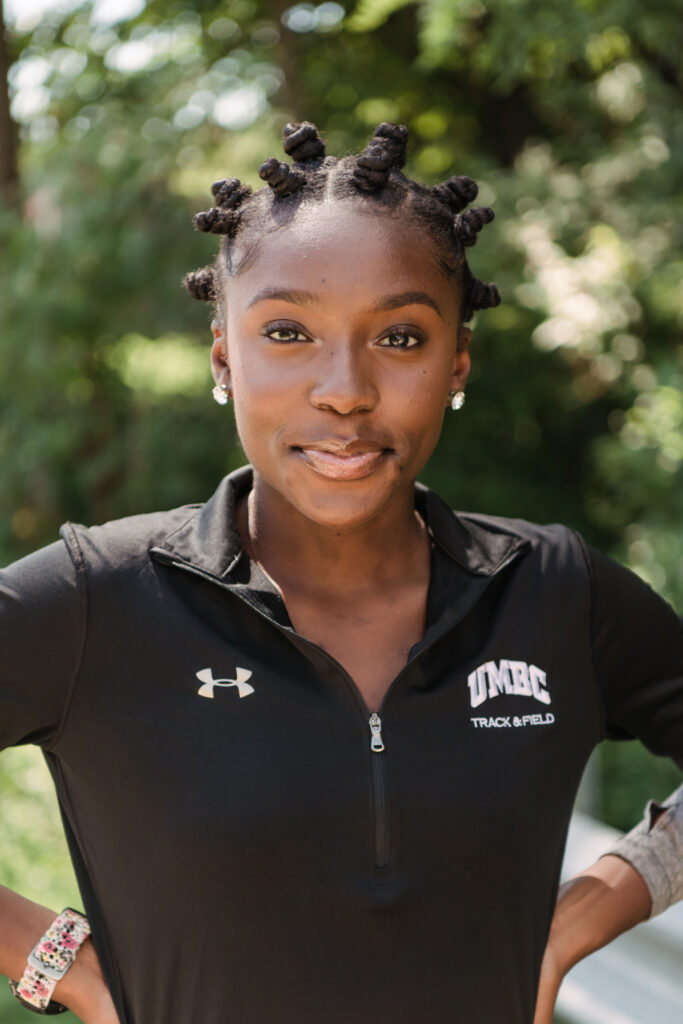
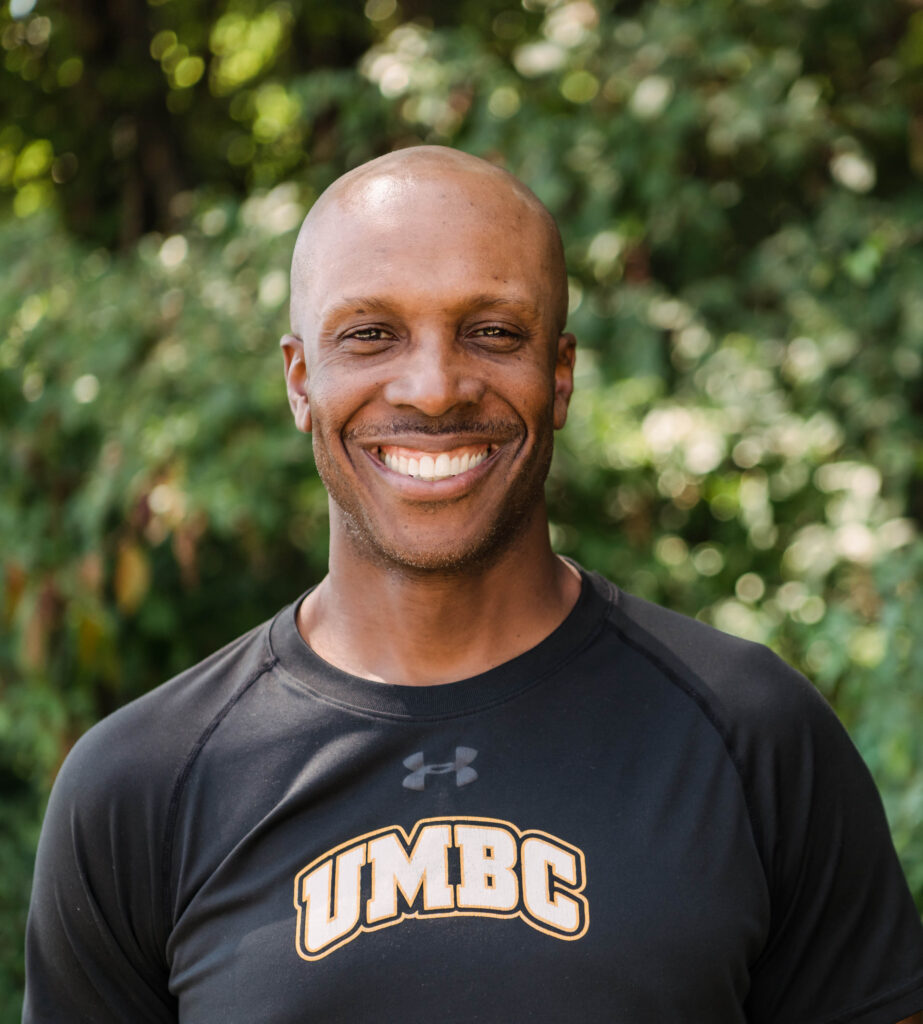
“My mom, she was like, ‘Okay, I saw that coming.’ I’m pretty sure my dad did, too. It’s in my genes. I didn’t have a choice,” Caitlyn says.
Caitlyn wowed the competition in her rookie season, earning several “most outstanding” titles at the America East Championships and placing 17th in the 400-meter dash at the NCAA Championships with a school record-breaking time of 51.84 seconds. And as she continues to learn from her dad and other coaches—like paying attention to the way she pumps her arms, for instance—she’s on course to make improvements each season.
“We’re doing what we’ve been doing for years—the only difference is we’re now doing it at UMBC,” says Coach Bobb. “Hearing my experiences and her mom’s experiences helps her prepare for situations she’s going to encounter herself.”
Although bubbly off the track, Caitlyn is extremely serious in her training—pushing thoughts out of her head in order to focus on breathing above all else. She often runs and studies with her friend Ibra Khairat, a sophomore biological sciences major.
“I would describe Caitlyn and Coach’s relationship as one that’s balanced just right,” he says. “Although she is the coach’s daughter, Coach Bobb gives her room to grow as an athlete and doesn’t give any type of special treatment, which is why it works so well. They are both able to balance that father/daughter and coach/athlete dynamic.”
Coach Bobb is big on building relationships and trust and making sure his runners feel supported, both as athletes and students, he says. As father and daughter gently rib each other, it’s clear the one-upping is grounded in love.
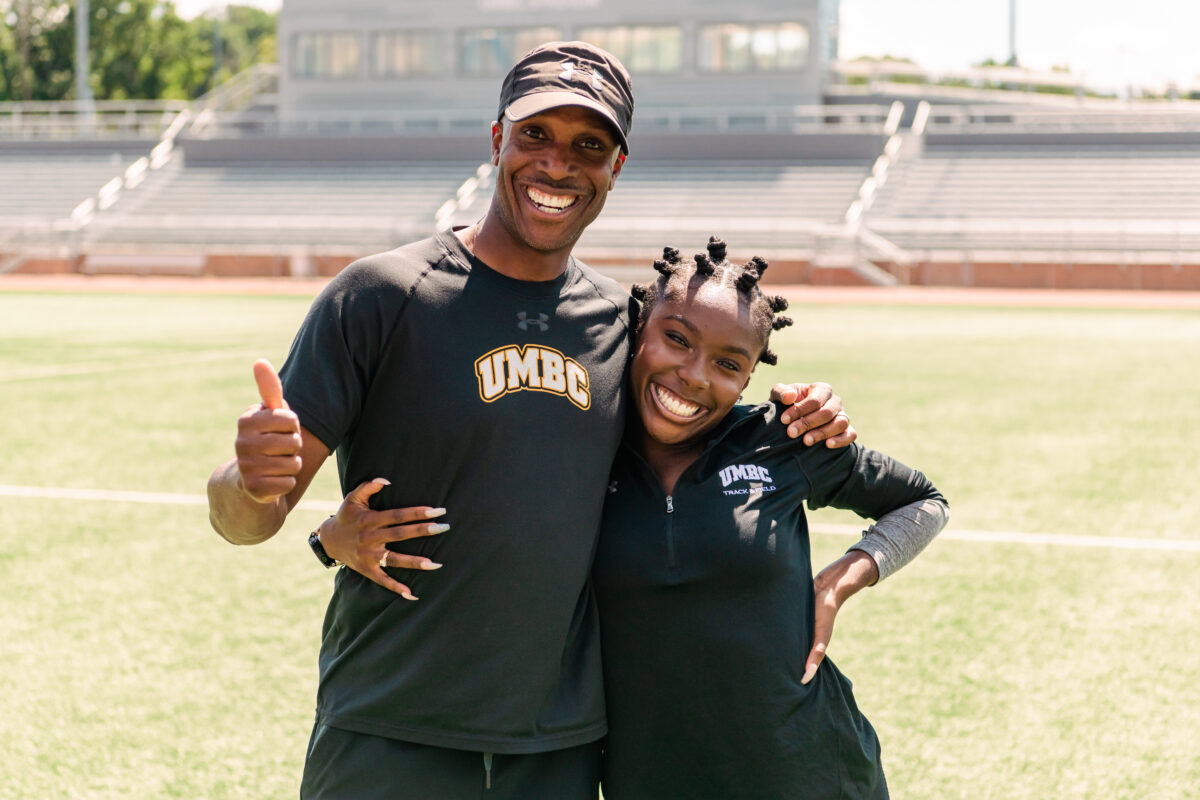 Coach Bobb and his daughter Caitlyn on the track. (Marlayna Demond ’11/UMBC)
“I know what it takes to be successful in this sport, so I just sit back and look at the execution of her race. Is she doing what she’s been trained to do?” Beyond that, he says, it’s about seizing the moment and improving wherever you can. “As a parent, I’m just making sure that I’m supportive. Track and field is only going to be X years of her life. I’m always going to be her dad.”
It’s true: Nobody runs track forever. Caitlyn is studying biological sciences with a minor in entrepreneurship and innovation with hopes of someday being a biology teacher—and possibly a coach herself.
She has a great model right next to her, even if she doesn’t always get his Karate Kid training jokes. (Don’t worry, they can watch it together later.)
“He cares about his students’ well-being, and he makes it a warm, welcoming environment. He cares a lot,” she says, getting serious for a moment. “Good job, Dad.”
]]>
The only things faster than David and Caitlyn Bobb themselves, perhaps, are the zingers they toss at one another. As Caitlyn, a rookie running star now in her sophomore year, describes what...
https://umbc.edu/stories/think-fast-father-daughter-track-duo/
https://my3.my.umbc.edu/api/v0/pixel/news/129600/guest@my.umbc.edu/74a25f9adf6b4ce247cf77b4edef8e90/api/pixel
athletics
biologicalsciences
campus-life
fall-2022
magazine
track-and-field
UMBC News & Magazine
https://my3.my.umbc.edu/groups/umbc-news-magazine
https://assets1-my.umbc.edu/system/shared/avatars/groups/000/001/943/24435aa6207c452e7bc15cc74b42c7bb/xsmall.png?1748556657
https://assets1-my.umbc.edu/system/shared/avatars/groups/000/001/943/24435aa6207c452e7bc15cc74b42c7bb/original.png?1748556657
https://assets2-my.umbc.edu/system/shared/avatars/groups/000/001/943/24435aa6207c452e7bc15cc74b42c7bb/xxlarge.png?1748556657
https://assets2-my.umbc.edu/system/shared/avatars/groups/000/001/943/24435aa6207c452e7bc15cc74b42c7bb/xlarge.png?1748556657
https://assets3-my.umbc.edu/system/shared/avatars/groups/000/001/943/24435aa6207c452e7bc15cc74b42c7bb/large.png?1748556657
https://assets1-my.umbc.edu/system/shared/avatars/groups/000/001/943/24435aa6207c452e7bc15cc74b42c7bb/medium.png?1748556657
https://assets2-my.umbc.edu/system/shared/avatars/groups/000/001/943/24435aa6207c452e7bc15cc74b42c7bb/small.png?1748556657
https://assets1-my.umbc.edu/system/shared/avatars/groups/000/001/943/24435aa6207c452e7bc15cc74b42c7bb/xsmall.png?1748556657
https://assets2-my.umbc.edu/system/shared/avatars/groups/000/001/943/24435aa6207c452e7bc15cc74b42c7bb/xxsmall.png?1748556657
UMBC News & Magazine
1
0
false
Mon, 05 Dec 2022 16:30:20 -0500
Mon, 05 Dec 2022 16:30:20 -0500