UMBC’s exploratory artist in residence Levester Williams examines history of Cockeysville marble in film project

Since 2014, multimedia artist Levester Williams has developed a personal connection and exploration with a natural material that is a historic staple of Baltimore life—Cockeysville, Maryland, marble.
Go down specific streets in neighborhoods like Highlandtown, Charles Village, Cherry Hill, or Mount Vernon and you’ll see the ubiquitous, three-to-four tiered steps made of marble outfitting the exterior of many rowhomes throughout Baltimore, much of it from Cockeysville. Beyond the steps, you’ll also find the stone in landmarks such as Baltimore’s City Hall, the Washington monuments in Baltimore and D.C., and the 108 columns of the U.S. Capitol Building.
“The stone is a literal and figurative bedrock of our nation. It’s used in many prominent monuments and institutions,” explains Williams, who is a 2023 – 2024 artist in residence in UMBC’s Exploratory Research Residency Program, a component of the university’s Center for Art, Design, and Visual Culture (CADVC).
In this pilot artist residency program, Williams is collaborating with the CADVC to complete a new video art project called “dreaming of a beyond: Baltimore,” in which the artist is researching the history of Cockeysville marble, underscoring the “intertwined history of African Americans’ plight to self-determined agency and full citizenship, and a rather benign stone.”
More than just marble
In his work, Williams examines the relationship between objects, humans, and the physical world with art that includes sculptures, installations, sound, animations, drawings, and videos. Williams is continuing that exploration in “dreaming of a beyond: Baltimore,” part of his ongoing series focused on the dolomitic stone that is quarried in Cockeysville, 25 miles from Catonsville. The series explores Williams’ desire to examine his idea of “the beyond—where race is no longer tethered to value; where my body matters just as much as other bodies matter,” he says.
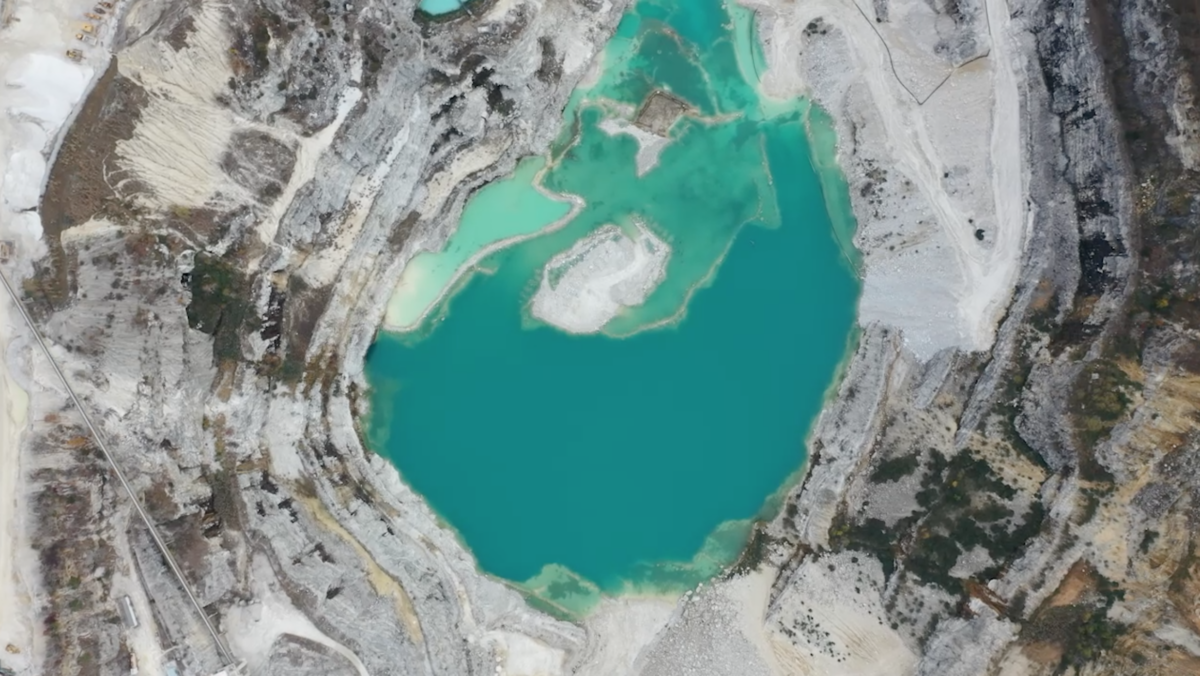 A drone image of the Texas Quarry in Cockeysville, Maryland, one of the locations where Cockeysville marble is mined. (Photo courtesy of Levester Williams)
The artist began his exploration into the stone after reading a passage in Lindon Barrett’s book Blackness and Value: Seeing Double about jazz singer Billie Holiday’s time growing up in Baltimore. The book references Holiday’s autobiography, Lady Sings the Blues, which documents her stint cleaning the marble steps in Baltimore as a teenager.
“White homeowners were obsessed with keeping the white marble stoops clean, and didn’t care how the inside of their homes looked, as long as the steps were clean,” says Williams in reference to the passage about Holiday in Blackness and Value. The steps were seen as a marker of class and economic status, he adds, explaining how “Holiday knew that and was able to bargain to get more money for cleaning the stoops.”
Through archival research, Williams learned more about the stone’s connection to Black people in Baltimore and their bodies as they handled, cleaned, and labored over the marble. As part of his CADVC residency, Williams conducted research at the Maryland Center for History and Culture, using the center’s digital archives of Baltimore’s historic Afro-American newspaper and photographer Paul Henderson’s collection of images he captured for the paper from 1930 through 1960. The archives showcase the long history of Baltimore’s Black residents who cleaned and maintained the marble steps as part of their daily routines.
“Bodies in space”
The “dreaming of a beyond” series consists of short vignettes capturing performers touching and physically engaging with structures, objects, and buildings made with Cockeysville marble at different sites throughout the northeast region. Beyond Maryland, the marble can be found in places such as the Buffalo AKG Art Museum in upstate New York; the Fisher Building in Detroit; Girard College in Philadelphia; and St. Patrick’s Cathedral in New York City.
In Baltimore, Williams filmed performers interacting with the (original) Washington Monument in Mount Vernon Place. Nia Hampton, an intermedia and digital arts (IMDA) graduate student at UMBC, and her mother, Sheila Gaskins, were featured in “dreaming of a beyond: Baltimore,” filmed with the assistance of IMDA student Bao Nguyen. A sneak peek of Williams’ in-development projection demo was on display at the CADVC in February.
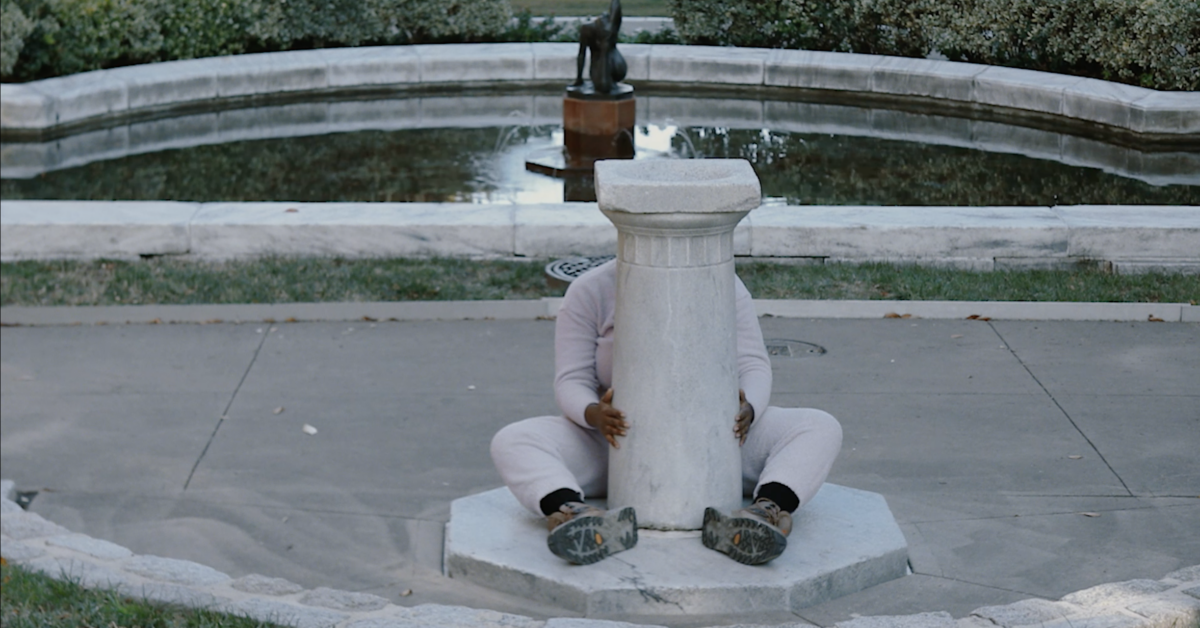 Video still of Nia Hampton in the vignette “Nia’s Embrace” from “dreaming of a beyond: Baltimore,” filmed at Mount Vernon Park Place in November 2023. (Photo by Levester Williams)
The film—which was projected onto the side of a building across from the CADVC’s outdoor amphitheater space—captures the mother-daughter duo physically engaging with the monument with movements that included hugging, caressing, scaling, and sprawling various body parts across the marble-encased statue. Williams worked with artist and intimacy coordinator Savannah Knoop to “reconfigure and think about bodies in space, non-human bodies, and what it is to give consent to these things,” he says.
“What I appreciate about Levester’s work is its level of obscurity,” says Hampton. “When I saw his work, I thought it was different—I never saw anything like it before.”
When she learned that the artist wanted the film’s subjects to be local residents with a deep connection to Baltimore’s history, Hampton referred Williams to her mother. Gaskins, a multi-disciplined artist who has been a local arts advocate and educator for more than four decades, wrote and directed “Last House Standing: A Play About the Highway to Nowhere”in 2016. The play included performers playing the role of the marbled stoop steps.
“When I was interacting with the marble [in the work with Williams], it wasn’t a pretty thing. I was thinking about my ancestors. Nia and I were having conversations about the slaves that probably built the monument. All of that was in our minds when we were interacting with the marble,” says Gaskins.
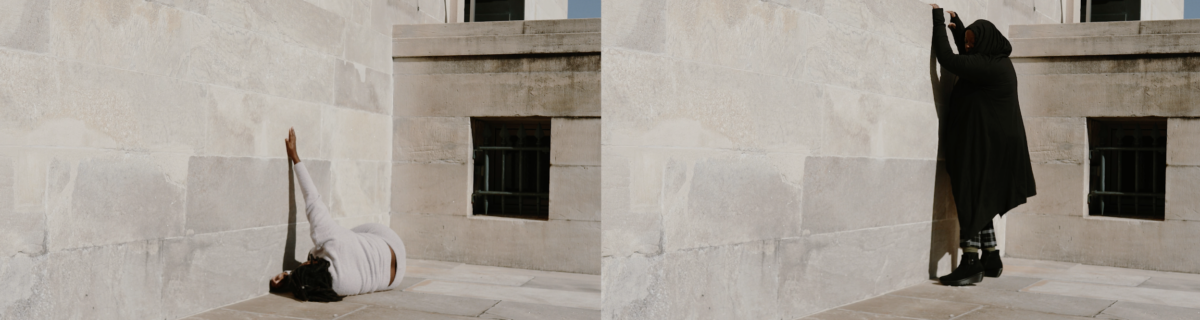 Nia Hampton (left) and Sheila Gaskins in “standing ground (On Washington)” from “dreaming of a beyond: Baltimore,” filmed at the base of the Washington Monument in Baltimore. (Photo by Levester Williams)
“Black folks touching the stone have been an anchor in this master-slave dynamic. I reimagined this relationship between the Black body and the stone, which is not in service of this power dynamic,” says Williams. “I’m using this stone as a way to reimagine Black folks in public spaces.”
Artistic practice as research
This fall, the CADVC gallery is set to premiere a selection of Williams’ artwork that emerges from his “dreaming of a beyond: Baltimore” research as part of the introduction to the center’s public video projection gallery series, which will be on display in the Fine Arts Building Amphitheater. The series is anticipated to rotate new video artwork presentations and will run for the next several years, says Rebecca Uchill, director of the CADVC.
The fall projection presentation will also coincide with the “all matters aside” exhibition at the CADVC that will feature a retrospective of Williams’ work from the last 10 years, organized by curator Lisa Freiman. Williams’ work was previously featured in “Declaration,” the inaugural exhibition at the Institute for Contemporary Art at Virginia Commonwealth University that Freiman curated as the institute’s inaugural director.
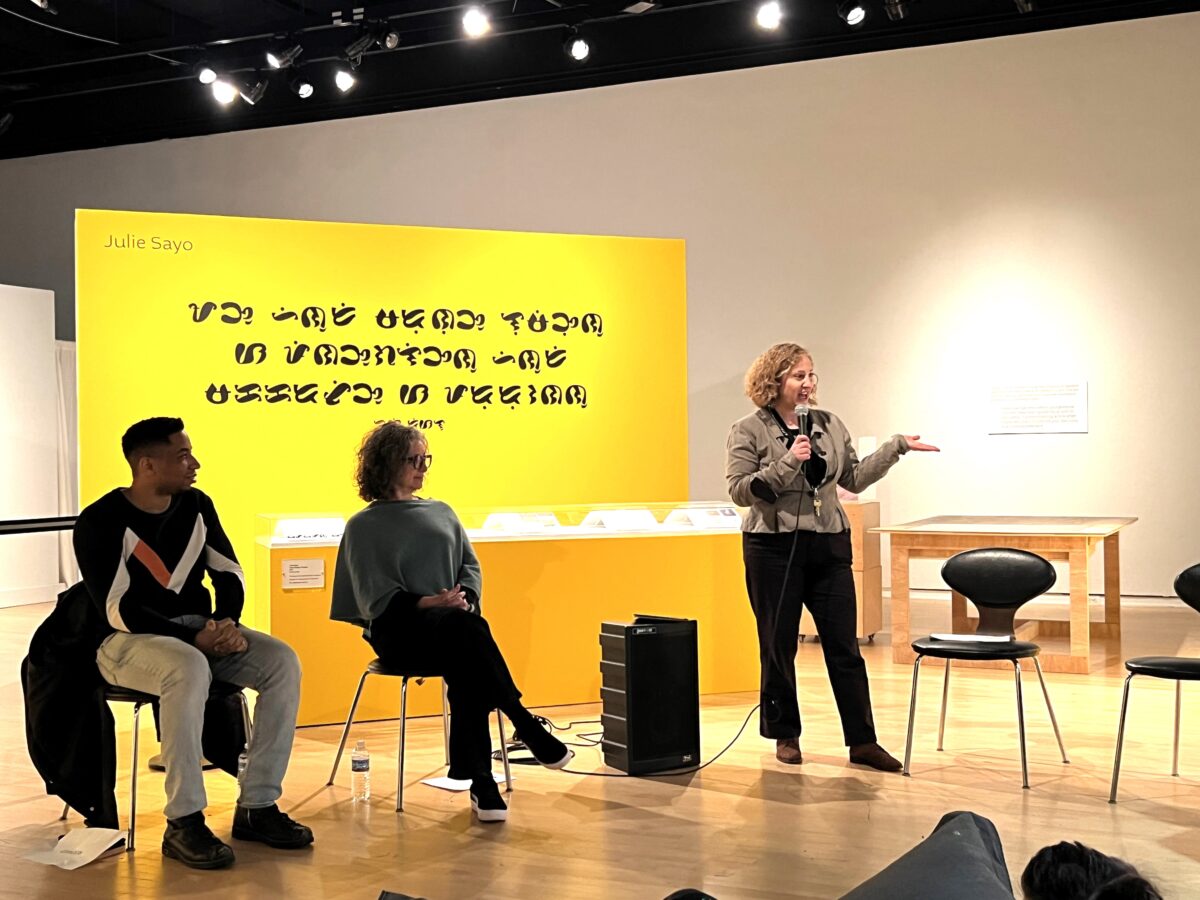 Levester Williams, Lisa Freiman, and Rebecca Uchill at the sneak peak projection demo of “dreaming of a beyond: Baltimore” in February 2024 at the CADVC. (Photo by Tedd Henn, courtesy of the CADVC)
Wiliams’ projection work will also feature an accompanying booklet that includes an essay by Michelle Wright, professor of history and Africana studies at the Community College of Baltimore County. Wright’s essay, “Scrubbed Clean,” examines the complex history of Beaver Dam marble, its use in Baltimore’s Washington Monument, and its connections to the city’s history of racial division.
Along with Williams, the CADVC Exploratory Research Residency Program also hosted artists Tomashi Jackson and Paul Rucker. Portions of the program have been funded by the Maryland State Arts Council, the Baltimore County Commission on Arts and Culture, and UMBC’s College of Arts, Humanities, and Social Sciences’ Big Ideas initiative. The pilot program, which launched in 2022, “recognizes the inherent research that is artistic practice,” Uchill explains.
“Artists are researchers, technicians, and producers. I think some of that occasionally may be underemphasized in certain contexts, but fortunately not at UMBC. CADVC’s residency program aligns with the rigor, creativity, and civic engagement of the university at large, and feeds into other areas of our center’s programs in exhibition, publication, and creative production,” says Uchill. “This has been an especially enriching opportunity because of UMBC’s laudable, sincere belief in the importance of the arts as research.”
For Williams, the exploratory residency program is helping him to expand his interpretation of being Black and existing in public spaces: “There’s no hierarchy of us existing in space and doing that through touch is what my project is focused on. Having these performers touch the stone in any way that they want is [my idea of] pushing back and getting to that ‘beyond’.”
]]>
Since 2014, multimedia artist Levester Williams has developed a personal connection and exploration with a natural material that is a historic staple of Baltimore life—Cockeysville, Maryland,...
https://umbc.edu/stories/exploratory-artist-levester-williams-marble/
https://my3.my.umbc.edu/api/v0/pixel/news/142784/guest@my.umbc.edu/6451d2c213b5ef5e11ff25ba1ef6b2c4/api/pixel
arts-and-culture
cadvc
cahss
community
feature
imda
news
rca-2
research
story
visualarts
UMBC News & Magazine
https://my3.my.umbc.edu/groups/umbc-news-magazine
https://assets1-my.umbc.edu/system/shared/avatars/groups/000/001/943/24435aa6207c452e7bc15cc74b42c7bb/xsmall.png?1748556657
https://assets1-my.umbc.edu/system/shared/avatars/groups/000/001/943/24435aa6207c452e7bc15cc74b42c7bb/original.png?1748556657
https://assets2-my.umbc.edu/system/shared/avatars/groups/000/001/943/24435aa6207c452e7bc15cc74b42c7bb/xxlarge.png?1748556657
https://assets2-my.umbc.edu/system/shared/avatars/groups/000/001/943/24435aa6207c452e7bc15cc74b42c7bb/xlarge.png?1748556657
https://assets3-my.umbc.edu/system/shared/avatars/groups/000/001/943/24435aa6207c452e7bc15cc74b42c7bb/large.png?1748556657
https://assets1-my.umbc.edu/system/shared/avatars/groups/000/001/943/24435aa6207c452e7bc15cc74b42c7bb/medium.png?1748556657
https://assets2-my.umbc.edu/system/shared/avatars/groups/000/001/943/24435aa6207c452e7bc15cc74b42c7bb/small.png?1748556657
https://assets1-my.umbc.edu/system/shared/avatars/groups/000/001/943/24435aa6207c452e7bc15cc74b42c7bb/xsmall.png?1748556657
https://assets2-my.umbc.edu/system/shared/avatars/groups/000/001/943/24435aa6207c452e7bc15cc74b42c7bb/xxsmall.png?1748556657
UMBC News & Magazine
0
0
false
Mon, 15 Jul 2024 14:48:42 -0400
Mon, 15 Jul 2024 14:48:42 -0400
Open to Interpretation
What if you could ask yourself a big question and then use your intuition to follow it wherever it led for as long as it took? It would take a certain kind of guts, right? But, with a willingness to get lost on a tangent, to joyfully put themselves in positions of not knowing, truly creative thinkers can find new ways of translating the world around them.
Enter the following: A dancer who makes beautiful movement from fish research. An information systems professor who turns poetry into wine. A data visualizer who draws connections while splattering paint. A mapper and sculptor of hip hop facts. A harnesser of color and language and culture.
This is the sort of magic that can happen when you’re open to interpretation.

On a molecular level, the push and pull of an ecosystem may feel too infinitesimal for humans to experience visually. A researcher can track the data in a spreadsheet as a series of characters and marks or explain it with the structure of a scientific article. Microscopes may capture stills or video of tiny worlds, but what about the emotional landscape of life in motion?
“I really am fascinated with the small things we cannot see that are so important,” says Ann Sofie Clemmensen, assistant professor of dance, who spent a year in residence at the Institute of Marine & Environmental Technology (IMET) next to Baltimore’s Inner Harbor working with scientists who study a variety of topics adjacent to aquaculture, environment, and sustainability.
Clemmensen began her residency by diving deeply into the research of the IMET scientists around her—learning about everything from rainbow trout viruses to the ecological wear and tear of red tides. As she built relationships with researchers, she found herself drawn into the details of their studies—and wondering how she might translate what she learned into something that might encourage viewers to learn more about their world.
“There’s a sort of unpacking of the language of that field. Because movement, while it’s not a spoken language, it is language,” she explains, ever the eager translator. “We have to understand the concept we are trying to embody in order for the physical embodiment to carry the meaning.”
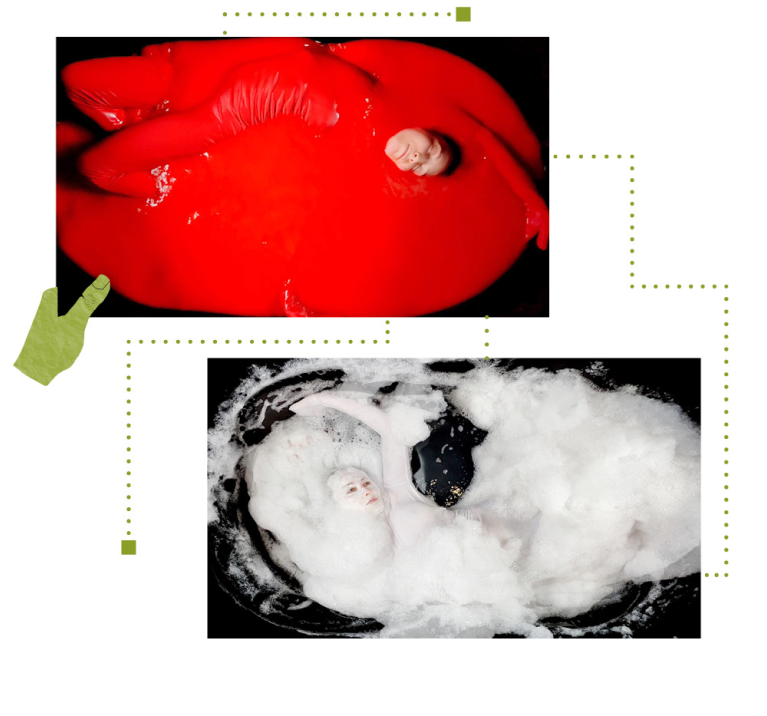
Working with student dancers, Clemmensen choreographed and filmed a series of movements and scenes meant to depict biological processes she learned about from her IMET counterparts. In one, students in masks represent the generic differences of virulent and avirulent strains of the VHSV rainbow trout virus. In another, dancer Michaela Emmerich ’24 (covered in clay powder) rolls in the dirt to show the effect of argonite in reducing levels of phosphorus in farming run-off.
While Clemmensen’s scenes of red tides, green biomass, and white, milky foams are objectively beautiful, don’t be fooled. Nature isn’t pretty, Clemmensen says. But taking a good close look can help us all understand our environment a bit better.
“For many doing art, dance, and data-driven research, it’s like looking at an abstract painting. If you don’t have a little key that can unveil or reveal some of those secrets, then it’s just chaos.”
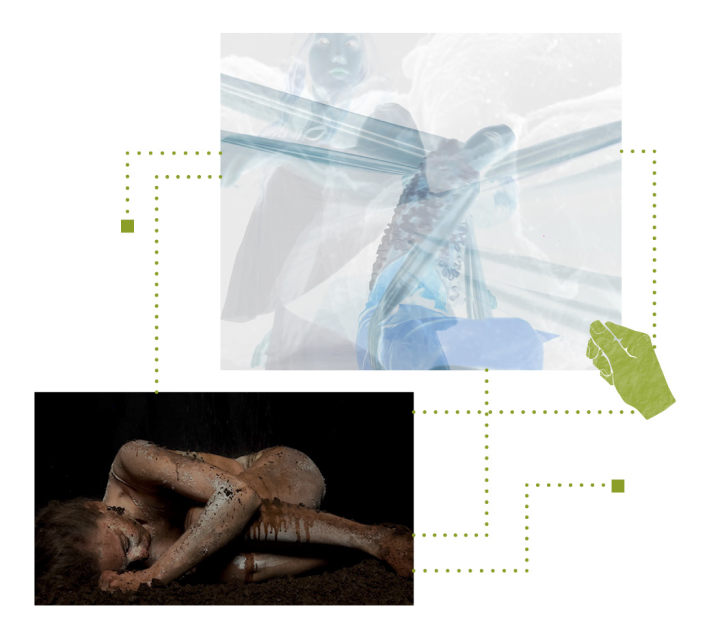
Assistant professor Ann Sofie Clemmensen worked with
researchers at IMET to create a series of videos depicting
microscopic processes like red tides and battling
dinoflaggelates. Photos courtesy of Clemmensen.

A poem crosses time and space, building in meaning as it travels from person to person, from generation to generation. With each new reader, it becomes something new and specific—but also potentially loses something of itself along the way.
As a trained computer scientist, Foad Hamidi, assistant professor of information systems, is fascinated by the practical challenge of being able to retrieve information lost when data is duplicated—an inevitable fact of digital life. As a lifelong lover of Sufi poetry from his home country of Iran, he also can’t help but wonder how to preserve the heart of these precious words, even as circumstances—generations, distance, cultural leanings—might dilute or change them.
“There’s always some information loss” in data duplication, he explains. “However, a very interesting theorem in information theory also says that if you have a lot of replicas of the same code…you can recover the original message in the presence of errors that was in all these codes.”
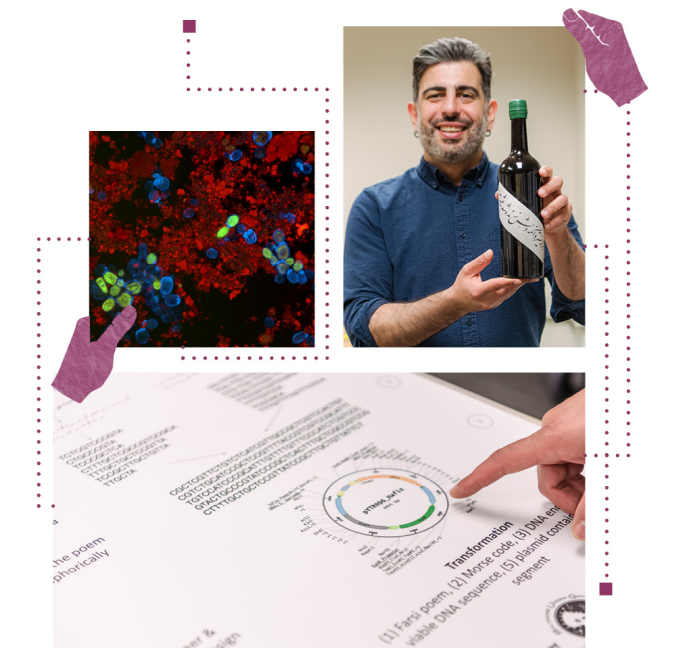
Information systems Professor Foad Hamidi has
translated a favorite childhood poem into DNA code,
wine, and more. Top image (magnified photo of yeast
cells with the modified DNA Hamidi made)
courtesy of Tagide deCarvalho.
Years ago, Hamidi learned about a song that was encoded by Japanese musician Etsuko Yakushimaru using living bacteria as a sort of language, “and it really made me think of the possibilities of information and culture and data and encoding.” And so, at the start of the pandemic, he began exploring ways of translating the poetry of Hafiz, a 14th-century Persian poet, into new, living forms and of sharing the experience with others.
Hamidi’s bio-art-inspired creative inquiry led him first to interpret the poetry as code—DNA, to be precise—culled from the words themselves. He then created a “poetry-infused transgenic wine” using yeast modified with the DNA encoding of the poem. Craving community, he took the idea to other researchers in music, biology, imaging, and beyond to joyfully build further iterations of the chain. These efforts led to an Imaging Research Center (IRC) Faculty Research Fellowship (with Linda Dusman, professor of music), and today, he continues to explore new translations of the coded poem through music, cellular imagery, and even a cluster of mushrooms growing in Hamidi’s office.
With each new link in Hamidi’s poetic chain, the information is replicated and the “data” is one step closer to being saved through this fascinating theorem. In doing so, Hamidi also is able to bring together curious new friends who might not have had reason to collaborate otherwise.
Although Hamidi’s “translations” may seem outside the box, the practice of making a poem one’s own “has a long history,” he explains. “These poems are the DNA of my culture…so our architecture, our music, our visual arts, our cultural traditions, are very much impacted by poetry.”

In a far corner hangs an enormous painting of a brain, with bright blue lines, red arrows, and clips of phrases suggesting ideas in motion. In every direction above it, threads of red and blue crisscross the room anchoring one artwork to the next—a system of knit synapses representing not only 25 years of research but the artistic process that fuels it.
“What I try to do, above and beyond anything else, is show as transparently as possible what that process looks like,” says Lee Boot, director of UMBC’s Imaging Research Center (IRC), whose retrospective exhibit “Abstracts & Artifacts” showed at Baltimore’s Peale Museum earlier this spring.
For Boot, that means a room filled with numbers, images—some animated, many bursting with color—and the connective tissue of the personal paintings he created to process information and experiences related to the various subjects of his research.
“The work is immersive. I paint my brain out as a meditative, reflective process. And then that gets honed, and reshaped, and…out of that automatically comes new perspectives and new ways of framing problems.”
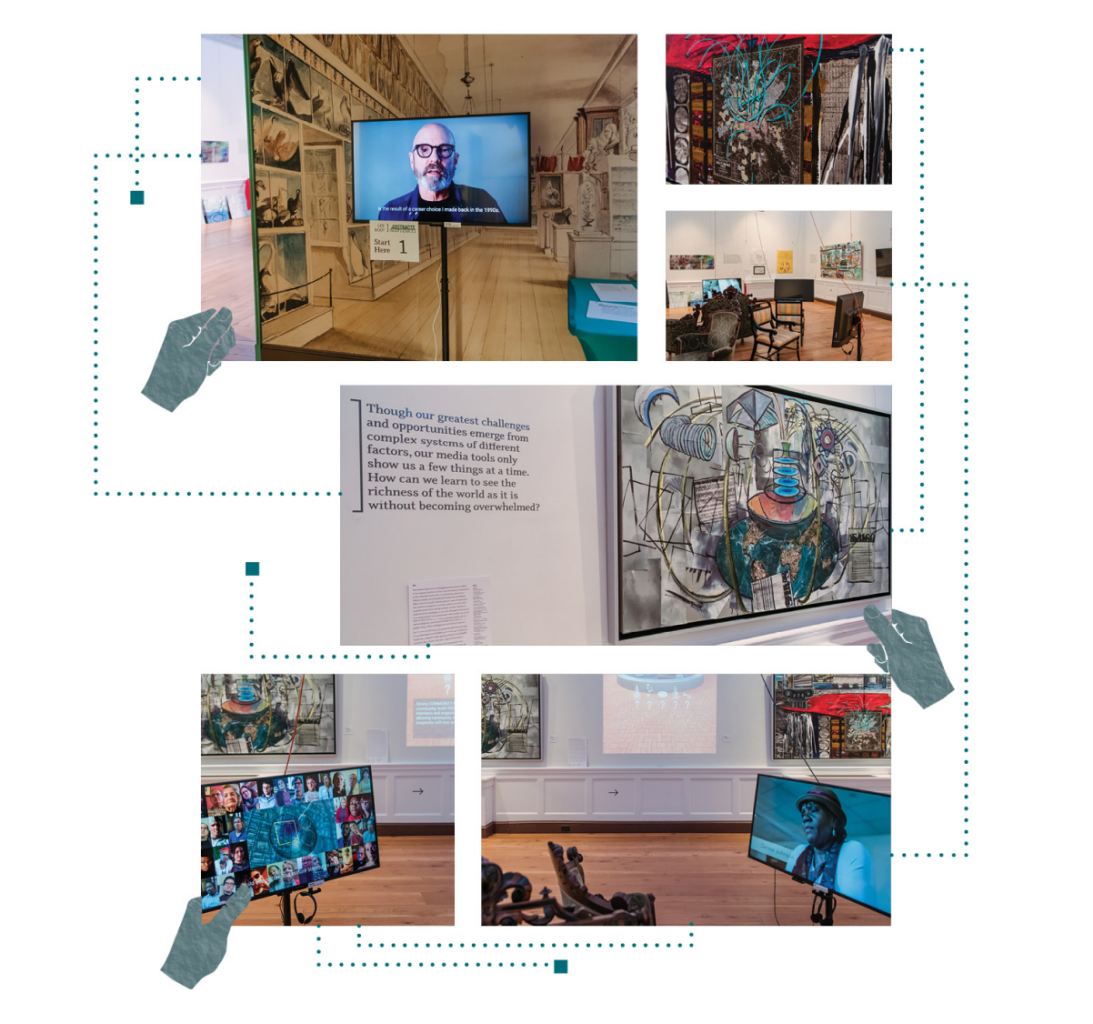 In his exhibit “Abstracts & Artifacts,” Lee Boot asks
viewers to consider new ways of solving problems.
“Almost like dreaming, making art with a question
in mind reveals meaning through metaphor. How
is it that metaphors seem to be both specific and
ambiguous—both personal and universal—at once?”
In his exhibit “Abstracts & Artifacts,” Lee Boot asks
viewers to consider new ways of solving problems.
“Almost like dreaming, making art with a question
in mind reveals meaning through metaphor. How
is it that metaphors seem to be both specific and
ambiguous—both personal and universal—at once?”
Boot lives to solve problems, and believes deeply in the power of combining artists’ ways of thinking with other disciplines to ask questions and find solutions in new ways. Over the years, the IRC has brought together multidisciplinary teams of artists, scientists, and social scientists from state and local agencies, foundations, and other organizations who are open to tackling everything from substance misuse to educational achievement gaps to the epidemiology of pandemics.
And while technology runs much of what the IRC builds, nothing is quite so essential to the heart of the work as one’s own intuition, says Boot. As a classically-trained painter, that means returning to the canvas and allowing his brush to take him in new directions—not to create something beautiful, per se, but to open himself to ideas accessible only through such a personal process.
With each stroke of the brush, and each new color, he pulls from the deepest reaches of experience, community, and understanding, creating a road map for what’s next.
“I’m not trying to make something pretty,” he says. “I am trying to understand how a set of issues sits in being, in my psyche, on the landscape of the world as I understand it. I’m trying to see what I cannot see.”

On the table sit three football-sized forms of light plastic. Each has been sculpted in a 3D printer using zigzag motions specifically programmed to mimic the map lit up behind them showing an orange globe splashed with green arcs. Dots on the screen represent locations mentioned in thousands of hip-hop and rap lyrics, as big as the oft-mentioned city of Atlanta and as hyperlocal as the intersection in front of a neighborhood convenience store.
A student gingerly picks up a gold-colored sculpture, and asks, “Is this Kendrick Lamar?” Tahir Hemphill, a faculty fellow, music aficionado, and self-described “creative technologist who works with art,” nods as a collective “oooh” makes its way around the room.
“It’s data sculpture, literally. It’s making things as real as possible,” says Hemphill, whose ever-evolving body of work, The Rap Research Lab, made its home at UMBC’s Center for Art, Design, and Visual Culture this spring. “This is what it feels like to touch a rapper’s rhymes.”
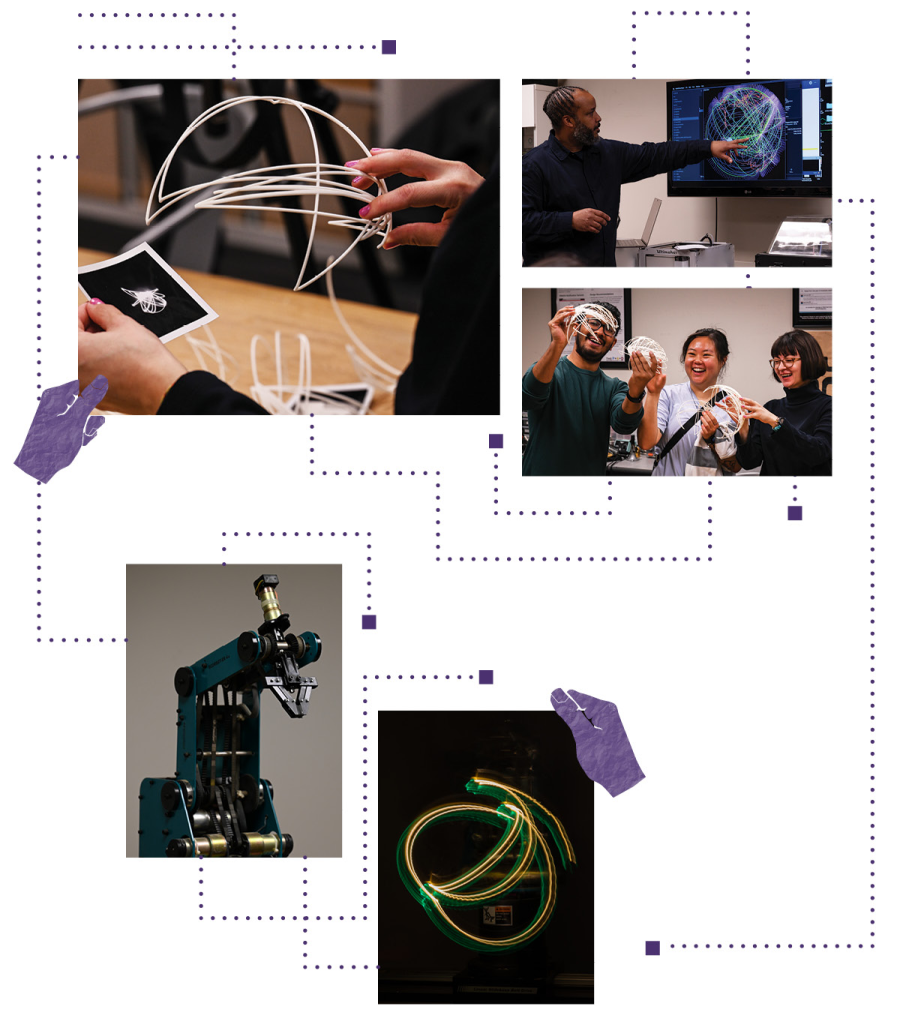
Located at the intersection of hip-hop and data visualization, and built as an interactive teaching space, the lab features the “Mapper’s Delight” tool that, using augmented and virtual reality, cross-references locations from thousands of rap song lyrics along with a variety of other art pieces that speak to Hemphill’s goal of finding “relationships and shapes in the data.”
Over the course of the semester, UMBC students helped Hemphill delve further into the data while middle schoolers from around the state visited the teaching lab with their classes to try their own hands at research using Hemphill’s lyrics database.
On this particular day, Hemphill demonstrates yet another incorporation of the geographic lyric data. In collaboration, Foad Hamidi helped Hemphill program a robotic arm, and by inserting a LED pen into the robot hand and filming movements at a long exposure, he’s able to make “light pen drawings” of the data, à la Pablo Picasso.
With the lights dimmed and the robot arm making ethereal data shapes before their eyes, Hemphill tinkers with his projected spreadsheet in real time. There are just so many threads to follow and infinite stories hidden within.
“My job is to draw them out—pun intended,” he laughs.
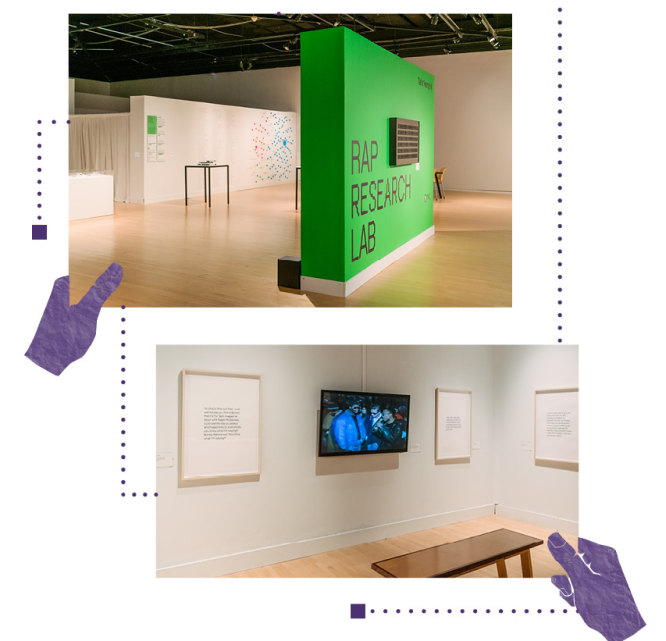
Tahir Hemphill, a faculty fellow, music aficionado, and
self-described “creative technologist who works with
art,” uses data visualization tools to reveal new levels
within hip-hop.
Read how artist Hadieh Shafie, M.F.A. ’04, channels the power of language and her childhood experiences in Iran into intricate and colorful pieces of art.
]]>
What if you could ask yourself a big question and then use your intuition to follow it wherever it led for as long as it took? It would take a certain kind of guts, right? But, with a willingness...
https://umbc.edu/stories/researchers-artists-open-to-interpretation/
https://my3.my.umbc.edu/api/v0/pixel/news/133965/guest@my.umbc.edu/7d78d7c39a954622fea6ad99411873aa/api/pixel
cadvc
dance
discovery
information-systems
irc
magazine
research
spring-2023
UMBC News & Magazine
https://my3.my.umbc.edu/groups/umbc-news-magazine
https://assets1-my.umbc.edu/system/shared/avatars/groups/000/001/943/24435aa6207c452e7bc15cc74b42c7bb/xsmall.png?1748556657
https://assets1-my.umbc.edu/system/shared/avatars/groups/000/001/943/24435aa6207c452e7bc15cc74b42c7bb/original.png?1748556657
https://assets2-my.umbc.edu/system/shared/avatars/groups/000/001/943/24435aa6207c452e7bc15cc74b42c7bb/xxlarge.png?1748556657
https://assets2-my.umbc.edu/system/shared/avatars/groups/000/001/943/24435aa6207c452e7bc15cc74b42c7bb/xlarge.png?1748556657
https://assets3-my.umbc.edu/system/shared/avatars/groups/000/001/943/24435aa6207c452e7bc15cc74b42c7bb/large.png?1748556657
https://assets1-my.umbc.edu/system/shared/avatars/groups/000/001/943/24435aa6207c452e7bc15cc74b42c7bb/medium.png?1748556657
https://assets2-my.umbc.edu/system/shared/avatars/groups/000/001/943/24435aa6207c452e7bc15cc74b42c7bb/small.png?1748556657
https://assets1-my.umbc.edu/system/shared/avatars/groups/000/001/943/24435aa6207c452e7bc15cc74b42c7bb/xsmall.png?1748556657
https://assets2-my.umbc.edu/system/shared/avatars/groups/000/001/943/24435aa6207c452e7bc15cc74b42c7bb/xxsmall.png?1748556657
UMBC News & Magazine
1
0
false
Thu, 08 Jun 2023 19:21:59 -0400
Thu, 08 Jun 2023 19:21:59 -0400
UMBC’s galleries deliver interactive and thoughtful art
UMBC’s art galleries are already in full bloom for the spring. With exhibits showcasing historic and innovative 20th century photography, interactive hip-hop data visualization, and the legacies of political resistance as seen through Black hair, the university’s exhibition spaces are bountiful with thought-provoking work.
Hip-Hop and Data at CADVC
Tahir Hemphill: Rap Research Lab runs at the Center for Art, Design, and Visual Culture (CADVC) through March 18. In this exhibition, Tahir Hemphill, the inaugural Fellow for Faculty Diversity in the Visual Arts at UMBC, presents a collection of interactive works that explore what he calls “the hybrid area between art, technology, social engagement, and interdisciplinary research.”
Visitors are invited to participate in Hemphill’s design and research process through evolving artworks, including “Visualisation of Authority,” a kinetic sculpture drawing on Library of Congress research data, and “Mapper’s Delight,” an interactive augmented reality-based middle-school curriculum Hemphill designed in collaboration with Verizon Innovative Learning.
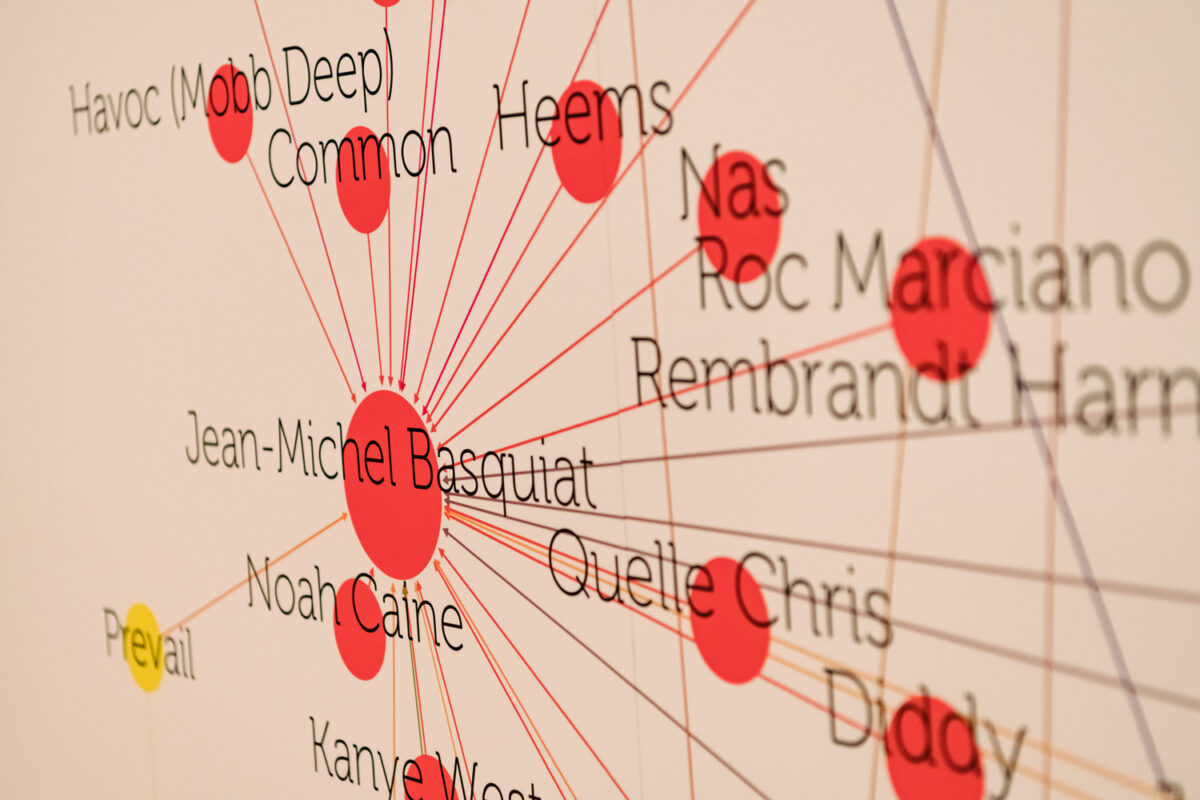 Data visualization from Hemphill’s Rap Research Lab at the CADVC. (Marlayna Demond ’11/UMBC)
Hemphill is using the exhibition space for teaching as well. In a course offered in collaboration between Visual Arts and the UMBC Image Research Center (IRC) students have the opportunity to mine the “Rap Almanac,” Hemphill’s expansive dataset of rap lyrics, to produce work in an internship-based research practicum.
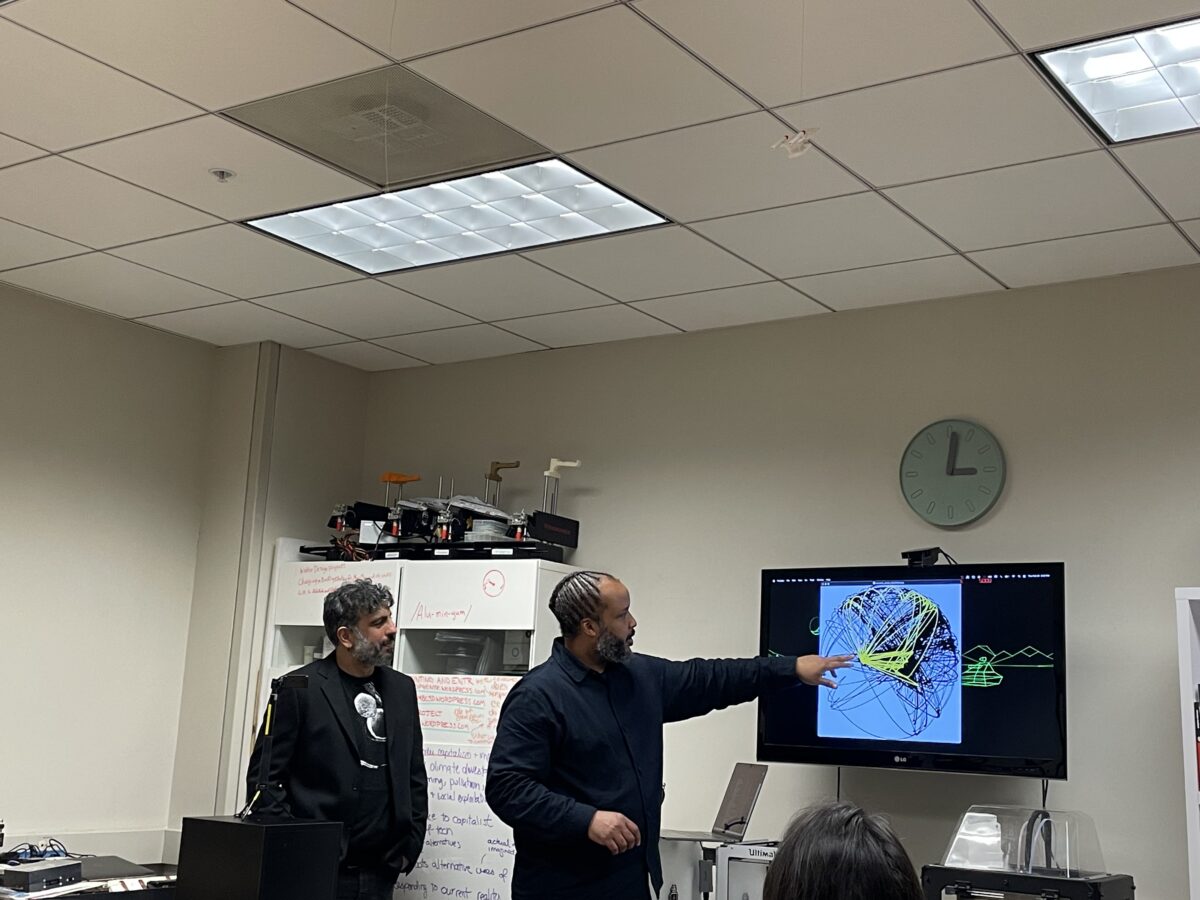 Hamidi, left, and Hemphill, right, talk through data visualization. (Marlayna Demond ’11/UMBC)
“CADVC operates as an art gallery and research center dedicated to scholarship and experimentation in art and culture,” says CADVC Director Rebecca Uchill. “This exhibition demonstrates a terrific range of scholarly inquiries, by Hemphill and his collaborators, into many facets of cultural history and the power of creative data visualization strategies. It is very exciting to watch this research develop in a public-facing presentation!”
Additional programming for the exhibition will include a series of public events such as a choreographed activation of a programmable robot arm, a partnership project with assistant professor Foad Hamidi from the Human-Centered Computing program in Information Systems, and a series of pop-up events.
Historic Hair and Formative Photography at AOK
The Albin O. Kuhn Library Gallery currently features two shows—Aaron Siskind: Formations and Sonya Clark: Hair/Craft—both on view through March 12.
Multidisciplinary artist Sonya Clark presents five works made with human hair and fiber art techniques to explore Black visibility and identity, and to examine the ways Black hair has been employed as an instrument of political resistance across the African diaspora. Clark, whose work explores issues of identity, race, cultural heritage, and collective memory, engages everyday objects and craft traditions to examine narrative threads connecting modern issues with historical origins, including the Black national anthem “Lift Every Voice and Sing” and the biography of Madam C. J. Walker, who became the first female self-made millionaire by selling hair care products to Black women.
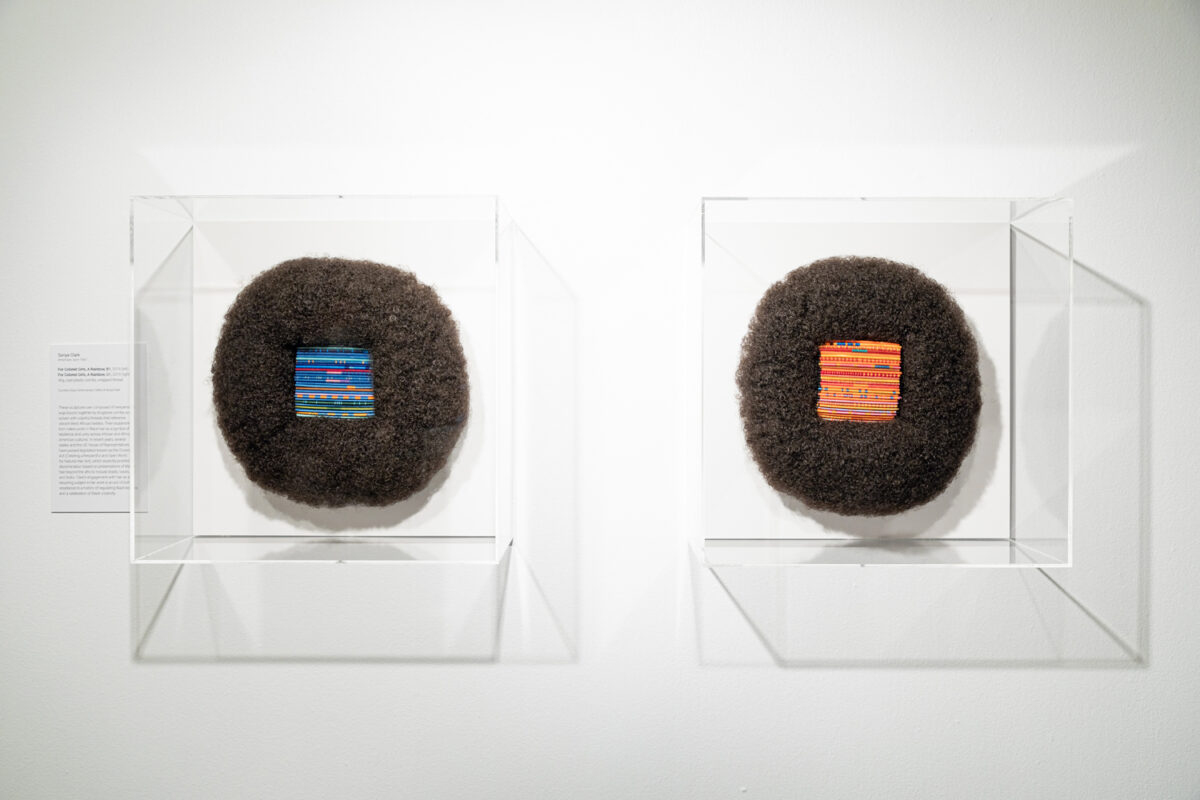 Sonya Clark’s Hair/Craft exhibit at the AOK Library Gallery. (Melissa Penley Cormier, M.F.A. ’17, for Research Graphics)
Influential photographer Aaron Siskind is celebrated through 55 works spanning his prolific career, all part of UMBC’s Photography Collections. Beginning with early documentary works Siskind made as part of the New York Film and Photo League in the 1930s and his groundbreaking abstract works of the 1940s and 1950s, the exhibition continues through phases of architectural studies, travel photography, and Siskind’s famous series focused on divers suspended in mid-air, “Terrors and Pleasures of Levitation.”
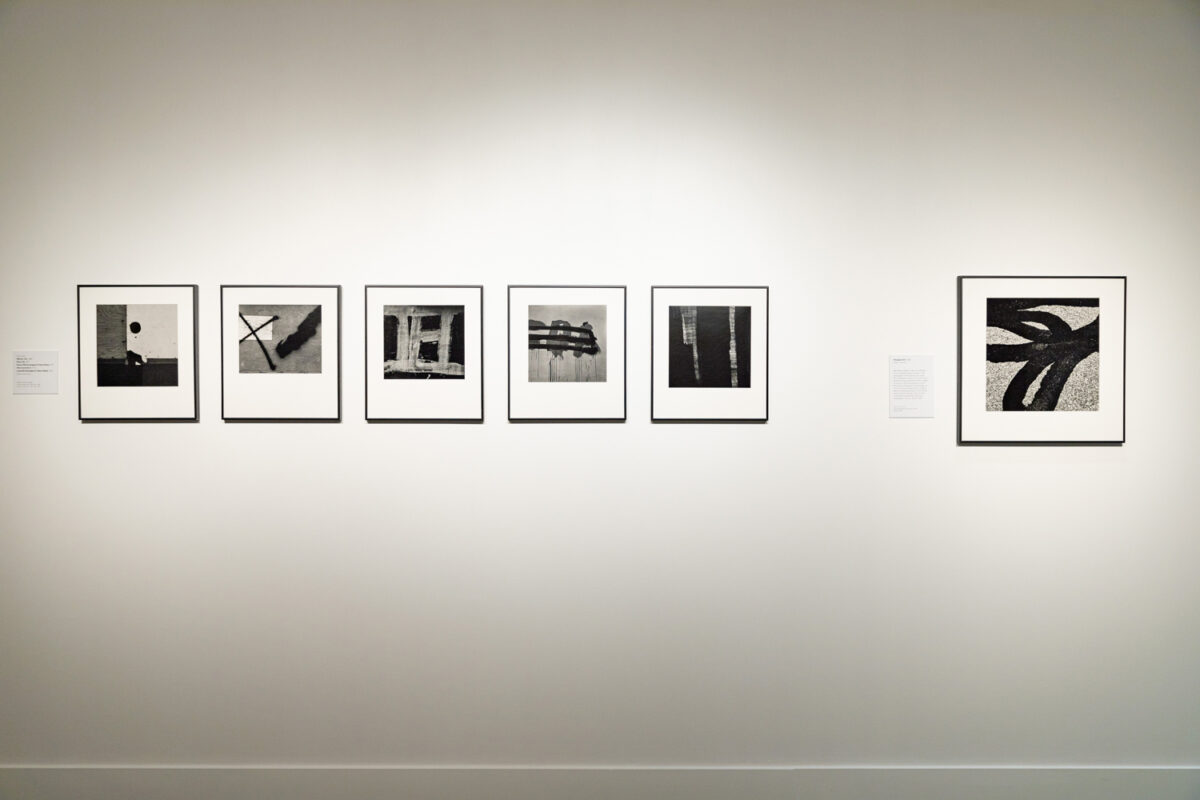 The Aaron Siskind exhibit in the AOK Library Gallery. (Melissa Penley Cormier, M.F.A. ’17, for Research Graphics)
Mind’s Eye in Toronto
With Mind’s Eye: The Psychic Photographs of Ted Serios, UMBC’s Special Collections has gone international. The Image Centre of Toronto Metropolitan University invited UMBC’s Curator of Exhibitions Emily Cullen to curate a show featuring one of AOK’s more fascinating collections, the Jule Eisenbud Collection on Ted Serios and Thoughtographic Photography.
Serios claimed to have the ability to psychically transfer his thoughts onto Polaroid film, a process called “thoughtography.” Chicago psychiatrist Jule Eisenbud investigated these claims, experimenting with Serios for several years in the mid-1960s, and the archive of those results is now part of UMBC’s permanent collection.
Mind’s Eye: The Psychic Photographs of Ted Serios opens at the IMC tomorrow, on view January 25–April 1!
]]>
UMBC’s art galleries are already in full bloom for the spring. With exhibits showcasing historic and innovative 20th century photography, interactive hip-hop data visualization, and the legacies...
https://umbc.edu/stories/umbcs-galleries-deliver-interactive-art/
https://my3.my.umbc.edu/api/v0/pixel/news/131356/guest@my.umbc.edu/5fd578a744572090ba95cb818c844cba/api/pixel
aok-library
arts-and-culture
cadvc
campus-life
is
magazine
media-and-communication-studies
news
special-collections
visual-arts
UMBC News & Magazine
https://my3.my.umbc.edu/groups/umbc-news-magazine
https://assets1-my.umbc.edu/system/shared/avatars/groups/000/001/943/24435aa6207c452e7bc15cc74b42c7bb/xsmall.png?1748556657
https://assets1-my.umbc.edu/system/shared/avatars/groups/000/001/943/24435aa6207c452e7bc15cc74b42c7bb/original.png?1748556657
https://assets2-my.umbc.edu/system/shared/avatars/groups/000/001/943/24435aa6207c452e7bc15cc74b42c7bb/xxlarge.png?1748556657
https://assets2-my.umbc.edu/system/shared/avatars/groups/000/001/943/24435aa6207c452e7bc15cc74b42c7bb/xlarge.png?1748556657
https://assets3-my.umbc.edu/system/shared/avatars/groups/000/001/943/24435aa6207c452e7bc15cc74b42c7bb/large.png?1748556657
https://assets1-my.umbc.edu/system/shared/avatars/groups/000/001/943/24435aa6207c452e7bc15cc74b42c7bb/medium.png?1748556657
https://assets2-my.umbc.edu/system/shared/avatars/groups/000/001/943/24435aa6207c452e7bc15cc74b42c7bb/small.png?1748556657
https://assets1-my.umbc.edu/system/shared/avatars/groups/000/001/943/24435aa6207c452e7bc15cc74b42c7bb/xsmall.png?1748556657
https://assets2-my.umbc.edu/system/shared/avatars/groups/000/001/943/24435aa6207c452e7bc15cc74b42c7bb/xxsmall.png?1748556657
UMBC News & Magazine
1
0
false
Wed, 01 Mar 2023 14:37:02 -0500
Wed, 01 Mar 2023 14:37:02 -0500
Meet a Retriever—Sandra Abbott, curator of art and outreach at CADVC
Meet Sandra Abbott, who has been working in UMBC’s art world for 14 years. Whether it’s through setting up world-class exhibitions or coordinating educational programs, Sandra combines her work as curator of collections and outreach at the Center for Art, Design, and Visual Culture (CADVC) and affiliate faculty in the visual arts department. Sandra thrives in her role of introducing Retrievers and community members to great art.
Q: What part of your job do you enjoy the most and why?
A: I love working with students who are exploring my profession. They keep me on my toes and ask the best questions.
Q: Who is someone in the community who has supported you, and how did they do it?
A: When I needed to research local 3D printers for a special K-12 art project, I reached out to alum Maks Prykhodko, M.F.A. ’21, IMDA. Maks returned my email within 24 hours and offered help, including a personal introduction to those I needed to connect with at the best vendor.
This is only one example of many alumni I’ve reconnected with professionally after UMBC. This community supports you at UMBC and beyond. It’s the best network!
Q: Tell us about what you love about where you work.
A: What I love about the CADVC gallery is the amazing, world-class artwork I pass by every time I come and go from my office.
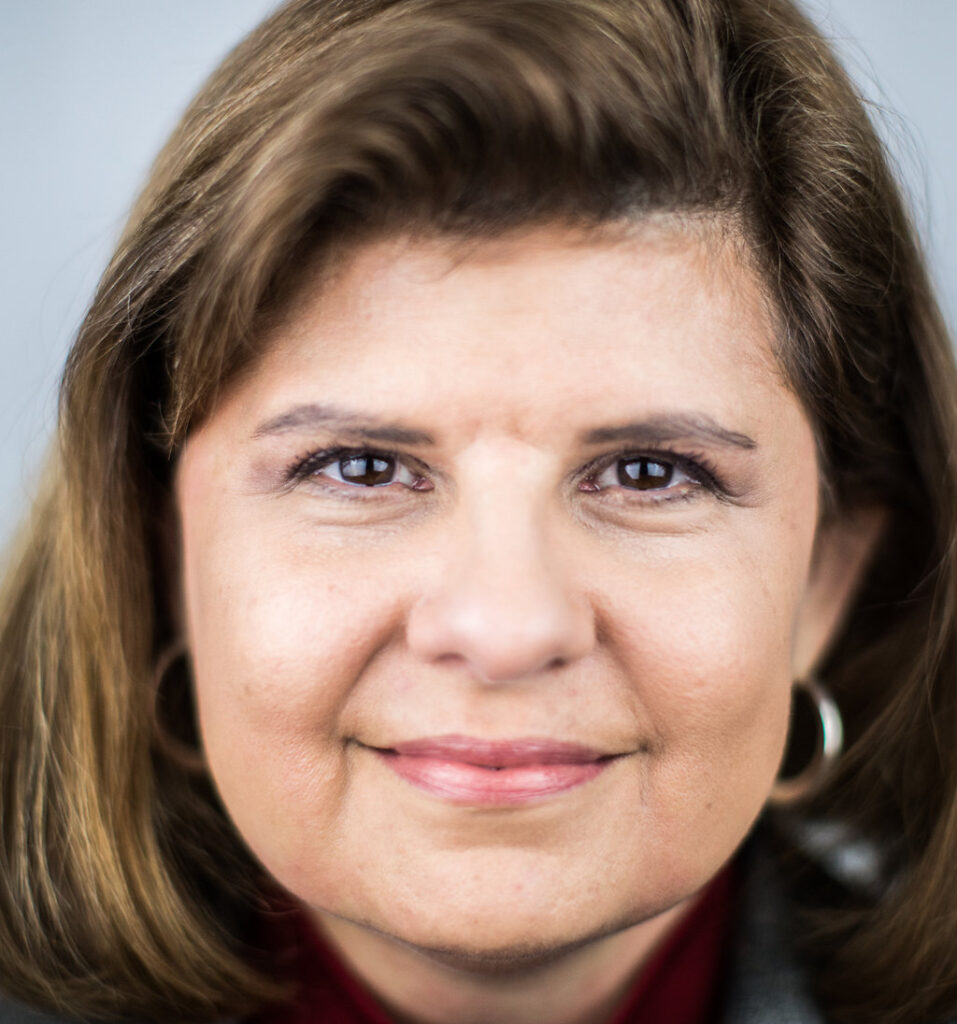
Headshot courtesy of Abbott.
Q: What brought you to UMBC in the first place?
A: I was drawn to UMBC as a place known for its academic rigor and scholarship. I wanted to develop my career amongst those who took their work as seriously as I took mine.
What I love about the CADVC gallery is the amazing, world-class artwork I pass by every time I come and go from my office.
Sandra Abbott
Q: What would you tell someone who is considering a career at UMBC?
There is always someone who can help you when you have a question or a challenge. The network of experts we have access to at UMBC is astounding. They range from those in cybersecurity and STEM to the arts and beyond. I’ve made many connections here, which often continue beyond UMBC.
There is also always something happening—live theater, films, exhibitions, lectures, and performances. Personal growth, wellness, and education are among so many shared values here.
* * * * *
UMBC’s greatest strength is its people. When people meet Retrievers and hear about the passion they bring, the relationships they create, the ways they support each other, and the commitment they have to inclusive excellence, they truly get a sense of our community. That’s what “Meet a Retriever” is all about.
Learn more about how UMBC can help you achieve your goals.
]]>
Meet Sandra Abbott, who has been working in UMBC’s art world for 14 years. Whether it’s through setting up world-class exhibitions or coordinating educational programs, Sandra combines her work as...
https://umbc.edu/stories/meet-a-retriever-sandra-abbott-curator-of-art-and-outreach-at-cadvc/
https://my3.my.umbc.edu/api/v0/pixel/news/129758/guest@my.umbc.edu/db044e45efdcd3b3838342d29074e1b2/api/pixel
cadvc
fall-2022
impact
magazine
meet-a-retriever
perspectives
retriever-behind-the-scenes
UMBC News & Magazine
https://my3.my.umbc.edu/groups/umbc-news-magazine
https://assets1-my.umbc.edu/system/shared/avatars/groups/000/001/943/24435aa6207c452e7bc15cc74b42c7bb/xsmall.png?1748556657
https://assets1-my.umbc.edu/system/shared/avatars/groups/000/001/943/24435aa6207c452e7bc15cc74b42c7bb/original.png?1748556657
https://assets2-my.umbc.edu/system/shared/avatars/groups/000/001/943/24435aa6207c452e7bc15cc74b42c7bb/xxlarge.png?1748556657
https://assets2-my.umbc.edu/system/shared/avatars/groups/000/001/943/24435aa6207c452e7bc15cc74b42c7bb/xlarge.png?1748556657
https://assets3-my.umbc.edu/system/shared/avatars/groups/000/001/943/24435aa6207c452e7bc15cc74b42c7bb/large.png?1748556657
https://assets1-my.umbc.edu/system/shared/avatars/groups/000/001/943/24435aa6207c452e7bc15cc74b42c7bb/medium.png?1748556657
https://assets2-my.umbc.edu/system/shared/avatars/groups/000/001/943/24435aa6207c452e7bc15cc74b42c7bb/small.png?1748556657
https://assets1-my.umbc.edu/system/shared/avatars/groups/000/001/943/24435aa6207c452e7bc15cc74b42c7bb/xsmall.png?1748556657
https://assets2-my.umbc.edu/system/shared/avatars/groups/000/001/943/24435aa6207c452e7bc15cc74b42c7bb/xxsmall.png?1748556657
UMBC News & Magazine
0
0
false
Tue, 13 Dec 2022 11:02:57 -0500
Tue, 13 Dec 2022 11:02:57 -0500
Art, Life, and Spirit—Oletha DeVane Retrospective at The CADVC
Artist retrospectives have been a significant part of the history of the Center for Art, Design and Visual Culture. Since opening on the UMBC campus more than 30 years ago, the CADVC has delivered retrospectives of visionary artists like Fred Wilson, Adrian Piper, Kate Millett, and more.
This fall, multidisciplinary artist Oletha DeVane joins these esteemed ranks with a new retrospective of her work, Oletha DeVane: Spectrum of Light and Spirit, now on view at the CADVC through December 17. It’s an exciting show for DeVane, a prolific artist and educator who has been a staple of Maryland’s cultural landscape for more than 50 years.
“I’m honored, and I don’t think it was expected,” says DeVane. “There was a real sense of commitment [by the CADVC] to do the work, and, that’s what I felt was important — the commitment to to take on a project like this. It’s not simple when you have so many variables and mediums happening in a space.”
The myriad artworks in Spectrum of Light and Spirit span DeVane’s prolific career, including paintings, works on paper, video artworks, and interactive sculpture. Curator Lowery Stokes Sims worked closely with the CADVC to bring all the pieces together into a cohesive whole, and to develop the interactive elements allow visitors to participate directly in the development of some of the artworks – and occasionally with DeVane herself.
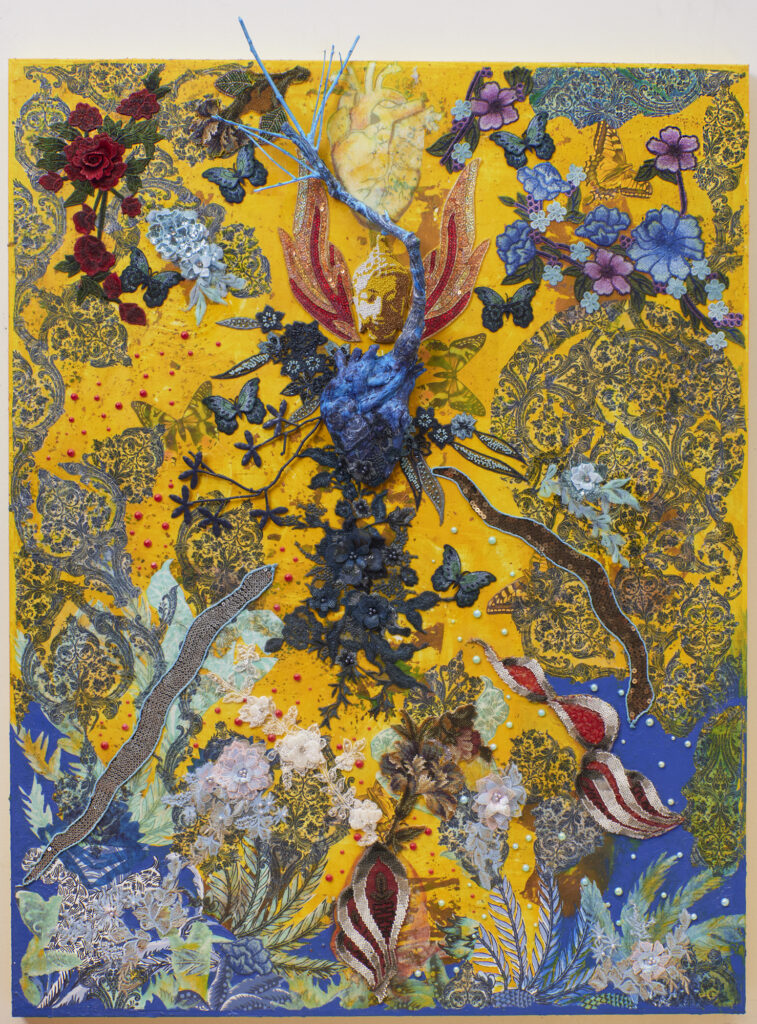 Garden of the Heart, 2021, mixed media, 47 x 36 inches. Photo by Mitro Hood.
“Lowery is a curator who’s worked extensively with African American subjects and artists, and she’s a good friend as well,” says DeVane. “I’m so glad I asked her to curate, because she was able to carry the through line of what the work itself has been about over the last 50 years, and that was good for me.”
Sims’ curatorial perspective makes powerful connections between DeVane’s works in the gallery space.
“Oletha DeVane is a way finder and a storyteller,” Sims says. “Over the last five decades as she has traveled in Asia, Africa, and the Caribbean, she has been inspired by the stories and characters she encounters, bringing the unexpected to light, while finding new nuances in the old and familiar, and unexpected correlations among those varied cultures.”
Art and outreach
Spectrum of Light and Spirit marks the first exhibition at the CADVC under the guidance of newly-appointed director Rebecca Uchill, who took over after the retirement of long-time director Symmes Gardner.
“It is a true honor for me to have joined CADVC as this important exhibition came into being,” Uchill says. “Oletha DeVane is an artist of incredible vision and artistic range, and a key figure in art and education in our region. We have much to look forward to in the robust exhibition programming, which will include a series of activations of Nkisi Woman-Universal Nkisi, a community-engaged sculptural project by DeVane on view in the CADVC amphitheater.”
A nkisi is a power figure rooted in Congolese culture, imbued with sacred energy by the community where it is created. Over the course of the exhibition, visitors to DeVane’s large-scale nkisi sculpture will be invited to add beads to its surface. DeVane herself will periodically participate in these activations, including hour-long sessions slated for October 6, 8, and 29.
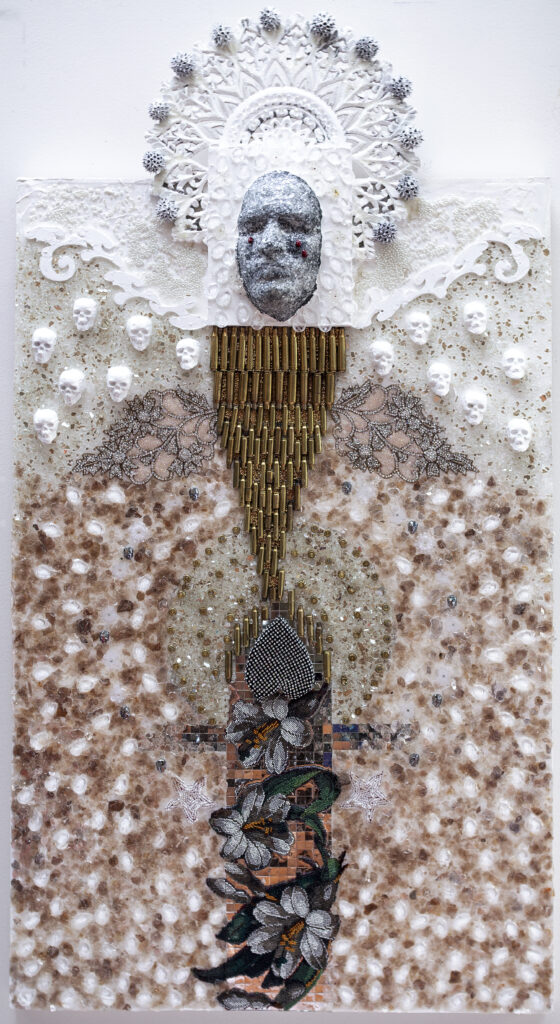 Subsumed by Whiteness, 2020, mixed media, 56 x 40 inches. Photo by Mitro Hood.
“The concept of nkisi to me is about power figures, and a female power figure is sometimes unusual,” says DeVane. “The idea is that they are oriented towards community, you know, in terms of how one begins this whole process of healing. How do you achieve justice in a community? How do you approach nature? What is it that we value? All those questions to me were a part of the nkisi spirit.”
In addition to the sculptural and painting works in the exhibit, DeVane’s video works, Beyond Bars: Prison Women Speak, created in collaboration with writer and media personality Tadia Rice, have been updated for this exhibition. The videos make for a profound dialogue with Prison Nation, the photography show on view across campus at the Albin O. Kuhn Library Gallery through October 14.
“[Prison Nation] is pretty phenomenal. I was really impressed because the black and white photos are just beautiful,” says DeVane. “Ours is a little different. I chose to set up the photographs and the videos with the idea that the women would be interviewed from the past, the present and the future. It’s really about setting up an opportunity for people to understand that these women are in situations where they’re incarcerated, and happen to have had lives prior, and would like to go back to those lives. Just as our society begins to grapple with the issues around how our prison system works, we have to continue this work.”
* * * * *
Spectrum of Light and Spirit is on view at the CADVC through December 17. For more information about the exhibit and associated events, visit the CADVC website at https://cadvc.umbc.edu/oletha-devane/
]]>
Artist retrospectives have been a significant part of the history of the Center for Art, Design and Visual Culture. Since opening on the UMBC campus more than 30 years ago, the CADVC has delivered...
https://umbc.edu/stories/art-life-and-spirit-oletha-devane-retrospective-at-the-cadvc/
https://my3.my.umbc.edu/api/v0/pixel/news/128170/guest@my.umbc.edu/35bf602f277b8e5a6e81dc313ebf6148/api/pixel
cadvc
discovery
magazine
visualarts
UMBC News & Magazine
https://my3.my.umbc.edu/groups/umbc-news-magazine
https://assets1-my.umbc.edu/system/shared/avatars/groups/000/001/943/24435aa6207c452e7bc15cc74b42c7bb/xsmall.png?1748556657
https://assets1-my.umbc.edu/system/shared/avatars/groups/000/001/943/24435aa6207c452e7bc15cc74b42c7bb/original.png?1748556657
https://assets2-my.umbc.edu/system/shared/avatars/groups/000/001/943/24435aa6207c452e7bc15cc74b42c7bb/xxlarge.png?1748556657
https://assets2-my.umbc.edu/system/shared/avatars/groups/000/001/943/24435aa6207c452e7bc15cc74b42c7bb/xlarge.png?1748556657
https://assets3-my.umbc.edu/system/shared/avatars/groups/000/001/943/24435aa6207c452e7bc15cc74b42c7bb/large.png?1748556657
https://assets1-my.umbc.edu/system/shared/avatars/groups/000/001/943/24435aa6207c452e7bc15cc74b42c7bb/medium.png?1748556657
https://assets2-my.umbc.edu/system/shared/avatars/groups/000/001/943/24435aa6207c452e7bc15cc74b42c7bb/small.png?1748556657
https://assets1-my.umbc.edu/system/shared/avatars/groups/000/001/943/24435aa6207c452e7bc15cc74b42c7bb/xsmall.png?1748556657
https://assets2-my.umbc.edu/system/shared/avatars/groups/000/001/943/24435aa6207c452e7bc15cc74b42c7bb/xxsmall.png?1748556657
UMBC News & Magazine
0
0
false
Tue, 04 Oct 2022 11:30:10 -0400
Tue, 04 Oct 2022 11:30:10 -0400
A Season of Change for the CADVC
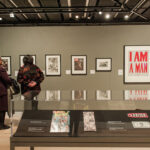
For more than 30 years, Symmes Gardner has worked with the Center for Art, Design and Visual Culture (CADVC) at UMBC, and in that time helped transform the gallery into an internationally-recognized hub for art, research, and technology on the UMBC campus.
Gardner retires this month having hosted historic retrospectives of artists like Adrian Piper, Kate Millett, and Fred Wilson, while simultaneously supporting annual student and faculty exhibitions. Notably, every major CADVC exhibition has been accompanied by a catalog designed in collaboration with Visual Arts faculty. A majority of these catalogs remain available through the CADVC website.
Rebecca Uchill, who has served as director of community engagement initiatives at the College of Visual and Performing Arts at UMass Dartmouth, will begin as director of CADVC on July 1, bringing with her a commitment to carry on CADVC’s tradition of exceptional art and engagement.
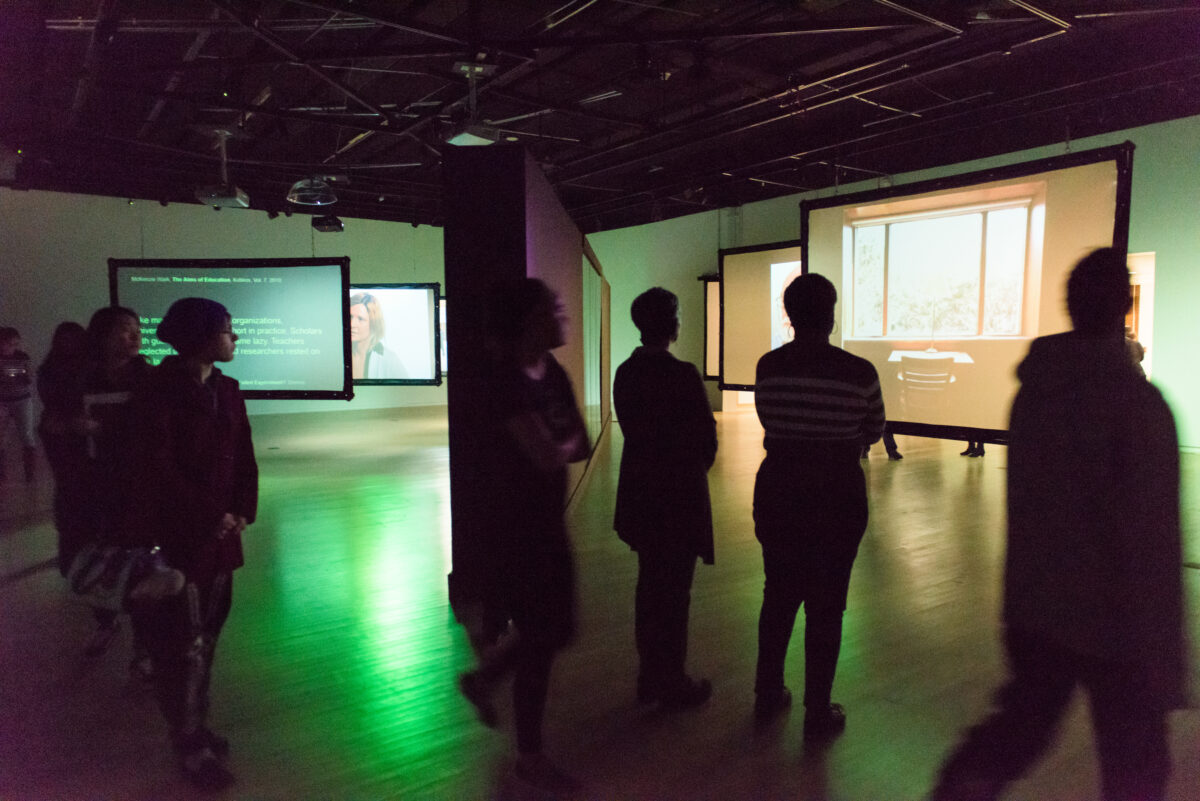 Guests enjoy the Antoni Muntadas — Activating Artifacts: About Academia exhibit in 2017. (Marlayna Demond ’11/UMBC)
Putting the CADVC on the map
Gardner’s tenure with the CADVC began in 1989, and he took over directorial responsibilities after founding director David Yager left for a position at UC Santa Cruz.
“I feel really fortunate and lucky,” Gardner says. “We had had a good team from the beginning, and were allowed a fair degree of autonomy to investigate and grow.”
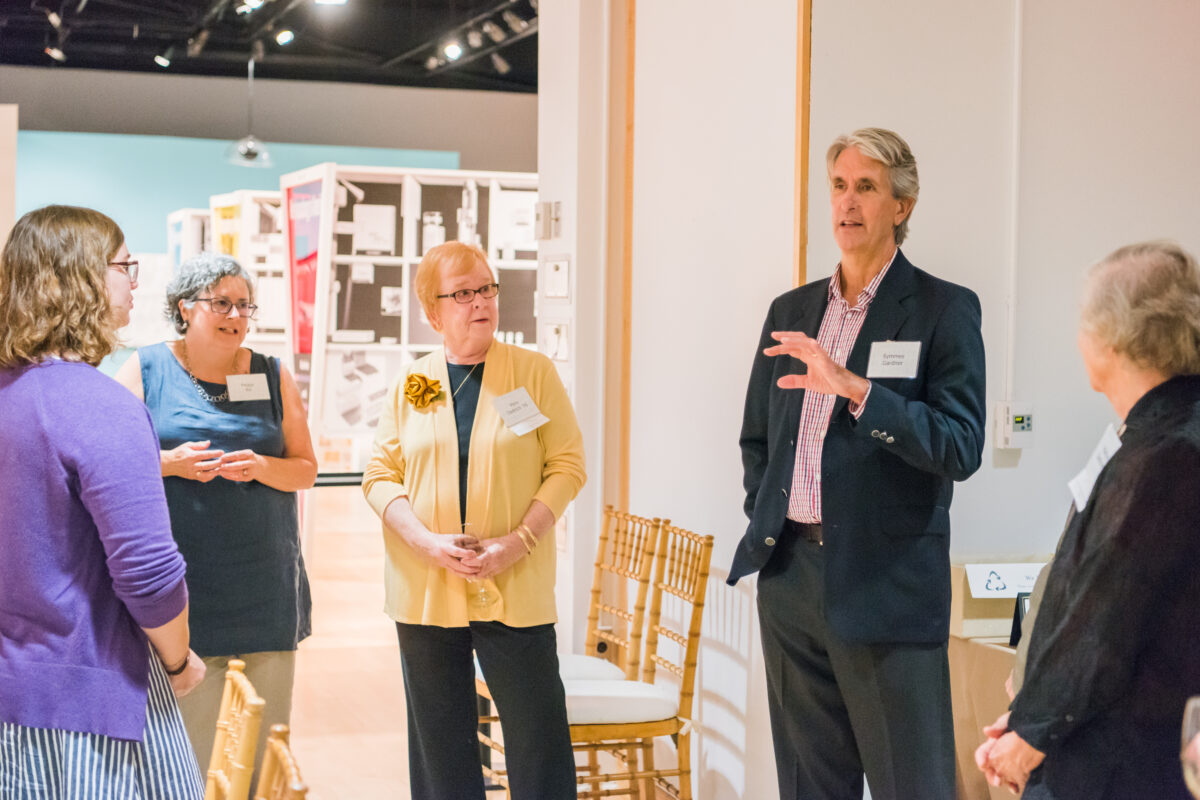 Symmes Gardner, center right, outgoing director of CADVC, shares a behind-the scenes look at an exhibit with UMBC alumni. (Marlayna Demond ’11/UMBC)
Gardner’s team included the curatorial contributions of Maurice Berger, the influential art historian whose work radically advanced the dialogue about the ways museums and archives dealt with race prior to his death in March 2020. Berger’s numerous contributions to the CADVC included curating For All The World To See: Visual Culture and the Struggle for Civil Rights, which came to the CADVC in 2012-2013 after opening at the Smithsonian, and later traveled around the United States. This legendary exhibition remains available to view via the CADVC website.
“Maurice really challenged us to bring together traveling exhibitions that were incredibly timely,” says Gardner. “That really helped the CADVC and put us on the map, and the university allowed us to conduct ourselves like we’re in a laboratory.”
Under Gardner’s guidance, the CADVC also expanded its reach beyond its gallery walls, including numerous touring exhibitions as well as the Joseph Beuys Sculpture Park, created in 2001 as a tribute to Beuys’ 7000 Oaks project on the south side of the UMBC campus.
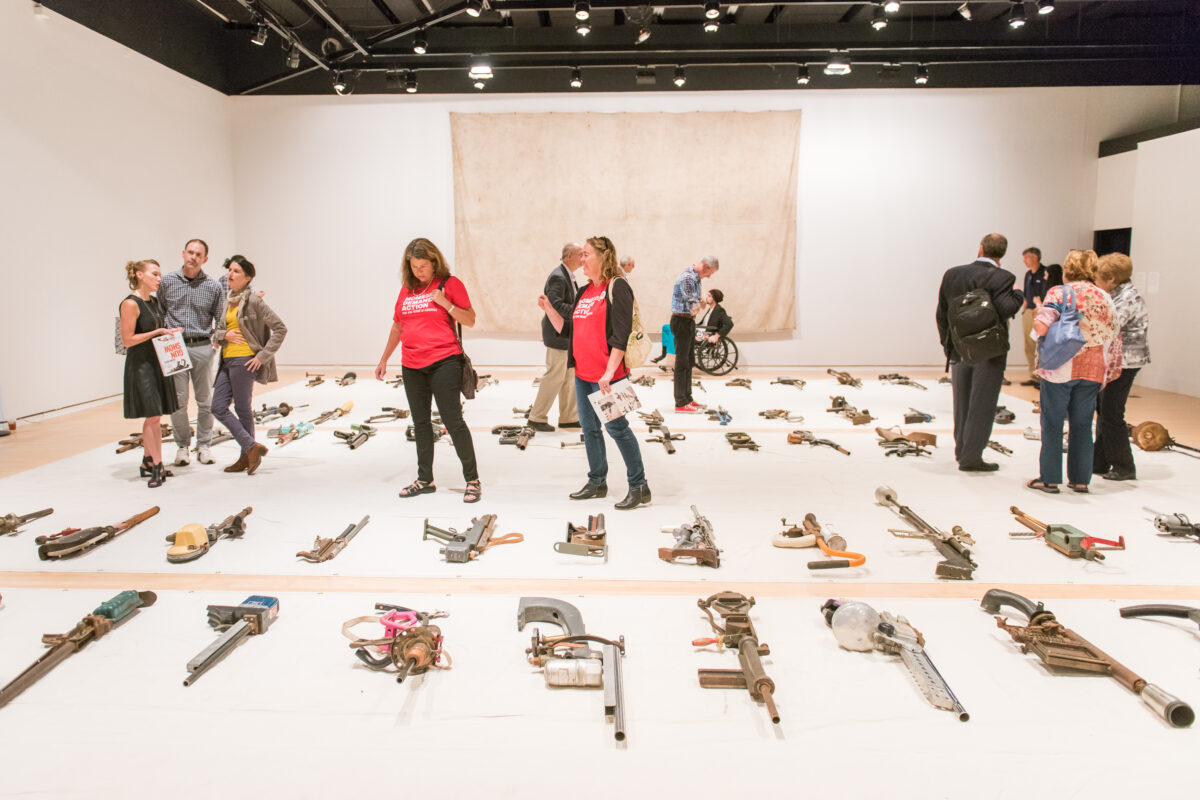 At 2017’s Gun Show, artist David Hess presented dozens of life-size sculptures of assault rifles made from what he calls “rescued” objects – ranging from an old black sneaker and vintage turquoise sewing machine, to a raggedy crutch and pink Barbie bike frame – to foster dialogue around gun violence.
Room to grow
Gardner’s departure leaves the CADVC’s legacy in good hands. Rebecca Uchill, an art historian and curator who most recently served as director of community engagement initiatives at UMass Dartmouth, arrives this summer ready to build on an already impressive career.
Last year at UMass Dartmouth, Uchill curated a celebration of the life and work of renowned multimedia artist Nancy Holt, complete with the first posthumous presentation of Holt’s 1982 immersive work Electrical System in the United States and presenting new research into Holt’s 1991 public sculpture Spinwinder.
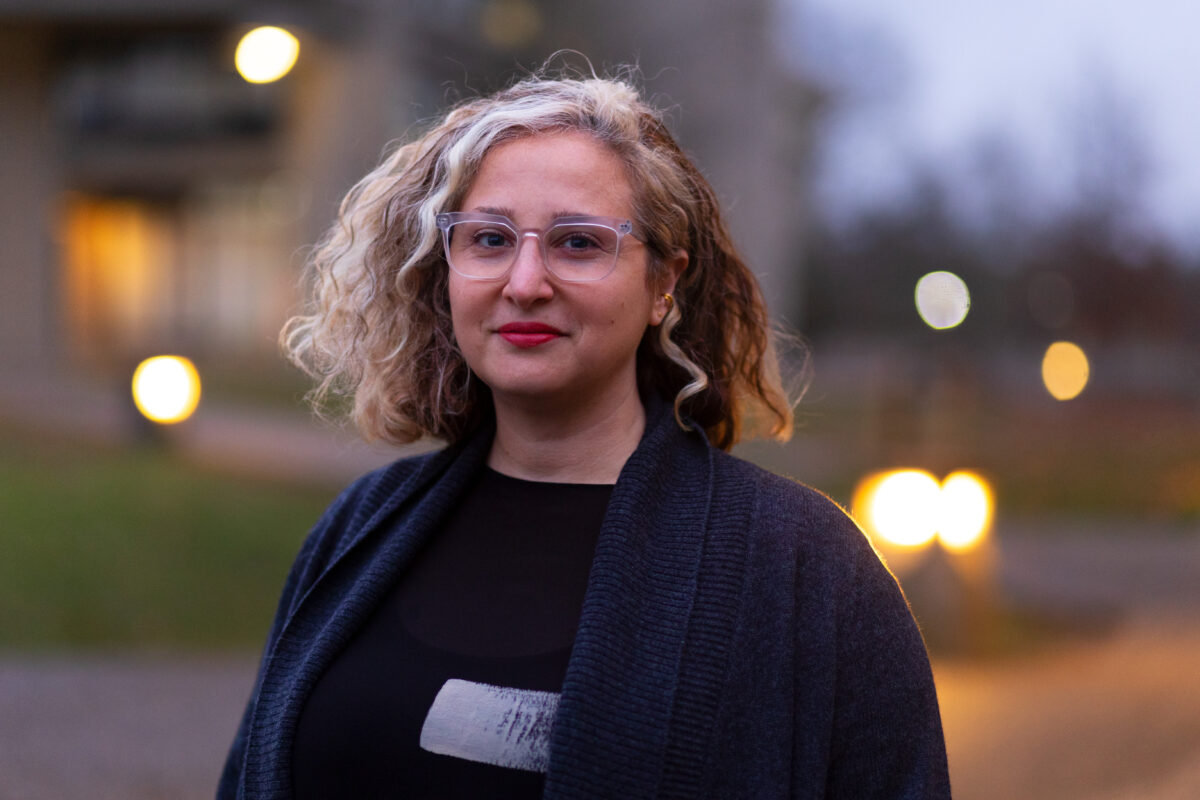 Rebecca Uchill (Courtesy of Uchill)
To recreate Holt’s elaborate Electrical System, the Nancy Holt: Massachusetts team included electrical engineering students who took on the project as a capstone project, bending conduit to showcase the infrastructure of electricity via Holt’s darkened gallery environment.
Uchill worked with the National Park Service in revitalizing Holt’s Spinwindersculpture on the UMass Dartmouth campus through a new tour that connected Holt’s legacy with the Massachusetts textile industry.
“I am interested in what the public presentation of art and visual culture can mean to a university campus environment,” says Uchill. “I think it’s an important part of any academic, interdisciplinary, social, community minded public-facing discussion that work is accessible for a broader general public.”
Previously, Uchill was a Mellon Postdoctoral Fellow with the Center for Art, Science & Technology (CAST) at MIT, where she co-edited two publications: Experience: Culture, Cognition, and the Common Sense (2016) and Being Material (2019).
Uchill has curated exhibitions at Harvard University, the Indianapolis Museum of Art, and MASS MoCA. Her publication CV includes serving as editor of Art Journal Open, as well as scholarly publications in Architectural Theory Review, Journal of Art Historiography, and Journal of Curatorial Studies.
“UMBC is a cool, nerdy place, and I really thrive in that kind of environment,” says Uchill. “CADVC is part of that culture, and builds on that research-centered mission, which excites me. I wouldn’t be in the business of working in the arts if I didn’t think that they were the most important tools for reflecting on and understanding what’s happening in the world.”
Learn more about upcoming events at CADVC here.
]]>
For more than 30 years, Symmes Gardner has worked with the Center for Art, Design and Visual Culture (CADVC) at UMBC, and in that time helped transform the gallery into an...
https://umbc.edu/stories/a-season-of-change-for-cadvc/
https://my3.my.umbc.edu/api/v0/pixel/news/125911/guest@my.umbc.edu/26853c71eff3117ef2d4f54f14bee744/api/pixel
arts-calendar
cadvc
discovery
magazine
UMBC News & Magazine
https://my3.my.umbc.edu/groups/umbc-news-magazine
https://assets1-my.umbc.edu/system/shared/avatars/groups/000/001/943/24435aa6207c452e7bc15cc74b42c7bb/xsmall.png?1748556657
https://assets1-my.umbc.edu/system/shared/avatars/groups/000/001/943/24435aa6207c452e7bc15cc74b42c7bb/original.png?1748556657
https://assets2-my.umbc.edu/system/shared/avatars/groups/000/001/943/24435aa6207c452e7bc15cc74b42c7bb/xxlarge.png?1748556657
https://assets2-my.umbc.edu/system/shared/avatars/groups/000/001/943/24435aa6207c452e7bc15cc74b42c7bb/xlarge.png?1748556657
https://assets3-my.umbc.edu/system/shared/avatars/groups/000/001/943/24435aa6207c452e7bc15cc74b42c7bb/large.png?1748556657
https://assets1-my.umbc.edu/system/shared/avatars/groups/000/001/943/24435aa6207c452e7bc15cc74b42c7bb/medium.png?1748556657
https://assets2-my.umbc.edu/system/shared/avatars/groups/000/001/943/24435aa6207c452e7bc15cc74b42c7bb/small.png?1748556657
https://assets1-my.umbc.edu/system/shared/avatars/groups/000/001/943/24435aa6207c452e7bc15cc74b42c7bb/xsmall.png?1748556657
https://assets2-my.umbc.edu/system/shared/avatars/groups/000/001/943/24435aa6207c452e7bc15cc74b42c7bb/xxsmall.png?1748556657
UMBC News & Magazine
0
0
false
Wed, 15 Jun 2022 14:21:34 -0400
Wed, 15 Jun 2022 14:21:34 -0400
Beyond Midlife: Kathy Marmor’s new artwork explores memory and embodiment for women in midlife
Western culture remains terrified of aging, particularly for women, but that fear doesn’t stop any of us from actually aging. Kathy Marmor, associate professor of visual arts at UMBC, delves into the heart of these anxieties with a pair of innovative collaborative works, collectively titled Beyond Midlife: What’s Lost, What’s Gained, on view at the Center for Art, Design and Visual Culture (CADVC) on the UMBC campus through March 12.
Marmor’s new work appears as part of the CADVC’s Spectrum: 2022 Visual Arts Faculty exhibition, which also features works by UMBC visual arts faculty Lisa Moren and Lynn Cazabon.
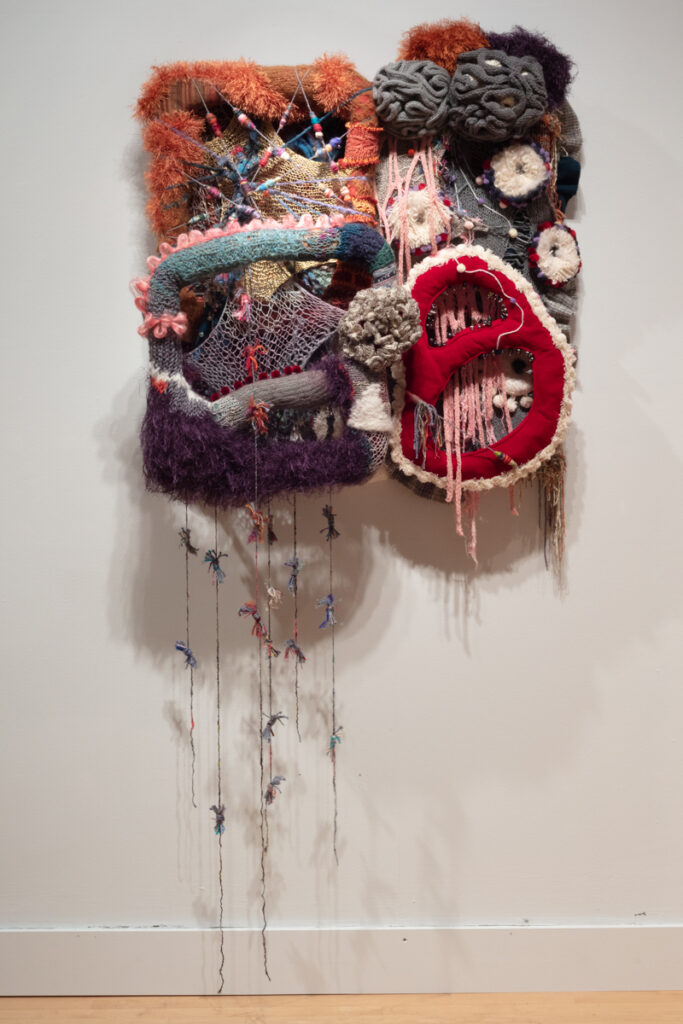 Unspooling Cognition. Photo by Heather Braxton.
While Marmor typically works alone, in recent years she’s begun a series of collaborations. “I thought it would be interesting to work with women from UMBC. [Penny Rheingans] and I had talked about working together when I first came to UMBC, but timelines didn’t work out.” Marmor said. “I knew Robin [Farabaugh] as a writer and I really wanted to work with a writer because I often use text in my work. The timing was good for them both.”
Unspooling is a textile-based installation created with Rheingans—a former professor of computer science and director of the Center for Women in Technology at UMBC who is now on the faculty at the University of Maine.
“I’ve worked for a long time with technology, using computers to mediate the environment, using sensors and interaction with people’s presence,” said Marmor. “This new work is a pause or break from technology. We wanted people to come in and get a different sense of the body. We see that there’s a decay, or a sense of unspooling, and unwrapping of daily life.”
Rheingans, an accomplished knitter, added new dimensions to the work.
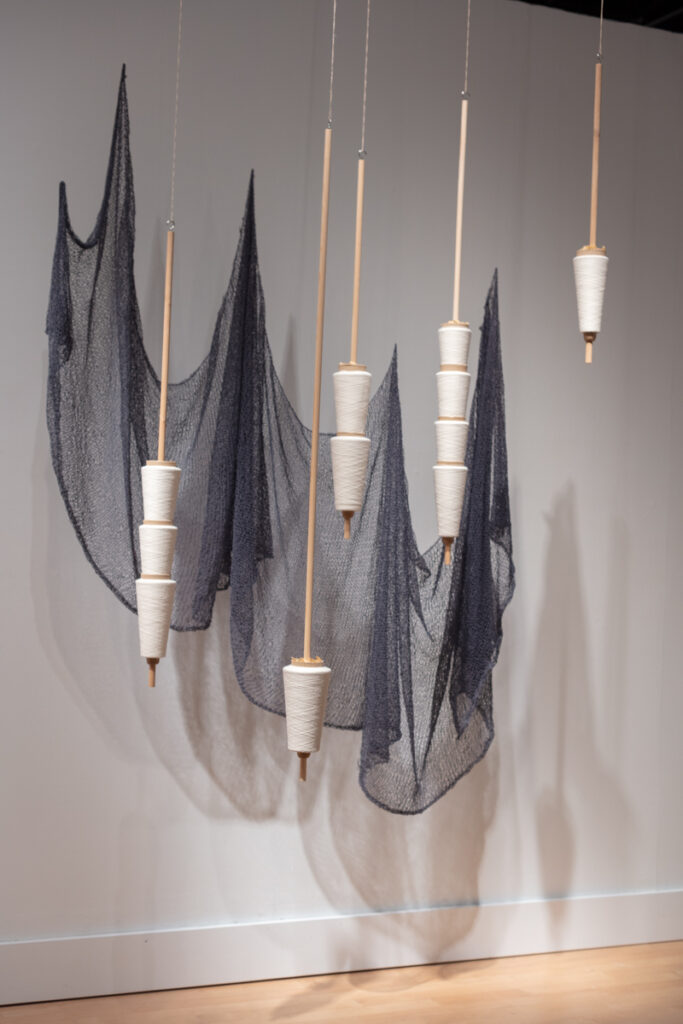 Unspooling Self. Photo by Heather Braxton.
“She’s a fabulous knitter, and a dedicated collector,” said Marmor. “She gave me all these materials to work with. I fell in love with yarn. It’s a really accessible material, fun to work with and it hinged on craft. My work has always been tactile and sculptural, but this was change for me.”
Comprising four vivid mixed-media sculptures, the piece charts vulnerabilities of aging women, including cognition, reproduction, appearance, self and autonomy. Echoing Suzanne Valadon’s “The Blue Room,” which depicts a middle-aged woman reclining on a day bed, together the pieces form an abstract portrait of a complete body.
“The Blue Room’ is one of my favorite paintings by a woman about being a woman, present and in her body,” Marmor says.
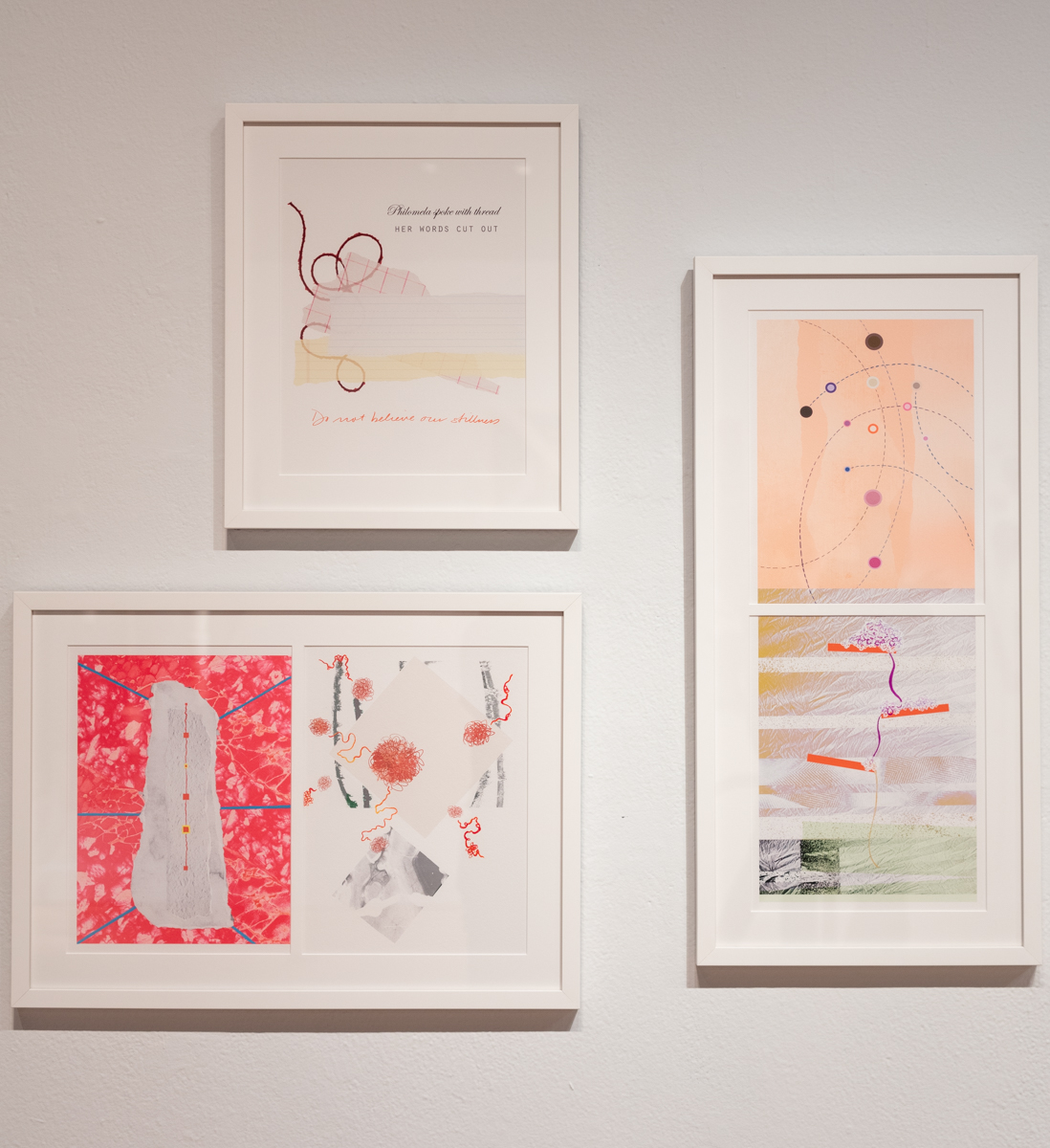
The second piece, Philomela’s Thread: a Commonplace book, was created with Robin Farabaugh, an essayist and former senior lecturer in UMBC’s English department. Consisting of ten prints and a single channel video, the pieces draw on the classic Greek tragedy of Philomela, a princess who was violently silenced.
“I really wanted to work with a writer because I often use text in my work,” said Marmor. “[Farabaugh] had never worked with a visual artist before, so it was an adventure.”
Historically, commonplace books were kept by men as personal compendiums of knowledge. Notable men like John Locke and Thomas Jefferson were famous for their commonplace books as reference works and historical documents. Women, Marmor notes, also kept commonplace books, but they tended to serve a different purpose.
“Women were taught to read, but not allowed to go on with education, so one way in which women taught themselves and had a sense of themselves is by keeping commonplace books,” said Marmor. “They’d put many things in them, recipes, letters, scriptures, writings and poems they would come across, these miscellanies of their lives. That’s how women understood themselves.”
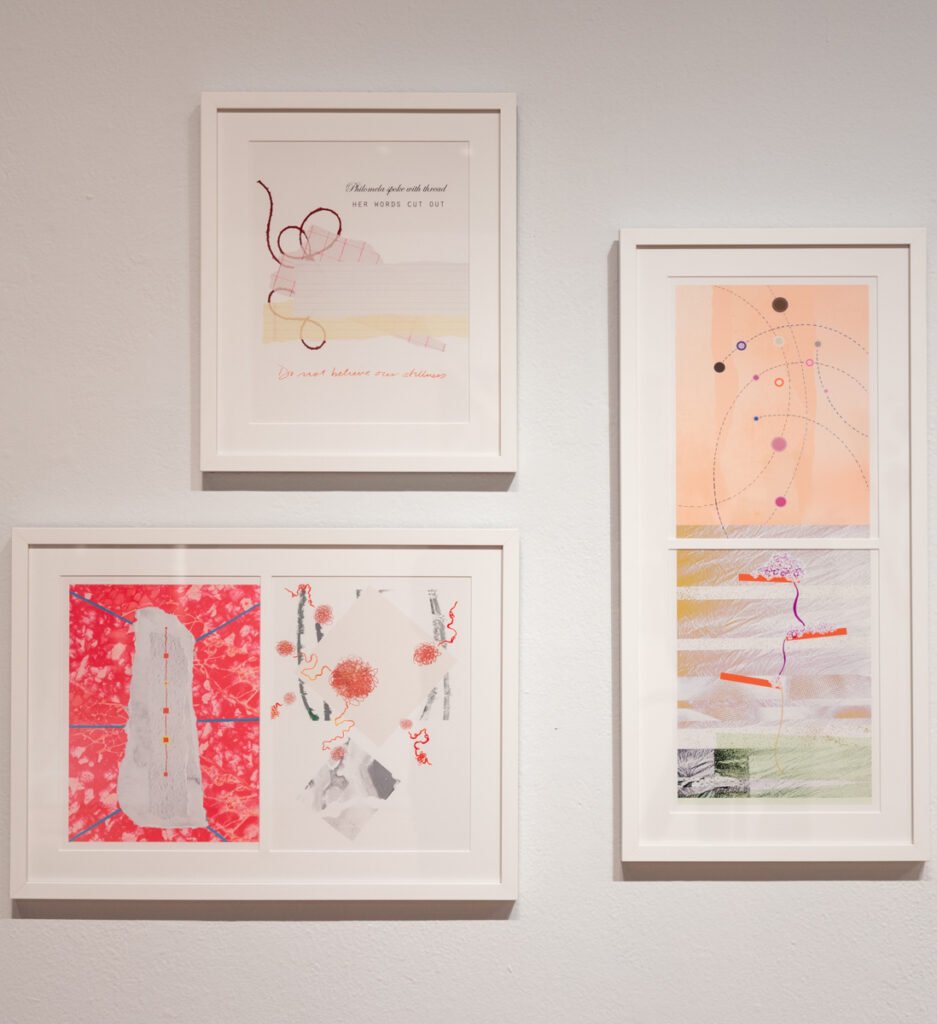 A close up of three prints from Philomela’s Thread: a Commonplace Book. Photo by Heather Braxton.
The ten prints in Philomela’s Thread combine abstract images that simultaneously recall Hilma af Klint and Alexander Calder, peppered with Farabaugh’s text.
“Robin wrote these beautiful words which we distilled so that each one is about paper, thread and voice through the centuries,” said Marmor. “I really wanted to make it clear that the way in which women have recorded the stories of their lives has changed over time. We depicted the digital stylus to ask how will the life experiences of women be preserved now in this contemporary digital age?”
The four-minute video loop that stands as the centerpiece of Philomela’s Thread takes a more linear narrative form, centering on a story of love and loss.
“It’s moving through the story of a woman’s desire for her sexuality, getting older, and then the loss of her family. I think it really captures our understanding of the world, like a memory, or an inner space,” said Marmor.
Marmor’s work remains on display through March 12, with a closing reception 5 p.m. to 7 p.m. March 10. For those who are unable to visit the gallery in person, the entire Spectrum 2022 exhibition can be viewed via the CADVC website.
Header image: Philomela’s Thread: a Commonplace Book — 10 gouache and giclee prints that depict a multiplicity of threads that make up a woman’s life and a single channel video that voices to her inner thoughts. Photo by Heather Braxton.
]]>
Western culture remains terrified of aging, particularly for women, but that fear doesn’t stop any of us from actually aging. Kathy Marmor, associate professor of visual arts at UMBC, delves into...
https://umbc.edu/stories/beyond-midlife-kathy-marmors-new-artwork-explores-memory-and-embodiment-for-women-in-midlife/
https://my3.my.umbc.edu/api/v0/pixel/news/119470/guest@my.umbc.edu/dd62d63a45edc29766ac6dc6e90c975f/api/pixel
cadvc
computer-science
discovery
english
magazine
visual-arts
UMBC News & Magazine
https://my3.my.umbc.edu/groups/umbc-news-magazine
https://assets1-my.umbc.edu/system/shared/avatars/groups/000/001/943/24435aa6207c452e7bc15cc74b42c7bb/xsmall.png?1748556657
https://assets1-my.umbc.edu/system/shared/avatars/groups/000/001/943/24435aa6207c452e7bc15cc74b42c7bb/original.png?1748556657
https://assets2-my.umbc.edu/system/shared/avatars/groups/000/001/943/24435aa6207c452e7bc15cc74b42c7bb/xxlarge.png?1748556657
https://assets2-my.umbc.edu/system/shared/avatars/groups/000/001/943/24435aa6207c452e7bc15cc74b42c7bb/xlarge.png?1748556657
https://assets3-my.umbc.edu/system/shared/avatars/groups/000/001/943/24435aa6207c452e7bc15cc74b42c7bb/large.png?1748556657
https://assets1-my.umbc.edu/system/shared/avatars/groups/000/001/943/24435aa6207c452e7bc15cc74b42c7bb/medium.png?1748556657
https://assets2-my.umbc.edu/system/shared/avatars/groups/000/001/943/24435aa6207c452e7bc15cc74b42c7bb/small.png?1748556657
https://assets1-my.umbc.edu/system/shared/avatars/groups/000/001/943/24435aa6207c452e7bc15cc74b42c7bb/xsmall.png?1748556657
https://assets2-my.umbc.edu/system/shared/avatars/groups/000/001/943/24435aa6207c452e7bc15cc74b42c7bb/xxsmall.png?1748556657
UMBC News & Magazine
0
0
false
Thu, 03 Mar 2022 18:01:17 -0500
Florence Knoll Bassett’s mid-century design diplomacy
by Margaret Re, Associate Professor of Graphic Design, UMBC
The look, feel and functionality of the modern American office can be traced back to the work of one woman.
Florence Knoll Bassett, whom Architectural Record called the “single most powerful figure in modern design,” died at 101 on Jan. 25.
In the early 20th century, offices consisted of rows of dark, heavy desks and chairs, with the executive desk angled toward an office door.
Knoll, who believed that a building’s interior was as important as its exterior, introduced an office aesthetic based on function. She interviewed people about how they did their job so they could do it efficiently and comfortably. She then went on to design products like the Model 1500 series – a desk that allowed drawers and cabinets to be added to the frame based on need.
The press coined a term for her “humanist interpretation of European modernism”: the “Knoll Look.” Her clients included CBS, Connecticut General, Alcoa and the University of Michigan, and you’ll see her influence in mid-century period pieces like “Mad Men.”
The U.S. State Department had also noticed Knoll’s growing reputation. As part of a Cold War propaganda effort to align consumer choice with political choice, they used her and her “look” to help establish and promote an American identity abroad.
Reimagining the textile
Knoll attended the Cranbrook Academy of Art, a school that’s considered the birthplace of American modernism, where she was a classmate of future star designers Charles and Ray Eames, Eero Saarinen, Harry Bertoia and Benjamin Baldwin.
She eventually moved to New York, where she joined the architectural firm of Harrison & Abromovitz in 1941. While living and working in New York, she met Hans Knoll, the owner of a small furniture company, and she joined his firm in 1943. The couple married in 1946; that same year, the H. G. Knoll Company was renamed “Knoll Associates,” and the Knoll Planning Unit, which focused on interior design, was set up. Florence was named head.
“I am not a decorator,” she famously declared in a 1964 New York Times article that credited her for revolutionizing office design as an architect in a predominantly male profession.
Frustrated by the challenge of finding fabrics suitable for use on modern furniture, Knoll initially used men’s suiting fabrics for upholstery and interiors.
Then, in 1947, Knoll Textiles, which worked closely with the Planning Unit, was launched, giving Knoll the opportunity to develop, market and sell printed and woven textiles.
 Curator Margaret Re with her 2018 exhibit A Designed Life: Contemporary American Textiles, Wallpapers, and Containers & Packaging, 1951 – 1954, at UMBC’s Center for Art, Design and Visual Culture (CADVC). Photo by Marlayna Demond ’11 for UMBC Magazine.
READ MORE: A Designed Life: Modernism as Propaganda
“Textiles were among the most visible and industrially innovative products produced in the U.S. in the 1950s and impacted many aspects of postwar life,” Berry College historian Virginia Troy told me in an interview.
Wartime rationing, which included clothing and textiles, had ended in 1946. As the economy grew, so did the appetite for textiles. Used for upholstery, curtains and carpeting, they were integral to modern architecture: They could unify open floor plans, serve as dividers and separate work areas from living spaces.
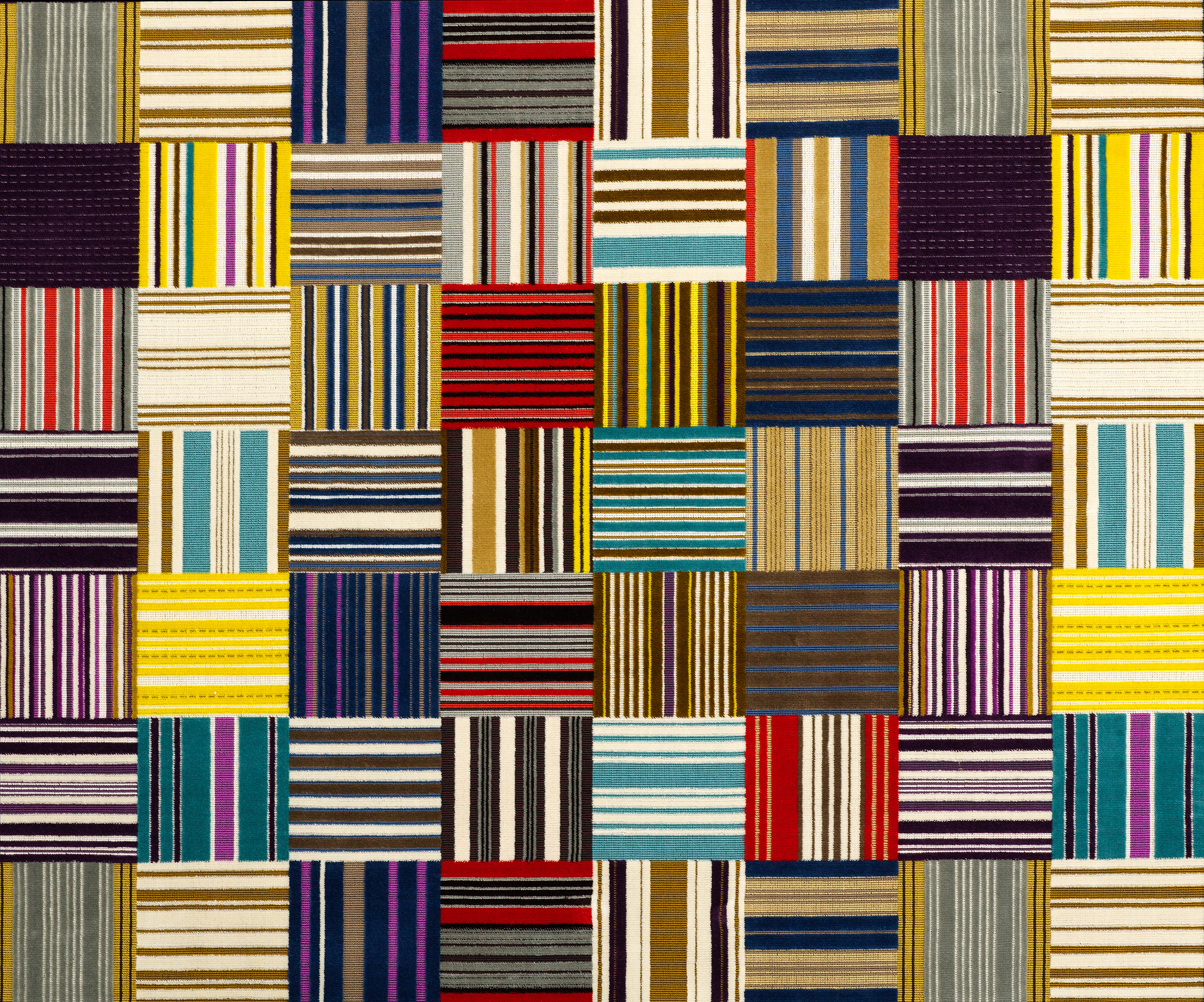
Knoll’s unobtrusive textile designs – which tended to feature subtle colors – often included geometric or biomorphic prints and woven fabrics in which vertical and horizontal weaves formed a pattern.
Her textiles were quite different from the brocade and chintz cabbage roses sold in most of the era’s textile showrooms.
Branding and selling America abroad
Around this time, the U.S. government started sponsoring international expositions to introduce the American people and their innovations abroad – what historian Robert Haddow called “Pavilions of Plenty.”
The most famous is probably the 1959 American National Exhibition in Moscow, during which then-Vice President Richard Nixon and Soviet Premier Nikita Khrushchev held their “kitchen debate” and argued about the merits of capitalism and communism.
But there were smaller exhibits that preceded the American National Exhibition in Moscow including “How America Lives,” which was held in Frankfurt in 1949, and “America at Home,” an exhibition in Berlin that took place in 1950.
In 1951, the Traveling Exhibition Service – now called the Smithsonian Institution Traveling Exhibition Service – asked Knoll to curate and design an exhibit. She had been recommended by Edgar Kaufmann Jr., the director of the Museum of Modern Art’s Good Design program. It also didn’t hurt that Knoll was known in some government circles. She had designed Secretary of War Henry Stimson’s office, and Knoll Associates had outfitted government buildings in the U.S. and Europe.
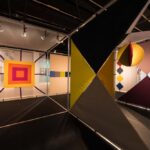
Titled “Contemporary American Textiles,” Knoll and the Planning Unit designed an exhibit that, like her office designs, was meant to be experienced as a whole. The self-lit aluminum-framed pavilion included its own drop-in floor, and double-sided wall panels assembled from textiles were hung by straps and braced by cross-wires.
For a 2018 exhibit titled “A Designed Life,” organized by UMBC’s Center for Art, Design & Visual Culture, I recreated Knoll’s original exhibit using photographs and plans from the Archives of American Art.
Brightly colored panels were used to make rooms within a room. Sight lines formed by triangular shapes and patterns directed visitors through the exhibit, offering a continuously changing viewpoint described by the magazine Interiors as “kaleidoscopic.”
The display showcased over 150 well-designed, mass-produced and readily available fabrics; in the forward of the accompanying catalog, Knoll described the textiles as “designs of beautiful color in all price ranges.” Over 50 of these fabrics were sold under the Knoll Textile label.
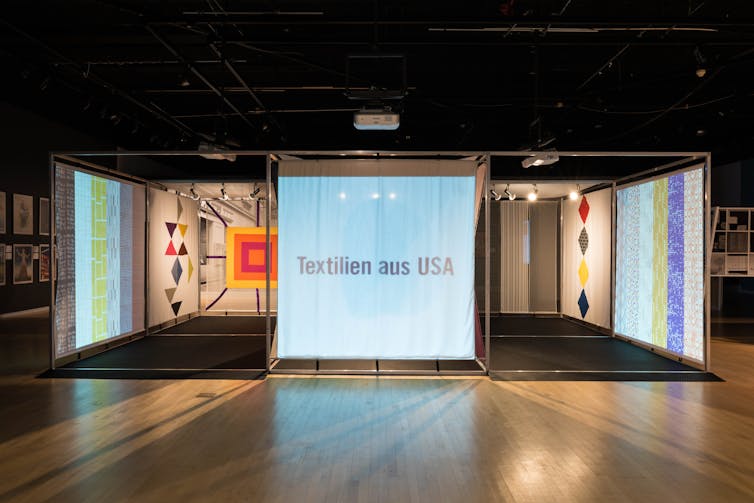 The recreated Knoll exhibition allows visitors to participate in the original ‘kaleidoscopic’ experience. Dan Meyers, Author provided.
The goal was to sell the idea of capitalism, America and democracy in a post-war Europe that was anxious to rebuild, and it appeared in West German and Austrian schools, museums and trade fairs.
Government records note that the exhibit was included in the 1952 Berlin Cultural Festival and presented in 1953 in Munich and Essen. The U.S. Embassy in France also sponsored its display in a 1954 Parisian trade show dedicated to household management.
To date, there’s no known physical trace of this exhibit.
Was it thrown away or donated to a German school or museum in order to earn some goodwill? Was it discarded because the 1948 Smith-Mundt Act, which authorized international public diplomacy, discouraged the presentation of these exhibitions back in the United States?
I have no way of knowing.
I do know, however, that Knoll was proud of this exhibit: When German architect Walter Gropius praised it, she wrote that it was “a great honor.” And she included sketches, plans and photographs of “Contemporary American Textiles” in her papers that she donated to the Archives of American Art.
The exhibit is a reminder that one of the country’s most influential designers was also one of its great ambassadors.
* * * * *
Margaret Re, Associate Professor of Graphic Design, University of Maryland, Baltimore County
This article is republished from The Conversation under a Creative Commons license. Read the original article.
Header Image: For the 2018 exhibit ‘A Designed Life,’ the author rebuilt Knoll’s ‘Contemporary American Textiles.’ Dan Meyers, Author provided
]]>
by Margaret Re, Associate Professor of Graphic Design, UMBC The look, feel and functionality of the modern American office can be traced back to the work of one woman. Florence Knoll Bassett,...
https://umbc.edu/stories/florence-knoll-bassetts-mid-century-design-diplomacy/
https://my3.my.umbc.edu/api/v0/pixel/news/120213/guest@my.umbc.edu/ca1ee38f4946d60abb074b5f55c589af/api/pixel
cadvc
discovery
vpa
UMBC News & Magazine
https://my3.my.umbc.edu/groups/umbc-news-magazine
https://assets1-my.umbc.edu/system/shared/avatars/groups/000/001/943/24435aa6207c452e7bc15cc74b42c7bb/xsmall.png?1748556657
https://assets1-my.umbc.edu/system/shared/avatars/groups/000/001/943/24435aa6207c452e7bc15cc74b42c7bb/original.png?1748556657
https://assets2-my.umbc.edu/system/shared/avatars/groups/000/001/943/24435aa6207c452e7bc15cc74b42c7bb/xxlarge.png?1748556657
https://assets2-my.umbc.edu/system/shared/avatars/groups/000/001/943/24435aa6207c452e7bc15cc74b42c7bb/xlarge.png?1748556657
https://assets3-my.umbc.edu/system/shared/avatars/groups/000/001/943/24435aa6207c452e7bc15cc74b42c7bb/large.png?1748556657
https://assets1-my.umbc.edu/system/shared/avatars/groups/000/001/943/24435aa6207c452e7bc15cc74b42c7bb/medium.png?1748556657
https://assets2-my.umbc.edu/system/shared/avatars/groups/000/001/943/24435aa6207c452e7bc15cc74b42c7bb/small.png?1748556657
https://assets1-my.umbc.edu/system/shared/avatars/groups/000/001/943/24435aa6207c452e7bc15cc74b42c7bb/xsmall.png?1748556657
https://assets2-my.umbc.edu/system/shared/avatars/groups/000/001/943/24435aa6207c452e7bc15cc74b42c7bb/xxsmall.png?1748556657
UMBC News & Magazine
0
0
false
Fri, 08 Feb 2019 14:22:20 -0500
Guenet Abraham receives Fulbright awards to teach graphic design and research a multimedia project in Ethiopia

Guenet Abraham, associate professor of graphic design, who received a 10-month Fulbright for 2017 – 2018 to teach graphic design and conduct research in Ethiopia for an upcoming multimedia exhibition, will extend her stay with the support of an additional Fulbright award for 2018 – 2019. She will continue teaching at the Alle School of Arts and Design at Addis Ababa University as well as conduct her research, which has taken her to the far reaches of the country.
The design courses Abraham has developed for the school, including a course in typography, are pilot courses aimed to help introduce a full graphic design curriculum. Her work includes direct instruction of students and mentoring of faculty. The curriculum will address the needs of university students well-placed to contribute design skills in the many sectors of Ethiopia’s growing economy.
“It is going very well in spite of challenges I am not used to in my teaching activities,” says Abraham, noting that there is no wifi in classrooms, many students do not own their own laptops, and there are limitations in computer lab facilities. “Despite these roadblocks, the students have universally embraced the course material. I am pleased to say that they continue to surpass my expectations. This has allowed me to continue to expand the learning goals.”

The additional year afforded through the second-round Fulbright will enable Abraham to continue teaching and working with faculty to draft a program that will continue long after the end of her stay.
In addition to teaching, Abraham is using the time in Ethiopia to research the rise and rule of The Coordinating Committee of the Armed Forces, Police, and Territorial Army – later named Derg – the brutal military regime that ruled Ethiopia from 1974 – 1992. Her historic and artistic research will culminate in a multimedia exhibition, Labyrinth of Memory, at the Center for Art, Design and Visual Culture (CADVC) when she returns.
The exhibition will present a depiction of the political violence, displacements, and disfigurements exacted by the Derg “for public consumption and debate,” as Abraham put it. “It stems from my belief that artists have the unique skills to address sensitive topics in ways that encourage contemplation and create dialogue. The trauma that Ethiopian society has faced is documented in tomes, but there are few monuments, exhibitions, explorations, and interpretations. The tragedies cannot be left to languish in archives or filed away in governmental reports. They must be given a proper place in the public’s memory.”

Her research has led her to explore many regions, such as sulfur lake in Dalol, Danakil Depression, to juxtapose natural and contemporary sound and imagery against the horrors of the Derg period.
Abraham’s extended stay in Addis is also a return. As civil war erupted, she departed with her family in 1974 and escaped the extreme violence that followed. “Since I left, the country has gone through two major regimes, the first one being the communist government of Mengistu which fractured the social fabric of the country. Soon after the present government toppled the Mengistu’s regime in 1991, the country split in two (Ethiopia and Eritrea) in 1992.”
The whole population of Ethiopia before the split was about 26 million, 450,000 in Addis Ababa. Now Ethiopia’s population is close to 100 million with over 6 million in Addis Ababa. “I simply do not recognize the country,” says Abraham. “The city is completely new and so are many aspects of the culture.”

Abraham also shared the unexpected feeling of “otherness” she has experienced in navigating a country that is both an old home and new place. It is not unlike what she encountered as a new American, she describes. Her approach has been to focus on the present rather than searching for what she remembers, she explains, saying, “I continue to immerse myself in the culture of today.”
Images, from top: Guenet Abraham in the Ethiopian highlands, photo by Teddy Berhanu; Guenet Abraham with students, photo by Fitsum Seyoum; Guenet Abraham at the sulfur lake in Dalol, Danakil Depression, photo by Colton Flynn; Addis Ababa, Ethiopia, photo by Guenet Abraham.
]]>
Guenet Abraham, associate professor of graphic design, who received a 10-month Fulbright for 2017 – 2018 to teach graphic design and conduct research in Ethiopia for an upcoming multimedia...
https://umbc.edu/stories/guenet-abraham-receives-fulbright-awards-to-teach-graphic-design-and-research-a-multimedia-project-in-ethiopia/
https://my3.my.umbc.edu/api/v0/pixel/news/120446/guest@my.umbc.edu/05b190f80d3101dbf0311b1ff3e539ed/api/pixel
arts-and-culture
cadvc
cahss
engage
international
visualarts
UMBC News & Magazine
https://my3.my.umbc.edu/groups/umbc-news-magazine
https://assets1-my.umbc.edu/system/shared/avatars/groups/000/001/943/24435aa6207c452e7bc15cc74b42c7bb/xsmall.png?1748556657
https://assets1-my.umbc.edu/system/shared/avatars/groups/000/001/943/24435aa6207c452e7bc15cc74b42c7bb/original.png?1748556657
https://assets2-my.umbc.edu/system/shared/avatars/groups/000/001/943/24435aa6207c452e7bc15cc74b42c7bb/xxlarge.png?1748556657
https://assets2-my.umbc.edu/system/shared/avatars/groups/000/001/943/24435aa6207c452e7bc15cc74b42c7bb/xlarge.png?1748556657
https://assets3-my.umbc.edu/system/shared/avatars/groups/000/001/943/24435aa6207c452e7bc15cc74b42c7bb/large.png?1748556657
https://assets1-my.umbc.edu/system/shared/avatars/groups/000/001/943/24435aa6207c452e7bc15cc74b42c7bb/medium.png?1748556657
https://assets2-my.umbc.edu/system/shared/avatars/groups/000/001/943/24435aa6207c452e7bc15cc74b42c7bb/small.png?1748556657
https://assets1-my.umbc.edu/system/shared/avatars/groups/000/001/943/24435aa6207c452e7bc15cc74b42c7bb/xsmall.png?1748556657
https://assets2-my.umbc.edu/system/shared/avatars/groups/000/001/943/24435aa6207c452e7bc15cc74b42c7bb/xxsmall.png?1748556657
UMBC News & Magazine
0
0
false
Sun, 29 Apr 2018 19:01:16 -0400
UMBC’s Maurice Berger receives ICP Infinity Award for New York Times “Race Stories” column

UMBC’s Maurice Berger, research professor and chief curator for the Center for Art, Design and Visual Culture (CADVC), and a major national figure in the field of media studies, has won the International Center of Photography (ICP) 2018 Infinity Award. The award, in the category of Critical Writing and Research, honors Berger’s acclaimed ”Race Stories” column for the Lens section of the New York Times.
ICP’s Infinity Awards are widely considered the leading honor for excellence in the field of photography and visual culture. The selection committee includes Isolde Brielmaier, assistant professor at NYU and executive director of Arts, Culture and Community, Westfield World Trade Center; Marina Chao, assistant curator of exhibitions for ICP; James Estrin, Lens blog co-editor and senior staff photographer for the New York Times; and Antwaun Sargent, writer and critic.
Since 1985, the ICP Infinity Awards have recognized major contributions and emerging talent in the fields of photojournalism, art, fashion photography, and publishing. The 34th annual ICP Infinity Award honorees will be celebrated at a gala on April 9 in New York City.
”I am honored to receive an award long considered important to the community of photographers, writers, editors, and curators of which I’m a part,” Berger shares. “To write monthly for the New York Times about the ways photography mediates the issues of race fulfills a long held dream. To have that work acknowledged and rewarded by my peers, in addition to the incredible support I get from Times readers, is truly wonderful.”
Berger’s monthly “Race Stories” column explores the relationship of photography to concepts, themes, and social issues around race not usually covered in the mainstream media. He launched the column, in July 2012 and two years later received the 2014 Creative Capital | Andy Warhol Foundation ArtsWriters Grant in recognition of his writing.

The well-researched essays are written in a literary and reader-friendly style and explore a range of subjects and photographers. Predominantly focused on work from the civil rights era to the present, his writing has focused on a multiple issues: contemporary African American art and photography; the modern civil rights movement; Latino/a, Asian-American, and Native American photography; Asian and African photography; 19th-century and Civil War-era photography and race; and developments in Latino and Asian American photography. His work has also explored how artists and photographers of color have employed photography to combat stereotypes and prevailing ideas about race and identity in the United States.
Included in the series is a moving personal essay from December 2017, “Using Photography to Tell Stories About Race”, that contextualizes Berger’s writing on race within his personal story. In the essay, Berger writes:
As a Jew, I have known anti-Semitism. As a gay man, I have known homophobia. But neither has seemed as relentless as the racism I witnessed growing up — a steady drumbeat of slights, thinly-veiled hostility and condescension perpetrated by even the most liberal and well-meaning people. It was painful to watch, and as my friends let me know, considerably more painful to endure.
“Continually observing this reality shaped how I understood racism: When people told me they had experienced prejudice, I believed them. I had rejected the liberal tendency to defensively dismiss the victim to protect the accused.”
ICP worked with Harbers Studio and MediaStorm to produce mini-documentary films on each of the 2018 Infinity awardees, including a 12-minute film on Berger:
The CADVC recently launched a webpage indexing all of the “Race Stories” essays that is updated monthly as new posts are published. “I wanted to find ways to make the ‘Race Stories’ series available to as broad an audience as possible,” says Berger. “I think it’s important for college and university students to read these essays. So putting them on the CADVC website has made all of them available, in one convenient place, to our students at UMBC as well as the thousands of outside visitors to our website.”
Berger shared further, “I always write my essays for The New York Times and curate my exhibitions on race and visual culture with young people in mind…because if you can inspire a young person to see the world in new ways, then you can inspire anyone. I get a lot of emails from high school teachers and college professors, who tell me they routinely assign my ‘Race Stories’ essays to their students. I’m an educator, first and foremost. The principal purpose of my work is to teach racial literacy through visual culture.”
In addition to Berger’s writing for the New York Times, his work regularly appears in other major publications, from Artforum and Aperture to Wired and the Los Angeles Times. His latest essay, “These Reenactments Put a Personal Face on the History of Black Protest,” appears in a historic April special issue of National Geographic on race. The magazine put together a team of photographers and race writers to explore one of the most complicated issues of our time. Berger’s writing engages with the work of Senegalese artist Omar Victor Diop, who explores the fight for civil rights in reenactment photos. His essay will also appear in an eight-page spread in the print issue.
Top image: Maurice Berger, photo by James Estrin. Center images from left to right: Nona Faustine, Arbores autumnales puella, Queen Ming, the photographer’s daughter, 2016, Courtesy of the artist; Gordon Parks, Untitled, Mobile, Alabama, 1956, Courtesy of the Gordon Parks Foundation; Ken Gonzales-Day, Erased Lynching: Disguised Bandit, 2006
]]>
UMBC’s Maurice Berger, research professor and chief curator for the Center for Art, Design and Visual Culture (CADVC), and a major national figure in the field of media studies, has won the...
https://umbc.edu/stories/umbcs-maurice-berger-receives-icp-infinity-award-for-new-york-times-race-stories-column/
https://my3.my.umbc.edu/api/v0/pixel/news/120513/guest@my.umbc.edu/9a1877938bbc542dc877fd6fd5a0327b/api/pixel
arts-and-culture
cadvc
cahss
engage
visualarts
UMBC News & Magazine
https://my3.my.umbc.edu/groups/umbc-news-magazine
https://assets1-my.umbc.edu/system/shared/avatars/groups/000/001/943/24435aa6207c452e7bc15cc74b42c7bb/xsmall.png?1748556657
https://assets1-my.umbc.edu/system/shared/avatars/groups/000/001/943/24435aa6207c452e7bc15cc74b42c7bb/original.png?1748556657
https://assets2-my.umbc.edu/system/shared/avatars/groups/000/001/943/24435aa6207c452e7bc15cc74b42c7bb/xxlarge.png?1748556657
https://assets2-my.umbc.edu/system/shared/avatars/groups/000/001/943/24435aa6207c452e7bc15cc74b42c7bb/xlarge.png?1748556657
https://assets3-my.umbc.edu/system/shared/avatars/groups/000/001/943/24435aa6207c452e7bc15cc74b42c7bb/large.png?1748556657
https://assets1-my.umbc.edu/system/shared/avatars/groups/000/001/943/24435aa6207c452e7bc15cc74b42c7bb/medium.png?1748556657
https://assets2-my.umbc.edu/system/shared/avatars/groups/000/001/943/24435aa6207c452e7bc15cc74b42c7bb/small.png?1748556657
https://assets1-my.umbc.edu/system/shared/avatars/groups/000/001/943/24435aa6207c452e7bc15cc74b42c7bb/xsmall.png?1748556657
https://assets2-my.umbc.edu/system/shared/avatars/groups/000/001/943/24435aa6207c452e7bc15cc74b42c7bb/xxsmall.png?1748556657
UMBC News & Magazine
0
0
false
Thu, 22 Mar 2018 18:11:58 -0400