Beyond the visa: UMBC supports its global community through trainings and human connections
The world researches, teaches, and learns at UMBC thanks to international student and scholar visas. With hundreds of international faculty and staff, our international Retriever family thrives because of the community and the infrastructure that supports their journey. Diane Zeenny Ghorayeb ’20, modern languages, linguistics, and intercultural communication, M.A. ’22, intercultural communication, UMBC’s international scholar senior coordinator, ensures this important and complex process is handled with care, accuracy, and a people-first mindset.
Zeenny Ghorayeb developed that people-first mindset long before she became a Retriever. She was born in Beirut, Lebanon, and lived in Paris, France, for more than 20 years before moving to the United States in 2006. This sparked a curiosity for world cultures and how people adapt when they move to a new country. It also instilled an understanding of what it takes to create a welcoming and compassionate community, inspiring her to combine her experience as a global citizen with her classroom knowledge to design two trainings: a cross-cultural communication training in 2021 and immigration training in 2024.
“My role and trainings are the first of their kind at UMBC. They align with the university’s investment in a globally engaged campus community by providing resources to support the international Retriever experience, be that as employers, teachers, or classmates,” says Zeenny Ghorayeb. She translates complicated requirements for UMBC-sponsored visa categories into practical guidance to help UMBC remain compliant. “It is rewarding seeing people develop new skills and a deeper understanding while also connecting with me and each other,” says Zeenny Ghorayeb, who has been at UMBC for 10 years. “Some of my friends have gone through the trainings, which has made us even closer.”
Immigration process made clear
With constant regulation changes, Zeenny Ghorayeb has adapted her immigration training and taken it on the road to faculty and leadership meetings. More than 350 people have received the training, creating a more informed university on the complexities of working and studying in the U.S.
The trainings teach faculty and staff responsible for managing international employees and students how to initiate visa applications and maintain compliance with J-1 researcher visas, H-1B employee visas, and, in liaison with UMBC’s outside immigration counsel, the United States permanent residency process. As regulations shifted, Zeenny Ghorayeb added sessions for specialized audiences, including human resources staff, leadership, and 30-minute crash courses for new leaders to help them navigate the latest immigration-related requirements and policy changes.
“In this year’s immigration training day,” said Zeenny Ghorayeb, “the audience expanded to include shared services and financial services because they were interested in all the sessions, especially the human resources/payroll session.”
Once a visa petition has been approved by United States Citizenship and Immigration Services (USCIS), the Office of International Students and Scholars (OISS)—the team Zeenny Ghorayeb is a part of—advises UMBC’s international students and scholars on navigating the visa process and maintaining valid immigration status. Immigration advising involves status maintenance, compliance, employment authorization, sponsorship, changing regulations, and individualized case analysis.
However, navigating visa regulations is only one part of welcoming global scholars and students. Faculty, staff, and students must also invest in their interpersonal skills to foster engaging and supportive cross-cultural relationships.
Communicating effectively
Before Zeenny Ghorayeb launched her immigration trainings, she was already a familiar face across campus and the University System of Maryland (USM) as an intercultural communication trainer. The workshops—designed to prepare teams to communicate more effectively across cultural differences—started as a project for one of her master’s classes. It was so well received that she refined it and became a freelance intercultural communications trainer. Since 2021, Zeenny Ghorayeb has partnered with departments across UMBC and throughout USM, equipping them with practical tools and strategies needed to sustain and develop an international workforce and learning environment.
“Cultural differences can create misunderstandings and affect how people interpret each other. When people understand these differences, they become more accepting and better able to work together,” says Zeenny Ghorayeb. “It has been rewarding to see UMBC embrace the processes and interpersonal skills that define a welcoming international R1 institution. What is most important is building collaboration across campus.”
Learn more about UMBC’s Office of International Students and Scholars.
]]>
The world researches, teaches, and learns at UMBC thanks to international student and scholar visas. With hundreds of international faculty and staff, our international Retriever family thrives...
https://umbc.edu/stories/visas-supporting-umbcs-international-community/
Video Preview
https://assets3-my.umbc.edu/system/shared/attachments/8fa89de44224ae64de5d6dce0e05e52d/6a9df065/news/000/162/409/8d806bbec8ab9ba5235e121c05e3154a/rjc_DrlqDFM.jpg?1788475807
https://my3.my.umbc.edu/api/v0/pixel/news/162409/guest@my.umbc.edu/894dfa3381f6b3ca0fcb1a4937baca04/api/pixel
cahss
center-for-global-engagement
cnms
coeit
community
international
stories
story
UMBC News & Magazine
https://my3.my.umbc.edu/groups/umbc-news-magazine
https://assets1-my.umbc.edu/system/shared/avatars/groups/000/001/943/24435aa6207c452e7bc15cc74b42c7bb/xsmall.png?1748556657
https://assets1-my.umbc.edu/system/shared/avatars/groups/000/001/943/24435aa6207c452e7bc15cc74b42c7bb/original.png?1748556657
https://assets2-my.umbc.edu/system/shared/avatars/groups/000/001/943/24435aa6207c452e7bc15cc74b42c7bb/xxlarge.png?1748556657
https://assets2-my.umbc.edu/system/shared/avatars/groups/000/001/943/24435aa6207c452e7bc15cc74b42c7bb/xlarge.png?1748556657
https://assets3-my.umbc.edu/system/shared/avatars/groups/000/001/943/24435aa6207c452e7bc15cc74b42c7bb/large.png?1748556657
https://assets1-my.umbc.edu/system/shared/avatars/groups/000/001/943/24435aa6207c452e7bc15cc74b42c7bb/medium.png?1748556657
https://assets2-my.umbc.edu/system/shared/avatars/groups/000/001/943/24435aa6207c452e7bc15cc74b42c7bb/small.png?1748556657
https://assets1-my.umbc.edu/system/shared/avatars/groups/000/001/943/24435aa6207c452e7bc15cc74b42c7bb/xsmall.png?1748556657
https://assets2-my.umbc.edu/system/shared/avatars/groups/000/001/943/24435aa6207c452e7bc15cc74b42c7bb/xxsmall.png?1748556657
UMBC News & Magazine
0
0
false
Thu, 03 Sep 2026 18:35:46 -0400
Thu, 03 Sep 2026 18:35:46 -0400
“You belong here”—New and returning Retrievers are welcomed to campus for fall 2026
As fall 2026’s first full week of classes wrap up, Retrievers across campus—newly minted and returning—are finding their place. In addition to learning to navigate to the right classroom, they are bringing their unique strengths and voices to this ever evolving community.
This year’s incoming class of over 2,000 Retrievers boasts a median GPA of 4.0. Among them is Rodney Oglesby, an aspiring musician and a Gates Scholar. Oglesby was one of 750 students awarded this high honor among a pool of over 61,000 applicants nationwide.
“We are thrilled to welcome another impressive entering undergraduate class, with a 15 percent increase in enrollment from Baltimore City, and, overall, students representing 42 countries,” says Dale Bittinger, M.P.P. ’16, assistant vice provost for strategic undergraduate engagement, partnerships, and pathways. “They are academically talented and engaged and we look forward to all they have to offer to our campus community.”
Joining Oglesby is Saad Bin Waqas, a new student who traveled nearly 7,000 miles from his home in Pakistan to address the UMBC community at this year’s Fall Opening Meeting. At just 16, this Sondheim Scholar and geography and environmental studies major is looking forward to planting some roots after growing up in a military family.
“After moving from place to place for much of my life, I am really excited to have a new place I can call home,” shared Waqas.
A place to flourish
Junior Sabirah Burt is joining UMBC as a transfer student from Howard Community College. Her aspirations to ultimately become a physician’s assistant are shaped by her own experience grappling with a medical condition. If you had asked Burt a few months ago to describe herself, she’d say “ticking time bomb.” In June 2025, she was rushed to the hospital for an agonizing headache. Medical professionals eventually discovered she had an active brain bleed and underwent emergency surgery.
“I believe graduating with a public health degree from here will allow me to flourish when continuing my education and applying to graduate school in the future,” she said. “After going through my tough experiences last year, it’s made me even more passionate to pursue medicine, now more than ever before, and help those lying in hospitals wondering if it will be their last day.”
Strengthening connections—early
Some new Retrievers got a jump start to the year and arrived on campus over the summer to dive into work-integrated learning (WIL)—an educational approach that prepares students for a rewarding career after college by pairing what they are learning in the classroom with hands-on, authentic work experiences. In July, more than 100 incoming first-year and transfer students spent a night on campus, connected with an instructor and teaching assistant, and spent a day participating in service on site at five different community partner locations.
WIL students will participate in service with the same sites throughout their full first year at UMBC, deepening engagement and strengthening connection to their peers and faculty as well as to the campus and community.
“I believe a program like this is an excellent cohort building model. I was able to have individual conversations with all of them, learning what they cared about going into their unique UMBC journeys,” says Emily Passera, the senior program coordinator for community-engaged learning through The Shriver Center at UMBC, who led a group of students to Patterson Park in east Baltimore and will teach the same students in a first-year experience course called UNIV 101.
A community for all
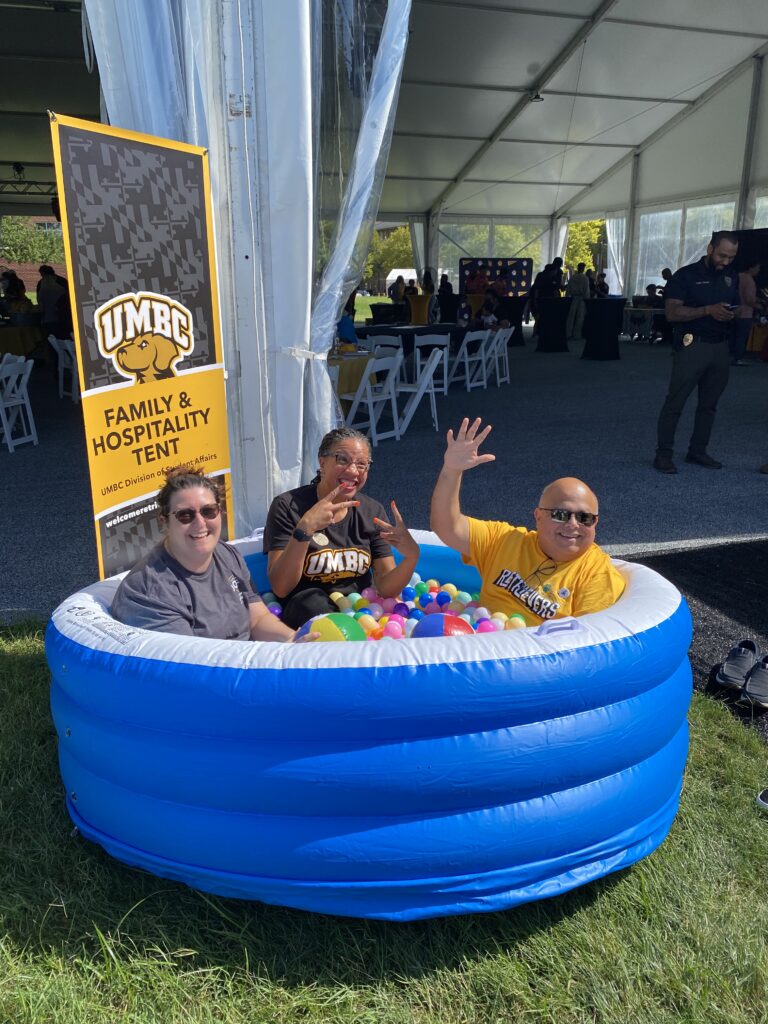 Diaz hangs out with Renique Kersh, vice president for student affairs (center), and Wendy Low, coordinator in the Division of Institutional Equity, in the hospitality tent’s ball pit. (Photo courtesy of Kait McCaffrey)
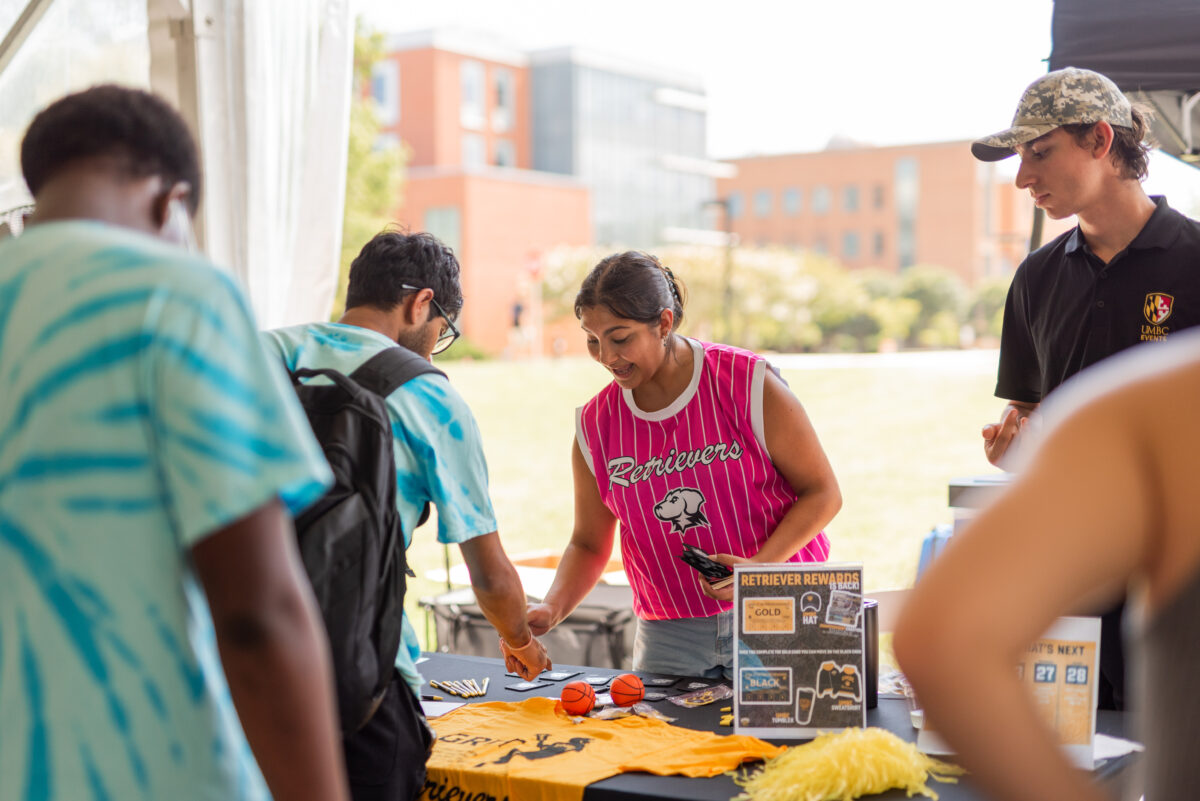
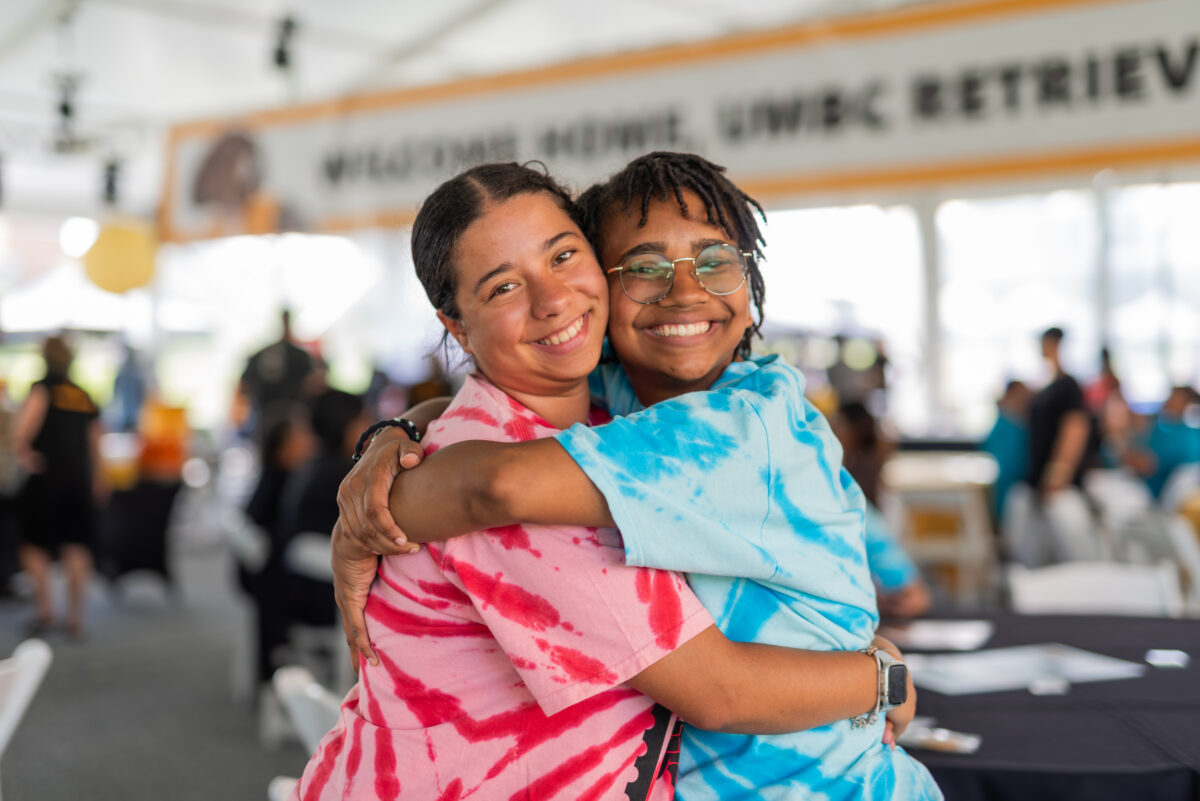
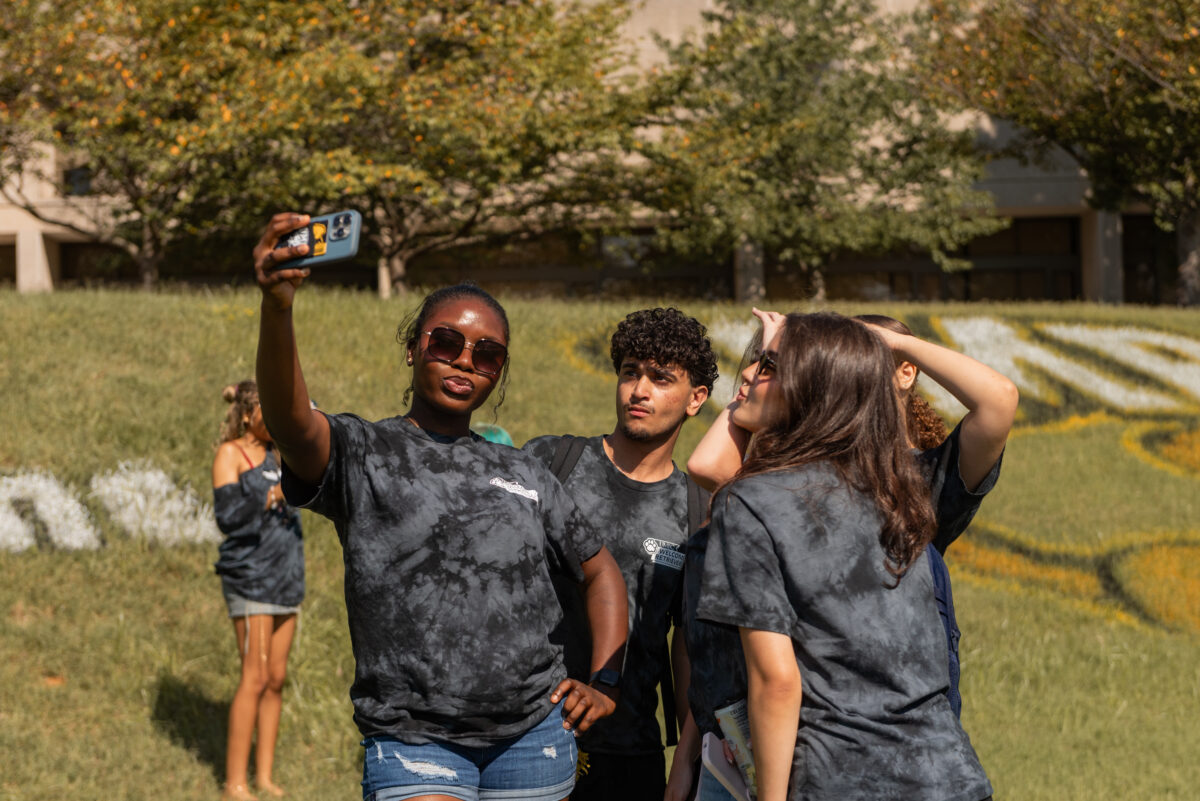
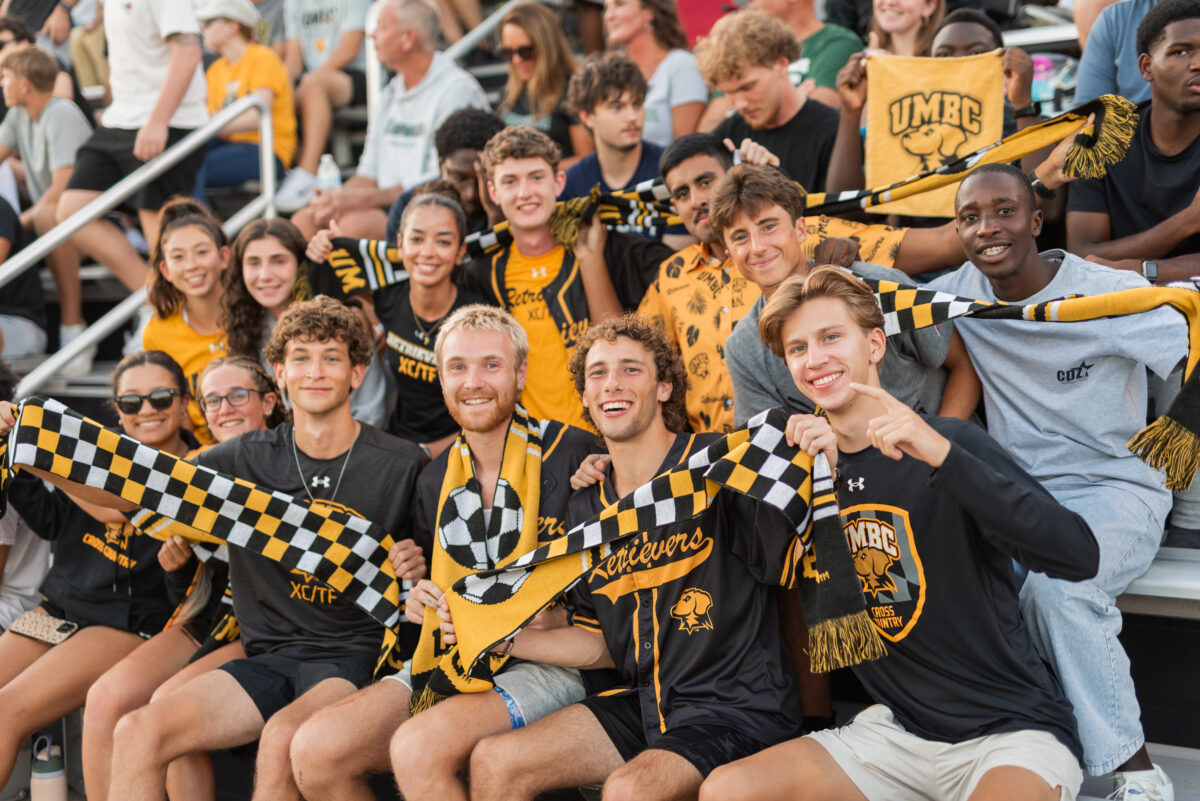
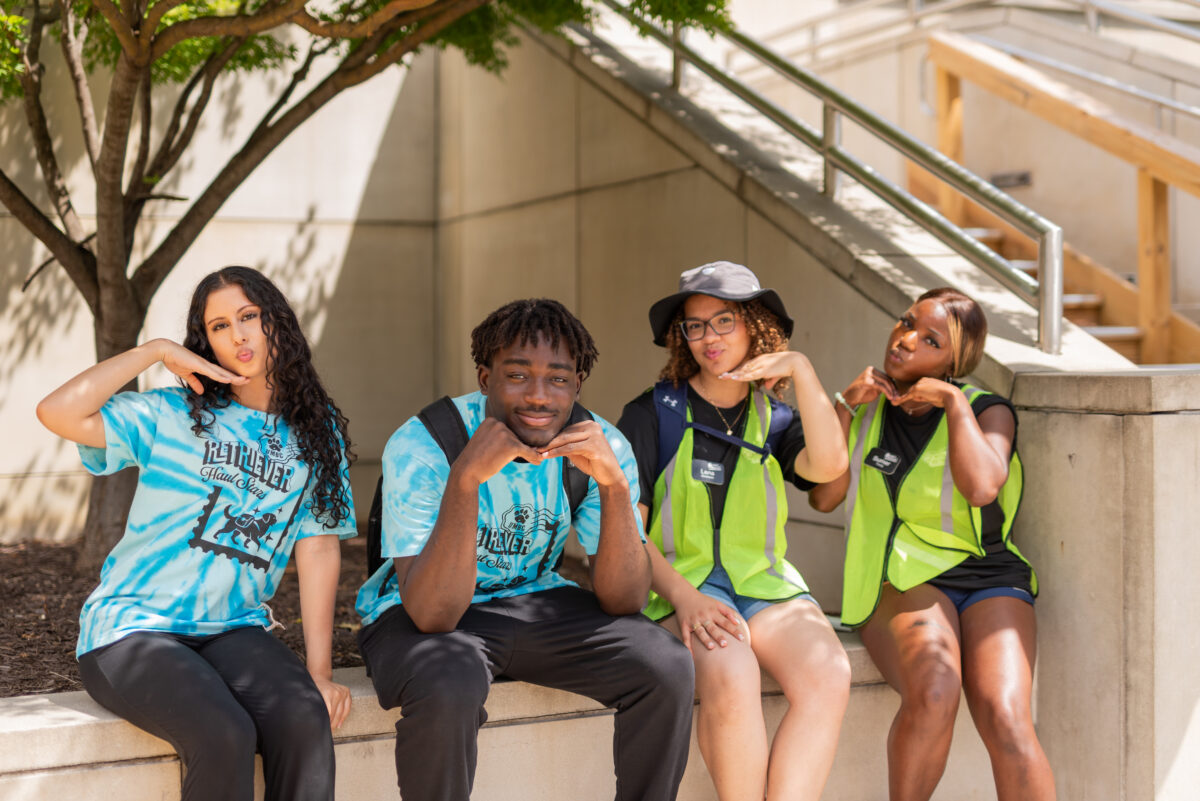
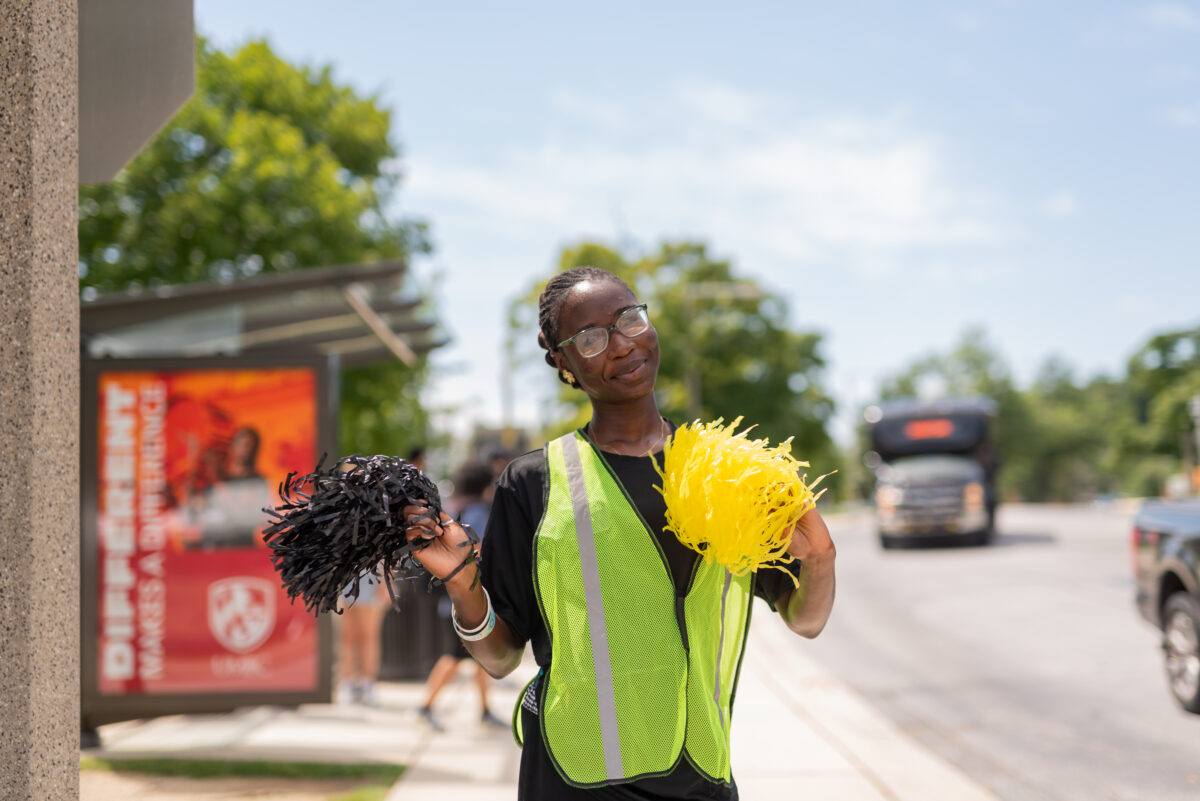
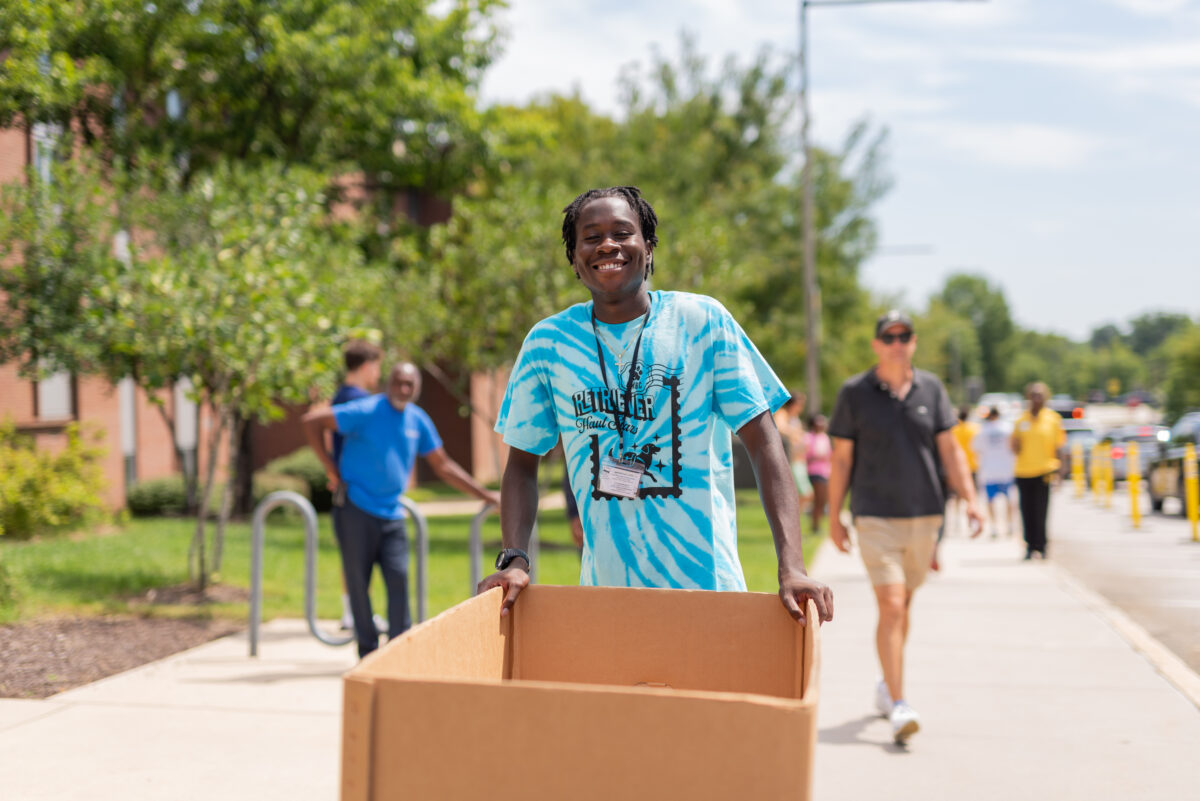
With a full lineup of events, this year’s Welcome, Retrievers efforts ensured that students started to find their place from the minute they stepped onto campus. Student volunteers (“Haul Stars”) were on hand to keep things moving as they helped new students with their belongings and offered directions.
Students weren’t the only ones getting in on the fun. Retriever Fest gave families the opportunity to meet with campus partners and learn more about everything UMBC has to offer—while enjoying refreshments and picking up some swag. Jake Diaz, inaugural assistant vice president and dean of students in the Division of Student Affairs, had a ball welcoming new students.
Throughout the weekend, students continued to enjoy Retriever 101 events, like First Night, an Student Events-Board-sponsored takeover of The Commons with inflatables, prizes, games, and plenty of other activities that cemented the first night as one students will remember for years to come.
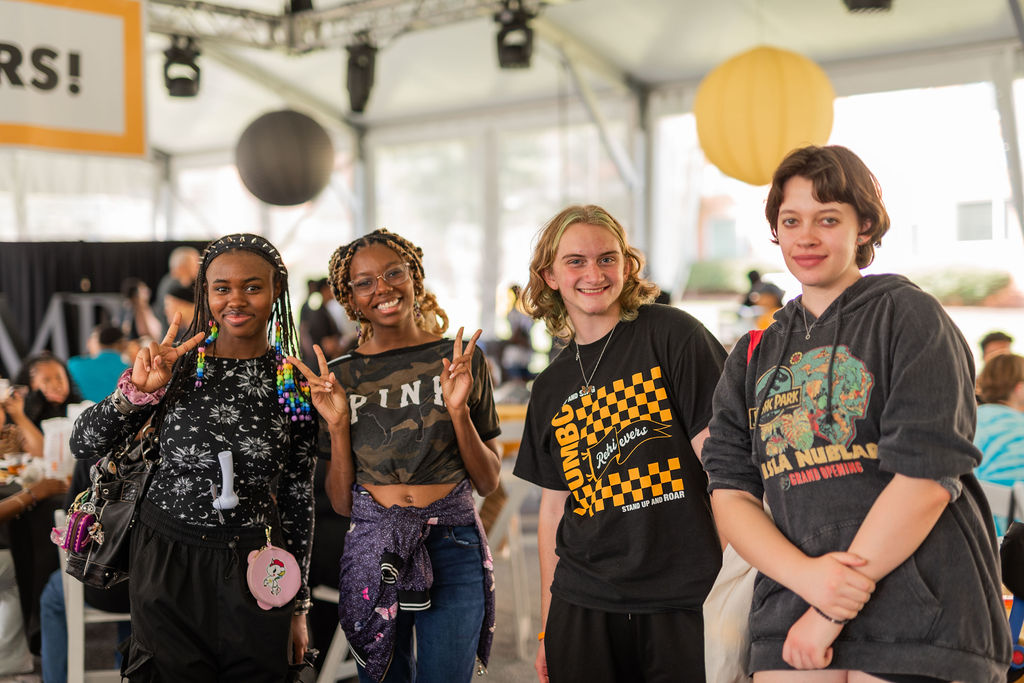
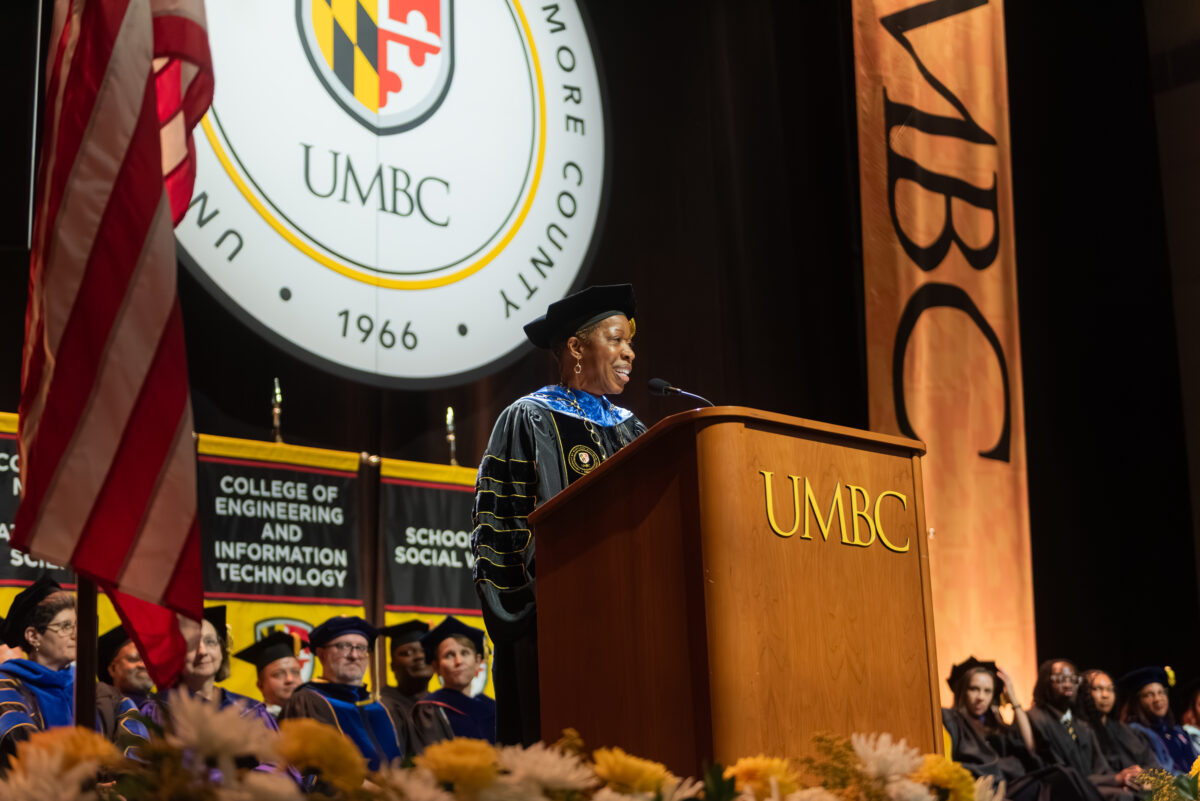
Events like the Taste of UMBC, Your Story Belongs Here, and the annual New Retriever Photo bonded students and filled their camera rolls. The first weekend concluded with Convocation, the official opening of the fall semester. President Valerie Sheares Ashby addressed the new students, reassuring them that UMBC is where they’re meant to be.
“…I want to make sure you hear this from me: You belong here. You have come to an institution that wants you here and believes that you can be successful here, even if you are not yet completely sure of that yourself.”
 ]]>
As fall 2026’s first full week of classes wrap up, Retrievers across campus—newly minted and returning—are finding their place. In addition to learning to navigate to the right classroom, they are...
https://umbc.edu/stories/you-belong-here-welcome-to-campus-for-fall-2026/
https://my3.my.umbc.edu/api/v0/pixel/news/162122/guest@my.umbc.edu/176c4fda6b22f7eb41f50de5e81bf5d4/api/pixel
cahss
campus-life
cnms
coeit
feature
ges
public-health
public-policy
shriver-center
stories
story
student-affairs
transfer
UMBC News & Magazine
https://my3.my.umbc.edu/groups/umbc-news-magazine
https://assets1-my.umbc.edu/system/shared/avatars/groups/000/001/943/24435aa6207c452e7bc15cc74b42c7bb/xsmall.png?1748556657
https://assets1-my.umbc.edu/system/shared/avatars/groups/000/001/943/24435aa6207c452e7bc15cc74b42c7bb/original.png?1748556657
https://assets2-my.umbc.edu/system/shared/avatars/groups/000/001/943/24435aa6207c452e7bc15cc74b42c7bb/xxlarge.png?1748556657
https://assets2-my.umbc.edu/system/shared/avatars/groups/000/001/943/24435aa6207c452e7bc15cc74b42c7bb/xlarge.png?1748556657
https://assets3-my.umbc.edu/system/shared/avatars/groups/000/001/943/24435aa6207c452e7bc15cc74b42c7bb/large.png?1748556657
https://assets1-my.umbc.edu/system/shared/avatars/groups/000/001/943/24435aa6207c452e7bc15cc74b42c7bb/medium.png?1748556657
https://assets2-my.umbc.edu/system/shared/avatars/groups/000/001/943/24435aa6207c452e7bc15cc74b42c7bb/small.png?1748556657
https://assets1-my.umbc.edu/system/shared/avatars/groups/000/001/943/24435aa6207c452e7bc15cc74b42c7bb/xsmall.png?1748556657
https://assets2-my.umbc.edu/system/shared/avatars/groups/000/001/943/24435aa6207c452e7bc15cc74b42c7bb/xxsmall.png?1748556657
UMBC News & Magazine
0
0
false
Fri, 28 Aug 2026 14:55:24 -0400
Fri, 28 Aug 2026 14:55:24 -0400
Record-setting group of UMBC students explores global careers through Albrecht Fellowship
]]>
As fall 2026’s first full week of classes wrap up, Retrievers across campus—newly minted and returning—are finding their place. In addition to learning to navigate to the right classroom, they are...
https://umbc.edu/stories/you-belong-here-welcome-to-campus-for-fall-2026/
https://my3.my.umbc.edu/api/v0/pixel/news/162122/guest@my.umbc.edu/176c4fda6b22f7eb41f50de5e81bf5d4/api/pixel
cahss
campus-life
cnms
coeit
feature
ges
public-health
public-policy
shriver-center
stories
story
student-affairs
transfer
UMBC News & Magazine
https://my3.my.umbc.edu/groups/umbc-news-magazine
https://assets1-my.umbc.edu/system/shared/avatars/groups/000/001/943/24435aa6207c452e7bc15cc74b42c7bb/xsmall.png?1748556657
https://assets1-my.umbc.edu/system/shared/avatars/groups/000/001/943/24435aa6207c452e7bc15cc74b42c7bb/original.png?1748556657
https://assets2-my.umbc.edu/system/shared/avatars/groups/000/001/943/24435aa6207c452e7bc15cc74b42c7bb/xxlarge.png?1748556657
https://assets2-my.umbc.edu/system/shared/avatars/groups/000/001/943/24435aa6207c452e7bc15cc74b42c7bb/xlarge.png?1748556657
https://assets3-my.umbc.edu/system/shared/avatars/groups/000/001/943/24435aa6207c452e7bc15cc74b42c7bb/large.png?1748556657
https://assets1-my.umbc.edu/system/shared/avatars/groups/000/001/943/24435aa6207c452e7bc15cc74b42c7bb/medium.png?1748556657
https://assets2-my.umbc.edu/system/shared/avatars/groups/000/001/943/24435aa6207c452e7bc15cc74b42c7bb/small.png?1748556657
https://assets1-my.umbc.edu/system/shared/avatars/groups/000/001/943/24435aa6207c452e7bc15cc74b42c7bb/xsmall.png?1748556657
https://assets2-my.umbc.edu/system/shared/avatars/groups/000/001/943/24435aa6207c452e7bc15cc74b42c7bb/xxsmall.png?1748556657
UMBC News & Magazine
0
0
false
Fri, 28 Aug 2026 14:55:24 -0400
Fri, 28 Aug 2026 14:55:24 -0400
Record-setting group of UMBC students explores global careers through Albrecht Fellowship
Eight UMBC students are spending part of their summer meeting business leaders, visiting Maryland companies, and getting a closer look at careers that connect the state to the rest of the world.
They were selected for the World Trade Center Institute’s (WTCI) 2026 Albrecht Fellowship, a two-week professional development program hosted in Baltimore City and focused on international business and global affairs. This year, the UMBC group set a record.
Daniel Khoshkepazi, senior manager of fellowships at the World Trade Center Institute, called the eight students “a record for a single university from any given cohort in the past.” WTCI typically limits participation to five or six students from one institution, he says. But UMBC students ranked so highly during what he described as the program’s most competitive application cycle to date that “their exceptional performance earned them a place in the cohort.”
For the students participating, the two weeks are a chance to test assumptions about their careers, see what they have studied at UMBC in practice, and, in some cases, discover work they had never considered.
Trying something different
 Headshot courtesy of Matthew O’Donnell
Matthew O’Donnell applied for the fellowship the day after hearing WTCI CEO Eddie Resende speak at UMBC. O’Donnell, a senior global studies major and political science minor, had been thinking about how he spent his first few years of college and wanted to push himself to try something different. Resende’s description of the fellowship and its focus on global trade and business caught his attention.
“I began to realize I need to step out of my comfort zone more,” O’Donnell says. “I felt that I spent my first semesters too close to the norm, and I wanted to try a new experience to see how it would go.”
Gouri Gupta, a junior, initially had a different reaction when she heard about the opportunity. A global studies and political science double major on the pre-law track, Gupta initially brushed off the fellowship. Marketing, global supply chains, logistics, and other business-oriented topics did not seem particularly relevant to her plans to pursue human rights law or federal law enforcement.
Eventually, that became part of the appeal. Gupta decided there could be value in pursuing an experience that did not neatly match the future she had planned for herself. A few hours before the application closed, she started filling it out. She hit submit just seconds before midnight.
The experience introduced Gupta to industries she had rarely considered. Through site visits, she got a closer look at the systems behind everyday products, from olive oil and power saws to athletic wear. She also began connecting concepts from the classroom with areas such as supply chain management and logistics. For Gupta, the fellowship helped clear up some of the “fuzziness” surrounding careers and industries she had previously known primarily as a consumer.
Seeing coursework in action
That sense of discovery is showing up in the classroom connections students are making, too.
During a fellowship panel on global business and supply chains, O’Donnell found himself fascinated by a field he had known little about. He stayed after the session to talk with several panelists about their work. As he explores new fields through the fellowship, he is also seeing connections to topics he has discussed in his global studies courses at UMBC, including global trade, artificial intelligence, international boundaries, and negotiation.
Bibi Qudsia Tolwak, a senior global studies major and public humanities minor, has studied national and international organizations in her UMBC courses. Through the fellowship, she had the chance to visit organizations and businesses and talk directly with professionals about their work.
Originally from Afghanistan, Tolwak is interested in global affairs, humanitarian work, refugee issues, and advocacy. But one of the things that has stood out to her during the fellowship has less to do with any particular industry.
The professionals the students heard from have taken very different routes to their current roles. Some started as interns. Some applied multiple times before an opportunity came through. Others changed directions or faced challenges such as building careers while speaking English as a second language.
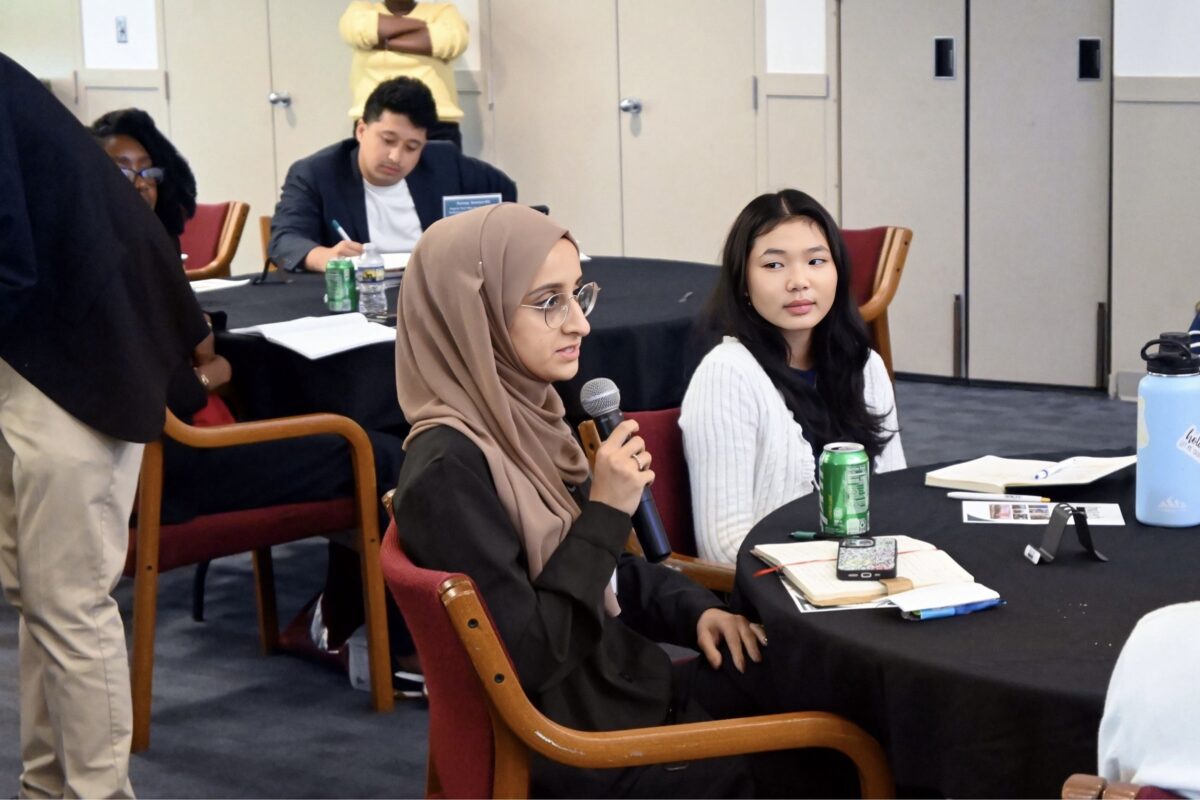 Bibi Qudsia Tolwak speaks at a WTCI group meeting. (Photo courtesy of Tolwak)
“It reminded me that careers do not always happen all at once,” Tolwak says. “Sometimes you just have to say yes to an opportunity and keep moving forward.”
The message resonated with Gupta, too. During a visit to McCormick’s plant and global headquarters in Hunt Valley, Maryland, a panelist shared a message about how the steps toward one career goal may not be the same ones that lead to the next. Gupta says it put into words one of the biggest lessons she is taking from the fellowship: Growth requires being willing to learn and adapt.
Eight Retrievers, one cohort
The size of UMBC’s group has added another dimension to the experience. “It has been great meeting other Retrievers from different majors and backgrounds and learning from their experiences,” Tolwak says. “It also makes me proud to see so many UMBC students represented in the fellowship.”
O’Donnell appreciates that the students bring different interests and strengths to the group. “One thing I love is that nobody feels like they’re overshadowing one another,” he says. “We each have our interests and strengths, and no matter if it’s a group setting or an individual one, we always contribute in a way that aids both ourselves and the group.”
Their paths to the fellowship began months earlier. In April, UMBC’s Global Studies Program hosted Global Career Conversations with Resende, an event focused on international careers. Felipe Filomeno, director of the Global Studies Program, and Christine Routzahn, director of the Career Center, worked together to promote the fellowship and encourage students to apply.
After the UMBC students were selected, the university worked to make sure cost would not prevent any of them from participating. The Division of Student Affairs provided support through a combination of the Career Center’s intern and service funds and divisional resources, allowing all eight students to participate.
Making room for what comes next
As the fellowship continues, the students are not necessarily finding one answer about what comes next. Instead, they are becoming more comfortable with the possibility that their careers may take unexpected turns.
O’Donnell is interested in international relations and more recently, community engagement and local government as well. The fellowship has given him more possibilities to consider rather than one definitive answer.
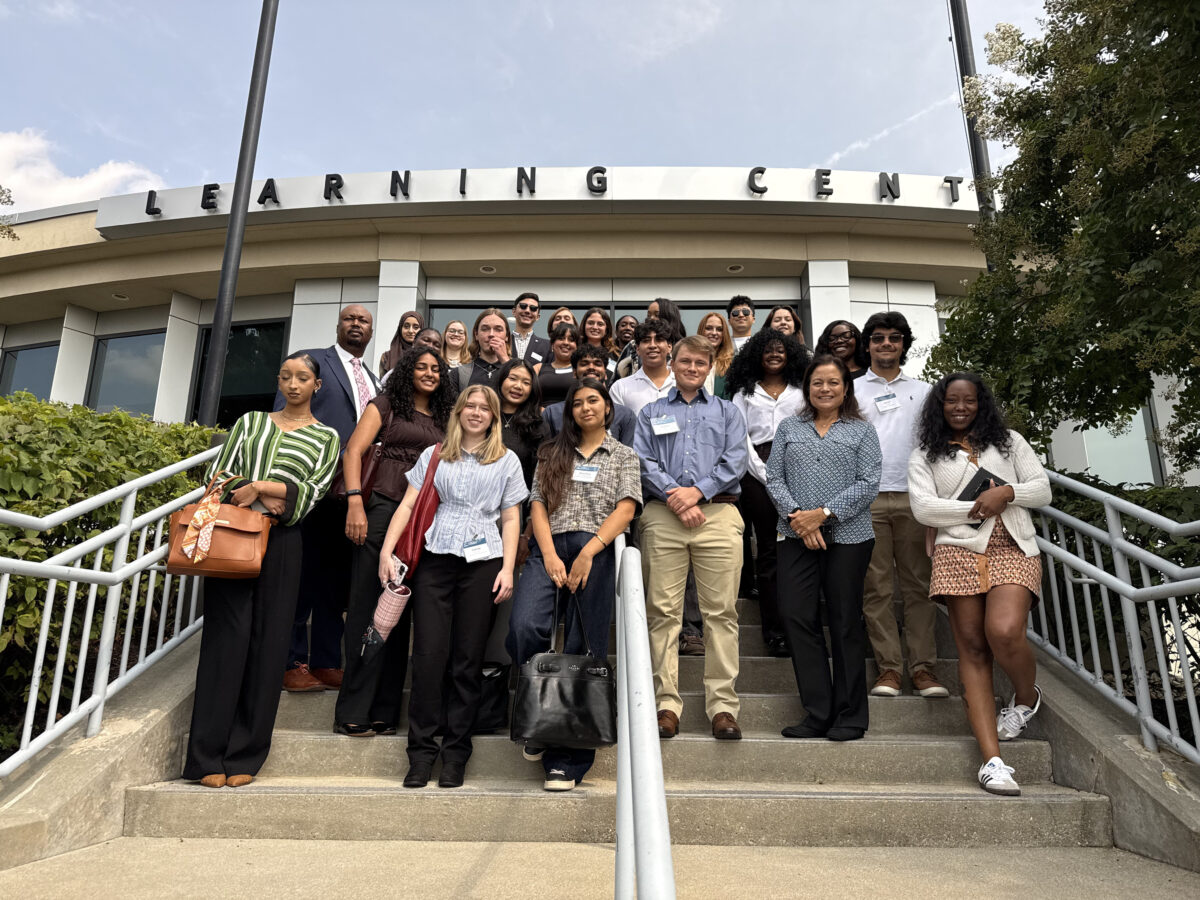 The WTCI interns gather at another site visit. (Photo courtesy of Tolwak).
“The Albrecht Fellowship has certainly given me more to think on, and that’s really what I wanted from this opportunity,” he says.
Tolwak is also still exploring where her interests will lead after UMBC. “I have learned that successful careers are not always straightforward,” Tolwak says. “You do not have to have everything figured out at the beginning; you just have to be willing to learn, keep trying, and say yes to opportunities that can help you grow.”
Gupta is considering law school and careers in human rights or federal law enforcement. The fellowship is also changing how she thinks about entering spaces where she may be younger or less experienced than the people around her.
“If there is one important lesson that the fellowship taught me, it’s that we—as students and professionals—can own our space,” Gupta says.
She hopes to carry that confidence into a field where she wants to make a difference: Gupta specifically wants to increase the representation of South Asian women in federal law enforcement. “I want to change that, and the Albrecht Fellowship has solidified the notion that I can change it.”
]]>
Eight UMBC students are spending part of their summer meeting business leaders, visiting Maryland companies, and getting a closer look at careers that connect the state to the rest of the world....
https://umbc.edu/stories/exploring-global-careers-albrecht-fellowship/
https://my3.my.umbc.edu/api/v0/pixel/news/162085/guest@my.umbc.edu/172c155646d287fefd0c96cd8334dee5/api/pixel
cahss
campus-life
career-center
community
global-studies
political-science
pre-law
public-humanities
stories
story
UMBC News & Magazine
https://my3.my.umbc.edu/groups/umbc-news-magazine
https://assets1-my.umbc.edu/system/shared/avatars/groups/000/001/943/24435aa6207c452e7bc15cc74b42c7bb/xsmall.png?1748556657
https://assets1-my.umbc.edu/system/shared/avatars/groups/000/001/943/24435aa6207c452e7bc15cc74b42c7bb/original.png?1748556657
https://assets2-my.umbc.edu/system/shared/avatars/groups/000/001/943/24435aa6207c452e7bc15cc74b42c7bb/xxlarge.png?1748556657
https://assets2-my.umbc.edu/system/shared/avatars/groups/000/001/943/24435aa6207c452e7bc15cc74b42c7bb/xlarge.png?1748556657
https://assets3-my.umbc.edu/system/shared/avatars/groups/000/001/943/24435aa6207c452e7bc15cc74b42c7bb/large.png?1748556657
https://assets1-my.umbc.edu/system/shared/avatars/groups/000/001/943/24435aa6207c452e7bc15cc74b42c7bb/medium.png?1748556657
https://assets2-my.umbc.edu/system/shared/avatars/groups/000/001/943/24435aa6207c452e7bc15cc74b42c7bb/small.png?1748556657
https://assets1-my.umbc.edu/system/shared/avatars/groups/000/001/943/24435aa6207c452e7bc15cc74b42c7bb/xsmall.png?1748556657
https://assets2-my.umbc.edu/system/shared/avatars/groups/000/001/943/24435aa6207c452e7bc15cc74b42c7bb/xxsmall.png?1748556657
UMBC News & Magazine
0
0
false
Thu, 27 Aug 2026 14:39:28 -0400
Thu, 27 Aug 2026 14:39:28 -0400
Details and detective skills matter at Reese Finnigan’s internship at the U.S. Holocaust Memorial Museum’s archives in Bowie
Deep in UMBC’s climate-controlled Special Collections are 750,000 prints, negatives, and transparencies from The Baltimore Sun dating from the 1930s through the 1980s.
Before faculty and students can use the collection, archivists must create finding aids. These inventory documents describe a collection—its origins, number of pieces, types of materials, their quality, dates, number of archival boxes, box measurements, and more. It’s a road map guiding users through each piece of a collection.
Reese Finnigan, studying the history of the Soviet Union and learning Russian, developed these archival skills working on The Baltimore Sun collection during her first year in the Master of Arts in Public History program. This year, when looking for summer internship opportunities, Finnigan was excited to find that the United States Holocaust Memorial Museum Shapell Family Collections, Conservation and Research Center in Bowie, Maryland—a museum she had tried to secure a curatorial or research internship with for years—was seeking an intern with her exact skill set.
“In retrospect, this is the first year that I’ve had the skills and resume needed for this level of archival work,” says Finnigan, grateful that Maryland is home to such a prestigious research center with the largest concentration of Holocaust-related records in the United States, and to learn from archival experts with decades of experience. “The opportunities UMBC has given me to learn Russian, historical research, and archival skills dovetailed very nicely with the center’s Archival Affairs Division internship, which required knowledge of Eastern European history and languages.”
Needle in the digital stack
The finding aids for the Eastern European collection that Finnigan is working on do not always directly correspond to what is in the archive. Some materials are in the wrong order or are missing finding aids. Other times, some things aren’t listed in the original file but are actually in it. Finnigan also has to translate the words on the document, which could be a translation of the original language, depending on where the document was recovered from. It could be Russian, a Slavic language, or any language using the Cyrillic alphabet, which is used for various languages across Eastern Europe, the former Soviet Union, and the Soviet Republics of Central Asia.
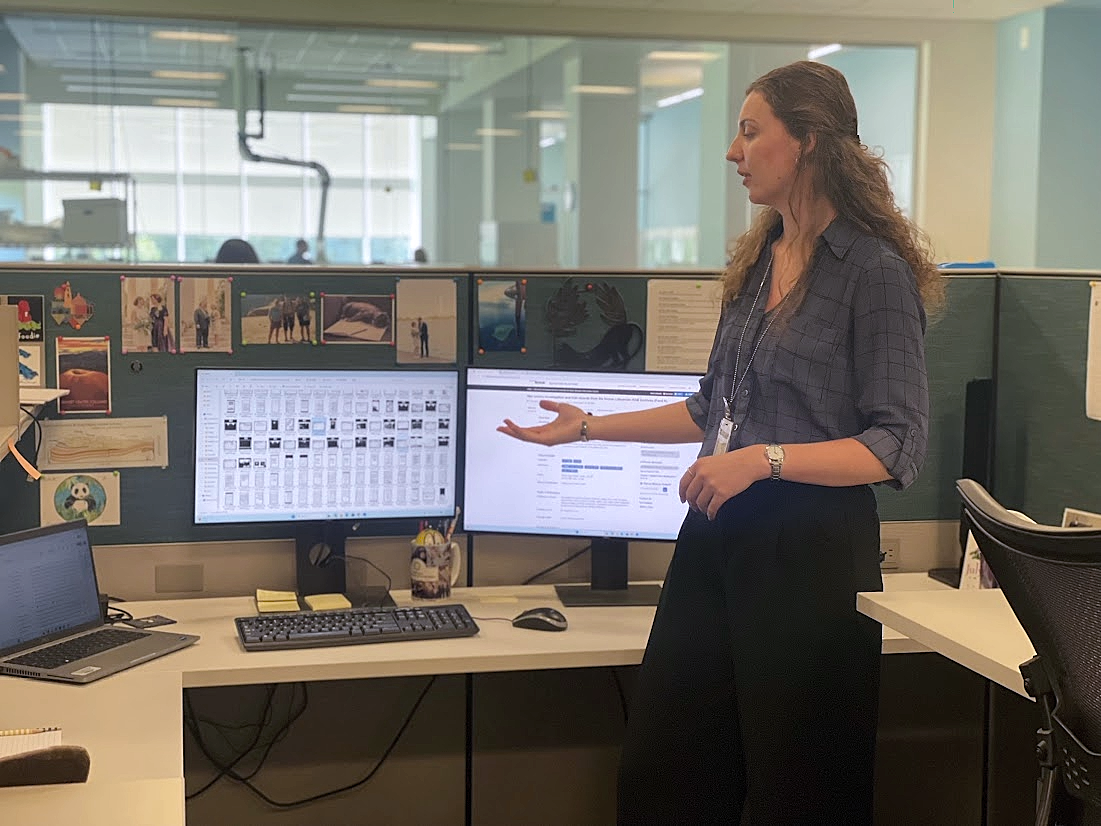 Finnigan showing the documents and photographs she is creating finding aids for.
She spends hours cross-checking inventories, documents, photos, descriptions, and creating new spreadsheets that reflect the latest information. She then hands it off to another archivist to double-check her work. It’s a cycle of verification and refinement to align the finding aids with the accurate collections. The maze of finding aids is the result of different archival processes carried out across borders, countries, and decades. “The researcher should be able to come in and find something quickly without ever having to think too much about it. The easier they can find things, the better,” says Finnigan.
A note from the past
Some mysteries are beyond languages and locations, stumping even a team of experts and bringing them together to do serious detective work. That’s exactly what happened when Finnigan noticed a small symbol on some original photos in a Lithuanian KGB (national security and intelligence agency) collection placed by the original archives. She asked archivists Julie Schweitzer, her boss, and Alla Dvorkin, her direct supervisor, but they hadn’t seen it before either. The mystery quickly spread throughout the building, ensuing a string of emails with experts weighing in, hoping to reveal the meaning of what looked like a small bean. They found that the symbol was a mark used in some European archival systems to note the poor quality of the writing or the photography.
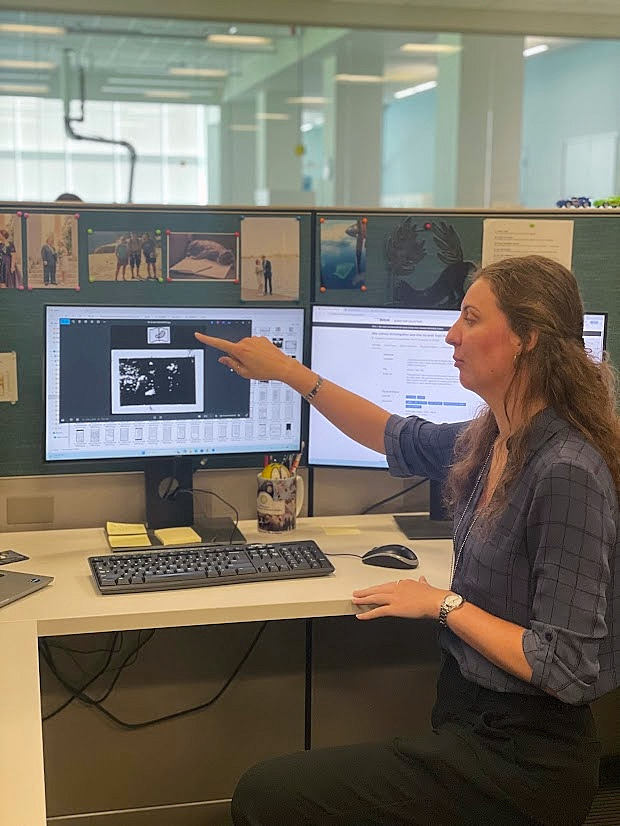
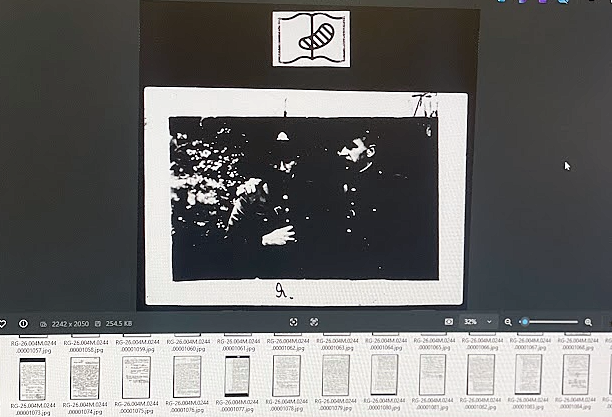
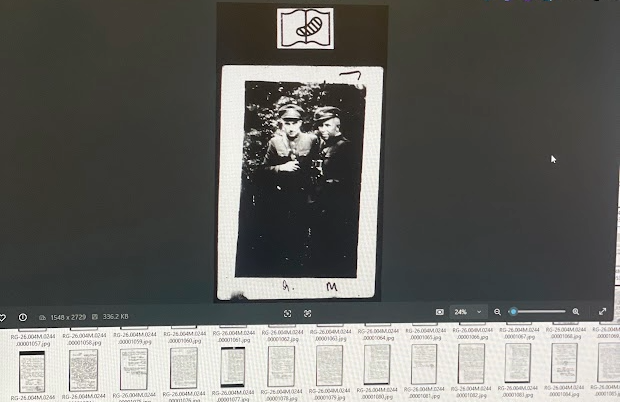
Finnigan showing the mysterious mark she came across in a set of photographs.
“People often imagine archival work as simply preserving historical materials. In reality, a surprising amount of the job involves acting as part historian, part detective, part translator, and occasionally part conspiracy theorist—until someone finds the answer,” Finnigan posted on LinkedIn. “It’s a reminder that expertise is often collective. No single person knew the answer. The solution emerged through conversations, institutional knowledge, and a network of colleagues willing to chase down an obscure question simply because it mattered.”
To preserve and share
In the last few weeks of her internship, Finnigan received additional training from Adam Fielding, a processing archivist who works primarily with personal papers. Fielding, who has been at the center for 11 years, began by showing Finnigan the Rudolph Daniel Sichel papers, an example of what a finished collection can look like once the personal papers have been digitized and preserved in archival boxes.
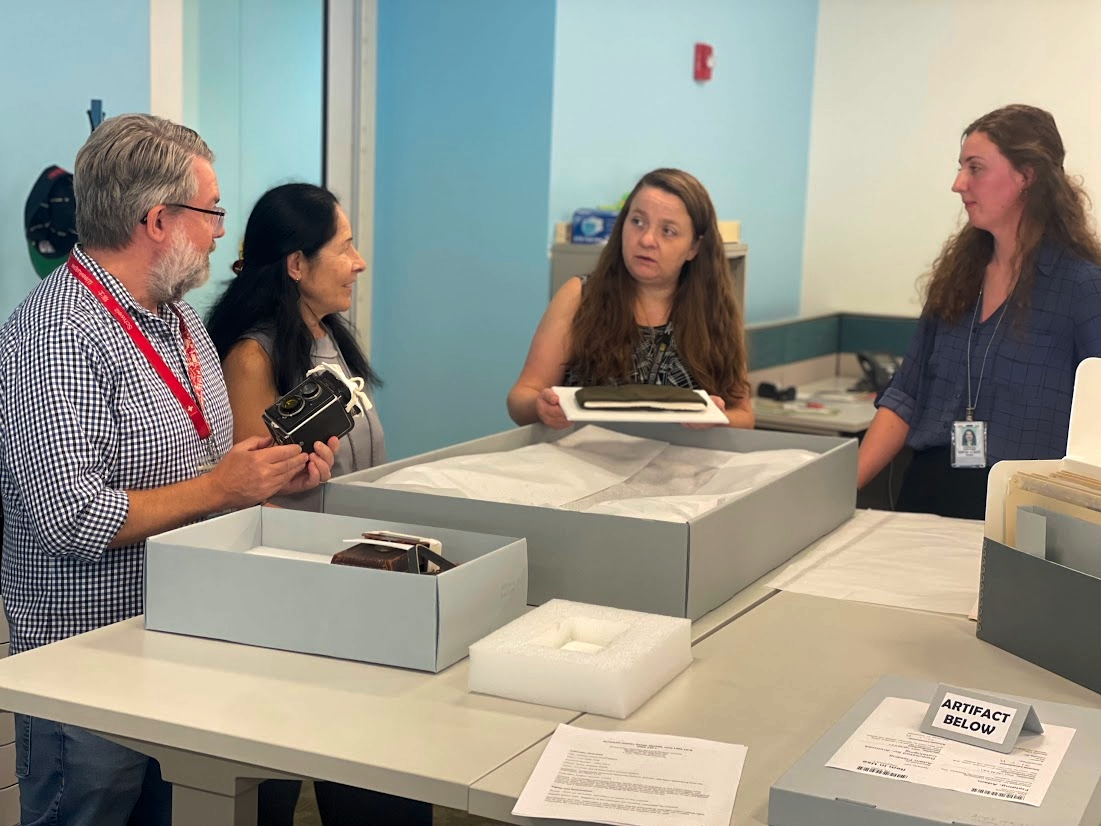
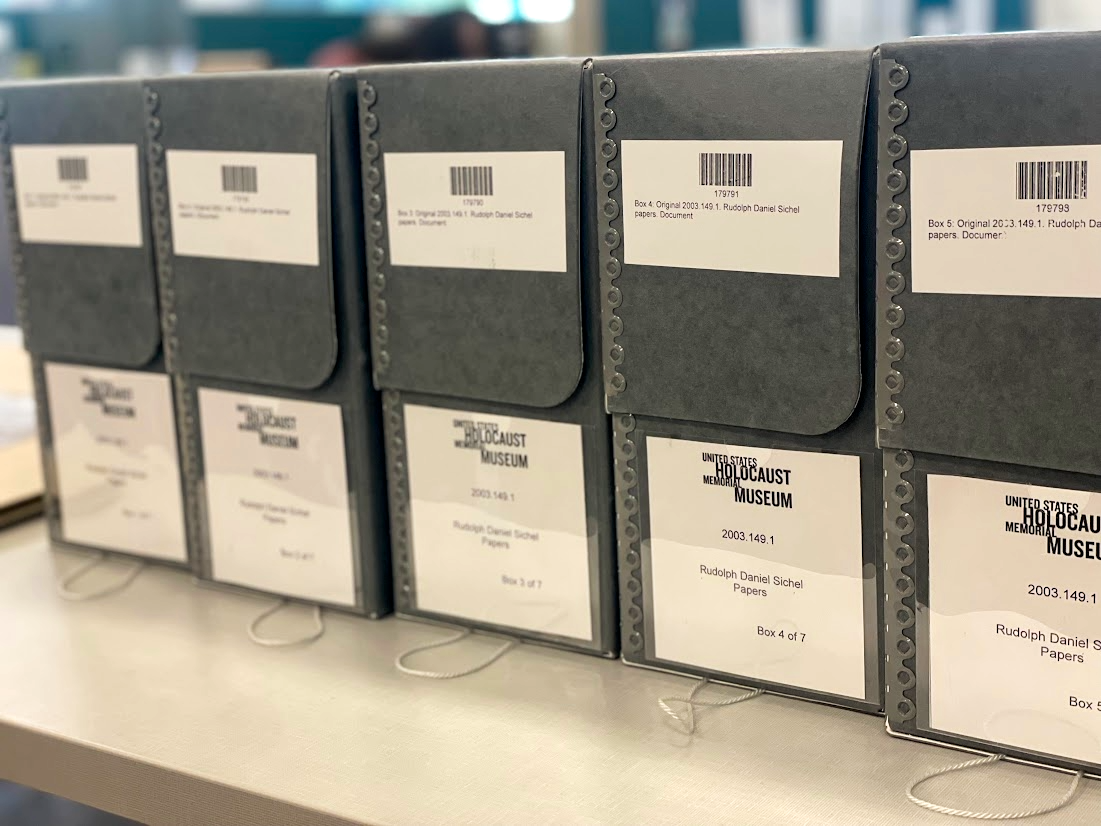
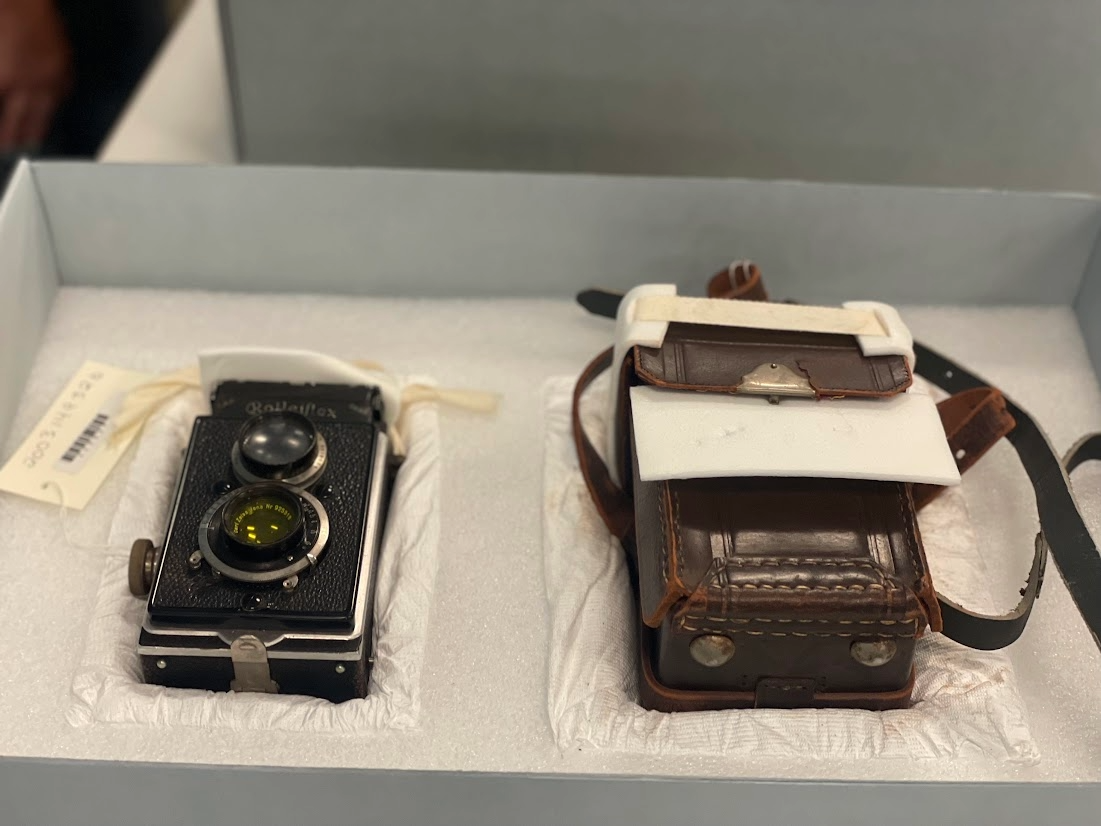
(Top) Finnigan with Fielding, Dvorkin, and Schweitzer (center), reviewing Rudolph Daniel Sichel‘s military uniform and personal camera. (Bottom) The Sichel collection archival boxes and Sichel’s camera and camera case.
The Sichel papers, donated by Rudolph’s children, consist of seven boxes with documents dating from 1903 to 1978, many of which connect Sichel to Maryland. Sichel was a “Ritchie Boy,” one of thousands of Jewish refugees who immigrated to the U.S., enlisted in the army, and trained at the Military Intelligence Training Center at Camp Ritchie near Cascade, Maryland, a little over an hour north of UMBC.
The additonal training gave Finnigan the techniques to work with non-digital items that require special care, like the folder Fielding tasked her with, full of primarily prewar family photographs related to the Kugelman family from Bedzin, Poland, dating between 1930 – 1942.
While putting these skills to use was exciting, the greater reward was seeing the impact of the team’s work. Finnigan’s interest in archival work is not only about preserving history but also making archives accessible to the public, which are two of the center’s priorities.
“There is no point in preserving all of this history if the public can’t access it. We want to preserve the history and make it easily accessible, whether through exhibitions, digital archives, or physical collections. Good archival work should essentially be invisible,” says Finnigan. This includes special handling and storage methods, like cold storage (35°F to 50°F) and cool storage (55°F to 65°F) to dramatically slow chemical decay, stop pest activity, and extend the lifespan of sensitive artifact and media collections.
“The collections at the Shapell Center are evidence of atrocities, of war crimes, of survival,” says Finnigan. “If the items are damaged, they can’t be replaced, and then that piece of history is lost.”
Learn more about internship opportunities at the United States Holocaust Memorial Museum’s archives.
]]>
Deep in UMBC’s climate-controlled Special Collections are 750,000 prints, negatives, and transparencies from The Baltimore Sun dating from the 1930s through the 1980s. Before faculty and...
https://umbc.edu/stories/details-and-detective-skills-matter-at-reese-finnigans-internship-at-the-u-s-holocaust-memorial-museums-archives-in-bowie/
https://my3.my.umbc.edu/api/v0/pixel/news/161639/guest@my.umbc.edu/38aca15bbbceb371a51a6da4ca4cef43/api/pixel
cahss
career-center
history
international
internships
policy-and-society
stories
story
UMBC News & Magazine
https://my3.my.umbc.edu/groups/umbc-news-magazine
https://assets1-my.umbc.edu/system/shared/avatars/groups/000/001/943/24435aa6207c452e7bc15cc74b42c7bb/xsmall.png?1748556657
https://assets1-my.umbc.edu/system/shared/avatars/groups/000/001/943/24435aa6207c452e7bc15cc74b42c7bb/original.png?1748556657
https://assets2-my.umbc.edu/system/shared/avatars/groups/000/001/943/24435aa6207c452e7bc15cc74b42c7bb/xxlarge.png?1748556657
https://assets2-my.umbc.edu/system/shared/avatars/groups/000/001/943/24435aa6207c452e7bc15cc74b42c7bb/xlarge.png?1748556657
https://assets3-my.umbc.edu/system/shared/avatars/groups/000/001/943/24435aa6207c452e7bc15cc74b42c7bb/large.png?1748556657
https://assets1-my.umbc.edu/system/shared/avatars/groups/000/001/943/24435aa6207c452e7bc15cc74b42c7bb/medium.png?1748556657
https://assets2-my.umbc.edu/system/shared/avatars/groups/000/001/943/24435aa6207c452e7bc15cc74b42c7bb/small.png?1748556657
https://assets1-my.umbc.edu/system/shared/avatars/groups/000/001/943/24435aa6207c452e7bc15cc74b42c7bb/xsmall.png?1748556657
https://assets2-my.umbc.edu/system/shared/avatars/groups/000/001/943/24435aa6207c452e7bc15cc74b42c7bb/xxsmall.png?1748556657
UMBC News & Magazine
0
0
false
Fri, 14 Aug 2026 11:51:40 -0400
Fri, 14 Aug 2026 11:51:40 -0400
Meet a Retriever—Kyle Clelan ’08, M.A. ’09, private investments manager and Retriever Loyal donor
Meet Kyle Clelan, a double alumnus who earned his B.S. in financial economics in 2008 and his M.A. in economic policy analysis in 2009. Today, he serves as a private investments manager with The Johnson Group, building on a successful career with stints at the U.S. Commodity Futures Trading Commission and T. Rowe Price. Kyle is also a Retriever Loyal donor, having given back to UMBC for the past eight years. Take it away, Kyle!
Q: What brought you to UMBC?
A: I was primarily drawn to UMBC because of its academically-centered reputation coming out of high school. I wanted to go to school, study, and work hard so that I could get to my career as soon as possible. Then I found myself surrounded by similarly-minded people and started making some lifelong friendships—many of whom were in my wedding. Meeting so many great people with a vast array of life experiences and backgrounds enhanced my time at UMBC immensely and helped me to slow down and enjoy the journey.

 Left: Clelan when he first started at UMBC and lived in Chesapeake Hall. Right: Clelan and his first-year roommate, Matt Basch ’08, M.S. ’09, who became a lifelong friend.
Q: What did you love about the economics programs at UMBC?
A: The economic policy analysis program in particular introduced me to econometric and data science concepts and how they can apply to investment management and policy decision-making. I have used foundational knowledge I learned in that coursework over and over throughout my career. From how to build a model using Stata or SAS, for example, to learning how to organize data and look for anomalies that can help inform better risk management, the courses taught me how to think better analytically and holistically.
Q: Who in the community inspired you or supported you?
A: Doug Lamdin in the Department of Economics was my M.A. advisor, and I also did work with him during my time as an undergraduate. He helped me connect the dots between academia and practice by pushing me to do research with real-world market data. He also introduced me to several professional mentors and helped me find my initial internship at T. Rowe Price, where I spent the first 12 years of my professional career. That experience has been instrumental to where I am today.
Without Dr. Lamdin’s guidance and support, I likely would have never found that pivotal opportunity. And the knowledge I acquired and various investment and technical courses continue to come in handy in roles I have had and have now.
Q: What’s one thing you’d want someone to know about the support you find at UMBC?
A: I came to UMBC expecting a healthy balance of academic rigor and the opportunity to develop lasting relationships and connections. I was not disappointed. UMBC offers a myriad of opportunities to perform meaningful research. Undergraduate Research and Creative Achievement Day, also known as URCAD, is one example that was very rewarding for me to publish my first paper. There are real pipelines that I personally benefitted from to get my career going, which showed me opportunities that wouldn’t have been possible without UMBC. It’s all about being proactive and seeking them out because the resources are there.
The UMBC community really engages with alumni and cares how they are doing after graduation.
Kyle Clelan ’08, M.A. ’09
financial economics
Q: Tell us about your current job. What do you like most about it?
A: For the past five years, I was a risk analyst within the Risk Surveillance Branch at the U.S. Commodity Futures Trading Commission (CFTC). I enjoyed performing broad derivatives market oversight work where we published reports on a regular basis to help better inform the public and help markets better manage systemic risks.
For the last year, I have relocated to being nearer to family in South Carolina and am working as a private investments manager for a family office and set of operating companies. In this role, I am applying the investment and risk management knowledge acquired from UMBC and my career, and I am enjoying being part of investment and capital allocation decisions that directly affect investment outcomes that benefit the company and also the local community.
Q: What drives you to support UMBC?
A: Without financial support from aid and scholarships, I likely would not have been able to attend college at all. So, giving back in whatever way I can now is important to me and my family because it could be just the little bit extra that makes all of the difference for someone to make something really special happen.
* * * * *
UMBC’s greatest strength is its people. When people meet Retrievers and hear about the passion they bring, the relationships they create, the ways they support each other, and the commitment they have to inclusive excellence, they truly get a sense of our community. That’s what “Meet a Retriever” is all about.
Learn more about how UMBC can help you achieve your goals.
]]>
Meet Kyle Clelan, a double alumnus who earned his B.S. in financial economics in 2008 and his M.A. in economic policy analysis in 2009. Today, he serves as a private investments manager with The...
https://umbc.edu/stories/meet-kyle-clelan-financial-economics/
https://my3.my.umbc.edu/api/v0/pixel/news/161541/guest@my.umbc.edu/f3bf184af8cd0e930c021c9d0b7bff32/api/pixel
alumni
cahss
financial-economics
impact
stories
story
UMBC News & Magazine
https://my3.my.umbc.edu/groups/umbc-news-magazine
https://assets1-my.umbc.edu/system/shared/avatars/groups/000/001/943/24435aa6207c452e7bc15cc74b42c7bb/xsmall.png?1748556657
https://assets1-my.umbc.edu/system/shared/avatars/groups/000/001/943/24435aa6207c452e7bc15cc74b42c7bb/original.png?1748556657
https://assets2-my.umbc.edu/system/shared/avatars/groups/000/001/943/24435aa6207c452e7bc15cc74b42c7bb/xxlarge.png?1748556657
https://assets2-my.umbc.edu/system/shared/avatars/groups/000/001/943/24435aa6207c452e7bc15cc74b42c7bb/xlarge.png?1748556657
https://assets3-my.umbc.edu/system/shared/avatars/groups/000/001/943/24435aa6207c452e7bc15cc74b42c7bb/large.png?1748556657
https://assets1-my.umbc.edu/system/shared/avatars/groups/000/001/943/24435aa6207c452e7bc15cc74b42c7bb/medium.png?1748556657
https://assets2-my.umbc.edu/system/shared/avatars/groups/000/001/943/24435aa6207c452e7bc15cc74b42c7bb/small.png?1748556657
https://assets1-my.umbc.edu/system/shared/avatars/groups/000/001/943/24435aa6207c452e7bc15cc74b42c7bb/xsmall.png?1748556657
https://assets2-my.umbc.edu/system/shared/avatars/groups/000/001/943/24435aa6207c452e7bc15cc74b42c7bb/xxsmall.png?1748556657
UMBC News & Magazine
0
0
false
Tue, 11 Aug 2026 08:44:06 -0400
Tue, 11 Aug 2026 08:44:06 -0400
Nothing but beauty: Noor Zaidi leads an international interfaith team digitizing the history of one of the few shrines to a woman in Islam
The Sayyida Zainab shrine, near Damascus, Syria, is capped by a gold leaf dome atop a building wrapped in interlocking glazed tiles. The aquamarine, gold, amethyst, and brown tiles create geographic tapestries of swirls and intricate flower patterns. It’s a beautiful place of splendor inside and out, where thousands of Shi‘i Muslim pilgrims and visitors worldwide gather, pray, and honor the resting place of Zainab bint ‘Ali, Prophet Muhammad’s granddaughter. The shrine’s roofline is decorated with cobalt blue tiles that repeat the phrase, “Peace be upon you, oh mother of sorrows and hardships” in white Arabic calligraphy—a testament to the trials Zainab endured throughout her life.
When Noor Zaidi, assistant professor of history, visited the shrine on pilgrimage with her family more than 20 years ago, she was mesmerized. The shrine then inspired her graduate research, and now Zaidi is a scholar of the Middle East and South Asia specializing in the history of gender and sectarianism.
Her new book, Traces of Zainab: Ritual, Memory, and Place in Shi’a Islam, is a study of the woman who became a symbol of resistance for Shi‘i Muslims worldwide. Now Zaidi is leading an international interfaith team to preserve, restore, and digitize the shrine’s archives. With the support of Father Columba Stewart of the Hill Museum & Manuscript Library (HMML) in Minnesota, the Holy Spirit University of Kaslik in Lebanon, and the Mourtada family from Damascus, who have been the custodians of the shrine for over 800 years, the world will learn about one of the very few shrines to a woman in Islam and the community that has preserved it with love.
“We are delighted to return to Syria in support of this historic project,” says Stewart, executive director and CEO of HMML, at Saint John’s University—one of the world’s leading organizations funding the preservation and digitization of endangered archives to create open access collections. “Partnering with this historic shrine lies at the very heart of HMML’s mission to preserve and share the world’s handwritten past to inspire a deeper understanding of our present and future.”
Zaidi notes that this is not just about preserving. It’s about teaching students what it takes to be historians, stewards of a past with many missing parts, and to be aware that their work cannot happen in isolation. “There is a story to tell in the construction of this work that also tells us about the discipline of history, at this moment in time,” says Zaidi. “It’s a story of how to teach students to be conscientious scholars: to not just look at newspapers and documents but take into account what’s not being told, what history is being erased, and ask whose voices are not being heard.”
Q: Who is Zainab bint ‘Ali?
A: Zainab bint ‘Ali has meant many things to many people: woman, emblem, whisper in the past, shout in the street. Her presence, body, and words have been central to the construction of a distinct Shi‘i Islamic identity, yet large parts of her life were absent from view.
At six, she witnessed her grandfather Muhammad’s death, the singular political and religious leader of the Muslim community. Her father, ‘Ali, became the fourth successor to the Prophet Muhammad in 656 AD. His followers considered him the first Imam, God’s spiritual representative on earth. Before he was killed five years later, he passed on the leadership to his sons.
In Karbala, present-day Iraq, in 680 AD, Husayn ibn ‘Ali, Zainab’s brother, refused allegiance to Caliph Yazīd ibn Mu‘awiyah, viewing his rule as illegitimate. A battle ensued, and Husayn’s 72 male companions were killed along with his eight sons, nephews, and cousins. Husayn was beheaded. Zainab and the other women witnessed the massacre. After she was taken into captivity and paraded unveiled to Damascus, it is said that she delivered sermons recounting the events at Karbala. Zainab became a symbol of resistance—the few against the many.
For Shi‘i Muslims, the battle at Karbala became central to constructing their distinct identity, collective memory, theological frameworks, devotional practice, and traditions of mourning.
Q: In what ways have local and international communities contributed to keeping the shrine alive?
A: The shrine is a transnational space with people, materials, and ideas moving in and out of it. In the 19th and 20th centuries, many Shi‘i shrines in Iran and Iraq began to take on a similar appearance, usually attributed to Iranian patronage. A lot of money was invested in maintaining these shrines. The mausoleum is surrounded by silver and gold grilles with Zainab’s grave beneath. They were replaced over the centuries through donations. One came from Pakistan in the 1950s, while others came from Iraq and Iran. The gold leaf, some of the tile colors, and the carpets have all come from different countries. However, the Mourtada family was very deliberate in the renovations, using local craftsmen and an Arab Damascene style of tilework to keep the local cultural heritage embedded in the shrine.


Top row: Inside Sayyida Zainab shrine. (Images courtesy of Zaidi) Bottom row: Local craftsmen renovating the shrine. Constructing the golden dome. (Images courtesy of Makam Sayyida Zainab)
Long before the politics of the present, the shrine was part of the shared sacred geography of Damascus. Its history is entwined with the devotion of countless people who have passed through it over centuries. Syrians of many different backgrounds—including Muslims, Christians, and Jews—have visited the shrine over the centuries. Queen Soraya Esfandiary-Bakhtiary of Iran gave funding to build an electrical system, and Sunni Muslim Muhammad Ali, the American professional boxer and activist, also visited the shrine and paid tribute. Their visits helped raise awareness and respect and brought support from outside the Shi’i community.


(l) Former Prime Minister of Pakistan, Benazir Bhutto, at the Sayyida Zainab shrine. (r) Boxer Muhammad Ali at the Shrine of Sayyida Zainab (Images courtesy Makam Sayyida Zainab)
While the shrine’s story can be told through violence, conflict, and upheaval, we chose to tell the story that often gets buried. When Zainab was asked what she thought of her dead brother, she said, “I see nothing but beauty.” We see nothing but beauty. This is the story the project chooses to tell.
Q: How did you gain access to the shrine’s archives?
A: When I first visited for research in 2012, there was almost nobody there. The shrine was under constant threat, and the atmosphere was one of uncertainty. During that visit, I met Hani Mohsen Mourtada, the head custodian, former Syrian Minister of Higher Education, and former president of the University of Damascus. I think he was genuinely surprised that someone was willing to come under those conditions. He gave me access to photographs, legal documents, and virtually everything the shrine held in its archives. We built a close relationship. I interviewed him several times as the project developed. I returned to Syria in 2019 and again in 2021, but he was in Beirut. Sadly, he passed away during the COVID-19 pandemic, and I never had the chance to see him again.
As I neared completion of my manuscript, I needed to revisit the archival materials and get legal permission to use them. After Hani Mohsen’s death, custodianship passed to his son, Sayed Mazen Al-Mourtada. I connected with him, and Mazen agreed to give me access. He explained that he had moved the oldest records to Beirut because he feared they might not survive the war. Although there was widespread looting and destruction when he moved the records, Mazen recovered much of what I needed. There are many major Shi‘i shrines around the world, but not all of them make their archives available in this way or welcome the same level of transparency. That made this project especially meaningful because Mozen was willing to do exactly that.


Manuscripts from the Sayyida Zainab shrine. (Images courtesy of Makam Sayyida Zainab)
For historians, the history we write is so often incomplete and shaped by these absences and losses. Rather than presenting itself as complete, the digital archive will clearly identify documents destroyed through conflict and explain how historical archives are often incomplete collections of surviving materials. Understanding this is crucial for students as they embark on research.
Q: How does your personal journey help students understand the academic and personal skills required to be a historian?
A: History as a discipline is changing. We’re reading documents, translating them, and making meaning from them. Our research process is part of that history. While I was writing the book, my colleagues at UMBC told me that I should be in the story. I wasn’t used to that. The book is divided into three parts: Zainab’s shrine, the Bibi Pak Daman shrine in Lahore, Pakistan; and the al-Rashād prison for women in Iraq. In each section, I invite the reader to take a journey with me. I was so much a part of the process that while I was writing the book, I became part of the story. I learned that if I’m interviewing these women, they are not speaking to a wall—they were speaking to me.
Being a historian is a labor of love. You don’t do things this long unless you care and find them interesting. I have been studying the Shrine of Sayyida Zainab for about 15 years. For much of that time, Syria was caught in civil war and proxy war. The shrine was regularly targeted by jihadist groups such as ISIS and al-Qaeda, and for more than a decade it was extraordinarily difficult to travel in and out of the country, and then the pandemic happened. Many times, I was told to reframe the book or to change the topic. I didn’t give up.
This archive is my way of contributing something meaningful to the people and place that shaped my research. Although I continue to worry about the shrine’s future, preserving these materials offers hope that, should anything happen to it, its history will not disappear. In that sense, preserving the shrine and its documents is about preserving a piece of our common humanity.
Learn more about UMBC’s history department.
]]>
The Sayyida Zainab shrine, near Damascus, Syria, is capped by a gold leaf dome atop a building wrapped in interlocking glazed tiles. The aquamarine, gold, amethyst, and brown tiles create...
https://umbc.edu/stories/noor-zaidi-leads-team-digitizing-history-of-sayyida-zainab-shrine/
https://my3.my.umbc.edu/api/v0/pixel/news/161375/guest@my.umbc.edu/b26c99277cb65970c0caa20dd3e07b2e/api/pixel
cahss
history
international
policy-and-society
research
stories
story
UMBC News & Magazine
https://my3.my.umbc.edu/groups/umbc-news-magazine
https://assets1-my.umbc.edu/system/shared/avatars/groups/000/001/943/24435aa6207c452e7bc15cc74b42c7bb/xsmall.png?1748556657
https://assets1-my.umbc.edu/system/shared/avatars/groups/000/001/943/24435aa6207c452e7bc15cc74b42c7bb/original.png?1748556657
https://assets2-my.umbc.edu/system/shared/avatars/groups/000/001/943/24435aa6207c452e7bc15cc74b42c7bb/xxlarge.png?1748556657
https://assets2-my.umbc.edu/system/shared/avatars/groups/000/001/943/24435aa6207c452e7bc15cc74b42c7bb/xlarge.png?1748556657
https://assets3-my.umbc.edu/system/shared/avatars/groups/000/001/943/24435aa6207c452e7bc15cc74b42c7bb/large.png?1748556657
https://assets1-my.umbc.edu/system/shared/avatars/groups/000/001/943/24435aa6207c452e7bc15cc74b42c7bb/medium.png?1748556657
https://assets2-my.umbc.edu/system/shared/avatars/groups/000/001/943/24435aa6207c452e7bc15cc74b42c7bb/small.png?1748556657
https://assets1-my.umbc.edu/system/shared/avatars/groups/000/001/943/24435aa6207c452e7bc15cc74b42c7bb/xsmall.png?1748556657
https://assets2-my.umbc.edu/system/shared/avatars/groups/000/001/943/24435aa6207c452e7bc15cc74b42c7bb/xxsmall.png?1748556657
UMBC News & Magazine
1
0
false
Wed, 29 Jul 2026 09:43:09 -0400
Wed, 29 Jul 2026 09:43:09 -0400
Meet a Retriever—Annie Byrd ’04, M.P.S. ’23, birth worker advocate who creates employment connections for UMBC students
Annie Byrd ’04, emergency health services, M.P.S. ’23, community leadership, began her staff career at UMBC as an executive administrative assistant and she is now the Career Center’s assistant director for employer relations. She attributes her growth as a leader to UMBC’s supportive environment that encouraged members to make an impact in their communities. Annie says that the community leadership program helped her connect the dots between her undergraduate degree in emergency health services, her experience as a doula—a trained professional who provides emotional, physical, and informational support during pregnancy, birth, and the postpartum period—and her passion for maternal health equity and social justice. She then integrated these values into systems-level change, co-founding the Doula Alliance of Maryland.
Q: What’s one essential thing you’d want another Retriever to know about you?
A: I’ve been part of the UMBC community for over 20 years—as an undergraduate, graduate student, and a staff member. I love building connections, supporting students, and finding creative solutions that help people succeed.
Q: Tell us about someone in the UMBC community who has inspired you.
 Byrd, second from left, in May 2026 with the student staff she supervises. “This is why I do what I do—students!”
A: Yvette Mozie-Ross [’88, currently vice provost for enrollment management and planning] saw potential in me before I saw it in myself. As my first supervisor at UMBC, she encouraged me to continue my education and pursue new opportunities. Her mentorship helped shape my journey from executive administrative assistant to assistant director.
Q: Tell us about what you love about your academic program or an organization you’re involved in at UMBC.
A: What I loved most about the M.P.S. in Community Leadership was learning alongside people committed to creating change. The program challenged me to think strategically, and it directly inspired my work co-founding the Doula Alliance of Maryland to advance equitable maternal health.
Q: What’s the one thing you’d want someone who hasn’t joined the UMBC community to know about the support you find here?
A: What makes UMBC special is that everyone belongs here. It’s an inclusive community that values curiosity, encourages ambitious ideas, and provides the support to help you grow personally, academically, and professionally.
Q: What part of your job do you enjoy the most and why?
A: Student interactions are what I enjoy most. I love helping students discover opportunities, build confidence, and recognize the skills they already have. It’s rewarding to know that even one conversation can have a lasting impact on their career journey.
Q: What brought you to UMBC?
 Byrd at the May 2023 graduation ceremony for her M.P.S. in Community Leadership.
A: I came to UMBC as an undergraduate and a student-athlete, and I’ve come back as a staff member because I experienced firsthand how transformative this community can be. UMBC has shaped my life. I met my husband, built lifelong friendships, and found a career where I can help students create their own UMBC stories.
Q: At UMBC, how have you found support for birth work advocacy?
A: The community leadership program faculty and staff helped me turn my passion for birth work into systems-level change. Research shows that doula support is associated with better maternal health outcomes, yet many families—particularly those who have been historically marginalized—face significant barriers to accessing this care. Seeing both the impact of doulas and the inequities in access inspired me to co-found the Doula Alliance of Maryland to expand access and advance maternal health equity. Also, my Career Center colleagues have continued to support that mission, reminding me that UMBC values both professional growth and community impact.
Q: What would you tell someone who is considering a career at UMBC?
A: UMBC is a place where your ideas and potential are valued. It provides opportunities to grow your career while connecting your work to a larger purpose. My own journey from student to staff member shows how UMBC supports people who want to make a difference.
]]>
Annie Byrd ’04, emergency health services, M.P.S. ’23, community leadership, began her staff career at UMBC as an executive administrative assistant and she is now the Career Center’s assistant...
https://umbc.edu/stories/meet-a-retriever-annie-byrd-birth-worker-advocate/
https://my3.my.umbc.edu/api/v0/pixel/news/161335/guest@my.umbc.edu/411920c2945bc1cc733100111b1660e1/api/pixel
alumni
cahss
campus-life
career-center
community-leadership
dps
ehs
mps
stories
story
UMBC News & Magazine
https://my3.my.umbc.edu/groups/umbc-news-magazine
https://assets1-my.umbc.edu/system/shared/avatars/groups/000/001/943/24435aa6207c452e7bc15cc74b42c7bb/xsmall.png?1748556657
https://assets1-my.umbc.edu/system/shared/avatars/groups/000/001/943/24435aa6207c452e7bc15cc74b42c7bb/original.png?1748556657
https://assets2-my.umbc.edu/system/shared/avatars/groups/000/001/943/24435aa6207c452e7bc15cc74b42c7bb/xxlarge.png?1748556657
https://assets2-my.umbc.edu/system/shared/avatars/groups/000/001/943/24435aa6207c452e7bc15cc74b42c7bb/xlarge.png?1748556657
https://assets3-my.umbc.edu/system/shared/avatars/groups/000/001/943/24435aa6207c452e7bc15cc74b42c7bb/large.png?1748556657
https://assets1-my.umbc.edu/system/shared/avatars/groups/000/001/943/24435aa6207c452e7bc15cc74b42c7bb/medium.png?1748556657
https://assets2-my.umbc.edu/system/shared/avatars/groups/000/001/943/24435aa6207c452e7bc15cc74b42c7bb/small.png?1748556657
https://assets1-my.umbc.edu/system/shared/avatars/groups/000/001/943/24435aa6207c452e7bc15cc74b42c7bb/xsmall.png?1748556657
https://assets2-my.umbc.edu/system/shared/avatars/groups/000/001/943/24435aa6207c452e7bc15cc74b42c7bb/xxsmall.png?1748556657
UMBC News & Magazine
7
0
false
Tue, 28 Jul 2026 14:53:00 -0400
Tue, 28 Jul 2026 14:53:00 -0400
UMBC’s student Fulbright recipients pursue community-driven research on a global stage
UMBC’s 2026 – 2027 recipients of the prestigious Fulbright U.S. Student Program are joining the ranks of UMBC’s distinguished Fulbright alumni, who have made UMBC a three-time Fulbright Top Producing Institution, a recognition from the U.S. Department of State’s Bureau of Educational and Cultural Affairs.
More than 2,000 Fulbright U.S. Students—recent college graduates, graduate students, and early career professionals—pursue graduate study, conduct research, or teach English in schools abroad each year, earning placements in Africa, Asia and the Pacific, the Middle East, Latin America, and Europe. This year’s Fulbright Retrievers are launching the international phase of their research. From Baltimore to the Dominican Republic, India, and Mexico, these students are working with and for local communities to support local approaches to ongoing challenges.
The art of collaboration
During her senior year, Marelen Acevedo Soto ’26, visual arts, wowed Retrievers at UMBC’s 2025 Undergraduate Research and Creative Achievement Day with an experiential painting that combined projection, animation, and live performance. Now, she is packing up these skills and taking them to Santo Domingo, Dominican Republic, where she was born. Acevedo Soto earned her associate’s degree from Chavón School of Design. She is returning to work with the students to create a large-scale mural titled “Multidimensional Mural: Augmented Reality for Environmental Change” in Santo Domingo’s Zona Colonial (Colonial Zone), a UNESCO World Heritage site. Using QR codes, passersby will access animations and hear community voices describing how pollution affects daily life. The project will close with a Spanish and English multimedia performance combining projected animations, environmental data, and Dominican music.


Acevedo Soto (on the right) with artists from The Music and Me Foundation and at URCAD 2025. (Images courtesy of Acevedo)
“Many of my strongest ideas came from learning across different fields at UMBC,” says Acevedo Soto. “Music theory helped me think about rhythm and emotion. Storytelling taught me how to create meaningful experiences. Psychology helped me better understand how people think and engage with art. Environmental science deepened my understanding of water and the importance of its conservation, and data analysis gave me the tools to measure the impact of my project.”
Researchers’ responsibility
Vunnathi Ankem ’26, psychology, has had a passion for India for years, specifically how cultural exchange in India was shaped by hundreds of years of discourse, colonization, and history. While researching intimate partner violence (IPV) for her honors thesis, Vunnathi Ankem ’26, psychology, became interested in how South Asian students developed their understandings of IPV. Unexpectedly, most of the students she interviewed were from Telugu-speaking regions, such as Hyderabad in southern India. Intrigued, Ankem is now headed to the Psychology Center at the University of Hyderabad to continue her research. “Psychology, as we know it in the Western world, is only one approach to understanding the mind and the body,” says Ankem. “As psychology students, it is our responsibility to explore worlds and lenses beyond the Eurocentric ones.”
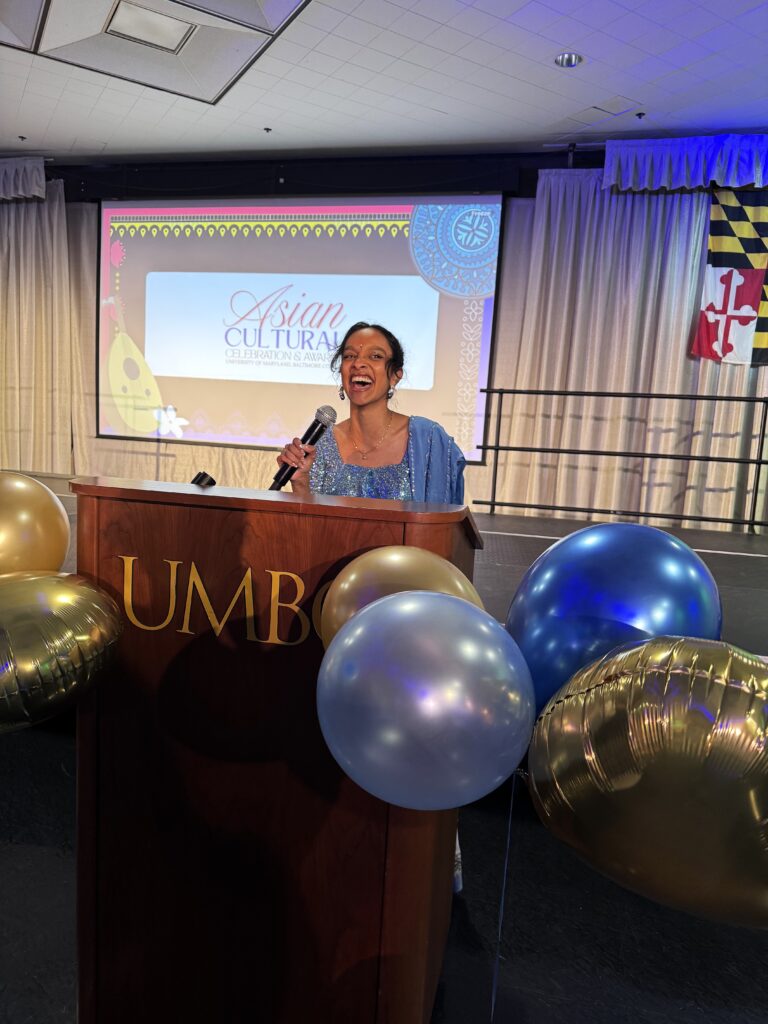
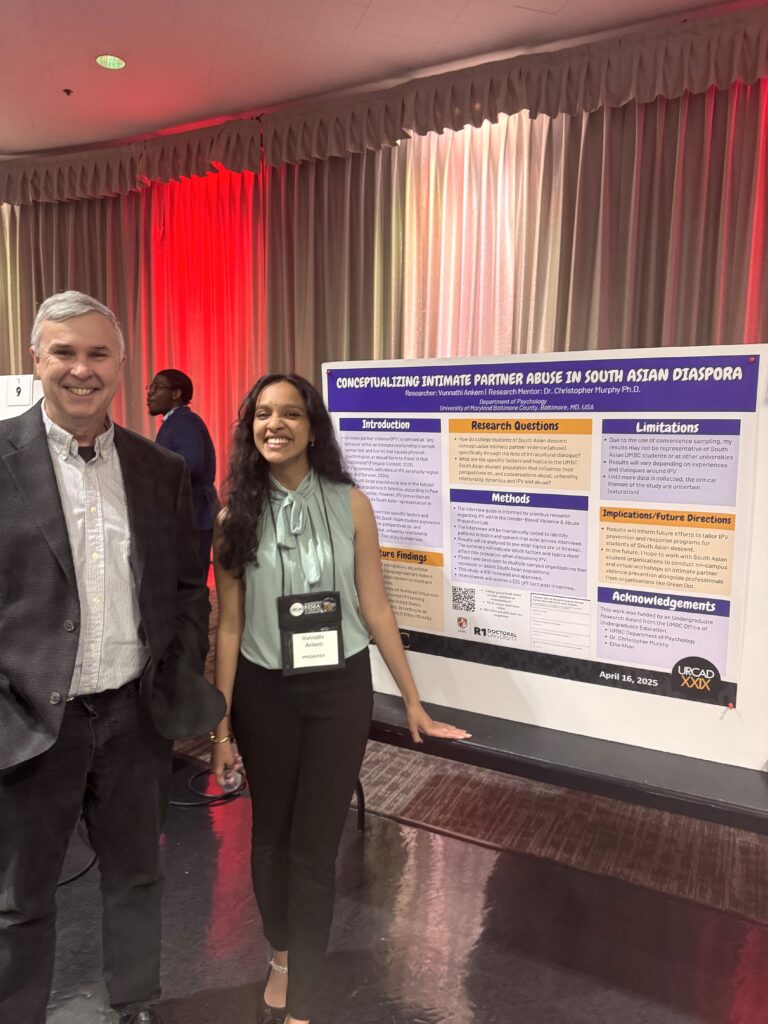
(l-r) Ankem at the 2026 Asian Cultural Celebration and Awards ceremony. Ankem with mentor Christopher Murphy, professor of psychology. (Images courtesy of Ankem)
She will study how systems, class, community, and culture shape experiences of IPV in India and inform more culturally responsive prevention strategies. Ankem will then develop community-based and community-led IPV prevention workshops. “The Fulbright program is giving me the opportunity I have always dreamed about,” says Ankem. “I can’t wait to learn from professionals and clinicians, alongside ancient culture practitioners and experts in India. It will be the experience of a lifetime!”
Humanistic climate futures
After studying climate change and migration on a study abroad trip to Oaxaca, Mexico, Bryan Castro-Velez ’26, geography and environmental studies, knew he was on the right research path—studying humanistic approaches to equitable agroecological systems and land in Indigenous Latin American communities. He says learning directly from indigenous leaders about their farming practices and response to climate change inspired him to apply for the Fulbright García-Robles award for graduate and doctoral research in Mexico. Castro-Velez’s graduate work will focus on agroecology, natural resource management, and rural development in Chiapas, Mexico.
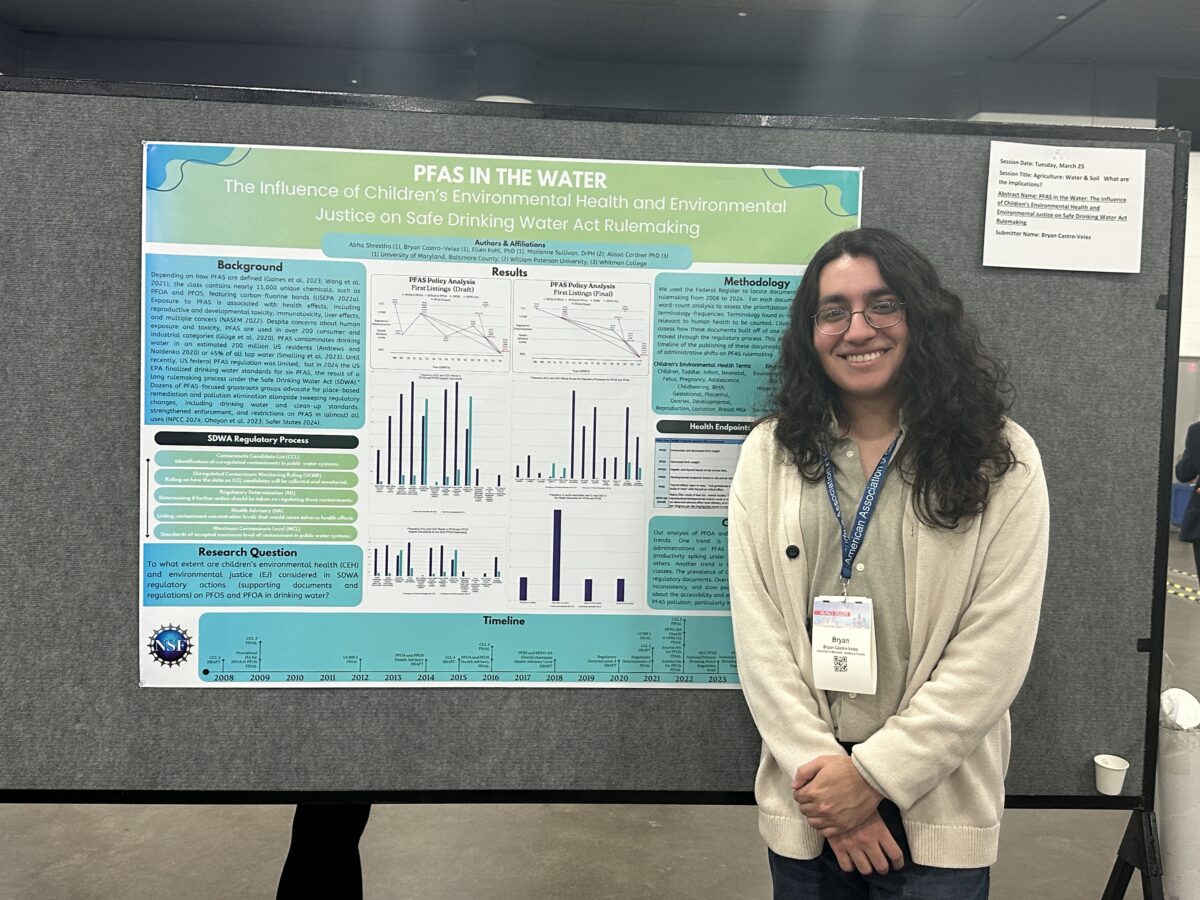 Bryan Castro-Velez at the 2025 Association of American Geographers annual conference in Detroit. (Image courtesy of Castro-Velez)
“I look forward to continuing down this path, encouraging others to do the same, and furthering my education outside the walls of academia,” says Castro-Velez. “My experiences during and outside of UMBC have proven to me that community-based learning systems are fundamental to just climate solutions and humanistic futures.”
As the U.S. Fulbright Program celebrates its 80th anniversary this year, UMBC’s Fulbright program is celebrating by expanding support through the Office of Prestigious Scholarships (OPS) under the leadership of April Householder ’95, director of OPS: “I am looking forward to building on UMBC’s strong legacy as a top producer of Fulbright students,” says Householder, “and expanding student support throughout the processes of exploring, applying, and transitioning abroad.”
Learn more about UMBC’s international opportunities.
]]>
UMBC’s 2026 – 2027 recipients of the prestigious Fulbright U.S. Student Program are joining the ranks of UMBC’s distinguished Fulbright alumni, who have made UMBC a three-time Fulbright Top...
https://umbc.edu/stories/umbcs-2026-student-fulbright-recipients/
https://my3.my.umbc.edu/api/v0/pixel/news/161318/guest@my.umbc.edu/3c2bd6a8225156f81db68222ed9fdd71/api/pixel
alumni
cahss
class-of-2026
community
fulbright
geographic-information-systems
international
policy-and-society
psychology
stories
story
urcad
visual-arts
UMBC News & Magazine
https://my3.my.umbc.edu/groups/umbc-news-magazine
https://assets1-my.umbc.edu/system/shared/avatars/groups/000/001/943/24435aa6207c452e7bc15cc74b42c7bb/xsmall.png?1748556657
https://assets1-my.umbc.edu/system/shared/avatars/groups/000/001/943/24435aa6207c452e7bc15cc74b42c7bb/original.png?1748556657
https://assets2-my.umbc.edu/system/shared/avatars/groups/000/001/943/24435aa6207c452e7bc15cc74b42c7bb/xxlarge.png?1748556657
https://assets2-my.umbc.edu/system/shared/avatars/groups/000/001/943/24435aa6207c452e7bc15cc74b42c7bb/xlarge.png?1748556657
https://assets3-my.umbc.edu/system/shared/avatars/groups/000/001/943/24435aa6207c452e7bc15cc74b42c7bb/large.png?1748556657
https://assets1-my.umbc.edu/system/shared/avatars/groups/000/001/943/24435aa6207c452e7bc15cc74b42c7bb/medium.png?1748556657
https://assets2-my.umbc.edu/system/shared/avatars/groups/000/001/943/24435aa6207c452e7bc15cc74b42c7bb/small.png?1748556657
https://assets1-my.umbc.edu/system/shared/avatars/groups/000/001/943/24435aa6207c452e7bc15cc74b42c7bb/xsmall.png?1748556657
https://assets2-my.umbc.edu/system/shared/avatars/groups/000/001/943/24435aa6207c452e7bc15cc74b42c7bb/xxsmall.png?1748556657
UMBC News & Magazine
0
0
false
Mon, 27 Jul 2026 17:10:21 -0400
Mon, 27 Jul 2026 17:10:21 -0400
Four Retrievers selected for this summer’s Key Bridge rebuilding internship
This summer, four UMBC students are getting hands-on experience contributing to efforts to rebuild the Francis Scott Key Bridge over the Patapsco River, which collapsed in March 2024 after a cargo ship collided with one of its supports. This is the second year in a row that the Maryland Transportation Authority has partnered with the Maryland Higher Education Commission to run the program.
Last year, three out of nine students in the program hailed from UMBC. This year, four out of the 10 interns are Retrievers. Mechanical engineering students Bilal Faizullah and Katelyn Prasad and geography and environmental systems students James Keller and Megan (Em) Schumacher ’26 will get the opportunity to learn about topics such as project management, environmental analysis, construction oversight, and community outreach. They will also get the chance to be a part of an iconic infrastructure project for Maryland, an experience that last year’s student interns found particularly meaningful.
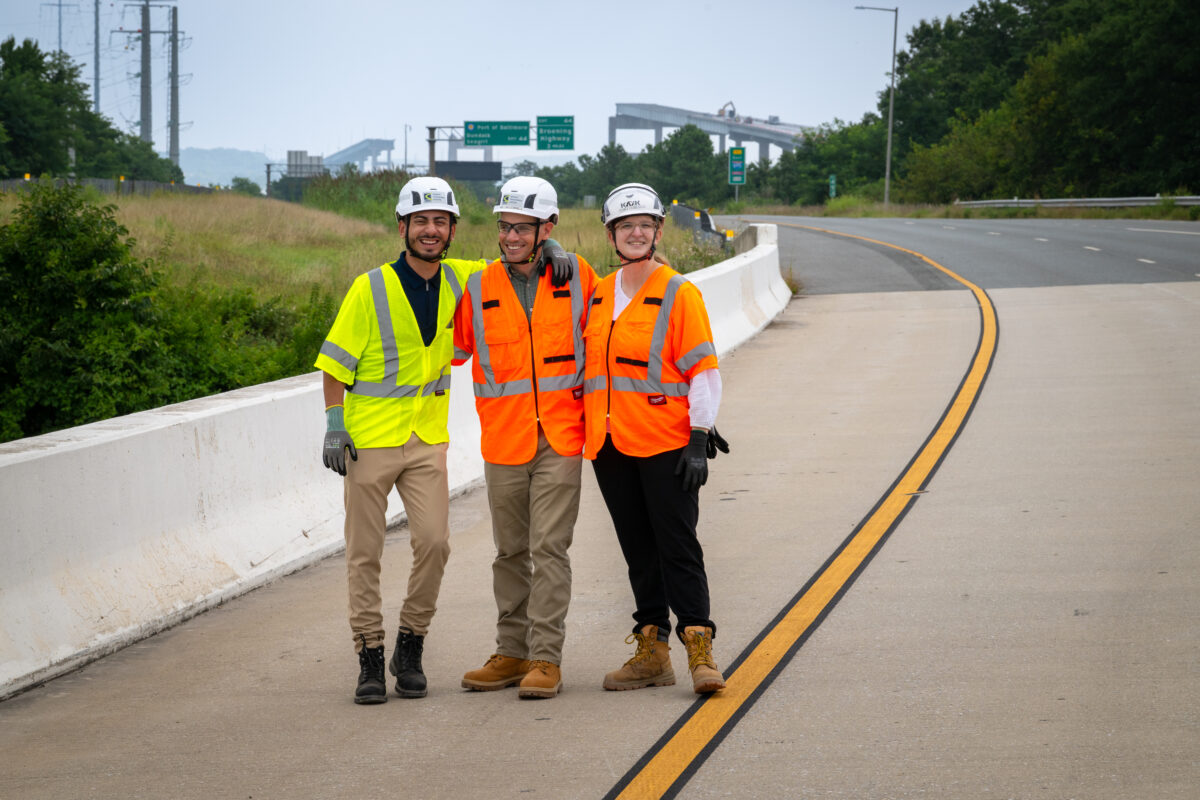 From left to right, Cristian Mena, William McConnell, and Emily DiMarzio pose for a photo near the site of the collapsed Key Bridge. The three worked on the bridge rebuilding project as interns with the Maryland Transportation Authority in summer 2025. (Brad Ziegler/UMBC)
“The Key Bridge Internship Program represents the very best of career-connected learning by giving students the opportunity to contribute to a project that will have a lasting impact on Maryland,” says Christine Routzahn, director of UMBC’s Career Center. “We’re incredibly proud that four UMBC students were selected for this prestigious program. Their selection reflects not only their talent and dedication, but also the strength of the partnerships that make opportunities like this possible. We are grateful to the Maryland Transportation Authority, Maryland Higher Education Commission, and its partners for investing in our students and in the state’s future workforce.”
]]>
This summer, four UMBC students are getting hands-on experience contributing to efforts to rebuild the Francis Scott Key Bridge over the Patapsco River, which collapsed in March 2024 after a cargo...
https://umbc.edu/stories/key-bridge-rebuilding-internship-summer-2026/
https://my3.my.umbc.edu/api/v0/pixel/news/161314/guest@my.umbc.edu/56fca8c62f428a6e6cff12abb2ccee1e/api/pixel
cahss
coeit
ges
impact
internship
meche
science-and-tech
stories
story
UMBC News & Magazine
https://my3.my.umbc.edu/groups/umbc-news-magazine
https://assets1-my.umbc.edu/system/shared/avatars/groups/000/001/943/24435aa6207c452e7bc15cc74b42c7bb/xsmall.png?1748556657
https://assets1-my.umbc.edu/system/shared/avatars/groups/000/001/943/24435aa6207c452e7bc15cc74b42c7bb/original.png?1748556657
https://assets2-my.umbc.edu/system/shared/avatars/groups/000/001/943/24435aa6207c452e7bc15cc74b42c7bb/xxlarge.png?1748556657
https://assets2-my.umbc.edu/system/shared/avatars/groups/000/001/943/24435aa6207c452e7bc15cc74b42c7bb/xlarge.png?1748556657
https://assets3-my.umbc.edu/system/shared/avatars/groups/000/001/943/24435aa6207c452e7bc15cc74b42c7bb/large.png?1748556657
https://assets1-my.umbc.edu/system/shared/avatars/groups/000/001/943/24435aa6207c452e7bc15cc74b42c7bb/medium.png?1748556657
https://assets2-my.umbc.edu/system/shared/avatars/groups/000/001/943/24435aa6207c452e7bc15cc74b42c7bb/small.png?1748556657
https://assets1-my.umbc.edu/system/shared/avatars/groups/000/001/943/24435aa6207c452e7bc15cc74b42c7bb/xsmall.png?1748556657
https://assets2-my.umbc.edu/system/shared/avatars/groups/000/001/943/24435aa6207c452e7bc15cc74b42c7bb/xxsmall.png?1748556657
UMBC News & Magazine
6
0
false
Mon, 27 Jul 2026 13:01:27 -0400
Mon, 27 Jul 2026 13:01:27 -0400
Meet a Retriever–Keisha Hale, M.A. ’20, Hurricane Katrina survivor, educator, researcher, and author
Meet Keisha Hale, M.A.’20, applied sociology. Keisha is an educator, researcher, and author. In 2025, she published We Weather the Storm: A Poetry Memoir of Survival and Healing, inspired by her experiences surviving Hurricane Katrina and navigating foster care. Her work centers on resilience, education, and giving voice to stories that are often overlooked. Whether she’s teaching fourth grade math, analyzing data, or writing poetry, Keisha is passionate about using storytelling and research to create understanding, inspire change, and help others feel seen. Take it away, Keisha!
Q: What initially brought you to UMBC?
A: I came to UMBC because I wanted to better understand the social systems that shape people’s lives and to gain the skills to create meaningful change. After experiencing Hurricane Katrina, navigating foster care, and witnessing firsthand how policies and institutions can impact individuals and families, I knew I wanted to study society in a way that combined research with real world application. UMBC’s applied sociology program stood out because it emphasized using data, research, and critical thinking to address complex social issues.
I wanted more than a degree. I wanted an education that would prepare me to serve my community, inform policy, and make a lasting impact.
Keisha Hale, M.A. ’20
Q: Can you tell us what you loved most about the applied sociology program?
A: What I loved most about UMBC’s applied sociology program was its emphasis on using research to solve real world problems. The program challenged me to think critically, analyze data, and understand the social systems that shape people’s lives. It encouraged me to move beyond theory and consider how research can inform policy, improve communities, and create meaningful change.
Q: Can you talk about your experience as a first generation student?
A: As a first generation graduate student, there were moments when I questioned whether I truly belonged. Like many students, I experienced imposter syndrome and wondered if I was capable enough to succeed. What I learned at UMBC is that belonging is not determined by where you come from, but by your willingness to learn, grow, and persevere.
I would encourage other first generation students to not let self doubt convince them they are less deserving of the opportunities they’ve earned. Ask questions, seek out mentors, build relationships, and take advantage of the support systems UMBC has to offer. There are people here who genuinely want to see you succeed.
Looking back, I realize that believing in myself was just as important as earning good grades. UMBC gave me the confidence to trust my abilities, find my voice, and pursue opportunities that have shaped my career as a researcher, educator, and author. I hope other students give themselves permission to do the same.
Q: Were you a part of any clubs or organizations at UMBC?
A: During my time at UMBC, I was an active member of Alpha Kappa Delta, the International Sociology Honor Society, and the Sociology Graduate Student Association. Both organizations gave me opportunities to connect with classmates who shared my passion for research, social justice, and community engagement.
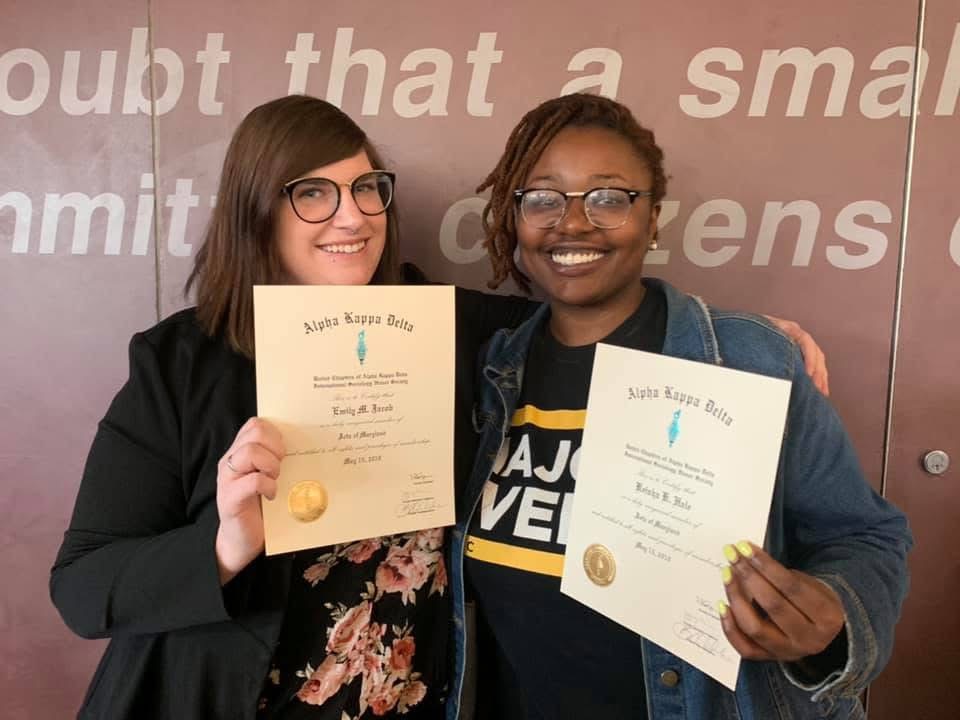 Hale (right) during Alpha Kappa Delta induction. (Photo courtesy Hale)
 Hale (left) at the Sociology Graduate Student Organization table during UMBC Career Month. (Photo courtesy Hale)
What I appreciated most was the opportunity to learn from one another beyond the classroom. Through these organizations, I built friendships, expanded my professional network, and engaged in meaningful conversations about research, policy, and the role sociology plays in addressing real world challenges. Those experiences strengthened my sense of belonging at UMBC and reinforced my commitment to using research and education to make a positive impact in my community.
Q: Where did you find support while at UMBC?
A: One of the things I valued most about my time at UMBC was the sense of community I found there. While there was not just one person who inspired me, the relationships I built as a graduate assistant had a lasting impact. Working alongside fellow graduate students, faculty, and staff allowed me to develop meaningful connections with people who became mentors, collaborators, and an important part of my support system.
One of those relationships was with my fellow graduate student, Samantha Fries ’18, M.A. ’25. We supported one another throughout our time at UMBC, encouraging each other academically and personally. That friendship has continued long after graduation, and I was honored to stand beside her as a member of her wedding party.
Some of the most meaningful parts of the UMBC experience are the lifelong relationships you build along the way.
Keisha Hale, M.A. ’20
Building a trusted, supportive community, whether through biological family or the family we create through friends, mentors, and colleagues, has always been essential to my success. UMBC reinforced that belief by surrounding me with people who invested in my growth both personally and professionally. Their encouragement gave me the confidence to pursue my goals, and those relationships continue to influence the way I approach my work as an educator, researcher, and author.
Q: Since you’ve been a part of the UMBC community, how have you found support for your dreams?
A: UMBC helped turn my aspirations into opportunities by surrounding me with people who believed in my potential and invested in my growth. As a graduate assistant, I gained hands-on experience while building meaningful relationships with faculty, staff, and fellow graduate students who encouraged me to challenge myself and pursue new opportunities.
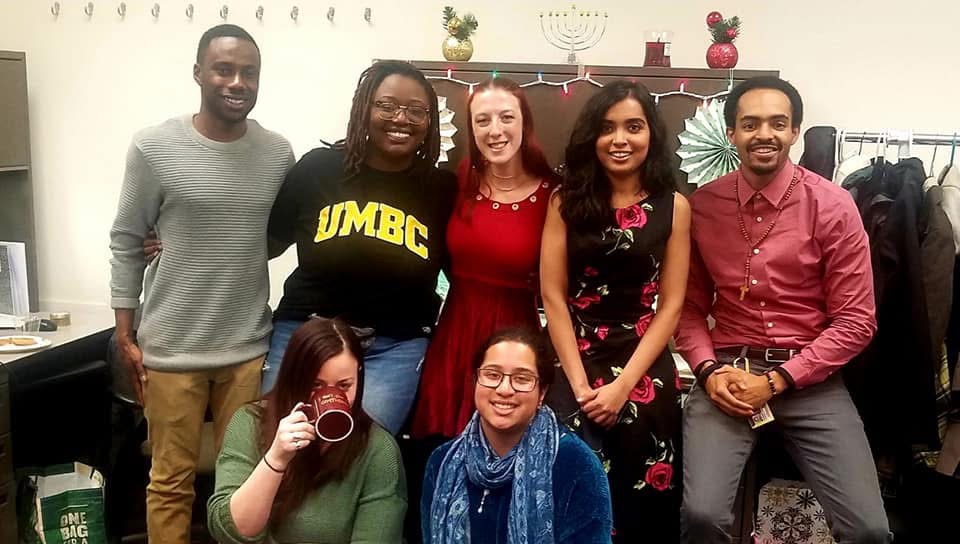 Hale (back row, second from left) and other applied sociology graduate students at a holiday party. (Photo courtesy Hale)
The knowledge and practical experience I gained through the applied sociology program prepared me for a career in research, beginning with my role at Westat, where I supported large scale federally funded studies. Just as importantly, the confidence and encouragement I received at UMBC inspired me to continue growing beyond research. Today, I am an educator, researcher, and author, and I carry the lessons, mentorship, and sense of community I found at UMBC into everything I do.
What has made the biggest difference is knowing that UMBC did not just prepare me academically. It gave me a network of people who continue to encourage, support, and celebrate one another long after graduation. That lasting community is one of the greatest gifts UMBC has given me.
Q: What is a piece of advice you would give a current UMBC student?
A: You never have to navigate your journey alone. UMBC is a place where people genuinely invest in one another’s success. Whether it is faculty who challenge and encourage you, classmates who become lifelong friends, or mentors who help you see your potential, there is a strong sense that everyone wants to see you succeed.
* * * * *
UMBC’s greatest strength is its people. When people meet Retrievers and hear about the passion they bring, the relationships they create, the ways they support each other, and the commitment they have to inclusive excellence, they truly get a sense of our community. That’s what “Meet a Retriever” is all about.
Learn more about how UMBC can help you achieve your goals.
]]>
Meet Keisha Hale, M.A.’20, applied sociology. Keisha is an educator, researcher, and author. In 2025, she published We Weather the Storm: A Poetry Memoir of Survival and Healing, inspired by her...
https://umbc.edu/stories/keisha-hale-author/
https://my3.my.umbc.edu/api/v0/pixel/news/161111/guest@my.umbc.edu/4edb0efc96ff6bca5429c2eba205c3f1/api/pixel
alumni
applied-sociology
arts-and-culture
cahss
graduate-school
retriever-authors
social-work
stories
story
UMBC News & Magazine
https://my3.my.umbc.edu/groups/umbc-news-magazine
https://assets1-my.umbc.edu/system/shared/avatars/groups/000/001/943/24435aa6207c452e7bc15cc74b42c7bb/xsmall.png?1748556657
https://assets1-my.umbc.edu/system/shared/avatars/groups/000/001/943/24435aa6207c452e7bc15cc74b42c7bb/original.png?1748556657
https://assets2-my.umbc.edu/system/shared/avatars/groups/000/001/943/24435aa6207c452e7bc15cc74b42c7bb/xxlarge.png?1748556657
https://assets2-my.umbc.edu/system/shared/avatars/groups/000/001/943/24435aa6207c452e7bc15cc74b42c7bb/xlarge.png?1748556657
https://assets3-my.umbc.edu/system/shared/avatars/groups/000/001/943/24435aa6207c452e7bc15cc74b42c7bb/large.png?1748556657
https://assets1-my.umbc.edu/system/shared/avatars/groups/000/001/943/24435aa6207c452e7bc15cc74b42c7bb/medium.png?1748556657
https://assets2-my.umbc.edu/system/shared/avatars/groups/000/001/943/24435aa6207c452e7bc15cc74b42c7bb/small.png?1748556657
https://assets1-my.umbc.edu/system/shared/avatars/groups/000/001/943/24435aa6207c452e7bc15cc74b42c7bb/xsmall.png?1748556657
https://assets2-my.umbc.edu/system/shared/avatars/groups/000/001/943/24435aa6207c452e7bc15cc74b42c7bb/xxsmall.png?1748556657
UMBC News & Magazine
0
0
false
Wed, 15 Jul 2026 09:27:49 -0400
Wed, 15 Jul 2026 09:27:49 -0400