Simple wood makes advanced sensors
Picture the most advanced technology and certain qualities probably spring to mind: maybe metallic and sleek, with glowing lights and big digital screens.
The researchers at the Center for Advanced Sensor Technology (CAST) at UMBC, however, have a different adjective they aim for when designing tech: dirt cheap.
For these scientists and engineers, inexpensive doesn’t mean low-quality—it means challenging traditional ways of thinking to produce affordable and reliable products that meet vital needs. Toward this end, a CAST research team recently debuted a new environmental sensor made out of simple balsa wood sheets—the kind you could buy at a craft store for a few dollars. The wood was cut and assembled to make a central well to hold samples and channels for the electrochemical components of the sensor to be inserted. The researchers coated the wood to make it waterproof and stuck it together with wood glue.
Inexpensive and sustainable
 A schematic shows the layers of the wood sensor, with openings for the three electrodes and a microwell. (Image courtesy of Kadolkar)
Choosing wood served two purposes: making the sensor low-cost and also environmentally friendly.
“Sustainability was very important to us,” says Revati Kadolkar, a Ph.D. student in chemical engineering who is working on the project. Kadolkar is advised by professors Govind Rao, who directs CAST, and Douglas Frey in the department of chemical, biochemical, and environmental engineering (CBEE). “Using wood instead of plastic for the structural skeleton of the sensor was a key step toward that sustainability,” she says.
In collaboration with another UMBC team from the Center for Urban Environmental Research and Education led by CBEE professor Claire Welty, the CAST team tested the sensor in the field by measuring nitrate levels in streams in the Gwynns Falls watershed near Baltimore. Nitrate is a pollutant, often linked to agricultural activities, that can cause gut cancer, birth defects and a condition called methemoglobinemia, also known as the blue baby syndrome. Its concentration in tap water in the U.S. is regulated by the Safe Drinking Water Act. The accuracy of the sensor’s readings was on par with traditional equipment that cost hundreds of times more money, the researchers say.
Testing in the lab, the team also found the sensor worked well across a range of conditions, including wide variations in temperature and pH levels, and continued to operate well for more than a year.
A more comprehensive view of the world
Driving down the cost of technology should drive up its impact. Cheaper sensors could be deployed in higher numbers, yielding a more comprehensive view of the world and spotting potential problems earlier.
 Kadolkar shows a sensor the team tested in the field by measuring nitrate levels in Baltimore-area streams. (Photo courtesy of Kadolkar)
“Let’s say you want to map the whole Chesapeake Bay and know every hour if there is contamination and how it is traveling down the bay,” says Venkatesh Srinivasan, a research associate professor at CAST who also worked on the project. “You can get these details more easily if you have lower-cost sensors.”
Spreading the benefits of science and technology to resource-limited communities has been a driving force behind CAST research for decades. The team has also developed low-cost infant incubators and a suitcase-sized device to make medicine on-demand.
For now, the sensor operates by analyzing droplets of water added to its central well. Going forward, the team would like to create a sensor that could be submerged in the water and report continuous measurements.
They are already working with the Maryland company NanoForge Systems to commercialize the new nitrate sensor.
“Translating science into innovative products that can help people is what really excites me about this work,” Kadolkar says.
]]>
Picture the most advanced technology and certain qualities probably spring to mind: maybe metallic and sleek, with glowing lights and big digital screens. The researchers at the Center for...
https://umbc.edu/stories/simple-wood-makes-advanced-sensors/
https://my3.my.umbc.edu/api/v0/pixel/news/154263/guest@my.umbc.edu/35593d39c3d8fae21e9187e25db7d671/api/pixel
cast
cbee
coeit
discovery
fall-2025
magazine
research
story
UMBC News & Magazine
https://my3.my.umbc.edu/groups/umbc-news-magazine
https://assets1-my.umbc.edu/system/shared/avatars/groups/000/001/943/24435aa6207c452e7bc15cc74b42c7bb/xsmall.png?1748556657
https://assets1-my.umbc.edu/system/shared/avatars/groups/000/001/943/24435aa6207c452e7bc15cc74b42c7bb/original.png?1748556657
https://assets2-my.umbc.edu/system/shared/avatars/groups/000/001/943/24435aa6207c452e7bc15cc74b42c7bb/xxlarge.png?1748556657
https://assets2-my.umbc.edu/system/shared/avatars/groups/000/001/943/24435aa6207c452e7bc15cc74b42c7bb/xlarge.png?1748556657
https://assets3-my.umbc.edu/system/shared/avatars/groups/000/001/943/24435aa6207c452e7bc15cc74b42c7bb/large.png?1748556657
https://assets1-my.umbc.edu/system/shared/avatars/groups/000/001/943/24435aa6207c452e7bc15cc74b42c7bb/medium.png?1748556657
https://assets2-my.umbc.edu/system/shared/avatars/groups/000/001/943/24435aa6207c452e7bc15cc74b42c7bb/small.png?1748556657
https://assets1-my.umbc.edu/system/shared/avatars/groups/000/001/943/24435aa6207c452e7bc15cc74b42c7bb/xsmall.png?1748556657
https://assets2-my.umbc.edu/system/shared/avatars/groups/000/001/943/24435aa6207c452e7bc15cc74b42c7bb/xxsmall.png?1748556657
UMBC News & Magazine
0
0
false
Wed, 05 Nov 2025 13:32:05 -0500
UMBC’s Christopher Slaughter, engineering student with health equity focus, wins prestigious Gates Cambridge Scholarship

Christopher Slaughter ’23, M31 computer engineering, has won a Gates Cambridge Scholarship to pursue graduate work at the University of Cambridge in the United Kingdom next fall. Slaughter is the fifth student from UMBC to be recognized with the prestigious award, established by the University of Cambridge in 2000 with a donation from the Bill and Melinda Gates Foundation.
Gates Cambridge Scholars are selected from around the world for their academic talents and commitment to improving the lives of others. Each year around 25 of the 80 total awards are offered to students from the United States.
Slaughter will pursue a Ph.D. in electrical engineering at the University of Cambridge, which is the world’s third oldest surviving university, founded in 1209. His career goals are to develop novel biomedical technologies that meet the healthcare needs of under-resourced communities.
“We are so proud of Chris,” says UMBC President Valerie Sheares Ashby. “He exemplifies UMBC’s values and the Gates Cambridge vision of preparing leaders who demonstrate not only academic excellence, but also a deep commitment to improving the lives of others. Congratulations to Chris, and my thanks and appreciation to those among the UMBC community who have served as influential teachers, mentors, and supporters for Chris throughout his educational journey.”
Research as a way to change the world
Slaughter grew up in a “STEM family,” but he didn’t initially envision a future in research. His perspective changed, however, after he traveled to Germany and Ghana to visit family during his high school years.
While traveling, Slaughter noticed how different communities had inequitable access to healthcare, and he started to think about the disparities that also existed back home in the United States. New biomedical technologies, he realized, might help underserved communities get better care.
Guided by a passion for improving people’s lives, Slaughter began his first of many biomedical research projects. At UMBC’s Bioelectronics Laboratory, he worked on technology to help patients who are insensitive to pain avoid burns. Most recently, he has been working at UMBC’s Center for Advanced Sensor Technology (CAST) in the lab of Govind Rao, professor of chemical and biochemical engineering.
Slaughter is helping develop technology that can sense glucose levels through the skin. This could lead to a device that continuously monitors glucose for people with diseases such as diabetes without painful finger pricks or repeated blood draws. He has presented the work at leading scientific conferences, including the IEEE/EMB Healthcare Innovations Point of Care Technologies conference as the sole undergraduate oral presenter.
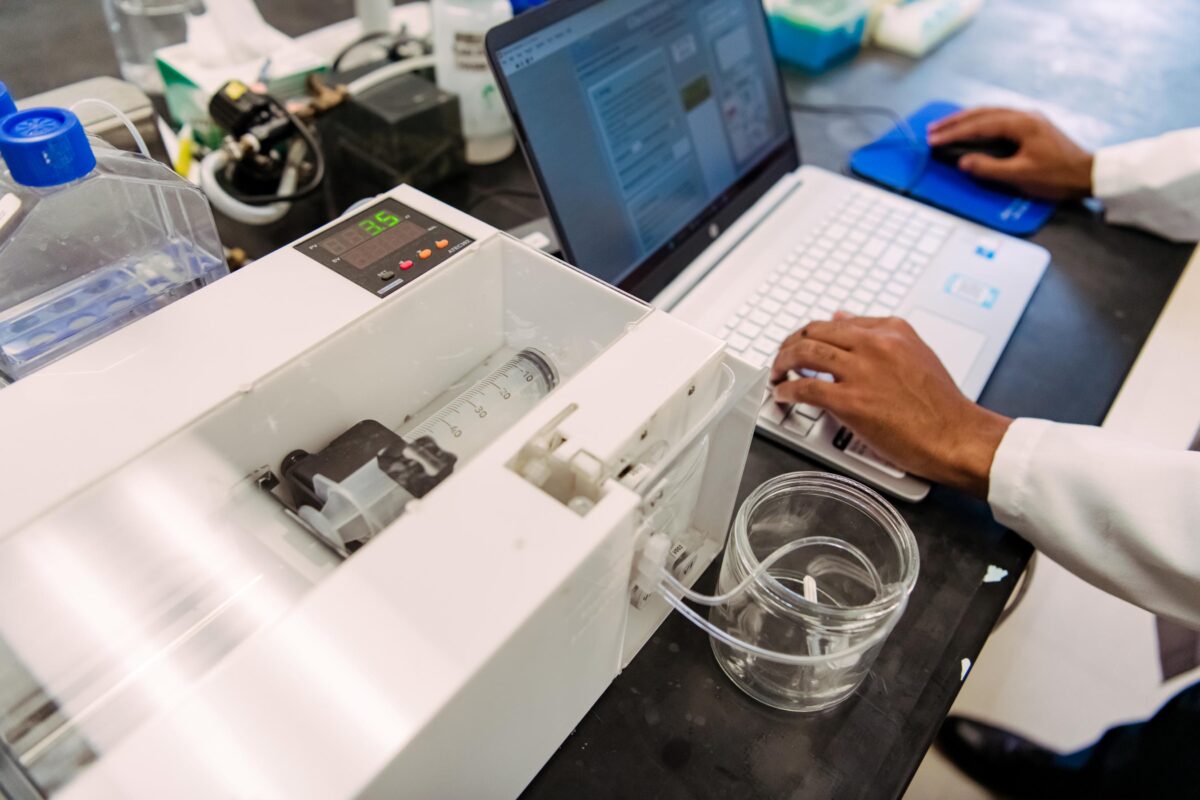
The glucose monitor that Chris Slaughter is helping develop. (Marlayna Demond ’11/UMBC)
“What strikes you immediately about Chris is his sheer enthusiasm, curiosity, and positivity,” Rao says. “He is always eager to be in the lab.”
“Chris’ intense energy and his genuine interest in the topic made him the best mentee you can ask for,” says Hasib Hasan, an electrical engineering Ph.D. student in the department of computer science and electrical engineering who is mentoring Slaughter on the glucose monitor project. “I have no doubt about his ability to become a successful researcher. The Gates Cambridge Scholarship will support him as he pursues work that will improve lives.”
The value of mentorship
Throughout his time at UMBC, Slaughter found mentors to help him grow and learn. He was part of the Meyerhoff Scholars Program, a nationally recognized effort to foster diversity in science, technology, engineering, and mathematics by supporting students who intend to pursue advanced degrees in these fields. He has also been inspired and supported by scholars throughout the UMBC community, such as Rao; Freeman Hrabowski, president emeritus; and Charles LaBerge, professor of the practice in computer science and electrical engineering.
“Mentorship has been so important for me,” Slaughter says. “I knew that in order to succeed, I needed to be in a community that could push me to be my best, hold me accountable, and support me at the same time. To accomplish what I wanted to accomplish—getting a Ph.D. in a scientific field—there was no place better for me to start than UMBC.”
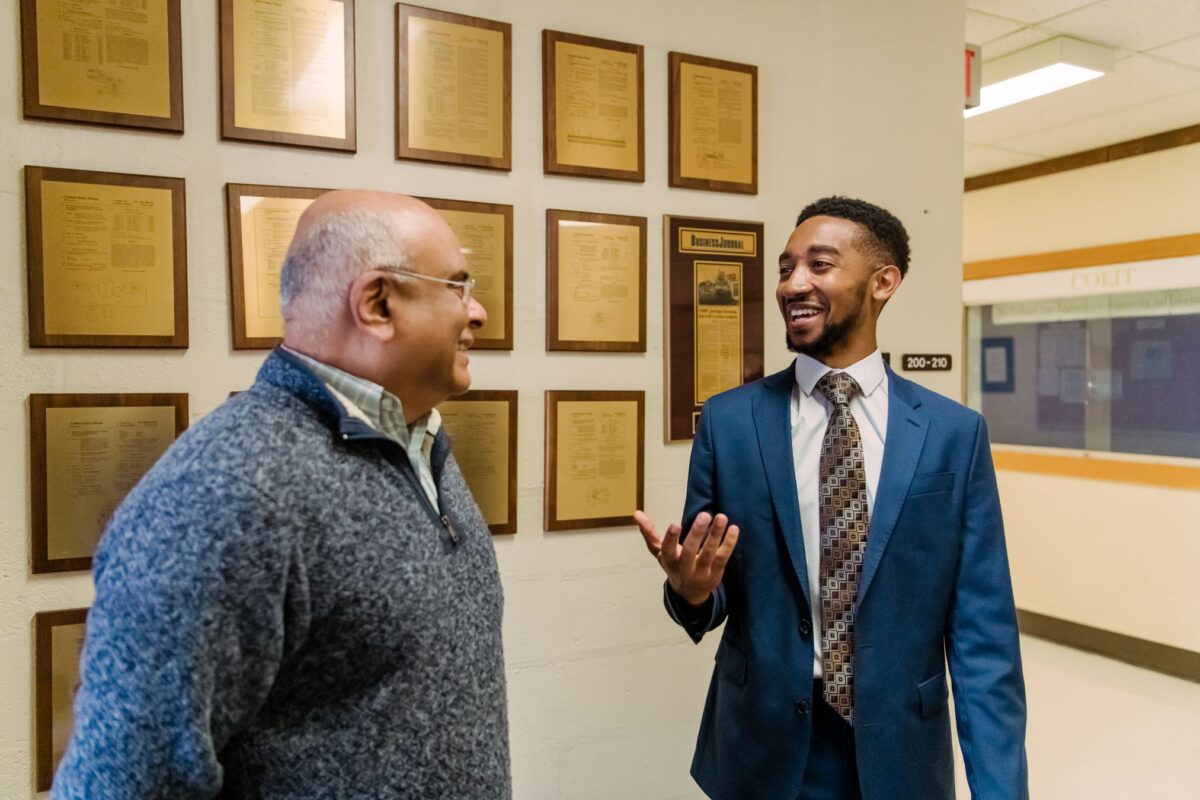
Chris Slaughter (right) is working in the lab of Govind Rao (left). (Marlayna Demond ’11/UMBC)
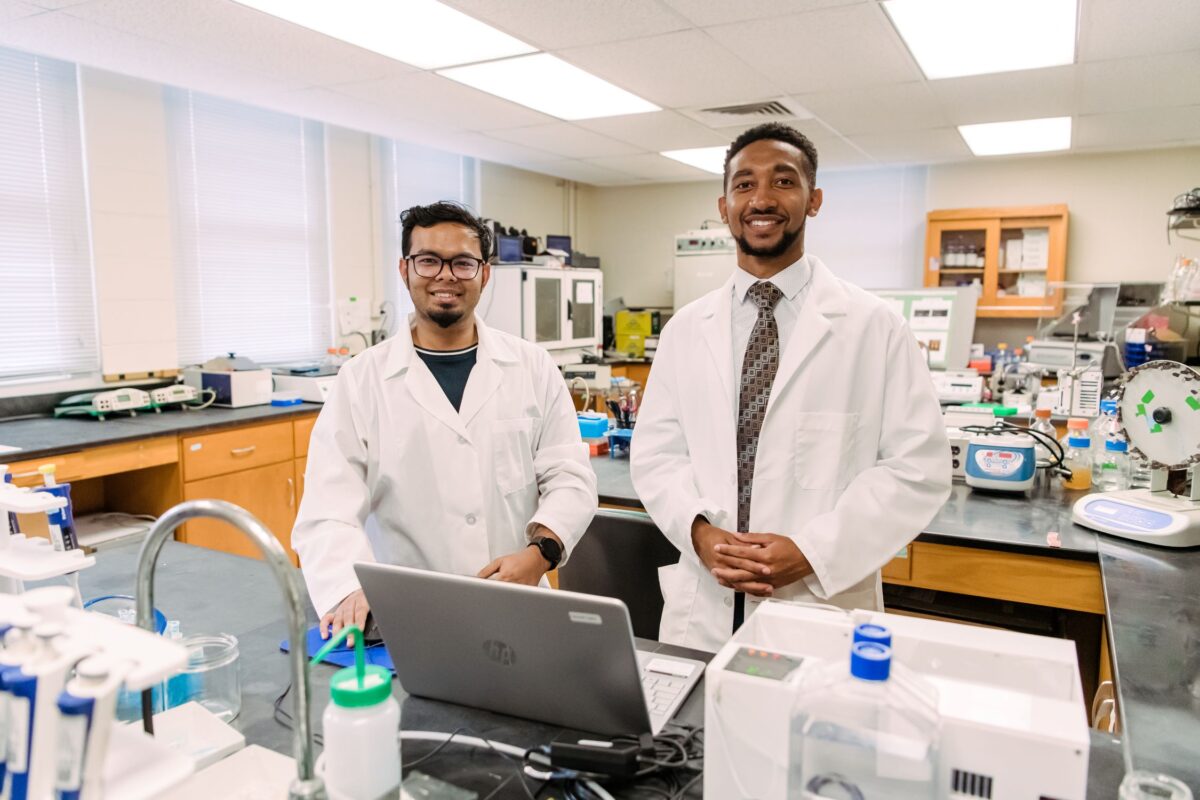
Hasib Hasan (left) and Chris Slaughter (right) in the lab where they are working on a glucose monitoring device. (Marlayna Demond ’11/UMBC)
Slaughter’s application for the Gates Cambridge Scholarship was supported by UMBC’s Office of Prestigious Scholarships, which was established six years ago with the ambition to focus on three major international scholarships as well as others in the U.S., says April Householder, director of undergraduate research and prestigious scholarships at UMBC.
“With Chris’s win, I am happy to say that we have now achieved the trifecta—UMBC alumni simultaneously supported by all three major U.K. scholarships,” she says. The alumni are Rhodes Scholars Naomi Mburu and Sam Patterson at the University of Oxford, Marshall Scholar Joshua Slaughter at the University of Edinburgh, and now Gates Scholar Christopher Slaughter, heading tothe University of Cambridge.
Paying it forward
Having benefited from a culture of mentoring and support at UMBC, Slaughter embraces opportunities to become a mentor and leader himself.
Slaughter was named a Goldwater Scholar in 2022, recognizing him among the top engineering students in the nation. He is president of the UMBC chapter of the National Society of Black Engineers and, through volunteering at local schools, encourages middle and high school students to develop technical skills and aspire to careers in science and technology. In addition, he serves as the vice president of the UMBC chapter of the Institute of Electrical and Electronics Engineers and the UMBC Club Taekwondo team. He also serves as the lead peer advisor in the Meyerhoff Scholars Program, responsible for organizing events and managing peer advisor relationships across the program.
“I think the way we honor the people who invest so much in us is by turning around and doing the same thing for somebody else,” Slaughter says. “Regardless of what I do, I want to make sure I am giving back.”
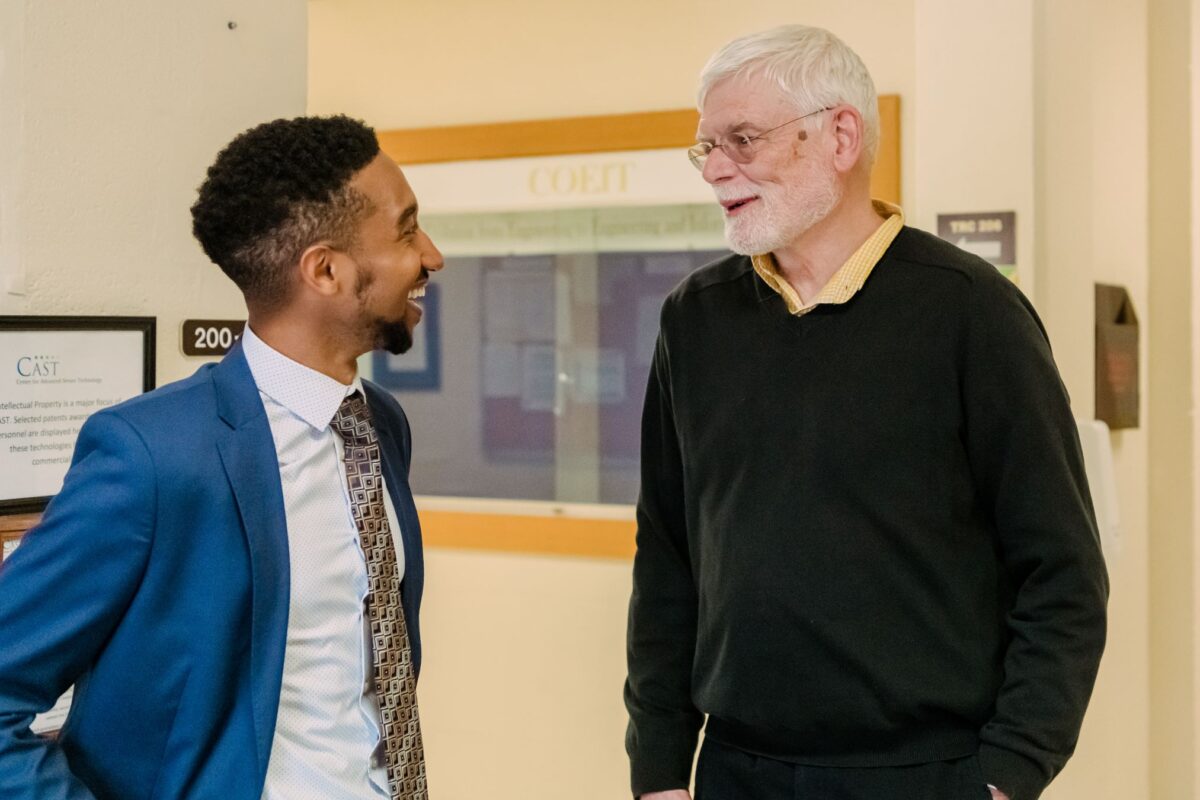 Chris Slaughter (left) talks with mentor Charles LaBerge (right). (Marlayna Demond ’11/UMBC)
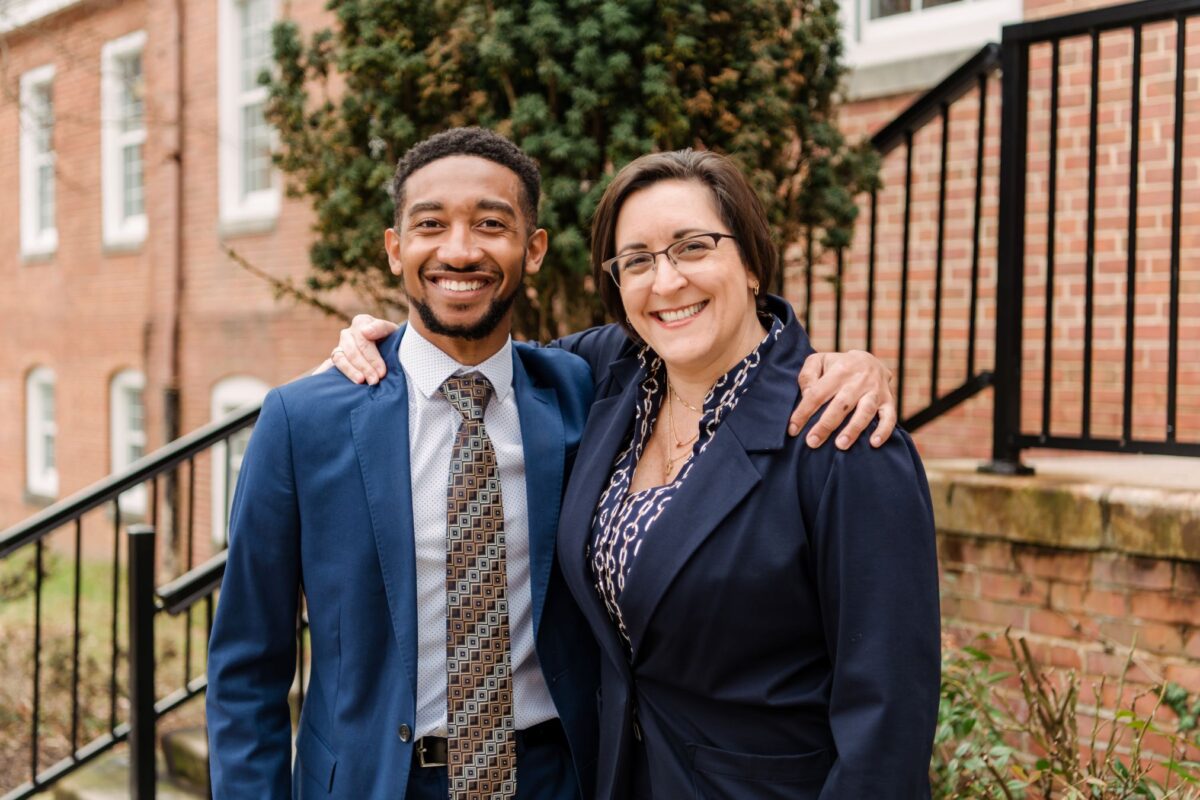 April Householder (right) helped guide Slaughter (left) through the Gates Cambridge process. (Marlayna Demond ’11/UMBC)
Reflecting on his time as a Retriever, Slaughter says he wants to spread the culture of support he encountered at UMBC wherever he goes next. “I think that the great thing about UMBC is we all work together,” he reflects. “I hope throughout my career to make more communities like that because ultimately, I think that’s how we solve the problems that we face today.”
Householder echoes that sentiment. “Chris’s experiences in the Meyerhoff Scholars Program, a national model for STEM student success, have prepared him to be a leader and to lift up others. UMBC has provided a culture of support and mentoring similar to what he will experience as part of a Gates cohort,” she says. “I can’t wait to see how being a Gates Cambridge Scholar will not only help him grow, but how he will transform Cambridge as an institution.”
]]>
Christopher Slaughter ’23, M31 computer engineering, has won a Gates Cambridge Scholarship to pursue graduate work at the University of Cambridge in the United Kingdom next fall. Slaughter is the...
https://umbc.edu/stories/gates-cambridge-scholarship/
https://my3.my.umbc.edu/api/v0/pixel/news/130944/guest@my.umbc.edu/2d4ebfe00a62eac215d0f7a276afe45f/api/pixel
cast
cbee
class-of-2023
coeit
community
csee
news
scholarships
UMBC News & Magazine
https://my3.my.umbc.edu/groups/umbc-news-magazine
https://assets1-my.umbc.edu/system/shared/avatars/groups/000/001/943/24435aa6207c452e7bc15cc74b42c7bb/xsmall.png?1748556657
https://assets1-my.umbc.edu/system/shared/avatars/groups/000/001/943/24435aa6207c452e7bc15cc74b42c7bb/original.png?1748556657
https://assets2-my.umbc.edu/system/shared/avatars/groups/000/001/943/24435aa6207c452e7bc15cc74b42c7bb/xxlarge.png?1748556657
https://assets2-my.umbc.edu/system/shared/avatars/groups/000/001/943/24435aa6207c452e7bc15cc74b42c7bb/xlarge.png?1748556657
https://assets3-my.umbc.edu/system/shared/avatars/groups/000/001/943/24435aa6207c452e7bc15cc74b42c7bb/large.png?1748556657
https://assets1-my.umbc.edu/system/shared/avatars/groups/000/001/943/24435aa6207c452e7bc15cc74b42c7bb/medium.png?1748556657
https://assets2-my.umbc.edu/system/shared/avatars/groups/000/001/943/24435aa6207c452e7bc15cc74b42c7bb/small.png?1748556657
https://assets1-my.umbc.edu/system/shared/avatars/groups/000/001/943/24435aa6207c452e7bc15cc74b42c7bb/xsmall.png?1748556657
https://assets2-my.umbc.edu/system/shared/avatars/groups/000/001/943/24435aa6207c452e7bc15cc74b42c7bb/xxsmall.png?1748556657
UMBC News & Magazine
2
0
false
Wed, 15 Feb 2023 09:20:00 -0500
Wed, 15 Feb 2023 09:20:00 -0500
UMBC and UMSOM work to more effectively reverse opioid overdose in real time through $500,000+ NIH award
Opioid-related deaths have risen sharply in the U.S. in recent years. In 2017, the Department of Health and Human Services declared the opioid crisis to be a public health emergency—one disproportionately affecting historically marginalized communities—and the crisis has worsened since then.
In response to the rising epidemic, UMBC researchers have partnered with the University of Maryland School of Medicine (UMSOM) to develop a device that could help prevent opioid overdose deaths. The device is a non-invasive CO2 monitor designed to more effectively detect and reverse an opioid overdose in real time. It was recently awarded a one-year grant of more than $500,000 from the National Institutes of Health (NIH).
“Opioid-related death is a serious problem for the country. We hope this new device will help to directly address this issue,” said the study’s co-PI Xudong Ge, research professor of chemical, biochemical, and environmental engineering (CBEE).
Meeting an urgent need
The Centers for Disease Control and Prevention’s (CDC) National Center for Health Statistics reported that during a 12-month period ending in April 2021, more than 100,000 drug overdoses were recorded in the U.S., with nearly 76,000 deaths attributed to opioid usage. In a separate 2022 report, the CDC noted the severity of this impact among underserved communities of color. Between 2019 and 2020 alone, overdose death rates increased 44 percent amongst Black populations and 39 percent in American Indian and Alaska Native populations.
“If you look at the statistics, the people who are dying from opioid overdoses largely come from underserved minority communities. They are the ones that need the most help,” said Thelma Wright, associate professor of pain medicine at UMSOM, who developed the idea for the study.
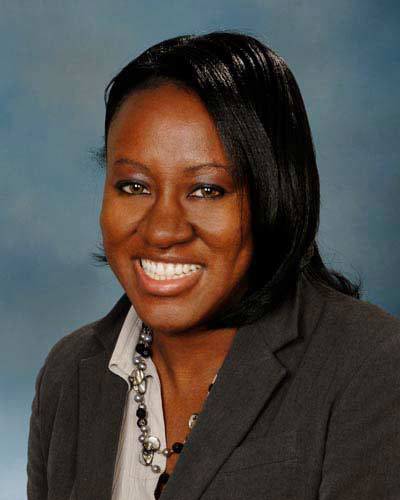 Thelma Wright (Image courtesy of UMSOM)
As a pain medicine physician, she said she was aware of how medically-prescribed opioids have contributed to the rise in overdose death rates. In 2016, Wright began to conceptualize a way to non-invasively monitor if a patient is about to die from an opioid overdose and ways to immediately administer naloxone, an opioid antagonist that can quickly reverse an overdose.
Despite administering naloxone to people experiencing opioid overdose, to reverse their respiratory depression, many overdose cases are fatal because the naloxone was not administered in time, Wright shared.
“When someone is dying from an overdose, they cannot get the antidote from their medicine cabinet to administer it to themselves. I asked around if there was a sensitive monitor that could immediately detect an opioid overdose, and there was nothing,” said Wright. “I needed to find some sort of parameter that would signal respiratory depression due to an overdose, and the most accurate parameter happened to be a carbon dioxide (CO2) monitor.”
Evolving CO2 monitoring research
Opioids stimulate receptors in the brain and can cause a decrease in pain perception. When brain receptors are overstimulated, the brainstem can then become desensitized to rises in CO2 levels. As a result, the opioid user could experience respiratory depression, loss of protective airway reflexes, and respiratory arrest.
Ge, who serves as the assistant director of UMBC’s Center for Advanced Sensor Technology (CAST), has spent more than a decade researching and developing non-invasive CO2 sensor systems. During the pandemic, Ge, along with Govind Rao, a professor of CBEE and the director of CAST, co-authored a study published in Medical Engineering & Physics analyzing the effects of face coverings on transdermal CO2 levels. The study demonstrated the potential effectiveness of monitoring CO2 levels through the use of wearable transdermal CO2 sensors.
“The original CO2 monitoring device is large, about the size of a suitcase,” said Ge. Wright approached Ge and Rao to develop a miniaturized, wearable version that could address some of the shortcomings of other devices available today.
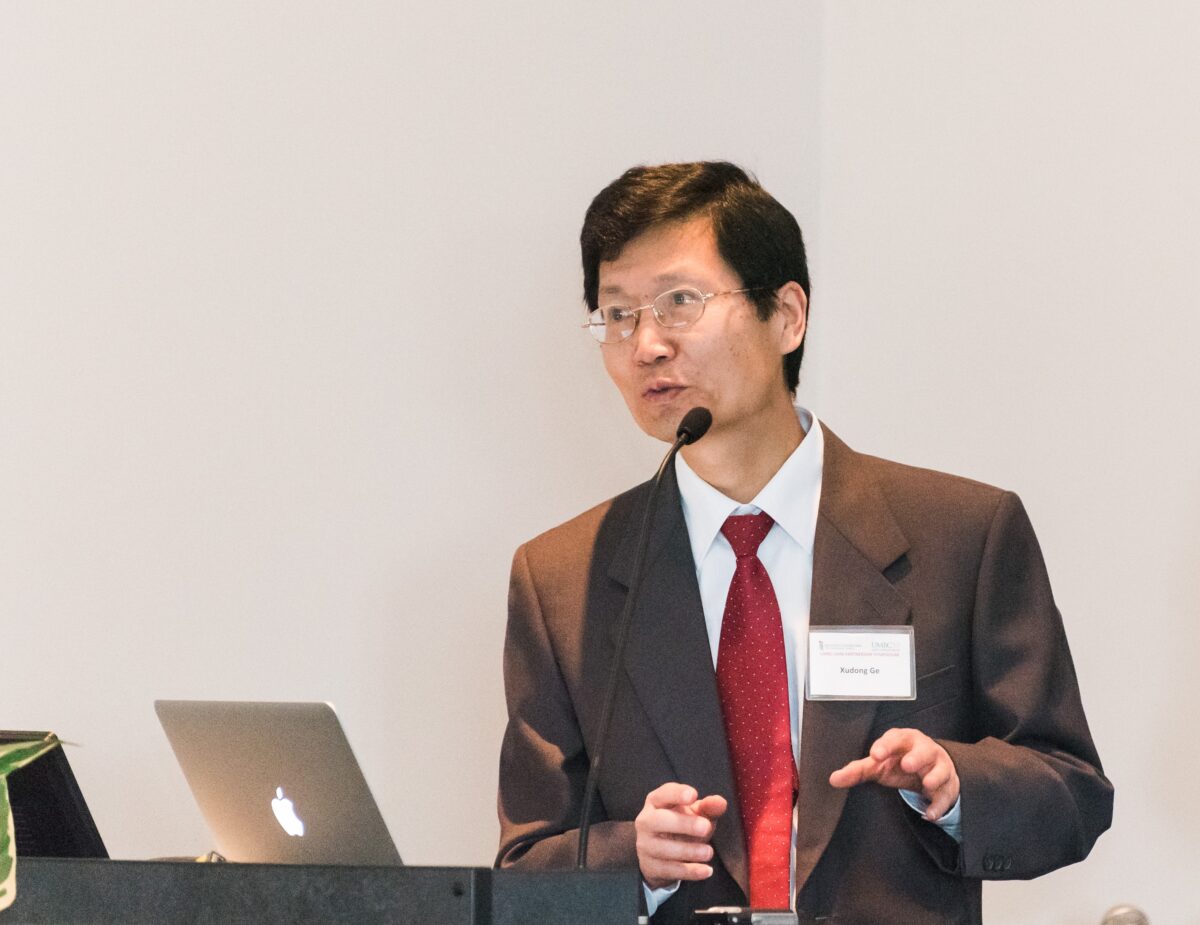 Xudong Ge (Marlayna Demond ’11/UMBC)
Ge explains that traditional non-invasive CO2 monitors that are used on the skin heat up to about 42 degrees Celsius, or more than 107 degrees Fahrenheit. Because of the high heat, they can leave burns on skin and cannot be worn for an extended amount of time. The monitors tend to work at a slower speed and can come with a price tag averaging about $25,000.
Along with miniaturizing the device, Ge aims to create a monitor that is safer and more comfortable, delivers data more efficiently, and is more affordable for the average consumer.
Developing the device
When a patient wears the CO2 device and experiences respiratory depression due to an overdose, the device will trigger an alarm that will automatically inject naloxone. In order to validate the study’s proof of principle, the initial phases of the study will start with developing and testing CO2 sensor prototypes. The test results will then be compared to data from a similar FDA-approved device that they are hoping to improve on.
“We will run side by side tests to see how accurate our device is and then do challenge studies, like holding your breath, breathing into a bag, or exercising to get the subjects’ CO2 levels up in the body to see if we are able to detect it,” says Rao. “We will incorporate some elements of machine learning to detect the signal accurately, to make sure that there are no false positives or false negatives.”
 Govind Rao (Marlayna Demond ’11/UMBC)
The investigators have hired UMBC postdoctoral researcher Preety Ahuja to work on the prototyping. If the study is granted additional funding, Wright and her team of researchers will test the sensor on animal subjects to validate whether the wearable transdermal CO2 alarm will be effective. The researchers also intend to develop a mobile app to gather and share the data provided by the monitor.
Rao looks forward to collaborating closely with Wright through this UMBC-UMSOM partnership, noting the significance of her work with underserved populations in Baltimore. He shares, “Dr. Wright is very keen and passionate about finding solutions and our UMBC team is very excited to be working with her.”
]]>
Opioid-related deaths have risen sharply in the U.S. in recent years. In 2017, the Department of Health and Human Services declared the opioid crisis to be a public health emergency—one...
https://umbc.edu/stories/reverse-opioid-overdoses-in-real-time/
https://my3.my.umbc.edu/api/v0/pixel/news/129710/guest@my.umbc.edu/b903201bcdb55aa185c720f758b62002/api/pixel
cast
cbee
coeit
news
rca-2
research
science-and-tech
UMBC News & Magazine
https://my3.my.umbc.edu/groups/umbc-news-magazine
https://assets1-my.umbc.edu/system/shared/avatars/groups/000/001/943/24435aa6207c452e7bc15cc74b42c7bb/xsmall.png?1748556657
https://assets1-my.umbc.edu/system/shared/avatars/groups/000/001/943/24435aa6207c452e7bc15cc74b42c7bb/original.png?1748556657
https://assets2-my.umbc.edu/system/shared/avatars/groups/000/001/943/24435aa6207c452e7bc15cc74b42c7bb/xxlarge.png?1748556657
https://assets2-my.umbc.edu/system/shared/avatars/groups/000/001/943/24435aa6207c452e7bc15cc74b42c7bb/xlarge.png?1748556657
https://assets3-my.umbc.edu/system/shared/avatars/groups/000/001/943/24435aa6207c452e7bc15cc74b42c7bb/large.png?1748556657
https://assets1-my.umbc.edu/system/shared/avatars/groups/000/001/943/24435aa6207c452e7bc15cc74b42c7bb/medium.png?1748556657
https://assets2-my.umbc.edu/system/shared/avatars/groups/000/001/943/24435aa6207c452e7bc15cc74b42c7bb/small.png?1748556657
https://assets1-my.umbc.edu/system/shared/avatars/groups/000/001/943/24435aa6207c452e7bc15cc74b42c7bb/xsmall.png?1748556657
https://assets2-my.umbc.edu/system/shared/avatars/groups/000/001/943/24435aa6207c452e7bc15cc74b42c7bb/xxsmall.png?1748556657
UMBC News & Magazine
3
0
false
Fri, 09 Dec 2022 13:43:21 -0500
Fri, 09 Dec 2022 13:43:21 -0500
Low-cost infant incubator developed at UMBC completes successful clinical trial in India

Innovative technologies don’t have to be expensive or complicated.
UMBC’s Govind Rao, professor of chemical, biochemical, and environmental engineering and director of the Center for Advanced Sensor Technology, has been developing a low-cost solution to improve the care of babies born prematurely.
A standard incubator found in a newborn intensive care unit costs between $1,500 and $35,000—beyond the means of many hospitals in low- and middle-income countries. Public impact research initiated by Rao and UMBC students has culminated in the successful clinical trial of an incubator that costs only $200.
 Govind Rao, center, presents a prototype incubator to then-Maryland Secretary of Commerce Mike Gill in 2017. Photo by Marlayna Demond ’11 for UMBC.
“This will be a game-changer,” says Rajeev Seth, managing trustee of BUDS, a nonprofit that advocates for the health and welfare of children in India.
Student project beginnings
The low-cost incubator traces its roots to a UMBC course on sensors in 2011. There, Rao asked students to come up with solutions for real-world problems. Kevin Tran ’12, chemical engineering, was part of a team that designed a low-cost infant incubator. He continued on the project that summer.
“As an engineer, [when] you start something, you can’t leave it half-finished,” Tran says. He and his teammates tested out prototypes built with different materials, like wood and PVC. The team ultimately took a trip to India to visit various healthcare settings and receive feedback on their design.

Govind Rao, third from left, with UMBC students and research partners, during a trip to India.
Photo courtesy of Kevin Tran.
The students encountered facilities that faced frequent power outages and lacked resources they’d taken for granted in the U.S. One healthcare center had broken incubators that sat unused, Tran says, because they couldn’t be maintained, even if it was a simple fix.
The team was accompanied by Geetha Mohanram, a retired elementary school teacher who acted as a translator. Mohanram now lives in the U.S. but is from Karnataka, one of the areas the team visited. She bridged the gap between the engineers and the nurses and doctors, not only through fluency with the local dialect, but also because of familiarity with the local culture. This helped the UMBC team access the medical staff’s observations and insights.
Feedback gathered during the trip guided updates to the design, such as smaller dimensions and cardboard construction for single use. The design work culminated in a paper published in the Journal of Laboratory Automation in 2014. It provided recommendations for a prototype suited to a clinical trial.
Cardboard incubator in action
An updated version of the cardboard incubator has now proven successful in a clinical setting. In an EClinicalMedicine study, published by The Lancet, the low-cost incubator maintained the body temperatures of premature babies as well as a more expensive, standard incubator over 48 hours.
The low-cost incubator is made up of a cardboard chamber, designed to be disposed of after use by one infant, and a reusable heating unit. The cardboard packs down flat, so it can be easily transported. It is straightforward to assemble—almost like a pop-up book, Rao says.
Careful monitoring
The clinical trial was a collaborative effort supported by the U.S. Food and Drug Administration. Subawards supported Phoenix Medical Systems, which provided the cardboard incubators, and researchers at Sri Ramachandra Institute of Higher Education and Research (SRIHER), who conducted the study.
The study involved 96 preterm babies, ranging from 32 to 36 weeks old, without health complications. By limiting the clinical trial to babies that were relatively well, the researchers were able to focus on the performance of the incubators, says Ashok Chandrasekaran, associate professor of neonatology at SRIHER.
The babies spent 48 hours in either a standard or cardboard incubator, with continued monitoring by medical staff. Skin sensors tracked the babies’ temperatures. They raised alarms if temperatures deviated over half a degree Celsius (0.9 degrees Fahrenheit) from 37 degrees Celsius (98.6 degrees Fahrenheit). Nurses also checked the infants using underarm thermometers every four hours and adjusted the incubator temperature as needed.
 A prototype of Rao’s cardboard incubator. Photos courtesy of V. Sashi Kumar.
There were cases where the babies’ temperatures were slightly low with both incubators, as well as several instances of mild hypothermia. But, overall, the performance of the low-cost incubator was on par with the standard incubator.
Avoiding hospital-acquired infections
The surfaces of the low-cost and standard incubators were disinfected daily, but in two cases the standard incubator harbored bacteria responsible for hospital-acquired infections. None of the low-cost incubators were positive for surface bacteria. The disposable nature of the cardboard incubator would also prevent infectious outbreaks, since each chamber would only be used by a single infant.
“One of the major killers of preterm babies in developing countries is infection,” Chandrasekaran says. “Especially hospital-acquired infections.”
Future studies will assess how well the low-cost incubator performs over longer periods of time and whether premature babies continue to gain weight, says Binu Ninan, director and professor of neonatology at SRIHER. Future iterations of the incubator could include sensors to track babies’ weight and cameras to monitor babies more closely.
“You don’t necessarily need to have very expensive interventions to improve outcomes,” Rao says. “You can come up with something simple that works, that can have a huge impact.”
Banner image: “Happy Foot” by Natesh Ramasamy, Flickr CC BY-NC 2.0.
Article written by Jack J. Lee for UMBC News
]]>
Innovative technologies don’t have to be expensive or complicated. UMBC’s Govind Rao, professor of chemical, biochemical, and environmental engineering and director of the Center for...
https://umbc.edu/stories/low-cost-infant-incubator-developed-at-umbc-completes-successful-clinical-trial-in-india/
https://my3.my.umbc.edu/api/v0/pixel/news/119682/guest@my.umbc.edu/36a5869ee2cc363f1bf2d7a6b0f129dd/api/pixel
alumni
cast
cbee
coeit
international
page1
research
science-and-technology
UMBC News & Magazine
https://my3.my.umbc.edu/groups/umbc-news-magazine
https://assets1-my.umbc.edu/system/shared/avatars/groups/000/001/943/24435aa6207c452e7bc15cc74b42c7bb/xsmall.png?1748556657
https://assets1-my.umbc.edu/system/shared/avatars/groups/000/001/943/24435aa6207c452e7bc15cc74b42c7bb/original.png?1748556657
https://assets2-my.umbc.edu/system/shared/avatars/groups/000/001/943/24435aa6207c452e7bc15cc74b42c7bb/xxlarge.png?1748556657
https://assets2-my.umbc.edu/system/shared/avatars/groups/000/001/943/24435aa6207c452e7bc15cc74b42c7bb/xlarge.png?1748556657
https://assets3-my.umbc.edu/system/shared/avatars/groups/000/001/943/24435aa6207c452e7bc15cc74b42c7bb/large.png?1748556657
https://assets1-my.umbc.edu/system/shared/avatars/groups/000/001/943/24435aa6207c452e7bc15cc74b42c7bb/medium.png?1748556657
https://assets2-my.umbc.edu/system/shared/avatars/groups/000/001/943/24435aa6207c452e7bc15cc74b42c7bb/small.png?1748556657
https://assets1-my.umbc.edu/system/shared/avatars/groups/000/001/943/24435aa6207c452e7bc15cc74b42c7bb/xsmall.png?1748556657
https://assets2-my.umbc.edu/system/shared/avatars/groups/000/001/943/24435aa6207c452e7bc15cc74b42c7bb/xxsmall.png?1748556657
UMBC News & Magazine
0
0
false
Mon, 22 Feb 2021 18:16:28 -0500
UMBC’s Mustafa Al-Adhami wins national Three-Minute Thesis competition

Mustafa Al-Adhami M.S. ‘15, Ph.D. ‘20, mechanical engineering, won the national Three-Minute Thesis competition last week, during the annual conference of the Council of Graduate Schools. His winning topic: rapid detection of bacteria in blood.
Al-Adhami developed a rapid bacterial-detection test that can assess, within an hour, if a patient has an infection. It can also help physicians determine which specific antibiotics should be administered to help fight the infection. Al-Adhami’s device, ASTEK, costs a fraction of the price of the current antibiotic susceptibility test. He hopes that it will reduce the duration of hospital stays and can reduce antibiotic resistance by avoiding unnecessary antibiotic use.
Al-Adhami earned first place in two qualifying rounds of the competition, on his path to claiming the national title. The first round was held at UMBC. The second round included 150 competitors from universities across the southern United States. The top two students from that round qualified for the national competition in Nashville.
In Nashville, Al-Adhami and nine other finalists presented their three-minute talks in front of a live audience that selected the ultimate winner. He explains that as he moved through the competition rounds he felt more at ease.
“I was very nervous doing the UMBC Three-Minute Thesis competition, but things got easier as the competition progressed,” Al-Adhami says. “Last weekend was more fun than anything else, maybe because I had my wife and a UMBC team with me this time.”
In addition to presenting in the Three-Minute Thesis competition, Al-Adhami has shared his work at UMBC’s GRIT-X talks, Idea Competition, and Cangialosi Business Innovation Competition. He was also on a team of three UMBC graduate students who won the BMEidea competition hosted by VentureWell (a national alliance of collegiate inventors and innovators) in August. He conducted his research in UMBC’s Center for Advanced Sensor Technology, and was advised by mechanical engineering faculty Marc Zupan, associate professor, and Chuck Eggleton, professor.
Learn more about Al-Adhami’s research in UMBC Magazine
Banner image: Mustafa Al-Adhami, Ph.D. ’20, speaks at GRIT-X 2019. Photo by Arionna Gonsalves.
]]>
Mustafa Al-Adhami M.S. ‘15, Ph.D. ‘20, mechanical engineering, won the national Three-Minute Thesis competition last week, during the annual conference of the Council of Graduate Schools. His...
https://umbc.edu/stories/umbcs-mustafa-al-adhami-wins-national-three-minute-thesis-competition/
https://my3.my.umbc.edu/api/v0/pixel/news/119992/guest@my.umbc.edu/10e75ba39eb48d34057364fd4b99ddfa/api/pixel
alexbrowncenter
cast
coeit
gradresearch
meche
science-and-technology
UMBC News & Magazine
https://my3.my.umbc.edu/groups/umbc-news-magazine
https://assets1-my.umbc.edu/system/shared/avatars/groups/000/001/943/24435aa6207c452e7bc15cc74b42c7bb/xsmall.png?1748556657
https://assets1-my.umbc.edu/system/shared/avatars/groups/000/001/943/24435aa6207c452e7bc15cc74b42c7bb/original.png?1748556657
https://assets2-my.umbc.edu/system/shared/avatars/groups/000/001/943/24435aa6207c452e7bc15cc74b42c7bb/xxlarge.png?1748556657
https://assets2-my.umbc.edu/system/shared/avatars/groups/000/001/943/24435aa6207c452e7bc15cc74b42c7bb/xlarge.png?1748556657
https://assets3-my.umbc.edu/system/shared/avatars/groups/000/001/943/24435aa6207c452e7bc15cc74b42c7bb/large.png?1748556657
https://assets1-my.umbc.edu/system/shared/avatars/groups/000/001/943/24435aa6207c452e7bc15cc74b42c7bb/medium.png?1748556657
https://assets2-my.umbc.edu/system/shared/avatars/groups/000/001/943/24435aa6207c452e7bc15cc74b42c7bb/small.png?1748556657
https://assets1-my.umbc.edu/system/shared/avatars/groups/000/001/943/24435aa6207c452e7bc15cc74b42c7bb/xsmall.png?1748556657
https://assets2-my.umbc.edu/system/shared/avatars/groups/000/001/943/24435aa6207c452e7bc15cc74b42c7bb/xxsmall.png?1748556657
UMBC News & Magazine
0
0
false
Fri, 13 Dec 2019 18:52:14 -0500
Urgent Care

This is what it looks like when researchers push beyond band-aid solutions and design better answers to pressing medical and mental-health issues.
The Patapsco Valley might not bring to mind the disruption of the technology industry the way Silicon Valley has defined itself, but UMBC student and faculty researchers are aggressively tackling disparities related to health care and changing the way people around the world access health technologies.
As a public university, UMBC’s scientific community is actively researching ways to alleviate public-health problems. In some labs this means changing the focus of research to address a more pressing medical issue, like Ph.D. student Mustafa Al-Adhami did when he veered away from studying water purification to address sepsis, a life-threatening condition that strikes over a million Americans each year.
Another example is UMBC faculty member Govind Rao, who feels a sense of urgency in addressing critical challenges that are impacting people’s quality of life. Rao, a professor of chemical, biochemical, and environmental engineering, and director of UMBC’s Center for Advanced Sensor Technology (CAST), sees UMBC students and professors using their skills and interests to make health technologies more equitable, more affordable, and more sustainable. A central focus of Rao’s collaborative work is creating health-care solutions that are not restrained by cost or geography, like an award-winning cardboard incubator his lab produced, accessible for communities with limited resources.
Rao refers to his research and the technologies he’s developed as “disruptive innovations,” and he’s not the only UMBC researcher who is working to help people change how they approach and access medical care. These developments offer novel solutions to challenges facing the world, and faculty and staff at UMBC are changing the way people receive medical care and support from medical providers.
“If I can empower students to think and come up with solutions that have a green footprint and are lower cost and sustainable, I think we can bend the curve,” explains Rao.
Treating sepsis with more accuracy
Mustafa Al-Adhami, M.S ’15, Ph.D. ’19, mechanical engineering, credits a conversation with his wife Stephanie Al-Adhami, a nurse, in changing the focus of his research. At the time Al-Adhami was working to develop a device to determine whether water was safe to consume, but after discovering devices on the market that could already filter most water to make it potable, he shifted his work to address another prevalent challenge that people around the world are facing. “We just pivoted from water to actual blood with this specific application,” he says.
Sepsis is a serious blood infection that, if not treated properly and promptly, can lead to serious complications and even death in mere days. Those at highest risk are the most vulnerable: infants, children, the elderly, and those already facing severe medical problems. According to the Centers for Disease Control and Prevention, more than one million people fight sepsis each year and about a quarter of these cases are fatal. Discouragingly, the number of sepsis cases each year is also on the rise. Al-Adhami and others are working to reverse the trend.

The challenge for physicians isn’t determining whether a person has sepsis, explains Al-Adhami, but rather identifying which antibiotics to administer to the patient. “With every one hour without proper treatment, there is a 7% less chance of survival,” he says.
Working with faculty and student researchers in CAST, Al-Adhami developed a rapid bacterial-detection test that can determine whether a patient has an infection within an hour and helps physicians determine which specific antibiotics should be administered to help fight the infection. Al-Adhami’s device, ASTEK, costs a fraction of the price of the current antibiotic susceptibility test, can reduce the duration of hospital stays, and can prevent antibiotic resistance by avoiding unnecessary antibiotic use.
In addition to its cost effectiveness, ASTEK only requires one milliliter of blood to be run. This is a breakthrough in detecting sepsis in young children. “For [traditional] blood cultures, they take four bottles of blood. Each one is eight milliliters,” explains Al-Adhami. “Because we don’t need this much blood, it could be used for newborns…the concentration of bacteria is much higher in infants.”
The device has successfully been tested in mice, and Al-Adhami hopes that it will be ready for human testing in the next couple of years. If the device is approved for human use, it has the potential to save thousands of patients each year by speeding up the process of diagnosing and administering the correct antibiotics.
Understanding behavior through social media analytics
According to the U.S. Department of Health and Human Services, more than 130 people die from opioid-related overdoses each day, and there are over 14,000 substance abuse facilities across the U.S. that treat people facing these addictions. The opioid epidemic affects every region of the country, and those watching loved ones go through the cycle of substance abuse are seeking any new ways to halt this disease in its tracks.
 Shimei Pan, assistant professor of information systems, is studying human behavior in the context of monitoring, preventing, and treating substance-abuse by analyzing how people with substance use disorders behave on social media. “On social media, there is a lot of information about each individual. Some are related to substance use, like drinking, smoking, and illicit drug use,” she says.
Pan and her collaborator Warren Bickel, a well-known behavior scientist at the Virginia Tech Addiction Treatment Center, are employing large-scale social media analytics to better understand addiction and help medical professionals provide personalized treatment to people facing addiction and substance abuse.
The clues Pan and Bickel are looking for in social media data are subtle, but have the potential to alter the way substance abuse is identified and subsequently treated. “Sometimes, people explicitly mention substance use in their social media posts,” she shares. “These are useful signals. But there are other signals in social media, sometimes even stronger than explicit mentions of substances. Substance abuse is frequently linked to mental disorders such as depression, anxiety and impulsivity. As a result, social media behavior signals related to depression, anxiety and impulsivity can also be very useful in helping us detect and understand substance abuse”
Since substance abuse could be explained by both genetic and environmental factors, with large-scale social media analytics it is possible to identify distinct patterns in its manifestation on social media, says Pan. “We want to see whether we can find those behavioral markers of addiction on social media. By identifying these markers, we can understand substance abuse a little bit better.”
Pan and her collaborators plan to continue conducting basic research, and hope to help develop new screening, diagnostic, and intervention tools in the future—another way of building a bridge to proper health care access for all.
Studying stigma and pain
Another UMBC faculty member studying human behavior is Shawn Bediako, associate professor of psychology, who focuses on the psychosocial impact of sickle cell disease. Bediako is using new technologies to assess sickle cell patients’ pain and experiences.
Previously, Bediako and his collaborators collected data using paper surveys that were sent to patients and required that patients mail them back each week. “We didn’t know when they filled [the surveys] out,” he says. “All we knew is that they would send us a packet back.”
The development of a new app-based tool, however, lessened the lag in survey responses. This new approach gives researchers a more accurate picture by providing data with integrity. Bediako explains that the app allows patients to submit their experiences directly and enables researchers like him to pose bold, new questions to patients. Each night at 7 p.m., the patients automatically receive a survey to fill out by midnight. The rapid turnaround and ease of completing the survey also “cut down on data contamination,” he says.
“Now that data analytics has expanded the range of online behaviors that we can examine, researchers like me can think about the links between health care and health outcomes in a different way,” Bediako explains.
Bediako, who is also the facilitator for UMBC’s Collaborative for the Interdisciplinary Promotion of Health Equity Research (CIPHER), hopes that his work bridges the gap between people who are doing research on sickle cell disease and people who are studying how innovative technologies can be utilized to help people with the disease. “I’m currently integrating information from history, policy, sociology, psychology, and medicine to better understand the genetics of sickle cell pain,” he says, adding this requires some “out-of-the-box type thinking.”
Like Pan, Bediako is interested in how people’s social media use differs depending on whether they are in pain versus not in pain. “Now that data analytics has expanded the range of online behaviors that we can examine, researchers like me can think about the links between health care and health outcomes in a different way,” he explains.
Supporting first responders
In a broad collaboration to understand how the stressful situations first responders encounter in their jobs can lead to anxiety and other mental health issues, UMBC faculty in emergency health services (EHS) and information systems are using existing technologies to tackle the task. Principal investigator Andrea Kleinsmith, assistant professor of information systems, is collaborating with J. Lee Jenkins, associate professor and chair of emergency health services; Helena Mentis, associate professor of information systems and associate dean in the College of Engineering and Information Technology; and Gary Williams, acting paramedic director in emergency health services.
Trainees and first responders on the job may experience an array of physiological responses when they are in a situation that is tense or challenging. UMBC students in their third and fourth years of the emergency health services program move through a series of often intense scenarios in the simulation lab in Sherman Hall to prepare them for a range of situations they may encounter on the job. Involuntary bodily reactions such as increased heart rates or perspiration are tracked by wearable devices, and allow the instructors and trainees the opportunity to assess and manage stress and improve the preparedness for future emergency scenarios.

Working with student researchers, the faculty members design, develop, and evaluate the system to assess how discussions and intentional in-class reflections on stressful situations can help trainees implement stress management strategies during their work. The team is studying how a Team Stress Reflection system can be used by paramedic trainees to “understand the events that trigger stress increases and their ability to mitigate that stress,” according to the grant proposal. This technology allows the students to identify and better understand the correlations between stressful situations and their physiological responses.
Stress, explains Kleinsmith, can lead to errors during care and long-term health concerns for medical personnel, including emergency health professionals. Williams says that it’s important for students to debrief and reflect on the simulation to make sure that they can address any stressors or points that caused them to have strong physiological responses.
“The ability to monitor and manage stress in medical personnel has the potential to improve medical care provided in stressful situations,” explains Kleinsmith.
Understanding the physiological responses during training exercises is important for trainees, explains Williams, because it allows them to improve how they cope with stress in situations that they may encounter on the job. This research is being funded by a three-year grant from the National Science Foundation, which supports the faculty in collecting data from the EHS students and developing the interface to help the students come to their own conclusions about the correlation between physiological measurements and stress to understand their stress triggers. The interface also helps facilitate the team’s discussion about stress.
Motion sensors to inform treatment

Helena Mentis is also using activity trackers and other motion sensors to assess movement and inform treatment for patients with Parkinson’s disease. In collaboration with faculty at the University of Maryland Parkinson Disease and Movement Disorders Center, Mentis designed and developed a sensor using Leap Motion devices to track and assess the movement of patients with Parkinson’s disease during deep brain stimulation.
One observation that Mentis and her collaborators made was that the presentation of data collected from the sensors impacted how the data was interpreted and used to develop customized treatment plans for patients. In 2017, Mentis presented a paper at the Association for Computing Machinery Special Interest Group on Computer-Human Interaction Conference. The paper explains that the data collected by the patients’ activity trackers led to more informed conversations between the patient with Parkinson’s and their physician.
In a well-researched disease like Parkinson’s, there’s still always room for improvements in care and access to care. Researchers have been studying Parkinson’s disease and treatment options for people with Parkinson’s since the 1960s, but there is still work to be done. Every advancement leads to better outcomes and an increased quality of life for Parkinson’s patients. Mentis and her collaborators are now using self-tracking technologies to help physicians customize treatment plans and advocate for patients.
“Determining how sensor data can be incorporated in shared decision-making is fundamental to effective patient-centered care,” explains Mentis. “Even more so for low-resource and marginalized communities, where sensor data could easily be used by medical caregivers to argue for diagnoses or treatments that are based on assumptions and biases. The sensor data in itself does not embody truth and instead should be taken into account alongside a holistic understanding of the patient and their circumstances.”
Doing good through “disruptive innovations”
Through his work, Rao focuses on addressing critical challenges by answering the fundamental question: “How can we help them?”
“These are real lives, real people who are living in desperate conditions,” Rao says, noting that he aims to empower his students to think about how they can make positive changes through their work. Rao explains that his multidisciplinary approach to research has allowed him and his colleagues and students to make tremendous impacts related to health technology. CAST allows him to work with faculty and students from a range of disciplines, and he believes it is important for engineers, scientists, sociologists and psychologists, and policymakers to have a seat at the table, because each perspective is so valuable.

“Disruptive innovation” refers to technologies and other developments that offer novel solutions to challenges facing the world. Like Bediako and other colleagues at UMBC, Rao challenges his students to consider new approaches to addressing challenges and needs in the health technologies space.
While Rao leads this research, he is quick to point out that the collaborative nature of the work and the contributions of his students are crucial to its success. “It’s not about me,” he says. “I’m just privileged enough to have such an amazing team across several disciplines and backgrounds. It’s just a blast.”
With funding and support from federal agencies, including the Defense Advanced Research Projects Agency, Rao has developed a bioreactor or “biomod” that fits inside a suitcase and allows pharmaceuticals to be produced on demand and with limited resources and time. The device was developed with soldiers in conflict zones in mind because it allows them to quickly create customized medicines to save lives based on the needs of the patient.
Additionally, Rao and his colleagues have developed low-cost incubators to support premature babies in communities with limited resources and in areas that do not have access to robust medical facilities. His research team was presented with the 2019 Global Health Research Award at the Pediatric Academic Societies Meeting in Baltimore.
The question “What have you done for others?” is the driving force behind Rao’s lab. He says that many of the health technologies that are currently available are only affordable to a small group of people, and are only helping the people who can afford them. “Just spending five to 10 minutes a day thinking about what they [students] can do with their skill set to improve the lives of others, that’s all it takes to change the world,” Rao says.
*****
All illustrations by Brucie Rosch.
]]>
This is what it looks like when researchers push beyond band-aid solutions and design better answers to pressing medical and mental-health issues. The Patapsco Valley might not bring to mind the...
https://umbc.edu/stories/tackling-disparities-related-to-healthcare-and-care-access/
https://my3.my.umbc.edu/api/v0/pixel/news/120106/guest@my.umbc.edu/2fe6c14f2765ff8f2122bf8dbbdfe314/api/pixel
cast
coeit
discovery
feature
graduateschool
spring-2019
UMBC News & Magazine
https://my3.my.umbc.edu/groups/umbc-news-magazine
https://assets1-my.umbc.edu/system/shared/avatars/groups/000/001/943/24435aa6207c452e7bc15cc74b42c7bb/xsmall.png?1748556657
https://assets1-my.umbc.edu/system/shared/avatars/groups/000/001/943/24435aa6207c452e7bc15cc74b42c7bb/original.png?1748556657
https://assets2-my.umbc.edu/system/shared/avatars/groups/000/001/943/24435aa6207c452e7bc15cc74b42c7bb/xxlarge.png?1748556657
https://assets2-my.umbc.edu/system/shared/avatars/groups/000/001/943/24435aa6207c452e7bc15cc74b42c7bb/xlarge.png?1748556657
https://assets3-my.umbc.edu/system/shared/avatars/groups/000/001/943/24435aa6207c452e7bc15cc74b42c7bb/large.png?1748556657
https://assets1-my.umbc.edu/system/shared/avatars/groups/000/001/943/24435aa6207c452e7bc15cc74b42c7bb/medium.png?1748556657
https://assets2-my.umbc.edu/system/shared/avatars/groups/000/001/943/24435aa6207c452e7bc15cc74b42c7bb/small.png?1748556657
https://assets1-my.umbc.edu/system/shared/avatars/groups/000/001/943/24435aa6207c452e7bc15cc74b42c7bb/xsmall.png?1748556657
https://assets2-my.umbc.edu/system/shared/avatars/groups/000/001/943/24435aa6207c452e7bc15cc74b42c7bb/xxsmall.png?1748556657
UMBC News & Magazine
0
0
false
Mon, 17 Jun 2019 19:56:07 -0400
Class project to clinical trials: UMBC’s affordable infant incubator wins Global Health Research Award

When Kevin Tran ‘12, chemical engineering, was a student at UMBC, he took a course on sensors that made him realize the best high tech solution is sometimes a low tech solution.
Govind Rao, professor of chemical, biochemical, and environmental engineering, and director of the Center for Advanced Sensor Technology (CAST) asked Tran and his classmates to explore a problem that could be solved by sensors, but to not lose sight of factors beyond the technology. The team began work on a low-cost infant incubator. After years of refinement in the lab, the invention has now earned the 2019 Global Health Research Award from the Academic Pediatric Association. Rao and co-authors will be recognized at the Pediatric Academic Societies Meeting in Baltimore, April 27–30.
Rao and his students sought to develop an incubator to support premature babies in communities with limited resources, and in remote areas that do not have access to medical facilities. The incubators they developed are made from cardboard, and can be easily disposed of after each use. The materials used to construct them are fairly easy to find, making them inexpensive and accessible to people in low- and middle-income countries.
 Govind Rao, center, explaining the cardboard incubator that he and his collaborators have developed to Maryland Secretary of Commerce Mike Gill. Photo by Marlayna Demond ’11 for UMBC.
Seeing the challenge firsthand
Tran recalls that, from the very beginning, the project stretched his mind and allowed him to think of creative solutions to a significant real-world challenge. “The scope of the project was much broader than just the sensor itself,” and Rao emphasized the need to look at social and economic factors, recalls Tran. “Rather than just trying to make an efficient and low-cost sensor, our design would also be heavily influenced by which target population we were trying to reach.”
After completing the course, Tran joined CAST for the summer to continue working on the project alongside the professor. Tran and several other student researchers joined Rao on a trip to India to see, firsthand, how local medical facilities used incubators for premature infants.
Govind Rao, third from left, with UMBC students and research partners, during a trip to India. Photo courtesy of Kevin Tran.
The facilities they visited had some access to incubators, but the situation was far from ideal. “We learned that incubators that broke were not able to be serviced at hospitals or primary health care facilities,” explains Tran. “Since many [incubators] were donated…no one know how to go about repairing them.”
Eventually, the collaboration included funding from the Food and Drug Administration to support collaborations with the Sri Ramachandra Institute of Higher Education and Research and Phoenix Medical Systems to conduct clinical trials, which resulted in the award winning work.
 Some incubator development team members during a trip to India. Photo courtesy of Kevin Tran.
Thinking outside the box
The research project has evolved over time to better account for the particular needs of communities that would use this incubator technology. Heating systems are common for incubators in air conditioned facilities, and a heating system for the incubator is currently in a clinical trial in India. But what about incubators used in warm environments without air conditioning?
In these contexts, a cooling system can be just as important to help infants maintain a steady body temperature. Plus, both the heating and cooling systems must be highly reliable and cost-effective.
Elizabeth Tan ‘19, chemical engineering, has worked in CAST for about two years, and is conducting research to develop a cooling system. She is collaborating with Deepika Sagar ’18, mechanical engineering, to develop the system, and she says that working a student in another major has allowed her to learn new skills, from computer-aided design to soldering.
“It’s great to put what you learned into play,” Tan says. She adds, “It’s nothing like what I expected.”
Tan has enjoyed learning about the broader process of how a product is designed, tested, and launched, and all of the factors that go into making it successful. It’s also opened her eyes to the opportunities she has to make an impact on how medical care is delivered in communities with limited resources. “You realize the need” for these kinds of solutions, says Tan. That’s affected how she understands the project and how she envisions her career.
In the future, the team envisions the device being modified at a local level to fit the needs of people in different areas. After all, says Tran, providing care for premature babies is a problem faced by all communities, “not just one country or certain population.”
“The dream is to be able to shift paradigms” throughout the world, he explains, so all communities can access this life-saving technology.
Banner image: An infant’s hand. Photo by Limor Zellermayer on Unsplash.com.
]]>
When Kevin Tran ‘12, chemical engineering, was a student at UMBC, he took a course on sensors that made him realize the best high tech solution is sometimes a low tech solution. Govind Rao,...
https://umbc.edu/stories/class-project-to-clinical-trials-umbcs-affordable-infant-incubator-wins-global-health-research-award/
https://my3.my.umbc.edu/api/v0/pixel/news/120195/guest@my.umbc.edu/063b8ef4ce62ccfada517a4ea5303e74/api/pixel
cast
cbee
cirsca
coeit
science-and-technology
strategic-planning
UMBC News & Magazine
https://my3.my.umbc.edu/groups/umbc-news-magazine
https://assets1-my.umbc.edu/system/shared/avatars/groups/000/001/943/24435aa6207c452e7bc15cc74b42c7bb/xsmall.png?1748556657
https://assets1-my.umbc.edu/system/shared/avatars/groups/000/001/943/24435aa6207c452e7bc15cc74b42c7bb/original.png?1748556657
https://assets2-my.umbc.edu/system/shared/avatars/groups/000/001/943/24435aa6207c452e7bc15cc74b42c7bb/xxlarge.png?1748556657
https://assets2-my.umbc.edu/system/shared/avatars/groups/000/001/943/24435aa6207c452e7bc15cc74b42c7bb/xlarge.png?1748556657
https://assets3-my.umbc.edu/system/shared/avatars/groups/000/001/943/24435aa6207c452e7bc15cc74b42c7bb/large.png?1748556657
https://assets1-my.umbc.edu/system/shared/avatars/groups/000/001/943/24435aa6207c452e7bc15cc74b42c7bb/medium.png?1748556657
https://assets2-my.umbc.edu/system/shared/avatars/groups/000/001/943/24435aa6207c452e7bc15cc74b42c7bb/small.png?1748556657
https://assets1-my.umbc.edu/system/shared/avatars/groups/000/001/943/24435aa6207c452e7bc15cc74b42c7bb/xsmall.png?1748556657
https://assets2-my.umbc.edu/system/shared/avatars/groups/000/001/943/24435aa6207c452e7bc15cc74b42c7bb/xxsmall.png?1748556657
UMBC News & Magazine
0
0
false
Fri, 08 Mar 2019 20:37:06 -0500
Third annual UMBC-UMB Partnership Symposium reveals impact of collaborative research

Researchers and campus leaders from UMBC and the University of Maryland, Baltimore (UMB) convened at bwtech@UMBC South on April 12 to celebrate ongoing research partnerships and announce a new round of Research and Innovation Seed Grants. The awards provide one or two years of funding for interdisciplinary projects with collaborators from both institutions, and are available to faculty in every college at UMBC and every school at UMB.
UMB President Jay Perman, who is also a physician, thanked the researchers for tackling challenging issues that transcend the boundaries between fields. “Your collaborative work empowers people like me to help improve the human condition,” he shared. “You need to know that your work is critically important.”
Wendy Perrow, CEO of AsclepiX Therapeutics, also emphasized the connection between research and clinical work in her keynote address. She encouraged attendees to “bring your technology to the market to help patients,” while acknowledging the many challenges along the way. Perrow’s wealth of experience includes launching a now-mainstream high-blood pressure drug and the first-ever chicken pox vaccine. Most recently, she played a key role in a breakthrough celiac disease drug entering stage three clinical trials.
Following Perrow, five teams who received funding last year presented updates on their progress. Xudong Ge, assistant director of the UMBC Center for Advanced Sensor Technology, and Richard Pierson, professor of surgery at UMB, presented the improvements they’ve made to a non-invasive respiration sensor for adults, children, and even babies. The device would be a boon for intensive care units. Its accuracy parallels that of traditional methods, without the potential to cause burns, a pitfall of current respiration monitoring technologies.
 Xudong Ge, assistant director of UMBC’s CAST, explains his work on a non-invasive respiration sensor.
Tonya Santaus, Ph.D. student in Chris Geddes’ lab at UMBC, shared the development of a rapid, low-cost test for cholera. The lab is applying the same technology to tests for sexually-transmitted infections. “The goal is to get this to rural Africa and rural Haiti,” shared UMB collaborator Colin Stine, professor of epidemiology and public health. Geddes, professor of chemistry, added that while he and Stine have known each other for 15 years, it is “because of this grant [that] we’ve actually been able to work together.”
Elsa Garcin, UMBC associate professor of chemistry and biochemistry, presented her work with Patrick Wintrode, UMB associate professor of pharmaceutical sciences. Their research seeks to better understand how a molecule naturally found in cells, called GAPDH, is able to either activate or shut down another molecule known to contribute to autoimmune conditions and cancer. Eventually, that knowledge could be used to harness GAPDH to treat those conditions.
Soobum Lee, UMBC assistant professor of mechanical engineering, and Mary Melo, UMB clinical assistant professor of dentistry, explained how they intend to use the movement of people’s own jaws to provide the energy for deep brain stimulation, a proven treatment for some neurodegenerative diseases. The proposed new method would avoid the need for repeated surgeries to replace the battery.
Christine Mair, UMBC assistant professor of sociology, and Amanda Lehning, UMB assistant professor of social work, examine the relationship between neighborhood environments and cardiovascular health in Baltimore City to identify social determinants of health inequality such as violent crime and low social cohesion.
 Keynote speaker Wendy Perrow discusses her successful career.
Don Engel, UMBC assistant vice president for research, and Terry Rogers, assistant dean of research affairs at the UMB School of Medicine, announced this year’s cohort of awardees. “We’re delighted to see this program reaching across many areas of both universities,” shared Engel. The new projects include research on oyster herpes, opioid addiction, and non-invasive neonatal glucose monitoring.
Closing the program, UMBC President Freeman Hrabowski reiterated the value and strength of the UMBC-UMB relationship. The $1.5 million invested so far in UMBC-UMB partnership grants has led to $15 million of external grant funding, a return on investment that indicates the effectiveness of the program. In a challenging federal funding climate, it is more important than ever to creatively collaborate to demonstrate the importance of scientific research and generate new funding sources, Hrabowski explained.
“We want to be strong in our commitment to investing in and supporting” collaborative work, said Hrabowski, of uniting inquisitive minds across the institutions. “Our very future, not just in Maryland, not just in America, but of humankind, in large part depends on [this] kind of work.”
Banner image: 2017 UMBC-UMB Partnership Grant recipients with the university presidents. From left to right: Jay Perman, President of UMB; Rose Viscardi, UMB School of Medicine; Leah Tolosa, UMBC Center for Advanced Sensor Technologies; Shaya Fadia, UMB School of Pharmacy; Michael Abrams, UMBC Hilltop Institute; Colleen Burge, UMBC Department of Marine Biotechnology; Matthew Frieman, UMB School of Medicine; Freeman Hrabowski, President of UMBC. All photos by Marlayna Demond ’11 for UMBC.
]]>
Researchers and campus leaders from UMBC and the University of Maryland, Baltimore (UMB) convened at bwtech@UMBC South on April 12 to celebrate ongoing research partnerships and announce a new...
https://umbc.edu/stories/third-annual-umbc-umb-partnership-symposium-reveals-impact-of-collaborative-research/
https://my3.my.umbc.edu/api/v0/pixel/news/120816/guest@my.umbc.edu/e08f908e93e9d2a7c3cd9d50e3ed3c5b/api/pixel
cahss
cast
chembiochem
cnms
coeit
community
imet
iof
marinebiotech
meche
research
saph
science-and-technology
UMBC News & Magazine
https://my3.my.umbc.edu/groups/umbc-news-magazine
https://assets1-my.umbc.edu/system/shared/avatars/groups/000/001/943/24435aa6207c452e7bc15cc74b42c7bb/xsmall.png?1748556657
https://assets1-my.umbc.edu/system/shared/avatars/groups/000/001/943/24435aa6207c452e7bc15cc74b42c7bb/original.png?1748556657
https://assets2-my.umbc.edu/system/shared/avatars/groups/000/001/943/24435aa6207c452e7bc15cc74b42c7bb/xxlarge.png?1748556657
https://assets2-my.umbc.edu/system/shared/avatars/groups/000/001/943/24435aa6207c452e7bc15cc74b42c7bb/xlarge.png?1748556657
https://assets3-my.umbc.edu/system/shared/avatars/groups/000/001/943/24435aa6207c452e7bc15cc74b42c7bb/large.png?1748556657
https://assets1-my.umbc.edu/system/shared/avatars/groups/000/001/943/24435aa6207c452e7bc15cc74b42c7bb/medium.png?1748556657
https://assets2-my.umbc.edu/system/shared/avatars/groups/000/001/943/24435aa6207c452e7bc15cc74b42c7bb/small.png?1748556657
https://assets1-my.umbc.edu/system/shared/avatars/groups/000/001/943/24435aa6207c452e7bc15cc74b42c7bb/xsmall.png?1748556657
https://assets2-my.umbc.edu/system/shared/avatars/groups/000/001/943/24435aa6207c452e7bc15cc74b42c7bb/xxsmall.png?1748556657
UMBC News & Magazine
0
0
false
Mon, 01 May 2017 21:11:04 -0400
Govind Rao receives 2017 Pioneer Award for technologies that empower patients and save lives
Connected World has named Govind Rao, director of the Center for Advanced Sensor Technology (CAST) and professor of chemical, biochemical, and environmental engineering, a 2017 Pioneer Award recipient. He joins nine trailblazers whom the magazine describes as “the disruptors forging new pathways in this ever-emerging digital age.”
During his career, Rao has created technologies that have revolutionized how doctors and hospitals provide care to patients of all ages and from around the world. “This recognition was unexpected, as it comes from a different discipline,” he said of the award. “It illustrates the power of sensor technology to have a broad impact.”
One technology Rao developed has created a more personalized approach to monitoring metabolic parameters in adults. For example, when patients have their blood pressure and heart rate checked by a medical professional, these numbers are often compared only with the average levels of the population, which may not reflect how the individual differs from the general population. Rao and his team are creating “next-generation sensors” that collect more accurate readings, and monitor and track over time individual carbon dioxide, glucose and oxygen levels. The sensors can allow healthcare providers to receive real-time data for the management of diseases such as diabetes, asthma, emphysema and lung infections. The up-to-date data will allow healthcare professionals to provide more tailored care.
As Connected World describes, Rao’s work is “aimed at giving patients better control over their personal health and enabling solutions that are specific to patients’ needs.”
Rao and his team are also known internationally for developing affordable infant incubators that are powered by solar rechargeable batteries. These devices, made from cardboard, are particularly important in preventing deaths among newborn babies in low- or middle-income countries with gaps in healthcare resources. Infants born in low-resource communities often have higher rates of mortality in the first week of life due to preventable causes such as hypothermia and sepsis, so the incubator was designed with their needs in mind.
Read “Scholars Changing our World Through the IoT” in Connected World to learn more about Rao’s work and the other Pioneer Award recipients.
Image: Govind Rao. Photo courtesy Marlayna Demond ’11 for UMBC.
]]>
Connected World has named Govind Rao, director of the Center for Advanced Sensor Technology (CAST) and professor of chemical, biochemical, and environmental engineering, a 2017 Pioneer Award...
https://umbc.edu/stories/govind-rao-receives-2017-pioneer-award-for-technologies-that-empower-patients-and-save-lives/
https://my3.my.umbc.edu/api/v0/pixel/news/120905/guest@my.umbc.edu/efec93861ad6c66a1597fab1edf2dc5d/api/pixel
cast
cbee
coeit
science-and-technology
UMBC News & Magazine
https://my3.my.umbc.edu/groups/umbc-news-magazine
https://assets1-my.umbc.edu/system/shared/avatars/groups/000/001/943/24435aa6207c452e7bc15cc74b42c7bb/xsmall.png?1748556657
https://assets1-my.umbc.edu/system/shared/avatars/groups/000/001/943/24435aa6207c452e7bc15cc74b42c7bb/original.png?1748556657
https://assets2-my.umbc.edu/system/shared/avatars/groups/000/001/943/24435aa6207c452e7bc15cc74b42c7bb/xxlarge.png?1748556657
https://assets2-my.umbc.edu/system/shared/avatars/groups/000/001/943/24435aa6207c452e7bc15cc74b42c7bb/xlarge.png?1748556657
https://assets3-my.umbc.edu/system/shared/avatars/groups/000/001/943/24435aa6207c452e7bc15cc74b42c7bb/large.png?1748556657
https://assets1-my.umbc.edu/system/shared/avatars/groups/000/001/943/24435aa6207c452e7bc15cc74b42c7bb/medium.png?1748556657
https://assets2-my.umbc.edu/system/shared/avatars/groups/000/001/943/24435aa6207c452e7bc15cc74b42c7bb/small.png?1748556657
https://assets1-my.umbc.edu/system/shared/avatars/groups/000/001/943/24435aa6207c452e7bc15cc74b42c7bb/xsmall.png?1748556657
https://assets2-my.umbc.edu/system/shared/avatars/groups/000/001/943/24435aa6207c452e7bc15cc74b42c7bb/xxsmall.png?1748556657
UMBC News & Magazine
0
0
false
Mon, 09 Jan 2017 20:15:28 -0500
UMB-UMBC Partnership Symposium celebrates research collaborations with impact
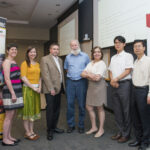
UMBC and the University of Maryland, Baltimore (UMB) celebrated new and recent recipients of UMB-UMBC Research and Innovation Partnership Grants at a symposium held last month on UMB’s downtown Baltimore campus.
This annual event seeks to actively support the growth of meaningful and sustainable research collaborations between the two universities. The June 2016 symposium highlighted the milestones of past partnership grant recipients and celebrated a new round of awardees: five teams of two, with faculty from all three colleges at UMBC as well as UMB’s School of Medicine, School of Pharmacy, School of Dentistry, and School of Social Work.
In recognition of the power of collaborative research, Karl V. Steiner, vice president for research at UMBC, shared, “This is another brick in the pavement as we’re building a road between our two campuses.”
Aaron White, senior scientific advisor to the director at the National Institutes of Health-National Institute on Alcohol Abuse and Alcoholism (NIH-NIAAA), delivered a keynote focused on the diagnosis, prevention, and treatment of alcohol addiction. In addition to having a major negative impact on so many lives, White noted, alcohol addiction costs the U.S. nearly $250 billion dollars each year.
Following White’s remarks, the 2014-15 Research and Innovation Partnership Seed Grant teams each presented updates on their work, including goals for the upcoming year.

Toni Antalis, professor of physiology at the UMB School of Medicine; Rajabrata Sarkar, professor of surgery at UMB School of Medicine; and Zeev Rosenzweig, professor of chemistry and biochemistry at UMBC collaborated to develop a targeted therapy that increases blood flow to the limbs of patients with artery blockages resulting from diabetes, stroke, or other causes. With the prevalence of diabetes rising dramatically in this country, it’s critical to find ways to prevent the need for last-resort treatments like amputation.
When an artery experiences blockage, the nearby arteries expand to compensate, a process called “arteriogenesis.” When a specific protein called “p53” is deleted, the arteriogenesis response is stronger. However, p53 is also a critical tumor suppressor, so deleting it throughout the entire body or for an extended period of time is dangerous. The team is developing a new technique using nanoparticles to carry a drug that blocks p53 to carefully targeted immune cells, which pick up the particles and deliver the drug where it is needed. The team has shown that the new therapy effectively reduces p53 activity and increases arteriogenesis, which is maintained after treatment stops after 14 days.
Aryya Gangopadhyay, professor and chair of the department of information systems; Nirmalya Roy, assistant professor of information systems; and Elizabeth Galik, associate professor in UMB’s School of Nursing; have developed and implemented a smart health technology for people with Alzheimer’s or symptoms of the disease. The technology monitors the cognitive impairment of older adults to help them maintain independence. They worked with a senior community center to fit some residents with wearable sensors to assess cognitive function by monitoring everyday activities like making a sandwich, sweeping the floor, washing hands, and folding clothes.
Radi Masri, associate professor of endodontics, prosthodontics and operative dentistry at the UMB School of Dentistry; David Seminowicz, assistant professor of neural and pain sciences at the UMB School of Dentistry; and Raimi Quiton, assistant professor of psychology at UMBC, are working together to elucidate pain processing in migraines, the third most common cause of pain in the U.S. They hope to discover neural pathways that could be new targets for treatment, because current treatments are ineffective for a large percentage of migraine sufferers.
The team showed that a brain area known as the superior colliculus could be involved in processing migraine pain. The superior colliculus is known to integrate many types of sensory information, which might help explain symptoms such as sensitivity to light, sound, and touch. They also found that individuals who experience migraines have chronically high levels of a protein that is known to transmit pain signals. One next step for their research is to see how mice respond to pain stimuli if the neural signal is prevented from passing through the superior colliculus.
The final presentation examined how drugs are evaluated to develop a more effective way to test the effects of drugs on different cells simultaneously. To assess their new testing method, Ronghui Ma, associate professor of mechanical engineering; Liang Zhu, professor of mechanical engineering, and Hongbing Wong, professor in UMB’s School of Pharmacy, developed a specialized 3D-printed plate with multiple chambers.

The 2016-17 grant winners span several several departments and centers at UMBC and schools at UMB. On the “challenge track,” Xudong Ge, UMBC Center for Advanced Sensor Technology (CAST), and Richard Pierson, UMB School of Medicine, will pursue development of a non-invasive respiratory status monitor. Chris Geddes, UMBC chemistry and biochemistry and Institute of Fluorescence, and Colin Stine, UMB School of Medicine, will work on the ultra-rapid and sensitive detection of cholera.
“Seed track” winners include Elsa Garcin, UMBC chemistry and biochemistry, with Patrick Wintrode, UMB School of Pharmacy; Soobum Lee, UMBC mechanical engineering, with Mary Melo, UMB School of Dentistry; and Christine Mair, UMBC sociology and anthropology, with Amanda Lehning, UMB School of Social Work.
UMBC President Freeman Hrabowski and UMB Chief Academic and Research Officer Bruce Jarrell offered closing remarks focused on their shared commitment to building a close relationship between the two universities for years to come. UMB and UMBC have complementary strengths, Pres. Hrabowski explained. Programs like the UMB-UMBC Partnership Grants, he said, help both universities fulfill their potential as national leaders in innovative research and teaching.
Header image: 2016-17 UMB-UMBC Partnership Grant winners, from left to right: Amanda Lehning, Christine Mair, Chris Geddes, Colin Stine, Mary Melo, Soobum Lee, Xudong Ge. Top image: Andrew White gives his keynote address. Bottom image: Karl Steiner (left) and Bruce Jarrell introduce the program. All photos by Marlayna Demond ’11 for UMBC.
]]>
UMBC and the University of Maryland, Baltimore (UMB) celebrated new and recent recipients of UMB-UMBC Research and Innovation Partnership Grants at a symposium held last month on UMB’s downtown...
https://umbc.edu/stories/umb-umbc-partnership-symposium-celebrates-successful-research-collaborations-across-campuses/
https://my3.my.umbc.edu/api/v0/pixel/news/121091/guest@my.umbc.edu/1516dd223cc052b9a60ae6822e6ef6a7/api/pixel
cahss
cast
chembiochem
cnms
coeit
iof
is
meche
psychology
research
saph
science-and-technology
UMBC News & Magazine
https://my3.my.umbc.edu/groups/umbc-news-magazine
https://assets1-my.umbc.edu/system/shared/avatars/groups/000/001/943/24435aa6207c452e7bc15cc74b42c7bb/xsmall.png?1748556657
https://assets1-my.umbc.edu/system/shared/avatars/groups/000/001/943/24435aa6207c452e7bc15cc74b42c7bb/original.png?1748556657
https://assets2-my.umbc.edu/system/shared/avatars/groups/000/001/943/24435aa6207c452e7bc15cc74b42c7bb/xxlarge.png?1748556657
https://assets2-my.umbc.edu/system/shared/avatars/groups/000/001/943/24435aa6207c452e7bc15cc74b42c7bb/xlarge.png?1748556657
https://assets3-my.umbc.edu/system/shared/avatars/groups/000/001/943/24435aa6207c452e7bc15cc74b42c7bb/large.png?1748556657
https://assets1-my.umbc.edu/system/shared/avatars/groups/000/001/943/24435aa6207c452e7bc15cc74b42c7bb/medium.png?1748556657
https://assets2-my.umbc.edu/system/shared/avatars/groups/000/001/943/24435aa6207c452e7bc15cc74b42c7bb/small.png?1748556657
https://assets1-my.umbc.edu/system/shared/avatars/groups/000/001/943/24435aa6207c452e7bc15cc74b42c7bb/xsmall.png?1748556657
https://assets2-my.umbc.edu/system/shared/avatars/groups/000/001/943/24435aa6207c452e7bc15cc74b42c7bb/xxsmall.png?1748556657
UMBC News & Magazine
0
0
false
Fri, 08 Jul 2016 16:22:21 -0400


