A place to spark scientific curiosity—UMBC hosts 1,200 high schoolers at Science Olympiad invitational
On a cloudy Saturday in January, UMBC buzzed with the energy of over 1,200 high school students from across the Mid-Atlantic region. For the third consecutive year, UMBC’s College of Natural and Mathematical Sciences (CNMS) hosted its Science Olympiad Invitational Tournament, transforming the campus into a vibrant hub of hands-on scientific discovery for the high school competitors.
From building hovercrafts and bridges to tackling exams in anatomy, astronomy, and beyond, the event showcased 23 competitive challenges across an array of STEM disciplines. What started as a modest gathering of 40 teams three years ago has ballooned into Maryland’s largest invitational, drawing participants from Virginia, Delaware, New Jersey, Pennsylvania, and D.C.
The tournament exemplifies UMBC’s commitment to nurturing young talent and building community connections. “A couple of years ago, I suggested a Science Olympiad tournament as a way to invite more high school students onto the campus and get them excited about science—and UMBC,” shared event co-organizer Bindu Abraham, Ph.D. ’06, chemistry, assistant teaching professor of chemistry and biochemistry, and executive director of Maryland Science Olympiad.
Abraham first encountered Science Olympiad as a homeschool parent watching a passion for science emerge in her son. Now, she is happy to be involved in encouraging a similar enthusiasm for science in students across the region. This year’s event also spotlighted partnerships with organizations like STEM Champions of Baltimore, ensuring under-resourced Baltimore City schools could participate in a dedicated league and envision futures at UMBC.
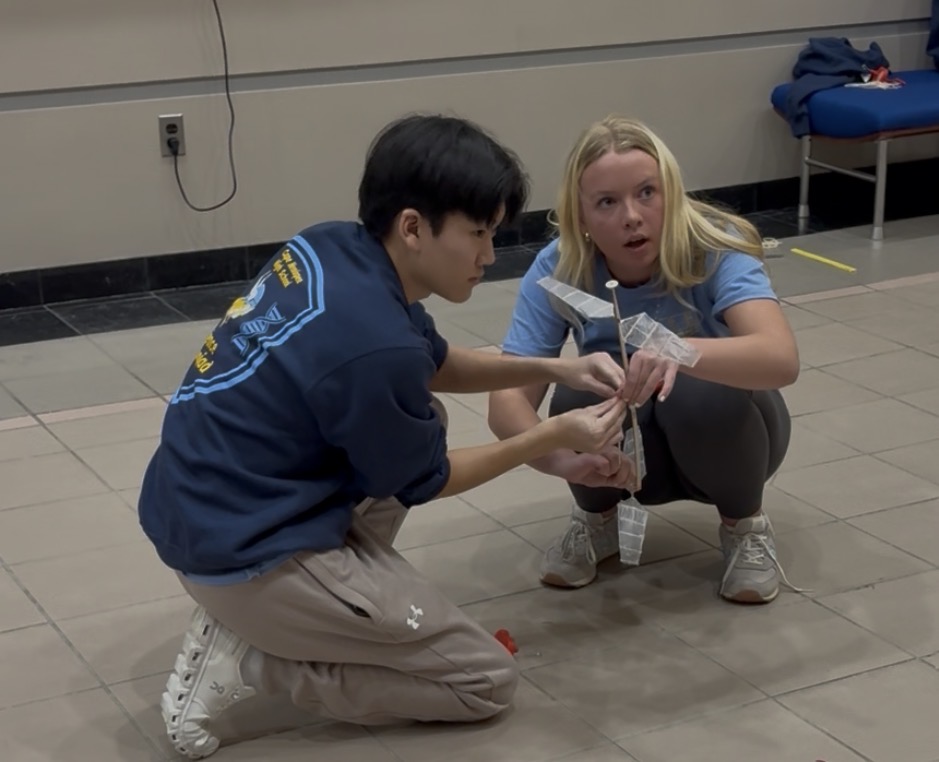
 Cape Henlopen High School in Delaware brought three complete teams to the Science Olympiad at UMBC. Left: Nathaniel Hoang and Ellie Sprague compete in the helicopter event. Right: Quinton Eisenmann and Ava Lewis prepare for the hovercraft event. (Photos courtesy of Priscilla Coolbaugh)
Inspiring students’ interest in science
Volunteers—including UMBC faculty, alumni, current students—made the day possible, each driven by motivations rooted in their own journeys. Mark Grzanna, M.S. ’15, biological sciences, today a Science Olympiad coach at John Carroll High School in Bel Air, Maryland, brought two teams of eager students for his third year at the UMBC tournament. Grzanna teaches biology, anatomy and physiology, and a biotech course he designed at John Carroll, and he views the Olympiad as a gateway to scientific curiosity.
“Education is so important. I became a teacher to get kids interested in science—or at least to help them understand enough science to navigate their world,” he said. His co-coach, John Carroll teacher Andrew Ketchum, echoed the sentiment: “It’s a great experience for our kids to see other students excited about science.”
Frank Tagaytay, a senior physics and math major, supervised the “boomilever” event, where teams tested structures’ strength and integrity. Based on experience as president of his high school Science Olympiad club, Tagaytay patiently guided participants through event regulations, offering encouragement amid the occasional structural mishap.

 Left: Frank Tagaytay (left), a senior UMBC physics and math major, encourages Aalyna Johnson (center) and Cassidy Mehegan from Cape Henlopen High School as they set up their “boomilever” for competition. (Photo by Sarah Hansen, M.S. ’15/UMBC) Right: Cape Henlopen students Theodore Noe Fellows, Shouta Sano, Quinton Eisenmann, and Ava Lewis (left to right) carry their equipment to the competition site in the UMBC Physics Building. (Photo courtesy of Priscilla Coolbaugh)
“It’s an early season event for teams to work out the kinks,” he explained, highlighting how the low-stakes environment builds confidence and resilience. For Tagaytay, volunteering bridges his past and present, reinforcing UMBC’s supportive community.
Fareedah Owolabi, a junior chemical engineering major who recently transferred from the Community College of Baltimore County, found the event particularly meaningful. “I have a soft spot for STEM outreach, because it’s how I was introduced to UMBC,” she shared. Through the Upward Bound Math and Science program, Owolabi connected with UMBC tutors as a high schooler. Now, as a volunteer, she fielded questions from participants about campus life. “I want to inspire younger students,” she said, embodying the cycle of mentorship that defines the tournament.
Broadening their horizons
Priscilla Coolbaugh, Science Olympiad coach at Cape Henlopen High School in Delaware, started her team three years ago after loving Science Olympiad as a student herself. “I want to share that love,” she said. Her three full teams traveled far to compete. “They get to see themselves at these universities. They might have planned to stay close to home, but this way they get exposure to out-of-state schools,” Coolbaugh said. “It broadens their horizons to different schools as well as different STEM fields.”

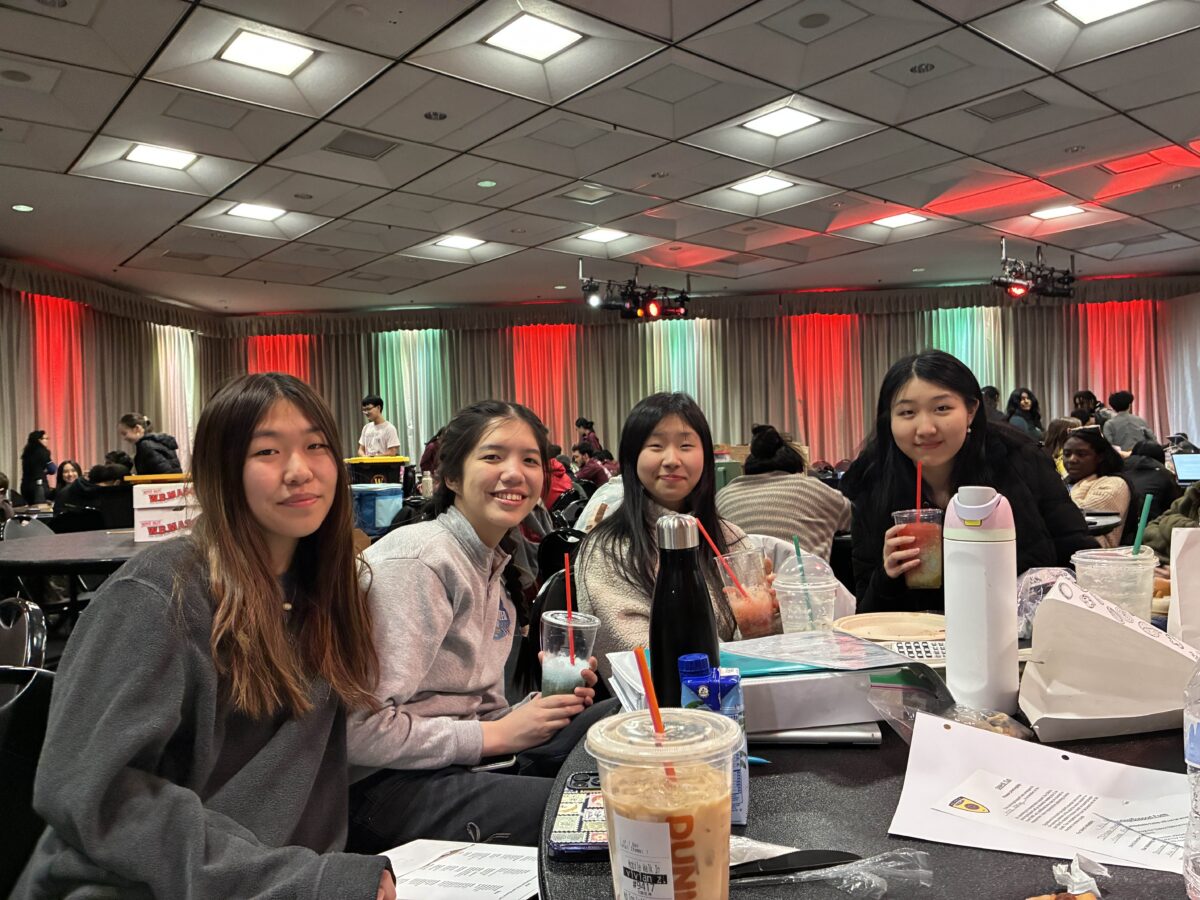 Students and a coach from Winston Churchill High School in Potomac, Maryland, relax in the UMBC Ballroom between events. (Photos courtesy of Jonathan Lee)
Students expressed their sense of community and excitement about their experiences at the UMBC event. Cape Henlopen freshman Aalya Desai noted how the event helped her make friends despite starting as a newcomer, and sophomore Grace Eanes appreciated the chance to bond with peers across grades while exploring the beautiful campus. Michael Song, a junior from Winston Churchill High School in Potomac, Maryland, who with his teammate, Leo Jiang, earned the top score in the hovercraft event, commented, “UMBC is much bigger than I expected. It’s a lot of fun to travel to Olympiad events.”
In good hands
Faculty and staff volunteers underscored the event’s broader impact. CNMS dean William R. LaCourse, surveying the awards ceremony, reflected on the promise of the participants. “As I stood on the stage looking over the ballroom filled with excited and creative students, I couldn’t help feeling as if I was looking into the future and thinking, ‘We (all of us) are in good hands,’” he said.
Zeev Rosenzweig, professor of chemistry and biochemistry, supervised the rocks and minerals test with three undergraduates and three of his graduate students. “Being here is just an important thing to do,” he said. “It’s a great outlet to show them that their interests matter,” he noted. “The kids who come to the Olympiad—they’re our people.” Ph.D. student Kushani Mendis, a Ph.D. student in Rosenzweig’s lab, added, “The best way to support the next generation in STEM is to organize events like this and spend time with them.”
In April, UMBC will host the Maryland State Science Olympiad for the first time, building on this invitational’s momentum. “It’s fun to see young people so excited about different areas of STEM,” shared Michelle Starz-Gaiano, professor and chair of biological sciences, adding, “It’s critical to foster the growth of young scientists. We love the energy and enthusiasm that they bring.”
]]>
On a cloudy Saturday in January, UMBC buzzed with the energy of over 1,200 high school students from across the Mid-Atlantic region. For the third consecutive year, UMBC’s College of Natural and...
https://umbc.edu/stories/1200-high-schoolers-at-science-olympiad/
https://my3.my.umbc.edu/api/v0/pixel/news/156251/guest@my.umbc.edu/8fcd1fc51406ee5d71336ef39bd47917/api/pixel
biology
cbee
chembiochem
cnms
coeit
community
news
physics
science-and-tech
story
trio
UMBC News & Magazine
https://my3.my.umbc.edu/groups/umbc-news-magazine
https://assets1-my.umbc.edu/system/shared/avatars/groups/000/001/943/24435aa6207c452e7bc15cc74b42c7bb/xsmall.png?1748556657
https://assets1-my.umbc.edu/system/shared/avatars/groups/000/001/943/24435aa6207c452e7bc15cc74b42c7bb/original.png?1748556657
https://assets2-my.umbc.edu/system/shared/avatars/groups/000/001/943/24435aa6207c452e7bc15cc74b42c7bb/xxlarge.png?1748556657
https://assets2-my.umbc.edu/system/shared/avatars/groups/000/001/943/24435aa6207c452e7bc15cc74b42c7bb/xlarge.png?1748556657
https://assets3-my.umbc.edu/system/shared/avatars/groups/000/001/943/24435aa6207c452e7bc15cc74b42c7bb/large.png?1748556657
https://assets1-my.umbc.edu/system/shared/avatars/groups/000/001/943/24435aa6207c452e7bc15cc74b42c7bb/medium.png?1748556657
https://assets2-my.umbc.edu/system/shared/avatars/groups/000/001/943/24435aa6207c452e7bc15cc74b42c7bb/small.png?1748556657
https://assets1-my.umbc.edu/system/shared/avatars/groups/000/001/943/24435aa6207c452e7bc15cc74b42c7bb/xsmall.png?1748556657
https://assets2-my.umbc.edu/system/shared/avatars/groups/000/001/943/24435aa6207c452e7bc15cc74b42c7bb/xxsmall.png?1748556657
UMBC News & Magazine
1
0
false
Thu, 05 Feb 2026 11:30:12 -0500
Thu, 05 Feb 2026 11:30:12 -0500
Simple wood makes advanced sensors
Picture the most advanced technology and certain qualities probably spring to mind: maybe metallic and sleek, with glowing lights and big digital screens.
The researchers at the Center for Advanced Sensor Technology (CAST) at UMBC, however, have a different adjective they aim for when designing tech: dirt cheap.
For these scientists and engineers, inexpensive doesn’t mean low-quality—it means challenging traditional ways of thinking to produce affordable and reliable products that meet vital needs. Toward this end, a CAST research team recently debuted a new environmental sensor made out of simple balsa wood sheets—the kind you could buy at a craft store for a few dollars. The wood was cut and assembled to make a central well to hold samples and channels for the electrochemical components of the sensor to be inserted. The researchers coated the wood to make it waterproof and stuck it together with wood glue.
Inexpensive and sustainable
 A schematic shows the layers of the wood sensor, with openings for the three electrodes and a microwell. (Image courtesy of Kadolkar)
Choosing wood served two purposes: making the sensor low-cost and also environmentally friendly.
“Sustainability was very important to us,” says Revati Kadolkar, a Ph.D. student in chemical engineering who is working on the project. Kadolkar is advised by professors Govind Rao, who directs CAST, and Douglas Frey in the department of chemical, biochemical, and environmental engineering (CBEE). “Using wood instead of plastic for the structural skeleton of the sensor was a key step toward that sustainability,” she says.
In collaboration with another UMBC team from the Center for Urban Environmental Research and Education led by CBEE professor Claire Welty, the CAST team tested the sensor in the field by measuring nitrate levels in streams in the Gwynns Falls watershed near Baltimore. Nitrate is a pollutant, often linked to agricultural activities, that can cause gut cancer, birth defects and a condition called methemoglobinemia, also known as the blue baby syndrome. Its concentration in tap water in the U.S. is regulated by the Safe Drinking Water Act. The accuracy of the sensor’s readings was on par with traditional equipment that cost hundreds of times more money, the researchers say.
Testing in the lab, the team also found the sensor worked well across a range of conditions, including wide variations in temperature and pH levels, and continued to operate well for more than a year.
A more comprehensive view of the world
Driving down the cost of technology should drive up its impact. Cheaper sensors could be deployed in higher numbers, yielding a more comprehensive view of the world and spotting potential problems earlier.
 Kadolkar shows a sensor the team tested in the field by measuring nitrate levels in Baltimore-area streams. (Photo courtesy of Kadolkar)
“Let’s say you want to map the whole Chesapeake Bay and know every hour if there is contamination and how it is traveling down the bay,” says Venkatesh Srinivasan, a research associate professor at CAST who also worked on the project. “You can get these details more easily if you have lower-cost sensors.”
Spreading the benefits of science and technology to resource-limited communities has been a driving force behind CAST research for decades. The team has also developed low-cost infant incubators and a suitcase-sized device to make medicine on-demand.
For now, the sensor operates by analyzing droplets of water added to its central well. Going forward, the team would like to create a sensor that could be submerged in the water and report continuous measurements.
They are already working with the Maryland company NanoForge Systems to commercialize the new nitrate sensor.
“Translating science into innovative products that can help people is what really excites me about this work,” Kadolkar says.
]]>
Picture the most advanced technology and certain qualities probably spring to mind: maybe metallic and sleek, with glowing lights and big digital screens. The researchers at the Center for...
https://umbc.edu/stories/simple-wood-makes-advanced-sensors/
https://my3.my.umbc.edu/api/v0/pixel/news/154263/guest@my.umbc.edu/35593d39c3d8fae21e9187e25db7d671/api/pixel
cast
cbee
coeit
discovery
fall-2025
magazine
research
story
UMBC News & Magazine
https://my3.my.umbc.edu/groups/umbc-news-magazine
https://assets1-my.umbc.edu/system/shared/avatars/groups/000/001/943/24435aa6207c452e7bc15cc74b42c7bb/xsmall.png?1748556657
https://assets1-my.umbc.edu/system/shared/avatars/groups/000/001/943/24435aa6207c452e7bc15cc74b42c7bb/original.png?1748556657
https://assets2-my.umbc.edu/system/shared/avatars/groups/000/001/943/24435aa6207c452e7bc15cc74b42c7bb/xxlarge.png?1748556657
https://assets2-my.umbc.edu/system/shared/avatars/groups/000/001/943/24435aa6207c452e7bc15cc74b42c7bb/xlarge.png?1748556657
https://assets3-my.umbc.edu/system/shared/avatars/groups/000/001/943/24435aa6207c452e7bc15cc74b42c7bb/large.png?1748556657
https://assets1-my.umbc.edu/system/shared/avatars/groups/000/001/943/24435aa6207c452e7bc15cc74b42c7bb/medium.png?1748556657
https://assets2-my.umbc.edu/system/shared/avatars/groups/000/001/943/24435aa6207c452e7bc15cc74b42c7bb/small.png?1748556657
https://assets1-my.umbc.edu/system/shared/avatars/groups/000/001/943/24435aa6207c452e7bc15cc74b42c7bb/xsmall.png?1748556657
https://assets2-my.umbc.edu/system/shared/avatars/groups/000/001/943/24435aa6207c452e7bc15cc74b42c7bb/xxsmall.png?1748556657
UMBC News & Magazine
0
0
false
Wed, 05 Nov 2025 13:32:05 -0500
Mark Benesch catalyzes UMBC’s partnership with drug maker AstraZeneca
 Mark Benesch and other AstraZeneca recruiters talk with students at the UMBC Career Fair in September. (Photo courtesy of
Miriam Friedman)
Mark Benesch and other AstraZeneca recruiters talk with students at the UMBC Career Fair in September. (Photo courtesy of
Miriam Friedman)
On a recent Wednesday in September, thousands of people filled the arena of the Retriever Activity Center for the UMBC 2025 Fall Career and Internship Fair. At the booth for pharmaceutical giant AstraZeneca, Mark Benesch ’08, chemical engineering, eagerly engaged with students, some of whom waited in a line 30-odd people long at times for their chance to ask questions and exchange contact information.
Benesch has regularly brought his enthusiasm and energy to UMBC career fairs, first as a recruiter for ExxonMobil, where he worked immediately after graduating, and later for the Columbia, Maryland-based chemical company W.R. Grace. But it was after starting at AstraZeneca as the senior director of the capital projects portfolio for the Americas region in January 2023 that Benesch spotted the opportunity to take his connections with the university to the next level.
AstraZeneca employs thousands of people across the state of Maryland, including at a large scientific campus in Gaithersburg, a center in Frederick that manufactures a diverse class of drugs called biologics, and a newly opened facility in Rockville that will manufacture immunotherapy drugs to treat cancer. The company has announced plans to invest $50 billion in America by 2030 for medicines manufacturing and research and development.
From the hundreds of UMBC alumni at AstraZeneca, Benesch has recruited and inspired a team of eight dedicated to forging stronger links to their alma mater. They, together with partners in AstraZeneca’s Early Career Programs, have built a strong alumni-driven network linking UMBC students with opportunities at the company.
“Mark is always thinking about innovative ways to connect,” says Christine Routzahn, the director of the Career Center at UMBC who has worked with Benesch to expand the UMBC-AstraZeneca partnership. “He’s very passionate about UMBC and ensuring our students are successful.”
Benesch’s efforts will be recognized when he receives the 2025 Distinguished Service Alumni Award this October.

 Mark Benesch and some members of the UMBC recruiting team he has brought together. On left, Benesch, Matthew Schwarz ’11, Shakir Muradymov ’07, Chioma Ngobili ’04, Tania Monterastelli ’08, and Sara Rego in front of the AstraZeneca Gaithersburg campus. On right, the team chats inside. Not pictured are team members Emily Elliott, M.S. ’22, Asmaa Hasan ’22, Moe Nayel ’15, and Babacarr Lemon ’23. (Brad Ziegler/UMBC)
A growing partnership
The work of the AstraZeneca-UMBC recruiting team has gone far beyond career fairs. Under Benesch’s stewardship, AstraZeneca played a key role at the UMBC-hosted 2024 Mid-Atlantic Student Conference for the American Institute of Chemical Engineers. The company sponsored the event and Pran Patel, the vice president of global engineering and real estate at AstraZeneca, served as a keynote speaker. Benesch met monthly with student organizers of the conference, helped lead a popular conference workshop, and mobilized other AstraZeneca employees to volunteer.
“From a five-minute conversation at the career fair, Mark took the initiative to follow up and create real collaboration opportunities,” says An Dang ’24, a student organizer who led the fundraising efforts for the conference.
Benesch and his team have also worked with UMBC to launch new collaborations such as dedicated on-campus information sessions and recruiting events, alumni happy hours, and tours and networking at the AstraZeneca Gaithersburg campus.
 “UMBC On the Road” took students on a tour of the AstraZeneca facility under construction in Rockville in fall 2024. (Photo courtesy of Benesch)
The efforts have paid off, as the number of UMBC students applying to summer internships at AstraZeneca has increased by 31 percent in the past year, and the number of students accepting internships has grown from one in summer 2024 to seven in 2025.
On the research side, Benesch attended the College of Engineering and Information Technology’s recent Research Day and is facilitating discussions of ways AstraZeneca may partner with UMBC faculty on joint projects.
“Mark’s ongoing dedication to serving his alma mater has been nothing short of extraordinary,” says Mariajosé Castellanos, a teaching professor in the Department of Chemical, Biochemical, and Environmental Engineering who first met Benesch in her thermodynamics class in 2006. “As a faculty member who has been in the department for 20 years and served as the AIChE UMBC Chapter advisor for the past nine, I can confidently say that I have never seen this level of consistent engagement and support from any other undergraduate alumnus.”
Building community and empowering individuals
 A mixer for UMBC alumni employees and interns at AstraZeneca. (Photo courtesy of Miriam Friedman)
Benesch, who was the first from his family to go to college, credits his UMBC education with empowering him to realize his own potential.
“At UMBC, I was exposed to so much, and from that I gained confidence. Technical confidence, yes, but also the confidence to navigate the diversity of the world and the opportunities that come from that,” he says. “So I’m inspired to help today’s students receive that same kind of support, and even more so.”
“Mark is so animated when he’s connecting with people. He listens well and he really brings out the best in students,” says Miriam Friedman, assistant director of alumni professional networks.
On his part, Benesch says the students give him energy. “They are curious and smart and I see their enormous potential,” he says. “To give them opportunities to realize it for themselves is really gratifying.”
Abi Postus, a junior in chemical engineering who interned this summer on Benesch’s AstraZeneca team, says she was impressed by his efforts to connect her to resources and make sure she got the most out of the experience.
“I remember one piece of advice he told me,” she says, “which was: ‘Don’t be afraid to take up space.’ I found that very helpful because this was my first internship and it was kind of daunting. That made me feel more confident.”
Mark your calendars for the 2025 Alumni Awards on Wednesday, October 29, at 6 p.m., and consider joining the UMBC community at the Chesapeake Employers Insurance Arena to celebrate Mark Benesch and the many remarkable individuals receiving awards. The event will be livestreamed for those unable to join in person. You can learn more at alumni.umbc.edu/alumniawards.
]]>
Mark Benesch and other AstraZeneca recruiters talk with students at the UMBC Career Fair in September. (Photo courtesy of Miriam Friedman) On a recent Wednesday in September, thousands of...
https://umbc.edu/stories/mark-benesch-astrazeneca/
https://my3.my.umbc.edu/api/v0/pixel/news/153504/guest@my.umbc.edu/a8b53a128197bef2294d1878b92fd86c/api/pixel
alumni
alumni-awards
career-center
cbee
coeit
impact
magazine
story
UMBC News & Magazine
https://my3.my.umbc.edu/groups/umbc-news-magazine
https://assets1-my.umbc.edu/system/shared/avatars/groups/000/001/943/24435aa6207c452e7bc15cc74b42c7bb/xsmall.png?1748556657
https://assets1-my.umbc.edu/system/shared/avatars/groups/000/001/943/24435aa6207c452e7bc15cc74b42c7bb/original.png?1748556657
https://assets2-my.umbc.edu/system/shared/avatars/groups/000/001/943/24435aa6207c452e7bc15cc74b42c7bb/xxlarge.png?1748556657
https://assets2-my.umbc.edu/system/shared/avatars/groups/000/001/943/24435aa6207c452e7bc15cc74b42c7bb/xlarge.png?1748556657
https://assets3-my.umbc.edu/system/shared/avatars/groups/000/001/943/24435aa6207c452e7bc15cc74b42c7bb/large.png?1748556657
https://assets1-my.umbc.edu/system/shared/avatars/groups/000/001/943/24435aa6207c452e7bc15cc74b42c7bb/medium.png?1748556657
https://assets2-my.umbc.edu/system/shared/avatars/groups/000/001/943/24435aa6207c452e7bc15cc74b42c7bb/small.png?1748556657
https://assets1-my.umbc.edu/system/shared/avatars/groups/000/001/943/24435aa6207c452e7bc15cc74b42c7bb/xsmall.png?1748556657
https://assets2-my.umbc.edu/system/shared/avatars/groups/000/001/943/24435aa6207c452e7bc15cc74b42c7bb/xxsmall.png?1748556657
UMBC News & Magazine
0
0
false
Mon, 13 Oct 2025 12:10:56 -0400
Mon, 13 Oct 2025 12:10:56 -0400
Who is AI for? Eric Stokan receives USM professorship to address barriers and promote AI equity for students and faculty
For tech-savvy individuals like Eric Stokan, artificial intelligence, programming languages, and open-source software are powerful tools that can turn once-impossible ideas into reality. Researchers can use human language processing to analyze historical documents or legal texts. Through collaborative platforms, global organizations can collaborate quickly without incurring travel costs. In the social sciences, open-source tools provide students with unique opportunities to work with experts developing projects that address community needs. However, to take full advantage of these revolutionary technologies, these tools often require advanced computing skills or access to expensive software, which can limit their impact and exclude those without the necessary resources or training.
Stokan, director of the Center for Social Science Scholarship (CS3), is committed to removing these barriers for faculty and students in computational social science, which uses computers, data, and algorithms to study human behavior and social systems. His research lies at the intersection of urban policy, economic development, and computational social science, with a focus on how local governments make policy decisions and how those decisions impact equity, economic growth, and environmental sustainability.
The University System of Maryland (USM) William E. Kirwan Center for Academic Innovation has awarded Stokan the Elkins Professorship for Academic Transformation to address this gap with his project “Computational Social Science and Generative AI: Scalable, Modular Training for Teaching, Research, and Public Impact.”

The Elkins Professorship is named after Wilson H. Elkins, a former Rhodes Scholar and president of the University of Maryland, College Park from 1954 to 1978. This prestigious award is for faculty within USM who are working on innovative projects focused on the use of generative AI to advance academic transformation, foster improvements in access, affordability, quality of outcomes, and/or stewardship of people’s time, money, and other scarce resources.
 Stokan’s examples of the R open-source programming language.
“The professorship will allow me, through the Center for Social Science Scholarship, to first assist faculty and students in understanding how to leverage advances in computing and AI to address new research questions and scale their research in ways that were unfathomable during Dr. Elkins tenure,” says Stokan, associate professor of political science, who earned one of three $10,000 awards. He will use the funding to complete Computational Public Administration—his first book written with R, a free programming language used for statistical computing and graphics—about computational social science methods focused on addressing public policy and administration topics, such as climate change and economic development.
The funding will also support the design and implementation of five hands-on training modules and workshops tailored for faculty, students, and community organizations. Participants will learn to use generative AI large language models (LLM) like ChatGPT and R. The goal is to help participants answer novel and important research questions, develop marketable technical skills, to work more effectively with data, and better communicate the results of their analyses with the broader community.

 Left: Codi Hrynko, Ph.D. ’29, chemistry, and Sarah Lanasa, Ph.D. ’25, environmental engineering work together. Right: Nagaraj Neerchal, professor of statistics, at the first workshop series on AI, LLMs, and computational methods.
“I am deeply honored to receive the Elkins Professorship, in honor of the late Wilson H. Elkins, who was a transformational leader, administrator, and educator,” says Stokan. “This award is important to me because it not only provides support but also affirms my commitment to accommodating learners at all levels of experience in computational social sciences, promoting accessibility, equity, and methodological transparency.”
Initial support for the project came from the UMBC’s Faculty Development Center, the AOK Library’s Digital Scholarship Services, iHARP/Data Science Scholars, and the Institute for Public Leadership at the University of Maryland, College Park.
The workshops will be offered through CS3 in collaboration with CGC-SCIPE, the UMBC Division of Information Technology, and ScaleS. A lecture series component, which will include external speakers, is being co-sponsored with the Department of English, the Department of Sociology, Anthropology, and Public Health, and the Department of Modern Languages, Linguistics, and Intercultural Communications.
Register for the fall semester’s workshop series on AI, LLMs, and computational methods.
]]>
For tech-savvy individuals like Eric Stokan, artificial intelligence, programming languages, and open-source software are powerful tools that can turn once-impossible ideas into reality....
https://umbc.edu/stories/eric-stokan-elkins-professorship/
https://my3.my.umbc.edu/api/v0/pixel/news/153447/guest@my.umbc.edu/bbab2ee0a08b4098a167cd53ca08b643/api/pixel
cahss
cahss-research
cbee
cs3
doit
english
mathstat
mlli
news
politicalscience
research
saph
science-and-tech
story
UMBC News & Magazine
https://my3.my.umbc.edu/groups/umbc-news-magazine
https://assets1-my.umbc.edu/system/shared/avatars/groups/000/001/943/24435aa6207c452e7bc15cc74b42c7bb/xsmall.png?1748556657
https://assets1-my.umbc.edu/system/shared/avatars/groups/000/001/943/24435aa6207c452e7bc15cc74b42c7bb/original.png?1748556657
https://assets2-my.umbc.edu/system/shared/avatars/groups/000/001/943/24435aa6207c452e7bc15cc74b42c7bb/xxlarge.png?1748556657
https://assets2-my.umbc.edu/system/shared/avatars/groups/000/001/943/24435aa6207c452e7bc15cc74b42c7bb/xlarge.png?1748556657
https://assets3-my.umbc.edu/system/shared/avatars/groups/000/001/943/24435aa6207c452e7bc15cc74b42c7bb/large.png?1748556657
https://assets1-my.umbc.edu/system/shared/avatars/groups/000/001/943/24435aa6207c452e7bc15cc74b42c7bb/medium.png?1748556657
https://assets2-my.umbc.edu/system/shared/avatars/groups/000/001/943/24435aa6207c452e7bc15cc74b42c7bb/small.png?1748556657
https://assets1-my.umbc.edu/system/shared/avatars/groups/000/001/943/24435aa6207c452e7bc15cc74b42c7bb/xsmall.png?1748556657
https://assets2-my.umbc.edu/system/shared/avatars/groups/000/001/943/24435aa6207c452e7bc15cc74b42c7bb/xxsmall.png?1748556657
UMBC News & Magazine
0
0
false
Thu, 09 Oct 2025 17:19:07 -0400
Thu, 09 Oct 2025 17:19:07 -0400
Who is AI for? Eric Stokan receives USM professorship to address barriers and promote AI equity for students and faculty
For tech-savvy individuals like Eric Stokan, artificial intelligence, programming languages, and open-source software are powerful tools that can turn once-impossible ideas into reality. Researchers can use human language processing to analyze historical documents or legal texts. Through collaborative platforms, global organizations can collaborate quickly without incurring travel costs. In the social sciences, open-source tools provide students with unique opportunities to work with experts developing projects that address community needs. However, to take full advantage of these revolutionary technologies, these tools often require advanced computing skills or access to expensive software, which can limit their impact and exclude those without the necessary resources or training.
Stokan, director of the Center for Social Science Scholarship (CS3), is committed to removing these barriers for faculty and students in computational social science, which uses computers, data, and algorithms to study human behavior and social systems. His research lies at the intersection of urban policy, economic development, and computational social science, with a focus on how local governments make policy decisions and how those decisions impact equity, economic growth, and environmental sustainability.
The University System of Maryland (USM) William E. Kirwan Center for Academic Innovation has awarded Stokan the Elkins Professorship for Academic Transformation to address this gap with his project “Computational Social Science and Generative AI: Scalable, Modular Training for Teaching, Research, and Public Impact.”
The Elkins Professorship is named after Wilson H. Elkins, a former Rhodes Scholar and president of the University of Maryland, College Park from 1954 to 1978. This prestigious award is for faculty within USM who are working on innovative projects focused on the use of generative AI to advance academic transformation, foster improvements in access, affordability, quality of outcomes, and/or stewardship of people’s time, money, and other scarce resources.
Stokan’s examples of the R open-source programming language.
“The professorship will allow me, through the Center for Social Science Scholarship, to first assist faculty and students in understanding how to leverage advances in computing and AI to address new research questions and scale their research in ways that were unfathomable during Dr. Elkins tenure,” says Stokan, associate professor of political science, who earned one of three $10,000 awards. He will use the funding to complete Computational Public Administration—his first book written with R, a free programming language used for statistical computing and graphics—about computational social science methods focused on addressing public policy and administration topics, such as climate change and economic development.
The funding will also support the design and implementation of five hands-on training modules and workshops tailored for faculty, students, and community organizations. Participants will learn to use generative AI large language models (LLM) like ChatGPT and R. The goal is to help participants answer novel and important research questions, develop marketable technical skills, to work more effectively with data, and better communicate the results of their analyses with the broader community.
Left: Codi Hrynko, Ph.D. ’29, chemistry, and Sarah Lanasa, Ph.D. ’25, environmental engineering work together. Right: Nagaraj Neerchal, professor of statistics, at the first workshop series on AI, LLMs, and computational methods.
“I am deeply honored to receive the Elkins Professorship, in honor of the late Wilson H. Elkins, who was a transformational leader, administrator, and educator,” says Stokan. “This award is important to me because it not only provides support but also affirms my commitment to accommodating learners at all levels of experience in computational social sciences, promoting accessibility, equity, and methodological transparency.”
Initial support for the project came from the UMBC’s Faculty Development Center, the AOK Library’s Digital Scholarship Services, iHARP/Data Science Scholars, and the Institute for Public Leadership at the University of Maryland, College Park.
The workshops will be offered through CS3 in collaboration with CGC-SCIPE, the UMBC Division of Information Technology, and ScaleS. A lecture series component, which will include external speakers, is being co-sponsored with the Department of English, the Department of Sociology, Anthropology, and Public Health, and the Department of Modern Languages, Linguistics, and Intercultural Communications.
Register for the fall semester’s workshop series on AI, LLMs, and computational methods.
]]>
For tech-savvy individuals like Eric Stokan, artificial intelligence, programming languages, and open-source software are powerful tools that can turn once-impossible ideas into reality....
https://umbc.edu/stories/eric-stokan-usm-professorship-ai-access/
https://my3.my.umbc.edu/api/v0/pixel/news/153456/guest@my.umbc.edu/c3599eb85a6c2ad8fd93f23e15267920/api/pixel
cahss
cahss-research
cbee
coeit
cs3
doit
english
graduate-school
mathstat
mlli
news
politicalscience
research
saph
science-and-tech
story
UMBC News & Magazine
https://my3.my.umbc.edu/groups/umbc-news-magazine
https://assets1-my.umbc.edu/system/shared/avatars/groups/000/001/943/24435aa6207c452e7bc15cc74b42c7bb/xsmall.png?1748556657
https://assets1-my.umbc.edu/system/shared/avatars/groups/000/001/943/24435aa6207c452e7bc15cc74b42c7bb/original.png?1748556657
https://assets2-my.umbc.edu/system/shared/avatars/groups/000/001/943/24435aa6207c452e7bc15cc74b42c7bb/xxlarge.png?1748556657
https://assets2-my.umbc.edu/system/shared/avatars/groups/000/001/943/24435aa6207c452e7bc15cc74b42c7bb/xlarge.png?1748556657
https://assets3-my.umbc.edu/system/shared/avatars/groups/000/001/943/24435aa6207c452e7bc15cc74b42c7bb/large.png?1748556657
https://assets1-my.umbc.edu/system/shared/avatars/groups/000/001/943/24435aa6207c452e7bc15cc74b42c7bb/medium.png?1748556657
https://assets2-my.umbc.edu/system/shared/avatars/groups/000/001/943/24435aa6207c452e7bc15cc74b42c7bb/small.png?1748556657
https://assets1-my.umbc.edu/system/shared/avatars/groups/000/001/943/24435aa6207c452e7bc15cc74b42c7bb/xsmall.png?1748556657
https://assets2-my.umbc.edu/system/shared/avatars/groups/000/001/943/24435aa6207c452e7bc15cc74b42c7bb/xxsmall.png?1748556657
UMBC News & Magazine
0
0
false
Thu, 09 Oct 2025 17:19:07 -0400
Thu, 09 Oct 2025 17:19:07 -0400
Diane Alonso named senior fellow for generative AI pedagogy at USM Kirwan Center for Academic Innovation
Diane Alonso, a teaching professor and director of UMBC’s psychology program at the Universities at Shady Grove, has been named one of two senior fellows for generative AI pedagogy at the William E. Kirwan Center for Academic Innovation. The center was established in 2013 by the University System of Maryland (USM) Board of Regents and aims to be a focal point for advancing academic innovation both within Maryland and across higher education nationally.
Alonso will work alongside the other senior fellow—Tracy Tomlinson of the University of Maryland, College Park—and Jennifer Potter, the associate director at the Kirwan Center, to lead the development of the Kirwan Center’s generative AI programming in the 2025 – 2026 academic year. This includes the development of a curriculum to train and collaborate with select faculty from across the USM system in best practices for classroom use of generative AI, a type of AI that can create new content, including text, images, audio, and video, in response to prompts. These faculty will then convey the lessons from the sessions to their respective campus colleagues in spring 2026.
Bringing generative AI into the classroom
 Diane Alonso (Marlayna Demond ’11/UMBC)
Alonso has actively experimented with the integration of AI in her psychology courses over the past two years, sharing her insights with colleagues across the USM system. For example, she has asked students to compare their own handwritten ideas with ChatGPT-generated output on a similar topic and to evaluate the differences. Students learn about effective AI prompting and about ethical considerations such as biases and hallucinations. “We always follow these hands-on activities with debriefs and open discussions, and I make a point to model transparent and responsible AI usage,” Alonso says.
This year Alonso also worked with Neha Raikar, chemical, biochemical, and environmental engineering, to bring together a small group of UMBC faculty to engage in a year-long exploration of how to enhance teaching with AI. Participants shared ideas for using AI in the classroom, such as brainstorming discussion topics, generating podcasts from textbooks, and crafting and revising syllabi. They also shared concerns about the technology.
Alonso says she has been interested in technology’s role in education for decades. As early as the mid-1980s, she dabbled with basic AI programs and during her graduate education in the ’90s, she focused on how technology could transform the classroom. As a post-graduate, she worked in industry as a usability specialist, deepening her understanding of how people interact with complex systems.
“This role feels like the culmination of a lifetime fascination with technology, psychology, and education,” Alonso says. “I feel that things have now come full-circle.”
]]>
Diane Alonso, a teaching professor and director of UMBC’s psychology program at the Universities at Shady Grove, has been named one of two senior fellows for generative AI pedagogy at the William...
https://umbc.edu/stories/alonso-senior-fellow-for-generative-ai-pedagogy/
https://my3.my.umbc.edu/api/v0/pixel/news/150813/guest@my.umbc.edu/66475180c90a672b06714db491968c7e/api/pixel
cbee
coeit
news
policy-and-society
psychology
shady-grove
story
usm
UMBC News & Magazine
https://my3.my.umbc.edu/groups/umbc-news-magazine
https://assets1-my.umbc.edu/system/shared/avatars/groups/000/001/943/24435aa6207c452e7bc15cc74b42c7bb/xsmall.png?1748556657
https://assets1-my.umbc.edu/system/shared/avatars/groups/000/001/943/24435aa6207c452e7bc15cc74b42c7bb/original.png?1748556657
https://assets2-my.umbc.edu/system/shared/avatars/groups/000/001/943/24435aa6207c452e7bc15cc74b42c7bb/xxlarge.png?1748556657
https://assets2-my.umbc.edu/system/shared/avatars/groups/000/001/943/24435aa6207c452e7bc15cc74b42c7bb/xlarge.png?1748556657
https://assets3-my.umbc.edu/system/shared/avatars/groups/000/001/943/24435aa6207c452e7bc15cc74b42c7bb/large.png?1748556657
https://assets1-my.umbc.edu/system/shared/avatars/groups/000/001/943/24435aa6207c452e7bc15cc74b42c7bb/medium.png?1748556657
https://assets2-my.umbc.edu/system/shared/avatars/groups/000/001/943/24435aa6207c452e7bc15cc74b42c7bb/small.png?1748556657
https://assets1-my.umbc.edu/system/shared/avatars/groups/000/001/943/24435aa6207c452e7bc15cc74b42c7bb/xsmall.png?1748556657
https://assets2-my.umbc.edu/system/shared/avatars/groups/000/001/943/24435aa6207c452e7bc15cc74b42c7bb/xxsmall.png?1748556657
UMBC News & Magazine
2
0
false
Wed, 25 Jun 2025 10:34:40 -0400
Wed, 25 Jun 2025 10:34:40 -0400
From better batteries to safer surgery: Three engineering grads to tackle society’s big challenges with support from prestigious NSF research fellowships
How can we make the world a better place? It’s a question that Nathaniel Glover ’25, chemical engineering, Jacob Lombardo ‘25, mechanical engineering, and August Phelps ’25, mechanical engineering, have spent a lot of time thinking about. And each has concluded that advancing science is a powerful way to advance humanity.
The three promising researchers were each recently recognized and rewarded by the National Science Foundation’s Graduate Research Fellowship Program (GRFP), which provides financial support to U.S. graduate students who have shown the potential to be high-achieving scientists and engineers.
“The NSF GRFP award is a very prestigious and competitive award,” says Deepa Madan, associate professor in the Department of Mechanical Engineering, who has worked with both Glover and Lombardo on research projects in her lab. So far this year the program has awarded 1,000 fellowships across the U.S., about half of the typical number, making the process even more competitive. This fall, Glover, Lombardo, and Phelps will all head to Johns Hopkins University in Baltimore to begin their graduate education and research.
The thrill of research
Glover, Lombardo, and Phelps knew early in their college careers that they wanted to become researchers. The three are part of the Meyerhoff Scholars Program at UMBC, which is at the forefront of efforts to increase diversity among future leaders in science, technology, engineering, and mathematics by supporting students who intend to pursue a Ph.D. or combined M.D./Ph.D. in these fields. Throughout their time at UMBC, they engaged in a variety of research projects with different faculty mentors.
 Nathaniel Glover stands next to the research poster he presented at the end of his internship at Argonne National Laboratory in summer 2024. (Photo courtesy of Glover)
“I really enjoy the quest to answer unanswered questions,” Glover says, explaining what attracts him to research. Most recently, he worked in Madan’s lab on a project to develop rechargeable, safe, and flexible zinc alkaline batteries, which could revolutionize how consumers power devices such as wearable health monitors.
Lombardo has also worked in Madan’s lab, studying materials that can convert wasted heat into electricity, while Phelps recently worked with mechanical engineering assistant professor Ankit Goel to develop methods for improving control over the flight trajectory of multicopters. Multicopters, which use multiple rotors for lift and maneuvering, are inherently unstable and underactuated, meaning the craft is limited in the ways it can move and must actively stabilize itself at all times. The researchers developed a method to guide the aircraft along a desired trajectory as precisely as possible despite variations in operating conditions and physical properties of the multicopter.
The problems the students and their mentors study—such as how to power and control machines—transcend any particular application, and the solutions the researchers develop could have profound effects on a variety of technologies.
For example, in graduate school, Phelps will join a lab that develops control systems for medical robots. There, he will study electrocauterization, a medical procedure that uses heat generated by an electric current to perform tasks such as removing harmful tissue and controlling bleeding during surgery. Phelps said the speed of the process needs to be carefully controlled to avoid excess damage to healthy tissue, and the lab he is joining is working on ways to automate this control. He notes that both his father and girlfriend have undergone medical procedures with long recovery times. Making the process better is personal to him.
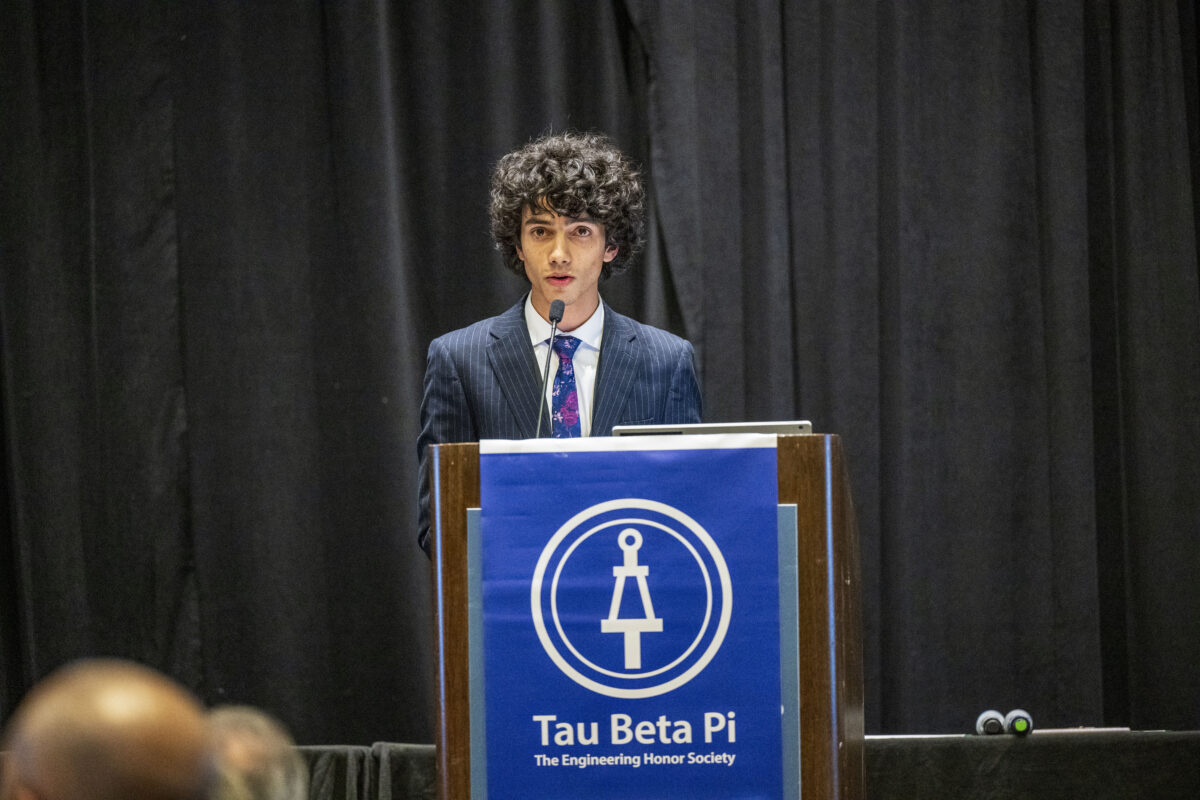 August Phelps speaks at the 2023 Tau Beta Pi National Convention in Atlanta, Georgia, as UMBC’s chapter delegate to the engineering honor society. (Photo by Kiffer Creveling)
Glover and Lombardo agree that what keeps them going, even through late-night problem solving and failed prototypes, is the desire to improve the way things get done. “I love how engineering research takes fundamental science principles and applies it to making a difference in the world,” says Lombardo.
“My real passion is figuring out how to progress as a species,” echoes Glover. “Science is one of our most powerful tools for that.”
A launch pad for big dreams
 Jacob Lombardo (left) and labmates Jiyuan Huang and Srushti Kulkarni attend the 2024 Consumer Electronics Showcase, as part of the Southwest I-Corp program. The program guides engineers to engage with stakeholders outside the lab to better understand market needs and consumer requirements. (Photo courtesy of Lombardo)
These Retrievers say UMBC offered the tools and the mentorship to progress toward their biggest ambitions.
“So many people took their time to sit with me, to push me forward,” says Lombardo. “I had the opportunity to go to scientific conferences, engage in world-class research, and find a community that embraced me.”
Lombardo notes that with support from programs such as the National Institute of Health’s Undergraduate Research Training Initiative for Student Enhancement (U-RISE) program and the Southwest Regional National Science Foundation Innovation Corps (I-Corps) program, he was able to network with researchers outside of his discipline, as well as with industry experts who understand the consumer market. The interactions honed his career goals and reinforced his passion for translating fundamental science principles into practical and impactful engineering, he says.
Glover, Lombardo and Phelps agree being awarded NSF GRFP fellowships is both a validation of the work they have done so far and an obligation to make a positive difference with research going forward. “It does make me feel that what we do is seen and appreciated,” Glover says. “I have this feeling that I will be able to have the impact that I am hoping to have on the world, which is inspiring and humbling.”
Phelps says he is excited to take the next steps: “I’m looking forward to exploring new topics, pushing the boundaries, and creating new things.”
]]>
How can we make the world a better place? It’s a question that Nathaniel Glover ’25, chemical engineering, Jacob Lombardo ‘25, mechanical engineering, and August Phelps ’25, mechanical...
https://umbc.edu/stories/three-engineering-grads-win-nsf-grfp-awards/
https://my3.my.umbc.edu/api/v0/pixel/news/150763/guest@my.umbc.edu/9e0b1a4e721e724c6e958f4ac3c812c3/api/pixel
cbee
coeit
meche
meyerhoff-program
news
research
science-and-tech
story
UMBC News & Magazine
https://my3.my.umbc.edu/groups/umbc-news-magazine
https://assets1-my.umbc.edu/system/shared/avatars/groups/000/001/943/24435aa6207c452e7bc15cc74b42c7bb/xsmall.png?1748556657
https://assets1-my.umbc.edu/system/shared/avatars/groups/000/001/943/24435aa6207c452e7bc15cc74b42c7bb/original.png?1748556657
https://assets2-my.umbc.edu/system/shared/avatars/groups/000/001/943/24435aa6207c452e7bc15cc74b42c7bb/xxlarge.png?1748556657
https://assets2-my.umbc.edu/system/shared/avatars/groups/000/001/943/24435aa6207c452e7bc15cc74b42c7bb/xlarge.png?1748556657
https://assets3-my.umbc.edu/system/shared/avatars/groups/000/001/943/24435aa6207c452e7bc15cc74b42c7bb/large.png?1748556657
https://assets1-my.umbc.edu/system/shared/avatars/groups/000/001/943/24435aa6207c452e7bc15cc74b42c7bb/medium.png?1748556657
https://assets2-my.umbc.edu/system/shared/avatars/groups/000/001/943/24435aa6207c452e7bc15cc74b42c7bb/small.png?1748556657
https://assets1-my.umbc.edu/system/shared/avatars/groups/000/001/943/24435aa6207c452e7bc15cc74b42c7bb/xsmall.png?1748556657
https://assets2-my.umbc.edu/system/shared/avatars/groups/000/001/943/24435aa6207c452e7bc15cc74b42c7bb/xxsmall.png?1748556657
UMBC News & Magazine
0
0
false
Mon, 23 Jun 2025 11:18:40 -0400
Mon, 23 Jun 2025 11:18:40 -0400
Research days foster collaboration and showcase research across the College of Engineering and Information Technology
A dynamic research ecosystem was on display in a series of events showcasing existing projects and encouraging new collaborations across the College of Engineering and Information Technology (COEIT) this spring.
On April 11, the second annual COEIT Research Day brought together more than 180 students and faculty from COEIT’s four academic departments, as well as outside speakers and visitors. Attendance increased by around 20 percent from last year’s inaugural Research Day.
More than 100 researchers presented either talks or posters at the meeting, and several students won awards for their posters and were recognized at the COEIT Awards and Celebration event on May 4.
“A major success of this year’s Research Day was the presence of visitors and speakers from industry, nonprofits, and government,” says Vandana Janeja, the associate dean for research in COEIT. “The event gave these guests an opportunity to visit UMBC and to engage in the vibrant research happening within COEIT, making connections with our research community that we hope to see grow into long-lasting partnerships.”
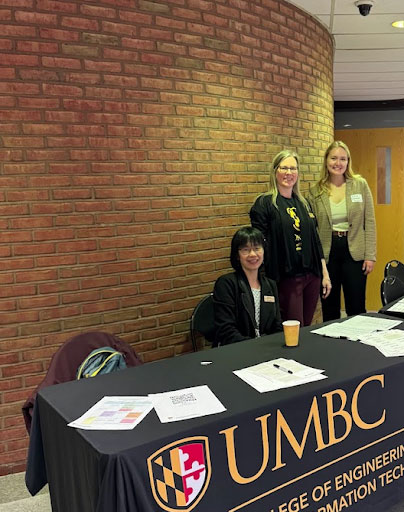 COEIT dean’s office staff Emily Tien, Amy Heckhaus, and Chloe Evered at COEIT Research Day. (Image courtesy of Vandana Janeja)
The college also launched a new call for COEIT Interdisciplinary Proposals. Last year, COEIT funded 11 projects from teams made up of researchers from two or more academic departments. The teams presented their results at this year’s event, on topics ranging from cybersecurity in manufacturing to thermally stable energy-harvesting materials.
On May 2, the Department of Computer Science and Electrical Engineering also hosted its annual research day, bringing together faculty, staff, and students to highlight the department’s latest advancements in research, from robotics to AI weather forecasting.
]]>
A dynamic research ecosystem was on display in a series of events showcasing existing projects and encouraging new collaborations across the College of Engineering and Information Technology...
https://umbc.edu/quick-posts/coeit-research-days/
https://my3.my.umbc.edu/api/v0/pixel/news/150553/guest@my.umbc.edu/2dabfa0e25e152f93f40d0b49805aa6b/api/pixel
cbee
coeit
csee
is
meche
news
quick-post
research
science-and-tech
UMBC News & Magazine
https://my3.my.umbc.edu/groups/umbc-news-magazine
https://assets1-my.umbc.edu/system/shared/avatars/groups/000/001/943/24435aa6207c452e7bc15cc74b42c7bb/xsmall.png?1748556657
https://assets1-my.umbc.edu/system/shared/avatars/groups/000/001/943/24435aa6207c452e7bc15cc74b42c7bb/original.png?1748556657
https://assets2-my.umbc.edu/system/shared/avatars/groups/000/001/943/24435aa6207c452e7bc15cc74b42c7bb/xxlarge.png?1748556657
https://assets2-my.umbc.edu/system/shared/avatars/groups/000/001/943/24435aa6207c452e7bc15cc74b42c7bb/xlarge.png?1748556657
https://assets3-my.umbc.edu/system/shared/avatars/groups/000/001/943/24435aa6207c452e7bc15cc74b42c7bb/large.png?1748556657
https://assets1-my.umbc.edu/system/shared/avatars/groups/000/001/943/24435aa6207c452e7bc15cc74b42c7bb/medium.png?1748556657
https://assets2-my.umbc.edu/system/shared/avatars/groups/000/001/943/24435aa6207c452e7bc15cc74b42c7bb/small.png?1748556657
https://assets1-my.umbc.edu/system/shared/avatars/groups/000/001/943/24435aa6207c452e7bc15cc74b42c7bb/xsmall.png?1748556657
https://assets2-my.umbc.edu/system/shared/avatars/groups/000/001/943/24435aa6207c452e7bc15cc74b42c7bb/xxsmall.png?1748556657
UMBC News & Magazine
0
0
false
Tue, 27 May 2025 07:37:00 -0400
Tue, 27 May 2025 07:37:00 -0400
Finding the harmony within art and science
At UMBC, undergraduate students are redefining the boundaries of scientific and artistic pursuits. From a chemical engineer who graces the stage with his cello to a bioinformatician who paints and a biochemist who ignites the dance floor with Latin rhythms, these scholars thrive in an environment that celebrates their diverse passions.
This spring, several U-RISE Scholars—the National Institutes of Heath’s Undergraduate Research Training Initiative for Student Enhancement—shared their multidisciplinary interests with Jacqueline King, associate director of the U-RISE program, and Mariano Sto. Domingo, associate director of research and evaluation within the Meyerhoff Scholars Program. As a result, King and Sto. Domingo started researching how the arts and science blend in these students’ lives, and presented their findings at an academic conference this spring. What they learned was that here, rigorous research and creative expression intertwine, fostering a vibrant community where students explore every dimension of their talents.
Ajeetha Aruchandran, a seniorbioinformatics and computational biology major, studies how the neural tube—a precursor to the spinal cord—forms in zebrafish embryos with Rachel Brewster, professor of biological sciences.
The development of the embryos, which are transparent, “is a very visual process,” Aruchandran says. Her artistic skills have allowed her to generate beautiful and accurate diagrams that communicate her research, she says. “When you’re not able to communicate science well, then the meaning is lost. So I think my art has really strengthened that aspect of my science. The connection has surprised and delighted me, because for a long time I thought my science and my art had to be separate.”
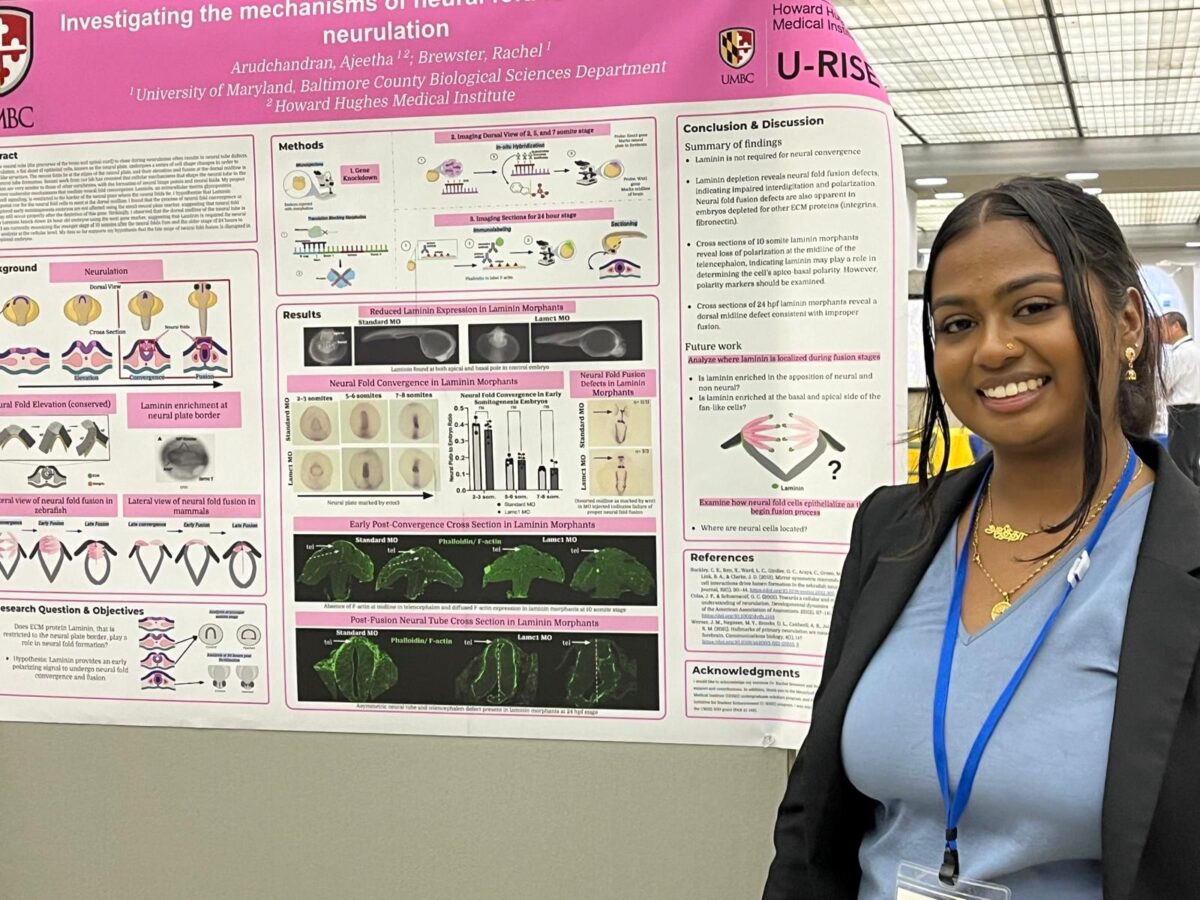
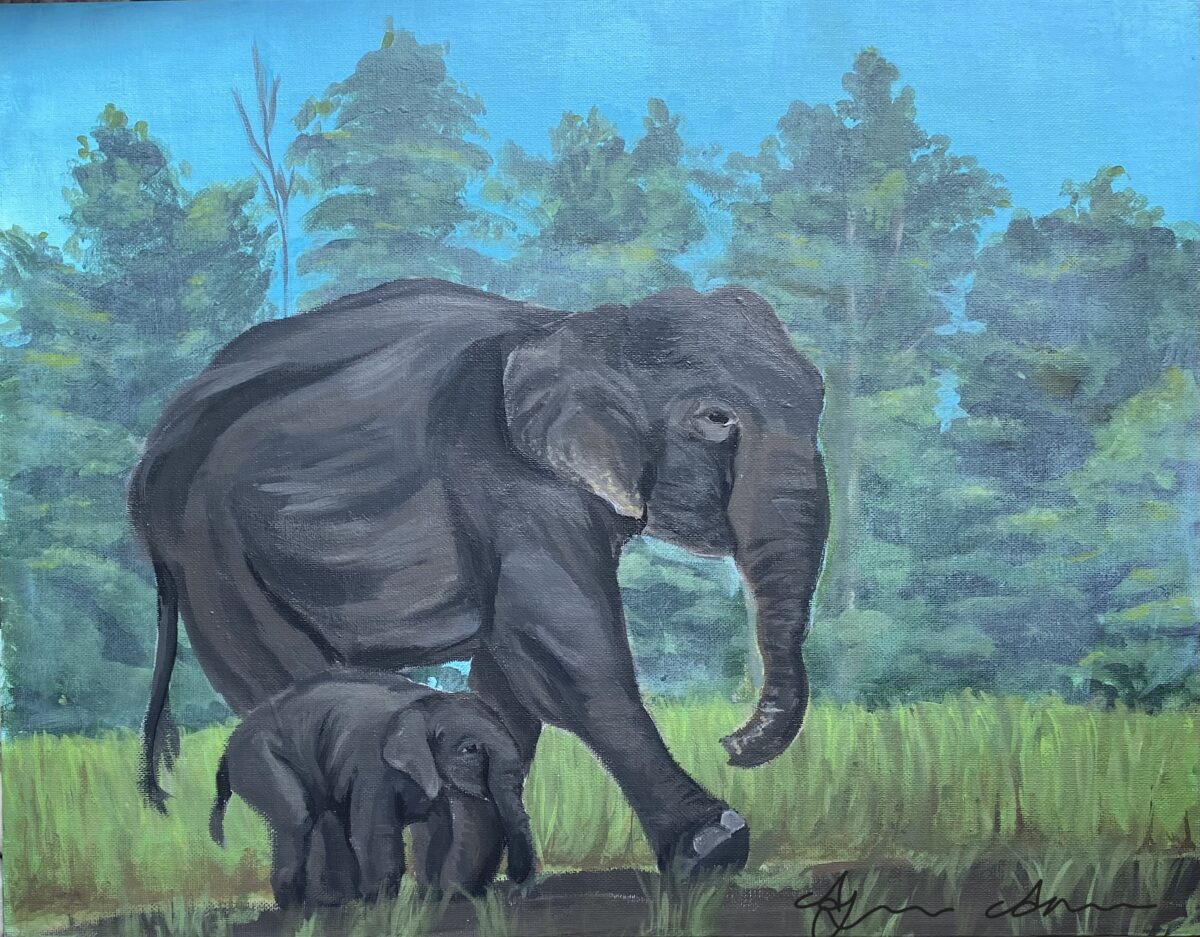 Biologist Ajeetha Aruchandran also loves to paint. (Courtesy of Aruchandran)
Aruchandran began with drawing, but has transitioned to painting. “There’s something so special about the freeness of a brushstroke,” she says. The two pursuits “create balance in my life, because when I need more structure, I have research and the scientific method, but when I need to feel more free, I have my art.”
Rhythm and harmony
Lesley Hernandez, a senior majoring in biochemistry and molecular biology, is hunting for factors that regulate how viruses like HIV multiply in cells with Michael Summers, University Distinguished Professor of Cchemistry and Bbiochemistry. The ultimate goal is to disrupt the viruses’ replication. She also loves to dance.
“My family is from the Dominican Republic, so I grew up surrounded by music and movement. I decided to embrace that part of my culture at UMBC by joining the Latin Dance Club, where I could perform and share my love for dance with others,” Hernandez says. “I love incorporating dance into the workspace by sharing a laugh with my peers and dancing between experiments. It fosters stronger connections and creates an enjoyable work environment.”
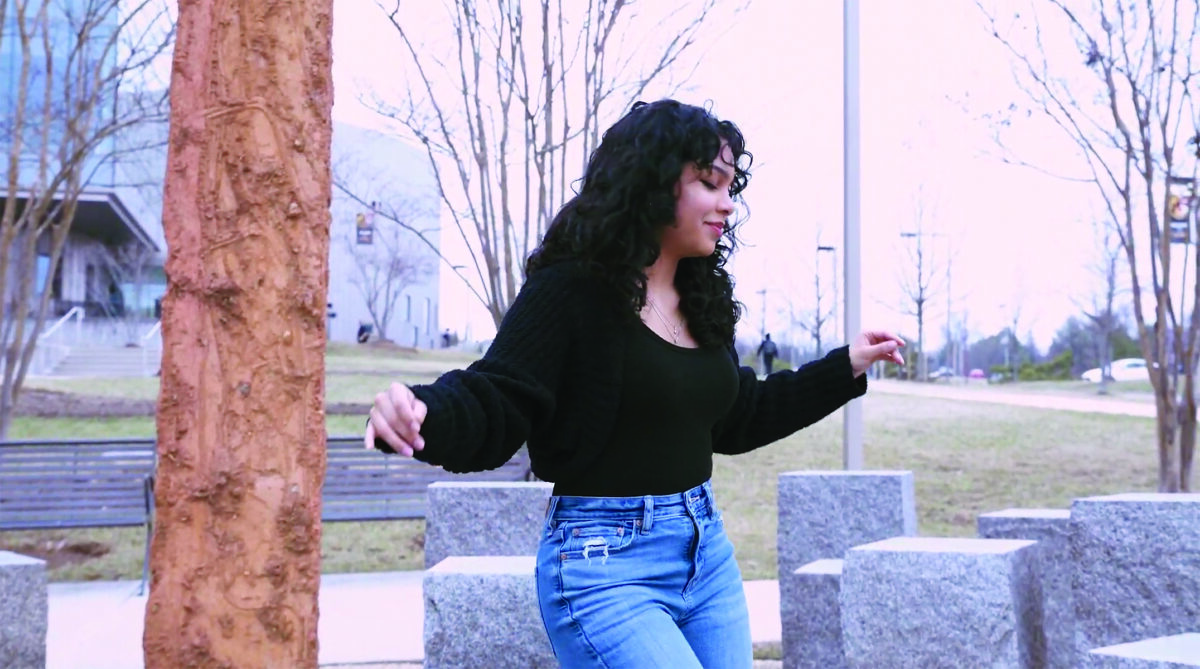
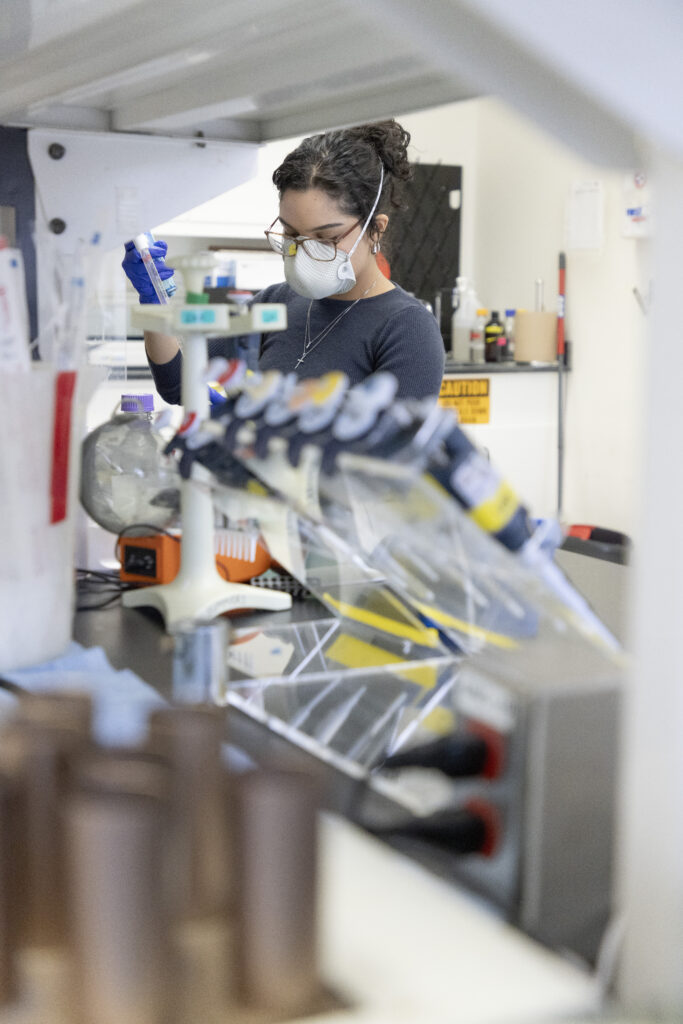 Lesley Hernandez loves being able to “go to my dance class and come back [to the lab] with a refreshed mind.” (Melissa Penley Cormier, M.F.A. ’17/UMBC)
And, when the science gets intense, “I can go to my dance class and come back with a refreshed mind,” Hernandez says. Her attention to detail benefits both her science and her dance. Being “a calculated person” helps her pick up rhythmically complex dance moves more quickly, for example. Both activities also require creativity, whether in trouble-shooting an experiment that’s not working or coming up with new dance routines.
In the Summers lab, “We are all really into science, but what is fun for you outside of that? Everyone in my lab has their own outlet, and that is encouraged,” Hernandez says.
For Daisy Parry, a senior majoring in biological sciences, that outlet is singing. “I’ve had a lot of interests that have come and gone, but singing has been a constant thread throughout my life. It’s very important and very centering to me,” Parry says. Her music minor has created dedicated times that provide a respite from the demands of science, she says.
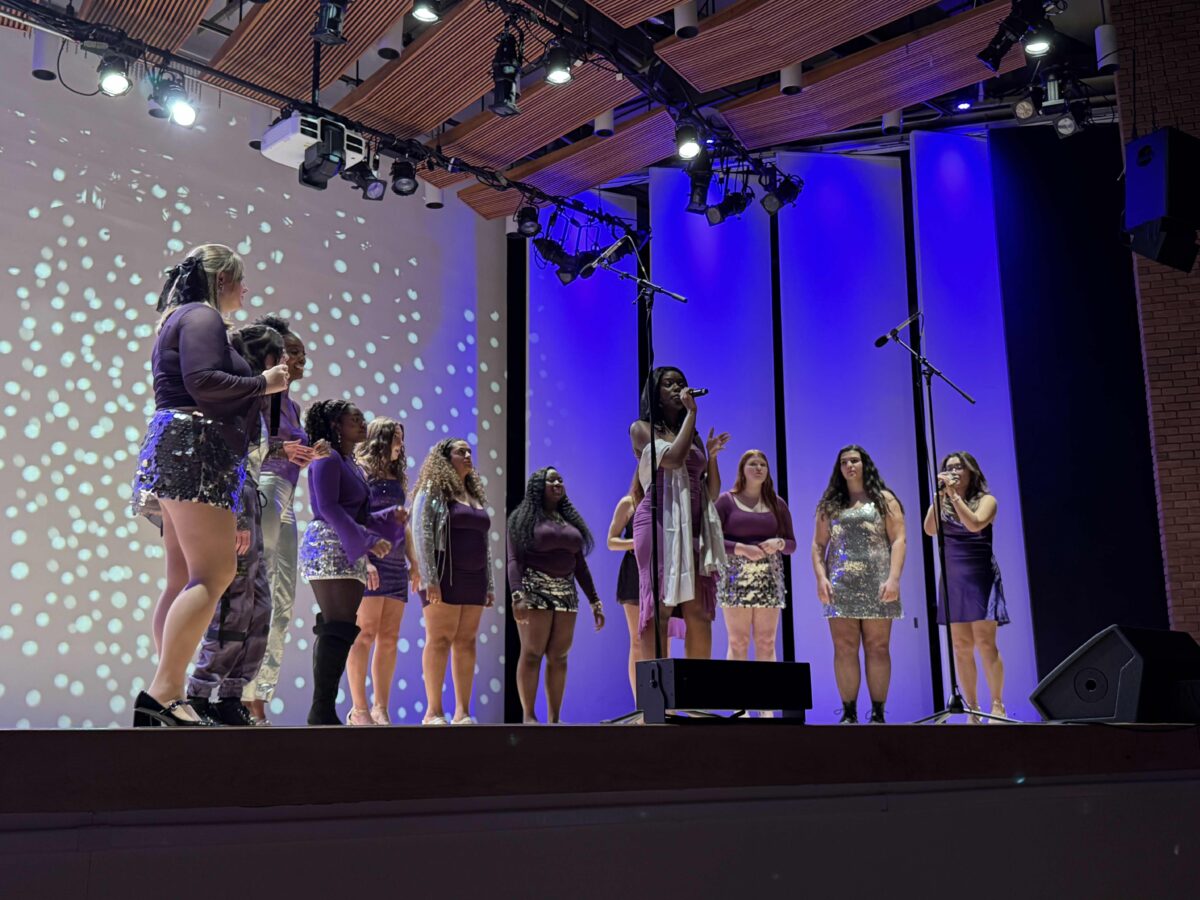 Daisy Parry (in front, with microphone) performs with the UMBC Stilettos, an all-female a cappella group. (Courtesy of Parry)
Parry is a member of The Stilettos, an all-woman a cappella group at UMBC, and her church choir. She arranges songs for The Stilettos to perform, which permits taking some creative license with the original work. “I like changing up the rhythms and dynamics to add depth to the music, and I think’s encouraged me to think a bit outside the box with my science, too, in terms of trying new experimental techniques.”
For now, her work on cell migration in fruit fly embryos with Michelle Starz-Gaiano, professor of biological sciences, her classes, and her music keep her busy, but Parry is looking forward to pursuing a master’s in public health after UMBC. She emphasizes how the concept of harmony—so central to music—carries over to the kind of work she wants to do. Factors such as research, clinical care, public policy, economics, the environment, and how they intersect are all relevant to public health outcomes, she explains.
‘It makes me whole’
Ella Reinders, a junior biological sciences major, also likes to tackle projects—scientific or artistic—from many angles. Watercolor and acrylic paints, sketching and drawing, handicrafts, sewing, and ballet have all captured her interest. “There are all different kinds of random things that I think are fun,” Reinders says.
In the lab, “I am able to come up with different ways of thinking about something because I’ve taken so many different approaches,” she says.
Reinders does behavioral research with Tara LeGates, assistant professor of biological sciences. The lab needed a new piece of equipment, but it was too expensive to buy off the shelf. “So I decided, why not create our own?” Reinders recalls.
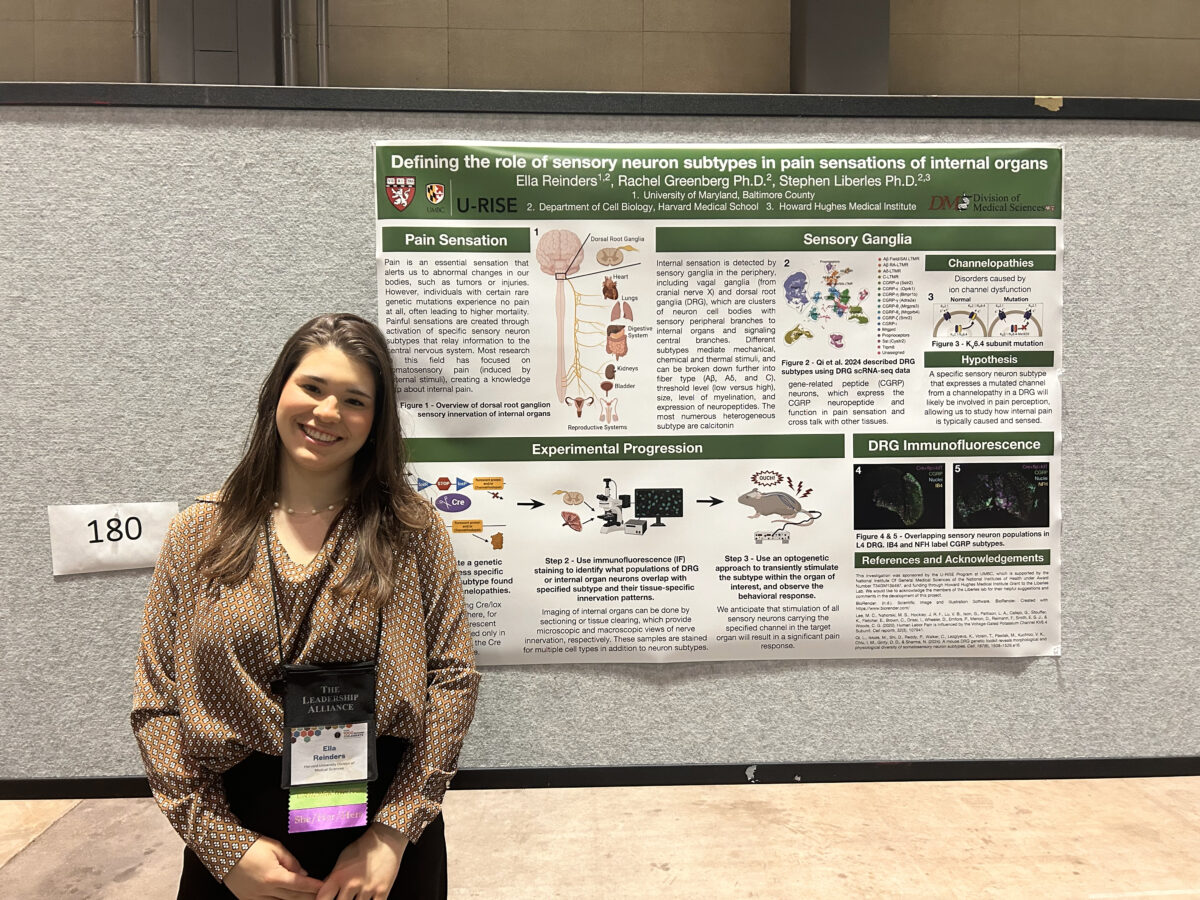
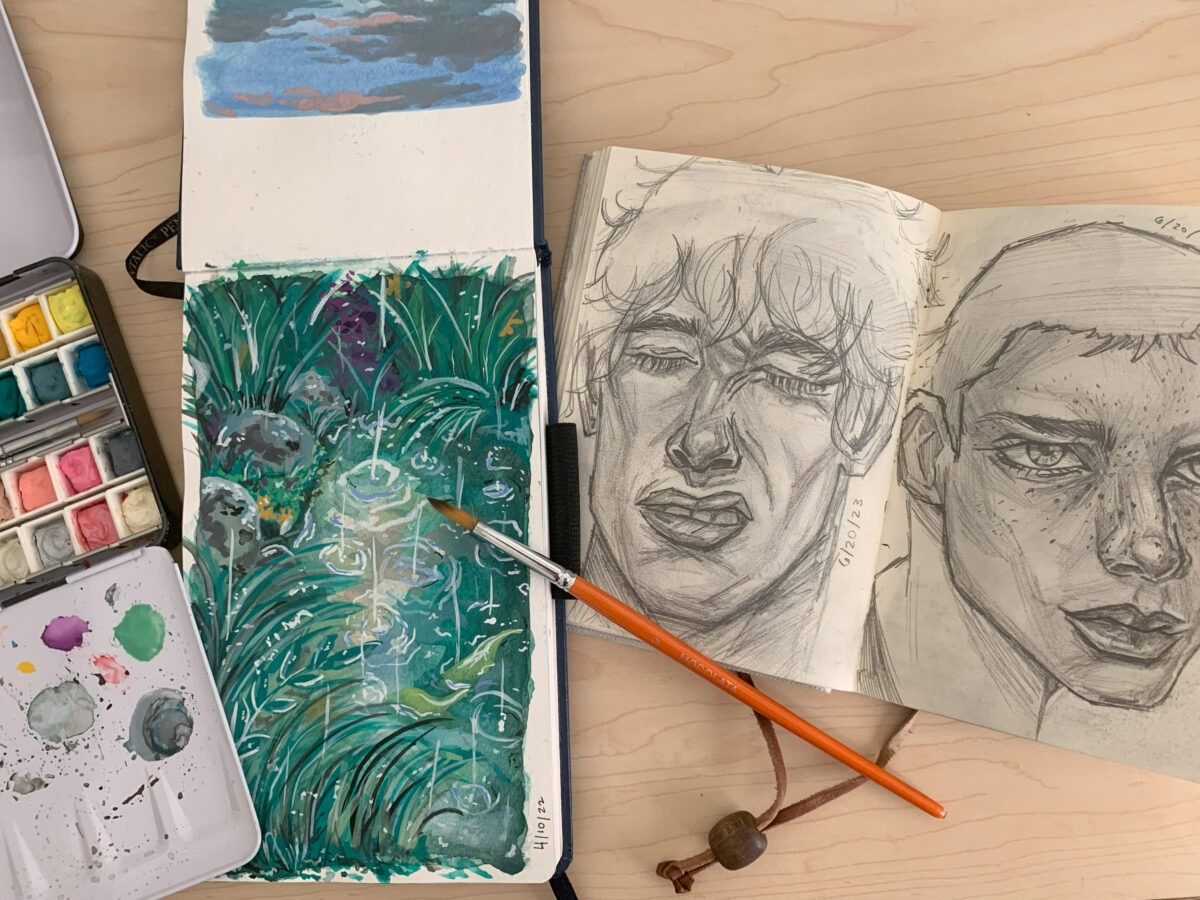 Ella Reinders says that “moving through life with both scientific and artistic interests just makes everything more interesting.” (Courtesy of Reinders)
She sketched it out, learned how to render it on the computer, how to 3D print it at the UMBC library, and then how to wire it. “And now I’ve actually been using it, and it works,” she says. “It was really exciting. I love turning something from my brain into something that I’m actually holding.”
There is also direct overlap between Reinders’ science and her art. “I’ve done imaging of neurons, and being able to turn them into this piece of artwork that you want to hang on your wall is really exciting. Moving through life with both scientific and artistic interests just makes everything more interesting and feels like a way to express all sides of myself.”
For Joshua Dayie, a senior chemical engineering major, both discipline and creativity are required for his research and his art—playing the cello. “You really have to strike a balance between them to make any meaningful progress,” he says. Practicing cello requires hours of repetition, until technical passages flow out of his fingers from muscle memory alone. In the lab, sometimes experiments must be repeated many times before they’re successful—that’s the discipline.
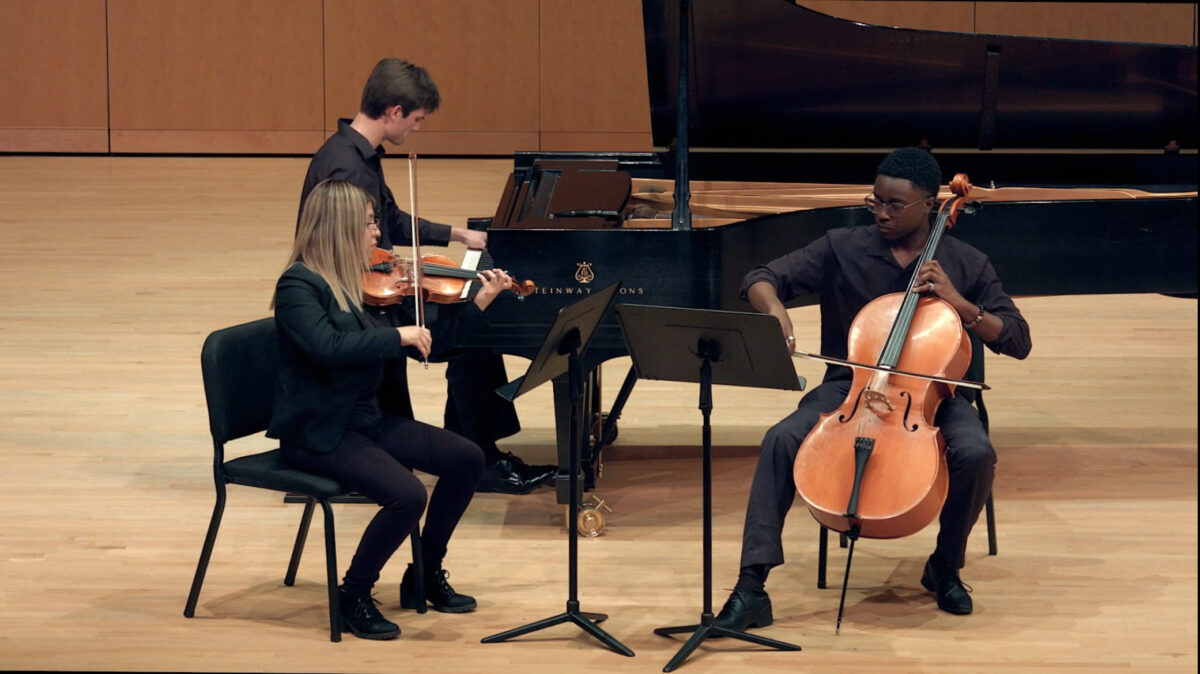
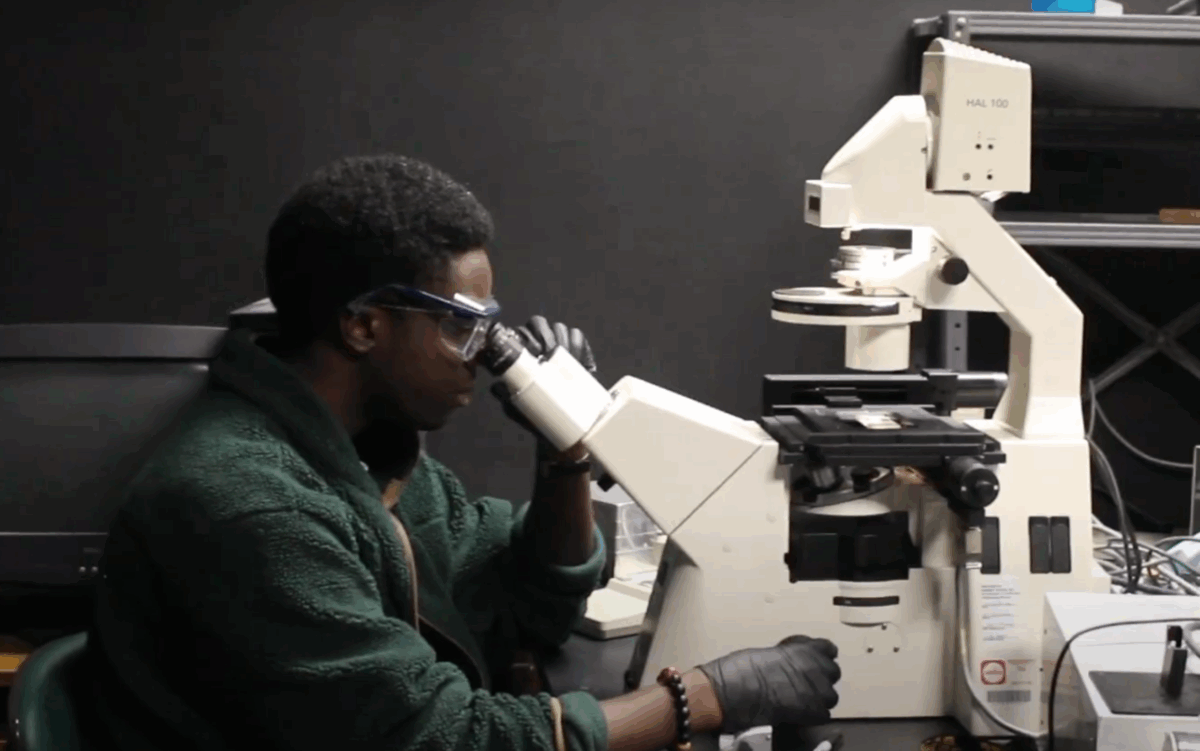 Playing the cello and conducting research makes Joshua Dayie feel “more whole.” (Melissa Penley Cormier, M.F.A. ’17/UMBC)
Dayie applies that discipline to his research with Mark Marten, professor of chemical, biochemical, and environmental engineering, on characterizing signaling pathways in fungi that activate in response to environmental stressors.
Then comes the creativity. Only after someone masters the fundamentals can they explore nuance in the tone or emotion conveyed on the cello, Dayie says. Similarly, in science “a lot of the innovation that you generate is really only meaningful after you’ve spent a lot of time understanding the core scientific concepts behind everything.”
“I think that’s been the most surprising thing: The creativity that comes from a very sound foundation of discipline is something that is translatable pretty much anywhere,” Dayie reflects.
As an added bonus, “Music has been a really nice outlet for me to use a different part of my brain, just to express myself in a different way,” he adds. “I feel like it makes me a little bit more whole.”
]]>
At UMBC, undergraduate students are redefining the boundaries of scientific and artistic pursuits. From a chemical engineer who graces the stage with his cello to a bioinformatician who paints and...
https://umbc.edu/stories/art-of-scientists/
https://my3.my.umbc.edu/api/v0/pixel/news/150074/guest@my.umbc.edu/8497eb97bed55a957858f91cb734d636/api/pixel
biochemistry-and-molecular-biology
bioinformatics
bioinformatics-and-computational-biology
biological-sciences
biology
cbee
chembiochem
cheme
chemeng
chemical-engineering
cnms
coeit
dance
discovery
magazine
music
story
UMBC News & Magazine
https://my3.my.umbc.edu/groups/umbc-news-magazine
https://assets1-my.umbc.edu/system/shared/avatars/groups/000/001/943/24435aa6207c452e7bc15cc74b42c7bb/xsmall.png?1748556657
https://assets1-my.umbc.edu/system/shared/avatars/groups/000/001/943/24435aa6207c452e7bc15cc74b42c7bb/original.png?1748556657
https://assets2-my.umbc.edu/system/shared/avatars/groups/000/001/943/24435aa6207c452e7bc15cc74b42c7bb/xxlarge.png?1748556657
https://assets2-my.umbc.edu/system/shared/avatars/groups/000/001/943/24435aa6207c452e7bc15cc74b42c7bb/xlarge.png?1748556657
https://assets3-my.umbc.edu/system/shared/avatars/groups/000/001/943/24435aa6207c452e7bc15cc74b42c7bb/large.png?1748556657
https://assets1-my.umbc.edu/system/shared/avatars/groups/000/001/943/24435aa6207c452e7bc15cc74b42c7bb/medium.png?1748556657
https://assets2-my.umbc.edu/system/shared/avatars/groups/000/001/943/24435aa6207c452e7bc15cc74b42c7bb/small.png?1748556657
https://assets1-my.umbc.edu/system/shared/avatars/groups/000/001/943/24435aa6207c452e7bc15cc74b42c7bb/xsmall.png?1748556657
https://assets2-my.umbc.edu/system/shared/avatars/groups/000/001/943/24435aa6207c452e7bc15cc74b42c7bb/xxsmall.png?1748556657
UMBC News & Magazine
3
0
false
Tue, 13 May 2025 09:16:55 -0400
Tue, 13 May 2025 09:16:55 -0400
UMBC’s CIDER program supports new Hilltop Institute-led Medicaid study, other cross-collaborative projects
UMBC researchers are collaborating on a study that takes a closer look at specific diagnosis coding patterns that focus on societal factors that potentially influence the health of Maryland’s Medicaid recipients.
Morgan Henderson, director of analytics and research at UMBC’s The Hilltop Institute, and Jun Chu, assistant professor of public health, are among the five cross-collaborative teams selected to receive funding from UMBC’s Center and Institute Departmentally-Engaged Research (CIDER) program. Henderson and Chu’s CIDER-supported project will investigate potential “z code” patterns of the state’s Medicaid recipients. Z codes are a set of diagnosis codes that refer to factors influencing a patient’s health status beyond diseases or injuries, called social determinants of health.
“These specific diagnosis codes indicate certain social determinants of health-related factors, not just traditionally medical things,” explains Henderson, principal investigator of the study. Z code data indicates if a patient has an issue that’s related to social risk factors, such as unstable housing, lack of food, hazardous living environments, and employment status.
“There hasn’t been much analysis of z code patterns and we aim to lay a good foundation for better understanding these diagnosis codes within Maryland’s Medicaid data,” says Henderson.
A deeper look into z code diagnosing could be a useful identification “to bring extra resources to Medicaid recipients who are in need,” says Chu.
Analyzing Medicaid data
The study coincides with recent news of potential billion-dollar federal budget cuts to Maryland’s Medicaid program, which currently supports about 1.7 million Maryland residents. The Hilltop Institute specializes in working with the state’s Medicaid data. According to the institute’s Maryland Medicaid DataPort, two in five of those in Medicaid are children and Medicaid pays for 60 percent of nursing home stays.
Chu’s research has largely focused on social determinants of health with a particular focus on immigrant communities and Medicaid recipients who are children. Henderson helped to develop and currently manages Hilltop’s predictive modeling portfolio. These predictive models, which also utilize z code data, use a variety of risk factors derived from Medicare and Medicaid claims data to estimate the probability that a given patient incurs certain outcomes in the near future.
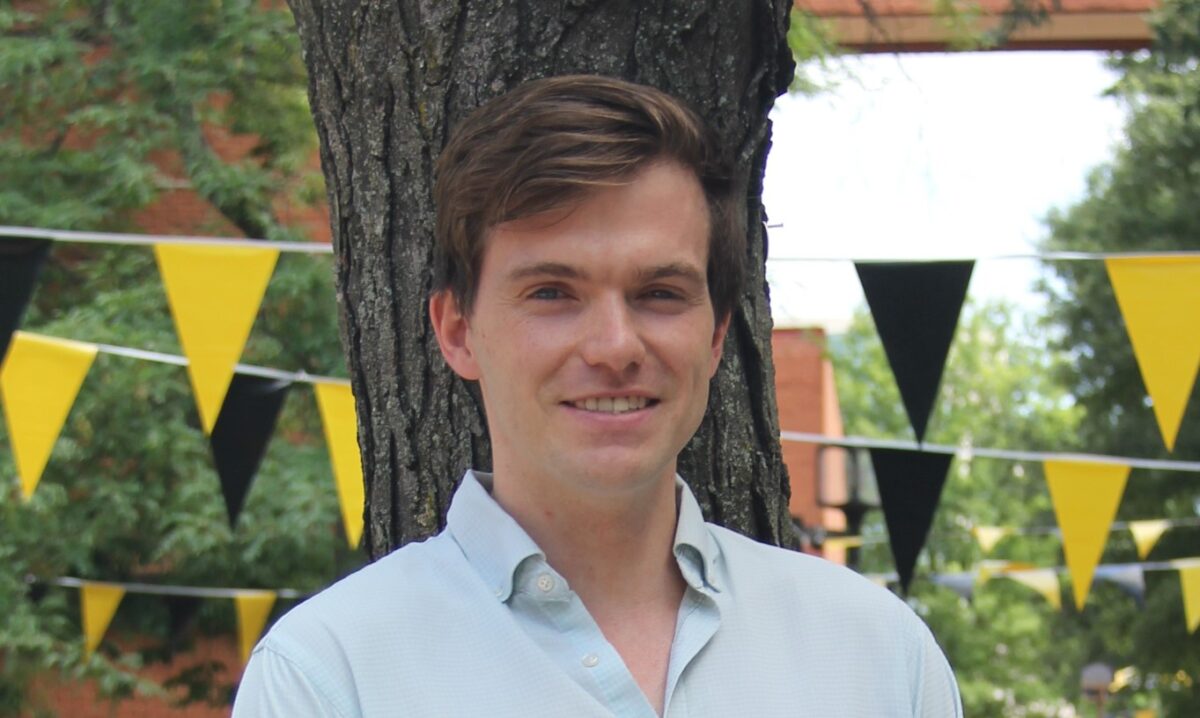
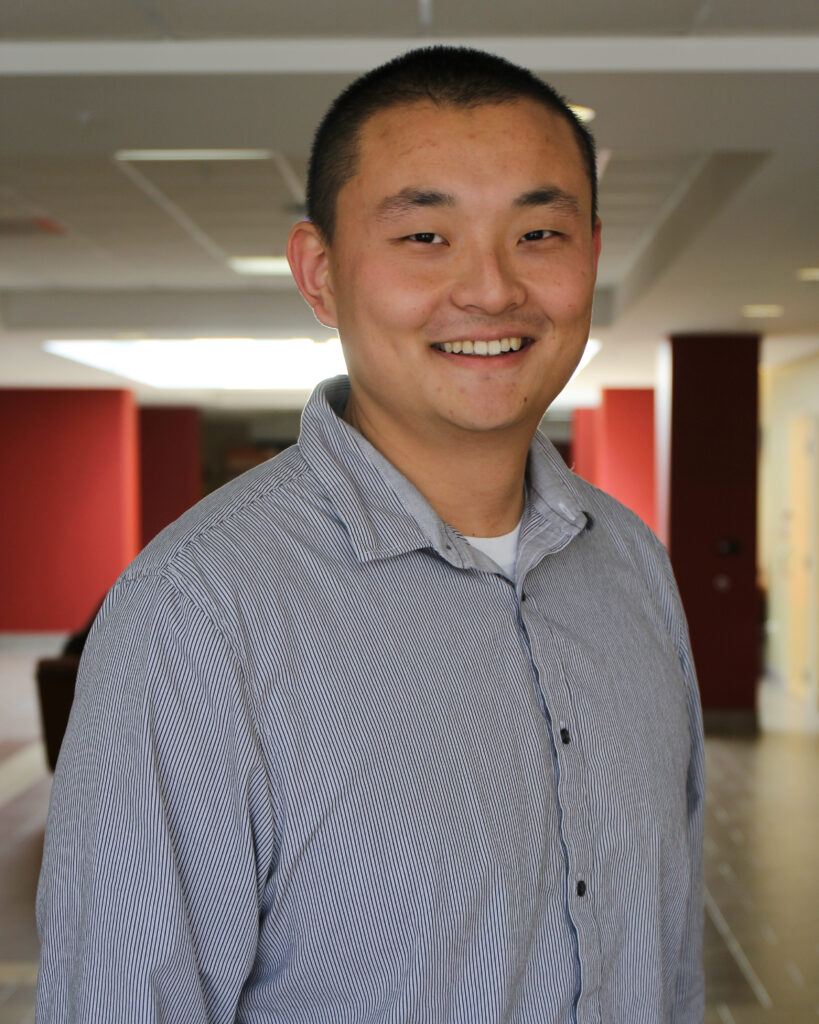 Principal investigator Morgan Henderson (left) and co-investigator Jun Chu of the CIDER Program study, “Analysis of Social Determinant of Health Diagnosis Coding Patterns Among Medicaid Recipients and Providers in Maryland.” (Photos courtesy of The Hilltop Institute and Jun Chu)
The pair’s project will include two studies: one study will focus specifically on the patients ascribed z codes to determine what patterns arise based on patient-specific factors such as demographics, health care utilization, or geography.
The second study will focus on analyzing the characteristics of the healthcare providers that indicate the z codes on Medicaid claims.
“Patient claims are the engine that so much of health analysis relies upon. It’s the decision of the provider on which coding diagnoses to include—it’s not a completely standardized process,” says Henderson.
CIDER 2025 recipients
The CIDER program’s goal includes supporting and promoting collaborative research between scholars based in one of UMBC’s affiliate centers and institutes and the university’s faculty researchers. Selected proposals are awarded up to $50,000 in seed funding for 18 months.
The 2025 CIDER program recipients include:
-
Anin Puthukkudy, Earth and Space Institute, and Vanderlei Martins, professor of physics
-
Jessica Sutton, Goddard Earth Sciences Technology and Research (GESTAR) II, Tejas Gokhale, assistant professor of computer science and electrical engineering, and Thomas Stanley, GESTAR II
-
Kaur Kullman, the Center for Space Sciences and Technology, Alan Sherman, Roberto Yus, and Enis Golaszewski, professors of computer science and electrical engineering
-
Morgan Henderson, The Hilltop Institute at UMBC, and Jun Chu, assistant professor of public health
-
Venkatesh Srinivasan, Center for Advanced Sensor Technology, Tyler Josephson, assistant professor of chemical, biochemical, and environmental engineering
Don Engel, associate vice president for research development, shares that the CIDER program was created to foster collaborations that draw on the full range of UMBC’s strengths in research and creative achievement.
“CIDER helps connect faculty in our research centers with colleagues in degree-granting departments to pursue work with real impact—work that informs policy, advances knowledge, and ultimately serves the public good,” says Engel.
Learn more about UMBC’s funding opportunities.
]]>
UMBC researchers are collaborating on a study that takes a closer look at specific diagnosis coding patterns that focus on societal factors that potentially influence the health of Maryland’s...
https://umbc.edu/stories/cider-program-hilltop-medicaid-study/
https://my3.my.umbc.edu/api/v0/pixel/news/149744/guest@my.umbc.edu/78db6f7fa7d09470bbd8c0df0856a68c/api/pixel
cahss
cbee
coeit
csee
gestar
hilltop-institute
news
policy-and-society
public-health
research
saph
story
UMBC News & Magazine
https://my3.my.umbc.edu/groups/umbc-news-magazine
https://assets1-my.umbc.edu/system/shared/avatars/groups/000/001/943/24435aa6207c452e7bc15cc74b42c7bb/xsmall.png?1748556657
https://assets1-my.umbc.edu/system/shared/avatars/groups/000/001/943/24435aa6207c452e7bc15cc74b42c7bb/original.png?1748556657
https://assets2-my.umbc.edu/system/shared/avatars/groups/000/001/943/24435aa6207c452e7bc15cc74b42c7bb/xxlarge.png?1748556657
https://assets2-my.umbc.edu/system/shared/avatars/groups/000/001/943/24435aa6207c452e7bc15cc74b42c7bb/xlarge.png?1748556657
https://assets3-my.umbc.edu/system/shared/avatars/groups/000/001/943/24435aa6207c452e7bc15cc74b42c7bb/large.png?1748556657
https://assets1-my.umbc.edu/system/shared/avatars/groups/000/001/943/24435aa6207c452e7bc15cc74b42c7bb/medium.png?1748556657
https://assets2-my.umbc.edu/system/shared/avatars/groups/000/001/943/24435aa6207c452e7bc15cc74b42c7bb/small.png?1748556657
https://assets1-my.umbc.edu/system/shared/avatars/groups/000/001/943/24435aa6207c452e7bc15cc74b42c7bb/xsmall.png?1748556657
https://assets2-my.umbc.edu/system/shared/avatars/groups/000/001/943/24435aa6207c452e7bc15cc74b42c7bb/xxsmall.png?1748556657
UMBC News & Magazine
0
0
false
Fri, 02 May 2025 15:04:11 -0400
Fri, 02 May 2025 15:04:11 -0400