Sisters in science: How one UMBC lab kindled a family tradition of discovery
On the fourth floor of UMBC’s Meyerhoff Chemistry Building, where students are hard at work exploring the intricacies of RNA molecules that may hold the key to combating viral diseases, a unique family tradition has taken root. Three sisters—Huda, Reem, and Rowah Abdelghani—have each stepped into the same research space and found the thrill of discovery, the warmth of community, and a mentor who welcomes eager learners at all levels.
It began with Huda, the trailblazing eldest of the three sisters. As a high school junior in Howard County’s Applications and Research Laboratory (ARL) biotechnology program, she dove into the program’s intensive training—mastering lab basics like micropipetting, PCR, and gel electrophoresis alongside students from across the county. ARL encourages seniors to pursue off-site internships, so Huda cold-emailed labs at nearby universities. “It was tough,” she recalls. “Some of my friends emailed over 30 people before finding a spot. I got lucky with Dr. Koirala.”

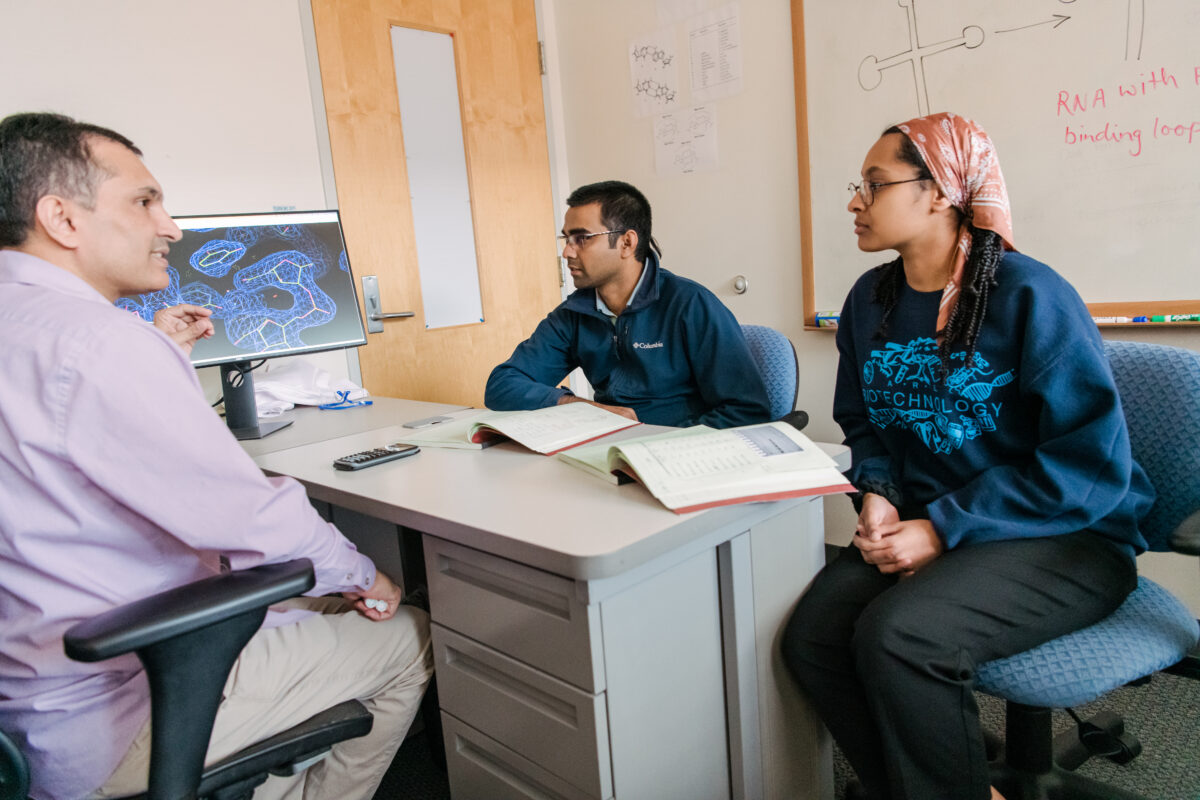 Huda Abdelghani (left) was the first of her three sisters to work in Deepak Koirala’s lab through Howard County’s Applications and Research Laboratory program. At right: Deepak Koirala (left), Naba Krishna Das (center), and Huda Abdelghani discuss their research in Koirala’s office. (Photos by Marlayna Demond ’11/UMBC)
Skills that apply everywhere
Deepak Koirala, associate professor of chemistry and biochemistry, leads a UMBC research group that studies the structures of RNA in enteroviruses—a family of pathogens behind illnesses like hand-foot-and-mouth disease, polio, and myocarditis. Huda joined in the summer of 2022 and stayed through spring 2023. Mentored by a Ph.D. student in the lab, Hasan Al Banna, she quickly learned that scientific research frequently involves failure—but that’s no reason to give up.
“You can do everything right and still not get results,” she says. “It’s not personal—that’s just science.” This lesson in perseverance stuck with her, as did Koirala’s individualized attention. When her graduate student mentor was away, he spent hours helping her set up trays of crystallization plates for her experiments.
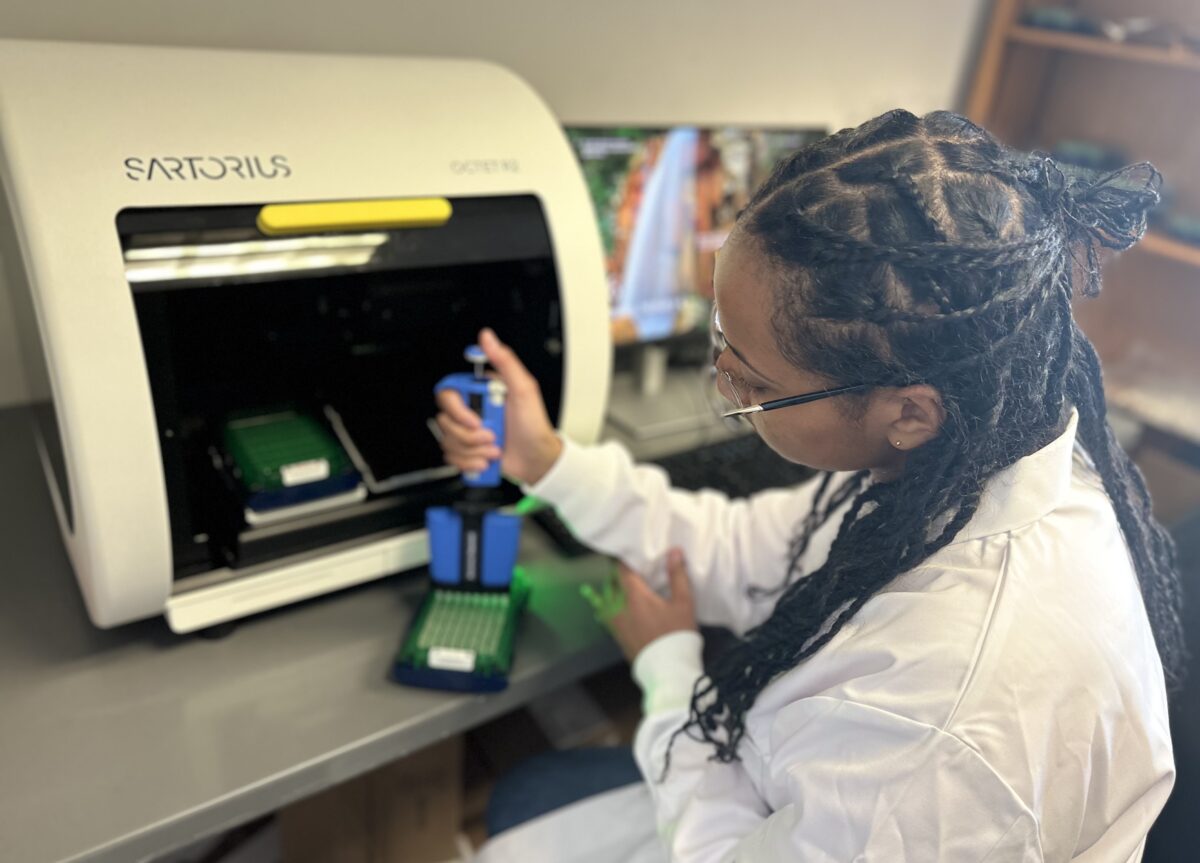
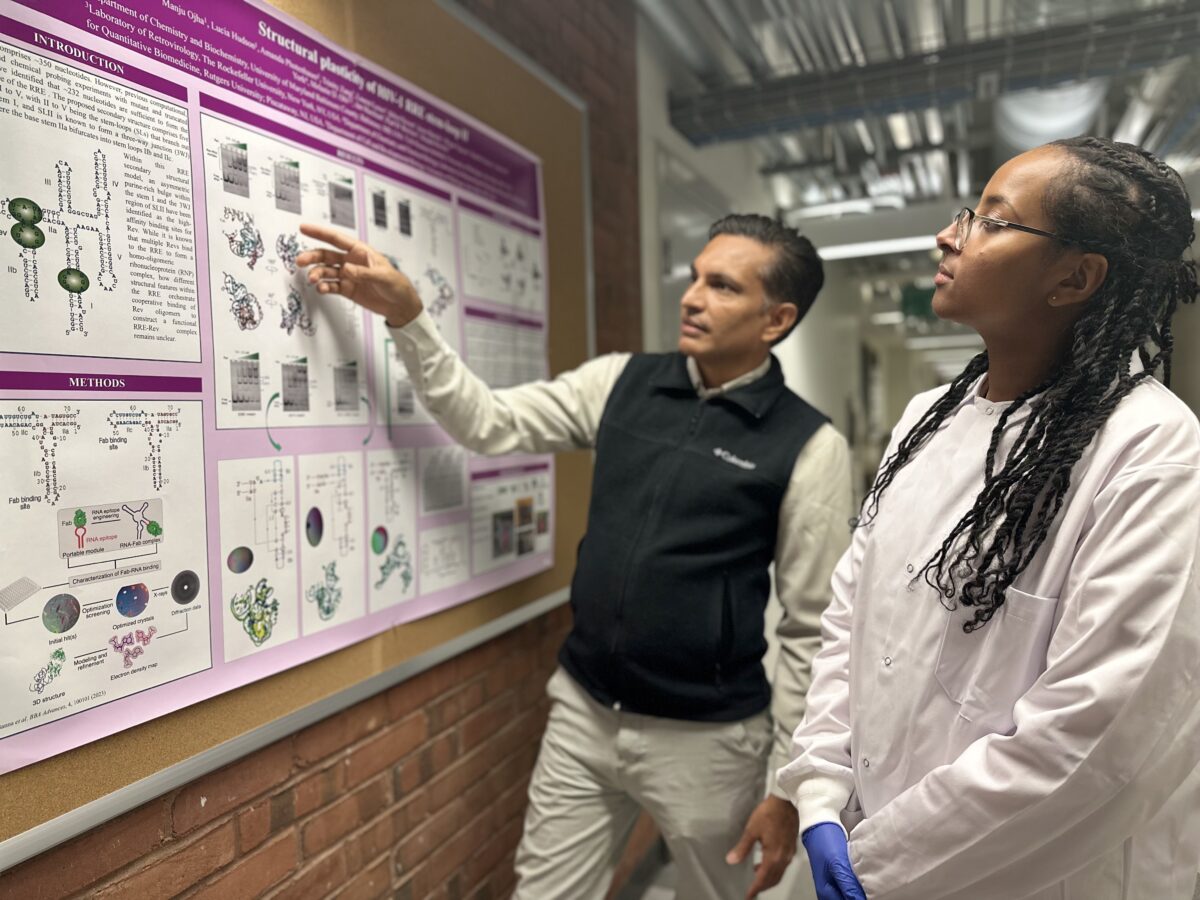 Left: Reem Abdelghani works with a multi-channel micropipet in the lab. Right: Reem and Deepak Koirala discuss research at a poster in the hallway outside Koirala’s lab. (Photos courtesy of Deepak Koirala)
Huda is now a junior mechanical engineering major at MIT, spending this semester on co-op with Apple’s Mac product design team in Austin, Texas—but the lab’s influence lingers. It sparked her interest in tools that help accelerate biochemistry research, like imaging platforms. “The technical and soft skills I gained at UMBC can apply anywhere,” she reflects. Even her first MIT lab connection came from a conversation overheard down the hall from her bench in Koirala’s lab. “It showed me the interconnectedness of academia,” she says.
Shattering preconceptions
Huda’s enthusiasm inspired Reem, the middle sister, to reach out to Koirala for her own ARL biotech internship. She started in Koirala’s lab in the summer of 2024, before her senior year of high school. “I saw how happy Huda was—and it looked like something I’d enjoy, too,” Reem says.
Mentored by Ph.D. student Naba Krishna Das, who isnow a postdoctoral fellow at the National Cancer Institute in Frederick, Maryland, Reem immersed herself in the lab’s operations, from presenting at lab meetings to executing tasks like sterilizing equipment and generating crystal structures of RNA and protein complexes. The lab’s collaborative vibe shattered her preconceptions. “I was worried grad school could be isolating, but it’s so interactive, with people at every stage of their scientific careers,” she explains.
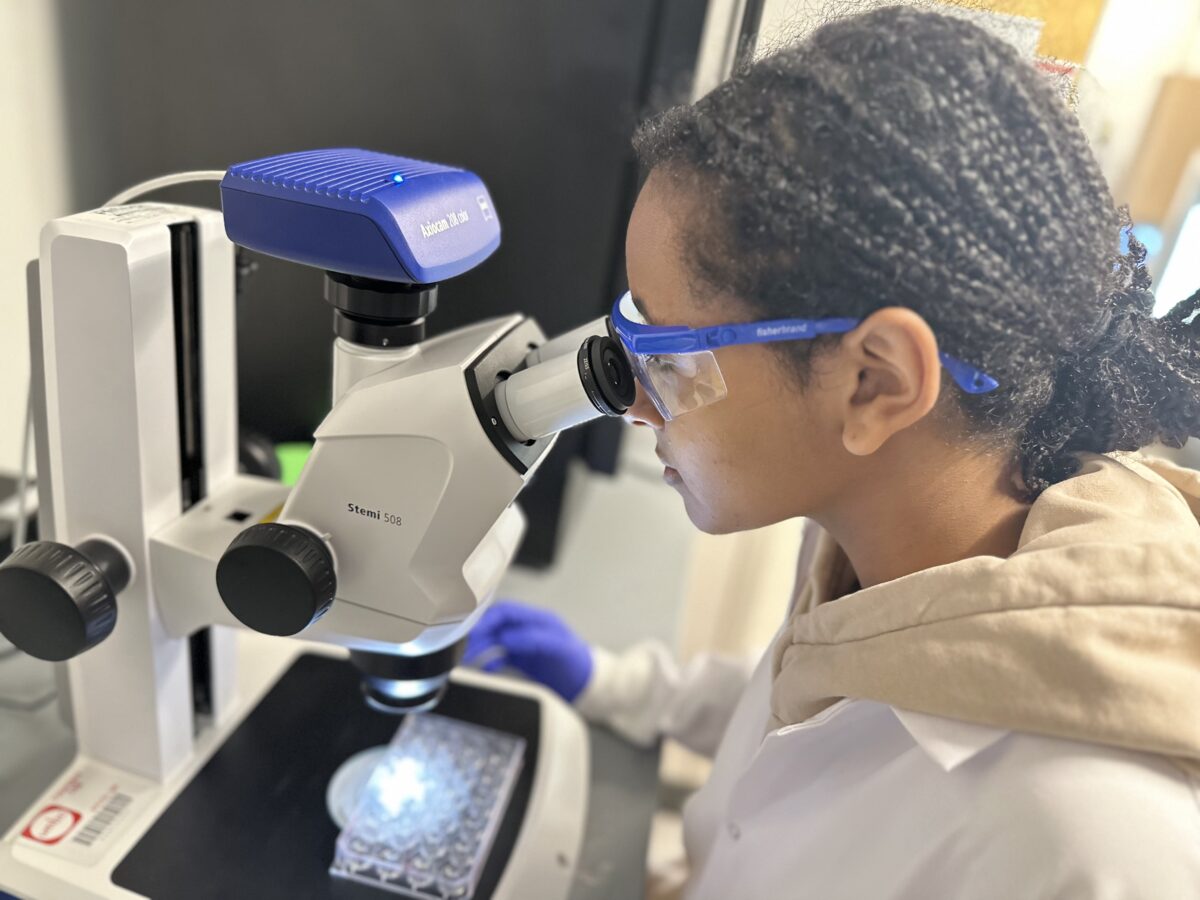
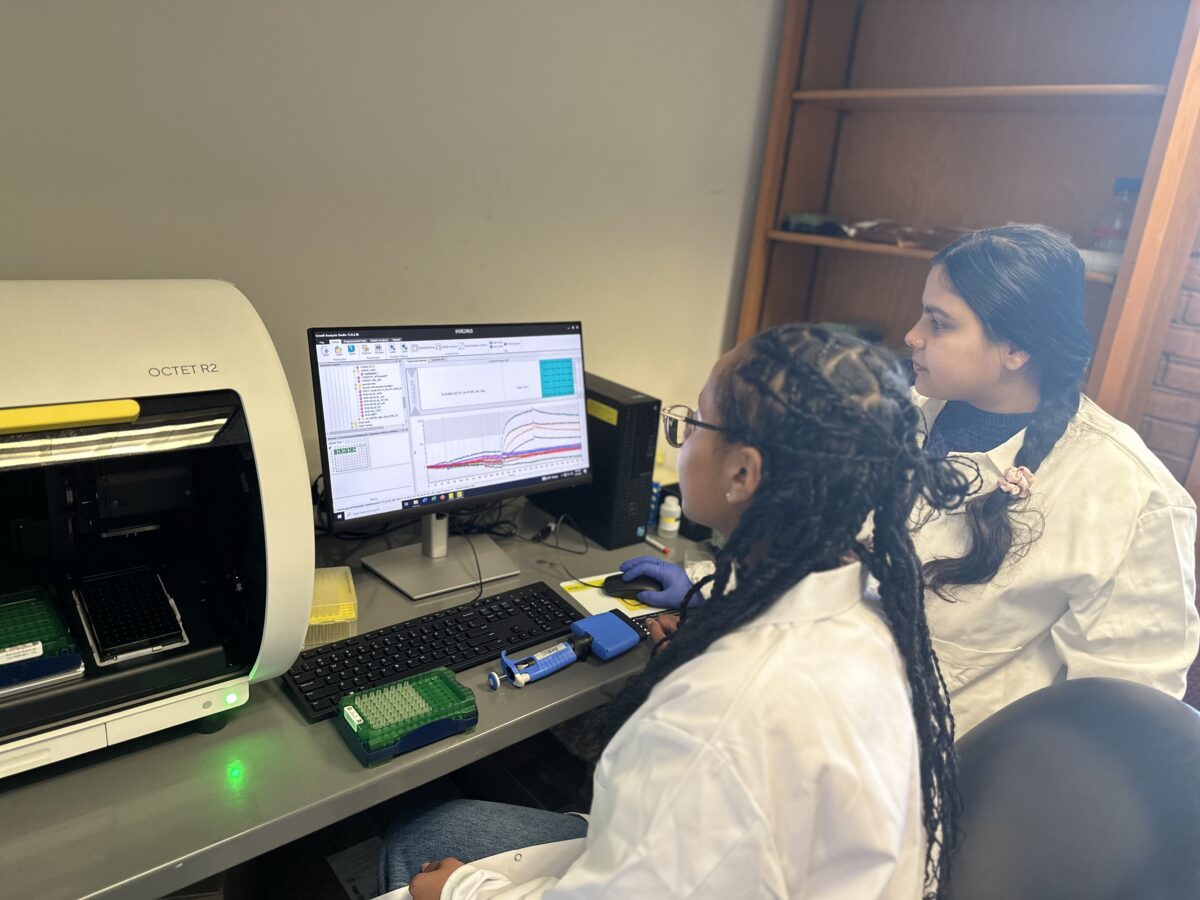 All three sisters gained valuable experience and skills working with Koirala. Left: Rowah looks at experimental wells under a microscope. Right: Reem (left) and Manju Ojha analyze data. (Photos courtesy of Deepak Koirala)
Reem conducted experiments for a project on viral replication, earning co-authorship on a 2025 Nature Communications paper as a high schooler. “I never expected to be so involved—I feel privileged,” she says. The process taught her the value of replication and troubleshooting. “Sometimes it’s trial and error as you’re exploring something new,” she says.
Now a first-year student at UMBC majoring in biochemistry, Reem plans to return to the Koirala lab as soon as space becomes available. “I didn’t consider grad school before, but now it’s definitely on the table,” she says—a perspective born of early research experiences that revealed what the scientific process is really like.
A real community
Rowah, a high school senior, joined the lab last fall. Her expectations of a “scary, strict PI” melted away. “Dr. Koirala is one of the kindest people I’ve met,” Rowah says. The lab’s supportive dynamic impressed her, too. Members shared resources, brainstormed next steps, and lifted each other up. “They push each other to do better—it’s a real community.”
Building on her ARL skills, Rowah felt like a valued member of the team. Her mentor in the lab, Ph.D. student Bethel G. Beyene, provided scientific papers for context, ensuring she grasped the concepts behind the team’s research, not just individual lab techniques. She, too, came face to face with failure and learned from it.
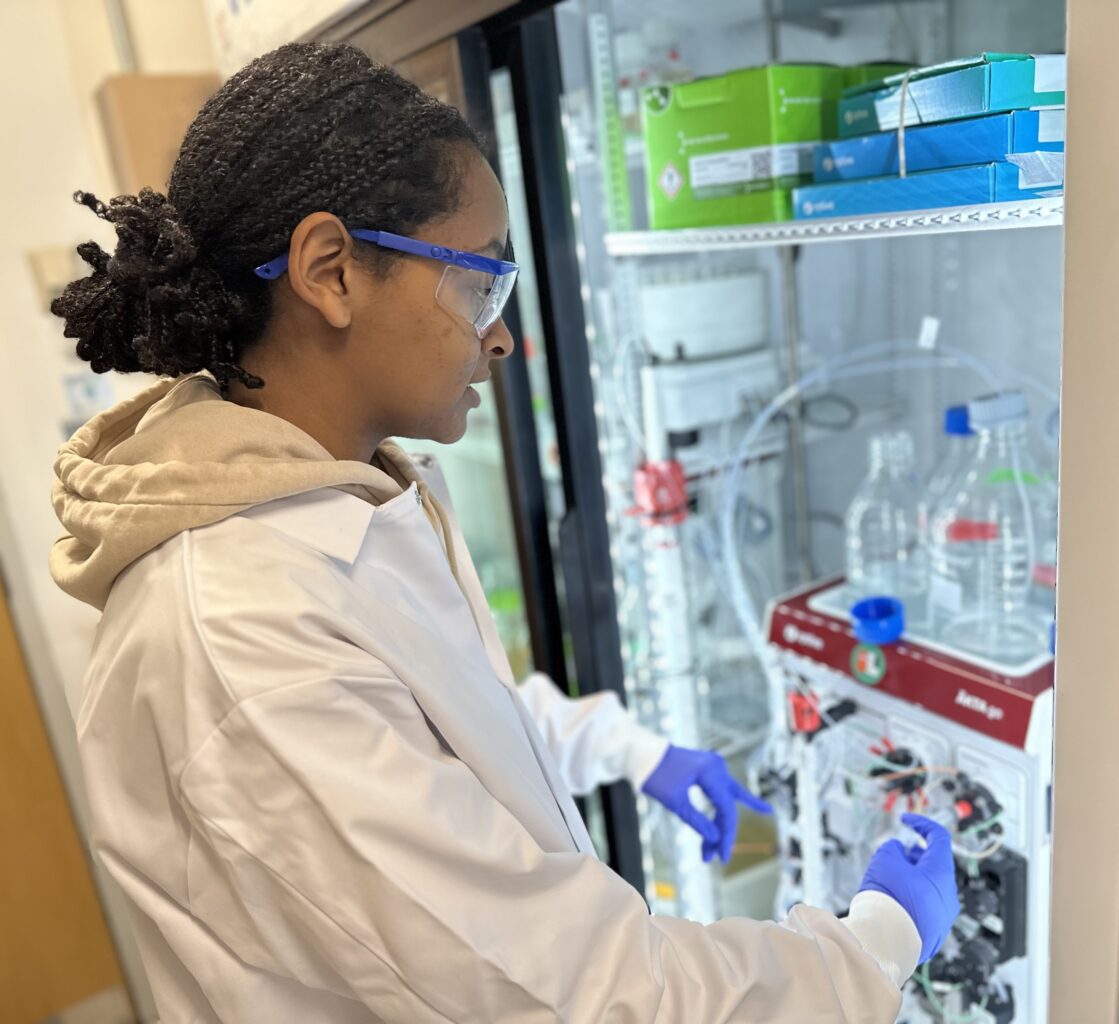
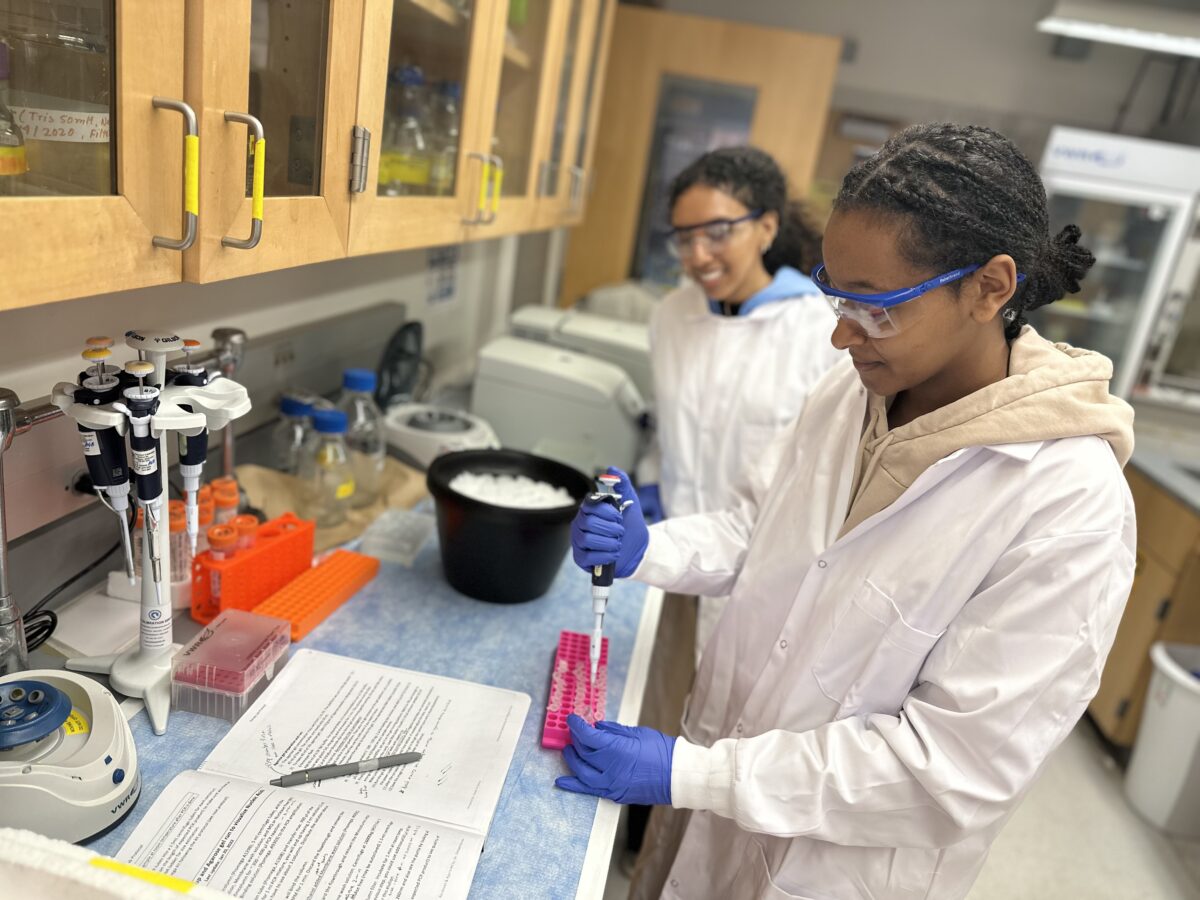 Rowah (at left and pipetting on right) received supportive mentorship from Ph.D. student Bethel Beyene (right photo, background). (Photos courtesy of Deepak Koirala)
“When things go wrong, we sit down and figure it out. It’s not that failure means you’re wrong; overcoming it is how you succeed.” That creative problem-solving carried over into her high school robotics competitions. “I applied lab thinking by evaluating all the possible sources of error to debug our robot—it felt great,” Rowah says. With her interests across biology and engineering, Rowah is considering a biomedical engineering major in the future. “The Koirala lab showed me that I don’t have to choose between my interests,” she says.
Making science better
The sisters’ bond fueled their experiences. “We talk openly—about lab life, plans, even arguments,” Reem laughs. Rowah says her admiration for Huda encouraged her to pursue working in Koirala’s lab. Though they never overlapped in the lab, Huda’s path reassured the others. “If I hadn’t had that chance, I couldn’t have shared it with my family,” Huda says.
Koirala credits the ARL program for bringing talented high schoolers like the Abdelghanis into his group. “They’re not just mentioned in the acknowledgments for completing experiments, but contributing intellectually at the level of authorship,” he says, noting the paper Reem co-authored.
His inclusive approach welcomes students with diverse backgrounds, training the next generation of scientists. “High schoolers, undergrads, women and men from varied backgrounds—they’re all making science better,” Koirala says. Clearly, including less experienced scientists isn’t hurting the lab’s output. Koirala has received multiple major grants and published high-profile papers since he arrived at UMBC in 2020.
In Koirala’s welcoming space, beginners become contributors, failures forge innovators, and family ties amplify ambition. As Rowah troubleshoots gels, Reem eyes graduate school, and Huda designs bioimaging tech at MIT, their paths affirm that science thrives on curiosity, community, and the courage to explore.
]]>
On the fourth floor of UMBC’s Meyerhoff Chemistry Building, where students are hard at work exploring the intricacies of RNA molecules that may hold the key to combating viral diseases, a unique...
https://umbc.edu/stories/sisters-in-science/
https://my3.my.umbc.edu/api/v0/pixel/news/156260/guest@my.umbc.edu/87ca52c1e4d306e0d8b68899f861ab8c/api/pixel
chembiochem
cnms
community
news
research
science-and-tech
story
undergradresearch
UMBC News & Magazine
https://my3.my.umbc.edu/groups/umbc-news-magazine
https://assets1-my.umbc.edu/system/shared/avatars/groups/000/001/943/24435aa6207c452e7bc15cc74b42c7bb/xsmall.png?1748556657
https://assets1-my.umbc.edu/system/shared/avatars/groups/000/001/943/24435aa6207c452e7bc15cc74b42c7bb/original.png?1748556657
https://assets2-my.umbc.edu/system/shared/avatars/groups/000/001/943/24435aa6207c452e7bc15cc74b42c7bb/xxlarge.png?1748556657
https://assets2-my.umbc.edu/system/shared/avatars/groups/000/001/943/24435aa6207c452e7bc15cc74b42c7bb/xlarge.png?1748556657
https://assets3-my.umbc.edu/system/shared/avatars/groups/000/001/943/24435aa6207c452e7bc15cc74b42c7bb/large.png?1748556657
https://assets1-my.umbc.edu/system/shared/avatars/groups/000/001/943/24435aa6207c452e7bc15cc74b42c7bb/medium.png?1748556657
https://assets2-my.umbc.edu/system/shared/avatars/groups/000/001/943/24435aa6207c452e7bc15cc74b42c7bb/small.png?1748556657
https://assets1-my.umbc.edu/system/shared/avatars/groups/000/001/943/24435aa6207c452e7bc15cc74b42c7bb/xsmall.png?1748556657
https://assets2-my.umbc.edu/system/shared/avatars/groups/000/001/943/24435aa6207c452e7bc15cc74b42c7bb/xxsmall.png?1748556657
UMBC News & Magazine
0
0
false
Thu, 05 Feb 2026 13:43:47 -0500
Thu, 05 Feb 2026 13:43:47 -0500
A place to spark scientific curiosity—UMBC hosts 1,200 high schoolers at Science Olympiad invitational
On a cloudy Saturday in January, UMBC buzzed with the energy of over 1,200 high school students from across the Mid-Atlantic region. For the third consecutive year, UMBC’s College of Natural and Mathematical Sciences (CNMS) hosted its Science Olympiad Invitational Tournament, transforming the campus into a vibrant hub of hands-on scientific discovery for the high school competitors.
From building hovercrafts and bridges to tackling exams in anatomy, astronomy, and beyond, the event showcased 23 competitive challenges across an array of STEM disciplines. What started as a modest gathering of 40 teams three years ago has ballooned into Maryland’s largest invitational, drawing participants from Virginia, Delaware, New Jersey, Pennsylvania, and D.C.
The tournament exemplifies UMBC’s commitment to nurturing young talent and building community connections. “A couple of years ago, I suggested a Science Olympiad tournament as a way to invite more high school students onto the campus and get them excited about science—and UMBC,” shared event co-organizer Bindu Abraham, Ph.D. ’06, chemistry, assistant teaching professor of chemistry and biochemistry, and executive director of Maryland Science Olympiad.
Abraham first encountered Science Olympiad as a homeschool parent watching a passion for science emerge in her son. Now, she is happy to be involved in encouraging a similar enthusiasm for science in students across the region. This year’s event also spotlighted partnerships with organizations like STEM Champions of Baltimore, ensuring under-resourced Baltimore City schools could participate in a dedicated league and envision futures at UMBC.
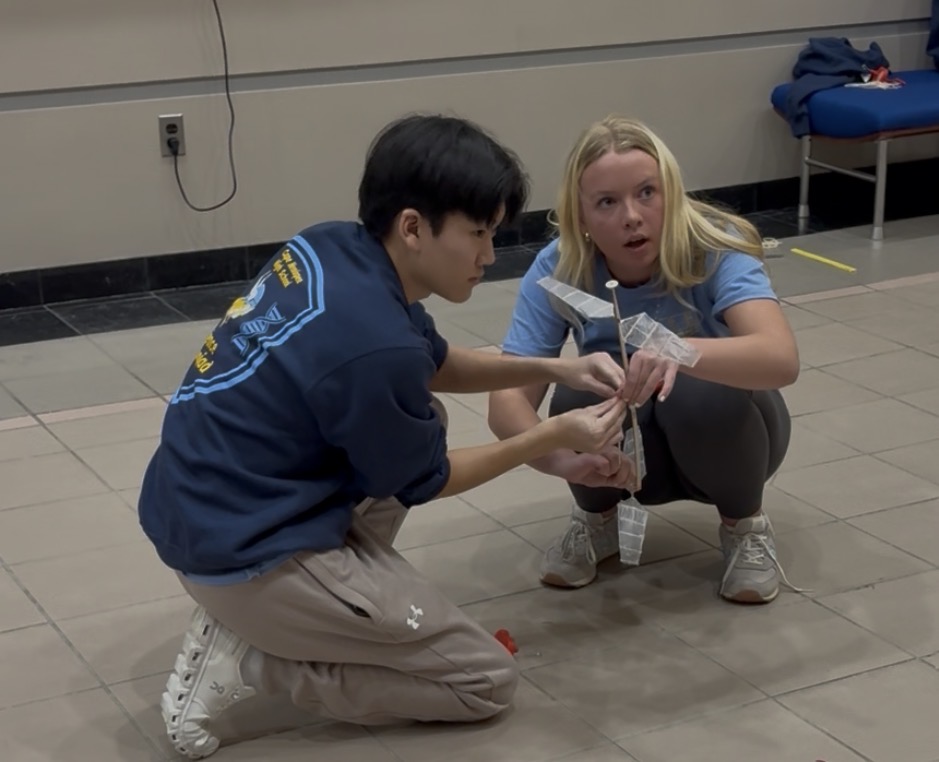
 Cape Henlopen High School in Delaware brought three complete teams to the Science Olympiad at UMBC. Left: Nathaniel Hoang and Ellie Sprague compete in the helicopter event. Right: Quinton Eisenmann and Ava Lewis prepare for the hovercraft event. (Photos courtesy of Priscilla Coolbaugh)
Inspiring students’ interest in science
Volunteers—including UMBC faculty, alumni, current students—made the day possible, each driven by motivations rooted in their own journeys. Mark Grzanna, M.S. ’15, biological sciences, today a Science Olympiad coach at John Carroll High School in Bel Air, Maryland, brought two teams of eager students for his third year at the UMBC tournament. Grzanna teaches biology, anatomy and physiology, and a biotech course he designed at John Carroll, and he views the Olympiad as a gateway to scientific curiosity.
“Education is so important. I became a teacher to get kids interested in science—or at least to help them understand enough science to navigate their world,” he said. His co-coach, John Carroll teacher Andrew Ketchum, echoed the sentiment: “It’s a great experience for our kids to see other students excited about science.”
Frank Tagaytay, a senior physics and math major, supervised the “boomilever” event, where teams tested structures’ strength and integrity. Based on experience as president of his high school Science Olympiad club, Tagaytay patiently guided participants through event regulations, offering encouragement amid the occasional structural mishap.

 Left: Frank Tagaytay (left), a senior UMBC physics and math major, encourages Aalyna Johnson (center) and Cassidy Mehegan from Cape Henlopen High School as they set up their “boomilever” for competition. (Photo by Sarah Hansen, M.S. ’15/UMBC) Right: Cape Henlopen students Theodore Noe Fellows, Shouta Sano, Quinton Eisenmann, and Ava Lewis (left to right) carry their equipment to the competition site in the UMBC Physics Building. (Photo courtesy of Priscilla Coolbaugh)
“It’s an early season event for teams to work out the kinks,” he explained, highlighting how the low-stakes environment builds confidence and resilience. For Tagaytay, volunteering bridges his past and present, reinforcing UMBC’s supportive community.
Fareedah Owolabi, a junior chemical engineering major who recently transferred from the Community College of Baltimore County, found the event particularly meaningful. “I have a soft spot for STEM outreach, because it’s how I was introduced to UMBC,” she shared. Through the Upward Bound Math and Science program, Owolabi connected with UMBC tutors as a high schooler. Now, as a volunteer, she fielded questions from participants about campus life. “I want to inspire younger students,” she said, embodying the cycle of mentorship that defines the tournament.
Broadening their horizons
Priscilla Coolbaugh, Science Olympiad coach at Cape Henlopen High School in Delaware, started her team three years ago after loving Science Olympiad as a student herself. “I want to share that love,” she said. Her three full teams traveled far to compete. “They get to see themselves at these universities. They might have planned to stay close to home, but this way they get exposure to out-of-state schools,” Coolbaugh said. “It broadens their horizons to different schools as well as different STEM fields.”

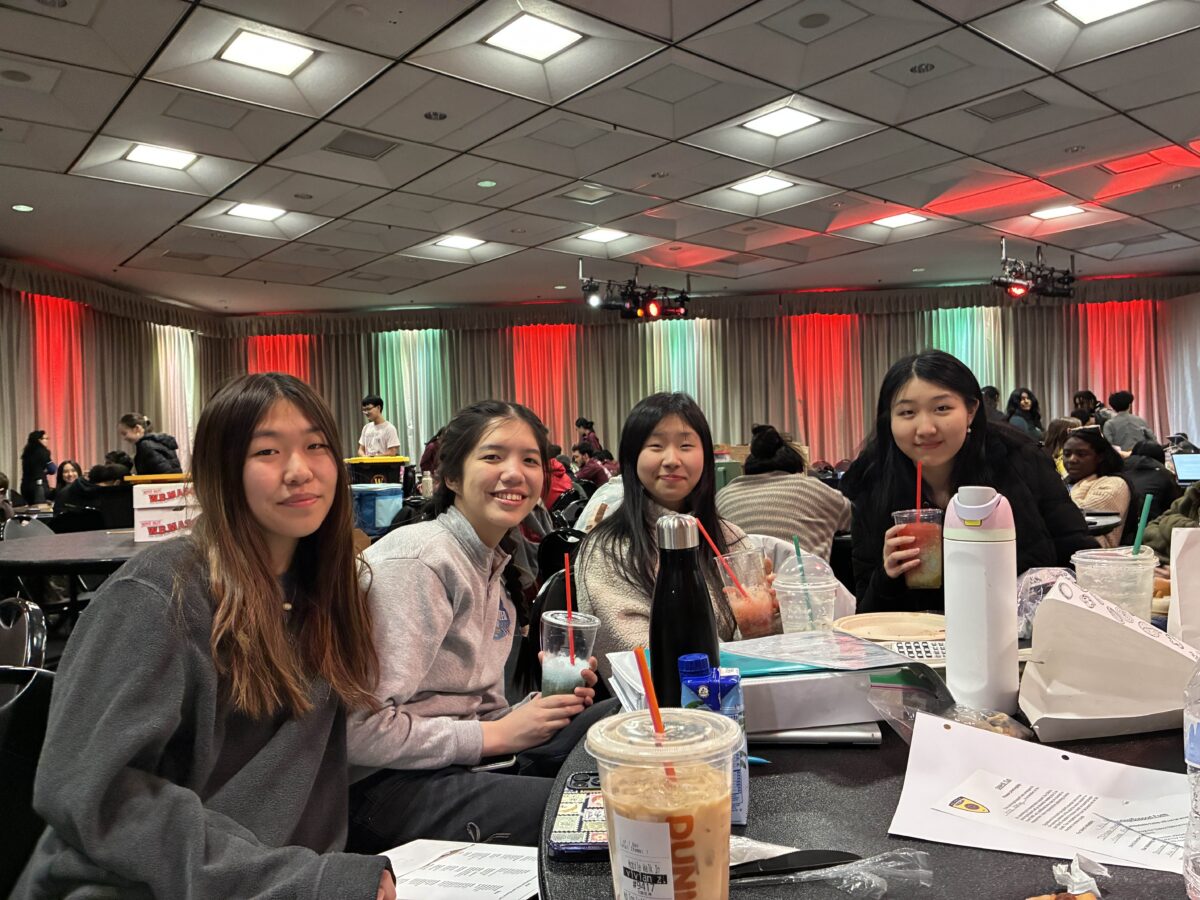 Students and a coach from Winston Churchill High School in Potomac, Maryland, relax in the UMBC Ballroom between events. (Photos courtesy of Jonathan Lee)
Students expressed their sense of community and excitement about their experiences at the UMBC event. Cape Henlopen freshman Aalya Desai noted how the event helped her make friends despite starting as a newcomer, and sophomore Grace Eanes appreciated the chance to bond with peers across grades while exploring the beautiful campus. Michael Song, a junior from Winston Churchill High School in Potomac, Maryland, who with his teammate, Leo Jiang, earned the top score in the hovercraft event, commented, “UMBC is much bigger than I expected. It’s a lot of fun to travel to Olympiad events.”
In good hands
Faculty and staff volunteers underscored the event’s broader impact. CNMS dean William R. LaCourse, surveying the awards ceremony, reflected on the promise of the participants. “As I stood on the stage looking over the ballroom filled with excited and creative students, I couldn’t help feeling as if I was looking into the future and thinking, ‘We (all of us) are in good hands,’” he said.
Zeev Rosenzweig, professor of chemistry and biochemistry, supervised the rocks and minerals test with three undergraduates and three of his graduate students. “Being here is just an important thing to do,” he said. “It’s a great outlet to show them that their interests matter,” he noted. “The kids who come to the Olympiad—they’re our people.” Ph.D. student Kushani Mendis, a Ph.D. student in Rosenzweig’s lab, added, “The best way to support the next generation in STEM is to organize events like this and spend time with them.”
In April, UMBC will host the Maryland State Science Olympiad for the first time, building on this invitational’s momentum. “It’s fun to see young people so excited about different areas of STEM,” shared Michelle Starz-Gaiano, professor and chair of biological sciences, adding, “It’s critical to foster the growth of young scientists. We love the energy and enthusiasm that they bring.”
]]>
On a cloudy Saturday in January, UMBC buzzed with the energy of over 1,200 high school students from across the Mid-Atlantic region. For the third consecutive year, UMBC’s College of Natural and...
https://umbc.edu/stories/1200-high-schoolers-at-science-olympiad/
https://my3.my.umbc.edu/api/v0/pixel/news/156251/guest@my.umbc.edu/8fcd1fc51406ee5d71336ef39bd47917/api/pixel
biology
cbee
chembiochem
cnms
coeit
community
news
physics
science-and-tech
story
trio
UMBC News & Magazine
https://my3.my.umbc.edu/groups/umbc-news-magazine
https://assets1-my.umbc.edu/system/shared/avatars/groups/000/001/943/24435aa6207c452e7bc15cc74b42c7bb/xsmall.png?1748556657
https://assets1-my.umbc.edu/system/shared/avatars/groups/000/001/943/24435aa6207c452e7bc15cc74b42c7bb/original.png?1748556657
https://assets2-my.umbc.edu/system/shared/avatars/groups/000/001/943/24435aa6207c452e7bc15cc74b42c7bb/xxlarge.png?1748556657
https://assets2-my.umbc.edu/system/shared/avatars/groups/000/001/943/24435aa6207c452e7bc15cc74b42c7bb/xlarge.png?1748556657
https://assets3-my.umbc.edu/system/shared/avatars/groups/000/001/943/24435aa6207c452e7bc15cc74b42c7bb/large.png?1748556657
https://assets1-my.umbc.edu/system/shared/avatars/groups/000/001/943/24435aa6207c452e7bc15cc74b42c7bb/medium.png?1748556657
https://assets2-my.umbc.edu/system/shared/avatars/groups/000/001/943/24435aa6207c452e7bc15cc74b42c7bb/small.png?1748556657
https://assets1-my.umbc.edu/system/shared/avatars/groups/000/001/943/24435aa6207c452e7bc15cc74b42c7bb/xsmall.png?1748556657
https://assets2-my.umbc.edu/system/shared/avatars/groups/000/001/943/24435aa6207c452e7bc15cc74b42c7bb/xxsmall.png?1748556657
UMBC News & Magazine
1
0
false
Thu, 05 Feb 2026 11:30:12 -0500
Thu, 05 Feb 2026 11:30:12 -0500
UMBC’s Seneviratne to study how HIV and cancer drugs harm the brain
Important FDA-approved drugs to treat HIV and cancer can save lives, but they come with their own risks. Some drugs used clinically are known to cause neurological side effects in up to half of patients, ranging from confusion and memory problems to permanent nerve damage. Kamal Seneviratne, assistant professor of chemistry and biochemistry, has been studying exactly how these drugs harm the brain, in an effort to mitigate their negative effects.
 Work led by Nav Phulara supplied the data needed to successfully apply for MSCRF funding; he also leads the current project. (Courtesy of Phulara)
Last year, Seneviratne’s lab published the first study to reveal disruptions to brain lipid metabolism in response to the HIV drug efavirenz. The study began to show how the drug throws the brain’s lipid chemistry out of balance in specific brain regions.
Now, the Maryland Stem Cell Research Fund (MSCRF) has awarded Seneviratne a $350,000 grant to continue this promising line of work. He and his students will investigate how drugs currently in use such as efavirenz, dolutegravir (another HIV drug), and a common chemotherapy agent (oxaliplatin) can damage brain cells over time.
Nav Phulara, a Ph.D. candidate in Seneviratne’s lab, was first author on the 2024 paper and will again take a leading role in the upcoming work, alongside other UMBC graduate and undergraduate students. The project offers an opportunity to gain hands-on experience with key techniques for work in this field, including advanced mass spectrometry imaging and human stem cell research.
From ‘what’ to ‘how’
Work supported by the new grant will take advantage of Seneviratne’s collaboration with neurologist Jinchong Xu at Johns Hopkins University, who works with human neural cells. The research team will run their trials in miniature human “brain organoids”—clusters of human brain cells grown in the lab from stem cells. Organoids mimic the physiology of a human brain far better than animal models ever could.
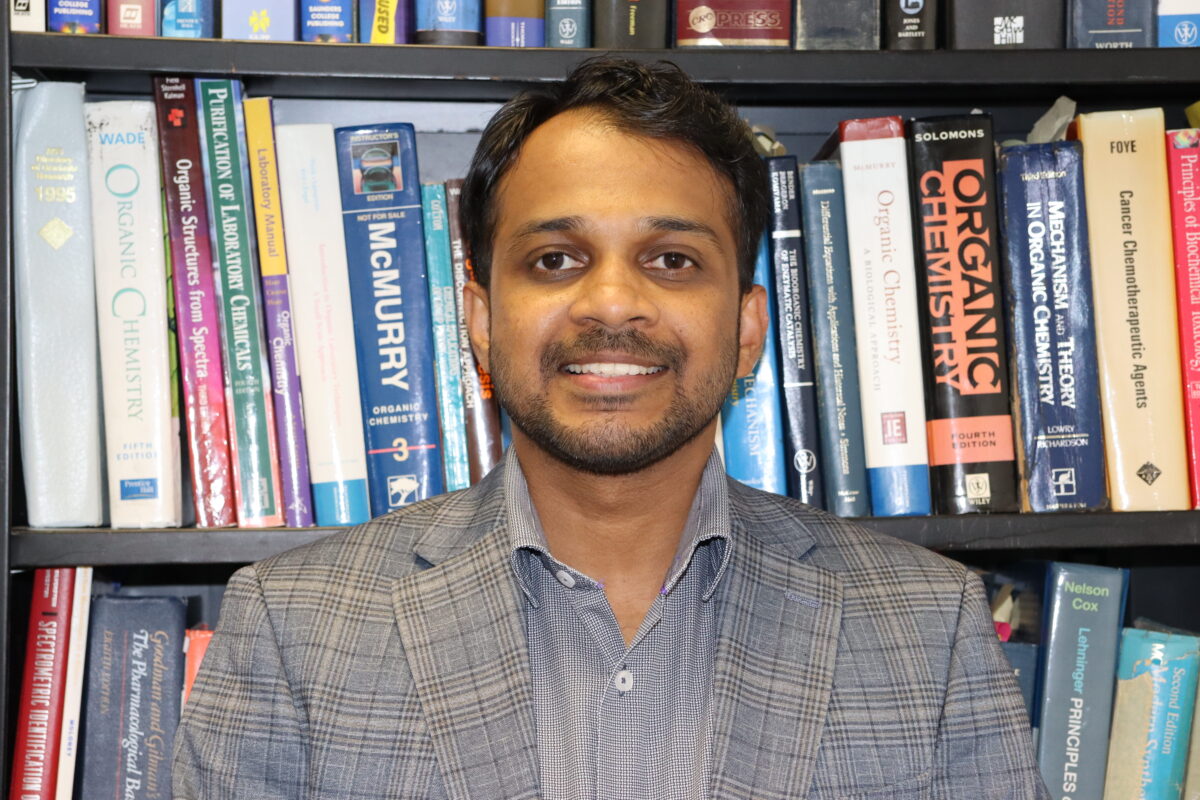 Herana Kamal Seneviratne uses a wide range of approaches to discover molecular mechanisms involved in neurotoxicity. (Courtesy of Seneviratne)
“Animal studies are useful, but there are major limitations due to species differences. It is extremely difficult to obtain human brain tissues,” Seneviratne says. “That’s why our collaboration with Dr. Xu has been a game-changer. With the organoids, we will finally see how these drugs behave inside human brain tissue.”
A high-resolution approach Seneviratne’s lab employed for their 2024 paper visualizes molecules directly in intact tissues, whereas other methods require grinding up the samples. The technique, a type of mass spectrometry imaging (MSI) called MALDI MSI, allows researchers to determine not only how much of various molecule types are present in the brain, but exactly where.
Seneviratne and his collaborators will be using this technique in combination with proteomics—the large-scale study of all proteins in a cell or tissue—in their MSCRF-funded work to track exactly where the drugs and their breakdown products travel inside the brain organoids and how they disturb the brain’s lipid balance. Lipids are essential for brain cells to communicate and survive, so when their function is impaired, brain cells can die, contributing to long-term neurodegeneration.
“We want to understand the ‘how’ behind the damage,” says Seneviratne. “If we can pinpoint the exact molecular warning signs, clinicians and drug companies could one day screen new medicines early in their development to help avoid these risks.”
A holistic approach
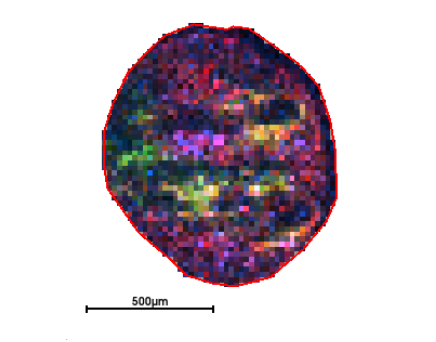 Different colors in this spectroscopy image of a brain organoid indicate the presence of different cell types. (Courtesy of Kamal Seneviratne)
“I’m driven by the scientific questions, not any single technique,” Seneviratne explains. “We’ll use whatever tools—imaging, proteomics, molecular biology, biochemical analyses—best let us answer them.”
By combining high-resolution MALDI MSI and proteomics with human brain organoids that contain the full neighborhood of neural cells, the project offers a highly relevant picture of drug-induced damage—helping bridge the gap between scientific discoveries and patient outcomes.
The grant also opens a path for future impact. Part of the goal of the MSCRF is to encourage technology transfer, meaning discoveries could eventually lead to a startup company and new tools for the pharmaceutical industry.
“This support lets us turn promising science into something that can genuinely help people,” Seneviratne says. “Ultimately, we hope to give clinicians better ways to protect the brain while treating deadly diseases.”
]]>
Important FDA-approved drugs to treat HIV and cancer can save lives, but they come with their own risks. Some drugs used clinically are known to cause neurological side effects in up to half of...
https://umbc.edu/stories/study-how-hiv-cancer-drugs-harm-the-brain/
https://my3.my.umbc.edu/api/v0/pixel/news/155431/guest@my.umbc.edu/3ec1a9cba13291524cc275f111e227f4/api/pixel
chembiochem
cnms
news
research
science-and-tech
story
UMBC News & Magazine
https://my3.my.umbc.edu/groups/umbc-news-magazine
https://assets1-my.umbc.edu/system/shared/avatars/groups/000/001/943/24435aa6207c452e7bc15cc74b42c7bb/xsmall.png?1748556657
https://assets1-my.umbc.edu/system/shared/avatars/groups/000/001/943/24435aa6207c452e7bc15cc74b42c7bb/original.png?1748556657
https://assets2-my.umbc.edu/system/shared/avatars/groups/000/001/943/24435aa6207c452e7bc15cc74b42c7bb/xxlarge.png?1748556657
https://assets2-my.umbc.edu/system/shared/avatars/groups/000/001/943/24435aa6207c452e7bc15cc74b42c7bb/xlarge.png?1748556657
https://assets3-my.umbc.edu/system/shared/avatars/groups/000/001/943/24435aa6207c452e7bc15cc74b42c7bb/large.png?1748556657
https://assets1-my.umbc.edu/system/shared/avatars/groups/000/001/943/24435aa6207c452e7bc15cc74b42c7bb/medium.png?1748556657
https://assets2-my.umbc.edu/system/shared/avatars/groups/000/001/943/24435aa6207c452e7bc15cc74b42c7bb/small.png?1748556657
https://assets1-my.umbc.edu/system/shared/avatars/groups/000/001/943/24435aa6207c452e7bc15cc74b42c7bb/xsmall.png?1748556657
https://assets2-my.umbc.edu/system/shared/avatars/groups/000/001/943/24435aa6207c452e7bc15cc74b42c7bb/xxsmall.png?1748556657
UMBC News & Magazine
0
0
false
Fri, 19 Dec 2025 16:20:00 -0500
Fri, 19 Dec 2025 16:20:00 -0500
UMBC discovery opens door to broad-spectrum antivirals against dozens of dangerous viruses
A study out of UMBC, published in Nature Communications, reveals how enteroviruses—including pathogens that cause polio, encephalitis, myocarditis, and the common cold—initiate replication by hijacking host-cell machinery. The research fills a knowledge gap on this critical step and could pave the way for a new class of antiviral drugs that are effective against multiple viruses.
“My lab has been really motivated to understand how RNA viruses produce their proteins inside the cell and multiply their genome to make more virus particles,” says senior author Deepak Koirala, associate professor of chemistry and biochemistry. Building on his group’s discovery of a crucial cloverleaf structure in the viral RNA, their latest paper, led by first author Naba Krishna Das, Ph.D. ’25, chemistry, has now shown how the cloverleaf recruits proteins to assemble the replication complex.
Seeing the bigger picture
Enteroviruses carry a small RNA genome that must do double duty: make viral proteins and copy itself to produce new viruses. A key player is a viral protein called 3CD. One half (3C) cuts the complete string of amino acids encoded by the virus’s RNA into individual proteins. The other half (3D) is an RNA polymerase—the enzyme that copies the viral RNA. Human cells don’t have anything like this polymerase, so the virus has to bring its own.
 Deepak Koirala (center) discusses his team’s research with Senali Dansou ’23, biochemistry and molecularbiology (left), and Alisha Patel ’25, biochemistry and molecular biology, and a coauthor on the new paper. (Marlayna Demond ’11/UMBC)
“We previously determined the structure of the RNA alone, and other groups determined the structure of 3C and 3D separately, but now we’ve captured the structure of the RNA and proteins together, so we know how they are interacting,” Koirala explains. “We found that it’s the 3C domain of 3CD that binds to the viral RNA, and then it recruits the other components to assemble the replication complex.”
The same complex also works as an on-off switch: when 3CD is attached, the virus copies its RNA; when it lets go, the RNA can be read to make proteins instead.
The team also settled a debate by showing that two complete 3CD molecules (bringing two RNA polymerases) bind to the RNA independently, rather than forming a single fused pair. Why two are needed is still a mystery, but the picture is now clear.
 Koirala lab members Alisha Patel, Deepak Koirala, Naba Krishna Das, and Jeffrey Vogt ’23, biochemistry and molecular biology, compare the growth on petri dishes. (Marlayna Demond ’11/UMBC)
New antiviral targets
Perhaps most exciting, the seven types of enteroviruses the paper investigated all employed a very similar binding mechanism and RNA cloverleaf structure. The extent of this conservation implies the RNA cloverleaf is very important for replication, and any mutations would likely derail it. That means the RNA and RNA-protein interface is likely to be stable over time across enteroviruses, making it an even more promising drug target—and opening the door to the tantalizing prospect of a “universal” drug targeting all enteroviruses.
Drugs disrupting 3C and 3D activity are already in development, but “now we have another layer to test,” Koirala says. “What if we target the RNA, or the RNA-protein interface, so that we break the interaction? That is another opportunity. Now that we have high-resolution structures, you can precisely design drug molecules to target them.”
“Viruses are so, so clever. Their entire genome is equivalent to about one mRNA sequence in humans, yet they are so effective,” Koirala says. His latest work demonstrates “why we need to investigate this basic science—so that it can be translated into developing drugs targeting pathogens that cause so many harmful diseases.”
]]>
A study out of UMBC, published in Nature Communications, reveals how enteroviruses—including pathogens that cause polio, encephalitis, myocarditis, and the common cold—initiate replication by...
https://umbc.edu/stories/broad-spectrum-antivirals-against-enteroviruses/
https://my3.my.umbc.edu/api/v0/pixel/news/155288/guest@my.umbc.edu/39863233500dd0ecd4d3c92b6dd998f0/api/pixel
chembiochem
cnms
news
research
science-and-tech
story
UMBC News & Magazine
https://my3.my.umbc.edu/groups/umbc-news-magazine
https://assets1-my.umbc.edu/system/shared/avatars/groups/000/001/943/24435aa6207c452e7bc15cc74b42c7bb/xsmall.png?1748556657
https://assets1-my.umbc.edu/system/shared/avatars/groups/000/001/943/24435aa6207c452e7bc15cc74b42c7bb/original.png?1748556657
https://assets2-my.umbc.edu/system/shared/avatars/groups/000/001/943/24435aa6207c452e7bc15cc74b42c7bb/xxlarge.png?1748556657
https://assets2-my.umbc.edu/system/shared/avatars/groups/000/001/943/24435aa6207c452e7bc15cc74b42c7bb/xlarge.png?1748556657
https://assets3-my.umbc.edu/system/shared/avatars/groups/000/001/943/24435aa6207c452e7bc15cc74b42c7bb/large.png?1748556657
https://assets1-my.umbc.edu/system/shared/avatars/groups/000/001/943/24435aa6207c452e7bc15cc74b42c7bb/medium.png?1748556657
https://assets2-my.umbc.edu/system/shared/avatars/groups/000/001/943/24435aa6207c452e7bc15cc74b42c7bb/small.png?1748556657
https://assets1-my.umbc.edu/system/shared/avatars/groups/000/001/943/24435aa6207c452e7bc15cc74b42c7bb/xsmall.png?1748556657
https://assets2-my.umbc.edu/system/shared/avatars/groups/000/001/943/24435aa6207c452e7bc15cc74b42c7bb/xxsmall.png?1748556657
UMBC News & Magazine
0
0
false
Fri, 12 Dec 2025 15:27:37 -0500
Fri, 12 Dec 2025 15:27:37 -0500
CNMS GradFest fosters research connections and builds community
On November 7, graduate students and postdoctoral researchers from the College of Natural and Mathematical Sciences (CNMS) gathered for the college’s second annual CNMS GradFest.
Prableen Chowdhary, Ph.D. ’24, biological sciences, currently a postdoc with Rachel Brewster, professor of biological sciences, and a member of the student-led planning committee, expressed hope that GradFest would “spark conversations and collaborations across disciplines.”
CNMS dean William LaCourse offered advice to attendees as the program kicked off. “Whatever you do in life, do it with all your heart. If you’re doing research, do it like you own it,” he said. “Live in the present and seize opportunities. Enjoy every moment, like this moment today. You can’t change yesterday; when I make mistakes, I’m grateful for grace and forgiveness. And you can plan for tomorrow, but you can’t control it.”
 Prableen Chowdhary (left) and Hasan Al Banna, CNMS GradFest’s two emcees, welcome attendees to the event. (Brad Ziegler/UMBC)
Following the introductions, seven students presented “lightning talks,” five-minute presentations describing their research in engaging, accessible terms for those outside their field. The talks featured students in biological sciences, physics, chemistry and biochemistry, marine biotechnology, and mathematics and statistics. They discussed topics like novel therapeutic targets for ovarian cancer, innovative two-dimensional materials for improved sensors, and previously unobserved plasma jets from black holes.
GradFest as a stepping stone
“Part of our goal was to intentionally include graduate students with less presentation experience or early-stage projects,” shared Maria Cambraia, director for research and international affairs in CNMS, and lead staff member on the planning committee. “GradFest gives them a chance to practice in a friendly environment.”
 Lightning talk presenters and CNMS GradFest planning committee members worked hard to make the event a success. Rear, left to right: Maria Cambraia, Lara Scott, Andrew Wolff, Sean Ravel, Peng Yan, Codi Hrynko, Jalil Ahmad. Front, left to right: Prableen Chowdhary, Lizbeth Joy Tan, Megha Pandya, Ronita Sequeira, Hasan Al Banna. Planning committee members not pictured: Ayo Ogunsanya, Elana Frazier, Jeanne Ngo. (Brad Ziegler/UMBC)
Following the talks, the ballroom buzzed during two poster sessions, where dozens more students discussed their projects with peers, mentors, and guests. GradFest encouraged presentations of research at all stages of development.
Muhammad Jalil Ahmad, president of the Mathematics and Statistics Graduate Student Association and a planning committee member, presented a lightning talk and poster on mathematical modeling for complex phenomena like weather or disease spread.
Ahmad, a fourth-year applied mathematics Ph.D. candidate mentored by Animikh Biswas and Kathleen Hoffman, professors of mathematics, agreed. “Presenting at GradFest is useful before heading to a bigger stage, like a national meeting,” he said. “Even at a math conference, people are studying different topics, so it’s good to practice communicating with people outside your field.” He added that GradFest offers the opportunity to network with researchers using similar methods for different applications.

 Muhammad Jalil Ahmad (left) and Lara Scott (right), Ph.D. students in mathematics, presented lightning talks at GradFest. (Brad Ziegler/UMBC)
Ian Kirn ’23, physics, a second-year physics Ph.D. student, presented a poster on astroseismology, which investigates earthquake-like phenomena on stars. Kirn chose to pursue his Ph.D. with Eileen Meyer, professor of physics, after doing undergraduate research with her. “It’s important for different disciplines to talk to each other, because they’re actually all related,” Kirn says. “This event encourages collaboration.”
Fidelia Asomani, a third-year biological sciences Ph.D. candidate working with Erin Green, associate professor of biological sciences, called GradFest “a good first opportunity to get my feet wet presenting.” Asomani studies yeast, which shares basic functions with complex organisms. “It’s important to invest in studying processes conserved across species,” she says, which can inform human disease treatment.

 Ian Kirn (left) discussed his astroseismology research, and Fidelia Asomani (right) explains her research on protein regulation in yeast, with GradFest attendees. (Brad Ziegler/UMBC)
The humble heart of a scientist
LaCourse also encouraged embracing humility. “By remembering you won’t always be the best, humility helps you celebrate others’ successes and accept failure—and research involves a lot of failure,” he said. “Humility is a path you walk, not a trait you innately possess, and it leads to learning, growth, and respect.”
By late afternoon, GradFest had turned strangers into collaborators, boosted first-time presenters’ confidence, and made the ballroom a launchpad for breakthroughs. Attendees left with new contacts and the dean’s words in their hearts—proof that bold discoveries can begin with a humble “hello.”
Learn more about graduate programs in CNMS.
]]>
On November 7, graduate students and postdoctoral researchers from the College of Natural and Mathematical Sciences (CNMS) gathered for the college’s second annual CNMS GradFest. Prableen...
https://umbc.edu/stories/cnms-gradfest-2025/
https://my3.my.umbc.edu/api/v0/pixel/news/154570/guest@my.umbc.edu/e98c847e7012a2b534bab5add27d1f0c/api/pixel
biology
chembiochem
cnms
community
gradresearch
graduateschool
marinebiotech
mathstat
news
physics
science-and-tech
story
UMBC News & Magazine
https://my3.my.umbc.edu/groups/umbc-news-magazine
https://assets1-my.umbc.edu/system/shared/avatars/groups/000/001/943/24435aa6207c452e7bc15cc74b42c7bb/xsmall.png?1748556657
https://assets1-my.umbc.edu/system/shared/avatars/groups/000/001/943/24435aa6207c452e7bc15cc74b42c7bb/original.png?1748556657
https://assets2-my.umbc.edu/system/shared/avatars/groups/000/001/943/24435aa6207c452e7bc15cc74b42c7bb/xxlarge.png?1748556657
https://assets2-my.umbc.edu/system/shared/avatars/groups/000/001/943/24435aa6207c452e7bc15cc74b42c7bb/xlarge.png?1748556657
https://assets3-my.umbc.edu/system/shared/avatars/groups/000/001/943/24435aa6207c452e7bc15cc74b42c7bb/large.png?1748556657
https://assets1-my.umbc.edu/system/shared/avatars/groups/000/001/943/24435aa6207c452e7bc15cc74b42c7bb/medium.png?1748556657
https://assets2-my.umbc.edu/system/shared/avatars/groups/000/001/943/24435aa6207c452e7bc15cc74b42c7bb/small.png?1748556657
https://assets1-my.umbc.edu/system/shared/avatars/groups/000/001/943/24435aa6207c452e7bc15cc74b42c7bb/xsmall.png?1748556657
https://assets2-my.umbc.edu/system/shared/avatars/groups/000/001/943/24435aa6207c452e7bc15cc74b42c7bb/xxsmall.png?1748556657
UMBC News & Magazine
2
0
false
Fri, 14 Nov 2025 15:37:10 -0500
Fri, 14 Nov 2025 15:37:10 -0500
Unsung heroes: Meet 4 UMBC building managers who keep research moving
The College of Natural and Mathematical Sciences is home to high-tech scientific instrumentation alongside traditional infrastructure like water pipes and HVAC systems, all of which UMBC researchers and students rely on. That equipment also requires regular maintenance and occasional upgrades, and it’s the often-invisible work of UMBC’s skilled and experienced building managers that keeps things humming. Four CNMS building managers welcomed us into their world, sharing everything from what it takes to succeed in their roles to the hidden gems found in their buildings.
Meet the building managers:
Erik Crowe
Building Manager, Physics Building
Erik Crowe brought five years of hands-on expertise as a laboratory specialist in the UMBC physics department and prior experience at NASA Goddard Space Flight Center to his current role as physics department building manager, which he assumed in 2019. Today he supports faculty, staff, and students in physics—including the Earth and Space Institute and Quantum Science Institute—overseeing everything from HVAC systems to lab renovations. Crowe thrives on the blend of technical innovation, educational support, and collaborative spirit he gets to practice in his role.
 Erik Crowe works in the Physics Building’s basement machine shop, where he fabricates custom instrument parts for researchers and trains students to do the same. Crowe built 35 parts for AirHARP, a critical precursor to UMBC’s HARP2, which is currently orbiting Earth on NASA’s PACE mission. (Photo by Brad Ziegler/UMBC)
Q: What do you enjoy about your role?
A: I appreciate that every day presents new challenges to problem-solve and support occupants of the Physics Building. My position allows me to leverage my technical background in facilities management and in educating students, staff, and faculty about prototyping and precision machine operations in the machine shop. I also appreciate my collaboration with my colleagues. We have a wonderful staff team in physics, and I couldn’t be successful in my position without their support. The faculty, staff, and students are always finding new ways to push me to expand my skill set.
Q: What brought you to UMBC?
A: I started my career as a process engineer developing and fabricating cryogenic detectors, devices that use ultra-low temperatures to very sensitively detect particles, for the Cosmology Large Angular Scale Surveyor at NASA Goddard Space Flight Center. I thoroughly enjoyed the work, but working in a cleanroom is grueling, and I was looking for something new. Encouraged by my former college advisor, I applied for the lab specialist position at UMBC and was hired in December 2014. It was the change that I needed. I have grown both professionally and personally over the last decade, hitting career goals and growing my family.
Q: What are some of your proudest moments?
A: I am particularly proud of collaborating with the structural maintenance department in facilities management (FM) to renovate approximately 40 spaces in the building over the course of a year and a half. These included research labs, office spaces, and our graduate student wing. It is a tremendous amount of work to plan, organize, and facilitate a project of that size, but we were able to do it with minimal interruption and impact to the building occupants.
I am also proud of the ongoing work to improve the HVAC system within the Physics Building. Over the last decade, we’ve gathered data and addressed the underlying issues, so completing the HVAC study last year was a huge milestone for me. We have a lot of work left to do, but we are moving in the right direction every day.
 Crowe operates a lathe, which is useful for creating complex shapes in various materials. The lathe is the only instrument Crowe does not train others to use due to the risk of injury; he takes safety in the shop very seriously and is proud of the space’s safety record. (Photo by Brad Ziegler/UMBC)
Q: What does it take to be a successful building manager?
A: It takes large doses of patience, persistence, organization, and communication skills to be a successful building manager. You have to prioritize different issues that arise on a daily, weekly, and monthly basis. There are emergencies where a building system might go down or malfunction. In those situations, you have to stay calm, gather data, run through your contact list, formulate a plan, communicate the impact, and follow up to make sure all aspects of an issue are addressed. You also have to be prepared to pivot when things don’t go smoothly.
I submit work orders every day to keep the building running. There are small maintenance and renovation projects where I meet with the FM shops to discuss our approach, there are large-scale projects that can significantly impact occupants and their academic and research activities, and everything in between. My day is never the same and the requests I receive ebb and flow.
Q: What are some of your favorite spaces or hidden gems in the building?
A: The machine shop is my favorite space in the building. Over the last decade, I have built the shop to match the department’s needs. I am proud of the resource it has become and my interactions with students, staff, and faculty to help them develop their technical skills. I am excited about the future of the space, and how we can continue to grow its capabilities and educational programming. It’s a lean facility, but it packs a punch.
Not all of our research activities are performed inside the building. We installed a dedicated research platform on the roof in 2018, which gathers data for atmospheric physics and astrophysics research. But the roof doesn’t just house equipment—it also provides some of the best views on campus of the Baltimore skyline.

 Erik Crowe maintains the Physics Building’s machine shop (left) and instrumentation on the building’s roof (right). (Photos by Brad Ziegler/UMBC)
Dennis Cuddy
Senior Facilities Manager, Interdisciplinary Life Sciences Building and beyond
Dennis Cuddy, administrator of the Interdisciplinary Life Sciences Building (ILSB) and senior facilities manager in the College of Natural and Mathematical Sciences, is in his 26th year at UMBC and his sixth in his current role. Cuddy’s career exemplifies innovative problem-solving and dedication to UMBC’s scientific ecosystem, from orchestrating the renovation of the Meyerhoff Chemistry Building to managing dozens of classrooms, labs, and core facilities that support hundreds of students and researchers.
 Dennis Cuddy maintains research equipment in the Interdisciplinary Life Sciences Building, which opened in 2019. (Photo by Brad Ziegler/UMBC)
Q: What do you appreciate about your role?
A: UMBC has allowed me to use my strengths in organization, scheduling, and operations while exposing me to skills like web development, event planning, and major construction operations—above and beyond what I could offer when I was hired. Now, I handle building operations across colleges and consult for administrative departments I’ve worked with over the years. It’s fulfilling to be asked your opinion about how things can run better.
Q: What brought you to UMBC?
A: I answered an ad in the Baltimore Sun for a chemist, which listed managerial duties similar to what I was doing at the University of Maryland Greenebaum Comprehensive Cancer Center. I still have the ad somewhere at home.
Q: What are some of your proudest moments?
A: I oversaw the renovation of the Meyerhoff Chemistry Building from 2002 to 2005. When we needed additional funds to finish the project, I wrote a construction grant to the National Center for Research Resources that was awarded. Being tasked with reporting the research activities going on in the renovated space for 20 years after the fact was the price I paid, but it was worth it.
 The ILSB sports a green roof, which reduces cooling costs but also complicates building maintenance. (Photo by Brad Ziegler/UMBC)
Q: What does it take to be a successful building manager?
A: It takes patience, good communication, organization, and being proactive when needed (and knowing when that is). You have to be a representative of the university and a good steward of state-appropriated funds. Helping colleagues when needed is essential, because even buildings with dedicated facility managers often lack backups.
Q: What are some of your favorite spaces or surprising facts about the building?
A: The lobby by the third floor elevators is pretty amazing, with the green roof and double helix staircase to the fourth floor, but I find that sitting in the main lobby, anonymously taking in the beauty of the space and the energy of the students, is the most rewarding. Most people don’t know that the ILSB sits on a redirected creek bed, and even during the driest times, the water table is only eight feet beneath the basement floor.
 The ILSB houses several active learning classrooms with extensive audio visual equipment that Cuddy also oversees. (Photo by Brad Ziegler/UMBC)
Brian Moravec
Building Manager, Meyerhoff Chemistry Building
Brian Moravec honed his skills through two decades in USDA molecular biology labs. For the last six years, he has ensured that research and teaching go smoothly in the Meyerhoff Chemistry Building as its building manager. Moravec coordinates repairs and maintenance, manages inventories, and supervises the department’s glassblower and teaching lab manager—turning potential disruptions into opportunities for safety and efficiency.
 Brian Moravec will do anything to keep his building spic and span, including stopping to straighten a poster during a tour of the Meyerhoff Chemistry Building. (Photo by Brad Ziegler/UMBC)
Q: What do you enjoy about your role?
A: I like that my responsibilities change from day to day. One day I may spend most of my time in the office completing administrative tasks, and the next day I might respond to an urgent water leak. I also like that my colleagues in the department, college, and facilities management all have the same goal: Keep things running safely and smoothly to serve our community’s education and research needs.
Q: What brought you to UMBC?
A: I worked in a molecular biology lab at the USDA in Beltsville, Maryland for 20 years. Near the end of that time, I was able to take temporary work as a facility operations specialist at the National Agricultural Library and the National Arboretum. These temporary jobs boosted my interest in the field of building management and operations. When I saw an opening at UMBC in a STEM field, I decided to make a switch.
 Brian Moravec maintains the behind-the-scenes systems that keep the Meyerhoff Chemistry Building running. (Photo by Brad Ziegler/UMBC)
Q: What are some of your proudest moments?
A: I am proud of the water damage mitigation I helped with during the 2022 Christmas flood. Our building was damaged, but we didn’t lose any scientific equipment because I had prepared some items in advance, just in case we needed to divert water around million-dollar instruments. I am also proud of the safety record in both the teaching and research labs in the building. Our building can be dangerous, with flammable and toxic materials, but the safety training and equipment we provide helps keep what can be a dangerous place very safe.
Q: What is something you want people to know about the building or your role?
A: People should know that sometimes the building smells—it’s old! There are a lot of different chemicals in use, but a strange odor by itself is not dangerous. Also, I consider myself a problem solver. People come to me with all sorts of difficulties and issues. I may not be able to fix them all, but I can almost certainly find someone that can help.

 Brian Moravec manages and distributes keys for all spaces in his building, and there are a lot of them! (Photos by Brad Ziegler/UMBC)
Sam Williams ’99
Building Manager, Biological Sciences Building and Schwartz Hall
Sam Williams ’99, history, has dedicated 24 years to UMBC, serving the last 11 as building manager for the Biological Sciences Building after 13 years as assistant athletics director for facilities and operations. His role spans routine maintenance, crisis response, vendor coordination, budget oversight, and safety compliance.
 Sam Williams maintains the many freezers that store experimental samples in the Biological Sciences Building. Some are as cold as -80 degrees Celsius. (Photo by Brad Ziegler/UMBC)
Q: What do you enjoy about your role?
A: I appreciate the fact that no day is ever the same. I feel like we have a great department, from the students to the faculty and staff, which makes coming to work a lot easier.
Q: What are some of your proudest moments?
A: I’ve been a part of two major events: COVID and the great flood in December of 2022. Both of these events brought their own set of challenges. However, the biggest goal for both was making sure that research continued and building occupants were able to work in a safe environment. I have a lot of memories from both.
Q: What does it take to be a successful building manager?
A: I feel like you need patience and the ability to adapt. Things can change by the minute, so being prepared and prioritizing is an essential skill. I would also say that problem-solving is one of the best skills I’ve learned. Having a good working relationship with building occupants and FM makes my life a lot easier, too.
 Sam Williams helped coordinate repair of the Biological Sciences Building’s mural (pictured), which was damaged in a flood in 2022. (Photo by Brad Ziegler/UMBC)
]]>
The College of Natural and Mathematical Sciences is home to high-tech scientific instrumentation alongside traditional infrastructure like water pipes and HVAC systems, all of which UMBC...
https://umbc.edu/stories/unsung-heroes-building-managers/
https://my3.my.umbc.edu/api/v0/pixel/news/153867/guest@my.umbc.edu/cafa05eb2799f41007947a56c8bc02cc/api/pixel
biology
chembiochem
cnms
facilities-management
fall-2025
magazine
physics
retriever-behind-the-scenes
staff
story
UMBC News & Magazine
https://my3.my.umbc.edu/groups/umbc-news-magazine
https://assets1-my.umbc.edu/system/shared/avatars/groups/000/001/943/24435aa6207c452e7bc15cc74b42c7bb/xsmall.png?1748556657
https://assets1-my.umbc.edu/system/shared/avatars/groups/000/001/943/24435aa6207c452e7bc15cc74b42c7bb/original.png?1748556657
https://assets2-my.umbc.edu/system/shared/avatars/groups/000/001/943/24435aa6207c452e7bc15cc74b42c7bb/xxlarge.png?1748556657
https://assets2-my.umbc.edu/system/shared/avatars/groups/000/001/943/24435aa6207c452e7bc15cc74b42c7bb/xlarge.png?1748556657
https://assets3-my.umbc.edu/system/shared/avatars/groups/000/001/943/24435aa6207c452e7bc15cc74b42c7bb/large.png?1748556657
https://assets1-my.umbc.edu/system/shared/avatars/groups/000/001/943/24435aa6207c452e7bc15cc74b42c7bb/medium.png?1748556657
https://assets2-my.umbc.edu/system/shared/avatars/groups/000/001/943/24435aa6207c452e7bc15cc74b42c7bb/small.png?1748556657
https://assets1-my.umbc.edu/system/shared/avatars/groups/000/001/943/24435aa6207c452e7bc15cc74b42c7bb/xsmall.png?1748556657
https://assets2-my.umbc.edu/system/shared/avatars/groups/000/001/943/24435aa6207c452e7bc15cc74b42c7bb/xxsmall.png?1748556657
UMBC News & Magazine
20
0
false
Thu, 23 Oct 2025 17:18:15 -0400
Thu, 23 Oct 2025 17:18:15 -0400
UMBC publishes first-of-its-kind tutorial for teaching complex computational chemistry technique
Sam Williams helped coordinate repair of the Biological Sciences Building’s mural (pictured), which was damaged in a flood in 2022. (Photo by Brad Ziegler/UMBC)
]]>
The College of Natural and Mathematical Sciences is home to high-tech scientific instrumentation alongside traditional infrastructure like water pipes and HVAC systems, all of which UMBC...
https://umbc.edu/stories/unsung-heroes-building-managers/
https://my3.my.umbc.edu/api/v0/pixel/news/153867/guest@my.umbc.edu/cafa05eb2799f41007947a56c8bc02cc/api/pixel
biology
chembiochem
cnms
facilities-management
fall-2025
magazine
physics
retriever-behind-the-scenes
staff
story
UMBC News & Magazine
https://my3.my.umbc.edu/groups/umbc-news-magazine
https://assets1-my.umbc.edu/system/shared/avatars/groups/000/001/943/24435aa6207c452e7bc15cc74b42c7bb/xsmall.png?1748556657
https://assets1-my.umbc.edu/system/shared/avatars/groups/000/001/943/24435aa6207c452e7bc15cc74b42c7bb/original.png?1748556657
https://assets2-my.umbc.edu/system/shared/avatars/groups/000/001/943/24435aa6207c452e7bc15cc74b42c7bb/xxlarge.png?1748556657
https://assets2-my.umbc.edu/system/shared/avatars/groups/000/001/943/24435aa6207c452e7bc15cc74b42c7bb/xlarge.png?1748556657
https://assets3-my.umbc.edu/system/shared/avatars/groups/000/001/943/24435aa6207c452e7bc15cc74b42c7bb/large.png?1748556657
https://assets1-my.umbc.edu/system/shared/avatars/groups/000/001/943/24435aa6207c452e7bc15cc74b42c7bb/medium.png?1748556657
https://assets2-my.umbc.edu/system/shared/avatars/groups/000/001/943/24435aa6207c452e7bc15cc74b42c7bb/small.png?1748556657
https://assets1-my.umbc.edu/system/shared/avatars/groups/000/001/943/24435aa6207c452e7bc15cc74b42c7bb/xsmall.png?1748556657
https://assets2-my.umbc.edu/system/shared/avatars/groups/000/001/943/24435aa6207c452e7bc15cc74b42c7bb/xxsmall.png?1748556657
UMBC News & Magazine
20
0
false
Thu, 23 Oct 2025 17:18:15 -0400
Thu, 23 Oct 2025 17:18:15 -0400
UMBC publishes first-of-its-kind tutorial for teaching complex computational chemistry technique
Joseph Bennett, assistant professor of chemistry and biochemistry, and Mona Layegh, Ph.D. ’25, chemistry, know how hard it can be to teach density functional theory (DFT) to undergraduates. DFT is a computational method for predicting a substances’ properties at the quantum level, such as how they conduct electricity or react with other compounds. Despite its complexity, DFT is a foundational technique that underpins research in fields like renewable energy, pharmaceuticals, and nanotechnology, so it’s critical that students understand it and know how to apply it.
To address the challenge of teaching DFT well, Bennett and Layegh coauthored a tutorial on teaching the technique, which was published in the Journal of Chemical Education. Their paper was the first ever published in the journal’s brand new Tutorial section, which was inspired by their submission and a need to develop more training tools.
The tutorial, refined over five years of training UMBC students in DFT, is paired with open-source resources on GitHub, including ready-to-use files and visualizations. These allow instructors at community colleges or in areas with limited internet to teach the concepts even without advanced computers.
“If you can erase some of the hurdles to make DFT a little bit more accessible, more students can get into it,” Bennett says.
In sharing these teaching tools, UMBC is leveling the playing field, making it possible for students in all kinds of learning environments to master this core technique. As a result, they’ll be better prepared for careers in growing industries like technology and healthcare, where they may go on to design better batteries, solar panels, life-saving drugs, and more.
]]>
Joseph Bennett, assistant professor of chemistry and biochemistry, and Mona Layegh, Ph.D. ’25, chemistry, know how hard it can be to teach density functional theory (DFT) to undergraduates. DFT is...
https://umbc.edu/quick-posts/chemistry-tutorial-published/
https://my3.my.umbc.edu/api/v0/pixel/news/151117/guest@my.umbc.edu/9396ad05149080141d08e90e009638ea/api/pixel
chembiochem
cnms
graduateschool
news
quick-post
research
science-and-tech
UMBC News & Magazine
https://my3.my.umbc.edu/groups/umbc-news-magazine
https://assets1-my.umbc.edu/system/shared/avatars/groups/000/001/943/24435aa6207c452e7bc15cc74b42c7bb/xsmall.png?1748556657
https://assets1-my.umbc.edu/system/shared/avatars/groups/000/001/943/24435aa6207c452e7bc15cc74b42c7bb/original.png?1748556657
https://assets2-my.umbc.edu/system/shared/avatars/groups/000/001/943/24435aa6207c452e7bc15cc74b42c7bb/xxlarge.png?1748556657
https://assets2-my.umbc.edu/system/shared/avatars/groups/000/001/943/24435aa6207c452e7bc15cc74b42c7bb/xlarge.png?1748556657
https://assets3-my.umbc.edu/system/shared/avatars/groups/000/001/943/24435aa6207c452e7bc15cc74b42c7bb/large.png?1748556657
https://assets1-my.umbc.edu/system/shared/avatars/groups/000/001/943/24435aa6207c452e7bc15cc74b42c7bb/medium.png?1748556657
https://assets2-my.umbc.edu/system/shared/avatars/groups/000/001/943/24435aa6207c452e7bc15cc74b42c7bb/small.png?1748556657
https://assets1-my.umbc.edu/system/shared/avatars/groups/000/001/943/24435aa6207c452e7bc15cc74b42c7bb/xsmall.png?1748556657
https://assets2-my.umbc.edu/system/shared/avatars/groups/000/001/943/24435aa6207c452e7bc15cc74b42c7bb/xxsmall.png?1748556657
UMBC News & Magazine
0
0
false
Tue, 22 Jul 2025 15:32:42 -0400
Making STEM courses more inclusive with lab and lecture hall upgrades
This summer UMBC is partnering with the Maryland Department of Disabilities to upgrade nine teaching labs in the Meyerhoff Chemistry Building. The updates will allow students with mobility disabilities to fully participate in critical chemistry and biochemistry lab courses.
Sinks, lab benches, cabinets, fume hoods, specialized equipment stations, and more will all be constructed that are accessible for wheelchair users. A research lab will be similarly modified to allow students with disabilities to gain research experience.
“These projects are a part of an ongoing campus-wide effort to remove barriers to access throughout our campus buildings,” Celso Guitian, UMBC’s campus planner, says.
A lecture hall in the Engineering Building is also being renovated this summer. The changes are similar to those made in lecture halls in the Administration, Meyerhoff Chemistry, and Biological Sciences buildings in recent years to create multiple spaces for wheelchair-users with fold-down desk tablets, both at the front and rear of the lecture hall. TV monitors will help students with vision disabilities who may not be able to see the whiteboard or screen at the front of these lecture halls. And seating size variations, including standing-desk options, accommodate students of varied body types and disabilities, including supporting pregnant students and students with orthopedic challenges. Assisted listening technology and an area for sign language interpreters support students who are deaf or hard of hearing.
Other projects under construction this summer include accessibility upgrades in four Biological Sciences Building restrooms and elevator upgrades in several academic buildings.
“The Office of Accessibility & Disability Services greatly values our longstanding partnership with Facilities Management to assist us in the mission of inclusive access and elimination of barriers for all UMBC community members,” says Tawny McManus, assistant vice president for accessibility. “Improving our teaching labs allows increased participation of our students with disabilities and shows them UMBC welcomes everyone here.”
]]>
This summer UMBC is partnering with the Maryland Department of Disabilities to upgrade nine teaching labs in the Meyerhoff Chemistry Building. The updates will allow students with mobility...
https://umbc.edu/quick-posts/inclusive-lab-and-lecture-hall-upgrades/
https://my3.my.umbc.edu/api/v0/pixel/news/151118/guest@my.umbc.edu/44b1341b2e8c55dc87ba049142c9d7f2/api/pixel
chembiochem
cnms
coeit
news
quick-post
science-and-tech
student-disability-services
UMBC News & Magazine
https://my3.my.umbc.edu/groups/umbc-news-magazine
https://assets1-my.umbc.edu/system/shared/avatars/groups/000/001/943/24435aa6207c452e7bc15cc74b42c7bb/xsmall.png?1748556657
https://assets1-my.umbc.edu/system/shared/avatars/groups/000/001/943/24435aa6207c452e7bc15cc74b42c7bb/original.png?1748556657
https://assets2-my.umbc.edu/system/shared/avatars/groups/000/001/943/24435aa6207c452e7bc15cc74b42c7bb/xxlarge.png?1748556657
https://assets2-my.umbc.edu/system/shared/avatars/groups/000/001/943/24435aa6207c452e7bc15cc74b42c7bb/xlarge.png?1748556657
https://assets3-my.umbc.edu/system/shared/avatars/groups/000/001/943/24435aa6207c452e7bc15cc74b42c7bb/large.png?1748556657
https://assets1-my.umbc.edu/system/shared/avatars/groups/000/001/943/24435aa6207c452e7bc15cc74b42c7bb/medium.png?1748556657
https://assets2-my.umbc.edu/system/shared/avatars/groups/000/001/943/24435aa6207c452e7bc15cc74b42c7bb/small.png?1748556657
https://assets1-my.umbc.edu/system/shared/avatars/groups/000/001/943/24435aa6207c452e7bc15cc74b42c7bb/xsmall.png?1748556657
https://assets2-my.umbc.edu/system/shared/avatars/groups/000/001/943/24435aa6207c452e7bc15cc74b42c7bb/xxsmall.png?1748556657
UMBC News & Magazine
0
0
false
Tue, 22 Jul 2025 15:28:12 -0400
UMBC researchers pioneer method to discover new 2D materials for advanced electronics
Finding new materials with useful properties is a primary goal for materials scientists, and it’s central to improving technology. One exciting area of current research is 2D materials—super-thin substances made of just a few layers of atoms, which could power the next generation of electronic devices. UMBC researchers have developed a new way to predict 2D materials that might transform electronics, and the results were published in Chemistry of Materials earlier in July.
Picture a sheet of paper so thin that it’s only a few atoms thick, and that’s what 2D materials are like. One might think they would be fragile—but these materials can actually be incredibly strong or conduct electricity in unique ways. They’re held together by weak forces called van der Waals bonds, which allow materials to slightly deform without breaking under stress. Stacked layers of these 2D materials can slide past each other, further reducing brittleness.
The research team, led by Peng Yan, Ph.D. candidate in chemistry, and Joseph Bennett, assistant professor of chemistry and biochemistry, focused on a type of 2D material called van der Waals layered phosphochalcogenides. Some of these materials are ferroelectric, meaning they can hold an electric charge in a particular direction, and then the direction can be reversed on command—sort of like tiny, reversible batteries. Some ferroelectric materials are also magnetic, behaving similarly when a magnetic field is applied. That combination makes them ideal for advanced electronics like memory devices and sensors.
“There’s only two known 2D van der Waals ferroelectric materials with this type of structure,” Bennett said, “so we were asking ourselves, where might others be hiding?” The new publication is their answer to that question.
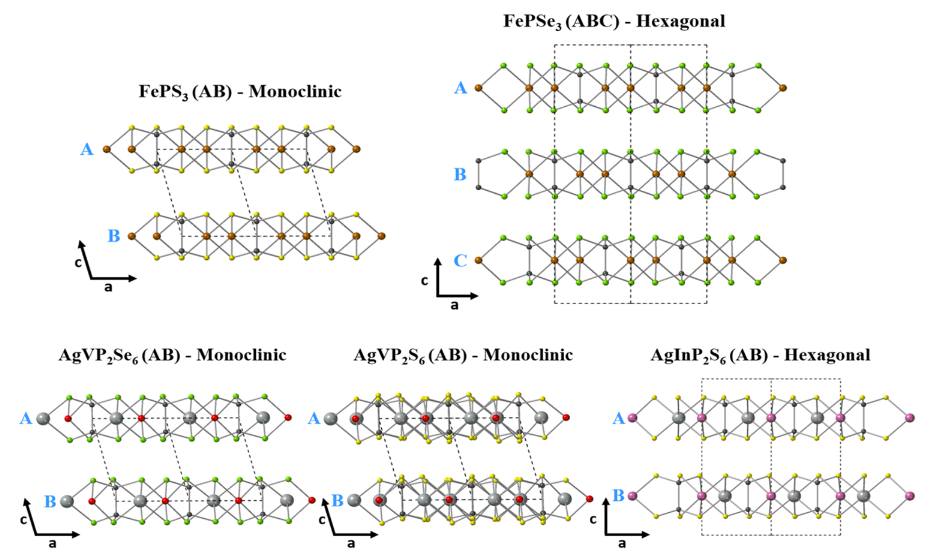 Figure 1 from the new study shows examples of atomic structures that the research team’s algorithm identified as having features conducive for potential use as 2D materials.
A treasure map to new 2D materials
The researchers used a mix of data mining, computer modeling, and structural analysis (because only materials with certain shapes are conducive to use in electronics) to ferret out new material candidates.
“We developed a set of chemical design rules to predict these materials, which could significantly accelerate the discovery of new functional materials,” Yan, the study’s first author, said.
Joshua Birenzvige ’23, chemistry, played a key role by developing a Python script that helped sort the potential materials based on their properties, speeding up the team’s progress. Mona Layegh, a Ph.D. candidate in Bennett’s group, is also a co-author on the new paper.
 Joseph Bennett’s research lab focuses on the discovery and design of new functional materials. (Marlayna Demond ’11/UMBC)
The researchers began by digging into the Inorganic Crystal Structure Database, a huge collection of known crystal structures. Then they used quantum structural diagrams—which map materials on a chart according to how they relate to each other, determined by their atomic traits—to find areas within the diagrams where promising new materials might be hiding.
“By analyzing basic parameters like differences in electronegativity and radius, we were able to separate materials that have the properties we want from those that don’t,” Bennett explained. Electronegativity measures how strongly an atom attracts electrons, and an atom’s radius is the distance from its center to the outer edge of its electron cloud.
“These quantum structural diagrams act like a treasure map,” Bennett said, “guiding us to regions of chemical space where new, stable 2D materials are likely to exist.”
Their results indicated 83 potential new materials that could be made and used in the tech industry, potentially increasing the number of known ferroelectric materials by an incredible margin.
From the computer to the lab bench
After the computer-based analysis, the team took their work a step further. The UMBC researchers collaborated with Ryan Stadel, Peter Zavalij, and Efrain Rodriguez at the University of Maryland, College Park (UMD), who made and tested some of the predicted materials in the lab. Their work proved the UMBC predictions could be used to guide experiments with the predicted materials.
“Being able to predict which compositions are likely to form stable, functional materials gives us a huge head start in the lab,” Bennett said. “It’s like having a recipe book for materials that haven’t been made yet, which saves time and resources.”
These new materials could shine in real-world uses, substantially advancing the electronics industry. For example, they could help build memory devices that can store data after power is shut off, tiny sensors that detect minute amounts of particular substances, or low-power components that make your phone battery last longer. These properties are in high demand across the tech industry and the U.S. government—this work was funded by a substantial grant from the Defense Threat Reduction Agency.
 Joseph Bennett’s students Peng Yan (top left), Joshua Berinzvige (top right), and Mona Layegh (bottom) are all authors on the new study. (Courtesy of Bennett)
An exciting future of discovery
“I’m excited because the work demonstrates a successful data-guided approach to discovering novel 2D materials with promising functional properties, potentially accelerating the design of next-generation electronic materials,” Yan said.
Next up, the team will use a complex computer simulation, called high-throughput density functional theory modeling, to explore these 83 materials in more depth. They’ll check their ferroic traits and how easily they can be made. Plus, they’ll continue their collaboration with the UMD to synthesize and study the materials in the lab, aiming to confirm their special properties and tweak them for specific applications.
The research is a major step forward, paving the way for materials that could change how engineers build electronics—from sensors for the military to longer-lasting laptops and tablets for students on the go.
]]>
Finding new materials with useful properties is a primary goal for materials scientists, and it’s central to improving technology. One exciting area of current research is 2D materials—super-thin...
https://umbc.edu/stories/new-2d-materials-for-advanced-electronics/
https://my3.my.umbc.edu/api/v0/pixel/news/151101/guest@my.umbc.edu/0bb5442dfdd83f7ff2784483866a9272/api/pixel
chembiochem
cnms
gradresearch
news
research
science-and-tech
story
UMBC News & Magazine
https://my3.my.umbc.edu/groups/umbc-news-magazine
https://assets1-my.umbc.edu/system/shared/avatars/groups/000/001/943/24435aa6207c452e7bc15cc74b42c7bb/xsmall.png?1748556657
https://assets1-my.umbc.edu/system/shared/avatars/groups/000/001/943/24435aa6207c452e7bc15cc74b42c7bb/original.png?1748556657
https://assets2-my.umbc.edu/system/shared/avatars/groups/000/001/943/24435aa6207c452e7bc15cc74b42c7bb/xxlarge.png?1748556657
https://assets2-my.umbc.edu/system/shared/avatars/groups/000/001/943/24435aa6207c452e7bc15cc74b42c7bb/xlarge.png?1748556657
https://assets3-my.umbc.edu/system/shared/avatars/groups/000/001/943/24435aa6207c452e7bc15cc74b42c7bb/large.png?1748556657
https://assets1-my.umbc.edu/system/shared/avatars/groups/000/001/943/24435aa6207c452e7bc15cc74b42c7bb/medium.png?1748556657
https://assets2-my.umbc.edu/system/shared/avatars/groups/000/001/943/24435aa6207c452e7bc15cc74b42c7bb/small.png?1748556657
https://assets1-my.umbc.edu/system/shared/avatars/groups/000/001/943/24435aa6207c452e7bc15cc74b42c7bb/xsmall.png?1748556657
https://assets2-my.umbc.edu/system/shared/avatars/groups/000/001/943/24435aa6207c452e7bc15cc74b42c7bb/xxsmall.png?1748556657
UMBC News & Magazine
0
0
false
Mon, 21 Jul 2025 13:54:33 -0400
Mon, 21 Jul 2025 13:54:33 -0400
More life science grad students to be prepared for interdisciplinary success following renewed NIH funding for Chemistry Biology Interface program
For over 20 years, the Chemistry Biology Interface (CBI) program at UMBC has been shaping Ph.D. students into leaders who bridge chemistry and biology. Programs like CBI are critical to help meet the rising demand for researchers with wide-ranging skill sets who can communicate clearly with those outside their specialty. In the joint UMBC-University of Maryland, Baltimore (UMB) CBI program, participants complete their degrees faster than students in similar labs outside the program, and 97 percent graduate—well above the national average of 63 percent for graduate study in the life sciences.
“Everything now is interdisciplinary research,” says Aaron Smith, associate professor of chemistry and biochemistry at UMBC and CBI director.
CBI supports Ph.D. students at UMBC in chemistry, biochemistry, and biological sciences, and pharmacy students at UMB. Now it has secured five more years of funding to continue building community, creating networking opportunities, and training students in interdisciplinary research and science communication.
Communication for career success
CBI alumni credit the program with positioning them to thrive in a range of careers, from the classroom to corporate laboratories.
“I became more confident with public speaking and attribute the success of my job interview talks to the training I received in CBI,” shares Kathryn Wardrup, Ph.D. ’24, biological sciences. Today, she is a postdoctoral fellow at the Fred Hutchinson Cancer Center, an independent research institute in Seattle.
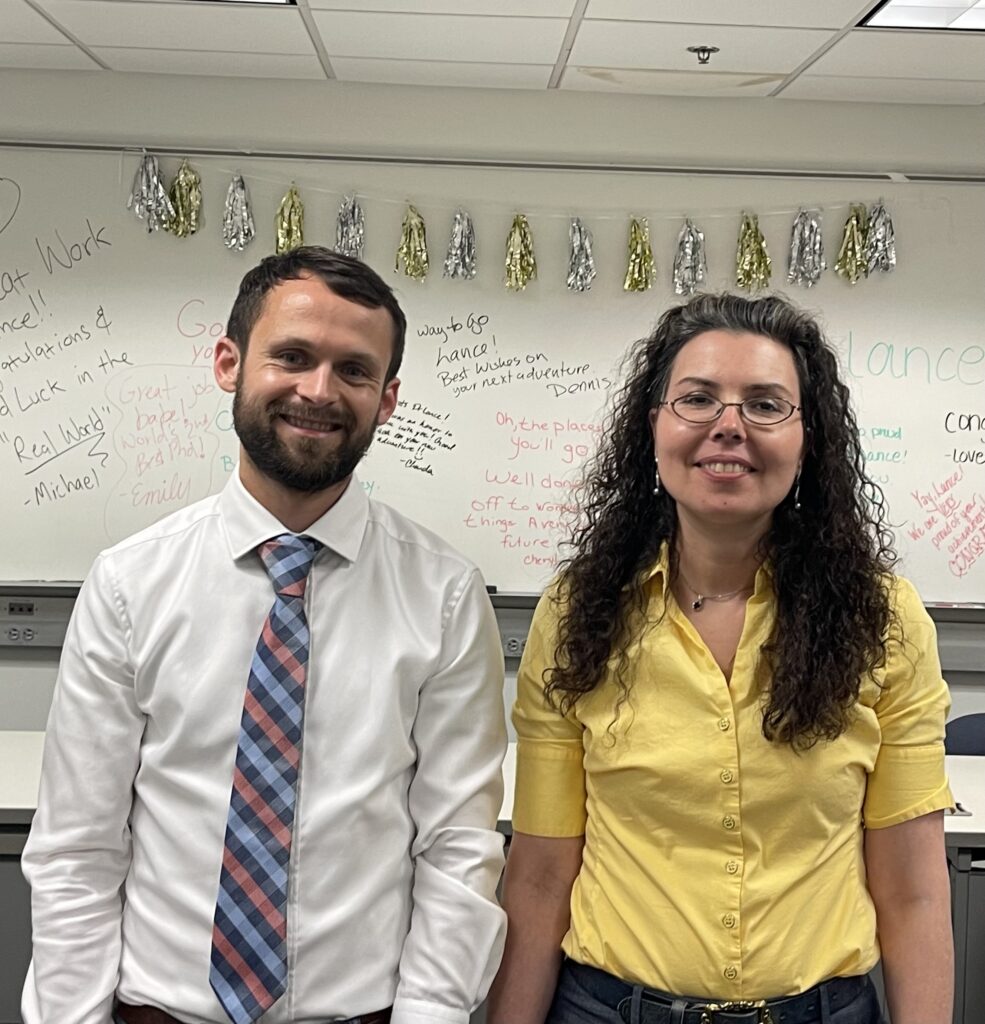 Lance Dockery (left) completed his Ph.D. with Marie-Christine Daniel, associate professor of chemistry and biochemistry. Here they celebrate his thesis defense in 2022. (Courtesy of Dockery)
“Hearing about other research on campus and learning what techniques are being used was a valuable experience,” Wardrup adds. “I felt confident in my ability to be able to have discussions outside of my scientific expertise.”
Scott Riley, Ph.D. ’20, chemistry, also benefited. “I’ve carried many of the lessons I learned into presentations, whether classroom lectures or at meetings and conferences,” he says. “I know many of my interviews were successful because of things I learned in CBI.”
Currently, Riley coordinates internship placements and teaches courses in the master’s program in pharmaceutical sciences at UMB.
Lance Dockery, Ph.D. ’22, chemistry, parlayed skills gained in CBI into a senior scientist role at biotech company AstraZeneca, and recently transitioned to a leadership role at pharmaceutical company Eli Lilly.
“In industry, projects often require coordination between chemists, biochemists, immunologists, and other specialists, similar to the collaborative environment within the CBI program,” Dockery says. “The experience of presenting research to a diverse audience within CBI strengthened my communication skills—something that has given me a clear advantage when interacting with project teams.”
Building a supportive community
CBI participants attend weekly meetings where they take turns teaching their peers about a range of scientific topics selected by the students. Following the more formal instruction period, students partake in group discussions on graduate student life and professional development topics—like mental health, time management, and creating and updating a CV—over pizza.
All this interaction promotes a strong sense of community. “This program builds a really strong rapport among the students, some of whom are in their first semester of graduate school and some of whom are preparing to defend their theses,” Smith says. “They build connections with one another; they learn how to talk with one another. I really think of it as building a community of support among the students.”
Danielle Schmitt, Ph.D. ’17, biochemistry, concurs. “I really benefited from having a cohort of fellow graduate students to support me during my Ph.D.,” she says. Today, Schmitt is an assistant professor of chemistry and biochemistry at UCLA.
CBI’s community feel also fosters shared investment in each participant’s success. “It’s a fun experience to see other students’ data and scientific talks develop as they experience growth during their time in CBI,” Wardrup says.
 Danielle Schmitt (front row, yellow shirt) took a group of her UCLA lab members to the 2nd Annual SoCal Metabolism Symposium in 2022, where several of them presented research posters. She completed her Ph.D. with Songon An, associate professor of chemistry and biochemistry. (Courtesy of Schmitt)
Hands-on cross-training
CBI includes about 40 students per year. Most of them are considered “trainees,” who receive a funding allowance to support conference travel and research expenses for cross-training in a lab outside their work with their primary Ph.D. advisor. Students have received training at the NIH, St. Jude’s Research Hospital, biotech giant Genentech, labs at universities such as UNC-Chapel Hill and UT-Austin, and UMBC and UMB labs.
Riley’s cross-training experience “allowed me to discover a new technique (electron microscopy) which played a critical role in my thesis,” he says. Schmitt adds, as a CBI fellow, “I was able to spend time at the NIH working on a collaborative project related to glucose metabolism. Because CBI supported my time at the NIH, I could move the project forward and learn new skills I might not have gained otherwise.”
 Scott Riley (front row, third from left) with his first class of graduates from the UMB master’s program in pharmaceutical sciences in 2022. (Courtesy of Riley)
Janae Baptiste Brown, Ph.D. ’18, chemistry, adds that “the cross-disciplinary training gave me the unique opportunity to conduct research at the bench with collaborators both at UMBC and the NIH.”
In addition to the benefits trainees receive, six CBI fellows per year further receive full tuition support, health care benefits, and a living stipend. The fellows serve as peer leaders, planning CBI programming in collaboration with Smith and leading group discussions.
“Beyond the bench, I have referred back to some of the leadership skills that I gained as a fellow to encourage an active learning environment in my classes,” says Baptiste Brown, who is now an assistant professor of chemistry and biochemistry at Spelman College.
 Janae Baptiste Brown (right) with members of her lab group at Spelman College. Baptiste Brown completed her Ph.D. with Michael Summers, professor of chemistry and biochemistry. (Courtesy of Baptiste Brown)
Expanding horizons through conferences
Support for conference travel is another major benefit of CBI. Conferences offered “an excellent opportunity to engage with scientists outside my realm of expertise and network with scientists in my field, ultimately landing me a job interview through a connection made at a CBI-sponsored conference,” Wardrup says.
Conferences also offer more opportunities to practice communicating one’s work with a range of audiences. “Having experience in interdisciplinary communication is invaluable,” Dockery says. “It facilitates smoother collaborations and ensures that diverse expertise contributes effectively to project success.”
“I can’t overstate the way this program dramatically enhances the graduate training outcomes for individuals,” Smith says, “so I wish we had more of these training grants for cross-disciplinary training in other fields, like chemistry-engineering or chemistry-physics.”
Embracing growth beyond comfort zones
 Aaron Smith has led the CBI program since 2022. (Marlayna Demond ’11/UMBC)
Smith took on leading CBI in 2022, after serving as assistant director under previous director Katherine Seley Radtke, professor of chemistry and biochemistry. “It’s a ton of work, but the benefits far outweigh the amount of time and effort that it takes to keep this program running,” he says. “It’s just a fantastic program.”
As Wardrup notes, “It can feel uncomfortable to step outside of your comfort zone to explore something new, but CBI is an extremely supportive environment to take that first step.” Riley echoes this sentiment. “Graduate school is one of the best times in your life to really dig deep and learn as many things as you can,” he says. “You will be surprised how some skills or knowledge will be relevant in your early career.”
The CBI program, with its focus on interdisciplinary training and community building, provides the perfect platform for students to do just that—equipping them with the confidence, skills, and networks to excel.
]]>
For over 20 years, the Chemistry Biology Interface (CBI) program at UMBC has been shaping Ph.D. students into leaders who bridge chemistry and biology. Programs like CBI are critical to help meet...
https://umbc.edu/stories/chemistry-biology-interface-program-impact/
https://my3.my.umbc.edu/api/v0/pixel/news/151067/guest@my.umbc.edu/4b8db02c66ed351fd8a0624d49dd504a/api/pixel
alumni
biology
chembiochem
cnms
gradresearch
news
research
science-and-tech
story
UMBC News & Magazine
https://my3.my.umbc.edu/groups/umbc-news-magazine
https://assets1-my.umbc.edu/system/shared/avatars/groups/000/001/943/24435aa6207c452e7bc15cc74b42c7bb/xsmall.png?1748556657
https://assets1-my.umbc.edu/system/shared/avatars/groups/000/001/943/24435aa6207c452e7bc15cc74b42c7bb/original.png?1748556657
https://assets2-my.umbc.edu/system/shared/avatars/groups/000/001/943/24435aa6207c452e7bc15cc74b42c7bb/xxlarge.png?1748556657
https://assets2-my.umbc.edu/system/shared/avatars/groups/000/001/943/24435aa6207c452e7bc15cc74b42c7bb/xlarge.png?1748556657
https://assets3-my.umbc.edu/system/shared/avatars/groups/000/001/943/24435aa6207c452e7bc15cc74b42c7bb/large.png?1748556657
https://assets1-my.umbc.edu/system/shared/avatars/groups/000/001/943/24435aa6207c452e7bc15cc74b42c7bb/medium.png?1748556657
https://assets2-my.umbc.edu/system/shared/avatars/groups/000/001/943/24435aa6207c452e7bc15cc74b42c7bb/small.png?1748556657
https://assets1-my.umbc.edu/system/shared/avatars/groups/000/001/943/24435aa6207c452e7bc15cc74b42c7bb/xsmall.png?1748556657
https://assets2-my.umbc.edu/system/shared/avatars/groups/000/001/943/24435aa6207c452e7bc15cc74b42c7bb/xxsmall.png?1748556657
UMBC News & Magazine
0
0
false
Thu, 17 Jul 2025 12:02:54 -0400
Thu, 17 Jul 2025 12:02:54 -0400