Finding the harmony within art and science
At UMBC, undergraduate students are redefining the boundaries of scientific and artistic pursuits. From a chemical engineer who graces the stage with his cello to a bioinformatician who paints and a biochemist who ignites the dance floor with Latin rhythms, these scholars thrive in an environment that celebrates their diverse passions.
This spring, several U-RISE Scholars—the National Institutes of Heath’s Undergraduate Research Training Initiative for Student Enhancement—shared their multidisciplinary interests with Jacqueline King, associate director of the U-RISE program, and Mariano Sto. Domingo, associate director of research and evaluation within the Meyerhoff Scholars Program. As a result, King and Sto. Domingo started researching how the arts and science blend in these students’ lives, and presented their findings at an academic conference this spring. What they learned was that here, rigorous research and creative expression intertwine, fostering a vibrant community where students explore every dimension of their talents.
Ajeetha Aruchandran, a seniorbioinformatics and computational biology major, studies how the neural tube—a precursor to the spinal cord—forms in zebrafish embryos with Rachel Brewster, professor of biological sciences.
The development of the embryos, which are transparent, “is a very visual process,” Aruchandran says. Her artistic skills have allowed her to generate beautiful and accurate diagrams that communicate her research, she says. “When you’re not able to communicate science well, then the meaning is lost. So I think my art has really strengthened that aspect of my science. The connection has surprised and delighted me, because for a long time I thought my science and my art had to be separate.”
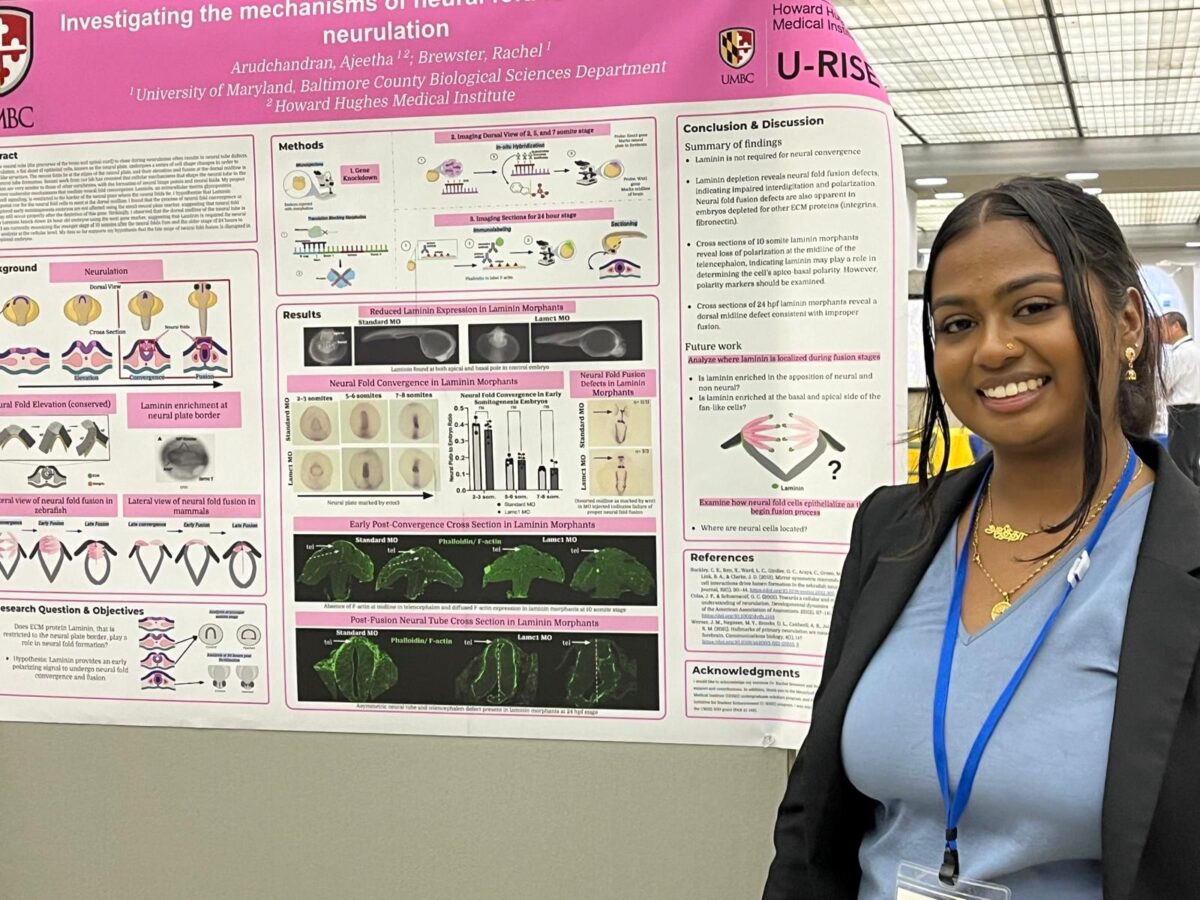
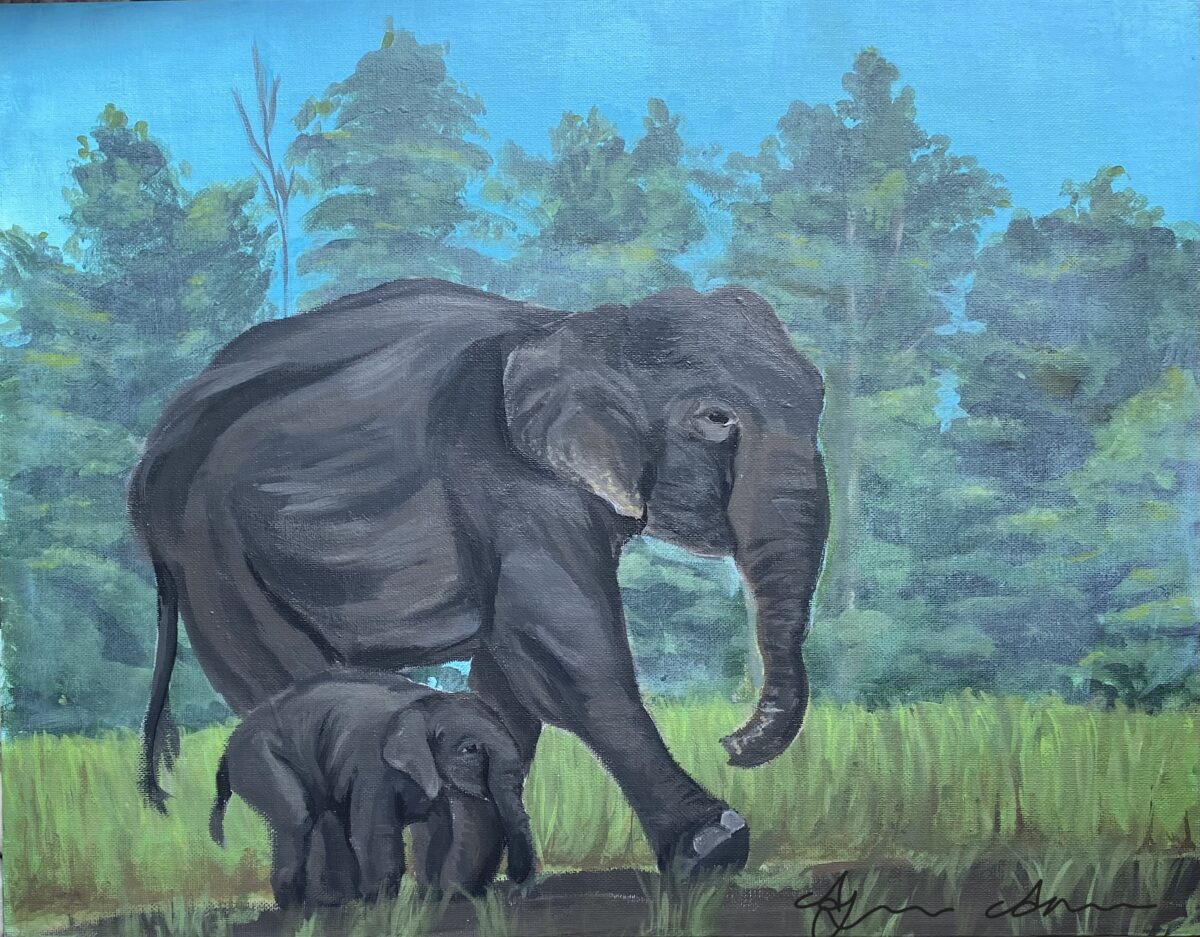 Biologist Ajeetha Aruchandran also loves to paint. (Courtesy of Aruchandran)
Aruchandran began with drawing, but has transitioned to painting. “There’s something so special about the freeness of a brushstroke,” she says. The two pursuits “create balance in my life, because when I need more structure, I have research and the scientific method, but when I need to feel more free, I have my art.”
Rhythm and harmony
Lesley Hernandez, a senior majoring in biochemistry and molecular biology, is hunting for factors that regulate how viruses like HIV multiply in cells with Michael Summers, University Distinguished Professor of Cchemistry and Bbiochemistry. The ultimate goal is to disrupt the viruses’ replication. She also loves to dance.
“My family is from the Dominican Republic, so I grew up surrounded by music and movement. I decided to embrace that part of my culture at UMBC by joining the Latin Dance Club, where I could perform and share my love for dance with others,” Hernandez says. “I love incorporating dance into the workspace by sharing a laugh with my peers and dancing between experiments. It fosters stronger connections and creates an enjoyable work environment.”
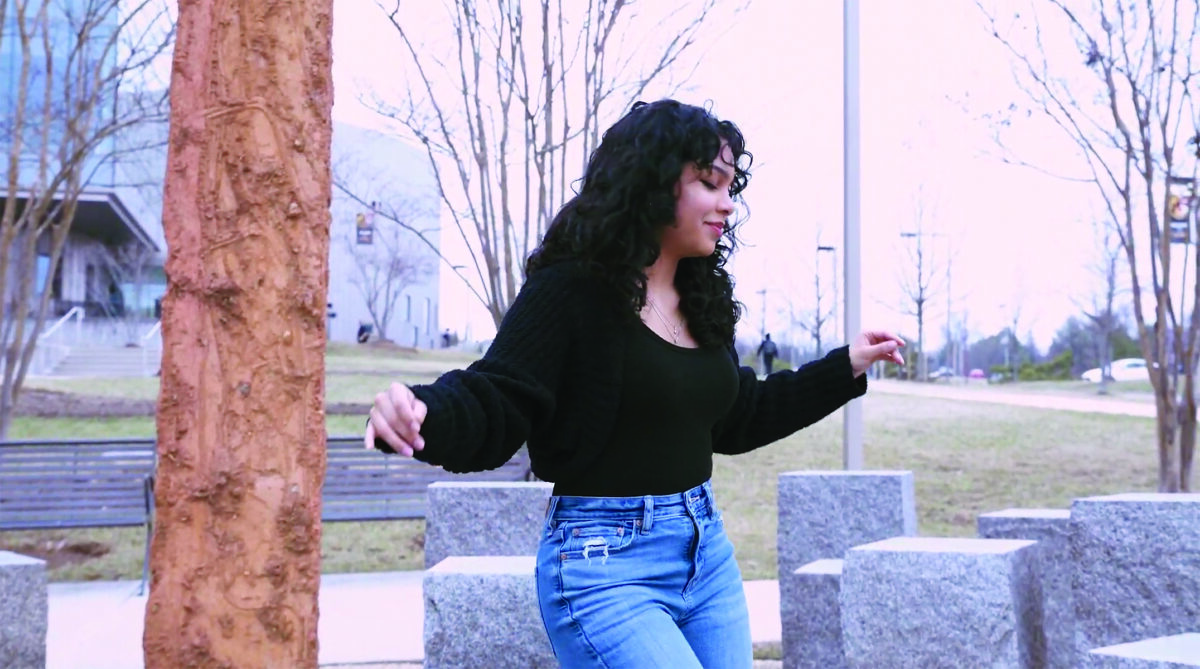
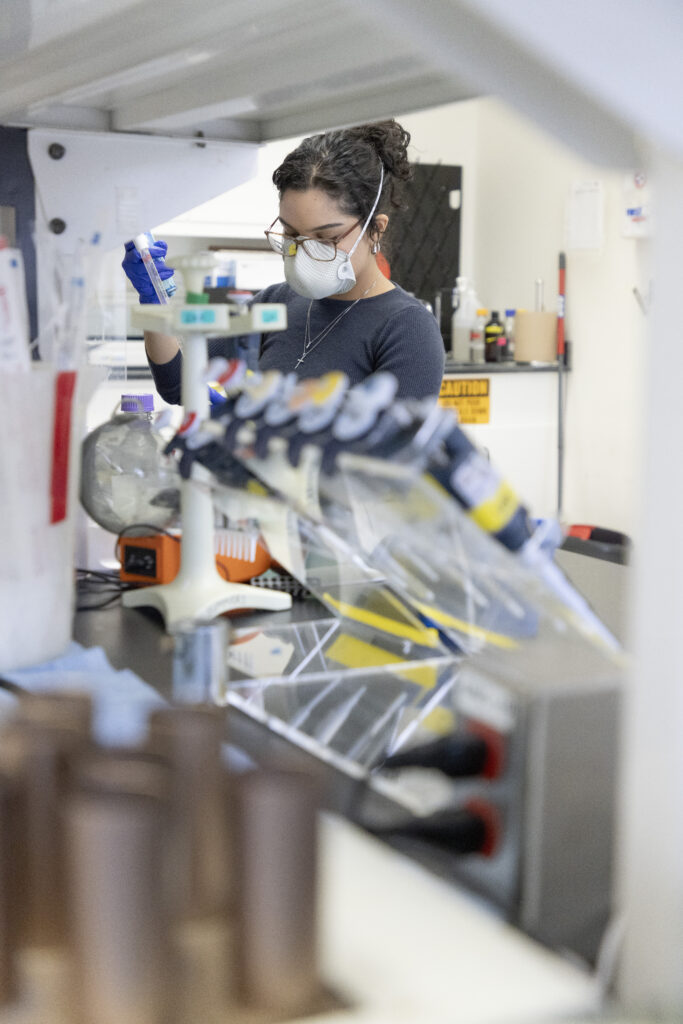 Lesley Hernandez loves being able to “go to my dance class and come back [to the lab] with a refreshed mind.” (Melissa Penley Cormier, M.F.A. ’17/UMBC)
And, when the science gets intense, “I can go to my dance class and come back with a refreshed mind,” Hernandez says. Her attention to detail benefits both her science and her dance. Being “a calculated person” helps her pick up rhythmically complex dance moves more quickly, for example. Both activities also require creativity, whether in trouble-shooting an experiment that’s not working or coming up with new dance routines.
In the Summers lab, “We are all really into science, but what is fun for you outside of that? Everyone in my lab has their own outlet, and that is encouraged,” Hernandez says.
For Daisy Parry, a senior majoring in biological sciences, that outlet is singing. “I’ve had a lot of interests that have come and gone, but singing has been a constant thread throughout my life. It’s very important and very centering to me,” Parry says. Her music minor has created dedicated times that provide a respite from the demands of science, she says.
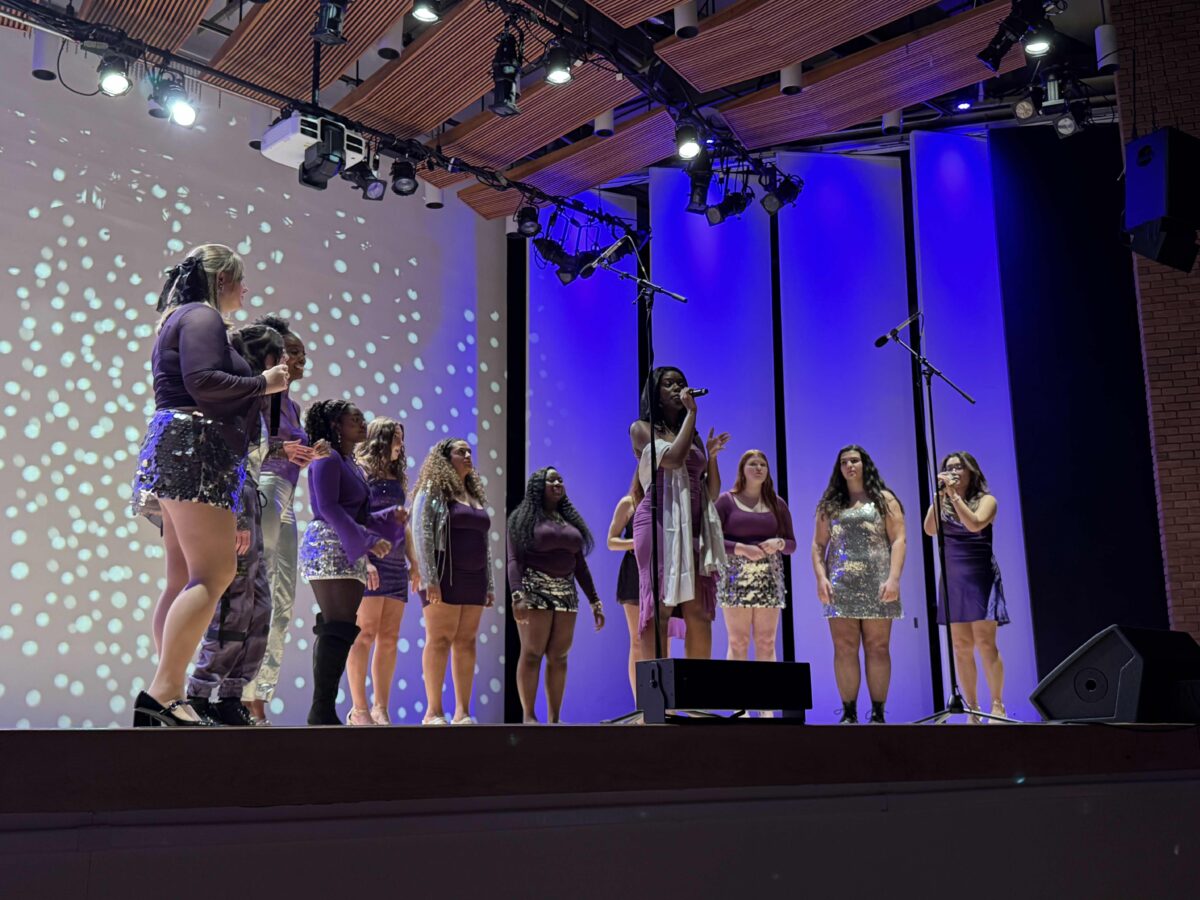 Daisy Parry (in front, with microphone) performs with the UMBC Stilettos, an all-female a cappella group. (Courtesy of Parry)
Parry is a member of The Stilettos, an all-woman a cappella group at UMBC, and her church choir. She arranges songs for The Stilettos to perform, which permits taking some creative license with the original work. “I like changing up the rhythms and dynamics to add depth to the music, and I think’s encouraged me to think a bit outside the box with my science, too, in terms of trying new experimental techniques.”
For now, her work on cell migration in fruit fly embryos with Michelle Starz-Gaiano, professor of biological sciences, her classes, and her music keep her busy, but Parry is looking forward to pursuing a master’s in public health after UMBC. She emphasizes how the concept of harmony—so central to music—carries over to the kind of work she wants to do. Factors such as research, clinical care, public policy, economics, the environment, and how they intersect are all relevant to public health outcomes, she explains.
‘It makes me whole’
Ella Reinders, a junior biological sciences major, also likes to tackle projects—scientific or artistic—from many angles. Watercolor and acrylic paints, sketching and drawing, handicrafts, sewing, and ballet have all captured her interest. “There are all different kinds of random things that I think are fun,” Reinders says.
In the lab, “I am able to come up with different ways of thinking about something because I’ve taken so many different approaches,” she says.
Reinders does behavioral research with Tara LeGates, assistant professor of biological sciences. The lab needed a new piece of equipment, but it was too expensive to buy off the shelf. “So I decided, why not create our own?” Reinders recalls.
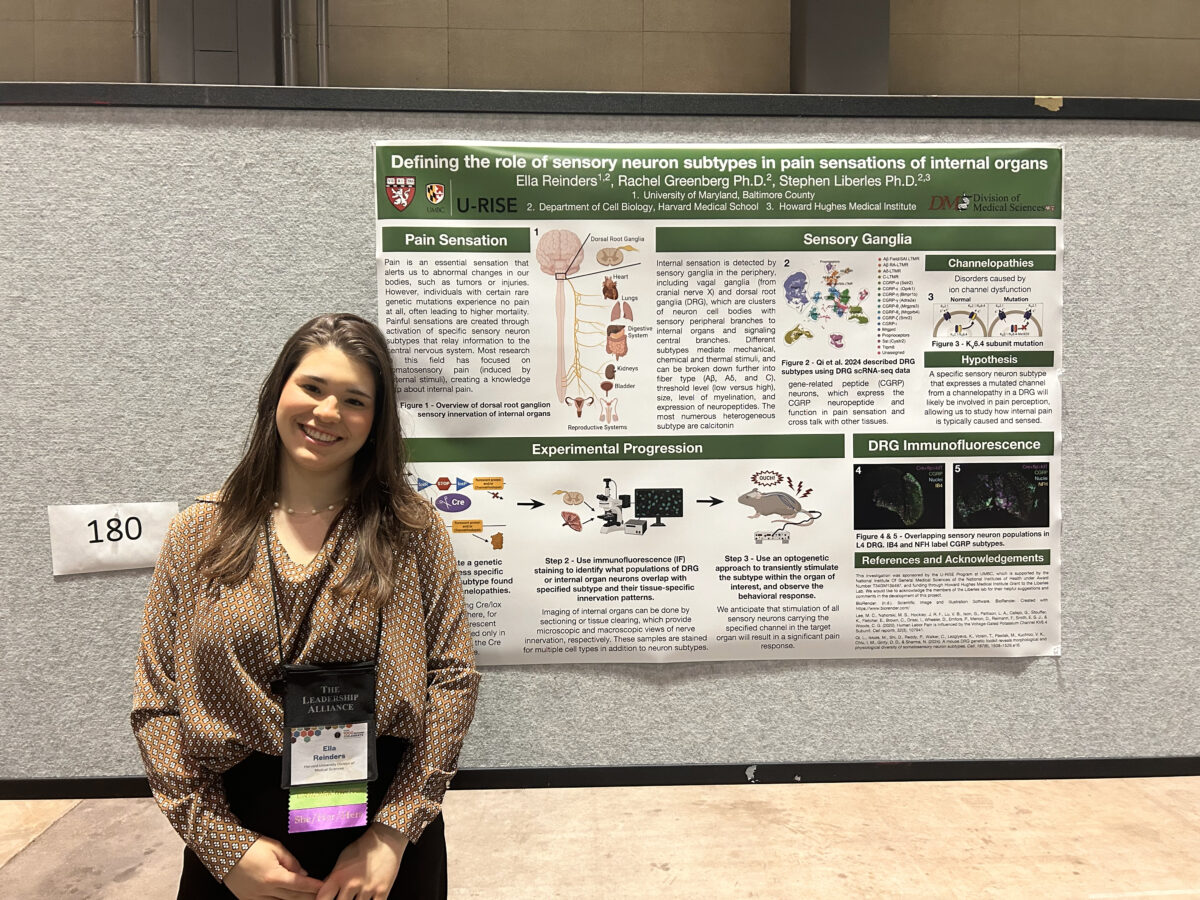
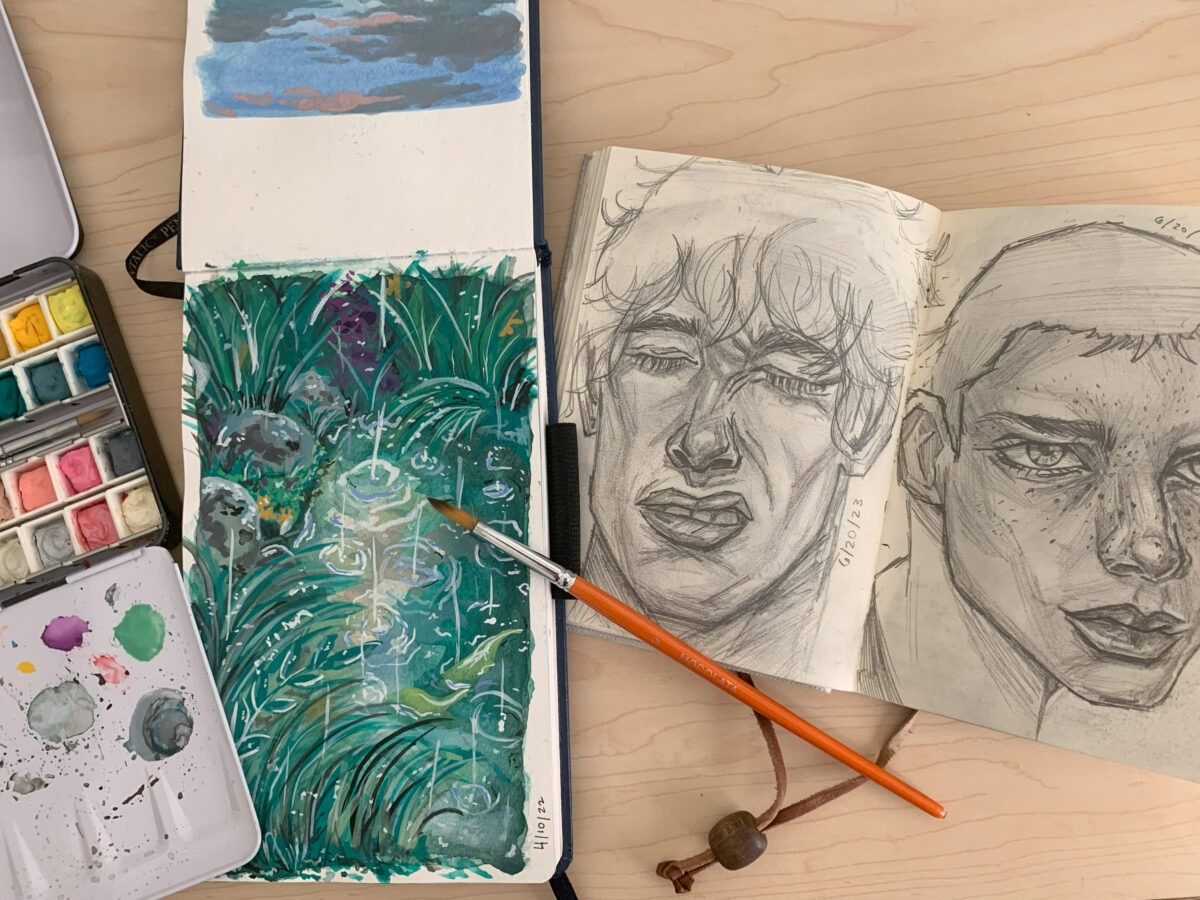 Ella Reinders says that “moving through life with both scientific and artistic interests just makes everything more interesting.” (Courtesy of Reinders)
She sketched it out, learned how to render it on the computer, how to 3D print it at the UMBC library, and then how to wire it. “And now I’ve actually been using it, and it works,” she says. “It was really exciting. I love turning something from my brain into something that I’m actually holding.”
There is also direct overlap between Reinders’ science and her art. “I’ve done imaging of neurons, and being able to turn them into this piece of artwork that you want to hang on your wall is really exciting. Moving through life with both scientific and artistic interests just makes everything more interesting and feels like a way to express all sides of myself.”
For Joshua Dayie, a senior chemical engineering major, both discipline and creativity are required for his research and his art—playing the cello. “You really have to strike a balance between them to make any meaningful progress,” he says. Practicing cello requires hours of repetition, until technical passages flow out of his fingers from muscle memory alone. In the lab, sometimes experiments must be repeated many times before they’re successful—that’s the discipline.
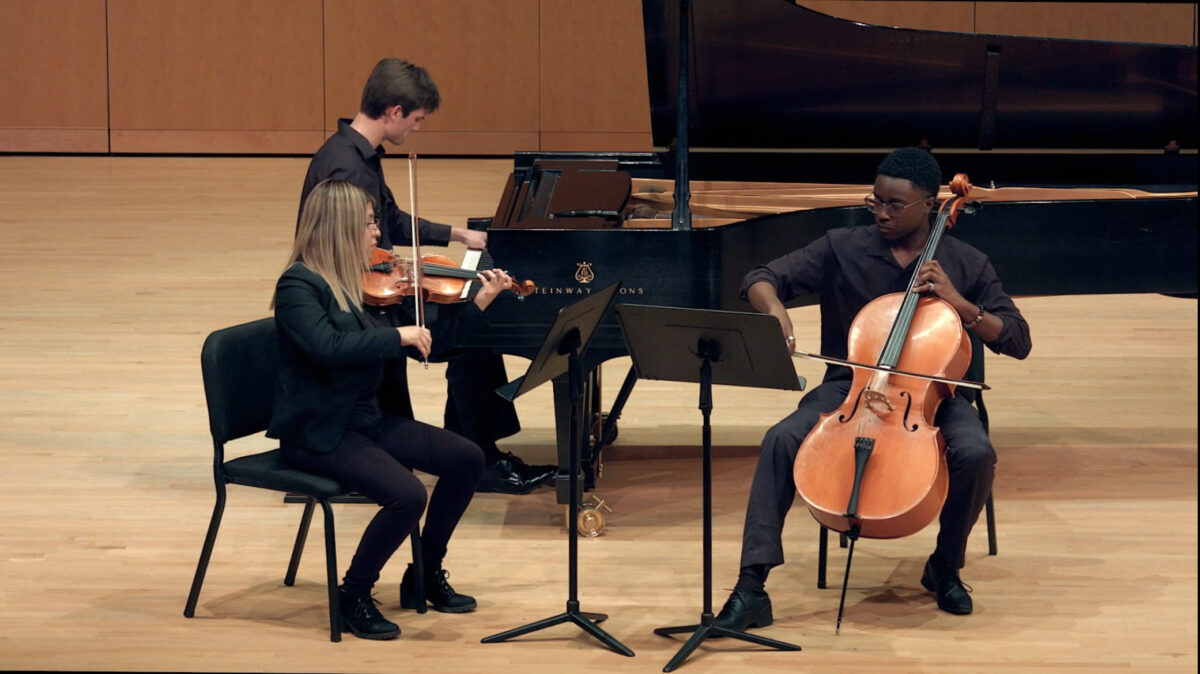
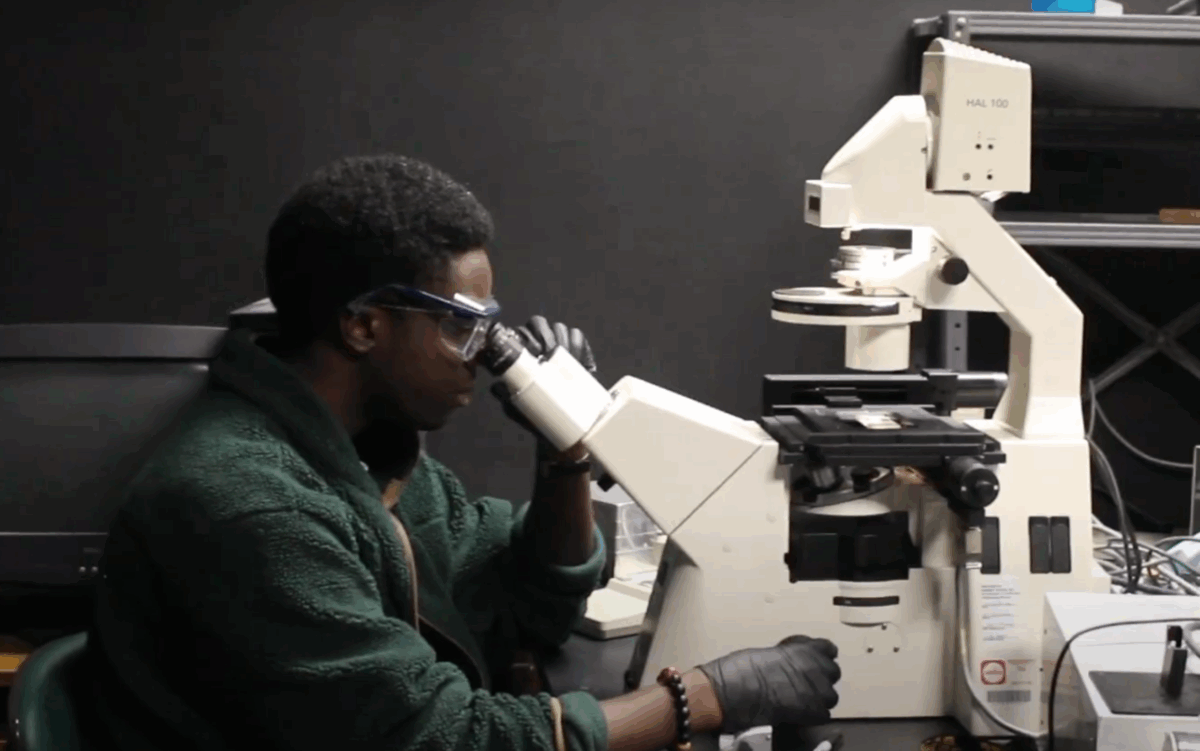 Playing the cello and conducting research makes Joshua Dayie feel “more whole.” (Melissa Penley Cormier, M.F.A. ’17/UMBC)
Dayie applies that discipline to his research with Mark Marten, professor of chemical, biochemical, and environmental engineering, on characterizing signaling pathways in fungi that activate in response to environmental stressors.
Then comes the creativity. Only after someone masters the fundamentals can they explore nuance in the tone or emotion conveyed on the cello, Dayie says. Similarly, in science “a lot of the innovation that you generate is really only meaningful after you’ve spent a lot of time understanding the core scientific concepts behind everything.”
“I think that’s been the most surprising thing: The creativity that comes from a very sound foundation of discipline is something that is translatable pretty much anywhere,” Dayie reflects.
As an added bonus, “Music has been a really nice outlet for me to use a different part of my brain, just to express myself in a different way,” he adds. “I feel like it makes me a little bit more whole.”
]]>
At UMBC, undergraduate students are redefining the boundaries of scientific and artistic pursuits. From a chemical engineer who graces the stage with his cello to a bioinformatician who paints and...
https://umbc.edu/stories/art-of-scientists/
https://my3.my.umbc.edu/api/v0/pixel/news/150074/guest@my.umbc.edu/8497eb97bed55a957858f91cb734d636/api/pixel
biochemistry-and-molecular-biology
bioinformatics
bioinformatics-and-computational-biology
biological-sciences
biology
cbee
chembiochem
cheme
chemeng
chemical-engineering
cnms
coeit
dance
discovery
magazine
music
story
UMBC News & Magazine
https://my3.my.umbc.edu/groups/umbc-news-magazine
https://assets1-my.umbc.edu/system/shared/avatars/groups/000/001/943/24435aa6207c452e7bc15cc74b42c7bb/xsmall.png?1748556657
https://assets1-my.umbc.edu/system/shared/avatars/groups/000/001/943/24435aa6207c452e7bc15cc74b42c7bb/original.png?1748556657
https://assets2-my.umbc.edu/system/shared/avatars/groups/000/001/943/24435aa6207c452e7bc15cc74b42c7bb/xxlarge.png?1748556657
https://assets2-my.umbc.edu/system/shared/avatars/groups/000/001/943/24435aa6207c452e7bc15cc74b42c7bb/xlarge.png?1748556657
https://assets3-my.umbc.edu/system/shared/avatars/groups/000/001/943/24435aa6207c452e7bc15cc74b42c7bb/large.png?1748556657
https://assets1-my.umbc.edu/system/shared/avatars/groups/000/001/943/24435aa6207c452e7bc15cc74b42c7bb/medium.png?1748556657
https://assets2-my.umbc.edu/system/shared/avatars/groups/000/001/943/24435aa6207c452e7bc15cc74b42c7bb/small.png?1748556657
https://assets1-my.umbc.edu/system/shared/avatars/groups/000/001/943/24435aa6207c452e7bc15cc74b42c7bb/xsmall.png?1748556657
https://assets2-my.umbc.edu/system/shared/avatars/groups/000/001/943/24435aa6207c452e7bc15cc74b42c7bb/xxsmall.png?1748556657
UMBC News & Magazine
3
0
false
Tue, 13 May 2025 09:16:55 -0400
Tue, 13 May 2025 09:16:55 -0400
Mentors help students grow their research skills, from fieldwork in Puerto Rico to labs at UMBC
It’s 4 a.m. in Puerto Rico, and Ellie Bare’s alarm is going off. Within an hour, she and her research colleagues are driving to their forested field site on the north side of the island to record Puerto Rican Oriole songs. After a midday break to avoid the worst of the heat, the team scouts new sites late in the afternoon. Some days they make another excursion before bed to check the birds’ roosting sites. Then the research team hits the pillow before doing it all over again.
This is the life of an ecological field researcher, one Ellie Bare ’23, biological sciences, has embraced wholeheartedly with the encouragement of mentors like Kevin Omland, professor of biological sciences, and Michelle Moyer, a Ph.D. candidate in Omland’s research group.
Building research skills—and life skills
Perhaps the most important trait of a strong researcher is the ability to ask good questions and then figure out how to pursue their answers. For example, Bare and her teammates in Puerto Rico noticed a bird roosting in a years-old nest overnight near their lodging. “We’d never heard of a bird doing that before,” Bare says, and as it turned out, neither had local experts. So began a new observational study managed by Bare.
Bare presented the results at UMBC’s Undergraduate Research and Achievement Day (URCAD) in April, finding that over 50 percent of old nests she tracked were in use as overnight roosts. The findings created new knowledge about this endangered species and a chance for Bare to flex her scientific inquiry skills, which will serve her well in any research area.
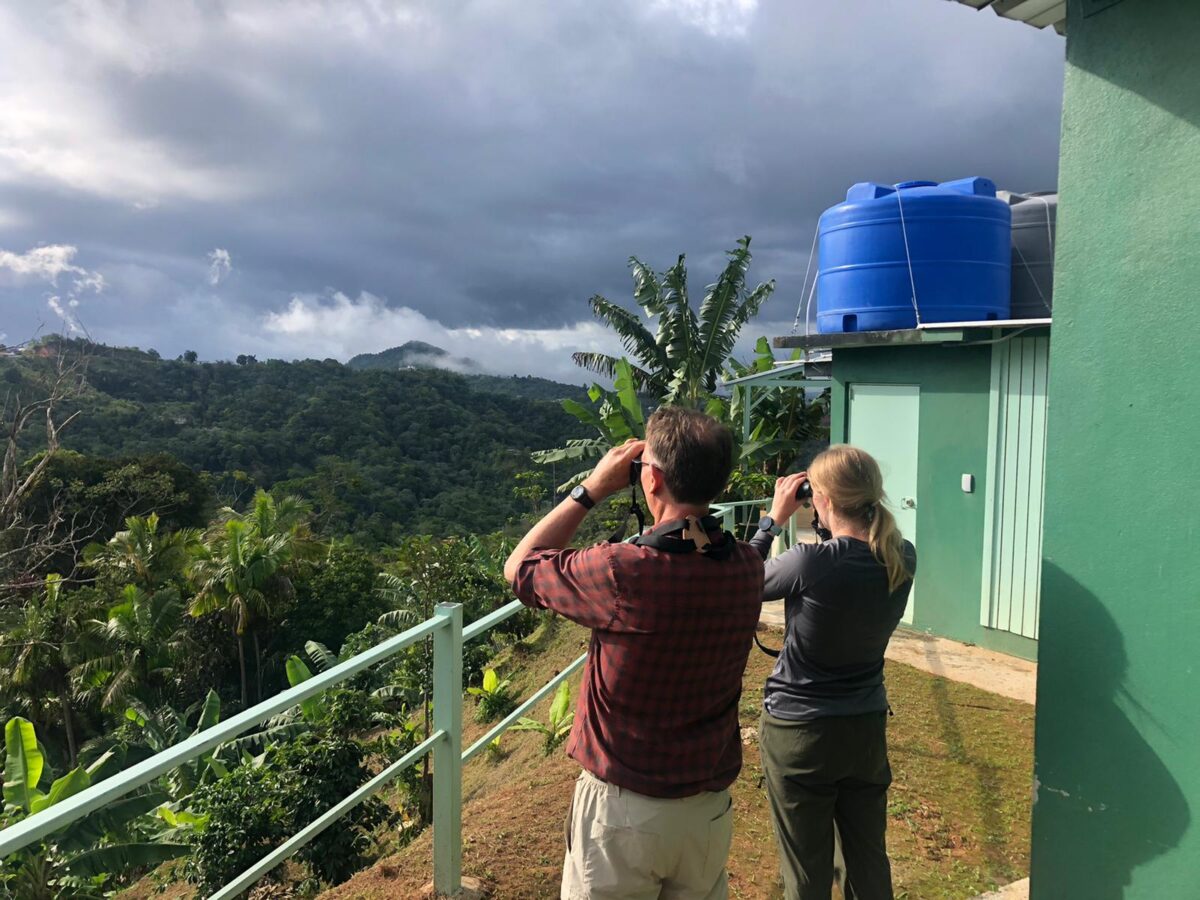 Kevin Omland and Ellie Bare scan the rainforest for birds during a research trip in Puerto Rico. (Image courtesy of Bare)
“Dr. Omland encourages that in his undergrads, which is really special,” Bare says. “He’s really supportive of undergrads getting the full research experience.”
Back on campus, Bare also took on developing a protocol for the Omland lab to determine the sex of birds based on DNA samples. That’s especially valuable in the study of tropical birds, where males and females frequently sport identical plumage. “It was really interesting and fun to spearhead that project on my own,” Bare says. The molecular skills she learned will help her in her next role, a postbac fellowship at the National Institutes of Health (NIH).
Omland also emphasizes communication skills with his students, requiring lab members to take turns presenting journal articles and providing updates on their own projects at lab meetings. In addition to URCAD, Bare also attended the international American Ornithological Society and BirdsCaribbean conference in Puerto Rico.
“Having those opportunities to improve my science communications abilities was invaluablereally great,” Bare says, “and it even helped me with my postbac interviews.”
Across the disciplines, student research shines
Bare will soon explore another area of biological research through her upcoming work at NIH—cancer research. While this area is a shift from her prior work with Omland and Moyer, she shares that the skills she learned in the Omland Lab were essential to her journey as a researcher and her mentors have continued to provide unflagging support.
Other graduating students, too, have had positive experiences with research that have prepared them for what’s next. Sarah Turner ’23, psychology, completed research with Susan Sonnenschein, professor of psychology, as well as summer research experiences at the Harvard Business School and Michigan State University. Max Bobbin ’23, chemical engineering, took on a leadership role early on in Tyler Josephson’s research group, learning and then teaching others a new programming language, and applying it to the team’s chemical theory work.
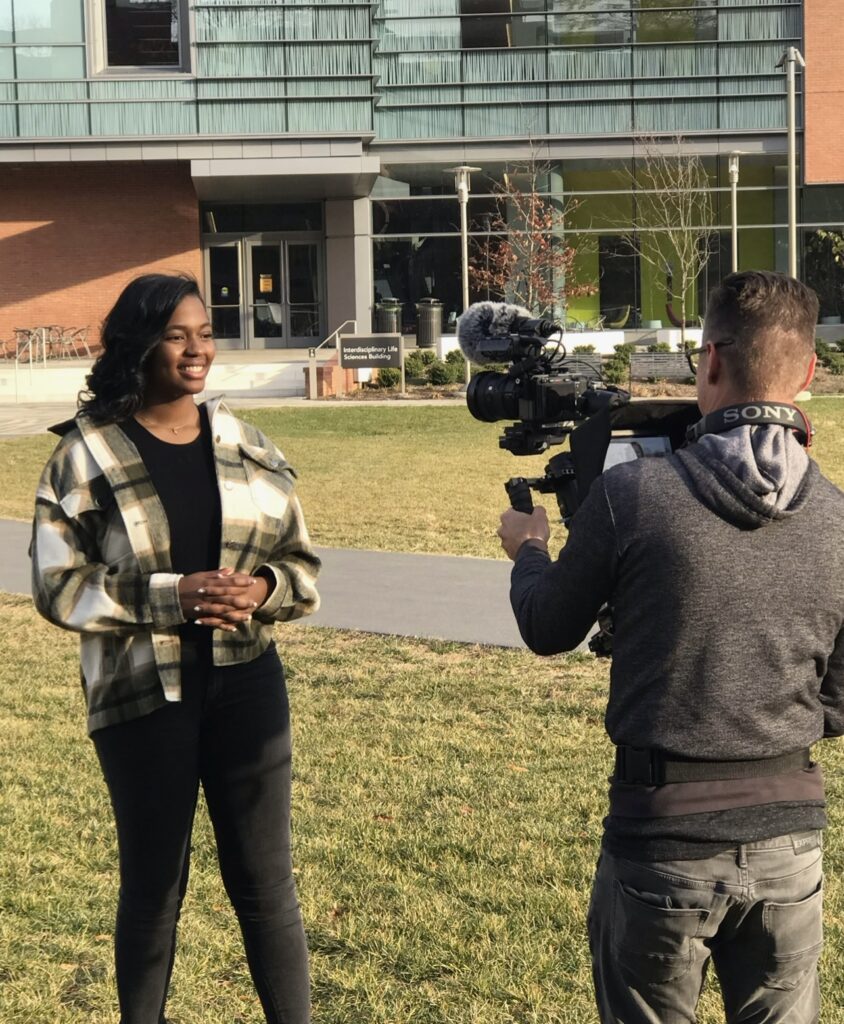 Sarah Turner, left, was interviewed for UMBC’s episode of the College Tour (on Amazon Prime) in 2022. (Image courtesy of Turner)
And valedictorian for the humanities and social sciences, Zinedine Partipilo Cornielles ’23, financial economics and mathematics, conducted research with Tim Gindling, professor of economics, and Salem Abo-Zaid, associate professor of economics. His project with Gindling focused on the impact of financial literacy on student loan decisions among undergraduates across the United States. In the future, he hopes to conduct research on labor economics with a focus on Latin America.
Across UMBC, research experiences are a cornerstone of the current and future success of students and the projects and labs to which they contribute. Encouragement from mentors to ask new questions, try new techniques, and fully participate in the intellectual life of the research group helps students build skills that will serve them in their careers and in life.
Read more Class of 2023 stories.
]]>
It’s 4 a.m. in Puerto Rico, and Ellie Bare’s alarm is going off. Within an hour, she and her research colleagues are driving to their forested field site on the north side of the island to record...
https://umbc.edu/stories/mentors-help-students-grow-research-skills/
https://my3.my.umbc.edu/api/v0/pixel/news/133508/guest@my.umbc.edu/df218eeb547890f00512ce3fe39109fc/api/pixel
biology
cahss
cahssresearch
chemeng
class-of-2023
cnms
coeit
economics
mathematics
news
psychology
undergraduate-research
UMBC News & Magazine
https://my3.my.umbc.edu/groups/umbc-news-magazine
https://assets1-my.umbc.edu/system/shared/avatars/groups/000/001/943/24435aa6207c452e7bc15cc74b42c7bb/xsmall.png?1748556657
https://assets1-my.umbc.edu/system/shared/avatars/groups/000/001/943/24435aa6207c452e7bc15cc74b42c7bb/original.png?1748556657
https://assets2-my.umbc.edu/system/shared/avatars/groups/000/001/943/24435aa6207c452e7bc15cc74b42c7bb/xxlarge.png?1748556657
https://assets2-my.umbc.edu/system/shared/avatars/groups/000/001/943/24435aa6207c452e7bc15cc74b42c7bb/xlarge.png?1748556657
https://assets3-my.umbc.edu/system/shared/avatars/groups/000/001/943/24435aa6207c452e7bc15cc74b42c7bb/large.png?1748556657
https://assets1-my.umbc.edu/system/shared/avatars/groups/000/001/943/24435aa6207c452e7bc15cc74b42c7bb/medium.png?1748556657
https://assets2-my.umbc.edu/system/shared/avatars/groups/000/001/943/24435aa6207c452e7bc15cc74b42c7bb/small.png?1748556657
https://assets1-my.umbc.edu/system/shared/avatars/groups/000/001/943/24435aa6207c452e7bc15cc74b42c7bb/xsmall.png?1748556657
https://assets2-my.umbc.edu/system/shared/avatars/groups/000/001/943/24435aa6207c452e7bc15cc74b42c7bb/xxsmall.png?1748556657
UMBC News & Magazine
0
0
false
Mon, 15 May 2023 11:40:41 -0400
Mon, 15 May 2023 11:40:41 -0400
Pres. Freeman Hrabowski honors Class of 2022 at final commencement as UMBC leader

Nearly 1,800 students walked across the stage at Chesapeake Employers Insurance Arena this week during UMBC’s 78th graduate and undergraduate commencement ceremonies. After pausing to receive their congratulatory elbow bumps from President Freeman Hrabowski and other leaders, they could breathe a sigh of relief, knowing their hard work and perseverance paid off.
After another unprecedented year, many of the commencement speeches touched upon the resilience and drive of the Class of 2022. Their time at UMBC was marked by tradition and change, a new normal and questioning “what is normal?,” and a collective focus on supporting each other and having a positive impact.
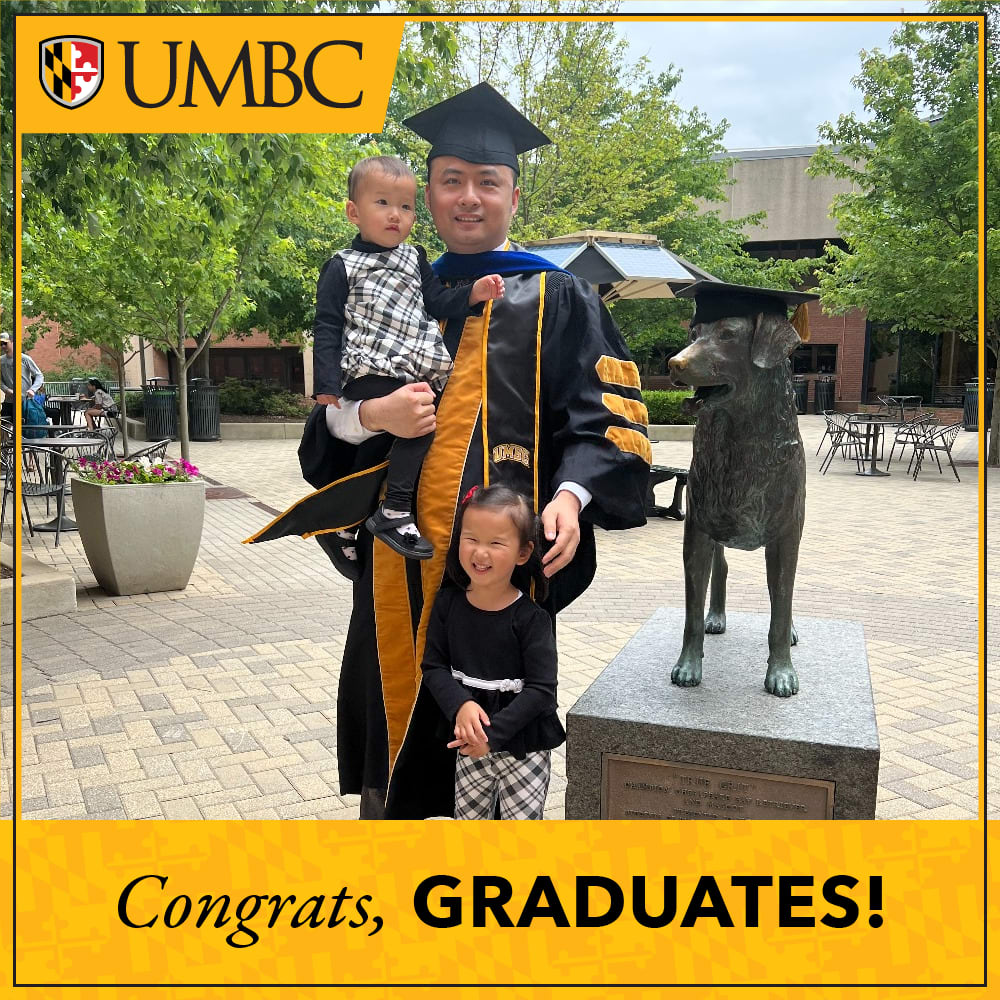
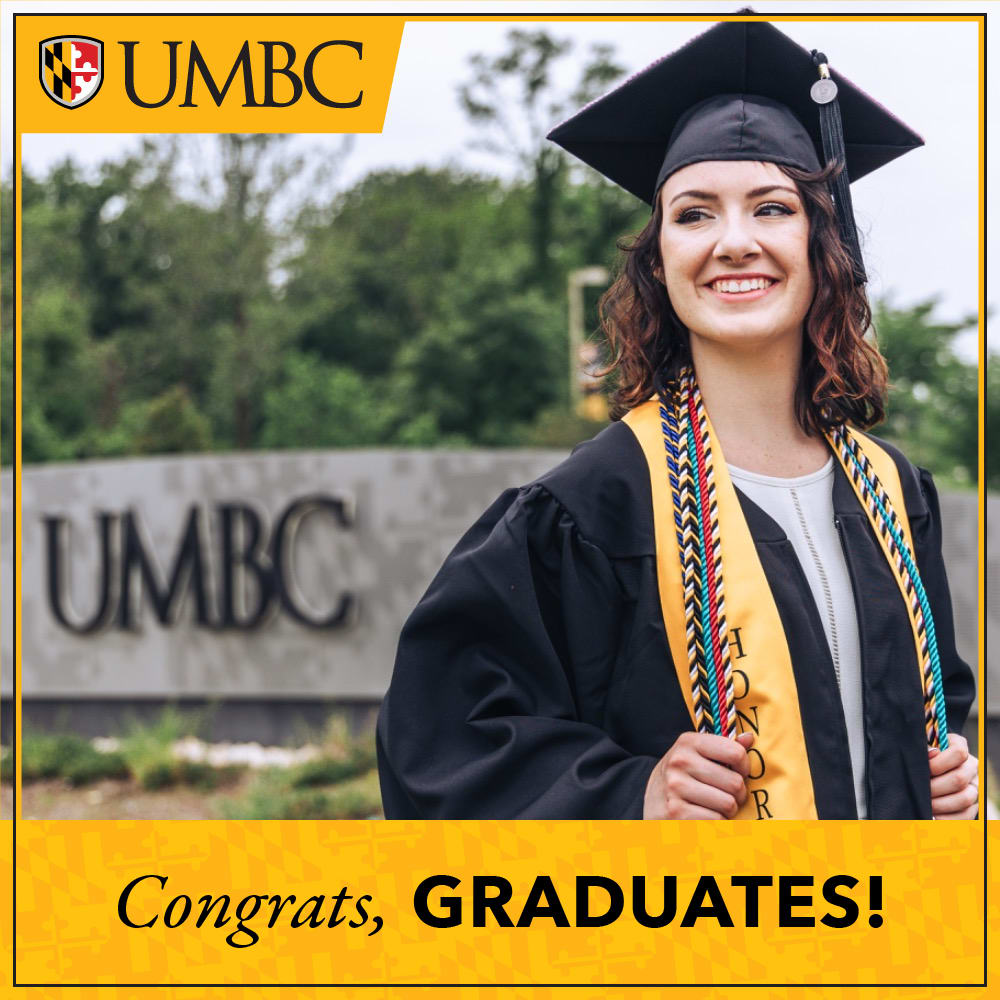
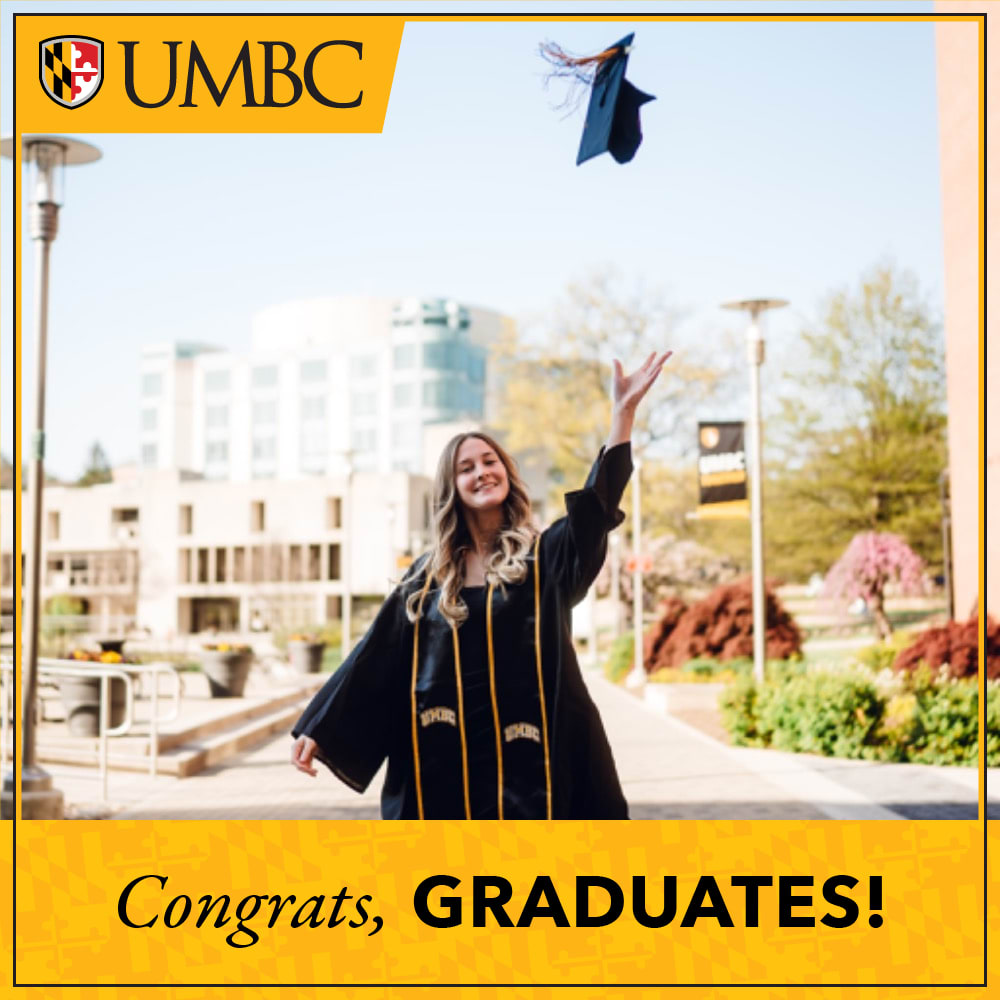
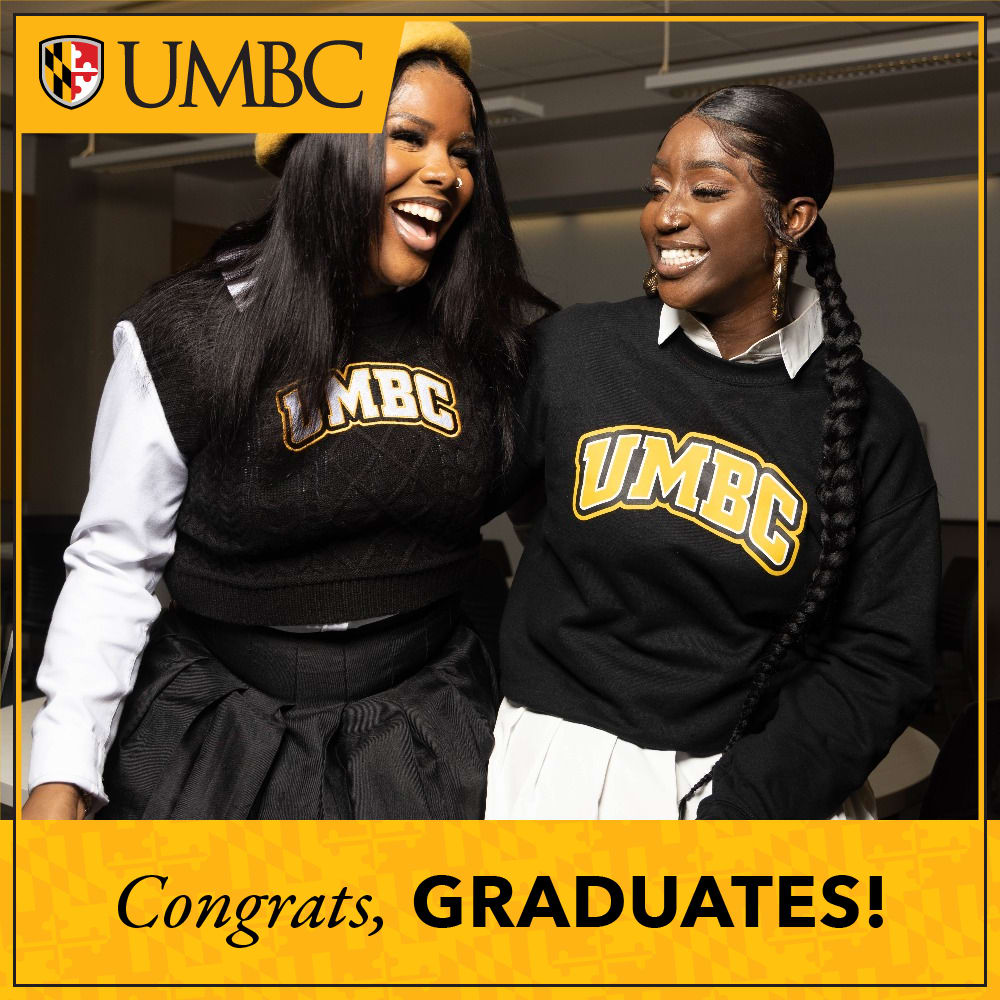
Joel Tyson ‘18, chemical engineering, president of UMBC’s Graduate Student Association, addressed master’s and Ph.D. graduates saying, “I’ve seen you reach forward for help and for mentorship, looking ahead not just at a path of personal success, but a path in service of making the world a better place.”
Encouraging graduates to build upon the lessons they learned at UMBC, honorary degree recipient Judge Ricardo Zwaig ‘77, Spanish, said, “Whatever your calling, the elevation of humanity should be your primary goal regardless of boundaries.”
A legacy of mentorship
This year, six Retriever alumni were awarded honorary degrees and served as distinguished speakers during the ceremonies. Now in their own established careers, they’ve continued the UMBC tradition of paying it forward as mentors.
Kafui Dzirasa’01, M8, chemical engineering, mentioned what an impactful mentor President Hrabowski has been to him. “Every time I tripped and fell, when the world saturated me with adversity and tribulation, he would gently reach back his hand and pull me forward with a word of encouragement,” he recalled.
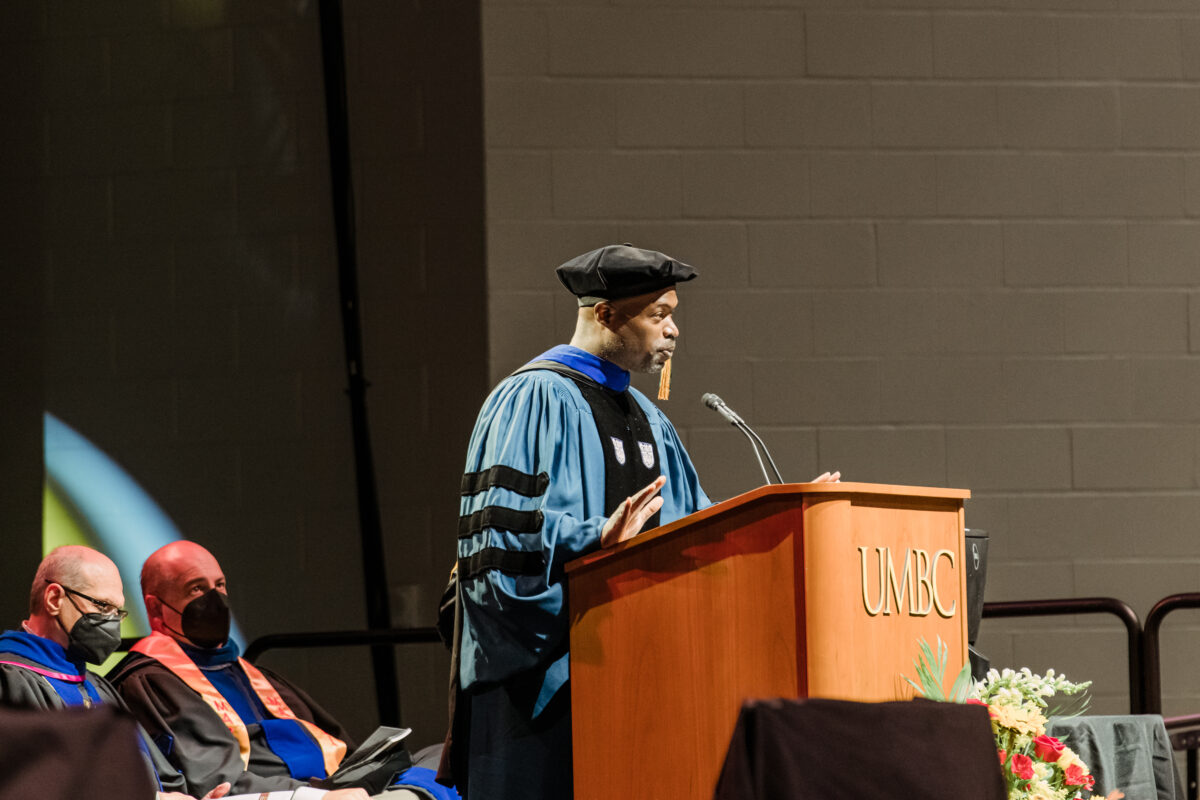 Dzirasa addresses the master’s and Ph.D. students. (Marlayna Demond ’11/UMBC)
“As Doc’s grandmother would tell him, the higher you go, the more people will try to pull you down,” Dzirasa said. He went on to let the audience know with levity that that’s “the modern day translation of ‘haters gonna hate.’ And when they do, it’s the mentors that will be there to sustain you. They are a refuge in the midst of the storm.”
The speakers promised to keep that legacy of support going amongst themselves, as well. In a tweet, Kaitlyn Sadtler’11, biological sciences, responded to a shout-out from fellow speaker Kizzmekia Corbett’08, M16, biological sciences and sociology, saying, “I credit you to being a huge reason why I’m on this list. Your email saying ‘Hey there’s another UMBC alum at NIH doing some COVID work’ was a catalyst. I’ll do my best to pay it forward.”
Combining potential with support
Corbett delivered her remarks by video, as she was at a meeting with Nobel Laureates at the time of commencement. She has often commented on the profound role President Hrabowski and other mentors have had on her life and career, and has carried that forward through mentoring emerging scientists.
Focusing on what people can achieve when they have support and a belief in themselves, she shared, “I hope you dare to dream so big that no one else can imagine the possibility. I hope that you take this degree and you make this world a better place. I hope for you scientists out there, that you take this degree and you cure cancer. I hope for you humanitarians that you stop world hunger. And I hope that you live and I hope that you love.”
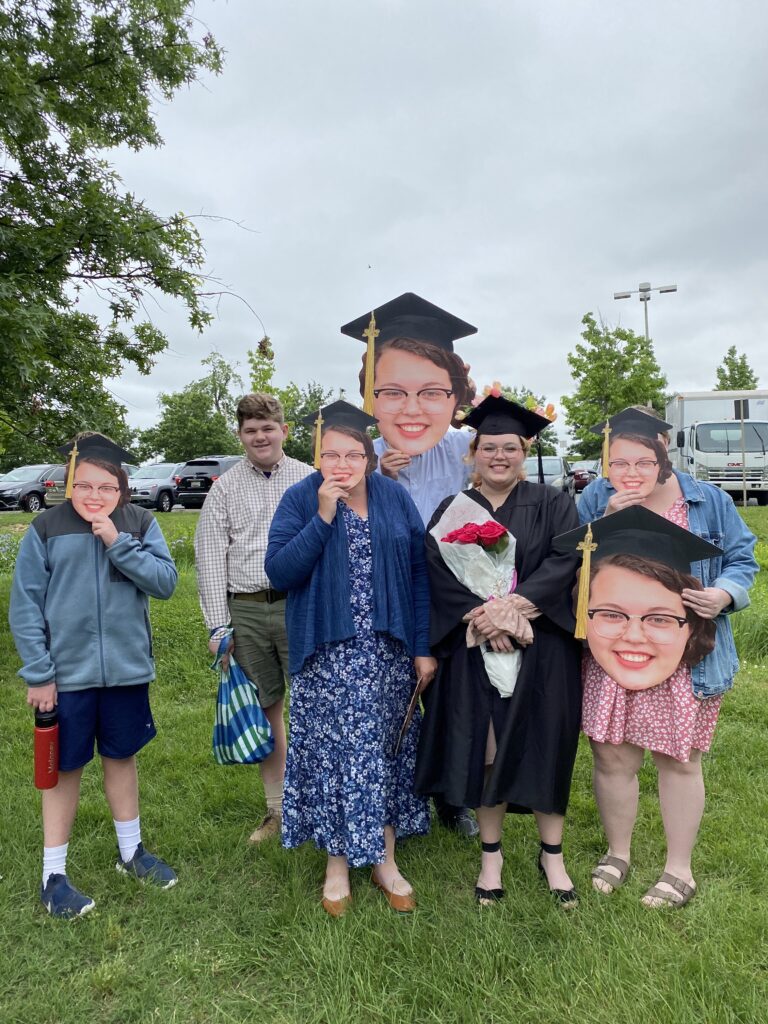 Reilly Moloney ’22, visual arts, poses with Reilly Moloney and Reilly Moloney and Reilly Moloney and Reilly Moloney after the commencement ceremony. (Kait McCaffrey/UMBC)
Co-valedictorian Shahreen Zannat ‘22, biological sciences, also spotlighted the greatness that students and communities can achieve with the right support.
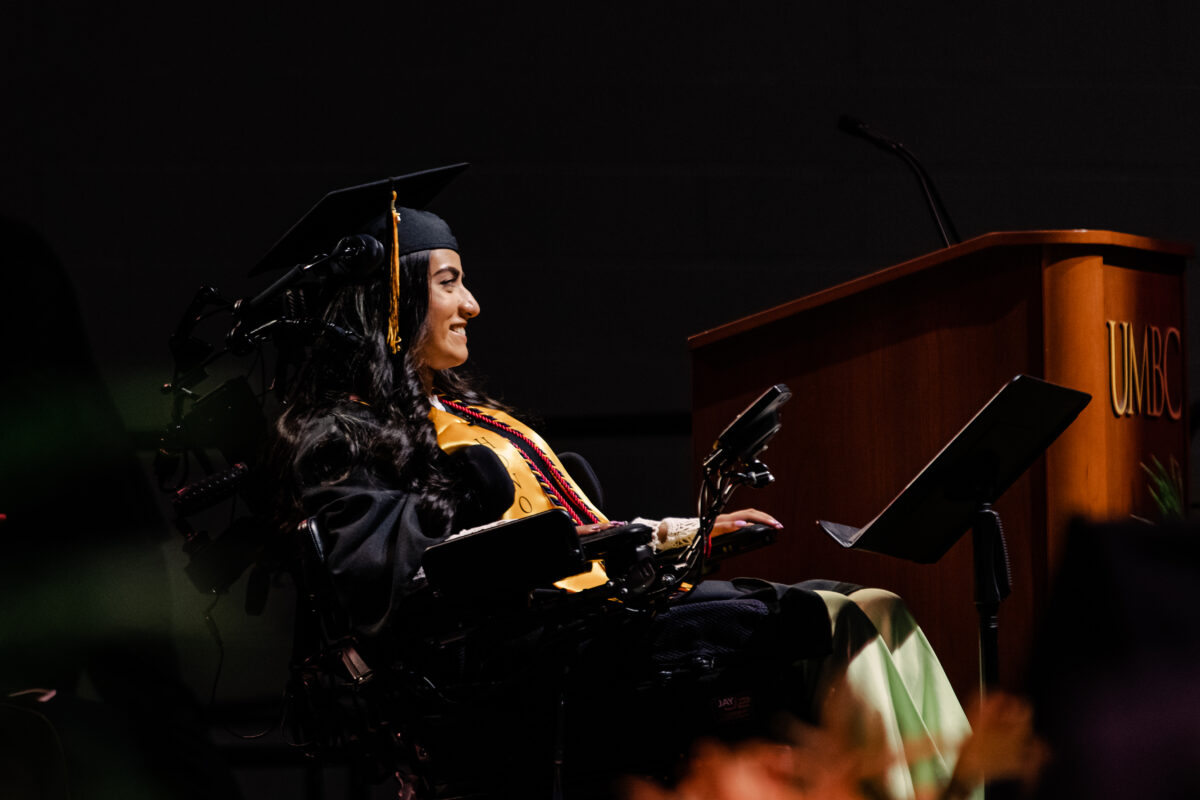 Zannat addresses her classmates during the afternoon commencement ceremony. (Marlayna Demond ’11/UMBC)
“Our journey at UMBC was not one we took alone—advisors came to our rescue during moments of panic, professors connected us with their networks for employment opportunities, and all of the support staff ensured our safety and well-being on campus,” said Zannat. “This support has helped shape leaders, resulting in international recognition of UMBC’s innovative research, creative teaching methods, and its cultural and ethnic diversity.”
Sadtler recognized that support can also come from unlikely places saying, “You will meet people that will bring out the best and worst in you. Learn from both because if you don’t get lost, you will never find your way.”
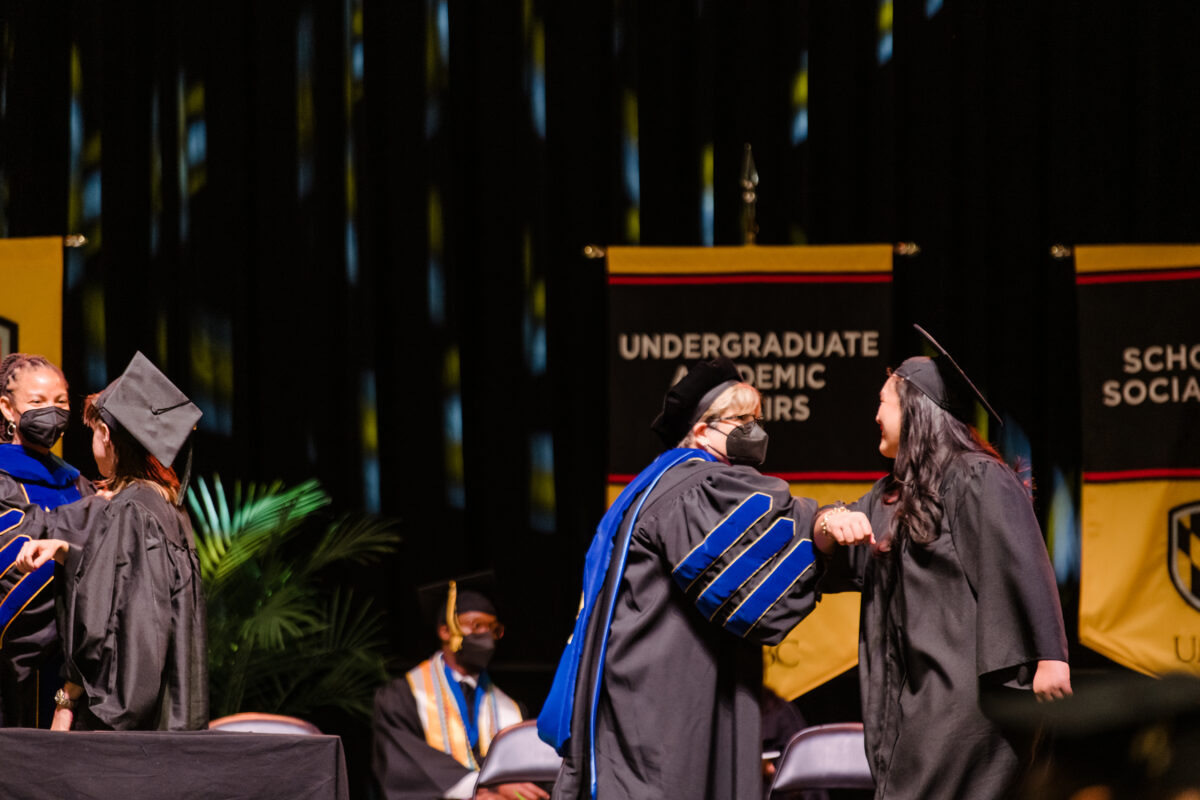 A graduate stops for an elbow bump on the commencement stage. (Marlayna Demond ’11/UMBC)
The importance of you
While many speakers touched on the idea of mutual support and “paying it forward,” others recognized the need to couple that with taking care of oneself.
Co-valedictorian Viola Lis ‘21, psychology, reminded her classmates that, “To make a difference once we leave UMBC, we have to be doing the things that bring us joy, the things we find fulfilling and meaningful. Otherwise, our imprint will be faint. In order to show up for others, you have to show up for yourself first.”
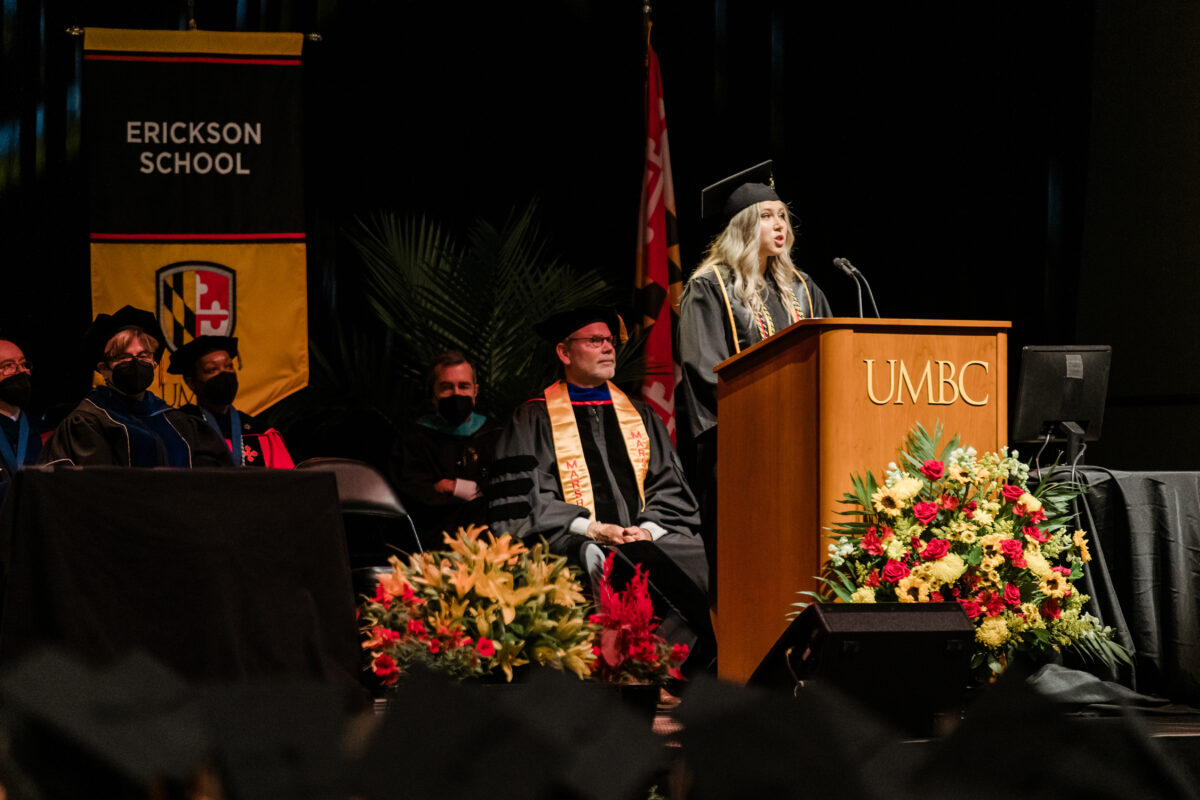 Co-valedictorian Viola Lis addresses the crowd. (Marlayna Demond ’11/UMBC)
Echoing these statements, honorary degree recipient Mark Doms’86, economics and mathematics, admitted that the road would be hard for graduates, but implored them to listen to themselves and their abilities.
“You will hit roadblocks, setbacks will blindside you,” he said. “But please, don’t surrender to self-doubt. Instead, persevere. You are extremely gifted and, please, don’t deprive us of your gifts.”
Tiffany Holmes, M.F.A. ’99, imaging and digital arts,was once a student who thought she had her life figured out. But as she shared in her address, the “key message to you today is to have a plan that is endlessly adaptable. Work hard at something that brings you joy, and your path will lead you somewhere fascinating that is just right for you.”
The places you will go
The ceremonies were bittersweet—an important moment of transition for both the graduates and President Hrabowski.
“In many ways, today we’re really celebrating two commencements: all of you, most of you, who graduated in four years. And then the second commencement is my buddy Freeman. Now, it took him 31 years to finish his work,” joked Mike Gill from the University System of Maryland Board of Regents.
Gill went on to share the news of a significant new way in which Hrabowski’s legacy would be carried forward: the $1.5 billion Freeman Hrabowski Scholars Program just launched by the Howard Hughes Medical Institute.
Dr. Hrabowski (@umbc) sees the last of his graduates across the stage today, and then BOOM @HHMINEWS names a young investigator scholars program after him… https://t.co/HV26BzP8XK
The way my mentors are retiring into their purposes is purely aspirational.
]]>
Nearly 1,800 students walked across the stage at Chesapeake Employers Insurance Arena this week during UMBC’s 78th graduate and undergraduate commencement ceremonies. After pausing to receive...
https://umbc.edu/stories/freeman-hrabowski-honors-class-of-2022-at-final-commencement/
https://my3.my.umbc.edu/api/v0/pixel/news/125644/guest@my.umbc.edu/6af52a7641286ad069ad4057f2de6c50/api/pixel
biological-sciences
cahss
chemeng
class-of-2022
cnms
coeit
community
economics
hrabowski
meche
modern-languages-and-linguistics
news
UMBC News & Magazine
https://my3.my.umbc.edu/groups/umbc-news-magazine
https://assets1-my.umbc.edu/system/shared/avatars/groups/000/001/943/24435aa6207c452e7bc15cc74b42c7bb/xsmall.png?1748556657
https://assets1-my.umbc.edu/system/shared/avatars/groups/000/001/943/24435aa6207c452e7bc15cc74b42c7bb/original.png?1748556657
https://assets2-my.umbc.edu/system/shared/avatars/groups/000/001/943/24435aa6207c452e7bc15cc74b42c7bb/xxlarge.png?1748556657
https://assets2-my.umbc.edu/system/shared/avatars/groups/000/001/943/24435aa6207c452e7bc15cc74b42c7bb/xlarge.png?1748556657
https://assets3-my.umbc.edu/system/shared/avatars/groups/000/001/943/24435aa6207c452e7bc15cc74b42c7bb/large.png?1748556657
https://assets1-my.umbc.edu/system/shared/avatars/groups/000/001/943/24435aa6207c452e7bc15cc74b42c7bb/medium.png?1748556657
https://assets2-my.umbc.edu/system/shared/avatars/groups/000/001/943/24435aa6207c452e7bc15cc74b42c7bb/small.png?1748556657
https://assets1-my.umbc.edu/system/shared/avatars/groups/000/001/943/24435aa6207c452e7bc15cc74b42c7bb/xsmall.png?1748556657
https://assets2-my.umbc.edu/system/shared/avatars/groups/000/001/943/24435aa6207c452e7bc15cc74b42c7bb/xxsmall.png?1748556657
UMBC News & Magazine
0
0
false
Fri, 27 May 2022 16:12:03 -0400
Fri, 27 May 2022 16:12:03 -0400
NIDA EDUCATE program develops the next generation of addiction researchers
In 2021, the National Institute on Drug Abuse (NIDA) awarded UMBC more than $1 million over five years to create a program specifically for undergraduate scholars interested in research on substance abuse and addiction. A year after the program’s launch, it is thriving as students in fields as diverse as economics, computer science, and chemical engineering find ways to connect their interests to this important topic.
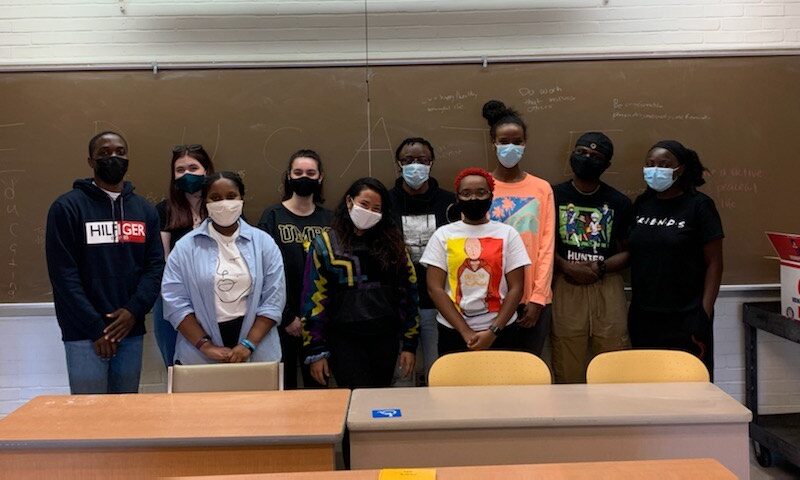
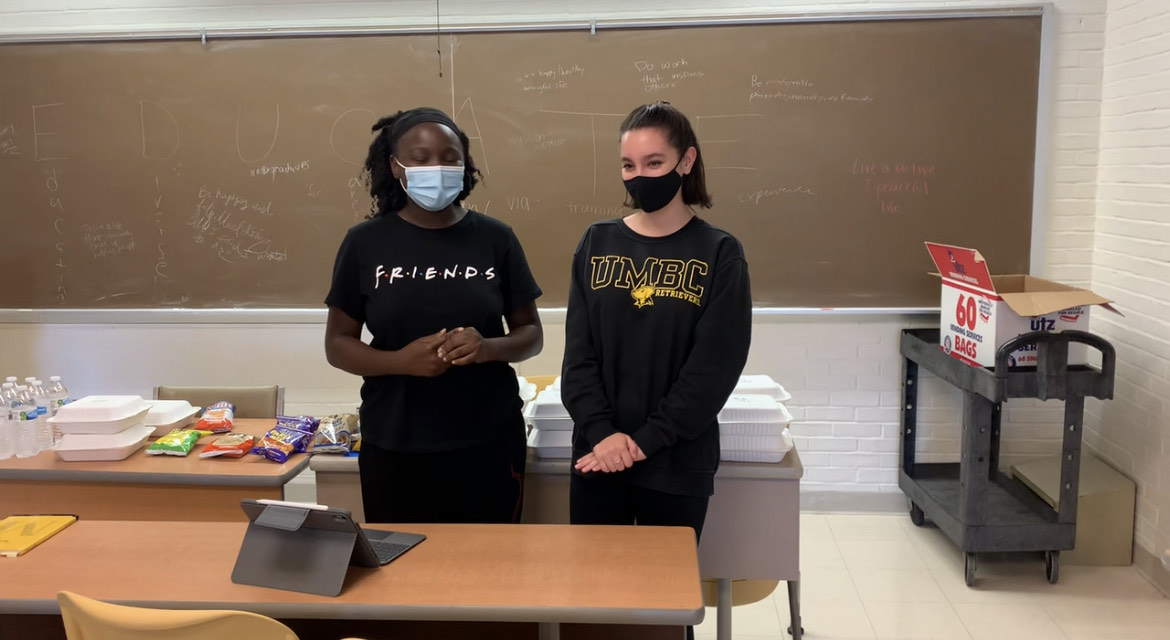
EDUCATE Scholars gathered for an end-of-semester social in spring 2022. (Image courtesy of Yetunde Oshagbemi)
“We need people from all walks of STEM to be able to approach problems to find solutions,” says Patrice Darby. She isprogram coordinator of special projects of the Meyerhoff Scholars Program and a co-lead on the grant, which is called Educating Diverse Undergraduates for Careers in Addiction and substance abuse research via Training Experiences (EDUCATE). The program supports a small, specialized group of Meyerhoff Scholars as EDUCATE Scholars. The grant is administered by UMBC’s College of Natural and Mathematical Sciences and led by the college’s dean, Bill LaCourse.
EDUCATE programming includes talks from researchers whose work touches addiction, as well as workshop series on science communication and on the tools needed to become a successful researcher. EDUCATE Scholars are also expected to participate in a sustained research experience with UMBC faculty mentors and to present their research at a conference. They also take an ethics course and receive intensive academic and career advising from program staff. Funding is available to support summer research experiences for EDUCATE Scholars as well.
“NIDA has really encouraged an interdisciplinary approach,” Darby says. That and the small size of each cohort means “we’re really able to tailor things to the students’ needs.”
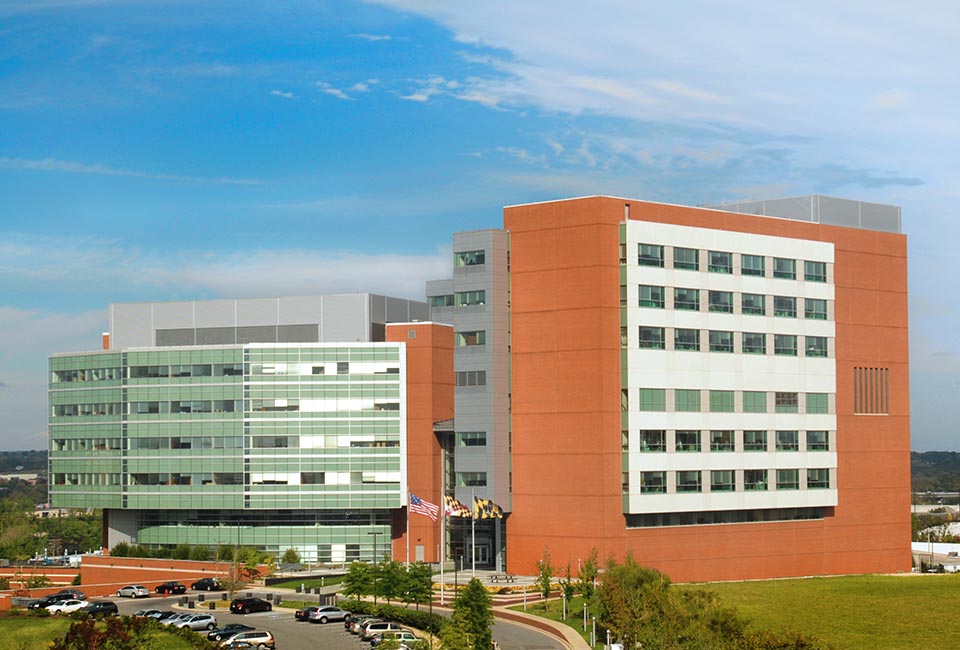 The National Institute on Drug Abuse in Baltimore. (NIDA)
Broader horizons
Yetunde Oshagbemi ’23, economics and mathematics, wants to study economic development in Nigeria, and she is interested in understanding how drug abuse has impacted development. Based on Oshagbemi’s interests, Darby invited an economist with a focus on drug abuse to speak to the scholars. In addition to speaking directly to Oshagbemi’s interest, this offered a fresh perspective for students in other majors.
The talk “reminded me that similar interests can be applied in different ways,” Oshagbemi says. The EDUCATE program as a whole “broadens your horizons and your views on the ways drug abuse is being studied in different disciplines. It’s allowed me to see that there are different ways to answer the questions I have about my interests.”
 Yetunde Oshagbemi ’23, economics and mathematics (left), relaxes with another EDUCATE Scholar at a social event. (Image courtesy of Oshagbemi)
Oshagbemi conducts research with Zoë McLaren, professor of public policy, whose work includes studying infectious disease in developing countries. Oshagbemi also appreciates Darby’s mentorship. Darby helps “make sure that not only am I progressing academically, but my mental health is also doing well,” she says. “She tries to give you the best advice based on the type of person you are and the path you want to go on.”
Family inspiration
Mike Anoruo ’24, computer science,has also benefited from the mentorship and interdisciplinary nature of the program. Darby recommended he apply for a summer workshop at MIT on quantitative methods, which was eye-opening. “I learned a lot about biology and I was able to bring in my computer science knowledge,” Anoruo says.
Anoruo is inspired by his mother, who works at a crisis stabilization center for people who struggle with addiction and substance abuse. “Seeing her passion for it has made me really want to learn more about it,” he says. “From the MIT workshop, I was able to see that computer science has a lot of applications. So if I can find a way to make a difference the same way my mom is, I think I would really enjoy that.”
Knowing that there are so many ways to apply computer science, Anoruo is still considering his options for the future. “I really like being in the EDUCATE program because I get to look into different topics in drug addiction. I’m just trying to explore and see what I want to go into.”
A real contribution
Students who are not EDUCATE Scholars also benefit from the program.
Each year six students, a mix of Meyerhoff Scholars and STEM BUILD Trainees, have the opportunity to participate in research internships at NIDA through a supplement to the EDUCATE grant. STEM BUILD Trainee Precious Oyinloye ’23, chemical engineering, is completing a virtual internship this school year. Her project involves analyzing data to identify chemical compounds involved in addiction.
After learning how to code in the Python language as part of her NIDA experience, “I’m more curious about computer science,” she says. Plus, “being part of a research project offers a sense of fulfillment—I’m really contributing to science.”
Zoha Faraz ’22, psychology and biological sciences, also a STEM BUILD Trainee, used the opportunity to gain important research skills. “Through the internship, I was able to learn a lot about the research process, and I feel more confident in testing my research skills,” she says. “I think it also improved my scientific communication, because I had to make a presentation about my project.”
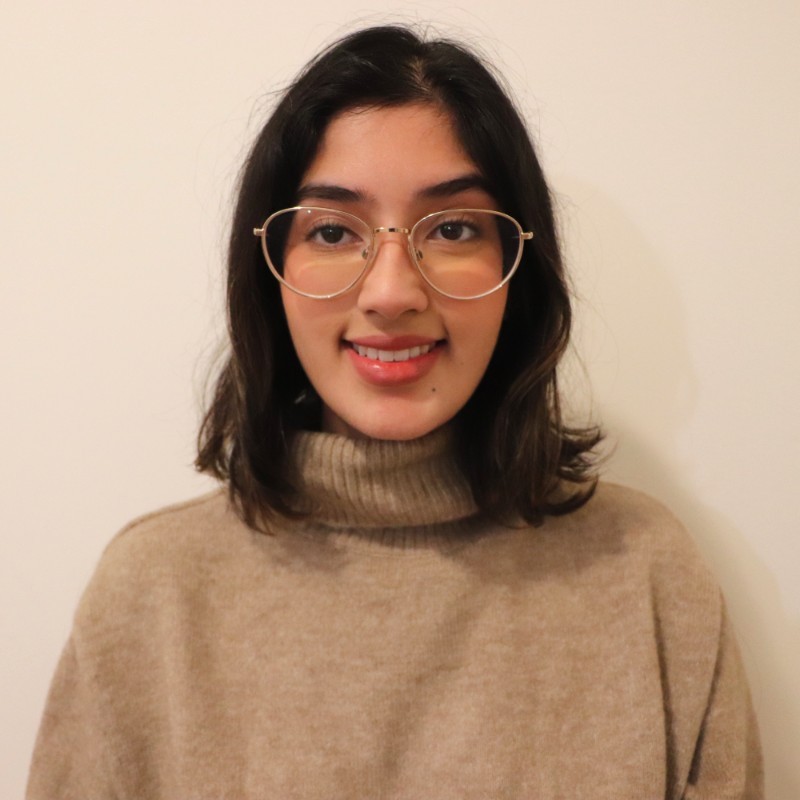
Zoha Faraz ’22, psychology and biological sciences (Image courtesy of Faraz)
A personalized experience
The EDUCATE program is small, with a maximum of six scholars per year. That allows the staff “to give our students a highly personalized experience,” Darby says.
Between the workshop-style trainings, faculty-mentored research, and availability of committed staff like Darby to offer guidance and feedback, the program is setting the EDUCATE Scholars up for success in whatever field they choose to pursue.
“You don’t have to research addiction to be able to influence addiction research,” Darby says. Addiction is, however, one of the topics that brings the scholars together. At a social event for EDUCATE students earlier this year, that connection was on full display, helping students deepen relationships they may rely on for support for years to come.
“It’s just different to have a special community,” Darby says, “to talk about the impacts of addiction and why our students care.”
]]>
In 2021, the National Institute on Drug Abuse (NIDA) awarded UMBC more than $1 million over five years to create a program specifically for undergraduate scholars interested in research on...
https://umbc.edu/stories/the-next-generation-of-addiction-researchers/
https://my3.my.umbc.edu/api/v0/pixel/news/125582/guest@my.umbc.edu/b72e18144ef0e3cd9ded5fa07df2ad6c/api/pixel
cahss
chemeng
cnms
coeit
csee
economics
mathstat
meyerhoffscholars
psychology
public-policy
science-and-tech
stembuild
undergradresearch
UMBC News & Magazine
https://my3.my.umbc.edu/groups/umbc-news-magazine
https://assets1-my.umbc.edu/system/shared/avatars/groups/000/001/943/24435aa6207c452e7bc15cc74b42c7bb/xsmall.png?1748556657
https://assets1-my.umbc.edu/system/shared/avatars/groups/000/001/943/24435aa6207c452e7bc15cc74b42c7bb/original.png?1748556657
https://assets2-my.umbc.edu/system/shared/avatars/groups/000/001/943/24435aa6207c452e7bc15cc74b42c7bb/xxlarge.png?1748556657
https://assets2-my.umbc.edu/system/shared/avatars/groups/000/001/943/24435aa6207c452e7bc15cc74b42c7bb/xlarge.png?1748556657
https://assets3-my.umbc.edu/system/shared/avatars/groups/000/001/943/24435aa6207c452e7bc15cc74b42c7bb/large.png?1748556657
https://assets1-my.umbc.edu/system/shared/avatars/groups/000/001/943/24435aa6207c452e7bc15cc74b42c7bb/medium.png?1748556657
https://assets2-my.umbc.edu/system/shared/avatars/groups/000/001/943/24435aa6207c452e7bc15cc74b42c7bb/small.png?1748556657
https://assets1-my.umbc.edu/system/shared/avatars/groups/000/001/943/24435aa6207c452e7bc15cc74b42c7bb/xsmall.png?1748556657
https://assets2-my.umbc.edu/system/shared/avatars/groups/000/001/943/24435aa6207c452e7bc15cc74b42c7bb/xxsmall.png?1748556657
UMBC News & Magazine
0
0
false
Tue, 24 May 2022 16:52:34 -0400
Tue, 24 May 2022 16:52:34 -0400
Choosing Her Own Adventure

Halfway through her senior year at UMBC, Naomi Mburu M26, ’18, chemical engineering, was named the very first Rhodes Scholar in university history. So, following Commencement, she packed her bags and—after squeezing in a summer trip to Kenya—headed for jolly old England to make her mark on Oxford, the oldest English-speaking university in the world. Today, more than 3,500 miles from home in her pursuit of a doctorate in nuclear fusion, Mburu writes to share her thoughts on her first year at Oxford, and the ways she’s making herself right at home.
Roughly a year and a half ago, I received one of the biggest surprises I have ever received: the opportunity to attend the University of Oxford in England. As someone who has lived and attended elementary, middle, and high school all within 15 minutes of UMBC, I was itching to see the broader world and what it had to offer. Now, I have been living in Oxford for a little over six months and wanted to share some experiences and observations with my UMBC community.
There have been several wonderful and difficult moments woven throughout my experience thus far. Meeting hundreds of other Rhodes Scholars has been one of the most wonderful aspects of this experience, as the scholars come from many corners of the world and each have such interesting experiences and perspectives on life. Some of the moments I most enjoy at Oxford involve exchanging life stories with my fellow “Rhodies” and hearing my classmates passionately talk about topics that are close to their hearts.
Having the Rhodes community around me has definitely helped ease my adjustment to English life, but there have still been many times when I felt the loneliness of leaving home and starting off alone in a new country. I found that close community and friendship can sometime take quite a bit of time, patience, and effort to create, and maintaining old friendships across time zones can be a difficult thing to juggle. Luckily, there is so much fantastic technology like WhatsApp and FaceTime that allow me to easily connect with family and friends back home, and my family was able to visit me in April. There have also been some unexpected differences that I am learning to adjust to, the main being the weather and the sun setting at 3 p.m. in the winter.
 Visiting the world’s oldest functioning nuclear fusion reactor in Prague.
One of the biggest surprises of Oxford has been the structure of the Ph.D. compared to universities in America. For starters, here the Ph.D. is instead called the D.Phil., and in my department the D.Phil. process solely consists of an in-depth research project conducted over 3-4 years. There are no class or teaching requirements; the only responsibility is conducting research. This was quite a shift from my time at UMBC where I found myself balancing a full, pre-determined chemical engineering course load along with extracurriculars, teaching, and research. This has given me the chance to spend my first few months at Oxford really diving into my new field of nuclear fusion and thinking critically about what I want to get out of my Ph.D.
The increased freedom does come with added responsibility, however—students must decide for themselves what they want their D.Phil. experience to look like and proactively seek out those opportunities. Coming from a more structured undergraduate experience, this freedom was initially quite intimidating. However, I have seen how the flexibility of this new schedule has afforded me lots of time to try new things, travel, ponder, and simply do things that make me happy. Oxford has lots of great spots where I go to relax, read, or think, such as Christ Church Meadow, a beautiful field complete with cows which runs along the Thames River, or any of the beautiful college gardens.
Oxford and the Rhodes community are bursting with opportunities for students to “choose their own adventure.” The Rhodes House has been a central part of my experience thus far, as it serves as a meeting place for scholars past and present to plan events, study, and hang out. I have attended many scholar-led talks, musical performances, and even a mindfulness course there. The house also serves as the location for the annual Rhodes Retreat, which is a unique chance to spend a few days reflecting and discussing deep issues of life and purpose with your cohort.
 Eating an American-style Thanksgiving together in Milner Hall of the Rhodes House.
In November, I helped organize an American Thanksgiving dinner for 130 people in the Rhodes House with a diverse team of people, some of whom had never experienced this type of holiday celebration. We had mashed potatoes, macaroni and cheese, stuffing, sweet potato casserole, homemade bread, turkey, a vegan option prepared by a scholar from Israel, and one of the Jamaican scholars even made jerk sauce for the turkey! Every year, the Rhodes House also sponsors scholar trips to places like Israel, China, Palestine, and Chile. I attended the Chile trip in March, where I joined a group of 11 other scholars on a nine-day backpacking expedition through Patagonia National Park.
Outside of the Rhodes House, I have attended talks at Oxford ranging from brain surgery to the evolution of language, tried new sports like rowing, and engaged in ancient traditions such as attending formal hall in the Harry Potter-style dining halls where we wear a mandatory black gown and stand for a formal Latin grace before the meal. And in March, the university supported me to attend a fusion-focused, week-long program that involved operating the world’s oldest functioning nuclear fusion reactor, located in Prague, Czech Republic, which was a great chance to meet other students in Europe interested in fusion and gain some hands-on experience with a fusion reactor.
Overall, my time at Oxford has been full of experiences that are continuing to shape the way I view the world and use my time. I look forward to all of the adventures the next year has in store!
–Naomi Mburu ’18
*****
Header image: Mburu finds the end of the rainbow during a Rhodes trip to Chile, which included a backpacking expedition through Patagonia National Park. All images courtesy of the author.
]]>
Halfway through her senior year at UMBC, Naomi Mburu M26, ’18, chemical engineering, was named the very first Rhodes Scholar in university history. So, following Commencement, she packed her bags...
https://umbc.edu/stories/umbc-rhodes-scholar-pursues-doctorate-in-nuclear-fusion-at-oxford/
https://my3.my.umbc.edu/api/v0/pixel/news/120121/guest@my.umbc.edu/c2eb028a6e296f023f5081f9120f5e8f/api/pixel
alumni
chemeng
meyerhoff
meyerhoff-alumni
oxford
rhodes-scholar
spring-2019
UMBC News & Magazine
https://my3.my.umbc.edu/groups/umbc-news-magazine
https://assets1-my.umbc.edu/system/shared/avatars/groups/000/001/943/24435aa6207c452e7bc15cc74b42c7bb/xsmall.png?1748556657
https://assets1-my.umbc.edu/system/shared/avatars/groups/000/001/943/24435aa6207c452e7bc15cc74b42c7bb/original.png?1748556657
https://assets2-my.umbc.edu/system/shared/avatars/groups/000/001/943/24435aa6207c452e7bc15cc74b42c7bb/xxlarge.png?1748556657
https://assets2-my.umbc.edu/system/shared/avatars/groups/000/001/943/24435aa6207c452e7bc15cc74b42c7bb/xlarge.png?1748556657
https://assets3-my.umbc.edu/system/shared/avatars/groups/000/001/943/24435aa6207c452e7bc15cc74b42c7bb/large.png?1748556657
https://assets1-my.umbc.edu/system/shared/avatars/groups/000/001/943/24435aa6207c452e7bc15cc74b42c7bb/medium.png?1748556657
https://assets2-my.umbc.edu/system/shared/avatars/groups/000/001/943/24435aa6207c452e7bc15cc74b42c7bb/small.png?1748556657
https://assets1-my.umbc.edu/system/shared/avatars/groups/000/001/943/24435aa6207c452e7bc15cc74b42c7bb/xsmall.png?1748556657
https://assets2-my.umbc.edu/system/shared/avatars/groups/000/001/943/24435aa6207c452e7bc15cc74b42c7bb/xxsmall.png?1748556657
UMBC News & Magazine
0
0
false
Tue, 04 Jun 2019 18:44:05 -0400
Highways to Healing – Omolola Eniola-Adefeso '99, ChemEng
Once upon a time, Omolola Eniola-Adefeso ’99, chemical engineering, was on track to attend medical school. But she became a chemical engineer instead – so she could better attack problems such as her number one target: heart disease.
Eniola-Adefeso, an assistant professor of chemical engineering at the University of Michigan, investigates radical ways of delivering medicine that could prove efficient and effective than current practice. And she may succeed because she is thinks like an engineer – and not a doctor. Eniola-Adefeso came to Maryland from her native Nigeria the age of 16. She began her studies at Catonsville Community College, before transferring to UMBC, where she met the late Janice Lumpkin, an African-American chemical engineering professor. Lumpkin not only guided her student into a field where her passion for technology and medicine could intersect, but also helped her become a member of the first class of UMBC students in the Minority Access to Research Careers program.
After graduating from UMBC, she took a doctorate at the University of Pennsylvania in 2004. Her scholarship for graduate studies there was actually named after Lumpkin – who also attended Penn and died tragically after childbirth in 1997.
In 2006, Eniola-Adefeso (pronounced ah-DAY-feso and known to everyone as “Lola”) joined the faculty at Michigan where her lab seeks ways to create and use miniscule synthetic pellets to mimic white blood cells and deliver medicine more efficiently.
So far, she is succeeding with laboratory mice specially bred to have cardiovascular disease. She is moving next to larger animals before she attempts experiments on humans.
Why white blood cells? When there is an infection or injury in the body, nearby cells send out a chemical alarm. On receiving that signal, white blood cells – especially those known as neutrophils – leap to action.
Normally, neutrophils are spherical, but they can change their shape as they charge to the scene of injury, producing a sticky surface protein to match proteins at the target site. As the neutrophils pass injured tissue, their protein grabs onto proteins on the tissue and the neutrophils hoist themselves out of the blood stream, infiltrate the cell walls and go about the work of healing.
The system is incredibly efficient and it’s the reason most of us recover from our illnesses by doing nothing but letting the immune system do its thing.
But sometimes the forces of healing need help (such as antibiotics) which come in the form of pills or injections. And that’s where Eniola-Adefeso’s research comes in.
Current methods of drug delivery lack efficiency. A pill goes through the digestive system and is absorbed into the blood stream. Injections take a more direct route into the blood stream. But in both cases, only some of the drug winds up at the target site. Plus, extra medicine can occasionally cause serious and even fatal side effects.
Eniola-Adefeso’s proposed technique solves both issues. And because her father died of a heart attack five years ago, she’s focused her attention on cardiovascular disease. She’s trying to produce pellets that mimic white blood cells and go straight to heart muscle or blood vessels to repair them. Injected into your body, Eniola-Adefeso’s pellets – loaded with the right proteins and medicine – would find their way directly to damaged heart muscles or arteries and deliver medicine contained within it. Ideally the pellets would be designed to release the medicine for weeks or months, possibly even years.
The complexities include identifying target proteins in the cardiovascular system and factoring in significant variations in blood flow in the body. When the heart pumps blood, the arteries proximate to it surge like a river. But by the time the blood gets to your big toe or the skin of your elbow, it has slowed to a mild stream without the surge.
To actually deliver the medicine, Eniola-Adefeso’s pellets must also be biodegradable, so she is also working on testing polymers and plastics, seeking substances which degrade at just the right rate for what she wants to accomplish.
Then there is size. Eniola-Adefeso needs pellets about the same size as the neutrophils, which measure about 100 nanometers to about three micrometers and require a microscope to be seen. “Shape and size matter,” she says.
Eniola-Adefeso also believes the system would work for other diseases as well, including cancer. And her work is already receiving recognition. In April, she was the 2011 recipient of the Lloyd N. Ferguson Young Scientist from the National Organization for the Professional Advancement of Black Chemists and Chemical Engineers (NOBCChE), an award that recognizes and honors scientific contributions and achievements and dedication to research.
— Joel N. Shurkin
]]>
Once upon a time, Omolola Eniola-Adefeso ’99, chemical engineering, was on track to attend medical school. But she became a chemical engineer instead – so she could better attack problems such as...
https://umbc.edu/stories/highways-to-healing-omolola-eniola-adefeso-99-chemeng-2/
https://my3.my.umbc.edu/api/v0/pixel/news/124523/guest@my.umbc.edu/241476e2779cb2593a8d4bd3e3a638f1/api/pixel
alumni
cbee
chemeng
coeit
fall-2011
omolola-eniola-adefeso
UMBC News & Magazine
https://my3.my.umbc.edu/groups/umbc-news-magazine
https://assets1-my.umbc.edu/system/shared/avatars/groups/000/001/943/24435aa6207c452e7bc15cc74b42c7bb/xsmall.png?1748556657
https://assets1-my.umbc.edu/system/shared/avatars/groups/000/001/943/24435aa6207c452e7bc15cc74b42c7bb/original.png?1748556657
https://assets2-my.umbc.edu/system/shared/avatars/groups/000/001/943/24435aa6207c452e7bc15cc74b42c7bb/xxlarge.png?1748556657
https://assets2-my.umbc.edu/system/shared/avatars/groups/000/001/943/24435aa6207c452e7bc15cc74b42c7bb/xlarge.png?1748556657
https://assets3-my.umbc.edu/system/shared/avatars/groups/000/001/943/24435aa6207c452e7bc15cc74b42c7bb/large.png?1748556657
https://assets1-my.umbc.edu/system/shared/avatars/groups/000/001/943/24435aa6207c452e7bc15cc74b42c7bb/medium.png?1748556657
https://assets2-my.umbc.edu/system/shared/avatars/groups/000/001/943/24435aa6207c452e7bc15cc74b42c7bb/small.png?1748556657
https://assets1-my.umbc.edu/system/shared/avatars/groups/000/001/943/24435aa6207c452e7bc15cc74b42c7bb/xsmall.png?1748556657
https://assets2-my.umbc.edu/system/shared/avatars/groups/000/001/943/24435aa6207c452e7bc15cc74b42c7bb/xxsmall.png?1748556657
UMBC News & Magazine
0
0
false
Fri, 02 Sep 2011 16:50:39 -0400
Highways to Healing – Omolola Eniola-Adefeso ’99, ChemEng
Once upon a time, Omolola Eniola-Adefeso ’99, chemical engineering, was on track to attend medical school. But she became a chemical engineer instead – so she could better attack problems such as her number one target: heart disease.
Eniola-Adefeso, an assistant professor of chemical engineering at the University of Michigan, investigates radical ways of delivering medicine that could prove efficient and effective than current practice. And she may succeed because she is thinks like an engineer – and not a doctor. Eniola-Adefeso came to Maryland from her native Nigeria the age of 16. She began her studies at Catonsville Community College, before transferring to UMBC, where she met the late Janice Lumpkin, an African-American chemical engineering professor. Lumpkin not only guided her student into a field where her passion for technology and medicine could intersect, but also helped her become a member of the first class of UMBC students in the Minority Access to Research Careers program.
After graduating from UMBC, she took a doctorate at the University of Pennsylvania in 2004. Her scholarship for graduate studies there was actually named after Lumpkin – who also attended Penn and died tragically after childbirth in 1997.
In 2006, Eniola-Adefeso (pronounced ah-DAY-feso and known to everyone as “Lola”) joined the faculty at Michigan where her lab seeks ways to create and use miniscule synthetic pellets to mimic white blood cells and deliver medicine more efficiently.
So far, she is succeeding with laboratory mice specially bred to have cardiovascular disease. She is moving next to larger animals before she attempts experiments on humans.
Why white blood cells? When there is an infection or injury in the body, nearby cells send out a chemical alarm. On receiving that signal, white blood cells – especially those known as neutrophils – leap to action.
Normally, neutrophils are spherical, but they can change their shape as they charge to the scene of injury, producing a sticky surface protein to match proteins at the target site. As the neutrophils pass injured tissue, their protein grabs onto proteins on the tissue and the neutrophils hoist themselves out of the blood stream, infiltrate the cell walls and go about the work of healing.
The system is incredibly efficient and it’s the reason most of us recover from our illnesses by doing nothing but letting the immune system do its thing.
But sometimes the forces of healing need help (such as antibiotics) which come in the form of pills or injections. And that’s where Eniola-Adefeso’s research comes in.
Current methods of drug delivery lack efficiency. A pill goes through the digestive system and is absorbed into the blood stream. Injections take a more direct route into the blood stream. But in both cases, only some of the drug winds up at the target site. Plus, extra medicine can occasionally cause serious and even fatal side effects.
Eniola-Adefeso’s proposed technique solves both issues. And because her father died of a heart attack five years ago, she’s focused her attention on cardiovascular disease. She’s trying to produce pellets that mimic white blood cells and go straight to heart muscle or blood vessels to repair them. Injected into your body, Eniola-Adefeso’s pellets – loaded with the right proteins and medicine – would find their way directly to damaged heart muscles or arteries and deliver medicine contained within it. Ideally the pellets would be designed to release the medicine for weeks or months, possibly even years.
The complexities include identifying target proteins in the cardiovascular system and factoring in significant variations in blood flow in the body. When the heart pumps blood, the arteries proximate to it surge like a river. But by the time the blood gets to your big toe or the skin of your elbow, it has slowed to a mild stream without the surge.
To actually deliver the medicine, Eniola-Adefeso’s pellets must also be biodegradable, so she is also working on testing polymers and plastics, seeking substances which degrade at just the right rate for what she wants to accomplish.
Then there is size. Eniola-Adefeso needs pellets about the same size as the neutrophils, which measure about 100 nanometers to about three micrometers and require a microscope to be seen. “Shape and size matter,” she says.
Eniola-Adefeso also believes the system would work for other diseases as well, including cancer. And her work is already receiving recognition. In April, she was the 2011 recipient of the Lloyd N. Ferguson Young Scientist from the National Organization for the Professional Advancement of Black Chemists and Chemical Engineers (NOBCChE), an award that recognizes and honors scientific contributions and achievements and dedication to research.
— Joel N. Shurkin
]]>
Once upon a time, Omolola Eniola-Adefeso ’99, chemical engineering, was on track to attend medical school. But she became a chemical engineer instead – so she could better attack problems such as...
https://umbc.edu/stories/highways-to-healing-omolola-eniola-adefeso-99-chemeng/
https://my3.my.umbc.edu/api/v0/pixel/news/124524/guest@my.umbc.edu/5c6a03044dd615c2aada929e59564289/api/pixel
alumni
cbee
chemeng
coeit
fall-2011
omolola-eniola-adefeso
UMBC News & Magazine
https://my3.my.umbc.edu/groups/umbc-news-magazine
https://assets1-my.umbc.edu/system/shared/avatars/groups/000/001/943/24435aa6207c452e7bc15cc74b42c7bb/xsmall.png?1748556657
https://assets1-my.umbc.edu/system/shared/avatars/groups/000/001/943/24435aa6207c452e7bc15cc74b42c7bb/original.png?1748556657
https://assets2-my.umbc.edu/system/shared/avatars/groups/000/001/943/24435aa6207c452e7bc15cc74b42c7bb/xxlarge.png?1748556657
https://assets2-my.umbc.edu/system/shared/avatars/groups/000/001/943/24435aa6207c452e7bc15cc74b42c7bb/xlarge.png?1748556657
https://assets3-my.umbc.edu/system/shared/avatars/groups/000/001/943/24435aa6207c452e7bc15cc74b42c7bb/large.png?1748556657
https://assets1-my.umbc.edu/system/shared/avatars/groups/000/001/943/24435aa6207c452e7bc15cc74b42c7bb/medium.png?1748556657
https://assets2-my.umbc.edu/system/shared/avatars/groups/000/001/943/24435aa6207c452e7bc15cc74b42c7bb/small.png?1748556657
https://assets1-my.umbc.edu/system/shared/avatars/groups/000/001/943/24435aa6207c452e7bc15cc74b42c7bb/xsmall.png?1748556657
https://assets2-my.umbc.edu/system/shared/avatars/groups/000/001/943/24435aa6207c452e7bc15cc74b42c7bb/xxsmall.png?1748556657
UMBC News & Magazine
0
0
false
Fri, 02 Sep 2011 16:50:39 -0400
