Jacqueline Smith ’06, cancer drug researcher and role model for Black chemists
At a young age, Jacqueline Smith ’06, chemistry, already knew what she wanted to study in college. What she wasn’t quite sure about was where that would take her. She interned at several different companies, including L’Oreal, McCormick, and Walgreens, but it wasn’t until she found herself in Katherine Seley-Radtke’s chemistry lab that she found her true passion—academic research.
Today, Smith is an associate professor of chemistry at Howard University.
Her research on drug discovery and delivery has been supported by prestigious national awards, including a National Science Foundation CAREER award, as well as the NSF Excellence in Research award. And in October, she will receive a 2025 UMBC Outstanding Alumni Award.
She recently had an opportunity to reflect on her journey from UMBC to Howard, and everything in between.
Q: What initially brought you to UMBC?
A: I’m a native of the DMV area. I graduated from Eleanor Roosevelt High School in Prince George’s County. I came to UMBC as a Meyerhoff scholar, the M13 cohort, as a chemistry major in 2003. In high school, I didn’t really know much about UMBC, to be honest. It was my guidance counselor who told me to check it out. And then when I came to campus for Meyerhoff selection weekend, it was a different atmosphere than I had ever experienced. The idea of people getting their Ph.D. was kind of new to me. That was attractive and interesting to me as a high-achieving student from the Eleanor Roosevelt Science and Tech program.
 Jacqueline, right, and some of her fellow Meyerhoff M13 cohort having fun.
Q: What do you love most about the Meyerhoff Scholars Program?
A: The Meyerhoff program really helped me because, even though I was a pretty strong student, I didn’t necessarily have the best study skills. The Meyerhoff Program helps you get organized and get focused, so that when you meet challenges, you have the tools to overcome them. And then personally, the Meyerhoff program has always been very supportive of me throughout my academic and professional career.
Q: You had your daughter while at UMBC. What was that experience like, and where did you find support?
A: It was challenging, of course. But I think that because of the strong foundation I had through the Meyerhoff program, I was able to continue on and eventually complete my degree. I remember vividly that sometimes I had to bring my daughter to class. The teachers were not like, “Oh, no, what are you doing here?” I didn’t get that vibe at UMBC. Even when I had to bring my daughter to the library with me for a study group, my colleagues were very welcoming. So, there was tons of support..
Q: If you could give one piece of advice to a current UMBC student, what would it be?
A: What I would say to current UMBC students is to take advantage of all the wonderful opportunities and support found on campus. Sometimes when you’re young, you think you don’t need to go to a study group or utilize the Writing Center, but they’re valuable.
Pictured right: Jacqueline holding hands with her daughter and one of her Meyerhoff M13 cohort.

Q: How did your time at UMBC shape your career aspirations?
A: Coming into UMBC, I knew I wanted to study chemistry, but I really didn’t know what type of chemistry or, really, what different varieties were out there. I was able to explore that at UMBC. In addition to the whole Meyerhoff program experience, which was pivotal to my academic growth, I had a lot of wonderful internship experiences at UMBC, including L’Oreal, McCormick, and Walgreens.
I also worked in Katherine Seley-Radtke’s lab in the chemistry department. Faculty research was a new thing to me, and it intrigued me. And so I decided that I wanted to explore this idea of academic research further. When I graduated from UMBC, I continued on to the University of Maryland, College Park to do my Ph.D. in chemistry, specializing in organic synthesis, which is what Dr. Seley-Radtke had done. Then, I went to do my postdoc at Georgetown University in the Lombardi Comprehensive Cancer Center.
Q: Can you tell us more about your career in higher ed?
A: After my postdoc, I got a faculty position at Bowie State University, which is a primarily undergraduate institution. I think what really attracted me to Bowie is that it’s an HBCU (Historically Black College or University), but it also felt similar to UMBC in a lot of ways. It was a smaller school, and I felt like there was that whole family environment.
However, when I got to Bowie in 2016, they did not have a chemistry department. I played a big role in developing the chemistry program at Bowie, developing the curriculum, developing the proposal for the Maryland Higher Education Committee, and, eventually, defending that proposal. And I am happy to say that we officially launched the chemistry department at Bowie in 2019.
While I was working on the chemistry program, I was also trying to develop a research program with undergraduates, similar to what I saw done at UMBC. Ultimately, I was able to secure National Science Foundation funding through the HBCU-UP program. Initially, I got a research initiation award, which allowed me to procure some high-tech equipment, like a microwave reactor and an automated column chromatography instrument.
These tools allowed students to do their research within the confines of their academic schedule. The microwave, for example, allowed students to do reactions very quickly—in about 20 minutes—and then they could purify the compounds very quickly using automated chromatography.
 Jacqueline, right, and the Bowie State Smith Research Lab 2023 summer research group.
In 2023, I became the first-ever Bowie professor to earn an NSF CAREER grant. This is an unusual achievement for an HBCU. When I was at College Park in my Ph.D. program, I remember seeing everybody working on their CAREER award applications. It was like a benchmark when they got it. So, being the rebel that I am, I decided that I was going to go for it at this primarily undergraduate HBCU institution.
It just so happened that UMBC president Valerie Sheares Ashby (herself a chemist) was at Bowie shortly after I received the CAREER award. She was very happy for me, especially after learning I was a UMBC alum. She shared that information with UMBC president emeritus Freeman Hrabowski and the Meyerhoff program, who also reached out to congratulate me.
Receiving the CAREER award was really a game-changer for my research. I was able to hire a postdoc. And then, I received the NSF Excellence in Research award the next year.
Now, I felt like I had the tools I needed to take my work to the next level. So, that’s what brought me to Howard University in 2025. It was a hard decision to leave Bowie, but I really wanted to work with and support graduate students at the Ph.D. level.
Q: How have you given back to the community throughout your career?
A: I’ve had the opportunity throughout my career, really starting in my Ph.D. program, to work with the National Organization for the Professional Advancement of Black Chemists and Chemical Engineers (NOBCChE). I was the student chapter president at College Park, and that was a really supportive organization for me. Then, upon starting my career at Bowie, I joined the NOBCChE board. I am entering the last year of my term as the Northeast Regional chair for NOBCChE.
However, I still plan to assist with programming and outreach in the local areas and with Howard University’s chapter. So, I’ve been really fortunate to come full circle and now be in a position to offer the same support to graduate students that I received. I was also lucky enough to help approve the UMBC chapter of NOBCChE recently.
While at Bowie, I also worked with the science and technology program at Flowers High School to have students come into my lab and do their research practicum project, just like I did when I was a student at Eleanor Roosevelt. Then, several times a year I try to do some K-12 STEM activities with local elementary, middle, and high schools.
Q: What does winning a UMBC Alumni Award mean to you?
A: Winning this award means a lot to me because it validates that I have continued the Meyerhoff and the UMBC tradition of excellence. I know UMBC’s reputation is world-renowned, and I know the high standard that is there. So, it makes me feel proud to be selected. It makes me feel like the work I’m doing is good work, and it’s contributing to the scientific community, to the chemistry community in a tremendous way.
Mark your calendars for the 2025 Alumni Awards on Wednesday, October 29,at 6 p.m., and consider joining the UMBC community at the Chesapeake Employers Insurance Arena to celebrate Jacqueline Smith and the many remarkable individuals receiving awards. The event will be livestreamed for those unable to join in person. You can learn more at alumni.umbc.edu/alumniawards.
]]>
At a young age, Jacqueline Smith ’06, chemistry, already knew what she wanted to study in college. What she wasn’t quite sure about was where that would take her. She interned at several different...
https://umbc.edu/stories/meet-jacqueline-smith-role-model-black-chemists/
https://my3.my.umbc.edu/api/v0/pixel/news/153465/guest@my.umbc.edu/f2440c7093eebd8fe644561b22f51060/api/pixel
alumni
alumni-awards
alumni-awards-2025
chemistry
cnms
magazine
meyerhoff-scholar
story
UMBC News & Magazine
https://my3.my.umbc.edu/groups/umbc-news-magazine
https://assets1-my.umbc.edu/system/shared/avatars/groups/000/001/943/24435aa6207c452e7bc15cc74b42c7bb/xsmall.png?1748556657
https://assets1-my.umbc.edu/system/shared/avatars/groups/000/001/943/24435aa6207c452e7bc15cc74b42c7bb/original.png?1748556657
https://assets2-my.umbc.edu/system/shared/avatars/groups/000/001/943/24435aa6207c452e7bc15cc74b42c7bb/xxlarge.png?1748556657
https://assets2-my.umbc.edu/system/shared/avatars/groups/000/001/943/24435aa6207c452e7bc15cc74b42c7bb/xlarge.png?1748556657
https://assets3-my.umbc.edu/system/shared/avatars/groups/000/001/943/24435aa6207c452e7bc15cc74b42c7bb/large.png?1748556657
https://assets1-my.umbc.edu/system/shared/avatars/groups/000/001/943/24435aa6207c452e7bc15cc74b42c7bb/medium.png?1748556657
https://assets2-my.umbc.edu/system/shared/avatars/groups/000/001/943/24435aa6207c452e7bc15cc74b42c7bb/small.png?1748556657
https://assets1-my.umbc.edu/system/shared/avatars/groups/000/001/943/24435aa6207c452e7bc15cc74b42c7bb/xsmall.png?1748556657
https://assets2-my.umbc.edu/system/shared/avatars/groups/000/001/943/24435aa6207c452e7bc15cc74b42c7bb/xxsmall.png?1748556657
UMBC News & Magazine
0
0
false
Wed, 08 Oct 2025 10:34:37 -0400
Meet Jacqueline Smith ’06, cancer drug researcher and role model for Black chemists
At a young age, Jacqueline Smith ’06, chemistry, already knew what she wanted to study in college. What she wasn’t quite sure about was where that would take her. She interned at several different companies, including L’Oreal, McCormick, and Walgreens, but it wasn’t until she found herself in Katherine Seley-Radtke’s chemistry lab that she found her true passion—academic research.
Today, Smith is an associate professor of chemistry at Howard University.
Her research on drug discovery and delivery has been supported by prestigious national awards, including a National Science Foundation CAREER award, as well as the NSF Excellence in Research award. And in October, she will receive a 2025 UMBC Outstanding Alumni Award.
She recently had an opportunity to reflect on her journey from UMBC to Howard, and everything in between.
Q: What initially brought you to UMBC?
A: I’m a native of the DMV area. I graduated from Eleanor Roosevelt High School in Prince George’s County. I came to UMBC as a Meyerhoff scholar, the M13 cohort, as a chemistry major in 2003. In high school, I didn’t really know much about UMBC, to be honest. It was my guidance counselor who told me to check it out. And then when I came to campus for Meyerhoff selection weekend, it was a different atmosphere than I had ever experienced. The idea of people getting their Ph.D. was kind of new to me. That was attractive and interesting to me as a high-achieving student from the Eleanor Roosevelt Science and Tech program.
Jacqueline, right, and some of her fellow Meyerhoff M13 cohort having fun.
Q: What do you love most about the Meyerhoff Scholars Program?
A: The Meyerhoff program really helped me because, even though I was a pretty strong student, I didn’t necessarily have the best study skills. The Meyerhoff Program helps you get organized and get focused, so that when you meet challenges, you have the tools to overcome them. And then personally, the Meyerhoff program has always been very supportive of me throughout my academic and professional career.
Q: You had your daughter while at UMBC. What was that experience like, and where did you find support?
A: It was challenging, of course. But I think that because of the strong foundation I had through the Meyerhoff program, I was able to continue on and eventually complete my degree. I remember vividly that sometimes I had to bring my daughter to class. The teachers were not like, “Oh, no, what are you doing here?” I didn’t get that vibe at UMBC. Even when I had to bring my daughter to the library with me for a study group, my colleagues were very welcoming. So, there was tons of support..
Q: If you could give one piece of advice to a current UMBC student, what would it be?
A: What I would say to current UMBC students is to take advantage of all the wonderful opportunities and support found on campus. Sometimes when you’re young, you think you don’t need to go to a study group or utilize the Writing Center, but they’re valuable.
Pictured right: Jacqueline holding hands with her daughter and one of her Meyerhoff M13 cohort.
Q: How did your time at UMBC shape your career aspirations?
A: Coming into UMBC, I knew I wanted to study chemistry, but I really didn’t know what type of chemistry or, really, what different varieties were out there. I was able to explore that at UMBC. In addition to the whole Meyerhoff program experience, which was pivotal to my academic growth, I had a lot of wonderful internship experiences at UMBC, including L’Oreal, McCormick, and Walgreens.
I also worked in Katherine Seley-Radtke’s lab in the chemistry department. Faculty research was a new thing to me, and it intrigued me. And so I decided that I wanted to explore this idea of academic research further. When I graduated from UMBC, I continued on to the University of Maryland, College Park to do my Ph.D. in chemistry, specializing in organic synthesis, which is what Dr. Seley-Radtke had done. Then, I went to do my postdoc at Georgetown University in the Lombardi Comprehensive Cancer Center.
Q: Can you tell us more about your career in higher ed?
A: After my postdoc, I got a faculty position at Bowie State University, which is a primarily undergraduate institution. I think what really attracted me to Bowie is that it’s an HBCU (Historically Black College or University), but it also felt similar to UMBC in a lot of ways. It was a smaller school, and I felt like there was that whole family environment.
However, when I got to Bowie in 2016, they did not have a chemistry department. I played a big role in developing the chemistry program at Bowie, developing the curriculum, developing the proposal for the Maryland Higher Education Committee, and, eventually, defending that proposal. And I am happy to say that we officially launched the chemistry department at Bowie in 2019.
While I was working on the chemistry program, I was also trying to develop a research program with undergraduates, similar to what I saw done at UMBC. Ultimately, I was able to secure National Science Foundation funding through the HBCU-UP program. Initially, I got a research initiation award, which allowed me to procure some high-tech equipment, like a microwave reactor and an automated column chromatography instrument.
These tools allowed students to do their research within the confines of their academic schedule. The microwave, for example, allowed students to do reactions very quickly—in about 20 minutes—and then they could purify the compounds very quickly using automated chromatography.
Jacqueline, right, and the Bowie State Smith Research Lab 2023 summer research group.
In 2023, I became the first-ever Bowie professor to earn an NSF CAREER grant. This is an unusual achievement for an HBCU. When I was at College Park in my Ph.D. program, I remember seeing everybody working on their CAREER award applications. It was like a benchmark when they got it. So, being the rebel that I am, I decided that I was going to go for it at this primarily undergraduate HBCU institution.
It just so happened that UMBC president Valerie Sheares Ashby (herself a chemist) was at Bowie shortly after I received the CAREER award. She was very happy for me, especially after learning I was a UMBC alum. She shared that information with UMBC president emeritus Freeman Hrabowski and the Meyerhoff program, who also reached out to congratulate me.
Receiving the CAREER award was really a game-changer for my research. I was able to hire a postdoc. And then, I received the NSF Excellence in Research award the next year.
Now, I felt like I had the tools I needed to take my work to the next level. So, that’s what brought me to Howard University in 2025. It was a hard decision to leave Bowie, but I really wanted to work with and support graduate students at the Ph.D. level.
Q: How have you given back to the community throughout your career?
A: I’ve had the opportunity throughout my career, really starting in my Ph.D. program, to work with the National Organization for the Professional Advancement of Black Chemists and Chemical Engineers (NOBCChE). I was the student chapter president at College Park, and that was a really supportive organization for me. Then, upon starting my career at Bowie, I joined the NOBCChE board. I am entering the last year of my term as the Northeast Regional chair for NOBCChE.
However, I still plan to assist with programming and outreach in the local areas and with Howard University’s chapter. So, I’ve been really fortunate to come full circle and now be in a position to offer the same support to graduate students that I received. I was also lucky enough to help approve the UMBC chapter of NOBCChE recently.
While at Bowie, I also worked with the science and technology program at Flowers High School to have students come into my lab and do their research practicum project, just like I did when I was a student at Eleanor Roosevelt. Then, several times a year I try to do some K-12 STEM activities with local elementary, middle, and high schools.
Q: What does winning a UMBC Alumni Award mean to you?
A: Winning this award means a lot to me because it validates that I have continued the Meyerhoff and the UMBC tradition of excellence. I know UMBC’s reputation is world-renowned, and I know the high standard that is there. So, it makes me feel proud to be selected. It makes me feel like the work I’m doing is good work, and it’s contributing to the scientific community, to the chemistry community in a tremendous way.
Mark your calendars for the 2025 Alumni Awards on Wednesday, October 29,at 6 p.m., and consider joining the UMBC community at the Chesapeake Employers Insurance Arena to celebrate Jacqueline Smith and the many remarkable individuals receiving awards. The event will be livestreamed for those unable to join in person. You can learn more at alumni.umbc.edu/alumniawards.
]]>
At a young age, Jacqueline Smith ’06, chemistry, already knew what she wanted to study in college. What she wasn’t quite sure about was where that would take her. She interned at several different...
https://umbc.edu/stories/jacqueline-smith-role-model-for-black-chemists/
https://my3.my.umbc.edu/api/v0/pixel/news/153381/guest@my.umbc.edu/a6ff0f914eb0c66659710fd1607638af/api/pixel
alumni
alumni-awards
alumni-awards-2025
chemistry
cnms
magazine
meyerhoff-scholar
story
UMBC News & Magazine
https://my3.my.umbc.edu/groups/umbc-news-magazine
https://assets1-my.umbc.edu/system/shared/avatars/groups/000/001/943/24435aa6207c452e7bc15cc74b42c7bb/xsmall.png?1748556657
https://assets1-my.umbc.edu/system/shared/avatars/groups/000/001/943/24435aa6207c452e7bc15cc74b42c7bb/original.png?1748556657
https://assets2-my.umbc.edu/system/shared/avatars/groups/000/001/943/24435aa6207c452e7bc15cc74b42c7bb/xxlarge.png?1748556657
https://assets2-my.umbc.edu/system/shared/avatars/groups/000/001/943/24435aa6207c452e7bc15cc74b42c7bb/xlarge.png?1748556657
https://assets3-my.umbc.edu/system/shared/avatars/groups/000/001/943/24435aa6207c452e7bc15cc74b42c7bb/large.png?1748556657
https://assets1-my.umbc.edu/system/shared/avatars/groups/000/001/943/24435aa6207c452e7bc15cc74b42c7bb/medium.png?1748556657
https://assets2-my.umbc.edu/system/shared/avatars/groups/000/001/943/24435aa6207c452e7bc15cc74b42c7bb/small.png?1748556657
https://assets1-my.umbc.edu/system/shared/avatars/groups/000/001/943/24435aa6207c452e7bc15cc74b42c7bb/xsmall.png?1748556657
https://assets2-my.umbc.edu/system/shared/avatars/groups/000/001/943/24435aa6207c452e7bc15cc74b42c7bb/xxsmall.png?1748556657
UMBC News & Magazine
1
0
false
Wed, 08 Oct 2025 10:34:37 -0400
Wed, 08 Oct 2025 10:34:37 -0400
Meet a Retriever—Anjayooluwa Adegboyo ’25, Arthur Ashe Jr. Male Sports Scholar of the Year
Meet track and field student athlete Anjayooluwa “Jayo” Adegboyo ’25, biochemistry and molecular biology, who was named the 2025 Arthur Ashe Jr. Male Sports Scholar of the Year by Diverse: Issues in Higher Education magazine. The publication sponsors the Arthur Ashe Jr. Sports Scholar Awards to honor students of color who have excelled in the classroom and on the athletic field, demonstrating a commitment to community service and student leadership. Jayo is a Meyerhoff Program Scholar and is excited to pursue a career in medicine after being trained in research at UMBC.
Q: What’s one essential thing you’d want another Retriever to know about you?
A: I am a student-athlete who graduated with a biochemistry major and a physics minor in the Honors College. I am interested in pursuing a career in medicine and research to solve problems associated with migraine and autism-related disorders.
Q: Tell us about someone in the community who has inspired you or supported you, and how they did it.
A: An alum and fellow Meyerhoff Scholar from UMBC about 20 years ago, and a notable professor from Duke University, Dr. Kafui Dzirasa ’01, inspired and supported me by investing in my future as a research advisor, motivator for my passions, and connecting me with people who do work related to my career goals.
Q: Tell us about what you love about your academic program or an organization you’re involved in.
A: I am a part of the Meyerhoff Scholars program and U-RISE scholar. I really appreciated how much the programs reached out to us about research opportunities in STEM related to the interests of me and my peers.
Q: What’s the one thing you’d want someone who hasn’t joined the UMBC community to know about the support you find here?
A: All of the support is there, just do not be afraid to ask around. You never know who may have the answer to your question; whether it is a roommate in a different major or a faculty member in one of your gen ed classes!
Q: Tell us about your primary WHY, and how it led you to UMBC
A: I came to UMBC because of the opportunity to pursue both of my passions in track and field competition and scholarship. It also introduced me to the prospect of pursuing a career in research through the Meyerhoff Scholars Program and its affiliations.

Q: Tell us about the people who are helping you grow at UMBC.
A: My support for my WHY came in the form of familial circumstances. My twin brother has autism and is relatively non-verbal, and my dad has migraines that get progressively worse as the days go by. These issues got me interested in medicine. UMBC helped guide me on a path to successfully apply to and get accepted to an M.D./Ph.D. program at Rutgers New Jersey Medical School.
Q: What clubs, teams, or organizations are you a part of? What do you love about them?
A: I was a part of the UMBC track and field team, the NOBCChE e-board, a member of NSBE, and a mentor in the Meyerhoff Scholars Program’s peer mentorship program. I also tutored in the physics and chemistry tutorial centers and the SI-PASS program.
 NCAA Indoor Track – 2024 – America East Championships, Track at New balance, Boston, Massachusetts.
Q: What do you enjoy about your scholar program?
A: I love the Meyerhoff Scholars Program because the community is filled with people with similar goals of pursuing research in STEM. It also felt like another family, from the peers who love interacting with one another outside of the classroom to the faculty who always have an intense desire to guide us scholars on the path to realizing and attaining our career goals.
Jayo’s fun loving personality disguises his relentless pursuit of excellence, and that combination makes him an obvious asset.
David Bobb ’02
UMBC head track and field coach
Q: Tell us more about being a student-athlete and scholarship recipient. What would you tell others who are in your shoes about UMBC?
A: These dual parts of my life were difficult to get in tuned with during college because I felt some imposter-syndrome in trying to excel athletically and academically, while at the same time as I would see the accomplishments of my peers in each realm.
Eventually, I came to embrace my dual-roles and found harmony in the balance between the two, most especially during my roughest year (3rd year) where I had to balance training and competitions every week with studying for the MCAT (the medical school entrance exam), research, tutoring, and my ongoing classwork. I built so much resilience through these experiences that I would never trade it for anything in the world.
UMBC’s greatest strength is its people. When people meet Retrievers and hear about the passion they bring, the relationships they create, the ways they support each other, and the commitment they have to inclusive excellence, they truly get a sense of our community. That’s what “Meet a Retriever” is all about.
Learn more about how UMBC can help you achieve your goals.
]]>
Meet track and field student athlete Anjayooluwa “Jayo” Adegboyo ’25, biochemistry and molecular biology, who was named the 2025 Arthur Ashe Jr. Male Sports Scholar of the Year by Diverse: Issues...
https://umbc.edu/stories/meet-a-retriever-arthur-ashe-sports-scholar/
https://my3.my.umbc.edu/api/v0/pixel/news/152941/guest@my.umbc.edu/638fb364100caee296e28f4458b166c1/api/pixel
athletics
biochemistry-and-molecular-biology
chemistry
cnms
honorscollege
impact
magazine
meyerhoffscholars
perspectives
physics
story
urise
UMBC News & Magazine
https://my3.my.umbc.edu/groups/umbc-news-magazine
https://assets1-my.umbc.edu/system/shared/avatars/groups/000/001/943/24435aa6207c452e7bc15cc74b42c7bb/xsmall.png?1748556657
https://assets1-my.umbc.edu/system/shared/avatars/groups/000/001/943/24435aa6207c452e7bc15cc74b42c7bb/original.png?1748556657
https://assets2-my.umbc.edu/system/shared/avatars/groups/000/001/943/24435aa6207c452e7bc15cc74b42c7bb/xxlarge.png?1748556657
https://assets2-my.umbc.edu/system/shared/avatars/groups/000/001/943/24435aa6207c452e7bc15cc74b42c7bb/xlarge.png?1748556657
https://assets3-my.umbc.edu/system/shared/avatars/groups/000/001/943/24435aa6207c452e7bc15cc74b42c7bb/large.png?1748556657
https://assets1-my.umbc.edu/system/shared/avatars/groups/000/001/943/24435aa6207c452e7bc15cc74b42c7bb/medium.png?1748556657
https://assets2-my.umbc.edu/system/shared/avatars/groups/000/001/943/24435aa6207c452e7bc15cc74b42c7bb/small.png?1748556657
https://assets1-my.umbc.edu/system/shared/avatars/groups/000/001/943/24435aa6207c452e7bc15cc74b42c7bb/xsmall.png?1748556657
https://assets2-my.umbc.edu/system/shared/avatars/groups/000/001/943/24435aa6207c452e7bc15cc74b42c7bb/xxsmall.png?1748556657
UMBC News & Magazine
0
0
false
Fri, 26 Sep 2025 11:31:23 -0400
Fri, 26 Sep 2025 11:31:23 -0400
Three decades of student mentoring earns UMBC chemist Paul Smith the Braude Award
For nearly three decades, Paul Smith has put undergraduate mentorship and the motivation of bettering human health at the forefront of his work. He’s been recognized for his efforts as the most recent recipient of the Braude Award from the Maryland Section of the American Chemical Society (ACS). The annual award recognizes one chemist from Maryland who has demonstrated a long-term commitment to mentoring undergraduate researchers in the chemical and biochemical sciences. Smith will give a scientific talk at the chapter’s October meeting, and the award includes a $4,000 prize to further support undergraduate research.
Smith has trained more than 70 undergraduates in his laboratory over his 29-year career at UMBC. Many of them have been recognized for their outstanding work at the department and the university level, as well as by outside organizations such as the ACS and Pfizer. His research group does not always include graduate students or postdoctoral fellows, so “the undergrads learn from me directly, which is fun,” he says.
Despite his many years of experience, Smith continues to approach his work with contagious childlike curiosity and enthusiasm. “I tell the students, I love doing this because I’m going to make a molecule no one has ever made before, and that’s a pretty cool feeling,” he says. “And also, it’s a long shot, but you could discover something that’s really going to be beneficial to human health. It’s motivating.”
Paying mentoring forward
Smith is a synthetic chemist, which he describes as the “bricklayer” of the chemistry world. He and his students coax various molecular structures into existence by carefully facilitating intricate chemical reactions. Throughout his career, Smith has worked on synthesizing molecules with activity against cancer cells, hepatitis C, and influenza. Some of these molecules have also shown a promising ability to reverse antibiotic resistance in some bacteria. Right now, he and his students are working on improving compounds that may help fight influenza and reduce antibiotic resistance.
Smith conducted research as an undergraduate at SUNY-Brockport and in a summer Research Experience for Undergraduates at the Roswell Park Cancer Center in Buffalo, New York.
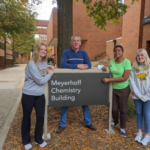
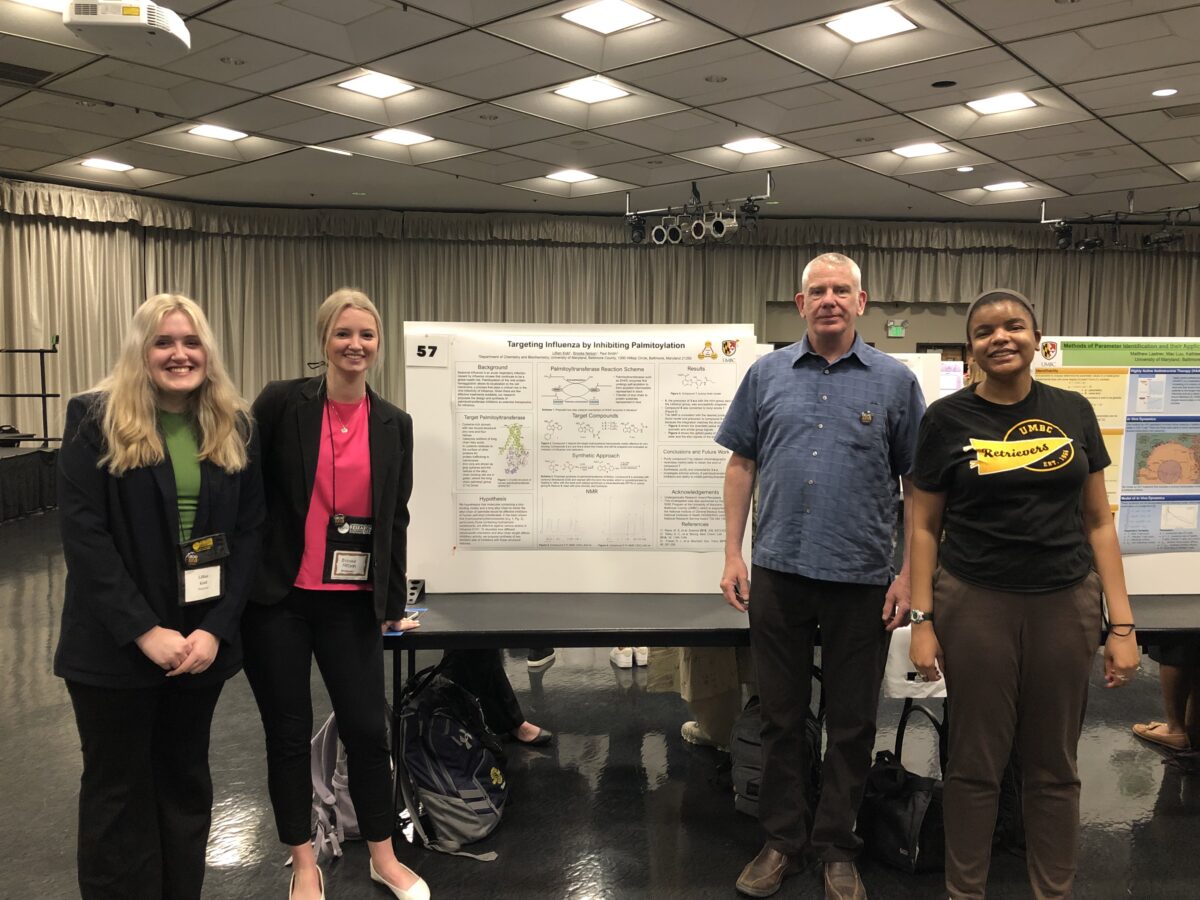 Paul Smith enjoys helping prepare his students to present at research conferences, such as UMBC’s Undergraduate Research and Creative Achievement Day, seen here in 2023. (Photo courtesy of Smith)
“Both of those experiences allowed me to immerse myself in research as an undergraduate,” Smith says, “so I think because of that, it’s always been important to me to include undergrads in the research that we do in my lab.”
Brian Cullum, professor and chair of chemistry and biochemistry, nominated Smith for the Braude Award. “Even with the significant potential health and environmental benefits that his ongoing research efforts can address, Dr. Smith continues to be dedicated first and foremost in his career to training undergraduate researchers in preparation for their future roles as independent scientists,” Cullum shares.
A focus on connections
Many advances in Smith’s career have come from interpersonal connections, both in his department at UMBC and with external researchers. When Duke chemist Kathy Franz discussed compounds to address antibiotic resistance in a seminar at UMBC, Smith recognized that her compounds included a similar structure to the molecules he was investigating for activity against influenza. He spoke to her after the talk, which eventually led to a collaboration and a promising new line of research in his lab.
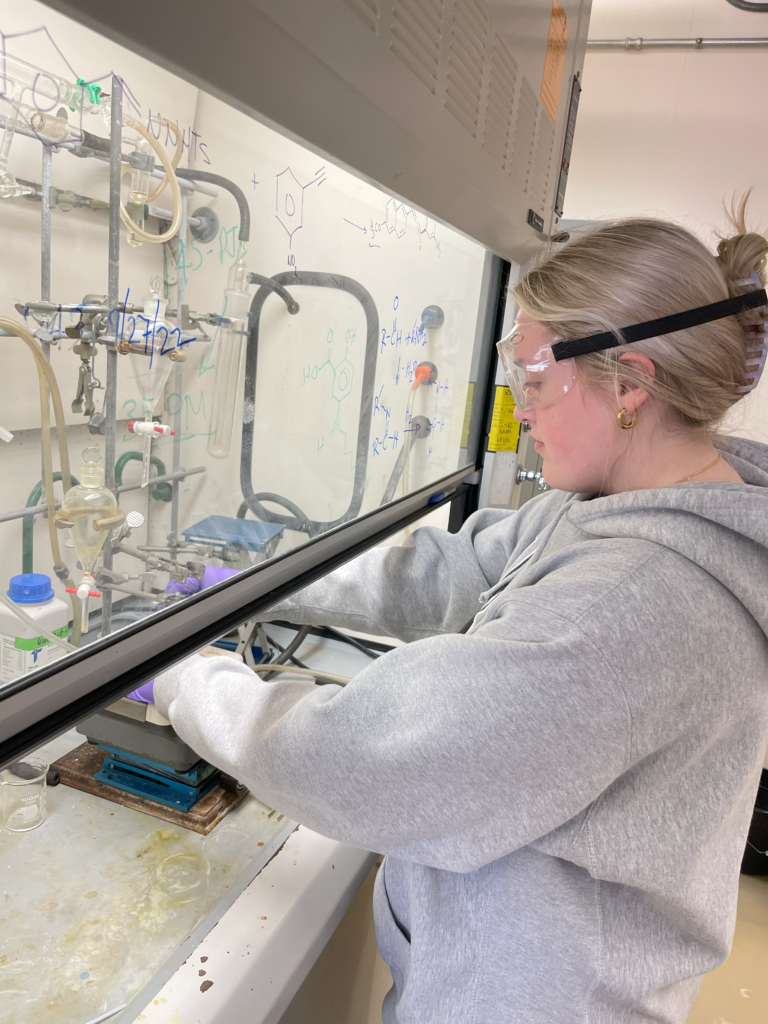 Lillian Kidd, who has received mentoring from Paul Smith, conducts an experiment in his lab. (Photo courtesy of Smith)
“Serendipity is the word of my career,” Smith jokes, although it’s not just luck. He encourages his students to attend as many seminars as possible, and he leads by example. “You’ll learn something at every talk, even if it’s far outside your field,” Smith says.
Lillian Kidd ’24, biochemistry and molecular biology, spent two years in Smith’s lab as an undergraduate, and as a result, she says she is dedicated to pursuing a career in designing and synthesizing therapeutic compounds. She will begin graduate school at Brown University this fall.
“Beyond learning fundamental research techniques in organic chemistry, Dr. Smith pushed me to think critically about every decision I made in the lab. He taught me how to transform core principles from coursework into reality, which has impacted my analysis skills and encouraged my curiosity,” Kidd says. “Dr. Smith’s mentorship emphasizes that success comes with integrity, deep understanding, and the ability to pivot when research does not work the way you thought it would.”
Shauna Kearney ’25, chemistry, has also benefited from Smith’s mentorship. She plans to pursue graduate school in organic chemistry based on her experiences in his lab.
“Being a member of Dr. Smith’s lab has allowed me to take ownership of my own research project as an undergraduate,” Kearney says. “While he helps me solve problems in the lab, he pushes me to think through them first and come up with my own solutions.”
Shared commitment
Smith’s personal commitment to supporting undergraduate research fits right into the fabric of UMBC. “I love our department, and I love UMBC,” he says. “I think one of our strengths, and what I tell students, is that they have a really good chance of getting into a lab—and my understanding is that’s fairly unique. But here, it’s unusual to find a lab that doesn’t have at least two or three undergrads.”
Smith’s equal dedication to his research and his students is exactly what the Braude Award selection committee looks for in nominees.
“I cannot imagine another individual more fitting for this prestigious award celebrating a faculty member’s tireless dedication to undergraduate research and training,” Cullum says. “Paul’s lifelong dedication to guiding undergraduate research and teaching his students to apply classroom concepts to solve challenges in their research projects embodies the ideal research mentor.”
]]>
For nearly three decades, Paul Smith has put undergraduate mentorship and the motivation of bettering human health at the forefront of his work. He’s been recognized for his efforts as the most...
https://umbc.edu/stories/paul-smith-braude-mentoring-award/
https://my3.my.umbc.edu/api/v0/pixel/news/142776/guest@my.umbc.edu/069ba839cb6a395bdcc492386c48c1b8/api/pixel
chembiochem
chemistry
chemistry-and-biochemistry
cnms
news
research
science-and-tech
story
undergraduate-research
UMBC News & Magazine
https://my3.my.umbc.edu/groups/umbc-news-magazine
https://assets1-my.umbc.edu/system/shared/avatars/groups/000/001/943/24435aa6207c452e7bc15cc74b42c7bb/xsmall.png?1748556657
https://assets1-my.umbc.edu/system/shared/avatars/groups/000/001/943/24435aa6207c452e7bc15cc74b42c7bb/original.png?1748556657
https://assets2-my.umbc.edu/system/shared/avatars/groups/000/001/943/24435aa6207c452e7bc15cc74b42c7bb/xxlarge.png?1748556657
https://assets2-my.umbc.edu/system/shared/avatars/groups/000/001/943/24435aa6207c452e7bc15cc74b42c7bb/xlarge.png?1748556657
https://assets3-my.umbc.edu/system/shared/avatars/groups/000/001/943/24435aa6207c452e7bc15cc74b42c7bb/large.png?1748556657
https://assets1-my.umbc.edu/system/shared/avatars/groups/000/001/943/24435aa6207c452e7bc15cc74b42c7bb/medium.png?1748556657
https://assets2-my.umbc.edu/system/shared/avatars/groups/000/001/943/24435aa6207c452e7bc15cc74b42c7bb/small.png?1748556657
https://assets1-my.umbc.edu/system/shared/avatars/groups/000/001/943/24435aa6207c452e7bc15cc74b42c7bb/xsmall.png?1748556657
https://assets2-my.umbc.edu/system/shared/avatars/groups/000/001/943/24435aa6207c452e7bc15cc74b42c7bb/xxsmall.png?1748556657
UMBC News & Magazine
2
0
false
Mon, 15 Jul 2024 13:12:05 -0400
Mon, 15 Jul 2024 13:12:05 -0400
Putting UMBC Research on the Map
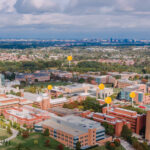
Spring on UMBC’s main campus brings a host of familiar sights and sounds: blooms on the magnolia trees, the chatter of red-winged blackbirds calling from the reeds around Library Pond, greening grass on the campus Quad, and black-and-gold-bedecked Grit Guides leading groups of prospective Retrievers around what may soon become a home away from home.
The guides cover the usual highlights—Academic Row, the Retriever Activity Center, the AOK Library, eating establishments, and residential halls. UMBC is a place to live, to learn, and to find community. And while some of the functions of campus spaces are obvious, others are often hidden.
Look more closely, and you’ll see faculty and students turning the everyday infrastructure and green oases of UMBC into out-of-the-ordinary laboratories. Beeswax sculptures, tactile maps, robots helping other robots—read on to discover some of the amazing ways Retrievers are using the campus itself for experiential learning and diverse research.
Written by: Catherine Meyers & Sarah L. Hansen, M.S. ’15

Two students wearing knee-high waders stand several meters apart in the middle of a rapidly flowing stream at the north end of UMBC’s campus. One releases a Ping-Pong ball, which bobs along with the current, as the second starts a timer, stopping it when the ball reaches his feet to determine the stream’s flow rate.
Nearby, another student measures the size of rocks in the streambed using a device called a gravelometer—a rectangular piece of metal with square holes of various sizes. The smallest hole a given rock will fit through becomes its measurement.
Farther along, other students capture photos that include reference posts on the stream bank. Each small group of students also takes measurements of the water depth at one-foot intervals along strings hung from one bank to the other. The students (with the help of specialized software) will use these measurements and photos to generate 3D models of the streambed.
“It’s a little DIY, but we get some amazing pictures,” says Charles Kaylor, the instructor and director of GIS and cartography labs in the Department of Geography and Environmental Systems (GES).
This is the “stream lab” in Exploring the Environment: A Geospatial Perspective, a course best known in the UMBC community for its semesterly launch of a dozen or so brightly-colored balloons that dot the campus skyline. Throughout the semester, students train their brains in the ways geographic data can help answer a wide range of research questions.
For the students, there are a range of perks to the course. “It’s cool to see different applications of computer science, which can sometimes feel pretty theoretical,” says George Rush ’24, computer science. Luke Thomas ’27, GES, who was partnered with Rush, is grateful for the senior’s support with the programming aspects of the coursework.
Rhonda Plofkin, Ph.D. student in GES and the graduate assistant for the class, concurs that having students with different strengths facilitates peer learning. “This is real-life stuff that geomorphologists do in the field,” she adds.
For some, the benefits are just as real, but simpler: “The cold water wakes me up,” Anthony Roytenberg ’24, computer science, says with a smile.
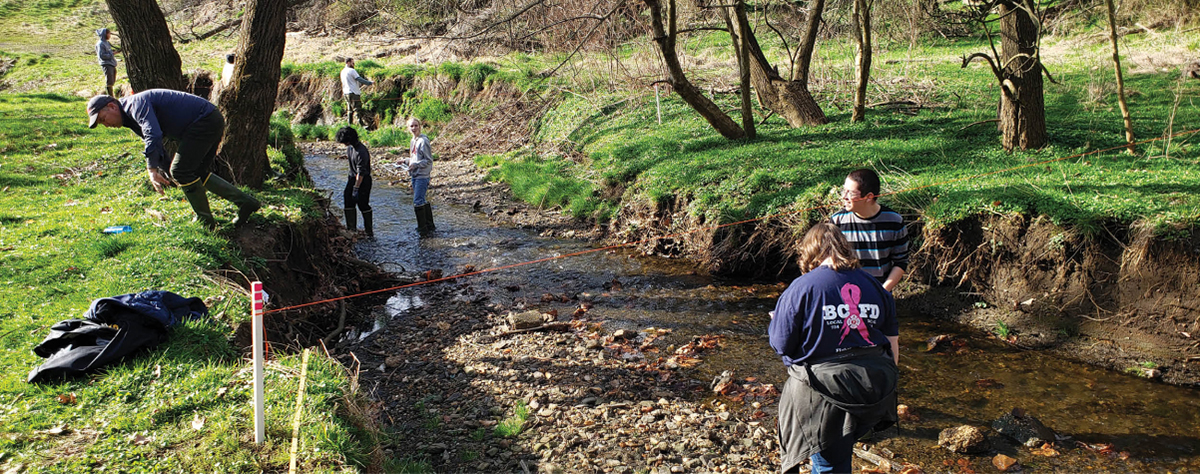 Students collect data that measure flow rate, depth, pebble size, and more as part of the “stream lab” in a popular, interdisciplinary GES course. Photo by Sarah Hansen, M.S. ’15.

When Alieh Rezaei arrived at UMBC from Iran, she couldn’t take her eyes off the ground. Almost immediately she was mesmerized by the flora and fauna of her new residence, and as an master of fine
arts student in the intermedia and digital arts (IMDA) program, she decided to incorporate pieces of UMBC into her artwork. She walked around campus, picking up windfalls of seeds and exploring hidden nooks of nature. A place that would come to be her sanctuary,
Rezaei, M.F.A. ’22, says, was Joseph Beuys Sculpture Park.
“The solidity of the stones alongside the growth of the oaksand the evolving shape of the garden reflect concepts of erosion and growth,” says Rezaei. “As an immigrant, I found solace in my attachment to the settled and solid stones, representing a sense of
grounding to me.”
Rezaei was drawn to UMBC’s M.F.A. program because of its multidisciplinary approach and the freedom she felt to choose an unconventional path. She praised Kathy O’Dell, IMDA professor emerita, who was her advisor. “Kathy was someone who—it was like I was floating in the air and Kathy held my hand and grounded me. She was very supportive for the whole journey.”
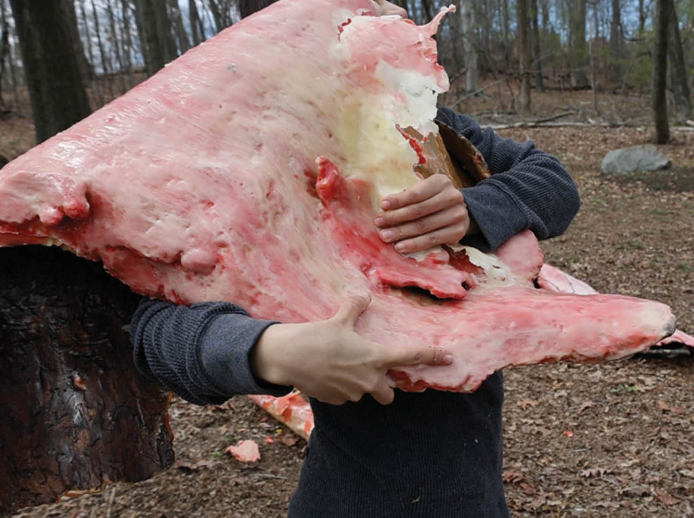
A photograph from Rezaei’s three-hour performance “The Tongue in the Landscape” at the Joseph Beuys Sculpture Park featuring the artist laboriously peeling the wax layer off the pieces of bark. Photo courtesy of Rezaei.
To create the art for her thesis project, Rezaei used almost exclusively materials collected on or near campus, including fallen tree bark, shattered wood, and seeds. She bought her main material—beeswax— from Baltimore beekeepers. One piece, “The Collective Womb,” featured hundreds of native seeds, called Devil’s Darning Needles, held together by beeswax around orange peels.
When the pieces were finished, Rezaei immediately knew the stage she wanted to showcase them on—Joseph Beuys Sculpture Park. “I installed my pieces there and had a performance as a way to extend the concept of public sculpture, aiming to reactivate the space and revive the concept of ecological engagement central to Beuys’ 7000 Oaks project.”

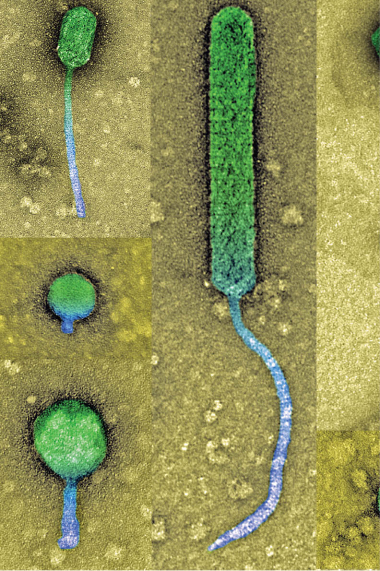
A composite of several microscope images of phages discovered by UMBC students in the Phage Hunters program demonstrates the variety of shapes phages can take. Photo by Tagide deCarvalho.
IchabodCrane. MindFlayer. Annihilus. TonyStarch. These are viruses previously completely unknown to science discovered by UMBC students in the Phage Hunters program, a two-course undergraduate genetics and bioinformatics sequence.
Since its launch in 2008, UMBC students have discovered 661 viruses that infect bacteria, called phages. Ninety-seven of them originated in samples collected on campus, with the most popular location being the Library Pond. Seventy-seven phages have been sequenced and 60 have been fully characterized and submitted to GenBank, an international digital repository of genetic and protein sequences.
Steven Caruso ’94, Ph.D. ’02, biological sciences, principal lecturer of biological sciences, runs the genetics course where the students collect samples, isolate their phages, image them with help from Tagide deCarvalho, “and growth,” says Rezaei. “As an immigrant, I found present their findings. They learn foundational laboratory techniques and get a taste for research.
Phage Hunters gives students “a first glimpse of what research is, with all that goes with it: determination, grit, inspiration, frustration, and more,” says Ivan Erill, professor of biological sciences and co-instructor for the bioinformatics course with Caruso. “Students get to see all the possible outcomes of a research project, from total success culminating in a DNA extraction for sequencing to failure to isolate a phage in the first place.”

In the basement of the Meyerhoff Chemistry Building, in a tiled expanse called the Molecular Characterization and Analysis Complex, sits a sleek, roughly human-sized instrument with the power to measure extremely tiny amounts of chemicals. Amanda Belunis, a chemistry Ph.D. student now in her final year, knows the instrument like an old friend, having turned to it to analyze a smorgasbord of UMBC water samples.
Belunis studies a group of chemicals called per- and polyfluoroalkyl substances, or PFAS. The chemicals are used in products as varied as makeup, clothing, and fire-fighting foam and are found in trace amounts in many water sources as well as in human blood. Dubbed “forever chemicals” because of the way they persist in the environment, they present a growing concern to human health.
Belunis’s research is part of a growing effort by scientists to understand how PFAS enter and travel through the environment and, ultimately, figure out ways to remove them.
To validate her procedures for measuring PFAS concentrations, Belunis tested water from drinking fountains, the sink in her chemistry lab, the pool, and the pond and streams around UMBC, all of which contained trace amounts of PFAS, as would be expected. Confident her methods worked on real-life samples, she then turned her attention to analyzing water in aquaculture fish tanks.
“My lab mates and I sometimes discuss how all of us have these chemicals in our bodies,” says Belunis. “It’s concerning, which is why we need to do more studies.”
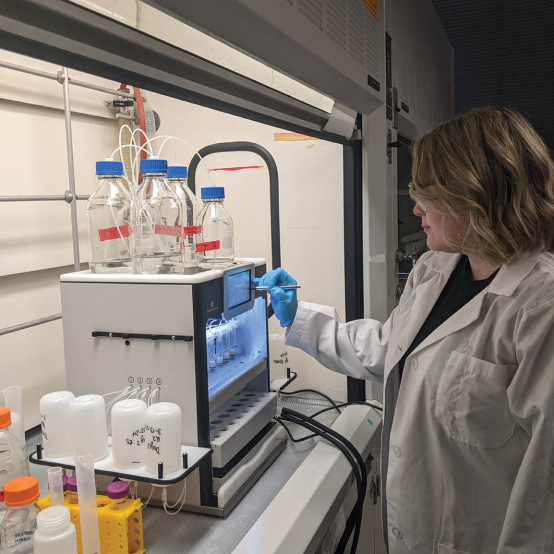
Amanda Belunis prepares samples for later analysis in the Molecular Characterization and Analysis Complex. Photo by Catherine Meyers.

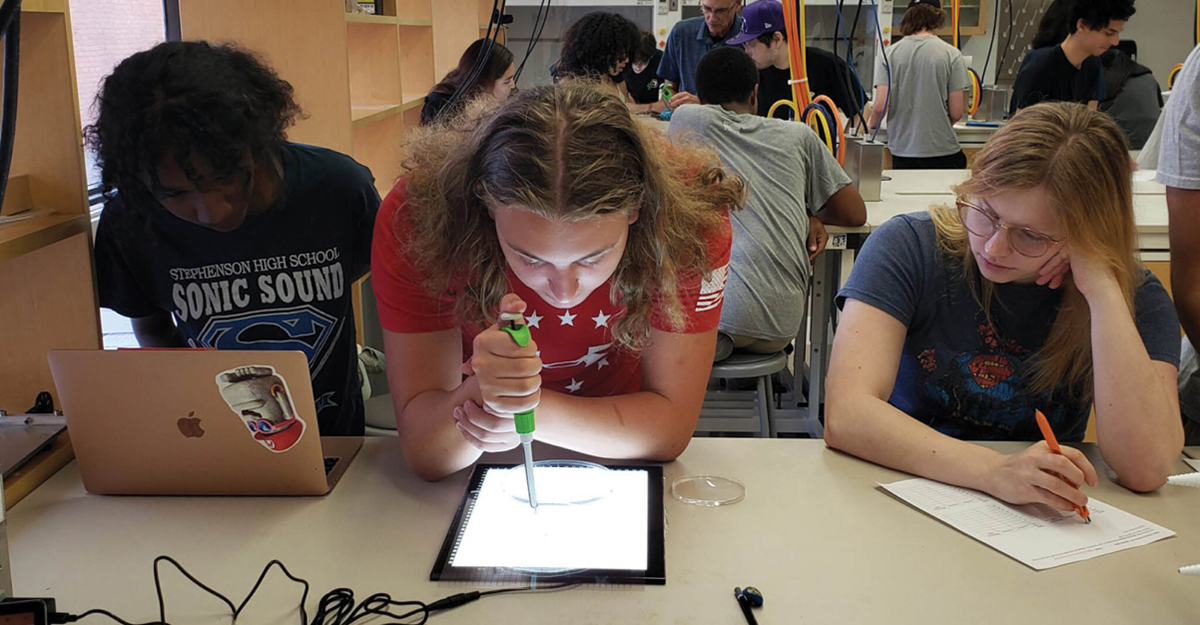 In addition to measuring buildings, students in Math in Action discovered other ways that math naturally interacts with their lives and studies. Here they are recording the movements of brine shrimp. Photo by Sarah Hansen, M.S. ’15.
When asked how to measure the height of a building, most students in Math in Action, a new laboratory course for non-STEM majors, “came up with various ways to measure the height directly—for example, by dropping down a string and then measuring the string or stacking up various objects,” says Alexis O’Malley ’18, mathematics and psychology, who teaches the lab.
But today, students are peering along the edges of homemade clinometers—plastic protractors with drinking straws attached—taking measurements from safely on the ground with a meter stick, and running simple calculations based on the properties of triangles to measure the height of UMBC’s Administration Building (123 feet, 2 inches).
Throughout the course, “I want students to see how math can be used to solve problems creatively,” O’Malley says.
Math in Action covers different math concepts each week through hands-on activities. The purpose of the clinometer activity is to remind students that “science is based on measurement, and you can build a tool to measure almost anything,” shares William R. LaCourse, dean of the College of Natural and Mathematical Sciences, who originally generated the idea for the course to help a wider range of students develop math skills relevant to their everyday lives. The course, he adds, “is a doorway to a lot of different math concepts.”

Shawn Abraham ’24, political science, has gotten lost on the UMBC campus more times than he can remember. As a blind student, he finds his way using a white cane, auditory cues, mental maps, and by asking people for directions. “People are surprised when I tell them, but big cities are much easier to navigate,” Abraham says. “College campuses are hard to get around.”
Tactile maps are one tool that could help. Erin Higgins and Kirk Crawford, Ph.D. students in human-centered computing, have recently been working with blind students at UMBC to create and test 3D-printed maps of campus.
The researchers launched the project after being approached by Michael Canale, assistant director of the Office of Student Disability Services. He says UMBC currently has four completely blind students enrolled and his office wants to provide personalized maps that each student can carry with them as they navigate campus. He’d also like to see a large 3D-printed map mounted somewhere on campus.
“A beautiful tactile map could be used by visitors of all kinds,” Canale said. “It’s the principle of universal design.”
Meanwhile, Md Osman Gani, an assistant professor of information systems, is spearheading a new project, named MyPath, to develop a Google Maps–style app to help wheelchair users navigate campus.
“Uneven surfaces, discontinuous sidewalks, and steep slopes can make wheelchair travel challenging, and even impossible” Gani says. The MyPath app would help by providing users with personalized turn-by-turn navigation with real-time updates. The app will rely on a machine learning model that recognizes path accessibility conditions based on crowd-sourced data, and Gani is currently recruiting wheelchair users to contribute data using their smartphones.
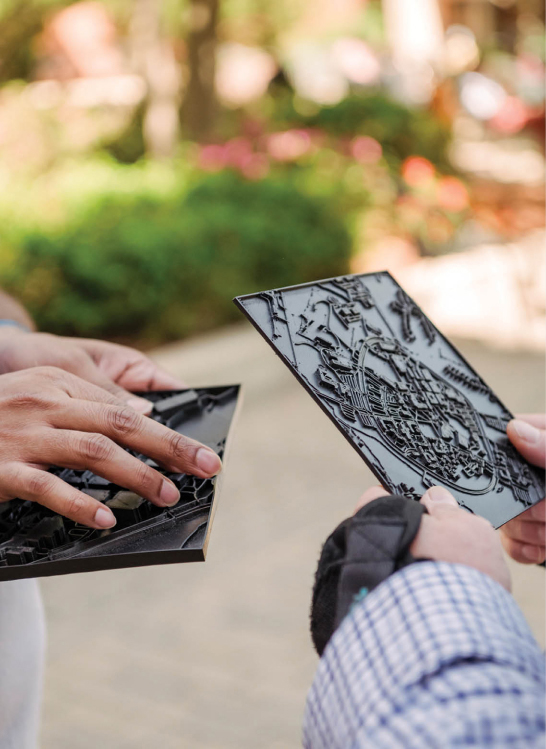
Shawn Abraham (left) tests prototype tactile maps made with 3-D printers with Michael Canale (right).

It’s 7 a.m. in July, and Megan Curtiss ’23, GES, is standing next to a tree just outside The Loop on UMBC’s southeast corner. It’s wrapped in a thin metal band at about chest height. Curtiss carefully measures the small gap between the two ends of the band with digital calipers three times, takes the average, and then moves on to the next tree. Only 98 to go.
This scene played out weekly from March to October 2023 as Curtiss collected data for a study led by Matthew Baker, GES professor, and Nancy Sonti, a research ecologist with the U.S. Forest Service. “It became like a morning meditation,” Curtiss shares.
The metal bands, call dendrobands, “are a cheap and easy way to get pretty detailed information,” Curtiss says. By measuring the trees’ growth over time, the goal is to look at how trees of different species and in different immediate environments (such as a parking lot versus a forest) handle conditions like fluctuating temperatures and water availability.
After attending Anne Arundel Community College in her 30s, Curtiss then found a home at UMBC. She began working with Baker in fall 2022 and will enter the GES master’s program at UMBC this fall. A graduate degree was not something Curtiss originally planned on, but now she’s excited about the further experiences it will bring. “I’m looking forward to the unexpected,” Curtiss says.

Take a left off Hilltop Circle, just past the greenhouse on the right and toward the Walker Avenue apartments, and you’ll find yourself outside a traditional brick building that used to house trial rooms and detention cells. In 2021, UMBC turned this former courthouse into the main hub for the Center for Real-time Distributed Sensing and Autonomy (CARDS). Researchers here develop artificial intelligence-enabled smart robots for military and search-and-rescue operations.
On a sunny day in spring, you will likely see students gathered in the courthouse’s “backyard,” huddled around dog-like Spot robots and wheeled vehicles called Jackals and Huskies.
The researchers outfit the robots with a host of custom devices, such as cameras and radar to sense their surroundings and microprocessors to run on-board algorithms. While the robots can be commanded via voice and gesture, the ultimate goal is for them to operate mostly autonomously.
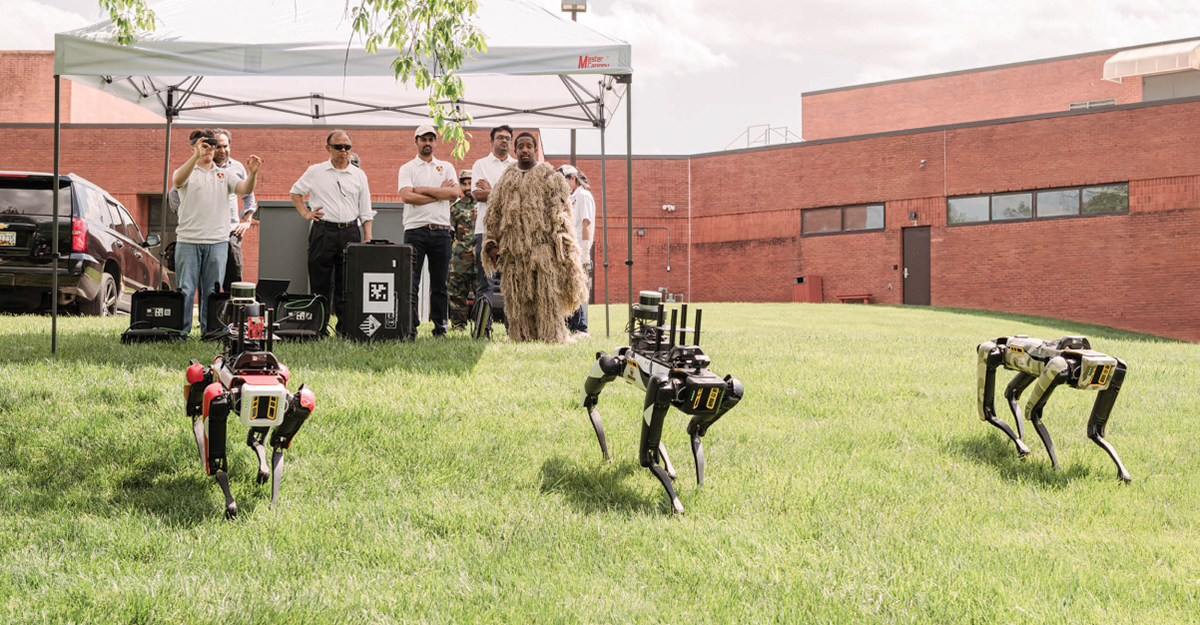 On the back lawn of the courthouse building, student researcher Kevin Rippy, left, controls three Spot robots with gestures. Another student stands by in a ghillie suit, a type of camouflage clothing.
Recently, the team has demonstrated this capability by verbally assigning the robots the task of jointly surveying a given area. The robots must translate the instructions from plain English into machine-level commands, divide up duties, detect and avoid obstacles, come to a fellow robot’s aid in the case of unexpected problems, and identify and keep track of the objects and people within their assigned perimeter.
“People from around campus will see us testing and will stop to watch,” says Aryya Gangopadhyay, a professor in information systems who directs CARDS. “The robots are an attention getter.”

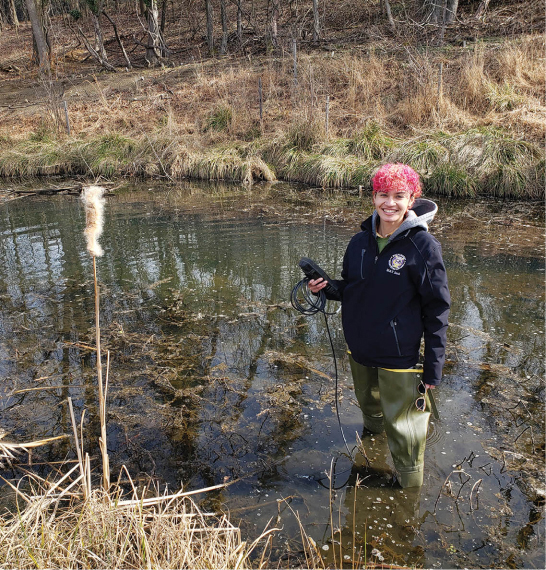
Erin Hamner collected weekly water quality data from this stream for six months, using the battery-powered digital probe she’s holding. (Image by Sarah L. Hansen, M.S. ’15)
After traipsing across a swampy field between research sites, Erin Hamner ’22, GES, and a current master’s student in the Interdisciplinary Consortium for Applied Research in the Environment program, scampers down a streambank in thigh-high waders and plunges a battery-powered probe into the water. It reports concentrations of ammonia and nitrates—key water quality measures. The probe also measures the water’s conductivity, which indicates the level of ions, such as salts used to melt snow.
It’s beautiful out today, but Hamner completed the trek to a dozen campus sites weekly from September 2023 to February 2024, sometimes dealing with mud, snow, or rain. The goal of her master’s thesis is to confirm that stormwater management features UMBC has installed to reduce flooding, filter storm runoff, and otherwise improve water quality are working as intended—or if they aren’t, to suggest improvements.
Hamner and her collaborators in Facilities Management and the Office of Sustainability want to see the data collection effort continue after she graduates. So she is working with faculty in GES to incorporate crowd-sourced stormwater monitoring into the undergraduate curriculum, including generating a public dashboard.
“Erin has done incredible groundwork collecting water quality data across our campus, generating useful data that can tell us about the health of UMBC’s waterways,” says Taylor Smith, assistant director of sustainability.
Long-term data will help the university “see how our development affects our watershed so we can continue to be good stewards,” Smith adds, noting that, “data like Erin’s can help us advocate for more greenspace and stream buffers around campus.”
]]>
Spring on UMBC’s main campus brings a host of familiar sights and sounds: blooms on the magnolia trees, the chatter of red-winged blackbirds calling from the reeds around Library Pond, greening...
https://umbc.edu/stories/putting-umbc-research-on-the-map/
https://my3.my.umbc.edu/api/v0/pixel/news/142303/guest@my.umbc.edu/93196282138c9d99f3c2930689edf3cd/api/pixel
biological-sciences
cahss
campus-life
cards
chemistry
cnms
coeit
computer-science
feature
ges
humancentered-computing
icare
imda
information-systems
joseph-beuys
magazine
mathematics
political-science
psychology
science-and-tech
sds
spring-2024
story
UMBC News & Magazine
https://my3.my.umbc.edu/groups/umbc-news-magazine
https://assets1-my.umbc.edu/system/shared/avatars/groups/000/001/943/24435aa6207c452e7bc15cc74b42c7bb/xsmall.png?1748556657
https://assets1-my.umbc.edu/system/shared/avatars/groups/000/001/943/24435aa6207c452e7bc15cc74b42c7bb/original.png?1748556657
https://assets2-my.umbc.edu/system/shared/avatars/groups/000/001/943/24435aa6207c452e7bc15cc74b42c7bb/xxlarge.png?1748556657
https://assets2-my.umbc.edu/system/shared/avatars/groups/000/001/943/24435aa6207c452e7bc15cc74b42c7bb/xlarge.png?1748556657
https://assets3-my.umbc.edu/system/shared/avatars/groups/000/001/943/24435aa6207c452e7bc15cc74b42c7bb/large.png?1748556657
https://assets1-my.umbc.edu/system/shared/avatars/groups/000/001/943/24435aa6207c452e7bc15cc74b42c7bb/medium.png?1748556657
https://assets2-my.umbc.edu/system/shared/avatars/groups/000/001/943/24435aa6207c452e7bc15cc74b42c7bb/small.png?1748556657
https://assets1-my.umbc.edu/system/shared/avatars/groups/000/001/943/24435aa6207c452e7bc15cc74b42c7bb/xsmall.png?1748556657
https://assets2-my.umbc.edu/system/shared/avatars/groups/000/001/943/24435aa6207c452e7bc15cc74b42c7bb/xxsmall.png?1748556657
UMBC News & Magazine
1
0
false
Thu, 30 May 2024 10:42:29 -0400
Thu, 30 May 2024 10:42:29 -0400
Meet a Retriever—Noah Cruz ’24, first-generation scholar and mentor
Meet Noah Cruz, a senior pursuing B.S. degrees in both psychology and biological sciences on the pre-med/Ph.D. track. As a first generation student and a member of multiple scholars programs, Noah takes part in student organizations and undergraduate research while also following his passions of advocating for underrepresented students in STEM (science, technology, engineering, and mathematics) fields. We can’t wait to see where Noah goes from here, and we’re excited to share his story.
Q: Tell us about yourself. What would you want another Retriever to know about you?
A: I am a senior concurrently pursuing dual bachelor of science degrees in psychology and biological sciences, complemented by minors in chemistry and photography on the Pre-M.D./Ph.D. track. I take pride in being a first-generation Salvadoran American student, and I am a strong advocate for underrepresented students in STEM. I am from Rockville, Maryland, and went to Northwood High School where I earned my associates degree and high school diploma concurrently.
I am also one out of 200,000 patients with a rare blood disorder called idiopathic thrombocytopenic purpura. Idiopathic means “of unknown cause.” This highlights the importance of bridging the gap within the immunological field of research, and drives me toward pursuing a career in the biomedical sciences!
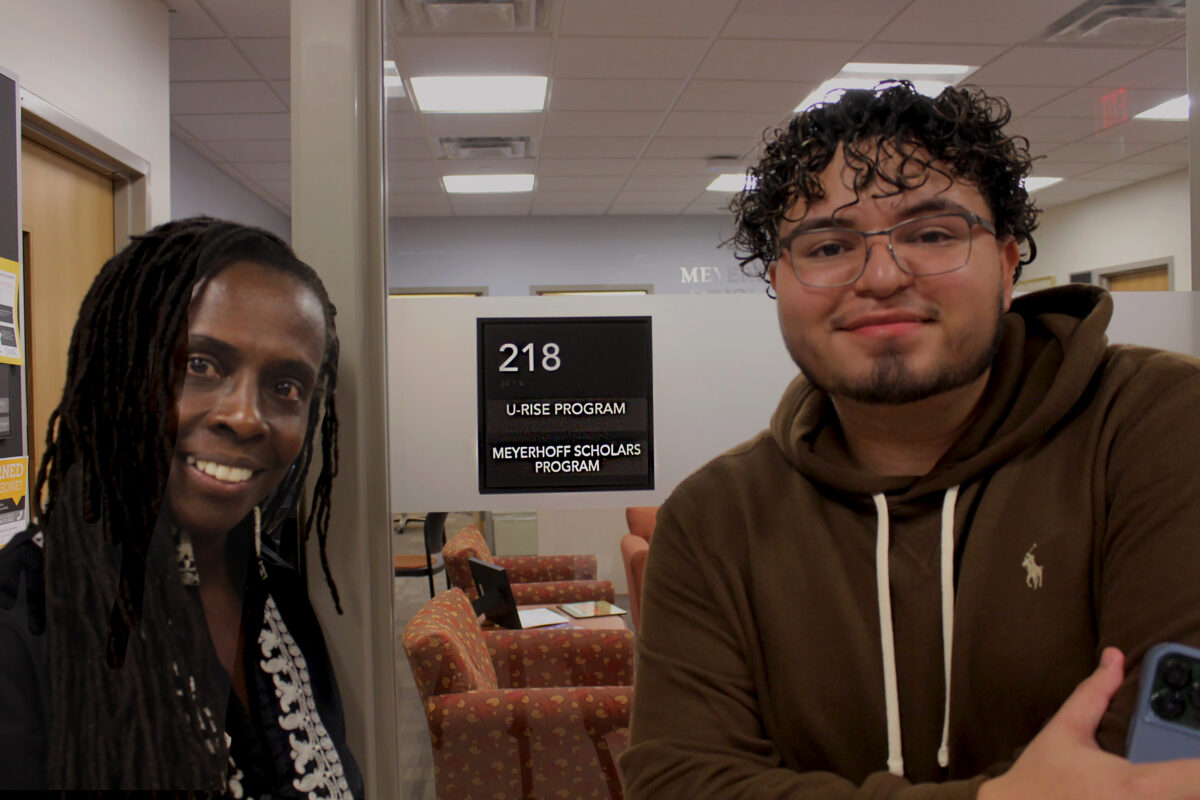 Noah Cruz (right) with Jacqueline King, associate director of the U-RISE Program (left), in front of the Meyerhoff and U-RISE Scholars Program Office. Photo courtesy of Cruz.
Q: Tell us about someone in the community who has inspired you or supported you, and how they did it.
A: There are numerous individuals who come to mind, and I am truly grateful for their unwavering support throughout my academic journey. Among them, Dr. Jacqueline King stands out as a cornerstone of support in my experience at UMBC. She has not only served as my advisor but has also been my steadfast advocate and personal cheerleader for all my accomplishments. Her inspiration has propelled me forward on the challenging path of higher education.
Another significant supporter of my aspirations is Dr. Charles Bieberich. His unwavering support, mentorship, and profound knowledge of the scientific field have been instrumental in motivating me to pursue my M.D./Ph.D. journey. I also extend my heartfelt thanks to Dr. Diana Hamilton. She not only supervises my principles of chemistry teaching assistantship but also provides unwavering support for all my academic pursuits.
Additionally, I must express my gratitude to Dr. Sarah Leupen for her invaluable support in my academic endeavors. Each of these individuals saw potential in me that I often failed to recognize within myself. As a first-generation student navigating the complexities of higher education, their investment in my education—offering support, mentorship, and words of encouragement—has made an indelible impact on my journey. I cannot express my appreciation enough for their contributions to my academic success.
Q: What do you love most about your academic program or an organization you’re involved in?
A: UMBC’s psychology and biology departments have played a pivotal role in shaping my academic journey, and I couldn’t be more appreciative of the invaluable resources and experiences they have provided me. One of the aspects I truly love about this academic program is the seamless integration of interdisciplinary approaches within the psychology and biology departments. One of the standout features of this program is how it effectively connects the dots between neuroscience, behavioral pathology, genetics, and biology.
As a first-generation student navigating the complexities of higher education, their investment in my education—offering support, mentorship, and words of encouragement—has made an indelible impact on my journey.
Noah Cruz ’24
This holistic approach has not only broadened my horizons but has also allowed me to harness the power of knowledge across these fields to enhance my own research. Whether it’s understanding the intricacies of brain function or delving into the biological underpinnings of behavior, UMBC’s program has provided me with a well-rounded education that I can leverage in my academic pursuits.
Currently, I am fortunate to be involved in neuroscience clinical research at the University of Maryland School of Medicine. The foundation laid by UMBC’s program has been instrumental in my ability to contribute effectively to this research. The skills, knowledge, and interdisciplinary perspective I gained from my time in UMBC’s psychology and biology departments have proven to be a significant advantage in my work at the School of Medicine.
Q: Since you’ve been a part of the UMBC community, how have you found support of your WHY?
A: During my time at UMBC, Peter DeCrescenzo played an indispensable role in jumpstarting my academic and career journey. As a newcomer to the university and a Louis Stokes Alliance for Minority Participation (LSAMP) Scholar, I was initially unaware of the vast opportunities and resources available to me in the field of biomedical research and academia. Peter’s guidance and support proved to be transformative in several ways. Firstly, he provided me with invaluable guidance on crafting a compelling resume—a crucial tool in presenting myself as a competitive candidate for various academic and research endeavors.
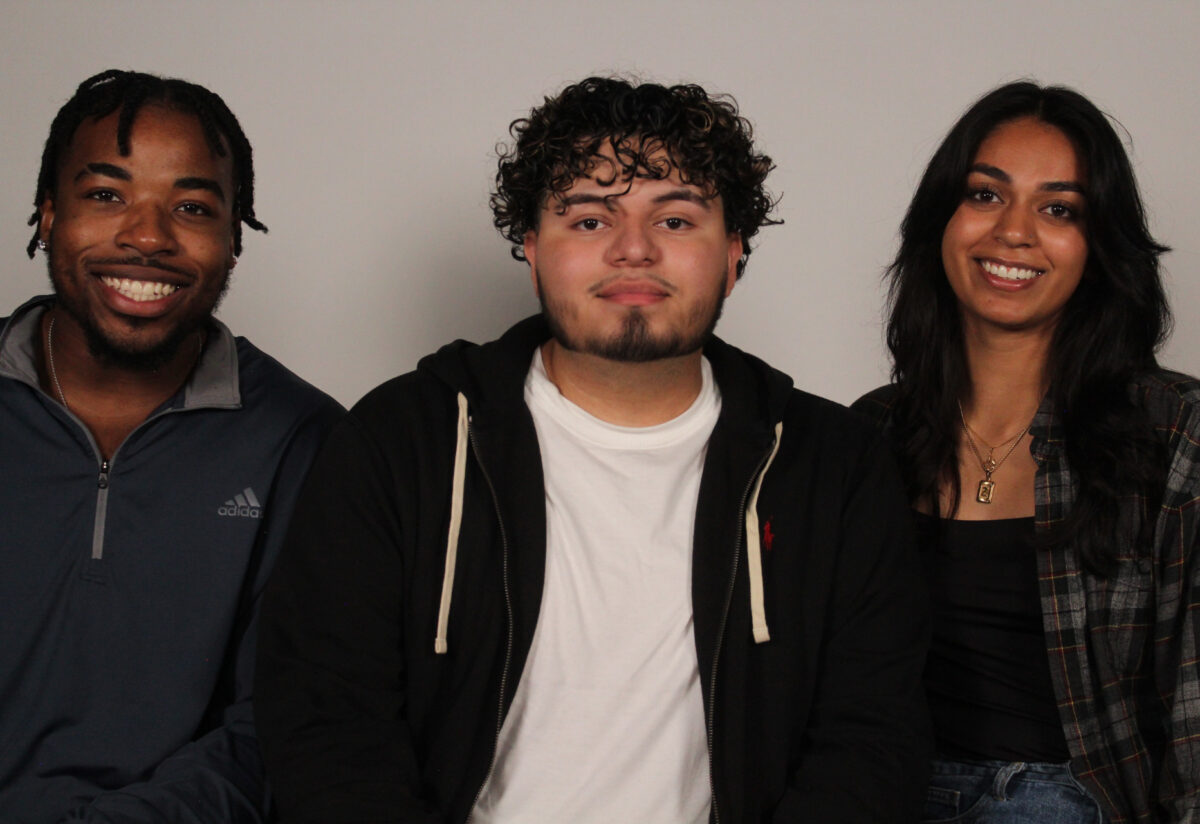
Cruz states that much of his success could be attributed to his strong support system among his close friends, including (L-R): Arian Nyandjo’24, Noah Cruz’24, Zainab Bharmal’24, and Chioma Iheacho’24 (not pictured). Photo courtesy of Cruz.
Additionally, Peter equipped me with the skills necessary to create engaging and informative poster presentations, an asset that would prove indispensable in showcasing my research projects. He also encouraged me to explore and apply to other scholars’ programs, ultimately leading to my acceptance into the U-RISE Program, a significant milestone in my academic journey.
Overall, Peter’s unwavering support and mentorship initiated a pathway to academic excellence that I had never imagined. His guidance not only imparted practical skills but also instilled in me the confidence to pursue my academic goals. Peter DeCrescenzo’s dedication to my growth at UMBC made a profound difference in my academic journey and played a pivotal role in shaping my career in biomedical research and academia.
Q: What clubs, teams, or organizations are you a part of? What do you love about them and why?
A: I am an active member of two significant organizations at UMBC, and each role holds special meaning for me. Firstly, as the Meyerhoff Scholars lead peer advisor, I have the incredible opportunity to serve as a mentor and guide to incoming first-year and sophomore students, assisting them as they embark on their college journey. What I truly cherish about this role is the chance to share my own experiences and knowledge with these students, offering them valuable insights and personal support to succeed academically and personally.
One of the most rewarding aspects of being a lead peer advisor is assisting students with their applications for scholarships, internships, and research positions. I am deeply passionate about helping students navigate the intricate and competitive application procedures, ensuring that underrepresented minority students are consistently represented in science-related settings.
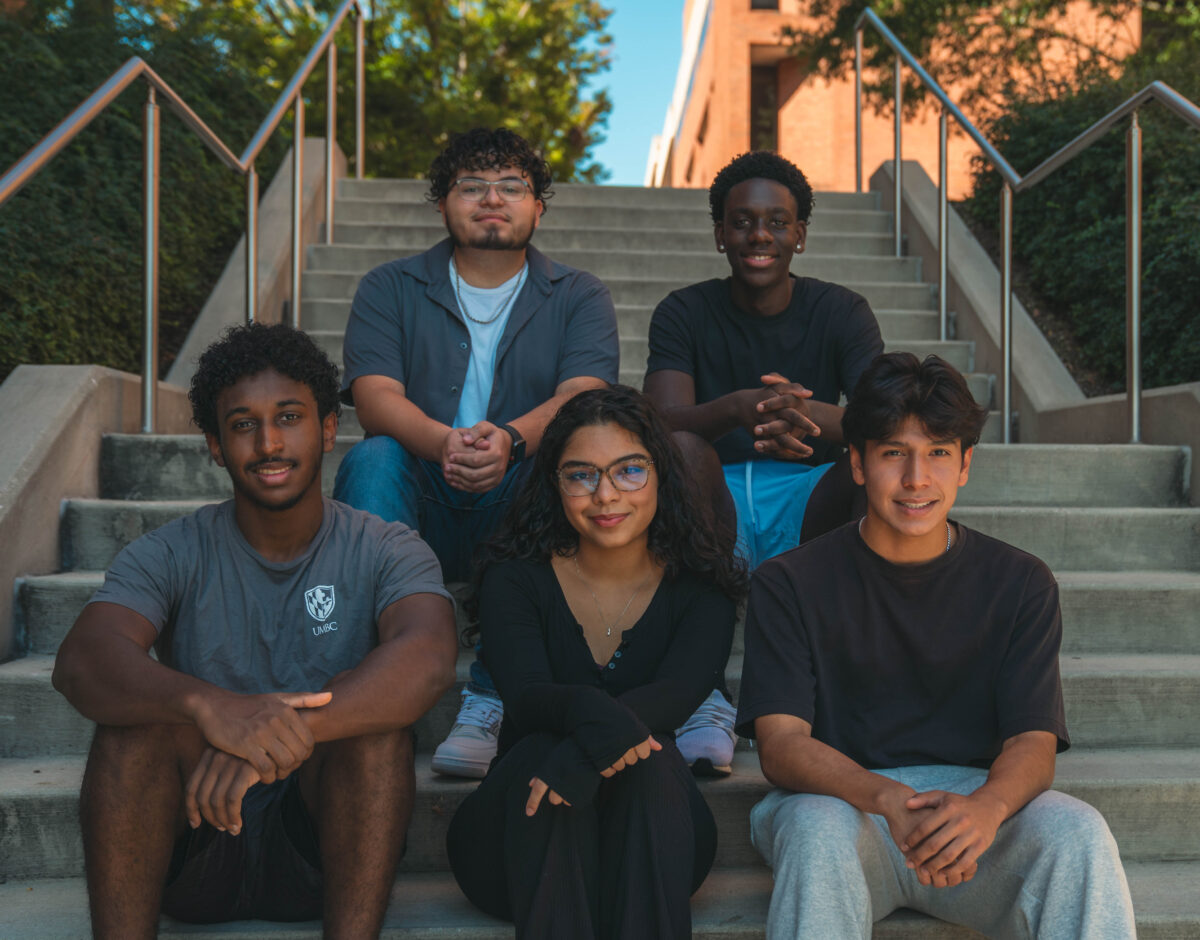 Cruz with his advisees, including students from the Meyerhoff, U-RISE, LSAMP, and McNair Scholars programs. Bottom (L-R): Emmanuel Mekasha ’25, Lesley Hernandez ’25, Christian Verastegui ’25. Top (L-R): Noah Cruz ’24, Maxwell Amoh-Mayes ’26. (Photo courtesy of Julianna Falconer’24)
Secondly, my role as vice president of the Society of Advancing Chicanos/Hispanics & Native Americans in Science (SACNAS) holds a special place in my heart. SACNAS is dedicated to promoting diversity and inclusion in STEM fields, and as VP, I play a pivotal role in building a supportive community for underrepresented students. Organizing events, creating networking opportunities, and collaborating with like-minded individuals to advance our mission is both fulfilling and impactful. It’s inspiring to see students from diverse backgrounds come together to pursue their passions in science while breaking down barriers and stereotypes.
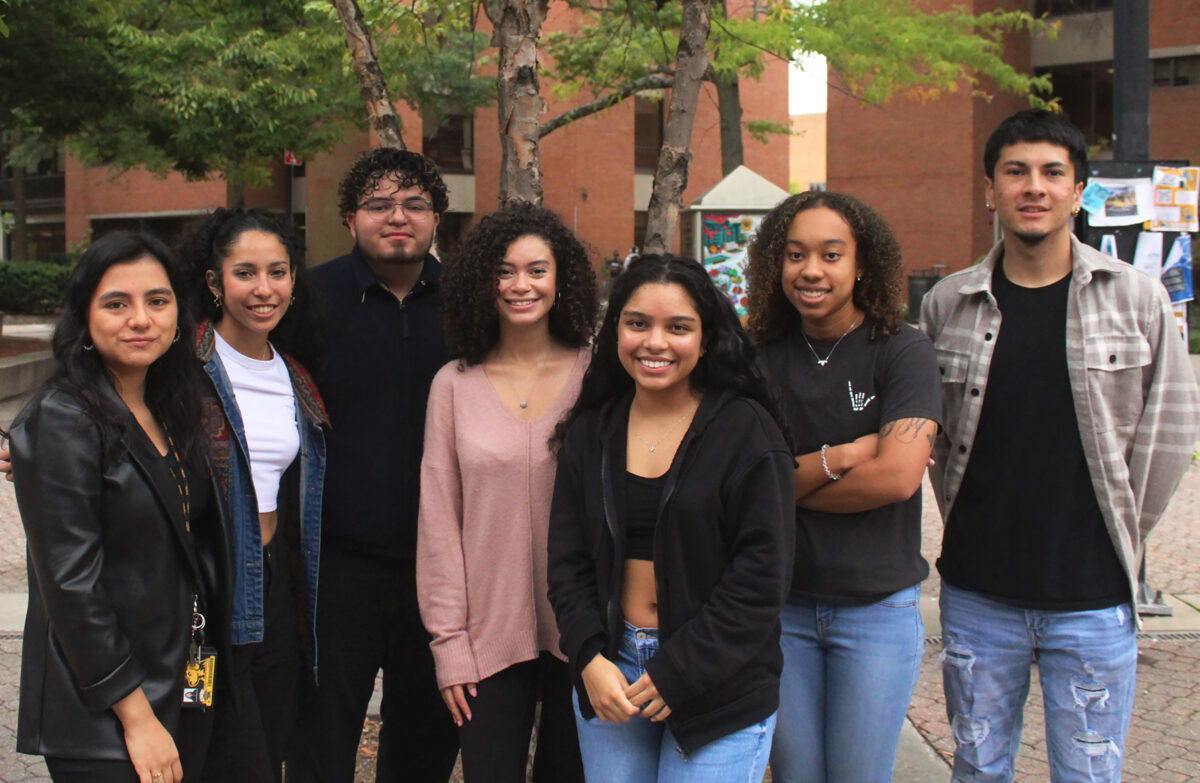 UMBC’s Society of Advancing Chicanos/Hispanics and Native Americans in Science (SACNAS) E-board, from left to right: Isabella Salguero Cespedes (Hispanic/Latino Student Council Representative), Isabella Lopez (Event Coordinator), Noah Cruz (Vice-President), Tatiana Perez (President), Lesley Hernandez (Treasurer), Viviana Smart (Secretary), Eduardo Ramirez (Social Media & Promotion Chair). Photo courtesy of Cruz.
Q: As a first-generation college student, what would you tell others who are in your shoes about UMBC?
A: Navigating the world of secondary education, especially as the first in my family to graduate high school and attend college, was undoubtedly an intimidating and overwhelming experience. One piece of advice I would offer to others in my shoes about UMBC is the critical importance of building a solid support system. Throughout my college journey, I found that my advisors and supporters played a pivotal role in my success.
These mentors believed in me from day one, providing guidance, encouragement, and a sense of belonging on campus. Having a support system is like having a lifeline when facing the myriad challenges that college life can present. They can offer valuable insights into academic decisions, personal development, and even career choices. Advisors and mentors can help you navigate the complexities of course selection, major choices, and extracurricular activities, ensuring that you make informed decisions that align with your goals.
* * * * *
UMBC’s greatest strength is its people. When people meet Retrievers and hear about the passion they bring, the relationships they create, the ways they support each other, and the commitment they have to inclusive excellence, they truly get a sense of our community. That’s what “Meet a Retriever” is all about.
Learn more about how UMBC can help you achieve your goals.
]]>
Meet Noah Cruz, a senior pursuing B.S. degrees in both psychology and biological sciences on the pre-med/Ph.D. track. As a first generation student and a member of multiple scholars programs, Noah...
https://umbc.edu/stories/meet-a-retriever-noah-cruz-24-pre-med/
https://my3.my.umbc.edu/api/v0/pixel/news/136045/guest@my.umbc.edu/673759723ca75ac6122d46b7cbb3ef81/api/pixel
biological-sciences
chemistry
magazine
meet-a-retriever
psychology
visualarts
UMBC News & Magazine
https://my3.my.umbc.edu/groups/umbc-news-magazine
https://assets1-my.umbc.edu/system/shared/avatars/groups/000/001/943/24435aa6207c452e7bc15cc74b42c7bb/xsmall.png?1748556657
https://assets1-my.umbc.edu/system/shared/avatars/groups/000/001/943/24435aa6207c452e7bc15cc74b42c7bb/original.png?1748556657
https://assets2-my.umbc.edu/system/shared/avatars/groups/000/001/943/24435aa6207c452e7bc15cc74b42c7bb/xxlarge.png?1748556657
https://assets2-my.umbc.edu/system/shared/avatars/groups/000/001/943/24435aa6207c452e7bc15cc74b42c7bb/xlarge.png?1748556657
https://assets3-my.umbc.edu/system/shared/avatars/groups/000/001/943/24435aa6207c452e7bc15cc74b42c7bb/large.png?1748556657
https://assets1-my.umbc.edu/system/shared/avatars/groups/000/001/943/24435aa6207c452e7bc15cc74b42c7bb/medium.png?1748556657
https://assets2-my.umbc.edu/system/shared/avatars/groups/000/001/943/24435aa6207c452e7bc15cc74b42c7bb/small.png?1748556657
https://assets1-my.umbc.edu/system/shared/avatars/groups/000/001/943/24435aa6207c452e7bc15cc74b42c7bb/xsmall.png?1748556657
https://assets2-my.umbc.edu/system/shared/avatars/groups/000/001/943/24435aa6207c452e7bc15cc74b42c7bb/xxsmall.png?1748556657
UMBC News & Magazine
3
0
false
Thu, 05 Oct 2023 11:27:59 -0400
Thu, 05 Oct 2023 11:27:59 -0400
Why does your hair curl in the summer? A chemist explains the science behind hair structure

Written by Tara S. Carpenter, principal lecturer of chemistry and biochemistry, UMBC
If you have curly hair, you know that every day is a new adventure. What will my hair do today? Why does it curl better on some days than others? And even those without naturally curly hair might notice their hair curling – or, let’s be honest, frizzing – a bit on humid summer days.
As a person with curly hair, I’m always looking for the best way to care for and understand my hair. As a chemist, I’m interested in the science behind how my hair behaves at the molecular level. There are different hair types, from straight to curly, and they behave differently depending on their structure. But what hairs are made up of at the molecular level is the same.
Hair structure
Hair begins growing under the skin’s surface, but it’s what happens after it pokes through the skin that determines whether you have a good hair day or a bad one.
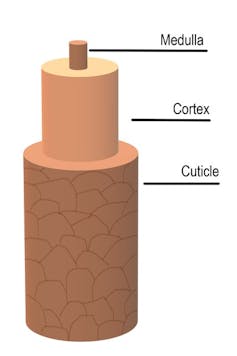 The three layers of hair. (Image by Christinelmiller/Wikimedia Commons, CC BY-SA)
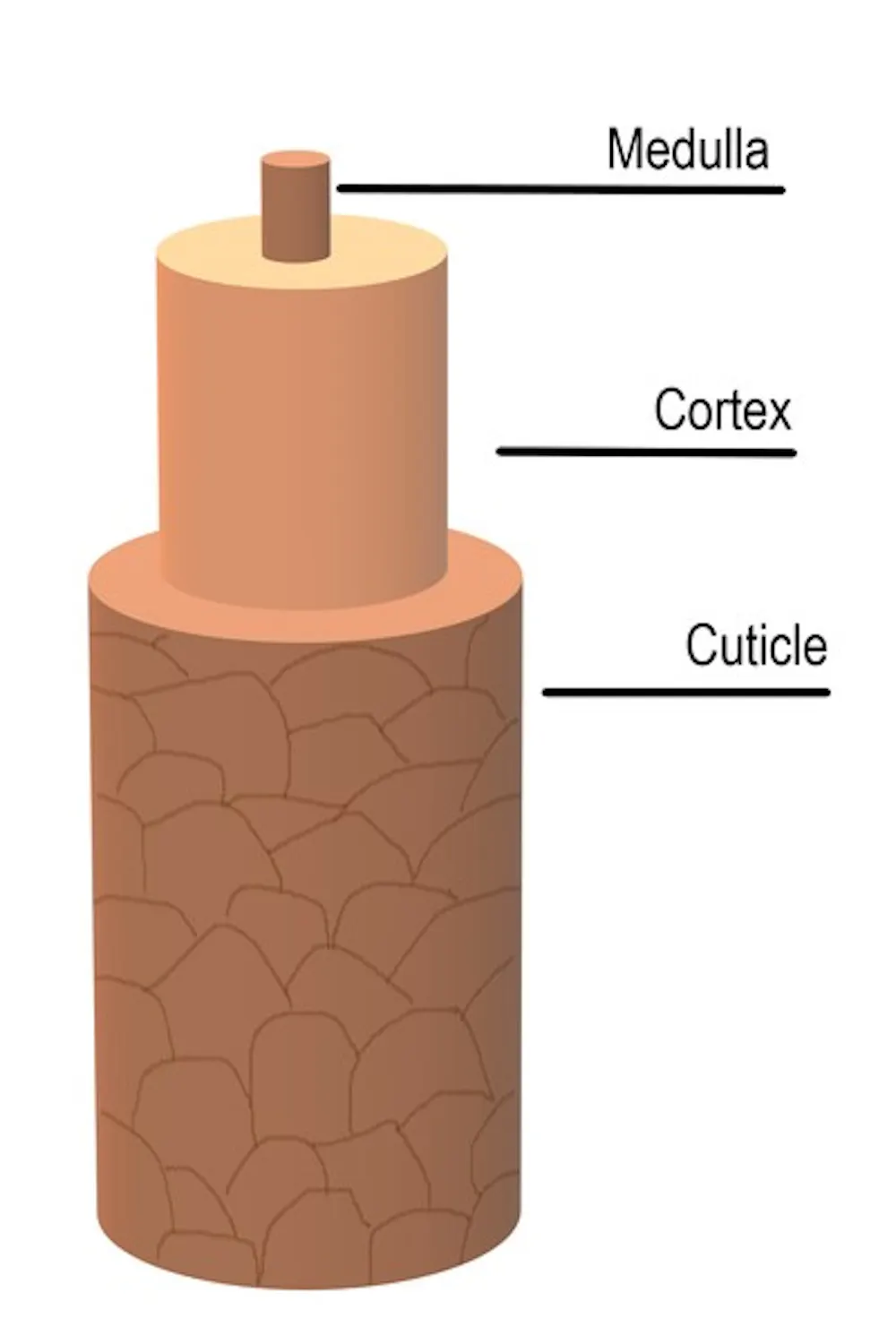
Each hair can have three layers – the medulla, the cortex and the cuticle. You can think of each hair like a tiny tree trunk.
The innermost, or core layer, is the medulla. This layer holds moisture, much like the pith in the center of a tree trunk. This layer is also very fragile, but only thick or coarse hairs contain this part – so those with thin or blond hair typically don’t have the medulla layer in their hairs.
Next is the cortex, which makes up most of a hair and is analogous to the wood of a tree. The cortex is made up of spring-shaped protein molecules that lie in parallel rows in a cylindrical bundle. The exact shape of that bundle is determined by the hair follicle, which is a pore on the skin from where the hair grows.
How the hair grows out of the follicle influences the distribution of its proteins. So a straight follicle produces straight hair and a curved follicle produces curly hair. The less evenly distributed the squiggly proteins are, the curlier the hair. Your genetic code also plays a role in the shape of the cortex and, therefore, the shape and thickness of your hair.
Lastly, the outermost layer of a hair is called the cuticle. The cuticle is like the bark of a tree – and it even looks like bark under a microscope.
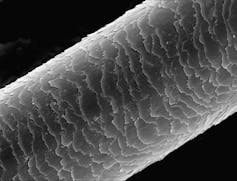 A hair’s cuticle under a microscope. (Image by Lauren Holden, CC BY-SA)
It’s the cuticle’s job to protect the cortex, but the cuticle is very easily damaged. Imagine lifting or removing the bark from a tree. Doing so would leave the wood inside susceptible to moisture loss, exposure to the environment and damage.
The same is true for each hair. When the cuticle is damaged from brushing, chemicals, wind or heat, the proteins of the cortex have a much more difficult time lying smoothly together. This means they can lose moisture, gain moisture, fray like a rope – this causes split ends – and even break. All these factors can influence how your hair looks at any given moment.
Hair in the summer
So what does all of this have to do with humidity? Well, hair proteins contain many permanent chemical bonds. Only chemical treatments like perms or straightening can change these bonds. But there’s another natural phenomenon that keeps the protein molecules in the cortex in line – something called hydrogen bonding.
The long, stringy protein molecules in the cortex contain tiny positive and negative charges throughout their structure. Because opposite charges attract each other, entire rows of proteins can be attracted to each other like tiny, weak magnets.
Heating or wetting your hair breaks the magnetlike attraction between these rows of proteins. So, heat and water can rearrange the proteins in your hair by breaking the hydrogen bonds that keep their structure together.
How hydrogen bonds form.
Water is one of the best molecules at hydrogen bonding. So when a molecule of water has the opportunity to hydrogen bond with something, it will.
In your hair, water can form hydrogen bonds between the rows of proteins in your hair’s cortex. It is the extent to which this happens that determines your hair’s fate.
When just a little water enters the hair, like it might in lower humidity conditions or when the cuticle is healthy and able to keep too much water out of the cortex, your hair may curl. When humidity is high, or the cuticle is damaged, more water enters the hair. Too much water can swell and crack the cuticle, making hair look frizzy.
Many people consider high humidity to be the problem behind frizzy hair, but styling your hair under high humidity and then entering a less humid environment can also be an issue. Water molecules leaving the hair’s cortex can also lead to a change in hair behavior.
Treating summer hair
A damaged cuticle layer leaves the cortex more susceptible to water molecules creeping in or out and wreaking havoc on your hair. Anytime water molecules travel in or out, your hair’s structure suffers and your hairstyle may be ruined. When the cuticle is healthy, it can protect the cortex, making your hair less susceptible to changes in the weather or environment. The bottom line is that a healthy hair cuticle helps keep proper moisture in the cortex.
Heat from styling tools is the most common culprit behind damaged cuticles, but chemical treatments, brushing, sun and wind can also cause damage. Avoiding these activities can help, but some things, such as exposure to the sun, can’t be avoided.
You can also take care of your scalp – a clean, healthy scalp leads to healthy hair cuticles. Using moisturizing products on your hair can help maintain cuticle health as well. Oils and moisturizing treatments can even restore damaged cuticles. The good news is that by understanding your hair and treating it well, you can help prevent the undesired effects of humidity
This article is republished from The Conversation under a Creative Commons license. Read the original article and see more than 250 UMBC articles available in The Conversation.
]]>
Written by Tara S. Carpenter, principal lecturer of chemistry and biochemistry, UMBC If you have curly hair, you know that every day is a new adventure. What will my hair do today? Why does...
https://umbc.edu/stories/why-does-your-hair-curl-in-the-summer/
https://my3.my.umbc.edu/api/v0/pixel/news/134647/guest@my.umbc.edu/aab24994e577bb6db156241f6a476b7a/api/pixel
chemistry
cnms
discovery
magazine
the-conversation
UMBC News & Magazine
https://my3.my.umbc.edu/groups/umbc-news-magazine
https://assets1-my.umbc.edu/system/shared/avatars/groups/000/001/943/24435aa6207c452e7bc15cc74b42c7bb/xsmall.png?1748556657
https://assets1-my.umbc.edu/system/shared/avatars/groups/000/001/943/24435aa6207c452e7bc15cc74b42c7bb/original.png?1748556657
https://assets2-my.umbc.edu/system/shared/avatars/groups/000/001/943/24435aa6207c452e7bc15cc74b42c7bb/xxlarge.png?1748556657
https://assets2-my.umbc.edu/system/shared/avatars/groups/000/001/943/24435aa6207c452e7bc15cc74b42c7bb/xlarge.png?1748556657
https://assets3-my.umbc.edu/system/shared/avatars/groups/000/001/943/24435aa6207c452e7bc15cc74b42c7bb/large.png?1748556657
https://assets1-my.umbc.edu/system/shared/avatars/groups/000/001/943/24435aa6207c452e7bc15cc74b42c7bb/medium.png?1748556657
https://assets2-my.umbc.edu/system/shared/avatars/groups/000/001/943/24435aa6207c452e7bc15cc74b42c7bb/small.png?1748556657
https://assets1-my.umbc.edu/system/shared/avatars/groups/000/001/943/24435aa6207c452e7bc15cc74b42c7bb/xsmall.png?1748556657
https://assets2-my.umbc.edu/system/shared/avatars/groups/000/001/943/24435aa6207c452e7bc15cc74b42c7bb/xxsmall.png?1748556657
UMBC News & Magazine
6
0
false
Fri, 11 Aug 2023 11:22:00 -0400
Fri, 11 Aug 2023 11:22:00 -0400
Graduating students share how unexpected paths and community support got them to where they needed to be

Avi Newman, who is graduating from UMBC this spring, knows all too well about learning to navigate unexpected detours beyond his control. Managing the compounding effects of COVID-19, meant letting go of his original college plan and embracing much-needed time for self-care and reflection. It also meant asking for and accepting help from a network of faculty who were ready to listen, offer guidance and encouragement, and help him pursue his interests in new ways.
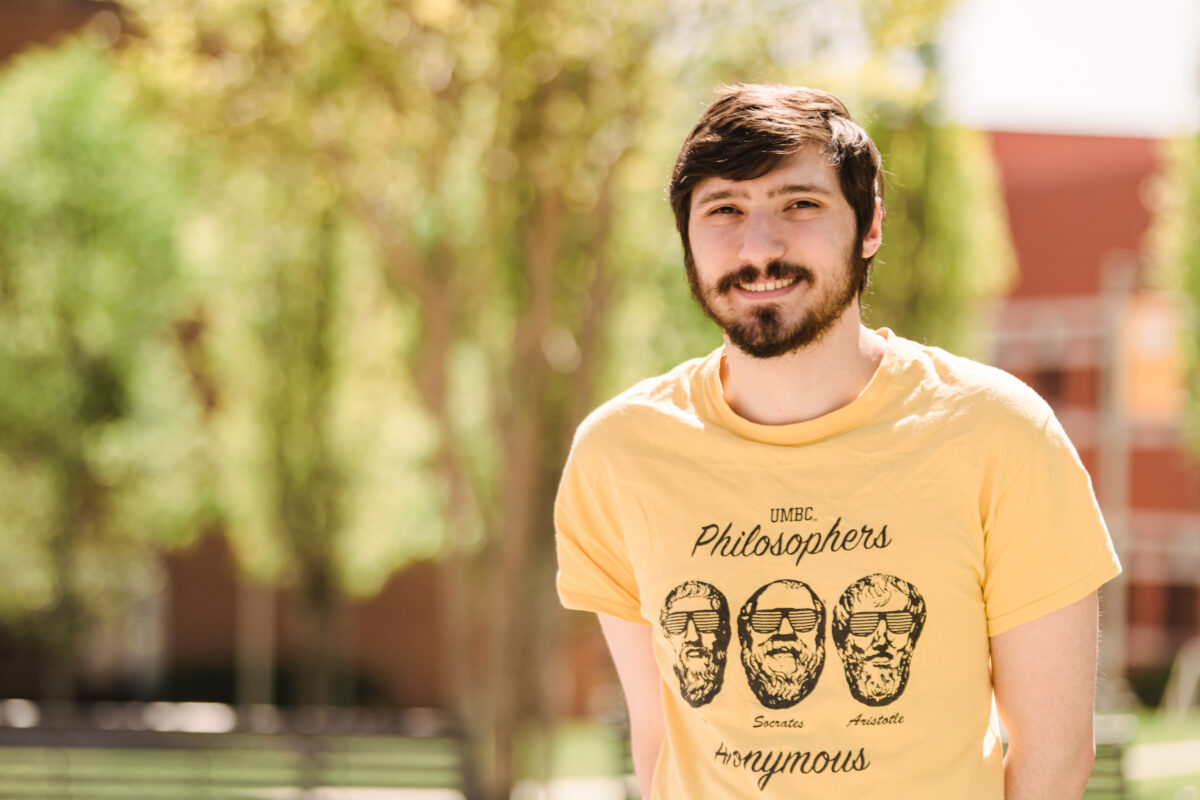 Avi Newman. (Marlayna Demond ’11/UMBC)
Newman originally envisioned himself walking a straight line from College Signing Day to Commencement. Instead, he found that a zig-zagging seven-year path took him where he needed to go, and that his success was a collaborative process. One of his greatest sources of support was Songon An, associate professor of chemistry and biochemistry.
“Avi came to my lab with great potential to become a biochemist. However, the COVID pandemic changed everything about his course of life,” says An. “I remember telling him that it’s OK to pause his undergraduate life and take advantage of such time to try out many different things, beyond academics, that he may find himself enjoying and feel rewarding.”
Newman began taking courses in a broader range of fields and is graduating with majors in biochemistry and molecular biology, biological sciences, and philosophy, plus minors. He has worked as a tutor, volunteered with a public health organization, and practices meditation to keep himself grounded. Accessing support gave Newman the confidence to rethink his assumptions about who he is now and who he wants to be.
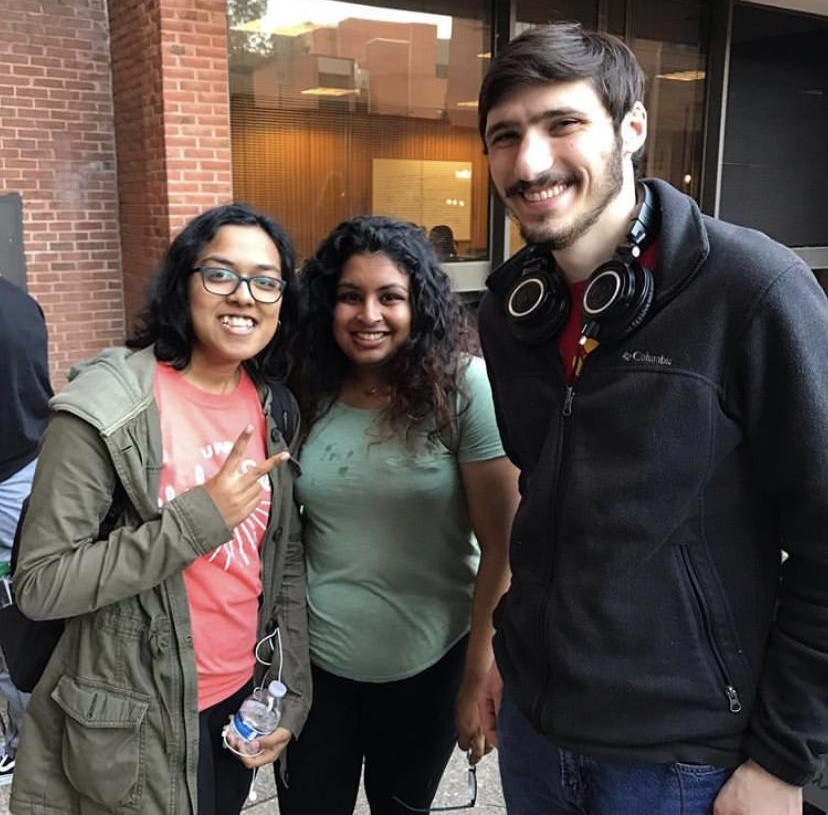 Avi (at right) with friends at the UMBC Chapter of the American Chemical Society Saccharide Social. (Image courtesy of Newman.)
“I think initially it was hard to come to terms with not graduating ‘on time,’ but after a while I realized that there’s no rush to life and that it was better for me to take my time and learn as much as I could,” says Newman. “I wanted to enjoy my time and take care of my mental, emotional, and physical health, which ultimately is much more important than rushing through things being excessively stressed.”
Maneuvering daily challenges
Like Newman, Jennifer Boateng will soon cross the stage to accept her degree seven years after she enrolled at UMBC. Throughout her journey, she has kept a clear goal in mind: finding the best way to use her creative talent to support people who, like her, live with sickle cell disease, and similar challenges.
Boateng found a perfect match in global studies, with a focus on creating multimedia content for humanitarian groups with a global audience. Pursuing this dream has meant adeptly maneuvering the complexity of living with sickle cell disease. Boateng completed research, taught herself her Final Cut Pro, wrote papers and lab reports, and attended classes both in person and at the hospital, virtually, as she received necessary care.
 Jennifer Boateng. (Marlayna Demond ’11/UMBC)
Boateng credits her positive and successful college experience to the long-term support of her friends and family as well as kindness and flexibility from UMBC faculty, staff, and peers. Her mentor Brigid Starkey, principal lecturer of political science and director of global studies, notes that the program worked closely with Boateng, especially over the last year, to strategize on how to finish her degree.
“We worked on course selection and navigating academic appeals processes, and her disability rights,” says Starkey.
With the moment she will turn her tassel in sight, Boateng and her mentors are looking toward what’s ahead. “Lately, my mentorship has involved talking to her about the future and where she may want to focus her efforts in the job market,” says Starkey. Boateng’s mentor is leveraging the department’s alumni network to connect her with career possibilities that will help her fulfill her vision.
Community support leads to success
Finding success through community support is familiar to many UMBC graduates. UMBC was the second university Victoria Joya Euceda attended, searching for a mentor who understood her story as a first-generation college student whose parents immigrated from Central America. At UMBC, she connected with Yolanda Valencia, assistant professor of geography and environmental studies, and other supporters. Now, Joya Euceda ’23, geography and environmental systems, is heading to a Ph.D. in geography at the University of Illinois at Urbana-Champaign.
 Victoria Joya Euceda ’23, geography and environmental studies. (Marlayna Demond ’11/UMBC)
Beatriz Soriano Luna ’23, social work, transferred from Montgomery College to UMBC at the Universities at Shady Grove, where she became an integral member of a close-knit community. Valuing the mentorship of M. Nicole Belfiore, clinical instructor of social work, Soriano Luna herself mentored more than two dozen students as a peer advisor. She’ll next pursue a master’s degree through the University of Maryland School of Social Work.
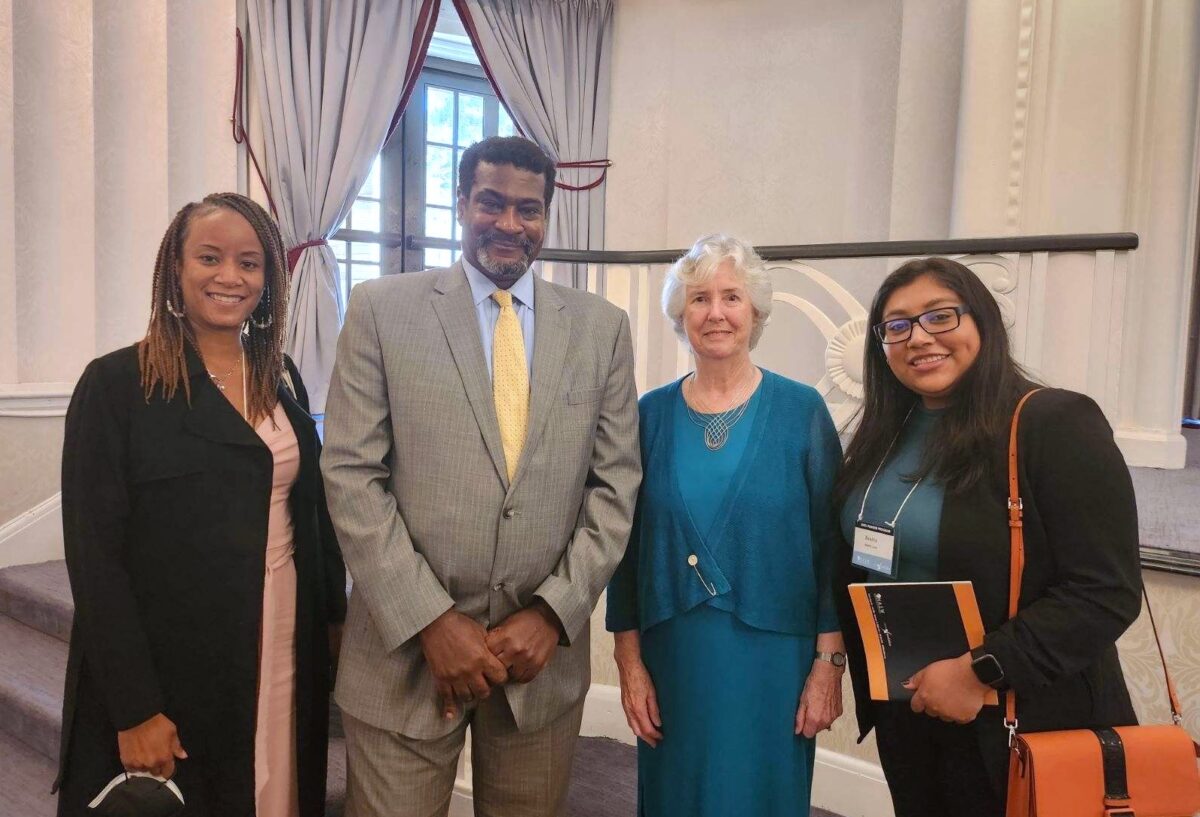 Beatriz Soriano Luna (right) with (left to right): Dominique Culley ’23, social work; Angelo McClain, former chief executive officer of the National Association of Social Workers (NASW); and Betsy Vourlekis, professor emeritus of social work and chair of the NASW Social Work Pioneer Committee. (Image courtesy of Soriano Luna.)
This May, on College Signing Day (which celebrates students’ college decisions), Joel DeWyer, director of campus life operations, welcomed UMBC’s next incoming class in a video on Twitter, reminding them of the excitement that lies ahead and the support they can access along the way.
“College can be a nerve-wracking and anxious experience, right? So when you have a question, or when you are feeling uncertain, when you are feeling overwhelmed, do me one favor,” said DeWyer. “Find someone around you in your community and ask for help.”
He shared a message that Newman, Boateng, Joya Euceda, and Soriano Luna have worked to pass along to others: that support can be found everywhere at UMBC. “There’s people all around you who care about your success and we are here to help you,” said DeWyer. “So never, ever, be afraid to ask for help.”
Read more Class of 2023 stories.
]]>
Avi Newman, who is graduating from UMBC this spring, knows all too well about learning to navigate unexpected detours beyond his control. Managing the compounding effects of COVID-19, meant...
https://umbc.edu/stories/graduating-students-community-support/
https://my3.my.umbc.edu/api/v0/pixel/news/133537/guest@my.umbc.edu/5ca7daf8ca4cada6e1574ae38c0465ea/api/pixel
biochemistry
cahss
campus-life
chemistry
class-of-2023
ges
globalstudies
news
philosophy
politicalscience
socialwork
UMBC News & Magazine
https://my3.my.umbc.edu/groups/umbc-news-magazine
https://assets1-my.umbc.edu/system/shared/avatars/groups/000/001/943/24435aa6207c452e7bc15cc74b42c7bb/xsmall.png?1748556657
https://assets1-my.umbc.edu/system/shared/avatars/groups/000/001/943/24435aa6207c452e7bc15cc74b42c7bb/original.png?1748556657
https://assets2-my.umbc.edu/system/shared/avatars/groups/000/001/943/24435aa6207c452e7bc15cc74b42c7bb/xxlarge.png?1748556657
https://assets2-my.umbc.edu/system/shared/avatars/groups/000/001/943/24435aa6207c452e7bc15cc74b42c7bb/xlarge.png?1748556657
https://assets3-my.umbc.edu/system/shared/avatars/groups/000/001/943/24435aa6207c452e7bc15cc74b42c7bb/large.png?1748556657
https://assets1-my.umbc.edu/system/shared/avatars/groups/000/001/943/24435aa6207c452e7bc15cc74b42c7bb/medium.png?1748556657
https://assets2-my.umbc.edu/system/shared/avatars/groups/000/001/943/24435aa6207c452e7bc15cc74b42c7bb/small.png?1748556657
https://assets1-my.umbc.edu/system/shared/avatars/groups/000/001/943/24435aa6207c452e7bc15cc74b42c7bb/xsmall.png?1748556657
https://assets2-my.umbc.edu/system/shared/avatars/groups/000/001/943/24435aa6207c452e7bc15cc74b42c7bb/xxsmall.png?1748556657
UMBC News & Magazine
3
0
false
Tue, 16 May 2023 10:37:27 -0400
UMBC’s Chengpeng Chen receives $1.7M NIH grant to develop human liver model
It can take more than 10 years and a billion dollars to get one new drug approved, and less than 10 percent of drugs succeed in clinical trials. Part of the problem is that common techniques used to study drug candidates, such as simple cell cultures and mouse models, don’t accurately represent how a drug will behave in the human body, says Chengpeng Chen, assistant professor of chemistry and biochemistry.
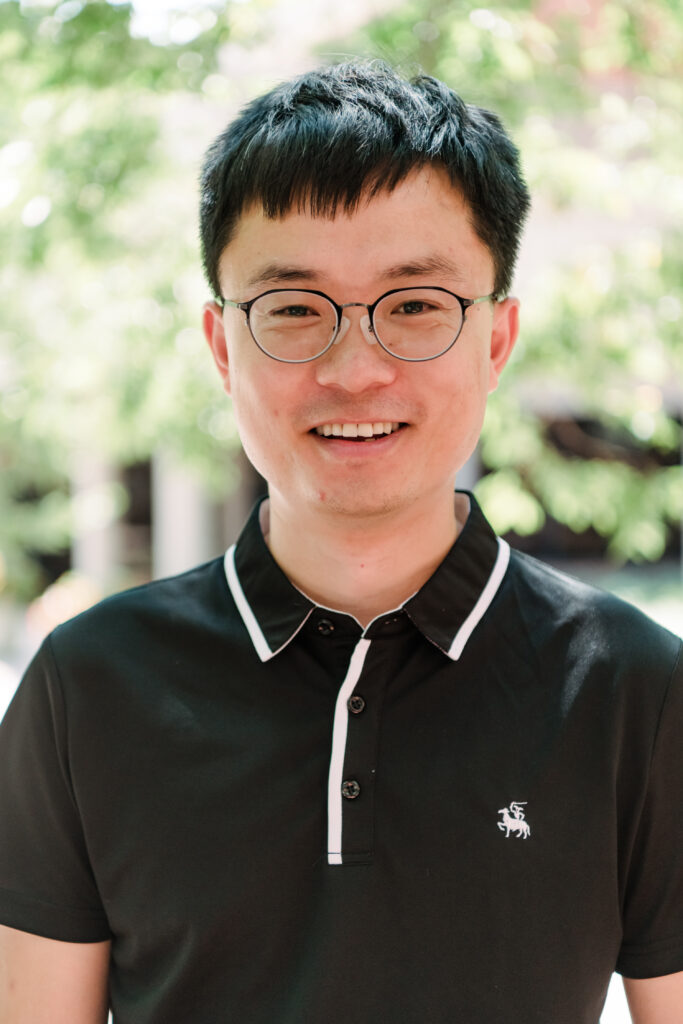 Chengpeng Chen (Marlayna Demond ’11/UMBC)
The low success rate motivated Chen to pursue development of more realistic models of human organs, starting with the liver. The hope is that researchers will one day use these models early in the drug development process to rule out drug candidates that are doomed to fail later on. That way, companies can quickly divert resources to projects with more promise. A new five-year, $1.7 million grant from the National Institute for General Medical Science will support Chen’s interdisciplinary work.
Chen learned about the concept of “organs-on-a-chip” during his postdoctoral research. These 2D, usually plastic devices use tiny amounts of liquid in tiny tubes to imitate organ function. He was hooked on the idea of creating miniature, realistic models of human systems. In addition to supporting drug development studies, such systems can increase understanding of many diseases, without the ethical issues that accompany using animal or human subjects.
Recreating the liver—in miniature
Chen’s first goal is to perfect his liver model, which goes a step beyond an organ-on-a-chip. Instead of a 2D mimic in plastic tubes, “We’re mimicking everything—the cell types, the architecture, and also the 3D microenvironment of the cells,” he says. Ultimately, he hopes to expand to other organs, but the liver is an important place to start, he says. The liver is involved in the metabolism of many drugs, and liver diseases are common.
Other models have recreated single cell types in the liver, but if successful, Chen’s will be the first to include all four major cell types interacting with each other the way they do inside the body.
“We can recreate the architecture of the real tissue, so when we put the cell types together, we think they will show total liver function,” Chen says. “But if we want to study them separately, we can separate them easily.”
While this might sound like the beginning of a quest to grow artificial organs for transplant, “We’re not there yet,” Chen says. He and his group will create “miniaturized liver functional units” that represent all the functionality of the liver on a tiny scale, mainly for biomedical research purposes. While a complete liver contains about 500 billion cells, each model will have approximately 2 million cells and be about the size of a typical thumbtack.
The goal is to create a model that researchers anywhere can replicate. “We want to make this technology standardized and modular,” Chen says, “so that anyone can build the model like Legos.”
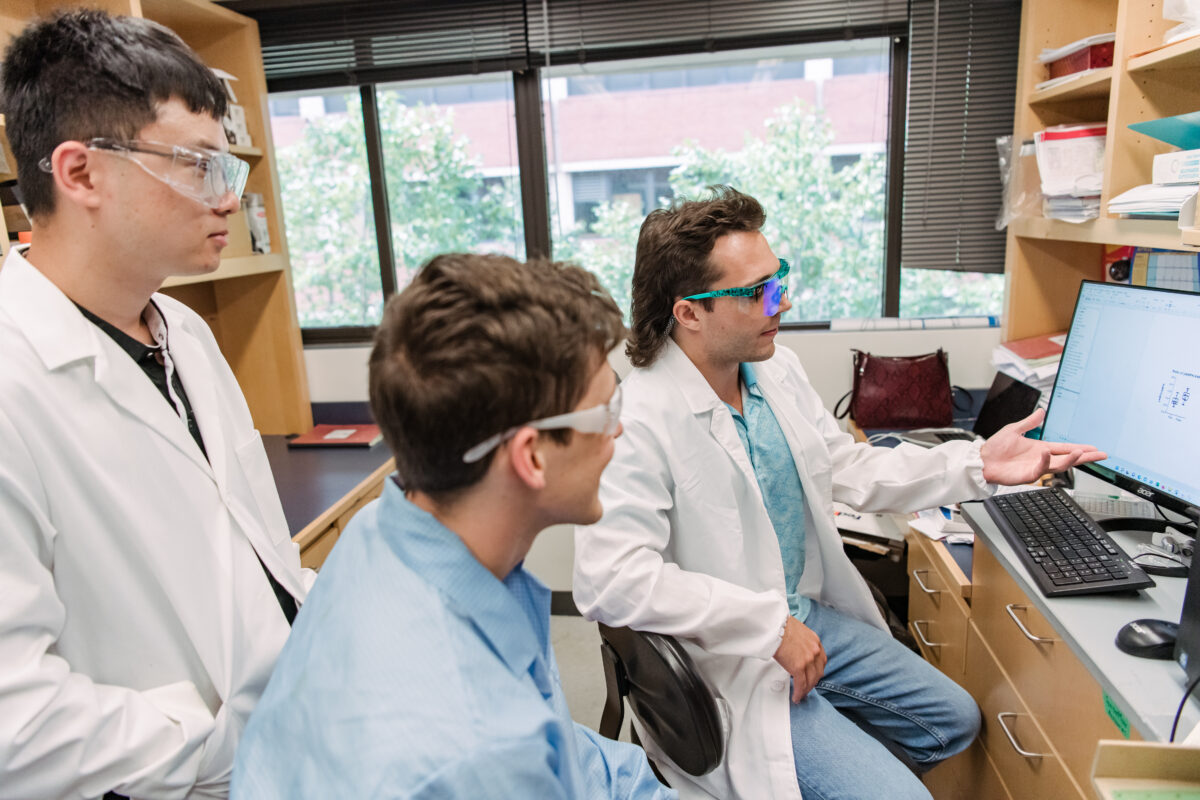 Curtis Jones (right), discusses experimental results with fellow chemistry Ph.D. student John Terrell (center) as Chengpeng Chen looks on. (Marlayna Demond ’11/UMBC)
Metabolism monitoring
Once Chen’s team optimizes the model, Chen is interested in looking at how the extracellular matrix—the material in between cells that binds them together and helps shuttle material from cell to cell—influences activity inside the cell, and how it changes during the course of disease.
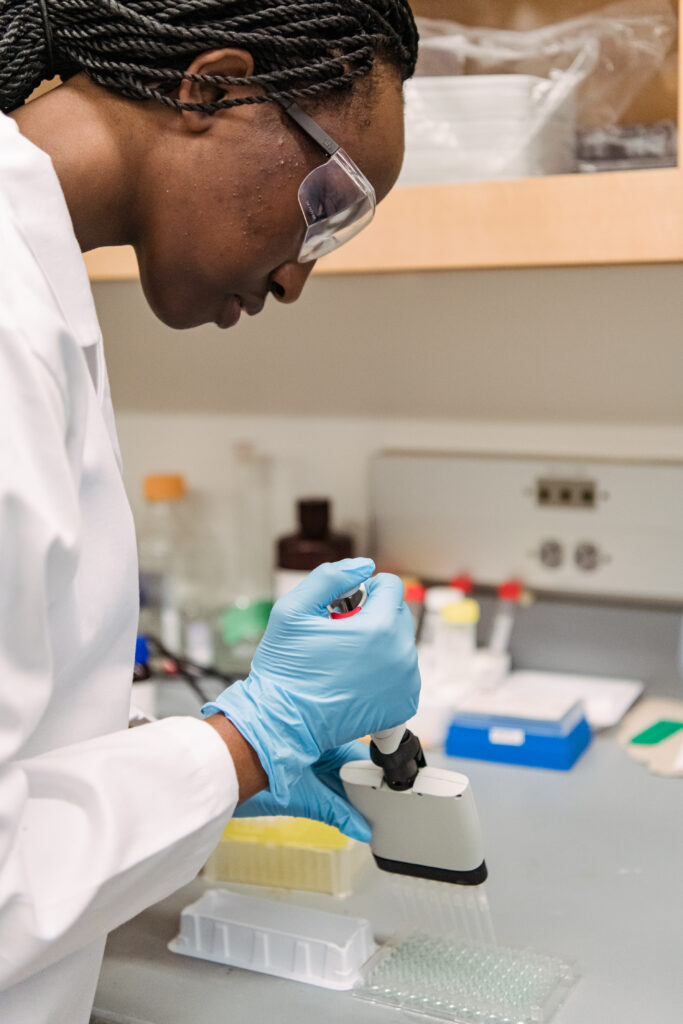 G.K. Monia Kabandana conducts research in the Chen laboratory. (Marlayna Demond ’11/UMBC)
A disease known as liver fibrosis induces changes in the extracellular matrix (ECM), stiffening and thickening the liver. Some researchers have looked at how the ECM affects various functions within liver cells, but not at how it may drive metabolic processes. That’s what Chen’s team will look at first with the new model, which should give more comprehensive results than looking at single cell types alone.
They’ll investigate how ECM changes affect essential metabolic pathways like energy production, construction of lipids and amino acids, and oxidative stress. Then they’ll conduct an untargeted sweep of all metabolites in the cell, measuring whether and how they are affected by ECM changes.
Shared facilities on campus administered by the College of Natural and Mathematical Sciences, such as the Keith Porter Imaging Facility and Molecular Characterization and Analysis Complex, will make the work possible.
Fighting fatal diseases
In the long term, “the ultimate biological goal is to find new therapies for fibrosis diseases,” Chen says. “New knowledge is needed. We’re starting with the liver in this project, because liver fibrosis is one of the most prevalent fibroses. And it’s fatal.”
Liver fibrosis is similar to cardiovascular diseases where tissue thickens, Chen explains. Earlier, “We initiated blood vessel studies, because in cardiovascular diseases, the blood vessels are stiffer. It’s called sclerosis, but it is very similar to fibrosis,” he says. “They both have extracellular matrix microstructure changes.”
There are other diseases that involve ECM changes, too. “If we can figure out how those changes cause disease,” Chen says, “it’s not just a fundamental science question, but also has biomedical applications.”
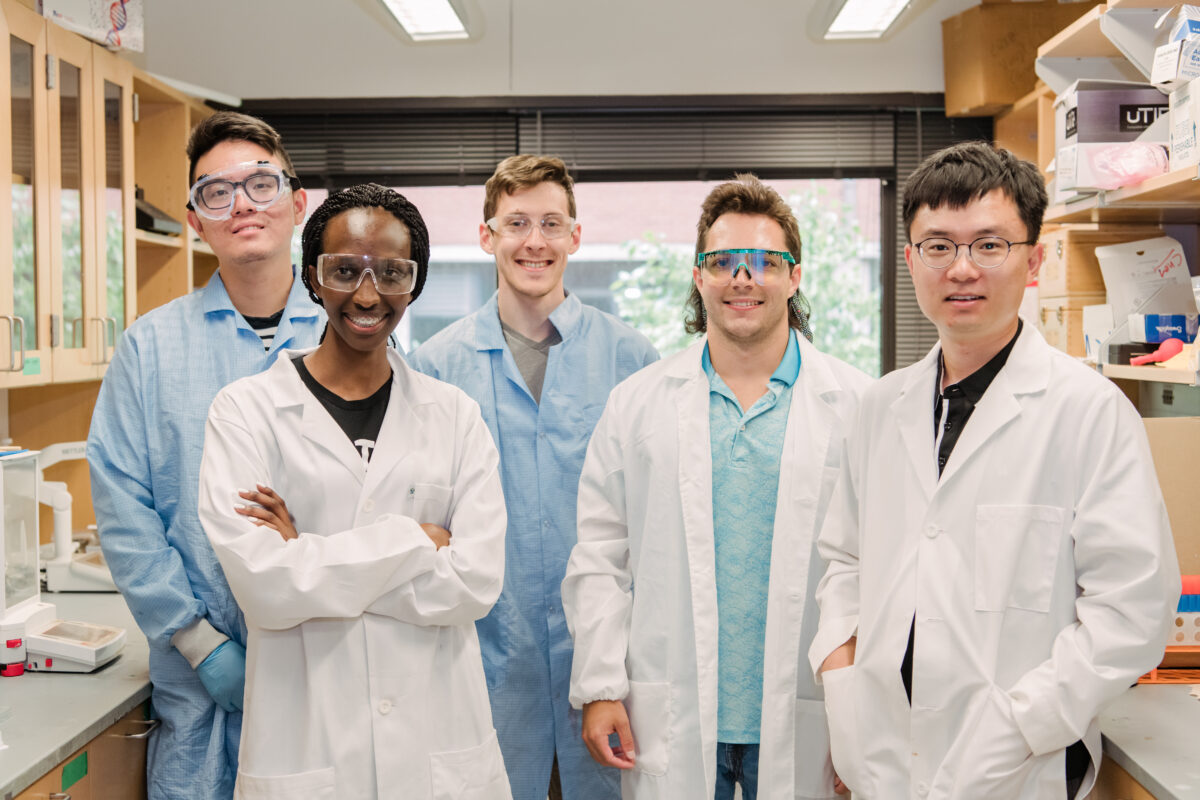 Chengpeng Chen (right) and his four graduate students: Tao Zhang, G.K. Monia Kabandana, John Terrell, and Curtis Jones.
Interdisciplinary effort
Some may be surprised that Chen is in the chemistry and biochemistry department, given the biological and even engineering nature of his work. Chen is part of a new generation of scientists that doesn’t hesitate to forge connections across disciplines.
“I really don’t see a boundary for chemistry work,” Chen says. With the new grant, he plans to add at least two new graduate students to the group, who will receive training in a wide range of techniques and disciplines.
Whether developing technologies to generate new models, measuring biological functions in tissues, or studying the roles of individual metabolites in chemical pathways, Chen’s work puts him at the frontier of scientific research and in position to have a significant public impact.
]]>
It can take more than 10 years and a billion dollars to get one new drug approved, and less than 10 percent of drugs succeed in clinical trials. Part of the problem is that common techniques used...
https://umbc.edu/stories/1-7m-nih-grant-to-develop-human-liver-model/
https://my3.my.umbc.edu/api/v0/pixel/news/127071/guest@my.umbc.edu/38e31370861199353f2ec6e90a31a0c9/api/pixel
chembiochem
chemistry
cnms
news
rca-1
research
science-and-tech
UMBC News & Magazine
https://my3.my.umbc.edu/groups/umbc-news-magazine
https://assets1-my.umbc.edu/system/shared/avatars/groups/000/001/943/24435aa6207c452e7bc15cc74b42c7bb/xsmall.png?1748556657
https://assets1-my.umbc.edu/system/shared/avatars/groups/000/001/943/24435aa6207c452e7bc15cc74b42c7bb/original.png?1748556657
https://assets2-my.umbc.edu/system/shared/avatars/groups/000/001/943/24435aa6207c452e7bc15cc74b42c7bb/xxlarge.png?1748556657
https://assets2-my.umbc.edu/system/shared/avatars/groups/000/001/943/24435aa6207c452e7bc15cc74b42c7bb/xlarge.png?1748556657
https://assets3-my.umbc.edu/system/shared/avatars/groups/000/001/943/24435aa6207c452e7bc15cc74b42c7bb/large.png?1748556657
https://assets1-my.umbc.edu/system/shared/avatars/groups/000/001/943/24435aa6207c452e7bc15cc74b42c7bb/medium.png?1748556657
https://assets2-my.umbc.edu/system/shared/avatars/groups/000/001/943/24435aa6207c452e7bc15cc74b42c7bb/small.png?1748556657
https://assets1-my.umbc.edu/system/shared/avatars/groups/000/001/943/24435aa6207c452e7bc15cc74b42c7bb/xsmall.png?1748556657
https://assets2-my.umbc.edu/system/shared/avatars/groups/000/001/943/24435aa6207c452e7bc15cc74b42c7bb/xxsmall.png?1748556657
UMBC News & Magazine
0
0
false
Fri, 26 Aug 2022 16:02:48 -0400
Fri, 26 Aug 2022 16:02:48 -0400
Better Living Through Chemistry
From cooking and cleaning to fixing your car, understanding chemistry can enlighten all aspects of life. That’s just one reason why Dean William R. LaCourse still loves sharing the joy of his favorite subject in front of a classroom.
It’s not every institution where you can take a class taught by the dean— especially a 100-level course. It’s even less likely to find that dean sprinkling his weekly lectures with silly chemistry jokes and cultural references. But William R. LaCourse, dean of the College of Natural and Mathematical Sciences (CNMS) since 2011, does exactly that, co-teaching CHEM 100: The Chemical World to non-chemistry majors with Caitlin Kowalewski, assistant director of undergraduate initiatives in CNMS. Every Tuesday afternoon this spring, LaCourse taught his students how chemistry influences their lives.
The jokes and digressions are designed to keep a complex topic like chemistry light and relatable—even fun. After all, LaCourse tells his students one day in March, “This is not a course that’s supposed to stress you out. It’s an empowering course. At the end, you’re gonna know so much more about chemistry.”
Throughout the class LaCourse affectionately refers to as “the egg lecture,” for example, he teaches the students how best to make hard- and soft-boiled, fried, and baked eggs and exactly why based on the chemistry involved, with the occasional digression. The Lilliputians from Gulliver’s Travels, for example, make an appearance— apparently they went to war over which end of a soft-boiled egg to open. He also takes a moment to share a favorite recipe his wife makes—showing the students he’s more than a university administrator.
After the short lecture, the students answer discussion questions in groups, coming up with a list of compounds important for cooking, such as baking powder and gelatin, and their roles.
“CHEM 100 is all about empowerment,” LaCourse says. “Understanding how the chemical world affects you gives you more control over your life.” For example, you can avoid trendy health hacks that are actually bad for you, he explains. Understanding chemistry can even help you be more self-sufficient. You may be able to “fix your car, cook better meals, or take stains out of your clothing,” LaCourse says.
Students in the course appreciate that LaCourse makes the content relatable. “I don’t think I’ve ever had a science class before that connects to our daily lives in a way I can understand it,” says Keli Amoako ’25, political science. “He makes you aware of the chemistry in everyday life. I think everybody should have to take a class like this,” adds Moroti Oyeyemi ’25, information systems. There is something for everyone. “I have a great love of baking,” says Meghan Seerey ’23, visual arts, “and he connects the class to the culinary arts.”
For their final projects, students had complete freedom to demonstrate how chemistry affects their lives. Some created “day-in-the-life” presentations, explaining the chemistry in activities like brushing their teeth or doing laundry. Others focused on a particular interest, like skin care, fashion, or scuba diving. One student filmed a baking video, and another designed a brochure explaining how to improve one’s garden through soil chemistry. There were podcasts, poems, and even a musical composition in the key of C sharp. (The musical notation for C sharp, C#, looks like CH, representing carbon and hydrogen, two key elements for life.)
Connected to his roots
For LaCourse, teaching CHEM 100 follows naturally from his values. Even with the added responsibilities of a dean, after also serving as chair of the chemistry and biochemistry department for four years, and a member of the department for 15 years before that, “I still have graduate students and I still teach, because that’s the reason I came here in the first place,” LaCourse says. “I think if you move too far away from those roots that you’ll lose the ability to understand and to be empathetic with those who teach, with those who do research, and the issues that they encounter.”
Never has this been truer than over the last two years, as the COVID-19 pandemic forced administrators to make decisions about whether to shift classes online and other changes to the education experience. In Fall 2020 and Spring 2021, LaCourse and Kowalewski taught CHEM 100 fully online, in part to be in solidarity with the rest of the college’s faculty. “All the challenges with technology, grading, and keeping people’s interest…I could understand what the faculty were going through,” LaCourse remembers.
A non-traditional path
In addition to staying connected with the needs of faculty, LaCourse calls on his own experience to explain why he pursued the deanship and why he works so hard to make sure the college is serving all UMBC students well. He starts to talk about when he became department chair, then pauses.
“Actually, I’m gonna go back even faaather,” he says, revealing the Boston accent that still shows up now and then, despite living in the Baltimore area for decades. “I took a very non-traditional pathway to get where I am.”
He goes on to describe a series of experiences—starting out at a technical college, then pursuing a four-year degree at multiple institutions while working full-time, and a graduate education full of “naïve decisions” due in large part to a lack of guidance and support.
All that is what drove him to pursue leadership. It’s one thing to teach a course that shows students from all backgrounds why chemistry matters—and hopefully improve their lives in the process. It’s another to make changes at the department level, and yet another to be able to lead the college. LaCourse says his motto is “There’s always a better way,” similar to one of President Freeman Hrabowski’s sayings that has been adopted by many on campus: “Success is never final.”
“The world changes,” LaCourse says, “and most things will have to evolve to keep up.”
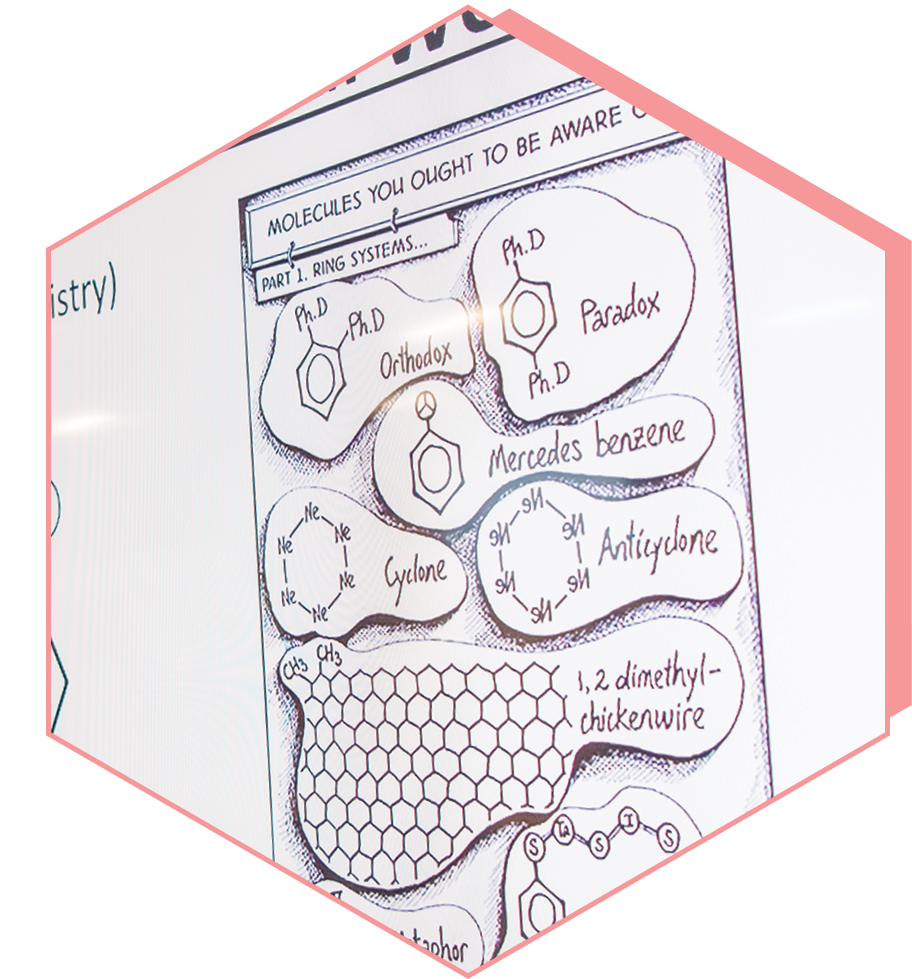
Discovery Learning
When LaCourse started as chair, he felt as if there were too many students failing introductor y chemistr y courses. He believed there was a better way—that the introductory chemistry curriculum needed to evolve. As a result, after a collaborative pilot program, introductory chemistry courses added a weekly, team-based, problem-solving session to the lecture component in 2005. These sessions are still a cornerstone of the chemistry curriculum today. The magic happens in the Chemistry Discovery Center (CDC), and LaCourse calls the technique “discovery learning.”
“Chem Discovery was a different way to do it. The vision was to bring students from a passive to an engaged format, to give them the opportunity to discover,” he says. “People love to discover things, to plant new flags.”
Research faculty get to experience that on a regular basis, LaCourse notes.
“Why don’t we give our students the opportunity to discover knowledge?” he says. “Because when you discover it, you own it—and we know that ownership is important for learning.”
After the Chemistry Discovery Center’s introduction, the fail rate in intro to chemistry dropped by half. The CDC plus a shift among UMBC faculty away from the concept of “weed out” courses has led to continued success, including increased retention and attendance.
Creating opportunities for all
Chemistry Discovery was just the beginning. LaCourse has spent nearly two decades working with colleagues across the college and at community colleges in the region to create more opportunities for students through a number of initiatives that supply the support and structure students need to succeed.
UMBC has proven again and again that relatively small, cohort-based scholars programs that generate a sense of community and offer intensive advising can significantly increase student persistence and success rates in STEM (science, technology, engineering, and math). LaCourse isn’t satisfied with that, though—he wants to see more students get that high-touch experience.
“The whole purpose is to give opportunity and a unique education experience to every student that UMBC lets in,” LaCourse says. “The focus is on what we need to do to make that possible.”
Scaling up
The most comprehensive manifestation of this goal is STEM BUILD, a 10-year, National Institutes of Health-funded initiative at 10 universities to diversify the biomedical sciences workforce. At UMBC, the initiative’s motto is, “500, not 50.” That’s 500 students. “Can we do 500, not 50? Can we make things scalable?” LaCourse asks. “Can we take the pieces of community and intensive advising, and make it so many more people benefit from it?”
The goal of STEM BUILD at UMBC is to identify the most effective practices that support student success and find ways to implement them at scale. Perhaps most important, the college is working hard to weave the most effective elements into regular operations so that when the grant funding sunsets in 2023, students will continue to benefit.
STEM BUILD programming includes group research experiences, a summer bridge that teaches laboratory skills and experimental design, and training in communications and research ethics. Advising, community meetings and socials, living on campus in the STEM Living Learning Community, and a rich culture of staff and faculty support are key community-building elements.
STEM BUILD also spawned an Active Learning, Inquiry Teaching (ALIT) certificate through UMBC’s Faculty Development Center. ALIT has helped faculty transition their courses to more engaged formats, such as team-based problem-solving, rather than lectures. Spaces like the CNMS Active Science Teaching and Learning Environment, opened in 2010, facilitate this transition. CASTLE has round tables rather than desks, and since fall 2019, the new Interdisciplinary Life Sciences Building has offered similar classroom environments, plus features like mobile whiteboards. Originally, ALIT was intended only for faculty directly involved in STEM BUILD activities, but has since been expanded to any interested faculty—an example of the ripple effect of initiatives such as STEM BUILD.
Leading the change
LaCourse has also led efforts to capitalize on UMBC’s location in one of the top biotech clusters in the country. After hiring Annica Wayman ’99, M6, mechanical engineering, as associate dean of Shady Grove affairs in CNMS, degree options for UMBC STEM students at the Universities at Shady Grove have grown. “She has a passion for students and helping them be successful,” LaCourse says.
Wayman came back to UMBC from a successful career in international development at USAID specifically to lead the new Translational Life Science Technology (TLST) bachelor’s degree program, which prepares students for immediate, in-demand careers in biotech. “The relevance, innovative nature, and health-related impact of the TLST program is what attracted me back to UMBC as associate dean, and the many students who come into the program,” she says.
LaCourse’s leadership, in conjunction with community college partners, was crucial to bringing it to life, Wayman adds. “Bill’s educational start in community college and work in the private sector before coming to academia made him the perfect visionary for developing a new bachelor’s degree in biotechnology at UMBC.”
And it’s working. TLST grads like Titina Sirak ’20 and Charmaine Hipolito ’20 are already finding success in the regional biotech market, leaving the program with several job offers for biotech positions in hand.
LaCourse also knows that for students to succeed, faculty need to feel supported and be representative of the student body. The ADVANCE program, for example, has increased the number of women faculty in STEM by 180% since 2003. And now, the Pre-professoriate Fellowship program encourages faculty members committed to supporting diversity and inclusion to apply. The goal is for participants to convert to assistant professors at UMBC.
While persistence and success in STEM majors has significantly increased over the last two decades, “How many more successful students could there be if they could see more people like themselves, who they can relate to better?” LaCourse asks.
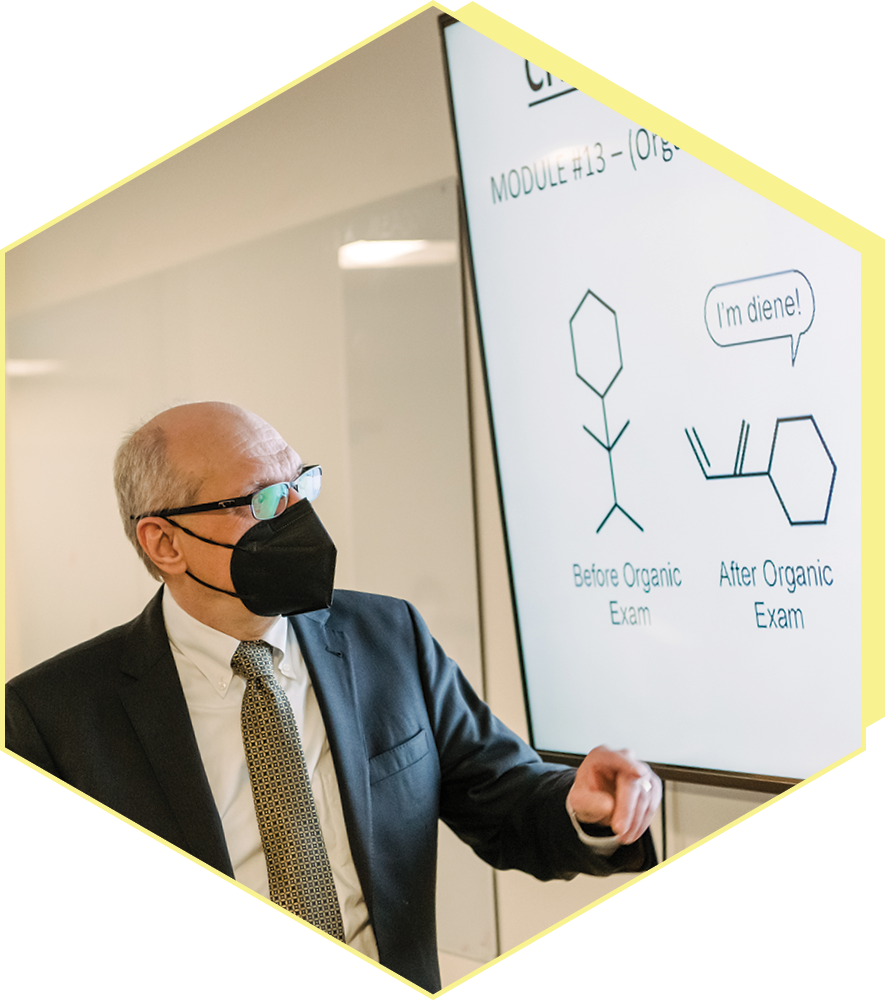
Doing right by students
Given his own challenges navigating higher education, supporting success for all students, enabling discovery, and encouraging ownership of their education is deeply embedded in LaCourse’s psyche.
One of his current graduate students in chemistry and biochemistry, Amanda Belunis, confirms this. “Dr. LaCourse always says that he is just a guide, and he wants us to be actively engaged in our own education and learn lessons. He pushes us all to reach our full potential and consistently offers constructive feedback and encouragement, usually paired with a funny anecdote or joke,” she says. “I feel confident that when I finish, I will be leaving the program as an independent critical thinker ready to tackle any problem, and I owe a lot of that to him.”
While some students may be likely to succeed regardless of the support available or not, for others, the right environment can make all the difference.
“When people come in, if you give them the feeling that they belong, and that they can do it, and you give them the help that they need, many, many more will succeed,” LaCourse says. This sentiment applies to faculty, too. Both students and faculty “put their future in the hands of the institution, that we’ll do right by them,” LaCourse says.
Nowhere like UMBC
Through his work with individual students in his laboratory, teaching undergraduates, and securing funding for projects that affect many more students, he’s doing his best to make sure the institution deserves its community members’ trust by creating opportunities and offering support.
“Opportunities are what life is all about,” LaCourse says. “It’s up to an individual to take advantage of them, but we have to put those opportunities in front of people and make people believe that they can take advantage of them.” Through programs like STEM BUILD, TLST, transfer student support programs, and more, “that’s what we train our students to believe—that they belong, that they could do the job, that that opportunity is theirs as much as anybody else’s,” no matter their background.
As a non-traditional candidate for a leadership role in academia, LaCourse also appreciates the opportunities he’s been given to make a difference at UMBC—the chances people took on him and his ideas, which sometimes involved creative new methods. Another pause. And then, “Of course I can’t know—as a scientist, I understand there’s no control group for my life,” he says. “But I don’t think I’d be where I am at any other place than UMBC.”
He’s taken it as his mission to pass on those opportunities to UMBC students—they’re why he’s here, after all. As a leader first in chemistry, and now in CNMS as a whole, he’s worked to “break down silos, and work under umbrellas,” as he says, to make changes that do the greatest good.
“You need to understand what everybody’s going through, and what they’re up against,” he says. “That way you can work together better in the long run—and again, we’re all working for the same purpose.”
Vision of what could be
The significant, positive change that has occurred on his watch is already impressive, and the trajectory is still going in the right direction. More students are succeeding in STEM at UMBC. Students who demonstrate high potential, but may not be at the top of their class or have much experience when they arrive at UMBC, are getting the resources they need and finding their way. Faculty and staff are committed to supporting all of them.
Although he’s not retiring yet, LaCourse has decades of experience at UMBC to reflect on. When asked about what a normal day might look like, after mentioning writing grant proposals, dealing with crises, attending leadership meetings, and, of course, teaching CHEM 100, he pauses again, waxing philosophical.
“A day in the life…” he ponders. “It’s really a lifetime, guided by principles and experiences from my own life. So every decision, every action, draws upon everything in the past, and the vision of what could be.”
Who knows what may come next.
]]>
From cooking and cleaning to fixing your car, understanding chemistry can enlighten all aspects of life. That’s just one reason why Dean William R. LaCourse still loves sharing the joy of his...
https://umbc.edu/stories/better-living-through-chemistry/
https://my3.my.umbc.edu/api/v0/pixel/news/126138/guest@my.umbc.edu/c32ad1a8f0fd5a982f45570f55d41b1f/api/pixel
chemistry
cnms
impact
magazine
summer-2022
UMBC News & Magazine
https://my3.my.umbc.edu/groups/umbc-news-magazine
https://assets1-my.umbc.edu/system/shared/avatars/groups/000/001/943/24435aa6207c452e7bc15cc74b42c7bb/xsmall.png?1748556657
https://assets1-my.umbc.edu/system/shared/avatars/groups/000/001/943/24435aa6207c452e7bc15cc74b42c7bb/original.png?1748556657
https://assets2-my.umbc.edu/system/shared/avatars/groups/000/001/943/24435aa6207c452e7bc15cc74b42c7bb/xxlarge.png?1748556657
https://assets2-my.umbc.edu/system/shared/avatars/groups/000/001/943/24435aa6207c452e7bc15cc74b42c7bb/xlarge.png?1748556657
https://assets3-my.umbc.edu/system/shared/avatars/groups/000/001/943/24435aa6207c452e7bc15cc74b42c7bb/large.png?1748556657
https://assets1-my.umbc.edu/system/shared/avatars/groups/000/001/943/24435aa6207c452e7bc15cc74b42c7bb/medium.png?1748556657
https://assets2-my.umbc.edu/system/shared/avatars/groups/000/001/943/24435aa6207c452e7bc15cc74b42c7bb/small.png?1748556657
https://assets1-my.umbc.edu/system/shared/avatars/groups/000/001/943/24435aa6207c452e7bc15cc74b42c7bb/xsmall.png?1748556657
https://assets2-my.umbc.edu/system/shared/avatars/groups/000/001/943/24435aa6207c452e7bc15cc74b42c7bb/xxsmall.png?1748556657
UMBC News & Magazine
1
0
false
Wed, 06 Jul 2022 11:16:47 -0400
Wed, 06 Jul 2022 11:16:47 -0400