URCAD 2019 features diversity-focused student research, with Baltimore, LGBTQ+, and international focus areas
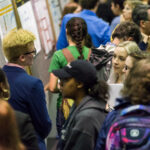
UMBC students are diligently making final touches to their presentations in preparation for the 23rd annual Undergraduate Research and Creative Achievement Day (URCAD) on Wednesday, April 24. Students’ research projects are as diverse as UMBC students themselves. This year, URCAD has highlighted research that explores diversity and inequalities through three thematic series, focusing on research about Baltimore, LGBTQ+ topics, and international topics.
These presentations affirm a core goal of URCAD. As Katharine H. Cole, vice provost and dean of undergraduate academic affairs, has shared, “UMBC encourages students of all disciplines to engage in mentored projects and through creative thought and focused inquiry, to discover in themselves their passion.”
STEM identities in Baltimore
Shadia Musa ‘19, American studies, focused her research one exploring how sixth-grade students of color at James McHenry Elementary/Middle School in Baltimore City come to identify with STEM fields. Through her work as a Sherman STEM Teachers Scholar, Musa explored the impact of restructuring learning environments to increase students’ involvement in STEM disciplines.
 Musa at James McHenry Elementary/Middle School. Photo courtesy of the Sherman STEM Teachers Scholars.
At James McHenry, where many families don’t have confidence with science and math topics due to historic inequalities in education, teachers, parents, and community organizers collaborate with each other to create more and earlier points of entry into STEM education for students, using an inquiry-based approach.
“I worked with students to identify issues important to them, like having a grocery store nearby. We then created a 3D model of the store out of cardboard,” explains Musa, who plans to continue teaching in Baltimore City. “Through this interactive process, students learned and strengthened their grouping, measurement, computation, and spatial skills as well as cooperative learning skills, and involved their families in the process.”
Musa will present Combating Academic Inequity: A Community-based Approach to Cultivating a Love for STEM within Students of Color at 2:15 p.m. in UC 310.
Intersections of LGBTQ and Jewish identities
Cliel Shdaimah ‘19, gender, women’s, and sexuality studies, researched intersecting identities in her own queer and Jewish communities through interviews with five LGBTQ rabbis in the United States and in Israel. “In the last five years I realized that I was queer and wanted to find a way into my Judaism that was natural but that also celebrated that part of myself,” explains Shdaimah.
The interviews revealed three insights into how the rabbis were managing their identities. First, they described their visibility as queer people and as Jewish family members in Jewish religious spaces. They also dealt with addressing their LGBTQ identities with social justice work. Third, the rabbis had to find ways to incorporate their values as both Jewish and LGBTQ people when interpreting Jewish religious texts and teachings.
“Through this and other research projects at UMBC I had the joy of reading feminist and queer ways of thinking and the Torah,” says Shdaimah. “I have been able to bring all of my identities to my personal life but also to my academic life through different research projects that helped me understand what my possibilities are for the future.”
Shdaimah will present Keshet L’Am: Perspectives of LGBTQ+ Rabbis on Intersecting Identities, 1-2:30 p.m. in the UC Ballroom.
Sharing complex feelings through animation
 Animation still by Blurton-Jones.
Julia Blurton-Jones ‘21, visual arts, took a very personal perspective in creating a short animation based on her experience growing up as a gay woman in Catholic private schools. Her film shares the experience of being asked to read a passage from a textbook that implied same-sex marriage should not be allowed. Through animation, she explores this dilemma of having to betray yourself and conveys the fear the protagonist is experiencing.
In her experience with members outside of the LGBTQ community, Blurton-Jones feels coming out is seen as a black and white situation—you are either in or out. But that’s a misconception, she says.
 Animation still by Blurton-Jones.
“There is a greyness to coming out,” shares Blurton Jones. “People in the closet have to actively hide and lie a lot and pretend to disagree with homosexuality. People out of the closet have to decide to continuously come out in different environments.”
This project proved tremendously gratifying for Blurton-Jones. “I am passionate about animation,” she says. “It is a medium where I can mess with reality to portray complex feelings.”
Blurton-Jones will present “Traitor: An Animated Short” at 2:30 p.m. in the Fine Arts Recital Hall.
Separation of voice from body
As a sound professional, Daniel Goldstein ‘18, media and communications studies, is used to mixing different voices to convey ideas, events, and information. For his independent research project, he was interested in researching the effect on different communities of the separation of the voice from the body that occurs in voicing animations, doing voice-over narrations, and creating voices for new digital platforms.
“I wanted to think critically, holistically, and analytically about what it means to cast a specific person as a narrator or a character for animation, and how over time they have created norms about gender and race based on stereotypes,” says Goldstein.
One major example is The Simpsons, where the South Asian character of Abu is portrayed by a white male voice referencing stereotypes of English spoken with a South Asian accent. “This has many negative social and political ramifications,” says Goldstein. “Abu’s voice has been used to create voice norms for an entire community that is not adequately represented on the show.”
Goldstein also shares that he found positive examples of inclusion for a broader range of voices. He describes that theatre voice coaching has helped some members of the trans community match their voice with their identity. Also, looking at growing digital platforms, he notes, “Modern consumer technology like Alexa, Siri, and podcasts, allows traditionally non-normative voices to be successful and fulfill roles that are historically very gendered.”
Goldstein will present Will You Listen?: A Critical Analysis of Gendered and Racialized Disembodied Voices in Contemporary Media Culture at 1:15 p.m., UC 204.
Evolution of Korean art, 2013-1017
Sparked by her sister’s interest in Korean culture, Sarah Natterman ‘20, modern languages, linguistics, and intercultural communication and Asian studies, began learning the Korean language in high school. At UMBC, she began studying Korean art, culture, and social issues in greater depth. Natterman says, “I combined both my academic and personal interests in visual and performing arts to research how the South Korean regime of Park Geun-hye in between 2013 and 2017 affected Korean contemporary art.”
Her research explored the effects of Park Geun-hye censoring 10,000 artists and how censorship restricted and grew art in Korea. As a result of the regime, Korean art developed two movements. One was reminiscent of a past cultural movement, with prominent Korean cultural themes. The other included more abstract themes for a global market. Both influenced the evolution of contemporary South Korean art and culture in the world today.
“I want people to see South Korea as a whole. Politics are important but they can often mask South Korea’s vibrant literature, culture, and theatre,” shares Natterman. She will further her study of South Korean culture next year through UMBC’s academic exchange program with Seoul National University.
Natterman will present Modern Dualism in Korean Contemporary Art at 9:45 a.m. in UC 310
Options in social work delivery
As a student of social work, Rebeccah Mann ‘19, is familiar with the U.S. social work model, which depends largely on federal, state, and local funding to provide services. She was in search of a different perspective on social work delivery models. Through the University Studies Abroad Consortium, Mann enrolled in a social work program at the University of Ghana.
 Mann, with other social work students, introducing themselves to a class in Ghana. Photo courtesy of Mann.
She found that in Ghana there isn’t a vast network of federal, state, or local funding. Social workers in Ghana pursue a more creative and collective approach to fundraising to support the delivery of social work services.
“Through local sales of goods, international sponsors, and a barter system, organizations could be paid for the services they provided and communities could continue to access those needed services,” says Mann. “The innovation has inspired me to see possibilities instead of obstacles as I become a professional social worker.”
Mann will present A Comparison Between Social Service Delivery Systems in Ghana and the United States, 10-11:30 a.m. in the UC Ballroom.
URCAD guests are encouraged to learn more about the broad range of presentations on Baltimore, LGBTQ+, and international research topics. A full listing of all student presenters and their topics and presentation times is available through the URCAD website.
Banner image: URCAD 2018 by Marlayna Demond ’11 for UMBC.
]]>
UMBC students are diligently making final touches to their presentations in preparation for the 23rd annual Undergraduate Research and Creative Achievement Day (URCAD) on Wednesday, April 24....
https://umbc.edu/stories/urcad-2019-features-diversity-focused-student-research-with-baltimore-lgbtq-and-international-focus-areas/
https://my3.my.umbc.edu/api/v0/pixel/news/120156/guest@my.umbc.edu/b1723549a1e2080cc4abd8bef1cdfb64/api/pixel
americanstudies
arts-and-culture
asianstudies
cahss
cirsca
community
mcs
mlli
policy-and-society
shermanscholars
socialwork
undergradresearch
visualarts
UMBC News & Magazine
https://my3.my.umbc.edu/groups/umbc-news-magazine
https://assets1-my.umbc.edu/system/shared/avatars/groups/000/001/943/24435aa6207c452e7bc15cc74b42c7bb/xsmall.png?1748556657
https://assets1-my.umbc.edu/system/shared/avatars/groups/000/001/943/24435aa6207c452e7bc15cc74b42c7bb/original.png?1748556657
https://assets2-my.umbc.edu/system/shared/avatars/groups/000/001/943/24435aa6207c452e7bc15cc74b42c7bb/xxlarge.png?1748556657
https://assets2-my.umbc.edu/system/shared/avatars/groups/000/001/943/24435aa6207c452e7bc15cc74b42c7bb/xlarge.png?1748556657
https://assets3-my.umbc.edu/system/shared/avatars/groups/000/001/943/24435aa6207c452e7bc15cc74b42c7bb/large.png?1748556657
https://assets1-my.umbc.edu/system/shared/avatars/groups/000/001/943/24435aa6207c452e7bc15cc74b42c7bb/medium.png?1748556657
https://assets2-my.umbc.edu/system/shared/avatars/groups/000/001/943/24435aa6207c452e7bc15cc74b42c7bb/small.png?1748556657
https://assets1-my.umbc.edu/system/shared/avatars/groups/000/001/943/24435aa6207c452e7bc15cc74b42c7bb/xsmall.png?1748556657
https://assets2-my.umbc.edu/system/shared/avatars/groups/000/001/943/24435aa6207c452e7bc15cc74b42c7bb/xxsmall.png?1748556657
UMBC News & Magazine
0
0
false
Mon, 22 Apr 2019 17:19:11 -0400
UMBC researchers invent creative approach to remove dangerous pollutant from waterways
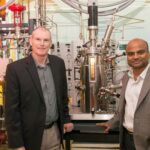
UMBC professors Kevin Sowers and Upal Ghosh have advanced a new technique to eliminate PCBs—one of the most persistent, pervasive, and dangerous chemical pollutants found in waterway sediments. Their innovative, environmentally-friendly approach, published in Environmental Science and Technology, resulted in reducing PCBs by over 50 percent in treated areas.
Sowers, a professor of marine biotechnology, and Ghosh, a professor of chemical, biochemical, and environmental engineering, had been working on PCB removal separately for years. Only recently did they realize their separate efforts could be combined to create a new, more-effective way to get rid of dangerous PCBs, even in ecologically sensitive or hard-to-reach areas, such as around piers and in fragile wetlands. Sowers and Ghosh have now formed a company, Rembac Environmental, to help bring their process to more areas that need PCB remediation.
From required to “remove it!”
PCBs were used extensively as fire retardants—and even required in some products—until they were banned in the U.S. in 1979 because of findings suggesting they might be neurotoxic, disrupt animals’ endocrine systems, and possibly cause cancer. Despite the fact that the ban has been in place for decades, PCBs still persist in sediments around the country, including in Chesapeake Bay. In the Mid-Atlantic, PCBs are the second most common reason for public advisories against consuming fish, just behind mercury.
“If they were to be left alone, PCBs would be in the sediments for decades, and depending on the level it could be a century,” says Sowers. “They’re very stable,” he adds. “That was their selling point.”
The best techniques to deal with PCBs are dredging, which physically removes the PCBs from the area (along with loads of sediment), and capping, which involves piling gravel on top of the sediment to keep the PCBs from interacting with aquatic life above. While each method has its place in the fight against PCB contamination, both are extremely costly, cannot be deployed in ecologically sensitive areas, and are not always effective.
People have tried for decades to develop and sell methods to remove PCBs from sediments biologically. Microorganisms that can break down PCBs occur naturally in sediment, and most efforts have focused on encouraging their populations to grow by adding cocktails of nutrients. None of those prior efforts worked especially well, and Sowers remembers hearing repeatedly that biological removal of PCBs was impossible, but he wasn’t quite ready to give up on the idea.
Never give up
“The technology itself started in the 1980s,” Sowers says, when officials were trying to show that naturally-occurring microbes alone could take care of PCBs in the Hudson River. The effort was not successful, because scientists couldn’t identify the specific microbes doing the work. In the mid-1990s, Sowers and another collaborator, Hal May at the Medical University of South Carolina, identified the species, and soon after that, they developed a method for growing them in the lab without sediment.
“Once we could isolate them, we could study them. We learned enough about them to scale them up and inject them back into sediment,” he says. And finally, about nine years ago, “We found that if we added them in high numbers, we could get rid of the PCBs.” Bingo.
 Upal Ghosh (left) and Kevin Sowers in Sowers’s lab at the Institute of Marine and Environmental Technology. Photo by Marlayna Demond ’11 for UMBC.
Well, almost. Sowers was still delivering the PCB-eating microbes to sediment set up in the lab. How could he inject the microbes over huge bodies of water in the real world?
Sowers’s microbes need to enter the sediment and settle there, not float around in the water. He needed a delivery method that was safe for sensitive areas, relatively quick, and ideally much less expensive than dredging or capping.
Collaboration opens doors
In parallel with Sowers’s work, Ghosh had also been working for years on PCB remediation, but he’d taken a different approach. He had developed pellets made of activated carbon. When the pellets enter the sediment, they bond tightly to PCBs.
“It doesn’t eliminate the PCBs, but it reduces the risk of PCBs getting into the food chain,” he explains. This, in turn, reduces the danger to aquatic life, and the need for fish consumption advisories.
Because carbon is one of the key building blocks of all life, it also wasn’t a significant environmental threat. Ghosh founded a company called Sediment Solutions to produce the pellets, known as SediMite. But it wasn’t until Ghosh and Sowers met that they realized their projects could complement each other.
“Working together allowed us to see the bottlenecks,” Ghosh says.
One breakthrough for the new team was figuring out why the naturally occurring PCB-eaters weren’t enough to have a substantial impact in bodies of water. As an environmental engineer, Ghosh dived into examining the energy balance in the sediment environment, and found it just wouldn’t facilitate growth of those populations in large enough numbers. “You need the microbes in higher levels to see PCB degradation happen in months, and not decades or centuries,” he explains.
With that realization, they began to see the tremendous potential of their partnership. Sowers could produce the microbes that could eliminate PCBs, and Ghosh had pellets that would settle into the sediment—a novel delivery mechanism for the microbes. “When we started working and talking together, we realized, ‘I can solve your problem and you can solve my problem,’” Ghosh says.
Scaling up
Their new publication is the result of the first field trial of the new combined technology. Sowers and Ghosh found a way to bind the microbes to the pellets, and sprayed them into a polluted body of water on the Quantico Marine Corps Base, which drains into the Potomac River. The Department of Defense funded the trial as part of its commitment to clean up PCB contamination at military bases.
The experiment was a success, showing not only that the method is effective at removing PCBs, but also that it didn’t negatively impact the local environment in any detectable way. Ghosh and Sowers also found that the plot treated with the combined microbes and pellets showed a greater reduction in PCBs than a plot treated with the carbon pellets alone. This is the first concrete evidence that a biological approach to removing PCBs can work if delivered in the right way.
Ghosh and Sowers hope the technique will become popular for use in sensitive and hard-to-reach areas. For now, their company is working with another biotech firm to produce the microbes at large scale, but as they take on more remediation projects, they hope to expand their company and start growing the organisms themselves, Sowers says.
It’s taken a long time to get to this point, partly because environmental work of this sort is scrutinized so heavily, “for good reasons,” Ghosh says. But now, Sowers adds, “The most exciting thing is seeing it out there in the field.”
Banner image: Kevin Sowers (left) and Upal Ghosh in Sowers’s lab at the Institute of Marine and Environmental Technology. Photo by Marlayna Demond ’11 for UMBC.
]]>
UMBC professors Kevin Sowers and Upal Ghosh have advanced a new technique to eliminate PCBs—one of the most persistent, pervasive, and dangerous chemical pollutants found in waterway sediments....
https://umbc.edu/stories/umbc-researchers-invent-creative-approach-to-remove-dangerous-pollutant-from-waterways/
https://my3.my.umbc.edu/api/v0/pixel/news/120168/guest@my.umbc.edu/d3c394b3e6772ff71c1366fbdd56b793/api/pixel
cbee
cirsca
cnms
coeit
interdisciplinary
marinebiotech
research
science-and-technology
UMBC News & Magazine
https://my3.my.umbc.edu/groups/umbc-news-magazine
https://assets1-my.umbc.edu/system/shared/avatars/groups/000/001/943/24435aa6207c452e7bc15cc74b42c7bb/xsmall.png?1748556657
https://assets1-my.umbc.edu/system/shared/avatars/groups/000/001/943/24435aa6207c452e7bc15cc74b42c7bb/original.png?1748556657
https://assets2-my.umbc.edu/system/shared/avatars/groups/000/001/943/24435aa6207c452e7bc15cc74b42c7bb/xxlarge.png?1748556657
https://assets2-my.umbc.edu/system/shared/avatars/groups/000/001/943/24435aa6207c452e7bc15cc74b42c7bb/xlarge.png?1748556657
https://assets3-my.umbc.edu/system/shared/avatars/groups/000/001/943/24435aa6207c452e7bc15cc74b42c7bb/large.png?1748556657
https://assets1-my.umbc.edu/system/shared/avatars/groups/000/001/943/24435aa6207c452e7bc15cc74b42c7bb/medium.png?1748556657
https://assets2-my.umbc.edu/system/shared/avatars/groups/000/001/943/24435aa6207c452e7bc15cc74b42c7bb/small.png?1748556657
https://assets1-my.umbc.edu/system/shared/avatars/groups/000/001/943/24435aa6207c452e7bc15cc74b42c7bb/xsmall.png?1748556657
https://assets2-my.umbc.edu/system/shared/avatars/groups/000/001/943/24435aa6207c452e7bc15cc74b42c7bb/xxsmall.png?1748556657
UMBC News & Magazine
0
0
false
Wed, 10 Apr 2019 17:09:34 -0400
Class project to clinical trials: UMBC’s affordable infant incubator wins Global Health Research Award
When Kevin Tran ‘12, chemical engineering, was a student at UMBC, he took a course on sensors that made him realize the best high tech solution is sometimes a low tech solution.
Govind Rao, professor of chemical, biochemical, and environmental engineering, and director of the Center for Advanced Sensor Technology (CAST) asked Tran and his classmates to explore a problem that could be solved by sensors, but to not lose sight of factors beyond the technology. The team began work on a low-cost infant incubator. After years of refinement in the lab, the invention has now earned the 2019 Global Health Research Award from the Academic Pediatric Association. Rao and co-authors will be recognized at the Pediatric Academic Societies Meeting in Baltimore, April 27–30.
Rao and his students sought to develop an incubator to support premature babies in communities with limited resources, and in remote areas that do not have access to medical facilities. The incubators they developed are made from cardboard, and can be easily disposed of after each use. The materials used to construct them are fairly easy to find, making them inexpensive and accessible to people in low- and middle-income countries.
 Govind Rao, center, explaining the cardboard incubator that he and his collaborators have developed to Maryland Secretary of Commerce Mike Gill. Photo by Marlayna Demond ’11 for UMBC.
Seeing the challenge firsthand
Tran recalls that, from the very beginning, the project stretched his mind and allowed him to think of creative solutions to a significant real-world challenge. “The scope of the project was much broader than just the sensor itself,” and Rao emphasized the need to look at social and economic factors, recalls Tran. “Rather than just trying to make an efficient and low-cost sensor, our design would also be heavily influenced by which target population we were trying to reach.”
After completing the course, Tran joined CAST for the summer to continue working on the project alongside the professor. Tran and several other student researchers joined Rao on a trip to India to see, firsthand, how local medical facilities used incubators for premature infants.
 Govind Rao, third from left, with UMBC students and research partners, during a trip to India. Photo courtesy of Kevin Tran.
The facilities they visited had some access to incubators, but the situation was far from ideal. “We learned that incubators that broke were not able to be serviced at hospitals or primary health care facilities,” explains Tran. “Since many [incubators] were donated…no one know how to go about repairing them.”
Eventually, the collaboration included funding from the Food and Drug Administration to support collaborations with the Sri Ramachandra Institute of Higher Education and Research and Phoenix Medical Systems to conduct clinical trials, which resulted in the award winning work.
 Some incubator development team members during a trip to India. Photo courtesy of Kevin Tran.
Thinking outside the box
The research project has evolved over time to better account for the particular needs of communities that would use this incubator technology. Heating systems are common for incubators in air conditioned facilities, and a heating system for the incubator is currently in a clinical trial in India. But what about incubators used in warm environments without air conditioning?
In these contexts, a cooling system can be just as important to help infants maintain a steady body temperature. Plus, both the heating and cooling systems must be highly reliable and cost-effective.
Elizabeth Tan ‘19, chemical engineering, has worked in CAST for about two years, and is conducting research to develop a cooling system. She is collaborating with Deepika Sagar ’18, mechanical engineering, to develop the system, and she says that working a student in another major has allowed her to learn new skills, from computer-aided design to soldering.
“It’s great to put what you learned into play,” Tan says. She adds, “It’s nothing like what I expected.”
Tan has enjoyed learning about the broader process of how a product is designed, tested, and launched, and all of the factors that go into making it successful. It’s also opened her eyes to the opportunities she has to make an impact on how medical care is delivered in communities with limited resources. “You realize the need” for these kinds of solutions, says Tan. That’s affected how she understands the project and how she envisions her career.
In the future, the team envisions the device being modified at a local level to fit the needs of people in different areas. After all, says Tran, providing care for premature babies is a problem faced by all communities, “not just one country or certain population.”
“The dream is to be able to shift paradigms” throughout the world, he explains, so all communities can access this life-saving technology.
Banner image: An infant’s hand. Photo by Limor Zellermayer on Unsplash.com.
]]>
When Kevin Tran ‘12, chemical engineering, was a student at UMBC, he took a course on sensors that made him realize the best high tech solution is sometimes a low tech solution. Govind Rao,...
https://umbc.edu/stories/class-project-to-clinical-trials-umbcs-affordable-infant-incubator-wins-global-health-research-award/
https://my3.my.umbc.edu/api/v0/pixel/news/120195/guest@my.umbc.edu/063b8ef4ce62ccfada517a4ea5303e74/api/pixel
cast
cbee
cirsca
coeit
science-and-technology
strategic-planning
UMBC News & Magazine
https://my3.my.umbc.edu/groups/umbc-news-magazine
https://assets1-my.umbc.edu/system/shared/avatars/groups/000/001/943/24435aa6207c452e7bc15cc74b42c7bb/xsmall.png?1748556657
https://assets1-my.umbc.edu/system/shared/avatars/groups/000/001/943/24435aa6207c452e7bc15cc74b42c7bb/original.png?1748556657
https://assets2-my.umbc.edu/system/shared/avatars/groups/000/001/943/24435aa6207c452e7bc15cc74b42c7bb/xxlarge.png?1748556657
https://assets2-my.umbc.edu/system/shared/avatars/groups/000/001/943/24435aa6207c452e7bc15cc74b42c7bb/xlarge.png?1748556657
https://assets3-my.umbc.edu/system/shared/avatars/groups/000/001/943/24435aa6207c452e7bc15cc74b42c7bb/large.png?1748556657
https://assets1-my.umbc.edu/system/shared/avatars/groups/000/001/943/24435aa6207c452e7bc15cc74b42c7bb/medium.png?1748556657
https://assets2-my.umbc.edu/system/shared/avatars/groups/000/001/943/24435aa6207c452e7bc15cc74b42c7bb/small.png?1748556657
https://assets1-my.umbc.edu/system/shared/avatars/groups/000/001/943/24435aa6207c452e7bc15cc74b42c7bb/xsmall.png?1748556657
https://assets2-my.umbc.edu/system/shared/avatars/groups/000/001/943/24435aa6207c452e7bc15cc74b42c7bb/xxsmall.png?1748556657
UMBC News & Magazine
0
0
false
Fri, 08 Mar 2019 20:37:06 -0500
UMBC’s Ivan Erill finds resistance to modern drug in ancient bacteria
“The drug you design ten years from now may already be obsolete,” Ivan Erill says. In a new study in Frontiers in Microbiology, Erill and colleagues describe how bacteria that existed hundreds of millions of years ago were already resistant to an antibacterial drug not invented until the 1930s. Once farmers began using the new class of drugs in agriculture, resistance spread quickly. As the bacteria were exposed to the drugs on a large scale in soils and waterways, antibiotic-resistant strains began appearing in hospitals within a decade.
How is this all possible? Antibiotic resistance has much deeper roots than most people realize, Erill explains. Many antibiotics used to treat bacterial infections today are based on molecules bacteria naturally produce to out-compete their neighbors. “Your competitors are not just going to stand by,” says Erill, professor of biological sciences, “so over millions of years they are going to develop resistance. That’s a given.”
But the drugs featured in this research are not natural antibiotics. They are synthetic compounds produced by humans. “With synthetic drugs, that’s a different picture altogether,” Erill says. “It’s not a given that you would find resistance.” That’s why the research team was surprised when they did—hundreds of millions of years before the drugs were invented.
Tracking down the source
The synthetic antibacterial drugs in question, called sulfonamides, target an enzyme involved in a pathway necessary for DNA synthesis. If an organism can’t replicate its DNA, it can’t reproduce, so its population quickly dwindles to nothing. The bacteria that are resistant to sulfonamides have modified genes for the target enzyme, called sul genes (for sulfonamide resistance). These genes allow the bacteria to continue reproducing in the presence of the drug, which means the antibiotic won’t work on them.
Most sulfonamide-resistant bacteria have sul genes in what are called mobile elements—small segments of DNA that can easily jump from one individual or species to another. Erill and colleagues used computational tools to figure out which bacteria species had sulfonamide-resistance genes in their chromosomes instead of in mobile elements, indicating that they were the original sources of the resistance. They showed that two groups of bacteria harbor chromosomal sul-like genes.
 Ivan Erill. Photo by Marlayna Demond ‘11 for UMBC.
“You can use algorithms to reconstruct the most likely evolutionary history that explains the development of sulfonamide resistance,” Erill says. Those algorithms allowed the researchers to confirm that the resistance existed 500 to 600 million years ago. To further verify their results, the researchers inserted copies of the chromosomal sul-like genes into bacterial cells in the lab. When exposed to sulfonamides, the cells grew just fine, confirming that the genes confer resistance.
Pure chance
The question remains, though: “How can you explain that bacteria 500 million years ago were resistant to a substance that didn’t yet exist?” asks Erill. While there is an small chance some organism was producing a sulfonamide-like compound hundreds of millions of years ago and resistance evolved in response to that pressure, Erill and his team put forth a different argument.
“There is an enormous amount of bacterial genetic diversity,” Erill says. Miquel Sanchez, a Ph.D. student at the Universitat Autònoma de Barcelona and the first author on the paper, adds, “Resistant variants of the antibacterial target could be present in the global genetic pool even before microbes are exposed to them.”
So, the reason these two bacterial groups were resistant to a compound that had never existed? Erill says, “We argue that this is just pure chance.”
Rogue bacteria
This research has big implications for the development and use of future antibiotics. If scientists develop a new antibiotic, “it is well possible that there might be one bacterium in the world that is already resistant,” Erill says. With conservative use of the antibiotic in human patients, though, it’s unlikely that particular bacterium would ever be exposed to the antibiotic and spread its resistance.
But, “if you overuse the drug, especially in an agricultural setting, where the drug slowly permeates into the soil, waterways, and underground water reservoirs,” you’re exposing “this huge population of bacteria that otherwise would never be bothered by antibiotics or synthetic drugs,” Erill says. And, based on the team’s analysis, if the one bacterium that is already resistant is exposed to the drug, “this variant that is resistant will jump to other species in a matter of years.”
“For me, it’s especially a warning against using antibiotics in farm settings,” Erill says. New drugs are typically tested using disease-causing bacterial species, “but maybe that’s not enough,” he says. “Maybe you should do broader testing, especially on the non-usual suspects, like soil bacteria.”
Erill also says the new finding points toward using combination therapies more often. A bacterium in nature might harbor a chance resistance to one compound it’s never encountered, but it’s unlikely to be resistant to two. If doctors use two drugs at once, it is likely that one of the drugs will kill the bacteria, preventing it from spreading its resistance to the other drug.
These new research findings could affect how well superbugs are kept at bay and the effectiveness of new antibiotic treatments. Whether the agricultural industry and drug developers heed the team’s advice remains to be seen.
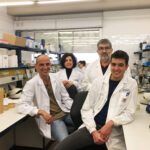
Image: From left to right, the authors of the paper: Ivan Erill, Pilar Cortés, Jordi Barbé, and Miquel Sánchez-Osuna. Photo by Ángela Martínez Mateos.
]]>
“The drug you design ten years from now may already be obsolete,” Ivan Erill says. In a new study in Frontiers in Microbiology, Erill and colleagues describe how bacteria that existed hundreds of...
https://umbc.edu/stories/umbcs-ivan-erill-finds-resistance-to-modern-drug-in-ancient-bacteria/
https://my3.my.umbc.edu/api/v0/pixel/news/120219/guest@my.umbc.edu/2c0cab6151ff54246af167ebacc1b2ab/api/pixel
biology
cirsca
cnms
research
science-and-technology
strategic-planning
UMBC News & Magazine
https://my3.my.umbc.edu/groups/umbc-news-magazine
https://assets1-my.umbc.edu/system/shared/avatars/groups/000/001/943/24435aa6207c452e7bc15cc74b42c7bb/xsmall.png?1748556657
https://assets1-my.umbc.edu/system/shared/avatars/groups/000/001/943/24435aa6207c452e7bc15cc74b42c7bb/original.png?1748556657
https://assets2-my.umbc.edu/system/shared/avatars/groups/000/001/943/24435aa6207c452e7bc15cc74b42c7bb/xxlarge.png?1748556657
https://assets2-my.umbc.edu/system/shared/avatars/groups/000/001/943/24435aa6207c452e7bc15cc74b42c7bb/xlarge.png?1748556657
https://assets3-my.umbc.edu/system/shared/avatars/groups/000/001/943/24435aa6207c452e7bc15cc74b42c7bb/large.png?1748556657
https://assets1-my.umbc.edu/system/shared/avatars/groups/000/001/943/24435aa6207c452e7bc15cc74b42c7bb/medium.png?1748556657
https://assets2-my.umbc.edu/system/shared/avatars/groups/000/001/943/24435aa6207c452e7bc15cc74b42c7bb/small.png?1748556657
https://assets1-my.umbc.edu/system/shared/avatars/groups/000/001/943/24435aa6207c452e7bc15cc74b42c7bb/xsmall.png?1748556657
https://assets2-my.umbc.edu/system/shared/avatars/groups/000/001/943/24435aa6207c452e7bc15cc74b42c7bb/xxsmall.png?1748556657
UMBC News & Magazine
0
0
false
Wed, 30 Jan 2019 20:47:42 -0500
Faculty receive START and SURFF awards to pursue new research and creative work
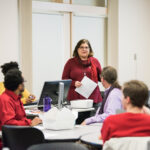
UMBC’s Office of the Vice President for Research recently presented awards to support the work of two dozen UMBC faculty examining topics from health disparities among people with diabetes to natural language processing.
UMBC offers a range of research awards to help faculty launch new research projects, advance ongoing work, and effectively compete for external funding as their projects progress and grow. Strategic Awards for Research Transitions (START) offer up to $25,000. These awards allow faculty to pursue new areas of research and compete for external funding. Summer Research Faculty Fellowship (SURFF) awards offer up to $6,000 in summer funding to non-tenured, tenure-track faculty. Current SURFF awardees received funding for summer 2018, and START awardees will begin their funding cycle in July 2019.
Health and aging
Christine Mair, associate professor of sociology, anthropology, and health administration policy, and a faculty member in the gerontology Ph.D. program, received START funding to complete foundational research visits in global regions that are underrepresented in aging research, across Eastern Europe, Southern Europe, South America, and Asia. She is working to clarify research questions and strengthen relationships with potential research collaborators for a proposal to the National Institute of Aging (NIA).
 Christine Mair, second from left, at the UMB-UMBC Partnership Symposium. Photograph by Marlayna Demond ’11 for UMBC.
With START funding, Sarah Chard, associate professor of sociology, anthropology, and health administration policy, is studying the activity levels of older African-American adults in Baltimore who have diabetes. She is conducting interviews and observing patients to better understand how they experience and manage their illness, their social and physical environments, and how they maintain physical activity routines. This work is helping Chard to develop more effective programs to address health disparities among people with diabetes.
“The aim of my START-funded project is to identify how belief systems and social processes work together to inform physical activity routines among older adult African Americans with diabetes. The project builds on my earlier research on diabetes, which identified many barriers to physical activity for older adults living in Baltimore,” Chard says. “Through START funding, I’m able to shift my focus to look at persons who are engaging in physical activity to see how they create support systems and navigate local barriers. The findings will help address a critical gap in the literature regarding successful community-based physical activity.” Chard will use data from this research for an NIA grant proposal.
 Tasneem Khambaty. Photo courtesy of psychology department.
Tasneem Khambaty, assistant professor of psychology, is using her SURFF award to continue research studying the symptoms and biomarkers of type 2 diabetes, which disproportionately affects African Americans. Khambaty examined how depressive symptoms and executive function impact these biomarkers in the long term, utilizing data from the Healthy Aging in Neighborhoods of Diversity across the Life Span (HANDLS) study, which was conducted in Baltimore. Khambaty is using this research to build a proposal for an NIH Mentored Patient-Oriented Research Career Development Award.
Jiaqi Gong, assistant professor of information systems, is developing innovative ways to understand cognitive and neural systems, specifically in people with multiple sclerosis and ACL injuries. Wearable sensors don’t all work equally well for all people. Previously, Gong developed wearable sensors that perform better in people with multiple sclerosis at different stages. Through his SURFF-funded work, he is utilizing those sensors to study brain mechanisms that control automatic and unconscious motor action, to inform his teaching and further research.
 Jiaqi Gong, right, connects with colleagues at campus event. Photo by Kait McCaffrey.
Drew Holladay, assistant professor of English, utilized SURFF funding to continue revisions of his 2017 dissertation “Articulating the New Normal(s): Mental Disability, Medical Discourse, and Rhetorical Action” for publication as a book. Holladay studies online discussion board posts written by people diagnosed with autism, post-traumatic stress disorder, and schizophrenia. He is expanding his earlier writing to include more linguistic analysis, analyzing how the medical community talks about these diagnoses, as well as adding in illustrations to complement the text.
 Drew Holladay, third from right, participating on UMBC’s Public Humanities and Health Justice Research Forum. Photo by Kait McCaffrey.
Cynthia Matuszek, assistant professor of computer science and electrical engineering (CSEE), was granted START funding to advance her work on robots that assist senior citizens in daily life and enable them to continue to live independently. She is collaborating with eldercare professionals to develop a library that will outline specific examples of how seniors can utilize assistive robots in daily life. Matuszek also received SURFF funding to develop a networking event at the Robotics: Science and Systems conference, to connect junior faculty and postdoctoral researchers with mentors in robotics.
Art, history, and society
Kathryn Bell, associate professor of visual arts, is using START funding to create Metempsychosis, a series of interactive digital video installations that combine art with science, technology, engineering, and math. She is shifting her work from project mapping art to art that is more accessible and less expensive to stage in galleries. Bell will travel to the United Kingdom to study under automata artist Matt Smith, who has exhibited at museums around the world.
Anne Rubin, professor of history, was awarded START funding to visualize the landscape of slavery and freedom in Early Baltimore. Rubin is building a virtual 3D prototype of early Baltimore between 1815 and 1820, in collaboration with UMBC’s Imaging Research Center.
Kathy Marmor, associate professor of visual arts, received START funding to create two new art installations called Mid-Life, inspired by the practice of compiling a book based personal knowledge, which has been common from the seventeenth century through modern times, and is based on one’s “habit of mind.” She is collaborating with faculty in UMBC’s English and computer science and electrical engineering departments. The installations will bring together digital and computer-based imagery, and analog drawings and fiber art to depict women facing mid-life challenges.
 A photo from The Glass Knife exhibition, by Kathy Marmor and Stephen Bradley, which ran in 2016. Image by Stephen Bradley.
Sarah Sharp, assistant professor of visual arts, is using START funding for her new project Off the Press. Sharp will look at small presses and self-published media from the women’s, gay rights, and environmental movements in the 1970s. She will examine the differences and similarities between common practices of that period and contemporary self-publishing practices, such as through social media and other online platforms. Sharp is combining traditional art practices, like quiltmaking and embroidery, with digital video, augmented reality, and 3D modeling.
Earl Brooks, assistant professor of English, utilized a SURFF award to continue his project Black Sonority: Rhetoric and Black Music. This work examines the intersections of Black music, life, and culture. Brooks explores the rhetorical nature of Black music and the various roles it had has in shaping public discussion.
Cross-cultural understanding
Kindel Nash, associate professor of early childhood education, has received SURFF funding to study the relationship between culture, language, and literacy development for young children in the United States and Peru. Nash is examining highly effective literacy practices in U.S. and Peruvian primary schools, which both include populations that are historically underserved in educational settings. She will work to determine the practices’ commonalities and underlying principles, and whether the approaches would be transferable across cultures.
Salem Abo-Zaid, assistant professor of economics, studied attitudes toward immigrant and minority populations in a sample of European countries between 2002 and 2016. He used longitudinal data from the European Social Survey to understand how economic conditions have impacted tolerance toward people in these groups. Abo-Zaid found that economic conditions, in addition to security, political, and cultural tensions, impacted countries’ tolerance of immigrant and minority populations.
Melissa Bailey Kutner, assistant professor of ancient studies, used SURFF funding to complete her book about economics in the Roman Empire. As a part of this work, Kutner studied coins, measured instruments, and wrote accounts of documents found at specific archaeological sites. She looked at how communities used these tools to trace how they shared information and negotiated economic value. Kutner found that how Romans represented value depended on social context, and she developed a model to examine related historical changes across multiple regions.
Technology and environment
Dillon Mahmoudi, assistant professor of geography and environmental systems, used SURFF funding to create a machine-learning algorithm to identify spaces for urban agriculture on single family tax lots. Mahmoudi will study whether urban agriculture plots are more frequently located in richer or poorer neighborhoods. This work focuses on the food production potential of lots in Seattle and Baltimore, expanding on prior research that analyzed lots through satellite images of Portland.
Tim Nohe, professor of visual arts and director of UMBC’s Center for Innovative Research in the Creative Arts, received START funding to use 360 degree immersive video and surround-sound technology to give people a deeper look into the environment through his project “Water Flowing Underground: Immersive Sound and Immersive Video Imaging.” His work will allow viewers to understand sources of pollution that impact Baltimore’s watershed. The research will reveal streams that have been used to collect raw sewage, or have been paved over, impacting the flow of water.
 Tim Nohe at Light City in 2017. Photo by Marlayna Demond ’11 for UMBC.
“This grant has allowed me to begin fieldwork and research on the fractured interface of Baltimore’s watershed and its sanitary sewer system. That breakdown is evident in my neighborhood, and throughout the city,” explains Nohe. “When the sewer system was nearing completion in 1909 it was called an ‘unexcelled marvel of the engineering world,’ but today sanitary sewers routinely spew waste into our streams, the bay, and city basements.”
“I’m forging partnerships with journalists, water quality scientists and nonprofit groups like Blue Water Baltimore to hunt down and expose these breakdowns,” says Nohe, “using the tools of archival research, and documentary immersive video and surround sound.”
Data and computing
Frank Ferraro, assistant professor of CSEE, used SURFF funding to advance his work in natural language processing. He studied how information extraction systems can help deconstruct and summarize highly complex documents. Over the summer, Ferraro developed, trained, and evaluated these systems to determine how they can be effectively used to can help people understand themes within dense and complicated texts.
Haibin Zhang, assistant professor of CSEE, developed an efficient, secure and scalable system that helps prevent compromised sensors from shifting aggregated data results based on polluted data. The system that Zhang designed and put in place helps solve the problem by keeping individual sensor inputs private.
Sisi Duan, assistant professor of information systems, used SURFF funding to study the scalability of blockchains—blocks of data linked using cryptography, that are resistant to tampering. She identified challenges that blockchain researchers sometimes face, and then redesigned and reimplemented a blockchain protocol called BChain, which she developed. Duan implemented BChain as part of the Hyperledger project, a global collaborative project aimed at advancing blockchain technologies across industries.
Curtis Menyuk, professor of CSEE, is working with collaborators at Bangladesh University of Engineering and Technology and at the Maryland Psychiatric Research Center to develop a model that can help explain what contributes to white matter deficits in the brain.
New directions in science
Theodosia Gougousi, professor of physics, received funding to address the shortage of semiconductor-compatible nonlinear optical materials. She will investigate the nonlinear properties of dielectric thin films and nanolaminates formed by atomic layer deposition. Her project is interdisciplinary, bridging the fields of electronics materials and nonlinear optics, with the goal of developing a broader materials toolkit that could be utilized for optoelectronic applications.
Gougousi explains that the funding will support the collaboration of her research group and that of Anthony Johnson, professor of physics. “Our groups have been working together for over a year,” she says. “We expect the award will enable us to complete the characterization of the structure and composition of these films, which is required for competitive proposals to national funding agencies.
Mercedes Burns, assistant professor of biological sciences, studied sexual reproduction in Japanese harvestman, an arachnid with long legs compared to other species. This work, supported by SURFF funding, allowed Burns to collect female Japanese harvestman in order to conduct genotyping analysis. During the summer, she attended the Society of Molecular Biology and Evolution scientific meeting to collaborate with fellow biologists from around the world.
Kathleen Cusick, assistant professor of biological sciences, received SURFF funding to characterize the role of an intracellular signaling molecule in bacteria that regulates cellular function, cell movement, intracellular communication, and how cells respond to the environment. The molecule (called c-di-GMP) has unique trails that make it a particularly good fit for this research into signaling networks.
For more information about UMBC’s START and SURFF programs, visit the UMBC Research website.
Banner image: Anne Rubin, standing, during the 2018 Frederick Douglass transcribe-a-thon. Banner image by Marlayna Demond ’11 for UMBC.
]]>
UMBC’s Office of the Vice President for Research recently presented awards to support the work of two dozen UMBC faculty examining topics from health disparities among people with diabetes to...
https://umbc.edu/stories/faculty-receive-start-and-surff-awards-to-pursue-new-research-and-creative-work/
https://my3.my.umbc.edu/api/v0/pixel/news/120243/guest@my.umbc.edu/714811ac2a01d4a647e7e1503f70268a/api/pixel
ancientstudies
biology
cahss
cirsca
cnms
coeit
csee
economics
education
english
ges
history
is
physics
research
saph
science-and-technology
strategic-planning
visualarts
UMBC News & Magazine
https://my3.my.umbc.edu/groups/umbc-news-magazine
https://assets1-my.umbc.edu/system/shared/avatars/groups/000/001/943/24435aa6207c452e7bc15cc74b42c7bb/xsmall.png?1748556657
https://assets1-my.umbc.edu/system/shared/avatars/groups/000/001/943/24435aa6207c452e7bc15cc74b42c7bb/original.png?1748556657
https://assets2-my.umbc.edu/system/shared/avatars/groups/000/001/943/24435aa6207c452e7bc15cc74b42c7bb/xxlarge.png?1748556657
https://assets2-my.umbc.edu/system/shared/avatars/groups/000/001/943/24435aa6207c452e7bc15cc74b42c7bb/xlarge.png?1748556657
https://assets3-my.umbc.edu/system/shared/avatars/groups/000/001/943/24435aa6207c452e7bc15cc74b42c7bb/large.png?1748556657
https://assets1-my.umbc.edu/system/shared/avatars/groups/000/001/943/24435aa6207c452e7bc15cc74b42c7bb/medium.png?1748556657
https://assets2-my.umbc.edu/system/shared/avatars/groups/000/001/943/24435aa6207c452e7bc15cc74b42c7bb/small.png?1748556657
https://assets1-my.umbc.edu/system/shared/avatars/groups/000/001/943/24435aa6207c452e7bc15cc74b42c7bb/xsmall.png?1748556657
https://assets2-my.umbc.edu/system/shared/avatars/groups/000/001/943/24435aa6207c452e7bc15cc74b42c7bb/xxsmall.png?1748556657
UMBC News & Magazine
0
0
false
Tue, 18 Dec 2018 20:22:13 -0500
From lab to museum, new UMBC grads show the powerful impact of original research
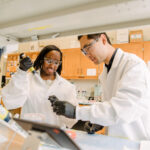
“I just had this feeling that there had to be more to this story,” says Nicolle “Niki” Konkel ’18, on the striking lack of women in her art history textbooks. So, with the support of faculty mentors, in her senior year she embarked on research that has opened new doors in the art world.
Student passion guided by faculty support is part of the fabric of UMBC. Konkel’s experience is one exciting example of how this winning combination can make possible big breakthroughs.
Hearing marginalized voices
Konkel is an art history and museum studies major who came to UMBC after attending Frederick Community College. While at FCC, She worked 30 hours a week in addition to her studies to fund her first trip to the Netherlands, a voyage that shaped her career goals. Now, she is contributing to a new branch of art history research on women of the De Stijl, an early 20th-century avant garde Dutch art movement.
“There’s so much still to learn, and that fuels my passion to go to graduate school and continue this research,” she says. “When marginalized voices can be heard and placed more within the mainstream, I think that’s so important.”
 DE STIJL “6 decades book.” Photo by de stijl, CC BY 2.0.
This fall, Konkel was also able to gain professional experience as an curatorial intern at the Smithsonian National Museum of American History. She was part of the curatorial team for an entertainment exhibit that will be on display for two decades.
Konkel says the support of her mentors helped make it all possible, especially her senior thesis mentor, visual arts professor Kathy O’Dell. All of the professors “are so invested in us here. They care a lot about my growth and what I’m going to do afterward,” Konkel says. “They want to help you channel your passion.”
Confidence boost
Alexis Waller ’18, biological sciences, has had similarly powerful experiences with research and mentorship. UMBC STEM BUILD, an NIH-funded initiative to increase diversity in the biomedical workforce, “showed me what research actually was,” Waller says. Before UMBC, she shares, “I’d never been inside a lab.” Now? “I just love being in the lab setting and doing hands-on research.”
In her first year, Waller presented at the UMBC Undergraduate Research Symposium with BUILD. With support from Laura Ott, the active learning coordinator for STEM BUILD, Waller joined Michael Summers’s lab in 2016. The lab’s research focuses on how the HIV-1 retrovirus assembles copies of itself within infected cells, so that the copies can emerge to infect other cells.
In addition to Summers, postdoc Pengfei Ding provides direct research mentorship to Waller. “He has always been very patient and encouraged me to ask questions,” Waller says.
 Alexis Waller ’18, right, and her mentor Pengfei Ding at work in Michael Summers’s biochemistry lab. Photo by Marlayna Demond ’11 for UMBC.
Waller started out in a shadowing role in the lab, but says, “as I’ve gotten more confident and knowledgeable, the more responsibility I’ve been given.”
Now a MARC U*STAR Scholar, Waller is continuing work on her team’s project studying a step in the replication of HIV. By contributing to a better understanding of that step, she’s helping provide the knowledge necessary for other scientists to develop treatments to block HIV replication, preventing spread of the infection.
After graduation, Waller will continue to work in the Summers lab as a research assistant while she applies to Ph.D. programs in microbiology. “Being a part of BUILD and MARC, and working in the Summers lab, has all led to me deciding to pursue a Ph.D.,” she says.
Bench to bedside
Like Waller, Abby Cruz ‘18 is also a biological sciences major and a MARC U*STAR Scholar. When she came to UMBC, she believed science was a solitary pursuit, but that changed after she joined Fernando Vonhoff’s biology lab. “I look forward to going to lab because of the collaboration with other people,” she says.
 Abby Cruz ’18, left, and her mentor Fernando Vonhoff discuss an experimental protocol. Photo by Marlayna Demond ’11 for UMBC.
Cruz has been looking at whether certain genes may be associated with human motor neuron diseases, such as ALS, using fruit flies as a model. Scientists at Yale University will use her results to inform their study of motor neuron disease in human cells.
She also works part time in a neurology clinic, where she interacts directly with patients. “I love it,” she says. “It’s what gets me up every day—that I’m part of a community where I can see the research and the clinical side go hand in hand.”
Cruz reached out to Vonhoff just before she joined UMBC from Howard Community College in 2016, and he’s been a supporter ever since. “If it wasn’t for Dr. Vonhoff I wouldn’t have been able to do everything I did,” she says. “If you’re willing to try and put in the effort, his attitude is, ‘Let’s make it happen.’”
 Abby Cruz ’18 and her mentor Fernando Vonhoff check on a vial of fruit flies, their study organism. Photo by Marlayna Demond ’11 for UMBC.
Before starting work in the lab, Cruz was planning on medical school. Now she’s looking toward an M.D./Ph.D. or D.O./Ph.D. (doctor of osteopathic medicine). “Focusing on that connection between the research and the clinic has really solidified my future goals,” she says.
Bridging cultures
When Julian Tash ’18 approached Constantine Vaporis, history professor and former director of UMBC’s Asian studies program, after an art history class one day, he expected a helpful conversation about his career goals. He came away with a game-changing connection to Robert Mintz, the curator of Japanese art at the Walters Art Museum in Baltimore.
Tash, a Humanities Scholar, had noticed Asian art was given less attention than Western art in his high school courses. His further exposure at UMBC to the rich traditions found in Asian art, however, inspired him to pursue a double major in Asian studies and history. With Vaporis’s support, he began an internship at the Walters.
Cataloguing Buddhist statuary at the Walters got Tash “interested in the question of how to connect museum visitors with these statues, when they don’t have a background in the culture in which the objects were produced,” he shares. That interest led to a project he pursued with guidance from Vaporis and visual arts professor Preminda Jacob.
 Julian Tash ’18 says most of his research, when he isn’t doing fieldwork, involves a lot of reading in the library. Photo by Marlayna Demond ’11 for UMBC.
Tash received funding from a UMBC Undergraduate Research Award and a Bridging Scholarship from the American Association of Teachers of Japanese to travel throughout Japan and in the U.S. to explore how Buddhist statues are displayed in their native context compared to in American museums. His resulting research paper, which has been selected for publication in the UMBC Review, recommends that U.S. museums use technology to help visitors see more clearly how the statues appear in their original contexts, in Japanese temples.
Tash has already shared his research with curators at the Metropolitan Museum of Art, British Museum, and Freer and Sackler Galleries. He has also presented other work at the Bard Conference on Asia and the Environment, with research partner Jennifer Christhilf ’19, geography and environmental systems. That project was a new direction for Tash, exploring the impacts of dam construction projects in China and downstream countries such as Vietnam and Cambodia.
 Julian Tash ’18 and one of his mentors, Julie Rosenthal, stand by his research poster about dam removals on the Mekong River in China. Photo by Marlayna Demond ’11 for UMBC.
“Working with someone in the sciences is really emblematic of UMBC, because we’re bringing it all together, in a way that’s vitally important to this region,” says Tash. “That was a great experience and it got me thinking about the intersection of the humanities and policy.”
Although he’s graduating, collaborations Tash has helped build will continue at UMBC, including a Perspectives on Asia conference that will be co-sponsored by Johns Hopkins University.
Tash has applied for a Fulbright Fellowship to conduct research in Taiwan as well as graduate programs.
Like Konkel, Cruz, and Waller, when Tash reflects on his UMBC experience, it all comes back to mentorship and support. “Even though these professors all have really busy schedules, I would go to them with an idea, and even if it wasn’t in their immediate area of study, they all made such phenomenal efforts to support me,” he shares.
“UMBC put the resources in front of me,” Tash says. “I just thought, I could do all these things—I just have to try to pursue them.”
December commencement ceremonies will be livestreamed through both the UMBC Commencement website and UMBC Facebook page. Share well wishes for our grads using #UMBCgrad and #UMBCproud.
Banner image: Alexis Waller ’18 and her mentor, Pengfei Ding, at work in the lab. Photo by Marlayna Demond ’11 for UMBC.
]]>
“I just had this feeling that there had to be more to this story,” says Nicolle “Niki” Konkel ’18, on the striking lack of women in her art history textbooks. So, with the support of faculty...
https://umbc.edu/stories/from-lab-to-museum-new-umbc-grads-show-the-powerful-impact-of-original-research/
https://my3.my.umbc.edu/api/v0/pixel/news/120244/guest@my.umbc.edu/8feb90d9cbb819b272a89488968dd7d0/api/pixel
arts-and-culture
asianstudies
biology
cahss
chembiochem
cirsca
cnms
community
diversityandinclusion
history
marcustar
policy-and-society
science-and-technology
stembuild
strategic-planning
visualarts
UMBC News & Magazine
https://my3.my.umbc.edu/groups/umbc-news-magazine
https://assets1-my.umbc.edu/system/shared/avatars/groups/000/001/943/24435aa6207c452e7bc15cc74b42c7bb/xsmall.png?1748556657
https://assets1-my.umbc.edu/system/shared/avatars/groups/000/001/943/24435aa6207c452e7bc15cc74b42c7bb/original.png?1748556657
https://assets2-my.umbc.edu/system/shared/avatars/groups/000/001/943/24435aa6207c452e7bc15cc74b42c7bb/xxlarge.png?1748556657
https://assets2-my.umbc.edu/system/shared/avatars/groups/000/001/943/24435aa6207c452e7bc15cc74b42c7bb/xlarge.png?1748556657
https://assets3-my.umbc.edu/system/shared/avatars/groups/000/001/943/24435aa6207c452e7bc15cc74b42c7bb/large.png?1748556657
https://assets1-my.umbc.edu/system/shared/avatars/groups/000/001/943/24435aa6207c452e7bc15cc74b42c7bb/medium.png?1748556657
https://assets2-my.umbc.edu/system/shared/avatars/groups/000/001/943/24435aa6207c452e7bc15cc74b42c7bb/small.png?1748556657
https://assets1-my.umbc.edu/system/shared/avatars/groups/000/001/943/24435aa6207c452e7bc15cc74b42c7bb/xsmall.png?1748556657
https://assets2-my.umbc.edu/system/shared/avatars/groups/000/001/943/24435aa6207c452e7bc15cc74b42c7bb/xxsmall.png?1748556657
UMBC News & Magazine
0
0
false
Tue, 18 Dec 2018 20:14:09 -0500
CS3 leads research summit on community-based violence prevention in Baltimore
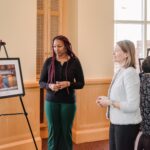
Lauren and Vibha sit in a conference room deep in the middle of the University of Maryland School of Medicine. They wait patiently as faculty and staff from UMBC; the University of Maryland, Baltimore (UMB); the University of Maryland, College Park; Baltimore City government officials; and staff from Baltimore-based non-profit organizations fill the round tables.
This is the Research Summit on Violence Prevention and Community Engagement hosted by UMBC and UMB. In a room of about fifty attendees ready to discuss the impact of violence prevention efforts in Baltimore, Lauren and Vibha look at each other, knowing they bring a different voice. Both recent UMBC alumni and graduate presidential fellows at UMB, they are here to speak as young Baltimore researchers, who care deeply about their communities and want to be involved in the research aimed at making their city safer.
 UMB graduate students discuss violence prevention in Baltimore with UMBC’s Lauren Edwards, public policy (right). Photo by Marlayna Demond ’11 for UMBC.
“I am the community”
Lauren Highsmith ‘15, education, introduces herself to the room after a conversation about the need to work with the community. “I am the community. Please remember me,” she says. “I am a master’s student in social work at the University of Maryland, Baltimore. I was born in West Baltimore and continue to live in the area. Don’t assume the community is just what you see on television. The community are also people like me who are working in the field and doing research.”
Vibha Rao ‘14, biological sciences, M22, claps after her friend’s statement. She is from Gaithersburg, Maryland, but lives, studies, and works in Baltimore. In the last decade, she has earned her undergraduate degree and a medical degree from the University of Maryland School of Medicine, and she is currently pursuing an M.S. in clinical research.
Rao has been deeply affected by the experiences of her undergraduate and graduate peers from Baltimore whose family members have been killed by gun violence. “Their experience having grown up and gone to college and medical school in Baltimore is starkly different than students outside of Baltimore,” she says. She worries about the normalization of gun violence and wants to be part of research to address it from a medical perspective. She shares, “I don’t want violence to be normal anymore.”
Human- and community-centered research
The research summit was organized by Christine Mallinson, director of UMBC’s Center for Social Science Scholarship (CS3) and professor of Language, Literacy, and Culture, and Kate Tracy ‘03 Ph.D. and ‘01 M.A., psychology and human services, who is associate professor of epidemiology and public health and director of The Richard and Jane Sherman Center for Health Care Innovation at the University of Maryland, Baltimore. As one focus for the day’s work, Mallinson and Tracy asked participants to explore both immediate and long-term supports for communities served through the UMB Community Engagement Center. During the breakout sessions, they asked attendees to identify how they might engage more undergraduate and graduate students from Baltimore, like Highsmith and Rao, in community-facing research on violence prevention.
 Mallinson (l) and Tracy (r) address the purpose of the summit. Photo courtesy of UMB.
“We wanted to purposefully use this summit to convene as many researchers as possible to examine, discuss, and share expertise and data,” Mallinson says. “Our intent is increasing collaboration and resources beyond this room, between institutions and the community, to create tangible, applicable and responsive human- and community-centered research in violence prevention with and for Baltimore.”
During the day-long event, UMBC faculty and staff representing the School of Public Policy, media and communication studies, visual arts, The Hilltop Institute, The Shriver Center, Division of Student Affairs, emergency health services, and psychology gathered for group discussion in different areas of violence prevention research. They met as cohorts focused on data, community involvement, K-12 and higher education, clinical interventions, and the intersection of the correctional and health systems.
Responding to the call from the morning discussion, the groups developed ideas for how to support the UMB Community Engagement Center through each of their focus areas, particularly building on existing work by community members. They also identified a timeline to continue the cohort work beyond the conference.
 UMBC President Freeman Hrabowski (l) speaks to summit participants. Photo courtesy of UMB.
“Collaboration between academic and community partners is key for successful violence prevention research, and developing the next generation of innovators by harnessing the talents of our undergraduate and graduate students in this process is essential,” shared Lucy Wilson, M.D., graduate program director of emergency health services at UMBC.
After the summit, the participants walked through two thought-provoking exhibitions, David Hess’s “Gun Show,” with life-size sculptures of assault rifles made from ordinary objects, and a photo series of homicide locations in Baltimore City by Amy Berbert’s ’17, visual arts. Both artists created the pieces to foster dialogue and awareness about guns and violence.
 Highsmith and Berbert discussing the photo exhibit. Photo by Marlayna Demond ’11, for UMBC.
As everyone spoke with the artists, and with each other, reflecting on the day, Mallinson took this opportunity to connect with Lauren Highsmith and Vibha Rao. She wanted to hear their perspectives, and their advice, on how to engage and include more undergraduate and graduate students from Baltimore in violence prevention work, to ensure it tackles the most pressing issues, recognizes community work already underway, and can have a lasting impact.
Banner image: Event organizer Christine Mallinson (r) speaks with summit participants. Photo by Marlayna Demond ’11 for UMBC.
]]>
Lauren and Vibha sit in a conference room deep in the middle of the University of Maryland School of Medicine. They wait patiently as faculty and staff from UMBC; the University of Maryland,...
https://umbc.edu/stories/cs3-leads-research-summit-on-community-based-violence-prevention-in-baltimore/
https://my3.my.umbc.edu/api/v0/pixel/news/120250/guest@my.umbc.edu/0c1a83adcf2fb9ee8ac4430723901b48/api/pixel
cahss
cec
cirsca
cs3
ehs
hilltopinstitute
mcs
policy-and-society
psychology
publicpolicy
shrivercenter
strategic-planning
visualarts
UMBC News & Magazine
https://my3.my.umbc.edu/groups/umbc-news-magazine
https://assets1-my.umbc.edu/system/shared/avatars/groups/000/001/943/24435aa6207c452e7bc15cc74b42c7bb/xsmall.png?1748556657
https://assets1-my.umbc.edu/system/shared/avatars/groups/000/001/943/24435aa6207c452e7bc15cc74b42c7bb/original.png?1748556657
https://assets2-my.umbc.edu/system/shared/avatars/groups/000/001/943/24435aa6207c452e7bc15cc74b42c7bb/xxlarge.png?1748556657
https://assets2-my.umbc.edu/system/shared/avatars/groups/000/001/943/24435aa6207c452e7bc15cc74b42c7bb/xlarge.png?1748556657
https://assets3-my.umbc.edu/system/shared/avatars/groups/000/001/943/24435aa6207c452e7bc15cc74b42c7bb/large.png?1748556657
https://assets1-my.umbc.edu/system/shared/avatars/groups/000/001/943/24435aa6207c452e7bc15cc74b42c7bb/medium.png?1748556657
https://assets2-my.umbc.edu/system/shared/avatars/groups/000/001/943/24435aa6207c452e7bc15cc74b42c7bb/small.png?1748556657
https://assets1-my.umbc.edu/system/shared/avatars/groups/000/001/943/24435aa6207c452e7bc15cc74b42c7bb/xsmall.png?1748556657
https://assets2-my.umbc.edu/system/shared/avatars/groups/000/001/943/24435aa6207c452e7bc15cc74b42c7bb/xxsmall.png?1748556657
UMBC News & Magazine
0
0
false
Fri, 14 Dec 2018 18:56:55 -0500
 Musa at James McHenry Elementary/Middle School. Photo courtesy of the Sherman STEM Teachers Scholars.
 Animation still by Blurton-Jones.
 Animation still by Blurton-Jones.
 Mann, with other social work students, introducing themselves to a class in Ghana. Photo courtesy of Mann.


