Building next-gen AI chips at UMBC: A Q&A with NSF CAREER award winner Chenchen Liu
Many recent artificial intelligence (AI) breakthroughs—such as smartphone tools that recognize your friends’ faces or understand your spoken commands—are based on a computing approach that was first dreamed up nearly 80 years ago. Called neural networks, the approach loosely mimics the way biological brains work. For decades, it was a quixotic idea with results that fell far short of the power of human brains. Yet starting in the early 2000s, the technique took off. What changed? In short, computers finally got fast enough (and training data plentiful enough) for neural networks to realize their hoped-for potential.
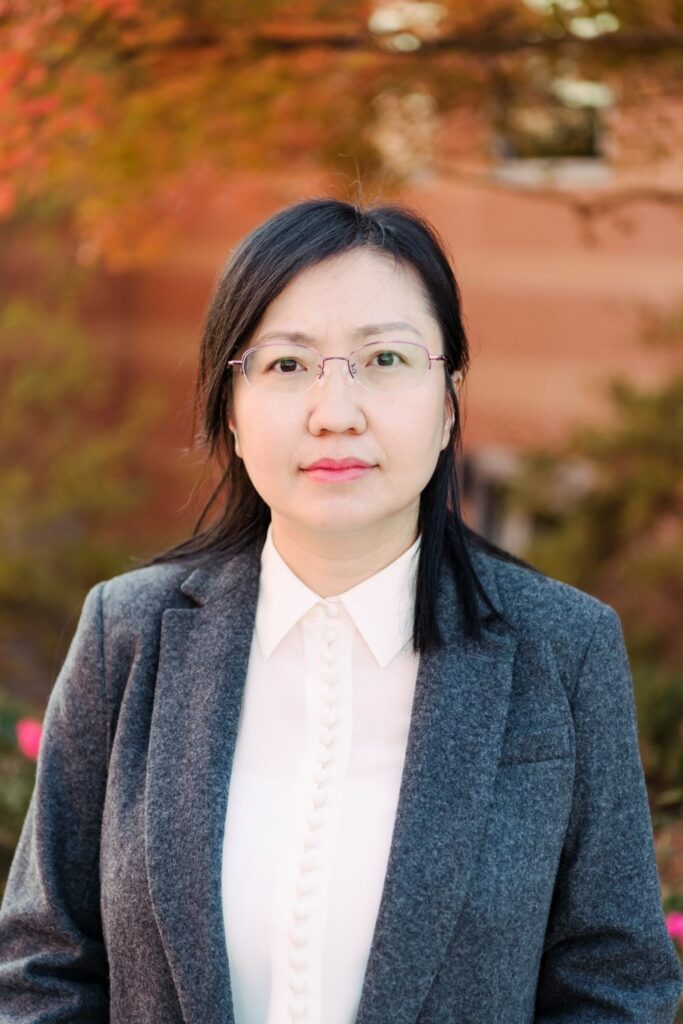 Chenchen Liu (Marlayna Demond ’11/UMBC)
The story of neural networks illustrates a key principle in computer science: the power of any computing technique is bound by the capabilities of the hardware that runs it. Improving that hardware is a major research focus for Chenchen Liu, an assistant professor of computer science and electrical engineering at UMBC. Liu was recently awarded a prestigious NSF CAREER award totaling nearly $540,000 that will fund her efforts over the next five years to advance the next generation of powerful computer chips.
As society continues to engage with the implications of the latest commercial iterations of AI, research efforts such as Liu’s are looking ahead to an even newer wave of applications, including self-driving cars, immersive virtual reality, and AI-assisted agriculture. These new applications often require separate neural networks—for example, an image recognition system and a collision avoidance system, to share information and work together.
Working with students and colleagues, Liu is studying how modifications to state-of-the-art AI chips could make such coordination easier.
UMBC News asked Liu about her research, the NSF CAREER award, the future of AI, and the need for responsible AI use.
UMBC News: What are some of the main challenges holding back next-generation AI applications?
Liu: In next-gen AI applications, machines are faced with a complex composition of multiple tasks, requiring them to run multiple AI models simultaneously. And not only do the models need to run at the same time, they need to share information from one to the other. The computing needs of the models may be different. Some models may need a lot of computing power, others may need a lot of memory. It becomes very difficult to coordinate these distinct resource needs on a single computing platform and to run everything in parallel and as efficiently as possible.
UMBC News: What are some ways that you plan to tackle these challenges in your NSF CAREER-funded research?
Liu: We first need to map the interactions of the different models and understand what computing resources they need and how they work together. We then plan to investigate a novel computer chip architecture designed to support these interactions. We will look for ways to flexibly schedule tasks and allocate computing power and memory so the system can operate differently for different scenarios. Eventually, we will integrate these techniques into a comprehensive framework that could be widely applied to various next-gen AI applications.
UMBC News: What are you the most excited about in your work?
Liu: I believe an incredible increase in AI complexity will be the next big thing in the world, and I am excited to become a small part of it. The increase in complexity comes with an urgent need for novel computer architecture to support it. Since the first computer was invented, people have been trying to optimize computing performance. Now with AI, current computing resources cannot meet the requirements caused by larger and larger volumes of data. A lot of researchers are working on novel computing architectures to improve performance and I am happy to be one of them.
UMBC News: Do you see a lot of opportunities for students in the field?
Liu: AI is changing everything in the world now. You can hear about job opportunities in Silicon Valley or with new AI start-ups nowadays, indicating a thriving new era of careers centered on AI computing. This trend is also shaping the interests of students on campus. They want to work on projects with AI components and we offer opportunities like that in many of our classes. It’s not only an opportunity for students, but also an opportunity for us to review our course development and career guidance.
UMBC News: What do you think is the future of AI?
Liu: The overall feeling is one of awe. Just like the first word carved on stone and the first rocket launched to the sky, AI is another milestone in human history. It marks humankind’s exploration of intelligence itself, asking questions about how it is formed and how it might evolve.
We should proceed cautiously, since AI is also strong enough now to challenge human intelligence and even deceive us. Many governments have made calls to regulate it.
I believe in a few years, we will have every perspective of our world reshaped by AI, with clear impacts on the economy and society.
]]>
Many recent artificial intelligence (AI) breakthroughs—such as smartphone tools that recognize your friends’ faces or understand your spoken commands—are based on a computing approach that was...
https://umbc.edu/stories/building-next-gen-ai-chips/
https://my3.my.umbc.edu/api/v0/pixel/news/137924/guest@my.umbc.edu/8c9451a9e7d3590f7bd072855f76f563/api/pixel
coiet
csee
news
research
science-and-tech
UMBC News & Magazine
https://my3.my.umbc.edu/groups/umbc-news-magazine
https://assets1-my.umbc.edu/system/shared/avatars/groups/000/001/943/24435aa6207c452e7bc15cc74b42c7bb/xsmall.png?1748556657
https://assets1-my.umbc.edu/system/shared/avatars/groups/000/001/943/24435aa6207c452e7bc15cc74b42c7bb/original.png?1748556657
https://assets2-my.umbc.edu/system/shared/avatars/groups/000/001/943/24435aa6207c452e7bc15cc74b42c7bb/xxlarge.png?1748556657
https://assets2-my.umbc.edu/system/shared/avatars/groups/000/001/943/24435aa6207c452e7bc15cc74b42c7bb/xlarge.png?1748556657
https://assets3-my.umbc.edu/system/shared/avatars/groups/000/001/943/24435aa6207c452e7bc15cc74b42c7bb/large.png?1748556657
https://assets1-my.umbc.edu/system/shared/avatars/groups/000/001/943/24435aa6207c452e7bc15cc74b42c7bb/medium.png?1748556657
https://assets2-my.umbc.edu/system/shared/avatars/groups/000/001/943/24435aa6207c452e7bc15cc74b42c7bb/small.png?1748556657
https://assets1-my.umbc.edu/system/shared/avatars/groups/000/001/943/24435aa6207c452e7bc15cc74b42c7bb/xsmall.png?1748556657
https://assets2-my.umbc.edu/system/shared/avatars/groups/000/001/943/24435aa6207c452e7bc15cc74b42c7bb/xxsmall.png?1748556657
UMBC News & Magazine
0
0
false
Thu, 21 Dec 2023 12:15:32 -0500
The Driving Force of Chemistry
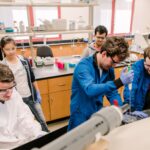
In a chemical engineering lab, students huddle around a bench layering aluminum foil and steel wool together to build a battery. Another group pipettes solutions into a pressure vessel to test various reactions. The end result of the students’ experimentations will be two autonomous shoebox-sized vehicles that are powered by chemical reactions. Think of your second-grade volcano project, but the baking soda and vinegar “eruption” is happening inside an enclosed vessel, propelling it forward down a track.
When the UMBC Chem-E-Car chapter launched in early spring 2019, there were 10 students who came together to grow the group. Today, less than one year after they became formally recognized by UMBC and the American Institute of Chemical Engineers, there are about 30 students working together to build vehicles powered by chemical reactions, putting the information and skills they learn in their classes into practice.
Students work in three groups on two vehicle projects. One team focuses on developing the stopping mechanism that uses a color changing reaction, the second team works on refining the car propelled by a pressure-generating reaction, and the third team develops a battery-driven vehicle.
“One car moves using a chemical reaction that produces a large volume of gas, and the gas is used to move a pneumatic motor, which is kind of like a water wheel for air,” explains Sammie Maygers ’20, chemical engineering, who is leading the group in charge of developing the stopping mechanism. “The second car is powered by a battery. We are experimenting with different chemical reactions to optimize the amount of current and voltage that we can produce to run an electric motor.”

As the group was ramping up, the founding students spent the semester learning about the structure of the competitions and attended the regional competition as onlookers. Alex Von Gunten ’20, chemical engineering, current chair of the Chem-E-Car Project, says that it was helpful for UMBC students to experience the competitions and to take note of the vehicles that other teams built. An additional layer of pressure for competitors is that no one knows how far their car will need travel until a couple of hours before the race, when the judges release the specifications that the car must meet. Just before the car is set to race, the students work through a series of calculations to determine the amount of chemicals that are needed to propel the vehicle a specific distance.
Jason Ewart ’20, chemical engineering, who is a member of the pressure team, explains that safety is a very important component of the Chem-E-Car competitions. The students who are taking part rely on the knowledge they’ve learned in the courses they have taken at UMBC, including the safety course that all chemical, biochemical, and environmental engineering students must complete.
The Chem-E-Car group joins a rich history of student organizations on campus that design and build vehicles based on skills learned in the classroom. On a human scale, UMBC’s Baja SAE team builds vehicles that are driven by one student and are designed to withstand challenging terrain and weather while keeping budget, vehicle weight, and agility in mind. In the 2018–2019 season, the Baja team finished with the second highest total points in the program’s 30-year history.
The Chem-E-Car team has yet to test the mettle of their designs, but they plan on competing in the regional competition at Virginia Tech in April 2020, with their sights set on advancing to the national competition.
***
All photos, including header, by Marlayna Demond ’11.
]]>
In a chemical engineering lab, students huddle around a bench layering aluminum foil and steel wool together to build a battery. Another group pipettes solutions into a pressure vessel to test...
https://umbc.edu/stories/mini-vehicles-powered-by-chemical-reactions/
https://my3.my.umbc.edu/api/v0/pixel/news/120006/guest@my.umbc.edu/2574760c7d6a055cbaeaa01d50047c08/api/pixel
at-play
campus-life
chemistry
coiet
fall-2019
sae-baja
UMBC News & Magazine
https://my3.my.umbc.edu/groups/umbc-news-magazine
https://assets1-my.umbc.edu/system/shared/avatars/groups/000/001/943/24435aa6207c452e7bc15cc74b42c7bb/xsmall.png?1748556657
https://assets1-my.umbc.edu/system/shared/avatars/groups/000/001/943/24435aa6207c452e7bc15cc74b42c7bb/original.png?1748556657
https://assets2-my.umbc.edu/system/shared/avatars/groups/000/001/943/24435aa6207c452e7bc15cc74b42c7bb/xxlarge.png?1748556657
https://assets2-my.umbc.edu/system/shared/avatars/groups/000/001/943/24435aa6207c452e7bc15cc74b42c7bb/xlarge.png?1748556657
https://assets3-my.umbc.edu/system/shared/avatars/groups/000/001/943/24435aa6207c452e7bc15cc74b42c7bb/large.png?1748556657
https://assets1-my.umbc.edu/system/shared/avatars/groups/000/001/943/24435aa6207c452e7bc15cc74b42c7bb/medium.png?1748556657
https://assets2-my.umbc.edu/system/shared/avatars/groups/000/001/943/24435aa6207c452e7bc15cc74b42c7bb/small.png?1748556657
https://assets1-my.umbc.edu/system/shared/avatars/groups/000/001/943/24435aa6207c452e7bc15cc74b42c7bb/xsmall.png?1748556657
https://assets2-my.umbc.edu/system/shared/avatars/groups/000/001/943/24435aa6207c452e7bc15cc74b42c7bb/xxsmall.png?1748556657
UMBC News & Magazine
0
0
false
Thu, 21 Nov 2019 14:46:59 -0500
