Office Hours—President Sheares Ashby talks with a graduating senior about rootedness and change
Manav Narendra’s story has been shaped by constant motion. A math and computer science double major, who graduated from UMBC this spring, Narendra grew up moving frequently between India and the United States, adapting to new schools, cultures, and environments every few years. Raised by a single mother who was always striving to create a better life for them, Narendra grew accustomed to change—but also to the challenges that come with it.
Coming to UMBC marked a turning point. Narendra sought out a smaller, close-knit academic environment where he could build community, form lasting friendships, and explore what it means to belong somewhere. In this Office Hour, President Valerie Sheares Ashby—who has also been at UMBC for four years—and Narendra reflect on growing rooted to a place and what effect those lasting connections can have.
UMBC Magazine: Manav, tell us about your background and what brought you to UMBC.
Manav Narendra: I’m originally from India, and I’ve spent about half my life there and half in the U.S. Growing up, I moved a lot because my mom would switch jobs for better opportunities. By my senior year of high school, we had just moved to Maryland. I applied to a vast array of colleges, but I ultimately chose UMBC because I wanted a smaller, more personal environment where I wouldn’t feel lost.
And here, I’ve met people in so many different ways—through classes, the Honors College, tutoring, tennis, even the Career Fair. It’s been really meaningful.
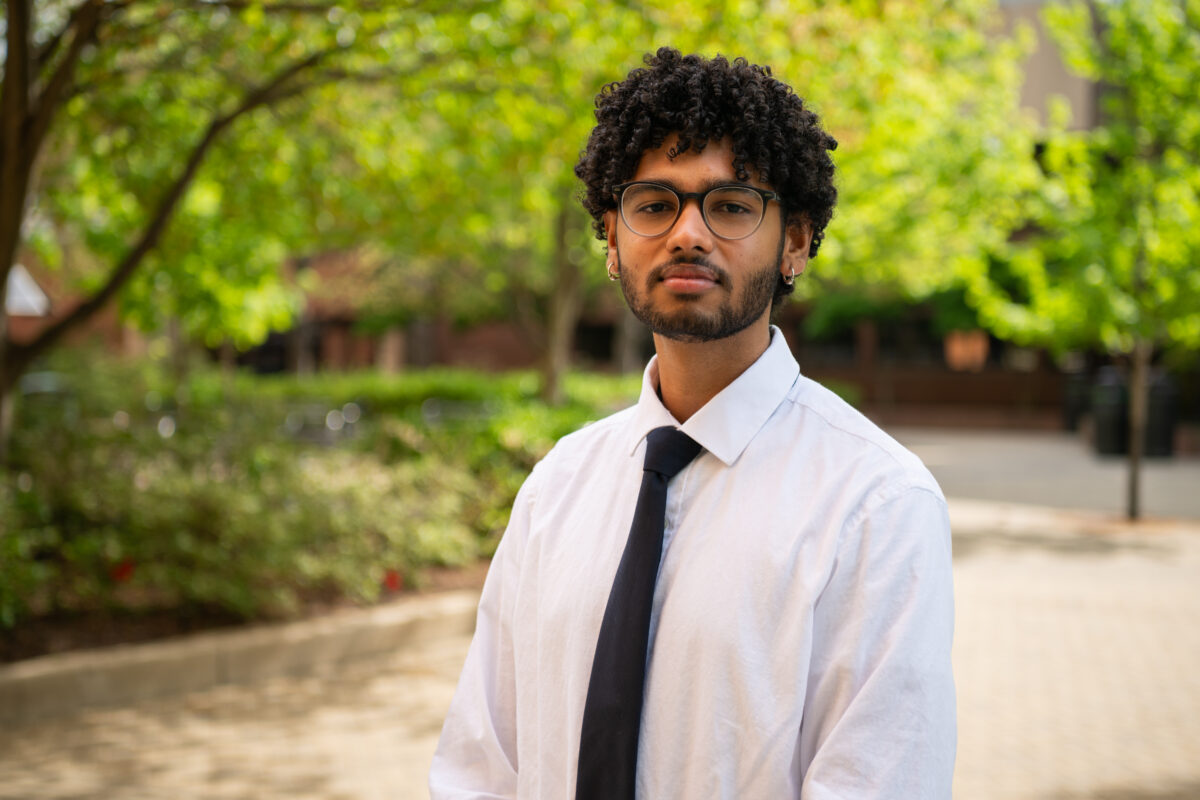 Narendra on campus in spring 2026.
President Valerie Sheares Ashby: You wanted a place where you could feel seen—that is powerful. And these smaller communities within UMBC can really shape your experience.
UMBC Magazine: How did moving so often affect your ability to build relationships?
Narendra: It was difficult. I became more introverted over time because you don’t really get the chance to build lasting friendships when you’re always leaving. I just didn’t realize how much I was missing in terms of long-term connections until I got here. Nevertheless, I’m forever grateful to have met so many incredible people from such beautifully different walks of life—they’ve all shaped who I am today.
President Sheares Ashby: I understand that. I am an introvert, too, and I think those kinds of experiences can really shape how you connect with people. It is not always easy to keep starting over. When I moved to Baltimore, I did not know anyone here, but from experience, I knew what I needed to put in place in order to feel like I am grounded and rooted in community. I learned how to do that when I was your age. In college and in graduate school, I started to ask myself: “What is it that I need to feel grounded?” And then I would go get it—I do not wait for it to happen.
UMBC Magazine: How has UMBC shaped your conception of community?
Narendra: I’ve made friendships that have lasted all four years, which still surprises me. I’ll see someone on campus and think, “Wow, I’ve known you for so long.”
President Sheares Ashby: That is such a special realization. I always tell students that those relationships are one of the most important parts of college. You learn so much in the classroom, but those connections—those are what stay with you.
UMBC Magazine: What does “home” mean to you now, after having moved so much?
Narendra: Growing up, home was my mom. Wherever she was, that’s where home was. She was the only constant in my life. I was diagnosed with cancer when I was 13, and my mom and I went through it together. I dealt with the physical pain, but she carried the brunt of the emotional and mental burden. She quit her job to take care of me. I couldn’t have done it without her. Now, I feel like I have another home here. I have a place where I belong, where I feel valued. It’s comforting to be in one place and not have everything constantly changing.
UMBC Magazine: How did that experience influence your future goals?
Narendra: It’s made me want to give back. I’m looking at various roles, ranging from data and actuarial science to software and astrophysics—seeing where I can best utilize my skills to make a difference: something that helps people and advances our collective understanding of the world. I feel like I’ve been given a second chance at life, and I want to use it well.
President Sheares Ashby: Often, our experiences guide us toward that sense of purpose. There is this idea of finding where your talents meet the greatest need—that is where meaningful work happens.
]]>
Manav Narendra’s story has been shaped by constant motion. A math and computer science double major, who graduated from UMBC this spring, Narendra grew up moving frequently between India and the...
https://umbc.edu/stories/office-hours-rootedness-and-change/
https://my3.my.umbc.edu/api/v0/pixel/news/160751/guest@my.umbc.edu/9430445fa9c6f071aa889ed9b10c3a72/api/pixel
alumni
campus-life
cnms
coeit
computer-science
mathematics
office-hours
spring-2026
story
UMBC News & Magazine
https://my3.my.umbc.edu/groups/umbc-news-magazine
https://assets1-my.umbc.edu/system/shared/avatars/groups/000/001/943/24435aa6207c452e7bc15cc74b42c7bb/xsmall.png?1748556657
https://assets1-my.umbc.edu/system/shared/avatars/groups/000/001/943/24435aa6207c452e7bc15cc74b42c7bb/original.png?1748556657
https://assets2-my.umbc.edu/system/shared/avatars/groups/000/001/943/24435aa6207c452e7bc15cc74b42c7bb/xxlarge.png?1748556657
https://assets2-my.umbc.edu/system/shared/avatars/groups/000/001/943/24435aa6207c452e7bc15cc74b42c7bb/xlarge.png?1748556657
https://assets3-my.umbc.edu/system/shared/avatars/groups/000/001/943/24435aa6207c452e7bc15cc74b42c7bb/large.png?1748556657
https://assets1-my.umbc.edu/system/shared/avatars/groups/000/001/943/24435aa6207c452e7bc15cc74b42c7bb/medium.png?1748556657
https://assets2-my.umbc.edu/system/shared/avatars/groups/000/001/943/24435aa6207c452e7bc15cc74b42c7bb/small.png?1748556657
https://assets1-my.umbc.edu/system/shared/avatars/groups/000/001/943/24435aa6207c452e7bc15cc74b42c7bb/xsmall.png?1748556657
https://assets2-my.umbc.edu/system/shared/avatars/groups/000/001/943/24435aa6207c452e7bc15cc74b42c7bb/xxsmall.png?1748556657
UMBC News & Magazine
0
0
false
Wed, 17 Jun 2026 14:49:56 -0400
Wed, 17 Jun 2026 14:49:56 -0400
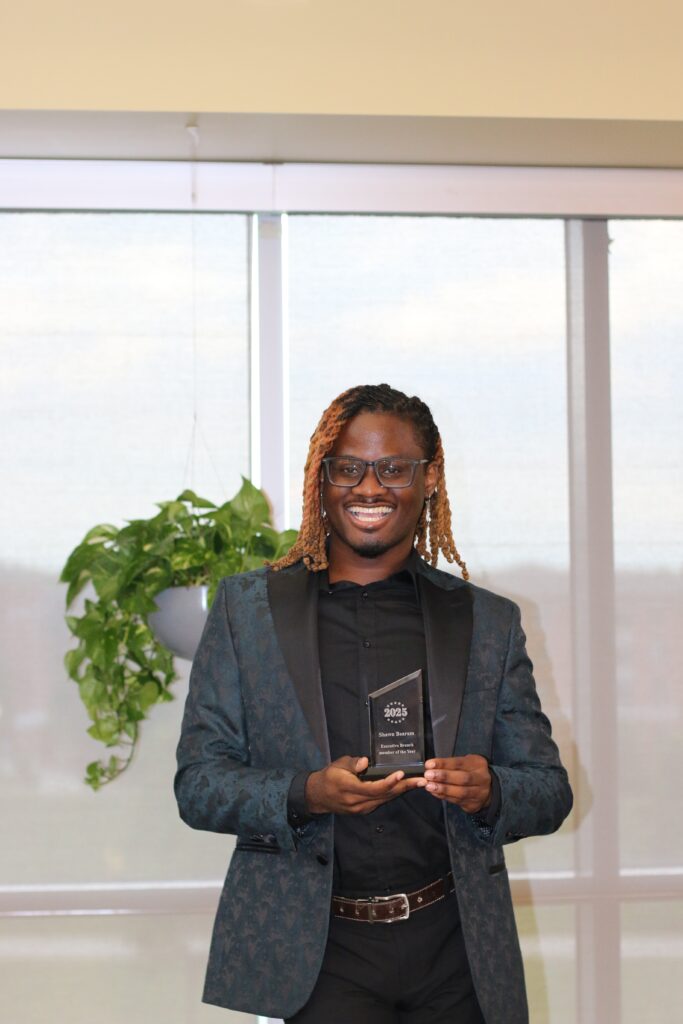
Shawn Bearam, Jr. ’26—Getting involved and finding your place on campus
Just tackling the rigors of a college course load on its own can be daunting for any student. But when you add in the additional responsibilities of working and getting involved with co-curriculars, it can become impossible…unless you’re Shawn Bearam, Jr., computer science. Throughout his time at UMBC, he saw how much value this level of involvement and responsibility added to his college career and saw it as his way of giving back.
Q: What drew you to UMBC?
A: I chose UMBC for a few reasons—first because of the scholarships they provided me, and also because of the diversity here. Other schools didn’t have the same diversity UMBC was able to offer. My last reason was the smaller campus. I felt like a smaller campus would allow me the opportunity to connect with professors and I wouldn’t get lost in a large lecture hall. The professors here actually remember me.
Q: Why did you choose your major?
A: I’m a computer science major. I was always considered the tech kid growing up, and in my early college program, one of the pathways was computer science. I discovered that I liked problem solving, seeing what was going wrong, and it became fun for me.
Q: What inspired you to get so involved in different campus departments?
A: I found communities where it seemed that everyone was having fun together, and I wanted to be a part of that. My first role was working with the events staff in Athletics, then I applied to work with bwtech@UMBC. From there, I applied to work in the Vice President of Student Affairs office as an office assistant and I was promoted to lead office assistant. During my first year I was also hired as a resident assistant, and I was later promoted to lead resident assistant. I also served as a first-year ambassador for SGA.
I started to see that I was able to learn so much here. Overall, I saw people who looked like me in different spaces, and I knew they would be able to understand me, so I wanted to get involved.
Q: How have your various roles on campus impacted your time at UMBC?
A: My many roles made me want to stay at UMBC. I had the option to graduate last semester, but I wanted to stay another semester, I didn’t want to leave everyone so soon. I feel safe at UMBC. It also made me want to keep pursuing my education—I knew that being involved in so many different organizations meant I needed to keep my GPA up, so it pushed me to stay focused in my classes so I could keep having fun.

Q: How did you balance your academic work with your on-campus jobs?
A: It was a struggle at first, but using my Google Calendar helped me manage my time. My employers here also made sure to emphasize the importance of me being a student first.
My community director at Walker Avenue Apartments, LaDonna Wyatt, became a mentor to me while I was searching for internships. I was applying to different places, but it became difficult and I wanted to give up. She pushed me to keep applying and was there for me throughout the process which then led me to getting an internship with the Division of Information Technology for the state. The faculty and staff here really care about the students as a whole.
Q: What made you decide to join SGA?
A: I was involved in SGA during my early college program at Montgomery College. I felt like I was really making a change while I was there, and I wanted to do the same at UMBC. I started off as a first-year ambassador in SGA here, then I became the director of communications, and I am currently the chief of staff. I knew after my first year that SGA was something I wanted to continue with and I wanted to keep moving up.
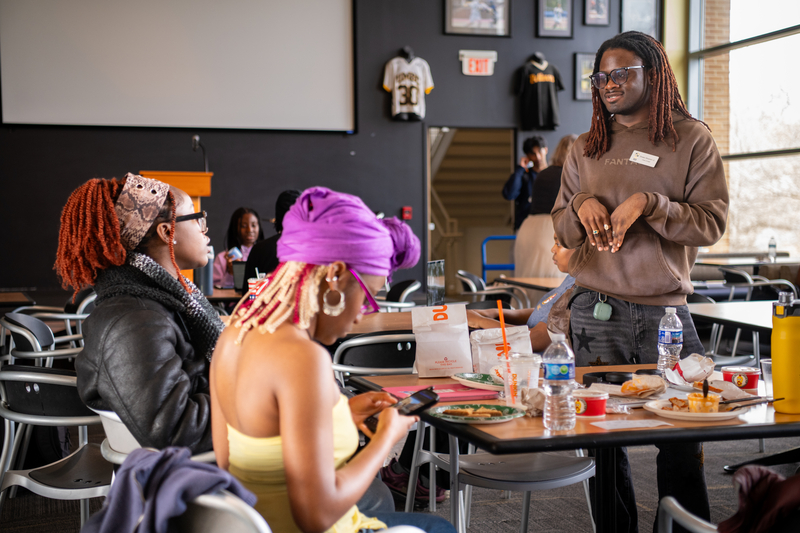 SGA’s “Prove It!” event gives UMBC students the opportunity to inspire change on campus. (Brad Ziegler/UMBC)
Q: Through all of your roles on campus, what is one moment that had the biggest impact on you?
A: Being an office assistant in the VPSA office. Everyday they drive me forward, and encourage me with their motto: Strive to unlock potential and transform lives. It really feels like a family. They’ve been asking me about how I feel as I’m getting ready to graduate and making sure that I have everything together. At first, it was a shock to me, but they really care about me even though I’m about to leave, and they care about what I’m going to be doing even after I leave. That role has had the biggest impact on me because they are so invested in seeing me grow and succeed.
Q: What’s next for you?
A: I was just offered a role with the State of Maryland with the Division of Information and Technology and I will be starting as a project analyst.
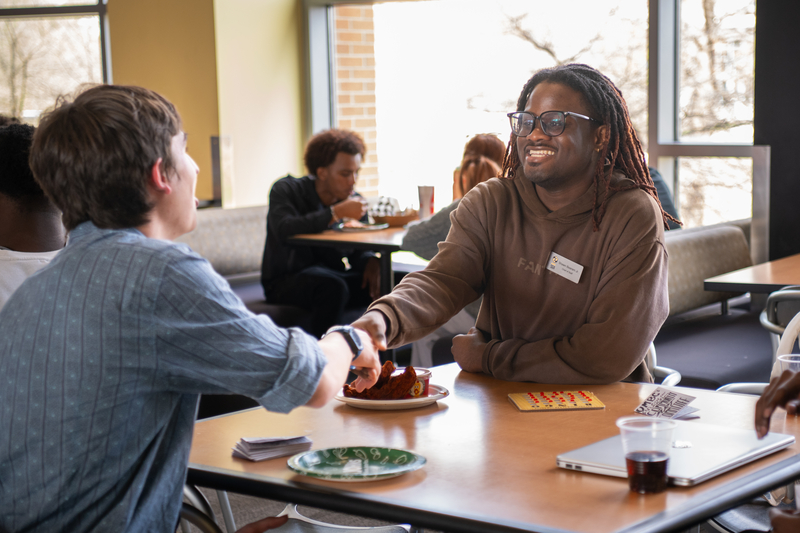 Making connections has been at the forefront of Bearam’s UMBC career. (Brad Ziegler/UMBC)
Q: What advice would you give to new students who are curious about getting involved on campus?
A: You may be scared, but sometimes you have to do things while you’re scared too. It may be scary to go to a big (seb) event because there’s so many people, but that may be the place where you find friends. You can be scared while you do things, but still do it. My personal motto is: The worst thing someone can say is “no.” Take those big steps, join the club, and if the club you’re looking for isn’t there—create it!
My whole experience at UMBC has been amazing—I can be myself here, and I’m not going to be judged. Community is truly the word to describe UMBC.
Story by Allison John ’24, psychology, graduate coordinator for first-year engagement and anchor programs. All photos courtesy of Bearam unless otherwise noted.
]]>
Just tackling the rigors of a college course load on its own can be daunting for any student. But when you add in the additional responsibilities of working and getting involved with...
https://umbc.edu/stories/shawn-bearam-jr-26-getting-involved/
https://my3.my.umbc.edu/api/v0/pixel/news/159406/guest@my.umbc.edu/b61fa0b61a935d6ae3df3e4dcc4e0fa6/api/pixel
bw-tech
class-of-2026
coeit
computer-science
news
science-and-tech
sga
story
UMBC News & Magazine
https://my3.my.umbc.edu/groups/umbc-news-magazine
https://assets1-my.umbc.edu/system/shared/avatars/groups/000/001/943/24435aa6207c452e7bc15cc74b42c7bb/xsmall.png?1748556657
https://assets1-my.umbc.edu/system/shared/avatars/groups/000/001/943/24435aa6207c452e7bc15cc74b42c7bb/original.png?1748556657
https://assets2-my.umbc.edu/system/shared/avatars/groups/000/001/943/24435aa6207c452e7bc15cc74b42c7bb/xxlarge.png?1748556657
https://assets2-my.umbc.edu/system/shared/avatars/groups/000/001/943/24435aa6207c452e7bc15cc74b42c7bb/xlarge.png?1748556657
https://assets3-my.umbc.edu/system/shared/avatars/groups/000/001/943/24435aa6207c452e7bc15cc74b42c7bb/large.png?1748556657
https://assets1-my.umbc.edu/system/shared/avatars/groups/000/001/943/24435aa6207c452e7bc15cc74b42c7bb/medium.png?1748556657
https://assets2-my.umbc.edu/system/shared/avatars/groups/000/001/943/24435aa6207c452e7bc15cc74b42c7bb/small.png?1748556657
https://assets1-my.umbc.edu/system/shared/avatars/groups/000/001/943/24435aa6207c452e7bc15cc74b42c7bb/xsmall.png?1748556657
https://assets2-my.umbc.edu/system/shared/avatars/groups/000/001/943/24435aa6207c452e7bc15cc74b42c7bb/xxsmall.png?1748556657
UMBC News & Magazine
6
0
false
Tue, 28 Apr 2026 12:33:59 -0400
Tue, 28 Apr 2026 12:33:59 -0400
Feeling supported at summer internships gives Retrievers a leg up in applied learning
“Support” is one of the most frequently used words when UMBC students reflect on their internship experiences on and off campus. From resources offered by the Career Center, to guidance from professors, and even sometimes from peers who wind up working side-by-side, UMBC students depend on university support and the many shapes it takes.
This summer, hundreds of Retrievers built upon the foundational knowledge they learned in the classroom and applied it to hands-on, real-world learning through internships. From getting front seat roles in bridge engineering and analyzing cyber threats to using inspiration drawn from campus, these UMBC students had plenty to write about for their “What I Did with My Summer Vacation” essays.
The science of sticking together
Mustafa Akpinar, a senior information systems major; Alek Read, a senior environmental science major; and Ty Allen, a junior mechanical engineering major, honed technical expertise, built teamwork and communication skills, and forged connections with peers and professionals on the Baltimore/D.C. biotech scene working at AstraZeneca.
Akpinar worked as a cyber threat intelligence and threat detection intern, a position that closely aligned with his career trajectory. “This internship is a perfect fit for both my academic path and long-term career goals,” Akpinar says, noting how the role builds on his data communications and networks and database design courses.
 A mixer for UMBC alumni employees and interns at AstraZeneca was a meaningful way for the students to network with potential mentors. (Courtesy of Miriam Friedman)
Read and Allen also used the summer to further their professional goals. Read contributed to sustainability efforts at AstraZeneca’s Frederick Manufacturing Center as an environmental health safety intern and Allen served as a site operations intern, applying his engineering skills to edit technical drawings in AutoCAD.
Building bridges
As all of Baltimore and most of the country recalls, Maryland’s Francis Scott Key Bridge was struck by a cargo ship and collapsed in March of 2024. The impacts of this catastrophe are still felt throughout the region with travel complications, economic hardships, and more. Through a partnership between the Maryland Transportation Authority and the Maryland Higher Education Commission, three Retrievers and six other Maryland-based students had the chance to join the Key Bridge Rebuild Internship Program.
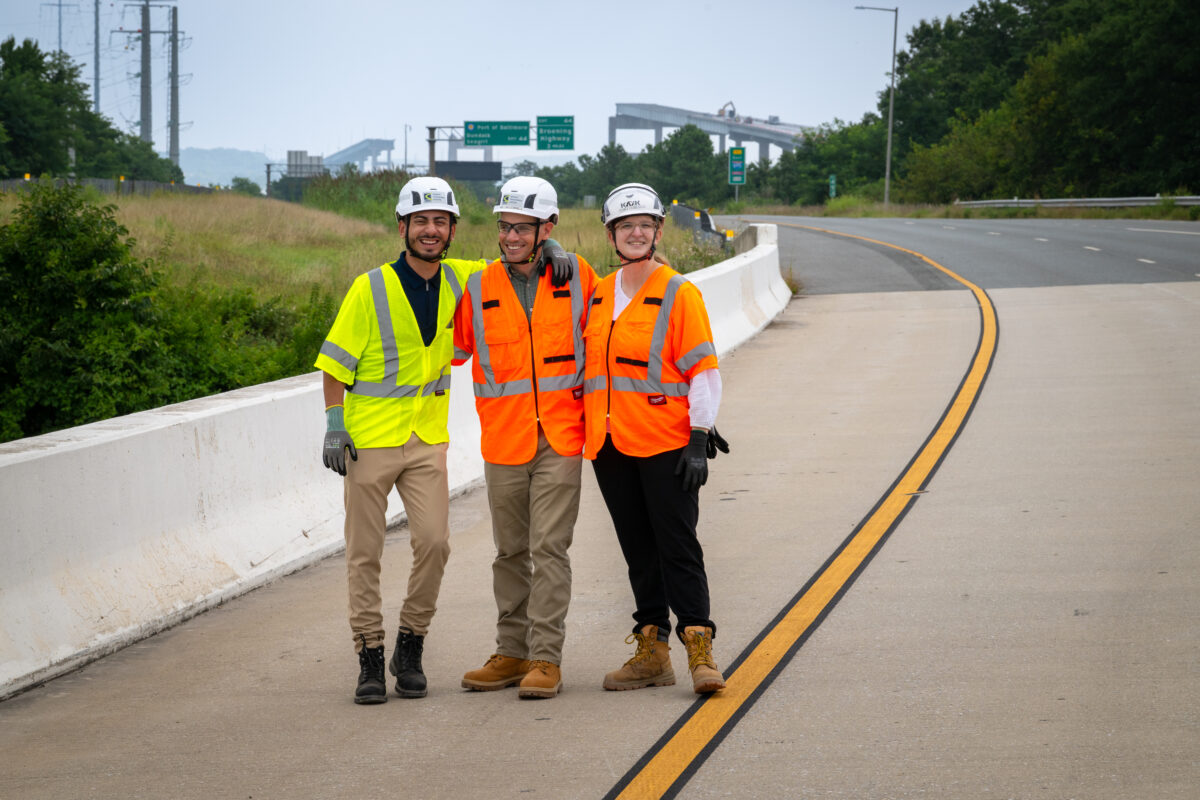 From left to right, Cristian Mena, William McConnell, and Emily DiMarzio pose for a photo near the site of the collapsed Key Bridge. The three worked on the bridge rebuilding project as interns with the Maryland Transportation Authority. (Brad Ziegler/UMBC)
Emily DiMarzio, a junior studying environmental science and geography, and Cristian Mena and William McConnell, both seniors studying mechanical engineering, all explored their individual areas of interest while actively helping to rebuild in their own community.
“It hurt when the bridge went down,” says McConnell, who grew up in Baltimore and now lives with his wife and three kids in Catonsville. “You could practically see it from our neighborhood, and now see that it is missing. So when the opportunity came along to apply for this internship, I jumped on it.”
Bustling Baltimore
The UMBC Career and Internship Fair is a first foot in the door for many UMBC students seeking to make networking connections. This was precisely the case for Wonder Akpabio, a junior computer science major, who connected with a recruiter from T. Rowe Price who helped guide her through the interview process.
With a massive network of UMBC alumni, T. Rowe Price is already a well-known investment management firm with Retrievers, with the added bonus of being headquartered in Baltimore. Gabriel Farmer, another junior computer science major, was impressed with the outreach efforts the company did with UMBC, like sending recruiters to events and hosting online programming.
 Gabriel Farmer in Baltimore’s Inner Harbor, near the headquarters of T. Rowe Price, where he interned in summer 2025. (Brad Ziegler/UMBC)
“Anytime you ask a question, people are ready to help,” Farmer says. “It’s been a very good experience, and T. Rowe Price is definitely a place I could see myself continuing to work at.”
Connections across campus
UMBC is far from a sleepy campus in the summer, with hundreds of research, internship, and student-employment opportunities available. So, while others traveled far and wide to secure an internship in their area of interest, some Retrievers saw the home-field advantage right in front of them.
Giovanna Orfali, a visual arts senior from São Paulo, Brazil, spent this summer behind the camera as a digital content intern at both the Maryland Center for History and Culture and UMBC’s event and conference services. Humanities Scholar Kendal Howell stepped off the plane after studying business management abroad in France this past spring and into the office as an intern at UMBC’s Division of Student Affairs for their new academic partnerships and high-impact experiences unit.
 Kendal Howell updates internship supervisor, James DeVita, on her latest project. (Brad Ziegler/UMBC)
Second-year gerontology doctoral student Claire McDonald also had the opportunity to conduct new research, working with Rowena Winkler, the new assistant director for graduate student career development at the UMBC Career Center, who was seeking graduate students to conduct a 10-week qualitative research project. Caleb Ruck ’22, modern languages, linguistics, and intercultural communication, and M.A. ’24, intercultural communication, continued his work becoming the first year-long graduate assistant for the Center for Social Justice Dialogue.
A numbers game
With so many resources available to help students land their dream internship, it’s not surprising to see the statistics of success—85 percent of recent alumni engaged in applied learning like internships, research, service-learning, or leadership during their time at UMBC. Thanks to the work they’re putting into their futures as a student, 93 percent graduate with firm plans for employment or graduate school within six months of graduation.
“I’m continually inspired by the way our students engage in applied learning to launch their careers,” says Marykate Conroy, associate director of internships and employment. “UMBC students are entering the workforce prepared and in demand.”
 Tanzila Malik speaking at the Women’s History Month panel, hosted by the Women’s, Gender, and Equity Center.
UMBC’s Career Center offers a comprehensive suite of resources including SteppingBlocks to explore alumni career paths and outcomes, UMBC Careers Unleashed Podcast for stories and insights, the Internship and Research Success Practicum course to complement student work experiences, Handshake for employer connections, and the UMBC Career Connectors network of faculty and staff linking the classroom to careers.
The annual Career and Internship Fair will be held on Wednesday, September 17, from 11:30 a.m. – 3:30 p.m. in the Retriever Activity Center. “Get engaged, ask the big questions, push yourself to achieve your goals, and influence the world. The UMBC community will be right there with you along your journey,” recommends Tanzila Malik ’26, women’s studies, who spent two years interning with the Women’s, Gender, and Equity Center.
Read more about where internships took Retrievers this summer.
]]>
“Support” is one of the most frequently used words when UMBC students reflect on their internship experiences on and off campus. From resources offered by the Career Center, to guidance from...
https://umbc.edu/stories/campus-support-umbc-summer-internships-2025/
https://my3.my.umbc.edu/api/v0/pixel/news/152407/guest@my.umbc.edu/bdde959821900d8673fa552b719cbdd0/api/pixel
cahss
careercenter
cnms
coeit
community
computer-science
ges
gwsst
humanities-scholar
internships
is
meche
mlli
news
story
visual-arts
UMBC News & Magazine
https://my3.my.umbc.edu/groups/umbc-news-magazine
https://assets1-my.umbc.edu/system/shared/avatars/groups/000/001/943/24435aa6207c452e7bc15cc74b42c7bb/xsmall.png?1748556657
https://assets1-my.umbc.edu/system/shared/avatars/groups/000/001/943/24435aa6207c452e7bc15cc74b42c7bb/original.png?1748556657
https://assets2-my.umbc.edu/system/shared/avatars/groups/000/001/943/24435aa6207c452e7bc15cc74b42c7bb/xxlarge.png?1748556657
https://assets2-my.umbc.edu/system/shared/avatars/groups/000/001/943/24435aa6207c452e7bc15cc74b42c7bb/xlarge.png?1748556657
https://assets3-my.umbc.edu/system/shared/avatars/groups/000/001/943/24435aa6207c452e7bc15cc74b42c7bb/large.png?1748556657
https://assets1-my.umbc.edu/system/shared/avatars/groups/000/001/943/24435aa6207c452e7bc15cc74b42c7bb/medium.png?1748556657
https://assets2-my.umbc.edu/system/shared/avatars/groups/000/001/943/24435aa6207c452e7bc15cc74b42c7bb/small.png?1748556657
https://assets1-my.umbc.edu/system/shared/avatars/groups/000/001/943/24435aa6207c452e7bc15cc74b42c7bb/xsmall.png?1748556657
https://assets2-my.umbc.edu/system/shared/avatars/groups/000/001/943/24435aa6207c452e7bc15cc74b42c7bb/xxsmall.png?1748556657
UMBC News & Magazine
0
0
false
Fri, 12 Sep 2025 16:12:34 -0400
Fri, 12 Sep 2025 16:12:34 -0400
Evan McRae ’25 paired his computer science degree with a music focused-individualized studies major and followed his family’s Retriever legacy
Before Evan McRae came to UMBC, Tess McRae—his sister—was a student here. So was Evan and Tess’s mother—Sharon McRae.You might say being a legacy Retriever was a family tradition. With Evan graduating this spring with majors in both computer science and individualized studies, we thought to ask Tess, now the assistant director for connective learning with the Center for Democracy and Civic Life, to take on this Q&A with her younger brother. Evan shares how an early exposure to UMBC’s Game Developers Club before attending UMBC eventually led to an executive board position and the creation of numerous games and great memories with other programmers and musicians.
Q: How did you decide to come to UMBC?
A: UMBC is where our mom went and also where you went, and I wanted to continue that family legacy. I also knew that it was a really great institution especially for computer science. I remember our family going to campus for Homecoming when I was in high school, and I saw a banner in The Commons for the UMBC Game Developers Club. I have always wanted to be a game developer; seeing that banner, I knew that there was a pretty good foundation for my passion at UMBC, and I wanted to join the club.
 McRae (second from left) and his fellow members of the Game Developers Club pose for a photo. Photo courtesy of McRae.
Q: In high school you discovered a passion for composing and producing music. How have you been able to expand on that passion at UMBC both technically and artistically?
A: While I was in high school I thought, “Music is something fun I do on the side, but not what I’m going to go to college for.” I was a computer science and math double major going into UMBC. When I decided to drop my math major by my second year, I told my Honors College advisor, Julie Oakes, that I was interested in music but didn’t have time to finish a music major within the next two years. She suggested I try individualized study (INDS) and see if there was a way to integrate my music passion with game development.
I ended up talking to professor Steven McAlpine from the INDS department and found a great bond with him; he shares a lot of my interests in game design and music. He has helped open a lot of doors for me, and I’m really grateful to the INDS program for that. I’ve been able to take music theory and composition courses, use UMBC’s studio facilities, and learn how to produce with industry standard software like Logic Pro. My music professors Greg Kalember, Linda Dusman, and Joseph Siu have mentored and fiercely advocated for me as an INDS major. It’s been incredible to not be a music major but still feel like I belong in those rooms.
Q: What are some of the most meaningful experiences you’ve had during your time at UMBC?
A: I’m taking a class this semester called Capstone Games Group Project taught by Marc Olano, the director of UMBC’s game development track and advisor for the Game Developers Club. The class combines artists and programmers who pitch game ideas at the start and work together on only a handful of those games for the rest of the semester. I pitched a puzzle platformer game called King Scribble that I’ve been wanting to make since first grade. My classmates and professor liked the idea, and to my surprise, it got picked as one of four games the class will develop in full. I still don’t think I’ve fully internalized how cool it is to actually be making this game.
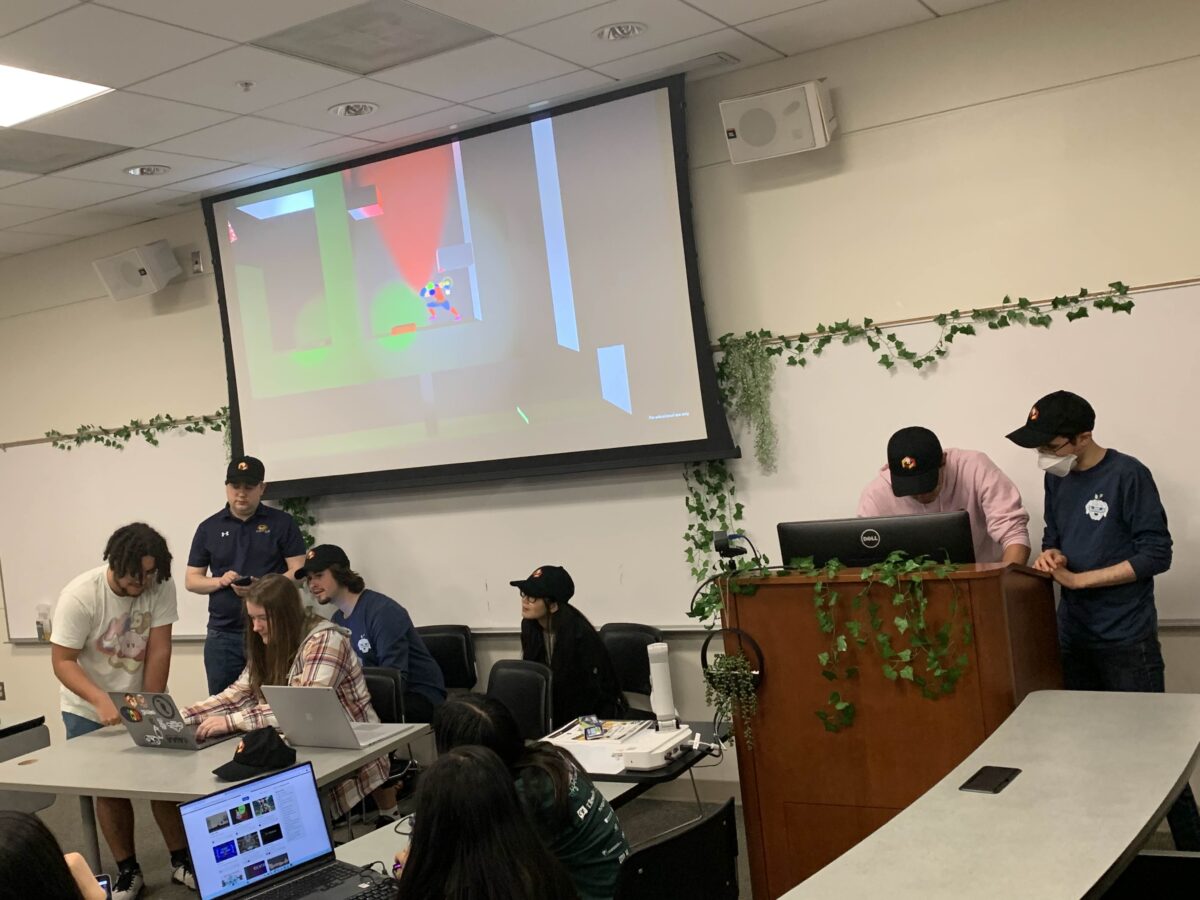 McRae (standing at podium) plays a submission to the Game Jamathon, hosted by hackUMBC and UMBC Game Developers Club. Photo courtesy of McRae.
I’ve also been working on a game called Daylight(available to play on Windows only, the password is: dog)since 2022 through the Game Developers Club. I feel like I’ve really grown as a developer and musician from it, and I’ve met some really cool and talented people through it. For my INDS capstone I’m improving and expanding upon Daylight’s soundtrack, which I’ve been working on for years now. It likely won’t be finished this semester or even next year, but I’m so privileged and grateful to have played such a big part in it.
I also have found a lot of meaning in my internship at UMBC’s Imaging Research Center (IRC). I got a position there thanks to Professor McAlpine, who had previously mentored Tristan King ’21,a former IRC technical specialist, when he was an INDS student. Tristan ended up being my supervisor for my first year there. I’m making virtual reality data visualization concept mapping software using Unreal Engine and solving complex, cutting-edge interface design problems. It’s really challenging my professional coding skills and helping me to grow exponentially as a game developer. I appreciate that I’ve had the opportunity on campus to enrich my learning like that. It’s been so cool to work with this transdisciplinary team and develop something that I think will have a good impact on the world.
Q: How have the ideas of inter/transdisciplinarity enhanced your UMBC experience?
A: What drew me to game development was working among disciplines. I love the idea of being a programmer and musician working with artists, writers, and playtesters to make a very human, cohesive experience: a love letter to players. Finding myself in INDS and at the IRC legitimized this way of thinking for me. I’ve really found myself at home in environments where I can collaborate with people from different backgrounds who are bringing all their skills and influences to the table. I value that process in everything I make and do at UMBC.
Being part of the Honors College also helped broaden my personal horizons as a student. I’ve been able to take a lot of cool courses outside of my disciplines like Mathematics of the Universe with Manil Suri and Sounds Like Social Justice with Earl Brooks, who have also been pretty big inspirations for me when it comes to the interdisciplinarity of technical fields and the ways I can actually make an impact toward issues I care about.
Q: What has being a student leader in the UMBC Game Developers Club been like for you?

A: It actually wasn’t something I knew I wanted to do in the first place until my friend encouraged me to run for vice president during a special election. I think it’s been the happiest accident in my life. I’ve been able to help make UMBC a proper home for students of all disciplines interested in game development, whether it’s for a hobby or a future career. Playing a pivotal role in creating and maintaining that space has been absolutely awesome. (Check out another Game Developers Club creation, Phantom Feline—I was a programmer and musician on this game that can be played in-browser as well as on Windows, Mac, and Linux.) The Game Developers Club has established alumni and mentors in the industry who give talks and network with our students. To be able to stand on that 20-year legacy and be lifted by it is a really special thing.
Written by Tess McRae ’22, Assistant Director for Connective Learning, Center for Democracy and Civic Life
Read more Commencement 2025 stories.
]]>
Before Evan McRae came to UMBC, Tess McRae—his sister—was a student here. So was Evan and Tess’s mother—Sharon McRae.You might say being a legacy Retriever was a family tradition. With Evan...
https://umbc.edu/stories/evan-mcrae-25-followed-familys-retriever-legacy/
https://my3.my.umbc.edu/api/v0/pixel/news/149903/guest@my.umbc.edu/5e648a26fda274bc5c1302e370d47cd1/api/pixel
center-for-democracy-and-civic-life
class-of-2025
coeit
computer-science
inds
news
story
UMBC News & Magazine
https://my3.my.umbc.edu/groups/umbc-news-magazine
https://assets1-my.umbc.edu/system/shared/avatars/groups/000/001/943/24435aa6207c452e7bc15cc74b42c7bb/xsmall.png?1748556657
https://assets1-my.umbc.edu/system/shared/avatars/groups/000/001/943/24435aa6207c452e7bc15cc74b42c7bb/original.png?1748556657
https://assets2-my.umbc.edu/system/shared/avatars/groups/000/001/943/24435aa6207c452e7bc15cc74b42c7bb/xxlarge.png?1748556657
https://assets2-my.umbc.edu/system/shared/avatars/groups/000/001/943/24435aa6207c452e7bc15cc74b42c7bb/xlarge.png?1748556657
https://assets3-my.umbc.edu/system/shared/avatars/groups/000/001/943/24435aa6207c452e7bc15cc74b42c7bb/large.png?1748556657
https://assets1-my.umbc.edu/system/shared/avatars/groups/000/001/943/24435aa6207c452e7bc15cc74b42c7bb/medium.png?1748556657
https://assets2-my.umbc.edu/system/shared/avatars/groups/000/001/943/24435aa6207c452e7bc15cc74b42c7bb/small.png?1748556657
https://assets1-my.umbc.edu/system/shared/avatars/groups/000/001/943/24435aa6207c452e7bc15cc74b42c7bb/xsmall.png?1748556657
https://assets2-my.umbc.edu/system/shared/avatars/groups/000/001/943/24435aa6207c452e7bc15cc74b42c7bb/xxsmall.png?1748556657
UMBC News & Magazine
4
0
false
Wed, 07 May 2025 15:37:48 -0400
Wed, 07 May 2025 15:37:48 -0400
UMBC’s Ethics Bowl team earns spot in national championship two years in a row
UMBC’s Ethics Bowl team won third place at the 2024 Chesapeake Regional Ethics Bowl competition in December. The team competed at UMBC against 15 teams from the Mid-Atlantic region, all vying for one of three qualifying spots in the 2025 Association for Practical and Professional Ethics Intercollegiate Ethics Bowl National Competition. UMBC will join Virginia Tech, first-place winner, Salisbury University, second-place winner, and 33 qualifying teams across the country at the national competition in February 2025.
“Activities like the Ethics Bowl engage students to think more critically about their own values and decisions, and thereby be better able to engage with those whose views differ,” says Jessica Pfeifer, associate professor of philosophy and department chair. “This will make them better scientists, doctors, programmers, entrepreneurs, lawyers, parents, and citizens.”
Six weeks before the competition, teams receive detailed information about the topics they will discuss, allowing them to prepare and strategize their arguments. Students must be ready to answer judges’ questions and defend their responses to the opposing team in just a few minutes. Each team competes in four preliminary rounds to advance to the semifinals and finals.
Greg Ealick, a philosophy lecturer, has coached the undergraduate team 15 years. He meets with the team year-round to hone their critical thinking skills, debate challenging ethical issues across all disciplines, and develop strategies for conveying their research respectfully and succinctly. Ealick knows what it takes to make it to the top. In 1988, Ealick ’89, philosophy, helped lead UMBC’s debate team to number one in the United States and to the Parliamentary Debate Association world finals in Australia, where he was ranked as the number one American speaker. Over the 15 years Ealick has coached the Ethics Bowl team, UMBC has qualified for nationals seven times, most recently in 2023 and 2020.
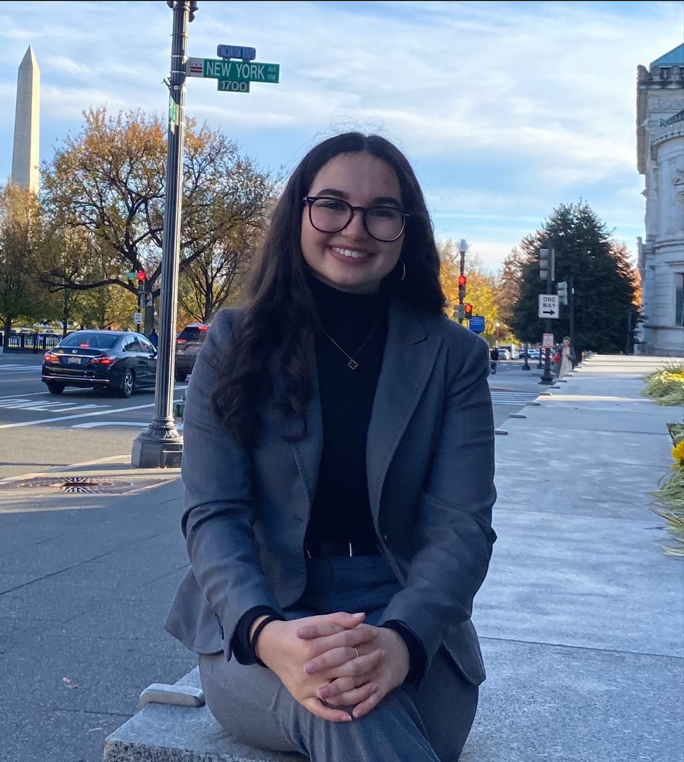 Tafat Boudif. (Image courtesy of Greg Ealick.)
“Qualifying means a lot since it is a testament to all our hard work throughout the semester. We spent several hours each week preparing for these cases, which were sometimes incredibly difficult to hash out,” says Tafat Boudif, a political science junior. Boudif helps Retrievers engage with government, politics, and policy-making as a political engagement intern at UMBC’s Center for Democracy and Civic Life. She also serves on the Student Government Association’s Appeals Board. “There are also so many additional things that we have to take into account, such as tone, confidence, etc. So I’m super proud of our team for being able to juggle all these things against some pretty tough teams!”
This year’s achievement comes shortly after UMBC’s new Center for Ethics and Values, home to the UMBC Ethics Bowl team, announced it would be a new host in the national line-up for the Association for Practical and Professional Ethics regional competitions. The event was co-hosted by UMBC’s Department of Philosophy and made possible with over 50 former Ethics Bowl team members and community members who helped to run, moderate, and judge the tournament, which took place on December 7, 2024, in the Performing Arts and Humanities Building.
This is what keeps former Ethics Bowl team member Stephanie Ferrone ’09, physics, returning to UMBC—her role as a coach. She notes that the skills she developed in Ethics Bowl continue to guide her thinking and communication as a physicist at the Underwater Electromagnetics Sensors branch of the Naval Surface Warfare Center.
“Coaching Ethics Bowl has been a joy; past the highs and lows of competition, there is a true delight in sitting in a room in the PAHB every week to help students talk through all aspects of Ethics Bowl, from Beauchamp’s principles of biomedical ethics to the importance of signposting in public speaking,” says Ferrone. “It’s even more meaningful of an experience to know how deeply this is likely to affect these students—this type of experience is one that shapes a college career and crafts friendships and connections that truly last.”
Learn more about UMBC’s philosophy department.
]]>
UMBC’s Ethics Bowl team won third place at the 2024 Chesapeake Regional Ethics Bowl competition in December. The team competed at UMBC against 15 teams from the Mid-Atlantic region, all vying for...
https://umbc.edu/quick-posts/ethics-bowl-team-headed-to-national-championship/
https://my3.my.umbc.edu/api/v0/pixel/news/146539/guest@my.umbc.edu/28fa588296e975af7251e97c644d707f/api/pixel
biology
cahss
cnms
coeit
computer-science
global-studies
news
physics
policy-and-society
political-science
psychology
quick-post
UMBC News & Magazine
https://my3.my.umbc.edu/groups/umbc-news-magazine
https://assets1-my.umbc.edu/system/shared/avatars/groups/000/001/943/24435aa6207c452e7bc15cc74b42c7bb/xsmall.png?1748556657
https://assets1-my.umbc.edu/system/shared/avatars/groups/000/001/943/24435aa6207c452e7bc15cc74b42c7bb/original.png?1748556657
https://assets2-my.umbc.edu/system/shared/avatars/groups/000/001/943/24435aa6207c452e7bc15cc74b42c7bb/xxlarge.png?1748556657
https://assets2-my.umbc.edu/system/shared/avatars/groups/000/001/943/24435aa6207c452e7bc15cc74b42c7bb/xlarge.png?1748556657
https://assets3-my.umbc.edu/system/shared/avatars/groups/000/001/943/24435aa6207c452e7bc15cc74b42c7bb/large.png?1748556657
https://assets1-my.umbc.edu/system/shared/avatars/groups/000/001/943/24435aa6207c452e7bc15cc74b42c7bb/medium.png?1748556657
https://assets2-my.umbc.edu/system/shared/avatars/groups/000/001/943/24435aa6207c452e7bc15cc74b42c7bb/small.png?1748556657
https://assets1-my.umbc.edu/system/shared/avatars/groups/000/001/943/24435aa6207c452e7bc15cc74b42c7bb/xsmall.png?1748556657
https://assets2-my.umbc.edu/system/shared/avatars/groups/000/001/943/24435aa6207c452e7bc15cc74b42c7bb/xxsmall.png?1748556657
UMBC News & Magazine
0
0
false
Mon, 13 Jan 2025 11:29:41 -0500
Mon, 13 Jan 2025 11:29:41 -0500
Retrievers learn the art and heart of cooking Salvadoran food at True Grit’s Test Kitchen
“Recipes are like an address to a homeland, but they’re also very personal to your own story,” said Karla T. Vasquez, author of The SalviSoul Cookbook, in True Grit’s Test Kitchen. Celia Bonilla, a business technology administration sophomore, grinned and nodded—the addresses for her own recipes come from El Salvador and Maryland. Bonilla joined other UMBC students earlier this fall for the “More than Pupusas” cooking demonstration, sponsored by the Dresher Center for the Humanities, to learn how to cook Salvadoran street food.
Bonilla sat at one of two tables set with brown butcher paper with her classmates, Stephania Fonseca, a social work sophomore, and Jeffrey Molina Soriano, a computer science junior. They also have roots in Maryland and El Salvador. “Pastelitos [pah-steh-lee-tos] means little pie and it’s the Salvadoran version of empanadas [em-pah-nah-dahs],” said Vasquez. “Empanadas are well known all over Latin America. Greeks, Italians, and other Europeans make meat pies, too.”
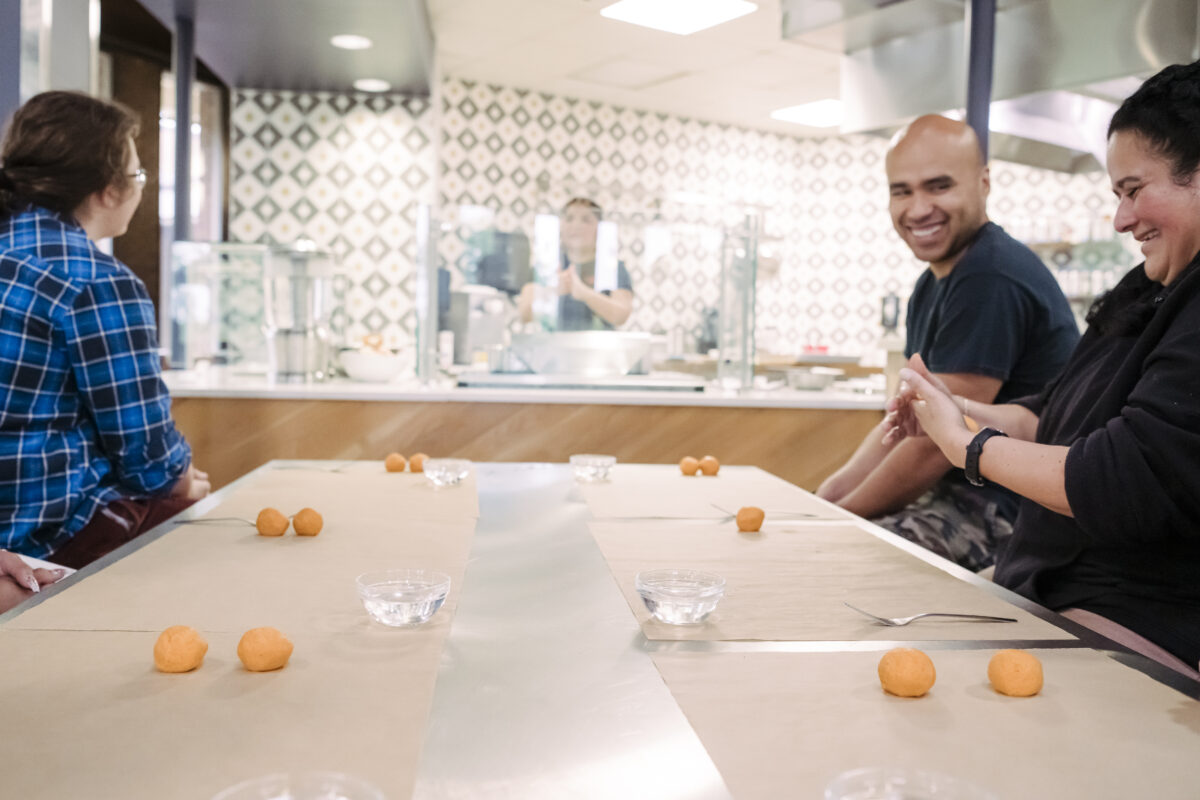 Celia Bonilla and Jeffrey Molina Soriano learn how to mold pastelito dough. (Marlayna Demond ’11/UMBC)
Like many Salvadoran students at UMBC, their journeys to UMBC are as complex as the ingredients they use for this meal. “Sometimes Hispanic Heritage Month events portray Latinx culture as a monolith, often focusing on the Caribbean or Mexican American experience,” said Courtney C. Hobson ’10, M.A. ’14, history, program manager at the James T. and Virginia M. Dresher Center for the Humanities. “I grew up in Prince George’s County, Maryland, where a significant part of the Latinx immigrant community comes from Central America, specifically El Salvador. Many of our Latinx students have roots in Central America—I wanted to organize an event that celebrated the rich culture they represent.”
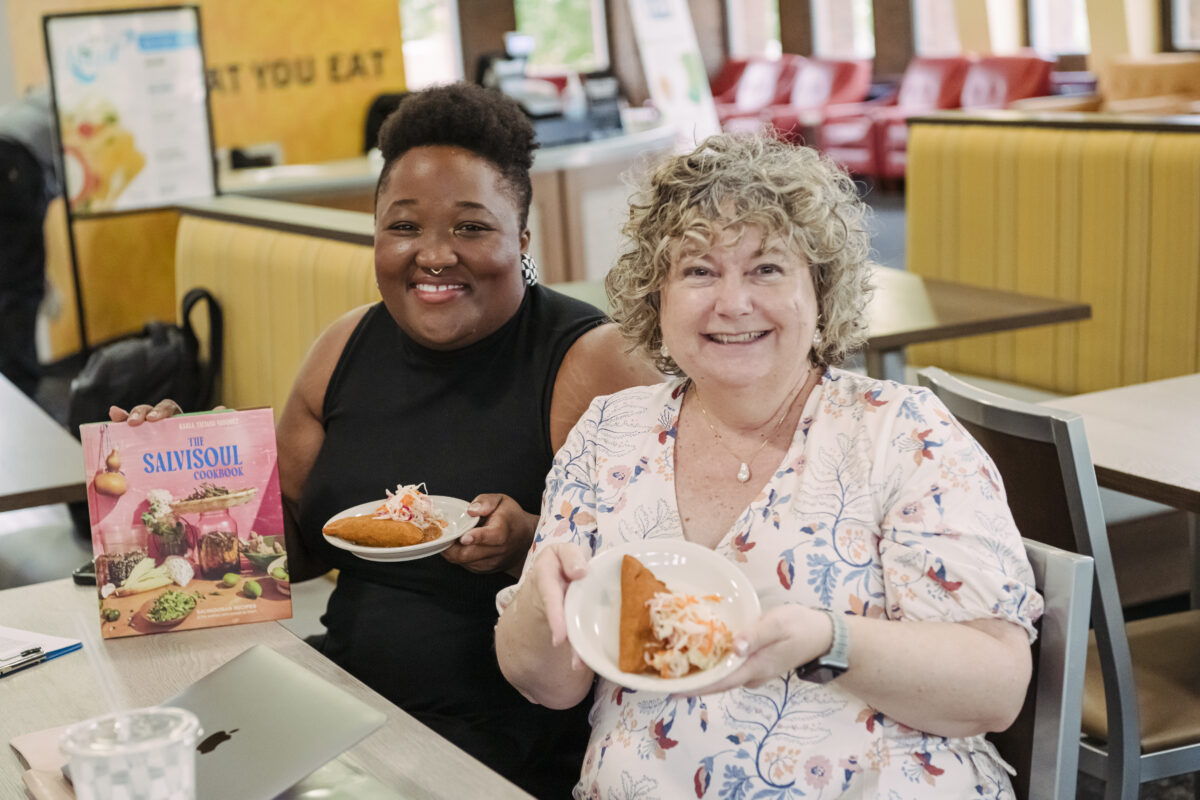 (l-r): Courtney C. Hobson and Amy Froide, professor of history and director of the Dresher Center for the Humanities. (Marlayna Demond ’11/UMBC)
“I came here when I was six years old from El Salvador,” said Bonilla, who attended the event as part of an assignment for the Spanish for Heritage Spanish Speakers class. Students must participate in two on-campus and two off-campus cultural events that celebrate Hispanic/Latinx culture. While Bonilla is familiar with campus events as the parent of a UMBC alum Jasmine Esmeralda Bonilla ’21, chemical engineering, this event felt different. “This class gives me a chance to learn more about my culture and language by engaging with people from various countries and age groups.”
Culinary traditions
Most students at the event said they had eaten pupusas (puh-poo-suhz) at home or at a restaurant. This flat corn flour cake, stuffed with cheese, beans, and sometimes meat is the national dish of El Salvador. “I have an aunt who is from El Salvador. She taught my mom, and then my mom taught me how to make pupusas with my sister,” said Fonseca. “My dad is from El Salvador, and my mom is from Mexico. We learned to make pupusas together as a family. So it became a typical food from my home.”
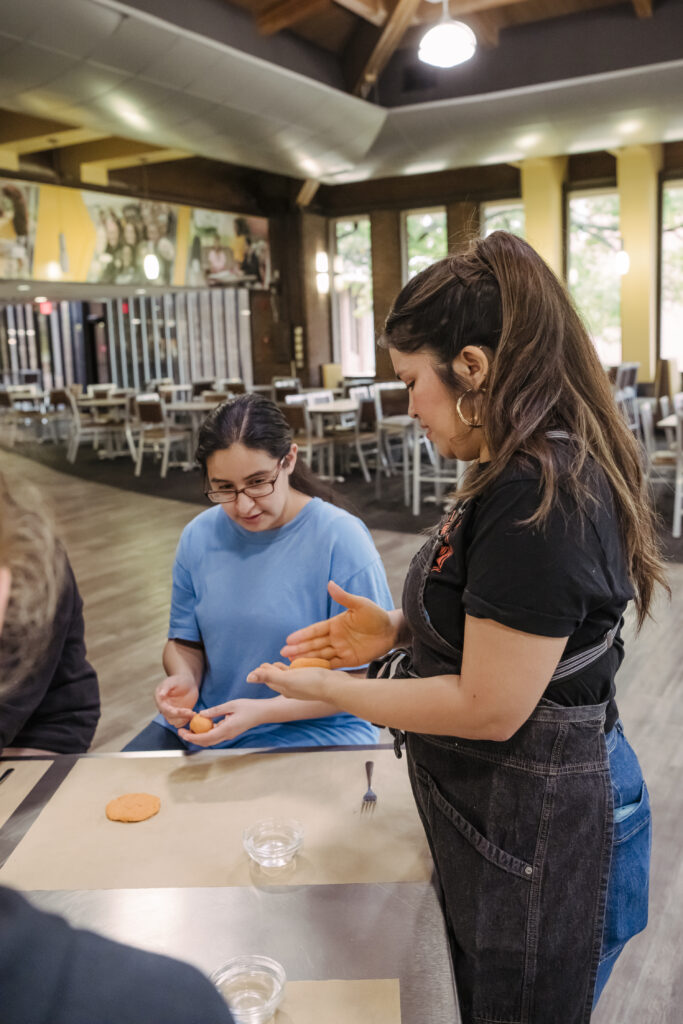
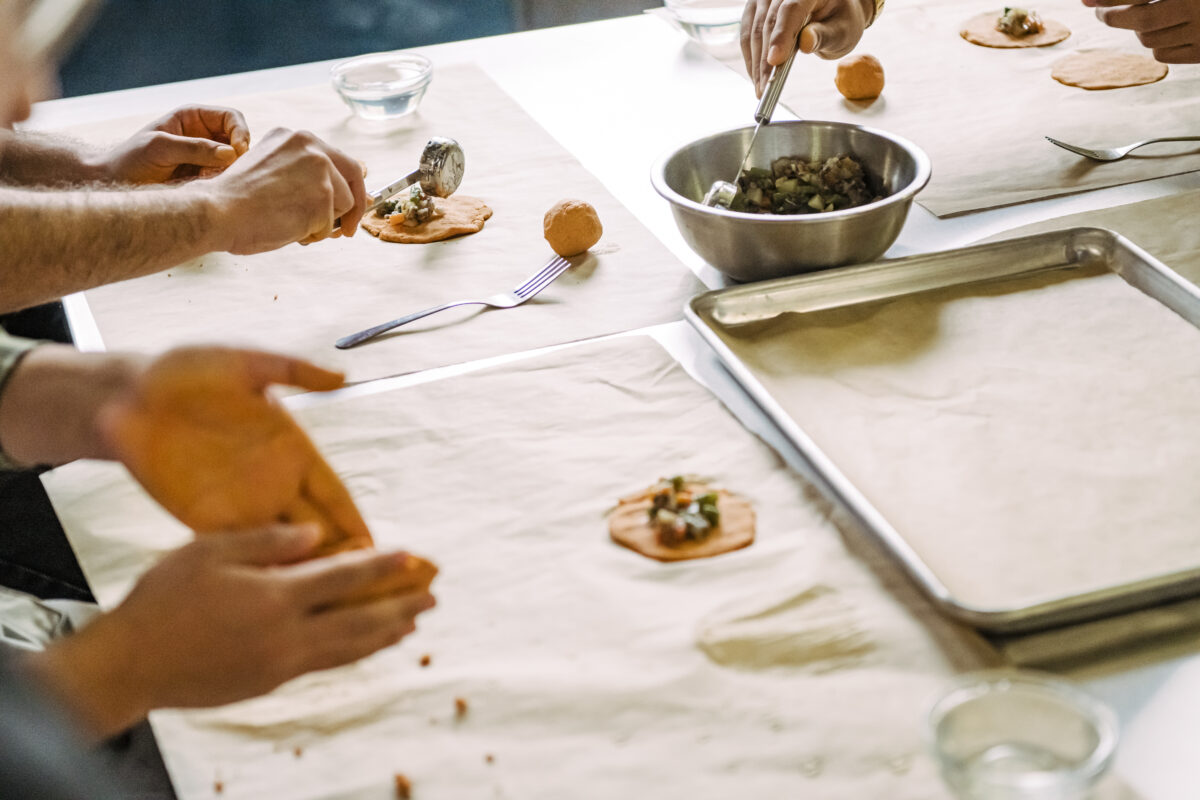
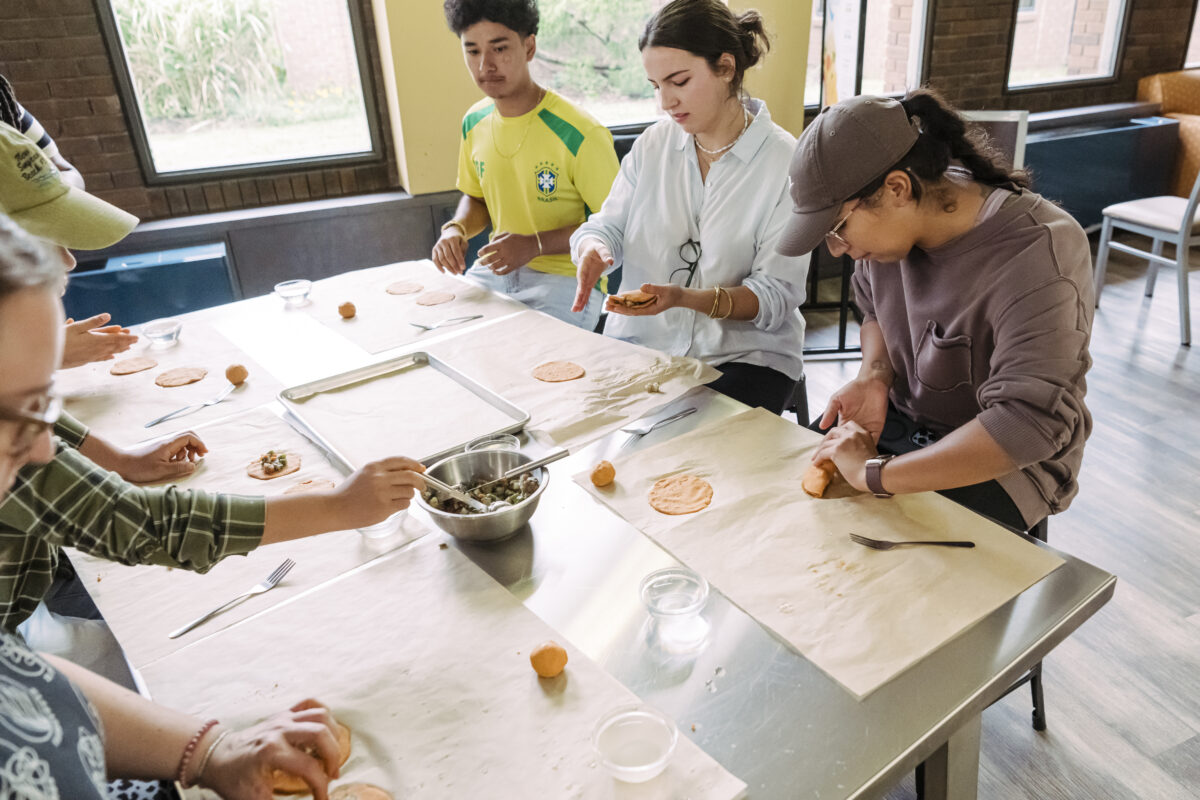 (l-r): Stephania Fonseca watches Vasquez fold the dough to make a pocket. Students fill the pastelitos with a mushroom filling. (Marlayna Demond ’11/UMBC)
As students kneaded the dough into a palm-sized disc, filled it with sautéed mushrooms, and pinched the edges to seal the pastelitos, they also shared what food meant to them in the context of their family and student life. A clear theme emerged, culinary traditions can extend beyond the kitchen. “We have the Philly pretzel factory. I’ve never been able to find a soft pretzel as good as the Philly Pretzel Factory,” said Ashley Gutshall about her hometown of Royersford, Pennsylvania. Gutshall, a history and Spanish sophomore, shares, “It’s our family tradition to get Philly soft pretzels after doctor’s appointments.”
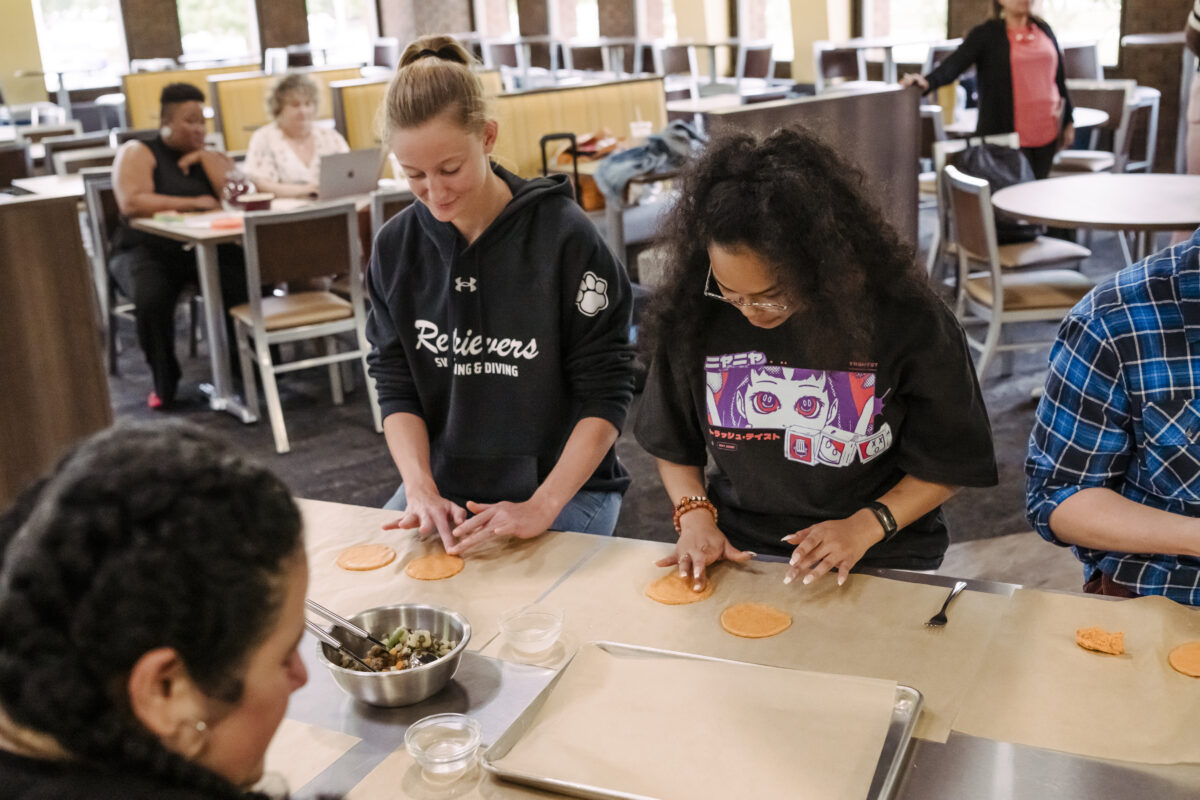 (l): Ashley Gutshall presses dough into a circular shape to make a pastelito. (Marlayna Demond ’11/UMBC)
Snack routines also create taste memories. “I was born in El Salvador during the Civil War [1980-1992] but was raised in Los Angeles. I would often fantasize about the routines my family would have had if they had been able to stay in their homeland,” said Vasquez, as she cooked down strawberries that she used to sweeten a large container of water filled with chan seeds—similar to chia seeds in texture and nutrition. “Fresco de chan satisfied that question for me because it’s a drink students have after school,” said Vasquez.
Food as a cultural bridge
Dishes are a fingerprint of a family’s traditions and tastes that can also serve as a timeline marking the evolution of ingredients locally and globally. “When my mom hears of these new trending food ingredients like chia seeds or quinoa,” says Vasquez, “she argues that they have been used in El Salvador and Central American communities for a long time.”
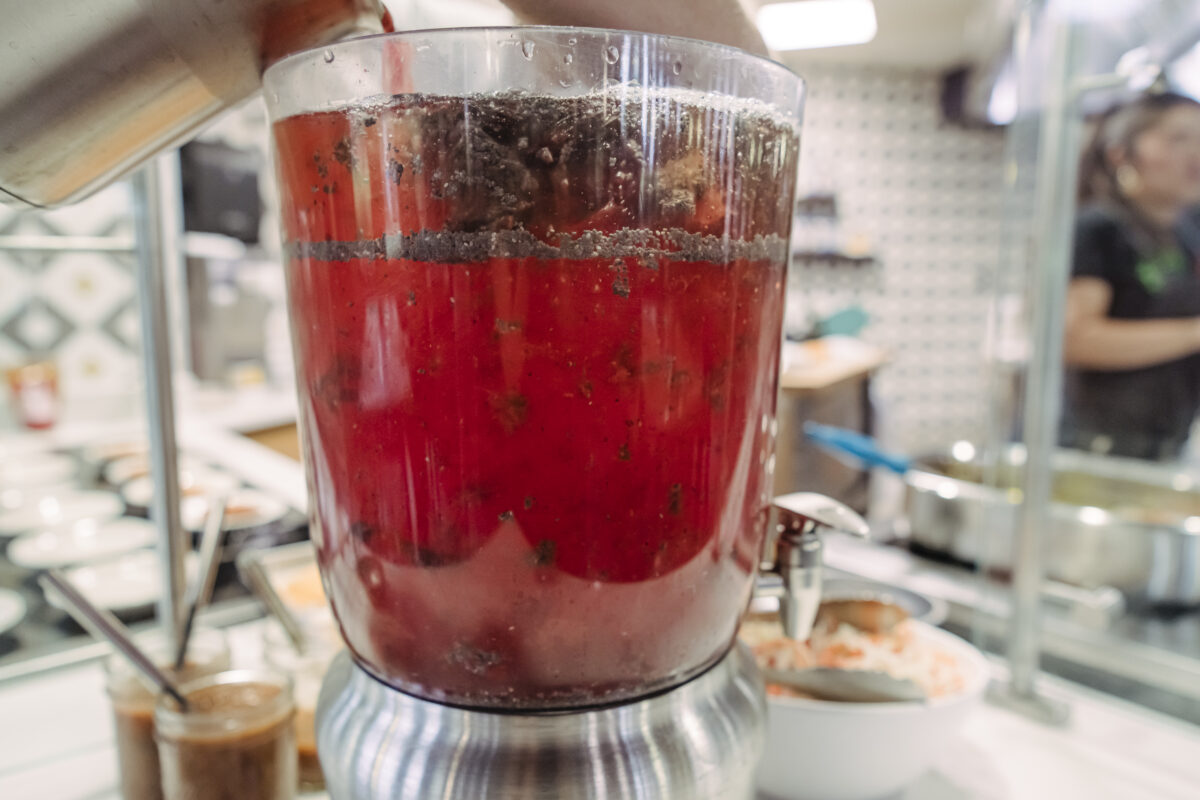
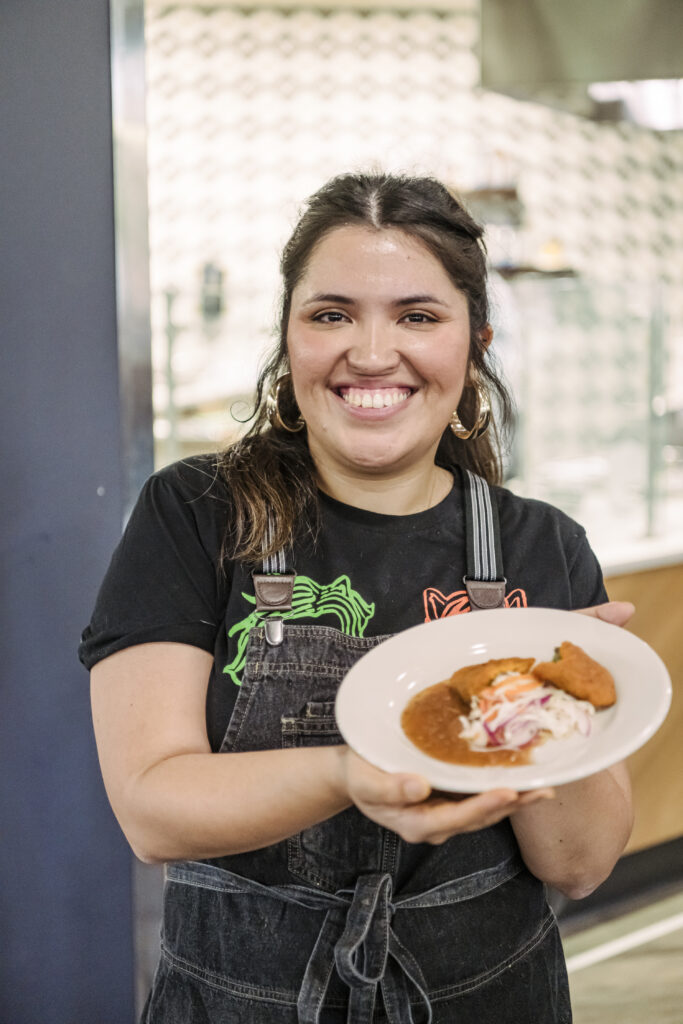
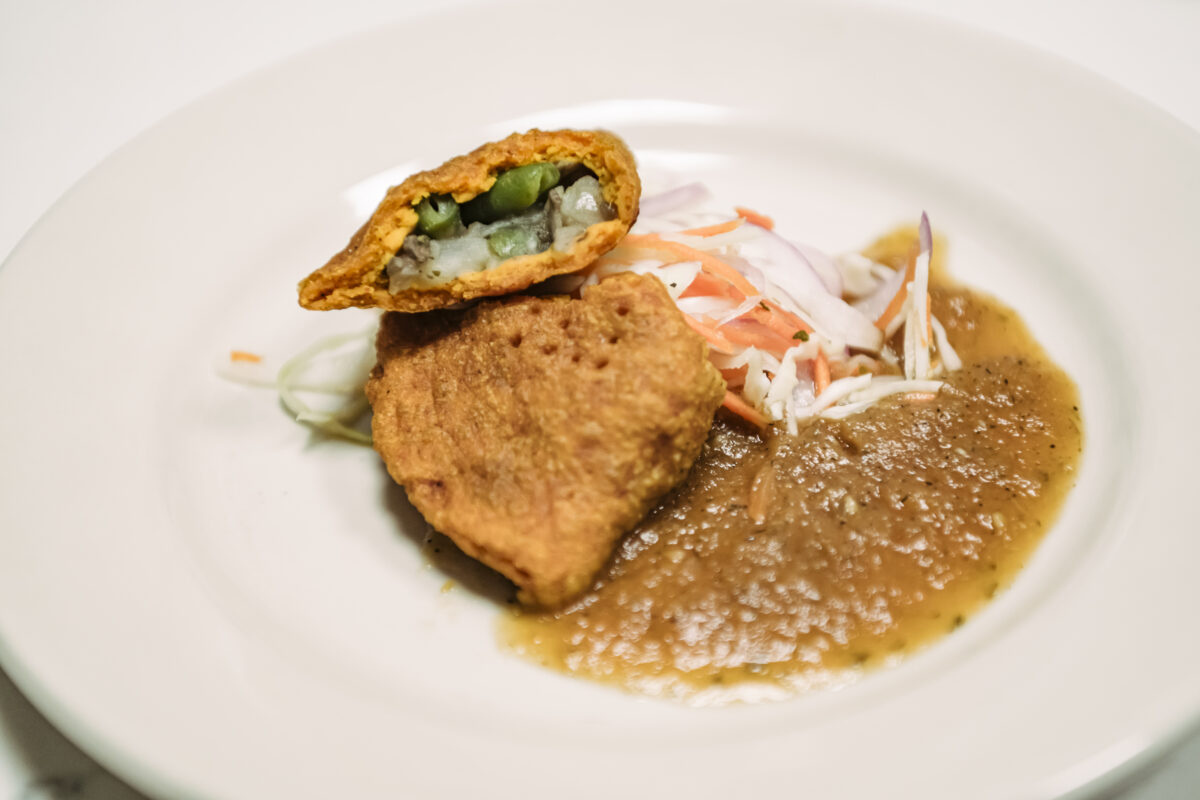 (l-r): Fresco de chan. Karla T. Vasques presents a Salvadoran mushroom pastelito with salsa and slaw. (Marlayna Demond ’11/UMBC)
Whether savory or sweet, the names of foods and spices across Latin America, and the dishes they inspire, are rooted in indigenous, African, and European languages and culinary traditions often fused to create unique dishes with local variations. Vasquez noted that achiote [ah-chee-oh-teh], the spice used to season and enhance the yellow color of the corn flour dough for the pastelitos, is a Nahuat word. Nahuat is a widely spoken indigenous language in Mexico and Central America. The rich legacy of Salvadoran food is seldom recognized alongside Western cuisine, even though many of its ingredients are sourced from the Global South—reinforcing cultural divisions. The Dresher Center’s “More than Pupusas” cooking event aimed to bridge this gap and celebrate the cultural footprint of Salvadoran cuisine.
“I interviewed more than 100 women while I’ve been working on this project. It’s taken me nine years,” says Vasquez about her recent release, The SalviSoul Cookbook. “I wanted to make sure that we’re giving credit where credit is due.”
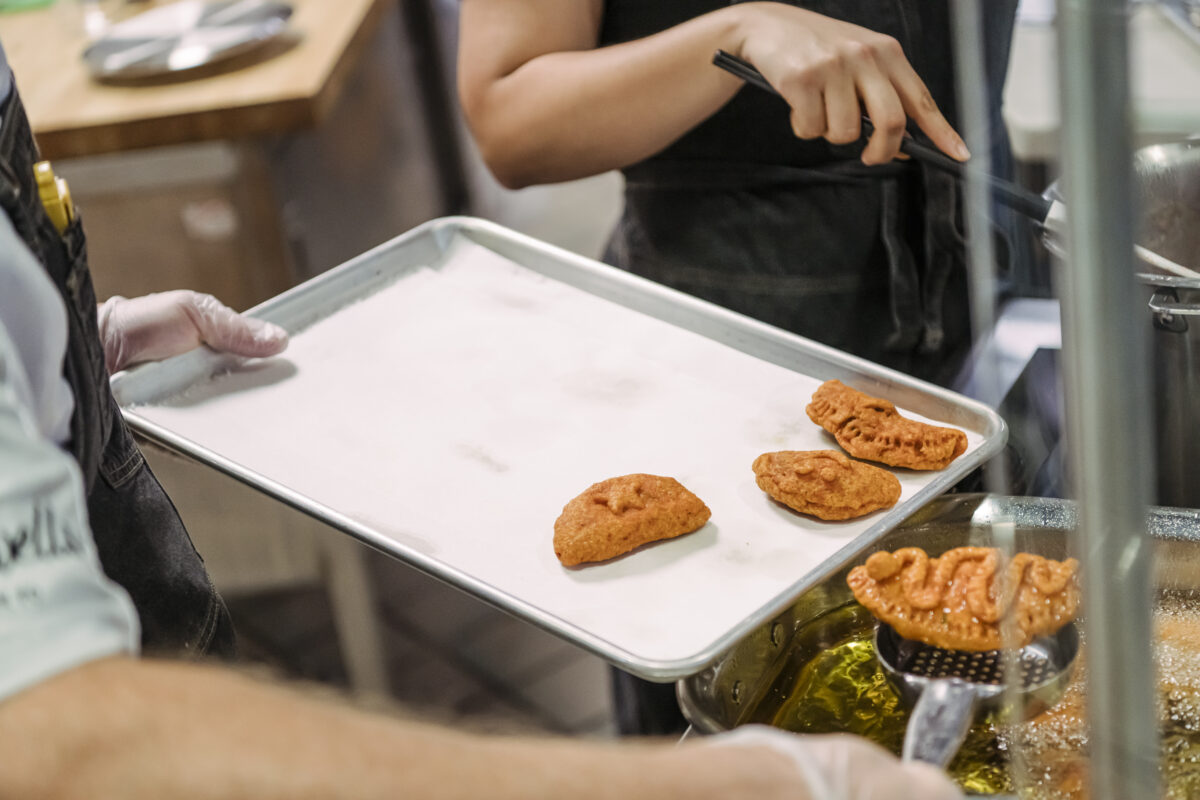
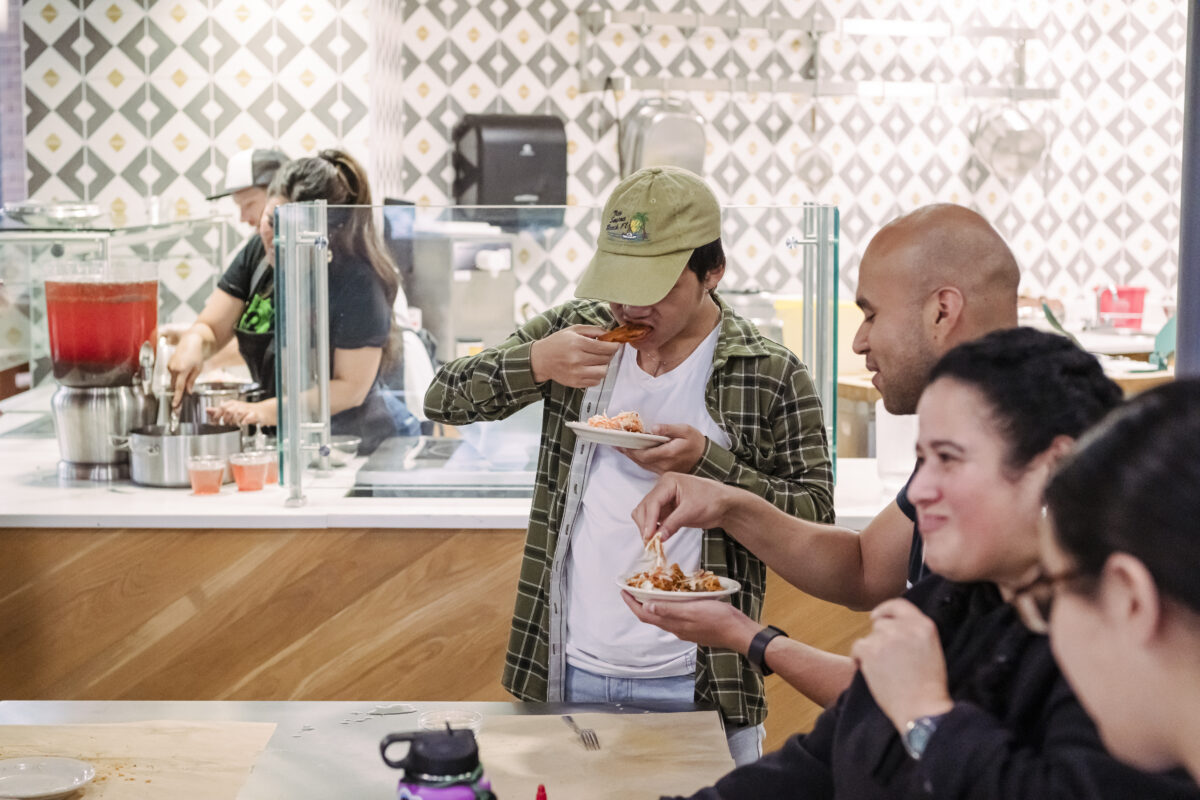
(r): Bonilla and Molina Soriano taste the fried pastelitos. (Marlayna Demond ’11/UMBC)
The tasters and aspiring chefs were grateful to be part of the long tradition of communities brought together across borders and time to learn, cook, and share a meal with new and old friends. They stamped their seal of approval with dough—a squiggly line, a star, a smile—sealing each pastelito with personal flair.
]]>
“Recipes are like an address to a homeland, but they’re also very personal to your own story,” said Karla T. Vasquez, author of The SalviSoul Cookbook, in True Grit’s Test Kitchen. Celia Bonilla,...
https://umbc.edu/stories/teaching-pupusas/
https://my3.my.umbc.edu/api/v0/pixel/news/145381/guest@my.umbc.edu/9ca276cb76c35ec0df767c000aca50ec/api/pixel
business-technology-administration
cahss
campus-life
chemical-engineering
computer-science
dresher-center
history
magazine
mlli
spanish
story
UMBC News & Magazine
https://my3.my.umbc.edu/groups/umbc-news-magazine
https://assets1-my.umbc.edu/system/shared/avatars/groups/000/001/943/24435aa6207c452e7bc15cc74b42c7bb/xsmall.png?1748556657
https://assets1-my.umbc.edu/system/shared/avatars/groups/000/001/943/24435aa6207c452e7bc15cc74b42c7bb/original.png?1748556657
https://assets2-my.umbc.edu/system/shared/avatars/groups/000/001/943/24435aa6207c452e7bc15cc74b42c7bb/xxlarge.png?1748556657
https://assets2-my.umbc.edu/system/shared/avatars/groups/000/001/943/24435aa6207c452e7bc15cc74b42c7bb/xlarge.png?1748556657
https://assets3-my.umbc.edu/system/shared/avatars/groups/000/001/943/24435aa6207c452e7bc15cc74b42c7bb/large.png?1748556657
https://assets1-my.umbc.edu/system/shared/avatars/groups/000/001/943/24435aa6207c452e7bc15cc74b42c7bb/medium.png?1748556657
https://assets2-my.umbc.edu/system/shared/avatars/groups/000/001/943/24435aa6207c452e7bc15cc74b42c7bb/small.png?1748556657
https://assets1-my.umbc.edu/system/shared/avatars/groups/000/001/943/24435aa6207c452e7bc15cc74b42c7bb/xsmall.png?1748556657
https://assets2-my.umbc.edu/system/shared/avatars/groups/000/001/943/24435aa6207c452e7bc15cc74b42c7bb/xxsmall.png?1748556657
UMBC News & Magazine
0
0
false
Tue, 05 Nov 2024 16:30:49 -0500
Tue, 05 Nov 2024 16:30:49 -0500
Retrievers learn the art and heart of cooking Salvadoran food at True Grit’s Test Kitchen
“Recipes are like an address to a homeland, but they’re also very personal to your own story,” said Karla T. Vasquez, author of The SalviSoul Cookbook, in True Grit’s Test Kitchen. Celia Bonilla, a business technology administration sophomore, grinned and nodded—the addresses for her own recipes come from El Salvador and Maryland. Bonilla joined other UMBC students earlier this fall for the “More than Pupusas” cooking demonstration, sponsored by the Dresher Center for the Humanities, to learn how to cook Salvadoran street food.
Bonilla sat at one of two tables set with brown butcher paper with her classmates, Stephania Fonseca, a social work sophomore, and Jeffrey Molina Soriano, a computer science junior. They also have roots in Maryland and El Salvador. “Pastelitos [pah-steh-lee-tos] means little pie and it’s the Salvadoran version of empanadas [em-pah-nah-dahs],” said Vasquez. “Empanadas are well known all over Latin America. Greeks, Italians, and other Europeans make meat pies, too.”
Celia Bonilla and Jeffrey Molina Soriano learn how to mold pastelito dough. (Marlayna Demond ’11/UMBC)
Like many Salvadoran students at UMBC, their journeys to UMBC are as complex as the ingredients they use for this meal. “Sometimes Hispanic Heritage Month events portray Latinx culture as a monolith, often focusing on the Caribbean or Mexican American experience,” said Courtney C. Hobson ’10, M.A. ’14, history, program manager at the James T. and Virginia M. Dresher Center for the Humanities. “I grew up in Prince George’s County, Maryland, where a significant part of the Latinx immigrant community comes from Central America, specifically El Salvador. Many of our Latinx students have roots in Central America—I wanted to organize an event that celebrated the rich culture they represent.”
(l-r): Courtney C. Hobson and Amy Froide, professor of history and director of the Dresher Center for the Humanities. (Marlayna Demond ’11/UMBC)
“I came here when I was six years old from El Salvador,” said Bonilla, who attended the event as part of an assignment for the Spanish for Heritage Spanish Speakers class. Students must participate in two on-campus and two off-campus cultural events that celebrate Hispanic/Latinx culture. While Bonilla is familiar with campus events as the parent of a UMBC alum Jasmine Esmeralda Bonilla ’21, chemical engineering, this event felt different. “This class gives me a chance to learn more about my culture and language by engaging with people from various countries and age groups.”
Culinary traditions
Most students at the event said they had eaten pupusas (puh-poo-suhz) at home or at a restaurant. This flat corn flour cake, stuffed with cheese, beans, and sometimes meat is the national dish of El Salvador. “I have an aunt who is from El Salvador. She taught my mom, and then my mom taught me how to make pupusas with my sister,” said Fonseca. “My dad is from El Salvador, and my mom is from Mexico. We learned to make pupusas together as a family. So it became a typical food from my home.”
(l-r): Stephania Fonseca watches Vasquez fold the dough to make a pocket. Students fill the pastelitos with a mushroom filling. (Marlayna Demond ’11/UMBC)
As students kneaded the dough into a palm-sized disc, filled it with sautéed mushrooms, and pinched the edges to seal the pastelitos, they also shared what food meant to them in the context of their family and student life. A clear theme emerged, culinary traditions can extend beyond the kitchen. “We have the Philly pretzel factory. I’ve never been able to find a soft pretzel as good as the Philly Pretzel Factory,” said Ashley Gutshall about her hometown of Royersford, Pennsylvania. Gutshall, a history and Spanish sophomore, shares, “It’s our family tradition to get Philly soft pretzels after doctor’s appointments.”
(l): Ashley Gutshall presses dough into a circular shape to make a pastelito. (Marlayna Demond ’11/UMBC)
Snack routines also create taste memories. “I was born in El Salvador during the Civil War [1980-1992] but was raised in Los Angeles. I would often fantasize about the routines my family would have had if they had been able to stay in their homeland,” said Vasquez, as she cooked down strawberries that she used to sweeten a large container of water filled with chan seeds—similar to chia seeds in texture and nutrition. “Fresco de chan satisfied that question for me because it’s a drink students have after school,” said Vasquez.
Food as a cultural bridge
Dishes are a fingerprint of a family’s traditions and tastes that can also serve as a timeline marking the evolution of ingredients locally and globally. “When my mom hears of these new trending food ingredients like chia seeds or quinoa,” says Vasquez, “she argues that they have been used in El Salvador and Central American communities for a long time.”
(l-r): Fresco de chan. Karla T. Vasques presents a Salvadoran mushroom pastelito with salsa and slaw. (Marlayna Demond ’11/UMBC)
Whether savory or sweet, the names of foods and spices across Latin America, and the dishes they inspire, are rooted in indigenous, African, and European languages and culinary traditions often fused to create unique dishes with local variations. Vasquez noted that achiote [ah-chee-oh-teh], the spice used to season and enhance the yellow color of the corn flour dough for the pastelitos, is a Nahuat word. Nahuat is a widely spoken indigenous language in Mexico and Central America. The rich legacy of Salvadoran food is seldom recognized alongside Western cuisine, even though many of its ingredients are sourced from the Global South—reinforcing cultural divisions. The Dresher Center’s “More than Pupusas” cooking event aimed to bridge this gap and celebrate the cultural footprint of Salvadoran cuisine.
“I interviewed more than 100 women while I’ve been working on this project. It’s taken me nine years,” says Vasquez about her recent release, The SalviSoul Cookbook. “I wanted to make sure that we’re giving credit where credit is due.”
(r): Bonilla and Molina Soriano taste the fried pastelitos. (Marlayna Demond ’11/UMBC)
The tasters and aspiring chefs were grateful to be part of the long tradition of communities brought together across borders and time to learn, cook, and share a meal with new and old friends. They stamped their seal of approval with dough—a squiggly line, a star, a smile—sealing each pastelito with personal flair.
]]>
“Recipes are like an address to a homeland, but they’re also very personal to your own story,” said Karla T. Vasquez, author of The SalviSoul Cookbook, in True Grit’s Test Kitchen. Celia Bonilla,...
https://umbc.edu/stories/retrievers-learn-to-cook-salvadoran-food/
https://my3.my.umbc.edu/api/v0/pixel/news/145379/guest@my.umbc.edu/0e0931c682bcda13e479d7afdd5d4a25/api/pixel
business-technology-administration
cahss
campus-life
chemical-engineering
computer-science
dresher-center
history
magazine
mlli
spanish
story
UMBC News & Magazine
https://my3.my.umbc.edu/groups/umbc-news-magazine
https://assets1-my.umbc.edu/system/shared/avatars/groups/000/001/943/24435aa6207c452e7bc15cc74b42c7bb/xsmall.png?1748556657
https://assets1-my.umbc.edu/system/shared/avatars/groups/000/001/943/24435aa6207c452e7bc15cc74b42c7bb/original.png?1748556657
https://assets2-my.umbc.edu/system/shared/avatars/groups/000/001/943/24435aa6207c452e7bc15cc74b42c7bb/xxlarge.png?1748556657
https://assets2-my.umbc.edu/system/shared/avatars/groups/000/001/943/24435aa6207c452e7bc15cc74b42c7bb/xlarge.png?1748556657
https://assets3-my.umbc.edu/system/shared/avatars/groups/000/001/943/24435aa6207c452e7bc15cc74b42c7bb/large.png?1748556657
https://assets1-my.umbc.edu/system/shared/avatars/groups/000/001/943/24435aa6207c452e7bc15cc74b42c7bb/medium.png?1748556657
https://assets2-my.umbc.edu/system/shared/avatars/groups/000/001/943/24435aa6207c452e7bc15cc74b42c7bb/small.png?1748556657
https://assets1-my.umbc.edu/system/shared/avatars/groups/000/001/943/24435aa6207c452e7bc15cc74b42c7bb/xsmall.png?1748556657
https://assets2-my.umbc.edu/system/shared/avatars/groups/000/001/943/24435aa6207c452e7bc15cc74b42c7bb/xxsmall.png?1748556657
UMBC News & Magazine
1
0
false
Tue, 05 Nov 2024 16:30:49 -0500
Peter Wilschke ’24, political science and economics, celebrates national research accomplishments
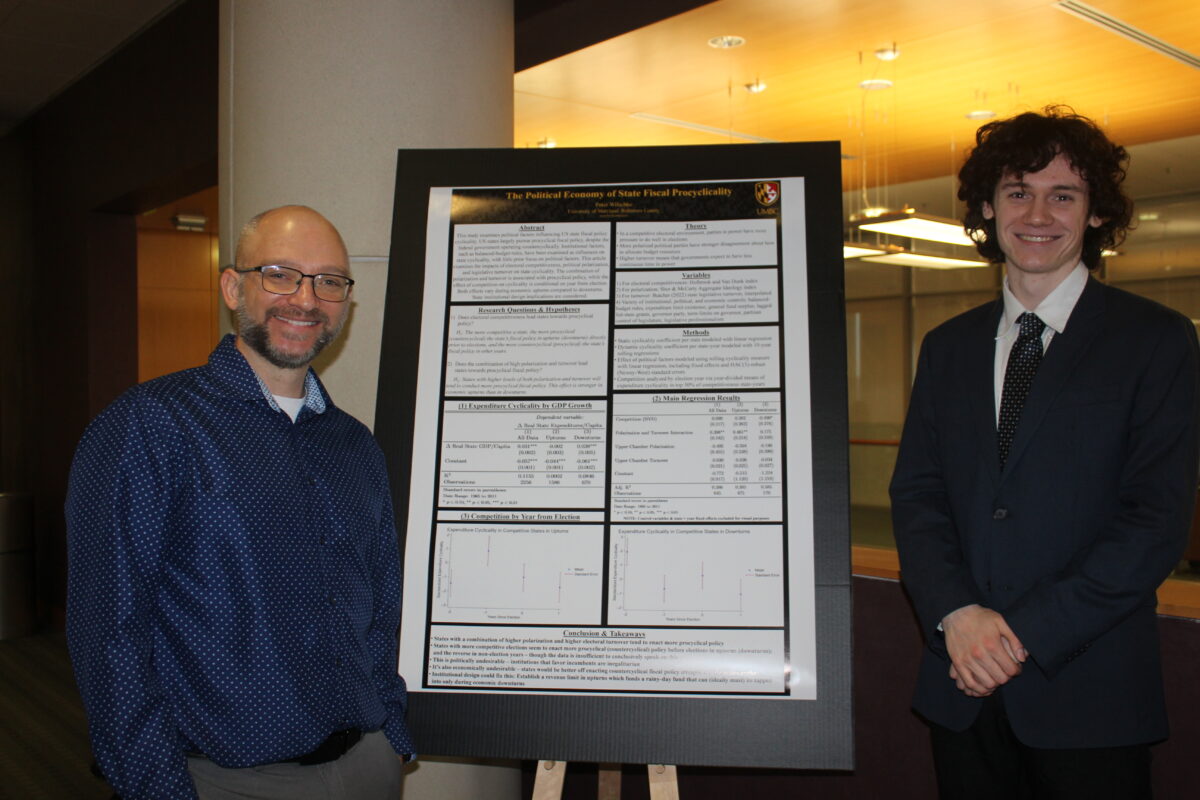
Peter Wilschke ’24, economics and political science, hit the ground running after graduation in May, beginning a two-year research assistant position at the Federal Reserve Board of Governors in Washington, D.C. He is working on the quarterly Z.1, a report on the financial assets and liabilities, transactions, and balance sheets for households, nonprofit organizations, and businesses. Additionally, Wilschke assists economists with research projects. For Wilschke, these tasks are a welcome set of challenges—he thrives on long-term projects that combine both his majors and allow him a level of independence he nurtured successfully at UMBC.
Just weeks before graduating, Wilschke’s article “Political Drivers of State Fiscal Cyclicality” was accepted for publication in the State and Local Government Review, the official journal of the Section on Intergovernmental Administration and Management of the American Society for Public Administration. Wilschke published as the sole author, which is rare for an undergraduate researcher.
A few weeks after graduation, Wilschke was celebrating again. This time, with his teammates Arvind Kuruvilla ’25, financial economics and philosophy, and Matthew Dyson ’25, political science and computer science. Their paper, “Improving American Retirement Prospects: Policy Solutions for the Financially Fragile,” was one of two winning submissions chosen by the Women’s Institute for a Secure Retirement (WISER) 2024 iOme (I Owe Me) Challenge national student competition. It was the first time in the 20 years since the challenge was established that two teams held the winning title. UMBC’s trio of undergraduates proudly shared the spotlight with the Johns Hopkins Carey School of Business graduate student team.
While these accomplishments came one right after another, Wilschke has been successfully merging his two passions—political science and economics—for some time.
“Once you take statistical analysis and research methods classes in economics or political science, your world is open to how empirical research is actually conducted in those fields. I would not have known where to start without these classes,” says Wilschke, the 24th recipient of the Pittman Family Scholarship, established in 2006 by Kenneth Pittman ’79, economics, and Patricia Pittman ’78, political science, who shared Wilschke’s majors.
“Peter’s accomplishments and that of his colleagues at UMBC are very impressive,” says Kenneth Pittman.“Congratulations to everyone on the iOme team!”
With a little help from my mentors
His desire to see the impact of policy for the long haul keeps Wilschke open to inspiration. A couple of years ago, Wilschke attended the economic department’s Mullen Lecture, presented by Carlos A. Vegh, the Fred H. Sanderson professor of international economics at Johns Hopkins University. Vegh discussed his research on how fiscal policy is conducted over the business cycle in developing and developed countries. What intrigued Wilschke was how developed countries contract their fiscal policy when the economy is doing well and expand fiscal policy during an economic downturn while developing countries do the exact opposite. He wondered if individual states reflected similar cycles and, if so, whether other factors influenced the expansion and contraction of fiscal policy.
“I explored whether and how political factors—political polarization, turnover, and electoral competition—work to explain why some U.S. states tend to spend more in good times and less in bad times, unlike the federal government,” says Wilschke, who presented the paper at UMBC’s 2024 Undergraduate Research and Creative Achievement Day.
This was Wilschke’s first time leading a research project. “I didn’t quite know what I was getting myself into,” says Wilschke. He shared the idea with Carolyn Forestiere, professor of political science and his professor of research methods, and she connected him with Eric Stokan.
 (l-r) Eric Stokan and Peter Wilschke at the 2024 Pi Sigma Alpha National Student Research Conference. (Image courtesy of Carolyn Forestiere, professor of political science/UMBC)
Stokan, associate professor of political science and now Wilschke’s mentor, says he enjoyed working with Wilschke weekly for over two semesters, which helped him think through all aspects of the work. He taught Wilschke R, a statistical computing and data visualization programming language. Stokan also suggested pieces of literature on the topic, which helped Wilschke think through the operationalization of his variables and analytic specifications and framing policy.
“For each session, I would consistently say, ‘Okay, your next step should be X,’ and he would have done X, Y, and Z,” says Stokan. “It was amazing. Peter learned R more quickly than anyone I have ever met.” Wilschke adds, “It was very helpful to have a mentor who had gone through this process multiple times before.”
“Eric and I encouraged Peter to submit his work to a professional journal,” says Forestiere. “We figured that it would be a learning experience even if it were rejected.” They were all delighted when the journal—which only accepts about 14 percent of submissions—asked Wilschke to revise and resubmit. “We were ecstatic when it was finally accepted for publication!”
WISER choices
Doug Lamdin, professor of economics, mentored Wilschke,Kuruvilla, and Dyson to the finish line of the WISER iOme Challenge. The competition raises awareness among university students about the impact of retirement security on society’s social and economic well-being. Students nationwide respond to the annual iOme Challenge question with a policy paper. This year, students were asked to imagine that Congress named them to an independent commission on retirement, with instructions to re-evaluate and modernize the retirement system from the perspective of Gen Zers (those born between 1997 and 2012).
“I put the team together,” says Wilschke. “I knew Matthew from classes and volunteering at UMBC’s Volunteer Income Tax Assistance club, and Arvind was a co-worker of mine in the Admissions Office. It was a lot of fun to work with them and much easier with three people than it would have been by myself.”
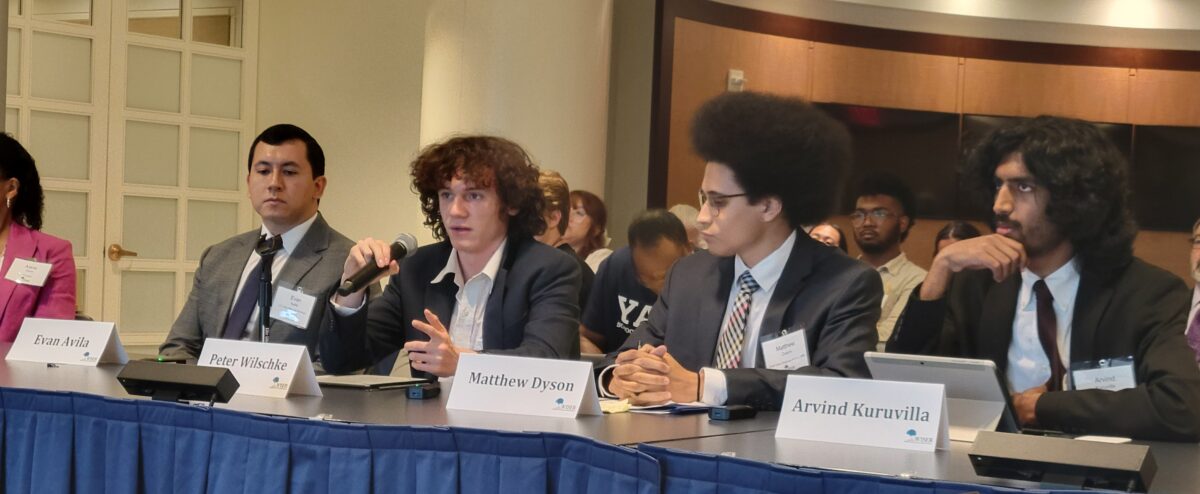 (l-r): Evan Avila, Peter Wilschke, Matthew Dyso, and Arvind Kuruvilla. (Image courtesy of Ratzsch/UMBC)
Lamdin has ushered four iOme winning teams through the process, starting in 2018 with Evan Avila ’18, economics and political science, now a financial analyst at the Securities and Exchange Commission. Avila has served as a co-moderator for the iOme winner’s presentation for the last two years. Lamdin’s mentoring approach—based on guiding mentees toward independence—has stayed consistent since he first mentored Avila. Lamdin assists them in developing a timeline for producing the essay by the due date that aligns with the judging criteria and provides students with background reading materials. From there, Lamdin steps back, trusting the team to work independently, with weekly check-ins to monitor their progress and provide feedback on their drafts.
Lamdin notes that Wilschke was proactive and professional. He appreciated his ability to find relevant research, interpret data, and consider new possible retirement policies.
“It is a rewarding experience for the students and me, so I hope to continue doing it,” says Lamdin. “I have never had a team I mentored not win, so maybe I will stop doing this when the winning streak ends—kidding, sort of.”
Motivation to follow a hunch
While Wilschke was conducting his research for his papers, he was also interning at The Hilltop Institute at UMBC, a nonpartisan research organization dedicated to improving the health and well-being of people and communities. He worked for Morgan Henderson, principal data scientist and affiliate professor of economics, and Morgane Mouslim, policy analyst, on a research project funded by the National Science Foundation on hospital pricing transparency. His two-year internship entailed helping to organize data collected from hundreds of hospitals and writing a news brief, “The Impact of Market Concentration on Hospital Pricing,” and presenting it at URCAD 2024.
“Peter is an excellent researcher who helped our hospital price transparency project significantly over the past two years,” says Henderson. “The quality of his work is top-notch—we predict that he’ll go far.”
Wilschke did not plan on contributing empirical research to the field of political science as an undergraduate student. Looking back, he is grateful for the classes and opportunities UMBC afforded him that prepared him to follow a hunch. Wilschke said that he felt that some students don’t look forward to statistical analysis or research methods classes in economics or political science because they’ve heard the classes can be difficult and may appear irrelevant at the moment.
“Most of what I accomplished as an undergrad was something I had to decide I wanted to do without having anyone to tell me I should do it,” explains Wilschke. “I’ve learned how far I can go if I try everything I can think of. It gives me motivation and a little bit of pressure to keep up that level of work throughout my time at the Fed Reserve and, hopefully, in grad school.”
]]>
Peter Wilschke ’24, economics and political science, hit the ground running after graduation in May, beginning a two-year research assistant position at the Federal Reserve Board of Governors in...
https://umbc.edu/stories/peter-wilschke-celebrates-national-research-accomplishments/
https://my3.my.umbc.edu/api/v0/pixel/news/143171/guest@my.umbc.edu/d843a6e74a8916c2e16769a2c5586312/api/pixel
cahss
cahss-research
class-of-2024
coeit
computer-science
economics
news
philosophy
policy-and-society
politicalscience
research
story
UMBC News & Magazine
https://my3.my.umbc.edu/groups/umbc-news-magazine
https://assets1-my.umbc.edu/system/shared/avatars/groups/000/001/943/24435aa6207c452e7bc15cc74b42c7bb/xsmall.png?1748556657
https://assets1-my.umbc.edu/system/shared/avatars/groups/000/001/943/24435aa6207c452e7bc15cc74b42c7bb/original.png?1748556657
https://assets2-my.umbc.edu/system/shared/avatars/groups/000/001/943/24435aa6207c452e7bc15cc74b42c7bb/xxlarge.png?1748556657
https://assets2-my.umbc.edu/system/shared/avatars/groups/000/001/943/24435aa6207c452e7bc15cc74b42c7bb/xlarge.png?1748556657
https://assets3-my.umbc.edu/system/shared/avatars/groups/000/001/943/24435aa6207c452e7bc15cc74b42c7bb/large.png?1748556657
https://assets1-my.umbc.edu/system/shared/avatars/groups/000/001/943/24435aa6207c452e7bc15cc74b42c7bb/medium.png?1748556657
https://assets2-my.umbc.edu/system/shared/avatars/groups/000/001/943/24435aa6207c452e7bc15cc74b42c7bb/small.png?1748556657
https://assets1-my.umbc.edu/system/shared/avatars/groups/000/001/943/24435aa6207c452e7bc15cc74b42c7bb/xsmall.png?1748556657
https://assets2-my.umbc.edu/system/shared/avatars/groups/000/001/943/24435aa6207c452e7bc15cc74b42c7bb/xxsmall.png?1748556657
UMBC News & Magazine
0
0
false
Tue, 13 Aug 2024 16:36:25 -0400
Tue, 13 Aug 2024 16:36:25 -0400
Putting UMBC Research on the Map
Spring on UMBC’s main campus brings a host of familiar sights and sounds: blooms on the magnolia trees, the chatter of red-winged blackbirds calling from the reeds around Library Pond, greening grass on the campus Quad, and black-and-gold-bedecked Grit Guides leading groups of prospective Retrievers around what may soon become a home away from home.
The guides cover the usual highlights—Academic Row, the Retriever Activity Center, the AOK Library, eating establishments, and residential halls. UMBC is a place to live, to learn, and to find community. And while some of the functions of campus spaces are obvious, others are often hidden.
Look more closely, and you’ll see faculty and students turning the everyday infrastructure and green oases of UMBC into out-of-the-ordinary laboratories. Beeswax sculptures, tactile maps, robots helping other robots—read on to discover some of the amazing ways Retrievers are using the campus itself for experiential learning and diverse research.
Written by: Catherine Meyers & Sarah L. Hansen, M.S. ’15

Two students wearing knee-high waders stand several meters apart in the middle of a rapidly flowing stream at the north end of UMBC’s campus. One releases a Ping-Pong ball, which bobs along with the current, as the second starts a timer, stopping it when the ball reaches his feet to determine the stream’s flow rate.
Nearby, another student measures the size of rocks in the streambed using a device called a gravelometer—a rectangular piece of metal with square holes of various sizes. The smallest hole a given rock will fit through becomes its measurement.
Farther along, other students capture photos that include reference posts on the stream bank. Each small group of students also takes measurements of the water depth at one-foot intervals along strings hung from one bank to the other. The students (with the help of specialized software) will use these measurements and photos to generate 3D models of the streambed.
“It’s a little DIY, but we get some amazing pictures,” says Charles Kaylor, the instructor and director of GIS and cartography labs in the Department of Geography and Environmental Systems (GES).
This is the “stream lab” in Exploring the Environment: A Geospatial Perspective, a course best known in the UMBC community for its semesterly launch of a dozen or so brightly-colored balloons that dot the campus skyline. Throughout the semester, students train their brains in the ways geographic data can help answer a wide range of research questions.
For the students, there are a range of perks to the course. “It’s cool to see different applications of computer science, which can sometimes feel pretty theoretical,” says George Rush ’24, computer science. Luke Thomas ’27, GES, who was partnered with Rush, is grateful for the senior’s support with the programming aspects of the coursework.
Rhonda Plofkin, Ph.D. student in GES and the graduate assistant for the class, concurs that having students with different strengths facilitates peer learning. “This is real-life stuff that geomorphologists do in the field,” she adds.
For some, the benefits are just as real, but simpler: “The cold water wakes me up,” Anthony Roytenberg ’24, computer science, says with a smile.
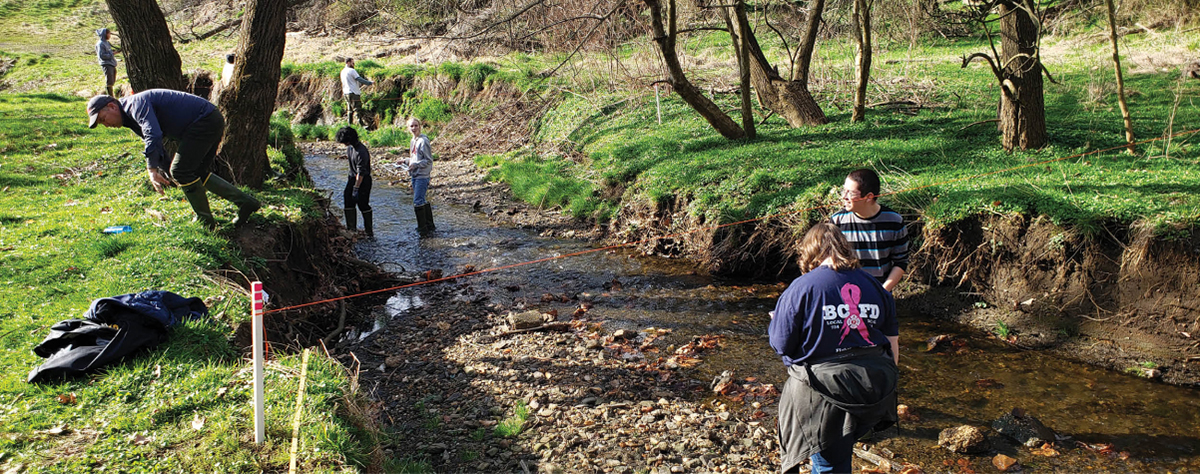 Students collect data that measure flow rate, depth, pebble size, and more as part of the “stream lab” in a popular, interdisciplinary GES course. Photo by Sarah Hansen, M.S. ’15.

When Alieh Rezaei arrived at UMBC from Iran, she couldn’t take her eyes off the ground. Almost immediately she was mesmerized by the flora and fauna of her new residence, and as an master of fine
arts student in the intermedia and digital arts (IMDA) program, she decided to incorporate pieces of UMBC into her artwork. She walked around campus, picking up windfalls of seeds and exploring hidden nooks of nature. A place that would come to be her sanctuary,
Rezaei, M.F.A. ’22, says, was Joseph Beuys Sculpture Park.
“The solidity of the stones alongside the growth of the oaksand the evolving shape of the garden reflect concepts of erosion and growth,” says Rezaei. “As an immigrant, I found solace in my attachment to the settled and solid stones, representing a sense of
grounding to me.”
Rezaei was drawn to UMBC’s M.F.A. program because of its multidisciplinary approach and the freedom she felt to choose an unconventional path. She praised Kathy O’Dell, IMDA professor emerita, who was her advisor. “Kathy was someone who—it was like I was floating in the air and Kathy held my hand and grounded me. She was very supportive for the whole journey.”
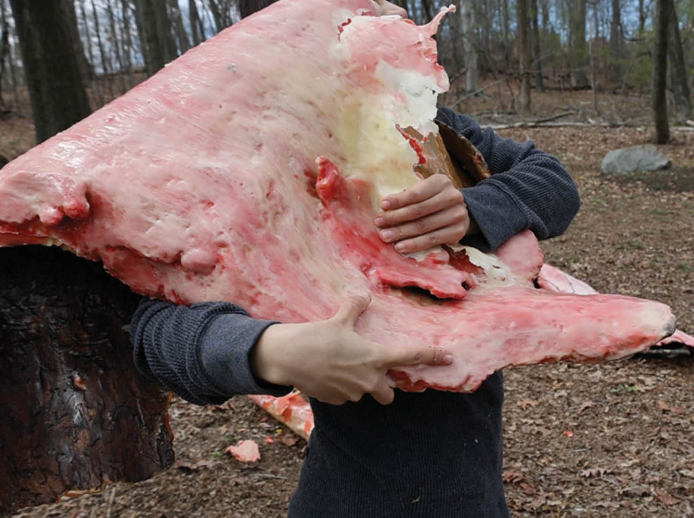
A photograph from Rezaei’s three-hour performance “The Tongue in the Landscape” at the Joseph Beuys Sculpture Park featuring the artist laboriously peeling the wax layer off the pieces of bark. Photo courtesy of Rezaei.
To create the art for her thesis project, Rezaei used almost exclusively materials collected on or near campus, including fallen tree bark, shattered wood, and seeds. She bought her main material—beeswax— from Baltimore beekeepers. One piece, “The Collective Womb,” featured hundreds of native seeds, called Devil’s Darning Needles, held together by beeswax around orange peels.
When the pieces were finished, Rezaei immediately knew the stage she wanted to showcase them on—Joseph Beuys Sculpture Park. “I installed my pieces there and had a performance as a way to extend the concept of public sculpture, aiming to reactivate the space and revive the concept of ecological engagement central to Beuys’ 7000 Oaks project.”

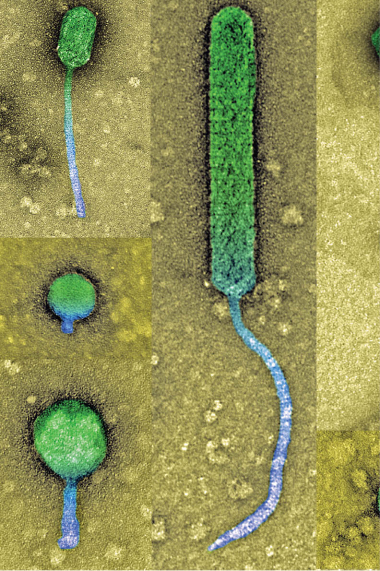
A composite of several microscope images of phages discovered by UMBC students in the Phage Hunters program demonstrates the variety of shapes phages can take. Photo by Tagide deCarvalho.
IchabodCrane. MindFlayer. Annihilus. TonyStarch. These are viruses previously completely unknown to science discovered by UMBC students in the Phage Hunters program, a two-course undergraduate genetics and bioinformatics sequence.
Since its launch in 2008, UMBC students have discovered 661 viruses that infect bacteria, called phages. Ninety-seven of them originated in samples collected on campus, with the most popular location being the Library Pond. Seventy-seven phages have been sequenced and 60 have been fully characterized and submitted to GenBank, an international digital repository of genetic and protein sequences.
Steven Caruso ’94, Ph.D. ’02, biological sciences, principal lecturer of biological sciences, runs the genetics course where the students collect samples, isolate their phages, image them with help from Tagide deCarvalho, “and growth,” says Rezaei. “As an immigrant, I found present their findings. They learn foundational laboratory techniques and get a taste for research.
Phage Hunters gives students “a first glimpse of what research is, with all that goes with it: determination, grit, inspiration, frustration, and more,” says Ivan Erill, professor of biological sciences and co-instructor for the bioinformatics course with Caruso. “Students get to see all the possible outcomes of a research project, from total success culminating in a DNA extraction for sequencing to failure to isolate a phage in the first place.”

In the basement of the Meyerhoff Chemistry Building, in a tiled expanse called the Molecular Characterization and Analysis Complex, sits a sleek, roughly human-sized instrument with the power to measure extremely tiny amounts of chemicals. Amanda Belunis, a chemistry Ph.D. student now in her final year, knows the instrument like an old friend, having turned to it to analyze a smorgasbord of UMBC water samples.
Belunis studies a group of chemicals called per- and polyfluoroalkyl substances, or PFAS. The chemicals are used in products as varied as makeup, clothing, and fire-fighting foam and are found in trace amounts in many water sources as well as in human blood. Dubbed “forever chemicals” because of the way they persist in the environment, they present a growing concern to human health.
Belunis’s research is part of a growing effort by scientists to understand how PFAS enter and travel through the environment and, ultimately, figure out ways to remove them.
To validate her procedures for measuring PFAS concentrations, Belunis tested water from drinking fountains, the sink in her chemistry lab, the pool, and the pond and streams around UMBC, all of which contained trace amounts of PFAS, as would be expected. Confident her methods worked on real-life samples, she then turned her attention to analyzing water in aquaculture fish tanks.
“My lab mates and I sometimes discuss how all of us have these chemicals in our bodies,” says Belunis. “It’s concerning, which is why we need to do more studies.”
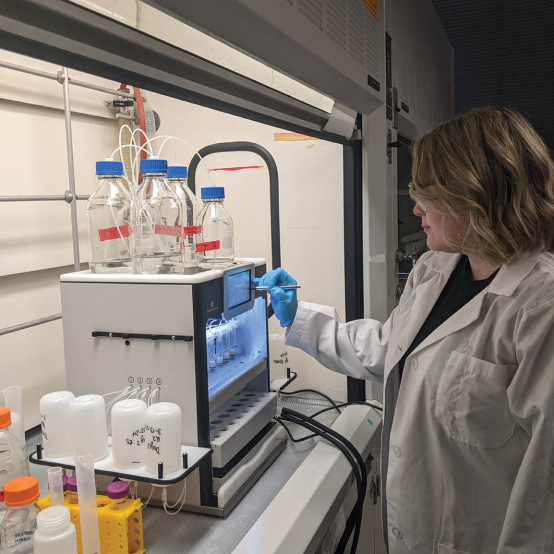
Amanda Belunis prepares samples for later analysis in the Molecular Characterization and Analysis Complex. Photo by Catherine Meyers.

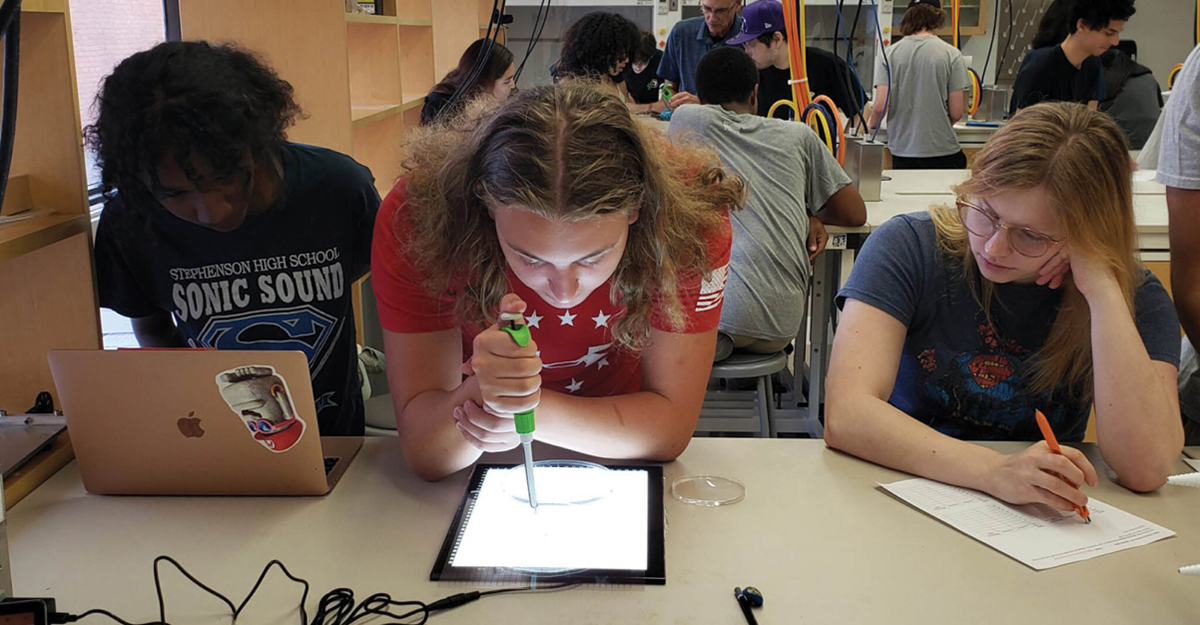 In addition to measuring buildings, students in Math in Action discovered other ways that math naturally interacts with their lives and studies. Here they are recording the movements of brine shrimp. Photo by Sarah Hansen, M.S. ’15.
When asked how to measure the height of a building, most students in Math in Action, a new laboratory course for non-STEM majors, “came up with various ways to measure the height directly—for example, by dropping down a string and then measuring the string or stacking up various objects,” says Alexis O’Malley ’18, mathematics and psychology, who teaches the lab.
But today, students are peering along the edges of homemade clinometers—plastic protractors with drinking straws attached—taking measurements from safely on the ground with a meter stick, and running simple calculations based on the properties of triangles to measure the height of UMBC’s Administration Building (123 feet, 2 inches).
Throughout the course, “I want students to see how math can be used to solve problems creatively,” O’Malley says.
Math in Action covers different math concepts each week through hands-on activities. The purpose of the clinometer activity is to remind students that “science is based on measurement, and you can build a tool to measure almost anything,” shares William R. LaCourse, dean of the College of Natural and Mathematical Sciences, who originally generated the idea for the course to help a wider range of students develop math skills relevant to their everyday lives. The course, he adds, “is a doorway to a lot of different math concepts.”

Shawn Abraham ’24, political science, has gotten lost on the UMBC campus more times than he can remember. As a blind student, he finds his way using a white cane, auditory cues, mental maps, and by asking people for directions. “People are surprised when I tell them, but big cities are much easier to navigate,” Abraham says. “College campuses are hard to get around.”
Tactile maps are one tool that could help. Erin Higgins and Kirk Crawford, Ph.D. students in human-centered computing, have recently been working with blind students at UMBC to create and test 3D-printed maps of campus.
The researchers launched the project after being approached by Michael Canale, assistant director of the Office of Student Disability Services. He says UMBC currently has four completely blind students enrolled and his office wants to provide personalized maps that each student can carry with them as they navigate campus. He’d also like to see a large 3D-printed map mounted somewhere on campus.
“A beautiful tactile map could be used by visitors of all kinds,” Canale said. “It’s the principle of universal design.”
Meanwhile, Md Osman Gani, an assistant professor of information systems, is spearheading a new project, named MyPath, to develop a Google Maps–style app to help wheelchair users navigate campus.
“Uneven surfaces, discontinuous sidewalks, and steep slopes can make wheelchair travel challenging, and even impossible” Gani says. The MyPath app would help by providing users with personalized turn-by-turn navigation with real-time updates. The app will rely on a machine learning model that recognizes path accessibility conditions based on crowd-sourced data, and Gani is currently recruiting wheelchair users to contribute data using their smartphones.
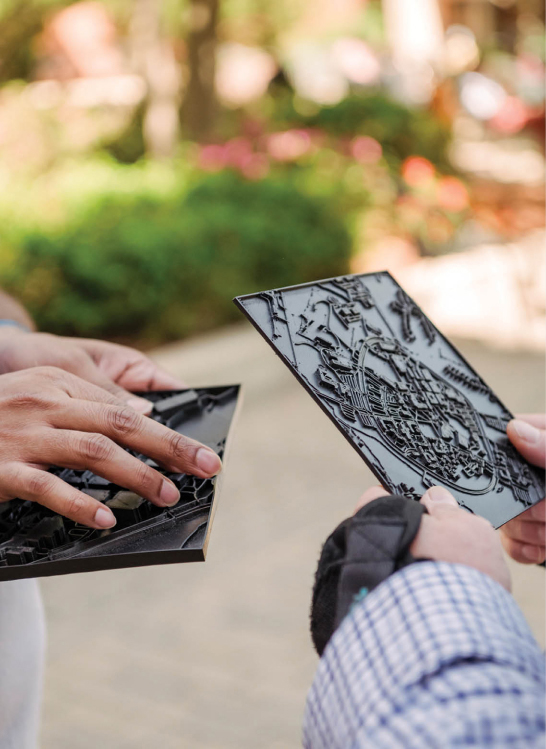
Shawn Abraham (left) tests prototype tactile maps made with 3-D printers with Michael Canale (right).

It’s 7 a.m. in July, and Megan Curtiss ’23, GES, is standing next to a tree just outside The Loop on UMBC’s southeast corner. It’s wrapped in a thin metal band at about chest height. Curtiss carefully measures the small gap between the two ends of the band with digital calipers three times, takes the average, and then moves on to the next tree. Only 98 to go.
This scene played out weekly from March to October 2023 as Curtiss collected data for a study led by Matthew Baker, GES professor, and Nancy Sonti, a research ecologist with the U.S. Forest Service. “It became like a morning meditation,” Curtiss shares.
The metal bands, call dendrobands, “are a cheap and easy way to get pretty detailed information,” Curtiss says. By measuring the trees’ growth over time, the goal is to look at how trees of different species and in different immediate environments (such as a parking lot versus a forest) handle conditions like fluctuating temperatures and water availability.
After attending Anne Arundel Community College in her 30s, Curtiss then found a home at UMBC. She began working with Baker in fall 2022 and will enter the GES master’s program at UMBC this fall. A graduate degree was not something Curtiss originally planned on, but now she’s excited about the further experiences it will bring. “I’m looking forward to the unexpected,” Curtiss says.

Take a left off Hilltop Circle, just past the greenhouse on the right and toward the Walker Avenue apartments, and you’ll find yourself outside a traditional brick building that used to house trial rooms and detention cells. In 2021, UMBC turned this former courthouse into the main hub for the Center for Real-time Distributed Sensing and Autonomy (CARDS). Researchers here develop artificial intelligence-enabled smart robots for military and search-and-rescue operations.
On a sunny day in spring, you will likely see students gathered in the courthouse’s “backyard,” huddled around dog-like Spot robots and wheeled vehicles called Jackals and Huskies.
The researchers outfit the robots with a host of custom devices, such as cameras and radar to sense their surroundings and microprocessors to run on-board algorithms. While the robots can be commanded via voice and gesture, the ultimate goal is for them to operate mostly autonomously.
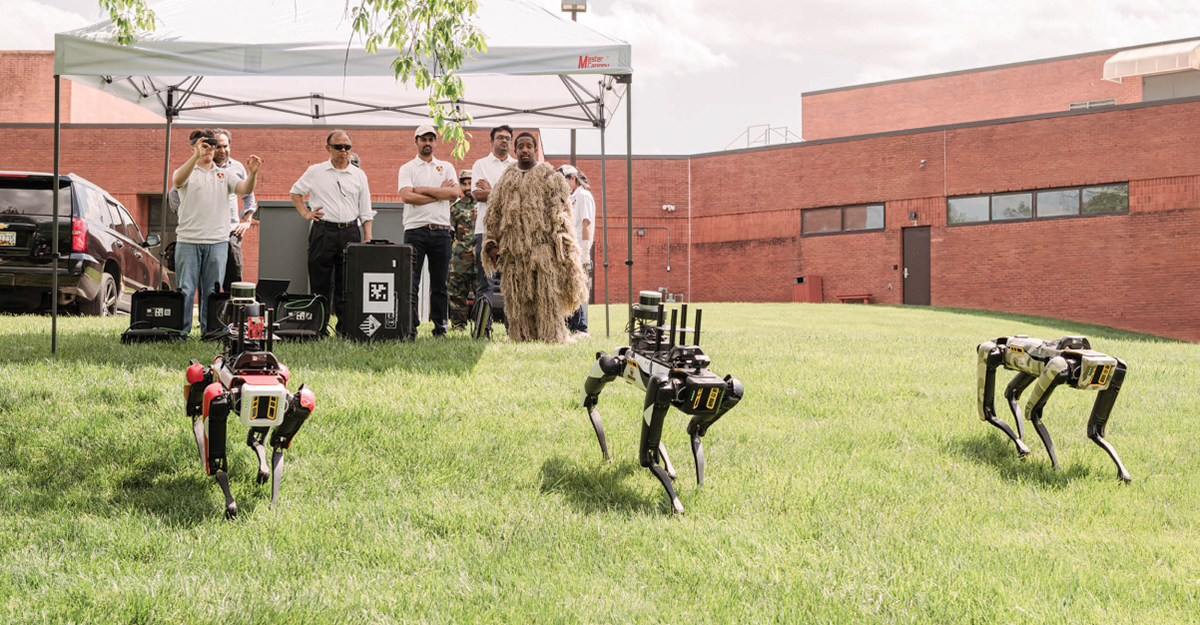 On the back lawn of the courthouse building, student researcher Kevin Rippy, left, controls three Spot robots with gestures. Another student stands by in a ghillie suit, a type of camouflage clothing.
Recently, the team has demonstrated this capability by verbally assigning the robots the task of jointly surveying a given area. The robots must translate the instructions from plain English into machine-level commands, divide up duties, detect and avoid obstacles, come to a fellow robot’s aid in the case of unexpected problems, and identify and keep track of the objects and people within their assigned perimeter.
“People from around campus will see us testing and will stop to watch,” says Aryya Gangopadhyay, a professor in information systems who directs CARDS. “The robots are an attention getter.”

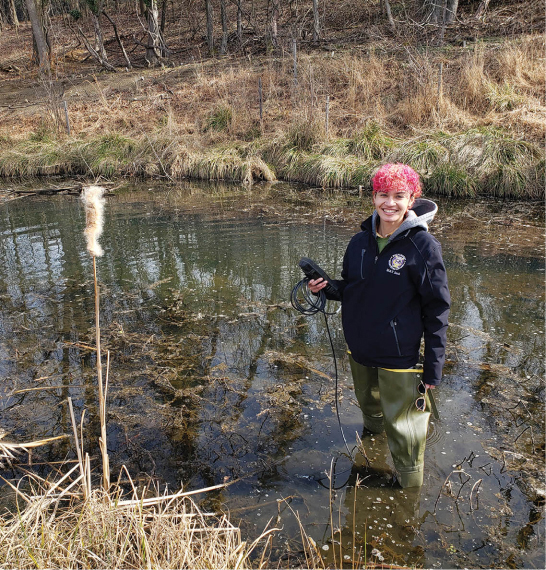
Erin Hamner collected weekly water quality data from this stream for six months, using the battery-powered digital probe she’s holding. (Image by Sarah L. Hansen, M.S. ’15)
After traipsing across a swampy field between research sites, Erin Hamner ’22, GES, and a current master’s student in the Interdisciplinary Consortium for Applied Research in the Environment program, scampers down a streambank in thigh-high waders and plunges a battery-powered probe into the water. It reports concentrations of ammonia and nitrates—key water quality measures. The probe also measures the water’s conductivity, which indicates the level of ions, such as salts used to melt snow.
It’s beautiful out today, but Hamner completed the trek to a dozen campus sites weekly from September 2023 to February 2024, sometimes dealing with mud, snow, or rain. The goal of her master’s thesis is to confirm that stormwater management features UMBC has installed to reduce flooding, filter storm runoff, and otherwise improve water quality are working as intended—or if they aren’t, to suggest improvements.
Hamner and her collaborators in Facilities Management and the Office of Sustainability want to see the data collection effort continue after she graduates. So she is working with faculty in GES to incorporate crowd-sourced stormwater monitoring into the undergraduate curriculum, including generating a public dashboard.
“Erin has done incredible groundwork collecting water quality data across our campus, generating useful data that can tell us about the health of UMBC’s waterways,” says Taylor Smith, assistant director of sustainability.
Long-term data will help the university “see how our development affects our watershed so we can continue to be good stewards,” Smith adds, noting that, “data like Erin’s can help us advocate for more greenspace and stream buffers around campus.”
]]>
Spring on UMBC’s main campus brings a host of familiar sights and sounds: blooms on the magnolia trees, the chatter of red-winged blackbirds calling from the reeds around Library Pond, greening...
https://umbc.edu/stories/putting-umbc-research-on-the-map/
https://my3.my.umbc.edu/api/v0/pixel/news/142303/guest@my.umbc.edu/93196282138c9d99f3c2930689edf3cd/api/pixel
biological-sciences
cahss
campus-life
cards
chemistry
cnms
coeit
computer-science
feature
ges
humancentered-computing
icare
imda
information-systems
joseph-beuys
magazine
mathematics
political-science
psychology
science-and-tech
sds
spring-2024
story
UMBC News & Magazine
https://my3.my.umbc.edu/groups/umbc-news-magazine
https://assets1-my.umbc.edu/system/shared/avatars/groups/000/001/943/24435aa6207c452e7bc15cc74b42c7bb/xsmall.png?1748556657
https://assets1-my.umbc.edu/system/shared/avatars/groups/000/001/943/24435aa6207c452e7bc15cc74b42c7bb/original.png?1748556657
https://assets2-my.umbc.edu/system/shared/avatars/groups/000/001/943/24435aa6207c452e7bc15cc74b42c7bb/xxlarge.png?1748556657
https://assets2-my.umbc.edu/system/shared/avatars/groups/000/001/943/24435aa6207c452e7bc15cc74b42c7bb/xlarge.png?1748556657
https://assets3-my.umbc.edu/system/shared/avatars/groups/000/001/943/24435aa6207c452e7bc15cc74b42c7bb/large.png?1748556657
https://assets1-my.umbc.edu/system/shared/avatars/groups/000/001/943/24435aa6207c452e7bc15cc74b42c7bb/medium.png?1748556657
https://assets2-my.umbc.edu/system/shared/avatars/groups/000/001/943/24435aa6207c452e7bc15cc74b42c7bb/small.png?1748556657
https://assets1-my.umbc.edu/system/shared/avatars/groups/000/001/943/24435aa6207c452e7bc15cc74b42c7bb/xsmall.png?1748556657
https://assets2-my.umbc.edu/system/shared/avatars/groups/000/001/943/24435aa6207c452e7bc15cc74b42c7bb/xxsmall.png?1748556657
UMBC News & Magazine
1
0
false
Thu, 30 May 2024 10:42:29 -0400
Thu, 30 May 2024 10:42:29 -0400
A Journey of Growth
International travel offers ample opportunities to stretch yourself—one minute you may be the expert and the next, completely clueless about how something works. Retrievers currently in the Fulbright U.S. Student Program—teaching English or researching around the globe—find themselves oscillating between their teaching and student roles on a daily or hourly basis. By engaging their host communities through openness and cultural humility (and many shared cups of tea or coffee), these Fulbrighters are finding their balance along the way.
All eyes are on Milan Richardson ’23 as she helps her co-teacher keep score in a Jeopardy-like game her students are playing. Richardson teaches English to several classes of first through sixth-grade students at Jinsha Elementary School in Kinmen County, Taiwan. As she completes the Mandarin character for the numeral 5, a wave of giggles and chatter flows through the room.
Similar to a U.S. tally—four strokes and a strike though, the Mandarin character has 5 strokes total and needs to be written a certain way to represent 1, 2, 3, 4, or 5. “The students were so confused because I wrote the character strokes in the wrong order,” says Richardson, who is used to solving complex math as a Meyerhoff Scholar having earned a bachelor’s degree in bioinformatics and computational biology and minors in computer science and modern, languages, linguistics, and intercultural communication.
“I wanted to write the character correctly. I asked, and they showed me the proper order to write the strokes,” says Richardson, a Fulbright English Teaching Assistant (ETA). “They started clapping once I got it right. This was one of the many cool moments where my students were able to teach me.”
While she may be new to teaching in Taiwan, Richardson brings with her four years as an English and math tutor and a minor in Mandarin. “Taiwan was so different from any place I’ve ever been to. I was overwhelmed at first,” says Richardson. “I like it a lot, now. In my second month, I applied for a scooter license. Now I ride around the island and have taken my scooter other places on trips.”
Diplomas earned. Visas in hand. Vaccines completed. Luggage packed. Destination confirmed. Last summer, UMBC’s eight participants in the 2023 – 2024 Fulbright U.S. Student Program checked off all the important items on their to-do lists. The only thing left was to get to their placements on islands and in landlocked countries, cities, and countrysides across East Asia and Eastern Europe. It’s easier written than done. To adapt well to a new community, job, language, and culture, they must practice the art of humility and flexibility as their roles shift regularly from teacher to student.
Leading the Fulbright charge
All technicalities aside, the Fulbright experience is the beginning of building an international network of teachers and researchers who share the diversity and possibility of the U.S. with the world. In return, across the globe, communities welcome the next generation of leaders into their cities, neighborhoods, schools, and homes to share their country’s history, innovations, and culture. Since Fulbright’s inception in 1946, these reciprocal acts of kindness have created multiple paths forward to lifelong worldwide collaboration and understanding based on the simple act of giving someone different than yourself a chance.
“The Fulbright Program truly demonstrates public diplomacy in action,” says Brian Souders, M.A.’19, TESOL, and Ph.D. ’09, language, literacy, and culture, the associate director of global learning at UMBC’s Center for Global Engagement. In this role, Souders, who received a 2023 Fulbright International Education Administrator award to Germany, has led hundreds of Retrievers through the Fulbright application process as UMBC’s Fulbright Program advisor. “Whether in the classroom as teachers, students, or researchers, recipients learn about the world as much as they share what it means to be from the U.S. and UMBC alumni,” says Souders.
Thanks to Souders’ guidance, UMBC is one of 57 doctoral universities nationwide and three in Maryland to receive a Fulbright Top Producing Institution designation for 2023 – 2024, for the third time in the last five years. In the last decade, more than 80 UMBC alumni have received Fulbright awards. Out of the 10 Retrievers who received a 2023 – 2024 Fulbright, eight are currently placed internationally, seven are ETAs and one is on a research grant.
The hard work of play
There are U.S. Fulbright student scholars in more than 100 countries worldwide. Three Retrievers were placed in Taiwan—they keep in touch regularly, see each other at ETA trainings, and are planning to travel together during their Fulbright year. But they all arrived in Taiwan separately and faced different challenges settling in.
“I arrived in Taiwan and immediately changed my plans because the airline lost my luggage,” says Humanities Scholar Kara Gavin ’20, English. She was grateful to have a carry-on. “It was chaotic. I was taking it all in,” says Gavin. A day and a 50-minute plane ride later, she arrived in Penghu County, Taiwan, an archipelago of about 90 islands between China and the main island of Taiwan. “The little beach town is in its own little world,” says Gavin. “The smell of the sand gave me comfort.”
Gavin teaches beginner English at two local junior high schools. New to Asia and Mandarin, Gavin’s thinking cap is on 24 – 7, including learning Mandarin in between teaching classes. “Living independently for the first time is hard on its own, but doing it in a foreign country is a whole other ball game,” says Gavin. “I’m acquiring many new life skills that will last me a lifetime.”
One of those is sympathizing with her students and anyone learning a new language and culture. “I teach the English pronunciation and spelling of a word,” says Gavin. “Then, they like to share the Mandarin equivalent with me. It’s all about patience, balance, and trust.” She also models intercultural teamwork by developing and teaching lessons with her bilingual (Mandarin/English) Taiwanese co-teacher to foster student engagement and enrichment.
For Fulbright Scholars, it is equally important to engage with communities beyond the classroom. When they apply for the grant, the Fulbright Program asks them to develop ideas to share their passions and skills in a community project. For Gavin, this meant adding a little drama to have a lot of fun. As a performing artist, Gavin knows the theatre can be a powerful community-building outlet. “I wanted to encourage students and other community members to express themselves and share their culture with me and others,” says Gavin.
She found a kindred spirit in a professor at a local university. They formed a drama club at the university for English language learners at all levels to explore American play formats with Taiwanese traditions and histories.“Writing original bilingual plays, in English and Mandarin, based on folktales about island traditions is creating an artistic and fun cultural exchange and understanding outside of my ETA duties,” says Gavin.
Finding the right pace
For fellow Humanities Scholar Nailah-Benā Chambers ’23, global studies, a Fulbright award to Taiwan was a natural next step. Chambers began learning Mandarin and all things Taiwanese in sixth grade at a Taiwanese Mandarin language immersion school in her hometown of Richmond, Virginia. As her Mandarin improved, she tutored other English speakers. This oscillating pattern of being a student and a teacher makes Chambers adaptable and persistent, she says.
But it hasn’t always been easy. When she first visited Taipei, Taiwan, in the spring of 2023 on a Mandarin language-intensive study abroad program, “I was so confident. I walked into a 7-Eleven to shop. No one could understand me,” says Chambers. “It was a bit embarrassing. Even with my language and cultural skills, I had a long way to go to mastering Mandarin.”
Now on her Fulbright ETA grant, Chambers arrived on solid ground, both culturally and linguistically. “I felt such a sense of calm and familiarity. Taiwan is so welcoming,” says Chambers. “It calms you down. Things are much slower here than in the U.S.” Soon enough, Chambers was balancing classrooms at Huludun Elementary and Fu Chun Elementary in Taichung City, on the main island of Taiwan, with students at both schools on the extreme spectrum of English proficiency.
The upside of working with proficient English language learners is connecting on more advanced topics and sticking to Fulbright’s English-only immersion model. At one of her schools, the students are beginning English language learners, and the administrators only speak Mandarin. “My experience as a bilingual teacher and learner with a high level of understanding of the local language and culture has helped with classroom management and fostering powerful connections with students and administrators,” says Chambers. “It also helps to advance their grasp of the nuances of American English, especially when there are gray areas or misunderstandings.”
Keeping your ears open
Watching anime, reading manga, (Japanese graphic novels), and participating in their fandom inspired Paul Ocone ’22, individualized study, a Linehan Artist Scholar, to research these subjects and learn Japanese. “I have deeply engaged in fan social life and communities—from leading an anime club to participating in and running conventions to moderating online communities—my affinity for and interest in anime fan spaces runs deep,” says Ocone. Part of Ocone’s observations include witnessing how some fan subcultures limit their membership in fear that a broader fanbase would weaken their subculture identity. In contrast, he says, other fan subcultures are more flexible while maintaining their identity.
Interested in adding to his initial research in U.S. fan spaces, Ocone is now at the epicenter of anime and manga culture as a Fulbright Student Researcher doing anthropological research with Morikawa Kaichirō, a leading scholar in this field at Meiji University’s School of Global Japanese Studies in Tokyo, also home to the Yoshihiro Yonezawa Memorial Library of Manga and Subcultures.
“I have had some amazing experiences participating in anime pilgrimage or anime tourism, including learning much from other fans and benefitting from their generosity,” says Ocone. “My Japanese is conversational—sometimes it’s challenging to understand specialized topics, but this has not deterred me from adding anime and manga tourism as a second research project.” In January, Ocone presented his work at the Popular Culture Tourism Stakeholders Summit in Japan.
Ocone is a sort of tourist himself, enjoying various aspects of Japanese pop culture. The daily musicality of Tokyo teaches him about enjoying the rhythm of the day. “Each train station plays a unique melody when the train departs,” says Ocone. These melodies or “hassha merodii,” are catchy and echo around in his brain like the convenience store jingles that also greet customers. “I was happily surprised when I heard a loudspeaker playing a symphony in my neighborhood,” says Ocone. “Another one played the following day and the next. I learned this was a daily sunset ritual.” He knows these sound experiences will play in his head long after returning to the U.S.
Learning new languages
This is not the first time David Bullman ’22, ancient studies, visited North Macedonia. He first went in 1995 as a performing musician and public affairs representative for the U.S. Army.
“North Macedonia was very different coming out of the Cold War,” says Bullman. “The infrastructure and general state of repair of public spaces and businesses is much better than I recall from that time.”
Now, as an ETA, Bullman teaches British civilization and American civilization in addition to three different levels of English at the University of Totovo in the Republic of North Macedonia, a landlocked country north of Greece. In Totovo, students begin learning English in elementary school and are fluent by the time they reach college. “I thought I would be teaching English basics,” says Bullman, “but it’s been great to teach a complex subject in the context of where my students live.”
His students are equally glad to help him with the local language. Macedonian and Albanian are the country’s two official languages. Bullman began learning some key Macedonian phrases in preparation for his trip. However, Albanian is the preferred language in Tetovo. After traveling with the Army to more than 15 countries on three continents, Bullman is used to rapidly switching gears and accepting help.
He eagerly takes on the student role when it comes to learning about new foods. Bullman’s apartment faces the Hapësira Socio-Kulturore Tetovë, a community center where locals and the nearby Peace Corps Volunteers sometimes organize activities, like an ajvar-making gathering. Ajvar is a delicacy across the Balkans made every fall. It’s a tradition passed down through centuries with many recipe variations. “Ajvar is made by charring red bell peppers that are then peeled, minced, seasoned, and cooked for hours,” says Bullman. It boils down to a relish that can be preserved for months, but locals tell Bullman that’s rare because it’s too good to keep for even one week. After participating in the preparation and getting to take home a few jars, Bullman agrees with the locals. Ajvar is now his go-to condiment on eggs, pasta, toast—anything goes.
Albanian and cooking are not the only languages Bullman tapped into while in Tetovo. As a lifelong clarinet player, Bullman hoped to create a musical exchange with local musicians. The opportunity presented itself when the dean of the Faculty of Art wanted to celebrate Thanksgiving. Bullman collaborated with the music faculty, the orchestra director, and students to create a concert of six songs. “I’m glad I returned to North Macedonia. The people are as warm and friendly as I remembered them to be,” says Bullman. “I wanted to come back and experience it myself again.”
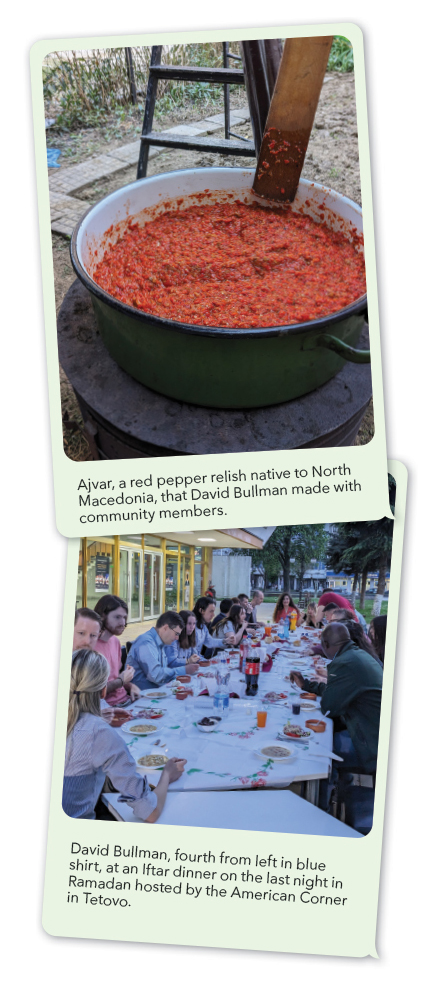
Tapping into curiosity
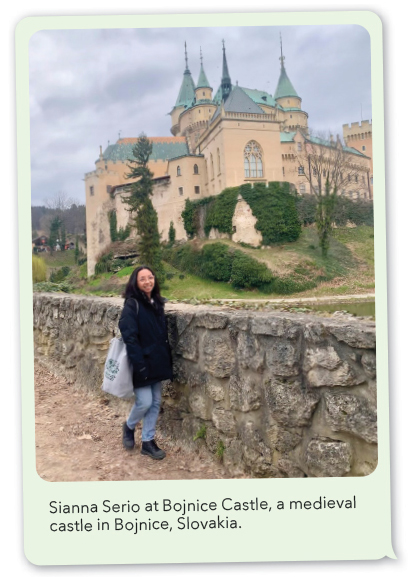
On her way to her Fulbright placement, Sianna Serio ’23, computer science, went city hopping. “I was headed to Žilina, Slovakia, east of Austria and south of Poland,” says Serio. “I flew into Vienna, Austria, then I took a one-hour bus ride crossing Austria’s eastern border into Slovakia to get to Bratislava, the capital.“ There she met other ETAs for orientation. “A week later, I hopped on a two-hour train ride to my teaching placement in Žilina and I met my wonderful mentor, Maria Veršova, who became my second mom.”
Serio teaches at the Hotel Academy, Žilina. The academy focuses on hotel management, gastronomy, and tourism. “My students are beginning English language learners,” says Serio. “I teach what the class is interested in, like American pop culture, because they rarely meet a native English speaker.” During outings with her students, they ask about a wide range of topics. “There are many topics that I would not have thought to cover if it were not for time spent outside of the classroom,” says Serio, “Some of those conversations became formal lessons, like the lesson on the three branches of the U. S. government.”
Serio appreciates her students’ curiosity. She tapped into her love of website development and design to improve her students’ confidence in writing and speaking English and prepare for their Maturita exam, a national high school exit exam. “Some of my students are helping me design a class webpage for them where I will showcase their class and post some of their practice writing in English,” says Serio. “These posts will include topics covered in the Maturita exam, information about their school, and answers to questions about Slovakia.”
Serio’s mentor Maria Veršova, head of the English department, is her motivation. She guides her through lesson planning, class schedules, and the challenges of relocating to a new country. “When my original housing plans fell through, Maria found housing for me five minutes from her house,” says Serio. “She helped me find health insurance and open a bank account. Her husband set up my internet.” They have welcomed Serio almost daily into their home for dinner, tea, coffee, or wine. Serio is a gracious guest and lent her graphic design expertise to help Veršova design invitation cards for her 50th birthday party. Veršova tells Serio she will always have a place to stay in Žilina.
Fulbright: The next generation
Teaching has defined the last decade for Tiffany Powell, a master’s student in UMBC’s TESOL program, a passion she invested in as an English language learner teacher in Seoul and in Miryang City, South Korea, for five years, and in Florida this past year. Now, she is in Iași, Romania, southwest of Ukraine, at the Alexandru Ioan Cuza University teaching American studies. Powell is committed to bridging culture, community, and belonging by bringing technology into the classroom.
Powell also decided to bring the research and cultural understanding closer to home by partnering with Romanian teachers to develop a five-part series on African American women’s history. “We talked about Black women in science in the context of the movie Hidden Figures and discussed Hollywood’s portrayal of Black life,” says Powell. The class is now creating a series on Romanian women. Helping students better understand the similarities and differences between U.S. and Romanian cultures has been an eye-opening experience for Powell.
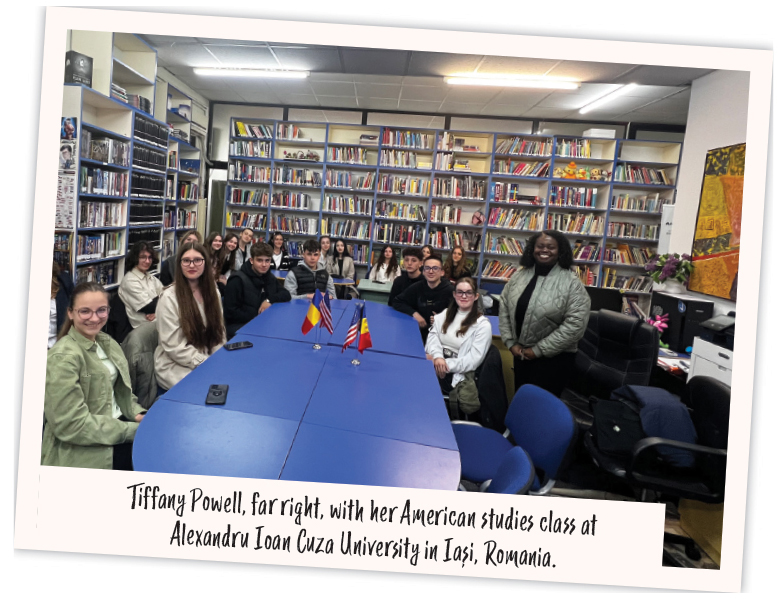
She sees the impact of a country formerly under communism. In Iași, sometimes the internet doesn’t work and, in her school, there are no clubs or student organizations to gain the skills needed to earn a Fulbright award. “My students have given me a new perspective. You may want to come in and make changes, but you must understand where they’re coming from. There is a saying in Iași, ‘It’s not impossible. It’s just difficult,’” says Powell. She is trying to help with the difficult part by leading Fulbright application and leadership workshops.
Powell, like the other Fulbrighters, will bring her experiences home with her and wherever she ends up teaching English next. When their Fulbright year ends, these Retriever ambassadors will find themselves as emissaries yet again, returning to their hometowns, sharing the good news of ajvar made in community, the freedom of a scooter ride along a Taiwanese beach, or the correct stroke order for writing the Mandarin number five. The lessons their students and host families passed along—including pausing to take a breath and appreciate their international successes small and large—will continue to form and shape the way they see the world.
“Having a flexible mindset and under-standing the historical context of your placement is key,” says Powell. “I carry myself as a U.S. representative. Living abroad teaches humility, adaptability, and open-mindedness to press on through challenging times.”
]]>
International travel offers ample opportunities to stretch yourself—one minute you may be the expert and the next, completely clueless about how something works. Retrievers currently in the...
https://umbc.edu/stories/a-journey-of-growth-retriever-fulbright/
https://my3.my.umbc.edu/api/v0/pixel/news/142404/guest@my.umbc.edu/ed280c216f570c718be808f58bf7c55a/api/pixel
alumni
ancient-studies
bioinformatics-and-computational-biology
cahss
cge
computer-science
education-abroad
english
feature
fulbright
global-studies
humanities
inds
linehan
llc
magazine
meyerhoff
spring-2024
story
UMBC News & Magazine
https://my3.my.umbc.edu/groups/umbc-news-magazine
https://assets1-my.umbc.edu/system/shared/avatars/groups/000/001/943/24435aa6207c452e7bc15cc74b42c7bb/xsmall.png?1748556657
https://assets1-my.umbc.edu/system/shared/avatars/groups/000/001/943/24435aa6207c452e7bc15cc74b42c7bb/original.png?1748556657
https://assets2-my.umbc.edu/system/shared/avatars/groups/000/001/943/24435aa6207c452e7bc15cc74b42c7bb/xxlarge.png?1748556657
https://assets2-my.umbc.edu/system/shared/avatars/groups/000/001/943/24435aa6207c452e7bc15cc74b42c7bb/xlarge.png?1748556657
https://assets3-my.umbc.edu/system/shared/avatars/groups/000/001/943/24435aa6207c452e7bc15cc74b42c7bb/large.png?1748556657
https://assets1-my.umbc.edu/system/shared/avatars/groups/000/001/943/24435aa6207c452e7bc15cc74b42c7bb/medium.png?1748556657
https://assets2-my.umbc.edu/system/shared/avatars/groups/000/001/943/24435aa6207c452e7bc15cc74b42c7bb/small.png?1748556657
https://assets1-my.umbc.edu/system/shared/avatars/groups/000/001/943/24435aa6207c452e7bc15cc74b42c7bb/xsmall.png?1748556657
https://assets2-my.umbc.edu/system/shared/avatars/groups/000/001/943/24435aa6207c452e7bc15cc74b42c7bb/xxsmall.png?1748556657
UMBC News & Magazine
0
0
false
Wed, 29 May 2024 14:32:52 -0400