I’m a Black sociologist, and a mom – by listening to other Black mothers, I’ve learned about their pandemic struggles and strengths
By Loren Henderson, associate professor, Sociology, UMBC
I spent the 2020 spring break week setting up to teach my college courses online while helping to care for my 14-month-old grandchild, whose daycare had closed. At the same time, I couldn’t help thinking, being the sociologist I am, of the devastating consequences of COVID-19 I saw for women like me, Black mothers, whom I have studied for over a decade.
Social science research can influence policy. Sharing Black mothers’ stories in their own voices may ultimately lead to more compassionate policies. My work is part of a small body of descriptive research, mostly by researchers of color, countering negativity and victim-blaming in earlier studies of Black families.
My research partner, sociologist BarBara Scott, lives in Chicago, where I grew up. In our studies of Black mothers there, we’ve explored parenting in violent communities and living with inadequate health care. In 2019, before COVID-19 hit, we were preparing to study parenting practices.
But when lab conditions change, scientists need to reorganize their work. I am a social scientist and society is my lab, where the pandemic dramatically altered the conditions of my research.
We adjusted, preparing to interview remotely instead of in person. We added new questions to investigate, like: How were Black mothers coping with pandemic conditions? How did the murder of George Floyd and the resulting protests affect them? Our research would now include the pandemic and the country’s racial upheaval, highly unusual factors complicating Black mothers’ already challenging lives.
Researching with rapport
The first challenge was finding participants. We put up fliers in and around schools, churches, the YWCA and other places Black moms go when not at work. Even in the best of times, though, they face practical barriers to joining a research project. Child care responsibilities might be theirs alone. Taking time off from work means their paychecks take a hit not nearly covered by the $25 gift cards we offered.
But they called. Some just wanted to sign up after looking me up on their phones. Others, who may have known that the federal government oversees studies involving people, asked why I was studying them and what I would do with their information. I knew that if any of the women thought talking with me might bring embarrassment or other trouble, they might be less forthcoming or decide not to participate. My findings would be much less credible.
I assured the moms that I would keep their responses confidential and that they had a right to leave the study whenever they wanted to.
None of them did. We signed up enough moms for two focus groups of five to seven participants each. I ran group meetings and conducted 12 one-on-one interviews via video conferencing.
To start our 60- to 90-minute sessions, I introduced myself and got the mothers talking with an ice breaker question like, “What is the farthest place from your current neighborhood that you’ve been?”
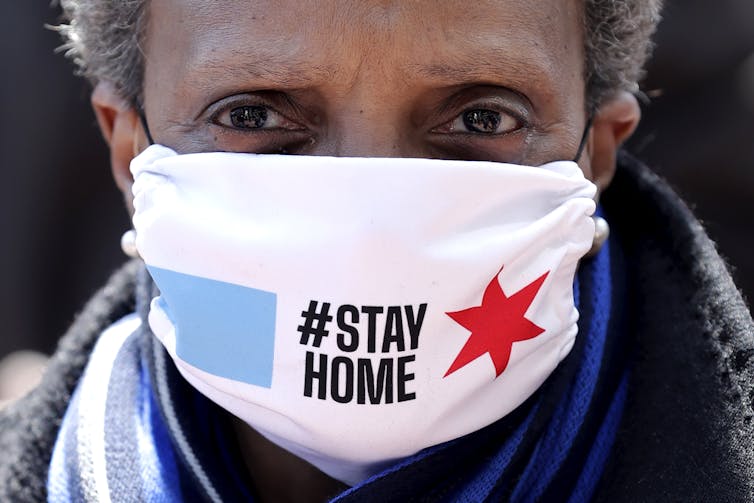 Many Black mothers were front-line workers who couldn’t heed the message on Chicago Mayor Lori Lightfoot’s mask in the early days of the pandemic. AP Photo/Nam Y. Huh
I also tell them that I have a Black mom, and that I am one. And then, because my skin tone is fair, I mention that I have an Italian father. I didn’t want to be mistaken for white; the moms might feel less comfortable discussing certain topics with me. But after realizing that I’m Black too, a few of them said things like, “I knew there was something about you!”
I share my belief in centering – and that’s the word I use – Black mothers’ lived experiences and exploring their parenting from a strength perspective. That’s when I got a lot of smiling and nodding.
No time for racism
Black mothers don’t need a pandemic to face impossible choices. But it took a pandemic for others to see that. As nearly everyone else stayed home to stop the spread of COVID-19, it became obvious that Black women were more likely than any one else to be essential workers in front-line jobs. And despite risking COVID-19 infection to keep their jobs, Black workers were more likely to lose them anyway during the pandemic.
I asked the mothers about the pandemic’s effect on their lives. They talked about the trickiness of trying to isolate or distance in small or crowded homes. They hated being unable to get masks and hand sanitizer when stores closed during the George Floyd protests, which none of them attended.
I asked why they didn’t go, given their stated frustrations with racism affecting their lives. Some didn’t want to risk getting sick. But most of these Black mothers told me they don’t dwell on racism, saying things like, “Yeah, racism is bad, but I got things to do.”
And so they did those things. While at work, they sent their kids text reminders to go to remote school if it was available, or if it was not, to study. The moms came home from long shifts and helped with homework, worrying about their kids falling behind academically. The mothers worried about getting COVID-19 and losing custody of kids if they became too sick to parent well.
Keeping the conversation flowing
The qualitative research I do is about words and meanings, not just numbers and statistics. It allows me to explore the lives of Black moms in depth.
In my interviews, I don’t ask closed-ended questions – the kind where the answer is simply yes or no, true or false, or limited to a set of multiple-choice answers. For example, if a participant can only respond to the question, “How safe is your community?” with the options “very safe,” “somewhat safe,” or “not safe,” that’s a closed-ended question.
In qualitative research, however, questions are often open-ended. Participants decide what a question means to them, then answer in any way they choose. I’ve been asking the Black mothers questions like: “How do you feel about Chicago as a place to live and raise your children? How do you feel about working and raising your children during the COVID-19 pandemic?”
Reading the transcribed interviews later, I look for general thoughts, or themes, in the mothers’ collective responses. For example, when I asked about violence, the overall sentiment was that it was around, but avoidable. One participant told me, “You have to know where [to go] and where not to go, when to go and when not to go.” And she called Chicago “a great place,” with “great opportunities” for anyone who wanted to be there.
This response was common: The moms know that Chicago can be violent, but many focus on the positive aspects of the city. My theory is that this is their conscious or unconscious way of explaining why they stay in a violent community. That question has come often enough – usually from those with far more options – to hang over the heads of these Black moms, even if no one asks them directly.
A related sentiment the moms had was that moving away is pointless since violence “is everywhere.” They may simply want to stay close to the generations of family and community ties they have. But it’s also true that moving isn’t affordable for many of these mothers.
Identifying these themes helps me present a picture of Black mothers’ lives as a corrective to the earlier research. Documenting their experiences as the center of my research gives them a voice and validates their lives as worthy of exploration.
******
Header image: When schools shut down to prevent the spread of COVID-19, moms took on the burden of supporting students at home. AP Photo/Shafkat Anowar
Loren Henderson, Associate Professor of Sociology, University of Maryland, Baltimore County
This article is republished from The Conversation under a Creative Commons license. Read the original article.
]]>
By Loren Henderson, associate professor, Sociology, UMBC I spent the 2020 spring break week setting up to teach my college courses online while helping to care for my 14-month-old grandchild,...
https://umbc.edu/stories/im-a-black-sociologist-and-a-mom-by-listening-to-other-black-mothers-ive-learned-about-their-pandemic-struggles-and-strengths/
https://my3.my.umbc.edu/api/v0/pixel/news/119436/guest@my.umbc.edu/c7c85e15e203808a64f4d1b94dcc5c0b/api/pixel
covid-19
discovery
magazine
sociology
the-conversation
webfeature
UMBC News & Magazine
https://my3.my.umbc.edu/groups/umbc-news-magazine
https://assets1-my.umbc.edu/system/shared/avatars/groups/000/001/943/24435aa6207c452e7bc15cc74b42c7bb/xsmall.png?1748556657
https://assets1-my.umbc.edu/system/shared/avatars/groups/000/001/943/24435aa6207c452e7bc15cc74b42c7bb/original.png?1748556657
https://assets2-my.umbc.edu/system/shared/avatars/groups/000/001/943/24435aa6207c452e7bc15cc74b42c7bb/xxlarge.png?1748556657
https://assets2-my.umbc.edu/system/shared/avatars/groups/000/001/943/24435aa6207c452e7bc15cc74b42c7bb/xlarge.png?1748556657
https://assets3-my.umbc.edu/system/shared/avatars/groups/000/001/943/24435aa6207c452e7bc15cc74b42c7bb/large.png?1748556657
https://assets1-my.umbc.edu/system/shared/avatars/groups/000/001/943/24435aa6207c452e7bc15cc74b42c7bb/medium.png?1748556657
https://assets2-my.umbc.edu/system/shared/avatars/groups/000/001/943/24435aa6207c452e7bc15cc74b42c7bb/small.png?1748556657
https://assets1-my.umbc.edu/system/shared/avatars/groups/000/001/943/24435aa6207c452e7bc15cc74b42c7bb/xsmall.png?1748556657
https://assets2-my.umbc.edu/system/shared/avatars/groups/000/001/943/24435aa6207c452e7bc15cc74b42c7bb/xxsmall.png?1748556657
UMBC News & Magazine
0
0
false
Fri, 29 Apr 2022 16:59:01 -0400
Fri, 29 Apr 2022 16:59:01 -0400
Diaper Need Emerges as Health Indicator During Pandemic

By Lauren A. Clay, associate professor, Emergency Health Services, UMBC and Emily Belarmino, University of Vermont
The Research Brief is a short take about interesting academic work.
The big idea
During the first year of the COVID-19 pandemic, more than a third of Massachusetts households with a child under 5 didn’t have enough diapers to change their child as often as needed, according to our survey. A baby without enough diapers might have more doctor visits for diaper rash and urinary tract infections. But we also found a link between diaper need and other concerns, like depression and chronic illness, that are less obvious and seemingly unrelated.
Our data for this study came from an online survey of Massachusetts residents led by The Greater Boston Food Bank from October 2020 and to January 2021. To compile, analyze and interpret the data, we had help from former food bank volunteer and Harvard biostatistics student Nick Birk, along with the food bank’s epidemiologist, Rachel Zack.
We looked at more than 3,000 responses from participants in the food bank’s survey. Of those, we selected the 353 respondents who reported having a child age 4 or under using diapers. We then asked them specifically, “If you have children in diapers, do you ever feel that you do not have enough diapers to change them as often as you would like?”
We found that 36% of families with young children went without enough diapers during the pandemic.
But diaper need is about more than bare baby bottoms. We found that in households with the greatest diaper need there is also a greater likelihood of other significant concerns. For example, we found that people who reported diaper need were also more likely to report symptoms of depression or living in a home where someone had a chronic illness.
Previous research has highlighted the stress of needing but being unable to get diapers for a baby. The link between diaper need and chronic illness adds substantial evidence that households dealing with health issues are more likely to struggle with other hardships like food insecurity and unmet medical needs.
Among those at greater risk of not having enough diapers are parents or caregivers under 26 years of age, Latino parents or caregivers and people with less than a high school education. This might be related to the relatively limited resources these parents and caregivers have to draw upon to meet their daily needs.
Why it matters
Diapers are an essential child care need and a significant expense for families with young children. The National Diaper Bank Network defines “diaper need” as “lacking a sufficient supply of diapers to keep an infant or child clean, dry and healthy.” The group estimates that the average cost of a month’s supply of diapers is US$80-$100. Public aid programs for families with low incomes generally do not provide diapers.
We had previously identified links between diaper need and food-related hardship. Our newer study sheds light on the situation during the COVID-19 pandemic and brings more income-related findings, such as the fact that diaper need is more common in households where someone lost a job. We also found more need for diapers in households with a 2019 income of less than $50,000 than in those with higher incomes. Speaking of income, our findings show that pandemic diaper need persisted despite most U.S. households’ receiving federal economic stimulus payments and diaper banks’ expanding distribution. Without these factors, there might have been more families in the state without enough diapers.
What still isn’t known
We used mathematical weighting to get data representing the Massachusetts population. But we haven’t yet looked into diaper need in other states or nationally.
It’s also not yet clear what the most effective solutions are for families lacking enough diapers for their babies. We have not measured the effectiveness of diaper banks or other diaper distribution models. Legislation proposed in Massachusetts would create a diaper distribution program or give qualifying families $30 to purchase diapers each month.
Congress also has considered creating federal funding for diaper distribution programs, in 2019 and again in 2021. And in February, lawmakers proposed allowing families to cover the cost of diapers with health savings or flexible spending accounts. If these programs become reality, studying their impact and effectiveness could prove useful.
Previous research already has found, however, that providing diapers to families needing them has benefits beyond the obvious. In a 2017 study of families with low incomes, life in their households improved when they received diapers from a local diaper bank. Parents reported more positive moods, along with improved health and happiness of their children. Diaper distribution increased family members’ attendance at school, work and child care centers. And families were also able to divert household finances toward other basic needs, including utilities and medical care.
*****
Emily Belarmino, Assistant Professor of Public Health Nutrition, University of Vermont and Lauren A. Clay, Associate Professor of Emergency Health Services, University of Maryland, Baltimore County
Header image: Thirty-six percent of surveyed families with young children said they did not have enough diapers during the pandemic. Tony Arruzza/Corbis Documentary via Getty Images
This article is republished from The Conversation under a Creative Commons license. Read the original article.
]]>
By Lauren A. Clay, associate professor, Emergency Health Services, UMBC and Emily Belarmino, University of Vermont The Research Brief is a short take about interesting academic work. The...
https://umbc.edu/stories/diaper-need-emerges-as-health-indicator-during-pandemic/
https://my3.my.umbc.edu/api/v0/pixel/news/119438/guest@my.umbc.edu/4648ec6af089822fb818f11d83cb77e1/api/pixel
covid-19
discovery
emergency-health-services
magazine
the-conversation
webfeature
UMBC News & Magazine
https://my3.my.umbc.edu/groups/umbc-news-magazine
https://assets1-my.umbc.edu/system/shared/avatars/groups/000/001/943/24435aa6207c452e7bc15cc74b42c7bb/xsmall.png?1748556657
https://assets1-my.umbc.edu/system/shared/avatars/groups/000/001/943/24435aa6207c452e7bc15cc74b42c7bb/original.png?1748556657
https://assets2-my.umbc.edu/system/shared/avatars/groups/000/001/943/24435aa6207c452e7bc15cc74b42c7bb/xxlarge.png?1748556657
https://assets2-my.umbc.edu/system/shared/avatars/groups/000/001/943/24435aa6207c452e7bc15cc74b42c7bb/xlarge.png?1748556657
https://assets3-my.umbc.edu/system/shared/avatars/groups/000/001/943/24435aa6207c452e7bc15cc74b42c7bb/large.png?1748556657
https://assets1-my.umbc.edu/system/shared/avatars/groups/000/001/943/24435aa6207c452e7bc15cc74b42c7bb/medium.png?1748556657
https://assets2-my.umbc.edu/system/shared/avatars/groups/000/001/943/24435aa6207c452e7bc15cc74b42c7bb/small.png?1748556657
https://assets1-my.umbc.edu/system/shared/avatars/groups/000/001/943/24435aa6207c452e7bc15cc74b42c7bb/xsmall.png?1748556657
https://assets2-my.umbc.edu/system/shared/avatars/groups/000/001/943/24435aa6207c452e7bc15cc74b42c7bb/xxsmall.png?1748556657
UMBC News & Magazine
0
0
false
Thu, 28 Apr 2022 14:44:38 -0400
Thu, 28 Apr 2022 14:44:38 -0400
Biden to expand access to at-home COVID kits: 4 essential reads on the critical role of rapid tests
By Matt Williams, Breaking News Editor
President Joe Biden has outlined plans to massively ramp up COVID-19 testing in an effort to curb – or at least slow – the spread of the highly infectious omicron variant across the U.S.
In a speech on Dec. 21, 2021, Biden said he aimed to get out “as many tests, as quickly as possible” and said free at-home kits would be sent out to Americans beginning in January.
At the forefront of the push against the omicron variant will be new federal testing sites and the distribution of 500 million rapid tests, free of charge, to the public. To enable the speedy rollout of tests, the White House committed to using the Defense Production Act, which allows the federal government to “allocate materials, services and facilities” from the private sector to meet the demands of the nation.
The focus on testing comes at a time of high demand for kits that diagnose infection. The arrival of the omicron variant has coincided with a desire by many to get tested before meeting up with loved ones over the holiday period, resulting in long lines outside test sites and a run on home kits being sold at pharmacies.
Throughout the coronavirus pandemic, The Conversations’s team of health experts has been on hand to explain why testing is such a crucial part of the response.
1. What exactly is a rapid COVID-19 test?
The type of test that Biden is hoping to get into the hands of Americans is a rapid antigen test.
Rapid antigen tests look for proteins from the virus that may be present in samples collected via saliva or a swab up the nostrils.
The tests are relatively cheap and quick, with results known in around 15 minutes. They are, however, not 100% reliable and can miss the early stages of COVID-19 infection.
The more accurate PCR test is usually performed by a doctor or health practitioner – although some are available for home use – after which the samples are sent to a lab.
Like the rapid test, the first step in a PCR test is the collection of genetic material – again, saliva or nostril swab.
After that initial procedure, the sample is amplified through a sophisticated process that causes the test DNA to replicate until there are a billion copies of the original piece.
This allows for a very high level of accuracy, with the test being able to detect the tiniest presence of SARS-CoV-2, the virus that causes COVID-19.
But as Nathaniel Hafer, an expert in molecular medicine at UMass Chan Medical School, notes, the PCR test has weaknesses – a PCR test can cost up to US$100 or more, and results can take several days to come through.
It’s important to note that all tests are a snapshot at the time of sample collection and are much more likely to be accurate when a person is infectious. So people are encouraged to take multiple tests 24 hours apart.
2. Why rapid tests are important – especially now
Despite their lower accuracy, the antigen tests can be particularly useful at a time when many people need to get tested.
As Hafer notes in a separate article for The Conversation, rapid tests are “a welcome tool in society’s fight against the COVID-19 pandemic.”
He advises readers to take a test, be it PCR or antigen, as soon as they show symptoms of COVID-19. And the same holds true whether someone is vaccinated or not.
“The faster you can determine if you have COVID-19, the sooner you can isolate yourself, which helps prevent transmission to others,” he writes.
And even if someone gets a negative antigen result, it shouldn’t be assumed that they are in the clear. Anyone showing symptoms would be advised to have a follow-up rapid or PCR test.
3. So how do you use a home testing kit?
One of the big benefits of the rapid test is that it can be performed at home – no need for a lab setting or skilled lab technicians.
Zoë McLaren, a public health policy expert at the University of Maryland, Baltimore County, explained how readers should go about using their home test.
First off, plan ahead.
“It’s important to have a plan for what to do based on the test results. If you get a positive result, immediately take precautions to slow transmission, such as self-isolating, letting close contacts know about the test result and reporting the case to health authorities,” McLaren writes. Even when presented with a negative result, caution is advised, “and, if you have symptoms or a known exposure, it’s a good idea to do a follow-up rapid antigen or PCR test just in case the first test was a false negative.”
A second rapid test performed 24-36 hours after the initial test can help detect coronavirus cases that may have been missed the first time around due to an insufficient viral load, writes McLaren.
4. And if you still can’t get your hands on a rapid test?
Despite the massive planned rollout of rapid tests announced by Biden, there may well still be difficulties finding a kit.
Loss of smell or taste can be an indicator of COVID-19 infection. John Hayes and Cara Exten, both of Penn State, recount how a graduate student’s mother discovered recently that she could neither smell nor taste her habitual cup of coffee. She quarantined and got a rapid test, which came back positive.
The fact that she confirmed her suspicions by use of an antigen test underscores a key point: If you have the slightest inkling that you may have COVID-19, or been in contact with someone who has, it is advisable to get tested to know for sure.
“Using loss of smell as a COVID-19 test is far from perfect. But because a daily smell check is very specific, instantaneous and quite literally free, it is a highly useful screening tool,” write Hayes and Exten.
*****
Interviewed: Cara Exten Assistant Professor of Epidemiology, Penn State; John E. Hayes Professor of Food Science, Penn State; Nathaniel Hafer Assistant Professor of Molecular Medicine, UMass Chan Medical School; and Zoë McLaren Associate Professor of Public Policy, University of Maryland, Baltimore County.
This article is republished from The Conversation under a Creative Commons license. Read the original article here.
Header image: Reflecting on the growing demand for at-home rapid COVID-19 tests. Corinna Kern/Getty Images
All images courtesy of Marlayna Desmond unless otherwise noted.
]]>
By Matt Williams, Breaking News Editor President Joe Biden has outlined plans to massively ramp up COVID-19 testing in an effort to curb – or at least slow – the spread of the highly...
https://umbc.edu/stories/biden-to-expand-access-to-at-home-covid-kits-4-essential-reads-on-the-critical-role-of-rapid-tests-3/
https://my3.my.umbc.edu/api/v0/pixel/news/119493/guest@my.umbc.edu/b1314b7bced2894b296b6f13b4fa04fd/api/pixel
covid-19
perspectives
public-health
the-conversation
UMBC News & Magazine
https://my3.my.umbc.edu/groups/umbc-news-magazine
https://assets1-my.umbc.edu/system/shared/avatars/groups/000/001/943/24435aa6207c452e7bc15cc74b42c7bb/xsmall.png?1748556657
https://assets1-my.umbc.edu/system/shared/avatars/groups/000/001/943/24435aa6207c452e7bc15cc74b42c7bb/original.png?1748556657
https://assets2-my.umbc.edu/system/shared/avatars/groups/000/001/943/24435aa6207c452e7bc15cc74b42c7bb/xxlarge.png?1748556657
https://assets2-my.umbc.edu/system/shared/avatars/groups/000/001/943/24435aa6207c452e7bc15cc74b42c7bb/xlarge.png?1748556657
https://assets3-my.umbc.edu/system/shared/avatars/groups/000/001/943/24435aa6207c452e7bc15cc74b42c7bb/large.png?1748556657
https://assets1-my.umbc.edu/system/shared/avatars/groups/000/001/943/24435aa6207c452e7bc15cc74b42c7bb/medium.png?1748556657
https://assets2-my.umbc.edu/system/shared/avatars/groups/000/001/943/24435aa6207c452e7bc15cc74b42c7bb/small.png?1748556657
https://assets1-my.umbc.edu/system/shared/avatars/groups/000/001/943/24435aa6207c452e7bc15cc74b42c7bb/xsmall.png?1748556657
https://assets2-my.umbc.edu/system/shared/avatars/groups/000/001/943/24435aa6207c452e7bc15cc74b42c7bb/xxsmall.png?1748556657
UMBC News & Magazine
0
0
false
Wed, 22 Dec 2021 19:00:44 -0500
Nursing home residents and staff are traumatized from the pandemic—collaborative care can help with recovery
By Nancy Kusmaul, associate professor, Social Work UMBC
For older adults, social isolation may have dredged up past traumas that are difficult to come back from. And for those living in nursing homes that have been the center of outbreaks throughout the COVID-19 pandemic, these new traumas can make resuming care as usual even more difficult.
Older adults more vulnerable to COVID-19 stayed home out of fear. People in nursing homes were further isolated when the Centers for Medicare & Medicaid Services required nursing homes to stop outside visitation and group activities in the interest of public safety. Full closure lasted six months, with gradual reopening. Some states chose to keep more restrictive measures in place for much longer.
Not only did residents lose their right to visitors and contact with the rest of the world, but nursing home staff were covered in personal protective equipment that made it harder to connect because of communication challenges. In addition, staff were busier than ever because of staff shortages and greater care demands, leaving little time to provide social support.
Isolation, emotional neglect and fear of life-threatening disease can be traumatic in their own right. Furthermore, they can exacerbate past traumas that caregivers may not be aware of.
I am an associate professor of social work at the University of Maryland, Baltimore County, and my research focuses on quality of life and care in nursing homes. As nursing homes begin recovering from COVID-19, it will be important to address both the trauma residents and staff endured during the pandemic, as well as past traumas they may have endured.
What is trauma?
Psychological trauma results from exposure to abuse, disasters, violence and other harmful or life-threatening events that are often out of one’s control. These events can have lasting adverse effects on mental, physical, social, emotional or spiritual well-being. People with a history of trauma report more distress and pain in medical settings, and are more likely to be anxious, depressed and distrustful when receiving medical care. These factors make it more difficult for them to engage with providers and respond to care.
Trauma-informed care is especially relevant to older adults. They have a greater risk of having experienced something traumatic by virtue of the fact that they have been around longer. Older adults are also likely to have experienced potentially traumatic loss of their loved ones or physical abilities. Furthermore, many older people grew up during a time when trauma and other mental health challenges were often not addressed due to heavy stigma. These unresolved issues may resurface when faced with the additional challenges of aging, including end of life.
What is trauma-informed care?
Trauma-informed care is an approach that takes a person’s past traumatic experiences into consideration when providing care and creates services that minimize re-traumatization. It’s currently used in a variety of settings, such as education, mental health, health care and criminal justice. https://www.youtube.com/embed/fWken5DsJcw?wmode=transparent&start=0 Trauma-informed care recognizes that life experiences play a role in an individual’s health and well-being.
It’s particularly useful when there are power differentials between clients and providers. These include situations where the provider can control which programs or services a client can access, or by the type of report they provide on the client’s progress. Organizations that are trauma-informed work to flatten their power structure, meaning that hospitals, social service agencies and nursing homes give their patients and clients the ability to choose how they receive services.
Organizations also work to make their clients and staff feel safer in a variety of ways:
- Ensuring the safety of their care settings. This is not always easy or one size fits all. For example, locked doors will make some people feel safer and others less safe.
- Fostering trust through transparency. Organizations will hold high expectations for care, but also give their staff the tools to work independently and make decisions without micromanaging.
- Offering opportunities to connect with people in similar situations. This may include social events, mentoring and group therapy or self-help.
- Collaborating in service provision. This involves a “doing with,” rather than serving or “doing for” mentality. For example, instead of scheduling an appointment on a client’s behalf, staff may provide contacts at local agencies and help the client to call and set up services on their own.
- Empowering clients and staff. Clients and staff have a voice in deciding how they want to work with each other. This could include having a variety of times that services are available, virtual or in-person meetings and the ability to choose their provider.
- Respectful of identity. Organizations take into account cultural, historical and gender issues that may have affected how someone has previously been treated. This is particularly important when working with older adults, who may have had a lifetime of discrimination and past trauma.
Trauma-informed care is still in its early stages when it comes to older adults. End-of-life and hospice care settings are in the process of implementing it, and it is required but not yet fully integrated in nursing homes.
Trauma-informed care starts with staff
The COVID-19 pandemic has had significant psychosocial effects on older adults in nursing homes and in the community. Residents and families need to trust nursing homes again. Care that incorporates the principles of trauma-informed care and takes each individual’s unique life experiences into account is essential for older adults with potentially traumatic life experiences, especially in light of the potential trauma caused by a global pandemic.
For older adults in long-term care settings, organizations can take steps to ensure that residents feel safe both from the threat of disease and isolation. This starts with supporting their staff.
Trauma-informed nursing homes need to ensure their that workers have access to personal protective equipment and health care to mitigate disparities. Racial and ethnic minorities are over-represented among direct care workers and may need trauma-informed care themselves to be able to provide trauma-informed care to residents. Without trauma-informed care at all levels, staff will burn out and shortages will worsen.
Nursing home staff that feel supported in their efforts are essential to collaborative, quality care. Trauma-informed care goes both ways.
*****
Header image: Trauma-informed care ensures that both patients and staff feel supported in their care decisions. Owen Franken/Corbis Documentary via Getty Images
Nancy Kusmaul, Associate Professor of Social Work, University of Maryland, Baltimore County
This article is republished from The Conversation under a Creative Commons license. Read the original article.
]]>
By Nancy Kusmaul, associate professor, Social Work UMBC For older adults, social isolation may have dredged up past traumas that are difficult to come back from. And for those living in...
https://umbc.edu/stories/nursing-home-residents-and-staff-are-traumatized-from-the-pandemic%e2%81%a0-collaborative-care-can-help-with-recovery/
https://my3.my.umbc.edu/api/v0/pixel/news/119573/guest@my.umbc.edu/fc151ef1d953f7435940a5cd500f564f/api/pixel
covid-19
elder-care
perspectives
social-work
the-conversation
UMBC News & Magazine
https://my3.my.umbc.edu/groups/umbc-news-magazine
https://assets1-my.umbc.edu/system/shared/avatars/groups/000/001/943/24435aa6207c452e7bc15cc74b42c7bb/xsmall.png?1748556657
https://assets1-my.umbc.edu/system/shared/avatars/groups/000/001/943/24435aa6207c452e7bc15cc74b42c7bb/original.png?1748556657
https://assets2-my.umbc.edu/system/shared/avatars/groups/000/001/943/24435aa6207c452e7bc15cc74b42c7bb/xxlarge.png?1748556657
https://assets2-my.umbc.edu/system/shared/avatars/groups/000/001/943/24435aa6207c452e7bc15cc74b42c7bb/xlarge.png?1748556657
https://assets3-my.umbc.edu/system/shared/avatars/groups/000/001/943/24435aa6207c452e7bc15cc74b42c7bb/large.png?1748556657
https://assets1-my.umbc.edu/system/shared/avatars/groups/000/001/943/24435aa6207c452e7bc15cc74b42c7bb/medium.png?1748556657
https://assets2-my.umbc.edu/system/shared/avatars/groups/000/001/943/24435aa6207c452e7bc15cc74b42c7bb/small.png?1748556657
https://assets1-my.umbc.edu/system/shared/avatars/groups/000/001/943/24435aa6207c452e7bc15cc74b42c7bb/xsmall.png?1748556657
https://assets2-my.umbc.edu/system/shared/avatars/groups/000/001/943/24435aa6207c452e7bc15cc74b42c7bb/xxsmall.png?1748556657
UMBC News & Magazine
0
0
false
Tue, 17 Aug 2021 14:23:09 -0400
Are America’s schools safe for Asian Americans?
By Charissa S. L. Cheah, professor, psychology, UMBC; Aggie Yellow Horse, Arizona State University, and Kevin A. Gee, University of California, Davis
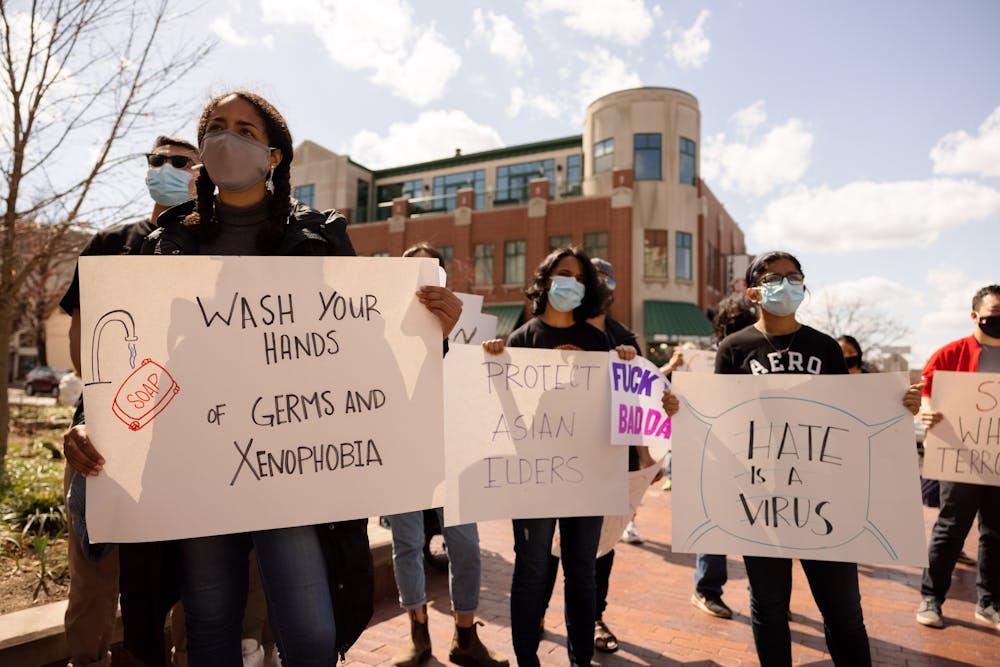
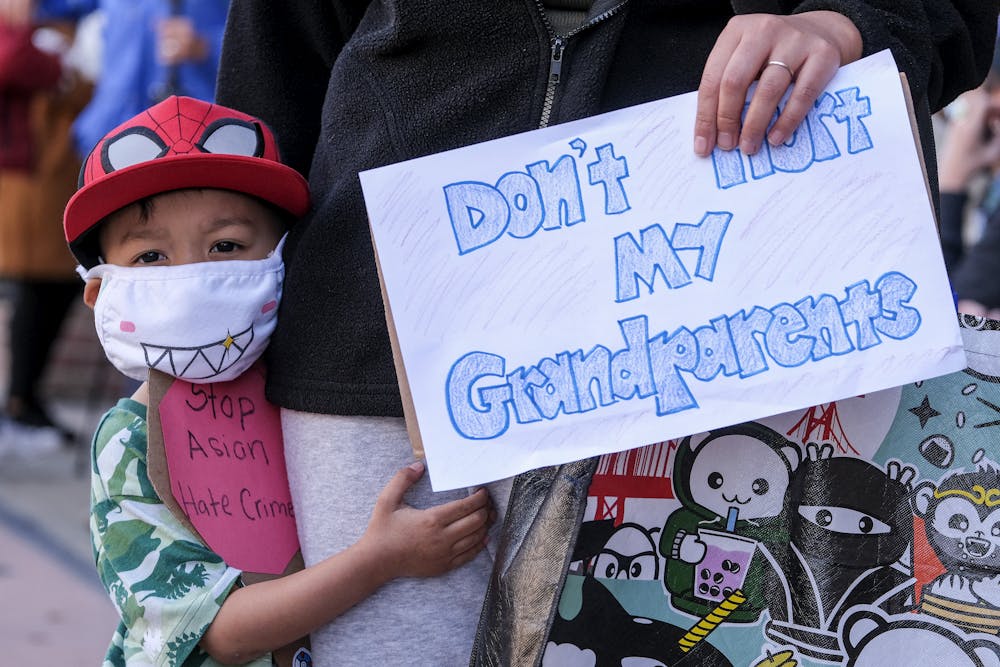
The rise in anti-Asian hate crimes during the pandemic has prompted many Asian American parents to enroll their children in remote learning out of concern for their child’s safety at school. Asian American youths are enrolled in remote learning at much higher rates than other racial groups. Federal data show that 78% of Asian American eighth graders attended school virtually in February 2021, whereas just 59% of Black, 59% of Latino and 29% of white students attended school virtually.
Here, three scholars address school safety for Asian American students.
Are American schools dangerous for Asian American students?
Aggie J. Yellow Horse, assistant professor of Asian Pacific American Studies at Arizona State University.
Data show that many Asian American youths have experienced anti-Asian violence in the past year.
Asian Americans have experienced a great deal of racial harassment amid the COVID-19 pandemic. A recent survey found that 1 in 8 Asian Americans reported experiencing anti-Asian hate incidents in 2020. The victims of that harassment aren’t just adults – they include students.
Since the beginning of the pandemic, more than 3,800 hate incidents targeting Asian Americans and Pacific Islanders have been reported to the Stop AAPI Hate National Reporting Center. Among the incidents early in the pandemic, 16% percent of the targets were Asian American youths ages 12-20.
The majority of the young victims, about 80%, reported being bullied or verbally harassed. In over half the incidents, the perpetrator used anti-Asian hate rhetoric. About 1 in 5 hate incidents happened at school.
National trends before the pandemic suggested that Asian American students were already more likely to experience racial discrimination, such as race-related name-calling, from their peers at school than other categories of students. About 11% of Asian American students reported being called hate-related words, compared with 6.3% of white students in 2015. A separate study found that bullying and physical violence were less of an issue for Asian American students. Only about 7.3% reported being bullied at school in 2017, compared with 23% of white students.
How common race-based harassment against Asian students is can vary based on different factors, such as where students live, their gender, grades or immigration status. For example, a study from California found that Asian American sixth graders in California reported being bullied and victimized at higher rates than other racial groups.
What are the biggest worries for Asian American youth and parents?
Charissa S. L. Cheah, professor of psychology at the University of Maryland, Baltimore County
Many Asian American parents are worried that their children will be the victims of discrimination once school reopens.
Asian American parents are worried about schools reopening. NPR3.38 MB (download)
In one survey, nearly 1 in 2 Chinese American parents and 1 in 2 Chinese American youth reported being directly targeted with COVID-19 racial discrimination in person or online. About 4 in 5 of these parents and their children also reported witnessing racism directed at someone else of their own race either online or in person.
Despite their concerns, some parents may avoid talking to their children about anti-Asian racism to avoid scaring them while they are at school. Even if parents want to have the “race talk” with their children, many struggle with how to talk to their children about the potential racism they might encounter. Some parents may not have been taught these lessons while growing up and are grappling with how to make sense of these experiences.
Anti-Asian racism is also associated with greater depressive symptoms and anxiety in Chinese American parents and their children. A majority of Americans blame China for its mishandling of the coronavirus outbreak. Researchers have found that even thinking that one’s racial or ethnic group is viewed by the general public as a threat to the health of Americans is linked to poorer mental health in both Chinese American parents and youths.
Asian Americans are less likely than non-Hispanic white Americans to seek mental health help. This is due in part to perceived stigma, language barriers and lack of mental health providers of the same ethnicity. These disparities are even greater for Asian American families with fewer financial resources.
Some Asian American parents have also expressed concerns about the ability of schools to maintain appropriate COVID-19-related health and safety measures. They are worried about the health risks that children exposed to others at school might bring home. Asians Americans are more likely to live in a multigenerational household, in which older adults might be at a higher health risk.
Even if parents choose to keep their children home because of one or several of these concerns, they are getting the message that in-person education is superior to virtual education. Being out of physical school could cause Asian Americans to miss out on these opportunities and resources even more. Also, due to the “model minority myth,” which characterizes Asian Americans as successful, the needs of this very diverse group, including a large number of immigrant and refugee Asian families in the U.S., are often overlooked. With 30% of Asian Americans reporting limited English proficiency, these families are more difficult to reach. The fears of being harassed also make some parents reluctant to access educational materials or free meals or even reach out to teachers or counselors for help.
What can schools do to reduce threats to Asian American students?
Kevin Gee, an associate professor in the school of education at the University of California Davis
Helping students build strong and supportive relationships with each other can reduce their physical victimization and buffer the negative effects of discrimination Asian Americans face.
Schools can also create supportive environments by implementing a range of evidence-based approaches, such as building teachers’ cultural knowledge and strengthening teacher-student relationships. Activities like engaging students in class discussions about bullying have been shown to reduce bullying.
Alongside initiatives to build supportive environments, schools should also consider partnering with parents. Directly engaging Asian American parents in anti-bullying initiatives can help reduce victimization. For example, schools can collaborate with parents to craft disciplinary policies on bullying. Schools can also hold workshops to teach parents how to handle and prevent bullying.
In order to reduce threats and eradicate harm, I believe schools will need to consider whether they are doing enough to protect Asian American youth. One landmark case underscores this. In the aftermath of violent attacks on Asian American students at South Philadelphia High School in 2009, a Department of Justice investigation revealed that the school district was “deliberately indifferent” to harassment against Asian students that fueled the attacks.
A key takeaway: Harms against Asian American students can be systemic and require broader structural solutions. When South Philadelphia High School began to do more to promote multicultural awareness and improved systems to report and investigate harassment, the school saw fewer violent incidents.
To make Asian American youth feel safe and protected, schools need to track, report and respond to incidents of hate against Asian Americans, especially among Asian American ethnic subgroups. Subgroup data, often lacking on Asian Americans, can be a powerful tool in revealing potential disparities and highlighting groups that schools need to target for support.
I believe schools also need to invest in longer-term systemic changes such as including a more complete history of Asian Americans in U.S. social studies curricula.
*****
Header image: Eight out of 10 Asian American youths reported being bullied and harassed during the pandemic. RyanJLane/E+ via Getty Images
Charissa S. L. Cheah, Professor of Psychology, University of Maryland, Baltimore County; Aggie Yellow Horse, Assistant Professor of Asian Pacific American Studies, Arizona State University, and Kevin A. Gee, Associate Professor of Education, University of California, Davis
This article is republished from The Conversation under a Creative Commons license. Read the original article.
]]>
By Charissa S. L. Cheah, professor, psychology, UMBC; Aggie Yellow Horse, Arizona State University, and Kevin A. Gee, University of California, Davis The rise in anti-Asian hate crimes during...
https://umbc.edu/stories/are-americas-schools-safe-for-asian-americans/
https://my3.my.umbc.edu/api/v0/pixel/news/119651/guest@my.umbc.edu/78eb0c173831da66c59f0ba2ee6351a7/api/pixel
covid-19
discovery
psychology
the-conversation
UMBC News & Magazine
https://my3.my.umbc.edu/groups/umbc-news-magazine
https://assets1-my.umbc.edu/system/shared/avatars/groups/000/001/943/24435aa6207c452e7bc15cc74b42c7bb/xsmall.png?1748556657
https://assets1-my.umbc.edu/system/shared/avatars/groups/000/001/943/24435aa6207c452e7bc15cc74b42c7bb/original.png?1748556657
https://assets2-my.umbc.edu/system/shared/avatars/groups/000/001/943/24435aa6207c452e7bc15cc74b42c7bb/xxlarge.png?1748556657
https://assets2-my.umbc.edu/system/shared/avatars/groups/000/001/943/24435aa6207c452e7bc15cc74b42c7bb/xlarge.png?1748556657
https://assets3-my.umbc.edu/system/shared/avatars/groups/000/001/943/24435aa6207c452e7bc15cc74b42c7bb/large.png?1748556657
https://assets1-my.umbc.edu/system/shared/avatars/groups/000/001/943/24435aa6207c452e7bc15cc74b42c7bb/medium.png?1748556657
https://assets2-my.umbc.edu/system/shared/avatars/groups/000/001/943/24435aa6207c452e7bc15cc74b42c7bb/small.png?1748556657
https://assets1-my.umbc.edu/system/shared/avatars/groups/000/001/943/24435aa6207c452e7bc15cc74b42c7bb/xsmall.png?1748556657
https://assets2-my.umbc.edu/system/shared/avatars/groups/000/001/943/24435aa6207c452e7bc15cc74b42c7bb/xxsmall.png?1748556657
UMBC News & Magazine
0
0
false
Mon, 19 Apr 2021 15:49:34 -0400
Rewriting the Rules of Academia in the Age of COVID-19

Some classes translate better to remote learning than others. There was no way for students in Adam Mendelson’s advanced lighting design class to emulate the experience of programming and running massive lighting rigs from their homes. But, as it turns out, there are lessons about lighting design to be learned even in one’s own bedroom.
Mendelson, a senior lecturer in the Theatre Department, and his students discovered this after one of their projects—design lights to accompany a reading of a poem—had to be transferred to online. Students were given the option to complete the project using online simulation software or take a hands-on approach by using the lights sources available in their house.
The DIY students used whatever materials they had on hand, from Christmas lights to flashlights to simply opening or closing the blinds of a window. About half of the class went this route, enlisting the help of family members and housemates to flip switches or plug lights in on cue, one even used their dog as a lighting model.
This experimental assignment has proven successful; Mendelson was pleased with the creativity and innovation his students have shown. “One person used three or four different desk lamps that they put different colored light bulbs in,” he says. Another student used t-shirts and papers to change the colors of flashlights. “He took apart a shoebox and he put five chess pieces in it and that was the surface he was lighting,” Mendselson says. “It was really beautiful.”
-
 Created by Adeayo Adenusi ’20.
-
 Created by Carrie Edick ’21.
“As a lighting designer for a theatrical or a live event, every single thing that lights up is in your purview,” says Mendelson as a takeaway from the at-home version of this assignment. “Sometimes it’s something you can control and sometimes it’s not,” he explains, using green “exit” signs in a space as an example of something that the lighting designer might have to account for. “The key to lighting design is controlling the light and putting the light where you want it to go.”
Other assignments have been more challenging to translate to a distance-learning format; traditionally, students in the class have the opportunity to light a live dance performance, but those shows were canceled. Nothing can replace that live experience, says Mendelson. “That objective of being in the room and having to make quick decisions and all of that is practically impossible to recreate.” Instead, he is asking students to attend a supplemental webinar or online class to help fill in the knowledge gaps left behind by the sudden pivot to online learning.
Testing the Waters
Suzanne Braunschweig, a senior lecturer in the department of Geography and Environmental Systems and director of the Interdisciplinary Science Program, has also faced the challenge of transferring hands-on lessons into a digital space. Science 100: Water, An Interdisciplinary Study, the GEP lab science course she teaches, usually involves traveling to the creeks and streams on campus to collect data, but, because of the dangers of COVID-19, many students can no longer even go into their backyards to collect data.
The solution, Braunschweig has found, is to give her students virtual lab assignments that mirror the course’s in-person labs as closely as possible. One assignment, for instance, typically involves going to a nearby stream to find and identify benthic macroinvertebrates—small organisms that live in the bottoms of lakes and streams. In the virtual lab, students will still go through the same steps of identification that they would in person, albeit using high-quality photographs rather than real organisms.
 In a typical Science 100 class, like this one in Spring 2018, students test the water in the Library and Pig Pen ponds. Photo by Marlayna Demond ’11.
According to Braunschweig, the analysis aspect of the lab will also be essentially the same as it would be in a traditional classroom setting: “Based on the assemblage of critters that you find, you can then make conclusions about the quality of the stream from which they would’ve come.” Usually, she notes, students are excited to find that the streams on campus are “in good shape.”
Transitioning to running online labs has been far from a solo project—Braunschweig’s colleague Susan Schreier and several teaching assistants have assisted with finding virtual materials and making sure the labs run smoothly. She has also utilized a number of invaluable online resources, such as data collected by local nonprofit Blue Water Baltimore.
As part of its mission to restore the quality of Baltimore’s waterways, Blue Water Baltimore maintains a database of information about the health of Baltimore’s rivers and streams. This data has proven to be a “godsend,” says Braunschweig, replacing data students would have sampled from streams around the Baltimore area.
“It’s not doing hands-on work, but they still have the ability to analyze data, and put things in context for the greater Baltimore area in terms of water quality,” Braunschweig says.
Braunschweig knows that most of her students take Science 100 to fulfill a general education requirement, but she’s found that they are still giving their all, even remotely.
“They show up, they stick around, they actually try to work through the lab material during their lab time,” Braunschweig says. “I really admire them for sticking to that because it’s hard, under the current circumstances.”
Lending a (Virtual) Hand
While instructors of hands-on courses knew from the start how difficult this pivot would be, Kate Drabinski, lecturer of Gender, Women’s, + Sexuality Studies, never could have anticipated how much she still had to learn about online teaching. After all, she had years of experience with teaching online and hybrid courses, and had even signed up to help train her fellow professors how to use various distance learning technologies.

But the technical side of things didn’t turn out to be the biggest challenge for faculty to navigate, Drabinski says. “The faculty I worked with needed to know that what they were planning to do was a good idea and would work,” she explains. “They needed to hear that we could do this, that we were all unsure of what our new classrooms would look like, and that we would be able to find strategies that would work to keep us and our students moving forward in a time of great uncertainty.”
For Drabinski’s own classes, the strategy has been to decrease the amount of work students have to complete. “We don’t all have equal access to technology, workspaces, time, or other resources to learn best, and my workload has to respect those differences,” she says. She also knows that it can be difficult for students to give schoolwork their full attention when they are contending with the realities of the COVID-19 pandemic, such as losing their jobs or having to take care of sick family members.
She has also opted to use a synchronous learning approach paired with recorded lectures. That way, she meets with her students in Blackboard Collaborate during her regularly scheduled class times but each student can decide whether they prefer to come to class or watch the video later.
“This approach builds structure for those who need it while recognizing that others have different needs,” Drabinski explains.
Continuing Connections
UMBC professors aren’t the only ones leading the charge into remote learning. Atom Zerfas ’13, mathematics, M.A., ’14, education and teaching, a math teacher at Pikesville High School, played a pivotal role in introducing the students at PHS to how the final quarter of the school year would play out. He created a video to help guide students through what their new class schedule would look like, how they would access online materials, and how they would get in contact with their instructors.
He decided to make the video after seeing how stressful the transfer to remote learning was on the teachers’ end. “It was extremely overwhelming for us, functioning adults who are supposed to be able to ‘be the calm’ for our students,” he explains. “I couldn’t imagine what it would have been like to be a student in any grade, wondering what this means for them. I wanted to provide as many answers that I could, as soon as I could.”
 A screen grab from Zerfas’s remote learning instructional video.
Zerfas originally made the three-and-a-half minute video for the students in his classes, but then restructured it so that the entire school could use it as a resource. Later, he found out that teachers at other high schools were using his video, despite it being tailored to how PHS, specifically, was restructuring its curriculum.
Online teaching isn’t entirely new to Zerfas. He has been uploading recorded lectures for a few years now in an effort to support students who missed class or just need a refresher on the material. The videos he is making now, however, have a purpose beyond education; he wants them to be a beacon for his students.
Video lectures give Zerfas the chance to say “Hi,” he says, and “let my students know that I’m thinking about them, and show them that I’m here if they need me for anything. I know a number of other teachers are dressing up, wearing wigs, or trying to make it as fun as they can. It really comes down to use trying to reconnect with our students, support them, and restore a sense of normalcy and joy.”
In addition to keeping in contact with his students, Zerfas has also been making sure to maintain another important connection these past few weeks: “I’m lucky to have been part of UMBC’s Sherman program because I’ve been connecting with a lot of my cohort members recently, and we’ve just been checking in with each other and being as supportive as we can.”
Making Permanent Change
Though distance learning will not always be necessary, instructors at UMBC and beyond are proving that they are capable of delivering online lessons that are compelling, stimulating, and sometimes even fun for students. Perhaps this unusual semester will give way to lasting, innovative teaching practices, from providing recorded lectures to maintaining more open lines of communication between professors and students.
Ultimately, though, the biggest takeaway lies not in any particular teaching strategy or technological tool. Rather, what we all must learn from this pandemic is that the UMBC community is strong enough to overcome great adversity—but only when we are able to be patient and understanding of each other’s unique challenges and circumstances.
“Not all students have the ability to study or do their [homework] in peace. It’s just more noticeable now,” Zerfas says. “That doesn’t mean to stop offering resources or to stop pushing your kids to do more, but to differentiate lessons more and not to penalize the kids who couldn’t do it.”
*****
Header image: Pig Pen Pond, a common Science 100 site, sits between campus and bwtech@UMBC.
]]>
Some classes translate better to remote learning than others. There was no way for students in Adam Mendelson’s advanced lighting design class to emulate the experience of programming and running...
https://umbc.edu/stories/rewriting-the-rules-of-academia-in-the-age-of-covid-19/
https://my3.my.umbc.edu/api/v0/pixel/news/119899/guest@my.umbc.edu/34d838f3ae7ce9f377261ec30ecaaf2b/api/pixel
campus-life
covid-19
covidresearch
professorsnottomiss
spring-2020
umbctogether
UMBC News & Magazine
https://my3.my.umbc.edu/groups/umbc-news-magazine
https://assets1-my.umbc.edu/system/shared/avatars/groups/000/001/943/24435aa6207c452e7bc15cc74b42c7bb/xsmall.png?1748556657
https://assets1-my.umbc.edu/system/shared/avatars/groups/000/001/943/24435aa6207c452e7bc15cc74b42c7bb/original.png?1748556657
https://assets2-my.umbc.edu/system/shared/avatars/groups/000/001/943/24435aa6207c452e7bc15cc74b42c7bb/xxlarge.png?1748556657
https://assets2-my.umbc.edu/system/shared/avatars/groups/000/001/943/24435aa6207c452e7bc15cc74b42c7bb/xlarge.png?1748556657
https://assets3-my.umbc.edu/system/shared/avatars/groups/000/001/943/24435aa6207c452e7bc15cc74b42c7bb/large.png?1748556657
https://assets1-my.umbc.edu/system/shared/avatars/groups/000/001/943/24435aa6207c452e7bc15cc74b42c7bb/medium.png?1748556657
https://assets2-my.umbc.edu/system/shared/avatars/groups/000/001/943/24435aa6207c452e7bc15cc74b42c7bb/small.png?1748556657
https://assets1-my.umbc.edu/system/shared/avatars/groups/000/001/943/24435aa6207c452e7bc15cc74b42c7bb/xsmall.png?1748556657
https://assets2-my.umbc.edu/system/shared/avatars/groups/000/001/943/24435aa6207c452e7bc15cc74b42c7bb/xxsmall.png?1748556657
UMBC News & Magazine
0
0
false
Thu, 07 May 2020 01:04:13 -0400
Remdesivir Explained – What Makes This Drug Work Against Viruses?
By Katherine Seley-Radtke, professor, Chemistry and Biochemistry, UMBC
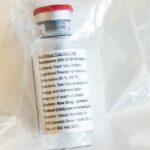
With the FDA approving Gilead’s Remdesivir as an emergency use treatment for the most acute cases of COVID-19, many people are wondering what type of a drug it is.
Remdesivir is a member of one of the oldest and most important classes of drugs – known as nucleoside analogue. Currently there are more than 30 of these types of drugs that have been approved for use in treating viruses, cancers, parasites, as well as bacterial and fungal infections, with many more currently in clinical and preclinical trials.
I am a medicinal chemist who has worked in design and synthesis of these important drug treatments for over 30 years. I have written numerous reviews over the years about these drugs and their structure and function, and as a result have had many inquiries lately from friends, family and others not in the field asking me to explain what exactly is it about Remdesivir that makes it so effective, but also why it is so interesting. Understanding why means digging into the biochemistry of this class of drugs.
Fake genetic building blocks
The reason nucleoside analogues and a similar group called nucleotide analogues are so effective is that they resemble the naturally occurring molecules known as nucleosides – cytidine, thymidine, uridine, guanosine and adenosine. These are the essential building blocks for the DNA and RNA that carry our genetic information and play critical roles in our body’s biological processes.
Slight differences in the chemical structure of these analogues from naturally occurring compounds make them effective as drugs. If an organism like a virus incorporates a nucleoside analogue into its genetic material, rather than the real thing, even small changes to the structure of these building blocks prevent the regular chemistry from happening and ultimately foils the ability of the virus to replicate.
The basic structure of a nucleoside includes a sugar group and a base (A, C, G, T or U), and in the case of a nucleotide, a group containing a phosphate which is a collection of oxygen and phosphorus atoms.
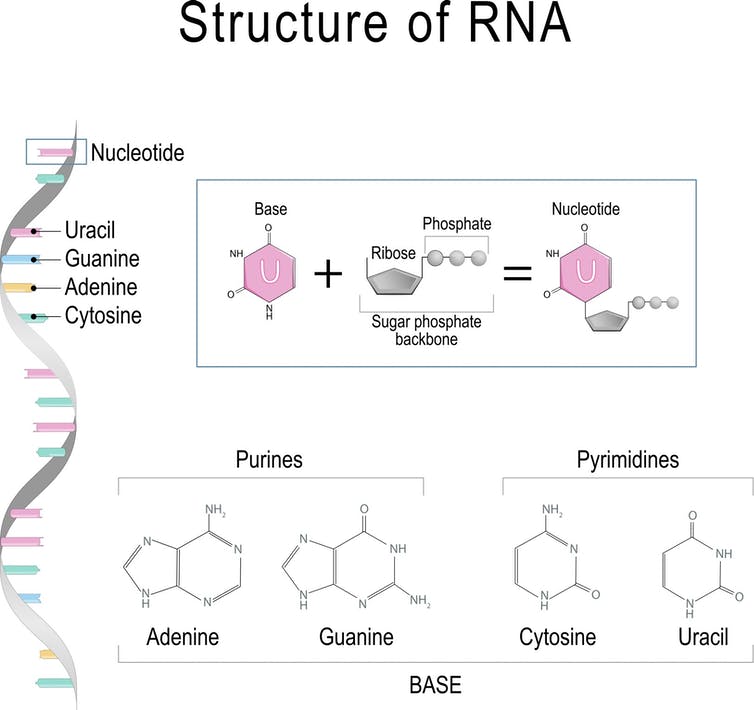 Every building block of DNA is made from three parts: a sugar, a base (A, C, G, or T) and a phosphate group. Every building block of RNA is made from (A, C, G, or U). ttsz / Getty Images
The first nucleoside analogues were approved for medicinal use in the 1950s. The early nucleosides had only simple modifications, typically either to the sugar or the base, while today’s nucleosides, such as Remdesivir, typically have several modifications to their structure. These modifications are essential to their therapeutic activity.
How does Remdesivir work as antiviral therapeutic?
This activity occurs because nucleoside/tide analogues mimic the structure of a natural nucleoside or nucleotide such that they are recognized by, for example, viruses. Due to those structural modifications, however, they stop or interrupt viral replication, which stops the virus from multiplying and infecting more cells in the body.
As a result, they are known as direct-acting antivirals, and this is the case for Remdesivir, which works by blocking the coronavirus’s RNA polymerase – one of the key enzymes that this virus needs to replicate its genetic material (RNA) and proliferate in our bodies. Remdesivir works when the enzyme replicating the genetic material for a new generation of viruses accidentally grabs this nucleoside analogue rather than the natural molecule and incorporates it into the growing RNA strand. Doing this essentially blocks the rest of the RNA from being replicated; this in turn prevents the virus from multiplying.
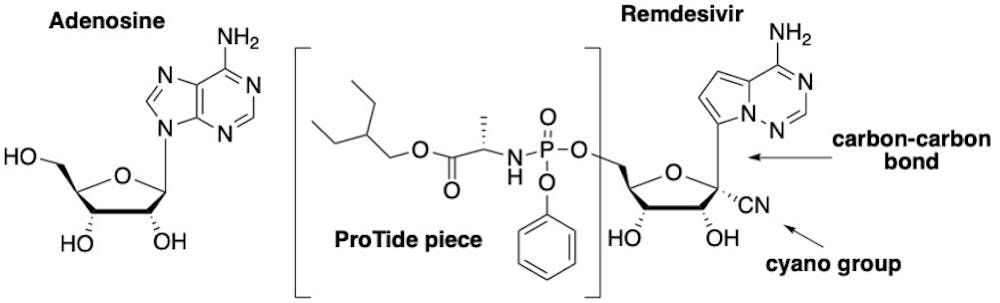
The drug Remdesivir is basically an altered version of the natural building block adenosine – which is essential for DNA and RNA. Comparing the structure of Remdesivir with adenosine, one can see there are three key modifications that make it effective.
The first is that Remdesivir, as it is administered, is not the actual active drug; it is actually a “prodrug,” meaning it must be modified once in the body before it becomes an active drug. Prodrugs are used for many reasons, including protecting a drug until it reaches its site of action. The active form of Remdesivir contains three phosphate groups; it is this form that is recognized by the virus’s RNA polymerase enzyme.
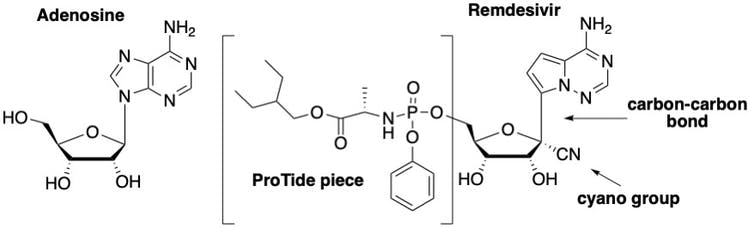 A naturally occurring nucleotide (left) which is a building block of RNA and DNA and Remdesivir (right) which is a variation on its natural counterpart. Katherine Seley-Radtke, CC BY-SA
The second important modification on Remdesivir is the carbon-nitrogen (CN) group attached to the sugar. Once Remdesivir is incorporated into the RNA growing chain, the presence of this CN group causes the shape of the sugar to pucker, which, in turn, distorts the shape of the RNA strand such that only three more nucleotides can be added. This terminates the production of the RNA strand and is what ultimately sabotages the replication of the virus.
The third important structural feature which makes Remdesivir differ from adenosine is the change of one particular chemical bond on the molecule. Rather than a bond linking a carbon and nitrogen atoms, chemists replaced the nitrogen with another carbon, creating a carbon-carbon bond. This is critical to the success of this drug because coronaviruses have a special enzyme that recognizes unnatural nucleosides and clips them out. But by changing this chemical bond, Remdesivir cannot be removed by the enzyme, allowing it to stay in the growing chain and block replication.
Remdesivir trials
Remdesivir originally was found during a drug discovery program at Gilead to search for inhibitors of the hepatitis C virus, which is another RNA virus. Although Gilead ultimately selected a different nucleoside analogue for treatment of hepatitis the company tested the drug to see if it was effective against other RNA viruses. Remdesivir exhibited potent activity against Ebola and Middle Eastern respiratory virus, among others.
Now the drug is being tested against the SAR-CoV-2 virus in the first clinical trial launched in the United States.
According to the NIH, patients who received Remdesivir had a faster recovery compared to those who received placebo; 11 days compared with 15 days for those who received the placebo. “Results also suggested a survival benefit, with a mortality rate of 8.0% for the group receiving Remdesivir versus 11.6% for the placebo group,” according to the NIH press release.
While these results are preliminary, there are a plethora of clinical trials underway across the world. Regardless, a certain amount of caution is still needed. As noted by Dr. Anthony Fauci on NBC’s “Today” show, “the antiviral drug Remdesivir is the first step in what we project will be better and better drugs coming along” to treat COVID-19, but cautioned, “This is not the total answer.”
I share this view with many other scientists in the field. No matter what those results ultimately show, Remdesivir will mostly certainly be part of a cocktail of drugs, just as is standard for treating other viruses such as HIV and hepatitis C.
A combination, or cocktail, of drugs will provide a more effective and more complete therapy that blocks the virus from replicating. The other benefit of such a drug cocktail is that it lowers the chance the virus will develop resistance to the therapy. In the meantime, these early results for Remdesivir are proving to be an important source of hope for many of us across the world as we wait for this pandemic to subside.
******
[You need to understand the coronavirus pandemic, and we can help. Read The Conversation’s newsletter.]
Header image: Photo by ULRIC PERREY/POOL/AFP via Getty Images.
Katherine Seley-Radtke, Professor of Chemistry and Biochemistry and President-Elect of the International Society for Antiviral Research, University of Maryland, Baltimore County
Disclosure statement: Dr. Katherine Seley-Radtke has previously consulted for Gilead Sciences and owns Gilead Sciences stock. She currently receives funding from the National Institutes of Health (NIH), the National Institute of General Medicine (NIGMS), the National Institute of Allergies and Infectious Diseases (NIAID). She is the President-elect of the International Society for Antiviral Research (ISAR) and is the Secretary and former President of the International Society of Nucleosides, Nucleotides & Nucleic Acids (IS3NA), both non-profit scientific professional societies.
This article is republished from The Conversation under a Creative Commons license. Read the original article.
]]>
By Katherine Seley-Radtke, professor, Chemistry and Biochemistry, UMBC With the FDA approving Gilead’s Remdesivir as an emergency use treatment for the most acute cases of COVID-19, many...
https://umbc.edu/stories/remdesivir-explained-what-makes-this-drug-work-against-viruses/
https://my3.my.umbc.edu/api/v0/pixel/news/119901/guest@my.umbc.edu/997bfe579684771042b88b060e098539/api/pixel
cnms
covid-19
covidresearch
discovery
the-conversation
UMBC News & Magazine
https://my3.my.umbc.edu/groups/umbc-news-magazine
https://assets1-my.umbc.edu/system/shared/avatars/groups/000/001/943/24435aa6207c452e7bc15cc74b42c7bb/xsmall.png?1748556657
https://assets1-my.umbc.edu/system/shared/avatars/groups/000/001/943/24435aa6207c452e7bc15cc74b42c7bb/original.png?1748556657
https://assets2-my.umbc.edu/system/shared/avatars/groups/000/001/943/24435aa6207c452e7bc15cc74b42c7bb/xxlarge.png?1748556657
https://assets2-my.umbc.edu/system/shared/avatars/groups/000/001/943/24435aa6207c452e7bc15cc74b42c7bb/xlarge.png?1748556657
https://assets3-my.umbc.edu/system/shared/avatars/groups/000/001/943/24435aa6207c452e7bc15cc74b42c7bb/large.png?1748556657
https://assets1-my.umbc.edu/system/shared/avatars/groups/000/001/943/24435aa6207c452e7bc15cc74b42c7bb/medium.png?1748556657
https://assets2-my.umbc.edu/system/shared/avatars/groups/000/001/943/24435aa6207c452e7bc15cc74b42c7bb/small.png?1748556657
https://assets1-my.umbc.edu/system/shared/avatars/groups/000/001/943/24435aa6207c452e7bc15cc74b42c7bb/xsmall.png?1748556657
https://assets2-my.umbc.edu/system/shared/avatars/groups/000/001/943/24435aa6207c452e7bc15cc74b42c7bb/xxsmall.png?1748556657
UMBC News & Magazine
0
0
false
Wed, 06 May 2020 14:19:16 -0400
Retrievers on the Front Lines of the Pandemic
By Susan Thornton Hobby
Every time a coronavirus patient is released from St. Barnabas Hospital in the Bronx, a song plays over the loudspeaker: “St. Barnabas for All of Us.”
Trent Gabriel ’14, biochemistry and molecular biology, has heard the catchy tune several times, but not enough. Doctors call St. Barnabas a coronavirus “war zone,” with most of its clinics for specialties such as pediatrics and psychiatry now lined with bed after bed of patients with COVID-19. The hiss and click of ventilators fills the halls.
Gabriel is a dental resident who until mid-March handled routine and emergency dentistry at St. Barnabas. When the pandemic hit, Gabriel was pressed into service, filling in gaps when hospital staff were sick or overburdened. Among other jobs, he has tested doctors for coronavirus, taken vitals of COVID-19 patients, and filled prescriptions.
The pandemic necessitates fighting on all fronts. UMBC alumni and students are in the thick of that battle—testing hospital staff for the virus, screening patients at a Red Cross, riding in ambulances as an EMT, and many other roles.
Testing Medical Workers to Save Patients
When the pandemic closed St. Barnabas’ dental clinic, Gabriel was first assigned to test staff for coronavirus.
“It was really surprising how many had a good chance that they had COVID,” says Gabriel. “It hit the hospital really fast. These are doctors who know how to use PPE [personal protective equipment], and they’re getting sick.”
 Trent Gabriel, center, works as a dental resident at St. Barnabas Hospital in the Bronx. Since the pandemic, Gabriel has been testing staff for the virus, working in the pharmacy, and taking vital signs of patients. Photo courtesy of Gabriel.
Several staff, including a trauma surgeon and two nurses who both were supposed to have retired but stayed at St. Barnabas to help, have died from the disease. Gabriel’s worry that he’ll become infected is ever-present.
“A lot of us have a fatalistic attitude,” Gabriel says. “We’re getting exposed every day. It’s going to happen. You just hope that it’s later, and we’ve figured out how to treat it.”
How to Train a Hero
“Many of our faculty, students, and staff are participating in an active role in the COVID-19 response, treating patients on the ambulance, in the field, in the emergency department, and providing consultation to direct response,” explains J. Lee Jenkins, chair of the Department of Emergency Health Services at UMBC.
To prepare for just this kind of health crisis, leaders in medical and traumatic emergency services serve as faculty members and mentors to provide practical experiences for the 80 undergraduate and 35 graduate students in the program, Jenkins says.
 For the Graduate Experience Achievement Research Symposium in 2019, emergency health services graduate student Sanaz Taherzadeh and classmates demonstrate the proper use of personal protective equipment, concentrating on the Ebola crisis that was happening then. Photo courtesy of Taherzadeh.
“While serving as an emergency physician, I’ve personally seen the toll that this virus has taken on our first responders, our nation’s emergency public health system, our patients, our students and faculty,” says Jenkins, who is an emergency medicine physician at Johns Hopkins Hospital and a faculty member in emergency medicine at JHU’s School of Medicine.
“Our nation’s emergency departments and EMS systems have been stretched past our limits in both physical and supply capacity as the front-liners bravely handle the physical and emotional needs of both themselves and the patients,” Jenkins shares. “Those in EMS and in the hospital continue to go to work, to take care of patients, then we come home to our families, each time worrying that we may have brought home this disease.”
Why engage in this risky profession? “We are here to serve, to go where we are needed,” adds Jenkins. “This is why our department, EHS, exists, to educate the next generation of these heroes.”
The Right Skills for a Crisis
Current EHS student Sanaz Taherzadeh says her life has prepared her for a pandemic. As a teenager, she watched her grandfather battle cancer in her native Iran and decided to become a nurse. After years working as an operating room nurse in Tehran, when a 2017 earthquake devastated the mountainous region of Kermanshah, Taherzadeh traveled there to triage and treat victims.
“I had to be brave, calm, and honest so that people could trust me and rely on me,” Taherzadeh remembers.
In 2019, Taherzadeh started her master’s in emergency health services concentrating in epidemiology at UMBC. For her graduate research, she has given presentations on personal protection equipment and coronavirus. All the threads of her knowledge—disaster medicine, epidemiology, and protective equipment—culminated when this coronavirus became a pandemic.

 Top: Sanaz Taherzadeh volunteers at a Baltimore Red Cross donation center, assessing donors before their blood is drawn. Photos courtesy of Taherzadeh. Bottom: At the 2019 Graduate Experience Achievement Research Symposium, emergency health services graduate student Sanaz Taherzadeh and classmates presented on the proper use of personal protective equipment.
Taherzadeh, set to graduate in December, volunteers as a surgical support technician for the University of Maryland Shock Trauma Center, as well as for the Red Cross, where she assists victims at sites of disasters, and screens patients at blood donation centers to ensure they are healthy.
Even though Iran and the United States do not have a good diplomatic relationship, says Taherzadeh, and she worries about being deported, the nurse believes her place is here.
“Regardless of what our nationality is, what country we live in, or what religion we have, I believe we are human beings and now is the time that everyone in the world should work together to overcome this disease pandemic,” Taherzadeh says.
“Hard not to tear up”
Maggie Kemper ’14, biology, remembers her first patient with COVID-19. He arrived in mid-March, just after she and the rest of the nursing staff at Johns Hopkins Hospital had converted their Intensive Care Unit to an exclusively COVID-19 unit.
“He was pretty notable,” Kemper remembers, talking on an infrequent day off from her twelve-hour shifts at the hospital. “We had been hearing the patients would be older, immune-suppressed. But this guy was younger, a bodybuilder, no known health issues. It threw all of us for a loop. He was literally the opposite of what we’d been hearing. He was very sick, it was touch and go.”
 Maggie Kemper and her fellow nurses in a converted COVID-19 exclusive unit at Johns Hopkins Hospital. Photos courtesy of Kemper.
But finally, the last week in April, the patient had recovered enough for staff to discharge him after weeks on a ventilator. The disease had transformed him. Kemper says, “he came in jacked, and now he’s very skinny.” He will likely need rehabilitative care, his lungs were severely damaged, and he can’t live alone for a while, she says.
“We gave him a standing ovation,” Kemper says. “It was hard not to tear up.”
Like all of emergency medicine, Kemper and her unit have been learning on the fly about COVID-19—how they must put patients on their bellies to help the blood and oxygen flow to their lungs, how they should try to have patients breathe on their own as long as they can without putting them on ventilators, how it’s hard to guess, now, which patients are going to recover, and which aren’t.
The disease is taking its toll on the staff as well. Kemper is working her usual shifts, plus overtime because the unit is usually full to its capacity of 24 patients, “the sickest of the sick,” she says. And because she shouldn’t remove her protective gear, which gives her rashes around her ears and neck, she goes long stretches without eating or drinking. And she worries about getting infected herself.
“Initially I was very scared,” Kemper said. “Now I’m too tired to be scared.”
But Kemper is also thinking about her patients, who can’t have visitors, and who are debilitated with the disease. So she started an art campaign. Kemper spread the word in her Hampden neighborhood, and to friends and family, to have people send in drawings and letters. Kemper then laminated the pieces so the art could be sterilized, and hung them all over the unit and in patients’ rooms.
“It’s so overwhelming,” Kemper said. “Kids are sending in drawings and letters that say ‘I love you,’ and they don’t even know these people.”
Be Prepared
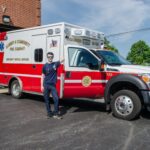
First-year emergency services and theatre dual major Jack Bez is just beginning his studies at UMBC, but is already using his skills. For 18 months, Bez has worked as an EMT with the Gamber & Community Fire Company. When campus closed, the Eagle Scout chose to live at the firehouse instead of moving home, to avoid exposing his parents to the coronavirus.
 Jack Bez at the Gamber & Community Fire Company, where he moved after campus closed. Photo courtesy of Bez.
Between responding to several ambulance calls a day, Bez is keeping up with his studies in theatre. He hung sleeping bags from a top bunk in the firehouse to fashion a sound booth in which he could record his sound production assignments.
Though Bez hasn’t yet treated a confirmed coronavirus patient, he has trained on prevention techniques and decontamination, and is activated with Maryland Medical Reserve Corps.
“All I know is that I’m content with being able to help people who need it, whether it’s COVID or not,” Bez says simply.
Looking Forward to “Normal”
When the pandemic crisis first began flooding hospitals with patients, but New York City hadn’t yet been put on lockdown, Gabriel remembers emerging from the subway after a long day of testing other doctors for coronavirus. Beside his subway stop was a public park, packed with kids and parents on a beautiful spring day. He remembers being afraid.
The pandemic, Gabriel says, “turns everything that makes us human on its head. Is it that bad to go to a park? We take for granted the things that keep us together.”
When Gabriel finishes his rotation at St. Barnabas this year, he’ll head to Boston University to complete specialty training and a program in crowns and dentures. He’ll be learning the aesthetics of making people’s smiles better, the layering of porcelains on implant teeth, full-mouth dentures on complex cases.
“Something calm and safe,” Gabriel says with a laugh. “Compared to now.”
Catherine Borg contributed to this story.
Header image courtesy of Jack Bez.
]]>
By Susan Thornton Hobby Every time a coronavirus patient is released from St. Barnabas Hospital in the Bronx, a song plays over the loudspeaker: “St. Barnabas for All of Us.” Trent...
https://umbc.edu/stories/retrievers-on-the-front-lines-of-the-pandemic/
https://my3.my.umbc.edu/api/v0/pixel/news/119902/guest@my.umbc.edu/34babb84b7bd0de2436a41c18e0e5813/api/pixel
alumni
covid-19
covidresearch
ehs
resilience
umbctogether
UMBC News & Magazine
https://my3.my.umbc.edu/groups/umbc-news-magazine
https://assets1-my.umbc.edu/system/shared/avatars/groups/000/001/943/24435aa6207c452e7bc15cc74b42c7bb/xsmall.png?1748556657
https://assets1-my.umbc.edu/system/shared/avatars/groups/000/001/943/24435aa6207c452e7bc15cc74b42c7bb/original.png?1748556657
https://assets2-my.umbc.edu/system/shared/avatars/groups/000/001/943/24435aa6207c452e7bc15cc74b42c7bb/xxlarge.png?1748556657
https://assets2-my.umbc.edu/system/shared/avatars/groups/000/001/943/24435aa6207c452e7bc15cc74b42c7bb/xlarge.png?1748556657
https://assets3-my.umbc.edu/system/shared/avatars/groups/000/001/943/24435aa6207c452e7bc15cc74b42c7bb/large.png?1748556657
https://assets1-my.umbc.edu/system/shared/avatars/groups/000/001/943/24435aa6207c452e7bc15cc74b42c7bb/medium.png?1748556657
https://assets2-my.umbc.edu/system/shared/avatars/groups/000/001/943/24435aa6207c452e7bc15cc74b42c7bb/small.png?1748556657
https://assets1-my.umbc.edu/system/shared/avatars/groups/000/001/943/24435aa6207c452e7bc15cc74b42c7bb/xsmall.png?1748556657
https://assets2-my.umbc.edu/system/shared/avatars/groups/000/001/943/24435aa6207c452e7bc15cc74b42c7bb/xxsmall.png?1748556657
UMBC News & Magazine
0
0
false
Sat, 02 May 2020 01:30:00 -0400
Holding Down the Fort to Keep Students Connected
UMBC has begun planning for the fall and a gradual return to campus. See the Retrievers Return Roadmap here for the latest.
Many things came up to an abrupt end on March 12. At UMBC, students began leaving campus and their dorms for an early start to spring break, student-athletes saw a sudden stop to their season, and employees were figuring out plans to work from home for the foreseeable future.
Stacy Carone, associate athletic director for sports medicine, summed up the Retriever community’s feelings succinctly: “We felt as if our identities were challenged and we…lost a big part of our ‘why.’”
In the wake of so many life-defining activities suddenly curtailed, many other things continued nevertheless—namely the indomitable UMBC spirit showcased in the grit of students whose academic plans now looked dramatically different and by campus decision makers who had to make quick, tough calls to elevate the safety and health of our Retriever Nation.
As many campus activities transitioned to online formats, it’s fair to mourn what was lost: Commencement, final championship games, shaking your professor’s hand at the end of the semester, the last hug with suitemates before move out day, the final nostalgic meal at True Grit’s. Yet, it’s also important to celebrate the folks behind the scenes making these transitions for the community as smooth as possible.
The necessity of being nimble
When it became clear that UMBC would transition to distance learning for at least two weeks after spring break, John Fox, director of Residential Life, and his team immediately started brainstorming how to serve the students who, for a variety of reasons, would not be able to make a trip home. With an exceptions process in place, around 200 students stayed through the first few weeks, and when Maryland Governor Larry Hogan’s stay-at-home order came, 65 students continued to remain on the nearly empty campus.
“Dealing with the unknown as a college student is a unique experience,” says Fox ’91, information systems management. “There’s a lot students have to juggle on a day-to-day basis, so they react well to knowing the knowns and the constants. Right now, we’re trying to guide them through this process as smoothly as we can, but, of course, they have a lot of questions, and we’ve been trying to respond to each student’s needs.”
On a case-by-case basis, this means letting students access their rooms to retrieve medicine or class notes left behind. On a wider scale, it involves considering safe ways to allow the residents to return to collect their belongings without compromising their health. “The important thing for us,” says Fox, “is to be nimble and pivot as information comes down from the governor, to the University System of Maryland, then to individual campuses.”

A small group of students and staff remain living in campus housing during COVID-19.
That flexibility involves reaching out to—and listening to—the students. This outreach Fox sees as vital to serving the student population, but also invaluable as students were pulled from their communities so suddenly. “Residential advisors are still connecting with their floors, trying to give students some closure to an unusual semester,” shares Fox.
Resident advisor for Chester apartments, Rileigh Matson ’21, psychology and visual arts, is checking in with her residents on a weekly basis. “In comparison to the conversations that occurred before COVID-19 closed campus, not much has changed,” says Matson, but the importance of staying connected feels much more weighty. Matson, who hopes she can return as an RA next semester, says that students are coping fairly well by staying busy with pre-pandemic activities, like school and pop culture, although some have taken up new hobbies or make taking walks a bigger priority during this time of isolation.
For Fox’s part, the phone calls and emails with students serve to show him that even during pandemics, UMBC students are still exemplary. “I’m constantly reminded that we have thoughtful, understanding students who ask good questions. It reminds me that UMBC is a place that puts value on the individual and that each student feels attended to and that their individual circumstances matter.”
Provisions in a pandemic
Dining Services staff, like Residential Life, needed essential staff to stay and continue to serve the remaining student population. Tim Dunn, campus executive chef talks through the game plans his team created in discussions with UMBC leadership. “UMBC was incredibly proactive with action plans of all essential associates,” says Dunn. “So early on we worked through potential scenarios, and how we would respond.”

The inside of True Grit’s before the transition to a contact-free food pick-up process.
This included modifying their offerings to comply with the necessary physical distancing, which happened in stages. First, they strongly encouraged taking food in to-go containers; this quickly turned into a total grab-and-go operation. In late April, remaining students and staff on campus select their meals online and pick them up at the door.
After resolving how to continue feeding the dwindling campus population, Dunn also needed a plan to distribute the semester’s worth of overstocked food. “We found a home for most of our products at St. Agnes Hospital,” he says, “and donated some other perishables and non-perishables to Catonsville Emergency Assistance.”

Tim Dunn, campus executive chef, delivers food to Catonsville Emergency Assistance. Photo courtesy of UMBC Dining.
Despite the unexpected upheaval of COVID-19 to campus operations, Dunn says that their “staff is building even stronger relationships with the students who are remaining on campus.”
Be purposeful in all you do
As a member of UMBC’s Incident Management Team, Carone in Athletics had a sneak peek of what was coming, “but I could not possibly prepare emotionally for that day.” She’s referring to March 12, when Athletic Director Brian Barrio got in front of the students to explain that in order to stall the spread of a lethal virus, spring sport seasons were canceled.
Despite this decision coming at the expense of students’ athletic careers, what Carone remembers “is an overwhelming sense of pride; looking at the faces of our UMBC student athletes as they processed the gravity of what was happening in the world around us; watching them not hang their heads in defeat, but do what Dogs always do, come together, have heart, show grit, and do what is right, not what is easy.”

The UMBC Event Center, home to sports teams and Commencement activities, is closed.
Carone, who supervises seven athletic trainers and strength coaches, outlined the resources Athletics would continue to provide via telemedicine and encouraged the students to remain connected to one another and to reach out for help in these unprecedented times.
“We usually interact with student athletes on a daily basis for four hours a day,” says Carone. “Replacing that time with screen time interactions has been challenging.” As a result, Carone and her staff are encouraging the student athletes to find routines. “Their days are usually extremely structured from morning to evening… so they’re trying to adjust to this new normal with lack of structure and without sports, which are usually a huge outlet for them.”
Currently all workouts are completely voluntary for student athletes, according to the NCAA. UMBC coaches are posting training videos mainly as a way to keep in touch with their teams and give the athletes a sense of normalcy that practicing might give them. In response to COVID-19, the NCAA has extended an additional season of eligibility to seniors playing spring sports, and Carone says that at this time, 10 student athletes have committed to returning next year.
Carone’s biggest piece of advice to her staff and students as they adjust to this time away from “normal” is to continue to live life with intention, be purposeful in all they do. As well as engaging in weekly wellness check ups with staff and distance workouts with coaches, Carone suggests students can always use “more time to be slow and still.” Her final piece of advice: “Stay connected as much as possible; be good to yourself and one another.”
Recreating essential in-person resources
In the Academic Success Center, it was clear that tutoring and supplemental instruction would be more important than ever if UMBC did move to a distant learning model. In early March, preparing for news that could come at any time, Amanda Knapp, associate vice provost and assistant dean, Undergraduate Academic Affairs, and others in ASC began gathering tools to help their staff of nearly 200 student tutors transition to online services.
As a testament to their efforts, says Delana Gregg, director of Academic Learning Resources, Assessment, and Analysis, ASC’s complete catalog of services was available online the day after spring break. To lighten the load on students seeking help and mimic the one-stop-shop of services that ASC offers, a new website compiled the list of available resources and how to access them.

The Academic Success Center has made the most of the University’s transition to remote learning. Photo courtesy of Delana Gregg.
“So far,” shares Gregg, Ph.D. ’19, language, literacy, and culture, “students tell us that having a staff member who they can talk to—who can help them develop a plan for success—makes all of this so much better.”
International Education Services (IES), which serves a population of students uniquely affected by COVID-19, has also seen an increase in webinar attendance and online traffic to their Town Halls and a new website with resources for UMBC’s current and incoming international students.
These resources are the result of a series of surveys IES proactively sent out to international students and scholars before spring break, asking what resources they needed and how IES could best serve their needs during the COVID-19 disruption. International students face strict restrictions when it comes to working and supporting themselves in the United States, says Michelle Massey, associate director of International Student and Scholar Services. With many businesses closing or furloughing employees, international students are increasingly uncertain about their student status, while also carrying the burden of worrying about their families in other countries, some of which have closed their borders.
“It’s very difficult to know that so many of our international students are suffering financially, and not have more solutions to offer,” says Massey. “We encourage students, and each other within our team, to focus first and foremost on taking care of yourself, so we can still do our best work and contribute to the community as best we can.”
Hope on the horizon
One day, campus will reopen. No one knows what that will look like yet, but Michael Pound, director of Environmental Safety and Health and logistics chief for UMBC’s Incident Management team, is excited to think about it. Pound and his team led the charge to safely shut down campus and think through closing buildings where ongoing research occurs.

UMBC leaders are working through what step are necessary to eventually re-open campus.
With graduation being the priority, some students were able to complete their experiments in time, others had to find alternative ways to finish. “That was the toughest part,” says Pound. “Telling students about to graduate, who only needed six more experiments to complete their work or graduate students not able to finish their dissertation research, ‘I’m sorry, you can’t keep doing this here.’”
After Pound’s team successfully closed down most campus infrastructure, while providing for the skeleton crew of staff and students remaining, he was relieved to be able to focus on what it will take to gradually re-open campus and bring back high levels of research.
“We know the mission of UMBC,” says Pound. “We’re all here to support students, and we’re excited to think about what that will look like when campus can reopen.”
*****
All photographs, unless otherwise noted, by Marlayna Demond ‘11.
]]>
UMBC has begun planning for the fall and a gradual return to campus. See the Retrievers Return Roadmap here for the latest. Many things came up to an abrupt end on March 12. At UMBC, students...
https://umbc.edu/stories/holding-down-the-fort-to-keep-students-connected/
https://my3.my.umbc.edu/api/v0/pixel/news/119909/guest@my.umbc.edu/1b77c36ee452b8f360f9df4e7ac44af4/api/pixel
campus-life
covid-19
resilience
spring-2020
umbctogether
UMBC News & Magazine
https://my3.my.umbc.edu/groups/umbc-news-magazine
https://assets1-my.umbc.edu/system/shared/avatars/groups/000/001/943/24435aa6207c452e7bc15cc74b42c7bb/xsmall.png?1748556657
https://assets1-my.umbc.edu/system/shared/avatars/groups/000/001/943/24435aa6207c452e7bc15cc74b42c7bb/original.png?1748556657
https://assets2-my.umbc.edu/system/shared/avatars/groups/000/001/943/24435aa6207c452e7bc15cc74b42c7bb/xxlarge.png?1748556657
https://assets2-my.umbc.edu/system/shared/avatars/groups/000/001/943/24435aa6207c452e7bc15cc74b42c7bb/xlarge.png?1748556657
https://assets3-my.umbc.edu/system/shared/avatars/groups/000/001/943/24435aa6207c452e7bc15cc74b42c7bb/large.png?1748556657
https://assets1-my.umbc.edu/system/shared/avatars/groups/000/001/943/24435aa6207c452e7bc15cc74b42c7bb/medium.png?1748556657
https://assets2-my.umbc.edu/system/shared/avatars/groups/000/001/943/24435aa6207c452e7bc15cc74b42c7bb/small.png?1748556657
https://assets1-my.umbc.edu/system/shared/avatars/groups/000/001/943/24435aa6207c452e7bc15cc74b42c7bb/xsmall.png?1748556657
https://assets2-my.umbc.edu/system/shared/avatars/groups/000/001/943/24435aa6207c452e7bc15cc74b42c7bb/xxsmall.png?1748556657
UMBC News & Magazine
0
0
false
Fri, 24 Apr 2020 21:29:30 -0400
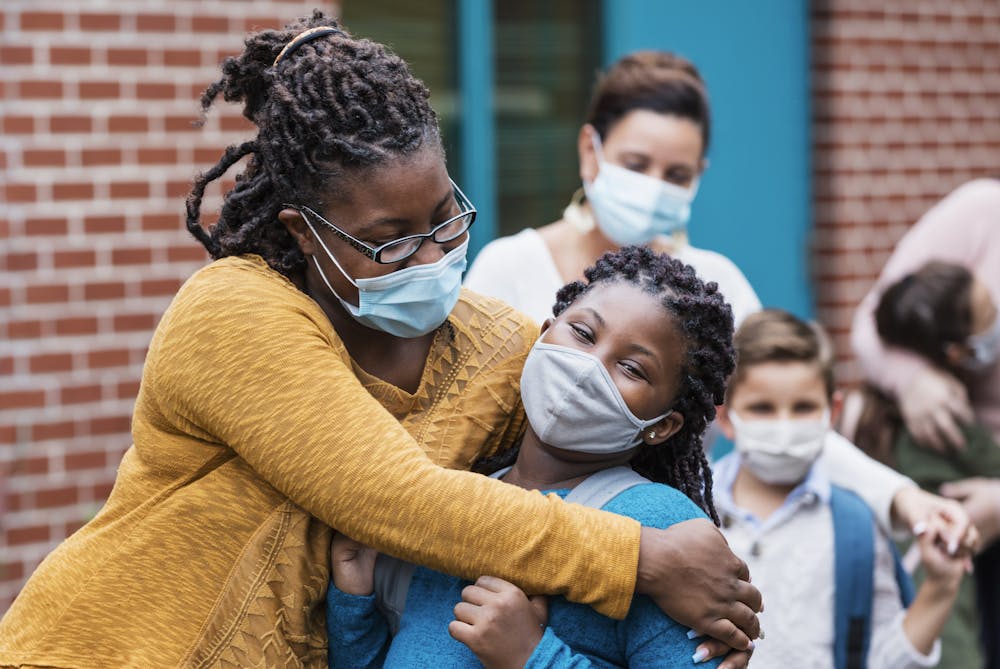 Parenting didn’t stop when the pandemic started. kali9/E+ via Getty Images
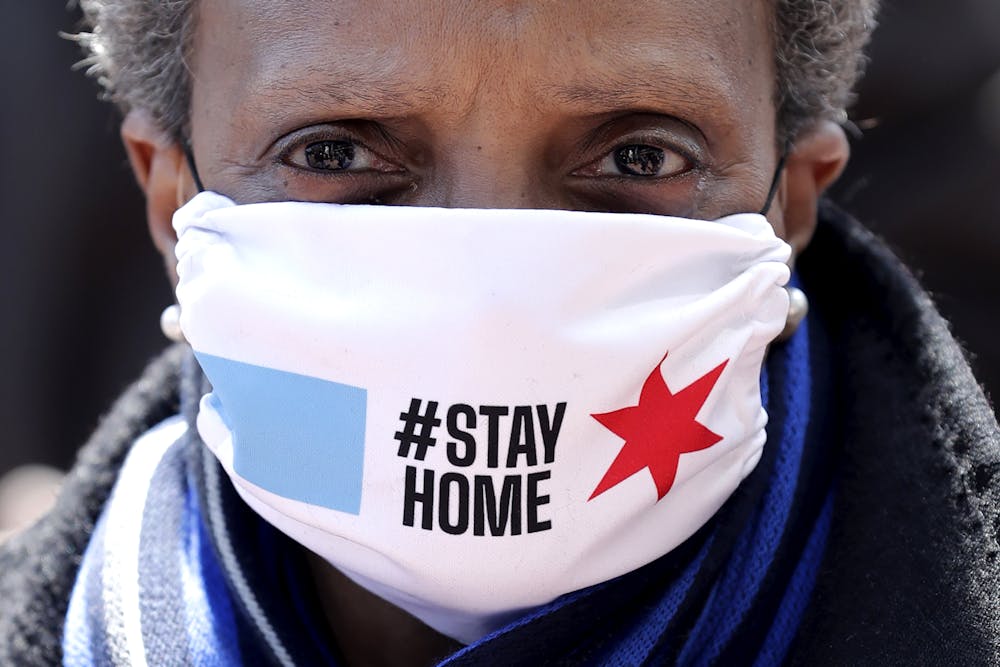 Many Black mothers were front-line workers who couldn’t heed the message on Chicago Mayor Lori Lightfoot’s mask in the early days of the pandemic. AP Photo/Nam Y. Huh
 None of the Black moms in the study went to the protests George Floyd’s death spurred in 2020. Natasha Moustache/Getty Images News via Getty Images
 Homes without enough diapers were also more likely to have depression and chronic illness among family members.