Who is AI for? Eric Stokan receives USM professorship to address barriers and promote AI equity for students and faculty
For tech-savvy individuals like Eric Stokan, artificial intelligence, programming languages, and open-source software are powerful tools that can turn once-impossible ideas into reality. Researchers can use human language processing to analyze historical documents or legal texts. Through collaborative platforms, global organizations can collaborate quickly without incurring travel costs. In the social sciences, open-source tools provide students with unique opportunities to work with experts developing projects that address community needs. However, to take full advantage of these revolutionary technologies, these tools often require advanced computing skills or access to expensive software, which can limit their impact and exclude those without the necessary resources or training.
Stokan, director of the Center for Social Science Scholarship (CS3), is committed to removing these barriers for faculty and students in computational social science, which uses computers, data, and algorithms to study human behavior and social systems. His research lies at the intersection of urban policy, economic development, and computational social science, with a focus on how local governments make policy decisions and how those decisions impact equity, economic growth, and environmental sustainability.
The University System of Maryland (USM) William E. Kirwan Center for Academic Innovation has awarded Stokan the Elkins Professorship for Academic Transformation to address this gap with his project “Computational Social Science and Generative AI: Scalable, Modular Training for Teaching, Research, and Public Impact.”

The Elkins Professorship is named after Wilson H. Elkins, a former Rhodes Scholar and president of the University of Maryland, College Park from 1954 to 1978. This prestigious award is for faculty within USM who are working on innovative projects focused on the use of generative AI to advance academic transformation, foster improvements in access, affordability, quality of outcomes, and/or stewardship of people’s time, money, and other scarce resources.
 Stokan’s examples of the R open-source programming language.
“The professorship will allow me, through the Center for Social Science Scholarship, to first assist faculty and students in understanding how to leverage advances in computing and AI to address new research questions and scale their research in ways that were unfathomable during Dr. Elkins tenure,” says Stokan, associate professor of political science, who earned one of three $10,000 awards. He will use the funding to complete Computational Public Administration—his first book written with R, a free programming language used for statistical computing and graphics—about computational social science methods focused on addressing public policy and administration topics, such as climate change and economic development.
The funding will also support the design and implementation of five hands-on training modules and workshops tailored for faculty, students, and community organizations. Participants will learn to use generative AI large language models (LLM) like ChatGPT and R. The goal is to help participants answer novel and important research questions, develop marketable technical skills, to work more effectively with data, and better communicate the results of their analyses with the broader community.

 Left: Codi Hrynko, Ph.D. ’29, chemistry, and Sarah Lanasa, Ph.D. ’25, environmental engineering work together. Right: Nagaraj Neerchal, professor of statistics, at the first workshop series on AI, LLMs, and computational methods.
“I am deeply honored to receive the Elkins Professorship, in honor of the late Wilson H. Elkins, who was a transformational leader, administrator, and educator,” says Stokan. “This award is important to me because it not only provides support but also affirms my commitment to accommodating learners at all levels of experience in computational social sciences, promoting accessibility, equity, and methodological transparency.”
Initial support for the project came from the UMBC’s Faculty Development Center, the AOK Library’s Digital Scholarship Services, iHARP/Data Science Scholars, and the Institute for Public Leadership at the University of Maryland, College Park.
The workshops will be offered through CS3 in collaboration with CGC-SCIPE, the UMBC Division of Information Technology, and ScaleS. A lecture series component, which will include external speakers, is being co-sponsored with the Department of English, the Department of Sociology, Anthropology, and Public Health, and the Department of Modern Languages, Linguistics, and Intercultural Communications.
Register for the fall semester’s workshop series on AI, LLMs, and computational methods.
]]>
For tech-savvy individuals like Eric Stokan, artificial intelligence, programming languages, and open-source software are powerful tools that can turn once-impossible ideas into reality....
https://umbc.edu/stories/eric-stokan-usm-professorship-ai-access/
https://my3.my.umbc.edu/api/v0/pixel/news/153456/guest@my.umbc.edu/c3599eb85a6c2ad8fd93f23e15267920/api/pixel
cahss
cahss-research
cbee
coeit
cs3
doit
english
graduate-school
mathstat
mlli
news
politicalscience
research
saph
science-and-tech
story
UMBC News & Magazine
https://my3.my.umbc.edu/groups/umbc-news-magazine
https://assets1-my.umbc.edu/system/shared/avatars/groups/000/001/943/24435aa6207c452e7bc15cc74b42c7bb/xsmall.png?1748556657
https://assets1-my.umbc.edu/system/shared/avatars/groups/000/001/943/24435aa6207c452e7bc15cc74b42c7bb/original.png?1748556657
https://assets2-my.umbc.edu/system/shared/avatars/groups/000/001/943/24435aa6207c452e7bc15cc74b42c7bb/xxlarge.png?1748556657
https://assets2-my.umbc.edu/system/shared/avatars/groups/000/001/943/24435aa6207c452e7bc15cc74b42c7bb/xlarge.png?1748556657
https://assets3-my.umbc.edu/system/shared/avatars/groups/000/001/943/24435aa6207c452e7bc15cc74b42c7bb/large.png?1748556657
https://assets1-my.umbc.edu/system/shared/avatars/groups/000/001/943/24435aa6207c452e7bc15cc74b42c7bb/medium.png?1748556657
https://assets2-my.umbc.edu/system/shared/avatars/groups/000/001/943/24435aa6207c452e7bc15cc74b42c7bb/small.png?1748556657
https://assets1-my.umbc.edu/system/shared/avatars/groups/000/001/943/24435aa6207c452e7bc15cc74b42c7bb/xsmall.png?1748556657
https://assets2-my.umbc.edu/system/shared/avatars/groups/000/001/943/24435aa6207c452e7bc15cc74b42c7bb/xxsmall.png?1748556657
UMBC News & Magazine
0
0
false
Thu, 09 Oct 2025 17:19:07 -0400
Thu, 09 Oct 2025 17:19:07 -0400
Who is AI for? Eric Stokan receives USM professorship to address barriers and promote AI equity for students and faculty
For tech-savvy individuals like Eric Stokan, artificial intelligence, programming languages, and open-source software are powerful tools that can turn once-impossible ideas into reality. Researchers can use human language processing to analyze historical documents or legal texts. Through collaborative platforms, global organizations can collaborate quickly without incurring travel costs. In the social sciences, open-source tools provide students with unique opportunities to work with experts developing projects that address community needs. However, to take full advantage of these revolutionary technologies, these tools often require advanced computing skills or access to expensive software, which can limit their impact and exclude those without the necessary resources or training.
Stokan, director of the Center for Social Science Scholarship (CS3), is committed to removing these barriers for faculty and students in computational social science, which uses computers, data, and algorithms to study human behavior and social systems. His research lies at the intersection of urban policy, economic development, and computational social science, with a focus on how local governments make policy decisions and how those decisions impact equity, economic growth, and environmental sustainability.
The University System of Maryland (USM) William E. Kirwan Center for Academic Innovation has awarded Stokan the Elkins Professorship for Academic Transformation to address this gap with his project “Computational Social Science and Generative AI: Scalable, Modular Training for Teaching, Research, and Public Impact.”
The Elkins Professorship is named after Wilson H. Elkins, a former Rhodes Scholar and president of the University of Maryland, College Park from 1954 to 1978. This prestigious award is for faculty within USM who are working on innovative projects focused on the use of generative AI to advance academic transformation, foster improvements in access, affordability, quality of outcomes, and/or stewardship of people’s time, money, and other scarce resources.
Stokan’s examples of the R open-source programming language.
“The professorship will allow me, through the Center for Social Science Scholarship, to first assist faculty and students in understanding how to leverage advances in computing and AI to address new research questions and scale their research in ways that were unfathomable during Dr. Elkins tenure,” says Stokan, associate professor of political science, who earned one of three $10,000 awards. He will use the funding to complete Computational Public Administration—his first book written with R, a free programming language used for statistical computing and graphics—about computational social science methods focused on addressing public policy and administration topics, such as climate change and economic development.
The funding will also support the design and implementation of five hands-on training modules and workshops tailored for faculty, students, and community organizations. Participants will learn to use generative AI large language models (LLM) like ChatGPT and R. The goal is to help participants answer novel and important research questions, develop marketable technical skills, to work more effectively with data, and better communicate the results of their analyses with the broader community.
Left: Codi Hrynko, Ph.D. ’29, chemistry, and Sarah Lanasa, Ph.D. ’25, environmental engineering work together. Right: Nagaraj Neerchal, professor of statistics, at the first workshop series on AI, LLMs, and computational methods.
“I am deeply honored to receive the Elkins Professorship, in honor of the late Wilson H. Elkins, who was a transformational leader, administrator, and educator,” says Stokan. “This award is important to me because it not only provides support but also affirms my commitment to accommodating learners at all levels of experience in computational social sciences, promoting accessibility, equity, and methodological transparency.”
Initial support for the project came from the UMBC’s Faculty Development Center, the AOK Library’s Digital Scholarship Services, iHARP/Data Science Scholars, and the Institute for Public Leadership at the University of Maryland, College Park.
The workshops will be offered through CS3 in collaboration with CGC-SCIPE, the UMBC Division of Information Technology, and ScaleS. A lecture series component, which will include external speakers, is being co-sponsored with the Department of English, the Department of Sociology, Anthropology, and Public Health, and the Department of Modern Languages, Linguistics, and Intercultural Communications.
Register for the fall semester’s workshop series on AI, LLMs, and computational methods.
]]>
For tech-savvy individuals like Eric Stokan, artificial intelligence, programming languages, and open-source software are powerful tools that can turn once-impossible ideas into reality....
https://umbc.edu/stories/eric-stokan-elkins-professorship/
https://my3.my.umbc.edu/api/v0/pixel/news/153447/guest@my.umbc.edu/bbab2ee0a08b4098a167cd53ca08b643/api/pixel
cahss
cahss-research
cbee
cs3
doit
english
mathstat
mlli
news
politicalscience
research
saph
science-and-tech
story
UMBC News & Magazine
https://my3.my.umbc.edu/groups/umbc-news-magazine
https://assets1-my.umbc.edu/system/shared/avatars/groups/000/001/943/24435aa6207c452e7bc15cc74b42c7bb/xsmall.png?1748556657
https://assets1-my.umbc.edu/system/shared/avatars/groups/000/001/943/24435aa6207c452e7bc15cc74b42c7bb/original.png?1748556657
https://assets2-my.umbc.edu/system/shared/avatars/groups/000/001/943/24435aa6207c452e7bc15cc74b42c7bb/xxlarge.png?1748556657
https://assets2-my.umbc.edu/system/shared/avatars/groups/000/001/943/24435aa6207c452e7bc15cc74b42c7bb/xlarge.png?1748556657
https://assets3-my.umbc.edu/system/shared/avatars/groups/000/001/943/24435aa6207c452e7bc15cc74b42c7bb/large.png?1748556657
https://assets1-my.umbc.edu/system/shared/avatars/groups/000/001/943/24435aa6207c452e7bc15cc74b42c7bb/medium.png?1748556657
https://assets2-my.umbc.edu/system/shared/avatars/groups/000/001/943/24435aa6207c452e7bc15cc74b42c7bb/small.png?1748556657
https://assets1-my.umbc.edu/system/shared/avatars/groups/000/001/943/24435aa6207c452e7bc15cc74b42c7bb/xsmall.png?1748556657
https://assets2-my.umbc.edu/system/shared/avatars/groups/000/001/943/24435aa6207c452e7bc15cc74b42c7bb/xxsmall.png?1748556657
UMBC News & Magazine
0
0
false
Thu, 09 Oct 2025 17:19:07 -0400
Thu, 09 Oct 2025 17:19:07 -0400
Who is “Fulbright material”? UMBC’s six 2025 – 2026 Fulbright U.S. Student Program recipients share their not-so-secret recipe for success
Alyssa Thomas is more of an “and” person than an “or” person. Growing up in a military family stationed in Florida, Thomas learned flexibility, a sense of curiosity, and a “Why not?” approach to life. So when Shin Yon Kim, assistant teaching professor of Asian studies, encouraged her to apply to the U.S. Fulbright Student Program during her junior year, Thomas was skeptical. “I decided to give it a try, but I didn’t think I’d get very far because I had never studied abroad,” said Thomas. “And then Dr. Kim said, ‘I need you to start believing in yourself and actually push yourself to apply for it.'” Those words of encouragement stuck with her. Thomas took her own advice and said, “Why not?”
Thomas ’25, Asian studies, ended her summer by moving to Taipei, Taiwan, where she is already working as a Fulbright English Teaching Assistant. She hopes her rudimentary Mandarin will help her learn Taiwanese Mandarin and the various dialects while she’s there. “There’s a big difference between learning in the classroom and in person. Accents, tempo, and slang are elements of Mandarin I’ve yet to adjust to,” says Thomas.

Retriever advice from Alyssa Thomas ’25
U.S. Fulbright Student Program
English Teaching Assistant, Taipei, Taiwan
“It’s important to learn how to manage your stress, especially if you have never traveled abroad or applied for a Fulbright. For me, it’s morning walks. Find what works for you—whether it’s journaling or therapy—to help manage the unexpected.”
Deciding to apply for a Fulbright is only the beginning. The process usually starts with a mentor pointing the way toward Brian Souders, M.A. ’19, TESOL, and Ph.D. ’09, language, literacy, and culture, the associate director for global learning at UMBC’s Center for Global Engagement. CGE hosts Fulbright information sessions in the spring for undergraduate, graduate, and recent alumni. Retrievers can apply to earn a master’s, conduct research, or be an English Teaching Assistant in East Asia-Pacific, Europe and Eurasia, Middle East and North Africa, South and Central Asia, Sub-Saharan Africa, and the Western Hemisphere.
With three UMBC 2025 – 2026 Fulbrights already settled in Taiwan, Norway, and Indonesia, and three preparing to cross the Atlantic Ocean to Belgium, Israel, and Germany, these alumni are eager to share tips to inspire and prepare the next generations of Fulbright Retrievers.
Transforming the lives of incarcerated women
Right now, it is the beginning of fall in Bergen, Norway, where Shanika Freeman ’24 is settling in at the University of Bergen, working with faculty studying the reentry experiences of native Norwegian and non-native Norwegian women into the community after incarceration. Freeman’s individualized studies major at UMBC focused on recidivism and policy in urban communities, making Norway a perfect research location. The country’s progressive and humane approach to rehabilitation, from the point of entry into the carceral system to successful reentry, has made Norway have the world’s lowest recidivism rates. Though Baltimore and Norway are worlds apart geographically and culturally, Freeman hopes to use what she learns abroad to help transform the lives of incarcerated women in the U.S. by exploring practices that shift the focus from punishment to rehabilitation and community building.

Retriever advice from Shanika Freeman ’24
U.S. Fulbright Student Program
Research in Bergen, Norway
“Build a team. I found out about Fulbright through Dr. Brian Souders. I didn’t know anything about it before and felt like Fulbright was out of reach for me. The furthest I had traveled was to California, and that was only for a weekend. I never thought a person like me—low-income, two-time college dropout from Baltimore City—would get the opportunity to go abroad.”
Her team included the INDS faculty and her academic mentors: Tammy Henderson, associate teaching professor of Africana studies; Loren Henderson, director of the school of public policy; László Kőrössy, assistant director for academic advising, outreach, and assessment; and Eric Stokan, director of the Center for Social Science Scholarship. “I applied because the faculty encouraged me and supported my research. I knew that my research was important, and Fulbright allowed me to take it further. Applying was a bit overwhelming at times, but Dr. Souders was extremely thorough, patient, kind, and knowledgeable. My team of faculty and staff was instrumental in my development as a scholar and fostered my academic goals.”
Researching your roots
Since Eilah Goldberg ’25, history, with a Judaic studies minor, first learned about the Fulbright Program during her sophomore year, her academic goals became very clear—build a strong academic and social foundation to earn this prestigious award. Goldberg knew she wanted to study Jewish history, religion, and culture abroad. The first step was studying abroad in England at the University College London (UCL) Hebrew and Jewish studies department, with the intent of returning to earn a master’s. “When I told Dr. Souders my plan to return to London after graduation, he asked me what I really wanted to do,” says Goldberg. “I shared my deep interest in Jewish studies, and he helped me realize that I could go directly to Israel to study—that it was a real option.”

Retriever advice from Eilah Goldberg ’25
U.S. Fulbright Student Program
Master’s at Hebrew University of Jerusalem
“Stay true to yourself, your interests, passions, and intellectual curiosities. Don’t let fear stop you from traveling to places or studying topics that are personally and culturally meaningful to you. Take the opportunity to conduct firsthand research into your roots, identity, and beliefs. Lean on the support of student clubs and cultural communities, just as I did with UMBC’s Chabad and Hillel Jewish student organizations and UCL’s Jewish Student Union. It’s important to have people to encourage you and believe in you.”
Goldberg will earn a master’s in Israel Studies at the Hebrew University of Jerusalem, surrounded by her extended family in Israel, an hour away from Jerusalem. She will study the impact of American Aliyah—ascent in Hebrew—the immigration of American Jews to Israel, and how it shaped Israeli society historically, culturally, and politically.
Pre-med neurologocial research abroad
The summer before his first year at UMBC, Andrew Opincar ’25, biological sciences, mapped out a four-year plan to ensure he would complete his major requirements, gain clinical experience, and take the MCAT all before graduating. As a participant in STEM Build—a National Institutes of Health initiative focused on enhancing diversity in the biomedical and behavioral sciences workforce, Opincar was excited to explore diverse perspectives in healthcare and research. While planning for his final two years at UMBC, he took the opportunity to study abroad in Amsterdam, Netherlands, to learn about the Dutch public universal health system.

Retriever advice from Andrew Opincar ’25
U.S. Fulbright Student Program
Research at the University of Heidelberg, Germany
“For pre-med students to critically analyze the health systems around us, we need to understand systems and people different from ourselves. It’s difficult to be well-rounded physicians, scientists, or researchers when you’ve only lived in one place and had one kind of experience,” says Opincar, who, even though his mentors encouraged him to apply, was unsure if he was “Fulbright material.” “I like the sports quote, ‘You lose 100 percent of the shots you don’t take,’ so you really must take a chance on what you care about and put yourself out there.”
Now, Opincar has mapped the time between graduation and medical school to learn a new healthcare system and expand his research experience from cell migration in fruit flies to spinal cord regeneration in mouse models at Heidelberg University, Germany, a global center for molecular biology and neuroscience. He’s excited to plan for many unknowns, like exploring a new research field, becoming bilingual, and stepping outside of his comfort zone to gain more confidence personally and professionally.
Connecting with your community across borders
Law and politics have been on Navara Syed‘s mind as long as she can remember. Her political science professors, Carolyn Forestiere, Brian Grodsky, and Jeffrey Davis, fueled her passion for comparative politics, civil and human rights, and community advocacy, leading her to choose a major in political science. During her visits to Pakistan to visit family and to Thailand to study abroad, Syed began to understand the complexity and broadness of what community can mean, and is ready to embrace the community she will be part of during her Fulbright in Indonesia as an English Teaching Assistant.

Retriever advice from Navara Syed ’25
U.S. Fulbright Student Program
English Teaching Assistant
Padang, West Sumatra, Indonesia
“Dip your toes into different ponds. You never know what you will find. I’m Muslim and have never lived in a Muslim country. In the U.S., I always have to think about where to get Halal food. In Thailand, a kind person approached me and offered to show me where I could find Halal food. Our tour guide even made sure to include Halal restaurant options.
Indonesia is a Muslim country, so spending Ramadan and other major Muslim holidays without needing to explain them or figure out how to participate in them is a dream come true. No experience is a waste—it’s just as important to realize what you don’t like as it is to discover what you do.”
Since graduating in May, these connections, along with her time in Mock Trial, the Muslim Student Association, and the student events board, continue to plant seeds of possibilities for her future in the field of law, whether as a judge, legislator, professor, or advocate.
Intersectional approach to flood mitigation
Daniel Douglas ’21, global studies, M.P.P. ’24, public policy, a current Ph.D. student, has been clear about his career path since his undergraduate years, when he began researching environmental policy focused on disaster mitigation and natural hazards. As a Fulbright recipient, he is now taking his expertise to the international level in Antwerp, Belgium.

Retriever advice from Daniel Douglas, Ph.D. student
U.S. Fulbright Student Program
Research at University of Antwerp, Belgium
“In every single field of study at UMBC, you can identify a way to apply your work for the common good. Find and seek your purpose above all else. This is especially important today when research and academia are being challenged. Now, we all have to uplift goodness, justice, and each other. And most of all, we can’t give up hope. I try my best to uplift those around me, knowing and trusting that they are pushing me forward to new heights.”
At the University of Antwerp, Douglas will conduct research on Belgium’s Sigma Plan—the primary flood mitigation plan along the Scheldt River Valley in Flanders, Belgium. Originally launched in 1977 as a single-purpose safety plan, it has since evolved to manage flood protection with nature conservation, recreation, and the needs of shipping and agriculture. This intersectional approach to flood mitigation is Douglas’s passion. He plans to build on his skill set in Belgium, then bring this newfound knowledge back to UMBC to complete his doctorate, and help communities worldwide—including Ellicott City—reduce the disastrous impacts of environmental hazards through disaster prevention, mitigation, and governance.
Learn more about UMBC’s Center for Global Education.
All photos by Brad Ziegler/UMBC, with the exception of Shanika Friedman’s, courtesy of INDS, and Daniel Douglas, courtesy of Douglas.
]]>
Alyssa Thomas is more of an “and” person than an “or” person. Growing up in a military family stationed in Florida, Thomas learned flexibility, a sense of curiosity, and a “Why not?” approach to...
https://umbc.edu/stories/2025-2026-fulbright-u-s-student-program-recipients-share-advice/
https://my3.my.umbc.edu/api/v0/pixel/news/153327/guest@my.umbc.edu/41b99848b6530be49b6743052c7a2469/api/pixel
africanastudies
asianstudies
baltimorecity
biologicalsciences
cahss
cnms
coeit
community
cs3
globalstudies
graduateschool
inds
international
judaicstudies
news
publicpolicy
story
UMBC News & Magazine
https://my3.my.umbc.edu/groups/umbc-news-magazine
https://assets1-my.umbc.edu/system/shared/avatars/groups/000/001/943/24435aa6207c452e7bc15cc74b42c7bb/xsmall.png?1748556657
https://assets1-my.umbc.edu/system/shared/avatars/groups/000/001/943/24435aa6207c452e7bc15cc74b42c7bb/original.png?1748556657
https://assets2-my.umbc.edu/system/shared/avatars/groups/000/001/943/24435aa6207c452e7bc15cc74b42c7bb/xxlarge.png?1748556657
https://assets2-my.umbc.edu/system/shared/avatars/groups/000/001/943/24435aa6207c452e7bc15cc74b42c7bb/xlarge.png?1748556657
https://assets3-my.umbc.edu/system/shared/avatars/groups/000/001/943/24435aa6207c452e7bc15cc74b42c7bb/large.png?1748556657
https://assets1-my.umbc.edu/system/shared/avatars/groups/000/001/943/24435aa6207c452e7bc15cc74b42c7bb/medium.png?1748556657
https://assets2-my.umbc.edu/system/shared/avatars/groups/000/001/943/24435aa6207c452e7bc15cc74b42c7bb/small.png?1748556657
https://assets1-my.umbc.edu/system/shared/avatars/groups/000/001/943/24435aa6207c452e7bc15cc74b42c7bb/xsmall.png?1748556657
https://assets2-my.umbc.edu/system/shared/avatars/groups/000/001/943/24435aa6207c452e7bc15cc74b42c7bb/xxsmall.png?1748556657
UMBC News & Magazine
0
0
false
Tue, 07 Oct 2025 09:08:23 -0400
Tue, 07 Oct 2025 09:08:23 -0400
Magaly Lizama Hernandez ’26, a burgeoning public servant, receives the inaugural Bernard L. Berkowitz Memorial Award, honoring service to Baltimore City
Growing up in Bronx, New York, almost a century ago, Bernard “Bernie” L. Berkowitz, a first-generation son of Hungarian immigrants, may not have realized then that his life would take him beyond the bounds of New York City to Baltimore City and eventually to UMBC. In 1995, Berkowitz completed seven years of service to UMBC as the special assistant to the president for economic development efforts, which included planning for the bwtech@UMBC Research and Technology Park.
Thirty years later, Magaly Lizama Hernandez, a first-generation daughter of Salvadoran immigrants, is the recipient of the inaugural award bearing his name for her vision to develop a higher education pathway for Baltimore City students—a similar program to the one that led her to the psychology program at UMBC at the Universities at Shady Grove.
“Receiving the Bernard L. Berkowitz Memorial Award is not only an incredible and personal honor, but a reflection of a mission I’m deeply passionate about, making higher education more accessible for young people in Baltimore City,” said senior Lizama Hernandez at the awards ceremony this past May. “I’ve seen many talented and hardworking students feel that college was out of reach, not because of ability, but because they lacked access, support, and sometimes simply someone who believed in them. I know, because I was that student.”
As an alumna of the Achieving Collegiate Excellence and Success (ACES) program, a partnership between Montgomery County Public Schools, Montgomery College, and the Universities at Shady Grove, Lizama Hernandez knows firsthand the profound impact of mentorship. Beginning in her sophomore year at Gaithersburg High School in Montgomery County, Lizama Hernandez received one-on-one coaching to develop college-level skills and guidance on college and scholarship applications, which made her transition from high school to Montgomery College—and eventually to UMBC-Shady Grove—a success. Now, she wants to adapt the program for Baltimore City Public Schools.
The next generation of public servants
“The goal of the endowment is to inspire the next generation of committed Baltimore public servants,” said Rachel Edds, former deputy director of Baltimore City’s planning department, principal at Edds Consulting, and one of 10 founding donors. After Berkowitz passed in 2023, the group—composed of family, friends, and colleagues—established the award to commemorate his more than 40-year legacy of planning and economic development in Baltimore City.
Berkowitz began his service to Baltimore City in 1961 at the Baltimore City Department of Planning, becoming the director in 1968. He held various positions across the city, including on Mayor William Donald Schaefer’s economic development team (1974 – 1980), and more recently as the president of the Black/Jewish Forum of Baltimore (1997 – 1999) and as president of the Lexington Market Board (1990s – 2000s).
“We look to provide the recipients of the Bernard Berkowitz Memorial Award with planning, guidance, and leadership, assuring that the Baltimore region of the future remains sound and continues to be on very strong economic footing,” said Edds. She was joined in the audience by three other founding members: David Berkowitz, his son, Chris Ryer, director of planning for Baltimore City Mayor Brandon Scott, and David Hash, senior director of facilities planning at Johns Hopkins Bayview Medical Center, who worked with Berkowitz for over 20 years.
 (l-r): Eli Edds, Dave Hash, Rachel Edds, Lizama Hernandez, Erick Stokan, and Chris Ryer. (Image courtesy of Stokan)
“Bernie was a true professional whose work ethic was exemplary. He cared very much about serving the business community, calling upon companies who he thought might benefit from the numerous economic development programs available for their retention and expansion”, said David Hash, former executive vice president of the Baltimore Economic Development Corporation.
The fund marks the first student-centered endowment award administered by UMBC’s Center for Social Science Scholarship (CS3). Eric Stokan, director of CS3 and associate professor of political science, noted that Lizama Hernandez’s application stood out among the 16 submitted. “Magaly’s efforts to empower low-income students throughout their educational journey, providing them with tools, support, and confidence to thrive professionally and personally, align well with the spirit and purpose of the award,” said Stokan.
Stokan is grateful that the founding funders will ensure that CS3 can offer this award on an annual basis to students who embody the spirit of “Bernie” Berkowitz with a focus on local public service in the Baltimore area.
Investing in Baltimore City Public Schools
Impressed by Lizama Hernandez’s entrepreneurial spirit, the counseling staff at Gaithersburg High School hired her as a student worker to guide students like herself through the college application process. The knowledge she acquired as a student and staff member in the program has prepared her to begin the planning process for establishing the program at Baltimore City Public Schools with the guidance from the Bernard L. Berkowitz Memorial Fund donors.
“Bernie believed in transcending divisions—bringing together people of different social and economic backgrounds,” said Edds. “He is fondly remembered for his clear thinking, always with a sense of humor and kindness.”
His example has motivated Lizama Hernandez to take the next step in her academic and professional journey. “Through my studies in psychology and social work at UMBC and my work supporting students and families, I’ve seen firsthand the transformative power of education,” said Lizama Hernandez, who plans on earning a master’s in social work. “My goal as a future counselor is to help students know why their dreams are valid and achievable. Baltimore’s young people deserve every chance to thrive.”
Learn more about UMBC scholarship opportunities.
]]>
Growing up in Bronx, New York, almost a century ago, Bernard “Bernie” L. Berkowitz, a first-generation son of Hungarian immigrants, may not have realized then that his life would take him beyond...
https://umbc.edu/stories/lizama-hernandez-wins-bernard-l-berkowitz-award/
https://my3.my.umbc.edu/api/v0/pixel/news/150728/guest@my.umbc.edu/44efec996714b9d256f91e11ea2636b4/api/pixel
baltimore-city
cahss
cs3
news
policy-and-society
political-science
psychology
shadygrove
story
UMBC News & Magazine
https://my3.my.umbc.edu/groups/umbc-news-magazine
https://assets1-my.umbc.edu/system/shared/avatars/groups/000/001/943/24435aa6207c452e7bc15cc74b42c7bb/xsmall.png?1748556657
https://assets1-my.umbc.edu/system/shared/avatars/groups/000/001/943/24435aa6207c452e7bc15cc74b42c7bb/original.png?1748556657
https://assets2-my.umbc.edu/system/shared/avatars/groups/000/001/943/24435aa6207c452e7bc15cc74b42c7bb/xxlarge.png?1748556657
https://assets2-my.umbc.edu/system/shared/avatars/groups/000/001/943/24435aa6207c452e7bc15cc74b42c7bb/xlarge.png?1748556657
https://assets3-my.umbc.edu/system/shared/avatars/groups/000/001/943/24435aa6207c452e7bc15cc74b42c7bb/large.png?1748556657
https://assets1-my.umbc.edu/system/shared/avatars/groups/000/001/943/24435aa6207c452e7bc15cc74b42c7bb/medium.png?1748556657
https://assets2-my.umbc.edu/system/shared/avatars/groups/000/001/943/24435aa6207c452e7bc15cc74b42c7bb/small.png?1748556657
https://assets1-my.umbc.edu/system/shared/avatars/groups/000/001/943/24435aa6207c452e7bc15cc74b42c7bb/xsmall.png?1748556657
https://assets2-my.umbc.edu/system/shared/avatars/groups/000/001/943/24435aa6207c452e7bc15cc74b42c7bb/xxsmall.png?1748556657
UMBC News & Magazine
1
0
false
Wed, 18 Jun 2025 15:34:11 -0400
Wed, 18 Jun 2025 15:34:11 -0400
Satellite data: The other type of smartphone data you might not know about

Co-written by Alicia Sabatino ’20, M.S. ’24, geography and environmental systems, UMBC.
When you think about location data on your mobile phone, tablet or laptop, what comes to mind? Mailing addresses? Postal codes? These data indicate where you live, where you work, and the places you visit.
When combined with other types of data over time, companies and governments use them to analyze your consumption patterns, occupation, education, health and financial status.
Turning location services off only prevents smartphone apps from receiving location data. Smartphones can still be located by cell towers and wireless networks when location services are switched off.
This was highlighted by German politician Malte Spitz over a decade ago when he sued his cellphone provider, Deutsche Telekom, for any personal data they had about him.
When the case was settled and he eventually received the data, Spitz found 35,000 references to his location. He was able to visually reconstruct his movements over the previous six months, demonstrating the relevance of data protection laws to the public.
But there is more. By using critical code and documentary research methods, we found that raw satellite location measurement data are perpetually created in our devices all the time.
Because satellite data are building blocks used by our phones to determine where we are, they don’t always get turned off — nor are they collected and treated the same way as location data.
Data outputs
Smartphones determine your location in several ways. The first way involves phones triangulating distances between cell towers or Wi-Fi routers.
The second way involves smartphones interacting with navigation satellites. When satellites pass overhead, they transmit signals to smartphones, which allows smartphones to calculate their own location. This process uses a specialized piece of hardware called the Global Navigation Satellite System (GNSS) chipset. Every smartphone has one.
When these GNSS chipsets calculate navigation satellite signals, they output data in two standardized formats (known as protocols or languages): the GNSS raw measurement protocol and the National Marine Electronics Association protocol (NMEA 0183).
 When satellites pass overhead, they transmit signals to smartphones, which enable smartphones to calculate their own location. (Shutterstock)
GNSS raw measurements include data such as the distance between satellites and cellphones and measurements of the signal itself.
NMEA 0183 contains similar information to GNSS raw measurements, but also includes additional information such as satellite identification numbers, the number of satellites in a constellation, what country owns a satellite, and the position of a satellite.
NMEA 0183 was created and is governed by the NMEA, a not-for-profit lobby group that is also a marine electronics trade organization. The NMEA was formed at the 1957 New York Boat Show when boating equipment manufacturers decided to build stronger relationships within the electronic manufacturing industry.
In the decades since, the NMEA 0183 data standard has improved marine electronics communications and is now found on a wide variety of non-marine communications devices today, including smartphones.
Who has access to these data?
It is difficult to know who has access to data produced by these protocols. Access to NMEA protocols is only available under licence to businesses for a fee.
GNSS raw measurements, on the other hand, are a universal standard and can be read by different devices in the same way without a license. In 2016, Google allowed industries to have open access to it to foster innovation around device tracking accuracy, precision, analytics about how we move in real-time, and predictions about our movements in the future.
While automated processes can quietly harvest location data — like when a French-based company extracted location data from Salaat First, a Muslim prayer app — these data don’t need to be taken directly from smartphones to be exploited.
Data can be modelled, experimented with, or emulated in licensed devices in labs for innovation and algorithmic development.
Satellite-driven raw measurements from our devices were used to power global surveillance networks like STRIKE3, a now defunct European-led initiative that monitored and reported perceived threats to navigation satellites.
Data and citizen rights
Our research raises questions about how rights are protected in the midst of these practices. Citizens have little to no access to the data output from NMEA 0183 and GNSS raw measurements. Because of this, people are unable to negotiate the visibility of their data in these datasets.
The data output from NMEA 0183 and GNSS raw measurements flow unrestricted from every smartphone on the planet. Smartphones have unique identifiers — IMEI numbers — that are known to the tech ecosystem. They can be connected to a user’s personal details.
The flow of NMEA 0183 and GNSS data is invisible to the average person, meaning citizens are unsure of how these data are used, or with whom they are shared. Because of this, it’s impossible for people to challenge how their personal data are used.
 A U.S. Coast Guard boat in Biscayne Bay, Fla., in June 2022. The National Marine Electronics Association is working on improving search-and-rescue operations by ensuring radio distress signals sent by marines contain GPS information. (AP Photo/Lynne Sladky)
As interest in the supposed security, entertainment and surveillance value of these protocols continue to grow, these protocols are increasingly susceptible to misuse by third-party developers.
But there is another layer to this: NMEA 0183 and GNSS raw measurements are standards in industries that offer products and services that many of us benefit from. The NMEA has foundations in safe passage at sea, making their data an important part of emergency services operations. GNSS raw measurements are also utilized for safety purposes.
Could solutions restrict the use of these data for life-critical situations only? Is there an oversight body that could assess what impacts industrial usage of these data might have upon smartphone owner rights and liberties? What about an audit led by civil society, who would be appropriately positioned to objectively inspect these issues to determine whether they might harm the public? For example, consider the way the federal privacy commissioner reviews app data activities.
Location data now flows constantly from GNSS chipsets. There is uncertainty about who is using these data, and for what purposes. Until industry and government reassure citizens that personal data are not being exploited and that rights are protected, these remain open questions.
This article is republished from The Conversation under a Creative Commons license. Read the original article and see more than 250 UMBC articles available in The Conversation.
]]>
Co-written by Alicia Sabatino ’20, M.S. ’24, geography and environmental systems, UMBC. When you think about location data on your mobile phone, tablet or laptop, what comes to mind? Mailing...
https://umbc.edu/stories/satellite-data-the-other-type-of-smartphone-datat/
https://my3.my.umbc.edu/api/v0/pixel/news/131109/guest@my.umbc.edu/452b125ba75b4e308706be8598c56bf3/api/pixel
cahss
cahssresearch
cs3
discovery
ges
magazine
the-conversation
UMBC News & Magazine
https://my3.my.umbc.edu/groups/umbc-news-magazine
https://assets1-my.umbc.edu/system/shared/avatars/groups/000/001/943/24435aa6207c452e7bc15cc74b42c7bb/xsmall.png?1748556657
https://assets1-my.umbc.edu/system/shared/avatars/groups/000/001/943/24435aa6207c452e7bc15cc74b42c7bb/original.png?1748556657
https://assets2-my.umbc.edu/system/shared/avatars/groups/000/001/943/24435aa6207c452e7bc15cc74b42c7bb/xxlarge.png?1748556657
https://assets2-my.umbc.edu/system/shared/avatars/groups/000/001/943/24435aa6207c452e7bc15cc74b42c7bb/xlarge.png?1748556657
https://assets3-my.umbc.edu/system/shared/avatars/groups/000/001/943/24435aa6207c452e7bc15cc74b42c7bb/large.png?1748556657
https://assets1-my.umbc.edu/system/shared/avatars/groups/000/001/943/24435aa6207c452e7bc15cc74b42c7bb/medium.png?1748556657
https://assets2-my.umbc.edu/system/shared/avatars/groups/000/001/943/24435aa6207c452e7bc15cc74b42c7bb/small.png?1748556657
https://assets1-my.umbc.edu/system/shared/avatars/groups/000/001/943/24435aa6207c452e7bc15cc74b42c7bb/xsmall.png?1748556657
https://assets2-my.umbc.edu/system/shared/avatars/groups/000/001/943/24435aa6207c452e7bc15cc74b42c7bb/xxsmall.png?1748556657
UMBC News & Magazine
0
0
false
Tue, 21 Feb 2023 12:04:16 -0500
Tue, 21 Feb 2023 12:04:16 -0500
Tackling food insecurity in disasters: UMBC’s Lauren Clay develops a new model through $520K NSF CAREER award
When disasters happen, access to food can be interrupted, which can increase existing food insecurity issues and compound the impact of disasters. Currently, there isn’t a standard tool to measure disaster-specific food insecurity issues, making it harder to address them.
The National Science Foundation (NSF) has awarded UMBC’s Lauren Clay, associate professor and chair of emergency health services, a five-year, $520,000 Faculty Early Career Development (CAREER) award to develop a sociocultural model called Food Environment in Disasters (FED) and other tools to improve the understanding and monitoring of food availability, acceptability, and accessibility during disasters.
“Food is a basic need for human survival and the ability of social systems to meet this need in disaster situations is compromised when our homes, businesses, and other structures are damaged and lifelines disrupted,” says Clay. “While elements of the various social and built-in environmental systems that make up the broader food environment as well as food security issues have been studied by various disciplines, a comprehensive, systematic approach has yet to be applied and tested in disaster settings.”
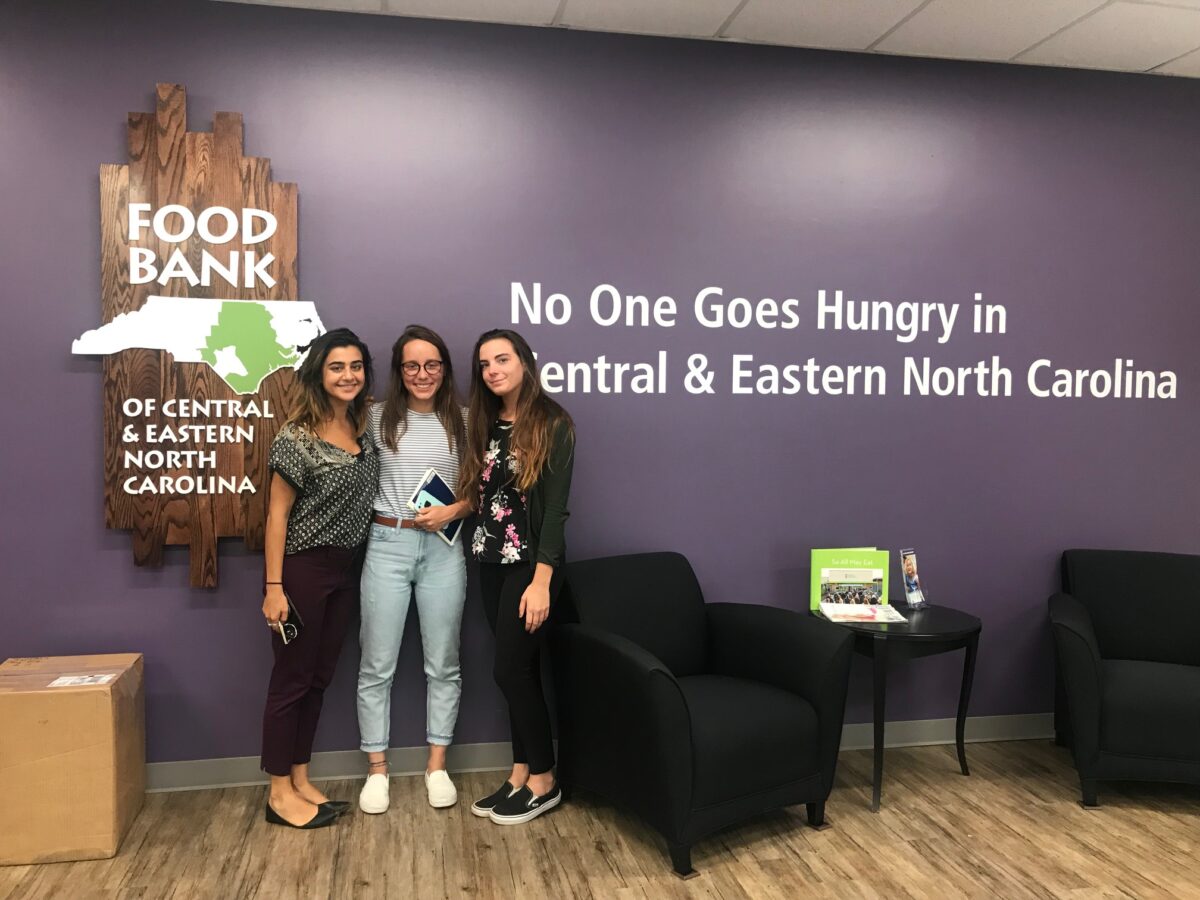 Lauren Clay’s graduate students volunteer at a food bank. (Image courtesy of Clay)
The CAREER award is one of NSF’s most prestigious awards for early career faculty. Recipients are chosen for their passion and dedication to the discovery process and commitment to teaching, learning, and sharing new knowledge.
This research builds on Clay’s prior body of work in disaster preparedness, recovery, and resilience. That work has focused on communities impacted by COVID-19; Hurricanes Harvey, Sandy, and Katrina; the Deepwater Horizon Oil Spill in the Gulf of Mexico; and the 2013 tornado in Moore, Oklahoma, among other disasters and public health emergencies.
The FED model
Over the next five years, Clay will use the current Nourish Food System Model as a guiding theory to develop her new FED model. “The Nourish Food System Model looks at the interconnectedness and interdependence of the biological, social, political, economic, health, and policy systems,” says Clay. “Some of these systems can be disrupted any day, but in a disaster, all of the systems are stressed.”
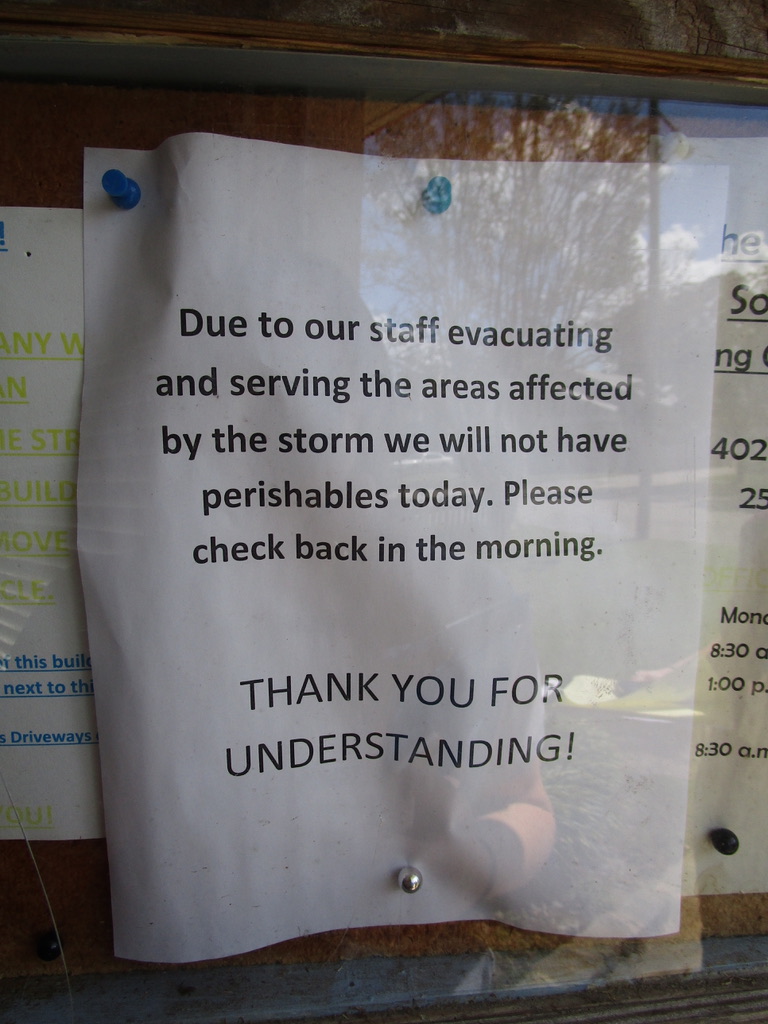 Community announcement for North Carolina residents after Hurricane Florence (2018).
(Image courtesy of Clay)
A key aspect of the FED model is that it is being developed with data from disasters. This is unlike current food system theory and metrics that base their emergency response on data from non-disaster times. The FED model will be tested against food insecurity data from COVID-19, Hurricane Florence, the 2018 Camp Fire in Paradise, California, and other case studies to determine how well the model fits with actual lived experiences in disasters.
“After I develop the FED model and validate it, the last part in the latter years of the grant will be to develop tools to support communities in building food system resilience for disasters,” says Clay. She will create the Environmental Audit Tool (EAT) to help local and state organizations better monitor and assess the processes and structures in place to address food insecurity in non-disaster times. This information will help improve both early response and long-term monitoring.
All of this work will help address the kinds of acute food insecurity issues that can double or triple chronic food security problems following disasters.
 Grocery store shelves after Hurricane Florence (2018). (Image courtesy of Clay)
Best practices in teaching
The NSF award also recognizes and furthers Clay’s work as an innovative educator. Through the CAREER award, she will develop best practices in teaching methods related to food insecurity in disaster situations.
Clay will create one of the first teaching labs to train undergraduate students with the knowledge, skills, and attitudes to address disaster-focused food insecurity. She will also integrate field and lab research into her classes more broadly, where students can engage with the work as disaster response is unfolding, giving them the opportunity to learn about disasters both from emergency response practices and a theoretical framework.
Foundational work
Clay’s latest research builds on prior foundational work. In 2021, she received a $100,000 collaborative research award from the U.S. Department of Agriculture (USDA) and Tufts University. Clay was one of six researchers across the U.S. to participate in the USDA’s “25 Years of Food Security Measurement: Answered Questions and Further Research” program. The program aims to foster research related to the past 25 years of U.S. household food security research and to explore feasible evidence-based improvements.
“I proposed that the USDA was missing important information about people’s lives by focusing entirely on financial barriers to food security. Having cash does not guarantee food security if there are community-level disruptions,” says Clay. “Roads can flood and access to kitchens and food storage facilities can be damaged.”
Clay and a team of researchers collected data from six states to explore nonfinancial barriers to food accessibility, availability, and acceptability, including physical barriers to food sources (such as damaged roads), barriers to food availability (such as store closures), and access to foods that can be consumed without extensive kitchen facilities.
“We are in the final phase of developing a better measure of food insecurity following disasters when there is a community-level disruption,” says Clay. She plans to use this measurement tool in the development of the FED model.
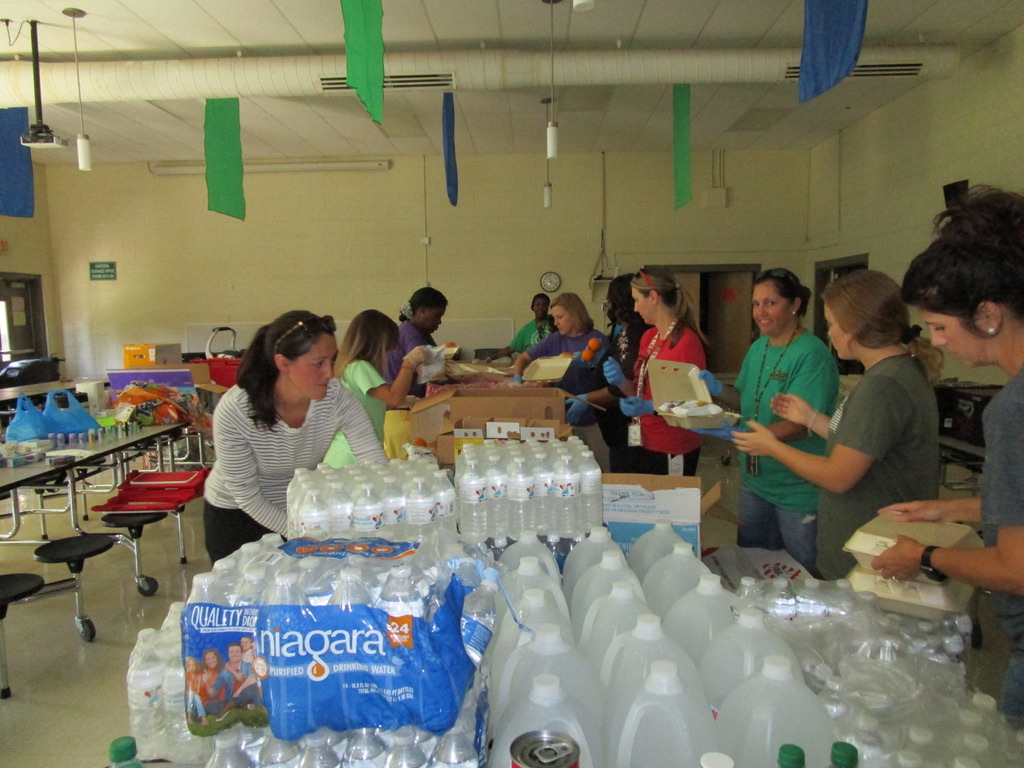 North Carolina teachers package food for victims of Hurricane Florence (2018). (Image courtesy of Clay)
National food access and COVID-19
Additionally, Clay has been working on two other food insecurity projects that have received Quick Response Research Awards, funded by the University of Colorado’s Natural Hazards Center with support from NSF.
In the first project, Clay leads the New York state team of the National Food Access and COVID research Team (NFACT). The team consists of researchers across 15 states exploring the impact of COVID-19 on food access, food security, and food systems across local, state, regional, and national levels. NFACT also integrates data to explore outcomes and impacts across scales.
NFACT has published several research briefs on COVID-19 and its primary and secondary health impacts, racial disparities in food insecurity, and racial disparities in healthcare insecurity among Native Americans and communities of color in New York City and New York State. NFACT has also published academic journal articles related to the health impacts of COVID-19, food access during the pandemic, and the need for enhanced outreach and support to those experiencing food insecurity for the first time during the pandemic.
The second project, in which Clay is the co-PI, is a study with the Food Distribution Program on American Reservations to pilot a culturally relevant metric of food insecurity. It will measure the impact of the COVID-19 pandemic on food insecurity among Native American and Alaskan Native communities in Western New York.
Clay was also awarded a research fellowship with the National Academies of Science, Engineering, and Medicine Gulf Research Program studying the Post-Disaster Food Environment project.
Helping communities to prepare and recover
In five years, Clay plans to have established the Disaster Health Research Lab, integrating the breadth of her research and teaching activities. This lab will offer a portfolio of tools to monitor food systems over the course of a disaster experience, from preparedness to assessing and responding to impact, to recovery. And she will offer tools to help communities improve the functioning of their food environments in disasters.
She particularly looks forward to developing a public engagement plan to share this work with researchers, disaster officials, and communities.
“Dr. Clay’s research demonstrates the importance of bringing a social science lens to the understanding of disaster science, management, and resilience,” says Christine Mallinson, director of UMBC’s Center for Social Science Scholarship. “Disasters exacerbate inequities, including food insecurity, which has a serious impact on the health of people and communities around the world. Dr. Clay’s research not only aims to understand these processes but also how to design interventions to mitigate the societal-level impacts and consequences of disasters.”
Clay is the first faculty member in UMBC’s College of Arts, Humanities, and Social Sciences to have received this award. UMBC faculty have received 42 NSF CAREER Awards since NSF launched the program in 1995, including eight faculty over the past five years. Their fields of research include computer science and electrical engineering (CSEE); information systems; chemistry and biochemistry; chemical, biochemical, and environmental engineering (CBEE); and biological sciences.
UMBC’s most recent recipients are Cynthia Matuszek, associate professor of CSEE; James Foulds, assistant professor of information systems; Naghmeh Karimi, assistant professor of CSEE, and Jianwu Wang, associate professor of information systems. UMBC President Valerie Sheares Ashby received an NSF CAREER award in 1998 while at Iowa State University.
]]>
When disasters happen, access to food can be interrupted, which can increase existing food insecurity issues and compound the impact of disasters. Currently, there isn’t a standard tool to measure...
https://umbc.edu/stories/tackling-food-insecurity-in-disasters-umbcs/
https://my3.my.umbc.edu/api/v0/pixel/news/128747/guest@my.umbc.edu/470bb3f3e0d5ff9ecfd2020b0f45ebe8/api/pixel
cahss
cahssresearch
career-award
cs3
diversityandinclusion
ehs
majoraward
news
policy-and-society
UMBC News & Magazine
https://my3.my.umbc.edu/groups/umbc-news-magazine
https://assets1-my.umbc.edu/system/shared/avatars/groups/000/001/943/24435aa6207c452e7bc15cc74b42c7bb/xsmall.png?1748556657
https://assets1-my.umbc.edu/system/shared/avatars/groups/000/001/943/24435aa6207c452e7bc15cc74b42c7bb/original.png?1748556657
https://assets2-my.umbc.edu/system/shared/avatars/groups/000/001/943/24435aa6207c452e7bc15cc74b42c7bb/xxlarge.png?1748556657
https://assets2-my.umbc.edu/system/shared/avatars/groups/000/001/943/24435aa6207c452e7bc15cc74b42c7bb/xlarge.png?1748556657
https://assets3-my.umbc.edu/system/shared/avatars/groups/000/001/943/24435aa6207c452e7bc15cc74b42c7bb/large.png?1748556657
https://assets1-my.umbc.edu/system/shared/avatars/groups/000/001/943/24435aa6207c452e7bc15cc74b42c7bb/medium.png?1748556657
https://assets2-my.umbc.edu/system/shared/avatars/groups/000/001/943/24435aa6207c452e7bc15cc74b42c7bb/small.png?1748556657
https://assets1-my.umbc.edu/system/shared/avatars/groups/000/001/943/24435aa6207c452e7bc15cc74b42c7bb/xsmall.png?1748556657
https://assets2-my.umbc.edu/system/shared/avatars/groups/000/001/943/24435aa6207c452e7bc15cc74b42c7bb/xxsmall.png?1748556657
UMBC News & Magazine
7
0
false
Wed, 26 Oct 2022 09:12:43 -0400
Wed, 26 Oct 2022 09:12:43 -0400
Biden again indicates that US will defend Taiwan ‘militarily’ – does this constitute a change in policy?

Meredith Oyen, Associate Professor of History and Asian Studies, UMBC.
President Joe Biden has – not for the first time – suggested that the U.S. would intervene “militarily” should China attempt an invasion of Taiwan.
In an interview with CBS’s “60 Minutes” on Sept. 18, 2022, Biden vowed to protect the island in the face of any attack. Pressed if that meant the U.S. getting “involved militarily,” the president replied: “Yes.”
The comments appear to deviate from the official U.S. line on Taiwan, in place for decades. But White House officials said the remarks did not represent any change in Taiwan policy.
Meredith Oyen, an expert on U.S.-China relations at the University of Maryland, Baltimore County, helps explain the background to Biden’s comments and untangles what should be read into his remarks – and what shouldn’t.
What did Biden say and why was it significant?
In an exchange on “60 Minutes,” Biden was asked directly if the U.S. would “come to Taiwan’s defense” if it were attacked by China. He replied: “Yes, we have a commitment to do that.” He also confirmed that U.S. intervention would be military.
By my count, this is the fourth time Biden as president has suggested that the U.S. will come to Taiwan’s aid militarily if the island is attacked. In 2021 he made similar remarks in an interview with ABC News and then again while taking part in a CNN town hall event. And earlier this year he said something similar while in Japan, marking the first time he has made the assertion while in Asia.
On each occasion he has made such a comment, it has been followed quite quickly by the White House’s walking back the remarks, by issuing statements along the lines of “what the president actually means is …” and stressing that this isn’t a shift away from the official U.S. policy on China or Taiwan.
But I think that with each incident it is harder to prevaricate about Biden’s comments being an accident, or suggest that he in some way misspoke. I think it is clear at this point that Biden’s interpretation of the Taiwan Relations Act – which since 1979 has set out the parameters of U.S. policy on the island – is that it allows for a U.S. military response should China invade. And despite White House claims to the contrary, I believe that does represent a departure from the long-standing policy of “strategic ambiguity” on Taiwan.
What does ‘strategic ambiguity’ mean?
Strategic ambiguity has long been the U.S. policy toward Taiwan – really since the 1950s, but certainly from 1979 onward. While it does not explicitly commit the U.S. to defending Taiwan in every circumstance, it does leave open the option of American defensive support to Taiwan in the event of an unprovoked attack by China.
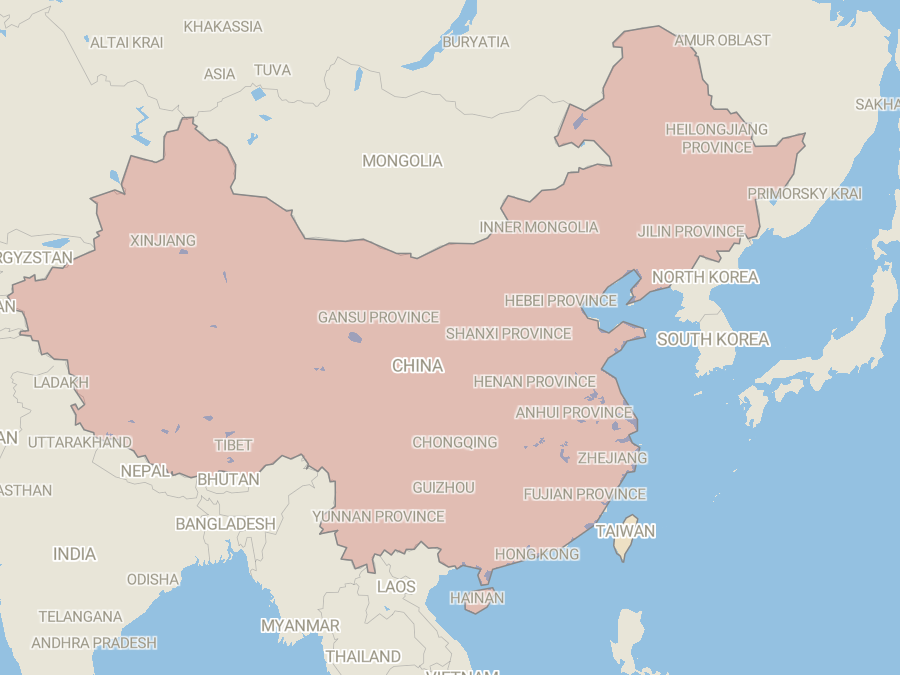 Map: The Conversation, CC-BY-ND @OpenStreetMap contributors.
Crucially, the U.S. hasn’t really said what it will do – so does this support mean economic aid, supply of weapons or U.S. boots on the ground? China and Taiwan are left guessing if – and to what extent – the U.S. will be involved in any China-Taiwan conflict.
By leaving the answer to that question ambiguous, the U.S. holds a threat over China: Invade Taiwan and find out if you face the U.S. as well.
Traditionally, this has been a useful policy for the U.S., but things have changed since it was first rolled out. It was certainly effective when the U.S. was in a much stronger position militarily compared with China. But it might be less effective as a threat now that China’s military is catching up with the U.S.
Leading voices from U.S. allies in Asia, such as Japan, believe that “strategic clarity” might be a better option now – with the U.S. stating outright that it would defend Taiwan if the island were attacked.
What is the history of US relations with Taiwan?
After the victory of the Chinese Communist Party in 1949, the defeated Republic of China government withdrew to the island of Taiwan, located just 100 miles off the shore of Fujian province. And until the 1970s, the U.S. recognized only this exiled Republic of China on Taiwan as the government of China.
 Nixon in China. Bettmann/Getty Images
But in 1971, the United Nations shifted recognition to the People’s Republic of China on the mainland. In 1972, President Richard Nixon made a now-famous trip to China to announce a rapprochement and sign the Shanghai Communique, a joint statement from Communist China and the U.S. signaling a commitment to pursue formal diplomatic relations. A critical section of that document stated: “The United States acknowledges that all Chinese on either side of the Taiwan Strait maintain there is but one China and that Taiwan is a part of China. The United States Government does not challenge that position.”
The wording was crucial: The U.S. was not formally committing to a position on whether Taiwan was part of the China nation. Instead, it was acknowledging what the governments of either territory asserted – that there is “one China.”
Where does US commitment of military support for Taiwan come from?
After establishing formal diplomatic relations with China in 1979, the U.S. built an informal relationship with the ROC on Taiwan. In part to push back against President Jimmy Carter’s decision to recognize Communist China, U.S. lawmakers passed the Taiwan Relations Act in 1979. That act outlined a plan to maintain close ties between the U.S. and Taiwan and included provisions for the U.S. to sell military items to help the island maintain its defense – setting the path for the policy of strategic ambiguity.
What has changed recently?
China has long maintained its desire for an eventual peaceful reunification of its country with the island it considers a rogue province. But the commitment to the principle of “one China” has become increasingly one-sided. It is an absolute for Beijing. In Taiwan, however, resistance to the idea of reunification has grown amid a surge of support for moving the island toward independence.
Beijing has become more aggressive of late in asserting that Taiwan must be “returned to China.” Domestic politics plays a role in this. At times of internal instability in China, Beijing has sounded a more belligerent tone on relations between the two entities separated by the Taiwan Strait. We have seen this over the past year with Beijing sending military aircraft into Taiwan’s Air Defense Zone.
Meanwhile, Chinese assertion of increased authority over Hong Kong has damaged the argument for “one country, two systems” as a means of peaceful reunification with Taiwan.
How has the US position shifted in the face of Beijing’s stance?
Biden has definitely been more openly supportive of Taiwan than previous presidents. He officially invited a representative from Taiwan to his inauguration – a first for an incoming president – and has repeatedly made it clear that he views Taiwan as an ally.
He also didn’t overturn the Taiwan Travel Act passed under the the previous administration of Donald Trump. This legislation allows U.S. officials to visit Taiwan in an official capacity.
In August 2022, U.S. House Speaker Nancy Pelosi visited Taiwan, making her the highest-profile U.S. politician to go to the island in decades.
Meanwhile, for the second time, Biden in his “60 Minutes” interview indicated a belief that it was up to Taiwan to decide its future, departing slightly from the usual line that the U.S. doesn’t support changes to the status quo. However, Biden has also said he does not support a unilateral declaration of independence from Taiwan.
So there has been a shift to a degree. But the White House is keen not to overstate any change. At heart, there is a desire by the U.S. to not stray from the Shanghai Communique.
So is an invasion of Taiwan likely?
The current rhetoric from the U.S. and response from China do raise the risk of conflict, but I don’t think we are at that point yet. Any invasion across the Taiwan Strait would be militarily complex. It also comes with risks of backlash from the international community. Taiwan would receive support from not only the U.S. – in an unclear capacity, given Biden’s remarks – but also Japan and likely other countries in the region.
Meanwhile, China maintains that it wants to see reintegration through peaceful means. As long as Taiwan doesn’t force the issue and declare independence unilaterally, I think there is tolerance in Beijing to wait it out. And despite some commentary to the contrary, I don’t think the invasion of Ukraine has raised the prospects of a similar move on Taiwan. In fact, given that Russia is now bogged down in a monthslong conflict that has hit its military credibility and economy, the Ukraine invasion may actually serve as a warning to Beijing.
This is an update to an article that was originally published on May 24, 2022.
This article is republished from The Conversation under a Creative Commons license. Read the original article.
]]>
Meredith Oyen, Associate Professor of History and Asian Studies, UMBC. President Joe Biden has – not for the first time – suggested that the U.S. would intervene “militarily” should China...
https://umbc.edu/stories/biden-again-indicates-that-us-will-defend-taiwan-militarily/
https://my3.my.umbc.edu/api/v0/pixel/news/127756/guest@my.umbc.edu/2e57e1ff30b15ff9ad42ebb620e16b7e/api/pixel
asianstudies
cahss
cahssresearch
cs3
discovery
history
international
magazine
UMBC News & Magazine
https://my3.my.umbc.edu/groups/umbc-news-magazine
https://assets1-my.umbc.edu/system/shared/avatars/groups/000/001/943/24435aa6207c452e7bc15cc74b42c7bb/xsmall.png?1748556657
https://assets1-my.umbc.edu/system/shared/avatars/groups/000/001/943/24435aa6207c452e7bc15cc74b42c7bb/original.png?1748556657
https://assets2-my.umbc.edu/system/shared/avatars/groups/000/001/943/24435aa6207c452e7bc15cc74b42c7bb/xxlarge.png?1748556657
https://assets2-my.umbc.edu/system/shared/avatars/groups/000/001/943/24435aa6207c452e7bc15cc74b42c7bb/xlarge.png?1748556657
https://assets3-my.umbc.edu/system/shared/avatars/groups/000/001/943/24435aa6207c452e7bc15cc74b42c7bb/large.png?1748556657
https://assets1-my.umbc.edu/system/shared/avatars/groups/000/001/943/24435aa6207c452e7bc15cc74b42c7bb/medium.png?1748556657
https://assets2-my.umbc.edu/system/shared/avatars/groups/000/001/943/24435aa6207c452e7bc15cc74b42c7bb/small.png?1748556657
https://assets1-my.umbc.edu/system/shared/avatars/groups/000/001/943/24435aa6207c452e7bc15cc74b42c7bb/xsmall.png?1748556657
https://assets2-my.umbc.edu/system/shared/avatars/groups/000/001/943/24435aa6207c452e7bc15cc74b42c7bb/xxsmall.png?1748556657
UMBC News & Magazine
0
0
false
Mon, 19 Sep 2022 16:07:15 -0400
Mon, 19 Sep 2022 16:07:15 -0400
Americans think they know a lot about politics – and it’s bad for democracy that they’re so often wrong in their confidence

Ian Anson, Associate Professor of Political Science, UMBC
As statewide primaries continue through the summer, many Americans are beginning to think about which candidates they will support in the 2022 general election.
This decision-making process is fraught with difficulties, especially for inexperienced voters.
Voters must navigate angry, emotion-laden conversations about politics when trying to sort out whom to vote for. Americans are more likely than ever to view politics in moral terms, meaning their political conversations sometimes feel like epic battles between good and evil.
But political conversations are also shaped by, obviously, what Americans know – and, less obviously, what they think they know – about politics.
In recent research, I studied how Americans’ perceptions of their own political knowledge shape their political attitudes. My results show that many Americans think they know much more about politics than they really do.
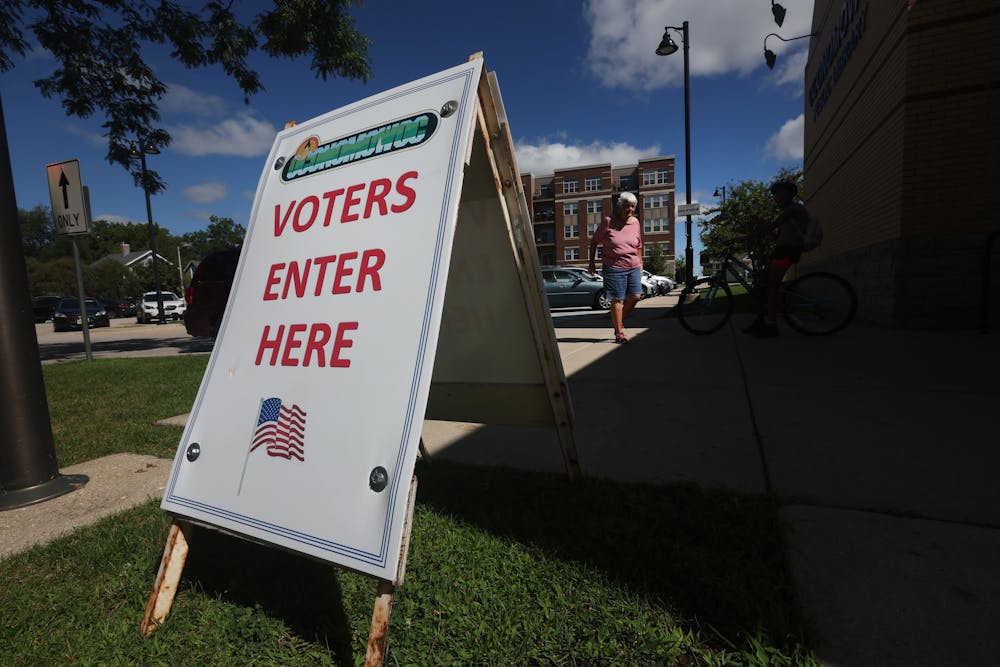
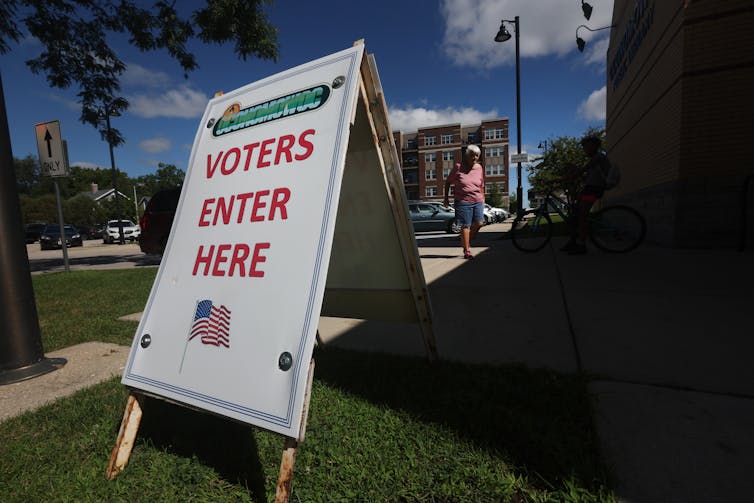 Voters arrive to cast their primary ballots at a polling place on Aug. 9, 2022, in Oconomowoc, Wisconsin.
Scott Olson/Getty Images
Knowledge deficit, confidence surplus
Over the past five years, I have studied the phenomenon of what I call “political overconfidence.” My work, in tandem with other researchers’ studies, reveals the ways it thwarts democratic politics.
Political overconfidence can make people more defensive of factually wrong beliefs about politics. It also causes Americans to underestimate the political skill of their peers. And those who believe themselves to be political experts often dismiss the guidance of real experts.
Political overconfidence also interacts with political partisanship, making partisans less willing to listen to peers across the aisle.
The result is a breakdown in the ability to learn from one another about political issues and events.
A ‘reality check’ experiment
In my most recent study on the subject, I tried to find out what would happen when politically overconfident people found out they were mistaken about political facts.
To do this, I recruited a sample of Americans to participate in a survey experiment via the Lucid recruitment platform. In the experiment, some respondents were shown a series of statements that taught them to avoid common political falsehoods. For instance, one statement explained that while many people believe that Social Security will soon run out of money, the reality is less dire than it seems.
My hypothesis was that most people would learn from the statements, and become more wary of repeating common political falsehoods. However, as I have found in my previous studies, a problem quickly emerged.
The problem
First, I asked respondents a series of basic questions about American politics. This quiz included topics like which party controls the House of Representatives – the Democrats – and who the current Secretary of Energy is – Jennifer Granholm. Then, I asked them how well they thought they did on the quiz.
Many respondents who believed they were top performers were actually among those who scored the worst. Much akin to the results of a famous study by Dunning and Kruger, the poorest performers did not generally realize that they lagged behind their peers.
Of the 1,209 people who participated, around 70% were overconfident about their knowledge of politics. But this basic pattern was not the most worrying part of the results.
The overconfident respondents failed to change their attitudes in response to my warnings about political falsehoods. My investigation showed that they did read the statements, and could report details about what they said. But their attitudes toward falsehoods remained inflexible, likely because they – wrongly – considered themselves political experts.
But if I could make overconfident respondents more humble, would they actually take my warnings about political falsehoods to heart?
Poor self-assessment
My experiment sought to examine what happens when overconfident people are told their political knowledge is lacking. To do this, I randomly assigned respondents to receive one of three experimental treatments after taking the political knowledge quiz. These were as follows:
- Respondents received statements teaching them to avoid political falsehoods.
- Respondents did not receive the statements.
- Respondents received both the statements and a “reality check” treatment. The reality check showed how respondents fared on the political quiz they took at the beginning of the survey. Along with their raw score, the report showed how respondents ranked among 1,000 of their peers.
For example, respondents who thought they had aced the quiz might have learned that they got one out of five questions right, and that they scored worse than 82% of their peers. For many overconfident respondents, this “reality check” treatment brought them down to earth. They reported much less overconfidence on average when I followed up with them.
Finally, I asked all the respondents in the study to report their levels of skepticism toward five statements. These statements are all common political falsehoods. One statement, for example, asserted that violent crime had risen over the prior decade – it hadn’t. Another claimed the U.S. spent 18% of the federal budget on foreign aid – the real number was less than 1%.
I expected most respondents who had received my cautionary statements to become more skeptical of these misinformed statements. On average, they did. But did overconfident respondents learn this lesson too?
 Those who believe themselves to be political experts often dismiss the guidance of real experts. IvelinRadkov/iStock/Getty Images
Reality check: Mission accomplished
The results of the study showed that overconfident respondents began to take political falsehoods seriously only if they had experienced my “reality check” treatment first.
While overconfident respondents in other conditions showed no reaction, the humbling nature of the “reality check,” when they realized how wrong they had been, led overconfident participants in that condition to revise their beliefs. They increased their skepticism of political falsehoods by a statistically significant margin.
Overall, this “reality check” experiment was a success. But it reveals that outside of the experiment, political overconfidence stands in the way of many Americans’ ability to accurately perceive political reality.
The problem of political overconfidence
What, if anything, can be done about the widespread phenomenon of political overconfidence?
While my research cannot determine whether political overconfidence is increasing over time, it makes intuitive sense that this problem would be growing in importance in an era of online political discourse. In the online realm, it is often difficult to appraise the credibility of anonymous users. This means that false claims are easily spread by uninformed people who merely sound confident.
To combat this problem, social media companies and opinion leaders could seek ways to promote discourse that emphasizes humility and self-correction. Because confident, mistaken self-expression can easily drown out more credible voices in the online realm, social media apps could consider promoting humility by reminding posters to reconsider the “stance,” or assertiveness, of their posts.
While this may seem far-fetched, recent developments show that small nudges can lead to powerful shifts in social media users’ online behavior.
For example, Twitter’s recent inclusion of a pop-up message that asks would-be posters of news articles to “read before tweeting” caused users to rethink their willingness to share potentially misleading content.
A gentle reminder to avoid posting bold claims without evidence is just one possible way that social media companies could encourage good online behavior. With another election season soon upon us, such a corrective is urgently needed.
Ian Anson, Associate Professor of Political Science, University of Maryland, Baltimore County
This article is republished from The Conversation under a Creative Commons license. Read the original article.
]]>
Ian Anson, Associate Professor of Political Science, UMBC As statewide primaries continue through the summer, many Americans are beginning to think about which candidates they will support in...
https://umbc.edu/stories/americans-think-they-know-a-lot-about-politics/
https://my3.my.umbc.edu/api/v0/pixel/news/127247/guest@my.umbc.edu/f045cfea3a6d6704df19f99aaac1835a/api/pixel
cs3
discovery
magazine
politicalscience
research
the-conversation
UMBC News & Magazine
https://my3.my.umbc.edu/groups/umbc-news-magazine
https://assets1-my.umbc.edu/system/shared/avatars/groups/000/001/943/24435aa6207c452e7bc15cc74b42c7bb/xsmall.png?1748556657
https://assets1-my.umbc.edu/system/shared/avatars/groups/000/001/943/24435aa6207c452e7bc15cc74b42c7bb/original.png?1748556657
https://assets2-my.umbc.edu/system/shared/avatars/groups/000/001/943/24435aa6207c452e7bc15cc74b42c7bb/xxlarge.png?1748556657
https://assets2-my.umbc.edu/system/shared/avatars/groups/000/001/943/24435aa6207c452e7bc15cc74b42c7bb/xlarge.png?1748556657
https://assets3-my.umbc.edu/system/shared/avatars/groups/000/001/943/24435aa6207c452e7bc15cc74b42c7bb/large.png?1748556657
https://assets1-my.umbc.edu/system/shared/avatars/groups/000/001/943/24435aa6207c452e7bc15cc74b42c7bb/medium.png?1748556657
https://assets2-my.umbc.edu/system/shared/avatars/groups/000/001/943/24435aa6207c452e7bc15cc74b42c7bb/small.png?1748556657
https://assets1-my.umbc.edu/system/shared/avatars/groups/000/001/943/24435aa6207c452e7bc15cc74b42c7bb/xsmall.png?1748556657
https://assets2-my.umbc.edu/system/shared/avatars/groups/000/001/943/24435aa6207c452e7bc15cc74b42c7bb/xxsmall.png?1748556657
UMBC News & Magazine
1
0
false
Fri, 02 Sep 2022 14:21:45 -0400
Fri, 02 Sep 2022 14:21:45 -0400
UMBC’s Nkiru Nnawulezi and D.C. community partners make the case for survivor-centered housing services

In fall 2016 the DC Coalition Against Domestic Violence (DCCADV) approached Nkiru Nnawulezi for her help collecting data on the experiences of domestic violence survivors in Washington D.C. She was eager to lend her expertise.
“As a community psychologist, it is a dream come true to be able to do a study that community partners initiated, said they wanted, asked for, and would meet a particular need in the community,” says Nnawulezi.
Nnawulezi is an associate professor of psychology at UMBC and affiliate faculty at the Yale School of Public Health. Her research examines the factors that enhance equity in housing for domestic violence survivors, including survivors of color; queer and trans survivors; and those who are low-income, unhoused, experiencing addiction, living with HIV, or experiencing severe mental health conditions.
She knew her first task for this major project would be to connect with community partners across D.C. to together identify the most pressing needs of local domestic violence survivors.
Identifying the right question
Nnawulezi was already well-connected with a network of experts in her field, as associate editor of the Journal of Family Violence and on the editorial board of Community Psychology in the Global Perspective. She also serves as a research and evaluation advisor to the National Resource Center on Domestic Violence and Ujima: The National Center on Violence Against Women in the Black Community.
To begin this project she convened four round table discussions with scholars, service providers, and legal experts. This included participants from American University’s Washington College of Law Domestic Violence Clinic; Catholic University’s Columbus Community Legal Services and Families and the Law Clinic; George Mason University; Georgetown Law’s Domestic Violence Clinic; GW Law’s Family Justice Litigation Clinic; and Howard University’s Interpersonal Violence Prevention Program.
The meetings revealed housing as the most pressing issue facing survivors of domestic violence in Washington, D.C. The Virginia Williams Family Resource Center (VWFRC) serves as the central point of intake for families experiencing housing instability in the District. But many survivors seeking housing assistance through the center were not being housed. Understanding why and how this was happening became the purpose of the study.
Designing a community-based study
With a research question in mind and a research community established, Nnawulezi and Liz Odongo, DCCADV director of grants and programs, co-founded the Domestic Violence Action Research Collective (DVARC). To support this work, the collective received funding from the Center for Victim Research, through the Office for Victims of Crime within the U.S. Department of Justice.
“DVARC gathers victimization researchers, advocates, and practitioners to design and conduct community-based research and evaluation studies to enhance survivors’ safety, build their power, and support policy and practice within multiple systems across the city,” says Nnawulezi.
The collective’s first task would be to better understand the VWFRC’s screening process, including the questions the center used to assess whether violence was the primary cause of current homelessness and survivors’ perceptions of the screening process. Next, they would determine how the screening process influenced survivors’ future decision making and experiences with housing support.
Over a period of a year, the research team connected with 779 clients seeking housing assistance and identified 291 of that group as having experienced domestic violence. Of that group, 101 agreed to participate in the research study. The final sample that participated in an in-depth confidential interview included 41 survivors. All were survivors between the ages of 24 and 52, and they were primarily Black, heterosexual, cisgender women.
Survivor experiences
The team’s data show that domestic violence survivors reported numerous systemic and cultural barriers to access safe, affordable, and equitable housing in Washington, D.C. Of the 41 women, only 4 received immediate crisis housing assistance from the VWFRC, despite significant need.
Survivors desired to be treated with more respect by staff, and get housing resource support that aligned with their individual needs. Instead, many women described treatment by staff as unfair or dismissive. A few reported bias incidents based on their race and class that made it increasingly challenging to ask for and receive services. Others reported not receiving services regardless of need, or having to return to the VWFRC an average of 2-5 times to attempt to become eligible for services.
Staff were also not consistent in asking about or responding to safety concerns that survivors disclosed, participants reported. Some shared that they had experienced economic, verbal, and mental abuse, but because they had not experienced physical abuse they were not considered survivors. And some respondents who received assistance reported not having access to the additional financial resources needed to move.
Making lasting change
The DVARC recommends that the District continue to fund sustainable community-based systems of support that are survivor-centered and trauma-informed, and that address the challenges already identified. To determine next steps, the DCCADV also convened an advisory group with survivors from the study to further review the preliminary data and provide recommendations for future advocacy and research studies.
“I believe that it is possible for us to have a city where survivors are treated justly and fairly,” says Nnawulezi. “I love being able to think at the systems level about what needs to shift to improve people’s lives. It’s an incredible opportunity to be a part of this group, in the city that I love, working with people that I love, and working to improve the lives of people that I am deeply committed to.”
]]>
In fall 2016 the DC Coalition Against Domestic Violence (DCCADV) approached Nkiru Nnawulezi for her help collecting data on the experiences of domestic violence survivors in Washington D.C. She...
https://umbc.edu/stories/umbc-nkiru-nnawulezi/
https://my3.my.umbc.edu/api/v0/pixel/news/127029/guest@my.umbc.edu/0a174c4bb8f88c1efb7dedbb947ae743/api/pixel
cahss
cahssresearch
cs3
news
policy-and-society
psychology
rca-1
research
UMBC News & Magazine
https://my3.my.umbc.edu/groups/umbc-news-magazine
https://assets1-my.umbc.edu/system/shared/avatars/groups/000/001/943/24435aa6207c452e7bc15cc74b42c7bb/xsmall.png?1748556657
https://assets1-my.umbc.edu/system/shared/avatars/groups/000/001/943/24435aa6207c452e7bc15cc74b42c7bb/original.png?1748556657
https://assets2-my.umbc.edu/system/shared/avatars/groups/000/001/943/24435aa6207c452e7bc15cc74b42c7bb/xxlarge.png?1748556657
https://assets2-my.umbc.edu/system/shared/avatars/groups/000/001/943/24435aa6207c452e7bc15cc74b42c7bb/xlarge.png?1748556657
https://assets3-my.umbc.edu/system/shared/avatars/groups/000/001/943/24435aa6207c452e7bc15cc74b42c7bb/large.png?1748556657
https://assets1-my.umbc.edu/system/shared/avatars/groups/000/001/943/24435aa6207c452e7bc15cc74b42c7bb/medium.png?1748556657
https://assets2-my.umbc.edu/system/shared/avatars/groups/000/001/943/24435aa6207c452e7bc15cc74b42c7bb/small.png?1748556657
https://assets1-my.umbc.edu/system/shared/avatars/groups/000/001/943/24435aa6207c452e7bc15cc74b42c7bb/xsmall.png?1748556657
https://assets2-my.umbc.edu/system/shared/avatars/groups/000/001/943/24435aa6207c452e7bc15cc74b42c7bb/xxsmall.png?1748556657
UMBC News & Magazine
0
0
false
Thu, 25 Aug 2022 11:50:02 -0400
Thu, 25 Aug 2022 11:50:02 -0400
Anti-abortion pregnancy centers will likely outlast the age of Roe – here’s how they’re funded and the services they provide

Laura Antkowiak, Professor of Political Science, UMBC
Experts predict increased economic hardship now that the U.S. Supreme Court has overturned Roe v. Wade in its Dobbs v. Jackson Women’s Health Organization decision.
Three-quarters of abortion patients in the United States have incomes that place them below or just barely above the federal poverty line of US$26,500 for a family of four in 2021. The inability to afford a child ranks among the most common reasons women give when they explain why they are ending a pregnancy.
The anti-abortion movement is often criticized as caring little about these matters. But as a political scientist who has studied the intersections of abortion and social welfare issues, I became intrigued by a large but little-known subset of anti-abortion activists who claimed to support women during pregnancy and after childbirth.
My 2020 book on this “pregnancy help” work indicates that the anti-abortion movement does provide support to low-income families, even if not in the way its critics might prefer.
The ‘pregnancy help’ movement
This work mostly occurs within the anti-abortion movement’s own charitable organizations. Participants in this “pregnancy help movement,” according to Margaret Hartshorn, the former president of one such organization, strive to make abortion “unwanted now and unthinkable in future generations” by ensuring “that no woman ever feels forced to have an abortion because of lack of support or practical alternatives.”
People in the movement run maternity homes, adoption and social service agencies, charitable medical practices, hotlines, support groups and aid networks. However, the core institutions of their movement are pregnancy centers. Pregnancy centers typically offer free pregnancy tests, sonograms, counseling and promises of material support in the hopes of persuading women to carry unintended pregnancies to term.
The first ones began to open in the U.S. in the late 1960s. They outnumbered abortion providers at least as early as 2013. A July 2018 directory listed 2,740 U.S. pregnancy centers. Lehigh University sociologist Ziad Munson writes that such outreach involves more people, volunteer hours and organizations than any other type of anti-abortion activism.
Based on my interviews of pregnancy center leaders and review of various movement communications, these organizations are mostly funded by individual donations, commonly raised through banquets, walks, races or church-based collections of money and goods. Some anti-abortion groups like Focus on the Family and the Knights of Columbus give them grants.
Pregnancy centers typically aren’t affiliated with specific churches, though they often frame themselves as ministries modeled on Jesus Christ’s love for people who are hurting and marginalized.
In 13 states as of 2021, pregnancy centers could apply for funding from state-run Alternatives to Abortion programs. As of March 2022, as many as 19 states may have directed a proportion of “Choose Life” license plate proceeds to pregnancy centers. An Associated Press investigation of fiscal 2022 state budgets found that 12 states funded pregnancy centers, providing US$89 million.
Centers can also apply for select federal grants. According to a report on U.S. pregnancy center services by the Charlotte Lozier Institute, an anti-abortion think tank, 17% of U.S. centers received some public money in 2019.
By comparison, the Planned Parenthood Federation of America, which provides abortions and other reproductive health care services, reported receiving about $618 million – or 38% of its revenue – in government grants and payments for services in the fiscal year ending June 30, 2020.
U.S. pregnancy centers in 2019, also according to the Lozier Institute, performed more than 730,000 pregnancy tests and met with nearly 1 million new clients.
For perspective, the U.S. recorded 3.75 million live births that year. In 2017, the most recent data available, just over 860,000 abortions were performed. A new peer-reviewed study of pregnant women who were searching online for an abortion provider – suggesting they may be more internet-savvy, older and more socioeconomically advantaged than U.S. abortion-seekers generally – found that at least 13% of them visited a pregnancy center.
 Tatiana Kutina/EyeEm via Getty Images.
Pregnancy center aid
Anti-abortion advocates paint pregnancy centers as the compassionate alternative to abortion. Abortion-rights activists describe them as threats to public health that advertise deceptively, offer few health care services and infuse their counseling with misinformation and emotional coercion.
My research did not attempt to assess the quality of counseling provided by the centers. Rather, I focused on broadly understanding and describing the movement and measuring the extent of help they provide to needy families.
Similar to data I collected in 2012, a 2019 report by the Lozier Institute claimed that 94% of centers provided material aid. The report credited U.S. pregnancy centers with distributing about 1.3 million packages of diapers, 690,000 packages of wipes, 2 million baby outfits, 30,000 new car seats and 20,000 strollers. They valued these goods at nearly $27 million. I also found pregnancy centers provided personalized help in navigating community resources for housing, health care, creditor mediation and domestic violence recovery.
Activists told me that helping families meet their material needs was integral to their missions, greatly needed, and simply “Christian” or “pro-life.” Available data suggests that the women who use these centers tend to be under 30 and unmarried.
My research also noted that pregnancy centers were increasingly tying material aid to participation in their parenting programs.
Another trending service they offer is ultrasound imaging. Leaders I interviewed felt that offering a medical service could increase centers’ credibility and that viewing an image of their fetus would inspire clients to “choose life.” Trained nurses overseen by an often off-site physician “medical director” usually perform the scans, but otherwise, critics correctly assert that most pregnancy center staff lack medical training.
Interviews of 21 pregnancy center clients over a period between 2015 and 2017 led medical sociologist Katrina Kimport of the University of California, San Francisco to conclude that “low-income women can find these centers to be meaningful and appreciated sources of free emotional support, pregnancy-related services and material goods,” even if the women ultimately needed more economic resources than centers could provide and sometimes struggled with program requirements.
Kimport continued: “Although these centers have been rightly criticized for disseminating scientifically inaccurate materials and employing potentially deceptive practices, the policy debate about their legitimacy needs to be more nuanced.”
Pregnancy help in a post-Roe America
Pregnancy center volunteers and employees I surveyed in 2012 overwhelmingly agreed that pregnancy centers would remain needed if the federal right to abortion was overturned. Centers are already most numerous, my statistical analysis of location data found, where public opposition to abortion is highest, abortion rates are lowest and abortion providers are the most scarce. Some anti-abortion leaders are calling the movement to follow the fall of Roe with increased aid to low-income people, some of which would flow through pregnancy centers.
The kind of aid pregnancy help groups offer won’t begin to cover all costs of childbearing, or solve larger socioeconomic problems. Many women inclined toward abortion likely don’t see anti-abortion pregnancy centers as desirable service providers.
Still, they attract anti-abortion activists who appear to take seriously what one interviewee called the “consequences to a choice for life.” In my view, they could potentially participate constructively in a conversation about poverty and childbearing in a post-Roe America.
Laura Antkowiak, Associate Professor of Political Science, University of Maryland, Baltimore County
This article is republished from The Conversation under a Creative Commons license. Read the original article.
]]>
Laura Antkowiak, Professor of Political Science, UMBC Experts predict increased economic hardship now that the U.S. Supreme Court has overturned Roe v. Wade in its Dobbs v. Jackson Women’s...
https://umbc.edu/stories/anti-abortion-pregnancy-centers/
https://my3.my.umbc.edu/api/v0/pixel/news/126070/guest@my.umbc.edu/79602999d6e26cfed5fcc2e195f6112f/api/pixel
cahss
cahssresearch
cs3
discovery
magazine
politicalscience
the-conversation
UMBC News & Magazine
https://my3.my.umbc.edu/groups/umbc-news-magazine
https://assets1-my.umbc.edu/system/shared/avatars/groups/000/001/943/24435aa6207c452e7bc15cc74b42c7bb/xsmall.png?1748556657
https://assets1-my.umbc.edu/system/shared/avatars/groups/000/001/943/24435aa6207c452e7bc15cc74b42c7bb/original.png?1748556657
https://assets2-my.umbc.edu/system/shared/avatars/groups/000/001/943/24435aa6207c452e7bc15cc74b42c7bb/xxlarge.png?1748556657
https://assets2-my.umbc.edu/system/shared/avatars/groups/000/001/943/24435aa6207c452e7bc15cc74b42c7bb/xlarge.png?1748556657
https://assets3-my.umbc.edu/system/shared/avatars/groups/000/001/943/24435aa6207c452e7bc15cc74b42c7bb/large.png?1748556657
https://assets1-my.umbc.edu/system/shared/avatars/groups/000/001/943/24435aa6207c452e7bc15cc74b42c7bb/medium.png?1748556657
https://assets2-my.umbc.edu/system/shared/avatars/groups/000/001/943/24435aa6207c452e7bc15cc74b42c7bb/small.png?1748556657
https://assets1-my.umbc.edu/system/shared/avatars/groups/000/001/943/24435aa6207c452e7bc15cc74b42c7bb/xsmall.png?1748556657
https://assets2-my.umbc.edu/system/shared/avatars/groups/000/001/943/24435aa6207c452e7bc15cc74b42c7bb/xxsmall.png?1748556657
UMBC News & Magazine
1
0
false
Tue, 28 Jun 2022 13:31:49 -0400
Tue, 28 Jun 2022 13:31:49 -0400