Revealing galactic history with cosmic rays
What if we could peer back in time to understand how our galaxy was built—one exploding star at a time?
When massive stars reach the end of their lives, they don’t go quietly. They explode in spectacular fashion, forging heavy elements and hurling them across space. Some of these particles, known as cosmic rays, eventually reach detectors built by humans. By studying which elements arrive and in what amounts, scientists hope to piece together the story of our galaxy’s chemical evolution.
But there’s a problem: As these cosmic rays race through space, they smash into hydrogen atoms and break apart. These reactions, called “proton spallation,” turn heavier elements like iron into lighter ones like sodium or chromium. Without knowing exactly how often these “break-ups” happen, it’s hard to translate what detectors see into a true picture of what’s out there. But if scientists could accurately reverse-engineer the process, determining how much of one element came from another, they would better understand the galaxy’s true chemical makeup.
Now, Priyarshini Ghosh, a nuclear physicist at UMBC’s Center for Space Sciences and Technology, is performing a first-of-its-kind experiment, hoping to fill some of this knowledge gap.
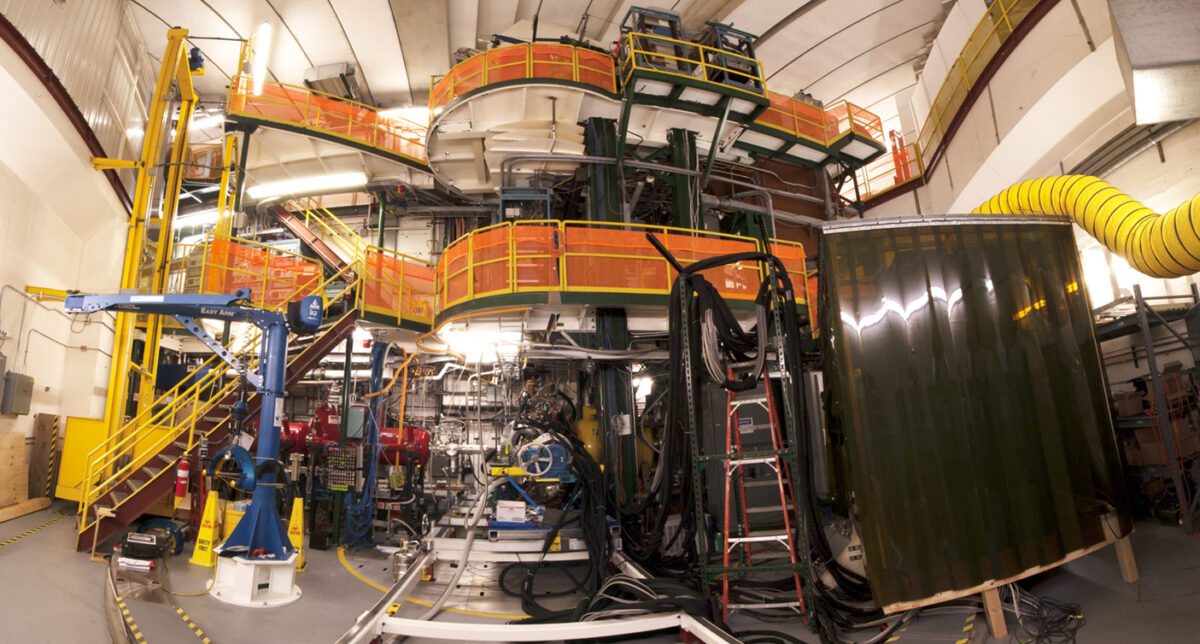 The research team will run a novel experiment on the S800 Spectrograph at the Facility for Rare Ion Beams at Michigan State University. They expect the results to increase understanding of the chemical makeup of the Milky Way galaxy. (Courtesy of FRIB)
In early June, Ghosh and her collaborators led the Facility for Rare Isotope Beams (FRIB) at Michigan State University to study, for the first time ever, how chromium-52 breaks apart when it interacts with hydrogen. Chromium-52 is of particular interest because it can shed light on processes happening in our galaxy, and yet it has never been measured before. Using a high-energy beam of this stable form of chromium, the team will record “proton spallation cross sections”—measures of the likelihood of violent interactions between protons and heavy ions. The experiment essentially recreates inside a Michigan laboratory what’s happening to cosmic rays in space, Ghosh says.
“Nuclear data acts as a translator from the data collected by missions like Voyager, converting it into a meaningful understanding of our galaxy,” Ghosh explains.
Mimicking cosmic rays
Current models don’t quite match what telescopes and spacecraft actually observe, especially for elements like chromium, titanium, and vanadium. The differences have puzzled researchers for years. These questions linger because the right kind of experimental data has been extremely laborious and expensive to obtain—until now.
“A sample of chromium-52 the size of a chocolate square can cost around $150,000,” Ghosh notes. So instead of using a large piece of chromium-52, FRIB’s chemists will collide a beam of less-expensive nickel-58 with a carbon target, producing a pure chromium beam—the first time this has ever been achieved.
 Priyarshini Ghosh operates a scanning electron microscope at Kansas State University, where she completed her Ph.D. in nuclear engineering. (Courtesy of Kansas State University)
The team will run the experiment for about 43 hours, collecting data on 50 to 60 different fragments produced as the chromium beam collides with various detectors and breaks apart. Then comes the long work of analysis. The results are expected to sharpen astrophysical models and bring us closer to understanding how elements are created and spread throughout the Milky Way.
“What makes this project exciting is that FRIB lets us reproduce, in a controlled way, a process that naturally happens in the universe: cosmic rays traveling from a dying star through the galaxy,” says Jorge Pereira, FRIB’s magnetic spectrometer operation group leader.
“Arm-wrestling with nature”
This chromium experiment is the first in a program that Ghosh is developing at UMBC dedicated to building a comprehensive proton-spallation cross-section database. Proton-based reactions—like the ones cosmic rays experience with hydrogen—have received little attention, even though they’re crucial for interpreting data from space.
By building a reliable database of these proton cross sections, the team is laying the groundwork that could transform how we read the cosmos. The results will directly support the upcoming TIGERISS mission, set to fly to the International Space Station in 2027. TIGERISS will be the first instrument to measure elements from boron all the way to lead with remarkable precision—and Ghosh’s nuclear data will help scientists make sense of what it sees.
For Ghosh, the thrill lies in the experimental challenge itself.
“This is such a feat of nuclear engineering,” she says. “We’re using detectors to expose the physics in very specific ways—arm-wrestling with nature to get the answers we need.”
]]>
What if we could peer back in time to understand how our galaxy was built—one exploding star at a time? When massive stars reach the end of their lives, they don’t go quietly. They explode in...
https://umbc.edu/stories/revealing-galactic-history-with-cosmic-rays/
https://my3.my.umbc.edu/api/v0/pixel/news/160273/guest@my.umbc.edu/410394584f051775b6fcd874feb81096/api/pixel
csst
discovery
magazine
research
science-and-tech
story
UMBC News & Magazine
https://my3.my.umbc.edu/groups/umbc-news-magazine
https://assets1-my.umbc.edu/system/shared/avatars/groups/000/001/943/24435aa6207c452e7bc15cc74b42c7bb/xsmall.png?1748556657
https://assets1-my.umbc.edu/system/shared/avatars/groups/000/001/943/24435aa6207c452e7bc15cc74b42c7bb/original.png?1748556657
https://assets2-my.umbc.edu/system/shared/avatars/groups/000/001/943/24435aa6207c452e7bc15cc74b42c7bb/xxlarge.png?1748556657
https://assets2-my.umbc.edu/system/shared/avatars/groups/000/001/943/24435aa6207c452e7bc15cc74b42c7bb/xlarge.png?1748556657
https://assets3-my.umbc.edu/system/shared/avatars/groups/000/001/943/24435aa6207c452e7bc15cc74b42c7bb/large.png?1748556657
https://assets1-my.umbc.edu/system/shared/avatars/groups/000/001/943/24435aa6207c452e7bc15cc74b42c7bb/medium.png?1748556657
https://assets2-my.umbc.edu/system/shared/avatars/groups/000/001/943/24435aa6207c452e7bc15cc74b42c7bb/small.png?1748556657
https://assets1-my.umbc.edu/system/shared/avatars/groups/000/001/943/24435aa6207c452e7bc15cc74b42c7bb/xsmall.png?1748556657
https://assets2-my.umbc.edu/system/shared/avatars/groups/000/001/943/24435aa6207c452e7bc15cc74b42c7bb/xxsmall.png?1748556657
UMBC News & Magazine
0
0
false
Thu, 21 May 2026 15:17:46 -0400
Thu, 21 May 2026 15:17:46 -0400
Possible tectonic activity on Venus may yield insight into Earth’s past
Vast, quasi-circular features on Venus’ surface may reveal that the planet has ongoing tectonics, according to new research. On Earth, the shifting and recycling of tectonic plates continually renews our planet’s surface. Venus doesn’t have tectonic plates, but its surface is still being deformed by molten material from below.
“These features are not found on Earth today; however, they may have existed when our planet was young and before plate tectonics had been established,” says the study’s lead author, Gael Cascioli, a UMBC assistant research scientist with the Center for Space Sciences and Technology. “By combining gravity and topography data, this research has provided a new and important insight into the possible subsurface processes currently shaping the surface of Venus.”
Seeking to better understand the underlying processes at work on Venus, researchers studied a feature called a corona. Ranging from tens to hundreds of miles across, a corona is most often thought to be the location where a blob of molten, buoyant material from the planet’s mantle rises (called a “plume”), pushing against the uppermost part of the planet’s mantle and its crust. Coronae are usually oval and surrounded by fractures in the crust, and hundreds are known to exist on Venus.
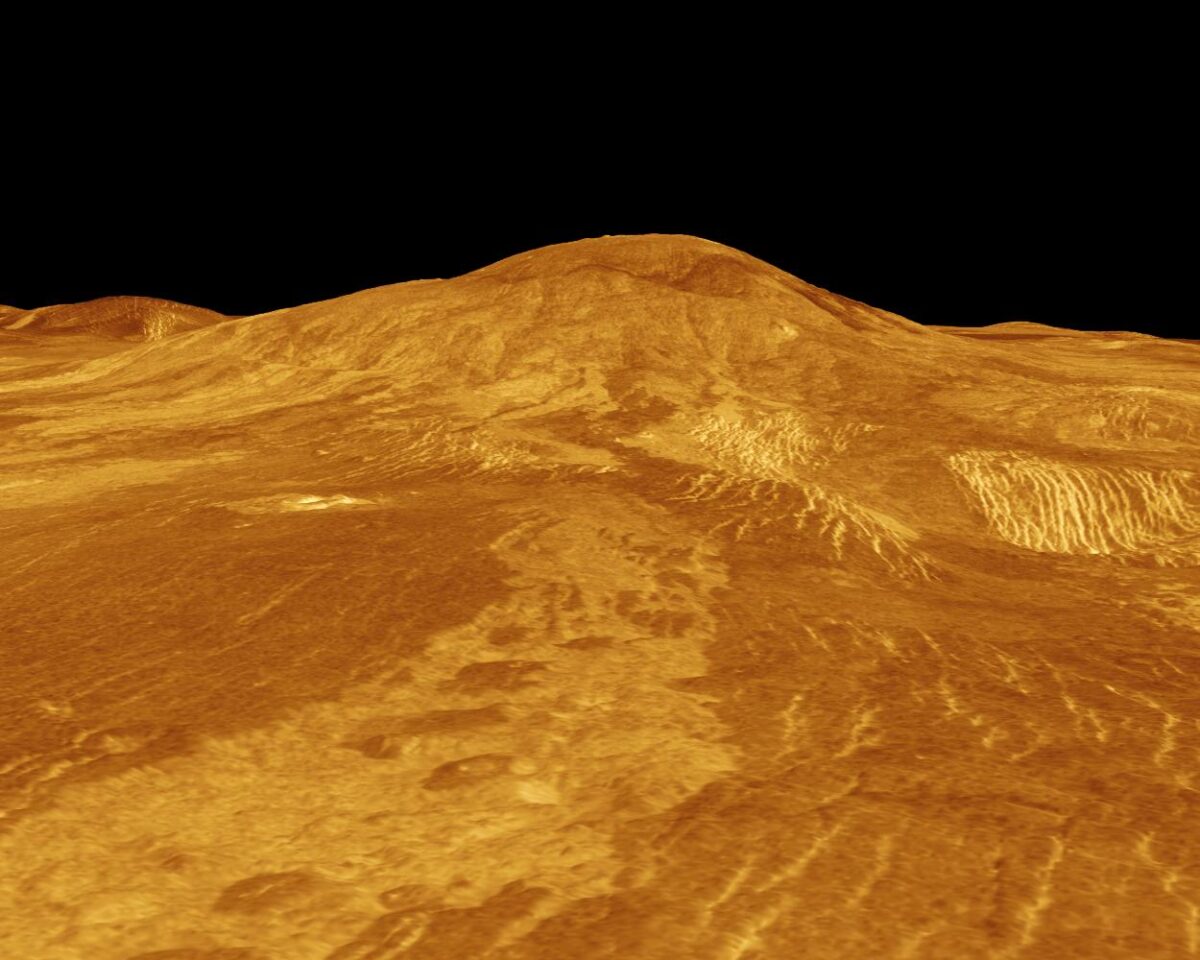 Unlike on Earth, where tectonic plates move sideways and down in a process called subduction, the plumes on Venus might be pushing the surface upward and outward, making the surrounding surface sink down. The scientists also think that in some places, the plumes might be driving volcanoes. Here, Sif Mons, a volcano on Venus, is rendered from data collected by Magellan. The lighter orange trails coming from the peak to the foreground are lava flows. (NASA)
Old data, new discoveries
The new study, published in Science Advances, found telltale signs of corona-shaping activity at or beneath Venus’ surface. These signs may also provide a unique window into Earth’s past. To find them, the authors turned to NASA’s Magellan mission, which orbited Venus in the 1990s and collected what is still the most detailed gravity and topography data of Venus available.
There are various theories about how coronae form. “The most exciting thing for our study is that we can now say there are most likely various and ongoing active processes driving their formation,” coauthor Anna Gülcher, Earth and planetary scientist at the University of Bern in Switzerland, says.
The scientists created detailed 3D models that predicted different ways the coronae might have formed, and then compared them to data from Magellan. Their work revealed that beneath about 70 percent of the coronae they studied, there were hot, low-density plumes rising from deep inside Venus, which might be causing the unique geological activity.
The NASA VERITAS mission, scheduled for launch no earlier than 2031, will be key to filling gaps in understanding of how coronae form. According to coauthor Suzanne Smrekar, planetary scientist at the NASA Jet Propulsion Laboratory (JPL) and principal investigator for VERITAS, the mission will provide much greater resolution than Magellan, supplying “an unprecedented level of detail that could revolutionize our understanding of Venus’ geology and implications for early Earth.”
Read the complete NASA release here.
]]>
Vast, quasi-circular features on Venus’ surface may reveal that the planet has ongoing tectonics, according to new research. On Earth, the shifting and recycling of tectonic plates continually...
https://umbc.edu/stories/tectonic-activity-on-venus/
https://my3.my.umbc.edu/api/v0/pixel/news/150164/guest@my.umbc.edu/9845bc31648d4838b4a64bbfa155d67c/api/pixel
csst
nasa
news
rca
research
science-and-tech
story
UMBC News & Magazine
https://my3.my.umbc.edu/groups/umbc-news-magazine
https://assets1-my.umbc.edu/system/shared/avatars/groups/000/001/943/24435aa6207c452e7bc15cc74b42c7bb/xsmall.png?1748556657
https://assets1-my.umbc.edu/system/shared/avatars/groups/000/001/943/24435aa6207c452e7bc15cc74b42c7bb/original.png?1748556657
https://assets2-my.umbc.edu/system/shared/avatars/groups/000/001/943/24435aa6207c452e7bc15cc74b42c7bb/xxlarge.png?1748556657
https://assets2-my.umbc.edu/system/shared/avatars/groups/000/001/943/24435aa6207c452e7bc15cc74b42c7bb/xlarge.png?1748556657
https://assets3-my.umbc.edu/system/shared/avatars/groups/000/001/943/24435aa6207c452e7bc15cc74b42c7bb/large.png?1748556657
https://assets1-my.umbc.edu/system/shared/avatars/groups/000/001/943/24435aa6207c452e7bc15cc74b42c7bb/medium.png?1748556657
https://assets2-my.umbc.edu/system/shared/avatars/groups/000/001/943/24435aa6207c452e7bc15cc74b42c7bb/small.png?1748556657
https://assets1-my.umbc.edu/system/shared/avatars/groups/000/001/943/24435aa6207c452e7bc15cc74b42c7bb/xsmall.png?1748556657
https://assets2-my.umbc.edu/system/shared/avatars/groups/000/001/943/24435aa6207c452e7bc15cc74b42c7bb/xxsmall.png?1748556657
UMBC News & Magazine
2
0
false
Wed, 14 May 2025 15:34:06 -0400
Wed, 14 May 2025 15:34:06 -0400
Astronomers observe real-time formation of black hole jets for the first time
 Eileen Meyer (Marlayna Demond ’11/UMBC)
A large international team of scientists has observed a phenomenon that astronomers didn’t ever expect to see happen in real time. A new paper published in Astrophysical Journal Letters led by Eileen Meyer, associate professor of physics at UMBC, describes the findings. It reports remarkable increases in radio emission in a few months and formation of plasma jets extending from a black hole over the course of a year.
A galaxy about 270 million light-years away from Earth in the constellation Draco called 1ES 1927+654 is the focus of the excitement. For many years, scientists had classified 1ES 1927+654 as an “active galactic nucleus,” or AGN, meaning it has an active black hole at its center. This particular black hole was adding material at a slow rate—until it wasn’t.
Back in 2018, the black hole first made news when it suddenly increased its activity exponentially. It dramatically increased the rate at which it was consuming material and became over 100 times brighter in the visible light spectrum over the course of a few months. A shift like that was once thought to take far longer than a human lifetime, on the order of thousands to millions of years. Since then, scientists have been observing it closely for any additional interesting phenomena, and 1ES 1927+654 has delivered.
More drama
After the major increase in activity began in 2018, which included nearly a year of extremely high levels of X-ray emission, the black hole quieted down again by 2020—only to dramatically increase its output again in 2023. At that time, it began emitting radio waves at 60 times the previous intensity over just a few months, behavior which has never been monitored in real time for a supermassive black hole.
Some of the highest-resolution imaging of radio frequency emissions was collected using a technique called Very Long Baseline Interferometry (VLBI). It clearly shows a pair of oppositely directed plasma jets forming near the black hole and expanding outward over the course of 2023 – 2024. Among the other unusual behavior of the black hole, this is the first-ever observation of jet formation in real time.
In recent years, scientists have discovered a handful of supermassive black holes that appear to emit far more intensely at radio frequencies compared to when they were first observed, which they call “changing-look AGN.” However, until now all of them had been observed at two timepoints years or decades apart, and the assumption was that “something happened” in between. This new paper gives the very first look at how this kind of change occurs in detail.
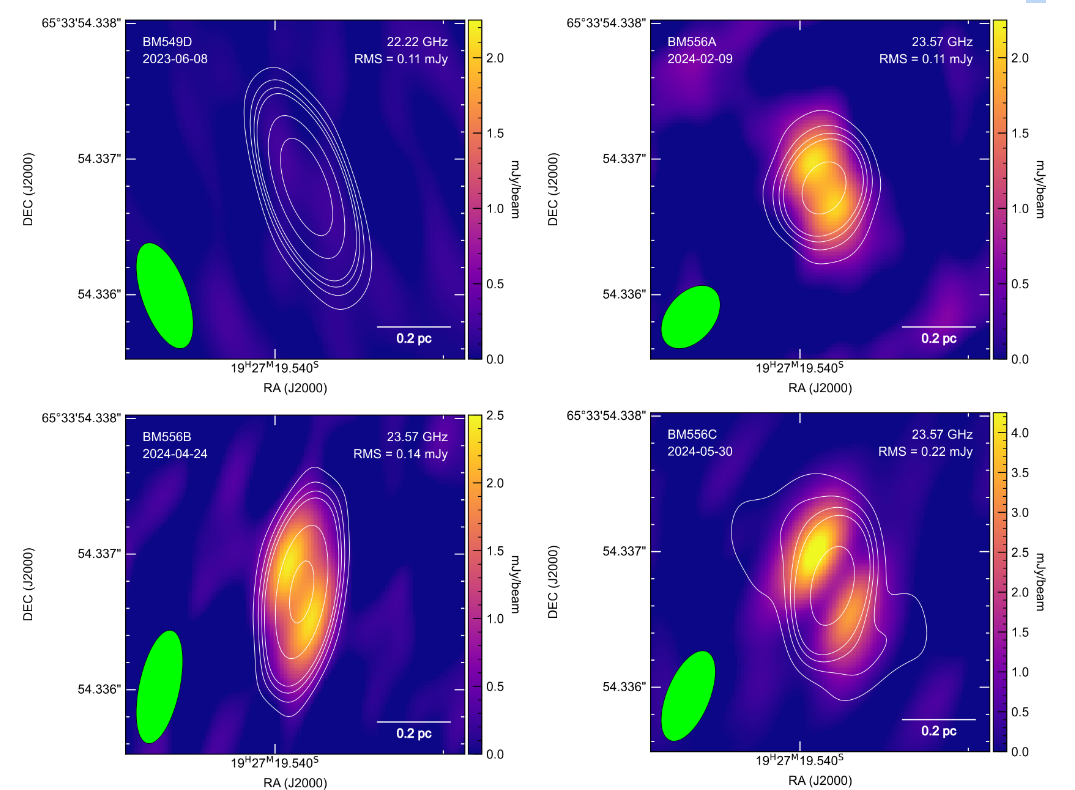 This figure from the new paper shows the plasma jets (yellow blobs) forming. Clockwise from top left, the dates of the images are June 2023, February 2024, April 2024, and May 2024.
Turning on in real time
In some cases, black hole jets “can reach huge scales well outside the host galaxy. They can affect how many stars are forming,” Meyer says. Figuring out how the jets work “is a very important thing, in order to understand the big picture of how the universe is evolving and galaxies evolved.”
 Sibasish Laha (courtesy of Laha)
In the case described in the new paper, “We have very detailed observations of a radio jet ‘turning on’ in real time, and even more exciting are the VLBI observations, which clearly show these plasma blobs moving out from the black hole,” Meyer says. “That shows us that this really is an outflow jet of plasma that’s causing the radio flare. It’s not some other process causing increased radio emission. This is a jet moving at likely 20 to 30 percent of the speed of light originating very near a black hole. That’s the exciting thing.”
Sibasish Laha, an associate research scientist for UMBC with the Center for Space Sciences Technology at Goddard Space Flight Center and second author on the new paper, has long studied changing-look AGN at X-ray wavelengths. On a hunch that 1ES 1927+654’s radio frequency emission might show interesting behavior as well, he reached out to Meyer to form a collaboration to study it and other similar galaxies back in 2020. He is lead author on a companion paper that is currently under review. It includes additional X-ray observations and interpretation of the jet formation event.
“We still do not understand how black holes and their host galaxies interact with each other and co-evolve in cosmic time,” Laha says, “and this study for the first time gives us the rare opportunity to understand how a supermassive black hole ‘talks’ to the host galaxy.”
Not for the faint of heart
In this kind of work, time is of the essence. “Time-domain astronomy,” as it’s called, “is not for the faint of heart,” Meyer says. “You know, there are rapid alerts—something happens and you have to go follow up. You gotta get on it, and it doesn’t matter if it’s midnight, you have to send that email because you know every hour counts. It’s a little stressful.”
 Onic Shuvo (courtesy of Shuvo)
The project became an “all hands on deck” moment for the UMBC collaboration. Once Meyer and Laha saw the huge jump in radio activity in 2023, Meyer says, “We were like, ‘whoa, ok, something is happening.’ This has never been seen before. We got very excited, so this is where we went all in on basically trying to grab every radio telescope and get it to look at this source.”
Because 1ES 1927+654 was changing so rapidly before their eyes, the team was awarded new, unscheduled observations on telescopes around the world during the study period, when typically telescope time must be scheduled months or years in advance.
A postdoctoral fellow working with Meyer, Onic Shuvo, who is third author on the paper, took on the lion’s share of the late-night duties, rapidly analyzing incoming data and requesting new observations. He’s thrilled to be part of such an exciting discovery. “This remarkable finding challenges existing models of AGN activity and highlights the unique role that changing-look AGN play in unraveling the mysteries of the central engine of active galaxies in real-time,” Shuvo says.
A new jet is born
The newborn jets coming from 1ES 1927+654 are relatively small compared to the massive jet structures in some of the most powerful AGN, Meyer says. But that doesn’t make them less interesting—in fact, they are probably more common across the universe and therefore very important to understand, she says.
Some data suggested that the 2018 flare, in the visible spectrum, could be due to a “tidal disruption event,” where a large object like a star or cloud of gas gets too close to an inactive black hole and artificially brightens it for just a few years, Meyer says. But observations of tidal disruption events in already-active galaxies are rare and not well understood.
While the largest plasma jets extend well beyond their host galaxies and last millions of years, scientists are gaining understanding of a new class of smaller, shorter-lived jets called “compact symmetric objects,” or CSOs. Meyer believes the data in this case point most strongly to the birth of a new CSO. One recent hypothesis is that jets in CSOs are qualitatively different from the very large and long-lived jets seen elsewhere, Meyer says, perhaps representing “a single ingestion of a star or a gas cloud; basically a single tidal disruption event happens and powers this short-term jet for maybe 1,000 years.”
Perhaps the tidal disruption event occurred several years ago, “and it took a few years for the accreting black hole to organize and start producing the jet,” as the team saw in 2023 – 2024, Meyer says.
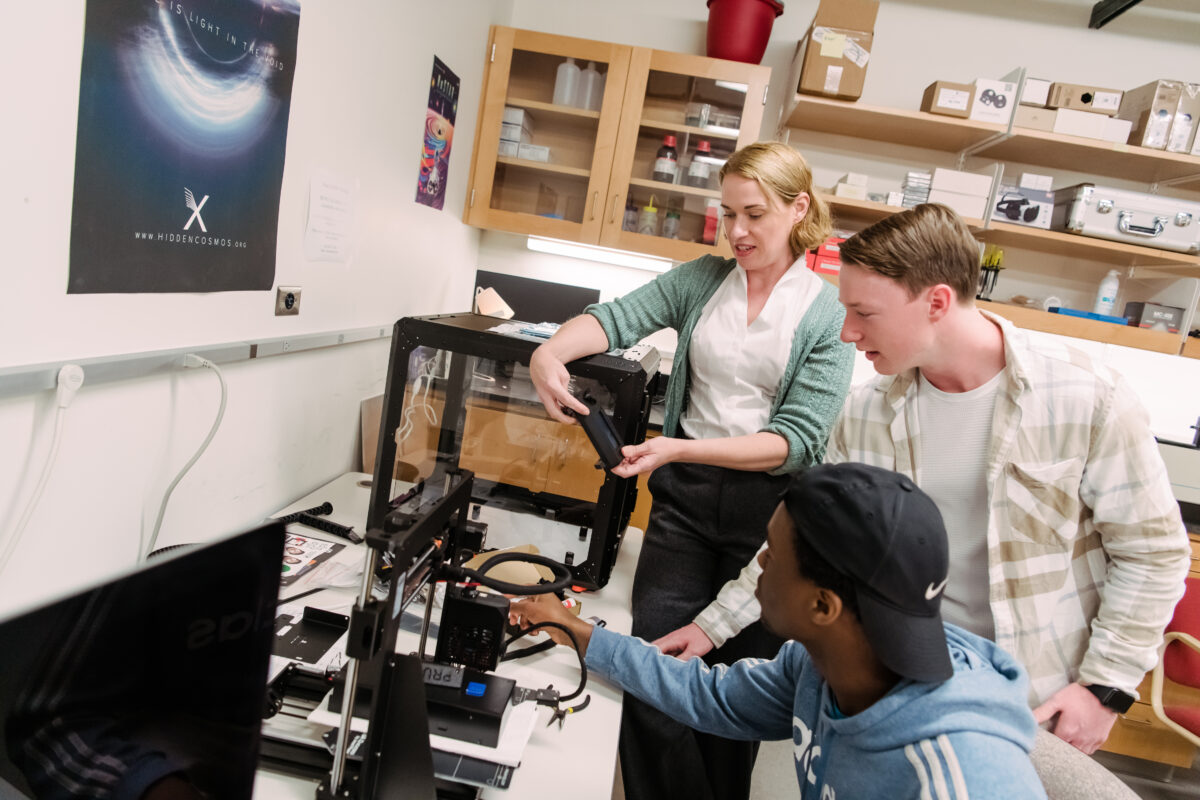 Eileen Meyer works with students in her laboratory. (Marlayna Demond ’11/UMBC)
Open questions
Overall, “We still don’t really understand after all these decades of studying these sources why only a fraction of accreting black holes produce jets and then exactly how they launch them. Until recently we could not literally look into that innermost region to see what’s happening—how the accretion disk surrounding the black hole is interacting with and producing the jet. And so there are still a lot of open questions there,” Meyer says.
Questions remain, but today there are many promising models of how black holes produce jets, Meyer says. Next steps will include working with theorists to understand how the data from this study can help test and refine those models.
“There’s a lot of theoretical work to be done to understand what we’ve seen, but the good thing is that we have a massive amount of data,” Meyer says. “We’re going to keep following this source, and it’s going to continue to be exciting.”
]]>
Eileen Meyer (Marlayna Demond ’11/UMBC) A large international team of scientists has observed a phenomenon that astronomers didn’t ever expect to see happen in real time. A new paper published...
https://umbc.edu/stories/black-hole-jets-observed-forming-in-real-time/
https://my3.my.umbc.edu/api/v0/pixel/news/146533/guest@my.umbc.edu/d48847e8a6d810d41676651bdd9661cc/api/pixel
cnms
csst
news
physics
research
science-and-tech
story
UMBC News & Magazine
https://my3.my.umbc.edu/groups/umbc-news-magazine
https://assets1-my.umbc.edu/system/shared/avatars/groups/000/001/943/24435aa6207c452e7bc15cc74b42c7bb/xsmall.png?1748556657
https://assets1-my.umbc.edu/system/shared/avatars/groups/000/001/943/24435aa6207c452e7bc15cc74b42c7bb/original.png?1748556657
https://assets2-my.umbc.edu/system/shared/avatars/groups/000/001/943/24435aa6207c452e7bc15cc74b42c7bb/xxlarge.png?1748556657
https://assets2-my.umbc.edu/system/shared/avatars/groups/000/001/943/24435aa6207c452e7bc15cc74b42c7bb/xlarge.png?1748556657
https://assets3-my.umbc.edu/system/shared/avatars/groups/000/001/943/24435aa6207c452e7bc15cc74b42c7bb/large.png?1748556657
https://assets1-my.umbc.edu/system/shared/avatars/groups/000/001/943/24435aa6207c452e7bc15cc74b42c7bb/medium.png?1748556657
https://assets2-my.umbc.edu/system/shared/avatars/groups/000/001/943/24435aa6207c452e7bc15cc74b42c7bb/small.png?1748556657
https://assets1-my.umbc.edu/system/shared/avatars/groups/000/001/943/24435aa6207c452e7bc15cc74b42c7bb/xsmall.png?1748556657
https://assets2-my.umbc.edu/system/shared/avatars/groups/000/001/943/24435aa6207c452e7bc15cc74b42c7bb/xxsmall.png?1748556657
UMBC News & Magazine
3
0
false
Mon, 13 Jan 2025 10:18:20 -0500
Mon, 13 Jan 2025 10:18:20 -0500
5 ways UMBC partnered with NASA in 2024
UMBC is approaching 30 years of collaboration with the National Aeronautics and Space Administration (NASA), a partnership that largely culminates under the university’s three major cooperative agreements with the agency. According to the NSF’s latest Higher Education Research and Development (HERD) survey, UMBC is among the nation’s top 10 universities receiving federal funding from NASA. In 2024, UMBC scientists, researchers, interns, and engineers have reached new levels of achievement in connection to this partnership—some even going as far as to the surface of the Moon…in a few years.
Take a look back at five ways UMBC collaborated with NASA in 2024:
UMBC goes to the Moon
Planetary scientist Mehdi Benna of UMBC’s Center for Space Sciences Technology is leading the team designing one of the lunar instruments chosen for implementation and deployment in NASA’s forthcoming Artemis III mission, humanity’s first return to the lunar surface in more than 50 years. The Lunar Environment Monitoring Station (LEMS) was selected as one of the first three candidate payloads to be a part of Artemis III, NASA’s mission that will send astronauts to explore the region near the lunar South Pole. Artemis III, currently planned to launch in 2026, will be the first time humans will return to the Moon’s surface since the historic Apollo program in 1969 – 1972.
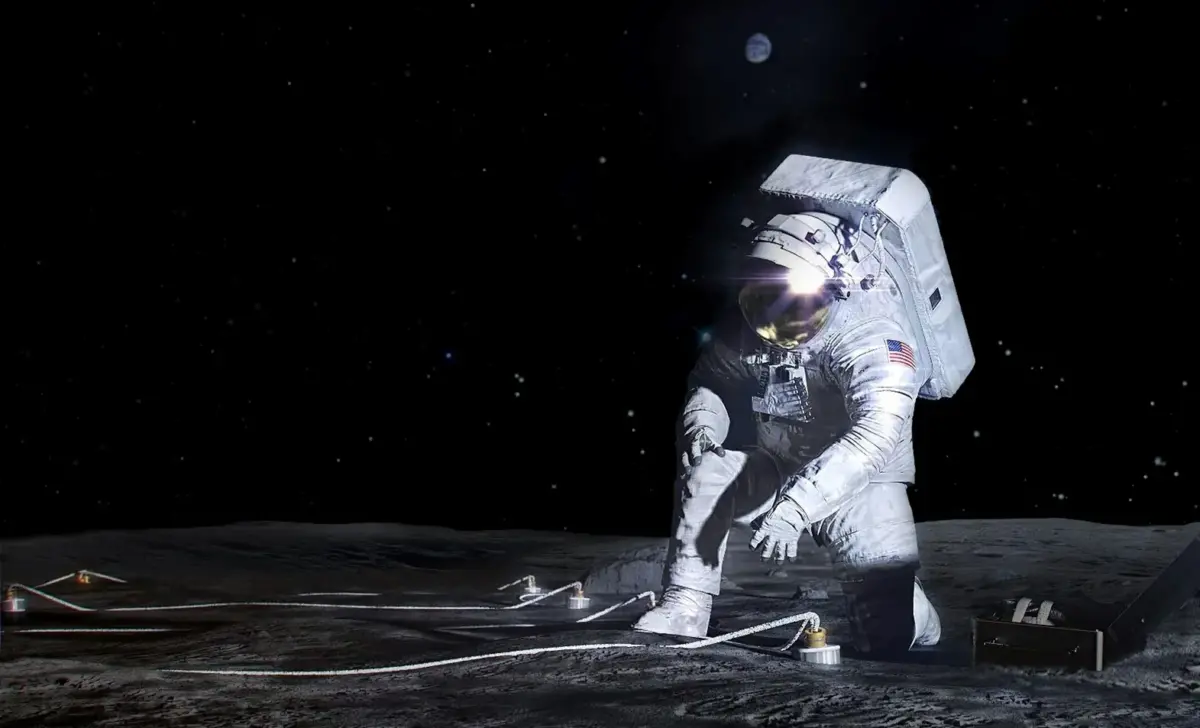 Artist’s concept of an Artemis astronaut deploying an instrument on the lunar surface.
(Photo courtesy of NASA)
HARP2 launches into space
The UMBC-designed Hyper-Angular Rainbow Polarimeter (HARP2) wide-angle imaging polarimeter instrument is part of NASA’s Plankton, Aerosol, Cloud, ocean Ecosystem (PACE) spacecraft mission, which launched into space in February. The PACE satellite provides insight into ocean health, air quality, and the effects of a changing climate. PACE’s mission data, which includes data captured by the HARP2 instrument, is now available for public access. The HARP2 team, which includes a host of students and alumni, is led by Vanderlei Martins, professor of physics, who is also the director of the NASA-affiliated Earth and Space Institute, based out of UMBC’s Physics Building.
AXIS X-ray telescope selected for final round
Nearly a year ago, a group of engineers and scientists including UMBC physicists became one of 10 teams to successfully submit a proposal to NASA to develop the Advanced X-ray Imaging Satellite (AXIS). In October 2024, the AXIS team was selected as one of the final two instrument designs selected for further development. The team will receive $5 million to flesh out their plans as part of what NASA calls a “Phase A study.” Adi Foord, assistant professor of physics, and Eileen Meyer, associate professor of physics, serve on the AXIS leadership team, and during the proposal development phase, Foord co-led the sub-team focused on supermassive black hole evolution.
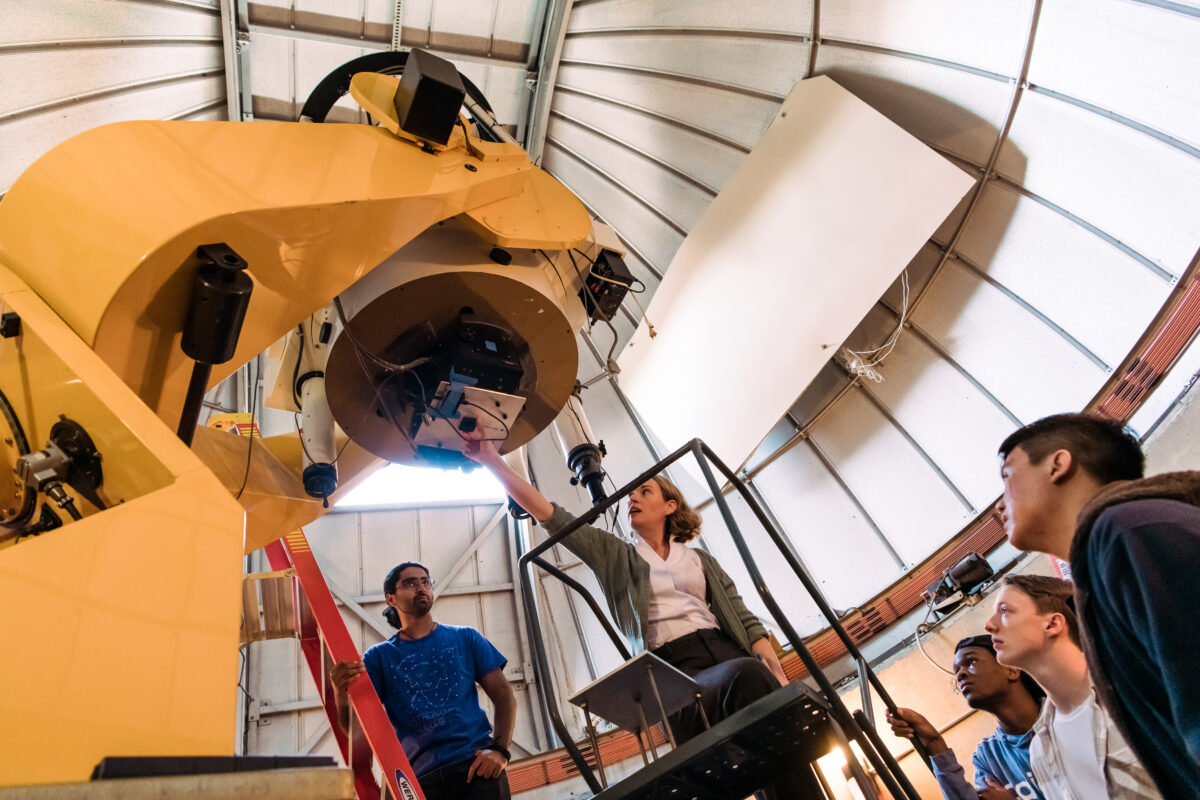 Eileen Meyer (center, reaching up) works on UMBC’s telescope with students. (Marlayna Demond ’11/UMBC)
NASA comes to campus
The university collaborated with the Goddard Space Flight Center to host the “NASA-UMBC Interaction Days,” an interactive, three-day series that took a closer look into the agency’s current research activity across a range of fields, with insight into how UMBC faculty, staff, and students can continue to work with Goddard scientists and engineers. The event series attracted more than 250 registrants.
UMBC-NASA earth science center awarded $47 million extension
The UMBC-led Goddard Earth Science Technology and Research (GESTAR) II center was awarded a two-year, $47 million extension this year to continue its cooperative agreement with the NASA Goddard Space Flight Center (GSFC). Since launching in 2021, GESTAR II has employed more than 150 scientists who are distributed across nearly all of GSFC’s earth science division laboratories. Over the years, GESTAR II researchers have been a part of teams that have developed an instrument that monitors water quality in the Chesapeake Bay, studied the environmental impacts of megafire smoke plumes, generated the first global map of cargo ship pollution, and much more.
More on UMBC’s partnership with NASA
]]>
UMBC is approaching 30 years of collaboration with the National Aeronautics and Space Administration (NASA), a partnership that largely culminates under the university’s three major cooperative...
https://umbc.edu/stories/umbc-nasa-partnership-2024/
https://my3.my.umbc.edu/api/v0/pixel/news/146266/guest@my.umbc.edu/c9b14e4a81a0cad626bb8a2df7cb33d8/api/pixel
csst
esi
gestar2
gphi
nasa
nasa-goddard-space-flight-center
news
research
science-and-tech
story
UMBC News & Magazine
https://my3.my.umbc.edu/groups/umbc-news-magazine
https://assets1-my.umbc.edu/system/shared/avatars/groups/000/001/943/24435aa6207c452e7bc15cc74b42c7bb/xsmall.png?1748556657
https://assets1-my.umbc.edu/system/shared/avatars/groups/000/001/943/24435aa6207c452e7bc15cc74b42c7bb/original.png?1748556657
https://assets2-my.umbc.edu/system/shared/avatars/groups/000/001/943/24435aa6207c452e7bc15cc74b42c7bb/xxlarge.png?1748556657
https://assets2-my.umbc.edu/system/shared/avatars/groups/000/001/943/24435aa6207c452e7bc15cc74b42c7bb/xlarge.png?1748556657
https://assets3-my.umbc.edu/system/shared/avatars/groups/000/001/943/24435aa6207c452e7bc15cc74b42c7bb/large.png?1748556657
https://assets1-my.umbc.edu/system/shared/avatars/groups/000/001/943/24435aa6207c452e7bc15cc74b42c7bb/medium.png?1748556657
https://assets2-my.umbc.edu/system/shared/avatars/groups/000/001/943/24435aa6207c452e7bc15cc74b42c7bb/small.png?1748556657
https://assets1-my.umbc.edu/system/shared/avatars/groups/000/001/943/24435aa6207c452e7bc15cc74b42c7bb/xsmall.png?1748556657
https://assets2-my.umbc.edu/system/shared/avatars/groups/000/001/943/24435aa6207c452e7bc15cc74b42c7bb/xxsmall.png?1748556657
UMBC News & Magazine
0
0
false
Fri, 13 Dec 2024 12:58:18 -0500
Fri, 13 Dec 2024 12:58:18 -0500
Creative, scientifically accurate eclipse animation selected for screening at Iron Mule Film Festival
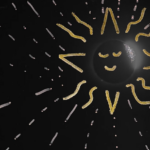
An animated short co-directed by UMBC’s Robin Corbet, senior research scientist in the Center for Space Sciences and Technology, and Laurence Arcadias, an animation professor at the Maryland Institute College of Art, will screen at the Iron Mule Film Festival—a short comedy film fest—in New York City on October 7. Corbet and Arcadias will attend the screening and take questions from the audience about science, art, and how they can complement each other.
The playful and zany short film features animations representing the 2024 total eclipse. The soundtrack showcases a delightful and scientifically accurate track, “The Sun Song,” performed by The Chromatics, an a cappella group consisting primarily of NASA scientists.
A large group of astronomy researchers attending a meeting of the American Astronomical Society took part in a collaborative art and science workshop where they developed the animations just before viewing the eclipse.
“The Eclipse”
The final product “uses the first film ever made of an eclipse, produced by magician Nevil Maskelyne in 1900, as a basis,” Corbet explains, “but the astronomers and artists added quite a few of their own wild embellishments.”
The eclipse workshop was a project of AstroAnimation, an ongoing collaboration led by Corbet and Arcadias. AstroAnimation brings together art students at MICA and NASA scientists to produce animations based on cutting-edge science. The eclipse film represents AstroAnimation’s effort to expand its impact beyond the classroom.
]]>
An animated short co-directed by UMBC’s Robin Corbet, senior research scientist in the Center for Space Sciences and Technology, and Laurence Arcadias, an animation professor at the Maryland...
https://umbc.edu/quick-posts/eclipse-animation-at-iron-mule-film-fest/
https://my3.my.umbc.edu/api/v0/pixel/news/143936/guest@my.umbc.edu/a623c047818cfa719f6ef0d19ac34f9f/api/pixel
arts-and-culture
csst
news
quick-post
science-and-tech
UMBC News & Magazine
https://my3.my.umbc.edu/groups/umbc-news-magazine
https://assets1-my.umbc.edu/system/shared/avatars/groups/000/001/943/24435aa6207c452e7bc15cc74b42c7bb/xsmall.png?1748556657
https://assets1-my.umbc.edu/system/shared/avatars/groups/000/001/943/24435aa6207c452e7bc15cc74b42c7bb/original.png?1748556657
https://assets2-my.umbc.edu/system/shared/avatars/groups/000/001/943/24435aa6207c452e7bc15cc74b42c7bb/xxlarge.png?1748556657
https://assets2-my.umbc.edu/system/shared/avatars/groups/000/001/943/24435aa6207c452e7bc15cc74b42c7bb/xlarge.png?1748556657
https://assets3-my.umbc.edu/system/shared/avatars/groups/000/001/943/24435aa6207c452e7bc15cc74b42c7bb/large.png?1748556657
https://assets1-my.umbc.edu/system/shared/avatars/groups/000/001/943/24435aa6207c452e7bc15cc74b42c7bb/medium.png?1748556657
https://assets2-my.umbc.edu/system/shared/avatars/groups/000/001/943/24435aa6207c452e7bc15cc74b42c7bb/small.png?1748556657
https://assets1-my.umbc.edu/system/shared/avatars/groups/000/001/943/24435aa6207c452e7bc15cc74b42c7bb/xsmall.png?1748556657
https://assets2-my.umbc.edu/system/shared/avatars/groups/000/001/943/24435aa6207c452e7bc15cc74b42c7bb/xxsmall.png?1748556657
UMBC News & Magazine
0
0
false
Mon, 16 Sep 2024 11:19:20 -0400
Mon, 16 Sep 2024 11:19:20 -0400
UMBC hosts “NASA Days” event series with Goddard Space Flight Center
UMBC is collaborating with the NASA Goddard Space Flight Center (GSFC) to host an interactive, three-day event series that takes a closer look into the center’s current research activity, with insight into how faculty and students can engage with Goddard scientists and engineers.
NASA-UMBC Interaction Days launched on September 9 and continues on September 16 and September 30, highlighting a range of topics on the diverse research and technological advancements in space exploration from leading scientists and engineers at GSFC. The series also provides an overview of the extensive research activity happening in collaboration between UMBC and NASA, a partnership that began nearly 30 years ago.
Astrophysicist Sibasish Laha, an associate research scientist with UMBC’s Center for Space Sciences and Technology who works out of GSFC, organized the series in response to an influx of students inquiring about the work that happens at NASA and ways to get involved.
“I started this interaction day series to help UMBC students better understand what NASA scientists and engineers do on a day-to-day basis,” says Laha. Students get a behind-the-scenes look into the research happening at GSFC, across an array of disciplinary fields such as earth science, data science and AI, astrobiology, and more.
Student opportunities at NASA
Day one of the event series included lectures focused on earth science, exoplanets, and laboratory astrophysics with featured speakers Maurice Leutenegger of GSFC’s x-ray astrophysics laboratory; Wayne Yu, an senior engineer in astrobiology; and planetary scientist Ravi Kopparap. A packed room of more than 90 attendees learned about the inquiring minds behind the GSFC’s research activity.
Day two of the event series (happening on September 16) will feature discussions on data science and AI, x-ray astrophysics, and astrobiology. The event will conclude on September 30 with lectures on the habitable worlds observatory, payload systems and engineering, and NASA’s long term goals with featured speaker Robert Petre, director of GSFC’s astrophysics science division.
Some Retrievers at the event were there out of general curiosity and some were looking for jobs and internship experiences. Brad Cenko, research scientist at GSFC, shared about the wide array of experiential learning opportunities happening at NASA’s research centers across the country.
“NASA has one of the largest internship programs in the state of Maryland, and students can apply to internships year-round,” said Cenko. This summer, UMBC students secured internship placements with NASA, which included senior Leah Narat, business technology administration, who worked at GSFC as a business intelligence intern.
 Interns from the Flight Projects Directorate at NASA Goddard, including Leah Narat, center, tour the Wallops Flight Facility in Virginia. (Image courtesy of Narat)
Narat created and updated databases to track awards given to NASA employees. The agency will use the information to maximize employees’ recognition and success and guide them toward career paths that best take advantage of their strengths.
“Honestly, being at NASA was something that I never thought I would achieve, but I put my application out there, and here I am,” says Narat, who worked as a business intelligence intern at the NASA Goddard Space Flight Center in Greenbelt, Maryland, this past summer. “It’s been wonderful.”
A 30-year partnership
While a large majority of students made up the attendee list for day one, the event also brought in many faculty and staff interested in collaborating with the agency. “Faculty are an integral part in these collaborative efforts and our goal is to connect them directly with NASA’s scientists and engineers,” said event organizer Laha.
 Makenzie Lystrup, director of NASA’s Goddard Space Flight Center, and UMBC President Valerie Sheares Ashby during Lystrup’s visit to UMBC in February 2024. (Marlayna Demond ’11/UMBC)
Currently, more than 250 UMBC scientists and research faculty members are partnering with NASA civil servants and are employed under three major cooperative agreements, of which includes the Goddard Earth Sciences Technology and Research II center (GESTAR II); the Center for Space Sciences and Technology (CSST); and the Goddard Planetary Heliophysics Institute (GPHI). The university also is home to the NASA-affiliated Earth and Space Institute based out of UMBC’s Physics Building.
Additionally, nearly 30 of the university’s scientists and research faculty are working on active NASA space missions. That includes the UMBC-developed Lunar Environment Monitoring Station, which was selected as one of the first three instruments to be a part of Artemis III, NASA’s mission that will send astronauts back to the lunar surface after more than 50 years, and UMBC’s Hyper-Angular Rainbow Polarimeter wide-angle imaging polarimeter instrument on board NASA’s Plankton, Aerosol, Cloud, ocean Ecosystem spacecraft mission.
“NASA is providing half of UMBC’s federal contract funding—on a national scale, this is really unusual,” says Don Engel, director of the CSST and assistant professor of computer science and electrical engineering. “Our NASA partnerships are so cross-disciplinary. All three of UMBC’s colleges are represented with these centers, and that’s extremely significant.”
Register for the remaining NASA-UMBC Interaction Days events here.
]]>
UMBC is collaborating with the NASA Goddard Space Flight Center (GSFC) to host an interactive, three-day event series that takes a closer look into the center’s current research activity, with...
https://umbc.edu/stories/nasa-days-event-series/
https://my3.my.umbc.edu/api/v0/pixel/news/143892/guest@my.umbc.edu/e03c952bb42087e2a28c0c06cd19474e/api/pixel
community
csst
esi
gestar
gestar2
gphi
nasa
nasa-goddard-space-flight-center
news
science-and-tech
story
UMBC News & Magazine
https://my3.my.umbc.edu/groups/umbc-news-magazine
https://assets1-my.umbc.edu/system/shared/avatars/groups/000/001/943/24435aa6207c452e7bc15cc74b42c7bb/xsmall.png?1748556657
https://assets1-my.umbc.edu/system/shared/avatars/groups/000/001/943/24435aa6207c452e7bc15cc74b42c7bb/original.png?1748556657
https://assets2-my.umbc.edu/system/shared/avatars/groups/000/001/943/24435aa6207c452e7bc15cc74b42c7bb/xxlarge.png?1748556657
https://assets2-my.umbc.edu/system/shared/avatars/groups/000/001/943/24435aa6207c452e7bc15cc74b42c7bb/xlarge.png?1748556657
https://assets3-my.umbc.edu/system/shared/avatars/groups/000/001/943/24435aa6207c452e7bc15cc74b42c7bb/large.png?1748556657
https://assets1-my.umbc.edu/system/shared/avatars/groups/000/001/943/24435aa6207c452e7bc15cc74b42c7bb/medium.png?1748556657
https://assets2-my.umbc.edu/system/shared/avatars/groups/000/001/943/24435aa6207c452e7bc15cc74b42c7bb/small.png?1748556657
https://assets1-my.umbc.edu/system/shared/avatars/groups/000/001/943/24435aa6207c452e7bc15cc74b42c7bb/xsmall.png?1748556657
https://assets2-my.umbc.edu/system/shared/avatars/groups/000/001/943/24435aa6207c452e7bc15cc74b42c7bb/xxsmall.png?1748556657
UMBC News & Magazine
0
0
false
Fri, 13 Sep 2024 16:04:17 -0400
Fri, 13 Sep 2024 16:04:17 -0400
Watch: A recap of UMBC-led NASA Dissipation sounding rocket launch
Planetary scientist Mehdi Benna of UMBC’s Center for Space Sciences and Technology, along with a team of collaborators, recently released a video recounting the launch of NASA’s Dissipation sounding rocket mission.
The Dissipation sounding rocket, which launched from the Poker Flat Research Range in Fairbanks, Alaska in November 2023, carried a suite of six instruments designed to measure how Earth’s upper atmosphere at high altitudes responds to large energy inputs from the sun during auroral storms.
The video recaps how Benna, principal investigator of Dissipation, and his team of scientists and engineers overcame a series of obstacles to successfully launch the sounding rocket during the peak of the auroral activity that took place in Alaska on November 8.
The launch of NASA’s Dissipation sounding rocket from the Poker Flat Research Range in Fairbanks, Alaska on November 8, 2023.
“It was an exciting but nerve-racking experience. The countdown had to be precisely timed to target the peak of the auroral activities, which lasted less than 30 minutes from its growth to recovery phase,” said Benna in an article. “The last four minutes of the countdown felt like hours as we waited for the last items on the launch checklist to be completed before the rocket could lift off.”
Along with Benna, the Dissipation team included scientists and engineers from UMBC, Goddard Space Flight Center, the Wallops Flight Facility, the University of New Hampshire, and the University of Alaska Fairbanks.
Benna shares that the video encapsulates “the human aspect of space engineering that is rarely shown, and demonstrates that the success of these types of missions are often hinged on the real time and quick decision-making of the engineers.”
]]>
Planetary scientist Mehdi Benna of UMBC’s Center for Space Sciences and Technology, along with a team of collaborators, recently released a video recounting the launch of NASA’s Dissipation...
https://umbc.edu/quick-posts/dissipation-sounding-rocket-launch/
https://my3.my.umbc.edu/api/v0/pixel/news/142424/guest@my.umbc.edu/57ee748b1e5c3872c9c231a9486cb039/api/pixel
csst
nasa-goddard-space-flight-center
quick-post
research
UMBC News & Magazine
https://my3.my.umbc.edu/groups/umbc-news-magazine
https://assets1-my.umbc.edu/system/shared/avatars/groups/000/001/943/24435aa6207c452e7bc15cc74b42c7bb/xsmall.png?1748556657
https://assets1-my.umbc.edu/system/shared/avatars/groups/000/001/943/24435aa6207c452e7bc15cc74b42c7bb/original.png?1748556657
https://assets2-my.umbc.edu/system/shared/avatars/groups/000/001/943/24435aa6207c452e7bc15cc74b42c7bb/xxlarge.png?1748556657
https://assets2-my.umbc.edu/system/shared/avatars/groups/000/001/943/24435aa6207c452e7bc15cc74b42c7bb/xlarge.png?1748556657
https://assets3-my.umbc.edu/system/shared/avatars/groups/000/001/943/24435aa6207c452e7bc15cc74b42c7bb/large.png?1748556657
https://assets1-my.umbc.edu/system/shared/avatars/groups/000/001/943/24435aa6207c452e7bc15cc74b42c7bb/medium.png?1748556657
https://assets2-my.umbc.edu/system/shared/avatars/groups/000/001/943/24435aa6207c452e7bc15cc74b42c7bb/small.png?1748556657
https://assets1-my.umbc.edu/system/shared/avatars/groups/000/001/943/24435aa6207c452e7bc15cc74b42c7bb/xsmall.png?1748556657
https://assets2-my.umbc.edu/system/shared/avatars/groups/000/001/943/24435aa6207c452e7bc15cc74b42c7bb/xxsmall.png?1748556657
UMBC News & Magazine
0
0
false
Thu, 13 Jun 2024 10:05:11 -0400
Thu, 13 Jun 2024 10:05:11 -0400
NASA selects UMBC-led lunar instrument for implementation on Artemis III Moon landing mission
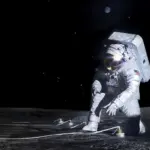
The University of Maryland Baltimore County (UMBC), along with several institutional partners, has been selected to develop one of the first three lunar instruments chosen for implementation and deployment as part of NASA’s forthcoming Artemis III mission, humanity’s first return to the lunar surface in more than 50 years.
The Lunar Environment Monitoring Station (LEMS), led by planetary scientist Mehdi Benna of UMBC’s Center for Space Sciences Technology (CSST), was selected as one of the first three candidate payloads to be a part of Artemis III, NASA’s mission that will send astronauts to explore the region near the lunar South Pole. Artemis III, currently planned to launch in 2026, will be the first time humans will return to the moon’s surface since the historic Apollo program in 1969-1972.
LEMS is a compact, autonomous seismometer designed to carry out continuous, long-term monitoring of seismic activity, namely ground motion from moonquakes, in the lunar south polar region, according to NASA’s recent announcement of the selected Artemis III instruments. During the Artemis III mission, LEMS will accompany the Lunar Effects on Agricultural Flora instrument, led by researchers at Space Lab Technologies in Boulder, Colorado, and the Lunar Dielectric Analyzer instrument, led by researchers at the University of Tokyo and supported by the Japan Aerospace Exploration Agency.
The LEMS project is the culmination of several years of collaboration between UMBC and partnering institutions, of which includes the University of Maryland, College Park (through deputy principal investigator Nicholas Schmerr) and NASA’s Goddard Space Flight Center, which will lead LEMS’ technical implementation process. The University of Arizona will supply LEMS’ two state-of-the-art seismometer sensors; Morehead State University will provide LEMS’ telecommunication system, and Washington University in St. Louis will manage the instrument’s data processing and dissemination to the larger scientific community.
Designed to withstand extreme conditions
Principal Investigator Benna, who operates out of the NASA’s Goddard Space Flight Center with the CSST, began conceptualizing with his team the idea behind the LEMS instrument in 2018 after realizing the need for technology that could withstand the Moon’s harsh conditions in order to measure lunar geophysical activity for a long duration of time.
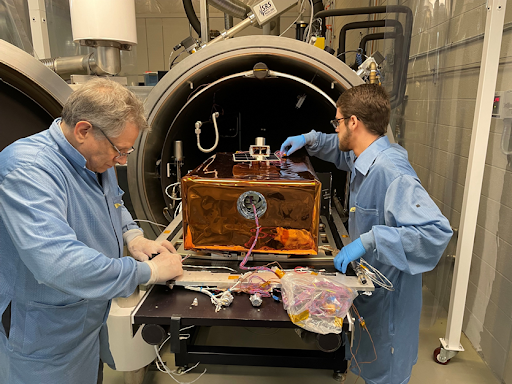 Team members during the final preparation of the Lunar Environment Monitoring Station (LEMS) engineering units for thermal-vacuum testing. During this test the LEMS prototype was subjected to the ultra-high vacuum and harsh thermal conditions that mimic the surface of the Moon to demonstrate the station can sustain itself and operate unassisted for long durations. (Photo Credit: NASA MSFC)
“The lunar environment is one of the harshest environments in the solar system. It’s hard to survive [on] the Moon because it rotates very slowly around itself—daytime on the Moon lasts about 15 Earth days, and night on the Moon lasts 15 Earth days,” says Benna. “Because the Moon doesn’t have an atmosphere, the days are very hot and the nights get really cold.”
Benna’s team began developing his idea of a small, self-sustaining station that operates almost like a buoy in the ocean—what Benna calls a “lunar buoy”—that can survive on the surface through the lunar night and operate during the day for an extended amount of time. In 2018, Benna’s team received funding from NASA’s Development and Advancement of Lunar Instrumentation program for engineering development and risk reduction of the LEMS instrument, which allowed it to reach the required NASA flight readiness level.
“The Apollo 11 of our generation”
LEMS, which is of the size of a standard carry-on airplane suitcase, is intended to operate on the lunar surface from three months up to two years following its deployment. The station’s battery is designed to be charged by its solar panels during the day. The stored power is used to keep the station operational at night. The LEMS instrument would then autonomously beam its data to one of NASA’s Deep Space Network ground stations once a month via its own communication antennas and radio system.
With the data retrieved from LEMS’ two distinct lunar-night-surviving seismometers, scientists will be able to characterize the structure of the local crust and mantle.
“Artemis III is the Apollo 11 of our generation—that’s significant. Landing astronauts on the Moon doesn’t get any easier 50 years later. Being a part of this adventure is extremely exciting,” shares Benna.
For more information on the Lunar Environment Monitoring Station (LEMS) science and technology, please contact: The University of Maryland, Baltimore County- Adriana Fraser; NASA’s Goddard Space Flight Center- Molly Wasser, Nancy Jones; The University of Arizona- Mikayla Kelley; Morehead State University- April Hobbs Nutter, Rick L. Hesterberg; Washington University in St. Louis- Paul Byrne; NASA Headquarters- Erin Morton.
]]>
The University of Maryland Baltimore County (UMBC), along with several institutional partners, has been selected to develop one of the first three lunar instruments chosen for implementation and...
https://umbc.edu/stories/lems-nasa-moon-instrument/
https://my3.my.umbc.edu/api/v0/pixel/news/140744/guest@my.umbc.edu/848c0ddb2c722e39f920edef140c1e7c/api/pixel
csst
nasa-goddard-space-flight-center
news
rca-1
research
science-and-tech
story
UMBC News & Magazine
https://my3.my.umbc.edu/groups/umbc-news-magazine
https://assets1-my.umbc.edu/system/shared/avatars/groups/000/001/943/24435aa6207c452e7bc15cc74b42c7bb/xsmall.png?1748556657
https://assets1-my.umbc.edu/system/shared/avatars/groups/000/001/943/24435aa6207c452e7bc15cc74b42c7bb/original.png?1748556657
https://assets2-my.umbc.edu/system/shared/avatars/groups/000/001/943/24435aa6207c452e7bc15cc74b42c7bb/xxlarge.png?1748556657
https://assets2-my.umbc.edu/system/shared/avatars/groups/000/001/943/24435aa6207c452e7bc15cc74b42c7bb/xlarge.png?1748556657
https://assets3-my.umbc.edu/system/shared/avatars/groups/000/001/943/24435aa6207c452e7bc15cc74b42c7bb/large.png?1748556657
https://assets1-my.umbc.edu/system/shared/avatars/groups/000/001/943/24435aa6207c452e7bc15cc74b42c7bb/medium.png?1748556657
https://assets2-my.umbc.edu/system/shared/avatars/groups/000/001/943/24435aa6207c452e7bc15cc74b42c7bb/small.png?1748556657
https://assets1-my.umbc.edu/system/shared/avatars/groups/000/001/943/24435aa6207c452e7bc15cc74b42c7bb/xsmall.png?1748556657
https://assets2-my.umbc.edu/system/shared/avatars/groups/000/001/943/24435aa6207c452e7bc15cc74b42c7bb/xxsmall.png?1748556657
UMBC News & Magazine
1
0
false
Wed, 10 Apr 2024 08:17:34 -0400
Wed, 10 Apr 2024 08:17:34 -0400
Study finds strongest evidence yet for local sources of cosmic ray electrons
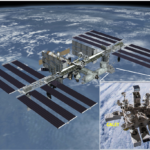
A new study using data from the CALorimetric Electron Telescope (CALET)instrument on the International Space Station has found evidence for nearby, young sources of cosmic ray electrons, contributing to a greater understanding of how the galaxy functions as a whole.
The study included more than seven million data points representing particles arriving at CALET’s detector since 2015, and CALET’s ability to detect electrons at the highest energies is unique. As a result, the data includes more electrons at high energies than any previous work. That makes the statistical analysis of the data more robust and lends support to the conclusion that there are one or more local sources of cosmic ray electrons.
“This is one of the primary things that CALET is made to look for,” says Nicholas Cannady, an assistant research scientist with UMBC’s Center for Space Sciences and Technology, a partnership with NASA Goddard Space Flight Center, and a leader on the study. With this paper, he adds, “We were really able to push into the realm where we have few events and start to look for things at the highest energies, which is exciting.”
A better understanding of the galaxy
 Nicholas Cannady, the lead U.S. scientist on the new study, is excited that the CALET mission is bearing fruitful results. (Image courtesy of Cannady)
Current theory posits that the aftermath of supernovae (exploding stars), called supernova remnants, produce these high energy electrons, which are a specific type of cosmic ray. Electrons lose energy very quickly after leaving their source, so the rare electrons arriving at CALET with high energy are believed to originate in supernova remnants that are relatively nearby (on a cosmic scale), Cannady explains.
The study’s results are “a strong indicator that the paradigm that we have for understanding these high-energy electrons—that they come from supernova remnants and that they are accelerated the way that we think they are—is correct,” Cannady says. The findings “give insight into what’s going on in these supernova remnants, and offer a way to understand the galaxy and these sources in the galaxy better.”
CALET is a collaborative project built and operated by groups in Japan, Italy, and the United States, led by Shoji Torii. The lead contributors to this work in Japan are Torii, Yosui Akaike, and Holger Motz at Waseda University in Tokyo, and Louisiana State University is the lead institution in the U.S. The findings were published in Physical Review Letters.
New data lead to new cosmic ray sources
Previous work found that the number of electrons arriving at CALET decreased steadily as energy increased up to about 1 teravolt (TeV), or 1 trillion electron volts. The number of electrons arriving with even greater energy was extremely low. But in this study, CALET did not see the expected dropoff. Instead, the results suggest that the number of particles plateau, and then even increase, at the highest energies—all the way up to 10 TeV in a few cases.
Previous experiments could only measure particles up to about 4 TeV, so the highest energy event candidates above that in this study are a crucial new source of information about potential nearby sources of cosmic ray electrons. Cannady led the effort to individually analyze each of those events to confirm they represent a real signal, and a deeper dive into those events is forthcoming.
Addressing challenges
It’s difficult to distinguish between electrons and protons at high energies, and there are many more protons arriving than electrons, which poses challenges to an accurate analysis. To tell the particles apart, a program developed by the researchers analyzes how the particles break down when they hit the detector. Protons and electrons break down differently, so comparing the cascade of particles they create in that process can filter out the protons. However, at the highest energies, the differences between protons and electrons decrease, making it harder to accurately remove only the protons from the data.
To address this, Cannady led the CALET team’s effort to simulate the breakdown patterns of both protons and electrons coming from the exact direction each of the high-energy events arrived from. That increased the team’s ability to determine whether the events are electrons or protons as accurately as possible.
Based on that work, “We believe we are evaluating the likelihood of events being protons in a realistic fashion,” Cannady says. Enough presumed electrons remain in the dataset after that careful analysis to conclude there is a real signal.
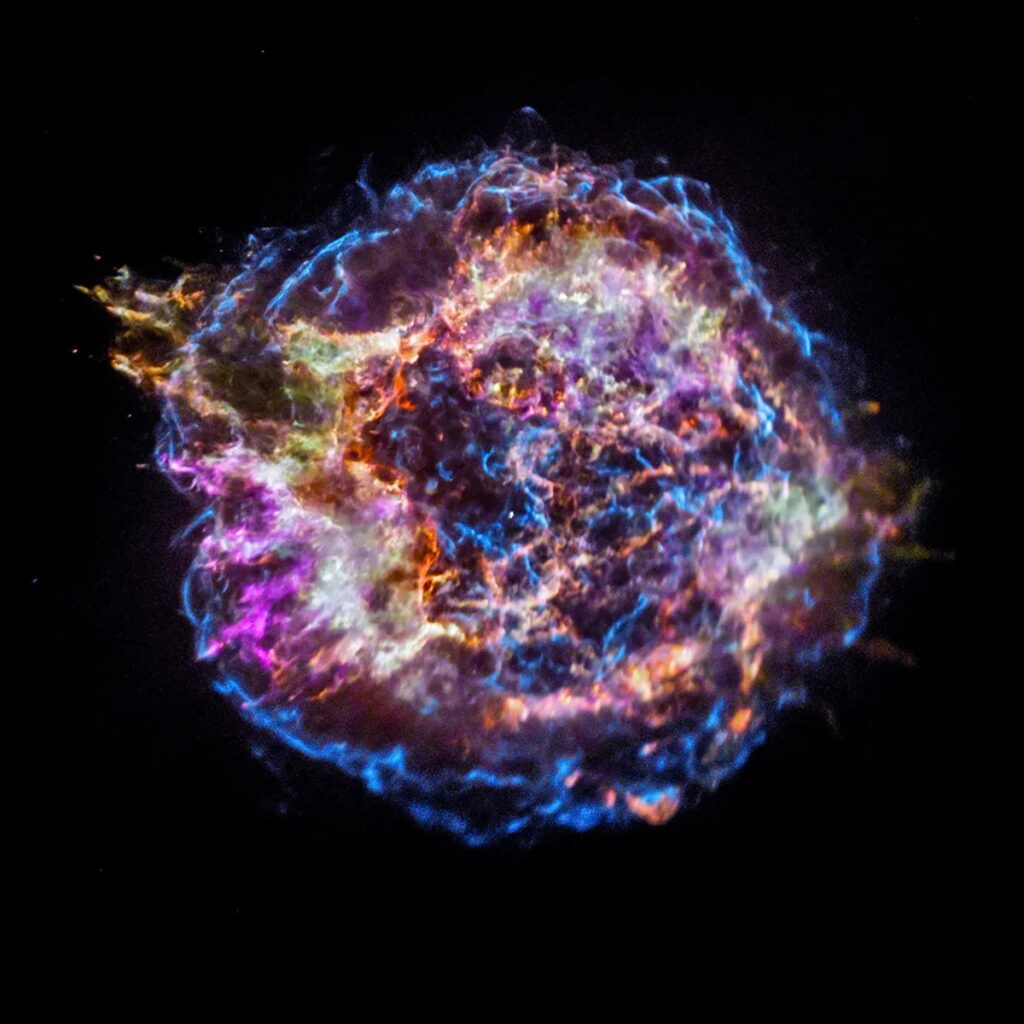 An x-ray image of Cassiopeia A, an example of a young supernova remnant. (Image courtesy of NASA)
Pushing boundaries
T. Gregory Guzik, professor of physics at LSU and the U.S. CALET collaboration lead, is excited that further analysis of the data suggested that electrons coming from the three best candidates for nearby supernova remnants can explain the high-energy arrivals.
“These CALET observations open the tantalizing possibility that matter from a particular nearby supernova remnant can be measured at Earth,” Guzik shares. “Continued CALET measurement through the life of the International Space Station will help shed new light on the origin and transport of relativistic matter in our galaxy.”
For Cannady, “The most exciting part is seeing things at the highest energies. We have some candidates above 10 TeV—and if it is borne out that these are real electron events, it’s really a smoking gun for clear evidence of a nearby source,” he says. “This is essentially what CALET was put up to do, so it’s exciting to be working on this and to finally be getting results that are pushing the bounds of what we’ve seen before.”
]]>
A new study using data from the CALorimetric Electron Telescope (CALET)instrument on the International Space Station has found evidence for nearby, young sources of cosmic ray electrons,...
https://umbc.edu/stories/calet-detects-high-energy-cosmic-ray-electrons/
https://my3.my.umbc.edu/api/v0/pixel/news/137074/guest@my.umbc.edu/d13963f002bb21b25ab24a7c0429d237/api/pixel
csst
news
research
science-and-tech
UMBC News & Magazine
https://my3.my.umbc.edu/groups/umbc-news-magazine
https://assets1-my.umbc.edu/system/shared/avatars/groups/000/001/943/24435aa6207c452e7bc15cc74b42c7bb/xsmall.png?1748556657
https://assets1-my.umbc.edu/system/shared/avatars/groups/000/001/943/24435aa6207c452e7bc15cc74b42c7bb/original.png?1748556657
https://assets2-my.umbc.edu/system/shared/avatars/groups/000/001/943/24435aa6207c452e7bc15cc74b42c7bb/xxlarge.png?1748556657
https://assets2-my.umbc.edu/system/shared/avatars/groups/000/001/943/24435aa6207c452e7bc15cc74b42c7bb/xlarge.png?1748556657
https://assets3-my.umbc.edu/system/shared/avatars/groups/000/001/943/24435aa6207c452e7bc15cc74b42c7bb/large.png?1748556657
https://assets1-my.umbc.edu/system/shared/avatars/groups/000/001/943/24435aa6207c452e7bc15cc74b42c7bb/medium.png?1748556657
https://assets2-my.umbc.edu/system/shared/avatars/groups/000/001/943/24435aa6207c452e7bc15cc74b42c7bb/small.png?1748556657
https://assets1-my.umbc.edu/system/shared/avatars/groups/000/001/943/24435aa6207c452e7bc15cc74b42c7bb/xsmall.png?1748556657
https://assets2-my.umbc.edu/system/shared/avatars/groups/000/001/943/24435aa6207c452e7bc15cc74b42c7bb/xxsmall.png?1748556657
UMBC News & Magazine
2
0
false
Tue, 14 Nov 2023 11:50:52 -0500
Tue, 14 Nov 2023 11:50:52 -0500
UMBC partners on STAR-X, a $3M NASA mission concept study through the CRESST II research consortium
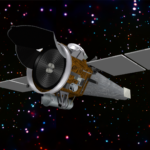
UMBC researchers are partnering on STAR-X, a nine-month mission concept study investigating black holes, galaxy clusters, and often-elusive transient cosmic events like supernova explosions. STAR-X stands for Survey and Time-domain Astrophysical Research Explorer. It is one of two Explorer missions to receive $3 million from NASA for this concept phase, before NASA selects one in 2024 to proceed with implementation, targeted for launch in 2028.
“With STAR-X, we want to come up with a survey that will catch very rare transient events,” said Antara Basu-Zych, a UMBC associate research scientist with the Center for Research and Exploration in Space Science & Technology II (CRESST II). “We’re aiming to understand at what rate these events are happening, what types of systems they involve, and where in the universe they’re happening.”
Maintaining STAR-X’s mission data
 Antara Basu-Zych. (Photo curtesy of Antara Basu-Zych)
This mission reflects the important role of strategic research partnerships in moving forward space science—what CRESST II was designed to achieve. UMBC’s CRESST II partners on STAR-X include NASA’s Goddard Space Flight Center (GSFC) and the Massachusetts Institute of Technology, providing an X-ray telescope; the University of Colorado, providing an ultraviolet telescope; and Ball Aerospace, providing the spacecraft. UMBC’s role will focus on the mission data retrieved from STAR-X.
Basu-Zych works with NASA’s High Energy Astrophysics Science Archive Research Center (HEASARC). If the mission is selected for launch, HEASARC will house the data that STAR-X collects. Basu-Zych is currently developing a process to organize the data, along with methods of alerting the scientific community of interesting STAR-X discoveries, called targets of opportunity, that could be further explored.
“Our role is to make it so that average scientists outside of the mission are able to do something valuable with the mission data,” she said.
An agile spacecraft
The mission will conduct a medium survey covering 300 square degrees of the sky on a weekly basis, and a deep survey on a daily basis covering 12 square degrees. As NASA has described, those deep surveys would seek to map black holes and hot gas trapped in distant clusters of galaxies. Combined with infrared observations from NASA’s Roman Space Telescope, these observations would enable researchers to trace how massive galaxy clusters were built up over time.
Additionally, the spacecraft would be able to turn rapidly to point its wide-field X-ray and UV telescopes at transient cosmic sources, such as supernova explosions, gravitational wave events, and extreme black hole feeding events.
“STAR-X is fast moving, very agile, and can quickly go to a source that is interesting,” explains Basu-Zych. “It would be able to slew the sky within a day or within a couple of hours, depending on what event was happening, and target something very quickly.”
In addition to being agile, she notes, “the instrument itself has a large field of view and low particle background, so that helps us with picking out faint objects and will help us get to areas of deep sensitivity.”
With these time-domain surveys and detecting cosmic targets of opportunity, STAR-X seeks to address several key priorities outlined in the “Pathways to Discovery in Astronomy and Astrophysics for the 2020s,” the latest decadal survey of the field released by the National Academies.
]]>
UMBC researchers are partnering on STAR-X, a nine-month mission concept study investigating black holes, galaxy clusters, and often-elusive transient cosmic events like supernova explosions....
https://umbc.edu/stories/star-x-nasa-mission/
https://my3.my.umbc.edu/api/v0/pixel/news/130905/guest@my.umbc.edu/f8c6d5ac6a997ba6ee11dde520d63403/api/pixel
csst
nasa
nasa-goddard-space-flight-center
news
rca-2
research
science-and-tech
UMBC News & Magazine
https://my3.my.umbc.edu/groups/umbc-news-magazine
https://assets1-my.umbc.edu/system/shared/avatars/groups/000/001/943/24435aa6207c452e7bc15cc74b42c7bb/xsmall.png?1748556657
https://assets1-my.umbc.edu/system/shared/avatars/groups/000/001/943/24435aa6207c452e7bc15cc74b42c7bb/original.png?1748556657
https://assets2-my.umbc.edu/system/shared/avatars/groups/000/001/943/24435aa6207c452e7bc15cc74b42c7bb/xxlarge.png?1748556657
https://assets2-my.umbc.edu/system/shared/avatars/groups/000/001/943/24435aa6207c452e7bc15cc74b42c7bb/xlarge.png?1748556657
https://assets3-my.umbc.edu/system/shared/avatars/groups/000/001/943/24435aa6207c452e7bc15cc74b42c7bb/large.png?1748556657
https://assets1-my.umbc.edu/system/shared/avatars/groups/000/001/943/24435aa6207c452e7bc15cc74b42c7bb/medium.png?1748556657
https://assets2-my.umbc.edu/system/shared/avatars/groups/000/001/943/24435aa6207c452e7bc15cc74b42c7bb/small.png?1748556657
https://assets1-my.umbc.edu/system/shared/avatars/groups/000/001/943/24435aa6207c452e7bc15cc74b42c7bb/xsmall.png?1748556657
https://assets2-my.umbc.edu/system/shared/avatars/groups/000/001/943/24435aa6207c452e7bc15cc74b42c7bb/xxsmall.png?1748556657
UMBC News & Magazine
0
0
false
Tue, 14 Feb 2023 09:31:31 -0500
Tue, 14 Feb 2023 09:31:31 -0500