Working to diversify and advance environmental science, UMBC, USGS and EPA sign new agreement

On a recent Friday, representatives of UMBC, the U.S. Geological Survey and the U.S. Environmental Protection Agency gathered in UMBC’s Albin O. Kuhn Library Gallery and pledged to work together to diversify and advance environmental science.
UMBC President Valerie Sheares Ashby, USGS Northeast Region Director Michael Tupper, and then-director of the EPA’s Chesapeake Bay Program Kandis Boyd, now senior advisor to regional administrator for EPA Region 3, ceremonially signed a memorandum of understanding that outlines areas where the three partners plan to collaborate. One of their main objectives is to create a seamless career pipeline for students in environmental science, engineering, and related fields.
Deepening strong ties
The agreement aims to further deepen an already strong relationship between the three organizations. It comes on the heels of other successful collaborations, including the 2001 opening of the UMBC Center for Urban Environmental Research and Education, initially funded in part by the EPA, and the 2007 relocation of the USGS Maryland-Delaware-DC Water Science Center to a new facility at the bwtech@UMBC Research and Technology Park.
UMBC faculty and students have worked with USGS and EPA scientists to develop new methods to analyze environmental data, clean up polluted ecosystems, and understand the economic benefits of healthy air and water.
The trio aim to build off these successes, and in particular will focus on recruiting and training diverse students to further environmental research and stewardship.
Kick-starting environmental science careers
“I’m a living, breathing example of what a partnership like this can do,” says Kandis Boyd, who was the first person of color to direct the EPA’s Chesapeake Bay Program. She notes that her career in the federal government was kickstarted with an internship while she was a college student.
President Sheares Ashby echoed the enthusiasm. “I am thrilled to be here, having heard the values embodied by our partners,” she says. “Our students can change the world.”
One of those students is Christopher Blume, a participant in UMBC’s Interdisciplinary Consortium for Applied Research in the Environment (ICARE) master’s program. He is studying how bats might be used to track heavy metal pollution in the Baltimore area.
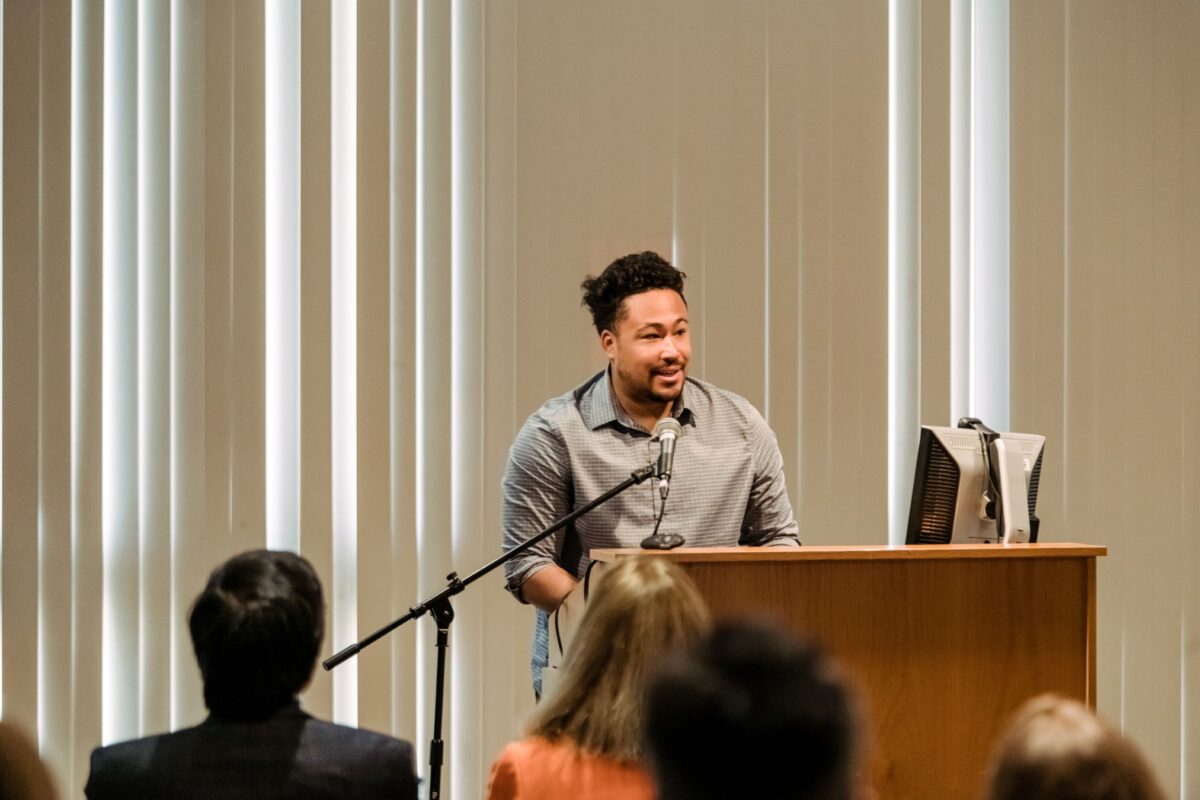 Graduate student Christopher Blume spoke at the signing ceremony. (Marlayna Demond ’11/UMBC)
In remarks he gave during the signing ceremony, Blume thanked his mentors and fellow students for the invaluable support he has received while pursuing a career in environmental science. He also expressed how grateful he was for the chance to work and connect with the communities throughout Baltimore who are impacted by and invested in the work he does.
“If there is one thing I’ve learned from my time in this program, it’s that diversity and representation of that diversity truly matter,” he says.
]]>
On a recent Friday, representatives of UMBC, the U.S. Geological Survey and the U.S. Environmental Protection Agency gathered in UMBC’s Albin O. Kuhn Library Gallery and pledged to work together...
https://umbc.edu/stories/usgs-epa-environmental-science-agreement/
https://my3.my.umbc.edu/api/v0/pixel/news/133263/guest@my.umbc.edu/e76ea9016f917f942ad603dd26e14da6/api/pixel
cnms
coeit
cuere
news
research
science-and-tech
UMBC News & Magazine
https://my3.my.umbc.edu/groups/umbc-news-magazine
https://assets1-my.umbc.edu/system/shared/avatars/groups/000/001/943/24435aa6207c452e7bc15cc74b42c7bb/xsmall.png?1748556657
https://assets1-my.umbc.edu/system/shared/avatars/groups/000/001/943/24435aa6207c452e7bc15cc74b42c7bb/original.png?1748556657
https://assets2-my.umbc.edu/system/shared/avatars/groups/000/001/943/24435aa6207c452e7bc15cc74b42c7bb/xxlarge.png?1748556657
https://assets2-my.umbc.edu/system/shared/avatars/groups/000/001/943/24435aa6207c452e7bc15cc74b42c7bb/xlarge.png?1748556657
https://assets3-my.umbc.edu/system/shared/avatars/groups/000/001/943/24435aa6207c452e7bc15cc74b42c7bb/large.png?1748556657
https://assets1-my.umbc.edu/system/shared/avatars/groups/000/001/943/24435aa6207c452e7bc15cc74b42c7bb/medium.png?1748556657
https://assets2-my.umbc.edu/system/shared/avatars/groups/000/001/943/24435aa6207c452e7bc15cc74b42c7bb/small.png?1748556657
https://assets1-my.umbc.edu/system/shared/avatars/groups/000/001/943/24435aa6207c452e7bc15cc74b42c7bb/xsmall.png?1748556657
https://assets2-my.umbc.edu/system/shared/avatars/groups/000/001/943/24435aa6207c452e7bc15cc74b42c7bb/xxsmall.png?1748556657
UMBC News & Magazine
0
0
false
Fri, 05 May 2023 09:09:37 -0400
UMBC to co-lead new Baltimore Social-Environmental Collaborative with $2.3M grant
American cities face environmental challenges that are exacerbated by climate change, from air and water quality issues to flooding and heat. Low-income neighborhoods and areas that were previously subject to racial redlining often experience these effects more intensely.
A new program supported by the U.S. Department of Energy (DoE) has funded Urban Integrated Field Laboratories in three American cities (including Baltimore) to generate resilience-enhancing solutions to urban climate challenges in collaboration with community organizations. The Baltimore-centered consortium, named the Baltimore Social-Environmental Collaborative (BSEC), will receive $24.5 million through the program. UMBC will receive $2.3 million of this larger grant.
Leading UMBC’s work on the project is Claire Welty, professor of chemical, biochemical, and environmental engineering and director of the Center for Urban Environmental Research and Education (CUERE). Johns Hopkins University leads the overall project, which also includes collaborators at the Pennsylvania State University, Morgan State University, the National Renewable Energy Laboratory, Drexel University, and the University of Virginia.
“This Baltimore Social-Environmental Collaborative is an important program during a critical time for our region, for our state, and for our planet,” says Karl V. Steiner, vice president for research at UMBC. “I am pleased that Baltimore was selected to serve as a representative metropolitan area for the climate challenges faced by many mid-sized industrial cities across the U.S.”
Listening to the community
Welty and UMBC colleagues such as Andrew Miller, professor of geography and environmental systems, bring decades of expertise in environmental monitoring to the project through their individual research and the Baltimore Ecosystem Study (BES). Originally funded as one of only two urban Long-Term Ecological Research (LTER) sites in the U.S., the BES has compiled massive datasets on the Baltimore region’s watershed, ecology, and sociological issues related to the environment for more than 20 years. The new BSEC will bring opportunities to expand this work in fresh directions.
“The exciting thing is leading from the needs of the community. To me, that’s what’s different about this,” Welty says. “What we want to try to do is partner with the communities to come up with solutions to these climate impact problems, and then what we’re bringing to the table are our tools to implement that.”
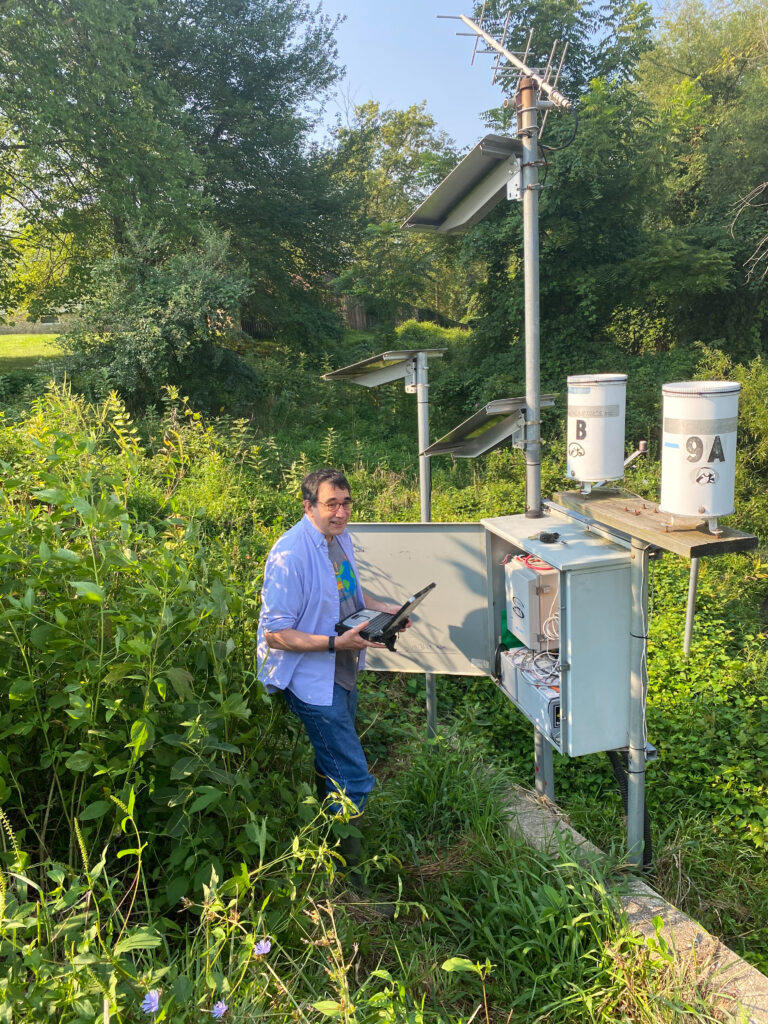 Andrew Miller checks on a water sampling station in Catonsville, MD. (Victor Fulda/UMBC)
Welty and Miller bring expertise in understanding patterns of water quality, flood and groundwater modeling, and rainfall patterns and how they are changing. UMBC also brings experience interacting with local agencies, such as the Baltimore City Department of Public Works and Maryland Department of the Environment. Other institutions in the consortium bring complementary expertise, such as overall climate forecasting, an understanding of how climate impacts intersect with issues of public health, and experience building trust with community groups.
“Among us, we think we have tools that can be applied to solve these problems,” Welty says. “We’re not imposing our tools on community groups, though, or telling them what their problems are. They’re telling us, and we’re responding with support and resources.”
Adding nuance
Welty, Miller, and others have spent decades generating models and collecting on-the-ground (and sometimes underground) observations of water quality, flow, and more in the Baltimore region. They will continue that work with the BSEC, and with input from communities, prioritize certain issues or geographic areas.
The BSEC will also fund deployment of new sensors at existing Baltimore Ecosystem Study stream sampling stations in the Gwynns Falls watershed . These stations have a 22-year record of weekly water quality sampling, and the new sensors will add data on other parameters at 15-minute intervals, 24 hours a day, seven days a week. The data will be accessible in near- real time, on only about a one-hour delay.
The BES data is “the best urban water quality data set in the world. This is not meant to replace that, but to add nuance,” Welty says. For example, Baltimore streams have struggled with inundation from road salt in the winter. “You might miss the peak of a salt event with weekly sampling,” Welty says, but finer scale sampling would easily identify it in the data.
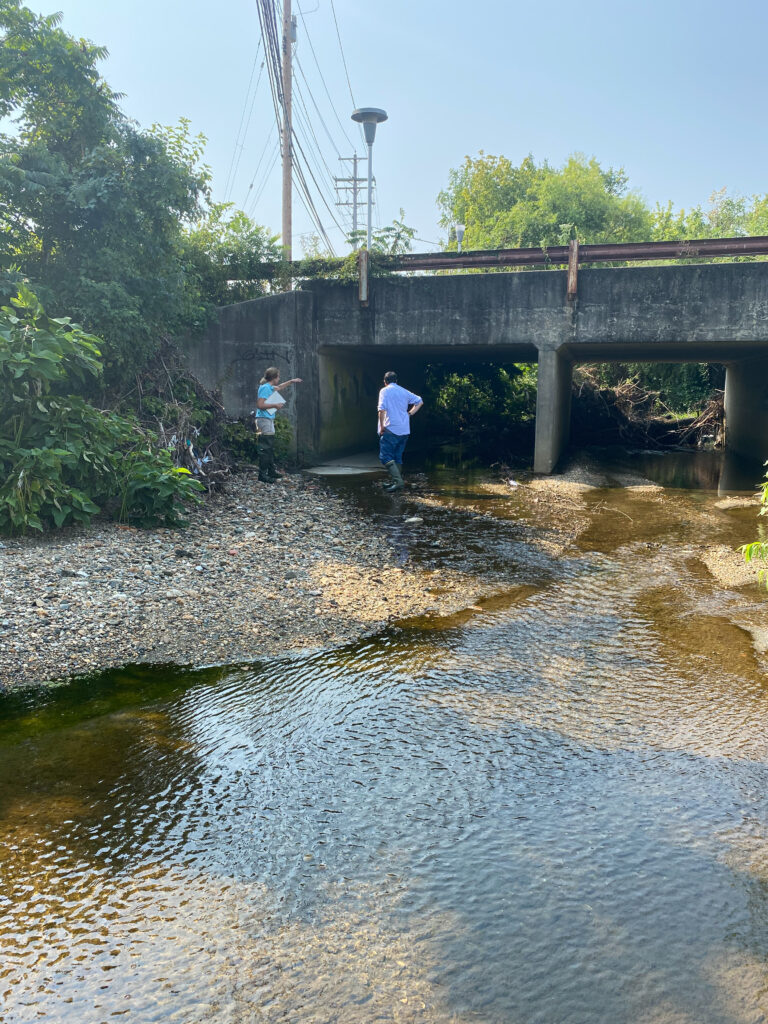 Claire Welty (left) and Andrew Miller check out one of their study sites in Woodlawn, MD. (Victor Fulda/UMBC)
A giant puzzle to put together
The BSEC is a unique project that brings together wide-ranging expertise to address pressing urban needs. “The guiding objective of the BSEC process is to produce the urban climate science needed to inform community-guided, equitable pathways for climate action,” says Ben Zaitchik, professor of Earth and planetary sciences at Johns Hopkins and the overall project lead. “In doing so, we address a number of fundamental urban science questions from across natural science and social science disciplines.”
UMBC’s Steiner adds, “This partnership with John Hopkins University and other research institutions is building upon our strong and long-term record of environmental research and educational initiatives here at UMBC. It will both challenge and enable us to explore equitable climate solutions.”
While the exact priorities and concerns that local communities will bring to the forefront are unknown, the BSEC group plans to bring their tools to bear in a way that best serves the people of Baltimore. Building coalitions with researchers and community members, learning the communities’ needs, and then finding the best ways to address them “is like a giant puzzle to put together,” Welty says. “It’s going to be exciting to see how it all unfolds.”
]]>
American cities face environmental challenges that are exacerbated by climate change, from air and water quality issues to flooding and heat. Low-income neighborhoods and areas that were...
https://umbc.edu/stories/social-environmental-collab-wins-2-3m-grant/
https://my3.my.umbc.edu/api/v0/pixel/news/128185/guest@my.umbc.edu/ff69f44dc2b56dfdfa416165651d0253/api/pixel
cahss
cahssresearch
cbee
cuere
ges
news
policy-and-society
rca-1
research
science-and-tech
UMBC News & Magazine
https://my3.my.umbc.edu/groups/umbc-news-magazine
https://assets1-my.umbc.edu/system/shared/avatars/groups/000/001/943/24435aa6207c452e7bc15cc74b42c7bb/xsmall.png?1748556657
https://assets1-my.umbc.edu/system/shared/avatars/groups/000/001/943/24435aa6207c452e7bc15cc74b42c7bb/original.png?1748556657
https://assets2-my.umbc.edu/system/shared/avatars/groups/000/001/943/24435aa6207c452e7bc15cc74b42c7bb/xxlarge.png?1748556657
https://assets2-my.umbc.edu/system/shared/avatars/groups/000/001/943/24435aa6207c452e7bc15cc74b42c7bb/xlarge.png?1748556657
https://assets3-my.umbc.edu/system/shared/avatars/groups/000/001/943/24435aa6207c452e7bc15cc74b42c7bb/large.png?1748556657
https://assets1-my.umbc.edu/system/shared/avatars/groups/000/001/943/24435aa6207c452e7bc15cc74b42c7bb/medium.png?1748556657
https://assets2-my.umbc.edu/system/shared/avatars/groups/000/001/943/24435aa6207c452e7bc15cc74b42c7bb/small.png?1748556657
https://assets1-my.umbc.edu/system/shared/avatars/groups/000/001/943/24435aa6207c452e7bc15cc74b42c7bb/xsmall.png?1748556657
https://assets2-my.umbc.edu/system/shared/avatars/groups/000/001/943/24435aa6207c452e7bc15cc74b42c7bb/xxsmall.png?1748556657
UMBC News & Magazine
0
0
false
Tue, 04 Oct 2022 16:22:06 -0400
Tue, 04 Oct 2022 16:22:06 -0400
Bedrock to treetops: NSF awards $4.8M to urban environment study led by UMBC’s Claire Welty
There is an essential resource constantly flowing beneath our feet: groundwater. Urban denizens may not think about it often, or at all, because they don’t rely on wells, “but it’s still there,” says hydrologist Claire Welty, and it’s critical to understanding the health of urban ecosystems.
Welty is director of UMBC’s Center for Urban Environmental Research and Education (CUERE) and a professor of chemical, biochemical, and environmental engineering. Groundwater is just one piece of a complicated puzzle that she and her team will work to put together over the next five years. A $4.8 million Critical Zone Collaborative Network grant from the National Science Foundation will make the large-scale project possible. The grant will support researchers at UMBC and eight other institutions that are part of the UMBC-led Urban Critical Zone Cluster.
Welty’s team will explore Earth’s critical zone, which extends from the tops of trees to the base of weathered bedrock, in urban centers along the Eastern Seaboard. In particular, they’re interested in how natural, geological processes occurring below the Earth’s surface and human-driven processes interact. Human influences include road salt application, polluted stormwater runoff, and soil-disturbing construction. These factors can all significantly influence urban water quality, water chemistry, and weathering processes.
Most Critical Zone grants are for work in more pristine wilderness areas, because the added effects of urban processes make the research more complicated. But, Welty says, “that’s the most interesting part.”
 The Earth’s critical zone extends from the treetops down to bedrock below ground. Image by the National Science Foundation.
Focus on the Fall Zone
The research will take place in four East Coast cities: Philadelphia, Baltimore, Washington, and Raleigh. The researchers strategically selected these urban centers because they align in a north-to-south corridor along what geologists call the “Fall Zone.” The Fall Zone exists at the transition from the Piedmont to the Coastal Plain, and is an area of intense interest for geologists.
“We think of this landscape as ancient, but recent research has led to a different understanding about how the Fall Zone in our region has evolved,” says geomorphologist Andrew Miller, UMBCprofessor of geography and environmental systems and a collaborator on the new grant. Glaciers to the region’s north played a role, and “human activity has also caused profound changes,” Miller says. “All of this forms the background for the work we are planning to do on this project.”
 Miller (left) and Welty in Catonsville at one of their research field sites. Photo by Victor Fulda.
Philadelphia to Raleigh: An urban corridor
The Fall Zone’s unique topography made it a natural place for some of the first American cities to emerge. Dramatic elevation changes characterize the Fall Zone, “so that’s where waterfalls formed, providing hydropower, so mills were set up,” Welty explains. Population centers grew up around the mills. Elevation changes at the Fall Zone boundary also limited water transport further inland, making it the natural place to build port cities. Today’s I-95 corridor links these urban centers.
The north-south corridor also gives the researchers an opportunity to examine how climate affects the movement of substances, such as sediment and dissolved materials, through the natural and built environments. Natural and human-introduced substances can affect everything from water quality to how quickly the bedrock wears away over time.
Of the four cities, Raleigh is distinct in ways that offer unique opportunities. As a younger city, it’s laid out differently. It may also have newer water, sewer, and other systems that could affect its underground properties in ways that differ from older, industrial cities like Baltimore and Philadelphia.
 The U.S. Northeast and mid-Atlantic at night, showing the urban corridor. Image courtesy NASA Earth Observatory, by Joshua Stevens.
Long-term legacy
Baltimore, in particular, is well-suited to host this research, because scientists have collected environmental data on the region for over twenty years through the Baltimore Ecosystem Study Long-Term Ecological Research Project (BES). The BES team has installed scientific instruments all over the region. Students, faculty, and sensors have been recording data consistently for decades, painting a picture of Baltimore’s watershed, ecology, and social issues related to the environment.
However, “the subsurface has for the most part been ignored,” Welty says. With funding from other sources, she and her field assistants have drilled 35 monitoring wells—but there’s more to be learned.
“We’ve got all this incredible science that’s been going on for 20 years of the BES,” Welty says. With the Critical Zone grant, “Now we want to look at the subsurface to complement all the data and information and instrumentation—you name it, we have it,” Welty says. “We think it’s really important to marry these two together.”
In addition to adding more and different data to an already huge archive, the Baltimore-based team also plans to leverage their existing data in new ways. “We’re going to use stream chemistry as a window into the subsurface,” Welty says. The researchers will also examine land use patterns and analyze bedrock and soil cores. Tools that act like an x-ray or MRI will enable them to visualize the structure and properties of the subsurface that are impossible to observe directly.
 Baltimore skyline. Photo by Adam Lindquist, used under CC-BY-NC 2.0.
Putting science into practice
Urban groundwater processes fascinate Welty. She’s driven by a fundamental desire to better understand what’s going on underneath cities in the Fall Zone. And there are practical reasons why this work is important, too.
“At UMBC, we’re always interested in informing policy with the scientific projects we do,” she says. “We have strong relationships with partners in Baltimore, and folks in the other cities do as well. They pay attention to what we do.”
Those relationships work in both directions. Sometimes the research informs new policies around development, water treatment, or salt use. Other times, questions from regional leaders inspire additional research, including student projects.
Some public concerns have involved hazards to the urban drinking water supply and salinization of streams, which could be detrimental to wildlife. “We’re making connections and providing a foundation of knowledge,” Welty says, so policymakers can make decisions grounded in science.
In addition, Alan Berkowitz from the Cary Institute is on the team to help bring these important ideas to K-12 students. Berkowitz will work with the researchers to develop an Earth science module for local schools, which will eventually be available to educators nationwide. Berkowitz will also work with the team to develop a citizen science program focused on the urban critical zone theme.
“Alan has his ear to the ground on what the schools are interested in, and he knows how to make that translation from the scientific project to this kind of outreach,” Welty says. This work will bring the project full circle, inspiring another generation of minds to explore the world beneath their feet.
Banner image: Claire Welty (left) and Andrew Miller at a field research site in Catonsville. The site is a buried stream that doubles as a storm drain and is part of a restoration project. Photo by Victor Fulda, an engineering technician in UMBC’s chemical, biochemical, and environmental engineering department.
]]>
There is an essential resource constantly flowing beneath our feet: groundwater. Urban denizens may not think about it often, or at all, because they don’t rely on wells, “but it’s still there,”...
https://umbc.edu/stories/bedrock-to-treetops-nsf-awards-4-8m-to-urban-environment-study-led-by-umbcs-claire-welty/
https://my3.my.umbc.edu/api/v0/pixel/news/119801/guest@my.umbc.edu/178c230cb8be7e31515048d7b62f7845/api/pixel
cahss
cbee
coeit
cuere
ges
research
science-and-technology
UMBC News & Magazine
https://my3.my.umbc.edu/groups/umbc-news-magazine
https://assets1-my.umbc.edu/system/shared/avatars/groups/000/001/943/24435aa6207c452e7bc15cc74b42c7bb/xsmall.png?1748556657
https://assets1-my.umbc.edu/system/shared/avatars/groups/000/001/943/24435aa6207c452e7bc15cc74b42c7bb/original.png?1748556657
https://assets2-my.umbc.edu/system/shared/avatars/groups/000/001/943/24435aa6207c452e7bc15cc74b42c7bb/xxlarge.png?1748556657
https://assets2-my.umbc.edu/system/shared/avatars/groups/000/001/943/24435aa6207c452e7bc15cc74b42c7bb/xlarge.png?1748556657
https://assets3-my.umbc.edu/system/shared/avatars/groups/000/001/943/24435aa6207c452e7bc15cc74b42c7bb/large.png?1748556657
https://assets1-my.umbc.edu/system/shared/avatars/groups/000/001/943/24435aa6207c452e7bc15cc74b42c7bb/medium.png?1748556657
https://assets2-my.umbc.edu/system/shared/avatars/groups/000/001/943/24435aa6207c452e7bc15cc74b42c7bb/small.png?1748556657
https://assets1-my.umbc.edu/system/shared/avatars/groups/000/001/943/24435aa6207c452e7bc15cc74b42c7bb/xsmall.png?1748556657
https://assets2-my.umbc.edu/system/shared/avatars/groups/000/001/943/24435aa6207c452e7bc15cc74b42c7bb/xxsmall.png?1748556657
UMBC News & Magazine
0
0
false
Wed, 02 Sep 2020 16:23:32 -0400
Convicts Are Returning to Farming—Anti-Immigrant Policies Are the Reason
By Stian Rice, visiting assistant research professor, Center for Urban Environmental Research and Education, UMBC
Prison inmates are picking fruits and vegetables at a rate not seen since Jim Crow.
Convict leasing for agriculture—a system that allows states to sell prison labor to private farms—became infamous in the late 1800s for the brutal conditions it imposed on captive, mostly black workers.
Federal and state laws prohibited convict leasing for most of the 20th century, but the once-notorious practice is making a comeback.
Under lucrative arrangements, states are increasingly leasing prisoners to private corporations to harvest food for American consumers.
Why now?
The U.S. food system relies on cheap labor. Today, median income for farm workers is US$10.66 an hour, with 33% of farm-worker households living below the poverty line.
Historically, agriculture has suppressed wages—and eschewed worker protections—by hiring from vulnerable groups, notably, undocumented migrants. By some estimates, 70% of agriculture’s 1.2 million workers are undocumented.
As current anti-immigrant policies diminish the supply of migrant workers (both documented and undocumented), farmers are not able to find the labor they need. So, in states such as Arizona, Idaho and Washington that grow labor-intensive crops like onions, apples and tomatoes, prison systems have responded by leasing convicts to growers desperate for workers.
The racist roots of convict leasing
Since Reconstruction, states have used prisoners to solve labor supply problems in industries such as road and rail construction, mining and agriculture. But convict leasing has also been a powerful weapon of white supremacy, and now, anti-immigrant sentiment.
After Emancipation, southern economies faced a crisis: how to maintain a racial caste system and a supply of surplus labor now that blacks were free.
Southern states passed vagrancy laws, Black Codes, and other legislation to selectively incarcerate freed slaves. For example, under Mississippi’s vagrancy law, all black men had to provide written proof of a job or face a $50 fine. Those who could not pay were forced to work for any white man willing to pay the fine—an amount that was deducted from the black man’s wage.
During the late 1800s, mass incarceration created an army of cheap labor that could be leased to private businesses for substantial profit. In 1886, state revenues from leasing exceeded the cost of running prisons by nearly 400%. Between 1870 and 1910, 88% of convicts leased in Georgia were black.
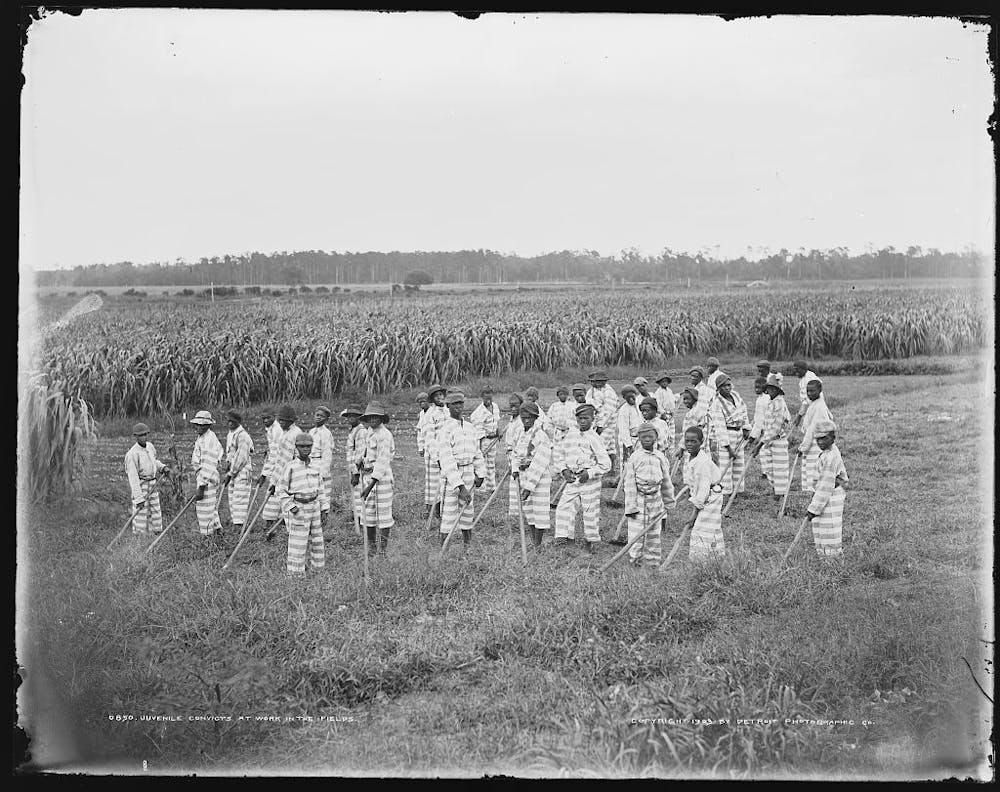
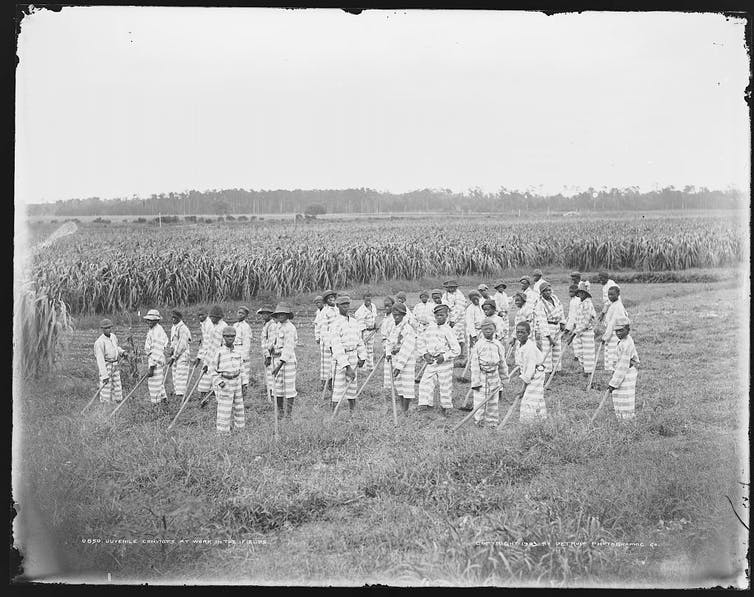 In this Library of Congress photo from 1903, juvenile convicts are shown at work in the fields, location unknown.
Library of Congress/Detroit Publishing Co.
Populist response
But cheap convict labor also suppressed wages for free whites, and by 1900, poor whites began pushing back.
In 1904, James Vardaman was elected governor of Mississippi on a platform of returning whites to work and blacks to confinement. These populist white supremacist sentiments dovetailed with national economic concerns during the Great Depression, when agricultural failures led to widespread unemployment.
In the 1930s, the Ashurst-Sumners Act and accompanying state laws prohibited convict leasing and the sale of prisoner-made goods on the open market. Inmates still worked in agriculture, but the food they produced had to be consumed by other prisoners or state workers.
By the late 1970s, with growing competition from foreign manufacturing, U.S. companies sought out domestic sources of cheap labor.
Under pressure from corporate lobbies like the American Legislative Exchange Council, Congress relaxed restrictions on convict leasing with the Justice System Improvement Act. As the manufacturing and service sectors began hiring prisoners, agriculture expanded its use of migrant workers.
Profit and exploitation
Today, convict leasing offers significant revenues for prisons.
Most wages paid to inmates are garnished by prisons to cover incarceration costs and pay victim restitution programs. In some cases, prisoners see no monetary compensation whatsoever. In 2015 and 2016, the California Prison Industry Authority made over $2 million from its food and agriculture sector.
Growers can reap significant revenues, too. Inmates are excluded from federal minimum wage protections, allowing prison systems to lease convicts at a rate below the going labor rate. In Arizona, inmates leased through Arizona Correctional Industries (ACI) receive a wage of $3-$4 per hour before deductions. Meanwhile, the state’s minimum wage for most non-incarcerated farm workers is $11.00/hr.
Beyond the unfairness of low wages, inadequate state and federal regulations ensure that agricultural work continues to be onerous. Laborers endure long hours, repetitive motion injuries, temperature and humidity extremes and exposure to caustic and carcinogenic chemicals.
For inmates, these circumstances are unlikely to change. U.S. courts have ruled that prisoners are prohibited from organizing for higher wages and working conditions—though strikes have occurred in recent years.
Furthermore, inmates are not legally considered employees, which means they are excluded from protection under parts of the 1964 Civil Rights Act, the Equal Pay Act, the Fair Labor Standards Act, the National Labor Relations Act and the Federal Tort Claims Act.
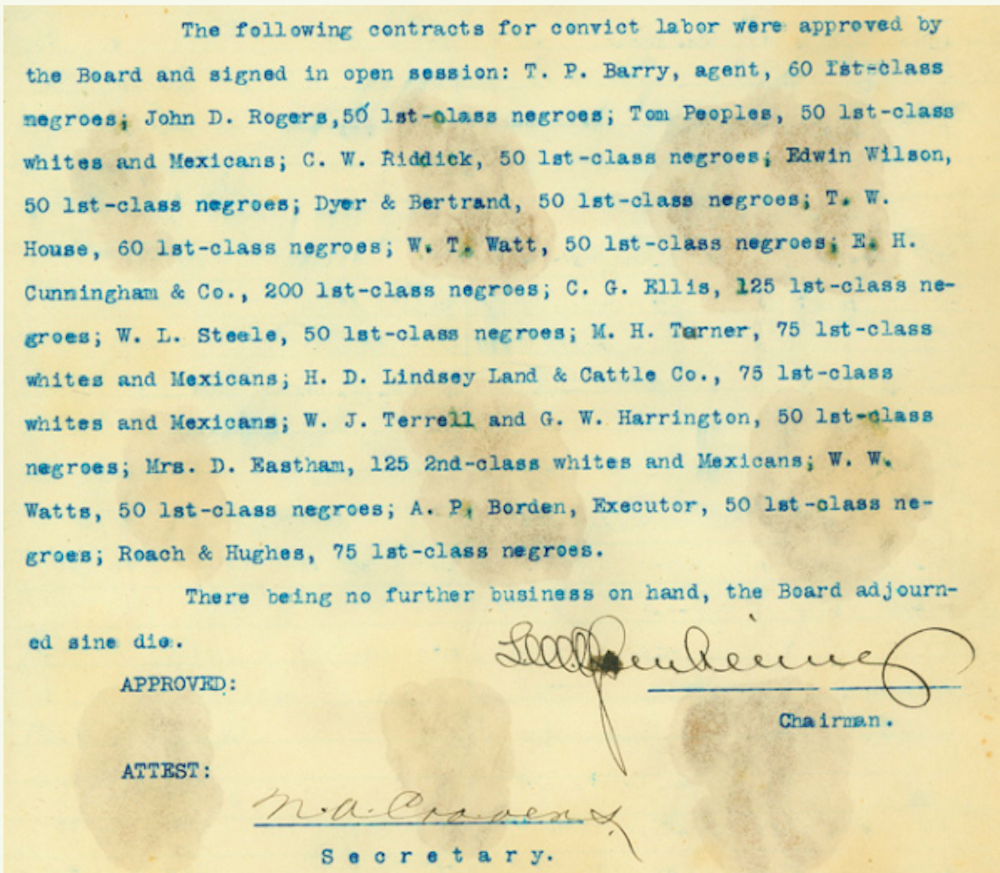
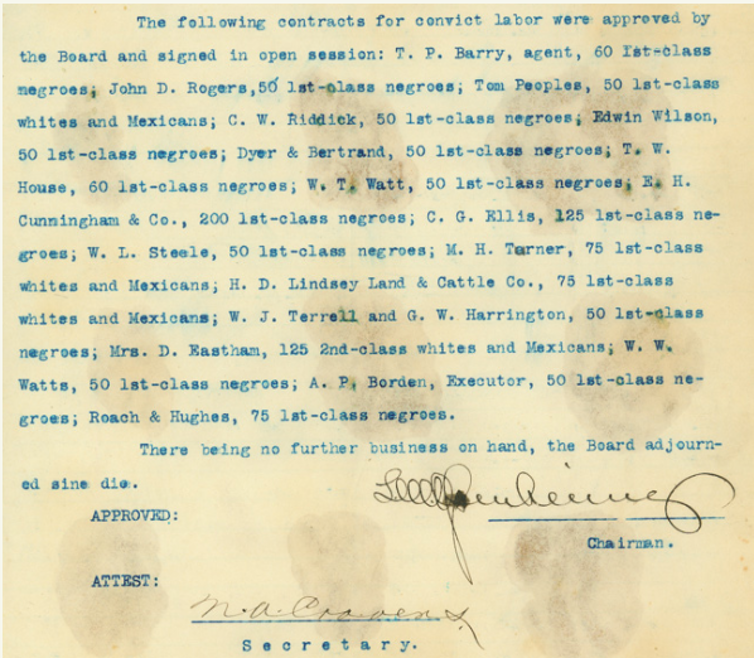 Excerpt from minutes of the regular meeting of the Texas Penitentiary Board, Nov. 12, 1903.
Board of Criminal Justice minutes and meeting files, Texas Department of Criminal Justice, Archives and Information Services Division, Texas State Library and Archives Commission.
Whose labor is being sold?
The total number—and racial makeup—of leased inmates is difficult to calculate. Not all prison systems report on farming operations or leased labor arrangements. According to one advocacy group, at least 30,000 inmates work within the food system. But to the extent that convict leasing reflects overall inmate demographics, prison agriculture is distinctly racial.
Blacks make up 39% of inmates, but only 12% of the general population, making blacks six times more likely than whites to be incarcerated. Over the last 50 years—the same period that saw the return of convict leasing—the black incarceration rate quadrupled.
Proponents of “prison industries” argue that leasing provides rehabilitative benefits like on-the-job training for reentry. But research shows that within the prison system, whites receive better jobs than blacks, with better pay and more beneficial skills.
Whereas migrant workers often benefit home communities by returning a portion of their wages as remittances, the garnishing or nonpayment of convict wages prevents inmates from contributing to their families and home economies.
Since Emancipation, agriculture has moved its focus from one labor source to another in response to shifting currents of populism, nativism and racism. All three benefit from the exploitation of minority populations, and all three justify policies of exploitation in economic terms.
Convict leasing is the first—and now the latest—strategy.
******
Stian Rice, food systems geographer, Center for Urban Environmental Research and Education, University of Maryland, Baltimore County
Header image by Rasmus Landgreen on Unsplash
This article is republished from The Conversation under a Creative Commons license. Read the original article.
]]>
By Stian Rice, visiting assistant research professor, Center for Urban Environmental Research and Education, UMBC Prison inmates are picking fruits and vegetables at a rate not seen since Jim...
https://umbc.edu/stories/convicts-are-returning-to-farming-anti-immigrant-policies-are-the-reason/
https://my3.my.umbc.edu/api/v0/pixel/news/120116/guest@my.umbc.edu/5b477624ca7fff55e387dffcc8c10284/api/pixel
cuere
perspectives
the-conversation
UMBC News & Magazine
https://my3.my.umbc.edu/groups/umbc-news-magazine
https://assets1-my.umbc.edu/system/shared/avatars/groups/000/001/943/24435aa6207c452e7bc15cc74b42c7bb/xsmall.png?1748556657
https://assets1-my.umbc.edu/system/shared/avatars/groups/000/001/943/24435aa6207c452e7bc15cc74b42c7bb/original.png?1748556657
https://assets2-my.umbc.edu/system/shared/avatars/groups/000/001/943/24435aa6207c452e7bc15cc74b42c7bb/xxlarge.png?1748556657
https://assets2-my.umbc.edu/system/shared/avatars/groups/000/001/943/24435aa6207c452e7bc15cc74b42c7bb/xlarge.png?1748556657
https://assets3-my.umbc.edu/system/shared/avatars/groups/000/001/943/24435aa6207c452e7bc15cc74b42c7bb/large.png?1748556657
https://assets1-my.umbc.edu/system/shared/avatars/groups/000/001/943/24435aa6207c452e7bc15cc74b42c7bb/medium.png?1748556657
https://assets2-my.umbc.edu/system/shared/avatars/groups/000/001/943/24435aa6207c452e7bc15cc74b42c7bb/small.png?1748556657
https://assets1-my.umbc.edu/system/shared/avatars/groups/000/001/943/24435aa6207c452e7bc15cc74b42c7bb/xsmall.png?1748556657
https://assets2-my.umbc.edu/system/shared/avatars/groups/000/001/943/24435aa6207c452e7bc15cc74b42c7bb/xxsmall.png?1748556657
UMBC News & Magazine
0
0
false
Fri, 07 Jun 2019 13:24:50 -0400
Twenty years of the Baltimore Ecosystem Study: An icon of urban ecology research

The Baltimore Ecosystem Study (BES) is one of only two urban Long-Term Ecological Research projects initially funded by the National Science Foundation, and this year it turns 20. When the BES was founded in 1998, “The field of urban ecology basically didn’t exist,” says Claire Welty, director of UMBC’s Center for Urban Environmental Research and Education. Since then, the field has flourished, in no small part thanks to dedicated researchers in Baltimore.
The BES has succeeded in compiling massive datasets on the Baltimore region’s watershed, ecology, and sociological issues related to the environment. The extent of these data are unparalleled anywhere else in the world. That makes the study “an international icon,” Welty says, and its wealth of fully public data provides “a rich resource for people to use in their research.”
“We’re living in a rapidly changing environment,” says Andy Miller, professor of geography and environmental systems (GES) and chair of the department when the study was founded. The long-term data the BES collects allows researchers to document “how systems change in response to what we do” on and to the landscape, Miller explains. That includes large-scale development of previously undisturbed ecosystems. If we can learn enough, Miller says, that knowledge may create “opportunities to mitigate the effects of urbanization.”
 Claire Welty, director of UMBC’s Center for Urban Environmental Research and Education.
Moving on those opportunities requires collaboration with policymakers at many levels. Over the course of the BES, its researchers have gained the trust of local and state officials who have found BES data helpful in informing policy discussions, says Miller. Employees from the Maryland Department of the Environment, Department of Natural Resources, and others regularly attend BES quarterly meetings.
At the federal level, scientists and managers from the USDA Forest Service’s Baltimore Field Station and from the US Geological Survey’s MD-DE-DC Water Science Center have been long-term partners, contributing to and benefiting from the BES program. Both are located at the bwtech@UMBC Research & Technology Park.
Beyond the flood of data and influence on policy, “The impact of the BES on research infrastructure and training in Baltimore has been so important,” says Miller. The BES is headquartered on UMBC’s campus, and the presence of the program here has helped faculty successfully apply for funding to support related projects. It even enabled the launch of UMBC’s graduate program in GES by facilitating funding of the program’s first students through the NSF’s Integrative Graduate Education and Research Traineeship program.
The education component of the BES extends far beyond the graduate level. Its education arm works with K-12 students throughout the Baltimore region to teach them about their local ecosystems and the importance of caring for the environment, with the goal of raising a generation of young people committed to environmental stewardship.
 Andy Miller (left) and Matthew Baker, professors of geography and environmental systems at UMBC.
Today, “More than half of the world’s population lives in cities,” says Chris Swan, professor of GES and a BES scientist, “and understanding how these environments function from the natural, physical and social science perspectives has never been more important.”
Plus, the effects of climate change don’t necessarily show up immediately, but can accumulate over time, explains Welty, “so it’s important that the data collection continue,” especially as climate change accelerates.
The BES is unique because it “brings scientists, stakeholders, policy makers, and students to the table on a regular basis to perform research, interpret results and understand outcomes,” says Swan. This level of collaboration on such a large scale enables BES to have a substantial impact, locally and in other urban areas around the world. This impact can be felt in the well-being of urban residents, he adds, “none more so than the people of Baltimore.”
Banner image: Chris Swan tends native plants at a UMBC greenhouse. All photos by Marlayna Demond ’11 for UMBC.
]]>
The Baltimore Ecosystem Study (BES) is one of only two urban Long-Term Ecological Research projects initially funded by the National Science Foundation, and this year it turns 20. When the BES was...
https://umbc.edu/stories/twenty-years-of-the-baltimore-ecosystem-study-an-icon-of-urban-ecology-research/
https://my3.my.umbc.edu/api/v0/pixel/news/120288/guest@my.umbc.edu/7a9e9ef2f7dad128bb9f573ad5905715/api/pixel
cahss
coeit
cuere
ges
research
science-and-technology
UMBC News & Magazine
https://my3.my.umbc.edu/groups/umbc-news-magazine
https://assets1-my.umbc.edu/system/shared/avatars/groups/000/001/943/24435aa6207c452e7bc15cc74b42c7bb/xsmall.png?1748556657
https://assets1-my.umbc.edu/system/shared/avatars/groups/000/001/943/24435aa6207c452e7bc15cc74b42c7bb/original.png?1748556657
https://assets2-my.umbc.edu/system/shared/avatars/groups/000/001/943/24435aa6207c452e7bc15cc74b42c7bb/xxlarge.png?1748556657
https://assets2-my.umbc.edu/system/shared/avatars/groups/000/001/943/24435aa6207c452e7bc15cc74b42c7bb/xlarge.png?1748556657
https://assets3-my.umbc.edu/system/shared/avatars/groups/000/001/943/24435aa6207c452e7bc15cc74b42c7bb/large.png?1748556657
https://assets1-my.umbc.edu/system/shared/avatars/groups/000/001/943/24435aa6207c452e7bc15cc74b42c7bb/medium.png?1748556657
https://assets2-my.umbc.edu/system/shared/avatars/groups/000/001/943/24435aa6207c452e7bc15cc74b42c7bb/small.png?1748556657
https://assets1-my.umbc.edu/system/shared/avatars/groups/000/001/943/24435aa6207c452e7bc15cc74b42c7bb/xsmall.png?1748556657
https://assets2-my.umbc.edu/system/shared/avatars/groups/000/001/943/24435aa6207c452e7bc15cc74b42c7bb/xxsmall.png?1748556657
UMBC News & Magazine
0
0
false
Fri, 02 Nov 2018 20:06:44 -0400
Innovative soil project offers new approach to sustainable landscaping by giving roots room to grow
Stu Schwartz, senior research scientist for the Center for Urban Environmental Research and Education (CUERE) at UMBC, has long looked with concern at the issue of soil compaction and its effect on stormwater runoff and infiltration. Impervious surfaces, such as roofs, roads, and parking lots, increase stormwater runoff and pollutants in streams and rivers. Schwartz and his students found that standard construction practices can routinely result in green permeable landscapes with compacted soil profiles that produce almost as much runoff as an impervious road or parking lot.
Looking for a better way to create sustainable, attractive landscaping, he dug into the problem of compacted soil and began collaborating with various government agencies to address these issues.
Schwartz and his students worked with the Maryland Department of Transportation State Highway Administration’s Office of Environmental Design to demonstrate and refine an alternative to standard topsoiling practices that are commonly used by contractors. The technique—suburban subsoiling—makes the soil less compact and incorporates rich, organic compost into the soil to restore infiltration and water-holding capacity.
This practice needs little to no ongoing irrigation and fertilizer input, functions well technically, and has the markers of commercial success. It can be implemented with relatively minor changes to standard land development practices, and holds great promise as a win-win technology to reduce stormwater runoff while delivering superior sustainable landscaping.
The American Association of State Highway and Transportation Officials (AASHTO) recently identified this innovation as one of 2016’s “Sweet 16” projects. AASHTO’s “Sweet 16” distinction annually recognizes four high value projects from each geographic region of the United States.
In applying the suburban subsoiling technique, Schwartz and his students have worked with the City of Baltimore and Yorkwood Elementary School. The collaboration aims to reduce the amount of asphalt covering the ground and create construction that can allow the ground to absorb more water. Schwartz’s team developed an alternative way to restore the sustainability profile of the soil after the asphalt was removed and replaced with grass.
Photo by U.S. Department of Agriculture. CC by 2.0.
]]>
Stu Schwartz, senior research scientist for the Center for Urban Environmental Research and Education (CUERE) at UMBC, has long looked with concern at the issue of soil compaction and its effect...
https://umbc.edu/stories/innovative-soil-project-offers-new-approach-to-sustainable-landscaping-by-giving-roots-room-to-grow/
https://my3.my.umbc.edu/api/v0/pixel/news/120999/guest@my.umbc.edu/dec83b05f6197980a44b2886460edaf2/api/pixel
cuere
science-and-technology
UMBC News & Magazine
https://my3.my.umbc.edu/groups/umbc-news-magazine
https://assets1-my.umbc.edu/system/shared/avatars/groups/000/001/943/24435aa6207c452e7bc15cc74b42c7bb/xsmall.png?1748556657
https://assets1-my.umbc.edu/system/shared/avatars/groups/000/001/943/24435aa6207c452e7bc15cc74b42c7bb/original.png?1748556657
https://assets2-my.umbc.edu/system/shared/avatars/groups/000/001/943/24435aa6207c452e7bc15cc74b42c7bb/xxlarge.png?1748556657
https://assets2-my.umbc.edu/system/shared/avatars/groups/000/001/943/24435aa6207c452e7bc15cc74b42c7bb/xlarge.png?1748556657
https://assets3-my.umbc.edu/system/shared/avatars/groups/000/001/943/24435aa6207c452e7bc15cc74b42c7bb/large.png?1748556657
https://assets1-my.umbc.edu/system/shared/avatars/groups/000/001/943/24435aa6207c452e7bc15cc74b42c7bb/medium.png?1748556657
https://assets2-my.umbc.edu/system/shared/avatars/groups/000/001/943/24435aa6207c452e7bc15cc74b42c7bb/small.png?1748556657
https://assets1-my.umbc.edu/system/shared/avatars/groups/000/001/943/24435aa6207c452e7bc15cc74b42c7bb/xsmall.png?1748556657
https://assets2-my.umbc.edu/system/shared/avatars/groups/000/001/943/24435aa6207c452e7bc15cc74b42c7bb/xxsmall.png?1748556657
UMBC News & Magazine
0
0
false
Thu, 29 Sep 2016 15:17:11 -0400
UMBC researchers collaborate to improve sustainability, with impacts in Maryland and across the nation
Local sustainability researchers and thought leaders took center stage on October 16, 2015, at a forum for urban sustainability in Baltimore, hosted by UMBC’s School of Public Policy. The forum was designed to examine how collaborations among government agencies, companies, and nonprofits can improve sustainability policies and programs. It also emphasized how a broad range of perspectives is needed to effectively assess and address environmental concerns.
This isn’t news to Claire Welty, professor of chemical, biochemical, and environmental engineering and director of UMBC’s Center for Urban Environmental Research and Education. Welty is the associate director of research for the Urban Water Innovation Network (UWIN), recently created through a $12 million commitment from the National Science Foundation (NSF).
Global climate change and extreme events can impact water security and be costly to economies. Through UWIN, UMBC and 13 other academic institutions and key partners, including Princeton University and the University of Pennsylvania, will address challenges that threaten urban water systems in the United States. Led by Colorado State University, UWIN will create solutions to help communities increase resilience in their water systems and boost preparedness for responding to water crises.
The research completed by UMBC and other UWIN partners will produce sustainability blueprints for cities of various sizes, detailing the likely effects and tradeoffs of potential solutions to urban water problems. This will serve as a guide for actions urban centers can take to improve their water security.
UMBC’s strong research and education programs focusing on stormwater management, water quality control, and urban biodiversity will serve as major assets for UWIN. In addition to Welty, Andrew Miller and Christopher Swan, both professors of geography and environmental systems, will play an active role in the collaboration.
NSF also recently announced a major $20 million award to expand the Center for Sustainable Nanotechnology (CSN), which uses fundamental chemistry to explore how modern nanomaterials interact with the environment and living organisms. Zeev Rosenzweig, professor and chair of chemistry and biochemistry at UMBC, is leading UMBC’s participation in the CSN, which includes 13 faculty from research institutions across the United States.
Nanotechnology involves the use of materials at the smallest scale, including the manipulation of individual atoms and molecules. There are hundreds of products that use nanoscale technologies in various ways, including beer bottles, car wax, electric and hybrid car batteries, and even Kindle devices, but there are still many concerning unknowns when it comes to how tiny particles interact with biological systems.
“This research center will greatly impact society by preparing next generation nanomaterials that retain high function, while being safer for human health and the environment,” said Rosenzweig.
Each of these projects demonstrates the need for collaboration across disciplines and institutions to develop optimal solutions for environmental problems. Faculty, staff, and students across UMBC are participating in this work in innumerable ways, from the Maryland Green Prisons Initiative, to reducing phosphorus loads in Maryland’s waterways, to constructing new buildings on campus that have been recognized for leadership in energy and environmental design.
In just one week, a UMBC research forum on climate change and the environment will bring together faculty from all three colleges for discussions that may inspire even greater collaboration.
At the recent urban sustainability forum in Baltimore, researcher Eric Zeemering shared, “I think it’s very important that we need to discuss strategies beyond ‘green.’” Zeemering told the crowd that when it comes to developing partnerships to tackle sustainability issues, “Baltimore can continue to be a model for the rest of the nation.”
Image: Zeev Rosenzweig, professor and chair of chemistry and biochemistry, is leading UMBC’s participation in the Center for Sustainable Nanotechnology. Photo by Marlayna Demond ’11.
]]>
Local sustainability researchers and thought leaders took center stage on October 16, 2015, at a forum for urban sustainability in Baltimore, hosted by UMBC’s School of Public Policy. The forum...
https://umbc.edu/stories/umbc-researchers-collaborate-to-improve-sustainability-with-impacts-in-maryland-and-across-the-nation/
https://my3.my.umbc.edu/api/v0/pixel/news/121509/guest@my.umbc.edu/1eb197159d341aa3dde6b88943dd9aec/api/pixel
cahss
cbee
chembiochem
cnms
coeit
cuere
ges
publicpolicy
science-and-technology
UMBC News & Magazine
https://my3.my.umbc.edu/groups/umbc-news-magazine
https://assets1-my.umbc.edu/system/shared/avatars/groups/000/001/943/24435aa6207c452e7bc15cc74b42c7bb/xsmall.png?1748556657
https://assets1-my.umbc.edu/system/shared/avatars/groups/000/001/943/24435aa6207c452e7bc15cc74b42c7bb/original.png?1748556657
https://assets2-my.umbc.edu/system/shared/avatars/groups/000/001/943/24435aa6207c452e7bc15cc74b42c7bb/xxlarge.png?1748556657
https://assets2-my.umbc.edu/system/shared/avatars/groups/000/001/943/24435aa6207c452e7bc15cc74b42c7bb/xlarge.png?1748556657
https://assets3-my.umbc.edu/system/shared/avatars/groups/000/001/943/24435aa6207c452e7bc15cc74b42c7bb/large.png?1748556657
https://assets1-my.umbc.edu/system/shared/avatars/groups/000/001/943/24435aa6207c452e7bc15cc74b42c7bb/medium.png?1748556657
https://assets2-my.umbc.edu/system/shared/avatars/groups/000/001/943/24435aa6207c452e7bc15cc74b42c7bb/small.png?1748556657
https://assets1-my.umbc.edu/system/shared/avatars/groups/000/001/943/24435aa6207c452e7bc15cc74b42c7bb/xsmall.png?1748556657
https://assets2-my.umbc.edu/system/shared/avatars/groups/000/001/943/24435aa6207c452e7bc15cc74b42c7bb/xxsmall.png?1748556657
UMBC News & Magazine
0
0
false
Fri, 23 Oct 2015 16:18:00 -0400
CUERE Seminar: Effects of Urbanizaion on Shallow Hydrogeolic Systems (5/1)
 CUERE Seminar presents Dr. John M. Sharp, Jr. from the National Science Foundation and University of Texas. His talk will be on “Effects of urbanization on shallow hydrogeolic systems.” Friday, May 1, 2015 at 2:00 pm in the TRC Building room 206.
]]>
CUERE Seminar presents Dr. John M. Sharp, Jr. from the National Science Foundation and University of Texas. His talk will be on “Effects of urbanization on shallow hydrogeolic systems.” Friday,...
https://umbc.edu/stories/cuere-seminar-effects-of-urbanizaion-on-shallow-hydrogeolic-systems-51/
https://my3.my.umbc.edu/api/v0/pixel/news/121834/guest@my.umbc.edu/517ffca064c5fe70d21bcb7a8006ceee/api/pixel
coeit
cuere
science-and-technology
UMBC News & Magazine
https://my3.my.umbc.edu/groups/umbc-news-magazine
https://assets1-my.umbc.edu/system/shared/avatars/groups/000/001/943/24435aa6207c452e7bc15cc74b42c7bb/xsmall.png?1748556657
https://assets1-my.umbc.edu/system/shared/avatars/groups/000/001/943/24435aa6207c452e7bc15cc74b42c7bb/original.png?1748556657
https://assets2-my.umbc.edu/system/shared/avatars/groups/000/001/943/24435aa6207c452e7bc15cc74b42c7bb/xxlarge.png?1748556657
https://assets2-my.umbc.edu/system/shared/avatars/groups/000/001/943/24435aa6207c452e7bc15cc74b42c7bb/xlarge.png?1748556657
https://assets3-my.umbc.edu/system/shared/avatars/groups/000/001/943/24435aa6207c452e7bc15cc74b42c7bb/large.png?1748556657
https://assets1-my.umbc.edu/system/shared/avatars/groups/000/001/943/24435aa6207c452e7bc15cc74b42c7bb/medium.png?1748556657
https://assets2-my.umbc.edu/system/shared/avatars/groups/000/001/943/24435aa6207c452e7bc15cc74b42c7bb/small.png?1748556657
https://assets1-my.umbc.edu/system/shared/avatars/groups/000/001/943/24435aa6207c452e7bc15cc74b42c7bb/xsmall.png?1748556657
https://assets2-my.umbc.edu/system/shared/avatars/groups/000/001/943/24435aa6207c452e7bc15cc74b42c7bb/xxsmall.png?1748556657
UMBC News & Magazine
0
0
false
Fri, 24 Apr 2015 15:21:49 -0400
CUERE Seminar: Sources and Processes Affecting Particulate Matter (4/24)
CUERE Seminar Series presents Dr. Chris Hennigan with UMBC’s Department of Chemical, Biochemical, and Environmental Engineering Department and his talk on “Sources and Processes Affecting Particulate Matter in Denver, CO during DISCOVER-AQ.” Friday, April 24, 2015 at 2:00 pm in the TRC Building room 206.
]]>
CUERE Seminar Series presents Dr. Chris Hennigan with UMBC’s Department of Chemical, Biochemical, and Environmental Engineering Department and his talk on “Sources and Processes Affecting...
https://umbc.edu/stories/cuere-seminar-sources-and-processes-affecting-particulate-matter-424/
https://my3.my.umbc.edu/api/v0/pixel/news/121874/guest@my.umbc.edu/d73484e2c8f443255069f904827f135a/api/pixel
coeit
cuere
science-and-technology
UMBC News & Magazine
https://my3.my.umbc.edu/groups/umbc-news-magazine
https://assets1-my.umbc.edu/system/shared/avatars/groups/000/001/943/24435aa6207c452e7bc15cc74b42c7bb/xsmall.png?1748556657
https://assets1-my.umbc.edu/system/shared/avatars/groups/000/001/943/24435aa6207c452e7bc15cc74b42c7bb/original.png?1748556657
https://assets2-my.umbc.edu/system/shared/avatars/groups/000/001/943/24435aa6207c452e7bc15cc74b42c7bb/xxlarge.png?1748556657
https://assets2-my.umbc.edu/system/shared/avatars/groups/000/001/943/24435aa6207c452e7bc15cc74b42c7bb/xlarge.png?1748556657
https://assets3-my.umbc.edu/system/shared/avatars/groups/000/001/943/24435aa6207c452e7bc15cc74b42c7bb/large.png?1748556657
https://assets1-my.umbc.edu/system/shared/avatars/groups/000/001/943/24435aa6207c452e7bc15cc74b42c7bb/medium.png?1748556657
https://assets2-my.umbc.edu/system/shared/avatars/groups/000/001/943/24435aa6207c452e7bc15cc74b42c7bb/small.png?1748556657
https://assets1-my.umbc.edu/system/shared/avatars/groups/000/001/943/24435aa6207c452e7bc15cc74b42c7bb/xsmall.png?1748556657
https://assets2-my.umbc.edu/system/shared/avatars/groups/000/001/943/24435aa6207c452e7bc15cc74b42c7bb/xxsmall.png?1748556657
UMBC News & Magazine
0
0
false
Thu, 16 Apr 2015 17:46:35 -0400
CUERE Seminar: Turning our Waste into Energy: Anaerobic Digestion and Microbial Fuel Cells (4/17)
CUERE Seminar presents Dr. Stephanie Lansing with the Environmental Science and Technology Department at University of Maryland College Park.
Her talk will be on “Turning our Waste into Energy: Anaerobic Digestion and Microbial Fuel Cells.” Friday, April 17, 2015 at 2:00 pm in TRC Building room 206.
]]>
CUERE Seminar presents Dr. Stephanie Lansing with the Environmental Science and Technology Department at University of Maryland College Park. Her talk will be on “Turning our Waste into Energy:...
https://umbc.edu/stories/cuere-seminar-turning-our-waste-into-energy-anaerobic-digestion-and-microbial-fuel-cells-417/
https://my3.my.umbc.edu/api/v0/pixel/news/121896/guest@my.umbc.edu/e2f77f5fc1a9666169f60eb1424f69ce/api/pixel
coeit
cuere
science-and-technology
UMBC News & Magazine
https://my3.my.umbc.edu/groups/umbc-news-magazine
https://assets1-my.umbc.edu/system/shared/avatars/groups/000/001/943/24435aa6207c452e7bc15cc74b42c7bb/xsmall.png?1748556657
https://assets1-my.umbc.edu/system/shared/avatars/groups/000/001/943/24435aa6207c452e7bc15cc74b42c7bb/original.png?1748556657
https://assets2-my.umbc.edu/system/shared/avatars/groups/000/001/943/24435aa6207c452e7bc15cc74b42c7bb/xxlarge.png?1748556657
https://assets2-my.umbc.edu/system/shared/avatars/groups/000/001/943/24435aa6207c452e7bc15cc74b42c7bb/xlarge.png?1748556657
https://assets3-my.umbc.edu/system/shared/avatars/groups/000/001/943/24435aa6207c452e7bc15cc74b42c7bb/large.png?1748556657
https://assets1-my.umbc.edu/system/shared/avatars/groups/000/001/943/24435aa6207c452e7bc15cc74b42c7bb/medium.png?1748556657
https://assets2-my.umbc.edu/system/shared/avatars/groups/000/001/943/24435aa6207c452e7bc15cc74b42c7bb/small.png?1748556657
https://assets1-my.umbc.edu/system/shared/avatars/groups/000/001/943/24435aa6207c452e7bc15cc74b42c7bb/xsmall.png?1748556657
https://assets2-my.umbc.edu/system/shared/avatars/groups/000/001/943/24435aa6207c452e7bc15cc74b42c7bb/xxsmall.png?1748556657
UMBC News & Magazine
0
0
false
Thu, 09 Apr 2015 19:45:35 -0400