UMBC physicist wins Amazon award to build AI-orchestrated scientific assistant
Fabio Anza, an assistant professor in UMBC’s Department of Physics, Quantum Science Institute and Cybersecurity Institute, has won an Amazon Research Award to develop Physics Co-Pilot—a scientific AI assistant that combines large language model (LLM) orchestration with reliable computational algorithms to address critical bottlenecks in modern physics research.
The problem isn’t just coding. Theoretical physics, like many other areas of scientific research, is currently facing two major challenges: knowledge fragmentation and hyperspecialized computational tools. The open-access, online scientific paper repository ArXiv alone publishes over 25,000 new papers monthly across computer science, math, and physics. Meanwhile, using sophisticated computational methods requires mastering ultra-niche software ecosystems—work that diverts researchers from scientific discovery.
“Researchers spend increasingly large amounts of time wrestling with software issues rather than exploring scientific questions,” Anza explains. “Valuable human capital gets diverted from discovery to dealing with technical problems that could be avoided with better infrastructure.”
A hybrid approach to scientific computing
Physics Co-Pilot takes a fundamentally different approach from pure AI code generation systems. Rather than having language models write code—which, at scale, produces unreliable results—the system uses LLMs only for natural language understanding, while delegating all computational work to pre-written, validated algorithms.
Researchers spend increasingly large amounts of time wrestling with software issues rather than exploring scientific questions. Valuable human capital gets diverted from discovery to dealing with technical problems that could be avoided with better infrastructure. — Fabio Anza, assistant physics professor
“The LLM acts as an orchestrator, not a programmer,” Anza says. “It translates natural language into structured commands that call expertly implemented computational routines. This maintains computational rigor while making advanced techniques accessible through conversation.”
The tool features specialized software routines for literature analysis and physics simulations. For the initial release, the system will focus on modeling a a narrow set of physical systems, serving as proof-of-concept for future community-driven expansions.
From concept to open-source release
Anza has recruited computer science senior Samuel Truong to help develop the system over the next year, with plans to expand the team as the project progresses.
The project follows a short timeline: an initial prototype with literature analysis capabilities will be released in the first six months, enabling researchers to conduct natural language-driven searches and synthesis of ArXiv papers. The complete system, including simulation and visualization capabilities for dynamical systems, will be released (under the MIT open-source license) by the end of 2026.
“Physics Co-Pilot represents a new paradigm in scientific assistants,” Anza notes. “By combining conversational accessibility with computational reliability, we aim to give researchers access to advanced computational techniques without the need to know any programming languages.”
The system aims to enable physicists to discover and synthesize knowledge across disciplines, eliminate programming barriers to sophisticated analysis methods, and accelerate research cycles through rapid hypothesis testing—all without researchers writing a single line of code themselves.
]]>
Fabio Anza, an assistant professor in UMBC’s Department of Physics, Quantum Science Institute and Cybersecurity Institute, has won an Amazon Research Award to develop Physics Co-Pilot—a scientific...
https://umbc.edu/quick-posts/anza-ai-orchestrated-scientific-assistant/
https://my3.my.umbc.edu/api/v0/pixel/news/156016/guest@my.umbc.edu/381414bc27cf343cac1118e24912a032/api/pixel
cnms
coeit
csee
cybersecurity
physics
quick-post
science-and-tech
UMBC News & Magazine
https://my3.my.umbc.edu/groups/umbc-news-magazine
https://assets1-my.umbc.edu/system/shared/avatars/groups/000/001/943/24435aa6207c452e7bc15cc74b42c7bb/xsmall.png?1748556657
https://assets1-my.umbc.edu/system/shared/avatars/groups/000/001/943/24435aa6207c452e7bc15cc74b42c7bb/original.png?1748556657
https://assets2-my.umbc.edu/system/shared/avatars/groups/000/001/943/24435aa6207c452e7bc15cc74b42c7bb/xxlarge.png?1748556657
https://assets2-my.umbc.edu/system/shared/avatars/groups/000/001/943/24435aa6207c452e7bc15cc74b42c7bb/xlarge.png?1748556657
https://assets3-my.umbc.edu/system/shared/avatars/groups/000/001/943/24435aa6207c452e7bc15cc74b42c7bb/large.png?1748556657
https://assets1-my.umbc.edu/system/shared/avatars/groups/000/001/943/24435aa6207c452e7bc15cc74b42c7bb/medium.png?1748556657
https://assets2-my.umbc.edu/system/shared/avatars/groups/000/001/943/24435aa6207c452e7bc15cc74b42c7bb/small.png?1748556657
https://assets1-my.umbc.edu/system/shared/avatars/groups/000/001/943/24435aa6207c452e7bc15cc74b42c7bb/xsmall.png?1748556657
https://assets2-my.umbc.edu/system/shared/avatars/groups/000/001/943/24435aa6207c452e7bc15cc74b42c7bb/xxsmall.png?1748556657
UMBC News & Magazine
3
0
false
Thu, 29 Jan 2026 13:46:52 -0500
Thu, 29 Jan 2026 13:46:52 -0500
TowerCares Foundation makes $300,000 commitment to support UMBC cybersecurity students
The TowerCares Foundation, the philanthropic arm of the Laurel, Maryland-based Tower Federal Credit Union, has partnered with UMBC’s Cybersecurity Institute to create a new scholarship fund for UMBC students studying cybersecurity. The scholarships will support students in the university’s Cyber Scholars Program, a program with a track record of more than 10 years nurturing the next generation of cybersecurity professionals. The program provides financial aid, a welcoming community, unique courses, mentoring, and the chance for students to take part in cybersecurity research and internships early in their academic careers.
“Our mission is to help our community thrive, and partnering with institutions like UMBC—recognized as a leader in information technology and cybersecurity—is a key part of that effort,” says Allen Brisentine, chairman of the TowerCares Foundation. “The entire Maryland region benefits from UMBC’s renowned and highly regarded cybersecurity program.”
As cyber threats, ransomware, and data breaches have become daily realities in our increasingly digital world, the demand for skilled cybersecurity professionals remains strong. The Cyber Scholars Program has launched the careers of over 100 graduates, many of whom have gone on to jobs safeguarding the digital data of government agencies, businesses, and everyday consumers.
“Last year we celebrated the 10th anniversary of the program, and it was such a great feeling to meet program alumni who have become cybersecurity leaders,” says Anupam Joshi, acting dean of the College of Engineering and Information Technology. “We’re deeply grateful to the TowerCares Foundation for supporting this important work that both helps grow the cybersecurity workforce and makes it more inclusive.”
]]>
The TowerCares Foundation, the philanthropic arm of the Laurel, Maryland-based Tower Federal Credit Union, has partnered with UMBC’s Cybersecurity Institute to create a new scholarship fund for...
https://umbc.edu/quick-posts/towercares-foundation-support/
https://my3.my.umbc.edu/api/v0/pixel/news/148656/guest@my.umbc.edu/800698bfaba135e8eae56ea78a44ff62/api/pixel
cfr
coeit
cwit
cybersecurity
news
quick-post
science-and-tech
UMBC News & Magazine
https://my3.my.umbc.edu/groups/umbc-news-magazine
https://assets1-my.umbc.edu/system/shared/avatars/groups/000/001/943/24435aa6207c452e7bc15cc74b42c7bb/xsmall.png?1748556657
https://assets1-my.umbc.edu/system/shared/avatars/groups/000/001/943/24435aa6207c452e7bc15cc74b42c7bb/original.png?1748556657
https://assets2-my.umbc.edu/system/shared/avatars/groups/000/001/943/24435aa6207c452e7bc15cc74b42c7bb/xxlarge.png?1748556657
https://assets2-my.umbc.edu/system/shared/avatars/groups/000/001/943/24435aa6207c452e7bc15cc74b42c7bb/xlarge.png?1748556657
https://assets3-my.umbc.edu/system/shared/avatars/groups/000/001/943/24435aa6207c452e7bc15cc74b42c7bb/large.png?1748556657
https://assets1-my.umbc.edu/system/shared/avatars/groups/000/001/943/24435aa6207c452e7bc15cc74b42c7bb/medium.png?1748556657
https://assets2-my.umbc.edu/system/shared/avatars/groups/000/001/943/24435aa6207c452e7bc15cc74b42c7bb/small.png?1748556657
https://assets1-my.umbc.edu/system/shared/avatars/groups/000/001/943/24435aa6207c452e7bc15cc74b42c7bb/xsmall.png?1748556657
https://assets2-my.umbc.edu/system/shared/avatars/groups/000/001/943/24435aa6207c452e7bc15cc74b42c7bb/xxsmall.png?1748556657
UMBC News & Magazine
1
0
false
Tue, 25 Mar 2025 11:10:40 -0400
Is DOGE a cybersecurity threat? A security expert explains the dangers of violating protocols and regulations that protect government computer systems

Written by Richard Forno, principal lecturer in computer science and electrical engineering, UMBC
The Department of Government Efficiency (DOGE), President Donald Trump’s special commission tasked with slashing federal spending, continues to disrupt Washington and the federal bureaucracy. According to published reports, its teams are dropping into federal agencies with a practically unlimited mandate to reform the federal government in accordance with recent executive orders.
As a 30-year cybersecurity veteran, I find the activities of DOGE thus far concerning. Its broad mandate across government, seemingly nonexistent oversight, and the apparent lack of operational competence of its employees have demonstrated that DOGE could create conditions that are ideal for cybersecurity or data privacy incidents that affect the entire nation.
Traditionally, the purpose of cybersecurity is to ensure the confidentiality and integrity of information and information systems while helping keep those systems available to those who need them. But in DOGE’s first few weeks of existence, reports indicate that its staff appears to be ignoring those principles and potentially making the federal government more vulnerable to cyber incidents.
Technical competence
Cybersecurity and information technology, like any other business function, depend on employees trained specifically for their jobs. Just as you wouldn’t let someone only qualified in first aid to perform open heart surgery, technology professionals require a baseline set of credentialed education, training and experience to ensure that the most qualified people are on the job.
Currently, the general public, federal agencies and Congress have little idea who is tinkering with the government’s critical systems. DOGE’s hiring process, including how it screens applicants for technical, operational or cybersecurity competency, as well as experience in government, is opaque. And journalists investigating the backgrounds of DOGE employees have been intimidated by the acting U.S. attorney in Washington.
DOGE has hired young people fresh out of – or still in – college or with little or no experience in government, but who reportedly have strong technical prowess. But some have questionable backgrounds for such sensitive work. And one leading DOGE staffer working at the Treasury Department has since resigned over a series of racist social media posts.
Wired’s Katie Drummond explains what the magazine’s reporters have uncovered about DOGE staffers and their activities.
According to reports, these DOGE staffers have been granted administrator-level technical access to a variety of federal systems. These include systems that process all federal payments, including Social Security, Medicare and the congressionally appropriated funds that run the government and its contracting operations.
DOGE operatives are quickly developing and deploying major software changes to very complex old systems and databases, according to reports. But given the speed of change, it’s likely that there is little formal planning or quality control involved to ensure such changes don’t break the system. Such actions run contrary to cybersecurity principles and best practices for technology management.
As a result, there’s probably no way of knowing if these changes make it easier for malware to be introduced into government systems, if sensitive data can be accessed without authorization, or if DOGE’s work is making government systems otherwise more unstable and more vulnerable.
If you don’t know what you’re doing in IT, really bad things can happen. A notable example is the failed launch of the healthcare.gov website in 2013. In the case of the Treasury Department’s systems, that’s fairly important to remember as the nation careens toward another debt-ceiling crisis and citizens look for their Social Security payments.
On Feb. 6, 2025, a federal judge ordered that DOGE staff be restricted to read-only access to the Treasury Department’s payment systems, but the legal proceedings challenging the legality of their access to government IT systems are ongoing.
DOGE email servers
DOGE’s apparent lack of cybersecurity competence is reflected in some of its first actions. DOGE installed its own email servers across the federal government to facilitate direct communication with rank-and-file employees outside official channels, disregarding time-tested best practices for cybersecurity and IT administration. A lawsuit by federal employees alleges that these systems did not undergo a security review as required by current federal cybersecurity standards.
There is an established process in the federal government to configure and deploy new systems to ensure they are stable, secure and unlikely to create cybersecurity problems. But DOGE ignored those practices, with predictable results.
For example, a journalist was able to send invitations to his newsletter to over 13,000 National Oceanic and Atmospheric Administration employees through one of these servers. In another case, the way in which employee responses to DOGE’s Fork in the Road buyout offer to federal employees are collected could easily be manipulated by someone with malicious intent – a simple social engineering attack could wrongly end a worker’s employment. And DOGE staff members reportedly are connecting their own untrusted devices to government networks, which potentially introduces new ways for cyberattackers to penetrate sensitive systems.
However, DOGE appears to be embracing creative cybersecurity practices in shielding itself. It’s reorganizing its internal communications in order to dodge Freedom of Information Act requests into its work, and it’s using cybersecurity techniques for tracking insider threats to prevent and investigate leaks of its activities.
Lacking management controls
But it’s not just technical security that DOGE is ignoring. On Feb. 2, two security officials for the U.S. Agency for International Development resisted granting a DOGE team access to sensitive financial and personnel systems until their identities and clearances were verified, in accordance with federal requirements. Instead, the officials were threatened with arrest and placed on administrative leave, and DOGE’s team gained access.
The Trump administration also has reclassified federal chief information officers, normally senior career employees with years of specialized knowledge, to be general employees subject to dismissal for political reasons. So there may well be a brain drain of IT talent in the federal government, or a constant turnover of both senior IT leadership and other technical experts. This change will almost certainly have ramifications for cybersecurity.
DOGE operatives now have direct access to the Office of Personnel Management’s database of millions of federal employees, including those with security clearances holding sensitive positions. Without oversight, this access opens up the possibilities of privacy violations, tampering with employment records, intimidation or political retribution.
Support from all levels of management is crucial to provide accountability for cybersecurity and technology management. This is especially important in the public sector, where oversight and accountability is a critical function of good democratic governance and national security. After all, if people don’t know what you’re doing, they don’t know what you’re doing wrong.
At the moment, DOGE appears to be operating with very little oversight by anyone in position willing or able to hold it responsible for its actions.
Mitigating the damage
Career federal employees trying to follow legal or cybersecurity practices for federal systems and data are now placed in a difficult position. They either capitulate to DOGE staffers’ instructions, thereby abandoning best practices and ignoring federal standards, or resist them and run the risk of being fired or disciplined.
The federal government’s vast collections of data touch every citizen and company. While government systems may not be as trustworthy as they once were, people can still take steps to protect themselves from adverse consequences of DOGE’s activities. Two good starting points are to lock your credit bureau records in case your government data is disclosed and using different logins and passwords on federal websites to conduct business.
It’s crucial for the administration, Congress and the public to recognize the cybersecurity dangers that DOGE’s activities pose and take meaningful steps to bring the organization under reasonable control and oversight.
This article is republished from The Conversation under a Creative Commons license. Read the original article and see more than 250 UMBC articles available in The Conversation.
]]>
Written by Richard Forno, principal lecturer in computer science and electrical engineering, UMBC The Department of Government Efficiency (DOGE), President Donald Trump’s special commission...
https://umbc.edu/stories/is-doge-a-cybersecurity-threat-a-security-expert-explains-the-dangers-of-violating-protocols-and-regulations-that-protect-government-computer-systems/
https://my3.my.umbc.edu/api/v0/pixel/news/147183/guest@my.umbc.edu/5b767c36739cb25e8c5fec2d28595c49/api/pixel
coeit
csee
cybersecurity
discovery
magazine
story
the-conversation
UMBC News & Magazine
https://my3.my.umbc.edu/groups/umbc-news-magazine
https://assets1-my.umbc.edu/system/shared/avatars/groups/000/001/943/24435aa6207c452e7bc15cc74b42c7bb/xsmall.png?1748556657
https://assets1-my.umbc.edu/system/shared/avatars/groups/000/001/943/24435aa6207c452e7bc15cc74b42c7bb/original.png?1748556657
https://assets2-my.umbc.edu/system/shared/avatars/groups/000/001/943/24435aa6207c452e7bc15cc74b42c7bb/xxlarge.png?1748556657
https://assets2-my.umbc.edu/system/shared/avatars/groups/000/001/943/24435aa6207c452e7bc15cc74b42c7bb/xlarge.png?1748556657
https://assets3-my.umbc.edu/system/shared/avatars/groups/000/001/943/24435aa6207c452e7bc15cc74b42c7bb/large.png?1748556657
https://assets1-my.umbc.edu/system/shared/avatars/groups/000/001/943/24435aa6207c452e7bc15cc74b42c7bb/medium.png?1748556657
https://assets2-my.umbc.edu/system/shared/avatars/groups/000/001/943/24435aa6207c452e7bc15cc74b42c7bb/small.png?1748556657
https://assets1-my.umbc.edu/system/shared/avatars/groups/000/001/943/24435aa6207c452e7bc15cc74b42c7bb/xsmall.png?1748556657
https://assets2-my.umbc.edu/system/shared/avatars/groups/000/001/943/24435aa6207c452e7bc15cc74b42c7bb/xxsmall.png?1748556657
UMBC News & Magazine
18
0
false
Mon, 10 Feb 2025 09:40:17 -0500
Mon, 10 Feb 2025 09:40:17 -0500
What is Salt Typhoon? A security expert explains the Chinese hackers and their attack on US telecommunications networks

Written by Richard Forno, principal lecturer in computer science and electrical engineering, UMBC
Cyberattacks linked to the Chinese government that compromised large portions of the American telecommunications network have the U.S. government sounding the alarm. The chair of the Senate Intelligence Committee, Sen. Mark Warner (D-VA), has called it the “worst telecom hack in our nation’s history” and noted that it makes prior cyberattacks by Russian operatives look like “child’s play” by comparison.
The complex cyberattack, carried out by a group of Chinese hackers dubbed Salt Typhoon, began as far back as 2022. Its purpose, according to U.S. officials, was to give Chinese operatives persistent access to telecommunications networks across the U.S. by compromising devices like routers and switches run by companies like AT&T, Verizon, Lumen and others.
This attack comes on the heels of reports that the FBI and Cybersecurity and Infrastructure Security Agency were assisting telephone companies with countering other China-connected compromises of their networks. The earlier hacking was part of an attack targeting people in the Washington area in government or political roles, including candidates for the 2024 presidential election.
But Salt Typhoon is not just targeting Americans. Research from security vendor Trend Micro shows that attacks by Salt Typhoon compromised other critical infrastructure around the world in recent years. U.S. officials have confirmed these findings as well – and their level of concern is noteworthy.
Chinese officials have denied the allegations that they’re behind this operation, as they have in response to allegations about previous cyberattacks.
As a cybersecurity researcher, I find this attack is indeed breathtaking in its scope and severity. But it’s not surprising that such an incident took place. Many organizations of all sizes still fail to follow good cybersecurity practices, have limited resources, or operate IT infrastructures that are too complex to effectively monitor, manage and secure.
How bad is it?
Salt Typhoon exploited technical vulnerabilities in some of the cybersecurity products like firewalls used to protect large organizations. Once inside the network, the attackers used more conventional tools and knowledge to expand their reach, gather information, stay hidden and deploy malware for later use.
According to the FBI, Salt Typhoon allowed Chinese officials to obtain a large amount of records showing where, when and who specific individuals were communicating with. In some cases, they noted that Salt Typhoon gave access to the contents of phone calls and text messages as well.
‘PBS News Hour’ reports on updates from the White House about Salt Typhoon.
Salt Typhoon also compromised the private portals, or backdoors, that telephone companies provide to law enforcement to request court-ordered monitoring of phone numbers pursuant to investigations. This is also the same portal that is used by U.S. intelligence to surveil foreign targets inside the United States.
As a result, Salt Typhoon attackers may have obtained information about which Chinese spies and informants counterintelligence agencies were monitoring – knowledge that can help those targets try to evade such surveillance.
On Dec. 3, the Cybersecurity and Infrastructure Security Agency, National Security Agency and FBI, along with their counterparts in Australia, New Zealand and Canada, released guidance to the public on how to address the Salt Typhoon attack. Their Enhanced Visibility and Hardening Guidance for Communications Infrastructure guide essentially reiterates best cybersecurity practices for organizations that could help mitigate the impact of Salt Typhoon or future copycat attacks.
It does, however, include recommendations to protect specific telecommunication equipment for some of the Cisco products that were targeted in this attack.
As of this writing, U.S. officials and affected companies have not been able to fully ascertain the scope, depth and severity of the attack – or remove the attackers from compromised systems – even though this attack has been ongoing for months.
What can be done?
U.S. officials have said that many of the ways Salt Typhoon penetrated its targets was through existing weaknesses with the infrastructure. As I’ve written previously, failing to implement basic cybersecurity best practices can lead to debilitating incidents for organizations of all sizes. Given how dependent the world is on networked information systems, it is more important than ever to maintain cybersecurity programs that make it difficult for attacks to succeed, especially for critical infrastructure like the phone network.
In addition to following the best practices guidance issued by the Cybersecurity and Infrastructure Security Agency earlier this week, organizations should remain vigilant. They should monitor not only the news for information about this attack but the various free, proprietary or private threat intelligence feeds and informal professional networks to stay up to date on attackers’ tactics and techniques – and ways to counter them.
Companies and governments should also ensure their IT departments and cybersecurity programs are adequately staffed and funded to meet their needs and ensure that best practices are implemented. The Federal Communications Commission is already threatening companies with fines for failing to bolster their defenses against Chinese hacking.
Although any illicit surveillance is concerning, the average American probably has little to worry about from Salt Typhoon. It’s unlikely that your family phone calls or text messages to friends are of interest to the Chinese government. However, if you want to increase your security and privacy a bit, consider using end-to-end encrypted messaging services like Signal, FaceTime or Messages.
Also make sure you’re not using default or easily guessed passwords on your devices, including your home router. And consider using two-factor authentication to further strengthen the security of any critical internet accounts.
Backdoors and bad guys
Lost in the noise of the story is that Salt Typhoon has proved that the decades of warnings by the internet security community were correct. No mandated secret or proprietary access to technology products is likely to remain undiscovered or used only by “the good guys” – and efforts to require them are likely to backfire.
So it’s somewhat ironic that one of the countermeasures recommended by the government to guard against Salt Typhoon spying is to use strongly encrypted services for phone calls and text messages – encryption capabilities that it has spent decades trying to undermine so that only “the good guys” can use it.
This article is republished from The Conversation under a Creative Commons license. Read the original article and see more than 300 UMBC articles available in The Conversation.
]]>
Written by Richard Forno, principal lecturer in computer science and electrical engineering, UMBC Cyberattacks linked to the Chinese government that compromised large portions of the American...
https://umbc.edu/stories/what-is-salt-typhoon-a-security-expert-explains-the-chinese-hackers-and-their-attack-on-us-telecommunications-networks/
https://my3.my.umbc.edu/api/v0/pixel/news/146120/guest@my.umbc.edu/e8c940e77114f1aea179b6800c6ab420/api/pixel
coeit
cybersecurity
discovery
magazine
story
the-conversation
UMBC News & Magazine
https://my3.my.umbc.edu/groups/umbc-news-magazine
https://assets1-my.umbc.edu/system/shared/avatars/groups/000/001/943/24435aa6207c452e7bc15cc74b42c7bb/xsmall.png?1748556657
https://assets1-my.umbc.edu/system/shared/avatars/groups/000/001/943/24435aa6207c452e7bc15cc74b42c7bb/original.png?1748556657
https://assets2-my.umbc.edu/system/shared/avatars/groups/000/001/943/24435aa6207c452e7bc15cc74b42c7bb/xxlarge.png?1748556657
https://assets2-my.umbc.edu/system/shared/avatars/groups/000/001/943/24435aa6207c452e7bc15cc74b42c7bb/xlarge.png?1748556657
https://assets3-my.umbc.edu/system/shared/avatars/groups/000/001/943/24435aa6207c452e7bc15cc74b42c7bb/large.png?1748556657
https://assets1-my.umbc.edu/system/shared/avatars/groups/000/001/943/24435aa6207c452e7bc15cc74b42c7bb/medium.png?1748556657
https://assets2-my.umbc.edu/system/shared/avatars/groups/000/001/943/24435aa6207c452e7bc15cc74b42c7bb/small.png?1748556657
https://assets1-my.umbc.edu/system/shared/avatars/groups/000/001/943/24435aa6207c452e7bc15cc74b42c7bb/xsmall.png?1748556657
https://assets2-my.umbc.edu/system/shared/avatars/groups/000/001/943/24435aa6207c452e7bc15cc74b42c7bb/xxsmall.png?1748556657
UMBC News & Magazine
0
0
false
Fri, 06 Dec 2024 11:43:12 -0500
Fri, 06 Dec 2024 11:43:12 -0500
Faisal Quader, Ph.D. ’20: Expanding access to the cyber ecosystem
There’s already a student waiting outside the office of Faisal Quader, Ph.D. ’20, when the adjunct professor arrives at the Information Technology and Engineering building on a Thursday afternoon.
 Headshot courtesy of Quader.
The recent graduate, Smriti Khilnani, M.S. ’24, information systems, patiently waits for the information systems instructor—a full-time president of Technuf LLC, philanthropist, and board member of several organizations—to open his office for his limited hours on campus. Quader breezes in, greeting his guest with a smile while asking her how she’s doing.
“I don’t know,” the graduate says, before the pair steps inside the office. After several minutes, the duo exit and Khilnani’s face looks more relaxed and at ease than moments before.
“She’s looking for a job, and she’s a little frustrated,” says Quader of the graduate, who is an international student. “She’s trying to get a cybersecurity job, but it needs security clearance, which she cannot get due to her non-U.S. citizen status. However, we talked about alternative solutions to her problem.”
Moments like these aren’t uncommon for Quader, a former international student himself. He spends a large portion of his time in service to those around him, whether it’s in the classroom, in a meeting room at the high-tech company he runs, or on stage when he’s singing classic Bengali songs.
“The fact that people are so open to come to me for help—that makes my day knowing that I’m able to make a difference,” says Quader.
Bringing industry perspectives into the classroom
Since graduating in 2020, Quader has spent the last four years as a part-time instructor teaching two graduate-level cybersecurity courses at UMBC and an additional course at the University of Maryland, College Park. On top of teaching, Quader works full-time as the president of the company he co-founded, Technuf, which specializes in cybersecurity, artificial intelligence (AI), machine learning (ML), robotic process automation, mobile application development, and software engineering. The Rockville-based company supports agencies, such as the Internal Revenue Service, the National Institutes of Health, and the Department of Homeland Security, and some state governments on high-profile cybersecurity initiatives.
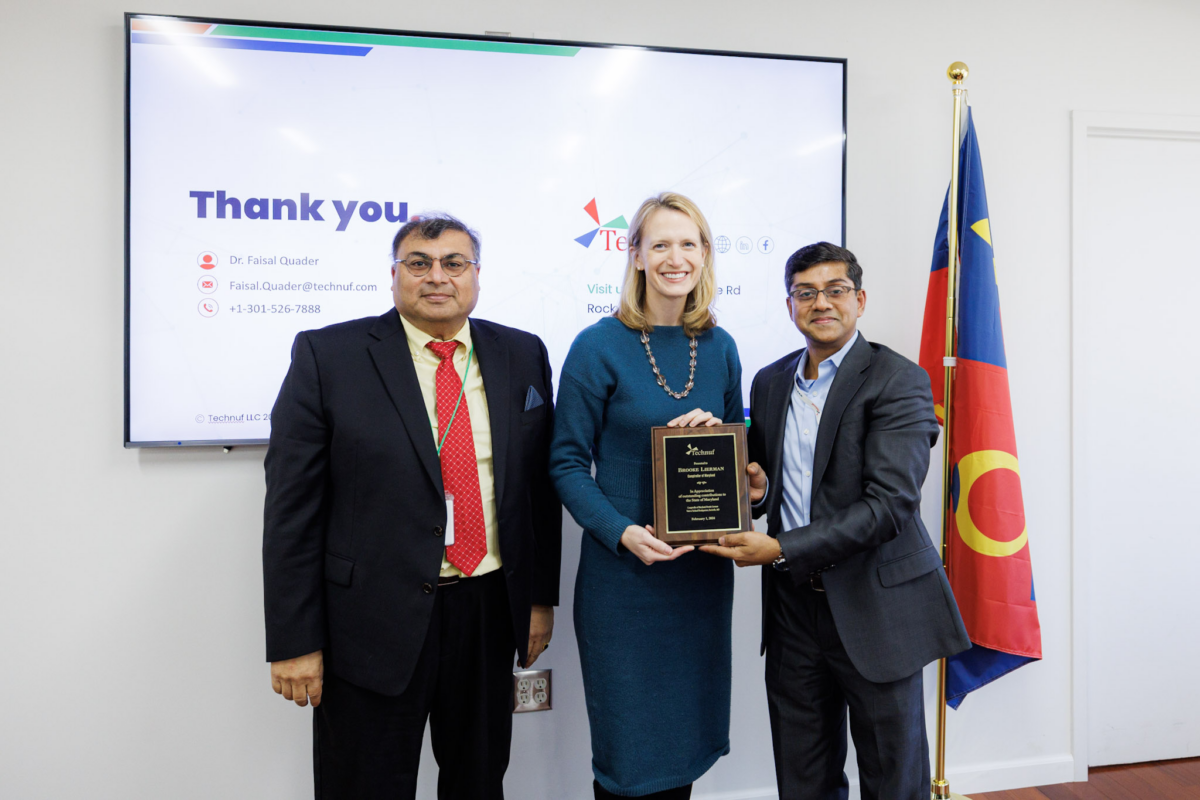 Faisal Quader (right) and Technuf co-founder and CEO Shah Ahmed (left) presenting an award to Maryland Comptroller Brooke E. Lierman in February 2024. (Photo courtesy of Technuf LLC’s X account)
Quader has a B.S. in computer science from the University of Wisconsin and an M.S. in computer science and engineering from Johns Hopkins University. Before going down the path to becoming a faculty member, Quader was initially a non-degree student at UMBC, but after enjoying his class so much, he decided to pursue a doctoral degree in information systems, specializing in cybersecurity.
“It was a difficult path working full-time and being a student, but I got so much from UMBC,” says Quader. “My mentors and professors supported me tremendously. I love this school, and now I feel like it’s time for me to give something back. Nothing is better than being able to share what I’ve learned with students.”
Quader brings his data science industry know-how to the classroom in more practical ways, educating students on how he and his team at Technuf work to address timely cybersecurity challenges, such as securing network infrastructures from cyber attacks and analyzing data to protect from cyber threats. His courses are capped to capacity every semester and has an ever-evolving waitlist of students hoping to learn from his tutelage.
“Cybersecurity is an extremely hot topic, and I like that I can bring in the industry perspective to my theoretical teachings,” explains Quader. “I love teaching—it’s my passion. Even though I work full time, I do this because I love to be able to share what I do everyday.”
A passion for performance
While Quader has spent the last three decades in engineering, computer science, and information science as an industry leader, he’s dedicated much of his life to something he got from his mother: a love of singing.
As a child growing up in Bangladesh, Quader frequently performed on tv shows as a vocalist and continues to feed his passion for performance today. He shares that music is his “weekend work” where he occasionally puts on family performances with his wife and two children. Every few weeks, Quader travels across the DMV singing with various groups. He’s a big fan of Lionel Richie and Bengali polymath Rabindranath Tagore. With his performances, Quader says that he is trying to create a bridge between Eastern and Western music.
 Faisal Quader singing traditional South Asian music during a performance at the Purbachal Resort in Bangladesh. (Photo courtesy of Quader)
The tech-heavy data scientist says that finding time to mesh his creative passions with his analytical and technical skills gives balance to his life—music and technology are more related than one may think, he adds.
“Technology has a lot of mathematical inductions, different kinds of modeling theories and patterns. Music is also something that is kind of like a pattern,” says Quader. “Music refreshes my brain. When the weekend comes, I focus on music and that gives me more energy to do my work. That keeps me sane.”
Supporting the next generation of data scientists and engineers
In 2023, Quader established the Technuf Endowed Fellowship at UMBC, a $100,000 fund that supports master’s or Ph.D. candidates in information systems with entrepreneurial aspirations who are conducting research and/or pursuing a career in AI/ML or cybersecurity. The fellowship, Quader shares, is particularly for students who are unable to receive financial support for their education.
“When I was a student here in the U.S. after emigrating from Bangladesh at age 18, I didn’t have a scholarship or funding because of the fact that I was an international student. I struggled so badly and had to work three jobs to make my tuition,” he says. “I don’t want my students to go through the same process of struggling. I’m not able to help every student, but this is a good start.”
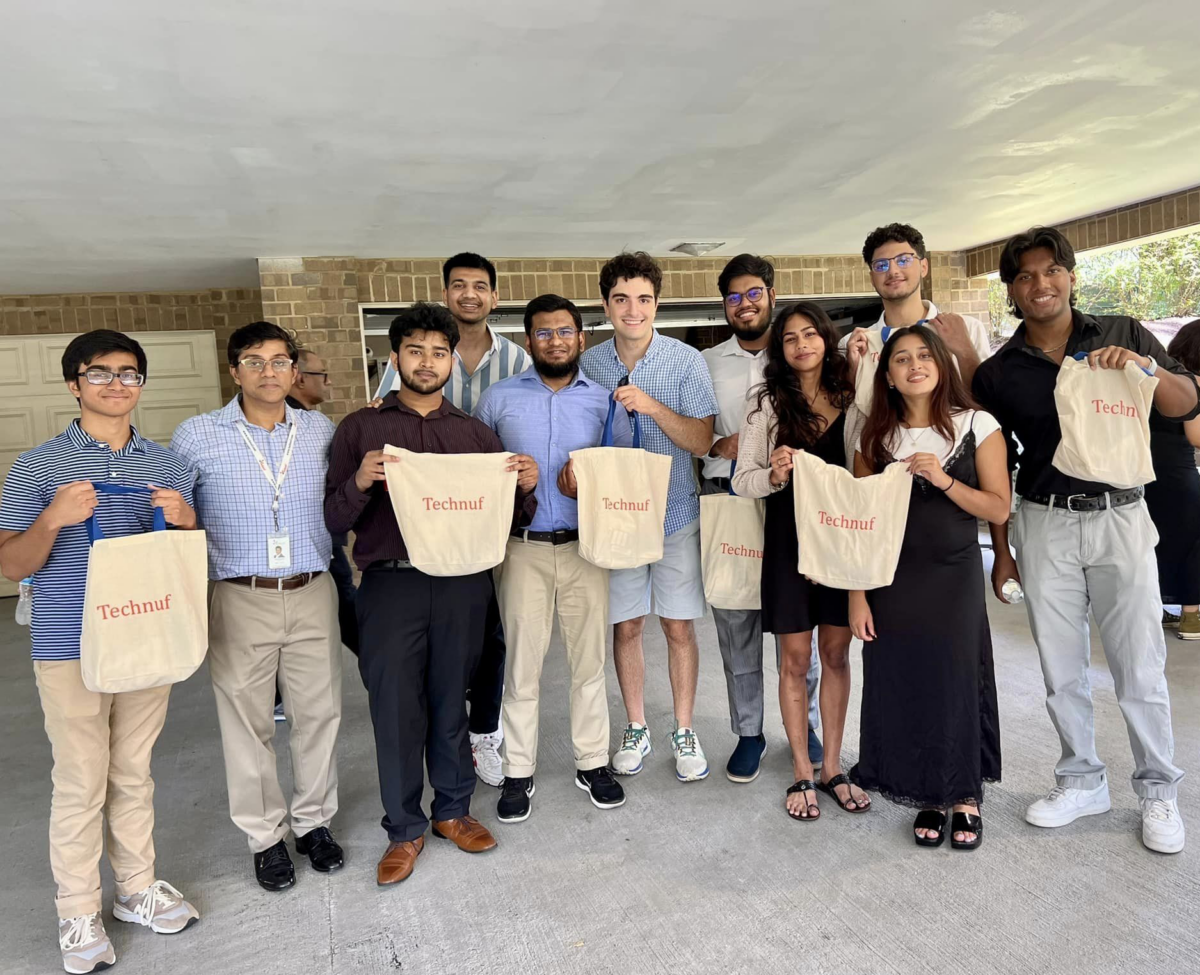 Faisal Quader (second from left) with former Technuf interns. (Photo courtesy of Technuf’s X account)
Quader also created a summer internship program at Technuf where students work hand-in-hand with data scientists and engineers on solving technical problems. Several UMBC students have gone on to work full time at Technuf following their internships, including Isha Shah, M.S. ’23, information systems. In summer 2022, Shah worked at Technuf as a software engineer and data science intern.
 Quader, alongside his wife Fahmida, holding his Distinguished Service Alumni Award. (Photo courtesy of Quader)
“I often found it challenging to secure job or internship opportunities. During one of our initial classes, Dr. Quader mentioned his company, which immediately caught my interest,” says Shah. “I reached out to him to inquire about internship opportunities and to my surprise, he responded with enthusiasm and asked me to send over my resume. That moment felt like a turning point in my career journey.”
After graduating from UMBC, Shah was offered a full-time position at Technuf and currently works at the company as a product development engineer.
“Dr. Quader has had a tremendous impact on both my studies and career. His approach to teaching went far beyond textbooks. He always emphasized the importance of real-world applications and critical thinking, which made a significant difference in my understanding of cybersecurity concepts,” Shah explains. “Dr. Quader believed in my potential and opened doors for me at Technuf, where I’ve been able to gain invaluable hands-on experience in the field.”
In October, Quader was honored for his service as a 2024 recipient of UMBC’s Distinguished Service Alumni Award.
“That was a big encouragement for me,” Quader beamed. “I can see the difference I’m able to make with my students by giving them job opportunities, internships, training, and industry focused-teaching. That’s what keeps me going.”
]]>
There’s already a student waiting outside the office of Faisal Quader, Ph.D. ’20, when the adjunct professor arrives at the Information Technology and Engineering building on a Thursday...
https://umbc.edu/stories/faisal-quader/
https://my3.my.umbc.edu/api/v0/pixel/news/145437/guest@my.umbc.edu/f67ae41ea549926f17a588967aebfbf7/api/pixel
alumni
alumni-awards
coeit
cybersecurity
datascience
fall-2024
impact
information-systems
magazine
story
UMBC News & Magazine
https://my3.my.umbc.edu/groups/umbc-news-magazine
https://assets1-my.umbc.edu/system/shared/avatars/groups/000/001/943/24435aa6207c452e7bc15cc74b42c7bb/xsmall.png?1748556657
https://assets1-my.umbc.edu/system/shared/avatars/groups/000/001/943/24435aa6207c452e7bc15cc74b42c7bb/original.png?1748556657
https://assets2-my.umbc.edu/system/shared/avatars/groups/000/001/943/24435aa6207c452e7bc15cc74b42c7bb/xxlarge.png?1748556657
https://assets2-my.umbc.edu/system/shared/avatars/groups/000/001/943/24435aa6207c452e7bc15cc74b42c7bb/xlarge.png?1748556657
https://assets3-my.umbc.edu/system/shared/avatars/groups/000/001/943/24435aa6207c452e7bc15cc74b42c7bb/large.png?1748556657
https://assets1-my.umbc.edu/system/shared/avatars/groups/000/001/943/24435aa6207c452e7bc15cc74b42c7bb/medium.png?1748556657
https://assets2-my.umbc.edu/system/shared/avatars/groups/000/001/943/24435aa6207c452e7bc15cc74b42c7bb/small.png?1748556657
https://assets1-my.umbc.edu/system/shared/avatars/groups/000/001/943/24435aa6207c452e7bc15cc74b42c7bb/xsmall.png?1748556657
https://assets2-my.umbc.edu/system/shared/avatars/groups/000/001/943/24435aa6207c452e7bc15cc74b42c7bb/xxsmall.png?1748556657
UMBC News & Magazine
0
0
false
Thu, 07 Nov 2024 10:05:35 -0500
Thu, 07 Nov 2024 10:05:35 -0500
UMBC’s 2024 Cybersecurity Leadership Exploratory Grant Program recipients announced
The UMBC Cybersecurity Institute and the Division of Research and Creative Achievement, in partnership with the College of Engineering and Information Technology, recently announced the recipients of the 2024 Cybersecurity Leadership Exploratory grant program.
The internal funding opportunity is designed to promote innovative, interdisciplinary research and education focused on enhancing UMBC’s leadership in cybersecurity research. Awardees received up to $45,000 in funding to develop their exploratory projects—an increase compared to its inaugural recipient cohort in 2023.
The 2024 recipients are:
-
Alan Sherman and Enis Golaszewski for “Modeling and Formal-Methods Analysis of the Secure DNA Protocol”
-
Manas Gaur for “Cybersecurity Research: MetamorphicLLM: Robust Understanding of Metamorphic Malware Through Attacks and Defenses Using Neurosymbolic Large Language Models”
-
Meilin Yu and Zhiyuan Chen for “Detecting Stealthy Long-Term Cyber Attacks on Wind Energy Assets with Physics-Informed Neural Network Technologies”
-
Naghmeh Karim for “Artificial Intelligence and Hardware Security: From Research to Classroom (Educational Proposal)”
-
Nilanjan Banerjee and Mohamed Younis for “Implementing Endpoint Security for Cyber-Physical Systems”
-
Tera Reynolds for “Swiss Cheese Please: Analyzing Cybersecurity Risks in the Digital Health Ecosystem with Patients with Complex Care Needs”
Learn more about UMBC’s internal funding opportunities.
]]>
The UMBC Cybersecurity Institute and the Division of Research and Creative Achievement, in partnership with the College of Engineering and Information Technology, recently announced the recipients...
https://umbc.edu/quick-posts/2024-exploratory-grant-recipients/
https://my3.my.umbc.edu/api/v0/pixel/news/144674/guest@my.umbc.edu/f49123192875a7393ea88ca4f921794b/api/pixel
coeit
csee
cybersecurity
information-systems
quick-post
research
UMBC News & Magazine
https://my3.my.umbc.edu/groups/umbc-news-magazine
https://assets1-my.umbc.edu/system/shared/avatars/groups/000/001/943/24435aa6207c452e7bc15cc74b42c7bb/xsmall.png?1748556657
https://assets1-my.umbc.edu/system/shared/avatars/groups/000/001/943/24435aa6207c452e7bc15cc74b42c7bb/original.png?1748556657
https://assets2-my.umbc.edu/system/shared/avatars/groups/000/001/943/24435aa6207c452e7bc15cc74b42c7bb/xxlarge.png?1748556657
https://assets2-my.umbc.edu/system/shared/avatars/groups/000/001/943/24435aa6207c452e7bc15cc74b42c7bb/xlarge.png?1748556657
https://assets3-my.umbc.edu/system/shared/avatars/groups/000/001/943/24435aa6207c452e7bc15cc74b42c7bb/large.png?1748556657
https://assets1-my.umbc.edu/system/shared/avatars/groups/000/001/943/24435aa6207c452e7bc15cc74b42c7bb/medium.png?1748556657
https://assets2-my.umbc.edu/system/shared/avatars/groups/000/001/943/24435aa6207c452e7bc15cc74b42c7bb/small.png?1748556657
https://assets1-my.umbc.edu/system/shared/avatars/groups/000/001/943/24435aa6207c452e7bc15cc74b42c7bb/xsmall.png?1748556657
https://assets2-my.umbc.edu/system/shared/avatars/groups/000/001/943/24435aa6207c452e7bc15cc74b42c7bb/xxsmall.png?1748556657
UMBC News & Magazine
1
0
false
Thu, 10 Oct 2024 13:07:29 -0400
Thu, 10 Oct 2024 13:07:29 -0400
Preparing students for a quantum tomorrow: Lei Zhang brings futuristic computing concepts into the classroom

In the early 20th century, as physicists explored the tiny world of atoms, they noticed some perplexing things: Energy transferred only in chunks; particles that also acted like waves; mysterious links between physically separate systems. Their observations and theories marked the start of the first quantum revolution, which rocked the philosophical world of scientists (Albert Einstein was famously disturbed by some of its implications), but ultimately helped birth the technology of today by enabling the development of physical devices such as computer chips and lasers.
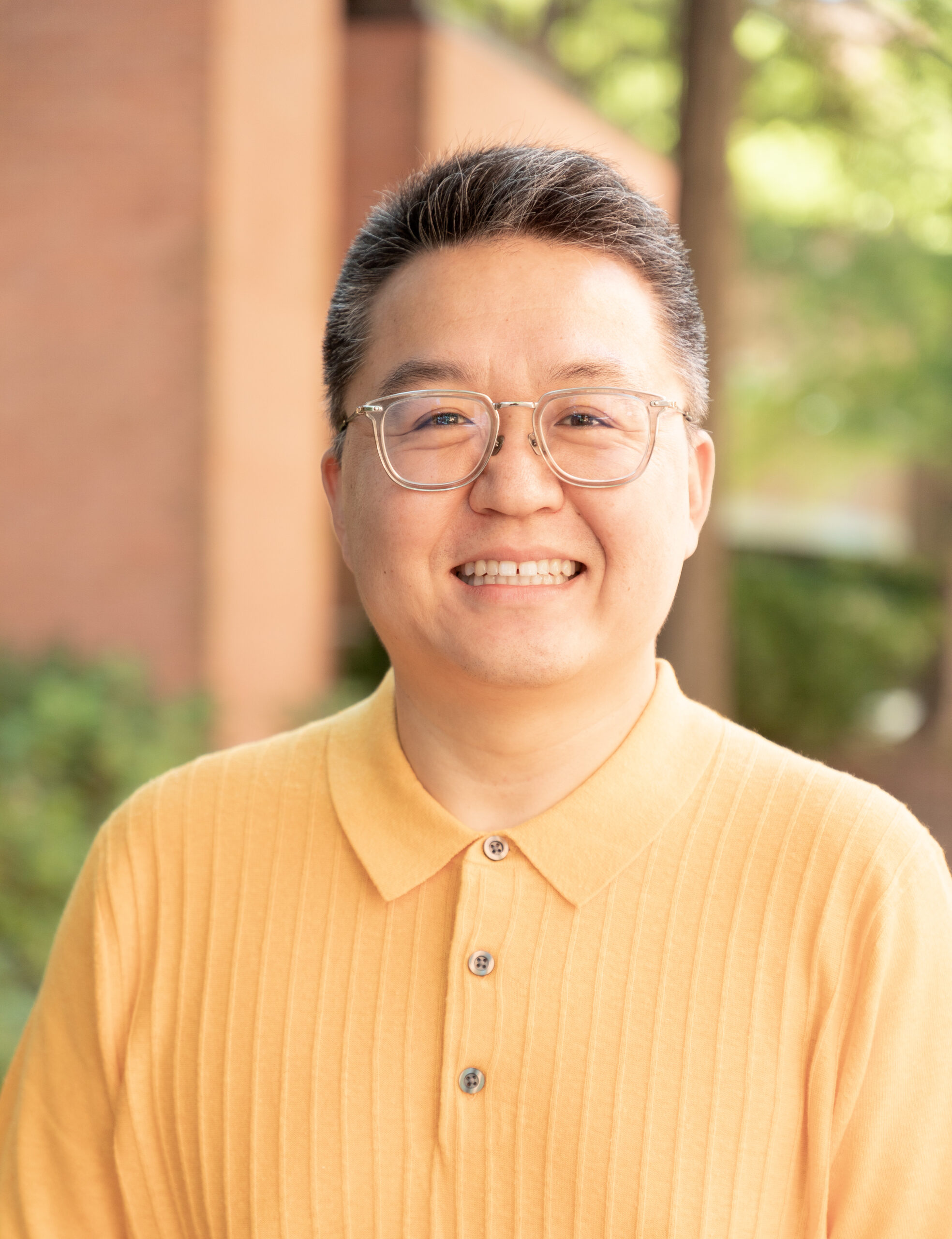 Headshot courtesy of Lei Zhang
Many scientists believe we are now on the cusp of a second quantum revolution, as quantum concepts are poised to transform the world of information science and technology too. The new revolution offers the promise, among other things, of a new type of computer called a quantum computer. Quantum computers could quickly solve some problems that are extremely difficult for traditional machines—they might also unleash some chaos we’ll have to find ways to prevent.
Lei Zhang, an assistant professor in the department of information systems, is working hard to prepare students for this quantum information future. In 2023 and 2024, with support from a Hrabowski Innovation Fund Grant, he developed new learning modules on quantum information concepts and integrated them into existing graduate and undergraduate courses in information systems.
Based partly on the success of that pilot project, Zhang recently received funding from the National Science Foundation to develop a 14-week summer program in quantum information science and technology. The program, which will launch in the summer of 2025, will be open to students from UMBC and nearby Montgomery College.
“Quantum computing is the next industrial revolution, and there will be an urgent need for skilled professionals in quantum information science and technology,” says Zhang. “This project aims to equip students with the skills and networks to meet that need and advance their careers.”
Quantum’s encryption-breaking challenge
The quantum information revolution is already smashing into our everyday world in the area of internet security. Most internet traffic is kept safe from prying eyes using a technique that works well against hackers using traditional computers but could be broken by a sophisticated enough quantum computer. No quantum computer has reached that point yet, but scientists are making steady progress in that direction, and experts are worried enough to start mandating security changes.
In 2022, the White House released a National Security Memorandum coordinating the actions of various federal agencies in a move toward quantum-resistant forms of encryption for their computer systems.
“The government will be one of the leaders in the change, but the whole private sector will need to follow,” Zhang says. “Everyone will need to update their systems.”
Zhang is focusing the summer program on this challenge. Students will learn about quantum computers and how they could break traditional encryption, and will also learn about new security algorithms, called post-quantum encryption algorithms, that are not as vulnerable to quantum attacks.
“Quantum computing is the next industrial revolution, and there will be an urgent need for skilled professionals in quantum information science and technology. This project aims to equip students with the skills and networks to meet that need and advance their careers.”
Lei Zhang
Assistant Professor, Information Systems
After six weeks of active and immersive learning activities, the students will engage in eight-week-long internships at local tech companies or in Zhang’s UMBC lab, where they will put their newfound knowledge and skills to use. At the completion of the summer program, the students will earn a MicroBachelors certificate from the online education company edX.
Partnerships advance outreach and teaching
Zhang is partnering with individuals and programs across UMBC to make his summer program successful. Zhang’s main collaborator on the project, assistant information systems professor Karen Chen, specializes in the study of how technology can improve learning. The team also includes information systems faculty Aryya Gangopadhyay, Michael Brown, and C. Augusto Casas.
Zhang is partnering with UMBC’s Center for Women in Technology, UMBC’s Cybersecurity Institute, and Montgomery College to recruit a diverse range of students for the summer program.
The project will be guided by the expertise of local leaders from government and private industry and its effectiveness will be evaluated by UMBC’s Chris Rakes, a professor of mathematics education.
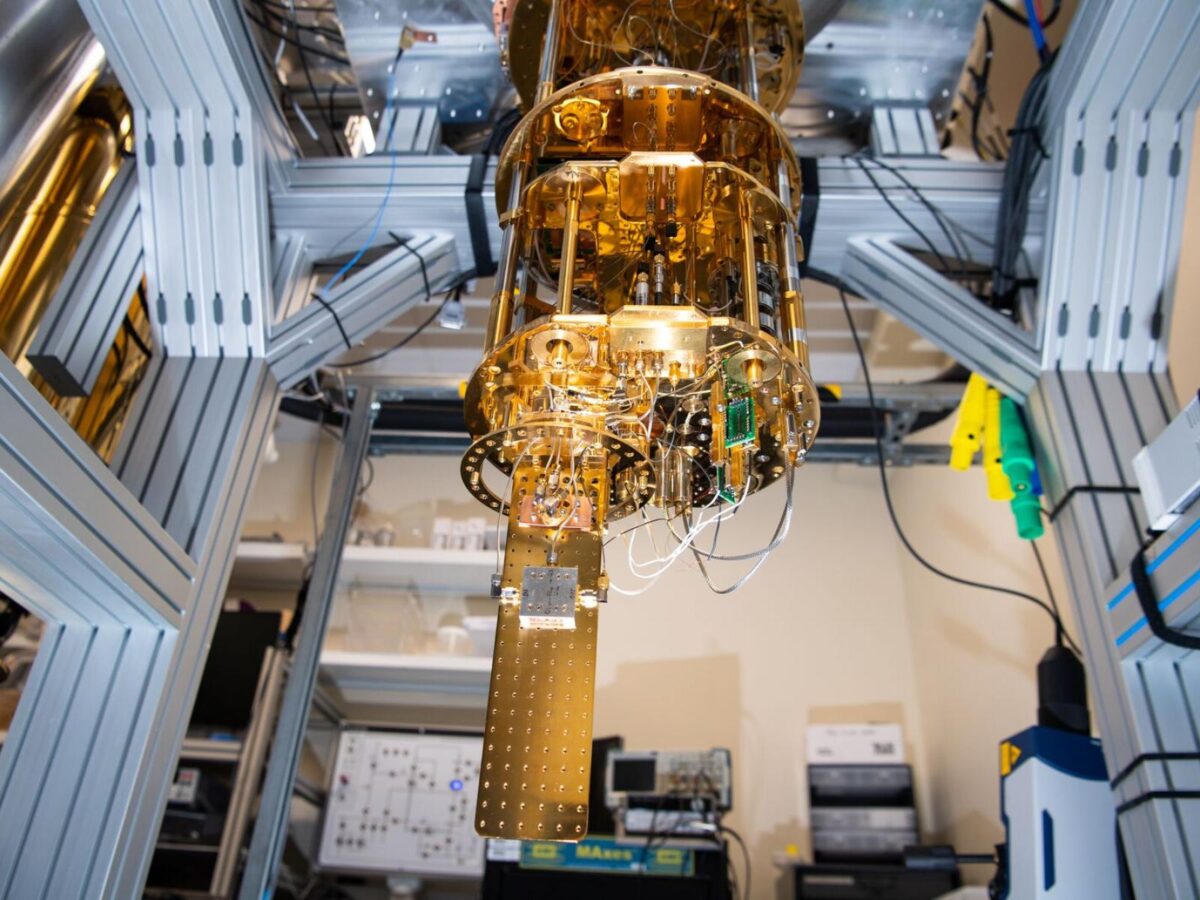 Quantum computers use qubits, the quantum version of the classic binary bit, such as this superconducting qubit, which sits in a dilution refrigerator in a Pacific Northwest National Laboratory physics lab. (Photo by Andrea Starr | Pacific Northwest National Laboratory)
Going forward, Zhang plans to continue scaling up his quantum education efforts. The coursework from the summer program will be made freely available for other educational institutions to use. It could also be incorporated into programs for adult learners.
In collaboration with the National Institute of Standards and Technology, headquartered in Gaithersburg, Maryland, Zhang also plans to use knowledge generated from the summer program to organize professional development workshops for instructors in four-year and community colleges.
The impact of Zhang’s efforts can already be seen on the individual level. Khushdeep Kaur, a master’s student in information systems, first heard about quantum computing from Zhang. “I felt amazed and eager to learn more about the technology,” she says. She is now part of Zhang’s research group, studying quantum computing topics.
Dongchan Kim, a senior majoring in information systems, also joined the lab after taking one of Zhang’s classes in spring 2024.
“I really enjoyed learning about technology that could become the ‘next big thing,’” he says. “Like AI, I think quantum computing has the power to transform industries. I look forward to contributing to its development in the future.”
]]>
In the early 20th century, as physicists explored the tiny world of atoms, they noticed some perplexing things: Energy transferred only in chunks; particles that also acted like waves; mysterious...
https://umbc.edu/stories/teaching-quantum-information-concepts/
https://my3.my.umbc.edu/api/v0/pixel/news/144436/guest@my.umbc.edu/ffad2f1364c881198ebb0b56382eb07d/api/pixel
coeit
cwit
cybersecurity
is
news
science-and-tech
story
UMBC News & Magazine
https://my3.my.umbc.edu/groups/umbc-news-magazine
https://assets1-my.umbc.edu/system/shared/avatars/groups/000/001/943/24435aa6207c452e7bc15cc74b42c7bb/xsmall.png?1748556657
https://assets1-my.umbc.edu/system/shared/avatars/groups/000/001/943/24435aa6207c452e7bc15cc74b42c7bb/original.png?1748556657
https://assets2-my.umbc.edu/system/shared/avatars/groups/000/001/943/24435aa6207c452e7bc15cc74b42c7bb/xxlarge.png?1748556657
https://assets2-my.umbc.edu/system/shared/avatars/groups/000/001/943/24435aa6207c452e7bc15cc74b42c7bb/xlarge.png?1748556657
https://assets3-my.umbc.edu/system/shared/avatars/groups/000/001/943/24435aa6207c452e7bc15cc74b42c7bb/large.png?1748556657
https://assets1-my.umbc.edu/system/shared/avatars/groups/000/001/943/24435aa6207c452e7bc15cc74b42c7bb/medium.png?1748556657
https://assets2-my.umbc.edu/system/shared/avatars/groups/000/001/943/24435aa6207c452e7bc15cc74b42c7bb/small.png?1748556657
https://assets1-my.umbc.edu/system/shared/avatars/groups/000/001/943/24435aa6207c452e7bc15cc74b42c7bb/xsmall.png?1748556657
https://assets2-my.umbc.edu/system/shared/avatars/groups/000/001/943/24435aa6207c452e7bc15cc74b42c7bb/xxsmall.png?1748556657
UMBC News & Magazine
2
0
false
Thu, 03 Oct 2024 09:24:53 -0400
Thu, 03 Oct 2024 09:24:53 -0400
Meet a Retriever—Nathan Wooddell ’23, graduate student specializing in Russian and cybersecurity

Meet Nathan Wooddell ’23, computer science. Nathan is a member of UMBC’s CyberCorps: Scholarship for Service cohort, and is getting his master’s in cybersecurity as a graduate researcher at the National Nuclear Security Agency. Nathan attributes much of his success to the connections he’s made with the staff and faculty at UMBC who have helped him to discover his true passions. During his time as an undergraduate at UMBC, Nathan also completed a Russian language certificate, and has found a way to combine his interests of both cybersecurity and the Russian language in the professional world. Take it away, Nathan.
Q: What’s one thing you’d want someone to know about the support you find at UMBC?
A: In many classes, casual visits to professors during office hours, polite interactions during class, and expressing interest in the subject matter can go a long way. Such interactions help with all aspects of student life. Too many students fail to take proper advantage of the fantastic support that the university faculty can offer. The best way to do this in my experience is simply to speak with your professors after class or outside of class.
Such interactions help with all aspects of student life. The faculty can offer support in the form of academic resources, scholarship recommendations, professional guidance, and even letters of recommendation for work or graduate programs.
Q: Tell us about someone in the community who has inspired you or supported you, and how they did it.
A: I want to give special thanks to Russian instructor Vira Zhdanovych. Since I first transferred to UMBC, I have taken Russian language courses with Professor Zhdanovych. It was through her guidance that I got my first research experience when she advised me on my 2022 Undergraduate Research and Creative Achievement Day presentation Analyzing the Russian Federation’s Impact on Global Cyber Security. This was also the first time that I was able to merge my interest in cybersecurity and Russian language.
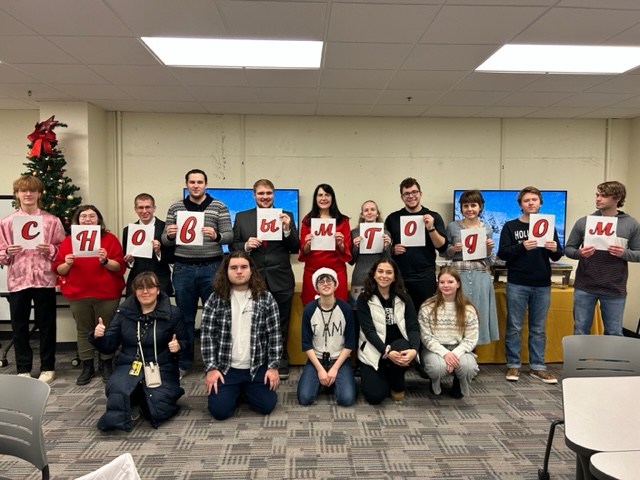 At the MLLI winter and New Year celebration, hosted by the Russian Area in December 2023, Zhdanovych stands in the center holding an “M” and Wooddell is to her right holding the Russian letter “ы.” The full sign reads “Happy New Year!” (Photo courtesy of Zhdanovych)
I have worked extensively with Professor Zhdanovych to study and research the impact of the Russian-speaking world on the cybersecurity and intelligence communities—I owe so much of my professional and academic success to her.
Q: Tell us what you love about your academic program or an organization you’re involved in.
A: I am a participant and former officer in UMBC’s Russian Club. The meetings of this club are especially good for learning about contemporary Russian culture, as well as the geopolitical history, which still shapes the diplomacy of the Russo-American relationship.
“Had I known then what I know now about the university’s programs, rigor, faculty, and opportunities, UMBC would have been a shoo-in. Ultimately, I am so grateful that I applied to, and attended UMBC.”
Nathan Wooddell ’23, current master’s student
Q: What is your WHY? What brought you to UMBC?
A:I came to UMBC in my sophomore year as a transfer student. Admittedly when I was accepted I toyed around with the idea of going to a variety of different schools, but eventually decided on UMBC for the price, and the relative vicinity to my home in northern Maryland.
Had I known then what I know now about the university’s programs, rigor, faculty, and opportunities, UMBC would have been a shoo-in. Ultimately, I am so grateful that I applied to, and attended UMBC.
Q: Tell us about the people who are helping you grow at UMBC, and why their HOW made such a difference to you.
A: In addition to Professor Zhdanovych’s support with my Russian language and research, Professor RJ Joyce in computer science encouraged me to become invested in cybersecurity. It’s because of him that I’ve become involved in many of the clubs and organizations I am currently enrolled in. Such interest in security was able to earn me recipient status in UMBC’s Scholarship for Service cohort.
Q: What clubs, teams, or organizations are you a part of? What do you love about them?
A: First and foremost, I am a member of UMBC’s National Science Foundation-fundedCyberCorps: Scholarship of Service (SFS). This program has allowed me to pursue my interest in security outside of the traditional academic venues. Thanks to SFS, I was able to attend and present at DEFCON 31 in Las Vegas, one of the largest cybersecurity conventions in the world [Photo: Wooddell, left, at DEFCON 31 with a fellow student].
I am also a member of the UMBC Cyberdawgs. I never miss an opportunity to compete in the annual competitions they hold on campus. Beyond this, I attend the bi-weekly Cyber Defense Lab meetings, which allow me to keep up to date with all sorts of security research projects being conducted on campus.
Q: Are you a student leader? Tell us about it!
A: Through SFS, related organizations, and clubs on campus, I have been lucky enough to meet and work with some of the most amazing and intelligent people I have ever met. From these associated labs, clubs, and programs I have met and been influenced by more people than I could ever hope to list here.

I am incredibly honored to have been able to lead these organizations, as they have provided me with opportunities to give back to my university and community.
* * * * *
UMBC’s greatest strength is its people. When people meet Retrievers and hear about the passion they bring, the relationships they create, the ways they support each other, and the commitment they have to inclusive excellence, they truly get a sense of our community. That’s what “Meet a Retriever” is all about.
Learn more about how UMBC can help you achieve your goals.
]]>
Meet Nathan Wooddell ’23, computer science. Nathan is a member of UMBC’s CyberCorps: Scholarship for Service cohort, and is getting his master’s in cybersecurity as a graduate researcher at the...
https://umbc.edu/stories/meet-a-retriever-wooddell-russian-cybersecurity/
https://my3.my.umbc.edu/api/v0/pixel/news/139627/guest@my.umbc.edu/2095dac00bc9311ee2df369ee54e38f3/api/pixel
alumni
coeit
compsci
cybersecurity
impact
magazine
meet-a-retriever
mll
perspectives
russian
story
UMBC News & Magazine
https://my3.my.umbc.edu/groups/umbc-news-magazine
https://assets1-my.umbc.edu/system/shared/avatars/groups/000/001/943/24435aa6207c452e7bc15cc74b42c7bb/xsmall.png?1748556657
https://assets1-my.umbc.edu/system/shared/avatars/groups/000/001/943/24435aa6207c452e7bc15cc74b42c7bb/original.png?1748556657
https://assets2-my.umbc.edu/system/shared/avatars/groups/000/001/943/24435aa6207c452e7bc15cc74b42c7bb/xxlarge.png?1748556657
https://assets2-my.umbc.edu/system/shared/avatars/groups/000/001/943/24435aa6207c452e7bc15cc74b42c7bb/xlarge.png?1748556657
https://assets3-my.umbc.edu/system/shared/avatars/groups/000/001/943/24435aa6207c452e7bc15cc74b42c7bb/large.png?1748556657
https://assets1-my.umbc.edu/system/shared/avatars/groups/000/001/943/24435aa6207c452e7bc15cc74b42c7bb/medium.png?1748556657
https://assets2-my.umbc.edu/system/shared/avatars/groups/000/001/943/24435aa6207c452e7bc15cc74b42c7bb/small.png?1748556657
https://assets1-my.umbc.edu/system/shared/avatars/groups/000/001/943/24435aa6207c452e7bc15cc74b42c7bb/xsmall.png?1748556657
https://assets2-my.umbc.edu/system/shared/avatars/groups/000/001/943/24435aa6207c452e7bc15cc74b42c7bb/xxsmall.png?1748556657
UMBC News & Magazine
3
0
false
Wed, 28 Feb 2024 13:31:03 -0500
Résumés in hand, 2,000+ hopeful and prepared Retrievers attend the 2024 Career Fair
On a perfect 55-degree sunny February day, hundreds of undergraduate and graduate students across all colleges stood in a line that began at the RAC and wrapped its way to Sherman Hall. Instead of exercise gear, Retrievers were dressed to impress with résumés in hand, ready to land a summer internship or a job with one of the 180-plus employers across multiple industry sectors at UMBC’s Spring 2024 Career and Internship Fair.
“We are excited to help employers develop a strong talent pipeline and diverse future workforce, shaping the leaders and innovators of tomorrow,” said Paige Bauder, associate director of employer relations and recruitment programs at UMBC.
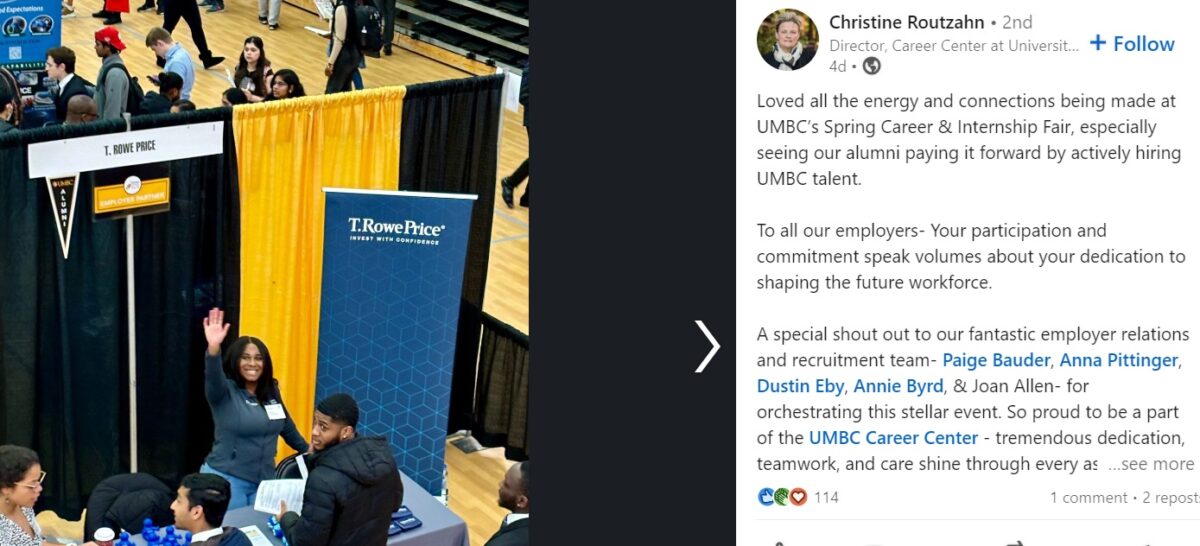 Image courtesy of Christine Routzahn, director of UMBC’s Career Center.
The leading edge
“Give strong handshakes. Maintain eye contact,” said Leon Tang ’26, information systems, in a booming voice, as he scanned IDs as a volunteer at the event.
 Leon Tang welcoming Career Fair attendees. (Marlayna Demond ’11/UMBC)
“Some people might come in nervous. It’s over 180 companies, so it can be pretty hard,” said Tang. He currently has two internships, one as a business technology intern at Agile Care Enterprises, based at bwtech@UMBC, and another as a research assistant in the information systems department. “It’s a good way to tell everyone to be calm and be confident. It’s the little things that can go pretty far in obtaining something.” For the nearly 2,200 Retrievers that made it through the door that day, this was sage advice.
A professional headshot is one of those little things. After making it past Tang, Bhargavi Gudapati, a current master’s student in information systems, headed straight back to grab the 10th spot in a line that, over the next four hours, would consistently have dozens of excited and grateful students waiting for their free headshot. Gudapati, an international student from India, has attended every career fair since she arrived in 2022. She wants to get ahead of the steep competition of international students looking to launch the next phase of their career in the U.S.
 Spring 2024 Career and Internship Fair headshot station. (Image courtesy of Christine Routzahn)
“It’s incredibly important to get to know employers in person instead of only on their online portal,” says Gudapati.“You want to know what they require and the current technology they are using.”
One of those employers, Ed Belsinger ’90, M.S. ’93, mechanical engineering, is a newbie to UMBC’s career fairs. He proudly wore his UMBC sweatshirt and a smile that became a beacon of friendliness in a sea of students seeking opportunities. Belsinger is the director of product development at RPM Tech, a company that turns an idea into a prototype and a prototype into a fully manufacturable product. Because RPM does all the engineering and design in-house with a full shop and lab, it can offer students a wide range of expertise.
Belsinger notes that RPM is currently in a growth mode and has three internships available as well as full-time positions. “As an alum, I said, ‘This is a great school—we have to go there.’ Whether it’s an internship or someone right out of college, we’re looking for students with curiosity, who want to learn, are willing to do new things, to be challenged, and be part of a team.”
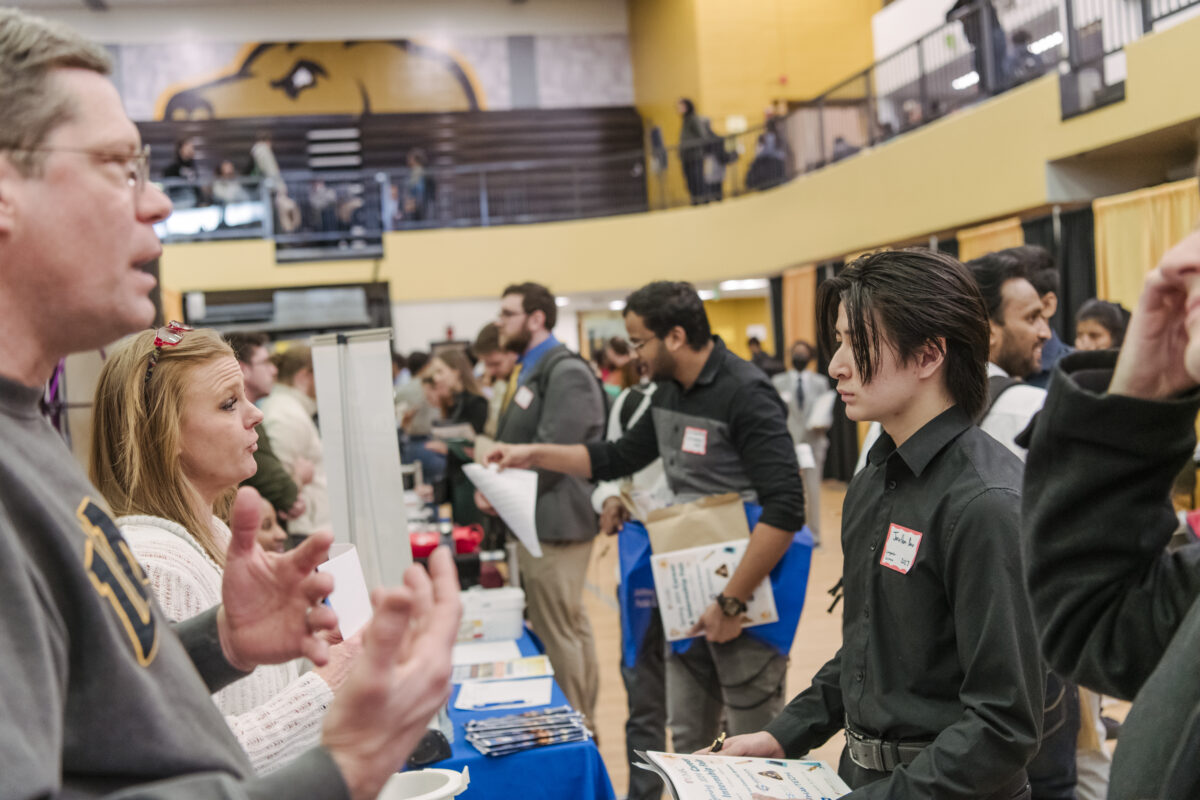 (l – r): Ed Belsinger (in grey) and Jonathan Dao (in black). (Marlayna Demond ’11/UMBC)
Hoping to grab one of the RPM internships is Jonathan Dao, computer science, a first-year student waiting in line to speak with Belsinger. “I saw tech in the name and wanted to learn more. I want to see if I can start early to have a competitive advantage,” said Dao. “I think first-year students should definitely give the career fair a shot. Come in with confidence, try rehearsing how to present yourself, and dress well.”
Part of the team
Sekinat Dosunmu ’24 agrees with Dao’s approach. After spending her first year of college remote, she has made it a point to attend every career fair in person. Toward the end of the day, she lined up at the FBI table, ready to discuss what the FBI had to offer someone like her with a global studies major, an Africana studies minor, and certificates in tech and intercultural communication. As she stepped forward, a recruiter immediately welcomed her.
While waiting to continue talking with Dosunmu, other recruiters shared that the FBI welcomes all majors, including the arts and humanities. They noted that the most important skill the FBI is looking for is how someone approaches and solves a problem in a team environment.
The artists approach
Solving problems creatively is the bread (or blood) and butter of C.C. Smith ’24, theatre, formerly known as Dracula in UMBC’s fall 2023 production of Dracula: a Feminist Revenge Fantasy, Really. That role earned him an audition for a film later on in the day, so Smith is hurrying through the fair.
Later in the spring, UMBC’s Career Center hosts boutique career fairs, one of which is focused on creative careers, and on March 7, it will host the CAHSS Career Connection Social for arts, humanities, and social science majors, but that doesn’t stop Smith from checking things out. As an actor, Smith explains, you never know when someone is looking to do a commercial. “This is my first time here. I would like to see more performing arts employers in this larger career fair, especially with how good the arts programs are here,” says Smith. “As a senior, it’s still important to be poking around this fair.”
Luna Siesko ’25, visual arts, and Alexander Schobitz ’22, visual arts, agree with Smith that UMBC students excel in the arts, and would like local employers to know about that. Siesko, a photographer and videographer at commonvision, UMBC’s design shop, used her skillset to bring personally designed business cards and résumés to the fair. Siesko is unsure what she is looking for but hopes that by speaking with some of the employers, like the folks at the Baltimore County Arts Guild, she can get a sense of how to best move forward.
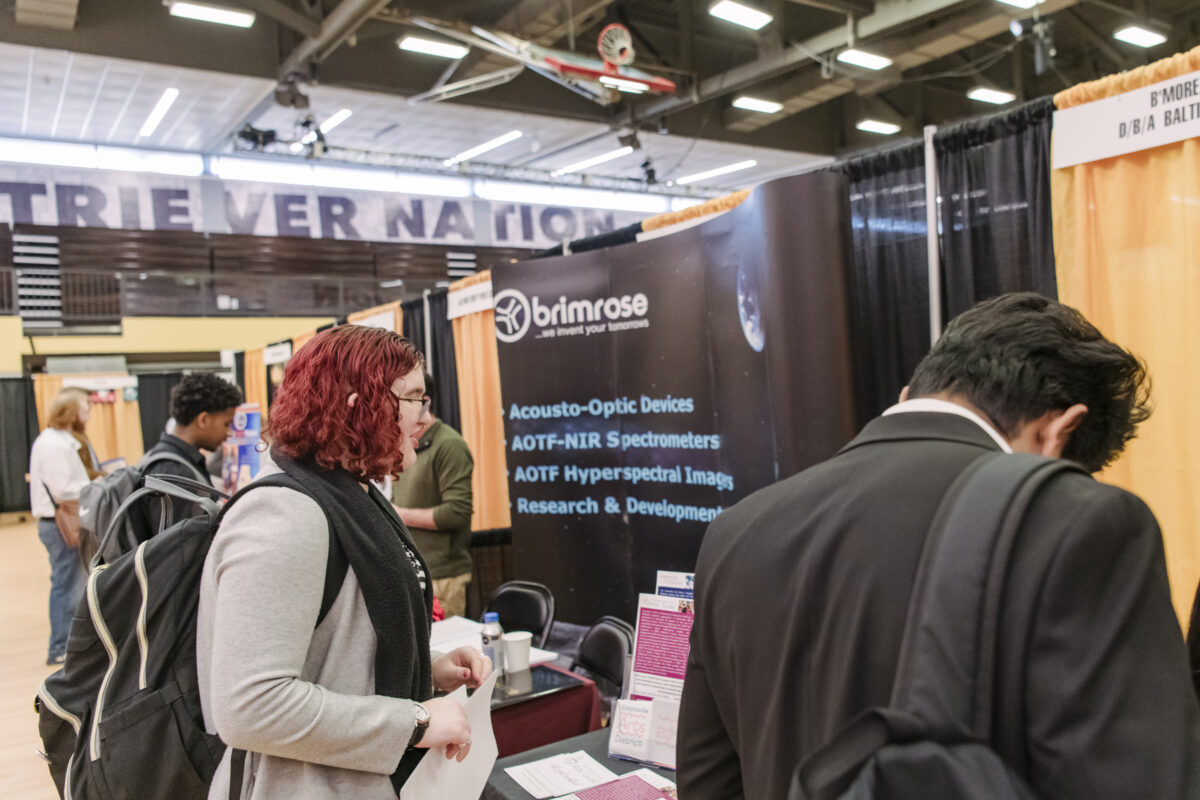 Luna Siesko at the Baltimore County Arts Guild table. (Marlayna Demond ’11/UMBC)
“We’re a small non-profit five minutes from UMBC. We want to make sure that artists feel seen and heard and know there is a place for them to work,” said Gloria Fajimolu, program and events manager at the Baltimore County Arts Guild, a new employer at the Career Fair. “We’re very welcoming. If a student doesn’t get the internship or the job, they can still be a paid instructor. If they are in animation, we will pay them to teach animation classes to the community.”
 Gloria Fajimolu, program and events manager at the Baltimore County Arts Guild. (Marlayna Demond ’11/UMBC)
As a recent alum, Schobitz has one goal—to get a job in animation. He is grateful UMBC gives alumni access to the career fairs and Handshake, a job listing app. “I apply to about 10 jobs per day. I use sites like Indeed and Handshake to find jobs and apply,” says Schobitz. “While I was a student, I used UMBC’s résumé services and made a lot of appointments. I’m still trying. I won’t give up.”
The end and beginning
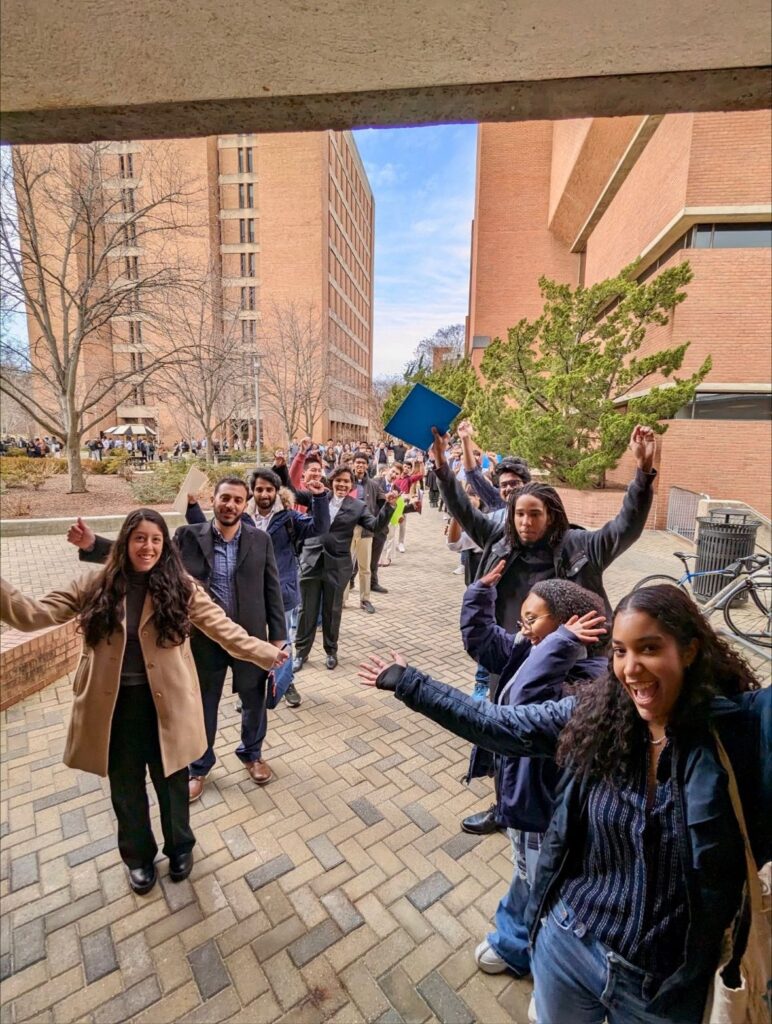 UMBC students lineup for the Spring 2024 Career and Internship Fair.
(Image courtesy of Routzhan)
Back at the headshot line, Cristian Castro, M.S. ’24, cybersecurity, joined the still-growing line as the last wave of students filed in. Castro is from Colombia and is looking to find a company to sponsor him to work in the U.S. “The Career Fair is a very good opportunity to see what’s out there. A professional photo is important in a LinkedIn profile,” says Castro. He also found some job leads earlier this year while representing UMBC as part of the Society of Advancing Chicanos/Hispanics and Native Americans in Science. “When it comes to what happens after graduation, every detail helps.”
Follow the Career Center on myUMBC and RSVP to the CAHSS Career Connection Social on Thursday, March 7, to network with alumni and employers in the arts, humanities, and social sciences.
]]>
On a perfect 55-degree sunny February day, hundreds of undergraduate and graduate students across all colleges stood in a line that began at the RAC and wrapped its way to Sherman Hall. Instead of...
https://umbc.edu/stories/the-2024-career-fair/
https://my3.my.umbc.edu/api/v0/pixel/news/139041/guest@my.umbc.edu/21c9b154d9df23acc2fa66d5d7b9f73e/api/pixel
africana-studies
cahss
career-center
coeit
community
computer-science
cybersecurity
global-studies
is
meche
news
story
theatre
visual-arts
UMBC News & Magazine
https://my3.my.umbc.edu/groups/umbc-news-magazine
https://assets1-my.umbc.edu/system/shared/avatars/groups/000/001/943/24435aa6207c452e7bc15cc74b42c7bb/xsmall.png?1748556657
https://assets1-my.umbc.edu/system/shared/avatars/groups/000/001/943/24435aa6207c452e7bc15cc74b42c7bb/original.png?1748556657
https://assets2-my.umbc.edu/system/shared/avatars/groups/000/001/943/24435aa6207c452e7bc15cc74b42c7bb/xxlarge.png?1748556657
https://assets2-my.umbc.edu/system/shared/avatars/groups/000/001/943/24435aa6207c452e7bc15cc74b42c7bb/xlarge.png?1748556657
https://assets3-my.umbc.edu/system/shared/avatars/groups/000/001/943/24435aa6207c452e7bc15cc74b42c7bb/large.png?1748556657
https://assets1-my.umbc.edu/system/shared/avatars/groups/000/001/943/24435aa6207c452e7bc15cc74b42c7bb/medium.png?1748556657
https://assets2-my.umbc.edu/system/shared/avatars/groups/000/001/943/24435aa6207c452e7bc15cc74b42c7bb/small.png?1748556657
https://assets1-my.umbc.edu/system/shared/avatars/groups/000/001/943/24435aa6207c452e7bc15cc74b42c7bb/xsmall.png?1748556657
https://assets2-my.umbc.edu/system/shared/avatars/groups/000/001/943/24435aa6207c452e7bc15cc74b42c7bb/xxsmall.png?1748556657
UMBC News & Magazine
1
0
false
Thu, 15 Feb 2024 16:23:39 -0500
Thu, 15 Feb 2024 16:23:39 -0500
Cracking the code: International collaboration fosters cybersecurity

UMBC’s work in strengthening students’ preparedness in cybersecurity defense is proving effective not only on campus, but well beyond. This summer, three UMBC students competed in an international “capture the flag”-style cybersecurity competition in Japan, with one Retriever taking home a victory—and all three bringing back a greater range of expertise. This opportunity helped UMBC students build global relationships and attain more practical experience in cyber defense.
In August, Kevin Chen ’23, computer science, Zachary Amoss ’24, computer science, and Leela SaiNadh Gade, M.P.S. ’24, cybersecurity, competed in the 2023 Country-to-Country Capture the Flag (C2C-CTF) event at the Hiyoshi Campus of Keio University in Yokohama, Japan. The competition—which convened in person for the first time this summer since it began in 2020—brought together 80 students from around the world to team up and complete 25 cybersecurity challenges within 10 hours. Teams were tasked with solving challenges such as identifying hackers in various cyber scenarios or using open-source investigative methods to pinpoint geographic locations of different photographs.
Among the awardees were Chen and his team, which included students from the U.K, China, Japan, and Israel. The team placed fourth overall in C2C-CTF’s main challenge and received the Hitachi award, named after one of the event’s sponsors. Claiming a victory wasn’t the only thing Chen wanted to accomplish at the competition.
“My [goal] was to learn extensively, tackle novel technical obstacles, and engage in international collaboration. I embarked on this journey with the determination for achieving victory, fully aware of the formidable nature of that challenge,” he says.
Code cracking in real time
Chen is a member of UMBC’s CyberDawgs team and has been participating in cyber competitions throughout the year in preparation for C2C-CTF. His prep paid off as he helped his team solve the final problem of the competition, a cryptography challenge in which competitors had to correctly guess an image’s location without being provided any identifying information.
“Inside the images were a set of true images and false images [which] were meant to lead you down a rabbit hole,” Chen explains. “When selecting the true images, we had to piece them together in a certain order to get the code for that challenge.”
The team used open-source intelligence methods to solve the problem, such as paying attention to the direction of the sun in an image to narrow down the range of countries, identifying specific landmark clues, and analyzing the images’ metadata. Minutes before the competition’s conclusion, Chen’s team cracked the code, earning them 300 points to secure the win.
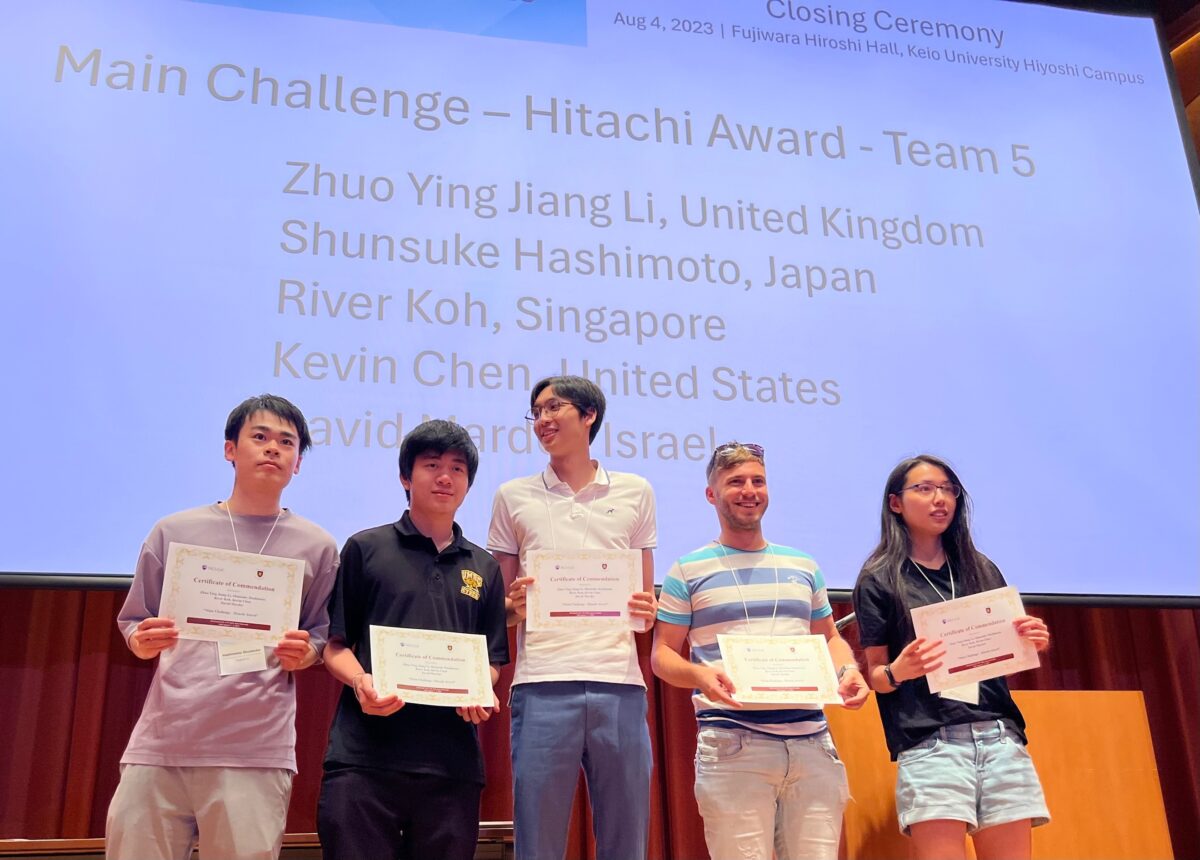 Kevin Chen (second from left) and teammates accepting the Hitachi award at the 2023 Country-to-Country Capture the Flag closing ceremony at Keio University. (Image courtesy of Karl V. Steiner)
“My entry into the world of cybersecurity began just a year ago. Despite my relative newness to the cyber realm and my position as one of the younger members on the team, I played a pivotal role in addressing key challenges that propelled us into the top four [ranking],” said Chen. “My involvement in the [C2C-CTF] event marked a significant milestone. This allowed me to achieve success on an international stage and served as a gratifying culmination of my trip.”
An international partnership
The annual C2C-CTF competition is organized by the International Cyber Security Center of Excellence (INCS-CoE), a global university network dedicated to securing critical systems against cyber threats through research, policy, education, and training. UMBC is one of the founding charter members of the INCS-CoE, which currently includes 12 academic institutions across six countries and recently expanded into Australia, France, and Israel.
Karl V. Steiner, UMBC’s vice president for research and creative achievement, has worked with the group since its creation in 2019, and serves as the INCS-CoE’s 2023 board chair. Steiner joined the UMBC team at Keio University during this year’s C2C-CTF event and shared his pride in seeing UMBC students competing at such a high level on an international stage.
“I was extremely proud to see our students compete at the international level. Competing in this competition provided them with a valuable set of new experiences and a set of new friends from across the globe. Each one of our students was fully dedicated to the spirit of competition,” shares Steiner.
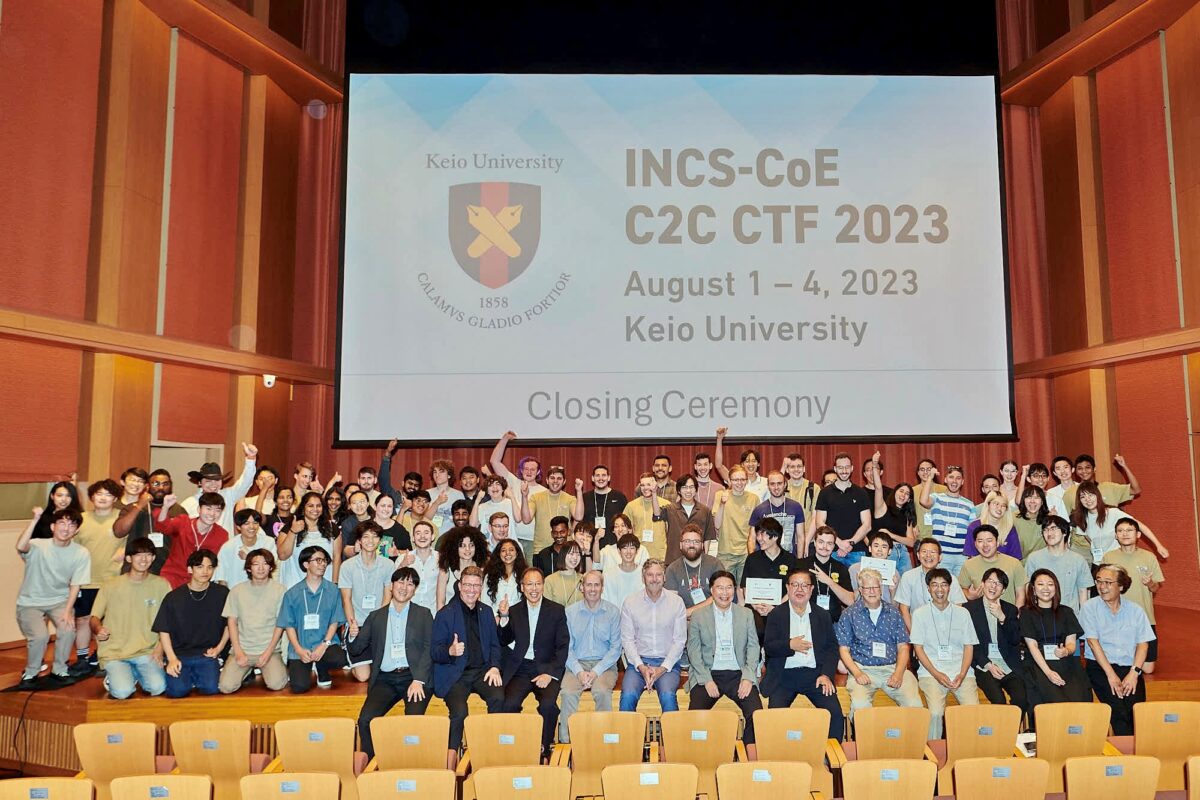 Karl V. Steiner (front row, second from left) with members of the INCS-CoE and the student competitors at the 2023 Country-to-Country Capture the Flag competition. (Image courtesy of Karl V. Steiner)
Chen made note of the significance of collaborating with students from around the world, sharing that the experience helped him to “absorb valuable insights into the cyber capabilities and experiences of students globally. The contrasting nature of our experiences…was both enlightening and enriching.”
Kazuo Noguchi, executive director of the INCS-CoE added: “ The vision for this event is to provide inclusive and international education and training which can enhance not only new skills, but also, and more importantly, promote international friendship, collaboration, ethics, and teamwork.”
A “real world” approach to cybersecurity
Rick Forno, principal lecturer in computer science and electrical engineering and assistant director of UMBC’s Center for Cybersecurity, explains that competitions like the C2C-CTF provide students with a look into the “real world” of cyber defense.
“The competition provides the next generation of cyber defenders an opportunity to tackle technical cybersecurity challenges and gain insight into the global nature of cybersecurity, [along with] the need for effective intercultural collaboration in working toward a common goal,” says Forno.
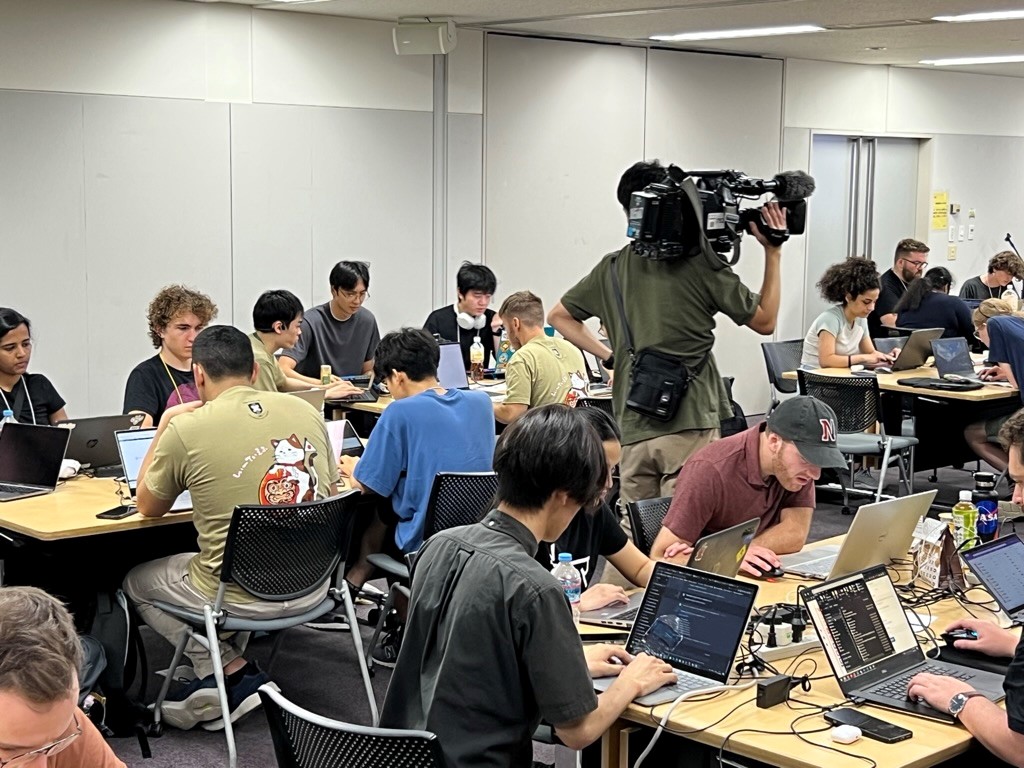 Students competing during the 2023 Country-to-Country Capture the Flag competition at Keio University. (Image courtesy of Karl V. Steiner)
Forno also serves as a coach for the UMBC CyberDawgs and adds that “structuring the C2C-CTF event with teams composed of members from different countries is an innovative idea that adds additional real-world ‘flavor’ to what participants will encounter later as cybersecurity professionals around the world.”
CyberDawgs member Zachary Amoss shared that while he has gotten the opportunity to compete with the team at national events, “the opportunity to represent UMBC on the global stage [at C2C-CTF] was a once-in-a-lifetime opportunity. I highly recommend all current UMBC students, especially those who are already in cybersecurity spaces such as the CyberDawgs, to compete in next year’s event.”
Leela SaiNadh Gade added that the competition has been “an enriching experience that expanded my understanding immensely. The learning I acquired from this event will serve as an invaluable asset in my future endeavors.”
]]>
UMBC’s work in strengthening students’ preparedness in cybersecurity defense is proving effective not only on campus, but well beyond. This summer, three UMBC students competed in an international...
https://umbc.edu/stories/umbc-capture-the-flag-cybersecurity-competition-japan/
https://my3.my.umbc.edu/api/v0/pixel/news/136423/guest@my.umbc.edu/aaaf6362c9bbd38d03ebe32aeccf2cbd/api/pixel
coeit
community
computer-science
csee
cybersecurity
news
science-and-tech
UMBC News & Magazine
https://my3.my.umbc.edu/groups/umbc-news-magazine
https://assets1-my.umbc.edu/system/shared/avatars/groups/000/001/943/24435aa6207c452e7bc15cc74b42c7bb/xsmall.png?1748556657
https://assets1-my.umbc.edu/system/shared/avatars/groups/000/001/943/24435aa6207c452e7bc15cc74b42c7bb/original.png?1748556657
https://assets2-my.umbc.edu/system/shared/avatars/groups/000/001/943/24435aa6207c452e7bc15cc74b42c7bb/xxlarge.png?1748556657
https://assets2-my.umbc.edu/system/shared/avatars/groups/000/001/943/24435aa6207c452e7bc15cc74b42c7bb/xlarge.png?1748556657
https://assets3-my.umbc.edu/system/shared/avatars/groups/000/001/943/24435aa6207c452e7bc15cc74b42c7bb/large.png?1748556657
https://assets1-my.umbc.edu/system/shared/avatars/groups/000/001/943/24435aa6207c452e7bc15cc74b42c7bb/medium.png?1748556657
https://assets2-my.umbc.edu/system/shared/avatars/groups/000/001/943/24435aa6207c452e7bc15cc74b42c7bb/small.png?1748556657
https://assets1-my.umbc.edu/system/shared/avatars/groups/000/001/943/24435aa6207c452e7bc15cc74b42c7bb/xsmall.png?1748556657
https://assets2-my.umbc.edu/system/shared/avatars/groups/000/001/943/24435aa6207c452e7bc15cc74b42c7bb/xxsmall.png?1748556657
UMBC News & Magazine
1
0
false
Thu, 19 Oct 2023 18:06:47 -0400
Thu, 19 Oct 2023 18:06:47 -0400