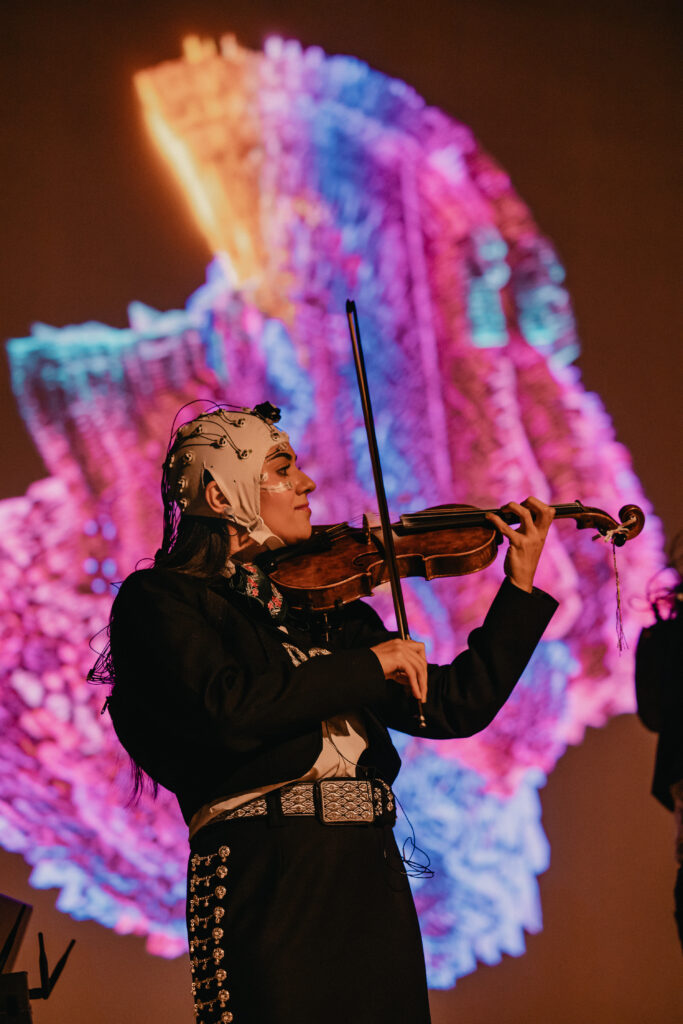
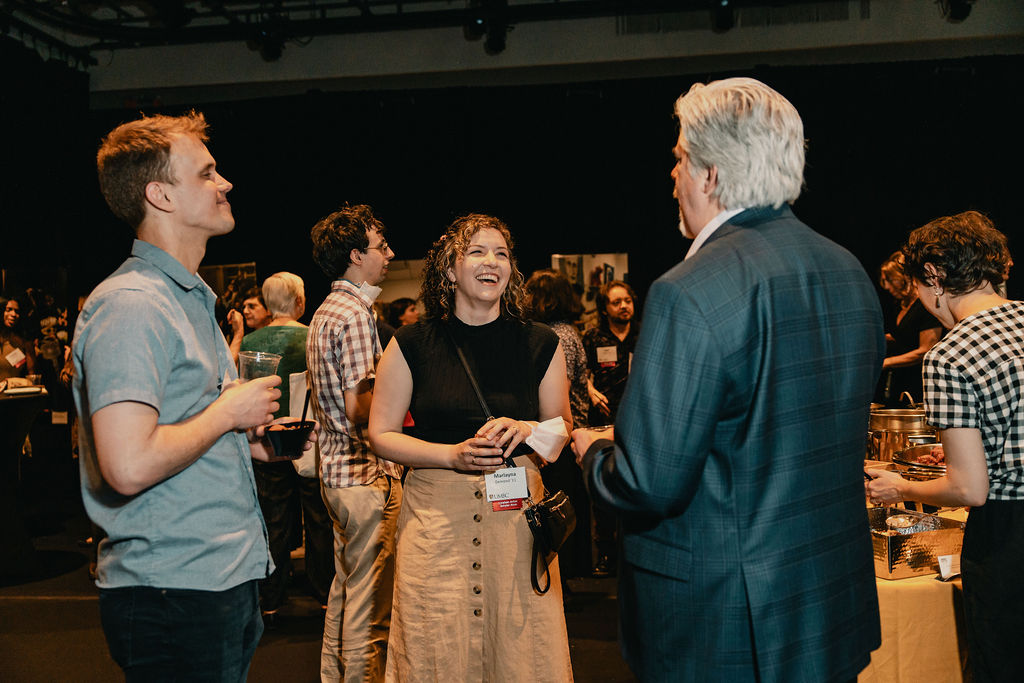
Katie King ’26, biology and dance double major, Admissions Grit Guide, and UMBC Dance Team co-captain, pursues a future that engages her passions
Katie King ’26, biology and dance, completed an ambitious double degree, and not only thrived but also became co-captain of the UMBC Dance Team and worked for the admissions office as a Grit Guide. Looking forward, she plans to become a physician assistant, and hopes to find ways to combine her love of both dance and biology.
Q: What attracted you to UMBC?
A: I knew I wanted to double major in biology and dance. I’m planning to go into the medical field, so biology was the route I needed to take, but I have been dancing since I was three. When looking at colleges, a lot of them told me I had to choose, but UMBC allowed me to do both. I was accepted into the Linehan Artist Scholars Program, so that also drew me here—I really love the possibilities and experiences that the program gives.
Q: How did the Linehan Artist Scholars Program impact your time at UMBC?
A: My experience began with the first-year seminar, and that class really helped me get more exposure and awareness to the other arts. As a dancer of many years, I really only stuck to dance, so I never really dove into the music or the theatre sides, and I didn’t know a lot about visual arts at all. That class really helped open my eyes—we did skits, we had to learn how to play music. In the second year, we had to do service hours, and that was rewarding. I did service hours within the dance department, and it was nice to feel like I was giving back to a bigger cause. The different trips that we got to go on with the Linehan program were super fun—twice to New York and once to Philly, to visit art museums and see performances. I was also in the Living-Learning Community in Harbor Hall, living right next to everyone in my cohort.
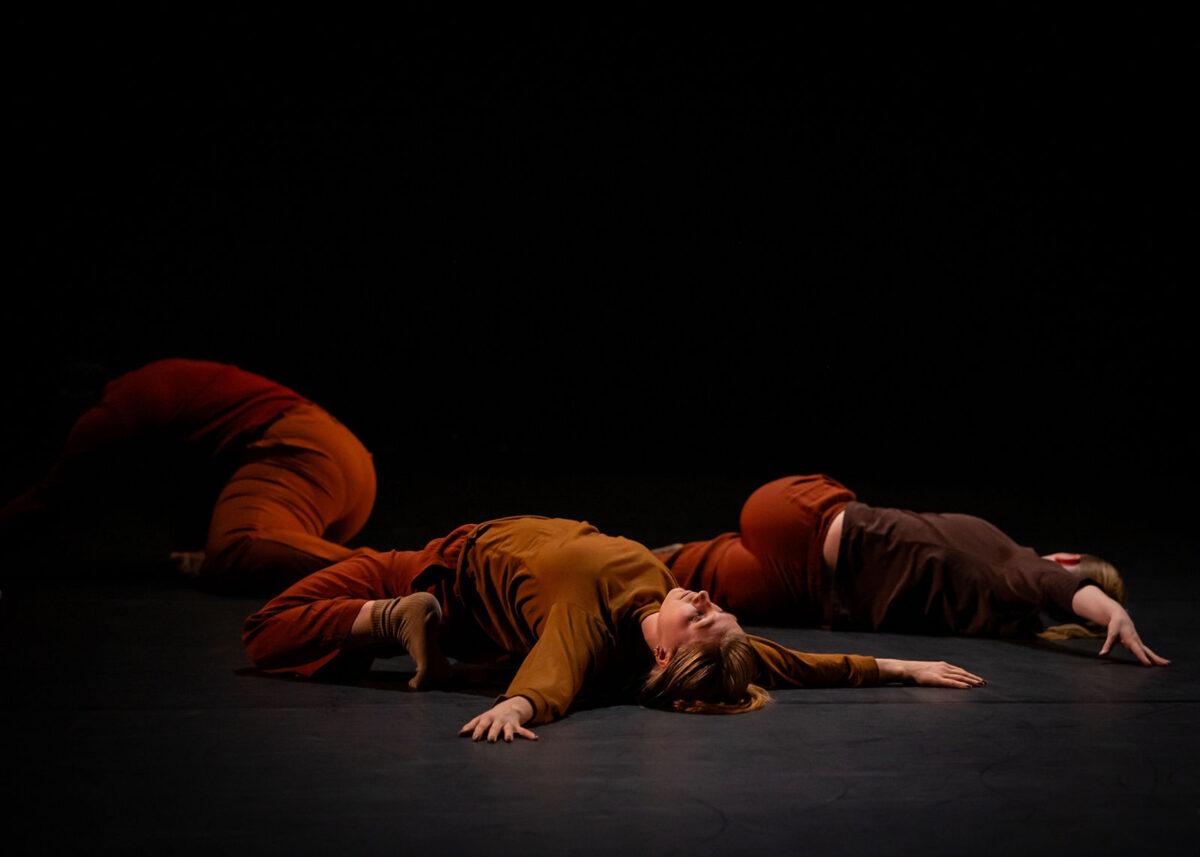 Katie King and two colleagues perform in the 2025 Fall Dance Showcase. (Photo by Kiirstn Pagan ’11.)
Q: Can you share more about your dance and biology double major?
A: I knew I wanted to be in the medical field since I was little. My dolls would be wrapped in casts, and I bought my own crutches when I was 7 at the pharmacy! At the same time, I’ve been dancing since I can remember. For a while, I thought of going into physical therapy, combining my dance and biology backgrounds. Now, I’m thinking of becoming a physician assistant. Both dance and biology have been passions, and I haven’t wanted to give up either one. I worked in a physical therapy office for 5 or 6 years, and there I got the idea to specialize in dancers. So that was the route I thought for a while until I switched to physician’s assistant, but I’m hoping at some point those fields intercross.
Q: How did being a Grit Guide impact your experience?
A: During my freshman year, I joined the UMBC Dance Team to get more involved on campus, and the coach said that the admissions office was hiring. I was brought on as a visual and performing arts tour guide for dance, but later became a general tour guide, and it shaped my entire experience at UMBC. I’ve done it for four years now. Working with professional staff, I gained skill sets that I’ll be able to use in the future, especially if I go into the medical field or work with the public again.
 Katie King, third from right, poses UMBC’s comfort dog, Chip, her handler, Sergeant Jamie Cheatem, and other friends. (Image courtesy of King.)
Q: What motivated you to join the UMBC Dance Team?
A; At the start of my freshman year, I didn’t join anything—I thought I needed to get acclimated. But by November, I was bored! I’ve never been the kind of person who isn’t involved—I have to be going all the time. So I decided to try out for the Dance Team, and I was accepted. It was a super fun experience. During my last two years, I was co-captain for the team and built so many friendships. I love basketball and used to play, but had to give it up for dance. With the Dance Team, I could both dance and watch basketball, and this year they won championships—life was good! It was probably my favorite part of college.
Q: How did you maintain a work-life balance?
A: I prioritize sleep, and get eight hours every night. My calendar is my best friend, truthfully. A lot of my shifts for tour guides were in the mornings, and then I had classes, and then rehearsals at night, and then a 3 or 4-hour block at the end of the night where I would do homework. I didn’t do a lot of hanging out in general besides those things—my social time was being at those events and at work.
 Katie King, left, poses with other members of the UMBC Dance Team on the basketball court.
Q: Were there faculty or staff who made a difference for you?
A: Definitely Ann Sofie Clemmensen—I call her my school mom! She was my dance advisor, but also became my unintentional biology advisor. At the start of my freshman year, we sat down, and she helped me plan out all four years, saying, “We’re going to get you out in four years, both degrees done.” We planned everything out. We met all the time, and I text and call her all the time. She’s always been there.
Q: What are your post-graduation plans?
A: I’m applying to physician assistant school and hope to start somewhere in January. Over the summer, though, I’ll be visiting Portugal, Spain, England, France, and Switzerland. I’m so excited—I haven’t been to Europe.
 Katie King, bottom right, poses with Grit Guide colleagues. (Image courtesy of King.)
Q: What advice would you give to new students?
A: My advice would be to stay true to yourself and always go after what you want. I was told many times that I couldn‘t do both degrees, and then I found a way. Get involved. That changed my whole trajectory here at UMBC. It’s hard to get out of your shell sometimes, and hard to put yourself out there, but it’s so rewarding, especially here. Step out of your comfort zone!
]]>
Katie King ’26, biology and dance, completed an ambitious double degree, and not only thrived but also became co-captain of the UMBC Dance Team and worked for the admissions office as a Grit...
https://umbc.edu/stories/katie-king-26-biology-and-dance-double-major-admissions-grit-guide-and-umbc-dance-team-co-captain-pursues-a-future-that-engages-her-passions/
https://my3.my.umbc.edu/api/v0/pixel/news/160254/guest@my.umbc.edu/d74fc3f9c7b7a6fc508207e7e3529d15/api/pixel
biology
cahss
class-of-2026
cnms
dance
linehan
news
science-and-tech
story
UMBC News & Magazine
https://my3.my.umbc.edu/groups/umbc-news-magazine
https://assets1-my.umbc.edu/system/shared/avatars/groups/000/001/943/24435aa6207c452e7bc15cc74b42c7bb/xsmall.png?1748556657
https://assets1-my.umbc.edu/system/shared/avatars/groups/000/001/943/24435aa6207c452e7bc15cc74b42c7bb/original.png?1748556657
https://assets2-my.umbc.edu/system/shared/avatars/groups/000/001/943/24435aa6207c452e7bc15cc74b42c7bb/xxlarge.png?1748556657
https://assets2-my.umbc.edu/system/shared/avatars/groups/000/001/943/24435aa6207c452e7bc15cc74b42c7bb/xlarge.png?1748556657
https://assets3-my.umbc.edu/system/shared/avatars/groups/000/001/943/24435aa6207c452e7bc15cc74b42c7bb/large.png?1748556657
https://assets1-my.umbc.edu/system/shared/avatars/groups/000/001/943/24435aa6207c452e7bc15cc74b42c7bb/medium.png?1748556657
https://assets2-my.umbc.edu/system/shared/avatars/groups/000/001/943/24435aa6207c452e7bc15cc74b42c7bb/small.png?1748556657
https://assets1-my.umbc.edu/system/shared/avatars/groups/000/001/943/24435aa6207c452e7bc15cc74b42c7bb/xsmall.png?1748556657
https://assets2-my.umbc.edu/system/shared/avatars/groups/000/001/943/24435aa6207c452e7bc15cc74b42c7bb/xxsmall.png?1748556657
UMBC News & Magazine
1
0
false
Wed, 20 May 2026 16:14:49 -0400
Wed, 20 May 2026 16:14:49 -0400
From modern languages to modern dance—Xavier Mack ’16 performs around the world
Before Xavier Mack ’16 dove into the world of professional dance, he prioritized finishing his college education, earning his degree—not in dance—but in modern language and linguistics. Mack transferred to UMBC in his sophomore year, and after a rocky start, he sought out a social group through his programs and housing community and he found his feet firmly under him. Now, Mack is pursuing his other passion, “the power of body language in conversation,” by dancing at the largest modern dance company in the U.S, Alvin Ailey American Dance Theater.
Mack chats below with fellow dancer and UCM intern Kayla Logue ’27 about finding correlation between his linguistics and dance knowledge, his experience at Alvin Ailey Dance Theater, and how his time at UMBC has led to pursuing his passions.
Q: What was it like being an MLL student who also danced?
A: I loved studying two disciplines that had no seeming relation! I found so much enjoyment in the balance of moving my body and spending hours learning language in the lecture halls. Dancing served as a release for me, even though it came with its challenges. As my understanding of linguistics and dance deepened, I was able to discover more of a correlation between the two. Both of these fields are rooted in elements of communication. This discovery helped enhance my dance artistry as well as revealing the power of body language in conversation.
Q: Do you have a favorite performance memory while at UMBC?
A: My favorite performance memory at UMBC was dancing a duet called Floating Above by Carol Hess. This piece was acrobatic yet very slow and meditative.
Q: Is there someone from UMBC who inspired you and how?
A: I’ve always been able to find inspiration in my peers. Everyone had their own special gifting; things that came easy to them. Drawing from what I observed around me kept me reaching for my untapped potentials. However, my most influential person had to be Brandon P. Russell [assistant teaching professor of classical ballet and contemporary dance]. Brandon saw all of my capabilities and pushed me to be the professional dance artist I am today, even before I knew it was possible.
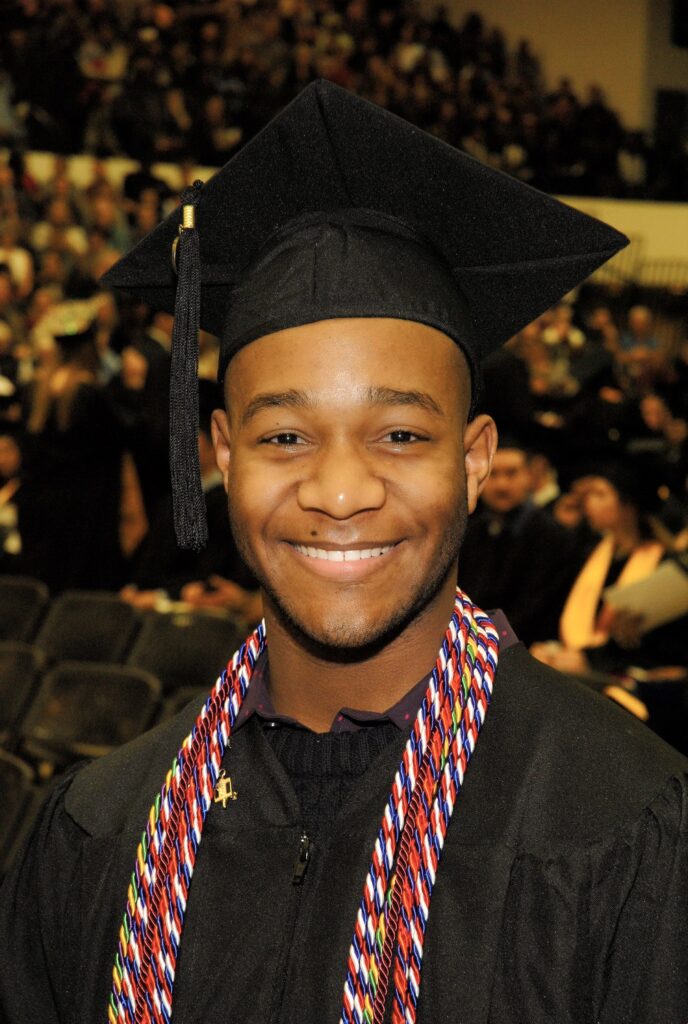
Photo right: Mack at his UMBC graduation.
Q: What was the process of getting into Alvin Ailey American Dance Theater?
A: My process for joining Ailey was a standard audition and callback in New York City. Since we were just coming out of COVID, they structured the preliminary audition to take place over several sessions within one day. Only 30 dancers could be in the room at one time and we had to wear masks. I had to return to NYC a few weeks later for the callback. Then, I waited about one week before I received the call offering me my job.
As my understanding of linguistics and dance deepened, I was able to discover more of a correlation between the two. Both of these fields are rooted in elements of communication. This discovery helped enhance my dance artistry as well as revealing the power of body language in conversation.
Xavier Mack '16
Q: What has been your favorite part about being in the company?
A: My favorite part of being in the company is the touring! I’ve always had a heart for travel; especially international travel. This job helps soothe my wanderlust. I’m afforded the opportunity to visit incredible parts of the world and meet the special people who inhabit these places.
Q: Did you do any traveling while at UMBC?
A: I actually constructed my own study abroad experience. With the approval of my advisor, I connected with a middle school, in a suburb of Paris, and asked their principal if I could assist with their English language classes. The principal was more than happy to have me during three weeks of my winter break.
 (Photo courtesy of Fredrik Gille)
Q: What’s a takeaway from UMBC that’s stayed with you?
A: Time management is the greatest skill I learned at UMBC and still use today. There are many things about my professional life that require timely/rapid responses. The discipline of managing my time gives me the ability to reply to alerts and submit important documents to my leadership teams, without falling behind or becoming stressed by long to-do lists.
Q: Why was it important that you finish your college education before performing professionally?
A: I had come way too close to graduation to turn away from obtaining my degree. In my opinion, my only option was walking across the stage. I poured an immense amount of time, hard work, and money into my education. I wanted to see that through to the end.
Learn more about extraordinary UMBC alumni, faculty, and staff who are chasing their dreams.
]]>
Before Xavier Mack ’16 dove into the world of professional dance, he prioritized finishing his college education, earning his degree—not in dance—but in modern language and linguistics. Mack...
https://umbc.edu/stories/xavier-mack-journey-from-linguistics-to-dancing/
https://my3.my.umbc.edu/api/v0/pixel/news/157356/guest@my.umbc.edu/bb1b5218cb8d4f41bef5f89c9c64f767/api/pixel
alumni
cahss
dance
magazine
mlli
story
UMBC News & Magazine
https://my3.my.umbc.edu/groups/umbc-news-magazine
https://assets1-my.umbc.edu/system/shared/avatars/groups/000/001/943/24435aa6207c452e7bc15cc74b42c7bb/xsmall.png?1748556657
https://assets1-my.umbc.edu/system/shared/avatars/groups/000/001/943/24435aa6207c452e7bc15cc74b42c7bb/original.png?1748556657
https://assets2-my.umbc.edu/system/shared/avatars/groups/000/001/943/24435aa6207c452e7bc15cc74b42c7bb/xxlarge.png?1748556657
https://assets2-my.umbc.edu/system/shared/avatars/groups/000/001/943/24435aa6207c452e7bc15cc74b42c7bb/xlarge.png?1748556657
https://assets3-my.umbc.edu/system/shared/avatars/groups/000/001/943/24435aa6207c452e7bc15cc74b42c7bb/large.png?1748556657
https://assets1-my.umbc.edu/system/shared/avatars/groups/000/001/943/24435aa6207c452e7bc15cc74b42c7bb/medium.png?1748556657
https://assets2-my.umbc.edu/system/shared/avatars/groups/000/001/943/24435aa6207c452e7bc15cc74b42c7bb/small.png?1748556657
https://assets1-my.umbc.edu/system/shared/avatars/groups/000/001/943/24435aa6207c452e7bc15cc74b42c7bb/xsmall.png?1748556657
https://assets2-my.umbc.edu/system/shared/avatars/groups/000/001/943/24435aa6207c452e7bc15cc74b42c7bb/xxsmall.png?1748556657
UMBC News & Magazine
0
0
false
Tue, 10 Mar 2026 13:58:46 -0400
Tue, 10 Mar 2026 13:58:46 -0400
Arts+ extravaganza hits a high note
On December 5, the campus celebrated this year’s Arts+ initiative with five concurrent events featuring UMBC students, faculty, and guest artists. In a sold out concert in Linehan Concert Hall, the UMBC Symphony Orchestra and String Chamber Orchestra, directed by assistant professor Philip Mann, performed Alexander Glazunov’s Violin Concerto, featuring professor Airi Yoshioka, and works by professor Linda Dusman and Rich Sigwald ’03, music.
 A moment from Street Scenes, with Jamia Tutt, ’26, as Mamie Jackson, and Christian Price-Burnett, ’26, as Jim Jackson.. Photo: Kiirstn Pagan ’11 for UMBC.
Down the hall in the Black Box Theatre, UMBC Theatre presented Street Scenes, with text by Langston Hughes and his contemporaries, with music by Kurt Weill, adapted and directed by associate professor Eve Muson, with musical direction by adjunct professor Andrew Hann—also to a sold out house.
 Students perform in the Fall Dance Showcase. Photo: Kiirstn Pagan,’11 for UMBC.
The Department of Dance presented the Fall Dance Showcase on the stage of the Proscenium Theatre, featuring striking capstone works by senior students and independent student research.
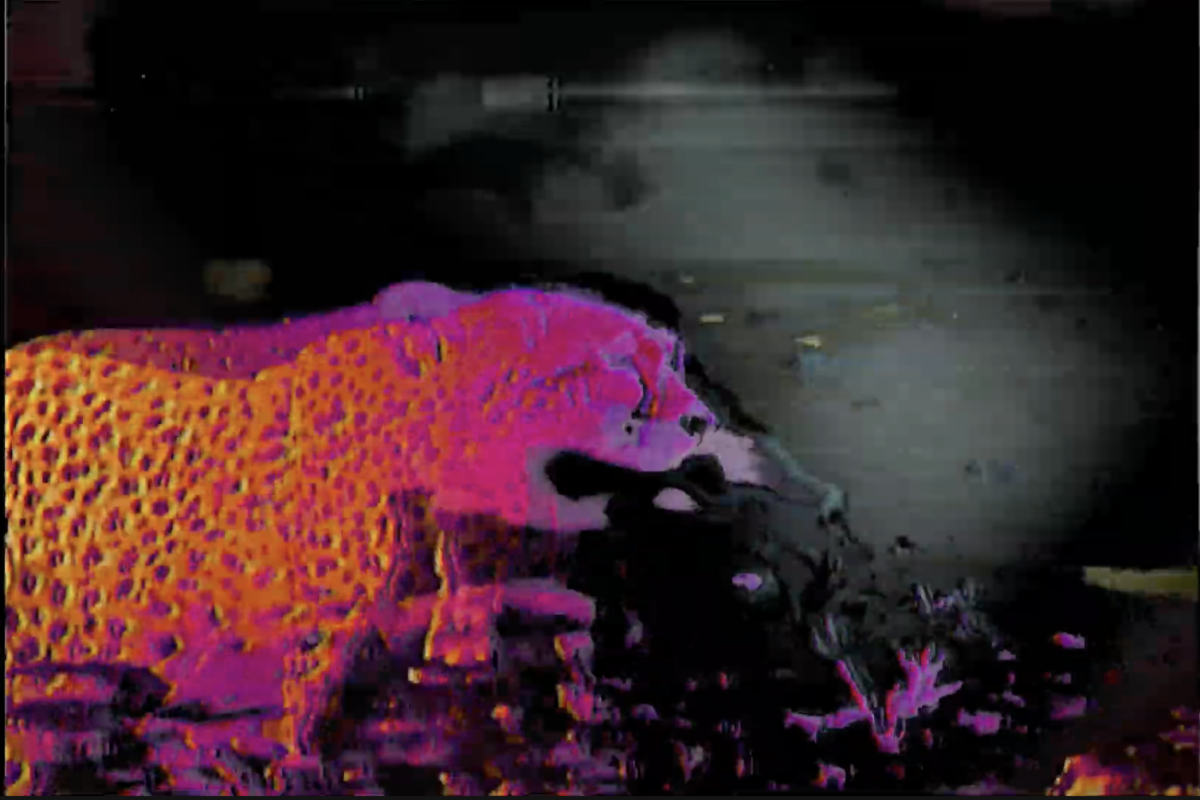 Still from video by McCoy Chance, M.F.A. ’25, IMDA.
The PAHB lecture hall was home to a Film and Animation Showcase, featuring works by 18 students and recent graduates of UMBC’s Intermedia and Digital Arts (IMDA) program.
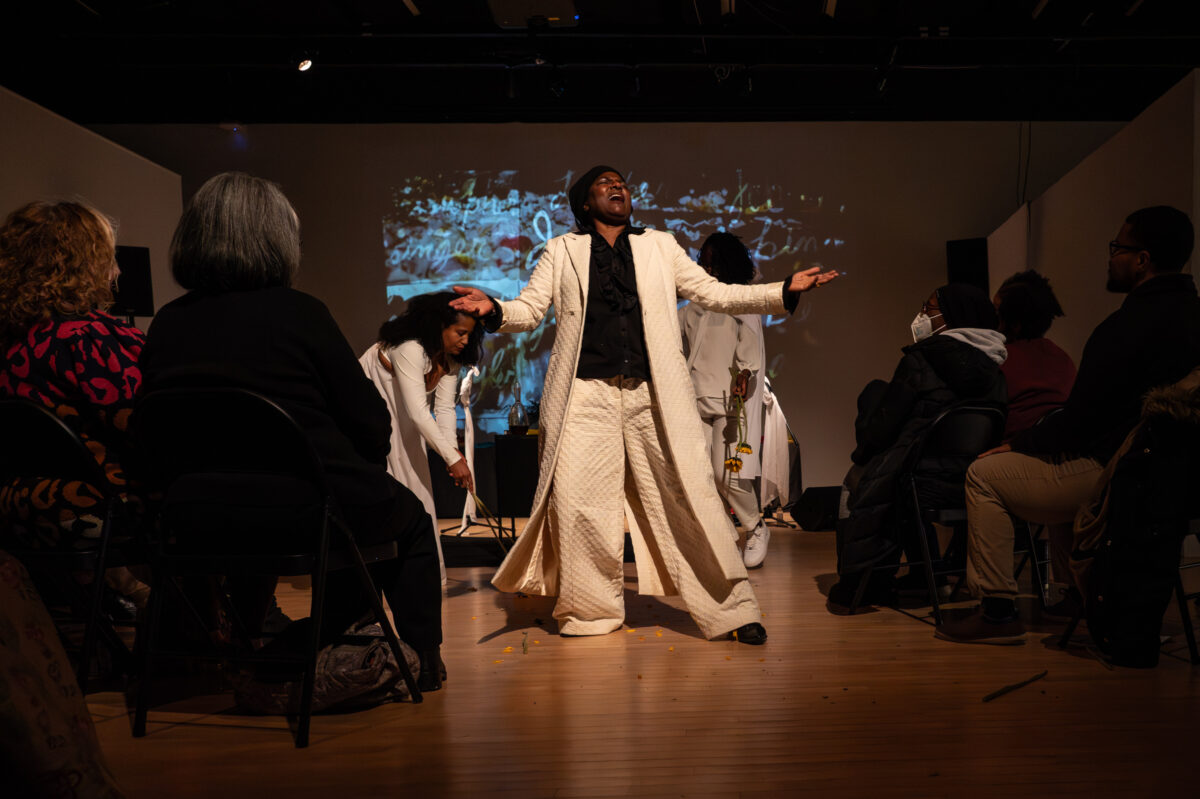 María Magdalena Campos-Pons performs at the Center for Art, Design, and Visual Culture. Photo: Tedd Henn for UMBC.
The Center for Art, Design, and Visual Culture presented a collaboration between 2023 MacArthur Fellow María Magdalena Campos-Pons and musician Kamaal Malak, known collectively as KaMag. Their work, entitled Vignettes in 3 Sessions: An Immersive Ancestral Experience, delighted a capacity audience and was followed by the launch of a new public projection by KaMag, I Am Soil — My Tears Are Water, in the Fine Arts Building amphitheatre.
The Arts+ initiative will continue in spring 2026 with performances by Baltimore Dance Project and Orange Grove Dance, a faculty art exhibition, a lecture by visual artist Lynda Barry, a production of The Wonderful Wizard of Oz, and more than a dozen music concerts by faculty and guest artists. A full schedule will be available in January 2026.
]]>
On December 5, the campus celebrated this year’s Arts+ initiative with five concurrent events featuring UMBC students, faculty, and guest artists. In a sold out concert in Linehan Concert Hall,...
https://umbc.edu/stories/arts-extravaganza-hits-a-high-note/
https://my3.my.umbc.edu/api/v0/pixel/news/155327/guest@my.umbc.edu/f1f002b8ac06aef4f89394fb70f8c50e/api/pixel
arts
arts-and-culture
cahss
dance
music
news
story
theatre
visualarts
UMBC News & Magazine
https://my3.my.umbc.edu/groups/umbc-news-magazine
https://assets1-my.umbc.edu/system/shared/avatars/groups/000/001/943/24435aa6207c452e7bc15cc74b42c7bb/xsmall.png?1748556657
https://assets1-my.umbc.edu/system/shared/avatars/groups/000/001/943/24435aa6207c452e7bc15cc74b42c7bb/original.png?1748556657
https://assets2-my.umbc.edu/system/shared/avatars/groups/000/001/943/24435aa6207c452e7bc15cc74b42c7bb/xxlarge.png?1748556657
https://assets2-my.umbc.edu/system/shared/avatars/groups/000/001/943/24435aa6207c452e7bc15cc74b42c7bb/xlarge.png?1748556657
https://assets3-my.umbc.edu/system/shared/avatars/groups/000/001/943/24435aa6207c452e7bc15cc74b42c7bb/large.png?1748556657
https://assets1-my.umbc.edu/system/shared/avatars/groups/000/001/943/24435aa6207c452e7bc15cc74b42c7bb/medium.png?1748556657
https://assets2-my.umbc.edu/system/shared/avatars/groups/000/001/943/24435aa6207c452e7bc15cc74b42c7bb/small.png?1748556657
https://assets1-my.umbc.edu/system/shared/avatars/groups/000/001/943/24435aa6207c452e7bc15cc74b42c7bb/xsmall.png?1748556657
https://assets2-my.umbc.edu/system/shared/avatars/groups/000/001/943/24435aa6207c452e7bc15cc74b42c7bb/xxsmall.png?1748556657
UMBC News & Magazine
0
0
false
Mon, 15 Dec 2025 15:23:15 -0500
Strange Dance Partners
UMBC researchers are discovering building blocks of hand motions, aiming to improve physical therapy for humans and find better ways to program robots. They’re turning to a novel source material for these gestures: classical Indian dance.
Fossil records suggest that between four and six million years ago, the hominin ancestors of modern humans first stood up and walked on two legs—thus freeing their hands. Those hands went on to craft humanity’s story arc: cradling babies, carrying food, fashioning and wielding weapons, carving the woodblocks used to print the first paper books, running over the keys of a piano in a Rachmaninoff concerto, and even planting a flag on the surface of the moon.
“Hands are incredibly important to humans,” says Ramana Vinjamuri, an associate professor of computer science and electrical engineering whose work has focused on understanding how the brain controls complex hand movements.
Vinjamuri personally witnessed the debilitating impact of loss of hand movement when his mother suffered a stroke in 2014. “The very hand that taught me how to draw, how to write—I saw that hand irrevocably paralyzed. It was really hard for the family.”
The experience motivated Vinjamuri to work on technologies that could help people regain lost motor functions or serve as robotic replacements for injured body parts. As part of the research, the team began searching for and cataloging the building blocks of hand motions. Further inspiration struck when Vinjamuri attended a scientific conference on the brain, hosted by the Indian Institute of Technology Mandi in the serene foothills of the Himalayas. While brainstorming ideas for a session of the conference focused on ways that ancient Indian traditions might be applied to modern problems, Vinjamuri conceived a novel approach to deriving these building blocks—from the structured hand gestures of Indian classical dance.

Ramana Vinjamuri in the Vinjamuri lab, stands with a Unitree bipedal robot.
A Complex and Versatile Instrument

Mitra, a humanoid robot produced by Invento Robotics, a company founded by UMBC alumnus Balaji Viswanathan, M.S ’06, Ph.D. ’23, computer science. The researchers programmed Mitra to make letters of the American Sign Language alphabet by combining the mudras-derived alphabets of movement, in this case making the letter E.
Take a moment to consider your hands. Including the wrist, each hand has 27 joints. Some of those joints, such as the carpometacarpal joint at the base of the thumb, can move in multiple ways, such as rotating, bending, and moving toward or away from the center of the palm. The full hand encompasses billions of possible unique combinations of movements.
“To study something as complex as the hand is fascinating,” says Parthan Olikkal, a longtime member of Vinjamuri’s lab who is currently working toward his Ph.D in computer science and is deeply involved in recent research efforts.
To get a grip on the complexities, the team has turned to a concept called kinematic synergies. First extensively explored in the mid-20th century by Russian physiologist Nikolai Bernstein, synergies are essentially building blocks of movement in which the brain simultaneously coordinates multiple joint movements to simplify complex motions.
The concept can be used to deconstruct a dazzling diversity of movements into a limited number of fundamental units, similar to how the hundreds of thousands of different words in the English language can be broken down into only 26 letters.
Vinjamuri and his students have been on a quest to discover the “alphabets” of human hand movements we’ve collectively learned through hundreds of dropped sippy cups, hours of handwriting practice, and the like. The hope is that the knowledge could then be used as a “hack”—to more effectively train ourselves and our robotic assistants in the future.
“The way we interact with our surroundings—the way we grasp objects or move through space—feels so natural and effortless. We often forget we stumbled and fell as children while our brains and bodies were learning to coordinate.”
— Ramana Vinjamuri, associate professor of computer science and electrical engineering
Natural Versus Structured Movements

Ashwathi Menon, co-caption of the Adaa Indian fusion dance team, stopped by the lab for a photo shoot in October. Here she appears on the computer screen as the team demonstrates how to use a simple camera and software system to recognize hand movements.

A small statue representing the Hindu god Shiva in the form of Nataraja, the cosmic dancer. Ramana Vinjamuri keeps the statue in his office. (Photo courtesy of Vinjamuri)
As part of their latest research on alphabets of hand movements, Vinjamuri and his students analyzed a dataset of 30 natural hand grasps. The movements are used for picking up objects ranging in size from large water bottles to tiny beads. The researchers found six synergies, akin to an alphabet of six letters, that when combined could account for nearly 99 percent of the variations in movements represented in the full dataset.
The first two synergies alone—specifically a movement in which all five fingers wrap around an object and a movement in which the index finger and thumb pinch together—could account for more than 90 percent of the variations. Learning (or relearning) those two movements would be essential to training a hand to pick up objects, the researchers say.
However, the team also says that studying natural grasps has limitations.
“Natural grasp is unique to the motor learning history of an individual,” says Olikkal. “So the way I do something might be completely different from another person.” The grasps also represented limited functionality, containing only a small subset of ways that a person might use their hands.
“Hand gestures are part of the storytelling. They are very precise. They can be used to point, to represent an animal, to represent praying—those are just some examples.”
— Ashwathi Menon, a junior and co-captain of UMBC’s Adaa Indian fusion dance team
In search of richer alphabets of movement, the researchers turned to dance, specifically an Indian classical dance form called Bharatanatyam, which originated in the southern Indian state of Tamil Nadu. The term Bharatanatyam is often explained as a mnemonic blend of words combining the concepts of emotion, melody, rhythm, and dance. The holistic art form employs a variety of hand gestures, called mudras, to drive the storytelling at its heart.
“Bharatanatyam is an intricate, linear, and structured dance form with a lot of precision,” says Ashwathi Menon, a UMBC junior majoring in bioinformatics and computational biology who is co-captain of the university’s Adaa Indian fusion dance team and who has been performing classical Indian dances since she was four years old. “Hand gestures are part of the storytelling. They are very precise. They can be used to point, to represent an animal, to represent praying—those are just some examples.”
“We noticed dancers tend to age super gracefully: They remain flexible and agile because they have been training,” says Vinjamuri. “That was a huge inspiration for us when we started looking for richer alphabets of movement. With dance, we are looking not just at healthy movement but super healthy. And so the question became, could we find a ‘superhuman’ alphabet from the dance gestures?”

Mitra’s hands use three types of motors for movement. The strongest motor, located at the shoulder, handles shoulder flexion and extension, while a medium-torque motor at the elbow controls elbow movements, and five servo motors, one for each digit, are used to control the fingers.
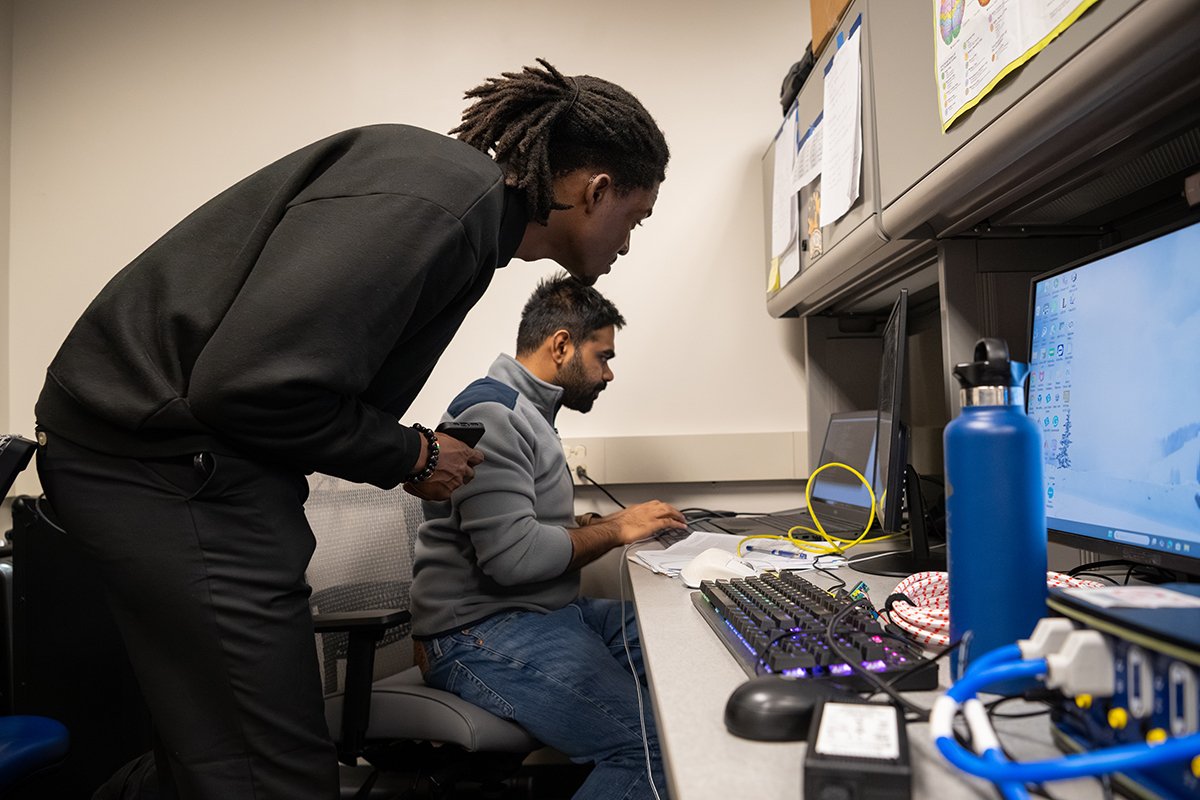
Chris Dollo (left), a senior computer science major and undergraduate researcher in the Vinjamuri lab, and Parthan Olikkal (right) work at the computer. Olikkal brought the concept of capturing hand movements using simple camera set-ups into the lab, a key step toward making cost-effective technologies.
Dance-Derived Alphabets of Movement

Ashwathi Menon demonstrates mudras, which are copied by an Inspire robotic hand. From top to bottom the mudras are: Ardhachandra, meaning “half moon;” Chandrakala, meaning “crescent moon;” and Tripataka, meaning “three parts of the flag.” The mudras can demonstrate various elements of a story, including weapons, trees, flowers, or concepts such as balance, unity, and beauty.
Using the same techniques they had deployed to deconstruct the 30 natural hand grasps, the research team also analyzed 30 single-hand mudras. They found six synergies that could account for around 94 percent of the mudras’ variations.
Crucially, the team then tested how well the six natural grasp-derived synergies could combine to construct unrelated hand motions—in this case 15 letters of the American Sign Language alphabet—compared to the mudras-derived synergies. The mudras synergies significantly outperformed the natural hand grasp synergies on that task.
“When we started this type of research more than 15 years ago, we wondered: Can we find a golden alphabet that can be used to reconstruct anything?” says Vinjamuri. “Now I highly doubt that there is such a thing. But the mudras-derived alphabet is definitely better than the natural grasp alphabet because there is more dexterity and more flexibility.”
Ultimately, Vinjamuri envisions coming up with libraries of task-specific alphabets that can be deployed depending on the needs, be it completing everyday household chores such as cooking or folding laundry, or something more complicated and precise, such as playing an instrument.
Robotic Helping Hands
Apart from advancing understanding of the fundamental roots of movement, the team has made great strides developing cost-effective and pragmatic methods of testing and implementing their ideas. When Vinjamuri first started the work, his team relied on motion-capture systems that required specialized gloves and other equipment. Now, the team uses a simple camera and software system to recognize, record, and analyze movements.
“Parthan brought the concept of capturing hand movements using cameras into the lab and really developed it,” Vinjamuri said. It’s an important contribution to ultimately making cost-effective technologies that people could use in their homes, he says, such as a virtual system to coach people through physical therapy sessions.
The team is also successfully developing techniques to “teach” robotic hands the alphabets of movements and how to combine them to make new hand gestures. The approach marks a departure from standard techniques of teaching robots to mimic hand gestures, and toward a method rooted in our understanding of how the human body and brain work.

Ashwathi Menon, left, demonstrates the Katakamukha mudra while a robotic hand mimics her gesture. The mudra is often used to represent actions like plucking flowers, holding a necklace, and pulling a bowstring.
“It’s called biomimetic learning,” says Vinjamuri. “We want to watch how a human body moves, how a hand moves and works, and we want to derive those principles and apply them to machines.”
The researchers are testing the techniques on a stand-alone robotic hand and a humanoid robot, each of which operates in a different way and requires a unique approach to translating the mathematical representations of synergies into physical movements.
“Once I learned about synergies, I became so curious to see if we could use them to make a robotic hand respond and perform the same way as a human hand,” says Olikkal. “Adding my own work to the research efforts and seeing the results has been gratifying.”
These moments of satisfaction in finding solutions to knotty problems will continue to propel the team’s voyage of discovery. They may even take a moment to celebrate their successes—perhaps with a fitting high-five.

Could A Dancing Robot Improve Humans’ Mental Health?
By Catherine Meyers • Photography by Kiirstn Pagan ’11
Searching for an alphabet of hand movements from the gestures in classical Indian dance is not the only way that art is inspiring and guiding new research in Ramana Vinjamuri’s lab. In a related project, Vinjamuri has teamed up with Andrea Kleinsmith, an associate professor in information systems who specializes in ways that computers can assess humans’ emotions, and Ann Sofie Clemmensen, an associate professor of dance, to explore whether and how dancing robots might offer humans new tools to improve their mental health. The research piggybacks off established practices of human-to-human dance/movement therapy, which can be used to treat some mental health challenges, such as schizophrenia, anxiety, and depression.
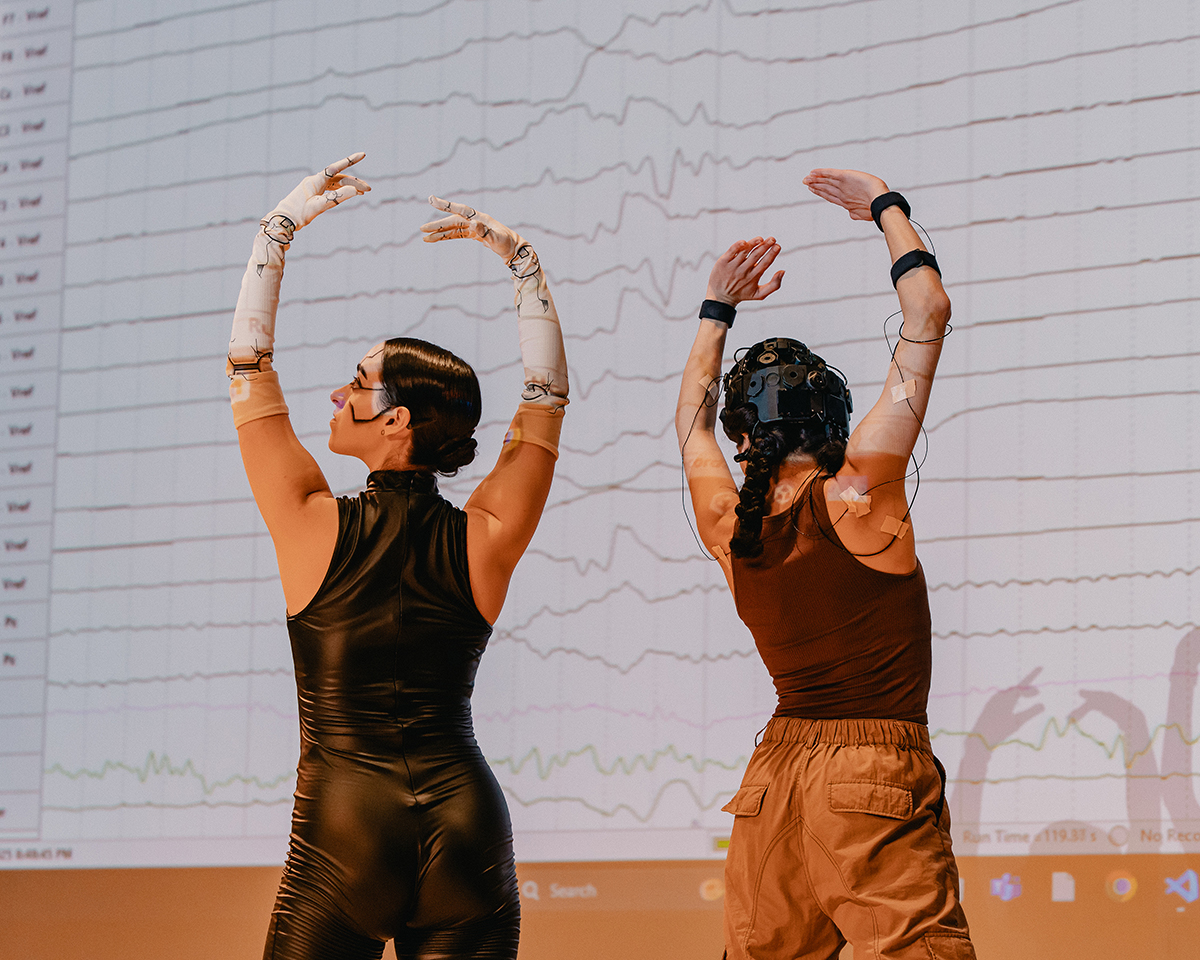
Dancers Sarah McHale ’24 and Juju Ayoub ’25 perform during the AccelNet meeting. The dance was a demonstration of a collaborative research project by UMBC faculty Ramana Vinjamuri, Andrea Kleinsmith, and Ann Sofie Clemmensen exploring stress reducing technology.
The spark for the interdisciplinary venture was struck when the College of Engineering and Information Technology launched a program to encourage faculty to explore collaborations across disciplines to tackle big challenges.
Together, Vinjamuri, Kleinsmith and Clemmensen developed a proposal to investigate questions such as whether the coordination in a person’s arms and legs could be a proxy measure of mental well-being, how existing dance therapy movements affect brain activity, and how a humanoid robot dance partner compares in effectiveness to a flesh-and-blood one.
“As a healthcare opportunity, dancing with a robot may sound weird at first,” notes Clemmensen. But, she says, people who are socially isolated or struggle with the stressors of human interactions might benefit from robot partners. “As humans, we project emotions on objects, but the objects do not judge back.”
In June, the team creatively demonstrated their progress to brain researchers and artists from around the world when they choreographed a technology-infused dance performance for the Movement, Music, and Brain Health National Science Foundation AccelNet meeting on the UMBC campus.
Two dancers—one representing a robot and the other a human—took turns moving around each other. Sensors monitored physiological signs of stress on the human dancer. As the dance progressed, the human was at first fearful, then curious, and finally happy—an ending the researchers hope their own project might one day also accomplish.
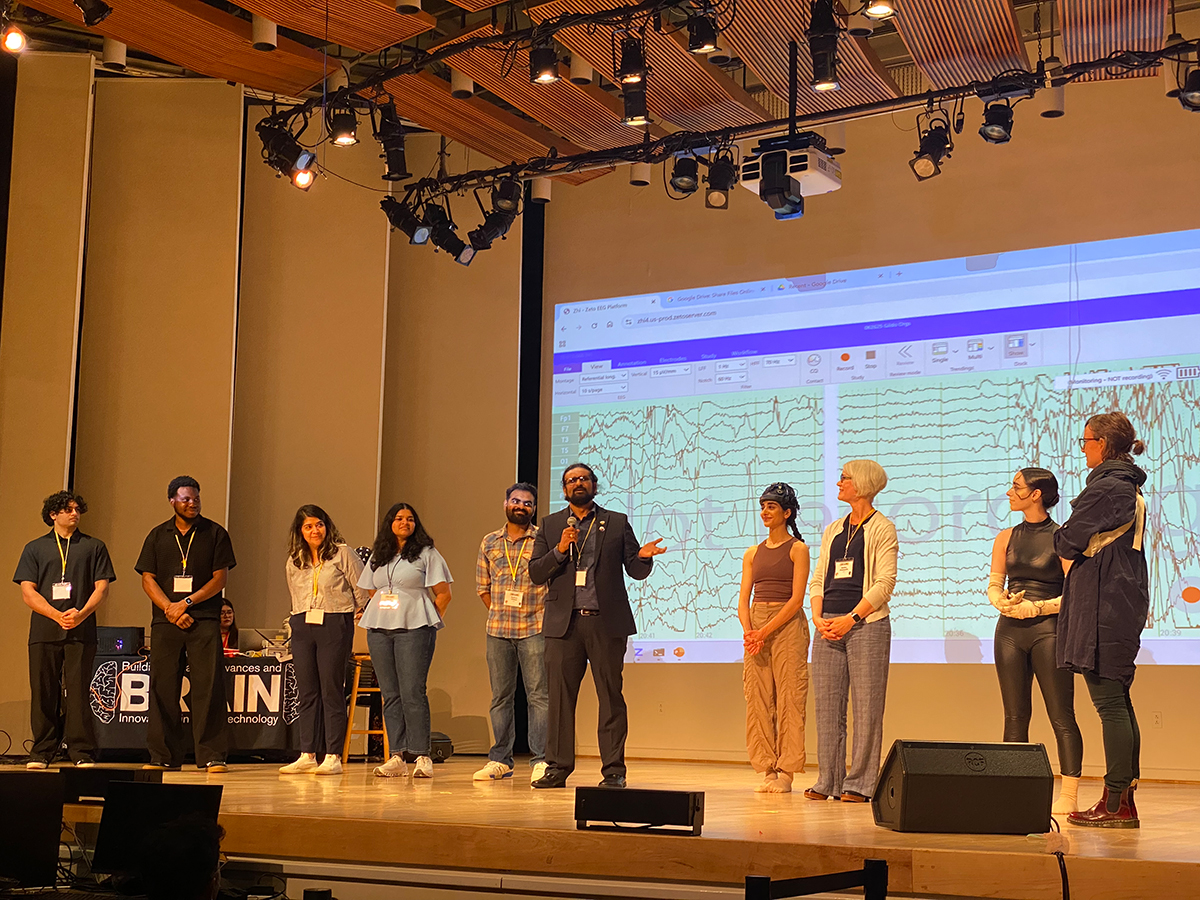
UMBC students and professors who worked on the project gather on the stage after the dance performance. From left to right are Viraj Janeja, Oritsejolomisan Mebaghanje, Golnaz Moharrer, Sruthi Sundharram, Parthan Olikkal, Ramana Vinjamuri, Juju Ayoub, Andrea Kleinsmith, Sarah McHale, and Ann Sofie Clemmensen.
Photo Credit: Niloufar Sarmast
 ]]>
UMBC researchers are discovering building blocks of hand motions, aiming to improve physical therapy for humans and find better ways to program robots. They’re turning to a novel source material...
https://umbc.edu/stories/strange-dance-partners/
https://my3.my.umbc.edu/api/v0/pixel/news/155312/guest@my.umbc.edu/f9ed6ebca522ae4dc141aea381fb8838/api/pixel
cahss
cnms
coeit
csee
dance
discovery
fall-2025
feature
magazine
research
story
UMBC News & Magazine
https://my3.my.umbc.edu/groups/umbc-news-magazine
https://assets1-my.umbc.edu/system/shared/avatars/groups/000/001/943/24435aa6207c452e7bc15cc74b42c7bb/xsmall.png?1748556657
https://assets1-my.umbc.edu/system/shared/avatars/groups/000/001/943/24435aa6207c452e7bc15cc74b42c7bb/original.png?1748556657
https://assets2-my.umbc.edu/system/shared/avatars/groups/000/001/943/24435aa6207c452e7bc15cc74b42c7bb/xxlarge.png?1748556657
https://assets2-my.umbc.edu/system/shared/avatars/groups/000/001/943/24435aa6207c452e7bc15cc74b42c7bb/xlarge.png?1748556657
https://assets3-my.umbc.edu/system/shared/avatars/groups/000/001/943/24435aa6207c452e7bc15cc74b42c7bb/large.png?1748556657
https://assets1-my.umbc.edu/system/shared/avatars/groups/000/001/943/24435aa6207c452e7bc15cc74b42c7bb/medium.png?1748556657
https://assets2-my.umbc.edu/system/shared/avatars/groups/000/001/943/24435aa6207c452e7bc15cc74b42c7bb/small.png?1748556657
https://assets1-my.umbc.edu/system/shared/avatars/groups/000/001/943/24435aa6207c452e7bc15cc74b42c7bb/xsmall.png?1748556657
https://assets2-my.umbc.edu/system/shared/avatars/groups/000/001/943/24435aa6207c452e7bc15cc74b42c7bb/xxsmall.png?1748556657
UMBC News & Magazine
0
0
false
Fri, 05 Dec 2025 16:55:00 -0500
Mon, 15 Dec 2025 12:55:36 -0500
Meet A Retriever—Kayla Logue ’27, dance major, cinematography minor, and Linehan Artist Scholar
]]>
UMBC researchers are discovering building blocks of hand motions, aiming to improve physical therapy for humans and find better ways to program robots. They’re turning to a novel source material...
https://umbc.edu/stories/strange-dance-partners/
https://my3.my.umbc.edu/api/v0/pixel/news/155312/guest@my.umbc.edu/f9ed6ebca522ae4dc141aea381fb8838/api/pixel
cahss
cnms
coeit
csee
dance
discovery
fall-2025
feature
magazine
research
story
UMBC News & Magazine
https://my3.my.umbc.edu/groups/umbc-news-magazine
https://assets1-my.umbc.edu/system/shared/avatars/groups/000/001/943/24435aa6207c452e7bc15cc74b42c7bb/xsmall.png?1748556657
https://assets1-my.umbc.edu/system/shared/avatars/groups/000/001/943/24435aa6207c452e7bc15cc74b42c7bb/original.png?1748556657
https://assets2-my.umbc.edu/system/shared/avatars/groups/000/001/943/24435aa6207c452e7bc15cc74b42c7bb/xxlarge.png?1748556657
https://assets2-my.umbc.edu/system/shared/avatars/groups/000/001/943/24435aa6207c452e7bc15cc74b42c7bb/xlarge.png?1748556657
https://assets3-my.umbc.edu/system/shared/avatars/groups/000/001/943/24435aa6207c452e7bc15cc74b42c7bb/large.png?1748556657
https://assets1-my.umbc.edu/system/shared/avatars/groups/000/001/943/24435aa6207c452e7bc15cc74b42c7bb/medium.png?1748556657
https://assets2-my.umbc.edu/system/shared/avatars/groups/000/001/943/24435aa6207c452e7bc15cc74b42c7bb/small.png?1748556657
https://assets1-my.umbc.edu/system/shared/avatars/groups/000/001/943/24435aa6207c452e7bc15cc74b42c7bb/xsmall.png?1748556657
https://assets2-my.umbc.edu/system/shared/avatars/groups/000/001/943/24435aa6207c452e7bc15cc74b42c7bb/xxsmall.png?1748556657
UMBC News & Magazine
0
0
false
Fri, 05 Dec 2025 16:55:00 -0500
Mon, 15 Dec 2025 12:55:36 -0500
Meet A Retriever—Kayla Logue ’27, dance major, cinematography minor, and Linehan Artist Scholar
Meet Kayla Logue, a junior with a dance major and a cinematography minor. Kayla is a Linehan Artist Scholar, is an intern for UMBC’s communications and marketing team, and is a Visual and Performing Arts Grit Guide at UMBC. She currently serves as the president of the Dance Council Of Majors; A student organization that works closely with the Department of Dance.
Q: Tell us about someone in the UMBC community who has inspired you or supported you, and how they did it.
A: I have had the pleasure of learning from many incredible professors so far here at UMBC, especially in the Department of Dance. One professor that I have had the pleasure to work closely with and who continuously inspires and supports me is Shaness D. Kemp.
Since my freshman year, I have looked up to Ms. Shaness because she is an incredible artist, teacher, and spirit! I had the opportunity to assist with her work for the Baltimore Dance Project in my sophomore year. Witnessing her rehearsal process and her creative mind inspires me as a dancer every day. As a teacher, professor Kemp always pushes me to be what she knows I am capable of, and she always supports me in achieving my goals.
Q: What’s the one thing you’d want someone who hasn’t joined the UMBC community to know about the support you find here?
A: UMBC is a place where you can find others who share your goals and are equally passionate.
The community here has helped me to believe in myself more than anything.
Kayla Logue ’27
Dance, President of Dance Council Of Majors
Q: What part of your job do you enjoy the most and why?
A: As a Visual and Performing Arts Grit Guide, I absolutely love getting to share my passion for UMBC and its community! So far, I have truly found incredible opportunities in my time here, as well as a beloved home away from home with the family I have in this community.
 Kayla Logue with friends at the Linehan 30th Anniversary party (photo courtesy of Jillian Casey)
Q: What brought you to UMBC in the first place?
A: I came to UMBC because of the opportunities it presented. I loved the Dance Department and its faculty, I would be able to both dance and continue my passions for visual art, and I was still close to home.
Q: Since you’ve been a part of the UMBC community, how have you found support of your WHY? Tell us about the people who have helped you at UMBC, and why it has made such a difference to you.
A: The UMBC community has helped me gain confidence in all my endeavors. I have met so many fellow Retrievers who inspire me with their passion and drive, and I have such incredible support from my professors who want to see me succeed. The community here has helped me to believe in myself more than anything.
 Kayla Logue and fellow dance majors outside the Kennedy Center (Kayla Logue/UMBC)
Q: Are you involved in any campus organizations? Tell us about what you love about them!
A: I currently serve as the president for UMBC’s Dance Council of Majors. I am incredibly honored to be in this leadership position because we foster community engagement amongst those who love to move and groove.
* * * * *
UMBC’s greatest strength is its people. When people meet Retrievers and hear about the passion they bring, the relationships they create, the ways they support each other, and the commitment they have to inclusive excellence, they truly get a sense of our community. That’s what “Meet a Retriever” is all about.
]]>
Meet Kayla Logue, a junior with a dance major and a cinematography minor. Kayla is a Linehan Artist Scholar, is an intern for UMBC’s communications and marketing team, and is a Visual and...
https://umbc.edu/stories/meet-a-retriever-kayla-logue-dance-linehan-artist/
https://my3.my.umbc.edu/api/v0/pixel/news/152528/guest@my.umbc.edu/7f809098ac21dac2f782b1f16652aab6/api/pixel
cahss
campus-life
dance
linehanscholars
magazine
meetaretriever
perspectives
story
UMBC News & Magazine
https://my3.my.umbc.edu/groups/umbc-news-magazine
https://assets1-my.umbc.edu/system/shared/avatars/groups/000/001/943/24435aa6207c452e7bc15cc74b42c7bb/xsmall.png?1748556657
https://assets1-my.umbc.edu/system/shared/avatars/groups/000/001/943/24435aa6207c452e7bc15cc74b42c7bb/original.png?1748556657
https://assets2-my.umbc.edu/system/shared/avatars/groups/000/001/943/24435aa6207c452e7bc15cc74b42c7bb/xxlarge.png?1748556657
https://assets2-my.umbc.edu/system/shared/avatars/groups/000/001/943/24435aa6207c452e7bc15cc74b42c7bb/xlarge.png?1748556657
https://assets3-my.umbc.edu/system/shared/avatars/groups/000/001/943/24435aa6207c452e7bc15cc74b42c7bb/large.png?1748556657
https://assets1-my.umbc.edu/system/shared/avatars/groups/000/001/943/24435aa6207c452e7bc15cc74b42c7bb/medium.png?1748556657
https://assets2-my.umbc.edu/system/shared/avatars/groups/000/001/943/24435aa6207c452e7bc15cc74b42c7bb/small.png?1748556657
https://assets1-my.umbc.edu/system/shared/avatars/groups/000/001/943/24435aa6207c452e7bc15cc74b42c7bb/xsmall.png?1748556657
https://assets2-my.umbc.edu/system/shared/avatars/groups/000/001/943/24435aa6207c452e7bc15cc74b42c7bb/xxsmall.png?1748556657
UMBC News & Magazine
0
0
false
Tue, 16 Sep 2025 12:19:58 -0400
Tue, 16 Sep 2025 12:19:58 -0400
Could a robot dance partner help us de-stress? UMBC researchers explore the ‘algo-rhythmic’ possibilities
It wasn’t your usual scientific research presentation. Two dancers—one representing a robot and the other a human—take turns moving around each other. As the dance progresses the human is at first fearful, then curious, and finally happy.
The performance in June during the Movement, Music, and Brain Health National Science Foundation (NSF) AccelNet meeting on the UMBC campus was the brainchild of three UMBC faculty who have joined forces to explore whether and how dancing robots might offer humans new tools to improve their mental health. The research piggybacks off established practices of human-to-human dance/movement therapy, which can be used to treat some mental health challenges, such as schizophrenia, anxiety and depression.
The exact form that robotic dance therapy might take, and the range of mental health conditions it could treat, are still large open-ended questions for the team, which is led by Ramana Vinjamuri, an associate professor in computer science and electrical engineering, who has done extensive work in brain-computer interfaces, and Andrea Kleinsmith, an associate professor in information systems, who specializes in ways that computers can assess humans’ emotions.
“As a healthcare opportunity, dancing with a robot may sound weird at first,” says Ann Sofie Clemmensen, an associate professor of dance, who is also part of the interdisciplinary team. “Why not just dance with a human?” But, she says, people who are socially isolated or struggle with the stressors of human interactions might benefit from robot partners. “As humans we project emotions on objects, but the objects do not judge back,” she says.
“The most exciting thing about this project for me is the collaboration,” says Vinjamuri. “I’ve never done something like this, and so the possibility to bring these fields together to tackle an important issue like mental health is super exciting.”
First steps
The groundwork for the research was laid as part of over a decade of work in Vinjamuri’s lab searching for “alphabets” or “synergies” of hand movements and associated brain activity that combine to build the variety of our everyday movements. Vinjamuri’s Ph.D. student Parthan Olikkal had recently developed contactless human motion tracking methods, which he applied when teaching humanoid robots these alphabets to form new movements.
Against this backdrop, the spark for the interdisciplinary venture was struck when the College of Engineering and Information Technology (COEIT) launched a “COEIT Interdisciplinary Projects” program to encourage faculty to explore collaborations across disciplines to tackle big challenges. Vinjamuri reached out to Kleinsmith and Clemmensen to discuss the possibility of teaming up.
Together, the researchers developed a project proposal to study key questions surrounding the idea of robot-assisted dance therapy. They named the proposal SIVAM after the Indian mythological god of dance (also short for “Synergy-based, Intuitive, Virtual and Augmented therapy for Mental health”). The research would look into questions such as whether the coordination in a person’s arms and legs could be a proxy measure of mental well-being, how existing dance therapy movements affect brain activity, and how a humanoid robot dance partner compares in effectiveness to a flesh-and-blood one.
Creative solutions at the technological frontiers
Like any big endeavor, the project encountered unexpected hurdles. An existing robot that the team had couldn’t move fast enough or with the full range of motion needed for a dance partner. (A new robot will soon be ordered.) The team also had to wait for delivery of a special EEG cap that could measure a dancer’s brain activity without the typical gel and wires that would get in the way. The cap was also equipped to filter out the signal noise that comes from a person moving around.
When the team realized they would have to wait for the humanoid robot, they pivoted to developing a digital avatar. They designed a camera and software system to track a person’s motions and then created a digital representation of a person to mirror the movements back, a technique in dance/movement therapy.
Developing the motion tracking system was a big part of the project to date. “Even just a few years ago, it was so much more difficult to digitally capture a person’s movements without them wearing reflective markers that a camera can easily track,” says Kleinsmith. Now, the team is using the latest in computer vision and machine learning tools to implement a markerless tracking system. Eliminating the need for specialized attire should make the system more accessible and useful.
The team also laid the groundwork for the next stages of the project by testing sensors, including the new cap and wireless sensors that can measure physiological signals such as heart rate, skin conductance, and body temperature. All the equipment will help the team test novel ways of assessing, and perhaps ultimately altering, human subjects’ emotional states.
“If you tighten your body, that may mean anger or fright, if you are more loose, you are more relaxed,” says Clemmensen. “And it’s possible that you could then guide a person through movement into that emotional state. The next part of this research is to get the data on that, and I’m quite excited about it.”
A technology-infused stage debut
The June performance was a chance for the team to creatively demonstrate their progress to brain researchers and artists from around the world.
In the first half of the performance, the human dancer, performed by UMBC graduate Juju Ayoub ’25, dance, and a “robot” dancer, performed by Sarah McHale ’24, dance, sit opposite one another and take turns moving. Their movements are captured and displayed on a large screen by digital avatars. In the second half, the human and robot meet on the dance floor, while the human cycles through the emotions of fear, curiosity, and happiness. Sensors on Ayoub measured her brain activity, heart rate, and other signals that capture emotions, and displayed them on the screen. The second half of the performance was improvised by the dancers, within an accumulative structure provided by Clemmensen.


On left, dancers Juju Ayoub and Sarah McHale get ready to perform while Ph.D. student Parthan Olikkal sets up equipment. On right, Sarah McHale dances in front of the digital avatars. (Photos by Kiirstn Pagan ’11)
“Philosophically speaking, the first part of the performance represents humans and robots working in their own spaces. Part two is where they’re trying to work together, going through these phases of fear, curiosity, and then finally collaboration—and hopefully a happy collaboration,” says Vinjamuri.
The human researchers on the project have certainly found their own happy collaboration.
Clemmensen said she appreciated how the group’s focus could zoom out and in, transitioning from discussions of big ideas to tackling tricky troubleshooting for one piece of equipment.
“I would like to see if I can take that verbal process into the creative space of dance choreography too,” she says.
The students involved in the project—Olikkal, fellow Ph.D. students Sruthi Sundharram and Golnaz Moharrer, and undergraduates Oritsejolomisan Mebaghanje ’25, computer science, and first-year computer science student Viraj Janeja—agree it was a mind-stretching and rewarding experience.
“I was very excited to be involved in the performance, which was an unusual and creative experience,” says Sundharram, who is a first-year Ph.D. student in computer science in Vinjamuri’s lab and who helped set up and connect the cap and sensors before the dance. “It was nerve-racking right before the start, fearing that something wouldn’t work,” Sundharram laughed. But the dancers helped ease her jitters and the performance went well.
“The best part of the experience for me was seeing the virtual environment for the project come alive,” says Mebaghanje, who worked as the lead software developer on the project. “I also really enjoyed working with my team and debugging issues together.”
Olikkal, who has been involved in the project from the beginning, and who worked primarily on the motion capture system, says he’s been able to hone his career aspirations in a meaningful way after joining Vinjamuri’s lab in 2019 as a master’s student.
“Once I started really putting my heart into the research and seeing how these systems can help people, maybe not always immediately but certainly down the line, I felt like I had found my calling,” he says.
After the dancers exited the stage of the Fine Arts Recital Hall, Vinjamuri took the microphone to thank the whole team. And he hinted at the exciting work that lies ahead: “Maybe next time there will be a real robot on stage.”
]]>
It wasn’t your usual scientific research presentation. Two dancers—one representing a robot and the other a human—take turns moving around each other. As the dance progresses the human is at first...
https://umbc.edu/stories/robot-dance-partner-research/
https://my3.my.umbc.edu/api/v0/pixel/news/150994/guest@my.umbc.edu/d0e8122b74ccd4b9af234dffd3a0e5e8/api/pixel
cahss-research
coeit
csee
dance
is
news
research
science-and-tech
story
UMBC News & Magazine
https://my3.my.umbc.edu/groups/umbc-news-magazine
https://assets1-my.umbc.edu/system/shared/avatars/groups/000/001/943/24435aa6207c452e7bc15cc74b42c7bb/xsmall.png?1748556657
https://assets1-my.umbc.edu/system/shared/avatars/groups/000/001/943/24435aa6207c452e7bc15cc74b42c7bb/original.png?1748556657
https://assets2-my.umbc.edu/system/shared/avatars/groups/000/001/943/24435aa6207c452e7bc15cc74b42c7bb/xxlarge.png?1748556657
https://assets2-my.umbc.edu/system/shared/avatars/groups/000/001/943/24435aa6207c452e7bc15cc74b42c7bb/xlarge.png?1748556657
https://assets3-my.umbc.edu/system/shared/avatars/groups/000/001/943/24435aa6207c452e7bc15cc74b42c7bb/large.png?1748556657
https://assets1-my.umbc.edu/system/shared/avatars/groups/000/001/943/24435aa6207c452e7bc15cc74b42c7bb/medium.png?1748556657
https://assets2-my.umbc.edu/system/shared/avatars/groups/000/001/943/24435aa6207c452e7bc15cc74b42c7bb/small.png?1748556657
https://assets1-my.umbc.edu/system/shared/avatars/groups/000/001/943/24435aa6207c452e7bc15cc74b42c7bb/xsmall.png?1748556657
https://assets2-my.umbc.edu/system/shared/avatars/groups/000/001/943/24435aa6207c452e7bc15cc74b42c7bb/xxsmall.png?1748556657
UMBC News & Magazine
0
0
false
Fri, 11 Jul 2025 11:54:44 -0400
Fri, 11 Jul 2025 11:54:44 -0400
Leading brain researchers and engineers converge on UMBC campus to advance innovative neurotechnologies
From June 5 – 8, UMBC hosted leading scientific researchers for a series of meetings on the science of the brain—often said to be the least understood organ in the human body. The proceedings began with a meeting of the industry advisory board for the Building Reliable Advances and Innovations in Neurotechnology (BRAIN) Center, of which UMBC is a site. Ramana Vinjamuri, associate professor of computer science and electrical engineering, directs UMBC’s participation in the center and played a key role in organizing the meeting, which brought industry, government, and academic researchers together to discuss the latest advancements in developing safe, effective and affordable personalized neurotechnologies to diagnose, restore or enhance brain and nervous system functions. Immediately following, the Movement, Music, and Brain Health National Science Foundation (NSF) AccelNet Meeting showcased how tools such as AI, mobile brain-body imaging and brain-computer interfaces could advance investigations into how music and dance promote cognitive function and well-being.
On the Friday evening of June 6, visually compelling performances in the UMBC Fine Arts Recital Hall merged science and art. Musicians and dancers wearing sensors to monitor their brain waves and vital signs such as heartbeat treated the audience to performances of flamenco dancing, mariachi music, interpretive dance, and classical piano. A UMBC team presented the imagined interactions of a human and a humanoid robot—exploring how the two could move together and expressing the emotions that might arise from the interaction. The team comprised faculty members Vinjamuri; Andrea Kleinsmith, information systems, and Ann Sofie Clemmensen, dance; computer science and human-centered computing students Parthan Olikkal, Oritsejolomisan Mebaghanje, Viraj Janeja, Sruthi Sundharram, and Golnaz Moharrer; and UMBC graduates Sarah McHale ’24, dance, and Juju Ayoub ’25, dance.
Fostering collaboration to accelerate innovation
UMBC joined the BRAIN Center in 2024. As an Industry–University Cooperative Research Center (IUCRC), it brings academic researchers across multiple institutions together with industry partners to conduct research of interest to those partners. Vinjamuri’s lab has partnered with industry and other research centers on projects such as detecting deception in brain waves, developing new tools for managing and treating substance abuse, and reducing stress through interaction with robots and virtual tools.
This was the first time that the BRAIN Center meeting was held in conjunction with an AccelNet meeting, part of the NSF’s efforts to tackle grand research challenges through coordinated international efforts. This meeting focused on better understanding how music and movement are linked to brain health.

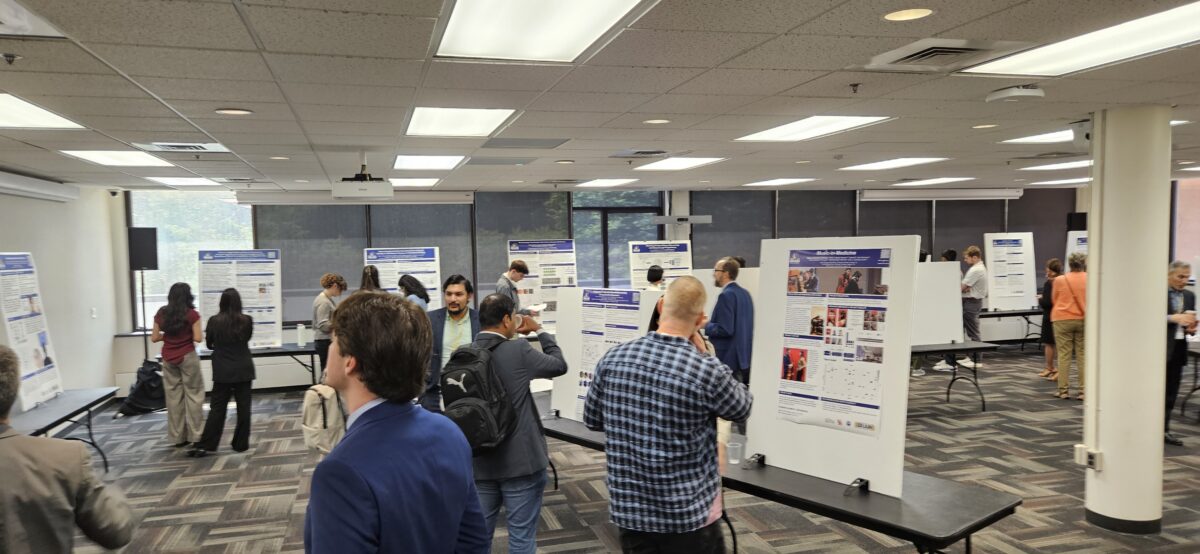
Attendees of the BRAIN Center IAB meeting pose for a group photo (left) and mingle at a poster session. (Photos by Catherine Meyers and Ramana Vinjamuri)
The twin meetings were an extra draw, and brought in close to 300 attendees, says Vinjamuri, including program directors from the NSF and FDA.
“We brought some of the world’s top researchers to UMBC, where we could showcase our labs and discuss opportunities to collaborate,” he says. “There was lots of shared interest and fruitful discussions.”
The conferences were an interdisciplinary affair, with experts in fields such as computer science, mechanical engineering, dance, music and the arts all mingling.
“These event would not be possible without the support and participation of UMBC leadership, the BRAIN Center, and fellow site directors,” said Vinjamuri. “So many people, from across UMBC and our collaborating institutions, in the U.S. and around the world, came together to make the events a success and I am deeply grateful to them all.”
“For a conference like this, I get to wear both of my hats, advocating for both research and creative achievement,” said Karl Steiner, UMBC’s vice president for research and creative achievement, in opening remarks. “We entered these partnerships to improve human life. It’s truly a privilege and a motivation to focus on that joint mission.”
These events were sponsored by the NSF IUCRC Program, the BRAIN Center, UMBC College of Engineering and Information Technology, and bwtech.
]]>
From June 5 – 8, UMBC hosted leading scientific researchers for a series of meetings on the science of the brain—often said to be the least understood organ in the human body. The proceedings...
https://umbc.edu/stories/brain-researchers-at-umbc/
https://my3.my.umbc.edu/api/v0/pixel/news/150711/guest@my.umbc.edu/2cb4b2594681869e8ebc475ce70ffeb9/api/pixel
coeit
csee
dance
is
news
science-and-tech
story
UMBC News & Magazine
https://my3.my.umbc.edu/groups/umbc-news-magazine
https://assets1-my.umbc.edu/system/shared/avatars/groups/000/001/943/24435aa6207c452e7bc15cc74b42c7bb/xsmall.png?1748556657
https://assets1-my.umbc.edu/system/shared/avatars/groups/000/001/943/24435aa6207c452e7bc15cc74b42c7bb/original.png?1748556657
https://assets2-my.umbc.edu/system/shared/avatars/groups/000/001/943/24435aa6207c452e7bc15cc74b42c7bb/xxlarge.png?1748556657
https://assets2-my.umbc.edu/system/shared/avatars/groups/000/001/943/24435aa6207c452e7bc15cc74b42c7bb/xlarge.png?1748556657
https://assets3-my.umbc.edu/system/shared/avatars/groups/000/001/943/24435aa6207c452e7bc15cc74b42c7bb/large.png?1748556657
https://assets1-my.umbc.edu/system/shared/avatars/groups/000/001/943/24435aa6207c452e7bc15cc74b42c7bb/medium.png?1748556657
https://assets2-my.umbc.edu/system/shared/avatars/groups/000/001/943/24435aa6207c452e7bc15cc74b42c7bb/small.png?1748556657
https://assets1-my.umbc.edu/system/shared/avatars/groups/000/001/943/24435aa6207c452e7bc15cc74b42c7bb/xsmall.png?1748556657
https://assets2-my.umbc.edu/system/shared/avatars/groups/000/001/943/24435aa6207c452e7bc15cc74b42c7bb/xxsmall.png?1748556657
UMBC News & Magazine
0
0
false
Tue, 17 Jun 2025 15:48:24 -0400
Tue, 17 Jun 2025 15:48:24 -0400
Finding the harmony within art and science
At UMBC, undergraduate students are redefining the boundaries of scientific and artistic pursuits. From a chemical engineer who graces the stage with his cello to a bioinformatician who paints and a biochemist who ignites the dance floor with Latin rhythms, these scholars thrive in an environment that celebrates their diverse passions.
This spring, several U-RISE Scholars—the National Institutes of Heath’s Undergraduate Research Training Initiative for Student Enhancement—shared their multidisciplinary interests with Jacqueline King, associate director of the U-RISE program, and Mariano Sto. Domingo, associate director of research and evaluation within the Meyerhoff Scholars Program. As a result, King and Sto. Domingo started researching how the arts and science blend in these students’ lives, and presented their findings at an academic conference this spring. What they learned was that here, rigorous research and creative expression intertwine, fostering a vibrant community where students explore every dimension of their talents.
Ajeetha Aruchandran, a seniorbioinformatics and computational biology major, studies how the neural tube—a precursor to the spinal cord—forms in zebrafish embryos with Rachel Brewster, professor of biological sciences.
The development of the embryos, which are transparent, “is a very visual process,” Aruchandran says. Her artistic skills have allowed her to generate beautiful and accurate diagrams that communicate her research, she says. “When you’re not able to communicate science well, then the meaning is lost. So I think my art has really strengthened that aspect of my science. The connection has surprised and delighted me, because for a long time I thought my science and my art had to be separate.”
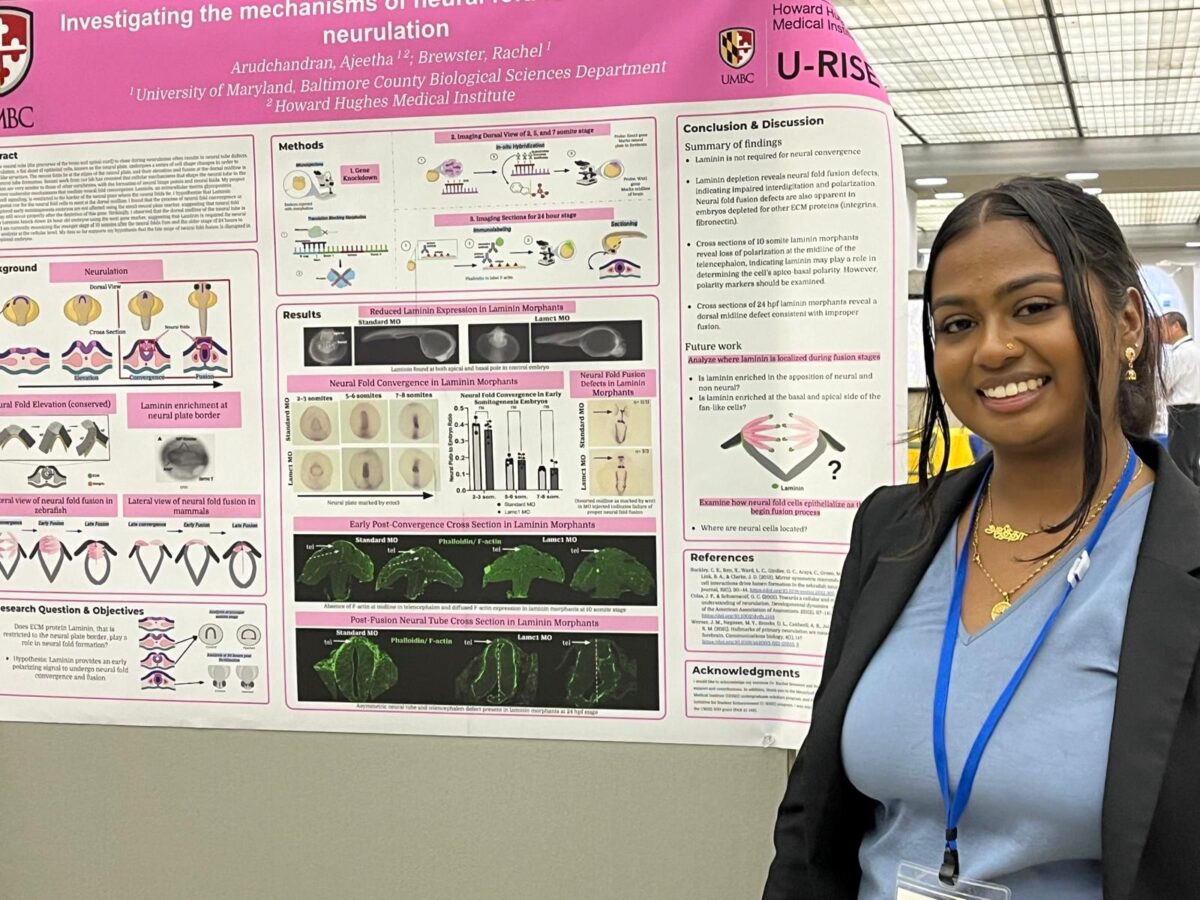
 Biologist Ajeetha Aruchandran also loves to paint. (Courtesy of Aruchandran)
Aruchandran began with drawing, but has transitioned to painting. “There’s something so special about the freeness of a brushstroke,” she says. The two pursuits “create balance in my life, because when I need more structure, I have research and the scientific method, but when I need to feel more free, I have my art.”
Rhythm and harmony
Lesley Hernandez, a senior majoring in biochemistry and molecular biology, is hunting for factors that regulate how viruses like HIV multiply in cells with Michael Summers, University Distinguished Professor of Cchemistry and Bbiochemistry. The ultimate goal is to disrupt the viruses’ replication. She also loves to dance.
“My family is from the Dominican Republic, so I grew up surrounded by music and movement. I decided to embrace that part of my culture at UMBC by joining the Latin Dance Club, where I could perform and share my love for dance with others,” Hernandez says. “I love incorporating dance into the workspace by sharing a laugh with my peers and dancing between experiments. It fosters stronger connections and creates an enjoyable work environment.”
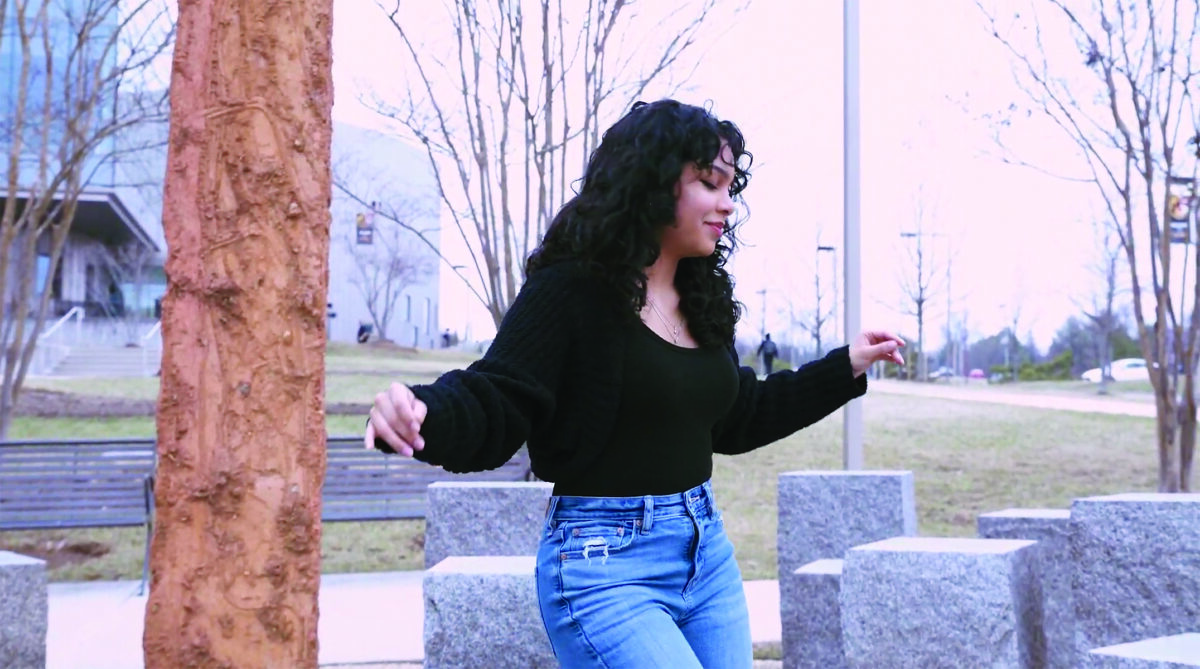
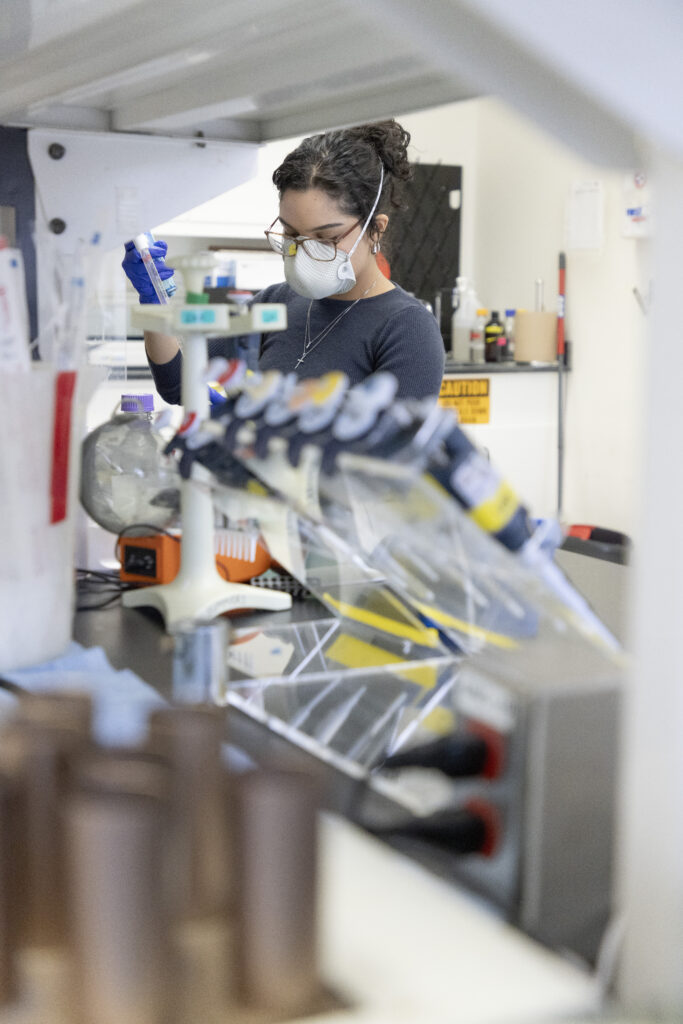 Lesley Hernandez loves being able to “go to my dance class and come back [to the lab] with a refreshed mind.” (Melissa Penley Cormier, M.F.A. ’17/UMBC)
And, when the science gets intense, “I can go to my dance class and come back with a refreshed mind,” Hernandez says. Her attention to detail benefits both her science and her dance. Being “a calculated person” helps her pick up rhythmically complex dance moves more quickly, for example. Both activities also require creativity, whether in trouble-shooting an experiment that’s not working or coming up with new dance routines.
In the Summers lab, “We are all really into science, but what is fun for you outside of that? Everyone in my lab has their own outlet, and that is encouraged,” Hernandez says.
For Daisy Parry, a senior majoring in biological sciences, that outlet is singing. “I’ve had a lot of interests that have come and gone, but singing has been a constant thread throughout my life. It’s very important and very centering to me,” Parry says. Her music minor has created dedicated times that provide a respite from the demands of science, she says.
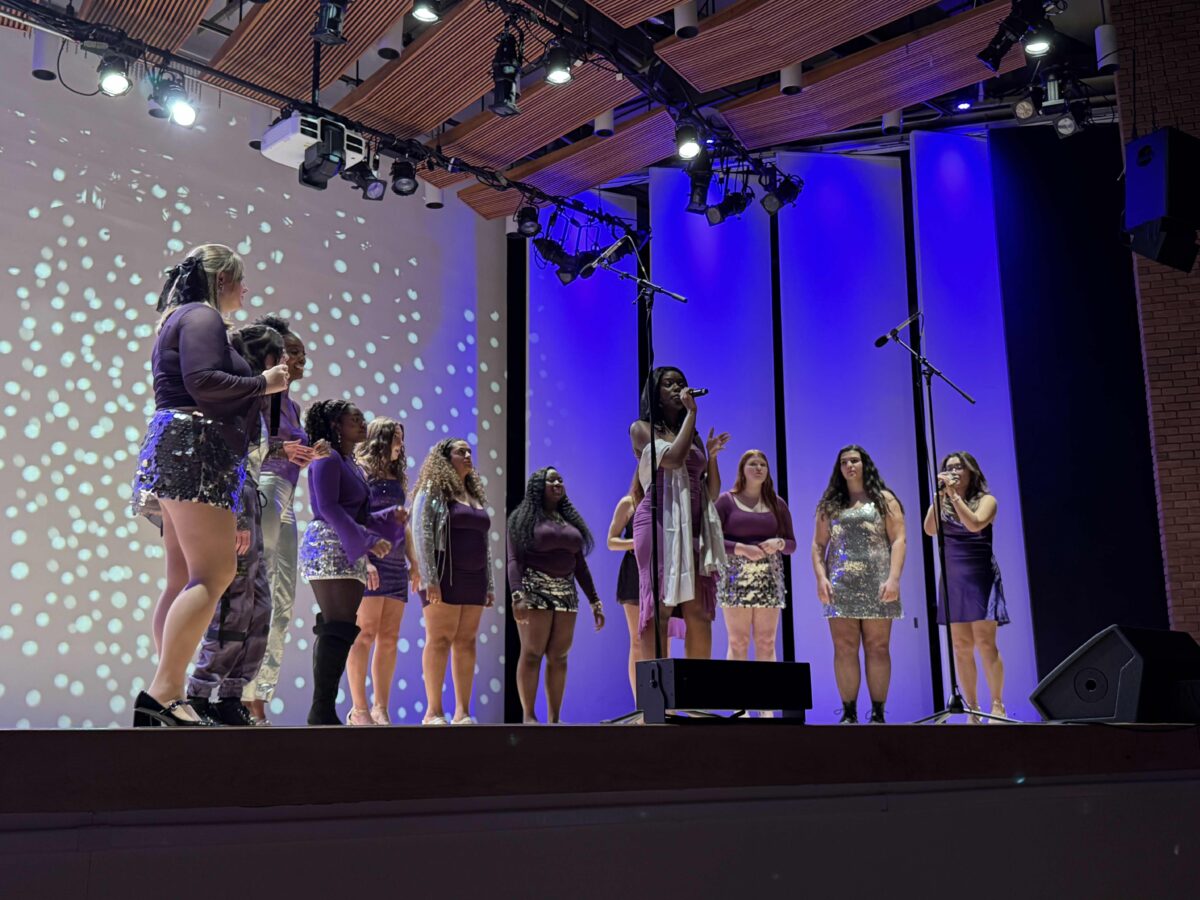 Daisy Parry (in front, with microphone) performs with the UMBC Stilettos, an all-female a cappella group. (Courtesy of Parry)
Parry is a member of The Stilettos, an all-woman a cappella group at UMBC, and her church choir. She arranges songs for The Stilettos to perform, which permits taking some creative license with the original work. “I like changing up the rhythms and dynamics to add depth to the music, and I think’s encouraged me to think a bit outside the box with my science, too, in terms of trying new experimental techniques.”
For now, her work on cell migration in fruit fly embryos with Michelle Starz-Gaiano, professor of biological sciences, her classes, and her music keep her busy, but Parry is looking forward to pursuing a master’s in public health after UMBC. She emphasizes how the concept of harmony—so central to music—carries over to the kind of work she wants to do. Factors such as research, clinical care, public policy, economics, the environment, and how they intersect are all relevant to public health outcomes, she explains.
‘It makes me whole’
Ella Reinders, a junior biological sciences major, also likes to tackle projects—scientific or artistic—from many angles. Watercolor and acrylic paints, sketching and drawing, handicrafts, sewing, and ballet have all captured her interest. “There are all different kinds of random things that I think are fun,” Reinders says.
In the lab, “I am able to come up with different ways of thinking about something because I’ve taken so many different approaches,” she says.
Reinders does behavioral research with Tara LeGates, assistant professor of biological sciences. The lab needed a new piece of equipment, but it was too expensive to buy off the shelf. “So I decided, why not create our own?” Reinders recalls.
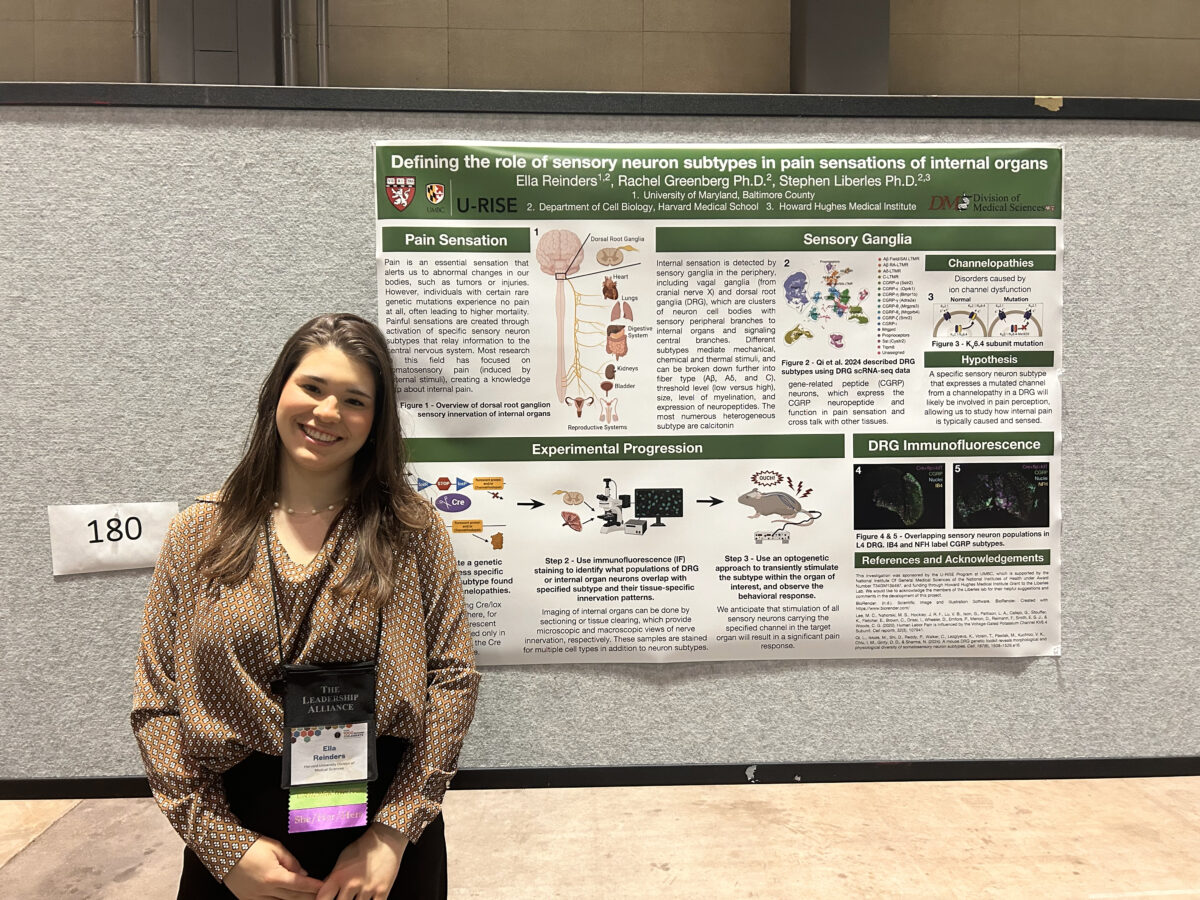
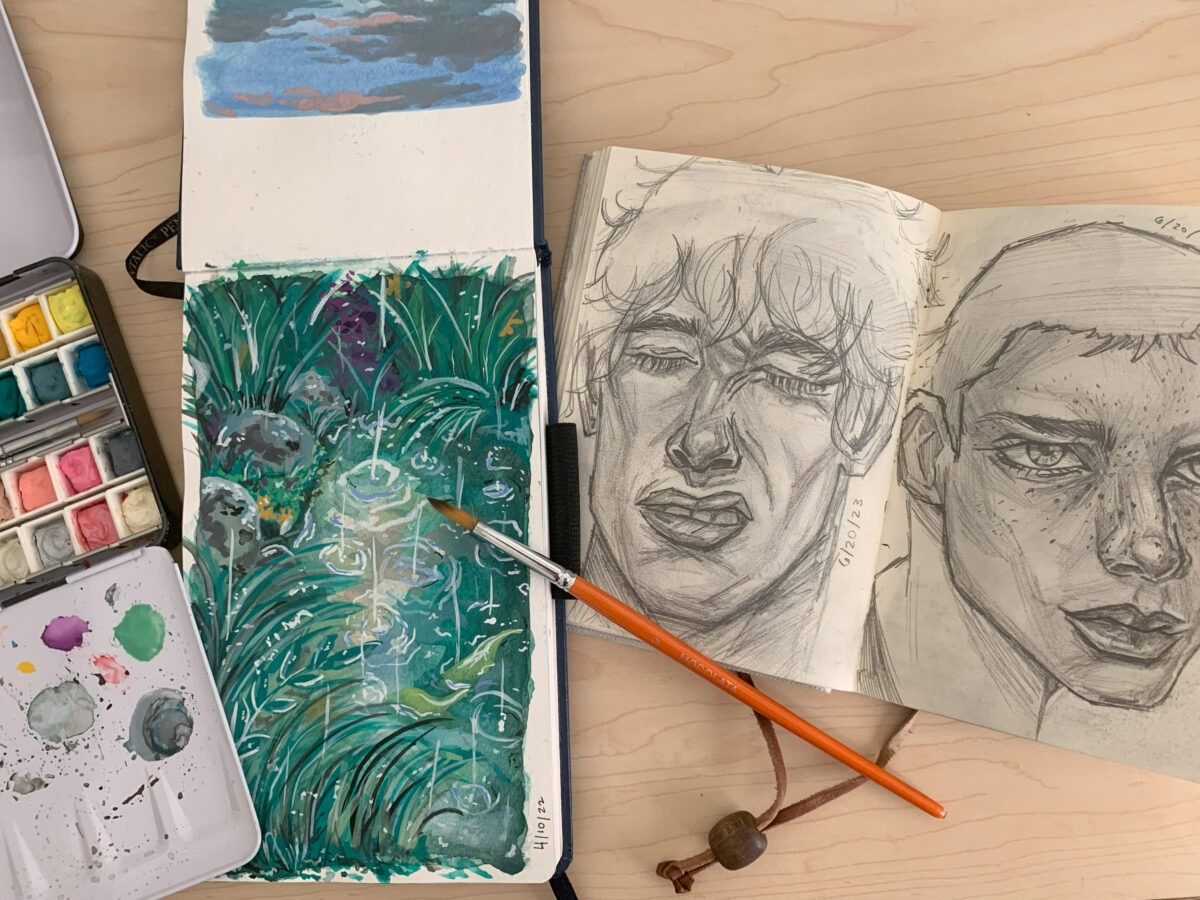 Ella Reinders says that “moving through life with both scientific and artistic interests just makes everything more interesting.” (Courtesy of Reinders)
She sketched it out, learned how to render it on the computer, how to 3D print it at the UMBC library, and then how to wire it. “And now I’ve actually been using it, and it works,” she says. “It was really exciting. I love turning something from my brain into something that I’m actually holding.”
There is also direct overlap between Reinders’ science and her art. “I’ve done imaging of neurons, and being able to turn them into this piece of artwork that you want to hang on your wall is really exciting. Moving through life with both scientific and artistic interests just makes everything more interesting and feels like a way to express all sides of myself.”
For Joshua Dayie, a senior chemical engineering major, both discipline and creativity are required for his research and his art—playing the cello. “You really have to strike a balance between them to make any meaningful progress,” he says. Practicing cello requires hours of repetition, until technical passages flow out of his fingers from muscle memory alone. In the lab, sometimes experiments must be repeated many times before they’re successful—that’s the discipline.
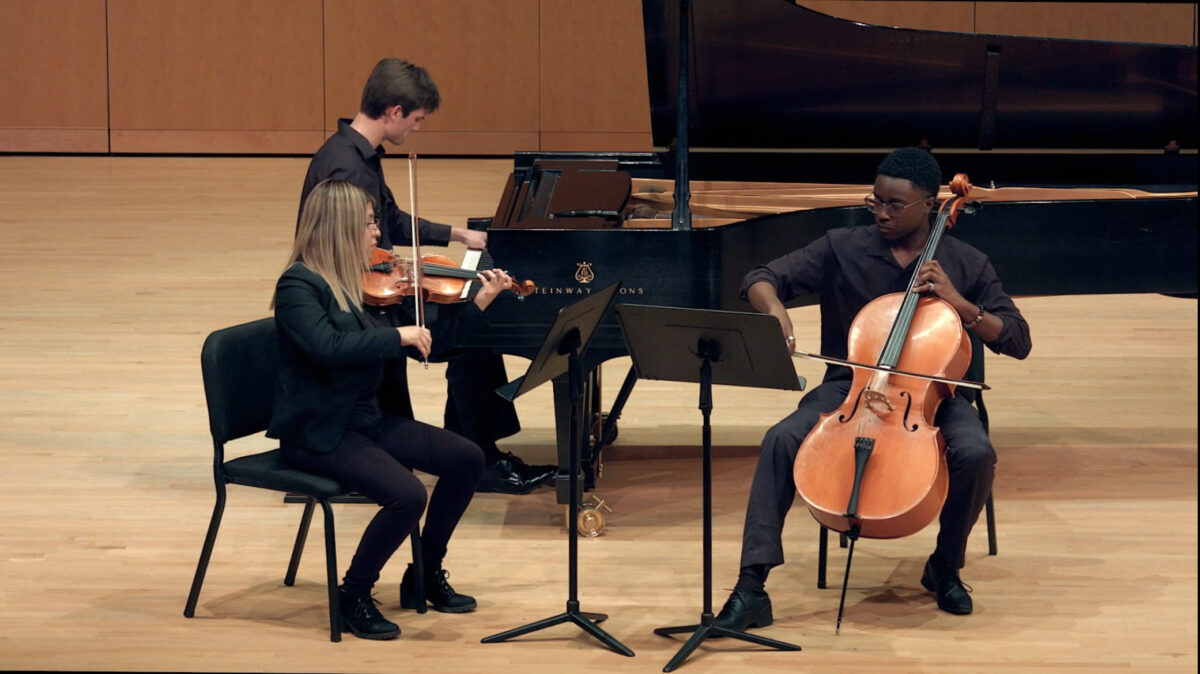
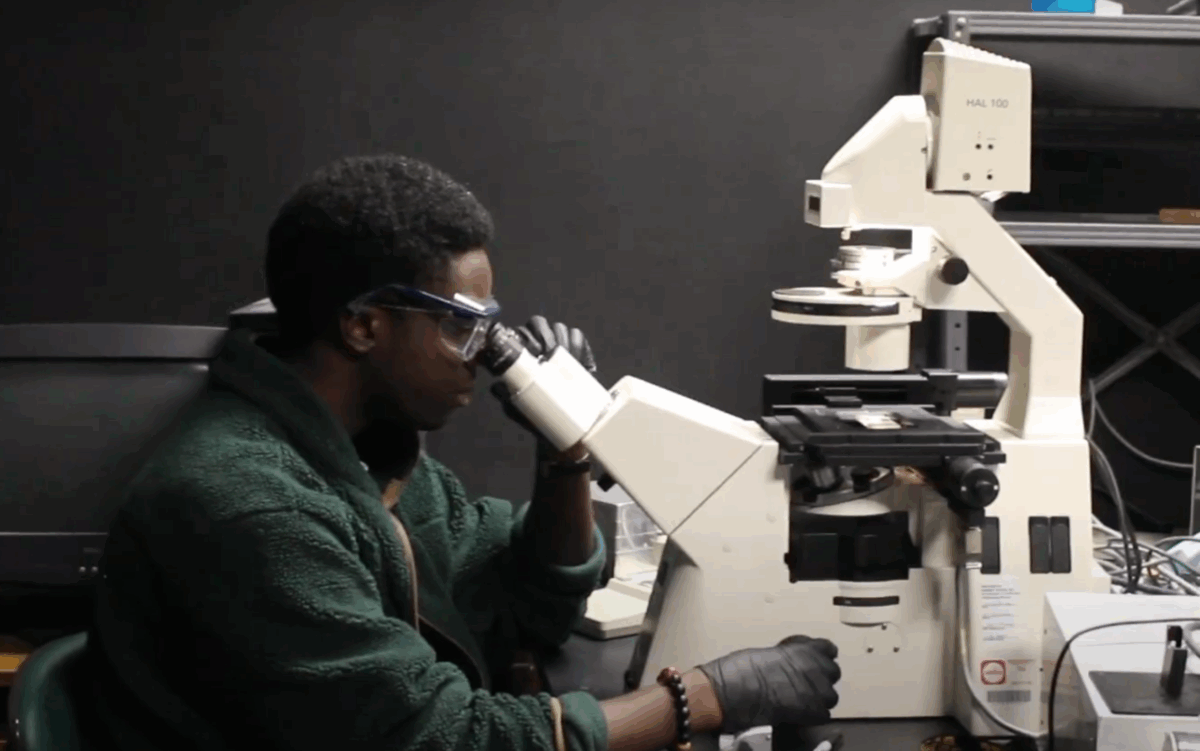 Playing the cello and conducting research makes Joshua Dayie feel “more whole.” (Melissa Penley Cormier, M.F.A. ’17/UMBC)
Dayie applies that discipline to his research with Mark Marten, professor of chemical, biochemical, and environmental engineering, on characterizing signaling pathways in fungi that activate in response to environmental stressors.
Then comes the creativity. Only after someone masters the fundamentals can they explore nuance in the tone or emotion conveyed on the cello, Dayie says. Similarly, in science “a lot of the innovation that you generate is really only meaningful after you’ve spent a lot of time understanding the core scientific concepts behind everything.”
“I think that’s been the most surprising thing: The creativity that comes from a very sound foundation of discipline is something that is translatable pretty much anywhere,” Dayie reflects.
As an added bonus, “Music has been a really nice outlet for me to use a different part of my brain, just to express myself in a different way,” he adds. “I feel like it makes me a little bit more whole.”
]]>
At UMBC, undergraduate students are redefining the boundaries of scientific and artistic pursuits. From a chemical engineer who graces the stage with his cello to a bioinformatician who paints and...
https://umbc.edu/stories/art-of-scientists/
https://my3.my.umbc.edu/api/v0/pixel/news/150074/guest@my.umbc.edu/8497eb97bed55a957858f91cb734d636/api/pixel
biochemistry-and-molecular-biology
bioinformatics
bioinformatics-and-computational-biology
biological-sciences
biology
cbee
chembiochem
cheme
chemeng
chemical-engineering
cnms
coeit
dance
discovery
magazine
music
story
UMBC News & Magazine
https://my3.my.umbc.edu/groups/umbc-news-magazine
https://assets1-my.umbc.edu/system/shared/avatars/groups/000/001/943/24435aa6207c452e7bc15cc74b42c7bb/xsmall.png?1748556657
https://assets1-my.umbc.edu/system/shared/avatars/groups/000/001/943/24435aa6207c452e7bc15cc74b42c7bb/original.png?1748556657
https://assets2-my.umbc.edu/system/shared/avatars/groups/000/001/943/24435aa6207c452e7bc15cc74b42c7bb/xxlarge.png?1748556657
https://assets2-my.umbc.edu/system/shared/avatars/groups/000/001/943/24435aa6207c452e7bc15cc74b42c7bb/xlarge.png?1748556657
https://assets3-my.umbc.edu/system/shared/avatars/groups/000/001/943/24435aa6207c452e7bc15cc74b42c7bb/large.png?1748556657
https://assets1-my.umbc.edu/system/shared/avatars/groups/000/001/943/24435aa6207c452e7bc15cc74b42c7bb/medium.png?1748556657
https://assets2-my.umbc.edu/system/shared/avatars/groups/000/001/943/24435aa6207c452e7bc15cc74b42c7bb/small.png?1748556657
https://assets1-my.umbc.edu/system/shared/avatars/groups/000/001/943/24435aa6207c452e7bc15cc74b42c7bb/xsmall.png?1748556657
https://assets2-my.umbc.edu/system/shared/avatars/groups/000/001/943/24435aa6207c452e7bc15cc74b42c7bb/xxsmall.png?1748556657
UMBC News & Magazine
3
0
false
Tue, 13 May 2025 09:16:55 -0400
Tue, 13 May 2025 09:16:55 -0400
Celebrating 30 years of the Linehan Artist Scholars Program
On May 2 and 3, the campus celebrated the 30th anniversary of the Linehan Artist Scholars Program with two days of festivities attended by dozens of alumni, current scholars, and incoming students.
Exhibitions and performances featured works by scholars from across the years, including choreography by Ryan Bailey, LAS ’16, a theatrical performance by Grace Marsh, LAS ’28, music performances by Michelle Purdy, LAS ’10 and Christian Hartman, LAS ’20, artwork by Petra Janka, LAS ’25 and Riley Payne, LAS ’29, and creativity by many other alumni and students. Featured speakers included Cameron Slayden, LAS ’99, from the very first LAS cohort and now CEO of Microverse Studios, James Dorsey, LAS ’05, a music teacher in Prince George’s County Public Schools, and Courtney Culp, LAS ’20, a designer with Warner Brothers Discovery.
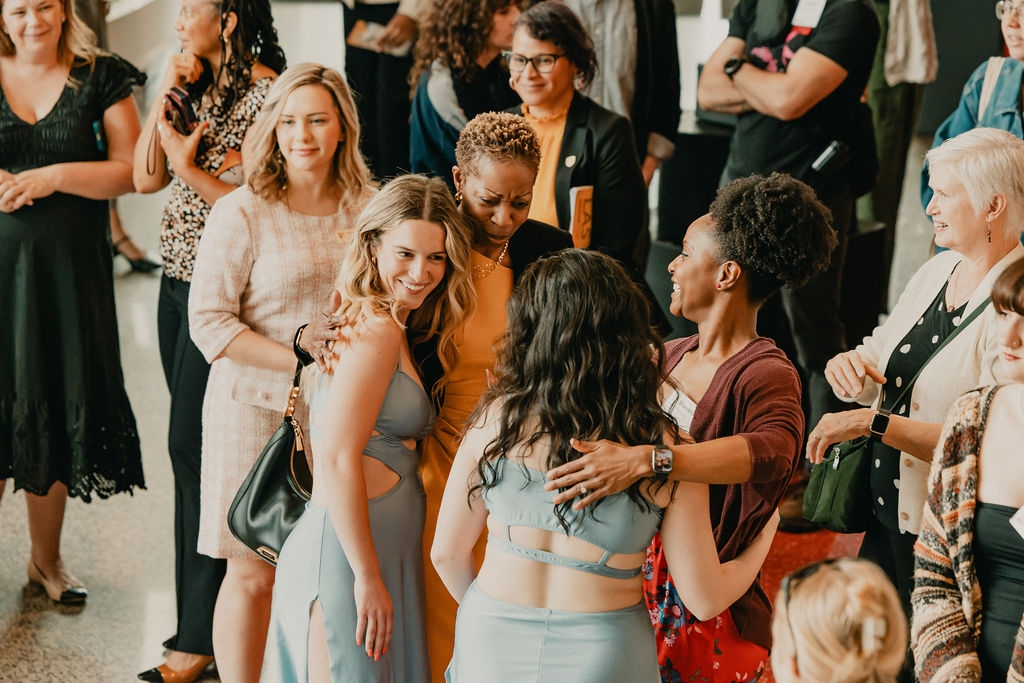
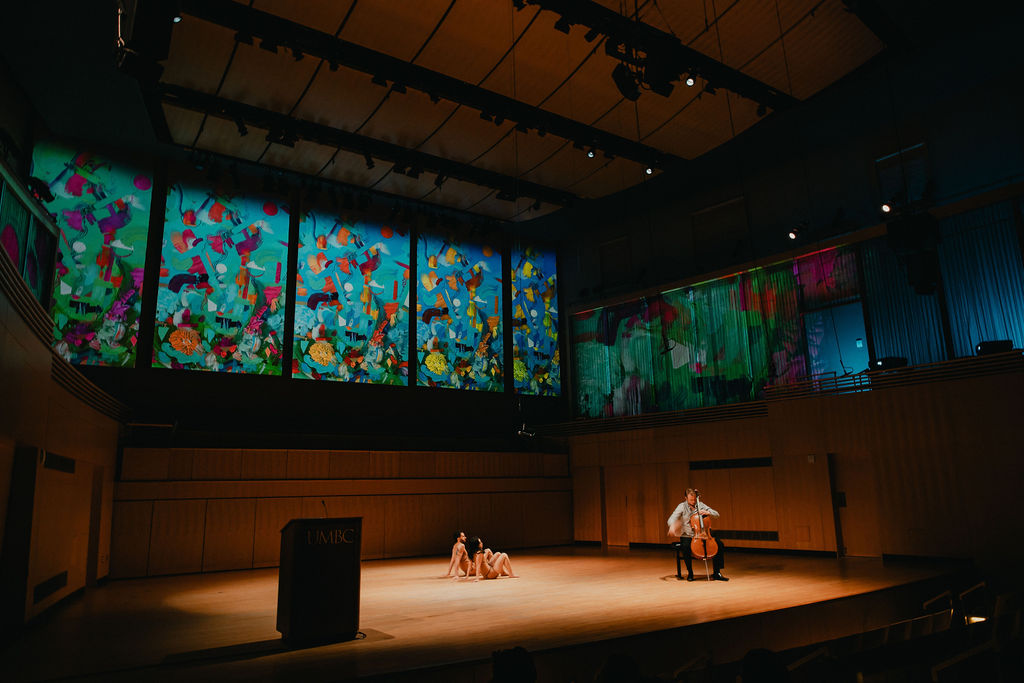
Left: Brechtel and Haynes are greeted by UMBC President Valerie Sheares Ashby following their performance, joined by Shaness Kemp, assistant professor of dance. Right: Christian Hartman plays the cello, while Ryan Bailey and Clarisse Lukban dance on stage in Linehan Concert Hall.
“The Linehan Program has strengthened my passions for new music and interdisciplinary collaboration, and I am so grateful to the program for supporting me as an artist and providing me with so many opportunities to create and collaborate,” says Hartman, who played the cello for the event. “I was so thrilled to get the opportunity to perform once again on the stage I called home for four years, and to work with Clarisse and Ryan. I didn’t see their choreography or the projections until the day of the performance, and to see it all come together was such a breathtaking experience.”
Left to right: Darielle and Earl Linehan at the post-celebration luncheon; Jillian Casey, LAS ’27 with her mom at the post-celebration luncheon; Ann Sofie Clemmensen, director of the Linehan Artist Scholars Program, poses with Petra Janka, LAS ’25.
“Earl and Darielle Linehan’s commitment to UMBC and the Linehan Artist Scholars Program has created transformative learning experiences for hundreds of talented undergraduates majoring in the visual and performing arts,” says Ann Sofie Clemmensen, director of the program. “Our focus for the celebration was to highlight the past and the future of the Linehan Artist Scholars program, and what makes our program and community unique and essential to the undergraduate rigor at UMBC.”
With a deeply held belief in the importance of the arts in society, Earl and Darielle Linehan launched the Linehan Artist Scholars Program with a generous gift in the 1990s. (To this day, Earl Linehan loves to recount that he and Darielle met UMBC President Emeritus Freeman Hrabowski on a bus in Israel, and that Hrabowski asked them right then for their support.) In 2015 the Linehans fully endowed the Linehan Artist Scholars Program, ensuring its future ability to continue and grow. Now, its graduates in dance, music, theatre, and the visual arts number almost 400.
“Artists are the leading edge of creativity in our society,” says Earl Linehan. “They inspire our thinking and enrich our lives. But how can we encourage more young people to turn their talents into a career? Young artists seem to thrive best in an atmosphere that blends critical study with creative expressions—the kind of interdisciplinary environment that UMBC has always fostered.”
See more photos from the two-day celebration. Learn more about the Linehan Artist Scholars Program.
]]>
On May 2 and 3, the campus celebrated the 30th anniversary of the Linehan Artist Scholars Program with two days of festivities attended by dozens of alumni, current scholars, and incoming...
https://umbc.edu/stories/30-years-of-the-linehan-artist-scholars-program/
https://my3.my.umbc.edu/api/v0/pixel/news/149951/guest@my.umbc.edu/a3027669dbe5500f4c7e76d371cd2572/api/pixel
cahss
community
dance
design
feature
linehan-artist-scholar
music
news
story
theatre
visual-and-performing-arts
UMBC News & Magazine
https://my3.my.umbc.edu/groups/umbc-news-magazine
https://assets1-my.umbc.edu/system/shared/avatars/groups/000/001/943/24435aa6207c452e7bc15cc74b42c7bb/xsmall.png?1748556657
https://assets1-my.umbc.edu/system/shared/avatars/groups/000/001/943/24435aa6207c452e7bc15cc74b42c7bb/original.png?1748556657
https://assets2-my.umbc.edu/system/shared/avatars/groups/000/001/943/24435aa6207c452e7bc15cc74b42c7bb/xxlarge.png?1748556657
https://assets2-my.umbc.edu/system/shared/avatars/groups/000/001/943/24435aa6207c452e7bc15cc74b42c7bb/xlarge.png?1748556657
https://assets3-my.umbc.edu/system/shared/avatars/groups/000/001/943/24435aa6207c452e7bc15cc74b42c7bb/large.png?1748556657
https://assets1-my.umbc.edu/system/shared/avatars/groups/000/001/943/24435aa6207c452e7bc15cc74b42c7bb/medium.png?1748556657
https://assets2-my.umbc.edu/system/shared/avatars/groups/000/001/943/24435aa6207c452e7bc15cc74b42c7bb/small.png?1748556657
https://assets1-my.umbc.edu/system/shared/avatars/groups/000/001/943/24435aa6207c452e7bc15cc74b42c7bb/xsmall.png?1748556657
https://assets2-my.umbc.edu/system/shared/avatars/groups/000/001/943/24435aa6207c452e7bc15cc74b42c7bb/xxsmall.png?1748556657
UMBC News & Magazine
1
0
false
Fri, 09 May 2025 08:23:00 -0400
Fri, 09 May 2025 08:23:00 -0400
The dance floor beckons—after 4 decades away, a dance major returns to her degree

In the fall of 1977, Jimmy Carter was president. NASA launched the Voyager I fly-by mission past Jupiter and Saturn. “The Mary Tyler Moore” show earned an Emmy for outstanding comedy, and the Atari 2600 gaming system went on the market. The Emotions’ “The Best of My Love” hit number one on the pop charts.
It was also the year Baltimore native Teresa Kearney entered UMBC as a dance major. But her route to a dance degree has been circuitous. She anticipates graduating in 2025.
From the classroom to the dance floor
At Walbrook High School in West Baltimore, Kearney danced under the direction of Beverly Marshall Johnson, who she still keeps in touch with today. As a young dancer, she performed regularly on TV channel 45’s “Soul City” (later renamed “Moonman Connection”)—a teen-dance show akin to the beloved “Soul Train” and “American Bandstand.” Kearney was accepted to UMBC with scholarships but, after two years, she heeded the call of Hollywood and decided to take a chance on professional dance opportunities on the West Coast.
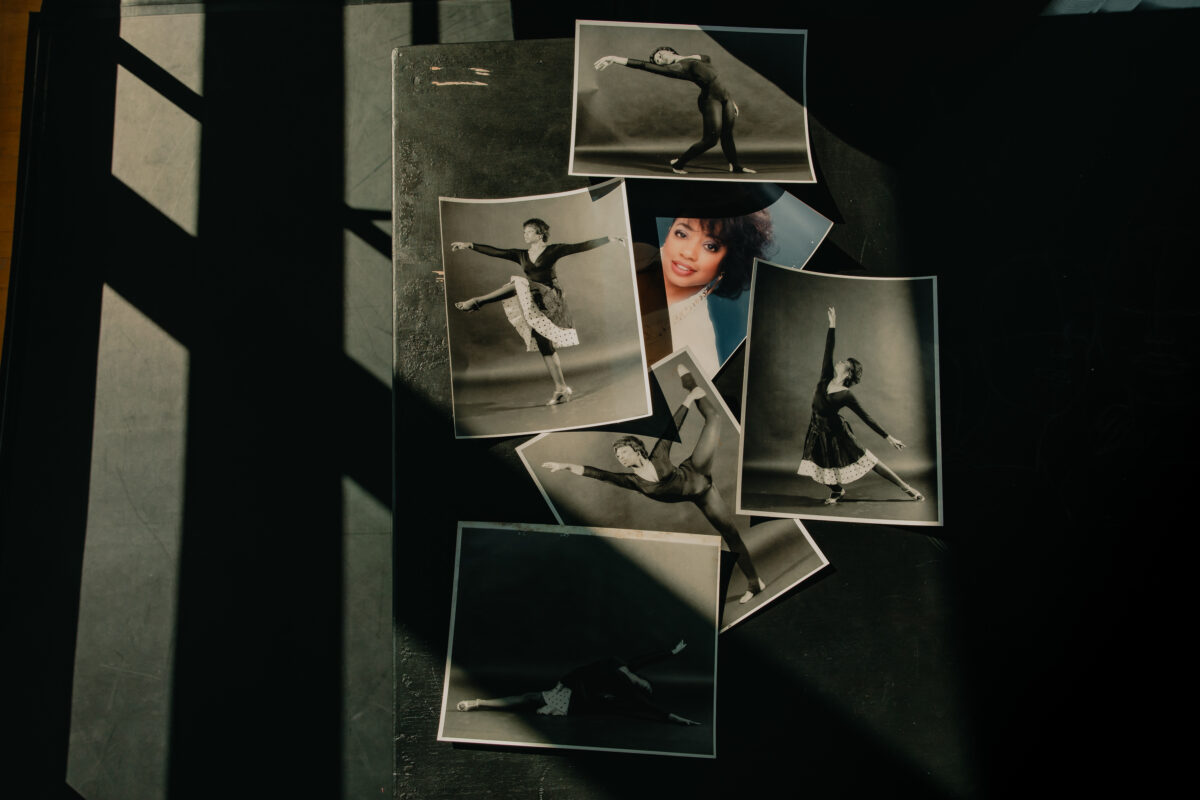 Teresa Kearney’s early days of dance.
By 1979, Kearney and her dance partner were regulars on the competitive social dance circuit. “We were getting really popular, my dance partner and I,” she says. “We got a chance to go to Hollywood and be on ‘Dance Fever’ and compete from state to state, city to city. We made our living in dance for a long time.”
Kearney held onto the goal of a UMBC degree for decades as life intervened. In between, she took on acting roles, was an instructor for LaBlast Fitness under Louis van Amstel of “Dancing with the Stars,” graduated from the Broadcasting Institute of Maryland for air talent for radio and TV, including an FCC license, sold insurance and real estate, and helped put her nephew through medical school, to name a few of her jobs and activities. “Then my mother, Lillie Kearney, passed away three years ago. She was also a dancer, and I thought this is the time for me to go back to college,” she says. “It was on my bucket list.”
Keeping the standard
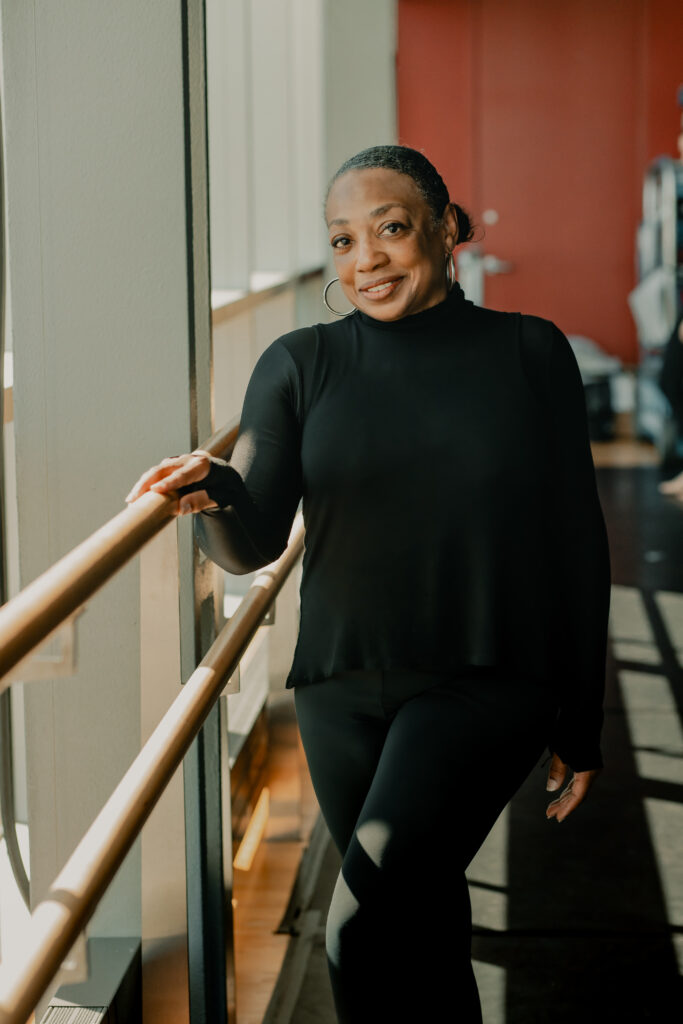
As a long-time professional dancer—who never actually retired—Kearney continues to challenge herself by learning new techniques and styles. And she’s worked hard to re-train her body after decades dancing in heels on Latin and social dance circuits. “I’m still learning,” she says. “There’s a contemporary African dance class required now for all dance majors. For a two-and-a-half-hour class, it’s very energetic. And even though I’m 65, we all have challenges in that class,” she notes of her younger classmates.
Ballet instructor Alison Crosby could see Kearney was working hard, and says, “Teresa made it easy for me to keep the standard of the course, because she asked for no changes, asked for nothing to be different.” Plus, by showing up on time, preparing her body with gentle stretches to warm up her muscles and feet, and finding her place at the barre, Kearney modeled the appropriate dancer’s discipline that is expected in professional classes and rehearsals.
“Her experience in dance is wide and professional,” Crosby adds, “and she modeled the discipline and respect for coming to ballet class.” As an instructor, Crosby noticed how easily Kearney connected with her much younger classmates. “Teresa was involved with even the first-years. They all saw Teresa with great respect.”
In fact, Kearney shares that her classmates in the dance program often seek her out for advice or just a listening ear. She’s noticed that these students face far more self-doubt and pressures than she did when she was a student in the 1970s.
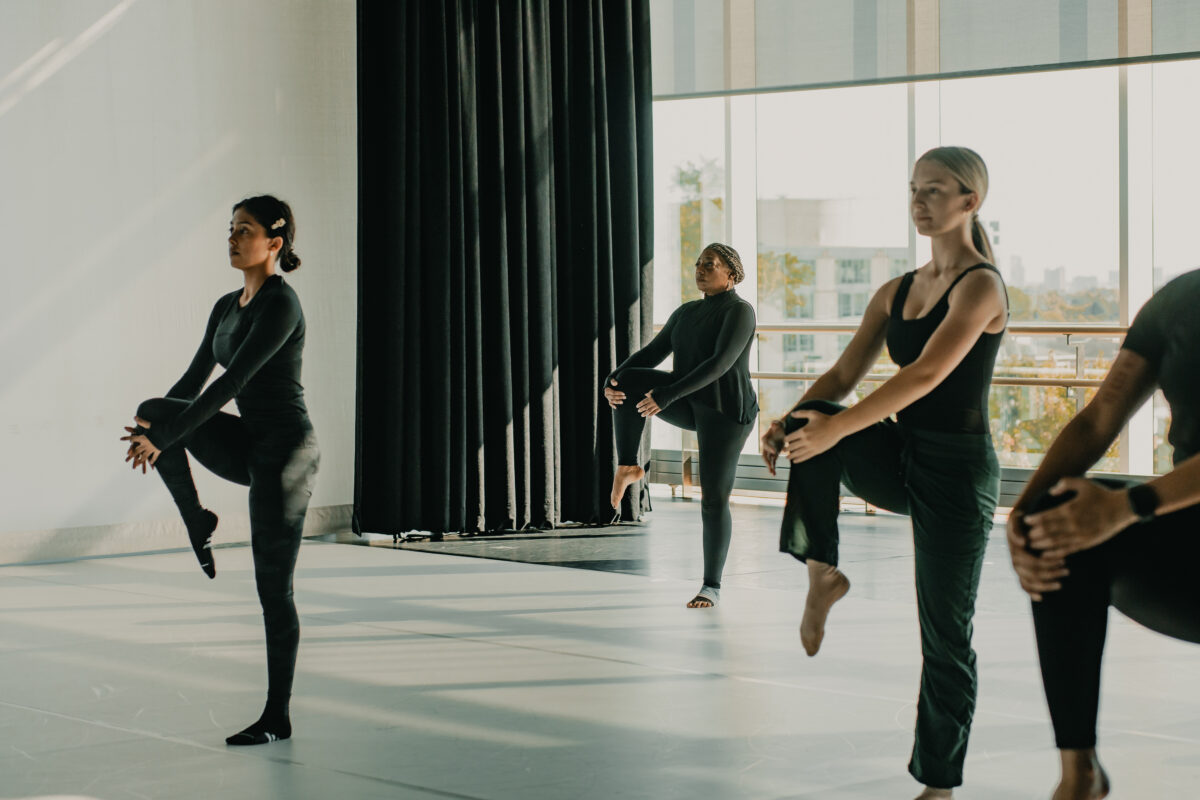 Kearney, back, center, practices with her classmates in the Dance Cube.
“Last semester, I was talking with a group of students,” Kearney recalls. “We were overwhelmed with classes and how hard it is. I said, ‘Wait a minute. We’re here getting a degree….We’re here to learn even when it’s hard.’”
“Once in a while,” Crosby says, “I’ll ask a student to show something as a positive model for the rest of the class. I asked Teresa…she just was dancing and using her eyes and her head so beautifully—everything she’d learned through her dance life. It’s still in her—that artistry through all the years and her different careers—her artistry has just stayed with her.”
By Lisa Traiger
]]>
In the fall of 1977, Jimmy Carter was president. NASA launched the Voyager I fly-by mission past Jupiter and Saturn. “The Mary Tyler Moore” show earned an Emmy for outstanding comedy, and the...
https://umbc.edu/stories/teresa-kearney-dance-journey-adult-learner/
https://my3.my.umbc.edu/api/v0/pixel/news/145839/guest@my.umbc.edu/714d646804c74808d06dd5426568c895/api/pixel
at-play
cahss
campus-life
dance
fall-2024
magazine
performing-arts
story
UMBC News & Magazine
https://my3.my.umbc.edu/groups/umbc-news-magazine
https://assets1-my.umbc.edu/system/shared/avatars/groups/000/001/943/24435aa6207c452e7bc15cc74b42c7bb/xsmall.png?1748556657
https://assets1-my.umbc.edu/system/shared/avatars/groups/000/001/943/24435aa6207c452e7bc15cc74b42c7bb/original.png?1748556657
https://assets2-my.umbc.edu/system/shared/avatars/groups/000/001/943/24435aa6207c452e7bc15cc74b42c7bb/xxlarge.png?1748556657
https://assets2-my.umbc.edu/system/shared/avatars/groups/000/001/943/24435aa6207c452e7bc15cc74b42c7bb/xlarge.png?1748556657
https://assets3-my.umbc.edu/system/shared/avatars/groups/000/001/943/24435aa6207c452e7bc15cc74b42c7bb/large.png?1748556657
https://assets1-my.umbc.edu/system/shared/avatars/groups/000/001/943/24435aa6207c452e7bc15cc74b42c7bb/medium.png?1748556657
https://assets2-my.umbc.edu/system/shared/avatars/groups/000/001/943/24435aa6207c452e7bc15cc74b42c7bb/small.png?1748556657
https://assets1-my.umbc.edu/system/shared/avatars/groups/000/001/943/24435aa6207c452e7bc15cc74b42c7bb/xsmall.png?1748556657
https://assets2-my.umbc.edu/system/shared/avatars/groups/000/001/943/24435aa6207c452e7bc15cc74b42c7bb/xxsmall.png?1748556657
UMBC News & Magazine
0
0
false
Fri, 22 Nov 2024 11:07:27 -0500