More than skills: Four CNMS interns on mentorship, belonging, and the gift of opportunity
Every morning this summer, junior biological sciences major Magdalen Ruth made her way to the National Institutes of Health in Bethesda—a dense hub of biomedical research. There, at the National Institute of Arthritis and Musculoskeletal and Skin Diseases, she helped investigate a genetic mutation in a patient with a rare form of juvenile arthritis known as Still’s disease, connecting her UMBC training to work that could improve patients’ lives. She is one of four CNMS students whose recent internships at Maryland-based companies and agencies show how local opportunities are helping Retrievers build skills, find mentors, and advance discoveries that matter here and beyond.
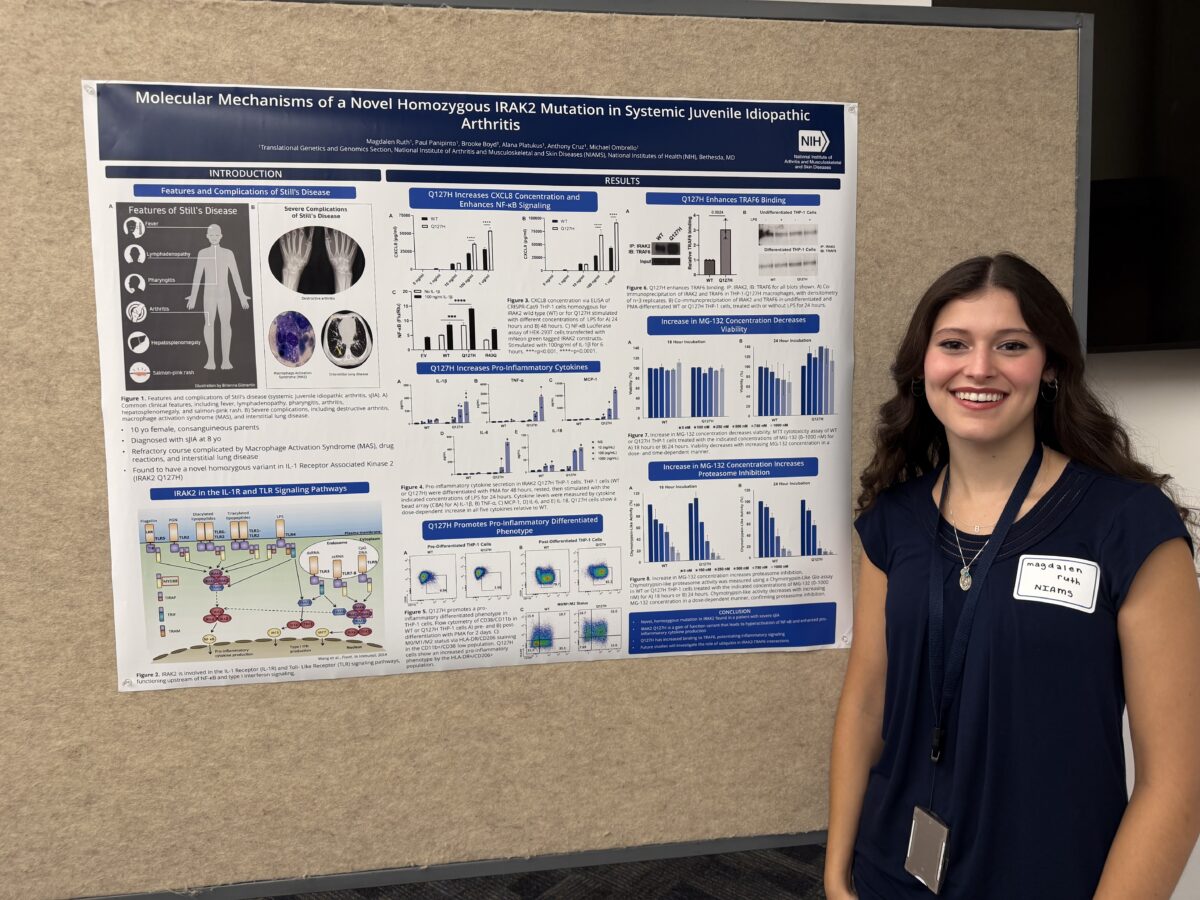 At the conclusion of her NIH internship, Magdalen Ruth presented her summer research on the role of a particular genetic mutation in a rare form of juvenile arthritis. (Courtesy of Ruth)
“I feel like I’m doing really important work,” Ruth, a Meyerhoff and U-RISE scholar, says. “Getting to know the patient’s diagnosis and being able to see that what I’m working on is affecting an actual person in real time has been awesome.” The internship has confirmed her interest in pursuing a career in pharmacology. It’s also stretched her communication skills. While familiar with presenting her work to colleagues in Deepak Koirala’s lab group at UMBC, communicating her research to a mix of researchers and clinicians—who don’t all share the same jargon and expertise—taught her the nuance of communicating with technical and non-technical audiences.
The Meyerhoff community helped make the opportunity possible. “I would not be in the place I am without Meyerhoff,” she notes. On campus, Ruth balances research and leadership as vice president of the STEM Ph.D. Society, a student-run organization designed to help students connect with scholarships, internships, graduate schools, and more. She also takes dance classes, is pursuing a music minor, and volunteers at her family’s Catholic parish—nurturing connections that ground her amid rigorous academic work.
Protecting lives, growing a career
Mark Harrison, a senior biological sciences major who started in chemical engineering, is in his third summer at Aberdeen Proving Ground (APG), a U.S. Army installation in Aberdeen, Maryland. His work involves designing and testing gas masks, bridging his early engineering training and his understanding of physiology. “I’m able to bring an understanding of what a warfighter may be experiencing in their body while wearing a gas mask in a way that others at APG may not,” Harrison says.
His mentors at APG, Jon Sampson ’03, mechanical engineering, and Edward Parshley ’06, chemical engineering, value the perspective Harrison brings and have supported his growth. “They made it clear that they want to reach back and offer opportunities to those coming behind them,” he says. They are making good on that commitment: Harrison will stay on board at APG this fall, and the plan is to transition him into a full-time position after he graduates in December. “They were always asking me what I wanted to learn and then giving me related opportunities,” Harrison says. “I could ask anyone how something worked, and they’d take the time to explain it to me. I’m so grateful for the way they’ve invested in me.”
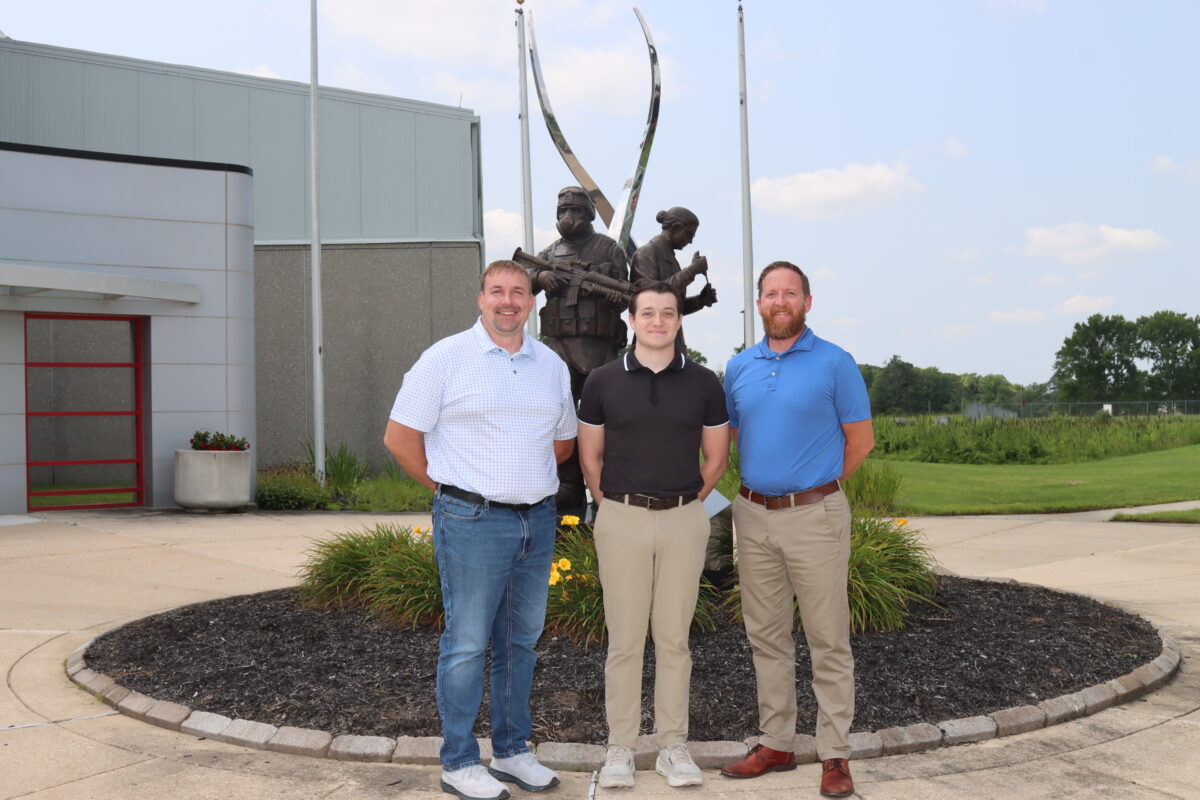 UMBC alumni Jonathan Sampson (right) and Ed Parshley (left) have mentored Mark Harrison (center) over the last two-plus years as he completed three internships at Aberdeen Proving Ground. (Courtesy of Harrison)
Interning in a fast-paced, interdisciplinary environment has also changed how Harrison operates in the classroom. “I learned how to learn at APG,” he says. “Now I don’t have to spend as much time studying, because when I leave class I already have a good understanding of the material. I’m connecting the dots so much better than before.” For Harrison, the work has taken on personal meaning, as well. “I’m fighting right now to try to protect American lives—that’s why I’m here.”
Translating discovery into treatment
Zainab Idowu, a senior biochemistry and molecular biology major and a Meyerhoff Scholar, interned at pharmaceutical giant AstraZeneca in Gaithersburg, Maryland, joining a robust group of Retrievers who’ve grown their skills there. Her project involved testing flow cytometers, which count and characterize individual cells and are used in manufacturing cell therapy treatments. Her goal was to determine the instrument and protocols that would be simplest and most effective for manufacturing teams to implement. The experience shifted Idowu’s focus toward translational medicine and reinforced her plans for an M.D./Ph.D. after UMBC. But the people around her made the biggest impression.
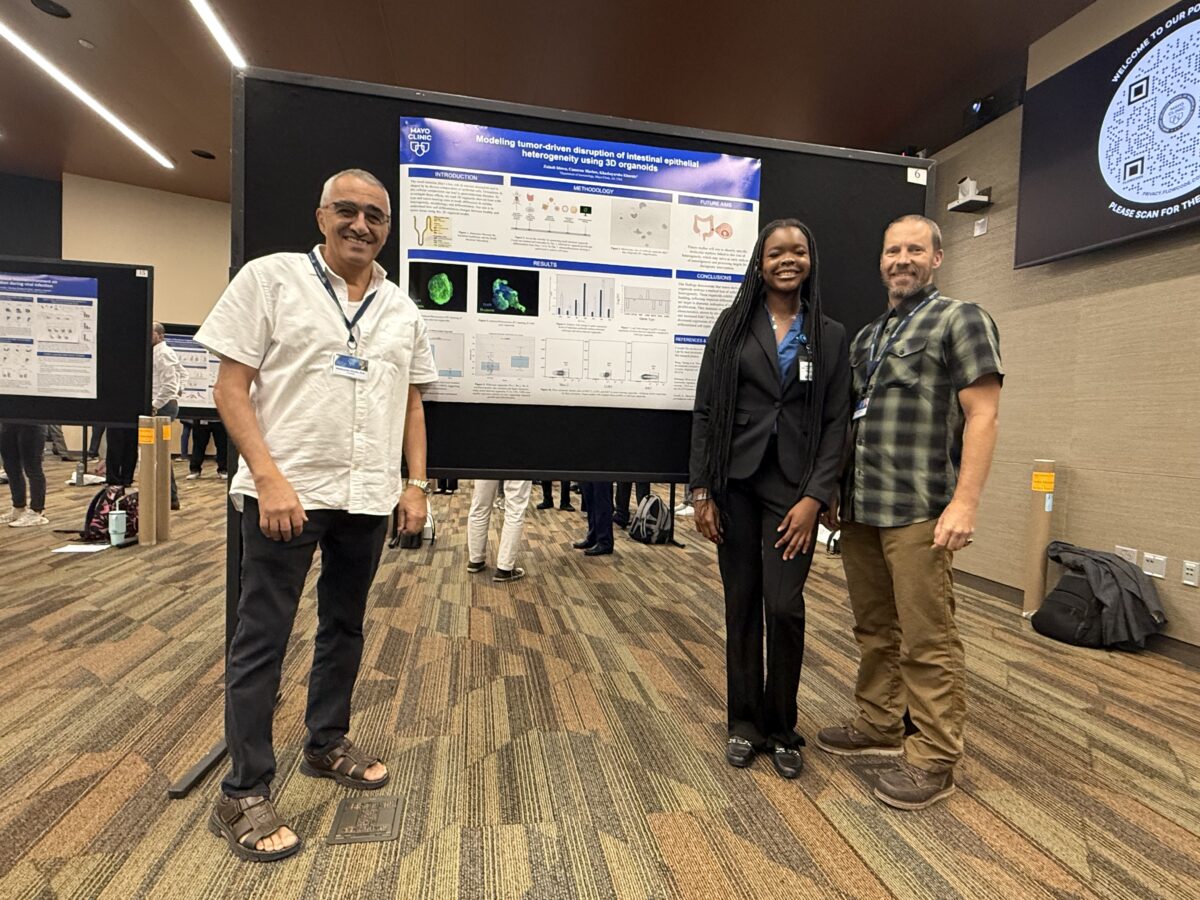
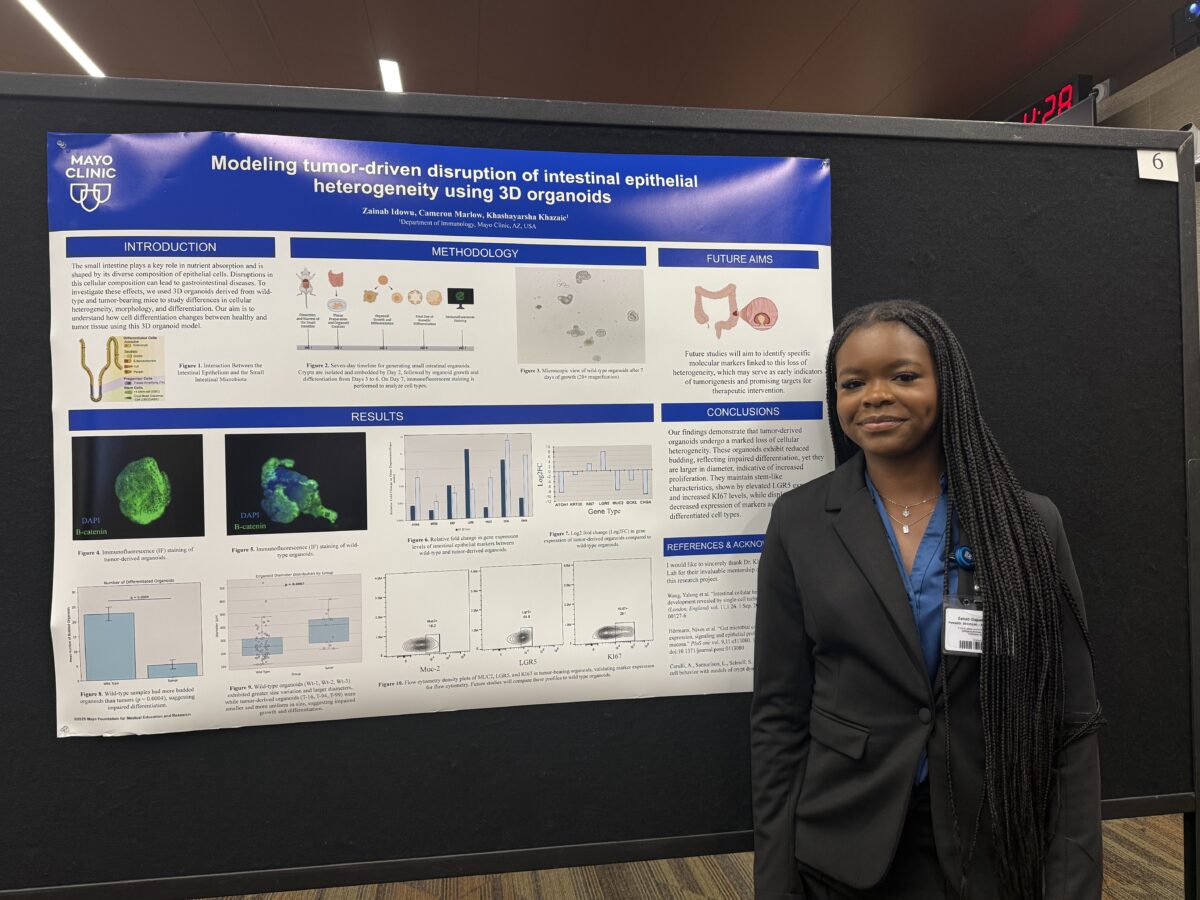 Zainab Idowu presented a research poster at the conclusion of a previous internship at the Mayo Clinic. She was supported by two mentors at the Mayo Clinic, Khashayarsha Khazaie (far left) and Cameron Marlow. (Courtesy of Idowu)
“I love everyone on my team,” Idowu says. “My managers, Ashley Ruddy and Jen Fox, were really insightful—giving me advice on what I want to do post-grad and what I should do my senior year to make sure I’m well-positioned for after graduation.” And when she had questions, the collaborative atmosphere showed her how scientists work together. “They were able to give recommendations and point me to scientific literature to help me along,” she says.
Opportunities through Meyerhoff gave her the chance to connect with AstraZeneca staff, which helped her secure the internship. “I was able to talk to them about my passions for research,” she says. Roles with UMBC’s chapters of the Society of Women Engineers, the international professional medical fraternity Phi Delta Epsilon, the National Society of Black Engineers, and the African Students Association have also enriched her UMBC experience. These organizations, she says, offered “a place to be ourselves, find new friends, and really build a home here at UMBC.”
The benefit of seeing both sides
 Saeed Damadi (left) and his wife Sepideh Hematian at her graduation from UMBC’s master’s program in data science.
Saeed Damadi recently defended his Ph.D. thesis in applied mathematics after beginning in electrical engineering. This summer at the FDA, he developed a mathematical model for how illicit drugs taken during pregnancy transfer to the developing baby through the placenta—increasing important understanding in a situation where human testing would be profoundly unethical.
While the math was familiar, Damadi welcomed the new challenge of jumping into biology. “I learned so many things, and I am still learning,” he says. Yet he found that his interest in how to describe randomness mathematically, which led him to complete a master’s in statistics on the way to his Ph.D., was highly relevant to studying the quirks of the human body. Looking ahead, he wants to continue work at the interface of biology and mathematics.
“Hopefully in the future I can make a contribution by bridging fields,” Damadi says, “because you can computationally simulate millions of parameters and patients at once, which makes the rate of iteration and discovery much faster.” The work Damadi and colleagues do with simulations can help effectively target limited resources for expensive and lengthy clinical studies, he explains.
Damadi and his wife, Sepideh Hematian, M.S. ’23, data science, and a former data scientist at the Maryland Department of Human Services, are planning to build their lives in California. They are both thriving, but “sometimes I get emotional thinking about UMBC,” Damadi says, “because after I arrived nine years ago from Iran, it became like a home to me and my wife.”
 Saeed Damadi (center) with his wife Sepideh Hematian (third from right), Ph.D. advisor Jinglai Shen (third from left), and the rest of his thesis committee and other members of the UMBC math faculty at his Ph.D. defense. (Courtesy of Damadi)
Damadi has given back through his teaching. As an engineer, “I just learned how to use the mathematical tools without understanding what was going on behind the scenes,” he says. Whereas, in math, “you learn the origins of all the theorems and how they work, but not necessarily how to apply them. I feel super lucky to get to see both sides.” So, in undergraduate calculus and linear algebra courses, “I just wanted to explain to my students, ‘Why do you need these equations? Why are they important?’ and give them a feeling of gratitude.”
Gratitude threads through all four of these journeys—for mentors who reach back, for teams that invest in their members, for communities that feel like home, and for the chance to do work that matters. As Magdalen Ruth at NIH puts it, “I’ve just found myself in a great spot with UMBC. I feel really blessed to have had all the opportunities I’ve had. Being able to do these internships has seriously been great.”
]]>
Every morning this summer, junior biological sciences major Magdalen Ruth made her way to the National Institutes of Health in Bethesda—a dense hub of biomedical research. There, at the National...
https://umbc.edu/stories/cnms-interns-mentorship-belonging-opportunity/
https://my3.my.umbc.edu/api/v0/pixel/news/161797/guest@my.umbc.edu/dacd98bb3662b16e6b4733ee94746d77/api/pixel
alumni
biology
career-center
chemical-biochemical-and-environmental-engineering
chemistry-and-biochemistry
cnms
coeit
community
data-science
internships
mathstat
meche
meyerhoff-scholars
science-and-tech
stories
story
undergraduate-research
urise
UMBC News & Magazine
https://my3.my.umbc.edu/groups/umbc-news-magazine
https://assets1-my.umbc.edu/system/shared/avatars/groups/000/001/943/24435aa6207c452e7bc15cc74b42c7bb/xsmall.png?1748556657
https://assets1-my.umbc.edu/system/shared/avatars/groups/000/001/943/24435aa6207c452e7bc15cc74b42c7bb/original.png?1748556657
https://assets2-my.umbc.edu/system/shared/avatars/groups/000/001/943/24435aa6207c452e7bc15cc74b42c7bb/xxlarge.png?1748556657
https://assets2-my.umbc.edu/system/shared/avatars/groups/000/001/943/24435aa6207c452e7bc15cc74b42c7bb/xlarge.png?1748556657
https://assets3-my.umbc.edu/system/shared/avatars/groups/000/001/943/24435aa6207c452e7bc15cc74b42c7bb/large.png?1748556657
https://assets1-my.umbc.edu/system/shared/avatars/groups/000/001/943/24435aa6207c452e7bc15cc74b42c7bb/medium.png?1748556657
https://assets2-my.umbc.edu/system/shared/avatars/groups/000/001/943/24435aa6207c452e7bc15cc74b42c7bb/small.png?1748556657
https://assets1-my.umbc.edu/system/shared/avatars/groups/000/001/943/24435aa6207c452e7bc15cc74b42c7bb/xsmall.png?1748556657
https://assets2-my.umbc.edu/system/shared/avatars/groups/000/001/943/24435aa6207c452e7bc15cc74b42c7bb/xxsmall.png?1748556657
UMBC News & Magazine
1
0
false
Thu, 20 Aug 2026 12:10:24 -0400
Thu, 20 Aug 2026 12:10:24 -0400
Meet a Retriever—Harish Reddy Manyam, M.P.S. ’24, data science professional passionate about A.I.
Meet Harish Reddy Manyam, M.P.S. ’24, data science. Harish is a data scientist and AI governance advisor at Marshfield Clinic Health System, where he gets to put his interest in AI/machine learning (ML) in healthcare to work. At UMBC, he co-developed a no-code generative AI chatbot and made strong connections with peers and classmates. As an international student, he found a network of professional support at bwtech, UMBC’s research and technology park. In his free time, Harish loves traveling—he’s visited 25 states so far! Take it away, Harish!
Q: What is your WHY? What brought you to UMBC?
A: I came to UMBC because I wanted an education that went beyond textbooks—something practical, impactful, and connected to real-world problems. As an international student, I applied to several universities, but my final choice was between the University of Arizona and UMBC.
One major reason I chose UMBC was the Master of Professional Studies (MPS) in Data Science, a program that focuses on hands-on learning rather than just theory. I’ve always believed education should prepare us to solve real-life problems, and UMBC gave me that foundation.
I came here with two big dreams: to become a data scientist and to create something of my own as an entrepreneur. I’m proud to say that I now work as a data scientist and AI governance advisor for Marshfield Clinic Health System (MCHS), a nonprofit healthcare organization, where I use data and AI to improve healthcare outcomes and support underserved communities.
Today, I know I made the right decision, and I’m grateful for that.
Harish Reddy Manyam, M.P.S. ’24
Data Science
My time at UMBC also gave me incredible research opportunities. I worked on an independent research project under Ergun Simsek, UMBC data science program director, and together, we published a paper titled “Classification with Electromagnetic Waves” in The Institute of Engineering and Technology (IET), an esteemed engineering journal. This research experience taught me how to approach complex problems and think critically—skills that I now use every day in my job.
Beyond academics, UMBC empowered me to co-build a no-code Gen AI chatbot product with one of my professors, and this experience fueled my entrepreneurial spirit. I am now exploring launching my own startup through bwtech@UMBC, the university’s business incubator.
But more than anything, UMBC gave me a community that supported me both professionally and personally. As an international student, being welcomed, encouraged, and supported was something I never took for granted—UMBC became my second home.
So, my WHY for choosing UMBC was to learn, grow, and create something impactful—and today, because of UMBC, I’m well on my way to making that dream a reality. UMBC gave me not just knowledge, but a community that believed in me and helped me find my purpose.
Q: Where have you found support in the UMBC community?
There are six pillars to my life in the U.S.—people who have inspired and supported me throughout my journey. First is Simsek, who became my role model from the very first speech he gave to our Fall 2022 incoming student batch. His incredible work inspired me, and I was fortunate to work with him on independent research that led to our publication in the IET journal.
Second is Mehmet Sarica, one of my professors. I took two courses under him—Data 601: Introduction to Data Science and Data 602: Introduction to Data Analysis and Machine Learning. He taught me valuable lessons beyond coursework and later recommended me to work as a graduate teaching assistant under his guidance, which was a significant milestone in my career.
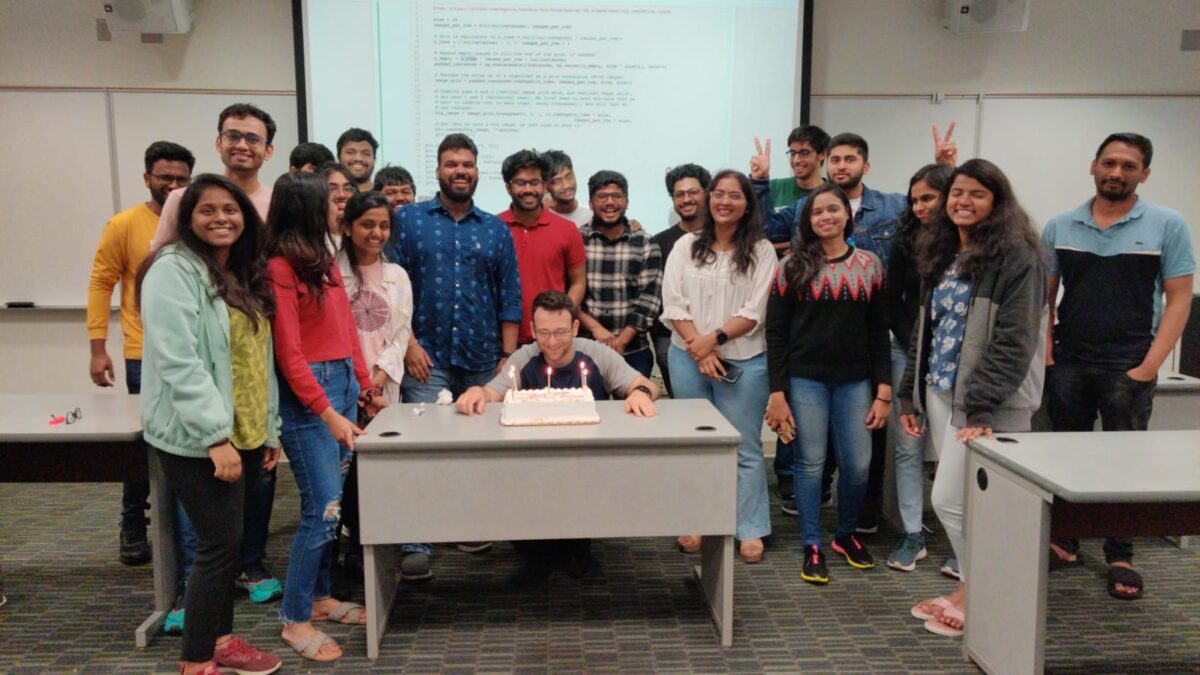 As a token of appreciation, Harish (standing in the dark blue shirt behind the desk) and his class surprised Data Science Professor Mehmet Sarica with a cake-cutting celebration at the end of the semester.
Third is Abdullah Karassan, another professor and mentor. I took Financial Data Science with him and later collaborated on developing LeverBot, a no-code Generative AI chatbot. I served as the product owner and AI developer for this project, which was a great learning experience in applied AI.
Fourth is the UMBC Career Center, especially Christine Routzahn, the director, who provided immense support in shaping my career path and preparing me for professional opportunities.
Another person who has made a big impact on my journey is Marjie Cota, director of entrepreneurial services at bwtech@UMBC. She encouraged me to think bigger—to believe that I could start my own company. Her guidance opened a new door for me to pursue my entrepreneurial dreams, and today I’m actively exploring launching a startup through bwtech.
Finally, my uncles Raj and Mahesh have been my strongest personal support system since day one in the U.S., helping me settle and navigate life as an international student. I’m also grateful to my friends who stood by me and made my journey memorable. As an international student, having friends who understand you and stand by you is priceless. They made the hardest days easier and the good days even better.
Each of these individuals and groups played a crucial role in my academic, professional, and personal life, and I’m forever thankful for their support and inspiration.
Harish Reddy Manyam, M.P.S. ’24
Data Science
Q: What’s your favorite part of being a part of Retriever Nation?
A: My favorite part of Retriever Nation is the strong sense of community and lifelong connections. Even after graduation, I feel supported by professors, mentors, and peers. It’s a network that continues to inspire, uplift, and open doors for personal and professional growth.
Q: What do you love most about the data science program?
A: What I love most about my academic program is how supportive and collaborative everyone is—from professors to classmates. The faculty are always approachable and genuinely invested in students’ success, providing both academic and career guidance. I also love that the program focuses on practical, real-world applications of data science, which helped me gain hands-on experience through research and projects.
Q: What’s one thing you’d want someone who hasn’t joined the UMBC community to know?
A: One thing I’d want someone to know is that UMBC truly cares about its students—both academically and personally. Whether it’s professors, the Career Center, or fellow students, there’s always someone ready to guide, support, and help you succeed. You’ll never feel alone in your journey here. It’s a family for me.
What makes UMBC special is that it’s more than a university—it’s a community of people who lift each other up. They believed in me when I was just learning to believe in myself. Their HOW—the way they supported, mentored, and cared—has made all the difference in my life.
Because of UMBC, I’ve grown into a data scientist working in healthcare, a researcher, and an aspiring entrepreneur. And none of this would have been possible without the amazing people who stood beside me. For that, I will forever be grateful.
Q: How have you remained connected with UMBC?
A: As an alum and professional, I value my ongoing partnership with UMBC through research collaborations and mentorship opportunities. UMBC builds meaningful relationships that extend beyond graduation—focused on innovation, real-world problem-solving, and community support. I would tell anyone that partnering with UMBC means working with passionate, talented individuals committed to making a difference. It’s a partnership that fosters growth, creativity, and mutual success.
* * * * *
UMBC’s greatest strength is its people. When people meet Retrievers and hear about the passion they bring, the relationships they create, the ways they support each other, and the commitment they have to inclusive excellence, they truly get a sense of our community. That’s what “Meet a Retriever” is all about.
Learn more about how UMBC can help you achieve your goals.
]]>
Meet Harish Reddy Manyam, M.P.S. ’24, data science. Harish is a data scientist and AI governance advisor at Marshfield Clinic Health System, where he gets to put his interest in AI/machine...
https://umbc.edu/stories/meet-harish-reddy-manyam-data-science/
https://my3.my.umbc.edu/api/v0/pixel/news/148662/guest@my.umbc.edu/c35fb880f1298a1b65a3c5c3c8405752/api/pixel
a-i
alumni
data-science
magazine
meet-a-retriever
story
UMBC News & Magazine
https://my3.my.umbc.edu/groups/umbc-news-magazine
https://assets1-my.umbc.edu/system/shared/avatars/groups/000/001/943/24435aa6207c452e7bc15cc74b42c7bb/xsmall.png?1748556657
https://assets1-my.umbc.edu/system/shared/avatars/groups/000/001/943/24435aa6207c452e7bc15cc74b42c7bb/original.png?1748556657
https://assets2-my.umbc.edu/system/shared/avatars/groups/000/001/943/24435aa6207c452e7bc15cc74b42c7bb/xxlarge.png?1748556657
https://assets2-my.umbc.edu/system/shared/avatars/groups/000/001/943/24435aa6207c452e7bc15cc74b42c7bb/xlarge.png?1748556657
https://assets3-my.umbc.edu/system/shared/avatars/groups/000/001/943/24435aa6207c452e7bc15cc74b42c7bb/large.png?1748556657
https://assets1-my.umbc.edu/system/shared/avatars/groups/000/001/943/24435aa6207c452e7bc15cc74b42c7bb/medium.png?1748556657
https://assets2-my.umbc.edu/system/shared/avatars/groups/000/001/943/24435aa6207c452e7bc15cc74b42c7bb/small.png?1748556657
https://assets1-my.umbc.edu/system/shared/avatars/groups/000/001/943/24435aa6207c452e7bc15cc74b42c7bb/xsmall.png?1748556657
https://assets2-my.umbc.edu/system/shared/avatars/groups/000/001/943/24435aa6207c452e7bc15cc74b42c7bb/xxsmall.png?1748556657
UMBC News & Magazine
0
0
false
Thu, 27 Mar 2025 15:09:06 -0400