UMBC supports promising internal research and creative endeavors with 2026 – 27 START, SURFF awards
UMBC’s Division of Research and Creative Achievement recently announced the recipients of the 2027 Strategic Awards for Research Transitions (START) and the 2026 Summer Research Faculty Fellowship (SURFF) awards, two of the university’s primary, internal funding opportunities that support faculty-led research and creative work.
The latest awards cover diverse projects, including exploring the genetic origins of a neurologic disorder in Siberian huskies, securing smartphones against voice scams, building novel animated sculpture, and exploring the legacy of Argentine-born American cellist Ennio Bolognini.
In total for fiscal year 2027, 12 faculty members and researchers across UMBC’s three colleges and the university’s research centers were awarded up to $25,000 in START funding to advance their research and creative projects. The awards help recipients build research momentum early in their careers and hone their research pitches to pursue external funding. They can also help faculty pivot to new fields of inquiry later in their careers.
For summer 2026, 21 faculty members received a SURFF award, which supports non-tenured, tenure-track faculty members in pursuing research and creative achievement projects during the summer. Recipients are awarded $8,000 in funding.
“Each year when we review applications, we find we have so many faculty who are being very creative and really pushing the edge of what’s known in their various disciplines,” says Don Engel, associate vice president for strategic research initiatives at UMBC, who coordinates the faculty committee that reviews prospective awards. “The proposals really illustrate the breadth of achievement that goes on across the university.”
]]>
UMBC’s Division of Research and Creative Achievement recently announced the recipients of the 2027 Strategic Awards for Research Transitions (START) and the 2026 Summer Research Faculty Fellowship...
https://umbc.edu/stories/umbc-2026-27-start-surff-awards/
https://my3.my.umbc.edu/api/v0/pixel/news/160970/guest@my.umbc.edu/3135e22beb3f1d1bead291c5198c4080/api/pixel
cahss
cnms
coeit
discovery
research
stories
story
UMBC News & Magazine
https://my3.my.umbc.edu/groups/umbc-news-magazine
https://assets1-my.umbc.edu/system/shared/avatars/groups/000/001/943/24435aa6207c452e7bc15cc74b42c7bb/xsmall.png?1748556657
https://assets1-my.umbc.edu/system/shared/avatars/groups/000/001/943/24435aa6207c452e7bc15cc74b42c7bb/original.png?1748556657
https://assets2-my.umbc.edu/system/shared/avatars/groups/000/001/943/24435aa6207c452e7bc15cc74b42c7bb/xxlarge.png?1748556657
https://assets2-my.umbc.edu/system/shared/avatars/groups/000/001/943/24435aa6207c452e7bc15cc74b42c7bb/xlarge.png?1748556657
https://assets3-my.umbc.edu/system/shared/avatars/groups/000/001/943/24435aa6207c452e7bc15cc74b42c7bb/large.png?1748556657
https://assets1-my.umbc.edu/system/shared/avatars/groups/000/001/943/24435aa6207c452e7bc15cc74b42c7bb/medium.png?1748556657
https://assets2-my.umbc.edu/system/shared/avatars/groups/000/001/943/24435aa6207c452e7bc15cc74b42c7bb/small.png?1748556657
https://assets1-my.umbc.edu/system/shared/avatars/groups/000/001/943/24435aa6207c452e7bc15cc74b42c7bb/xsmall.png?1748556657
https://assets2-my.umbc.edu/system/shared/avatars/groups/000/001/943/24435aa6207c452e7bc15cc74b42c7bb/xxsmall.png?1748556657
UMBC News & Magazine
0
0
false
Mon, 06 Jul 2026 15:17:16 -0400
How to make a (really) strong magnet
Magnets often attract curious minds. Einstein told of his profound sense of hidden order after witnessing the invisible forces of the Earth’s magnetic field guide the needle of a compass. For Ethan Bowers, it was the wonder of learning Maxwell’s laws—equations developed by 19th-century Scottish physicist James Clerk Maxwell that unite magnetism, electricity, and light—that really pulled him in.
Now a Ph.D. student in mechanical engineering, Bowers is building a massive, one-of-a-kind research magnet. It weighs more than 2,300 pounds and will be capable of generating a magnetic field of 7 tesla (roughly 140,000 times stronger than the Earth’s magnetic field and more than twice as strong as the field in most MRI machines).
Making the magnet has been the labor of multiple researchers over more than a decade, led by mechanical engineering associate professor Carlos Romero Talamás, who plans to use the magnet to conduct experiments on plasma, the superheated soup of particles found in stars, lighting, and the Aurora Borealis, and which makes up more than 99 percent of the visible universe.
An initial magnet design and analysis was completed by Evan Bates, M.S. ’15, Ph.D. ’18, mechanical engineering. In 2023, Bowers, who had returned as a student to UMBC following a stint in industry, joined the project. He redesigned key aspects of the magnet and began the meticulous work of assembling and testing it. In the coming months, Bowers plans to run the magnet up to full strength. Then the real fun begins: Unleashing the new tool to help answer the questions curious minds dream up.
Tools of the trade
- Mechanical and electrical know-how
- Perseverance
- Heavy-lifting equipment (custom designed)
- A serious power source and some chilled water (things are going to get hot)
Step 1: Brush up on your magnet basics
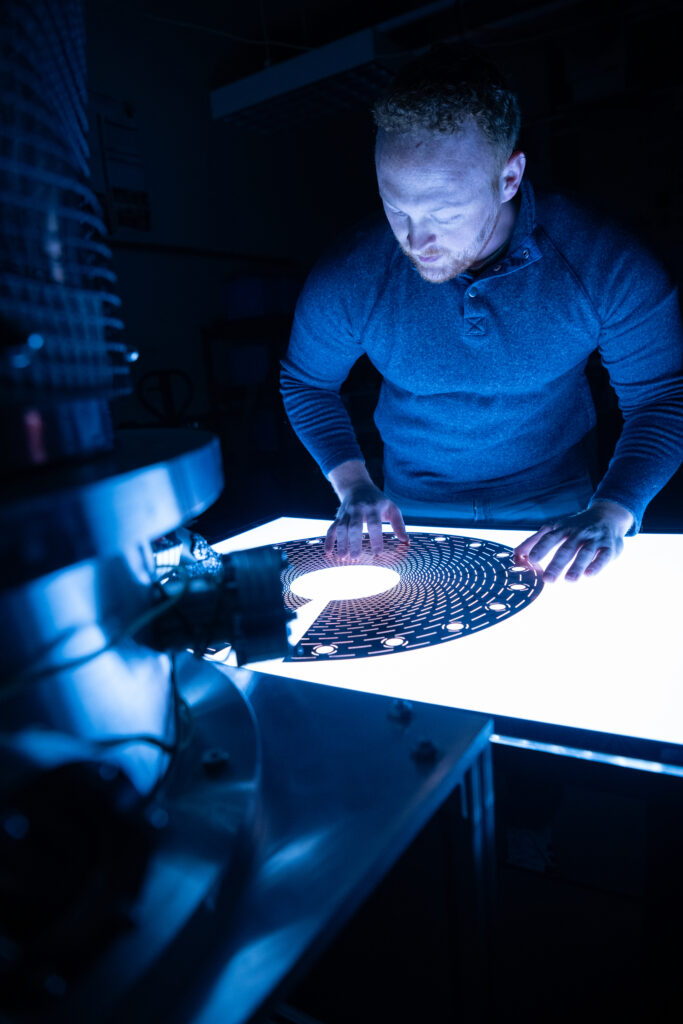 Bowers illuminates a Bitter disk with a backlight. (Brad Ziegler/UMBC)
Say “magnet,” and many people think first of the objects affixing their kids’ artwork to the fridge. Refrigerator magnets are an example of permanent magnets: materials in which the electrons permanently align in a way that generates a magnetic field. Permanent magnets can get quite strong—such as the rare earth neodymium magnets used in some maglev trains—but they top out at about 2 tesla.
To get an even stronger magnet, engineers can turn to a phenomenon that’s captured in the Maxwell equations that captivated Bowers: Electricity and magnetism are intrinsically linked.
Electrons flowing through a wire generate a magnetic field. Coil the wire and you can create a field similar in shape to a permanent bar magnet, with distinct north and south poles. This is the electromagnet. Higher current and more coils make a stronger magnet. However, high current also risks melting your magnet into a puddle and mangling it with the enormous pressure from the magnetic field pushing on the moving electrons (called Lorentz forces).
Superconducting electromagnets, which use material with the almost magical property of showing virtually zero electrical resistance when cooled with liquid helium, can eliminate the melting risk, but are expensive and finicky to operate, and have other limitations.
Another (more old-school) solution is called the Bitter electromagnet, invented in the 1930s by American physicist Francis Bitter. In place of coiled wires, circular metal disks separated with insulating spacers create a helical path that concentrates the current. The disks are shot through with holes for circulating water to whisk away heat and the structural design counteracts the mechanical stresses. “We chose a Bitter magnet because it offered the right combination of features for the tasks we wanted to perform,” Bowers says.
Step 2: Design, test, refine, repeat
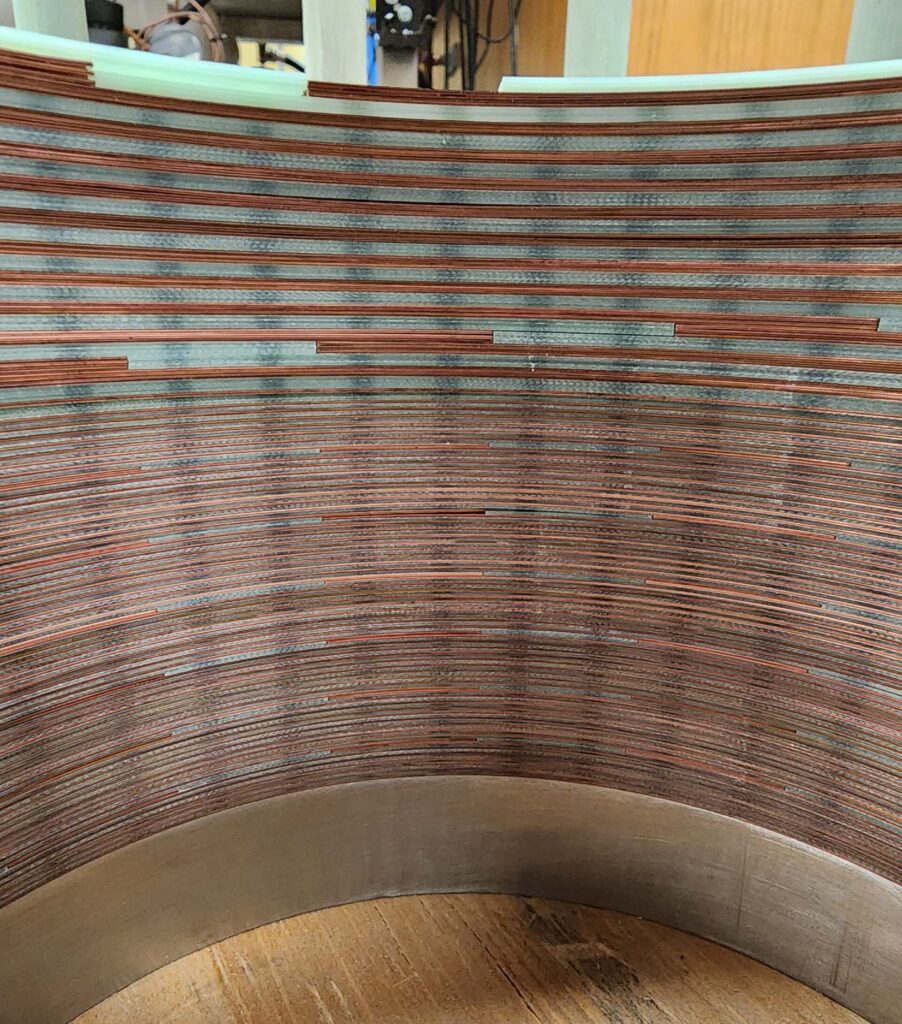 The turn density for the magnet is higher at the ends than at the middle. (Photo courtesy of Bowers)
The UMBC team’s initial vision was to create a 10-tesla Bitter magnet, with space in the center for a relatively large vacuum chamber to hold plasma. The magnet could generate either a steady or pulsed magnetic field, depending on the needs of the experiment. Bates analyzed the disk shape, stacking methods, cooling hole geometry, heat transfer, mechanical stress, and electrical properties of the magnet to optimize the design. He validated it by constructing and testing a 1-tesla prototype.
In 2023, the team decided to change the desired magnetic field profile, making it slightly higher on the ends of the magnet than in the middle, so that charged particles would be pushed toward the center. They didn’t want to redesign the Bitter disks, so they had to lower the maximum field strength to 7 tesla. They also had to vary the coil density, making tighter turns at the ends to get the stronger field.
Bowers analyzed the new field profile and worked out a clever trick of adding a tapered insulating disk to seamlessly transition between the areas of tighter and looser turns. He also performed a structural analysis of the whole assembly.
Step 3: Pallets, cranes, and painstaking planning
The final design called for 439 copper Bitter disks, four insulating transition disks, and 434 regular insulating disks housed inside a pressure vessel. Outside companies manufactured the disks, but Bowers personally inspected every single one, removing any with defects, and cleaning the copper ones with isopropyl alcohol. He built a custom pallet to hold the cylindrical assembly in place in the lab, and started stacking.
The process took about a month, and near the end “I was so sick of the monotony,” Bowers says. To push it across the finish line, he worked straight through the weekend, stacking the last disk on a Sunday afternoon in February. “It happened to be my friend’s birthday so I celebrated that completion and their birthday together,” he says.
Next up was moving the approximately 2-foot-high stack of disks to a movable swing set, created by a UMBC mechanical engineering capstone team to serve as a mobile and rotatable platform for the magnet. Bowers built a custom crane fixture to lift the assembly onto the platform and spent weeks planning every step of the move. “It was the last major place the structure could fail before we power the magnet,” he says. After one stressful day, Bowers says he was elated when it all went according to plan. “I felt genuinely grateful for all I had been given the chance to work on, and grateful that God had given me the ability to succeed.”
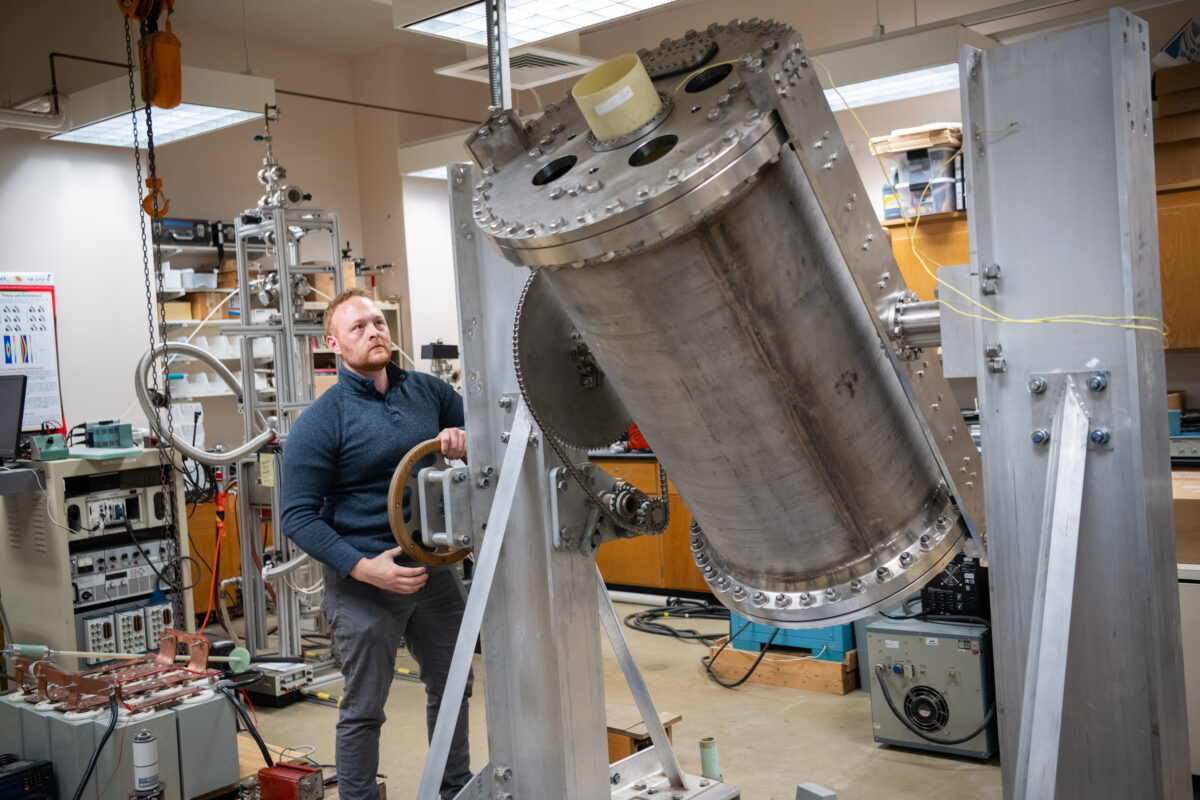 Bowers shows how the magnet core can be rotated. (Brad Ziegler/UMBC)
Step 4: Test some more
With the core of the magnet assembled, Bowers has also begun the detailed process of testing its electrical properties, using a host of measurement equipment.
At first, he is powering the magnet with lower currents, but eventually he will send 15,000 amps through the disks, about half the current that flows in an average lightning bolt. The voltage will be about five times the voltage in a wall socket.
Safety is of paramount concern to the team when working with such high power. When the magnet is operating at full strength, the energy in two cubic feet of the magnetic field alone will be more than the energy of a small SUV zooming by at 60 miles per hour.
Bowers is working on a set of detailed instructions to address all conceivable operating, maintenance, and failure scenarios. “We’re safe. We do all our due diligence,” he says.
Step 5: Serve up some science
Once the magnet is fully up and running, the science experiments can start. Bowers and Romero Talamás have a few ideas for initial experiments, including investigating how a high magnetic field affects when a gas will suddenly switch from being an insulator to a conductor, allowing current to arc through it. They are also interested in how the magnet might be used to separate different forms of hydrogen—particularly two forms that may form the fuel for future fusion reactors to supply clean and near limitless energy.
 Stars—nature’s original fusion reactors—show how plasma and magnetic fields can interact in spectacular fashion. In this image of our sun, taken in July 2012, million-degree plasma in the sun’s atmosphere began to cool and fall to the surface. Because the plasma is charged, it condensed along twisted magnetic field lines close to the surface and formed giant streaming arcs, some as tall as five Earths stacked high. (NASA Solar Dynamics Observatory)
Bowers grew up in rural Hagarstown, Maryland, a kid who enjoyed exploring everything from the rocks on the side of a path to the electrical motors his grandfather would wind. Research has offered him the chance to constantly challenge himself. After graduation, he’ll move on to new questions at the scientific frontiers, perhaps working at a fusion energy start-up or a national lab. But the 7T Bitter magnet will remain at UMBC, a gift to curious students who come after him.
]]>
Magnets often attract curious minds. Einstein told of his profound sense of hidden order after witnessing the invisible forces of the Earth’s magnetic field guide the needle of a compass. For...
https://umbc.edu/stories/how-to-make-a-really-strong-magnet/
https://my3.my.umbc.edu/api/v0/pixel/news/160699/guest@my.umbc.edu/daf60158f49bee7547aece6f2687d891/api/pixel
coeit
discovery
graduate-research
how-to
meche
research
science-and-tech
spring-2026
story
UMBC News & Magazine
https://my3.my.umbc.edu/groups/umbc-news-magazine
https://assets1-my.umbc.edu/system/shared/avatars/groups/000/001/943/24435aa6207c452e7bc15cc74b42c7bb/xsmall.png?1748556657
https://assets1-my.umbc.edu/system/shared/avatars/groups/000/001/943/24435aa6207c452e7bc15cc74b42c7bb/original.png?1748556657
https://assets2-my.umbc.edu/system/shared/avatars/groups/000/001/943/24435aa6207c452e7bc15cc74b42c7bb/xxlarge.png?1748556657
https://assets2-my.umbc.edu/system/shared/avatars/groups/000/001/943/24435aa6207c452e7bc15cc74b42c7bb/xlarge.png?1748556657
https://assets3-my.umbc.edu/system/shared/avatars/groups/000/001/943/24435aa6207c452e7bc15cc74b42c7bb/large.png?1748556657
https://assets1-my.umbc.edu/system/shared/avatars/groups/000/001/943/24435aa6207c452e7bc15cc74b42c7bb/medium.png?1748556657
https://assets2-my.umbc.edu/system/shared/avatars/groups/000/001/943/24435aa6207c452e7bc15cc74b42c7bb/small.png?1748556657
https://assets1-my.umbc.edu/system/shared/avatars/groups/000/001/943/24435aa6207c452e7bc15cc74b42c7bb/xsmall.png?1748556657
https://assets2-my.umbc.edu/system/shared/avatars/groups/000/001/943/24435aa6207c452e7bc15cc74b42c7bb/xxsmall.png?1748556657
UMBC News & Magazine
0
0
false
Mon, 15 Jun 2026 14:54:55 -0400
Mon, 15 Jun 2026 14:54:55 -0400
Business—not as usual
At UMBC, entrepreneurship transcends a traditional business education: It empowers scientists, artists, and technologists to transform their expertise into real-world impact. Through business accelerators, ambassador programs, interdisciplinary courses, and other innovation pathways, the university offers many avenues for ideas to flourish.
Kushani Mendis and her labmates have developed novel nanomaterials that could transform biomedical technology. She wants to translate their discoveries into a business opportunity, but initially, wasn’t sure what steps to take. So, early in her chemistry Ph.D. with Zeev Rosenzweig, professor of chemistry and biochemistry, Mendis told him that she wanted to become an entrepreneur—and he jumped at the chance to creatively support her with internal and external resources.
UMBC has no formal business school. Yet it may be one of the best places in the country to learn entrepreneurial thinking—precisely because the best ideas so often come from those with technical expertise rather than MBAs. Also, many UMBC entrepreneurs are motivated by a desire to drive positive social change rather than profit, which is supported by courses on “socialpreneurship.” Overall, the university’s model rests on a simple but powerful dual thesis: 1) Disciplinary excellence paired with an entrepreneurial mindset produces graduates who create real-world impact, and 2) entrepreneurship is for everyone.
Employers repeatedly say they need graduates who excel in communication, creative problem-solving, collaboration, and constructive conflict navigation. Traits like resilience and empathy are in high demand—after all, finding effective solutions often requires understanding problems from another’s perspective. UMBC’s courses and programs deliberately train these skills, which can enhance the success of entrepreneurs—and every UMBC graduate.
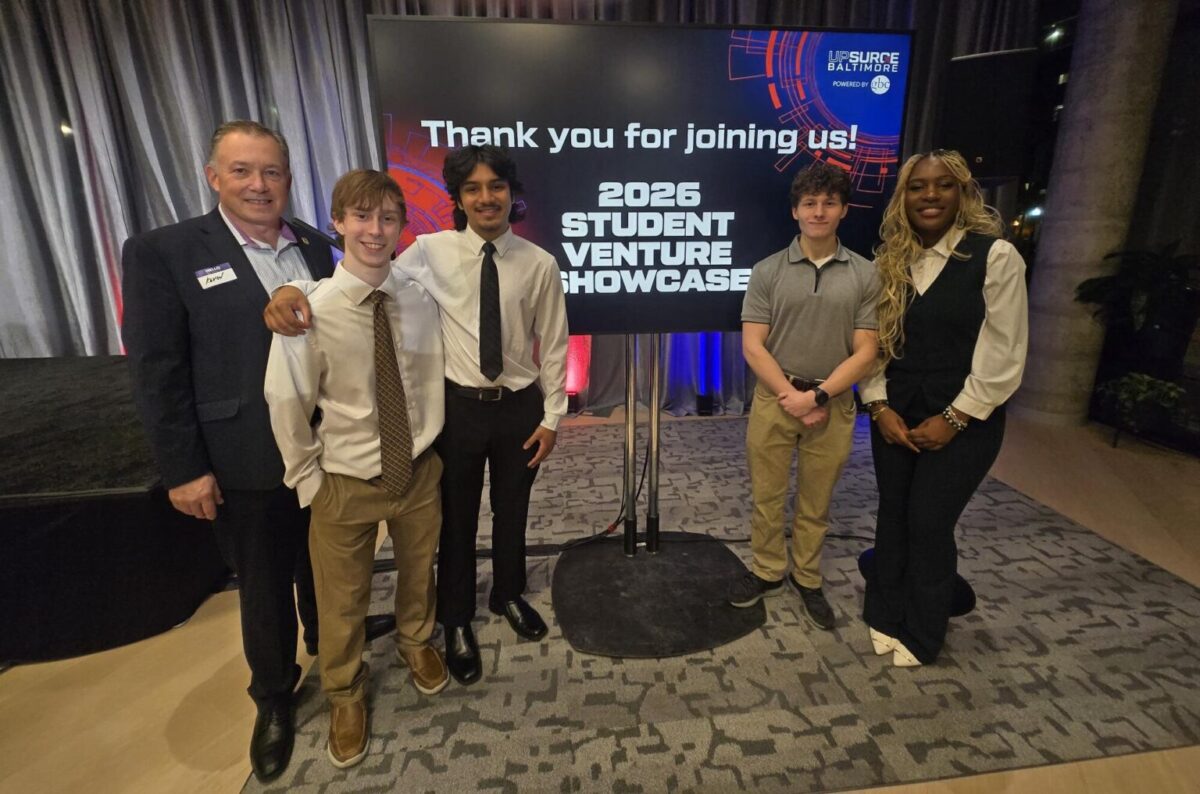 From left to right, Kevin Fulmer, director of the The Alex. Brown Center for Entrepreneurship and Innovation at UMBC, and students Charles Nerad, Abhinav Patel, Aidan Fleischer, and Velma Funebe at the 2026 Maryland Student Venture Showcase in Baltimore. (Photo courtesy of Kevin Fulmer)
The results speak for themselves. Students are winning state and national funding, launching ventures, gaining versatile life skills, and contributing to Maryland’s innovation economy. This spring, two UMBC student teams—iBraid and StrikeSense—each received $50,000 Pava LePere Innovation Awards. Others have advanced through the university’s Summer Launchpad accelerator and secured funding totaling more than $300,000 in the past three years.
An entrepreneurial environment
The roots of UMBC’s entrepreneurship emphasis trace back to 2000, with the founding of the Alex. Brown Center for Entrepreneurship and Innovation. Initially led by Vivian Armour and supported by Constellation Energy Group and the Bearman Foundation, the center took off in 2006 the Kauffman Foundation awarded funds to a small cohort of universities including UMBC, as well as Brown, Carnegie Mellon, Arizona State, and Purdue, to further their entrepreneurship efforts. Armour invited Gib Mason ’95, economics, a serial entrepreneur who had been guest lecturing at UMBC, to help steward UMBC’s $2 million Kauffman award.
“Kauffman’s research had shown that it wasn’t the business school students bringing entrepreneurial ideas to the marketplace,” Mason recalls. “It was the engineers and the tech guys and gals.” The foundation’s premise was that exposing disciplinary experts to entrepreneurial environments could help them develop and commercialize new ideas, he explains.
That initiative led to the creation of UMBC’s minor in Entrepreneurship and Innovation. The 18-credit program combines two core entrepreneurship courses with 12 credits from designated courses across UMBC’s three colleges, where faculty have infused entrepreneurial principles into existing major curricula. Today, more than 70 courses in biology, public health, information systems, art, and engineering count toward the minor, making it broadly accessible.
 Gib Mason (standing) leads entrepreneurship programming at the UMBC Training Centers. (Marlayna Demond ’11/UMBC)
The center turned 25 this academic year. Kevin Fulmer, its first full-time director and a lifelong entrepreneur, has spent the past five years expanding its reach and visibility. “Before there were any full-time staff, awareness of the center was fairly minimal,” he says. Under his leadership, Introduction to Entrepreneurship—which fills up quickly every semester—was approved as a General Education Program course. The center also launched a student ambassador program, and now six students promote events, support programming, and serve as peer mentors. Faculty can apply for funding to embed entrepreneurial thinking in their courses, and designated faculty fellows from each college are designing discipline-specific tracks within the minor. “We’re trying to make it as accessible for as many students as possible,” Fulmer explains.
A separate master’s in Entrepreneurship, Innovation, and Leadership—developed by Mason and offered through UMBC’s Division of Professional Studies—has served working professionals since 2019 and draws on the same philosophy of practical application. Meanwhile, the center’s summer Launchpad accelerator has supported more than 20 student ventures since 2022; participants receive an $8,000 stipend to dedicate 10-weeks to full-time customer discovery and problem validation. iBraid and StrikeSense, the Maryland award winners, emerged from the accelerator’s pipeline. Additional opportunities include the fall Idea and Innovation Challenge (with a popular social-impact category) and the spring Cangialosi Business Innovation Competition for more developed concepts.
All of this exists without a traditional business school. Instead, UMBC has built an ecosystem that meets students where they are—inside their technical and creative majors—and provides the tools to translate discovery into impact. “Entrepreneurship is for everyone,” the Alex. Brown Center’s website proclaims, regardless of major or career aspirations.
Not-so-risky business

Entrepreneurship at UMBC emphasizes mindset over venture creation alone. “It’s really just about solving problems and using an entrepreneurial mindset to do that,” Fulmer stresses.
Studies suggest that only 30 to 50 percent of graduates nationally are employed in roles directly related to their specific field of study, Fulmer notes. “You may have all the technical skills in the world, but not get these life skills from your major,” he adds. UMBC’s approach prepares students for diverse careers—launching startups, innovating inside a corporation, teaching, or pursuing research—by developing empathy and resilience and building creative problem-solving and communication skills.
Mason challenges the stereotype that entrepreneurs are reckless risk takers. “Most entrepreneurs are constantly making informed decisions to mitigate risks,” he says. He draws from childhood summers working on his grandfather’s Kansas farm, where he earned money from “his” acres of wheat—until one year a tornado destroyed the crop. The experience taught him that “there’s a lot that you can control and a lot that you can’t.” True entrepreneurs, he says, take calculated risks and then work diligently to reduce them.
Many UMBC students are drawn to “socialpreneurship”—ventures that solve societal problems rather than chase profit. “Students today seem especially geared toward trying to do things for social impact,” Mason says. The center’s social-impact track in competitions reflects this, and courses like Creative Problem Solving and The Socialpreneur have led to tangible outcomes, such as OCA Mocha, a coffee shop connecting UMBC with the Baltimore community.
Braiding the future
Velma Funebe, a public health major, embodies this orientation. Her venture, iBraid, uses augmented reality to help users part and braid their own hair—transforming protective styling that can become a multi-day ordeal into a more manageable process. Inspired by braiding her own hair since age 11 and running a professional braiding business since ninth grade, Funebe validated demand via TikTok and conversations. “I realized it was a major problem because so many people struggled with it,” she says. “I couldn’t find any solutions out there.”
As an Entrepreneurship Ambassador, she now supports programming and events like 1 Million Cups, another Kauffman Foundation initiative where entrepreneurs pitch ideas and get feedback. The Baltimore edition meets at OCA Mocha twice monthly. “The scariest part is when the idea is not just in your brain, but other people hear it,” Funebe says. “But I think it’s a great space to get feedback and say, ‘Okay, I can live through an application rejection.’”
Funebe’s faith helps anchor her while she balances classes, leadership in the Public Health Council of Majors, weekend braiding appointments, and venture development. iBraid has gained strong traction: a second-place finish in UMBC’s Idea and Innovation Challenge, the Pava LaPere Innovation Award, a waitlist approaching 4,000, and more than 10,000 TikTok followers. Beta testing is underway, supported in part by two UMBC data science graduate fellows through the Maryland New Venture program at bwtech@UMBC, a business incubator adjacent to campus. iBraid’s momentum continued to build at Maryland New Venture Pitch Night ’26, where Funebe took third place and received the Audience Choice Visionary Award.
“The Alex. Brown Center has played an essential role in helping me to grow my confidence,” she says. To others considering giving entrepreneurship a try, she says, “Don’t be afraid to fail—at least you get a result out of failing, and can learn a lot from it.”
Striking while it’s hot
Abhinav Patel, Charles Nerad, and Aidan Fleischer, co-founders of StrikeSense, channeled frustration with their Taekwondo training into innovation. In competition, expensive electronic wearables detect hits and record scores, but most athletes lack access to that equipment in practice. “I had the idea for a sparring vest with a health bar like something from a video game,” Nerad says.
The team developed an affordable sensor attachment that turns any existing sparring vest into a smart vest capable of detecting and scoring hits, with a gamified “health bar” interface. After placing second in the 2025 Cangialosi Business Innovation Competition, they joined the summer Launchpad program.

“All of the support we have gotten from UMBC has been instrumental, and we wouldn’t be where we are today without it.” Patel notes. Mentors like Donald Miner ’06, Ph.D. 2010, computer science; and Chris Ewing, an “entrepreneur in residence” at bwtech@UMBC, and especially Fulmer provided guidance: “Without him, we would not have had the encouragement to continue, the accountability to work hard, and the guidance to grow,” Nerad adds.
They are now refining software and preparing a pilot program with local dojos. “There is no better time to take a chance on an idea than right now,” Nerad advises. “You are surrounded by thousands of brilliant minds at UMBC, and have access to dedicated mentors who genuinely want you to succeed.”
And Kushani Mendis is now thriving at the intersection of research and entrepreneurship. She’s participated in the Center for Sustainable Nanotechnology, represented UMBC in the regional 3-Minute Thesis competition, and completed training at Brookhaven National Lab through UMBC’s Chemistry and Biology Interface program. To younger scientists, she says: “Being a scientist does not have to mean being confined in a lab. You are a human who has a lot of potential that you can give out to the community.”
As Fulmer puts it, “We’ve always been really great at UMBC at training students’ analytical, left-brain development—but our entrepreneurship programs are promoting right-brain skills as well, which are just as important.”
Extending the ecosystem
Faculty, alumni, and the broader community benefit, too. bwtech@UMBC offers state-of-the-art labs and work spaces, educational programming, mentorship, and industry connections. Many alumni and community members have built businesses there that contribute jobs and innovative products and services to the regional economy.
 bwtech@UMBC, located adjacent to main campus, supports Maryland entrepreneurs at every stage of business growth. (Marlayna Demond ’11/UMBC)
In addition, the Entrepreneurial Skills Training program for faculty in the College of Natural and Mathematical Sciences helps principal investigators apply strategic, startup-style thinking to manage their multi-million-dollar research labs. “They’re running a business, whether they like it or not,” says Mason, who originally designed the program that’s now run by Fulmer. “They’re hiring people, buying resources, creating stuff.”
Finally, the new Entrepreneurial Learning Lab (ELL) pairs faculty with trained students to evaluate research for commercialization potential—without requiring faculty to become full-time CEOs. The inaugural cohort drew strong interest: 23 faculty applied for 10 spots alongside 54 student applications. “We’re not trying to change what faculty do in terms of research and teaching,” Fulmer explains, “but while they’re doing that, think about potential impact.”
This diverse array of entry points—from minors and master’s programs to accelerators, competitions, and faculty-student collaborations—deliberately creates an inclusive entrepreneurial ecosystem. Ideas from any discipline or career stage have room to grow.
The bigger picture
UMBC’s entrepreneurial ecosystem does more than launch student ventures; it strengthens Maryland’s innovation economy, particularly in biotech, health tech, and advanced materials. The university’s strengths in these areas—coupled with proximity to federal labs and funding—creates what Fulmer calls a “target-rich environment.” Many Launchpad teams naturally transition into bwtech@UMBC’s incubation programs, forming a clear pathway from classroom concept to scalable company.
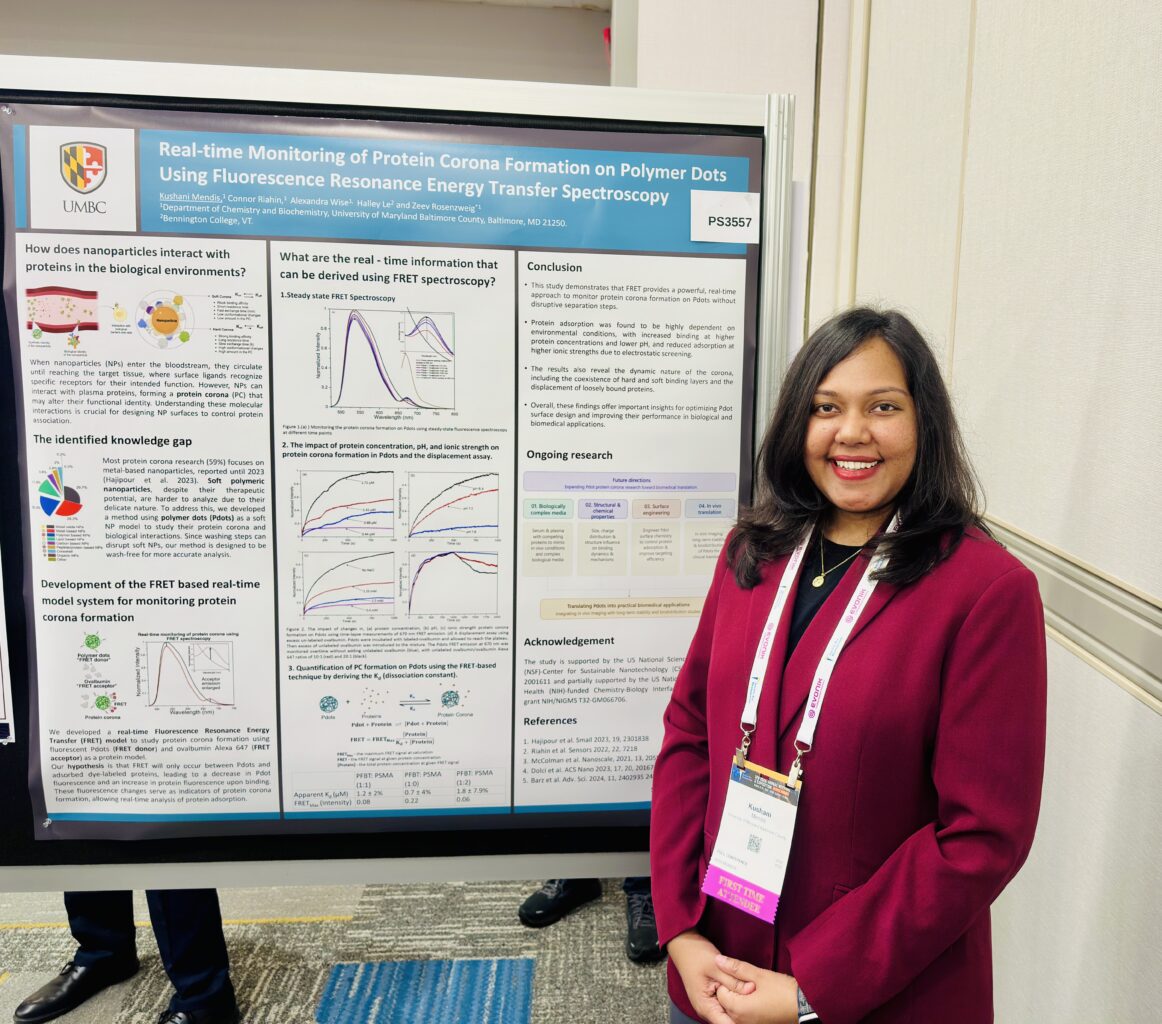 Kushani Mendis presented her research at the 2026 Society for Biomaterials Annual Meeting. (Courtesy of Mendis)
Today, Mendis’s schedule is packed with interviews of biomedical technology researchers in government, academia, and industry. Her probing questions are helping determine whether her lab’s novel nanomaterials have commercial potential. Rosenzweig’s encouragement and programs like the National Science Foundation Innovation Corps (I-Corps), which trains scientists to translate research into societal impact, have been key. She is thriving, balancing independent laboratory research, teaching and mentoring undergraduates, and her entrepreneurial work; she even occasionally finds time to engage her artistic side.
Whether or not students like Mendis ultimately launch businesses, at UMBC, they gain versatile skills—problem-solving, communication, empathy, and resilience—that will serve them across diverse careers. Here, entrepreneurial thinking is not an elective add-on but foundational preparation for an unpredictable world.
“UMBC’s model—technical excellence plus mindset training—prepares graduates to innovate anywhere,” Fulmer says, “making the university a powerful driver of Maryland’s future.”
]]>
At UMBC, entrepreneurship transcends a traditional business education: It empowers scientists, artists, and technologists to transform their expertise into real-world impact. Through business...
https://umbc.edu/stories/business-not-as-usual/
https://my3.my.umbc.edu/api/v0/pixel/news/160676/guest@my.umbc.edu/3eb018960d350b6c9c83e9cf0bcdf92a/api/pixel
alexbrowncenter
alumni
bwtech
cahss
campus-life
chemistry-and-biochemistry
cnms
coeit
csee
discovery
economics
entrepreneurship
feature
graduate-research
magazine
public-health
story
UMBC News & Magazine
https://my3.my.umbc.edu/groups/umbc-news-magazine
https://assets1-my.umbc.edu/system/shared/avatars/groups/000/001/943/24435aa6207c452e7bc15cc74b42c7bb/xsmall.png?1748556657
https://assets1-my.umbc.edu/system/shared/avatars/groups/000/001/943/24435aa6207c452e7bc15cc74b42c7bb/original.png?1748556657
https://assets2-my.umbc.edu/system/shared/avatars/groups/000/001/943/24435aa6207c452e7bc15cc74b42c7bb/xxlarge.png?1748556657
https://assets2-my.umbc.edu/system/shared/avatars/groups/000/001/943/24435aa6207c452e7bc15cc74b42c7bb/xlarge.png?1748556657
https://assets3-my.umbc.edu/system/shared/avatars/groups/000/001/943/24435aa6207c452e7bc15cc74b42c7bb/large.png?1748556657
https://assets1-my.umbc.edu/system/shared/avatars/groups/000/001/943/24435aa6207c452e7bc15cc74b42c7bb/medium.png?1748556657
https://assets2-my.umbc.edu/system/shared/avatars/groups/000/001/943/24435aa6207c452e7bc15cc74b42c7bb/small.png?1748556657
https://assets1-my.umbc.edu/system/shared/avatars/groups/000/001/943/24435aa6207c452e7bc15cc74b42c7bb/xsmall.png?1748556657
https://assets2-my.umbc.edu/system/shared/avatars/groups/000/001/943/24435aa6207c452e7bc15cc74b42c7bb/xxsmall.png?1748556657
UMBC News & Magazine
0
0
false
Fri, 12 Jun 2026 11:42:24 -0400
Fri, 12 Jun 2026 11:42:24 -0400
Wildfires are reversing America’s progress on ozone pollution, the main ingredient in smog
Written by Weizhi Deng, University of Iowa; Jun Wang, University of Iowa; and Meng Zhou, research scientist at the Goddard Earth Sciences and Technology Research Center II
For decades, the United States made steady progress in reducing surface ozone pollution, the main ingredient in smog. But that progress – achieved as vehicles, industries and power sources became cleaner – is increasingly being overshadowed by a different and growing source of ozone pollution: wildfires.
Our team of atmospheric and wildfire scientists analyzed wildfires’ contribution to surface ozone levels from 2003 to 2024 across the United States.
We found that the gases in wildfire smoke have reversed the national ozone trend, forcing a shift from declining ozone levels prior to 2015 to increasing ozone levels after 2015. We also found that the number of ozone-related premature deaths due to wildfires has been increasing by about 300 deaths per year since then.
Battling smog
Most people know ozone as the protective layer of the atmosphere high above the Earth that shields the planet from harmful ultraviolet radiation. But ozone has two very different faces.
High in the atmosphere, ozone is beneficial. Near the ground, it is a harmful air pollutant that can irritate the lungs and worsen respiratory diseases.
Los Angeles made ozone visible to the nation in the 1940s and 1950s, as thick, eye-stinging smog often blanketed the city. It turned an invisible chemistry problem into a public-health crisis people could see and feel. That crisis helped motivate decades of air pollution control efforts in California and, later, across the United States.
After the passage of the Clean Air Act and its amendments in the 1970s, the U.S. made steady progress in cleaning up surface ozone. Regulations on vehicles, power plants and industrial sources reduced emissions of nitrogen oxides and other ozone-forming chemicals.
To monitor the progress, the U.S. Environmental Protection Agency has over 1,000 stations that measure ozone around the country. They cover many places, but mostly urban areas, and do not measure ground-level ozone everywhere at the neighborhood scale.
We were able to fill in the gaps by combining those monitoring station measurements with satellite-derived information about air pollution and human activity, along with weather and air quality model simulations. We then used artificial intelligence to estimate daily surface ozone levels everywhere in the contiguous U.S., with data every square kilometer, over the past 22 years.
The results show that national progress in reducing surface ozone reversed around 2015 as North America began to face more severe wildfires. In many regions, ozone levels are now increasing, especially in the western U.S. and the Midwest, where smoke and gases from wildfires are becoming more common as they are transported through the air.
Overall, surface ozone levels that had been falling by about 0.65 part per billion per year from 2003–2015 have since increased by about 0.13 parts per billion per year. If wildfires hadn’t been an influence, we found, the trend of falling surface ozone levels would have continued instead.
 Ground-level ozone since 2015 has increased the most in areas where wildfire smoke increased. Minnesota, Wisconsin and other parts of the Midwest have experienced several summers of wildfire smoke from Canada. The map uses national ambient air quality standards. (Weizhi Deng et al., 2026)
People often think of wildfires as a problem for the western U.S., but smoke and gas pollutants from their emissions can travel thousands of miles, affecting communities far from the fires themselves.
The 2023 Canadian wildfires offered a vivid example. In much of the Midwest, ozone reached unhealthy levels for more than a week. The impact of wildfire smoke reached as far as Georgia and New York. That year, an additional 43 million Americans lived in areas with ozone exceeding healthy standards compared to previous years because of increased wildfire emissions.
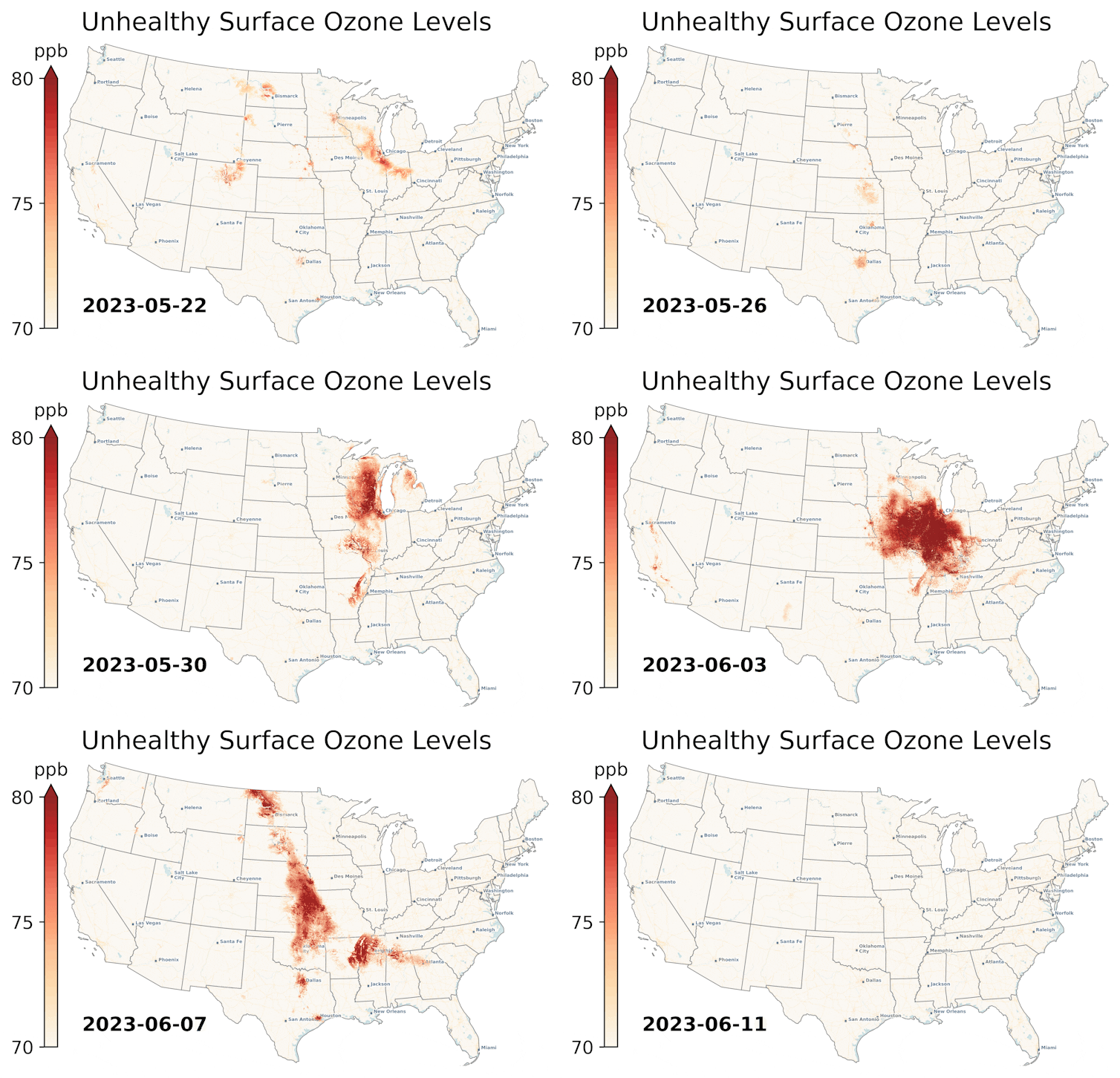 Smoke reached far into the U.S. during Canada’s destructive 2023 wildfire season, as these measures of ground-level ozone over three weeks that summer show. (Weizhi Deng, CC BY-ND)
As the Earth and its atmosphere warm, wildfire seasons are becoming longer and more severe across many parts of North America, and the trend is predicted to continue. In line with projections, Canada experienced its most devastating wildfire seasons on record in 2023 and 2025. In January 2025, destructive fires burned more than 16,000 homes and businesses in and around Los Angeles during a time of year when such events have historically been uncommon.
The shift toward more fires suggests that the rising ozone problem could become even greater in the future. That’s a problem for human health.
Reducing exposure to ozone and its health risks
People can reduce their exposure to ozone pollution by checking air quality forecasts and limiting outdoor activities when wildfires are sending smoke into the air. But protecting public health in the long run will require broader actions to reduce ground-level ozone itself.
That includes efforts to mitigate fire risk by improving wildfire management, such as reducing brush and other dry undergrowth that can fuel fires, and also scaling back the causes of rising global temperatures, such as the burning of fossil fuels. As temperatures rise, the ground loses moisture, creating conditions for more extreme fires.
Protecting public health also means strengthening air quality forecasting systems to provide accurate early warnings, so people can take precautions, and maintaining air pollution monitoring networks and investing in satellite sensors to continue measuring progress, so problems can be identified and fixed.
Weizhi Deng, Ph.D. Student in Atmospheric and Environmental Science, University of Iowa; Jun Wang, Professor of Chemical and Biochemical Engineering, University of Iowa, and Meng Zhou, Researcher in Atmospheric and Earth Sciences, University of Maryland, Baltimore County
This article is republished from The Conversation under a Creative Commons license. Read the original article and see more than 300 UMBC articles available in The Conversation.
]]>
Written by Weizhi Deng, University of Iowa; Jun Wang, University of Iowa; and Meng Zhou, research scientist at the Goddard Earth Sciences and Technology Research Center II For decades, the...
https://umbc.edu/stories/the-conversation-wildfires-reverse-ozone-progress/
https://my3.my.umbc.edu/api/v0/pixel/news/160625/guest@my.umbc.edu/9617001933486ab16921677613403e89/api/pixel
discovery
goddard-earth-sciences-technology-and-research-gestar-ii
magazine
story
the-conversation
UMBC News & Magazine
https://my3.my.umbc.edu/groups/umbc-news-magazine
https://assets1-my.umbc.edu/system/shared/avatars/groups/000/001/943/24435aa6207c452e7bc15cc74b42c7bb/xsmall.png?1748556657
https://assets1-my.umbc.edu/system/shared/avatars/groups/000/001/943/24435aa6207c452e7bc15cc74b42c7bb/original.png?1748556657
https://assets2-my.umbc.edu/system/shared/avatars/groups/000/001/943/24435aa6207c452e7bc15cc74b42c7bb/xxlarge.png?1748556657
https://assets2-my.umbc.edu/system/shared/avatars/groups/000/001/943/24435aa6207c452e7bc15cc74b42c7bb/xlarge.png?1748556657
https://assets3-my.umbc.edu/system/shared/avatars/groups/000/001/943/24435aa6207c452e7bc15cc74b42c7bb/large.png?1748556657
https://assets1-my.umbc.edu/system/shared/avatars/groups/000/001/943/24435aa6207c452e7bc15cc74b42c7bb/medium.png?1748556657
https://assets2-my.umbc.edu/system/shared/avatars/groups/000/001/943/24435aa6207c452e7bc15cc74b42c7bb/small.png?1748556657
https://assets1-my.umbc.edu/system/shared/avatars/groups/000/001/943/24435aa6207c452e7bc15cc74b42c7bb/xsmall.png?1748556657
https://assets2-my.umbc.edu/system/shared/avatars/groups/000/001/943/24435aa6207c452e7bc15cc74b42c7bb/xxsmall.png?1748556657
UMBC News & Magazine
0
0
false
Tue, 09 Jun 2026 11:04:57 -0400
Tue, 09 Jun 2026 11:04:57 -0400
Revealing galactic history with cosmic rays
What if we could peer back in time to understand how our galaxy was built—one exploding star at a time?
When massive stars reach the end of their lives, they don’t go quietly. They explode in spectacular fashion, forging heavy elements and hurling them across space. Some of these particles, known as cosmic rays, eventually reach detectors built by humans. By studying which elements arrive and in what amounts, scientists hope to piece together the story of our galaxy’s chemical evolution.
But there’s a problem: As these cosmic rays race through space, they smash into hydrogen atoms and break apart. These reactions, called “proton spallation,” turn heavier elements like iron into lighter ones like sodium or chromium. Without knowing exactly how often these “break-ups” happen, it’s hard to translate what detectors see into a true picture of what’s out there. But if scientists could accurately reverse-engineer the process, determining how much of one element came from another, they would better understand the galaxy’s true chemical makeup.
Now, Priyarshini Ghosh, a nuclear physicist at UMBC’s Center for Space Sciences and Technology, is performing a first-of-its-kind experiment, hoping to fill some of this knowledge gap.
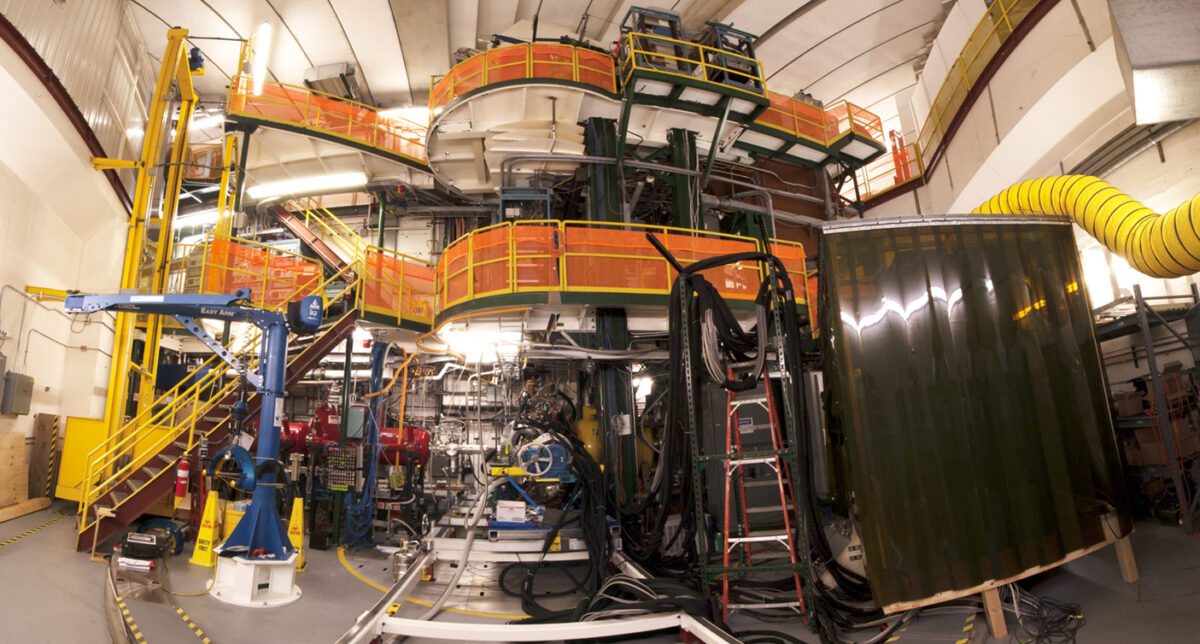 The research team will run a novel experiment on the S800 Spectrograph at the Facility for Rare Ion Beams at Michigan State University. They expect the results to increase understanding of the chemical makeup of the Milky Way galaxy. (Courtesy of FRIB)
In early June, Ghosh and her collaborators led the Facility for Rare Isotope Beams (FRIB) at Michigan State University to study, for the first time ever, how chromium-52 breaks apart when it interacts with hydrogen. Chromium-52 is of particular interest because it can shed light on processes happening in our galaxy, and yet it has never been measured before. Using a high-energy beam of this stable form of chromium, the team will record “proton spallation cross sections”—measures of the likelihood of violent interactions between protons and heavy ions. The experiment essentially recreates inside a Michigan laboratory what’s happening to cosmic rays in space, Ghosh says.
“Nuclear data acts as a translator from the data collected by missions like Voyager, converting it into a meaningful understanding of our galaxy,” Ghosh explains.
Mimicking cosmic rays
Current models don’t quite match what telescopes and spacecraft actually observe, especially for elements like chromium, titanium, and vanadium. The differences have puzzled researchers for years. These questions linger because the right kind of experimental data has been extremely laborious and expensive to obtain—until now.
“A sample of chromium-52 the size of a chocolate square can cost around $150,000,” Ghosh notes. So instead of using a large piece of chromium-52, FRIB’s chemists will collide a beam of less-expensive nickel-58 with a carbon target, producing a pure chromium beam—the first time this has ever been achieved.
 Priyarshini Ghosh operates a scanning electron microscope at Kansas State University, where she completed her Ph.D. in nuclear engineering. (Courtesy of Kansas State University)
The team will run the experiment for about 43 hours, collecting data on 50 to 60 different fragments produced as the chromium beam collides with various detectors and breaks apart. Then comes the long work of analysis. The results are expected to sharpen astrophysical models and bring us closer to understanding how elements are created and spread throughout the Milky Way.
“What makes this project exciting is that FRIB lets us reproduce, in a controlled way, a process that naturally happens in the universe: cosmic rays traveling from a dying star through the galaxy,” says Jorge Pereira, FRIB’s magnetic spectrometer operation group leader.
“Arm-wrestling with nature”
This chromium experiment is the first in a program that Ghosh is developing at UMBC dedicated to building a comprehensive proton-spallation cross-section database. Proton-based reactions—like the ones cosmic rays experience with hydrogen—have received little attention, even though they’re crucial for interpreting data from space.
By building a reliable database of these proton cross sections, the team is laying the groundwork that could transform how we read the cosmos. The results will directly support the upcoming TIGERISS mission, set to fly to the International Space Station in 2027. TIGERISS will be the first instrument to measure elements from boron all the way to lead with remarkable precision—and Ghosh’s nuclear data will help scientists make sense of what it sees.
For Ghosh, the thrill lies in the experimental challenge itself.
“This is such a feat of nuclear engineering,” she says. “We’re using detectors to expose the physics in very specific ways—arm-wrestling with nature to get the answers we need.”
]]>
What if we could peer back in time to understand how our galaxy was built—one exploding star at a time? When massive stars reach the end of their lives, they don’t go quietly. They explode in...
https://umbc.edu/stories/revealing-galactic-history-with-cosmic-rays/
https://my3.my.umbc.edu/api/v0/pixel/news/160273/guest@my.umbc.edu/410394584f051775b6fcd874feb81096/api/pixel
csst
discovery
magazine
research
science-and-tech
story
UMBC News & Magazine
https://my3.my.umbc.edu/groups/umbc-news-magazine
https://assets1-my.umbc.edu/system/shared/avatars/groups/000/001/943/24435aa6207c452e7bc15cc74b42c7bb/xsmall.png?1748556657
https://assets1-my.umbc.edu/system/shared/avatars/groups/000/001/943/24435aa6207c452e7bc15cc74b42c7bb/original.png?1748556657
https://assets2-my.umbc.edu/system/shared/avatars/groups/000/001/943/24435aa6207c452e7bc15cc74b42c7bb/xxlarge.png?1748556657
https://assets2-my.umbc.edu/system/shared/avatars/groups/000/001/943/24435aa6207c452e7bc15cc74b42c7bb/xlarge.png?1748556657
https://assets3-my.umbc.edu/system/shared/avatars/groups/000/001/943/24435aa6207c452e7bc15cc74b42c7bb/large.png?1748556657
https://assets1-my.umbc.edu/system/shared/avatars/groups/000/001/943/24435aa6207c452e7bc15cc74b42c7bb/medium.png?1748556657
https://assets2-my.umbc.edu/system/shared/avatars/groups/000/001/943/24435aa6207c452e7bc15cc74b42c7bb/small.png?1748556657
https://assets1-my.umbc.edu/system/shared/avatars/groups/000/001/943/24435aa6207c452e7bc15cc74b42c7bb/xsmall.png?1748556657
https://assets2-my.umbc.edu/system/shared/avatars/groups/000/001/943/24435aa6207c452e7bc15cc74b42c7bb/xxsmall.png?1748556657
UMBC News & Magazine
0
0
false
Thu, 21 May 2026 15:17:46 -0400
Thu, 21 May 2026 15:17:46 -0400
No animal alive today is ‘primitive’— why are so many still labeled that way?
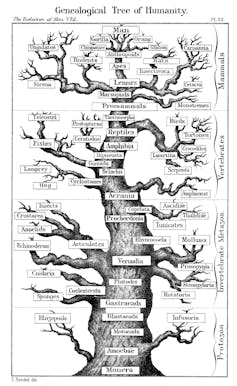 ‘Man’ is at the very top looking down at all other forms of life in Ernst Haeckel’s drawing. Ernst Haeckel/Photos.com via Getty Images Plus
Written by Kevin Omland, professor of biological sciences, UMBC
We humans have long viewed ourselves as the pinnacle of evolution. People label other species as “primitive” or “ancient” and use terms like “higher” and “lower” animals.
This anthropocentric perspective was entrenched in 1866, when German scientist Ernst Haeckel drew one of the first trees of life. He placed “Man,” clearly labeled, at the top. This illustration helped establish the popular view that we are the ultimate goal of evolution.
Modern evolutionary biology and genomics debunk that flawed perspective, showing there is no hierarchy in evolution. All species alive today, from chimpanzees to bacteria, are cousins that each have equally long lineages, rather than ancestors or descendants.
Unfortunately, these outdated notions remain prevalent in scientific journals and science journalism. In my new book, “Understanding the Tree of Life,” I explore why it is fundamentally misleading to view any current species as primitive, ancient or simple. As an evolutionary biologist, I offer an alternative view that emphasizes evolution’s complex, nonhierarchical, interconnected history.
Not primitive, just different
Egg-laying mammals, the monotremes, are frequently labeled the most “primitive” living mammals. This category includes the platypus and four species of echidnas. Indeed, their egg-laying is an ancient characteristic shared with reptiles.
But platypuses also have many unique recent adaptations that make them well suited to their lifestyle: They have webbed feet for swimming and a bill with specialized electroreceptors that detect prey in the mud. Males have spurs with venom that they can use to defend themselves against rivals. If you take a platypus’s view, they’re the pinnacle of evolution for their specific ecological niche.
 Echidnas have just what it takes to flourish in their unique niche. Chris Beavon/Moment via Getty Images
Echidnas may seem primitive, especially because they lack a capability that humans have—giving birth to live young. Yet they possess many extraordinary traits that humans lack. Echidnas are known for their outer covering of protective spines. They also have powerful claws for digging, a sensitive beak and a long sticky tongue, all of which they use foraging for ants and termites. In a head-to-head competition foraging for prey in a termite mound, an echidna would easily outperform any human.
Other mammals native to Australia also turn up on lists of primitive mammals, such as many species of marsupials – pouched mammals, including kangaroos, koalas and wombats. These species generally give birth to small, minimally developed young that move to the mother’s pouch where they complete development. Pouch development may seem inferior to the human way, but it does have advantages. For example, kangaroos can simultaneously nurture young at three stages of development.
Evolutionary tree appearance depends on focus
Marsupials such as opossums, or monotremes such as the platypus, are often shown at the bottom or left side of an evolutionary tree. However, that does not mean that they are older, more primitive or less evolved.
Evolutionary trees—what scientists call phylogenies—show cousin relationships. Just as your second or third cousin is no more primitive than you are, it is misleading to think of a koala or echidna as primitive because of where they are depicted on these trees.
When scientists and journalists choose which species to include in the evolutionary trees in their publications, it can influence how the public perceives these species. But species shown lower on the page are not “lower” on some evolutionary scale.
Rather, they are placed there because the focus of many of those trees is on placental mammals, such as humans, other primates, carnivores, rodents and so on. When the focus is on placental mammals, it makes sense to include one or two species of marsupials as comparisons for reference.
 A phylogenetic tree focused on marsupials shows humans as one of the species included for comparison. Spiekman, S., Werneburg, I. Sci Rep 7, 43197 (2017), CC BY
In contrast, in a tree focused on marsupials, one or two placental mammals could be included at the bottom of the page for comparison.
Why understanding the tree of life matters
Viewing humans as the goal of evolution leads to a misunderstanding of the entire evolutionary process. Since evolution is the conceptual foundation for all biology, this flawed perspective can hinder all biological and biomedical science.
Mastering a modern understanding of evolutionary trees is crucial to advances in fields ranging from animal behavior and physiology to conservation and biomedicine. For example, because rhesus monkeys are much more closely related to us than are capuchins, rhesus monkeys are generally better subjects for preliminary tests of human vaccines. Opossums, incorrectly considered to be primitive, are a great species for providing a broader framework for studies of neurobiology and aging because they are distantly related to us, not because they are lower or more ancestral.
Grasping the profound reality that humans are not the pinnacle of evolution, but one branch among many, is foundational for all modern biology. Understanding the tree of life is central to fully embracing the shared modern status of all animals, from platypuses to people.
This article is republished from The Conversation under a Creative Commons license. Read the original article and see more than 300 UMBC articles available in The Conversation.
]]>
‘Man’ is at the very top looking down at all other forms of life in Ernst Haeckel’s drawing. Ernst Haeckel/Photos.com via Getty Images Plus Written by Kevin Omland, professor of biological...
https://umbc.edu/stories/no-animal-alive-today-is-primitive-why-are-so-many-still-labeled-that-way/
https://my3.my.umbc.edu/api/v0/pixel/news/156361/guest@my.umbc.edu/579b4c20ffcd65ab5def01337ebca42f/api/pixel
biology
cnms
discovery
magazine
story
the-conversation
UMBC News & Magazine
https://my3.my.umbc.edu/groups/umbc-news-magazine
https://assets1-my.umbc.edu/system/shared/avatars/groups/000/001/943/24435aa6207c452e7bc15cc74b42c7bb/xsmall.png?1748556657
https://assets1-my.umbc.edu/system/shared/avatars/groups/000/001/943/24435aa6207c452e7bc15cc74b42c7bb/original.png?1748556657
https://assets2-my.umbc.edu/system/shared/avatars/groups/000/001/943/24435aa6207c452e7bc15cc74b42c7bb/xxlarge.png?1748556657
https://assets2-my.umbc.edu/system/shared/avatars/groups/000/001/943/24435aa6207c452e7bc15cc74b42c7bb/xlarge.png?1748556657
https://assets3-my.umbc.edu/system/shared/avatars/groups/000/001/943/24435aa6207c452e7bc15cc74b42c7bb/large.png?1748556657
https://assets1-my.umbc.edu/system/shared/avatars/groups/000/001/943/24435aa6207c452e7bc15cc74b42c7bb/medium.png?1748556657
https://assets2-my.umbc.edu/system/shared/avatars/groups/000/001/943/24435aa6207c452e7bc15cc74b42c7bb/small.png?1748556657
https://assets1-my.umbc.edu/system/shared/avatars/groups/000/001/943/24435aa6207c452e7bc15cc74b42c7bb/xsmall.png?1748556657
https://assets2-my.umbc.edu/system/shared/avatars/groups/000/001/943/24435aa6207c452e7bc15cc74b42c7bb/xxsmall.png?1748556657
UMBC News & Magazine
0
0
false
Mon, 09 Feb 2026 13:40:33 -0500
Mon, 09 Feb 2026 13:40:33 -0500
Strange Dance Partners
UMBC researchers are discovering building blocks of hand motions, aiming to improve physical therapy for humans and find better ways to program robots. They’re turning to a novel source material for these gestures: classical Indian dance.
Fossil records suggest that between four and six million years ago, the hominin ancestors of modern humans first stood up and walked on two legs—thus freeing their hands. Those hands went on to craft humanity’s story arc: cradling babies, carrying food, fashioning and wielding weapons, carving the woodblocks used to print the first paper books, running over the keys of a piano in a Rachmaninoff concerto, and even planting a flag on the surface of the moon.
“Hands are incredibly important to humans,” says Ramana Vinjamuri, an associate professor of computer science and electrical engineering whose work has focused on understanding how the brain controls complex hand movements.
Vinjamuri personally witnessed the debilitating impact of loss of hand movement when his mother suffered a stroke in 2014. “The very hand that taught me how to draw, how to write—I saw that hand irrevocably paralyzed. It was really hard for the family.”
The experience motivated Vinjamuri to work on technologies that could help people regain lost motor functions or serve as robotic replacements for injured body parts. As part of the research, the team began searching for and cataloging the building blocks of hand motions. Further inspiration struck when Vinjamuri attended a scientific conference on the brain, hosted by the Indian Institute of Technology Mandi in the serene foothills of the Himalayas. While brainstorming ideas for a session of the conference focused on ways that ancient Indian traditions might be applied to modern problems, Vinjamuri conceived a novel approach to deriving these building blocks—from the structured hand gestures of Indian classical dance.

Ramana Vinjamuri in the Vinjamuri lab, stands with a Unitree bipedal robot.
A Complex and Versatile Instrument

Mitra, a humanoid robot produced by Invento Robotics, a company founded by UMBC alumnus Balaji Viswanathan, M.S ’06, Ph.D. ’23, computer science. The researchers programmed Mitra to make letters of the American Sign Language alphabet by combining the mudras-derived alphabets of movement, in this case making the letter E.
Take a moment to consider your hands. Including the wrist, each hand has 27 joints. Some of those joints, such as the carpometacarpal joint at the base of the thumb, can move in multiple ways, such as rotating, bending, and moving toward or away from the center of the palm. The full hand encompasses billions of possible unique combinations of movements.
“To study something as complex as the hand is fascinating,” says Parthan Olikkal, a longtime member of Vinjamuri’s lab who is currently working toward his Ph.D in computer science and is deeply involved in recent research efforts.
To get a grip on the complexities, the team has turned to a concept called kinematic synergies. First extensively explored in the mid-20th century by Russian physiologist Nikolai Bernstein, synergies are essentially building blocks of movement in which the brain simultaneously coordinates multiple joint movements to simplify complex motions.
The concept can be used to deconstruct a dazzling diversity of movements into a limited number of fundamental units, similar to how the hundreds of thousands of different words in the English language can be broken down into only 26 letters.
Vinjamuri and his students have been on a quest to discover the “alphabets” of human hand movements we’ve collectively learned through hundreds of dropped sippy cups, hours of handwriting practice, and the like. The hope is that the knowledge could then be used as a “hack”—to more effectively train ourselves and our robotic assistants in the future.
“The way we interact with our surroundings—the way we grasp objects or move through space—feels so natural and effortless. We often forget we stumbled and fell as children while our brains and bodies were learning to coordinate.”
— Ramana Vinjamuri, associate professor of computer science and electrical engineering
Natural Versus Structured Movements

Ashwathi Menon, co-caption of the Adaa Indian fusion dance team, stopped by the lab for a photo shoot in October. Here she appears on the computer screen as the team demonstrates how to use a simple camera and software system to recognize hand movements.

A small statue representing the Hindu god Shiva in the form of Nataraja, the cosmic dancer. Ramana Vinjamuri keeps the statue in his office. (Photo courtesy of Vinjamuri)
As part of their latest research on alphabets of hand movements, Vinjamuri and his students analyzed a dataset of 30 natural hand grasps. The movements are used for picking up objects ranging in size from large water bottles to tiny beads. The researchers found six synergies, akin to an alphabet of six letters, that when combined could account for nearly 99 percent of the variations in movements represented in the full dataset.
The first two synergies alone—specifically a movement in which all five fingers wrap around an object and a movement in which the index finger and thumb pinch together—could account for more than 90 percent of the variations. Learning (or relearning) those two movements would be essential to training a hand to pick up objects, the researchers say.
However, the team also says that studying natural grasps has limitations.
“Natural grasp is unique to the motor learning history of an individual,” says Olikkal. “So the way I do something might be completely different from another person.” The grasps also represented limited functionality, containing only a small subset of ways that a person might use their hands.
“Hand gestures are part of the storytelling. They are very precise. They can be used to point, to represent an animal, to represent praying—those are just some examples.”
— Ashwathi Menon, a junior and co-captain of UMBC’s Adaa Indian fusion dance team
In search of richer alphabets of movement, the researchers turned to dance, specifically an Indian classical dance form called Bharatanatyam, which originated in the southern Indian state of Tamil Nadu. The term Bharatanatyam is often explained as a mnemonic blend of words combining the concepts of emotion, melody, rhythm, and dance. The holistic art form employs a variety of hand gestures, called mudras, to drive the storytelling at its heart.
“Bharatanatyam is an intricate, linear, and structured dance form with a lot of precision,” says Ashwathi Menon, a UMBC junior majoring in bioinformatics and computational biology who is co-captain of the university’s Adaa Indian fusion dance team and who has been performing classical Indian dances since she was four years old. “Hand gestures are part of the storytelling. They are very precise. They can be used to point, to represent an animal, to represent praying—those are just some examples.”
“We noticed dancers tend to age super gracefully: They remain flexible and agile because they have been training,” says Vinjamuri. “That was a huge inspiration for us when we started looking for richer alphabets of movement. With dance, we are looking not just at healthy movement but super healthy. And so the question became, could we find a ‘superhuman’ alphabet from the dance gestures?”

Mitra’s hands use three types of motors for movement. The strongest motor, located at the shoulder, handles shoulder flexion and extension, while a medium-torque motor at the elbow controls elbow movements, and five servo motors, one for each digit, are used to control the fingers.
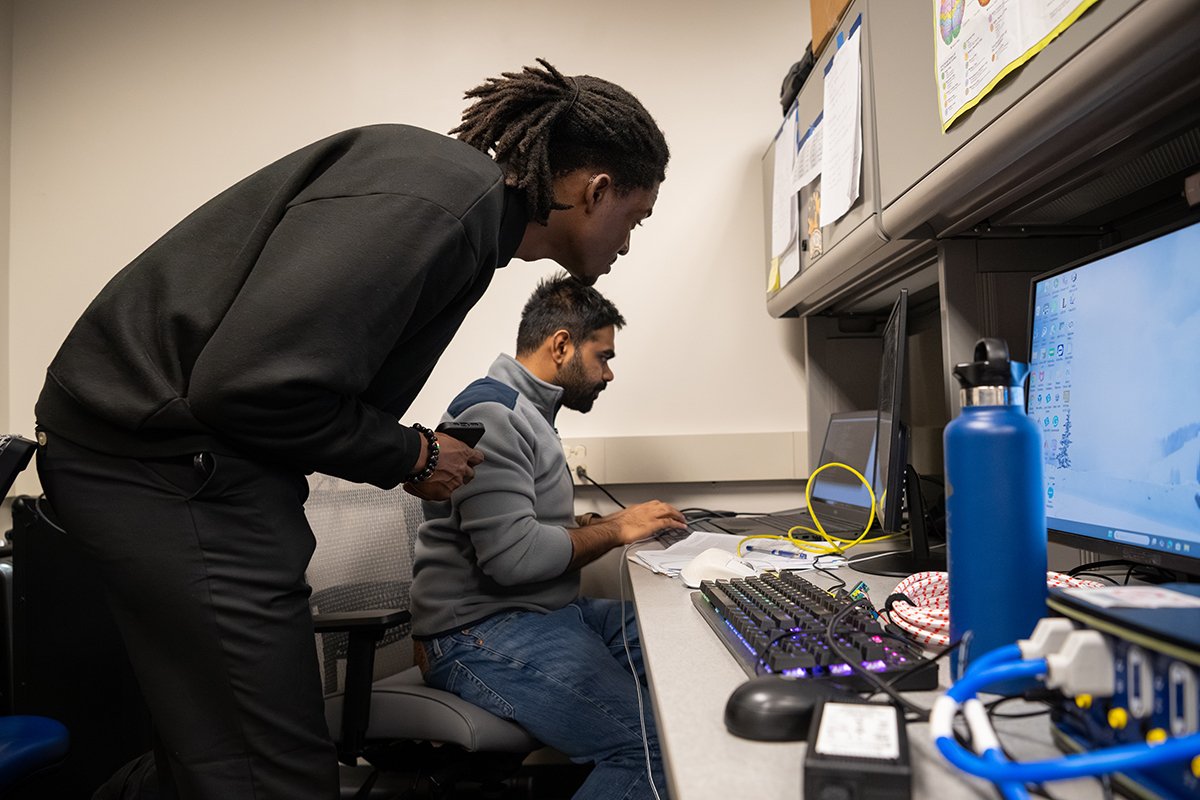
Chris Dollo (left), a senior computer science major and undergraduate researcher in the Vinjamuri lab, and Parthan Olikkal (right) work at the computer. Olikkal brought the concept of capturing hand movements using simple camera set-ups into the lab, a key step toward making cost-effective technologies.
Dance-Derived Alphabets of Movement

Ashwathi Menon demonstrates mudras, which are copied by an Inspire robotic hand. From top to bottom the mudras are: Ardhachandra, meaning “half moon;” Chandrakala, meaning “crescent moon;” and Tripataka, meaning “three parts of the flag.” The mudras can demonstrate various elements of a story, including weapons, trees, flowers, or concepts such as balance, unity, and beauty.
Using the same techniques they had deployed to deconstruct the 30 natural hand grasps, the research team also analyzed 30 single-hand mudras. They found six synergies that could account for around 94 percent of the mudras’ variations.
Crucially, the team then tested how well the six natural grasp-derived synergies could combine to construct unrelated hand motions—in this case 15 letters of the American Sign Language alphabet—compared to the mudras-derived synergies. The mudras synergies significantly outperformed the natural hand grasp synergies on that task.
“When we started this type of research more than 15 years ago, we wondered: Can we find a golden alphabet that can be used to reconstruct anything?” says Vinjamuri. “Now I highly doubt that there is such a thing. But the mudras-derived alphabet is definitely better than the natural grasp alphabet because there is more dexterity and more flexibility.”
Ultimately, Vinjamuri envisions coming up with libraries of task-specific alphabets that can be deployed depending on the needs, be it completing everyday household chores such as cooking or folding laundry, or something more complicated and precise, such as playing an instrument.
Robotic Helping Hands
Apart from advancing understanding of the fundamental roots of movement, the team has made great strides developing cost-effective and pragmatic methods of testing and implementing their ideas. When Vinjamuri first started the work, his team relied on motion-capture systems that required specialized gloves and other equipment. Now, the team uses a simple camera and software system to recognize, record, and analyze movements.
“Parthan brought the concept of capturing hand movements using cameras into the lab and really developed it,” Vinjamuri said. It’s an important contribution to ultimately making cost-effective technologies that people could use in their homes, he says, such as a virtual system to coach people through physical therapy sessions.
The team is also successfully developing techniques to “teach” robotic hands the alphabets of movements and how to combine them to make new hand gestures. The approach marks a departure from standard techniques of teaching robots to mimic hand gestures, and toward a method rooted in our understanding of how the human body and brain work.

Ashwathi Menon, left, demonstrates the Katakamukha mudra while a robotic hand mimics her gesture. The mudra is often used to represent actions like plucking flowers, holding a necklace, and pulling a bowstring.
“It’s called biomimetic learning,” says Vinjamuri. “We want to watch how a human body moves, how a hand moves and works, and we want to derive those principles and apply them to machines.”
The researchers are testing the techniques on a stand-alone robotic hand and a humanoid robot, each of which operates in a different way and requires a unique approach to translating the mathematical representations of synergies into physical movements.
“Once I learned about synergies, I became so curious to see if we could use them to make a robotic hand respond and perform the same way as a human hand,” says Olikkal. “Adding my own work to the research efforts and seeing the results has been gratifying.”
These moments of satisfaction in finding solutions to knotty problems will continue to propel the team’s voyage of discovery. They may even take a moment to celebrate their successes—perhaps with a fitting high-five.

Could A Dancing Robot Improve Humans’ Mental Health?
By Catherine Meyers • Photography by Kiirstn Pagan ’11
Searching for an alphabet of hand movements from the gestures in classical Indian dance is not the only way that art is inspiring and guiding new research in Ramana Vinjamuri’s lab. In a related project, Vinjamuri has teamed up with Andrea Kleinsmith, an associate professor in information systems who specializes in ways that computers can assess humans’ emotions, and Ann Sofie Clemmensen, an associate professor of dance, to explore whether and how dancing robots might offer humans new tools to improve their mental health. The research piggybacks off established practices of human-to-human dance/movement therapy, which can be used to treat some mental health challenges, such as schizophrenia, anxiety, and depression.
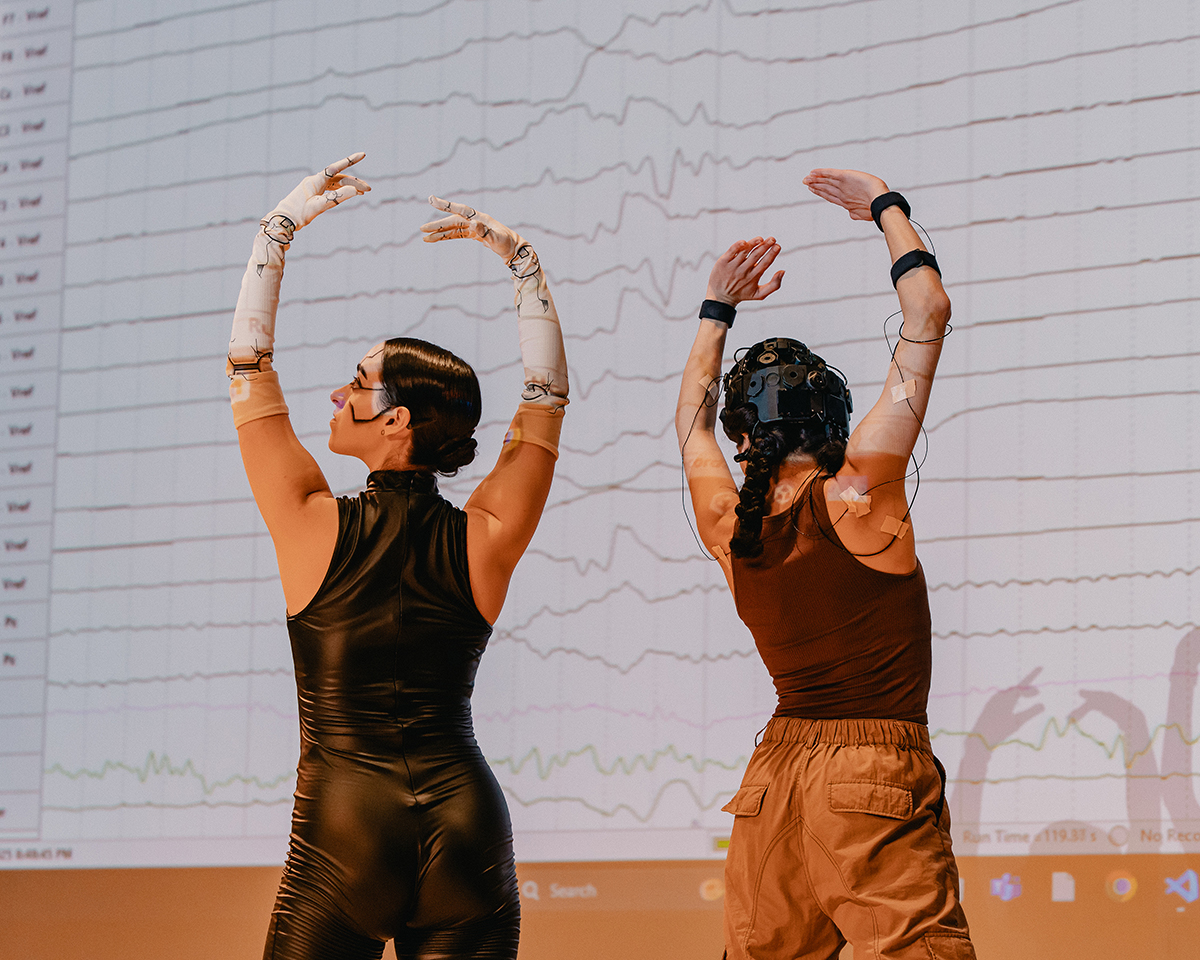
Dancers Sarah McHale ’24 and Juju Ayoub ’25 perform during the AccelNet meeting. The dance was a demonstration of a collaborative research project by UMBC faculty Ramana Vinjamuri, Andrea Kleinsmith, and Ann Sofie Clemmensen exploring stress reducing technology.
The spark for the interdisciplinary venture was struck when the College of Engineering and Information Technology launched a program to encourage faculty to explore collaborations across disciplines to tackle big challenges.
Together, Vinjamuri, Kleinsmith and Clemmensen developed a proposal to investigate questions such as whether the coordination in a person’s arms and legs could be a proxy measure of mental well-being, how existing dance therapy movements affect brain activity, and how a humanoid robot dance partner compares in effectiveness to a flesh-and-blood one.
“As a healthcare opportunity, dancing with a robot may sound weird at first,” notes Clemmensen. But, she says, people who are socially isolated or struggle with the stressors of human interactions might benefit from robot partners. “As humans, we project emotions on objects, but the objects do not judge back.”
In June, the team creatively demonstrated their progress to brain researchers and artists from around the world when they choreographed a technology-infused dance performance for the Movement, Music, and Brain Health National Science Foundation AccelNet meeting on the UMBC campus.
Two dancers—one representing a robot and the other a human—took turns moving around each other. Sensors monitored physiological signs of stress on the human dancer. As the dance progressed, the human was at first fearful, then curious, and finally happy—an ending the researchers hope their own project might one day also accomplish.
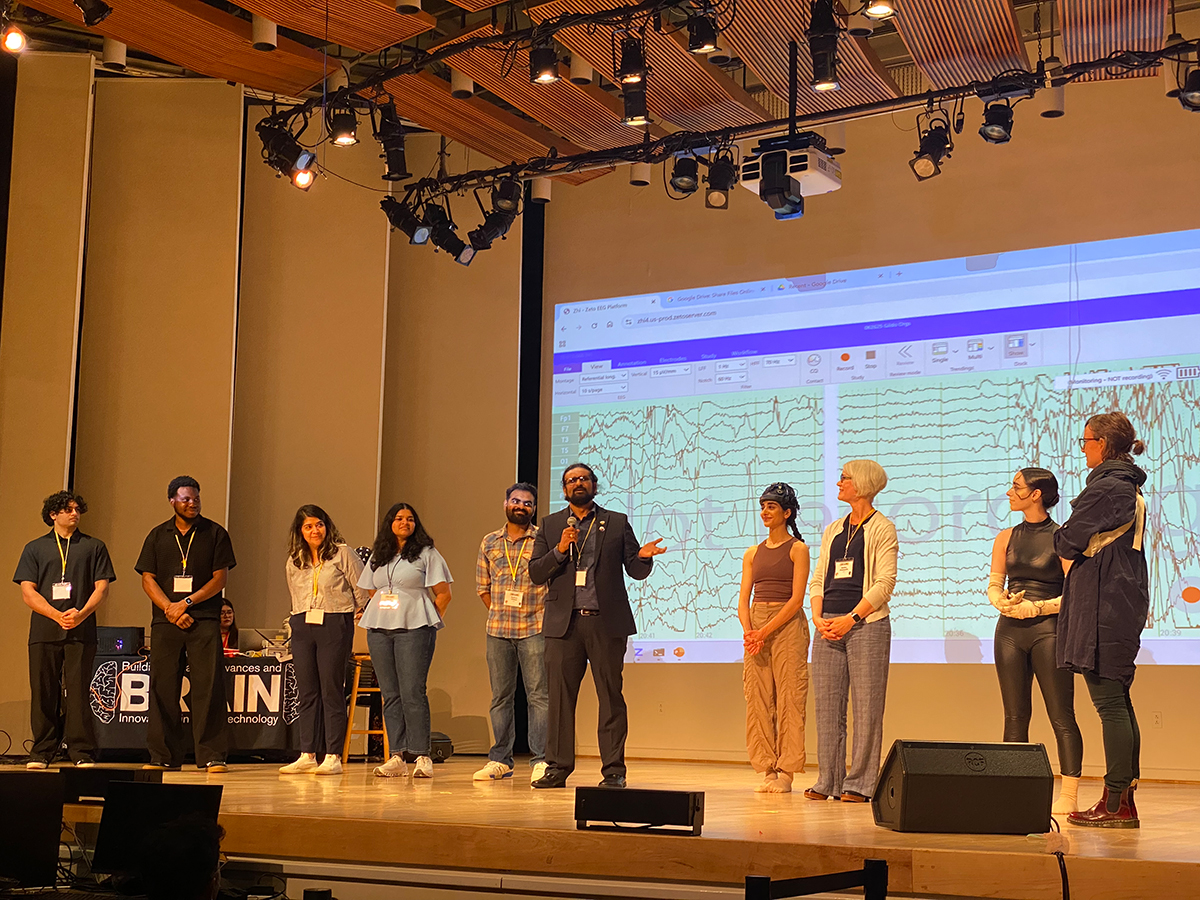
UMBC students and professors who worked on the project gather on the stage after the dance performance. From left to right are Viraj Janeja, Oritsejolomisan Mebaghanje, Golnaz Moharrer, Sruthi Sundharram, Parthan Olikkal, Ramana Vinjamuri, Juju Ayoub, Andrea Kleinsmith, Sarah McHale, and Ann Sofie Clemmensen.
Photo Credit: Niloufar Sarmast
 ]]>
UMBC researchers are discovering building blocks of hand motions, aiming to improve physical therapy for humans and find better ways to program robots. They’re turning to a novel source material...
https://umbc.edu/stories/strange-dance-partners/
https://my3.my.umbc.edu/api/v0/pixel/news/155312/guest@my.umbc.edu/f9ed6ebca522ae4dc141aea381fb8838/api/pixel
cahss
cnms
coeit
csee
dance
discovery
fall-2025
feature
magazine
research
story
UMBC News & Magazine
https://my3.my.umbc.edu/groups/umbc-news-magazine
https://assets1-my.umbc.edu/system/shared/avatars/groups/000/001/943/24435aa6207c452e7bc15cc74b42c7bb/xsmall.png?1748556657
https://assets1-my.umbc.edu/system/shared/avatars/groups/000/001/943/24435aa6207c452e7bc15cc74b42c7bb/original.png?1748556657
https://assets2-my.umbc.edu/system/shared/avatars/groups/000/001/943/24435aa6207c452e7bc15cc74b42c7bb/xxlarge.png?1748556657
https://assets2-my.umbc.edu/system/shared/avatars/groups/000/001/943/24435aa6207c452e7bc15cc74b42c7bb/xlarge.png?1748556657
https://assets3-my.umbc.edu/system/shared/avatars/groups/000/001/943/24435aa6207c452e7bc15cc74b42c7bb/large.png?1748556657
https://assets1-my.umbc.edu/system/shared/avatars/groups/000/001/943/24435aa6207c452e7bc15cc74b42c7bb/medium.png?1748556657
https://assets2-my.umbc.edu/system/shared/avatars/groups/000/001/943/24435aa6207c452e7bc15cc74b42c7bb/small.png?1748556657
https://assets1-my.umbc.edu/system/shared/avatars/groups/000/001/943/24435aa6207c452e7bc15cc74b42c7bb/xsmall.png?1748556657
https://assets2-my.umbc.edu/system/shared/avatars/groups/000/001/943/24435aa6207c452e7bc15cc74b42c7bb/xxsmall.png?1748556657
UMBC News & Magazine
0
0
false
Fri, 05 Dec 2025 16:55:00 -0500
Mon, 15 Dec 2025 12:55:36 -0500
Simple wood makes advanced sensors
]]>
UMBC researchers are discovering building blocks of hand motions, aiming to improve physical therapy for humans and find better ways to program robots. They’re turning to a novel source material...
https://umbc.edu/stories/strange-dance-partners/
https://my3.my.umbc.edu/api/v0/pixel/news/155312/guest@my.umbc.edu/f9ed6ebca522ae4dc141aea381fb8838/api/pixel
cahss
cnms
coeit
csee
dance
discovery
fall-2025
feature
magazine
research
story
UMBC News & Magazine
https://my3.my.umbc.edu/groups/umbc-news-magazine
https://assets1-my.umbc.edu/system/shared/avatars/groups/000/001/943/24435aa6207c452e7bc15cc74b42c7bb/xsmall.png?1748556657
https://assets1-my.umbc.edu/system/shared/avatars/groups/000/001/943/24435aa6207c452e7bc15cc74b42c7bb/original.png?1748556657
https://assets2-my.umbc.edu/system/shared/avatars/groups/000/001/943/24435aa6207c452e7bc15cc74b42c7bb/xxlarge.png?1748556657
https://assets2-my.umbc.edu/system/shared/avatars/groups/000/001/943/24435aa6207c452e7bc15cc74b42c7bb/xlarge.png?1748556657
https://assets3-my.umbc.edu/system/shared/avatars/groups/000/001/943/24435aa6207c452e7bc15cc74b42c7bb/large.png?1748556657
https://assets1-my.umbc.edu/system/shared/avatars/groups/000/001/943/24435aa6207c452e7bc15cc74b42c7bb/medium.png?1748556657
https://assets2-my.umbc.edu/system/shared/avatars/groups/000/001/943/24435aa6207c452e7bc15cc74b42c7bb/small.png?1748556657
https://assets1-my.umbc.edu/system/shared/avatars/groups/000/001/943/24435aa6207c452e7bc15cc74b42c7bb/xsmall.png?1748556657
https://assets2-my.umbc.edu/system/shared/avatars/groups/000/001/943/24435aa6207c452e7bc15cc74b42c7bb/xxsmall.png?1748556657
UMBC News & Magazine
0
0
false
Fri, 05 Dec 2025 16:55:00 -0500
Mon, 15 Dec 2025 12:55:36 -0500
Simple wood makes advanced sensors
Picture the most advanced technology and certain qualities probably spring to mind: maybe metallic and sleek, with glowing lights and big digital screens.
The researchers at the Center for Advanced Sensor Technology (CAST) at UMBC, however, have a different adjective they aim for when designing tech: dirt cheap.
For these scientists and engineers, inexpensive doesn’t mean low-quality—it means challenging traditional ways of thinking to produce affordable and reliable products that meet vital needs. Toward this end, a CAST research team recently debuted a new environmental sensor made out of simple balsa wood sheets—the kind you could buy at a craft store for a few dollars. The wood was cut and assembled to make a central well to hold samples and channels for the electrochemical components of the sensor to be inserted. The researchers coated the wood to make it waterproof and stuck it together with wood glue.
Inexpensive and sustainable
 A schematic shows the layers of the wood sensor, with openings for the three electrodes and a microwell. (Image courtesy of Kadolkar)
Choosing wood served two purposes: making the sensor low-cost and also environmentally friendly.
“Sustainability was very important to us,” says Revati Kadolkar, a Ph.D. student in chemical engineering who is working on the project. Kadolkar is advised by professors Govind Rao, who directs CAST, and Douglas Frey in the department of chemical, biochemical, and environmental engineering (CBEE). “Using wood instead of plastic for the structural skeleton of the sensor was a key step toward that sustainability,” she says.
In collaboration with another UMBC team from the Center for Urban Environmental Research and Education led by CBEE professor Claire Welty, the CAST team tested the sensor in the field by measuring nitrate levels in streams in the Gwynns Falls watershed near Baltimore. Nitrate is a pollutant, often linked to agricultural activities, that can cause gut cancer, birth defects and a condition called methemoglobinemia, also known as the blue baby syndrome. Its concentration in tap water in the U.S. is regulated by the Safe Drinking Water Act. The accuracy of the sensor’s readings was on par with traditional equipment that cost hundreds of times more money, the researchers say.
Testing in the lab, the team also found the sensor worked well across a range of conditions, including wide variations in temperature and pH levels, and continued to operate well for more than a year.
A more comprehensive view of the world
Driving down the cost of technology should drive up its impact. Cheaper sensors could be deployed in higher numbers, yielding a more comprehensive view of the world and spotting potential problems earlier.
 Kadolkar shows a sensor the team tested in the field by measuring nitrate levels in Baltimore-area streams. (Photo courtesy of Kadolkar)
“Let’s say you want to map the whole Chesapeake Bay and know every hour if there is contamination and how it is traveling down the bay,” says Venkatesh Srinivasan, a research associate professor at CAST who also worked on the project. “You can get these details more easily if you have lower-cost sensors.”
Spreading the benefits of science and technology to resource-limited communities has been a driving force behind CAST research for decades. The team has also developed low-cost infant incubators and a suitcase-sized device to make medicine on-demand.
For now, the sensor operates by analyzing droplets of water added to its central well. Going forward, the team would like to create a sensor that could be submerged in the water and report continuous measurements.
They are already working with the Maryland company NanoForge Systems to commercialize the new nitrate sensor.
“Translating science into innovative products that can help people is what really excites me about this work,” Kadolkar says.
]]>
Picture the most advanced technology and certain qualities probably spring to mind: maybe metallic and sleek, with glowing lights and big digital screens. The researchers at the Center for...
https://umbc.edu/stories/simple-wood-makes-advanced-sensors/
https://my3.my.umbc.edu/api/v0/pixel/news/154263/guest@my.umbc.edu/35593d39c3d8fae21e9187e25db7d671/api/pixel
cast
cbee
coeit
discovery
fall-2025
magazine
research
story
UMBC News & Magazine
https://my3.my.umbc.edu/groups/umbc-news-magazine
https://assets1-my.umbc.edu/system/shared/avatars/groups/000/001/943/24435aa6207c452e7bc15cc74b42c7bb/xsmall.png?1748556657
https://assets1-my.umbc.edu/system/shared/avatars/groups/000/001/943/24435aa6207c452e7bc15cc74b42c7bb/original.png?1748556657
https://assets2-my.umbc.edu/system/shared/avatars/groups/000/001/943/24435aa6207c452e7bc15cc74b42c7bb/xxlarge.png?1748556657
https://assets2-my.umbc.edu/system/shared/avatars/groups/000/001/943/24435aa6207c452e7bc15cc74b42c7bb/xlarge.png?1748556657
https://assets3-my.umbc.edu/system/shared/avatars/groups/000/001/943/24435aa6207c452e7bc15cc74b42c7bb/large.png?1748556657
https://assets1-my.umbc.edu/system/shared/avatars/groups/000/001/943/24435aa6207c452e7bc15cc74b42c7bb/medium.png?1748556657
https://assets2-my.umbc.edu/system/shared/avatars/groups/000/001/943/24435aa6207c452e7bc15cc74b42c7bb/small.png?1748556657
https://assets1-my.umbc.edu/system/shared/avatars/groups/000/001/943/24435aa6207c452e7bc15cc74b42c7bb/xsmall.png?1748556657
https://assets2-my.umbc.edu/system/shared/avatars/groups/000/001/943/24435aa6207c452e7bc15cc74b42c7bb/xxsmall.png?1748556657
UMBC News & Magazine
0
0
false
Wed, 05 Nov 2025 13:32:05 -0500
Federal shutdown deals blow to already hobbled cybersecurity agency
Written by Richard Forno, teaching professor in computer science and electrical engineering, UMBC
As the United States experiences its latest government shutdown, most of the daily operations of the federal government have ground to a halt. This includes much of the day-to-day work done by federal information technology and cybersecurity employees, including those at the nation’s leading civilian cybersecurity agency, the Cybersecurity and Infrastructure Security Agency.
CISA is among the entities that will see the deepest staffing reductions during the shutdown that began Oct. 1, 2025, according to Department of Homeland Security documentation. Only about one-third of its employees remain on the job after federal employees were furloughed. As if cybersecurity wasn’t challenging enough, fewer CISA employees are being asked to do more and more work protecting American cyberspace during the shutdown. And they’ll be working with the promise of getting paid for their efforts at some date in the future once the shutdown ends.
The current CISA situation is grim, from my vantage point as a cybersecurity researcher and former industry practitioner. The agency was already experiencing deep cuts to its staff and resources before the shutdown. And now, coinciding with the shutdown, a key law that enabled the agency to facilitate information-sharing with the private sector has expired.
Taken together, the cyberdefense agency is being hobbled at a time when the need for its services has never been greater, from the ongoing China-led Salt Typhoon attack on U.S. telecommunications networks to ransomware, data breaches and threats to infrastructure.
CISA was created in 2007 within the Department of Homeland Security. As its name implies, the agency is charged with digital security matters across the federal government. The agency also works with the companies that operate and secure the numerous critical infrastructure sectors of the American economy, such as phone networks, the electric grid and energy pipelines. Additionally, it helps state and local governments across the country secure their vulnerable networks and data.
CISA also publishes threat and vulnerability alerts for the government and cybersecurity community and engages with public and private stakeholders on best practices in response to emerging vulnerabilities. Prior to the recent expiration of the 2015 Cybersecurity Information Sharing Act, the agency also made it easier for organizations to share useful information with the government to help cybersecurity teams better protect their systems.
Shutdown-mandated furloughs at the nation’s cybersecurity agency present an opportunity for malicious hackers.
Political football
The agency takes a nonpartisan approach to cybersecurity matters. However, some politicians have accused the agency of political bias for its work helping states protect their voting infrastructure from cyberattacks and external influence. Specifically, the agency was repeatedly maligned for calling the 2020 election the “most secure” in history. For some in elected office, this work on election security has tarnished CISA’s reputation and perhaps explains recent budgetary actions taken against the agency.
Since the Trump administration took office in January 2025, nearly 1,000 CISA employees have departed the agency through voluntary buyouts or deferred resignations. By the end of May 2025, nearly all of CISA’s senior leadership had resigned or had announced plans to do so.
For 2026, the president’s draft budget proposes to reduce CISA’s head count by nearly one-third, dramatically cutting staff from its risk management and stakeholder engagement divisions. Other cuts will significantly reduce the agency’s collaboration activities and funding for CISA’s various cybersecurity education and training programs.
Making the problem worse, the government shutdown began at the same time that Congress failed to renew the Cybersecurity Information Sharing Act. This law provided a legal shield that allowed companies and infrastructure operators to share timely and often sensitive information with CISA about the cyberattacks, vulnerabilities and incidents that they were encountering.
In the wake of the law’s expiration, prudent companies may consider restricting what information they share with the government. Without the indemnification provided by CISA, many companies will likely have their legal teams review any information to be shared with the government. And that takes time.
Unfortunately, adversaries do not reduce their attacks against the U.S. based on available federal cyber defense funding or the status of cybersecurity laws. In fact, malicious hackers often strike when their target’s guard is down.
Charting a better course
Early in my career I had to work through a prolonged government shutdown. I’ve also participated in and developed assorted public-private information-sharing environments to exchange intelligence and analysis on cyber- and national security matters. And having been in the D.C. area for over 30 years, I’ve seen how government works. So I have a good idea of what’s needed to improve American cybersecurity. The following suggestions are a starting point.
First, Congress could ensure that critical security agencies such as CISA are immune from the threat of recurring federal government shutdowns. If it desired, Congress could set budgets for America’s security agencies on a biennial basis – as 16 states already do for their entire budgets.
In terms of cybersecurity funding, the White House’s proposed 2026 budget reduces research and education on cybersecurity. For example, the nation’s premiere federal cybersecurity scholarship program to recruit, educate and place future federal cybersecurity workers would be reduced by over 60%. Protecting this funding would allow CISA and the federal government to maintain the pipeline for a robust and capable cybersecurity workforce both today and into the future.
Companies could develop new or expand existing nongovernmental information-sharing networks that are not completely dependent on the government to facilitate or fund, such as the Cyber Threat Alliance or the Center for Internet Security. Cybersecurity relies on trust. But right now, the instability of the federal government makes it difficult to rely on any entity under its policy or funding influence, no matter how well time-tested and trusted. Regardless, without legal protections, the information-sharing utility of these services will be limited.
Cybersecurity risks remain even if the federal government shuts down. So this is another reminder that each of us is responsible for our own cybersecurity. Individual users should continue to remain vigilant, follow accepted best practices for cybersecurity and always be mindful about online risks.
It’s ironic that the federal government is shutting down, CISA is being eviscerated and the Cybersecurity Information Sharing Act has expired just as the country begins to observe national Cybersecurity Awareness Month – another collaborative public engagement activity that CISA promotes to help improve cybersecurity for all Americans.
This article is republished from The Conversation under a Creative Commons license. Read the original article and see more than 300 UMBC articles available in The Conversation.
]]>
Written by Richard Forno, teaching professor in computer science and electrical engineering, UMBC As the United States experiences its latest government shutdown, most of the daily operations...
https://umbc.edu/stories/federal-shutdown-deals-blow-to-already-hobbled-cybersecurity-agency/
https://my3.my.umbc.edu/api/v0/pixel/news/153358/guest@my.umbc.edu/ed7329c1a3292da8fe845ffaf7b381d6/api/pixel
coeit
csee
discovery
magazine
story
the-conversation
UMBC News & Magazine
https://my3.my.umbc.edu/groups/umbc-news-magazine
https://assets1-my.umbc.edu/system/shared/avatars/groups/000/001/943/24435aa6207c452e7bc15cc74b42c7bb/xsmall.png?1748556657
https://assets1-my.umbc.edu/system/shared/avatars/groups/000/001/943/24435aa6207c452e7bc15cc74b42c7bb/original.png?1748556657
https://assets2-my.umbc.edu/system/shared/avatars/groups/000/001/943/24435aa6207c452e7bc15cc74b42c7bb/xxlarge.png?1748556657
https://assets2-my.umbc.edu/system/shared/avatars/groups/000/001/943/24435aa6207c452e7bc15cc74b42c7bb/xlarge.png?1748556657
https://assets3-my.umbc.edu/system/shared/avatars/groups/000/001/943/24435aa6207c452e7bc15cc74b42c7bb/large.png?1748556657
https://assets1-my.umbc.edu/system/shared/avatars/groups/000/001/943/24435aa6207c452e7bc15cc74b42c7bb/medium.png?1748556657
https://assets2-my.umbc.edu/system/shared/avatars/groups/000/001/943/24435aa6207c452e7bc15cc74b42c7bb/small.png?1748556657
https://assets1-my.umbc.edu/system/shared/avatars/groups/000/001/943/24435aa6207c452e7bc15cc74b42c7bb/xsmall.png?1748556657
https://assets2-my.umbc.edu/system/shared/avatars/groups/000/001/943/24435aa6207c452e7bc15cc74b42c7bb/xxsmall.png?1748556657
UMBC News & Magazine
0
0
false
Tue, 07 Oct 2025 16:11:49 -0400
Tue, 07 Oct 2025 16:11:49 -0400
A new world order isn’t coming, it’s already here − and this is what it looks like
Written by John Rennie Short, professor emeritus of public policy, UMBC
On Sept. 3, 2025, China celebrated the 80th anniversary of its victory over Japan by staging a carefully choreographed event in which 26 world leaders were offered a podium view of Beijing’s impressive military might.
The show of strength was deliberate and reignited a debate in Western media over whether we are on the cusp of a China-centric “new world order” to replace the U.S.-dominated international “rules-based order.”
But as someone who writes about geopolitics, I believe we are already there. It might be in flux, and the U.S. still has a big role in it, but a new world order has begun – and as it develops, it will look increasingly different than what it’s replacing.
A brief history of world orders
Global history can be understood as the rise and fall of different orders, defined as a given era’s dominant power relations and attendant institutions and norms.
From 1815 to 1880, the United Kingdom was the undisputed world superpower, with an empire and navy that spanned the globe. The period from 1880 to 1945 was one of imperial rivalries as other countries – largely European and the U.S. – sought to copy Britain’s success and replace its dominance. Supplanting that was the bipolar world of two competing superpowers, the Soviet Union and the U.S., marking the period from 1945 to 1991.
The fall of the Soviet Union was the beginning of a brief period, from 1991 to 2008, of a unipolar world centered on U.S. global dominance, military power and economic might. With the retreat of global communism, the U.S. increased its influence, and that of the international rules-based order it helped establish after 1945, through institutions such as the World Trade Organization, World Bank and International Monetary Fund.
 The tearing down of the Berlin Wall marked the end of the Cold War. Colin Campbell/Getty Images
It did not last long in the face of a long war on terrorism, the fiasco of the invasion of Iraq, the long occupation of Afghanistan and finally the 2008 global financial crisis that undermined U.S. strength and weakened domestic support for Washington’s role as the world’s policeman.
Toward a multipolar world
In recent years, a new multipolar world has emerged with at least four distinct sources of power.
The U.S. remains central to this world order. It is blessed with a huge territory, a dynamic economy and the strategic luxury of large oceans on its east and west and much smaller powers to its north and south. The U.S. had a global military presence in the previous bipolar and unipolar order. But the cost of this imperial overstretch has prompted Washington to shift the cost burden toward its former allies, leading to a new militarization in Europe and East Asia where most countries now aim to increase military spending.
There is also a change in economic arrangements. In the unipolar order, the U.S. promoted a frictionless free trade arrangement and economic globalization. This resulted in the global shift of manufacturing that in turn created a populist backlash in those countries where manufacturing employment was hollowed out.
Now, economic nationalism is becoming a much more common refrain than free trade. Long the promoter of purportedly open markets, the U.S. is now leading the way in resurrecting tariff barriers to levels that haven’t been seen on the global stage in decades.
The military realignments and growing trade barriers will make it increasingly difficult to assemble durable alliances. In the short term the U.S. can leverage its existing power to its advantage, but over the long term other countries will likely pivot away from too much reliance on the U.S. The American Century that publishing magnate Henry Luce famously described in 1941 has to all intents and purposes come to an end.
China is now a peer competitor to the U.S. in both economic and military power. Increasingly, under the powerful leadership of Xi Jinping, China openly seeks a more Sino-centric world order with institutions and a global arrangement to match. To that end, it is assembling an axis of resistance to a U.S.-dominated world order. Russia, suffering from post-imperial syndrome, is an important member but not an equal partner.
Russian power is limited to establishing a Eurasian sphere of influence across its former Soviet republics and disrupting liberal democracies. But in that, Russia is more of a spoiler than an architect of the new order.
And then there is Europe, facing what British Prime Minister Keir Starmer referred to as a “generational challenge” as the U.S. pivots away from Europe toward the Indo-Pacific just as Russia poses a more serious threat to Europe, especially for its easternmost states.
Europe is remilitarizing after decades of demilitarizing. Sweden and Finland joined NATO in 2023 and 2024, respectively. In the coming decades, Europe could emerge as an independent source of both economic and military power with a different agenda from the U.S. – more keen to confront Russia, less willing to support Israel, and perhaps more willing to engage with China.
But all three power centers – the U.S., China and Europe – will struggle with similar and unique internal challenges.
All of them have sluggish economies and aging populations. The U.S. faces growing inequality and political instability as it shifts from a liberal democracy to competitive authoritarianism. China has an untested military, a looming demographic crisis, a faltering economy and a forthcoming succession struggle.
Finally, Europe is beset with a nationalist populism and growing social welfare costs just as military expenditures are set to increase.
The growth of the Global South
This threefold division is strangely reminiscent of the tripartite global division in George Orwell’s “1984,” where Oceania, Eurasia and Eastasia fought a permanent war of shifting alliances.
But Orwell was writing at a time when much of what is now called the Global South was either under the informal or formal control of the superpowers. That is no longer the case in the Global South, especially in the case of the larger countries such as Brazil, India and Indonesia.
The Global South is not yet a coherent bloc, more an informal arrangement of independent actors that tend to hedge between the major powers.
A world in flux
Yet none of this new global reality means that things are now fixed. Indeed, the new world order is in a state of disruptive flux that promises years of growing pains. Both the U.S. and China need allies, and countries in the Global South will continue to hedge between the competing powers.
 It doesn’t have to end this way. Dan Kitwood/Getty Images
As such, the world is in for a process of constant jostling as the major powers seek alliances while dealing with domestic pressures. In that messy status quo, many questions remain: Who will be most effective in building durable alliances? Will China manage its internal challenges? Will Europe get its act together? Will Russia continue its disruptive ways? Could a post-Trump U.S., post-Putin Russia and post-Xi China move the world in yet a different direction altogether?
And there is one large question above all others: Can the major powers manage their competition through shared global interests, such as combating climate change, environmental pollution and pandemic threats? Or will mounting conflict in the newly contested areas of the Arctic, cyberspace, outer space and the oceanic realm, and in ongoing geopolitical hot spots provide the trigger for outright conflict?
All world orders come to an end. The hope is the old one is doing so with a whimper rather than a bang.
John Rennie Short, Professor Emeritus of Public Policy, University of Maryland, Baltimore County
This article is republished from The Conversation under a Creative Commons license. Read the original article and see more than 300 UMBC articles available in The Conversation.
]]>
Written by John Rennie Short, professor emeritus of public policy, UMBC On Sept. 3, 2025, China celebrated the 80th anniversary of its victory over Japan by staging a carefully choreographed...
https://umbc.edu/stories/a-new-world-order-is-already-here-john-short/
https://my3.my.umbc.edu/api/v0/pixel/news/152527/guest@my.umbc.edu/0219ee54cd5c5294b0b91cf59e8545c1/api/pixel
cahss
conversation
discovery
magazine
publicpolicy
research
story
UMBC News & Magazine
https://my3.my.umbc.edu/groups/umbc-news-magazine
https://assets1-my.umbc.edu/system/shared/avatars/groups/000/001/943/24435aa6207c452e7bc15cc74b42c7bb/xsmall.png?1748556657
https://assets1-my.umbc.edu/system/shared/avatars/groups/000/001/943/24435aa6207c452e7bc15cc74b42c7bb/original.png?1748556657
https://assets2-my.umbc.edu/system/shared/avatars/groups/000/001/943/24435aa6207c452e7bc15cc74b42c7bb/xxlarge.png?1748556657
https://assets2-my.umbc.edu/system/shared/avatars/groups/000/001/943/24435aa6207c452e7bc15cc74b42c7bb/xlarge.png?1748556657
https://assets3-my.umbc.edu/system/shared/avatars/groups/000/001/943/24435aa6207c452e7bc15cc74b42c7bb/large.png?1748556657
https://assets1-my.umbc.edu/system/shared/avatars/groups/000/001/943/24435aa6207c452e7bc15cc74b42c7bb/medium.png?1748556657
https://assets2-my.umbc.edu/system/shared/avatars/groups/000/001/943/24435aa6207c452e7bc15cc74b42c7bb/small.png?1748556657
https://assets1-my.umbc.edu/system/shared/avatars/groups/000/001/943/24435aa6207c452e7bc15cc74b42c7bb/xsmall.png?1748556657
https://assets2-my.umbc.edu/system/shared/avatars/groups/000/001/943/24435aa6207c452e7bc15cc74b42c7bb/xxsmall.png?1748556657
UMBC News & Magazine
1
0
false
Tue, 16 Sep 2025 12:25:25 -0400
Tue, 16 Sep 2025 12:25:25 -0400


