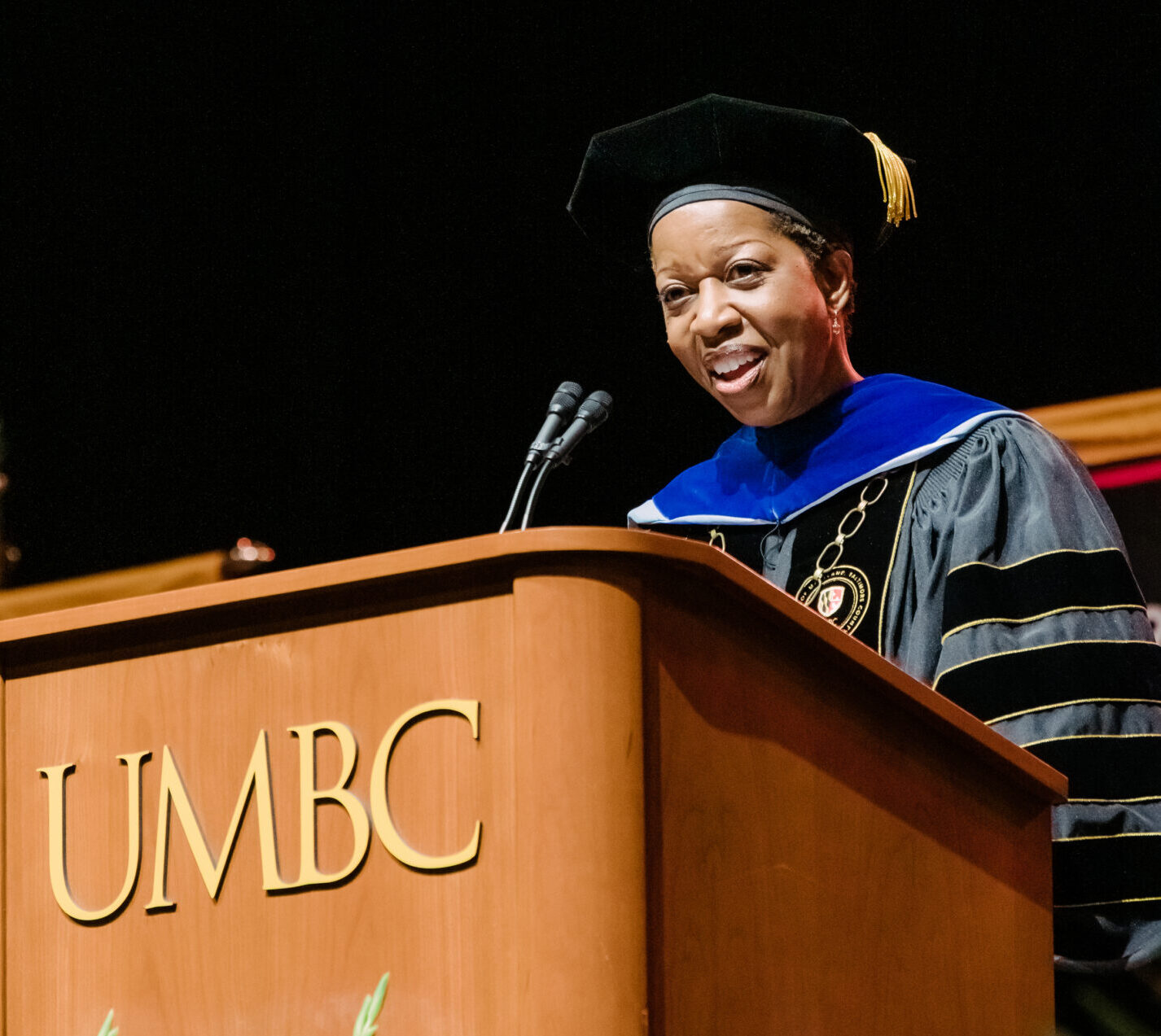
Pres. Sheares Ashby discusses importance of higher education, diversity, AI research, and more at iMPACT Maryland 2023

This week, UMBC President Valerie Sheares Ashby underscored the importance of higher education and how UMBC and the broader University System of Maryland (USM) are working to make education accessible for all at the inaugural iMPACT Maryland event.
“We know what education does to change families, generations, and economic prosperity in communities,” Sheares Ashby said during the event’s “Empowering Dreams: Advancing Education for All in Maryland” panel discussion. “We need to think about access and affordability. We need to work with our schools to think about what the pathways are for students who cannot even imagine this is for them or cannot imagine that they can afford [college].”
The day-long event, hosted by the Baltimore Banner at the Joseph Meyerhoff Symphony Hall, featured numerous discussions detailing the various challenges that are affecting Maryland residents and how industry leaders across many sectors are identifying opportunities for growth and innovation.
Sheares Ashby was joined by fellow panelists Kurt Schmoke, president of the University of Baltimore; Melanie Perreault, interim president of Towson University; David Wilson, president of Morgan State University; Sonja Brookins Santelises, chief executive officer of Baltimore City Schools; and Tierra Dorsey, president of the Central Scholarship Bureau. The discussion highlighted the obstacles students encounter at all levels and how Maryland’s education leaders are working to prepare students to thrive in and out of the classroom.
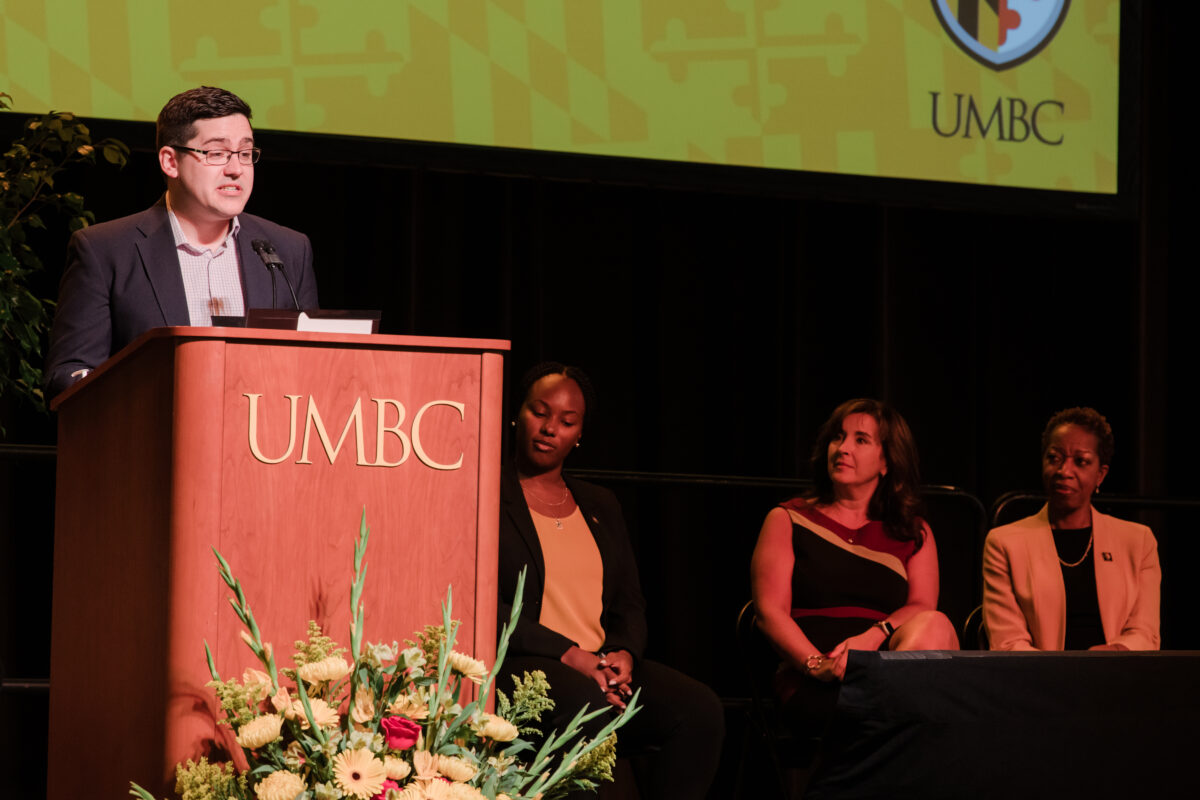
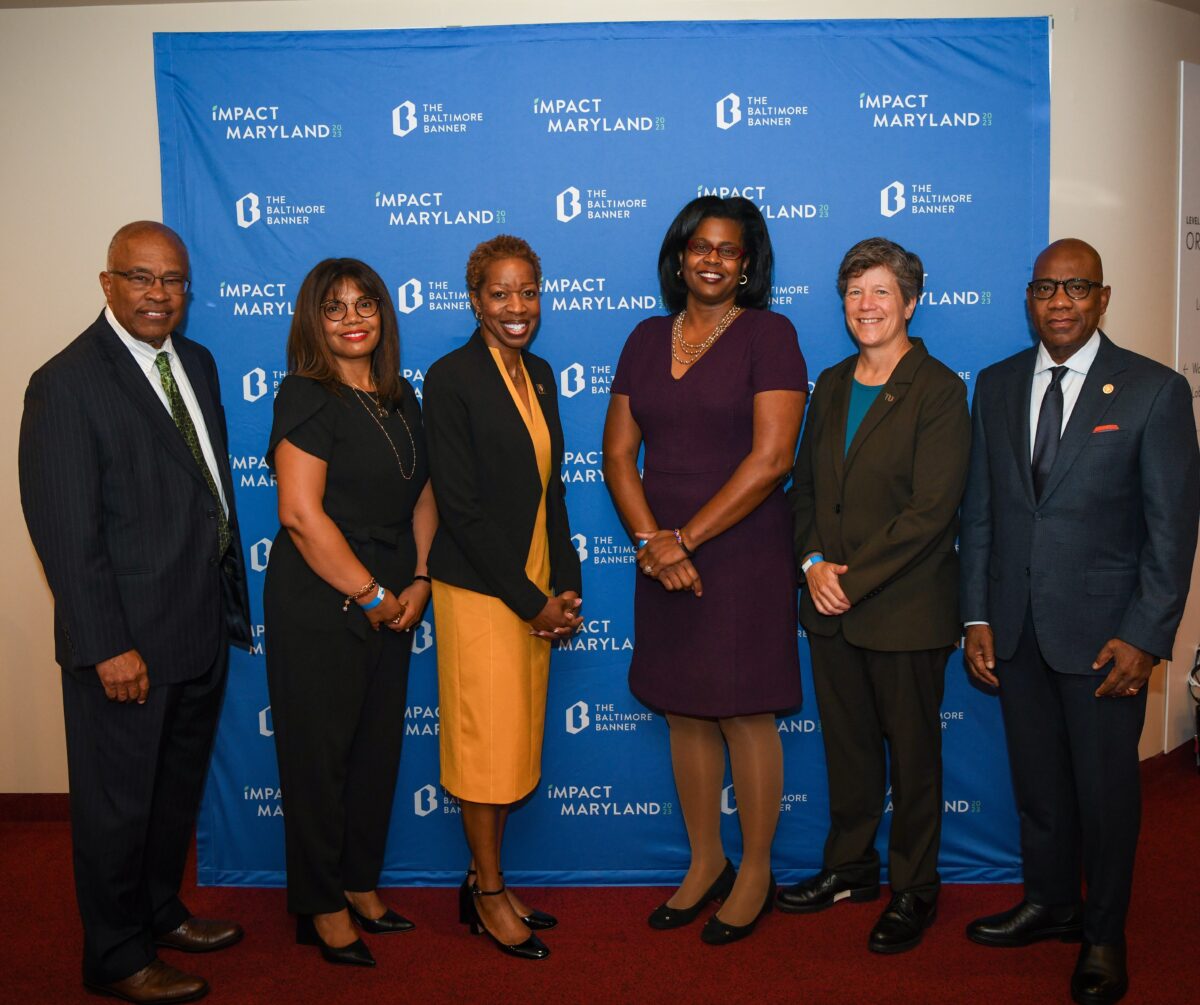 iMPACT Maryland 2023 “Empowering Dreams: Advancing Education for All in Maryland” panelists. From left to right: Kurt Schmoke, Tierra Dorsey, Valerie Sheares Ashby, Sonja Brookins Santelises, Melanie Perrault, and David Wilson. (Photo Courtesy of the Baltimore Banner)
“If you look at the mission statement for the USM, it uses words like equity, justice, and doing research and scholarship to improve lives. That’s the same vision and mission we have at UMBC,” Sheares Ashby said.
The event also included conversations with keynote speakers Governor Wes Moore and U.S. Secretary of Transportation Pete Buttigieg. Gov. Moore discussed the statewide initiatives his office is working to achieve. He made note of his investment into the Baltimore region, saying “in order for it to be Maryland’s decade, it’s got to be Baltimore’s time.”
Sec. Buttigieg spoke at length about the Biden Administration’s plans to reduce the impacts of climate change, which was temporarily interrupted by a protest organized by a local climate activist group.
Diversity concerns in higher education
When asked about the Supreme Court’s recent ruling that ended race-conscious admission programs at colleges and universities, Sheares Ashby shared that the “devastating decision” will not stop the ongoing work that UMBC is doing to create an environment of inclusive excellence for all students.
“UMBC has not had race-based admissions for decades, and we have an incredibly diverse student body. We have done that because we actually believe that excellence without diversity does not exist,” said Sheares Ashby. “We are trying to deliver a world-class education, and it is impossible to deliver a world-class education without different perspectives, different experiences, and being from different backgrounds. You cannot solve the world’s problems without a diverse group of people at the table.”
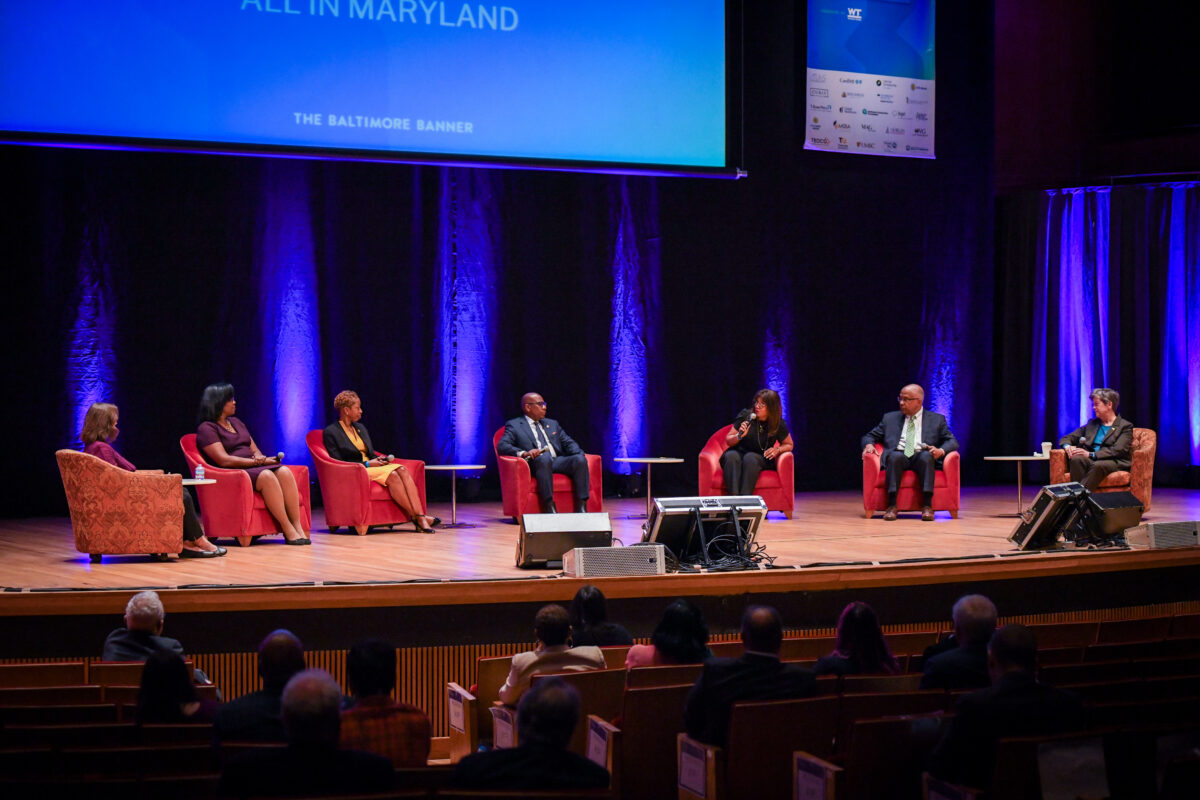 iMPACT Maryland 2023 “Empowering Dreams: Advancing Education for All in Maryland” panelists on stage at the Joseph Meyerhoff Symphony Hall on October 10, 2023. (Photo courtesy of the Baltimore Banner)
Advancing AI scholarship
iMPACT Maryland also included discussions with leaders in the Baltimore region working in areas such as healthcare, entertainment, youth gun violence prevention, and technology. Throughout several of the discussions, presenters and audience participants alike mentioned the rising worries associated with artificial intelligence (AI) technology.
Sheares Ashby highlighted the scholarship that’s being done at UMBC in helping to define the possibilities of AI and how it will be used across every sector.
“AI is scary…but the science is beautiful. At UMBC, we are taking a scholarly approach of getting in front of this and thinking about the unintended consequences. We have more students who want to study computing, information systems, and all those disciplines where AI and all of these new technologies are growing,” explains Sheares Ashby. “As scholars and researchers, we see this as pure opportunity, but we also see it as a responsibility to get in front of some of those unintended consequences.”
Read the Baltimore Banner’s key takeaways from iMPACT Maryland 2023 here.
]]>
This week, UMBC President Valerie Sheares Ashby underscored the importance of higher education and how UMBC and the broader University System of Maryland (USM) are working to make education...
https://umbc.edu/stories/sheares-ashby-speaks-at-impact-maryland-2023/
https://my3.my.umbc.edu/api/v0/pixel/news/136270/guest@my.umbc.edu/8daac99b8d9653f594c2b0a79e202b15/api/pixel
community
diversity
diversityandinclusion
news
policy-and-society
umbcpresident
UMBC News & Magazine
https://my3.my.umbc.edu/groups/umbc-news-magazine
https://assets1-my.umbc.edu/system/shared/avatars/groups/000/001/943/24435aa6207c452e7bc15cc74b42c7bb/xsmall.png?1748556657
https://assets1-my.umbc.edu/system/shared/avatars/groups/000/001/943/24435aa6207c452e7bc15cc74b42c7bb/original.png?1748556657
https://assets2-my.umbc.edu/system/shared/avatars/groups/000/001/943/24435aa6207c452e7bc15cc74b42c7bb/xxlarge.png?1748556657
https://assets2-my.umbc.edu/system/shared/avatars/groups/000/001/943/24435aa6207c452e7bc15cc74b42c7bb/xlarge.png?1748556657
https://assets3-my.umbc.edu/system/shared/avatars/groups/000/001/943/24435aa6207c452e7bc15cc74b42c7bb/large.png?1748556657
https://assets1-my.umbc.edu/system/shared/avatars/groups/000/001/943/24435aa6207c452e7bc15cc74b42c7bb/medium.png?1748556657
https://assets2-my.umbc.edu/system/shared/avatars/groups/000/001/943/24435aa6207c452e7bc15cc74b42c7bb/small.png?1748556657
https://assets1-my.umbc.edu/system/shared/avatars/groups/000/001/943/24435aa6207c452e7bc15cc74b42c7bb/xsmall.png?1748556657
https://assets2-my.umbc.edu/system/shared/avatars/groups/000/001/943/24435aa6207c452e7bc15cc74b42c7bb/xxsmall.png?1748556657
UMBC News & Magazine
0
0
false
Fri, 13 Oct 2023 15:37:45 -0400
Fri, 13 Oct 2023 15:37:45 -0400
UMBC welcomes Tanyka M. Barber as vice president for institutional equity and chief diversity officer

UMBC President Valerie Sheares Ashby has appointed Tanyka M. Barber as the university’s inaugural vice president for institutional equity and chief diversity officer. She will officially join the UMBC community on Monday, April 17.
“This role is of critical importance and value to UMBC’s long-held vision for inclusive excellence,” says President Sheares Ashby. “We all will benefit from the exceptional depth and breadth of expertise, along with the strength of commitment that Tanyka will bring to the work.”
Sharing what drew her to the role, Barber notes, “I desired a position at an institution that had a genuine commitment to advancing diversity, equity, and inclusion.”
“Being a Maryland native,” she says, “I was familiar with UMBC and its stellar academic and research reputation, and as I progressed through the hiring process, the genuine commitment to diversity, equity, and inclusion was evident. That is what confirmed for me that this was a place I wanted to be.”
Public health to civil rights
Barber holds a bachelor’s degree from Morgan State University, a master of health sciences degree from the Johns Hopkins University Bloomberg School of Public Health, and a law degree from the University of Baltimore.
She joins UMBC from TNG, one of the nation’s largest education-focused law and consulting practices, where she served as partner. TNG serves K-12 schools, colleges and universities, and other organizations, and Barber had the opportunity to work with a wide range of educational institutions nationwide.
Prior to her work with TNG, Barber served as director of diversity and EEO/Title IX coordinator at Morgan State University. There she drafted Morgan State’s first comprehensive policy and procedures to address gender- and sex-based harassment and violence. She also developed and implemented a comprehensive Title IX grievance process and prevention policy, and prioritized initiatives seeking to prevent discrimination and harassment and to increase reporting.
In addition to these roles, Barber has worked as the equal employment opportunity officer for Baltimore County Public Schools, assistant general counsel for the Maryland Commission on Civil Rights, and a law clerk for the Maryland Legal Aid Bureau. Prior to earning her law degree, she also held roles in public health with Morgan State University and the NAACP.
“My background is in health education and policy, and I worked in the public health field for seven years prior to attending law school,” Barber explains. “My intention upon starting law school was to gain a firmer foundation in health policy. However, during my second year of law school I began working at the Maryland Commission on Civil Rights and I was hooked. My passion for advancing civil rights and ensuring equitable access grew from there.”
National and local leadership
Barber frequently writes about Title IX topics, sharing best practices. She also serves in leadership roles, such as on the advisory board for the Association of Title IX Administrators and on the board of directors for Community Law in Action, a Baltimore-based nonprofit focused on helping young people become leaders and advocates for positive community change.
“It is to UMBC’s great advantage that in this inaugural vice presidential role, we will have a leader whose career has been as a practitioner in both the legal compliance space and the diversity, equity, and inclusion space,” says President Sheares Ashby. “We also will have someone whose personal perspective, including as a first-generation college student and a nontraditional law school student, deeply informs her understanding of this work and the communities she serves.”
Of her own experience, Barber says, “As a college student, I stepped onto campus with no frame of reference for college life beyond what was portrayed on television. Since then, my career path has focused on strategizing, implementing, and enacting change.”
Barber shares, “I want to be a partner and a resource to ensure that UMBC students, faculty, and staff have what they need to navigate the UMBC community and achieve success as they define it. I am eager to engage those already doing this work at UMBC and to bring new voices to the table.”
]]>
UMBC President Valerie Sheares Ashby has appointed Tanyka M. Barber as the university’s inaugural vice president for institutional equity and chief diversity officer. She will officially join the...
https://umbc.edu/stories/umbc-welcomes-tanyka-m-barber/
https://my3.my.umbc.edu/api/v0/pixel/news/132636/guest@my.umbc.edu/a16c51618639464dbc0dc419a3ec07e2/api/pixel
campus
community
diversityandinclusion
news
UMBC News & Magazine
https://my3.my.umbc.edu/groups/umbc-news-magazine
https://assets1-my.umbc.edu/system/shared/avatars/groups/000/001/943/24435aa6207c452e7bc15cc74b42c7bb/xsmall.png?1748556657
https://assets1-my.umbc.edu/system/shared/avatars/groups/000/001/943/24435aa6207c452e7bc15cc74b42c7bb/original.png?1748556657
https://assets2-my.umbc.edu/system/shared/avatars/groups/000/001/943/24435aa6207c452e7bc15cc74b42c7bb/xxlarge.png?1748556657
https://assets2-my.umbc.edu/system/shared/avatars/groups/000/001/943/24435aa6207c452e7bc15cc74b42c7bb/xlarge.png?1748556657
https://assets3-my.umbc.edu/system/shared/avatars/groups/000/001/943/24435aa6207c452e7bc15cc74b42c7bb/large.png?1748556657
https://assets1-my.umbc.edu/system/shared/avatars/groups/000/001/943/24435aa6207c452e7bc15cc74b42c7bb/medium.png?1748556657
https://assets2-my.umbc.edu/system/shared/avatars/groups/000/001/943/24435aa6207c452e7bc15cc74b42c7bb/small.png?1748556657
https://assets1-my.umbc.edu/system/shared/avatars/groups/000/001/943/24435aa6207c452e7bc15cc74b42c7bb/xsmall.png?1748556657
https://assets2-my.umbc.edu/system/shared/avatars/groups/000/001/943/24435aa6207c452e7bc15cc74b42c7bb/xxsmall.png?1748556657
UMBC News & Magazine
0
0
false
Fri, 14 Apr 2023 09:40:09 -0400
Ozone and thunderstorms: Two UMBC Ph.D. students receive prestigious NASA grants, mentor undergraduates
Two UMBC Ph.D. students in atmospheric physics, Maurice Roots and Kylie Hoffman, have received competitive Future Investigators in NASA Earth and Space Science and Technology (FINESST) awards that will support the remainder of their graduate studies. Roots’s research project will focus on air pollution and Hoffman will target thunderstorms, both using remote sensing techniques. Each will receive up to $150,000 over a maximum of three years for tuition, research, professional development, and other expenses.
Tracking ozone’s journey
Roots will further his study of ozone found near the Earth’s surface. Unlike ozone in the upper atmosphere, which is critical for protecting organisms on Earth from powerful solar radiation, ozone near the surface is a form of air pollution. It can lead to respiratory issues in animals (including humans) and reduce crop yields by damaging plants’ leaves.
Combustion engines are the main producers of surface-level ozone, because they release molecules that can convert to ozone when they interact with sunlight. Roots is particularly interested in ozone prevalence in the Chesapeake Bay region and other urban areas on bays, such as New York City and San Francisco, because “water is like a mirror,” he says, and with more light bouncing around, there are many more opportunities to generate harmful ozone.
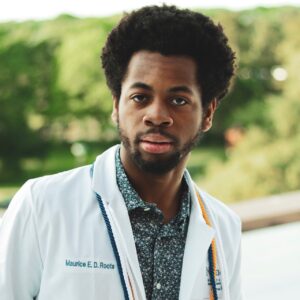 Maurice Roots (image courtesy of Roots)
Roots will use a network of ground-based remote sensing instruments to improve understanding of how ozone forms and moves around, with a focus on the Eastern United States.
It’s an exciting time to be in remote sensing and ozone studies, Roots says, in part because “we’re still finding out things about simply when and where high ozone is happening.” At the same time, the instrument network “is becoming a teenager. It’s grown up a lot, and a lot of changes are about to start happening.” One of Roots’s main goals with the new project is to generate a “synergy of NASA’s ground-based instruments,” where all of the data they produce can be easily gathered and interpreted together to form conclusions.
Understanding not just where ozone forms, but where it travels from there, is important, Roots says. For example, phenomena called “nocturnal low-level jets” can move air (and ozone and other pollutants with it) from Georgia to New York in one night, he explains, which “changes the whole regulatory perspective.” Right now, states or cities can be fined for having too many instances of high ozone—but if the ozone may have come from several states away, the picture gets more complicated.
While Roots isn’t directly involved in policy, his work to improve “process-level understanding” of where ozone is created, how it moves, and where it ends up could influence regulation in the future.
Predicting thunderstorms, protecting farmers
Hoffman’s work will explore how severe thunderstorms form in the southern United States, especially at night. The genesis of these storms is currently poorly understood, despite their important implications for community safety and agriculture.
Belay Demoz, professor of physics and director of the Goddard Earth Science Technology and Research (GESTAR) II Center, and also Hoffman’s and Root’s Ph.D. advisor, co-led the Plains Elevated Convection at Night (PECAN) mission in 2015. It used ground- and aircraft-based instruments to collect a huge amount of data about storms in the U.S. southern plains, much of which has the potential for more in-depth analysis, Hoffman says. She will develop a few in-depth case studies using PECAN data, seeking clues about which variables are most important for forming these storms, such as temperature, wind speed, and water vapor concentrations. After that, she’ll expand to determining the frequency of severe storms and what features differentiate them from milder events.
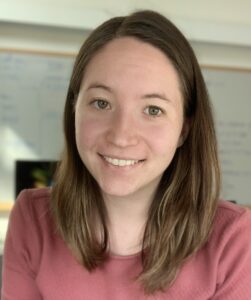 Kylie Hoffman (image courtesy of Hoffman)
“A lot of people research these storms with weather models and simulations, but there hasn’t been a ton of research done with remote sensing observations yet,” Hoffman says. “I plan to use the PECAN datasets to calculate atmospheric quantities that are typically only evaluated in model-based research, and determine what potential uses this approach has for improving our understanding of these storms.” Her eventual goal is to develop better forecasting for thunderstorms, especially to benefit the many farmers in the southern plains.
Hoffman’s research is interdisciplinary and brings together the work of NASA and the National Oceanic and Atmospheric Administration (NOAA), which previously awarded her a research fellowship. Better weather forecasting is “also one of NOAA’s main missions,” she explains, “to help us become a weather-ready nation, and improve our ability to inform people and small businesses” about the risks severe weather can pose to lives and livelihoods.
Making it official
Hoffman’s research as an undergraduate meteorology major also used remote sensing data, which she enjoyed. As a result, “I was looking specifically for a meteorology or atmospheric physics graduate program that worked with remote sensing data,” she says, “and that’s one of the strengths of the UMBC program.”
In preparing her FINESST application, “I felt very supported by Belay [Demoz] and the whole office. It was exciting. It felt really official,” she says. “Writing the application helped me clarify where I want to go with my research. And even if I hadn’t gotten the grant, it was helpful just to know the process.”
Demoz is thrilled to have two students receive the FINESST award—a rare event for any Ph.D. advisor. “I know firsthand how competitive this was, and I am very proud of their accomplishment,” Demoz says.
He’s also proud of the work they do outside the lab, supporting other students and choosing projects that could have real public impact. “This is what I would like all our grad students to do, since it prepares them well for entering the professoriate,” he shares. “I’m honored to say they are my graduate students.”
Paying it forward
Roots and Hoffman have already begun to pay forward the support they received from mentors at UMBC. This past summer, they and three more graduate students, including Emily Faber, M.S. ’21, atmospheric physics, a current Ph.D. student in the same field, served as mentors in the eight-week Student Airborne Science Activation (SaSa) program. The NASA-funded program offers high-achieving first- and second-year undergraduates at minority-serving institutions (MSIs) the opportunity to gain experience with airborne field research campaigns through a paid internship.
This year, SaSa welcomed 24 students, including four from UMBC, to UMBC’s main campus for four weeks. Participants spent the other four weeks at the NASA Wallops Flight Facility in Wallops Island, Virginia. The graduate students served as the participants’ primary mentors, Hoffman explains, from helping them develop research questions to guiding them through final presentations.
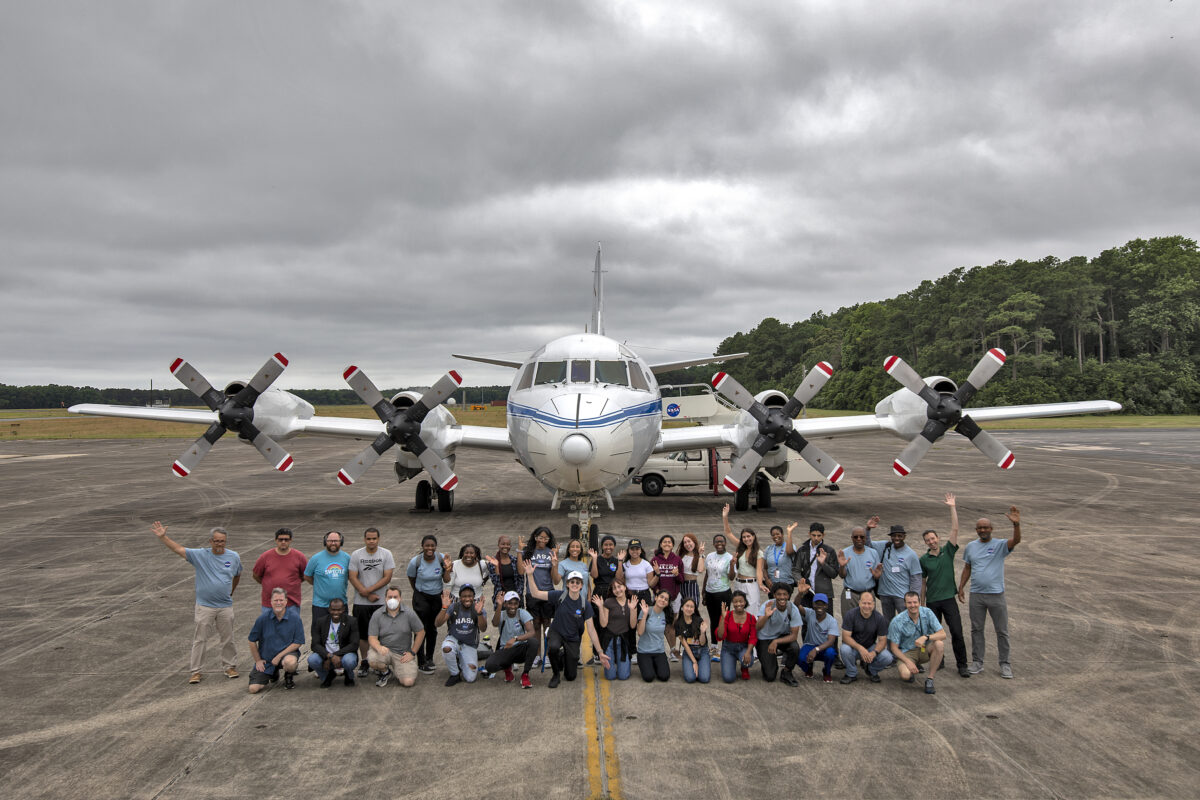 Participants in the 2022 SaSa program at NASA Wallops Flight Facility. (image courtesy of Belay Demoz)
Two of the UMBC participants decided to continue conducting research with Demoz’s group during the academic year. Trisha Joy Francisco ’25, mechanical engineering, is working with Hoffman on pollution measurements. Eric Ekey ’25, computer engineering, will start work soon with Roots.
Hoffman recalls a transformative summer internship that gave her the confidence to apply to graduate school. “That’s part of what I wanted to do for the students—replicate what my mentor did to help me during that experience,” she says.
SaSa was mutually beneficial for the students and their mentors; it helped Roots boost his confidence, too. After answering student questions for a month, “by the end,” he says with a smile, “I realized, I guess I actually know a lot.”
With their FINESST awards, Hoffman and Roots will continue to put their knowledge and mentoring skills to work as they conduct research to answer big questions about how atmospheric dynamics impact our daily lives.
]]>
Two UMBC Ph.D. students in atmospheric physics, Maurice Roots and Kylie Hoffman, have received competitive Future Investigators in NASA Earth and Space Science and Technology (FINESST) awards that...
https://umbc.edu/stories/ozone-and-thunderstorms-nasa-grants-to-ph-d-students/
https://my3.my.umbc.edu/api/v0/pixel/news/128761/guest@my.umbc.edu/ad4d4f8a25d0c84acca13b01cb3bee0b/api/pixel
cnms
coeit
csee
diversityandinclusion
meche
news
physics
research
science-and-tech
UMBC News & Magazine
https://my3.my.umbc.edu/groups/umbc-news-magazine
https://assets1-my.umbc.edu/system/shared/avatars/groups/000/001/943/24435aa6207c452e7bc15cc74b42c7bb/xsmall.png?1748556657
https://assets1-my.umbc.edu/system/shared/avatars/groups/000/001/943/24435aa6207c452e7bc15cc74b42c7bb/original.png?1748556657
https://assets2-my.umbc.edu/system/shared/avatars/groups/000/001/943/24435aa6207c452e7bc15cc74b42c7bb/xxlarge.png?1748556657
https://assets2-my.umbc.edu/system/shared/avatars/groups/000/001/943/24435aa6207c452e7bc15cc74b42c7bb/xlarge.png?1748556657
https://assets3-my.umbc.edu/system/shared/avatars/groups/000/001/943/24435aa6207c452e7bc15cc74b42c7bb/large.png?1748556657
https://assets1-my.umbc.edu/system/shared/avatars/groups/000/001/943/24435aa6207c452e7bc15cc74b42c7bb/medium.png?1748556657
https://assets2-my.umbc.edu/system/shared/avatars/groups/000/001/943/24435aa6207c452e7bc15cc74b42c7bb/small.png?1748556657
https://assets1-my.umbc.edu/system/shared/avatars/groups/000/001/943/24435aa6207c452e7bc15cc74b42c7bb/xsmall.png?1748556657
https://assets2-my.umbc.edu/system/shared/avatars/groups/000/001/943/24435aa6207c452e7bc15cc74b42c7bb/xxsmall.png?1748556657
UMBC News & Magazine
0
0
false
Wed, 26 Oct 2022 12:51:31 -0400
Wed, 26 Oct 2022 12:51:31 -0400
Tackling food insecurity in disasters: UMBC’s Lauren Clay develops a new model through $520K NSF CAREER award
When disasters happen, access to food can be interrupted, which can increase existing food insecurity issues and compound the impact of disasters. Currently, there isn’t a standard tool to measure disaster-specific food insecurity issues, making it harder to address them.
The National Science Foundation (NSF) has awarded UMBC’s Lauren Clay, associate professor and chair of emergency health services, a five-year, $520,000 Faculty Early Career Development (CAREER) award to develop a sociocultural model called Food Environment in Disasters (FED) and other tools to improve the understanding and monitoring of food availability, acceptability, and accessibility during disasters.
“Food is a basic need for human survival and the ability of social systems to meet this need in disaster situations is compromised when our homes, businesses, and other structures are damaged and lifelines disrupted,” says Clay. “While elements of the various social and built-in environmental systems that make up the broader food environment as well as food security issues have been studied by various disciplines, a comprehensive, systematic approach has yet to be applied and tested in disaster settings.”
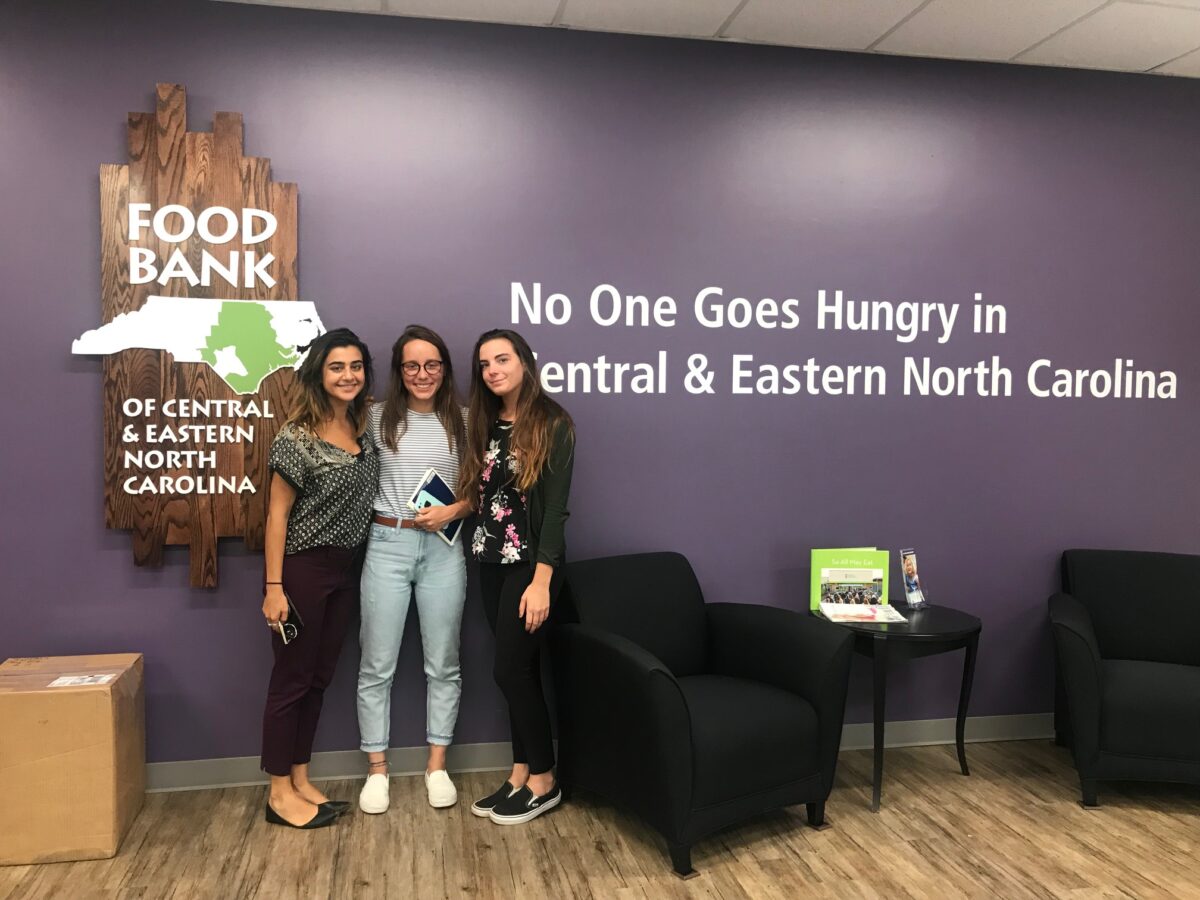 Lauren Clay’s graduate students volunteer at a food bank. (Image courtesy of Clay)
The CAREER award is one of NSF’s most prestigious awards for early career faculty. Recipients are chosen for their passion and dedication to the discovery process and commitment to teaching, learning, and sharing new knowledge.
This research builds on Clay’s prior body of work in disaster preparedness, recovery, and resilience. That work has focused on communities impacted by COVID-19; Hurricanes Harvey, Sandy, and Katrina; the Deepwater Horizon Oil Spill in the Gulf of Mexico; and the 2013 tornado in Moore, Oklahoma, among other disasters and public health emergencies.
The FED model
Over the next five years, Clay will use the current Nourish Food System Model as a guiding theory to develop her new FED model. “The Nourish Food System Model looks at the interconnectedness and interdependence of the biological, social, political, economic, health, and policy systems,” says Clay. “Some of these systems can be disrupted any day, but in a disaster, all of the systems are stressed.”
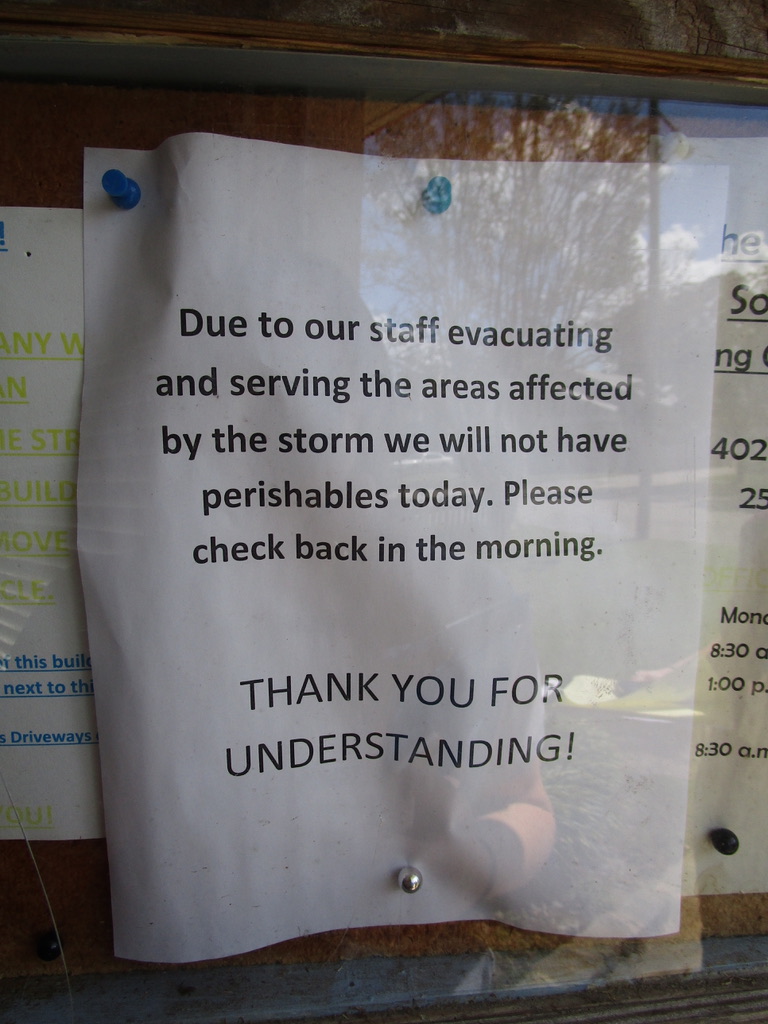 Community announcement for North Carolina residents after Hurricane Florence (2018).
(Image courtesy of Clay)
A key aspect of the FED model is that it is being developed with data from disasters. This is unlike current food system theory and metrics that base their emergency response on data from non-disaster times. The FED model will be tested against food insecurity data from COVID-19, Hurricane Florence, the 2018 Camp Fire in Paradise, California, and other case studies to determine how well the model fits with actual lived experiences in disasters.
“After I develop the FED model and validate it, the last part in the latter years of the grant will be to develop tools to support communities in building food system resilience for disasters,” says Clay. She will create the Environmental Audit Tool (EAT) to help local and state organizations better monitor and assess the processes and structures in place to address food insecurity in non-disaster times. This information will help improve both early response and long-term monitoring.
All of this work will help address the kinds of acute food insecurity issues that can double or triple chronic food security problems following disasters.
 Grocery store shelves after Hurricane Florence (2018). (Image courtesy of Clay)
Best practices in teaching
The NSF award also recognizes and furthers Clay’s work as an innovative educator. Through the CAREER award, she will develop best practices in teaching methods related to food insecurity in disaster situations.
Clay will create one of the first teaching labs to train undergraduate students with the knowledge, skills, and attitudes to address disaster-focused food insecurity. She will also integrate field and lab research into her classes more broadly, where students can engage with the work as disaster response is unfolding, giving them the opportunity to learn about disasters both from emergency response practices and a theoretical framework.
Foundational work
Clay’s latest research builds on prior foundational work. In 2021, she received a $100,000 collaborative research award from the U.S. Department of Agriculture (USDA) and Tufts University. Clay was one of six researchers across the U.S. to participate in the USDA’s “25 Years of Food Security Measurement: Answered Questions and Further Research” program. The program aims to foster research related to the past 25 years of U.S. household food security research and to explore feasible evidence-based improvements.
“I proposed that the USDA was missing important information about people’s lives by focusing entirely on financial barriers to food security. Having cash does not guarantee food security if there are community-level disruptions,” says Clay. “Roads can flood and access to kitchens and food storage facilities can be damaged.”
Clay and a team of researchers collected data from six states to explore nonfinancial barriers to food accessibility, availability, and acceptability, including physical barriers to food sources (such as damaged roads), barriers to food availability (such as store closures), and access to foods that can be consumed without extensive kitchen facilities.
“We are in the final phase of developing a better measure of food insecurity following disasters when there is a community-level disruption,” says Clay. She plans to use this measurement tool in the development of the FED model.
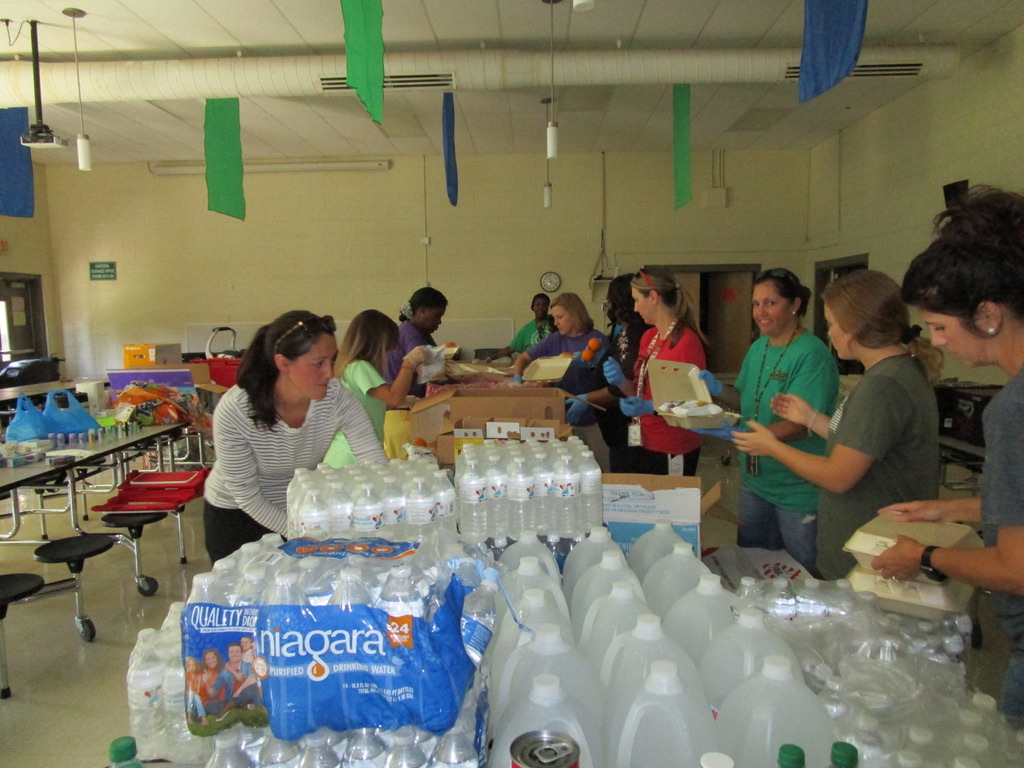 North Carolina teachers package food for victims of Hurricane Florence (2018). (Image courtesy of Clay)
National food access and COVID-19
Additionally, Clay has been working on two other food insecurity projects that have received Quick Response Research Awards, funded by the University of Colorado’s Natural Hazards Center with support from NSF.
In the first project, Clay leads the New York state team of the National Food Access and COVID research Team (NFACT). The team consists of researchers across 15 states exploring the impact of COVID-19 on food access, food security, and food systems across local, state, regional, and national levels. NFACT also integrates data to explore outcomes and impacts across scales.
NFACT has published several research briefs on COVID-19 and its primary and secondary health impacts, racial disparities in food insecurity, and racial disparities in healthcare insecurity among Native Americans and communities of color in New York City and New York State. NFACT has also published academic journal articles related to the health impacts of COVID-19, food access during the pandemic, and the need for enhanced outreach and support to those experiencing food insecurity for the first time during the pandemic.
The second project, in which Clay is the co-PI, is a study with the Food Distribution Program on American Reservations to pilot a culturally relevant metric of food insecurity. It will measure the impact of the COVID-19 pandemic on food insecurity among Native American and Alaskan Native communities in Western New York.
Clay was also awarded a research fellowship with the National Academies of Science, Engineering, and Medicine Gulf Research Program studying the Post-Disaster Food Environment project.
Helping communities to prepare and recover
In five years, Clay plans to have established the Disaster Health Research Lab, integrating the breadth of her research and teaching activities. This lab will offer a portfolio of tools to monitor food systems over the course of a disaster experience, from preparedness to assessing and responding to impact, to recovery. And she will offer tools to help communities improve the functioning of their food environments in disasters.
She particularly looks forward to developing a public engagement plan to share this work with researchers, disaster officials, and communities.
“Dr. Clay’s research demonstrates the importance of bringing a social science lens to the understanding of disaster science, management, and resilience,” says Christine Mallinson, director of UMBC’s Center for Social Science Scholarship. “Disasters exacerbate inequities, including food insecurity, which has a serious impact on the health of people and communities around the world. Dr. Clay’s research not only aims to understand these processes but also how to design interventions to mitigate the societal-level impacts and consequences of disasters.”
Clay is the first faculty member in UMBC’s College of Arts, Humanities, and Social Sciences to have received this award. UMBC faculty have received 42 NSF CAREER Awards since NSF launched the program in 1995, including eight faculty over the past five years. Their fields of research include computer science and electrical engineering (CSEE); information systems; chemistry and biochemistry; chemical, biochemical, and environmental engineering (CBEE); and biological sciences.
UMBC’s most recent recipients are Cynthia Matuszek, associate professor of CSEE; James Foulds, assistant professor of information systems; Naghmeh Karimi, assistant professor of CSEE, and Jianwu Wang, associate professor of information systems. UMBC President Valerie Sheares Ashby received an NSF CAREER award in 1998 while at Iowa State University.
]]>
When disasters happen, access to food can be interrupted, which can increase existing food insecurity issues and compound the impact of disasters. Currently, there isn’t a standard tool to measure...
https://umbc.edu/stories/tackling-food-insecurity-in-disasters-umbcs/
https://my3.my.umbc.edu/api/v0/pixel/news/128747/guest@my.umbc.edu/470bb3f3e0d5ff9ecfd2020b0f45ebe8/api/pixel
cahss
cahssresearch
career-award
cs3
diversityandinclusion
ehs
majoraward
news
policy-and-society
UMBC News & Magazine
https://my3.my.umbc.edu/groups/umbc-news-magazine
https://assets1-my.umbc.edu/system/shared/avatars/groups/000/001/943/24435aa6207c452e7bc15cc74b42c7bb/xsmall.png?1748556657
https://assets1-my.umbc.edu/system/shared/avatars/groups/000/001/943/24435aa6207c452e7bc15cc74b42c7bb/original.png?1748556657
https://assets2-my.umbc.edu/system/shared/avatars/groups/000/001/943/24435aa6207c452e7bc15cc74b42c7bb/xxlarge.png?1748556657
https://assets2-my.umbc.edu/system/shared/avatars/groups/000/001/943/24435aa6207c452e7bc15cc74b42c7bb/xlarge.png?1748556657
https://assets3-my.umbc.edu/system/shared/avatars/groups/000/001/943/24435aa6207c452e7bc15cc74b42c7bb/large.png?1748556657
https://assets1-my.umbc.edu/system/shared/avatars/groups/000/001/943/24435aa6207c452e7bc15cc74b42c7bb/medium.png?1748556657
https://assets2-my.umbc.edu/system/shared/avatars/groups/000/001/943/24435aa6207c452e7bc15cc74b42c7bb/small.png?1748556657
https://assets1-my.umbc.edu/system/shared/avatars/groups/000/001/943/24435aa6207c452e7bc15cc74b42c7bb/xsmall.png?1748556657
https://assets2-my.umbc.edu/system/shared/avatars/groups/000/001/943/24435aa6207c452e7bc15cc74b42c7bb/xxsmall.png?1748556657
UMBC News & Magazine
7
0
false
Wed, 26 Oct 2022 09:12:43 -0400
Wed, 26 Oct 2022 09:12:43 -0400
UMBC and University of Maryland School of Medicine receive $13.7M NIH FIRST grant to increase faculty diversity
UMBC and the University of Maryland School of Medicine (UMSOM) have received a five-year, $13.7 million grant from the National Institutes of Health (NIH) to enhance recruitment and training of junior faculty from groups underrepresented in biomedical science. Funding is through the NIH Common Fund Faculty Institutional Recruitment for Sustainable Transformation (FIRST) program, which was founded last year to support efforts to hire groups of diverse, early-career research faculty.
The grant will enable the universities to hire a group of four faculty members at UMBC and six at UMSOM, each of whom will have cross-campus appointments at both institutions.
“Faculty hired under UM-FIRST will advance our teaching and research missions and serve as leaders for institutional change as we pursue our vision of a diverse professoriate,” says William LaCourse, dean of the College of Natural and Mathematical Sciences and professor of chemistry and biochemistry at UMBC. “These faculty and those who follow will also serve as role models for future generations of underrepresented students.”
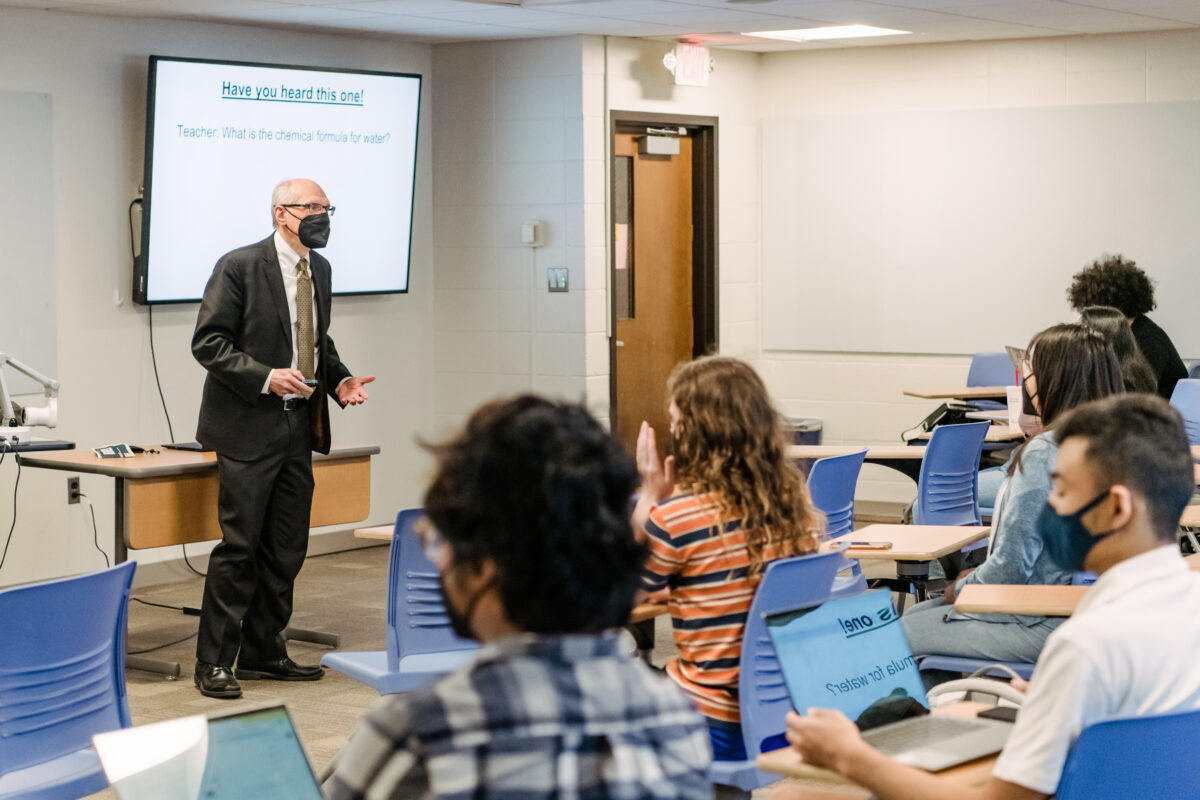 Dean William LaCourse teaches Chemistry 100 in spring 2022. (Marlayna Demond ’11/UMBC)
Fostering culture change
The grant aims to build self-reinforcing communities of scientists committed to diversity and inclusive excellence through the recruitment of early-career faculty who are competitive for assistant professor positions and have demonstrated commitment to promoting diversity and inclusion. UMSOM and UMBC will measure their progress against clearly defined metrics of institutional culture change, diversity, and inclusion to determine if hiring efforts and other evidence-based strategies are achieving the program’s goals.
The grant “is designed to foster sustainable culture change and promote inclusive excellence by enabling us to hire a diverse cohort of new faculty and to support faculty development, mentoring, and promotion opportunities,” says James Kaper, the lead on the grant and the James and Carolyn Frenkil Distinguished Dean’s Professor, vice dean for Academic Affairs, and chair of microbiology and immunology at UMSOM.
Building on a legacy of inclusion
The NIH FIRST grant builds on UMBC’s highly esteemed Meyerhoff Scholars Program, launched more than 30 years ago, which has led UMBC to become a leading university for developing underrepresented STEM undergraduates. UMBC is now the nation’s number #1 producer of Black undergraduates who go on to complete a PhD in the natural sciences or engineering and #1 for Black undergraduates who complete an M.D./Ph.D.
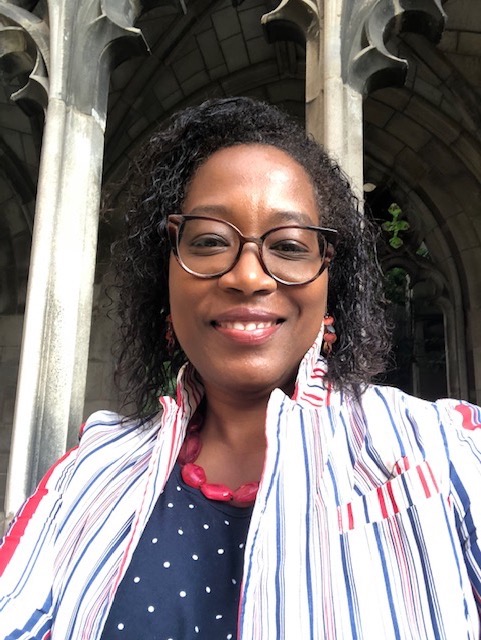 Nykia Walker, a Pre-professoriate Fellow in biological sciences, studies how breast tumors initiate metastasis. (Image courtesy of Nykia Walker)
At the same time that UMBC excels in educating undergraduates, the university is also classified as one of only 146 R1 (“very high research activity”) institutions in the nation.
UMBC’s efforts to promote faculty diversity in STEM include the PROMISE Academy and ADVANCE, which has increased women faculty in STEM by 70 percent at UMBC since 2003.
The College of Natural and Mathematical Sciences’ Pre-professoriate Fellowship offers incoming faculty two-year appointments as research assistant professors, with structured mentoring and other scaffolds for success. Faculty who came to UMBC through this program in biological sciences, physics, and chemistry have already been converted to tenure-track assistant professors.
Unwavering dedication
The recent $10M INCLUDES grant awarded to UMBC further builds a robust, diverse pipeline in STEM at UMBC by supporting postdocs from underrepresented groups, and the PROMISE Allegiance for Graduate Education and the Professoriate (AGEP) program offers professional development and community to all graduate students and postdocs at UMBC and throughout the University System of Maryland.
UMSOM’s efforts to promote a diverse STEM and health-science pipeline include the UMB CURES program for middle and high school students, several internship and summer research programs for college students, and multiple post-graduate training programs that give underrepresented minority scholars direct experience in a laboratory setting.
Like many of these other initiatives, “The true strength of UM-FIRST,” LaCourse says, “ is in the unwavering dedication of the leadership, faculty, and staff of these two institutions to inclusive excellence and social justice.”
]]>
UMBC and the University of Maryland School of Medicine (UMSOM) have received a five-year, $13.7 million grant from the National Institutes of Health (NIH) to enhance recruitment and training of...
https://umbc.edu/stories/13-7m-nih-grant-to-increase-faculty-diversity/
https://my3.my.umbc.edu/api/v0/pixel/news/127879/guest@my.umbc.edu/0eeebdb2f330f00829cd9817044d91ec/api/pixel
cnms
coeit
diversityandinclusion
majoraward
meyerhoffscholars
news
science-and-tech
UMBC News & Magazine
https://my3.my.umbc.edu/groups/umbc-news-magazine
https://assets1-my.umbc.edu/system/shared/avatars/groups/000/001/943/24435aa6207c452e7bc15cc74b42c7bb/xsmall.png?1748556657
https://assets1-my.umbc.edu/system/shared/avatars/groups/000/001/943/24435aa6207c452e7bc15cc74b42c7bb/original.png?1748556657
https://assets2-my.umbc.edu/system/shared/avatars/groups/000/001/943/24435aa6207c452e7bc15cc74b42c7bb/xxlarge.png?1748556657
https://assets2-my.umbc.edu/system/shared/avatars/groups/000/001/943/24435aa6207c452e7bc15cc74b42c7bb/xlarge.png?1748556657
https://assets3-my.umbc.edu/system/shared/avatars/groups/000/001/943/24435aa6207c452e7bc15cc74b42c7bb/large.png?1748556657
https://assets1-my.umbc.edu/system/shared/avatars/groups/000/001/943/24435aa6207c452e7bc15cc74b42c7bb/medium.png?1748556657
https://assets2-my.umbc.edu/system/shared/avatars/groups/000/001/943/24435aa6207c452e7bc15cc74b42c7bb/small.png?1748556657
https://assets1-my.umbc.edu/system/shared/avatars/groups/000/001/943/24435aa6207c452e7bc15cc74b42c7bb/xsmall.png?1748556657
https://assets2-my.umbc.edu/system/shared/avatars/groups/000/001/943/24435aa6207c452e7bc15cc74b42c7bb/xxsmall.png?1748556657
UMBC News & Magazine
0
0
false
Fri, 23 Sep 2022 09:46:03 -0400
Fri, 23 Sep 2022 09:46:03 -0400
U.S. News highlights UMBC’s national leadership in teaching, innovation, diversity
The 2022–23 U.S. News and World Report Best Colleges undergraduate rankings released this week illustrate why a record number of students chose to call UMBC home this fall. This year’s rankings show UMBC jumping an impressive 25 spots on the list of Best National Universities and appearing on several other prestigious lists, distinguishing the university’s achievements on a national stage.
“Notable increases in UMBC’s six-year graduation rate, at a time when UMBC was also recognized as an Research 1 university, likely supported this jump,” says Constance A. Pierson ’90, M.A. ’92, associate vice provost for Institutional Research, Analysis and Decision Support. “We are particularly proud that the graduation rate trend is consistent for students of different economic backgrounds.”
This year UMBC ranks at #9 nationally for undergraduate teaching, joined in the top ten by such institutions as Brown, Princeton, and Dartmouth, and tied with the University of Notre Dame. UMBC also maintains its longstanding position on the list of the nation’s most innovative universities, tied at #10 with Johns Hopkins University. UMBC ranks #64 on the Top Public Universities list, #137 on the overall Top National Universities list, and #46 for undergraduate research and creative projects.
Student-centered education
At the core of this year’s rankings are students who already distinguish themselves as budding entrepreneurs, global citizens, advocates, and leaders. Farah Helal ’24, global studies and political science, began her term as University System of Maryland (USM) student regent on July 1, 2022. UMBC’s U.S. News ranking as one of the country’s Best Value Schools and universities with the least student debt speaks directly to the work Helal will be doing as part of her tenure: weighing in on topics like setting tuition and fee rates, approving new degree programs, and approving capital and operating budgets.
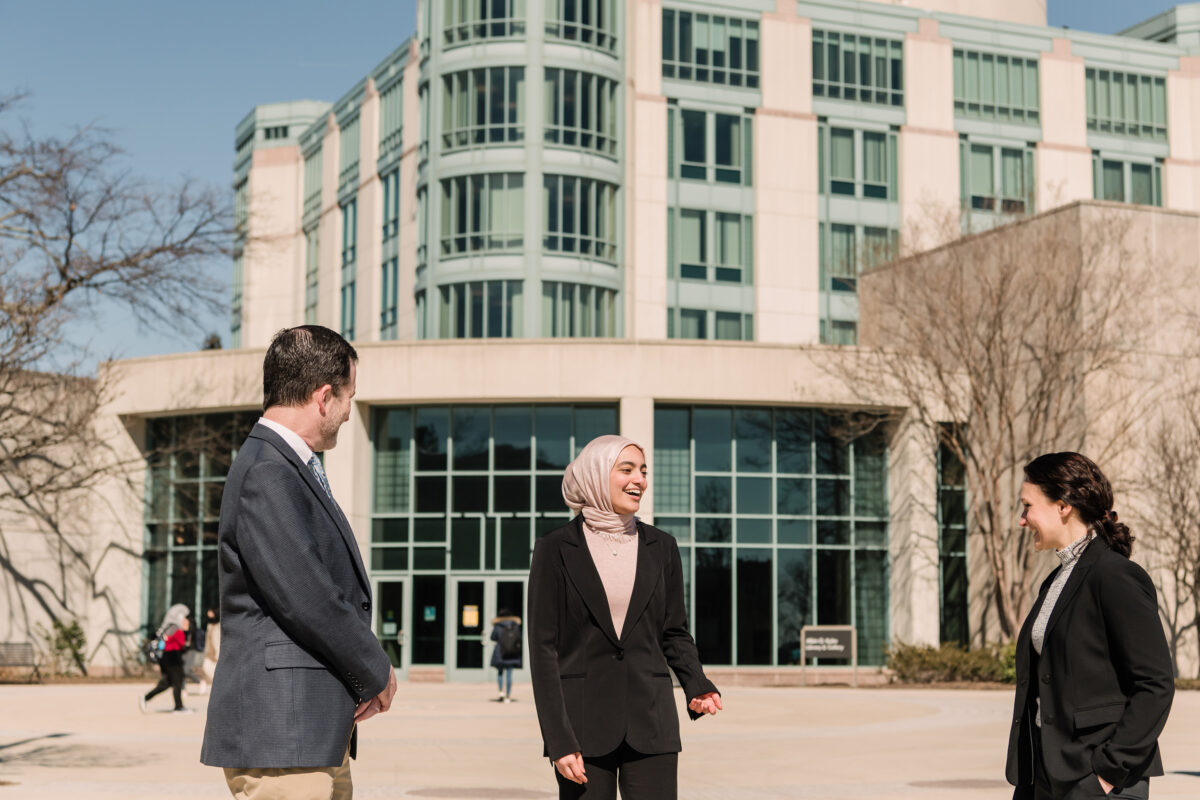 Helal (center) with Romy Hübler ‘09, modern languages and linguistics, M.A. ‘11, intercultural communication, Ph.D. ‘15, language, literacy, and culture (LLC), right, and David Hoffman, Ph.D. ’13, LLC, left. (Marlayna Demond ’11/UMBC)
“UMBC is a meeting ground for students, faculty, and staff who want to be engaged in our communities every day, doing deep and creative work to solve problems and promote justice and inclusion,” says David Hoffman, director of the Center for Democracy and Civic Life.
In addition to the latest U.S. News rankings, Hoffman highlights that the 2022 College Rankings issue of The Washington Monthly names UMBC one of America’s Best Colleges for Student Voting. “I love that we have been recognized by Washington Monthly for our efforts in connection with voting, and I love knowing that voting is just the tip of the iceberg for us when it comes to our students’ engagement and impact.”
Both teaching and research
The latest U.S. News rankings are primarily university-wide, but they also include recognition for a few specific undergraduate programs. UMBC is listed as a top-100 university this year for both computer science and engineering. Coming in at #86 for computer science, UMBC shares the rank with George Mason University, Texas Tech University, and Howard University. Ascending to #94 for engineering this year, UMBC is joined by Clemson University, George Washington University, and University of Delaware.
It’s essential to understand these rankings in the context of another important milestone, notes Keith J Bowman, dean of the College of Engineering and Information Technology (COEIT): UMBC’s recent Carnegie Classification as a doctoral university with very high research activity, popularly known as Research 1 (or R1). UMBC is now ranked as one of only 146 R1 institutions nationally, including 107 public and 39 private universities.
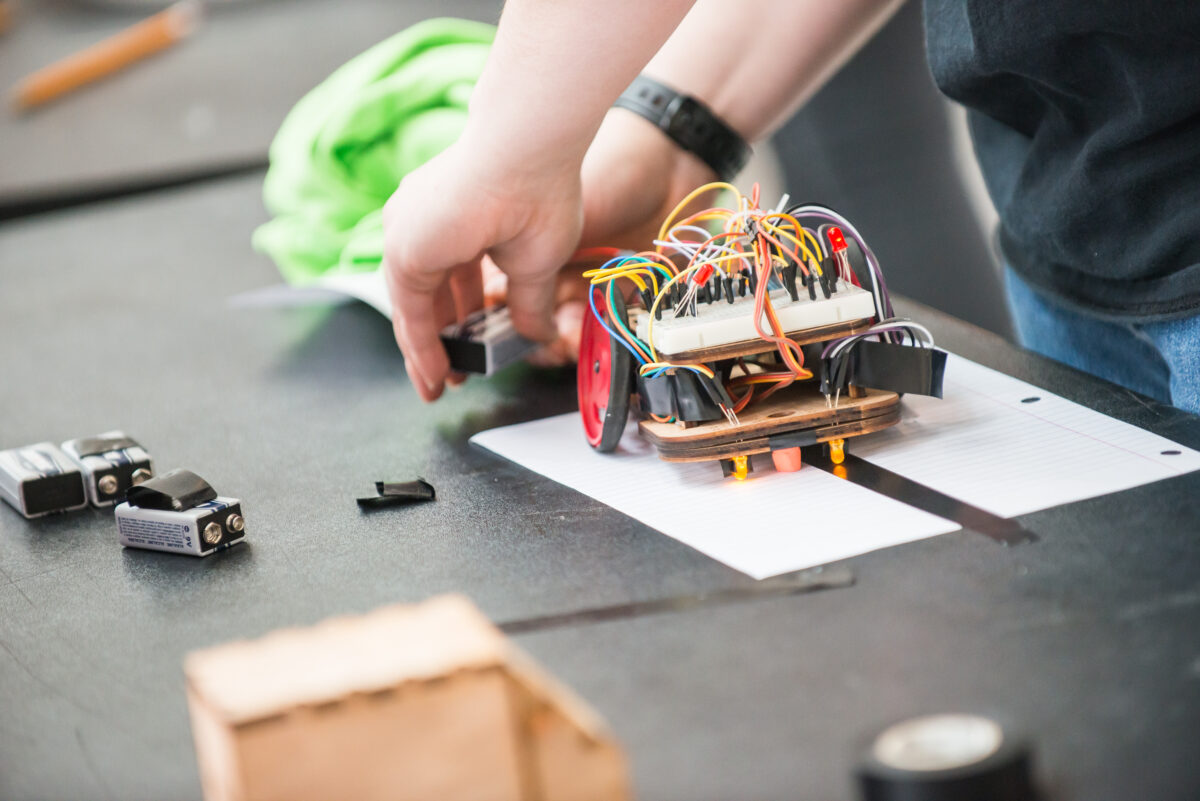 A student works on an engineering project. (Marlayna Demond ’11/UMBC)
“UMBC’s designation as an R1 institution combined with increasing recognition for our engineering, computing and information systems programs has enabled us to recruit incredible faculty talent,” says Bowman. “Those faculty are attracted to UMBC for our potential to both advance their success as researchers and educators and our emphasis on inclusion as essential to excellence.”
Promoting diversity and innovation
UMBC’s recognition as one of the nation’s most innovative universities, alongside Johns Hopkins, goes hand-in-hand with recognition as a top university for ethnic diversity. The National Institute of Health (NIH) and National Science Foundation (NSF) have recently awarded UMBC over $15 million for programs specifically to support underrepresented STEM students—an area where UMBC is known as an innovative national model.
The College of Natural and Mathematical Sciences (CNMS) will receive $5.6 million over five years from the NIH to fund the Graduate Research Training Initiative for Student Enhancement (G-RISE). This program will support graduate students from underrepresented groups in STEM with up to three years of funding and an array of training opportunities. The goal is to help participants select and prepare for a range of career paths in academia, industry, government, entrepreneurship, or beyond.
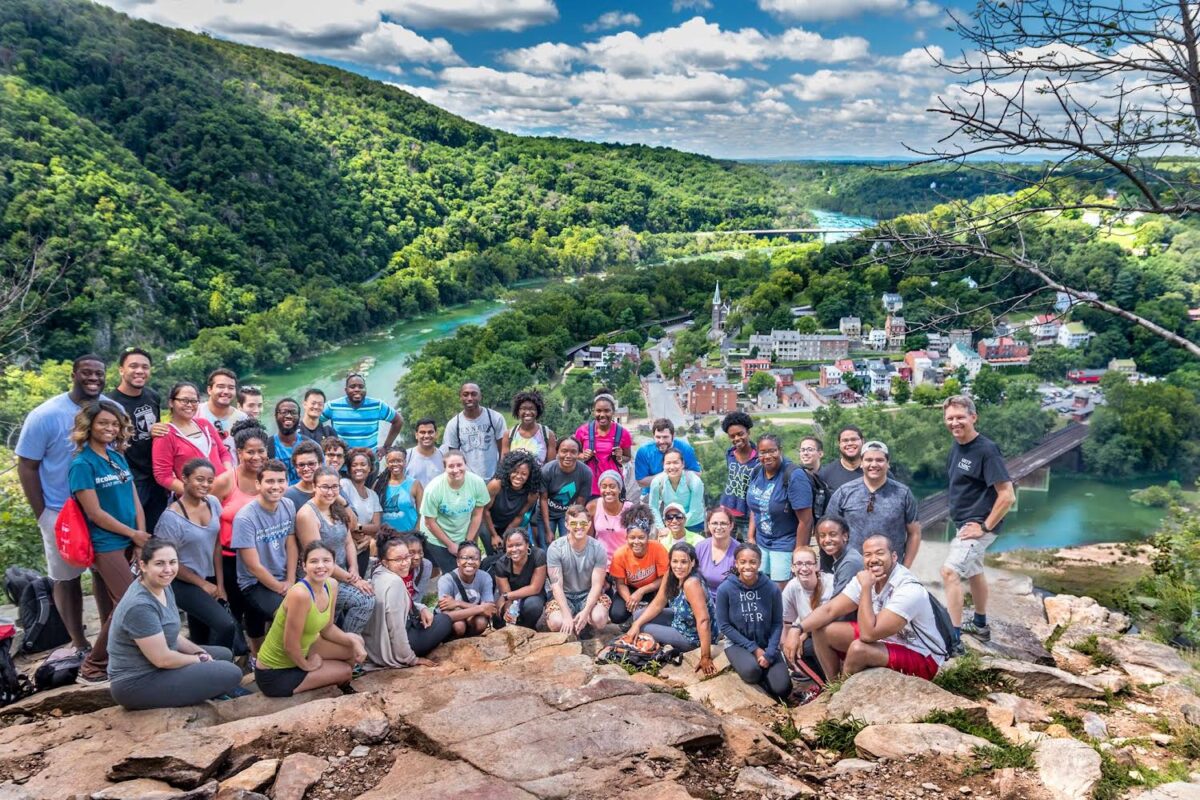 Students and faculty in the Initiative for Maximizing Student Development (IMSD) Meyerhoff Graduate Fellows program celebrate reaching the summit of their hike at Harper’s Ferry on one of the program’s annual summer retreats. IMSD launched in 1996 and transitions to G-RISE this year. Over 150 UMBC participants earned their Ph.D. in that time period. (Image courtesy of the Meyerhoff Graduate Fellows)
UMBC will expand its work boosting diversity in academia from Maryland to the national level through a new NSF INCLUDES Alliance: Re-Imagining STEM Equity Utilizing Postdoc Pathways (RISE UPP). The RISE UPP Alliance, anticipated to officially launch in fall 2022, is modeled after the AGEP PROMISE Academy, a high-impact initiative co-led by UMBC that supports faculty diversification in the biomedical sciences across USM institutions.
The university has also received support from a broad range of other groups and agencies to expand and replicate UMBC’s student success models. This includes $2.5 million from the Simons Foundation to create a Meyerhoff Scholars-like program within the public university system in New York, among other initiatives.
Vision of leadership
This commitment to diversity and inclusion can also be seen at the faculty and administrative leadership levels. Kimberly R. Moffitt, dean of UMBC’s College of Arts, Humanities, and Social Sciences (CAHSS) and professor of language, literacy, and culture, serves as the lead principal investigator for Breaking the M.O.L.D. UMBC, Morgan State University, and the University of Maryland, College Park are partnering in this $3 million initiative funded by the Andrew W. Mellon Foundation to develop a pipeline to higher ed leadership for diverse scholars in the arts and humanities.
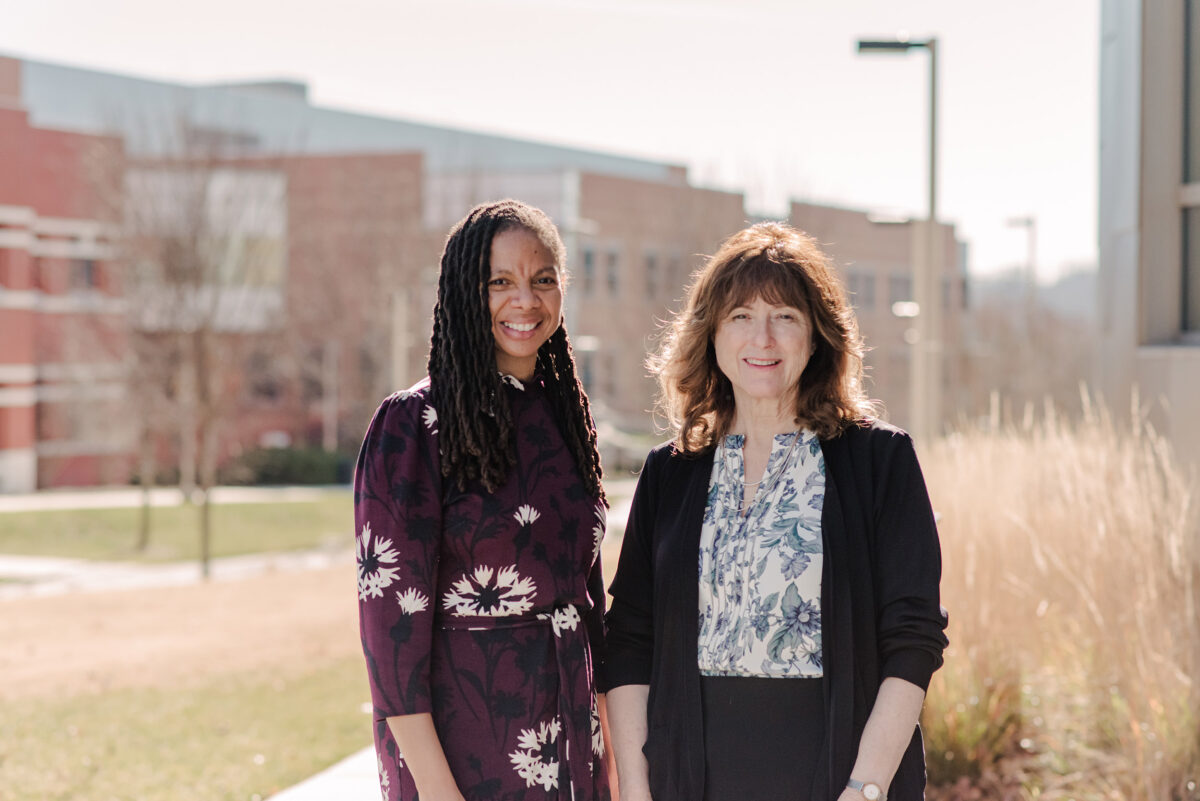 Kimberly Moffitt (l), dean of UMBC’s College of Arts, Humanities, and Social Sciences (CAHSS), serves as Breaking the M.O.L.D.’s lead PI. Joining her in leading UMBC’s implementation of Breaking the M.O.L.D. is Patrice McDermott, vice provost for faculty affairs. (Marlayna Demond ’11/UMBC)
Following through on “redefin[ing] excellence in higher education through an inclusive culture” is an essential part of what makes UMBC such a special and distinctive place, says UMBC President Valerie Sheares Ashby. “This is an extraordinary institution,” she recently told WYPR’s Tom Hall. She shares, “The university is true to the values and vision that it states.”
]]>
The 2022–23 U.S. News and World Report Best Colleges undergraduate rankings released this week illustrate why a record number of students chose to call UMBC home this fall. This year’s rankings...
https://umbc.edu/stories/us-news-2022-23/
https://my3.my.umbc.edu/api/v0/pixel/news/127542/guest@my.umbc.edu/eacccc71a5100eea5cb5511cf6654531/api/pixel
cahss
civic
cnms
coeit
community
diversityandinclusion
globalstudies
llc
mlli
news
politicalscience
rankings
UMBC News & Magazine
https://my3.my.umbc.edu/groups/umbc-news-magazine
https://assets1-my.umbc.edu/system/shared/avatars/groups/000/001/943/24435aa6207c452e7bc15cc74b42c7bb/xsmall.png?1748556657
https://assets1-my.umbc.edu/system/shared/avatars/groups/000/001/943/24435aa6207c452e7bc15cc74b42c7bb/original.png?1748556657
https://assets2-my.umbc.edu/system/shared/avatars/groups/000/001/943/24435aa6207c452e7bc15cc74b42c7bb/xxlarge.png?1748556657
https://assets2-my.umbc.edu/system/shared/avatars/groups/000/001/943/24435aa6207c452e7bc15cc74b42c7bb/xlarge.png?1748556657
https://assets3-my.umbc.edu/system/shared/avatars/groups/000/001/943/24435aa6207c452e7bc15cc74b42c7bb/large.png?1748556657
https://assets1-my.umbc.edu/system/shared/avatars/groups/000/001/943/24435aa6207c452e7bc15cc74b42c7bb/medium.png?1748556657
https://assets2-my.umbc.edu/system/shared/avatars/groups/000/001/943/24435aa6207c452e7bc15cc74b42c7bb/small.png?1748556657
https://assets1-my.umbc.edu/system/shared/avatars/groups/000/001/943/24435aa6207c452e7bc15cc74b42c7bb/xsmall.png?1748556657
https://assets2-my.umbc.edu/system/shared/avatars/groups/000/001/943/24435aa6207c452e7bc15cc74b42c7bb/xxsmall.png?1748556657
UMBC News & Magazine
0
0
false
Tue, 13 Sep 2022 16:34:18 -0400
Tue, 13 Sep 2022 16:34:18 -0400
UMBC opens new academic year with new president, largest-ever incoming class
“This is a time when you begin to define what you love, what really matters to you, who you want to be in this world, and what difference you want to make in the lives of others.”
Valerie Sheares Ashby
UMBC President
As UMBC President Valerie Sheares Ashby looked out at the crowd of eager first-year students during Tuesday’s Convocation ceremony to open the academic year, she reinforced the importance of marking this formative chapter. And with well over 2,100 new first-year students, and record numbers of graduate and international students, this is a new chapter for UMBC’s largest incoming class yet.
“In an increasingly competitive college admissions landscape characterized by a declining pool of high school graduates and increasing costs of attendance, UMBC’s ability to continue to attract a strong and talented first-year class speaks to, among many things, our reputation as an institution that offers an exceptional collegiate experience that is affordable,” says Yvette Mozie-Ross ’88, UMBC’s vice provost for enrollment management and planning. This includes in-demand programs at both UMBC’s main campus and the Universities at Shady Grove in Montgomery County.
In addition to a record number of new first-year students, UMBC enrolled over 3,300 graduate students for fall 2022, marking an impressive 500-plus increase over last year’s fall enrollment.
Welcoming the incoming class
Veronica Goonan, an incoming first-year student, knew once she visited campus that she had found her place. “I had an incredible opportunity to tour campus with the [mock trial] team in the fall of my senior year, and that’s when I began to know that my place was here,” she said. “I could feel the innovation and excellence that UMBC boasts.”
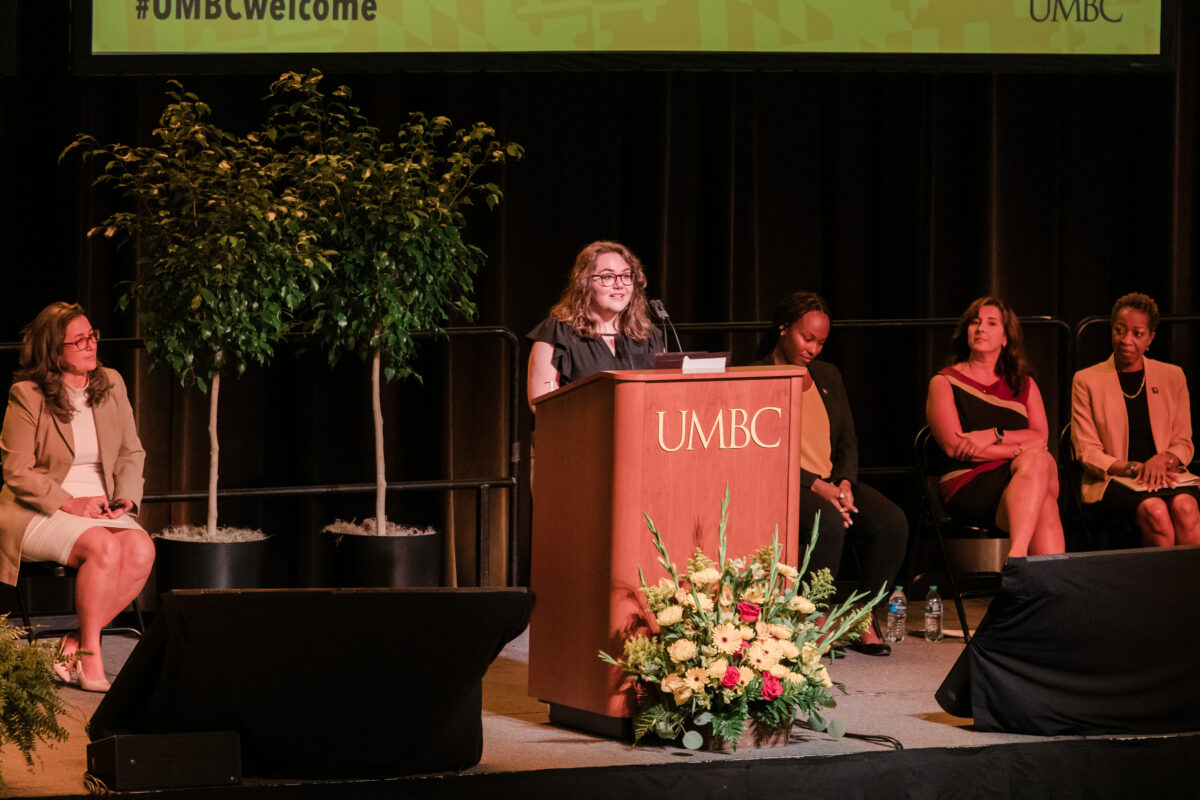 Goonan addresses the audience during Fall Opening Meeting. (Marlayna Demond ’11/UMBC)
One of the biggest goals in the first few weeks of the new academic year is to ensure students have opportunities to get to know the campus and begin learning about the possibilities available to them throughout their academic career.
“In the Division of Student Affairs, we take the role of welcoming and holding space for our students seriously. Those first few days and weeks are about making sure that we are doing all we can to help them carve out their own path while they are here,” says Jen Dress, associate director of campus life.
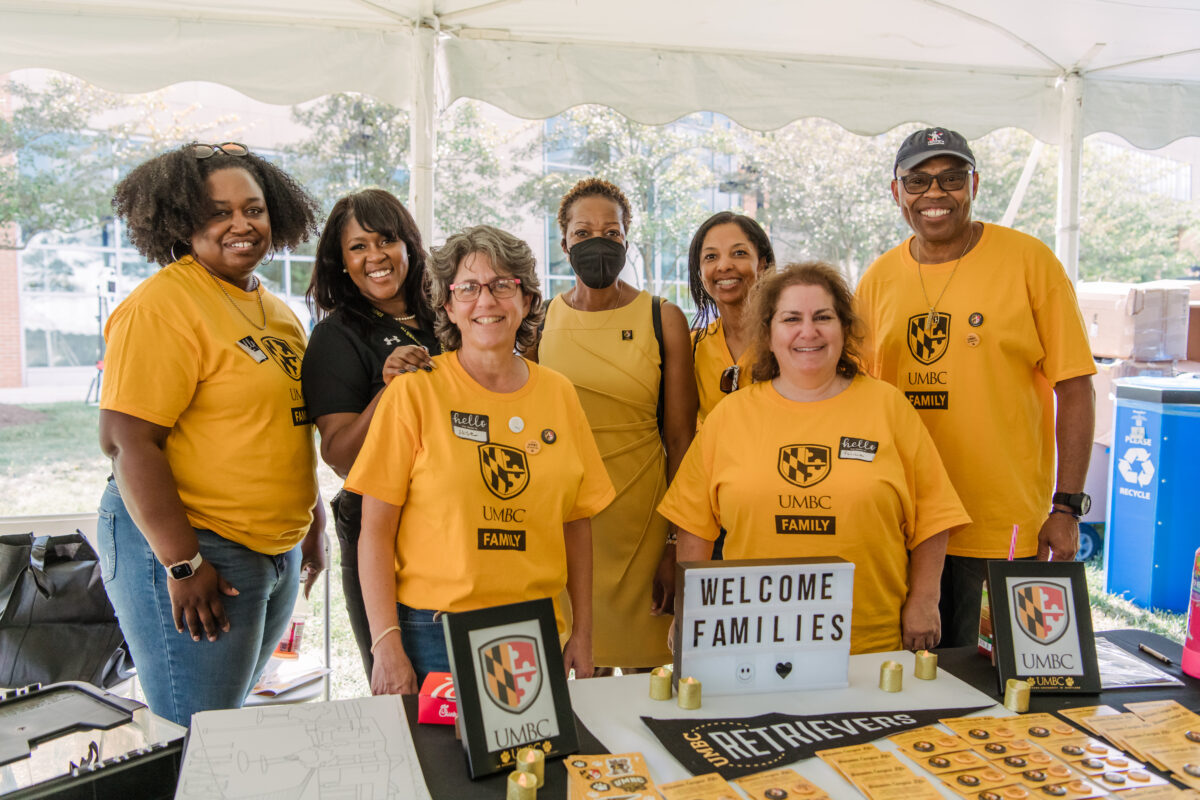 Parent volunteers welcome families to UMBC with President Sheares Ashby (c). (Marlayna Demond ’11/UMBC)
A robust Welcome Week full of fun and engaging events is an important part of this experience. When new students moved in last Saturday, they were treated to some of UMBC’s favorite traditions. Once the boxes were unpacked, the beds were made, and the posters of (insert cool band here) were hung, students and their families made their way to Erickson Field.
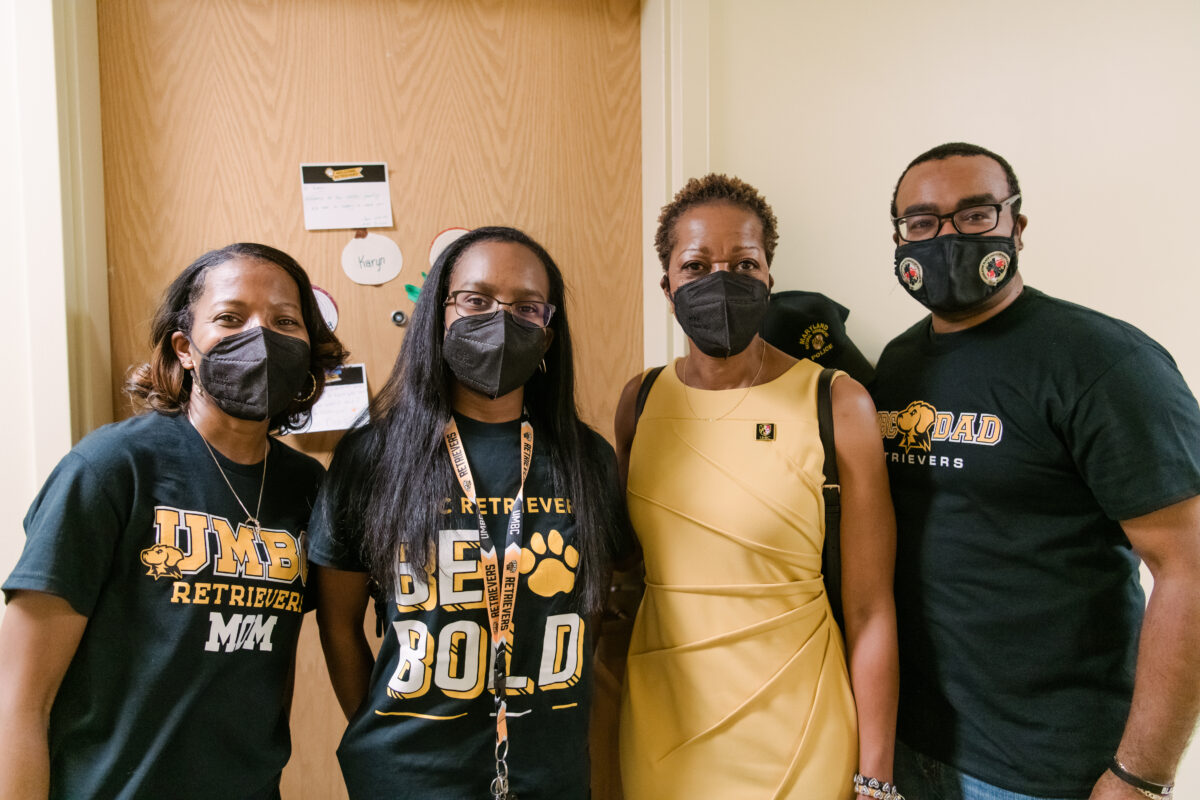 A Retriever family stops to pose with President Sheares Ashby (in gold). They include (l-r): Myra Sydnor, Camryn Sydnor, and Maryland State Senator Charles Sydnor. (Marlayna Demond ’11/UMBC)
If new Retrievers didn’t know the school colors before, they certainly did now. Swag tables, information tables, and goodie tables lined the field, all decked out in UMBC’s signature black and gold. Even the animals in the petting zoo got the memo.
 Just your normal campus petting zoo. (Marlayna Demond ’11/UMBC)
Once families said their goodbyes and maybe a few students and parents teared up got something in their eye, celebrations continued with Playfair and the annual fireworks display. New Retrievers played “getting to know you” games to break the ice and capped off the night with a spectacular fireworks show.
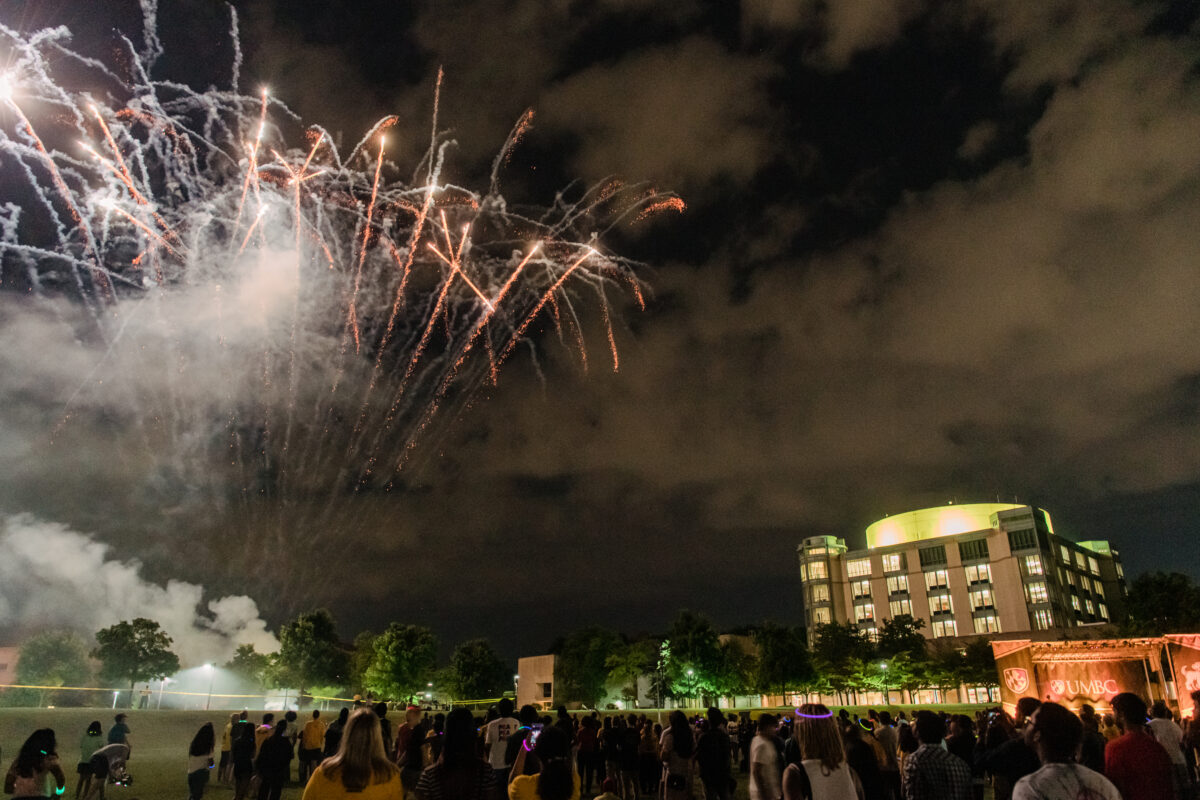 Fireworks lighting up the UMBC night sky. (Marlayna Demond ’11/UMBC)
A place for everyone
Incoming transfer student Luther Daigle, mechanical engineering, summed up the feeling hearing about UMBC versus coming to UMBC by saying, “It wasn’t until I toured the campus and I felt an overwhelming sense of belonging that I knew I wanted to continue my academic career at UMBC.” And that feeling has carried through the start of his first semester.
 Daigle addresses the crowd at Fall Opening Meeting. (Marlayna Demond ’11/UMBC)
This sense of belonging extends to UMBC’s rapidly growing population of international students. As of the end of August, over 2,200 international students were enrolled for the 2022 – 2023 academic year.
“As UMBC’s international reputation continues to grow, more students from around the world choose to join our campus community,” says David Di Maria, associate vice provost for international education. “We are very pleased to welcome the largest number of international students in UMBC’s history.”
Jok Thon, an incoming graduate student studying entrepreneurship, innovation, and leadership, is the first student from South Sudan to enroll at UMBC and he was buoyed by the diversity represented in the community he’d be joining.
 Thon and Joby Taylor, Ph.D. ’05, LLC, director of the Shriver Peaceworker Fellows Program. (Image courtesy of Taylor)
Addressing his peers at the annual Fall Opening Meeting, Thon said, “We have an incredibly diverse and creative campus community. We have such an opportunity to learn from this global village…maybe we should even think of it as our responsibility as global citizens to learn from each other during our time at UMBC.”
During Convocation, 2022 Presidential Teaching Award recipient Tamra Mendelson echoed the importance of this saying, “Inclusive to me means that we not only value, we require a diversity of backgrounds to make the world a better place. It’s the only way we will achieve a more accurately educated, environmentally conscious civil society.”
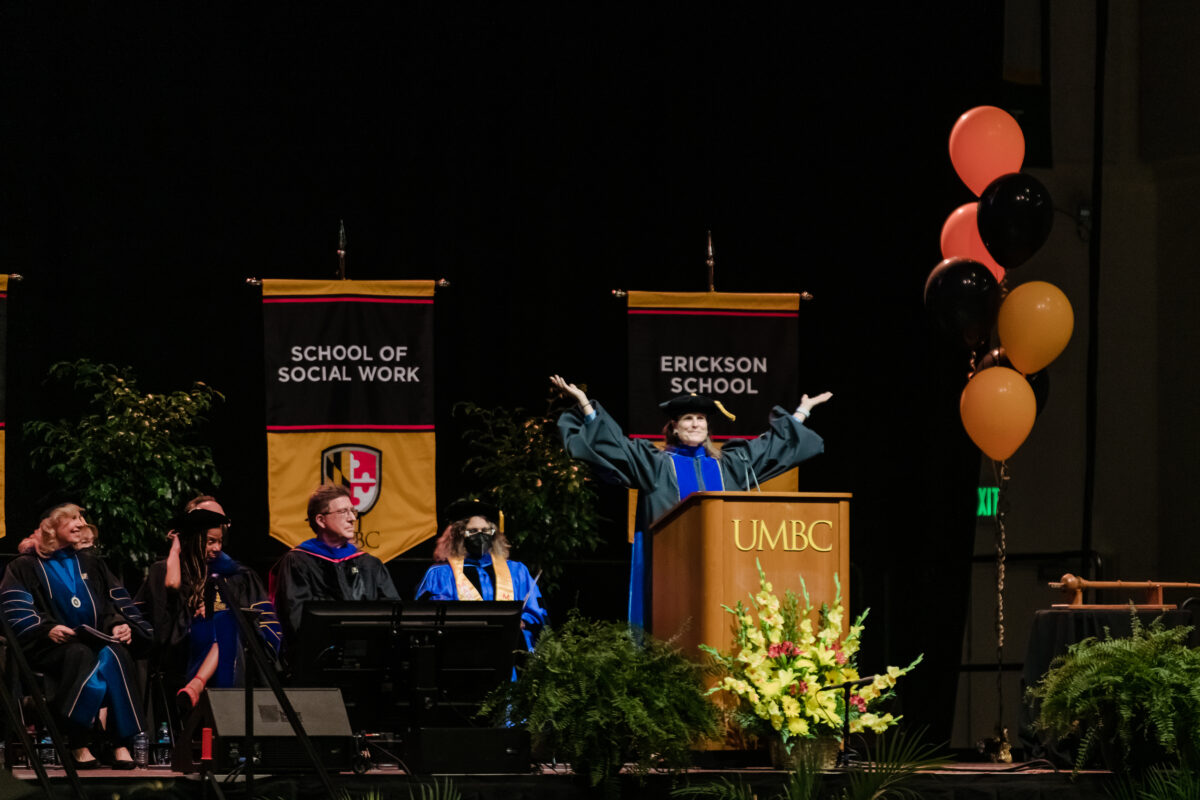 Mendelson expresses her excitement at opening another school year. (Marlayna Demond ’11/UMBC)
Students at the center
While students may think faculty and staff are the backbone of their educational career, their educators and advisors would argue it’s the opposite—students themselves are at the core of UMBC.
“If there was an equation to describe UMBC, our students would be the essential term. We are committed to providing each of our outstanding students with a first-class education and the support needed to achieve success, whether that means meeting with the CNMS success coach, participating in programs at The Learning Collaboratory, or working one-on-one with a faculty mentor,” said William R. LaCourse, dean of the College of Natural and Mathematical Sciences (CNMS). “Inclusive excellence is more than just words—it is our mission.”
LaCourse himself knows the importance of connecting with students on a foundational level. In the spring, you can find him co-teaching CHEM 100: The Chemical World to non-chemistry majors.
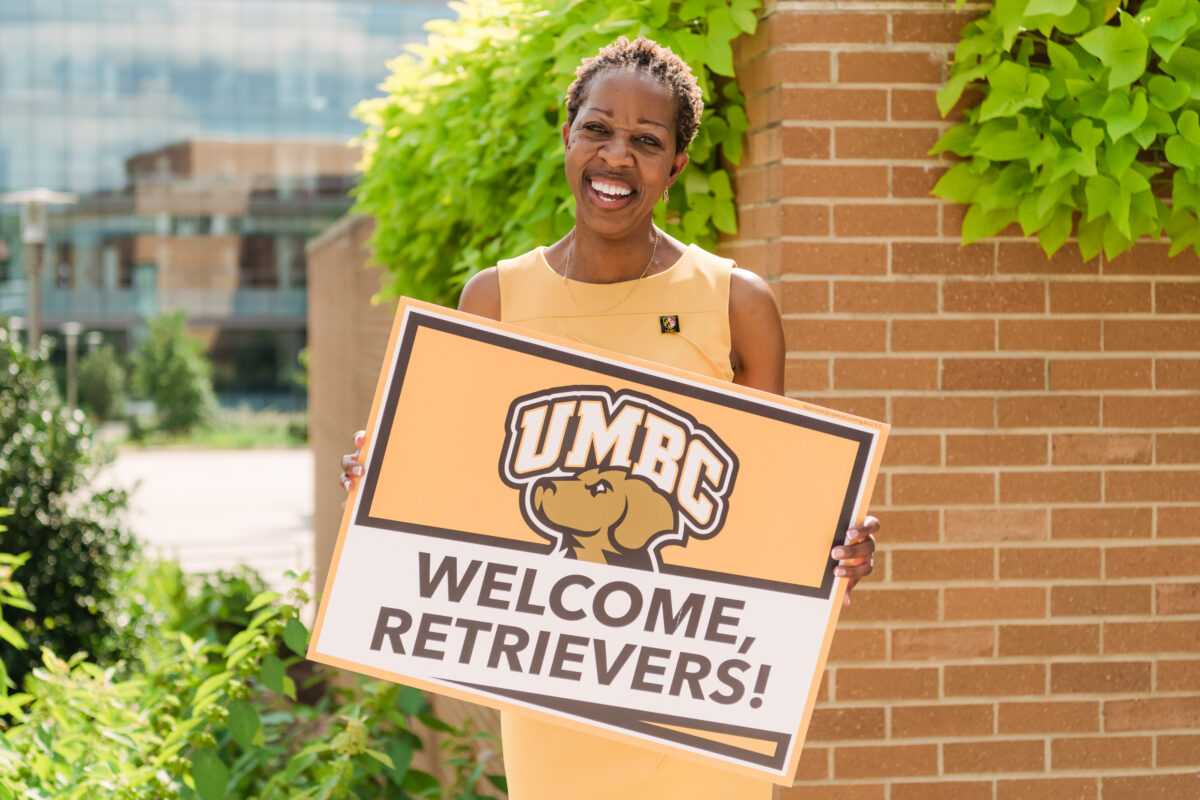 President Sheares Ashby eagerly welcomes UMBC’s new students. (Marlayna Demond ’11/UMBC)
Keith J Bowman, dean of the College of Engineering and Information Technology (COEIT), points to the essential role that student leaders play in reaching out to and connecting with new students, and helping them feel welcome and connected.
“All summer I have been hearing from student org leaders from our college,” says Bowman. “Their enthusiasm to engage with current and new members is very exciting.”
Among the new students Dean Kimberly Moffitt welcomed to UMBC’s College of Arts, Humanities, and Social Sciences (CAHSS) this year are several Shriver Peaceworker Fellows, who gathered on campus on August 1 to kick off their fellowship. These Returned Peace Corps Volunteers pursue graduate degrees in a range of fields (such as teaching and applied sociology) while also working with community partner organizations to address diverse social needs, and actively reflecting on their learning and engagement experiences.
This multifaceted approach exemplifies how work in the classroom, hands-on learning, community engagement, and service connect to form the unique UMBC student experience.
]]>
“ “This is a time when you begin to define what you love, what really matters to you, who you want to be in this world, and what difference you want to make in the lives of...
https://umbc.edu/stories/umbc-opens-new-academic-year-with-new-president-largest-ever-incoming-class/
https://my3.my.umbc.edu/api/v0/pixel/news/127230/guest@my.umbc.edu/a88f8efff8f07beedd8f08ca7c180207/api/pixel
cahss
civic
cnms
coeit
community
diversityandinclusion
news
shrivercenter
UMBC News & Magazine
https://my3.my.umbc.edu/groups/umbc-news-magazine
https://assets1-my.umbc.edu/system/shared/avatars/groups/000/001/943/24435aa6207c452e7bc15cc74b42c7bb/xsmall.png?1748556657
https://assets1-my.umbc.edu/system/shared/avatars/groups/000/001/943/24435aa6207c452e7bc15cc74b42c7bb/original.png?1748556657
https://assets2-my.umbc.edu/system/shared/avatars/groups/000/001/943/24435aa6207c452e7bc15cc74b42c7bb/xxlarge.png?1748556657
https://assets2-my.umbc.edu/system/shared/avatars/groups/000/001/943/24435aa6207c452e7bc15cc74b42c7bb/xlarge.png?1748556657
https://assets3-my.umbc.edu/system/shared/avatars/groups/000/001/943/24435aa6207c452e7bc15cc74b42c7bb/large.png?1748556657
https://assets1-my.umbc.edu/system/shared/avatars/groups/000/001/943/24435aa6207c452e7bc15cc74b42c7bb/medium.png?1748556657
https://assets2-my.umbc.edu/system/shared/avatars/groups/000/001/943/24435aa6207c452e7bc15cc74b42c7bb/small.png?1748556657
https://assets1-my.umbc.edu/system/shared/avatars/groups/000/001/943/24435aa6207c452e7bc15cc74b42c7bb/xsmall.png?1748556657
https://assets2-my.umbc.edu/system/shared/avatars/groups/000/001/943/24435aa6207c452e7bc15cc74b42c7bb/xxsmall.png?1748556657
UMBC News & Magazine
0
0
false
Thu, 01 Sep 2022 15:02:09 -0400
Thu, 01 Sep 2022 15:02:09 -0400
NSF awards $10M to UMBC to expand successful initiative developing underrepresented postdocs in STEM
UMBC will expand its work boosting diversity in academia from Maryland to the national level through a new NSF INCLUDES Alliance: Re-Imagining STEM Equity Utilizing Postdoc Pathways (RISE UPP). The RISE UPP Alliance, anticipated to officially launch in fall 2022, is modeled after the AGEP PROMISE Academy, a high-impact initiative co-led by UMBC that supports faculty diversification in the biomedical sciences across University System of Maryland (USM) institutions.
The UMBC-led RISE UPP Alliance will assist the University of Texas System, Texas A&M University System, and University of North Carolina System in creating programs similar to the AGEP PROMISE Academy, but tailored to meet the needs of their specific institutions and systems. The AGEP PROMISE Academy focuses on recruiting diverse Ph.D. recipients and helping them develop their careers from the postdoc to tenure-track faculty stage. UMBC has received a $10 million grant from the National Science Foundation (NSF) to replicate this national model.
RISE UPP seeks to help R1, R2, and teaching-intensive institutions recruit and train postdoctoral scholars from underrepresented backgrounds in STEM, and help them build community and supportive networks, facilitating their progression into tenure-track positions.
“The underrepresentation of minoritized scholars in universities has been a stagnant problem for a really long time and decades of effort have not yet yielded much change,” said Robin Cresiski, assistant vice provost for graduate student development and postdoctoral affairs. “There is an appetite for trying something different.”
A systemic approach to faculty diversity
The AGEP PROMISE Academy, which launched in 2018 and is set to continue until 2023, is an extension of Maryland’s nationally-regarded PROMISE Alliance for Graduate Education and the Professoriate (PROMISE AGEP) program, also funded by NSF. UMBC co-leads the Academy with the University of Maryland, College Park, University of Maryland, Baltimore, Towson University, and Salisbury University.
Since its inception, 10 fellows have participated in the AGEP PROMISE Academy, including UMBC’s Nykia Walker, a biological sciences research assistant professor. Walker’s lab is focused on how primary breast tumors initiate metastases through transcriptional regulation.Walker is currently preparing for a tenure track position as one of UMBC’s Pre-Professoriate Fellows.
Cresiski, who also serves as the director of Maryland’s AGEP PROMISE Academy Alliance, explains that the Academy was developed as an extension of UMBC’s Fellows for Faculty Diversity program. UMBC developed that program to better recruit, support, and retain scholars committed to diversity, equity, and inclusion, particularly members of groups underrepresented in the professoriate.
As members of UMBC’s Executive Committee for the Recruitment, Retention and Advancement of Underrepresented Minority Faculty shared in a recent Baltimore Sun letter, “the program, launched in 2011, has been a resounding success.” In its first decade, the initiative brought in 18 postdoctoral fellows in disciplines from dance to history to geography and environmental systems, 17 of whom have transitioned to higher academic positions (11 at UMBC).
The success of the Fellows Faculty Diversity program, along with UMBC’s Natural Sciences Pre-Professoriate Fellowship program, served as the inspiration for the AGEP PROMISE Academy program, Cresiski notes. “We feel so fortunate that UMBC’s leadership has led us to generate approaches to addressing faculty diversity at a large scale,” she says.
The USM leading the way
In addition to the AGEP PROMISE Academy, other university systems will also be learning from additional RISE UPP Alliance partner, the University of California President’s Postdoctoral Fellowship Program.
Principal investigator Philip Rous, UMBC provost and senior vice president for academic affairs, shares that at its core RISE UPP is a research project that assesses the effectiveness of a university system-based approach to faculty diversification and allows participating systems to learn from one another.
 Philip Rous (Marlayna Demond ’11/UMBC)
He underscores that by replicating USM’s approach within other university systems, more institutions across the country may also be able to increase the faculty diversity.
“Only by many systems and many universities doing this are we actually going to succeed in what we want to do, which is not only to change the diversity of our faculty but change the opportunities for diversity and inclusion of faculty across the nation,” says Rous. “All universities and all university systems have an obligation—and should, with our support—to diversify their faculty. Hopefully we can be useful to the other systems from our experience and help guide them.”
Rising up to the challenge
The RISE UPP Alliance will work with both participating university systems and their institutions and departments to make campus cultures and structures more inclusive.
In order to do this, RISE UPP will focus on four areas. The first will be supporting postdoctoral scholars from underrepresented groups by providing training, professional development, and community with other scholars across their university system and the RISE UPP Alliance network. RISE UPP will also facilitate formal assessment of participating departments, institutions, and systems to check if the adaptations are proving effective.
The Alliance will help the institutions create pathways, through policy and practice, that remove barriers for postdocs from underrepresented groups to access tenure-track positions within and across participating university systems. To make all this work possible, they will develop and support faculty who serve as mentors for postdoctoral fellows and junior colleagues through training, compensation, recognition, and advocacy.
“We have learned a lot about the benefits of working across the [USM] to develop, implement, study and evaluate our model that allows multiple pathways for postdocs to convert to tenure track faculty positions,” says Janet Rutledge, vice provost and dean of UMBC’s graduate school. “We look forward to further development, dissemination and further evaluation and research with additional state system partners to expand opportunities for postdoc conversions.”
]]>
UMBC will expand its work boosting diversity in academia from Maryland to the national level through a new NSF INCLUDES Alliance: Re-Imagining STEM Equity Utilizing Postdoc Pathways (RISE UPP)....
https://umbc.edu/stories/nsf-awards-10m-to-umbc-to-expand-successful-initiative-developing-underrepresented-postdocs-in-stem/
https://my3.my.umbc.edu/api/v0/pixel/news/126721/guest@my.umbc.edu/a85b2a6b5e4b1f20deab49aa821a553e/api/pixel
cnms
diversityandinclusion
graduateschool
majoraward
news
science-and-tech
UMBC News & Magazine
https://my3.my.umbc.edu/groups/umbc-news-magazine
https://assets1-my.umbc.edu/system/shared/avatars/groups/000/001/943/24435aa6207c452e7bc15cc74b42c7bb/xsmall.png?1748556657
https://assets1-my.umbc.edu/system/shared/avatars/groups/000/001/943/24435aa6207c452e7bc15cc74b42c7bb/original.png?1748556657
https://assets2-my.umbc.edu/system/shared/avatars/groups/000/001/943/24435aa6207c452e7bc15cc74b42c7bb/xxlarge.png?1748556657
https://assets2-my.umbc.edu/system/shared/avatars/groups/000/001/943/24435aa6207c452e7bc15cc74b42c7bb/xlarge.png?1748556657
https://assets3-my.umbc.edu/system/shared/avatars/groups/000/001/943/24435aa6207c452e7bc15cc74b42c7bb/large.png?1748556657
https://assets1-my.umbc.edu/system/shared/avatars/groups/000/001/943/24435aa6207c452e7bc15cc74b42c7bb/medium.png?1748556657
https://assets2-my.umbc.edu/system/shared/avatars/groups/000/001/943/24435aa6207c452e7bc15cc74b42c7bb/small.png?1748556657
https://assets1-my.umbc.edu/system/shared/avatars/groups/000/001/943/24435aa6207c452e7bc15cc74b42c7bb/xsmall.png?1748556657
https://assets2-my.umbc.edu/system/shared/avatars/groups/000/001/943/24435aa6207c452e7bc15cc74b42c7bb/xxsmall.png?1748556657
UMBC News & Magazine
0
0
false
Fri, 05 Aug 2022 12:12:49 -0400
Fri, 05 Aug 2022 12:12:49 -0400
Chronicle report on “new era” of inclusive administration highlights UMBC leaders
In the newly-released Chronicle of Higher Education report “Diverse Leadership for a New Era,” Valerie Sheares Ashby shares a powerful story of mentorship. Years ago, when Sheares Ashby was a professor of chemistry at University of North Carolina at Chapel Hill, she came to UMBC for the first time to learn about the Meyerhoff Scholars Program. After meeting Sheares Ashby and seeing how others responded to her leadership, even in those early days, UMBC President Freeman A. Hrabowski turned to her and said, “You’re going to be a president.”
It was the same prediction that Hrabowski’s predecessor, Michael K. Hooker, made to him years before. For Sheares Ashby it will become a reality on August 1 when she begins as UMBC’s next president.
Positive impact
Like Hrabowski three decades before her, Sheares Ashby wasn’t sure what to make of the idea at first, but the comment inspired her to think in new ways about a leadership career. She loved teaching and says, to this day, “I am a teacher at heart.” But she also came to see how she could positively affect the lives of more students through university leadership.
As her career progressed, she assembled a team of mentors, including former UNC-Chapel Hill Chancellor Holden Thorp, who is now editor-in-chief of Science. Much of the new Chronicle report focuses on the essential role of mentors in supporting leaders, particularly from underrepresented groups.
 Dr. Valerie Sheares Ashby and Dr. Freeman Hrabowski at the RetriEVER Empowered campus event, April 2022.
Advocacy and community
Beyond mentors, President Hrabowski notes in the report, are champions. “A champion will knock down doors for you,” he says. “When people tell you no, the champion will say, ‘We don’t accept no.’ When you want to quit, it takes a champion to say, ‘No, you won’t.’”
Effectively supporting the development of diverse leaders also takes the right community, Hrabowski notes. At UMBC, the diverse faculty members teaching the diverse students are led by a diverse administration, Hrabowski explains. “You put that team together and you see how they approach problems from very different perspectives,” he says, “and it makes for a very rich conversation.”
 Dr. Valerie Sheares Ashby (center) connects with UMBC faculty, staff, and students at the RetriEVER Empowered event, April 2022.
Through these rich conversations, universities can find the best ways to support their students, carry out high-impact research, and foster the ongoing growth of their community members—all essential elements of their mission.
The full report is available through The Chronicle of Higher Education.
]]>
In the newly-released Chronicle of Higher Education report “Diverse Leadership for a New Era,” Valerie Sheares Ashby shares a powerful story of mentorship. Years ago, when Sheares Ashby was a...
https://umbc.edu/stories/chronicle-report-on-inclusive-administration-highlights-umbc-leaders/
https://my3.my.umbc.edu/api/v0/pixel/news/126413/guest@my.umbc.edu/fc340b4ef30517cf9be042964e5a495b/api/pixel
community
diversityandinclusion
hrabowski
news
sheares-ashby
UMBC News & Magazine
https://my3.my.umbc.edu/groups/umbc-news-magazine
https://assets1-my.umbc.edu/system/shared/avatars/groups/000/001/943/24435aa6207c452e7bc15cc74b42c7bb/xsmall.png?1748556657
https://assets1-my.umbc.edu/system/shared/avatars/groups/000/001/943/24435aa6207c452e7bc15cc74b42c7bb/original.png?1748556657
https://assets2-my.umbc.edu/system/shared/avatars/groups/000/001/943/24435aa6207c452e7bc15cc74b42c7bb/xxlarge.png?1748556657
https://assets2-my.umbc.edu/system/shared/avatars/groups/000/001/943/24435aa6207c452e7bc15cc74b42c7bb/xlarge.png?1748556657
https://assets3-my.umbc.edu/system/shared/avatars/groups/000/001/943/24435aa6207c452e7bc15cc74b42c7bb/large.png?1748556657
https://assets1-my.umbc.edu/system/shared/avatars/groups/000/001/943/24435aa6207c452e7bc15cc74b42c7bb/medium.png?1748556657
https://assets2-my.umbc.edu/system/shared/avatars/groups/000/001/943/24435aa6207c452e7bc15cc74b42c7bb/small.png?1748556657
https://assets1-my.umbc.edu/system/shared/avatars/groups/000/001/943/24435aa6207c452e7bc15cc74b42c7bb/xsmall.png?1748556657
https://assets2-my.umbc.edu/system/shared/avatars/groups/000/001/943/24435aa6207c452e7bc15cc74b42c7bb/xxsmall.png?1748556657
UMBC News & Magazine
0
0
false
Mon, 25 Jul 2022 15:46:01 -0400
Mon, 25 Jul 2022 15:46:01 -0400
Simons Foundation provides $2.5M to support UMBC Meyerhoff Scholars, plans New York replication

The Simons Foundation and its sister organization, Simons Foundation International, have pledged $2.5 million over five years to support the Meyerhoff Scholars Program. Continued partnership between UMBC and Simons will also generate opportunities for program alumni and support Meyerhoff replication efforts at other institutions.
For almost 30 years, the Simons Foundation has worked to support advances in mathematics and basic science by funding external scientists and, more recently, through research at its own Flatiron Institute in New York City. Simons has also done outreach work through the Math for America program, which seeks to enhance the math and science literacy of children in New York City public schools. The gift to UMBC, however, represents a new emphasis on supporting the development of a diverse pipeline of STEM professionals.
Partnering to diversify STEM
“I have long admired the UMBC Meyerhoff program for its significant impact on training outstanding students from diverse backgrounds. It is an important model for other universities, and its alumni are at the forefront of scientific research,” says David Spergel, president of the Simons Foundation and Simons Foundation International. “I am proud that the Simons Foundation and Simons Foundation International can partner with UMBC through support of this program.”
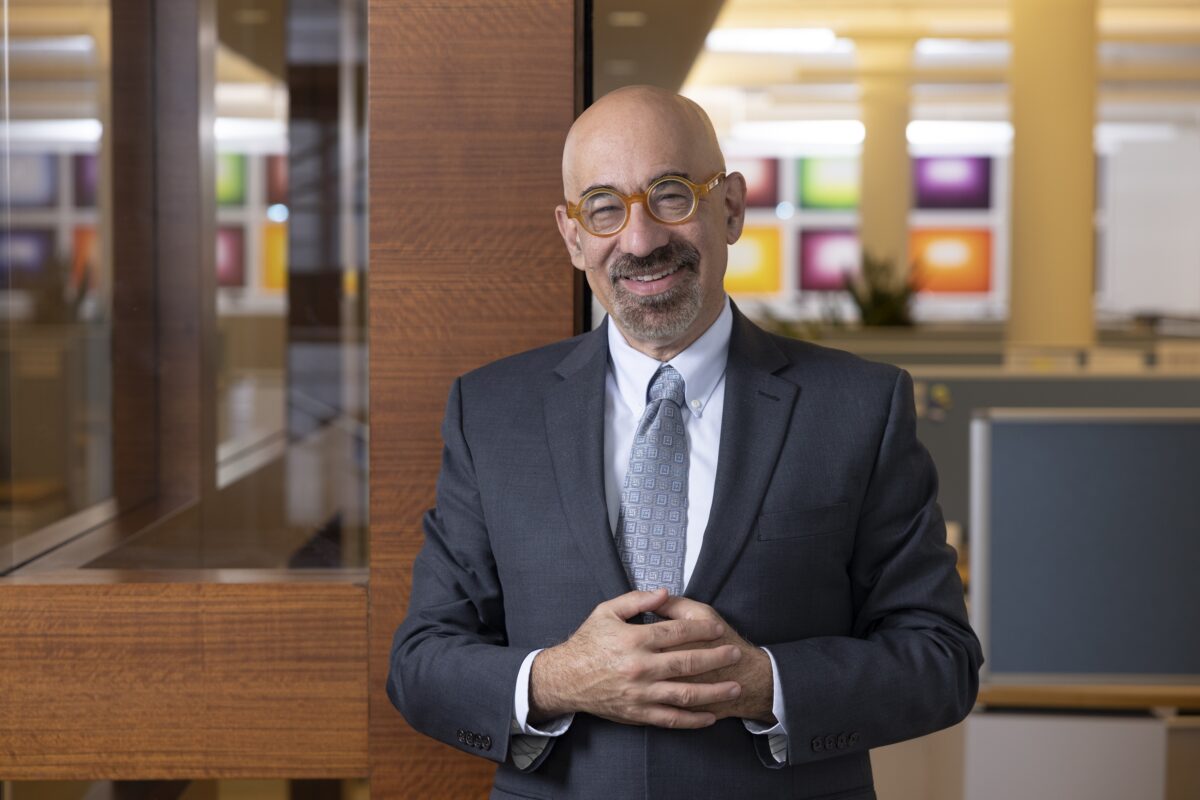 David Spergel, president of Simons Foundation and Simons Foundation International and a longtime admirer of President Hrabowski and the Meyerhoff Scholars Program (courtesy of Simons Foundation)
Craig Wesley, manager of diversity, equity, and inclusion at the Simons Foundation, has also been following President Freeman Hrabowski’s work for years. When Wesley started in his role a little over a year ago, he undertook a study to see what programs existed that were already successfully helping diversify the STEM pipeline. The Meyerhoff Scholars program jumped out as a leader in that space.
“The vision became, how could we replicate that model here in the New York area?” Wesley says. “We needed to find the right institutional partner to launch this work.” As it turned out, UMBC was the perfect fit.
Immediate impact
The new partnership will also create summer research opportunities for Meyerhoff Scholars at the Flatiron Institute. Naiyah Lewis ’23, M31, computer science,is already in New York for a summer internship with Natalie Sauerwald, a Flatiron Research Fellow with a focus on computational techniques in genomics.
This new grant will support scholarships for Meyerhoff Scholars and serve as a dedicated funding source for Summer Bridge, a cornerstone of the Meyerhoff experience undertaken by Scholars before their first year at UMBC. During Summer Bridge, Scholars bond as a community and internalize what it means to be a Meyerhoff Scholar. This includes the values of collaboration, leadership, service, professionalism, and academic excellence—alongside hard work and grit.
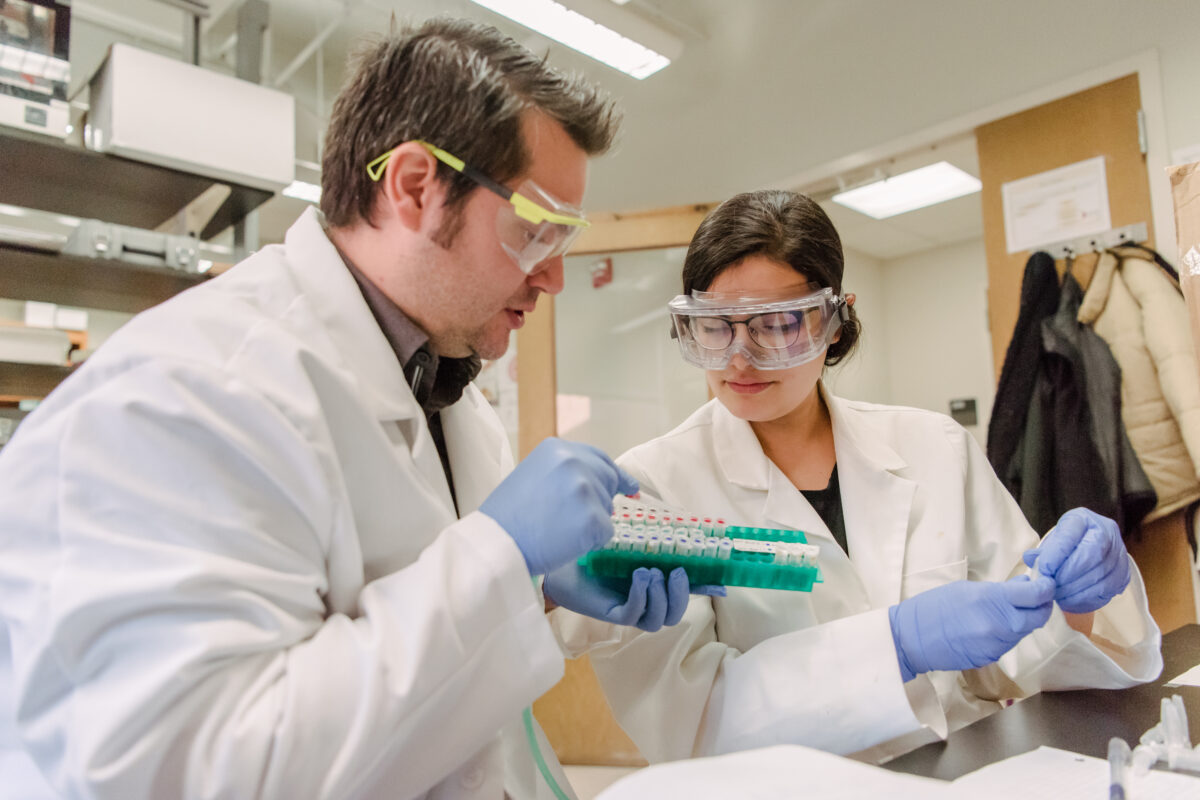 Abby Cruz ’18, biological sciences, a Meyerhoff affiliate and MARC U*STAR Scholar, conducts research with Fernando Vonhoff. (Marlayna Demond ’11/UMBC)
Meyerhoff alumni will also benefit. They will be invited to apply for Transition to Independence Awards through the Simons Collaboration on the Global Brain and the Simons Collaboration on Plasticity and the Aging Brain. These large awards target Ph.D. and M.D./Ph.D. scientists from underrepresented groups who are currently in training positions and seeking tenure-track roles. Postdoctoral positions may also be available for Meyerhoff Scholar alumni at the Flatiron Institute.
“UMBC and Meyerhoff are excited to partner with the Simons Foundation in advancing our efforts to promote inclusive excellence and diversify the nation’s STEM workforce,” says Keith Harmon, director of the Meyerhoff Scholars Program.
Ripple effect—amplified
In addition to helping individual students and alumni, the growing partnership between UMBC and Simons will also advance a larger, shared goal of both institutions: launching more programs modeled on the Meyerhoff Scholars. UMBC staff and faculty involved with Meyerhoff will work with SUNY Stony Brook to create a Meyerhoff-like program within the public university system in New York.
“We are committed to helping increase the diversity of the STEM workforce,” Spergel says. “We see our collaboration with UMBC as key to helping us reach that goal through partnerships, in part by helping to adapt the Meyerhoff model at Stony Brook.”
As the partnership between UMBC and the Simons Foundation develops, the institutions hope their collaborative work will amplify the ripple effect already occurring across the country as Meyerhoff alumni advance in their careers. As more students get to experience the support offered by Meyerhoff and programs like it, they, too, will join the ranks of these alumni and make their own impact.
]]>
The Simons Foundation and its sister organization, Simons Foundation International, have pledged $2.5 million over five years to support the Meyerhoff Scholars Program. Continued partnership...
https://umbc.edu/stories/simons-fdn-provides-2-5m-to-meyerhoff-scholars/
https://my3.my.umbc.edu/api/v0/pixel/news/125859/guest@my.umbc.edu/51ec2fe4de20e0d4c400dd9e5dadf18f/api/pixel
community
diversityandinclusion
meyerhoffscholars
science-and-tech
uncategorized
UMBC News & Magazine
https://my3.my.umbc.edu/groups/umbc-news-magazine
https://assets1-my.umbc.edu/system/shared/avatars/groups/000/001/943/24435aa6207c452e7bc15cc74b42c7bb/xsmall.png?1748556657
https://assets1-my.umbc.edu/system/shared/avatars/groups/000/001/943/24435aa6207c452e7bc15cc74b42c7bb/original.png?1748556657
https://assets2-my.umbc.edu/system/shared/avatars/groups/000/001/943/24435aa6207c452e7bc15cc74b42c7bb/xxlarge.png?1748556657
https://assets2-my.umbc.edu/system/shared/avatars/groups/000/001/943/24435aa6207c452e7bc15cc74b42c7bb/xlarge.png?1748556657
https://assets3-my.umbc.edu/system/shared/avatars/groups/000/001/943/24435aa6207c452e7bc15cc74b42c7bb/large.png?1748556657
https://assets1-my.umbc.edu/system/shared/avatars/groups/000/001/943/24435aa6207c452e7bc15cc74b42c7bb/medium.png?1748556657
https://assets2-my.umbc.edu/system/shared/avatars/groups/000/001/943/24435aa6207c452e7bc15cc74b42c7bb/small.png?1748556657
https://assets1-my.umbc.edu/system/shared/avatars/groups/000/001/943/24435aa6207c452e7bc15cc74b42c7bb/xsmall.png?1748556657
https://assets2-my.umbc.edu/system/shared/avatars/groups/000/001/943/24435aa6207c452e7bc15cc74b42c7bb/xxsmall.png?1748556657
UMBC News & Magazine
0
0
false
Fri, 10 Jun 2022 16:19:43 -0400
Fri, 10 Jun 2022 16:19:43 -0400