Retrievers learn the art and heart of cooking Salvadoran food at True Grit’s Test Kitchen
“Recipes are like an address to a homeland, but they’re also very personal to your own story,” said Karla T. Vasquez, author of The SalviSoul Cookbook, in True Grit’s Test Kitchen. Celia Bonilla, a business technology administration sophomore, grinned and nodded—the addresses for her own recipes come from El Salvador and Maryland. Bonilla joined other UMBC students earlier this fall for the “More than Pupusas” cooking demonstration, sponsored by the Dresher Center for the Humanities, to learn how to cook Salvadoran street food.
Bonilla sat at one of two tables set with brown butcher paper with her classmates, Stephania Fonseca, a social work sophomore, and Jeffrey Molina Soriano, a computer science junior. They also have roots in Maryland and El Salvador. “Pastelitos [pah-steh-lee-tos] means little pie and it’s the Salvadoran version of empanadas [em-pah-nah-dahs],” said Vasquez. “Empanadas are well known all over Latin America. Greeks, Italians, and other Europeans make meat pies, too.”
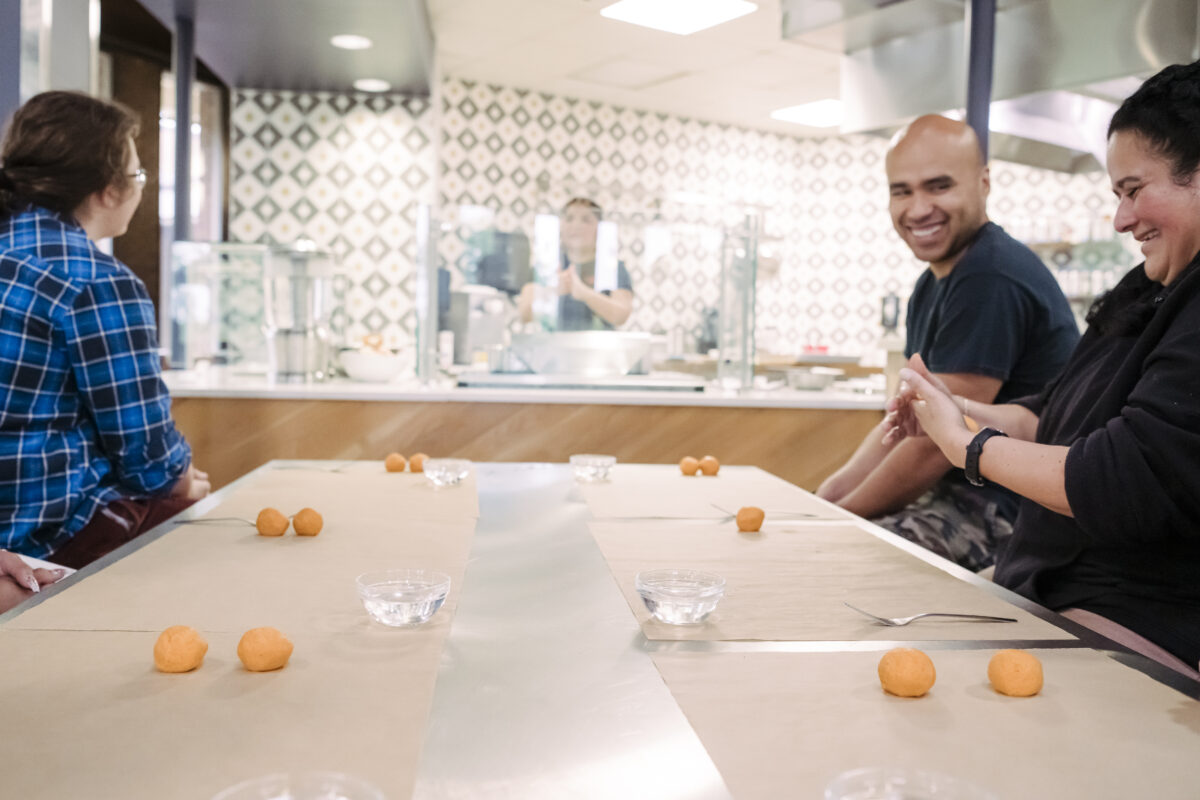 Celia Bonilla and Jeffrey Molina Soriano learn how to mold pastelito dough. (Marlayna Demond ’11/UMBC)
Like many Salvadoran students at UMBC, their journeys to UMBC are as complex as the ingredients they use for this meal. “Sometimes Hispanic Heritage Month events portray Latinx culture as a monolith, often focusing on the Caribbean or Mexican American experience,” said Courtney C. Hobson ’10, M.A. ’14, history, program manager at the James T. and Virginia M. Dresher Center for the Humanities. “I grew up in Prince George’s County, Maryland, where a significant part of the Latinx immigrant community comes from Central America, specifically El Salvador. Many of our Latinx students have roots in Central America—I wanted to organize an event that celebrated the rich culture they represent.”
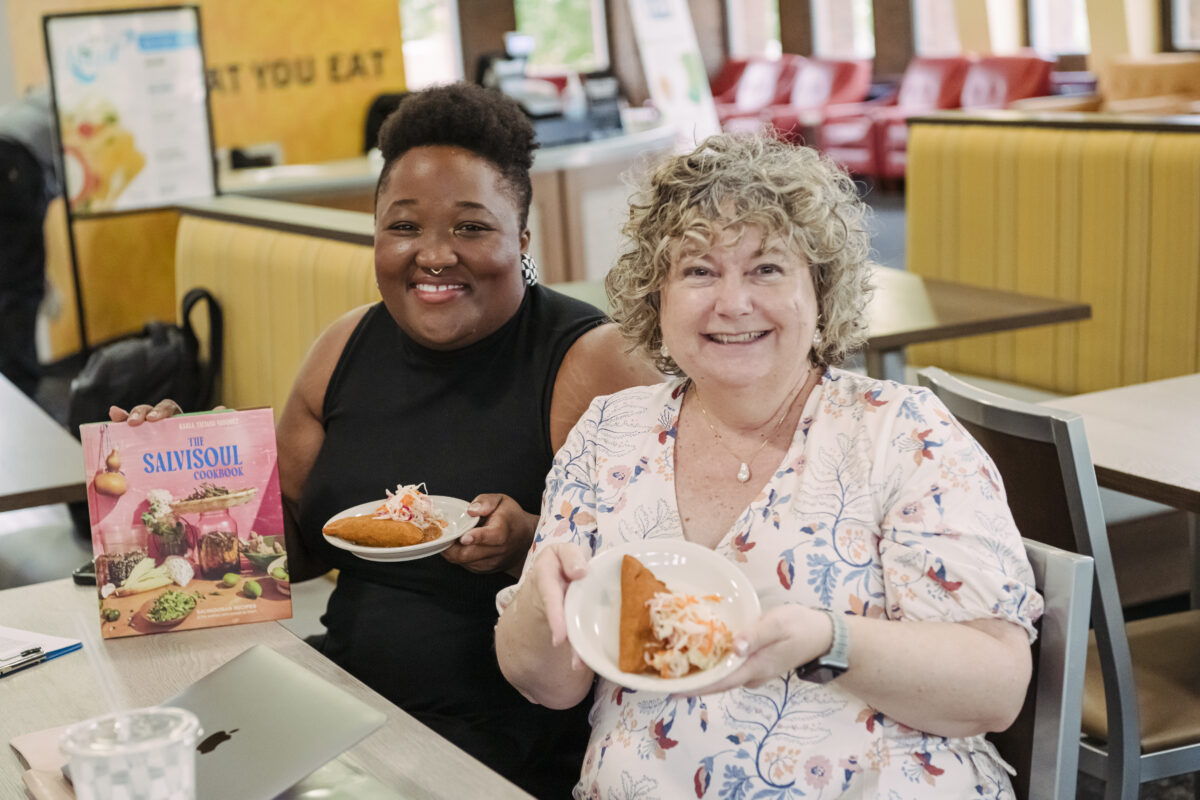 (l-r): Courtney C. Hobson and Amy Froide, professor of history and director of the Dresher Center for the Humanities. (Marlayna Demond ’11/UMBC)
“I came here when I was six years old from El Salvador,” said Bonilla, who attended the event as part of an assignment for the Spanish for Heritage Spanish Speakers class. Students must participate in two on-campus and two off-campus cultural events that celebrate Hispanic/Latinx culture. While Bonilla is familiar with campus events as the parent of a UMBC alum Jasmine Esmeralda Bonilla ’21, chemical engineering, this event felt different. “This class gives me a chance to learn more about my culture and language by engaging with people from various countries and age groups.”
Culinary traditions
Most students at the event said they had eaten pupusas (puh-poo-suhz) at home or at a restaurant. This flat corn flour cake, stuffed with cheese, beans, and sometimes meat is the national dish of El Salvador. “I have an aunt who is from El Salvador. She taught my mom, and then my mom taught me how to make pupusas with my sister,” said Fonseca. “My dad is from El Salvador, and my mom is from Mexico. We learned to make pupusas together as a family. So it became a typical food from my home.”
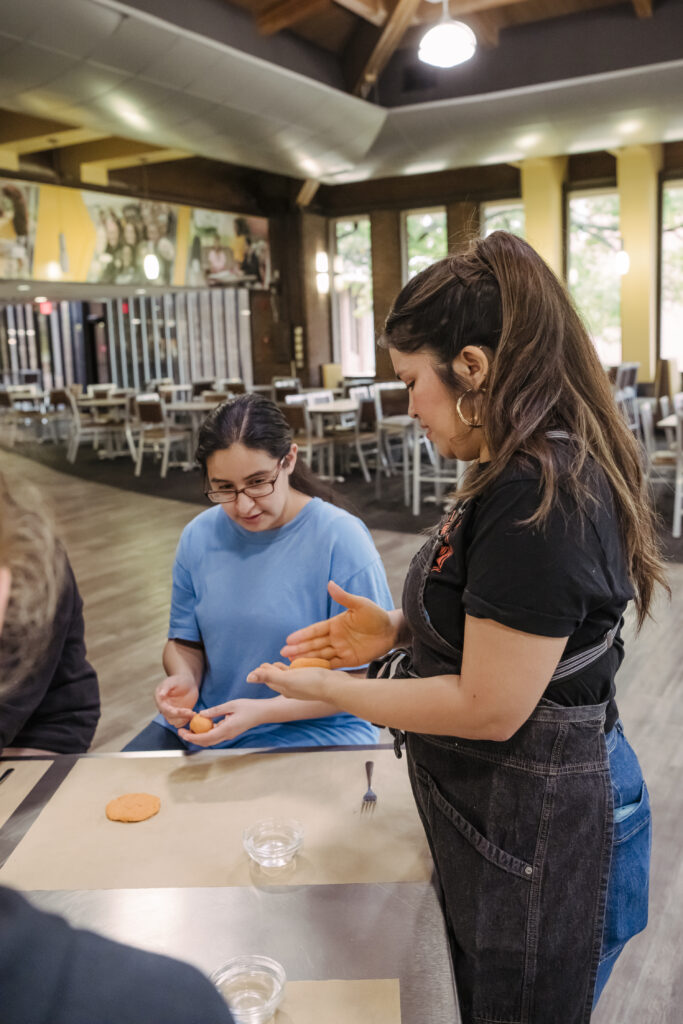
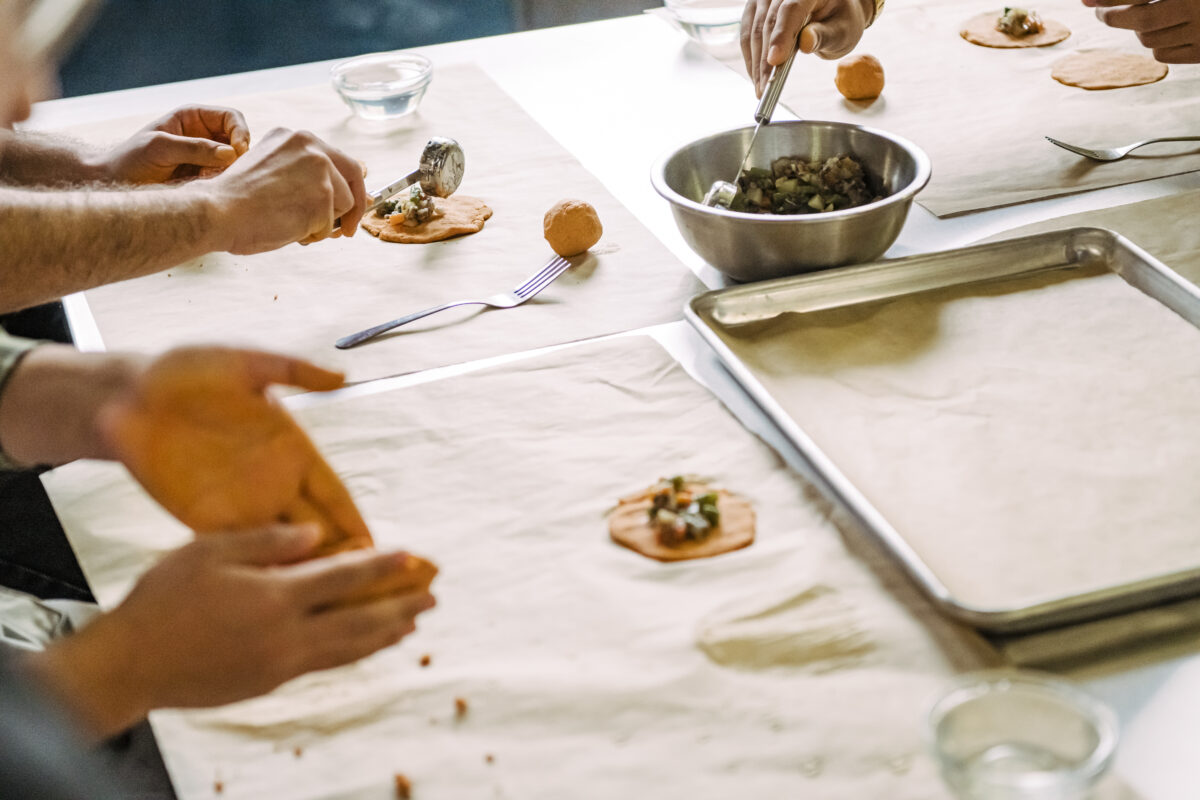
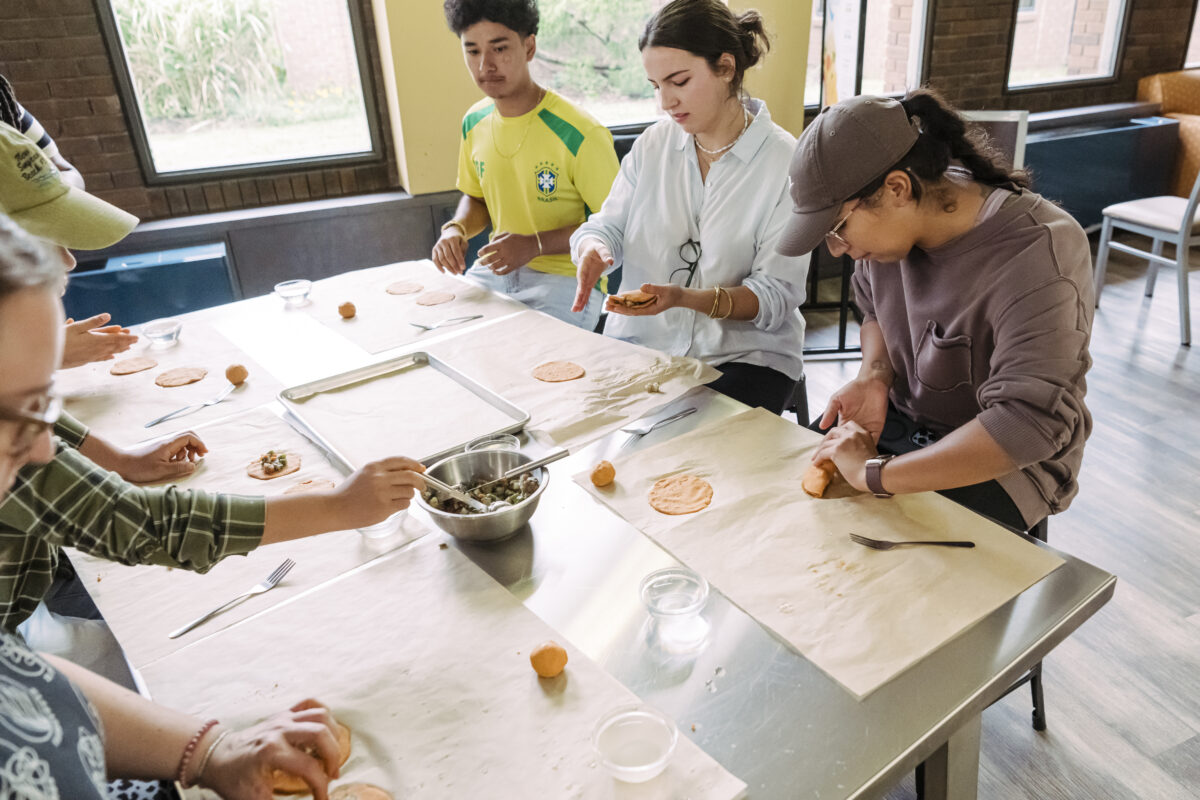 (l-r): Stephania Fonseca watches Vasquez fold the dough to make a pocket. Students fill the pastelitos with a mushroom filling. (Marlayna Demond ’11/UMBC)
As students kneaded the dough into a palm-sized disc, filled it with sautéed mushrooms, and pinched the edges to seal the pastelitos, they also shared what food meant to them in the context of their family and student life. A clear theme emerged, culinary traditions can extend beyond the kitchen. “We have the Philly pretzel factory. I’ve never been able to find a soft pretzel as good as the Philly Pretzel Factory,” said Ashley Gutshall about her hometown of Royersford, Pennsylvania. Gutshall, a history and Spanish sophomore, shares, “It’s our family tradition to get Philly soft pretzels after doctor’s appointments.”
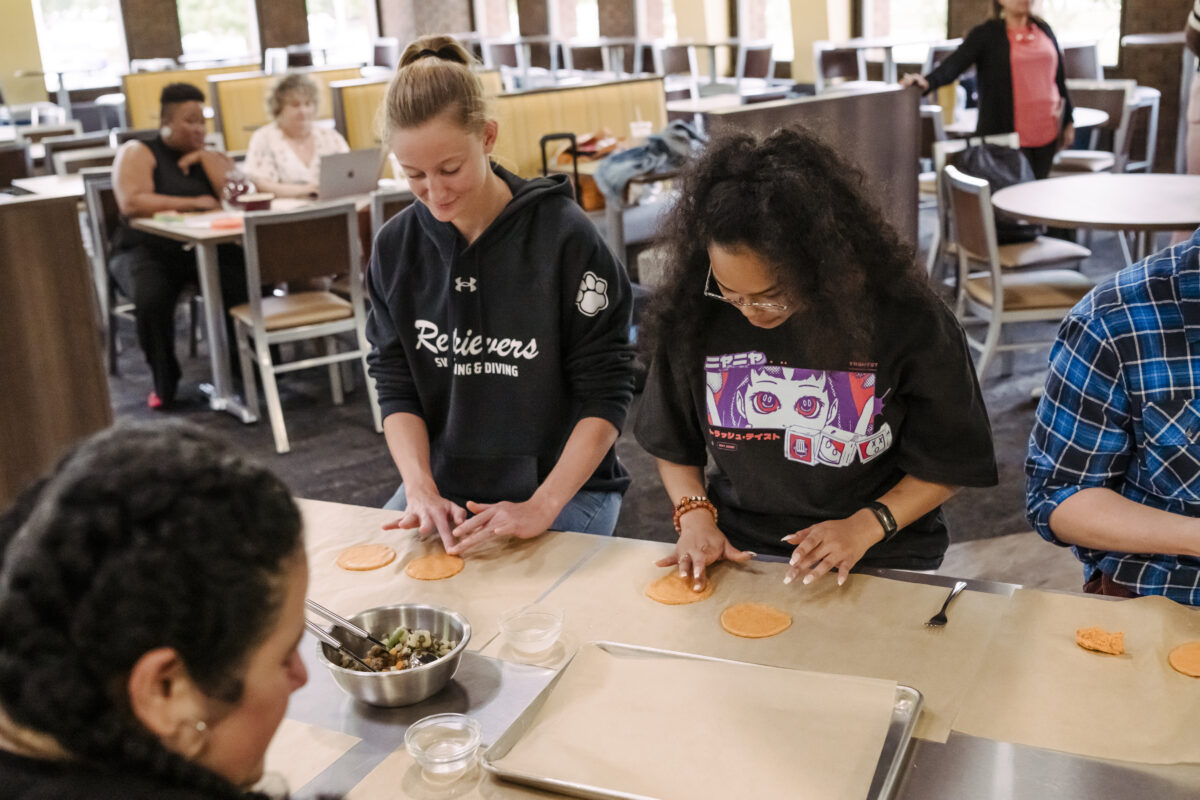 (l): Ashley Gutshall presses dough into a circular shape to make a pastelito. (Marlayna Demond ’11/UMBC)
Snack routines also create taste memories. “I was born in El Salvador during the Civil War [1980-1992] but was raised in Los Angeles. I would often fantasize about the routines my family would have had if they had been able to stay in their homeland,” said Vasquez, as she cooked down strawberries that she used to sweeten a large container of water filled with chan seeds—similar to chia seeds in texture and nutrition. “Fresco de chan satisfied that question for me because it’s a drink students have after school,” said Vasquez.
Food as a cultural bridge
Dishes are a fingerprint of a family’s traditions and tastes that can also serve as a timeline marking the evolution of ingredients locally and globally. “When my mom hears of these new trending food ingredients like chia seeds or quinoa,” says Vasquez, “she argues that they have been used in El Salvador and Central American communities for a long time.”
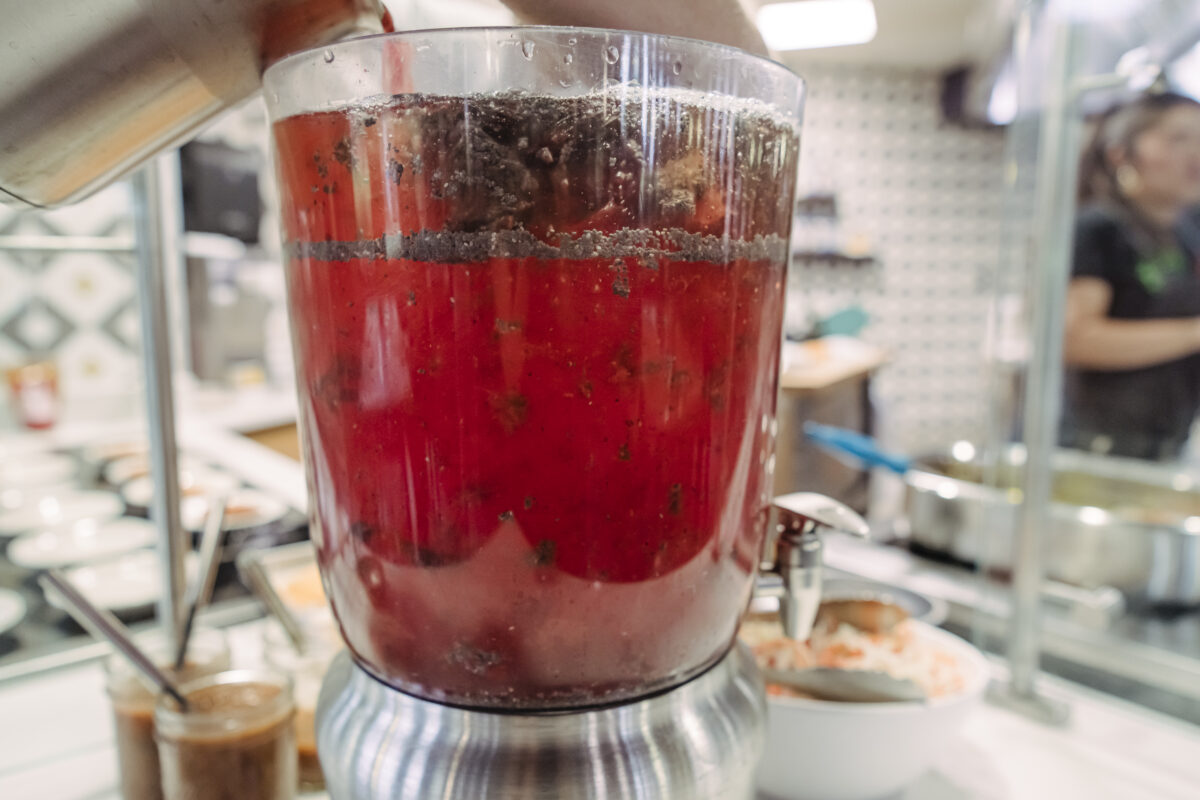
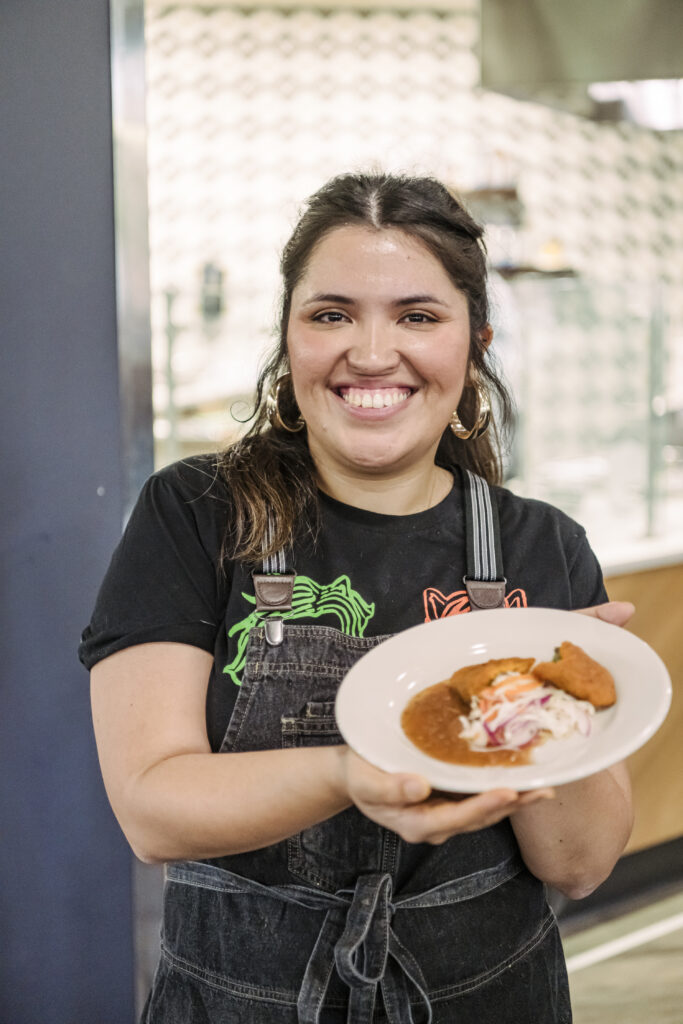
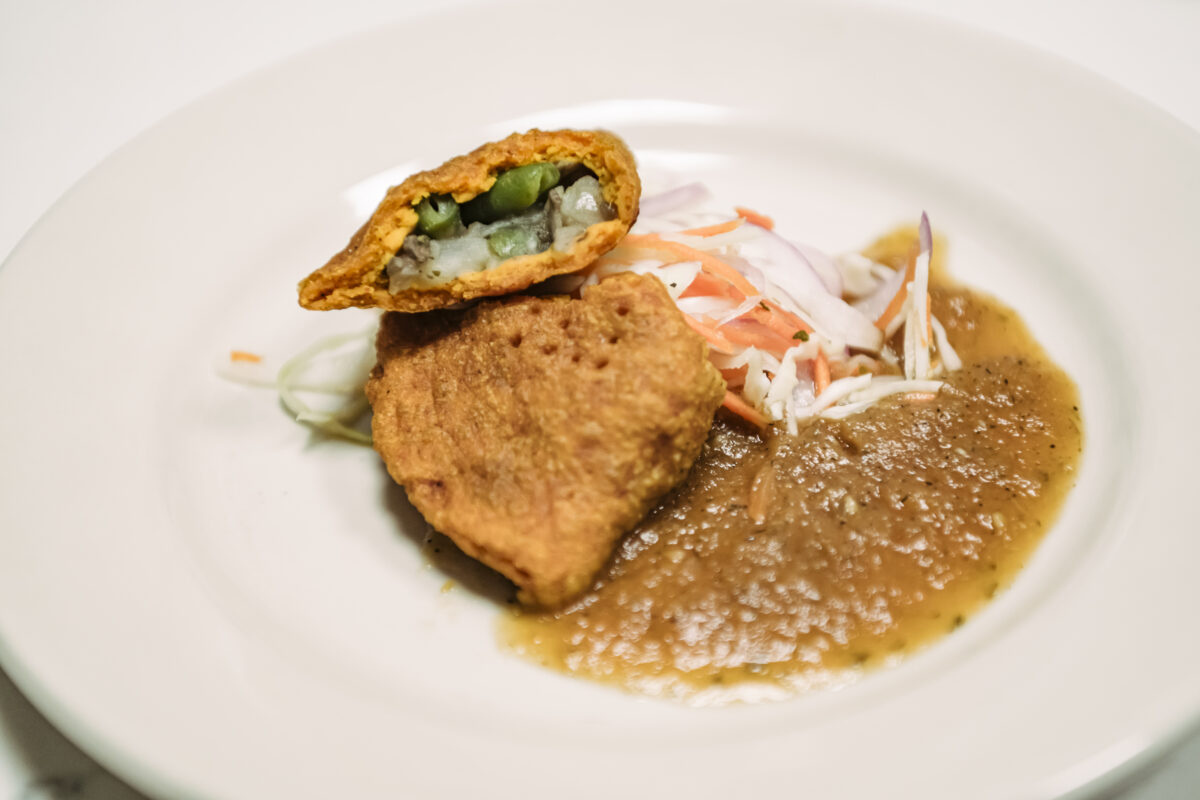 (l-r): Fresco de chan. Karla T. Vasques presents a Salvadoran mushroom pastelito with salsa and slaw. (Marlayna Demond ’11/UMBC)
Whether savory or sweet, the names of foods and spices across Latin America, and the dishes they inspire, are rooted in indigenous, African, and European languages and culinary traditions often fused to create unique dishes with local variations. Vasquez noted that achiote [ah-chee-oh-teh], the spice used to season and enhance the yellow color of the corn flour dough for the pastelitos, is a Nahuat word. Nahuat is a widely spoken indigenous language in Mexico and Central America. The rich legacy of Salvadoran food is seldom recognized alongside Western cuisine, even though many of its ingredients are sourced from the Global South—reinforcing cultural divisions. The Dresher Center’s “More than Pupusas” cooking event aimed to bridge this gap and celebrate the cultural footprint of Salvadoran cuisine.
“I interviewed more than 100 women while I’ve been working on this project. It’s taken me nine years,” says Vasquez about her recent release, The SalviSoul Cookbook. “I wanted to make sure that we’re giving credit where credit is due.”
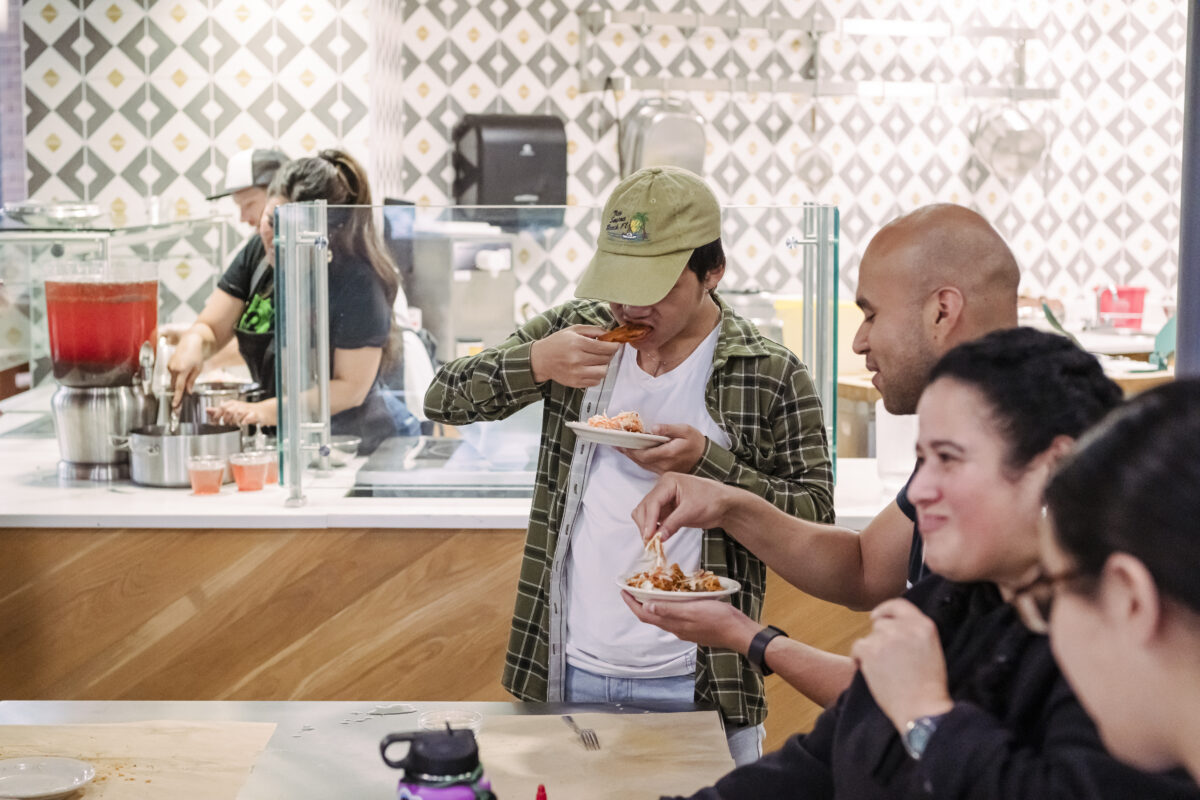
(r): Bonilla and Molina Soriano taste the fried pastelitos. (Marlayna Demond ’11/UMBC)
The tasters and aspiring chefs were grateful to be part of the long tradition of communities brought together across borders and time to learn, cook, and share a meal with new and old friends. They stamped their seal of approval with dough—a squiggly line, a star, a smile—sealing each pastelito with personal flair.
]]>
“Recipes are like an address to a homeland, but they’re also very personal to your own story,” said Karla T. Vasquez, author of The SalviSoul Cookbook, in True Grit’s Test Kitchen. Celia Bonilla,...
https://umbc.edu/stories/retrievers-learn-to-cook-salvadoran-food/
https://my3.my.umbc.edu/api/v0/pixel/news/145379/guest@my.umbc.edu/0e0931c682bcda13e479d7afdd5d4a25/api/pixel
business-technology-administration
cahss
campus-life
chemical-engineering
computer-science
dresher-center
history
magazine
mlli
spanish
story
UMBC News & Magazine
https://my3.my.umbc.edu/groups/umbc-news-magazine
https://assets1-my.umbc.edu/system/shared/avatars/groups/000/001/943/24435aa6207c452e7bc15cc74b42c7bb/xsmall.png?1748556657
https://assets1-my.umbc.edu/system/shared/avatars/groups/000/001/943/24435aa6207c452e7bc15cc74b42c7bb/original.png?1748556657
https://assets2-my.umbc.edu/system/shared/avatars/groups/000/001/943/24435aa6207c452e7bc15cc74b42c7bb/xxlarge.png?1748556657
https://assets2-my.umbc.edu/system/shared/avatars/groups/000/001/943/24435aa6207c452e7bc15cc74b42c7bb/xlarge.png?1748556657
https://assets3-my.umbc.edu/system/shared/avatars/groups/000/001/943/24435aa6207c452e7bc15cc74b42c7bb/large.png?1748556657
https://assets1-my.umbc.edu/system/shared/avatars/groups/000/001/943/24435aa6207c452e7bc15cc74b42c7bb/medium.png?1748556657
https://assets2-my.umbc.edu/system/shared/avatars/groups/000/001/943/24435aa6207c452e7bc15cc74b42c7bb/small.png?1748556657
https://assets1-my.umbc.edu/system/shared/avatars/groups/000/001/943/24435aa6207c452e7bc15cc74b42c7bb/xsmall.png?1748556657
https://assets2-my.umbc.edu/system/shared/avatars/groups/000/001/943/24435aa6207c452e7bc15cc74b42c7bb/xxsmall.png?1748556657
UMBC News & Magazine
1
0
false
Tue, 05 Nov 2024 16:30:49 -0500
Retrievers learn the art and heart of cooking Salvadoran food at True Grit’s Test Kitchen
“Recipes are like an address to a homeland, but they’re also very personal to your own story,” said Karla T. Vasquez, author of The SalviSoul Cookbook, in True Grit’s Test Kitchen. Celia Bonilla, a business technology administration sophomore, grinned and nodded—the addresses for her own recipes come from El Salvador and Maryland. Bonilla joined other UMBC students earlier this fall for the “More than Pupusas” cooking demonstration, sponsored by the Dresher Center for the Humanities, to learn how to cook Salvadoran street food.
Bonilla sat at one of two tables set with brown butcher paper with her classmates, Stephania Fonseca, a social work sophomore, and Jeffrey Molina Soriano, a computer science junior. They also have roots in Maryland and El Salvador. “Pastelitos [pah-steh-lee-tos] means little pie and it’s the Salvadoran version of empanadas [em-pah-nah-dahs],” said Vasquez. “Empanadas are well known all over Latin America. Greeks, Italians, and other Europeans make meat pies, too.”
Celia Bonilla and Jeffrey Molina Soriano learn how to mold pastelito dough. (Marlayna Demond ’11/UMBC)
Like many Salvadoran students at UMBC, their journeys to UMBC are as complex as the ingredients they use for this meal. “Sometimes Hispanic Heritage Month events portray Latinx culture as a monolith, often focusing on the Caribbean or Mexican American experience,” said Courtney C. Hobson ’10, M.A. ’14, history, program manager at the James T. and Virginia M. Dresher Center for the Humanities. “I grew up in Prince George’s County, Maryland, where a significant part of the Latinx immigrant community comes from Central America, specifically El Salvador. Many of our Latinx students have roots in Central America—I wanted to organize an event that celebrated the rich culture they represent.”
(l-r): Courtney C. Hobson and Amy Froide, professor of history and director of the Dresher Center for the Humanities. (Marlayna Demond ’11/UMBC)
“I came here when I was six years old from El Salvador,” said Bonilla, who attended the event as part of an assignment for the Spanish for Heritage Spanish Speakers class. Students must participate in two on-campus and two off-campus cultural events that celebrate Hispanic/Latinx culture. While Bonilla is familiar with campus events as the parent of a UMBC alum Jasmine Esmeralda Bonilla ’21, chemical engineering, this event felt different. “This class gives me a chance to learn more about my culture and language by engaging with people from various countries and age groups.”
Culinary traditions
Most students at the event said they had eaten pupusas (puh-poo-suhz) at home or at a restaurant. This flat corn flour cake, stuffed with cheese, beans, and sometimes meat is the national dish of El Salvador. “I have an aunt who is from El Salvador. She taught my mom, and then my mom taught me how to make pupusas with my sister,” said Fonseca. “My dad is from El Salvador, and my mom is from Mexico. We learned to make pupusas together as a family. So it became a typical food from my home.”
(l-r): Stephania Fonseca watches Vasquez fold the dough to make a pocket. Students fill the pastelitos with a mushroom filling. (Marlayna Demond ’11/UMBC)
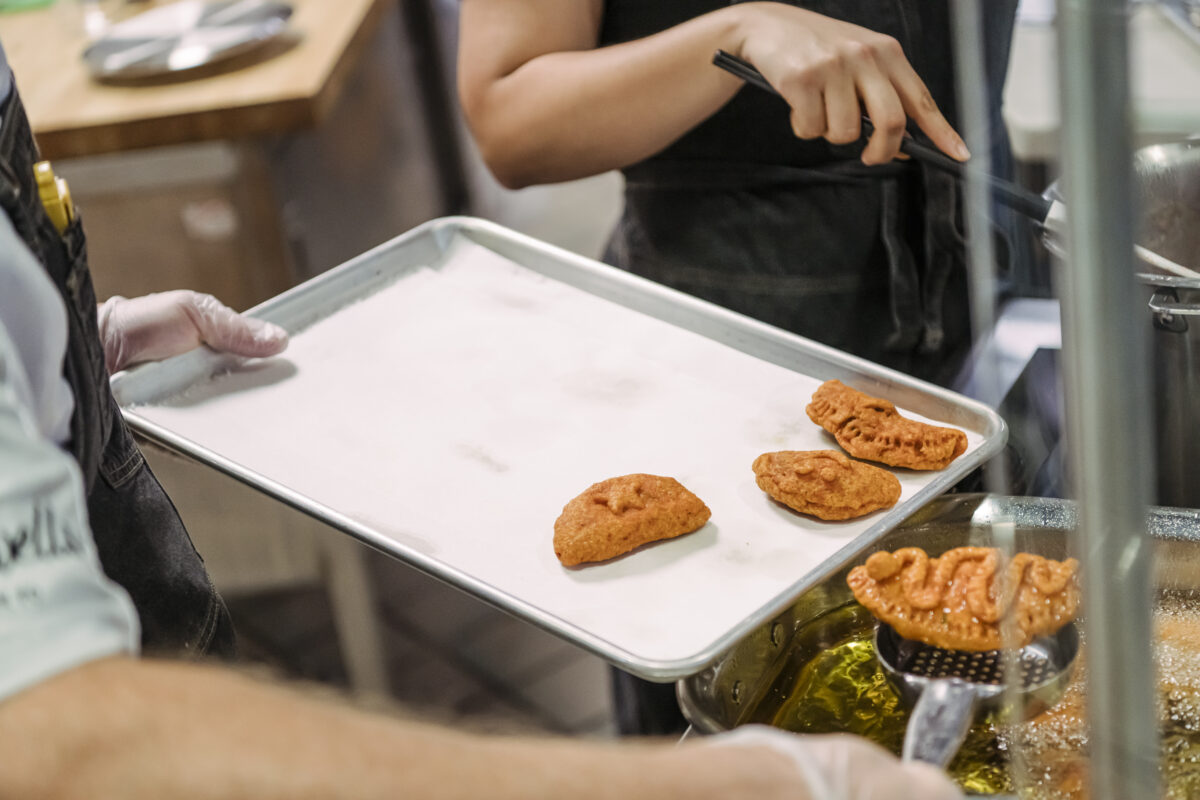
As students kneaded the dough into a palm-sized disc, filled it with sautéed mushrooms, and pinched the edges to seal the pastelitos, they also shared what food meant to them in the context of their family and student life. A clear theme emerged, culinary traditions can extend beyond the kitchen. “We have the Philly pretzel factory. I’ve never been able to find a soft pretzel as good as the Philly Pretzel Factory,” said Ashley Gutshall about her hometown of Royersford, Pennsylvania. Gutshall, a history and Spanish sophomore, shares, “It’s our family tradition to get Philly soft pretzels after doctor’s appointments.”
(l): Ashley Gutshall presses dough into a circular shape to make a pastelito. (Marlayna Demond ’11/UMBC)
Snack routines also create taste memories. “I was born in El Salvador during the Civil War [1980-1992] but was raised in Los Angeles. I would often fantasize about the routines my family would have had if they had been able to stay in their homeland,” said Vasquez, as she cooked down strawberries that she used to sweeten a large container of water filled with chan seeds—similar to chia seeds in texture and nutrition. “Fresco de chan satisfied that question for me because it’s a drink students have after school,” said Vasquez.
Food as a cultural bridge
Dishes are a fingerprint of a family’s traditions and tastes that can also serve as a timeline marking the evolution of ingredients locally and globally. “When my mom hears of these new trending food ingredients like chia seeds or quinoa,” says Vasquez, “she argues that they have been used in El Salvador and Central American communities for a long time.”
(l-r): Fresco de chan. Karla T. Vasques presents a Salvadoran mushroom pastelito with salsa and slaw. (Marlayna Demond ’11/UMBC)
Whether savory or sweet, the names of foods and spices across Latin America, and the dishes they inspire, are rooted in indigenous, African, and European languages and culinary traditions often fused to create unique dishes with local variations. Vasquez noted that achiote [ah-chee-oh-teh], the spice used to season and enhance the yellow color of the corn flour dough for the pastelitos, is a Nahuat word. Nahuat is a widely spoken indigenous language in Mexico and Central America. The rich legacy of Salvadoran food is seldom recognized alongside Western cuisine, even though many of its ingredients are sourced from the Global South—reinforcing cultural divisions. The Dresher Center’s “More than Pupusas” cooking event aimed to bridge this gap and celebrate the cultural footprint of Salvadoran cuisine.
“I interviewed more than 100 women while I’ve been working on this project. It’s taken me nine years,” says Vasquez about her recent release, The SalviSoul Cookbook. “I wanted to make sure that we’re giving credit where credit is due.”
(r): Bonilla and Molina Soriano taste the fried pastelitos. (Marlayna Demond ’11/UMBC)
The tasters and aspiring chefs were grateful to be part of the long tradition of communities brought together across borders and time to learn, cook, and share a meal with new and old friends. They stamped their seal of approval with dough—a squiggly line, a star, a smile—sealing each pastelito with personal flair.
]]>
“Recipes are like an address to a homeland, but they’re also very personal to your own story,” said Karla T. Vasquez, author of The SalviSoul Cookbook, in True Grit’s Test Kitchen. Celia Bonilla,...
https://umbc.edu/stories/teaching-pupusas/
https://my3.my.umbc.edu/api/v0/pixel/news/145381/guest@my.umbc.edu/9ca276cb76c35ec0df767c000aca50ec/api/pixel
business-technology-administration
cahss
campus-life
chemical-engineering
computer-science
dresher-center
history
magazine
mlli
spanish
story
UMBC News & Magazine
https://my3.my.umbc.edu/groups/umbc-news-magazine
https://assets1-my.umbc.edu/system/shared/avatars/groups/000/001/943/24435aa6207c452e7bc15cc74b42c7bb/xsmall.png?1748556657
https://assets1-my.umbc.edu/system/shared/avatars/groups/000/001/943/24435aa6207c452e7bc15cc74b42c7bb/original.png?1748556657
https://assets2-my.umbc.edu/system/shared/avatars/groups/000/001/943/24435aa6207c452e7bc15cc74b42c7bb/xxlarge.png?1748556657
https://assets2-my.umbc.edu/system/shared/avatars/groups/000/001/943/24435aa6207c452e7bc15cc74b42c7bb/xlarge.png?1748556657
https://assets3-my.umbc.edu/system/shared/avatars/groups/000/001/943/24435aa6207c452e7bc15cc74b42c7bb/large.png?1748556657
https://assets1-my.umbc.edu/system/shared/avatars/groups/000/001/943/24435aa6207c452e7bc15cc74b42c7bb/medium.png?1748556657
https://assets2-my.umbc.edu/system/shared/avatars/groups/000/001/943/24435aa6207c452e7bc15cc74b42c7bb/small.png?1748556657
https://assets1-my.umbc.edu/system/shared/avatars/groups/000/001/943/24435aa6207c452e7bc15cc74b42c7bb/xsmall.png?1748556657
https://assets2-my.umbc.edu/system/shared/avatars/groups/000/001/943/24435aa6207c452e7bc15cc74b42c7bb/xxsmall.png?1748556657
UMBC News & Magazine
0
0
false
Tue, 05 Nov 2024 16:30:49 -0500
Tue, 05 Nov 2024 16:30:49 -0500
Finding one’s face and building financially resilient spaces through ‘susus’
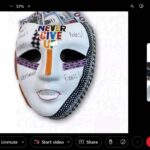
Sonya Squires-Caesar, a doctoral candidate in UMBC’s language, literacy, and culture program, has been interviewing communities who use susus to save money for big-ticket items like homes, farms, or everyday needs like transportation and bills. Susu, a word thought to come linguistically from West African languages, is an informal structure of communal savings where individuals agree to give an equal amount of money to one pool. Members then decide the frequency of when someone receives the entire amount.
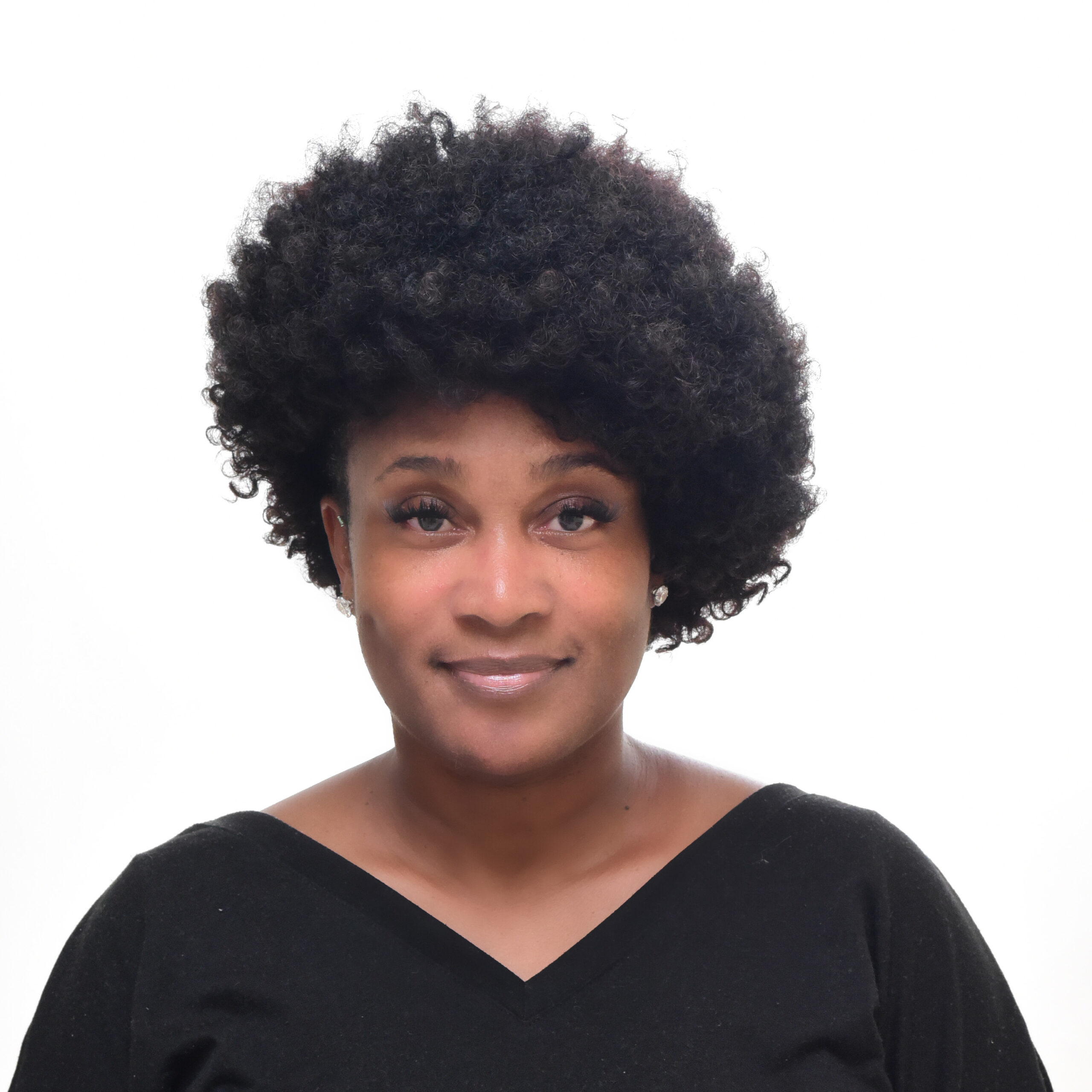 Headshot courtesy of Sonya Squires-Caesar.
“I remember my mother planning her spending around when she would get her payment,” says Squires-Caesar, whose family is from Barbados. Squires-Caesar explains that susus—or rotating savings and credit associations (ROSCAs)—can be a way for people to access larger sums of money without the barriers formal banks and finance systems pose to people without high levels of disposable income.
“While there is a significant body of ROSCA research, it tends to focus on groups living in poverty or with minimal or no access to formal financial instruments,” says Squires-Caesar. “My study differs by focusing on middle-class and upper-middle-class immigrants who opt to use this informal, unregulated financial tool in the U.S. alongside mainstream financial services such as banks, credit cards, investments, etc.”
Squires-Caesar, the Dresher Center for the Humanities’ graduate student research fellow for fall 2023, is interested in studying the evolution of susus from the transatlantic slave trade to today. She explains that for centuries people have pooled their resources for individual and communal needs.
Honoring African indigenous knowledge
Susus are a cultural practice rooted in African indigenous knowledge, a term for how various African cultures orally passed a range of information, customs, and beliefs from generation to generation. “In African indigenous knowledge, the act of learning is thought to be a fully engaged journey to ‘find one’s face,’” says Squires-Caesar, “which is considered the path to discovering your roots, revealing your spirit, and determining the ‘fire in your belly’ or core elements that matter most to you.”
Squires-Caesar “found her face” when she aligned her research path with her authentic identity. “Western research methods couldn’t guide mine. I felt I was trying to fit a square peg into a circle,” explains Squires-Caesar. “I found my face when I realized the methodology that my project needed had to model the community I was looking to understand.”
Researching what’s below the surface
Squires-Caesar’s approach to understanding financial literacy is less about the stock market and credit and more about what is intangible. She calls it the iceberg effect.
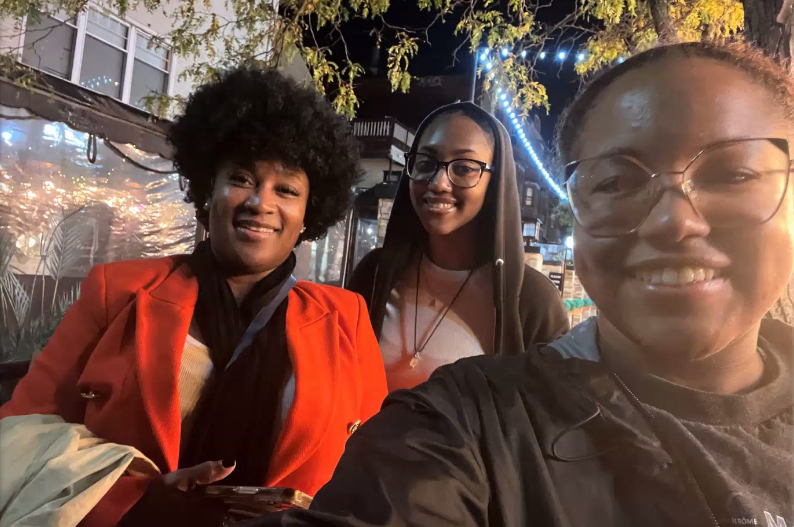 Squires-Caesar, in orange, with students. Some students she interviewed for her dissertation have formed a new intergenerational ROSCA savings club.
“On top of the iceberg are tangible things like bank accounts and credit cards,” explains Squires-Caesar. “You can see, touch, feel, and measure them, but beneath the iceberg are the processes that may not have official rules and regulations and where the general public may not know they are happening, like susus.”
During the four years she managed a community college financial literacy program, Squires-Caesar met many students surviving from month to month. Through ethnographic research, she found students were using non-traditional ways to make ends meet, like getting cash advances from bingo halls to pay for bills and groceries. The data also showed that some students were overwhelmed by the idea of saving.
To shift that thinking, she created a microsavings project for her students to take them through the process of saving—a few cents here, a few dollars there, which grows over time.
These stories about the complexities of susu communities have inspired Squires- Caesar, as part of her Dresher Fellowship, to decorate physical masks as three-dimensional representations of financial identity, of “finding face.”
]]>
Sonya Squires-Caesar, a doctoral candidate in UMBC’s language, literacy, and culture program, has been interviewing communities who use susus to save money for big-ticket items like homes, farms,...
https://umbc.edu/stories/finding-face-financially-resilient-spaces-susus/
https://my3.my.umbc.edu/api/v0/pixel/news/137600/guest@my.umbc.edu/5c3189eb3fce04d4a6418837335acd71/api/pixel
cahss
campus-life
discovery
dresher-center
fall-2023
llc
magazine
UMBC News & Magazine
https://my3.my.umbc.edu/groups/umbc-news-magazine
https://assets1-my.umbc.edu/system/shared/avatars/groups/000/001/943/24435aa6207c452e7bc15cc74b42c7bb/xsmall.png?1748556657
https://assets1-my.umbc.edu/system/shared/avatars/groups/000/001/943/24435aa6207c452e7bc15cc74b42c7bb/original.png?1748556657
https://assets2-my.umbc.edu/system/shared/avatars/groups/000/001/943/24435aa6207c452e7bc15cc74b42c7bb/xxlarge.png?1748556657
https://assets2-my.umbc.edu/system/shared/avatars/groups/000/001/943/24435aa6207c452e7bc15cc74b42c7bb/xlarge.png?1748556657
https://assets3-my.umbc.edu/system/shared/avatars/groups/000/001/943/24435aa6207c452e7bc15cc74b42c7bb/large.png?1748556657
https://assets1-my.umbc.edu/system/shared/avatars/groups/000/001/943/24435aa6207c452e7bc15cc74b42c7bb/medium.png?1748556657
https://assets2-my.umbc.edu/system/shared/avatars/groups/000/001/943/24435aa6207c452e7bc15cc74b42c7bb/small.png?1748556657
https://assets1-my.umbc.edu/system/shared/avatars/groups/000/001/943/24435aa6207c452e7bc15cc74b42c7bb/xsmall.png?1748556657
https://assets2-my.umbc.edu/system/shared/avatars/groups/000/001/943/24435aa6207c452e7bc15cc74b42c7bb/xxsmall.png?1748556657
UMBC News & Magazine
0
0
false
Tue, 05 Dec 2023 16:37:15 -0500