The chase and thrill of researching erotic worlds
A couple of years ago, Jessica Floyd was enjoying delicious olive flatbreads in Opio, France, a village on the French Riviera, thanks to the hospitality of Judith Legman, who owned the olive grove and a manuscript Floyd had been trying to find for her doctoral work for three years. This bucolic heaven was not where Floyd, who studies erotic folklore, thought she would find the holy grail of erotic chanteys by Stan Hugill, a renowned British sailor and chantey singer. These sailors’ work songs, first collected in the 1900s, were passed down verbally by sailors, with some never recorded. These bawdy versions were never meant to be heard or read by women, much less shared between them.
“When you’re talking about erotic content, it automatically becomes something that is salacious and provocative and therefore seen as taboo,” said Floyd, Ph.D. ’17, language, literacy, and culture, an adjunct instructor of English. “Publications that are not conservative in their treatment of sex, gender, and sexuality are often deemed taboo. Scholars who are actively working in this field have to fight not only for their legitimacy, but also because we’re considered dirty workers. We also fight for the legitimacy of the materials that we’re researching. These are real human experiences. They just happen to be from the darker corners of the human experience.”
Like other scholars in the field seeking access to a variety of documents, Floyd reached out to the librarians at the Kinsey Institute, which holds the largest historical archive on sexuality. “They weren’t sure if the manuscript could be found in the extensive archive of Gershon Legman, which Judith, his wife, had donated,” said Floyd, of her research for her debut book Cabin Boys, Milkmaids, and Rough Seas: Identity in the Unexpurgated Repertoire of Stan Hugill (University Press of Mississippi, 2024).
She emailed Legman, following a tip from other chantey folklorists and researchers that Legman, a famous connoisseur and collector of erotic jokes, folklore, and songs, had the manuscript. “Lo and behold, she emailed me back. I still get chills talking about it,” said Floyd. “Judith said, ‘Not only do I have it, I actually just sent it to the Kinsey Institute. If you’d like, I’ll send you the copy.’” Dispersed throughout Legman’s chapter on erotic folk songs were Hugill’s erotic chanteys that had never been circulated.
 The envelope sent by Judith Legman to Jessica Floyd with Stan Hugill’s unpublished manuscript. (Image courtesy of Jessica Floyd)
Chasing erotic rare texts
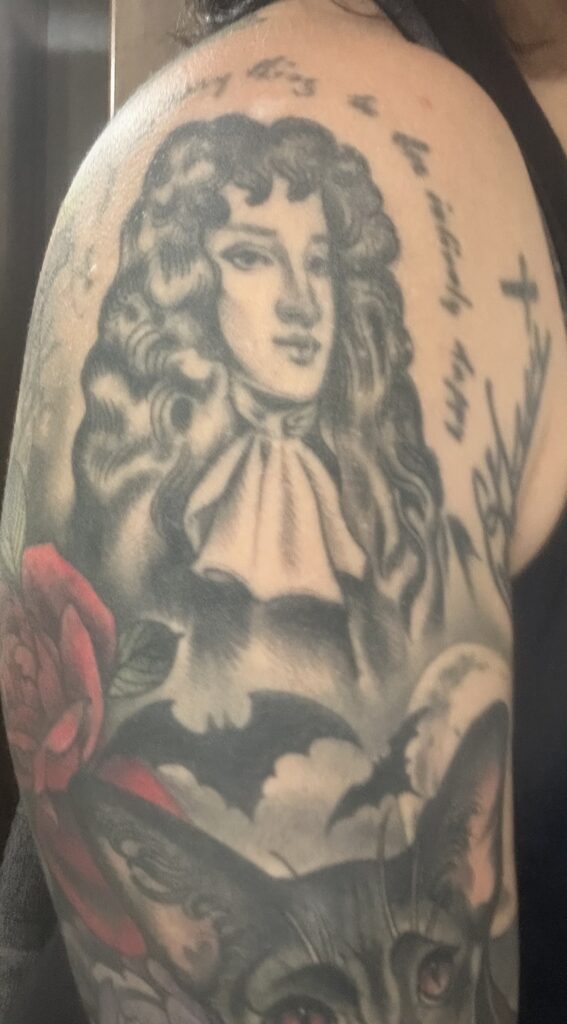 Floyd’s tattoo of John Wilmot, the Second Earl of Rochester, a late 17th-century English nobleman. (Image courtesy of Jessica Floyd)
Floyd is used to the chase and thrill of finding rare texts. She studies the gender and sexuality of sailors during the height of British and American sailing, from the mid-16th to the mid-19th centuries—when sailing ships dominated global trade and naval warfare—as well as 17th and 18th-century literature, erotic folklore, gender and women’s studies, and queer theory. This passion began in high school and continued through her undergraduate and graduate studies researching the life of John Wilmot, the Second Earl of Rochester, a late 17th-century English nobleman better known for questioning authority while also enjoying the excesses of court life and writing poetry that explored sex, desire, rebellion, and challenged social and gender norms.
“It made sense for me to research sexuality in chanteys because I want to understand why men sing dirty songs. What can chanteys tell us about how sailors negotiate sex and gender, especially in the constrained environment of the sailing ship?” said Floyd.
An epistolary discovery
Like Wilmot, Hugill also wrote and published his work. In the 1950s, Hugill began writing down the songs he remembered. In 1961, he published Shanties From The Seven Seas, a collection of over 400 chanteys now considered by chantey researchers and folklorists as the most comprehensive work on chanteys. Sailor Town was published in 1967, Shanties and Sailors’ Songs in 1969, followed by Songs of the Sea: The Tales and Tunes of Sailors and Sailing Shipsin 1977. Between 1962 and 1994, Hugill released 10 recordings—LPs, CDs, and cassette tapes—of chanteys and chantey history. Three were released posthumously. His Sea Songs CD, released in 1980, is now part of the Smithsonian Folkways Recordings catalogue.
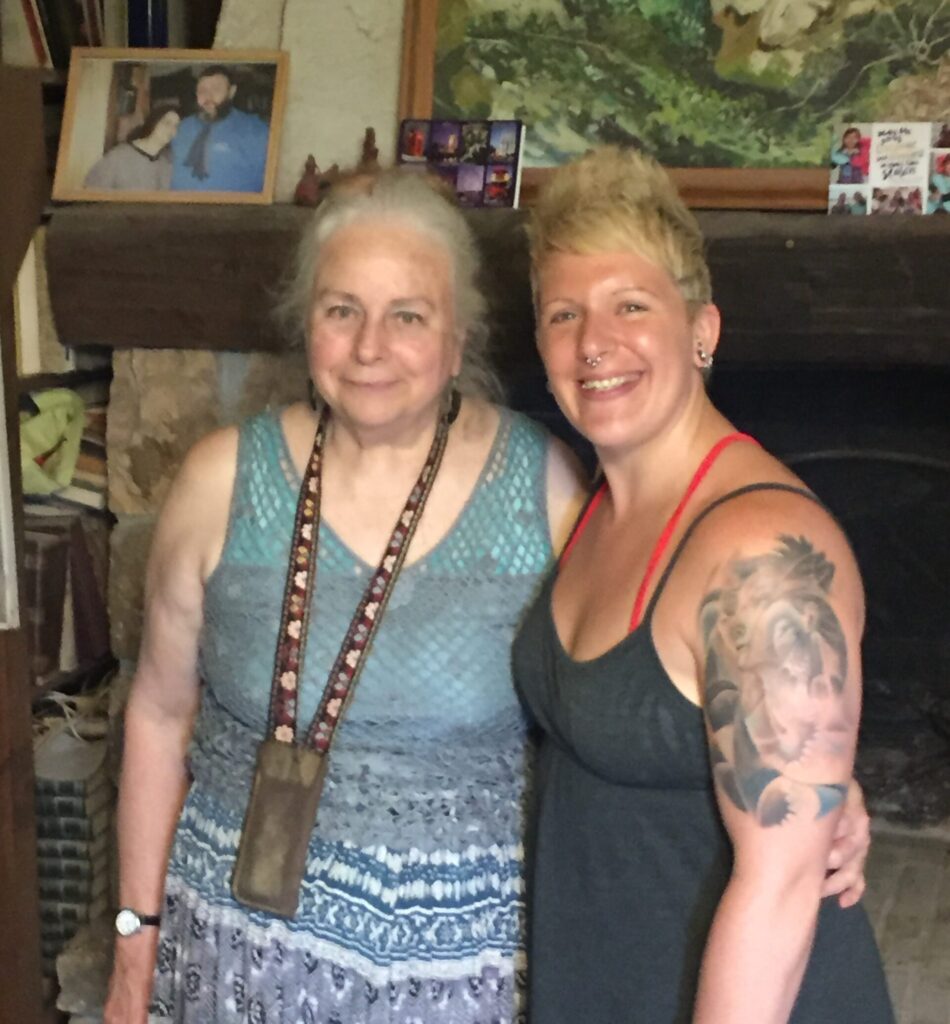 (l-r): Judith Legman and Jessica Floyd in Opio, France. (Image courtesy of Floyd)
However, unlike Wilmot, Hugill never penned the erotic versions and only sang them after a performance to an all-male audience. When Gershon Legman learned about Hugill’s repertoire, he wrote to Hugill, urging him to commit the erotic chanteys to paper for his vast collection. Hugill capitulated after years of correspondence with the condition that Legman not publish the manuscript before he could. Both men died in the 1990s without ever publishing it. With Hugill and Legman as the only witnesses of the manuscript’s existence, what was left for the chantey folklore community was rumors and the lore of its existence.
Thanks to funding from a 2016 UMBC Dresher Center for the Humanities summer fellowship, Floyd visited Judith Legman to study these letters alongside the manuscript. “Judith also had the letters shared between Hugill and Legman, which confirmed that this indeed was the sought-after manuscript,” said Floyd. She notes that by the time she left France, she had everything she needed to do a close analysis of the songs.
“Erotic worlds have fascinated me for a long time. It’s not your run-of-the-mill construction of gender. It’s actually focusing on the part of the human experience that we’re really reticent to talk about, especially in academic work,” said Floyd, who sports a palm-sized tattoo of Wilmot on her upper right arm. “This is the heart of my research—how do we write erotic worlds?”
Floyd is once again on the hunt for rare texts and has completed her second book, The Sons of Neptune. In this study, she is looking at cultural artifacts, from the 18th to the 20th century, that provide insight into why sailors are often thought of as sexy. This project is set to be published through the University of Mississippi Press in May 2026.
Read other books in our Humanities Books series.
]]>
A couple of years ago, Jessica Floyd was enjoying delicious olive flatbreads in Opio, France, a village on the French Riviera, thanks to the hospitality of Judith Legman, who owned the olive grove...
https://umbc.edu/stories/the-chase-and-thrill-of-researching-erotic-worlds/
https://my3.my.umbc.edu/api/v0/pixel/news/155331/guest@my.umbc.edu/6e42352b341487bf50a638ab81874d4f/api/pixel
arts-and-culture
cahss
dreshercenter
english
gwst
humanitiesbooks
llc
news
story
UMBC News & Magazine
https://my3.my.umbc.edu/groups/umbc-news-magazine
https://assets1-my.umbc.edu/system/shared/avatars/groups/000/001/943/24435aa6207c452e7bc15cc74b42c7bb/xsmall.png?1748556657
https://assets1-my.umbc.edu/system/shared/avatars/groups/000/001/943/24435aa6207c452e7bc15cc74b42c7bb/original.png?1748556657
https://assets2-my.umbc.edu/system/shared/avatars/groups/000/001/943/24435aa6207c452e7bc15cc74b42c7bb/xxlarge.png?1748556657
https://assets2-my.umbc.edu/system/shared/avatars/groups/000/001/943/24435aa6207c452e7bc15cc74b42c7bb/xlarge.png?1748556657
https://assets3-my.umbc.edu/system/shared/avatars/groups/000/001/943/24435aa6207c452e7bc15cc74b42c7bb/large.png?1748556657
https://assets1-my.umbc.edu/system/shared/avatars/groups/000/001/943/24435aa6207c452e7bc15cc74b42c7bb/medium.png?1748556657
https://assets2-my.umbc.edu/system/shared/avatars/groups/000/001/943/24435aa6207c452e7bc15cc74b42c7bb/small.png?1748556657
https://assets1-my.umbc.edu/system/shared/avatars/groups/000/001/943/24435aa6207c452e7bc15cc74b42c7bb/xsmall.png?1748556657
https://assets2-my.umbc.edu/system/shared/avatars/groups/000/001/943/24435aa6207c452e7bc15cc74b42c7bb/xxsmall.png?1748556657
UMBC News & Magazine
1
0
false
Mon, 15 Dec 2025 16:29:52 -0500
Mon, 15 Dec 2025 16:29:52 -0500
Inclusion Imperative spotlights six years of innovation in community-engaged humanities research and teaching
UMBC’s Dresher Center for the Humanities recently partnered with the National Humanities Alliance to host Inclusion and Public Humanities: A Convening, one of the culminating events in the final year of the Inclusion Imperative.
Over the past six years, the Inclusion Imperative’s work has focused on three core projects: the Visiting Faculty Fellows Program, the Diversity Teaching Network, and the Humanities Teaching Labs (HTLabs).
The Inclusion Imperative is a six-year initiative funded with a $750,000 grant from the Mellon Foundation. Run by the Dresher Center, the Inclusion Imperative promotes diversity and inclusion in the humanities in partnership with Bowie State University, Coppin State University, and Howard University. The initiative has supported cutting-edge humanities-centered inclusive practices and community collaborations in the Mid-Atlantic, with the goal of creating a national ripple effect.
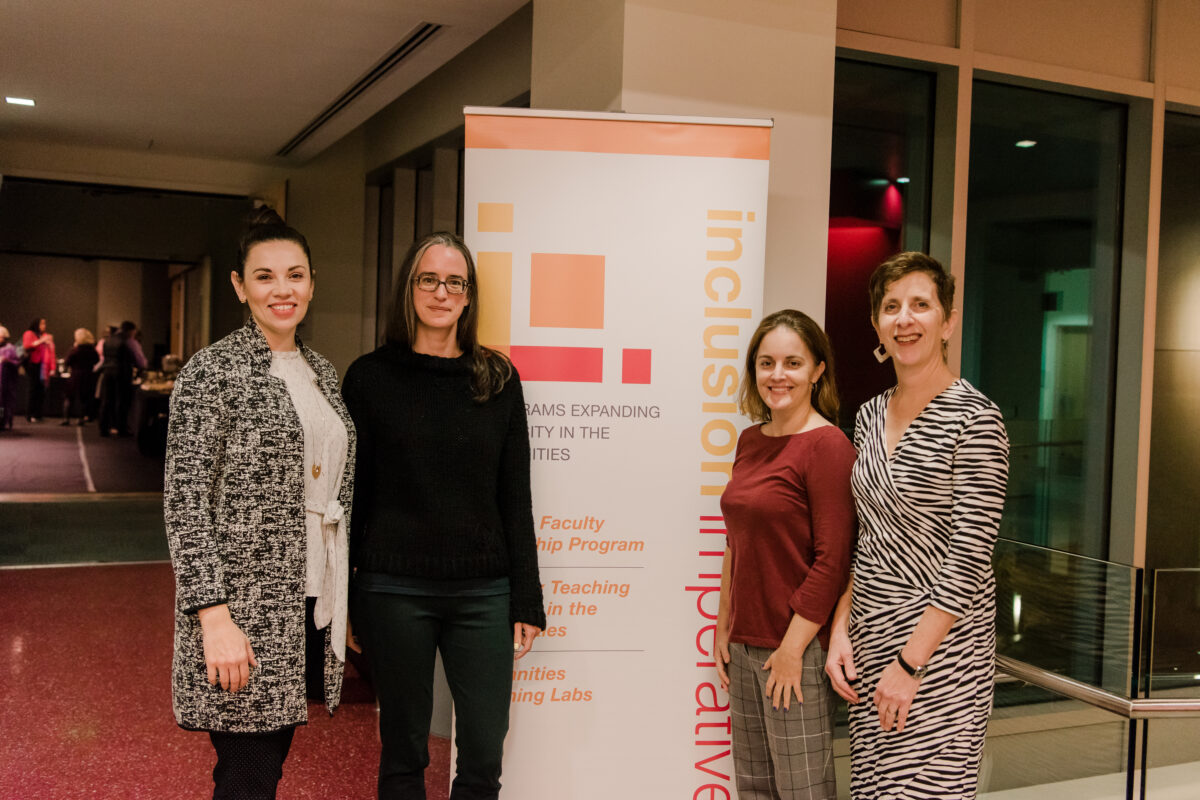 From left to right: Lindsay DiCuirci, associate professor of English, director of the English Honors program at UMBC, and the director of the HT Labs; former Faculty Visiting Fellow Elizabeth Groeneveld, associate professor and chair of women’s and gender studies at Old Dominion University; former Faculty Visiting Fellow Tracy Perkins, assistant professor in the School of Social Transformation at Arizona State University; and Jessica Berman, director of the Dresher Center and professor of English; gender, women’s, and sexuality studies; and language, literacy, and culture. Both Groeneveld and Perkins have since completed and published the projects they worked on during their fellowships.
(Marlayna Demond ’11/UMBC)
The Visiting Faculty Fellows Program has welcomed 14 full-time faculty from area universities to join UMBC for a semester or year as residential research fellows. The Diversity Teaching Network has brought together visiting fellows, UMBC faculty, and other interested scholars to work on curricular and civic-engagement projects. Through HTLabs, faculty, staff, and students have practiced innovative humanities-centered approaches to teaching and learning, from decolonizing assessments to teaching with the Smithsonian Learning Lab.
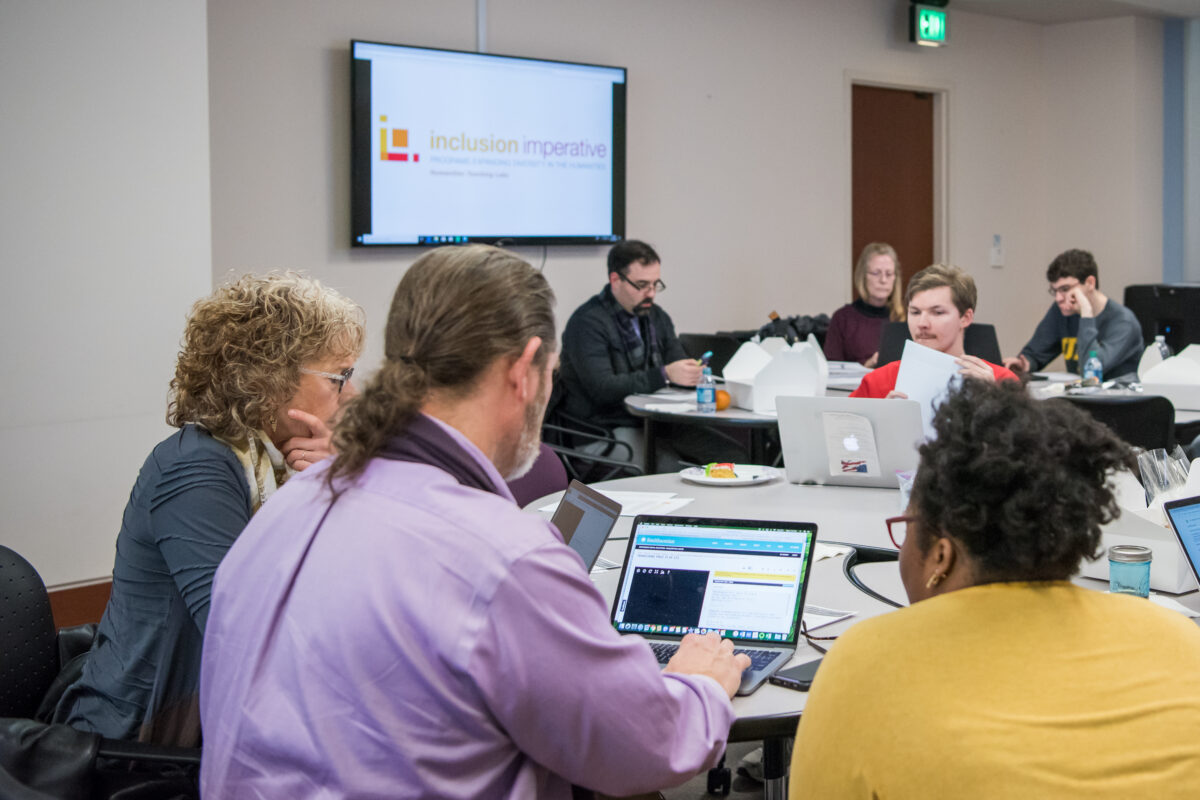 UMBC faculty, staff, and students at the 2018 Frederick Douglass Day Transcribe-a-thon HT Lab. (Marlayna Demond ’11/UMBC)
At the convening this spring, faculty and staff from institutions across the Mid-Atlantic gathered to share their approaches to community-engaged humanities research, teaching, and learning focused on race, equity, inclusion, and social justice issues.
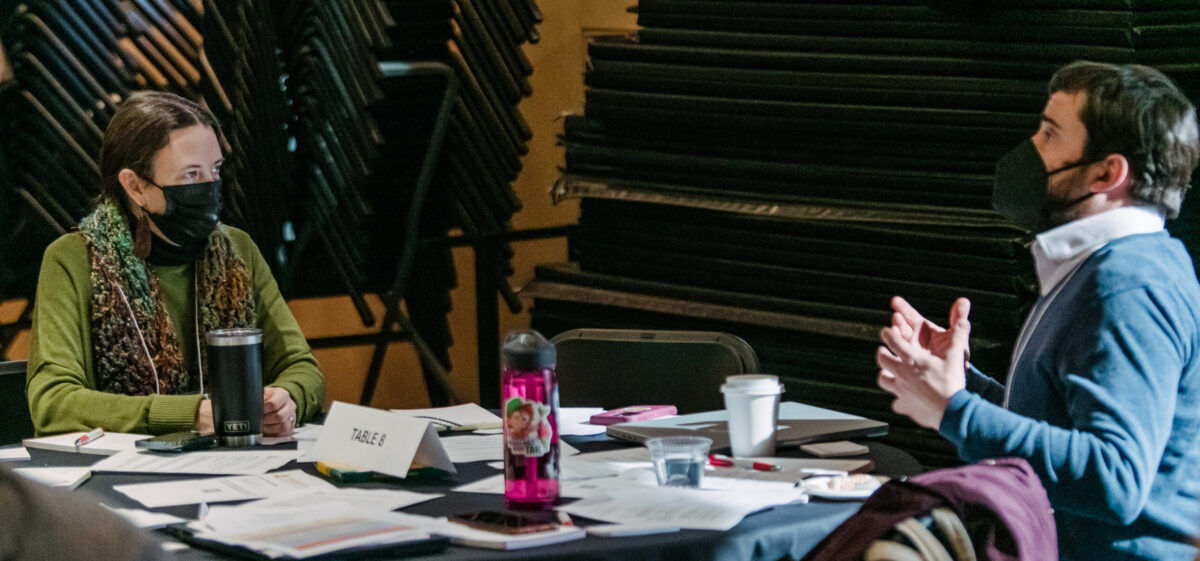 Jill Vasbinder, adjunct instructor of dance at UMBC, at left, discusses humanities music and dance topics with Scott Muir, director of undergraduate initiatives at the National Humanities Alliance.
(Marlayna Demond ’11/UMBC)
Building teaching and learning communities
Colleagues from University of Lynchburg, Community College of Baltimore County, Lehigh University, DewMore Baltimore, and Bard High School Early College-Baltimore presented on topics such as public humanities curriculum development, LGBTQ+ histories and resources, and poetry by local students.
UMBC faculty also shared several high-impact projects. Sarah Fouts, assistant professor of American studies and assistant director of the public humanities minor, spoke about her ongoing work with the Baltimore Field School 2.0. Earl Brooks, assistant professor of English, reported on his course Sounds Like Social Justice, redesigned through support from an Inclusion Imperative/HT Labs Course Transformation Grant.
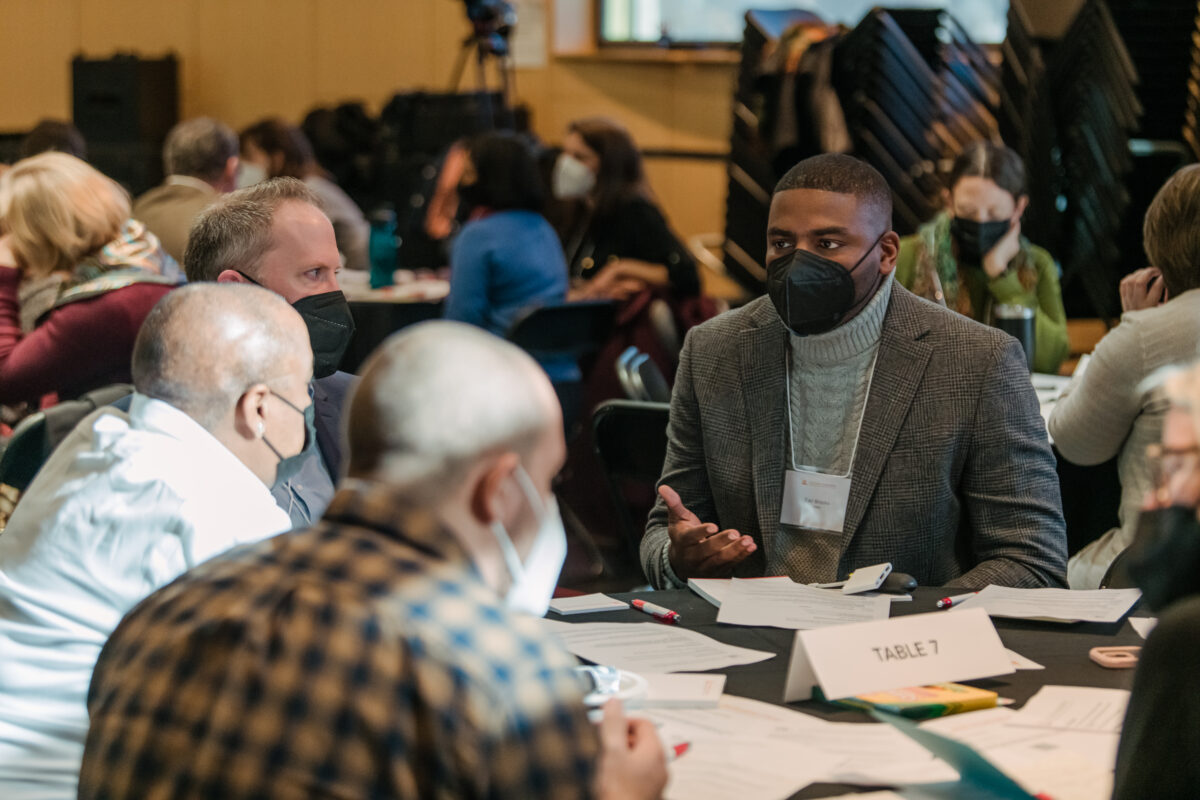 Earl Brooks speaking with Steven Park, faculty director of Community-Engaged Learning and Scholarship and assistant professor of English at Loyola University Maryland (on Brooks’s right); Tanya Saunders, associate professor of language, literacy, and culture at UMBC (middle); and Michael Casiano, assistant professor of American studies at UMBC (directly across from Brooks). (Marlayna Demond ’11/UMBC)
The funds provided recording equipment for students to work in collaboration with the Meadow Community Fellowship Church in Catonsville’s Beechfield and Irvington communities to document their experiences during and after the 2016 and 2018 floods in the “Underwater/Underserved” podcast (as shared in The Baltimore Banner). “What most people don’t know is that all that water flows downhill into the Irvington and Beechfield community, which is a little more than a mile from UMBC,” explains Brooks. The class created “Underwater/Underserved” podcast about flooding in the Irvington and Beechfield neighborhoods in Baltimore, MD.
The grant included funding for students to work on interview skills with Rona Kobell, science editor and writer with Maryland Sea Grant. Brooks explains, “I wanted my students to tell a story about the ways that the church community was underserved as a way of thinking about the role of sound in storytelling.”
Disability justice
Also at the event, faculty from La Salle University, University of Delaware, and Bowie State University shared insights into how diversity, equity, inclusion, and accommodation (DEIA) have become central to their humanities practice. To emphasize the role of accessibility and accommodation, leaders of two UMBC faculty working groups presented their ongoing work related to disability justice.
Dresher Center Disability Studies faculty working group leaders Drew Holladay, assistant professor of English, and Sharon Tran, assistant professor of English, discussed the disability justice movement and the pitfalls of ableist institutional policies that limit student and faculty engagement and success.
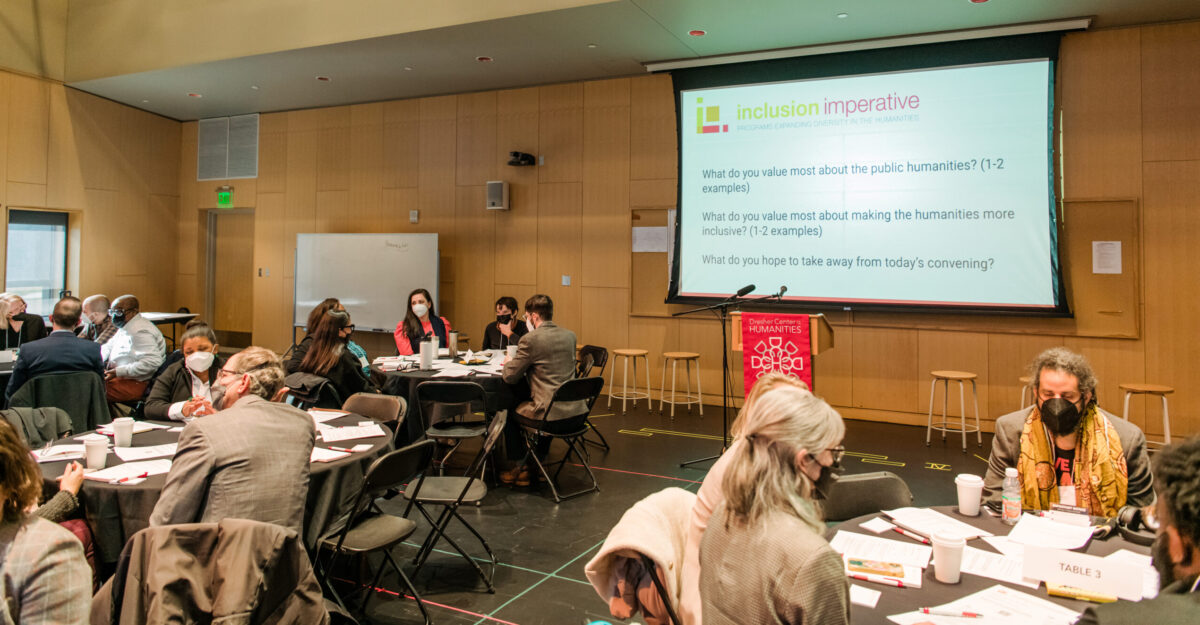 UMBC faculty Sharon Tran, Elizabeth Patton, Lindsay DiCuirci, Sarah Fouts, and Drew Holladay gather at at the Inclusion and Public Humanities convening, at the table closest to the podium.
(Marlayna Demond ’11 /UMBC)
Disability justice does not equal accessibility, especially in the way that it is institutionally defined, and it does not equal DEIA, Holladay suggested. The way he prefers to approach disability justice is to center his research and classroom practice as examples of disability justice, not as a topic that is part of the curriculum.
Tran explained strategies to implement disability justice in the classroom. “We need to think of how we can [adjust] the normative clock in the classroom to better accommodate disabled students rather than forcing those students to meet those temporal pressures,” she said.
Members of the Anti-Racism and Our Actions faculty and staff working group, Michael Hunt, director of UMBC’s McNair Scholars Program, and Amy Tondreau, assistant professor of education, talked about their work to demystify, destigmatize, and magnify anti-racist practices in the academy and in K-12 education.
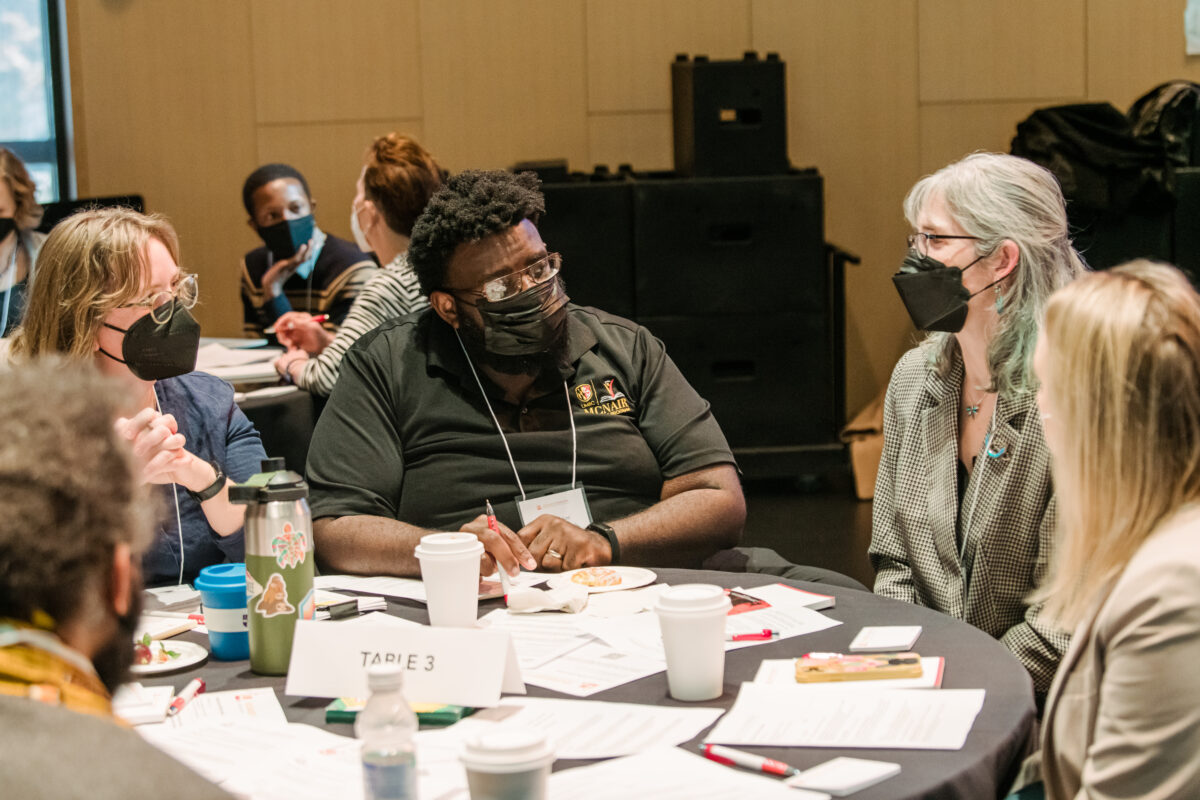 Michael Hunt (center) with colleagues from UMBC and partnering institutions. (Marlayna Demond ’11/UMBC)
Leading a national conversation
Although the Inclusion Imperative’s formal programming will come to a close this summer, the work itself will continue in several ways. Many of the program’s participants will gather again in June for the 11th International Digital Storytelling Conference, hosted by UMBC in partnership with Montgomery College and the Smithsonian Institution.
“I firmly believe that the humanities offer us crucial tools for addressing pressing issues of civic life,” says Berman who presented this work in partnership with the NHA at the 2023 NHA annual meeting. “Now more than ever, we need the tools of the humanities to advance local and national conversations about our history, our identities, and our common future.”
]]>
UMBC’s Dresher Center for the Humanities recently partnered with the National Humanities Alliance to host Inclusion and Public Humanities: A Convening, one of the culminating events in the final...
https://umbc.edu/stories/inclusion-imperative-convening/
https://my3.my.umbc.edu/api/v0/pixel/news/133242/guest@my.umbc.edu/c8d649536cdd080aaebc65b07fc28695/api/pixel
american-studies
arts-and-culture
cahss
cahssresearch
dance
dreshercenter
education
english
llc
mcnairscholars
news
policy-and-society
UMBC News & Magazine
https://my3.my.umbc.edu/groups/umbc-news-magazine
https://assets1-my.umbc.edu/system/shared/avatars/groups/000/001/943/24435aa6207c452e7bc15cc74b42c7bb/xsmall.png?1748556657
https://assets1-my.umbc.edu/system/shared/avatars/groups/000/001/943/24435aa6207c452e7bc15cc74b42c7bb/original.png?1748556657
https://assets2-my.umbc.edu/system/shared/avatars/groups/000/001/943/24435aa6207c452e7bc15cc74b42c7bb/xxlarge.png?1748556657
https://assets2-my.umbc.edu/system/shared/avatars/groups/000/001/943/24435aa6207c452e7bc15cc74b42c7bb/xlarge.png?1748556657
https://assets3-my.umbc.edu/system/shared/avatars/groups/000/001/943/24435aa6207c452e7bc15cc74b42c7bb/large.png?1748556657
https://assets1-my.umbc.edu/system/shared/avatars/groups/000/001/943/24435aa6207c452e7bc15cc74b42c7bb/medium.png?1748556657
https://assets2-my.umbc.edu/system/shared/avatars/groups/000/001/943/24435aa6207c452e7bc15cc74b42c7bb/small.png?1748556657
https://assets1-my.umbc.edu/system/shared/avatars/groups/000/001/943/24435aa6207c452e7bc15cc74b42c7bb/xsmall.png?1748556657
https://assets2-my.umbc.edu/system/shared/avatars/groups/000/001/943/24435aa6207c452e7bc15cc74b42c7bb/xxsmall.png?1748556657
UMBC News & Magazine
0
0
false
Thu, 04 May 2023 14:30:12 -0400
Thu, 04 May 2023 14:30:12 -0400
Meet a Retriever—Rachel Brubaker, M.A. ’00, faculty funding connector

Meet Rachel Brubaker, M.A. ’00, historical studies, assistant director for grants and program development at the Dresher Center for the Humanities. Brubaker, a self-proclaimed humanities nerd, has worked in different positions at UMBC for 22 years, but her current seat in the Dresher Center allows her to combine her UMBC degree with her passion for public humanities and education to collaborate with faculty members on research proposals and help connect them to prestigious funding opportunities. Take it away, Rachel!
Q: What’s one essential thing you’d want another Retriever to know about you?
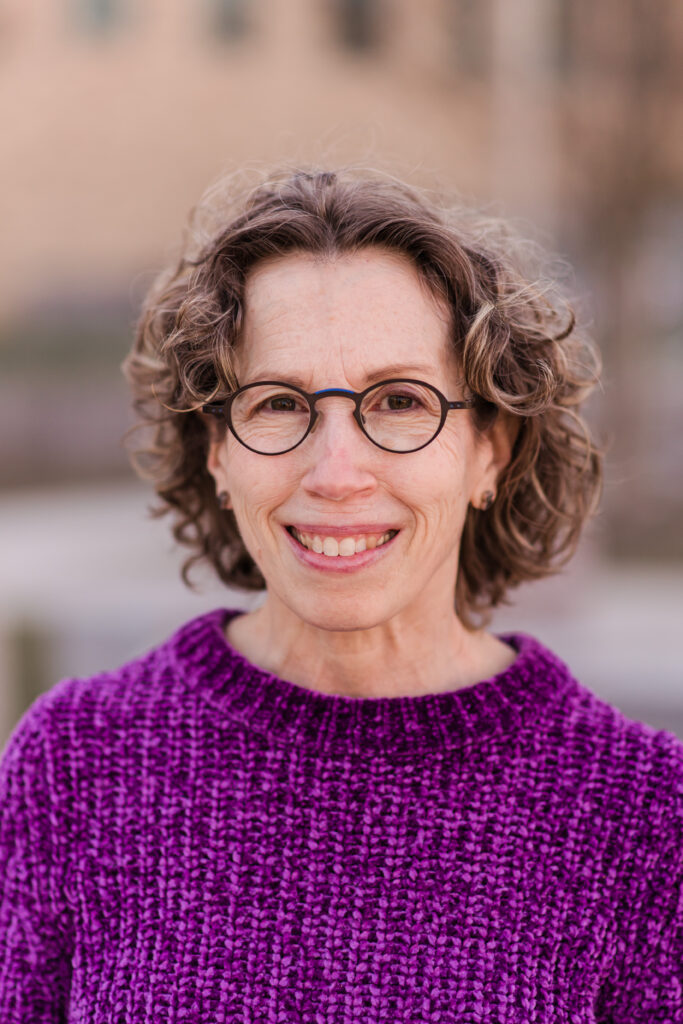 Rachel Brubaker, M.A. ’00 (Marlayna Demond ’11/UMBC)
A: I have been assistant director for grants and program development in the Dresher Center for the Humanities for nearly 10 years. In that capacity, I assist faculty in the arts and humanities get prestigious grants and fellowships. It’s a joy to learn about their research projects and help bring them to fruition.
Before that I worked for 12 years in the history department on “Teaching American History” professional development grants with eight area school districts. I received my master’s degree in historical studies from UMBC in 2000 and prior to that directed the National History Day Program for middle- and high-school students.
In a different life, I was a graphic designer and education communications professional, but that’s old news. I am a proud history/public history/humanities nerd, and I love working with our faculty!
Q: Tell us what you love about your place of work.
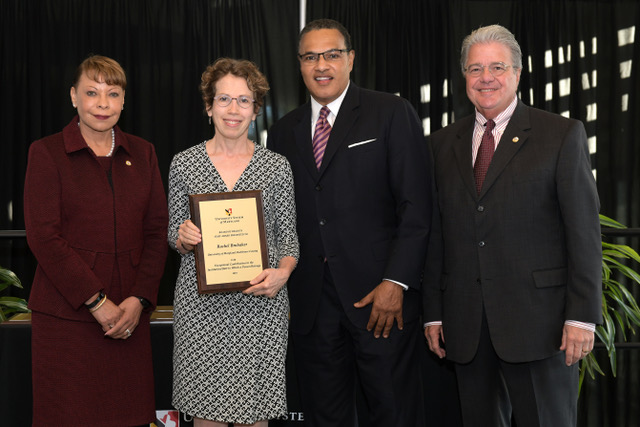 In 2019, Brubaker received the University System of Maryland Board of Regents’ Staff Award for exceptional contribution to the institution. Photo courtesy of Brubaker.
A: The Dresher Center is an interdisciplinary intellectual community in the truest sense. Our programs and grants support and promote faculty and graduate student research in the humanities at UMBC. We run a number of fellowship programs for faculty at all stages of their careers, and provide a temporary home for visiting and internal fellows to research, write, and think about the humanities in conversation with each other.
Our multi-year Inclusion Imperative program, funded by the Mellon Foundation, challenged us to put the tools of the humanities to use to further equity, inclusion, and social justice. With that charge, we have expanded our support for the public humanities at UMBC and formed a regional diversity teaching network of humanities scholars at area institutions who are doing similar work.
Q: What part of your job do you enjoy the most and why?
A: Collaborating with faculty on their research proposals. This often begins in learning about them and their works in progress. Finding the right support for them to write books, create digital projects, and collaborate with community scholars and partners is supremely gratifying!
Think about UMBC not as an office, but as a community of like-minded people who value and produce knowledge and look to make a difference.
Rachel Brubaker, M.A. ’00
Q: Tell us about your primary WHY, and how it led you to UMBC.
A: I came to UMBC because I was transitioning from one career to another, and UMBC became the place to do it. I began as a freelance designer in OIA, then entered the M.A. program in historical studies. After finishing the program, I came back to help run grant programs in the Center for History Education in the history department. That led to my present position in the Dresher Center.
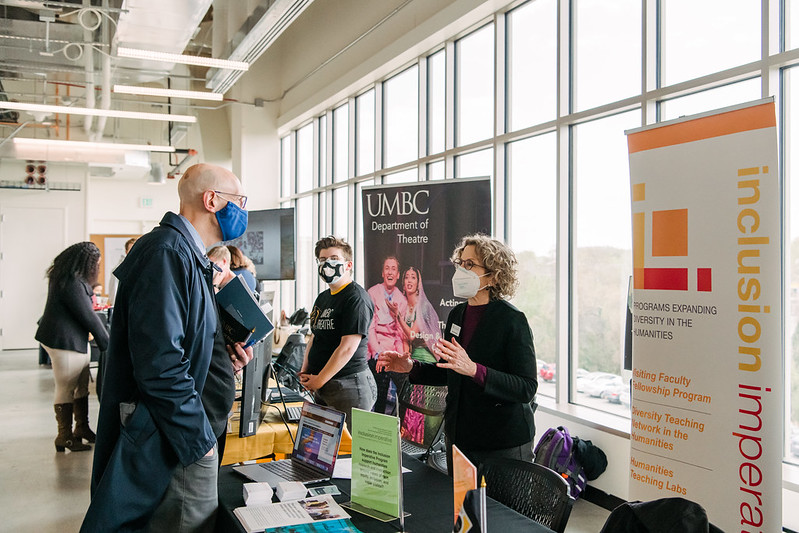 Brubaker presented at the RetriEVER Empowered event in May 2022. (Marlayna Demond ’11/UMBC)
Q: Tell us about the people who have helped you at UMBC, and why their HOW made such a difference to you.
A: There are many people who have made a difference…too many to list, but I have truly appreciated the caliber of support and kindness from colleagues, who have challenged me and helped me grow in my career. I have become a better writer and thinker with their help.
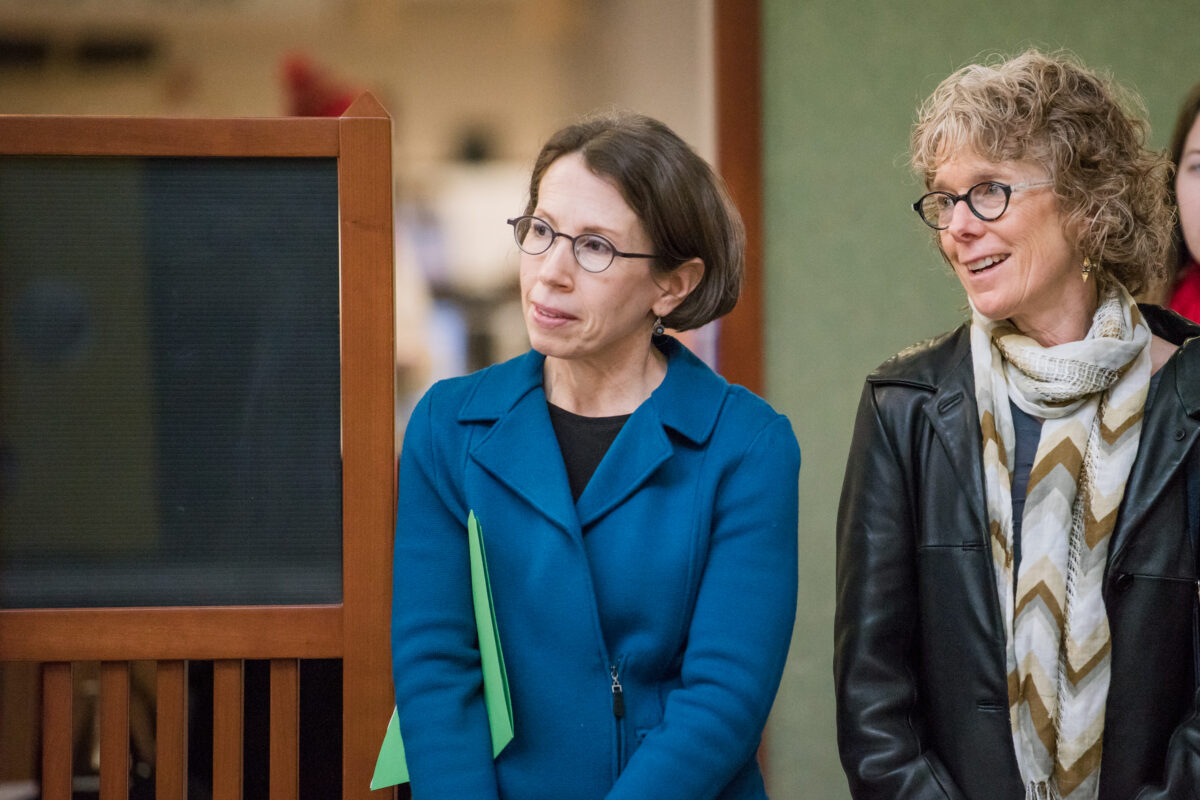 An activity that came out of the Inclusion Imperative are Humanities Teaching Labs (HTLabs). In 2018, a popular HTLab for faculty and students was the “Transcribe-a-thon,” commemorating the 200th anniversary of Frederick Douglass’s birth. Participants transcribed a portion of the Freedmen’s Bureau Papers for the Smithsonian Transcription Center and the National Museum of African American History and Culture. The national event was organized by the Colored Conventions program. Photo courtesy of Brubaker.
Q: Tell us about someone in the community who has inspired you or supported you, and how they did it.
A: Kriste Lindenmeyer was professor of history and chair of the department at UMBC for a number of years (now retired). Kris was a true force of nature. She inspired me with her dedication to the department, students, faculty and to her scholarship.
Q: What would you tell someone who is considering a career at UMBC?
A: Think about UMBC not as an office, but as a community of like-minded people who value and produce knowledge and look to make a difference. As a long-time staff member and former student, I have had the pleasure of seeing the campus evolve to become a place that is inclusive, creative, and original!
* * * * *
UMBC’s greatest strength is its people. When people meet Retrievers and hear about the passion they bring, the relationships they create, the ways they support each other, and the commitment they have to inclusive excellence, they truly get a sense of our community. That’s what “Meet a Retriever” is all about.
Learn more about how UMBC can help you achieve your goals.
]]>
Meet Rachel Brubaker, M.A. ’00, historical studies, assistant director for grants and program development at the Dresher Center for the Humanities. Brubaker, a self-proclaimed humanities nerd, has...
https://umbc.edu/stories/meet-retriever-rachel-brubaker-historical-studies/
https://my3.my.umbc.edu/api/v0/pixel/news/132653/guest@my.umbc.edu/623a683ca89c2b9d41f4d1cd37a85837/api/pixel
alumni
cahss
dreshercenter
graduateschool
historical-studies
impact
magazine
meet-a-retriever
perspectives
staff
UMBC News & Magazine
https://my3.my.umbc.edu/groups/umbc-news-magazine
https://assets1-my.umbc.edu/system/shared/avatars/groups/000/001/943/24435aa6207c452e7bc15cc74b42c7bb/xsmall.png?1748556657
https://assets1-my.umbc.edu/system/shared/avatars/groups/000/001/943/24435aa6207c452e7bc15cc74b42c7bb/original.png?1748556657
https://assets2-my.umbc.edu/system/shared/avatars/groups/000/001/943/24435aa6207c452e7bc15cc74b42c7bb/xxlarge.png?1748556657
https://assets2-my.umbc.edu/system/shared/avatars/groups/000/001/943/24435aa6207c452e7bc15cc74b42c7bb/xlarge.png?1748556657
https://assets3-my.umbc.edu/system/shared/avatars/groups/000/001/943/24435aa6207c452e7bc15cc74b42c7bb/large.png?1748556657
https://assets1-my.umbc.edu/system/shared/avatars/groups/000/001/943/24435aa6207c452e7bc15cc74b42c7bb/medium.png?1748556657
https://assets2-my.umbc.edu/system/shared/avatars/groups/000/001/943/24435aa6207c452e7bc15cc74b42c7bb/small.png?1748556657
https://assets1-my.umbc.edu/system/shared/avatars/groups/000/001/943/24435aa6207c452e7bc15cc74b42c7bb/xsmall.png?1748556657
https://assets2-my.umbc.edu/system/shared/avatars/groups/000/001/943/24435aa6207c452e7bc15cc74b42c7bb/xxsmall.png?1748556657
UMBC News & Magazine
0
0
false
Fri, 14 Apr 2023 13:18:27 -0400
Michelle R. Scott illuminates the lives of Black Vaudeville performers and their broader social impact in Jazz Age America
Michelle Scott, associate professor of history, will discuss her new book T.O.B.A. Time: Black Vaudeville and the Theater Owners Booking Association in Jazz Age America(University of Illinois Press, 2023) on April 11, presenting the history department’s annual Lowe Lecture. In a conversation with UMBC News, Scott shares the artistic, social, and historic context of an association that brought Black artists to both Black and white audiences across the United States during the 1920s.
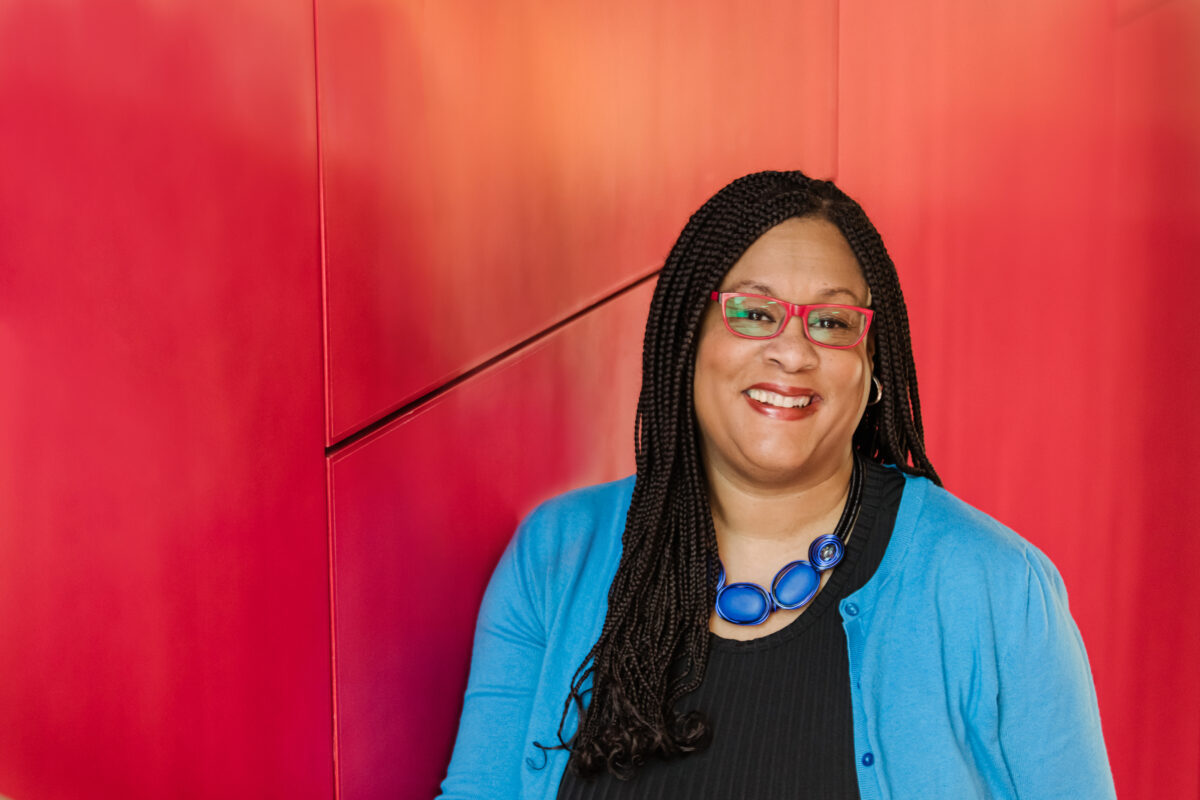 Michelle Scott. (Marlayna Demond ’11/UMBC)
UMBC News: What are some of the central themes the book explores?
Scott: The book explores the lives of the performers, theater owners, producers, managers, and audiences that were part of Black Vaudeville and the Theater Owners Booking Association (T.O.B.A.). It’s a story about how these Black- and white-owned theaters fostered Black artistic exploration and development and the growth of Black-owned businesses. T.O.B.A. is the foundation of Black live entertainment in the 20th century. This is the first in-depth study of this circuit during a time of transition in the entertainment industry between WWI and the Great Depression in segregated America.
UMBC News: Who were some of the artists who began with T.O.B.A. and grew famous, leading to profitable and stable careers?
Scott: T.O.B.A. is a cornerstone in the history of the African American entertainment industry where artists like Cab Calloway, the famed singer, songwriter, bandleader, conductor, and dancer, honed their talents. Other artists include “The Empress of the Blues,” Bessie Smith, and Ethel Waters, who became the first Black woman to receive equal billing with white stars on Broadway. These headliners, including Sammy Davis Jr., the tap-dancing Nicholas Brothers, Count Basie, and the comedic duo Butterbeans and Susie, found fame lasting decades beyond the Jazz Age.
But there was also a place for novelty acts, like the person doing the hula hoop or playing the harmonica with their nostrils. There were also tabloid plays. These abbreviated musical comedies bootlegged off-Broadway plays in a few songs. It’s a much shorter version of today’s Broadway tours. Think of a cabaret version of Hamilton represented in three songs.
It might be a few minutes, but T.O.B.A gave an opportunity to a wide variety of talents to create shows that appealed to a wide audience.
It was a family, where many had multiple jobs to make the show happen. Singers would do makeup. An actor would help with costuming. It wasn’t “the show must go on.” It was “the show will go on.”
UMBC News: T.O.B.A. enabled artists to channel their talents and broaden their networks. What was the association’s impact beyond performances?
Scott: This was the entertainment business. In 1929, T.O.B.A. was among the 12th most profitable black-owned industries in the United States, alongside black-owned insurance agencies, beauty businesses, dressmakers, etc. It had headquarters in Chicago, Washington, D.C., and Chattanooga, Tennessee, running 100 theaters over a decade. For Black and white theater owners, T.O.B.A. provided a steady stream of entertainers, helping to contribute to the local and national economy.
 The Howard Theater in Washington DC, on T Street, Northwest. Photo by Dhousch, Wikemedia Commons.
The hospitality industry grew to meet the demands. This was a particularly important business venture for leading Black artists who were paid well like Cab Calloway and the “Mother of the Blues” Ma Rainey, who was paid $800 for four performances and could spend money on fine room, board, and clothing while traveling for performances. In segregated towns, the Black hospitality industry played an essential role in meeting the needs of entertainers. Black women found opportunities to operate boarding room homes and cook meals, and workers created a key union to fight for fair wages.
As traveling performers, women were also allowed more financial, sexual, and artistic freedom away from families that could be strict and religious. Yet, they also faced gender discrimination and sexual violence on the road.
UMBC News: Jazz Age America was a time of expansive Black artistic exploration and innovation within a heightened period of racial violence and segregation. How did this affect T.O.B.A.?
Scott: The world was trying to recover from WWI, the devastation of the Spanish Flu, and a slowly declining economy that would lead to the Great Depression. Returning white veterans and communities felt threatened by the prospect of losing jobs and housing to Black veterans and to families moving from the South. All of these tensions led to the “Red Summer” of 1919. Mass shootings, lynchings, and race riots spread throughout the country including in Chicago, Washington, D.C., and Baltimore.
Most of the T.O.B.A. theaters were in the South. Artists traveling the country and performing in theaters often risked their safety to make a living from their art. The Black working-class audiences were taking a risk going to see live shows and spending their hard-earned money while surrounded by racial violence and segregation.
One of the most haunting accounts that I found was of the Dreamland Theatre in Tulsa, Oklahoma owned by a Black couple. It was one of the earliest theaters to join the circuit. In 1921, it was leveled during the Tulsa Race Massacre. I was shocked that their records survived, allowing the shared history of the theater, owners, artists, and local community to be witness to the importance of Black theater to Tulsa’s Black community. The owners eventually opened up other Dreamland Theatres in Oklahoma.
T.O.B.A. is monumental because it helped Black artists and Black communities continue to thrive while fighting white supremacy. Many times, if churches were not able to provide a space to organize marches, communities organized in theaters. Sometimes, theater entrance fees were donated to help activists or communities hit by natural disasters, or to help with legal fees.
History definitely talks about the violence inflicted on Black communities, the death toll, and poverty, but it doesn’t always tell about Black innovation, economic prosperity, creativity, and thriving Black communities that existed before, during, and after the Jazz Age. It doesn’t always talk about art as an alternative resistance. T.O.B.A. is that story.
Learn more about this new book in Michelle Scott’s Low Lecture on April 11, 4-5 p.m., in the Albin O. Kuhn Library 7th floor. Research for the book was partially supported by UMBC’s Dresher Center for the Humanities and the CAHSS research grant.
]]>
Michelle Scott, associate professor of history, will discuss her new book T.O.B.A. Time: Black Vaudeville and the Theater Owners Booking Association in Jazz Age America(University of Illinois...
https://umbc.edu/stories/strongmichelle-r-scott-illuminates-the-lives-of-black-vaudeville-performers-in-jazz-age-america-strong/
https://my3.my.umbc.edu/api/v0/pixel/news/132431/guest@my.umbc.edu/6929e550dfebce03421d7732f37337f9/api/pixel
arts-and-culture
cahss
cahssresearch
dreshercenter
history
humanities
news
policy-and-society
rca-2
research
UMBC News & Magazine
https://my3.my.umbc.edu/groups/umbc-news-magazine
https://assets1-my.umbc.edu/system/shared/avatars/groups/000/001/943/24435aa6207c452e7bc15cc74b42c7bb/xsmall.png?1748556657
https://assets1-my.umbc.edu/system/shared/avatars/groups/000/001/943/24435aa6207c452e7bc15cc74b42c7bb/original.png?1748556657
https://assets2-my.umbc.edu/system/shared/avatars/groups/000/001/943/24435aa6207c452e7bc15cc74b42c7bb/xxlarge.png?1748556657
https://assets2-my.umbc.edu/system/shared/avatars/groups/000/001/943/24435aa6207c452e7bc15cc74b42c7bb/xlarge.png?1748556657
https://assets3-my.umbc.edu/system/shared/avatars/groups/000/001/943/24435aa6207c452e7bc15cc74b42c7bb/large.png?1748556657
https://assets1-my.umbc.edu/system/shared/avatars/groups/000/001/943/24435aa6207c452e7bc15cc74b42c7bb/medium.png?1748556657
https://assets2-my.umbc.edu/system/shared/avatars/groups/000/001/943/24435aa6207c452e7bc15cc74b42c7bb/small.png?1748556657
https://assets1-my.umbc.edu/system/shared/avatars/groups/000/001/943/24435aa6207c452e7bc15cc74b42c7bb/xsmall.png?1748556657
https://assets2-my.umbc.edu/system/shared/avatars/groups/000/001/943/24435aa6207c452e7bc15cc74b42c7bb/xxsmall.png?1748556657
UMBC News & Magazine
0
0
false
Fri, 07 Apr 2023 11:15:07 -0400
Fri, 07 Apr 2023 11:15:07 -0400
BBC at 100: a trusted international news source, but it’s important to remember whose values it reflects
Jessica Berman, Director of the Dresher Center for the Humanities, Professor of English; Gender Women’s & Sexuality Studies; and Language, Literacy and Culture, UMBC.
As the BBC turns 100 we should celebrate its extraordinary history as a public service broadcaster bringing news and other programming to audiences around the globe. In 2020-2021 the BBC announced that its World Service achieved its highest-ever audience, with an average of close to 500 million listeners globally each week. The BBC brings news to audiences in more than 40 languages, with newer additions like Igbo, Pidgin, and Yoruba growing in strength each year.
Older people among us still remember tuning into the BBC World Service radio as a prime source for allied news during the second world war. Its long history of offering reliable information to those in conflict zones or under censorship continues, as shown by its strengthening of programming in Russian and Arabic in recent years. Since its founding in 1932, the BBC’s international output has been crucial to those seeking fair, honest and comprehensive news and cultural broadcasts around the world.
At the same time, as scholar Simon Potter notes, the BBC’s World Service has always been a vehicle for British soft power. In 1932, when the BBC first embarked on its Empire service, founding director John Reith called it:
A unique opportunity to foster bonds of understanding and friendship between the peoples of Britain’s scattered dominions and the mother country, and to bring to Britons overseas the benefits already enjoyed by the British public at home.
Reith had advocated for such a service since the beginning of the BBC, making clear the political and social dimension of its founding mission. Although the BBC is a public-service corporation separate from the British government and has seen its fair share of conflicts with those in power, its mission has been and continues to be informed by British values and interconnected to Britain’s future.
Empire Radio
The rise of Empire Radio in the 1930s and 1940s shows how the BBC navigated the conflicting roles of bringing the benefits of broadcasting to listeners in the British colonies while forging stronger bonds across the empire. Given a mission to educate, inform and entertain, the Empire Service (later World Service) developed programs to reach those in the colonies and dominions and allow them to access British civilisation and its values. As Potter puts it, “the BBC voluntarily participated in the overseas projection of Britishness as part of its public-service remit”.
For example, the Eastern Service gathered many celebrated writers into its ranks, with George Orwell directing the India Section from 1941 to 1943. A photograph shows Orwell with famous writers T.S. Eliot and William Empson and emerging figures from across the empire, including Indian writer Mulk Raj Anand and Jamaican writer Una Marson at work on a literary magazine called “The Voice” for broadcast to India. Peter Kalliney argues that these gatherings at the BBC were crucial for building networks of colonial and metropolitan writers. Orwell certainly hoped that programs like “Through Eastern Eyes” or “We Speak to India” would bring east and west together.
And yet, the programming was often naïve and Anglocentric. For instance, The Voice highlighted T.S. Eliot reading his difficult poem Little Giddings which demanded advanced literacy in English, not attained by many Indians at the time. Many programs relied on listeners to be interested in life in London and the progress of the second world war from the British perspective.
By contrast, my research has shown that All India Radio (AIR), India’s developing public broadcasting network modelled on the BBC, offered a wider range of programming focused on Indian listeners, their concerns and their regional languages and cultures. AIR devoted airtime to Indian music and developed cadres of performers to produce radio plays in Indian languages.
The program listings of The Indian Listener, AIR’s official magazine, in the early 1940s show excerpts from the Mahabharata, Indian classical music, a Hindustani lecture on religion in public life, a feature on the changing role of women and programmes for villagers in Tamil, Telugu, or Bengali. There was news analysis in multiple languages. In other words, AIR was more varied, more in-tune with local languages and interests and resisted the primacy of the BBC’s civilising mission.
Caribbean Voices
BBC radio programming for the Caribbean was never as extensive as it was for India nor did a regional broadcaster emerge in the colonial West Indies. But during the 1940s and 1950s it broadcast the celebrated weekly Caribbean Voices programme, which was founded in 1943 by poet, journalist and editor, Una Marson.
This helped to develop the careers of many of the best writers from the region, including Sam Selvon and Dereck Walcott. Caribbean Voices would champion local writing and language, spoken on air by those from the islands, in a way no other entity had done before.
But, as in India, the BBC’s Caribbean programming was also meant to extend the British connection throughout the region, especially during wartime. It arose from Marson’s “morale-boosting” earlier program West Indies Calling for people from the islands serving the war effort and continued to be part of a constellation of broadcasts for the region meant to knit the islands to each other and to Britain.
While these programmes sometimes acknowledged differences across the islands, they also reflect the British government’s interest in treating the West Indies as a single region in response to unrest as well as the threat of growing US power in the Caribbean. The BBC’s regional approach and its limitations can help us see both the promise and failures of the West Indian Federation, the short-lived political union between various islands in the Caribbean between 1958 and 1962.
These examples point to the complex relationship between the BBC’s Empire Service and British political interests which have implications for today. Never a direct vehicle for government power, the broadcaster nevertheless has participated in advancing “Britishness” around the globe.
As we mark the BBC’s centenary and celebrate the continuing achievements of the World Service, we should remember how British soft power has often guided its history and insist that it is able to operate independently now and into the future.
This article is republished from The Conversation under a Creative Commons license. Read the original article.
]]>
Jessica Berman, Director of the Dresher Center for the Humanities, Professor of English; Gender Women’s & Sexuality Studies; and Language, Literacy and Culture, UMBC. As the BBC turns 100...
https://umbc.edu/stories/bbc-at-100-a-trusted-international-news-source-but-its-important-to-remember-whose-values-it-reflects/
https://my3.my.umbc.edu/api/v0/pixel/news/128529/guest@my.umbc.edu/5fadd674629551d1c10ec37ac91bdc6e/api/pixel
cahss
cahssresearch
discovery
dreshercenter
english
international
magazine
UMBC News & Magazine
https://my3.my.umbc.edu/groups/umbc-news-magazine
https://assets1-my.umbc.edu/system/shared/avatars/groups/000/001/943/24435aa6207c452e7bc15cc74b42c7bb/xsmall.png?1748556657
https://assets1-my.umbc.edu/system/shared/avatars/groups/000/001/943/24435aa6207c452e7bc15cc74b42c7bb/original.png?1748556657
https://assets2-my.umbc.edu/system/shared/avatars/groups/000/001/943/24435aa6207c452e7bc15cc74b42c7bb/xxlarge.png?1748556657
https://assets2-my.umbc.edu/system/shared/avatars/groups/000/001/943/24435aa6207c452e7bc15cc74b42c7bb/xlarge.png?1748556657
https://assets3-my.umbc.edu/system/shared/avatars/groups/000/001/943/24435aa6207c452e7bc15cc74b42c7bb/large.png?1748556657
https://assets1-my.umbc.edu/system/shared/avatars/groups/000/001/943/24435aa6207c452e7bc15cc74b42c7bb/medium.png?1748556657
https://assets2-my.umbc.edu/system/shared/avatars/groups/000/001/943/24435aa6207c452e7bc15cc74b42c7bb/small.png?1748556657
https://assets1-my.umbc.edu/system/shared/avatars/groups/000/001/943/24435aa6207c452e7bc15cc74b42c7bb/xsmall.png?1748556657
https://assets2-my.umbc.edu/system/shared/avatars/groups/000/001/943/24435aa6207c452e7bc15cc74b42c7bb/xxsmall.png?1748556657
UMBC News & Magazine
0
0
false
Mon, 17 Oct 2022 13:08:17 -0400
Mon, 17 Oct 2022 13:08:17 -0400
UMBC humanities faculty pursue groundbreaking archival research through over $135,000 in prestigious fellowships

Humanities faculty Elizabeth Patton, Mirjam Voerkelius, and Amy Froide have received prestigious research fellowships totaling over $135,000 to explore archives and reveal new findings about unique historical events in the United States, Soviet Union, and United Kingdom. Their research will help further book manuscripts that will share new perspectives on African American leisure travel during Jim Crow, Darwinism in the Soviet Union, and financial fraud in the early stock market involving women investors in 18th-century England.
As an art historian, Preminda Jacob, an associate professor and associate dean of the College of Arts, Humanities, and Social Sciences, compares scholarship in the humanities to detective work. “Humanities research requires painstaking, patient piecing together of clues to develop narratives that have the power to subvert, or challenge accepted knowledge about a historical period or contemporary phenomenon,” says Jacob.
“The work is vastly time-consuming,” she explains. “It might require proficiency in one or more foreign languages, and entail years spent on a research site. Furthermore, the ‘evidence’ housed in archives, related by informants, or gathered from research sites, is often incomplete or biased. It is the scholar’s task to imaginatively reconstruct what was undocumented or left unsaid and to shine a light on the parts that were hidden, ignored, or missing.”
Cutting-edge humanities research
Over the past five years alone, UMBC’s cutting-edge humanities research has garnered funding from major sponsors that include the American Council of Learned Societies, the Carnegie Corporation of New York, the Institute of Advanced Study, the Institute of Citizens & Scholars (Mellon Foundation), Harvard’s Loeb Classical Library Foundation, the National Endowment for the Humanities (NEH), and the Whiting Foundation.
UMBC’s Dresher Center for the Humanities provides key support to faculty engaging in major scholarly and public projects. Rachel Brubaker, director of program administration at the Dresher Center, works with faculty one on one to identify and successfully apply for research funding.
 (l-r:) Brubaker and Christopher K. Tong, an assistant professor of modern languages, linguistics, and intercultural communication, discuss the Henry Luce Foundation and the American Council of Learned Societies Early Career Fellowship in China Studies, which Tong received in 2021. Brubaker provided support and guidance during the application process. (Marlayna Demond ’11/UMBC)
“The Dresher Center directs faculty to funding sources that further important humanities research,” says Patton, an associate professor of media and communication studies. “They get to know you and your interests and provide essential feedback—that has been an indispensable source of support and encouragement to me.”
Segregated leisure
Patton’s current research started with a picture found among her grandmother’s family photos. In the stack was a picture of her uncle at the 1964 New York World’s Fair. Patton was surprised because he lived in Philadelphia—a long way to travel at that time and a risky journey. This image defied the dangers, risks, and humiliation that were not limited to Southern states for African Americans traveling during Jim Crow.
Patton’s mother shared details of their trip to the World’s Fair, opening a door into a world where African American families and individuals enjoyed travel, counter to the media’s portrayal of vacations and other leisure trips as experiences exclusively for white Americans.
She developed a new research project: “Representation as a Form of Resistance: Documenting African-American Spaces of Leisure during the Jim Crow Era.” This research examines the history of Black leisure and tourism in the U.S. through the perspective of marketing and advertising to put into context lingering forms of racism that still affect Black tourism on platforms like Airbnb.
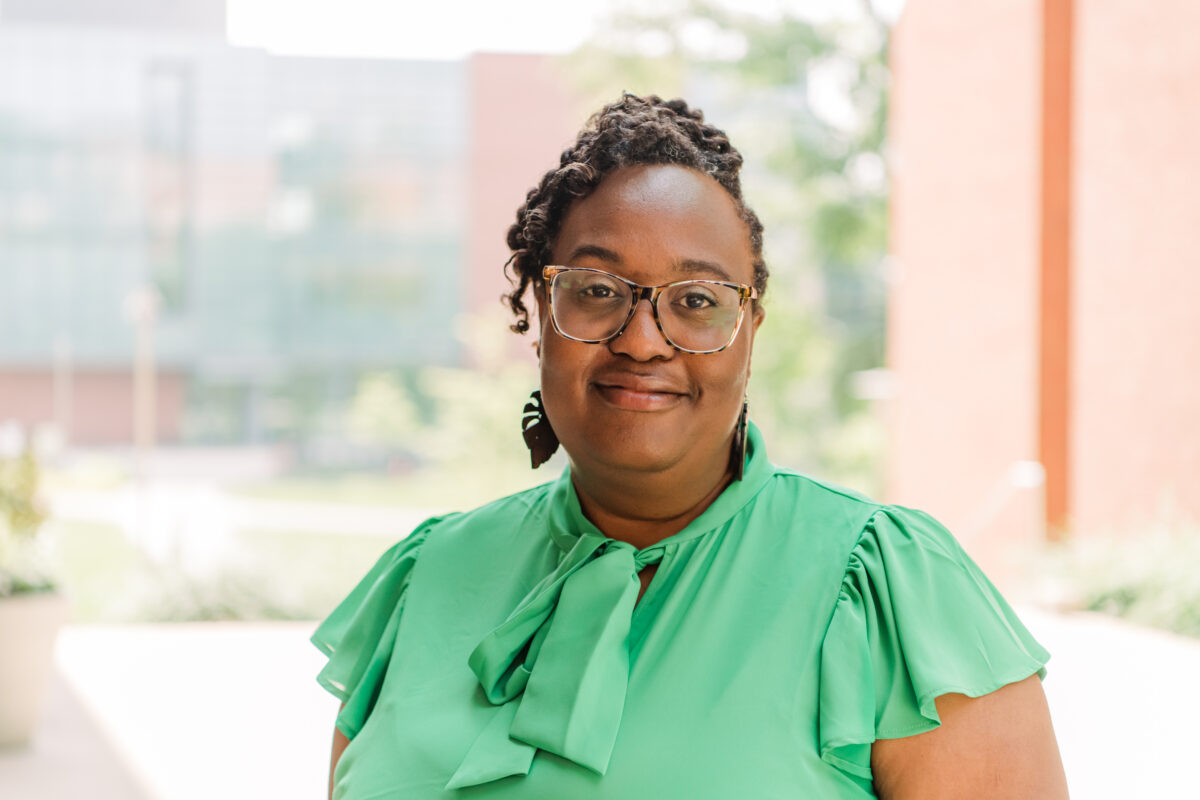 Elizabeth Patton. (Marlayna Demond ’11/UMBC)
“This research focuses on how media—such as advertisements, guidebooks, newspapers, magazines, film, photographs, home videos, and social media—have been used to document and promote leisure practices as a form of covert resistance,” says Patton. “It provides a counter-narrative to consumption-based and white-washed popular representations of tourism.”
Archival research
Patton has already begun traveling to archives with funding from the NEH, joint funding from Duke University’s John W. Hartman Center for Sales, Advertising & Marketing History and the John Hope Franklin Research Center for African American History and Culture, and UMBC’s CAHSS Research Fund. In collaboration with an archivist at the National Museum of American History Archives Center, Patton has reviewed the museum’s cold storage for photographic negatives from the 1920s and 1930s to view photographs of African Americans engaging in leisure activities and early advertising featuring African Americans. She has also reviewed Langston Hughes’s travel memoirs during Jim Crow and his time with Zora Neale Hurston at Yale University’s Beinecke Library.
The Smithsonian National Museum of African American History’s Great Migration Home Movie Project and African American Home Movie Archive have presented Patton with an opportunity to look through an extensive collection of home movies as well, offering another kind of personal perspective. Patton has also explored papers on city planning and major events like the World’s Fair, to understand how spaces were shaped by race and class and how leisure in New York became segregated, using the African American Studies collections at the Schomburg Center for Research in Black Culture and at the New York Public Library Rare Books Division, Manuscripts and Archives Division.
“I have found hundreds of examples of spaces where there is a history of people of color using those spaces, desegregating those spaces, or creating their own spaces for leisure and travel,” says Patton. “These rich data sources will help me tell the invisible history of African American leisure through historical methods, discourse analysis, semiotics, and oral history.”
The Soviet Union and Darwinism
Voerkelius’s book project, “Evolution in Times of Revolution: Darwinism, Nature and Society,” explores Soviet attitudes towards nature through the conflicted history of Darwinism in the Soviet Union. Voerkelius, assistant professor of history, explores this history through the lens of the State Darwin Museum in Russia.
Established in 1907, the museum has survived revolutions, political upheavals, world wars, polarizing schools of thought about Darwinism, and now a pandemic. Through it all, the museum has been a pillar of research, dissemination of science, and education pivotal to the Soviet Union’s theories, beliefs, discourse, and actions around evolution.
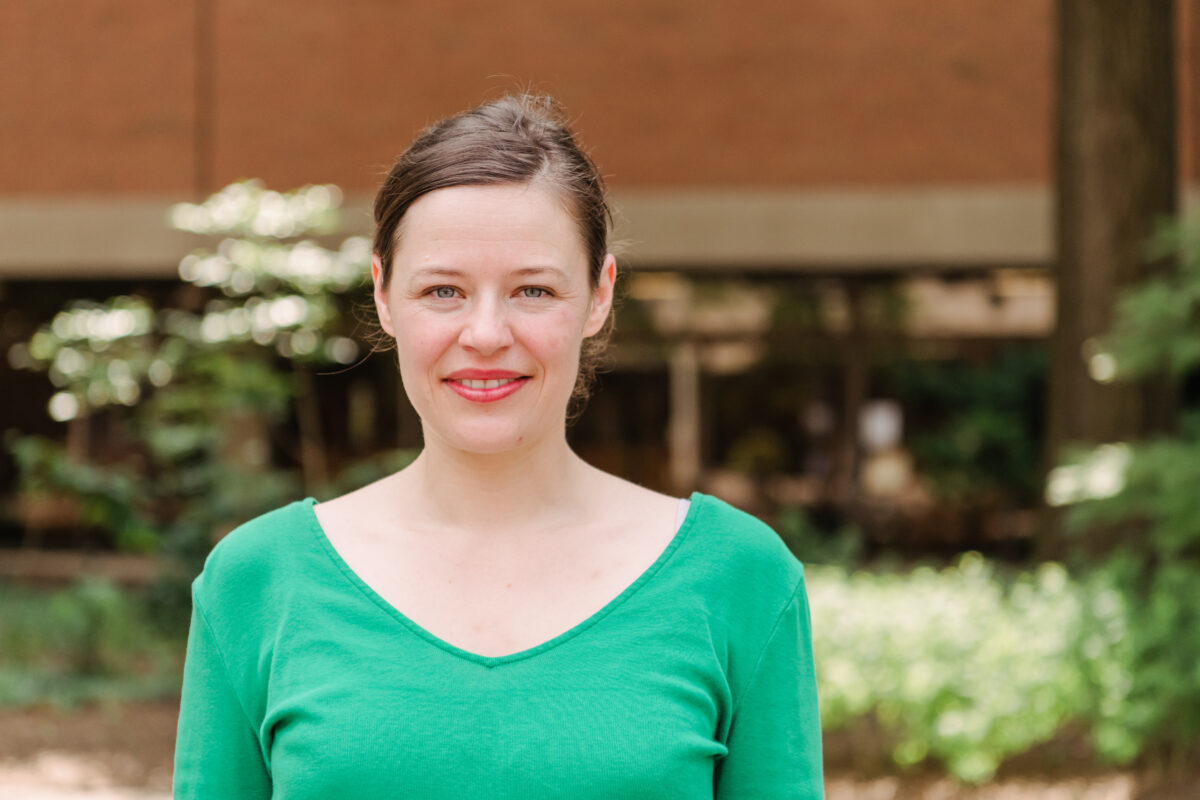 Mirjam Voerkelius. (Marlayna Demond ’11/UMBC)
“The Darwin Museum offers a comprehensive case study on attitudes towards the natural world in the Soviet Union and the underlying vision of the place of humankind within nature,” says Voerkelius.
This project builds on research completed in Russia at the State Archive of the Russian Federation, the archive of the State Darwin Museum, the Central Archive of the City of Moscow, and the Russian State Archive of the Economy, as well as the Jena University Archives in Germany.
Voerkelius was scheduled to return to Russia to further her archival research and complete her book. Due to the current war between Ukraine and Russia, Voerkelius cannot access these archives. To further her work, Voerkelius has received a $55,000 Kluge Fellowship from the John W. Kluge Center at the Library of Congress. As one of twelve fellows from around the world, she will have direct access to the Library’s extensive collection on the Soviet Union
“Working with the Library of Congress’s Russian Collection will allow me to consult published primary sources, which is essential for the completion of my manuscript,” says Voerkelius. With the help of these sources, she will place the Moscow State Darwin Museum’s research and narrative about Darwinism in a broader context.
“I hope to contribute to scholarly debate on the Soviet Union’s approach to science, evolutionary theory, and its broader impact on the environment,” she says.
Following the money
The idea for Froide’s new research project came from an unexpected find during eight years of research for her third book, Silent Partners: Women as Public Investors during Britain’s Financial Revolution, 1690-1750 (Oxford University Press, 2016).
Silent Partners focused on the role of women investors in England’s financial revolution and how women played a critical role in Britain’s rise to economic, military, and colonial dominance in the 18th century. Within the newspapers, government documents, and bookkeeping records she examined, Froide, professor and chair of history, found another story: a rare account of a stock market crash in 1732, wrought with fraud, embezzlement, forgery, and thievery.
Her new project, “The Charitable Corporation: A Cautionary Tale of Financial Fraud in Eighteenth-Century Britain,” will be a research-based narrative aimed at a wide audience about a group of investors, largely women, who invested in the microlending Charitable Corporation and the events around its collapse.
In her visit to England’s National Archives and Parliamentary Archives, Froide found lists of the Charitable Corporation shareholders petitioning the House of Lords and the House of Commons for a bailout. Some of the first petitioners were women, indicating they were active participants in seeking retribution politically and socially.
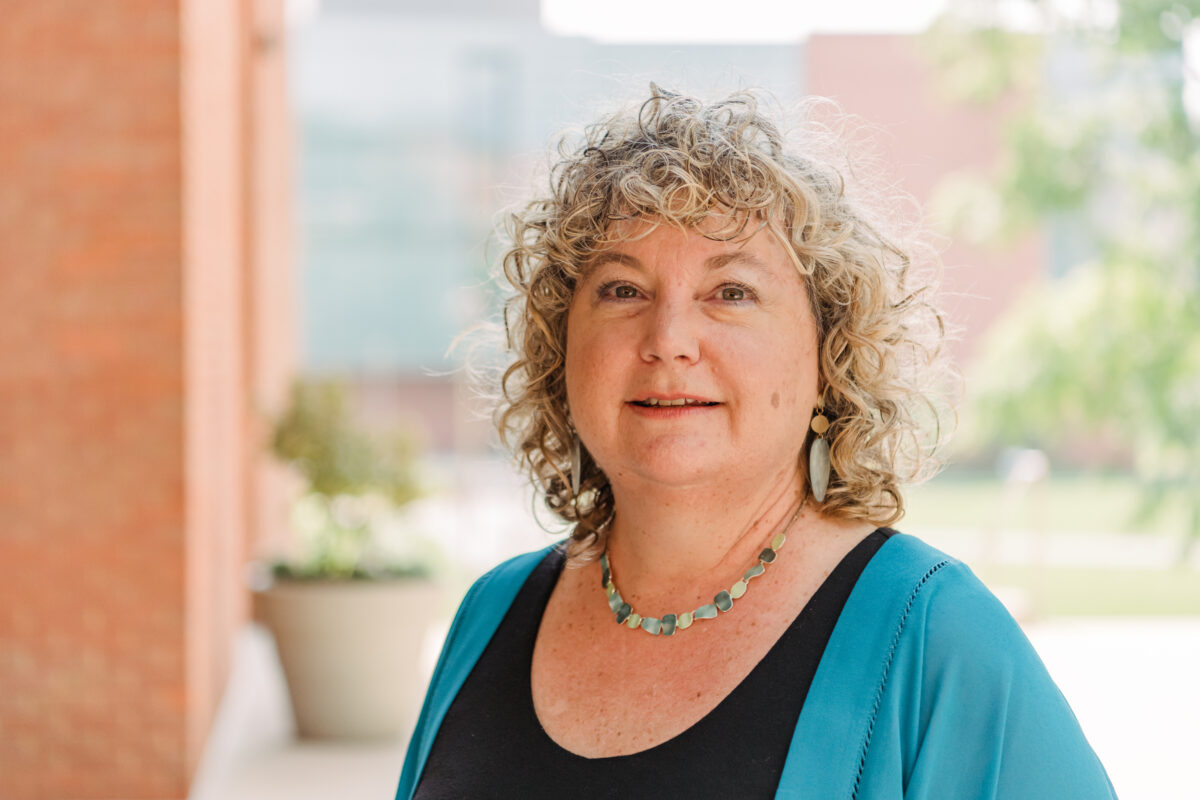 Amy Froide. (Marlayna Demond ’11/UMBC)
“This bailout doesn’t look much different from what we see in the 20th and 21st centuries,” says Froide. “Investors felt capitalism had not worked and wanted the government to step in. The various records from the parliamentary investigation found that the directors were committing fraud and because corporations and individual stockholders were equally liable at the time they both had to pay.”
“This story is interesting economically and will provide a lot of historical background for economic historians and economists,” she notes. “Much of what we think is so modern was actually happening three centuries ago in the early days of the stock market.”
Secrets without borders
Froide’s search through the Royal Archives led to a surprising discovery. She found evidence of a long-held suspicion by historians that the Charitable Corporation was funneling money to the Jacobites, a religious and political group that wanted to restore King James III to the British throne after the Glorious Revolution of 1688-89 toppled the Roman Catholic Stuarts.
“I began searching through the Stuart Papers in the British Library, which holds the personal and official correspondence of British monarchs,” says Froide. “I uncovered proof that the Jacobite ‘Pretender,’ James III, knew of the company and that he made contacts with officers of the Charitable Corporation who seem to have promised monetary support to fund his return to the throne and other acts of rebellion.”
Now, the story has led her to the largest repository of British documents outside of England—the Huntington Library in San Marino, California—as a research fellow. The Huntington Library Fellowship program is one of the largest and most distinguished fellowship programs for the support of humanities scholarship in the United States. Every year approximately 200 fellows from all over the world conduct advanced humanities research using The Huntington’s collections.
As a Huntington Library Fletcher Jones Foundation Fellow, Froide has received $50,000 to support a year at the Huntington Library archives to research and analyze documents and begin writing her book about the Charitable Corporation. The Huntington Library documents will allow Froide to reconstruct contemporary views of the financial scandal. She hopes the papers will lend further insights into the politicians, revolutionaries, investors, royalty, smugglers, and everyday people whose lives, willingly or not, were a part of creating and dismantling the business.
“My challenge is to write a story that shows you the political and economic context of the late 18th century in a way that is appealing to everyone. You can only do that if you have really good stories,” says Froide. “This is very labor-intensive work. There isn’t a specific file with all the answers in one language or in one country. But if you are a library or archive rat like me, you pursue all the threads to that great story.”
]]>
Humanities faculty Elizabeth Patton, Mirjam Voerkelius, and Amy Froide have received prestigious research fellowships totaling over $135,000 to explore archives and reveal new findings about...
https://umbc.edu/stories/umbc-humanities-faculty-pursue-groundbreaking-research/
https://my3.my.umbc.edu/api/v0/pixel/news/128409/guest@my.umbc.edu/7d56864c9bbdffe3e42d4b86a51c7309/api/pixel
arts-and-culture
cahss
cahssresearch
dreshercenter
history
international
majoraward
mcs
news
policy-and-society
rca-2
UMBC News & Magazine
https://my3.my.umbc.edu/groups/umbc-news-magazine
https://assets1-my.umbc.edu/system/shared/avatars/groups/000/001/943/24435aa6207c452e7bc15cc74b42c7bb/xsmall.png?1748556657
https://assets1-my.umbc.edu/system/shared/avatars/groups/000/001/943/24435aa6207c452e7bc15cc74b42c7bb/original.png?1748556657
https://assets2-my.umbc.edu/system/shared/avatars/groups/000/001/943/24435aa6207c452e7bc15cc74b42c7bb/xxlarge.png?1748556657
https://assets2-my.umbc.edu/system/shared/avatars/groups/000/001/943/24435aa6207c452e7bc15cc74b42c7bb/xlarge.png?1748556657
https://assets3-my.umbc.edu/system/shared/avatars/groups/000/001/943/24435aa6207c452e7bc15cc74b42c7bb/large.png?1748556657
https://assets1-my.umbc.edu/system/shared/avatars/groups/000/001/943/24435aa6207c452e7bc15cc74b42c7bb/medium.png?1748556657
https://assets2-my.umbc.edu/system/shared/avatars/groups/000/001/943/24435aa6207c452e7bc15cc74b42c7bb/small.png?1748556657
https://assets1-my.umbc.edu/system/shared/avatars/groups/000/001/943/24435aa6207c452e7bc15cc74b42c7bb/xsmall.png?1748556657
https://assets2-my.umbc.edu/system/shared/avatars/groups/000/001/943/24435aa6207c452e7bc15cc74b42c7bb/xxsmall.png?1748556657
UMBC News & Magazine
0
0
false
Wed, 12 Oct 2022 08:33:07 -0400
Wed, 12 Oct 2022 08:33:07 -0400
New Carnegie Fellow Derek Musgrove examines Black political movements in the U.S., 1980 – 1997

Readers of The New York Times opened their papers today to see a full-page announcement of the 2022 Andrew Carnegie Fellows, including UMBC’s George Derek Musgrove ‘97, history. Musgrove, an associate professor of history, is one of 28 scholars across the U.S. to receive the prestigious award this year, from nearly 300 nominations.
Meet the 2022 #CarnegieFellows! Through humanities and social sciences research, these scholars are helping us better understand the past, the enduring challenges we face, and how we can create a better future for us all. Congratulations, fellows!
]]>
Readers of The New York Times opened their papers today to see a full-page announcement of the 2022 Andrew Carnegie Fellows, including UMBC’s George Derek Musgrove ‘97, history. Musgrove, an...
https://umbc.edu/stories/new-carnegie-fellow-derek-musgrove-examines-black-political-movements-in-the-u-s-1980-1997/
https://my3.my.umbc.edu/api/v0/pixel/news/119440/guest@my.umbc.edu/0bc9e4d193b6ef4cef10358785e4978e/api/pixel
cahss
cahssresearch
community
dreshercenter
history
news
page1
policy-and-society
UMBC News & Magazine
https://my3.my.umbc.edu/groups/umbc-news-magazine
https://assets1-my.umbc.edu/system/shared/avatars/groups/000/001/943/24435aa6207c452e7bc15cc74b42c7bb/xsmall.png?1748556657
https://assets1-my.umbc.edu/system/shared/avatars/groups/000/001/943/24435aa6207c452e7bc15cc74b42c7bb/original.png?1748556657
https://assets2-my.umbc.edu/system/shared/avatars/groups/000/001/943/24435aa6207c452e7bc15cc74b42c7bb/xxlarge.png?1748556657
https://assets2-my.umbc.edu/system/shared/avatars/groups/000/001/943/24435aa6207c452e7bc15cc74b42c7bb/xlarge.png?1748556657
https://assets3-my.umbc.edu/system/shared/avatars/groups/000/001/943/24435aa6207c452e7bc15cc74b42c7bb/large.png?1748556657
https://assets1-my.umbc.edu/system/shared/avatars/groups/000/001/943/24435aa6207c452e7bc15cc74b42c7bb/medium.png?1748556657
https://assets2-my.umbc.edu/system/shared/avatars/groups/000/001/943/24435aa6207c452e7bc15cc74b42c7bb/small.png?1748556657
https://assets1-my.umbc.edu/system/shared/avatars/groups/000/001/943/24435aa6207c452e7bc15cc74b42c7bb/xsmall.png?1748556657
https://assets2-my.umbc.edu/system/shared/avatars/groups/000/001/943/24435aa6207c452e7bc15cc74b42c7bb/xxsmall.png?1748556657
UMBC News & Magazine
0
0
false
Tue, 26 Apr 2022 15:28:59 -0400
Tue, 26 Apr 2022 15:28:59 -0400
UMBC’s Marjoleine Kars receives the Cundill History Prize and Frederick Douglass Book Prize for “Blood on the River”

Marjoleine Kars, professor of history, has received the Cundill History Prize and the Frederick Douglass Book Prize for her acclaimed book Blood on the River: A Chronicle of Mutiny and Freedom on the Wild Coast (The New Press). Based on a decade of archival research, the book tells the story of a nearly successful rebellion of enslaved African and indigenous people just over 250 years ago in the Dutch colony of Berbice, 1763-1764.
Kars appreciates that the awards bring greater attention to the historical events and voices conveyed in her book. “At this moment when studying and teaching the history of African-descended people, and the history of race and racism, is under attack,” she says, “we need stories about Black courage, resilience, and resistance more than ever.”
Cundill History Prize
Cundill History Prize jurors voted unanimously for Blood on the River as the recipient of this year’s top award.
The annual prize, awarded by McGill University in Montreal, is the largest prize for a work of historical non-fiction in English ($75,000). It recognizes scholars globally for new books on any historical period or subject that have broad appeal, engaging readers outside of academia. Prize guidelines note that winners represent excellence in “the historian’s craft” – utilizing a variety of primary sources to produce “an impeccably-documented and well-argued study.”
“This story has, for so long, gone relatively unexamined,” says Jennifer L. Morgan, juror and professor of social and cultural analysis and history at NYU. “Kars’s skills as a researcher and a writer reposition the lives of these freedom fighters at the heart of our understanding of the Atlantic World.”
Frederick Douglass Book Prize
Just days before the Cundill History Prize announcement, Kars received the prestigious Frederick Douglass Book Prize, awarded by Yale University’s Gilder Lehrman Center for the Study of Slavery, Resistance, and Abolition and the Gilder Lerhman Institute of American History. It honors the most outstanding new non-fiction book in English on the subject of slavery, resistance, and/or abolition.
This “beautifully written book” relies on a “gold mine of an archive to unpack hidden meanings” within events that few historians have written of before, says jury chair Joseph P. Reidy, professor emeritus of history and former provost at Howard University. Among Kars’s archival resources are first-hand accounts of the rebellion by enslaved people, accessed through the National Archives of the Netherlands in the Hague.
Kars shares this prestigious $25,000 award with Vincent Brown, the Charles Warren Professor of American History and professor of African and African American studies at Harvard University. Brown’s book Tacky’s Revolt: The Story of an Atlantic Slave War takes an in-depth look at a rebellion of enslaved people in Jamaica,1760-61. The winning books were selected out of 85 nominees.
“I feel enormously honored to be a winner of this year’s Frederick Douglass Book Prize alongside Professor Vincent Brown,” shares Kars. “The Frederick Douglass Prize is the biggest prize in the field of slavery studies. It is very humbling to win it.”
Rigorous historical research
UMBC’s Amy Froide, professor and chair of history, shares that Kars is a notable example of the rigorous historical research that thrives at UMBC. She notes that Kars’s work has a particularly high impact because she produces meticulously researched and carefully argued scholarship that is beautifully written and accessible to a wide range of audiences. And within the field of history, her work will strongly influence scholars far afield from Berbice.

Kars.
Photo courtesy of Kars.
“Historians are especially appreciative of the creativity and unique perspective Dr. Kars has brought to the study of slave rebellions,” says Froide, “in particular her focus on divisions within and among the rebels, and seeing Africans and Indigenous peoples as leaders and participants in complex rather than monolithic resistance movements.”
Support for further research
Kars appreciates the support she has received from her department, the CAHSS Dean’s office, and UMBC in general. This includes feedback on her work, seed monies, research funding, help with grant writing, fellowship support, and leave from teaching in order to write. She notes that Rachel Brubaker, assistant director of grants and program development at UMBC’s Dresher Center for the Humanities, has provided invaluable assistance through her vast knowledge of prestigious national and international fellowships.
Since receiving the Cundill History Prize and Frederick Douglass Book Prize, Kars has received two new fellowships supporting her next project, from the National Endowment for the Humanities and the Netherlands Institute of Advanced Studies (NIAS). Her forthcoming research will focus on the complex lives of Accara and Gousarie, two African men who were revolutionary leaders and also involved in Dutch slavery and colonialism. She will begin working on the book Multiple Crossings: The Lives of Two African Men in the Eighteenth-Century Dutch Atlantic in residence at the NIAS in Amsterdam in 2022
“UMBC has created a marvelous infrastructure for research in the arts, humanities and social sciences,” she says. “I am glad these prizes can showcase that.”
Banner image: Marjoleine Kars. Photo by Marlayna Demond ’11 for UMBC.
]]>
Marjoleine Kars, professor of history, has received the Cundill History Prize and the Frederick Douglass Book Prize for her acclaimed book Blood on the River: A Chronicle of Mutiny and Freedom on...
https://umbc.edu/stories/umbcs-marjoleine-kars-receives-the-cundill-history-prize-and-frederick-douglass-book-prize-for-blood-on-the-river/
https://my3.my.umbc.edu/api/v0/pixel/news/119513/guest@my.umbc.edu/c78048fef94069558151a40d77186eeb/api/pixel
cahss
cahssresearch
dreshercenter
history
international
majoraward
page1
policy-and-society
UMBC News & Magazine
https://my3.my.umbc.edu/groups/umbc-news-magazine
https://assets1-my.umbc.edu/system/shared/avatars/groups/000/001/943/24435aa6207c452e7bc15cc74b42c7bb/xsmall.png?1748556657
https://assets1-my.umbc.edu/system/shared/avatars/groups/000/001/943/24435aa6207c452e7bc15cc74b42c7bb/original.png?1748556657
https://assets2-my.umbc.edu/system/shared/avatars/groups/000/001/943/24435aa6207c452e7bc15cc74b42c7bb/xxlarge.png?1748556657
https://assets2-my.umbc.edu/system/shared/avatars/groups/000/001/943/24435aa6207c452e7bc15cc74b42c7bb/xlarge.png?1748556657
https://assets3-my.umbc.edu/system/shared/avatars/groups/000/001/943/24435aa6207c452e7bc15cc74b42c7bb/large.png?1748556657
https://assets1-my.umbc.edu/system/shared/avatars/groups/000/001/943/24435aa6207c452e7bc15cc74b42c7bb/medium.png?1748556657
https://assets2-my.umbc.edu/system/shared/avatars/groups/000/001/943/24435aa6207c452e7bc15cc74b42c7bb/small.png?1748556657
https://assets1-my.umbc.edu/system/shared/avatars/groups/000/001/943/24435aa6207c452e7bc15cc74b42c7bb/xsmall.png?1748556657
https://assets2-my.umbc.edu/system/shared/avatars/groups/000/001/943/24435aa6207c452e7bc15cc74b42c7bb/xxsmall.png?1748556657
UMBC News & Magazine
0
0
false
Tue, 07 Dec 2021 19:03:41 -0500
Women leaders from UMBC, Morgan State, and UMD receive $3M Mellon grant to diversify senior leadership in higher ed

The Andrew W. Mellon Foundation has granted UMBC, Morgan State University, and the University of Maryland, College Park (UMD) $3 million to launch Breaking the M.O.L.D. (Mellon/Maryland Opportunities for Leadership Development). Many existing faculty leadership programs in higher education focus on leadership in STEM fields, the organizers note. This program will develop a pipeline to higher ed leadership for scholars in the arts and humanities. It will focus on interested faculty members at the rank of associate and full professor, particularly women faculty and Black, Hispanic, and American Indian/Alaska Native faculty.
Breaking the M.O.L.D. is also unique in its design with six women in senior leadership serving as principal investigators (PI), five of whom are Black. UMBC’s Kimberly Moffitt, interim dean of UMBC’s College of Arts, Humanities, and Social Sciences (CAHSS) and professor of language, literacy, and culture, serves as the project’s lead PI. Joining her in leading UMBC’s implementation of Breaking the M.O.L.D. will be Patrice McDermott, vice provost for faculty affairs.
Leading Morgan State’s implementation will be PI Patricia Williams Lessane, associate vice president for Academic Affairs and associate professor of sociology and anthropology, and Co-PI Charlene Chester, assistant dean for the James H. Gilliam College of Liberal Arts (CLA). At UMD, Psyche Williams-Forson, professor and chair of American studies, will serve as PI. Bonnie Thornton Dill, dean of the College of Arts and Humanities (ARHU) and professor in the Harriet Tubman Department of Women, Gender, and Sexuality Studies, will serve as co-PI.
L to R: Lessane (photo courtesy of Morgan State), Moffitt, Psyche Williams-Forson (photo courtesy of UMD)
A structural answer
“The many health, social justice, economic, and political challenges facing our society today place important demands on higher education institutions,” says UMBC’s Kimberly Moffitt.She points out that colleges and universities must shift how they approach engaging with societal problems, which often means reflecting on how higher ed itself works.
“This experienced team of diverse senior leaders has an opportunity to create a structural answer to elevate diverse leaders from the arts and humanities,” says Moffitt. “This will enable faculty to apply distinct knowledge, skills, and perspectives to address our communities’ needs as leaders at their respective institutions.”
Breaking the M.O.L.D.
As a minority-serving institution (MSI), Historically Black College and University (HBCU), and predominantly white institution (PWI), respectively, UMBC, Morgan State, and UMD are uniquely positioned to collaboratively lead this charge.
This ambitious project will include two cohorts of faculty—associate and full professors—guided by senior faculty over a three-year period. Participants will engage in skill-building seminars, learn key leadership skills from experts who hold senior leadership positions at the three universities, and take part in leadership experiences with their faculty mentors. The cohorts will travel to each campus to gain insights on how PWIs, HBCUs, and MSIs create different pathways to senior leadership.
 Some of UMBC’s 2015-19 postdoctoral fellows (L to R): Keisha Allen, assistant professor of education; Emily Yoon Perez, English; Lisa Cassell, assistant professor of philosophy; Noor Zaidi, assistant professor of history; Camee Maddox-Wingfield, assistant professor of sociology, anthropology, and public health policy; Moffitt.
This work builds on the success of previous initiatives, such as UMBC’s Postdoctoral Fellows for Diversity program. That program has brought 20 talented postdoctoral fellows to UMBC, in fields ranging from dance to history. It provides extensive mentoring and other support to enable postdocs to transition to faculty positions. Seventeen have already done so, including 11 at UMBC.
It also builds on UMD’s ADVANCE Program, a year-long professional development program that prepares faculty for leadership positions in their department, college, or the university.
 2019 postdoctoral fellows (L to R): Blake Francis, philosophy; Perez; Fernando Tormos-Aponte, public policy and political science.
One goal, three approaches
Breaking the M.O.L.D. will offer a flexible model that can be adapted to meet the diversity challenges and needs of individual campuses, while including all faculty from the arts and humanities who are committed to supporting diversity and inclusion in the academy.
UMBC’s CAHSS faculty includes dozens of scholars who identify as Black, Hispanic, American Indian or Alaska Native, but only ten hold the title of full professor. Most are associate professors. And just a handful serve in leadership positions, such as department chair or roles in the dean’s or provost’s office. While women, broadly, are more represented among CAHSS faculty, most women in CAHSS are associate professors.
As a result of these factors, UMBC’s Breaking the M.O.L.D. program will focus on supporting the leadership of Black, Hispanic, American Indian or Alaska Native, and women faculty in the arts and humanities while also being open to others committed to diversifying academic leadership. UMD and Morgan State’s approaches will be similar, but tailored to their institutions.
Investing in and nurturing tomorrow’s leaders
Morgan State will develop and implement a Summer Leadership Academy to address the unique, historical barriers that often impede the ascension of women, Black, Hispanic, and American Indian and Alaska Native faculty in the arts and humanities, with a focus on Black women faculty. The academy will help Morgan State faculty further develop leadership skills, balance research and leadership responsibilities, and navigate the higher education landscape. They will also explore the role of HBCUs in higher education.
“Leaders beget leaders. It is through this model initiative that we are creating the infrastructure and blueprint for our diverse faculty to thrive,” says Lessane. “Humanities scholars are needed in senior executive leadership positions because they understand the value of human-centered education and its impact as a driving force in equitable scientific and technological innovation, business enterprise, and social justice reform during volatile, unprecedented times.”
Diverse voices at the leadership table
UMD’s ARHU faculty will tackle barriers Black women faculty face to access and succeed in leadership positions, as well as support Black, Hispanic, American Indian and Alaska Native faculty more broadly. In ARHU, approximately 15% of the tenured and tenure-track faculty identify with one of the groups above, with the majority at the associate professor rank. Currently, fewer than ten Black women serve in mid-level leadership positions and only two at the senior executive leadership level.
“As a Black woman serving at the senior executive level in a PWI, I’m keenly aware of the importance of having the voices of diverse people at the leadership table,” says Thornton Dill. “I see this project as an opportunity to expose program participants to the knowledge and experiences of other underrepresented minorities in administration as they develop their own strategies and approaches to higher education leadership.”
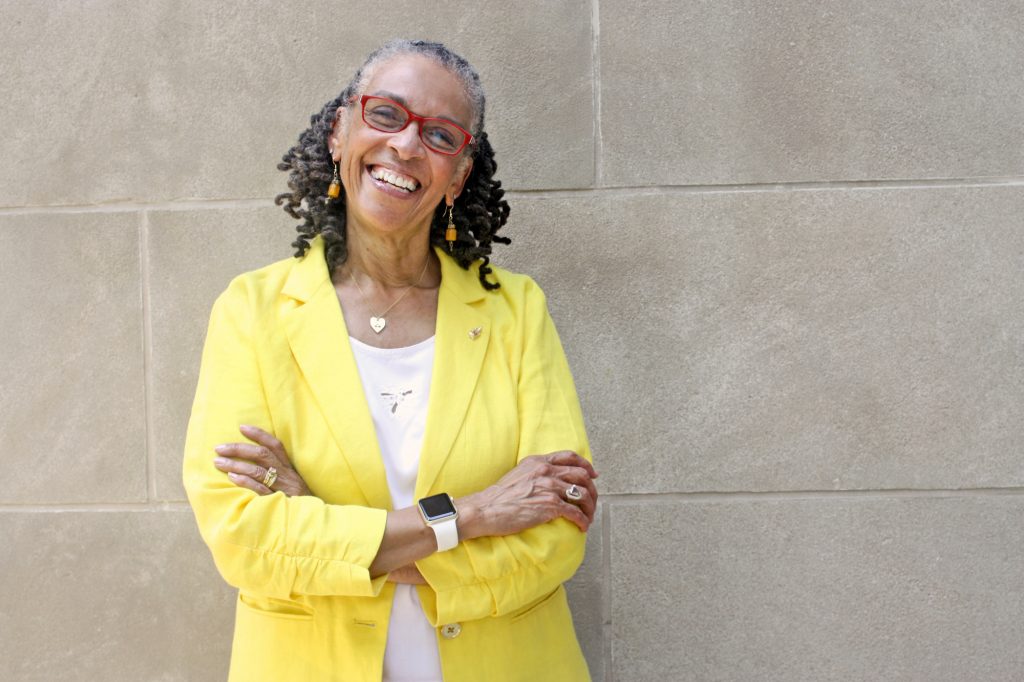
Bonnie Thornton Dill
(Photo courtesy of UMD)
As a recently promoted professor and long-time chair of American studies, Williams-Forson knows the experience of being at the associate professor rank while in mid-level leadership. “Those who advance to administration without research support, mentoring, or networking can find themselves unable to see beyond mid-level leadership positions like chair and director,” she says. “With this project we hope not only to provide greater opportunities for promotion, but also to expose faculty to the myriad senior-level leadership roles across the campus.”
The whole scholar
In addition to developing a network of diverse faculty equipped with the tools and resources to guide and grow universities, Breaking the M.O.L.D will invest in strengthening the links between leadership and scholarship. The intersectionality of the problems that communities face locally, nationally, and globally requires diverse leaders with humanities and arts perspectives who are empowered to create and share knowledge in new, high-impact ways.
 UMBC postdoctoral fellows with Moffitt and Tim Gindling, professor of economics.
Often, women, Black, Hispanic, American Indian, and Alaska Native faculty lack access to the social capital, financial resources, or time needed to advance their scholarly work. This program seeks to remove these barriers by providing funding for research, writing, conferences, and projects, and creating opportunities for partnership, innovation, and career development.
All of these elements are key components of leadership pathways, as is mentorship. In Breaking the M.O.L.D., tenured faculty leaders will provide guidance and resources to ensure participants receive the support they need to move their scholarship forward while growing their leadership skills and opportunities.
Reshaping institutions
Beyond working with faculty as future higher ed leaders, this program also seeks to reshape institutional structures. Ultimately, it aims to disrupt systemic practices that have left women, Black, Hispanic, American Indian, and Alaska Native arts and humanities faculty out of university leadership. The partners plan to combine information gathered over the three years of the program with current research on inclusive excellence to design tools that will help universities rethink their recruitment processes for faculty leaders.
Through a variety of leadership presentations and exercises, the three institutions will design a path to develop truly inclusive leadership by disrupting implicit bias and other forms of exclusion present in job descriptions, search and selection processes, hiring, and professional development. The resources they develop will be made available to other universities across Maryland and the nation, and to academic search firms and those who chair leadership searches, who often initiate the vetting process for arts and humanities faculty. By sharing these resources, the partners hope to enhance equity in academic hiring nationwide.
“Universities and colleges are at a crossroad to reimagine academia by cultivating diverse leaders with important leadership skills, such as imagination, compassion, and understanding,” says Moffitt. “These new leaders will become the next generation of stewards leading innovation in teaching and scholarship, and reshaping university structures to go beyond the status quo.”
For further coverage see Morgan State and College Park‘s news sites.
Banner image: UMBC postdoctoral fellows and Moffitt. (All photos by Marlayna Demond ’11 for UMBC unless otherwise noted.)
]]>
The Andrew W. Mellon Foundation has granted UMBC, Morgan State University, and the University of Maryland, College Park (UMD) $3 million to launch Breaking the M.O.L.D. (Mellon/Maryland...
https://umbc.edu/stories/women-leaders-from-umbc-morgan-state-and-umd-receive-3m-mellon-grant-to-diversify-senior-leadership-in-higher-ed/
https://my3.my.umbc.edu/api/v0/pixel/news/119526/guest@my.umbc.edu/e43f3af76a92fd745b84a93b021ec800/api/pixel
arts-and-culture
cahss
cahssresearch
dreshercenter
economics
education
english
history
llc
majoraward
mlli
page1
philosophy
policy-and-society
politicalscience
publicpolicy
saph
UMBC News & Magazine
https://my3.my.umbc.edu/groups/umbc-news-magazine
https://assets1-my.umbc.edu/system/shared/avatars/groups/000/001/943/24435aa6207c452e7bc15cc74b42c7bb/xsmall.png?1748556657
https://assets1-my.umbc.edu/system/shared/avatars/groups/000/001/943/24435aa6207c452e7bc15cc74b42c7bb/original.png?1748556657
https://assets2-my.umbc.edu/system/shared/avatars/groups/000/001/943/24435aa6207c452e7bc15cc74b42c7bb/xxlarge.png?1748556657
https://assets2-my.umbc.edu/system/shared/avatars/groups/000/001/943/24435aa6207c452e7bc15cc74b42c7bb/xlarge.png?1748556657
https://assets3-my.umbc.edu/system/shared/avatars/groups/000/001/943/24435aa6207c452e7bc15cc74b42c7bb/large.png?1748556657
https://assets1-my.umbc.edu/system/shared/avatars/groups/000/001/943/24435aa6207c452e7bc15cc74b42c7bb/medium.png?1748556657
https://assets2-my.umbc.edu/system/shared/avatars/groups/000/001/943/24435aa6207c452e7bc15cc74b42c7bb/small.png?1748556657
https://assets1-my.umbc.edu/system/shared/avatars/groups/000/001/943/24435aa6207c452e7bc15cc74b42c7bb/xsmall.png?1748556657
https://assets2-my.umbc.edu/system/shared/avatars/groups/000/001/943/24435aa6207c452e7bc15cc74b42c7bb/xxsmall.png?1748556657
UMBC News & Magazine
0
0
false
Thu, 18 Nov 2021 14:00:02 -0500
International labor economist Tim Gindling is named UMBC’s 2021 – 2022 Liptz Professor

UMBC has named Tim Gindling, professor of economics, the 2021 – 2022 Lipitz Professor of the College of Arts, Humanities, and Social Sciences (CAHSS). This endowed professorship celebrates, acknowledges, and sponsors cutting-edge research and teaching. This honor recognizes Gindling’s international leadership in research to support the capacity of developing economies to meet populations’ long-term needs. During the award year, he will move forward on collaborative research in Latin America and China.
“This is a prestigious award within the UMBC community,” shares Gindling. “I feel especially honored given the impressive accomplishments of previous Lipitz professors.”
Lipitz professors from the prior three years include Gloria Chuku, chair and professor of Africana Studies (2020-21); Jessica Berman, professor of English and director of the Dresher Center for the Humanities (2019-20); and Dan Bailey, a professor of visual arts who focuses on animation and interactive media (2018-19).
“This professorship will help Tim continue his research in wages, work, poverty, and income distribution in Latin America and East Asia,” says UMBC’s David Mitch, chair and professor of economics. “It brings to the forefront the importance of his research and its impact at an international level, which is in large part due to his ability to foster successful research collaborations.” This includes research partnerships in Costa Rica, El Salvador, Nicaragua, Colombia, Canada, China, and Taiwan.
 David Mitch (right) with incoming fall 2021 economics students.
Gindling will work on two main projects during his professorship. First, he will collaborate with the United Nations University World Institute for Development Economics Research (UNU-WIDER) in Helsinki, Finland on a global research project on informal work. Then, in spring 2022, he will return to China to continue a research collaboration on income inequality. There he will work with Linxiang Ye, a professor of economics and dean at the Nanjing University of Economics and Finance.
Transforming informal work
In 2019, Gindling was invited by UNU-WIDER to collaborate with them and Gary Fields from Cornell University to direct the project Transforming Informal Work and Livelihoods. They are gathering research from more than 25 developing economies from every region of the world on how workers who are self-employed, or who work for others as informal employees, access government-sponsored health care benefits and other worker protections. The team will publish a series of peer-reviewed papers on the research. They will also produce an edited volume on their findings, published by Oxford University Press in 2022, and co-edited by Gindling, Fields, and Kunal Sen, director of the UNU-WIDER, and others.
“The pandemic has highlighted the very difficult circumstances that informal workers face in their working lives,” shares Sen. “UNU-WIDER’s project ‘Transforming Informal Work and Livelihoods’ sheds light on the livelihoods of informal workers, and the prospects they have for moving to better jobs.”
Latin American economics
In addition to helping to direct the project, reviewing papers from researchers around the world, and co-editing the book project, Gindling has also co-authored three articles to contribute to the project.
One of the papers, “Heterogeneous informality in Costa Rica and Nicaragua,” has been submitted for publication in a special issue of the Journal of Development Studies. It was co-authored with Enrique Alaniz, an economist and research director at the Fundación Internacional para el Desafío Económico Global in Nicaragua, as well as UMBC international public policy doctoral students Catherine Mata M.A. ‘28, economics and Diego Rojas. Both are former researchers at the Institute of Research in Economic Sciences at the Universidad de Costa Rica.
 (L to R) Maria Bernedo Del Carpio, assistant professor of economics, Rojas, Mata, and Gindling. Photo by Marlyana Demond for UMBC.
“This project has been a great vehicle for me to apply what I have learned in my master’s and doctoral programs at UMBC,” says Mata. “I’ve worked closely with a senior researcher and participated in high-level conferences with experts in the field—valuable preparation for my own dissertation and later job search after graduation.”
Mata is also working on education research as a research assistant for Jane Lincove, associate professor of public policy. Rojas is currently a consultant for the Office of the Chief Economist for Latin America and the Caribbean at the World Bank.
The other two papers will be published in the book. “Transforming informal work and livelihoods in Costa Rica and Nicaragua” is co-authored by the same four researchers. “Self-employment and labour market dynamics of men and women in El Salvador and Nicaragua” is written by Gindling, Alaniz, and Alma Espino, a professor of economics and a researcher at the Universidad de la República Uruguay.
Global partnerships
Gindling’s work has garnered significant international recognition, which has, in turn, opened doors to more collaborative research opportunities. Gindling has been a non-resident senior research fellow at UNU-WIDER since 2019. For over a decade, he has been a research fellow at the Institute for the Study of Labor in Bonn, Germany. He has also worked at the Institute for Research in Economic Science at the University of Costa Rica for thirty-three years as a non-resident researcher, where he also served as a Fulbright U.S. Scholar in 1992 and again from 2001 to 2003.
In addition to his research and teaching, Gindling has also served as a research consultant to the World Bank, the International Labour Office, the Canadian International Development Research Centre, the United Nations Development Programme, the United States Agency for International Development (USAID), and the governments of Costa Rica and Honduras.
The World Bank published his book Toward More Efficient and Effective Public Social Spending in Central America in 2017. Gindling co-authored itwith World Bank researchers Pablo Acosta, program leader for human development in Brazil; Rita Almeida, lead economist and human development program leader for Central America; and Christine Lao Pena, senior human development economist.
Economic effects of immigration policy
In addition to advancing international development economics, Gindling also studies the relationship between immigrants and education in the United States. As with his international projects, Gindling has joined forces with research partners to better understand the economic effects of U.S. immigration policy.
His policy brief “Private and Government Fiscal Costs and Benefits of the Maryland Dream Act” looked at how the Maryland Dream Act affects in-state tuition rates at Maryland state colleges and universities for undocumented immigrants. He co-authored this study with Marvin Mendel, emeritus professor of public policy and former director of UMBC’s Maryland Institute for Policy Analysis and Research.
Gindling received funding from the Spencer Foundation to expand the research nationally with Lisa Dickson, associate professor of economics at UMBC. He also worked with counselors at Northwest High School in Prince George’s County, Maryland, to assess how immigrant family separation affects students in the classroom. For that project, he partnered with Sara Poggio, associate professor of modern languages, linguistics, and intercultural communications, and founder and co-chair of the International Migration Section of the national Latin American Studies Association.
Advising future innovators
The lessons Gindling has learned through his international research and partnerships directly benefit his UMBC students. He has mentored and advised hundreds of students like Rojas and Mata, helping them build their careers, with a focus on innovatively addressing economic inequalities.
One of these students, Anna Gifty Opoku-Agyeman, M26, ‘19, mathematics, co-founded the first conference for Black women in economics: the Sadie T.M. Alexander Conference for Economics and Related Fields. The conference led her to co-found the Sadie Collective, the first non-profit focused on supporting Black women in economics, finance, data science, and policy at all phases of their careers. In 2020, the UN Convention on the Elimination of All Forms of Discrimination Against Women awarded Opoku-Agyeman a Women’s Rights Award in the Social Justice category. Previous recipients include U.S. Vice President Kamala Harris and Nancy Pelosi, Speaker of the U.S. House of Representatives. Opoku-Agyeman is currently a graduate student at the Harvard Kennedy School.
 Opoku-Agyeman (right) presenting Diane Herz, vice president, director of human services, and chief diversity officer of Mathematica Policy Research, with a plaque of appreciation for hosting the first Sadie T.M. Alexander Conference.
Gindling has great memories of advising Ruby Lu ‘94, economics and mentoring her as part of UMBC’s first cohort of McNair Summer Research scholars. Lu conducted research on discrimination against women and the wage gap between men and women in Taiwan. “At the time I was also conducting research on Taiwan and I shared my data with her for the project,” says Gindling, who has kept in touch with her since she left UMBC.
Lu earned a master’s degree in international economics at Johns Hopkins. In 2005, she co-founded the Beijing-based venture firm DCM China. In 2019, she started her own firm, Atypical Ventures, to fund “ambitious entrepreneurs who want to build lasting companies that have a positive impact on our society.” Her investment in China’s e-commerce, software, and healthcare industries has helped to grow companies and create over 300,000 skilled jobs.
Impact across UMBC
Since 1988, Gindling has also lent his support and expertise by serving on over twenty-five UMBC committees related to faculty searches and tenure, graduate and undergraduate admissions, and department and program needs in public policy, interdisciplinary studies, Africana studies, and global studies.
“The international scope of Tim’s work brings unique and important lessons in economics research and collaboration for UMBC students,” says Kimberly Moffitt, interim dean of CAHSS. “Students have applied this rigor and passion to create new paths in the field and support measures that can improve economic policy in developing countries through collaborative research. The Lipitz professorship celebrates his decades of dedication and his vision for economics at UMBC.”
Banner image: Tim Gindling. Photo courtesy of Gindling.
]]>
UMBC has named Tim Gindling, professor of economics, the 2021 – 2022 Lipitz Professor of the College of Arts, Humanities, and Social Sciences (CAHSS). This endowed professorship celebrates,...
https://umbc.edu/stories/international-labor-economist-tim-gindling-is-named-umbcs-2021-2022-liptz-professor/
https://my3.my.umbc.edu/api/v0/pixel/news/119557/guest@my.umbc.edu/2cf0c3abc38ec6f5f63bf3da68c2f4da/api/pixel
africanastudies
cahss
cahssresearch
cs3
dreshercenter
economics
english
international
policy-and-society
publicpolicy
UMBC News & Magazine
https://my3.my.umbc.edu/groups/umbc-news-magazine
https://assets1-my.umbc.edu/system/shared/avatars/groups/000/001/943/24435aa6207c452e7bc15cc74b42c7bb/xsmall.png?1748556657
https://assets1-my.umbc.edu/system/shared/avatars/groups/000/001/943/24435aa6207c452e7bc15cc74b42c7bb/original.png?1748556657
https://assets2-my.umbc.edu/system/shared/avatars/groups/000/001/943/24435aa6207c452e7bc15cc74b42c7bb/xxlarge.png?1748556657
https://assets2-my.umbc.edu/system/shared/avatars/groups/000/001/943/24435aa6207c452e7bc15cc74b42c7bb/xlarge.png?1748556657
https://assets3-my.umbc.edu/system/shared/avatars/groups/000/001/943/24435aa6207c452e7bc15cc74b42c7bb/large.png?1748556657
https://assets1-my.umbc.edu/system/shared/avatars/groups/000/001/943/24435aa6207c452e7bc15cc74b42c7bb/medium.png?1748556657
https://assets2-my.umbc.edu/system/shared/avatars/groups/000/001/943/24435aa6207c452e7bc15cc74b42c7bb/small.png?1748556657
https://assets1-my.umbc.edu/system/shared/avatars/groups/000/001/943/24435aa6207c452e7bc15cc74b42c7bb/xsmall.png?1748556657
https://assets2-my.umbc.edu/system/shared/avatars/groups/000/001/943/24435aa6207c452e7bc15cc74b42c7bb/xxsmall.png?1748556657
UMBC News & Magazine
0
0
false
Tue, 14 Sep 2021 16:04:52 -0400