Inaugural “MyRCA” interdisciplinary faculty cohort empowers researchers to bring their work to life
UMBC’s new Make Your Research Come Alive (MyRCA) program is helping faculty translate their scholarship into compelling stories that resonate across disciplines, sectors, and audiences. Launched in November 2025, the program wrapped up its inaugural cohort with a May showcase.
“We created the MyRCA program to help faculty strengthen their research communication skills and effectively convey the significance and real-world impact of their work beyond traditional academic audiences and funding pathways,” says Christine Mallinson, assistant vice president for research and scholarly impact. “It also encourages faculty to think strategically and creatively about visibility, partnerships, collaboration, and long-term impact,” she adds.
Led by the Division of Research and Creative Achievement in partnership with the Office of Institutional Advancement, MyRCA brought together 14 faculty members for twice-monthly workshops and working group sessions, a January mini-retreat, and the culminating showcase. The program focused on identifying and articulating research impact, translating specialized scholarship for broad audiences, developing compelling narratives and pitches, understanding funding landscapes, exploring pathways for engagement with corporate, community, and philanthropic partners, and strengthening interdisciplinary collaboration.
“The value of this program is in connecting with each other,” cohort member Foad Hamidi, associate professor of information systems, shared at the showcase. “Strong research communication and collaboration can help our research come alive,” adds Dong Li, another cohort member and assistant professor of computer science and electrical engineering. Li added, “We are not just researchers, we are telling our story to our audience.”
The value of connection
The program intentionally grouped faculty into smaller interdisciplinary teams organized around broad themes such as health, youth, and the environment. These connections quickly sparked new ideas and collaborations.
For instance, Lauren Clay, professor and chair of emergency and disaster health systems, connected with Li, after learning about his work on wearable health-monitoring devices. Clay wondered how Li’s technology could support a colleague’s research on paramedic response during extreme heat events, including monitoring heat stroke risks for marathon runners.
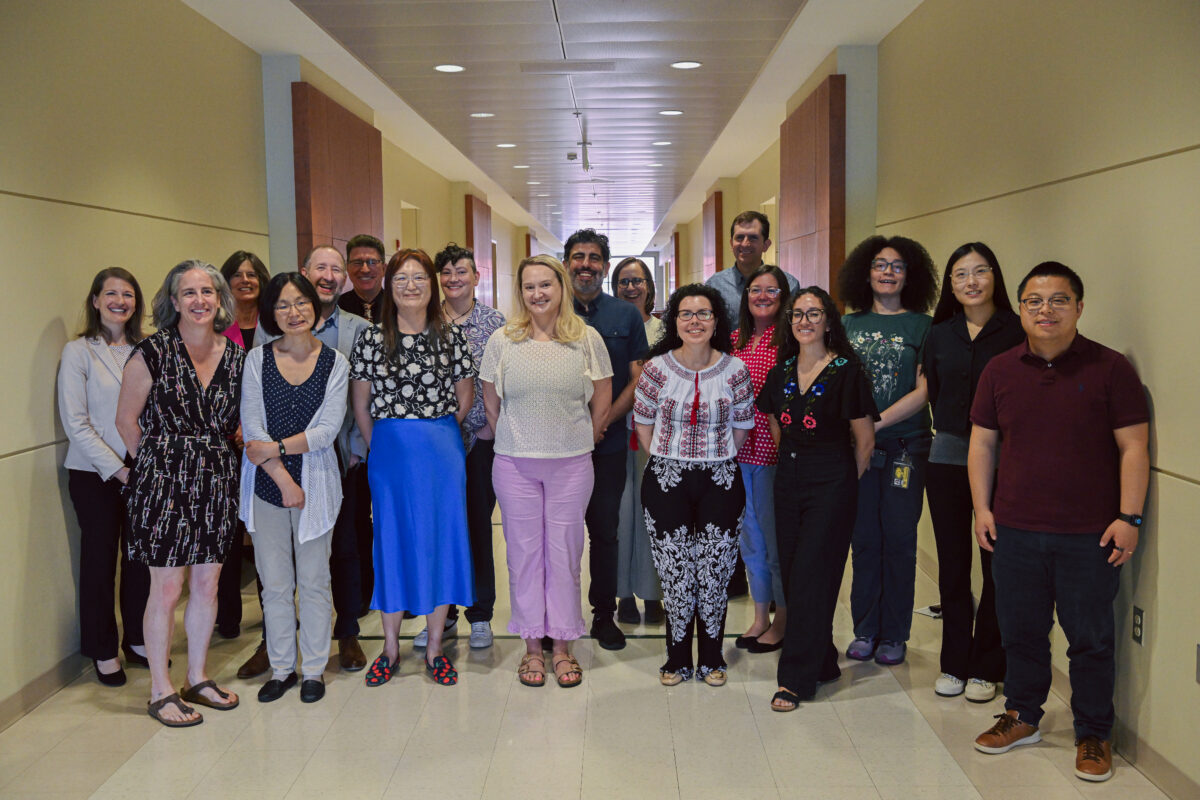 The inaugural MyRCA cohort and program organizers, left to right: Christine Mallinson, Ellen Kohl, Donna Ruginski, Karen Chen, Brian Kaufman, Karl Steiner, Shuling Yang, Sophie Comer-Warner, Amy Tondreau, Foad Hamidi, Linda Kidder Yarlott, Marie Christine-Daniel, Don Engel, Lauren Clay, Gabriella Weiss, Rebecca Williams, Yiwen Hu, Dong Li. Not pictured: Charissa Cheah.
A group including Gabriella Weiss, postdoctoral researcher with the Center for Spaces Sciences and Technology; Marie-Christine Daniel, associate professor of chemistry and biochemistry; and Sophie Comer-Warner, assistant professor of geography and environmental systems, examined remediation strategies for microplastics, heavy metals, and volatile organic compounds with a focus on wetlands. Their collaboration pointed to promising local funding opportunities with Maryland Sea Grant and Chesapeake Bay organizations.
Ellen Kohl, assistant professor of geography and environmental systems, strengthened a new science communication course with the skills she gained, and Shuling Yang, assistant professor of education, advanced her research using generative AI and Chinese pop music for biliteracy development. Brian Kaufman, professor of music, built on the UMBC Create Music Festival, which brings collaborative problem-solving into a typically performance-based discipline.
By the showcase, participants had developed polished pitches, public-facing materials, and broader impact narratives ready for funding proposals, donor outreach, and the media. Each received $500 in research support, along with new cross-campus and external connections.
MyRCA stretches faculty beyond their comfort zones
Mallinson has been excited to see the 14 faculty “stretch beyond their usual disciplinary comfort zones and immediately begin putting the skills and approaches they were learning into practice—developing cross-disciplinary proposals, crafting pitches, appearing in videos and podcasts, participating in panels, and bringing what they learned in the program back to their graduate students and colleagues.”
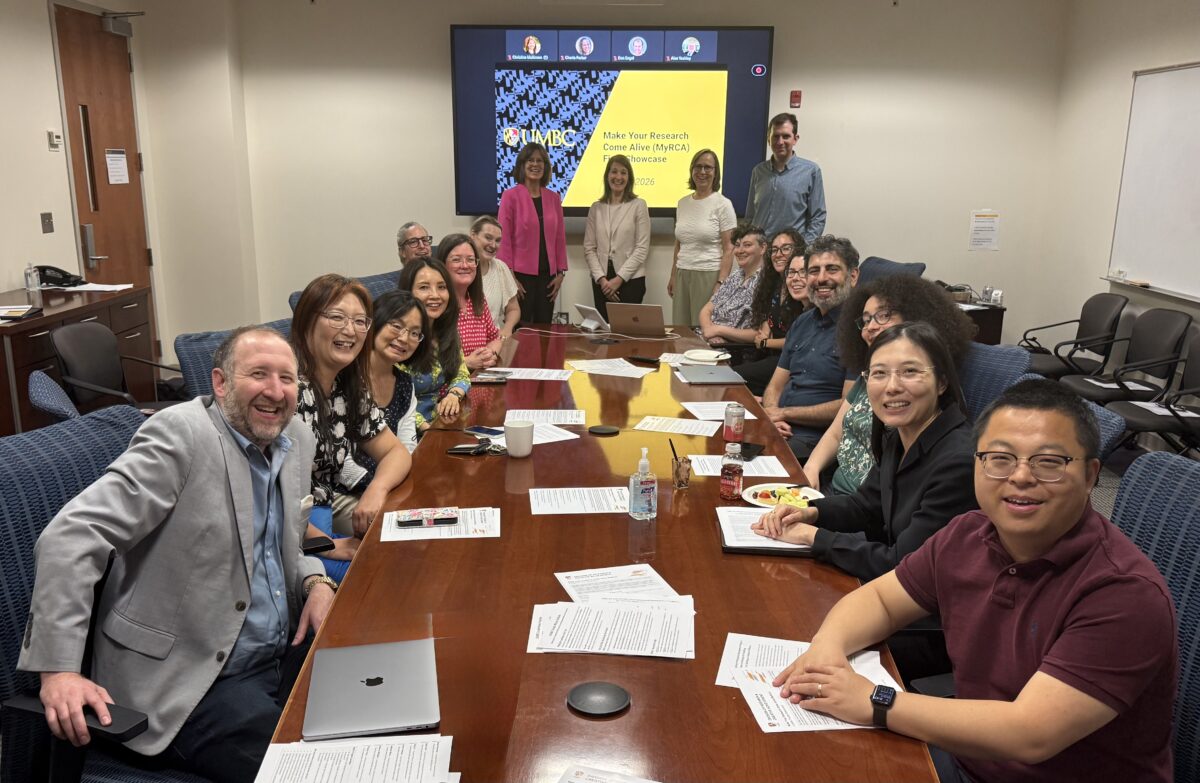 The inaugural MyRCA cohort shared progress and celebrated their accomplishments at a showcase event in May. (Photo by Karl Steiner)
Linda Kidder Yarlott, associate director for corporate research partnerships, highlighted the value of the partnership between the Division of Research and Creative Achievement and the Office of Institutional Advancement. “While federal funding agencies are looking for highly technical, methodology-driven proposals, it’s visionary, outcome-oriented narratives that clearly articulate the human impact and real-world return on investment that entice corporate and philanthropic partners,” Yarlott says.
Yarlott and Jocelyn Kehl, major gift officer for the College of Natural and Mathematical Sciences, worked with the cohort on practical skills—from strategic networking and optimizing LinkedIn profiles to crafting stories that resonate with donors and foundations. “Mentoring this cohort has been an incredibly rewarding experience, culminating in a spectacular program showcase where faculty teams powerfully demonstrated new communication skills that will help unlock new philanthropic pathways,” Yarlott shares.
For more information and to learn about the full 2025 – 2026 cohort, visit research.umbc.edu/myrca.
]]>
UMBC’s new Make Your Research Come Alive (MyRCA) program is helping faculty translate their scholarship into compelling stories that resonate across disciplines, sectors, and audiences. Launched...
https://umbc.edu/stories/myrca-empowers-interdisciplinary-researchers/
https://my3.my.umbc.edu/api/v0/pixel/news/160483/guest@my.umbc.edu/52d7d3b40ae47b848cd3806898a3a63d/api/pixel
cahss
chemistry-and-biochemistry
cnms
coeit
csee
edhs
education
ges
is
music
news
policy-and-society
rca
science-and-tech
story
UMBC News & Magazine
https://my3.my.umbc.edu/groups/umbc-news-magazine
https://assets1-my.umbc.edu/system/shared/avatars/groups/000/001/943/24435aa6207c452e7bc15cc74b42c7bb/xsmall.png?1748556657
https://assets1-my.umbc.edu/system/shared/avatars/groups/000/001/943/24435aa6207c452e7bc15cc74b42c7bb/original.png?1748556657
https://assets2-my.umbc.edu/system/shared/avatars/groups/000/001/943/24435aa6207c452e7bc15cc74b42c7bb/xxlarge.png?1748556657
https://assets2-my.umbc.edu/system/shared/avatars/groups/000/001/943/24435aa6207c452e7bc15cc74b42c7bb/xlarge.png?1748556657
https://assets3-my.umbc.edu/system/shared/avatars/groups/000/001/943/24435aa6207c452e7bc15cc74b42c7bb/large.png?1748556657
https://assets1-my.umbc.edu/system/shared/avatars/groups/000/001/943/24435aa6207c452e7bc15cc74b42c7bb/medium.png?1748556657
https://assets2-my.umbc.edu/system/shared/avatars/groups/000/001/943/24435aa6207c452e7bc15cc74b42c7bb/small.png?1748556657
https://assets1-my.umbc.edu/system/shared/avatars/groups/000/001/943/24435aa6207c452e7bc15cc74b42c7bb/xsmall.png?1748556657
https://assets2-my.umbc.edu/system/shared/avatars/groups/000/001/943/24435aa6207c452e7bc15cc74b42c7bb/xxsmall.png?1748556657
UMBC News & Magazine
1
0
false
Mon, 01 Jun 2026 15:17:46 -0400
Mon, 01 Jun 2026 15:17:46 -0400
Pete Fitzpatrick, pediatric transport nurse, appointed to Maryland’s Opioid Restitution Fund Advisory Council
Pete Fitzpatrick ’96 completed his paramedic training in a speeding ambulance in West Baltimore over 30 years ago. It wasn’t the career he had envisioned, but after a friend gave him a textbook for an elective Emergency Medical Technician class, he switched his major to emergency and disaster health systems. “I kind of fell in love with it. As a kid, I never saw it as a profession for me,” says Fitzpatrick. “There are no firefighters or paramedics in my family.”
His ability to communicate clearly and calmly under pressure, foresee medical or technical issues, and notice the tiniest details led him to return to school for nursing. He first worked in an adult neuroscience unit at Johns Hopkins Hospital before returning to ambulance and helicopter transport, including pediatric transport.
Fitzpatrick has spent the last 12 years at the Children’s National Hospital in Washington, D.C. As a transport team shift coordinator, he meets the needs and addresses the challenges of flight crews, medics, receiving hospitals, and families before, during, and after helicopter or ambulance transport. “I remember my surprise the first time somebody referred to me as a pediatric nurse,” says Fitzpatrick. “I guess I am.”
Addressing the opioid crisis
 Pete Fitzpatrick and a young Sam. (Image courtesy of Fitzpatrick)
In light of Fitzpatrick’s background and relevant training, in May 2025, he was appointed as one of 12 members on Maryland’s Opioid Restitution Fund Advisory Council. Established in 2022, the council makes recommendations for the allocation of financial settlements from prescription opioid-related lawsuits to help fund programs and initiatives that address the opioid crisis. Fitzpatrick, who is married to Kim Fitzpatrick and father of Sam, Mikey, and Danny, a first-year chemical and environmental engineering student, serves as the council member representing those who have lost a family member to an opioid overdose.
“It’s really a sad story. My oldest child, Sam, died of a fentanyl overdose in May of 2020. He was 22,” says Fitzpatrick. Fentanyl is a highly addictive synthetic opioid used in hospitals to treat severe and chronic pain from cancer and surgery. The Maryland Department of Health reported that between September 2024 and August 2025, there were 631 opioid-related deaths in Baltimore City and County combined, 575 of which were fentanyl-related deaths.
“I tell my colleagues, in emergency pediatric transport, we deal with children in sometimes very tragic circumstances,” says Fitzpatrick. “I say to them, ‘When you lose a child in transport, there’s only one thing you can do—you have to go and try to save the next one.'”
Broadening access to life-saving treatment
 Governor Wes Moore with Fitzpatrick at the Maryland General Assembly, where Fitzpatrick testified to expand the Maryland Good Samaritan Law. (Image courtesy of Fitzpatrick)
Coming from an emergency medical services (EMS) system approach, Fitzpatrick hopes the opioid crisis will be solved through similar measures. “The 1973 EMS Systems Act came about because of the rise in deaths due to a lack of emergency care,” he says. “The act created grants and programs to fund EMS training, equipment, and infrastructure.” UMBC established its emergency health services (EHS) baccalaureate program in 1980 to develop highly skilled emergency healthcare leaders, managers, and providers. In 1984, UMBC launched the first EHS graduate program in the U.S., and it remains a national leader in EMS education. Both programs are now part of UMBC’s emergency and disaster health systems department.
Broadening access to life-saving treatment for opioid use disorder is always on Fitzpatrick’s mind. Having access to good healthcare, a supportive family, education, and intervention resources helps, but he notes that not all families have that. For example, there were times when Sam was in crisis, and the family needed access to the police department.
“Baltimore County has a great crisis response,” Fitzpatrick says, “but what if we had not felt comfortable accessing the police department when we needed that help?” He now serves on the Police Accountability Board for Baltimore County to help strengthen the relationship between police and the community and fundraises for the American Society for Addiction Medicine.
“Sam had a lot of things going for him, and it still didn’t work. That’s sad. There’s only one thing I can do at this point,” says Fitzpatrick, “and that’s to try to make a difference.”
Learn more about UMBC’s Department of Emergency and Disaster Health Systems.
]]>
Pete Fitzpatrick ’96 completed his paramedic training in a speeding ambulance in West Baltimore over 30 years ago. It wasn’t the career he had envisioned, but after a friend gave him a textbook...
https://umbc.edu/stories/fitzpatrick-md-opioid-orf-advisory-council/
https://my3.my.umbc.edu/api/v0/pixel/news/154077/guest@my.umbc.edu/1ec855df3842d124a67b749e0d76c41d/api/pixel
alumni
cahss
edhs
fall-2025
impact
magazine
story
UMBC News & Magazine
https://my3.my.umbc.edu/groups/umbc-news-magazine
https://assets1-my.umbc.edu/system/shared/avatars/groups/000/001/943/24435aa6207c452e7bc15cc74b42c7bb/xsmall.png?1748556657
https://assets1-my.umbc.edu/system/shared/avatars/groups/000/001/943/24435aa6207c452e7bc15cc74b42c7bb/original.png?1748556657
https://assets2-my.umbc.edu/system/shared/avatars/groups/000/001/943/24435aa6207c452e7bc15cc74b42c7bb/xxlarge.png?1748556657
https://assets2-my.umbc.edu/system/shared/avatars/groups/000/001/943/24435aa6207c452e7bc15cc74b42c7bb/xlarge.png?1748556657
https://assets3-my.umbc.edu/system/shared/avatars/groups/000/001/943/24435aa6207c452e7bc15cc74b42c7bb/large.png?1748556657
https://assets1-my.umbc.edu/system/shared/avatars/groups/000/001/943/24435aa6207c452e7bc15cc74b42c7bb/medium.png?1748556657
https://assets2-my.umbc.edu/system/shared/avatars/groups/000/001/943/24435aa6207c452e7bc15cc74b42c7bb/small.png?1748556657
https://assets1-my.umbc.edu/system/shared/avatars/groups/000/001/943/24435aa6207c452e7bc15cc74b42c7bb/xsmall.png?1748556657
https://assets2-my.umbc.edu/system/shared/avatars/groups/000/001/943/24435aa6207c452e7bc15cc74b42c7bb/xxsmall.png?1748556657
UMBC News & Magazine
0
0
false
Thu, 30 Oct 2025 15:48:35 -0400
Thu, 30 Oct 2025 15:48:35 -0400
A lifetime of responding to disasters earns a lifetime professorship for John Ashworth, III
Before 1960, the United States didn’t have a shock trauma center. That was until the construction of the R Adams Cowley Shock Trauma Center at the University of Maryland, which marked a turning point in emergency medical treatment—the first facility of its kind in the world to treat shock.
Before 1980, the United States didn’t have a bachelor’s or master’s program in health services. That was until UMBC launched a revolutionary new program, Emergency Health Services, today known as Emergency and Disaster Health Systems (EDHS), awarding the world’s first bachelor’s degree in health services in 1984, and first master’s degrees in 1986.
John W. Ashworth, III,had a hand in shaping both.
Now, the man who helped build so many life-saving programs is being honored with the John W. Ashworth, III, Professorship in Emergency Health Services, another first. This time, the first named professorship in UMBC’s EDHS program.
“The University System of Maryland [USM] is known as a pioneer in emergency care and trauma care, and a great deal of that has to do with John Ashworth,” said USM Chancellor Jay A. Perman.
Ashworth was a vital leader in Maryland’s public health and emergency services community for more than four decades. Ashworth’s early career focused on emergency services and trauma. He was the director of the R Adams Cowley Shock Trauma Center, where he oversaw the construction of the Gudelsky Building and the Weinberg Building, helping bring the vision of the country’s first shock trauma unit to reality.
There would be no shock trauma without John Ashworth.
Francis X. Kelly
Maryland State Senator
His career spanned critical leadership roles, including director of development and special projects for the Maryland Institute for Emergency Medical Services, COO and CEO of the University of Maryland Medical Center, senior vice president for network development at the University of Maryland Medical System, and associate dean of hospital networks at the University of Maryland School of Medicine. He also helped build and taught at UMBC’s program in EDHS.
“There is no one, no one in this state who has done more for shock trauma, more for the University of Maryland Medical System, and more for the University of Maryland Medical Center,” said Maryland State Senator Francis X. Kelly. “There is just nobody that can even come close to him.”
Ashworth’s leadership helped develop a statewide network of care that continues to serve Marylanders to this day. But perhaps his most enduring contributions are the ones that began in the classroom.
“I enjoyed so much being with the students,” said Ashworth. “I learned so much from the students. It was so rewarding.”
The world’s first bachelor’s degree in health services
The EDHS baccalaureate program launched in 1980 to educate practitioners, clinicians, scholars, and leaders to support community and emergency health and disaster management, eventually awarding the world’s first bachelor’s degree in health services in 1984. The graduate program, also the first in the nation, followed a year later and remains the largest such program in the United States.
“From the start, the [EDHS] department has been a leader in EMS and related fields with a track record for innovation,” said Manfred H. M. van Dulmen, UMBC provost and senior vice president for academic affairs. “EDHS is a department grounded in excellence and built for the future.”
From 1989 to 2012, Ashworth taught undergraduate and graduate courses at UMBC, including EHS 400, the capstone management course for the undergraduate program. Today, Ashworth is an emeritus clinical assistant professor with the EDHS program, which serves more than 150 students across its undergraduate and graduate majors and minors with a robust curriculum that includes paramedic training, disaster health management, and emergency leadership.
Photo right: The faculty member, center, helps students practice emergency health techniques. (University Archives. Special Collections, UMBC)

“You have influenced and affected so many people in your career,” said Matthew Levy ’00, M.S. ‘08, EDHS medical director,of Ashworth, “and the impact you’ve had…goes further than you will ever know.”
In recognition of his tremendous work shaping the emergency health landscape, not just at UMBC, but throughout the state of Maryland, a group of Ashworth’s former colleagues and friends banded together to establish the John W. Ashworth, III, Professorship in Emergency Health Services.
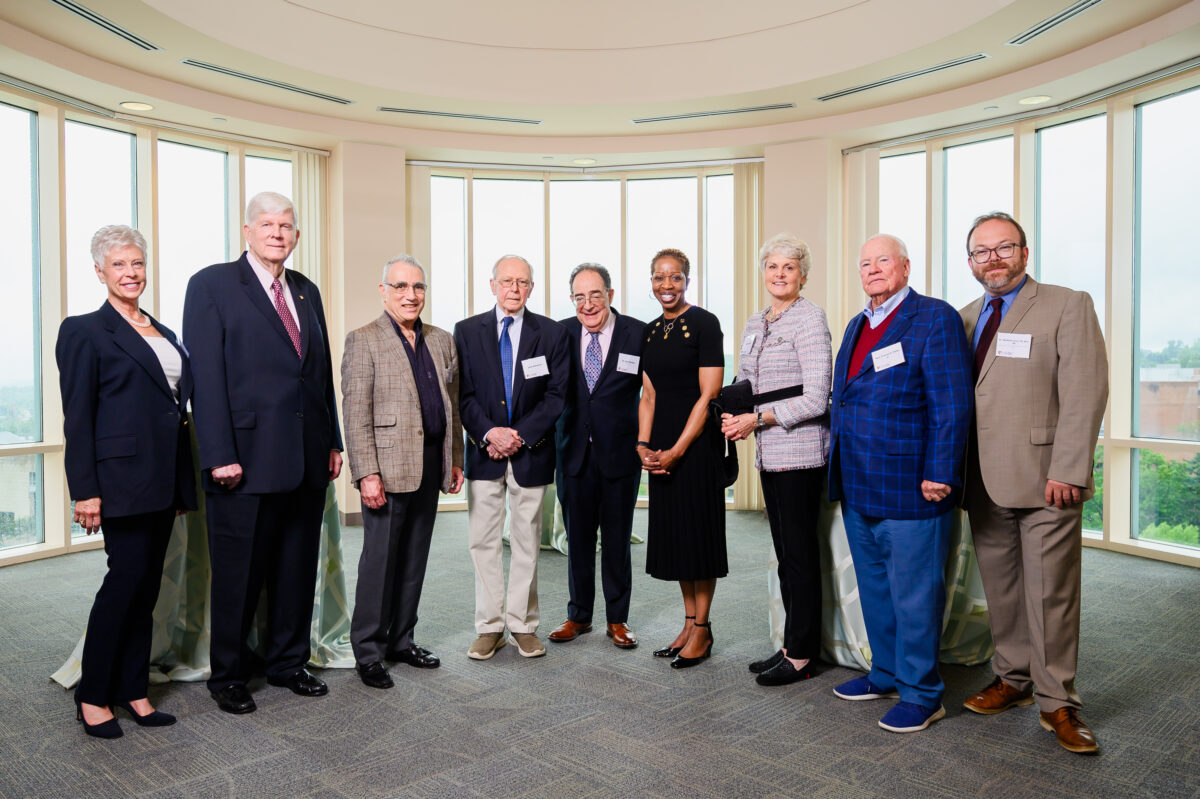 From left to right: Linda Doetsch; George Doetsch, Jr.; Thomas Scalea; John W. Ashworth, III; Jay A. Perman; Valerie Sheares Ashby; Janet Kelly; Francis X. Kelly; Matthew Levy ’00, M.S. ‘08. Photo by Abnet Shiferaw ’11.
“This is a significant milestone that honors John’s enduring legacy and his tremendous contributions to the EDHS department,” said van Dulmen.
This investment will enhance faculty excellence, expand research in emergency health systems, and elevate the academic experience for students in one of UMBC’s most impactful programs.
“This is a big deal in terms of furthering emergency health in Maryland, the nation, and the world,” saidPerman.
Friends, family, colleagues, and former students of Ashworth gathered together on Tuesday, May 13, to celebrate the tremendous legacy of Ashworth and the establishment of this new professorship—a tribute to a man whose career helped shape emergency care in Maryland and whose teaching left a lifelong impression on his students.
“Having an endowed professorship named for you is eternity,” said Thomas Scalea, physician-in-chief at the R Adams Cowley Shock Trauma Center, among other titles. “As long as there is a UMBC, there will be a John Ashworth Professor.”
]]>
Before 1960, the United States didn’t have a shock trauma center. That was until the construction of the R Adams Cowley Shock Trauma Center at the University of Maryland, which marked a turning...
https://umbc.edu/stories/john-ashworth-iii-emergency-health-services/
https://my3.my.umbc.edu/api/v0/pixel/news/150679/guest@my.umbc.edu/8f8119678840f82b3c7bbe0fe13ae6f4/api/pixel
ashworth
edhs
emergency-and-disaster-health-systems
emergency-health-services
impact
magazine
story
UMBC News & Magazine
https://my3.my.umbc.edu/groups/umbc-news-magazine
https://assets1-my.umbc.edu/system/shared/avatars/groups/000/001/943/24435aa6207c452e7bc15cc74b42c7bb/xsmall.png?1748556657
https://assets1-my.umbc.edu/system/shared/avatars/groups/000/001/943/24435aa6207c452e7bc15cc74b42c7bb/original.png?1748556657
https://assets2-my.umbc.edu/system/shared/avatars/groups/000/001/943/24435aa6207c452e7bc15cc74b42c7bb/xxlarge.png?1748556657
https://assets2-my.umbc.edu/system/shared/avatars/groups/000/001/943/24435aa6207c452e7bc15cc74b42c7bb/xlarge.png?1748556657
https://assets3-my.umbc.edu/system/shared/avatars/groups/000/001/943/24435aa6207c452e7bc15cc74b42c7bb/large.png?1748556657
https://assets1-my.umbc.edu/system/shared/avatars/groups/000/001/943/24435aa6207c452e7bc15cc74b42c7bb/medium.png?1748556657
https://assets2-my.umbc.edu/system/shared/avatars/groups/000/001/943/24435aa6207c452e7bc15cc74b42c7bb/small.png?1748556657
https://assets1-my.umbc.edu/system/shared/avatars/groups/000/001/943/24435aa6207c452e7bc15cc74b42c7bb/xsmall.png?1748556657
https://assets2-my.umbc.edu/system/shared/avatars/groups/000/001/943/24435aa6207c452e7bc15cc74b42c7bb/xxsmall.png?1748556657
UMBC News & Magazine
0
0
false
Mon, 16 Jun 2025 08:33:27 -0400
Mon, 16 Jun 2025 08:33:27 -0400
If FEMA didn’t exist, could states handle the disaster response alone?
Written by Ming Xie, assistant professor of emergency health management and public health systems, UMBC.
Imagine a world in which a hurricane devastates the Gulf Coast, and the U.S. has no federal agency prepared to quickly send supplies, financial aid and temporary housing assistance.
Could the states manage this catastrophic event on their own?
Normally, the Federal Emergency Management Agency, known as FEMA, is prepared to marshal supplies within hours of a disaster and begin distributing financial aid to residents who need help.
However, with President Donald Trump questioning FEMA’s future and suggesting states take over recovery instead, and climate change causing more frequent and severe disasters, it’s worth asking how prepared states are to face these growing challenges without help.
What FEMA does
FEMA was created in 1979 with the job of coordinating national responses to disasters, but the federal government has played important roles in disaster relief since the 1800s.
During a disaster, FEMA’s assistance can begin only after a state requests an emergency declaration and the U.S. president approves it. The request has to show that the disaster is so severe that the state can’t handle the response on its own.
FEMA’s role is to support state and local governments by coordinating federal agencies and providing financial aid and recovery assistance that states would otherwise struggle to supply on their own. FEMA doesn’t “take over,” as a misinformation campaign launched during Hurricane Helene claimed. Instead, it pools federal resources to allow states to recover faster from expensive disasters.
During a disaster, FEMA:
- Coordinates federal resources. For example, during Hurricane Ian in 2022, FEMA coordinated with the U.S. Coast Guard, the Department of Defense and search-and-rescue teams to conduct rescue operations, organized utility crews to begin restoring power and also delivered water and millions of meals.
- Provides financial assistance. FEMA distributes billions of dollars in disaster relief funds to help individuals, businesses and local governments recover. As of Feb. 3, 2025, FEMA aid from 2024 storms included US$1.04 billion related to Hurricane Milton, $416.1 million for Hurricane Helene and $112.6 million for Hurricane Debby.
- Provides logistical support. FEMA coordinates with state and local governments, nonprofits such as the American Red Cross and federal agencies to supply cots, blankets and hygiene supplies for emergency shelters. It also works with state and local partners to distribute critical supplies such as food, water and medical aid.
The agency also manages the National Flood Insurance Program, offers disaster preparedness training and helps states develop response plans to improve their overall responses systems.
What FEMA aid looks like in a disaster
When wildfires swept through Maui, Hawaii, in August 2023, FEMA provided emergency grants to cover immediate needs such as food, clothing and essential supplies for survivors.
The agency arranged hotel rooms, rental assistance and financial aid for residents who lost homes or belongings. Its Direct Housing Program has spent $295 million to lease homes for more than 1,200 households. This comprehensive support helped thousands of people begin rebuilding their lives after losing almost everything.
FEMA also helped fund construction of a temporary school to ensure that students whose schools burned could continue their classes. Hawaii, with its relatively small population and limited emergency funds, would have struggled to mount a comparable response on its own.
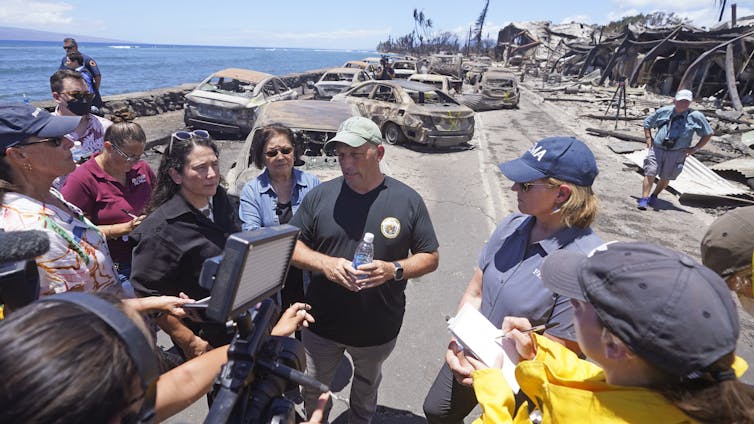 Hawaii Gov. Josh Green, center, and then-FEMA Administrator Deanne Criswell speak to reporters in Lahaina, Hawaii, on Aug. 12, 2023, while assessing the wildfire damage there. AP Photo/Rick Bowmer
Larger states often need help, too. When a 2021 winter storm overwhelmed Texas’ power grid and water infrastructure, FEMA coordinated the delivery of essential supplies, including water, fuel, generators and blankets, following the disaster declaration on Feb. 19, 2021. Within days, it awarded more than $2.8 million in grants to help people with temporary housing and home repairs.
Which states would suffer most without FEMA?
Without FEMA or other federal support, states would have to manage the disaster response and recovery on their own.
States prone to frequent disasters, such as Louisiana and Florida, would face expensive recurring challenges that would likely exacerbate recovery delays and reduce their overall resilience.
Smaller, more rural and less wealthy states that lack the financial resources and logistical capabilities to respond effectively would be disproportionately affected.
“States don’t have that capability built to handle a disaster every single year,” Lynn Budd, director of the Wyoming Office of Homeland Security, told Stateline in an interview. Access to FEMA avoids the need for expensive disaster response infrastructure in each state.
States might be able to arrange regional cooperation. But state-led responses and regional models have limitations. The National Guard could assist with supply distribution, but it isn’t designed to provide fast financial aid, housing or long-term recovery options, and the supplies and the recovery effort still come at a cost.
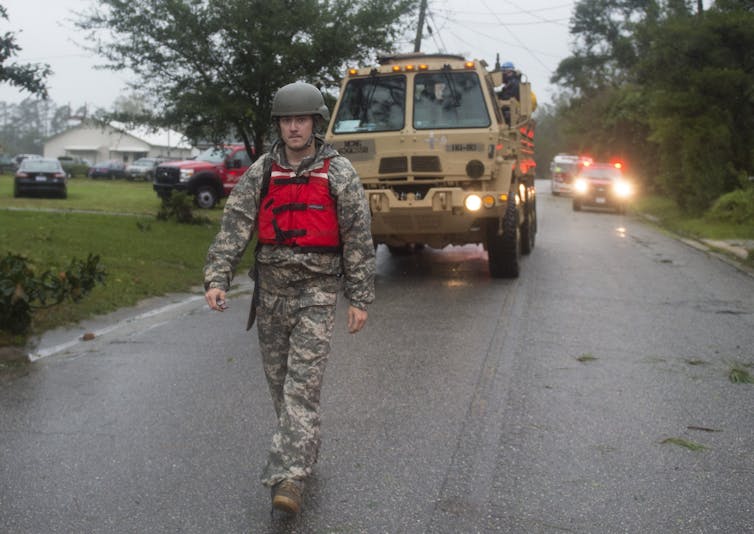 Members of the National Guard and a FEMA search-and-rescue team work together in the disaster response after Hurricane Florence pounded Wilmington, N.C., in September 2018. Andrew Caballero-Reynolds/AFP via Getty Images
Wealthier states might be better equipped to manage on their own, but poorer states would likely struggle. States with less funding and infrastructure would be left relying on nonprofits and community-based efforts. But these organizations are not capable of providing the scope of services FEMA can.
Any federal funding would also be slow if Congress had to approve aid after each disaster, rather than having FEMA already prepared to respond. States would be at the mercy of congressional infighting.
In the absence of a federal response and coordinating role, recovery would be uneven, with wealthier areas recovering faster and poorer areas likely seeing more prolonged hardships.
What does this mean?
Coordinating disaster response is complex, the paperwork for federal assistance can be frustrating, and the agency does draw criticism. However, it also fills an important role.
As the frequency of natural disasters continues to rise due to climate change, ask yourself: How prepared is your state for a disaster, and could it get by without federal aid?
This article is republished from The Conversation under a Creative Commons license. Read the original article and see more than 250 UMBC articles available in The Conversation.
]]>
Written by Ming Xie, assistant professor of emergency health management and public health systems, UMBC. Imagine a world in which a hurricane devastates the Gulf Coast, and the U.S. has no...
https://umbc.edu/stories/if-fema-didnt-exist-could-states-handle-the-disaster-response-alone/
https://my3.my.umbc.edu/api/v0/pixel/news/147189/guest@my.umbc.edu/5d16cf42692e67578f7d00921038968c/api/pixel
cahss
discovery
edhs
magazine
research
story
the-conversation
UMBC News & Magazine
https://my3.my.umbc.edu/groups/umbc-news-magazine
https://assets1-my.umbc.edu/system/shared/avatars/groups/000/001/943/24435aa6207c452e7bc15cc74b42c7bb/xsmall.png?1748556657
https://assets1-my.umbc.edu/system/shared/avatars/groups/000/001/943/24435aa6207c452e7bc15cc74b42c7bb/original.png?1748556657
https://assets2-my.umbc.edu/system/shared/avatars/groups/000/001/943/24435aa6207c452e7bc15cc74b42c7bb/xxlarge.png?1748556657
https://assets2-my.umbc.edu/system/shared/avatars/groups/000/001/943/24435aa6207c452e7bc15cc74b42c7bb/xlarge.png?1748556657
https://assets3-my.umbc.edu/system/shared/avatars/groups/000/001/943/24435aa6207c452e7bc15cc74b42c7bb/large.png?1748556657
https://assets1-my.umbc.edu/system/shared/avatars/groups/000/001/943/24435aa6207c452e7bc15cc74b42c7bb/medium.png?1748556657
https://assets2-my.umbc.edu/system/shared/avatars/groups/000/001/943/24435aa6207c452e7bc15cc74b42c7bb/small.png?1748556657
https://assets1-my.umbc.edu/system/shared/avatars/groups/000/001/943/24435aa6207c452e7bc15cc74b42c7bb/xsmall.png?1748556657
https://assets2-my.umbc.edu/system/shared/avatars/groups/000/001/943/24435aa6207c452e7bc15cc74b42c7bb/xxsmall.png?1748556657
UMBC News & Magazine
4
0
false
Mon, 10 Feb 2025 10:57:18 -0500
Mon, 10 Feb 2025 10:57:18 -0500
Meet a Retriever—Matthew Levy ’00, M.S. ’08, emergency response professional

Meet Matthew J. Levy ’00, M.S. ’08, emergency and disaster health services (EDHS), who has dedicated his career to Maryland communities. His expertise, as a physician of emergency medicine and former paramedic, has made him indispensable in the most challenging national, state, and local emergencies. Matthew was part of an emergency response team that spent 10 days in New York City, assisting in the relief efforts following 9/11. In 2015, he received the Silver Medal of Valor from Howard County Fire and Rescue Services for his role as the second tactical medic to arrive on the scene at the Columbia Mall shooting in January 2014 then transitioned to being the on-scene medical director. In 2017, he was named Emergency Medical Services Physician of the Year by the Maryland Chapter of the American College of Emergency Physicians. Take it away, Matt!
Q: Briefly introduce yourself. What’s one essential thing you’d want another Retriever to know about you?
A: I began my studies at UMBC in 1996, enrolling in the Emergency and Disaster Health Services (EDHS) program. I earned my bachelor’s degree in 2000 and my master’s in 2008 while finishing my residency training as an emergency physician at Johns Hopkins University School of Medicine. I now serve as EDHS’s medical director for the paramedic program, the very department that helped me become the clinician and leader I am today. I am also an associate professor in the Department of Emergency Medicine at Johns Hopkins University School of Medicine.
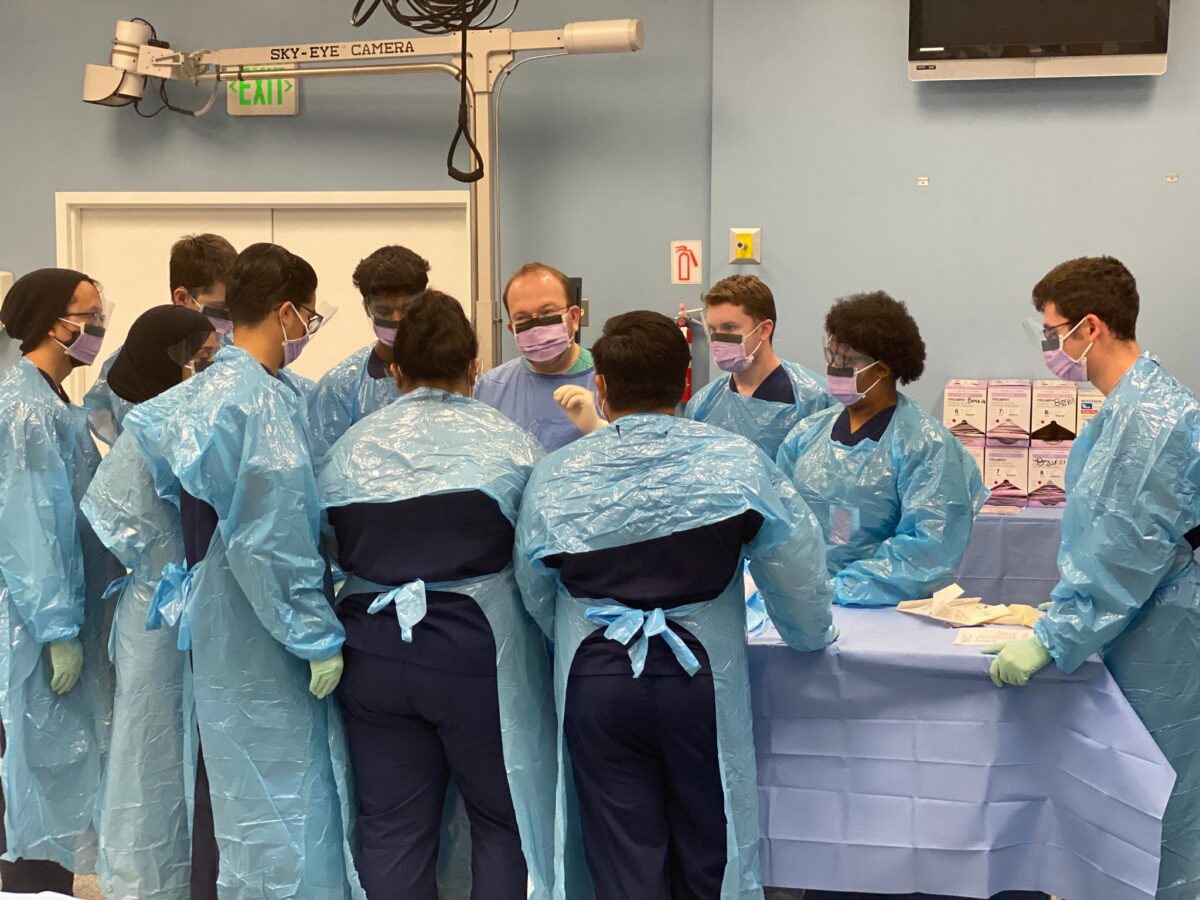 Matthew J. Levy, center, in the lab with students. (Image courtesy of Levy)
Q: What are some of the ways you have brought leading-edge practices to Howard County?
A: In 2016, I was part of the team that launched one of the nation’s first county-wide Stop the Bleed programs in Howard County. This is a national initiative designed to foster resilience and improve patient outcomes by empowering everyday people to recognize and treat life-threatening hemorrhages, which are the leading cause of preventable death in trauma patients. In 2023, I led the implementation of the Whole Blood Program in Howard County, which improves outcomes for critically ill and injured patients suffering from shock by implementing Maryland’s first ground-based EMS blood transfusion program. This program brings life-saving whole blood to the scene of the most critical patients to help give them precious time to get to the hospital for further stabilization.
Q: Tell us about someone in the community who has inspired or supported you, and how they did it.
A: I feel incredibly fortunate to have met so many people at UMBC who have shaped my life and career—from faculty and friends to colleagues and coworkers, specifically, I’d say Dwight Polk, Bill Hathaway, Dr. Rick Bissell, Dr. Jeff Mitchell, Dr. Bruce Walz (all from EDHS), and Dr. Joel Liebman (chemistry). However, the most impactful person has been Dr. J. Lee Jenkins, my wife, whom I met while we were both EDHS undergraduates. We dated through medical school and were married when I was in residency. She is also a physician and a faculty member in the Department of Emergency Medicine at Johns Hopkins University School of Medicine.
I genuinely love taking care of people and helping them. Whether that’s one-on-one as their doctor (or previously as their paramedic) or now as someone responsible for entire EMS systems, the path I’ve chosen…has allowed me to…improve outcomes from emergency medical situations.
Matthew J. Levy ’00, M.S. ’08
EDHS
Q: What is the one thing you’d want a potential student to know about the support you can find at UMBC?
A: At UMBC, we take pride in striving for excellence in everything we do. Being part of the UMBC community means contributing to something greater than oneself. Through leadership, service, teaching, and research, UMBC is making a positive impact on the world. My UMBC education provided an exceptionally strong basis in the sciences, combined with amazing training in leadership, project management, research, and teaching skills. All of these have helped me to achieve success in my career.
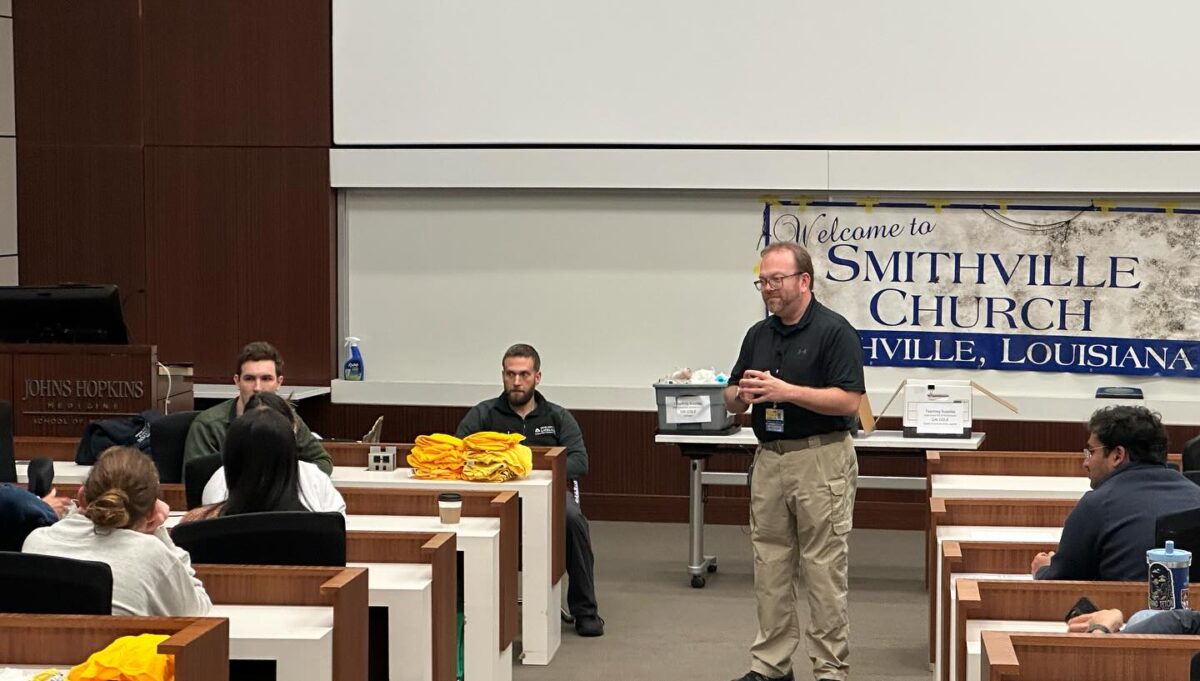 Levy teaching an EMS class. (Image courtesy of Levy)
Q: Tell us about what you love about your academic program.
A: That’s easy… it’s the people of the EDHS department. This department is one of UMBC’s best-kept secrets. It has produced EMS leaders, clinicians, educators, scientists, and practitioners who have played a pivotal role in pioneering, innovating, and redefining the delivery of prehospital care both locally and nationally.
Q: Why did you choose emergency medicine as a career path? What do you enjoy most about it that has kept you working in this field?
A: This passion has led me to many opportunities. In addition to my work at UMBC and Johns Hopkins, I am also the medical director of Howard County Fire and Rescue, the regional medical director for the Maryland Institute for Emergency Medical Services Systems, the tactical physician with the Maryland State Police and Howard County Police, and the founding commander of the Maryland-1 Disaster Medical Assistance Team.
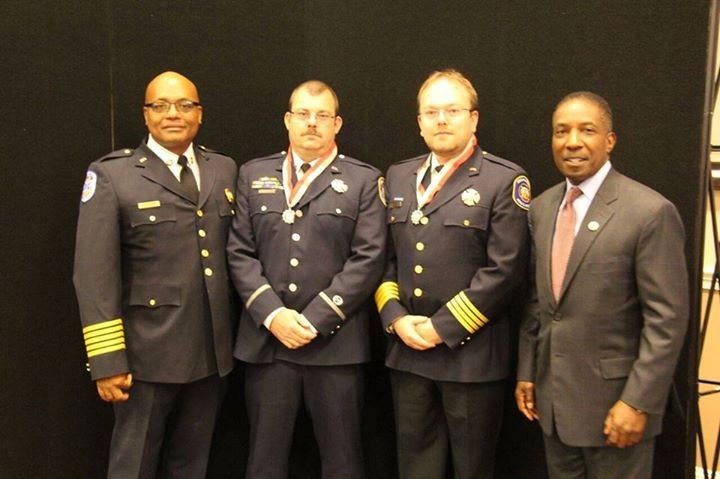 2015 Howard County Medal of Valor recipients. (l-r): John Butler, former fire chief for Howard County, Will Huber, lieutenant at Howard County Government, Levy, and Lonnie Robbins, former chief administrative officer at Howard County Government. (Image by Maryland Institute for Emergency Medical Services Systems)
Q: What advice do you wish you had received as an undergraduate EDHS student, particularly given the rapid changes in healthcare over the past few years?
A: Healthcare isn’t an easy path, but it’s one of the most noble professions and promises a rewarding career. However the journey will be long, so always believe in yourself, and always be your biggest fan and supporter. Surround yourself with the people you aspire to be like and always strive to improve yourself. This is your life to live so be sure to take the time to enjoy the journey along the way. But, don’t enjoy it too much…hard work does pay off! You’ll look back one day, maybe, 10,15, or 20 years or more later, and realize how far you’ve come.
* * * * *
UMBC’s greatest strength is its people. When people meet Retrievers and hear about the passion they bring, the relationships they create, the ways they support each other, and the commitment they have to inclusive excellence, they truly get a sense of our community. That’s what “Meet a Retriever” is all about.
Learn more about how UMBC can help you achieve your goals.
]]>
Meet Matthew J. Levy ’00, M.S. ’08, emergency and disaster health services (EDHS), who has dedicated his career to Maryland communities. His expertise, as a physician of emergency medicine and...
https://umbc.edu/stories/matthew-j-levy-umbc-edhs-outstanding-alum/
https://my3.my.umbc.edu/api/v0/pixel/news/145810/guest@my.umbc.edu/614b684326065eb62af62ef2911659ca/api/pixel
cahss
edhs
impact
magazine
meet-a-retriever
story
UMBC News & Magazine
https://my3.my.umbc.edu/groups/umbc-news-magazine
https://assets1-my.umbc.edu/system/shared/avatars/groups/000/001/943/24435aa6207c452e7bc15cc74b42c7bb/xsmall.png?1748556657
https://assets1-my.umbc.edu/system/shared/avatars/groups/000/001/943/24435aa6207c452e7bc15cc74b42c7bb/original.png?1748556657
https://assets2-my.umbc.edu/system/shared/avatars/groups/000/001/943/24435aa6207c452e7bc15cc74b42c7bb/xxlarge.png?1748556657
https://assets2-my.umbc.edu/system/shared/avatars/groups/000/001/943/24435aa6207c452e7bc15cc74b42c7bb/xlarge.png?1748556657
https://assets3-my.umbc.edu/system/shared/avatars/groups/000/001/943/24435aa6207c452e7bc15cc74b42c7bb/large.png?1748556657
https://assets1-my.umbc.edu/system/shared/avatars/groups/000/001/943/24435aa6207c452e7bc15cc74b42c7bb/medium.png?1748556657
https://assets2-my.umbc.edu/system/shared/avatars/groups/000/001/943/24435aa6207c452e7bc15cc74b42c7bb/small.png?1748556657
https://assets1-my.umbc.edu/system/shared/avatars/groups/000/001/943/24435aa6207c452e7bc15cc74b42c7bb/xsmall.png?1748556657
https://assets2-my.umbc.edu/system/shared/avatars/groups/000/001/943/24435aa6207c452e7bc15cc74b42c7bb/xxsmall.png?1748556657
UMBC News & Magazine
0
0
false
Tue, 19 Nov 2024 11:16:04 -0500
Colonialism’s legacy has left Caribbean nations much more vulnerable to hurricanes
Written by Farah Nibbs, assistant professor of emergency and disaster health systems at UMBC
Long before colonialism brought slavery to the Caribbean, the native islanders saw hurricanes and storms as part of the normal cycle of life.
The Taino of the Greater Antilles and the Kalinago, or Caribs, of the Lesser Antilles developed systems that enabled them to live with storms and limit their exposure to damage.
On the larger islands, such as Jamaica and Cuba, the Taino practiced crop selection with storms in mind, preferring to plant root crops such as cassava or yucca with high resistance to damage from hurricane and storm winds, as Stuart Schwartz describes in his 2016 book “Sea of Storms.”
The Kalinago avoided building their settlements along the coast to limit storm surges and wind damage. The Calusa of southwest Florida used trees as windbreaks against storm winds.
In fact, it was the Kalinago and Taino who first taught the Europeans – primarily the British, Dutch, French and Spanish – about hurricanes and storms. Even the word ‘hurricane’ comes from Huracán, a Taino and Mayan word denoting the god of wind.
But then colonialism changed everything.
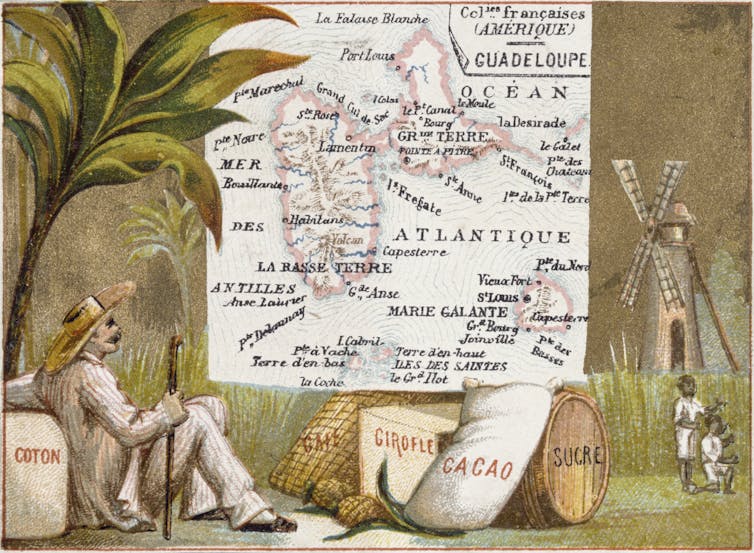 A French advertising card from around 1900 depicts colonial power in Guadeloupe, with a trader sitting comfortably among sacks of cotton, cocoa and coffee while islanders work in the field. Universal History Archive/Universal Images Group via Getty Images
I study natural disasters in the Caribbean, including how history molded responses to disasters today.
The current disaster crisis that the Caribbean’s small islands are experiencing as hurricanes intensify did not start a few decades ago. Rather, the islands’ vulnerability is a direct result of the exploitative systems forced upon the region by colonialism, its legacies of slave-based land policies and ill-suited construction and development practices, and its environmental injustices.
Forcing people into harm’s way
The colonial powers changed how Caribbean people interacted with the land, where they lived and how they recovered from natural hazard events.
Rather than growing crops that could sustain the local food supply, the Europeans who began arriving in the 1600s focused on exploitative extractive economic models and export cash crops through the plantation economy.
They forced Indigenous people off their lands and built settlements along the coast, which made it easier to import enslaved peoples and goods and to export cash crops such as sugar and tobacco to Europe – and also left communities vulnerable to storms. They also developed settlements in low-lying areas, often near rivers and streams, which could provide transportation for agricultural produce but which became flood risks during heavy rains.
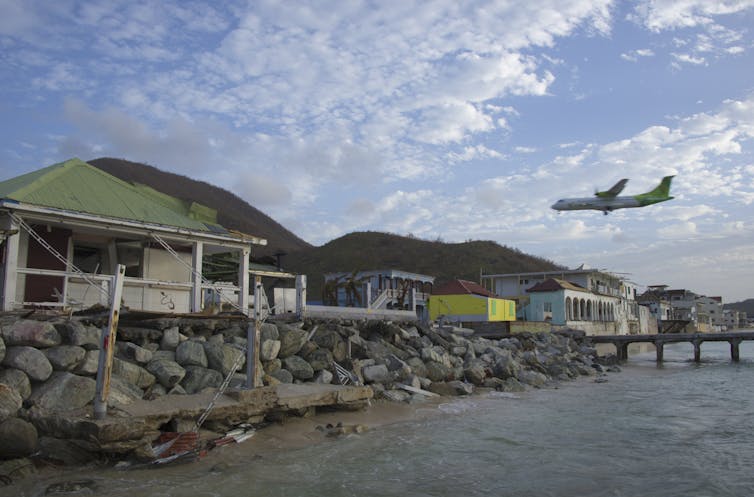 Homes built to the water’s edge in Saint-Martin, an overseas collectivity of France, were devastated when Hurricane Irma hit in 2017. Helene Valenzuela/AFP via Getty Images
Today, more than 70% of the Caribbean’s population lives along the coast, often less than a mile from the shore. These coastlines are not only highly exposed to hurricanes but also to sea-level rise fueled by climate change.
Legacies of slave-based land policies
Colonialism’s legacy of land policies has also made recovery from disasters much harder today.
When colonial powers took over, a few landowners were given control of most of the land, while the majority of the population was forced onto marginal and small areas. The local population had no legal right to the land, as the people did not possess land certificate titles or deeds and were often forced to pay rent to landlords.
After independence, most island governments tried to acquire land from former plantations or estates and to redistribute it to the working class. But these efforts, mainly in the 1960s and ’70s, largely failed to transform land ownership, improve economic development or reduce vulnerability.
One colonial legacy perpetuating vulnerability to this day is known as crown land, or state land. In the English-speaking Caribbean, all land for which there was no land grant was considered property of the British crown. Crown land can be found in every English-speaking island to this day. https://www.youtube.com/embed/YTckM-cNeII?wmode=transparent&start=0 How colonial powers controlled the Caribbean over time.
For example, in Barbuda, all land is vested in the “crown in perpetuity” on behalf of Barbudans. This means that an individual born on the island of Barbuda cannot individually own land.
Instead, land is communally owned, which limits access to the credit and development opportunities that were sorely needed to reconstruct the island after Hurricane Maria in 2017. Most Barbudans were unable to insure their homes because they had no title deeds to their property.
This and other collective land tenure systems created by colonialism places Caribbean residents at greater risk from a variety of natural hazards and limits their ability to seek financial credit for disaster recovery today.
The roots of poor construction
Vulnerability to disasters in the Caribbean also has roots in post-slavery housing construction and subsequent failures to institute proper building codes.
After emancipation from slavery, freed people had no right nor access to land. To build houses, they were forced to lease land from the former enslavers who at a whim could terminate their employment or kick them off the land.
This led to the development of a particular type of housing structure known as chattel houses in countries such as Barbados. These houses are tiny and were constructed in a way in which they could be easily taken apart and loaded onto carts, should the residents be forced out by their former enslavers. Many Bajans still live in these houses today, although quite a few have been converted to restaurants or shops.
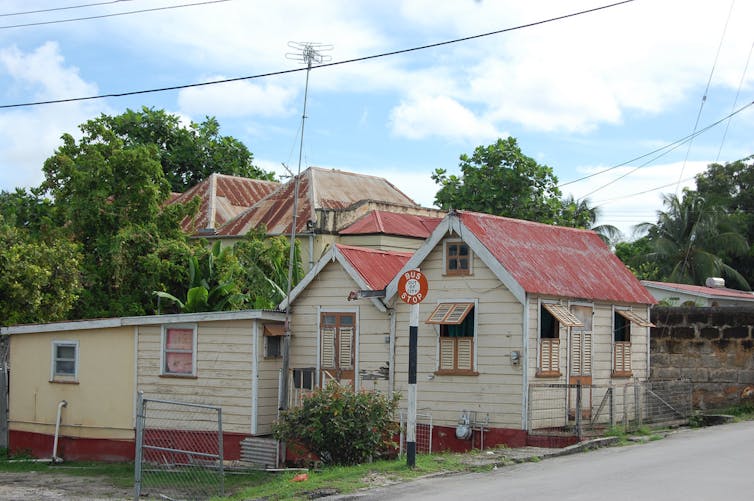 Chattel houses are still used as homes in Barbados. Shardalow via Wikimedia, CC BY
In Aruba, Bonaire and Curaçao, owned by the Dutch, slave huts were built along the coast, on land not suitable for agriculture and easily damaged by storms. These former slave huts are now tourist attractions, but the colonial patterns of settling along the coast has left many coastal communities exposed to hurricane damage and rising seas.
The vulnerability of such houses is not only a result of their exposure to natural hazards but also the underlying social structures.
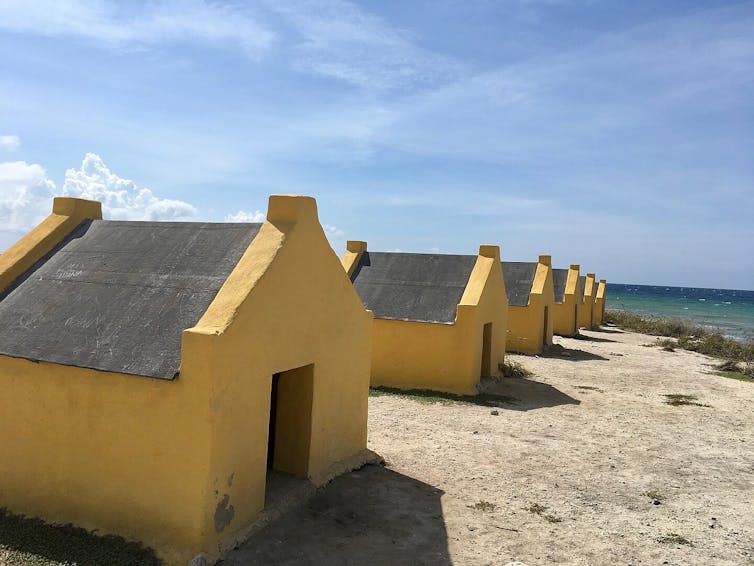 Slave huts were built on the coast in Bonaire, where they were vulnerable to storm surge. Leslie Ket via Wikimedia, CC BY-SA
In many islands today, poorer residents can’t afford protective measures, such as installing storm shutters or purchasing solar-powered generators.
They often live in marginal and disaster-prone areas, such as steep hillsides, where housing tends to be cheaper. Houses in these areas are also often poorly constructed with low-grade materials, such as galvanized sheeting for roofs and walls.
This situation is made worse by the informal and unregulated nature of residential housing construction in the region and the poor enforcement of building codes.
Due to the legacy of colonialism, most housing or building standards or codes in the Commonwealth Caribbean are relics from the United Kingdom and in the French Antilles from France. Building standards across the region lack uniformity and are generally subjective and uncontrolled. Financial limitations and staffing constraints mean that codes and standards more often than not remain unenforced.
Progress, but still a lot of work to do
The Caribbean has made progress in developing wind-related building codes to try to increase resilience in recent years. And while damage from torrential rain is still not properly addressed in most Caribbean building standards, scientific guidance is available through the Caribbean Institute for Meteorology and Hydrology in Barbados.
Individual islands, including Dominica and Saint Lucia, have new minimum building standards for recovery after disasters. The island of Grenada is hoping to guide new construction as it recovers from Hurricane Beryl. Trinidad and Tobago has developed a national land use strategy but has struggled to use it.
Construction standards can help the islands build resilience. But work remains to be done to overcome the legacy of colonial-era land policies and development that have left island towns vulnerable to increasing storm risks.
This article is republished from The Conversation under a Creative Commons license. Read the original article and see more than 250 UMBC articles available in The Conversation.
]]>
Written by Farah Nibbs, assistant professor of emergency and disaster health systems at UMBC Long before colonialism brought slavery to the Caribbean, the native islanders saw hurricanes and...
https://umbc.edu/stories/colonialisms-legacy-left-caribbean-vulnerable-to-hurricanes/
https://my3.my.umbc.edu/api/v0/pixel/news/144976/guest@my.umbc.edu/d4e68de413c4a368d4df374422ffcd90/api/pixel
cahss
cahss-research
discovery
edhs
international
magazine
research
story
UMBC News & Magazine
https://my3.my.umbc.edu/groups/umbc-news-magazine
https://assets1-my.umbc.edu/system/shared/avatars/groups/000/001/943/24435aa6207c452e7bc15cc74b42c7bb/xsmall.png?1748556657
https://assets1-my.umbc.edu/system/shared/avatars/groups/000/001/943/24435aa6207c452e7bc15cc74b42c7bb/original.png?1748556657
https://assets2-my.umbc.edu/system/shared/avatars/groups/000/001/943/24435aa6207c452e7bc15cc74b42c7bb/xxlarge.png?1748556657
https://assets2-my.umbc.edu/system/shared/avatars/groups/000/001/943/24435aa6207c452e7bc15cc74b42c7bb/xlarge.png?1748556657
https://assets3-my.umbc.edu/system/shared/avatars/groups/000/001/943/24435aa6207c452e7bc15cc74b42c7bb/large.png?1748556657
https://assets1-my.umbc.edu/system/shared/avatars/groups/000/001/943/24435aa6207c452e7bc15cc74b42c7bb/medium.png?1748556657
https://assets2-my.umbc.edu/system/shared/avatars/groups/000/001/943/24435aa6207c452e7bc15cc74b42c7bb/small.png?1748556657
https://assets1-my.umbc.edu/system/shared/avatars/groups/000/001/943/24435aa6207c452e7bc15cc74b42c7bb/xsmall.png?1748556657
https://assets2-my.umbc.edu/system/shared/avatars/groups/000/001/943/24435aa6207c452e7bc15cc74b42c7bb/xxsmall.png?1748556657
UMBC News & Magazine
0
0
false
Tue, 22 Oct 2024 11:12:41 -0400
Tue, 22 Oct 2024 11:12:41 -0400
Infrastructure of support after Key Bridge collapse
In 1987, Paul Flinton, then a 23-year-old senior studying at UMBC, decided to make a short documentary focused on the tollbooth workers on the Francis Scott Key Bridge.
The six-minute documentary “One Dollar”—named after the toll’s cost for cars at the time—captures a vehicle’s journey across the bridge from the driver’s point of view in one continuous take. As Flinton ’87, visual arts, drives across the bridge, audio of the tollbooth workers interviewed for the project act as the film’s narrators in which they share some of their experiences as toll operators.
Flinton, who is now a location sound manager for NFL Films, went on to win an award for “One Dollar” from the Maryland State Arts Council following its release. Nearly four decades later, Flinton all but forgot about the film’s existence until learning of the bridge’s collapse following a collision with a malfunctioning cargo ship on March 26, sending eight construction workers into the water and taking the lives of six.
“It hit a nerve,” Flinton told local news after the disaster. “[The film is] sort of a treasure…This captures something that in a lot of ways can’t really happen again.”
Paul Flinton’s short documentary entitled “One Dollar” (1987).
Supporting the impacted families
The Key Bridge opened to traffic in 1977, and regularly 30,000 vehicles crossed the 1.6 mile span over the Patapsco River. An integral part of Baltimore’s beltway, commuters, community members, and experts are now struggling to make sense of the literal change of transportation landscape. Now that the wreckage is completely cleared away and as the eventual construction commences, UMBC experts offer up their expertise and resources to confront the tragedy.
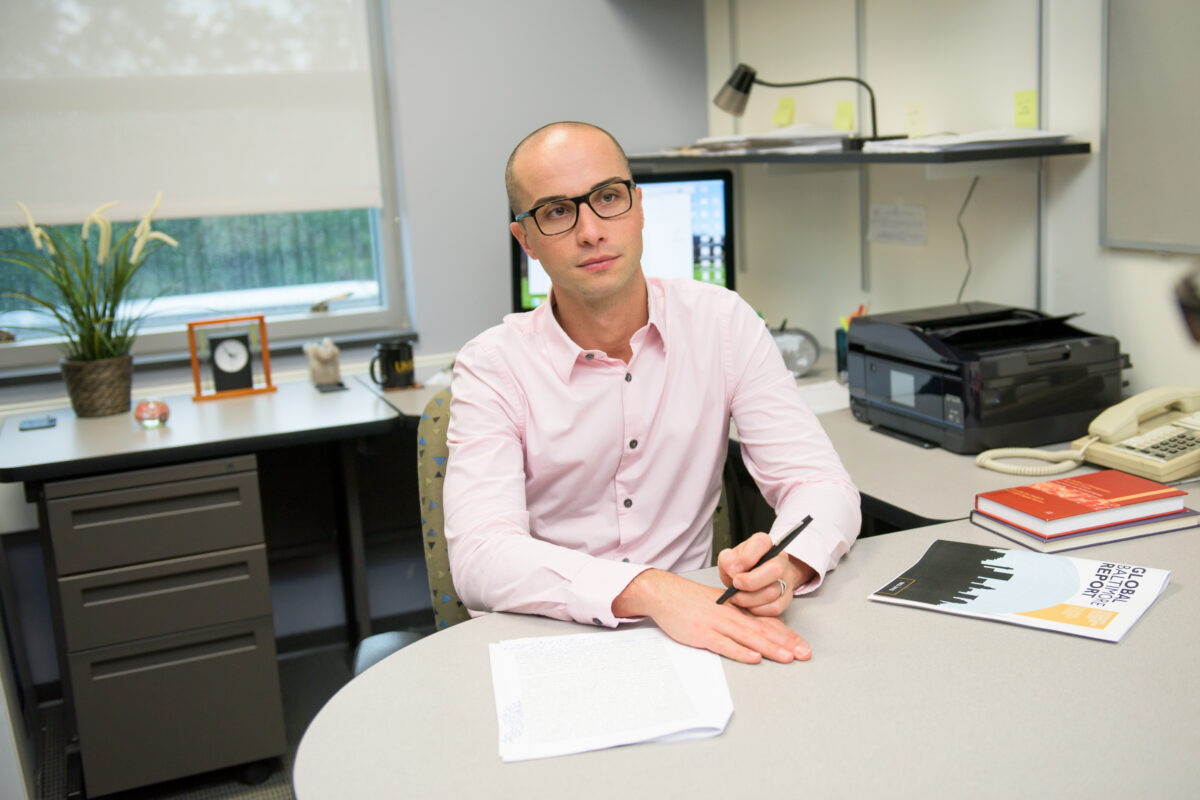 Felipe Filomeno. (Marlayna Demond ’11/UMBC)
After learning that all of the direct victims of the collapse were immigrants from countries throughout Latin America, Felipe Filomeno, associate professor of political science and global studies, immediately sprang into action with fellow members of the grassroots organization Latino Racial Justice Circle (LRJC). Filomeno, who is president of the LRJC, worked with the organization’s leadership team to establish a fundraiser in support of the families of the victims of the bridge collapse.
The crowdfunded campaign initially had a goal of raising about $5,000 for each of the families impacted, Filomeno said. Within hours of going live with the GoFundMe campaign, the organization raised $100,000 from donors located all around the world.
“The fundraiser caught a lot of traction. I have been overwhelmed by the outpouring of solidarity that we got from across the world in that week when the tragedy happened,” says Filomeno.
Following the fundraising success, the group has since directed prospective supporters to the Mayor’s Office of Immigrant Affairs’ Key Bridge Emergency Response Fund. The Mayor’s Office is working with the LRJC and case managers to distribute the funding to the six impacted families.
The tragedy has underlined key issues impacting the Latino immigrant community, challenges that Filomeno amplifies through his community-centered research at UMBC. “[The collapse] has highlighted and publicized to the world issues that we already know exist—the fact that Latino immigrants are over-represented in dangerous occupations,” says Filomeno. “There are higher incidents of work-related accidents among the Latino populations.”
Filomeno’s forthcoming book, Christian Cosmopolitanism: Faith Communities Talk Immigration (Temple University Press, 2024), explores the Honest Conversations on Immigration program he co-developed in 2017 in partnership with the LRJC. The program, Filomeno explains, was designed to build mutual understanding and collaboration between people who are diverse, but share the same religion.
“One of the goals is to build solidarity across differences,” says Filomeno. “The solidarity across differences is a principle that we also see in the Key Bridge fundraiser.”
Through his advocacy and academic scholarship, Filomeno is working to amplify the need for more long lasting efforts to stand in solidarity with Latino immigrant communities beyond moments of tragedy. “Those problems that became evident with the fall of the bridge, those challenges that the Latino immigrant population faces, they are still there,” he says. “To move the needle on those issues, it has to be more than helping those six families at this point in time.”
Examining the environmental impacts of the collapse
The ship that collided into the bridge was carrying 56 containers of hazardous materials, including corrosives, flammables, and lithium-ion batteries. The cargo ship was also carrying more than one million gallons of fuel at the time of the impact. City officials began their investigations into the incident, which included determining the environmental impacts to the Patapsco River and surrounding communities.
Upal Ghosh, professor of chemical, biochemical, and environmental engineering, whose research includes examining the effects of toxic pollutants in soils, sediments, and aquatic environments, was among the experts who weighed in on assessing the potentially hazardous effects of the containers that were resting at the bottom of the river.
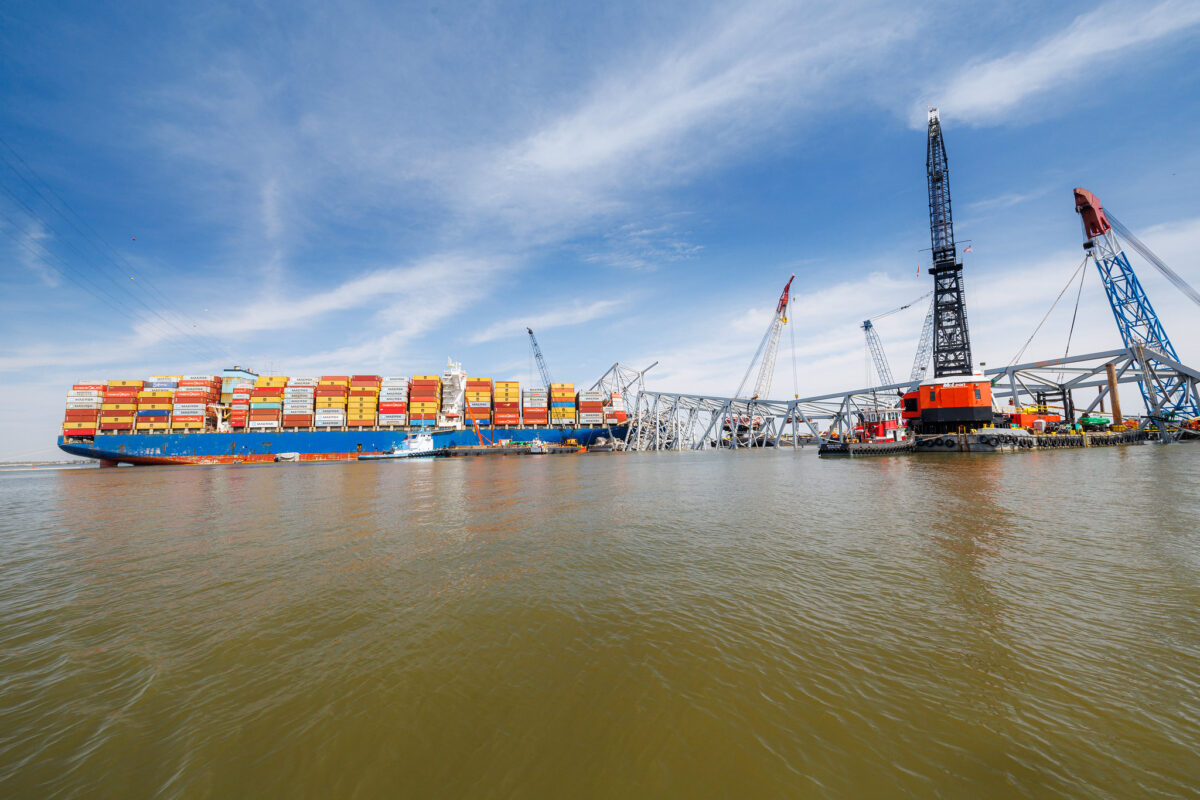 Maryland Comptroller Brooke Lierman and representatives of the Office of the Governor take a tour of the Francis Scott Key Bridge collapse site on a Maryland Department of Natural Resources police boat. (Photo source: Corey Jennings ’10, Maryland Comptroller/Flickr)
Ghosh told the Baltimore Sun days after the collapse that environmental officials’ first priority would likely be making sure none of the intact containers were breached.
“If you have containers that contain oily material, those things will, if they are breached, be releasing over time,” Ghosh said. “I would think if there is a release that goes down into the sediments under the water, it would be a local impact right there.”
Farah Nibbs, assistant professor of emergency and disaster health systems, is also thinking about future ways to contain the effects of similar disasters. Contributing factors to the bridge’s collapse, she says, can be tied to the 2012 expansion and modernization of the Port of Baltimore. Those changes did not happen hand in hand with improvements in safety management needed to accommodate ships of such huge sizes that now were able to port in the city. Risks from collisions, fuel spills, and contamination still lack proper oversight and regulation.
“A novel approach for decision-makers may be to view Maryland’s emergency management and transportation experts and service providers—as well as the physical bridge infrastructure itself—as part of the community’s lifeline systems,” said Nibbs.
More than a disaster
As plans for the bridge’s rebuilding process begins to take shape, Brian Grodsky, professor of political science, shed light on why Maryland Governor Wes Moore likely did not request a presidential disaster declaration in response to the collapse. Presidential disaster declarations, Grodsky said in a local tv news segment, are usually limited to tragedies that involve fires, floods, or explosives.
“Man-made disasters are more likely to be declined [for a presidential disaster declaration] because there is that question of public versus private ownership of the disaster,” he added. “If this ship caught on fire or exploded under the bridge, this would easily be qualified as a major disaster.”
Deborah Rudacille, professor of the practice in English, is well aware of the lives connected to the construction and opening of the Key Bridge. In 2010, she published Roots of Steel: Boom and Bust in an American Mill Town, a book exploring Baltimore’s industrial history of the Sparrows Point steel mill, but also capturing her family’s connection to the mill and Baltimore staples like the Key Bridge.
Rudacille’s mother was one of the original employees—collecting the toll that Flinton documented in his film— when the bridge first opened in 1977, and her brother worked as one of the bridge’s painters.
“They were kind of reminiscing about the fact that everything down there is now gone,” Rudacille told local media about her family. “First the steelworks, now the Key Bridge is gone. It’s like this world that they lived and worked in has vanished completely.”
]]>
In 1987, Paul Flinton, then a 23-year-old senior studying at UMBC, decided to make a short documentary focused on the tollbooth workers on the Francis Scott Key Bridge. The six-minute...
https://umbc.edu/stories/support-after-key-bridge-collapse/
https://my3.my.umbc.edu/api/v0/pixel/news/142431/guest@my.umbc.edu/85f4487fb5eddd76a8baa59270f45a52/api/pixel
cahss
cbee
coeit
discovery
edhs
english
magazine
political-science
spring-2024
story
visual-arts
UMBC News & Magazine
https://my3.my.umbc.edu/groups/umbc-news-magazine
https://assets1-my.umbc.edu/system/shared/avatars/groups/000/001/943/24435aa6207c452e7bc15cc74b42c7bb/xsmall.png?1748556657
https://assets1-my.umbc.edu/system/shared/avatars/groups/000/001/943/24435aa6207c452e7bc15cc74b42c7bb/original.png?1748556657
https://assets2-my.umbc.edu/system/shared/avatars/groups/000/001/943/24435aa6207c452e7bc15cc74b42c7bb/xxlarge.png?1748556657
https://assets2-my.umbc.edu/system/shared/avatars/groups/000/001/943/24435aa6207c452e7bc15cc74b42c7bb/xlarge.png?1748556657
https://assets3-my.umbc.edu/system/shared/avatars/groups/000/001/943/24435aa6207c452e7bc15cc74b42c7bb/large.png?1748556657
https://assets1-my.umbc.edu/system/shared/avatars/groups/000/001/943/24435aa6207c452e7bc15cc74b42c7bb/medium.png?1748556657
https://assets2-my.umbc.edu/system/shared/avatars/groups/000/001/943/24435aa6207c452e7bc15cc74b42c7bb/small.png?1748556657
https://assets1-my.umbc.edu/system/shared/avatars/groups/000/001/943/24435aa6207c452e7bc15cc74b42c7bb/xsmall.png?1748556657
https://assets2-my.umbc.edu/system/shared/avatars/groups/000/001/943/24435aa6207c452e7bc15cc74b42c7bb/xxsmall.png?1748556657
UMBC News & Magazine
2
0
false
Thu, 13 Jun 2024 13:40:41 -0400
Thu, 13 Jun 2024 13:40:41 -0400
Rotting sargassum is choking the Caribbean’s white sand beaches, fueling an economic and public health crisis
Written by Farah Nibbs, assistant professor of emergency and disaster health systems at UMBC
The Caribbean’s sandy beaches, clear turquoise water and vibrant coral reefs filled with an amazing variety of sea creatures have long been the pride of the islands.
The big three – sun, sea and sand – have made this tropical paradise the most tourism-reliant region in the world.
But now, all of that is under threat. The explosive growth of a type of seaweed called sargassum is wreaking havoc on economies, coastal environments and human health across the islands.
I study the intersection of critical infrastructure and disasters, particularly in the Caribbean. The sargassum invasion has worsened since it exploded in the region in 2011. Forecasts and the seaweed already washing up suggest that 2024 will be another alarming year.
 Sargassum levels were already high around many eastern Caribbean islands in late May 2024. Forecasters expect increasing sargassum washing up in June on many of the islands and in the Gulf of Mexico. NOAA and University of South Florida
The Sargasso Sea
The Sargasso Sea is often referred to as a golden, floating rainforest for its vast floating sargassum blooms and the wide variety of sea life that it supports.
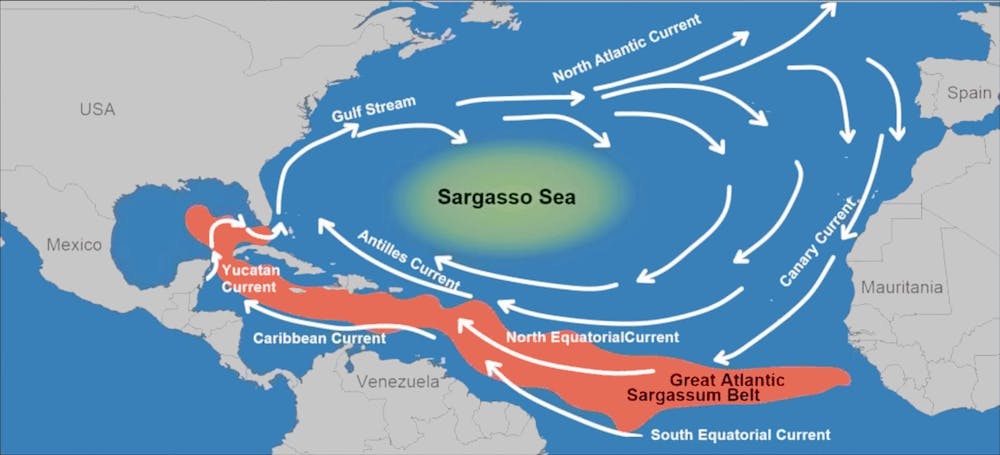
It is the only sea in the world with no land borders. Instead, it is bounded by four Atlantic Ocean currents: the North Atlantic current, the Gulf Stream, the North Atlantic Equatorial Current and the Canary Current.
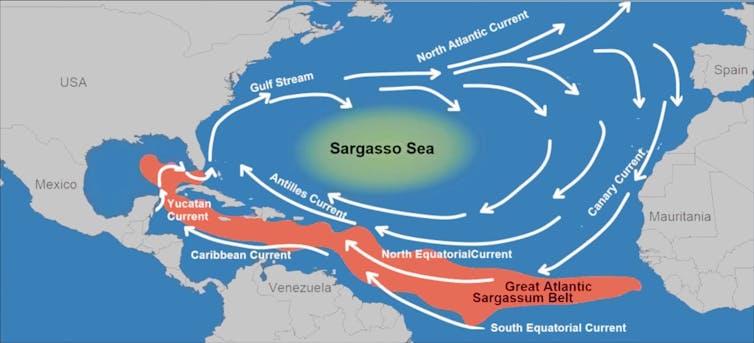 The Great Atlantic sargassum belt and Sargasso Sea. JL López Miranda, et al., via Wikimedia, CC BY
Without human interference, and under normal conditions, sargassum is a good thing. It has existed in the Caribbean for centuries, providing habitat and food for ocean wildlife, including threatened and endangered species such as the porbeagle shark and the anguillid eel.
Conditions over the past decade around the Caribbean Sea, North Atlantic and Gulf of Mexico, however, have been anything but normal.
Since 2011, vast mats of sargassum seaweed have been washing up on Caribbean islands. On shore, they pile up into a dead and stinky mass.
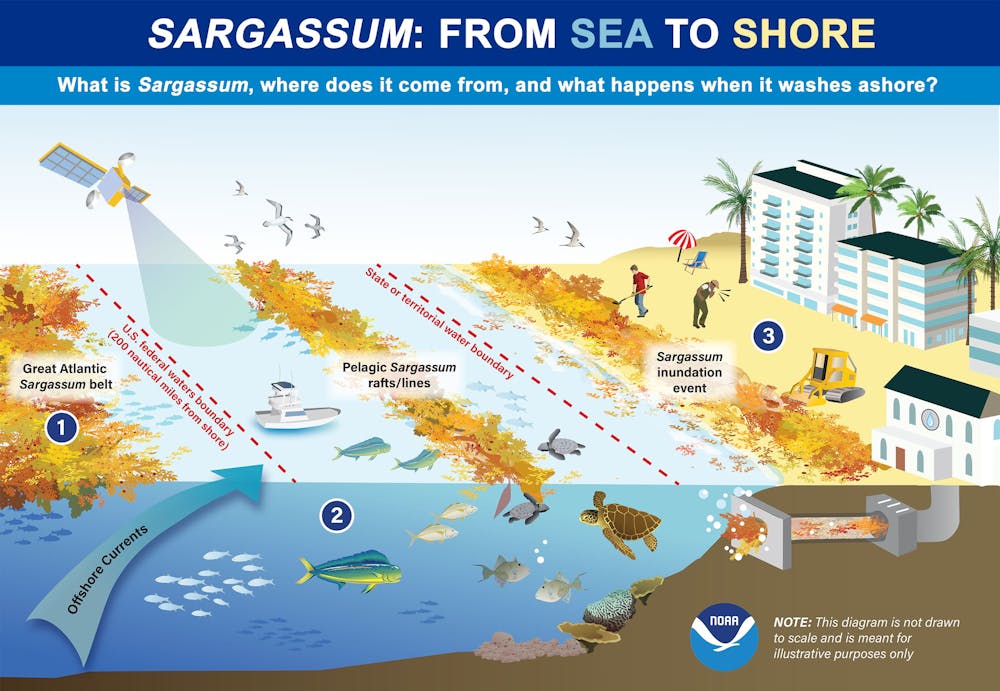
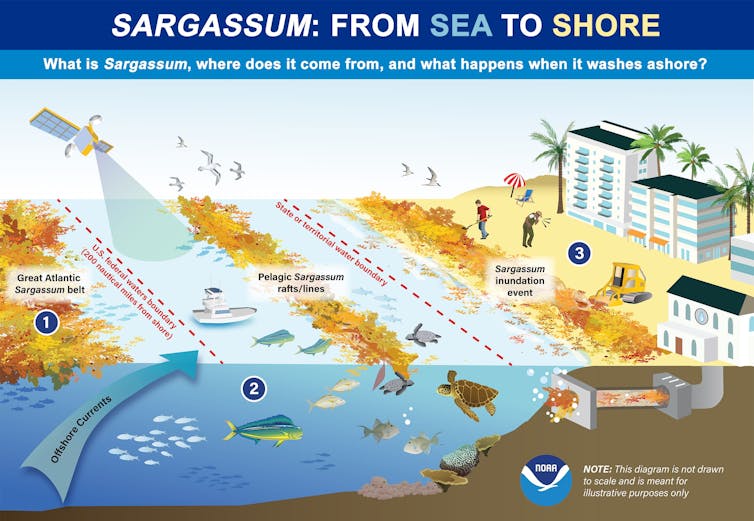 (1) Sargassum rafts from a vast bloom known as the sargassum belt are transported to shore by ocean currents. (2) Free-floating sargassum provides food and habitat. (3) But on shore, it rots and clogs water intakes and beaches. NOAA
These sargassum events have been occurring more frequently and are lasting longer, and the amount of algae is increasing.
The situation has gotten so bad that NOAA created a weekly sargassum inundation risk index in collaboration with the University of South Florida. They have predicted that 2024 will be another terrible year for the Caribbean.
Pollution fuels a hazardous algae bloom
So, what is causing the explosive growth of this algae? Studies have pointed to pollution that the Caribbean region itself has done little to contribute to.
Humans are altering the nutrient cycle by releasing fertilizer runoff and industrial wastewater into rivers, which sends phosphates and nitrates down river systems and out into the oceans. These are key nutrients for plant growth.
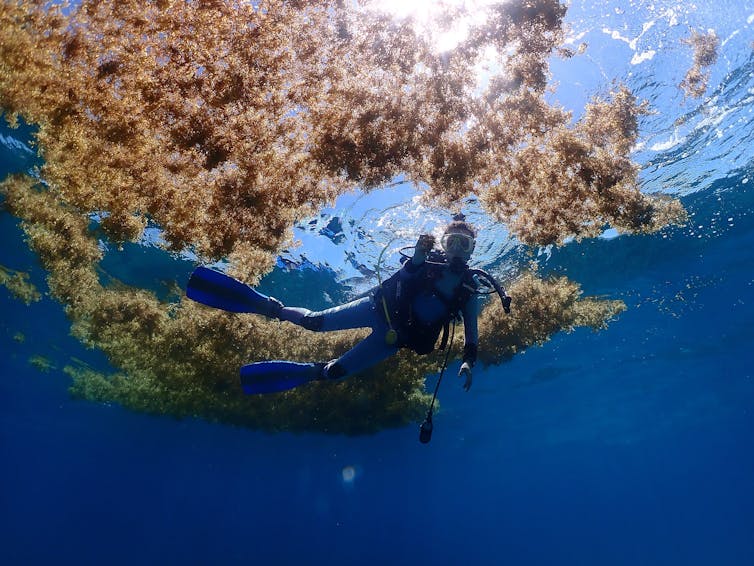 A diver swims below a sargassum mat. Dan Eidsmoe via Flickr, CC BY
A rapid increase in ranching, logging and agriculture along the Amazon River in South America is one source, sending huge amounts of nutrients washing into the river, which terminates in the Caribbean Sea.
Another culprit is the Mississippi River, which carries nutrient-rich effluent from farms and industries into the Gulf of Mexico.
The Congo River in Africa also carries pollutants into the ocean from deforestation, and burning forests can deliver nutrients, such as nitrogen, phosphorus and iron, that further fuel algae growth.
These pollutants are swept up by ocean currents. An increase in phosphate and nitrogen water pollution, combined with warming waters, is believed to have supercharged seaweed normally carried by currents from the Sargasso Sea and created the sargassum belt, which persists across the Caribbean today.
Coasts, fishing industries can’t escape the harm
In small quantities, sargassum plays a role in beach nourishment. But when it inundates coastlines, the rotting seaweed smothers beaches and reduces the amount of oxygen in the water, killing fish and harming fragile coral reefs.
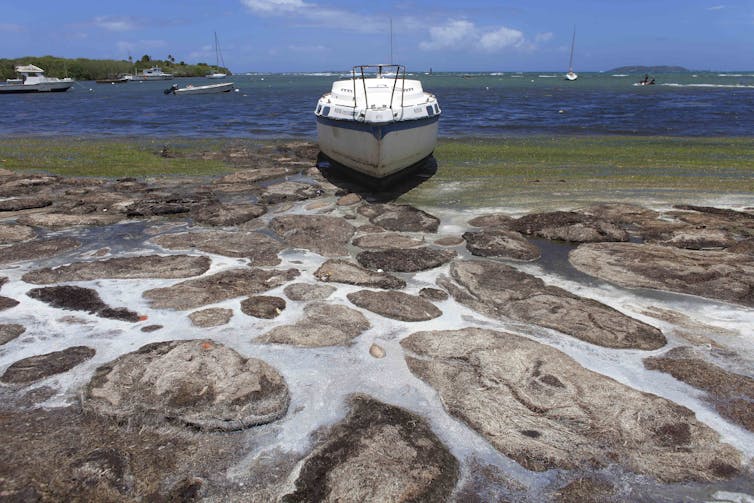 Sargassum can get into boat propellers and make it hard to approach shore. This was Puerto Rico in 2015. AP Photo/Ricardo Arduengo
The massive influx of sargassum has also disrupted fishing operations. Fishers find themselves struggling to maintain their livelihoods as sargassum is diminishing their catch. The seaweed has damaged fishing gear and boat engines and blocked access to harbors and mooring sites.
In addition, sargassum can concentrate arsenic, which poses the risk of contaminating fish and harming people who may eat them.
Sargassum on land is a public health threat
Sargassum rots quickly when stranded. Within 48 hours, it begins to degrade, releasing hydrogen sulphide and ammonia. At certain concentrations, these gases become not only toxic to the marine environment but also to human health.
There have been a growing number of reported cases of neurological, digestive and respiratory disorders associated with the noxious gases being emitted. Guadeloupe’s air-quality monitoring institute Gwad’Air has issued red alerts in recent years because of dangerous levels of hydrogen sulfide gas being emitted from rotting sargassum. https://www.youtube.com/embed/CH7MpiGCdgU?wmode=transparent&start=0 The growing sargassum problem.
The most common symptoms experienced by people living within close proximity to sargassum are headache, dizziness, abdominal pain, cough, rashes, eye disorders and effects on mood. Sargassum odors have led to an increase in nausea and headaches among school-age children. Pregnant women in the region are also being affected, with increasing reported cases of preeclampsia.
Sargassum has also clogged water intake tubes for desalination plants and power plants that use seawater for cooling, causing these units to shut down.
In the British Virgin Islands, sargassum sucked into the main desalination plant in 2023 led to smelly tap water and sporadic water shut-offs. In Virgin Gorda and St. Croix, people have reported smells, a burning sensation and skin rashes from their tap water.
Sargassum blooms also damage economies
Millions of tons of dead and rotting seaweed washing ashore can have widespread economic consequences.
The odor of the rotting seaweed attracts insects, which has been a repellent for some tourists. Cleaning the beaches and disposing of tons of debris, typically in landfills, cost the Caribbean about US$120 million in 2018.
That doesn’t include the economic losses for hotels, fisheries and other businesses.
Small businesses such as Jet Ski rentals that depend on the coast for revenue generation have at times been forced to shut down because of the odorous gases released from the decaying mass.
Is there a solution?
Research and entrepreneurial initiatives are underway to try to deal with the seaweed. Companies have tried turning it into fertilizer, cattle feed and concrete, but so far only at small scale. https://www.youtube.com/embed/5QoGoAWbvEA?wmode=transparent&start=0 Sargassum cleanup in Martinique in 2023.
Governments have made little progress beyond agreeing to some fisheries management rules to protect vulnerable species. A few countries have draft management strategies, but action is typically focused on protecting the tourism industry, with little attention given to fisherfolk and local communities.
The sargassum invasion is fueled by global pollution, and fixing that requires a global response.
The United Nations Environment Program has called for increased international cooperation to understand the causes and impact of sargassum invasions and to find ways to help the countries affected. But so far, the international community has done little to address the pollution at the root of the problem.
This article is republished from The Conversation under a Creative Commons license. Read the original article and see more than 250 UMBC articles available in The Conversation.
]]>
Written by Farah Nibbs, assistant professor of emergency and disaster health systems at UMBC The Caribbean’s sandy beaches, clear turquoise water and vibrant coral reefs filled with an...
https://umbc.edu/stories/rotting-sargassum-in-caribbean/
https://my3.my.umbc.edu/api/v0/pixel/news/142322/guest@my.umbc.edu/0a1136fdd0afa970b5b6f81e5b39211f/api/pixel
cahss
cahss-research
discovery
edhs
magazine
research
story
UMBC News & Magazine
https://my3.my.umbc.edu/groups/umbc-news-magazine
https://assets1-my.umbc.edu/system/shared/avatars/groups/000/001/943/24435aa6207c452e7bc15cc74b42c7bb/xsmall.png?1748556657
https://assets1-my.umbc.edu/system/shared/avatars/groups/000/001/943/24435aa6207c452e7bc15cc74b42c7bb/original.png?1748556657
https://assets2-my.umbc.edu/system/shared/avatars/groups/000/001/943/24435aa6207c452e7bc15cc74b42c7bb/xxlarge.png?1748556657
https://assets2-my.umbc.edu/system/shared/avatars/groups/000/001/943/24435aa6207c452e7bc15cc74b42c7bb/xlarge.png?1748556657
https://assets3-my.umbc.edu/system/shared/avatars/groups/000/001/943/24435aa6207c452e7bc15cc74b42c7bb/large.png?1748556657
https://assets1-my.umbc.edu/system/shared/avatars/groups/000/001/943/24435aa6207c452e7bc15cc74b42c7bb/medium.png?1748556657
https://assets2-my.umbc.edu/system/shared/avatars/groups/000/001/943/24435aa6207c452e7bc15cc74b42c7bb/small.png?1748556657
https://assets1-my.umbc.edu/system/shared/avatars/groups/000/001/943/24435aa6207c452e7bc15cc74b42c7bb/xsmall.png?1748556657
https://assets2-my.umbc.edu/system/shared/avatars/groups/000/001/943/24435aa6207c452e7bc15cc74b42c7bb/xxsmall.png?1748556657
UMBC News & Magazine
0
0
false
Tue, 04 Jun 2024 14:59:07 -0400
Tue, 04 Jun 2024 14:59:07 -0400
Thirsty in paradise: Water crises are a growing problem across the Caribbean islands
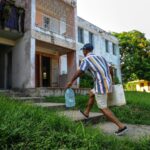
Written by Farah Nibbs, assistant professor of emergency and disaster health systems at UMBC.
In the popular imagination, the Caribbean is paradise, an exotic place to escape to. But behind the images of balmy beaches and lush hotel grounds lies a crisis, the likes of which its residents have never experienced.
Caribbean islands are in a water crisis, and their governments have warned that water scarcity may become the new norm.
Within the past five years, every island in the region has experienced some sort of water scarcity. For example, Trinidad is experiencing its worst drought in recent memory, and residents are under water restrictions through at least the end of June 2024, with fines for anyone who violates the rules.
Dominica, considered the nature island of the Caribbean for its mountain rain forests, is seeing a significant decrease in freshwater resources and increasingly frequent water shortages. In Grenada, known as the spice isle, drought has affected water systems throughout the island.
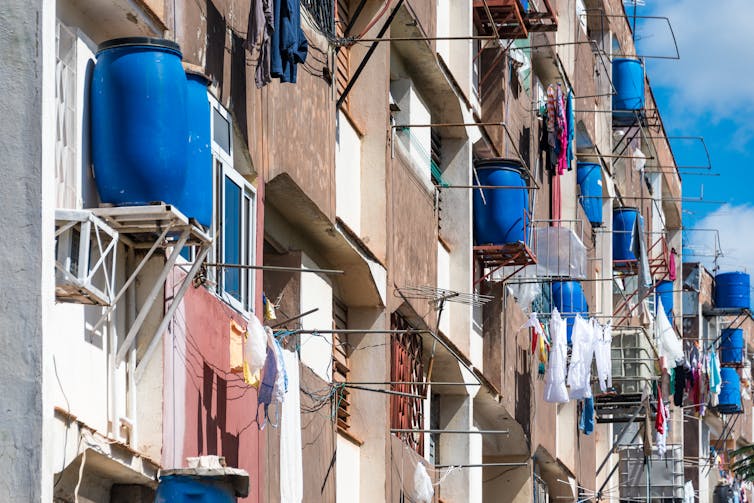 Apartments in Havana, Cuba, store water to provide supplies when the public system isn’t operating. Roberto Machado Noa/LightRocket via Getty Images
Jamaica is also facing water restrictions and has had to resort to water shutoffs in recent years, limiting water availability to a few hours per day in some areas. St. Vincent and St. Kitts have had to ration water. Barbados has experienced several water bans in recent years.
In fact, recent data shows that the Caribbean is one of the most water-stressed regions in the world.
I study the intersection of critical infrastructure and disasters, particularly in the Caribbean. Safe water is essential for all human activity and public health. That’s why it is important to understand the root causes of the water crises and to find effective, affordable ways to improve water supply systems.
3 reasons water demand is outstripping supply in the Caribbean
Changing precipitation patterns and droughts are straining Caribbean water supplies, but water demand has also been outstripping supply for a number of reasons.
1. Rapid urbanization and industrialization
The Caribbean is one of the most rapidly urbanizing regions in the world. About three-quarters of its population lives in cities, and that percentage is rising, adding pressure on public water systems.
At the same time, increased industrialization and commercialization of agriculture have degraded water quality and in some cases encroached on sensitive water catchment areas, affecting the soil’s capacity to retain water.
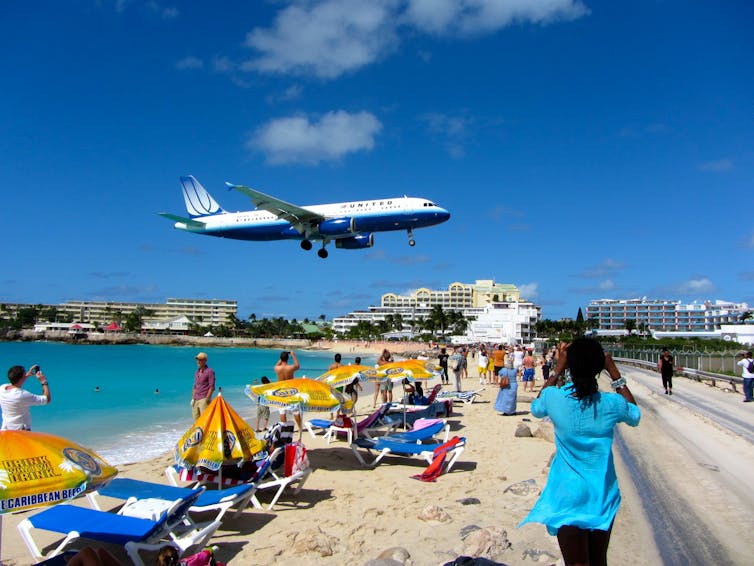 A plane lands in Sint Maarten. Visitors’ water needs come first on many islands that depend on tourism. Richie Diesterheft/Flickr, CC BY-SA
This competing demand for limited fresh water has reduced stream flows and led to water being drawn down from sensitive sources. In Dennery North, a major farming community in St. Lucia, water shortages have left residents collecting water from rivers and other sources for their homes and farms.
Unregulated extraction of groundwater can also worsen the problem. Many islands depend on groundwater.
For example, 90% of water supply in Barbados comes from groundwater, while in Jamaica it is 84%. However, increasing demand and changes in annual rainfall patterns are affecting the ability of aquifers or groundwater to recharge. As a result, supply isn’t keeping up with demand. This is a huge problem for the island of Utila, located off the coast of Honduras, where the current rate of aquifer recharge is only 2.5% annually. For comparison, Barbados has a recharge rate of 15% to 30% of annual rainfall.
2. Water-intensive tourism industry
It’s no secret that the Caribbean is a popular tourist destination, and tourist economies depend on vast quantities of water.
Even during water rationing, water is diverted to hotels and other tourist-dependent sites first. That can leave local residents without water for hours or days at a time and facing fines if they violate use restrictions.
Tourism not only increases the consumption of water but also the pollution of water resources. Building golf courses to attract more tourists further increases tourism’s water demand and runoff.
3. Weak water infrastructure governance
Another problem water systems face is weak governance that leads to excessive loss of treated water before it even reaches the customer.
A well-performing water utility will usually have water losses – known as nonrevenue water – below 30%. In the Caribbean, the average nonrevenue water is 46%, with some as high as 75%.
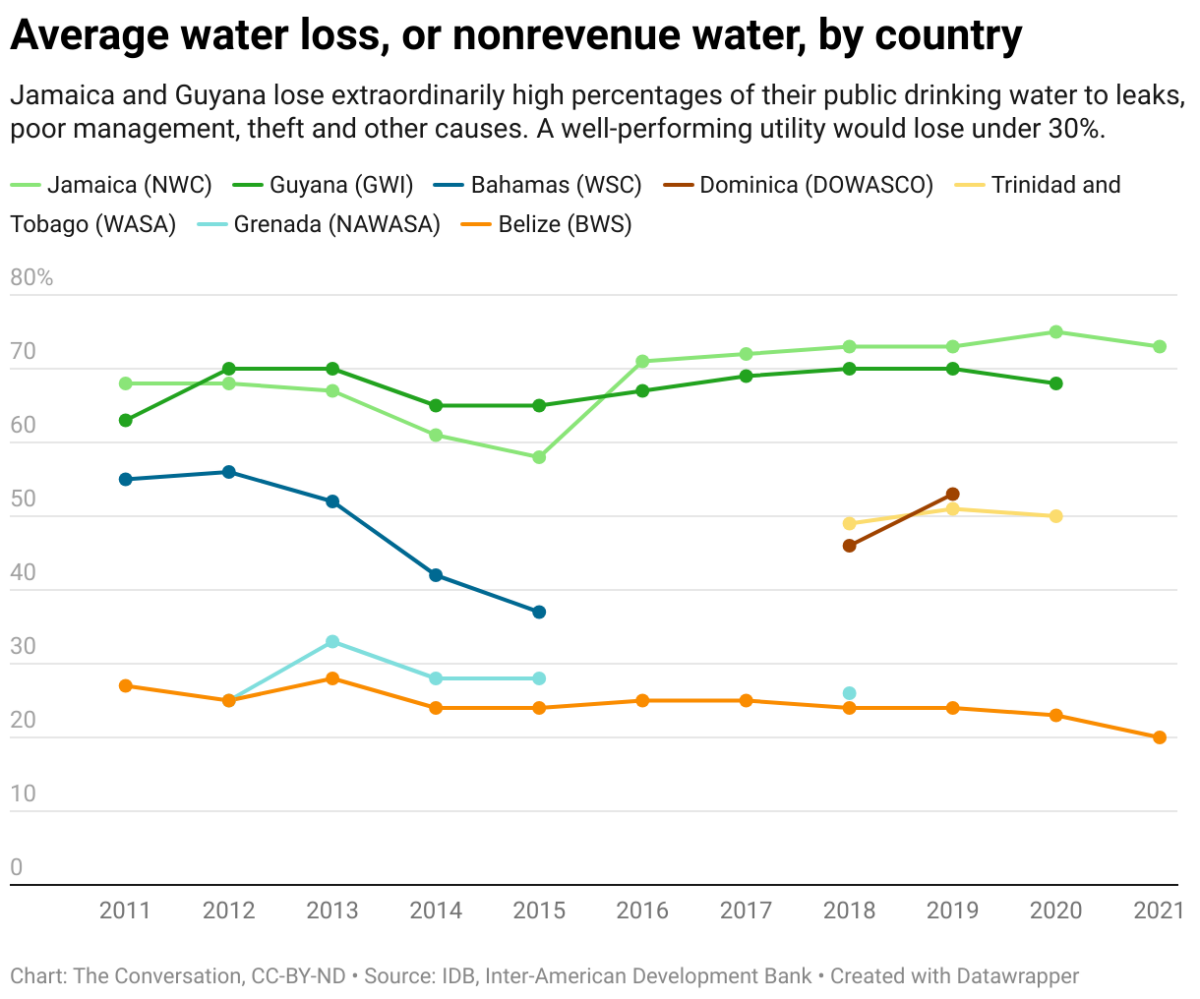
The reasons range from lack of appropriate management practices to metering inaccuracies, leaks and theft.
Climate change and extreme weather worsen water insecurity
These troubled water systems can struggle on good days. Worsening extreme weather, such as hurricanes and flooding, can damage infrastructure, leading to long outages and expensive repairs.
The Caribbean is the second-most disaster-prone region in the world. The islands face frequent earthquakes, landslides, devastating hurricanes and other destructive storms. As global temperatures and sea levels rise, the risk of extreme weather and storm surge causing erosion, flooding and saltwater contamination increases.
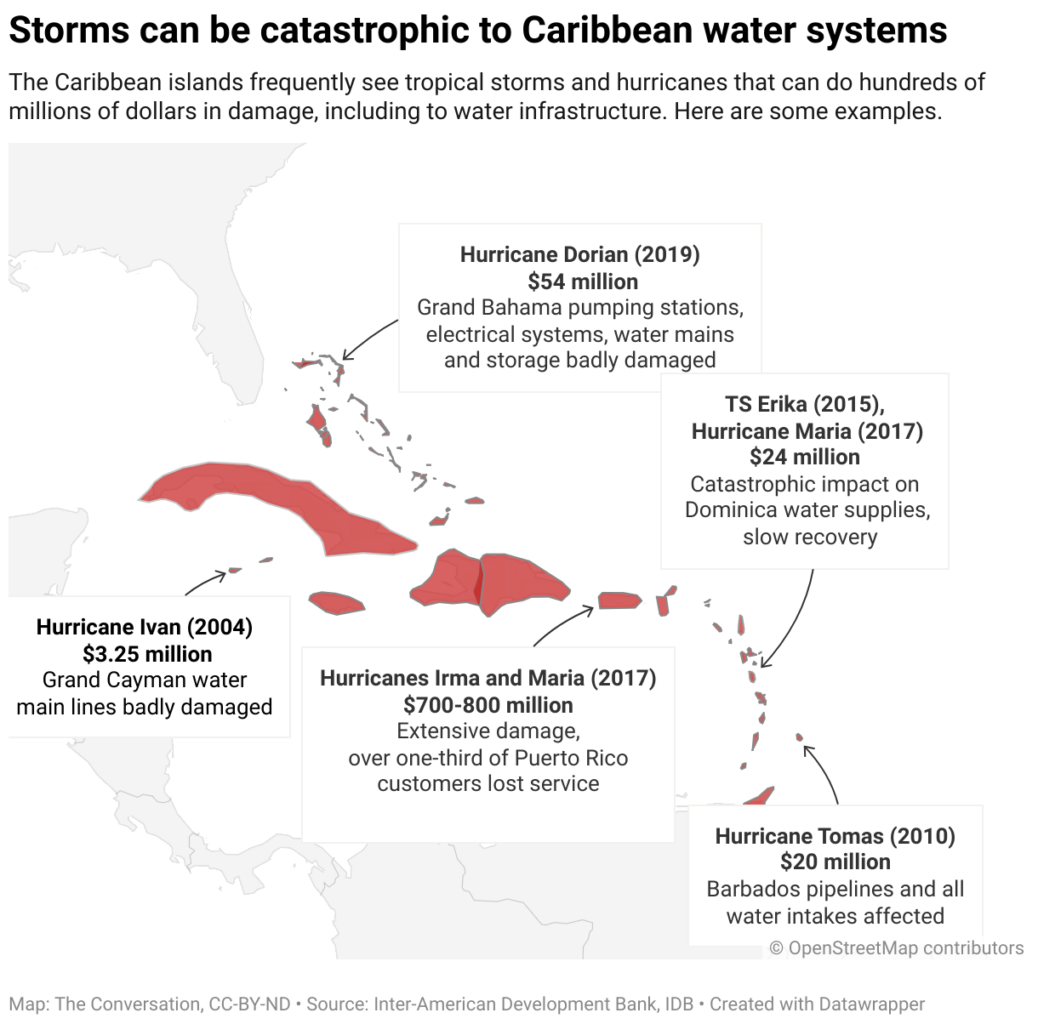
Three months after Hurricane Maria hit in 2017, well over 14% of the Caribbean population was still without potable water. Hurricane Dorian in 2019 left Grand Bahama Utility Co. and the country’s Water and Sewerage Corp. with U$54 million in damages. A year after Dorian, WSC was “still working on restoring operations to pre-Hurricane Dorian levels.”
How hybrid rainwater harvesting can help
Improving water access in the Caribbean means working on all of those challenges. Better governance and investment can help reduce water loss from theft and leaks. Government and social pressure and educating tourists can help reduce waste at hotels and resorts.
There are also ways to increase water supply. One involves being more strategic about how the islands use a practice the region has relied on for centuries: rainwater harvesting.
Rainwater harvesting involves capturing rainwater, often from where it runs off rooftops, and storing it for future use. It can replace irrigation, or the water can be treated for household uses.
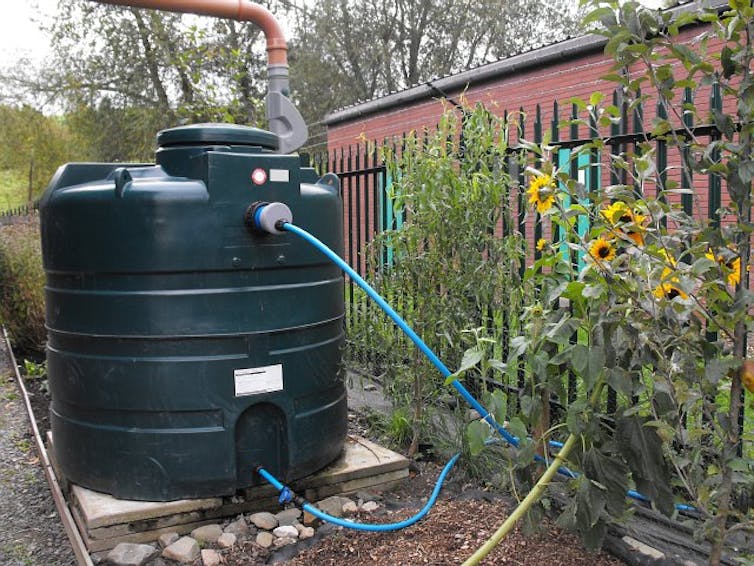 An example of a rainwater harvesting tank. Penny Mayes via Wikimedia, CC BY
Right now, rainwater harvesting is not managed as part of the islands’ centralized water management system. Instead, households bear the cost to finance, build and maintain their own systems. Finding technical support can be difficult, leaving households to contend with seasonal variations in water quantity and quality. That makes risks to drinking water safety difficult to identify.
If rainwater harvesting were instead combined with central water systems in a managed hybrid water model, I believe that could help expand safe rainwater harvesting and address water issues in the region.
It’s a relatively new concept, and integrating decentralized sources can be complex, including requiring separate pipes, but it has potential to reduce water stress. Decentralized sources, such as rainwater harvesting, groundwater or recycled gray water, could serve as backup water sources during shortages or provide water for nonpotable purposes, such as flushing toilets or irrigation, to reduce demand for treated water.
Engineers in Australia are weighing the potential of hybrid water systems to help face the challenges of delivering secure, safe and sustainable water in the future.
Fulfilling a human right in the islands
The World Health Organization has declared that access to a sufficient, safe and reliable water supply is a fundamental human right, and that to accomplish this, water suppliers have a responsibility to provide adequate quantities of potable water.
Hybrid water systems could help ensure water safety and security for island communities and improve the water systems’ resilience amid the human and environmental pressures facing the Caribbean.
This article is republished from The Conversation under a Creative Commons license. Read the original article and see more than 250 UMBC articles available in The Conversation.
]]>
Written by Farah Nibbs, assistant professor of emergency and disaster health systems at UMBC. In the popular imagination, the Caribbean is paradise, an exotic place to escape to. But behind...
https://umbc.edu/stories/water-crises-across-the-caribbean-islands/
https://my3.my.umbc.edu/api/v0/pixel/news/141952/guest@my.umbc.edu/2cb516f87ba22b91979c99be1906408e/api/pixel
cahss
cahss-research
discovery
edhs
magazine
research
story
the-conversation
UMBC News & Magazine
https://my3.my.umbc.edu/groups/umbc-news-magazine
https://assets1-my.umbc.edu/system/shared/avatars/groups/000/001/943/24435aa6207c452e7bc15cc74b42c7bb/xsmall.png?1748556657
https://assets1-my.umbc.edu/system/shared/avatars/groups/000/001/943/24435aa6207c452e7bc15cc74b42c7bb/original.png?1748556657
https://assets2-my.umbc.edu/system/shared/avatars/groups/000/001/943/24435aa6207c452e7bc15cc74b42c7bb/xxlarge.png?1748556657
https://assets2-my.umbc.edu/system/shared/avatars/groups/000/001/943/24435aa6207c452e7bc15cc74b42c7bb/xlarge.png?1748556657
https://assets3-my.umbc.edu/system/shared/avatars/groups/000/001/943/24435aa6207c452e7bc15cc74b42c7bb/large.png?1748556657
https://assets1-my.umbc.edu/system/shared/avatars/groups/000/001/943/24435aa6207c452e7bc15cc74b42c7bb/medium.png?1748556657
https://assets2-my.umbc.edu/system/shared/avatars/groups/000/001/943/24435aa6207c452e7bc15cc74b42c7bb/small.png?1748556657
https://assets1-my.umbc.edu/system/shared/avatars/groups/000/001/943/24435aa6207c452e7bc15cc74b42c7bb/xsmall.png?1748556657
https://assets2-my.umbc.edu/system/shared/avatars/groups/000/001/943/24435aa6207c452e7bc15cc74b42c7bb/xxsmall.png?1748556657
UMBC News & Magazine
0
0
false
Tue, 14 May 2024 08:31:51 -0400
Tue, 14 May 2024 08:31:51 -0400
New name for UMBC’s emergency health services department reflects broadened scope of disaster health systems
The increasing impact of global disasters on health systems has created a growing need for experts to help manage disaster risks and reduce their impact. In keeping with that demand, UMBC’s emergency health services (EHS) department has changed its name to the Department of Emergency and Disaster Health Systems (EDHS) to reflect the scope of research, teaching, and learning of emergency and disaster health systems covered in its programs. The new name also acknowledges the scholarship happening at the graduate level.
 Lauren Clay, EDHS associate professor and department chair
“Our new department name signifies our commitment to emergency and disaster health education,” says Lauren Clay, associate professor of emergency and disaster health systems and department chair, who has received several grants from the National Science Foundation in recent years to specifically address the understanding and monitoring of food availability, acceptability, and accessibility during disasters. “We prepare leaders that are ready to tackle the complex and evolving hazards facing communities across the United States and the world,” explains Clay.
UMBC’s EDHS department is rising to the challenge by equipping students with the skills needed to pursue careers as emergency preparedness coordinators, community engagement specialists, emergency communications supervisors, or analysts. Undergraduate students can now enroll in classes that focus on disaster management in healthcare, public health, and emergency management organizations, in addition to emergency health services classes.
UMBC’s EHS department has a long history of preparing students to enter careers where they are ready to respond to local disasters like Ellicott City’s most recent floods and international disasters, like the Philippines’s Typhoon Haiyan. The EHS baccalaureate program began in 1980 with the goal of producing the most comprehensively educated individuals capable of performing tasks within the broad scope of the emergency healthcare field as leaders, managers, and providers.
The graduate program for emergency health services, the first in the nation, began a year later. It remains the largest program of its type available in the United States. Next year, the department is planning to offer several new graduate and undergraduate classes on a range of disaster health systems topics.
“The department has offered emergency health services and disaster management programs for decades. The former name did not fully capture the breadth of those offerings,” explains Clay. “We wanted to make sure that students and our colleagues know about our programs that prepare students to work in various professions addressing emergency and disaster health.”
Learn more about what EDHS has to offer.
]]>
The increasing impact of global disasters on health systems has created a growing need for experts to help manage disaster risks and reduce their impact. In keeping with that demand, UMBC’s...
https://umbc.edu/stories/umbcs-emergency-and-disaster-health-systems/
https://my3.my.umbc.edu/api/v0/pixel/news/138499/guest@my.umbc.edu/947065f07b3d26084eb4fbcab6875d06/api/pixel
cahss
cahssresearch
edhs
news
policy-and-society
research
story
UMBC News & Magazine
https://my3.my.umbc.edu/groups/umbc-news-magazine
https://assets1-my.umbc.edu/system/shared/avatars/groups/000/001/943/24435aa6207c452e7bc15cc74b42c7bb/xsmall.png?1748556657
https://assets1-my.umbc.edu/system/shared/avatars/groups/000/001/943/24435aa6207c452e7bc15cc74b42c7bb/original.png?1748556657
https://assets2-my.umbc.edu/system/shared/avatars/groups/000/001/943/24435aa6207c452e7bc15cc74b42c7bb/xxlarge.png?1748556657
https://assets2-my.umbc.edu/system/shared/avatars/groups/000/001/943/24435aa6207c452e7bc15cc74b42c7bb/xlarge.png?1748556657
https://assets3-my.umbc.edu/system/shared/avatars/groups/000/001/943/24435aa6207c452e7bc15cc74b42c7bb/large.png?1748556657
https://assets1-my.umbc.edu/system/shared/avatars/groups/000/001/943/24435aa6207c452e7bc15cc74b42c7bb/medium.png?1748556657
https://assets2-my.umbc.edu/system/shared/avatars/groups/000/001/943/24435aa6207c452e7bc15cc74b42c7bb/small.png?1748556657
https://assets1-my.umbc.edu/system/shared/avatars/groups/000/001/943/24435aa6207c452e7bc15cc74b42c7bb/xsmall.png?1748556657
https://assets2-my.umbc.edu/system/shared/avatars/groups/000/001/943/24435aa6207c452e7bc15cc74b42c7bb/xxsmall.png?1748556657
UMBC News & Magazine
1
0
false
Mon, 29 Jan 2024 17:13:19 -0500
Mon, 29 Jan 2024 17:13:19 -0500